WO2012056826A1 - 有害物質含有水の処理方法および処理装置 - Google Patents
有害物質含有水の処理方法および処理装置 Download PDFInfo
- Publication number
- WO2012056826A1 WO2012056826A1 PCT/JP2011/071109 JP2011071109W WO2012056826A1 WO 2012056826 A1 WO2012056826 A1 WO 2012056826A1 JP 2011071109 W JP2011071109 W JP 2011071109W WO 2012056826 A1 WO2012056826 A1 WO 2012056826A1
- Authority
- WO
- WIPO (PCT)
- Prior art keywords
- sludge
- water
- containing water
- solid
- soluble metal
- Prior art date
- Legal status (The legal status is an assumption and is not a legal conclusion. Google has not performed a legal analysis and makes no representation as to the accuracy of the status listed.)
- Ceased
Links
Images


Classifications
-
- C—CHEMISTRY; METALLURGY
- C02—TREATMENT OF WATER, WASTE WATER, SEWAGE, OR SLUDGE
- C02F—TREATMENT OF WATER, WASTE WATER, SEWAGE, OR SLUDGE
- C02F1/00—Treatment of water, waste water, or sewage
- C02F1/28—Treatment of water, waste water, or sewage by sorption
- C02F1/281—Treatment of water, waste water, or sewage by sorption using inorganic sorbents
-
- C—CHEMISTRY; METALLURGY
- C02—TREATMENT OF WATER, WASTE WATER, SEWAGE, OR SLUDGE
- C02F—TREATMENT OF WATER, WASTE WATER, SEWAGE, OR SLUDGE
- C02F2101/00—Nature of the contaminant
- C02F2101/10—Inorganic compounds
- C02F2101/12—Halogens or halogen-containing compounds
- C02F2101/14—Fluorine or fluorine-containing compounds
Definitions
- the present invention relates to a method and apparatus for treating water containing harmful substances, and more specifically, a treatment system for removing these harmful substances from waste water containing harmful substances such as fluorine, boron, nitrogen compounds, phosphorus and heavy metals.
- the present invention relates to a treatment system that is excellent in solid-liquid separation of sludge incorporating toxic substances, and that sludge settles in a short time to remove toxic substances.
- Patent Document 1 discloses that a layered double hydroxide is produced by adding a divalent metal ion and a trivalent metal ion to wastewater containing fluorine to produce the layered double hydroxide. A treatment method for incorporating fluorine between the two layers is described.
- Patent Document 2 an acidic solution containing aluminum ions and magnesium ions and an alkaline solution containing alkali are mixed, and no time is left after the mixing of the acidic solution and the alkaline solution is completed.
- Patent Document 2 By immediately removing or neutralizing water, the general formula: Mg 2+ 1-x Al 3+ x (OH) 2 (A n ⁇ ) x / n ⁇ mH 2 O (A n ⁇ is an anion)
- a n ⁇ is an anion
- the conventional treatment method described above is a method for removing fluorine by producing a layered double hydroxide such as hydrotalcite, but has a problem that the treatment time is prolonged due to poor sedimentation of the produced sludge.
- the treatment method of Patent Document 1 focuses on the recovery of the fluorine-containing emulsifier, and the ability to remove heavy metals is unclear.
- the anion exchange capacity is enhanced by controlling the crystallite size of the hydrotalcite-like substance to 20 nm or less, and the adsorption effect on chromium is shown for heavy metal ions. The ability to remove heavy metals other than chromium is unclear.
- the present invention solves the problem of inferior sedimentation of the produced sludge in the above-described conventional treatment method, and provides a treatment system excellent in the adsorption effect on fluorine and the sedimentation of the produced sludge. Moreover, the removal effect of boron, a nitrogen compound, phosphorus, and heavy metals is also excellent, Preferably, the processing system excellent in the removal effect of harmful substances, such as a boron, a nitrogen compound, phosphorus, and heavy metals, with fluorine is provided.
- a first aspect of the present invention includes a step of adding a hardly soluble metal oxide and a soluble metal compound, which are components of a layered double hydroxide, to harmful substance-containing water, and the hardly soluble metal oxide and the soluble metal compound.
- a method for treating harmful substance-containing water comprising: a solid-liquid separation step of removing a harmful substance taken into the sludge out of the system by solid-liquid separation.
- part or all of the solid-liquid separated sludge is returned to the reaction step, and the returned sludge is used to form a layered double hydroxide.
- This is a method for treating water containing harmful substances.
- a third aspect of the present invention is a method for treating harmful substance-containing water according to the first or second aspect, wherein the hardly soluble metal oxide is magnesium oxide, and the soluble metal compound is a soluble aluminum salt.
- the hardly soluble metal oxide is magnesium oxide
- the soluble metal compound is a soluble aluminum salt.
- a method for treating harmful substance-containing water according to any one of the first to third aspects, wherein the harmful substance is any one of fluorine, boron, nitrogen compounds, phosphorus, and heavy metals.
- This is a method for treating harmful substance-containing water, wherein one or two or more kinds are produced, and a slurry containing sludge incorporating the harmful substances is generated and solid-liquid separated.
- a method for treating harmful substance-containing water according to any one of the first to fourth aspects per 1 L of harmful substance-containing water having a fluorine concentration of 1 to 50 mg / L.
- This is a method for treating harmful substance-containing water in which 0.05 to 10 g / L of magnesium oxide and a soluble aluminum salt are added so that the aluminum concentration in water is 10 to 1000 mg / L and the reaction is carried out at a pH of 7 to 11 in a reaction vessel.
- a sixth aspect of the present invention is a method for treating a hazardous substance according to any one of the first to fifth aspects, and when the slurry containing the generated sludge is allowed to stand, the stable volume after 30 minutes is 40.
- % Is a method of treating harmful substance-containing water that is less than or equal to%.
- the slurry containing sludge is allowed to stand in the solid-liquid separation step, and after 30 minutes, the sludge volume after sedimentation (sludge sediment volume) is 40% or less of the initial slurry volume. Become.
- a seventh aspect of the present invention is a method for treating a hazardous substance according to any one of the first to sixth aspects, wherein the pretreatment for reducing harmful substances and interfering substances contained in the harmful substance-containing water (raw water)
- a method for treating hazardous substance-containing water is provided, wherein a process is provided, and a hardly soluble metal oxide and a soluble metal compound as components of a layered double hydroxide are added to pretreated harmful substance-containing water.
- harmful substances contained in the raw water containing harmful substances are reduced, and components that hinder uptake of harmful substances by the layered double hydroxide are reduced.
- An eighth aspect of the present invention is a method for treating a hazardous substance according to any one of the first to seventh aspects, wherein a post-treatment step for post-treating treated water obtained by solid-liquid separation of sludge from the slurry is provided. This is a method for treating water containing harmful substances.
- a ninth aspect of the present invention is a treatment apparatus for hazardous substance-containing water, comprising an addition tank for adding a chemical to the harmful substance-containing water, and a slurry containing sludge by reacting the added chemical with the harmful substance-containing water.
- a reaction tank to be generated and a solid-liquid separation tank for separating sludge in the generated slurry from water are connected in order by a pipe line, and each supply means for toxic substance-containing water and soluble metal compound is provided in the addition tank.
- Each of the reaction tanks is provided with means for supplying a hardly soluble metal oxide and a pH adjuster, and the solid-liquid separation tank is connected to the separated sludge and the treated water discharge pipe, Toxic substance-containing water to which a soluble metal compound is added in the addition tank is introduced into the reaction tank, and the hardly soluble metal oxide and the pH adjuster are added in the reaction tank, and the surface of the hardly soluble metal oxide is reacted by the reaction under alkaline conditions.
- a toxic substance-containing water treatment apparatus characterized in that a slurry containing sludge formed with a particulate double hydroxide is generated, and the slurry containing the sludge is introduced into a solid-liquid separation tank and the sludge is settled and separated. It is.
- a return pipeline from the solid-liquid separation tank to the reaction tank is connected, and the sludge separated into solid and liquid Part or all of the above is a treatment apparatus for harmful substance-containing water that is returned to the reaction tank through the return conduit.
- a return pipeline from the solid-liquid separation tank to the reaction tank is connected, and the insoluble metal is separated from the separated sludge.
- the 2nd addition tank which adds an oxide is the processing apparatus of the harmful
- the sludge to be generated is excellent in settling properties.
- the stable volume after 30 minutes is 40% or less.
- solid-liquid separation can be performed in a short time, and the solid-liquid separation tank can be downsized.
- the treatment system of the present invention is excellent in the effect of removing fluorine, and easily reduces the fluorine concentration in the wastewater to below the drainage standard [fluorine 8 mg / L (public water area other than sea area), fluorine 15 mg / L (sea area)]. Can be reduced. Furthermore, by returning the separated sludge to the reaction step, the effect of removing fluorine can be enhanced, and the fluorine concentration in the waste water can be easily reduced to the environmental standard (0.8 mg / L or less). In addition, harmful substances such as boron, nitrogen compounds, phosphorus, and heavy metals can be removed simultaneously with fluorine.
- the treatment method of the present invention comprises a step of adding a hardly soluble metal oxide and a soluble metal compound, which are components of a layered double hydroxide, to water containing harmful substances, the above-mentioned hardly soluble metal oxide, a soluble metal compound and harmful substances.
- harmful substances contained in the water to be treated can be removed out of the water system.
- the method for treating toxic substance-containing water includes a step of returning a part or all of the solid-liquid separated sludge to the reaction step and utilizing the returned sludge for forming the layered double hydroxide.
- toxic substance-containing water broadly means water containing toxic substances, and includes various types of wastewater and wastewater generated naturally and artificially.
- Hazardous substance-containing water includes, for example, industrial wastewater and sewage, seawater, river water, lake and pond water, surface pool water, river and other dam water, underground running water and pool water, underdrain water, etc.
- wastewater containing harmful substances or wastewater with high salt concentration such as purified water from soil contaminated by harmful substances, seawater and leachate from the final disposal site, etc.
- Toxic substances to be treated are, for example, heavy metals, fluorine, boron, nitrogen, phosphorus and the like.
- Heavy metals include cadmium, lead, copper, zinc, iron, nickel, selenium, hexavalent chromium, arsenic, manganese, and antimony.
- the treatment system of the present invention has an excellent removal effect on any one or more of these harmful substances contained in the harmful substance-containing water.
- harmful substances include halide ions, various halogen acids (halogen acids, perhalogen acids, halous acids, hypohalous acids, etc.), hexafluorophosphate ions (PF 6 ⁇ ), borofluoride ions (BF 4 - ), Silicofluoride ions (SiF 6 2- ), organic acids, suspended solids (SS) and organic substances.
- the treatment system of the present invention has an excellent removal effect on one or more of these harmful substances.
- the hardly soluble metal oxide and the soluble metal compound, which are components of the layered double hydroxide in the adding step, are added to the harmful substance-containing water.
- This mixture is reacted under alkaline conditions in the reaction step to produce sludge in which a layered double hydroxide is formed on the surface of the hardly soluble metal oxide.
- the hardly soluble metal oxide partly dissolves to become a component source of the layered double hydroxide, and most of it remains as an undissolved part.
- the dissolved hardly soluble metal oxide and the soluble metal compound react to form a layered double hydroxide on the surface of the hardly soluble metal oxide.
- dissolved hardly soluble metal oxide becomes a component source of a layered double hydroxide, and plays the role as an alkali agent.
- Examples of the hardly soluble metal oxide include magnesium oxide and calcium oxide.
- magnesium oxide is preferable for forming the hydrotalcite of the layered double hydroxide. This magnesium oxide can be added using magnesium oxide alone. Alternatively, it may be added using a dolomite [CaMg (CO 3 ) 2 ] baked product containing magnesium oxide as a part of the component, or a material containing magnesium oxide together with other components without being limited to Ca. it can.
- Soluble aluminum salts and soluble iron salts can be used as the soluble metal compound.
- a soluble aluminum salt is preferable for forming hydrotalcite.
- polyaluminum chloride, aluminum sulfate (sulfuric acid band), aluminum chloride, aluminum nitrate and the like are preferable.
- a waste liquid containing a high concentration of aluminum a recovery waste liquid of a noble metal catalyst, a liquid in which metal aluminum is dissolved, or the like
- a waste liquid containing a high concentration of aluminum a recovery waste liquid of a noble metal catalyst, a liquid in which metal aluminum is dissolved, or the like
- the amount of soluble aluminum salt added is appropriate such that the aluminum concentration in water is 10 to 1000 mg / L with respect to 1 L of harmful substance-containing water having a fluorine concentration of 1 to 50 mg / L.
- the amount of magnesium oxide added is suitably 0.05 to 10 g / L with respect to 1 L of harmful substance-containing water having a fluorine concentration of 1 to 50 mg / L.
- the addition tank adds the soluble metal compound and the hardly soluble metal oxide to the harmful substance-containing water and introduces it into the reaction tank. good.
- a soluble metal compound may be added to the harmful substance-containing water in the addition tank, introduced into the reaction tank, and the poorly soluble metal oxide and a pH adjuster may be added as necessary in the reaction tank.
- reaction process In the reaction step, the partially dissolved hardly soluble metal oxide and the soluble metal compound react to form a layered double hydroxide on the surface of the undissolved hardly soluble metal oxide. Moreover, the melt
- the alkaline condition in the reaction step is preferably pH 7-11.
- magnesium oxide when magnesium oxide is used as a hardly soluble metal oxide, a soluble aluminum salt is used as a soluble metal compound, these are added to water containing harmful substances, and reacted under alkaline conditions (preferably pH 7 to 11), magnesium oxide
- alkaline conditions preferably pH 7 to 11
- magnesium oxide the surface is partially dissolved and the eluted magnesium reacts with aluminum to form a layered double hydroxide on the surface of magnesium oxide.
- magnesium and aluminum react with the magnesium oxide surface to form hydrotalcite [general formula: Mg 2+ 1-x Al 3+ x (OH) 2 (A n ⁇ ) x / n ⁇ mH 2 O ( An- is an anion)].
- FIG. 1A is an SEM photograph showing a cross section of sludge particles.
- the magnesium component is overwhelmingly large as shown in FIG.
- EDX analysis is performed on the analysis point C near the surface of the sludge particles in FIG. 1A, it can be seen that peaks of magnesium and aluminum are detected and hydrotalcite is formed as shown in FIG. 1C.
- the hardly soluble metal oxide may be hydrated into a metal hydroxide in the reaction process, a layered double hydroxide is formed on the surface of the coexisting substance of the hardly soluble metal oxide and the metal hydroxide. It may be formed.
- the layered double hydroxide has a layered structure containing water molecules between layers, and has the property of taking in anions between layers in order to maintain electrical neutrality.
- Anionic harmful substances such as fluorine, organic acids, oxyanionic boron, nitrogen, phosphorus, selenium, hexavalent chromium, arsenic and antimony contained in this water are taken in between the layers.
- harmful heavy metals such as cadmium, lead, copper, zinc, iron, nickel, and manganese are incorporated by replacing some of the magnesium and aluminum forming the layered double hydroxide with cationic heavy metals. It is.
- the suspended matter (SS) is aggregated and taken in with the sludge containing the layered double hydroxide, and the organic matter is adsorbed and taken in the surface of the sludge containing the layered double hydroxide.
- the sludge containing the layered double hydroxide that has taken in the toxic substance settles, and the toxic substance can be removed by solid-liquid separation.
- a pH adjusting agent can be added as necessary.
- the pH adjuster include alkalis such as sodium hydroxide, calcium hydroxide and calcium oxide, and acids such as sulfuric acid and hydrochloric acid.
- the pH is controlled to 7-11.
- the pH may be adjusted before the reaction, during the reaction, or after the reaction, but it is preferably during or after the reaction because it promotes the formation of the layered double hydroxide.
- Solid-liquid separation process The slurry containing the produced sludge is guided to a solid-liquid separation step to settle the sludge, and the slurry is solid-liquid separated.
- the sludge produced by the treatment method of the present invention has a structure in which a layered double hydroxide is formed on the surface of an undissolved hardly soluble metal oxide (magnesium oxide or the like), and thus has good sedimentation.
- the volume of sludge slurry at the start of standing is 2300 mL.
- the volume of the subsequent sludge precipitate portion is about 550 mL, and the stable volume is 40% or less, preferably 25% or less in a short time.
- the stable volume is an index calculated by the following equation [1]. A smaller stable volume indicates that sludge can be solid-liquid separated in a short time. (Sludge sediment volume after a certain period of time) / (initial sludge slurry volume) ⁇ 100 ... [1]
- the treatment system of the present invention has a small stable volume, so that sludge can be solid-liquid separated in a short time. If a flocculant is added before introducing into the solid-liquid separation tank, solid-liquid separation can be achieved in a shorter time.
- a flocculant inorganic flocculants and anionic, cationic, nonionic and amphoteric polymer flocculants can be used.
- a soluble magnesium salt such as magnesium chloride
- magnesium oxide is used instead of magnesium oxide, and this is added to a harmful substance-containing water together with a soluble aluminum salt, and further added with sodium hydroxide to adjust to alkalinity.
- the initial sludge-containing slurry volume at the start of standing is 2300 mL.
- the volume of sludge sediment after placement is about 2200 mL, and sludge hardly settles in about 30 minutes.
- surplus sludge that is not returned to the reaction process can be recovered and recycled as a cement raw material.
- excess sludge can be used as a purification material for soil contamination and wastewater treatment.
- a pretreatment step for reducing harmful substances and interfering substances contained in harmful substance-containing water (raw water) in advance can be provided before the addition step or the reaction step.
- the pretreatment can further enhance the effect of removing harmful substances. See FIG.
- Interfering substances are substances that are not harmful substances themselves but interfere with the treatment method of the present invention.
- one or more of heavy metals, phosphate ions, nitrate ions, borate ions, fluorine, suspended solids, organic matter, sulfate ions, sulfite ions, chloride ions, carbonate ions, dissolved silica, and silicate ions are more than the predetermined values.
- the concentration can be reduced to be less than a predetermined value by the pretreatment step.
- the concentration of heavy metals (cadmium, lead, copper, zinc, iron, nickel, manganese, hexavalent chromium, arsenic, etc.) contained in the raw water is higher than 20 mg / L, heavy metals are incorporated.
- the structure of the layered double hydroxide is partially broken, and the effect of removing harmful substances such as heavy metals is insufficient. Therefore, a pretreatment for reducing the concentration of heavy metals in the raw water may be performed.
- the pretreatment method is not limited.
- a neutralizing agent NaOH, Ca (OH) 2 or the like
- a neutralizing agent NaOH, Ca (OH) 2 or the like
- the heavy metal concentration of raw water may be less than 10 mg / L.
- a neutralizing agent NaOH, Ca (OH) 2 etc.
- the precipitate may be co-precipitated and separated into solid and liquid to make the heavy metal concentration of raw water less than 10 mg / L.
- a pretreatment for reducing the phosphate ion concentration in the raw water may be performed.
- the pretreatment method is not limited.
- a calcium salt (Ca (OH) 2 or the like) is added to the raw water to generate and remove the calcium phosphate salt, and the phosphate ion of the raw water is adjusted to a phosphorus concentration of less than 5 mg / L.
- nitrate ion of raw water is higher than 200 mg / L as the nitrogen concentration, the nitrate ion competes with other harmful substances and is adsorbed on the layered double hydroxide, which may reduce the effect of removing other harmful substances. is there. Therefore, a pretreatment for reducing the nitrate ion concentration in the raw water may be performed.
- the pretreatment method is not limited.
- biological treatment anaerobic denitrification method or the like
- nitrate ion of raw water is preferably set to a nitrogen concentration of less than 200 mg / L.
- a pretreatment for reducing the borate ion concentration in the raw water may be performed.
- the pretreatment method is not limited.
- raw water is passed through a chelate resin having a methylglucamine group to adsorb borate ions, and the borate ions of the raw water are adjusted to a boron concentration of less than 100 mg / L.
- a pretreatment for reducing the fluorine concentration in the raw water may be performed.
- the pretreatment method is not limited.
- a pretreatment for example, a calcium salt may be added to form poorly soluble calcium fluoride, which is then solid-liquid separated so that the fluorine concentration is less than 50 mg / L.
- pretreatment for reducing the concentration of suspended solids in the raw water may be performed.
- the pretreatment method is not limited.
- an inorganic flocculant or a polymer flocculant is added to precipitate and separate floating substances, so that the concentration of floating substances in raw water is less than 20 mg / L.
- the concentration of the organic substance contained in the raw water is higher than 200 mg / L as COD, the structure of the layered double hydroxide incorporating the organic substance may partially collapse, and the harmful substance removal effect may be insufficient. . Therefore, a pretreatment for reducing the concentration of organic substances in the raw water may be performed.
- the pretreatment method is not limited.
- the organic matter concentration of raw water may be less than 80 mg / L as COD by a biological treatment method (such as activated sludge method) or an accelerated oxidation method (such as ultraviolet oxidation or photocatalyst).
- the treatment effect can be further enhanced by removing the disturbing components contained in the raw water.
- Interfering components include sulfate ions, sulfite ions, chloride ions, carbonate ions, dissolved silica and silicate ions.
- a pretreatment for reducing the sulfate ion concentration in the raw water may be performed.
- the pretreatment method is not limited.
- a pretreatment for example, a Ca salt or a Ba salt is added to raw water to form a hardly soluble sulfate, which is solid-liquid separated to lower the sulfate ion concentration.
- a Ca salt sulfate ions can be reduced to less than 1000 mg / L.
- Ba salt is used, sulfate ion can be reduced to less than 5 mg / L.
- sulfite ion concentration of raw water is higher than 50 mg / L, sulfite ions react with aluminum ions, so a large amount of aluminum may be required.
- sulfite ions compete with harmful substances and are adsorbed on the layered double hydroxide, which may reduce the effect of removing harmful substances. Therefore, a pretreatment for reducing the sulfite ion concentration in the raw water may be performed.
- the pretreatment method is not limited.
- an oxidizing agent such as hydrogen peroxide may be added to raw water to oxidize sulfite ions to sulfate ions, so that the sulfite ions of raw water are less than 10 mg / L.
- chloride ion concentration in the raw water is higher than 2000 mg / L, chloride ions may compete with harmful substances and be adsorbed on the layered double hydroxide, which may reduce the effect of removing harmful substances. Therefore, a pretreatment for reducing the chloride ion concentration in the raw water may be performed.
- the pretreatment method is not limited. As pretreatment, for example, chlorine may be gasified and removed by electrolytic decomposition, or the chloride ion concentration may be made less than 1000 mg / L by membrane treatment such as reverse osmosis or electrodialysis.
- the carbonate ion concentration in the raw water is higher than 500 mg / L, the carbonate ions compete with the harmful substances and are adsorbed on the layered double hydroxide, which may reduce the effect of removing the harmful substances. Therefore, a pretreatment for reducing the carbonate ion concentration in the raw water may be performed.
- the pretreatment method is not limited. As pretreatment, for example, aeration is performed to disperse carbonate ions, or Ca salt is added to form a hardly soluble carbonate, which is solid-liquid separated so that the carbonate ion concentration is less than 50 mg / L. .
- a pretreatment for reducing the concentration of dissolved silica or silicate ions in the raw water may be performed.
- the pretreatment method is not limited. As pretreatment, for example, iron salt or aluminum salt is added, and further neutralizing agents (NaOH, Ca (OH) 2 etc.) are added to adjust the pH of the raw water to a range of 5 to 10 to precipitate hydroxide. It is preferable that dissolved silica and silicate ions are co-precipitated in the precipitate, and this is solid-liquid separated to make the dissolved silica and silicate ions of raw water less than 10 mg / L as Si concentration.
- the processing method of this invention can provide the process of post-processing the liquid component (process water) which isolate
- organic matter, suspended solids, and nitrogen compounds remain in the liquid (treated water) remaining after separating the sludge in the slurry in the solid-liquid separation step, or the pH of the treated water may be 9 or more. Therefore, a post-treatment process for treated water may be provided.
- the post-processing method is not limited.
- the organic matter may be reduced to a COD concentration of less than 80 mg / L by, for example, a biological treatment method (eg, activated sludge method) or an accelerated oxidation method (eg, ultraviolet oxidation or photocatalyst).
- a biological treatment method eg, activated sludge method
- an accelerated oxidation method eg, ultraviolet oxidation or photocatalyst
- an inorganic flocculant or a polymer flocculant is added to precipitate and separate the suspended matter, so that the concentration of suspended matter is less than 20 mg / L.
- biological treatment nitrogen compounds contained in the treated water
- nitrogen compounds contained in the treated water for example, biological treatment (nitrification denitrification method or the like) may be performed to reduce the nitrogen concentration to less than 60 mg / L.
- the pH of the treated water may be 9 or more, if the pH is high, it is better to neutralize the treated water to pH 6-8 by adding sulfuric acid or hydrochloric acid.
- the configuration of the processing apparatus of the present invention and the processing steps using the processing apparatus are shown in FIGS.
- the illustrated treatment apparatus includes an addition tank 10 for adding a chemical to harmful substance-containing water (raw water), a reaction tank 30 for reacting the added chemical to generate sludge, and a solid-liquid separation tank for separating the generated sludge. 40, and the addition tank 10, the reaction tank 30, and the solid-liquid separation tank 40 are sequentially connected by a pipe 50.
- Discharge pipes 51 and 52 for discharging the separated treated water and sludge are connected to the solid-liquid separation tank 40, respectively, and part or all of the separated sludge is sent to the reaction tank 30 in the sludge discharge pipe 52.
- a return pipeline 53 to be returned is connected.
- the second addition tank 20 is provided in the middle of the return conduit 53.
- the addition tank 10 is connected with a supply pipe 60 for toxic substance-containing water and a supply pipe 61 for a soluble metal compound. Note that the addition tank 10 may be omitted, the pipe 60 and the pipe 61 may be connected, and the soluble metal compound may be added to the raw water in the pipe.
- the reaction tank 30 is provided with a supply line 62 for a hardly soluble metal oxide and a supply line 63 for a pH adjuster.
- a supply line 62 of a hardly soluble metal oxide is provided in the second addition tank 20.
- a soluble metal compound such as polyaluminum chloride is added to water containing harmful substances, and this is introduced into the reaction tank 30.
- sludge is added to the reaction tank 30 through a pipe 53, and further a hardly soluble metal oxide is added through a pipe 62.
- the separated sludge is introduced into the reaction tank 30 after the hardly soluble metal oxide is added through the pipe line 62 in the second addition tank 20.
- a pH adjusting agent is added to the reaction tank 30 through a pipe 63, and the inside of the reaction tank is controlled to pH 7-11.
- the reaction may be an open system or a closed system
- the reaction tank 30 preferably has a structure in which the reaction system hardly absorbs carbon dioxide because it may inhibit removal of harmful substances due to absorption of carbon dioxide. In general, a closed reaction tank is preferred.
- the surface of the hardly soluble metal oxide partially dissolves and reacts with the soluble metal compound under alkaline conditions (preferably pH 7 to 11), and layered composites such as hydrotalcite are formed on the hardly soluble metal oxide surface.
- Sludge with hydroxide formed is produced.
- the system is in a slurry state in which sludge particles are dispersed in water. Slurry containing sludge is guided to the solid-liquid separation tank 40, where the sludge is settled and solid-liquid separated. A flocculant may be added before being introduced into the solid-liquid separation tank 40.
- the flocculant may be added in the pipe by connecting the flocculant supply pipe and the pipe 50, or a flocculant addition tank is provided, and slurry containing sludge is added to the flocculant addition tank through the pipe 50.
- a flocculant may be added through a flocculant supply line. Part or all of the separated sludge is returned to the reaction tank 30 through the pipe line 53. Some sludge may be dehydrated and discarded, recovered and recycled as a raw material for cement, or used as a purification material for soil contamination and wastewater treatment.
- the treatment apparatus of the present invention can be a portable apparatus that can be mounted on a vehicle, or can be separated into units such as an addition tank, a reaction tank, and a solid-liquid separation tank.
- Example 1 In accordance with the treatment system shown in FIG. 4, the fluorine-containing water was treated as follows. First, fluorine-containing water (fluorine concentration 20 mg / L) was introduced into the addition tank 10, and polyaluminum chloride was added so that the aluminum concentration was 240 mg / L in water. On the other hand, the entire amount of sludge separated in the solid-liquid separation tank 40 was returned to the second addition tank 20, where 1 g / L of magnesium oxide was added to 1 L of fluorine-containing water. This sludge was introduced into the reaction tank 30, mixed with fluorine-containing water added with polyaluminum chloride, stirred for 30 minutes, and reacted at a temperature of 20 ° C. for 30 minutes.
- the slurry containing the produced sludge is introduced into the solid-liquid separation tank 40 (thickener) and allowed to stand for 20 hours. Sludge was allowed to settle.
- 2 mg / L of anionic polymer flocculant was added to the slurry containing sludge before being introduced into the solid-liquid separation tank 40.
- the whole amount of sludge separated in the solid-liquid separation tank 40 was introduced into the second addition tank 20 as described above, and 1 g / L of magnesium oxide was added to 1 L of fluorine-containing water and returned to the reaction tank 30. This sludge generation was repeated 15 times.
- the fluorine concentration of treated water can be reduced to below the drainage standard (8 mg / L) for public water areas other than the sea area at the first iteration, and the treatment can be performed at the 12th iteration.
- the fluorine concentration of water can be reduced to the environmental standard (0.8 mg / L or less).
- the peak of hydrotalcite appears with magnesium oxide, and it turns out that the hydrotalcite is formed on the magnesium oxide surface. When the number of repetitions is 1, the hydrotalcite peak is small, but when the number of repetitions is 5 or more, the hydrotalcite peak increases and grows in proportion to the number of repetitions.
- Example 2 In accordance with the treatment system shown in FIG. 3, the fluorine-containing water was treated as follows. First, fluorine-containing water (fluorine concentration 20 mg / L) was introduced into the addition tank 10, and aluminum sulfate was added so that the aluminum concentration was 240 mg / L in water. This was introduced into the reaction vessel 30. On the other hand, the entire amount of sludge separated in the solid-liquid separation tank 40 was returned to the reaction tank 30. Further, 1 g / L of magnesium oxide was added to 1 L of fluorine-containing water in the reaction tank 30, mixed with fluorine-containing water added with aluminum sulfate, stirred for 30 minutes, and reacted at a temperature of 20 ° C. for 30 minutes.
- the fluorine concentration of the treated water can be reduced to the drainage standard (8 mg / L) or less in public water areas other than the sea area by the first repetition. Each time the number of repetitions is repeated, the fluorine concentration in the treated water can be reduced.
- Example 3 In accordance with the treatment system shown in FIG. 4, water containing harmful substances containing fluorine and heavy metals was treated as follows. First, toxic substance-containing water (hazardous substance concentration in raw water is listed in Table 5) was introduced into the addition tank 10 and polyaluminum chloride was added so that the aluminum concentration was 240 mg / L in water. This was introduced into the reaction vessel 30. On the other hand, the entire amount of sludge separated in the solid-liquid separation tank 40 was returned to the second addition tank 20, where 1 g / L of magnesium oxide was added to 1 L of harmful substance-containing water.
- toxic substance-containing water Hazardous substance concentration in raw water is listed in Table 5
- polyaluminum chloride was added so that the aluminum concentration was 240 mg / L in water. This was introduced into the reaction vessel 30.
- the entire amount of sludge separated in the solid-liquid separation tank 40 was returned to the second addition tank 20, where 1 g / L of magnesium oxide was added to 1 L of harmful substance-containing water.
- This sludge was returned to the reaction tank 30, mixed with harmful substance-containing water added with polyaluminum chloride, stirred for 30 minutes, and reacted at a temperature of 20 ° C. for 30 minutes.
- sodium hydroxide is added as a pH adjusting agent to adjust the pH to 8.5 to 9.5, and then the slurry containing the produced sludge is introduced into the solid-liquid separation tank 40 (thickener) and allowed to stand for 20 hours. Sludge was allowed to settle.
- 2 mg / L of anionic polymer flocculant was added to the sludge slurry before introducing into the solid-liquid separation tank 40.
- the total amount of sludge separated in the solid-liquid separation tank 40 is introduced into the second addition tank 20 as described above, and magnesium oxide is added at 1 g / L to 1 L of harmful substance-containing water and returned to the reaction tank 30. This sludge generation was repeated 5 times.
- the processing conditions are shown in Table 5, and the processing results are shown in Table 6. In the initial cycle before repetition, the above processing is performed except for returning sludge.
- the fluorine concentration of the treated water can be reduced to the drainage standard (8 mg / L) or less in public water areas other than the sea area by the first repetition. Each time the number of repetitions is repeated, the fluorine concentration in the treated water can be reduced. Concerning other harmful substances, the concentration in the treated water can be reduced, and the concentration can be further reduced as the number of repetitions is repeated. *
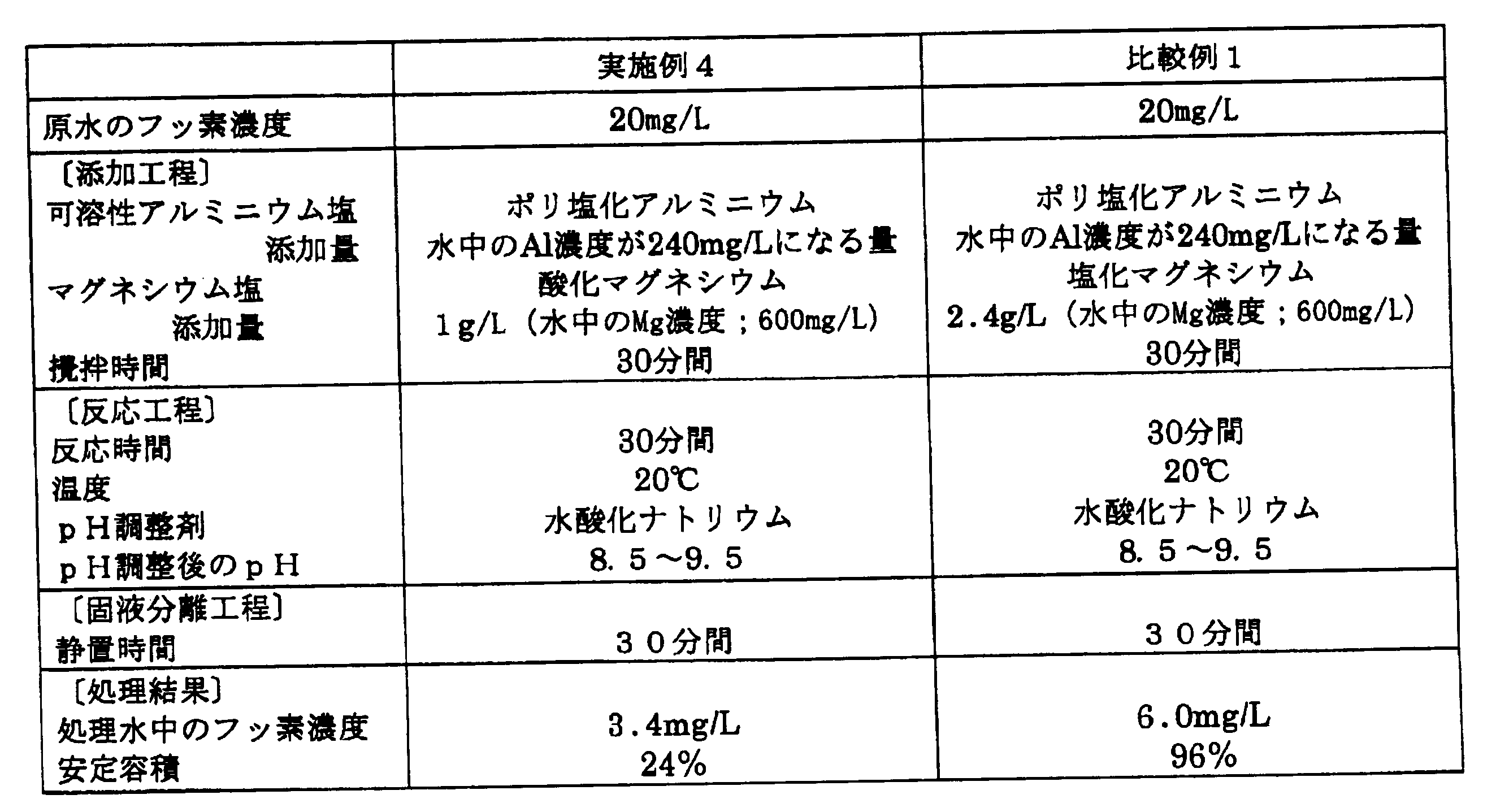
- Example 4 In accordance with the treatment system shown in FIG. 3, the fluorine-containing water was treated as follows. First, fluorine-containing water (fluorine concentration 20 mg / L) was introduced into the addition tank 10, and polyaluminum chloride was added so that the aluminum concentration was 240 mg / L in water. This was introduced into the reaction vessel 30. Thereafter, 1 g / L of magnesium oxide and water added with polyaluminum chloride are mixed in the reaction tank 30 and adjusted to pH 8.5 to 9.5 by adding sodium hydroxide as a pH adjuster, and then stirred for 30 minutes. And reacted at a temperature of 20 ° C. for 30 minutes. After the reaction, the slurry containing the generated sludge was introduced into the solid-liquid separation tank 40 (thickener) and allowed to stand for 30 minutes to settle the sludge. The processing conditions and processing results are shown in Table 7.
- the fluorine-containing water was treated as follows. First, fluorine-containing water (fluorine concentration 20 mg / L) was introduced into the addition tank 10, and polyaluminum chloride was added so that the aluminum concentration was 240 mg / L in water. This was introduced into the reaction vessel 30. Thereafter, 2.4 g / L of magnesium chloride and water added with polyaluminum chloride are mixed in the reaction tank 30 and adjusted to pH 8.5 to 9.5 by adding sodium hydroxide as a pH adjuster. The mixture was stirred for 30 minutes and reacted at a temperature of 20 ° C. for 30 minutes. After the reaction, the slurry containing the generated sludge was introduced into the solid-liquid separation tank 40 (thickener) and allowed to stand for 30 minutes to settle the sludge. The processing conditions and processing results are shown in Table 7.
- Example 4 and Comparative Example 1 can reduce the fluorine concentration of the treated water to below the drainage standard (8 mg / L) for public water areas other than sea areas, but the stable volumes are comparable.
- Example 1 is much larger and has poor separation.
- Example 4 has a small stable volume, good separability, and can perform solid-liquid separation in a short time.
- a slurry containing sludge incorporating toxic substances can be solid-liquid separated in a short time, and harmful substances contained in water such as fluorine, nitrogen compounds, phosphorus and heavy metals. Substances can be removed efficiently.
Landscapes
- Chemical & Material Sciences (AREA)
- Life Sciences & Earth Sciences (AREA)
- Hydrology & Water Resources (AREA)
- Engineering & Computer Science (AREA)
- Environmental & Geological Engineering (AREA)
- Water Supply & Treatment (AREA)
- Organic Chemistry (AREA)
- Inorganic Chemistry (AREA)
- Removal Of Specific Substances (AREA)
- Compounds Of Alkaline-Earth Elements, Aluminum Or Rare-Earth Metals (AREA)
- Water Treatment By Sorption (AREA)
- Treatment Of Sludge (AREA)
Abstract
Description
本願は、2010年10月29日に、日本に出願された特願2010-244772号に基づき優先権を主張し、その内容をここに援用する。
本発明の第1の態様は、層状複水酸化物の成分となる難溶性金属酸化物と可溶性金属化合物とを有害物質含有水に添加する工程と、前記難溶性金属酸化物と可溶性金属化合物と有害物質含有水をアルカリ性条件下で反応させて上記難溶性金属酸化物の表面に層状複水酸化物が形成された汚泥を含むスラリーを生成させる反応工程と、この汚泥を沈降させて前記スラリーを固液分離することによって該汚泥に取り込まれた有害物質を系外に除去する固液分離工程とを有する、有害物質含有水の処理方法である。
本発明の第2の態様は、上記第一の態様に係る処理方法において、固液分離した汚泥の一部または全部を反応工程に返送し、返送した汚泥を層状複水酸化物の形成に利用する有害物質含有水の処理方法である。
本発明の第4の態様は、上記第1から第3の何れかの態様に係る有害物質含有水の処理方法であって、前記有害物質がフッ素、ホウ素、窒素化合物、リン、重金属類の何れか1種または2種以上であり、前記有害物質を取り込んだ汚泥を含むスラリーを生成させて固液分離する害物質含有水の処理方法である。
本発明の第6の態様は、上記第1から第5何れかの態様に係る有害物質の処理方法であって、生成した汚泥を含むスラリーを静置したとき、30分後の安定容積が40%以下である有害物質含有水の処理方法である。
上記の処理方法では、汚泥を含むスラリーを固液分離工程において静置し、30分経過した時、沈殿した後の汚泥容積(汚泥沈殿物容積)は、最初のスラリーの容積の40%以下となる。
上記の処理方法では、前処理において、有害物質含有水の原水に含まれる有害物質を低減するとともに、層状複水酸化物による有害物質の取り込みを妨害する成分を低減する。
本発明の第8の態様は、上記第1から第7何れかの態様に係る有害物質の処理方法であって、前記スラリーから汚泥を固液分離した処理水を後処理する後処理工程が設けられている有害物質含有水の処理方法である。
本発明の第9の態様は、有害物質含有水の処理装置であって、有害物質含有水に薬剤を添加する添加槽と、添加した薬剤を有害物質含有水と反応させて汚泥を含むスラリーを生成させる反応槽と、生成したスラリー中の汚泥を水から分離する固液分離槽とが管路によって順に接続されており、添加槽には有害物質含有水と可溶性金属化合物の供給手段がおのおの設けられており、反応槽には難溶性金属酸化物とpH調整剤の供給手段がおのおの設けられており、固液分離槽には分離した汚泥と処理水の排出管路がおのおの接続しており、添加槽において可溶性金属化合物が添加された有害物質含有水が反応槽に導入され、反応槽において難溶性金属酸化物とpH調整剤が添加され、アルカリ性条件下の反応によって難溶性金属酸化物の表面に層状複水酸化物が形成された汚泥を含むスラリーが生成され、該汚泥を含むスラリーが固液分離槽に導入されて該汚泥が沈降分離されることを特徴とする有害物質含有水の処理装置である。
本発明の第11の態様は、上記第10の態様に係る有害物質含有水の処理装置において、固液分離槽から反応槽に至る返送管路が接続されており、分離した汚泥に難溶性金属酸化物を添加する第二添加槽が上記返送管路の途中に設けられている有害物質含有水の処理装置である。
本発明の処理方法は、層状複水酸化物の成分となる難溶性金属酸化物と可溶性金属化合物とを有害物質含有水に添加する工程、上記の難溶性金属酸化物と可溶性金属化合物と有害物質含有水をアルカリ性条件下で反応させて上記難溶性金属酸化物の表面に層状複水酸化物が形成された汚泥を含むスラリーを生成させる反応工程と、この汚泥を沈降させて汚泥を含むスラリーを固液分離することによって該汚泥に取り込まれた有害物質を系外に除去する固液分離工程を有する、有害物質含有水の処理方法である。
この方法により、処理される水に含有される有害物質を水の系外に除去することができる。
本発明の処理システムでは、添加工程において層状複水酸化物の成分となる難溶性金属酸化物と可溶性金属化合物とを有害物質含有水に添加する。この混合物を反応工程においてアルカリ性条件下で反応させて上記難溶性金属酸化物の表面に層状複水酸化物が形成された汚泥を生成させる。
反応工程では、部分的に溶解した難溶性金属酸化物と可溶性金属化合物とが反応して、未溶解の難溶性金属酸化物の表面に層状複水酸化物が形成される。また、溶解した難溶性金属酸化物は、層状複水酸化物の成分源になると共にアルカリ剤としての役割を果たす。反応工程のアルカリ性条件はpH7~11とすることが好ましい。
例えば、難溶性金属酸化物として酸化マグネシウムを用い、可溶性金属化合物として可溶性アルミニウム塩を用い、これらを有害物質含有水に添加し、アルカリ性条件下(pH7~11が好ましい)で反応させると、酸化マグネシウムは溶け難いので大部分は未溶解部分として残るが、表面は部分的に溶解し、溶出したマグネシウムがアルミニウムと反応して酸化マグネシウム表面に層状複水酸化物が形成される。具体的には、酸化マグネシウム表面にマグネシウムとアルミニウムが反応してハイドロタルサイト〔一般式:Mg2+ 1-xAl3+ x(OH)2(An-)x/n・mH2O(An-はアニオン)〕が形成される。
生成した汚泥を含むスラリーを固液分離工程に導いて汚泥を沈降させ、スラリーを固液分離する。本発明の処理方法によって生成した汚泥は、未溶解の難溶性金属酸化物(酸化マグネシウム等)の表面に層状複水酸化物が形成された構造を有しているので沈降性が良い。
(一定時間経過後の汚泥沈殿物容積)/(初期の汚泥スラリー容積)×100…[1]
本発明の処理方法において、好ましくは、スラリーから固液分離した汚泥の一部または全部を反応工程に返送し、返送した汚泥を層状複水酸化物の形成に利用すると良い。汚泥の一部または全部を反応工程に戻すことによって、層状複水酸化物の生成が促進し、フッ素、ホウ素、窒素化合物、リン、有害重金属類等の有害物質が汚泥中に多く取り込まれるようになり、これらの除去効果が向上する。
本発明の処理方法は、有害物質含有水(原水)に含まれる有害物質や妨害物質を予め低減する前処理工程を添加工程または反応工程の前に設けることができる。前処理することによって有害物質の除去効果をさらに高めることができる。図5参照。なお、妨害物質(妨害成分)とは、それ自身は有害物質ではないが、本発明の処理方法を妨害する物質である。
例えば、重金属、リン酸イオン、硝酸イオン、ホウ酸イオン、フッ素、浮遊物質、有機物、硫酸イオン、亜硫酸イオン、塩化物イオン、炭酸イオン、溶存シリカ、ケイ酸イオンの一以上がそれぞれの所定値以上の濃度で有害物質含有水に含まれる場合、前処理工程により濃度を所定値未満となるよう低減することができる。
さらに、本発明の処理方法は、汚泥を分離した液分(処理水)を後処理する工程を設けることができる。図5参照。
固液分離工程でスラリー中の汚泥を分離した後に残る液分(処理水)に、有機物や浮遊物質、窒素化合物が残留している場合や、あるいは処理水のpHが9以上の場合がある。そこで、処理水の後処理工程を設けてもよい。後処理方法は限定されない。
本発明の処理装置の構成および、処理装置を用いた処理工程を図3および図4に示す。
図示する処理装置には、有害物質含有水(原水)に薬剤を添加する添加槽10と、添加した薬剤を反応させて汚泥を生成させる反応槽30と、生成した汚泥を分離する固液分離槽40とが設けられており、これらの添加槽10と反応槽30と固液分離槽40とは管路50によって順に接続されている。
図4に示す処理システムに従い、フッ素含有水を以下のように処理した。まず、フッ素含有水(フッ素濃度20mg/L)を添加槽10に導入し、ポリ塩化アルミニウムをアルミニウム濃度が水中で240mg/Lになるように添加した。一方、固液分離槽40で分離した汚泥の全量を第二添加槽20に返送し、ここで酸化マグネシウムをフッ素含有水1Lに対して1g/L添加した。この汚泥を反応槽30に導入し、ポリ塩化アルミニウムを添加したフッ素含有水と混合し、30分間攪拌し、温度20℃下、30分間反応させた。反応後、pH調整剤として水酸化ナトリウムを添加してpH8.5~9.5に調整した後、生成した汚泥を含むスラリーを固液分離槽40(シックナー)に導入して20時間静置して汚泥を沈降させた。なお、固液分離槽40に導入する前の汚泥を含むスラリーにアニオン性高分子凝集剤2mg/Lを添加した。固液分離槽40で分離した汚泥の全量を先に述べたように第二添加槽20に導入し、酸化マグネシウムをフッ素含有水1Lに対して1g/L添加して反応槽30に戻した。この汚泥の生成を15回繰り返した。処理条件を表1に示し、処理結果を表2に示した。また、汚泥のX線解析チャートを図6に示した。図6において1st~10thは繰返し回数である。なおinitialは、汚泥の返送を除き上記の処理を行った初期サイクルで得られた汚泥のX線解析チャートである。


図3に示す処理システムに従い、フッ素含有水を以下のように処理した。まず、フッ素含有水(フッ素濃度20mg/L)を添加槽10に導入し、硫酸アルミニウムをアルミニウム濃度が水中で240mg/Lになるように添加した。これを反応槽30に導入した。一方、固液分離槽40で分離した汚泥の全量を反応槽30に返送した。また反応槽30で酸化マグネシウムをフッ素含有水1Lに対して1g/L添加し、硫酸アルミニウムを添加したフッ素含有水と混合し、30分間攪拌し、温度20℃下、30分間反応させた。反応後、pH調整剤として水酸化ナトリウムを添加してpH8.5~9.5に調整した後、生成した汚泥を含むスラリーを固液分離槽40(シックナー)に導入して20時間静置して汚泥を沈降させた。なお、固液分離槽40に導入する前の汚泥を含むスラリーにアニオン性高分子凝集剤2mg/Lを添加した。固液分離槽40で分離した汚泥を、上記のように、反応槽30に返送して酸化マグネシウムをフッ素含有水1Lに対して1g/L添加した。この汚泥の生成を15回繰り返した。処理条件を表3に示し、処理結果を表4に示した。なお繰り返し前の初期サイクルでは、汚泥の返送を除き上記の処理を行う。
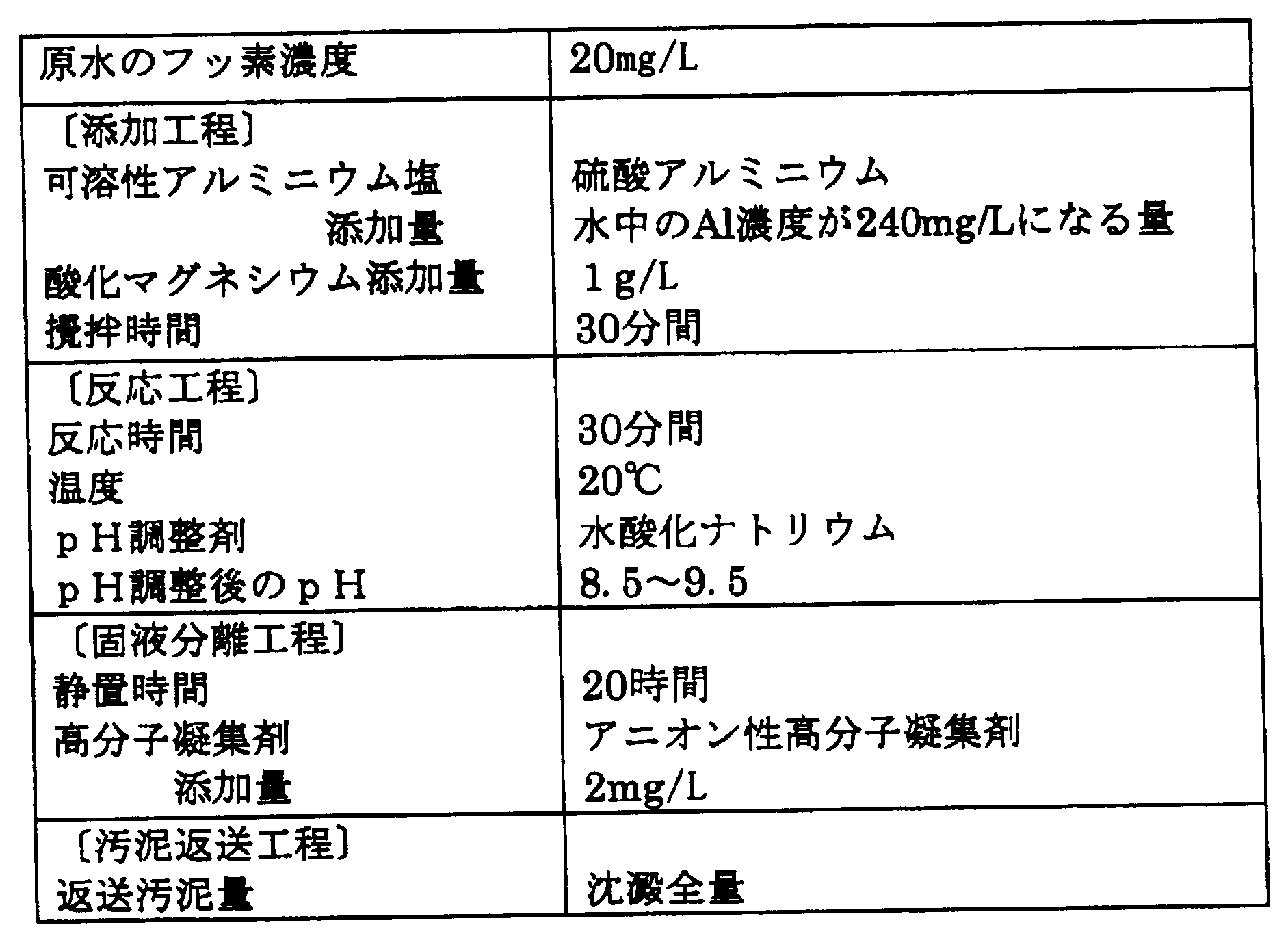

図4に示す処理システムに従い、フッ素及び重金属類を含む有害物質含有水を以下のように処理した。まず、有害物質含有水(原水中の有害物質濃度は表5に記載)を添加槽10に導入し、ポリ塩化アルミニウムをアルミニウム濃度が水中で240mg/Lになるように添加した。これを反応槽30に導入した。一方、固液分離槽40で分離した汚泥の全量を第二添加槽20に返送し、ここで酸化マグネシウムを有害物質含有水1Lに対して1g/L添加した。この汚泥を反応槽30に戻し、ポリ塩化アルミニウムを添加した有害物質含有水と混合し、30分間攪拌し、温度20℃下、30分間反応させた。反応後、pH調整剤として水酸化ナトリウムを添加してpH8.5~9.5に調整した後、生成した汚泥を含むスラリーを固液分離槽40(シックナー)に導入して20時間静置して汚泥を沈降させた。なお、固液分離槽40に導入する前の汚泥スラリーにアニオン性高分子凝集剤2mg/Lを添加した。固液分離槽40で分離した汚泥の全量を、上記のように、第二添加槽20に導入し、酸化マグネシウムを有害物質含有水1Lに対して1g/L添加して反応槽30に戻し、この汚泥の生成を5回繰り返した。処理条件を表5に示し、処理結果を表6に示した。なお繰り返し前の初期サイクルでは、汚泥の返送を除き上記の処理を行う。

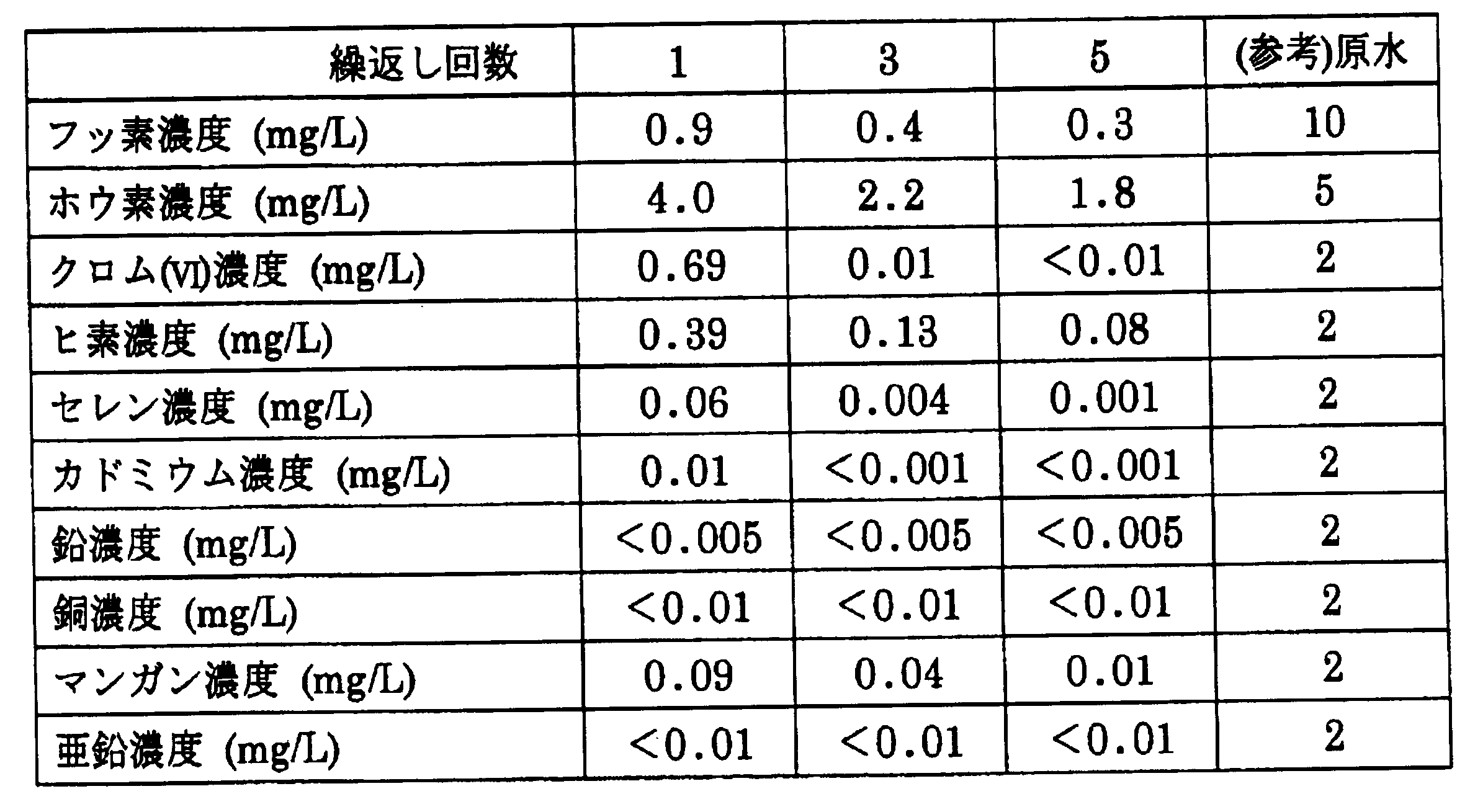
図3に示す処理システムに従い、フッ素含有水を以下のように処理した。まず、フッ素含有水(フッ素濃度20mg/L)を添加槽10に導入し、ポリ塩化アルミニウムをアルミニウム濃度が水中で240mg/Lになるように添加した。これを反応槽30に導入した。その後、反応槽30で酸化マグネシウム1g/Lとポリ塩化アルミニウムを添加した水とを混合し、pH調整剤として水酸化ナトリウムを添加してpH8.5~9.5に調整した後、30分間攪拌し、温度20℃下、30分間反応させた。反応後、生成した汚泥を含むスラリーを固液分離槽40(シックナー)に導入して30分間静置して汚泥を沈降させた。処理条件および処理結果を表7に示した。
図3に示す処理システムに従い、フッ素含有水を以下のように処理した。まず、フッ素含有水(フッ素濃度20mg/L)を添加槽10に導入し、ポリ塩化アルミニウムをアルミニウム濃度が水中で240mg/Lになるように添加した。これを反応槽30に導入した。その後、反応槽30で塩化マグネシウム2.4g/Lとポリ塩化アルミニウムを添加した水とを混合し、pH調整剤として水酸化ナトリウムを添加してpH8.5~9.5に調整した後、30分間攪拌し、温度20℃下、30分間反応させた。反応後、生成した汚泥を含むスラリーを固液分離槽40(シックナー)に導入して30分間静置して汚泥を沈降させた。処理条件および処理結果を表7に示した。
Claims (12)
- 層状複水酸化物の成分となる難溶性金属酸化物と可溶性金属化合物とを有害物質含有水に添加する工程と、
前記難溶性金属酸化物と可溶性金属化合物と有害物質含有水をアルカリ性条件下で反応させて上記難溶性金属酸化物の表面に層状複水酸化物が形成された汚泥を含むスラリーを生成させる反応工程と、
前記汚泥を沈降させて前記スラリーを固液分離することによって該汚泥に取り込まれた有害物質を系外に除去する固液分離工程とを有する
有害物質含有水の処理方法。 - 請求項1に記載する処理方法において、固液分離した汚泥の一部または全部を反応工程に返送し、返送した汚泥を層状複水酸化物の形成に利用する有害物質含有水の処理方法。
- 前記難溶性金属酸化物が酸化マグネシウムであり、前記可溶性金属化合物が可溶性アルミニウム塩であり、有害物質含有水に酸化マグネシウムと可溶性アルミニウム塩を添加し、これをアルカリ性条件下で反応させて、酸化マグネシウムの表面にハイドロタルサイトを形成させることによって該ハイドロタルサイトに有害物質が取り込まれた汚泥を含むスラリーを生成させ、該スラリーを固液分離する請求項1に記載する有害物質含有水の処理方法。
- 前記難溶性金属酸化物が酸化マグネシウムであり、前記可溶性金属化合物が可溶性アルミニウム塩であり、有害物質含有水に酸化マグネシウムと可溶性アルミニウム塩を添加し、これをアルカリ性条件下で反応させて、酸化マグネシウムの表面にハイドロタルサイトを形成させることによって該ハイドロタルサイトに有害物質が取り込まれた汚泥を含むスラリーを生成させ、該スラリーを固液分離する請求項2に記載する有害物質含有水の処理方法。
- 前記有害物質がフッ素、ホウ素、窒素化合物、リン、重金属類の何れか1種または2種以上であり、有害物質を取り込んだ汚泥を含むスラリーを生成させて固液分離する請求項1~請求項4の何れかに記載する有害物質含有水の処理方法。
- フッ素濃度1~50mg/Lの有害物質含有水1Lあたりに対して、酸化マグネシウムを0.05~10g/L、可溶性アルミニウム塩を水中のアルミニウム濃度が10~1000mg/Lになるように添加し、反応槽においてpH7~11で反応させる請求項1~請求項4の何れかに記載する有害物質含有水の処理方法。
- 生成した汚泥を含むスラリーを静置したとき、30分後の安定容積が40%以下である請求項1~請求項4の何れかに記載する有害物質含有水の処理方法。
- 有害物質含有水に含まれる有害物質および妨害物質を低減する前処理工程が設けられており、前処理された有害物質含有水に層状複水酸化物の成分となる難溶性金属酸化物と可溶性金属化合物を添加する請求項1~請求項4の何れかに記載する有害物質含有水の処理方法。
- 前記スラリーから汚泥を固液分離した処理水を後処理する後処理工程が設けられている請求項1~請求項4の何れかに記載する有害物質含有水の処理方法。
- 有害物質含有水に薬剤を添加する添加槽と、
添加した薬剤と有害物質含有水を反応させて汚泥を含むスラリーを生成させる反応槽と、
生成したスラリー中の汚泥を水から分離する固液分離槽とが管路によって順に接続されており、
添加槽には有害物質含有水と可溶性金属化合物の供給手段がおのおの設けられており、
反応槽には難溶性金属酸化物とpH調整剤の供給手段がおのおの設けられており、
固液分離槽には分離した汚泥と処理水の排出管路がおのおの接続しており、
添加槽において可溶性金属化合物が添加された有害物質含有水が反応槽に導入され、
反応槽において難溶性金属酸化物とpH調整剤が添加され、
アルカリ性条件下の反応によって難溶性金属酸化物の表面に層状複水酸化物が形成された汚泥が生成され、
該汚泥を含むスラリーが固液分離槽に導入されて該汚泥が沈降分離されることを特徴とする有害物質含有水の処理装置。 - 請求項10に記載する処理装置において、固液分離槽から反応槽に至る返送管路が接続されており、固液分離した汚泥の一部または全部が該返送管路を通じて反応槽に返送される有害物質含有水の処理装置。
- 請求項10に記載する処理装置において、固液分離槽から反応槽に至る返送管路が接続されており、分離した汚泥に難溶性金属酸化物を添加する第二添加槽が上記返送管路の途中に設けられている有害物質含有水の処理装置。
Priority Applications (3)
| Application Number | Priority Date | Filing Date | Title |
|---|---|---|---|
| KR1020137009342A KR101613774B1 (ko) | 2010-10-29 | 2011-09-15 | 유해 물질 함유수의 처리 방법 및 처리 장치 |
| KR1020157022082A KR20150100950A (ko) | 2010-10-29 | 2011-09-15 | 유해 물질 함유수의 처리 방법 및 처리 장치 |
| CN2011800513702A CN103180251A (zh) | 2010-10-29 | 2011-09-15 | 含有害物质的水的处理方法及处理装置 |
Applications Claiming Priority (2)
| Application Number | Priority Date | Filing Date | Title |
|---|---|---|---|
| JP2010-244772 | 2010-10-29 | ||
| JP2010244772 | 2010-10-29 |
Publications (1)
| Publication Number | Publication Date |
|---|---|
| WO2012056826A1 true WO2012056826A1 (ja) | 2012-05-03 |
Family
ID=45993556
Family Applications (1)
| Application Number | Title | Priority Date | Filing Date |
|---|---|---|---|
| PCT/JP2011/071109 Ceased WO2012056826A1 (ja) | 2010-10-29 | 2011-09-15 | 有害物質含有水の処理方法および処理装置 |
Country Status (4)
| Country | Link |
|---|---|
| JP (1) | JP5943176B2 (ja) |
| KR (2) | KR101613774B1 (ja) |
| CN (2) | CN103180251A (ja) |
| WO (1) | WO2012056826A1 (ja) |
Cited By (5)
| Publication number | Priority date | Publication date | Assignee | Title |
|---|---|---|---|---|
| CN102992440A (zh) * | 2012-11-28 | 2013-03-27 | 常州大学 | 一种光伏废水的净化方法 |
| JP2013075261A (ja) * | 2011-09-30 | 2013-04-25 | Mitsubishi Materials Corp | 有害物質を除去する処理方法および処理装置 |
| CN105562422A (zh) * | 2016-01-04 | 2016-05-11 | 扬州杰嘉工业固废处置有限公司 | 一种含氟农药废渣稳定化固化方法 |
| US12398052B2 (en) | 2017-09-08 | 2025-08-26 | Commonwealth Scientific And Industrial Research Organisation | In situ process for producing layered double hydroxide (LDH) and further recycling of the LDH |
| US12404195B2 (en) | 2017-09-08 | 2025-09-02 | Commonwealth Scientific And Industrial Research Organisation | Process for removing silica and reducing total hardness from water |
Families Citing this family (15)
| Publication number | Priority date | Publication date | Assignee | Title |
|---|---|---|---|---|
| JP5257469B2 (ja) * | 2011-02-01 | 2013-08-07 | 吉澤石灰工業株式会社 | 排水中の有害物の除去剤とそれを使用した除去方法 |
| JP5794422B2 (ja) * | 2011-09-30 | 2015-10-14 | 三菱マテリアル株式会社 | フッ素および有害物質を除去する処理方法と処理装置 |
| JP6076649B2 (ja) * | 2012-08-22 | 2017-02-08 | 吉田 英夫 | 土壌等の除染方法および土壌等の除染システム |
| CN102974309A (zh) * | 2012-11-28 | 2013-03-20 | 常州大学 | 一种同时处理工业酸洗废水和洗涤废水的方法 |
| CN103043815B (zh) * | 2012-11-29 | 2014-10-29 | 常州大学 | 同时净化电镀废水、洗涤废水和化工有机废水的方法 |
| CN106103354B (zh) * | 2014-04-10 | 2019-06-04 | 栗田工业株式会社 | 含铜废水的处理方法以及处理装置 |
| JP6826806B2 (ja) * | 2015-03-30 | 2021-02-10 | 住友重機械エンバイロメント株式会社 | 排水処理装置及び排水処理方法 |
| CN107614442B (zh) * | 2015-04-15 | 2021-07-23 | 联邦科学和工业研究组织 | 水的处理和/或修复方法 |
| JP6109999B1 (ja) * | 2015-11-25 | 2017-04-05 | 株式会社武部鉄工所 | 水処理方法及び水処理システム |
| JP2019155209A (ja) * | 2018-03-07 | 2019-09-19 | 住友金属鉱山株式会社 | ホウ素含有水の処理設備および処理方法 |
| JP7202250B2 (ja) * | 2019-04-26 | 2023-01-11 | 住友重機械エンバイロメント株式会社 | 排水処理装置及び排水処理方法 |
| JP7496577B2 (ja) * | 2020-08-05 | 2024-06-07 | 学校法人早稲田大学 | 水処理方法および水処理装置 |
| CN112551772A (zh) * | 2020-11-24 | 2021-03-26 | 衢州学院 | 一种格氏反应废水的资源化处理方法 |
| JP7028358B1 (ja) * | 2021-01-13 | 2022-03-02 | Jfeエンジニアリング株式会社 | 水処理装置、水処理方法、薬剤、および薬剤の製造方法 |
| JP7810010B2 (ja) * | 2022-02-25 | 2026-02-03 | 三菱マテリアル株式会社 | 坑廃水の処理方法 |
Citations (9)
| Publication number | Priority date | Publication date | Assignee | Title |
|---|---|---|---|---|
| JPS4889559A (ja) * | 1972-03-02 | 1973-11-22 | ||
| JPS5253786A (en) * | 1975-10-29 | 1977-04-30 | Toyo Soda Mfg Co Ltd | Al-cont. adsorbent |
| JPS5377899A (en) * | 1976-12-22 | 1978-07-10 | Toyo Soda Mfg Co Ltd | Production of basic aluminum chloride containing magnesium |
| JPS60231416A (ja) * | 1983-12-24 | 1985-11-18 | バイエル・アクチエンゲゼルシヤフト | 改良された特性をもつハイドロタルサイトの製造方法 |
| JPH07284657A (ja) * | 1992-03-28 | 1995-10-31 | Joseph Crosfield & Sons Ltd | 吸収剤 |
| JPH10128313A (ja) * | 1996-09-25 | 1998-05-19 | Eastman Kodak Co | 写真排出液からの重金属の除去方法 |
| JPH10216742A (ja) * | 1997-01-31 | 1998-08-18 | Kawaken Fine Chem Co Ltd | 重金属含有イオンの捕集方法 |
| JP2010099552A (ja) * | 2008-10-21 | 2010-05-06 | Mitsubishi Materials Techno Corp | 廃水の処理方法 |
| JP2011101830A (ja) * | 2009-11-10 | 2011-05-26 | Waseda Univ | 水処理剤及び水処理方法 |
Family Cites Families (7)
| Publication number | Priority date | Publication date | Assignee | Title |
|---|---|---|---|---|
| CA1338346C (en) * | 1989-08-23 | 1996-05-28 | Chanakya Misra | Method for reducing the amount of anionic metal-ligand complex in a solution |
| JP2912226B2 (ja) * | 1996-04-19 | 1999-06-28 | 日本電気環境エンジニアリング株式会社 | 排水の処理方法 |
| CN1257847C (zh) * | 2003-07-24 | 2006-05-31 | 合肥工业大学 | 即时合成层状双氢氧化物的水处理方法 |
| JP4036237B2 (ja) * | 2004-03-16 | 2008-01-23 | 学校法人早稲田大学 | ハイドロタルサイト様物質およびその製造方法、ならびに有害物質の固定化方法 |
| JP4845188B2 (ja) * | 2006-03-14 | 2011-12-28 | 協和化学工業株式会社 | 排水処理剤および排水中のフッ素イオンを低減させる方法 |
| WO2008015784A1 (en) * | 2006-07-31 | 2008-02-07 | Jdc Corporation | Hydrotalcite-like particulate material and method for production thereof |
| AP3426A (en) * | 2009-03-20 | 2015-09-30 | Commw Scient Ind Res Org | Treatment or remediation of natural or waste water |
-
2011
- 2011-08-31 JP JP2011188650A patent/JP5943176B2/ja active Active
- 2011-09-15 CN CN2011800513702A patent/CN103180251A/zh active Pending
- 2011-09-15 KR KR1020137009342A patent/KR101613774B1/ko active Active
- 2011-09-15 CN CN201610034798.0A patent/CN105692759B/zh active Active
- 2011-09-15 WO PCT/JP2011/071109 patent/WO2012056826A1/ja not_active Ceased
- 2011-09-15 KR KR1020157022082A patent/KR20150100950A/ko not_active Withdrawn
Patent Citations (9)
| Publication number | Priority date | Publication date | Assignee | Title |
|---|---|---|---|---|
| JPS4889559A (ja) * | 1972-03-02 | 1973-11-22 | ||
| JPS5253786A (en) * | 1975-10-29 | 1977-04-30 | Toyo Soda Mfg Co Ltd | Al-cont. adsorbent |
| JPS5377899A (en) * | 1976-12-22 | 1978-07-10 | Toyo Soda Mfg Co Ltd | Production of basic aluminum chloride containing magnesium |
| JPS60231416A (ja) * | 1983-12-24 | 1985-11-18 | バイエル・アクチエンゲゼルシヤフト | 改良された特性をもつハイドロタルサイトの製造方法 |
| JPH07284657A (ja) * | 1992-03-28 | 1995-10-31 | Joseph Crosfield & Sons Ltd | 吸収剤 |
| JPH10128313A (ja) * | 1996-09-25 | 1998-05-19 | Eastman Kodak Co | 写真排出液からの重金属の除去方法 |
| JPH10216742A (ja) * | 1997-01-31 | 1998-08-18 | Kawaken Fine Chem Co Ltd | 重金属含有イオンの捕集方法 |
| JP2010099552A (ja) * | 2008-10-21 | 2010-05-06 | Mitsubishi Materials Techno Corp | 廃水の処理方法 |
| JP2011101830A (ja) * | 2009-11-10 | 2011-05-26 | Waseda Univ | 水処理剤及び水処理方法 |
Cited By (5)
| Publication number | Priority date | Publication date | Assignee | Title |
|---|---|---|---|---|
| JP2013075261A (ja) * | 2011-09-30 | 2013-04-25 | Mitsubishi Materials Corp | 有害物質を除去する処理方法および処理装置 |
| CN102992440A (zh) * | 2012-11-28 | 2013-03-27 | 常州大学 | 一种光伏废水的净化方法 |
| CN105562422A (zh) * | 2016-01-04 | 2016-05-11 | 扬州杰嘉工业固废处置有限公司 | 一种含氟农药废渣稳定化固化方法 |
| US12398052B2 (en) | 2017-09-08 | 2025-08-26 | Commonwealth Scientific And Industrial Research Organisation | In situ process for producing layered double hydroxide (LDH) and further recycling of the LDH |
| US12404195B2 (en) | 2017-09-08 | 2025-09-02 | Commonwealth Scientific And Industrial Research Organisation | Process for removing silica and reducing total hardness from water |
Also Published As
| Publication number | Publication date |
|---|---|
| CN105692759B (zh) | 2019-06-07 |
| KR20130069798A (ko) | 2013-06-26 |
| JP5943176B2 (ja) | 2016-06-29 |
| KR101613774B1 (ko) | 2016-04-19 |
| CN103180251A (zh) | 2013-06-26 |
| KR20150100950A (ko) | 2015-09-02 |
| CN105692759A (zh) | 2016-06-22 |
| JP2012106226A (ja) | 2012-06-07 |
Similar Documents
| Publication | Publication Date | Title |
|---|---|---|
| JP5943176B2 (ja) | 有害物質含有水の処理方法および処理装置。 | |
| JP5794423B2 (ja) | 有害物質を除去する処理方法および処理装置 | |
| US9499420B2 (en) | Formulations and methods for removing heavy metals from waste solutions containing chelating agents | |
| JP5794422B2 (ja) | フッ素および有害物質を除去する処理方法と処理装置 | |
| CN103922517B (zh) | 一种含重金属硫酸废水处理与循环利用的方法 | |
| CN105293775A (zh) | 采用预氧化和混凝沉淀组合来处理含铊、氨氮废水的方法 | |
| JP5915834B2 (ja) | 浄化処理材の製造方法 | |
| CN106517577A (zh) | 酸性含砷废水的处理工艺 | |
| JP4954131B2 (ja) | ホウフッ化物含有水の処理方法 | |
| Wu et al. | Treatment of cosmetic wastewater containing N, N-dimethylformamide and high concentration of chloride salt by chemical precipitation and electrochemical method | |
| JP4936559B2 (ja) | ヒ素除去剤 | |
| JP5484702B2 (ja) | 水質浄化材料およびそれを用いた水質浄化方法 | |
| JP2007209886A (ja) | フッ素除去剤、それを用いたフッ素含有排水の処理方法及びその処理装置 | |
| WO2004045740A1 (ja) | 廃水および汚泥水の浄化処理剤 | |
| JP2005052723A (ja) | 重金属除去方法およびその装置 | |
| EP4628456A1 (en) | Method for producing urea component-containing aqueous solution by using inorganic flocculant having selective removal capability for fluoride ions and phosphate ions | |
| JP5848119B2 (ja) | フッ素含有排水の処理方法 | |
| RU2725315C1 (ru) | Способ очистки воды от соединений мышьяка | |
| JP7496577B2 (ja) | 水処理方法および水処理装置 | |
| KR101879744B1 (ko) | 폐수 중 셀레늄 제거방법 | |
| JP2009262109A (ja) | クロム及び砒素の処理剤およびそれを用いた処理方法 | |
| CN120817692A (zh) | 一种通过钙铝盐沉淀法去除反渗透浓盐水中氯离子的工艺 | |
| CN116768410A (zh) | 磷石膏堆场渗滤液的催化变价组合工艺 | |
| JP2021115499A (ja) | 水処理方法および水処理装置 | |
| MX2010004385A (es) | Uso del acido galacturonico para la remocion de iones metalicos (al, as, ba, cd, cu, cr, fe, mn, hg, pb, na, zn) en agua de pozos de abastecimiento humano. |
Legal Events
| Date | Code | Title | Description |
|---|---|---|---|
| 121 | Ep: the epo has been informed by wipo that ep was designated in this application |
Ref document number: 11835966 Country of ref document: EP Kind code of ref document: A1 |
|
| ENP | Entry into the national phase |
Ref document number: 20137009342 Country of ref document: KR Kind code of ref document: A |
|
| NENP | Non-entry into the national phase |
Ref country code: DE |
|
| 122 | Ep: pct application non-entry in european phase |
Ref document number: 11835966 Country of ref document: EP Kind code of ref document: A1 |
|
| NENP | Non-entry into the national phase |
Ref country code: JP |