WO2011068169A1 - 磁石用粉末 - Google Patents
磁石用粉末 Download PDFInfo
- Publication number
- WO2011068169A1 WO2011068169A1 PCT/JP2010/071604 JP2010071604W WO2011068169A1 WO 2011068169 A1 WO2011068169 A1 WO 2011068169A1 JP 2010071604 W JP2010071604 W JP 2010071604W WO 2011068169 A1 WO2011068169 A1 WO 2011068169A1
- Authority
- WO
- WIPO (PCT)
- Prior art keywords
- rare earth
- iron
- powder
- magnet
- alloy material
- Prior art date
- Legal status (The legal status is an assumption and is not a legal conclusion. Google has not performed a legal analysis and makes no representation as to the accuracy of the status listed.)
- Ceased
Links
Images

Classifications
-
- C—CHEMISTRY; METALLURGY
- C21—METALLURGY OF IRON
- C21D—MODIFYING THE PHYSICAL STRUCTURE OF FERROUS METALS; GENERAL DEVICES FOR HEAT TREATMENT OF FERROUS OR NON-FERROUS METALS OR ALLOYS; MAKING METAL MALLEABLE, e.g. BY DECARBURISATION OR TEMPERING
- C21D1/00—General methods or devices for heat treatment, e.g. annealing, hardening, quenching or tempering
- C21D1/74—Methods of treatment in inert gas, controlled atmosphere, vacuum or pulverulent material
-
- B—PERFORMING OPERATIONS; TRANSPORTING
- B22—CASTING; POWDER METALLURGY
- B22F—WORKING METALLIC POWDER; MANUFACTURE OF ARTICLES FROM METALLIC POWDER; MAKING METALLIC POWDER; APPARATUS OR DEVICES SPECIALLY ADAPTED FOR METALLIC POWDER
- B22F1/00—Metallic powder; Treatment of metallic powder, e.g. to facilitate working or to improve properties
-
- B—PERFORMING OPERATIONS; TRANSPORTING
- B22—CASTING; POWDER METALLURGY
- B22F—WORKING METALLIC POWDER; MANUFACTURE OF ARTICLES FROM METALLIC POWDER; MAKING METALLIC POWDER; APPARATUS OR DEVICES SPECIALLY ADAPTED FOR METALLIC POWDER
- B22F1/00—Metallic powder; Treatment of metallic powder, e.g. to facilitate working or to improve properties
- B22F1/10—Metallic powder containing lubricating or binding agents; Metallic powder containing organic material
- B22F1/102—Metallic powder coated with organic material
-
- B—PERFORMING OPERATIONS; TRANSPORTING
- B22—CASTING; POWDER METALLURGY
- B22F—WORKING METALLIC POWDER; MANUFACTURE OF ARTICLES FROM METALLIC POWDER; MAKING METALLIC POWDER; APPARATUS OR DEVICES SPECIALLY ADAPTED FOR METALLIC POWDER
- B22F3/00—Manufacture of workpieces or articles from metallic powder characterised by the manner of compacting or sintering; Apparatus specially adapted therefor ; Presses and furnaces
- B22F3/02—Compacting only
-
- B—PERFORMING OPERATIONS; TRANSPORTING
- B22—CASTING; POWDER METALLURGY
- B22F—WORKING METALLIC POWDER; MANUFACTURE OF ARTICLES FROM METALLIC POWDER; MAKING METALLIC POWDER; APPARATUS OR DEVICES SPECIALLY ADAPTED FOR METALLIC POWDER
- B22F3/00—Manufacture of workpieces or articles from metallic powder characterised by the manner of compacting or sintering; Apparatus specially adapted therefor ; Presses and furnaces
- B22F3/24—After-treatment of workpieces or articles
-
- B—PERFORMING OPERATIONS; TRANSPORTING
- B22—CASTING; POWDER METALLURGY
- B22F—WORKING METALLIC POWDER; MANUFACTURE OF ARTICLES FROM METALLIC POWDER; MAKING METALLIC POWDER; APPARATUS OR DEVICES SPECIALLY ADAPTED FOR METALLIC POWDER
- B22F9/00—Making metallic powder or suspensions thereof
-
- C—CHEMISTRY; METALLURGY
- C21—METALLURGY OF IRON
- C21D—MODIFYING THE PHYSICAL STRUCTURE OF FERROUS METALS; GENERAL DEVICES FOR HEAT TREATMENT OF FERROUS OR NON-FERROUS METALS OR ALLOYS; MAKING METAL MALLEABLE, e.g. BY DECARBURISATION OR TEMPERING
- C21D6/00—Heat treatment of ferrous alloys
-
- C—CHEMISTRY; METALLURGY
- C22—METALLURGY; FERROUS OR NON-FERROUS ALLOYS; TREATMENT OF ALLOYS OR NON-FERROUS METALS
- C22C—ALLOYS
- C22C33/00—Making ferrous alloys
- C22C33/02—Making ferrous alloys by powder metallurgy
-
- C—CHEMISTRY; METALLURGY
- C22—METALLURGY; FERROUS OR NON-FERROUS ALLOYS; TREATMENT OF ALLOYS OR NON-FERROUS METALS
- C22C—ALLOYS
- C22C33/00—Making ferrous alloys
- C22C33/02—Making ferrous alloys by powder metallurgy
- C22C33/0207—Using a mixture of prealloyed powders or a master alloy
- C22C33/0228—Using a mixture of prealloyed powders or a master alloy comprising other non-metallic compounds or more than 5% of graphite
-
- C—CHEMISTRY; METALLURGY
- C22—METALLURGY; FERROUS OR NON-FERROUS ALLOYS; TREATMENT OF ALLOYS OR NON-FERROUS METALS
- C22C—ALLOYS
- C22C38/00—Ferrous alloys, e.g. steel alloys
-
- C—CHEMISTRY; METALLURGY
- C22—METALLURGY; FERROUS OR NON-FERROUS ALLOYS; TREATMENT OF ALLOYS OR NON-FERROUS METALS
- C22C—ALLOYS
- C22C38/00—Ferrous alloys, e.g. steel alloys
- C22C38/001—Ferrous alloys, e.g. steel alloys containing N
-
- C—CHEMISTRY; METALLURGY
- C22—METALLURGY; FERROUS OR NON-FERROUS ALLOYS; TREATMENT OF ALLOYS OR NON-FERROUS METALS
- C22C—ALLOYS
- C22C38/00—Ferrous alloys, e.g. steel alloys
- C22C38/005—Ferrous alloys, e.g. steel alloys containing rare earths, i.e. Sc, Y, Lanthanides
-
- H—ELECTRICITY
- H01—ELECTRIC ELEMENTS
- H01F—MAGNETS; INDUCTANCES; TRANSFORMERS; SELECTION OF MATERIALS FOR THEIR MAGNETIC PROPERTIES
- H01F1/00—Magnets or magnetic bodies characterised by the magnetic materials therefor; Selection of materials for their magnetic properties
- H01F1/01—Magnets or magnetic bodies characterised by the magnetic materials therefor; Selection of materials for their magnetic properties of inorganic materials
- H01F1/03—Magnets or magnetic bodies characterised by the magnetic materials therefor; Selection of materials for their magnetic properties of inorganic materials characterised by their coercivity
- H01F1/032—Magnets or magnetic bodies characterised by the magnetic materials therefor; Selection of materials for their magnetic properties of inorganic materials characterised by their coercivity of hard-magnetic materials
- H01F1/04—Magnets or magnetic bodies characterised by the magnetic materials therefor; Selection of materials for their magnetic properties of inorganic materials characterised by their coercivity of hard-magnetic materials metals or alloys
- H01F1/047—Alloys characterised by their composition
- H01F1/053—Alloys characterised by their composition containing rare earth metals
-
- H—ELECTRICITY
- H01—ELECTRIC ELEMENTS
- H01F—MAGNETS; INDUCTANCES; TRANSFORMERS; SELECTION OF MATERIALS FOR THEIR MAGNETIC PROPERTIES
- H01F1/00—Magnets or magnetic bodies characterised by the magnetic materials therefor; Selection of materials for their magnetic properties
- H01F1/01—Magnets or magnetic bodies characterised by the magnetic materials therefor; Selection of materials for their magnetic properties of inorganic materials
- H01F1/03—Magnets or magnetic bodies characterised by the magnetic materials therefor; Selection of materials for their magnetic properties of inorganic materials characterised by their coercivity
- H01F1/032—Magnets or magnetic bodies characterised by the magnetic materials therefor; Selection of materials for their magnetic properties of inorganic materials characterised by their coercivity of hard-magnetic materials
- H01F1/04—Magnets or magnetic bodies characterised by the magnetic materials therefor; Selection of materials for their magnetic properties of inorganic materials characterised by their coercivity of hard-magnetic materials metals or alloys
- H01F1/047—Alloys characterised by their composition
- H01F1/053—Alloys characterised by their composition containing rare earth metals
- H01F1/055—Alloys characterised by their composition containing rare earth metals and magnetic transition metals, e.g. SmCo5
-
- H—ELECTRICITY
- H01—ELECTRIC ELEMENTS
- H01F—MAGNETS; INDUCTANCES; TRANSFORMERS; SELECTION OF MATERIALS FOR THEIR MAGNETIC PROPERTIES
- H01F1/00—Magnets or magnetic bodies characterised by the magnetic materials therefor; Selection of materials for their magnetic properties
- H01F1/01—Magnets or magnetic bodies characterised by the magnetic materials therefor; Selection of materials for their magnetic properties of inorganic materials
- H01F1/03—Magnets or magnetic bodies characterised by the magnetic materials therefor; Selection of materials for their magnetic properties of inorganic materials characterised by their coercivity
- H01F1/032—Magnets or magnetic bodies characterised by the magnetic materials therefor; Selection of materials for their magnetic properties of inorganic materials characterised by their coercivity of hard-magnetic materials
- H01F1/04—Magnets or magnetic bodies characterised by the magnetic materials therefor; Selection of materials for their magnetic properties of inorganic materials characterised by their coercivity of hard-magnetic materials metals or alloys
- H01F1/047—Alloys characterised by their composition
- H01F1/053—Alloys characterised by their composition containing rare earth metals
- H01F1/055—Alloys characterised by their composition containing rare earth metals and magnetic transition metals, e.g. SmCo5
- H01F1/0551—Alloys characterised by their composition containing rare earth metals and magnetic transition metals, e.g. SmCo5 in the form of particles, e.g. rapid quenched powders or ribbon flakes
- H01F1/0552—Alloys characterised by their composition containing rare earth metals and magnetic transition metals, e.g. SmCo5 in the form of particles, e.g. rapid quenched powders or ribbon flakes with a protective layer
-
- H—ELECTRICITY
- H01—ELECTRIC ELEMENTS
- H01F—MAGNETS; INDUCTANCES; TRANSFORMERS; SELECTION OF MATERIALS FOR THEIR MAGNETIC PROPERTIES
- H01F1/00—Magnets or magnetic bodies characterised by the magnetic materials therefor; Selection of materials for their magnetic properties
- H01F1/01—Magnets or magnetic bodies characterised by the magnetic materials therefor; Selection of materials for their magnetic properties of inorganic materials
- H01F1/03—Magnets or magnetic bodies characterised by the magnetic materials therefor; Selection of materials for their magnetic properties of inorganic materials characterised by their coercivity
- H01F1/032—Magnets or magnetic bodies characterised by the magnetic materials therefor; Selection of materials for their magnetic properties of inorganic materials characterised by their coercivity of hard-magnetic materials
- H01F1/04—Magnets or magnetic bodies characterised by the magnetic materials therefor; Selection of materials for their magnetic properties of inorganic materials characterised by their coercivity of hard-magnetic materials metals or alloys
- H01F1/047—Alloys characterised by their composition
- H01F1/053—Alloys characterised by their composition containing rare earth metals
- H01F1/055—Alloys characterised by their composition containing rare earth metals and magnetic transition metals, e.g. SmCo5
- H01F1/0553—Alloys characterised by their composition containing rare earth metals and magnetic transition metals, e.g. SmCo5 obtained by reduction or by hydrogen decrepitation or embrittlement
-
- H—ELECTRICITY
- H01—ELECTRIC ELEMENTS
- H01F—MAGNETS; INDUCTANCES; TRANSFORMERS; SELECTION OF MATERIALS FOR THEIR MAGNETIC PROPERTIES
- H01F1/00—Magnets or magnetic bodies characterised by the magnetic materials therefor; Selection of materials for their magnetic properties
- H01F1/01—Magnets or magnetic bodies characterised by the magnetic materials therefor; Selection of materials for their magnetic properties of inorganic materials
- H01F1/03—Magnets or magnetic bodies characterised by the magnetic materials therefor; Selection of materials for their magnetic properties of inorganic materials characterised by their coercivity
- H01F1/032—Magnets or magnetic bodies characterised by the magnetic materials therefor; Selection of materials for their magnetic properties of inorganic materials characterised by their coercivity of hard-magnetic materials
- H01F1/04—Magnets or magnetic bodies characterised by the magnetic materials therefor; Selection of materials for their magnetic properties of inorganic materials characterised by their coercivity of hard-magnetic materials metals or alloys
- H01F1/047—Alloys characterised by their composition
- H01F1/053—Alloys characterised by their composition containing rare earth metals
- H01F1/055—Alloys characterised by their composition containing rare earth metals and magnetic transition metals, e.g. SmCo5
- H01F1/0555—Alloys characterised by their composition containing rare earth metals and magnetic transition metals, e.g. SmCo5 pressed, sintered or bonded together
- H01F1/0556—Alloys characterised by their composition containing rare earth metals and magnetic transition metals, e.g. SmCo5 pressed, sintered or bonded together pressed
-
- H—ELECTRICITY
- H01—ELECTRIC ELEMENTS
- H01F—MAGNETS; INDUCTANCES; TRANSFORMERS; SELECTION OF MATERIALS FOR THEIR MAGNETIC PROPERTIES
- H01F1/00—Magnets or magnetic bodies characterised by the magnetic materials therefor; Selection of materials for their magnetic properties
- H01F1/01—Magnets or magnetic bodies characterised by the magnetic materials therefor; Selection of materials for their magnetic properties of inorganic materials
- H01F1/03—Magnets or magnetic bodies characterised by the magnetic materials therefor; Selection of materials for their magnetic properties of inorganic materials characterised by their coercivity
- H01F1/032—Magnets or magnetic bodies characterised by the magnetic materials therefor; Selection of materials for their magnetic properties of inorganic materials characterised by their coercivity of hard-magnetic materials
- H01F1/04—Magnets or magnetic bodies characterised by the magnetic materials therefor; Selection of materials for their magnetic properties of inorganic materials characterised by their coercivity of hard-magnetic materials metals or alloys
- H01F1/047—Alloys characterised by their composition
- H01F1/053—Alloys characterised by their composition containing rare earth metals
- H01F1/055—Alloys characterised by their composition containing rare earth metals and magnetic transition metals, e.g. SmCo5
- H01F1/059—Alloys characterised by their composition containing rare earth metals and magnetic transition metals, e.g. SmCo5 and Va elements, e.g. Sm2Fe17N2
-
- H—ELECTRICITY
- H01—ELECTRIC ELEMENTS
- H01F—MAGNETS; INDUCTANCES; TRANSFORMERS; SELECTION OF MATERIALS FOR THEIR MAGNETIC PROPERTIES
- H01F1/00—Magnets or magnetic bodies characterised by the magnetic materials therefor; Selection of materials for their magnetic properties
- H01F1/01—Magnets or magnetic bodies characterised by the magnetic materials therefor; Selection of materials for their magnetic properties of inorganic materials
- H01F1/03—Magnets or magnetic bodies characterised by the magnetic materials therefor; Selection of materials for their magnetic properties of inorganic materials characterised by their coercivity
- H01F1/032—Magnets or magnetic bodies characterised by the magnetic materials therefor; Selection of materials for their magnetic properties of inorganic materials characterised by their coercivity of hard-magnetic materials
- H01F1/04—Magnets or magnetic bodies characterised by the magnetic materials therefor; Selection of materials for their magnetic properties of inorganic materials characterised by their coercivity of hard-magnetic materials metals or alloys
- H01F1/06—Magnets or magnetic bodies characterised by the magnetic materials therefor; Selection of materials for their magnetic properties of inorganic materials characterised by their coercivity of hard-magnetic materials metals or alloys in the form of particles, e.g. powder
-
- H—ELECTRICITY
- H01—ELECTRIC ELEMENTS
- H01F—MAGNETS; INDUCTANCES; TRANSFORMERS; SELECTION OF MATERIALS FOR THEIR MAGNETIC PROPERTIES
- H01F1/00—Magnets or magnetic bodies characterised by the magnetic materials therefor; Selection of materials for their magnetic properties
- H01F1/01—Magnets or magnetic bodies characterised by the magnetic materials therefor; Selection of materials for their magnetic properties of inorganic materials
- H01F1/03—Magnets or magnetic bodies characterised by the magnetic materials therefor; Selection of materials for their magnetic properties of inorganic materials characterised by their coercivity
- H01F1/032—Magnets or magnetic bodies characterised by the magnetic materials therefor; Selection of materials for their magnetic properties of inorganic materials characterised by their coercivity of hard-magnetic materials
- H01F1/04—Magnets or magnetic bodies characterised by the magnetic materials therefor; Selection of materials for their magnetic properties of inorganic materials characterised by their coercivity of hard-magnetic materials metals or alloys
- H01F1/06—Magnets or magnetic bodies characterised by the magnetic materials therefor; Selection of materials for their magnetic properties of inorganic materials characterised by their coercivity of hard-magnetic materials metals or alloys in the form of particles, e.g. powder
- H01F1/08—Magnets or magnetic bodies characterised by the magnetic materials therefor; Selection of materials for their magnetic properties of inorganic materials characterised by their coercivity of hard-magnetic materials metals or alloys in the form of particles, e.g. powder pressed, sintered, or bound together
-
- H—ELECTRICITY
- H01—ELECTRIC ELEMENTS
- H01F—MAGNETS; INDUCTANCES; TRANSFORMERS; SELECTION OF MATERIALS FOR THEIR MAGNETIC PROPERTIES
- H01F1/00—Magnets or magnetic bodies characterised by the magnetic materials therefor; Selection of materials for their magnetic properties
- H01F1/01—Magnets or magnetic bodies characterised by the magnetic materials therefor; Selection of materials for their magnetic properties of inorganic materials
- H01F1/03—Magnets or magnetic bodies characterised by the magnetic materials therefor; Selection of materials for their magnetic properties of inorganic materials characterised by their coercivity
- H01F1/12—Magnets or magnetic bodies characterised by the magnetic materials therefor; Selection of materials for their magnetic properties of inorganic materials characterised by their coercivity of soft-magnetic materials
- H01F1/14—Magnets or magnetic bodies characterised by the magnetic materials therefor; Selection of materials for their magnetic properties of inorganic materials characterised by their coercivity of soft-magnetic materials metals or alloys
- H01F1/20—Magnets or magnetic bodies characterised by the magnetic materials therefor; Selection of materials for their magnetic properties of inorganic materials characterised by their coercivity of soft-magnetic materials metals or alloys in the form of particles, e.g. powder
- H01F1/22—Magnets or magnetic bodies characterised by the magnetic materials therefor; Selection of materials for their magnetic properties of inorganic materials characterised by their coercivity of soft-magnetic materials metals or alloys in the form of particles, e.g. powder pressed, sintered, or bound together
-
- H—ELECTRICITY
- H01—ELECTRIC ELEMENTS
- H01F—MAGNETS; INDUCTANCES; TRANSFORMERS; SELECTION OF MATERIALS FOR THEIR MAGNETIC PROPERTIES
- H01F41/00—Apparatus or processes specially adapted for manufacturing or assembling magnets, inductances or transformers; Apparatus or processes specially adapted for manufacturing materials characterised by their magnetic properties
- H01F41/02—Apparatus or processes specially adapted for manufacturing or assembling magnets, inductances or transformers; Apparatus or processes specially adapted for manufacturing materials characterised by their magnetic properties for manufacturing cores, coils, or magnets
- H01F41/0206—Manufacturing of magnetic cores by mechanical means
- H01F41/0246—Manufacturing of magnetic circuits by moulding or by pressing powder
-
- H—ELECTRICITY
- H01—ELECTRIC ELEMENTS
- H01F—MAGNETS; INDUCTANCES; TRANSFORMERS; SELECTION OF MATERIALS FOR THEIR MAGNETIC PROPERTIES
- H01F41/00—Apparatus or processes specially adapted for manufacturing or assembling magnets, inductances or transformers; Apparatus or processes specially adapted for manufacturing materials characterised by their magnetic properties
- H01F41/02—Apparatus or processes specially adapted for manufacturing or assembling magnets, inductances or transformers; Apparatus or processes specially adapted for manufacturing materials characterised by their magnetic properties for manufacturing cores, coils, or magnets
- H01F41/0253—Apparatus or processes specially adapted for manufacturing or assembling magnets, inductances or transformers; Apparatus or processes specially adapted for manufacturing materials characterised by their magnetic properties for manufacturing cores, coils, or magnets for manufacturing permanent magnets
- H01F41/0266—Moulding; Pressing
-
- B—PERFORMING OPERATIONS; TRANSPORTING
- B22—CASTING; POWDER METALLURGY
- B22F—WORKING METALLIC POWDER; MANUFACTURE OF ARTICLES FROM METALLIC POWDER; MAKING METALLIC POWDER; APPARATUS OR DEVICES SPECIALLY ADAPTED FOR METALLIC POWDER
- B22F2998/00—Supplementary information concerning processes or compositions relating to powder metallurgy
- B22F2998/10—Processes characterised by the sequence of their steps
-
- B—PERFORMING OPERATIONS; TRANSPORTING
- B22—CASTING; POWDER METALLURGY
- B22F—WORKING METALLIC POWDER; MANUFACTURE OF ARTICLES FROM METALLIC POWDER; MAKING METALLIC POWDER; APPARATUS OR DEVICES SPECIALLY ADAPTED FOR METALLIC POWDER
- B22F2999/00—Aspects linked to processes or compositions used in powder metallurgy
-
- C—CHEMISTRY; METALLURGY
- C22—METALLURGY; FERROUS OR NON-FERROUS ALLOYS; TREATMENT OF ALLOYS OR NON-FERROUS METALS
- C22C—ALLOYS
- C22C2202/00—Physical properties
- C22C2202/02—Magnetic
Definitions
- the present invention relates to a magnet powder used as a raw material for a rare earth magnet, a method for producing the magnet powder, a powder compact obtained from the powder, a rare earth-iron alloy material, a rare earth-iron-nitrogen alloy material, and
- the present invention relates to a method for producing a rare earth-iron alloy material and a method for producing a rare earth-iron-nitrogen alloy material.
- the present invention relates to a magnet powder capable of forming a powder compact with excellent moldability and high relative density.
- Rare earth magnets are widely used as permanent magnets used in motors and generators.
- the rare earth magnet is typically a sintered magnet or a bond magnet made of an R—Fe—B alloy (R: rare earth element, Fe: iron, B: boron) such as Nd (neodymium) -Fe—B.
- R—Fe—B alloy R: rare earth element, Fe: iron, B: boron
- Nd (neodymium) -Fe—B As a bonded magnet, a magnet made of an Sm (samarium) -Fe-N (nitrogen) based alloy has been studied as one having superior magnetic properties as compared with a magnet made of an Nd—Fe—B based alloy.
- Sintered magnets are manufactured by compressing and then sintering powders composed of R-Fe-B alloys, and bonded magnets are composed of R-Fe-B alloys and Sm-Fe-N alloys.
- alloy powders used in bonded magnets should be treated with HDRR (Hydrogenation-Disproportionation-Desorption-Recombination, HD: hydrogenation and disproportionation, DR: dehydrogenation and recombination) to increase the coercive force.
- HDRR Hydrodrogenation-Disproportionation-Desorption-Recombination
- DR dehydrogenation and recombination
- Sintered magnets have excellent magnetic properties due to their high magnetic phase ratio, but have a low degree of freedom in shape, for example, to form complex shapes such as cylindrical shapes, columnar shapes, and pot shapes (bottomed tubular shapes). In the case of a complicated shape, it is necessary to cut the sintered material. On the other hand, although a bonded magnet has a high degree of freedom in shape, it is inferior in magnet characteristics to a sintered magnet.
- Patent Document 1 the alloy powder made of the Nd-Fe-B alloy is made fine, and the green compact (powder compact) obtained by compression molding the alloy powder is subjected to the HDDR treatment. It is disclosed that a magnet having excellent magnet characteristics can be obtained in addition to increasing the degree of freedom of shape.
- the sintered magnet has excellent magnet characteristics, but the degree of freedom in shape is small.
- the degree of freedom in shape is high, but due to the presence of the binder resin, the ratio of the magnetic phase is at most 80% by volume. It is difficult to improve the ratio of the magnetic phase. Therefore, it is desired to develop a raw material for a rare earth magnet that has a high magnetic phase ratio and can be easily manufactured even in a complicated shape.
- An alloy powder made of an Nd-Fe-B alloy as disclosed in Patent Document 1 and a powder obtained by subjecting this alloy powder to HDDR treatment have high rigidity of particles constituting the powder and are difficult to be deformed. Therefore, in order to obtain a rare earth magnet having a high magnetic phase ratio without sintering, a powder compact having a high relative density is to be obtained by compression molding, which requires a relatively large pressure. In particular, if the alloy powder is coarse, a larger pressure is required. Therefore, it is desired to develop a raw material that can easily form a powder compact having a high relative density.
- the green compact when the green compact is subjected to the HDDR treatment, the green compact may be collapsed due to expansion and contraction of the green compact during the treatment. Therefore, it is desired to develop a raw material and a production method that are difficult to disintegrate during the production, have sufficient strength, and obtain a rare earth magnet having excellent magnet characteristics.
- Another object of the present invention is to provide a powder compact, a rare earth-iron alloy material and a method for producing the same, a rare earth-iron-nitrogen alloy material and a method for producing the same, which can obtain a rare earth magnet having excellent magnet characteristics. There is.
- the present inventor uses a powder molded body rather than molding using a binding resin like a bonded magnet in order to obtain a magnet having excellent magnetic properties by increasing the ratio of the magnetic phase in the rare earth magnet without sintering.
- conventional raw material powders that is, alloy powders composed of Nd-Fe-B alloys and Sm-Fe-N alloys, and processed powders obtained by subjecting these alloy powders to HDDR treatment are hard and deformed. The performance is small, the moldability at the time of compression molding is poor, and it is difficult to improve the density of the powder compact.
- the present inventor has found that rare earth elements and iron are not bonded, as in rare earth-iron-boron alloys and rare earth-iron-nitrogen alloys. If the powder is a structure in which the element and iron do not bond, that is, the iron component exists independently of the rare earth element component, a powder compact with high deformability and excellent moldability and high relative density is obtained. Obtained knowledge. Further, the inventors have found that the powder can be produced by subjecting an alloy powder made of a rare earth-iron alloy to a specific heat treatment.
- the magnet powder of the present invention is a powder used for rare earth magnets, and each magnetic particle constituting the magnet powder comprises a rare earth element hydrogen compound having a volume of less than 40% by volume, and an iron-containing material containing the balance Fe. It is configured.
- the rare earth element hydrogen compound phase and the iron-containing substance phase are adjacent to each other, and the rare earth element hydrogen compound adjacent to each other through the iron-containing substance phase.
- the interval between the phases is 3 ⁇ m or less.
- the said magnet powder of this invention can be manufactured with the manufacturing method of the powder for magnets of the following this invention.
- This manufacturing method is a method for manufacturing a magnet powder used for a rare earth magnet, and includes the following preparation step and hydrogenation step.
- Preparation step a step of preparing an alloy powder made of a rare earth-iron alloy containing a rare earth element as an additive element.
- Hydrogenation step The above rare earth-iron alloy powder is heat treated at a temperature equal to or higher than the disproportionation temperature of the rare earth-iron alloy in an atmosphere containing hydrogen element, and the magnet powder is composed of the following magnetic particles: Forming.
- Each of the magnetic particles is composed of a rare earth element hydrogen compound of less than 40% by volume and an iron-containing material containing Fe as a balance, and the rare earth element hydrogen compound phase and the iron-containing material phase are adjacent to each other. And the interval between the phases of the rare earth element hydrogen compounds adjacent to each other through the phase of the iron-containing material is 3 ⁇ m or less.
- Each magnetic particle constituting the magnet powder of the present invention is not composed of a single-phase rare earth alloy like R-Fe-B alloy or R-Fe-N alloy, but Fe or Fe compound. It is composed of a plurality of phases including a phase composed of an iron-containing material and a phase composed of a rare earth element hydrogen compound.
- the phase of the iron-containing material is softer and more formable than the R-Fe-B alloy, the R-Fe-N alloy, and the rare earth element hydrogen compound.
- each magnetic particle constituting the powder of the present invention has an iron-containing material containing Fe (pure iron) as a main component (60% by volume or more), so that when the powder of the present invention is compression molded, The phase of the iron-containing material such as the Fe phase can be sufficiently deformed. Furthermore, the phase of the iron-containing material exists between the phases of the rare earth element hydride as described above, that is, the iron-containing material phase is uniformly present in each magnetic particle. Therefore, the magnetic particles are uniformly deformed during compression molding. From these facts, a powder compact having a high relative density can be formed by using the powder of the present invention.
- a rare earth magnet having a high proportion of magnetic phase can be obtained without sintering.
- the iron-containing material such as Fe is sufficiently deformed so that the magnetic particles are bonded to each other, the ratio of the magnetic phase is 80% by volume or more, preferably without interposing a binding resin like a bonded magnet.
- a rare earth magnet of 90% by volume or more can be obtained.
- the powder compact obtained by compression-molding the magnet powder of the present invention does not sinter like a sintered magnet, there is no shape restriction due to the anisotropy of shrinkage that occurs during sintering. Great freedom. Therefore, by using the powder of the present invention, even a complicated shape such as a cylindrical shape, a columnar shape, or a pot shape can be easily formed without substantially performing cutting or the like. Also, by eliminating the need for cutting, the yield of raw materials can be dramatically improved, and the productivity of rare earth magnets can be improved.
- the magnet powder of the present invention can be easily manufactured by heat-treating a rare earth-iron-based alloy powder at a specific temperature in an atmosphere containing a hydrogen element.
- the rare earth element and the iron-containing material (such as Fe) in the rare earth-iron alloy are separated and the rare earth element and hydrogen are combined.
- a rare earth magnet made of an Sm—Fe—N alloy having excellent magnet characteristics can be obtained.
- the powder of the present invention there is a form in which the phase of the rare earth element hydrogen compound is granular and the granular rare earth element hydrogen compound is dispersed in the phase of the iron-containing material.
- the iron-containing material is uniformly present around the rare earth element hydrogen compound particles, so that the iron-containing material is easily deformed, and the relative density is 85% or more, more preferably 90% or more. It is easy to obtain a high-density powder compact of 95% or more.
- the outer periphery of the magnetic particle is provided with an antioxidant layer having an oxygen permeability coefficient (30 ° C.) of less than 1.0 ⁇ 10 ⁇ 11 m 3 ⁇ m / (s ⁇ m 2 ⁇ Pa).
- the antioxidant layer includes an oxygen low-permeability layer composed of a material having an oxygen permeability coefficient (30 ° C.) of less than 1.0 ⁇ 10 ⁇ 11 m 3 ⁇ m / (s ⁇ m 2 ⁇ Pa), Examples include a low moisture permeation layer composed of a material having a humidity (30 ° C.) of less than 1000 ⁇ 10 ⁇ 13 kg / (m ⁇ s ⁇ MPa).
- the magnetic particles contain a rare earth element that is easily oxidized.
- the oxidation of the said new surface can be effectively suppressed by the said antioxidant layer.
- the moisture low-permeability layer causes the moisture in the atmosphere to come into contact with the new surface. It can suppress effectively that a magnetic particle is oxidized.
- the average particle diameter of the magnetic particles is 10 ⁇ m or more and 500 ⁇ m or less is mentioned.
- the occupation ratio the ratio of the rare earth element hydrogen compound on the surface of each magnetic particle.
- rare earth elements are generally easily oxidized, but powders satisfying the above average particle diameter are difficult to oxidize due to the small occupation ratio and can be handled in the atmosphere. Therefore, according to the said form, a powder compact can be shape
- the magnet powder of the present invention is excellent in moldability by having an iron-containing phase as described above, for example, even if it is a relatively coarse powder having an average particle size of 100 ⁇ m or more, pores are not generated. A powder compact with a small relative density can be formed. When the average particle size is 500 ⁇ m or less, a decrease in the relative density of the powder compact can be suppressed, and 50 ⁇ m or more and 200 ⁇ m or less is more preferable.
- the above-mentioned magnet powder of the present invention can be suitably used as a raw material for a powder compact.
- the powder compact of the present invention is used as a raw material for rare earth magnets, and is produced by compression molding the powder of the present invention, and has a relative density of 85% or more.
- the magnet powder of the present invention is excellent in moldability as described above, a high-density powder molded body as described above can be obtained. Moreover, the rare earth magnet with a high ratio of a magnetic phase is obtained by using the powder compact of the said form for a raw material.
- the powder compact of the present invention can be suitably used as a raw material for rare earth-iron alloy materials.
- the rare earth-iron alloy material of the present invention is used as a raw material for rare earth magnets, and includes a form produced by heat-treating the above-mentioned powder molded body of the present invention in an inert atmosphere or a reduced pressure atmosphere. It is done.
- the rare earth-iron alloy material of the present invention can be produced, for example, by the method for producing the rare earth-iron alloy material of the present invention.
- the method for producing a rare earth-iron alloy material of the present invention relates to a method for producing a rare earth-iron alloy material used for a rare earth magnet, and a magnet obtained by the above-described method for producing a magnet powder according to the present invention.
- the heat treatment removes hydrogen from the rare earth element hydrogen compound in each magnetic particle constituting the powder compact, and combines the phase of the iron-containing material with the rare earth element from which the hydrogen has been removed.
- the rare earth-iron alloy material is obtained.
- the obtained rare earth-iron-based alloy material of the present invention can be suitably used as a material for a rare earth magnet having a high magnetic phase ratio and excellent magnet characteristics by using a high-density powder compact.
- the rare earth-iron-based alloy material of the present invention can be suitably used as a raw material for a rare earth-iron-nitrogen based alloy material.
- the rare earth-iron-nitrogen alloy material of the present invention is used as a raw material for rare earth magnets, and includes a form produced by heat-treating the rare earth-iron alloy material of the present invention in an atmosphere containing nitrogen element.
- This rare earth-iron-nitrogen based alloy material of the present invention can be produced, for example, by the method for producing a rare earth-iron-nitrogen based alloy material of the present invention.
- the method for producing a rare earth-iron-nitrogen based alloy material of the present invention relates to a method for producing a rare earth-iron-nitrogen based alloy material used for a rare earth magnet.
- a nitriding step for forming the material is a method for producing a rare earth-iron-nitrogen based alloy material used for a rare earth magnet.
- the heat treatment nitrogen is bonded to the rare earth-iron alloy, and the rare earth-iron-nitrogen alloy material is formed.
- the obtained rare earth-iron-nitrogen based alloy material of the present invention can be suitably used as a rare earth magnet by being appropriately magnetized. As described above, since the rare earth-iron-based alloy material is manufactured using a high-density powder compact, the obtained rare earth magnet has a high magnetic phase ratio and excellent magnet characteristics.
- the volume change rate between the powder compact before the heat treatment (dehydrogenation) and the rare earth-iron alloy material after the heat treatment (dehydrogenation) is 5%.
- the following forms are mentioned.
- a rare earth-iron-nitrogen alloy material before the heat treatment (nitriding), and a rare earth-iron-nitrogen alloy material after the heat treatment (nitriding) In which the volume change rate is 5% or less.
- the volume change before and after heat treatment (dehydrogenation) and before and after heat treatment (nitridation) is small as in the above form, that is, a rare earth-iron alloy that is a net shape. Materials and rare earth-iron-nitrogen alloy materials.
- processing for example, cutting and cutting
- the productivity of rare earth magnets is excellent.
- the processing such as cutting for obtaining a final shape is unnecessary or simpler.
- the rare earth-iron-nitrogen based alloy material of the present invention a form in which the rare earth-iron-nitrogen based alloy constituting the rare earth-iron-nitrogen based alloy material is an Sm-Fe-Ti-N alloy is mentioned. .
- rare earth-iron-nitrogen alloys examples include Sm-Fe-N alloys, more specifically Sm 2 Fe 17 N 3 , Sm 2 Fe 17 is an example of a rare earth-iron alloy that constitutes the rare earth-iron alloy material.
- Sm-Fe-N alloys more specifically Sm 2 Fe 17 N 3
- Sm 2 Fe 17 is an example of a rare earth-iron alloy that constitutes the rare earth-iron alloy material.
- Sm 2 Fe 17 to Sm 2 Fe 17 N 3 it is necessary to control the ratio of nitrogen with high accuracy, and improvement in the productivity of rare earth-iron-nitrogen alloy materials is desired.
- the rare earth-iron-nitrogen based alloy material is Sm-Ti-Fe-N alloy, more specifically Sm 1 Fe 11 Ti 1 N 1
- Sm 1 Fe 11 Ti 1 is stable and uniform manner can nitriding, the rare earth - iron - excellent productivity of nitrogen-based alloy material.
- Sm 1 Fe 11 Ti 1 the ratio of the iron-containing component: Fe, FeTi to the rare earth element: Sm is higher than that of Sm 2 Fe 17 .
- the composition since there are many iron-containing components rich in moldability, the moldability is also excellent.
- the powder molded body is excellent in formability and stability during nitriding treatment, and thus is excellent in productivity.
- the rare earth magnet which has a high ratio of a magnetic phase and is excellent in a magnetic characteristic is obtained by manufacturing using a high-density powder compact as mentioned above.
- the rare earth element is Sm and the iron-containing material contains Fe and a FeTi compound.
- the rare earth element Sm
- the iron content Fe
- FeTi compound intermetallic compound
- excellent formability for example, relative density is 90%
- the powder compact as described above can be formed.
- a nitriding process can be performed stably and uniformly as mentioned above. Therefore, by using the magnet powder of the present invention having the above-described form, a rare earth magnet having a high magnetic phase can be obtained, and variation in magnet characteristics due to variation in nitrogen content can be suppressed. Magnets can be manufactured stably and with high productivity.
- the rare earth element is Sm
- the powder containing iron and the present invention containing Fe and FeTi compounds is compression-molded
- the relative density is 90% or more.
- the nitriding treatment can be performed stably and uniformly over the entire powder compact as described above, the ratio of the magnetic phase is high, and the magnet characteristics due to the variation in the nitrogen content are reduced.
- Rare earth magnets with little variation can be manufactured, and can be suitably used as a material for the magnets. Moreover, according to the said form, it can contribute to the improvement of the productivity of the rare earth magnet which is excellent in such a magnet characteristic.
- One form of the method for producing the magnet powder of the present invention includes a form in which the rare earth-iron alloy is an Sm-Fe-Ti alloy.
- the hydrogenation step can separate the Sm-Fe-Ti alloy into the Sm hydrogen compound and the iron-containing material containing Fe and Fe-Ti alloy, and contains iron as described above.
- a magnet powder having a relatively large amount of components and excellent moldability can be obtained.
- a high-density powder molded body can be obtained as described above, and the powder molded body is subjected to dehydrogenation heat treatment and then stable when nitriding. Thus, nitriding can be performed uniformly.
- the method for producing the rare earth-iron-nitrogen based alloy material of the present invention there is a form in which the nitriding step is performed under a pressure of 100 MPa or more.
- the temperature during nitriding can be lowered by setting the nitriding treatment under pressure, iron elements and rare earth elements constituting the rare earth-iron-based alloy are decomposed, and iron nitride and Rare earth element nitrides can be prevented from being independently formed. That is, it is possible to effectively prevent formation of nitrides other than the desired nitride: rare earth-iron-nitrogen alloy material.
- the heat treatment temperature for obtaining a desired rare earth-iron-nitrogen compound can be lowered by the pressurization, the nitriding of each element constituting the rare earth-iron-based alloy that is the object of nitriding treatment It is possible to reduce the reactivity and prevent the deterioration of the magnet characteristics due to the generation of unnecessary nitrides.
- the powder for magnets of the present invention is excellent in moldability and provides a powder compact of the present invention having a high relative density.
- a rare earth magnet having a high magnetic phase ratio can be obtained.
- the method for producing the magnet powder of the present invention, the method of producing the rare earth-iron-based alloy material of the present invention, and the method of producing the rare earth-iron-nitrogen-based alloy material of the present invention include the above-described powder for the magnet of the present invention and the rare earth-iron-based material of the present invention.
- the alloy material and the rare earth-iron-nitrogen based alloy material of the present invention can be produced with high productivity.
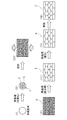
- FIG. 1 is a process explanatory view for explaining an example of a process for producing a magnet using the magnet powder of the present invention produced in Test Example 1.
- FIG. 2 is a process explanatory view for explaining an example of a process for producing a magnet using the magnet powder of the present invention produced in Test Example 3.
- Each magnetic particle constituting the magnet powder of the present invention contains iron as a main component, and its content is 60% by volume or more. If the content of the iron-containing material is less than 60% by volume, the amount of hard rare earth element hydrogen compound is relatively large, and it is difficult to sufficiently deform the iron-containing material during compression molding. 90% by volume or less is preferable because it ultimately causes a decrease in magnet characteristics.
- the iron-containing material is in the form of Fe (pure iron) only, a part of Fe is substituted with at least one element selected from Co, Ga, Cu, Al, Si, and Nb, and from Fe and the substituted element
- the form which consists of Fe, the said substitution element, and the said iron compound are mentioned.
- the iron-containing material contains the above-mentioned substitution element, the magnetic properties and corrosion resistance can be improved.
- the iron-containing material such as FeTi is contained, as described above, (1) (2) Stable nitriding after dehydrogenation heat treatment, (3) Ultimately high ratio of magnetic phase, magnet can be obtained.
- the abundance ratio between Fe and iron compounds in the iron-containing material is obtained, for example, by measuring the peak intensity (peak area) of X-ray diffraction and comparing the measured peak intensities.
- the abundance ratio can be adjusted by appropriately changing the composition of the rare earth-iron-based alloy used as the raw material for the magnet powder of the present invention.
- the content is more than 0% by volume, preferably 10% by volume or more, and less than 40% by volume.
- the content of the iron-containing material and the content of the rare earth element hydrogen compound depend on the composition of the rare earth-iron-based alloy used as the raw material for the magnet powder of the present invention and the heat treatment conditions (mainly temperature) at the time of producing the powder. It can be adjusted by changing it appropriately.
- permits inclusion of an unavoidable impurity.
- the rare earth element contained in each of the magnetic particles is one or more elements selected from Sc (scandium), Y (yttrium), lanthanoid and actinoid.
- Sc scandium
- Y yttrium
- lanthanoid a rare earth magnet made of an Sm—Fe—N alloy having excellent magnet characteristics can be obtained.
- another rare earth element is contained in addition to Sm, for example, at least one element of Pr, Dy, La, and Y is preferable.
- the rare earth element hydrogen compound include SmH 2 .
- Each magnetic particle has a structure in which the rare earth element hydrogen compound phase and the iron-containing material phase are uniformly dispersed.
- This discrete state means that in each of the magnetic particles, the rare earth element hydrogen compound phase and the iron-containing material phase are adjacent to each other, and the rare earth element is adjacent to each other via the iron-containing material phase.
- the distance between the phases of the elemental hydrogen compound is 3 ⁇ m or less.
- a layered form in which both phases have a multilayer structure a phase of the hydrogen compound of the rare earth element is granular, and the phase of the iron-containing material is a parent phase. Examples thereof include a granular form in which rare earth element hydrogen compounds are dispersed.
- the presence form of both phases depends on the heat treatment conditions (mainly temperature) when producing the magnet powder of the present invention, and when the temperature is raised, it becomes a granular form, and when the temperature is in the vicinity of the disproportionation temperature, It tends to be a layered form.
- a rare earth magnet having a magnetic phase ratio comparable to that of a bonded magnet can be obtained without using a binder resin.
- the phase of the rare earth element hydrogen compound and the phase of the iron-containing material are adjacent to each other when the cross-section of the magnetic particle is taken.
- the distance between adjacent rare earth element hydrogen compound phases means the distance between the centers of two rare earth element hydrogen compound phases adjacent to each other through the iron-containing phase in the cross section.
- the above-mentioned granular form is more easily deformed than the above-mentioned layered form because the iron-containing substance is uniformly present around the rare earth element hydrogen compound particles, for example, cylindrical, columnar, pot-shaped, etc. It is easy to obtain a powder molded body having such a complicated shape and a high density powder molded body having a relative density of 85% or more, more preferably 90% or more, and particularly 95% or more.
- the phase of the rare earth element hydrogen compound and the phase of the iron-containing material are typically adjacent to each other when the cross section of the magnetic particle is taken. A state in which iron-containing materials exist so as to cover, and iron-containing materials exist between adjacent rare earth element hydrogen compound particles.
- the interval between phases of adjacent rare earth element hydrogen compounds refers to the distance between the centers of two adjacent rare earth element hydrogen compound particles in the cross section.
- the interval may be measured by etching the cross section to remove the phase of the iron-containing material and extracting the rare earth element hydrogen compound, or depending on the type of solution, removing the rare earth element hydrogen compound to contain the iron. It can be measured by extracting an object or by analyzing the composition of the cross section with an EDX (energy dispersive X-ray spectroscopy) apparatus.
- EDX energy dispersive X-ray spectroscopy
- the interval is preferably 0.5 ⁇ m or more, particularly preferably 1 ⁇ m or more.
- the interval can be adjusted, for example, by adjusting the composition of the rare earth-iron-based alloy used as a raw material, or by adjusting the heat treatment conditions when manufacturing the magnet powder, particularly the temperature. For example, when the iron ratio (atomic ratio) is increased in a rare earth-iron alloy or the temperature during the heat treatment (hydrogenation) is increased under the specific conditions, the interval tends to increase.
- the above-mentioned magnetic particles have a form in which the circularity in the cross section is 0.5 or more and 1.0 or less.
- the circularity satisfies the above range, (1) it is easy to form an anti-oxidation layer or insulation coating, which will be described later, with a uniform thickness, and (2) it prevents damage to the anti-oxidation layer or insulation coating during compression molding.
- the effect that it can be obtained is preferable.
- the magnetic particle is closer to a true sphere, that is, the circularity is closer to 1, the above effect can be obtained. A method for measuring the circularity will be described later.
- the powder of the present invention contains a rare-earth element that easily oxidizes, for example, when compression molding is performed in an atmosphere containing oxygen such as an air atmosphere, a new surface formed on each magnetic particle is oxidized and generated by compression. The presence of the oxide may cause a decrease in the proportion of the magnetic phase in the finally obtained magnet.
- the above-described antioxidant layer is provided so as to cover the entire circumference of each magnetic particle, each magnetic particle is sufficiently shielded from oxygen in the atmosphere to oxidize the new surface of the magnetic particle. Can be prevented.
- the oxygen permeability coefficient (30 ° C.) of the antioxidant layer is preferably as small as possible, less than 1.0 ⁇ 10 ⁇ 11 m 3 ⁇ m / (s ⁇ m 2 ⁇ Pa), particularly 0.01 ⁇ 10 ⁇ It is preferably 11 m 3 ⁇ m / (s ⁇ m 2 ⁇ Pa) or less, and no lower limit is set.
- the antioxidant layer preferably has a moisture permeability (30 ° C.) of less than 1000 ⁇ 10 ⁇ 13 kg / (m ⁇ s ⁇ MPa).
- a moisture permeability (30 ° C.) of less than 1000 ⁇ 10 ⁇ 13 kg / (m ⁇ s ⁇ MPa).
- an atmosphere containing moisture in general such as an air atmosphere
- there may be a humid state for example, a temperature of about 30 ° C./humidity of about 80%
- a relatively large amount of moisture typically water vapor
- the moisture permeability is preferably as small as possible, more preferably 10 ⁇ 10 ⁇ 13 kg / (m ⁇ s ⁇ MPa) or less, and no lower limit is set.
- the above-mentioned antioxidant layer can be composed of various materials whose oxygen permeability coefficient and moisture permeability satisfy the above ranges, for example, resins, ceramics (non-oxygen permeable materials), metals, glassy materials, and the like.
- resin (1) at the time of compression molding, sufficiently following the deformation of each of the above magnetic particles, can effectively prevent the new surface of the magnetic particles from being exposed during the deformation, (2) a powder molded body It has the effect that it can be burned out during the heat treatment, and the decrease in the proportion of the magnetic phase due to the residue of the antioxidant layer can be suppressed.
- the antioxidant effect is high, and the vitreous material can also function as an insulating film as described later.
- the antioxidant layer may be a single layer or multiple layers.
- the antioxidant layer has an oxygen permeability coefficient (30 ° C.) of less than 1.0 ⁇ 10 ⁇ 11 m 3 ⁇ m / (s ⁇ m 2 ⁇ Pa).
- a single-layer form including only a low oxygen-permeable layer made of a certain material or a multi-layer form including the low-oxygen layer and the low-humidity layer laminated as described above can be used.
- the resin may be one selected from polyamide resin, polyester, and polyvinyl chloride.
- a typical example of the polyamide-based resin is nylon 6.
- Nylon 6 has an oxygen permeability coefficient (30 ° C.) of 0.0011 ⁇ 10 ⁇ 11 m 3 ⁇ m / (s ⁇ m 2 ⁇ Pa) and is very small.
- the constituent material of the moisture low-permeability layer include resins such as polyethylene, fluororesin, and polypropylene.
- Polyethylene is preferable because it has a moisture permeability (30 ° C.) of 7 ⁇ 10 ⁇ 13 kg / (m ⁇ s ⁇ MPa) to 60 ⁇ 10 ⁇ 13 kg / (m ⁇ s ⁇ MPa).
- any layer may be disposed on the inner side (the magnetic particle side) and the outer side (outermost surface side).
- the oxygen low-permeability layer on the inner side and the moisture low-permeability layer on the outer side.
- both the oxygen low-permeability layer and the moisture low-permeability layer are made of a resin as described above, it is preferable because the both layers are excellent in adhesion.
- the thickness of the antioxidant layer can be appropriately selected, but if it is too thin, the antioxidant effect cannot be sufficiently obtained, and if it is too thick, the density of the powder molded body is lowered, for example, the relative density is 85%. It becomes difficult to form the above powder compact or to remove it by burning. Therefore, the thickness of the antioxidant layer is preferably 10 nm or more and 1000 nm or less, and particularly when it is 2 or less times the diameter of the magnetic particle, and further 100 nm or more and 300 nm or less, oxidation and density reduction can be suppressed and moldability can be reduced. Excellent and preferred. When the antioxidant layer has a multilayer structure such as a two-layer structure as described above, the thickness of each layer is preferably 10 nm or more and 500 nm or less.
- the magnet powder according to the present invention may be provided with an insulating coating made of an insulating material on the outer periphery of each magnetic particle.
- an insulating coating made of an insulating material on the outer periphery of each magnetic particle.
- Si-N or Si-C ceramic coating may be applied.
- the crystalline film, glass film, oxide film, ceramic film and the like may have an antioxidant function, and in this case, oxidation of the magnetic particles can be prevented.
- an antioxidant layer by providing a film having the above antioxidant function, it is possible to further prevent the magnetic particles from being oxidized.
- the powder made of a rare earth-iron alloy (for example, Sm 2 Fe 17 , Sm 1 Fe 11 Ti 1 ) used as the raw material for the magnet powder is, for example, a melt cast ingot or a rapid solidification made of a desired rare earth-iron alloy.
- the foil-like body obtained by the method can be produced by pulverization with a pulverizer such as a jaw crusher, jet mill or ball mill, or by using an atomizing method such as a gas atomizing method.
- a powder containing substantially no oxygen oxygen concentration: 500 mass ppm or less
- the oxygen concentration in the particles constituting the rare earth-iron-based alloy powder being 500 mass ppm or less is one of the indicators showing that the powder is produced by the gas atomization method in a non-oxidizing atmosphere.
- a known production method may be used, or the powder produced by the atomization method may be further pulverized.
- the particle size distribution and particle shape of the magnet powder can be adjusted.
- the atomizing method it is easy to produce a powder having a high sphericity and excellent filling properties at the time of molding.
- Each particle constituting the rare earth-iron-based alloy powder may be a polycrystal or a single crystal. The particles made of a polycrystal can be appropriately heat treated to form particles made of a single crystal.
- the size of the rare earth-iron alloy powder prepared in the preparation step is maintained when the heat treatment is performed so that the size is not substantially changed during the subsequent hydrogenation heat treatment. It becomes the magnitude
- fine powders of 10 ⁇ m or less are used as raw material powders that form a green body before sintering and raw material powders mixed with resin.
- coarse alloy powder such fine pulverization can be eliminated, and the manufacturing cost can be reduced by shortening the manufacturing process.
- a general heating furnace can be used for the hydrogenation heat treatment described later.
- an oscillating furnace such as a rotary kiln furnace
- the knowledge that the rare earth-iron-based alloy as a raw material collapses into fine grains with hydrogenation was obtained. Therefore, a very coarse rare earth-iron alloy having an average particle size of several millimeters or tens of millimeters can be used as a raw material for the magnet powder of the present invention.
- the above-described pulverization step can be omitted, or the time can be shortened, and the manufacturing cost can be further reduced.
- examples of the atmosphere containing the hydrogen element include a single atmosphere of only hydrogen (H 2 ), or a mixed atmosphere of hydrogen (H 2 ) and an inert gas such as Ar or N 2 .
- the temperature during the heat treatment in the hydrogenation step is set to a temperature at which the disproportionation reaction of the rare earth-iron-based alloy proceeds, that is, a disproportionation temperature or higher.
- the disproportionation reaction is a reaction that separates rare earth hydrogen compounds and Fe (or Fe and iron compounds) by preferential hydrogenation of rare earth elements, and the lower limit temperature at which this reaction occurs is called the disproportionation temperature.
- the disproportionation temperature varies depending on the composition of the rare earth-iron alloy and the type of rare earth element.
- the temperature may be 600 ° C. or higher. If the temperature at the time of hydrogenation heat treatment is in the vicinity of the disproportionation temperature, the above-described layered form is easily obtained, and if the temperature is increased to the disproportionation temperature + 100 ° C. or more, the above-described granular form is easily obtained.
- the formation of a Fe phase matrix progresses, so the hard rare earth element hydride that precipitates at the same time as Fe is less likely to be an inhibitor of deformation, and molding of magnet powder.
- this temperature is preferably 1100 ° C. or lower.
- the rare earth-iron-based alloy is Sm 2 Fe 17 , Sm 1 Fe 11 Ti 1 , if the temperature during the heat treatment in the hydrogenation process is relatively low, such as 700 ° C. or more and 900 ° C. or less, the above intervals are small.
- a rare earth magnet having a high coercive force is easily obtained by using such a powder.
- Examples of the holding time include 0.5 hours or more and 5 hours or less. This heat treatment corresponds to the processing up to the disproportionation step of the above-described HDDR processing, and known disproportionation conditions can be applied.
- the antioxidant layer is formed on each magnetic particle obtained by the hydrogenation step.
- Either a dry method or a wet method can be used to form the antioxidant layer.
- a non-oxidizing atmosphere for example, an inert atmosphere such as Ar or N 2 , a reduced pressure atmosphere, etc. Is preferred.
- the wet method since the surface of the magnetic particles is not substantially in contact with oxygen in the atmosphere, it is not necessary to use the above-described inert atmosphere or the like, and for example, an antioxidant layer can be formed in an air atmosphere. Therefore, the wet method is preferable because it is excellent in workability for forming the antioxidant layer and is easy to form the antioxidant layer in a uniform thickness on the surface of the magnetic particles.
- the antioxidant layer when the antioxidant layer is formed of a resin or glassy material by a wet method, a wet dry coating method or a sol-gel method can be used. More specifically, the antioxidant layer is formed by mixing a solution prepared by dissolving and mixing the raw material in an appropriate solvent and the powder to be coated, and curing the raw material and drying the solvent. Can be formed.
- the antioxidant layer is formed of a resin by a dry method, for example, powder coating can be used.
- a vapor deposition method such as a PVD method such as sputtering or a CVD method or a mechanical alloying method can be used.
- various plating methods can be used.
- the powder compact of the present invention is obtained by compression molding the above-described magnet powder of the present invention.
- a powder compact having a high relative density actual density relative to the true density of the powder compact
- a powder having a relative density of 85% or more is obtained.
- the higher the relative density the higher the ratio of the magnetic phase can be finally achieved.
- the antioxidant layer when the components of the antioxidant layer are burned away in a heat treatment step such as nitriding treatment or a heat treatment step for removing separately, if the relative density is too high, the antioxidant layer It is difficult to burn down the constituent components of the layer sufficiently.
- the relative density of the powder compact is preferably about 90% to 95%.
- the magnetic particles constituting the magnet powder of the present invention are in a form containing an Sm hydrogen compound and an iron-containing material containing Fe and FeTi compounds, the moldability is excellent and the relative density is 90% or more. A certain powder compact can be manufactured stably.
- the magnet powder of the present invention is excellent in moldability, the pressure during compression molding can be made relatively small, for example, from 8 ton / cm 2 to 15 ton / cm 2 .
- the powder of the present invention is excellent in moldability, it can be easily formed even if it is a powder molded body having a complicated shape.
- the magnet powder of the present invention is excellent in bondability between magnetic particles because each magnetic particle can be sufficiently deformed (expression of strength (so-called necking strength) generated by meshing of irregularities on the particle surface), high strength, and production. A powder molded body that is difficult to disintegrate is obtained.
- the magnetic particles are hardly oxidized and excellent in workability even when molded in an oxygen-containing atmosphere such as the air atmosphere as described above.
- an antioxidant layer it is preferable to mold in a non-oxidizing atmosphere because the oxidation of the magnetic particles can be prevented.
- the dehydrogenation step heat treatment is performed in a non-hydrogen atmosphere so as not to react with the magnetic particles and to efficiently remove hydrogen.
- the non-hydrogen atmosphere include an inert atmosphere and a reduced pressure atmosphere.
- the inert atmosphere include Ar and N 2 .
- the reduced pressure atmosphere refers to a vacuum state in which the pressure is lower than that of a standard air atmosphere, and the final vacuum is preferably 10 Pa or less.
- the temperature during the dehydrogenation heat treatment is not less than the recombination temperature of the powder compact (the temperature at which the separated iron-containing material and rare earth element combine).
- the recombination temperature varies depending on the composition of the powder compact (magnetic particles), typically, the recombination temperature is 600 ° C. or higher. The higher this temperature, the more hydrogen can be removed.
- the temperature during the dehydrogenation heat treatment is too high, rare earth elements with high vapor pressure may volatilize and decrease, or the coercivity of the rare earth magnet may decrease due to the coarsening of the crystals of the rare earth-iron alloy. 1000 ° C. or less is preferable.
- the holding time is 10 minutes or more and 600 minutes or less.
- the rare earth-iron-based alloy material of the present invention obtained through the dehydrogenation step is substantially composed of a single form composed of a rare-earth-iron-based alloy or substantially composed of a rare-earth-iron-based alloy and iron.
- the mixed form is mentioned.
- the single form include those having substantially the same composition as that of the rare earth-iron alloy used as the raw material for the magnet powder of the present invention.
- the rare earth-iron alloy is made of Sm 2 Fe 17. This is preferable because, after the final nitriding treatment, Sm 2 Fe 17 N 3 having excellent magnet characteristics can be obtained, so that a rare earth magnet having excellent magnet characteristics can be obtained.
- the rare earth-iron alloy is made of Sm 1 Fe 11 Ti 1
- the final nitriding treatment can be performed stably, and the rare earth magnet made of Sm 1 Fe 11 Ti 1 N 1 with excellent magnetic properties can be produced. It is preferable because it can be manufactured well.
- the mixing form varies depending on the composition of the rare earth-iron alloy used as a raw material. For example, when an alloy powder having a high iron ratio (atomic ratio) is used, a form in which an iron phase and a rare earth-iron alloy phase exist can be obtained.
- a rare earth-iron alloy material produced by compression molding a powder comprising a rare earth-iron alloy has a planar fracture surface in the powder particles constituting the alloy material, and is produced by hot forging. In the rare earth-iron-based alloy material, the powder material interface clearly exists in the alloy material. In contrast, the rare earth-iron-based alloy material of the present invention is substantially free from the fracture surface and the interface of the powder particles.
- the dehydrogenation heat treatment can also serve to remove the anti-oxidation layer.
- a heat treatment (coating removal) for removing the antioxidant layer may be separately performed. Although this heat treatment for removing the coating depends on the constituent material of the antioxidant layer, a heating temperature of 200 ° C. to 400 ° C. and a holding time of 30 minutes to 300 minutes are easy to use.
- the heat treatment for removing the coating is carried out particularly when the density of the powder compact is high, the antioxidant layer is rapidly heated to the heating temperature for the dehydrogenation heat treatment, causing incomplete combustion and generating residue. This is preferable because it can be effectively prevented.
- the degree of volume change is small before and after the dehydrogenation heat treatment, for example, the volume change rate is 5% or less as described above. Can do.
- the powder molded body of the present invention when used, there is no large volume change compared to the case of manufacturing a conventional sintered magnet, and cutting for shape adjustment can be omitted.
- the rare earth-iron-based alloy material obtained after the dehydrogenation heat treatment can confirm the grain boundaries of the powder.
- the presence of powder grain boundaries is one that indicates that the powder compact has been heat-treated and is not a sintered compact, and is not limited to cutting, etc.
- the absence of processing traces is one of the indexes indicating that the volume change rate before and after heat treatment is small.
- the atmosphere containing nitrogen element in the nitriding step is a single atmosphere of only nitrogen (N 2 ), an ammonia (NH 3 ) atmosphere, or a mixed gas atmosphere of nitrogen (N 2 ), ammonia and an inert gas such as Ar. Can be mentioned.
- the temperature during the heat treatment in the nitriding step is equal to or higher than the temperature at which the rare earth-iron-based alloy reacts with the nitrogen element as the alloy (nitriding temperature), and the nitrogen disproportionation temperature (the iron-containing material and the rare earth element are separated and independently And the temperature at which the element reacts with the nitrogen element).
- the nitriding temperature and the nitrogen disproportionation temperature vary depending on the composition of the rare earth-iron alloy.
- the temperature during the nitriding treatment may be 200 ° C. or higher and 550 ° C. or lower (preferably 300 ° C. or higher).
- the holding time is 10 minutes or more and 600 minutes or less.
- the rare earth-iron alloy is Sm 1 Fe 11 Ti 1
- the nitriding treatment can be stably performed and nitrided uniformly over the entire rare earth-iron alloy material.
- the nitriding treatment can be stably performed as described above, and a rare earth-iron-nitrogen based alloy material such as Sm 1 Fe 11 Ti 1 N 1 can be produced with high productivity. It is considered that a pressure of about 100 MPa to 500 MPa is easy to use.
- a rare earth-iron-nitrogen based alloy material of the present invention for example, an alloy material made of Sm 2 Fe 17 N 3 or an alloy material made of Sm 1 Fe 11 Ti 1 N 1 is obtained.
- the rare earth-iron-nitrogen based alloy material obtained using the rare earth-iron based alloy material made of the compact formed by compression molding of the magnet powder of the present invention having excellent formability as described above is the alloy.
- the aspect ratio of the particles constituting the material tends to be large.
- the rare earth-iron-based alloy material of the present invention to produce a rare-earth-iron-nitrogen based alloy material, there is little change in volume before and after the nitriding treatment.
- the volume change rate can be 5% or less. Therefore, when the rare earth-iron alloy material of the present invention is used, cutting for the final shape can be omitted.
- the rare earth-iron-nitrogen based alloy material of the present invention obtained after nitriding treatment can also be obtained by confirming the grain boundaries of the powder and applying the appropriate heat treatment using the powder compact as a raw material.
- One of the indices indicating that the volume change rate before and after heat treatment such as nitriding is small when there is no machining trace such as cutting. Become one.
- a rare earth magnet can be produced by appropriately magnetizing the rare earth-iron-nitrogen based alloy material of the present invention.
- a rare earth magnet having a magnetic phase ratio of 80% by volume or more, and further 90% by volume or more can be obtained.
- rare earth magnets obtained by magnetizing rare earth-iron-nitrogen based alloy materials consisting of Sm 1 Fe 11 Ti 1 N 1 have both high magnetic flux density and coercive force, and the squareness of the demagnetization curve. Excellent. Furthermore, since rare earth-iron-nitrogen based alloy materials such as Sm 1 Fe 11 Ti 1 N 1 are easily nitridized, the magnetic properties inside the alloy materials are likely to be uniform, and also from this point, The obtained rare earth magnet is excellent in magnet characteristics. In addition, rare earth-iron-nitrogen based alloy materials such as Sm 1 Fe 11 Ti 1 N 1 have a lower Sm content than Sm 2 Fe 17 N 3 and can reduce the amount of rare Sm used.
- the above powder was prepared by the procedure of preparation step: preparation of alloy powder ⁇ hydrogenation step: heat treatment in hydrogen atmosphere.
- a rare earth-iron-based alloy (Sm x Fe y ) ingot having the composition shown in Table 1 was prepared, and this ingot was pulverized with a cemented carbide mortar in an Ar atmosphere to obtain an alloy powder having an average particle size of 100 ⁇ m ( FIG. 1 (I)) was prepared.
- the average particle size was measured with a laser diffraction particle size distribution device so that the cumulative weight was 50% (50% particle size).
- the alloy powder was heat-treated in a hydrogen (H 2 ) atmosphere at 850 ° C. for 3 hours.
- the powder obtained by this hydrogenation heat treatment is hardened with an epoxy resin to prepare a sample for tissue observation, and this sample is cut or polished at an arbitrary position so that the powder inside the sample is not oxidized, and this cutting is performed.
- the composition of each particle constituting the powder existing on the surface (or the polished surface) was examined by an EDX apparatus. Further, the cut surface (or polished surface) was observed with an optical microscope or a scanning electron microscope: SEM (100 to 10,000 times), and the form of each particle constituting the powder was examined. Then, in each of the obtained powders excluding the powder of a part of the sample, as shown in FIG.
- each magnetic particle 1 constituting the powder has a phase 2 (here, iron-containing material).
- Fe phase is a parent phase, and a plurality of granular rare earth element hydrogen compound phases 3 (here, SmH 2 ) are dispersed in this mother phase, and between adjacent rare earth element hydrogen compound particles. It was confirmed that phase 2 of iron-containing material was present in
- the content (volume%) of rare earth element hydrogen compound: SmH 2 and iron content: Fe of each magnetic particle was determined.
- the results are shown in Table 1.
- the content is calculated by calculating a volume ratio assuming that a silicone resin described later is present at a constant volume ratio (0.75% by volume). More specifically, Table 1 shows values obtained by calculating the volume ratio using the composition of the alloy powder used as a raw material and the atomic weight of SmH 2 and Fe and rounding off to the second decimal place.
- the above content is obtained, for example, by calculating the area ratio of SmH 2 and Fe in the area of the cut surface (or polished surface) of the produced molded body, and converting the obtained area ratio into a volume ratio, It can be obtained by performing analysis and utilizing the peak intensity ratio.
- the distance between adjacent rare earth element hydrogen compound particles was measured by the above-described EDX apparatus using surface analysis (mapping data) of the composition of each obtained powder.
- surface analysis was performed on the cut surface (or polished surface), the peak position of SmH 2 was extracted, the interval between the peak positions of adjacent SmH 2 was measured, and the average value of all the intervals was obtained. .
- Table 1 The results are shown in Table 1.
- each of the above powders was coated with a silicone resin as a Si-O coating precursor as an insulating coating, and a powder having this insulating coating was prepared.
- a silicone resin as a Si-O coating precursor as an insulating coating
- a powder having this insulating coating was prepared.
- each prepared powder was compression-molded with a hydraulic press device at a surface pressure of 10 ton / cm 2 (Fig. 1 (III))
- Fig. 1 (III) a hydraulic press device at a surface pressure of 10 ton / cm 2
- a cylindrical powder compact 4 (FIG. 1 (IV)) having an outer diameter of 10 mm ⁇ ⁇ height of 10 mm could be formed.
- the Fe phase was too small, and it was difficult to compress sufficiently, and it was considered that a powder compact could not be formed.
- the actual density (molding density) and relative density (actual density with respect to true density) of the obtained powder compact were determined. The results are shown in Table 1.
- the actual density was measured using a commercially available density measuring device.
- the true density is calculated by using SmH 2 density: 6.51 g / cm 3 , Fe density: 7.874 g / cm 3 , silicone resin density: 1.1 g / cm 3 and using the volume ratio shown in Table 1. It was.
- the rare earth element hydrogen compound is less than 40% by volume and the balance is a powder that is substantially iron-containing material such as Fe, and the rare earth element hydrogen compound is dispersed in the iron-containing material. It turns out that the powder which has a structure
- each cylindrical member excluding Sample No. 1-1 is a rare earth-iron alloy material substantially composed of iron and a rare earth-iron alloy, or substantially Sm 2 Fe 17 or the like. It can be seen that the rare earth-iron alloy material 5 (FIG. 1 (V)) made of the rare earth-iron alloy, and hydrogen was removed by the heat treatment.
- each obtained rare earth-iron alloy material was heat-treated at 450 ° C. for 3 hours in a nitrogen (N 2 ) atmosphere.
- N 2 nitrogen
- each cylindrical member was made of a rare earth-iron-nitrogen system substantially composed of a rare earth-iron-nitrogen alloy such as Sm 2 Fe 17 N 3. It is an alloy material 6 (FIG. 1 (VI)), and it can be seen that the nitride is formed by the heat treatment.
- each sample (rare earth magnet 7 composed of a rare earth-iron-nitrogen based alloy 7 (Fig. The magnetic properties of 1 (VII))) were examined using a BH tracer (DCBH tracer manufactured by Riken Denshi Co., Ltd.). The results are shown in Table 2.
- a magnet was prepared in the same manner for sample No. 1-1, and the magnet characteristics are shown in Table 2.
- saturation magnetic flux density Bs (T)
- residual magnetic flux density Br (T)
- intrinsic coercive force iHc (kA / m)
- product of magnetic flux density B and demagnetizing field size H Maximum value: (BH) max (kJ / m 3 ) was determined.
- the interval between particles of rare earth element hydride of less than 40% by volume and iron-containing material, the balance being substantially Fe, is 3 ⁇ m or less. It can be seen that a rare earth magnet produced using a certain powder (magnet powder) has excellent magnet characteristics. In particular, it can be seen that by using a powder having an Fe content of 90% by volume or less, or using a powder compact having a relative density of 90% or more, a rare earth magnet having further excellent magnet characteristics can be obtained.
- Test Example 2 A rare earth magnet was produced in the same manner as in Test Example 1, and the magnet characteristics were examined.
- the obtained powder compact was heated in a hydrogen atmosphere in the same manner as in Test Example 1 and heat-treated in a vacuum (final vacuum degree: 1.0 Pa) at 900 ° C. ⁇ 10 min. As a result of the examination, it was confirmed that the rare earth-iron alloy material was substantially composed of Sm 2 Fe 17 .
- each rare earth-iron-based alloy material obtained was heat-treated in a nitrogen atmosphere at 450 ° C. for 3 hours to produce a rare-earth-iron-nitrogen based alloy material.
- the magnet characteristics of each obtained sample were examined in the same manner as in Test Example 1. The results are shown in Table 4.
- a powder comprising less than 40% by volume of a rare earth element hydride and an iron-containing material such as the balance being substantially Fe, and having an interval between adjacent rare earth element hydride compounds of 3 ⁇ m or less. It can be seen that by using (magnet powder) and adjusting the temperature during the hydrogenation heat treatment to be relatively low, a rare earth magnet having high coercive force and further excellent magnet characteristics can be obtained.
- Test Example 3 A powder containing a rare earth element and an iron element was prepared, and the obtained powder was compression molded to examine the moldability and oxidation state of the powder. In this test, a magnetic particle having an antioxidant layer on the outer periphery of the magnetic particles constituting the powder was prepared.
- the above powder was prepared in the order of preparation step: preparation of alloy powder ⁇ hydrogenation step: heat treatment in hydrogen atmosphere ⁇ coating step: formation of an antioxidant layer.
- an alloy powder made of a rare earth-iron alloy (Sm 1 Fe 11 Ti 1 ) and having an average particle size of 100 ⁇ m was prepared by a gas atomization method (Ar atmosphere). The average particle size was measured in the same manner as in Test Example 1.
- a material in which each particle constituting the alloy powder is made of a polycrystalline material was produced by a gas atomization method.
- the alloy powder was heat-treated at 800 ° C. for 1 hour in a hydrogen (H 2 ) atmosphere.
- the powder obtained after this hydrogenation heat treatment (hereinafter referred to as the base powder) is added to a polyamide resin (here, nylon 6, oxygen permeability coefficient (30 ° C.): 0.0011 ⁇ 10 ⁇ 11 m 3 ⁇ m / (s ⁇ An oxygen low-permeability layer consisting of m 2 ⁇ Pa)) was formed. More specifically, after the base powder was mixed with the polyamide resin dissolved in an alcohol solvent, the solvent was dried and the resin was cured to form an oxygen low-permeability layer made of a polyamide resin. .
- the amount of the resin was adjusted so that the average thickness of the low oxygen permeability layer was 200 nm.
- a moisture low permeability layer made of polyethylene (moisture permeability (30 ° C.): 50 ⁇ 10 ⁇ 13 kg / (m ⁇ s ⁇ MPa)) was further formed on the base powder having the oxygen low permeability layer. More specifically, after mixing the base powder having the low oxygen permeation layer with polyethylene dissolved in a solvent: xylene, the solvent is dried and the polyethylene is cured to form a moisture low permeation layer made of polyethylene. did.
- the amount of polyethylene was adjusted so that the average thickness of the moisture low-permeability layer was 250 nm.
- the thicknesses of the low oxygen permeable layer and the low moisture permeable layer are the average thickness (volume of polyamide resin / volume of each magnetic material) assuming that each layer is uniformly formed on the surface of each magnetic particle constituting the base powder. (Total surface area of particles), (volume of polyethylene / total surface area of each magnetic particle including the low oxygen permeability layer). The surface area of each magnetic particle can be measured by, for example, the BET method. The volume of the resin can be calculated from the resin density, for example, by measuring the resin weight by DTA (differential thermal analysis) or the like.
- each of the magnetic particles 1 has an iron-containing phase 2 (here, Fe phase and FeTi compound phase) as a parent phase.
- a plurality of granular rare earth element hydrogen compound phase 3 (here, SmH 2 ) are dispersed in the phase, and iron-containing phase 2 is interposed between adjacent rare earth element hydrogen compound particles. Confirmed that. Further, as shown in FIG. 2 (II-2), it was confirmed that substantially the entire surface of the magnetic particle 1 was covered with the antioxidant layer 10 and was blocked from the outside air. Furthermore, rare earth oxides (here, Sm 2 O 3 ) were not detected from the magnetic particles 1.
- the circularity of the magnetic particles was determined to be 1.09.
- the circularity is obtained as follows.
- the sample is cut or polished at an arbitrary position, and the cut surface (or polished surface) is observed with an optical microscope or SEM to obtain a projected image of the cross section of the powder.
- the area Sr and the actual perimeter are obtained, and the ratio of the actual cross-sectional area Sr to the area Sc of a perfect circle having the same circumference as the actual perimeter: Sr / Sc is the circularity of the particle.
- the magnet powder having the antioxidant layer produced as described above was compression-molded by a hydraulic press device at a surface pressure of 10 ton / cm 2 (FIG. 2 (III)).
- the molding was performed in an air atmosphere (temperature: 25 ° C., humidity: 75% (humidity)).
- a surface pressure of 10 ton / cm 2 and to form a cylindrical powder compact 4 (FIG. 2 (IV)) having an outer diameter of 10 mm ⁇ ⁇ height of 10 mm.
- the powder produced in Test Example 3 can also be obtained in the same manner as in Test Example 1 in the form of a complex powder or a high-density powder compact having a relative density of 90% or more.
- the iron-containing material was 78% by volume, and Sample No. 1-5 (iron-containing material: 72.6% by volume) excellent in magnetic characteristics in a form not containing Ti shown in Test Example 1 and Compared with the high ratio of the iron-containing component which is excellent in moldability, it was further excellent in moldability, and a high-density powder molded body as described above could be produced with high accuracy.
- Test Example 3 by using a magnet powder having an antioxidant layer, it is possible to suppress the generation of rare earth oxides and to obtain a powder compact that is substantially free of the oxides. I understand.
- the obtained powder compact was heated to 825 ° C. in a hydrogen atmosphere, then switched to vacuum (VAC), and heat-treated in vacuum (VAC) (final vacuum: 1.0 Pa) at 825 ° C. ⁇ 60 min.
- VAC vacuum
- VAC heat-treated in vacuum
- the obtained rare earth-iron-based alloy material was heat-treated at 425 ° C. ⁇ 180 min in a nitrogen (N 2 ) atmosphere.
- N 2 nitrogen
- the cylindrical member was found to be a rare earth-iron-nitrogen substantially consisting of a rare earth-iron-nitrogen based alloy such as Sm 1 Fe 11 Ti 1 N 1. It can be seen that the nitride is formed by the heat treatment as shown in FIG. 2 (VI).
- rare earth-iron-nitrogen based alloy materials made of rare earth-iron-nitrogen based alloys such as Sm 1 Fe 11 Ti 1 N 1 have excellent magnet characteristics even if the amount of rare earth elements is reduced. It can be seen that a rare earth magnet is obtained.
- the above-described embodiment can be appropriately changed without departing from the gist of the present invention, and is not limited to the above-described configuration.
- the composition of the magnetic particles, the average particle diameter of the magnet powder, the thickness of the antioxidant layer, the relative density of the powder compact, various heat treatment conditions (heating temperature, holding time), and the like can be appropriately changed.
- Powder for magnets of the present invention powder compacts obtained from this powder, rare earth-iron-based alloy materials, rare-earth-iron-nitrogen based alloy materials are used in various motors, especially hybrid vehicles (HEV) and hard disk drives (HDD). It can utilize suitably for the raw material of the permanent magnet used for the high-speed motor comprised.
- the method for producing the magnet powder of the present invention, the method of producing the rare earth-iron-based alloy material of the present invention, and the method of producing the rare-earth-iron-nitrogen-based alloy material of the present invention include the above-described powder for the magnet of the present invention and the rare earth-iron-based alloy of the present invention.
- the present invention can be suitably used for producing the rare earth-iron-nitrogen based alloy material of the present invention.
- the rare earth-iron-based alloy material of the present invention is expected to be usable for magnetic members such as La-Fe-based magnetic refrigeration materials in addition to rare-earth magnets.
Landscapes
- Engineering & Computer Science (AREA)
- Chemical & Material Sciences (AREA)
- Power Engineering (AREA)
- Crystallography & Structural Chemistry (AREA)
- Mechanical Engineering (AREA)
- Metallurgy (AREA)
- Organic Chemistry (AREA)
- Materials Engineering (AREA)
- Inorganic Chemistry (AREA)
- Manufacturing & Machinery (AREA)
- Physics & Mathematics (AREA)
- Thermal Sciences (AREA)
- Dispersion Chemistry (AREA)
- Powder Metallurgy (AREA)
- Hard Magnetic Materials (AREA)
- Manufacturing Cores, Coils, And Magnets (AREA)
Priority Applications (7)
| Application Number | Priority Date | Filing Date | Title |
|---|---|---|---|
| EP10834619.8A EP2508279B1 (en) | 2009-12-04 | 2010-12-02 | Powder for magnet |
| KR1020127014331A KR101702696B1 (ko) | 2009-12-04 | 2010-12-02 | 자석용 분말 |
| US13/513,677 US9076584B2 (en) | 2009-12-04 | 2010-12-02 | Powder for magnet |
| CN201080055027.0A CN102639266B (zh) | 2009-12-04 | 2010-12-02 | 磁石用粉末 |
| US14/142,220 US20140112818A1 (en) | 2009-12-04 | 2013-12-27 | Method for producing powder for magnet |
| US14/712,308 US9129730B1 (en) | 2009-12-04 | 2015-05-14 | Rare-earth-iron-based alloy material |
| US14/979,111 US9435012B2 (en) | 2009-12-04 | 2015-12-22 | Method for producing powder for magnet |
Applications Claiming Priority (4)
| Application Number | Priority Date | Filing Date | Title |
|---|---|---|---|
| JP2009-276275 | 2009-12-04 | ||
| JP2009276275 | 2009-12-04 | ||
| JP2010-253753 | 2010-11-12 | ||
| JP2010253753A JP5059929B2 (ja) | 2009-12-04 | 2010-11-12 | 磁石用粉末 |
Related Child Applications (3)
| Application Number | Title | Priority Date | Filing Date |
|---|---|---|---|
| US13/513,677 A-371-Of-International US9076584B2 (en) | 2009-12-04 | 2010-12-02 | Powder for magnet |
| US14/142,220 Division US20140112818A1 (en) | 2009-12-04 | 2013-12-27 | Method for producing powder for magnet |
| US14/712,308 Continuation US9129730B1 (en) | 2009-12-04 | 2015-05-14 | Rare-earth-iron-based alloy material |
Publications (1)
| Publication Number | Publication Date |
|---|---|
| WO2011068169A1 true WO2011068169A1 (ja) | 2011-06-09 |
Family
ID=44115015
Family Applications (1)
| Application Number | Title | Priority Date | Filing Date |
|---|---|---|---|
| PCT/JP2010/071604 Ceased WO2011068169A1 (ja) | 2009-12-04 | 2010-12-02 | 磁石用粉末 |
Country Status (7)
| Country | Link |
|---|---|
| US (4) | US9076584B2 (enExample) |
| EP (1) | EP2508279B1 (enExample) |
| JP (1) | JP5059929B2 (enExample) |
| KR (1) | KR101702696B1 (enExample) |
| CN (1) | CN102639266B (enExample) |
| TW (1) | TW201129997A (enExample) |
| WO (1) | WO2011068169A1 (enExample) |
Cited By (1)
| Publication number | Priority date | Publication date | Assignee | Title |
|---|---|---|---|---|
| WO2015198396A1 (ja) * | 2014-06-24 | 2015-12-30 | 日産自動車株式会社 | 希土類磁石成形体の製造方法 |
Families Citing this family (25)
| Publication number | Priority date | Publication date | Assignee | Title |
|---|---|---|---|---|
| JP5059929B2 (ja) | 2009-12-04 | 2012-10-31 | 住友電気工業株式会社 | 磁石用粉末 |
| JP5059955B2 (ja) | 2010-04-15 | 2012-10-31 | 住友電気工業株式会社 | 磁石用粉末 |
| JP4930813B2 (ja) * | 2010-07-01 | 2012-05-16 | 住友電気工業株式会社 | 磁性部材用粉末、粉末成形体、及び磁性部材 |
| CN103151130A (zh) * | 2010-05-19 | 2013-06-12 | 住友电气工业株式会社 | 磁性部件用粉末、粉末成形体及磁性部件 |
| JP5218869B2 (ja) * | 2011-05-24 | 2013-06-26 | 住友電気工業株式会社 | 希土類−鉄−窒素系合金材、希土類−鉄−窒素系合金材の製造方法、希土類−鉄系合金材、及び希土類−鉄系合金材の製造方法 |
| US9205488B2 (en) * | 2011-06-30 | 2015-12-08 | Persimmon Technologies Corporation | Structured magnetic material having domains with insulated boundaries |
| JP2013110225A (ja) * | 2011-11-18 | 2013-06-06 | Sumitomo Electric Ind Ltd | 磁性部材及びその製造方法 |
| CN103137281B (zh) | 2011-11-22 | 2016-06-01 | 中国科学院物理研究所 | 粘结La(Fe,Si)13基磁热效应材料及其制备方法和用途 |
| JP5958685B2 (ja) * | 2012-02-15 | 2016-08-02 | 住友電気工業株式会社 | 粉末成形体の製造方法、回転機用部品の製造方法、及び回転機用部品 |
| CN103624248B (zh) * | 2012-08-28 | 2015-07-29 | 有研稀土新材料股份有限公司 | 一种稀土永磁粉的制备方法 |
| DE102013004985A1 (de) * | 2012-11-14 | 2014-05-15 | Volkswagen Aktiengesellschaft | Verfahren zur Herstellung eines Permanentmagneten sowie Permanentmagnet |
| JP2016004659A (ja) | 2014-06-16 | 2016-01-12 | 株式会社村田製作所 | 導電性樹脂ペーストおよびセラミック電子部品 |
| JP6331982B2 (ja) * | 2014-11-11 | 2018-05-30 | 住友電気工業株式会社 | 磁石用成形体、磁性部材、磁石用成形体の製造方法、及び磁性部材の製造方法 |
| GB201511553D0 (en) | 2015-07-01 | 2015-08-12 | Univ Birmingham | Magnet production |
| JP6440282B2 (ja) * | 2015-10-19 | 2018-12-19 | 国立研究開発法人産業技術総合研究所 | 磁性材料の製造方法 |
| JP2017098412A (ja) * | 2015-11-24 | 2017-06-01 | 住友電気工業株式会社 | 希土類磁石、及び希土類磁石の製造方法 |
| JP6553283B2 (ja) * | 2016-03-04 | 2019-07-31 | 国立研究開発法人産業技術総合研究所 | サマリウム−鉄−窒素合金粉末及びその製造方法 |
| RU2642508C1 (ru) * | 2016-11-21 | 2018-01-25 | федеральное государственное автономное образовательное учреждение высшего образования "Национальный исследовательский ядерный университет "МИФИ" (НИЯУ МИФИ) | СПОСОБ ПОЛУЧЕНИЯ ВЫСОКОКОЭРЦИТИВНЫХ МАГНИТОВ ИЗ СПЛАВОВ НА ОСНОВЕ Nd-Fe-B |
| US10763019B2 (en) * | 2017-01-12 | 2020-09-01 | Tdk Corporation | Soft magnetic material, core, and inductor |
| CN106710770B (zh) * | 2017-02-24 | 2019-05-17 | 赣南师范大学 | 一种钐铁氮磁性材料的制备方法 |
| KR102051514B1 (ko) * | 2018-03-05 | 2019-12-05 | 한국생산기술연구원 | 분산강화 분말의 제조방법 및 이에 의해 제조된 분말 |
| CN111599566A (zh) * | 2020-05-22 | 2020-08-28 | 横店集团东磁股份有限公司 | 一种纳米晶永磁材料及其制备方法 |
| CN112086280B (zh) * | 2020-09-22 | 2022-04-08 | 宁波磁性材料应用技术创新中心有限公司 | 一种稀土铁系金属间氮化物粉末的制备方法 |
| CN113410017A (zh) * | 2021-07-08 | 2021-09-17 | 中国科学院江西稀土研究院 | 一种多孔型室温磁制冷复合材料及其制备方法 |
| JP7686529B2 (ja) * | 2021-10-11 | 2025-06-02 | Dowaホールディングス株式会社 | Sm-Fe系合金粉体の製造方法 |
Citations (2)
| Publication number | Priority date | Publication date | Assignee | Title |
|---|---|---|---|---|
| WO2005105343A1 (ja) * | 2004-04-30 | 2005-11-10 | Neomax Co., Ltd. | 希土類磁石用原料合金および粉末ならびに焼結磁石の製造方法 |
| JP2009123968A (ja) | 2007-11-15 | 2009-06-04 | Hitachi Metals Ltd | R−Fe−B系永久磁石用多孔質材料およびその製造方法 |
Family Cites Families (23)
| Publication number | Priority date | Publication date | Assignee | Title |
|---|---|---|---|---|
| CH515763A (de) * | 1969-07-10 | 1971-11-30 | Bbc Brown Boveri & Cie | Verfahren zur Herstellung von Dauermagneten |
| JPS5378096A (en) * | 1976-12-20 | 1978-07-11 | Hitachi Maxell | Magnetic metal powder for magnetic recording and method of manufacturing same |
| JP2576671B2 (ja) | 1989-07-31 | 1997-01-29 | 三菱マテリアル株式会社 | 磁気的異方性および耐食性に優れた希土類ーFeーB系永久磁石粉末およびボンド磁石 |
| US5474623A (en) | 1993-05-28 | 1995-12-12 | Rhone-Poulenc Inc. | Magnetically anisotropic spherical powder and method of making same |
| JPH10106875A (ja) | 1996-09-30 | 1998-04-24 | Tokin Corp | 希土類磁石の製造方法 |
| JPH11158588A (ja) * | 1997-09-26 | 1999-06-15 | Mitsubishi Materials Corp | 希土類磁石粉末製造用原料合金およびその製造方法 |
| CN1144240C (zh) | 1998-03-27 | 2004-03-31 | 东芝株式会社 | 磁性材料 |
| JP3250551B2 (ja) * | 1999-06-28 | 2002-01-28 | 愛知製鋼株式会社 | 異方性希土類磁石粉末の製造方法 |
| US6444052B1 (en) * | 1999-10-13 | 2002-09-03 | Aichi Steel Corporation | Production method of anisotropic rare earth magnet powder |
| JP2001335802A (ja) * | 2000-05-26 | 2001-12-04 | Sumitomo Metal Mining Co Ltd | 耐酸化性に優れた希土類磁石合金粉末およびそれを用いたボンド磁石 |
| JP3452254B2 (ja) | 2000-09-20 | 2003-09-29 | 愛知製鋼株式会社 | 異方性磁石粉末の製造方法、異方性磁石粉末の原料粉末およびボンド磁石 |
| US6676773B2 (en) * | 2000-11-08 | 2004-01-13 | Sumitomo Special Metals Co., Ltd. | Rare earth magnet and method for producing the magnet |
| JP4648586B2 (ja) | 2001-07-16 | 2011-03-09 | 昭和電工株式会社 | 希土類焼結磁石の製造方法および希土類焼結磁石 |
| WO2003052778A1 (en) * | 2001-12-18 | 2003-06-26 | Showa Denko K.K. | Alloy flake for rare earth magnet, production method thereof, alloy powder for rare earth sintered magnet, rare earth sintered magnet, alloy powder for bonded magnet and bonded magnet |
| JP4029714B2 (ja) | 2002-10-10 | 2008-01-09 | 日産自動車株式会社 | 高保磁力異方性磁石及びその製造方法 |
| JP2004137582A (ja) * | 2002-10-21 | 2004-05-13 | Sumitomo Special Metals Co Ltd | 希土類焼結磁石およびその製造方法 |
| JP4590920B2 (ja) | 2004-04-28 | 2010-12-01 | 日亜化学工業株式会社 | 磁性粉末 |
| JP2008170814A (ja) * | 2007-01-12 | 2008-07-24 | Sharp Corp | 現像剤 |
| JP2008172037A (ja) | 2007-01-12 | 2008-07-24 | Daido Steel Co Ltd | 希土類磁石及びその製造方法 |
| CN100464380C (zh) * | 2007-06-07 | 2009-02-25 | 浙江大学 | 富稀土相的纳米钛粉改性制备高矫顽力稀土永磁方法 |
| US20100279105A1 (en) * | 2009-04-15 | 2010-11-04 | Arizona Board Of Regents On Behalf Of The University Of Arizona | Coated Magnetic Particles, Composite Magnetic Materials and Magnetic Tapes Using Them |
| CN101615459B (zh) | 2009-04-28 | 2011-11-23 | 中国科学院宁波材料技术与工程研究所 | 提高烧结钕铁硼永磁材料性能的方法 |
| JP5059929B2 (ja) | 2009-12-04 | 2012-10-31 | 住友電気工業株式会社 | 磁石用粉末 |
-
2010
- 2010-11-12 JP JP2010253753A patent/JP5059929B2/ja not_active Expired - Fee Related
- 2010-12-02 CN CN201080055027.0A patent/CN102639266B/zh not_active Expired - Fee Related
- 2010-12-02 WO PCT/JP2010/071604 patent/WO2011068169A1/ja not_active Ceased
- 2010-12-02 KR KR1020127014331A patent/KR101702696B1/ko not_active Expired - Fee Related
- 2010-12-02 US US13/513,677 patent/US9076584B2/en not_active Expired - Fee Related
- 2010-12-02 EP EP10834619.8A patent/EP2508279B1/en not_active Not-in-force
- 2010-12-03 TW TW099142235A patent/TW201129997A/zh unknown
-
2013
- 2013-12-27 US US14/142,220 patent/US20140112818A1/en not_active Abandoned
-
2015
- 2015-05-14 US US14/712,308 patent/US9129730B1/en not_active Expired - Fee Related
- 2015-12-22 US US14/979,111 patent/US9435012B2/en not_active Expired - Fee Related
Patent Citations (2)
| Publication number | Priority date | Publication date | Assignee | Title |
|---|---|---|---|---|
| WO2005105343A1 (ja) * | 2004-04-30 | 2005-11-10 | Neomax Co., Ltd. | 希土類磁石用原料合金および粉末ならびに焼結磁石の製造方法 |
| JP2009123968A (ja) | 2007-11-15 | 2009-06-04 | Hitachi Metals Ltd | R−Fe−B系永久磁石用多孔質材料およびその製造方法 |
Non-Patent Citations (1)
| Title |
|---|
| See also references of EP2508279A4 |
Cited By (2)
| Publication number | Priority date | Publication date | Assignee | Title |
|---|---|---|---|---|
| WO2015198396A1 (ja) * | 2014-06-24 | 2015-12-30 | 日産自動車株式会社 | 希土類磁石成形体の製造方法 |
| WO2015199096A1 (ja) * | 2014-06-24 | 2015-12-30 | 日産自動車株式会社 | 希土類磁石成形体の製造方法 |
Also Published As
| Publication number | Publication date |
|---|---|
| US20160108502A1 (en) | 2016-04-21 |
| JP5059929B2 (ja) | 2012-10-31 |
| US9076584B2 (en) | 2015-07-07 |
| EP2508279B1 (en) | 2018-08-01 |
| EP2508279A1 (en) | 2012-10-10 |
| US9435012B2 (en) | 2016-09-06 |
| US9129730B1 (en) | 2015-09-08 |
| US20120244030A1 (en) | 2012-09-27 |
| KR101702696B1 (ko) | 2017-02-06 |
| CN102639266B (zh) | 2014-10-08 |
| JP2011137218A (ja) | 2011-07-14 |
| KR20120115490A (ko) | 2012-10-18 |
| US20150248956A1 (en) | 2015-09-03 |
| TW201129997A (en) | 2011-09-01 |
| US20140112818A1 (en) | 2014-04-24 |
| EP2508279A4 (en) | 2016-12-14 |
| CN102639266A (zh) | 2012-08-15 |
Similar Documents
| Publication | Publication Date | Title |
|---|---|---|
| JP5059929B2 (ja) | 磁石用粉末 | |
| CN102665970B (zh) | 磁性部件用粉末、粉末成形体及磁性部件 | |
| JP5218869B2 (ja) | 希土類−鉄−窒素系合金材、希土類−鉄−窒素系合金材の製造方法、希土類−鉄系合金材、及び希土類−鉄系合金材の製造方法 | |
| JP5059955B2 (ja) | 磁石用粉末 | |
| JP2021122061A (ja) | Sm−Fe−N系結晶粒子を含む磁石粉末およびそれから製造される焼結磁石ならびにそれらの製造方法 | |
| JP5051270B2 (ja) | 磁性部材用粉末、粉末成形体、及び磁性部材 | |
| JP2014192460A (ja) | R−t−x系圧粉磁石の製造方法、及びr−t−x系圧粉磁石 | |
| JP4930813B2 (ja) | 磁性部材用粉末、粉末成形体、及び磁性部材 | |
| JP2012023223A (ja) | 磁性部材用粉末、粉末成形体、磁性部材、及び磁性部材の製造方法 | |
| JP2011176216A (ja) | 希土類磁石 |
Legal Events
| Date | Code | Title | Description |
|---|---|---|---|
| WWE | Wipo information: entry into national phase |
Ref document number: 201080055027.0 Country of ref document: CN |
|
| 121 | Ep: the epo has been informed by wipo that ep was designated in this application |
Ref document number: 10834619 Country of ref document: EP Kind code of ref document: A1 |
|
| WWE | Wipo information: entry into national phase |
Ref document number: 4716/DELNP/2012 Country of ref document: IN |
|
| WWE | Wipo information: entry into national phase |
Ref document number: 2010834619 Country of ref document: EP |
|
| ENP | Entry into the national phase |
Ref document number: 20127014331 Country of ref document: KR Kind code of ref document: A |
|
| NENP | Non-entry into the national phase |
Ref country code: DE |
|
| WWE | Wipo information: entry into national phase |
Ref document number: 13513677 Country of ref document: US |