WO2011043296A1 - リチウム二次電池用正極活物質、その製造方法及びリチウム二次電池 - Google Patents
リチウム二次電池用正極活物質、その製造方法及びリチウム二次電池 Download PDFInfo
- Publication number
- WO2011043296A1 WO2011043296A1 PCT/JP2010/067370 JP2010067370W WO2011043296A1 WO 2011043296 A1 WO2011043296 A1 WO 2011043296A1 JP 2010067370 W JP2010067370 W JP 2010067370W WO 2011043296 A1 WO2011043296 A1 WO 2011043296A1
- Authority
- WO
- WIPO (PCT)
- Prior art keywords
- lithium
- secondary battery
- lithium secondary
- positive electrode
- active material
- Prior art date
- Legal status (The legal status is an assumption and is not a legal conclusion. Google has not performed a legal analysis and makes no representation as to the accuracy of the status listed.)
- Ceased
Links
Images
Classifications
-
- C—CHEMISTRY; METALLURGY
- C01—INORGANIC CHEMISTRY
- C01G—COMPOUNDS CONTAINING METALS NOT COVERED BY SUBCLASSES C01D OR C01F
- C01G23/00—Compounds of titanium
- C01G23/003—Titanates
- C01G23/005—Alkali titanates
-
- H—ELECTRICITY
- H01—ELECTRIC ELEMENTS
- H01M—PROCESSES OR MEANS, e.g. BATTERIES, FOR THE DIRECT CONVERSION OF CHEMICAL ENERGY INTO ELECTRICAL ENERGY
- H01M4/00—Electrodes
- H01M4/02—Electrodes composed of, or comprising, active material
- H01M4/36—Selection of substances as active materials, active masses, active liquids
- H01M4/48—Selection of substances as active materials, active masses, active liquids of inorganic oxides or hydroxides
- H01M4/52—Selection of substances as active materials, active masses, active liquids of inorganic oxides or hydroxides of nickel, cobalt or iron
- H01M4/525—Selection of substances as active materials, active masses, active liquids of inorganic oxides or hydroxides of nickel, cobalt or iron of mixed oxides or hydroxides containing iron, cobalt or nickel for inserting or intercalating light metals, e.g. LiNiO2, LiCoO2 or LiCoOxFy
-
- C—CHEMISTRY; METALLURGY
- C01—INORGANIC CHEMISTRY
- C01G—COMPOUNDS CONTAINING METALS NOT COVERED BY SUBCLASSES C01D OR C01F
- C01G51/00—Compounds of cobalt
- C01G51/40—Complex oxides containing cobalt and at least one other metal element
- C01G51/42—Complex oxides containing cobalt and at least one other metal element containing alkali metals, e.g. LiCoO2
-
- H—ELECTRICITY
- H01—ELECTRIC ELEMENTS
- H01M—PROCESSES OR MEANS, e.g. BATTERIES, FOR THE DIRECT CONVERSION OF CHEMICAL ENERGY INTO ELECTRICAL ENERGY
- H01M10/00—Secondary cells; Manufacture thereof
- H01M10/05—Accumulators with non-aqueous electrolyte
- H01M10/052—Li-accumulators
-
- H—ELECTRICITY
- H01—ELECTRIC ELEMENTS
- H01M—PROCESSES OR MEANS, e.g. BATTERIES, FOR THE DIRECT CONVERSION OF CHEMICAL ENERGY INTO ELECTRICAL ENERGY
- H01M4/00—Electrodes
- H01M4/02—Electrodes composed of, or comprising, active material
- H01M4/13—Electrodes for accumulators with non-aqueous electrolyte, e.g. for lithium-accumulators; Processes of manufacture thereof
- H01M4/139—Processes of manufacture
- H01M4/1391—Processes of manufacture of electrodes based on mixed oxides or hydroxides, or on mixtures of oxides or hydroxides, e.g. LiCoOx
-
- H—ELECTRICITY
- H01—ELECTRIC ELEMENTS
- H01M—PROCESSES OR MEANS, e.g. BATTERIES, FOR THE DIRECT CONVERSION OF CHEMICAL ENERGY INTO ELECTRICAL ENERGY
- H01M4/00—Electrodes
- H01M4/02—Electrodes composed of, or comprising, active material
- H01M4/36—Selection of substances as active materials, active masses, active liquids
- H01M4/48—Selection of substances as active materials, active masses, active liquids of inorganic oxides or hydroxides
- H01M4/485—Selection of substances as active materials, active masses, active liquids of inorganic oxides or hydroxides of mixed oxides or hydroxides for inserting or intercalating light metals, e.g. LiTi2O4 or LiTi2OxFy
-
- C—CHEMISTRY; METALLURGY
- C01—INORGANIC CHEMISTRY
- C01P—INDEXING SCHEME RELATING TO STRUCTURAL AND PHYSICAL ASPECTS OF SOLID INORGANIC COMPOUNDS
- C01P2002/00—Crystal-structural characteristics
- C01P2002/70—Crystal-structural characteristics defined by measured X-ray, neutron or electron diffraction data
- C01P2002/77—Crystal-structural characteristics defined by measured X-ray, neutron or electron diffraction data by unit-cell parameters, atom positions or structure diagrams
-
- C—CHEMISTRY; METALLURGY
- C01—INORGANIC CHEMISTRY
- C01P—INDEXING SCHEME RELATING TO STRUCTURAL AND PHYSICAL ASPECTS OF SOLID INORGANIC COMPOUNDS
- C01P2004/00—Particle morphology
- C01P2004/60—Particles characterised by their size
- C01P2004/61—Micrometer sized, i.e. from 1-100 micrometer
-
- C—CHEMISTRY; METALLURGY
- C01—INORGANIC CHEMISTRY
- C01P—INDEXING SCHEME RELATING TO STRUCTURAL AND PHYSICAL ASPECTS OF SOLID INORGANIC COMPOUNDS
- C01P2004/00—Particle morphology
- C01P2004/80—Particles consisting of a mixture of two or more inorganic phases
-
- C—CHEMISTRY; METALLURGY
- C01—INORGANIC CHEMISTRY
- C01P—INDEXING SCHEME RELATING TO STRUCTURAL AND PHYSICAL ASPECTS OF SOLID INORGANIC COMPOUNDS
- C01P2006/00—Physical properties of inorganic compounds
- C01P2006/12—Surface area
-
- C—CHEMISTRY; METALLURGY
- C01—INORGANIC CHEMISTRY
- C01P—INDEXING SCHEME RELATING TO STRUCTURAL AND PHYSICAL ASPECTS OF SOLID INORGANIC COMPOUNDS
- C01P2006/00—Physical properties of inorganic compounds
- C01P2006/40—Electric properties
-
- H—ELECTRICITY
- H01—ELECTRIC ELEMENTS
- H01M—PROCESSES OR MEANS, e.g. BATTERIES, FOR THE DIRECT CONVERSION OF CHEMICAL ENERGY INTO ELECTRICAL ENERGY
- H01M4/00—Electrodes
- H01M4/02—Electrodes composed of, or comprising, active material
- H01M2004/026—Electrodes composed of, or comprising, active material characterised by the polarity
- H01M2004/028—Positive electrodes
-
- H—ELECTRICITY
- H01—ELECTRIC ELEMENTS
- H01M—PROCESSES OR MEANS, e.g. BATTERIES, FOR THE DIRECT CONVERSION OF CHEMICAL ENERGY INTO ELECTRICAL ENERGY
- H01M4/00—Electrodes
- H01M4/02—Electrodes composed of, or comprising, active material
- H01M4/13—Electrodes for accumulators with non-aqueous electrolyte, e.g. for lithium-accumulators; Processes of manufacture thereof
- H01M4/131—Electrodes based on mixed oxides or hydroxides, or on mixtures of oxides or hydroxides, e.g. LiCoOx
-
- H—ELECTRICITY
- H01—ELECTRIC ELEMENTS
- H01M—PROCESSES OR MEANS, e.g. BATTERIES, FOR THE DIRECT CONVERSION OF CHEMICAL ENERGY INTO ELECTRICAL ENERGY
- H01M4/00—Electrodes
- H01M4/02—Electrodes composed of, or comprising, active material
- H01M4/36—Selection of substances as active materials, active masses, active liquids
- H01M4/48—Selection of substances as active materials, active masses, active liquids of inorganic oxides or hydroxides
-
- H—ELECTRICITY
- H01—ELECTRIC ELEMENTS
- H01M—PROCESSES OR MEANS, e.g. BATTERIES, FOR THE DIRECT CONVERSION OF CHEMICAL ENERGY INTO ELECTRICAL ENERGY
- H01M4/00—Electrodes
- H01M4/02—Electrodes composed of, or comprising, active material
- H01M4/36—Selection of substances as active materials, active masses, active liquids
- H01M4/48—Selection of substances as active materials, active masses, active liquids of inorganic oxides or hydroxides
- H01M4/52—Selection of substances as active materials, active masses, active liquids of inorganic oxides or hydroxides of nickel, cobalt or iron
-
- Y—GENERAL TAGGING OF NEW TECHNOLOGICAL DEVELOPMENTS; GENERAL TAGGING OF CROSS-SECTIONAL TECHNOLOGIES SPANNING OVER SEVERAL SECTIONS OF THE IPC; TECHNICAL SUBJECTS COVERED BY FORMER USPC CROSS-REFERENCE ART COLLECTIONS [XRACs] AND DIGESTS
- Y02—TECHNOLOGIES OR APPLICATIONS FOR MITIGATION OR ADAPTATION AGAINST CLIMATE CHANGE
- Y02E—REDUCTION OF GREENHOUSE GAS [GHG] EMISSIONS, RELATED TO ENERGY GENERATION, TRANSMISSION OR DISTRIBUTION
- Y02E60/00—Enabling technologies; Technologies with a potential or indirect contribution to GHG emissions mitigation
- Y02E60/10—Energy storage using batteries
-
- Y—GENERAL TAGGING OF NEW TECHNOLOGICAL DEVELOPMENTS; GENERAL TAGGING OF CROSS-SECTIONAL TECHNOLOGIES SPANNING OVER SEVERAL SECTIONS OF THE IPC; TECHNICAL SUBJECTS COVERED BY FORMER USPC CROSS-REFERENCE ART COLLECTIONS [XRACs] AND DIGESTS
- Y02—TECHNOLOGIES OR APPLICATIONS FOR MITIGATION OR ADAPTATION AGAINST CLIMATE CHANGE
- Y02P—CLIMATE CHANGE MITIGATION TECHNOLOGIES IN THE PRODUCTION OR PROCESSING OF GOODS
- Y02P70/00—Climate change mitigation technologies in the production process for final industrial or consumer products
- Y02P70/50—Manufacturing or production processes characterised by the final manufactured product
-
- Y—GENERAL TAGGING OF NEW TECHNOLOGICAL DEVELOPMENTS; GENERAL TAGGING OF CROSS-SECTIONAL TECHNOLOGIES SPANNING OVER SEVERAL SECTIONS OF THE IPC; TECHNICAL SUBJECTS COVERED BY FORMER USPC CROSS-REFERENCE ART COLLECTIONS [XRACs] AND DIGESTS
- Y02—TECHNOLOGIES OR APPLICATIONS FOR MITIGATION OR ADAPTATION AGAINST CLIMATE CHANGE
- Y02T—CLIMATE CHANGE MITIGATION TECHNOLOGIES RELATED TO TRANSPORTATION
- Y02T10/00—Road transport of goods or passengers
- Y02T10/60—Other road transportation technologies with climate change mitigation effect
- Y02T10/70—Energy storage systems for electromobility, e.g. batteries
Definitions
- the present invention is a positive electrode active material for a lithium secondary battery, a method for producing the same, and particularly excellent cycle characteristics and rate characteristics, low direct current (DC) resistance, and swelling caused by gas generation accompanying reaction with a non-aqueous electrolyte.
- the present invention relates to a suppressed lithium secondary battery.
- lithium ion secondary batteries have been put to practical use as power sources for small electronic devices such as laptop computers, mobile phones, and video cameras.
- this lithium ion secondary battery research and development on lithium-based composite oxides has been active since 1980 when Mizushima et al. Reported that lithium cobalt oxide was useful as a positive electrode active material for lithium ion secondary batteries. Many proposals have been made so far.
- Patent Document 1 discloses a lithium cobalt-based composite oxide in which titanium oxide and / or lithium titanate is coated in an amount of 2.0 to 4.0 mol% as Ti on a part of the particle surface of lithium cobalt oxide.
- Patent Document 2 proposes a lithium secondary battery in which a lithium cobalt composite oxide having a titanium content of 20% or more on the surface of lithium cobaltate particles is used as a positive electrode active material.
- the present invention has been made in view of such a background art, and the object of the present invention is particularly excellent in cycle characteristics and rate characteristics when used as a positive electrode active material of a lithium secondary battery, and moreover, direct current ( DC)
- a positive electrode active material for a lithium secondary battery that has a low resistance and is capable of obtaining a lithium secondary battery in which blistering due to gas generation associated with a reaction with a non-aqueous electrolyte is suppressed, and the positive electrode active material It is providing the manufacturing method of the lithium secondary battery positive electrode active material which can be manufactured advantageously advantageously.
- the present invention is excellent in cycle characteristics and rate characteristics using the positive electrode active material, has low direct current (DC) resistance, and suppresses blistering caused by gas generation accompanying reaction with a non-aqueous electrolyte. Another object is to provide a lithium secondary battery.
- the present inventors have mixed lithium compounds, cobalt compounds, and titanium dioxide, and then baked the resulting mixture, and thus lithium containing a specific range of lithium atoms.
- lithium secondary batteries using a Ti atom containing a specific concentration distribution in the depth direction from the particle surface as the positive electrode active material are particularly excellent in cycle characteristics and rate characteristics.
- the present inventors have found that the battery performance is excellent, such as low direct current (DC) resistance, and suppression of blistering caused by gas generation accompanying reaction with a non-aqueous electrolyte. It was.
- the positive electrode active material for a lithium secondary battery is characterized by having a concentration gradient as follows.
- the second invention to be provided by the present invention is a method for producing a lithium transition metal composite oxide containing Ti atoms by mixing a lithium compound, a cobalt compound and titanium dioxide and then firing the resulting mixture.
- the molar ratio of lithium atom to cobalt atom and titanium atom Li / (Co + Ti)
- the molar ratio of Ti atom to Co atom Ti / Co Is a mixture of 0.005 to 0.030, and the resultant mixture is fired.
- the third invention to be provided by the present invention is a lithium secondary battery using the positive electrode active material for lithium secondary battery according to the first invention.
- the positive electrode active material of the present invention when used as a positive electrode active material of a lithium secondary battery, is particularly excellent in cycle characteristics and rate characteristics, has a low direct current (DC) resistance, and generates gas accompanying a reaction with a non-aqueous electrolyte. Thus, a lithium secondary battery in which swelling due to the above is suppressed can be obtained. Moreover, according to the manufacturing method of the lithium secondary battery positive electrode active material of this invention, this lithium secondary battery positive electrode active material can be manufactured by an industrially advantageous method.
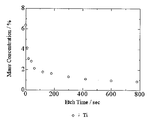
- FIG. 4 is a diagram showing the amount of titanium atoms in the depth direction of the lithium transition metal oxide obtained in Example 2.
- FIG. 4 is a diagram showing the amount of titanium atoms in the depth direction of the lithium transition metal oxide obtained in Example 2.
- the lithium secondary battery positive electrode active material according to the present invention (hereinafter sometimes simply referred to as “positive electrode active material”) is basically a mixture of a lithium compound, a cobalt compound and titanium dioxide, and then a mixture obtained. It consists of lithium transition metal complex oxide containing Ti atom produced
- the positive electrode active material for a lithium secondary battery according to the present invention is characterized by being a lithium transition metal composite oxide containing 0.20 to 2.00% by weight of Ti atoms.
- the reason why the Ti atom content is within the above range is that when the Ti atom content is less than 0.20% by weight, the Ti atom is present only on the particle surface of the lithium transition metal composite oxide, Since the presence is poor, the direct current (DC) resistance is improved, but the effect of improving the rate characteristic tends to be small.
- the content exceeds 2.00% by weight sufficient discharge capacity cannot be obtained, and Ti atoms are not lithium. This is because, in addition to the transition metal composite oxide particles, they may exist alone as Li 2 TiO 3 particles.
- Ti atoms when the Ti atom content is 0.40 to 1.20% by weight, Ti atoms are present in the depth direction from the particle surface of the lithium transition metal composite oxide, and on the particle surface. In addition to having a maximum concentration gradient, Ti atoms are sufficiently present inside the particles, and therefore, characteristics such as direct current (DC) resistance and rate characteristics can be further improved, which is particularly preferable.
- DC direct current
- the lithium transition metal composite oxide containing many Ti atoms either Ti atoms are uniformly present inside the particles, or Ti atoms are present on the particle surface.
- Ti atoms exist both inside the particle and on the particle surface.
- the lithium secondary battery positive electrode active material of the present invention has one characteristic in the concentration distribution state of Ti atoms from the particle surface to the inside of the particle. That is, Ti atoms are present in the depth direction from the particle surface inside the lithium transition metal composite oxide particles, and have a concentration gradient that is maximum on the particle surface.
- the Ti atom is present in the depth direction from the particle surface of the lithium transition metal composite oxide and has a maximum concentration gradient on the particle surface
- the presence of the Ti atom is determined by X-ray photoelectron spectroscopy ( In XPS analysis, the presence can be confirmed at least up to 50 nm in the depth direction, and the concentration gradient from the depth direction 50 nm to the particle surface has a maximum concentration on the particle surface. Therefore, in the present invention, the concentration gradient may be a regular concentration gradient or a non-regular concentration gradient. Moreover, it is preferable that the concentration difference between the Ti atom concentration in the depth direction of 50 nm and the Ti atom concentration maximized on the particle surface is twice or more. This concentration gradient of Ti atoms can be confirmed by analyzing the cross section of the lithium transition metal composite oxide particles by X-ray photoelectron spectroscopy (XPS) analysis and field emission electron probe microanalyzer (FE-EMPA).
- XPS X-ray photoelectron spectroscopy
- the Ti atom of the lithium transition metal composite oxide is present as at least Li 2 TiO 3 .
- XRD X-ray diffraction
- the positive electrode active material for a lithium secondary battery of the present invention Ti atoms contained in the lithium transition metal composite oxide affect the crystal structure of pure LiCoO 2 . That is, the lattice constant of the C axis of pure LiCoO 2 is 14.050 to 14.055 angstroms, whereas the positive electrode active material for a lithium secondary battery of the present invention has a lattice constant of C axis of 14.055. -14.070 angstroms, preferably 14.060-144.065 angstroms, which is larger than the C-axis lattice constant of pure LiCoO 2 .
- the crystallite size of pure LiCoO 2 is 700 to 750 ⁇ in the (104) plane direction
- the lithium secondary battery of the present invention is In the positive electrode active material for a battery, the crystallite size is 550 to 700 angstroms, preferably 550 to 650 angstroms in the (104) plane direction, and the crystallite size is (104) compared to pure LiCoO 2. ) It becomes smaller in the surface direction.
- the present inventors presume that this is an influence of Ti atoms present inside the particles of the lithium transition metal composite oxide.
- the positive electrode active material for a lithium secondary battery of the present invention has the above-mentioned characteristics, and the contained Li 2 CO 3 is 0.10% by weight or less, preferably 0.05% by weight or less. If it exists, the suppression effect of the blistering resulting from the gas generation accompanying reaction with a nonaqueous electrolyte is preferable from a viewpoint of becoming still higher.
- the average particle size obtained by the laser diffraction / scattering method is 1 to 30 ⁇ m, preferably 3 to 25 ⁇ m, and the uniform thickness This is preferable from the viewpoint of enabling the formation of a coating film.
- the positive electrode active material for a lithium secondary battery according to the present invention having the above physical properties is obtained by mixing a lithium compound, a cobalt compound and titanium dioxide, and then firing the resulting mixture to obtain a lithium transition metal composite oxide containing Ti atoms.
- the molar ratio of lithium atoms to cobalt atoms and titanium atoms (Li / (Co + Ti)) is 0.90 or more, and the molar ratio of Ti atoms to Co atoms (Ti / Co) is 0.005 to 0.00. It can be manufactured by mixing at 030 and firing the resulting mixture.
- the raw material lithium compound examples include lithium oxide, hydroxide, carbonate, nitrate, and organic acid salt. Among these, industrially inexpensive lithium carbonate is preferable. Further, this lithium compound has an average particle size of 0.1 to 200 ⁇ m, preferably 2 to 50 ⁇ m, since it has good reactivity and is particularly preferable.
- the raw material cobalt compound examples include cobalt oxide, oxyhydroxide, hydroxide, carbonate, nitrate and organic acid salt.
- cobalt oxide is industrially easily available and inexpensive.
- the cobalt compound has an average particle diameter of 0.5 to 30.0 ⁇ m, preferably 2.0 to 25.0 ⁇ m, because the reactivity is good, and thus it is particularly preferable.
- the raw material titanium dioxide is usually produced industrially by the chlorine method or the sulfuric acid method.
- the raw material titanium dioxide may be produced by the sulfuric acid method or the chlorine method. It can be used without any particular limitation.
- the reason why a BET specific surface area of 1 m 2 / g or more is used is that when the BET specific surface area is less than 1 m 2 / g, the reactivity with the raw material cobalt compound is poor.
- the titanium dioxide has an average particle size determined by a laser diffraction / scattering method of 5 ⁇ m or less, preferably 0.1 to 2 ⁇ m, from the viewpoint of good reactivity with the starting cobalt compound.
- the crystal structure of titanium dioxide is roughly classified into anatase type and rutile type, and any of them can be used in the present invention.
- the content of anatase type is 70% by weight or more. Particularly preferably used.
- the raw material lithium compound, cobalt compound and titanium dioxide have as little impurity content as possible.
- titanium dioxide inevitably contains a high concentration of sulfate radicals.
- it is preferable to appropriately select and use each raw material so that the sulfate radical contained in the obtained lithium transition metal composite oxide is 0.3 wt% or less as SO 4 .
- a predetermined amount of the above-described raw material lithium compound, cobalt compound and titanium dioxide is mixed.
- the mixing may be either a dry method or a wet method, but a dry method is preferred because the production is easy.
- dry mixing it is preferable to use a blender or the like that uniformly mixes the raw materials.
- the molar ratio of lithium atom to cobalt atom and titanium atom is 0.90 or more. This is because if the molar ratio of lithium atoms to cobalt atoms and titanium atoms (Li / (Co + Ti)) is less than 0.90, the discharge capacity tends to decrease remarkably. In the present invention, it is particularly preferable that the molar ratio of lithium atoms to cobalt atoms and titanium atoms (Li / (Co + Ti)) is 0.98 to 1.10 from the viewpoint of obtaining a stable discharge capacity.
- the molar ratio of Ti atoms to Co atoms is 0.005 to 0.030. This is because, when the molar ratio of Ti atom to Co atom (Ti / Co) is less than 0.005, Ti atom exists only on the particle surface of the lithium transition metal composite oxide, and the presence inside thereof is poor. DC) resistance is improved, but the effect of improving the rate characteristic tends to be small. On the other hand, if it exceeds 0.030, a sufficient discharge capacity cannot be obtained, and Ti atoms exist alone as Li 2 TiO 3 particles. Because there are cases.
- Ti atom exists in the depth direction from the particle surface of the lithium transition metal composite oxide,
- the presence of sufficient Ti atoms inside the particle is particularly preferable from the viewpoint of improving both direct current (DC) resistance and rate characteristics.
- the firing is preferably performed at 800 ° C. or higher.
- the reason for this is that when the firing temperature is less than 800 ° C., the reactivity of the raw material cobalt compound and titanium dioxide is poor, so that Ti atoms are scarcely present inside the lithium transition metal composite oxide, and the effect of improving the rate characteristics is small Because it becomes.
- the firing is in the range of 900 ° C. or more, more preferably 1000 to 1100 ° C., the Ti atoms are present in the depth direction from the particle surface of the lithium transition metal composite oxide and are maximum It is preferable from the viewpoint that the reaction with a clear tendency to have a concentration gradient progresses successfully.
- the firing atmosphere is in the air or in an oxygen atmosphere.
- these firings can be performed as many times as necessary, and in order to make the powder characteristics uniform, the firing may be performed once and then pulverized and further fired. After firing, the mixture is appropriately cooled, and pulverized and classified as necessary to obtain a lithium transition metal composite oxide containing Ti atoms, which is used as the positive electrode active material of the lithium secondary battery of the present invention.
- the pulverization performed as necessary is appropriately performed when the lithium transition metal composite oxide containing Ti atoms obtained by firing is in a brittlely bonded block form.
- the product particles themselves have a specific average particle size and a BET specific surface area. That is, the resulting lithium transition metal composite oxide containing Ti atoms has an average particle size of 1 to 30 ⁇ m, preferably 3 to 25 ⁇ m, and a BET specific surface area of 0.05 to 2.00 m 2 / g, preferably 0.10 to 0.80 m 2 / g.
- the lithium transition metal composite oxide used as the positive electrode active material of the lithium secondary battery in the present invention has the above powder characteristics, and in addition, Ti atom is 0.20 to 2.00% by weight, preferably The Ti atom is present in the depth direction from the particle surface of the lithium transition metal composite oxide and has a concentration gradient that is maximum on the particle surface. Furthermore, according to a preferred embodiment of the present invention, Ti atoms present in the lithium transition metal composite oxide are present as Li 2 TiO 3 at least on the surface of the particles, in addition to the C of the lithium transition metal composite oxide.
- the axial lattice constant is in the range of 14.055 to 14.070 angstrom, preferably 14.060 to 14.065 angstrom, and the crystallite size is 550 to 700 angstrom in the (104) plane direction, preferably Is in the range of 550 to 650 angstroms, and Ti atoms are also present inside the particles.
- the lithium transition metal composite oxide has a remaining Li 2 CO 3 content of 0.10% by weight or less, preferably 0.05% by weight or less.
- the lithium secondary battery according to the present invention uses the above-described lithium secondary battery positive electrode active material, and includes a positive electrode, a negative electrode, a separator, and a nonaqueous electrolyte containing a lithium salt.
- the positive electrode is formed, for example, by applying and drying a positive electrode mixture on a positive electrode current collector, and the positive electrode mixture includes a positive electrode active material, a conductive agent, a binder, and a filler added as necessary. Consists of.
- the lithium composite containing the Ti atom as the positive electrode active material is uniformly applied to the positive electrode. For this reason, the lithium secondary battery according to the present invention particularly has a reduced direct current (DC) resistance and is unlikely to cause deterioration in load characteristics and cycle characteristics.
- DC direct current
- the content of the positive electrode active material contained in the positive electrode mixture is 70 to 100% by weight, preferably 90 to 98% by weight.
- the positive electrode current collector is not particularly limited as long as it is an electronic conductor that does not cause a chemical change in the constituted battery.
- the surface include carbon, nickel, titanium, and silver surface-treated. The surface of these materials may be oxidized and used, or the current collector surface may be provided with irregularities by surface treatment.
- the current collector include foils, films, sheets, nets, punched ones, lath bodies, porous bodies, foam bodies, fiber groups, nonwoven fabric molded bodies, and the like.
- the thickness of the current collector is not particularly limited, but is preferably 1 to 500 ⁇ m.
- the conductive agent is not particularly limited as long as it is an electron conductive material that does not cause a chemical change in a configured battery.
- graphite such as natural graphite and artificial graphite, carbon black, acetylene black, ketjen black, channel black, furnace black, lamp black, carbon black such as thermal black
- conductive fibers such as carbon fiber and metal fiber
- Examples include metal powders such as carbon fluoride, aluminum and nickel powder, conductive whiskers such as zinc oxide and potassium titanate, conductive metal oxides such as titanium oxide, and conductive materials such as polyphenylene derivatives.
- graphite include scaly graphite, scaly graphite, and earthy graphite. These can be used alone or in combination of two or more.
- the blending ratio of the conductive agent is 1 to 50% by weight, preferably 2 to 30% by weight in the positive electrode mixture.
- binder examples include starch, polyvinylidene fluoride, polyvinyl alcohol, carboxymethylcellulose, hydroxypropylcellulose, regenerated cellulose, diacetylcellulose, polyvinylpyrrolidone, tetrafluoroethylene, polyethylene, polypropylene, ethylene-propylene-diene terpolymer ( EPDM), sulfonated EPDM, styrene butadiene rubber, fluoro rubber, tetrafluoroethylene-hexafluoroethylene copolymer, tetrafluoroethylene-hexafluoropropylene copolymer, tetrafluoroethylene-perfluoroalkyl vinyl ether copolymer, fluorinated Vinylidene-hexafluoropropylene copolymer, vinylidene fluoride-chlorotrifluoroethylene copolymer, ethylene-tetraf Oroethylene copolymer, polychlorotrifluoroethylene
- the compound containing a functional group which reacts with lithium like a polysaccharide it is preferable to add the compound like an isocyanate group and to deactivate the functional group, for example.
- the blending ratio of the binder is 1 to 50% by weight, preferably 5 to 15% by weight in the positive electrode mixture.
- the filler suppresses the volume expansion of the positive electrode in the positive electrode mixture, and is added if necessary.
- any fibrous material can be used as long as it does not cause a chemical change in the constructed battery.
- olefinic polymers such as polypropylene and polyethylene, and fibers such as glass and carbon are used.
- the addition amount of the filler is not particularly limited, but is preferably 0 to 30% by weight in the positive electrode mixture.
- the negative electrode is formed by applying and drying a negative electrode material on the negative electrode current collector.
- the negative electrode current collector is not particularly limited as long as it is an electronic conductor that does not cause a chemical change in a configured battery.
- stainless steel, nickel, copper, titanium, aluminum, calcined carbon, copper or stainless steel examples include carbon, nickel, titanium, silver surface-treated, and an aluminum-cadmium alloy. Further, the surface of these materials may be used after being oxidized, or the surface of the current collector may be provided with irregularities by surface treatment.
- Examples of the current collector include foils, films, sheets, nets, punched ones, lath bodies, porous bodies, foam bodies, fiber groups, nonwoven fabric molded bodies, and the like.
- the thickness of the current collector is not particularly limited, but is preferably 1 to 500 ⁇ m.
- the negative electrode material is not particularly limited, and examples thereof include carbonaceous materials, metal composite oxides, lithium metals, lithium alloys, silicon-based alloys, tin-based alloys, metal oxides, conductive polymers, and chalcogen compounds. , Li—Co—Ni-based materials, Li 4 Ti 5 O 12 and the like.
- Examples of the carbonaceous material include non-graphitizable carbon materials and graphite-based carbon materials.
- Examples of the metal composite oxide include Sn P (M 1 ) 1-p (M 2 ) q Or (wherein M 1 represents one or more elements selected from Mn, Fe, Pb and Ge, M 2 represents one or more elements selected from Al, B, P, Si, Group 1, Group 2, Group 3 and a halogen element in the periodic table, and 0 ⁇ p ⁇ 1, 1 ⁇ q ⁇ 3 1 ⁇ r ⁇ 8), Li x Fe 2 O 3 (0 ⁇ x ⁇ 1), Li x WO 2 (0 ⁇ x ⁇ 1) and the like.
- the metal oxide GeO, GeO 2, SnO, SnO 2, PbO, PbO 2, Pb 2 O 3, Pb 3 O 4, Sb 2 O 3, Sb 2 O 4, Sb 2 O 5, Bi 2 O 3 Bi 2 O 4 , Bi 2 O 5 and the like.
- the conductive polymer include polyacetylene and poly-p-phenylene.
- an insulating thin film having a large ion permeability and a predetermined mechanical strength is used.
- Sheets and non-woven fabrics made of olefin polymers such as polypropylene, glass fibers or polyethylene are used because of their organic solvent resistance and hydrophobicity.
- the pore diameter of the separator may be in a range generally useful for batteries, for example, 0.01 to 10 ⁇ m.
- the thickness of the separator may be in a range for a general battery, for example, 5 to 300 ⁇ m.
- the solid electrolyte such as a polymer is used as the electrolyte described later, the solid electrolyte may also serve as a separator.
- the non-aqueous electrolyte containing a lithium salt is composed of a non-aqueous electrolyte and a lithium salt.
- a non-aqueous electrolyte a non-aqueous electrolyte, an organic solid electrolyte, or an inorganic solid electrolyte is used.
- Non-aqueous electrolytes include, for example, N-methyl-2-pyrrolidinone, propylene carbonate, ethylene carbonate, butylene carbonate, dimethyl carbonate, diethyl carbonate, ⁇ -butyrolactone, 1,2-dimethoxyethane, tetrahydroxyfuran, 2-methyl Tetrahydrofuran, dimethyl sulfoxide, 1,3-dioxolane, formamide, dimethylformamide, dioxolane, acetonitrile, nitromethane, methyl formate, methyl acetate, phosphate triester, trimethoxymethane, dioxolane derivatives, sulfolane, methylsulfolane, 3-methyl -2-Oxazolidinone, 1,3-dimethyl-2-imidazolidinone, propylene carbonate derivative, tetrahydrofuran derivative, diethyl ether, 1, - propane sultone, methyl propionate, and a solvent obtained
- organic solid electrolyte examples include a polyethylene derivative, a polyethylene oxide derivative or a polymer containing the same, a polypropylene oxide derivative or a polymer containing the same, a phosphate ester polymer, polyphosphazene, polyaziridine, polyethylene sulfide, polyvinyl alcohol, polyvinylidene fluoride, Examples thereof include a polymer containing an ionic dissociation group such as polyhexafluoropropylene, and a mixture of a polymer containing an ionic dissociation group and the above non-aqueous electrolyte.
- Li nitride, halide, oxyacid salt, sulfide and the like can be used, for example, Li 3 N, LiI, Li 5 NI 2 , Li 3 N—LiI—LiOH, LiSiO 4.
- the inorganic solid electrolyte is amorphous (glass), lithium phosphate (Li 3 PO 4 ), lithium oxide (Li 2 O), lithium sulfate (Li 2 SO 4 ), phosphorus oxide (P 2 O 5) ), Compounds containing oxygen such as lithium borate (Li 3 BO 3 ), Li 3 PO 4-x N 2x / 3 (x is 0 ⁇ x ⁇ 4), Li 4 SiO 4-x N 2x / 3 (x is Nitrogen such as 0 ⁇ x ⁇ 4), Li 4 GeO 4-x N 2x / 3 (x is 0 ⁇ x ⁇ 4), Li 3 BO 3-x N 2x / 3 (x is 0 ⁇ x ⁇ 3)
- the compound to be contained can be contained in the inorganic solid electrolyte.
- lithium salt those dissolved in the non-aqueous electrolyte are used.
- the following compounds can be added to the non-aqueous electrolyte for the purpose of improving discharge, charge characteristics, and flame retardancy.
- pyridine triethyl phosphite, triethanolamine, cyclic ether, ethylenediamine, n-glyme, hexaphosphoric triamide, nitrobenzene derivative, sulfur, quinoneimine dye, N-substituted oxazolidinone and N, N-substituted imidazolidine, ethylene glycol dialkyl ether , Ammonium salt, polyethylene glycol, pyrrole, 2-methoxyethanol, aluminum trichloride, conductive polymer electrode active material monomer, triethylenephosphonamide, trialkylphosphine, morpholine, aryl compound with carbonyl group, hexamethylphosphine
- Examples include hollic triamide and 4-alkylmorpholine, bicyclic tertiary amines, oils, phosphonium salts and
- a halogen-containing solvent such as carbon tetrachloride or ethylene trifluoride can be included in the electrolyte.
- carbon dioxide gas can be included in the electrolytic solution in order to make it suitable for high-temperature storage.
- the lithium secondary battery according to the present invention is a lithium secondary battery excellent in battery performance, particularly in cycle characteristics, and the shape of the battery may be any shape such as a button, a sheet, a cylinder, a corner, or a coin type.
- the use of the lithium secondary battery according to the present invention is not particularly limited.
- electronic devices such as memory cards and video movies, and consumer electronic devices such as automobiles, electric vehicles, and game machines.
- Tricobalt tetroxide (average particle size 5 ⁇ m) and lithium carbonate (average particle size 7 ⁇ m) were weighed so that the molar ratio of Co atoms to Li atoms shown in Table 2 was obtained, and the titanium diacid shown in Table 1 was further measured.
- the obtained raw material mixture was baked in an alumina pot while circulating air in the air at the temperature and time shown in Table 2. After the firing, the fired product was pulverized and classified to obtain a lithium transition metal composite oxide containing Ti atoms.
- Tricobalt tetroxide (average particle size 5 ⁇ m) and lithium carbonate (average particle size 7 ⁇ m) were weighed so as to have the molar ratio of Co atom to Li atom shown in Table 2, and 60 seconds using a dry-type home mixer. Thorough mixing was performed to obtain a raw material mixture. Next, the obtained raw material mixture was baked in the atmosphere at the temperature and time shown in Table 2 in an alumina pot. After firing, the fired product was pulverized and classified to obtain a lithium transition metal composite oxide.
- Tricobalt tetroxide (average particle size 5 ⁇ m) and lithium carbonate (average particle size 7 ⁇ m) were weighed so that the molar ratio of Co atoms to Li atoms shown in Table 2 was obtained, and the titanium diacid shown in Table 1 was further measured.
- the obtained raw material mixture was baked in an alumina pot while circulating air in the air at the temperature and time shown in Table 2. After the firing, the fired product was pulverized and classified to obtain a lithium transition metal composite oxide containing Ti atoms.
- LiCO 3 content 5 g of sample and 100 g of pure water are measured in a beaker and dispersed for 5 minutes using a magnetic stirrer. The dispersion was then filtered, and 30 ml of the filtrate was titrated with 0.1 N HCl with an automatic titrator (model COMMITITE-2500) to calculate the residual Li 2 CO 3 .
- Average particle diameter The average particle diameter was measured by a laser diffraction / scattering method.
- FE-EPMA analysis was similarly performed for Examples 1, 3, 4 and Comparative Examples 2 to 4.
- Ti atoms were present in the particle interior and on the particle surface, and in particular at a high concentration on the particle surface. It was confirmed that Therefore, in the lithium transition metal composite oxide of the present invention, it was confirmed that the Ti atoms exist in the depth direction from the particle surface of the lithium transition metal composite oxide and have a maximum concentration gradient on the particle surface. .
- the lattice constant was obtained by X-ray diffraction (XRD) analysis using CuK ⁇ rays with a lithium transition metal composite oxide sample as a radiation source.
- the lattice constant and the structural parameters were refined by Rietveld analysis using the pattern.
- Rietveld analysis uses an X-ray diffraction pattern, and in order to extract the information contained therein, fitting the diffraction pattern obtained by actual measurement and the diffraction pattern expected from the crystal structure model This is a method for refining the parameters related to the crystal structure.
- ⁇ Battery performance test> (1) Production of lithium secondary battery; 91% by weight of the lithium transition metal composite oxide obtained in Examples 1 to 4 and Comparative Examples 1 to 4, 6% by weight of graphite powder, and 3% by weight of polyvinylidene fluoride were mixed to form a positive electrode agent, and this was treated with N-methyl.
- a kneaded paste was prepared by dispersing in -2-pyrrolidinone. The kneaded paste was applied to an aluminum foil, dried, pressed and punched into a disk with a diameter of 15 mm to obtain a positive electrode plate.
- Capacity maintenance rate (%) (Discharge capacity at 20th cycle / Discharge capacity at 1st cycle) ⁇ 100 (2)
- the x-axis was plotted as a current value, and the y-axis as a potential difference, and the slope of a straight line obtained by the least square method was defined as a direct current (DC) resistance at 25 ° C.
- DC direct current
- the current value when discharging at 0.2 C in a thermostatic chamber at ⁇ 10 ° C. is I 0.2C
- the x-axis was plotted with the current value and the y-axis with the potential difference, and the slope of the straight line obtained by the least square method was defined as a direct current (DC) resistance of ⁇ 10 ° C.
- the positive electrode active material of the present invention when used as a positive electrode active material of a lithium secondary battery, is particularly excellent in cycle characteristics and rate characteristics, has a low direct current (DC) resistance, and generates gas accompanying a reaction with a non-aqueous electrolyte. Thus, a lithium secondary battery in which swelling due to the above is suppressed can be obtained. Moreover, according to the manufacturing method of the lithium secondary battery positive electrode active material of this invention, this lithium secondary battery positive electrode active material can be manufactured by an industrially advantageous method.
Landscapes
- Chemical & Material Sciences (AREA)
- Organic Chemistry (AREA)
- Inorganic Chemistry (AREA)
- General Chemical & Material Sciences (AREA)
- Chemical Kinetics & Catalysis (AREA)
- Electrochemistry (AREA)
- Engineering & Computer Science (AREA)
- Geology (AREA)
- General Life Sciences & Earth Sciences (AREA)
- Environmental & Geological Engineering (AREA)
- Life Sciences & Earth Sciences (AREA)
- Manufacturing & Machinery (AREA)
- Materials Engineering (AREA)
- Battery Electrode And Active Subsutance (AREA)
- Secondary Cells (AREA)
Abstract
Description
また、下記特許文献1には、コバルト酸リチウムの粒子表面の一部に酸化チタン及び/又はチタン酸リチウムがTiとして2.0~4.0モル%の量で被覆されたリチウムコバルト系複合酸化物を正極活物質とするリチウム二次電池が提案されている。
また、下記特許文献2には、コバルト酸リチウムの粒子表面におけるチタンの存在割合が20%以上であるリチウムコバルト系複合酸化物を正極活物質とするリチウム二次電池が提案されている。
また、本発明のリチウム二次電池正極活物質の製造方法によれば、該リチウム二次電池正極活物質を工業的に有利な方法で製造することができる。
本発明に係るリチウム二次電池正極活物質(以下、単に「正極活物質」と言うこともある。)は、基本的にはリチウム化合物、コバルト化合物及び二酸化チタンを混合し、次いで得られる混合物を焼成することにより生成されるTi原子を含有するリチウム遷移金属複合酸化物からなる。
本発明において、Ti原子の含有量を前記範囲にする理由は、Ti原子の含有量が0.20重量%未満ではTi原子はリチウム遷移金属複合酸化物の粒子表面にのみ存在し、内部での存在が乏しいため、直流(DC)抵抗は改善するが、レート特性の改善効果が小さい傾向があり、一方、2.00重量%を超えると十分な放電容量が得られず、またTi原子がリチウム遷移金属複合酸化物粒子とは別に単独でLi2TiO3粒子として存在する場合があるからである。なお、本発明において、Ti原子の含有量が0.40~1.20重量%のものであるとTi原子がリチウム遷移金属複合酸化物の粒子表面から深さ方向に存在し、且つ粒子表面で最大となる濃度勾配を有することに加えて、更に粒子内部においてTi原子が十分に存在することから、直流(DC)抵抗、レート特性等の特性を更に向上させることができことから特に好ましい。
本発明において、「Ti原子はリチウム遷移金属複合酸化物の粒子表面から深さ方向に存在し、且つ粒子表面で最大となる濃度勾配」を有するとは、Ti原子の存在が、エックス線光電子分光(XPS)分析で、少なくとも深さ方向に50nmまでその存在が確認でき、この深さ方向50nmから粒子表面にかけて、粒子表面で最大濃度となる濃度勾配を有することを言う。従って、本発明では濃度勾配は、規則性のある濃度勾配であっても規則性のない濃度勾配であってもよい。また、深さ方向50nmでのTi原子濃度と、粒子表面で最大となるTi原子濃度との濃度差が2倍以上であることが好ましい。
このTi原子の濃度勾配は、リチウム遷移金属複合酸化物の粒子断面をエックス線光電子分光(XPS)分析及び電界放出形電子プローブマイクロアナライザ(FE-EMPA)で分析することにより確認することができる。
このLi2TiO3の存在は、該リチウム遷移金属複合酸化物を線源としてCuKα線を用いて、X線回折(XRD)分析したときに2θ=20.5°にLi2TiO3の回折ピークが存在することから確認することができる。本発明者らによれば、該リチウム遷移金属複合酸化物の粒子表面に高濃度で存在するTi原子は、Li2TiO3であると推測している。
このことは、リチウム遷移金属複合酸化物の粒子内部に存在するTi原子による影響であると、本発明者らは推測している。
本発明では、二酸化チタンは、BET比表面積が1m2/g以上、好ましくは5m2/g以上であり、特に5~50m2/gの範囲のものを用いることが原料のコバルト化合物との反応性が良好である観点から好ましい。BET比表面積が1m2/g以上のものを用いる理由は、BET比表面積が1m2/g未満では原料のコバルト化合物との反応性に乏しいため、Ti原子がリチウム遷移金属複合酸化物の内部での存在に乏しくなる傾向があるためである。また、該二酸化チタンはレーザー回折・散乱法により求められる平均粒径が5μm以下、好ましくは0.1~2μmであると原料のコバルト化合物との反応性が良好である観点から特に好ましい。
二酸化チタンの結晶構造は、アナターゼ型とルチル型に大別されるが、本発明ではいずれも使用できるが、反応性が良好である点で、アナターゼ型の含有量が70重量%以上のものが特に好ましく用いられる。
更に本発明の好ましい実施形態によれば、リチウム遷移金属複合酸化物に存在するTi原子は、少なくとも粒子の表面ではLi2TiO3として存在することに加えて、該リチウム遷移金属複合酸化物のC軸の格子定数が14.055~14.070オングストローム、好ましくは14.060~14.065オングストロームの範囲であって、結晶子の大きさが、(104)面方向において、550~700オングストローム、好ましくは550~650オングストロームの範囲であり、Ti原子は粒子内部にも存在する。更に、該リチウム遷移金属複合酸化物は残存するLi2CO3が0.10重量%以下、好ましくは0.05重量%以下であることが好ましい。
<二酸化チタン試料>
二酸化チタン(TiO2)は下記諸物性を有するものを使用した、なお、平均粒径はレーザー回折・散乱法により求めた。

表2に示したCo原子とLi原子のモル比となるように四酸化三コバルト(平均粒径5μm)、炭酸リチウム(平均粒径7μm)を秤量し、更に表1に示した前記二酸チタンを表2に示すモル比となるように乾式で家庭用ミキサーを用いて60秒間十分に混合し原料混合物を得た。次いで得られた原料混合物をアルミナ製の鉢で表2に示す温度と時間で大気中で大気を循環させながら焼成した。焼成終了後、該焼成物を粉砕、分級してTi原子を含有するリチウム遷移金属複合酸化物を得た。
表2に示したCo原子とLi原子のモル比となるように四酸化三コバルト(平均粒径5μm)、炭酸リチウム(平均粒径7μm)を秤量し、乾式で家庭用ミキサーを用いて60秒間十分に混合し原料混合物を得た。次いで得られた原料混合物をアルミナ製の鉢で表2に示す温度と時間で大気中で焼成した。焼成終了後、該焼成物を粉砕、分級してリチウム遷移金属複合酸化物を得た。
表2に示したCo原子とLi原子のモル比となるように四酸化三コバルト(平均粒径5μm)、炭酸リチウム(平均粒径7μm)を秤量し、更に表1に示した前記二酸チタンを表2に示すモル比となるように乾式で家庭用ミキサーを用いて60秒間十分に混合し原料混合物を得た。次いで得られた原料混合物をアルミナ製の鉢で表2に示す温度と時間で大気中で大気を循環させながら焼成した。焼成終了後、該焼成物を粉砕、分級してTi原子を含有するリチウム遷移金属複合酸化物を得た。

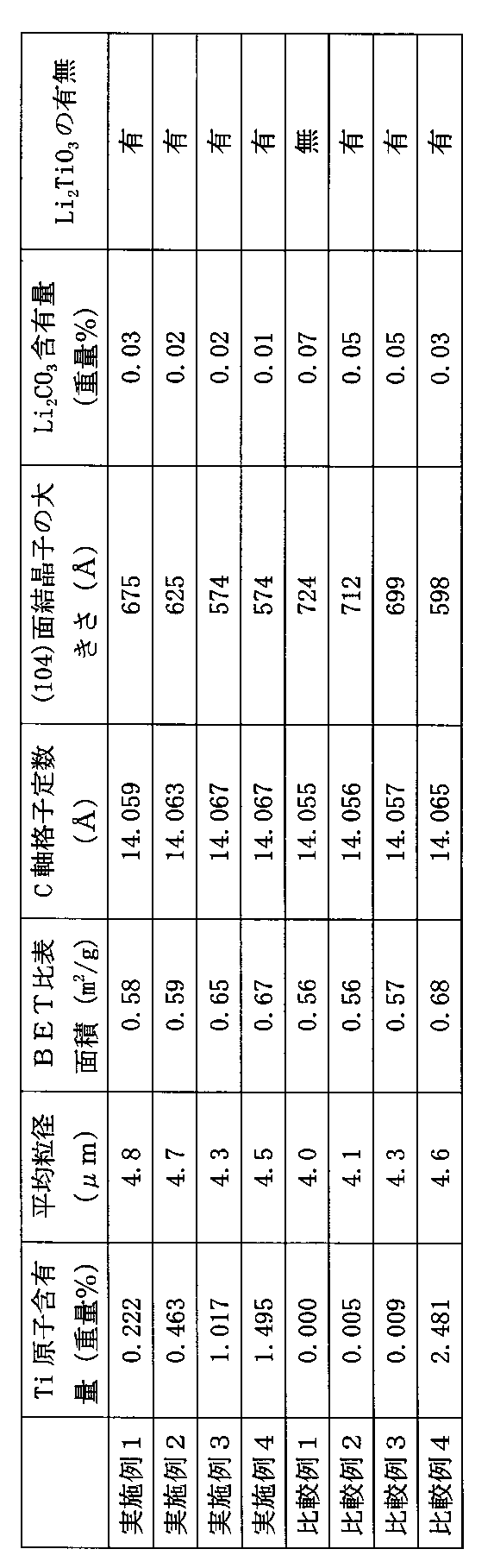
実施例及び比較例で得られたリチウム遷移金属複合酸化物について、Ti原子含有量、LiCO3含有量、平均粒径、BET比表面積、Ti原子の分布の状態、Li2TiO3の存在の有無、C軸の格子定数及び(104)面方向の結晶子の大きさを求めた。また、その結果を表4に示す。
Ti含有量は試料を酸で溶解し、その溶解液をICPにより測定して求めた値である。
試料5g、純水100gをビーカーに計り採りマグネチックスターラーを用いて5分間分散させる。次いでこの分散液をろ過し、そのろ液30mlを自動滴定装置(型式COMTITE-2500)にて0.1N-HClで滴定し残留Li2CO3を算出した。
平均粒径はレーザー回折・散乱法により測定した。
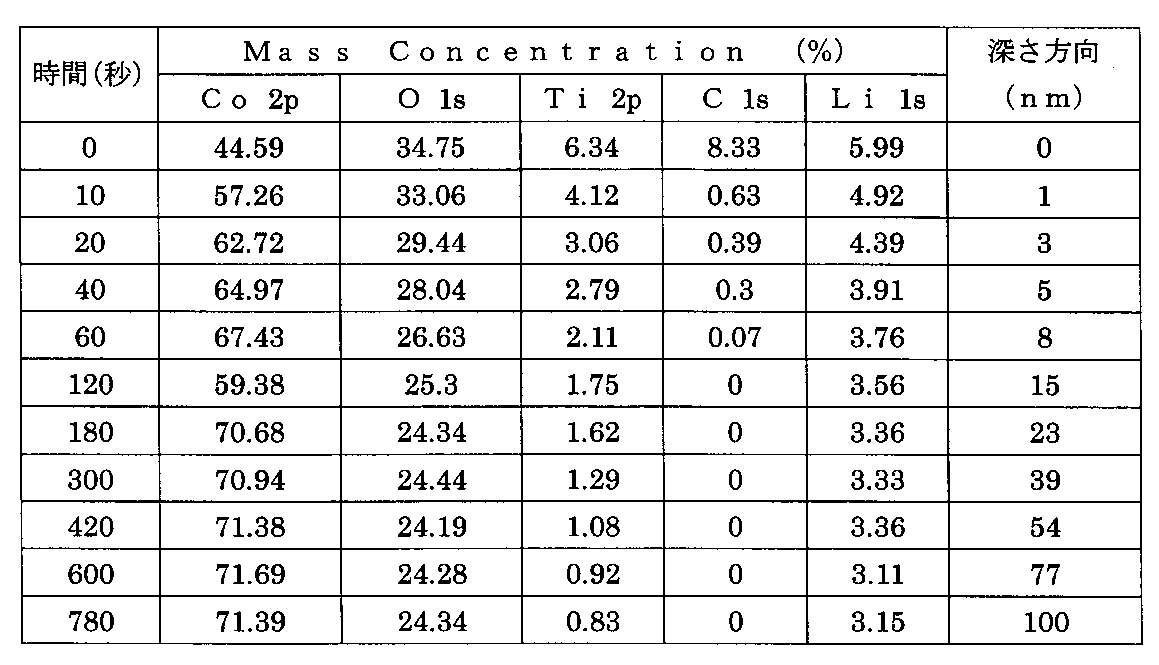
実施例2で得られたリチウム遷移金属複合酸化物粒子についてエックス線光電子分光(XPS)分析により、表面をアルゴンでエッチングしていき、深さ方向でTiピークを測定した。その結果を表3及び図1に示す。Co原子、O原子、C原子、Li原子の深さ方向の濃度分布を表3に併記した。
なお、エックス線光電子分光分析の条件は、下記のとおりである。
エッチングレート;7.7nm/min(Arでの表面エッチング)
エッチング時間;10sec×2回,20sec×2回,1min×2回,2min×2回,3min×2回
また、実施例2で得られたリチウム遷移金属酸化物粒子をカットして粒子断面を電界放出形電子プローブマイクロアナライザ(FE-EMPA)(装置名;JXA8500F 日本電子 測定条件;加速電圧15kV、倍率3000、照射電流4.861e-08A)でTi原子をマッピング分析した。FE-EPMAのマッピング分析の結果、Ti原子は粒子内部及び粒子表面に存在し、特に粒子表面では高濃度で存在していることが確認できた。
また、実施例1、3、4及び比較例2~4についても同様にFE-EPMA分析を行ったが、Ti原子は粒子内部及び粒子表面に存在し、特に粒子表面では高濃度で存在していることが確認できた。
従って、本発明のリチウム遷移金属複合酸化物において、該Ti原子はリチウム遷移金属複合酸化物の粒子表面から深さ方向に存在し、且つ粒子表面で最大となる濃度勾配を有することが確認できた。
リチウム遷移金属複合酸化物試料を線源としてCuKα線を用いてX回折(XRD)分析することにより、2θ=20.5°のLi2TiO3の回折ピークの存在の有無を確認した。
その結果、実施例1~4及び比較例2~4においてLi2TiO3の回折ピークが確認できた。
格子定数はリチウム遷移金属複合酸化物試料を線源としてCuKα線を用いてX線回折(XRD)分析により得た回折パターンを用いてリートベルト解析することにより、格子定数、構造パラメータを精密化して求めた。リートベルト解析は、X線回折パターンを用い、この中に含まれている情報を抽出するために、実測で得られた回折パターンと、結晶構造モデルから予想される回折パターンとをフィティングすることにより、結晶構造に関するパラメータの精密化を行う方法である。
結晶子の大きさは、回折角(2θ)45°の(104)面のX線回折ピークの半値幅を算出し、下記(式1)のScherrerの式より求めた。
結晶子の大きさD(オングストローム)=Kλ/(βcosθ))・・(1)
K:Scherrer定数(0.9)
λ:使用X線管球の波長(CuKα=1.5405オングストローム)
β:結晶子の大きさによる回折線の広がりの幅(radian)
θ:回折角2θ/2(degree)
(1)リチウム二次電池の作製;
実施例1~4及び比較例1~4で得られたリチウム遷移金属複合酸化物91重量%、黒鉛粉末6重量%、ポリフッ化ビニリデン3重量%を混合して正極剤とし、これをN-メチル-2-ピロリジノンに分散させて混練ペーストを調製した。該混練ペーストをアルミ箔に塗布したのち乾燥、プレスして直径15mmの円盤に打ち抜いて正極板を得た。
この正極板を用いて、セパレーター、負極、正極、集電板、取り付け金具、外部端子、電解液等の各部材を使用してコイン型リチウム二次電池を製作した。このうち、負極は金属リチウム箔を用い、電解液にはエチレンカーボネートとメチルエチルカーボネートの1:1混練液1リットルにLiPF61モルを溶解したものを使用した。
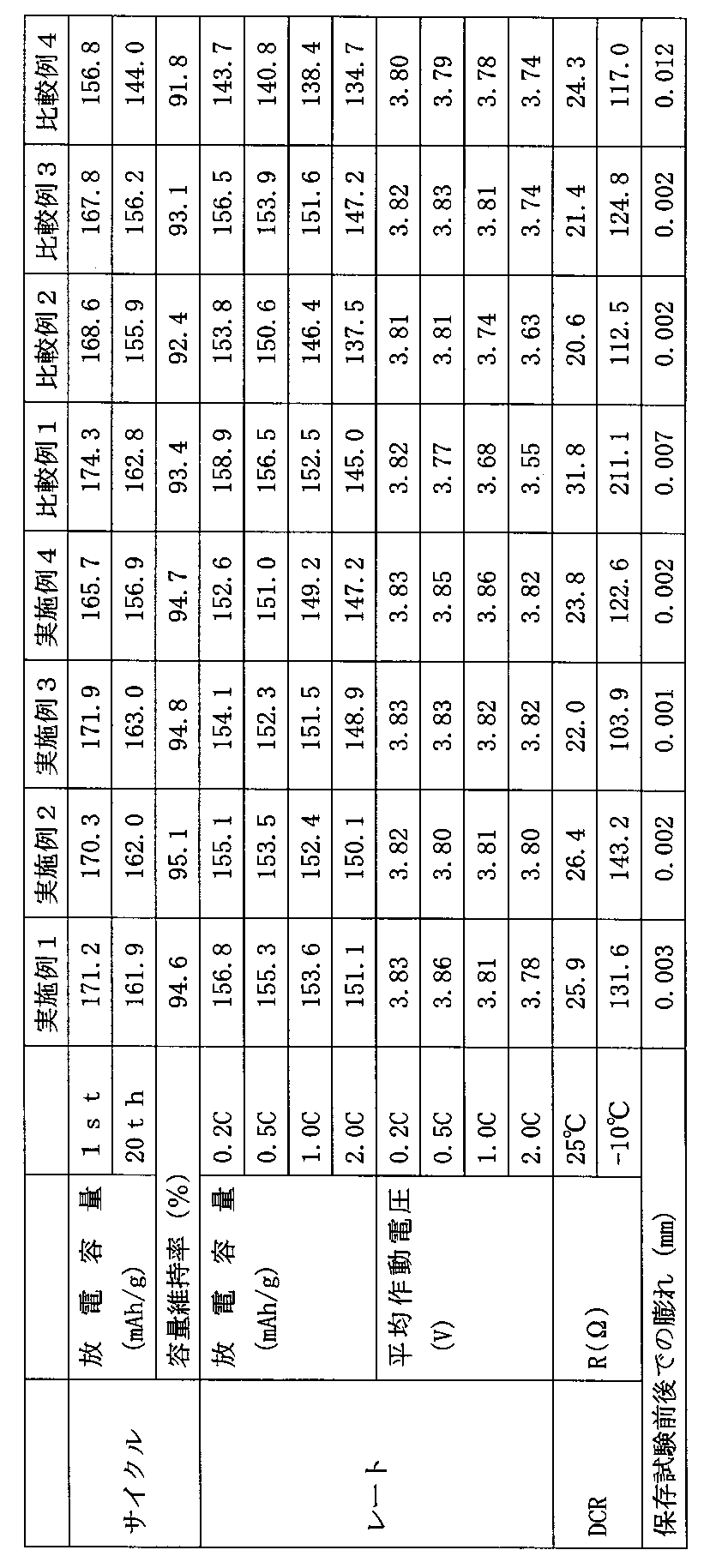
作製したコイン型リチウム二次電池を室温で下記条件で作動させ、下記の電池性能を評価した。その結果を表5に示す。
<サイクル特性の評価>
まず0.5Cにて4.4Vまで2時間かけて充電を行い、更に4.4Vで3時間電圧を保持させる定電流・定電圧充電(CCCV充電)を行った。その後、以下に示す所定の電流量にて、2.7Vまで定電流放電(CC放電)させる充放電を行い、これらの操作を1サイクルとして1サイクル毎に放電容量を測定した。このサイクルを20サイクル繰り返し、1サイクル目(1st)と20サイクル目(20th)のそれぞれの放電容量から、下記式(2)により容量維持率を算出した。なお、1サイクル目の放電容量を初期放電容量とした。
=(20サイクル目の放電容量/1サイクル目の放電容量)×100…(2)
まず0.5Cにて4.3Vまで2時間かけて充電を行い、更に4.3Vで3時間電圧を保持させる定電流・定電圧充電(CCCV充電)を行った。その後、以下に示す所定の電流量にて、2.7Vまで定電流放電(CC放電)させる充放電を行い、これらの操作を1サイクルとして1サイクル毎に放電容量を測定した。
各サイクルの放電電流量について、1から3サイクルは0.2C、4から6サイクルは0.5C、7から9サイクルは1.0C、10から12サイクルは2.0Cとし、3サイクル目の放電容量を0.2C時の放電容量、6サイクル目の放電容量を0.5C時の放電容量、9サイクル目の放電容量を1.0C時の放電容量、12サイクル目の放電容量を2.0C時の放電容量とした。また3サイクル目の平均作動電圧を0.2C時の平均作動電圧、6サイクル目の平均作動電圧を0.5C時の平均作動電圧、9サイクル目の平均作動電圧を1.0C時の平均作動電圧、12サイクル目の平均作動電圧を2.0C時の平均作動電圧とした。
まず0.5Cにて4.3Vまで2時間かけて充電を行い、更に4.3Vで3時間電圧を保持させる定電流・定電圧充電(CCCV充電)を行った。その後、25℃の恒温槽内で0.2Cで放電したときの電流値をI0.2C、放電開始0秒と6秒の電位差をΔV0.2C、0.5Cで放電したときの電流値をI0.5C、放電開始0秒と6秒の電位差をΔV0.5C、1.0Cで放電したときの電流値をI1.0C、放電開始0秒と6秒の電位差をΔV1.0Cとする。x軸を電流値、y軸を電位差としてプロットし、最小二乗法にて得られる直線の傾きを25℃の直流(DC)抵抗とした。また-10℃の恒温槽内で0.2Cで放電したときの電流値をI0.2C、放電開始0秒と6秒の電位差をΔV0.2C、0.5Cで放電したときの電流値をI0.5C、放電開始0秒と6秒の電位差をΔV0.5C、1.0Cで放電したときの電流値をI1.0C、放電開始0秒と6秒の電位差をΔV1.0Cとする。x軸を電流値、y軸を電位差としてプロットし、最小二乗法にて得られる直線の傾きを-10℃の直流(DC)抵抗とした。
0.5Cにて4.5Vまで2時間かけて充電を行い、更に4.5Vで3時間電圧を保持させる定電流・定電圧充電(CCCV充電)を行った。その直後にマイクロメータにて測定したコイン型リチウム二次電池の厚みをD0、このコイン型リチウム二次電池を60℃の恒温槽内で150時間保存した直後にマイクロメータにて測定したコイン型リチウム二次電池の厚みをD150とする。膨れ量は以下の式(3)にて算出した。
膨れ(mm)=D150-D0 ・・・(3)
また、本発明のリチウム二次電池正極活物質の製造方法によれば、該リチウム二次電池正極活物質を工業的に有利な方法で製造することができる。
Claims (8)
- リチウム化合物、コバルト化合物及び二酸化チタンを混合し、次いで得られる混合物を焼成することにより生成されるTi原子を0.20~2.00重量%含有するリチウム遷移金属複合酸化物からなるリチウム二次電池用正極活物質であって、前記Ti原子はリチウム遷移金属複合酸化物の粒子表面から深さ方向に存在し、且つ粒子表面で最大となる濃度勾配を有することを特徴するリチウム二次電池用正極活物質。
- 前記リチウム遷移金属複合酸化物に含有されるTi原子は、少なくともLi2TiO3として存在することを特徴とする請求項1記載のリチウム二次電池用正極活物質。
- 残存するLi2CO3が0.10重量%以下であることを特徴とする請求項1又は2記載のリチウム二次電池用正極活物質。
- 前記リチウム遷移金属複合酸化物のC軸の格子定数が14.055~14.070オングストロームの範囲であって、結晶子の大きさが、(104)面方向において、550~700オングストロームの範囲であることを特徴とする請求項1乃至3記載のリチウム二次電池用正極活物質。
- リチウム化合物、コバルト化合物及び二酸化チタンを混合し、次いで得られる混合物を焼成してTi原子を含有するリチウム遷移金属複合酸化物を製造する方法において、リチウム化合物、コバルト化合物及び二酸化チタンを、コバルト原子とチタン原子に対するリチウム原子のモル比(Li/(Co+Ti))が0.90以上で、Co原子に対するTi原子のモル比(Ti/Co)が0.005~0.030で混合し、得られる混合物を焼成することを特徴とするリチウム二次電池用正極活物質の製造方法。
- 前記二酸化チタンはBET比表面積が1m2/g以上のものを使用することを特徴とする請求項5記載のリチウム二次電池用正極活物質の製造方法。
- 前記焼成は800℃以上で行うことを特徴とする請求項5又は6記載のリチウム二次電池用正極活物質の製造方法。
- 請求項1乃至4の何れか1項に記載のリチウム二次電池用正極活物質を用いたことを特徴とするリチウム二次電池。
Priority Applications (4)
| Application Number | Priority Date | Filing Date | Title |
|---|---|---|---|
| CN201080044678XA CN102576872A (zh) | 2009-10-05 | 2010-10-04 | 锂二次电池用正极活性物质、其制造方法及锂二次电池 |
| US13/499,766 US9227850B2 (en) | 2009-10-05 | 2010-10-04 | Positive electrode active material for lithium secondary battery, method for producing the same, and lithium secondary battery |
| JP2011535379A JP5749650B2 (ja) | 2009-10-05 | 2010-10-04 | リチウム二次電池用正極活物質、その製造方法及びリチウム二次電池 |
| KR1020127010887A KR101751768B1 (ko) | 2009-10-05 | 2010-10-04 | 리튬 2차 전지용 양극 활물질, 그 제조 방법 및 리튬 2차 전지 |
Applications Claiming Priority (2)
| Application Number | Priority Date | Filing Date | Title |
|---|---|---|---|
| JP2009231841 | 2009-10-05 | ||
| JP2009-231841 | 2009-10-05 |
Publications (1)
| Publication Number | Publication Date |
|---|---|
| WO2011043296A1 true WO2011043296A1 (ja) | 2011-04-14 |
Family
ID=43856751
Family Applications (1)
| Application Number | Title | Priority Date | Filing Date |
|---|---|---|---|
| PCT/JP2010/067370 Ceased WO2011043296A1 (ja) | 2009-10-05 | 2010-10-04 | リチウム二次電池用正極活物質、その製造方法及びリチウム二次電池 |
Country Status (5)
| Country | Link |
|---|---|
| US (1) | US9227850B2 (ja) |
| JP (1) | JP5749650B2 (ja) |
| KR (1) | KR101751768B1 (ja) |
| CN (1) | CN102576872A (ja) |
| WO (1) | WO2011043296A1 (ja) |
Cited By (10)
| Publication number | Priority date | Publication date | Assignee | Title |
|---|---|---|---|---|
| US20130136985A1 (en) * | 2011-11-25 | 2013-05-30 | Sony Corporation | Electrode, secondary battery, battery pack, electric vehicle, electric power storage system, electric power tool, and electronic apparatus |
| EP2698850A1 (en) * | 2012-08-14 | 2014-02-19 | Samsung SDI Co., Ltd. | Positive active material for rechargeable lithium battery, method for preparing same and rechargeable lithium battery including same |
| CN104412424A (zh) * | 2012-06-04 | 2015-03-11 | 株式会社Lg化学 | 具有增强的寿命特性的二次电池用正极活性材料及其制备方法 |
| JP2015099794A (ja) * | 2012-01-19 | 2015-05-28 | 株式会社東芝 | 非水電解質電池および電池パック |
| JP2016139583A (ja) * | 2015-01-29 | 2016-08-04 | 輔仁大學學校財團法人輔仁大學 | リチウムイオン電池の金属勾配ドープ正極材料 |
| JP2020532849A (ja) * | 2017-09-19 | 2020-11-12 | エルジー・ケム・リミテッド | 二次電池用正極活物質、その製造方法及びこれを含むリチウム二次電池 |
| KR20210071959A (ko) | 2018-10-15 | 2021-06-16 | 니폰 가가쿠 고교 가부시키가이샤 | 리튬 이차 전지용 정극 활물질, 그의 제조 방법 및 리튬 이차 전지 |
| JP2021170494A (ja) * | 2020-04-16 | 2021-10-28 | 日産自動車株式会社 | 二次電池 |
| KR20220062307A (ko) | 2019-09-11 | 2022-05-16 | 니폰 가가쿠 고교 가부시키가이샤 | 리튬 2차 전지용 양극 활물질 및 리튬 2차 전지 |
| US11646408B2 (en) | 2018-10-15 | 2023-05-09 | Nippon Chemical Industrial Co., Ltd. | Positive electrode active substance for lithium secondary battery, method for producing the same and lithium secondary battery |
Families Citing this family (13)
| Publication number | Priority date | Publication date | Assignee | Title |
|---|---|---|---|---|
| GB2539612B (en) * | 2014-09-03 | 2021-12-01 | Mitsui Mining & Smelting Co Ltd | Positive electrode active material for lithium secondary cell |
| EP3353844B1 (en) | 2015-03-27 | 2022-05-11 | Mason K. Harrup | All-inorganic solvents for electrolytes |
| CN116565296A (zh) | 2016-07-05 | 2023-08-08 | 株式会社半导体能源研究所 | 锂离子二次电池 |
| US12308421B2 (en) | 2016-09-12 | 2025-05-20 | Semiconductor Energy Laboratory Co., Ltd. | Electrode and power storage device comprising graphene compound |
| US10707531B1 (en) | 2016-09-27 | 2020-07-07 | New Dominion Enterprises Inc. | All-inorganic solvents for electrolytes |
| CN115188931A (zh) | 2016-10-12 | 2022-10-14 | 株式会社半导体能源研究所 | 正极活性物质粒子以及正极活性物质粒子的制造方法 |
| CN110546794A (zh) | 2017-05-12 | 2019-12-06 | 株式会社半导体能源研究所 | 正极活性物质粒子 |
| KR20240023214A (ko) | 2017-05-19 | 2024-02-20 | 가부시키가이샤 한도오따이 에네루기 켄큐쇼 | 양극 활물질, 양극 활물질의 제작 방법, 및 이차 전지 |
| CN112201844A (zh) | 2017-06-26 | 2021-01-08 | 株式会社半导体能源研究所 | 正极活性物质的制造方法及二次电池 |
| WO2019185318A1 (en) * | 2018-03-28 | 2019-10-03 | Umicore | Lithium transition metal composite oxide as a positive electrode active material for rechargeable lithium secondary batteries |
| JP7397792B2 (ja) | 2018-06-22 | 2023-12-13 | 株式会社半導体エネルギー研究所 | 正極活物質、正極、および二次電池、ならびに正極の作製方法 |
| JP7211900B2 (ja) * | 2019-06-06 | 2023-01-24 | トヨタ自動車株式会社 | 二次電池の正極材料、およびこれを用いた二次電池 |
| KR20250150855A (ko) * | 2024-04-12 | 2025-10-21 | 주식회사 엘지에너지솔루션 | 전고체 전지용 양극 활물질, 이를 포함하는 전고체 전지용 양극 및 전고체 전지 |
Citations (7)
| Publication number | Priority date | Publication date | Assignee | Title |
|---|---|---|---|---|
| JPH0513082A (ja) * | 1991-06-29 | 1993-01-22 | Sony Corp | 非水電解液二次電池 |
| JP2001223008A (ja) * | 1999-12-02 | 2001-08-17 | Honjo Chemical Corp | リチウムイオン二次電池、そのための正極活物質及びその製造方法 |
| JP2001243948A (ja) * | 2000-02-10 | 2001-09-07 | Samsung Sdi Co Ltd | リチウム二次電池用正極活物質及びその製造方法 |
| JP2002246026A (ja) * | 2001-02-22 | 2002-08-30 | Sanyo Electric Co Ltd | 非水電解液二次電池 |
| JP2003288899A (ja) * | 2002-03-27 | 2003-10-10 | Matsushita Electric Ind Co Ltd | 非水電解質二次電池用正極活物質 |
| JP2005044743A (ja) * | 2003-07-25 | 2005-02-17 | Nichia Chem Ind Ltd | 非水電解液二次電池用正極活物質および非水電解液二次電池 |
| JP2008103308A (ja) * | 2006-09-22 | 2008-05-01 | Mitsubishi Chemicals Corp | リチウム二次電池正極材料用リチウムニッケルマンガンコバルト系複合酸化物粉体、その製造方法、及び噴霧乾燥粉体、並びにそれを用いたリチウム二次電池用正極及びリチウム二次電池 |
Family Cites Families (5)
| Publication number | Priority date | Publication date | Assignee | Title |
|---|---|---|---|---|
| US20020081495A1 (en) * | 2000-11-08 | 2002-06-27 | Hiroshi Nakajima | Nonaqueous electrolyte secondary battery |
| JP4973826B2 (ja) | 2000-11-14 | 2012-07-11 | 戸田工業株式会社 | 非水電解質二次電池用正極活物質の製造法、非水電解質二次電池 |
| JP4626141B2 (ja) | 2003-10-20 | 2011-02-02 | 日亜化学工業株式会社 | 非水電解質二次電池用正極活物質および非水電解質二次電池 |
| JP4591716B2 (ja) * | 2006-04-07 | 2010-12-01 | 三菱化学株式会社 | リチウム二次電池正極材料用リチウム遷移金属系化合物粉体、その製造方法、噴霧乾燥体、および焼成前駆体、並びにそれを用いたリチウム二次電池用正極及びリチウム二次電池 |
| JP2009224307A (ja) * | 2008-02-22 | 2009-10-01 | Sanyo Electric Co Ltd | 非水電解質二次電池及びその製造方法 |
-
2010
- 2010-10-04 JP JP2011535379A patent/JP5749650B2/ja active Active
- 2010-10-04 WO PCT/JP2010/067370 patent/WO2011043296A1/ja not_active Ceased
- 2010-10-04 CN CN201080044678XA patent/CN102576872A/zh active Pending
- 2010-10-04 KR KR1020127010887A patent/KR101751768B1/ko active Active
- 2010-10-04 US US13/499,766 patent/US9227850B2/en active Active
Patent Citations (7)
| Publication number | Priority date | Publication date | Assignee | Title |
|---|---|---|---|---|
| JPH0513082A (ja) * | 1991-06-29 | 1993-01-22 | Sony Corp | 非水電解液二次電池 |
| JP2001223008A (ja) * | 1999-12-02 | 2001-08-17 | Honjo Chemical Corp | リチウムイオン二次電池、そのための正極活物質及びその製造方法 |
| JP2001243948A (ja) * | 2000-02-10 | 2001-09-07 | Samsung Sdi Co Ltd | リチウム二次電池用正極活物質及びその製造方法 |
| JP2002246026A (ja) * | 2001-02-22 | 2002-08-30 | Sanyo Electric Co Ltd | 非水電解液二次電池 |
| JP2003288899A (ja) * | 2002-03-27 | 2003-10-10 | Matsushita Electric Ind Co Ltd | 非水電解質二次電池用正極活物質 |
| JP2005044743A (ja) * | 2003-07-25 | 2005-02-17 | Nichia Chem Ind Ltd | 非水電解液二次電池用正極活物質および非水電解液二次電池 |
| JP2008103308A (ja) * | 2006-09-22 | 2008-05-01 | Mitsubishi Chemicals Corp | リチウム二次電池正極材料用リチウムニッケルマンガンコバルト系複合酸化物粉体、その製造方法、及び噴霧乾燥粉体、並びにそれを用いたリチウム二次電池用正極及びリチウム二次電池 |
Cited By (21)
| Publication number | Priority date | Publication date | Assignee | Title |
|---|---|---|---|---|
| CN103138001A (zh) * | 2011-11-25 | 2013-06-05 | 索尼公司 | 电极、二次电池、电池组、电动车辆以及电力存储系统 |
| US20130136985A1 (en) * | 2011-11-25 | 2013-05-30 | Sony Corporation | Electrode, secondary battery, battery pack, electric vehicle, electric power storage system, electric power tool, and electronic apparatus |
| US9225006B2 (en) * | 2011-11-25 | 2015-12-29 | Sony Corporation | Electrode, secondary battery, battery pack, electric vehicle, electric power storage system, electric power tool, and electronic apparatus |
| JP2015099794A (ja) * | 2012-01-19 | 2015-05-28 | 株式会社東芝 | 非水電解質電池および電池パック |
| US10573880B2 (en) | 2012-06-04 | 2020-02-25 | Lg Chem, Ltd. | Cathode active material for secondary battery with enhanced lifespan characteristics and method of preparing the same |
| EP2835848A4 (en) * | 2012-06-04 | 2015-09-16 | Lg Chemical Ltd | CATHODE MATERIAL FOR A SECONDARY BATTERY WITH INCREASED LIFE AND MANUFACTURING METHOD THEREFOR |
| CN104412424B (zh) * | 2012-06-04 | 2020-06-19 | 株式会社Lg化学 | 具有增强的寿命特性的二次电池用正极活性材料及其制备方法 |
| CN104412424A (zh) * | 2012-06-04 | 2015-03-11 | 株式会社Lg化学 | 具有增强的寿命特性的二次电池用正极活性材料及其制备方法 |
| JP2014038828A (ja) * | 2012-08-14 | 2014-02-27 | Samsung Sdi Co Ltd | リチウム2次電池用正極活物質、リチウム2次電池用正極活物質の製造方法および前記正極活物質を含むリチウム2次電池 |
| US9614225B2 (en) | 2012-08-14 | 2017-04-04 | Samsung Sdi Co., Ltd. | Positive active material for rechargeable lithium battery, method for preparing same and rechargeable lithium battery including same |
| EP2698850A1 (en) * | 2012-08-14 | 2014-02-19 | Samsung SDI Co., Ltd. | Positive active material for rechargeable lithium battery, method for preparing same and rechargeable lithium battery including same |
| JP2016139583A (ja) * | 2015-01-29 | 2016-08-04 | 輔仁大學學校財團法人輔仁大學 | リチウムイオン電池の金属勾配ドープ正極材料 |
| JP7046411B2 (ja) | 2017-09-19 | 2022-04-04 | エルジー エナジー ソリューション リミテッド | 二次電池用正極活物質、その製造方法及びこれを含むリチウム二次電池 |
| JP2020532849A (ja) * | 2017-09-19 | 2020-11-12 | エルジー・ケム・リミテッド | 二次電池用正極活物質、その製造方法及びこれを含むリチウム二次電池 |
| US11611077B2 (en) | 2017-09-19 | 2023-03-21 | Lg Energy Solution, Ltd. | Positive electrode active material for secondary battery, method for preparing the same, and lithium secondary battery including the same |
| KR20210071959A (ko) | 2018-10-15 | 2021-06-16 | 니폰 가가쿠 고교 가부시키가이샤 | 리튬 이차 전지용 정극 활물질, 그의 제조 방법 및 리튬 이차 전지 |
| US11145862B1 (en) | 2018-10-15 | 2021-10-12 | Nippon Chemical Industrial Co., Ltd. | Positive electrode active substance for lithium secondary battery, method for producing the same and lithium secondary battery |
| US11646408B2 (en) | 2018-10-15 | 2023-05-09 | Nippon Chemical Industrial Co., Ltd. | Positive electrode active substance for lithium secondary battery, method for producing the same and lithium secondary battery |
| KR20220062307A (ko) | 2019-09-11 | 2022-05-16 | 니폰 가가쿠 고교 가부시키가이샤 | 리튬 2차 전지용 양극 활물질 및 리튬 2차 전지 |
| US11554968B2 (en) | 2019-09-11 | 2023-01-17 | Nippon Chemical Industrial Co., Ltd. | Positive electrode active substance for lithium secondary battery and lithium secondary battery |
| JP2021170494A (ja) * | 2020-04-16 | 2021-10-28 | 日産自動車株式会社 | 二次電池 |
Also Published As
| Publication number | Publication date |
|---|---|
| US9227850B2 (en) | 2016-01-05 |
| US20120273737A1 (en) | 2012-11-01 |
| JPWO2011043296A1 (ja) | 2013-03-04 |
| KR20120092605A (ko) | 2012-08-21 |
| CN102576872A (zh) | 2012-07-11 |
| JP5749650B2 (ja) | 2015-07-15 |
| KR101751768B1 (ko) | 2017-06-28 |
Similar Documents
| Publication | Publication Date | Title |
|---|---|---|
| JP5749650B2 (ja) | リチウム二次電池用正極活物質、その製造方法及びリチウム二次電池 | |
| JP5584456B2 (ja) | リチウム二次電池用正極活物質、その製造方法及びリチウム二次電池 | |
| JP5172231B2 (ja) | リチウム二次電池用正極活物質、その製造方法及びリチウム二次電池 | |
| JP5490458B2 (ja) | リチウム二次電池用正極活物質、その製造方法及びリチウム二次電池 | |
| JP5732351B2 (ja) | コバルト酸リチウムの製造方法 | |
| JP5897356B2 (ja) | リチウム二次電池用正極活物質の製造方法 | |
| US20120175552A1 (en) | Positive electrode active material for lithium secondary battery, method for producing the same, and lithium secondary battery | |
| WO2011065391A1 (ja) | リチウム二次電池用正極活物質、その製造方法及びリチウム二次電池 | |
| WO2011065401A1 (ja) | リチウム二次電池用活物質およびこれを用いたリチウム二次電池 | |
| JP2012113823A (ja) | リチウム二次電池用正極活物質、その製造方法及びリチウム二次電池 | |
| JP3959333B2 (ja) | リチウムコバルト系複合酸化物、その製造方法、リチウム二次電池正極活物質及びリチウム二次電池 | |
| WO2011007750A1 (ja) | リチウム二次電池用正極活物質、その製造方法及びリチウム二次電池 | |
| JP2014041710A (ja) | リチウムイオン二次電池用正極活物質及びリチウムイオン二次電池 | |
| JP6855427B2 (ja) | リチウム二次電池用正極活物質、その製造方法及びリチウム二次電池 | |
| JP5897357B2 (ja) | リチウム二次電池正極活物質の製造方法、リチウム二次電池用正極活物質及びリチウム二次電池 | |
| JP5134292B2 (ja) | リチウム二次電池用正極活物質、その製造方法及びリチウム二次電池 | |
| JP4754209B2 (ja) | リチウムコバルト系複合酸化物粉末の製造方法 | |
| JP5508322B2 (ja) | リチウムコバルト系複合酸化物粉末、リチウム二次電池正極活物質及びリチウム二次電池 | |
| JP4319663B2 (ja) | マンガン酸リチウム、リチウム二次電池正極副活物質、リチウム二次電池正極活物質及びリチウム二次電池 | |
| JP2025120282A (ja) | リチウム二次電池用正極活物質、その製造方法及びリチウム二次電池 | |
| KR20260045901A (ko) | 리튬 2차 전지용 양극 활물질 및 리튬 2차 전지 | |
| JP2009167100A (ja) | マンガン酸リチウム、その製造方法、リチウム二次電池正極副活物質、リチウム二次電池正極活物質及びリチウム二次電池 |
Legal Events
| Date | Code | Title | Description |
|---|---|---|---|
| WWE | Wipo information: entry into national phase |
Ref document number: 201080044678.X Country of ref document: CN |
|
| 121 | Ep: the epo has been informed by wipo that ep was designated in this application |
Ref document number: 10821966 Country of ref document: EP Kind code of ref document: A1 |
|
| WWE | Wipo information: entry into national phase |
Ref document number: 2011535379 Country of ref document: JP |
|
| NENP | Non-entry into the national phase |
Ref country code: DE |
|
| ENP | Entry into the national phase |
Ref document number: 20127010887 Country of ref document: KR Kind code of ref document: A |
|
| WWE | Wipo information: entry into national phase |
Ref document number: 13499766 Country of ref document: US |
|
| 122 | Ep: pct application non-entry in european phase |
Ref document number: 10821966 Country of ref document: EP Kind code of ref document: A1 |