WO2010150873A1 - 鉄スクラップに共存する元素の分離・回収方法 - Google Patents
鉄スクラップに共存する元素の分離・回収方法 Download PDFInfo
- Publication number
- WO2010150873A1 WO2010150873A1 PCT/JP2010/060840 JP2010060840W WO2010150873A1 WO 2010150873 A1 WO2010150873 A1 WO 2010150873A1 JP 2010060840 W JP2010060840 W JP 2010060840W WO 2010150873 A1 WO2010150873 A1 WO 2010150873A1
- Authority
- WO
- WIPO (PCT)
- Prior art keywords
- molten
- iron scrap
- phase
- iron
- separation
- Prior art date
- Legal status (The legal status is an assumption and is not a legal conclusion. Google has not performed a legal analysis and makes no representation as to the accuracy of the status listed.)
- Ceased
Links
Images


Classifications
-
- C—CHEMISTRY; METALLURGY
- C22—METALLURGY; FERROUS OR NON-FERROUS ALLOYS; TREATMENT OF ALLOYS OR NON-FERROUS METALS
- C22B—PRODUCTION AND REFINING OF METALS; PRETREATMENT OF RAW MATERIALS
- C22B7/00—Working up raw materials other than ores, e.g. scrap, to produce non-ferrous metals and compounds thereof; Methods of a general interest or applied to the winning of more than two metals
- C22B7/001—Dry processes
- C22B7/003—Dry processes only remelting, e.g. of chips, borings, turnings; apparatus used therefor
-
- C—CHEMISTRY; METALLURGY
- C22—METALLURGY; FERROUS OR NON-FERROUS ALLOYS; TREATMENT OF ALLOYS OR NON-FERROUS METALS
- C22B—PRODUCTION AND REFINING OF METALS; PRETREATMENT OF RAW MATERIALS
- C22B9/00—General processes of refining or remelting of metals; Apparatus for electroslag or arc remelting of metals
- C22B9/10—General processes of refining or remelting of metals; Apparatus for electroslag or arc remelting of metals with refining or fluxing agents; Use of materials therefor, e.g. slagging or scorifying agents
-
- C—CHEMISTRY; METALLURGY
- C22—METALLURGY; FERROUS OR NON-FERROUS ALLOYS; TREATMENT OF ALLOYS OR NON-FERROUS METALS
- C22B—PRODUCTION AND REFINING OF METALS; PRETREATMENT OF RAW MATERIALS
- C22B15/00—Obtaining copper
-
- C—CHEMISTRY; METALLURGY
- C22—METALLURGY; FERROUS OR NON-FERROUS ALLOYS; TREATMENT OF ALLOYS OR NON-FERROUS METALS
- C22B—PRODUCTION AND REFINING OF METALS; PRETREATMENT OF RAW MATERIALS
- C22B15/00—Obtaining copper
- C22B15/0026—Pyrometallurgy
- C22B15/0056—Scrap treating
-
- C—CHEMISTRY; METALLURGY
- C22—METALLURGY; FERROUS OR NON-FERROUS ALLOYS; TREATMENT OF ALLOYS OR NON-FERROUS METALS
- C22B—PRODUCTION AND REFINING OF METALS; PRETREATMENT OF RAW MATERIALS
- C22B7/00—Working up raw materials other than ores, e.g. scrap, to produce non-ferrous metals and compounds thereof; Methods of a general interest or applied to the winning of more than two metals
-
- C—CHEMISTRY; METALLURGY
- C22—METALLURGY; FERROUS OR NON-FERROUS ALLOYS; TREATMENT OF ALLOYS OR NON-FERROUS METALS
- C22B—PRODUCTION AND REFINING OF METALS; PRETREATMENT OF RAW MATERIALS
- C22B9/00—General processes of refining or remelting of metals; Apparatus for electroslag or arc remelting of metals
- C22B9/02—Refining by liquating, filtering, centrifuging, distilling, or supersonic wave action including acoustic waves
-
- Y—GENERAL TAGGING OF NEW TECHNOLOGICAL DEVELOPMENTS; GENERAL TAGGING OF CROSS-SECTIONAL TECHNOLOGIES SPANNING OVER SEVERAL SECTIONS OF THE IPC; TECHNICAL SUBJECTS COVERED BY FORMER USPC CROSS-REFERENCE ART COLLECTIONS [XRACs] AND DIGESTS
- Y02—TECHNOLOGIES OR APPLICATIONS FOR MITIGATION OR ADAPTATION AGAINST CLIMATE CHANGE
- Y02P—CLIMATE CHANGE MITIGATION TECHNOLOGIES IN THE PRODUCTION OR PROCESSING OF GOODS
- Y02P10/00—Technologies related to metal processing
- Y02P10/20—Recycling
Definitions
- the present invention relates to a method for separating and recovering an element coexisting with iron in iron scrap, particularly a metal element such as a playing card element.
- iron scrap contains useful metals (W, Mo, Co, Ni, V, Nb, etc.) in addition to copper and chromium. Therefore, if it is possible to efficiently separate and recover the components other than the minute iron contained in the iron scrap, it will not be possible to export the iron scrap generated in the country and use it in the country. It becomes possible to enlarge.
- Non-patent document 1 As a method for removing copper from iron scrap, there is a technique for removing copper from molten iron by utilizing copper distribution between iron-alkali metal and alkaline earth metal sulfides and carbon-saturated iron ( Non-patent document 1).
- This method can achieve a copper removal rate of 65 to 75% with a flux unit of 100 kg / t-metal, but this copper removal efficiency is not sufficient. Furthermore, since it is necessary to increase the amount of flux in order to improve the copper removal rate, there is a problem from an economical viewpoint.
- Patent Document 1 reports a method of selectively reacting copper with iron using chlorine gas and removing it as a gas. Since this method uses chlorine gas, the reaction vessel must be completely sealed. Furthermore, it is necessary to form the reaction vessel with a material that does not react with chlorine.
- Non-patent Document 2 An evaporative refining method that selectively evaporates copper under vacuum has also been proposed.
- a high temperature of 1873 K or higher and a high vacuum of at least 100 Pa are necessary.
- the reaction interface area sufficient for practical use calculated from the evaporation rate is large, it is difficult to develop into an actual process (Non-patent Document 2).
- Patent Document 2 proposes a technique for removing copper by once transferring copper in iron scrap to a lead alloy and then transferring the copper in the lead alloy to a metal melt containing aluminum.
- this technique it is necessary to separately perform the transfer of copper from iron scrap to a lead alloy and the transfer of copper from the lead alloy to a metal melt containing aluminum with respect to molten iron. For this reason, removal of copper cannot be continuously advanced.
- the present invention proposes a method for efficiently and economically separating and recovering elements such as copper coexisting in iron scrap, and aims to expand the use of iron scrap.
- Cu is an example of an element that is less oxidized than Fe and difficult to separate from molten iron by conventional oxidation smelting.
- this knowledge will be described in detail using this Cu as a specific example.
- the element that can be separated by the above principle is more easily oxidized than Ag and can be dissolved in the iron scrap melt and the molten Ag, that is, distributed at the interface between the iron scrap melt and the molten Ag. Element.
- the present invention provided on the basis of the above knowledge is, in one aspect thereof, a method for separating and recovering elements coexisting with iron scrap, the step of melting iron scrap, the obtained iron scrap melt and molten Ag
- a separation / recovery method comprising: a step of transferring an element coexisting in the iron scrap to molten Ag by contacting the molten iron, and a step of oxidizing and removing the element transferred to the molten Ag from the molten Ag.
- Oxidation removal means that the atmosphere in the vicinity of the surface of the molten Ag is made to be a strong oxidizing atmosphere by means such as blowing oxygen, so that it is more easily oxidized than Ag among the elements contained in the molten Ag. This means that the element is oxidized and consequently removed from the molten Ag phase as an oxide insoluble in molten Ag.
- the iron scrap melt contains C and the concentration N C (unit: mass%) satisfies the following formula (1): N C ⁇ 10 12.728 / T + 0.7271 ⁇ log T ⁇ 3.049 (1)
- T is the temperature of the iron scrap melt, and is greater than 1426K and less than 1873K.
- the element to be separated / recovered may include a playing element.
- the element to be separated / recovered may include one or more elements selected from the group consisting of W, Mo, Co, V, and Nb.
- elements coexisting in iron scrap can be oxidized and removed by using molten Ag having a particularly low solubility in the iron scrap melt as a medium. For this reason, it is implement
- the separation / recovery method of coexisting elements in iron scrap using Ag in the present invention is a two-liquid phase separation between a molten Fe phase and a molten Ag phase made of a melt obtained by melting iron scrap.
- they utilize properties that are hardly soluble in each other, that is, incompatible with each other, that is, properties that are particularly low in compatibility, and properties that hardly react with oxygen because the molten Ag phase that is a medium phase is a noble metal.
- FIG. 1 is a diagram conceptually showing an example of the structure of a reaction vessel for carrying out the coexisting element separation / recovery method according to the present invention.
- the molten Ag phase has a higher specific gravity than the molten Fe phase. Therefore, as a reaction vessel for carrying out the method according to the present invention, a structure in which a molten Ag phase is present in the lower layer and a partition is provided so as to partially enter the molten Ag phase, as shown in FIG. It is done.
- the molten Fe phase and the molten Ag phase are in contact with each other in one region partitioned by the partition, and oxygen is supplied to the surface of the molten Ag in the other region.
- the one area is referred to as a “separation area”
- the other area is referred to as a “collection area”.
- the molten Fe phase and the molten Ag phase are separated into two liquid phases in the separation region. Therefore, the coexisting elements in the iron scrap are distributed into a molten Fe phase and a molten Ag phase separated into two liquid phases.
- the coexisting elements distributed in the molten Ag phase diffuse into the recovery region beyond the partition and reach the vicinity of the surface of the molten Ag in the recovery region. Since oxygen is supplied to the surface of the molten Ag in the recovery region, the recovery region has a strong oxidizing atmosphere. For this reason, the coexisting elements that have reached the vicinity of the surface of the molten Ag in the recovery region are rapidly oxidized.
- the molten Ag that is a medium is a noble metal and thus is not easily oxidized. Therefore, the coexisting elements are preferentially oxidized and become oxides and removed from the molten Ag phase.
- the concentration of the coexisting element in the recovery region of the molten Ag phase decreases. This influence promotes diffusion of coexisting elements from the separation region to the recovery region. For this reason, the concentration of the coexisting elements in the separation region also decreases. Then, based on the distribution equilibrium of the coexisting elements between the molten Fe phase and the molten Ag phase, the coexisting elements move from the molten Fe phase to the molten Ag phase in the separation region.
- the coexisting elements contained in the molten Fe phase made of the iron scrap melt are continuously reduced, and the coexisting elements are recovered as oxides on the molten Ag phase side.
- the present principle Since elements are separated and recovered based on the above principle (hereinafter referred to as “the present principle”), the element separated and recovered in the present invention is an element that is more easily oxidized than Ag as a medium. These elements include so-called trump elements such as Cu, Ni, Cr, Sn, and Zn, and useful rare metals such as W, Mo, Co, Ni, V, and Nb.
- elements that are less likely to be oxidized than iron are not removed by conventional oxidative refining, but are efficiently separated and recovered by the method of the present invention based on this principle. That is, the benefit of the separation / recovery method of the present invention can be most enjoyed when a nonferrous metal element contained in iron scrap is targeted for an element that is more easily oxidized than Ag and less easily oxidized than Fe.
- metals that are more easily oxidized than iron that is, metals that can be removed by conventional oxidative refining (for example, REM such as Sm) can also be recovered in the recovery region according to this principle.
- the atmosphere of the separation region is a non-oxidizing atmosphere so that conventional oxidation refining does not proceed in the separation region.
- elements such as C, Si, B, and P, which have a thermodynamic affinity for Fe, are difficult to move from the iron scrap melt to the molten Ag, and thus are efficiently separated by this principle. It is difficult to do.
- the atmosphere in the separation region is preferably a non-oxidizing atmosphere.
- the target elements of the separation / recovery method based on this principle are: It is required to be dissolved in the molten Fe phase.
- the oxygen partial pressure in the atmosphere in the separation region that is, the atmosphere in the vicinity of the interface between the molten Fe phase and the molten Ag phase is high, some elements dissolved in the molten Fe phase may become oxides. If it becomes an oxide in the molten Fe phase, it becomes difficult to move to the molten Ag phase through the interface between the molten Fe phase and the molten Ag phase. For this reason, such an element becomes difficult to collect
- the molten iron scrap is preferably a molten Fe—C phase, and the C contained in the molten Fe—C phase is particularly preferably saturated and dissolved.
- the activity coefficient of the coexisting elements in the molten Fe—C phase is increased. For this reason, in the distribution of the coexisting elements between the molten Fe—C phase and the molten Ag phase, it is thermodynamically expected that the concentration of the coexisting elements distributed to the molten Ag phase is increased, that is, the molten Fe—C. The movement of coexisting elements from the phase into the molten Ag phase is promoted.
- Table 1 shows that it is possible to reduce the concentration of Trump elements such as Cu and Ni in the molten Fe—C phase.
- Table 1 also shows that the amount of metal elements such as W, Mo, Co, V, and Nb can be very small in the molten Fe—C phase.
- Table 1 shows that coexisting elements can be efficiently extracted from the molten Fe—C phase and separated and recovered.
- the C concentration N C (unit: mass%) in the molten Fe—C phase is not particularly limited. It becomes a range.
- T is the temperature of the iron scrap melt, and satisfies 1426K ⁇ T ⁇ 1873K.
- the C concentration N C that makes clear the benefit of containing carbon varies depending on the composition of the iron scrap melt.
- the supply method of C to the iron scrap melt is not particularly limited.
- a carbon source such as coal may be melted in the state of coexisting with iron scrap.
- the crucible for melting iron scrap is preferably a graphite crucible. While carbon is supplied from the graphite crucible, it is easily realized that the atmosphere in the vicinity of the iron scrap melt is a non-oxidizing atmosphere.
- a molten Ag phase is used as a moving medium phase for coexisting elements contained in iron scrap.
- the molten Ag phase is a medium phase interposed between the iron scrap melt and the oxygen-containing gas phase, and itself hardly reacts with oxygen.
- the molten iron in the iron scrap melt is suppressed from causing direct oxidation reaction.
- coexisting elements such as Cu that have moved from the iron scrap melt to the recovery zone through the molten Ag phase, which is the medium, are oxidized in the oxidizing atmosphere of the recovery zone and can be recovered as insoluble in the molten Ag phase. It becomes. For this reason, the molten Ag phase can be used continuously.
- noble metals other than Ag can be used as the medium phase in principle, but noble metals other than Ag (Au, Pt, etc.) are extremely expensive, so they can coexist even though they can be used continuously. It is impractical to use them as media phase materials to move elements. Further, since Cu is often an element to be collected, it is preferable not to use it as a medium phase material.
- Pb can be used only from the viewpoint of distributing and separating coexisting elements contained in iron scrap in the separation region, but the medium itself is volatilized or oxidized by oxidation refining in the recovery region. Moreover, Pb is a metal with a large environmental load. For these reasons, Pb is not used as a medium in the separation / recovery method according to the present invention.
- the entire atmosphere may be an oxidizing atmosphere, and the molten iron scrap and the molten Ag may be brought into contact with each other.
- Fe and an element that is more easily oxidized than Fe are removed from the iron scrap melt as oxidation proceeds on the surface of the iron scrap melt.
- an element that is less likely to be oxidized than Fe and more likely to be oxidized than Ag is oxidized on the surface of the molten Ag, and is consequently removed from the molten iron scrap.
- the iron scrap melt contains C and is in the form of a molten Fe-C phase
- the molten Ag is oxidized on the surface.
- the separation / recovery method according to the present invention is more efficiently implemented. Furthermore, the oxidation of the molten iron in the iron scrap melt is suppressed by the contained C. For this reason, it is possible to recover the Fe—C phase in which the content of the coexisting elements is reduced in a higher yield.
- a cut-out alumina tube (outer diameter 17 mm, inner diameter 12 mm, height 55 mm) is placed in an alumina crucible (outer diameter 30 mm, inner diameter 24 mm, height 50 mm).
- alumina crucible (outer diameter 30 mm, inner diameter 24 mm, height 50 mm).
- About 30 g of Ag and Cu were prepared so that the Cu concentration was 1.8% by mass, and Ar (purity 99.99%) was supplied at 100 cm 3 / min (standard condition conversion) from the gas spray tube. It was pre-dissolved in an atmosphere for 1 hour, and the alumina crucible and alumina tube were filled with an Ag—Cu alloy and cooled.
- Cu moves from the molten Fe phase to the molten Ag phase until reaching the Cu concentration determined by the distribution of the molten Fe phase and the molten Ag phase, and thus the Cu concentration in the molten Fe phase decreases. (Cu concentration reduction based on distribution only).
- the graphite tube and the graphite lid serve to keep the periphery of the Fe—Cu—C alloy in a reducing atmosphere and to supply carbon into Fe.
- the temperature was set to 1523 K and Ar was maintained in an atmosphere supplied from the gas spray tube at 100 cm 3 / min (converted to the standard state) for 1 hour, and then the supply from the gas spray tube was O 2 (purity 99 0.5%) was switched to 100 cm 3 / min (converted to the standard state), and held for 3 or 7 hours for air cooling.
- Cu in Fe decreases from the initial concentration to a value close to the Cu concentration (0.26% by mass) obtained by thermodynamic equilibrium calculation, and from the Fe phase by using the separation / recovery method according to the present invention. It was confirmed that Cu could be selectively oxidized and removed to a concentration predicted by thermodynamic equilibrium calculation.
Landscapes
- Chemical & Material Sciences (AREA)
- Engineering & Computer Science (AREA)
- Organic Chemistry (AREA)
- Materials Engineering (AREA)
- Mechanical Engineering (AREA)
- Metallurgy (AREA)
- Manufacturing & Machinery (AREA)
- Physics & Mathematics (AREA)
- Acoustics & Sound (AREA)
- Life Sciences & Earth Sciences (AREA)
- Environmental & Geological Engineering (AREA)
- General Life Sciences & Earth Sciences (AREA)
- Geology (AREA)
- Manufacture And Refinement Of Metals (AREA)
Abstract
Description
特許文献1には、塩素ガスを用いて鉄に対して銅を選択的に反応させ、これを気体として除去する方法が報告されている。この方法は塩素ガスを用いるため、反応容器を完全密閉型にする必要がある。さらに、塩素と反応しない材質で反応容器を形成する必要がある。
しかし、この技術では溶融鉄に対して鉄スクラップ中から鉛合金への銅の移行と鉛合金中からアルミニウムを含む金属融体への銅の移行とを別々に実施する必要がある。このため、銅の除去を連続的に進行させることができない。


以上の知見に基づき提供される本発明は、その一態様において、鉄スクラップに共存する元素の分離・回収方法であって、鉄スクラップを溶融させるステップ、得られた鉄スクラップの溶融物と溶融Agとを接触させることで前記鉄スクラップに共存する元素を溶融Agに移行させるステップ、およびこの溶融Agに移行した元素を溶融Agから酸化除去するステップを備えることを特徴とする分離・回収方法である。
鉄スクラップの溶融物がCを含有し、その濃度NC(単位:質量%)が下記式(1)を満たすことが好ましい:
NC ≦ 1012.728 / T + 0.7271 × log T - 3.049 (1)
ここで、Tは鉄スクラップの溶融物の温度であり、1426K超1873K未満である。
鉄スクラップの溶融および鉄スクラップの溶融物と溶融Agとの接触を黒鉛坩堝内で行い、鉄スクラップの溶融物にCが飽和溶解していることが好ましい。
分離・回収される元素がW,Mo,Co,VおよびNbからなる群から選ばれる一種または二種以上を含んでもよい。
1.分離・回収原理
本発明におけるAgを利用した鉄スクラップ中の共存元素の分離・回収方法は、鉄スクラップが溶融して得られる溶融物からなる溶融Fe相と溶融Ag相とが2液相分離し、互いにほとんど溶解度をもたず溶け合わない性質、すなわち、相溶性が特に低い性質、および媒体相である溶融Ag相が貴金属であるため酸素と反応しにくい性質を利用する。
溶融Ag相は溶融Fe相よりも比重が大きい。そこで、本発明に係る方法を実施する反応容器として、図1に示されるような、溶融Ag相が下層に存在し、一部溶融Ag相に浸入するかたちで仕切りが設けられている構造が考えられる。この構造では、仕切りで区切られた一方の領域において溶融Fe相と溶融Ag相とが接触し、他方の領域において溶融Agの表面に酸素が供給される。以下、上記の一方の領域を「分離領域」、上記の他方の領域を「回収領域」という。
2.対象元素
以上の原理(以下、「本原理」という。)に基づき元素の分離・回収を行うため、本発明において分離・回収される元素は、媒体であるAgよりも酸化されやすい元素となる。これらの元素には、Cu,Ni,Cr,Sn,Znなどのいわゆるトランプエレメントが含まれ、また、W,Mo,Co,Ni,V,Nb等の有用な希少金属も含まれる。特に、鉄よりも酸化されにくい元素(Cuなど)は、従来の酸化精錬では除去されないが、本原理に基づく本発明の方法では、効率的に分離・回収されることになる。つまり、鉄スクラップに含有される非鉄金属元素のうち、Agよりも酸化されやすくFeよりも酸化されにくい元素を対象とする場合に、本発明の分離・回収方法による利益を最も享受できる。
溶融Fe相と溶融Ag相とが接触する分離領域における雰囲気は非酸化性雰囲気であることが好ましい。
上記のように、鉄スクラップの溶融物が溶融Fe相である場合には、溶融Ag相と2液相分離させることが実現されるが、次に説明するように、鉄スクラップの溶融物は溶融Fe-C相であることが好ましく、この溶融Fe-C相に含有されるCは飽和溶解していることが特に好ましい。
鉄スクラップの溶融物を溶融Fe-C相とした場合における上記式(2)から(4)に対応する反応は、次の式(2)’から(4)’に示されるとおりである。
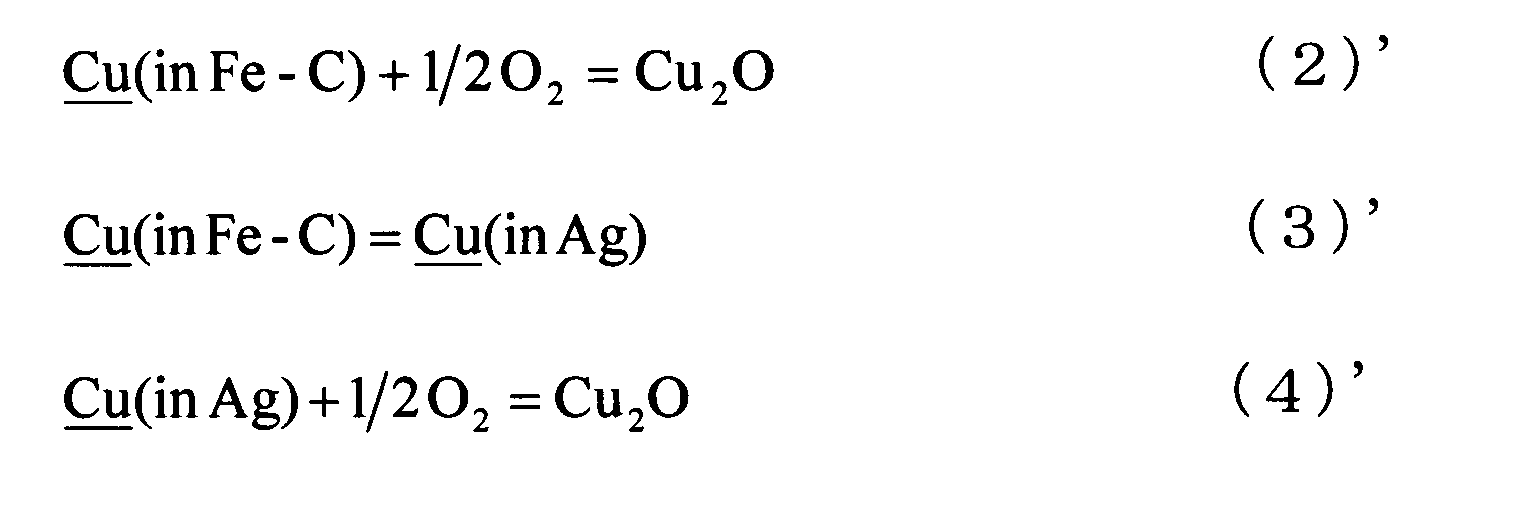

ここで、Tは鉄スクラップの溶融物の温度であり、1426K<T<1873Kを満たす。
本発明においては、鉄スクラップに含まれる共存元素の移動媒体相として溶融Ag相を使用する。溶融Ag相は鉄スクラップの溶融物と酸素を含む気相との間に介在する媒体相であって、それ自体は酸素とほとんど反応しない。このように溶融Ag相を介在させることで、鉄スクラップの溶融物における溶鉄が直接酸化反応を起こすことが抑制される。また、媒体である溶融Ag相を通じて鉄スクラップの溶融物から回収領域に移動してきたCuなどの共存元素は、回収領域の酸化性雰囲気において酸化し、溶融Ag相に不溶なものとなって回収可能となる。このため、溶融Ag相は継続的に使用することが可能である。
以上の説明では、本原理の理解を促進するために分離領域と回収領域とを仕切りにより分けた場合について説明したが、この構成は本原理において必須ではない。
Feに共存元素として含有させたCuを、Agを媒体として酸化除去した実施例を示す。
Cuを含有する溶融Fe相にAgのみからなる溶融相を接触させると、次の2つの現象が発生する。
これに対し、一方、Cuを含有する溶融Fe相に、あらかじめ溶融Fe相と溶融Ag相との分配で決定される濃度でCuを含有する溶融Ag-Cu相を接触させると、上記の(1)で示される分配のみに基づく溶融Fe相におけるCu濃度の減少は生じない。このため、(2)で示される酸化除去に基づくCu濃度減少のみが生じ、本発明の原理をより明確に確認することが可能となる。
この状態で、温度を1523Kとし、Arを100cm3/min(標準状態換算)でガス吹付け管から供給する雰囲気中で1時間保持した後、ガス吹付け管からの供給をO2(純度99.5%)を100cm3/min(標準状態換算)に切り替えて、3あるいは7時間保持して空冷した。

Claims (7)
- 鉄スクラップに共存する元素の分離・回収方法であって、
鉄スクラップを溶融させるステップ、
得られた鉄スクラップの溶融物と溶融Agとを接触させることで前記鉄スクラップに共存する元素を溶融Agに移行させるステップ、および
この溶融Agに移行した元素を溶融Agから酸化除去するステップを備えること
を特徴とする分離・回収方法。 - 鉄スクラップの溶融および鉄スクラップの溶融物と溶融Agとの接触を非酸化性雰囲気で行う請求項1記載の分離・回収方法。
- 鉄スクラップの溶融物がCを含有し、その濃度NC(単位:質量%)が下記式(1)を満たす請求項1記載の分離・回収方法:
NC ≦ 1012.728 / T + 0.7271 × log T - 3.049 (1)
ここで、Tは鉄スクラップの溶融物の温度であり、1426K<T<1873Kを満たす。 - 鉄スクラップを炭素源とともに溶融させることにより、前記Cを含有する鉄スクラップの溶融物を得る請求項3記載の分離・回収方法。
- 鉄スクラップの溶融および鉄スクラップの溶融物と溶融Agとの接触を黒鉛坩堝内で行い、鉄スクラップの溶融物にCが飽和溶解している請求項3記載の分離・回収方法。
- 分離・回収される元素がトランプエレメントを含む請求項1記載の分離・回収方法。
- 分離・回収される元素がW,Mo,Co,VおよびNbからなる群から選ばれる一種または二種以上を含む請求項1記載の分離・回収方法。
Priority Applications (2)
| Application Number | Priority Date | Filing Date | Title |
|---|---|---|---|
| KR1020117030749A KR101368575B1 (ko) | 2009-06-26 | 2010-06-25 | 철스크랩에 공존하는 원소의 분리·회수 방법 |
| CN2010800286193A CN102803525A (zh) | 2009-06-26 | 2010-06-25 | 废铁中共存的元素的分离·回收方法 |
Applications Claiming Priority (2)
| Application Number | Priority Date | Filing Date | Title |
|---|---|---|---|
| JP2009-152515 | 2009-06-26 | ||
| JP2009152515A JP5481966B2 (ja) | 2009-06-26 | 2009-06-26 | 鉄スクラップに共存する元素の分離・回収方法 |
Publications (1)
| Publication Number | Publication Date |
|---|---|
| WO2010150873A1 true WO2010150873A1 (ja) | 2010-12-29 |
Family
ID=43386642
Family Applications (1)
| Application Number | Title | Priority Date | Filing Date |
|---|---|---|---|
| PCT/JP2010/060840 Ceased WO2010150873A1 (ja) | 2009-06-26 | 2010-06-25 | 鉄スクラップに共存する元素の分離・回収方法 |
Country Status (4)
| Country | Link |
|---|---|
| JP (1) | JP5481966B2 (ja) |
| KR (1) | KR101368575B1 (ja) |
| CN (1) | CN102803525A (ja) |
| WO (1) | WO2010150873A1 (ja) |
Families Citing this family (2)
| Publication number | Priority date | Publication date | Assignee | Title |
|---|---|---|---|---|
| JP5724861B2 (ja) * | 2011-12-09 | 2015-05-27 | 新日鐵住金株式会社 | 鉄スクラップからの銅の硫化除去方法 |
| KR101462168B1 (ko) * | 2012-12-26 | 2014-11-14 | 주식회사 포스코 | 용철 처리장치 및 그 처리방법 |
Citations (3)
| Publication number | Priority date | Publication date | Assignee | Title |
|---|---|---|---|---|
| JP2004083962A (ja) * | 2002-08-26 | 2004-03-18 | Japan Science & Technology Corp | 銅鉄混在スクラップからの銅と鉄の分離、回収方法 |
| JP2006022387A (ja) * | 2004-07-09 | 2006-01-26 | Dowa Mining Co Ltd | 金属の回収方法 |
| JP2007092133A (ja) * | 2005-09-29 | 2007-04-12 | Nikko Kinzoku Kk | 銅、貴金属を含有するスクラップ及び又はスラッジの処理方法 |
Family Cites Families (8)
| Publication number | Priority date | Publication date | Assignee | Title |
|---|---|---|---|---|
| JPS60224720A (ja) * | 1984-04-23 | 1985-11-09 | Nippon Mining Co Ltd | 銅電解殿物からの高純度銀の回収法 |
| JPH0734147A (ja) * | 1993-07-21 | 1995-02-03 | Sumitomo Metal Mining Co Ltd | 粗銀の脱銅方法 |
| JP2000144270A (ja) * | 1998-11-17 | 2000-05-26 | Nippon Steel Corp | 鉄中不純物元素の溶融除去方法 |
| JP2001279339A (ja) * | 2000-03-30 | 2001-10-10 | Nippon Steel Corp | 鉄中不純物元素の溶解除去方法 |
| CN1270235A (zh) * | 2000-04-21 | 2000-10-18 | 沈阳冶炼厂 | 一种处理低品位阳极泥的方法 |
| JP3827547B2 (ja) * | 2001-09-28 | 2006-09-27 | 独立行政法人科学技術振興機構 | 鉄スクラップからの銅の分離、除去方法 |
| JP4426613B2 (ja) * | 2007-06-25 | 2010-03-03 | 日鉱金属株式会社 | 銅を含む原料の処理方法 |
| CN101403040B (zh) * | 2008-11-17 | 2010-12-22 | 河南豫光金铅股份有限公司 | 用于阳极泥熔炼工艺的高铅锑渣型及其使用方法 |
-
2009
- 2009-06-26 JP JP2009152515A patent/JP5481966B2/ja not_active Expired - Fee Related
-
2010
- 2010-06-25 WO PCT/JP2010/060840 patent/WO2010150873A1/ja not_active Ceased
- 2010-06-25 KR KR1020117030749A patent/KR101368575B1/ko not_active Expired - Fee Related
- 2010-06-25 CN CN2010800286193A patent/CN102803525A/zh active Pending
Patent Citations (3)
| Publication number | Priority date | Publication date | Assignee | Title |
|---|---|---|---|---|
| JP2004083962A (ja) * | 2002-08-26 | 2004-03-18 | Japan Science & Technology Corp | 銅鉄混在スクラップからの銅と鉄の分離、回収方法 |
| JP2006022387A (ja) * | 2004-07-09 | 2006-01-26 | Dowa Mining Co Ltd | 金属の回収方法 |
| JP2007092133A (ja) * | 2005-09-29 | 2007-04-12 | Nikko Kinzoku Kk | 銅、貴金属を含有するスクラップ及び又はスラッジの処理方法 |
Non-Patent Citations (2)
| Title |
|---|
| HIDEKI NAKAZATO ET AL.: "Tetsu Scrap no Recycle ni Okeru Tramp Element no Shori", CURRENT ADVANCES IN MATERIALS AND PROCESSES, vol. 19, no. 1, 1 March 2006 (2006-03-01), pages 17 - 20 * |
| SHINGO AGAWA ET AL.: "Fe-B Gokin to Ag no 2-ekiso Bunri ni yoru Tecchu Do no Jokyo", JOURNAL OF HIGH TEMPERATURE SOCIETY, vol. 35, no. 3, 20 May 2009 (2009-05-20) * |
Also Published As
| Publication number | Publication date |
|---|---|
| KR101368575B1 (ko) | 2014-02-27 |
| CN102803525A (zh) | 2012-11-28 |
| JP2011006749A (ja) | 2011-01-13 |
| KR20120023126A (ko) | 2012-03-12 |
| JP5481966B2 (ja) | 2014-04-23 |
Similar Documents
| Publication | Publication Date | Title |
|---|---|---|
| JP2014507564A (ja) | 白金族金属精鉱の精錬方法 | |
| JP7273819B2 (ja) | 改善された乾式精錬工程 | |
| JP7466446B2 (ja) | 銅/スズ/鉛製造の改善 | |
| JP7273818B2 (ja) | 改善された乾式冶金工程 | |
| KR102459098B1 (ko) | 개선된 구리 제조공정 | |
| JP2020516765A (ja) | 粗半田の改善された製造法 | |
| Wang et al. | Preparation of low-oxygen Ti–Al alloy by sustainable recovery of spent SCR catalyst | |
| JP5481966B2 (ja) | 鉄スクラップに共存する元素の分離・回収方法 | |
| JP3406645B2 (ja) | 高純度ニッケルマットと金属化硫化物マットの生産方法 | |
| KR101189182B1 (ko) | 바나듐 함유 용탕으로부터 바나듐을 선별하는 방법 | |
| CA3165293C (en) | Method for the recovery of platinum group metals from catalysts comprising silicon carbide | |
| CN115874054B (zh) | 一种废钨渣中有价金属的回收方法 | |
| Wen et al. | Rapid removal of copper impurity from bismuth-copper alloy melts via super-gravity separation | |
| JPS5950734B2 (ja) | 非鉄金属を回収する方法 | |
| NO300334B1 (no) | Fremgangsmåte for fremstilling av lett flyktige metaller, så som sink, bly og kadmium fra sulfidiske råmaterialer | |
| JP5724861B2 (ja) | 鉄スクラップからの銅の硫化除去方法 | |
| JP6542560B2 (ja) | 非鉄製錬スラグの処理方法 | |
| RU2354710C2 (ru) | Способ комплексной переработки концентрата металлического железа, содержащего цветные и драгоценные металлы | |
| RU2346064C1 (ru) | Способ переработки золото-сурьмяно-мышьяковых сульфидных концентратов | |
| JP3709466B2 (ja) | 銅鉄スクラップからの銅と鉄の分離回収方法 | |
| JP4525453B2 (ja) | スラグフューミング方法 | |
| US20250034667A1 (en) | Chemical Comminution - Iron Making Process | |
| US8163258B2 (en) | Pyrometallurgical process for treating molybdenite containing lead sulfide | |
| Gong et al. | Separation of low-purity Si-Mn melts to prepare clean MnSi1. 73–1.75 and Si1-xMnx alloys for the sustainability of Si and Mn resources | |
| Tiedemann et al. | Tellurium Recovery from Blister Copper and Copper Matte: A Review |
Legal Events
| Date | Code | Title | Description |
|---|---|---|---|
| WWE | Wipo information: entry into national phase |
Ref document number: 201080028619.3 Country of ref document: CN |
|
| 121 | Ep: the epo has been informed by wipo that ep was designated in this application |
Ref document number: 10792191 Country of ref document: EP Kind code of ref document: A1 |
|
| ENP | Entry into the national phase |
Ref document number: 20117030749 Country of ref document: KR Kind code of ref document: A |
|
| NENP | Non-entry into the national phase |
Ref country code: DE |
|
| 122 | Ep: pct application non-entry in european phase |
Ref document number: 10792191 Country of ref document: EP Kind code of ref document: A1 |