WO2010147425A2 - 신규한 유기염료 및 이의 제조방법 - Google Patents
신규한 유기염료 및 이의 제조방법 Download PDFInfo
- Publication number
- WO2010147425A2 WO2010147425A2 PCT/KR2010/003947 KR2010003947W WO2010147425A2 WO 2010147425 A2 WO2010147425 A2 WO 2010147425A2 KR 2010003947 W KR2010003947 W KR 2010003947W WO 2010147425 A2 WO2010147425 A2 WO 2010147425A2
- Authority
- WO
- WIPO (PCT)
- Prior art keywords
- formula
- dye
- compound
- photoelectric conversion
- independently
- Prior art date
- Legal status (The legal status is an assumption and is not a legal conclusion. Google has not performed a legal analysis and makes no representation as to the accuracy of the status listed.)
- Ceased
Links
- 0 CCCCCCc1c(-c2cc3c(-c4ccccc4)c(cc(cc4)C(C*5)=C(CCCCCC)C=C5C=C(C(O)=O)C#N)c4c(N(C(CC4)=CC(C5(C)C)=C4c4c5cccc4)c(cc4)cc5c4-c4ccccc4C5(C)C)c3cc2)[s]c(C=C(C(O)=O)C#N)c1 Chemical compound CCCCCCc1c(-c2cc3c(-c4ccccc4)c(cc(cc4)C(C*5)=C(CCCCCC)C=C5C=C(C(O)=O)C#N)c4c(N(C(CC4)=CC(C5(C)C)=C4c4c5cccc4)c(cc4)cc5c4-c4ccccc4C5(C)C)c3cc2)[s]c(C=C(C(O)=O)C#N)c1 0.000 description 10
- LVLWYRKDRXTEHT-HZOSDRPUSA-N CCc1c(-c(cc2)c(CC)cc2N(c(cc2)cc3c2-c2ccccc2C3(C)C)c2c(ccc(-c3c4OCCOc4c(/C=C(/C(O)=O)\C#N)[s]3)c3)c3c(-c3ccccc3)c3c2ccc(-c2c4OCCOc4c(/C=C(/C(O)=O)\C#N)[s]2)c3)cccc1 Chemical compound CCc1c(-c(cc2)c(CC)cc2N(c(cc2)cc3c2-c2ccccc2C3(C)C)c2c(ccc(-c3c4OCCOc4c(/C=C(/C(O)=O)\C#N)[s]3)c3)c3c(-c3ccccc3)c3c2ccc(-c2c4OCCOc4c(/C=C(/C(O)=O)\C#N)[s]2)c3)cccc1 LVLWYRKDRXTEHT-HZOSDRPUSA-N 0.000 description 2
- HZVMAVROXGDMHE-LKNRODPVSA-N N#C/C(/C(O)=O)=C\c1c2OCCOc2c(C(CC2)=CC(SC(C3C=C4)C=C4c4c5OCCOc5c(/C=C(/C(O)=O)\C#N)[s]4)=C2N3c2ccccc2)[s]1 Chemical compound N#C/C(/C(O)=O)=C\c1c2OCCOc2c(C(CC2)=CC(SC(C3C=C4)C=C4c4c5OCCOc5c(/C=C(/C(O)=O)\C#N)[s]4)=C2N3c2ccccc2)[s]1 HZVMAVROXGDMHE-LKNRODPVSA-N 0.000 description 2
- PCLKZNGNTKCOBX-MWLSYYOVSA-N CC(C(C(N1CC(O)=O)=O)SC1=S)c1cc([s]c(-c2c3OCCOc3c(-c(cc3SC(C4C=C5)C=C5c5c6OCCOc6c(C6SC7C=C(/C=C(/CC(N8CC(O)=O)=S)\C8=O)SC7C6C)[s]5)ccc3N4c3ccccc3)[s]2)c2)c2[s]1 Chemical compound CC(C(C(N1CC(O)=O)=O)SC1=S)c1cc([s]c(-c2c3OCCOc3c(-c(cc3SC(C4C=C5)C=C5c5c6OCCOc6c(C6SC7C=C(/C=C(/CC(N8CC(O)=O)=S)\C8=O)SC7C6C)[s]5)ccc3N4c3ccccc3)[s]2)c2)c2[s]1 PCLKZNGNTKCOBX-MWLSYYOVSA-N 0.000 description 1
- OQUCRYSPEMRQPH-WBUBMMJDSA-N CC(C1OC=CO/C1=C(/C)\C=C\c1cc2c(-c3ccccc3)c(cc(/C=C/c3c4OCCOc4c(/C=C(/C(O)=O)\C#N)[s]3)cc3)c3c(N(c3ccccc3)c3ccccc3)c2cc1)(/C=C(/C(O)=O)\C#N)S Chemical compound CC(C1OC=CO/C1=C(/C)\C=C\c1cc2c(-c3ccccc3)c(cc(/C=C/c3c4OCCOc4c(/C=C(/C(O)=O)\C#N)[s]3)cc3)c3c(N(c3ccccc3)c3ccccc3)c2cc1)(/C=C(/C(O)=O)\C#N)S OQUCRYSPEMRQPH-WBUBMMJDSA-N 0.000 description 1
- WBUITYWHHOUUFH-HWKANZROSA-N CC/C=C(\C(N1CC(O)=O)=O)/SC1=S Chemical compound CC/C=C(\C(N1CC(O)=O)=O)/SC1=S WBUITYWHHOUUFH-HWKANZROSA-N 0.000 description 1
- IXDJBPNJCDYWEP-UHFFFAOYSA-N CC1(C)COC(c2cc([nH]c(-c3c4OCCOc4c(NO)[nH]3)c3)c3[nH]2)OC1 Chemical compound CC1(C)COC(c2cc([nH]c(-c3c4OCCOc4c(NO)[nH]3)c3)c3[nH]2)OC1 IXDJBPNJCDYWEP-UHFFFAOYSA-N 0.000 description 1
- BOSILZOGGHXVHL-LFURNHCCSA-N CCCCCCC(C1)=C(/C=C/c2cc3c(-c4ccccc4)c(cc(/C=C/c4c(CCCCCC)cc(-c5c(CCCCCC)cc(/C=C(/C(O)=O)\C#N)[s]5)[s]4)cc4)c4nc3cc2)SC1(C)c1c(CCCCCC)cc(/C=C(/C(O)=O)\C#N)[s]1 Chemical compound CCCCCCC(C1)=C(/C=C/c2cc3c(-c4ccccc4)c(cc(/C=C/c4c(CCCCCC)cc(-c5c(CCCCCC)cc(/C=C(/C(O)=O)\C#N)[s]5)[s]4)cc4)c4nc3cc2)SC1(C)c1c(CCCCCC)cc(/C=C(/C(O)=O)\C#N)[s]1 BOSILZOGGHXVHL-LFURNHCCSA-N 0.000 description 1
- XROVEBAUCJTXDL-DNHJVCTKSA-N CCCCCCc1c(-c(cc2SC(C3C=C4)C=C4c4c(CCCCCC)cc(/C=C(/C(O)=O)\C#N)[s]4)ccc2N3c2ccccc2)[s]c(/C=C(/C(O)=O)\C#N)c1 Chemical compound CCCCCCc1c(-c(cc2SC(C3C=C4)C=C4c4c(CCCCCC)cc(/C=C(/C(O)=O)\C#N)[s]4)ccc2N3c2ccccc2)[s]c(/C=C(/C(O)=O)\C#N)c1 XROVEBAUCJTXDL-DNHJVCTKSA-N 0.000 description 1
- YLYBJYGALBWKIZ-GNQNNQALSA-N CCCCCCc1c(-c2cc(CCCCCC)c(-c3cc4c(-c5ccccc5)c(cc(cc5)-c6c(CCCCCC)cc(-c7c(CCCCCC)cc(/C=C(/C(O)=O)\C#N)[s]7)[s]6)c5c(N(c(cc5)cc6c5-c5ccccc5C6(C)C)c(cc5)cc6c5-c5ccccc5C6(C)C)c4cc3)[s]2)[s]c(CC(C)(C(O)=O)C#N)c1 Chemical compound CCCCCCc1c(-c2cc(CCCCCC)c(-c3cc4c(-c5ccccc5)c(cc(cc5)-c6c(CCCCCC)cc(-c7c(CCCCCC)cc(/C=C(/C(O)=O)\C#N)[s]7)[s]6)c5c(N(c(cc5)cc6c5-c5ccccc5C6(C)C)c(cc5)cc6c5-c5ccccc5C6(C)C)c4cc3)[s]2)[s]c(CC(C)(C(O)=O)C#N)c1 YLYBJYGALBWKIZ-GNQNNQALSA-N 0.000 description 1
- JUSYDCUPNGGVEX-QVIHJIDKSA-N CCCCCCc1c(/C=C/c(cc2)cc3c2c(N(c2ccccc2)C2=CCC(C)C=C2)c(ccc(/C=C/c2c(CCCCCC)cc(/C=C(/C(O)=O)\C#N)[s]2)c2)c2c3-c2ccccc2)[s]c(CC(C)(C(O)=O)C#N)c1 Chemical compound CCCCCCc1c(/C=C/c(cc2)cc3c2c(N(c2ccccc2)C2=CCC(C)C=C2)c(ccc(/C=C/c2c(CCCCCC)cc(/C=C(/C(O)=O)\C#N)[s]2)c2)c2c3-c2ccccc2)[s]c(CC(C)(C(O)=O)C#N)c1 JUSYDCUPNGGVEX-QVIHJIDKSA-N 0.000 description 1
- AXQLTNDLLUGQDX-UUFNBZTESA-N CCCCCCc1c(C2=CC3Sc4cc(-c5c(CCCCCC)cc(/C=C(\C(N6CC(O)=O)=O)/SC6=S)[s]5)ccc4N(C4C=CC=CC4)C3C=C2)[s]c(CC(C)(C(N2CC(O)=O)=O)SC2=S)c1 Chemical compound CCCCCCc1c(C2=CC3Sc4cc(-c5c(CCCCCC)cc(/C=C(\C(N6CC(O)=O)=O)/SC6=S)[s]5)ccc4N(C4C=CC=CC4)C3C=C2)[s]c(CC(C)(C(N2CC(O)=O)=O)SC2=S)c1 AXQLTNDLLUGQDX-UUFNBZTESA-N 0.000 description 1
- CDCBHAIZNFZRJI-CIOBDNPFSA-N N#C/C(/C(O)=O)=C\c1cc(SC(C2)c3c4OCCOc4c(-c(cc4)cc(SC(C5C=C6)C=C6c6c7OCCOc7c(C7=CC8SC(/C=C(/C(O)=O)\C#N)=CC8S7)[s]6)c4N5c4ccccc4)[s]3)c2[s]1 Chemical compound N#C/C(/C(O)=O)=C\c1cc(SC(C2)c3c4OCCOc4c(-c(cc4)cc(SC(C5C=C6)C=C6c6c7OCCOc7c(C7=CC8SC(/C=C(/C(O)=O)\C#N)=CC8S7)[s]6)c4N5c4ccccc4)[s]3)c2[s]1 CDCBHAIZNFZRJI-CIOBDNPFSA-N 0.000 description 1
- BPWNWHMTSKQJRS-VNRWOIRSSA-N N#C/C(/C(O)=O)=C\c1cc([s]c(-c2c3OCCOc3c(-c(cc3)cc4c3nc(ccc(-c3c5OCCOc5c(C5=CC6SC(/C=C(/C(O)=O)\C#N)=CC6S5)[s]3)c3)c3c4-c3ccccc3)[s]2)c2)c2[s]1 Chemical compound N#C/C(/C(O)=O)=C\c1cc([s]c(-c2c3OCCOc3c(-c(cc3)cc4c3nc(ccc(-c3c5OCCOc5c(C5=CC6SC(/C=C(/C(O)=O)\C#N)=CC6S5)[s]3)c3)c3c4-c3ccccc3)[s]2)c2)c2[s]1 BPWNWHMTSKQJRS-VNRWOIRSSA-N 0.000 description 1
- SRYAYMSKTHNDES-HYYFARDPSA-N N#C/C(/C(O)=O)=C\c1cc([s]c(-c2c3OCCOc3c(/C=C/c(cc3)cc4c3nc(ccc(/C=C/c3c5OCCOc5c(C5=CC6SC(/C=C(/C(O)=O)\C#N)=CC6S5)[s]3)c3)c3c4-c3ccccc3)[s]2)c2)c2[s]1 Chemical compound N#C/C(/C(O)=O)=C\c1cc([s]c(-c2c3OCCOc3c(/C=C/c(cc3)cc4c3nc(ccc(/C=C/c3c5OCCOc5c(C5=CC6SC(/C=C(/C(O)=O)\C#N)=CC6S5)[s]3)c3)c3c4-c3ccccc3)[s]2)c2)c2[s]1 SRYAYMSKTHNDES-HYYFARDPSA-N 0.000 description 1
- INJFTRYECQDGCE-CLSAIWBGSA-N N#C/C(/C(O)=O)=C\c1cc([s]c(-c2c3OCCOc3c(/C=C/c3ccc(C(CCc4ccccc4)C4C=CC(/C=C/c5c6OCCOc6c(C6=CC7SC(/C=C(/C(O)=O)\C#N)=CC7S6)[s]5)=CC4S4)c4c3)[s]2)c2)c2[s]1 Chemical compound N#C/C(/C(O)=O)=C\c1cc([s]c(-c2c3OCCOc3c(/C=C/c3ccc(C(CCc4ccccc4)C4C=CC(/C=C/c5c6OCCOc6c(C6=CC7SC(/C=C(/C(O)=O)\C#N)=CC7S6)[s]5)=CC4S4)c4c3)[s]2)c2)c2[s]1 INJFTRYECQDGCE-CLSAIWBGSA-N 0.000 description 1
Classifications
-
- H—ELECTRICITY
- H01—ELECTRIC ELEMENTS
- H01G—CAPACITORS; CAPACITORS, RECTIFIERS, DETECTORS, SWITCHING DEVICES, LIGHT-SENSITIVE OR TEMPERATURE-SENSITIVE DEVICES OF THE ELECTROLYTIC TYPE
- H01G9/00—Electrolytic capacitors, rectifiers, detectors, switching devices, light-sensitive or temperature-sensitive devices; Processes of their manufacture
- H01G9/20—Light-sensitive devices
- H01G9/2059—Light-sensitive devices comprising an organic dye as the active light absorbing material, e.g. adsorbed on an electrode or dissolved in solution
-
- C—CHEMISTRY; METALLURGY
- C09—DYES; PAINTS; POLISHES; NATURAL RESINS; ADHESIVES; COMPOSITIONS NOT OTHERWISE PROVIDED FOR; APPLICATIONS OF MATERIALS NOT OTHERWISE PROVIDED FOR
- C09B—ORGANIC DYES OR CLOSELY-RELATED COMPOUNDS FOR PRODUCING DYES, e.g. PIGMENTS; MORDANTS; LAKES
- C09B15/00—Acridine dyes
-
- C—CHEMISTRY; METALLURGY
- C09—DYES; PAINTS; POLISHES; NATURAL RESINS; ADHESIVES; COMPOSITIONS NOT OTHERWISE PROVIDED FOR; APPLICATIONS OF MATERIALS NOT OTHERWISE PROVIDED FOR
- C09B—ORGANIC DYES OR CLOSELY-RELATED COMPOUNDS FOR PRODUCING DYES, e.g. PIGMENTS; MORDANTS; LAKES
- C09B21/00—Thiazine dyes
-
- C—CHEMISTRY; METALLURGY
- C09—DYES; PAINTS; POLISHES; NATURAL RESINS; ADHESIVES; COMPOSITIONS NOT OTHERWISE PROVIDED FOR; APPLICATIONS OF MATERIALS NOT OTHERWISE PROVIDED FOR
- C09B—ORGANIC DYES OR CLOSELY-RELATED COMPOUNDS FOR PRODUCING DYES, e.g. PIGMENTS; MORDANTS; LAKES
- C09B23/00—Methine or polymethine dyes, e.g. cyanine dyes
-
- C—CHEMISTRY; METALLURGY
- C09—DYES; PAINTS; POLISHES; NATURAL RESINS; ADHESIVES; COMPOSITIONS NOT OTHERWISE PROVIDED FOR; APPLICATIONS OF MATERIALS NOT OTHERWISE PROVIDED FOR
- C09B—ORGANIC DYES OR CLOSELY-RELATED COMPOUNDS FOR PRODUCING DYES, e.g. PIGMENTS; MORDANTS; LAKES
- C09B57/00—Other synthetic dyes of known constitution
- C09B57/008—Triarylamine dyes containing no other chromophores
-
- H—ELECTRICITY
- H10—SEMICONDUCTOR DEVICES; ELECTRIC SOLID-STATE DEVICES NOT OTHERWISE PROVIDED FOR
- H10K—ORGANIC ELECTRIC SOLID-STATE DEVICES
- H10K85/00—Organic materials used in the body or electrodes of devices covered by this subclass
- H10K85/60—Organic compounds having low molecular weight
- H10K85/649—Aromatic compounds comprising a hetero atom
- H10K85/657—Polycyclic condensed heteroaromatic hydrocarbons
-
- H—ELECTRICITY
- H10—SEMICONDUCTOR DEVICES; ELECTRIC SOLID-STATE DEVICES NOT OTHERWISE PROVIDED FOR
- H10K—ORGANIC ELECTRIC SOLID-STATE DEVICES
- H10K85/00—Organic materials used in the body or electrodes of devices covered by this subclass
- H10K85/60—Organic compounds having low molecular weight
- H10K85/649—Aromatic compounds comprising a hetero atom
- H10K85/657—Polycyclic condensed heteroaromatic hydrocarbons
- H10K85/6576—Polycyclic condensed heteroaromatic hydrocarbons comprising only sulfur in the heteroaromatic polycondensed ring system, e.g. benzothiophene
-
- H—ELECTRICITY
- H01—ELECTRIC ELEMENTS
- H01G—CAPACITORS; CAPACITORS, RECTIFIERS, DETECTORS, SWITCHING DEVICES, LIGHT-SENSITIVE OR TEMPERATURE-SENSITIVE DEVICES OF THE ELECTROLYTIC TYPE
- H01G9/00—Electrolytic capacitors, rectifiers, detectors, switching devices, light-sensitive or temperature-sensitive devices; Processes of their manufacture
- H01G9/20—Light-sensitive devices
- H01G9/2027—Light-sensitive devices comprising an oxide semiconductor electrode
- H01G9/2031—Light-sensitive devices comprising an oxide semiconductor electrode comprising titanium oxide, e.g. TiO2
-
- Y—GENERAL TAGGING OF NEW TECHNOLOGICAL DEVELOPMENTS; GENERAL TAGGING OF CROSS-SECTIONAL TECHNOLOGIES SPANNING OVER SEVERAL SECTIONS OF THE IPC; TECHNICAL SUBJECTS COVERED BY FORMER USPC CROSS-REFERENCE ART COLLECTIONS [XRACs] AND DIGESTS
- Y02—TECHNOLOGIES OR APPLICATIONS FOR MITIGATION OR ADAPTATION AGAINST CLIMATE CHANGE
- Y02E—REDUCTION OF GREENHOUSE GAS [GHG] EMISSIONS, RELATED TO ENERGY GENERATION, TRANSMISSION OR DISTRIBUTION
- Y02E10/00—Energy generation through renewable energy sources
- Y02E10/50—Photovoltaic [PV] energy
- Y02E10/542—Dye sensitized solar cells
-
- Y—GENERAL TAGGING OF NEW TECHNOLOGICAL DEVELOPMENTS; GENERAL TAGGING OF CROSS-SECTIONAL TECHNOLOGIES SPANNING OVER SEVERAL SECTIONS OF THE IPC; TECHNICAL SUBJECTS COVERED BY FORMER USPC CROSS-REFERENCE ART COLLECTIONS [XRACs] AND DIGESTS
- Y02—TECHNOLOGIES OR APPLICATIONS FOR MITIGATION OR ADAPTATION AGAINST CLIMATE CHANGE
- Y02E—REDUCTION OF GREENHOUSE GAS [GHG] EMISSIONS, RELATED TO ENERGY GENERATION, TRANSMISSION OR DISTRIBUTION
- Y02E10/00—Energy generation through renewable energy sources
- Y02E10/50—Photovoltaic [PV] energy
- Y02E10/549—Organic PV cells
-
- Y—GENERAL TAGGING OF NEW TECHNOLOGICAL DEVELOPMENTS; GENERAL TAGGING OF CROSS-SECTIONAL TECHNOLOGIES SPANNING OVER SEVERAL SECTIONS OF THE IPC; TECHNICAL SUBJECTS COVERED BY FORMER USPC CROSS-REFERENCE ART COLLECTIONS [XRACs] AND DIGESTS
- Y02—TECHNOLOGIES OR APPLICATIONS FOR MITIGATION OR ADAPTATION AGAINST CLIMATE CHANGE
- Y02P—CLIMATE CHANGE MITIGATION TECHNOLOGIES IN THE PRODUCTION OR PROCESSING OF GOODS
- Y02P70/00—Climate change mitigation technologies in the production process for final industrial or consumer products
- Y02P70/50—Manufacturing or production processes characterised by the final manufactured product
Definitions
- the present invention relates to a novel organic dye for dye-sensitized photovoltaic devices used in dye-sensitized solar cells (DSSC) and a method of manufacturing the same.
- DSSC dye-sensitized solar cells
- Dye-sensitized solar cells are expected to be able to replace conventional amorphous silicon solar cells because of their higher efficiency and lower manufacturing costs than conventional silicon-based solar cells.
- dye-sensitized solar cells are photoelectrochemical solar cells that consist mainly of dyes that absorb visible light to form electron-hole pairs, and transition metal oxides that transfer the generated electrons. .
- organic dyes containing no metals exhibiting excellent physical properties in terms of light absorption efficiency, redox reaction stability, and intermolecular charge-transfer (CT) absorption have replaced dyes by replacing expensive ruthenium metal complexes. It has been found that it can be used as a dye for solar cells, and research on organic dyes containing no metals has been focused on.
- Organic dyes generally have a structure of electron donor-electron acceptor residues linked by ⁇ -binding units.
- amine derivatives act as electron donors
- 2-cyanoacrylic acid or rhodanine residues act as electron acceptors
- these two sites are ⁇ -binding systems such as metaine units or thiophene chains. Is connected by.
- An object of the present invention is to provide an organic dye for a dye-sensitized photoelectric conversion device that can improve the efficiency of the dye-sensitized solar cell by showing an improved molar absorption coefficient and photoelectric conversion efficiency than the conventional metal complex dye.
- Another object of the present invention is to provide a method for producing the organic dye.
- Still another object of the present invention is a dye-sensitized photoelectric conversion device including the organic dye exhibiting a markedly improved photoelectric conversion efficiency, excellent Jsc (short circuit photocurrent density) and a molar absorption coefficient, and efficiency including the same It is to provide this remarkably improved solar cell.
- the present invention provides an organic dye for dye-sensitized photoelectric conversion device represented by the following formula (1) or (2):
- A is C or N, provided that if A is N then b and c are 0,
- R 1 to R 3 are each independently hydrogen or C 1-12 alkyl
- Ar 1 to Ar 5 are each independently a substituted or unsubstituted C 6 -C 50 aryl group, wherein A1 to Ar 3 may be connected to each other to form a ring,
- a 0 or 1
- b and c are each independently 0 or 1, provided that c is 1, b is necessarily 1,
- d 0 or 1
- e 0 or 1
- R 6 to R 10 are each independently hydrogen or substituted or unsubstituted C 1-12 alkyl, and n is an integer of 1 to 10.
- Ring W are each independently or
- X is Br or Is
- Z is H or Is
- A, Ar 1 to Ar 4 , a, b, c, e and Sp are as defined above.
- the present invention provides an oxide semiconductor fine particle; And it provides a dye-sensitized photoelectric conversion device comprising the organic dye supported on the oxide semiconductor fine particles.
- the present invention provides a dye-sensitized solar cell comprising the dye-sensitized photoelectric conversion device.
- the dye compound of the present invention can be used in a dye-sensitized solar cell (DSSC) to exhibit an improved molar absorption coefficient, Jsc (single-circuit photocurrent density) and photoelectric conversion efficiency than conventional dyes, thereby greatly improving the efficiency of the solar cell.
- DSSC dye-sensitized solar cell
- alkyl refers to a linear or branched saturated C 1 to C 6 hydrocarbon radical chain. Specific examples include, but are not limited to, methyl, ethyl, n-propyl, isopropyl, n-butyl, isobutyl, t-butyl, n-pentyl, isopentyl and hexyl.
- alkoxy refers to the group -ORa, where Ra is alkyl as defined above. Specific examples include, but are not limited to, methoxy, ethoxy, n-propoxy, isopropoxy, n-butoxy, t-butoxy, and the like.
- aryl refers to a ring system that can be formed by the optionally substituted benzene ring or the fusion of one or more optional substituents.
- optional substituents include or have substituted C 1-3 alkyl, substituted C 2-3 alkenyl, substituted C 2-3 alkynyl, heteroaryl, heterocycle, aryl, 1 to 3 fluorine substituents Alkoxy, aryloxy, aralkoxy, acyl, aroyl, heteroaroyl, acyloxy and aroyloxy.
- the ring or ring system may be optionally fused to an aryl ring (including benzene ring), carbocycle ring or heterocycle ring with or without one or more substituents.
- aryl examples include, but are not limited to, phenyl, naphthyl, tetrahydronaphthyl, biphenyl, indanyl, anthracyl, phenanthryl and substituted derivatives thereof.
- heteroaryl means a monocyclic 5-6 membered aromatic ring having one or more heteroatoms such as oxygen, sulfur and nitrogen in the ring, or a heteroaryl ring, aryl ring, heterocycle ring or carbocycle Aromatic rings (eg, bicyclic or tricyclic ring systems) fused to one or more rings, such as rings.
- heteroaryl examples include pyridinyl, pyrrolyl, oxazolyl, indolyl, isoindolyl, purinyl, furanyl, thienyl, benzofuranyl, benzothiophenyl, carbazolyl, imidazolyl, thiazolyl, isox Sazolyl, pyrazolyl, isothiazolyl, quinolyl, isoquinolyl, pyridazyl, pyrimidyl, pyrazil, which may be substituted or unsubstituted, and the like.
- substituted or “substituted” means that at least one hydrogen in the compound or functional group is halogen, alkyl, alkenyl, alkynyl, aryl, alkoxy, hydroxy, carboxy, carbamoyl, alkoxycarbonyl It means substituted with a substituent selected from the group consisting of, nitro, haloalkyl, amino, alkylcarbonylamino, cycloalkyl group, cyano and thiol.
- the organic dye according to the present invention has a structure represented by the following formula (1) or (2) to show an improved molar absorption coefficient, Jsc (single circuit photocurrent density) and photoelectric conversion efficiency when used in a dye-sensitized solar cell (DSSC) as a dye-sensitized photoelectric conversion device.
- Jsc single circuit photocurrent density
- DSSC dye-sensitized solar cell
- A is C or N, provided that if A is N then b and c are 0,
- R 1 to R 3 are each independently hydrogen or C 1-12 alkyl
- Ar 1 to Ar 5 are each independently a substituted or unsubstituted C 6 -C 50 aryl group, wherein A 1 to Ar 3 may be connected to each other to form a ring,
- a 0 or 1
- b and c are each independently 0 or 1, provided that c is 1, b is necessarily 1,
- d 0 or 1
- e 0 or 1
- Sp each independently , , And At least one selected from the group consisting of, wherein L is independently selected from the group consisting of O, S, CR 6 R 7 , SiR 8 R9 and NR 10 , R 4 and R 5 are each independently hydrogen, substituted Or unsubstituted C 1-12 alkyl, substituted or unsubstituted C 6-30 aryl, and substituted or unsubstituted C 6-20 heteroaryl, or may be linked to each other to form a ring; , R 6 to R 10 are each independently hydrogen or substituted or unsubstituted C1-12 alkyl, and n is an integer from 1 to 10.
- A is C or N, provided that when A is N, b and c are 0,
- R 1 and R 2 are each independently hydrogen or a methyl group
- Ar 1 to Ar 5 are each independently a C 6 -C 50 aryl group or a C 6 -C 50 aryl group substituted with an alkyl or alkoxy group, more preferably a phenyl group, methoxyphenyl group or dimethylfluorenyl group ,
- a 0 or 1
- b and c are each independently 0 or 1, provided that c is 1, b is necessarily 1,
- d 0 or 1
- e 0 or 1
- Sp is , , And It is selected from the group consisting of.
- organic dyes according to the present invention are preferably one of the following Chemical Formulas 7 to 122.
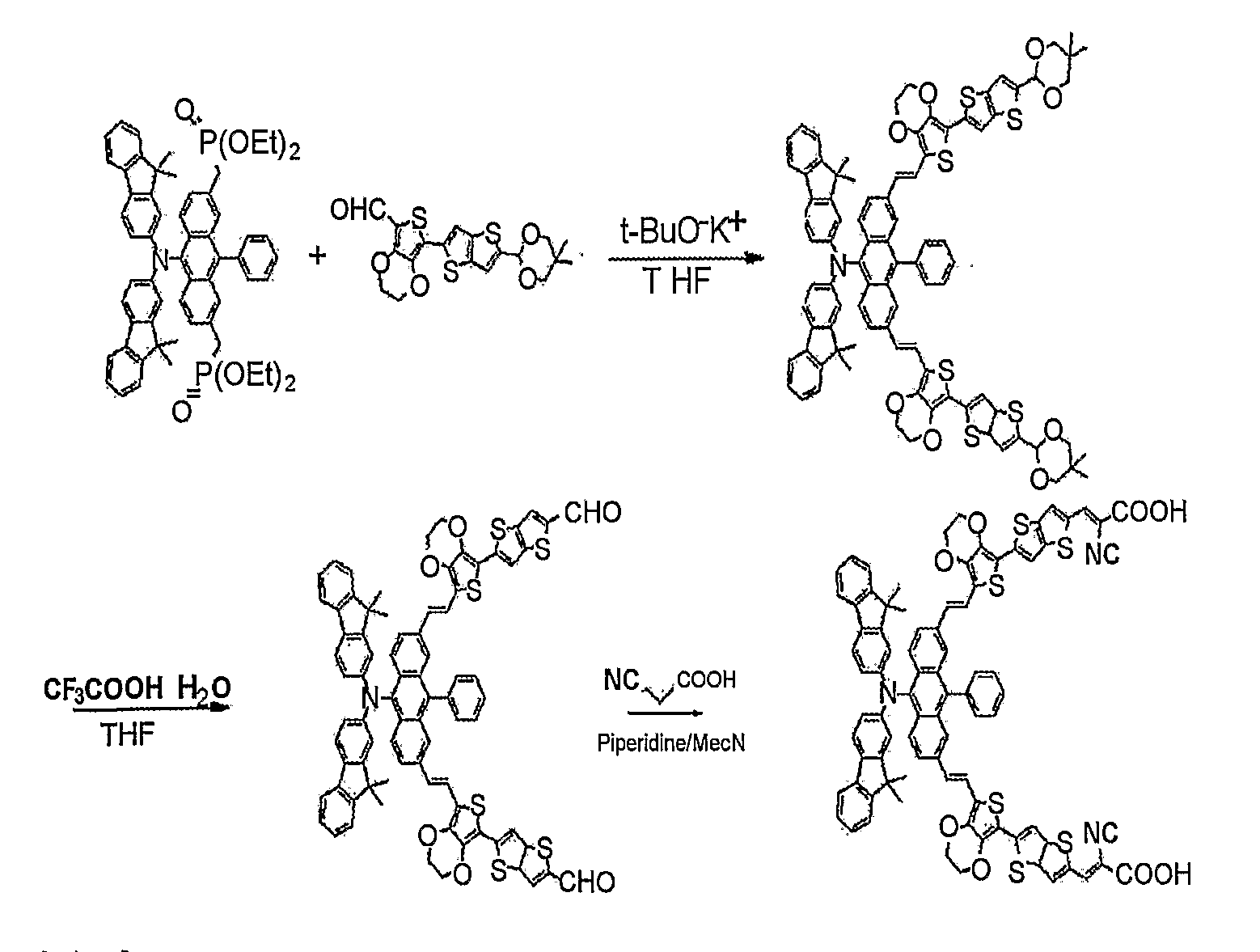
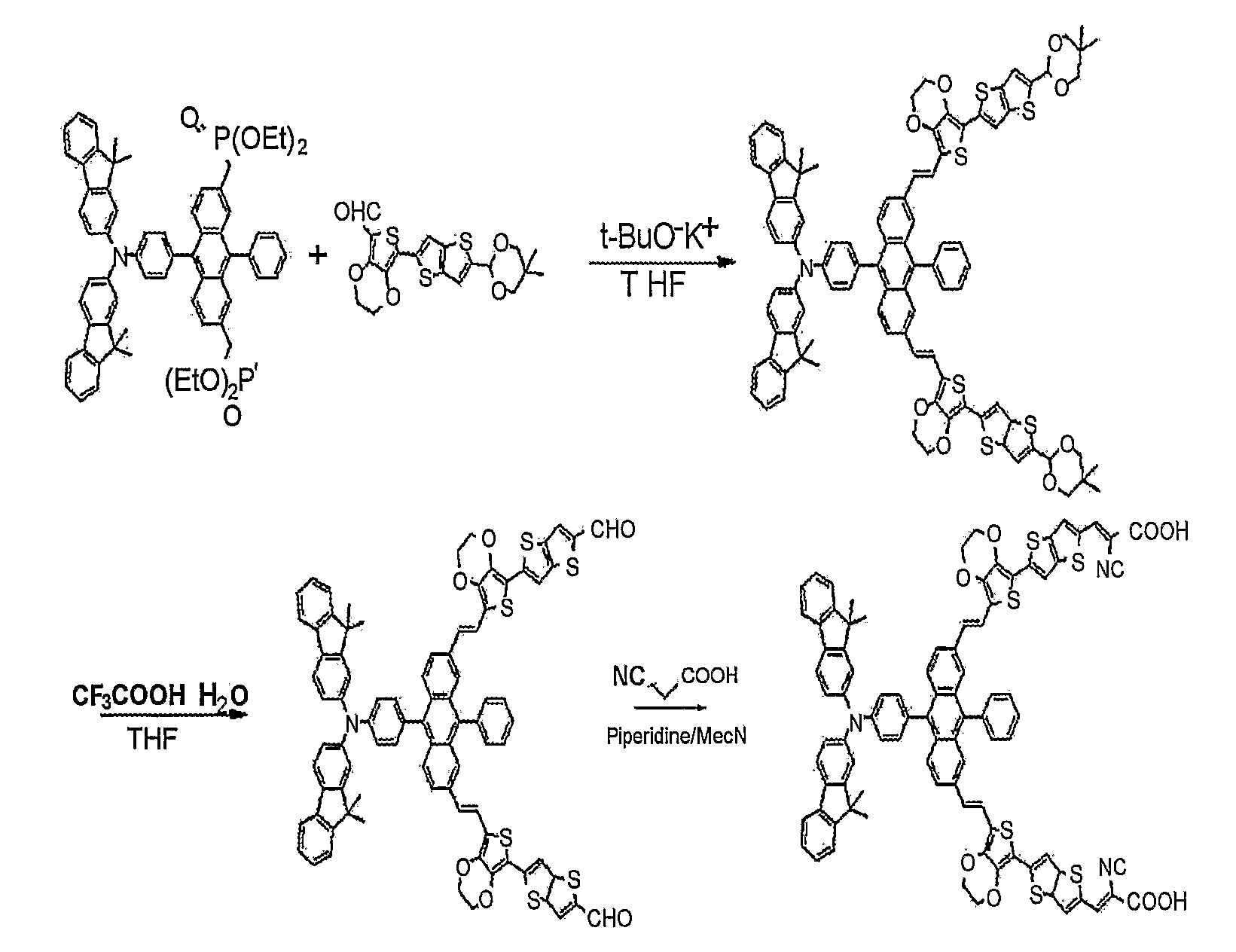
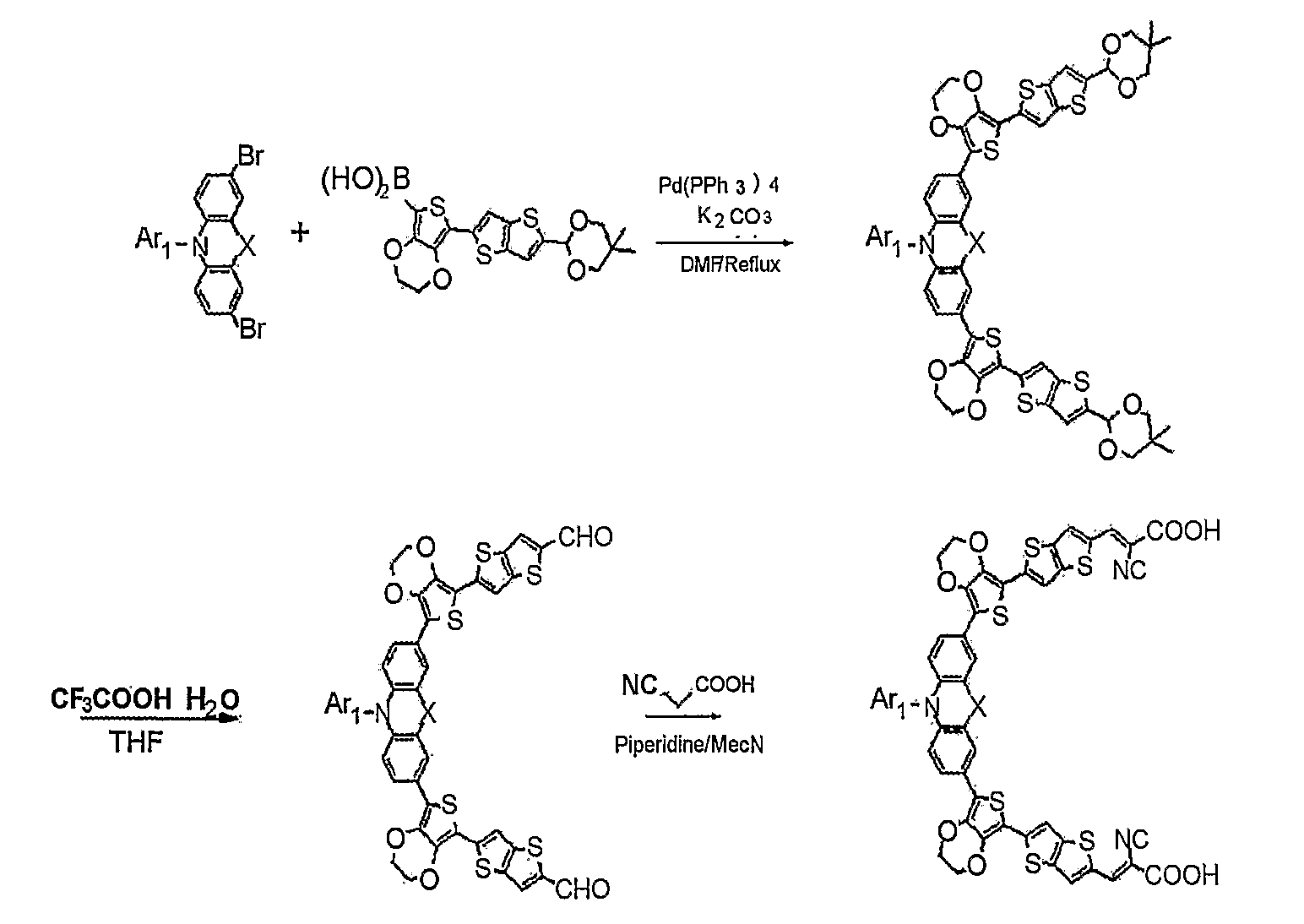
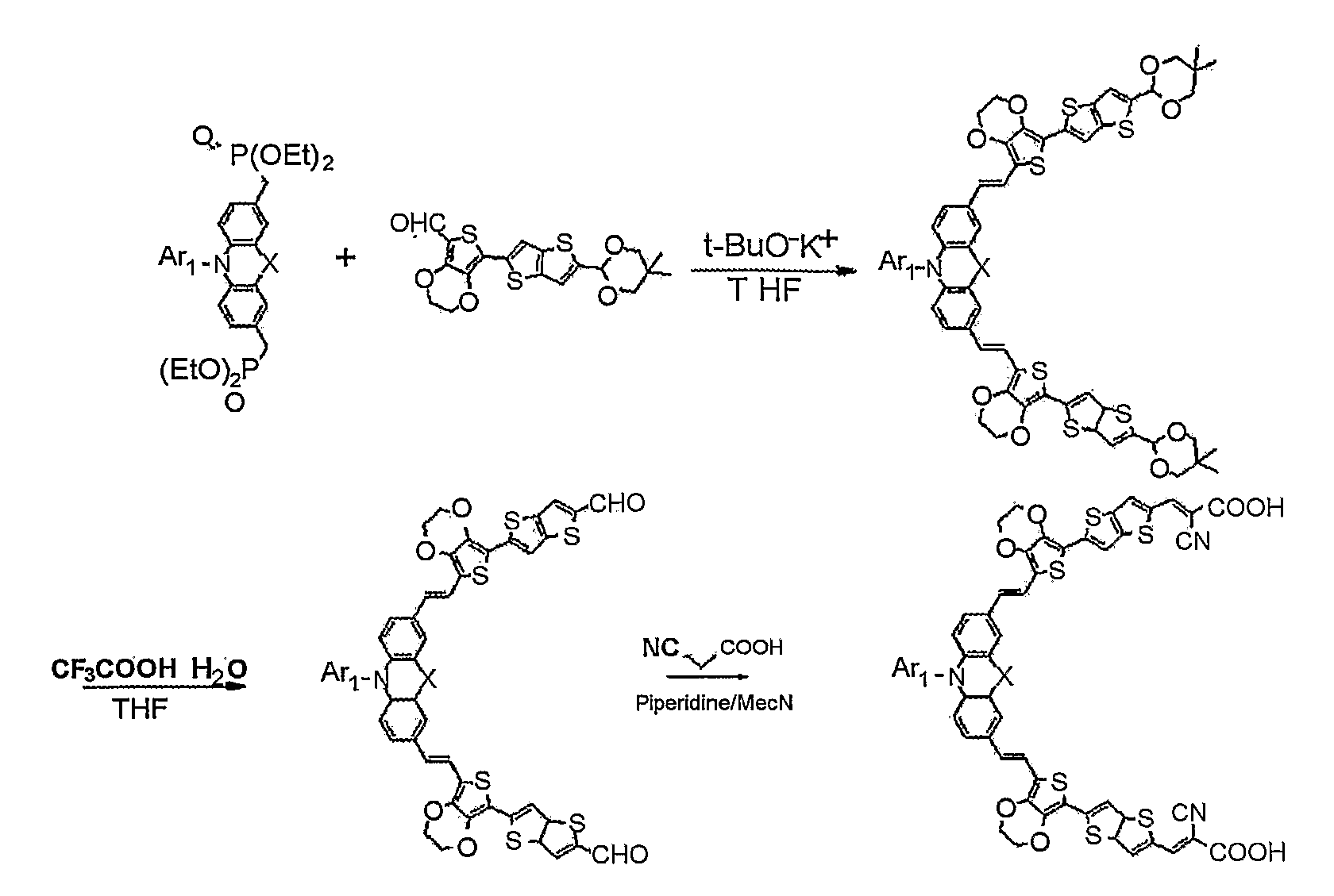
- the compound of formula 6 may be prepared by a process comprising the step of coupling with an anchoring group providing compound in the presence of piperidine in CH 3 CN:
- Ring W are each independently or
- X is Br or Is
- Z is H or Is
- A, Ar1 to Ar4, a, b, c, e and Sp are as defined above.
- any one of the following Formulas 3-1 to 3-6 may be used.
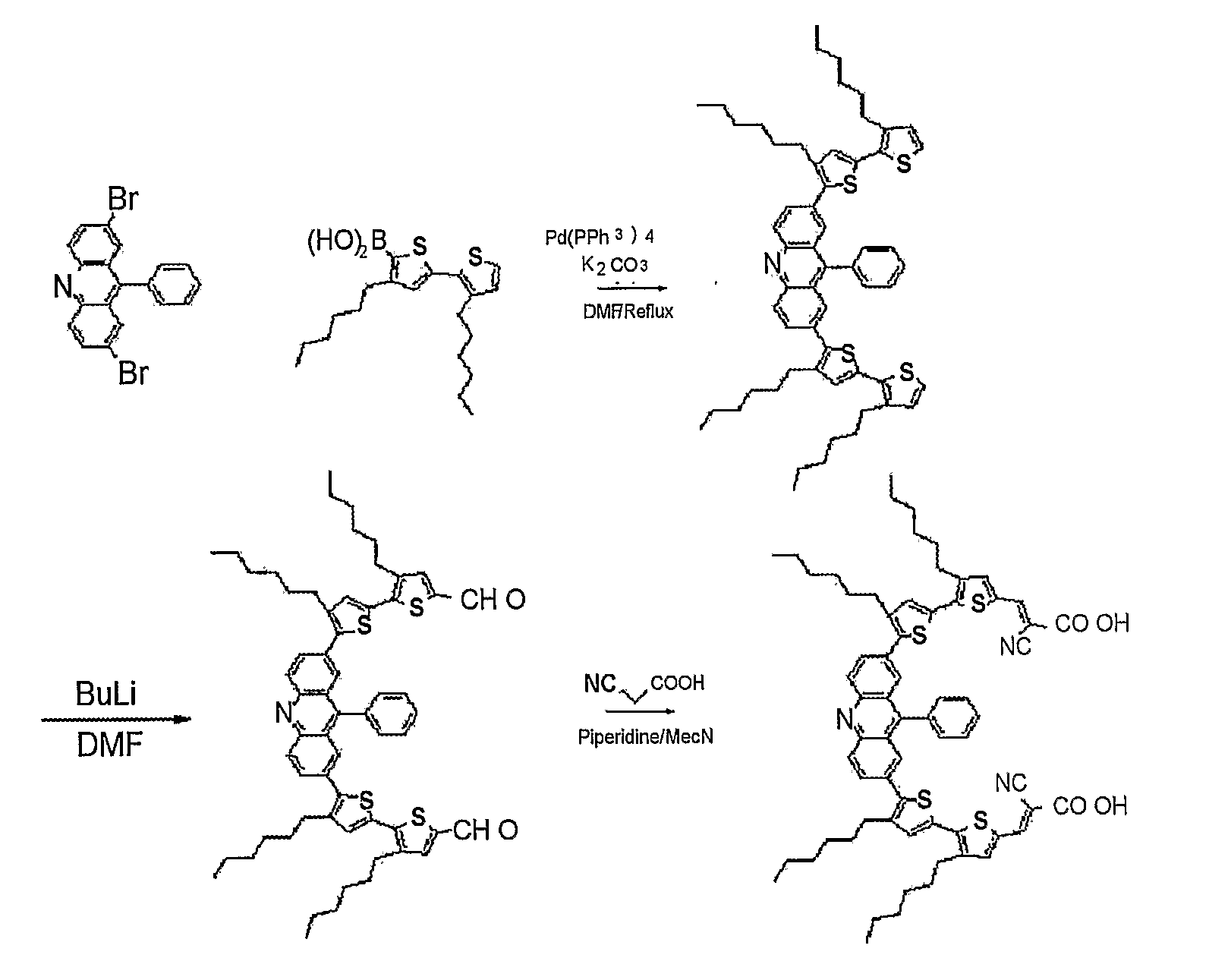
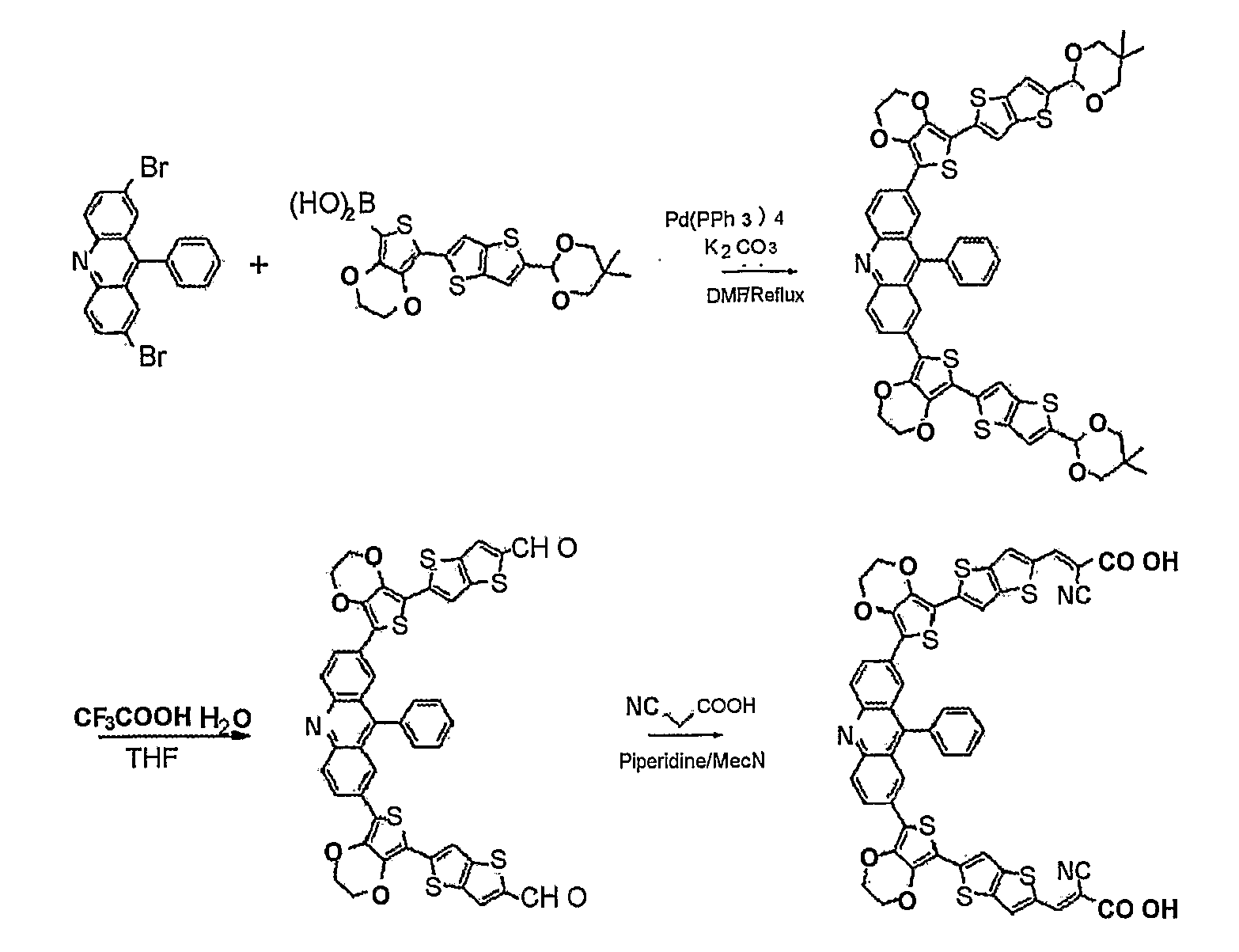
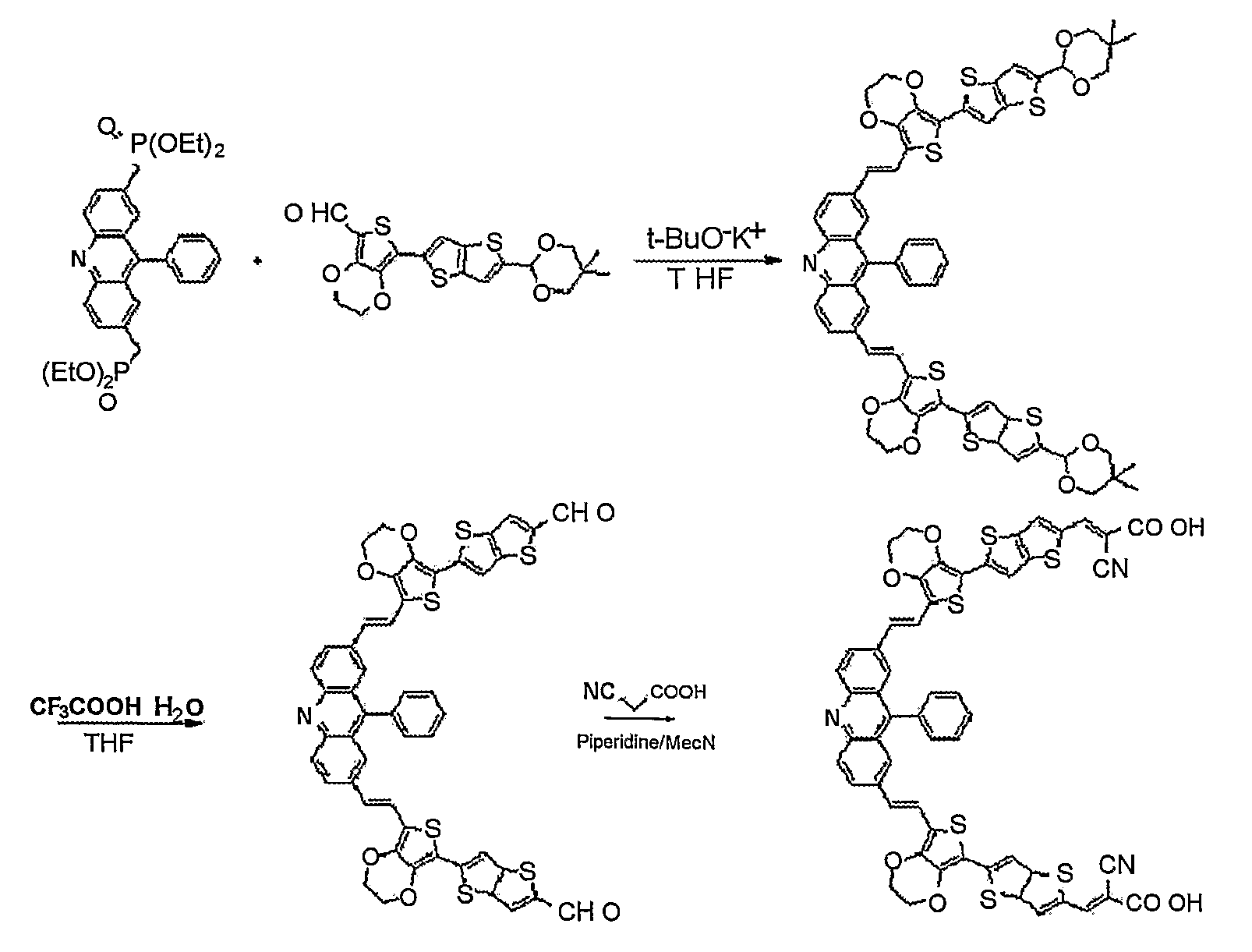
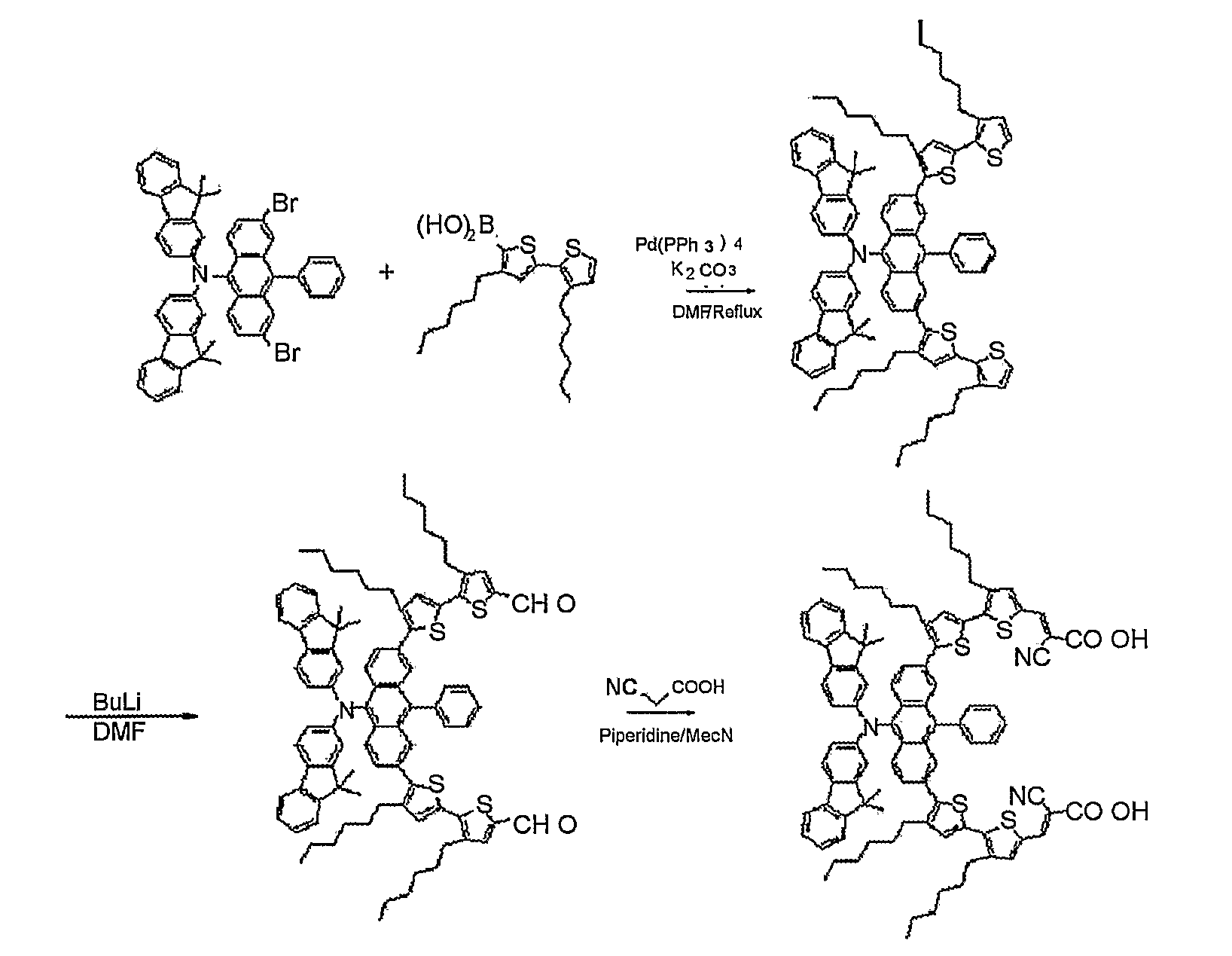
- the compound of Formula 5 is reacted with BuLi or CF 3 COOH in an organic solvent such as DMF to prepare a compound of Formula 6.
- the organic dye according to the present invention can be prepared by combining the resulting compound of formula 6 with an anchoring group-providing compound such as cyanoacetic acid in the presence of piperidine in CH 3 CN.
- organic dye according to the present invention may be prepared by the methods described in the following Schemes 1 to 10, but this is only an example and the present invention is not limited thereto.
- the organic dye according to the present invention prepared by the above manufacturing method is used in dye-sensitized solar cells (DSSC) as a dye-sensitized photoelectric conversion element, improved molar absorption coefficient, Jsc (short circuit photocurrent density) and The photoelectric conversion efficiency can be shown to greatly improve the efficiency of the solar cell.
- DSSC dye-sensitized solar cells
- the present invention provides a dye-sensitized photoelectric conversion device comprising the organic dye.
- the dye-sensitized photoelectric conversion device is characterized in that it comprises an oxide semiconductor microparticles, and the organic dye supported on the oxide semiconductor microparticles.
- a dye-sensitized photoelectric conversion device in addition to using the organic dye, methods for manufacturing dye-sensitized photoelectric conversion devices for solar cells using conventional dyes may be applied, and preferably, the dyes of the present invention.
- the sensitized photoelectric conversion device can be manufactured by producing a thin film of an oxide semiconductor on a substrate using oxide semiconductor fine particles, and then supporting the organic dye according to the present invention on the thin film.
- the substrate on which the thin film of the oxide semiconductor is formed is preferably conductive, and a commercially available one may be used.
- a thin film of conductive metal oxide such as tin oxide coated with indium, fluorine, or antimony on the surface of a transparent polymer material such as glass or polyethylene terephthalate or polyether sulfone, or a metal thin film such as copper, silver, or gold What formed this can be used.
- the conductivity is preferably 1000 ⁇ or less, particularly preferably 100 ⁇ or less.
- oxide semiconductor fine particles a metal oxide is preferable.
- oxides such as titanium, tin, zinc, tungsten, zirconium, gallium, indium, yttrium, niobium, tantalum and vanadium can be used.
- oxides such as titanium, tin, zinc, niobium and indium are preferable, titanium oxide, zinc oxide and tin oxide are more preferable, and titanium oxide is most preferred.
- the oxide semiconductor may be used alone, or may be mixed or coated on the surface of the semiconductor.
- the particle diameter of the oxide semiconductor fine particles is preferably 1 to 500 nm, more preferably 1 to 100 nm as the average particle diameter.
- the fine particles of the oxide semiconductor may be mixed with a large particle size and a small particle size, or may be used as a multilayer.
- the oxide semiconductor thin film is a method of forming oxide semiconductor fine particles into a thin film directly on the substrate through spray spraying, a method of electrically depositing a semiconductor fine particle thin film using the substrate as an electrode, a slurry of semiconductor fine particles, or a semiconductor such as a semiconductor alkoxide.
- the paste containing the fine particles prepared by hydrolyzing the precursor of the fine particles can be applied onto a substrate, and then produced by drying, curing or baking. Among these, a method of applying the paste onto the substrate is preferable.
- the said slurry can be obtained by disperse
- a dispersion medium which disperses a slurry as long as it can disperse semiconductor fine particles, it can use without a restriction
- a dispersion stabilizer can be used for the purpose of stabilizing the dispersion state of oxide semiconductor microparticles
- coated the slurry is 100 degreeC or more, Preferably it is 200 degreeC or more, and the upper limit is generally below melting
- the firing time is not particularly limited, but is generally within 4 hours.
- the thickness of the oxide semiconductor fine particles formed on the substrate is preferably 1 to 200 m, more preferably 1 to 50 m.
- a part of the thin film of the oxide semiconductor fine particles may be deposited during firing, but such deposition does not particularly affect the present invention.
- Secondary processing may be performed on the oxide semiconductor thin film.
- the performance of a semiconductor thin film may be improved by directly depositing a thin film for each substrate and drying or refiring it in a solution such as alkoxide, chloride, nitride or sulfide of the same metal as the semiconductor.
- a solution such as alkoxide, chloride, nitride or sulfide of the same metal as the semiconductor.
- the metal alkoxide include titanium ethoxide, titanium isopropoxide, titanium t-butoxide, n-dibutyl-diacetyl tin, and the like.
- the solvent may be used as an alcohol solution using alcohol.
- the chloride examples include titanium tetrachloride, tin tetrachloride, and zinc chloride, and the like can be used as an aqueous solution using water as a solvent.
- the oxide semiconductor thin film thus obtained is composed of fine particles of an oxide semiconductor.
- the method of supporting the dye on the oxide semiconductor fine particles formed in the thin film phase is not particularly limited, and as a specific example prepared by dissolving the organic dye represented by the formula (I) and (II) in a solvent capable of dissolving The method of immersing the board
- the concentration of the organic dye in the solution or dispersion can be appropriately determined depending on the dye.
- the dye concentration is preferably 1 ⁇ 10 ⁇ 6 M to 1 M, more preferably 1 ⁇ 10 ⁇ 5 M to 1 ⁇ 10 ⁇ 1 M.
- the temperature during deposition is usually from room temperature to the boiling point of the solvent, and the deposition time is about 1 minute to 48 hours.
- the organic dye to be supported may be one kind or may be mixed in several kinds.
- other organic dyes or metal complex dyes may be mixed with the organic dyes according to the present invention.
- the metal complex dyes that can be mixed are not particularly limited, but ruthenium complexes and quaternary salts thereof, phthalocyanine, porphyrin and the like are preferable, and other organic dyes include metal-free phthalocyanine, porphyrin or cyanine, merocyanine, oxo.
- Methine dyes such as knol, triphenylmethane, and acrylic acid dyes described in WO2002 / 011213, and dyes such as xanthene, azo, anthraquinone, and perylene-based dyes (MK Nazeeruddin, A.). Kay, I. Rodicio, R. Humphry-Baker, E. Muller, P. Liska, N. Vlachopoulos, M. Gratzel, J. Am. Chem. Soc., Vol. 115, p . 6382 (1993). . In the case of using two or more kinds of dyes, the dyes may be adsorbed onto the semiconductor thin film in order, or may be mixed and dissolved and adsorbed.
- the dye when the dye is supported on the thin film of the oxide semiconductor fine particles, it is preferable to support the dye in the presence of the inclusion compound in order to prevent the dyes from bonding.
- the inclusion compound include cholic acids such as deoxycholic acid, dehydrodeoxycholic acid, kenodeoxycholic acid, cholate methyl ester and sodium cholate; Steroid compounds such as polyethylene oxide and cholic acid; Crown ethers; Cyclodextrins; Callix arene; Polyethylene oxide and the like can be used.
- the substrate on which the semiconductor fine particle thin film is installed can be treated with an amine compound such as 4-t-butyl pyridine or a compound having an acidic group such as acetic acid or propionic acid.
- an amine compound such as 4-t-butyl pyridine
- a compound having an acidic group such as acetic acid or propionic acid.
- a treatment method for example, a method of dipping a substrate provided with a thin film of semiconductor fine particles in which a dye is supported in an amine ethanol solution may be used.
- the present invention provides a dye-sensitized solar cell comprising the dye-sensitized photoelectric conversion element.
- the dye-sensitized solar cell may be composed of a photoelectric conversion element electrode (cathode), a counter electrode (anode), a redox electrolyte, a hole transport material, or a p-type semiconductor, in which an organic dye is supported on oxide semiconductor fine particles.
- the dye-sensitized solar cell may be applied to conventional methods of manufacturing a solar cell using a conventional photoelectric conversion element, in addition to using a dye-sensitized photoelectric conversion element using the oxide semiconductor fine particles carrying the organic dye.
- the dye-sensitized solar cell according to the present invention comprises the steps of coating a titanium oxide paste on a conductive transparent substrate; Baking the paste-coated substrate to form a titanium oxide thin film; Impregnating the substrate on which the titanium oxide thin film is formed into a mixed solution in which an organic dye is dissolved to form a titanium oxide film electrode to which dye is adsorbed; Providing a second glass substrate having a counter electrode formed thereon; Forming a hole penetrating the second glass substrate and the counter electrode; Bonding the counter electrode to the titanium oxide film electrode by placing a thermoplastic polymer film between the counter electrode and the titanium oxide film electrode to which the dye is adsorbed, and performing a heat compression process; Injecting an electrolyte into the thermoplastic polymer film
- the redox electrolyte, hole transport material, p-type semiconductor, and the like may be used in the form of a liquid, a solid (gel and gel), a solid, and the like.
- redox electrolyte, dissolved salt, hole transport material, p-type semiconductor, etc. are dissolved in a solvent, or room temperature dissolved salts, etc., respectively, in the case of coagulated bodies (gel and gel form), these are polymer matrix or low molecular gel.
- a solid phase redox electrolyte, a dissolved salt, a hole transport material, a p-type semiconductor, or the like can be used.
- hole transport materials may be used as the hole transport material, and specific examples include conductive polymers such as amine derivatives, polyacetylene, polyaniline, and polythiophene; Or an object using a discotech liquid crystal phase such as a triphenylene compound.
- conductive polymers such as amine derivatives, polyacetylene, polyaniline, and polythiophene; Or an object using a discotech liquid crystal phase such as a triphenylene compound.
- CuI, CuSCN, etc. can be used as a p-type semiconductor.
- the counter electrode has conductivity and catalyzes the reduction reaction of the redox electrolyte.
- platinum, carbon, rhodium, ruthenium, or the like deposited on glass or a polymer film, or coated with conductive fine particles can be used.
- the redox electrolyte examples include a halogen redox electrolyte composed of a halogen compound-halogen molecule having halogen ions as a counter ion; Metal redox-based electrolytes such as metal complexes such as ferrocyanate-ferrocyanate, ferrocene-ferricinium ions and cobalt complexes; Organic redox-based electrolytes such as alkylthiol-alkyldisulfide, viologen dye, hydroquinone-quinone and the like can be used, and a halogen redox-based electrolyte is preferable.
- a halogen redox electrolyte composed of a halogen compound-halogen molecule having halogen ions as a counter ion
- Metal redox-based electrolytes such as metal complexes such as ferrocyanate-ferrocyanate, ferrocene-ferricinium ions and cobalt complexes
- halogen molecule in the halogen redox electrolyte composed of halogen compound-halogen molecules an iodine molecule is preferable.
- a halogen compound having a halogen ion as a large ion halogenated metal salts such as LiI, NaI, KI, CaI 2 , MgI 2 and CuI, or organic ammonium salts of halogens such as tetraalkylammonium iodine, imidazolium iodine and pyridium iodine, Or I 2 can be used.
- an electrochemically inert one may be used as the solvent.
- an electrochemically inert one may be used as the solvent.
- Specific examples include acetonitrile, propylene carbonate, ethylene carbonate, 3-methoxy propionitrile, methoxy acetonitrile, ethylene glycol, propylene glycol, diethylene glycol, triethylene glycol, butyrolactone, dimethoxyethane, dimethyl carbonate, 1,3-dioxolane, methylformate, 2-methyltetrahydrofuran, 3-methoxy-oxazolidin-2-one, sulfolane, tetrahydrofuran, water, and the like, in particular acetonitrile, Propylene carbonate, ethylene carbonate, 3-methoxy propionitrile, ethylene glycol, 3-methoxy-oxazolidin-2-one, butyrolactone and the like are preferable.
- the solvents may be used alone or in combination.
- the gel electrolyte one containing an electrolyte or an electrolyte solution in a matrix such as an oligomer and a polymer, or one containing an electrolyte or an electrolyte solution in the same manner as a starch gelling agent can be used.
- the concentration of the redox electrolyte is preferably 0.01 to 99% by weight, more preferably 0.1 to 30% by weight.
- a counter electrode anode
- a photoelectric conversion element cathode
- a solution containing a redox electrolyte is filled therebetween.
- the intermediate (8a) prepared above was added to anhydrous ethanol solution, and n- BuLi was further added under argon. After 3 h, DMF was added to the resulting reaction at 0 ° C. under argon and washed with 5% KOH. The resulting reaction solution was dried over magnesium sulfate, and the solvent was removed and purified to obtain an intermediate (8b).
- Trifluoroacetic acid and water were added dropwise to the solution of the intermediate (10a) prepared in Example 1 2) in tetrahydrofuran (THF) and stirred for 4 hours under a nitrogen atmosphere.
- the compound of Chemical Formula 18 was obtained in the same manner as in Example 1, except that Intermediate 18b prepared above was used instead of Intermediate 8b in Example 1.
- Tetraethyl (9) instead of 10- (bis (9,9-dimethyl-9H-fluoren-2-yl) amino) -9-phenylanthracene-2,7-diyl) bis (methylene) diphosphonate Same as in Example 7, except using 9-dimethyl-10- (4-methoxyphenyl) -9,10-dihydroacridine-2,7-diyl) bis (methylene) diphosphonate
- the compound of formula 120 was obtained by the method.
- Example 6 Instead of tetraethyl (10- (bis (9,9-dimethyl-9H-fluoren-2-yl) amino) -9-phenylanthracene-2,7-diyl) bis (methylene) diphosphonate in Example 6 The same procedure as in Example 6 was carried out except that tetraethyl (10- (4-methoxyphenyl) -10H-phenothiazine-3,7-diyl) bis (methylene) diphosphonate was used. The compound of formula 121 was obtained.
- Tetraethyl (9) instead of 10- (bis (9,9-dimethyl-9H-fluoren-2-yl) amino) -9-phenylanthracene-2,7-diyl) bis (methylene) diphosphonate
- the compound of formula 122 was carried out in the same manner as in Example 7, except that-(4-methoxyphenyl) -9H-carbazole-3,6-diyl) bis (methylene) diphosphonate was used.
- a dye-sensitized solar cell was prepared using a 13 + 10 ⁇ m TiO 2 transparent layer.
- the washed FTO (Pilkington, 8 ⁇ sq-1) glass substrate was impregnated in a 40 mM TiCl 4 aqueous solution.
- a TiO2 paste (Solaronix, 13 nm anatase) was screen printed to produce a 13 ⁇ m thick first TiO2 layer, and another paste (CCIC, HWP-400) was used to prepare a 10 ⁇ m thick second TiO2 scattering layer. .
- TiO2 electrode in a solution of the dye according to the present invention (prepared by dissolving the compound prepared in Examples 1-14 at 0.3 mM in ethanol containing 3m, 7a-dihydroxy-5b-cholic acid of 10 mM each) After impregnation, it was left at room temperature for 18 hours.
- the counter electrode was prepared by coating a solution of H 2 PtCl 6 (containing 2 mg of Pt in 1 mL of ethanol) on an FTO substrate.
- the dye compound of the present invention can be used in a dye-sensitized solar cell (DSSC) to exhibit an improved molar absorption coefficient, Jsc (single-circuit photocurrent density) and photoelectric conversion efficiency than conventional dyes, thereby greatly improving the efficiency of the solar cell.
- DSSC dye-sensitized solar cell
Landscapes
- Chemical & Material Sciences (AREA)
- Engineering & Computer Science (AREA)
- Organic Chemistry (AREA)
- Materials Engineering (AREA)
- Physics & Mathematics (AREA)
- Spectroscopy & Molecular Physics (AREA)
- Power Engineering (AREA)
- Microelectronics & Electronic Packaging (AREA)
- Hybrid Cells (AREA)
- Photovoltaic Devices (AREA)
Abstract
Description



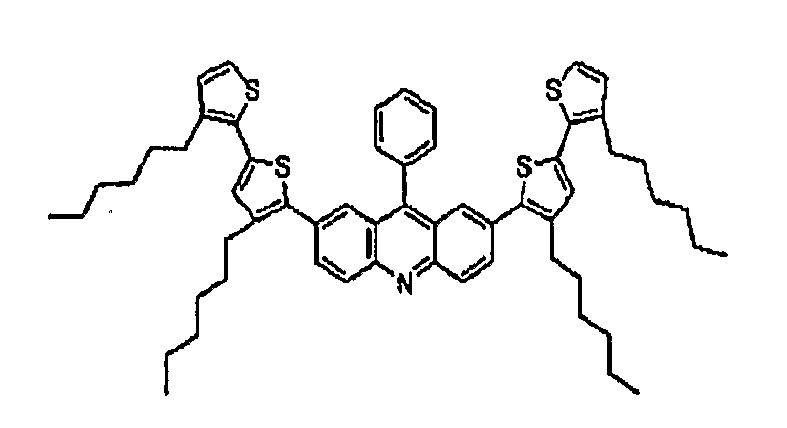
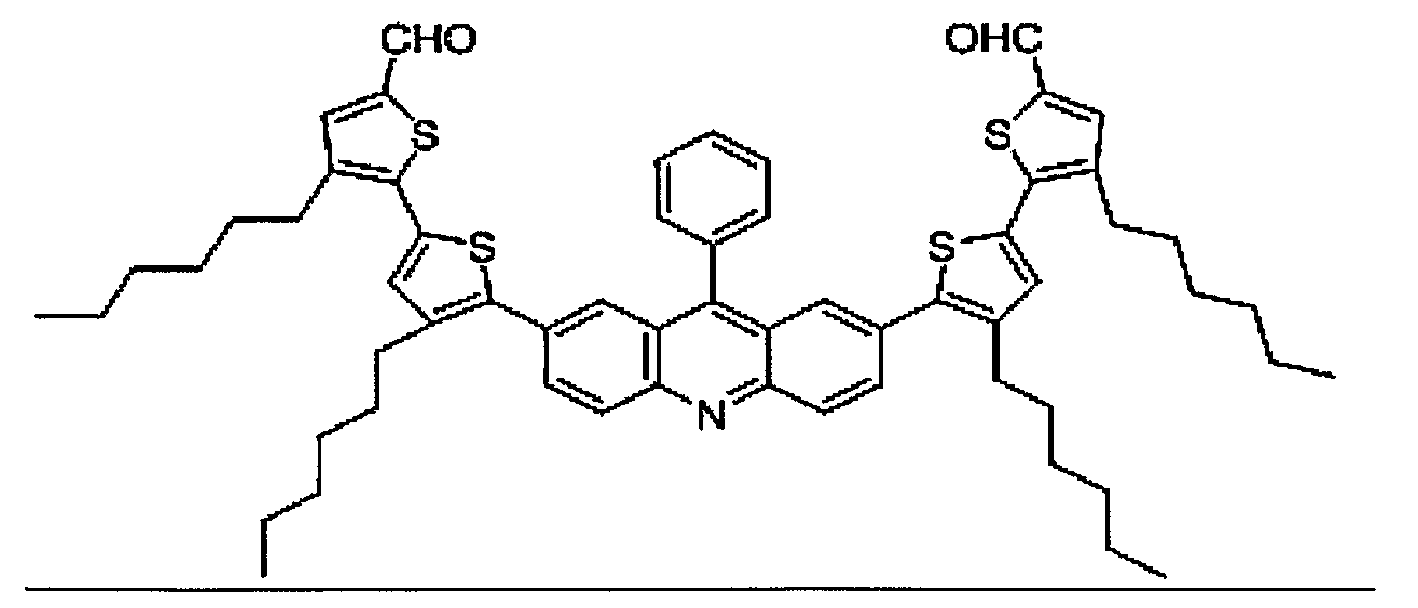
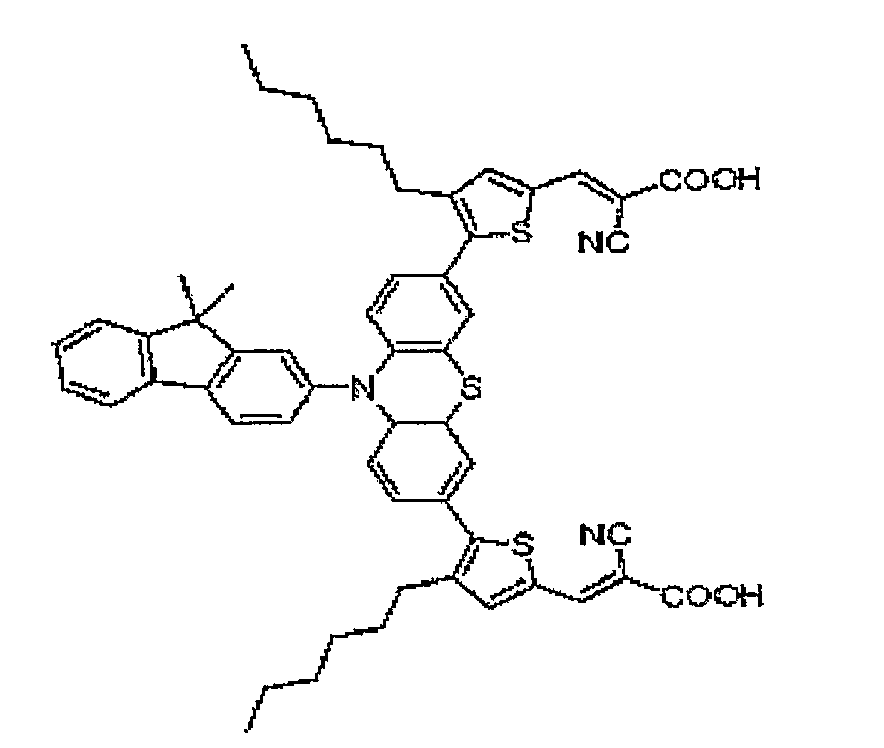
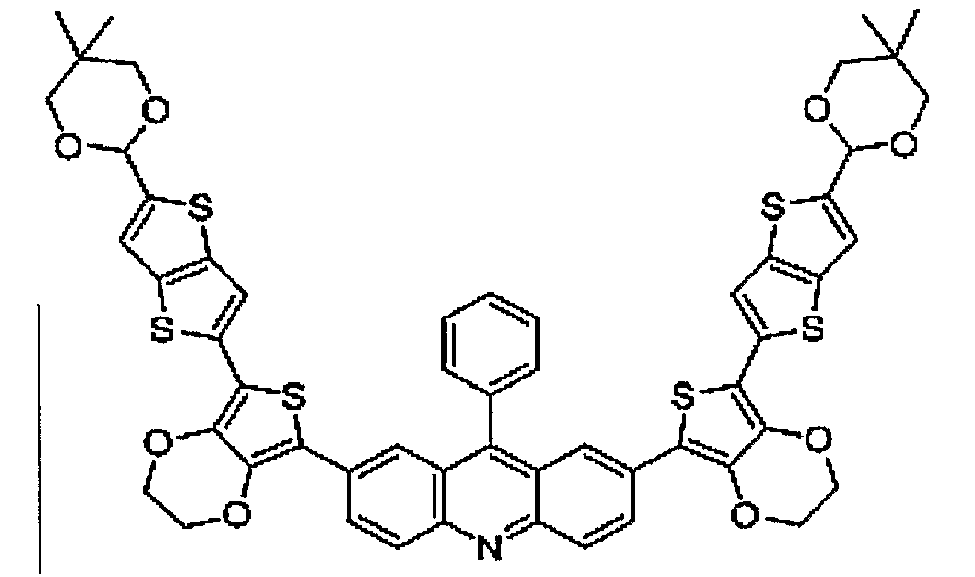
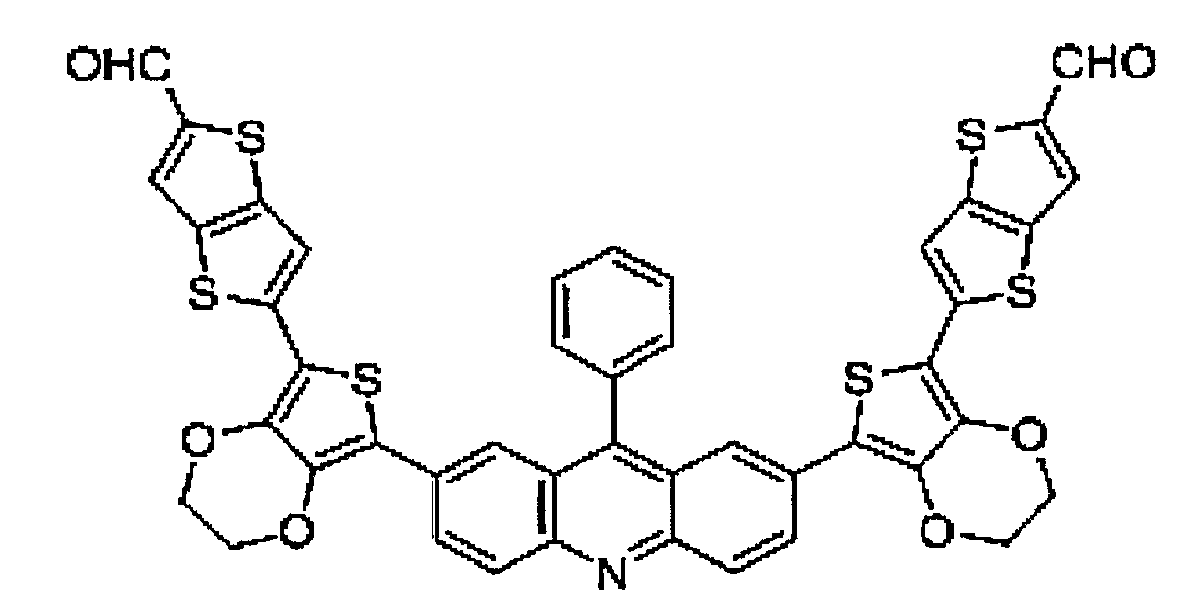


| 구분 | 효율(η)(%) | 구분 | 효율(η)(%) |
| 실시예 1 | 4.2 | 실시예 8 | 4.8 |
| 실시예 2 | 4.4 | 실시예 9 | 4.3 |
| 실시예 3 | 4.6 | 실시예 10 | 5.2 |
| 실시예 4 | 5.0 | 실시예 11 | 4.4 |
| 실시예 5 | 4.8 | 실시예 12 | 4.4 |
| 실시예 6 | 5.4 | 실시예 13 | 5.6 |
| 실시예 7 | 5.5 | 실시예 14 | 4.5 |
Claims (9)
- 하기 화학식 1 또는 2로 표시되는 염료증감 광전변환소자용 유기염료:[화학식 1]
 [화학식 2]
 상기 식에서,A는 C 또는 N이고, 단 A가 N이면 b 및 c는 0이며,B는 O, S, CR1R2 또는 NR3이고, 이때 R1 내지 R3은 각각 독립적으로 수소 또는 C1-12 알킬이며,Ar1 내지 Ar5는 각각 독립적으로 치환 또는 비치환된 C6-C50의 아릴기이고,이때 A1 내지 Ar3은 서로 연결되어 환을 형성할 수도 있으며,a는 0 또는 1이고,b 및 c는 각각 독립적으로 0 또는 1이고, 단 c가 1이면 b는 반드시 1이며,d는 0 또는 1이고,e는 0 또는 1이며,An은 각각 독립적으로,
 ,
, ,
, ,
, ,
, ,
, ,
, ,
, ,
, 및
및 로 이루어진 군에서 선택되며,
 Sp는 각각 독립적으로,
 ,
, 및
및 으로 이루어진 군으로부터 1종 이
 상 선택되며, 이때 L은 각각 독립적으로 O, S, CR6R7, SiR8R9 및 NR10으로 이루어진 군으로부터 선택되고, R4 및 R5는 각각 독립적으로 수소, 치환 또는 비치환된 C1-12 알킬, 치환 또는 비치환된 C6-30 아릴, 및 치환 또는 비치환된 C6-20 헤테로아릴로 이루어진 군에서 선택되거나, 또는 서로 연결되어 환을 형성할 수 있으며, R6 내지 R10은 각각 독립적으로 수소 또는 치환 또는 비치환된 C1-12 알킬이고, n은 1 내지 10의 정수이다.
 - 제1항에 있어서,A가 C 또는 N이고, 단, A가 N이면 b 및 c는 0이며,B가 S 또는 CR1R2이고, 이때 R1 및 R2는 각각 독립적으로 수소 또는 메틸기이며,Ar1 내지 Ar5가 각각 독립적으로 C6-C50의 아릴기, 또는 알킬 또는 알콕시기로 치환된 C6-C50의 아릴기이고,a가 0 또는 1이고,b 및 c가 각각 독립적으로 0 또는 1이고, 단 c가 1이면 b는 반드시 1이며,d가 0 또는 1이고,e가 0 또는 1이며,An이또는
 이고,
이고, Sp가,
Sp가, ,
, 및
및 으로 이루어진 군으로부터 선택되는 것을 특징으로 하는 유기염료.
- [규칙 제91조에 의한 정정 18.08.2010]
제1항에 있어서, 상기 유기염료가 하기 화학식 7 내지 122로 표시되는 화합물들로 이루어진 군에서 선택되는 것을 특징으로 하는 유기염료: [화학식 7][화학식 8] [화학식 9]
 [화학식 10]
 [화학식 11]
 [화학식 12]
 [화학식 13]
 [화학식 14]
 [화학식 15]
 [화학식 16]
 [화학식 17]
 [화학식 18]
 [화학식 19]
 [화학식 20]
 [화학식 21]
 [화학식 22]
 [화학식 23]
 [화학식 24]
 [화학식 25]
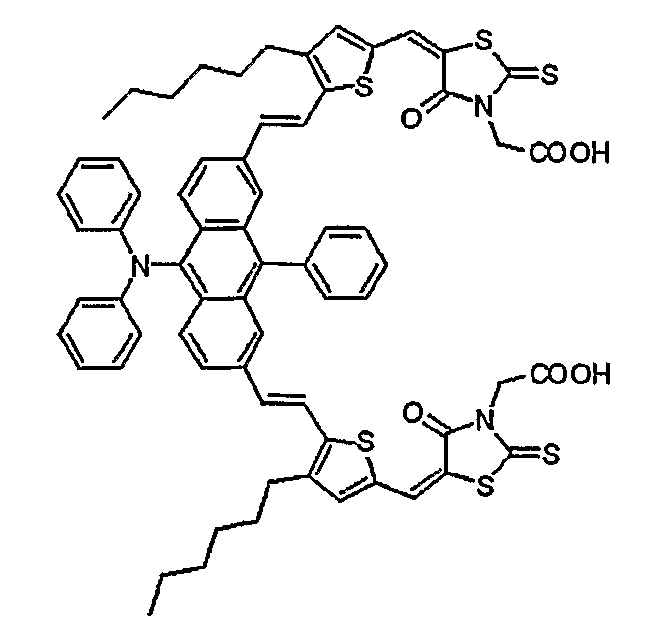 [화학식 26]
 [화학식 27]
 [화학식 28]
 [화학식 29]
 [화학식 30]
 [화학식 31]
 [화학식 32]
 [화학식 33]
 [화학식 34]
 [화학식 35]
 [화학식 36]
 [화학식 37]
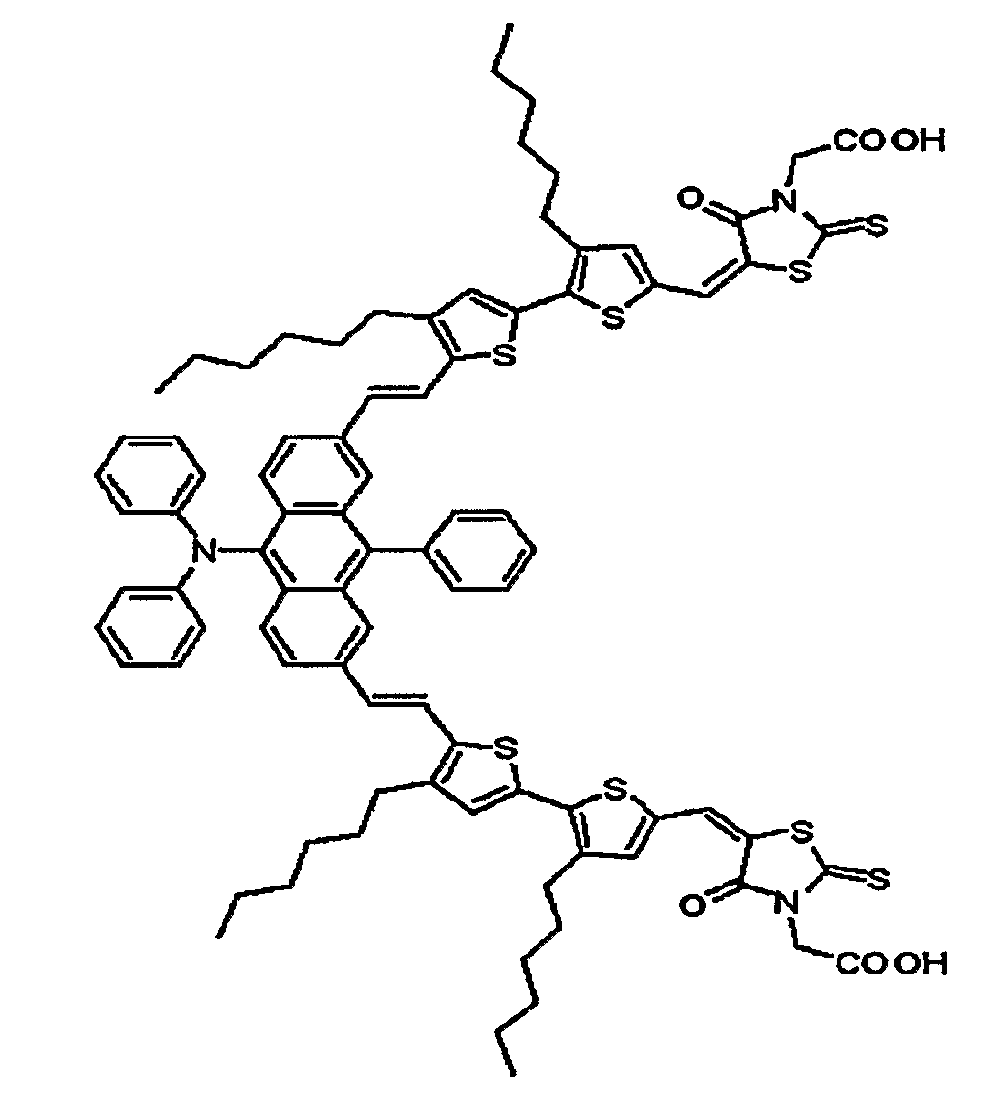 [화학식 38]
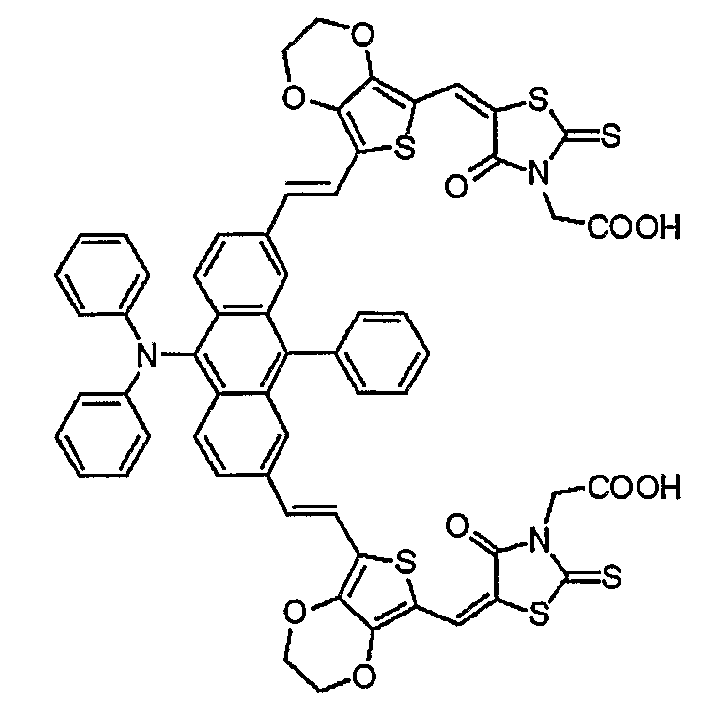 [화학식 39]
 [화학식 40]
 [화학식 41]
 [화학식 42]
 [화학식 43]
 [화학식 44]
 [화학식 45]
 [화학식 46]
 [화학식 47]
 [화학식 48]
 [화학식 49]
 [화학식 50]
 [화학식 51]
 [화학식 52]
 [화학식 53]
 [화학식 54]
 [화학식 55]
 [화학식 56]
 [화학식 57]
 [화학식 58]
 [화학식 59]
 [화학식 60]
 [화학식 61]
 [화학식 62]
 [화학식 63]
 [화학식 64]
 [화학식 65]
 [화학식 66]
 [화학식 67]
 [화학식 68]
 [화학식 69]
 [화학식 70]
 [화학식 71]
 [화학식 72]
 [화학식 73]
 [화학식 74]
 [화학식 75]
 [화학식 76]
 [화학식 77]
 [화학식 78]
 [화학식 79]
 [화학식 80]
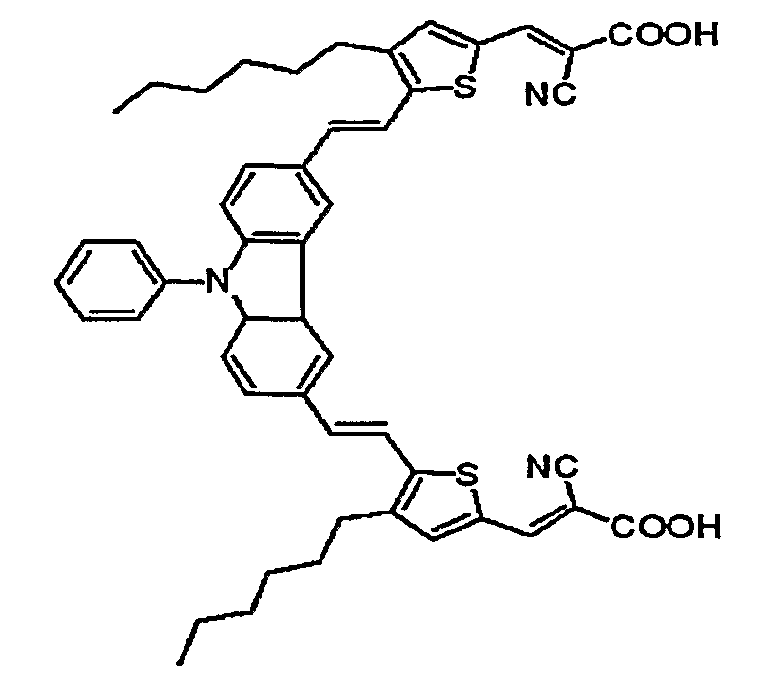 [화학식 81]
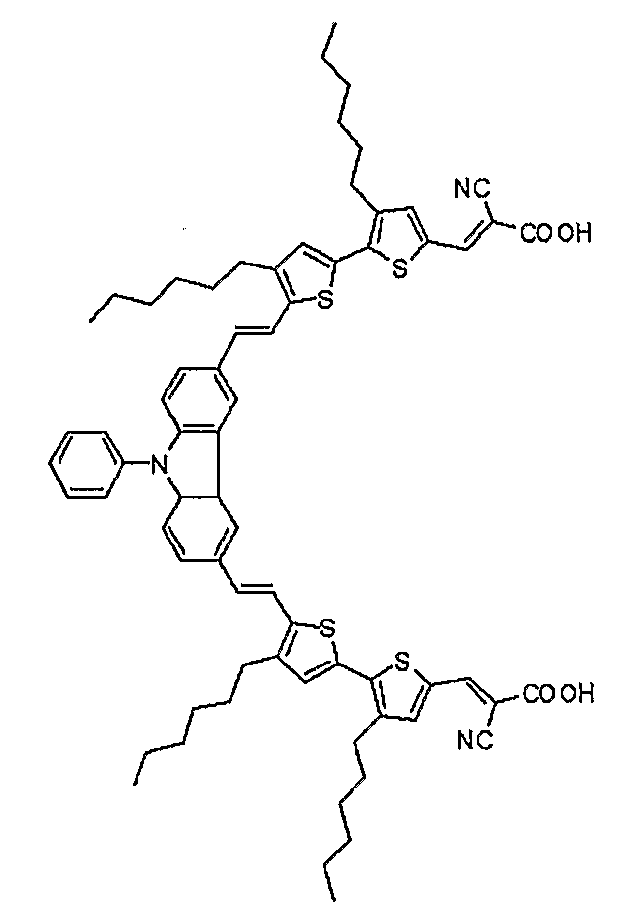 [화학식 82]
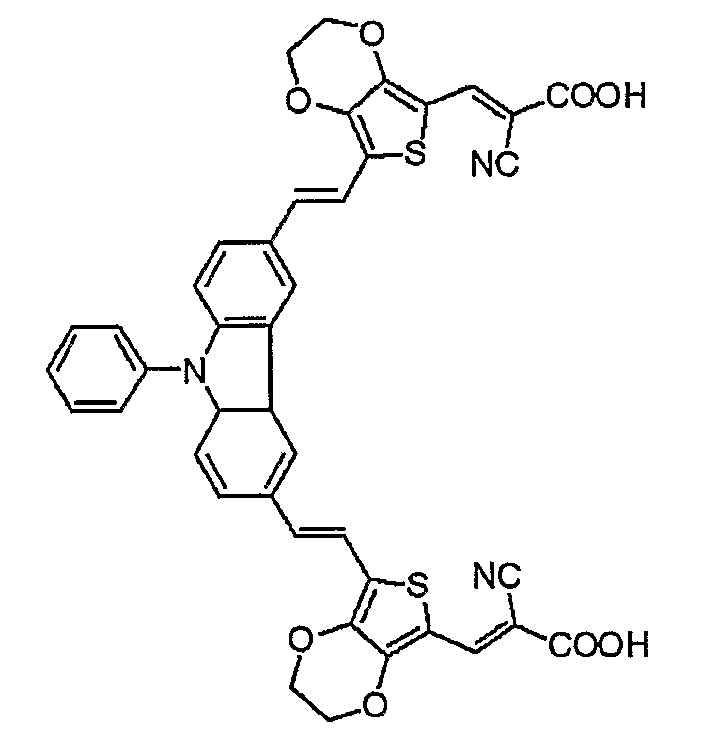 [화학식 83]
 [화학식 84]
 [화학식 85]
 [화학식 86]
 [화학식 87]
 [화학식 88]
 [화학식 89]
 [화학식 90] [화학식 91]
 [화학식 92] [화학식 93]
 [화학식 94]
 [화학식 95]
 [화학식 96]
 [화학식 97]
 [화학식 98]
 [화학식 99]
 [화학식 100]
 [화학식 101]
 [화학식 102]
 [화학식 103]
 [화학식 104]
 [화학식 105]
 [화학식 106]
 [화학식 107]
 [화학식 108]
 [화학식 109]
 [화학식 110]
 [화학식 111]
 [화학식 112]
 [화학식 113]
 [화학식 114]
 [화학식 115]
 [화학식 116]
 [화학식 117]
 [화학식 118]
 [화학식 119]
 [화학식 120]
 [화학식 121]
 [화학식 122]

- [규칙 제91조에 의한 정정 18.08.2010]
(1) 하기 화학식 3의 화합물을 하기 화학식 4의 화합물과 커플링 반응시켜 화학식 5의 화합물을 제조하는 단계; (2) 상기 화학식 5의 화합물을 유기용매중에서 BuLi 또는 CF3COOH와 반응시켜 하기 화학식 6의 화합물을 제조하는 단계; 및 (3) 상기 화학식 6의 화합물을 CH3CN 중에서 피페리딘 존재 하에서 앵커링기 제공 화합물과 결합반응시키는 단계 를 포함하는 제1항 기재의 염료증감 광전변환소자용 유기염료의 제조방법: [화학식 3][화학식 4] [화학식 5]
 [화학식 6]
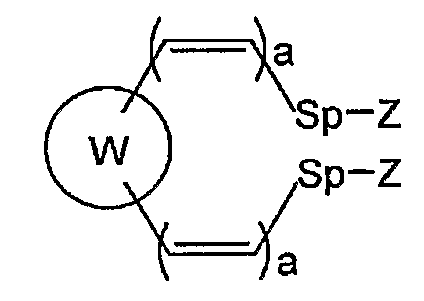 상기 식에서, 고리 W는
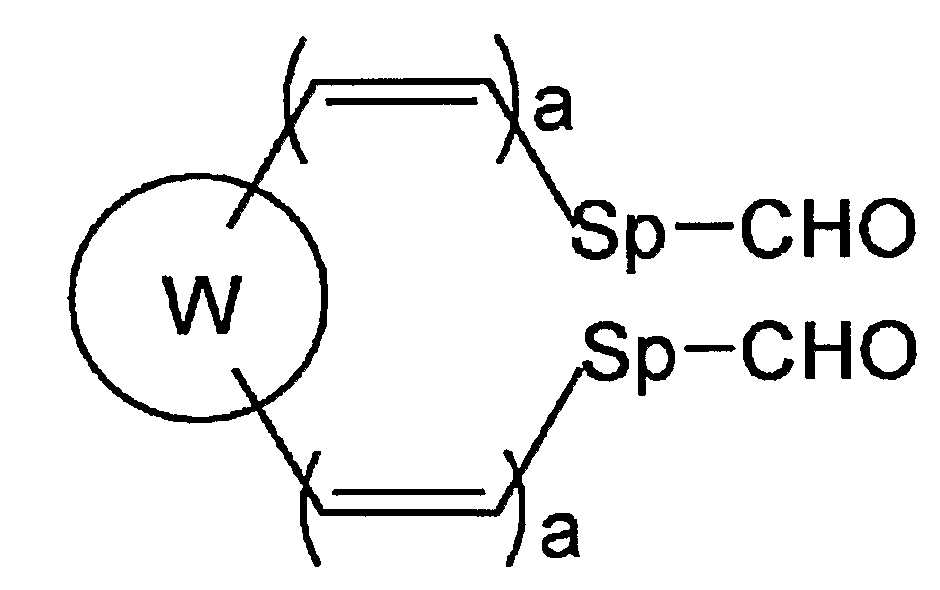 또는
또는 이고, X는 Br 또는
 이며, Y는
 또는
또는 이고, Z는 H 또는
 이며, A, Ar1 내지 Ar4, a, b, c, e 및 Sp는 제1항에서 정의한 바와 같다.
- 산화물 반도체 미립자; 및상기 산화물 반도체 미립자에 담지된 제1항 기재의 유기염료를 포함하는 염료증감 광전변환소자.
- 제1항에 있어서,상기 유기염료가 포섭화합물의 존재 하에서 산화물 반도체 미립자에 담지된 것을 특징으로 하는 염료증감 광전변환소자.
- 제1항에 있어서,상기 산화물 반도체 미립자가 이산화티탄을 포함하는 것을 특징으로 하는 염료증감 광전변환소자.
- 제1항에 있어서,상기 산화물 반도체 미립자가 1 내지 500 nm의 평균 입경을 갖는 것을 특징으로 하는 염료증감 광전변환소자.
- 제5항의 염료증감 광전변환소자를 전극으로서 포함하는 것을 특징으로 하는 염료감응태양전지.
Priority Applications (2)
| Application Number | Priority Date | Filing Date | Title |
|---|---|---|---|
| CN2010800270689A CN102803394A (zh) | 2009-06-19 | 2010-06-18 | 新型有机染料及其制造方法 |
| JP2012515989A JP2012530796A (ja) | 2009-06-19 | 2010-06-18 | 新規の有機色素およびその製造方法 |
Applications Claiming Priority (8)
| Application Number | Priority Date | Filing Date | Title |
|---|---|---|---|
| KR20090055229 | 2009-06-19 | ||
| KR20090055223 | 2009-06-19 | ||
| KR10-2009-0055227 | 2009-06-19 | ||
| KR10-2009-0055229 | 2009-06-19 | ||
| KR20090055227 | 2009-06-19 | ||
| KR10-2009-0055223 | 2009-06-19 | ||
| KR1020100057781A KR20100136929A (ko) | 2009-06-19 | 2010-06-17 | 신규한 유기염료 및 이의 제조방법 |
| KR10-2010-0057781 | 2010-06-17 |
Publications (2)
| Publication Number | Publication Date |
|---|---|
| WO2010147425A2 true WO2010147425A2 (ko) | 2010-12-23 |
| WO2010147425A3 WO2010147425A3 (ko) | 2011-04-28 |
Family
ID=43356941
Family Applications (1)
| Application Number | Title | Priority Date | Filing Date |
|---|---|---|---|
| PCT/KR2010/003947 Ceased WO2010147425A2 (ko) | 2009-06-19 | 2010-06-18 | 신규한 유기염료 및 이의 제조방법 |
Country Status (5)
| Country | Link |
|---|---|
| JP (1) | JP2012530796A (ko) |
| KR (1) | KR20100136929A (ko) |
| CN (1) | CN102803394A (ko) |
| TW (1) | TW201112469A (ko) |
| WO (1) | WO2010147425A2 (ko) |
Cited By (5)
| Publication number | Priority date | Publication date | Assignee | Title |
|---|---|---|---|---|
| WO2012147330A1 (ja) * | 2011-04-27 | 2012-11-01 | 保土谷化学工業株式会社 | アクリダン環構造を有する化合物および有機エレクトロルミネッセンス素子 |
| JP2013060581A (ja) * | 2011-08-23 | 2013-04-04 | Hodogaya Chem Co Ltd | 光電変換用増感色素およびそれを用いた光電変換素子ならびに色素増感太陽電池 |
| ITMI20120674A1 (it) * | 2012-04-23 | 2013-10-24 | Cnrs Ct Nat De La Rech He Scient | Colorante organico per cella solare sensibile ai coloranti |
| WO2014026244A1 (en) * | 2012-08-17 | 2014-02-20 | Commonwealth Scientific And Industrial Research Organisation | Photoactive optoelectronic and transistor devices |
| KR101489184B1 (ko) * | 2011-12-05 | 2015-02-03 | 고려대학교 산학협력단 | 정공전도특성을 갖는 염료감응 태양전지용 공흡착체 및 그를 포함하는 염료감응 태양전지 |
Families Citing this family (17)
| Publication number | Priority date | Publication date | Assignee | Title |
|---|---|---|---|---|
| CN102695759A (zh) * | 2009-12-30 | 2012-09-26 | 株式会社东进世美肯 | 新的有机染料及其制造方法 |
| JP5700937B2 (ja) * | 2010-02-09 | 2015-04-15 | 保土谷化学工業株式会社 | 光電変換用増感色素及びそれを用いた光電変換素子及び色素増感太陽電池 |
| TW201245119A (en) * | 2011-05-09 | 2012-11-16 | Everlight Chem Ind Corp | Dye compound and dye-sensitized solar cell using the same, and dye solution |
| WO2013085285A1 (ko) * | 2011-12-05 | 2013-06-13 | 고려대학교 산학협력단 | 정공전도특성을 갖는 염료감응 태양전지용 공흡착체 및 그를 포함하는 염료감응 태양전지 |
| KR101361043B1 (ko) * | 2012-04-17 | 2014-02-21 | 재단법인대구경북과학기술원 | 신규한 유기염료 화합물 및 이를 포함하는 염료감응 태양전지 |
| KR101457105B1 (ko) * | 2012-11-07 | 2014-11-04 | 재단법인대구경북과학기술원 | 유기염료 화합물 및 이를 포함하는 염료감응 태양전지 |
| CN103408963B (zh) * | 2013-08-08 | 2014-08-27 | 陕西师范大学 | 脲供体双桥链有机染料及其应用 |
| KR101587829B1 (ko) * | 2014-01-21 | 2016-01-22 | 재단법인대구경북과학기술원 | 염료감응 태양전지 및 이에 사용되는 유기염료 |
| KR101814673B1 (ko) * | 2014-11-28 | 2018-01-04 | 삼성에스디아이 주식회사 | 신규한 화합물, 이를 포함하는 감광성 수지 조성물 및 컬러필터 |
| CN105294735B (zh) * | 2015-11-25 | 2018-03-20 | 武汉工程大学 | 一种吩噻嗪类有机小分子给体及其制备方法 |
| CN107759621B (zh) * | 2016-08-17 | 2020-04-21 | 国家纳米科学中心 | 一种含有并噻吩(并硒吩)修饰的光电化合物及其制备方法和用途 |
| CN106800515B (zh) * | 2016-12-08 | 2018-06-05 | 烟台九目化学制品有限公司 | 一种具有芴胺结构的有机电致发光材料及其应用 |
| TWI750333B (zh) * | 2017-03-29 | 2021-12-21 | 日商保土谷化學工業股份有限公司 | 增感色素、光電轉換用增感色素組合物及使用其之光電轉換元件以及色素增感太陽電池 |
| KR102015820B1 (ko) * | 2017-09-28 | 2019-08-29 | 울산대학교 산학협력단 | 초고속 자동 불꽃 합성법을 이용한 전극 재료의 제조방법 |
| US20190372021A1 (en) * | 2017-11-15 | 2019-12-05 | Lg Chem, Ltd. | Heterocyclic compound and organic photoelectric device comprising same |
| CN110372719B (zh) * | 2019-08-09 | 2020-08-11 | 浙江工业大学 | N-芴基苯并咔唑类化合物、制备方法及其应用 |
| KR20250006096A (ko) * | 2022-05-11 | 2025-01-10 | 후지필름 가부시키가이샤 | 광전 변환 소자, 촬상 소자, 광센서, 화합물 |
Family Cites Families (4)
| Publication number | Priority date | Publication date | Assignee | Title |
|---|---|---|---|---|
| WO2004082061A1 (ja) * | 2003-03-14 | 2004-09-23 | Nippon Kayaku Kabushiki Kaisha | 色素増感光電変換素子 |
| AU2007221706B2 (en) * | 2006-03-02 | 2011-12-22 | Nippon Kayaku Kabushiki Kaisha | Dye-sensitized photoelectric conversion device |
| JP5135774B2 (ja) * | 2006-11-20 | 2013-02-06 | コニカミノルタビジネステクノロジーズ株式会社 | 光電変換素子、及び太陽電池 |
| JP2009048925A (ja) * | 2007-08-22 | 2009-03-05 | Nippon Kayaku Co Ltd | 色素増感光電変換素子 |
-
2010
- 2010-06-17 KR KR1020100057781A patent/KR20100136929A/ko not_active Withdrawn
- 2010-06-18 WO PCT/KR2010/003947 patent/WO2010147425A2/ko not_active Ceased
- 2010-06-18 JP JP2012515989A patent/JP2012530796A/ja active Pending
- 2010-06-18 TW TW099119905A patent/TW201112469A/zh unknown
- 2010-06-18 CN CN2010800270689A patent/CN102803394A/zh active Pending
Cited By (14)
| Publication number | Priority date | Publication date | Assignee | Title |
|---|---|---|---|---|
| US9905770B2 (en) | 2011-04-27 | 2018-02-27 | Hodogaya Chemical Co., Ltd. | Compound having acridan ring structure, and organic electroluminescent device |
| WO2012147330A1 (ja) * | 2011-04-27 | 2012-11-01 | 保土谷化学工業株式会社 | アクリダン環構造を有する化合物および有機エレクトロルミネッセンス素子 |
| US20140042425A1 (en) * | 2011-04-27 | 2014-02-13 | Hodogaya Chemical Co., Ltd. | Compound having acridan ring structure, and organic electroluminescent device |
| CN107266364A (zh) * | 2011-04-27 | 2017-10-20 | 保土谷化学工业株式会社 | 具有9,10‑二氢吖啶环结构的化合物以及有机电致发光器件 |
| CN103619821A (zh) * | 2011-04-27 | 2014-03-05 | 保土谷化学工业株式会社 | 具有9,10-二氢吖啶环结构的化合物以及有机电致发光器件 |
| JPWO2012147330A1 (ja) * | 2011-04-27 | 2014-07-28 | 保土谷化学工業株式会社 | アクリダン環構造を有する化合物および有機エレクトロルミネッセンス素子 |
| JP2013060581A (ja) * | 2011-08-23 | 2013-04-04 | Hodogaya Chem Co Ltd | 光電変換用増感色素およびそれを用いた光電変換素子ならびに色素増感太陽電池 |
| KR101489184B1 (ko) * | 2011-12-05 | 2015-02-03 | 고려대학교 산학협력단 | 정공전도특성을 갖는 염료감응 태양전지용 공흡착체 및 그를 포함하는 염료감응 태양전지 |
| WO2013160201A1 (en) * | 2012-04-23 | 2013-10-31 | Eni S.P.A. | Organic dye for a dye-sensitized solar cell |
| CN104487522A (zh) * | 2012-04-23 | 2015-04-01 | 艾尼股份公司 | 用于染料敏化太阳能电池的有机染料 |
| US9257236B2 (en) | 2012-04-23 | 2016-02-09 | Centre National De La Recherche Scientifique | Organic dye for a dye-sensitized solar cell |
| CN104487522B (zh) * | 2012-04-23 | 2016-08-17 | 艾尼股份公司 | 用于染料敏化太阳能电池的有机染料 |
| ITMI20120674A1 (it) * | 2012-04-23 | 2013-10-24 | Cnrs Ct Nat De La Rech He Scient | Colorante organico per cella solare sensibile ai coloranti |
| WO2014026244A1 (en) * | 2012-08-17 | 2014-02-20 | Commonwealth Scientific And Industrial Research Organisation | Photoactive optoelectronic and transistor devices |
Also Published As
| Publication number | Publication date |
|---|---|
| WO2010147425A3 (ko) | 2011-04-28 |
| CN102803394A (zh) | 2012-11-28 |
| TW201112469A (en) | 2011-04-01 |
| JP2012530796A (ja) | 2012-12-06 |
| KR20100136929A (ko) | 2010-12-29 |
Similar Documents
| Publication | Publication Date | Title |
|---|---|---|
| WO2010147425A2 (ko) | 신규한 유기염료 및 이의 제조방법 | |
| WO2012102544A2 (ko) | 신규한 유기염료 및 이의 제조방법 | |
| WO2022211594A1 (ko) | 유기 광전자 소자용 조성물, 유기 광전자 소자 및 표시 장치 | |
| WO2010002154A2 (ko) | 신규한 유기염료 및 이의 제조방법 | |
| WO2013100538A1 (ko) | 유기광전자소자용 화합물, 이를 포함하는 유기발광소자 및 상기 유기발광소자를 포함하는 표시장치 | |
| WO2012039534A1 (ko) | 유기광전소자용 화합물 및 이를 포함하는 유기광전소자 | |
| WO2013105747A1 (ko) | 유기전기 소자용 화합물, 이를 이용한 유기전기소자 및 그 전자 장치 | |
| WO2020166875A1 (ko) | 신규한 화합물 및 이를 이용한 유기발광 소자 | |
| WO2011102586A1 (ko) | 유기광전소자용 화합물 및 이를 포함하는 유기광전소자 | |
| WO2023282617A2 (ko) | 유기 광전자 소자용 조성물, 유기 광전자 소자 및 표시 장치 | |
| WO2019221545A1 (ko) | 유기발광소자 | |
| WO2021137512A1 (en) | Organic light emitting diode and organic light emitting device including the same | |
| WO2013095039A1 (ko) | 유기광전자소자용 화합물, 이를 포함하는 유기발광소자 및 상기 유기발광소자를 포함하는 표시장치 | |
| WO2021137510A1 (en) | Organic light emitting diode and organic light emitting device including the same | |
| WO2020130724A1 (ko) | 유기 발광 화합물 및 이를 이용한 유기 전계 발광 소자 | |
| WO2021020931A1 (ko) | 화합물 및 이를 포함하는 유기 발광 소자 | |
| WO2019066305A1 (ko) | 중합체 및 이를 포함하는 유기 태양 전지 | |
| WO2022182165A1 (ko) | 유기 발광 소자 | |
| WO2021049843A1 (ko) | 화합물 및 이를 포함하는 유기 발광 소자 | |
| WO2021137511A1 (en) | Organic light emitting diode and organic light emitting device including the same | |
| WO2023113333A1 (ko) | 유기 광전자 소자용 화합물, 유기 광전자 소자용 조성물, 유기 광전자 소자 및 표시 장치 | |
| WO2010147427A9 (ko) | 신규한 유기염료 및 이의 제조방법 | |
| WO2022019536A1 (ko) | 화합물 및 이를 포함하는 유기 발광 소자 | |
| WO2009096702A2 (ko) | 신규한 유기 염료 및 이의 제조방법 | |
| WO2010147428A9 (ko) | 신규한 유기염료 및 이의 제조방법 |
Legal Events
| Date | Code | Title | Description |
|---|---|---|---|
| WWE | Wipo information: entry into national phase |
Ref document number: 201080027068.9 Country of ref document: CN |
|
| 121 | Ep: the epo has been informed by wipo that ep was designated in this application |
Ref document number: 10789752 Country of ref document: EP Kind code of ref document: A2 |
|
| WWE | Wipo information: entry into national phase |
Ref document number: 2012515989 Country of ref document: JP |
|
| NENP | Non-entry into the national phase |
Ref country code: DE |
|
| 122 | Ep: pct application non-entry in european phase |
Ref document number: 10789752 Country of ref document: EP Kind code of ref document: A2 |