WO2010103828A1 - 石炭の膨張率の測定方法、石炭の比容積の推定方法、空隙充填度の測定方法及び石炭配合方法 - Google Patents
石炭の膨張率の測定方法、石炭の比容積の推定方法、空隙充填度の測定方法及び石炭配合方法 Download PDFInfo
- Publication number
- WO2010103828A1 WO2010103828A1 PCT/JP2010/001703 JP2010001703W WO2010103828A1 WO 2010103828 A1 WO2010103828 A1 WO 2010103828A1 JP 2010001703 W JP2010001703 W JP 2010001703W WO 2010103828 A1 WO2010103828 A1 WO 2010103828A1
- Authority
- WO
- WIPO (PCT)
- Prior art keywords
- coal
- specific volume
- softening
- blended
- coke
- Prior art date
- Legal status (The legal status is an assumption and is not a legal conclusion. Google has not performed a legal analysis and makes no representation as to the accuracy of the status listed.)
- Ceased
Links
Images


Classifications
-
- C—CHEMISTRY; METALLURGY
- C10—PETROLEUM, GAS OR COKE INDUSTRIES; TECHNICAL GASES CONTAINING CARBON MONOXIDE; FUELS; LUBRICANTS; PEAT
- C10B—DESTRUCTIVE DISTILLATION OF CARBONACEOUS MATERIALS FOR PRODUCTION OF GAS, COKE, TAR, OR SIMILAR MATERIALS
- C10B57/00—Other carbonising or coking processes; Features of destructive distillation processes in general
- C10B57/04—Other carbonising or coking processes; Features of destructive distillation processes in general using charges of special composition
-
- C—CHEMISTRY; METALLURGY
- C10—PETROLEUM, GAS OR COKE INDUSTRIES; TECHNICAL GASES CONTAINING CARBON MONOXIDE; FUELS; LUBRICANTS; PEAT
- C10B—DESTRUCTIVE DISTILLATION OF CARBONACEOUS MATERIALS FOR PRODUCTION OF GAS, COKE, TAR, OR SIMILAR MATERIALS
- C10B45/00—Other details
-
- G—PHYSICS
- G01—MEASURING; TESTING
- G01N—INVESTIGATING OR ANALYSING MATERIALS BY DETERMINING THEIR CHEMICAL OR PHYSICAL PROPERTIES
- G01N25/00—Investigating or analyzing materials by the use of thermal means
- G01N25/16—Investigating or analyzing materials by the use of thermal means by investigating thermal coefficient of expansion
-
- G—PHYSICS
- G01—MEASURING; TESTING
- G01N—INVESTIGATING OR ANALYSING MATERIALS BY DETERMINING THEIR CHEMICAL OR PHYSICAL PROPERTIES
- G01N33/00—Investigating or analysing materials by specific methods not covered by groups G01N1/00 - G01N31/00
- G01N33/22—Fuels; Explosives
Definitions
- the present invention relates to a method for measuring the coefficient of expansion of coal, which is an evaluation parameter for softening and melting characteristics of coal, a method for estimating the specific volume of coal, a method for measuring the degree of void filling, and a method for blending coal.
- the present application is filed on March 10, 2009, on Japanese Patent Application Nos. 2009-056920 and July 24, 2009, and on Japanese Patent Application No. 2009-173075, filed on October 16, 2009. Claims priority based on Japanese Patent Application No. 2009-239098 filed in Japan, the contents of which are incorporated herein by reference.
- ⁇ Blast furnace coke is usually produced by blending many types of coal according to the required quality of the blast furnace and dry-distilling in the coke oven. If the strength of the blast furnace coke is low, the movement (increase) of the reducing gas in the blast furnace is hindered by the powder coke generated from the coke when the coke is charged into the blast furnace. In this case, the iron ore reduction reaction is hindered, and stable operation of the blast furnace becomes difficult. Therefore, the blast furnace coke is required to have a strength equal to or higher than a predetermined value.
- a JIS drum strength index for example, DI 150 6 or DI 150 15
- an ISO Mycam strength index for example, ISO Mycam strength index
- an ASTM tumbler strength index for example, ASTM tumbler strength index
- a rotational strength index or a drop strength index is used as the coke strength.
- Each of these indexes represents the degree of maintaining the state of the coke without generating the powder coke when a predetermined mechanical impact is applied to the coke.
- the rotational strength index is obtained by automatically repeating a coke drop test in a cylindrical container. Therefore, this rotational strength index is essentially the same kind as the drop strength index.
- coke strength is estimated from the degree of coalification and caking properties that are characteristics of coal.
- an index representing the degree of coal coalization volatile matter, reflectance, carbon content, and the like are used.
- an index representing the caking property of coal expansibility (for example, expansion rate and specific volume) and fluidity defined in JIS M 8801 are used.
- Patent Document 1 the degree of void filling at the time of coal softening is obtained from the product of the specific volume at the time of coal softening and the bulk density of the coal at the time of charging into the coke oven, and the surface destruction of coke is determined from the degree of void filling at the time of coal softening.
- a method for estimating the intensity is disclosed.
- Patent Document 1 The method of Patent Document 1 is based on the following knowledge. If the expansion coefficient of coal is high relative to the porosity between coal particles during coal softening, the coal particles cannot expand sufficiently. On the contrary, when the expansion coefficient is low with respect to the void ratio between the coal particles, the coal particles expand freely because there are sufficient voids. When the coal particles freely expand during the softening of the coal, bubbles in the coal particles are ruptured, and coarse connecting pores and non-bonded portions between the coal particles are generated to produce brittle coke. Ordinary coal for producing coke begins to soften and expand at a temperature of about 400 ° C. and resolidifies at a temperature of about 500 ° C.
- the proportion of coal particles filling the voids from the softening to resolidification of the coal is determined, the amount of non-adhesion grain boundaries and connected pores in the coke can be predicted, and the surface of the coke The fracture strength can be estimated.
- the estimation method of coke strength in Patent Document 1 does not consider using coal with a total expansion rate of 0%. Therefore, it was unclear whether this method could be used even when coal with a total expansion rate of 0% was used. Therefore, the present inventors estimated the strength of coke produced from blended coal containing coal having a total expansion rate of 0% based on the method of Patent Document 1. Furthermore, the coke strength of the blast furnace coke produced by dry distillation of the coal blend containing coal having a total expansion rate of 0% was measured. Thereafter, the measured coke strength was compared with the estimated coke strength.
- Table 1 shows the values of evaluation parameters for evaluating the softening and melting characteristics of coals A to G.
- Coal A to G are different brands of coal.
- Coals A and B are highly caking coals, and coals C to G are low caking properties with a total expansion rate of 0%.
- the specific volume V (cm 3 / g) at the time of softening the coal is the volume of the coal ⁇ V (cm 3 ) at the time of maximum expansion or the expansion rate b (%) of the coal. And obtained from the following formula (1) or (2).
- V ⁇ V / w (1)
- V 0.96 ⁇ (1 + b / 100) / w (2)
- w is the amount of coal charged (g) into the dilatometer (capillary tube).
- the coal volume ⁇ V at the time of maximum expansion and the coefficient of expansion b of the coal are measured by a dilatometer.
- coals having the same expansion coefficient b have the same specific volume V during coal softening. Furthermore, as shown in Patent Document 1, the degree of void filling during coal softening can be obtained by multiplying the specific volume V during coal softening by the bulk density of coal during charging in the coke oven. Further, the degree of void filling and coke strength (for example, surface fracture strength) have a certain correlation. Therefore, coals having the same specific volume V (cm 3 / g) at the time of softening the coal have the same coke strength because they have the same degree of void filling ( ⁇ ).
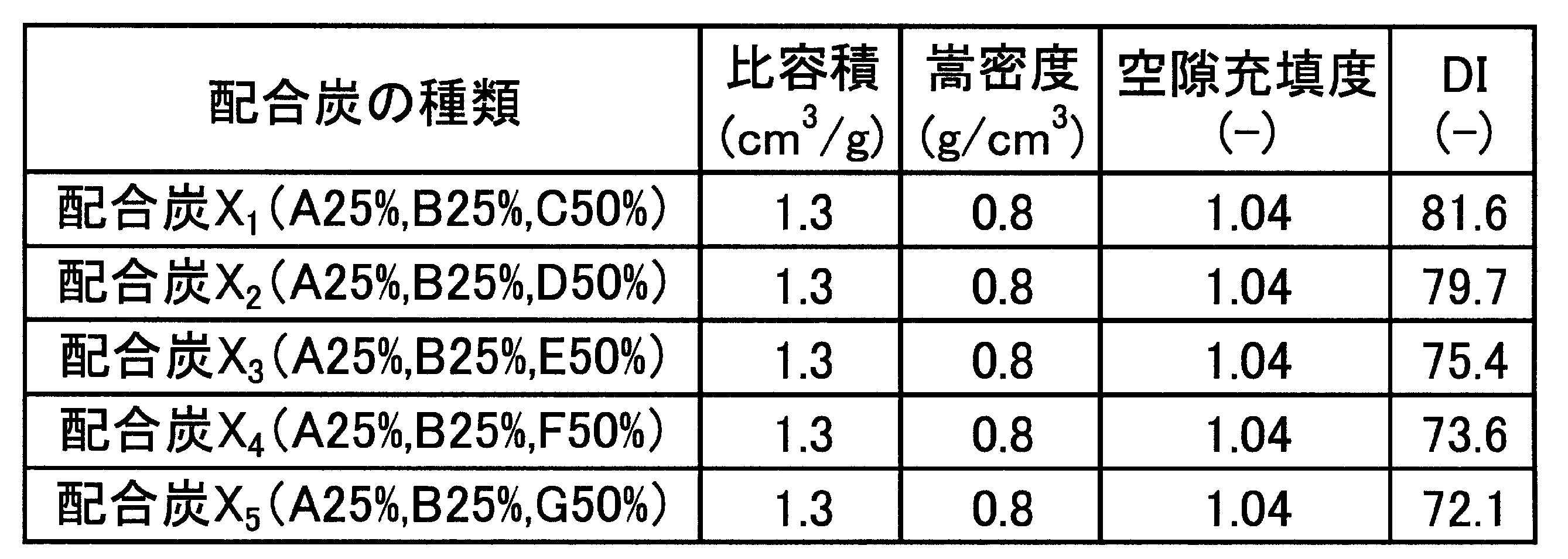
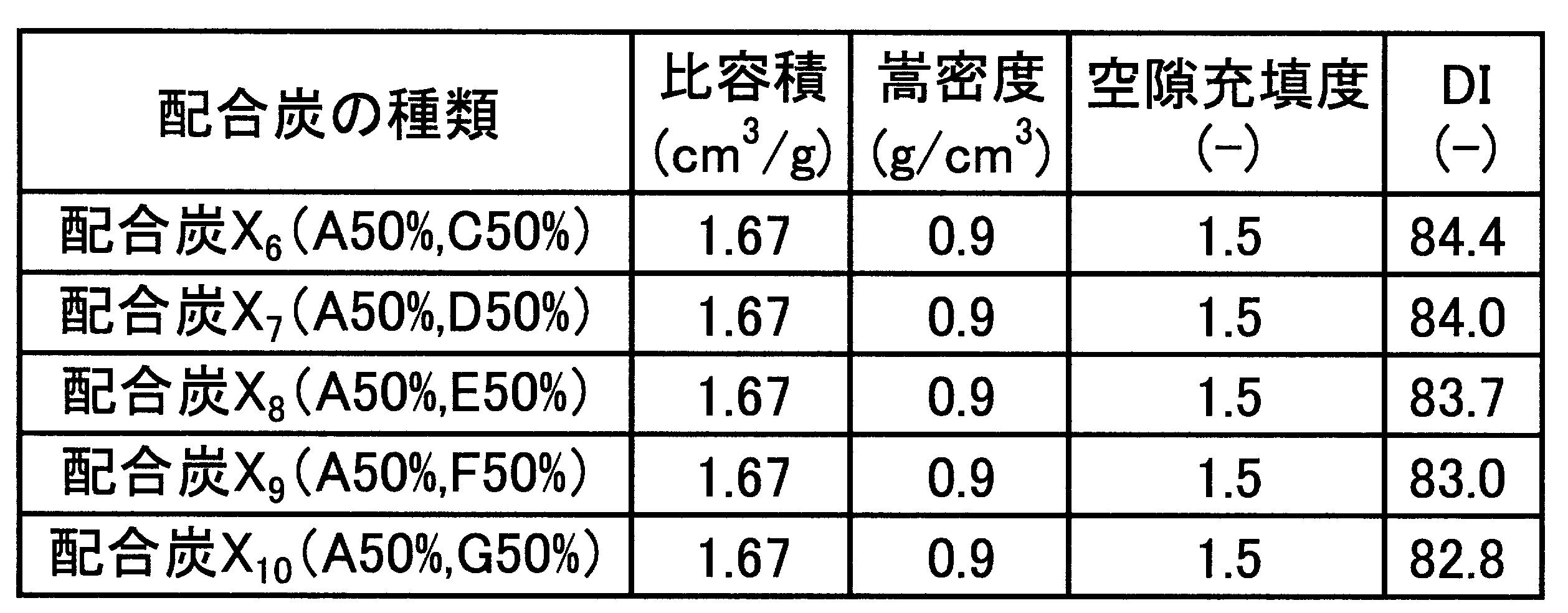
- the present inventors dry-distilled different types of blended coals X 1 to X 10 into coke, and measured the coke strength DI (drum index). The measurement results are shown in Tables 2 and 3. Furthermore, the correlation between the degree of void filling of these blended coals X 1 to X 10 and the coke strength DI is shown in FIG. The weighted average value of the specific volumes of each coal in Table 1 was used as the specific volume of the blended coals X 1 to X 10 .
- the black square data is Comparative Example 1 using blended coals X 1 to X 5 corresponding to Table 2.
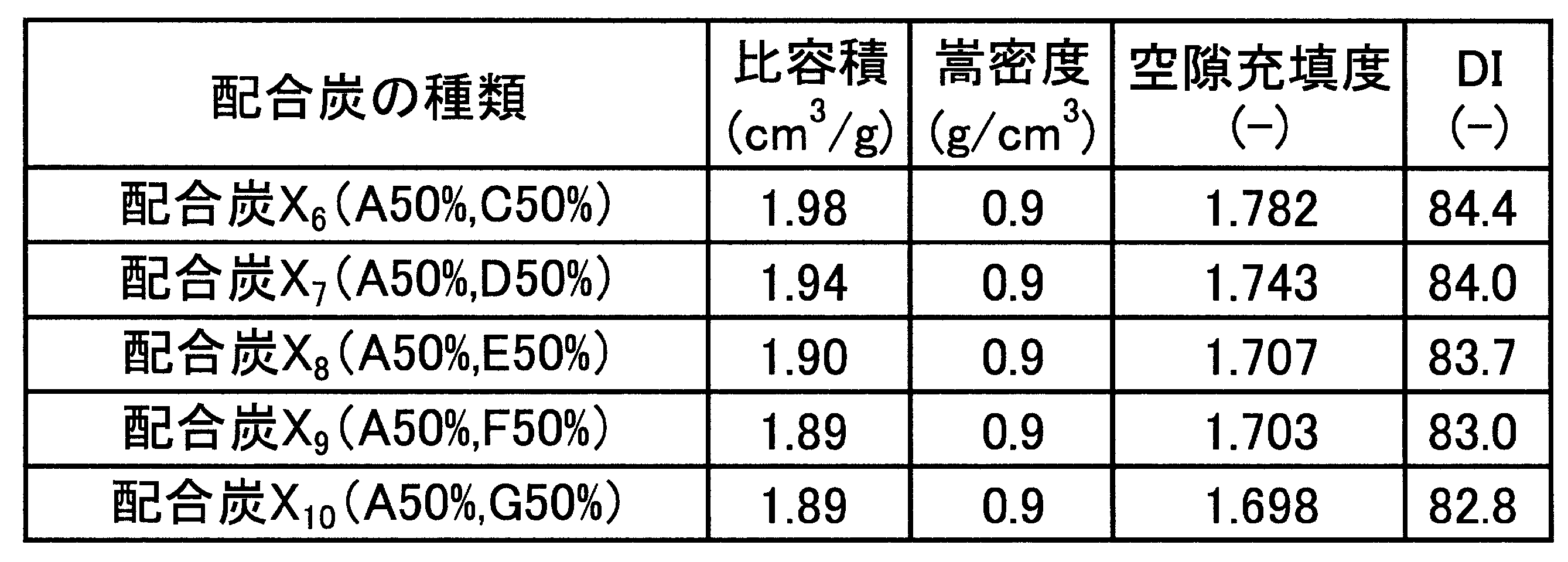
- the data of open triangles is Comparative Example 2 using blended coals X 6 to X 10 corresponding to Table 3.
- the blending ratios of coals A to G used for blended coals X 1 to X 10 are shown. That is, the coal blend X 1, and coal A of 25 mass%, and 25 mass% coal B, and the coal C to 50 mass% are blended.
- the coal blend X 2, and coal A of 25 mass%, and 25 mass% coal B, and the coal D of 50 mass% are blended.
- the coal blend X 3, and coal A of 25 mass%, and 25 mass% coal B, and a 50 mass% coal E are blended.
- the coal blend X 4 and coal A of 25 mass%, and 25 mass% coal B, and the coal F of 50 mass% are blended.
- the coal blend X 5 and coal A of 25 mass%, and 25 mass% coal B, and the coal G of 50 mass% are blended.
- coal blend X 6, and coal A of 50 mass%, and the coal C to 50 mass% are blended.
- the coal blend X 7 is a coal A of 50 mass%, and the coal D of 50 mass% are blended.
- the coal blend X 8, and coal A of 50 mass%, and a 50 mass% coal E are blended.
- the coal blend X 9, and coal A of 50 mass%, and the coal F of 50 mass% are blended.
- the coal blend X 10, and coal A of 50 mass%, and the coal G of 50 mass% are blended.
- the degree of void filling when the blended coal is softened is the same. Therefore, from the above description, it is considered that the coke strength DI using the blended coals X 1 to X 5 is all the same.
- the blended coals X 6 to X 10 all have the same degree of void filling. Therefore, from the above description, it is considered that the coke strength DI using the blended coals X 6 to X 10 is all the same.
- the present invention provides a method for measuring an expansion rate (or specific volume) that can be applied to coal having a total expansion rate of 0%. Moreover, the estimation method of the specific volume which can be applied also to the blended coal containing coal whose total expansion rate is 0% is provided. Further, the present invention provides a method for measuring the degree of void filling that can be applied to blended coal containing coal having a total expansion rate of 0%. In addition, the present invention provides a coal blending method using a method for measuring the degree of void filling that can be applied to blended coal containing coal having a total expansion rate of 0%.
- the present invention employs the following means in order to provide a method for measuring an expansion rate that can be applied to coal having a total expansion rate of 0%.
- (1) in the method for measuring the coefficient of expansion of coal according to the present invention, coal is put into a thin tube; a piston is inserted into the thin tube; and the rate of temperature rise during softening of the coal is 6 ° C./min or more. The coal is heated; the displacement amount of the piston is measured; and the expansion coefficient of the coal is obtained from the displacement amount.
- conditions other than the rate of temperature increase may be in accordance with the expansibility test method of JIS M8801.
- conditions other than the rate of temperature increase may be in accordance with the expansion test method of ISO 8264.
- the coal is an extremely low total expansion coefficient coal having a total expansion coefficient of 0% as measured by the expansion test method of JIS M 8801. May be.
- the present invention employs the following means in order to provide a specific volume estimation method that can be applied to coal having a total expansion rate of 0% (very low total expansion rate coal).
- Estimation of specific volume at the time of softening coal of the present invention for estimating the specific volume at the time of coal softening of an extremely low total expansion coefficient coal having a total expansion rate of 0% as measured by the JIS M 8801 coal expansibility test method In the method, a standard specific volume at the time of softening of the extremely low total expansion coefficient coal determined from the expansion coefficient of coal measured by the method for measuring the expansion coefficient of coal described in (1) above, and the extremely low total expansion coefficient The relationship with the standard oxygen concentration of charcoal is obtained in advance; the specific volume at the time of coal softening of the extremely low total expansion rate coal is estimated from the oxygen concentration of the very low total expansion rate coal measured based on this relationship.
- the oxygen concentration of the extremely low expansion coefficient coal may be 9 mass% or more.
- the oxygen concentration of the extremely low expansion coefficient coal may be 12 mass% or less.
- the present invention employs the following means in order to provide a method for measuring the degree of void filling that can be applied to blended coal containing coal having a total expansion rate of 0%.
- the coefficient of expansion of the coal is measured using the method of measuring the coefficient of expansion of coal described in (1) above; Determine the specific volume; multiply the specific volume by the bulk density when the coal is charged into the coke oven to determine the degree of void filling when the coal is softened.
- the coal is an extremely low total expansion coefficient coal having a total expansion coefficient of 0% as measured by an expansion test method of JIS M 8801. Also good.
- the blended coal includes an extremely low total expansion coefficient charcoal having a total expansion coefficient of 0% as measured by an expansion test method of JIS M 8801. But you can.
- the total expansion coefficient measured by the expansibility test method of JIS M 8801 is 0% using the method for estimating the specific volume of coal described in (5) above. Obtain the specific volume of the ultra low total expansion rate coal during softening; multiply the specific volume by the bulk density when the ultra low total expansion rate coal is charged in the coke oven, and soften the ultra low total expansion rate coal. Obtain the degree of void filling.
- a plurality of coals including an extremely low total expansion coefficient coal having an overall expansion coefficient of 0% measured by a coal expansion test method of JIS M 8801 is prepared; Applying the specific volume estimation method of coal described in (5) above to the extremely low total expansion rate coal among the coals, obtaining a specific volume during softening of the coals; blending of the coals The average specific volume of the blended coal is obtained by weighted averaging the specific volumes at the time of softening the respective coals with the ratio as a weight; the average specific volume is multiplied by the bulk density of the blended coals when charged in the coke oven. Then, the degree of void filling during softening of the blended coal is obtained.
- the oxygen concentration of the extremely low expansion coefficient charcoal may be 9 mass% or more.
- the oxygen concentration of the extremely low expansion coefficient charcoal may be 12 mass% or less.
- the present invention employs the following means in order to provide a coal blending method that can also be applied to blended coal containing coal with a total expansion rate of 0%.
- preparing a plurality of coals applying the method for measuring a coefficient of expansion of coal according to (1) above to at least one of the coals, Obtain the specific volume of each coal during softening; obtain the average specific volume of the blended coal by weighted averaging the specific volume during softening of each coal using the blending ratio of each coal as a weight; and the average specific volume
- the bulk density of the blended coal at the time of charging into the coke oven is multiplied to obtain the degree of void filling during softening of the blended coal; from the previously determined standard void filling degree during softening of the blended coal and the blended coal
- the coke strength of the coke using the blended coal is estimated from the degree of void filling when the blended coal is softened; of
- the blended coal may include an extremely low total expansion coefficient coal having a total expansion coefficient of 0% as measured by an expansion test method of JIS M 8801.
- a plurality of coals including a very low total expansion coefficient coal having a total expansion coefficient of 0% measured by a JIS M 8801 coal expansion test method is prepared;
- the specific volume estimation method of coal described in (5) above is applied to the extremely low total expansion coefficient coal to determine the specific volume when each coal is softened; the blending ratio of each coal is weighted
- the average specific volume of the blended coal is obtained by weighted averaging the specific volumes at the time of softening of each coal; the average specific volume is multiplied by the bulk density of the blended coal at the time of charging the coke oven,
- Obtain the degree of void filling during softening of the blended coal based on the relationship between the standard void filling degree during softening of the blended coal obtained in advance and the standard coke strength of coke produced from the blended coal, From the above-mentioned degree of void filling during softening, To estimate the coke strength of the scan; the coke strength of
- the oxygen concentration of the extremely low total expansion coefficient coal may be 9 mass% or more.
- the oxygen concentration of the extremely low total expansion coefficient coal may be 12 mass% or less.
- the expansion rate (specific volume) and the degree of void filling can be measured so that coal with a total expansion rate of 0% measured by the expansion test method of JIS M 8801 can be distinguished. Further, the specific volume of coal having a total expansion rate of 0% can be easily estimated. Furthermore, according to the present invention, since the coke strength can be estimated easily and accurately at the time of coal blending, an appropriate coal blending ratio can be determined.
- FIG. 10 is a correlation diagram showing the relationship between the degree of void filling shown in Tables 8 and 9 and the coke strength DI. It is the correlation figure which showed the relationship between the gap filling degree shown in Table 2 and Table 3, and the coke strength DI.
- FIG. 12 is a correlation diagram showing the relationship between the degree of void filling shown in Tables 10 and 11 and the coke strength DI.
- the strength of the coke indicates the amount of powder coke generated from the lump coke when the mechanical impact is applied to the lump coke (or the remaining amount of lump coke).
- the particle size distribution of coke after applying mechanical impact usually has a peak of coarse particles and a peak of fine particles. Coke belonging to this coarse-grained peak is generated by volume fracture. In addition, coke belonging to the peak of fine particles is generated by surface destruction.
- the boundary between the coarse grain peak (coke produced by volume fracture) and the fine grain peak (coke produced by surface fracture) in the above particle size distribution changes depending on the coke grain size before applying mechanical impact. In this case, it is approximately 6 mm.
- Coke fracture is brittle fracture starting from defects in coke. Defects that cause fracture (starting point) differ between volume fracture and surface fracture. The starting point of the volume fracture is a large crack that can be visually observed. Moreover, the starting point of surface destruction is a small crack which can be visually recognized with a microscope and a part in which the adhesion of coal particles (average particle size of about 1 mm) is incomplete.
- the powder coke having a particle size of 6 mm or less is classified into coke produced by surface fracture.
- the present inventors have found that by measuring the specific volume V (or expansion rate b), coal with different brands having a total expansion rate of 0% can be distinguished from each other by increasing the heating rate during coal softening. It was.
- requiring the specific volume at the time of coal softening is 3.0 +/- 0.1 degreeC / min.
- the specific volume V (or the expansion rate b) is measured so that the coal can be distinguished from each other with different expansion rates of 0% by increasing the rate of temperature increase to 6.0 ° C./min or more. is doing.
- “coal having a total expansion rate of 0% (very low total expansion rate coal)” is defined as coal having a total expansion rate of 0% measured in the expansibility test of JIS M8801.
- the expansion coefficient b of the extremely low total expansion coefficient coal is measured by ISO 8264, the expansion coefficient b becomes a predetermined minimum value.
- the expansion coefficients b of a plurality of extremely low total expansion coefficients cannot be distinguished.
- the specific volume V and the expansion coefficient b can be mutually converted by the above-described equation (2), both can be used as expansion characteristics representing the expansion coefficient.
- FIG. 1 shows the relationship between the heating temperature and the displacement of the piston.
- the data of Measurement Example 1 shows the displacement of the piston when heated at a rate of temperature increase of 3.0 ° C./min as defined in JIS M8801.
- the data of the measurement example 2 have shown the displacement amount of the piston when it heats with the temperature increase rate of 12.0 degrees C / min faster than the temperature increase rate prescribed
- the inventors of the present invention for extremely low total expansion rate coal, the specific volume at the time of coal softening measured by an expansibility test in which the heating rate Vtemp at the time of softening the coal is 6.0 ° C./min or more, and JIS It has been found that there is a certain correlation between the oxygen concentration of the coal measured by the measuring method specified in M 8813. Specifically, it was found that for the extremely low total expansion coefficient coal, the specific volume during coal softening described above decreases as the oxygen concentration of the coal increases. When the oxygen concentration in coal is high, radicals generated by thermal decomposition during coal softening are easily deactivated by oxygen and stabilized.
- the specific volume at the time of coal softening of the extremely low total expansion coefficient coal used for the actual blended coal can be easily estimated by the following method.
- the specific volume during coal softening and the oxygen concentration of coal are measured by the above method, and the specific volume during coal softening (standard specific volume) and the oxygen concentration of coal (standard)
- a database showing the relationship with the oxygen concentration is created. This database is compared with the oxygen concentration of extremely low total expansion coefficient coal.
- the expansibility test of the extremely low expansion coefficient coal that requires time for measurement can be omitted, and the specific volume of the extremely low expansion coefficient coal during coal softening can be estimated using the oxygen concentration of the coal.
- the oxygen concentration of the coal is generally analyzed as chemical analysis data together with elements such as carbon for the quality control of the coking raw material coal.
- the method for analyzing the oxygen concentration of coal is not limited to the measurement method defined in JIS M 8813. For example, a measurement method defined in ISO 333 or ISO 1994 may be used.
- the oxygen concentration of the extremely low total expansion rate coal is, for example, 9 mass% or more, as shown in FIGS. That is, the lower limit value of the oxygen concentration of coal having a total expansion rate of 0% (very low total expansion rate coal) can be defined as 9 mass%.
- strength can be estimated by calculating
- degree of void filling Z ( ⁇ ) at the time of coal softening can be calculated from the following equation (3) using the bulk density Sd (g / cm 3 ) of the coal at the time of charging in the coke oven.
- the specific volume V at the time of coal softening is calculated by the above formulas (1) and (2) using the expansion coefficient b (%) measured by a dilatometer of JIS M 8801.
- an electric furnace with a temperature increase rate of 6.0 ° C./min or higher which is faster than the temperature increase rate of the dilatometer method of JIS M 8801 in the temperature range of 300 ° C. to 500 ° C. Heat.
- the electric furnace is heated at a heating rate of 12 ° C./min or more. This heating rate is preferably 50 ° C./min or less in consideration of the measurement accuracy of the expansion coefficient and the heating capability of the electric furnace.
- the expansion coefficient b (%) is defined as “percentage of the displacement from the zero point of the piston to the highest position with respect to the initial length of the rod-shaped sample”. .
- the test conditions other than the heating rate conform to the standard of JIS M 8801 (or ISO 8264).
- the relationship between the degree of void filling Z and the coke strength during coal softening derived from the above formulas (1) to (3) is obtained in advance. From this relationship, the coke strength can be estimated.
- a method for estimating the coke strength will be described in detail.
- the specific volume at the time of softening of various coals (brands) is measured, and after these coals are blended, dry distillation is performed to produce coke.
- the relationship between the oxygen concentration of the coal (standard oxygen concentration) and the specific volume at the time of coal softening (standard specific volume) is obtained.
- the bulk density of coal at the time of charging the coke oven is measured.
- the coke strength of the produced coke is measured.
- the drum strength index DI 150 6 according to the drum test method of JIS K 2151 is measured as the coke strength.
- the drum strength index DI r d which is the weight percentage on the dmm sieve after r rotation can be used.
- another strength index such as ISO Mycam strength index or ASTM tumbler strength index may be measured.
- the void filling degree (standard void filling degree) at the time of coal softening calculated from the specific volume at the time of coal softening and the bulk density of the coal at the time of charging into the coke oven the coke strength DI 150 6 (standard coke strength), Seeking the relationship.
- the specific volume of each coal is used as the specific volume during coal softening (specific volume of blended coal, average specific volume of blended coal). Value) (weighted average specific volume) may be used.
- the specific volume at the time of softening the coal used is measured by the above method, and the bulk density of the coal (mixed coal) when charged in the coke oven during dry distillation is determined as the coal moisture. And predicting from the granularity.
- the void filling degree at the time of coal softening is calculated from the specific volume at the time of softening the coal (blended coal) and the value of the bulk density of the coal (blended coal) at the time of charging the coke oven. From the value of the degree of void filling, the coke strength is estimated using the relationship between the degree of void filling at the time of softening the coal (standard void filling degree) and the coke strength (standard coke strength).
- the database which shows the relationship between the oxygen concentration (standard oxygen concentration) of the coal produced beforehand and the specific volume at the time of coal softening (standard specific volume) Compare the oxygen concentration of the very low total expansion coefficient coal used.
- This method estimates the specific volume (estimated specific volume) of the extremely low expansion coefficient coal during softening.
- the estimated specific volume is used to calculate the weighted average specific volume.
- the above-described expansibility test with a temperature increase rate Vtemp during softening of the coal of 6.0 ° C / min or more, or the dilatometer method of JIS M 8801 The specific volume at the time of coal softening is calculated from the expansion coefficient measured by the above.
- the weighted specific volume obtained by multiplying the specific volume by the coal blending ratio is added to each of the coals other than the ultra-low total expansion coefficient coal to obtain the sum of the weighted specific volumes.
- the weighted estimated specific volume obtained by multiplying the estimated specific volume described above by the coal blending ratio is added to the extremely low total expansion coefficient coal to obtain the sum of the weighted estimated specific volume.
- the weighted average specific volume (average specific volume of blended coal) can be calculated by adding the sum of the weighted estimated specific volumes and the sum of the weighted specific volumes.
- the bulk density of coal (mixed coal) at the time of charging in the coke oven at the time of dry distillation is predicted from the coal moisture and particle size.
- the void filling degree at the time of coal softening is calculated from the specific volume at the time of softening the coal (blended coal) and the value of the bulk density of the coal (blended coal) at the time of charging into the coke oven. From the value of the degree of void filling, the coke strength is estimated using the relationship between the degree of void filling at the time of softening the coal (standard void filling degree) and the coke strength (standard coke strength).
- coke is a porous material, and the coke strength is also affected by the porosity. That is, when the porosity of coke is high, the effective cross-sectional area decreases, and physical properties such as effective elastic modulus and effective surface energy change, so that the coke strength decreases. Therefore, if the relationship between the coke porosity and the coke strength is obtained, and the influence of the change in porosity due to the blending of coal and the bulk density of the coal on the coke strength is taken into account, the estimation accuracy of the coke strength is further increased. improves.
- the porosity of coke can be estimated from, for example, the bulk density of coal and the coke yield.
- the coke yield can be estimated from, for example, the volatile matter of coal.
- coal is put into a thin tube of a dilatometer, a piston is inserted into this thin tube, and then, the temperature is increased to 6 ° C./min or more when the coal is softened.
- the coal is heated, the amount of displacement of the piston is measured, and the expansion rate (or specific volume) is obtained from this amount of displacement.
- the temperature range in which the temperature rising rate is 6 ° C./min or more may be 300 ° C. or more and 500 ° C. or less.
- conditions other than the heating rate may be in accordance with the expansibility test method of JIS M 8801.
- conditions other than the heating rate may be in accordance with the expansion test method of ISO 8264.
- the coal whose expansion coefficient is measured may be a coal whose total expansion coefficient measured by the expansibility test method of JIS M 8801 is 0%. Further, the coal whose expansion rate is measured may be a single brand of coal or a blended coal in which a plurality of brands of coal are blended. The expansion rate is calculated as the percentage of the displacement from the piston zero point to the highest position (the position of the piston when the coal is fully expanded) relative to the initial length of the coal in the capillary.
- the specific volume during coal softening can be estimated by the following method. That is, an extremely low total expansion coefficient coal obtained from the expansion coefficient of coal (very low total expansion coefficient coal) measured by the above-described expansibility test with a temperature increase rate Vtemp during softening of coal of 6.0 ° C./min or more.
- the relationship between the specific volume at the time of softening (standard specific volume) and the oxygen concentration (standard oxygen concentration) of the extremely low total expansion coefficient coal is obtained in advance. Based on this relationship, the specific volume of the extremely low expansion coefficient coal during softening of the coal is estimated from the oxygen concentration of the extremely low expansion coefficient coal.
- the coal which measures an expansion coefficient may contain at least the very low expansion coefficient coal whose total expansion coefficient measured by the expansibility test method of JISM8801 is 0%. That is, when a very low expansion coefficient coal is contained in a plurality of coals, the expansion coefficient of the extremely low expansion coefficient coal is applied by applying the above-described method for measuring the expansion coefficient of coal to at least one extremely low expansion coefficient coal.
- the specific volume at the time of softening of the low expansion coefficient charcoal is obtained using the equation (2). Furthermore, the average specific volume of the blended coal is obtained by weighted averaging the specific volumes of the plurality of coals when softened, with the blending ratio of the plurality of coals as a weight. Then, as shown in the equation (3), the average specific volume is multiplied by the bulk density of the blended coal at the time of charging the coke oven to obtain the degree of void filling when the blended coal is softened.
- the coal whose void filling degree is measured may be a single brand of coal or a blended coal in which a plurality of brands of coal are blended.
- the expansion coefficient of the coal is measured using the above-described method for measuring the expansion coefficient of coal, and the specific volume during softening of the coal is determined from this expansion coefficient. Ask for. As shown in the equation (3), this specific volume is multiplied by the bulk density at the time of charging the coal into the coke oven to determine the degree of void filling when the coal is softened.
- the average specific volume is multiplied by the bulk density of the blended coal at the time of charging the coke oven to obtain the degree of void filling when the blended coal is softened.
- the total expansion rate measured by the expansibility test method of JIS M 8801 is 0% using the above-described method for estimating the specific volume of coal.
- this specific volume is multiplied by the bulk density at the time of charging the very low total expansion rate coal into the coke oven to obtain the degree of void filling when the extremely low total expansion rate coal is softened.
- the above-described method for measuring the coefficient of expansion of coal is applied to at least one of the plurality of coals.
- the specific volume of the coal during softening is determined.
- the coal which measures an expansion coefficient may contain at least the very low expansion coefficient coal whose total expansion coefficient measured by the expansibility test method of JISM8801 is 0%. That is, when a very low expansion coefficient coal is contained in a plurality of coals, the expansion coefficient of the extremely low expansion coefficient coal is applied by applying the above-described method for measuring the expansion coefficient of coal to at least one extremely low expansion coefficient coal.
- the specific volume at the time of softening of the low expansion coefficient charcoal is obtained using the equation (2). Furthermore, the average specific volume of the blended coal is obtained by weighted averaging the specific volumes of the plurality of coals when softened, with the blending ratio of the plurality of coals as a weight. Then, as shown in the equation (3), the average specific volume is multiplied by the bulk density of the blended coal at the time of charging the coke oven to obtain the degree of void filling when the blended coal is softened. Based on the relationship between the pre-measured degree of void filling (standard gap filling degree) and the pre-measured coke strength (standard coke strength), the coke coke using the blended coal from the degree of void filling when the blended coal was softened Estimate strength.
- a plurality of coals are blended so that the coke strength of the coke using the blended coal is equal to or greater than a predetermined value (target value).
- a drum strength index DI 150 6 ( ⁇ ) according to the drum test method of JIS K2151 may be used.
- This drum strength index DI 150 6 indicates the ratio on the 6 mm sieve after 150 revolutions by the drum tester.
- another strength index such as ISO Mycam strength index or ASTM tumbler strength index may be used.
- the blended coal may include at least coal having a total expansion rate of 0% as measured by the expansibility test method of JIS M8801.
- the above-described method for measuring the expansion coefficient of coal (method for measuring the expansion coefficient at a heating rate of 6.0 ° C./min or more) or the above-described coal Using the specific volume estimation method (method for estimating the specific volume from the oxygen concentration), the expansion coefficient (specific volume) of the extremely low total expansion coefficient coal is obtained.
- a plurality of coals including an extremely low total expansion coefficient coal having an overall expansion coefficient of 0% measured by a coal expansion test method of JIS M 8801 is prepared.
- the specific volume estimation method of the coal described above is applied to the extremely low total expansion coefficient coal to obtain the specific volume at the time of softening the plurality of coals.
- the average specific volume of the blended coal is obtained by weighted averaging the specific volumes of the plurality of coals when softened, with the blending ratio of the plurality of coals as a weight.
- the average specific volume is multiplied by the bulk density of the blended coal at the time of charging the coke oven to obtain the degree of void filling when the blended coal is softened.
- the coke coke using the blended coal from the degree of void filling when the blended coal was softened Estimate strength. Based on this estimation, a plurality of coals are blended so that the coke strength of the coke using the blended coal is equal to or greater than a predetermined value (target value).
- a drum strength index DI 150 6 ( ⁇ ) according to the drum test method of JIS K2151 may be used.
- This drum strength index DI 150 6 indicates the ratio on the 6 mm sieve after 150 revolutions by the drum tester.
- another strength index such as ISO Mycam strength index or ASTM tumbler strength index may be used.
- the blended coal may include at least coal having a total expansion rate of 0% as measured by the expansibility test method of JIS M8801.
- Example 1 and Example 2 Each of the coals A to G was subjected to an expansibility test by the dilatometer method of JIS M8801. However, the heating rate at 300 ° C. or more and 500 ° C. or less, which is the softening and melting temperature of coal, was set to 12 ° C./min faster than JIS. These coals A to G were sized to a particle size of 2.8 mm or less (2.8 mm under the sieve). As shown in Table 4, coal A, coal B, coal C, coal D, coal E, the specific volume of coal F and coal G, respectively, 5.07cm 3 /g,2.10cm 3 / g, 1. was 75cm 3 /g,1.65cm 3 /g,1.43cm 3 /g,1.29cm 3 / g and 1.27 cm 3 / g.
- FIG. 6 is a diagram showing the relationship between the oxygen concentration O% of coals C to G, which is an extremely low total expansion coefficient coal, and the specific volume V at the time of coal softening. As shown in FIG. 6, as the oxygen concentration O% of coal decreased, the specific volume V during coal softening increased.
- the specific volume V at the time of coal softening is represented by the formula (4) using the oxygen concentration O% of coal.
- V ⁇ 0.25 ⁇ O% + 4.25 (4)
- the specific volume V during coal softening can be estimated easily.
- a formula which shows the relationship between oxygen concentration O% of coal and the specific volume V at the time of coal softening since a specific volume can be estimated easily, it is preferable to use a primary formula like Formula (4).
- an arbitrary estimation formula can be used as a relational expression between the oxygen concentration O% of coal and the specific volume V at the time of coal softening.
- the oxygen concentration of coal G having the highest oxygen concentration was 12%.
- the specific volume at the time of coal softening can be distinguished, and the relationship between the oxygen concentration of coal and the specific volume at the time of coal softening can be obtained by a linear expression. That is, for an extremely low total expansion coefficient coal with an oxygen concentration of 12% or less, the specific volume during coal softening can be distinguished by setting the rate of temperature rise to 12 ° C./min.
- the specific volume during coal softening can be reliably distinguished by setting the temperature rising rate to a rate faster than 12 ° C./min. it can.
- blended coals X 1 to X 10 containing coals C to G specific volumes were calculated and a fracture strength test was performed.
- the results (Example 1) of the blended coals X 1 to X 5 are shown in Table 5, and the results (Example 2) of the blended coals X 6 to X 10 are shown in Table 6.
- the ratio specific method for calculating the volume at the coal softening coal blend X 1 will be described. Coal other than very low total expansion coal contained in the coal blend X 1 (coal total expansion rate is not 0%), i.e., the specific volume during the coal softening coal A and B, dilatometer method JIS M 8801 Measured by an expansibility test. Calculate the weighted specific volume 0.6325 (cm 3 / g) by multiplying the specific volume 2.53 (cm 3 / g) when coal A shown in Table 1 is softened by the blending ratio 0.25 of coal A To do.
- the weighted specific volume 0.2625 (cm 3 / g) is calculated by multiplying the specific volume 1.05 (cm 3 / g) of coal B shown in Table 1 during coal softening by the blending ratio 0.25 of coal B. To do.
- an estimated specific volume of 1.75 (cm 3 / g) when coal C is softened is obtained.
- a weighted estimated specific volume of 0.875 (cm 3 / g) is calculated by multiplying the estimated specific volume of the coal C when the coal is softened by a blending ratio of coal C of 0.50.
- the specific volume at the time of coal softening is calculated by the same method.
- the specific volume (expansion coefficient) of the extremely low total expansion coefficient coal may be directly measured at a temperature rising rate of 12 ° C./min to obtain the specific volume of the blended coal.
- a specific volume of 0.875 (cm 3 / g) is calculated by multiplying a specific volume of 1.75 (cm 3 / g) when coal C is softened by a blending ratio of 0.50 of coal C. To do. Thereafter, by adding the weighted specific volumes of coals A to C, the specific volume 1.77 (cm 3 / g) of coal blend X 1 when coal is softened can be obtained.
- FIG. 2 shows the relationship between the degree of void filling shown in Tables 5 and 6 and the coke strength DI.
- the black square data is Example 1 using blended coals X 1 to X 5 corresponding to Table 5.
- the open triangle data is Example 2 using blended coals X 6 to X 10 corresponding to Table 6.
- the horizontal axis in FIG. 2 is the degree of void filling during coal softening, and the vertical axis is the coke strength DI.
- the coke strength DI is a drum strength index DI 150 6 according to the drum test method of JIS K2151.
- the degree of void filling and the coke strength DI have a certain correlation. Therefore, by accumulating this correlation as a database, it is possible to accurately estimate the strength of coke containing fragile coal having a total expansion rate of 0% in blended coal.
- Example 3 and Example 4 Each of the coals C to G was subjected to an expansibility test by the dilatometer method of JIS M8801. However, the heating rate at 300 ° C. or more and 500 ° C. or less which is the softening and melting temperature of coal was set to 6 ° C./min, which is faster than JIS. These coals C to G were sized to a particle size of 2.8 mm or less (2.8 mm under the sieve).
- coal C, coal D, coal E, the specific volume of coal F and coal G respectively, 1.43cm 3 /g,1.34cm 3 /g,1.26cm 3 / g, 1 They were .25 cm 3 / g and 1.24 cm 3 / g.
- the oxygen concentration of coals C to G which is coal with a total expansion rate of 0% (very low total expansion rate coal), was measured, and the relationship between the oxygen concentration O% of coal and the specific volume V during coal softening was determined.
- the oxygen concentration O% of coal was measured based on the “oxygen percentage calculation method (oxygen content measurement method)” of the JIS M 8813 coals and cokes—elemental analysis method.
- FIG. 7 is a graph showing the relationship between the oxygen concentration O% of coals C to G and the specific volume V during coal softening. As shown in FIG. 7, as the oxygen concentration O% of coal decreased, the specific volume V during coal softening increased.
- the specific volume V at the time of coal softening is represented by the formula (5) using the concentration O% of coal.
- V ⁇ 0.09 ⁇ O% + 2.23 (5)
- the specific volume during coal softening can be distinguished, and the relationship between the specific volume during coal softening and the oxygen concentration of coal can be approximated by a linear equation. I understood.
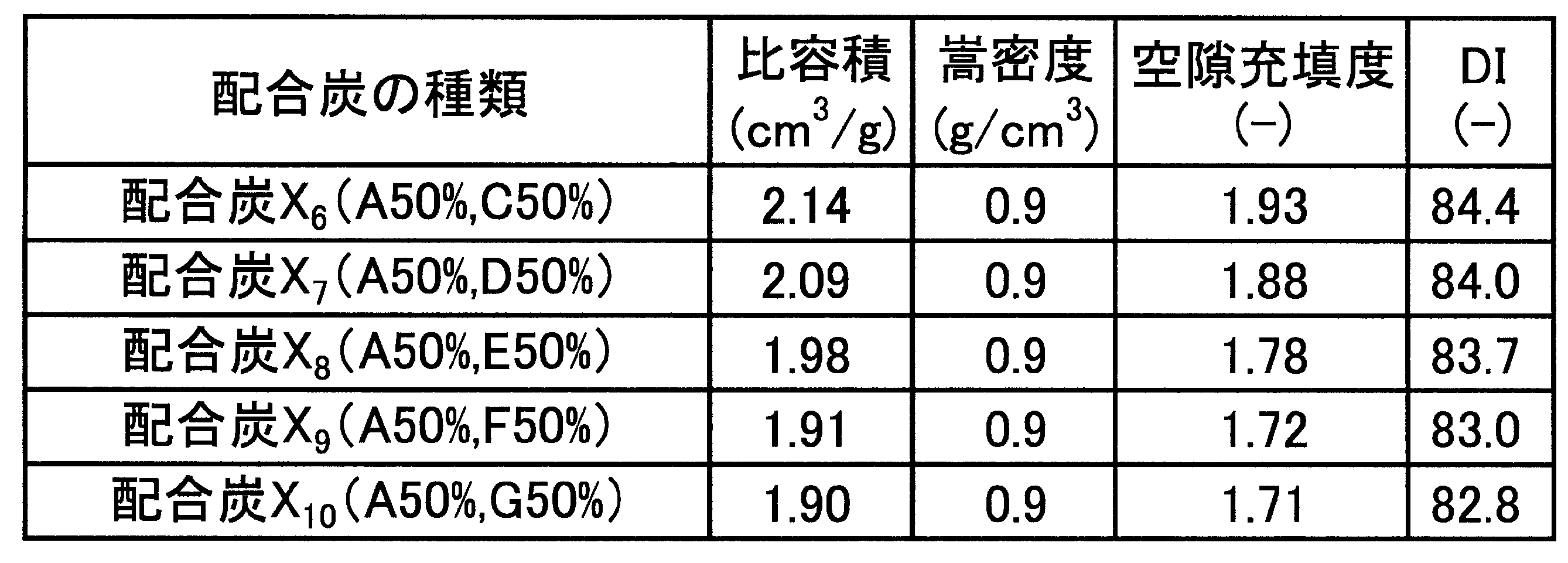
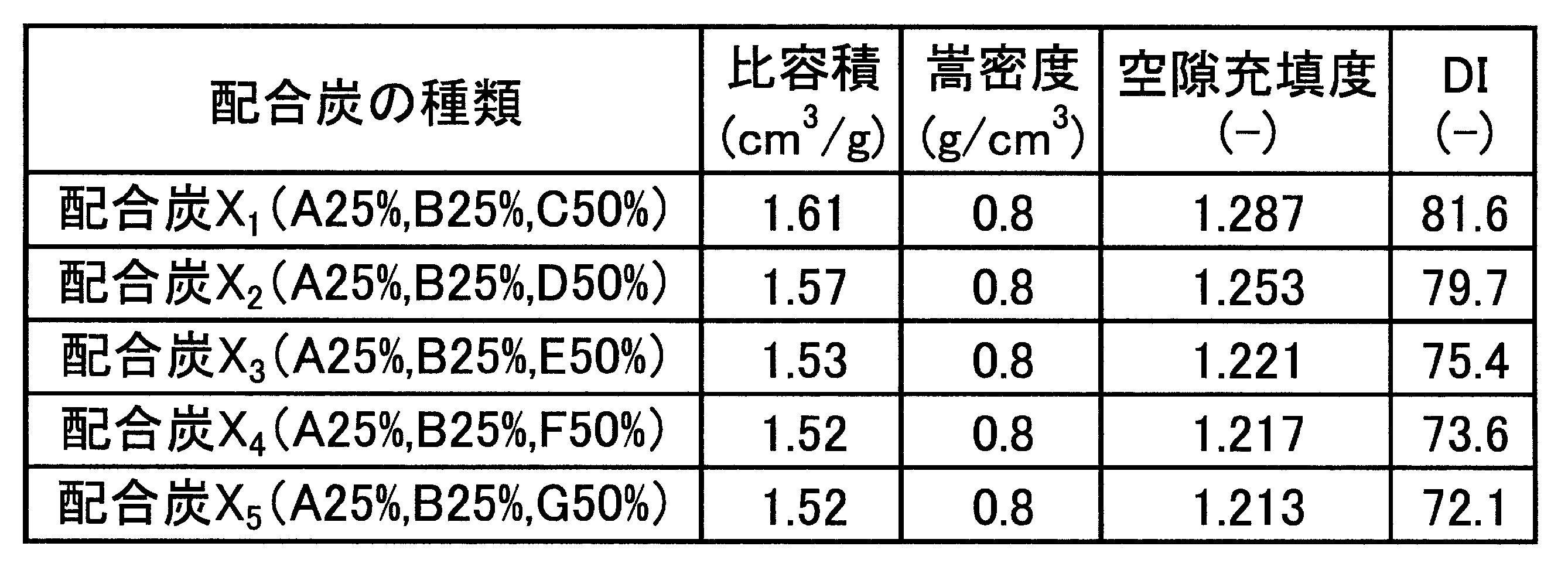
- blended coals X 1 to X 10 containing coals C to G specific volumes were calculated and a fracture strength test was performed.
- the test results (Example 3) of the blended coals X 1 to X 5 are shown in Table 8, and the test results (Example 4) of the blended coals X 6 to X 10 are shown in Table 9.
- the ratio specific method for calculating the volume at the coal softening coal blend X 1 will be described. Specific volume during coal softening very low except total expansion coal coal A and B contained in the coal blend X 1 was measured using an inflatable test by dilatometer method JIS M 8801. Calculate the weighted specific volume 0.6325 (cm 3 / g) by multiplying the specific volume 2.53 (cm 3 / g) when coal A shown in Table 1 is softened by the blending ratio 0.25 of coal A did. The specific volume during coal softening coal B shown in Table 1 1.05 (cm 3 / g) the weighted specific volume is multiplied by the blending ratio 0.25 coal B 0.2625 (cm 3 / g) was calculated.
- an estimated specific volume of 1.43 (cm 3 / g) when coal C was softened was obtained.
- a weighted estimated specific volume of 0.715 (cm 3 / g) was calculated by multiplying the estimated specific volume of coal C at the time of coal softening by a blending ratio of coal C of 0.50.
- the specific volume 1.61 (cm 3 / g) of coal blend X 1 during coal softening was obtained.
- the specific volume at the time of coal softening was calculated by the same method.
- the specific volume (expansion coefficient) of the extremely low total expansion coefficient coal may be directly measured at a heating rate of 6 ° C./min to obtain the specific volume of the blended coal.
- a specific volume of 0.715 (cm 3 / g) is calculated by multiplying the specific volume 1.43 (cm 3 / g) of coal C during softening of coal by the blending ratio 0.50 of coal C. To do. Thereafter, by adding the weighted specific volumes of coals A to C, the specific volume 1.61 (cm 3 / g) at the time of coal softening of the blended coal X 1 can be obtained.
- FIG. 3 shows the relationship between the degree of void filling shown in Tables 8 and 9 and the coke strength DI.
- the black square data is Example 3 using blended coals X 1 to X 5 corresponding to Table 8.
- the open triangle data is Example 4 using blended coals X 6 to X 10 corresponding to Table 9.
- the horizontal axis in FIG. 3 is the degree of void filling during coal softening, and the vertical axis is the coke strength DI.
- the coke strength DI is a drum strength index DI 150 6 according to the drum test method of JIS K2151. As shown in FIG. 3, the degree of void filling and the coke strength DI have a certain correlation.
- Example 5 Further, using the specific volumes of coals A and B and the oxygen concentrations of coals C to G shown in Table 4, the strength DI (estimated DI) of the coke produced from the blended coals X 11 to X 20 was estimated.
- the specific volumes of the blended coals X 11 to X 20 were determined by a weighted average method as described later.
- the degree of void filling was calculated using equation (3), and the coke strength (measured DI) was measured by a fracture strength test.
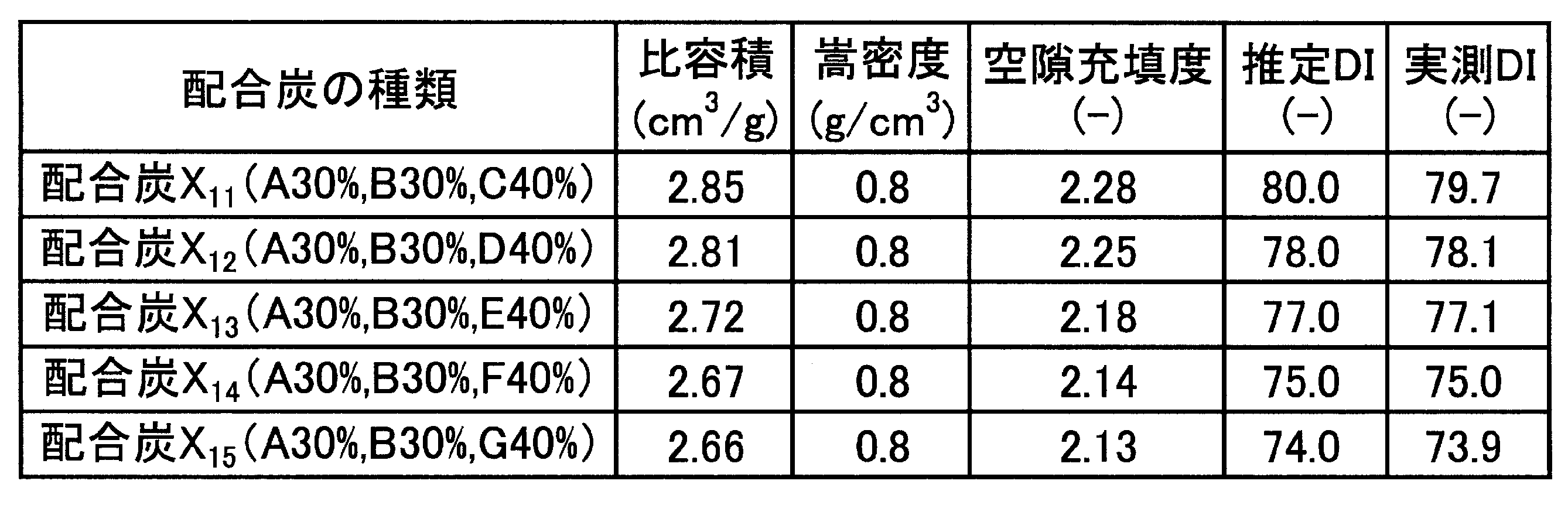
- Table 10 (Example 5) shows the specific volume (weighted average specific volume) and coke strength DI (estimated value and actual measured value) of the blended coal using blended coals X 11 to X 15 .
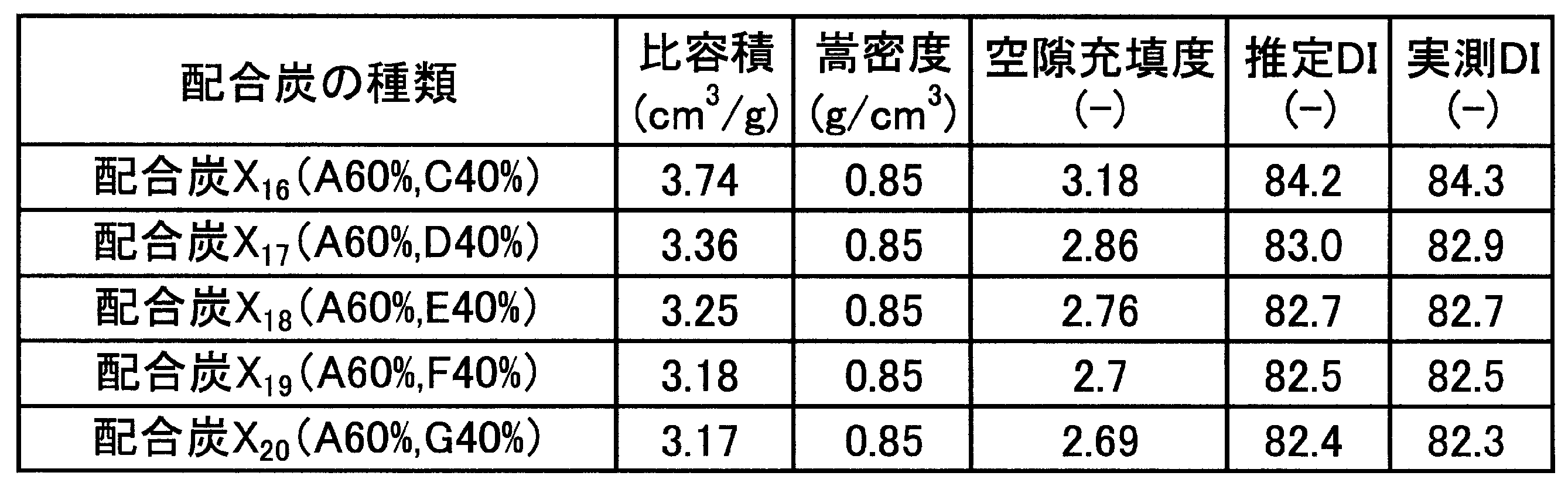
- Table 11 shows the specific volume (weighted average specific volume) and coke strength DI (estimated value and actual measured value) of the blended coal using blended coals X 16 to X 20 .
- an estimated specific volume of 1.75 (cm 3 / g) when coal C is softened is obtained.
- a weighted estimated specific volume of 0.7 (cm 3 / g) is calculated by multiplying the estimated specific volume of the coal C at the time of coal softening by a coal C blending ratio of 0.40.
- the weighted average specific volume 2.85 (cm 3 / g) of the blended coal X 11 is calculated by adding the weighted specific volume of the coals A and B and the weighted estimated specific volume of the coal C described above. To do.
- the weighted average specific volume is calculated by the same method.
- the weighted average specific volumes of the blended coals X 16 to X 20 were determined. Furthermore, the degree of void filling during coal softening was calculated using equation (3). Table 11 shows the calculated weighted average specific volume and the degree of void filling during coal softening.
- each coal in coal blend X 11 30 mass% blending ratio of coal A, coal B and coal C, respectively, 30 mass%, a 40 mass%.
- FIG. 5 shows the relationship between the degree of void filling and the coke strength DI.
- the black square data correspond to the blended coals X 11 to X 15 in Table 10 which is Example 5.
- the data of the white triangle corresponds to Table 11 which is Example 6.
- the estimated DI of coke using the blended coals X 11 to X 20 can be obtained from the degree of void filling during coal softening.
- void filling degree 2.28 blending coal X 11 (-) because it is the estimated DI of coal blend X 11 from the solid line in FIG. 5 79.7 - can be evaluated as ().
- a blended coal X 11 ) having an average specific volume is used.
- coal having a total expansion rate of 0%, coal blend including coal having a total expansion rate of 0%, and coke using this coal blend have been described.
- the method for measuring the coefficient of expansion of coal, the method for measuring the degree of void filling, and the method for blending coal according to the present invention are not limited to these embodiments. That is, the present invention can also be applied to coal having a total expansion rate higher than 0%, blended coal consisting only of coal having a total expansion rate higher than 0%, and coke using this blended coal.
- the expansion rate b (%) measured by the dilatometer and the estimated specific volume V can be used not only for estimation of coke strength but also for estimation of other physical quantities such as expansion pressure. .
Landscapes
- Chemical & Material Sciences (AREA)
- Engineering & Computer Science (AREA)
- Health & Medical Sciences (AREA)
- Life Sciences & Earth Sciences (AREA)
- Organic Chemistry (AREA)
- Oil, Petroleum & Natural Gas (AREA)
- Materials Engineering (AREA)
- Analytical Chemistry (AREA)
- Immunology (AREA)
- Pathology (AREA)
- General Physics & Mathematics (AREA)
- General Health & Medical Sciences (AREA)
- Biochemistry (AREA)
- Physics & Mathematics (AREA)
- Food Science & Technology (AREA)
- Medicinal Chemistry (AREA)
- Coke Industry (AREA)
Abstract
Description
本願は、2009年3月10日に、日本に出願された特願2009-056920号と2009年7月24日に、日本に出願された特願2009-173075号と2009年10月16日に、日本に出願された特願2009-239098とに基づき優先権を主張し、その内容をここに援用する。

V=ΔV/w・・・(1)
V=0.96π(1+b/100)/w・・・(2)
なお、wは、ディラトメーター(細管)への石炭装入量(g)である。また、最大膨張時の石炭体積ΔV及び石炭の膨張率bは、ディラトメーターにより測定される。
上記(2)式から、同じ膨張率bを有する石炭は、互いに石炭軟化時の比容積Vが同じになることがわかる。さらに、特許文献1に示すように、石炭軟化時の比容積Vにコークス炉装入時の石炭の嵩密度をかけることにより石炭軟化時の空隙充填度を求めることができる。また、この空隙充填度とコークス強度(例えば、表面破壊強度)とは、ある相関関係を有している。したがって、同じ石炭軟化時の比容積V(cm3/g)の石炭は、同じ空隙充填度(-)を有するため、同じコークス強度を有する。
(1)本発明の石炭の膨張率の測定方法では、細管に石炭を入れ;この細管にピストンを挿入し;前記石炭の軟化時の昇温速度が、6℃/min以上になるように、前記石炭を加熱し;前記ピストンの変位量を測定し;この変位量から前記石炭の膨張率を求める。
(3)上記(1)に記載の石炭の膨張率の測定方法では、前記昇温速度以外の条件は、ISO 8264の膨張性試験方法にしたがってもよい。
(5)JIS M 8801の石炭の膨張性試験方法により測定される全膨張率が0%の極低全膨張率炭の石炭軟化時の比容積を推定する本発明の石炭軟化時の比容積推定方法では、上記(1)に記載の石炭の膨張率の測定方法によって測定される石炭の膨張率から求めた前記極低全膨張率炭の軟化時の標準比容積と、前記極低全膨張率炭の標準酸素濃度との関係を予め求め;この関係に基づいて測定された前記極低全膨張率炭の酸素濃度から前記極低全膨張率炭の石炭軟化時の比容積を推定する。
(8)本発明の空隙充填度の測定方法では、上記(1)に記載の石炭の膨張率の測定方法を用いて前記石炭の膨張率を測定し;この膨張率から前記石炭の軟化時の比容積を求め;この比容積に前記石炭のコークス炉装入時の嵩密度をかけて、前記石炭の軟化時の空隙充填度を求める。
(16)本発明の石炭配合方法では、複数の石炭を準備し;前記各石炭のうち、少なくとも一つの石炭に対し上記(1)に記載の石炭の膨張率の測定方法を適用して、前記各石炭の軟化時の比容積を求め;前記各石炭の配合率を重みとして、前記各石炭の軟化時の前記比容積を加重平均することにより配合炭の平均比容積を求め;前記平均比容積に、コークス炉装入時の前記配合炭の嵩密度をかけて、前記配合炭の軟化時の空隙充填度を求め;予め求めた前記配合炭の軟化時の標準空隙充填度と前記配合炭から製造されたコークスの標準コークス強度との関係に基づいて、前記配合炭の軟化時の前記空隙充填度から前記配合炭を用いたコークスのコークス強度を推定し;前記配合炭を用いた前記コークスの前記コークス強度が所定の値以上になるように前記各石炭を配合する。
具体的には、極低全膨張率炭について、上述した石炭の酸素濃度が高くなるほど、上述した石炭軟化時の比容積が低くなることがわかった。
石炭中の酸素濃度が多いと、石炭軟化時の熱分解により生じるラジカルが酸素により失活し安定化しやすい。そのため、石炭中の酸素濃度の増加とともに粘結性(軟化溶融性)が低下すると考えられる。したがって、次の方法により、実際の配合炭に使用する極低全膨張率炭の石炭軟化時の比容積を簡単に推定することができる。まず、コークス製造用の主要な原料炭について、上記方法で石炭軟化時の比容積と石炭の酸素濃度とを測定し、予め石炭軟化時の比容積(標準比容積)と石炭の酸素濃度(標準酸素濃度)との関係を示すデータベースを作成する。このデータベースと極低全膨張率炭の酸素濃度とを照らし合わせる。
この方法により、測定に時間を要する極低全膨張率炭の膨張性試験を省略し、石炭の酸素濃度を用いて極低全膨張率炭の石炭軟化時の比容積を推定することができる。この石炭の酸素濃度は、化学分析データとして、一般にコークス原料の原料炭の品質管理のために炭素等の元素とともに分析されている。この石炭の酸素濃度の分析方法は、JIS M 8813で規定された測定方法に限定されない。例えば、ISO 333またはISO 1994に規定された測定方法であってもよい。
なお、極低全膨張率炭の酸素濃度は、例えば、後述する図6及び7に示すように、9mass%以上である。すなわち、全膨張率が0%の石炭(極低全膨張率炭)の酸素濃度の下限値は、9mass%に規定することができる。
つまり、石炭軟化時の比容積V(cm3/g)及びコークス炉装入時の石炭の嵩密度Sd(g/cm3)を求めることにより、石炭軟化時の空隙充填度Zが算出され、コークス強度を推定することができる。
上述したように、コークス強度を推定するために、使用する石炭の軟化時の比容積を上記方法により測定し、乾留する際のコークス炉装入時の石炭(配合炭)の嵩密度を石炭水分や粒度などから予測する。さらに、石炭(配合炭)の軟化時の比容積及びコークス炉装入時の石炭(配合炭)の嵩密度の値から石炭軟化時の空隙充填度を算出する。この空隙充填度の値から、予め求めておいた石炭軟化時の空隙充填度(標準空隙充填度)とコークス強度(標準コークス強度)との関係を用いて、コークス強度を推定する。
石炭A~Gのそれぞれについて、JIS M 8801のディラトメーター法により膨張性試験を行った。ただし、石炭の軟化溶融温度である300℃以上500℃以下での昇温速度を、JISよりも速い12℃/minに設定した。これらの石炭A~Gを2.8mm以下(篩下2.8mm)の粒度に整粒した。表4に示すように、石炭A、石炭B、石炭C、石炭D、石炭E、石炭F及び石炭Gの比容積は、それぞれ、5.07cm3/g、2.10cm3/g、1.75cm3/g、1.65cm3/g、1.43cm3/g、1.29cm3/g及び1.27cm3/gであった。

V=-0.25×O%+4.25・・・(4)
極低全膨張率炭の酸素濃度O%を測定し、この酸素濃度O%を(4)式に代入することにより、簡単に石炭軟化時の比容積Vを推定することができる。なお、石炭の酸素濃度O%と石炭軟化時の比容積Vとの関係を示す式としては、容易に比容積を推定できるため、(4)式のような一次式を用いることが好ましい。しかしながら、石炭の酸素濃度O%と石炭軟化時の比容積Vとの関係式として任意の推定式も用いることができる。

石炭C~Gのそれぞれについて、JIS M 8801のディラトメーター法により膨張性試験を行った。ただし、石炭の軟化溶融温度である300℃以上500℃以下での昇温速度を、JISよりも速い6℃/minに設定した。これらの石炭C~Gを2.8mm以下(篩下2.8mm)の粒度に整粒した。表7に示すように、石炭C、石炭D、石炭E、石炭F及び石炭Gの比容積は、それぞれ、1.43cm3/g、1.34cm3/g、1.26cm3/g、1.25cm3/g及び1.24cm3/gであった。

V=-0.09×O%+2.23・・・(5)
図6及び図7に示されるように、従来のJIS M 8801の膨張性試験において測定された全膨張率が0%の石炭(極低全膨張率炭)であっても、膨張性試験における昇温速度を6.0℃/min以上に上げることにより、石炭軟化時の比容積を区別することができ、さらに、石炭軟化時の比容積と石炭の酸素濃度との関係を一次式で近似できることがわかった。
さらに、表4に示す石炭A及びBの比容積及び石炭C~Gの酸素濃度を用いて、配合炭X11~X20から作製したコークスの強度DI(推定DI)を推定した。配合炭X11~X20の比容積は、後述するような加重平均法により求めた。また、(3)式を用いて、空隙充填度を算出し、破壊強度試験によりコークス強度(実測DI)を測定した。表10(実施例5)に、配合炭X11~X15を用いた配合炭の比容積(加重平均比容積)とコークス強度DI(推定値及び実測値)とを示す。同様に、表11(実施例6)に、配合炭X16~X20を用いた配合炭の比容積(加重平均比容積)とコークス強度DI(推定値及び実測値)とを示す。
(5.07×0.3)+(2.10×0.3)+(1.75×0.4)=2.85・・・(6)
上述の実施形態では、全膨張率0%の石炭と、全膨張率0%の石炭を含む配合炭と、この配合炭を用いたコークスとについて説明した。しかしながら、本発明の石炭の膨張率の測定方法、空隙充填度の測定方法及び石炭配合方法は、これらの実施形態に限られない。すなわち、本発明は、全膨張率が0%よりも高い石炭、全膨張率が0%よりも高い石炭のみからなる配合炭及びこの配合炭を用いたコークスについても適用することができる。
また、上記ディラトメーターにより測定された膨張率b(%)及び推定された比容積Vは、コークス強度の推定だけでなく、例えば、膨張圧のような他の物理量の推定に用いることもできる。
Claims (20)
- 細管に石炭を入れ;
この細管にピストンを挿入し;
前記石炭の軟化時の昇温速度が、6℃/min以上になるように、前記石炭を加熱し;
前記ピストンの変位量を測定し;
この変位量から前記石炭の膨張率を求める;
ことを特徴とする石炭の膨張率の測定方法。 - 前記昇温速度以外の条件は、JIS M 8801の膨張性試験方法にしたがうことを特徴とする請求項1に記載の石炭の膨張率の測定方法。
- 前記昇温速度以外の条件は、ISO 8264の膨張性試験方法にしたがうことを特徴とする請求項1に記載の石炭の膨張率の測定方法。
- 前記石炭は、JIS M 8801の膨張性試験方法により測定される全膨張率が0%の極低全膨張率炭であることを特徴とする請求項1に記載の石炭の膨張率の測定方法。
- JIS M 8801の石炭の膨張性試験方法により測定される全膨張率が0%の極低全膨張率炭の石炭軟化時の比容積を推定する石炭軟化時の比容積推定方法であって、
請求項1に記載の石炭の膨張率の測定方法によって測定される前記極低全膨張率炭の膨張率から求めた前記極低全膨張率炭の軟化時の標準比容積と、前記極低全膨張率炭の標準酸素濃度との関係を予め求め;
この関係に基づいて測定された前記極低全膨張率炭の酸素濃度から前記極低全膨張率炭の石炭軟化時の比容積を推定する;
ことを特徴とする石炭軟化時の比容積推定方法。 - 前記極低全膨張率炭の前記酸素濃度が9mass%以上であることを特徴とする請求項5に記載の石炭軟化時の比容積推定方法。
- 前記極低全膨張率炭の前記酸素濃度が12mass%以下であることを特徴とする請求項5に記載の石炭軟化時の比容積推定方法。
- 請求項1に記載の石炭の膨張率の測定方法を用いて前記石炭の膨張率を測定し;
この膨張率から前記石炭の軟化時の比容積を求め;
この比容積に前記石炭のコークス炉装入時の嵩密度をかけて、前記石炭の軟化時の空隙充填度を求める;
ことを特徴とする空隙充填度の測定方法。 - 前記石炭は、JIS M 8801の膨張性試験方法により測定される全膨張率が0%の極低全膨張率炭であることを特徴とする請求項8に記載の空隙充填度の測定方法。
- 複数の石炭を準備し;
前記各石炭のうち、少なくとも一つの石炭に対し請求項1に記載の石炭の膨張率の測定方法を適用して、前記各石炭の軟化時の比容積を求め;
前記各石炭の配合率を重みとして、前記各石炭の軟化時の前記比容積を加重平均することにより配合炭の平均比容積を求め;
前記平均比容積に、コークス炉装入時の前記配合炭の嵩密度をかけて、前記配合炭の軟化時の空隙充填度を求める;
ことを特徴とする空隙充填度の測定方法。 - 前記配合炭は、JIS M 8801の膨張性試験方法により測定される全膨張率が0%の極低全膨張率炭を含むことを特徴とする請求項10に記載の空隙充填度の測定方法。
- 請求項5に記載の石炭の比容積推定方法を用いて、JIS M 8801の膨張性試験方法により測定される全膨張率が0%の極低全膨張率炭の軟化時の比容積を求め;
この比容積に前記極低全膨張率炭のコークス炉装入時の嵩密度をかけて、前記極低全膨張率炭の軟化時の空隙充填度を求める;
ことを特徴とする空隙充填度の測定方法。 - JIS M 8801の石炭の膨張性試験方法により測定される全膨張率が0%の極低全膨張率炭を含む複数の石炭を準備し;
前記各石炭のうち、前記極低全膨張率炭に対し請求項5に記載の石炭の比容積推定方法を適用して、前記各石炭の軟化時の比容積を求め;
前記各石炭の配合率を重みとして、前記各石炭の軟化時の前記比容積を加重平均することにより配合炭の平均比容積を求め;
前記平均比容積に、コークス炉装入時の前記配合炭の嵩密度をかけて、前記配合炭の軟化時の空隙充填度を求める;
ことを特徴とする空隙充填度の測定方法。 - 前記極低全膨張率炭の酸素濃度が9mass%以上であることを特徴とする請求項12または13に記載の空隙充填度の測定方法。
- 前記極低全膨張率炭の酸素濃度が12mass%以下であることを特徴とする請求項12または13に記載の空隙充填度の測定方法。
- 複数の石炭を準備し;
前記各石炭のうち、少なくとも一つの石炭に対し請求項1に記載の石炭の膨張率の測定方法を適用して、前記各石炭の軟化時の比容積を求め;
前記各石炭の配合率を重みとして、前記各石炭の軟化時の前記比容積を加重平均することにより配合炭の平均比容積を求め;
前記平均比容積に、コークス炉装入時の前記配合炭の嵩密度をかけて、前記配合炭の軟化時の空隙充填度を求め;
予め求めた前記配合炭の軟化時の標準空隙充填度と前記配合炭から製造されたコークスの標準コークス強度との関係に基づいて、前記配合炭の軟化時の前記空隙充填度から前記配合炭を用いたコークスのコークス強度を推定し;
前記配合炭を用いた前記コークスの前記コークス強度が所定の値以上になるように前記各石炭を配合する;
ことを特徴とする石炭配合方法。 - 前記配合炭は、JIS M 8801の膨張性試験方法により測定される全膨張率が0%の極低全膨張率炭を含むことを特徴とする請求項16に記載の石炭配合方法。
- JIS M 8801の石炭の膨張性試験方法により測定される全膨張率が0%の極低全膨張率炭を含む複数の石炭を準備し;
前記各石炭のうち、前記極低全膨張率炭に対し請求項5に記載の石炭の比容積推定方法を適用して、前記各石炭の軟化時の比容積を求め;
前記各石炭の配合率を重みとして、前記各石炭の軟化時の前記比容積を加重平均することにより配合炭の平均比容積を求め;
前記平均比容積に、コークス炉装入時の前記配合炭の嵩密度をかけて、前記配合炭の軟化時の空隙充填度を求め;
予め求めた前記配合炭の軟化時の標準空隙充填度と前記配合炭から製造されたコークスの標準コークス強度との関係に基づいて、前記配合炭の軟化時の前記空隙充填度から前記配合炭を用いたコークスのコークス強度を推定し;
前記配合炭を用いた前記コークスの前記コークス強度が所定の値以上になるように前記各石炭を配合する;
ことを特徴とする石炭配合方法。 - 前記極低全膨張率炭の酸素濃度が9mass%以上であることを特徴とする請求項18に記載の石炭配合方法。
- 前記極低全膨張率炭の酸素濃度が12mass%以下であることを特徴とする請求項18に記載の石炭配合方法。
Priority Applications (4)
| Application Number | Priority Date | Filing Date | Title |
|---|---|---|---|
| CN201080011027.0A CN102348977B (zh) | 2009-03-10 | 2010-03-10 | 煤炭的膨胀率的测定方法、煤炭的比容积的推断方法、空隙填充度的测定方法及煤炭配合方法 |
| BRPI1008995-0A BRPI1008995B1 (pt) | 2009-03-10 | 2010-03-10 | Método de medição de dilatação de carvão, método de estimativa do volume específico de carvão, método de medição da capacidade de preencher o espaço interpartícula e método de mistura de carvão |
| JP2010531352A JP4691212B2 (ja) | 2009-03-10 | 2010-03-10 | 石炭の膨張率の測定方法、石炭の比容積の推定方法、空隙充填度の測定方法及び石炭配合方法 |
| KR1020117020873A KR101300941B1 (ko) | 2009-03-10 | 2010-03-10 | 석탄의 팽창률의 측정 방법, 석탄의 비용적의 추정 방법, 공극 충전도의 측정 방법 및 석탄 배합 방법 |
Applications Claiming Priority (6)
| Application Number | Priority Date | Filing Date | Title |
|---|---|---|---|
| JP2009056920 | 2009-03-10 | ||
| JP2009-056920 | 2009-03-10 | ||
| JP2009173075 | 2009-07-24 | ||
| JP2009-173075 | 2009-07-24 | ||
| JP2009239098 | 2009-10-16 | ||
| JP2009-239098 | 2009-10-16 |
Publications (1)
| Publication Number | Publication Date |
|---|---|
| WO2010103828A1 true WO2010103828A1 (ja) | 2010-09-16 |
Family
ID=42728124
Family Applications (1)
| Application Number | Title | Priority Date | Filing Date |
|---|---|---|---|
| PCT/JP2010/001703 Ceased WO2010103828A1 (ja) | 2009-03-10 | 2010-03-10 | 石炭の膨張率の測定方法、石炭の比容積の推定方法、空隙充填度の測定方法及び石炭配合方法 |
Country Status (5)
| Country | Link |
|---|---|
| JP (1) | JP4691212B2 (ja) |
| KR (1) | KR101300941B1 (ja) |
| CN (1) | CN102348977B (ja) |
| BR (1) | BRPI1008995B1 (ja) |
| WO (1) | WO2010103828A1 (ja) |
Cited By (9)
| Publication number | Priority date | Publication date | Assignee | Title |
|---|---|---|---|---|
| WO2012049770A1 (ja) | 2010-10-15 | 2012-04-19 | 東芝三菱電機産業システム株式会社 | 同期機起動装置 |
| JP2012219235A (ja) * | 2011-04-13 | 2012-11-12 | Nippon Steel Corp | 成形コークスの強度推定方法 |
| JP2014019814A (ja) * | 2012-07-20 | 2014-02-03 | Nippon Steel & Sumitomo Metal | 成形コークスの強度推定方法 |
| JP2016069469A (ja) * | 2014-09-29 | 2016-05-09 | 新日鐵住金株式会社 | コークス強度の推定方法 |
| KR20160145805A (ko) | 2014-05-28 | 2016-12-20 | 가부시키가이샤 고베 세이코쇼 | 고로용 코크스의 제조 방법 및 고로용 코크스 |
| KR20170048512A (ko) | 2014-10-07 | 2017-05-08 | 가부시키가이샤 고베 세이코쇼 | 무회탄 배합량 결정 방법 및 고로용 코크스의 제조 방법 |
| JP2019007943A (ja) * | 2017-06-20 | 2019-01-17 | 新日鐵住金株式会社 | コークス強度の評価方法 |
| JP2019070534A (ja) * | 2017-10-06 | 2019-05-09 | 株式会社Kri | 熱膨張係数の推算方法およびか焼コークスの品質管理方法 |
| JP2020094200A (ja) * | 2018-11-28 | 2020-06-18 | 日本製鉄株式会社 | 高炉用コークスの製造における石炭の配合方法及び炭種の選択方法 |
Families Citing this family (6)
| Publication number | Priority date | Publication date | Assignee | Title |
|---|---|---|---|---|
| CN106610388B (zh) * | 2015-10-27 | 2020-05-22 | 宝山钢铁股份有限公司 | 生产用煤膨胀收缩性能测定方法及装置 |
| CN105784545B (zh) * | 2016-04-26 | 2019-02-22 | 中唯炼焦技术国家工程研究中心有限责任公司 | 一种煤的膨胀与收缩性能评价方法 |
| KR200486106Y1 (ko) | 2016-09-20 | 2018-04-04 | (주)한일랩테크 | 시멘트 분말도 시험기 |
| KR102144195B1 (ko) * | 2018-11-27 | 2020-08-12 | 현대제철 주식회사 | 배합탄의 반사율 분포지수 도출방법 |
| JP7553785B2 (ja) * | 2019-09-06 | 2024-09-19 | 日本製鉄株式会社 | 石炭のイナートファクター係数推定方法及びコークス表面破壊強度の推定方法 |
| CN113804567B (zh) * | 2020-06-15 | 2023-11-14 | 宝山钢铁股份有限公司 | 一种脱硫脱硝颗粒活性炭强度评价方法 |
Citations (7)
| Publication number | Priority date | Publication date | Assignee | Title |
|---|---|---|---|---|
| JPS5728240A (en) * | 1980-07-25 | 1982-02-15 | Sumitomo Metal Ind Ltd | Indication of expansion coefficient for coal |
| JPS61194361A (ja) * | 1985-02-22 | 1986-08-28 | Sumitomo Metal Ind Ltd | 石炭の粘結性迅速測定装置 |
| JPH03188351A (ja) * | 1989-12-19 | 1991-08-16 | Nkk Corp | 石炭の膨張性試験方法 |
| JPH0543880A (ja) * | 1991-08-12 | 1993-02-23 | Kawasaki Steel Corp | 石炭の膨張圧及び粘性の評価方法 |
| JPH05288745A (ja) * | 1992-04-09 | 1993-11-02 | Nippon Steel Corp | 石炭の膨張性試験方法 |
| JPH10197516A (ja) * | 1997-01-07 | 1998-07-31 | Nippon Steel Corp | コークス強度の推定方法 |
| JP2002195966A (ja) * | 2000-12-25 | 2002-07-10 | Nippon Steel Corp | 石炭及びコークスの品質評価方法 |
-
2010
- 2010-03-10 CN CN201080011027.0A patent/CN102348977B/zh active Active
- 2010-03-10 JP JP2010531352A patent/JP4691212B2/ja active Active
- 2010-03-10 BR BRPI1008995-0A patent/BRPI1008995B1/pt active IP Right Grant
- 2010-03-10 KR KR1020117020873A patent/KR101300941B1/ko active Active
- 2010-03-10 WO PCT/JP2010/001703 patent/WO2010103828A1/ja not_active Ceased
Patent Citations (7)
| Publication number | Priority date | Publication date | Assignee | Title |
|---|---|---|---|---|
| JPS5728240A (en) * | 1980-07-25 | 1982-02-15 | Sumitomo Metal Ind Ltd | Indication of expansion coefficient for coal |
| JPS61194361A (ja) * | 1985-02-22 | 1986-08-28 | Sumitomo Metal Ind Ltd | 石炭の粘結性迅速測定装置 |
| JPH03188351A (ja) * | 1989-12-19 | 1991-08-16 | Nkk Corp | 石炭の膨張性試験方法 |
| JPH0543880A (ja) * | 1991-08-12 | 1993-02-23 | Kawasaki Steel Corp | 石炭の膨張圧及び粘性の評価方法 |
| JPH05288745A (ja) * | 1992-04-09 | 1993-11-02 | Nippon Steel Corp | 石炭の膨張性試験方法 |
| JPH10197516A (ja) * | 1997-01-07 | 1998-07-31 | Nippon Steel Corp | コークス強度の推定方法 |
| JP2002195966A (ja) * | 2000-12-25 | 2002-07-10 | Nippon Steel Corp | 石炭及びコークスの品質評価方法 |
Cited By (11)
| Publication number | Priority date | Publication date | Assignee | Title |
|---|---|---|---|---|
| WO2012049770A1 (ja) | 2010-10-15 | 2012-04-19 | 東芝三菱電機産業システム株式会社 | 同期機起動装置 |
| JP2012219235A (ja) * | 2011-04-13 | 2012-11-12 | Nippon Steel Corp | 成形コークスの強度推定方法 |
| JP2014019814A (ja) * | 2012-07-20 | 2014-02-03 | Nippon Steel & Sumitomo Metal | 成形コークスの強度推定方法 |
| KR20160145805A (ko) | 2014-05-28 | 2016-12-20 | 가부시키가이샤 고베 세이코쇼 | 고로용 코크스의 제조 방법 및 고로용 코크스 |
| JP2016069469A (ja) * | 2014-09-29 | 2016-05-09 | 新日鐵住金株式会社 | コークス強度の推定方法 |
| KR20170048512A (ko) | 2014-10-07 | 2017-05-08 | 가부시키가이샤 고베 세이코쇼 | 무회탄 배합량 결정 방법 및 고로용 코크스의 제조 방법 |
| JP2019007943A (ja) * | 2017-06-20 | 2019-01-17 | 新日鐵住金株式会社 | コークス強度の評価方法 |
| JP7067226B2 (ja) | 2017-06-20 | 2022-05-16 | 日本製鉄株式会社 | コークス強度の評価方法 |
| JP2019070534A (ja) * | 2017-10-06 | 2019-05-09 | 株式会社Kri | 熱膨張係数の推算方法およびか焼コークスの品質管理方法 |
| JP2020094200A (ja) * | 2018-11-28 | 2020-06-18 | 日本製鉄株式会社 | 高炉用コークスの製造における石炭の配合方法及び炭種の選択方法 |
| JP7273314B2 (ja) | 2018-11-28 | 2023-05-15 | 日本製鉄株式会社 | 高炉用コークスの製造における石炭の配合方法及び炭種の選択方法 |
Also Published As
| Publication number | Publication date |
|---|---|
| JP4691212B2 (ja) | 2011-06-01 |
| KR20110124289A (ko) | 2011-11-16 |
| KR101300941B1 (ko) | 2013-08-27 |
| CN102348977A (zh) | 2012-02-08 |
| BRPI1008995B1 (pt) | 2019-08-20 |
| JPWO2010103828A1 (ja) | 2012-09-13 |
| BRPI1008995A2 (pt) | 2016-03-22 |
| CN102348977B (zh) | 2015-05-06 |
Similar Documents
| Publication | Publication Date | Title |
|---|---|---|
| JP4691212B2 (ja) | 石炭の膨張率の測定方法、石炭の比容積の推定方法、空隙充填度の測定方法及び石炭配合方法 | |
| JP6056157B2 (ja) | コークス用配合炭組成決定方法及びコークス製造方法 | |
| KR101461838B1 (ko) | 야금용 코크스의 제조 방법 | |
| RU2675567C1 (ru) | Способ оценки угля и способ получения кокса | |
| JP5772277B2 (ja) | コークス熱間反応後強度の推定方法 | |
| JP6379934B2 (ja) | コークス強度の推定方法 | |
| JP6565642B2 (ja) | コークス収縮率の推定方法 | |
| JP4309780B2 (ja) | コークス熱間反応後強度の推定方法及びコークスの製造方法 | |
| JP6680163B2 (ja) | コークス粒径の推定方法 | |
| JP2010209310A (ja) | 配合炭の比容積の測定方法、コークス表面破壊強度の推定方法及び石炭配合方法 | |
| JP2018048297A (ja) | コークス強度の推定方法 | |
| JP5655684B2 (ja) | 成形コークスの強度推定方法 | |
| JP5045039B2 (ja) | 高強度コークスの製造方法 | |
| JP4299680B2 (ja) | コークス強度の推定方法 | |
| JP5304049B2 (ja) | 冶金用コークスの製造方法 | |
| JP6879020B2 (ja) | コークス収縮率の推定方法 | |
| JP5581630B2 (ja) | コークスケーキ押出し性の推定方法 | |
| JP2015214593A (ja) | 配合炭の比容積の推定方法 | |
| Nasirudeen et al. | Quality of some Nigerian coals as blending stock in metallurgical coke production | |
| JP5716271B2 (ja) | 冶金用コークスの製造方法 | |
| JPS6341423B2 (ja) | ||
| JP4464835B2 (ja) | コークスの製造方法 | |
| JP7188245B2 (ja) | 高炉用コークスの表面破壊強度の推定方法 | |
| JP2017101144A (ja) | コークス収縮率の推定方法 | |
| CN116751602A (zh) | 新型煤岩配煤方法和装置 |
Legal Events
| Date | Code | Title | Description |
|---|---|---|---|
| WWE | Wipo information: entry into national phase |
Ref document number: 201080011027.0 Country of ref document: CN |
|
| WWE | Wipo information: entry into national phase |
Ref document number: 2010531352 Country of ref document: JP |
|
| 121 | Ep: the epo has been informed by wipo that ep was designated in this application |
Ref document number: 10750585 Country of ref document: EP Kind code of ref document: A1 |
|
| ENP | Entry into the national phase |
Ref document number: 20117020873 Country of ref document: KR Kind code of ref document: A |
|
| WWE | Wipo information: entry into national phase |
Ref document number: 6903/DELNP/2011 Country of ref document: IN |
|
| NENP | Non-entry into the national phase |
Ref country code: DE |
|
| 122 | Ep: pct application non-entry in european phase |
Ref document number: 10750585 Country of ref document: EP Kind code of ref document: A1 |
|
| REG | Reference to national code |
Ref country code: BR Ref legal event code: B01A Ref document number: PI1008995 Country of ref document: BR |
|
| ENP | Entry into the national phase |
Ref document number: PI1008995 Country of ref document: BR Kind code of ref document: A2 Effective date: 20110908 |