WO2010073758A1 - キチンナノファイバーの製造方法、キチンナノファイバーを含む複合材料および塗料組成物、ならびにキトサンナノファイバーの製造方法、キトサンナノファイバーを含む複合材料および塗料組成物 - Google Patents
キチンナノファイバーの製造方法、キチンナノファイバーを含む複合材料および塗料組成物、ならびにキトサンナノファイバーの製造方法、キトサンナノファイバーを含む複合材料および塗料組成物 Download PDFInfo
- Publication number
- WO2010073758A1 WO2010073758A1 PCT/JP2009/061929 JP2009061929W WO2010073758A1 WO 2010073758 A1 WO2010073758 A1 WO 2010073758A1 JP 2009061929 W JP2009061929 W JP 2009061929W WO 2010073758 A1 WO2010073758 A1 WO 2010073758A1
- Authority
- WO
- WIPO (PCT)
- Prior art keywords
- chitin
- nanofibers
- chitosan
- nanofiber
- coating composition
- Prior art date
- Legal status (The legal status is an assumption and is not a legal conclusion. Google has not performed a legal analysis and makes no representation as to the accuracy of the status listed.)
- Ceased
Links
Images



Classifications
-
- D—TEXTILES; PAPER
- D01—NATURAL OR MAN-MADE THREADS OR FIBRES; SPINNING
- D01F—CHEMICAL FEATURES IN THE MANUFACTURE OF ARTIFICIAL FILAMENTS, THREADS, FIBRES, BRISTLES OR RIBBONS; APPARATUS SPECIALLY ADAPTED FOR THE MANUFACTURE OF CARBON FILAMENTS
- D01F9/00—Artificial filaments or the like of other substances; Manufacture thereof; Apparatus specially adapted for the manufacture of carbon filaments
-
- C—CHEMISTRY; METALLURGY
- C08—ORGANIC MACROMOLECULAR COMPOUNDS; THEIR PREPARATION OR CHEMICAL WORKING-UP; COMPOSITIONS BASED THEREON
- C08B—POLYSACCHARIDES; DERIVATIVES THEREOF
- C08B37/00—Preparation of polysaccharides not provided for in groups C08B1/00 - C08B35/00; Derivatives thereof
- C08B37/0006—Homoglycans, i.e. polysaccharides having a main chain consisting of one single sugar, e.g. colominic acid
- C08B37/0024—Homoglycans, i.e. polysaccharides having a main chain consisting of one single sugar, e.g. colominic acid beta-D-Glucans; (beta-1,3)-D-Glucans, e.g. paramylon, coriolan, sclerotan, pachyman, callose, scleroglucan, schizophyllan, laminaran, lentinan or curdlan; (beta-1,6)-D-Glucans, e.g. pustulan; (beta-1,4)-D-Glucans; (beta-1,3)(beta-1,4)-D-Glucans, e.g. lichenan; Derivatives thereof
- C08B37/0027—2-Acetamido-2-deoxy-beta-glucans; Derivatives thereof
- C08B37/003—Chitin, i.e. 2-acetamido-2-deoxy-(beta-1,4)-D-glucan or N-acetyl-beta-1,4-D-glucosamine; Chitosan, i.e. deacetylated product of chitin or (beta-1,4)-D-glucosamine; Derivatives thereof
-
- C—CHEMISTRY; METALLURGY
- C08—ORGANIC MACROMOLECULAR COMPOUNDS; THEIR PREPARATION OR CHEMICAL WORKING-UP; COMPOSITIONS BASED THEREON
- C08L—COMPOSITIONS OF MACROMOLECULAR COMPOUNDS
- C08L5/00—Compositions of polysaccharides or of their derivatives not provided for in groups C08L1/00 or C08L3/00
- C08L5/08—Chitin; Chondroitin sulfate; Hyaluronic acid; Derivatives thereof
-
- C—CHEMISTRY; METALLURGY
- C09—DYES; PAINTS; POLISHES; NATURAL RESINS; ADHESIVES; COMPOSITIONS NOT OTHERWISE PROVIDED FOR; APPLICATIONS OF MATERIALS NOT OTHERWISE PROVIDED FOR
- C09D—COATING COMPOSITIONS, e.g. PAINTS, VARNISHES OR LACQUERS; FILLING PASTES; CHEMICAL PAINT OR INK REMOVERS; INKS; CORRECTING FLUIDS; WOODSTAINS; PASTES OR SOLIDS FOR COLOURING OR PRINTING; USE OF MATERIALS THEREFOR
- C09D105/00—Coating compositions based on polysaccharides or on their derivatives, not provided for in groups C09D101/00 or C09D103/00
- C09D105/08—Chitin; Chondroitin sulfate; Hyaluronic acid; Derivatives thereof
-
- C—CHEMISTRY; METALLURGY
- C09—DYES; PAINTS; POLISHES; NATURAL RESINS; ADHESIVES; COMPOSITIONS NOT OTHERWISE PROVIDED FOR; APPLICATIONS OF MATERIALS NOT OTHERWISE PROVIDED FOR
- C09D—COATING COMPOSITIONS, e.g. PAINTS, VARNISHES OR LACQUERS; FILLING PASTES; CHEMICAL PAINT OR INK REMOVERS; INKS; CORRECTING FLUIDS; WOODSTAINS; PASTES OR SOLIDS FOR COLOURING OR PRINTING; USE OF MATERIALS THEREFOR
- C09D133/00—Coating compositions based on homopolymers or copolymers of compounds having one or more unsaturated aliphatic radicals, each having only one carbon-to-carbon double bond, and at least one being terminated by only one carboxyl radical, or of salts, anhydrides, esters, amides, imides, or nitriles thereof; Coating compositions based on derivatives of such polymers
- C09D133/04—Homopolymers or copolymers of esters
- C09D133/06—Homopolymers or copolymers of esters of esters containing only carbon, hydrogen and oxygen, the oxygen atom being present only as part of the carboxyl radical
- C09D133/08—Homopolymers or copolymers of acrylic acid esters
-
- Y—GENERAL TAGGING OF NEW TECHNOLOGICAL DEVELOPMENTS; GENERAL TAGGING OF CROSS-SECTIONAL TECHNOLOGIES SPANNING OVER SEVERAL SECTIONS OF THE IPC; TECHNICAL SUBJECTS COVERED BY FORMER USPC CROSS-REFERENCE ART COLLECTIONS [XRACs] AND DIGESTS
- Y10—TECHNICAL SUBJECTS COVERED BY FORMER USPC
- Y10S—TECHNICAL SUBJECTS COVERED BY FORMER USPC CROSS-REFERENCE ART COLLECTIONS [XRACs] AND DIGESTS
- Y10S977/00—Nanotechnology
- Y10S977/70—Nanostructure
- Y10S977/788—Of specified organic or carbon-based composition
- Y10S977/795—Composed of biological material
-
- Y—GENERAL TAGGING OF NEW TECHNOLOGICAL DEVELOPMENTS; GENERAL TAGGING OF CROSS-SECTIONAL TECHNOLOGIES SPANNING OVER SEVERAL SECTIONS OF THE IPC; TECHNICAL SUBJECTS COVERED BY FORMER USPC CROSS-REFERENCE ART COLLECTIONS [XRACs] AND DIGESTS
- Y10—TECHNICAL SUBJECTS COVERED BY FORMER USPC
- Y10T—TECHNICAL SUBJECTS COVERED BY FORMER US CLASSIFICATION
- Y10T428/00—Stock material or miscellaneous articles
- Y10T428/29—Coated or structually defined flake, particle, cell, strand, strand portion, rod, filament, macroscopic fiber or mass thereof
- Y10T428/2913—Rod, strand, filament or fiber
- Y10T428/298—Physical dimension
Definitions
- the present invention relates to a method for producing chitin nanofibers from a chitin-containing bio-derived material, chitin nanofibers obtainable by the method, and a composite material and a coating composition containing the chitin nanofibers.
- the present invention further relates to a method for obtaining chitosan nanofibers from a chitin-containing bio-derived material, and a composite material and a coating composition containing the chitosan nanofibers.
- Nanofibers are ultrafine fibers that generally have a diameter (width) of several tens to several hundreds of nanometers, and have features such as a significantly larger surface area than conventional fibers, and thus exhibit new and special functions. It is attracting attention and is being used. Polymer materials such as nylon and polyester are mainly used as raw materials for nanofibers. Recently, active research has been conducted on obtaining nanofibers from biological materials and using them for environmental considerations. Has been made.
- Chitin and chitosan are also derived from living organisms, and research into nanofibers is being conducted.
- a method in which commercially available chitin is defibrated and dried into nanofibers using a rotary desk wet pulverizer (Patent Document 1, Patent Document 2), but commercially available chitin forms hydrogen bonds extremely strongly between fibers. Even when a physical load is applied, it is difficult to completely loosen the fiber, and therefore the shape of the fiber is uneven.
- Non-Patent Document 1 There are also examples in which chitosan is dissolved in a solvent and nanofibers are spun by electrospinning (Patent Document 3, Non-Patent Document 1), but it is necessary to dissolve chitosan once in a solvent, Heavy load and unsuitable for mass production.
- the fiber obtained by electrospinning has a large diameter (fiber width of 100 nm or more) and is not uniform.
- mass production is difficult with the electrospinning method, and the energy cost is high.
- chitin is insoluble in a solvent, chitin nanofibers cannot be produced by electrospinning.
- Non-patent Document 2 Although there is also a method of obtaining bionanofiber by hydrolysis (Non-patent Document 2), the fiber is cut by acid treatment, so the fiber length is shortened to 1 ⁇ m or less.
- Non-patent Document 3 There is a method in which commercially available chitin is oxidized using a TEMPO catalyst to increase the dispersibility in water and the nanofibers are defibrated by ultrasonic treatment. It is decomposed and the fiber length is greatly reduced. The result is more like a whisker than a fiber. Strictly speaking, the chemical structure is different from that of chitin because of the oxidation treatment.
- Non-Patent Document 4 There is also a method in which acetic acid is added to chitin derived from squid tendon to form nanofibers by ultrasonic treatment.
- Squid-derived chitin is a beta chitin with a low degree of crystallinity, so it can be easily loosened and can be made into nanofibers, but crab / shrimp shell-derived chitin is a highly crystalline alpha chitin with high mechanical strength. Chitin nanofibers cannot be obtained even after treatment.
- the squid tendon is primarily scarce in resources compared to crab and shrimp shells, the possibility of practical application of the above method is low.
- Crustaceans such as crabs and shrimps contain abundant chitin in their outer shells. Moreover, shrimp and crabs are consumed in large quantities. In most cases, these hulls are discarded. In order to make effective use of these resources, some attempts have been made to produce nanofibers by obtaining chitin from crustaceans. However, no chitin nanofibers have been obtained from these organisms as they are, thin, long, homogeneous, and excellent in crystallinity, physical properties, ease of processing operation, and accumulated amount.
- the present inventors have obtained a thin, long, homogeneous, crystalline property, physical property, and ease of processing operation from a chitin-containing organism-derived material, with almost no damage.
- the present inventors have succeeded in producing a composite material that has less thermal expansion than the conventional one and that does not lose light transmission and flexibility.
- the coating composition a coating film more uniform than the conventional one was formed, and a coating composition having excellent adhesiveness was successfully produced.
- chitosan nanofibers having excellent properties, and composite materials and coating compositions containing chitosan nanofibers have also been successfully produced from biotin-derived materials.
- the chitin nanofibers derived from the chitin-containing organism-derived material obtained by the present invention are thin, long, homogeneous, and excellent in all of crystallinity, physical properties, ease of processing operation, and accumulated amount. Therefore, it can be applied to many uses.
- the composite material containing chitin nanofibers, particularly the chitin nanofibers obtained by the present invention has less thermal expansion than the conventional ones, and the light transmittance and flexibility are not lost.
- the coating composition containing chitin nanofibers, especially chitin nanofibers obtained by the present invention forms a more uniform coating film than the conventional one and has excellent adhesiveness.
- the coating composition of the present invention can be made into a neutral coating composition, it can be applied to metals, has a low hygroscopic property, and does not require air conditioning during painting. Chitosan nanofibers obtained by the present invention, composite materials containing the same, and coating compositions also have excellent properties.
- FIG. 1 is a photograph taken by a scanning electron microscope (FE-SEM) of a chitin nanofiber derived from a crab shell obtained by the method of the present invention. The magnification on the left is 20,000 times, and the magnification on the right is 70,000 times.
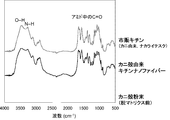
- FIG. 2 is a spectrum obtained by infrared spectrophotometer (FT-IR) of chitin nanofiber derived from crab shell obtained by the method of the present invention.
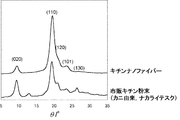
- FIG. 3 is an X-ray diffraction pattern of a crab shell-derived chitin nanofiber obtained by the method of the present invention using an X-ray scattering measurement apparatus.
- FIG. 1 is a photograph taken by a scanning electron microscope (FE-SEM) of a chitin nanofiber derived from a crab shell obtained by the method of the present invention. The magnification on the left is 20,000 times, and the magnification on the right is 70,000 times.
- FIG. 2 is a spectrum obtained by infrared spectrop
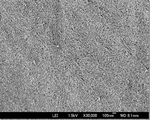
- FIG. 4 is a photograph taken with a scanning electron microscope (FE-SEM) of chitin nanofibers derived from shrimp shells obtained by the method of the present invention. The magnification is 30,000 times.
- FIG. 5 is a diagram showing the results of measuring the transmittance of the crab shell-derived chitin nanofiber-containing composite material obtained by the method of the present invention using an ultraviolet-visible spectrophotometer. In the photograph on the right side of the graph, the top shows the flexibility of the chitin nanofiber-containing composite material of the present invention, and the bottom is the chitin nanofiber sheet (no resin).
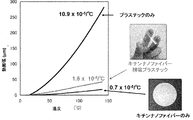
- FIG. 6 is a diagram showing a result of measuring thermal expansion by a thermomechanical measuring device of a crab shell-derived chitin nanofiber-containing composite material obtained by the method of the present invention.
- the top shows the flexibility of the chitin nanofiber-containing composite material of the present invention, and the bottom is the chitin nanofiber sheet (no resin).
- FIG. 7 is a photograph taken with a scanning electron microscope (FE-SEM) of chitosan nanofibers derived from shrimp shells obtained by the method of the present invention. The magnification is 100,000 times.
- FE-SEM scanning electron microscope
- the present invention provides the following.
- Chitin-containing biological material Subject to at least one deproteinization step and at least one decalcification step; A method for producing chitin nanofibers, which is subjected to a defibrating process.
- the method according to any one of (1) to (3) which is always performed without drying (5)
- the chitin-containing organism is a crustacean, according to any one of (1) to (4) Method.
- a method for producing a coating composition comprising blending an aqueous suspension of chitin nanofibers with a water-soluble resin or emulsion.
- the chitin nanofiber is any one of (6) to (8).
- a material derived from a chitin-containing organism Subject to at least one deproteinization step and at least one decalcification step and at least one deacetylation step; A method for producing chitosan nanofibers, which is subjected to a defibrating process.
- (21) The method according to (20), wherein each step is always performed without drying.
- a coating composition comprising chitosan nanofibers and a water-soluble resin or emulsion.
- a method for producing a coating composition comprising blending an aqueous suspension of chitosan nanofibers with a water-soluble resin or emulsion.
- the present invention provides: A bio-derived material derived from chitin Subject to at least one deproteinization step and at least one decalcification step; Provided is a method for producing chitin nanofibers, which is subjected to a defibrating process.
- the chitin nanofiber of the present invention can be obtained from a chitin-containing biological material.
- chitin-containing organisms include, but are not limited to, crustaceans, insects, and krill.
- the material derived from a chitin-containing organism as a raw material for the chitin nanofibers of the present invention include insect shells, krill shells, crustacean shells, shells, and the like.
- materials derived from chitin-containing organisms organisms with a high chitin content, for example, shells and hulls of crustaceans such as shrimps and crabs are preferred.
- Shrimp, crab shells, shells, etc. occupy most of the parts discarded after consumption.
- shrimp and crabs are consumed in large quantities, shrimp and crab skins can be obtained in large quantities, which is convenient.
- chitin nanofibers in a living body have a matrix containing proteins and calcium carbonate existing around and in the gap, they cannot be obtained unless dematrixing is performed.
- the method for producing chitin nanofibers of the present invention it is possible to isolate and extract chitin nanofibers in a living body as they are. Therefore, the chitin nanofibers obtained by the production method of the present invention are thin and homogeneous, long, molecules are extended chain crystals, and have high strength.
- An extended chain crystal is a fibrous crystal that is regularly arranged in a state in which a rigid polymer is fully stretched to form a bundle, and since it has few defects, it can exhibit strong physical properties. .
- chitin of crustaceans such as shrimps and crabs are highly crystalline alpha chitin
- chitin nanofibers obtained from crustacean shells such as shrimps and crabs in the present invention have the above-mentioned excellent characteristics. Is remarkable.
- Deproteinization removes the protein that forms the matrix surrounding the chitin nanofibers.
- the deproteinization treatment include an alkali treatment method and a proteolytic enzyme method such as protease, and the alkali treatment method is preferred.
- an aqueous solution of an alkali such as potassium hydroxide, sodium hydroxide, or lithium hydroxide is preferably used, and the concentration depends on the amount of the chitin-containing organism-derived material, the type of chitin-containing organism, the site, etc. Although it can be appropriately selected depending on the situation, it is usually about 2 to about 10% (w / v), preferably about 3 to about 7% (w / v), for example about 5% (w / v).
- the temperature of deproteinization by the alkali treatment can be appropriately selected according to the amount of the chitin-containing organism-derived material, the type of chitin-containing organism, the site, etc., but is usually about 80 ° C. or higher, preferably about 90 ° C. or higher, Preferably, it is carried out while refluxing an alkaline aqueous solution.
- the treatment time can also be appropriately selected according to the amount of the chitin-containing organism-derived material, the type of chitin-containing organism, the site, etc., but it is usually several hours to about 3 days, preferably several hours to about 2 days. Good.
- Deashing removes the ash that surrounds chitin nanofibers, mainly calcium carbonate.
- the decalcification treatment includes an acid treatment method and an ethylenediamine tetraacetic acid treatment method, and an acid treatment method is preferred.
- an aqueous solution of hydrochloric acid is preferably used, and the concentration thereof can be appropriately selected according to the amount of the chitin-containing organism-derived material, the type of chitin-containing organism, the site, etc. 4 to about 12% (w / v), preferably about 5 to about 10% (w / v).
- the temperature of deproteinization by acid treatment can be appropriately selected depending on the amount of the chitin-containing organism-derived material, the type of chitin-containing organism, the site, etc., but is usually about 10 to about 50 ° C., preferably about 20 to about It may be 30 ° C., for example room temperature.
- the decalcification time by acid treatment can be appropriately selected depending on the amount of the material derived from the chitin-containing organism, the kind of the chitin-containing organism, the site, etc., but usually several hours to several days, preferably about 1 to about 3 days. For example, you may carry out for 2 days.
- the outer skin (mostly chitin nanofibers) obtained in the above process is defibrated to obtain the target chitin nanofiber. Since chitin nanofibers are hydrogen-bonded and strongly aggregated when dried, it is preferable to perform each step of the method for producing chitin nanofibers of the present invention without always drying the material.
- an apparatus such as a stone mill grinder, a high-pressure homogenizer, and a freeze grinding apparatus can be used, and the grinder treatment is preferably performed using a stone mill grinder. If a device capable of applying a stronger load, such as a stone mill, is used, it is possible to quickly disentangle even shell-derived alpha chitin such as crabs and shrimps. Thereafter, the obtained chitin nanofibers may be dispersed in an aqueous medium such as water.
- a decoloring step may be performed if necessary or desired.
- the decolorization step may be performed at any stage of the above method, but is preferably performed after the deproteinization and decalcification treatments are completed.
- Decolorization may be carried out by any method, but it is preferable to use chlorine bleach, oxygen bleach, or reducing bleach. For example, about 1 to about 2% of hypochlorous acid in a buffer such as an acetate buffer. It may be carried out with sodium chlorate at about 70 to about 90 ° C. for several hours.
- a pulverization step may be performed in order to efficiently perform the deproteinization step, the deashing step, the decolorization step, the defibration step, and the treatment with the acidic reagent described below.
- the pulverization step may be performed at any stage of the above method, but is preferably performed immediately before the defibration step.
- the pulverization step may be performed by any method, but a method such as a homogenizer treatment or a mixer treatment is preferable, and may be performed by, for example, a household food processor.
- the above-described steps such as the deproteinization step, the deashing treatment step, the decolorization step, and the pulverization step may be repeated, performed a plurality of times or alternately. Moreover, the order of each process is not ask
- the water-dispersibility of chitin nanofibers may be improved by treating the decalcified chitin-containing material with an acidic reagent.
- the treatment method with an acidic reagent is not particularly limited as long as it is a method for allowing the acidic reagent to penetrate into the material.
- the treatment with an acidic reagent can be typically performed by immersing the decalcified chitin-containing material in an aqueous acid solution. In this step, not only the improvement in water dispersibility but also the variation in the width (or diameter) of the chitin nanofibers can be suppressed.
- the acid that can be used in this step may be any acid and is not particularly limited, but a weak acid is preferred.
- the weak acid examples include, but are not limited to, acetic acid, formic acid, chloroacetic acid, fluoroacetic acid, propionic acid, butyric acid, lactic acid, citric acid, malonic acid, and ascorbic acid.
- the preferred weak acid used in this step is acetic acid.
- the pH of the aqueous weak acid solution is usually adjusted to about 2 to about 5, preferably about 2.5 to about 4.5, such as about 3 to about 4.
- the temperature of this step can be appropriately selected according to the amount of the chitin-containing organism-derived material, the type of chitin-containing organism, the site, etc., but is usually about 10 to about 50 ° C., preferably about 20 to about 30 ° C., For example, it may be room temperature.
- the treatment time for this step can also be appropriately selected depending on the amount of the chitin-containing organism-derived material, the type of chitin-containing organism, the site, etc., but is usually 1 hour to about 1 day, preferably about 3 to about 12 hours. For example, it may be overnight.
- This acid treatment step may be performed at any stage before the defibration step, but preferably after the deproteinization and decalcification, the purification of chitin nanofibers proceeds to some extent. It may be performed immediately before the defibrating step.
- the present invention provides a chitin nanofiber obtained by the above production method.
- chitin nanofibers in a living body can be isolated and extracted as they are, and the chitin nanofibers obtained by the production method of the present invention are thin. It is homogeneous and very long, and the fibers are elongated and have chain fine crystals and high strength. Therefore, the chitin nanofibers obtained by the production method of the present invention are excellent in any of physical properties, ease of processing operation, and accumulated amount. Therefore, it can be applied to many uses.
- the width (or diameter) of the chitin nanofibers obtained by the present invention is usually about 2 nm to about 30 nm, preferably about 2 nm to about 20 nm, for example, 5 nm to 20 nm.
- “the width (or diameter) of the chitin nanofiber is about 2 nm to about 20 nm” means a fiber having a width (or diameter) of about 2 nm to about 20 nm or less when observed with an electron microscope. Occupies about 50% or more of the whole, preferably about 60% or more, more preferably about 70% or more. Further, the same applies to the width (or diameter) of chitosan nanofibers described later.
- chitin nanofibers have high crystallinity, they have excellent physical properties not found in other nanofibers. As mentioned above, crustaceans, especially shrimp and crab shells and shells, are discarded in large quantities. Obtaining useful chitin nanofibers from these is an environmentally friendly technology and also advantageous in terms of cost. is there. Furthermore, as described above, the chitin nanofibers obtained by the present invention have excellent physical properties. Therefore, this invention applies the outstanding physical property of the chitin nanofiber obtained by this invention to resin and a coating material.
- the present invention provides a composite material containing chitin nanofibers and a resin, and a method for producing the same.
- the chitin nanofibers used in the composite material of the present invention and the production method thereof are not particularly limited, but chitin nanofibers obtained by the method of the present invention described above are preferable.
- the chitin nanofiber produced by the method of the present invention is strong in strength because the fiber state is an extended chain crystal, has flexibility, and the width (or diameter) of the chitin nanofiber is relatively narrow. Is from about 2 nm to about 30 nm, preferably from about 2 nm to about 20 nm.
- the composite material generally refers to a material in which two or more kinds of base materials are combined and integrated.
- the composite material in the present invention may be any kind of composite material in which chitin nanofibers are combined with other base materials, such as plastics or resins containing chitin nanofibers, chitin nanofibers and living bodies. Examples include combinations with materials, blending chitin nanofibers into paper, and combinations of chitin nanofibers with natural or synthetic fibers.
- the composite material containing the chitin nanofibers of the present invention can be produced by mixing chitin nanofibers with other materials and integrating them.
- the other material can be appropriately selected according to the use of the composite material and the necessary physical properties, and may be either a natural material or an artificial material.
- the method of mixing and integrating chitin nanofibers with other materials may also be a method known in the art and can be selected as appropriate. Below, the case where a plastic is manufactured as an example of the composite material of this invention is demonstrated.
- the plastic containing chitin nanofibers of the present invention can be produced by polymerizing a resin monomer in the presence of chitin nanofibers.
- Resin monomers that can be used in the production of the plastic of the present invention include monoacrylate monomers, diacrylate monomers, triacrylate monomers, monomethacrylate monomers, dimethacrylate monomers, trimethacrylate monomers, epoxy resin monomers, phenols
- Resin monomers include, but are not limited to, resin monomers, melamine resin monomers, polyester monomers, polyimide monomers, and the like.
- Examples of the polymerization initiator that can be used for the production of the composite material of the present invention include 1-hydroxy-cyclohexyl-phenyl ketone, 2-hydroxy-2-methyl-phenylpropan-1-one, azobisisobutyronitrile, and benzoyl peroxide. However, it is not limited to these.
- the ratios of chitin nanofiber, resin monomer, and polymerization initiator can be appropriately selected depending on properties such as the strength, flexibility, and transparency of the plastic to be obtained. A specific procedure for producing the chitin nanofiber-containing plastic of the present invention is illustrated.
- an aqueous suspension of chitin nanofibers is dehydrated by a known method such as filtration, compression, and drying to form a desired shape (for example, a sheet shape, a film shape, etc.). Means and methods for filtration, compression and drying used in this step are also known.
- the chitin nanofibers molded into a desired shape are immersed in a resin monomer containing a polymerization initiator.
- a resin monomer containing a polymerization initiator is injected into chitin nanofibers.
- the injection of the resin monomer may be promoted by reducing the pressure.
- a plastic can be obtained by reacting the polymerization initiator in the chitin nanofibers into which the resin monomer has been injected.
- the polymerization reaction conditions can be appropriately selected according to the type of resin monomer, polymerization initiator, desired plastic shape and size.
- the plastic shape of the present invention is exemplified by a sheet shape, a film shape, etc., but using a known means / method, a powder shape, a fiber shape, a rod shape, a block shape, a sponge shape, a pellet shape, etc. It can also be formed into other shapes.
- additives for example, flame retardants, plasticizers, filling / reinforcing materials, light weight imparting materials, nucleating agents, curing agents, impact resistance imparting agents, couplings for modifying and imparting functions of the plastic of the present invention.
- coloring An agent may be included as appropriate.
- the chitin nanofiber-containing composite material of the present invention is reinforced more than a material containing no chitin nanofibers.
- the chitin nanofiber-containing composite material obtained by the present invention may have reduced thermal expansibility.
- the coefficient of thermal expansion is, for example, 50 ⁇ 10 ⁇ 5 / ° C. or less, preferably about 30 ⁇ 10 ⁇ 5 / ° C. or less, more preferably about 10 ⁇ 10 ⁇ 5 / ° C. In the following, it is possible to obtain a product reduced more preferably to about 2 ⁇ 10 ⁇ 5 / ° C. or less.
- thermomechanical measurement apparatus TMA
- the composite material containing chitin nanofibers obtained by the present invention reflects not only the strength but also the flexibility, reflecting the properties of chitin nanofibers.
- the composite material containing chitin nanofibers obtained by the present invention is less deteriorated in light transmission (transparency) than the case of not containing chitin nanofibers.
- a material with little decrease in light transmittance (transparency) can be obtained.
- resins having the same or similar refractive index as chitin include, but are not limited to, tricyclodecane methanol dimethacrylate, ethoxylated bisphenol A dimethacrylate, ethoxylated bisphenol A dimethacrylate, and the like.
- the chitin nanofiber-containing composite material obtained by the present invention has a linear transmittance in visible light of, for example, about 70% or more, preferably about 75% or more, depending on the type of resin and the amount of chitin nanofibers contained. More preferably about 80% or more, still more preferably 85% or more can be obtained.
- permeability in visible light of the chitin nanofiber containing composite material obtained by this invention can be measured, for example using an ultraviolet visible spectrophotometer.
- the chitin nanofiber-containing composite material obtained by the present invention is different from the chitin nanofiber-free composite material of the same thickness, although it depends on the type of resin, the amount of chitin nanofibers contained, and the thickness of the composite material.
- the loss of visible light transmittance for example, the loss of transmittance at 600 nm, is about 10% or less, preferably about 5% or less, and more preferably about 2% or less.
- permeability of the light in the specific wavelength of the chitin nanofiber containing composite material obtained by this invention can also be measured, for example using an ultraviolet visible spectrophotometer.
- the composite material of the present invention is suitable for applications requiring strength and transparency, and in particular, can be used in place of conventionally used plastics.
- Typical usage examples include various daily necessities; outer parts and parts of electronic devices such as mobile phones, personal computers and lighting equipment; bodies of vehicles such as automobiles, ships and airplanes; sports such as rackets, golf clubs and fishing rods. Examples include, but are not limited to, supplies.
- the present invention also provides a coating composition containing chitin nanofibers and a water-soluble resin or emulsion, and a method for producing the same.
- Chitin is insoluble in various solvents, but chitin nanofibers are highly dispersible in the solvent and can be used in coating compositions.
- Preferred chitin nanofibers used in the coating composition of the present invention and the production method thereof are chitin nanofibers produced by the production method of the present invention.
- the chitin nanofibers produced by the production method of the present invention are homogeneous, and their width (or diameter) is usually about 2 nm to about 30 nm (preferably about 2 nm to about 20 nm), so that the nanosize effect is large, and the effect on the solvent Since the dispersibility is extremely high, it is suitable for use in a coating composition.
- Chitin nanofibers are cationically charged, have excellent metal adsorptivity, pigment adsorptivity, antibacterial properties, solvent resistance, film-forming properties, and are highly reactive. Therefore, the coating composition containing chitin nanofibers obtained by the production method of the present invention and a water-soluble resin or emulsion is considered to have a new functionality that has not existed before. Furthermore, the coating composition containing chitin nanofibers obtained by the production method of the present invention and a water-soluble resin or emulsion forms a uniform coating film and has excellent adhesion to various objects to be coated.
- chitin nanofibers are almost neutral polymers and can be mixed with a wide range of resins.
- chitosan-containing paints are acidic paints (chitosan can only be dissolved in an acidic solution), so that coating on metal surfaces is generally unsuitable.
- the painting of wood parts such as building materials and furniture has been avoided when metal such as nails are combined.
- the coating composition of the present invention can be used for metal.
- Examples of a general method for producing a coating composition containing the chitin nanofibers of the present invention and a water-soluble resin or emulsion include an aqueous suspension of chitin nanofibers obtained by the production method of the present invention, a water-soluble resin or A method including a step of blending the emulsion may be mentioned.
- the blending can be performed by a known method such as mixing, mixing, stirring, sonication, dispersion, supercritical processing, or the like.
- the water-soluble resin and emulsion to be blended are any water-soluble synthetic resin, natural water-soluble resin, synthetic resin emulsion, or natural resin emulsion that can be mixed with or compatible with the chitin nanofiber aqueous suspension. May be.
- Examples of natural water-soluble resins that can be used in the production of the coating composition of the present invention include chitosan, carboxymethyl chitosan, hydroxymethyl chitosan, hydroxyethyl chitosan, hydroxypropyl chitosan, and other chitosan derivatives, carboxymethylcellulose, hydroxyethylcellulose, hydroxypropylmethylcellulose, Cellulose derivatives such as methylcellulose, dextran, pullulan, sodium alginate and potassium alginate, alginate such as calcium alginate, ammonium alginate, chondroitin sulfate, tannic acid, carrageenan, pectin, gum arabic, guar gum, locust bean gum, tamarind gum, xanthan gum, Examples include curdlan, collagen, fucoidan, polyglutamic acid, polylysine, etc.
- Synthetic resin emulsions that can be used in the production of the coating composition of the present invention include vinyl acetate homopolymer, vinyl acetate / acrylic copolymer, ethylene / vinyl acetate copolymer, acrylic, acrylic / styrene emulsions, and the like.
- the urethane, silicone, fluorine monomer, prepolymer copolymer, and the like are not limited thereto.
- Examples of natural resin emulsions that can be used in the production of the coating composition of the present invention include gum rosin, wood rosin, tall oil rosin, terpene resin, shellac resin, casein, copal rubber, carnauba wax, and taracant gum.
- Conditions of the water-soluble resin or emulsion, blending ratio of chitin nanofibers and water-soluble resin or emulsion, blending temperature, time, etc. can be appropriately selected by those skilled in the art.
- a highly transparent film that is transparent and excellent in light guiding properties after the coating film is formed is obtained.
- blending resins having the same or similar refractive index as chitin include polystyrene, acrylic / styrene copolymers, and also urethanes, silicones, fluorine monomers or prepolymer copolymers. It is not limited to these.
- emulsions having the same or similar refractive index as chitin include styrene-based, acrylic / styrene-based emulsions, and urethanes, silicones, fluorine monomers or prepolymer copolymers. However, it is not limited to these.
- organic resin beads for blending or inorganic powder having the same or similar refractive index as chitin it is transparent after coating film formation and has excellent strength, light guide and scattering properties. A high film can be obtained.
- resin beads for blending that have the same or similar refractive index as chitin include acrylic resins, styrene resins, acrylic / styrene copolymers, and urethanes, silicones, fluorine monomers or prepolymer copolymers, etc. However, it is not limited to these.
- examples of the inorganic powder having the same or similar refractive index as chitin include, but are not limited to, crushed glass, quartz, and mica.
- a pigment may be added for the purpose of coloring the resin composition of the present invention.
- pigments to be added include inorganic inorganic pigments, synthetic inorganic pigments, inorganic pigments represented by ceramic pigments, such as zinc white, lead white, lithopone, titanium dioxide, precipitated barium sulfate and barite powder, red lead, oxidation Iron red, yellow lead / chrome yellow [1], zinc yellow (1 type of zinc yellow, 2 types of zinc yellow), ultramarine blue, prussian blue (potassium ferrocyanide), carbon black, carbon black zircon gray, praseodymium yellow , Chrome titanium yellow, chrome green, peacock, Victoria green, bitumen, vanadium zirconium blue, chrome tin pink, pottery red, salmon pink, and the like, but are not limited thereto.
- organic pigments typified by azo pigments and polycyclic pigments such as anthraquinone, quinacridone, diketo-pyrrolo-pyrrole, perylene, indigoid, perinone, perylene, pyrazolone, pyranthrone, imidazolone, diketo-pyrrolo-pyrrole, Add quinophthalone, isoindolinone, pyrazolone, imidazolone, flavatron, phthalocyanine, perylene, nitroso, carbonium, phthalocyanine, anthraquinone, indigoid, carbonium, quinacridone, dioxazine, anthraquinone, perylene, imidazolone, indigoid, xanthene, carbonium, violanthrone, etc.
- azo pigments and polycyclic pigments such as anthraquinone, quinacridone, diketo-pyrrolo
- extender pigments such as calcium carbonate, talc and perlite may be added to the coating composition of the present invention.
- additives such as a dispersant, a thickener, an antifoaming agent, a leveling agent, and an anti-settling agent may be appropriately added to the coating composition of the present invention.
- the chitin-containing material is subjected to at least one deproteinization step, at least one decalcification step, and at least one deacetylation step, and then a defibration step.
- a method for producing chitosan nanofibers is provided.
- the deproteinization step, the deashing step, and the defibration step are the same as described above with respect to the production of chitin nanofibers.
- the deproteinization step and the deacetylation step can be performed simultaneously.
- chitosan nanofibers by subjecting a commercially available chitin powder that has already undergone a deproteinization step and a deashing step to a deacetylation step.
- an alkali treatment method is preferable.
- an aqueous solution of an alkali such as potassium hydroxide, sodium hydroxide or lithium hydroxide is preferably used, and its concentration is usually about 20 to about 50% (w / v), preferably about 30 to about 40% (w / v), for example about 40% (w / v).
- the temperature of deacetylation by alkali treatment can be appropriately selected according to the amount of the chitin-containing organism-derived material, the type of chitin-containing organism, the site, etc., but is usually about 80 ° C. or higher, preferably about 90 ° C. or higher, More preferably, it is carried out while refluxing an alkaline aqueous solution.
- the treatment time can also be appropriately selected depending on the amount of the chitin-containing organism-derived material, the type of chitin-containing organism, the site, etc., but it is usually 30 minutes to about 3 days, preferably 30 minutes to overnight. .
- chitosan nanofibers are hydrogen-bonded and strongly agglomerate when dried, it is very preferable to perform each step of the method for producing chitosan nanofibers of the present invention without always drying the material.
- the present invention provides, in a further aspect, composite materials such as plastics including chitosan nanofibers and resins, and coating compositions such as paints including chitosan nanofibers and water soluble resins or emulsions.
- Chitosan nanofibers used for such composite materials and coating compositions may be any and are not particularly limited.
- the chitosan nanofibers produced by the method of the present invention are strong in strength because the fiber state is an extended chain crystal, have flexibility, and have a relatively narrow width (or diameter). Therefore, it can be preferably used for the composite material and the coating composition of the present invention.
- the width (or diameter) of chitosan nanofibers produced by the production method of the present invention is usually about 2 nm to about 40 nm.
- the composite material containing chitosan nanofibers obtained by the above-described production method of the present invention has increased strength as compared with those not containing chitosan nanofibers, and a highly transparent material can be obtained.
- the composite material containing the chitosan nanofiber of the present invention include plastic.
- the use of the composite material comprising chitosan nanofibers of the present invention is similar to that described above for the composite material comprising chitin nanofibers.
- the coating composition containing the chitosan nanofiber obtained by the said manufacturing method of this invention forms a uniform coating film, and has the outstanding adhesiveness with respect to various to-be-coated objects.
- the present invention provides a method for producing a composite material containing chitosan nanofibers and a resin, and a method for producing a coating composition containing chitosan nanofibers and a water-soluble resin or emulsion.
- These manufacturing methods include the above-described method for manufacturing a composite material including chitin nanofibers and a resin, and a paint composition including chitin nanofibers and a water-soluble resin or emulsion, except that chitosan nanofibers are used instead of chitin nanofibers. It is the same as the manufacturing method of a thing.
- Dried crab shell from Canada, purchased from Kawai Fertilizer, 100 g was added to 5% KOH aqueous solution and refluxed for 6 hours to remove protein in the crab shell.
- the treated crab shell was filtered and washed well with water until neutral.
- the crab shell was stirred with 7% aqueous HCl at room temperature for 2 days to remove ash in the crab shell.
- the crab shell was filtered again and washed well with water until neutral.
- the treated crab shell was added to a 0.3 M sodium acetate buffer solution of 1.7% NaClO 2 and stirred at 80 ° C. for 6 hours to remove the pigment contained in the crab shell.
- the crab shell was filtered again and washed well with water until neutral.
- the crab shell was dispersed in water, and the dispersion was crushed with a home mixer, and then the pH was adjusted to 3 to 4 by adding acetic acid and stirred overnight.
- the acetic acid-treated crab shell was subjected to a stone mill (supermass colloider (MKCA 6-2)) to defibrate chitin nanofibers.
- the yield of chitin nanofibers was 12%. Further, the substitution degree of the N-acetyl group of the chitin nanofiber obtained by elemental analysis was 95%.
- the obtained chitin nanofibers were observed with a scanning electron microscope (FE-SEM) (JSM-6700F, JEOL). Most of the fibers had a width of about 20 nm or less, and many very thin and long homogeneous nanofibers having a width of about 10 nm were observed (FIG. 1). When nanofibers obtained using an infrared spectrophotometer (FT-IR) were evaluated, it was confirmed that they were purified chitin free from proteins and calcium carbonate (FIG. 2). Evaluation of chitin nanofibers obtained using an X-ray scattering measurement apparatus (XRD6000, Shimadzu) confirmed that it was ⁇ -type crystalline nanofibers (FIG. 3).
- FT-IR infrared spectrophotometer
- Dried crab shell (from Canada, purchased from Kawai Fertilizer, 100 g) was added to 5% KOH aqueous solution and refluxed for 6 hours to remove protein in the crab shell.
- the treated crab shell was filtered and washed well with water until neutral.
- the crab shell was stirred with 7% aqueous HCl at room temperature for 2 days to remove ash in the crab shell.
- the crab shell was filtered again and washed well with water until neutral.
- the crab shell was added to 5% KOH aqueous solution and refluxed for 2 days to remove the protein in the crab shell.
- the treated crab shell was added to a 0.3 M sodium acetate buffer solution of 1.7% NaClO 2 and stirred at 80 ° C. for 6 hours to remove the pigment contained in the crab shell.
- the crab shell was filtered again and washed well with water until neutral.
- the crab shell was dispersed in water, and the dispersion was crushed with a home mixer, and then the pH was adjusted to 3 to 4 by adding acetic acid and stirred overnight.
- the acetic acid-treated crab shell was subjected to a stone mill (supermass colloider (MKCA 6-2)) to defibrate chitin nanofibers.
- the obtained chitin nanofiber was used as a 1% chitin nanofiber aqueous dispersion.
- the yield of chitin nanofibers was 12.1%.
- Fresh black tiger shell (10 g) was added to 5% KOH aqueous solution and refluxed for 6 hours to remove protein in shrimp shell.
- the treated shrimp shell was filtered and washed well with water until neutral.
- the shrimp shell was stirred with 7% aqueous HCl at room temperature for 2 days to remove ash in the shrimp shell.
- the shrimp shell was filtered again and washed well with water until neutrality.
- the treated crab shell was added to a 0.3M sodium acetate buffer solution of 1.7% NaClO 2 and stirred at 80 ° C. for 6 hours to remove the pigment contained in the shrimp shell.
- the shrimp shell was filtered again and washed well with water until neutrality.
- the shrimp shell was dispersed in water and the dispersion was crushed with a household mixer, and then the shrimp shell was subjected to a stone mill (supermass colloider (MKCA 6-2)) to defibrate chitin nanofibers.
- the yield of chitin nanofibers was 16.7%.
- the obtained chitin nanofibers were observed with a scanning electron microscope (FE-SEM) (JSM-6700F, JEOL). Most of the fibers were about 20 nm or less in width, and many very thin and long homogeneous nanofibers having a width of about 10 nm were observed (FIG. 4).
- the chitin nanofiber sheet into which the resin monomer was injected was taken out, sandwiched between slide glasses, and the resin was cured using a UV irradiation apparatus (Spot Cure, manufactured by Ushio Electric).
- the irradiation energy was 20 J / cm 2 .
- the obtained chitin nanofiber-containing film was carefully peeled from the slide glass.
- the chitin nanofiber-containing film prepared by the above method had a thickness of 69 ⁇ m and a fiber content of about 63%.
- the transparency of the chitin nanofiber-containing film obtained above was evaluated using an ultraviolet-visible spectrophotometer (UV-4100, Hitachi High-Tech. Corp.), the linear transmittance in visible light was 88. %, It was confirmed that the material was very transparent.
- the transmittance loss due to chitin nanofibers was only 1.8% at a wavelength of 600 nm as compared to a transparent composite material containing no chitin nanofibers (FIG. 5).
- the thermal expansion property of the chitin nanofiber-containing film was evaluated using a thermomechanical measurement apparatus (TMA) (TM / SS6100, SII Nanotechnology Inc.). Measurement temperature range: 20 to 165 ° C., heating rate 5 ° C./min. As a result, the thermal expansion coefficient of the film containing no chitin nanofibers was 10.9 ⁇ 10 ⁇ 5 / ° C., whereas the thermal expansion coefficient of the chitin nanofiber-containing film was 1.6 ⁇ 10 ⁇ 5 / ° C. The thermal expansion could be reduced by 85% (FIG. 6).
- TMA thermomechanical measurement apparatus
- chitin nanofibers have low thermal expansibility (thermal expansion coefficient: 0.7 ⁇ 10 ⁇ 5 / ° C.), so that the expansion of the film is suppressed by compositing.
- thermal expansion coefficient 0.7 ⁇ 10 ⁇ 5 / ° C.
- the produced chitin nanofiber-containing film has flexibility, and bending, cracking, white turbidity, and the like were not observed when bending as shown in the photographs.
- the chitin nanofiber-containing film obtained according to the present invention was highly transparent, high in strength, and flexible.
- a uniform coating film was formed by applying the obtained coating liquid on a cedar board (50 mm ⁇ 50 mm ⁇ 10 mm) by brush coating. Further, the coating film showed strong adhesion to the plate material, and as a result of a cross-cut test (JIS 5600-5-5), no peeling was observed.
- the fibers had a width of 40 nm or less, and many homogeneous nanofibers having an average of about 20 nm were observed (FIG. 7). Further, the substitution degree of the N-acetyl group of the chitosan nanofiber obtained from the result of elemental analysis was 33%.
- the present invention can be used in the field where nanofibers are used.
- the present invention can also be used in the manufacture of composite materials and paints and in the fields where they are used.
Landscapes
- Chemical & Material Sciences (AREA)
- Engineering & Computer Science (AREA)
- Life Sciences & Earth Sciences (AREA)
- Organic Chemistry (AREA)
- Chemical Kinetics & Catalysis (AREA)
- Materials Engineering (AREA)
- Health & Medical Sciences (AREA)
- Medicinal Chemistry (AREA)
- Wood Science & Technology (AREA)
- Polymers & Plastics (AREA)
- General Health & Medical Sciences (AREA)
- Molecular Biology (AREA)
- Biochemistry (AREA)
- General Chemical & Material Sciences (AREA)
- Textile Engineering (AREA)
- Polysaccharides And Polysaccharide Derivatives (AREA)
- Paints Or Removers (AREA)
- Artificial Filaments (AREA)
Abstract
Description
(1)キチン含有生物由来の材料を、
少なくとも1回の脱蛋白工程および少なくとも1回の脱灰工程
に付し、次いで、
解繊工程
に付すことを特徴とする、キチンナノファイバーの製造方法。
(2)解繊工程の前に酸性試薬にて処理する工程をさらに含む、(1)記載の方法。
(3)酸性試薬が弱酸であり、処理工程におけるpHが3~4である(2)記載の方法。
(4)各工程を常に乾燥させずに行う(1)~(3)のいずれかに記載の方法
(5)キチン含有生物が甲殻類である(1)~(4)のいずれかに記載の方法。
(6)(1)~(5)のいずれかに記載の方法により得られるキチンナノファイバー。
(7)ファイバーの幅が2nm~20nmである(6)記載のキチンナノファイバー。
(8)繊維状態が伸びきり鎖結晶である(6)または(7)記載のキチンナノファイバー。
(9)キチンナノファイバーおよび樹脂を含む複合材料。
(10)熱膨張率が2x10⁻⁵℃-1以下に低減されている(9)記載の複合材料。
(11)同じ厚さのキチンナノファイバー不含のものと比べて、600nmにおける透過率の損失が10%以下である(9)または(10)記載の複合材料。
(12)キチンナノファイバーが(6)~(8)のいずれかに記載のものである、(9)~(11)のいずれかに記載の複合材料。
(13)キチンナノファイバーの存在下で樹脂モノマーを重合させることを特徴とする、複合材料の製造方法。
(14)キチンナノファイバーが(6)~(8)のいずれかに記載のものである、(13)記載の方法。
(15)キチンナノファイバーおよび水溶性樹脂またはエマルジョンを含む塗料組成物。
(16)金属用である(15)記載の塗料組成物。
(17)キチンナノファイバーが(6)~(8)のいずれかに記載のものである、(15)または(16)記載の塗料組成物。
(18)キチンナノファイバーの水懸濁液と水溶性樹脂またはエマルジョンをブレンドすることを特徴とする、塗料組成物の製造方法。
(19)キチンナノファイバーが(6)~(8)のいずれかに記載のものである、(18)記載の方法。
(20)キチン含有生物由来の材料を、
少なくとも1回の脱蛋白工程および少なくとも1回の脱灰工程
および少なくとも1回の脱アセチル化工程に付し、次いで、
解繊工程
に付すことを特徴とする、キトサンナノファイバーの製造方法。
(21)各工程を常に乾燥させずに行う(20)記載の方法。
(22)(20)または(21)記載の方法により得られるキトサンナノファイバー。
(23)ファイバーの幅が2nm~40nmである(22)記載のキトサンナノファイバー。
(24)キトサンナノファイバーおよび水溶性樹脂またはエマルジョンを含む塗料組成物。
(25)キトサンナノファイバーが(23)記載のものである、(24)記載の塗料組成物。
(26)キトサンナノファイバーの水懸濁液と水溶性樹脂またはエマルジョンをブレンドすることを特徴とする、塗料組成物の製造方法。
(27)キトサンナノファイバーが(23)記載のものである、(26)記載の方法。
キチン含有生物由来の材料を、
少なくとも1回の脱蛋白工程および少なくとも1回の脱灰工程
に付し、次いで、
解繊工程
に付すことを特徴とする、キチンナノファイバーの製造方法を提供する。
乾燥カニ殻(カナダ産、川井肥料より購入、100g)を5% KOH水溶液に加え、6時間還流し、カニ殻中のタンパク質を除去した。処理したカニ殻を濾過した後、中性になるまで水でよく洗浄した。カニ殻を7% HCl水溶液で室温下、2日間撹拌し、カニ殻中の灰分を除いた。再びカニ殻を濾過して中性になるまで水でよく洗浄した。1.7%のNaClO2の0.3M酢酸ソーダ緩衝溶液に処理カニ殻を加え、80℃、6時間撹拌し、カニ殻に含まれる色素分を除去した。再びカニ殻を濾過して中性になるまで水でよく洗浄した。カニ殻を水に分散させ、分散液を家庭用ミキサーで砕いた後、酢酸を添加してpHを3~4に調製し、一晩撹拌した。酢酸処理されたカニ殻を石臼式摩砕機(スーパーマスコロイダー(MKCA 6-2))に供し、キチンナノファイバーに解繊させた。キチンナノファイバーの収率は12%であった。また、元素分析により得られたキチンナノファイバーのN-アセチル基の置換度は95%であった。
乾燥カニ殻(カナダ産、川井肥料より購入、100g)を5% KOH水溶液に加え、6時間還流し、カニ殻中のタンパク質を除去した。処理したカニ殻を濾過した後、中性になるまで水でよく洗浄した。カニ殻を7% HCl水溶液で室温下、2日間撹拌し、カニ殻中の灰分を除いた。再びカニ殻を濾過して中性になるまで水でよく洗浄した。カニ殻を5% KOH水溶液に加え、2日間還流し、カニ殻中のタンパク質を除去した。1.7%のNaClO2の0.3M酢酸ソーダ緩衝溶液に処理カニ殻を加え、80℃、6時間撹拌し、カニ殻に含まれる色素分を除去した。再びカニ殻を濾過して中性になるまで水でよく洗浄した。カニ殻を水に分散させ、分散液を家庭用ミキサーで砕いた後、酢酸を添加してpHを3~4に調製し、一晩撹拌した。酢酸処理されたカニ殻を石臼式摩砕機(スーパーマスコロイダー(MKCA 6-2))に供し、キチンナノファイバーに解繊させた。得られたキチンナノファイバーを1%キチンナノファイバー水分散液とした。キチンナノファイバーの収率は12.1%であった。
新鮮なブラックタイガーの殻(10g)を5% KOH水溶液に加え、6時間還流し、エビ殻中のタンパク質を除去した。処理したエビ殻を濾過した後、中性になるまで水でよく洗浄した。エビ殻を7% HCl水溶液で室温下、2日間撹拌し、エビ殻中の灰分を除いた。再びエビ殻を濾過して中性になるまで水でよく洗浄した。1.7%のNaClO2の0.3M酢酸ソーダ緩衝溶液に処理カニ殻を加え、80℃、6時間撹拌し、エビ殻に含まれる色素分を除去した。再びエビ殻を濾過して中性になるまで水でよく洗浄した。エビ殻を水に分散させ、分散液を家庭用ミキサーで砕いた後、エビ殻を石臼式摩砕機(スーパーマスコロイダー(MKCA 6-2))に供し、キチンナノファイバーに解繊させた。キチンナノファイバーの収率は16.7%であった。得られたキチンナノファイバーを走査電子顕微鏡(FE-SEM)(JSM-6700F、JEOL)にて観察した。繊維の大部分は幅約20nm以下で、幅10nm程度の非常に細くて長い均質なナノファイバーが多く認められた(図4)。
0.7%のキチンナノファイバー(実施例1で得られた)の水懸濁液を濾過し、得られたシート状成形物を目の細かい金網シートに挟んでおもりを乗せ,80℃で一晩乾燥させた。乾燥したキチンナノファイバーシートを2x3cmにカットして、重合開始剤(2-ヒドロキシ-2-メチルプロピオフェノン)を5%加えたジメタクリレート樹脂モノマー(NK エステルDCP(新中村化学工業製))(屈折率n:1.556)に浸し、5mmHg以下で一晩、減圧注入した。樹脂モノマーを注入したキチンナノファイバーシートを取り出し、スライドガラスにはさみ、UV照射装置(スポットキュア、ウシオ電気製)を用いて樹脂を硬化させた。照射エネルギーは20J/cm2とした。得られたキチンナノファイバー含有フィルムをスライドガラスから丁寧に剥がした。
自己架橋型アクリルエマルジョンJONCRYL 1980(BASF製)71.09部に対し湿潤剤Dynol 604(Air Products社製)0.36部を添加し、あらかじめ調製済みのキチンナノファイバー1%水溶液(別途製法叙述)10.80部、共溶剤Dowanol DPM(ダウケミカル製)4.27部、Dowanol DPnB(ダウケミカル製)3.06部、Dowanol PPH(ダウケミカル製)0.81部の混合溶液を添加後1時間攪拌した。次に、消泡剤Tego Foamex 805(トロイケミカル製)0.42部、ポリエチレンワックスエマルジョンJONWAX 26(ジョンソンポリマー製)2.54部、潤滑剤Tego Glide 440(トロイケミカル製)0.18部を順次添加し、さらに1時間攪拌した。次にあらかじめ調製したDowanol DPM 0.62部と増粘剤Tafigel PUR 50(ウルトラアディティブ社製)0.63部の混合溶液を加えた後、最後に水5.23部を添加し、1時間攪拌することによって目的の塗料溶液を得た。
新鮮なブラックタイガーの殻(10g)を5% KOH水溶液に加え、6時間還流し、エビ殻中のタンパク質を除去した。処理したエビ殻を濾過した後、中性になるまで水でよく洗浄した。エビ殻を7% HCl水溶液で室温下、2日間撹拌し、エビ殻中の灰分を除き、再びカニ殻を濾過して中性になるまで水でよく洗浄した。1.7%のNaClO2の0.3M酢酸ソーダ緩衝溶液に処理カニ殻を加え、80℃、6時間撹拌し、エビ殻に含まれる色素分を除去し、再びエビ殻を濾過して中性になるまで水でよく洗浄した。タンパク質、灰分、色素分を除いたエビ殻に、40%水酸化ナトリウムを加え、窒素ガスを絶えず吹き込みながら、6時間還流し、脱アセチル化を行った後、再びエビ殻を濾過して中性になるまで水でよく洗浄した。エビ殻を水に分散させ、分散液を家庭用ミキサーで砕いた後、エビ殻を石臼式摩砕機(スーパーマスコロイダー(MKCA 6-2))に供し、キトサンナノファイバーに解繊させた。キトサンナノファイバーの収率は10%であった。得られたキトサンナノファイバーを走査電子顕微鏡(FE-SEM)(JSM-6700F、JEOL)にて観察した。繊維の大部分は幅40nm以下で、平均約20nm程度の均質なナノファイバーが多く認められた(図7)。また、元素分析の結果より得られたキトサンナノファイバーのN-アセチル基の置換度は33%であった。
自己架橋型アクリルエマルジョンJONCRYL 8383(BASF製)71.13部に対し湿潤剤Dynol 604(Air Products社製)0.36部を添加し、あらかじめ調製済みのキトサンナノファイバー2%水溶液(別途製法叙述)19.96部、共溶剤Dowanol DPM(ダウケミカル製)1.55部、Dowanol DPnB(ダウケミカル製)3.59部の混合溶液を添加後1時間攪拌した。次に、消泡剤Tego Foamex 805(トロイケミカル製)0.42部、ポリエチレンワックスエマルジョンJONWAX 26(ジョンソンポリマー製)2.58部、潤滑剤Tego Glide 440(トロイケミカル製)0.18部を順次添加し、さらに1時間攪拌した。最後に増粘剤 Cognos DSX-1550(Henkel製) 0.23部を添加し、1時間攪拌することによって目的の塗料溶液を得た。
Claims (27)
- キチン含有生物由来の材料を、
少なくとも1回の脱蛋白工程および少なくとも1回の脱灰工程
に付し、次いで、
解繊工程
に付すことを特徴とする、キチンナノファイバーの製造方法。 - 解繊工程の前に酸性試薬にて処理する工程をさらに含む、請求項1記載の方法。
- 酸性試薬が弱酸であり、処理工程におけるpHが3~4である請求項2記載の方法。
- 各工程を常に乾燥させずに行う請求項1~3のいずれか1項記載の方法
- キチン含有生物が甲殻類である請求項1~4のいずれか1項記載の方法。
- 請求項1~5のいずれか1項記載の方法により得られるキチンナノファイバー。
- ファイバーの幅が2nm~20nmである請求項6記載のキチンナノファイバー。
- 繊維状態が伸びきり鎖結晶である請求項6または7記載のキチンナノファイバー。
- キチンナノファイバーおよび樹脂を含む複合材料。
- 熱膨張率が2x10⁻⁵℃-1以下に低減されている請求項9記載の複合材料。
- 同じ厚さのキチンナノファイバー不含のものと比べて、600nmにおける透過率の損失が10%以下である請求項9または10記載の複合材料。
- キチンナノファイバーが請求項6~8のいずれか1項記載のものである、請求項9~11のいずれか1項記載の複合材料。
- キチンナノファイバーの存在下で樹脂モノマーを重合させることを特徴とする、複合材料の製造方法。
- キチンナノファイバーが請求項6~8のいずれか1項記載のものである、請求項13記載の方法。
- キチンナノファイバーおよび水溶性樹脂またはエマルジョンを含む塗料組成物。
- 金属用である請求項15記載の塗料組成物。
- キチンナノファイバーが請求項6~8のいずれか1項記載のものである、請求項15または16記載の塗料組成物。
- キチンナノファイバーの水懸濁液と水溶性樹脂またはエマルジョンをブレンドすることを特徴とする、塗料組成物の製造方法。
- キチンナノファイバーが請求項6~8のいずれか1項記載のものである、請求項18記載の方法。
- キチン含有生物由来の材料を、
少なくとも1回の脱蛋白工程および少なくとも1回の脱灰工程
および少なくとも1回の脱アセチル化工程に付し、次いで、
解繊工程
に付すことを特徴とする、キトサンナノファイバーの製造方法。 - 各工程を常に乾燥させずに行う請求項20記載の方法。
- 請求項20または21記載の方法により得られるキトサンナノファイバー。
- ファイバーの幅が2nm~40nmである請求項22記載のキトサンナノファイバー。
- キトサンナノファイバーおよび水溶性樹脂またはエマルジョンを含む塗料組成物。
- キトサンナノファイバーが請求項23記載のものである、請求項24記載の塗料組成物。
- キトサンナノファイバーの水懸濁液と水溶性樹脂またはエマルジョンをブレンドすることを特徴とする、塗料組成物の製造方法。
- キトサンナノファイバーが請求項23記載のものである、請求項26記載の方法。
Priority Applications (2)
| Application Number | Priority Date | Filing Date | Title |
|---|---|---|---|
| JP2010543941A JP5186694B2 (ja) | 2008-12-26 | 2009-06-30 | キチンナノファイバーの製造方法、キチンナノファイバーを含む複合材料および塗料組成物、ならびにキトサンナノファイバーの製造方法、キトサンナノファイバーを含む複合材料および塗料組成物 |
| US13/142,071 US8940881B2 (en) | 2008-12-26 | 2009-06-30 | Method for producing chitin nanofibers, composite material and coating composition each containing chitin nanofibers, and method for producing chitosan nanofibers, composite material and coating composition each containing chitosan nanofibers |
Applications Claiming Priority (2)
| Application Number | Priority Date | Filing Date | Title |
|---|---|---|---|
| JP2008-334187 | 2008-12-26 | ||
| JP2008334187 | 2008-12-26 |
Publications (1)
| Publication Number | Publication Date |
|---|---|
| WO2010073758A1 true WO2010073758A1 (ja) | 2010-07-01 |
Family
ID=42287387
Family Applications (1)
| Application Number | Title | Priority Date | Filing Date |
|---|---|---|---|
| PCT/JP2009/061929 Ceased WO2010073758A1 (ja) | 2008-12-26 | 2009-06-30 | キチンナノファイバーの製造方法、キチンナノファイバーを含む複合材料および塗料組成物、ならびにキトサンナノファイバーの製造方法、キトサンナノファイバーを含む複合材料および塗料組成物 |
Country Status (3)
| Country | Link |
|---|---|
| US (1) | US8940881B2 (ja) |
| JP (1) | JP5186694B2 (ja) |
| WO (1) | WO2010073758A1 (ja) |
Cited By (23)
| Publication number | Priority date | Publication date | Assignee | Title |
|---|---|---|---|---|
| JP2011056456A (ja) * | 2009-09-14 | 2011-03-24 | National Institute Of Advanced Industrial Science & Technology | バイオナノファイバーの製造方法 |
| JP2011167237A (ja) * | 2010-02-16 | 2011-09-01 | Kanazawa Inst Of Technology | 生体適用材料 |
| WO2012036283A1 (ja) * | 2010-09-16 | 2012-03-22 | 国立大学法人鳥取大学 | キチンナノファイバーまたはキトサンナノファイバーを含む化粧料、入浴剤および医薬組成物 |
| JP2012062457A (ja) * | 2010-08-16 | 2012-03-29 | Tottori Univ | ナノファイバー補強透明複合材 |
| JP2012075995A (ja) * | 2010-09-30 | 2012-04-19 | Jnc Corp | ナノファイバー強化タンパク質多孔膜 |
| JP2012117019A (ja) * | 2010-12-03 | 2012-06-21 | Tottori Univ | キチンナノファイバーまたはキトサンナノファイバーを含む塗料組成物 |
| JP2012131201A (ja) * | 2010-12-24 | 2012-07-12 | Oike Ind Co Ltd | ハードコートフィルム |
| JP2012171171A (ja) * | 2011-02-21 | 2012-09-10 | Oike Ind Co Ltd | ハードコートフィルム |
| JP2013018852A (ja) * | 2011-07-11 | 2013-01-31 | Earth Technica:Kk | キチン粉砕物生産方法および装置 |
| WO2013038776A1 (ja) * | 2011-09-15 | 2013-03-21 | 国立大学法人鳥取大学 | 炎症性腸疾患治療剤 |
| US20130081357A1 (en) * | 2010-09-22 | 2013-04-04 | Empire Technology Development Llc | Can with bisphenol a capture system |
| WO2015166808A1 (ja) * | 2014-04-30 | 2015-11-05 | Dic株式会社 | 水性顔料分散体および水性インク |
| JP2016074989A (ja) * | 2014-10-02 | 2016-05-12 | オーミケンシ株式会社 | レーヨン繊維及びその製造方法 |
| JP2016117679A (ja) * | 2014-12-19 | 2016-06-30 | 国立大学法人鳥取大学 | 創傷治癒促進剤 |
| JP2017082024A (ja) * | 2015-10-22 | 2017-05-18 | 出光興産株式会社 | グリース、機構部品、グリースの使用方法、及びグリースの製造方法 |
| JP2017082360A (ja) * | 2015-10-29 | 2017-05-18 | 旭化成株式会社 | 抗菌性能に優れた抗菌性合成繊維布帛 |
| JPWO2016175258A1 (ja) * | 2015-04-30 | 2018-03-01 | 出光興産株式会社 | グリース、機構部品、及びグリースの製造方法 |
| CN107938420A (zh) * | 2017-11-08 | 2018-04-20 | 常州欣彬纺织品有限公司 | 一种可生物降解型防油纸的制备方法 |
| JP2019026695A (ja) * | 2017-07-27 | 2019-02-21 | 第一工業製薬株式会社 | 水素ガスバリア膜用組成物及びこれを用いた水素ガスバリア膜 |
| JP2019173243A (ja) * | 2018-03-29 | 2019-10-10 | 大阪瓦斯株式会社 | 修飾キチン系ナノファイバーおよびその製造方法 |
| JP2022517376A (ja) * | 2019-01-17 | 2022-03-08 | テクソル エッセ.エッレ.エッレ. | 超音波処理によるキチン誘導体の製造方法 |
| JP7248260B1 (ja) | 2021-12-08 | 2023-03-29 | ダイキン工業株式会社 | 表面キトサン化キチンナノファイバーを含む処理剤 |
| CN117210066A (zh) * | 2023-10-30 | 2023-12-12 | 天津永续新材料有限公司 | 一种甲壳素两性离子防污涂层、其制备方法及用途 |
Families Citing this family (9)
| Publication number | Priority date | Publication date | Assignee | Title |
|---|---|---|---|---|
| FR3016882A1 (fr) | 2014-01-30 | 2015-07-31 | Sofradim Production | Procede de preparation de chitosane a haut degre d’acetylation |
| JP6497740B2 (ja) * | 2014-06-27 | 2019-04-10 | 独立行政法人国立高等専門学校機構 | β−キチンナノファイバーおよびその製造方法 |
| US20170291361A1 (en) * | 2014-10-02 | 2017-10-12 | Mohammad Raoufi | Methods for preparing and orientating biopolymer nanofibres and a composite material comprising the same |
| CN109851363B (zh) * | 2019-01-31 | 2021-08-27 | 中南大学 | 一种带梯度界面层的含异质元素SiC纤维及其制备方法和设备 |
| JP7420336B2 (ja) * | 2019-02-19 | 2024-01-23 | Toppanホールディングス株式会社 | 複合粒子の製造方法 |
| KR102209966B1 (ko) * | 2019-09-10 | 2021-02-01 | 한국화학연구원 | 수용액상에 분산된 나노키토산 섬유와 이를 포함하는 폴리아미드 복합소재 및 이의 제조방법 |
| CN112321747B (zh) * | 2020-09-22 | 2022-07-08 | 湖北大学 | 一种低能耗的甲壳素纳米纤维提取方法 |
| CN113321854A (zh) * | 2021-04-20 | 2021-08-31 | 南京林业大学 | 一种可降解微/纳米纤维无胶自粘合吸管及其制备方法 |
| CN113882027A (zh) * | 2021-11-02 | 2022-01-04 | 冯建国 | 基于甲壳素的产品制备方法、产品与结构 |
Citations (5)
| Publication number | Priority date | Publication date | Assignee | Title |
|---|---|---|---|---|
| JPS5647453A (en) * | 1979-09-26 | 1981-04-30 | Sofuto Kurishiyuna | Improved paint composition and its manufacture |
| WO2005116155A1 (ja) * | 2004-05-26 | 2005-12-08 | Nippon Paint Co., Ltd. | 塗料組成物、塗膜及び水中摩擦低減方法 |
| JP2005344047A (ja) * | 2004-06-04 | 2005-12-15 | Japan Atom Energy Res Inst | エマルショングラフト重合法とその生成物 |
| JP2007236551A (ja) * | 2006-03-07 | 2007-09-20 | National Institute For Materials Science | キチン誘導体複合材料及び医療用材料 |
| WO2009054512A1 (ja) * | 2007-10-25 | 2009-04-30 | The University Of Tokyo | ベータキチンナノファイバーとその製造方法、ベータキチンナノファイバー分散液、ナノフィブリル構造体、及びキチン複合体 |
Family Cites Families (2)
| Publication number | Priority date | Publication date | Assignee | Title |
|---|---|---|---|---|
| JP2654723B2 (ja) | 1991-03-07 | 1997-09-17 | 村山 敏博 | サブミクロン単位に解繊された天然繊維体及びその製造方法 |
| JP2003155349A (ja) | 2001-11-19 | 2003-05-27 | Seibutsu Kankyo System Kogaku Kenkyusho:Kk | 天然有機繊維からのナノ・メーター単位の超微細化繊維 |
-
2009
- 2009-06-30 WO PCT/JP2009/061929 patent/WO2010073758A1/ja not_active Ceased
- 2009-06-30 JP JP2010543941A patent/JP5186694B2/ja active Active
- 2009-06-30 US US13/142,071 patent/US8940881B2/en active Active
Patent Citations (5)
| Publication number | Priority date | Publication date | Assignee | Title |
|---|---|---|---|---|
| JPS5647453A (en) * | 1979-09-26 | 1981-04-30 | Sofuto Kurishiyuna | Improved paint composition and its manufacture |
| WO2005116155A1 (ja) * | 2004-05-26 | 2005-12-08 | Nippon Paint Co., Ltd. | 塗料組成物、塗膜及び水中摩擦低減方法 |
| JP2005344047A (ja) * | 2004-06-04 | 2005-12-15 | Japan Atom Energy Res Inst | エマルショングラフト重合法とその生成物 |
| JP2007236551A (ja) * | 2006-03-07 | 2007-09-20 | National Institute For Materials Science | キチン誘導体複合材料及び医療用材料 |
| WO2009054512A1 (ja) * | 2007-10-25 | 2009-04-30 | The University Of Tokyo | ベータキチンナノファイバーとその製造方法、ベータキチンナノファイバー分散液、ナノフィブリル構造体、及びキチン複合体 |
Non-Patent Citations (1)
| Title |
|---|
| FAN ET AL.: "Preparation of Chitin Nanofibers from Squid Pen beta -Chitin by Simple Mechanical Treatment under Acid Conditions", BIOMACROMOLECULES, vol. 9, no. 7, 12 June 2008 (2008-06-12), pages 1919 - 1923 * |
Cited By (33)
| Publication number | Priority date | Publication date | Assignee | Title |
|---|---|---|---|---|
| JP2011056456A (ja) * | 2009-09-14 | 2011-03-24 | National Institute Of Advanced Industrial Science & Technology | バイオナノファイバーの製造方法 |
| JP2011167237A (ja) * | 2010-02-16 | 2011-09-01 | Kanazawa Inst Of Technology | 生体適用材料 |
| JP2012062457A (ja) * | 2010-08-16 | 2012-03-29 | Tottori Univ | ナノファイバー補強透明複合材 |
| WO2012036283A1 (ja) * | 2010-09-16 | 2012-03-22 | 国立大学法人鳥取大学 | キチンナノファイバーまたはキトサンナノファイバーを含む化粧料、入浴剤および医薬組成物 |
| JP5974407B2 (ja) * | 2010-09-16 | 2016-08-23 | 国立大学法人鳥取大学 | キチンナノファイバーまたはキトサンナノファイバーを含む化粧料、入浴剤および医薬組成物 |
| US20130081357A1 (en) * | 2010-09-22 | 2013-04-04 | Empire Technology Development Llc | Can with bisphenol a capture system |
| US9221583B2 (en) * | 2010-09-22 | 2015-12-29 | Empire Technology Development Llc | Can with bisphenol A capture system |
| JP2012075995A (ja) * | 2010-09-30 | 2012-04-19 | Jnc Corp | ナノファイバー強化タンパク質多孔膜 |
| JP2012117019A (ja) * | 2010-12-03 | 2012-06-21 | Tottori Univ | キチンナノファイバーまたはキトサンナノファイバーを含む塗料組成物 |
| JP2012131201A (ja) * | 2010-12-24 | 2012-07-12 | Oike Ind Co Ltd | ハードコートフィルム |
| JP2012171171A (ja) * | 2011-02-21 | 2012-09-10 | Oike Ind Co Ltd | ハードコートフィルム |
| JP2013018852A (ja) * | 2011-07-11 | 2013-01-31 | Earth Technica:Kk | キチン粉砕物生産方法および装置 |
| WO2013038776A1 (ja) * | 2011-09-15 | 2013-03-21 | 国立大学法人鳥取大学 | 炎症性腸疾患治療剤 |
| JPWO2013038776A1 (ja) * | 2011-09-15 | 2015-03-23 | 国立大学法人鳥取大学 | 炎症性腸疾患治療剤 |
| US10240044B2 (en) | 2014-04-30 | 2019-03-26 | DIC Corporation (Tokyo) | Aqueous pigment dispersion and aqueous ink |
| WO2015166808A1 (ja) * | 2014-04-30 | 2015-11-05 | Dic株式会社 | 水性顔料分散体および水性インク |
| JP2016148044A (ja) * | 2014-04-30 | 2016-08-18 | Dic株式会社 | 水性顔料分散体および水性インク |
| JP5908662B1 (ja) * | 2014-04-30 | 2016-04-26 | Dic株式会社 | 水性顔料分散体および水性インク |
| JP2016074989A (ja) * | 2014-10-02 | 2016-05-12 | オーミケンシ株式会社 | レーヨン繊維及びその製造方法 |
| JP2016117679A (ja) * | 2014-12-19 | 2016-06-30 | 国立大学法人鳥取大学 | 創傷治癒促進剤 |
| JPWO2016175258A1 (ja) * | 2015-04-30 | 2018-03-01 | 出光興産株式会社 | グリース、機構部品、及びグリースの製造方法 |
| US10829711B2 (en) | 2015-04-30 | 2020-11-10 | Idemitsu Kosan Co., Ltd. | Grease, mechanical component, and method for producing grease |
| JP2017082024A (ja) * | 2015-10-22 | 2017-05-18 | 出光興産株式会社 | グリース、機構部品、グリースの使用方法、及びグリースの製造方法 |
| JP2017082360A (ja) * | 2015-10-29 | 2017-05-18 | 旭化成株式会社 | 抗菌性能に優れた抗菌性合成繊維布帛 |
| JP2019026695A (ja) * | 2017-07-27 | 2019-02-21 | 第一工業製薬株式会社 | 水素ガスバリア膜用組成物及びこれを用いた水素ガスバリア膜 |
| CN107938420A (zh) * | 2017-11-08 | 2018-04-20 | 常州欣彬纺织品有限公司 | 一种可生物降解型防油纸的制备方法 |
| JP2019173243A (ja) * | 2018-03-29 | 2019-10-10 | 大阪瓦斯株式会社 | 修飾キチン系ナノファイバーおよびその製造方法 |
| JP7015201B2 (ja) | 2018-03-29 | 2022-02-02 | 大阪瓦斯株式会社 | 修飾キチン系ナノファイバーおよびその製造方法 |
| JP2022517376A (ja) * | 2019-01-17 | 2022-03-08 | テクソル エッセ.エッレ.エッレ. | 超音波処理によるキチン誘導体の製造方法 |
| JP7248260B1 (ja) | 2021-12-08 | 2023-03-29 | ダイキン工業株式会社 | 表面キトサン化キチンナノファイバーを含む処理剤 |
| WO2023106003A1 (ja) * | 2021-12-08 | 2023-06-15 | ダイキン工業株式会社 | 表面キトサン化キチンナノファイバーを含む処理剤 |
| JP2023085208A (ja) * | 2021-12-08 | 2023-06-20 | ダイキン工業株式会社 | 表面キトサン化キチンナノファイバーを含む処理剤 |
| CN117210066A (zh) * | 2023-10-30 | 2023-12-12 | 天津永续新材料有限公司 | 一种甲壳素两性离子防污涂层、其制备方法及用途 |
Also Published As
| Publication number | Publication date |
|---|---|
| US8940881B2 (en) | 2015-01-27 |
| US20110319528A1 (en) | 2011-12-29 |
| JP5186694B2 (ja) | 2013-04-17 |
| JPWO2010073758A1 (ja) | 2012-06-14 |
Similar Documents
| Publication | Publication Date | Title |
|---|---|---|
| JP5186694B2 (ja) | キチンナノファイバーの製造方法、キチンナノファイバーを含む複合材料および塗料組成物、ならびにキトサンナノファイバーの製造方法、キトサンナノファイバーを含む複合材料および塗料組成物 | |
| Nawawi et al. | Nanomaterials derived from fungal sources—is it the new hype? | |
| Nascimento et al. | Nanocellulose nanocomposite hydrogels: technological and environmental issues | |
| Liu et al. | Fabrication and properties of transparent polymethylmethacrylate/cellulose nanocrystals composites | |
| Habibi | Key advances in the chemical modification of nanocelluloses | |
| Ifuku et al. | Fibrillation of dried chitin into 10–20 nm nanofibers by a simple grinding method under acidic conditions | |
| Jung et al. | Preparation and structural investigation of novel β-chitin nanocrystals from cuttlefish bone | |
| WO2010090026A1 (ja) | キチンナノファイバーとその製造方法、キチンナノファイバー分散液、ナノフィブリル構造体、及びキチン複合体 | |
| US20120309898A1 (en) | Modified microfibrillated cellulose and resin composite material containing the same | |
| Yuan et al. | Chitosan based antibacterial composite materials for leather industry: a review | |
| CN103396570A (zh) | 一种甲壳素纳米纤维/聚苯胺复合膜的制备方法 | |
| CN103059319A (zh) | 甲壳素纳米纤维制备方法 | |
| JP2012117019A (ja) | キチンナノファイバーまたはキトサンナノファイバーを含む塗料組成物 | |
| CN103319739A (zh) | 一种甲壳素纳米纤维/聚乳酸复合膜的制备方法 | |
| Edlund et al. | Admicellar polymerization coating of CNF enhances integration in degradable nanocomposites | |
| Huang et al. | Robust galactomannan/graphene oxide film with ultra-flexible, gas barrier and self-clean properties | |
| Barik et al. | Cellulose-based nanomaterials for textile applications | |
| Ifuku et al. | Preparation of a protein–chitin nanofiber complex from crab shells and its application as a reinforcement filler or substrate for biomineralization | |
| Yang et al. | Cellulose nanofibers prepared from pulp through ultrasound treatment followed semi-dry esterification and their application for transparent and anti-fingerprint coating | |
| Ifuku et al. | Preparation of chitin nanofibers and their composites | |
| JP7756626B2 (ja) | Ii型未修飾セルロース微細繊維、ii型未修飾セルロース微細繊維成形体及びii型未修飾セルロース微細繊維並びにその成形体の製造方法 | |
| CN112898601A (zh) | 一种具有高强度和优良生物相容性的无机纳米粒子增强壳聚糖基水凝胶及其制备方法 | |
| KR20200085090A (ko) | 왕겨로부터 유래된 셀룰로오스 나노크리스탈 및 그 응용 | |
| Cheng et al. | Sustainable green polymers with agro-based nanomaterials: A selected review | |
| Li et al. | Versatile fabrication of hydrogel coatings with shell powder as a key Ingredient |
Legal Events
| Date | Code | Title | Description |
|---|---|---|---|
| 121 | Ep: the epo has been informed by wipo that ep was designated in this application |
Ref document number: 09834564 Country of ref document: EP Kind code of ref document: A1 |
|
| DPE1 | Request for preliminary examination filed after expiration of 19th month from priority date (pct application filed from 20040101) | ||
| ENP | Entry into the national phase |
Ref document number: 2010543941 Country of ref document: JP Kind code of ref document: A |
|
| NENP | Non-entry into the national phase |
Ref country code: DE |
|
| WWE | Wipo information: entry into national phase |
Ref document number: 13142071 Country of ref document: US |
|
| 122 | Ep: pct application non-entry in european phase |
Ref document number: 09834564 Country of ref document: EP Kind code of ref document: A1 |