WO2010070978A1 - 液晶表示装置用カラーフィルタ及び液晶表示装置 - Google Patents
液晶表示装置用カラーフィルタ及び液晶表示装置 Download PDFInfo
- Publication number
- WO2010070978A1 WO2010070978A1 PCT/JP2009/068026 JP2009068026W WO2010070978A1 WO 2010070978 A1 WO2010070978 A1 WO 2010070978A1 JP 2009068026 W JP2009068026 W JP 2009068026W WO 2010070978 A1 WO2010070978 A1 WO 2010070978A1
- Authority
- WO
- WIPO (PCT)
- Prior art keywords
- colored
- layer
- color filter
- pigment
- composition
- Prior art date
- Legal status (The legal status is an assumption and is not a legal conclusion. Google has not performed a legal analysis and makes no representation as to the accuracy of the status listed.)
- Ceased
Links
Images


Classifications
-
- G—PHYSICS
- G02—OPTICS
- G02B—OPTICAL ELEMENTS, SYSTEMS OR APPARATUS
- G02B5/00—Optical elements other than lenses
- G02B5/20—Filters
- G02B5/201—Filters in the form of arrays
-
- G—PHYSICS
- G02—OPTICS
- G02F—OPTICAL DEVICES OR ARRANGEMENTS FOR THE CONTROL OF LIGHT BY MODIFICATION OF THE OPTICAL PROPERTIES OF THE MEDIA OF THE ELEMENTS INVOLVED THEREIN; NON-LINEAR OPTICS; FREQUENCY-CHANGING OF LIGHT; OPTICAL LOGIC ELEMENTS; OPTICAL ANALOGUE/DIGITAL CONVERTERS
- G02F1/00—Devices or arrangements for the control of the intensity, colour, phase, polarisation or direction of light arriving from an independent light source, e.g. switching, gating or modulating; Non-linear optics
- G02F1/01—Devices or arrangements for the control of the intensity, colour, phase, polarisation or direction of light arriving from an independent light source, e.g. switching, gating or modulating; Non-linear optics for the control of the intensity, phase, polarisation or colour
- G02F1/13—Devices or arrangements for the control of the intensity, colour, phase, polarisation or direction of light arriving from an independent light source, e.g. switching, gating or modulating; Non-linear optics for the control of the intensity, phase, polarisation or colour based on liquid crystals, e.g. single liquid crystal display cells
- G02F1/133—Constructional arrangements; Operation of liquid crystal cells; Circuit arrangements
- G02F1/1333—Constructional arrangements; Manufacturing methods
- G02F1/1335—Structural association of cells with optical devices, e.g. polarisers or reflectors
- G02F1/133509—Filters, e.g. light shielding masks
- G02F1/133514—Colour filters
-
- G—PHYSICS
- G02—OPTICS
- G02F—OPTICAL DEVICES OR ARRANGEMENTS FOR THE CONTROL OF LIGHT BY MODIFICATION OF THE OPTICAL PROPERTIES OF THE MEDIA OF THE ELEMENTS INVOLVED THEREIN; NON-LINEAR OPTICS; FREQUENCY-CHANGING OF LIGHT; OPTICAL LOGIC ELEMENTS; OPTICAL ANALOGUE/DIGITAL CONVERTERS
- G02F1/00—Devices or arrangements for the control of the intensity, colour, phase, polarisation or direction of light arriving from an independent light source, e.g. switching, gating or modulating; Non-linear optics
- G02F1/01—Devices or arrangements for the control of the intensity, colour, phase, polarisation or direction of light arriving from an independent light source, e.g. switching, gating or modulating; Non-linear optics for the control of the intensity, phase, polarisation or colour
- G02F1/13—Devices or arrangements for the control of the intensity, colour, phase, polarisation or direction of light arriving from an independent light source, e.g. switching, gating or modulating; Non-linear optics for the control of the intensity, phase, polarisation or colour based on liquid crystals, e.g. single liquid crystal display cells
- G02F1/133—Constructional arrangements; Operation of liquid crystal cells; Circuit arrangements
- G02F1/1333—Constructional arrangements; Manufacturing methods
- G02F1/1335—Structural association of cells with optical devices, e.g. polarisers or reflectors
- G02F1/13363—Birefringent elements, e.g. for optical compensation
- G02F1/133634—Birefringent elements, e.g. for optical compensation the refractive index Nz perpendicular to the element surface being different from in-plane refractive indices Nx and Ny, e.g. biaxial or with normal optical axis
Definitions
- the present invention relates to a color filter for a liquid crystal display device, and a liquid crystal display device including the color filter, and more particularly to a color filter for a liquid crystal display device and a liquid crystal display device that achieves both high contrast and oblique visibility.
- a photosensitive resin composition capable of patterning precisely and at low cost a colored layer having a fine pattern, a counter substrate supporting layer, a cell gap controlling raised layer, and a retardation layer while exhibiting excellent birefringence. Is desired.
- a colored layer contains a polymer having a planar structural group in a side chain, or a colored layer contains a birefringence reducing particle having a birefringence opposite to that of the polymer. Attempts have been made to reduce the amount of retardation possessed by filters (see, for example, Patent Documents 1 and 2).
- a retardation adjusting agent is added to the colored layer, and a different retardation is provided for each sub-pixel, so that a polymerizable liquid crystal layer is not provided separately from the color filter layer, or the thickness is not changed for each sub-pixel. Attempts have been made to make it possible to compensate for the viewing angle of the liquid crystal display in the black state at substantially all visible wavelengths (see, for example, Patent Documents 3, 4 and 5).
- the thickness direction retardation values (respectively Rth (R), Rth (G) and Rth (B)) of the red, green and blue colored pixels of the color filter are taken as the wavelength dispersion of the liquid crystal material and the retardation film.
- Rth (R)> Rth (G)> Rth (B) or Rth (R) ⁇ Rth (G) ⁇ Rth (B) for example, Patent Document 6 and Patent Document 7.
- the thickness direction retardation value of the color filter largely varies depending on the pigment type used, and the degree of the thickness direction retardation value depending on the fineness or dispersion of the pigment, or the matrix resin (for example, acrylic resin, cardo resin, etc.)
- the inventors have found that the thickness direction retardation value can be increased in the positive direction, or a large positive thickness direction retardation value can be reduced within the positive range.
- a sufficient effect can be obtained by shifting in the range of small thickness retardation values from zero to the negative direction. It was not possible to solve the above-mentioned problem.
- a styrene-containing polymerization composition is excellent in transparency and heat resistance, and thus, for example, a material for forming a colored layer of a color filter used for a liquid crystal display, an electronic paper display, an electroluminescence panel, etc. It can be used for In addition, developability, photocurability, etc. can be imparted by copolymerization with an alkali-soluble monomer such as an aromatic / non-aromatic polyvalent carboxylic acid-containing monomer, a polymerizable bond-containing monomer, etc. It has an excellent function as a polymerizable composition.
- the styrene-containing polymerization composition described above is known to have negative birefringence (see, for example, Non-Patent Document 1), and is suitably used as a material for negative birefringence retardation film There is. Therefore, as a material for forming at least one of the colored layer of the color filter for liquid crystal display, the counter substrate supporting layer, the cell gap control raising layer and the retardation layer, a styrene-containing polymer composition is used as a birefringence modifier. If used, it is expected that the above-mentioned problems can be solved. However, such attempts have not been made because the retardation of the color filter is relatively small compared to other members used in liquid crystal display devices. That is, for example, the method of reducing the thickness direction retardation value by adding the styrene-containing polymerization composition to the alkali-developable photosensitive resin composition has hardly been studied.
- JP 2000-136253 A JP 2000-187114 A JP 2008-20905A JP 2008-40486 A JP 2008-145868 A JP 2007-212603 A Unexamined-Japanese-Patent No. 5-196930
- the present invention has been made in view of the above-mentioned circumstances, and an object thereof is to provide a color filter having a negative retardation and a liquid crystal display device having such a color filter, in which high contrast and good oblique visibility are compatible.
- a color filter comprising a transparent substrate and colored layers of a plurality of colors formed on the transparent substrate, and having a color filter contrast of 9000 or more.
- the colored layer is a cured film of a colored resin composition containing a polymer composition obtained by copolymerizing styrene and an unsaturated carboxylic acid-containing monomer, and the styrene content of the polymer composition is 75 mol%.
- the color direction liquid crystal display device color liquid crystal device characterized in that the thickness direction retardation Rth represented by the following equation of each of the colored layers of the plurality of colors is within the range of 0 to -10 nm.
- the colored resin composition may further include a photopolymerizable monomer, a photopolymerization initiator, an acrylic resin, and an organic pigment, in addition to the polymerization composition.
- one of the colored layers of a plurality of colors is a green colored layer, and a halogenated zinc phthalocyanine green pigment can be suitably applied as the green pigment of the green colored layer.
- the color filter for a liquid crystal display device is also at least one selected from the group consisting of a counter substrate support layer, a cell gap control swelling layer, and a retardation layer formed on a substrate on which the colored layer is formed. Can be further equipped.
- a liquid crystal display device comprising the color filter described above, wherein the color difference ⁇ u′v ′ is 0.02 or less.
- a color filter adjusted to negative retardation and a liquid crystal display provided with such a color filter are provided, in which high contrast and good oblique visibility are compatible.
- a color filter for a liquid crystal display device has a color filter contrast of 9000 or more, and comprises a plurality of colored layers on a transparent substrate, and these colored layers contain styrene and unsaturated carboxylic acid. It is a cured film of a colored resin composition containing a polymer composition obtained by copolymerizing with a monomer, and the thickness direction retardation Rth represented by the following formula of each of the colored layers of these plural colors is 0 to It is characterized in that it is in the range of -10 nm.
- Nx represents the refractive index in the x direction in the plane of the colored pixel layer
- Ny represents the refractive index in the y direction in the plane of the colored pixel layer
- Nz represents the refractive index in the thickness direction of the colored pixel layer.
- Nx is a slow axis where Nx N Ny
- d is a thickness (nm) of the colored pixel layer.
- a liquid crystal display provided with such a color filter exhibits high contrast and oblique visibility. When the thickness direction retardation Rth is out of the range of 0 to -10 nm, the oblique visibility becomes inferior.
- a green coloring layer containing a halogenated zinc phthalocyanine pigment as a green pigment, for a liquid crystal display device having green pixels having a thickness direction retardation Rth in the range of 0 nm to -10 nm and having a color filter contrast of 9000 or more A color filter is obtained.
- the inventors of the present invention have intensively studied photosensitive compositions used to form color filter components such as a color filter coloring layer, a counter substrate supporting layer, a cell gap control raising layer, and a retardation layer.
- a photosensitive composition containing a polymerization composition obtained by copolymerizing styrene and an unsaturated carboxylic acid-containing monomer exhibits excellent performance in forming the color filter component.
- a photosensitive composition has excellent developability, long-term storage stability, and development speed
- a coating film after curing by light irradiation and / or baking has a thickness of 0 to -10 nm. It has a directional retardation value Rth and is excellent in heat resistance, adhesion to a substrate, hardness, solvent resistance, and alkali resistance, and can solve all the problems of the above-described conventional techniques.
- the polymer composition found by the present inventors is obtained by reacting styrene with an unsaturated carboxylic acid-containing monomer, and has a weight average molecular weight of 30,000 or less and a solid content acid value of 20 to 180 mg KOH / g. , 75 mol% or more and less than 95% of styrene content.
- Such polymeric compositions can be prepared by methods well known to those skilled in the art, such as radically polymerizing the ethylenically unsaturated groups of styrene and the ethylenically unsaturated groups of unsaturated carboxylic acid containing monomers in an organic solvent. It can be obtained by reaction.
- a conventional photosensitive resin composition can be obtained by a photosensitive resin composition prepared by blending a polymerization composition controlled to have a weight average molecular weight of 30,000 or less and a solid content acid value of 20 to 180 mg KOH / g. It becomes possible to solve the problem which it has and to fully exhibit the effect of a styrene containing polymerization composition.
- the alkali developability of the photosensitive resin composition is a problem of a photosensitive resin composition containing a styrene-containing polymerization composition having a weight average molecular weight of more than 30,000 and an acid value of solid content of 20 to 180 mg KOH / g
- the deterioration is not achieved, and the developing speed can not be properly adjusted, and the developing time does not become long, or the developing speed is too fast and the coating film is not easily peeled off from the substrate.
- the polymerization composition used in the present embodiment has a styrene content of 75 mol% or more and less than 95 mol%, so that it is possible to express the negative birefringence possessed by the conventional styrene resin, and alkali development type photosensitive Color filter, counter substrate support layer, swelling layer for cell gap control, and defects caused in the retardation layer, that is, about +10 to +30 nm, which are caused by the influence of pigments, dispersants, and other binder resins. Unnecessary positive thickness direction retardation value Rth can be canceled and further reduced to a negative value. As a result, it is possible to have a thickness direction retardation value originally desired from 0 to -10 nm, and it is possible to provide a liquid crystal display device having good display characteristics even when viewed obliquely.
- the positive thickness direction retardation value Rth of 2 to +30 nm can not be sufficiently canceled out, and it becomes difficult to exhibit the function as a birefringence adjusting agent.
- the styrene content exceeds 95 mol%, the developability decreases and the residue after development tends to remain. In addition, the compatibility with other resin components of the photosensitive resin composition is significantly deteriorated, and the storage stability tends to be lowered.
- unsaturated carboxylic acid-containing monomers used to form the polymerization composition described above include acrylic acid, methacrylic acid, maleic acid, monoalkylmaleic acid, fumaric acid, monoalkylfumaric acid, itaconic acid, monoalkylitaconic acid. And crotonic acid. Among them, acrylic acid and methacrylic acid can be mentioned.
- the photosensitive resin composition containing the above polymerization composition further contains a photopolymerizable monomer, a photopolymerization initiator, and an acrylic resin, and the polymerization composition is contained in the solid content of the photosensitive resin composition. It has a content of 3 to 60%.
- photosensitizers, non-photosensitive resins and / or photosensitive resins, pigments, dispersants, surfactants, polyfunctional thiols, storage stabilizers, adhesion improvers, and solvents may be included. It can.
- the polymer composition described above is contained in an amount of 3 to 60% by mass in the solid content of the photosensitive resin composition, so the heat resistance and adhesion to the substrate possessed by the polymer composition are obtained.
- the properties excellent in hardness, solvent resistance, alkali resistance, and birefringence can be sufficiently exhibited. That is, since these photosensitive resin compositions are imparted with properties excellent in long-term storage stability of the polymerization composition as described above and developing speed, an alkali-developable photosensitive color filter colored layer, an opposing substrate It can be suitably used to form a carrier layer, a cell gap control raising layer, and a retardation layer.
- the developing speed can not be adjusted appropriately, the developing time becomes long, and conversely, the developing speed is too fast. It becomes possible to adjust the alkali developability of the photosensitive resin composition to an optimum state without causing a problem that the coating film is easily peeled off from the substrate.
- a more preferable range of the acid value of the acrylic resin is 50 to 180 mg KOH / g.
- the photosensitive resin composition can further contain a pigment and a dispersant.
- the photosensitive resin composition described above is used to form at least one of a color filter colored layer, an opposite substrate supporting layer, and a retardation layer.
- any curing method of UV exposure and Deep UV exposure may be used.
- the styrene-containing polymerization composition used in the photosensitive resin composition may be used alone or in combination of two or more.
- Acrylic resin The following can be illustrated as acrylic resin.
- the acrylic resin is, for example, (meth) acrylic acid; methyl (meth) acrylate, ethyl (meth) acrylate, propyl (meth) acrylate, butyl (meth) acrylate, t-butyl (meth) acrylate penzyl as a monomer
- Alkyl (meth) acrylates such as (meth) acrylates and lauryl (meth) acrylates
- hydroxyl group-containing (meth) acrylates such as hydroxyethyl (meth) acrylates and hydroxypropyl (meth) acrylates
- ethoxyethyl (meth) acrylates, glycidyl (meth) acrylates ) Ether group-containing (meth) acrylates such as acrylates
- alicyclic (meth) acrylates such as cyclohexyl (meth) acrylates, isobornyl (meth) acrylates, dicyclopenteny
- the monomer mentioned above can be used individually or in combination of 2 or more types. Further, it may be a copolymer of compounds such as styrene, cyclohexyl maleimide, and phenyl maleimide which can be copolymerized with these monomers.
- a carboxylic acid having an ethylenically unsaturated group such as (meth) acrylic acid is copolymerized, and the obtained copolymer, and a compound having an epoxy group such as glycidyl methacrylate and an unsaturated double bond, Reacting or adding a carboxylic acid-containing compound such as (meth) acrylic acid to a polymer of epoxy group-containing (meth) acrylate such as glycidyl methacrylate or a copolymer thereof with other (meth) acrylate
- a resin having photosensitivity can be obtained.
- a resin having photosensitivity is also obtained by reacting a hydroxyl group-containing polymer of a monomer such as hydroxyethyl methacrylate with a compound having an isocyanate group such as methacryloyloxyethyl isocyanate and an ethylenic unsaturated group. You can get it.
- a copolymer such as hydroxyethyl methacrylate having a plurality of hydroxyl groups is reacted with a polybasic acid anhydride to introduce a carboxyl group into the copolymer to obtain a resin having a carboxyl group.
- a copolymer such as hydroxyethyl methacrylate having a plurality of hydroxyl groups is reacted with a polybasic acid anhydride to introduce a carboxyl group into the copolymer to obtain a resin having a carboxyl group.
- the manufacturing method is not limited to the method described above.
- Examples of the acid anhydride used in the above reaction are, for example, malonic acid anhydride, succinic acid anhydride, maleic acid anhydride, itaconic acid anhydride, phthalic acid anhydride, tetrahydrophthalic acid anhydride, hexahydrophthalic acid anhydride Methyltetrahydrophthalic anhydride, and trimellitic anhydride, and the like.
- the solid content acid number of the above-mentioned acrylic resin is preferably 20 to 180 mg KOH / g.
- the acid value is less than 20 mg KOH / g, the development speed of the photosensitive resin composition is too slow, the time required for development increases, and the productivity tends to be poor.
- the acid value of the solid content is more than 180 mg KOH / g, the developing speed is too fast, and a tendency of pattern peeling and pattern chipping after developing tends to occur.
- the double bond equivalent of this acrylic resin is preferably 100 or more, more preferably 100 to 2000, and most preferably 100 to 1000.
- the double bond equivalent exceeds 2000, it may be difficult to obtain sufficient photocurability.
- photopolymerizable monomers examples include 2-hydroxyethyl (meth) acrylate, 2-hydroxypropyl (meth) acrylate, cyclohexyl (meth) acrylate, polyethylene glycol di (meth) acrylate, pentaerythritol tri (meth) acrylate and trimethylol
- acrylic and methacrylic esters such as propane tri (meth) acrylate, dipentaerythritol hexa (meth) acrylate, tricyclodecanyl (meth) acrylate, melamine (meth) acrylate, epoxy (meth) acrylate, (meth) Acrylic acid, styrene, vinyl acetate, (meth) acrylamide, N-hydroxymethyl (meth) acrylamide, acrylonitrile and the like can be mentioned.
- the polyfunctional urethane acrylate which has a (meth) acryloyl group obtained by making a polyfunctional isocyanate react with the (meth) acrylate which has a hydroxyl group it is preferable to use the polyfunctional urethane acrylate which has a (meth) acryloyl group obtained by making a polyfunctional isocyanate react with the (meth) acrylate which has a hydroxyl group.
- the combination of the (meth) acrylate which has a hydroxyl group, and polyfunctional isocyanate is arbitrary, and is not specifically limited.
- one type of polyfunctional urethane acrylate may be used alone, or two or more types may be used in combination.
- Photopolymerization initiator As the photopolymerization initiator, 4-phenoxydichloroacetophenone, 4-t-butyl-dichloroacetophenone, diethoxyacetophenone, 1- (4-isopropylphenyl) -2-hydroxy-2-methylpropan-1-one, 1- Acetophenone compounds such as hydroxycyclohexyl phenyl ketone, 2-benzyl-2-dimethylamino-1- (4-morpholinophenyl) -butan-1-one, benzoin, benzoin methyl ether, benzoin ethyl ether, benzoin isopropyl ether, benzyl Benzoin compounds such as dimethyl ketal, benzophenone, benzoylbenzoic acid, methyl benzoylbenzoate, 4-phenylbenzophenone, hydroxybenzophenone, acrylated benzophenone, 4-benzoyl-4 ' Benzophenone compounds such as -methyl diphen
- Photosensitizer It is preferable to use a polymerization initiator and a photosensitizer in combination.
- a photosensitizer ⁇ -acyloxy ester, acyl phosphine oxide, methyl phenyl glyoxylate, benzyl, 9,10-phenanthrene quinone, camphor quinone, ethyl anthraquinone, 4,4'-diethyl isophthalophenone
- Compounds such as 3,3 ', 4,4'-tetra (t-butylperoxycarbonyl) benzophenone and 4,4'-diethylaminobenzophenone can also be used in combination.
- the sensitizer can be contained in an amount of 0.1 to 60 parts by mass with respect to 100 parts by mass of the photopolymerization initiator.
- Non-photosensitive resin and / or photosensitive resin In the photosensitive resin composition according to the second embodiment of the present invention, it is non-photosensitive having a transmittance of preferably 80% or more, more preferably 95% or more in the entire wavelength region of 400 to 700 nm in the visible light region.
- a transparent resin and / or a photosensitive transparent resin can be used in combination.
- Transparent resins include thermoplastic resins, thermosetting resins, and photosensitive resins, and as thermoplastic resins, for example, butyral resin, styrene-maleic acid copolymer, chlorinated polyethylene, chlorinated polypropylene, poly Vinyl chloride, vinyl chloride-vinyl acetate copolymer, polyvinyl acetate, polyurethane resin, polyester resin, acrylic resin, alkyd resin, polystyrene resin, polyamide resin, rubber resin, cyclized rubber resin, celluloses, polybutadiene , Polyethylene, polypropylene, polyimide resin and the like.
- thermoplastic resins for example, butyral resin, styrene-maleic acid copolymer, chlorinated polyethylene, chlorinated polypropylene, poly Vinyl chloride, vinyl chloride-vinyl acetate copolymer, polyvinyl acetate, polyurethane resin, polyester resin, acrylic resin, alkyd resin, polystyrene resin,
- thermosetting resin an epoxy resin, benzoguanamine resin, rosin modified maleic resin, rosin modified fumaric resin, melamine resin, urea resin, a phenol resin etc. are mentioned, for example.
- thermosetting resin one obtained by reacting the following melamine resin with a compound containing an isocyanate group may be used.
- a melamine resin the compound which has Structural formula (I) shown below, and its multimer can be illustrated.
- R 1 to R 6 each represent a hydrogen atom or CH 2 OR (R represents a hydrogen atom or an alkyl group, and may be the same or different in R 1 to R 6 )
- R 1 to R 6 may be the same or different.
- Two or more homopolymers or copolymers may be used in combination.
- compounds having a 1,3,5-triazine ring for example, those described in JP-A-2001-166144 can be used.
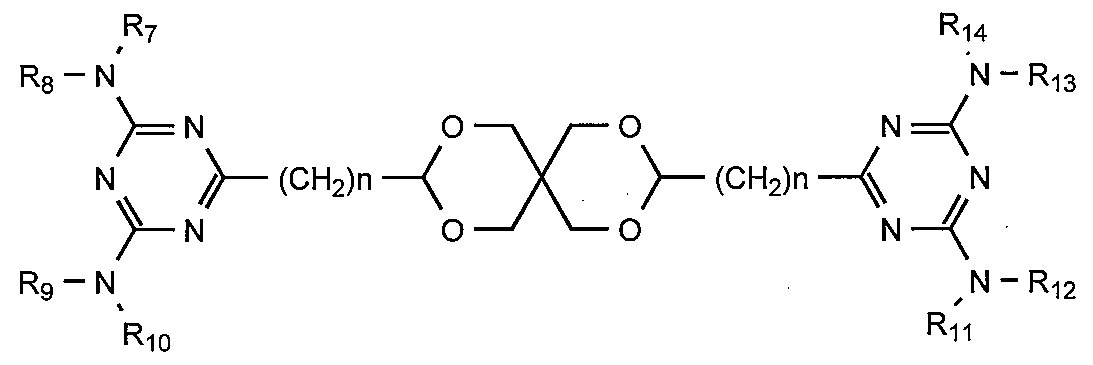
- a compound represented by the following structural formula (II) is also preferably used.
- R 7 to R 14 are each independently a hydrogen atom, an alkyl group, an alkenyl group, an aryl group or a heterocyclic group, with a hydrogen atom being particularly preferred.
- Various known aromatic, aliphatic or alicyclic isocyanates can be used as an example of the compound containing an isocyanate group used in the above reaction.
- thermosetting resin a compound containing an isocyanate group and a double bondable group can be suitably used, and 2-acracryloyloxyethyl isocyanate, 2-methacryloyl ester.
- Oxyethyl isocyanate, 1,1- (bisacryloyloxymethyl) ethyl isocyanate and the like can be exemplified.
- Examples of the acid anhydride used in the above reaction include malonic acid anhydride, succinic acid anhydride, maleic acid anhydride, itaconic acid anhydride, phthalic acid anhydride, hexahydrophthalic acid anhydride, tetrahydrophthalic acid anhydride And methyltetrahydrophthalic anhydride and the like.
- thermosetting resin needs to have an acid value of 3 to 60 mg KOH / g in terms of solid content, and more preferably 20 to 50 mg KOH / g. Therefore, the addition reaction of acid anhydride is reacted quantitatively so that the acid value is in this range.
- thermosetting resin When the acid value of the thermosetting resin is less than 3 mg KOH / g, there is a possibility that development failure may occur in alkali development, and when the acid value is more than 60 mg KOH / g, the surface of the exposed portion is corroded by the developer in alkali development. In this case, problems such as deterioration of the long-term storage stability of the photosensitive resin composition tend to occur.
- the thermosetting resin described above can be prepared by any of the following methods.
- thermosetting resins such as melamine resins are high in thermal reactivity and generally poor in long-term storage stability, so it has been difficult to use them in a large amount in photosensitive resin compositions.
- some of the plurality of thermally reactive groups present in the melamine resin skeleton are used for the reaction with a compound containing an isocyanate group or an acid anhydride. The property is appropriately lowered, and the effect of improving the long-term storage stability of the photosensitive resin composition can be obtained.
- the polymer chain of the melamine resin becomes long, and the free movement of the melamine resin skeleton is restrained, so that the storage stability is also improved. is there.
- Melamine resins tend to increase retardation as a color filter coloring composition.
- a melamine resin can be used as a retardation increasing agent for adjusting the retardation in the present invention.
- An organic compound having a benzyl group may be similarly used as a retardation adjusting agent for adjusting retardation.
- the reaction with the compound having an isocyanate group or the acid anhydride makes it possible to impart the alkali developability and / or the photosensitivity necessary for the alkali-developable photosensitive resin composition to the melamine resin.
- the adhesion to the substrate is improved, and a photosensitive resin composition having a good process margin which does not cause any problems during the development process is realized.
- thermosetting resin in the photosensitive resin composition, it is possible not only to impart sufficient heat resistance and hardness to the cured coating film, but also to impart functions of solvent resistance and alkali resistance. can do.
- thermosetting resin it is possible to reduce the elution of ionic impurities contained in pigments and other fine particles and / or in the production process thereof, and to improve the electrical characteristics. It is possible to That is, when baking and curing to form a color filter colored layer, a counter substrate supporting layer, a cell gap control raising layer, and a retardation layer, a thermosetting resin is contained in the photosensitive resin composition. The reaction makes it possible to suppress the elution of ionic impurities in order to confine the pigment and other fine particles in the polymer network.
- thermosetting resin by adding a suitable amount of thermosetting resin, the aromatic ring which the said thermosetting resin has can work electronically, and the electrical property of the hardened
- the photosensitive resin composition layer is a colored layer of a color filter, it is necessary to further contain a pigment.
- a pigment may be contained to provide a light shielding property.
- Known pigments can be used for the photosensitive resin composition for forming a colored layer and for imparting light shielding properties.
- the compounding amount of the pigment is not particularly limited, but is preferably about 5 to 70% by mass, and more preferably about 5 to 50% by mass, with respect to 100% by mass of the total amount of the composition. It is further preferable that the content be about 20 to 50% by mass, and the balance substantially consists of the resinous binder provided by the pigment carrier.
- a plurality of pigments can be used in combination for spectral adjustment of a color filter or the like.
- the pigment is preferably contained in a proportion of 5 to 70% by mass based on the total solid content of the coloring composition (100% by mass).
- an inorganic pigment in combination with the above-mentioned organic pigment, it is also possible to use an inorganic pigment in combination in order to ensure good coatability, sensitivity, developability and the like while maintaining the balance of chroma and lightness.
- inorganic pigments metal oxides such as yellow lead, zinc yellow, red iron oxide (red iron oxide (III)), cadmium red, ultramarine blue, bitumen, chromium oxide green, cobalt green etc., metal sulfide powder, metal powder etc. It can be mentioned.
- a dye can be contained in the range which does not reduce heat resistance for toning.
- Dispersant In the case of dispersing the pigment in the pigment carrier and the organic solvent, it is necessary to include a dispersant for dispersing the pigment and a surfactant.
- a dispersant for dispersing the pigment and a surfactant.
- surfactants intermediates of pigments, intermediates of dyes, sol spars, etc. are used, and they have a pigment affinity site having a property of adsorbing to the pigment and a site compatible with the pigment carrier. And adsorb to the pigment to stabilize the dispersion of the pigment on the pigment carrier.
- polyurethane, polycarboxylic acid ester such as polyacrylate, unsaturated polyamide, polycarboxylic acid, polycarboxylic acid (partial) amine salt, polycarboxylic acid ammonium salt, polycarboxylic acid alkylamine salt, polysiloxane, long Oil dispersants such as chain polyaminoamide phosphate, hydroxyl group-containing polycarboxylic acid ester, modified products thereof, amide formed by reaction of poly (lower alkyleneimine) with polyester having free carboxyl group, and salts thereof Water-soluble resins such as (meth) acrylic acid-styrene copolymer, (meth) acrylic acid- (meth) acrylic acid ester copolymer, styrene-maleic acid copolymer, polyvinyl alcohol, polyvinyl pyrrolidone, etc.
- the addition amount of the dispersant is not particularly limited, but is preferably 1 to 10% by mass with respect to 100% by mass of the pigment.
- the coloring composition may be coarse particles of 5 ⁇ m or more, preferably 1 ⁇ m or more, more preferably 0.5 ⁇ m or more, and dust mixed by means of centrifugation, a sintered filter, a membrane filter, etc. It is preferable to carry out the removal of
- surfactant polyoxyethylene alkyl ether sulfate, sodium dodecyl benzene sulfonate, alkali salt of styrene-acrylic acid copolymer, sodium alkyl naphthalene sulfonate, sodium alkyl diphenyl ether disulfonate, lauryl sulfate monoethanolamine, lauryl Anionic surfactants such as triethanolamine sulfate, ammonium lauryl sulfate, monoethanolamine stearic acid, sodium stearate, sodium lauryl sulfate, monoethanolamine of styrene-acrylic acid copolymer, polyoxyethylene alkyl ether phosphate ester; Polyoxyethylene oleyl ether, polyoxyethylene lauryl ether, polyoxyethylene nonylphenyl ether, polyoxyethylene Nonionic surfactants such as alkyl ether phosphate, polyoxyethylene sorbitan
- the photosensitive resin composition can contain a multifunctional thiol which acts as a chain transfer agent.
- the polyfunctional thiol may be any compound having two or more thiol groups, and examples thereof include hexanedithiol, decanedithiol, 1,4-butanediol bisthiopropionate, 1,4-butanediol bisthioglycolate, ethylene Glycol bis thioglycolate, ethylene glycol bis thiopropionate, trimethylol propane tris thio glycolate, trimethylol propane tris thio propionate, trimethylol propane tris (3-mercaptobutyrate), pentaerythritol tetrakis thio glycolate, Pentaerythritol tetrakisthiopropionate, trimercaptopropionic acid tris (2-hydroxyethyl) isocyanurate, 1,4-dimethylmercaptobenz
- polyfunctional thiols can be used alone or in combination of two or more.
- the multifunctional thiol can be used in an amount of 0.2 to 150 parts by weight, preferably 0.2 to 100 parts by weight, based on 100 parts by weight of the pigment in the coloring composition.
- the photosensitive resin composition can contain a storage stabilizer in order to stabilize the viscosity over time of the composition.
- storage stabilizers include quaternary ammonium chlorides such as benzyltrimethyl chloride and diethylhydroxyamine, organic acids such as lactic acid and oxalic acid and their methyl ethers, organics such as t-butylpyrocatechol, triethylphosphine and triphenylphosphine Phosphine, phosphite and the like can be mentioned.
- the storage stabilizer can be contained in an amount of 0.1 to 10 parts by weight with respect to 100 parts by weight of the pigment in the coloring composition.
- the photosensitive resin composition may also contain an adhesion improver such as a silane coupling agent in order to enhance the adhesion to the substrate.
- an adhesion improver such as a silane coupling agent
- a silane coupling agent vinyltris ( ⁇ -methoxyethoxy) silane, vinylethoxysilane such as vinylethoxysilane, vinyltrimethoxysilane, (meth) acrylsilanes such as ⁇ -methacryloxypropyltrimethoxysilane, ⁇ - (3 , 4-Epoxycyclohexyl) ethyltrimethoxysilane, ⁇ - (3,4-epoxycyclohexyl) methyltrimethoxysilane, ⁇ - (3,4-epoxycyclohexyl) ethyltriethoxysilane, ⁇ - (3,4-epoxycyclohexyl ) Epoxysilanes such as methyltriethoxysi
- solvent In the photosensitive resin composition, a solvent such as water or an organic solvent is blended in order to enable uniform coating on the substrate.
- the solvent when the composition of the present invention is a colored layer of a color filter, the solvent also has a function of uniformly dispersing the pigment.
- the solvent examples include cyclohexanone, ethyl cellosolve acetate, butyl cellosolve acetate, 1-methoxy-2-propyl acetate, diethylene glycol dimethyl ether, ethyl benzene, ethylene glycol diethyl ether, xylene, ethyl cellosolve, methyl-n amyl ketone, propylene glycol monomethyl ether, toluene, Examples thereof include methyl ethyl ketone, ethyl acetate, methanol, ethanol, isopropyl alcohol, butanol, isobutyl ketone, petroleum solvents and the like, and these are used alone or in combination.
- the solvent can be used in an amount of 800 to 4000 parts by mass, preferably 1000 to 2500 parts by mass, with respect to 100 parts by mass of the pigment in the coloring composition.
- the photosensitive resin composition can be prepared by a known method.
- the photosensitive coloring composition containing a photopolymerizable monomer, a thermosetting resin, a pigment, a dispersant, and a solvent can be prepared by the following method.
- a pigment composition prepared by mixing a pigment and a dispersing agent in advance is added to and dispersed in a photopolymerizable monomer and the thermosetting resin of the present invention, or a solution in which these are dissolved in a solvent.
- the pigment and the dispersant are separately added to and dispersed in the photopolymerizable monomer and the thermosetting resin of the present invention, or a solution in which these are dissolved in a solvent, and then the remaining components are added.
- Two types of photopolymerizable monomers and the thermosetting resin of the present invention, or a solution in which these are dissolved in a solvent are prepared, the pigment and the dispersant are separately dispersed, and then these are mixed. Add ingredients. One of the pigment and the dispersant may be dispersed only in the solvent.
- the dispersion of the photopolymerizable monomer, the thermosetting resin of the present invention, or the pigment or dispersant in a solution in which these are dissolved in a solvent may be carried out using a three-roll mill, two-roll mill, sand mill, kneader, dissolver, high speed It can carry out using various dispersing devices, such as a mixer, a homomixer, and an attritor. Moreover, in order to perform dispersion
- a pigment composition by mixing a pigment and a dispersing agent in advance, it is sufficient to simply mix a powdered pigment and a powdered dispersing agent, but (a) a kneader, a roll, an attritor, a super mill, etc. (B) Disperse the pigment in a solvent, and then add a solution containing a dispersant to make the dispersant adsorb on the pigment surface (c) Strong solvating power such as sulfuric acid It is preferable to adopt a mixing method such as coprecipitation with a poor solvent such as water after co-dissolving the pigment and the dispersant in the solvent possessed.
- pixel units in which red, green and blue coloring layers are disposed in the openings of the black matrix are respectively red coloring pixels (or red pixels), green coloring pixels (or green pixels) and blue coloring pixels ( Or it is called a blue pixel).
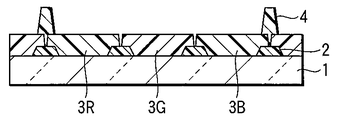
- FIG. 1 is a schematic cross-sectional view of a color filter according to a third embodiment of the present invention.
- a black matrix 2 formed by patterning a metal such as chromium or a photosensitive black resin composition is formed by a known method.
- a transparent substrate is preferable as the substrate 1 to be used, and specifically, a glass plate, or a resin substrate such as polycarbonate, polymethyl methacrylate, polyethylene phthalate and the like is suitably used.
- a transparent electrode made of a combination of metal oxides such as indium oxide, tin oxide, zinc oxide and antimony oxide is formed for liquid crystal driving after liquid crystal panelization. It is also good.
- the photosensitive resin composition according to the second embodiment of the present invention described above is uniformly coated on the substrate 1 by a spray coating method, a spin coating method, a roll coating method, or the like, and dried.
- the obtained photosensitive resin composition layer is patterned by photolithography. That is, after exposing and exposing active energy rays, such as an ultraviolet-ray and an electron beam, through the photomask which has a desired light-shielding pattern, it develops using developers, such as an organic solvent and alkaline aqueous solution.
- developers such as an organic solvent and alkaline aqueous solution.
- the photopolymerizable monomer contained in the photosensitive resin composition layer of the portion irradiated with the active energy ray is polymerized and cured.
- the photosensitive resin is also crosslinked and cured.
- a solution of a water-soluble or alkaline water-soluble resin for example, polyvinyl alcohol or a water-soluble acrylic resin
- a film that suppresses polymerization inhibition by oxygen exposure may be performed.
- a desired pattern is formed by washing away a portion which has not been irradiated with active energy rays with a developer.
- a developing method a shower developing method, a spray developing method, a dip (immersion) developing method, a paddle (liquid buildup) developing method or the like can be applied.
- alkaline developing solutions such as aqueous solutions, such as sodium carbonate and caustic soda, and organic alkali solutions, such as dimethyl benzylamine and a triethanolamine, are in use.
- a developing solution what to which the antifoamer and surfactant were added as needed is used.
- the same process is repeated for the other colors to produce a color filter. That is, on the substrate 1 on which the black matrix 2 is formed, the red pixel 3R, the green pixel 3G, and the blue pixel 3B are formed. A colored layer is configured by the red pixel 3R, the green pixel 3G, the blue pixel 3B, and the black matrix 2.
- the counter substrate supporting layer 4 for making the cell gap of the liquid crystal display uniform can be formed on these colored pixels. It is desirable that the counter substrate support layer 4 be formed at a position corresponding to the black matrix 2 as shown in FIG.
- the retardation layer 5, the cell gap control raising layer 6, and the counter substrate supporting layer 4 are formed on the substrate 1 provided with the colored layer. At least one of the retardation layer 5, the cell gap control raising layer 6, and the counter substrate supporting layer 4 can be formed in the same manner as the formation of the colored layer described above.
- FIG. 3 is a schematic cross-sectional view of a liquid crystal display device provided with a color filter according to a third embodiment of the present invention.
- the liquid crystal display device 7 shown in FIG. 3 is a typical example of a TFT drive type liquid crystal display device for a notebook type personal computer, and comprises a pair of transparent substrates 8 and 9 disposed facing each other, and between them , Liquid crystal (LC) is enclosed.
- LC Liquid crystal
- Liquid crystals are aligned according to liquid crystal alignment modes such as twisted nematic (ST), super twisted nematic (STN), in-plane switching (IPS), vertical alignment (VA), optically compensated birefringence (OCB), etc. .
- liquid crystal alignment modes such as twisted nematic (ST), super twisted nematic (STN), in-plane switching (IPS), vertical alignment (VA), optically compensated birefringence (OCB), etc.
- a TFT (thin film transistor) array 10 is formed on the inner surface of the first transparent substrate 8, and a transparent electrode layer 11 made of, for example, ITO is formed thereon.
- An alignment layer 12 is provided on the transparent electrode layer 11.
- a polarizing plate 13 including a retardation film is formed on the outer surface of the transparent substrate 8.
- a color filter 14 as shown in FIG. 1 or 2 is formed on the inner surface of the second transparent substrate 9.
- the red, green and blue filter segments constituting the color filter 14 are separated by a black matrix (not shown).
- a transparent protective film (not shown) is formed as necessary to cover the color filter 14, and a transparent electrode layer 15 made of, for example, ITO is further formed thereon, and the transparent electrode layer 15 is covered to form an alignment layer 16. Is provided.
- a polarizing plate 17 is formed on the outer surface of the transparent substrate 9.
- the backlight unit 19 provided with the three wavelength lamp 18 is provided.
- a polymerization composition comprising styrene and an unsaturated carboxylic acid-containing monomer used in Examples and Comparative Examples is synthesized as follows.
- the molecular weight of resin is a weight average molecular weight of polystyrene conversion measured by GPC (gel permeation chromatography).
- Synthesis Example 1 Polymerization Composition 1 160 g of styrene, 20 g of maleic anhydride, 420 g of cyclohexanone and 2 g of azobisisobutyronitrile are added to a 2-neck five-necked reaction vessel, and heated at 80 ° C. for 6 hours while blowing in nitrogen gas -A maleic anhydride copolymer was obtained.
- the weight average molecular weight of the obtained styrene-maleic anhydride copolymer 1 was 11,000.
- To the obtained styrene-maleic anhydride copolymer 1 75 g of a 20% aqueous solution of sodium hydroxide was added and heated at 75 ° C. for 1 hour.
- Synthesis Example 2 Polymerization Composition 2 160 g of styrene, 20 g of maleic anhydride, 420 g of cyclohexanone and 2 g of azobisisobutyronitrile are added to a 2-neck five-necked reaction vessel, and heated at 80 ° C. for 6 hours while blowing in nitrogen gas -A maleic anhydride copolymer was obtained.
- the weight average molecular weight of the obtained styrene-maleic anhydride copolymer 1 was 11,000. 36 g of 1-dodecanol and 0.5 g of triphenylphosphine were added to the obtained styrene-maleic anhydride copolymer 1 and heated at 145 ° C. for 20 hours.
- Synthesis Example 3 Polymerization Composition 3 A styrene-acrylic resin emulsion (AP1761 manufactured by Showa Highpolymer Co., Ltd., resin solid content 50%) 24 g and propylene glycol monomethyl ether acetate 96 g were added and heated at 30 ° C. for 1 hour. The weight average molecular weight of the obtained styrene-maleic anhydride copolymer 1 was 4,400.
- Synthesis Example 4 Polymerization Composition 4 In a five-necked reaction vessel with a capacity of 1 liter, 432 g of cyclohexanone and 3 g of azobisisobutyronitrile are added, and heated to 80 ° C. while blowing nitrogen gas, and 98.9 g of styrene and 9.1 g of acrylic acid The resulting mixture was added dropwise over 2 hours. Thirty minutes after completion of the dropwise addition, 3 g of azoisobutyronitrile was added, and heating was further performed for 5 hours to obtain a styrene-acrylic acid copolymer. The weight average molecular weight of the obtained styrene-acrylic acid copolymer was 6,900.
- Synthesis Example 5 Polymerization Composition 5 In a five-necked reaction vessel with a capacity of 1 liter, 432 g of propylene glycol monomethyl ether acetate and 13 g of azobisisobutyro nitrile are added, and heated to 80 ° C. while blowing nitrogen gas, 98.9 g of styrene and acrylic acid The mixture consisting of 9.1 g was added dropwise over 2 hours. Thirty minutes after completion of the dropwise addition, 6.5 g of azoisobutyronitrile was added, followed by heating for 5 hours to obtain a styrene-acrylic acid copolymer. The weight average molecular weight of the obtained styrene-acrylic acid copolymer was 3100.
- Synthesis Example 6 Polymer Composition 6 In a five-necked reaction vessel with a capacity of 1 liter, 432 g of propylene glycol monomethyl ether acetate and 13 g of azobisisobutyro nitrile are added, and heated to 80 ° C. while blowing nitrogen gas, 96.3 g of styrene and acrylic acid The mixture consisting of 11.8 g was added dropwise over 2 hours. Thirty minutes after completion of the dropwise addition, 6.5 g of azoisobutyronitrile was added, followed by heating for 5 hours to obtain a styrene-acrylic acid copolymer. The weight average molecular weight of the obtained styrene-acrylic acid copolymer was 3,000.
- Synthesis Example 7 Polymerization Composition 7 A styrene-acrylic resin emulsion (AP3770 manufactured by Showa Highpolymer Co., Ltd., resin solid content 50%) 24 g and propylene glycol monomethyl ether acetate 96 g were added and heated at 30 ° C. for 1 hour. The weight average molecular weight of the obtained styrene-acrylic acid copolymer 1 was 8600.
- Synthesis Example 8 Polymerization Composition 8 120 g of styrene, 20 g of maleic anhydride, 420 g of cyclohexanone and 2 g of azobisisobutyronitrile are added to a 2-neck five-necked reaction vessel, heated at 80 ° C. for 15 hours while blowing nitrogen gas, styrene -A maleic anhydride copolymer was obtained.
- the weight average molecular weight of the obtained styrene-maleic anhydride copolymer 1 was 37,000.
- To the obtained styrene-maleic anhydride copolymer 1 75 g of a 20% aqueous solution of sodium hydroxide was added and heated at 75 ° C. for 1 hour.
- styrene-maleic acid copolymer After cooling to 30 ° C., 170 g of 10% hydrochloric acid was added and stirring was performed for 1 hour. Subsequently, 180 g of cyclohexanone and 180 g of water were added and the mixture was stirred for 30 minutes, and then the aqueous layer was separated to obtain a styrene-maleic acid copolymer. The weight average molecular weight of the obtained styrene-maleic acid copolymer was 35,500.
- Synthesis Example 9 Polymerization Composition 9 120 g of styrene, 30 g of maleic anhydride, 420 g of cyclohexanone and 2 g of azobisisobutyronitrile are added to a 2-neck five-necked reaction vessel and heated at 80 ° C. for 6 hours while blowing in nitrogen gas. -A maleic anhydride copolymer was obtained. The weight average molecular weight of the obtained styrene-maleic anhydride copolymer 1 was 13,000. To the obtained styrene-maleic anhydride copolymer 1, 75 g of a 20% aqueous solution of sodium hydroxide was added and heated at 75 ° C. for 1 hour.
- styrene-maleic acid copolymer After cooling to 30 ° C., 170 g of 10% hydrochloric acid was added and stirring was performed for 1 hour. Subsequently, 180 g of cyclohexanone and 180 g of water were added and the mixture was stirred for 30 minutes, and then the aqueous layer was separated to obtain a styrene-maleic acid copolymer. The weight average molecular weight of the obtained styrene-maleic acid copolymer was 12000.
- Synthesis Example 10 Polymerization Composition 10 142.5 g of styrene, 7.5 g of maleic anhydride, 420 g of cyclohexanone and 2 g of azobisisobutyronitrile are added to a 2-neck five-necked reaction vessel and heated at 80 for 6 hours while blowing nitrogen gas Thus, a styrene-maleic anhydride copolymer 4 was obtained. The weight average molecular weight of the obtained styrene-maleic anhydride copolymer 4 was 13,000.
- styrene-maleic anhydride copolymer 1 To the obtained styrene-maleic anhydride copolymer 1, 75 g of a 20% aqueous solution of sodium hydroxide was added and heated at 75 ° C. for 1 hour. After cooling to 30 ° C., 170 g of 10% hydrochloric acid was added and stirring was performed for 1 hour. Subsequently, 180 g of cyclohexanone and 180 g of water were added and stirred for 30 minutes, and then the aqueous layer was separated to obtain a polymerization composition 10 of a styrene-maleic acid copolymer. The weight-average molecular weight of the resulting styrene-maleic acid copolymer polymerization composition 10 was 12,000. The results are shown in Table 1 below.
- the acrylic resin used in the examples and comparative examples is synthesized as follows.
- the molecular weight of an acrylic resin is the weight average molecular weight of polystyrene conversion measured by GPC (gel permeation chromatography).
- Acrylic Resin 1 Add 800 g of propylene glycol monomethyl ether acetate, 10 g of methacrylic acid, 40 g of methyl methacrylate, 80 g of butyl methacrylate, 40 g of hydroxyethyl methacrylate and 2 g of azobisisobutyronitrile in a five-necked reaction vessel with a content of 2 liters. The mixture was heated at 80.degree. C. for 6 hours while bubbling the mixture to obtain an acrylic resin 1. The weight average molecular weight of the obtained acrylic resin 1 was 40000.
- Synthetic Example 2 Acrylic Resin 2 An acrylic resin 2 was obtained in the same manner as in Synthesis Example 8 except that 40 g of methacrylic acid was used. The weight average molecular weight of the obtained acrylic resin 2 was 40000.
- Acrylic Resin 3 800 g of propylene glycol monomethyl ether acetate, 30 g of methacrylic acid, 70 g of butyl methacrylate, 40 g of hydroxyethyl methacrylate, 60 g of p-cumylphenoxyethyl methacrylate and 2 g of azobisisobutyronitrile in a 5-liter reaction vessel having a content of 2 liters
- a 5-liter reaction vessel having a content of 2 liters
- nitrogen gas while blowing in nitrogen gas, it was heated at 80 ° C. for 6 hours to obtain an acrylic resin 3.
- the weight average molecular weight of the obtained acrylic resin 3 was 30,000.
- Synthetic Example 4 Acrylic Resin 4 An acrylic resin 4 was obtained in the same manner as in Synthesis Example 10 except that 33 g of methacrylic acid was used. The weight average molecular weight of the obtained acrylic resin 4 was 30,000.
- Acrylic Resin 5 800 g of propylene glycol monomethyl ether acetate, 40 g of methacrylic acid, 40 g of butyl methacrylate, 60 g of hydroxyethyl methacrylate, 60 g of p-cumylphenoxyethyl methacrylate and 4 g of azobisisobutyronitrile in a 5-liter reaction vessel having a content of 2 liters
- it was heated at 80 ° C. for 6 hours while blowing in nitrogen gas to obtain an acrylic resin.
- This acrylic resin was further reacted with 45 g of methacryloyloxyethyl isocyanate at 60 ° C. for 8 hours to obtain an acrylic resin 5.
- the weight average molecular weight of this acrylic resin 5 was 25,000.
- Synthetic Example 6 Acrylic Resin 6 An acrylic resin 5 was obtained in the same manner as in Synthesis Example 10 except that 15 g of methacryloyloxyethyl isocyanate was used. The weight average molecular weight of this acrylic resin 5 was 25,000. The results are shown in Table 2 below.
- Blue pigment 200 g of blue pigment 1 (CI Pigment Blue 15: 6, "LIONOL BLUE ES” manufactured by Toyo Ink Mfg. Co., Ltd .; B-1), 1600 parts of sodium chloride, and 100 parts of diethylene glycol (manufactured by Tokyo Kasei Co., Ltd.)
- the mixture was charged in (made by Inoue Seisakusho Co., Ltd.) and kneaded at 70 ° C. for 12 hours.
- this mixture is poured into about 5 liters of warm water and stirred with a high speed mixer for about 1 hour while heating to about 70 ° C. to form a slurry, and then filtered and washed with water to remove sodium chloride and diethylene glycol, Drying at 80 ° C. for 24 hours gave 198 parts of a salt milled pigment (blue pigment 2).
- this mixture is poured into about 5 liters of warm water and stirred with a high speed mixer for about 1 hour while heating to about 70 ° C. to form a slurry, and then filtered and washed with water to remove sodium chloride and diethylene glycol, Drying at 80 ° C. for 24 hours gave 118 parts of a salt milled pigment (purple pigment 2).
- Red pigment 136 parts of red pigment 1 (CI Pigment Red 254, "IRGAPHOR RED B-CF” manufactured by Ciba Specialty Chemicals, 24 parts of dispersant A-1 shown in Table 2, 1600 parts of sodium chloride, and diethylene glycol (Tokyo Chemical Co., Ltd.)
- a stainless steel 1 gallon kneader manufactured by Inoue Seisakusho Co., Ltd.
- this mixture is poured into about 5 liters of warm water and stirred with a high speed mixer for about 1 hour while heating to about 70 ° C. to form a slurry, and then filtered and washed with water to remove sodium chloride and diethylene glycol, Drying at 80 ° C. for 24 hours gave 156 parts of a salt milled pigment (red pigment 2).
- red pigment 3 (CI Pigment Red 177, CROMOPHTAL RED A2B; C-3 manufactured by Ciba Specialty Chemicals, R-3), 1600 parts of sodium chloride, and 190 parts of diethylene glycol (manufactured by Tokyo Kasei Co., Ltd.) 1-gallon kneader made of stainless steel
- this mixture is poured into about 5 liters of warm water and stirred with a high speed mixer for about 1 hour while heating to about 70 ° C. to form a slurry, and then filtered and washed with water to remove sodium chloride and diethylene glycol, Drying at 80 ° C. for 24 hours gave 156 parts of a salt milled pigment (red pigment 4).
- Red pigment 100 parts of quinophthalone yellow pigment PY138 ("PARIOL YELLOW K0961 HD” manufactured by BASF Corp.), 5 parts of a dye derivative (D-3), 750 parts of crushed sodium chloride and 180 parts of diethylene glycol
- the mixture was kneaded at 60.degree. C. for 6 hours.
- the mixture is poured into 3000 parts of hot water and stirred for about 1 hour with a high speed mixer while heating to about 80 ° C. to form a slurry, filtered and washed with water repeatedly to remove salt and solvent, and then kept at 80 ° C. for 24 hours Drying gave 100 parts of salt milled pigment (Yellow pigment 1).
- Example 1 The blue coloring composition 1 used for color filter preparation was prepared in the following way.
- ⁇ Blue coloring composition 1> A mixture of the following composition was uniformly stirred and mixed, then dispersed by a sand mill for 5 hours using a glass bead having a diameter of 1 mm, and then filtered through a 5 ⁇ m filter to prepare a dispersion of a blue pigment.
- Example 12 [Preparation of Photosensitive Resin Composition 1 for Counter Substrate Carrying Layer]
- the mixture of the following composition was stirred and mixed so as to be uniform, and then filtered through a 5 ⁇ m filter to prepare a photosensitive resin composition 1 used for preparation of an opposing substrate supporting layer.
- Polymerization composition 5 16 parts Photopolymerizable monomer (Torongo Synthesis "Alonix M-402") 2.4 parts Photopolymerization initiator (Ciba Geigy “Irgacure-907” 2.8 parts Photosensitizer (Japan Chemical manufactured “Diethylthioxanthone-S” 0.5 parts Photosensitizer (Kanto Kagaku “2-mercaptobenzothiazole”) 0.5 parts Cyclohexanone 40.2 parts (Example 13) [Preparation of Photosensitive Resin Composition 2 for Bulk Layer for Cell Gap Control] The mixture having the composition shown below was stirred and mixed so as to be uniform, and then filtered through a 5 ⁇ m filter to prepare a photosensitive resin composition 2 used for preparing a cell gap control raising layer.
- Polymerization composition 5 16 parts Trimethylolpropane triacrylate (Osaka Organic Chemical Industry Co., Ltd. Biscoat # 295) 4.8 parts Photopolymerizable monomer (Torongo Synthesis "Alonix M-402") 2.4 parts Photopolymerization Initiator ("Irgacure-907” manufactured by Ciba Geigy) 2.8 parts Photosensitizer ("EAB-F” manufactured by Hodogaya Chemical Co., Ltd.) 0.2 parts Cyclohexanone 40.2 parts (Example 14) [Preparation of Photosensitive Resin Composition 3 for Retardation Layer] The mixture having the composition shown below was stirred and mixed so as to be uniform, and then filtered through a 5 ⁇ m filter to prepare a photosensitive resin composition 3 used for producing a retardation layer.
- Polymerization composition 5 16 parts Trimethylolpropane triacrylate (Osaka Organic Chemical Industry Co., Ltd. Biscoat # 295) 4.8 parts Photopolymerizable monomer (Torongo Synthesis "Alonix M-402") 2.4 parts Photopolymerization Initiator ("Irgacure-907” manufactured by Ciba Geigy) 2.8 parts Photosensitizer ("EAB-F” manufactured by Hodogaya Chemical Co., Ltd.) 0.2 parts Cyclohexanone 40.2 parts (Comparative Examples 10 to 12) Photosensitive resin compositions 4 to 6 were obtained in the same manner as in Examples 12 to 14 except that the polymerization composition 8 was used for the resin.
- E-type viscometer Long-term storage stability evaluation E-type viscometer ("ELD-type viscometer” manufactured by Toki Sangyo Co., Ltd.) was used as the initial viscosity on the day after the green coloring composition was prepared and the temporal viscosity accelerated with time at 40 ° C for 1 week. The measurement was performed at 25 ° C. under the condition of 20 rpm. From the values of the initial viscosity and the temporal viscosity, the temporal viscosity change rate was calculated by the following equation.
- Viscosity change rate over time 10% or less Viscosity change rate over time 10% to 20%
- X Viscosity change rate over time exceeds 20%.
- Thickness direction retardation value Rth The coating film of each color was produced in the following procedure, and the thickness direction retardation value was measured.
- each colored composition shown in Table 3 was applied to a glass substrate by spin coating, it was prebaked at 70 ° C. for 20 minutes in a clean oven. The substrate was then cooled to room temperature and exposed to ultraviolet light using an extra-high pressure mercury lamp. Thereafter, the substrate was spray developed using a 23 ° C. aqueous solution of sodium carbonate, then washed with ion exchanged water and air dried. Thereafter, post-baking was performed in a clean oven at 230 ° C. for 30 minutes to obtain a coating film for each color pixel. The film thickness of the dried coating film was 1.8 ⁇ m in each case.
- a coating film is similarly formed to form a counter substrate supporting layer for uniforming the cell gap of the liquid crystal display device, a raised layer for cell gap control, and a photosensitive resin composition for retardation layer. did.
- the thickness direction retardation value measures retardation ⁇ ( ⁇ ) from the direction inclined 45 ° from the normal direction of the substrate on which the coating film is formed, using a retardation measurement apparatus (“RETS-100” manufactured by Otsuka Electronics Co., Ltd.)
- the thickness direction retardation value (Rth) was calculated from Formula 1 from the three-dimensional refractive index obtained using this value. However, the measurement was performed at a wavelength of 610 nm for the red colored pixel, 550 nm for the green colored pixel, and 450 nm for the blue colored pixel.
- Rth ⁇ (Nx + Ny) / 2-Nz ⁇ ⁇ d (Wherein, Nx is the refractive index in the x direction in the plane of the colored pixel layer, Ny is the refractive index in the y direction in the plane of the colored pixel layer, and Nz is the refractive index in the thickness direction of the colored pixel layer And let Nx be Nx ⁇ Ny, where d is the thickness (nm) of the colored pixel layer.
- the thickness direction retardation value Rth of each color coating film prepared from each color coloring composition shown in Table 3 above is shown in Table 4 below.
- the thickness direction retardation value Rth of the colored pixel layer is -10 to 2 nm for red pixels, -10 to 0 nm for green pixels, and -10 to 2 nm for blue pixels.
- the thickness direction retardation value was evaluated based on the following criteria.
- CS is the value of the contrast of only the transparent substrate which does not form a color filter (colored layer).
- the color filter contrast is a value calculated by the above equation by measuring a color filter substrate in which red colored pixels, green colored pixels, and blue colored pixels are formed on a black matrix. The color filter contrast is more important than the value of the contrast of each color coloring layer since it directly directly affects the image quality of the liquid crystal display device.
- the brightness of light in a state orthogonal to the brightness (Lp) of light in a parallel state with a polarizing plate in a 2 ° view. (Lc) is measured in such a manner that only the colored pixel layer of a single coating film formed on a transparent substrate or the transparent substrate is sandwiched between polarizing plates.
- the polarizing plate for example, “NPF-SEG1224DU” manufactured by Nitto Denko Corporation is used.
- luminance 1937 cd / m 2
- color temperature 6525 K
- the characteristic of chromaticity deviation duv ⁇ 0.0136 is used.
- the obtained photosensitive composition was applied on a glass substrate by a spin coating method, and then prebaked at 70 ° C. for 15 minutes to form a coating film having a film thickness of 2.3 ⁇ m.
- ultraviolet exposure was performed through a photomask provided with a 50 ⁇ m fine line pattern by a proximity exposure method using ultraviolet light as an exposure light source.
- the exposure dose was set to eight levels of 30, 40, 50, 60, 70, 80, 90, and 100 mJ / cm 2 .
- the film thickness of the obtained colored pixel was divided by the film thickness (2.3 ⁇ m) of the unexposed / undeveloped part to calculate the residual film ratio. Then, the exposure sensitivity curve was plotted with the abscissa representing the exposure amount and the ordinate representing the residual film rate after development. From the obtained exposure sensitivity curve, the minimum exposure amount at which the residual film ratio reaches 80% or more was regarded as the saturated exposure amount, and the sensitivity was evaluated based on the following criteria.
- saturated exposure amount is 50 mJ / cm 2 or less
- saturated exposure amount is more than 50 and 100 mJ / cm 2 or less
- saturation exposure amount is more than 100 mJ / cm 2
- the obtained black photosensitive composition was applied on a glass substrate by a spin coating method, and prebaking was performed at 70 ° C. for 15 minutes to form a coating film having a film thickness of 2.3 ⁇ m.
- ultraviolet exposure was performed through a photomask provided with a stripe pattern having a line width of 6 to 20 ⁇ m by a proximity exposure method using ultraviolet light as an exposure light source.
- the exposure dose was the above-described saturated exposure dose.
- ⁇ No change in appearance under all conditions ⁇ : Defects such as pattern peeling, chipping and cracks are observed.
- the resin compositions according to Examples 1 to 14 using the polymerization composition within the scope of the present invention are the long-term storage stability of the photosensitive resin composition, the sensitivity, the patterning property, and the photosensitivity. It is understood that both the thickness direction retardation value and the resistance of the colored layer obtained by curing the resin composition are good.
- Example 15 Preparation of Color Filter
- the photosensitive coloring compositions shown in Table 4 were combined to prepare a color filter according to the method described below.
- a photosensitive red composition (colored composition 11) was applied to a glass substrate on which a black matrix had been previously formed by spin coating, and then prebaked at 70 ° C. for 20 minutes in a clean oven. Then, after the substrate was cooled to room temperature, ultraviolet light was exposed through a photomask using an extra-high pressure mercury lamp.
- the substrate was spray developed using a 23 ° C. aqueous solution of sodium carbonate, then washed with ion exchanged water and air dried. Furthermore, post-baking was performed at 230 ° C. for 30 minutes in a clean oven to form stripe-shaped red pixels on the substrate.
- a photosensitive green composition (colored composition 10) is used to similarly form green pixels, and further, a photosensitive blue composition (colored composition 1) is used to form blue pixels, and a color is formed.
- the formed film thickness of each color pixel was 2.0 ⁇ m.
- the two glass substrates prepared in this way are opposed so that the electrode layers face each other, aligned using spacer beads while keeping the distance between the two substrates constant, and leaving the periphery so as to leave the opening for injecting the liquid crystal composition. Sealed with a sealant.
- the liquid crystal composition for VA was injected from the opening to seal the opening.
- the polarizing plate was provided with an optical compensation layer optimized for wide viewing angle display.
- the liquid crystal display device manufactured in this manner was combined with a backlight unit to obtain a VA (vertical alignment) display mode liquid crystal panel.
- Example 16 Comparative Examples 13 and 14
- Color filters 2 to 4 were obtained in the same manner as in Example 15, except that the photosensitive coloring composition described in Table 5 below was used as the photosensitive coloring composition.
- a liquid crystal display device was manufactured using this color filter.
- composition of the coloring composition 21 used in Comparative Example 14 is as follows.
- Pigment Blue pigment 1 Purple pigment 2 Resin in dispersion: 36.5 parts of acrylic resin: 26.5 parts of resin in coloring composition: 4 parts of polymerization composition: 4 parts of acrylic resin: 12 parts of pigment composition ratio, amount of dispersant, and other composition ratio, Example 1 Same as.
- the retardation in the thickness direction of a green colored layer using a halogenated copper phthalocyanine pigment and the evaluation of oblique visibility in black display will be described below as a comparative example.
- the coloring composition 21 which used halogenated copper phthalocyanine pigment PG36 (made by Toyo Ink Mfg .; lyonol green 6YK) for the green pigment was produced.
- Pigment Green pigment (PG 36) ... 8.3 parts Yellow pigment 1 ... 5.4 parts Resin in the dispersion: Acrylic resin 2 ... 36.5 parts Resin in the coloring composition: Acrylic resin 6 ... 16 parts
- This coloring composition is applied as a coating film on a glass substrate to a thickness of 2 ⁇ m, and the thickness direction as a green coloring layer When the phase difference was measured, its Rth was ⁇ 13 nm.
- a halogenated copper phthalocyanine pigment which is a green pigment, can be suitably used with high contrast as a green colored pixel of a color filter, but since the retardation in the thickness direction becomes negative exceeding -10 nm, the oblique visibility is poor. there were.
- the color filter having the green colored pixels was evaluated as a liquid crystal display device in ⁇ the evaluation of the visibility of the black display of the liquid crystal display device to be described later>.
- the liquid crystal display device produced is displayed in black, and the amount of light (orthogonal transmitted light; leaked light) leaking from the normal direction (approximately vertical direction) of the liquid crystal panel and the azimuth (oblique) inclined 45 ° from the normal direction It observed visually.
- the chromaticity (u (v), v ( ⁇ )) when viewed from the substantially vertical direction at the time of black display and the chromaticity (when viewed from an azimuth inclined up to 60 ° from the normal direction of the display surface u (45) and v (45) were measured by BM-5A manufactured by Topcon Corporation, color difference ⁇ u′v ′ was calculated, and the maximum value of ⁇ u′v ′ at 0 ⁇ ⁇ ⁇ 60 ° was determined.
- SYMBOLS 1 Glass substrate, 2 ... Black matrix, 3R, 3G, 3B ... Coloring pixel, 4 ... Counter-substrate carrying
Landscapes
- Physics & Mathematics (AREA)
- Nonlinear Science (AREA)
- General Physics & Mathematics (AREA)
- Optics & Photonics (AREA)
- Mathematical Physics (AREA)
- Chemical & Material Sciences (AREA)
- Crystallography & Structural Chemistry (AREA)
- Materials For Photolithography (AREA)
- Optical Filters (AREA)
- Liquid Crystal (AREA)
- Polarising Elements (AREA)
Abstract
Description
(式中、Nxは着色画素層の平面内のx方向の屈折率、Nyは着色画素層の平面内のy方向の屈折率、Nzは着色画素層の厚み方向の屈折率を表す。ここで、NxはNx≧Nyとする遅相軸、dは着色画素層の厚み(nm)である。)
このような液晶表示装置用カラーフィルタにおいて、前記着色樹脂組成物は、前記重合組成物とともに、更に光重合性モノマーと、光重合開始剤と、アクリル系樹脂と、有機顔料を含むことが出来る。
(式中、Nxは着色画素層の平面内のx方向の屈折率、Nyは着色画素層の平面内のy方向の屈折率、Nzは着色画素層の厚み方向の屈折率を表す。ここで、NxはNx≧Nyとする遅相軸、dは着色画素層の厚み(nm)である。)
このようなカラーフィルタを備える液晶表示装置は、高いコントラストと斜め視認性を示す。厚み方向位相差Rthが、0ないし-10nmの範囲外の場合には、斜め視認性は劣ってしまう。
アクリル系樹脂として、以下のものを例示できる。
光重合性モノマーの例として、2-ヒドロキシエチル(メタ)アクリレート、2-ヒドロキシプロピル(メタ)アクリレート、シクロヘキシル(メタ)アクリレート、ポリエチレングリコールジ(メタ)アクリレート、ペンタエリスリトールトリ(メタ)アクリレート、トリメチロールプロパントリ(メタ)アクリレート、ジペンタエリスリトールヘキサ(メタ)アクリレート、トリシクロデカニル(メタ)アクリレート、メラミン(メタ)アクリレート、エポキシ(メタ)アクリレート等の各種アクリル酸エステルおよびメタクリル酸エステル、(メタ)アクリル酸、スチレン、酢酸ビニル、(メタ)アクリルアミド、N-ヒドロキシメチル(メタ)アクリルアミド、アクリロニトリル等が挙げられる。
光重合開始剤としては、4-フェノキシジクロロアセトフェノン、4-t-ブチル-ジクロロアセトフェノン、ジエトキシアセトフェノン、1-(4-イソプロピルフェニル)-2-ヒドロキシ-2-メチルプロパン-1-オン、1-ヒドロキシシクロヘキシルフェニルケトン、2-ベンジル-2-ジメチルアミノ-1-(4-モルフォリノフェニル)-ブタン-1-オン等のアセトフェノン系化合物、ベンゾイン、ベンゾインメチルエーテル、ベンゾインエチルエーテル、ベンゾインイソプロピルエーテル、ベンジルジメチルケタール等のベンゾイン系化合物、ベンゾフェノン、ベンゾイル安息香酸、ベンゾイル安息香酸メチル、4-フェニルベンゾフェノン、ヒドロキシベンゾフェノン、アクリル化ベンゾフェノン、4-ベンゾイル-4’-メチルジフェニルサルファイド等のベンゾフェノン系化合物、チオキサンソン、2-クロルチオキサンソン、2-メチルチオキサンソン、イソプロピルチオキサンソン、2,4-ジイソプロピルチオキサンソン等のチオキサンソン系化合物、2,4,6-トリクロロ-s-トリアジン、2-フェニル-4,6-ビス(トリクロロメチル)-s-トリアジン、2-(p-メトキシフェニル)-4,6-ビス(トリクロロメチル)-s-トリアジン、2-(p-トリル)-4,6-ビス(トリクロロメチル)-s-トリアジン、2-ピペニル-4,6-ビス(トリクロロメチル)-s-トリアジン、2,4-ビス(トリクロロメチル)-6-スチリルs-トリアジン、2-(ナフト-1-イル)-4,6-ビス(トリクロロメチル)-s-トリアジン、2-(4-メトキシ-ナフト-1-イル)-4,6-ビス(トリクロロメチル)-s-トリアジン、2,4-トリクロロメチル-(ピペロニル)-6-トリアジン、2,4-トリクロロメチル(4’-メトキシスチリル)-6-トリアジン等のトリアジン系化合物、1,2-オクタンジオン,1-〔4-(フェニルチオ)-,2-(O-ベンゾイルオキシム)〕、O-(アセチル)-N-(1-フェニル-2-オキソ-2-(4’-メトキシ-ナフチル)エチリデン)ヒドロキシルアミン等のオキシムエステル系化合物、ビス(2,4,6-トリメチルベンゾイル)フェニルホスフィンオキサイド、2,4,6-トリメチルベンゾイルジフェニルホスフィンオキサイド等のホスフィン系化合物、9,10-フェナンスレンキノン、
カンファーキノン、エチルアントラキノン等のキノン系化合物、ボレート系化合物、カルバゾール系化合物、イミダゾール系化合物、チタノセン系化合物等が挙げられる。
重合開始剤と光増感剤とを併用することが好ましい。光増感剤として、α-アシロキシエステル、アシルフォスフィンオキサイド、メチルフェニルグリオキシレート、ベンジル、9,10-フェナンスレンキノン、カンファーキノン、エチルアンスラキノン、4,4’-ジエチルイソフタロフェノン、3,3’,4,4’-テトラ(t-ブチルパーオキシカルボニル)ベンゾフェノン、4,4’-ジエチルアミノベンゾフェノン等の化合物を併用することもできる。
本発明の第2の実施形態に係る感光性樹脂組成物には、可視光領域の400~700nmの全波長領域において好ましくは80%以上、より好ましくは95%以上の透過率を有する非感光性透明樹脂及び/又は感光性透明樹脂を併用することができる。

2種類以上のホモポリマーまたはコポリマーを併用してもよい。また、上記以外に1,3,5-トリアジン環を有する化合物で、例えば特開2001-166144公報に記載のものを使用することができる。また下記に示す構造式(II)に示す化合物も好ましく用いられる。
上記の反応に用いるイソシアネート基を含有する化合物の例として、芳香族、脂肪族、又は脂環族の各種公知のイソシアネート類を使用することができる。
(2)メラミン樹脂及びイソシアネ―ト基を含有する化合物を加温下で混合して反応させた後、さらに酸無水物を加温下で混合して反応させる方法。
感光性樹脂組成物層がカラーフィルタの着色層である場合、さらに、顔料を含有させる必要がある。
顔料を顔料担体および有機溶剤中に分散する場合には、顔料を分散させるための分散剤、界面活性剤を含有させる必要がある。分散剤としては、界面活性剤、顔料の中間体、染料の中間体、ソルスパース等が使用され、顔料に吸着する性質を有する顔料親和性部位と、顔料担体と相溶性のある部位とを有し、顔料に吸着して顔料の顔料担体への分散を安定化する働きをするものである。
界面活性剤としては、ポリオキシエチレンアルキルエーテル硫酸塩、ドデシルベンゼンスルホン酸ナトリウム、スチレン-アクリル酸共重合体のアルカリ塩、アルキルナフタリンスルホン酸ナトリウム、アルキルジフェニルエーテルジスルホン酸ナトリウム、ラウリル硫酸モノエタノールアミン、ラウリル硫酸トリエタノールアミン、ラウリル硫酸アンモニウム、ステアリン酸モノエタノールアミン、ステアリン酸ナトリウム、ラウリル硫酸ナトリウム、スチレン-アクリル酸共重合体のモノエタノールアミン、ポリオキシエチレンアルキルエーテルリン酸エステルなどのアニオン性界面活性剤;ポリオキシエチレンオレイルエーテル、ポリオキシエチレンラウリルエーテル、ポリオキシエチレンノニルフェニルエーテル、ポリオキシエチレンアルキルエーテルリン酸エステル、ポリオキシエチレンソルビタンモノステアレート、ポリエチレングリコールモノラウレートなどのノニオン性界面活性剤;アルキル4級アンモニウム塩やそれらのエチレンオキサイド付加物などのカオチン性界面活性剤;アルキルジメチルアミノ酢酸ベタインなどのアルキルベタイン、アルキルイミダゾリンなどの両性界面活性剤が挙げられ、これらは単独でまたは2種以上を混合して用いることができる。
感光性樹脂組成物には、連鎖移動剤としての働きをする多官能チオールを含有させることができる。多官能チオールは、チオール基を2個以上有する化合物であればよく、例えば、ヘキサンジチオール、デカンジチオール、1,4-ブタンジオールビスチオプロピオネート、1,4-ブタンジオールビスチオグリコレート、エチレングリコールビスチオグリコレート、エチレングリコールビスチオプロピオネート、トリメチロールプロパントリスチオグリコレート、トリメチロールプロパントリスチオプロピオネート、トリメチロールプロパントリス(3-メルカプトブチレート)、ペンタエリスリトールテトラキスチオグリコレート、ペンタエリスリトールテトラキスチオプロピオネート、トリメルカプトプロピオン酸トリス(2-ヒドロキシエチル)イソシアヌレート、1,4-ジメチルメルカプトベンゼン、2、4、6-トリメルカプト-s-トリアジン、2-(N,N-ジブチルアミノ)-4,6-ジメルカプト-s-トリアジン等が挙げられる。
感光性樹脂組成物には、組成物の経時粘度を安定化させるために貯蔵安定剤を含有させることができる。貯蔵安定剤としては、例えばベンジルトリメチルクロライド、ジエチルヒドロキシアミンなどの4級アンモニウムクロライド、乳酸、シュウ酸などの有機酸およびそのメチルエーテル、t-ブチルピロカテコール、トリエチルホスフィン、トリフェニルフォスフィンなどの有機ホスフィン、亜リン酸塩等が挙げられる。貯蔵安定剤は、着色組成物中の顔料100質量部に対して、0.1~10質量部の量で含有させることができる。
また、前記感光性樹脂組成物には、基板との密着性を高めるためにシランカップリング剤等の密着向上剤を含有させることもできる。シランカップリング剤としては、ビニルトリス(β-メトキシエトキシ)シラン、ビニルエトキシシラン、ビニルトリメトキシシラン等のビニルシラン類、γ-メタクリロキシプロピルトリメトキシシラン等の(メタ)アクリルシラン類、β-(3,4-エポキシシクロヘキシル)エチルトリメトキシシラン、β-(3,4-エポキシシクロヘキシル)メチルトリメトキシシラン、β-(3,4-エポキシシクロヘキシル)エチルトリエトキシシラン、β-(3,4-エポキシシクロヘキシル)メチルトリエトキシシラン、γ-グリシドキシプロピルトリメトキシシラン、γ-グリシドキシプロピルトリエトキシシラン等のエポキシシラン類、N-β(アミノエチル)γ-アミノプロピルトリメトキシシラン、N-β(アミノエチル)γ-アミノプロピルトリエトキシシラン、N-β(アミノエチル)γ-アミノプロピルメチルジエトキシシシラン、γ-アミノプロピルトリエトキシシラン、γ-アミノプロピルトリメトキシシラン、N-フェニル-γ-アミノプロピルトリメトキシシラン、N-フェニル-γ-アミノプロピルトリエトキシシラン等のアミノシラン類、γ-メルカプトプロピルトリメトキシシラン、γ-メルカプトプロピルトリエトキシシラン等のチオシラン類等が挙げられる。シランカップリング剤は、着色組成物中の顔料100質量部に対して、0.01~100質量部の量で含有させることができる。
前記感光性樹脂組成物には、基板上への均一な塗布を可能とするために、水や有機溶剤等の溶剤が配合される。また、本発明の組成物がカラーフィルタの着色層である場合、溶剤は、顔料を均一に分散させる機能も有する。溶剤としては、例えばシクロヘキサノン、エチルセロソルブアセテート、ブチルセロソルブアセテート、1-メトキシ-2-プロピルアセテート、ジエチレングリコールジメチルエーテル、エチルベンゼン、エチレングリコールジエチルエーテル、キシレン、エチルセロソルブ、メチル-nアミルケトン、プロピレングリコールモノメチルエーテル、トルエン、メチルエチルケトン、酢酸エチル、メタノール、エタノール、イソプロピルアルコール、ブタノール、イソブチルケトン、石油系溶剤等が挙げられ、これらを単独でもしくは混合して用いる。溶剤は、着色組成物中の顔料100質量部に対して、800~4000質量部、好ましくは1000~2500質量部の量で用いることができる。
感光性樹脂組成物は、公知の方法により調製することができる。例えば、光重合性モノマー、熱硬化性樹脂、顔料、分散剤、及び溶剤を含む感光性着色組成物は、以下の方法により調製することができる。
以下、カラーフィルタ用着色層の形成方法について説明するが、該着色層が設けられた基板表面上に形成された液晶表示装置のセルギャップを均一化するための対向基板担持層、セルギャップ制御用かさ上げ層、及び位相差層についても同様の形成方法を適用することができる。なお、本発明において、赤色、緑色、青色着色層をブラックマトリクスの開口部に配設した画素単位を、それぞれ赤色着色画素(あるいは赤色画素)、緑色着色画素(あるいは緑色画素)、青色着色画素(あるいは青色画素)と呼ぶ。
実施例および比較例で用いるスチレンと不飽和カルボン酸含有モノマーから成る重合組成物を以下のように合成する。なお、樹脂の分子量は、GPC(ゲルパーミエーションクロマトグラフィ)により測定したポリスチレン換算の重量平均分子量である。
内容量が2リットルの5つ口反応容器内に、スチレン160g、無水マレイン酸20g、シクロヘキサノン420gおよびアゾビスイソブチロニトリル2gを加え、窒素ガスを吹き込みながら、80℃で6時間加熱し、スチレン-無水マレイン酸共重合体を得た。得られたスチレン-無水マレイン酸共重合体1の重量平均分子量は11000であった。得られたスチレン-無水マレイン酸共重合体1に20%水酸化ナトリウム水溶液75gを加え75℃で1時間加熱した。30℃まで冷却した後、10%塩酸170gを加え、1時間攪拌を行なった。続いてシクロヘキサノン180g、水180gを加え30分間攪拌を行なった後、水層を分離し、スチレン-マレイン酸共重合体を得た。得られたスチレン-マレイン酸共重合体の重量平均分子量は11000であった。
内容量が2リットルの5つ口反応容器内に、スチレン160g、無水マレイン酸20g、シクロヘキサノン420gおよびアゾビスイソブチロニトリル2gを加え、窒素ガスを吹き込みながら、80℃で6時間加熱し、スチレン-無水マレイン酸共重合体を得た。得られたスチレン-無水マレイン酸共重合体1の重量平均分子量は11000であった。得られたスチレン-無水マレイン酸共重合体1に1-ドデカノール36g、トリフェニルホスフィン0.5gを加え、145℃で20時間加熱した。
スチレン-アクリル樹脂エマルション(昭和高分子(株)製のAP1761、樹脂固形分50%)24g、プロピレングリコールモノメチルエーテルアセテート96gを加え30℃で1時間加熱した。得られたスチレン-無水マレイン酸共重合体1の重量平均分子量は4400であった。
内容量が1リットルの5つ口反応容器内に、シクロヘキサノン432g、アゾビスイソブチロニトリル3gを加え、窒素ガスを吹き込みながら、80℃に加熱し、スチレン98.9gおよびアクリル酸9.1gからなる混合液を2時間かけて滴下した。滴下終了から30分後にアゾイソブチロニトリル3gを加え、さらに5時間加熱し、スチレン-アクリル酸共重合体を得た。得られたスチレン-アクリル酸共重合体の重量平均分子量は6900であった。
内容量が1リットルの5つ口反応容器内に、プロピレングリコールモノメチルエーテルアセテート432g、アゾビスイソブチロニトリル13gを加え、窒素ガスを吹き込みながら、80℃に加熱し、スチレン98.9gおよびアクリル酸9.1gからなる混合液を2時間かけて滴下した。滴下終了から30分後にアゾイソブチロニトリル6.5gを加え、さらに5時間加熱し、スチレン-アクリル酸共重合体を得た。得られたスチレン-アクリル酸共重合体の重量平均分子量は3100であった。
内容量が1リットルの5つ口反応容器内に、プロピレングリコールモノメチルエーテルアセテート432g、アゾビスイソブチロニトリル13gを加え、窒素ガスを吹き込みながら、80℃に加熱し、スチレン96.3gおよびアクリル酸11.8gからなる混合液を2時間かけて滴下した。滴下終了から30分後にアゾイソブチロニトリル6.5gを加え、さらに5時間加熱し、スチレン-アクリル酸共重合体を得た。得られたスチレン-アクリル酸共重合体の重量平均分子量は3000であった。
スチレン-アクリル樹脂エマルション(昭和高分子(株)製のAP3770、樹脂固形分50%)24g、プロピレングリコールモノメチルエーテルアセテート96gを加え30℃で1時間加熱した。得られたスチレン-アクリル酸共重合体1の重量平均分子量は8600であった。
内容量が2リットルの5つ口反応容器内に、スチレン120g、無水マレイン酸20g、シクロヘキサノン420gおよびアゾビスイソブチロニトリル2gを加え、窒素ガスを吹き込みながら、80℃で15時間加熱し、スチレン-無水マレイン酸共重合体を得た。得られたスチレン-無水マレイン酸共重合体1の重量平均分子量は37000であった。得られたスチレン-無水マレイン酸共重合体1に20%水酸化ナトリウム水溶液75gを加え75℃で1時間加熱した。30℃まで冷却した後、10%塩酸170gを加え、1時間攪拌を行なった。続いてシクロヘキサノン180g、水180gを加え30分間攪拌を行なった後、水層を分離し、スチレン-マレイン酸共重合体を得た。得られたスチレン-マレイン酸共重合体の重量平均分子量は35500であった。
内容量が2リットルの5つ口反応容器内に、スチレン120g、無水マレイン酸30g、シクロヘキサノン420gおよびアゾビスイソブチロニトリル2gを加え、窒素ガスを吹き込みながら、80℃で6時間加熱し、スチレン-無水マレイン酸共重合体を得た。得られたスチレン-無水マレイン酸共重合体1の重量平均分子量は13000であった。得られたスチレン-無水マレイン酸共重合体1に20%水酸化ナトリウム水溶液75gを加え75℃で1時間加熱した。30℃まで冷却した後、10%塩酸170gを加え、1時間攪拌を行なった。続いてシクロヘキサノン180g、水180gを加え30分間攪拌を行なった後、水層を分離し、スチレン-マレイン酸共重合体を得た。得られたスチレン-マレイン酸共重合体の重量平均分子量は12000であった。
内容量が2リットルの5つ口反応容器内に、スチレン142.5g、無水マレイン酸7.5g、シクロヘキサノン420gおよびアゾビスイソブチロニトリル2gを加え、窒素ガスを吹き込みながら、80で6時間加熱し、スチレン-無水マレイン酸共重合体4を得た。得られたスチレン-無水マレイン酸共重合体4の重量平均分子量は13000であった。
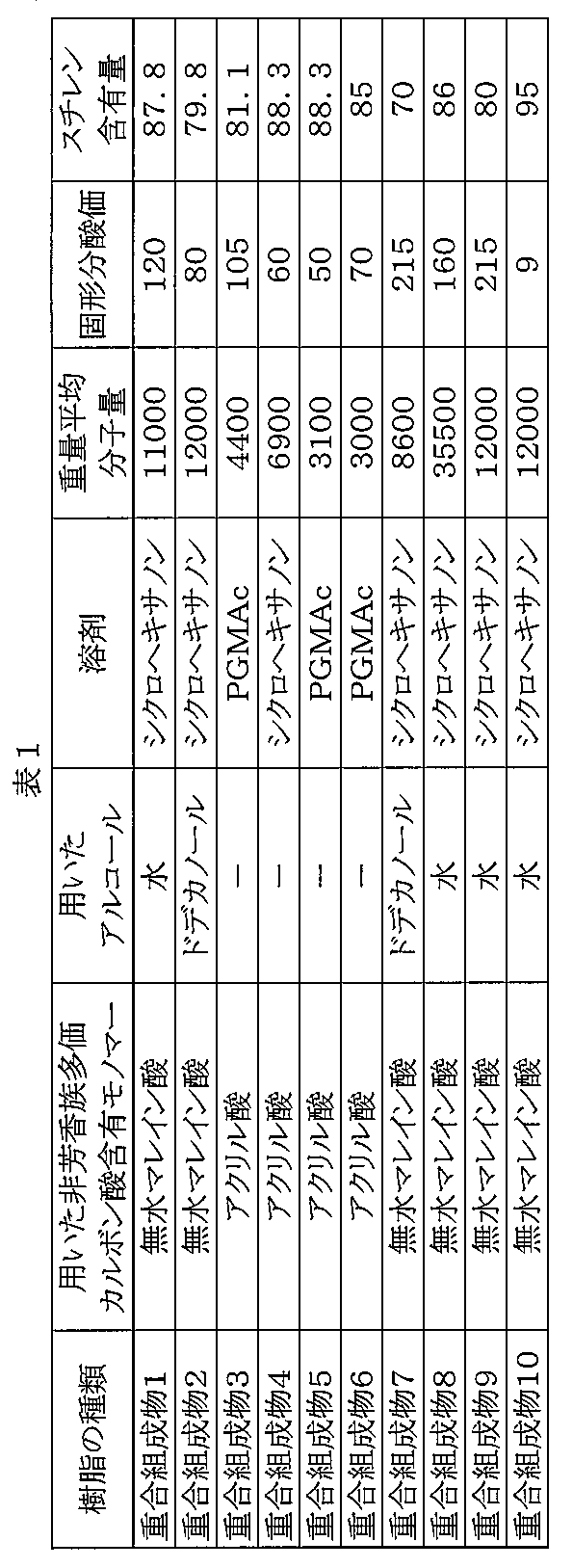
実施例および比較例で用いるアクリル樹脂を以下のように合成する。なお、アクリル樹脂の分子量は、GPC(ゲルパーミエーションクロマトグラフィ)により測定したポリスチレン換算の重量平均分子量である。
内容量が2リットルの5つ口反応容器内に、プロピレングリコールモノメチルエーテルアセテート800g、メタクリル酸10g、メチルメタクリレート40g、ブチルメタクリレート80g、ヒドロキシエチルメタクリレート40gおよびアゾビスイソブチロニトリル2gを加え、窒素ガスを吹き込みながら、80℃で6時間加熱し、アクリル樹脂1を得た。得られたアクリル樹脂1の重量平均分子量は40000であった。
メタクリル酸を40g用いた以外は合成例8と同様にしてアクリル樹脂2を得た。得られたアクリル樹脂2の重量平均分子量は40000であった。
内容量が2リットルの5つ口反応容器内に、プロピレングリコールモノメチルエーテルアセテート800g、メタクリル酸30g、ブチルメタクリレート70g、ヒドロキシエチルメタクリレート40g、pクミルフェノキシエチルメタクリレート60gおよびアゾビスイソブチロニトリル2gを加え、窒素ガスを吹き込みながら、80℃で6時間加熱し、アクリル樹脂3を得た。得られたアクリル樹脂3の重量平均分子量は30000であった。
メタクリル酸33gを用いた以外は合成例10と同様にしてアクリル樹脂4を得た。得られたアクリル樹脂4の重量平均分子量は30000であった。
内容量が2リットルの5つ口反応容器内に、プロピレングリコールモノメチルエーテルアセテート800g、メタクリル酸40g、ブチルメタクリレート40g、ヒドロキシエチルメタクリレート60g、pクミルフェノキシエチルメタクリレート60gおよびアゾビスイソブチロニトリル4gを加え、窒素ガスを吹き込みながら、80℃で6時間加熱し、アクリル樹脂を得た。このアクリル樹脂にさらにメタクリロイルオキシエチルイソシアネート45gを60℃で8時間反応させアクリル樹脂5を得た。このアクリル樹脂5の重量平均分子量は25000であった。
メタクリロイルオキシエチルイソシアネートを15g用いた以外は合成例10と同様にしてアクリル樹脂5を得た。このアクリル樹脂5の重量平均分子量は25000であった。それらの結果を下記表2に示す。
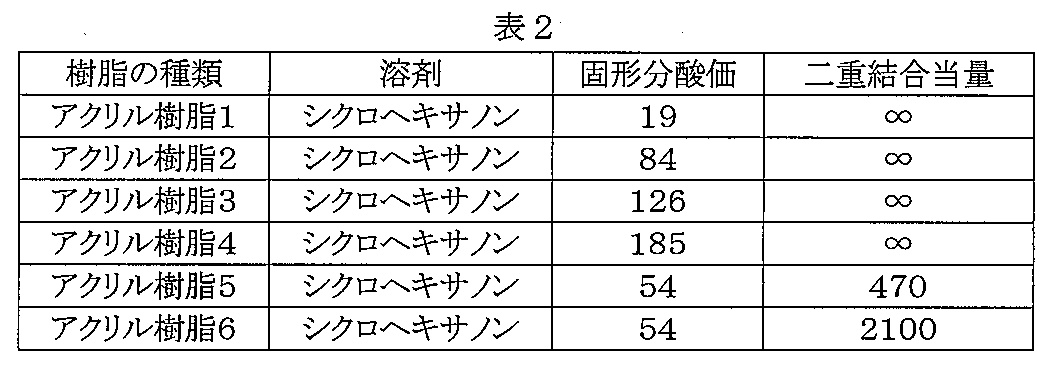
実施例および比較例で用いる顔料を以下のように合成する。
青色顔料1(C.I. Pigment Blue 15:6、東洋インキ製造社製「LIONOL BLUE ES」;B-1)200部、塩化ナトリウム1600部、およびジエチレングリコール(東京化成社製)100部をステンレス製1ガロンニーダー(井上製作所社製)に仕込み、70℃で12時間混練した。次に、この混合物を約5リットルの温水に投入し、約70℃に加熱しながらハイスピードミキサーで約1時間撹拌してスラリー状とした後、濾過、水洗して塩化ナトリウム及びジエチレングリコールを除き、80℃で24時間乾燥し、198部のソルトミリング処理顔料(青色顔料2)を得た。
紫色顔料1 300部を96%硫酸3000部に投入し1時間撹拌後、5℃の水に注入した。1時間撹拌後、濾過、温水で洗浄液が中性になるまで洗浄し、70℃で乾燥した。得られたアシッドペースティング処理顔料を120部、塩化ナトリウム1600部、およびジエチレングリコール(東京化成社製)100部をステンレス製1ガロンニーダー(井上製作所社製)に仕込み、90℃で18時間混練した。次に、この混合物を約5リットルの温水に投入し、約70℃に加熱しながらハイスピードミキサーで約1時間撹拌してスラリー状とした後、濾過、水洗して塩化ナトリウム及びジエチレングリコールを除き、80℃で24時間乾燥し、118部のソルトミリング処理顔料(紫色顔料2)を得た。
赤色顔料1(C.I. Pigment Red 254、チバ・スペシャルティ・ケミカルズ社製「IRGAPHOR RED B-CF」)136部、表2に示す分散剤A-1 24部、塩化ナトリウム1600部、およびジエチレングリコール(東京化成社製)190部をステンレス製1ガロンニーダー(井上製作所社製)に仕込み、60℃で8時間混練した。次に、この混合物を約5リットルの温水に投入し、約70℃に加熱しながらハイスピードミキサーで約1時間撹拌してスラリー状とした後、濾過、水洗して塩化ナトリウム及びジエチレングリコールを除き、80℃で24時間乾燥し、156部のソルトミリング処理顔料(赤色顔料2)を得た。
塩化アルミニウム356部および塩化ナトリウム6部の200℃の溶融塩に、亜鉛フタロシアニン46部を溶解し、130℃まで冷却し1時間攪拌した。反応温度を180℃に昇温し、臭素を1時間あたり10部で10時間滴下した。その後、塩素を1時間あたり0.8部で5時間導入した。この反応液を水3200部に徐々に注入したのち、濾過、水洗して107.8部の粗製ハロゲン化亜鉛フタロシアニン顔料を得た。粗製ハロゲン化亜鉛フタロシアニン顔料の1分子内に含まれる平均臭素数は14.1個、平均塩素数は1.9個であった。得られた粗製ハロゲン化亜鉛フタロシアニン顔料120部、粉砕した食塩1600部、およびジエチレングリコール270部をステンレス製1ガロンニーダー(井上製作所製)に仕込み、70℃で12時間混練した。この混合物を温水5000部に投入し、約70℃に加熱しながらハイスピードミキサーで約1時間攪拌してスラリー状とし、濾過、水洗をくりかえして食塩および溶剤を除いた後、80℃で24時間乾燥し、117部のソルトミリング処理顔料(緑色顔料1)を得た。
キノフタロン系黄色顔料PY138(BASF社製「パリオトールイエローK0961HD」)100部、色素誘導体(D-3)5部、粉砕した食塩750部、およびジエチレングリコール180部をステンレス製1ガロンニーダー(井上製作所製)に仕込み、60℃で6時間混練した。この混合物を温水3000部に投入し、約80℃に加熱しながらハイスピードミキサーで約1時間攪拌してスラリー状とし、濾過、水洗をくりかえして食塩および溶剤を除いた後、80℃で24時間乾燥し、100部のソルトミリング処理顔料(黄色顔料1)を得た。
下記の要領でカラーフィルタ作製に用いる青の着色組成物1を調製した。
下記組成の混合物を均一に攪拌混合した後、直径1mmのガラスビースを用いて、サンドミルで5時間分散した後、5μmのフィルタで濾過して青色顔料の分散体を作製した。
紫色顔料2 5.8部
分散剤
(味の素ファインテクノ社製「アジスパーPB821」) 1.8部
アクリル樹脂2(固形分20%) 36.5部
シクロヘキサノン 48部
その後、下記組成の混合物を均一になるように攪拌混合した後、5μmのフィルターで濾過して青色着色組成物1を得た。
重合組成物1 12部
アクリル樹脂5 4部
トリメチロールプロパントリアクリレート
(大阪有機化学工業(株)製ビスコート#295) 4.8部
光重合開始剤
(チバガイギー社製「イルガキュア-369」) 2.8部
光増感剤(保土ヶ谷化学社製「EAB-F」) 0.2部
シクロヘキサノン 34.2部
(実施例2~11、比較例1~9)
分散体中の顔料、分散体中及び着色組成物中に用いる樹脂に、下記表3に記載の樹脂を用いた以外は実施例1と同様にして、着色組成物2~20を得た。

[対向基板担持層用感光性樹脂組成物1の調製]
下記組成の混合物を均一になるように攪拌混合した後、5μmのフィルターで濾過して対向基板担持層作製に用いる感光性樹脂組成物1を調製した。
光重合性モノマー
(東亜合成社製「アロニックスM-402」) 2.4部
光重合開始剤
(チバガイギー社製「イルガキュア-907」) 2.8部
光増感剤
(日本化薬製「ジエチルチオキサントン-S」) 0.5部
光増感剤
(関東化学製「2-メルカプトベンゾチアゾール」) 0.5部
シクロヘキサノン 40.2部
(実施例13)
[セルギャップ制御用かさ上げ層用感光性樹脂組成物2の調製]
下記に示す組成の混合物を均一になるように攪拌混合した後、5μmのフィルターで濾過してセルギャップ制御用かさ上げ層作製に用いる感光性樹脂組成物2を調製した。
トリメチロールプロパントリアクリレート
(大阪有機化学工業(株)製 ビスコート#295) 4.8部
光重合性モノマー
(東亜合成社製「アロニックスM-402」) 2.4部
光重合開始剤
(チバガイギー社製「イルガキュア-907」) 2.8部
光増感剤(保土ヶ谷化学社製「EAB-F」) 0.2部
シクロヘキサノン 40.2部
(実施例14)
[位相差層用感光性樹脂組成物3の調製]
下記に示す組成の混合物を均一になるように攪拌混合した後、5μmのフィルターで濾過して位相差層作製に用いる感光性樹脂組成物3を調製した。
トリメチロールプロパントリアクリレート
(大阪有機化学工業(株)製 ビスコート#295) 4.8部
光重合性モノマー
(東亜合成社製「アロニックスM-402」) 2.4部
光重合開始剤
(チバガイギー社製「イルガキュア-907」) 2.8部
光増感剤(保土ヶ谷化学社製「EAB-F」) 0.2部
シクロヘキサノン 40.2部
(比較例10~12)
樹脂に重合組成物8を用いた以外は実施例12~14と同様にして感光性樹脂組成物4~6を得た。
緑色着色組成物を調製した翌日の初期粘度と、40℃で1週間、経時促進させた経時粘度を、E型粘度計(東機産業社製「ELD型粘度計」)を用いて、25℃において回転数20rpmという条件で測定した。この初期粘度および経時粘度の値から、下記式で経時粘度変化率を算出した。
長期保存安定性評価は、下記の基準で行なった。
△:経時粘度変化率が10%~20%
×:経時粘度変化率が20%を超える。
以下の手順で各色塗膜を作製し、厚み方向位相差値を測定した。
(式中、Nxは着色画素層の平面内のx方向の屈折率であり、Nyは着色画素層の平面内のy方向の屈折率であり、Nzは着色画素層の厚み方向の屈折率であり、NxをNx≧Nyとする遅相軸とする。dは着色画素層の厚み(nm)である。)
上記表3に示した各色着色組成物より作製された各色塗膜の厚み方向位相差値Rthを下記表4に示す。また、液晶表示装置に使用される位相差板、液晶材料の厚み方向位相差値Rthと、着色画素層の厚み方向位相差値Rthとの組み合わせにおいて、黒表示時での斜めから見たときの液晶表示装置の色付きが最も少なくなるようにした場合、着色画素層の厚み方向位相差値Rthは、それぞれ赤色画素で-10~2nm、緑色画素で-10~0nm、青色画素で-10~2nmであった。
透明基板上に形成された各色画素を2枚の偏光板の間に挟み、一方の偏光板側からバックライトを当てて、他方の偏光板を透過した光の輝度を輝度計にて測定し、偏光板が平行状態における光の輝度(Lp)と直交状態における光の輝度(Lc)の比よりコントラストC(=Lp/Lc)を算出した。
上記表3に示した各感光性着色組成物及びセルギャップ制御用かさ上げ層、及び位相差層用感光性樹脂組成物の感度を以下のようにして評価した。
△:飽和露光量が50を超え、100mJ/cm2以下である
×:飽和露光量が100mJ/cm2を超える。
各実施例及び比較例において調製した各感光性着色組成物及びセルギャップ制御用かさ上げ層、及び位相差層用感光性樹脂組成物について、そのパターニング性能を、以下のようにして評価を行った。
上記パターニング性評価と同様にして、ストライプパターンを形成したガラス基板を、下記条件下にさらし、その前後でのパターンの外観変化を光学顕微鏡にて観察した。
イソプロピルアルコール溶剤 浸漬 30分(同上)
γ-ブチロラクトン溶剤 浸漬 30分(同上)
下記の基準で耐性評価を行なった。
×:パターンハガレやカケ、クラックなどの不具合が見られる。

1.カラーフィルタの作製
上記表4に示した各色感光性着色組成物を組み合わせて、下記に示す方法により、カラーフィルタを作製した。
得られたカラーフィルタ上に、オーバーコート層を形成し、その上にポリイミド配向層を形成した。このガラス基板の他方の表面に偏光板を形成した。他方、別の(第2の)ガラス基板の一方の表面にTFTアレイおよび画素電極を形成し、他方の表面に偏光板を形成した。
感光性着色組成物として下記表5に記載の感光性着色組成物を用いた以外は実施例15と同様にしてカラーフィルタ2~4を得た。このカラーフィルタを用いて液晶表示装置を作製した。
分散体中の樹脂:アクリル樹脂2…36.5部
着色組成物中の樹脂:重合組成物4…4部
:アクリル樹脂6…12部
顔料組成比、分散剤量ほか組成比は、実施例1と同様とした。
黄色顔料1 ・・・5.4部
分散体中の樹脂 :アクリル樹脂2 …36.5部
着色組成物中の樹脂:アクリル樹脂6…16部
当着色組成物を塗膜としてガラス基板に2μm厚みに塗布し、緑色着色層として厚み方向位相差を測定したところ、そのRthは -13nmであった。
作製した液晶表示装置を黒表示させ、液晶パネルの法線方向(略垂直方向)および法線方向から45°傾けた方位(斜め)より漏れてくる光(直交透過光;漏れ光)の量を目視観察した。また黒表示時の略垂直方向から見たときの色度(u(⊥)、v(⊥))と表示面の法線方向から最大60°まで傾けた方位よりから見たときの色度(u(45)、v(45))をトプコン社製BM-5Aにて測定し、色差Δu’v’を算出し、0≦θ≦60°でのΔu’v’の最大値を求めた。
×:視認性評価の斜め色付きΔu’v’が0.02より大きい
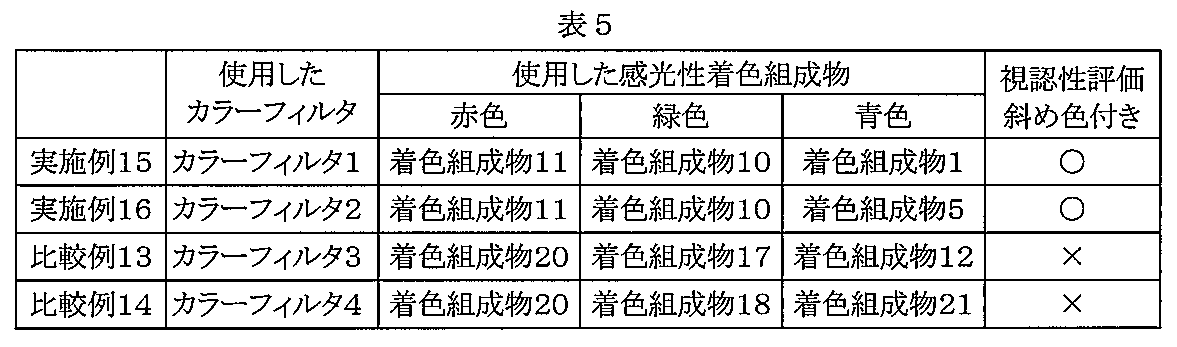

Claims (5)
- 透明基板と、この透明基板上に形成された複数色の着色層とを具備し、9000以上のカラーフィルタコントラストを有するカラーフィルタにおいて、前記着色層が、スチレンと不飽和カルボン酸含有モノマーとを共重合させることにより得られる重合組成物を含む着色樹脂組成物の硬化膜であり、かつ、前記重合組成物のスチレン含有量が75mol%以上95mol%未満であるともに、前記複数色の着色層のそれぞれの、下記式により表される厚み方向位相差Rthが、0ないし-10nmの範囲内にあることを特徴とする液晶表示装置用カラーフィルタ。
Rth={(Nx+Ny)/2-Nz}×d
(式中、Nxは着色画素層の平面内のx方向の屈折率、Nyは着色画素層の平面内のy方向の屈折率、Nzは着色画素層の厚み方向の屈折率を表す。ここで、NxはNx≧Nyとする遅相軸、dは着色画素層の厚み(nm)である。) - 前記着色樹脂組成物は、前記重合組成物とともに、更に光重合性モノマーと、光重合開始剤と、アクリル系樹脂と、有機顔料を含むことを特徴とする請求項1に記載の液晶表示装置用カラーフィルタ。
- 前記複数の着色層の一つが、緑色着色層であり、かつ、該緑色着色層に含まれる緑色顔料がハロゲン化亜鉛フタロシアニン顔料であることを特徴とする請求項1に記載の液晶表示装置用カラーフィルタ。
- 前記着色層が形成された基板上に形成された、対向基板担持層、セルギャップ制御用かさ上げ層、及び位相差層からなる群から選ばれた少なくとも1つを更に具備することを特徴とする請求項1に記載の液晶表示装置用カラーフィルタ。
- 請求項1~4のいずれかに記載のカラーフィルタを備え、色差Δu’v’が、0.02以下であることを特徴とする液晶表示装置。
Priority Applications (4)
| Application Number | Priority Date | Filing Date | Title |
|---|---|---|---|
| KR1020107018213A KR101200229B1 (ko) | 2008-12-18 | 2009-10-19 | 액정 표시 장치용 컬러 필터 및 액정 표시 장치 |
| CN2009801054769A CN101952750B (zh) | 2008-12-18 | 2009-10-19 | 液晶显示装置用滤色器及液晶显示装置 |
| JP2009545745A JP5037629B2 (ja) | 2008-12-18 | 2009-10-19 | 液晶表示装置用カラーフィルタ及び液晶表示装置 |
| US13/064,543 US8368851B2 (en) | 2008-12-18 | 2011-03-30 | Color filter for liquid crystal display device and liquid crystal display device |
Applications Claiming Priority (2)
| Application Number | Priority Date | Filing Date | Title |
|---|---|---|---|
| JP2008322530 | 2008-12-18 | ||
| JP2008-322530 | 2008-12-18 |
Related Child Applications (1)
| Application Number | Title | Priority Date | Filing Date |
|---|---|---|---|
| US13/064,543 Continuation US8368851B2 (en) | 2008-12-18 | 2011-03-30 | Color filter for liquid crystal display device and liquid crystal display device |
Publications (1)
| Publication Number | Publication Date |
|---|---|
| WO2010070978A1 true WO2010070978A1 (ja) | 2010-06-24 |
Family
ID=42268654
Family Applications (1)
| Application Number | Title | Priority Date | Filing Date |
|---|---|---|---|
| PCT/JP2009/068026 Ceased WO2010070978A1 (ja) | 2008-12-18 | 2009-10-19 | 液晶表示装置用カラーフィルタ及び液晶表示装置 |
Country Status (6)
| Country | Link |
|---|---|
| US (1) | US8368851B2 (ja) |
| JP (1) | JP5037629B2 (ja) |
| KR (1) | KR101200229B1 (ja) |
| CN (1) | CN101952750B (ja) |
| TW (1) | TWI428641B (ja) |
| WO (1) | WO2010070978A1 (ja) |
Cited By (1)
| Publication number | Priority date | Publication date | Assignee | Title |
|---|---|---|---|---|
| JP2014041301A (ja) * | 2012-08-23 | 2014-03-06 | Fujifilm Corp | 着色感放射線性組成物、これを用いたカラーフィルタ |
Families Citing this family (10)
| Publication number | Priority date | Publication date | Assignee | Title |
|---|---|---|---|---|
| TWI419097B (zh) * | 2011-01-11 | 2013-12-11 | E Ink Holdings Inc | 顯示器 |
| KR101384457B1 (ko) * | 2011-08-04 | 2014-04-14 | 주식회사 엘지화학 | 실란계 화합물 및 이를 포함하는 감광성 수지 조성물 |
| JP5360270B2 (ja) * | 2011-12-07 | 2013-12-04 | 凸版印刷株式会社 | 液晶表示装置 |
| JP6186702B2 (ja) * | 2011-12-14 | 2017-08-30 | 東洋インキScホールディングス株式会社 | カラーフィルタ用顔料分散体及びそれを用いた感光性着色組成物 |
| TWI474300B (zh) * | 2011-12-15 | 2015-02-21 | Innolux Corp | 彩色濾光片之製造方法及具有其之顯示裝置 |
| WO2013184136A1 (en) * | 2012-06-08 | 2013-12-12 | Empire Technology Development Llc | Multi-frequency filter arrays for low cost spectrometers |
| CN102830457B (zh) * | 2012-08-13 | 2015-08-26 | 深超光电(深圳)有限公司 | 一种彩色滤光片基板 |
| CN103739205B (zh) * | 2013-11-08 | 2017-06-13 | 北京京东方光电科技有限公司 | 功能材料及其制备方法、显示结构形成材料、彩膜基板、显示装置 |
| TWI704053B (zh) * | 2018-12-10 | 2020-09-11 | 財團法人紡織產業綜合研究所 | 電致發光纖維 |
| CN112698548B (zh) * | 2019-10-23 | 2023-12-08 | 乐凯华光印刷科技有限公司 | 一种长印程uv-ctp版及其制备方法和应用方法 |
Citations (4)
| Publication number | Priority date | Publication date | Assignee | Title |
|---|---|---|---|---|
| JP2006184427A (ja) * | 2004-12-27 | 2006-07-13 | Dainippon Ink & Chem Inc | カラーフィルター用緑色セミクルードの製造方法、緑色顔料組成物、およびそれらを緑色画素部に含有してなるカラーフィルター |
| JP2007108275A (ja) * | 2005-10-12 | 2007-04-26 | Toppan Printing Co Ltd | 感光性赤色着色組成物、それを用いたカラーフィルタ基板、および半透過型液晶表示装置 |
| JP2007171665A (ja) * | 2005-12-22 | 2007-07-05 | Fujifilm Corp | カラーフィルタ及びその製造方法、表示装置 |
| JP2008185984A (ja) * | 2007-01-31 | 2008-08-14 | Toppan Printing Co Ltd | カラーフィルタ、カラーフィルタ用着色組成物、および液晶表示装置 |
Family Cites Families (16)
| Publication number | Priority date | Publication date | Assignee | Title |
|---|---|---|---|---|
| JPH05196930A (ja) | 1992-01-21 | 1993-08-06 | Canon Inc | カラー表示素子 |
| JPH07209866A (ja) * | 1994-01-12 | 1995-08-11 | Fuji Photo Film Co Ltd | 光重合性組成物、それを用いたカラーフィルター及びその製造方法 |
| JPH11212263A (ja) * | 1997-10-02 | 1999-08-06 | Dainippon Printing Co Ltd | 感光性樹脂組成物 |
| JP2000187114A (ja) | 1998-12-22 | 2000-07-04 | Toray Ind Inc | カラーフィルターおよび液晶表示装置 |
| JP4482969B2 (ja) | 1998-08-28 | 2010-06-16 | 東レ株式会社 | 液晶表示装置用カラーフィルターおよび液晶表示装置 |
| US6720119B2 (en) * | 2000-07-27 | 2004-04-13 | Fuji Xerox Co., Ltd. | Method of fabricating high-dielectric color filter |
| KR100697584B1 (ko) * | 2001-09-25 | 2007-03-22 | 다이니폰 인사츠 가부시키가이샤 | 알칼리 가용성 말레이미드 공중합체 및 이를 함유하는액정 디스플레이 |
| JP3878451B2 (ja) * | 2001-10-22 | 2007-02-07 | 富士フイルムホールディングス株式会社 | 感光性樹脂転写材料、画像形成方法、カラーフィルターとその製造方法、フォトマスクとその製造方法 |
| JP4198363B2 (ja) * | 2002-01-29 | 2008-12-17 | 富士フイルム株式会社 | 反射型カラーフィルタ |
| JP4627224B2 (ja) * | 2005-06-28 | 2011-02-09 | 東京応化工業株式会社 | 顔料分散型感放射線樹脂組成物および着色パターンの形成方法 |
| JP4726130B2 (ja) | 2006-02-08 | 2011-07-20 | 日東電工株式会社 | 液晶表示装置 |
| JP2008020905A (ja) | 2006-06-13 | 2008-01-31 | Fujifilm Corp | 液晶表示装置 |
| JP2008040486A (ja) | 2006-07-11 | 2008-02-21 | Fujifilm Corp | カラーフィルタ、カラーフィルタの製造方法、及び液晶表示装置 |
| JP2008145868A (ja) | 2006-12-12 | 2008-06-26 | Fujifilm Corp | カラーフィルタ、及び液晶表示装置。 |
| JP5463911B2 (ja) * | 2007-11-29 | 2014-04-09 | 大日本印刷株式会社 | 有機el素子、カラーフィルター及び有機elディスプレイ |
| JP5463616B2 (ja) * | 2007-11-29 | 2014-04-09 | 大日本印刷株式会社 | 有機el素子、有機elディスプレイ及びカラーフィルター |
-
2009
- 2009-10-19 WO PCT/JP2009/068026 patent/WO2010070978A1/ja not_active Ceased
- 2009-10-19 JP JP2009545745A patent/JP5037629B2/ja not_active Expired - Fee Related
- 2009-10-19 KR KR1020107018213A patent/KR101200229B1/ko not_active Expired - Fee Related
- 2009-10-19 CN CN2009801054769A patent/CN101952750B/zh not_active Expired - Fee Related
- 2009-11-12 TW TW098138339A patent/TWI428641B/zh not_active IP Right Cessation
-
2011
- 2011-03-30 US US13/064,543 patent/US8368851B2/en not_active Expired - Fee Related
Patent Citations (4)
| Publication number | Priority date | Publication date | Assignee | Title |
|---|---|---|---|---|
| JP2006184427A (ja) * | 2004-12-27 | 2006-07-13 | Dainippon Ink & Chem Inc | カラーフィルター用緑色セミクルードの製造方法、緑色顔料組成物、およびそれらを緑色画素部に含有してなるカラーフィルター |
| JP2007108275A (ja) * | 2005-10-12 | 2007-04-26 | Toppan Printing Co Ltd | 感光性赤色着色組成物、それを用いたカラーフィルタ基板、および半透過型液晶表示装置 |
| JP2007171665A (ja) * | 2005-12-22 | 2007-07-05 | Fujifilm Corp | カラーフィルタ及びその製造方法、表示装置 |
| JP2008185984A (ja) * | 2007-01-31 | 2008-08-14 | Toppan Printing Co Ltd | カラーフィルタ、カラーフィルタ用着色組成物、および液晶表示装置 |
Cited By (1)
| Publication number | Priority date | Publication date | Assignee | Title |
|---|---|---|---|---|
| JP2014041301A (ja) * | 2012-08-23 | 2014-03-06 | Fujifilm Corp | 着色感放射線性組成物、これを用いたカラーフィルタ |
Also Published As
| Publication number | Publication date |
|---|---|
| TWI428641B (zh) | 2014-03-01 |
| KR101200229B1 (ko) | 2012-11-09 |
| JP5037629B2 (ja) | 2012-10-03 |
| US20110181818A1 (en) | 2011-07-28 |
| JPWO2010070978A1 (ja) | 2012-05-24 |
| KR20100113127A (ko) | 2010-10-20 |
| US8368851B2 (en) | 2013-02-05 |
| CN101952750A (zh) | 2011-01-19 |
| CN101952750B (zh) | 2012-05-30 |
| TW201027146A (en) | 2010-07-16 |
Similar Documents
| Publication | Publication Date | Title |
|---|---|---|
| JP5037629B2 (ja) | 液晶表示装置用カラーフィルタ及び液晶表示装置 | |
| JP5907064B2 (ja) | カラーフィルタ基板および液晶表示装置 | |
| CN101379427A (zh) | 带滤色器的液晶元件基板、液晶元件以及液晶显示装置 | |
| JP4905547B2 (ja) | カラーフィルタ基板および液晶表示装置 | |
| JP4964862B2 (ja) | 感光性樹脂組成物及びこの感光性樹脂組成物を用いたカラーフィルタ | |
| JP5498724B2 (ja) | カラーフィルタ、及び液晶表示装置 | |
| JP4465293B2 (ja) | カラーフィルタおよびこれを備えた液晶表示装置 | |
| JP2009084381A (ja) | 熱硬化性樹脂、これを含む感光性樹脂組成物、この感光性樹脂組成物を用いたカラーフィルタ、及びこのカラーフィルタを備える液晶表示装置 | |
| JP5128231B2 (ja) | 感光性着色組成物、これを用いたカラーフィルタ、及び液晶表示装置 | |
| JP2011112672A (ja) | カラーフィルタ用緑色顔料分散体の製造方法、該製造方法により製造されるカラーフィルタ用緑色顔料分散体、カラーフィルタ用緑色着色レジスト、着色層、カラーフィルタ、及び液晶表示装置 | |
| JP5099174B2 (ja) | 垂直配向液晶表示装置用カラーフィルタ基板および垂直配向液晶表示装置 | |
| JP5158133B2 (ja) | 垂直配向液晶表示装置用基板および垂直配向液晶表示装置 | |
| JP2009168836A (ja) | 感光性着色組成物、これを用いたカラーフィルタ、及び液晶表示装置 | |
| JP4905532B2 (ja) | 液晶表示装置用カラーフィルタ基板及び液晶表示装置 | |
| JP5343654B2 (ja) | 緑色着色組成物、それを用いたカラーフィルタおよび液晶表示装置 | |
| JP2009288609A (ja) | カラーフィルタおよび液晶表示装置 | |
| JP2011133577A (ja) | カラーフィルタ基板および液晶表示装置 | |
| JP5311013B2 (ja) | カラーフィルタ及び液晶表示装置 | |
| JP2009300564A (ja) | 感光性着色組成物、これを用いたカラーフィルタ及び液晶表示装置 | |
| JP2010152003A (ja) | 赤色着色組成物、赤色着色塗膜、それを用いたカラーフィルタ、及び液晶表示装置 |
Legal Events
| Date | Code | Title | Description |
|---|---|---|---|
| WWE | Wipo information: entry into national phase |
Ref document number: 200980105476.9 Country of ref document: CN |
|
| WWE | Wipo information: entry into national phase |
Ref document number: 2009545745 Country of ref document: JP |
|
| 121 | Ep: the epo has been informed by wipo that ep was designated in this application |
Ref document number: 09833283 Country of ref document: EP Kind code of ref document: A1 |
|
| ENP | Entry into the national phase |
Ref document number: 20107018213 Country of ref document: KR Kind code of ref document: A |
|
| NENP | Non-entry into the national phase |
Ref country code: DE |
|
| 122 | Ep: pct application non-entry in european phase |
Ref document number: 09833283 Country of ref document: EP Kind code of ref document: A1 |