WO2009128426A1 - 触媒及びその製造方法 - Google Patents
触媒及びその製造方法 Download PDFInfo
- Publication number
- WO2009128426A1 WO2009128426A1 PCT/JP2009/057451 JP2009057451W WO2009128426A1 WO 2009128426 A1 WO2009128426 A1 WO 2009128426A1 JP 2009057451 W JP2009057451 W JP 2009057451W WO 2009128426 A1 WO2009128426 A1 WO 2009128426A1
- Authority
- WO
- WIPO (PCT)
- Prior art keywords
- catalyst
- slurry
- metallosilicate
- producing
- raw material
- Prior art date
- Legal status (The legal status is an assumption and is not a legal conclusion. Google has not performed a legal analysis and makes no representation as to the accuracy of the status listed.)
- Ceased
Links
Images

Classifications
-
- F—MECHANICAL ENGINEERING; LIGHTING; HEATING; WEAPONS; BLASTING
- F26—DRYING
- F26B—DRYING SOLID MATERIALS OR OBJECTS BY REMOVING LIQUID THEREFROM
- F26B3/00—Drying solid materials or objects by processes involving the application of heat
- F26B3/02—Drying solid materials or objects by processes involving the application of heat by convection, i.e. heat being conveyed from a heat source to the materials or objects to be dried by a gas or vapour, e.g. air
- F26B3/10—Drying solid materials or objects by processes involving the application of heat by convection, i.e. heat being conveyed from a heat source to the materials or objects to be dried by a gas or vapour, e.g. air the gas or vapour carrying the materials or objects to be dried with it
- F26B3/12—Drying solid materials or objects by processes involving the application of heat by convection, i.e. heat being conveyed from a heat source to the materials or objects to be dried by a gas or vapour, e.g. air the gas or vapour carrying the materials or objects to be dried with it in the form of a spray, i.e. sprayed or dispersed emulsions or suspensions
-
- B—PERFORMING OPERATIONS; TRANSPORTING
- B01—PHYSICAL OR CHEMICAL PROCESSES OR APPARATUS IN GENERAL
- B01J—CHEMICAL OR PHYSICAL PROCESSES, e.g. CATALYSIS OR COLLOID CHEMISTRY; THEIR RELEVANT APPARATUS
- B01J29/00—Catalysts comprising molecular sieves
- B01J29/04—Catalysts comprising molecular sieves having base-exchange properties, e.g. crystalline zeolites
- B01J29/06—Crystalline aluminosilicate zeolites; Isomorphous compounds thereof
- B01J29/076—Crystalline aluminosilicate zeolites; Isomorphous compounds thereof containing arsenic, antimony, bismuth, vanadium, niobium, tantalum, polonium, chromium, molybdenum, tungsten, manganese, technetium or rhenium
-
- B—PERFORMING OPERATIONS; TRANSPORTING
- B01—PHYSICAL OR CHEMICAL PROCESSES OR APPARATUS IN GENERAL
- B01J—CHEMICAL OR PHYSICAL PROCESSES, e.g. CATALYSIS OR COLLOID CHEMISTRY; THEIR RELEVANT APPARATUS
- B01J29/00—Catalysts comprising molecular sieves
- B01J29/04—Catalysts comprising molecular sieves having base-exchange properties, e.g. crystalline zeolites
- B01J29/06—Crystalline aluminosilicate zeolites; Isomorphous compounds thereof
- B01J29/40—Crystalline aluminosilicate zeolites; Isomorphous compounds thereof of the pentasil type, e.g. types ZSM-5, ZSM-8 or ZSM-11, as exemplified by patent documents US3702886, GB1334243 and US3709979, respectively
- B01J29/48—Crystalline aluminosilicate zeolites; Isomorphous compounds thereof of the pentasil type, e.g. types ZSM-5, ZSM-8 or ZSM-11, as exemplified by patent documents US3702886, GB1334243 and US3709979, respectively containing arsenic, antimony, bismuth, vanadium, niobium tantalum, polonium, chromium, molybdenum, tungsten, manganese, technetium or rhenium
-
- B—PERFORMING OPERATIONS; TRANSPORTING
- B01—PHYSICAL OR CHEMICAL PROCESSES OR APPARATUS IN GENERAL
- B01J—CHEMICAL OR PHYSICAL PROCESSES, e.g. CATALYSIS OR COLLOID CHEMISTRY; THEIR RELEVANT APPARATUS
- B01J35/00—Catalysts, in general, characterised by their form or physical properties
- B01J35/30—Catalysts, in general, characterised by their form or physical properties characterised by their physical properties
- B01J35/34—Mechanical properties
- B01J35/37—Crush or impact strength
-
- B—PERFORMING OPERATIONS; TRANSPORTING
- B01—PHYSICAL OR CHEMICAL PROCESSES OR APPARATUS IN GENERAL
- B01J—CHEMICAL OR PHYSICAL PROCESSES, e.g. CATALYSIS OR COLLOID CHEMISTRY; THEIR RELEVANT APPARATUS
- B01J35/00—Catalysts, in general, characterised by their form or physical properties
- B01J35/40—Catalysts, in general, characterised by their form or physical properties characterised by dimensions, e.g. grain size
- B01J35/45—Nanoparticles
-
- B—PERFORMING OPERATIONS; TRANSPORTING
- B01—PHYSICAL OR CHEMICAL PROCESSES OR APPARATUS IN GENERAL
- B01J—CHEMICAL OR PHYSICAL PROCESSES, e.g. CATALYSIS OR COLLOID CHEMISTRY; THEIR RELEVANT APPARATUS
- B01J35/00—Catalysts, in general, characterised by their form or physical properties
- B01J35/70—Catalysts, in general, characterised by their form or physical properties characterised by their crystalline properties, e.g. semi-crystalline
- B01J35/77—Compounds characterised by their crystallite size
-
- B—PERFORMING OPERATIONS; TRANSPORTING
- B01—PHYSICAL OR CHEMICAL PROCESSES OR APPARATUS IN GENERAL
- B01J—CHEMICAL OR PHYSICAL PROCESSES, e.g. CATALYSIS OR COLLOID CHEMISTRY; THEIR RELEVANT APPARATUS
- B01J37/00—Processes, in general, for preparing catalysts; Processes, in general, for activation of catalysts
- B01J37/0009—Use of binding agents; Moulding; Pressing; Powdering; Granulating; Addition of materials ameliorating the mechanical properties of the product catalyst
- B01J37/0027—Powdering
- B01J37/0036—Grinding
-
- B—PERFORMING OPERATIONS; TRANSPORTING
- B01—PHYSICAL OR CHEMICAL PROCESSES OR APPARATUS IN GENERAL
- B01J—CHEMICAL OR PHYSICAL PROCESSES, e.g. CATALYSIS OR COLLOID CHEMISTRY; THEIR RELEVANT APPARATUS
- B01J37/00—Processes, in general, for preparing catalysts; Processes, in general, for activation of catalysts
- B01J37/0009—Use of binding agents; Moulding; Pressing; Powdering; Granulating; Addition of materials ameliorating the mechanical properties of the product catalyst
- B01J37/0027—Powdering
- B01J37/0045—Drying a slurry, e.g. spray drying
-
- C—CHEMISTRY; METALLURGY
- C07—ORGANIC CHEMISTRY
- C07B—GENERAL METHODS OF ORGANIC CHEMISTRY; APPARATUS THEREFOR
- C07B61/00—Other general methods
-
- C—CHEMISTRY; METALLURGY
- C07—ORGANIC CHEMISTRY
- C07C—ACYCLIC OR CARBOCYCLIC COMPOUNDS
- C07C15/00—Cyclic hydrocarbons containing only six-membered aromatic rings as cyclic parts
-
- C—CHEMISTRY; METALLURGY
- C07—ORGANIC CHEMISTRY
- C07C—ACYCLIC OR CARBOCYCLIC COMPOUNDS
- C07C2/00—Preparation of hydrocarbons from hydrocarbons containing a smaller number of carbon atoms
- C07C2/76—Preparation of hydrocarbons from hydrocarbons containing a smaller number of carbon atoms by condensation of hydrocarbons with partial elimination of hydrogen
-
- B—PERFORMING OPERATIONS; TRANSPORTING
- B01—PHYSICAL OR CHEMICAL PROCESSES OR APPARATUS IN GENERAL
- B01J—CHEMICAL OR PHYSICAL PROCESSES, e.g. CATALYSIS OR COLLOID CHEMISTRY; THEIR RELEVANT APPARATUS
- B01J2229/00—Aspects of molecular sieve catalysts not covered by B01J29/00
- B01J2229/10—After treatment, characterised by the effect to be obtained
- B01J2229/18—After treatment, characterised by the effect to be obtained to introduce other elements into or onto the molecular sieve itself
- B01J2229/186—After treatment, characterised by the effect to be obtained to introduce other elements into or onto the molecular sieve itself not in framework positions
-
- B—PERFORMING OPERATIONS; TRANSPORTING
- B01—PHYSICAL OR CHEMICAL PROCESSES OR APPARATUS IN GENERAL
- B01J—CHEMICAL OR PHYSICAL PROCESSES, e.g. CATALYSIS OR COLLOID CHEMISTRY; THEIR RELEVANT APPARATUS
- B01J2235/00—Indexing scheme associated with group B01J35/00, related to the analysis techniques used to determine the catalysts form or properties
- B01J2235/30—Scanning electron microscopy; Transmission electron microscopy
-
- B—PERFORMING OPERATIONS; TRANSPORTING
- B01—PHYSICAL OR CHEMICAL PROCESSES OR APPARATUS IN GENERAL
- B01J—CHEMICAL OR PHYSICAL PROCESSES, e.g. CATALYSIS OR COLLOID CHEMISTRY; THEIR RELEVANT APPARATUS
- B01J29/00—Catalysts comprising molecular sieves
- B01J29/04—Catalysts comprising molecular sieves having base-exchange properties, e.g. crystalline zeolites
- B01J29/06—Crystalline aluminosilicate zeolites; Isomorphous compounds thereof
- B01J29/08—Crystalline aluminosilicate zeolites; Isomorphous compounds thereof of the faujasite type, e.g. type X or Y
- B01J29/16—Crystalline aluminosilicate zeolites; Isomorphous compounds thereof of the faujasite type, e.g. type X or Y containing arsenic, antimony, bismuth, vanadium, niobium, tantalum, polonium, chromium, molybdenum, tungsten, manganese, technetium or rhenium
-
- B—PERFORMING OPERATIONS; TRANSPORTING
- B01—PHYSICAL OR CHEMICAL PROCESSES OR APPARATUS IN GENERAL
- B01J—CHEMICAL OR PHYSICAL PROCESSES, e.g. CATALYSIS OR COLLOID CHEMISTRY; THEIR RELEVANT APPARATUS
- B01J29/00—Catalysts comprising molecular sieves
- B01J29/04—Catalysts comprising molecular sieves having base-exchange properties, e.g. crystalline zeolites
- B01J29/06—Crystalline aluminosilicate zeolites; Isomorphous compounds thereof
- B01J29/70—Crystalline aluminosilicate zeolites; Isomorphous compounds thereof of types characterised by their specific structure not provided for in groups B01J29/08 - B01J29/65
- B01J29/78—Crystalline aluminosilicate zeolites; Isomorphous compounds thereof of types characterised by their specific structure not provided for in groups B01J29/08 - B01J29/65 containing arsenic, antimony, bismuth, vanadium, niobium, tantalum, polonium, chromium, molybdenum, tungsten, manganese, technetium or rhenium
-
- C—CHEMISTRY; METALLURGY
- C07—ORGANIC CHEMISTRY
- C07C—ACYCLIC OR CARBOCYCLIC COMPOUNDS
- C07C2521/00—Catalysts comprising the elements, oxides or hydroxides of magnesium, boron, aluminium, carbon, silicon, titanium, zirconium or hafnium
- C07C2521/06—Silicon, titanium, zirconium or hafnium; Oxides or hydroxides thereof
- C07C2521/08—Silica
-
- C—CHEMISTRY; METALLURGY
- C07—ORGANIC CHEMISTRY
- C07C—ACYCLIC OR CARBOCYCLIC COMPOUNDS
- C07C2521/00—Catalysts comprising the elements, oxides or hydroxides of magnesium, boron, aluminium, carbon, silicon, titanium, zirconium or hafnium
- C07C2521/12—Silica and alumina
-
- C—CHEMISTRY; METALLURGY
- C07—ORGANIC CHEMISTRY
- C07C—ACYCLIC OR CARBOCYCLIC COMPOUNDS
- C07C2523/00—Catalysts comprising metals or metal oxides or hydroxides, not provided for in group C07C2521/00
- C07C2523/16—Catalysts comprising metals or metal oxides or hydroxides, not provided for in group C07C2521/00 of arsenic, antimony, bismuth, vanadium, niobium, tantalum, polonium, chromium, molybdenum, tungsten, manganese, technetium or rhenium
- C07C2523/20—Vanadium, niobium or tantalum
- C07C2523/22—Vanadium
-
- C—CHEMISTRY; METALLURGY
- C07—ORGANIC CHEMISTRY
- C07C—ACYCLIC OR CARBOCYCLIC COMPOUNDS
- C07C2523/00—Catalysts comprising metals or metal oxides or hydroxides, not provided for in group C07C2521/00
- C07C2523/16—Catalysts comprising metals or metal oxides or hydroxides, not provided for in group C07C2521/00 of arsenic, antimony, bismuth, vanadium, niobium, tantalum, polonium, chromium, molybdenum, tungsten, manganese, technetium or rhenium
- C07C2523/24—Chromium, molybdenum or tungsten
- C07C2523/26—Chromium
-
- C—CHEMISTRY; METALLURGY
- C07—ORGANIC CHEMISTRY
- C07C—ACYCLIC OR CARBOCYCLIC COMPOUNDS
- C07C2523/00—Catalysts comprising metals or metal oxides or hydroxides, not provided for in group C07C2521/00
- C07C2523/16—Catalysts comprising metals or metal oxides or hydroxides, not provided for in group C07C2521/00 of arsenic, antimony, bismuth, vanadium, niobium, tantalum, polonium, chromium, molybdenum, tungsten, manganese, technetium or rhenium
- C07C2523/24—Chromium, molybdenum or tungsten
- C07C2523/28—Molybdenum
-
- C—CHEMISTRY; METALLURGY
- C07—ORGANIC CHEMISTRY
- C07C—ACYCLIC OR CARBOCYCLIC COMPOUNDS
- C07C2523/00—Catalysts comprising metals or metal oxides or hydroxides, not provided for in group C07C2521/00
- C07C2523/16—Catalysts comprising metals or metal oxides or hydroxides, not provided for in group C07C2521/00 of arsenic, antimony, bismuth, vanadium, niobium, tantalum, polonium, chromium, molybdenum, tungsten, manganese, technetium or rhenium
- C07C2523/24—Chromium, molybdenum or tungsten
- C07C2523/30—Tungsten
-
- C—CHEMISTRY; METALLURGY
- C07—ORGANIC CHEMISTRY
- C07C—ACYCLIC OR CARBOCYCLIC COMPOUNDS
- C07C2523/00—Catalysts comprising metals or metal oxides or hydroxides, not provided for in group C07C2521/00
- C07C2523/16—Catalysts comprising metals or metal oxides or hydroxides, not provided for in group C07C2521/00 of arsenic, antimony, bismuth, vanadium, niobium, tantalum, polonium, chromium, molybdenum, tungsten, manganese, technetium or rhenium
- C07C2523/32—Manganese, technetium or rhenium
- C07C2523/36—Rhenium
-
- C—CHEMISTRY; METALLURGY
- C07—ORGANIC CHEMISTRY
- C07C—ACYCLIC OR CARBOCYCLIC COMPOUNDS
- C07C2529/00—Catalysts comprising molecular sieves
- C07C2529/04—Catalysts comprising molecular sieves having base-exchange properties, e.g. crystalline zeolites, pillared clays
- C07C2529/06—Crystalline aluminosilicate zeolites; Isomorphous compounds thereof
- C07C2529/08—Crystalline aluminosilicate zeolites; Isomorphous compounds thereof of the faujasite type, e.g. type X or Y
-
- C—CHEMISTRY; METALLURGY
- C07—ORGANIC CHEMISTRY
- C07C—ACYCLIC OR CARBOCYCLIC COMPOUNDS
- C07C2529/00—Catalysts comprising molecular sieves
- C07C2529/04—Catalysts comprising molecular sieves having base-exchange properties, e.g. crystalline zeolites, pillared clays
- C07C2529/06—Crystalline aluminosilicate zeolites; Isomorphous compounds thereof
- C07C2529/40—Crystalline aluminosilicate zeolites; Isomorphous compounds thereof of the pentasil type, e.g. types ZSM-5, ZSM-8 or ZSM-11
-
- C—CHEMISTRY; METALLURGY
- C07—ORGANIC CHEMISTRY
- C07C—ACYCLIC OR CARBOCYCLIC COMPOUNDS
- C07C2529/00—Catalysts comprising molecular sieves
- C07C2529/82—Phosphates
- C07C2529/83—Aluminophosphates (APO compounds)
-
- C—CHEMISTRY; METALLURGY
- C07—ORGANIC CHEMISTRY
- C07C—ACYCLIC OR CARBOCYCLIC COMPOUNDS
- C07C2529/00—Catalysts comprising molecular sieves
- C07C2529/89—Silicates, aluminosilicates or borosilicates of titanium, zirconium or hafnium
-
- Y—GENERAL TAGGING OF NEW TECHNOLOGICAL DEVELOPMENTS; GENERAL TAGGING OF CROSS-SECTIONAL TECHNOLOGIES SPANNING OVER SEVERAL SECTIONS OF THE IPC; TECHNICAL SUBJECTS COVERED BY FORMER USPC CROSS-REFERENCE ART COLLECTIONS [XRACs] AND DIGESTS
- Y02—TECHNOLOGIES OR APPLICATIONS FOR MITIGATION OR ADAPTATION AGAINST CLIMATE CHANGE
- Y02P—CLIMATE CHANGE MITIGATION TECHNOLOGIES IN THE PRODUCTION OR PROCESSING OF GOODS
- Y02P20/00—Technologies relating to chemical industry
- Y02P20/50—Improvements relating to the production of bulk chemicals
Definitions
- This invention relates to advanced utilization of natural gas, biogas, and methane hydrate mainly composed of methane.
- Natural gas, biogas, and methane hydrate are considered to be the most effective energy resources as a countermeasure against global warming, and interest in utilization technology is increasing. Taking advantage of its cleanliness, methane resources are attracting attention as the next generation of new organic resources and hydrogen resources for fuel cells.
- the present invention relates to a catalytic chemical conversion technique and a catalyst production method for efficiently producing an aromatic compound mainly composed of benzene and naphthalene as raw materials for chemical products such as plastics and high-purity hydrogen gas from methane.
- Non-patent Document 1 Patent Document 1
- Patent Document 2 Patent Document 2
- carbon deposition is large and catalyst performance deteriorates in a short time due to carbon deposition and that the conversion rate of methane is low.
- the ratio of the catalyst component present in the particles from the viewpoint of wear resistance and impact resistance is 50% or less, which is inferior to the fixed-bed pellet type with mechanical strength adjustment. Further, since the catalyst is deactivated in a short time, it is essential to regenerate the catalyst.
- Pellet-type molded products require materials other than the catalyst required at the time of molding, such as organic binders, inorganic binders, glass fibers, pore formers, etc., and consider the effects of these additives on the catalyst. There is a need to.
- the particle size is as small as several tens to several hundreds of microns, and there is an advantage that the contact efficiency with the reaction gas is increased. It is an absolute requirement to have excellent heat resistance and thermal shock resistance.
- a large number of binders must be mixed or coated on the granulated material in addition to the catalyst material.
- a catalyst granule having a temporary spherical shape can be obtained, but it is easily broken by operation such as transportation and vibration.
- a suitable binder must be incorporated.
- a catalyst production method for solving the above problems is a catalyst production method for producing an aromatic compound and hydrogen from lower hydrocarbons, and is a catalyst obtained by refining a metallosilicate-containing raw material with a bead mill The slurry containing the powder is dried by a spray drying method to obtain a granulated body of the catalyst.
- the catalyst for solving the above problems is a catalyst formed by the above production method.
- the metallosilicate-containing raw material includes a metallosilicate having substantially 4.5 to 6.5 angstrom pores.
- the metallosilicate raw material may be refined by a bead mill so that the particle size of the metallosilicate is 50 ⁇ m or less and 1.0 ⁇ m or less.
- the metallosilicate may carry at least one metal component selected from rhenium, vanadium, molybdenum, tungsten, chromium and compounds thereof.
- the supported amount of molybdenum is preferably 2 to 12% by weight with respect to the total amount of the catalyst powder.
- the slurry may be dried by spray drying after aging. Examples of the aging include standing in an air atmosphere at normal temperature and pressure.
- the metal component may be supported on the metallosilicate by adding the metal component to the slurry. Furthermore, you may add polyvinyl alcohol (henceforth PVA) to the said slurry.
- the method for producing a catalyst according to the above invention it is possible to provide a catalyst in which the effective area of the crystal surface portion of the catalyst is increased and the crushing strength of the catalyst granule is improved without using a binder.
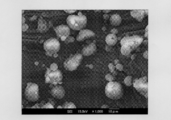
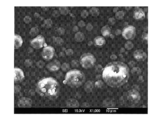
- the SEM photograph of the granulated body of Example 1 (acceleration voltage 15.0 kV, magnification 1000 times).
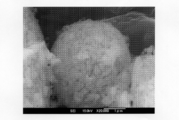
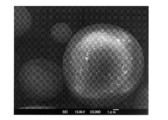
- the SEM photograph of the granulated body of Example 1 (acceleration voltage 15.0 kV, magnification 20000 times).
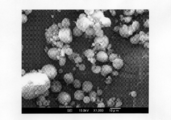
- the SEM photograph of the granulated body of Example 2 (acceleration voltage 15.0 kV, magnification 1000 times).
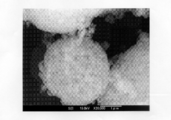
- the SEM photograph of the granulated body of Example 2 (acceleration voltage 15.0 kV, magnification 20000 times).
- the SEM photograph of the granulated body of Example 4 (acceleration voltage 15.0 kV, magnification 1000 times).
- the SEM photograph of the granulated body of Example 4 (acceleration voltage 15.0 kV, magnification 5000 times).
- the SEM photograph of the granulated body of Example 5 (acceleration voltage 15.0 kV, magnification 5500 times).
- a metallosilicate-containing raw material is refined and highly dispersed by a bead mill, and is converted into a granulated body by spray drying immediately after slurry preparation or after aging for a certain period of time.
- the aging may be performed by allowing the slurry to stand under an air atmosphere at normal temperature and pressure.
- the metallosilicate-containing raw material contains at least one metal component selected from rhenium, vanadium, molybdenum, tungsten, chromium and compounds thereof as a catalyst material, and is substantially as a carrier supporting this catalyst material. Includes metallosilicates having pores with a diameter of 4.5 to 6.5 angstroms.
- the metallosilicate is exemplified in Japanese Patent Application Laid-Open No. 2004-97891.
- the metallosilicate for example, in the case of aluminosilicate, the molecular sieve 5A, which is composed of silica and alumina, and is a porous body, faujasite (NaY and NaX), ZSM-5, MCM- 22 is mentioned.
- the molecular sieve 5A which is composed of silica and alumina, and is a porous body, faujasite (NaY and NaX), ZSM-5, MCM- 22 is mentioned.
- it is a porous body mainly composed of phosphoric acid, and is composed of a zeolite carrier characterized by 6 to 13 angstrom micropores and channels such as ALPO-5, VPI-5, etc., and partly composed mainly of silica.
- Examples include mesoporous porous carriers such as FSM-16 and MCM-41 characterized by cylindrical pores (channels) having mesopores (10 to 1000 angstroms) containing alumina as a component. Furthermore, in addition to the alumina silicate, a metallosilicate composed of silica and titania can be used as a catalyst.
- PVA may be added to the slurry.
- a granulated product obtained by drying a slurry containing catalyst powder refined by a bead mill by spray drying is fired, gas is generated in the granulated body at the time of firing, and spherical particles are ruptured. A phenomenon occurs in which particles are defective. Therefore, when PVA is added, many fine holes can be formed in the granulated body by vaporizing and removing PVA during firing. The sudden escape can be prevented by preventing the gas from escaping from the pores, so that no defect can occur.
- the amount of PVA added is preferably 0.1 to 1% by weight based on the metallosilicate in the slurry.
- the mixing ratio is not limited to this, and it is preferable to adjust appropriately according to the physical properties of the metallosilicate to be used.
- the slurry viscosity is preferably 100 cps or less.
- the catalyst powder When the catalyst powder and water are mixed, the catalyst powder is adjusted to about 0.4 to 1 kg / min and charged in a state where all the water is previously charged in the mixer and stirred. If it is earlier, the catalyst powder aggregates and settles in the mixer, which is not preferable.
- a mixer whose blade shape and rotation speed can be arbitrarily set is used.
- the wing shape and the number of rotations are not limited.
- ⁇ ⁇ Zirconia is preferable for the grinding beads used in the bead mill.
- the metallosilicate raw material may be refined by a bead mill so that the particle size of the metallosilicate is 50 ⁇ m or less and 1.0 ⁇ m or less. For example, in the case of a ZSM-5 raw material having an average particle diameter of 42 ⁇ m, it can be refined to 0.3 ⁇ m in one hour of pulverization time.
- the slurry obtained by refining the catalyst powder is recovered by switching the supply line from the closed system to the open system.
- the slurry prepared in (3) is preferably dried and granulated directly by a spray drying apparatus or used after aging for a certain time (for example, 6 days).
- the type of the spray dryer is not particularly limited, but the downward spray co-current system is preferable.
- the nozzle is preferably a two-fluid nozzle system, and the orifice diameter is preferably changed as appropriate depending on the viscosity of the slurry and the particle shape of the catalyst powder.
- the operating conditions of the spray dryer are appropriately adjusted depending on the slurry viscosity and the particle size of the catalyst powder in the slurry. The operating conditions are not particularly limited.
- the effective area of the crystal surface of the catalyst is increased by refining the nano-sized catalyst powder, and the crushing strength of the catalyst granule is improved without adding a binder.
- Catalyst can be provided. Therefore, it is possible to easily produce spherical particles that were difficult with the rolling granulation method.
- the inorganic binder is unnecessary or significantly reduced, and the metal is easily supported on the catalyst powder contained in the granulated body.
- Comparative Example 1 As the catalyst powder according to Comparative Example 1, proton type ZSM-5, which is a kind of metallosilicate having an average particle diameter of 31 ⁇ m and a crystal diameter of 0.08 ⁇ m, was used. The particle diameter and crystal diameter were measured by calculating the average value of particles arbitrarily selected from an electron micrograph. The slurry was prepared using purified water as a solvent so that the solid content concentration of the catalyst powder raw material was 20% by weight.
- the slurry was stirred for 1 hour and then granulated by a spray drying apparatus (manufactured by Yamato Kagaku Co., Ltd., model DL-41).
- the operating conditions were set to an inlet temperature of 230 to 240 ° C. and an outlet temperature of 90 ° C., followed by drying and granulation with a dry air amount of 0.8 m 3 / min, a nozzle spray air pressure of 0.1 MPa, and a slurry feed rate of 20 g / min.
- the obtained granule was dried in air at 120 ° C. for 20 hours.
- Example 1 As the catalyst powder according to Example 1, one kind of metallosilicate ZSM-5 having an average particle diameter of 42 ⁇ m and a crystal diameter of 5 ⁇ m was used.
- the catalyst powder raw material was ammonia type, and it was calcined at a predetermined temperature and converted to proton type. Metal loading was not performed for ZSM-5 used in this example.
- Example 2 As the catalyst powder according to Example 2, one kind of metallosilicate ZSM-5 having an average particle diameter of 39 ⁇ m and a crystal diameter of 4.2 ⁇ m was used. The subsequent preparation conditions are the same as in Example 1. Further, changes in the particle size distribution of the catalyst powder refined by the bead mill are shown in Table 2, and an SEM photograph of the granulated material by a spray drying apparatus (manufactured by Yamato Kagaku Co., Ltd., model DL-41) is shown in FIG. Although not disclosed in Table 3, it was confirmed that the crushing strength of the granulated material according to Example 2 was almost equal to the crushing strength of the granulated material according to Example 1.
- the catalyst powder contained in the granulated body of Example 1 is refined and the area of the crystal surface is increased, the contact efficiency with the reaction gas is increased, and the granulated body of Example 1 can be used under high flow conditions such as a fluidized bed process. It has been shown that it can contribute to the reaction as an efficient catalyst granulation. It has also been confirmed that the crushing strength can be obtained if the metallosilicate raw material is refined by a bead mill so that the particle size of the metallosilicate is 50 ⁇ % or less and 1.0 ⁇ m or less, particularly 0.5 ⁇ m or less.
- Example 3 As the catalyst powder according to Example 3, one kind of metallosilicate ZSM-5 having an average particle diameter of 42 ⁇ m and a crystal diameter of 5 ⁇ m was used.
- the catalyst powder raw material was ammonia type, and it was calcined at a predetermined temperature and converted to proton type. Metal loading was not performed for ZSM-5 used in this example.
- the previously prepared slurry was aged for 5 days. In the aging, the slurry was allowed to stand under an air atmosphere at normal temperature and pressure. Then, it stirred with the stirring container. After setting the inlet temperature to 230 to 240 ° C. and the outlet temperature to 90 ° C., spray drying equipment (Yamato Scientific Co., Ltd.) under the conditions of a dry air flow rate of 0.8 m 3 / min, a nozzle spray air pressure of 0.1 MPa, and a slurry feed rate of 20 g / min. Drying and granulation were started by company-made model DL-41). The obtained granulated body was dried in air at 120 ° C. for 20 hours. Then, it baked at 550 degreeC for 5 hours.
- the crushing strength of 15 granulated bodies was measured with the measuring method based on JISZ8841. The measurement results are shown in Table 4.
- the average crushing strength of the granulated body was 60.8 gf / mm 2 or less.
- the fluidity of the granulated material was based on a bulk density measurement method (obtaining a fluidity index from the manner of reducing bulk by tapping) in accordance with JIS Z2504 and JIS R6126. It measured based on the Kawakami-type tap density measuring method. The measurement results are shown in Table 5. The Kawakami liquidity index indicates that the smaller the value, the better the fluidity. The fluidity index of the granulation was 0.38.
- Example 4 In the catalyst powder according to Example 4, molybdenum is supported as a metal component on the metasilicate.
- the manufacturing method of the catalyst of a present Example is the same as the manufacturing method of the catalyst which concerns on Example 3 except having a procedure which impregnates and carries a metal component on the catalyst powder refined
- the slurry prepared above is set at an inlet temperature of 230 to 240 ° C. and an outlet temperature of 90 ° C., and then spray-dried under the conditions of a dry air flow rate of 0.8 m 3 / min, a nozzle spray air pressure of 0.1 MPa, and a slurry feed rate of 20 g / min. Drying and granulation were started by an apparatus (manufactured by Yamato Scientific Co., Ltd., model DL-41). The obtained granulated body was dried in air at 120 ° C. for 20 hours. Then, it baked at 550 degreeC for 5 hours.
- the results of the crushing strength (10-point average value) of the granulated material are shown in Table 4, and the results of the fluidity index are shown in Table 5.
- the crushing strength and fluidity index were measured in the same manner as in Example 3.
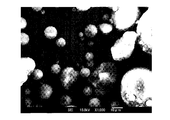
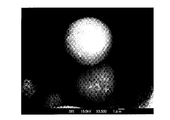
- the SEM photograph of the granulated body after baking is shown in FIG. 5 (1000 times magnification) and FIG. 6 (5000 times magnification).
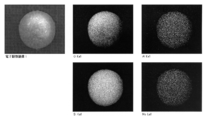
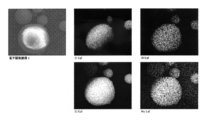
- SEM photographs showing the distribution of elements (O, Al, Si, Mo) on the surface of the granulated body are shown in FIG. 7 (magnification 1000 times) and FIG. 8 (magnification 10000 times).
- Example 5 The method for producing the catalyst of this example is the same as the method for producing the catalyst according to Example 4 except that the method further includes adding a PVA aqueous solution to the slurry charged with the aqueous ammonium molybdate solution.
- the results of the crushing strength (10-point average value) of the granulated material are shown in Table 4, and the results of the fluidity index are shown in Table 5.
- the crushing strength and fluidity index were measured in the same manner as in Example 3.
- the SEM photograph of the granulated body after baking was shown in FIG. 9 (1000 times magnification) and FIG. 10 (5500 times magnification).
- the SEM photograph (10,000 times magnification) which showed distribution of the element (O, Al, Si, Mo) in the surface of a granule was shown in FIG.
- Example 4 From the results of Table 4, the granule of Example 4 obtained by impregnating and supporting molybdenum in the slurry, spray drying and firing, rather than spray drying and firing the nano-sized raw material slurry as in Example 3. It can be seen that has a high crushing strength. Furthermore, it turns out that the granulated body of Example 5 obtained by adding PVA, spray drying, and baking has higher crushing strength.
- Example 4 a dense and spherical granulated body is obtained as shown in FIGS. Furthermore, according to the catalyst manufacturing method according to Example 5 to which PVA was added, it was confirmed that a granulated body having few defects (dents) was obtained as shown in FIGS. Since the catalyst powder in the granulated body increases the area of the crystal surface by miniaturization, the contact efficiency with the reaction gas increases, and the catalyst is efficient even for reactions under high flow rate conditions such as a fluidized bed process. It can contribute as a granulated body.
- the photograph “O Ka1” indicates the distribution of oxygen.
- the photograph of “Al Ka1” shows the distribution of aluminum.
- the photograph of “Si Ka1” shows the distribution of silicon.
- the photograph “Mo La1” shows the distribution of molybdenum.
- the white part of the photo shows the distribution of elements. According to the above photograph, it can be confirmed that the metal element components (Al, Mo) are supported in a uniformly distributed state on the surface of the granulated body.
- the main components of the zeolite used in the examples are AlO 3 and SiO 2 , and the SiO 2 / Al 2 O 3 ratio of the main raw material is 40, so it is confirmed that Si is densely distributed on one side. it can.
- the effective area of the crystal surface portion of the catalyst increases due to the refinement of the nano-sized catalyst powder by the bead mill. Further, it becomes possible to easily produce spherical particles, which was difficult with the rolling granulation method. Furthermore, an inorganic binder is unnecessary or can be greatly reduced. And the metal component illustrated by molybdenum is added to the slurry containing the refined catalyst powder so that the catalyst powder is impregnated with the metal component so that the catalyst powder contained in the granule is uniform. Metal loading becomes easy. Furthermore, the fluidity of the granulated body can be improved. Furthermore, the crushing strength of the granulated body is increased. In particular, the crushing strength can be further increased by adding PVA.
Landscapes
- Chemical & Material Sciences (AREA)
- Organic Chemistry (AREA)
- Engineering & Computer Science (AREA)
- Materials Engineering (AREA)
- Chemical Kinetics & Catalysis (AREA)
- Crystallography & Structural Chemistry (AREA)
- Life Sciences & Earth Sciences (AREA)
- Microbiology (AREA)
- Mechanical Engineering (AREA)
- General Engineering & Computer Science (AREA)
- Catalysts (AREA)
- Organic Low-Molecular-Weight Compounds And Preparation Thereof (AREA)
Priority Applications (3)
| Application Number | Priority Date | Filing Date | Title |
|---|---|---|---|
| CN200980113678.8A CN102006934B (zh) | 2008-04-18 | 2009-04-13 | 催化剂及其制备方法 |
| US12/988,072 US9052139B2 (en) | 2008-04-18 | 2009-04-13 | Catalyst and process for producing the same |
| GB201019375A GB2471639C (en) | 2008-04-18 | 2009-04-13 | Catalyst and process for producing the same |
Applications Claiming Priority (4)
| Application Number | Priority Date | Filing Date | Title |
|---|---|---|---|
| JP2008108713 | 2008-04-18 | ||
| JP2008-108713 | 2008-04-18 | ||
| JP2009038276A JP5736633B2 (ja) | 2008-04-18 | 2009-02-20 | 触媒及びその製造方法 |
| JP2009-038276 | 2009-02-20 |
Publications (2)
| Publication Number | Publication Date |
|---|---|
| WO2009128426A1 true WO2009128426A1 (ja) | 2009-10-22 |
| WO2009128426A9 WO2009128426A9 (ja) | 2009-12-23 |
Family
ID=41199117
Family Applications (1)
| Application Number | Title | Priority Date | Filing Date |
|---|---|---|---|
| PCT/JP2009/057451 Ceased WO2009128426A1 (ja) | 2008-04-18 | 2009-04-13 | 触媒及びその製造方法 |
Country Status (5)
| Country | Link |
|---|---|
| US (1) | US9052139B2 (enExample) |
| JP (1) | JP5736633B2 (enExample) |
| CN (1) | CN102006934B (enExample) |
| GB (1) | GB2471639C (enExample) |
| WO (1) | WO2009128426A1 (enExample) |
Families Citing this family (3)
| Publication number | Priority date | Publication date | Assignee | Title |
|---|---|---|---|---|
| JP2015124094A (ja) * | 2013-12-25 | 2015-07-06 | ユニオン昭和株式会社 | ゼオライト微粒粉末の製造方法及びゼオライト微粒粉末 |
| CN108479858A (zh) * | 2018-04-27 | 2018-09-04 | 陕西延长石油(集团)有限责任公司研究院 | 一种提高分子筛催化剂强度的无粘结剂喷雾成型工艺 |
| CN112058302B (zh) * | 2020-10-26 | 2023-02-28 | 陕西延长石油(集团)有限责任公司 | 一种zsm-5分子筛催化剂的制备方法及其应用 |
Citations (5)
| Publication number | Priority date | Publication date | Assignee | Title |
|---|---|---|---|---|
| JPH01236947A (ja) * | 1988-03-18 | 1989-09-21 | Satoyuki Inui | 複合金属メタロシリケート触媒およびこれを使用する低級パラフィン系炭化水素からの芳香族炭化水素の製法 |
| JP2003026613A (ja) * | 2001-07-12 | 2003-01-29 | National Institute Of Advanced Industrial & Technology | 低級炭化水素から芳香族炭化水素と水素を製造する方法 |
| JP2004521070A (ja) * | 2000-07-27 | 2004-07-15 | コノコ・インコーポレーテツド | メタンから芳香族炭化水素生成のための触媒及びプロセス |
| WO2005028105A1 (ja) * | 2003-09-17 | 2005-03-31 | Kabushiki Kaisha Meidensha | 低級炭化水素の芳香族化触媒とその製造方法並びに芳香族化合物と水素の製造方法 |
| JP2007527937A (ja) * | 2004-03-08 | 2007-10-04 | 中国石油化工股▲分▼有限公司 | 低級オレフィンおよび芳香族炭化水素の製造方法 |
Family Cites Families (25)
| Publication number | Priority date | Publication date | Assignee | Title |
|---|---|---|---|---|
| US4196102A (en) * | 1975-12-09 | 1980-04-01 | Chiyoda Chemical Engineering & Construction Co., Ltd. | Catalysts for demetallization treatment of _hydrocarbons supported on sepiolite |
| JPS61266306A (ja) * | 1985-05-18 | 1986-11-26 | Agency Of Ind Science & Technol | 結晶性アルミノケイ酸塩の微小球状粒子及びその製造方法 |
| US5011667A (en) * | 1988-09-08 | 1991-04-30 | Engelhard Corporation | Self-bound sodium chabazite aggregates and methods for preparation thereof |
| US4975180A (en) * | 1989-06-05 | 1990-12-04 | Exxon Research And Engineering Company | Cracking process |
| US5552361A (en) * | 1993-11-04 | 1996-09-03 | W. R. Grace & Co.-Conn. | Aluminum phosphate composition with high pore volume and large pore diameter, process for its production and use thereof |
| US5369071A (en) * | 1992-12-11 | 1994-11-29 | Mobil Oil Corporation | Manufacture of improved catalyst |
| US5403799A (en) * | 1992-12-21 | 1995-04-04 | W. R. Grace & Co.-Conn. | Process upset-resistant inorganic supports for bioremediation |
| JP3755955B2 (ja) * | 1997-03-19 | 2006-03-15 | 市川 勝 | 低級炭化水素の芳香族化触媒及び該触媒を用いた芳香族化合物の製造方法 |
| JP3745885B2 (ja) * | 1997-08-21 | 2006-02-15 | 市川 勝 | メタンを原料とする芳香族化合物の製造方法 |
| JP3927704B2 (ja) * | 1997-10-15 | 2007-06-13 | 中国石油化工集団公司 | 軽質オレフィンの生産のための接触式熱分解プロセスのための触媒およびその調製 |
| US6313061B1 (en) * | 1998-12-22 | 2001-11-06 | W. R. Grace & Co.-Conn. | Method of making frangible spray dried agglomerated supports and olefin polymerization catalysts supported thereon |
| US20020049133A1 (en) * | 1999-03-02 | 2002-04-25 | Michael S. Ziebarth | High zeolite content and attrition resistant catalyst, methods for preparing the same and catalyzed processes therewith |
| CN1248994C (zh) * | 2001-07-02 | 2006-04-05 | 埃克森美孚化学专利公司 | 在烯烃生产中抑制催化剂焦炭形成 |
| US6964934B2 (en) * | 2002-08-28 | 2005-11-15 | Albemarle Netherlands B.V. | Process for the preparation of doped pentasil-type zeolite using doped seeds |
| US6864202B2 (en) * | 2002-09-16 | 2005-03-08 | Indian Oil Corporation Limited | Process for preparing sodium silicate alkali solution depleted of sodium salt and enriched in silica |
| US7179766B2 (en) * | 2002-12-19 | 2007-02-20 | Sud-Chemie Inc. | Method and apparatus for production of enrobed catalyst pastilles or flakes |
| US20050146066A1 (en) * | 2003-04-28 | 2005-07-07 | Masafumi Koide | Porous ceramic and method for production thereof |
| TWI259106B (en) * | 2003-06-30 | 2006-08-01 | China Petrochemical Technology | Catalyst conversion process for increasing yield of light olefins |
| US7241713B2 (en) * | 2003-10-02 | 2007-07-10 | Exxonmobil Chemical Patents Inc. | Molecular sieve catalyst composition, its making and use in conversion processes |
| JP4677194B2 (ja) * | 2004-03-11 | 2011-04-27 | 勝 市川 | 触媒を用いた低級炭化水素の転化方法 |
| JP4335061B2 (ja) * | 2004-04-19 | 2009-09-30 | ジェイエフイーホールディングス株式会社 | スラリー床反応用触媒の製造方法 |
| US20060183626A1 (en) * | 2005-02-11 | 2006-08-17 | Cavalcanti Fernando Antonio Pe | Process for preparing catalysts and catalysts produced therefrom |
| JP4790356B2 (ja) * | 2005-09-16 | 2011-10-12 | 勝 市川 | 低級炭化水素改質触媒 |
| US7981834B2 (en) * | 2006-03-16 | 2011-07-19 | Ict Co., Ltd. | Adsorbent for hydrocarbons, catalyst for exhaust gas purification and method for exhaust gas purification |
| WO2007123808A1 (en) * | 2006-04-21 | 2007-11-01 | Exxonmobil Chemical Patents Inc. | Process for methane conversion |
-
2009
- 2009-02-20 JP JP2009038276A patent/JP5736633B2/ja active Active
- 2009-04-13 WO PCT/JP2009/057451 patent/WO2009128426A1/ja not_active Ceased
- 2009-04-13 CN CN200980113678.8A patent/CN102006934B/zh not_active Expired - Fee Related
- 2009-04-13 US US12/988,072 patent/US9052139B2/en active Active
- 2009-04-13 GB GB201019375A patent/GB2471639C/en not_active Expired - Fee Related
Patent Citations (5)
| Publication number | Priority date | Publication date | Assignee | Title |
|---|---|---|---|---|
| JPH01236947A (ja) * | 1988-03-18 | 1989-09-21 | Satoyuki Inui | 複合金属メタロシリケート触媒およびこれを使用する低級パラフィン系炭化水素からの芳香族炭化水素の製法 |
| JP2004521070A (ja) * | 2000-07-27 | 2004-07-15 | コノコ・インコーポレーテツド | メタンから芳香族炭化水素生成のための触媒及びプロセス |
| JP2003026613A (ja) * | 2001-07-12 | 2003-01-29 | National Institute Of Advanced Industrial & Technology | 低級炭化水素から芳香族炭化水素と水素を製造する方法 |
| WO2005028105A1 (ja) * | 2003-09-17 | 2005-03-31 | Kabushiki Kaisha Meidensha | 低級炭化水素の芳香族化触媒とその製造方法並びに芳香族化合物と水素の製造方法 |
| JP2007527937A (ja) * | 2004-03-08 | 2007-10-04 | 中国石油化工股▲分▼有限公司 | 低級オレフィンおよび芳香族炭化水素の製造方法 |
Also Published As
| Publication number | Publication date |
|---|---|
| JP2009274061A (ja) | 2009-11-26 |
| CN102006934A (zh) | 2011-04-06 |
| JP5736633B2 (ja) | 2015-06-17 |
| US9052139B2 (en) | 2015-06-09 |
| GB2471639C (en) | 2012-08-01 |
| CN102006934B (zh) | 2014-07-30 |
| WO2009128426A9 (ja) | 2009-12-23 |
| US20110034321A1 (en) | 2011-02-10 |
| GB2471639B (en) | 2012-05-30 |
| GB201019375D0 (en) | 2010-12-29 |
| GB2471639A (en) | 2011-01-05 |
Similar Documents
| Publication | Publication Date | Title |
|---|---|---|
| CN102046288B (zh) | 含沸石催化剂及其制造方法以及丙烯的制造方法 | |
| JP5544089B2 (ja) | シリカ成形体の製造方法 | |
| CN114025875A (zh) | 用于热解油改质的中孔沸石多功能催化剂的制备方法 | |
| CN105016955A (zh) | 制造丙烯的方法 | |
| CN101254472A (zh) | 一种复合分子筛基贵金属柴油深度加氢脱芳催化剂及其制备方法 | |
| KR20190023054A (ko) | Zsm-5-계 촉매 제조; 에틸벤젠 탈알킬화 공정에서의 용도 | |
| CN110860309B (zh) | 一种亚纳米级金属钴颗粒@分子筛的双能催化剂及其制备方法 | |
| CN102794193B (zh) | 一种微孔分子筛外表面修饰的方法 | |
| EA024080B1 (ru) | Способ получения связанного с кремнием псевдоожиженного катализатора, получаемый им гранулированный псевдоожиженный катализатор, его применение для неокислительной дегидроароматизации c-c-алифатических соединений и способ неокислительной дегидроароматизации c-c-алифатических соединений | |
| JP5427795B2 (ja) | 成形シリカリッチ体の製造 | |
| JP5736633B2 (ja) | 触媒及びその製造方法 | |
| CN102553637A (zh) | 一种中油型加氢裂化催化剂及其制备和应用 | |
| Naresh et al. | Nanocrystallite zeolite BEA for regioselective and continuous acetyl functionalization of anisole using acetic anhydride: catalyst deactivation studies | |
| CN117563625A (zh) | 一种钴系碳纳米管催化剂其制备方法及应用 | |
| CN110038631A (zh) | 一种甲醇制烯烃催化剂细粉的回用方法 | |
| CN106694028A (zh) | 一种制备低碳烯烃和芳烃的催化剂及其制备方法和应用 | |
| KR102494221B1 (ko) | 유동층 반응 기반 선택적 경질 올레핀 생산용 촉매, 이의 제조 방법 및 이를 이용하여 경질 올레핀을 제조하는 방법 | |
| JP4541688B2 (ja) | イソパラフィン−オレフィンアルキル化法 | |
| Li et al. | The synthesis of core-shell encapsulated metal catalysts for conversion of methanol to aromatics | |
| CN102223952A (zh) | 低级烃芳构化催化剂的制备方法和低级烃芳构化催化剂 | |
| CN103372423B (zh) | 一种劣质重油的接触裂化催化剂及其制备方法 | |
| CN1966147A (zh) | 一种生产苯、甲苯和二甲苯并联产低碳烯烃的催化剂 | |
| CN108187736B (zh) | 具有核壳结构的三水铝石@sapo分子筛复合物及制备方法和在催化甲醇制烯烃中的应用 | |
| CN105521819B (zh) | 石脑油催化裂解产丙烯的催化剂及其制备方法和石脑油催化裂解产丙烯的方法 | |
| FR3116818A1 (fr) | Procede d’hydrogenolyse selective de charges comportant des composes aromatiques c8+ mettant en œuvre un catalyseur a structure zeolithique |
Legal Events
| Date | Code | Title | Description |
|---|---|---|---|
| WWE | Wipo information: entry into national phase |
Ref document number: 200980113678.8 Country of ref document: CN |
|
| 121 | Ep: the epo has been informed by wipo that ep was designated in this application |
Ref document number: 09732101 Country of ref document: EP Kind code of ref document: A1 |
|
| WWE | Wipo information: entry into national phase |
Ref document number: 12988072 Country of ref document: US |
|
| NENP | Non-entry into the national phase |
Ref country code: DE |
|
| ENP | Entry into the national phase |
Ref document number: 1019375 Country of ref document: GB Kind code of ref document: A Free format text: PCT FILING DATE = 20090413 |
|
| WWE | Wipo information: entry into national phase |
Ref document number: 1019375.3 Country of ref document: GB |
|
| 122 | Ep: pct application non-entry in european phase |
Ref document number: 09732101 Country of ref document: EP Kind code of ref document: A1 |