US7168403B2 - Valve train device for engine - Google Patents
Valve train device for engine Download PDFInfo
- Publication number
- US7168403B2 US7168403B2 US11/263,573 US26357305A US7168403B2 US 7168403 B2 US7168403 B2 US 7168403B2 US 26357305 A US26357305 A US 26357305A US 7168403 B2 US7168403 B2 US 7168403B2
- Authority
- US
- United States
- Prior art keywords
- valve
- arm
- rocker arm
- swing
- drive member
- Prior art date
- Legal status (The legal status is an assumption and is not a legal conclusion. Google has not performed a legal analysis and makes no representation as to the accuracy of the status listed.)
- Expired - Lifetime
Links
Images




Classifications
-
- F—MECHANICAL ENGINEERING; LIGHTING; HEATING; WEAPONS; BLASTING
- F01—MACHINES OR ENGINES IN GENERAL; ENGINE PLANTS IN GENERAL; STEAM ENGINES
- F01L—CYCLICALLY OPERATING VALVES FOR MACHINES OR ENGINES
- F01L1/00—Valve-gear or valve arrangements, e.g. lift-valve gear
- F01L1/02—Valve drive
- F01L1/04—Valve drive by means of cams, camshafts, cam discs, eccentrics or the like
- F01L1/08—Shape of cams
-
- F—MECHANICAL ENGINEERING; LIGHTING; HEATING; WEAPONS; BLASTING
- F01—MACHINES OR ENGINES IN GENERAL; ENGINE PLANTS IN GENERAL; STEAM ENGINES
- F01L—CYCLICALLY OPERATING VALVES FOR MACHINES OR ENGINES
- F01L1/00—Valve-gear or valve arrangements, e.g. lift-valve gear
- F01L1/12—Transmitting gear between valve drive and valve
- F01L1/18—Rocking arms or levers
- F01L1/185—Overhead end-pivot rocking arms
-
- F—MECHANICAL ENGINEERING; LIGHTING; HEATING; WEAPONS; BLASTING
- F01—MACHINES OR ENGINES IN GENERAL; ENGINE PLANTS IN GENERAL; STEAM ENGINES
- F01L—CYCLICALLY OPERATING VALVES FOR MACHINES OR ENGINES
- F01L13/00—Modifications of valve-gear to facilitate reversing, braking, starting, changing compression ratio, or other specific operations
- F01L13/0015—Modifications of valve-gear to facilitate reversing, braking, starting, changing compression ratio, or other specific operations for optimising engine performances by modifying valve lift according to various working parameters, e.g. rotational speed, load, torque
- F01L13/0063—Modifications of valve-gear to facilitate reversing, braking, starting, changing compression ratio, or other specific operations for optimising engine performances by modifying valve lift according to various working parameters, e.g. rotational speed, load, torque by modification of cam contact point by displacing an intermediate lever or wedge-shaped intermediate element, e.g. Tourtelot
-
- F—MECHANICAL ENGINEERING; LIGHTING; HEATING; WEAPONS; BLASTING
- F01—MACHINES OR ENGINES IN GENERAL; ENGINE PLANTS IN GENERAL; STEAM ENGINES
- F01L—CYCLICALLY OPERATING VALVES FOR MACHINES OR ENGINES
- F01L2305/00—Valve arrangements comprising rollers
Definitions
- This invention relates to a valve train device for an engine and, more particularly, to a valve train device which can continuously change valve opening duration and/or the amount of valve lift.
- valve train device that is capable of continuously changing intake valve opening duration and/or the amount of valve lift.
- An example of such a valve train device comprises a camshaft, which drives an intake valve to open and close through a rocker arm, a swing arm that is driven to swing by the camshaft and a control arm that is interposed between a swing cam surface of the swing arm and a rocker-side depressed surface of the rocker arm.
- the valve opening duration and the amount of valve lift is continuously varied by continuously changing a point of the control arm that comes into contact with the swing cam surface and a point of the control arm that comes into contact with the depressed surface of the rocker arm (See e.g., JP-A-Sho 59-500002).
- the device includes the rocker arm, the swing arm and the control arm.
- the contact point between the control arm and the swing cam surface, as well as the contact point between the control arm and the rocker-side depressed surface is displaced to vary the valve lift and valve lift duration. While effective, there is a concern that the size of the overall device might increase depending on the features of the components determined to rigidly secure the device and on the layout of such components.
- an object of an embodiment of the present invention to provide a valve train device for an engine capable of rigidly securing the components as well a providing a compact arrangement.
- one embodiment of the present invention comprises a valve train device for an engine for driving a valve which opens and closes a valve opening of a combustion chamber.
- the device comprises a valve drive device and drive force transmission mechanism.
- the drive force transmission mechanism is configured to transmit a driving force from the drive member to the valve.
- the drive force transmission mechanism comprises a transmission portion configured to transmit the driving force from the drive member to the valve and a variable portion configured to continuously change a state of the transmission portion to thereby continuously change an opening duration of the valve or the amount of valve lift. At least part of the variable portion is positioned within in the transmission portion.
- FIG. 1 is a sectional side view of a valve train device for an engine according to a first embodiment of the present invention.
- FIG. 2 is an exploded perspective view of a control arm, rocker arm and rocker shaft of the first embodiment.
- FIG. 3 is a sectional side view for describing the forces incurred in the first embodiment.
- FIG. 4 is a sectional side view of a valve train device for an engine according to a second embodiment of the present invention.
- FIG. 5 is a front perspective view of the second embodiment.
- FIG. 6 is a front perspective view of the second embodiment in which a camshaft of the second embodiment is removed.
- FIG. 7 is a front perspective view of a swing member of the second embodiment.
- FIG. 8 is a sectional side view of a valve train device for an engine according to a third embodiment of the present invention.
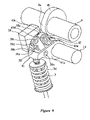
- FIG. 9 is a front perspective view of the third embodiment.
- FIG. 10 is a front perspective view of the third embodiment in which a camshaft and stationary cam of the third embodiment are removed.
- FIG. 11 is a rear perspective view of the third embodiment in which the camshaft and stationary cam of the third embodiment are removed.
- FIG. 12 is a rear perspective view of a rocker arm of the third embodiment.
- FIG. 13 is a sectional side view of a valve train device for an engine according to a fourth embodiment of the present invention.
- FIG. 14 is a sectional side view of a valve train device for an engine according to a fifth embodiment of the present invention.
- FIG. 15 is a sectional side view of a valve train device for an engine according to the above fifth embodiment.
- FIGS. 1 to 3 describe a first embodiment of the invention.
- FIG. 1 is a sectional side view of a valve train device according to this embodiment.
- FIG. 2 is a perspective view of several parts of the valve train device.
- FIG. 3 is a view for describing transfer efficiency of a force F in this embodiment.
- reference numeral 1 denotes a valve device for opening and closing valve openings formed in a combustion chamber.
- an engine can be provided with two intake and exhaust valves. However, in this Figure, only a portion of an intake valve side is shown.
- a combustion recess 2 a is provided on the mating face of a cylinder head 2 of the engine with the cylinder body.
- the combustion recess 2 a forms a top ceiling of a combustion chamber.
- the combustion recess 2 a includes left and right intake valve openings 2 b .
- Each intake valve opening 2 b is merged with a bifurcated intake port 2 c and led to an external connection opening of an engine wall.
- Each intake valve opening 2 b is opened and closed through a valve head 3 a of an intake valve 3 .
- the intake valve 3 is constantly urged with a valve spring or biasing member (not shown) in closing direction.
- a valve train device 7 is disposed generally above the intake valve 3 .
- the valve train device 7 is configured to drive the intake valve 3 to open and close by transmitting a driving force from an intake camshaft (driving member) 8 to the intake valve 3 via a driving force transmission mechanism.
- the driving force transmission mechanism includes a transmitting portion for transmitting the driving force from the intake camshaft 8 to the intake valve 3 , and a variable portion for continuously changing the state of the transmitting portion transmitting the driving force, thereby continuously changing an opening duration of the valve 3 and the amount of valve lift.
- the driving force transmission mechanism is configured such that: the intake camshaft 8 causes a first swing arm 9 to swing or pivot, the swing arm 9 causes a first rocker arm 11 to swing pivot through a first control arm 10 , and the swing or pivoting motion of the first rocker arm 11 causes the intake valve 3 to proceed and retract in the axial direction, and thus the intake valve opening 2 b is opened and closed.
- Causing the first control arm 10 to proceed and retract can continuously vary a contact point between the first control arm 10 and the first swing arm 9 and a contact point between the first control arm 10 and the first rocker arm 11 , thereby continuously changing the opening duration of the intake valve 3 and the amount of valve lift.
- the intake camshaft 8 is arranged in parallel with a crankshaft (not shown) and supported to be rotatable and immobile in the direction perpendicular to the intake camshaft and in the axial direction through a cam journal portion formed on the cylinder head 2 and a cam cap provided on an upper mating face of the journal portion.
- the intake camshaft 8 is formed with a single cam nose 8 c common to the left and right intake valves, including a base circle portion 8 a having a uniform diameter, and a lift portion 8 b having a specified cam profile.
- Each cylinder is preferably provided with a single cam nose.
- the first swing arm 9 includes a pair of left and right swing arm portions 9 a , 9 a , a swing cam surface (i.e., a first swing cam surface) 9 b , a roller shaft 9 c , and a swing roller 9 d .
- the pair of swing arm portions 9 a , 9 a are supported for free swinging or pivotal movement with a swing support shaft 12 , which is preferably arranged in parallel with the intake camshaft 8 and is immobile in the direction perpendicular to the swing shaft and in the axial direction.
- the swing cam surface 9 b is formed integrally with a coupling portion for coupling the distal ends (lower ends) of the swing arm portions 9 a .
- the roller shaft 9 c is arranged in parallel with the swing shaft 12 and passes through the midsection between the left and right swing arm portions 9 a , 9 a .
- the swing roller 9 d is rotatably supported with the roller shaft 9 c and located between the left and right swing arm portions 9 a , 9 a.
- the proximal ends (upper ends) of the swing arm portions 9 a are supported with the swing support shaft 12 for free swinging or pivoting movement.
- the swing support shaft 12 is provided with a pair of left and right balance springs 13 as coil springs.
- Each balance spring 13 has an end 13 a retained to a position of the swing arm portion 9 a between the swing shaft 12 and the roller shaft 9 c , and the other end 13 b of each balance spring is retained to the cylinder head 2 .
- the balance spring 13 urges the first swing arm 9 clockwise of FIG.
- the swing cam surface 9 b is generally in the shape of a plate having a curved surface in a base circle portion 9 e and a lift portion 9 f which are connected to each other continuously.
- the first swing arm 9 is provided so that the base circle portion 9 e is positioned nearer to a rocker shaft 14 and the lift portion 9 f is positioned opposite the rocker arm support shaft 14 .
- the base circle portion 9 e has an arcuate shape of a radius R 1 around the axial center of the swing shaft 12 as the center of swing (a).
- the lift portion 9 f lifts the intake valve 3 by a larger amount as the lift portion 8 b of the intake camshaft 8 , at the portion close to its top depresses the swing roller 9 d , that is, as the swing angle of the first swing arm 9 increases.
- the lift portion 9 f includes a ramp zone which gives a constant speed, an acceleration zone which gives a varied speed, and a lift zone which gives generally a constant speed.
- the rocker arm support shaft 14 includes a large-diameter portion 14 a and an eccentric pin (eccentric shaft) 14 b having a smaller diameter than the one for the large-diameter portion.
- the eccentric pin 14 b is provided on an axial midsection of the large-diameter portion 14 a , while being offset from an axial center (b) of the rocker shaft 14 toward the outer side in the radial direction.
- the large-diameter portion 14 a is rotatably supported with the cylinder head 2 . As shown in FIG.
- the eccentric pin 14 b has an axial center (c) positioned such that part of the outer surface 14 b ′ protrudes outward in the radial direction from an outer surface 14 a ′ of the larger-diameter portion 14 a .
- a rocker shaft driving mechanism (not shown) for controlling an angular position of the rocker shaft 14 according to an engine load (throttle opening) and engine speed.
- the first rocker arm 11 is formed with left and right rocker arm portions 11 a , 11 a , a rocker coupling portion 11 b , and ring-shaped bearing portions 11 c , 11 c .
- Lower-half portions on the distal end side of the left and right rocker arm portions 11 a , 11 a are coupled integrally with the rocker coupling portion 11 b.
- the ring-shaped bearing portions 11 c , 11 c are formed integrally with the proximal ends of the left and right rocker arm portions 11 a , 11 a .
- the bearing portions 11 c , 11 c are supported with the large-diameter portions 14 a , 14 a of the rocker shaft 14 .
- the first control arm 10 is configured such that (i) left and right control-side depressing surfaces 10 b , 10 b are formed in an arcuate shape about the center of swing (a) on the lower face of the distal ends of the left and right bifurcated control arm portions 10 a , 10 a , (ii) the roller 10 c in rotational contact with the swing cam surface 9 b is pivoted between the distal ends of the control arm portions 10 a , 10 a , and (iii) a bifurcated, semi-circular bearing portion 10 d is formed on the proximal ends of the control arm portions.
- the semi-circular bearing portion 10 d is rotatably supported with the eccentric pin 14 b of the rocker shaft 14 .
- a come-off prevention spring 15 prevents the bearing portion and the eccentric pin from coming off.
- the come-off prevention spring 15 can be made of spring steel band member, and has a holding portion 15 a curved into approximately a C-shape and a depressing portion 15 b that extends from the front end of the holding portion 15 a toward the distal end of the rocker arm 11 .
- the come-off prevention spring 15 is designed to retain a curved retaining portion 15 c , which is formed adjacent to the boarder between the holding portion 15 a and the depressing portion 15 b , to a retained portion 10 e of the control arm 10 .
- the come-off prevention spring 15 is also designed to retain an accurate retaining portion 15 d , which is formed opposite to the pressing portion 15 b , to the eccentric pin 14 b . Thereby, the come-off prevention spring 15 holds the bearing portion 10 d and the eccentric pin 14 b together for relative rotation while preventing them from separating from each other.
- the distal end of the depressing portion 15 b of the come-off prevention spring 15 comes into contact with a depressing groove 11 e with a predetermined amount of spring force.
- the depressing groove is provided on the topside of the rocker coupling portion 11 b of the rocker arm 11 and at the center in the axial direction.
- the depressing groove 11 e is formed in an arcuate shape about the center of rotation (a) of the first swing member 9 .
- the first control arm 10 is urged clockwise as shown in the drawing.
- the roller 10 c comes into contact with the swing cam surface 9 b .
- a slight gap (d) is created between the rocker-side depressed surface 11 d and the control-side depressing surface 10 b.
- left and right rocker-side depressed surfaces (first depressed surfaces) 11 d , 11 d are formed to come into sliding contact with the left and right control-side depressing surfaces 10 b , 10 b .
- the rocker-side depressed surfaces 11 d , 11 d are formed in an arcuate shape of a radius R 2 about the center of swing or pivoting motion (a) of the swing shaft 12 .
- An extension line 11 d ′ of the arcuate is preferably configured so as to pass in the vicinity of the center of swing (b) of the rocker arm 11 , and more preferably, to pass inside a rotation locus C (see FIG. 3 ) of the axial center (c) of the eccentric pin 14 b.
- the left and right rocker arm portions 11 a , 11 a of the first rocker arm 11 have a larger height toward their proximal ends, when viewed from the side (see FIG. 2 ).
- the first rocker arm 11 is thereby rigidly secured.
- the left and right rocker arm portions 11 a , 11 a and the coupling portion 11 b define a large space.
- the first control arm 10 is placed to be interposed between the left and right rocker arm portions 11 a , 11 a of the first rocker arm 11 .
- a portion of the first control arm 10 on its proximal end side is thus accommodated in the space enclosed by the left and right rocker arm portions 11 a , 11 a and the coupling portion 11 b.
- variable portion is constituted such that rotating the rocker shaft 14 allows a contact point (e) between the roller 10 c and the swing cam surface 9 b as well as a contact point (f) between the control-side depressing surface 10 b and the rocker-side depressed surface 11 d to continuously vary.
- displacement of the contact point relative to the rotation angle of the rocker shaft 14 in a high operation range in which the opening duration of the intake valve 3 is long and the amount of the valve lift is large is smaller than the displacement of the contact point in a medium operation range in which the opening duration of the intake valve 3 and the amount of the valve lift are medium.
- the axial center of the eccentric pin 14 b is positioned near (c 1 ), while near (c 2 ) in the low operation range.
- each displacement of the contact point (e) and (f) relative to the rotation angle of the rocker shaft 14 is smaller than that in another operation range.
- the axial center of the eccentric pin 14 b is positioned approximately between (c 1 ) and (c 2 ).
- each displacement of the contact point (e) and (f) relative to the rotation angle of the rocker shaft 14 is larger than those in the other operation ranges.
- An axial end surface 10 f of the bearing portion 10 d is in sliding contact with an end surface 14 c of the large-diameter portion 14 a of the rocker shaft 14 , the end surface forming a step from the eccentric pin 14 b , thereby positioning the first control arm 10 in the axial direction.
- an inner end surface 11 c ′ of the bearing portion 11 c is in sliding contact with an opposite end surface to the end surface 10 f of the bearing portion 10 d of the first control arm 10 , thereby positioning the rocker arm 11 in the axial direction.
- the rocker shaft driving mechanism controls a rotational angular position of the rocker shaft 14 in accordance with engine operation conditions determined based on the engine speed and load (throttle opening). For example, in a high-speed and high-load operation range, the angular position of the rocker shaft 14 is controlled to position the axial center of the eccentric pin 14 to (c 1 ) as shown by solid lines in FIG. 1 .
- the angular position of the rocker shaft 14 is controlled to position the axial center of the eccentric pin 14 to (c 2 ) as shown by chain double-dashed lines in FIG. 1 .
- the first control arm 10 moves to the retracted end, and the contact point (e) between the roller 10 c of the first control arm 10 and the swing cam surface 9 b of the swing member 9 is positioned farthest from the lift portion 9 f . This results in minimizing both the opening duration of the intake valve 3 and the amount of valve lift.
- the first control arm 10 and the first swing arm 9 are added to the first rocker arm 11 , since the first control arm 10 is located such that its portion on its proximal end side is accommodated in the space defined by the left and right rocker arm portions 11 a , 11 a of the first rocker arm 11 , and the coupling portion 11 b coupling the bottom portions of the left and right rocker arm portions 11 a , 11 a , an increase in size of the overall device can be restricted, a more compact arrangement is achieved, while still rigidly securing the first rocker arm 11 .
- the rocker-side depressed surface 11 d is formed such that the extension line 11 d ′ thereof passes in vicinity of the center of swing (b) of the first rocker arm 11 . More preferably, the structure is configure to allow the extension line 11 d ′ to pass inside the rotation locus C (see FIG. 3 ) of the eccentric pin 14 .
- the first control arm 10 is interposed between the left and right rocker arm portions 11 a , 11 a of the first rocker arm 11
- the rocker-side depressed surface 11 d is formed on the rocker coupling portion 11 b for coupling the left and right rocker arm portions 11 a , 11 a .
- the extension line 11 d ′ of the rocker-side depressed surface 11 d passes in the vicinity of the center of swing (b) of the first rocker arm 11 .
- the rocker-side depressed surface 11 d is preferably formed in such a manner that the extension line 11 d ′ thereof passes in the vicinity of the center of swing (b) of the rocker arm 11 .
- the force F transferred from the first swing arm 9 to the contact point (f) via the first control arm 10 can be efficiently transferred to the first rocker arm 11 and therefore to the valve 3 .
- the rocker-side depressed surface 11 d since the rocker-side depressed surface 11 d passes in the vicinity of the center of swing (b) of the first rocker arm 11 , the rocker-side depressed surface 11 d generally agrees with the straight line Lo.
- the transfer efficiency of the force F from the first control arm 10 to the first rocker arm 11 enhances.
- the center of swing (a) of the first swing arm 9 is located at a point opposite to a valve shaft line L 1 with respect to a straight line L 2 parallel to the valve shaft line L 1 and passing the axial center (b) of the rocker shaft 14 , while being away from the straight line L 2 by (g).
- the eccentric pin 14 b provided on the midsection of the rocker shaft 14 is adapted to support the bearing portion 10 d of the control arm portion 10 a for free rotation, and the come-off prevention spring 15 holds the bearing portion 10 d and the eccentric pin 14 b .
- This allows the opening duration of the valve 3 and the amount of valve lift to continuously change by using a very simple structure or solely rotating the rocker shaft 14 . This also facilitates work for coupling the first control arm 10 and the eccentric pin 14 b.
- first control arms 10 within the dimensional tolerance range are prepared to be selected in combination with the rocker shaft 14 in order to uniform the valve opening duration and the amount of valve. Assemble and removal work when such a selective combination is required can be easily carried out.
- the depressing portion 15 b is integrally formed with the come-off prevention spring 15 , the depressing portion 15 b urging the first control arm 10 by depressing the first rocker arm 11 , such that the roller 10 c comes into contact with the swing cam surface 9 b .
- the roller 10 c of the first control arm 10 can be constantly in contact with the swing cam surface 9 b of the first swing arm 9 by a simple constitution. Also, it is possible to constantly have a coating of lubricant between the swing cam surface 9 b and the roller 10 c , thereby ensuring lubrication therebetween.
- offset displacement of the eccentric pin 14 b is configured such that the outer surface 14 b ′ of the eccentric pin 14 b protrudes outward from the outer surface 14 a ′ of the rocker shaft 14 in the radial direction. This can increase the displacement of the first control arm 11 without increasing the diameter of the rocker shaft 14 , thereby increasing the adjustment range for the valve opening duration and amount of valve lift.
- the eccentric pin 14 b is positioned at (c 2 ) so that the displacement of the contact point (e) relative to the rotation angle of the rocker shaft 14 is smaller than the displacement in the medium operation range in which the opening duration of the valve 3 and the amount of valve lift are medium.
- the eccentric pin 14 b is positioned at (c 1 ), so that the displacement of the contact point (e) relative to the opening angle of the rocker shaft 14 is preset smaller than the displacement in the medium operation range in which the opening duration of the valve is medium and so forth. This, in the high engine speed range, can reduce a torque required for rotating the rocker shaft 14 , and can provide smooth driving operations.
- the first control arm 10 is brought into sliding contact with the step 14 c from the eccentric pin 14 b of the rocker shaft 14 , thereby positioning the first control arm in the axial direction.
- the first rocker arm 11 is brought into sliding contact with the axial end surface 10 f of the first control arm 10 , thereby positioning the first rocker arm in the axial direction. Therefore, positioning of the first control arm 10 and the first rocker arm 11 in the axial direction can be achieved without any dedicated parts.
- FIGS. 4 through 7 describe a second embodiment of the invention, in which similar or corresponding parts are denoted by the same reference numerals as in FIGS. 1 through 3 .
- the driving force transmission mechanism of the valve train device 7 in accordance with the second embodiment of the invention is configured such that a driving force from the intake camshaft 8 swings or pivots a second swing arm 29 through a second control arm 30 , the second swing arm 29 swings a second rocker arm 31 , and the swinging or pivoting motion of the second rocker arm 31 forces the intake valve 3 to travel back and forth in its axial direction, thereby opening and closing the intake valve opening 2 b.
- the back and forth motion of the second control arm 30 allows a contact point between the second control arm 30 and the second swing arm 29 to continuously vary, which in turn allows a contact point between the second swing arm 29 and the second rocker arm 31 to continuously vary, thereby continuously changing the opening duration of the intake valve 3 and the amount of valve lift.
- the second swing arm 29 includes a pair of left and right swing arm portions 29 a , 29 a defining sidewalls of the second swing arm 29 , and a coupling portion 29 c defining a bottom wall of the second swing arm 29 and coupling the swing arm portions 29 a , 29 a .
- Proximal ends 29 g , 29 g of the pair of left and right swing arm portions 29 a , 29 a are swingably or pivotally supported with a swing support shaft 32 , which is located parallel to the intake camshaft 8 and is immobile in directions perpendicular to the axis of the swing shaft 32 and in the axial direction thereof.
- the coupling portion 29 c couples the lower edges of the pair of left and right swing arm portions 29 a , 29 a.
- the lower face of the distal end of the coupling portion 29 c can be formed integrally with a swing cam surface (second swing cam surface) 29 b .
- the swing cam surface 29 b is generally in the shape of a plate having a curved surface in a base circle portion 29 e and a lift portion 29 f which are connected to each other continuously.
- the swing cam surface 29 b has a similar shape and function to the swing cam surface 9 b of the first embodiment described above.
- the second control arm 30 is configured such that a control-side depressing surface (second depressing surface) 30 b is formed in an arcuate shape on the lower face of the distal ends of the left and right bifurcated control arm portions 30 a , 30 a , and a roller 30 c in rotational contact with the intake camshaft 8 is located between the distal ends of the control arm portions 30 a , 30 a and supported with a roller shaft 30 d .
- a bifurcated, semi-circular bearing portion 30 d is formed at the proximal ends of the control arm portions.
- the bearing portion 30 d is rotatably supported with an eccentric pin (eccentric shaft) 32 b of a small diameter, which is formed on the swing shaft 32 to be offset from the center thereof.
- a come-off prevention spring 15 prevents the bearing portion and the eccentric pin from coming off.
- the left and right swing arm portions 29 a , 29 a of the second swing arm 29 are formed in the shape of a plate having a large height in the direction of swing, thereby securing the rigidity required for the second swing arm. Since the height of the second swing arm is designed to be large, a large space is defined by the swing arm portions 29 a , 29 a and the coupling portion 29 c .
- the second control arm 30 is placed to be interposed between the left and right swing arm portions 29 a , 29 a of the second swing arm 29 . A large part of the second control arm 30 is thereby accommodated in the space enclosed by the left and right swing arm portions 29 a , 29 a and the coupling portion 29 c.
- left and right swing-arm-side depressed surfaces (second depressed surfaces) 29 d , 29 d are formed to come into sliding contact with the left and right control-side depressing surfaces 30 b , 30 b of the second control arm 30 .
- the second swing arm 29 is urged with balance members or springs 33 (e.g., coil springs) such that the roller 30 c comes into contact with the cam nose 8 c of the intake camshaft 8 .
- the second swing arm 29 is thereby prevented from moving away from the camshaft 8 at high engine speed. This avoids or reduces abnormal behavior of the swing arm 9 .
- the second rocker arm 31 is formed with left and right rocker arm portions 31 a , 31 a , a rocker coupling portion 31 b , and ring-shaped bearing portions 31 e , 31 e .
- distal ends of the left and right rocker arm portions 31 a , 31 a are coupled integrally with the rocker coupling portion 31 b .
- the ring-shaped bearing portions 31 e , 31 e can be formed integrally with the proximal ends of the left and right rocker arm portions 31 a , 31 a .
- the bearing portions 31 e , 31 e are rotatably supported with a rocker shaft 34 .
- a rocker roller 31 d defining a second depressed surface is located in the space enclosed by the left and right rocker arm portions 31 a , 31 a , the rocker coupling portion 31 b and the rocker shaft 34 , and rotatably supported with a roller shaft 31 c .
- the rocker roller 31 d is constantly in contact with the swing cam surface 29 b .
- Opposite ends of the rocker coupling portion 31 b in the axial direction of the rocker shaft depress the respective top ends of the left and right intake valves 3 , 3 .
- the angular position of the swing shaft 32 is controlled to position the second control arm 30 at the advanced end as shown by solid lines in FIG. 4 .
- the second swing arm 29 at the portion of the swing cam surface 29 b which is closer to the lift portion 29 f comes into contact with the roller 31 d . This results in maximizing both the opening duration of the intake valve 3 and the amount of valve lift.
- the angular position of the swing shaft 32 is controlled to position the second control arm 30 at the retracted end as shown by chain double-dashed lines in FIG. 4 .
- the second swing arm 29 at the portion of the swing cam surface 29 b , which is closer to the base portion 29 e comes into contact with the roller 31 d. This results in minimizing both the opening duration of the intake valve 3 and the amount of valve lift.
- FIGS. 8 through 12 describe a third embodiment of the invention, in which similar or corresponding parts are denoted by the same reference numerals as in FIGS. 1 through 7 .
- the transmitting portion of the driving force transmission mechanism of the valve train device 7 comprises a fixedly located stationary cam 38 ; a third swing arm 39 in which a roller 39 d at its distal end comes into contact with the stationary cam 38 , a proximal end 39 b is swingably or pivotally coupled to the third rocker arm 41 , and the third swing arm 39 is driven to swing by the intake camshaft (driving member) 8 through a third control arm 40 ; a third rocker arm 41 in which it is coupled to the swingable third swing arm 39 , the proximal end thereof is swingably supported with the rocker shaft 14 , and the third rocker arm 41 is driven to swing or pivot by the intake camshaft 8 through the third control arm 40 and the third swing arm 39 .
- variable portion of the driving force transmission mechanism is constituted such that a contact point between the third swing arm 39 and the third control arm 40 interposed between the intake camshaft 8 and the third swing arm 39 is continuously varied, thereby continuously changing the state of a driving force from the intake camshaft 8 being transmitted from the third swing arm 39 to the third rocker arm 41 .
- a cam surface 38 c of the stationary cam 38 includes a base circle portion 38 a and a lift portion 38 b .
- the base circle portion 38 a is formed in an arcuate shape of a radius R 3 about the center of a support pin 39 c of the third swing arm 39 .
- the valve 3 is thus not lifted with an increase of the rotation angle of the intake camshaft 8 .
- the lift portion 38 b is designed to have a radius of curvature which is gradually reduced as it goes. The lift of the valve 3 is thus increased with an increase of the rotation angle of the intake camshaft 8 .
- the third rocker arm 41 includes a pair of left and right rocker arm portions 41 a , 41 a (see, in particular, FIG. 9 ) rotatably supported with the rocker shaft 14 and having a generally triangular shape as seen in side view, and a coupling portion 41 b coupling the rocker arm portions.
- Ring-shaped bearing portions 41 c which are formed at the proximal ends of the rocker arm portions 41 a , are supported with the rocker shaft 14 .
- Left and right portions of the distal end of the coupling portion 41 b depress the top end of the intake valve 3 .
- the left and right rocker arm portions 41 a define walls along a rotational plane of the rocker shaft 14 .
- the left and right rocker arm portions 41 a have a larger height toward their proximal ends to which a large bending moment is applied, and a smaller height toward their distal ends to which a small bending moment is applied. Also, the rocker arm portions 41 a , 41 a are coupled together with the coupling portion 41 b . The rigidity required for the third rocker arm 41 is thus secured without an unnecessary increase in size.
- the proximal end of the third control arm 40 is formed integrally with a bearing portion 40 a that is bifurcated along the direction of holding the rocker shaft 14 .
- the bearing portion 40 a is swingably or pivotally supported with the eccentric pin 14 b , which is formed on the rocker shaft 14 and between the left and right rocker arm portions 41 a , 41 a .
- a come-off prevention pin 40 b prevents the bearing portion and the eccentric pin from coming off.
- the distal end of the third control arm 40 can be formed integrally with a support portion 40 f that is bifurcated along the axial direction of the rocker shaft 14 .
- a roller 40 c is located between the forks of the support portion 40 f and supported with a support pin 40 d .
- a portion of the outer peripheral face of the support portion 40 f , on the third swing arm 39 side is formed with a control-side depressing surface 40 e .
- the control-side depressing surface 40 e is in sliding contact with a third depressed surface 39 f of the third swing arm 39 .
- a portion of the third control arm 40 on its proximal end side is preferably accommodated in the space defined by the coupling portion 41 b and the left and right rocker arm portions 41 a , 41 a of the third rocker arm 41 .
- the third swing arm 39 includes left and right swing arm portions 39 a , 39 a , and proximal ends 39 b thereof are coupled for free rotation to a midsection of the third rocker arm 41 with the support pin 39 c .
- the roller 39 d is located between the distal ends of the left and right swing arm portions 39 a and supported with a support pin 39 e for free rotation.
- the roller 39 d is in rotational contact with the cam surface 38 c of the stationary cam 38 described above.
- the angular position of the rocker shaft 14 is controlled to move the third control arm 40 to the advanced end as shown by solid lines in FIG. 8 .
- the roller 39 d of the third swing arm 39 comes into contact with a portion of the base circle portion 38 a of the stationary cam surface 38 c which is closer to the lift portion 38 b . This results in maximizing the opening duration of the valve and the amount of valve lift.
- the angular position of the rocker shaft 14 is controlled to position the third control arm 40 at the retracted end, on the contrary to the above.
- the roller 39 d of the third swing arm 39 comes into contact with a portion of the base circle portion 38 a of the stationary cam surface 38 c which is farthest from the lift portion 38 b . This results in minimizing both the opening duration of the intake valve 3 and the amount of valve lift.
- the third control arm 40 and the third swing arm 39 are added to the third rocker arm 41 , since the third control arm 40 is located such that its portion on its proximal end side is accommodated in the space defined by the left and right rocker arm portions 41 a , 41 a of the third rocker arm 41 , and the coupling portion 41 b coupling the bottom portions of the rocker arm portions 41 a , 41 a , an increase in size of the overall device can be restricted, providing a compact arrangement, while the rigidly securing the third rocker arm 41 .
- FIG. 13 describes a fourth embodiment of the invention, in which similar or corresponding parts are denoted by the same reference numerals as in FIG. 8 .
- the transmitting portion of the driving force transmission mechanism includes a fourth rocker arm 51 having a fourth depressed surface 51 d , swingably supported with the rocker shaft 14 , and driven to swing or pivot by the camshaft 8 through a fourth control arm 50 .
- variable portion of the driving force transmission mechanism is constituted such that a contact point between the fourth depressed surface 51 d and the fourth control arm 50 interposed between the camshaft 8 and the fourth rocker arm 51 is continuously varied, thereby continuously changing the state of a driving force being transmitted from the intake camshaft 8 to the fourth rocker arm 51 .
- the fourth rocker arm 51 includes a pair of left and right rocker arm portions 51 a supported with the rocker shaft 14 , and a coupling portion 51 b coupling the bottom portions of the rocker arm portions 51 a .
- the proximal end of the fourth rocker arm 51 is formed integrally with ring-shaped bearing portions 51 c .
- the bearing portions 51 c are swingably or pivotally supported with the left and right large-diameter portions of the rocker shaft 14 .
- the proximal end of the fourth control arm 50 is formed integrally with a bearing portion 50 a bifurcated along the direction to hold the rocker shaft 14 .
- the bearing portion 50 a is swingably or pivotally supported with the eccentric pin (eccentric shaft) 14 b , which is formed on the rocker shaft 14 and between the left and right rocker arm portions 51 a , 51 a .
- a come-off prevention pin 50 b prevents the bearing portion and the eccentric pin from coming off.
- the distal end of the fourth control arm 50 is formed integrally with a support portion 50 f bifurcated along the axial direction of the rocker shaft 14 .
- a roller 50 c is located between the forks of the support portion 50 f and supported with a support pin 50 d .
- the outer peripheral surface of the support portion 50 f is formed with a control-side depressing surface 50 e .
- the depressing surface 50 e is in sliding contact with the fourth depressed surface 51 d of the fourth rocker arm 51 .
- a portion of the fourth control arm 50 on its proximal end side is accommodated in the space defined by the coupling portion 51 b and the left and right rocker arm portions 51 a , 51 a of the fourth rocker arm 51 .
- the angular position of the rocker shaft 14 in a low-speed and low-load operation range, is controlled to position the fourth control arm 50 at the advanced end as shown by solid lines in FIG. 13 .
- a lever ratio of the fourth rocker arm 51 is thereby minimized, resulting in minimizing the amount of valve lift.
- the angular position of the rocker shaft 14 is controlled to position the fourth control arm 50 at the retracted end.
- the lever ratio of the fourth rocker arm 51 is thereby maximized, resulting in maximizing the amount of valve lift.
- the fourth control arm 50 when the fourth control arm 50 is added to the fourth rocker arm 51 , since the fourth control arm 50 is located such that its large part is accommodated in the space defined by the left and right rocker arm portions 51 a , 51 a of the fourth rocker arm 51 , and the coupling portion 51 b coupling the bottom portions of the rocker arm portions 51 a , 51 a , an increase in size of the overall device can be restricted, providing a compact arrangement, while the rigidly securing the fourth rocker arm 51 .
- FIGS. 14 and 15 describe a fifth embodiment of the invention, in which similar or corresponding parts are denoted by the same reference numerals as in FIGS. 1 through 13 .
- the transmitting portion of the driving force transmission mechanism includes a fifth rocker arm 61 having a fifth depressed surface 61 d , swingably or pivotally supported with the rocker shaft 14 , and driven to swing by the camshaft 8 through a fifth control arm 60 .
- variable portion of the driving force transmission mechanism is constituted such that a contact point between the fifth depressed surface 61 d and the fifth control arm 60 interposed between the camshaft 8 and the fifth rocker arm 61 is continuously varied, thereby continuously changing the state of a driving force being transmitted from the camshaft 8 to the fifth rocker arm 61 .
- the fifth rocker arm 61 includes a pair of left and right rocker arm portions 61 a supported with the rocker shaft 14 , and a coupling portion 61 b coupling the bottom portions of the rocker arm portions 61 a .
- the proximal ends of the left and right rocker arm portions 61 a , 61 a can be formed integrally with ring-shaped bearing portions 61 c .
- the bearing portions 61 c are swingably or pivotally supported with the left and right large-diameter portions of the rocker shaft 14 .
- the fifth rocker arm 61 is formed with a valve lifter depressing surface including a base circle portion 61 g and a lift portion 61 f .
- the base circle portion 61 g is a concentric circle about the center of swing (b) and does not lift the valve 3 with an increase of the swing angle of the fifth rocker arm 61 .
- the lift portion 61 f lifts the valve 3 with an increase of the counterclockwise-swing angle of the fifth rocker arm 61 shown in the drawing.
- the valve lifter depressing surface depresses and drives the valve 3 through a valve lifter 4 a , which is disposed at the top end of the valve 3 .
- the proximal end of the fifth control arm 60 is formed integrally with a bifurcated bearing portion 60 a .
- the bearing portion 60 a is swingably supported with the eccentric pin (eccentric shaft) 14 b , which is formed between the left and right large-diameter portions of the rocker shaft 14 .
- a come-off prevention pin 60 b prevents the bearing portion and the eccentric pin from coming off.
- the distal end of the fifth control arm 60 can be formed integrally with a support portion 60 f bifurcated along the axial direction of the rocker shaft 14 .
- a roller 60 c is located between the forks of the support portion 60 f and supported with a support pin 60 d .
- Left and right ends of the support pin 60 d are in sliding contact with the fifth depressed surfaces 61 d of the fifth rocker arm 61 .
- a portion of the fifth control arm 60 on its proximal end side is accommodated in the space defined by the coupling portion 61 b and the left and right rocker arm portions 61 a , 61 a of the fifth rocker arm 61 .
- the angular position of the rocker shaft 14 in a low-speed and low-load operation range, is controlled to position the fifth control arm 60 at the advanced end as shown in FIG. 15 .
- the lever ratio ( Lv/Lc′′) of the fifth rocker arm 61 is thereby minimized, resulting in minimizing the amount of valve lift.
- the angular position of the rocker shaft 14 in a high-speed and high-load operation range, is controlled to position the fifth control arm 60 at the retracted end as shown in FIG. 14 .
- the lever ratio of the fifth rocker arm 61 is thereby maximized, resulting in maximizing the amount of valve lift.
- the driving force transmission mechanism includes a transmitting portion and a variable portion. At least part of the variable portion is accommodated within the transmitting portion in accordance with the configurations shown and described above. This decreases the overall size of the valve train device by the volume of portion positioned within the transmitting portion.
- the first control arm is interposed between the first swing arm and the first rocker arm, and the contact point between the first control arm and the first swing arm and the contact point between the first control arm and the first rocker arm are allowed to continuously vary.
- the opening duration of the valve and the amount of valve lift are thereby continuously changed.
- At least part of the first control arm is preferably accommodated in the first rocker arm such that an increase in size of the overall device can be restricted in that the control arm is positioned within the rocker arm.
- the first rocker arm includes the pair of left and right rocker arm portions supported with the rocker shaft, and the coupling portion for coupling the bottom portions of the rocker arm portions. Since the left and right rocker arm portions define walls along a rotational plane of the first rocker arm, the rigidity of the first rocker arm to a bending moment applied thereto can be significantly increased by the left and right rocker arm portions. Further, the proximal end of the first control arm is accommodated in the space defined by the left and right rocker arm portions and the coupling portion.
- the left and right rocker arm portions provided to secure the rigidity of the first rocker arm are effectively used to accommodate the proximal end of the first control arm, thereby restricting an increase in size of the overall device in the case of adding the first control arm and the first swing arm to the first rocker arm.
- the second control arm is interposed between the second swing arm and the camshaft, and the contact point between the second control arm and the second swing arm is allowed to continuously vary. Also, at least part of the second control arm is preferably accommodated in the second swing arm. Thus, the opening duration of the valve and the amount of valve lift are continuously changed, and also an increase in size of the overall device is restricted.
- the second swing arm includes the pair of left and right swing arm portions supported with the swing shaft, and the coupling portion coupling the bottom portions of the swing arm portions. Since the left and right swing arm portions define walls along a rotational plane of the second rocker arm, the rigidity of the second swing arm to a bending moment applied thereto can be significantly increased by the left and right swing arm portions. Further, the proximal end of the second control arm is accommodated in the space defined by the left and right swing arm portions and the coupling portion.
- the left and right swing arm portions provided to secure the rigidity of the second swing arm are effectively used to accommodate the proximal end of the second control arm, thereby restricting an increase in size of the overall device in the case of adding the second control arm and the second swing arm to the second rocker arm.
- the third control arm is interposed between the camshaft and the third swing arm having the proximal end coupled to the third rocker arm and the distal end comes into contact with the stationary cam, and the contact point between the third control arm and the third swing arm is allowed to continuously vary. Also, at least part of the third control arm is accommodated in the third rocker arm. Thus, the opening duration of the valve and the amount of valve lift are continuously changed, and also an increase in size of the overall device can be restricted.
- the third rocker arm includes the pair of left and right rocker arm portions supported with the rocker shaft, and the coupling portion coupling the rocker arm portions, the rigidity of the third rocker arm to a bending moment applied thereto can be significantly increased by the left and right rocker arm portions.
- the proximal end of the third control arm is accommodated in the space defined by the left and right rocker arm portions and the coupling portion.
- the left and right rocker arm portions provided to secure the rigidity of the third rocker arm are effectively used to accommodate the proximal end of the third control arm, thereby restricting an increase in size of the overall device in the case of adding the third control arm and the third swing arm to the third rocker arm.
- control arm is interposed between the rocker arm and the driving member, and the contact point between the control arm and the rocker arm is allowed to continuously vary. Also, at least part of the control arm is accommodated in the rocker arm. Thus, the opening duration of the valve and the amount of valve lift are continuously changed, and also an increase in size of the overall device can be restricted.
- the rocker arm includes the pair of left and right rocker arm portions, and the coupling portion coupling the bottom portions of the rocker arm portions, and the proximal end of the control arm is accommodated in the space defined by the left and right rocker arm portions and the coupling portion.
- the rigidity of the rocker arm to a bending moment applied thereto can be significantly increased by the left and right rocker arm portions.
- the proximal end of the control arm is accommodated in the space defined by the left and right rocker arm portions and the coupling portion.
- the left and right rocker arm portions provided to secure the rigidity of the rocker arm are effectively used to accommodate the proximal end of the control arm, thereby restricting an increase in size of the overall device in the case of adding the control arm to the rocker arm.
Landscapes
- Engineering & Computer Science (AREA)
- Mechanical Engineering (AREA)
- General Engineering & Computer Science (AREA)
- Valve Device For Special Equipments (AREA)
- Electrically Driven Valve-Operating Means (AREA)
- Connection Of Motors, Electrical Generators, Mechanical Devices, And The Like (AREA)
Priority Applications (1)
| Application Number | Priority Date | Filing Date | Title |
|---|---|---|---|
| US11/668,401 US7584730B2 (en) | 2003-05-01 | 2007-01-29 | Valve train device for engine |
Applications Claiming Priority (5)
| Application Number | Priority Date | Filing Date | Title |
|---|---|---|---|
| JP2003126257 | 2003-05-01 | ||
| JP2003-126257 | 2003-05-01 | ||
| JP2003304932A JP4248344B2 (ja) | 2003-05-01 | 2003-08-28 | エンジンの動弁装置 |
| JP2003-304932 | 2003-08-28 | ||
| PCT/JP2004/006426 WO2004097185A1 (ja) | 2003-05-01 | 2004-05-06 | エンジンの動弁装置 |
Related Parent Applications (1)
| Application Number | Title | Priority Date | Filing Date |
|---|---|---|---|
| PCT/JP2004/006426 Continuation WO2004097185A1 (ja) | 2003-05-01 | 2004-05-06 | エンジンの動弁装置 |
Related Child Applications (1)
| Application Number | Title | Priority Date | Filing Date |
|---|---|---|---|
| US11/668,401 Continuation US7584730B2 (en) | 2003-05-01 | 2007-01-29 | Valve train device for engine |
Publications (2)
| Publication Number | Publication Date |
|---|---|
| US20060102120A1 US20060102120A1 (en) | 2006-05-18 |
| US7168403B2 true US7168403B2 (en) | 2007-01-30 |
Family
ID=33422089
Family Applications (2)
| Application Number | Title | Priority Date | Filing Date |
|---|---|---|---|
| US11/263,573 Expired - Lifetime US7168403B2 (en) | 2003-05-01 | 2005-10-31 | Valve train device for engine |
| US11/668,401 Expired - Fee Related US7584730B2 (en) | 2003-05-01 | 2007-01-29 | Valve train device for engine |
Family Applications After (1)
| Application Number | Title | Priority Date | Filing Date |
|---|---|---|---|
| US11/668,401 Expired - Fee Related US7584730B2 (en) | 2003-05-01 | 2007-01-29 | Valve train device for engine |
Country Status (7)
| Country | Link |
|---|---|
| US (2) | US7168403B2 (de) |
| EP (1) | EP1619361B1 (de) |
| JP (1) | JP4248344B2 (de) |
| AT (1) | ATE486197T1 (de) |
| CA (1) | CA2536772A1 (de) |
| DE (1) | DE602004029776D1 (de) |
| WO (1) | WO2004097185A1 (de) |
Cited By (9)
| Publication number | Priority date | Publication date | Assignee | Title |
|---|---|---|---|---|
| US20060207533A1 (en) * | 2003-08-25 | 2006-09-21 | Hideo Fujita | Valve mechanism for an internal combustion engine |
| US20070028876A1 (en) * | 2005-05-30 | 2007-02-08 | Hideo Fujita | Multiple cylinder engine |
| US20080173266A1 (en) * | 2006-12-20 | 2008-07-24 | Yamaha Hatsudoki Kabushiki Kaisha | Variable valve drive system for engine |
| US7469669B2 (en) | 2003-03-11 | 2008-12-30 | Yamaha Hatsudoki Kabushiki Kaisha | Variable valve train mechanism of internal combustion engine |
| US7503297B2 (en) | 2005-05-26 | 2009-03-17 | Yamaha Hatsudoki Kaisha | Valve drive mechanism for engine |
| US7584730B2 (en) | 2003-05-01 | 2009-09-08 | Yamaha Hatsudoki Kabushiki Kaisha | Valve train device for engine |
| US20090235885A1 (en) * | 2008-03-24 | 2009-09-24 | Hitachi, Ltd. | Variable valve actuating apparatus |
| CN101634239A (zh) * | 2008-07-23 | 2010-01-27 | 现代自动车株式会社 | 滑动型连续可变的气门升程装置 |
| US20170030231A1 (en) * | 2015-07-29 | 2017-02-02 | Hyundai Motor Company | Valve opening and closing apparatus |
Families Citing this family (9)
| Publication number | Priority date | Publication date | Assignee | Title |
|---|---|---|---|---|
| JP4248343B2 (ja) * | 2003-05-01 | 2009-04-02 | ヤマハ発動機株式会社 | エンジンの動弁装置 |
| JP4237643B2 (ja) | 2003-08-25 | 2009-03-11 | ヤマハ発動機株式会社 | 内燃機関の動弁機構 |
| US6932035B1 (en) * | 2005-01-28 | 2005-08-23 | Ford Global Technologies, Llc | Cylinder valve operating system for internal combustion engine |
| US7406932B2 (en) | 2005-08-15 | 2008-08-05 | Honda Motor Co., Ltd. | Lift-variable valve-operating system for internal combustion engine |
| DE102006003002B3 (de) * | 2006-01-23 | 2007-03-08 | Iav Gmbh Ingenieurgesellschaft Auto Und Verkehr | Ventiltrieb für Ladungswechselventile von Verbrennungsmotoren |
| JP5188155B2 (ja) * | 2007-11-16 | 2013-04-24 | ダイムラー・アクチェンゲゼルシャフト | 内燃機関の可変動弁装置 |
| ES2390400T3 (es) | 2009-12-16 | 2012-11-12 | Iveco Motorenforschung Ag | Sistema de accionamiento de válvula variable mecánico para funcionamientos de motor de 2 tiempos y de 4 tiempos |
| CN102061952A (zh) * | 2010-10-08 | 2011-05-18 | 奇瑞汽车股份有限公司 | 一种凸轮轴轴承座 |
| DE102013013913A1 (de) * | 2013-08-16 | 2015-02-19 | Alfred Trzmiel | Ventilsteuerung für ein Gaswechselventil einer Brennkraftmaschine |
Citations (2)
| Publication number | Priority date | Publication date | Assignee | Title |
|---|---|---|---|---|
| JPH02241916A (ja) * | 1989-03-16 | 1990-09-26 | Fuji Valve Co Ltd | エンジンバルブのリフト調節装置 |
| US6425357B2 (en) * | 2000-03-21 | 2002-07-30 | Toyota Jidosha Kabushiki Kaisha | Variable valve drive mechanism and intake air amount control apparatus of internal combustion engine |
Family Cites Families (58)
| Publication number | Priority date | Publication date | Assignee | Title |
|---|---|---|---|---|
| FR2448032A1 (fr) * | 1979-02-05 | 1980-08-29 | Semt | Procede pour ameliorer le rendement d'un moteur a combustion interne notamment suralimente |
| FR2519375B1 (fr) | 1981-12-31 | 1986-07-11 | Baguena Michel | Distribution variable pour moteur a quatre temps |
| JPS6199707A (ja) | 1984-10-20 | 1986-05-17 | Hino Motors Ltd | トリプルピストンシリンダ装置 |
| DE3519319A1 (de) | 1985-05-30 | 1986-12-04 | Dr.Ing.H.C. F. Porsche Ag, 7000 Stuttgart | Variable ventilsteuerung fuer eine hubkolben-brennkraftmaschine |
| JPS629864A (ja) | 1985-07-08 | 1987-01-17 | Osaka Titanium Seizo Kk | マルチブレ−ドソ−の加工方法 |
| JPS62255538A (ja) | 1986-04-30 | 1987-11-07 | Toshiba Corp | ガスタ−ビン制御装置 |
| JPS63179257A (ja) | 1987-01-21 | 1988-07-23 | Hitachi Ltd | 臨床検査システム |
| JPS63309707A (ja) | 1987-06-11 | 1988-12-16 | Fuji Heavy Ind Ltd | ロッカア−ムの可変バルブリフト装置 |
| JP2700692B2 (ja) | 1989-06-30 | 1998-01-21 | スズキ株式会社 | 4サイクルエンジンの動弁装置 |
| JP2944264B2 (ja) | 1991-07-23 | 1999-08-30 | 株式会社ユニシアジェックス | 内燃機関の動弁装置 |
| WO1993008377A1 (de) | 1991-10-25 | 1993-04-29 | Peter Kuhn | Vorrichtung zur betätigung der ventile in verbrennungsmotoren mittels umlaufender nocken |
| JP3268826B2 (ja) * | 1992-07-03 | 2002-03-25 | マツダ株式会社 | エンジンのバルブタイミング制御装置 |
| DE4326331A1 (de) * | 1992-07-15 | 1995-02-09 | Bayerische Motoren Werke Ag | Ventiltrieb einer Brennkraftmaschine |
| JP2924489B2 (ja) | 1992-09-16 | 1999-07-26 | トヨタ自動車株式会社 | 内燃機関の動弁機構 |
| JP3380582B2 (ja) | 1993-03-23 | 2003-02-24 | マツダ株式会社 | エンジンのバルブタイミング制御装置 |
| JP3092390B2 (ja) * | 1993-04-28 | 2000-09-25 | トヨタ自動車株式会社 | 内燃機関の可変動弁機構 |
| EP0638706A1 (de) | 1993-08-05 | 1995-02-15 | Bayerische Motoren Werke Aktiengesellschaft | Ventiltrieb einer Brennkraftmaschine |
| JPH07133709A (ja) | 1993-09-17 | 1995-05-23 | Mazda Motor Corp | エンジンのバルブタイミング可変装置 |
| JPH07293216A (ja) * | 1994-04-26 | 1995-11-07 | Mitsubishi Automob Eng Co Ltd | 内燃エンジンの動弁装置 |
| DE19548389A1 (de) * | 1995-12-22 | 1997-06-26 | Siemens Ag | Verstellvorrichtung für den Hubverlauf eines Gaswechselventils einer Brennkraftmaschine |
| JP3368521B2 (ja) | 1996-04-01 | 2003-01-20 | 三菱自動車工業株式会社 | 内燃機関の動弁機構 |
| DE19708484B4 (de) | 1997-03-03 | 2006-07-13 | Bayerische Motoren Werke Ag | Vorrichtung zur Änderung des Ventilhubverlaufes eines Hubventils, insbesondere eines Gaswechselventils von Brennkraftmaschinen |
| JPH1136833A (ja) | 1997-07-22 | 1999-02-09 | Otix:Kk | 可変動弁機構 |
| US6138636A (en) * | 1998-05-26 | 2000-10-31 | Honda Giken Kogyo Kabushiki Kaisha | Apparatus for controlling multi-cylinder internal combustion engine with partial cylinder switching-off mechanism |
| JP2000213320A (ja) | 1998-11-16 | 2000-08-02 | Yamaha Motor Co Ltd | エンジンのカム選択式動弁装置 |
| US6135075A (en) | 1999-03-10 | 2000-10-24 | Boertje; Brian H. | Variable cam mechanism for an engine |
| DE19913742A1 (de) * | 1999-03-26 | 2000-09-28 | Bayerische Motoren Werke Ag | Vorrichtung zur Hubverstellung eines Gaswechselventils im Zylinderkopf einer Brennkraftmaschine |
| WO2001029466A1 (en) * | 1999-10-15 | 2001-04-26 | Vee Two Pty Ltd. | A guide plate for a poppet valve |
| DE59902000D1 (de) | 1999-10-29 | 2002-08-14 | Sts System Technology Services | Mechanische Regelung der Hubverstellung des Einlassventils eines Verbrennungsmotors |
| JP2001164911A (ja) * | 1999-12-10 | 2001-06-19 | Yamaha Motor Co Ltd | 4サイクルエンジンの動弁機構 |
| DE19960742B4 (de) * | 1999-12-16 | 2006-09-28 | Iav Gmbh Ingenieurgesellschaft Auto Und Verkehr | Variabler Ventiltrieb, vorzugsweise für Verbrennungsmotoren |
| US6422187B2 (en) | 2000-01-26 | 2002-07-23 | Delphi Technologies, Inc. | Variable valve mechanism having an eccentric-driven frame |
| DE10006018B4 (de) | 2000-02-11 | 2009-09-17 | Schaeffler Kg | Variabler Ventiltrieb zur Laststeuerung einer fremdgezündeten Brennkraftmaschine |
| DE10017441A1 (de) * | 2000-04-07 | 2001-10-11 | Bayerische Motoren Werke Ag | vorrichtung zur Hubverstellung eines Gaswechselventils im Zylinderkopf einer Brennkraftmaschine |
| US6431129B1 (en) * | 2000-08-25 | 2002-08-13 | Ford Global Technologies, Inc. | Method and system for transient load response in a camless internal combustion engine |
| JP2002227665A (ja) * | 2001-01-30 | 2002-08-14 | Nissan Motor Co Ltd | 内燃機関の弁停止機構の油圧制御装置 |
| DE50103100D1 (de) * | 2001-05-03 | 2004-09-09 | Sts System Technology Services | Mechanische Regelung der Hubverstellung des Einlassventils eines Verbrennungsmotors |
| DE10123186A1 (de) | 2001-05-12 | 2002-11-14 | Bayerische Motoren Werke Ag | Ventiltrieb-Vorrichtung zur variablen Hubverstellung eines Gaswechselventils einer Brennkraftmaschine |
| JP4108295B2 (ja) | 2001-06-14 | 2008-06-25 | 株式会社オティックス | 可変動弁機構 |
| JP4362249B2 (ja) | 2001-09-28 | 2009-11-11 | 株式会社オティックス | 可変動弁機構 |
| JP2003148116A (ja) | 2001-11-07 | 2003-05-21 | Suzuki Motor Corp | 4サイクルエンジンの動弁装置 |
| US6769392B2 (en) * | 2001-12-20 | 2004-08-03 | Caterpillar Inc | Variable valve timing in a homogenous charge compression ignition engine |
| JP2003201814A (ja) | 2001-12-28 | 2003-07-18 | Suzuki Motor Corp | 4サイクルエンジンの動弁装置 |
| JP2003239713A (ja) | 2002-02-18 | 2003-08-27 | Toyota Motor Corp | 内燃機関の動弁機構 |
| AU2003242323A1 (en) | 2002-05-17 | 2003-12-02 | Koichi Hatamura | Engine valve driver |
| WO2003098013A1 (en) | 2002-05-17 | 2003-11-27 | Yamaha Hatsudoki Kabushiki Kaisha | Engine valve driver |
| JP2004012192A (ja) | 2002-06-04 | 2004-01-15 | Olympus Corp | 測定顕微鏡装置、その表示方法、及びその表示プログラム |
| JP3743826B2 (ja) | 2002-06-04 | 2006-02-08 | カシオ計算機株式会社 | 腕時計 |
| US6659053B1 (en) | 2002-06-07 | 2003-12-09 | Eaton Corporation | Fully variable valve train |
| CA2518949A1 (en) | 2003-03-11 | 2004-09-23 | Yamaha Hatsudoki Kabushiki Kaisha | Variable valve mechanism for internal combustion engine |
| JP4248344B2 (ja) | 2003-05-01 | 2009-04-02 | ヤマハ発動機株式会社 | エンジンの動弁装置 |
| JP4248343B2 (ja) | 2003-05-01 | 2009-04-02 | ヤマハ発動機株式会社 | エンジンの動弁装置 |
| JP4247529B2 (ja) | 2003-08-22 | 2009-04-02 | ヤマハ発動機株式会社 | 内燃機関の動弁機構 |
| JP4237643B2 (ja) | 2003-08-25 | 2009-03-11 | ヤマハ発動機株式会社 | 内燃機関の動弁機構 |
| JP2005069014A (ja) | 2003-08-25 | 2005-03-17 | Yamaha Motor Co Ltd | 内燃機関の動弁機構 |
| JP2004006428A (ja) | 2003-09-19 | 2004-01-08 | Toyota Motor Corp | 燃料電池および燃料電池システム |
| US7461504B2 (en) * | 2004-12-21 | 2008-12-09 | Detroit Diesel Corporation | Method and system for controlling temperatures of exhaust gases emitted from internal combustion engine to facilitate regeneration of a particulate filter |
| JP2006329164A (ja) | 2005-05-30 | 2006-12-07 | Yamaha Motor Co Ltd | 複数気筒エンジン |
-
2003
- 2003-08-28 JP JP2003304932A patent/JP4248344B2/ja not_active Expired - Fee Related
-
2004
- 2004-05-06 EP EP04731483A patent/EP1619361B1/de not_active Expired - Lifetime
- 2004-05-06 CA CA002536772A patent/CA2536772A1/en not_active Abandoned
- 2004-05-06 WO PCT/JP2004/006426 patent/WO2004097185A1/ja not_active Ceased
- 2004-05-06 DE DE602004029776T patent/DE602004029776D1/de not_active Expired - Lifetime
- 2004-05-06 AT AT04731483T patent/ATE486197T1/de not_active IP Right Cessation
-
2005
- 2005-10-31 US US11/263,573 patent/US7168403B2/en not_active Expired - Lifetime
-
2007
- 2007-01-29 US US11/668,401 patent/US7584730B2/en not_active Expired - Fee Related
Patent Citations (2)
| Publication number | Priority date | Publication date | Assignee | Title |
|---|---|---|---|---|
| JPH02241916A (ja) * | 1989-03-16 | 1990-09-26 | Fuji Valve Co Ltd | エンジンバルブのリフト調節装置 |
| US6425357B2 (en) * | 2000-03-21 | 2002-07-30 | Toyota Jidosha Kabushiki Kaisha | Variable valve drive mechanism and intake air amount control apparatus of internal combustion engine |
Cited By (15)
| Publication number | Priority date | Publication date | Assignee | Title |
|---|---|---|---|---|
| US7469669B2 (en) | 2003-03-11 | 2008-12-30 | Yamaha Hatsudoki Kabushiki Kaisha | Variable valve train mechanism of internal combustion engine |
| US7584730B2 (en) | 2003-05-01 | 2009-09-08 | Yamaha Hatsudoki Kabushiki Kaisha | Valve train device for engine |
| US20060207533A1 (en) * | 2003-08-25 | 2006-09-21 | Hideo Fujita | Valve mechanism for an internal combustion engine |
| US7503297B2 (en) | 2005-05-26 | 2009-03-17 | Yamaha Hatsudoki Kaisha | Valve drive mechanism for engine |
| US20070028876A1 (en) * | 2005-05-30 | 2007-02-08 | Hideo Fujita | Multiple cylinder engine |
| US7578272B2 (en) | 2005-05-30 | 2009-08-25 | Yamaha Hatsudoki Kabushiki Kaisha | Multiple cylinder engine |
| US7980210B2 (en) | 2006-12-20 | 2011-07-19 | Yamaha Hatsudoki Kabushiki Kaisha | Variable valve drive system for engine |
| US20080173266A1 (en) * | 2006-12-20 | 2008-07-24 | Yamaha Hatsudoki Kabushiki Kaisha | Variable valve drive system for engine |
| US20090235885A1 (en) * | 2008-03-24 | 2009-09-24 | Hitachi, Ltd. | Variable valve actuating apparatus |
| CN101634239A (zh) * | 2008-07-23 | 2010-01-27 | 现代自动车株式会社 | 滑动型连续可变的气门升程装置 |
| US20100018484A1 (en) * | 2008-07-23 | 2010-01-28 | Hyundai Motor Company | Slide Type Continuous Variable Valve Lift Device |
| US8079333B2 (en) | 2008-07-23 | 2011-12-20 | Hyundai Motor Company | Slide type continuous variable valve lift device |
| CN101634239B (zh) * | 2008-07-23 | 2013-08-28 | 现代自动车株式会社 | 滑动型连续可变的气门升程装置 |
| US20170030231A1 (en) * | 2015-07-29 | 2017-02-02 | Hyundai Motor Company | Valve opening and closing apparatus |
| US9822675B2 (en) * | 2015-07-29 | 2017-11-21 | Hyundai Motor Company | Valve opening and closing apparatus |
Also Published As
| Publication number | Publication date |
|---|---|
| US7584730B2 (en) | 2009-09-08 |
| US20060102120A1 (en) | 2006-05-18 |
| US20070204820A1 (en) | 2007-09-06 |
| DE602004029776D1 (de) | 2010-12-09 |
| JP2004353650A (ja) | 2004-12-16 |
| EP1619361B1 (de) | 2010-10-27 |
| EP1619361A1 (de) | 2006-01-25 |
| EP1619361A4 (de) | 2008-11-26 |
| EP1619361A8 (de) | 2006-05-10 |
| WO2004097185A1 (ja) | 2004-11-11 |
| JP4248344B2 (ja) | 2009-04-02 |
| ATE486197T1 (de) | 2010-11-15 |
| CA2536772A1 (en) | 2004-11-11 |
Similar Documents
| Publication | Publication Date | Title |
|---|---|---|
| US7584730B2 (en) | Valve train device for engine | |
| US7469669B2 (en) | Variable valve train mechanism of internal combustion engine | |
| US7281504B2 (en) | Valve train device for engine | |
| US7069890B2 (en) | Valve train device for an engine | |
| JP4276620B2 (ja) | エンジンの動弁装置 | |
| WO2005061864A1 (ja) | 内燃機関のバルブリフト可変装置 | |
| US7104230B2 (en) | Drive of variable valve lift mechanism | |
| JP4343021B2 (ja) | 内燃機関の動弁装置 | |
| JP4342372B2 (ja) | 内燃機関の動弁装置 | |
| JP4345616B2 (ja) | エンジンの可変動弁装置 | |
| CN100396891C (zh) | 发动机的气门传动装置 | |
| JP2005226566A (ja) | 可変動弁装置 | |
| JP2009133289A (ja) | エンジンの動弁装置 | |
| US20080173266A1 (en) | Variable valve drive system for engine | |
| JP2021102946A (ja) | 可変動弁機構 | |
| JP2009191854A (ja) | 内燃機関の動弁装置 | |
| JP2005127228A (ja) | 内燃機関の可変動弁装置 |
Legal Events
| Date | Code | Title | Description |
|---|---|---|---|
| AS | Assignment |
Owner name: INTERNATIONAL BUSINESS MACHINES CORPORATION, NEW Y Free format text: ASSIGNMENT OF ASSIGNORS INTEREST;ASSIGNORS:LAU, TSZ-KIN;SHUM, PETER KIN LEUNG;REEL/FRAME:017085/0036 Effective date: 20051028 |
|
| AS | Assignment |
Owner name: YAMAHA HATSUDOKI KABUSHIKI KAISHA, JAPAN Free format text: ASSIGNMENT OF ASSIGNORS INTEREST;ASSIGNORS:FUJITA, HIDEO;HATAMURA, KOICHI;REEL/FRAME:017493/0899 Effective date: 20051103 |
|
| FEPP | Fee payment procedure |
Free format text: PAYOR NUMBER ASSIGNED (ORIGINAL EVENT CODE: ASPN); ENTITY STATUS OF PATENT OWNER: LARGE ENTITY |
|
| STCF | Information on status: patent grant |
Free format text: PATENTED CASE |
|
| STCF | Information on status: patent grant |
Free format text: PATENTED CASE |
|
| CC | Certificate of correction | ||
| FEPP | Fee payment procedure |
Free format text: PAYOR NUMBER ASSIGNED (ORIGINAL EVENT CODE: ASPN); ENTITY STATUS OF PATENT OWNER: LARGE ENTITY Free format text: PAYER NUMBER DE-ASSIGNED (ORIGINAL EVENT CODE: RMPN); ENTITY STATUS OF PATENT OWNER: LARGE ENTITY |
|
| FPAY | Fee payment |
Year of fee payment: 4 |
|
| FPAY | Fee payment |
Year of fee payment: 8 |
|
| MAFP | Maintenance fee payment |
Free format text: PAYMENT OF MAINTENANCE FEE, 12TH YEAR, LARGE ENTITY (ORIGINAL EVENT CODE: M1553) Year of fee payment: 12 |