EP4512475A2 - Zusammensetzungen mit einem rna-polymerasehemmer und cyclodextrin zur behandlung von virusinfektionen - Google Patents
Zusammensetzungen mit einem rna-polymerasehemmer und cyclodextrin zur behandlung von virusinfektionen Download PDFInfo
- Publication number
- EP4512475A2 EP4512475A2 EP24205703.2A EP24205703A EP4512475A2 EP 4512475 A2 EP4512475 A2 EP 4512475A2 EP 24205703 A EP24205703 A EP 24205703A EP 4512475 A2 EP4512475 A2 EP 4512475A2
- Authority
- EP
- European Patent Office
- Prior art keywords
- cyclodextrin
- compound
- beta
- amount
- composition
- Prior art date
- Legal status (The legal status is an assumption and is not a legal conclusion. Google has not performed a legal analysis and makes no representation as to the accuracy of the status listed.)
- Pending
Links
Images

Classifications
-
- A—HUMAN NECESSITIES
- A61—MEDICAL OR VETERINARY SCIENCE; HYGIENE
- A61K—PREPARATIONS FOR MEDICAL, DENTAL OR TOILETRY PURPOSES
- A61K31/00—Medicinal preparations containing organic active ingredients
- A61K31/70—Carbohydrates; Sugars; Derivatives thereof
- A61K31/715—Polysaccharides, i.e. having more than five saccharide radicals attached to each other by glycosidic linkages; Derivatives thereof, e.g. ethers, esters
- A61K31/716—Glucans
- A61K31/724—Cyclodextrins
-
- A—HUMAN NECESSITIES
- A61—MEDICAL OR VETERINARY SCIENCE; HYGIENE
- A61K—PREPARATIONS FOR MEDICAL, DENTAL OR TOILETRY PURPOSES
- A61K31/00—Medicinal preparations containing organic active ingredients
- A61K31/66—Phosphorus compounds
- A61K31/683—Diesters of a phosphorus acid with two hydroxy compounds, e.g. phosphatidylinositols
-
- A—HUMAN NECESSITIES
- A61—MEDICAL OR VETERINARY SCIENCE; HYGIENE
- A61K—PREPARATIONS FOR MEDICAL, DENTAL OR TOILETRY PURPOSES
- A61K47/00—Medicinal preparations characterised by the non-active ingredients used, e.g. carriers or inert additives; Targeting or modifying agents chemically bound to the active ingredient
- A61K47/30—Macromolecular organic or inorganic compounds, e.g. inorganic polyphosphates
- A61K47/36—Polysaccharides; Derivatives thereof, e.g. gums, starch, alginate, dextrin, hyaluronic acid, chitosan, inulin, agar or pectin
- A61K47/40—Cyclodextrins; Derivatives thereof
-
- A—HUMAN NECESSITIES
- A61—MEDICAL OR VETERINARY SCIENCE; HYGIENE
- A61K—PREPARATIONS FOR MEDICAL, DENTAL OR TOILETRY PURPOSES
- A61K47/00—Medicinal preparations characterised by the non-active ingredients used, e.g. carriers or inert additives; Targeting or modifying agents chemically bound to the active ingredient
- A61K47/50—Medicinal preparations characterised by the non-active ingredients used, e.g. carriers or inert additives; Targeting or modifying agents chemically bound to the active ingredient the non-active ingredient being chemically bound to the active ingredient, e.g. polymer-drug conjugates
- A61K47/69—Medicinal preparations characterised by the non-active ingredients used, e.g. carriers or inert additives; Targeting or modifying agents chemically bound to the active ingredient the non-active ingredient being chemically bound to the active ingredient, e.g. polymer-drug conjugates the conjugate being characterised by physical or galenical forms, e.g. emulsion, particle, inclusion complex, stent or kit
- A61K47/6949—Medicinal preparations characterised by the non-active ingredients used, e.g. carriers or inert additives; Targeting or modifying agents chemically bound to the active ingredient the non-active ingredient being chemically bound to the active ingredient, e.g. polymer-drug conjugates the conjugate being characterised by physical or galenical forms, e.g. emulsion, particle, inclusion complex, stent or kit inclusion complexes, e.g. clathrates, cavitates or fullerenes
- A61K47/6951—Medicinal preparations characterised by the non-active ingredients used, e.g. carriers or inert additives; Targeting or modifying agents chemically bound to the active ingredient the non-active ingredient being chemically bound to the active ingredient, e.g. polymer-drug conjugates the conjugate being characterised by physical or galenical forms, e.g. emulsion, particle, inclusion complex, stent or kit inclusion complexes, e.g. clathrates, cavitates or fullerenes using cyclodextrin
-
- A—HUMAN NECESSITIES
- A61—MEDICAL OR VETERINARY SCIENCE; HYGIENE
- A61K—PREPARATIONS FOR MEDICAL, DENTAL OR TOILETRY PURPOSES
- A61K9/00—Medicinal preparations characterised by special physical form
- A61K9/0012—Galenical forms characterised by the site of application
- A61K9/0019—Injectable compositions; Intramuscular, intravenous, arterial, subcutaneous administration; Compositions to be administered through the skin in an invasive manner
-
- A—HUMAN NECESSITIES
- A61—MEDICAL OR VETERINARY SCIENCE; HYGIENE
- A61K—PREPARATIONS FOR MEDICAL, DENTAL OR TOILETRY PURPOSES
- A61K9/00—Medicinal preparations characterised by special physical form
- A61K9/14—Particulate form, e.g. powders, Processes for size reducing of pure drugs or the resulting products, Pure drug nanoparticles
- A61K9/19—Particulate form, e.g. powders, Processes for size reducing of pure drugs or the resulting products, Pure drug nanoparticles lyophilised, i.e. freeze-dried, solutions or dispersions
-
- A—HUMAN NECESSITIES
- A61—MEDICAL OR VETERINARY SCIENCE; HYGIENE
- A61P—SPECIFIC THERAPEUTIC ACTIVITY OF CHEMICAL COMPOUNDS OR MEDICINAL PREPARATIONS
- A61P31/00—Antiinfectives, i.e. antibiotics, antiseptics, chemotherapeutics
- A61P31/12—Antivirals
-
- A—HUMAN NECESSITIES
- A61—MEDICAL OR VETERINARY SCIENCE; HYGIENE
- A61P—SPECIFIC THERAPEUTIC ACTIVITY OF CHEMICAL COMPOUNDS OR MEDICINAL PREPARATIONS
- A61P31/00—Antiinfectives, i.e. antibiotics, antiseptics, chemotherapeutics
- A61P31/12—Antivirals
- A61P31/14—Antivirals for RNA viruses
Definitions
- compositions suitable for treating viral infections such as Arenaviridae, Coronaviridae, Filoviridae, Flaviviridae, or Paramyxoviridae viral infections.
- formulations comprising Compound 1, or a pharmaceutically acceptable salt thereof, cyclodextrin and, optionally, pH adjusting agents.
- Preventing or treating some Arenaviridae, Coronaviridae, Filoviridae, Flaviviridae, and Paramyxoviridae viral infections present challenges due to a lack of vaccine or post-exposure treatment modality for preventing or managing infections caused by viruses from these families.
- patients only receive supportive therapy such as electrolyte and fluid balancing, oxygen, blood pressure maintenance, or treatment for secondary infections.
- Compound 1 The compound (S)-2-ethylbutyl 2-(((S)-(((2R,3S,4R,5R)-5-(4-aminopyrrolo[2,1-f][1,2,4]triazin-7-yl)-5-cyano-3,4-dihydroxytetrahydrofuran-2-yl)methoxy)(phenoxy) phosphoryl)amino)propanoate, referred to herein as Compound 1, is known to exhibit antiviral properties against Arenaviridae, Coronaviridae, Filoviridae, and Paramyxoviridae viruses as described in Warren, T.
- solubilizers may be used to improve the solubility of a compound to form a composition capable of being administered parenterally, however such solubilizers may have certain undesirable effects ( Stella, et. al. Toxicologic Pathology (2008), Vol 36, Number 1, pages 30-42 ).
- a formulation including polysorbate 80 may have potential hemodynamic effects, tubing limitations, extractables and leachables from tubing, limitations on stoppers, potential for precipitation upon dilution, or issues with adaptability for pediatric use.
- beta-cyclodextrin derivatives are known to have certain physiological effects on kidneys, thus there is also a need to limit the amount of such solubilizers in a pharmaceutical formulation.
- the present disclosure provides a composition comprising Compound 1, or a pharmaceutically acceptable salt thereof, that exhibits improved solubility and/or improved usability for parenteral administration and limits the amount of beta-cyclodextrin derivatives.
- composition comprising (S)-2-ethylbutyl 2-(((S)-(((2R,3S,4R,5R)-5-(4-aminopyrrolo[2,1-f][1,2,4]triazin-7-yl)-5-cyano-3,4-dihydroxytetrahydrofuran-2-yl)methoxy)(phenoxy) phosphoryl)amino)propanoate (Compound 1), or a pharmaceutically acceptable salt thereof, cyclodextrin, and, optionally, pH adjusting agents.
- composition comprising or a pharmaceutically acceptable salt thereof, cyclodextrin, and, optionally, pH adjusting agents.
- the present invention includes a composition of Compound 1 and a cyclodextrin, such as betadex-sulfobutylether sodium, that is surprisingly stable at room temperature.
- the composition is substantially free of water following a dehydration or lyophilization process.
- the lyophilized composition can be prepared by suspending a crystalline form of Compound 1 in an acidic solution of betadex-sulfobutylether sodium, and subsequently adjusting the pH to between 3 to 4, to produce a solution that surprisingly maintains the complexation between Compound 1 and the betadex-sulfobutylether sodium, and lyophilizing the solution. The neutralized mixture is then lyophilized.
- Compound 1 is a viral RNA polymerase inhibitor with antiviral properties against Arenaviridae, Coronaviridae, Filoviridae, Flaviviridae, and Paramyxoviridae viruses. It has the following formula, as disclosed in PCT Publication No. WO2016/069826 :
- the IUPAC name for Compound 1 is (S)-2-ethylbutyl 2-(((S)-(((2R,3S,4R,5R)-5-(4-aminopyrrolo[2,1-f][1,2,4]triazin-7-yl)-5-cyano-3,4-dihydroxytetrahydrofuran-2-yl)methoxy)(phenoxy) phosphoryl)amino)propanoate.
- the CAS Registry Number for Compound 1 is 1809249-37-3 .
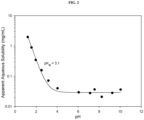
- the stability of Compound 1 was determined by monitoring the concentration of Compound 1 in solution by liquid chromatography at various storage conditions. The stability results are shown in FIG. 1 . Compound 1 is most stable in solution between about pH 4 and 5. The solubility of Compound 1 between pH 1 and 10 was determined by quantitatively measuring the concentration of Compound 1 in solution at various pH conditions by liquid chromatography. The solubility results are shown in FIG. 2 . The solubility of Compound 1 increases at or below pH 4.
- Cyclodextrin is a chemical family of cyclic compound typically having 6, 7, or 8 sugar units.
- a cyclodextrin comprising 6 sugar units is an alpha-cyclodextrin ( ⁇ -cyclodextrin).
- a cyclodextrin comprising 7 sugar units is a beta-cyclodextrin ( ⁇ -cyclodextrin).
- a cyclodextrin comprising 8 sugar units is a gamma-cyclodextrin ( ⁇ -cyclodextrin).
- Cyclodextrin derivatives are cyclodextrins where some of the -OH groups are modified to -OR groups.
- Non-limiting examples of cyclodextrin derivatives include cyclodextrins where -OH groups are modified to -OR wherein each R is independently alkyl, hydroxyalkyl, glucosyl or maltosyl groups, or -(CH 2 ) 4 SO 3 - Na + .
- Non-limiting examples of commercial cyclodextrin derivatives include CAPTISOL ® , CAVITRON ® , DEXOLVE-7 ® , and KLEPTOSE ® .
- CAPTISOL ® (herein referred to as Captisol) is a registered trademark of Ligand Corporation. Captisol refers to sulfobutylalkylether-beta-cyclodextrin sold by or licensed by Ligand Pharmaceuticals.
- CAVITRON ® (herein referred to as Cavitron) is a registered trademark of Wacker Chemie AG.
- Cavitron is an excipient obtained by the substitution of hydroxyl groups on native cyclodextrins to make hydroxypropyl-beta-cyclodextrins (HPBCD), a process that significantly enhance their solubility and makes them more suitable for drug solubilization.
- DEXOLVE-7 ® (herein referred to as Dexolve-7) is a registered trademark of CycloLabs Limited.
- Dexolve-7 is sulfobutylalkylether-beta-cyclodextrin sodium salt, an excipient used in pharmaceutical formulations to improve solubility.
- KLEPTOSE ® (herein referred to as Kleptose) is a registered trademark of Roquette Pharmaceuticals, Geneva, Illinois, USA. Kleptose is a brand of hydroxypropyl-beta-cyclodextrin.
- cyclodextrin refers to beta-cyclodextrin derivatives selected from the group consisting of sulfobutylalkylether-beta-cyclodextrin, betadex-sulfobutylether sodium, and hydroxypropyl-beta-cyclodextrin.
- cyclodextrin refers to sulfobutylalkylether-beta-cyclodextrin.
- cyclodextrin refers to betadex-sulfobutylether sodium.
- cyclodextrin refers to hydroxypropyl-beta-cyclodextrin.
- cyclodextrin refers to the formula wherein R is -H or CH 2 CH 2 CH 2 CH 2 SO 3 - Na + .
- pH adjusting agents are buffers, acids, and bases.
- Acid refers to a compound that is capable of donating a proton (H + ) under the Bronsted-Lowry definition, or is an electron pair acceptor under the Lewis definition.
- Acids useful in the present invention are Bronsted-Lowry acids that include, but are not limited to, alkanoic acids or carboxylic acids (formic acid, acetic acid, citric acid, lactic acid, oxalic acid, etc.), sulfonic acids and mineral acids, as defined herein.
- Mineral acids are inorganic acids such as hydrogen halides (hydrofluoric acid, hydrochloric acid, hydrobromice acid, etc.), halogen oxoacids (hypochlorous acid, perchloric acid, etc.), as well as sulfuric acid, nitric acid, phosphoric acid, chromic acid and boric acid.
- Sulfonic acids include methanesulfonic acid, benzenesulfonic acid, p-toluenesulfonic acid, triflouromethanesulfonic acid, camphorsulfonic acid, among others.
- Base refers to a compound capable of accepting a proton (H + ) under the Bronsted-Lowry definition, or is an electron-pair donor under the Lewis definition.
- Bases useful in the present invention that are Bronsted-Lowry bases include hydroxides such as lithium hydroxide, sodium hydroxide, potassium hydroxide, rubidium hydroxide, cesium hydroxide, magnesium hydroxide, strontium hydroxide, barium hydroxide, and others.
- Lewis bases include, but are not limited to, amines such as ammonia, trimethylamine, triethylamine, diisopropylethylamine (DIPEA or Hunig's Base), 1,8-diazabicycloundec-7-ene (DBU), 2,6-di-tert-butylpyridine, quinuclidine, and lithium di-isopropylamine (LDA), and nucleophilic bases such as butyl-lithium.
- amines such as ammonia, trimethylamine, triethylamine, diisopropylethylamine (DIPEA or Hunig's Base), 1,8-diazabicycloundec-7-ene (DBU), 2,6-di-tert-butylpyridine, quinuclidine, and lithium di-isopropylamine (LDA), and nucleophilic bases such as butyl-lithium.
- the pH adjusting agents are NaOH and HCl.
- Dehydrate refers to the process of removing water from a sample via evaporation, sublimation, or a combination thereof.
- Evaporation refers to the transition of a substance from a liquid state to a gaseous state, and sublimation to the transition from a solid state directly to a gaseous state. Dehydration can occur at a variety of temperatures and pressures. When dehydration occurs below the freezing point of the sample, this is referred to as freeze-drying or lyophilizing, the process of removing water from a sample at low temperature and pressure.
- treatment means any administration of Compound 1 according to the present disclosure to a subject (e.g. human) having or susceptible to a condition or disease disclosed herein for the purpose of: 1) preventing or protecting against the disease or condition, that is, causing the clinical symptoms not to develop; 2) inhibiting the disease or condition, that is, arresting or suppressing the development of clinical symptoms; or 3) relieving the disease or condition that is causing the regression of clinical symptoms.
- the term “treatment” or “treating” refers to relieving the disease or condition, i.e. which is causing the regression of clinical symptoms.
- the term "preventing” refers to the prophylactic treatment of a patient in need thereof.
- the prophylactic treatment can be accomplished by providing an appropriate dose of a therapeutic agent e.g. Compound 1, to a subject at risk of suffering from an ailment, thereby substantially averting onset of the ailment.
- a therapeutic agent e.g. Compound 1
- prophylactic treatment as used herein has the potential to avoid/ameliorate the symptoms or clinical consequences of having the disease engendered by such genetic mutation or predisposition.
- Subject refers to animals such as mammals, including, but not limited to, primates (e.g., humans), cows, sheep, goats, horses, dogs, cats, rabbits, rats, mice and the like. In certain embodiments, the subject is a human.
- terapéuticaally effective amount is the amount of Compound 1, or a pharmaceutically acceptable salt thereof, present in a composition described herein that is needed to provide a desired level of drug in the secretions and tissues of the airways and lungs, or alternatively, in the bloodstream of a subject to be treated to give an anticipated physiological response or desired biological effect when such a composition is administered by the chosen route of administration.
- the precise amount will depend upon numerous factors, for example the specific activity of the composition, the delivery device employed, the physical characteristics of the composition, its intended use, as well as animal considerations such as severity of the disease state, veterinarian cooperation, etc., and can readily be determined by one skilled in the art based upon the information provided herein.
- Safe water for injection refers to a water solution for combining with one or more drugs requiring dilution or dissolution prior to administration to the subject.
- the water for injection is sterile and stored in a glass vial of Type I or II borosilicate glass, or other suitable container.
- the water for injection does not include any other components, such as stabilizers, antimicrobial agents, buffer, etc.
- normal saline means a water solution containing 0.9% (w/v) NaCl.
- hypertonic saline means a water solution containing greater than 0.9% (w/v) NaCl.
- 3% hypertonic saline would contain 3% (w/v) NaCl.
- Forming a reaction mixture refers to the process of bringing into contact at least two distinct species such that they mix together and can react. It should be appreciated, however, the resulting reaction product can be produced directly from a reaction between the added reagents or from an intermediate from one or more of the added reagents which can be produced in the reaction mixture.
- compositions described here contain Compound 1, or a pharmaceutically acceptable salt thereof, cyclodextrin, and, optionally, pH adjusting agents.
- composition comprising Compound 1, or a pharmaceutically acceptable salt thereof, cyclodextrin, and, optionally, pH adjusting agents.
- composition comprising or a pharmaceutically acceptable salt thereof, cyclodextrin, and, optionally, pH adjusting agents.
- composition comprising Compound 1, or a pharmaceutically acceptable salt thereof, and beta-cyclodextrin, and, optionally, pH adjusting agents.
- an antiviral composition comprising Compound 1, or a pharmaceutically acceptable salt thereof, and beta-cyclodextrin, and, optionally, pH adjusting agents.
- a composition comprising Compound 1, or a pharmaceutically acceptable salt thereof, and beta-cyclodextrin, and, optionally, pH adjusting agents, wherein the beta cyclodextrin is sulfobutylalkylether-beta-cyclodextrin, betadex-sulfobutylether sodium, or hydroxypropyl-beta-cyclodextrin.
- composition comprising Compound 1, or a pharmaceutically acceptable salt thereof, and beta-cyclodextrin, and, optionally, pH adjusting agents, wherein the beta cyclodextrin is betadex-sulfobutylether sodium.
- the composition also includes water to form a solution composition.
- the water can be any suitable water, such as distilled water or water safe for injection. In some embodiments, the water can be water safe for injection.
- composition comprising Compound 1, or a pharmaceutically acceptable salt thereof, and beta-cyclodextrin, and, optionally, pH adjusting agents, wherein the pH adjusting agents are NaOH and HCl.
- the composition can includes, 1, 2, 3, 4 or more pH adjusting agents.
- the composition includes at least one pH adjusting agent.
- the composition includes at least 2 pH adjusting agents.
- the pH adjusting agents can be acids, bases, or a mixture thereof.
- a first pH adjusting agent includes an acid
- a second pH adjusting agent includes a base.
- the solution composition includes Compound 1, or a pharmaceutically acceptable salt thereof, beta-cyclodextrin, and at least one pH adjusting agent. In some embodiments, the solution composition includes Compound 1, or a pharmaceutically acceptable salt thereof, beta-cyclodextrin, and at least two pH adjusting agent. In some embodiments, the solution composition includes Compound 1, or a pharmaceutically acceptable salt thereof, beta-cyclodextrin, and the pH adjusting agents HCl and NaOH.
- the solution composition has a pH of less than 7, preferably less than about 6, 5, or 4.
- the pH of the solution composition can be from 1 to 6, 2 to 5, or 3 to 4.
- the pH of the solution composition can be about 3.1, 3.2, 3.3, 3.4, 3.5, 3.6, 3.7, 3.8, or about 3.9.
- the solution composition has a pH of from 3 to 4.
- the solution composition has a pH of about 3.5.
- an antiviral composition comprising Compound 1, or a pharmaceutically acceptable salt thereof, and beta-cyclodextrin, and, optionally, pH adjusting agents, wherein the pH adjusting agents are NaOH and HCl.
- a composition comprising 90 mg to 175 mg of Compound 1, or a pharmaceutically acceptable salt thereof, and beta-cyclodextrin, and, optionally, pH adjusting agents. In some embodiments, a composition comprising 90 mg to 110 mg of Compound 1, or a pharmaceutically acceptable salt thereof, and beta-cyclodextrin, and, optionally, pH adjusting agents. In some embodiments, a composition comprising 145 mg to 165 mg of Compound 1, or a pharmaceutically acceptable salt thereof, and beta-cyclodextrin, and, optionally, pH adjusting agents. In some embodiments, a composition comprising 100 mg of Compound 1, or a pharmaceutically acceptable salt thereof, and beta-cyclodextrin, and, optionally, pH adjusting agents. In some embodiments, a composition comprising 150 mg of Compound 1, or a pharmaceutically acceptable salt thereof, and beta-cyclodextrin, and, optionally, pH adjusting agents.
- a composition comprising 90 mg to 175 mg of Compound 1, or a pharmaceutically acceptable salt thereof, and beta-cyclodextrin, and, optionally, pH adjusting agents, wherein the pH adjusting agents are NaOH and HCl.
- a composition comprising 90 mg to 110 mg of Compound 1, or a pharmaceutically acceptable salt thereof, and beta-cyclodextrin, and, optionally, pH adjusting agents, wherein the pH adjusting agents are NaOH and HCl.
- a composition comprising 145 mg to 165 mg of Compound 1, or a pharmaceutically acceptable salt thereof, and beta-cyclodextrin, and, optionally, pH adjusting agents, wherein the pH adjusting agents are NaOH and HCl.
- a composition comprising 100 mg of Compound 1, or a pharmaceutically acceptable salt thereof, and beta-cyclodextrin, and, optionally, pH adjusting agents, wherein the pH adjusting agents are NaOH and HCl.
- a composition comprising 150 mg of Compound 1, or a pharmaceutically acceptable salt thereof, and beta-cyclodextrin, and, optionally, pH adjusting agents, wherein the pH adjusting agents are NaOH and HCl.
- the cyclodextrin is present at about 5% to 30% w/v. In some embodiments, the cyclodextrin is present at about 10% to 25% w/v. In some embodiments, the cyclodextrin is present at about 14% to 21% w/v. In some embodiments, the cyclodextrin is present at about 15% w/v. In some embodiments, the cyclodextrin is present at about 20% w/v. In some embodiments, the cyclodextrin is present at 15% w/v. In some embodiments, the cyclodextrin is present at 20% w/v. In some embodiments, the cyclodextrin is present at 15% w/v. In some embodiments, the cyclodextrin is present at 20% w/v.
- Compound 1 is present at about 1.0 to 10.0 mg/mL. In some embodiments, Compound 1 is present at about 4.0 to 8.0 mg/mL. In some embodiments, Compound 1 is present at about 5.0 to 7.0 mg/mL. In some embodiments, Compound 1 is present at about 5.0 mg/mL. In some embodiments, Compound 1 is present at about 6.7 mg/mL. In some embodiments, Compound 1 is present at 5.0 mg/mL. In some embodiments, Compound 1 is present at 6.7 mg/mL.
- a composition comprising Compound 1, or a pharmaceutically acceptable salt thereof, and beta-cyclodextrin, and, optionally, pH adjusting agents, wherein Compound 1 is present at about 4.0 to 8.0 mg/mL and the beta-cyclodextrin is present at about 5% to 30% w/v.
- a composition comprising Compound 1, or a pharmaceutically acceptable salt thereof, and beta-cyclodextrin, and, optionally, pH adjusting agents, wherein Compound 1 is present at about 4.0 to 8.0 mg/mL and the beta-cyclodextrin is present at about 10% to 25% w/v.
- composition comprising Compound 1, or a pharmaceutically acceptable salt thereof, and beta-cyclodextrin, and, optionally, pH adjusting agents, wherein Compound 1 is present at about 4.0 to 8.0 mg/mL and the beta-cyclodextrin is present at about 14% to 21% w/v.
- a composition comprising Compound 1, or a pharmaceutically acceptable salt thereof, and beta-cyclodextrin, and, optionally, pH adjusting agents, wherein Compound 1 is present at about 5.0 to 7.0 mg/mL and the beta-cyclodextrin is present at about 5% to 30% w/v.
- a composition comprising Compound 1, or a pharmaceutically acceptable salt thereof, and beta-cyclodextrin, and, optionally, pH adjusting agents, wherein Compound 1 is present at about 5.0 to 7.0 mg/mL and the beta-cyclodextrin is present at about 10% to 25% w/v.
- composition comprising Compound 1, or a pharmaceutically acceptable salt thereof, and beta-cyclodextrin, and, optionally, pH adjusting agents, wherein Compound 1 is present at about 5.0 to 7.0 mg/mL and the beta-cyclodextrin is present at about 14% to 21% w/v.
- a composition comprising Compound 1, or a pharmaceutically acceptable salt thereof, and beta-cyclodextrin, and, optionally, pH adjusting agents, wherein Compound 1 is present at about 5.0 mg/mL and the beta-cyclodextrin is present at about 15 % w/v.
- a composition comprising Compound 1, or a pharmaceutically acceptable salt thereof, and beta-cyclodextrin, and, optionally, pH adjusting agents, wherein Compound 1 is present at about 6.7 mg/mL and the beta-cyclodextrin is present at about 20 % w/v.
- a composition comprising Compound 1, or a pharmaceutically acceptable salt thereof, and beta-cyclodextrin, and, optionally, pH adjusting agents, wherein Compound 1 is present at about 5.0 mg/mL and the beta-cyclodextrin is present at about 15 % w/v further comprising water for injection.
- a composition comprising Compound 1, or a pharmaceutically acceptable salt thereof, and beta-cyclodextrin, and, optionally, pH adjusting agents, wherein Compound 1 is present at about 6.7 mg/mL and the beta-cyclodextrin is present at about 20 % w/v further comprising water for injection.
- a lyophilized composition comprising Compound 1, or a pharmaceutically acceptable salt thereof, and beta-cyclodextrin, and, optionally, pH adjusting agents, wherein Compound 1 is present at about 5.0 mg/mL and the beta-cyclodextrin is present at about 15 % w/v.
- a lyophilized composition comprising Compound 1, or a pharmaceutically acceptable salt thereof, and beta-cyclodextrin, and, optionally, pH adjusting agents, wherein Compound 1 is present at about 6.7 mg/mL and the beta-cyclodextrin is present at about 20 % w/v.
- a lyophilized composition comprising about 90 to 175 mg Compound 1, or a pharmaceutically acceptable salt thereof, and beta-cyclodextrin, and, optionally, pH adjusting agents, wherein the beta-cyclodextrin is present at about 15 to 20 % w/v. In some embodiments, a lyophilized composition comprising about 100 mg Compound 1, or a pharmaceutically acceptable salt thereof, and beta-cyclodextrin, and, optionally, pH adjusting agents, wherein the beta-cyclodextrin is present at about 15 to 20 % w/v.
- a lyophilized composition comprising about 150 mg Compound 1, or a pharmaceutically acceptable salt thereof, and beta-cyclodextrin, and, optionally, pH adjusting agents, wherein the beta-cyclodextrin is present at about 15 to 20 % w/v.
- a composition comprising crystalline Compound 1, or a pharmaceutically acceptable salt thereof, and beta-cyclodextrin, and, optionally, pH adjusting agents, wherein crystalline Compound 1 is characterized by an X-ray powder diffraction (XRPD) pattern having at least three peaks selected from the group consisting of 22.3°, 16.2°, 22.5°, 13.8°, 12.7°, 16.9°, 10.6°, 14.5°, 24.3, 24.0°, 17.6°, 23.4°, 8.1°, 11.0°, 26.8°, 28.9°, 19.6°, 27.8°, 26.4°, 28.7°, 29.8°, 33.0°, 18.8°, 18.3°, 32.1°, 25.3°, 32.6°, 8.6°, 34.2°, 35.9°, 27.2°, 28.1°, 38.9°,34.6°, 17.1°, 35.2°, 21.4°, 30.6°, 25.6°, 18.5°, 31.7°,
- the composition of the present invention also includes a lyophilized or dehydrated composition of Compound 1, or a pharmaceutically acceptable salt thereof, and cyclodextrin.
- the present invention provides a lyophilized composition including Compound 1, or a pharmaceutically acceptable salt thereof, and cyclodextrin.
- the lyophilized composition can be in any suitable solid form, such as a powder.
- Compound 1 can be present in the lyophilized composition in an amount from 1% to 10% (w/w), or from 1 to 5%, or from 2 to 4%, or from 3 to 4%, or from 3 to 3.5% (w/w).
- the lyophilized composition includes Compound 1 in an amount from 1% to 10% (w/w).
- the lyophilized composition include Compound 1 in an amount from 1% to 5% (w/w).
- the lyophilized composition includes Compound 1 in an amount from 2% to 4% (w/w).
- the lyophilized composition includes Compound 1 in an amount from 3% to 3.5% (w/w).
- Compound 1 can be present in the lyophilized composition in an amount of about 1% (w/w), or 1.5, 2, 2.1, 2.2, 2.3, 2.4, 2.5, 2.6, 2.7, 2.8, 3.9, 3, 3.1, 3.2, 3.3, 3.4, 3.5, 3.6, 3.7, 3.8, 3.9, 4, 4.5, 5, 6, 7, 8, 9, or about 10% (w/w).
- the lyophilized composition includes Compound 1 at about 3.2% (w/w).
- Cyclodextrin can be present in the lyophilized composition in an amount from 90% to 99% (w/w), or from 95 to 99%, or from 96 to 98%, or from 96.5 to 97% (w/w).
- the lyophilized composition includes cyclodextrin in an amount from 90% to 99% (w/w). In some embodiments, the lyophilized composition includes cyclodextrin in an amount from 95 to 99% (w/w). In some embodiments, the lyophilized composition includes cyclodextrin in an amount from 96 to 98% (w/w). In some embodiments, the lyophilized composition includes cyclodextrin in an amount from 96.5 to 97% (w/w).
- Cyclodextrin can be present in the lyophilized composition in an amount of about 90% (w/w), or 91, 92, 93, 94, 95, 95.1, 95.2, 95.3, 95.4, 95.5, 95.6, 95.7, 95.8, 95.9, 96, 96.1, 96.2, 96.3, 96.4, 96.5, 96.6, 96.7, 96.8, 96.9, 97, 97.1, 97.2, 97.3, 97.4, 97.5, 97.6, 97.7, 97.8, 97.9, 98, or about 99% (w/w).
- the lyophilized composition includes cyclodextrin at about 96.8% (w/w).
- the lyophilized composition includes betadex-sulfobutylether sodium at about 96.8% (w/w). In some embodiments, the lyophilized composition includes Compound 1 at about 3.2% (w/w), and cyclodextrin at about 96.8% (w/w). In some embodiments, the lyophilized composition includes Compound 1 at about 3.2% (w/w), and betadex-sulfobutylether sodium at about 96.8% (w/w).
- the lyophilized composition of the present invention can include Compound 1 in an amount from 1% to 10% (w/w), or from 1 to 5%, or from 2 to 4%, or from 3 to 4%, or from 3 to 3.5%, and cyclodextrin in an amount from 90% to 99% (w/w), or from 95 to 99%, or from 96 to 98%, or from 96.5 to 97% (w/w).
- the lyophilized composition includes Compound 1 in an amount from 1% to 10% (w/w), and cyclodextrin in an amount from 90% to 99% (w/w).
- the lyophilized composition include Compound 1 in an amount from 1% to 5% (w/w), and cyclodextrin in an amount from 95 to 99% (w/w). In some embodiments, the lyophilized composition includes Compound 1 in an amount from 2% to 4% (w/w), and cyclodextrin in an amount from 96 to 98% (w/w). In some embodiments, the lyophilized composition includes Compound 1 in an amount from 3% to 3.5% (w/w), and cyclodextrin in an amount from 96.5 to 97% (w/w).
- the lyophilized composition includes Compound 1 at about 3.2% (w/w) and cyclodextrin in an amount of about 96.8% (w/w). In some embodiments, the lyophilized composition includes Compound 1 at 3.2% (w/w) and cyclodextrin in an amount of 96.8% (w/w). In some embodiments, the lyophilized composition consists essentially of Compound 1 at about 3.2% (w/w) and cyclodextrin in an amount of about 96.8% (w/w). In some embodiments, the lyophilized composition consists essentially of Compound 1 at 3.2% (w/w) and cyclodextrin in an amount of 96.8% (w/w).
- the lyophilized composition includes Compound 1 at about 3.2% (w/w) and betadex-sulfobutylether sodium in an amount of about 96.8% (w/w). In some embodiments, the lyophilized composition includes Compound 1 at 3.2% (w/w) and betadex-sulfobutylether sodium in an amount of 96.8% (w/w). In some embodiments, the lyophilized composition consists essentially of Compound 1 at about 3.2% (w/w) and betadex-sulfobutylether sodium in an amount of about 96.8% (w/w). In some embodiments, the lyophilized composition consists essentially of Compound 1 at 3.2% (w/w) and betadex-sulfobutylether sodium in an amount of 96.8% (w/w). In some embodiments, the lyophilized composition consists essentially of Compound 1 at 3.2% (w/w) and betadex-sulfobutylether sodium in an amount of 96
- the cyclodextrin of the lyophilized composition can include any suitable cyclodextrin as described above.
- the cyclodextrin can be a beta-cyclodextrin, such as sulfobutylalkylether-beta-cyclodextrin, betadex-sulfobutylether sodium, or hydroxypropyl-beta-cyclodextrin.
- the lyophilized composition includes a beta-cyclodextrin.
- the lyophilized composition includes sulfobutylalkylether-beta-cyclodextrin, betadex-sulfobutylether sodium, or hydroxypropyl-beta-cyclodextrin. In some embodiments, the lyophilized composition includes betadex-sulfobutylether sodium.
- a composition comprising Compound 1, or a pharmaceutically acceptable salt thereof, and beta-cyclodextrin, and, optionally, pH adjusting agents, wherein Compound 1 is 3% ⁇ 1% w/w and beta-cyclodextrin is 97% ⁇ 1% w/w.
- a composition comprising Compound 1, or a pharmaceutically acceptable salt thereof, and beta-cyclodextrin, and, optionally, pH adjusting agents, wherein Compound 1 is 3% ⁇ 0.5% w/w and beta-cyclodextrin is 97% ⁇ 0.5% w/w.
- composition comprising Compound 1, or a pharmaceutically acceptable salt thereof, and beta-cyclodextrin, and, optionally, pH adjusting agents, wherein Compound 1 is about 3.2 % w/w and beta-cyclodextrin is 96.8 % w/w.
- the lyophilized compositions of the present invention are surprisingly stable, showing relatively little impurity formation when tested at raised temperatures and relative humidity.
- the purity of the lyophilized composition can be at least 95%, or 96, 97, 98, 99, 99.1, 99.2, 99.3, 99.4, 99.5, 99.6, 99.7, 99.8, or at least 99.9%.
- the lyophilized composition can have an impurity in the amount of less than 5%, or 4, 3, 2, 1, 0.9, 0.8, 0.7, 0.6, 0.5, 0.4, 0.3, 0.2, or less than 0.1%.
- the lyophilized composition has less than about 1% AN via HPLC of impurity following one or more of the following: (i) storage for 18 months at a temperature of about 25° C ( ⁇ 1° C) and a relative humidity of about 60% ( ⁇ 1%); (ii) storage for 18 months at a temperature of about 30° C ( ⁇ 1° C) and a relative humidity of about 75% ( ⁇ 1%); or (iii) storage for 6 months at a temperature of about 40° C ( ⁇ 1° C) and a relative humidity of about 75% ( ⁇ 1%).
- the lyophilized composition has less than about 0.5% AN via HPLC of impurity following one or more of the following: (i) storage for 18 months at a temperature of about 25° C ( ⁇ 1° C) and a relative humidity of about 60% ( ⁇ 1%); (ii) storage for 18 months at a temperature of about 30° C ( ⁇ 1° C) and a relative humidity of about 75% ( ⁇ 1%); or (iii) storage for 6 months at a temperature of about 40° C ( ⁇ 1° C) and a relative humidity of about 75% ( ⁇ 1%).
- the lyophilized composition can include various forms of Compound 1.
- Compound 1 can be amorphous or crystalline, or a mixture thereof.
- the lyophilized composition includes amorphous Compound 1.
- the lyophilized composition can be contained in any suitable container, such as a sealed vial.
- the present invention provides a sealed vial containing the lyophilized composition.
- the present invention provides a sealed vial containing the lyophilized composition consisting essentially of Compound 1 at 3.2% (w/w) and betadex-sulfobutylether sodium in an amount of 96.8% (w/w).
- the composition of the present invention also includes an injectable composition for administration to subjects and patients in need of treatment.
- the injectable composition includes the lyophilized composition described above, and water.
- the present invention provides an injectable composition, including Compound 1: or a pharmaceutically acceptable salt thereof, in an amount from 0.1% to 10% w/v; cyclodextrin in an amount from 10% to 50% w/v; and water.
- the cyclodextrin of the injectable composition can include any suitable cyclodextrin as described above.
- the cyclodextrin can be a beta-cyclodextrin, such as sulfobutylalkylether-beta-cyclodextrin, betadex-sulfobutylether sodium, or hydroxypropyl-beta-cyclodextrin.
- the injectable composition includes a beta-cyclodextrin.
- the injectable composition includes sulfobutylalkylether-beta-cyclodextrin, betadex-sulfobutylether sodium, or hydroxypropyl-beta-cyclodextrin. In some embodiments, the injectable composition includes betadex-sulfobutylether sodium.
- the water of the injectable composition can be any suitable type of water.
- the water of the injectable composition can be water safe for injection.
- the injectable composition include any suitable amount of Compound 1 from 0.1% to 10% w/v.
- Compound 1 can be present in the injectable composition in an amount from 0.1% to 5% w/v, 0.1 to 4, 0.1 to 3, 0.1 to 2, 0.1 to 1, 0.2 to 0.8, 0.3 to 0.7, or 0.4% to 0.6% w/v.
- Compound 1 can be present in the injectable composition in an amount of about 0.1% w/v, or 0.2, 0.3, 0.4, 0.5, 0.6, 0.7, 0.8, 0.9, or about 1% w/v.
- Compound 1 is present in the injectable composition in an amount of 0.1% to 10% w/v.
- Compound 1 is present in the injectable composition in an amount of 0.1% to 1% w/v.
- Compound 1 is present in the injectable composition in an amount of about 0.5% w/v.
- the injectable composition include any suitable amount of Compound 1 from 0.1 to 100 mg/mL.
- Compound 1 can be present in the injectable composition in an amount from 0.1 to 100 mg/mL, or 0.1 to 50, 0.5 to 10, 1 to 10, 2 to 8, 3 to 7, 4 to 6, or 4.5 to 5.5 mg/mL.
- Compound 1 can be present in the injectable composition in an amount of about 0.1 mg/mL, or 0.5, 1, 2, 2.5, 3, 3.5, 4, 4.5, 4.6, 4.7, 4.8, 4.9, 5, 5.1, 5.2, 5.3, 5.4, 5.5, 6, 6.5, 7, 7.5, 8, 8.5, 9, 9.5, 10, 15, 20 or 25 mg/mL.
- Compound 1 is present in the injectable composition in an amount of 1 to 10 mg/mL. In some embodiments, Compound 1 is present in the injectable composition in an amount of 4 to 6 mg/mL. In some embodiments, Compound 1 is present in the injectable composition in an amount of about 5 mg/mL.
- the injectable composition also includes cyclodextrin in any suitable amount from 5% to 50% w/v.
- the cyclodextrin can be present in the injectable composition in an amount of from 5% to 50% w/v, or 5 to 25, or 10% to 20% w/v.
- the cyclodextrin can be present in the injectable composition in an amount of about 5% w/v, or 6, 7, 8, 9, 10, 11, 12, 13, 14, 15, 16, 17, 18, 19, 20, 25, 30, 35, 40, 45, or 50% w/v.
- the cyclodextrin is present in the injectable composition in an amount of 5% to 50% w/v.
- the cyclodextrin is present in the injectable composition in an amount of 10% to 20% w/v. In some embodiments, the cyclodextrin is present in the injectable composition in an amount of about 15% w/v. In some embodiments, the betadex-sulfobutylether sodium is present in the injectable composition in an amount of about 15% w/v.
- the injectable composition can include Compound 1 and the cyclodextrin in any suitable combination of amounts as described above.
- the injectable composition can include Compound 1 in an amount from 0.1% to 5% w/v, 0.1 to 4, 0.1 to 3, 0.1 to 2, 0.1 to 1, 0.2 to 0.8, 0.3 to 0.7, or 0.4% to 0.6% w/v, and cyclodextrin in an amount of from 5% to 50% w/v, or 5 to 25, or 10% to 20% w/v.
- the injectable composition can include Compound 1 in an amount of about 0.1% w/v, or 0.2, 0.3, 0.4, 0.5, 0.6, 0.7, 0.8, 0.9, or about 1% w/v, and cyclodextrin in an amount of about 6, 7, 8, 9, 10, 11, 12, 13, 14, 15, 16, 17, 18, 19, 20, 25, 30, 35, 40, 45, or 50% w/v.
- the injectable composition includes Compound 1 in an amount of 0.1% to 10% w/v, and cyclodextrin in an amount of 5% to 50% w/v.
- the injectable composition includes Compound 1 in an amount of 0.1% to 1% w/v, and cyclodextrin in an amount of 10% to 20% w/v.
- the injectable composition includes Compound 1 in an amount of about 0.5% w/v, and cyclodextrin in an amount of about 15% w/v. In some embodiments, the injectable composition includes Compound 1 in an amount of about 0.5% w/v, and betadex-sulfobutylether sodium in an amount of about 15% w/v.
- the injectable composition includes Compound 1 in an amount of 0.1% to 10% w/v, cyclodextrin in an amount from 10% to 20% w/v, and water safe for injection. In some embodiments, the injectable composition includes Compound 1 in an amount of about 0.5% w/v, cyclodextrin in an amount of about 15% w/v, and water safe for injection. In some embodiments, the injectable composition consists essentially of Compound 1 in an amount of about 0.5% w/v, cyclodextrin in an amount of about 15% w/v, and water safe for injection.
- the injectable composition includes Compound 1 in an amount of 0.1% to 10% w/v, betadex-sulfobutylether sodium in an amount from 10% to 20% w/v, and water safe for injection. In some embodiments, the injectable composition includes Compound 1 in an amount of about 0.5% w/v, betadex-sulfobutylether sodium in an amount of about 15% w/v, and water safe for injection. In some embodiments, the injectable composition consists essentially of Compound 1 in an amount of about 0.5% w/v, betadex-sulfobutylether sodium in an amount of about 15% w/v, and water safe for injection.
- the injectable composition can be contained in any suitable container, such as a sealed vial.
- the present invention provides a sealed vial containing the injectable composition.
- the present invention provides a sealed vial containing the injectable composition consisting essentially of Compound 1 in an amount of about 0.5% w/v, cyclodextrin in an amount of about 15% w/v, and water safe for injection.
- the present invention provides a method of treating a viral infection comprising administering a pharmaceutical composition comprising Compound 1, or a pharmaceutically acceptable salt thereof, cyclodextrin, and, optionally, pH adjusting agents.
- the pharmaceutical composition is a composition of the present invention.
- the present invention provides a method of treating a viral infection comprising administering a pharmaceutical composition comprising Compound 1, or a pharmaceutically acceptable salt thereof, and beta-cyclodextrin, and, optionally, pH adjusting agents.
- the pharmaceutical composition is a composition of the present invention.
- the present invention provides a method of treating a viral infection comprising parenterally administering a pharmaceutical composition comprising Compound 1, or a pharmaceutically acceptable salt thereof, and beta-cyclodextrin, and, optionally, pH adjusting agents.
- the pharmaceutical composition is a composition of the present invention.
- the present invention provides a method of treating a viral infection comprising (a) reconstituting with safe water for injection a lyophilized pharmaceutical composition comprising Compound 1, or a pharmaceutically acceptable salt thereof, and beta-cyclodextrin, and, optionally, pH adjusting agents and (b) administering the reconstituted pharmaceutical composition.
- the pharmaceutical composition is a composition of the present invention.
- the reconstituted pharmaceutical composition is an injectable composition of the present invention.
- the lyophilized pharmaceutical composition is a lyophilized composition of the present invention.
- the present invention provides a method of treating a viral infection comprising (a) reconstituting with safe water for injection a lyophilized pharmaceutical composition comprising Compound 1, or a pharmaceutically acceptable salt thereof, and beta-cyclodextrin, and, optionally, pH adjusting agents and (b) parenterally administering the reconstituted pharmaceutical composition.
- the pharmaceutical composition is a composition of the present invention.
- the reconstituted pharmaceutical composition is an injectable composition of the present invention.
- the lyophilized composition is a lyophilized pharmaceutical composition of the present invention.
- the parenteral administration is selected from the group consisting of intramuscular (IM), subcutaneous (SC) and intravenous (IV) administrations.
- IM intramuscular
- SC subcutaneous
- IV intravenous
- the present invention provides a method of treating a virus comprising parenterally administering a pharmaceutical composition comprising Compound 1, or a pharmaceutically acceptable salt thereof, and beta-cyclodextrin, and, optionally, pH adjusting agents.
- the present invention provides a method of treating a virus comprising parenterally administering a pharmaceutical composition comprising Compound 1, or a pharmaceutically acceptable salt thereof, and beta-cyclodextrin, and, optionally, pH adjusting agents, wherein the virus is an Arenaviridae virus, a Coronaviridae virus, a Filoviridae virus, a Flaviviridae virus or a Paramyxoviridae virus.
- the present invention provides a method of treating a virus comprising parenterally administering a pharmaceutical composition comprising Compound 1, or a pharmaceutically acceptable salt thereof, and beta-cyclodextrin, and, optionally, pH adjusting agents, wherein the virus is Lassa, Junin, Severe Acute Respiratory Syndrome (SARS), Middle Eastern Respiratory Syndrome (MERS), ebolavirus, Marburg virus, Zika, or Respiratory Syncytial virus.
- SARS Severe Acute Respiratory Syndrome
- MERS Middle Eastern Respiratory Syndrome
- ebolavirus Marburg virus
- Zika Zika
- the present invention provides a method of treating a virus comprising parenterally administering a pharmaceutical composition comprising Compound 1, or a pharmaceutically acceptable salt thereof, and beta-cyclodextrin, and, optionally, pH adjusting agents, wherein the virus is Lassa, Junin, Severe Acute Respiratory Syndrome (SARS), Middle Eastern Respiratory Syndrome (MERS), other human coronaviruses (229E, NL63, OC43, HKU1, or WIV1), zoonotic coronaviruses (PEDV or HKU CoV isolates such as HKU3, HKU5, or HKU9), ebolavirus (variants Zaire, Bundibugio, Sudan, Tai forest, or Reston), Marburg virus, Nipah, Hendra, Measles, Mumbs, Dengue, Yellow Fever, West Nile Virus, Zika, Parainfluenza, Metapneumovirus or Respiratory Syncytial virus.
- SARS Severe Acute Respiratory Syndrome
- the present invention provides a method of treating a virus comprising parenterally administering a pharmaceutical composition comprising Compound 1, or a pharmaceutically acceptable salt thereof, and beta-cyclodextrin, and, optionally, pH adjusting agents, wherein the virus is ebolavirus.
- the present invention provides a method for treating an Arenaviridae virus, a Coronaviridae virus, a Filoviridae virus, a Flaviviridae virus or a Paramyxoviridae virus infection in a human comprising administering to the human a therapeutically effective amount of a composition disclosed herein in combination with a therapeutically effective amount of one or more (e.g., one, two, three, one or two, or one to three) additional therapeutic agents.
- a therapeutically effective amount of a composition disclosed herein in combination with a therapeutically effective amount of one or more (e.g., one, two, three, one or two, or one to three) additional therapeutic agents.
- the present invention provides a method for treating an Arenaviridae virus infection in a human comprising administering to the human a therapeutically effective amount of a composition disclosed herein in combination with a therapeutically effective amount of one or more (e.g., one, two, three, one or two, or one to three) additional therapeutic agents.
- the present invention provides a method for treating a Coronaviridae virus infection in a human comprising administering to the human a therapeutically effective amount of a composition disclosed herein in combination with a therapeutically effective amount of one or more (e.g., one, two, three, one or two, or one to three) additional therapeutic agents.
- the present invention provides a method for treating a Filoviridae virus infection in a human comprising administering to the human a therapeutically effective amount of a composition disclosed herein in combination with a therapeutically effective amount of one or more (e.g., one, two, three, one or two, or one to three) additional therapeutic agents.
- a method for treating a Flaviviridae virus infection in a human comprising administering to the human a therapeutically effective amount of a composition disclosed herein in combination with a therapeutically effective amount of one or more (e.g., one, two, three, one or two, or one to three) additional therapeutic agents.
- the present invention provides a method for treating a Paramyxoviridae virus infection in a human comprising administering to the human a therapeutically effective amount of a composition disclosed herein in combination with a therapeutically effective amount of one or more (e.g., one, two, three, one or two, or one to three) additional therapeutic agents.
- a composition disclosed herein in combination with a therapeutically effective amount of one or more (e.g., one, two, three, one or two, or one to three) additional therapeutic agents.
- the additional therapeutic agent used in combination with a compound disclosed herein is active against an Arenaviridae virus, a Coronaviridae virus, a Filoviridae virus, a Flaviviridae virus or a Paramyxoviridae virus infections.
- Non-limiting examples of these other active therapeutic agents are ribavirin, palivizumab, motavizumab, RSV-IGIV (RespiGam ® ), MEDI-557, A-60444, MDT-637, BMS-433771, amiodarone, dronedarone, verapamil, Ebola Convalescent Plasma (ECP), TKM-100201, BCX4430 ((2S,3S,4R,5R)-2-(4-amino-5H-pyrrolo[3,2-d]pyrimidin-7-yl)-5-(hydroxymethyl)pyrrolidine-3,4-diol), favipiravir (also known as T-705 or Avigan),T-705 monophosphate, T-705 diphosphate, T-705 triphosphate, FGI-106 (1-N,7-N-bis[3-(dimethylamino)propyl]-3,9-dimethylquinolino[8,7-h]quinolone-1,7-diamine),
- PMOs phosphoramidate morpholino oligomers
- Examples of PMOs include AVI-7287, AVI-7288, AVI-7537, AVI-7539, AVI-6002, and AVI-6003.
- the present invention provides a method of treating a Filoviridae virus infections comprising administering a composition comprising Compound 1, or a pharmaceutically acceptable salt thereof, cyclodextrin, and, optionally, pH adjusting agents, in combination with an additional therapeutic agent wherein the additional therapeutic agent is ZMapp.
- Co-administration of a composition disclosed herein with a therapeutically effective amount of a one or more additional therapeutic agents generally refers to simultaneous or sequential administration of a compound disclosed herein and one or more additional therapeutic agents, such that the composition disclosed herein and the one or more additional therapeutic agents are both present in the body of the patient.
- Co-administration includes administration of unit dosages comprising a therapeutically effective amount of one or more compositions disclosed herein before or after administration of unit dosages of a therapeutically effective amount of one or more additional therapeutic agents, for example, administration of the compositions disclosed herein within seconds, minutes, or hours of the administration of one or more additional therapeutic agents.
- a unit dose of a compound disclosed herein is administered first, followed within seconds or minutes by administration of a unit dose of one or more additional therapeutic agents.
- a unit dose of one or more additional therapeutic agents is administered first, followed by administration of a unit dose of a compound disclosed herein within seconds or minutes.
- a unit dose of a compound disclosed herein is administered first, followed, after a period of hours (e.g., 1-12 hours), by administration of a unit dose of one or more additional therapeutic agents.
- a unit dose of one or more additional therapeutic agents is administered first, followed, after a period of hours (e.g., 1-12 hours), by administration of a unit dose of a compound disclosed herein.
- compositions of the present invention can be prepared by means generally known to one of skill in the art for removing water from a substance.
- the compositions can be dehydrated by heating the sample to a suitable temperature for a suitable period of time.
- the compositions can also be dehydrated under a reduced pressure atmosphere at any suitable temperature.
- the reduced pressure atmosphere can be any pressure less than atmospheric pressure.
- the reduced pressure atmosphere can be heated to a temperature above room temperature, be maintained at about room temperature, or cooled to a temperature below room temperature.
- the compositions can be cooled to a temperature of less than room temperature while under a reduced pressure atmosphere.
- Suitable temperatures include, but are not limited to, less than room temperature, or less than 20° C, 15, 10, 5, 0, -5, -10, -15, -20, -25, - 30, -40, or less than -50° C.
- the reduced pressure atmosphere can be less than atmospheric pressure, or less than 100 torr (mm Hg), 50, 25, 10, 5, 4.58 (the triple point for water), 4, 3, 2, 1, 0.5, 0.1, 0.05, or less than 0.01 torr.
- the compositions can be cooled to a temperature of less than 0.01° C while under a reduced pressure atmosphere of less than 4.58 torr (611 Pascal or 0.006 atmospheres).
- compositions of the present invention can be prepared according to the methods described in the examples below and variations thereof understood by one of skill in the art.
- the lyophilized composition of the present invention can be prepared by dissolving cyclodextrin in water, acidifying the cyclodextrin mixture to a pH of less than 2, adding Compound 1 to the acidified mixture to form a suspension of the complex of Compound 1 and the cyclodextrin, adjusting the pH of the complexed mixture as needed to a pH of about 2 to form a solution of the complex of Compound 1 and the cyclodextrin, adjusting the pH of the solution to about 3.5 to form a supersaturated solution, adding water to the supersaturated solution as needed to form a mixture wherein the Compound 1 is at a concentration of about 6.7 mg/mL and the cyclodextrin is at a concentration of about 20% w/v, and lyophilizing the mixture.
- the present invention provides a method of preparing a lyophilized composition including Compound 1: or a pharmaceutically acceptable salt thereof, and cyclodextrin, wherein the method includes forming a first mixture comprising cyclodextrin and water, such that the cyclodextrin dissolves; adding acid to the first mixture to form a second mixture having a pH of less than 2; adding Compound 1 to the second mixture, to form a third mixture; optionally adding acid or base to the third mixture to form a fourth mixture having a pH of from 3 to 4; and lyophilizing the third or fourth mixture to form the lyophilized composition.
- Compound 1 can be used in any suitable amount to achieve the desired concentration in mixture prior to lyophilization.
- Compound 1 can be present in an amount of 1 mg to 1000 mg, or 5 to 500, or 50 to 250, or 60 to 240, or 70 to 230, or 80 to 220, or 90 to 210, or 100 to 200, or 90 to 110, or 145 to 165, or 90 mg to 175 mg.
- Compound 1 can also be present in an amount of about 10 mg, or about 20, 30, 40, 50, 60, 70, 80, 90, 100, 110, 120, 130, 140, 150, 160, 170, 180, 190, 200, 210, 220, 230, 240, or about 250 mg.
- the mixture includes 90 mg to 175 mg of Compound 1.
- the mixture includes 100 mg of Compound 1.
- the mixture includes 150 mg of Compound 1.
- Compound 1 is present in the third or fourth mixture at about 1 to 10 mg/mL. In some embodiments, Compound 1 is present at about 4 to 8 mg/mL. In some embodiments, Compound 1 is present at about 5 to 7 mg/mL. In some embodiments, Compound 1 is present at about 5 mg/mL. In some embodiments, Compound 1 is present at about 6.7 mg/mL. In some embodiments, Compound 1 is present in the fourth mixture at about 6.7 mg/mL. In some embodiments, Compound 1 is present at 5.0 mg/mL. In some embodiments, Compound 1 is present at 6.7 mg/mL. In some embodiments, Compound 1 is present in the fourth mixture at 6.7 mg/mL.
- Compound 1 can be of any suitable form.
- Compound 1 can be amorphous or crystalline.
- Compound 1 is amorphous Compound 1.
- Crystalline forms of Compound 1 useful in the methods and compositions of the present invention are described in U.S. Application No. 15/964,597 .
- Compound 1 can be crystalline Form I, Form II, Form III or Form IV.
- Compound 1 is crystalline Compound 1.
- Compound 1 is crystalline Compound 1 Form II.
- crystalline Compound 1 is characterized by an X-ray powder diffraction (XRPD) pattern having at least three peaks selected from the group consisting of 22.3°, 16.2°, 22.5°, 13.8°, 12.7°, 16.9°, 10.6°, 14.5°, 24.3, 24.0°, 17.6°, 23.4°, 8.1°, 11.0°, 26.8°, 28.9°, 19.6°, 27.8°, 26.4°, 28.7°, 29.8°, 33.0°, 18.8°, 18.3°, 32.1°, 25.3°, 32.6°, 8.6°, 34.2°, 35.9°, 27.2°, 28.1°, 38.9°,34.6°, 17.1°, 35.2°, 21.4°, 30.6°, 25.6°, 18.5°, 31.7°, 36.5°, and 37.1° ⁇ 0.2° 2- ⁇ .
- XRPD X-ray powder diffraction
- crystalline Compound 1 Form II has an XRPD pattern comprising degree 2 ⁇ -reflections (+/- 0.2 degrees 2 ⁇ ) at 22.3°, 16.9°, and 16.2°. In some embodiments, crystalline Compound 1 Form II has an XRPD pattern comprising degree 2 ⁇ -reflections (+/- 0.2 degrees 2 ⁇ ) at 22.3°, 16.9°, and 16.2° and one or more of the degree 2 ⁇ -reflections (+/- 0.2 degrees 2 ⁇ ) at 13.8° and 12.7°.
- crystalline Compound 1 Form II has an XRPD pattern comprising degree 2 ⁇ -reflections (+/- 0.2 degrees 2 ⁇ ) at 22.3°, 16.9°, and 16.2° and one of the degree 2 ⁇ -reflections (+/- 0.2 degrees 2 ⁇ ) at 13.8° and 12.7°. In some embodiments, crystalline Compound 1 Form II has an XRPD pattern comprising degree 2 ⁇ -reflections (+/- 0.2 degrees 2 ⁇ ) at 22.3°, 16.9°, and 16.2° and two of the degree 2 ⁇ -reflections (+/- 0.2 degrees 2 ⁇ ) at 13.8° and 12.7°.
- crystalline Compound 1 Form II has an XRPD pattern comprising degree 2 ⁇ -reflections (+/- 0.2 degrees 2 ⁇ ) at 22.3°, 16.9°, 16.2°, 13.8° and 12.7°. In some embodiments, crystalline Compound 1 Form II has an XRPD pattern comprising any three degree 2 ⁇ -reflections (+/- 0.2 degrees 2 ⁇ ) selected from the group consisting of 22.3°, 16.9°, 16.2°, 13.8°, and 12.7°.
- crystalline Compound 1 Form II has an XRPD pattern further comprising degree 2 ⁇ -reflections (+/- 0.2 degrees 2 ⁇ ) at 22.5°, 10.6° and 14.5°. In some embodiments, crystalline Compound 1 Form II has an XRPD pattern comprising degree 2 ⁇ -reflections (+/- 0.2 degrees 2 ⁇ ) at 22.3°, 16.9°, 16.2°, 13.8° and 12.7° and one or more of the degree 2 ⁇ -reflections (+/- 0.2 degrees 2 ⁇ ) at 22.5°, 10.6° and 14.5°.
- crystalline Compound 1 Form II has an XRPD pattern comprising degree 2 ⁇ -reflections (+/- 0.2 degrees 2 ⁇ ) at 22.3°, 16.9°, 16.2°, 13.8° and 12.7° and one of the degree 2 ⁇ -reflections (+/- 0.2 degrees 2 ⁇ ) at 22.5°, 10.6° and 14.5°.
- crystalline Compound 1 Form II has an XRPD pattern comprising degree 2 ⁇ -reflections (+/- 0.2 degrees 2 ⁇ ) at 22.3°, 16.9°, 16.2°, 13.8° and 12.7° and two of the degree 2 ⁇ -reflections (+/- 0.2 degrees 2 ⁇ ) at 22.5°, 10.6° and 14.5°.
- crystalline Compound 1 Form II has an XRPD pattern comprising degree 2 ⁇ -reflections (+/- 0.2 degrees 2 ⁇ ) at 22.3°, 16.9°, 16.2°, 13.8°, 12.7°, 22.5°, 10.6° and 14.5°. In some embodiments, crystalline Compound 1 Form II has an XRPD pattern comprising any three degree 2 ⁇ -reflections (+/- 0.2 degrees 2 ⁇ ) selected from the group consisting of 22.3°, 16.9°, 16.2°, 13.8°, 12.7°, 22.5°, 10.6° and 14.5°.
- Compound 1 can have any suitable purity.
- the compound of Formula I can have a purity of at least 90%, or at least 91, 92, 93, 94, 95, 96, 97, 98, 99, or at least 99.1, 99.2, 99.3, 99.4, 99.5, 99.6, 99.7, 99.8 or at least 99.9%.
- Compound 1 has a purity of at least 99.1%.
- Compound 1 has a purity of at least 99.3%.
- Compound 1 has a purity of at least 99.5%.
- Compound 1 has a purity of at least 99.7%.
- the impurities present in Compound 1 can include unreacted starting material, undesirable side-products, and other materials.
- Representative impurities include Impurity A: Impurity A can be present in an amount less than about 0.5%, or less than about 0.45%, 0.40, 0.35, 0.30, 0.25, 0.20, 0.15, 0.10, 0.09, 0.08, 0.07, 0.06, 0.05, 0.04, 0.03, 0.02, or less than about 0.01 %.
- the amount of Impurity A can be measured in %AN as measured by HPLC, or can be based on weight (w/w).
- Compound 1 includes less than 0.10% Impurity A.
- Compound 1 includes less than 0.05% Impurity A.
- Compound 1 can have a purity of at least 99.1%, and include less than 0.10% Impurity A. In some embodiments, Compound 1 can have a purity of at least 99.1%, and include less than 0.05% Impurity A. In some embodiments, Compound 1 can have a purity of at least 99.1%, and include less than 0.04% Impurity A. In some embodiments, Compound 1 can have a purity of at least 99.5%, and include less than 0.04% Impurity A. In some embodiments, Compound 1 can have a purity of at least 99.5%, and include less than 0.04% Impurity A. In some embodiments, Compound 1 can have a purity of at least 99.5%, and include less than 0.04% Impurity A.
- the cyclodextrin can include any suitable cyclodextrin as described above.
- the cyclodextrin can be a beta-cyclodextrin, such as sulfobutylalkylether-beta-cyclodextrin, betadex-sulfobutylether sodium, or hydroxypropyl-beta-cyclodextrin.
- the cyclodextrin includes a beta-cyclodextrin.
- the cyclodextrin includes sulfobutylalkylether-beta-cyclodextrin, betadex-sulfobutylether sodium, or hydroxypropyl-beta-cyclodextrin. In some embodiments, the cyclodextrin includes betadex-sulfobutylether sodium.
- the cyclodextrin can be present in any suitable amount.
- the cyclodextrin can be present in the mixture at 1 to 50% w/v, or 5 to 30, or 10 to 25, or 14% to 21% w/v.
- the cyclodextrin can also be present in the mixture at about 1% w/v, or 5, 10, 11, 12, 13, 14, 15, 16, 17, 18, 19, 20, 21, 22, 23, 24, 25, 30, 35, 40, 45 or about 50% w/v.
- the cyclodextrin is present at 5% to 30% w/v.
- the cyclodextrin is present at 10% to 25% w/v.
- the cyclodextrin is present at 14% to 21% w/v.
- the cyclodextrin is present at about 15% w/v. In some embodiments, the cyclodextrin is present at about 20% w/v. In some embodiments, the cyclodextrin is present at 15% w/v. In some embodiments, the cyclodextrin is present at 20% w/v.
- the beta-cyclodextrin is present at about 5% to 30% w/v. In some embodiments, the beta-cyclodextrin is present at 10% to 25% w/v. In some embodiments, the beta-cyclodextrin is present at 14% to 21% w/v. In some embodiments, the beta-cyclodextrin is present at about 15% w/v. In some embodiments, the beta-cyclodextrin is present at about 20% w/v. In some embodiments, the beta-cyclodextrin is present at 15% w/v. In some embodiments, the beta-cyclodextrin is present at 20% w/v. In some embodiments, the beta-cyclodextrin is present at 15% w/v. In some embodiments, the beta-cyclodextrin is present at 20% w/v.
- the pH adjusting agents useful in the methods of the present invention include any suitable acid and/or base.
- Representative acids include mineral acids such as hydrofluoric acid, hydrochloric acid, hydrobromice acid, etc. In some embodiments, the acid is hydrochloric acid. Other acids are useful in the methods of the present invention and are described above.
- Representative bases include hydroxides such as lithium hydroxide, sodium hydroxide, potassium hydroxide, rubidium hydroxide, cesium hydroxide, magnesium hydroxide, strontium hydroxide, barium hydroxide, and others.
- the base is sodium hydroxide.
- Other bases are useful in the methods of the present invention and are described above.
- the pH adjusting agents can be used in any suitable amount to adjust the pH of the mixture to achieve the target pH.
- the mixture includes Compound 1, or a pharmaceutically acceptable salt thereof, and beta-cyclodextrin, and, optionally, pH adjusting agents, wherein Compound 1 is present at about 4.0 to 8.0 mg/mL and the beta-cyclodextrin is present at about 5% to 30% w/v.
- the mixture includes Compound 1, or a pharmaceutically acceptable salt thereof, and beta-cyclodextrin, and, optionally, pH adjusting agents, wherein Compound 1 is present at about 4.0 to 8.0 mg/mL and the beta-cyclodextrin is present at about 10% to 25% w/v.
- the mixture includes Compound 1, or a pharmaceutically acceptable salt thereof, and beta-cyclodextrin, and, optionally, pH adjusting agents, wherein Compound 1 is present at about 4.0 to 8.0 mg/mL and the beta-cyclodextrin is present at about 14% to 21% w/v.
- the mixture includes Compound 1, or a pharmaceutically acceptable salt thereof, and beta-cyclodextrin, and, optionally, pH adjusting agents, wherein Compound 1 is present at about 5.0 to 7.0 mg/mL and the beta-cyclodextrin is present at about 5% to 30% w/v.
- the mixture includes Compound 1, or a pharmaceutically acceptable salt thereof, and beta-cyclodextrin, and, optionally, pH adjusting agents, wherein Compound 1 is present at about 5.0 to 7.0 mg/mL and the beta-cyclodextrin is present at about 10% to 25% w/v.
- the mixture includes Compound 1, or a pharmaceutically acceptable salt thereof, and beta-cyclodextrin, and, optionally, pH adjusting agents, wherein Compound 1 is present at about 5.0 to 7.0 mg/mL and the beta-cyclodextrin is present at about 14% to 21% w/v.
- the mixture includes Compound 1, or a pharmaceutically acceptable salt thereof, and beta-cyclodextrin, and, optionally, pH adjusting agents, wherein Compound 1 is present at about 5.0 mg/mL and the beta-cyclodextrin is present at about 15 % w/v.
- the mixture includes Compound 1, or a pharmaceutically acceptable salt thereof, and beta-cyclodextrin, and, optionally, pH adjusting agents, wherein Compound 1 is present at about 6.7 mg/mL and the beta-cyclodextrin is present at about 20 % w/v.
- the mixture includes about 90 to 175 mg Compound 1, or a pharmaceutically acceptable salt thereof, and beta-cyclodextrin, and, optionally, pH adjusting agents, wherein the beta-cyclodextrin is present at about 15 to 20 % w/v. In some embodiments, the mixture includes about 100 mg Compound 1, or a pharmaceutically acceptable salt thereof, and beta-cyclodextrin, and, optionally, pH adjusting agents, wherein the beta-cyclodextrin is present at about 15 to 20 % w/v.
- the mixture includes about 150 mg Compound 1, or a pharmaceutically acceptable salt thereof, and beta-cyclodextrin, and, optionally, pH adjusting agents, wherein the beta-cyclodextrin is present at about 15 to 20 % w/v.
- the pH of the second mixture can be any suitable pH less than 2.
- the pH of the second mixture can be less than 2, or 1.95, 1.9, 1.85, 1.8, 1.75, 1.7, 1.65, 1.6, or less than 1.5.
- the pH of the second mixture can be about 1.95, 1.9, 1.85, 1.8, 1.75, 1.7, 1.65, 1.6, or about 1.5.
- the second mixture has a pH of about 1.75.
- the pH of the third or fourth mixture can be any suitable pH from 3 to 4.
- the pH of the third or fourth mixture can be about 3.1, 3.2, 3.3, 3.4, 3.5, 3.6, 3.7, 3.8, or about 3.9.
- the fourth mixture has a pH of 3 to 4.
- the fourth mixture has a pH of about 3.5.
- the method of preparing a lyophilized composition includes forming the first mixture comprising cyclodextrin and water, such that the cyclodextrin dissolves; adding acid to the first mixture to form a second mixture having a pH of less than 2; adding Compound 1 to the second mixture such that Compound 1 dissolves, to form the third mixture; adding base to the third mixture to form the fourth mixture having a pH of from 3 to 4; and lyophilizing the fourth mixture to form the lyophilized composition.
- the method of preparing a lyophilized composition includes forming the first mixture comprising betadex-sulfobutylether sodium and water, such that the betadex-sulfobutylether sodium dissolves; adding hydrochloric acid to the first mixture to form a second mixture having a pH of less than 2; adding Compound 1 to the second mixture such that Compound 1 dissolves, to form the third mixture; adding sodium hydroxide to the third mixture to form the fourth mixture having a pH of about 3.5; and lyophilizing the fourth mixture to form the lyophilized composition.
- the method of preparing a lyophilized composition includes forming the first mixture comprising betadex-sulfobutylether sodium and water, such that the betadex-sulfobutylether sodium dissolves; adding hydrochloric acid to the first mixture to form a second mixture having a pH of less than 2; adding a crystalline form of Compound 1 to the second mixture such that Compound 1 dissolves, to form the third mixture; adding sodium hydroxide to the third mixture to form the fourth mixture having a pH of about 3.5, wherein the fourth mixture is a supersaturated solution of Compound 1; and lyophilizing the fourth mixture to form the lyophilized composition.
- the method includes forming the first mixture comprising betadex-sulfobutylether sodium and water; adding hydrochloric acid to the first mixture to form the second mixture having a pH of less than 2; adding the crystalline form of Compound 1 in the second mixture, to form the third mixture; adding sodium hydroxide to the third mixture to form the fourth mixture having a pH of about 3.5; adding water to the fourth mixture such that Compound 1 is present at about 6.7 mg/mL and betadex-sulfobutylether sodium is present at about 20% w/v; and lyophilizing the fourth mixture to form the composition.
- Betadex sulfobutyl ether sodium was dissolved in a suitable amount of water for injection in a suitable mixing vessel.
- the bulk solution was acidified by addition ofHCl.
- Compound 1 was then added and the pH reduced with additional HCl and/or NaOH to facilitate Compound 1 dissolution.
- the pH of the bulk solution was then adjusted to a range of 3 to 4 by addition of HCl and/or NaOH to obtain an aqueous solution containing a supersaturated solution of Compound 1.
- Water for injection was then added to the solution to obtain the desired concentration of Compound 1 for vial filling followed by additional pH adjustment with HCl and/or NaOH if necessary.
- the solution was then sterilized via filtration and aseptically filled into glass vials and lyophilized to obtain a lyophilized powder for reconstitution.
- beta cyclodextrin derivatives in formulating certain medicinal agents to improve solubility, safety and other parameters has been disclosed in, for example, U.S. patents U.S. 5,134,127 , U.S. 5,376,645 , U.S. 7,635,773 , U.S. 7,625,878 , and U.S. 8,410,077 the entirety of each of which is incorporated herein by reference.
- U.S. patents U.S. 5,134,127 , U.S. 5,376,645 , U.S. 7,635,773 , U.S. 7,625,878 , and U.S. 8,410,077 the entirety of each of which is incorporated herein by reference.
- the difficulty of preparing an IV solution of Compound 1 was unknown.
- the type of solubilizing agent(s) useful to achieve an effective IV formulation comprising Compound 1 was unknown.
- An IV solution of Compound 1 comprising a beta cyclodextrin derivative provides advantages of (1) ability to deliver varying required doses of Compound 1; (2) ability to adjust infusion rate without precipitation of Compound 1; (3) ability to avoid the problems associated with the use of other IV formulations such as the use of TWEEN ® 80 or organic co-solvents.
- kits comprising Compound 1 and a beta cyclodextrin derivative in an IV formulation for use in a human patient in need thereof.
- the kit may comprise a premixed large volume parenteral (LVP) or small volume parenteral SVP bag comprising Compound 1 and a beta cyclodextrin derivative.
- the kit may comprise an aqueous solution of a beta cyclodextrin (e.g.
- Captisol ® or Dexolve-7 ® and a vial of Compound 1 to be mixed on site or prior to use by one of ordinary skill in the art.
- the solution comprising a saline solution of a beta cyclodextrin e.g. Captisol ® may need to be further diluted (e.g. use of about a 20-50% concentrate) by one of ordinary skill in the art prior to mixing to form an intravenous formulation for administration to a patient in need thereof.
- the present disclosure is thus directed to the preparation, manufacture and/or use of an intravenous formulation comprising Compound 1 and a beta cyclodextrin derivative for use in IV treatment.
- a preferred beta cyclodextrin derivative is Captisol ® .
- the present disclosure provides a kit comprising Compound 1 and a beta-cyclodextrin derivative for the treatment of a Filoviridae virus infection in a patient in need thereof.
- the ultimate decision on dosing rate, concentration of beta cyclodextrin derivative solution to be dosed and duration thereof are to be made by a qualified caregiver.
- Pre-concentrated formulations of a surfactant and an organic solvent were explored.
- a solution formulation comprising Compound 1 present in about 30 mg/mL in 25% TWEEN ® 80, 50% PEG 300, and 25% water was evaluated, but showed precipitation upon 10x and 100x dilution in normal saline.
- betadex sulfobutyl ether sodium was dissolved in a suitable amount of water for injection in a suitable mixing vessel.
- the bulk solution was acidified to a pH less than 2 by the addition of HCl to facilitate dissolution of Compound 1 and complexation with betadex sulfobutyl ether sodium.
- a crystalline form of Compound 1 150 mg was added.
- NaOH was added to make the pH more neutral to between 3 and 4
- NaOH was added.
- Compound 1 and betadex sulfobutyl ether sodium remained complexed. When molecules are complexed under an acidic condition, increasing the pH can result in weakened or broken complexation.
- Lyophilized drug product vials were placed into temperature and humidity controlled chambers for predefined time intervals and removed for testing. The drug product vials were tested using analytical methods determined to be stability indicating such as liquid chromatography to monitor product purity.
- Example 2 The lyophilized composition of Example 1, was reconstituted with 29 mL of sterile water for injection, to prepare a 5 mg/mL composition having 0.5% (w/v) of Compound 1 and 15% (w/v) of betadex-sulfobutylether sodium. The reconstituted solution was diluted into intravenous infusion fluids prior to intravenous infusion. Table 2.
Landscapes
- Health & Medical Sciences (AREA)
- Life Sciences & Earth Sciences (AREA)
- Chemical & Material Sciences (AREA)
- Pharmacology & Pharmacy (AREA)
- General Health & Medical Sciences (AREA)
- Veterinary Medicine (AREA)
- Public Health (AREA)
- Animal Behavior & Ethology (AREA)
- Medicinal Chemistry (AREA)
- Epidemiology (AREA)
- Engineering & Computer Science (AREA)
- Bioinformatics & Cheminformatics (AREA)
- Virology (AREA)
- Chemical Kinetics & Catalysis (AREA)
- Communicable Diseases (AREA)
- General Chemical & Material Sciences (AREA)
- Oncology (AREA)
- Organic Chemistry (AREA)
- Nuclear Medicine, Radiotherapy & Molecular Imaging (AREA)
- Dermatology (AREA)
- Molecular Biology (AREA)
- Inorganic Chemistry (AREA)
- Pharmaceuticals Containing Other Organic And Inorganic Compounds (AREA)
- Medicinal Preparation (AREA)
Applications Claiming Priority (3)
| Application Number | Priority Date | Filing Date | Title |
|---|---|---|---|
| US201762530971P | 2017-07-11 | 2017-07-11 | |
| PCT/US2018/041482 WO2019014247A1 (en) | 2017-07-11 | 2018-07-10 | COMPOSITIONS COMPRISING POLYMERASE RNA INHIBITOR AND CYCLODEXTRIN FOR THE TREATMENT OF VIRAL INFECTIONS |
| EP18746497.9A EP3651734B1 (de) | 2017-07-11 | 2018-07-10 | Zusammensetzungen mit einem rna-polymerasehemmer und cyclodextrin zur behandlung von virusinfektionen |
Related Parent Applications (2)
| Application Number | Title | Priority Date | Filing Date |
|---|---|---|---|
| EP18746497.9A Division EP3651734B1 (de) | 2017-07-11 | 2018-07-10 | Zusammensetzungen mit einem rna-polymerasehemmer und cyclodextrin zur behandlung von virusinfektionen |
| EP18746497.9A Division-Into EP3651734B1 (de) | 2017-07-11 | 2018-07-10 | Zusammensetzungen mit einem rna-polymerasehemmer und cyclodextrin zur behandlung von virusinfektionen |
Publications (2)
| Publication Number | Publication Date |
|---|---|
| EP4512475A2 true EP4512475A2 (de) | 2025-02-26 |
| EP4512475A3 EP4512475A3 (de) | 2025-05-14 |
Family
ID=63036470
Family Applications (2)
| Application Number | Title | Priority Date | Filing Date |
|---|---|---|---|
| EP24205703.2A Pending EP4512475A3 (de) | 2017-07-11 | 2018-07-10 | Zusammensetzungen mit einem rna-polymerasehemmer und cyclodextrin zur behandlung von virusinfektionen |
| EP18746497.9A Active EP3651734B1 (de) | 2017-07-11 | 2018-07-10 | Zusammensetzungen mit einem rna-polymerasehemmer und cyclodextrin zur behandlung von virusinfektionen |
Family Applications After (1)
| Application Number | Title | Priority Date | Filing Date |
|---|---|---|---|
| EP18746497.9A Active EP3651734B1 (de) | 2017-07-11 | 2018-07-10 | Zusammensetzungen mit einem rna-polymerasehemmer und cyclodextrin zur behandlung von virusinfektionen |
Country Status (9)
| Country | Link |
|---|---|
| US (4) | US10675296B2 (de) |
| EP (2) | EP4512475A3 (de) |
| CN (2) | CN117982682A (de) |
| AR (1) | AR112271A1 (de) |
| CA (1) | CA3077489A1 (de) |
| ES (1) | ES3000461T3 (de) |
| PL (1) | PL3651734T3 (de) |
| TW (1) | TW201919648A (de) |
| WO (1) | WO2019014247A1 (de) |
Families Citing this family (37)
| Publication number | Priority date | Publication date | Assignee | Title |
|---|---|---|---|---|
| US20120027752A1 (en) | 2010-07-22 | 2012-02-02 | Gilead Sciences, Inc. | Methods and compounds for treating paramyxoviridae virus infections |
| TWI767201B (zh) | 2014-10-29 | 2022-06-11 | 美商基利科學股份有限公司 | 絲狀病毒科病毒感染之治療 |
| HRP20220355T1 (hr) | 2015-09-16 | 2022-05-13 | Gilead Sciences, Inc. | Postupci za liječenje infekcija coronaviridae |
| TW201836615A (zh) | 2017-03-14 | 2018-10-16 | 美商基利科學股份有限公司 | 治療貓冠狀病毒感染之方法 |
| CA3059777C (en) | 2017-05-01 | 2023-02-21 | Gilead Sciences, Inc. | Crystalline forms of (s)-2-ethylbutyl 2-(((s)-(((2r,3s,4r,5r)-5-(4-aminopyrrolo[2,1-f] [1,2,4]triazin-7-yl)-5-cyano-3,4-dihydroxytetrahydrofuran-2-yl)methoxy)(phenoxy) phosphoryl)amino)propanoate |
| WO2019014247A1 (en) | 2017-07-11 | 2019-01-17 | Gilead Sciences, Inc. | COMPOSITIONS COMPRISING POLYMERASE RNA INHIBITOR AND CYCLODEXTRIN FOR THE TREATMENT OF VIRAL INFECTIONS |
| CN110613726B (zh) * | 2019-09-25 | 2020-10-16 | 广州六顺生物科技股份有限公司 | 核苷化合物的应用 |
| CN118766947A (zh) | 2020-01-27 | 2024-10-15 | 吉利德科学公司 | 用于治疗SARS CoV-2感染的方法 |
| AR121356A1 (es) | 2020-02-18 | 2022-05-11 | Gilead Sciences Inc | Compuestos antivirales |
| TWI874791B (zh) | 2020-02-18 | 2025-03-01 | 美商基利科學股份有限公司 | 抗病毒化合物 |
| TWI883391B (zh) | 2020-02-18 | 2025-05-11 | 美商基利科學股份有限公司 | 抗病毒化合物 |
| WO2021168930A1 (zh) * | 2020-02-25 | 2021-09-02 | 顾世海 | 一种瑞德西韦的片剂及其制备方法 |
| WO2021180742A1 (en) * | 2020-03-09 | 2021-09-16 | Virtexx | Methyl-cyclodextrin for use in treating enveloped virus infections such as cov-2 |
| CN111249229B (zh) * | 2020-03-10 | 2023-05-02 | 北京阜康仁生物制药科技有限公司 | 一种稳定的法匹拉韦注射液及其制备方法 |
| TWI785528B (zh) | 2020-03-12 | 2022-12-01 | 美商基利科學股份有限公司 | 1’-氰基核苷之製備方法 |
| KR20220164784A (ko) | 2020-04-06 | 2022-12-13 | 길리애드 사이언시즈, 인코포레이티드 | 1'-시아노 치환된 카르바뉴클레오시드 유사체의 흡입 제형 |
| CN113811309B (zh) * | 2020-04-13 | 2023-05-05 | 山东华铂凯盛生物科技有限公司 | 用于治疗病毒感染的聚合物制剂及制备方法和用途 |
| CN112778310B (zh) | 2020-04-20 | 2025-05-30 | 中国科学院上海药物研究所 | 核苷类似物或含有核苷类似物的组合制剂在抗病毒中的应用 |
| AU2021281351A1 (en) | 2020-05-29 | 2023-01-19 | Gilead Sciences, Inc. | Remdesivir treatment methods |
| WO2021240543A1 (en) | 2020-05-29 | 2021-12-02 | Jubilant Generics Limited | Transmucosal pharmaceutical compositions of antiviral drugs |
| IN202011022634A (de) * | 2020-05-29 | 2020-10-09 | Jubilant Generics Limited | |
| CA3182179A1 (en) | 2020-06-11 | 2021-12-16 | Fabio E.S. Souza | Novel crystalline form of remdesivir |
| PH12022553530A1 (en) | 2020-06-24 | 2024-06-24 | Gilead Sciences Inc | 1'-cyano nucleoside analogs and uses thereof |
| US20230310369A1 (en) * | 2020-07-23 | 2023-10-05 | Arjil Biotech Holding Company Limited | Method and composition for inhibiting virus infection |
| CN111956630A (zh) * | 2020-08-20 | 2020-11-20 | 大连理工大学 | 一种瑞德西韦供雾化器用的液体制剂、制备方法及其应用 |
| ES2985995T3 (es) | 2020-08-27 | 2024-11-08 | Gilead Sciences Inc | Compuestos y métodos para el tratamiento de infecciones víricas |
| KR20230058107A (ko) * | 2020-08-28 | 2023-05-02 | 세이바 파마슈티컬스 인크. | 항바이러스 화합물 제형 |
| CA3199995A1 (en) * | 2020-11-25 | 2022-06-02 | Daniel L. Flynn | Morpholino derivatives as vsp34 inhibitors for use in the treatment of a viral infection |
| JP2023553810A (ja) * | 2020-11-25 | 2023-12-26 | デシフェラ・ファーマシューティカルズ,エルエルシー | Vps34阻害剤の抗ウイルス活性 |
| CN112402373A (zh) * | 2020-11-30 | 2021-02-26 | 沃德药业(安徽)股份有限公司 | 一种瑞德西韦注射剂的制备方法 |
| CN114632059A (zh) * | 2020-12-15 | 2022-06-17 | 南京海辰药业股份有限公司 | 一种包含瑞德西韦的静脉输注液体制剂及制备方法 |
| CN112656759B (zh) * | 2021-01-23 | 2022-08-19 | 河南泰丰生物科技有限公司 | 一种瑞德西韦滴眼剂及其制备方法和用途 |
| EP4323362B1 (de) | 2021-04-16 | 2025-05-07 | Gilead Sciences, Inc. | Verfahren zur herstellung von carbanukleosiden mit amiden |
| EP4346772A1 (de) | 2021-05-26 | 2024-04-10 | Gilead Sciences, Inc. | Phospholipid-formulierungen von 1'-cyan-substituierten carba-nukleosid-analoga |
| CA3228162A1 (en) | 2021-08-18 | 2023-02-23 | Gilead Sciences, Inc. | Phospholipid compounds and methods of making and using the same |
| US20230295172A1 (en) | 2022-03-02 | 2023-09-21 | Gilead Sciences, Inc. | Compounds and methods for treatment of viral infections |
| US12357577B1 (en) | 2024-02-02 | 2025-07-15 | Gilead Sciences, Inc. | Pharmaceutical formulations and uses thereof |
Citations (6)
| Publication number | Priority date | Publication date | Assignee | Title |
|---|---|---|---|---|
| US5134127A (en) | 1990-01-23 | 1992-07-28 | University Of Kansas | Derivatives of cyclodextrins exhibiting enhanced aqueous solubility and the use thereof |
| US5376645A (en) | 1990-01-23 | 1994-12-27 | University Of Kansas | Derivatives of cyclodextrins exhibiting enhanced aqueous solubility and the use thereof |
| US7625878B2 (en) | 2003-10-31 | 2009-12-01 | The University Of Kansas | Sulfoalkyl ether-alkyl ether cyclodextrin derivatives |
| US7635773B2 (en) | 2008-04-28 | 2009-12-22 | Cydex Pharmaceuticals, Inc. | Sulfoalkyl ether cyclodextrin compositions |
| WO2016069826A1 (en) | 2014-10-29 | 2016-05-06 | Gilead Sciences, Inc. | Methods for treating filoviridae virus infections |
| WO2017184668A1 (en) | 2016-04-20 | 2017-10-26 | Gilead Sciences, Inc. | Methods for treating flaviviridae virus infections |
Family Cites Families (172)
| Publication number | Priority date | Publication date | Assignee | Title |
|---|---|---|---|---|
| US4816570A (en) | 1982-11-30 | 1989-03-28 | The Board Of Regents Of The University Of Texas System | Biologically reversible phosphate and phosphonate protective groups |
| US4968788A (en) | 1986-04-04 | 1990-11-06 | Board Of Regents, The University Of Texas System | Biologically reversible phosphate and phosphonate protective gruops |
| JP3347723B2 (ja) | 1990-06-13 | 2002-11-20 | グラツィエル,アーノルド | 含リンプロドラッグ |
| EP0481214B1 (de) | 1990-09-14 | 1998-06-24 | Institute Of Organic Chemistry And Biochemistry Of The Academy Of Sciences Of The Czech Republic | Wirkstoffvorläufer von Phosphonaten |
| US6887707B2 (en) | 1996-10-28 | 2005-05-03 | University Of Washington | Induction of viral mutation by incorporation of miscoding ribonucleoside analogs into viral RNA |
| CN1291994A (zh) | 1998-03-03 | 2001-04-18 | 诺沃挪第克公司 | 新的(2e)-5-氨基-5-甲基已-2-烯酸n-甲基-n-((1r)-1-(n-甲基-n-(1r)-1-(甲基氨基甲酰基)-2-苯2基氨基甲酰基-2-(2-萘基)2基酰胺的盐 |
| US6312662B1 (en) | 1998-03-06 | 2001-11-06 | Metabasis Therapeutics, Inc. | Prodrugs phosphorus-containing compounds |
| CA2326535A1 (en) | 1998-03-27 | 1999-10-07 | Regents Of The University Of Minnesota | Nucleosides with antiviral and anticancer activity |
| WO2000023449A1 (en) | 1998-10-16 | 2000-04-27 | Merck Sharp & Dohme Limited | Pyrazolo-triazine derivatives as ligands for gaba receptors |
| DE19912636A1 (de) | 1999-03-20 | 2000-09-21 | Aventis Cropscience Gmbh | Bicyclische Heterocyclen, Verfahren zu ihrer Herstellung und ihre Verwendung als Herbizide und pharmazeutische Mittel |
| JP2003514766A (ja) | 1999-06-03 | 2003-04-22 | アボット・ラボラトリーズ | 活性剤としてルイス酸を用いるオリゴヌクレオチド合成 |
| AUPQ105499A0 (en) | 1999-06-18 | 1999-07-08 | Biota Scientific Management Pty Ltd | Antiviral agents |
| US6656915B1 (en) | 1999-09-15 | 2003-12-02 | Biocryst Pharmaceuticals, Inc. | Inhibiting T-cell proliferation |
| EP1225899A2 (de) | 1999-11-04 | 2002-07-31 | Virochem Pharma Inc. | Methode zur behandlung und vorbeugung von flaviviridae viralinfekten mit nukleosidanalogen |
| MXPA02008078A (es) | 2000-02-18 | 2002-11-29 | Julio Javier Cristiani | Metodo para el tratamiento o prevencion de infecciones por flavivirus utilizando analogos de nucleosidos. |
| MY164523A (en) | 2000-05-23 | 2017-12-29 | Univ Degli Studi Cagliari | Methods and compositions for treating hepatitis c virus |
| YU92202A (sh) | 2000-05-26 | 2006-01-16 | Idenix (Cayman) Limited | Metode i smeše za lečenje flavi virusa i pesti virusa |
| DE60105424T2 (de) | 2000-05-26 | 2005-09-22 | Idenix (Cayman) Ltd. | Methoden zur behandlung von delta hepatitis virus infektionen mit beta-l-2' deoxy-nucleosiden |
| AU2001282941C1 (en) | 2000-07-21 | 2016-12-22 | Gilead Sciences, Inc. | Prodrugs of phosphonate nucleotide analogues and methods for selecting and making same |
| US20030008841A1 (en) | 2000-08-30 | 2003-01-09 | Rene Devos | Anti-HCV nucleoside derivatives |
| CA2426187C (en) | 2000-10-18 | 2011-08-16 | Pharmasset Limited | Modified nucleosides for the treatment of viral infections and abnormal cellular proliferation |
| AUPR213700A0 (en) | 2000-12-18 | 2001-01-25 | Biota Scientific Management Pty Ltd | Antiviral agents |
| CN1267446C (zh) | 2001-01-22 | 2006-08-02 | 默克公司 | 作为依赖于rna的rna病毒聚合酶的抑制剂的核苷衍生物 |
| DE10145223A1 (de) | 2001-09-13 | 2003-04-03 | Basf Ag | Verfahren zur Herstellung von meso-Zeaxanthin |
| WO2003026675A1 (en) | 2001-09-28 | 2003-04-03 | Idenix (Cayman) Limited | Methods and compositions for treating flaviviruses and pestiviruses using 4'-modified nucleoside |
| AT410792B (de) | 2001-12-28 | 2003-07-25 | Dsm Fine Chem Austria Gmbh | Verfahren zur herstellung von geschützten, enantiomeren-angereicherten cyanhydrinen durch in-situ-derivatisierung |
| AU2003217863B9 (en) | 2002-02-28 | 2009-10-29 | Biota Scientific Management Pty Ltd | Nucleotide mimics and their prodrugs |
| JP2005524662A (ja) | 2002-02-28 | 2005-08-18 | ビオタ インコーポレーティッド | ヌクレオシド5’−一リン酸模倣物およびこれらのプロドラッグ |
| US20040138170A1 (en) | 2002-03-06 | 2004-07-15 | Montgomery John A. | Nucleosides, preparation thereof and use as inhibitors of rna viral polymerases |
| GB0210124D0 (en) | 2002-05-02 | 2002-06-12 | Merck Sharp & Dohme | Therapeutic agents |
| GB0210127D0 (en) | 2002-05-02 | 2002-06-12 | Merck Sharp & Dohme | Therapeutic agents |
| US20040063658A1 (en) | 2002-05-06 | 2004-04-01 | Roberts Christopher Don | Nucleoside derivatives for treating hepatitis C virus infection |
| WO2003100009A2 (en) | 2002-05-23 | 2003-12-04 | Biocryst Pharmaceuticals, Inc. | Enhancing the efficacy of reverse transcriptase and dna polymerase inhibitors (nucleoside analogs) using pnp inhibitors and/or 2'-deoxyguanosine and/or prodrug thereof |
| PT1576138T (pt) | 2002-11-15 | 2017-05-03 | Idenix Pharmaceuticals Llc | 2'-metil-nucleósidos em combinação com interferão e mutação de flaviviridae |
| TWI332507B (en) | 2002-11-19 | 2010-11-01 | Hoffmann La Roche | Antiviral nucleoside derivatives |
| CA2523083C (en) | 2003-04-25 | 2014-07-08 | Gilead Sciences, Inc. | Antiviral phosphonate analogs |
| NZ544671A (en) | 2003-06-26 | 2009-02-28 | Biotron Ltd | Antiviral compounds and methods |
| GB0317009D0 (en) | 2003-07-21 | 2003-08-27 | Univ Cardiff | Chemical compounds |
| US20050075309A1 (en) | 2003-07-25 | 2005-04-07 | Richard Storer | Purine nucleoside analogues for treating Flaviviridae including hepatitis C |
| DE602004029904D1 (de) | 2003-08-27 | 2010-12-16 | Biota Scient Management | Neue tricyclische nukleoside oder nukleotide als therapeutische mittel |
| JP2005187428A (ja) | 2003-12-26 | 2005-07-14 | Univ Of Tokyo | 抗mgl抗体によるフィロウイルス治療薬 |
| JP2005185235A (ja) | 2003-12-26 | 2005-07-14 | Univ Of Tokyo | ウイルス感染に対する感受性診断のための方法およびキット。 |
| CN103030617A (zh) | 2004-03-16 | 2013-04-10 | 贝林格尔.英格海姆国际有限公司 | 吡喃葡萄糖基取代的苯基衍生物、含该化合物的药物、其用途及其制造方法 |
| CA2568379A1 (en) | 2004-06-15 | 2005-12-29 | Merck & Co., Inc. | C-purine nucleoside analogs as inhibitors of rna-dependent rna viral polymerase |
| US7560434B2 (en) | 2004-06-22 | 2009-07-14 | Biocryst Pharmaceuticals, Inc. | AZA nucleosides, preparation thereof and use as inhibitors of RNA viral polymerases |
| US8492539B2 (en) | 2004-09-14 | 2013-07-23 | Gilead Pharmasset Llc | Preparation of 2′-fluoro-2′-alkyl-substituted or other optionally substituted ribofuranosyl pyrimidines and purines and their derivatives |
| CN101043893A (zh) | 2004-10-21 | 2007-09-26 | 默克公司 | 治疗RNA-依赖性RNA病毒感染的氟化吡咯并[2,3-d]嘧啶核苷 |
| US20080280842A1 (en) | 2004-10-21 | 2008-11-13 | Merck & Co., Inc. | Fluorinated Pyrrolo[2,3-D]Pyrimidine Nucleosides for the Treatment of Rna-Dependent Rna Viral Infection |
| CN101166750A (zh) | 2004-10-29 | 2008-04-23 | 拜奥克里斯特制药公司 | 治疗用呋喃并嘧啶类化合物和噻吩并嘧啶类化合物 |
| WO2006064033A2 (en) | 2004-12-16 | 2006-06-22 | Boehringer Ingelheim International Gmbh | Glucopyranosyl-substituted benzene derivatives, medicaments containing such compounds, their use and process for their manufacture |
| CA2600886A1 (en) | 2005-03-08 | 2006-09-14 | Biota Scientific Management Pty Ltd. | Bicyclic nucleosides and nucleotides as therapeutic agents |
| CA2602533A1 (en) | 2005-03-29 | 2006-10-05 | Biocryst Pharmaceuticals, Inc. | Use of c-nucleoside analogs for treatment of hepatitis c related viral infections |
| TW200720285A (en) | 2005-04-25 | 2007-06-01 | Genelabs Tech Inc | Nucleoside compounds for treating viral infections |
| WO2006121820A1 (en) | 2005-05-05 | 2006-11-16 | Valeant Research & Development | Phosphoramidate prodrugs for treatment of viral infection |
| WO2007027248A2 (en) | 2005-05-16 | 2007-03-08 | Valeant Research & Development | 3', 5' - cyclic nucleoside analogues for treatment of hcv |
| EP2826770B1 (de) | 2005-06-24 | 2018-09-12 | Biotron Limited | Acylguanidin-verbindungen mit antiviraler wirkung |
| WO2007038860A2 (en) | 2005-10-03 | 2007-04-12 | University Health Network | Odcase inhibitors as anti-virals and antibiotics |
| CA2627839C (en) | 2005-11-02 | 2014-08-19 | Bayer Healthcare Ag | Pyrrolo[2,1-f] [1,2,4] triazin-4-ylamines igf-1r kinase inhibitors for the treatment of cancer and other hyperproliferative diseases |
| NO20055456L (no) | 2005-11-17 | 2007-05-18 | Fluens Synthesis As | Kontinuerlig stromningsreaktor |
| WO2007062542A2 (en) | 2005-12-01 | 2007-06-07 | Basilea Pharmaceutica Ag | Process for the manufacture of epoxybutanol intermediates |
| EP1957485B1 (de) | 2005-12-02 | 2013-02-13 | Bayer HealthCare, LLC | Zur behandlung von hyperproliferationserkrankungen und mit angiogenese assoziierten krankheiten geeignete substituierte 4-aminopyrrolotriazinderivate |
| PE20070855A1 (es) | 2005-12-02 | 2007-10-14 | Bayer Pharmaceuticals Corp | Derivados de 4-amino-pirrolotriazina sustituida como inhibidores de quinasas |
| UA91255C2 (uk) | 2005-12-09 | 2010-07-12 | Ф. Хоффманн-Ля Рош Аг | Антивірусні нуклеозиди |
| WO2007065289A2 (en) | 2005-12-09 | 2007-06-14 | Basilea Pharmaceutica Ag | 4-oxo-(iso)tretinoin for the topical treatment of severe dermatological disorders |
| CA2637879A1 (en) | 2006-02-14 | 2007-08-23 | Merck & Co., Inc. | Nucleoside aryl phosphoramidates for the treatment of rna-dependent rna viral infection |
| WO2007097991A2 (en) | 2006-02-16 | 2007-08-30 | Pharmasset, Inc. | Methods and kits for dosing of antiviral agents |
| DE102006015378A1 (de) | 2006-04-03 | 2007-10-04 | Ludwig-Maximilians-Universität München | Verfahren zur Synthese von Organoelementverbindungen |
| AR061024A1 (es) | 2006-05-22 | 2008-07-30 | Novartis Ag | Maleato de 5-amino-3- (2'3'-di-o-acetil-beta-d-ribofuranosil)-3h-tiazolo[4,5-d] pirimidin-2-ona. |
| WO2008005542A2 (en) | 2006-07-07 | 2008-01-10 | Gilead Sciences, Inc., | Antiviral phosphinate compounds |
| JP5225991B2 (ja) | 2006-07-18 | 2013-07-03 | アナディス ファーマシューティカルズ インク | チアゾロ[4,5−d]ピリミジンのカーボネート及びカルバメートプロドラッグ |
| WO2008033466A2 (en) | 2006-09-14 | 2008-03-20 | Combinatorx (Singapore) Pre. Ltd. | Compositions and methods for treatment of viral diseases |
| US7879806B2 (en) | 2006-11-06 | 2011-02-01 | Boehringer Ingelheim International Gmbh | Glucopyranosyl-substituted benzyl-benzonitrile derivates, medicaments containing such compounds, their use and process for their manufacture |
| AU2007338899A1 (en) | 2006-12-20 | 2008-07-03 | Istituto Di Ricerche Di Biologia Molecolare P. Angeletti S.P.A. | Nucleoside cyclic phosphoramidates for the treatment of RNA-dependent RNA viral infection |
| US20080261913A1 (en) | 2006-12-28 | 2008-10-23 | Idenix Pharmaceuticals, Inc. | Compounds and pharmaceutical compositions for the treatment of liver disorders |
| EP2124555B1 (de) | 2007-01-05 | 2015-07-08 | Merck Sharp & Dohme Corp. | Nukleosidarylphosphoramidate für die behandlung von rna-abhängigen rna-virusinfektionen |
| NZ598927A (en) | 2007-01-12 | 2013-09-27 | Biocryst Pharm Inc | Antiviral nucleoside analogs |
| EP2125819B1 (de) | 2007-03-21 | 2014-10-22 | Bristol-Myers Squibb Company | Zur Behandlung von proliferativen, allergischen, Autoimmun- oder entzündlichen Erkrankungen geeignete kondensierte Heterocyclen |
| US7964580B2 (en) | 2007-03-30 | 2011-06-21 | Pharmasset, Inc. | Nucleoside phosphoramidate prodrugs |
| PT2155758E (pt) | 2007-05-10 | 2012-11-12 | Biocryst Pharm Inc | Compostos de tetrahidrofuro[3,4-d]dioxolano para utilização no tratamento de infecções virais e do cancro |
| CN100532388C (zh) | 2007-07-16 | 2009-08-26 | 郑州大学 | 2’-氟-4’-取代-核苷类似物、其制备方法及应用 |
| CN101827589B (zh) | 2007-08-03 | 2016-08-17 | 拜伊特朗有限公司 | 抗丙型肝炎病毒的组合物及方法 |
| KR101502533B1 (ko) * | 2007-11-22 | 2015-03-13 | 에스케이케미칼주식회사 | 우수한 안정성을 갖는 택산 유도체 함유 주사제용동결건조 조성물 및 이의 제조방법 |
| TW200942243A (en) | 2008-03-05 | 2009-10-16 | Biocryst Pharm Inc | Antiviral therapeutic agents |
| US8227431B2 (en) | 2008-03-17 | 2012-07-24 | Hetero Drugs Limited | Nucleoside derivatives |
| HUE025528T2 (en) | 2008-04-23 | 2016-05-30 | Gilead Sciences Inc | 1'-substituted carba-nucleoside analogs for antiviral treatment |
| US7863291B2 (en) | 2008-04-23 | 2011-01-04 | Bristol-Myers Squibb Company | Quinuclidine compounds as alpha-7 nicotinic acetylcholine receptor ligands |
| WO2010036407A2 (en) | 2008-05-15 | 2010-04-01 | Biocryst Pharmaceuticals, Inc. | Antiviral nucleoside analogs |
| EP2313102A2 (de) | 2008-07-03 | 2011-04-27 | Biota Scientific Management | Bicyclische nucleoside und nucleotide als therapeutische mittel |
| US8962580B2 (en) | 2008-09-23 | 2015-02-24 | Alnylam Pharmaceuticals, Inc. | Chemical modifications of monomers and oligonucleotides with cycloaddition |
| PE20161067A1 (es) | 2009-02-10 | 2016-10-23 | Gilead Sciences Inc | Analogos carba-nucleosidicos para tratamiento antiviral |
| AR075584A1 (es) | 2009-02-27 | 2011-04-20 | Intermune Inc | COMPOSICIONES TERAPEUTICAS QUE COMPRENDEN beta-D-2'-DESOXI-2'-FLUORO-2'-C-METILCITIDINA Y UN DERIVADO DE ACIDO ISOINDOL CARBOXILICO Y SUS USOS. COMPUESTO. |
| EP2623104A1 (de) | 2009-03-20 | 2013-08-07 | Alios Biopharma, Inc. | Substituierte Nucleosid- und Nucleotidanaloga |
| CA2755950C (en) | 2009-03-24 | 2017-04-25 | Biocryst Pharmaceuticals, Inc. | Useful pharmaceutical salts of 7-[(3r,4r)-3-hydroxy-4-hydroxymethyl-pyrrolidin-1-ylmethyl]-3,5-dihydro-pyrrolo[3,2-d]pyrimidin-4-one |
| TWI598358B (zh) | 2009-05-20 | 2017-09-11 | 基利法瑪席特有限責任公司 | 核苷磷醯胺 |
| UY32793A (es) | 2009-07-21 | 2011-01-31 | Gilead Sciences Inc | Compuestos inhibidores de los virus flaviviridae, composición farmacéutica que los contiene y sus usos |
| US7973013B2 (en) | 2009-09-21 | 2011-07-05 | Gilead Sciences, Inc. | 2'-fluoro substituted carba-nucleoside analogs for antiviral treatment |
| MX352646B (es) | 2009-09-21 | 2017-12-04 | Gilead Sciences Inc | Analogos de carba-nucleosidos sustituidos con 2'-fluoro para tratamiento antiviral. |
| US8455451B2 (en) | 2009-09-21 | 2013-06-04 | Gilead Sciences, Inc. | 2'-fluoro substituted carba-nucleoside analogs for antiviral treatment |
| ME01528B (me) | 2009-09-21 | 2014-04-20 | Gilead Sciences Inc | POSTUPCI l INTERMEDIJERI ZA PROIZVODNJU 1'-CIJANOKARBANUKLEOZIDIH ANALOGA |
| TWI555746B (zh) | 2009-12-28 | 2016-11-01 | 財團法人生物技術開發中心 | 作為mTOR及PI3K抑制劑之新穎嘧啶化合物 |
| US9198972B2 (en) | 2010-01-28 | 2015-12-01 | Alnylam Pharmaceuticals, Inc. | Monomers and oligonucleotides comprising cycloaddition adduct(s) |
| JP5872539B2 (ja) | 2010-03-31 | 2016-03-01 | ギリアド ファーマセット エルエルシー | プリンヌクレオシドホスホルアミダート |
| WO2011123668A2 (en) | 2010-03-31 | 2011-10-06 | Pharmasset, Inc. | Stereoselective synthesis of phosphorus containing actives |
| TW201201815A (en) | 2010-05-28 | 2012-01-16 | Gilead Sciences Inc | 1'-substituted-carba-nucleoside prodrugs for antiviral treatment |
| EP2805960A1 (de) | 2010-07-19 | 2014-11-26 | Gilead Sciences, Inc. | Verfahren für die Zubereitung von diasteromerenreinen Phosphoramidat-Prodrugs |
| US20120027752A1 (en) | 2010-07-22 | 2012-02-02 | Gilead Sciences, Inc. | Methods and compounds for treating paramyxoviridae virus infections |
| TW201305185A (zh) | 2010-09-13 | 2013-02-01 | Gilead Sciences Inc | 用於抗病毒治療之2’-氟取代之碳-核苷類似物 |
| EA026523B1 (ru) | 2010-09-20 | 2017-04-28 | Джилид Сайэнс, Инк. | 2'-фторзамещенные карбануклеозидные аналоги для противовирусного лечения |
| US8871737B2 (en) | 2010-09-22 | 2014-10-28 | Alios Biopharma, Inc. | Substituted nucleotide analogs |
| DK2627334T3 (en) | 2010-10-15 | 2015-05-18 | Biocryst Pharm Inc | A composition for use in the treatment of viral infections |
| CN103476770B (zh) | 2010-11-25 | 2017-02-15 | 拉蒂欧制药有限责任公司 | 阿法替尼盐和多晶型物 |
| NZ613370A (en) | 2010-12-20 | 2015-05-29 | Gilead Sciences Inc | Combinations for treating hcv |
| AU2012242517B2 (en) | 2011-04-13 | 2016-12-15 | Gilead Sciences, Inc. | 1'-substituted pyrimidine N-nucleoside analogs for antiviral treatment |
| CN110680913A (zh) | 2011-05-13 | 2020-01-14 | 硕腾有限公司 | 亨德拉和尼帕病毒g糖蛋白免疫原性组合物 |
| SMT201800087T1 (it) | 2011-09-16 | 2018-03-08 | Gilead Pharmasset Llc | Metodi per trattare hcv |
| US8889159B2 (en) | 2011-11-29 | 2014-11-18 | Gilead Pharmasset Llc | Compositions and methods for treating hepatitis C virus |
| US20130143835A1 (en) | 2011-12-05 | 2013-06-06 | Medivir Ab | HCV Polymerase Inhibitors |
| WO2013084165A1 (en) | 2011-12-05 | 2013-06-13 | Medivir Ab | Hcv polymerase inhibitors |
| US8980865B2 (en) | 2011-12-22 | 2015-03-17 | Alios Biopharma, Inc. | Substituted nucleotide analogs |
| BR112014029115A8 (pt) | 2012-05-22 | 2018-04-03 | Idenix Pharmaceuticals Inc | Composto, composição farmacêutica, e, uso de um composto ou composição |
| US9556216B2 (en) | 2012-08-31 | 2017-01-31 | Novartis Ag | 2′-Ethynyl nucleoside derivatives for treatment of viral infections |
| EP2892893B2 (de) | 2012-09-10 | 2019-10-16 | F.Hoffmann-La Roche Ag | 6-aminosäure-heteroaryldihydropyrimidine zur behandlung und prophylaxe der hepatitis-b-virusinfektion |
| WO2014042433A2 (en) | 2012-09-14 | 2014-03-20 | Kainos Medicine, Inc. | Compounds and compositions for modulating adenosine a3 receptor activity |
| WO2014078778A2 (en) | 2012-11-16 | 2014-05-22 | Biocryst Pharmaceuticals, Inc. | Antiviral azasugar-containing nucleosides |
| AU2013344757A1 (en) | 2012-11-19 | 2015-05-21 | Merck Sharp & Dohme Corp. | 2 -alkynyl substituted nucleoside derivatives for treating viral diseases |
| PE20151433A1 (es) | 2012-12-21 | 2015-10-16 | Alios Biopharma Inc | Nucleosidos sustituidos, nucleotidos y analogos de los mismos |
| WO2014116755A1 (en) | 2013-01-22 | 2014-07-31 | Massachusetts Institute Of Technology | Uses of dihydro bases |
| US10034893B2 (en) | 2013-02-01 | 2018-07-31 | Enanta Pharmaceuticals, Inc. | 5, 6-D2 uridine nucleoside/tide derivatives |
| RU2015148006A (ru) | 2013-04-12 | 2017-05-18 | Ачиллион Фармасютикалз, Инк. | Дейтерированные нуклеозидные пролекарства, применимые для лечения hcv |
| US9542154B2 (en) | 2013-06-25 | 2017-01-10 | Intel Corporation | Fused multiply add operations using bit masks |
| CA2913206C (en) | 2013-06-26 | 2022-08-02 | Alios Biopharma, Inc. | Substituted nucleosides, nucleotides and analogs thereof |
| UA117375C2 (uk) | 2013-09-04 | 2018-07-25 | Медівір Аб | Інгібітори полімерази hcv |
| DK3043865T3 (da) | 2013-09-11 | 2021-02-01 | Univ Claude Bernard Lyon | Fremgangsmåder og farmaceutiske sammensætningr til behandlingen af hepatitis b-virusinfektion |
| WO2015054465A1 (en) | 2013-10-11 | 2015-04-16 | Alios Biopharma, Inc. | Substituted nucleosides, nucleotides and analogs thereof |
| UA119050C2 (uk) | 2013-11-11 | 2019-04-25 | Ґілеад Саєнсиз, Інк. | ПІРОЛО[1.2-f][1.2.4]ТРИАЗИНИ, ЯКІ ВИКОРИСТОВУЮТЬСЯ ДЛЯ ЛІКУВАННЯ РЕСПІРАТОРНО-СИНЦИТІАЛЬНИХ ВІРУСНИХ ІНФЕКЦІЙ |
| CA2931329A1 (en) | 2014-01-30 | 2015-08-06 | F. Hoffmann-La Roche Ag | Novel dihydroquinolizinones for the treatment and prophylaxis of hepatitis b virus infection |
| KR101926243B1 (ko) | 2014-03-07 | 2018-12-06 | 에프. 호프만-라 로슈 아게 | B형 간염 바이러스 감염의 치료 및 예방을 위한 6-융합된 헤테로아릴다이하이드로피리미딘 |
| CN106459032B (zh) | 2014-05-13 | 2019-04-05 | 豪夫迈·罗氏有限公司 | 治疗和预防乙型肝炎病毒感染的新的二氢喹嗪酮类 |
| US9504701B2 (en) | 2014-06-02 | 2016-11-29 | The Board Of Regents Of The University Of Texas System | Methods for treating viral infections using hydrogen sulfide donors |
| US9616076B2 (en) | 2014-06-02 | 2017-04-11 | The Board Of Regents Of The University Of Texas Systems | Methods for treating viral infections using hydrogen sulfide donors |
| EP3160475B1 (de) | 2014-06-24 | 2024-01-03 | Janssen Pharmaceuticals, Inc. | Substituierte nukleoside und nukleotide zur behandlung von filoviridae infektionen |
| WO2015200219A1 (en) | 2014-06-24 | 2015-12-30 | Alios Biopharma, Inc. | Substituted nucleosides, nucleotides and analogs thereof |
| WO2016012470A1 (en) | 2014-07-25 | 2016-01-28 | F. Hoffmann-La Roche Ag | New amorphous and crystalline forms of (3s)-4-[[(4r)-4-(2-chloro-4-fluoro-phenyl)-5-methoxycarbonyl-2-thiazol-2-yl-1, 4-dihydropyrimidin-6-yl]methyl]morpholine-3-carboxylic acid |
| JP6506836B2 (ja) | 2014-08-14 | 2019-04-24 | エフ.ホフマン−ラ ロシュ アーゲーF. Hoffmann−La Roche Aktiengesellschaft | B型肝炎ウイルス感染症の処置および予防のための新規ピリダゾンおよびトリアジノン |
| US9637485B2 (en) | 2014-11-03 | 2017-05-02 | Hoffmann-La Roche Inc. | 6,7-dihydrobenzo[a]quinolizin-2-one derivatives for the treatment and prophylaxis of hepatitis B virus infection |
| US9676793B2 (en) | 2014-12-23 | 2017-06-13 | Hoffmann-Laroche Inc. | Co-crystals of 5-amino-2-oxothiazolo[4,5-d]pyrimidin-3(2H)-yl-5-hydroxymethyl tetrahydrofuran-3-yl acetate and methods for preparing and using the same |
| AR103222A1 (es) | 2014-12-23 | 2017-04-26 | Hoffmann La Roche | Procedimiento para la preparación de análogos de 4-fenil-5-alcoxicarbonil-2-tiazol-2-il-1,4-dihidropirimidina |
| JP6506845B2 (ja) | 2014-12-30 | 2019-04-24 | エフ.ホフマン−ラ ロシュ アーゲーF. Hoffmann−La Roche Aktiengesellschaft | B型肝炎ウイルス感染症の治療及び予防のための新規テトラヒドロピリドピリミジン類及びテトラヒドロピリドピリジン類 |
| JP2018504891A (ja) | 2014-12-31 | 2018-02-22 | エフ.ホフマン−ラ ロシュ アーゲーF. Hoffmann−La Roche Aktiengesellschaft | リアルタイムPCRによる細胞溶解物からのHBV cccDNA定量化のための新規ハイスループット法 |
| MA41338B1 (fr) | 2015-01-16 | 2019-07-31 | Hoffmann La Roche | Composés de pyrazine pour le traitement de maladies infectieuses |
| EP3250685A1 (de) | 2015-01-27 | 2017-12-06 | F. Hoffmann-La Roche AG | Rekombinante hbv-cccdna, verfahren zur erzeugung davon und verwendung davon |
| HK1244281B (zh) | 2015-02-11 | 2020-02-07 | F. Hoffmann-La Roche Ag | 治疗和预防乙型肝炎病毒感染的2-氧代-6,7-二氢苯并[a]喹嗪-3-甲酸衍生物 |
| HRP20220355T1 (hr) | 2015-09-16 | 2022-05-13 | Gilead Sciences, Inc. | Postupci za liječenje infekcija coronaviridae |
| US11963972B2 (en) | 2016-03-23 | 2024-04-23 | Emory University | Antiviral agents and nucleoside analogs for treatment of Zika virus |
| US11021510B2 (en) | 2016-11-03 | 2021-06-01 | Laurence I. Wu | Prodrugs of clofarabine |
| WO2018121678A1 (zh) | 2016-12-29 | 2018-07-05 | 广东东阳光药业有限公司 | 一种抗病毒核苷类似物前药及其组合物、用途 |
| EP3579833B1 (de) | 2017-02-08 | 2022-01-05 | Biotron Limited | Verfahren zur behandlung von influenza |
| TW201836615A (zh) | 2017-03-14 | 2018-10-16 | 美商基利科學股份有限公司 | 治療貓冠狀病毒感染之方法 |
| CA3059777C (en) | 2017-05-01 | 2023-02-21 | Gilead Sciences, Inc. | Crystalline forms of (s)-2-ethylbutyl 2-(((s)-(((2r,3s,4r,5r)-5-(4-aminopyrrolo[2,1-f] [1,2,4]triazin-7-yl)-5-cyano-3,4-dihydroxytetrahydrofuran-2-yl)methoxy)(phenoxy) phosphoryl)amino)propanoate |
| WO2019014247A1 (en) | 2017-07-11 | 2019-01-17 | Gilead Sciences, Inc. | COMPOSITIONS COMPRISING POLYMERASE RNA INHIBITOR AND CYCLODEXTRIN FOR THE TREATMENT OF VIRAL INFECTIONS |
| KR102696517B1 (ko) | 2017-09-18 | 2024-08-21 | 얀센 바이오파마, 인크. | 치환된 뉴클레오시드, 뉴클레오티드 및 이들의 유사체 |
| CN114502175B (zh) | 2019-07-27 | 2025-02-25 | 腾盛博药生物科技有限公司 | 腺苷衍生物和包含其的药物组合物 |
| MX2022002899A (es) | 2019-09-11 | 2022-05-16 | Scripps Research Inst | Profarmacos antivirales y composiciones farmaceuticas de los mismos. |
| CN111265532A (zh) | 2020-01-21 | 2020-06-12 | 中国人民解放军军事科学院军事医学研究院 | 取代氨基丙酸酯类化合物在治疗2019-nCoV感染中的应用 |
| CN118766947A (zh) | 2020-01-27 | 2024-10-15 | 吉利德科学公司 | 用于治疗SARS CoV-2感染的方法 |
| TWI785528B (zh) | 2020-03-12 | 2022-12-01 | 美商基利科學股份有限公司 | 1’-氰基核苷之製備方法 |
| US20230183282A1 (en) | 2020-04-02 | 2023-06-15 | The Regents Of The University Of Michigan | Remdesivir and remdesivir analogs, solutions, and nanoparticle, liposomal, and microparticle compositions for treating viral infections |
| KR20220164784A (ko) | 2020-04-06 | 2022-12-13 | 길리애드 사이언시즈, 인코포레이티드 | 1'-시아노 치환된 카르바뉴클레오시드 유사체의 흡입 제형 |
| CN112778310B (zh) | 2020-04-20 | 2025-05-30 | 中国科学院上海药物研究所 | 核苷类似物或含有核苷类似物的组合制剂在抗病毒中的应用 |
| AU2021281351A1 (en) | 2020-05-29 | 2023-01-19 | Gilead Sciences, Inc. | Remdesivir treatment methods |
| PH12022553530A1 (en) | 2020-06-24 | 2024-06-24 | Gilead Sciences Inc | 1'-cyano nucleoside analogs and uses thereof |
| ES2985995T3 (es) | 2020-08-27 | 2024-11-08 | Gilead Sciences Inc | Compuestos y métodos para el tratamiento de infecciones víricas |
-
2018
- 2018-07-10 WO PCT/US2018/041482 patent/WO2019014247A1/en not_active Ceased
- 2018-07-10 TW TW107123841A patent/TW201919648A/zh unknown
- 2018-07-10 EP EP24205703.2A patent/EP4512475A3/de active Pending
- 2018-07-10 PL PL18746497.9T patent/PL3651734T3/pl unknown
- 2018-07-10 CN CN202410243617.XA patent/CN117982682A/zh active Pending
- 2018-07-10 CN CN201880058767.6A patent/CN111093627B/zh active Active
- 2018-07-10 EP EP18746497.9A patent/EP3651734B1/de active Active
- 2018-07-10 ES ES18746497T patent/ES3000461T3/es active Active
- 2018-07-10 CA CA3077489A patent/CA3077489A1/en active Pending
- 2018-07-10 US US16/031,620 patent/US10675296B2/en active Active
- 2018-07-11 AR ARP180101926 patent/AR112271A1/es not_active Application Discontinuation
-
2020
- 2020-05-01 US US16/865,209 patent/US11266681B2/en active Active
-
2022
- 2022-01-27 US US17/585,651 patent/US11975017B2/en active Active
-
2023
- 2023-09-01 US US18/241,303 patent/US20240091251A1/en not_active Abandoned
Patent Citations (7)
| Publication number | Priority date | Publication date | Assignee | Title |
|---|---|---|---|---|
| US5134127A (en) | 1990-01-23 | 1992-07-28 | University Of Kansas | Derivatives of cyclodextrins exhibiting enhanced aqueous solubility and the use thereof |
| US5376645A (en) | 1990-01-23 | 1994-12-27 | University Of Kansas | Derivatives of cyclodextrins exhibiting enhanced aqueous solubility and the use thereof |
| US7625878B2 (en) | 2003-10-31 | 2009-12-01 | The University Of Kansas | Sulfoalkyl ether-alkyl ether cyclodextrin derivatives |
| US7635773B2 (en) | 2008-04-28 | 2009-12-22 | Cydex Pharmaceuticals, Inc. | Sulfoalkyl ether cyclodextrin compositions |
| US8410077B2 (en) | 2008-04-28 | 2013-04-02 | Cydex Pharmaceuticals, Inc. | Sulfoalkyl ether cyclodextrin compositions |
| WO2016069826A1 (en) | 2014-10-29 | 2016-05-06 | Gilead Sciences, Inc. | Methods for treating filoviridae virus infections |
| WO2017184668A1 (en) | 2016-04-20 | 2017-10-26 | Gilead Sciences, Inc. | Methods for treating flaviviridae virus infections |
Non-Patent Citations (3)
| Title |
|---|
| no. 1809249-37-3 |
| STELLA, TOXICOLOGIC PATHOLOGY, vol. 36, no. 1, 2008, pages 30 - 42 |
| WARREN, T. ET AL., NATURE, vol. 531, 2016, pages 381 - 385 |
Also Published As
| Publication number | Publication date |
|---|---|
| AR112271A1 (es) | 2019-10-09 |
| PL3651734T3 (pl) | 2025-03-31 |
| CN111093627A (zh) | 2020-05-01 |
| CN117982682A (zh) | 2024-05-07 |
| ES3000461T3 (en) | 2025-02-28 |
| EP4512475A3 (de) | 2025-05-14 |
| CA3077489A1 (en) | 2019-01-17 |
| US11975017B2 (en) | 2024-05-07 |
| US20190083525A1 (en) | 2019-03-21 |
| WO2019014247A8 (en) | 2019-08-29 |
| US20200360420A1 (en) | 2020-11-19 |
| US11266681B2 (en) | 2022-03-08 |
| WO2019014247A1 (en) | 2019-01-17 |
| US20240091251A1 (en) | 2024-03-21 |
| TW201919648A (zh) | 2019-06-01 |
| EP3651734C0 (de) | 2024-11-13 |
| US10675296B2 (en) | 2020-06-09 |
| EP3651734A1 (de) | 2020-05-20 |
| US20220280549A1 (en) | 2022-09-08 |
| CN111093627B (zh) | 2024-03-08 |
| EP3651734B1 (de) | 2024-11-13 |
Similar Documents
| Publication | Publication Date | Title |
|---|---|---|
| US11975017B2 (en) | Compositions comprising an RNA polymerase inhibitor and cyclodextrin for treating viral infections | |
| EP2822591B1 (de) | Pharmazeutische formulierungen von tnf-alpha-antikörpern | |
| JP5914328B2 (ja) | シクロデキストリン誘導体を含む注射用メルファラン組成物並びにその製造及び使用方法 | |
| JP7409772B2 (ja) | ダントロレンを含む水性組成物 | |
| JP2018531268A6 (ja) | ダントロレンを含む水性組成物 | |
| KR101731155B1 (ko) | 안정화된 보리코나졸 조성물 | |
| PT2094308E (pt) | Formulação parentérica estável contendo um inibidor de vsr com estrutura de benzodiazepina | |
| US11612614B2 (en) | Isomorphs of Remdesivir and methods for synthesis of same | |
| HK40118172A (en) | Compositions comprising an rna polymerase inhibitor and cyclodextrin for treating viral infections | |
| EP3369816B1 (de) | Zusammensetzung mit stabilem einsträngigem nukleinsäuremolekül, das die expression des tgf-beta1-gens unterdrückt | |
| HK40031479B (en) | Compositions comprising an rna polymerase inhibitor and cyclodextrin for treating viral infections | |
| HK40031479A (en) | Compositions comprising an rna polymerase inhibitor and cyclodextrin for treating viral infections | |
| HK40019973B (zh) | 用於治疗病毒感染的包含rna聚合酶抑制剂和环糊精的组合物 | |
| HK40019973A (en) | Compositions comprising an rna polymerase inhibitor and cyclodextrin for treating viral infections | |
| CN120154577B (zh) | 一种注射用伏立康唑冻干粉针及其制备方法 | |
| WO2022091122A1 (en) | Stable remdesivir formulations | |
| PT89301B (pt) | Processo para a preparacao de composicoes aquosas que contem um derivado do acido piperridinil-ciclo-pentil-heptenoico | |
| WO2023076878A1 (en) | Ready-to-dilute formulation | |
| JP6033931B2 (ja) | 有機溶媒無含有ゲムシタビン水溶液組成物 | |
| EP3395346A1 (de) | Orale zubereitung und herstellungsverfahren dafür | |
| CN120154577A (zh) | 一种注射用伏立康唑冻干粉针及其制备方法 | |
| US20110144202A1 (en) | Concentrated oxaliplatin solution and its method of preparation | |
| JP2015000869A (ja) | 有機溶媒無含有ゲムシタビン水溶液組成物 |
Legal Events
| Date | Code | Title | Description |
|---|---|---|---|
| PUAI | Public reference made under article 153(3) epc to a published international application that has entered the european phase |
Free format text: ORIGINAL CODE: 0009012 |
|
| STAA | Information on the status of an ep patent application or granted ep patent |
Free format text: STATUS: THE APPLICATION HAS BEEN PUBLISHED |
|
| AC | Divisional application: reference to earlier application |
Ref document number: 3651734 Country of ref document: EP Kind code of ref document: P |
|
| AK | Designated contracting states |
Kind code of ref document: A2 Designated state(s): AL AT BE BG CH CY CZ DE DK EE ES FI FR GB GR HR HU IE IS IT LI LT LU LV MC MK MT NL NO PL PT RO RS SE SI SK SM TR |
|
| REG | Reference to a national code |
Ref country code: DE Ref legal event code: R079 Free format text: PREVIOUS MAIN CLASS: A61P0031120000 Ipc: A61K0009000000 |
|
| PUAL | Search report despatched |
Free format text: ORIGINAL CODE: 0009013 |
|
| AK | Designated contracting states |
Kind code of ref document: A3 Designated state(s): AL AT BE BG CH CY CZ DE DK EE ES FI FR GB GR HR HU IE IS IT LI LT LU LV MC MK MT NL NO PL PT RO RS SE SI SK SM TR |
|
| RIC1 | Information provided on ipc code assigned before grant |
Ipc: A61P 31/12 20060101ALI20250408BHEP Ipc: A61K 31/683 20060101ALI20250408BHEP Ipc: A61K 9/19 20060101ALI20250408BHEP Ipc: A61K 47/40 20060101ALI20250408BHEP Ipc: A61K 9/00 20060101AFI20250408BHEP |
|
| REG | Reference to a national code |
Ref country code: HK Ref legal event code: DE Ref document number: 40118172 Country of ref document: HK |
|
| STAA | Information on the status of an ep patent application or granted ep patent |
Free format text: STATUS: REQUEST FOR EXAMINATION WAS MADE |
|
| 17P | Request for examination filed |
Effective date: 20251113 |