EP4421933A1 - Rohmaterialzusammensetzung, wärmehärtender zwischenfilm auf pan-basis und herstellungsverfahren dafür sowie elektrochemische vorrichtung - Google Patents
Rohmaterialzusammensetzung, wärmehärtender zwischenfilm auf pan-basis und herstellungsverfahren dafür sowie elektrochemische vorrichtung Download PDFInfo
- Publication number
- EP4421933A1 EP4421933A1 EP22914716.0A EP22914716A EP4421933A1 EP 4421933 A1 EP4421933 A1 EP 4421933A1 EP 22914716 A EP22914716 A EP 22914716A EP 4421933 A1 EP4421933 A1 EP 4421933A1
- Authority
- EP
- European Patent Office
- Prior art keywords
- pan
- thermosetting
- film
- lithium
- based polymer
- Prior art date
- Legal status (The legal status is an assumption and is not a legal conclusion. Google has not performed a legal analysis and makes no representation as to the accuracy of the status listed.)
- Pending
Links
Images


Classifications
-
- H—ELECTRICITY
- H01—ELECTRIC ELEMENTS
- H01M—PROCESSES OR MEANS, e.g. BATTERIES, FOR THE DIRECT CONVERSION OF CHEMICAL ENERGY INTO ELECTRICAL ENERGY
- H01M50/00—Constructional details or processes of manufacture of the non-active parts of electrochemical cells other than fuel cells, e.g. hybrid cells
- H01M50/40—Separators; Membranes; Diaphragms; Spacing elements inside cells
- H01M50/409—Separators, membranes or diaphragms characterised by the material
- H01M50/446—Composite material consisting of a mixture of organic and inorganic materials
-
- H—ELECTRICITY
- H01—ELECTRIC ELEMENTS
- H01M—PROCESSES OR MEANS, e.g. BATTERIES, FOR THE DIRECT CONVERSION OF CHEMICAL ENERGY INTO ELECTRICAL ENERGY
- H01M10/00—Secondary cells; Manufacture thereof
- H01M10/05—Accumulators with non-aqueous electrolyte
- H01M10/052—Li-accumulators
- H01M10/0525—Rocking-chair batteries, i.e. batteries with lithium insertion or intercalation in both electrodes; Lithium-ion batteries
-
- H—ELECTRICITY
- H01—ELECTRIC ELEMENTS
- H01M—PROCESSES OR MEANS, e.g. BATTERIES, FOR THE DIRECT CONVERSION OF CHEMICAL ENERGY INTO ELECTRICAL ENERGY
- H01M10/00—Secondary cells; Manufacture thereof
- H01M10/05—Accumulators with non-aqueous electrolyte
- H01M10/056—Accumulators with non-aqueous electrolyte characterised by the materials used as electrolytes, e.g. mixed inorganic/organic electrolytes
-
- H—ELECTRICITY
- H01—ELECTRIC ELEMENTS
- H01M—PROCESSES OR MEANS, e.g. BATTERIES, FOR THE DIRECT CONVERSION OF CHEMICAL ENERGY INTO ELECTRICAL ENERGY
- H01M10/00—Secondary cells; Manufacture thereof
- H01M10/05—Accumulators with non-aqueous electrolyte
- H01M10/056—Accumulators with non-aqueous electrolyte characterised by the materials used as electrolytes, e.g. mixed inorganic/organic electrolytes
- H01M10/0561—Accumulators with non-aqueous electrolyte characterised by the materials used as electrolytes, e.g. mixed inorganic/organic electrolytes the electrolyte being constituted of inorganic materials only
- H01M10/0562—Solid materials
-
- H—ELECTRICITY
- H01—ELECTRIC ELEMENTS
- H01M—PROCESSES OR MEANS, e.g. BATTERIES, FOR THE DIRECT CONVERSION OF CHEMICAL ENERGY INTO ELECTRICAL ENERGY
- H01M10/00—Secondary cells; Manufacture thereof
- H01M10/05—Accumulators with non-aqueous electrolyte
- H01M10/056—Accumulators with non-aqueous electrolyte characterised by the materials used as electrolytes, e.g. mixed inorganic/organic electrolytes
- H01M10/0564—Accumulators with non-aqueous electrolyte characterised by the materials used as electrolytes, e.g. mixed inorganic/organic electrolytes the electrolyte being constituted of organic materials only
- H01M10/0565—Polymeric materials, e.g. gel-type or solid-type
-
- H—ELECTRICITY
- H01—ELECTRIC ELEMENTS
- H01M—PROCESSES OR MEANS, e.g. BATTERIES, FOR THE DIRECT CONVERSION OF CHEMICAL ENERGY INTO ELECTRICAL ENERGY
- H01M10/00—Secondary cells; Manufacture thereof
- H01M10/05—Accumulators with non-aqueous electrolyte
- H01M10/056—Accumulators with non-aqueous electrolyte characterised by the materials used as electrolytes, e.g. mixed inorganic/organic electrolytes
- H01M10/0564—Accumulators with non-aqueous electrolyte characterised by the materials used as electrolytes, e.g. mixed inorganic/organic electrolytes the electrolyte being constituted of organic materials only
- H01M10/0566—Liquid materials
- H01M10/0567—Liquid materials characterised by the additives
-
- H—ELECTRICITY
- H01—ELECTRIC ELEMENTS
- H01M—PROCESSES OR MEANS, e.g. BATTERIES, FOR THE DIRECT CONVERSION OF CHEMICAL ENERGY INTO ELECTRICAL ENERGY
- H01M10/00—Secondary cells; Manufacture thereof
- H01M10/05—Accumulators with non-aqueous electrolyte
- H01M10/056—Accumulators with non-aqueous electrolyte characterised by the materials used as electrolytes, e.g. mixed inorganic/organic electrolytes
- H01M10/0564—Accumulators with non-aqueous electrolyte characterised by the materials used as electrolytes, e.g. mixed inorganic/organic electrolytes the electrolyte being constituted of organic materials only
- H01M10/0566—Liquid materials
- H01M10/0568—Liquid materials characterised by the solutes
-
- H—ELECTRICITY
- H01—ELECTRIC ELEMENTS
- H01M—PROCESSES OR MEANS, e.g. BATTERIES, FOR THE DIRECT CONVERSION OF CHEMICAL ENERGY INTO ELECTRICAL ENERGY
- H01M50/00—Constructional details or processes of manufacture of the non-active parts of electrochemical cells other than fuel cells, e.g. hybrid cells
- H01M50/40—Separators; Membranes; Diaphragms; Spacing elements inside cells
- H01M50/403—Manufacturing processes of separators, membranes or diaphragms
-
- H—ELECTRICITY
- H01—ELECTRIC ELEMENTS
- H01M—PROCESSES OR MEANS, e.g. BATTERIES, FOR THE DIRECT CONVERSION OF CHEMICAL ENERGY INTO ELECTRICAL ENERGY
- H01M50/00—Constructional details or processes of manufacture of the non-active parts of electrochemical cells other than fuel cells, e.g. hybrid cells
- H01M50/40—Separators; Membranes; Diaphragms; Spacing elements inside cells
- H01M50/409—Separators, membranes or diaphragms characterised by the material
- H01M50/411—Organic material
- H01M50/414—Synthetic resins, e.g. thermoplastics or thermosetting resins
- H01M50/42—Acrylic resins
-
- H—ELECTRICITY
- H01—ELECTRIC ELEMENTS
- H01M—PROCESSES OR MEANS, e.g. BATTERIES, FOR THE DIRECT CONVERSION OF CHEMICAL ENERGY INTO ELECTRICAL ENERGY
- H01M50/00—Constructional details or processes of manufacture of the non-active parts of electrochemical cells other than fuel cells, e.g. hybrid cells
- H01M50/40—Separators; Membranes; Diaphragms; Spacing elements inside cells
- H01M50/409—Separators, membranes or diaphragms characterised by the material
- H01M50/431—Inorganic material
- H01M50/434—Ceramics
-
- H—ELECTRICITY
- H01—ELECTRIC ELEMENTS
- H01M—PROCESSES OR MEANS, e.g. BATTERIES, FOR THE DIRECT CONVERSION OF CHEMICAL ENERGY INTO ELECTRICAL ENERGY
- H01M2300/00—Electrolytes
- H01M2300/0017—Non-aqueous electrolytes
- H01M2300/0065—Solid electrolytes
- H01M2300/0082—Organic polymers
-
- H—ELECTRICITY
- H01—ELECTRIC ELEMENTS
- H01M—PROCESSES OR MEANS, e.g. BATTERIES, FOR THE DIRECT CONVERSION OF CHEMICAL ENERGY INTO ELECTRICAL ENERGY
- H01M2300/00—Electrolytes
- H01M2300/0085—Immobilising or gelification of electrolyte
-
- Y—GENERAL TAGGING OF NEW TECHNOLOGICAL DEVELOPMENTS; GENERAL TAGGING OF CROSS-SECTIONAL TECHNOLOGIES SPANNING OVER SEVERAL SECTIONS OF THE IPC; TECHNICAL SUBJECTS COVERED BY FORMER USPC CROSS-REFERENCE ART COLLECTIONS [XRACs] AND DIGESTS
- Y02—TECHNOLOGIES OR APPLICATIONS FOR MITIGATION OR ADAPTATION AGAINST CLIMATE CHANGE
- Y02E—REDUCTION OF GREENHOUSE GAS [GHG] EMISSIONS, RELATED TO ENERGY GENERATION, TRANSMISSION OR DISTRIBUTION
- Y02E60/00—Enabling technologies; Technologies with a potential or indirect contribution to GHG emissions mitigation
- Y02E60/10—Energy storage using batteries
-
- Y—GENERAL TAGGING OF NEW TECHNOLOGICAL DEVELOPMENTS; GENERAL TAGGING OF CROSS-SECTIONAL TECHNOLOGIES SPANNING OVER SEVERAL SECTIONS OF THE IPC; TECHNICAL SUBJECTS COVERED BY FORMER USPC CROSS-REFERENCE ART COLLECTIONS [XRACs] AND DIGESTS
- Y02—TECHNOLOGIES OR APPLICATIONS FOR MITIGATION OR ADAPTATION AGAINST CLIMATE CHANGE
- Y02P—CLIMATE CHANGE MITIGATION TECHNOLOGIES IN THE PRODUCTION OR PROCESSING OF GOODS
- Y02P70/00—Climate change mitigation technologies in the production process for final industrial or consumer products
- Y02P70/50—Manufacturing or production processes characterised by the final manufactured product
Definitions
- the present disclosure relates to a raw material composition, a thermosetting PAN-based intermediate film and a preparation method therefor, and an electrochemical device.
- the intermediate film includes a diaphragm for a liquid electrochemical device, as well as a solid electrolyte film for a solid electrochemical device, and belongs to the technical field of design and preparation of key materials of electrochemical energy storage devices.
- solid batteries that are formed by using solid electrolyte to replace the existing electrolyte and conventional diaphragm have excellent safety performance, high energy density, and a wide range of operating temperatures, and thus has been recognized as one of the most promising commercialization of the next generation of lithium ion batteries.
- solid battery electrolyte has developed various types of solid electrolyte materials such as sulfide electrolyte, oxide electrolyte, polymer electrolyte, and halide electrolyte.
- the polymer electrolyte has the optimal processing performance, and is considered to be the first type of solid electrolyte expected to be pushed into industrial applications, while PAN-based polymer electrolyte has received extensive attention and research due to their high lithium ion conductivity.
- Chinese Patent CN110165291A further discloses a PAN-based composite electrolyte comparable to liquid electrolyte and its preparation method.
- a large specific interface area is constructed by using processes such as spray spinning, such that the ionic conductivity of the PAN-based polymer electrolyte is greatly improved by using a surface lithium ion conduction mechanism.
- devices required for the spray-spinning process require high accuracy, low yield, poor consistency, and high difficulty in continuous production, inhibiting the development of industrialization, while a thermal decomposition temperature of thermosetting PAN-based polymer is lower than a melting point temperature of the polymer, causing the traditional melt extrusion stretching polymer film-forming process to be not able to be successfully applied in the preparation method of such polymer electrolyte.
- thermosetting PAN-based intermediate film has become an urgent technical problem in the art.
- one objective of the present disclosure is to provide a raw material composition for preparing a thermosetting PAN-based intermediate film.
- Another objective of the present disclosure is to provide a method for preparing a thermosetting PAN-based intermediate film.
- Still another objective of the present disclosure is to provide a thermosetting PAN-based intermediate film.
- the last objective of the present disclosure is to provide an electrochemical device.
- the present disclosure provides a raw material composition for preparing a thermosetting PAN-based intermediate film.
- the raw material composition includes a thermosetting PAN-based polymer material, a lithium salt, and a modification additive.
- thermosetting PAN-based polymer material to the lithium salt 20:1 - 3:1
- a mass ratio of the thermosetting PAN-based polymer material to the modification additive 18:1-3:1.
- the modification additive includes one of or a combination of several of a carbonate modification additive, a nitrile modification additive, and an ionic liquid modification additive.
- the raw material composition further includes a ceramic material, and taking a total weight of the thermosetting PAN-based polymer material as 100%, a use amount of the ceramic material is 5-80wt%.
- the use amount of the ceramic material is 10-50wt%.
- the ceramic material includes an inorganic ionic conductor and/or inorganic non-ionic conductor.
- the inorganic ionic conductor includes one or more of oxide, halide, sulphide, nitride, and carbide, and the inorganic non-ionic conductor comprises one or more of metal oxide and non-metal oxide.
- the ceramic material includes one or more of titanium-containing oxide, aluminum-containing oxide, boron-containing oxide, zirconium-containing oxide, and silicon containing oxide.
- the ceramic material includes one of or a combination of several of silicon dioxide, alumina, lithium titanium aluminum phosphate, lithium borate, lithium borate ester, lithium zirconate, garnet type lithium lanthanum zirconium oxygen, lithium indium chloride halide, argyrodite type sulfide, lithium borohydride, and lithium lanthanum zirconium tantalum oxygen fast ion conductors.
- the ceramic material used in the present disclosure is commercially available or may be prepared by using existing conventional methods.
- the modification additive is the carbonate modification additive or the nitrile modification additive.
- Using the modification additive during the preparation of the thermosetting PAN-based intermediate film may reduce a melting point of the thermosetting PAN-based polymer material to below a thermal decomposition temperature, so as to ensure that a thermosetting PAN-based polymer fiber may be obtained through a melt stretching method.
- the modification additive is the carbonate modification additive.
- the carbonate ester-based modification additive includes one or more of ethylene carbonate, propylene carbonate, butylene carbonate, and ethyl methyl carbonate.
- the nitrile modification additive includes one or more of butyronitrile, succinonitrile, valeronitrile, hexanenitrile, adiponitrile, heptanitrile, octanenitrile, n-octyl cyanide, dodecanenitrile, n-dodecyl cyanide and myristonitrile.
- cations in the ionic liquid modification additive include one or more of alkyl quaternary ammonium cations, alkyl quaternary phosphonium cations, N,N-dialkyl imidazole cations, and N-alkylpyridine cations, and anions include one or more of halide ions, acetate ions, nitrate ions, tetrafluoroborate ions, and trifluoroacetate ions.
- the ionic liquid modification additive may be octadectyldimethylhydroxyethyl quaternary ammonium nitrate.
- the lithium salt includes one or more of lithium hexafluorophosphate, lithium perchlorate, lithium bis(oxalate)borate, lithium difluoro(oxalato)borate, lithium trifluoromethanesulfonate, lithium bis(trifluoromethanesulphonyl)imide, and lithium bis(fluorosulfonyl)imide.
- thermosetting PAN-based polymer material is prepared through copolymerization of monomers comprising acrylonitrile or derivatives thereof, and itaconic acid or derivatives thereof.
- the thermosetting PAN-based polymer material is a thermosetting PAN-based polymer fiber
- the number of the thermosetting PAN-based polymer fibers per unit film length is 1 ⁇ 10 3 -1 ⁇ 10 7 /cm
- the diameter of the thermosetting PAN-based polymer fiber is 50 nm-2 ⁇ m.
- ⁇ ' is an intermediate compaction density of the thermosetting PAN-based polymer fiber, in g/cm 3 ; ⁇ is the density of the thermosetting PAN-based polymer fiber, in g/cm 3 ; and d is an average diameter of the thermosetting PAN-based polymer fiber, in cm.
- the present disclosure further provides a method for preparing a thermosetting PAN-based intermediate film.
- the preparation method includes: pre-mixing a raw material composition, then performing melt extrusion, and then performing stretching treatment and/or thin film shaping treatment on a prototype thick film obtained by extrusion, so as to obtain the thermosetting PAN-based intermediate film.
- the raw material composition is the foregoing raw material composition for preparing the thermosetting PAN-based intermediate film.
- thermosetting PAN-based polymer fibers per unit film area by performing stretching treatment on the prototype thick film obtained by extrusion, the number of the thermosetting PAN-based polymer fibers per unit film area, the number of polymer interfaces, and the number of the ceramic materials and polymer interfaces (when the ceramic material is used) may be increased, such that the thermosetting PAN-based intermediate film has a three-dimensional interpenetrating connectivity morphological structure that is commonly formed by the aggregation of the thermosetting PAN-based polymer fibers, the ceramic material with random stacking/agglomeration or dispersion, polymer interface, the ceramic material and the polymer interface (when the ceramic material is used). Therefore, the ionic conductivity of the thermosetting PAN-based intermediate film may be improved, and it may be ensured that the thermosetting PAN-based intermediate film reaches a final desired thickness.
- the ceramic material is randomly distributed between three-dimensional interpenetrating connectivity polymer phases in the form of stacking/agglomeration or dispersion, and may increase amorphous regions of the polymer, increase the number of interfaces of solid electrolyte, promote dissociation of the lithium salt, etc.
- the temperature of melt extrusion is 80-350 °C, preferably, 120-300 °C.
- part of the lithium salt is dissolved in the polymer material, and the part of the lithium salt is aggregated or attached to the surface of the polymer through certain interaction with the polymer material in an amorphous state (as the lithium salt melts during processing, the lithium salt is subjected to a certain bonding effect with the thermosetting PAN-based polymer, making the lithium salt no longer crystalline but amorphous).
- the ionic conductivity of the thermosetting PAN-based intermediate film having such a lithium salt presence mode provided in the present disclosure is the highest.
- the preparation method includes the following steps.
- the raw material composition for preparing the thermosetting PAN-based intermediate film is pre-mixed, so as to obtain a pre-mixed material.
- melt extrusion is performed on the pre-mixed material to obtain a prototype thick film.
- thermosetting PAN-based intermediate film is obtained.
- the preparation method includes the following steps.
- thermosetting PAN-based polymer material and a modification additive in the raw material composition for preparing the thermosetting PAN-based intermediate film is pre-mixed, so as to obtain a pre-mixed material.
- melt extrusion is performed on the pre-mixed material to obtain a prototype thick film.
- step (3)' then stretching treatment and/or thin film shaping treatment is performed on the prototype thick film to obtain an intermediate film product.
- the intermediate film product is soaked in a lithium salt solution or the lithium salt solution on two sides of the intermediate film product is uniformly sprayed, and then the intermediate film product sprayed with the lithium salt solution or the intermediate film product obtained after soaking is dried to remove solvents, so as to obtain the thermosetting PAN-based intermediate film.
- devices used by melt extrusion respectively independently include one of or a combination of a variety of a ball mill, an internal mixer, a single screw, a twin screw, a multi-screw, and a granulator.
- the thicknesses of the prototype thick films respectively independently are 100 ⁇ m-2 mm.
- the stretching treatment respectively independently includes horizontal stretching, longitudinal stretching, or bi-directional stretching.
- the temperature of drying is 70-90 °C.
- a solvent used in the lithium salt solution is any one of conventional solvents, and preferably, the solvent is isopropanol and/or dimethyl ether.
- thermosetting PAN-based intermediate film is prepared by the foregoing preparation method.
- thermosetting PAN-based intermediate film is a liquid electrolyte diaphragm or a solid electrolyte film; preferably, the thickness of the solid electrolyte film is 1-100 ⁇ m, more preferably, 5-60 ⁇ m, and further preferably, 15-30 ⁇ m; and preferably, a compaction density of the solid electrolyte film ranges from 0.8 to 4.5 g/cm 3 .
- the present disclosure further provides an electrochemical device, including a liquid electrochemical device and a solid electrochemical device.
- the liquid electrochemical device includes a diaphragm; the solid electrochemical device includes a solid electrolyte film; and the diaphragm is the foregoing liquid electrolyte diaphragm, and the solid electrolyte film is the foregoing solid electrolyte film.
- the liquid electrochemical device is not limited to a liquid ion battery (such as a liquid lithium ion battery, a liquid sodium ion battery, a liquid zinc ion battery, etc.); and the solid electrochemical device is not limited to a solid battery.
- a liquid ion battery such as a liquid lithium ion battery, a liquid sodium ion battery, a liquid zinc ion battery, etc.
- the solid electrochemical device is not limited to a solid battery.
- the present disclosure can achieve the following technical effects.
- ranges disclosed in the present disclosure are given in the form of lower and upper limits.
- the ranges may be one or more lower limits, and one or more upper limits, respectively.
- the given range is limited by selecting a lower limit and an upper limit.
- the given lower limit and upper limit define the boundaries of a special range. All ranges limited in this way are combinable, i.e., any lower limit may be combined with any upper limit to form a range.
- 60-120 and 80-110 ranges are listed for specific parameters, and it is understood that the 60-110 and 80-120 ranges may also be expected.
- minimum range values listed are 1 and 2
- maximum range values listed are 3, 4, and 5, the following ranges may be all expected: 1-3, 1-4, 1-5, 2-3, 2-4, and 2-5.
- a value range "a-b” indicates an abbreviated representation of any combination of real numbers between a and b, where both a and b are real numbers.
- a value range "being a real number indicates that all real numbers between "shown in the present disclosure have been listed in the present disclosure, and "is simply an abbreviated representation of the combination of these values.
- thermosetting PAN-based composite solid electrolyte film which was prepared by using a preparation method including the following steps.
- step (1)-step (3) needed to be performed in a drying room environment of which humidity did not exceed 5%.
- thermosetting PAN-based composite solid electrolyte film prepared in this embodiment was 3.2 g/cm 3
- density of a thermosetting PAN-based polymer fiber was 1.184 g/cm 3
- the diameter of the thermosetting PAN-based polymer fiber was 200 nm
- the number of the thermosetting PAN-based polymer fibers per unit film area calculated according to the foregoing formula 1) was 5.4 ⁇ 10 5 /cm
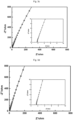
- a result diagram of ionic conductivity of the thermosetting PAN-based composite solid electrolyte film was shown in Fig. 3a , and the ionic conductivity obtained through calculation of data shown in Fig. 3a was 5.4 ⁇ 10 -4 S/cm.
- thermosetting PAN-based composite solid electrolyte film prepared in this embodiment was shown in Fig. 2 . From Fig. 2 , it might be seen that, in the thermosetting PAN-based composite solid electrolyte film, aggregation of strip-shaped polymer fibers with a diameter being about 200 nm was formed, and ceramic particles were randomly stacked/agglomerated or dispersed among the polymer fibers. Therefore, the polymer fibers, and the polymer fibers and the ceramic particles were interlaced and overlapped with each other, to commonly form a high interface network having a three-dimensional interpenetrating connectivity structure, such that the ionic conductivity of the thermosetting PAN-based composite solid electrolyte film might be effectively improved.
- thermosetting PAN-based composite solid electrolyte film provided in the present disclosure, a ceramic material was randomly distributed between three-dimensional interpenetrating connectivity polymer phases in the form of stacking/agglomeration or dispersion, and may increase amorphous regions of the polymer, increase the number of interfaces of solid electrolyte, promote dissociation of the lithium salt, etc.
- thermosetting PAN-based composite solid electrolyte film which was prepared by using a preparation method including the following steps.
- thermosetting PAN-based composite solid electrolyte film prepared in this embodiment was 3.8g/cm 3
- density of a thermosetting PAN-based polymer fiber was 1.184 g/cm 3
- the diameter of the thermosetting PAN-based polymer fiber was 80 nm
- the number of the thermosetting PAN-based polymer fibers per unit film area calculated according to the foregoing formula 1) was 1.6 ⁇ 10 6 /cm
- a result diagram of ionic conductivity of the thermosetting PAN-based composite solid electrolyte film was shown in Fig. 3b
- the ionic conductivity obtained through calculation of data shown in Fig. 3b was 6 ⁇ 10 -4 S/cm.
- thermosetting PAN-based composite solid electrolyte film which was prepared by using a preparation method including the following steps.
- thermosetting PAN-based composite solid electrolyte film prepared in this embodiment was 4.1g/cm 3
- density of a thermosetting PAN-based polymer fiber was 1.184 g/cm 3
- the diameter of the thermosetting PAN-based polymer fiber was 240 nm
- the number of the fibers per unit film area calculated according to the foregoing formula 1) was 5.7 ⁇ 10 5 /cm
- a result diagram of ionic conductivity of the thermosetting PAN-based composite solid electrolyte film was shown in Fig. 3c , and the ionic conductivity obtained through calculation of data shown in Fig. 3c was 5 ⁇ 10 -4 S/cm.
- thermosetting PAN-based composite solid electrolyte film which was prepared by using a preparation method including the following steps.
- thermosetting PAN-based composite solid electrolyte film prepared in this embodiment was 3.1g/cm 3
- density of a thermosetting PAN-based polymer fiber was 1.184 g/cm 3
- the diameter of the thermosetting PAN-based polymer fiber was 200 nm
- the number of the fibers per unit film area calculated according to the foregoing formula 1) was 5.2 ⁇ 10 5 /cm
- a result diagram of ionic conductivity of the thermosetting PAN-based composite solid electrolyte film was shown in Fig. 3d
- the ionic conductivity obtained through calculation of data shown in Fig. 3d was 2.3 ⁇ 10 -4 S/cm.
- thermosetting PAN-based composite solid electrolyte film which was prepared by using a preparation method including the following steps.
- thermosetting PAN-based composite solid electrolyte film prepared in this embodiment was 4.0g/cm 3
- density of a thermosetting PAN-based polymer fiber was 1.184 g/cm 3
- diameter of the thermosetting PAN-based polymer fiber was 100 nm
- number of the fibers per unit film area calculated according to the foregoing formula 1) was 1.4 ⁇ 10 6 /cm
- the ionic conductivity of the thermosetting PAN-based composite solid electrolyte film was 8 ⁇ 10 -4 S/cm.
- thermosetting PAN-based composite solid electrolyte film prepared without adding a modification additive. Preparation included the following specific preparation.
- This application embodiment provided a solid lithium ion battery.
- Solid electrolyte used in the solid lithium ion battery was the thermosetting PAN-based composite solid electrolyte film provided in Embodiment 1 of the present disclosure.
- the assembling of the solid lithium ion battery included the following specific steps.
- Step 2) was performed in a glove box.
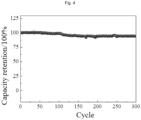
- thermosetting PAN-based composite solid electrolyte film prepared in Embodiment 1 was used as the intermediate film to assemble a full-solid button battery.
- the battery might be stably cycled for more than 300 times to achieve an advanced level of current research, such that the thermosetting PAN-based composite solid electrolyte film provided in the embodiments of the present disclosure might not only provide high ionic conductivity, but also effectively reduce interfacial impedance, so as to ensure the stable cycling of a full-solid battery.
Landscapes
- Chemical & Material Sciences (AREA)
- General Chemical & Material Sciences (AREA)
- Electrochemistry (AREA)
- Chemical Kinetics & Catalysis (AREA)
- Engineering & Computer Science (AREA)
- Inorganic Chemistry (AREA)
- Manufacturing & Machinery (AREA)
- Physics & Mathematics (AREA)
- General Physics & Mathematics (AREA)
- Condensed Matter Physics & Semiconductors (AREA)
- Materials Engineering (AREA)
- Ceramic Engineering (AREA)
- Composite Materials (AREA)
- Dispersion Chemistry (AREA)
- Conductive Materials (AREA)
- Secondary Cells (AREA)
- Electric Double-Layer Capacitors Or The Like (AREA)
Applications Claiming Priority (2)
| Application Number | Priority Date | Filing Date | Title |
|---|---|---|---|
| CN202111609879.6A CN114300741B (zh) | 2021-12-27 | 2021-12-27 | 用于制备热固型pan基复合固态电解质膜的原料组合物、固态电解质膜及制备与应用 |
| PCT/CN2022/142124 WO2023125462A1 (zh) | 2021-12-27 | 2022-12-26 | 原料组合物、热固型pan基中间膜及其制备方法、电化学器件 |
Publications (2)
| Publication Number | Publication Date |
|---|---|
| EP4421933A1 true EP4421933A1 (de) | 2024-08-28 |
| EP4421933A4 EP4421933A4 (de) | 2025-12-03 |
Family
ID=80969677
Family Applications (1)
| Application Number | Title | Priority Date | Filing Date |
|---|---|---|---|
| EP22914716.0A Pending EP4421933A4 (de) | 2021-12-27 | 2022-12-26 | Rohmaterialzusammensetzung, wärmehärtender zwischenfilm auf pan-basis und herstellungsverfahren dafür sowie elektrochemische vorrichtung |
Country Status (5)
| Country | Link |
|---|---|
| US (1) | US20240396164A1 (de) |
| EP (1) | EP4421933A4 (de) |
| JP (1) | JP2025503858A (de) |
| CN (1) | CN114300741B (de) |
| WO (1) | WO2023125462A1 (de) |
Families Citing this family (3)
| Publication number | Priority date | Publication date | Assignee | Title |
|---|---|---|---|---|
| CN114300741B (zh) * | 2021-12-27 | 2024-06-18 | 合肥国轩高科动力能源有限公司 | 用于制备热固型pan基复合固态电解质膜的原料组合物、固态电解质膜及制备与应用 |
| CN118281484B (zh) * | 2024-05-31 | 2024-09-20 | 新乡市中科膜材料科技有限公司 | 一种高性能阻燃流延电池隔膜及其制备方法 |
| CN119601754B (zh) * | 2024-11-12 | 2025-07-29 | 贵州航盛锂能科技有限公司 | 一种聚合物电池的制备工艺 |
Family Cites Families (20)
| Publication number | Priority date | Publication date | Assignee | Title |
|---|---|---|---|---|
| US6645675B1 (en) * | 1999-09-02 | 2003-11-11 | Lithium Power Technologies, Inc. | Solid polymer electrolytes |
| US6664006B1 (en) * | 1999-09-02 | 2003-12-16 | Lithium Power Technologies, Inc. | All-solid-state electrochemical device and method of manufacturing |
| CN100580021C (zh) * | 2007-01-12 | 2010-01-13 | 东华大学 | 一种可熔性聚丙烯腈复合物及其制备方法 |
| CN101768349B (zh) * | 2010-01-25 | 2012-08-15 | 北京理工大学 | 一种离子液体基聚合物电解质 |
| CN102299376B (zh) * | 2011-06-24 | 2013-12-25 | 中国科学院宁波材料技术与工程研究所 | 一种聚合物固体电解质膜及其制备方法 |
| CN102304786A (zh) * | 2011-07-18 | 2012-01-04 | 东华大学 | 一种熔融纺丝制备碳纳米管聚丙烯腈纤维的方法 |
| JP5853639B2 (ja) * | 2011-11-25 | 2016-02-09 | ソニー株式会社 | リチウムイオン電池およびリチウムイオン電池用のセパレータ、並びに電池パック、電子機器、電動車両、蓄電装置および電力システム |
| CN103390502B (zh) * | 2012-05-08 | 2016-10-19 | 海洋王照明科技股份有限公司 | 吗啉离子液体/凝胶聚合物电解质膜及其制备方法 |
| CN103540070B (zh) * | 2013-10-11 | 2016-09-14 | 苏州柯莱美高分子材料科技有限公司 | 一种聚丙烯腈薄膜的制备方法以及聚丙烯腈薄膜 |
| CN103928649B (zh) * | 2014-04-10 | 2016-08-24 | 佛山市金辉高科光电材料有限公司 | 一种改性无纺布锂离子电池隔膜及其制备方法 |
| KR20160032941A (ko) * | 2014-09-17 | 2016-03-25 | 주식회사 엘지화학 | 세퍼레이터 및 그를 포함하는 전기화학소자 |
| CN105006590A (zh) * | 2015-05-29 | 2015-10-28 | 上海交通大学 | 一种锂空气电池用凝胶聚合物电解质及其制备方法 |
| CN111653820B (zh) * | 2018-02-11 | 2021-04-30 | 中国科学院苏州纳米技术与纳米仿生研究所 | 一种固态电解质及其应用 |
| CN109401163B (zh) * | 2018-10-11 | 2020-06-30 | 天津工业大学 | 一种可熔融聚丙烯腈基树脂、制备方法及其应用 |
| CN111554975A (zh) * | 2020-05-11 | 2020-08-18 | 珠海冠宇电池股份有限公司 | 一种固态电解质及其制备方法和锂离子电池 |
| CN111740156A (zh) * | 2020-06-28 | 2020-10-02 | 星恒电源(滁州)有限公司 | 一种复合固态电解质膜及其制备方法 |
| CN112054244A (zh) * | 2020-08-21 | 2020-12-08 | 昆山宝创新能源科技有限公司 | 复合固态电解质及其制备方法和应用 |
| CN112054245A (zh) * | 2020-09-16 | 2020-12-08 | 昆山宝创新能源科技有限公司 | 复合电解质膜及其制备方法和应用 |
| CN112886067B (zh) * | 2021-02-01 | 2022-04-26 | 上海恩捷新材料科技有限公司 | 一种同步式基底支撑的固态复合电解质膜的制备方法 |
| CN114300741B (zh) * | 2021-12-27 | 2024-06-18 | 合肥国轩高科动力能源有限公司 | 用于制备热固型pan基复合固态电解质膜的原料组合物、固态电解质膜及制备与应用 |
-
2021
- 2021-12-27 CN CN202111609879.6A patent/CN114300741B/zh active Active
-
2022
- 2022-12-26 JP JP2024538729A patent/JP2025503858A/ja active Pending
- 2022-12-26 US US18/714,080 patent/US20240396164A1/en active Pending
- 2022-12-26 WO PCT/CN2022/142124 patent/WO2023125462A1/zh not_active Ceased
- 2022-12-26 EP EP22914716.0A patent/EP4421933A4/de active Pending
Also Published As
| Publication number | Publication date |
|---|---|
| WO2023125462A1 (zh) | 2023-07-06 |
| CN114300741B (zh) | 2024-06-18 |
| EP4421933A4 (de) | 2025-12-03 |
| JP2025503858A (ja) | 2025-02-06 |
| US20240396164A1 (en) | 2024-11-28 |
| CN114300741A (zh) | 2022-04-08 |
Similar Documents
| Publication | Publication Date | Title |
|---|---|---|
| EP4421933A1 (de) | Rohmaterialzusammensetzung, wärmehärtender zwischenfilm auf pan-basis und herstellungsverfahren dafür sowie elektrochemische vorrichtung | |
| CN104966823B (zh) | 材料表层具有成分浓度梯度的镍钴铝酸锂正极材料及其制备方法 | |
| CN108123101B (zh) | 一种采用预锂化的碳族材料做负极的锂硫电池及制备方法 | |
| JP7311593B2 (ja) | 電解液及び電気化学装置 | |
| CN109065945A (zh) | 一种固态电解质膜及其制备方法和应用 | |
| CN107078293A (zh) | 锂二次电池用正极活性物质、锂二次电池用正极和锂二次电池 | |
| CN107591563B (zh) | 一种硫基电解质溶液及其在固态锂电池中的应用 | |
| CN113140731B (zh) | 一种全固态锂电池及其制备方法 | |
| CN113054241A (zh) | 一种固态锂电池及其制备方法 | |
| KR20090078128A (ko) | 리튬 이차 전지용 양극 활물질, 이의 제조방법, 및 이를포함하는 리튬 이차 전지 | |
| CN114583270A (zh) | 一种锂离子电池 | |
| CN106784558A (zh) | 以气凝胶为粉体的陶瓷隔膜及其在锂离子电池中的应用 | |
| CN103094560A (zh) | 锂二次电池 | |
| CN106848396A (zh) | 一种复合聚合物电解质及其制备方法与应用 | |
| WO2021120434A1 (zh) | 一种电解液及电化学装置 | |
| CN103151528A (zh) | 一种掺铝氧化锌包覆锂离子电池正极材料的制备方法 | |
| CN109638350B (zh) | 一种对锂稳定的丁二腈基固态电解质、制备方法及其应用 | |
| EP4485602A1 (de) | Elektrochemische vorrichtung und elektrisches gerät damit | |
| CN111342137A (zh) | 一种电解液及电化学装置 | |
| He et al. | Research Progress of Electrolytes and Electrodes for Lithium‐and Sodium‐Ion Batteries at Extreme Temperatures | |
| CN108598568A (zh) | 改善正极/电解质界面稳定性的凝胶电解质及其制备方法 | |
| WO2023076011A1 (en) | Dry process for forming an electrode | |
| CN113161618A (zh) | 一种宽温域工作的锂二次电池高电压电解液及其制备方法和应用 | |
| CN113506914A (zh) | 一种三元锂离子电池电解液及含有该电解液的锂离子电池 | |
| CN106252649A (zh) | 一种正极极片及含有该极片的锂离子电池 |
Legal Events
| Date | Code | Title | Description |
|---|---|---|---|
| STAA | Information on the status of an ep patent application or granted ep patent |
Free format text: STATUS: THE INTERNATIONAL PUBLICATION HAS BEEN MADE |
|
| PUAI | Public reference made under article 153(3) epc to a published international application that has entered the european phase |
Free format text: ORIGINAL CODE: 0009012 |
|
| STAA | Information on the status of an ep patent application or granted ep patent |
Free format text: STATUS: REQUEST FOR EXAMINATION WAS MADE |
|
| 17P | Request for examination filed |
Effective date: 20240523 |
|
| AK | Designated contracting states |
Kind code of ref document: A1 Designated state(s): AL AT BE BG CH CY CZ DE DK EE ES FI FR GB GR HR HU IE IS IT LI LT LU LV MC ME MK MT NL NO PL PT RO RS SE SI SK SM TR |
|
| DAV | Request for validation of the european patent (deleted) | ||
| DAX | Request for extension of the european patent (deleted) | ||
| RIC1 | Information provided on ipc code assigned before grant |
Ipc: H01M 10/0565 20100101AFI20250805BHEP Ipc: H01M 10/058 20100101ALI20250805BHEP Ipc: H01M 10/05 20100101ALI20250805BHEP Ipc: H01M 50/40 20210101ALI20250805BHEP Ipc: H01M 10/056 20100101ALI20250805BHEP Ipc: H01M 10/0567 20100101ALI20250805BHEP Ipc: H01M 10/0568 20100101ALI20250805BHEP Ipc: H01M 10/0525 20100101ALI20250805BHEP |
|
| A4 | Supplementary search report drawn up and despatched |
Effective date: 20251103 |
|
| RIC1 | Information provided on ipc code assigned before grant |
Ipc: H01M 10/0565 20100101AFI20251028BHEP Ipc: H01M 10/058 20100101ALI20251028BHEP Ipc: H01M 10/05 20100101ALI20251028BHEP Ipc: H01M 50/40 20210101ALI20251028BHEP Ipc: H01M 10/056 20100101ALI20251028BHEP Ipc: H01M 10/0567 20100101ALI20251028BHEP Ipc: H01M 10/0568 20100101ALI20251028BHEP Ipc: H01M 10/0525 20100101ALI20251028BHEP |