EP3786944B1 - Zusammensetzung für schalldämmendes plattenelement, schalldämmendes plattenelement und schalldämmender strukturkörper - Google Patents
Zusammensetzung für schalldämmendes plattenelement, schalldämmendes plattenelement und schalldämmender strukturkörper Download PDFInfo
- Publication number
- EP3786944B1 EP3786944B1 EP19791506.9A EP19791506A EP3786944B1 EP 3786944 B1 EP3786944 B1 EP 3786944B1 EP 19791506 A EP19791506 A EP 19791506A EP 3786944 B1 EP3786944 B1 EP 3786944B1
- Authority
- EP
- European Patent Office
- Prior art keywords
- sound insulating
- meth
- acrylate
- resonant
- structure body
- Prior art date
- Legal status (The legal status is an assumption and is not a legal conclusion. Google has not performed a legal analysis and makes no representation as to the accuracy of the status listed.)
- Active
Links
Images




Classifications
-
- B—PERFORMING OPERATIONS; TRANSPORTING
- B32—LAYERED PRODUCTS
- B32B—LAYERED PRODUCTS, i.e. PRODUCTS BUILT-UP OF STRATA OF FLAT OR NON-FLAT, e.g. CELLULAR OR HONEYCOMB, FORM
- B32B25/00—Layered products comprising a layer of natural or synthetic rubber
- B32B25/04—Layered products comprising a layer of natural or synthetic rubber comprising rubber as the main or only constituent of a layer, which is next to another layer of the same or of a different material
- B32B25/08—Layered products comprising a layer of natural or synthetic rubber comprising rubber as the main or only constituent of a layer, which is next to another layer of the same or of a different material of synthetic resin
-
- B—PERFORMING OPERATIONS; TRANSPORTING
- B32—LAYERED PRODUCTS
- B32B—LAYERED PRODUCTS, i.e. PRODUCTS BUILT-UP OF STRATA OF FLAT OR NON-FLAT, e.g. CELLULAR OR HONEYCOMB, FORM
- B32B3/00—Layered products comprising a layer with external or internal discontinuities or unevennesses, or a layer of non-planar shape; Layered products comprising a layer having particular features of form
- B32B3/26—Layered products comprising a layer with external or internal discontinuities or unevennesses, or a layer of non-planar shape; Layered products comprising a layer having particular features of form characterised by a particular shape of the outline of the cross-section of a continuous layer; characterised by a layer with cavities or internal voids ; characterised by an apertured layer
- B32B3/30—Layered products comprising a layer with external or internal discontinuities or unevennesses, or a layer of non-planar shape; Layered products comprising a layer having particular features of form characterised by a particular shape of the outline of the cross-section of a continuous layer; characterised by a layer with cavities or internal voids ; characterised by an apertured layer characterised by a layer formed with recesses or projections, e.g. hollows, grooves, protuberances, ribs
-
- E—FIXED CONSTRUCTIONS
- E04—BUILDING
- E04B—GENERAL BUILDING CONSTRUCTIONS; WALLS, e.g. PARTITIONS; ROOFS; FLOORS; CEILINGS; INSULATION OR OTHER PROTECTION OF BUILDINGS
- E04B1/00—Constructions in general; Structures which are not restricted either to walls, e.g. partitions, or floors or ceilings or roofs
- E04B1/62—Insulation or other protection; Elements or use of specified material therefor
- E04B1/74—Heat, sound or noise insulation, absorption, or reflection; Other building methods affording favourable thermal or acoustical conditions, e.g. accumulating of heat within walls
- E04B1/82—Heat, sound or noise insulation, absorption, or reflection; Other building methods affording favourable thermal or acoustical conditions, e.g. accumulating of heat within walls specifically with respect to sound only
- E04B1/84—Sound-absorbing elements
- E04B1/8409—Sound-absorbing elements sheet-shaped
-
- E—FIXED CONSTRUCTIONS
- E04—BUILDING
- E04B—GENERAL BUILDING CONSTRUCTIONS; WALLS, e.g. PARTITIONS; ROOFS; FLOORS; CEILINGS; INSULATION OR OTHER PROTECTION OF BUILDINGS
- E04B1/00—Constructions in general; Structures which are not restricted either to walls, e.g. partitions, or floors or ceilings or roofs
- E04B1/62—Insulation or other protection; Elements or use of specified material therefor
- E04B1/74—Heat, sound or noise insulation, absorption, or reflection; Other building methods affording favourable thermal or acoustical conditions, e.g. accumulating of heat within walls
- E04B1/82—Heat, sound or noise insulation, absorption, or reflection; Other building methods affording favourable thermal or acoustical conditions, e.g. accumulating of heat within walls specifically with respect to sound only
- E04B1/84—Sound-absorbing elements
- E04B1/86—Sound-absorbing elements slab-shaped
-
- G—PHYSICS
- G10—MUSICAL INSTRUMENTS; ACOUSTICS
- G10K—SOUND-PRODUCING DEVICES; METHODS OR DEVICES FOR PROTECTING AGAINST, OR FOR DAMPING, NOISE OR OTHER ACOUSTIC WAVES IN GENERAL; ACOUSTICS NOT OTHERWISE PROVIDED FOR
- G10K11/00—Methods or devices for transmitting, conducting or directing sound in general; Methods or devices for protecting against, or for damping, noise or other acoustic waves in general
- G10K11/16—Methods or devices for protecting against, or for damping, noise or other acoustic waves in general
- G10K11/162—Selection of materials
-
- G—PHYSICS
- G10—MUSICAL INSTRUMENTS; ACOUSTICS
- G10K—SOUND-PRODUCING DEVICES; METHODS OR DEVICES FOR PROTECTING AGAINST, OR FOR DAMPING, NOISE OR OTHER ACOUSTIC WAVES IN GENERAL; ACOUSTICS NOT OTHERWISE PROVIDED FOR
- G10K11/00—Methods or devices for transmitting, conducting or directing sound in general; Methods or devices for protecting against, or for damping, noise or other acoustic waves in general
- G10K11/16—Methods or devices for protecting against, or for damping, noise or other acoustic waves in general
- G10K11/162—Selection of materials
- G10K11/168—Plural layers of different materials, e.g. sandwiches
-
- G—PHYSICS
- G10—MUSICAL INSTRUMENTS; ACOUSTICS
- G10K—SOUND-PRODUCING DEVICES; METHODS OR DEVICES FOR PROTECTING AGAINST, OR FOR DAMPING, NOISE OR OTHER ACOUSTIC WAVES IN GENERAL; ACOUSTICS NOT OTHERWISE PROVIDED FOR
- G10K11/00—Methods or devices for transmitting, conducting or directing sound in general; Methods or devices for protecting against, or for damping, noise or other acoustic waves in general
- G10K11/16—Methods or devices for protecting against, or for damping, noise or other acoustic waves in general
- G10K11/172—Methods or devices for protecting against, or for damping, noise or other acoustic waves in general using resonance effects
-
- B—PERFORMING OPERATIONS; TRANSPORTING
- B32—LAYERED PRODUCTS
- B32B—LAYERED PRODUCTS, i.e. PRODUCTS BUILT-UP OF STRATA OF FLAT OR NON-FLAT, e.g. CELLULAR OR HONEYCOMB, FORM
- B32B2250/00—Layers arrangement
- B32B2250/02—2 layers
-
- B—PERFORMING OPERATIONS; TRANSPORTING
- B32—LAYERED PRODUCTS
- B32B—LAYERED PRODUCTS, i.e. PRODUCTS BUILT-UP OF STRATA OF FLAT OR NON-FLAT, e.g. CELLULAR OR HONEYCOMB, FORM
- B32B2307/00—Properties of the layers or laminate
- B32B2307/10—Properties of the layers or laminate having particular acoustical properties
- B32B2307/102—Insulating
-
- B—PERFORMING OPERATIONS; TRANSPORTING
- B32—LAYERED PRODUCTS
- B32B—LAYERED PRODUCTS, i.e. PRODUCTS BUILT-UP OF STRATA OF FLAT OR NON-FLAT, e.g. CELLULAR OR HONEYCOMB, FORM
- B32B2307/00—Properties of the layers or laminate
- B32B2307/30—Properties of the layers or laminate having particular thermal properties
- B32B2307/306—Resistant to heat
- B32B2307/3065—Flame resistant or retardant, fire resistant or retardant
-
- B—PERFORMING OPERATIONS; TRANSPORTING
- B32—LAYERED PRODUCTS
- B32B—LAYERED PRODUCTS, i.e. PRODUCTS BUILT-UP OF STRATA OF FLAT OR NON-FLAT, e.g. CELLULAR OR HONEYCOMB, FORM
- B32B2319/00—Synthetic rubber
-
- C—CHEMISTRY; METALLURGY
- C08—ORGANIC MACROMOLECULAR COMPOUNDS; THEIR PREPARATION OR CHEMICAL WORKING-UP; COMPOSITIONS BASED THEREON
- C08F—MACROMOLECULAR COMPOUNDS OBTAINED BY REACTIONS ONLY INVOLVING CARBON-TO-CARBON UNSATURATED BONDS
- C08F2/00—Processes of polymerisation
- C08F2/46—Polymerisation initiated by wave energy or particle radiation
- C08F2/48—Polymerisation initiated by wave energy or particle radiation by ultraviolet or visible light
- C08F2/50—Polymerisation initiated by wave energy or particle radiation by ultraviolet or visible light with sensitising agents
-
- E—FIXED CONSTRUCTIONS
- E04—BUILDING
- E04B—GENERAL BUILDING CONSTRUCTIONS; WALLS, e.g. PARTITIONS; ROOFS; FLOORS; CEILINGS; INSULATION OR OTHER PROTECTION OF BUILDINGS
- E04B1/00—Constructions in general; Structures which are not restricted either to walls, e.g. partitions, or floors or ceilings or roofs
- E04B1/62—Insulation or other protection; Elements or use of specified material therefor
- E04B1/74—Heat, sound or noise insulation, absorption, or reflection; Other building methods affording favourable thermal or acoustical conditions, e.g. accumulating of heat within walls
- E04B1/82—Heat, sound or noise insulation, absorption, or reflection; Other building methods affording favourable thermal or acoustical conditions, e.g. accumulating of heat within walls specifically with respect to sound only
- E04B1/84—Sound-absorbing elements
- E04B2001/8414—Sound-absorbing elements with non-planar face, e.g. curved, egg-crate shaped
- E04B2001/8419—Acoustical cones or the like, e.g. for anechoic chambers
-
- E—FIXED CONSTRUCTIONS
- E04—BUILDING
- E04B—GENERAL BUILDING CONSTRUCTIONS; WALLS, e.g. PARTITIONS; ROOFS; FLOORS; CEILINGS; INSULATION OR OTHER PROTECTION OF BUILDINGS
- E04B1/00—Constructions in general; Structures which are not restricted either to walls, e.g. partitions, or floors or ceilings or roofs
- E04B1/62—Insulation or other protection; Elements or use of specified material therefor
- E04B1/74—Heat, sound or noise insulation, absorption, or reflection; Other building methods affording favourable thermal or acoustical conditions, e.g. accumulating of heat within walls
- E04B1/82—Heat, sound or noise insulation, absorption, or reflection; Other building methods affording favourable thermal or acoustical conditions, e.g. accumulating of heat within walls specifically with respect to sound only
- E04B1/84—Sound-absorbing elements
- E04B2001/8423—Tray or frame type panels or blocks, with or without acoustical filling
- E04B2001/8428—Tray or frame type panels or blocks, with or without acoustical filling containing specially shaped acoustical bodies, e.g. funnels, egg-crates, fanfolds
Definitions
- the present invention relates to a sound insulating structure body.
- indoor noise needs to be reduced by insulating wind and engine noise to provide a quiet and comfortable space for passengers. Therefore, research and development of means of insulating transmission of noise or vibration from outside to inside of a room or from outside to inside of a vehicle, or sound insulating means has been carried out.
- sound insulating members applicable to complex shapes are being demanded.
- Patent Document 1 a method of using a plurality of rigid flat plate materials such as gypsum board, concrete, steel plate, glass plate, or resin plate in combination
- Patent Document 2 a method of creating a hollow double or triple wall structure using gypsum board, or the like
- Patent Documents 3 and 4 a method of combining a flat plate material with a plurality of independent stump-like protrusions
- Patent Documents 1 to 4 improvements have been made to the sound insulating members in order to improve the sound insulating performance from the viewpoint of the structure of the members.
- improvements have not been sufficiently made from the viewpoint of the materials of the members, especially from the viewpoint of the properties of the materials.
- the present invention is aimed at providing a sound insulating structure body with excellent sound insulating performance.
- the present inventors intensively studied to solve the above-described problem to find that the above-described problem can be solved by setting the storage modulus obtained from the composite curve of the dynamic viscoelasticity of a resonant portion within a specified range and by setting the areal density of a support within a predetermined range, thereby completing the present invention.
- the present inventors intensively studied to solve the above-described problem to find that the above-described problem can also be solved by setting the storage modulus obtained from the composite curve of the dynamic viscoelasticity of a sound insulating sheet member within a specified range.
- the present inventors found that the above-described problem can also be solved by providing a composition for obtaining a cured product in which the peak temperature of the loss factor (tan ⁇ ) obtained by dynamic viscoelasticity measurement is within a specified range, and a sound insulating sheet member obtained by curing the composition.
- a sound insulating structure body with excellent sound insulating performance can be provided.
- a plurality of means “two or more”.
- sound insulating sheet member means a member including at least a sheet portion and a resonant portion as essential components.
- a sound insulating structure body refers to a structure including a resonant portion and a sheet-like support.
- (meth)acrylate is a generic term for acrylate and methacrylate, and means one or both of acrylate and methacrylate, and the same applies to " (meth) acryloyl” and "(meth)acrylic".
- Characteristic values of members such as resonant portions, which can be used in more than one, are calculated as the average of the characteristic values of a plurality of the members, unless otherwise specified.
- a sound insulating structure (hereinafter, also simply referred to as "sound insulating structure body”) of the present invention is a sound insulating structure body including: a plurality of convex-shaped rubber-elastic resonant portions; and a sheet-like support that supports the resonant portions, wherein the resonant portions have a storage modulus G' obtained from a composite curve of dynamic viscoelasticity according to ISO 6721-4 of 100 MPa or less at 25°C and 10 kHz, the resonant portions have a configuration of a single structure body, and the areal density of the support is 1.0 kg/m 2 or less.
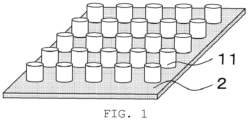
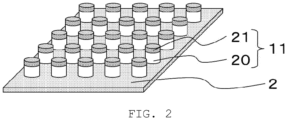
- a perspective view of one aspect of the sound insulating structure body is shown in Fig. 1 .
- the type of material used for a resonant portion is not particularly limited as long as the dynamic viscoelasticity can be measured, or in other words, as long as the material is rubber-elastic, and, examples thereof include resins and elastomers.
- the resin examples include a thermosetting or photo-curable resin and a thermoplastic resin
- examples of the elastomer include a thermosetting or photo-curable elastomer and a thermoplastic elastomer, and among these, a photo-curable resin or a photo-curable elastomer is preferable, and, in particular, from the viewpoint of favorable shape transferability and excellent productivity, a photo-curable resin is preferably included.
- a thermosetting or thermoplastic resin, or a thermosetting or thermoplastic elastomer is used as the material for a resonant portion, there is a strong tendency for air bubbles to form in a molded resonant portion due to the need for a thermal curing reaction during molding.
- Resins and elastomers may be used as materials, either singly or in any combination and ratio of two or more types thereof, and a combination of two or more types of materials is preferable from the viewpoint of being capable of controlling properties such as storage modulus and tensile elongation at break.
- Examples of a resin used in a resonant portion include: a thermosetting resin such as an unsaturated polyester resin, a phenolic resin, an epoxy resin, an urethane resin, or a rosin-modified maleic acid resin; a photo-curable resin such as a single polymer or a copolymer of monomers such as epoxy (meth)acrylate, urethane (meth)acrylate, polyester (meth)acrylate, polyether (meth)acrylate, or a modified product thereof; a single polymer or a copolymer of vinyl monomers such as vinyl acetate, vinyl chloride, vinyl alcohol, vinyl butyral, and vinylpyrrolidone; or a thermoplastic resin such as a saturated polyester resin, a polycarbonate resin, a polyamide resin, a polyolefin resin, a polyarylate resin, a polysulfone resin, and a polyphenylene ether resin.
- a thermosetting resin such as an unsaturated polyester resin,
- urethane (meth)acrylate urethane (meth)acrylate, polyester (meth) acrylate, and polyether (meth) acrylate, which have a low modulus of elasticity in a cured product, are preferable, and urethane (meth)acrylate is particularly preferable.
- an elastomer used in a resonant portion examples include a thermosetting elastomer such as a thermosetting resin-based elastomer such as a vulcanized rubber such as chemically cross-linked natural or synthetic rubber, urethane rubber, silicone rubber, fluoroelastomer, or acrylic rubber; a thermoplastic elastomer such as an olefin thermoplastic elastomer, a styrene thermoplastic elastomer, a vinyl chloride-based thermoplastic elastomer, a urethane thermoplastic elastomer, an ester thermoplastic elastomer, an amide thermoplastic elastomer, a silicone rubber thermoplastic elastomer, or an acrylic thermoplastic elastomer, a photo-curable elastomer such as an acrylic photo-curable elastomer, a silicone photo-curable elastomer, or an epoxy photo-curable elastomer, a silicone thermosetting
- thermosetting elastomer or an acrylic-based thermosetting elastomer which is a thermosetting elastomer, or an acrylic-based photo-curable elastomer or a silicone-based photo-curable elastomer, which is a photo-curable elastomer, is preferable.
- a photo-curable resin is a resin that polymerizes by light irradiation. Examples thereof include a photo-radical polymerizable resin and a photo-cationic polymerizable resin. Among them, a photo-radical polymerizable resin is preferable.
- a photo-radical polymerizable resin preferably has at least one or more (meth)acryloyl groups within the molecule.
- a photo-radical polymerizable elastomer having one or more (meth) acryloyl groups within the molecule is not particularly limited, and from the viewpoint of modulus of elasticity of a cured product, examples thereof include methyl (meth) acrylate, ethyl(meth)acrylate, n-propyl(meth)acrylate, i -propyl(meth)acrylate, n -butyl(meth)acrylate, i -butyl(meth)acrylate, t -butyl (meth)acrylate, 2-methylbutyl(meth)acrylate, n -pentyl(meth)acrylate, n -hexyl(meth)acrylate, n -heptyl(meth)acrylate, 2-methylhexyl(meth)acrylate, 2-ethylhexyl(meth)acrylate, 2-ethylhexyl(meth)acrylate, 2-butyl
- Examples of a resin used in a resonant portion include a compound having an ethylenically unsaturated bond.
- Examples of the compound having an ethylenically unsaturated bond include: an aromatic vinyl monomer such as styrene, ⁇ -methylstyrene, ⁇ -chlorostyrene, vinyl toluene, or divinylbenzene; a vinyl ester monomer such as vinyl acetate, vinyl butyrate, N -vinyl formamide, N -vinyl acetamide, N -vinyl-2-pyrrolidone, N -vinylcaprolactam, or divinyl adipate; a vinylether such as ethyl vinyl ether or phenyl vinyl ether; an allyl compound such as diallyl phthalate, trimethylol propanediaryl ether, or allyl glycidyl ether; a (meth)acrylamide such as (meth)acryl
- phenoxyethyl acrylate, benzyl acrylate, 2-ethylhexyl(meth)acrylate, and methoxypolyethylene glycol acrylate which have a low modulus of elasticity of a cured product, are preferable, and 2-ethylhexyl(meth)acrylate and methoxypolyethylene glycol acrylate are more preferable.
- These may be used singly or in a mixture of two or more kinds thereof.
- the content of a resin and/or an elastomer in a resonant portion can be adjusted as appropriate in terms of sound insulating performance, manufacturing cost, other functions, and the like, and is not particularly limited.
- the content is usually 70% by weight or more, and is preferably 80% by weight or more.
- the content may be 100% by weight, and is preferably 99% by weight or less.
- a photopolymerization initiator is preferably included from the viewpoint of improving moldability and mechanical strength, reducing manufacturing costs, and the like, and examples of the photopolymerization initiator include benzoin, acetophenone, thioxanthone, phosphine oxide, and peroxide photopolymerization initiators.
- photopolymerization initiators include benzophenone, 4,4-bis(diethylamino)benzophenone, 2,4,6-trimethylbenzophene, methyl orthobenzoyl benzoate, 4-phenylbenzophenone, t -butyl anthraquinone, 2-ethyl anthraquinone, diethoxyacetophenone, 2-hydroxy-2-methyl-1-phenylpropan-1-one 2-hydroxy-1- ⁇ 4-[4-(2-hydroxy-2-methyl-propionyl)-benzyl]phe nyl ⁇ -2-methyl-propan-1-one, benzyl dimethyl ketal, 1-hydroxycyclohexyl-phenyl ketone, benzoin methyl ether, benzoin ethyl ether, benzoin isopropyl ether, benzoin isopropyl ether, benzoin isobutyl ether, 2-methyl-[4-(methylthio)pheny
- the content of a photopolymerization initiator in a resonant portion is not particularly limited, and is usually 0.1% by weight or more, preferably 0.3% by weight or more, and 0.5% by weight or more, from the viewpoint of improving mechanical strength and maintaining an appropriate reaction rate.
- the content is usually 3% by weight or less, and preferably 2% by weight or less.
- a resonant portion may include a particle, a plate, a sphere, or the like in order to improve sound insulating performance, other functions, and the like.
- These materials are not limited, and examples thereof include a metallic material, an inorganic material, and an organic material.
- a resonant portion may contain inorganic particles from the viewpoint of improving mechanical strength and reducing material cost, and examples thereof include transparent inorganic particles such as silicon oxide, aluminum oxide, titanium oxide, soda glass, or diamond.
- inorganic particles such as silicon oxide, aluminum oxide, titanium oxide, soda glass, or diamond.
- particles of a resin such as an acrylic resin, a styrene resin, a silicone resin, a melamine resin, an epoxy resin, or a copolymer of these resins can also be used as fine particles.
- a resonant portion may contain a variety of additives such as a flame retardant, an antioxidant, a plasticizer, a defoaming agent, or a mold release agent as other components as long as the sound insulating performance is not inhibited, and these additives can be used singly, or in combination of two or more kinds thereof.
- additives such as a flame retardant, an antioxidant, a plasticizer, a defoaming agent, or a mold release agent as other components as long as the sound insulating performance is not inhibited, and these additives can be used singly, or in combination of two or more kinds thereof.
- a flame retardant is an additive that is blended in order for a flammable material to be made less flammable or not to ignite.
- the flame retardant include, but are not limited to, a bromine compound such as pentabromodiphenyl ether, octabromodiphenyl ether, decabromodiphenyl ether, tetrabromobisphenol A, hexabromocyclododecane, or hexabromobenzene, a phosphorus compound such as triphenylphosphate, a chlorine compound such as chlorinated paraffin, an antimony compound such as antimony trioxide, a metal hydroxide such as aluminum hydroxide, a nitrogen compound such as melamine cyanurate, and a boron compound such as sodium borate.
- a bromine compound such as pentabromodiphenyl ether, octabromodiphenyl ether, decabromodiphenyl ether, t
- An antioxidant is an additive that is blended for preventing oxidative degradation.
- Specific examples of the antioxidant include, but are not limited to, a phenolic antioxidant, a sulfur antioxidant, and a phosphorus antioxidant.
- a plasticizer is an additive that is blended for improving flexibility or weather resistance.
- the plasticizer include, but are not limited to, a phthalate ester, an adipate ester, a trimellitic ester, a polyester, a phosphate ester, a citrate ester, a sebacate ester, an azelaic acid ester, a maleic acid ester, a silicone oil, a mineral oil, a vegetable oil, and a modified product thereof.
- a material of a resonant portion is preferably to be easily integrated, for example, compatible with a material of a sheet portion, which will be described later, and in particular, these materials are preferably to be the same.
- a resonant portion may contain a liquid material such as a mineral oil, vegetable oil, or silicone oil.
- the liquid material is desirably encapsulated in a polymeric material from the viewpoint of inhibiting leakage of the liquid material to the outside.
- a resonant portion functions as an oscillator (resonator) that vibrates at a certain frequency when a sound wave is incident from a noise source.
- a resonant portion can provide a high sound insulating performance that exceeds the mass law when a sound wave is incident from a noise source.
- a resonant portion has a configuration of a single structure body as shown in Fig. 1 .
- a resonant portion may be a porous body containing pores (a gas such as air).
- the external shape of a resonant portion is not particularly limited, and any shape such as a triangular column, a trapezoidal column, a trapezoidal column, a polygonal column such as a pentagonal column or a hexagonal column, a circular column, an elliptical column, a truncated pyramid, a truncated cone, a pyramid, a cone, a hollow tube, a branched shape, or an indefinite shape not classified as one of the above can be adopted.
- a resonant portion can also be formed into a column shape having different cross-sectional area and/or cross-sectional shape depending on the height position of the resonant portion.
- resonant portions The arrangement of resonant portions, the number of the resonant portions provided, the size of the resonant portions, and the like can be set as appropriate according to a desired performance, and are not particularly limited.
- a resonant portion is preferably provided in contact with at least one face of the sheet portion.
- a plurality of resonant portions are arranged in a grid pattern at equal intervals, but the arrangement of the resonant portions is not particularly limited thereto.
- a plurality of resonant portions may be arranged in a staggered or random arrangement.
- a sound insulating mechanism by a sound insulating structure body which is the present invention, does not utilize Bragg scattering like in the case of a so-called phononic crystal, resonant portions do not necessarily have to be arranged at regular and periodic intervals.
- the number of resonant portions per unit area is not particularly limited as long as the number is more than one (two or more), it is preferable that resonant portions are arranged in such a way that the resonant portions do not interfere with each other due to contact, or the like, and when the diameter of a section of a cylinder is 5 mm, the number of resonant portions per 100 cm 2 is preferably from 0.1 to 4, more preferably from 0.1 to 3, and still more preferably from 0.2 to 2, from the viewpoint of improving sound insulating performance and reducing the overall weight of a sound insulating structure body.
- the number of resonant portions per 100 cm 2 is preferably from 1 to 50, and more preferably from 1 to 40, from the viewpoint of improving sound insulating performance and reducing the overall weight of a sound insulating structure body.
- the height, volume, or the like of a resonant portion is not particularly limited, and since the smaller the resonant portion is, the greater the sound insulating effect for high sound tends to be, while the larger the resonant portion is, the greater the sound insulating effect for low sound tends to be, they can be set appropriately according to desired performances.
- the height is preferably from 50 ⁇ m to 100 mm, more preferably from 100 ⁇ m to 50 mm, and still more preferably from 1 mm to 30 mm.
- the volume of each resonant portion is preferably from 1 cm 3 to 300 cm 3 , and more preferably from 2 cm 3 to 200 cm 3 .
- the diameter of a section of the cylinder is preferably from 0.5 mm to 20 mm, and more preferably from 1 mm to 10 mm, from the same viewpoint.
- the constituent material, arrangement, shape, size, direction of installation, and the like of resonant portions need not necessarily be the same for all the plurality of resonant portions.
- the frequency domain in which a high sound insulating performance appears can be expanded.
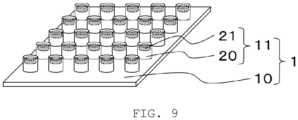
- a resonant portion may be provided directly on a support, as shown in Fig. 1 , or may be provided on a support via a rubber-elastic sheet portion, as shown in Fig. 4 , and a specific aspect thereof can include a sound insulating sheet member (also simply referred to as “sound insulating sheet member”) including a resonant portion and a rubber-elastic sheet portion (sometimes simply referred to as "sheet portion” or "sheet”) on which the resonant portion is provided, the sound insulating sheet member is layered on a support.
- a sound insulating sheet member also simply referred to as "sound insulating sheet member”
- sheet portion sometimes simply referred to as "sheet portion” or “sheet”
- the material of a sheet portion is not particularly limited as long as the material is different from that of a support described below, and can be selected from a group of materials similar to those of resins and/or elastomers used in the above-described sound insulating sheet members, and these materials may be used singly, or two or more materials may be used together in any combination and ratio. In addition, other components used in the members may be included. From the viewpoint of moldability or productivity, a material of a resonant portion is preferably to be easily integrated, for example, compatible with a material of a sheet portion, and in particular, these materials are preferably to be the same.
- a resonant portion may contain a liquid material such as a mineral oil, vegetable oil, or silicone oil. When a resonant portion contains a liquid material, the liquid material is desirably encapsulated in a polymeric material from the viewpoint of inhibiting leakage of the liquid material to the outside.
- the shape of a sheet portion when observed in plan view is not particularly limited, and any plan view shape such as a triangular shape, a square shape, an oblong shape, a rectangular shape, a trapezoidal shape, a rhombus shape, a polygonal shape such as a pentagon shape or a hexagon shape, a circular shape, an oval shape, or an indefinite shape that is not classified as one of the above can be adopted.
- a sheet may have a notch portion, a punched hole, or the like at any location from the viewpoint of improving elasticity performance, reducing weight, or the like, within a scope that does not deviate from the gist of the present invention.
- the shape of a sheet portion is not particularly limited as long as the shape is in the form of a sheet, and since the frequency band (acoustic bandgap width or frequency position) in which high sound insulating performance is exhibited can be controlled by the thickness of the sheet portion, the thickness of the sheet portion can be set appropriately in such a manner that the acoustic band gap matches a desired sound insulating frequency domain.
- the acoustic bandgap width tends to be narrower and shifted to the low frequency side.
- the acoustic bandgap width tends to be wider and shifted to the high frequency side.
- the thickness of a sheet portion is preferably 0.5 ⁇ m or more, more preferably 1 ⁇ m or more, and still more preferably 5 ⁇ m or more from the viewpoint of sound insulating performance, mechanical strength, flexibility, handleability, and the like.
- the thickness of a sheet portion is preferably 10 mm or less, more preferably 5 mm or less, and still more preferably 1 mm or less.
- the height of a sound insulating sheet member including a resonant portion and a sheet portion may be changed as appropriate depending on the application, and from the viewpoint of sound insulating performance and productivity, the height is preferably 50 ⁇ m or more, more preferably 100 ⁇ m or more, and particularly preferably 500 ⁇ m or more, and on the other hand, the height is preferably 10 mm or less, more preferably 8 mm or less, and particularly preferably 6 mm or less.
- the support used in the present invention for example, when a sheet portion is used, is provided on one side of the sheet portion to support the sheet portion and has an areal density of 1.0 kg/m 2 or less.
- the "sound insulating sheet member" does not include a support.
- a resonance of the sheet occurs.
- a frequency domain in which the direction of a force acting on the support and the direction of an acceleration generated in the sheet portion are reversed can exist, and some or all of vibrations of a specific frequency are cancelled out, resulting in a complete acoustic band gap in which vibrations of a specific frequency are almost completely absent.
- a sound insulating member utilizing such a principle is called an acoustic metamaterial.
- a structure body including at least a resonant portion and a support is referred to as a "sound insulating structure body".
- the material constituting a support is not particularly limited as long as the material is capable of supporting a resonant portion or a sheet portion, and from the viewpoint of improving the sound insulating performance, a material having a higher rigidity than that of the resonant portion or the sheet portion is preferable.
- a support preferably has a Young's modulus of 1 GPa or more, and more preferably 1.5 GPa or more.
- the upper limit of the Young's modulus is not particularly limited, and is, for example, 1,000 GPa or less.
- a face on which the sheet portion is placed is preferably as rigid as the above-described support from the viewpoint of supporting the sheet portion, improving sound insulating performance, and the like.
- the material constituting a support include, but are not specifically limited to, an organic material such as polyacrylonitrile, polyethylene terephthalate, polybutylene terephthalate, polyethylene naphthalate, polyvinyl chloride, polyvinylidene chloride, polychlorotrifluoroethylene, polyethylene, polypropylene, polystyrene, cyclic polyolefin, polynorbornene, polyethersulfone, polyetheretheretherketone, polyphenylene sulfide, polyarylate, polycarbonate, polyamide, polyimide, triacetylcellulose, polystyrene, an epoxy resin, an acrylic resin, or an oxazine resin, and a composite material containing a metal such as aluminum, stainless steel, iron, copper, zinc, or brass, inorganic glass, an inorganic particle, or a fiber in such an organic material.
- an organic material such as polyacrylonitrile, polyethylene terephthalate, polybutylene
- a support is preferably at least one selected from the group consisting of a photo-curable resin sheet, a thermosetting resin sheet, a thermoplastic resin sheet, a metal plate, and an alloy plate, and in particular, from the viewpoint of flexibility and durability, polypropylene or polyethylene terephthalate is preferable, and among these, polyethylene terephthalate is most preferable.
- the thickness of a support is not particularly limited, and from the viewpoint of sound insulating performance, rigidity, moldability, weight reduction, cost, and the like, the thickness is usually 0.03 mm or more, and preferably 0.04 mm or more, and more preferably 0.05 mm or more, and on the other hand, the thickness is preferably 1 mm or less, more preferably 0.7 mm or less, and particularly preferably 0.5 mm or less.
- a support is not limited to the aspect shown in Fig. 1 , and can be appropriately set according to the installation surface.
- a support may have a flat sheet shape, a curved sheet shape, or a special shape processed to include a curved portion, a bent portion, or the like.
- a notch, a punched portion, or the like may be provided at any position of a support.
- a support may include an adhesive layer or the like on a face of the support for attachment to another member.
- a face of a support including an adhesive layer or the like is not particularly limited, and the support may have one or more such faces.
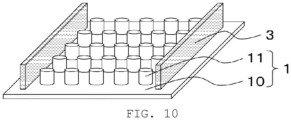
- a sound insulating structure body may be provided with a rib-shaped protrusion, which is present on the side of a face of the sound insulating structure body on the side on which a resonant portion is present, has a greater height than that of the resonant portion, and is formed in an external shape such as substantially a plate shape or substantially a cylindrical shape.
- a rib-shaped protrusion functions as a spacer.
- an aspect illustrated in WO2017/135409 can be adopted.
- the "sound insulating sheet member" does not include a rib-shaped protrusion.
- each member will be described below, and in the case of measurement of a resonant portion or a sheet portion, as a test piece for measurement, a test piece actually cut from the resonant portion or the sheet portion may be used, or a test piece prepared for evaluation using the same materials and conditions as those of the resonant portion or the sheet portion may be used. This is the same in the sound insulating sheet member and composition for a sound insulating sheet member described below.
- the description of properties of a resonant portion among the following properties may be applied to the sheet portion as well.
- a target for measurement is a resin portion or an elastomer portion in the resonant portion.
- the properties of the sheet portion can be employed as the properties of the resonant portion. This is the same in the sound insulating sheet member and composition for a sound insulating sheet member described below.
- the storage modulus G' (also simply referred to as "storage modulus") of a resonant portion at 25°C and 10 kHz is preferably 100 MPa or less, preferably 95 MPa or less, and more preferably 90 MPa or less, from the viewpoint of sound insulating performance, mechanical strength, flexibility, handleability, productivity, and the like.
- the resonance frequency is generated at a low frequency side, and therefore the sound insulating performance of a target sound insulating domain tends to be improved.
- the storage modulus at 25°C and 5 kHz is also not particularly limited. From the viewpoint of sound insulating performance, mechanical strength, flexibility, handleability, and productivity, or the like, the storage modulus is preferably 80 MPa or less, and more preferably 75 MPa or less. The smaller the storage modulus of a resonant portion, the more preferable, and although the lower limit of the storage modulus is not particularly limited, for example, the lower limit is 1 MPa or more.
- the storage modulus in the present invention refers to an index related to retention of a stress stored inside, and is obtained by creating a master curve (composite curve) according to the WLF (Williams-Landel-Ferry) law according to ISO 6721-4 from actual measured values and determining the modulus at 1 Hz band, 5 kHz band, or 10 kHz band.
- a master curve composite curve
- WLF Wide-Landel-Ferry
- the storage modulus can be controlled by changing the molecular weight or the type of bonding of a resin or the like, or by adding a filler, and in general, the storage modulus increases with an increase in molecular weight, an increase in bonding force, or addition of a filler. Further, for example, when a molded body is produced by blending a resin having a low storage modulus and a resin having a high storage modulus, the storage modulus of the molded body can be controlled by adjusting the blend ratio of these resins.
- the peak temperature of the loss factor (hereinafter, also referred to as "tan ⁇ ") of a resonant portion is usually 20°C or less, preferably 10°C or less, more preferably 0°C or less, still more preferably -20°C or less, and particularly preferably -30°C or less, from the viewpoint of sound insulating performance, tackiness, mechanical strength, flexibility, handleability, productivity, and the like.
- the temperature is usually -100°C or more, preferably -80°C or more, and more preferably -60°C or more.
- the tan ⁇ in the present invention is calculated by the loss modulus (which represents the viscosity) / storage modulus (which represents the elasticity), and is an index indicating which of the property of elasticity or the property of viscosity is dominant, and means a value at 1 Hz of the loss factor measured by the non-resonance method of "Plastics-Determination of dynamic mechanical properties- Part 4: Tensile vibration-" in accordance with ISO 6721-4.
- the peak temperature of the tan ⁇ can be controlled by using materials with different glass transition temperatures of cured products together, and adjusting the ratios of these materials used.
- the properties of a vibration damping and sound insulating material follow the so-called law of mass.
- the transmission loss which is an indicator of the amount of noise reduction, is determined by the logarithm of the product of the mass of a vibration damping and sound insulating material and the frequency of an elastic wave or sound wave. Therefore, in order to achieve a greater reduction in noise at a certain frequency, the mass of a vibration damping and sound insulating material is needed to be increased. Therefore, although a higher specific gravity of a resonant portion is preferable, a higher specific gravity reduces the handleability and increases the transportation cost.
- the specific gravity of a resonant portion is usually 1.0 g/cm 3 or more, and preferably 1.01 g/cm 3 or more.
- the specific gravity is usually 3.0 g/cm 3 or less, and preferably 2.5 g/cm 3 or less.
- the specific gravities of a plurality of resonant portions may differ from each other, from the viewpoint of securing stable sound insulating performance, the specific gravities are preferably uniform.
- uniform specific gravities mean that the difference between the maximum and minimum specific gravities of a plurality of resonant portions is within 0.5 g/cm 3 .
- Specific gravity means the ratio of the mass of a material to the mass of pure water at 4°C under a pressure of 1013.25 hPa of the same volume, and herein, the value measured by "Test methods for density and relative density of chemical products" in accordance with JIS K 0061 is used.
- the areal density of a support is 1.0 kg/m 2 or less, and preferably 0.9 kg/m 2 or less, more preferably 0.8 kg/m 2 or less, and particularly preferably 0.7 kg/m 2 or less, and on the other hand, is preferably 0.01 kg/m 2 or more, more preferably 0.03 kg/m 2 or more, particularly preferably 0.05 kg/m 2 or more.
- the areal density can be adjusted by the thickness or material of a support.
- the areal density of a support can be determined by multiplying the specific gravity of the support by the thickness of the support.
- the acoustic transmission loss of a sound insulating structure body is preferably 0.5 dB or more, and more preferably 1.0 dB or more.
- the acoustic transmission loss in the present invention refers to the difference between the sound pressure at a predetermined point in a space (sound source chamber) where a sound is generated and the sound pressure at a predetermined point in another space (sound receiving chamber) where the sound is generated in one of the two spaces divided by a sheet as a boundary.
- a white noise is generated from the inside of a small reverberation box to which a sound insulating structure body is attached, and the acoustic transmission loss (TL) can be determined from the difference in sound pressure between microphones installed inside and outside of the small reverberation box, based on the following Formula (1).
- Sound pressure difference between microphones installed inside and outside of a reverberation box TL dB L in ⁇ L out ⁇ 3
- a method of molding a resonant portion is not particularly limited, and a known molding method of a resin or an elastomer can be employed.
- a thermosetting or thermoplastic resin or elastomer for example, a melt molding method such as a press molding, an extrusion molding, or an injection molding can be used, and in such cases, molding conditions such as the temperature or pressure at which melt molding is performed can be changed appropriately depending on the type of material used.
- a photo-curable resin or elastomer for example, such a resin can be injected into a plate-shaped molding mold which is permeable to active energy rays and irradiated with an active energy ray to photo-cure.
- the active energy ray used for curing a photo-curable resin or the like is only needed to cure a photo-curable resin or the like to be used, and examples thereof include an ultraviolet ray and an electron beam.
- the amount of irradiation of an active energy ray is only needed to cure a photo-curable resin or the like to be used, and, in consideration of the type and amount of a monomer and a polymerization initiator, for example, an ultraviolet ray with a wavelength of from 200 to 400 nm is usually irradiated in the range of from 0.1 to 200 J.
- a chemical lamp, a xenon lamp, a low-pressure mercury lamp, a high-pressure mercury lamp, a metal halide lamp, or the like is used as a light source of an active energy ray.
- irradiation of an active energy ray may be performed in a single stage, it is preferable to perform irradiation in a plurality of stages, at least two stages, in order to obtain a resonant portion of a photo-curable resin having favorable surface properties.
- a curing accelerator may be contained.
- the method of combining a resonant portion and a support is not particularly limited, and can be either a method of bonding a resonant portion after molding and a support, or a method of molding a resonant portion on a support.
- bonding methods it is preferable to use an adhesive, and the type of an adhesive is not limited as long as the adhesive can bond a resonant portion and a support.
- the method of forming a sound insulating structure body including a sheet portion is not particularly limited, and can be either a method of bonding a molded resonant portion and a molded sheet portion, or a method of simultaneously forming a resonant portion and a sheet portion, and from the viewpoint of ease of stabilization of properties and inhibition of separation of the sheet portion and the resonant portion, a method of simultaneously forming the resonant portion and the sheet portion is preferable. With this method, a sound insulating structure body in which a sheet portion and a resonant portion (sound insulating sheet member) are integrally molded can be obtained.
- a sheet portion can be molded by the method described in the molding method of a resonant portion described above.
- a sheet portion like a resonant portion, can be formed by a general known molding method such as press molding, extrusion molding, or injection molding.
- the bonding method it is preferable to use an adhesive, and the type of adhesive is not limited as long as a sheet portion and a resonant portion can be bonded together.
- thermosetting or thermoplastic resin or elastomer for example, the method described in WO2017/135409 can be employed for the method of simultaneously molding a sheet portion and a resonant portion.
- molding can be performed by preparing a mold including a plurality of cavities, pouring a resin or elastomeric material into the cavities, curing the poured resin or elastomeric material by heat, and furthermore, releasing the cured product from the mold.
- molding can be performed by photo-curing with an active energy ray instead of heat curing in the above-described method of molding a thermosetting resin or the like.
- the amount of irradiation, the wavelength, and a light source of an active energy ray may be the same as those of the above-described method of forming a sheet.
- Combination of a sheet portion and a support can be performed by the same method as the method of combining a resonant portion and a support as described above.
- the resonant portion may be released from the sheet portion when a cured product is released from a mold, and the shape of a cavity may not be appropriately transferred. Separation of a sheet portion from a resonant portion is caused by stress concentrated on a boundary portion between the resonant portion and the sheet portion when a cured product is released from a mold due to occurrence of friction between the mold and the cured product, expansion of the material due to a curing reaction, pressure in the mold caused by the cured product in the mold, or the like.
- the resonant portion In order to suppress separation between a resonant portion and a sheet portion, from the viewpoint of the structure, the resonant portion is considered to be tapered to the tip of the resonant portion, but there is a problem of limiting selection of the shape of the resonant portion and a problem of increasing the manufacturing cost of a mold. Therefore, it is desirable to improve the design from the viewpoint of the material.
- Examples of a material which is not released even when stress concentration occurs include a material which is difficult to break under load, or a material which has a large tensile elongation at break.
- the elongation of the material of a resonant portion or a sheet portion is usually 30% or more, preferably 40% or more, more preferably 50% or more, and particularly preferably 100% or more, and is usually 500% or less, preferably 400% or less, and more preferably 300% or less.
- the material tends to be difficult to break even when a load is applied, and when the tensile elongation at break is equal to or less than the above-described upper limit value, a stretched shape tends to be easily restored.
- the transferability tends to be excellent.
- the value of tensile elongation at break is measured under the conditions of a tensile speed of 5 mm/min in accordance with ISO 527.
- a sound insulating sheet member (hereinafter also simply referred to as “sound insulating sheet member” or “sheet”) used in the present invention is a rubber-elastic sound insulating sheet member having a storage modulus G' obtained from a composite curve of dynamic viscoelasticity according to ISO 6721-4 of 100 MPa or less at 25°C and 10 kHz, and having an uneven structure on at least one face of the sound insulating sheet member.
- a perspective view of one aspect of the sound insulating sheet member is shown in Fig. 7 .
- Examples of the uneven structure include a structure in which a resonant portion is provided on one face of the above-described sound insulating sheet member, as illustrated in Fig. 7 .
- the resonant portion is described below, and the resonant portion illustrated in WO2017/135409 can also be employed.
- the type of material used for a sound insulating sheet member is not particularly limited as long as the dynamic viscoelasticity can be measured, or as long as the material has rubber elasticity, and examples thereof include a resin and an elastomer, and to a specific aspect of them, materials or properties of the resonant portion of the sound insulating structure body of the present invention described above can be applied in the same manner.
- a composition for a sound insulating sheet member described below can also be used.
- the materials and properties of the resonant portion of the sound insulating structure body of the present invention described above can be applied in the same manner.
- the shape of a sheet when observed in plan view is not particularly limited, and any plan view shape such as a triangular shape, a square shape, an oblong shape, a rectangular shape, a trapezoidal shape, a rhombus shape, a polygonal shape such as a pentagon shape or a hexagon shape, a circular shape, an oval shape, or an indefinite shape that is not classified as one of the above can be adopted.
- a sheet may have a notch portion, a punched hole, or the like at any location from the viewpoint of improving elasticity performance, reducing weight, or the like, within a scope that does not deviate from the gist of the present invention.
- the shape of a sheet is not particularly limited as long as the shape is in the form of a sheet, and since the frequency band (acoustic bandgap width or frequency position) in which high sound insulating performance is exhibited can be controlled by the thickness of the sheet, the thickness of the sheet can be set appropriately in such a manner that the acoustic band gap matches a desired sound insulating frequency domain.
- the acoustic bandgap width tends to be narrower and shifted to the low frequency side.
- the acoustic bandgap width tends to be wider and shifted to the high frequency side.
- the thickness of a sheet is preferably 0.5 ⁇ m or more, more preferably 1 ⁇ m or more, and still more preferably 5 ⁇ m or more from the viewpoint of sound insulating performance, mechanical strength, flexibility, handleability, and the like.
- the thickness of a sheet is preferably 10 mm or less, more preferably 5 mm or less, and still more preferably 1 mm or less.
- a sheet may include a support on at least one side of the sheet, as shown in Fig. 4 . Due to a support, for example, when a sound wave is incident from a noise source on the support side, a resonance of the sheet occurs. At this time, a frequency domain in which the direction of a force acting on the support and the direction of an acceleration generated in the sheet are reversed can exist, and some or all of vibrations of a specific frequency are cancelled out, resulting in a complete acoustic band gap in which vibrations of a specific frequency are almost completely absent. As a result, some or all of vibrations are stationary near the resonance frequency of the sheet, resulting in high sound insulating performance that exceeds the law of mass.
- a sound insulating member utilizing such a principle is called an acoustic metamaterial.
- a support is not included in the "sound insulating sheet member".
- the material constituting a support is not particularly limited as long as the material is capable of supporting a sheet, and from the viewpoint of improving the sound insulating performance, a material having a higher rigidity than that of the sheet is preferable.
- a support preferably has a Young's modulus of 1 GPa or more, and more preferably 1.5 GPa or more.
- the upper limit of the Young's modulus is not particularly limited, and is, for example, 1,000 GPa or less.
- the thickness of a support is not particularly limited, and from the viewpoint of sound insulating performance, rigidity, moldability, weight reduction, cost, and the like, the thickness is preferably usually from 0.1 mm to 50 mm.
- a support is not limited to the aspect shown in Fig. 4 , and can be appropriately set according to the installation surface.
- a support may have a flat sheet shape, a curved sheet shape, or a special shape processed to include a curved portion, a bent portion, or the like.
- a notch, a punched portion, or the like may be provided at any position of a support.
- a support may include an adhesive layer or the like on a face of the support for attachment to another member.
- a face of a support including an adhesive layer or the like is not particularly limited, and the support may have one or more such faces.
- the storage modulus of a sound insulating sheet member (sheet portion) at 25°C and 10 kHz is preferably 100 MPa or less, preferably 95 MPa or less, and more preferably 90 MPa or less, from the viewpoint of sound insulating performance, mechanical strength, flexibility, handleability, productivity, and the like.
- the resonance frequency of an uneven structure portion is generated at a low frequency side, and therefore the sound insulating performance of a target sound insulating domain tends to be improved.
- the storage modulus at 25°C and 5 kHz is also not particularly limited. From the viewpoint of sound insulating performance, mechanical strength, flexibility, handleability, and productivity, the storage modulus, or the like, is preferably 80 MPa or less, and more preferably 75 MPa or less. The smaller the storage modulus of a sheet portion, the more preferable, and although the lower limit of the storage modulus is not particularly limited, for example, the lower limit is 1 MPa or more.
- the storage modulus refers to an index related to retention of a stress stored inside, and is obtained by creating a master curve (composite curve) according to the WLF (Williams-Landel-Ferry) law according to ISO 6721-4 from actual measured values and determining the modulus at 1 Hz band, 5 kHz band, or 10 kHz band.
- WLF Wide-Landel-Ferry
- the storage modulus can be controlled by changing the molecular weight or the type of bonding of a resin or the like, or by adding a filler, and in general, the storage modulus increases with an increase in molecular weight, an increase in bonding force, or addition of a filler. Further, for example, when a molded body is produced by blending a resin having a low storage modulus and a resin having a high storage modulus, the storage modulus of the molded body can be controlled by adjusting the blend ratio of these resins.
- the properties of a vibration damping and sound insulating material follow the so-called law of mass.
- the transmission loss which is an indicator of the amount of noise reduction, is determined by the logarithm of the product of the mass of a vibration damping and sound insulating material and the frequency of an elastic wave or sound wave. Therefore, in order to achieve a greater reduction in noise at a certain frequency, the mass of a vibration damping and sound insulating material is needed to be increased. Therefore, although a higher specific gravity of a sheet is preferable, a higher specific gravity reduces the handleability and increases the transportation cost.
- the specific gravity of a sheet is usually 1.0 g/cm 3 or more, and preferably 1.01 g/cm 3 or more.
- the specific gravity is usually 3.0 g/cm 3 or less, and preferably 2.5 g/cm 3 or less.
- Specific gravity means the ratio of the mass of a material to the mass of pure water at 4°C under a pressure of 1013.25 hPa of the same volume, and herein, the value measured by "Test methods for density and relative density of chemical products" in accordance with JIS K 0061 is used.
- the acoustic transmission loss of a sound insulating structure body is preferably 0.5 dB or more, and more preferably 0.8 dB or more.
- the acoustic transmission loss refers to the difference between the sound pressure at a predetermined point in a space (sound source chamber) where a sound is generated and the sound pressure at a predetermined point in another space (sound receiving chamber) where the sound is generated in one of the two spaces divided by a sheet as a boundary.
- the measurement conditions for acoustic transmission loss an example of the measurement conditions described for the sound insulating structure body of the present invention may be employed.
- a method of molding a sound insulating sheet member is not particularly limited, and a commonly known sheet molding method can be employed.
- a thermosetting or thermoplastic resin or elastomer for example, a melt molding method such as a press molding, an extrusion molding, or an injection molding can be used, and in such cases, molding conditions such as the temperature or pressure at which melt molding is performed can be changed appropriately depending on the type of material used.
- a photo-curable resin or elastomer for example, such a resin can be injected into a plate-shaped molding mold which is permeable to active energy rays and irradiated with an active energy ray to photo-cure.
- the active energy ray used for curing a photo-curable resin or the like is only needed to cure a photo-curable resin or the like to be used, and examples thereof include an ultraviolet ray and an electron beam.
- the amount of irradiation of an active energy ray is only needed to cure a photo-curable resin or the like to be used, and, in consideration of the type and amount of a monomer and a polymerization initiator, for example, an ultraviolet ray with a wavelength of from 200 to 400 nm is usually irradiated in the range of from 0.1 to 200 J.
- a chemical lamp, a xenon lamp, a low-pressure mercury lamp, a high-pressure mercury lamp, a metal halide lamp, or the like is used as a light source of an active energy ray.
- irradiation of an active energy ray may be performed in a single stage, it is preferable to perform irradiation in a plurality of stages, at least two stages, in order to obtain a photo-curable resin sheet having favorable surface properties.
- a curing accelerator may be contained.
- the method of combining a sheet and a support is not particularly limited, and can be either a method of bonding a sheet after molding and a support, or a method of molding a sheet on a support.
- bonding methods it is preferable to use an adhesive, and the type of an adhesive is not limited as long as the adhesive can bond a sheet and a support.
- a sound insulating sheet member has an uneven structure on at least one face of the sound insulating sheet member.
- an uneven structure refers to a structure including a plurality of protrusions, and the shape and material of the protrusions are not particularly limited.
- the uneven structure may be formed by deforming a sound insulating sheet member, or may be formed with a material different from the sound insulating sheet member as the protrusions.
- the uneven structure may be formed on one face of a sound insulating sheet member or may be formed on a plurality of faces. In a configuration using a support, the unevenness may be on a face opposite the support and layering face of a sheet, or it may be on the same face as the layering face. These may be appropriately selected according to the application in terms of sound insulating performance, manufacturing cost, handleability, and the like.
- Examples of the uneven structure include a structure in which a resonant portion is provided on one face of the above-described sound insulating sheet member, as shown in Fig. 7 .
- the resonant portion is described below, and the resonant portion illustrated in WO2017/135409 can also be employed.
- a resonant portion functions as an oscillator (resonator) that vibrates at a certain frequency when a sound wave is incident from a noise source.
- a resonant portion can provide a high sound insulating performance that exceeds the mass law when a sound wave is incident from a noise source.
- a resonant portion has a configuration of a single structure body as shown in Fig. 7 .
- a resonant portion may be a porous body containing pores (a gas such as air).
- the external shape of a resonant portion is not particularly limited, and any shape such as a triangular column, a rectangular column, a trapezoidal column, a polygonal column such as a pentagonal column or a hexagonal column, a circular column, an elliptical column, a truncated pyramid, a truncated cone, a pyramid, a cone, a hollow tube, a branched shape, or an indefinite shape not classified as one of the above can be adopted.
- a resonant portion can also be formed into a column shape having different cross-sectional area and/or cross-sectional shape depending on the height position of the resonant portion.
- the material of a resonant portion can be selected from a group of materials similar to those of resins and/or elastomers used in the above-described sound insulating sheet members, and these materials may be used singly, or two or more materials may be used together in any combination and ratio. In addition, other components used in the members may be included. From the viewpoint of moldability or productivity, a material of a resonant portion is preferably to be easily integrated, for example, compatible with a material of a sound insulating sheet member, and in particular, these materials are preferably to be the same.
- a resonant portion may contain a liquid material such as a mineral oil, vegetable oil, or silicone oil. When a resonant portion contains a liquid material, the liquid material is desirably encapsulated in a polymeric material from the viewpoint of inhibiting leakage of the liquid material to the outside.
- the arrangement of resonant portions, the number of the resonant portions provided, the size of the resonant portions, and the like can be set as appropriate according to a desired performance, and are not particularly limited.
- a resonant portion is provided in contact with at least one face of a sound insulating sheet member.
- a plurality of resonant portions are arranged in a grid pattern at equal intervals, but the arrangement of the resonant portions is not particularly limited thereto.
- a plurality of resonant portions may be arranged in a staggered or random arrangement. Since a sound insulating mechanism by a sound insulating sheet member does not utilize Bragg scattering like in the case of a so-called phononic crystal, resonant portions do not necessarily have to be arranged at regular and periodic intervals.
- the number of resonant portions per unit area is not particularly limited as long as the resonant portions can be arranged in such a way that the resonant portions do not interfere with each other due to contact, or the like.
- the number of resonant portions per 100 cm 2 is preferably from 0.1 to 4, and more preferably from 0.1 to 3, from the viewpoint of improving sound insulating performance and reducing the overall weight of a sound insulating sheet member.
- the number of resonant portions per 100 cm 2 is preferably from 1 to 50, and more preferably from 1 to 40, from the viewpoint of improving sound insulating performance and reducing the overall weight of a sound insulating sheet member.
- the height, volume, or the like of a resonant portion is not particularly limited, and since the smaller the resonant portion is, the greater the sound insulating effect for high sound tends to be, while the larger the resonant portion is, the greater the sound insulating effect for low sound tends to be, they can be set appropriately according to desired performances.
- the height is preferably from 50 ⁇ m to 100 mm, more preferably from 100 ⁇ m to 50 mm, and still more preferably from 1 mm to 30 mm.
- the volume of each resonant portion is preferably from 1 cm 3 to 300 cm 3 , and more preferably from 2 cm 3 to 200 cm 3 .
- the diameter of a section of the cylinder is preferably from 0.5 mm to 20 mm, and more preferably from 1 mm to 10 mm, from the same viewpoint.
- the constituent material, arrangement, shape, size, direction of installation, and the like of resonant portions need not necessarily be the same for all the plurality of resonant portions.
- the frequency domain in which a high sound insulating performance appears can be expanded.
- a sound insulating sheet member including a resonant portion may be provided with a rib-shaped protrusion, which is present on the side of a face of a sheet on the side on which a resonant portion is present, has a greater height than that of the resonant portion, and is formed in an external shape such as substantially a plate shape or substantially a cylindrical shape.
- the method of forming a sound insulating sheet member including a resonant portion is not particularly limited, and may be either a method of bonding a molded sheet and a molded resonant portion, or a method of simultaneously forming a sheet and a resonant portion.
- a sheet in a method of bonding a molded sheet and a molded resonant portion, a sheet can be molded by the method described in the method of molding a sound insulating sheet member described above.
- a resonant portion like for a sheet, a commonly known molding method such as press molding, extrusion molding, or injection molding can be employed.
- a method of combining a sheet and a resonant portion is not particularly limited, and can be either a method of bonding a molded sheet and a molded resonant portion or a method of molding a resonant portion on a formed sheet.
- it is preferable to use an adhesive but there is no limitation on the type of adhesive as long as it is possible to bond a sheet and a resonant portion.
- thermosetting or thermoplastic resin or elastomer for example, the method described in WO2017/135409 can be employed for the method of simultaneously molding a sheet and a resonant portion. Specifically, molding can be performed by preparing a mold including a plurality of cavities, pouring a resin or elastomeric material into the cavities, curing the poured resin or elastomeric material by heat, and furthermore, releasing the cured product from the mold.
- molding can be performed by photo-curing with an active energy ray instead of heat curing in the above-described method of molding a thermosetting resin or the like.
- the amount of irradiation, the wavelength, and a light source of an active energy ray, or the like may be the same as those of the above-described method of forming a sheet.
- the resonant portion may be released from the sheet when a cured product is released from a mold, and the shape of a cavity may not be appropriately transferred. Separation of a sheet from a resonant portion is caused by stress concentrated on a boundary portion between the sheet and the resonant portion when a cured product is released from a mold due to occurrence of friction between the mold and the cured product, expansion of the material due to a curing reaction, pressure in the mold caused by the cured product in the mold, or the like.
- the resonant portion In order to suppress separation between a sheet and a resonant portion, from the viewpoint of the structure, the resonant portion is considered to be tapered to the tip of the resonant portion, but there is a problem of limiting selection of the shape of the resonant portion and a problem of increasing the manufacturing cost of a mold. Therefore, it is desirable to improve the design from the viewpoint of the material.
- Examples of a material which is not released even when stress concentration occurs include a material which is difficult to break under load, or a material which has a large tensile elongation at break.
- the elongation of the material of a sheet or a resonant portion is usually 30% or more, preferably 40% or more, more preferably 50% or more, and particularly preferably 100% or more, and is usually 500% or less, preferably 400% or less, and more preferably 300% or less.
- the material tends to be difficult to break even when a load is applied, and when the tensile elongation at break is equal to or less than the above-described upper limit value, a stretched shape tends to be easily restored.
- the transferability tends to be excellent.
- the value of tensile elongation at break is measured under the conditions of a tensile speed of 5 mm/min in accordance with ISO 527.
- composition for a sound insulating sheet member (hereinafter, also simply referred to as “composition”) is a composition for a sound insulating sheet member, wherein a cured product thereof has rubber elasticity, and the peak temperature of tan ⁇ obtained by measuring the dynamic viscoelasticity of the cured product in accordance with ISO 6721-4 is 20°C or less at 1 Hz.
- a cured product of the above-described composition for a sound insulating sheet member can be used as a sheet portion or a resonant portion in the above-described sound insulating structure body of the present invention and sound insulating sheet member.
- a material described in this section can be used as the material for this member.
- the type of material used for a sound insulating sheet member obtained by curing a composition is not particularly limited as long as the composition has rubber elasticity and the dynamic viscoelasticity can be measured, and examples thereof include a resin and an elastomer.
- the resin include a thermosetting or photo-curable resin and a thermoplastic resin
- examples of the elastomer include a thermosetting or photo-curable elastomer and a thermoplastic elastomer, and among these, a photo-curable resin or a photo-curable elastomer is preferable, and, in particular, from the viewpoint of favorable shape transferability and exhibiting excellent sound insulating fuction, a photo-curable resin is preferred.
- thermosetting or thermoplastic resin, or a thermosetting or thermoplastic elastomer is used as the material for a sound insulating sheet member
- thermosetting or thermoplastic resin or a thermosetting or thermoplastic elastomer
- there is a strong tendency for air bubbles to form in a molded sheet due to the need for a thermal curing reaction during molding a sheet. If air bubbles are generated, resonance becomes difficult to achieve and sound insulating performance is reduced.
- a photo-curable elastomer is used as the material of a sound insulating sheet member, a problem of air bubbles as described above does not occur, and the sound insulating performance is unlikely to be reduced.
- the resin examples include: a thermosetting resin such as an unsaturated polyester resin, a phenolic resin, an epoxy resin, an urethane resin, or a rosin-modified maleic acid resin; a photo-curable resin such as a single polymer or a copolymer of monomers such as epoxy acrylate, urethane acrylate, polyester acrylate, polyether acrylate, or a modified product thereof; a single polymer or a copolymer of vinyl monomers such as vinyl acetate, vinyl chloride, vinyl alcohol, vinyl butyral, and vinylpyrrolidone; and a thermoplastic resin such as a saturated polyester resin, a polycarbonate resin, a polyamide resin, a polyolefin resin, a polyarylate resin, a polysulfone resin, and a polyphenylene ether resin, and these materials may be used singly, or two or more of them may be used together in any combination and ratio.
- a thermosetting resin such as an unsaturated polyester resin
- the elastomer examples include a thermosetting elastomer such as a thermosetting resin-based elastomer such as a vulcanized rubber such as chemically cross-linked natural or synthetic rubber, urethane rubber, silicone rubber, fluoroelastomer, or acrylic rubber; a thermoplastic elastomer such as an olefin thermoplastic elastomer, a styrene-based thermoplastic elastomer, a vinyl chloride-based thermoplastic elastomer, a urethane-based thermoplastic elastomer, an ester-based thermoplastic elastomer, an amide-based thermoplastic elastomer, a silicone rubber thermoplastic elastomer, or an acrylic-based thermoplastic elastomer, a photo-curable elastomer such as an acrylic-based photo-curable elastomer; a silicone photo-curable elastomer, or an epoxy-based photo-curable elastomer, and
- the composition for a sound insulating sheet member preferably contains a photo-curable monomer, a thermosetting monomer, or a thermoplastic monomer as a monomer for obtaining the above-described resin or elastomer, and particularly preferably contains a photo-curable monomer from the viewpoint of having favorable shape transferability and exhibiting an excellent sound insulating function.
- Examples of the photo-curable monomer include a (meth)acrylate-based monomer, and an unsaturated polyester-based monomer.
- Examples of the (meth)acrylate-based monomer include an epoxy(meth)acrylate such as phenol novolac epoxy(meth)acrylate, cresol novolac epoxy(meth)acrylate, or bisphenol epoxy(meth)acrylate, urethane(meth)acrylate, epoxy urethane(meth)acrylate, polyester(meth)acrylate, polyether(meth)acrylate, and polybutadiene modified (meth) acrylate.
- an epoxy(meth)acrylate such as phenol novolac epoxy(meth)acrylate, cresol novolac epoxy(meth)acrylate, or bisphenol epoxy(meth)acrylate, urethane(meth)acrylate, epoxy urethane(meth)acrylate, polyester(meth)acrylate, polyether(meth)acrylate, and polybutadiene modified (meth) acryl
- These monomers may be used singly, and two or more monomers may be used together in any combination and ratio, and from the viewpoint of being capable of controlling properties such as tan ⁇ , storage modulus, and tensile elongation at break, it is preferable to combine two or more of monomers. These monomers may be substituted with any functional group to an extent that does not exceed the gist of the present invention.
- the total content of photo-curable monomers, thermosetting monomers, and/or thermoplastic monomers in a composition is not particularly limited, and can be appropriately adjusted in view of sound insulating performance, manufacturing cost, other functions, and the like. Although not particularly limited, for example, the content is usually 70% by weight or more, preferably 80% by weight or more, and may be 100% by weight, and is preferably 99% by weight or less.
- a combination of a bifunctional monomer ((A) component) also referred to as “bifunctional monomer (A) ”
- a monofunctional monomer ((B) component) also referred to as “monofunctional monomer (B)”
- a radical photopolymerization initiator ((C) component) also referred to as “radical photopolymerization initiator (C)
- the type of bifunctional monomer (A) is not particularly limited, and from the viewpoint of the modulus of elasticity of a cured product, an (meth) acrylate is preferred, and examples thereof include methyl(meth)acrylate, ethyl(meth)acrylate, n-propyl(meth)acrylate, i -propyl(meth)acrylate, n -butyl(meth)acrylate, i -butyl(meth)acrylate, t -butyl(meth)acrylate, 2-methylbutyl(meth)acrylate, n -pentyl(meth)acrylate, n -hexyl(meth)acrylate, n -heptyl(meth)acrylate, 2-methylhexyl(meth)acrylate, 2-ethylhexyl(meth)acrylate, 2-ethylhexyl(meth)acrylate, 2-butylhexyl(meth)acrylate
- the type of a monofunctional monomer (B) is not particularly limited, and examples of the monomer include a compound having an ethylenically unsaturated bond.
- the compound having an ethylenically unsaturated bond include: an aromatic vinyl monomer such as styrene, ⁇ -methylstyrene, ⁇ -chlorostyrene, vinyl toluene, or divinylbenzene; a vinyl ester monomer such as vinyl acetate, vinyl butyrate, N -vinyl formamide, N -vinyl acetamide, N -vinyl-2-pyrrolidone, N -vinylcaprolactam, or divinyl adipate; a vinylether such as ethyl vinyl ether or phenyl vinyl ether; an allyl compound such as diallyl phthalate, trimethylol propanediaryl ether, or allyl glycidyl ether; a (meth)acrylamide
- phenoxyethyl acrylate, benzyl acrylate, 2-ethylhexyl (meth)acrylate, and methoxypolyethylene glycol acrylate which have a low modulus of elasticity of a cured product, are preferable, and 2-ethylhexyl (meth)acrylate and methoxypolyethylene glycol acrylate are more preferable.
- the glass transition temperature (Tg) is low, and it is preferable that there is no tack on the surface of a cured product.
- the molecular weight of the bifunctional monomer is not limited, and from the viewpoint of the modulus of elasticity of a cured product, the average molecular weight Mw is usually 1,000 or more, preferably 1,200 or more, and more preferably 1,500 or more.
- the molecular weight is usually 20,000 or less, and is preferably 18,000 or less. When the molecular weight is within the above-described range, the modulus of elasticity and surface tackiness of a cured product tend to be excellent.
- the average molecular weight Mw is usually 100 or more, and is preferably 120 or more.
- the molecular weight is usually 1,000 or less, and is preferably 500 or less. In the above-described range, the modulus of elasticity and surface tackiness of a cured product tend to be excellent.
- the content of a bifunctional monomer in a composition is not particularly limited, from the viewpoint of sound insulating performance and manufacturing cost, the content of is usually 30% by weight or more, preferably 35% by weight or more, and more preferably 40% by weight or more.
- the content is usually 80% by weight or less, preferably 75% by weight or less, and more preferably 70% by weight or less.
- the modulus of elasticity and surface tackiness of a cured product tend to be excellent.
- the content of a monofunctional monomer in a composition is not particularly limited, from the viewpoint of sound insulating performance and manufacturing cost, the content is usually 20% by weight or more, preferably 25% by weight or more, and more preferably 30% by weight or more.
- the content is usually 70% by weight or less, preferably 65% by weight or less, and more preferably 60% by weight or less. When the content is within the above-described range, the modulus of elasticity and surface tackiness of a cured product tend to be excellent.
- the ratio of the content of a bifunctional monomer to the content of a monofunctional monomer is not particularly limited, and is usually 30% or more, preferably 35% or more, and more preferably 40% or more, from the viewpoint of sound insulating performance and manufacturing cost.
- the ratio is usually 80% or less, preferably 75% or less, and more preferably 70% or less. When the ratio is within the above-described range, the modulus of elasticity and surface tackiness of a cured product tend to be excellent.
- a radical photopolymerization initiator (C) is preferably included from the viewpoint of improving moldability and mechanical strength, reducing manufacturing costs, and the like, and examples of the photopolymerization initiator include benzoin, acetophenone, thioxanthone, phosphine oxide, and peroxide.
- photopolymerization initiators examples include benzophenone, 4,4-bis(diethylamino)benzophenone, 2,4,6-trimethylbenzophene, methyl orthobenzoyl benzoate, 4-phenylbenzophenone, t-butyl anthraquinone, 2-ethyl anthraquinone, diethoxyacetophenone, 2-hydroxy-2-methyl-1-phenylpropan-1-one 2-hydroxy-1- ⁇ 4-[4-(2-hydroxy-2-methyl-propionyl)-benzyl]phe nyl ⁇ -2-methyl-propan-1-one, benzyl dimethyl ketal, 1-hydroxycyclohexyl-phenyl ketone, benzoin methyl ether, benzoin ethyl ether, benzoin isopropyl ether, benzoin isopropyl ether, benzoin isobutyl ether, 2-methyl-[4-(methylthio)phenyl]
- the content of a radical photopolymerization initiator in a composition is not particularly limited, and is usually 0.1% by weight or more, preferably 0.3% by weight or more, and 0.5% by weight or more, from the viewpoint of improving mechanical strength and maintaining an appropriate reaction rate.
- the content is usually 3% by weight or less, and preferably 2% by weight or less.
- the composition may contain a particle, a plate, a sphere, or the like.
- These materials are not limited, and examples thereof include a metallic material, an inorganic material, and an organic material.
- a composition may contain inorganic particles from the viewpoint of improving the mechanical strength of a cured product and reducing material cost, and examples thereof include transparent inorganic particles such as silicon oxide, aluminum oxide, titanium oxide, soda glass, or diamond.
- inorganic particles particles of a resin such as an acrylic resin, a styrene resin, a silicone resin, a melamine resin, an epoxy resin, or a copolymer of these resins can also be used as fine particles.
- a composition may contain a variety of additives such as a flame retardant, an antioxidant, a plasticizer, a defoaming agent, or a mold release agent as other components as long as the sound insulating performance is not inhibited, and these additives can be used singly, or in combination of two or more kinds thereof.
- additives such as a flame retardant, an antioxidant, a plasticizer, a defoaming agent, or a mold release agent as other components as long as the sound insulating performance is not inhibited, and these additives can be used singly, or in combination of two or more kinds thereof.
- a flame retardant is an additive that is blended in order for a flammable material to be made less flammable or not to ignite.
- the flame retardant include, but are not limited to, a bromine compound such as pentabromodiphenyl ether, octabromodiphenyl ether, decabromodiphenyl ether, tetrabromobisphenol A, hexabromocyclododecane, or hexabromobenzene, a phosphorus compound such as triphenylphosphate, a chlorine compound such as chlorinated paraffin, an antimony compound such as antimony trioxide, a metal hydroxide such as aluminum hydroxide, a nitrogen compound such as melamine cyanurate, and a boron compound such as sodium borate.
- a bromine compound such as pentabromodiphenyl ether, octabromodiphenyl ether, decabromodiphenyl ether, t
- An antioxidant is an additive that is blended for preventing oxidative degradation.
- Specific examples of the antioxidant include, but are not limited to, a phenolic antioxidant, a sulfur antioxidant, and a phosphorus antioxidant.
- a plasticizer is an additive that is blended for improving flexibility or weather resistance.
- the plasticizer include, but are not limited to, a phthalate ester, an adipate ester, a trimellitic ester, a polyester, a phosphate ester, a citrate ester, a sebacate ester, an azelaic acid ester, a maleic acid ester, a silicone oil, a mineral oil, a vegetable oil, and a modified product thereof.
- a sound insulating sheet member (hereinafter, also simply referred to as a "sheet”) is not particularly limited as long as the member is a cured product molded using the above-described composition.
- a perspective view of one embodiment of the sound insulating sheet member is shown in Fig. 12 .
- the method of molding a sound insulating sheet member is not particularly limited, and a commonly known sheet molding method can be employed.
- a thermosetting or thermoplastic resin or elastomer for example, a melt molding method such as a press molding, an extrusion molding, or an injection molding can be used, and in such cases, molding conditions such as the temperature or pressure at which melt molding is performed can be changed appropriately depending on the type of material used.
- a photo-curable resin or elastomer for example, such a resin can be injected into a plate-shaped molding mold which is permeable to active energy rays and irradiated with an active energy ray to photo-cure.
- the active energy ray used for curing a photo-curable resin or the like is only needed to cure a photo-curable resin or the like to be used, and examples thereof include an ultraviolet ray and an electron beam.
- the amount of irradiation of an active energy ray is only needed to cure a photo-curable resin or the like to be used, and, in consideration of the type and amount of a monomer and a polymerization initiator, for example, an ultraviolet ray with a wavelength of from 200 to 450 nm is usually irradiated in the range of from 100 to 2,000 mJ/cm 2 .
- a chemical lamp, a xenon lamp, a low-pressure mercury lamp, a high-pressure mercury lamp, a metal halide lamp, or the like is used as a light source of an active energy ray.
- irradiation of an active energy ray may be performed in a single stage, it is preferable to perform irradiation in a plurality of stages, at least two stages, in order to obtain a photo-curable resin sheet having favorable surface properties.
- a curing accelerator may be contained.
- the sound insulating sheet member When a sound insulating sheet member is formed using a combination of a bifunctional monomer (A) and a monofunctional monomer (B), the sound insulating sheet member includes a constituent unit derived from the bifunctional monomer (A) and a constituent unit derived from the monofunctional monomer (B) .
- a preferred range for the content of these constituent units in the sound insulating sheet member in terms of weight is the same as the range of the content in the composition described above.
- Examples of a method for checking the contents of constituent units derived from the bifunctional monomer (A) and constituent units derived from the monofunctional monomer (B) in a sound insulating sheet member include IR, and pyrolysis GC/MS.
- the same configuration as described above can be employed for the configuration of a sound insulating sheet member, except for the following description.
- the same configuration as described above can be employed for the configuration of the member.
- the sheet may include a support on at least one face of the sheet, as shown in Fig. 13 .
- the thickness of the sheet is preferably 0.5 ⁇ m or more, more preferably 1 ⁇ m or more, and still more preferably 5 ⁇ m or more.
- the thickness of the sheet is preferably 10 mm or less, more preferably 5 mm or less, and still more preferably 1 mm or less.
- a cured product of the above-described composition for a sound insulating sheet member is preferably layered on a support supporting the cured product.
- the peak temperature of the loss factor (hereinafter, also referred to as "tan ⁇ ") of a sheet is usually 20°C or less, preferably 10°C or less, more preferably 0°C or less, still more preferably -20°C or less, and particularly preferably -30°C or less, from the viewpoint of sound insulating performance, tackiness, mechanical strength, flexibility, handleability, productivity, and the like.
- the temperature is usually -100°C or more, preferably -80°C or more, and more preferably -60°C or more.
- the tan ⁇ is calculated by the loss modulus (which represents the viscosity)/storage modulus (which represents the elasticity), and is an index indicating which of the properties of elasticity or the property of viscosity is dominant, and means a value at 1 Hz of the loss factor measured by the non-resonance method of "Plastics-Determination of dynamic mechanical properties- Part 4: Tensile vibration-" in accordance with ISO 6721-4.
- the peak temperature of the tan ⁇ can be controlled by using materials with different glass transition temperatures of cured products together, and adjusting the ratios of these materials used.
- the storage modulus of a sheet at 25°C and 10 kHz is not particularly limited, and is 100 MPa or less, preferably 95 MPa or less, and more preferably 90 MPa or less, from the viewpoint of sound insulating performance, mechanical strength, flexibility, handleability, productivity, and the like.
- the resonance frequency of an uneven structure portion is generated at a low frequency side, and therefore the sound insulating performance of a target sound insulating domain tends to be improved.
- the storage modulus at 25°C and 5 kHz is also not particularly limited. From the viewpoint of sound insulating performance, mechanical strength, flexibility, handleability, and productivity, the storage modulus is preferably 80 MPa or less, and more preferably 75 MPa or less. The smaller the storage modulus of a sheet, the more preferable, and although the lower limit of the storage modulus is not particularly limited, for example, the lower limit is 0.1 MPa or more.
- the storage modulus refers to an index related to retention of a stress stored inside, and is obtained by creating a master curve (composite curve) according to the WLF (Williams-Landel-Ferry) law according to ISO 6721-4 from actual measured values and determining the modulus at 1 Hz band, 5 kHz band, or 10 kHz band.
- WLF Wide-Landel-Ferry
- the storage modulus can be controlled by changing the molecular weight or the type of bonding of a resin or the like, or by adding a filler, and in general, the storage modulus increases with an increase in molecular weight, an increase in bonding force, or addition of a filler. Further, for example, when a molded body is produced by blending a resin having a low storage modulus and a resin having a high storage modulus, the storage modulus of the molded body can be controlled by adjusting the blend ratio of these resins.
- a sheet has a glass transition temperature of 0°C or less from the viewpoint of reducing the temperature dependence of the sound insulating performance at low temperatures.
- the temperature is more preferably -10°C or less, still more preferably -20°C or less, and particularly preferably -30°C or less.
- the glass transition temperature of a sheet refers to the peak temperature of the loss tangent in dynamic viscoelasticity measurement at the above-described frequency of 10 kHz, in particular in temperature dependent measurement.
- the sound insulating sheet member may include an uneven structure on at least one face of the sound insulating sheet member (hereinafter, also referred to as "sheet portion"), and the same uneven structure as described above may be employed. Examples
- a configuration composed of a sheet portion and/or a resonant portion is referred to as a sound insulating sheet member, and a configuration in which a support is layered thereon is referred to as a sound insulating structure body.
- a mixture of a bifunctional monomer (A), a monofunctional monomer (B), and a radical polymerization initiator (C) shown in Table 1 was poured into an aluminum A4 size mold with concave shapes of 1.2 mm in diameter and 2 mm in height with a pitch of 2 mm, and then a PET film was placed on the mold, and a high-pressure mercury lamp was used, and curing was carried out by ultraviolet irradiation at a wavelength of from 200 to 450 nm and an energy amount of 1,000 mJ/cm 2 . A sound insulating structure body cured in the mold was then released from the mold.
- the obtained sound insulating structure body included convex-shaped resonant portions of 1.2 mm in diameter, 2 mm in height, and 2 mm in pitch, and the number of resonant portions per unit area was 2,500/100 cm 2 .
- the weight of the sound insulating structure body was 71 g.
- the areal density of the above-described PET film, which was a support, was 0.35 kg/m 2 .
- a mixture of a bifunctional monomer (A), a monofunctional monomer (B), and a radical polymerization initiator (C) shown in Table 1 was prepared.
- the mixture was poured into an aluminum A4 size mold with concave shapes of 6 mm in diameter and 5 mm in height with a pitch of 10 mm, and then a PET film was placed on the mold, and a high-pressure mercury lamp was used, and curing was carried out by ultraviolet irradiation at a wavelength of from 200 to 450 nm and an energy amount of 1,000 mJ/cm 2 .
- a sound insulating structure body cured in the mold was then released from the mold.
- the obtained sound insulating structure body included convex-shaped resonant portions of 6 mm in diameter, 5 mm in height, and 10 mm in pitch, and the number of resonant portions per unit area was 100/100 cm 2 .
- the weight of the sound insulating structure body was 119 g.
- the areal density of the above-described PET film, which was a support, was 0.35 kg/m 2 .
- a mixture of a bifunctional monomer (A), a monofunctional monomer (B), and a radical polymerization initiator (C) shown in Table 1 was prepared.
- the mixture was poured into an aluminum A4 size mold with concave shapes of 6 mm in diameter and 5 mm in height with a pitch of 18 mm, and then a PET film was placed on the mold, and a high-pressure mercury lamp was used, and curing was carried out by ultraviolet irradiation at a wavelength of from 200 to 450 nm and an energy amount of 1,000 mJ/cm 2 .
- a sound insulating structure body cured in the mold was then released from the mold.
- the obtained sound insulating structure body included convex-shaped resonant portions of 6 mm in diameter, 5 mm in height, and 18 mm in pitch, and the number of resonant portions per unit area was 30/100 cm 2 .
- the weight of the sound insulating structure body was 119 g.
- the areal density of the above-described PET film, which was a support, was 0.35 kg/m 2 .
- a mixture of a bifunctional monomer (A), a monofunctional monomer (B), and a radical polymerization initiator (C) shown in Table 1 was used to prepare a sound insulating structure body of Comparative Example 1 in the same manner as in Example 1.
- the specific gravity of a sound insulating sheet member was 1.1 g/cm 3 , and the weight of the sound insulating structure body was 71 g.
- a mixture of a bifunctional monomer (A), a monofunctional monomer (B), and a radical polymerization initiator (C) shown in Table 1 was used, and this mixture was poured into an aluminum A4 size mold without concave shapes, and then a PET film was placed on the mold, and a high-pressure mercury lamp was used, and curing was carried out by ultraviolet irradiation at a wavelength of from 200 to 450 nm and an energy amount of 1,000 mJ/cm 2 . A sound insulating structure body cured in the mold was then released from the mold.
- the specific gravity of a sound insulating sheet member of the obtained sound insulating structure body was 1.1 g/cm 3 and the weight of the sound insulating structure body was 71 g.
- the areal density of the aluminum support was 1.35 kg/m 2 .
- a mixture of a bifunctional monomer (A), a monofunctional monomer (B), and a radical polymerization initiator (C) shown in Table 1 was used to prepare a sound insulating structure body of Comparative Example 3 in the same manner as in Example 2.
- the specific gravity of the sound insulating sheet member was 1.1 g/cm 3 and the weight of the sound insulating structure body was 119 g.
- a sound insulating structure body was prepared in the same manner as in Example 1, except that the PET film support was changed to an iron support.
- the areal density of the iron support was 7.85 kg/m 2 .
- a sound insulating structure body was prepared in the same manner as in Example 1, except that the structure body does not include a convex-shaped resonant portion.
- the areal density of a PET film, which was a support, was 0.35 kg/m 2 .
- a sound insulating structure body was prepared in the same manner as in Example 3, except that the structure body does not include a convex-shaped resonant portion.
- the areal density of a PET film, which was a support, was 0.35 kg/m 2 .
- the storage modulus was measured using a dynamic viscoelasticity device DMS6100 (manufactured by SII) under the following conditions.
- a strip of a resin was prepared by pouring a mixture which was used for a sound insulating sheet member in the above-described Examples into a silicone frame of 5 mm wide, 50 mm long, and 1 mm thick, glass-casting the mixture, and irradiating the mixture with ultraviolet light at an energy of 1,000 mJ/cm 2 using a high-pressure mercury lamp. From obtained viscoelasticity curves, a composite curve was created from 1 Hz to 10 kHz based on the time-temperature conversion law, and the storage modulus was calculated at 25°C. The measurement results are shown in Table 1.
- tan ⁇ was measured under the following conditions, and this peak temperature was determined.
- a strip of a resin was prepared by pouring a mixture which was used for a sound insulating sheet member in the above-described Examples into a silicone frame of 5 mm wide, 50 mm long, and 1 mm thick, glass-casting the mixture, and irradiating the mixture with ultraviolet light at an energy of 1,000 mJ/cm 2 using a high-pressure mercury lamp. The measurement results are shown in Table 2.
- the acoustic transmission loss was measured using the above-described sound insulating structure body. Using the measured values of Reference Example 1 and 2 as references, the difference between these measured values and corresponding Examples and Comparative Examples ( ⁇ TL) was determined, and the results were summarized in Tables 1 and 2, where "A” was obtained if ⁇ TL in a range from 500 Hz to 5,000 Hz was 1.0 dB or more, and "B” was obtained if ⁇ TL was less than 1.0 or no peaks due to acoustic metamaterials appeared.
- a white noise is generated from the inside of a small reverberation box to which a sound insulating structure body is attached, and the acoustic transmission loss (TL) can be determined from the difference in sound pressure between microphones installed inside and outside of the small reverberation box, based on the following Formula (1).
- Sound pressure difference between microphones installed inside and outside of a reverberation box TL dB L in ⁇ L out ⁇ 3
- Example 1 From comparison between Example 1 and Comparative Example 1 in Table 1, it is found that a sound insulating structure body using a sound insulating sheet member with a desired storage modulus has superior sound insulating performance (large acoustic transmission loss) compared to a sound insulating structure body that does not have such a storage modulus. This is because the low modulus of elasticity even in a high frequency domain improves the acoustic transmission loss due to resonance of a resonant portion up to a region around 5 kHz.
- Example 1 From comparison between Example 1 and Reference Example 1, it is found that a sound insulating structure body with an uneven structure has superior sound insulating performance (large acoustic transmission loss) compared to a sound insulating structure body without such a structure. This is because an uneven structure acts as a resonant portion to improve the acoustic transmission loss.
- Example 1 From comparison between Example 1 and Comparative Example 1 in Table 2, it is found that a sound insulating structure body using a sound insulating sheet member with a peak temperature of a desired tan ⁇ has superior sound insulating performance (large acoustic transmission loss) compared to a sound insulating structure body without such a member. This is because a low modulus of elasticity even in a high frequency domain improves the acoustic transmission loss due to resonance of a resonant portion up to a region around 5 kHz.
- a mixture of a monomer A, a monomer B, and an initiator shown in Table 3 was poured into an aluminum A4 size mold with concave shapes of 1.2 mm in diameter and 2 mm in height with a pitch of 2 mm, and then a PET film was placed on the mold, and a high-pressure mercury lamp was used, and curing was carried out by ultraviolet irradiation at a wavelength of from 200 to 450 nm and an energy amount of 1,000 mJ/cm 2 . A sound insulating structure body cured in the mold was then released from the mold.
- the obtained sound insulating structure body included convex-shaped resonant portions of 1.2 mm in diameter, 2 mm in height, and 2 mm in pitch, and the number of resonant portions per unit area was 2,500/100 cm 2 .
- the weight of the sound insulating sheet was 71 g.
- a mixture of a monomer A, a monomer B, and an initiator shown in Table 3 was used to prepare a sound insulating structure body of Reference Example 4 in the same manner as in Reference Example 3.
- the specific gravity of a sound insulating sheet member was 1.1 g/cm 3 .
- the weight of the sound insulating structure body was 71 g, and the number of resonant portions per unit area was 2,500/100 cm 2 .
- a mixture of a monomer A, a monomer B, and an initiator shown in Table 3 was used, and the mixture was cured in a container in the same manner as in Reference Example 3. Subsequently, a sound insulating structure body cured in the container was released from the container using the same method as in Reference Example 3, and a resonant portion in the sound insulating structure body was released from the structure body.
- the specific gravity of this member was 1.1 g/cm 3 .
- a mixture of a monomer A, a monomer B, and an initiator shown in Table 3 was used, and the mixture was cured in a container in the same manner as in Reference Example 3. Subsequently, a sound insulating structure body cured in the container was released from the container using the same method as in Reference Example 3, and a resonant portion in the sound insulating structure body was released from the structure body.
- the specific gravity of this member was 1.1 g/cm 3 .
- a mixture of a monomer A, a monomer B, and an initiator shown in Table 3 was used, and the mixture was cured in a container in the same manner as in Reference Example 3. Subsequently, a sound insulating structure body cured in the container was released from the container using the same method as in Reference Example 3, and a resonant portion in the sound insulating sheet member was released from the member.
- the specific gravity of this member was 1.1 g/cm 3 .
- a strip-shaped resin sample with a thickness of 200 ⁇ m, a width of 10 mm, and a length of 100 mm was prepared, and the tensile elongation at break of the strip-shaped resin sample was measured using a universal testing machine (manufactured by Shimadzu Corporation, Autograph AGS-X) to determine the tensile elongation at break of the sound insulating sheet member.
- the test conditions were set at a distance of 40 mm between chucks and a tensile speed of 5 mm/min, and the measurement was carried out at 25°C.
Landscapes
- Physics & Mathematics (AREA)
- Acoustics & Sound (AREA)
- Engineering & Computer Science (AREA)
- Architecture (AREA)
- Multimedia (AREA)
- Electromagnetism (AREA)
- Civil Engineering (AREA)
- Structural Engineering (AREA)
- Soundproofing, Sound Blocking, And Sound Damping (AREA)
- Building Environments (AREA)
- Laminated Bodies (AREA)
- Macromonomer-Based Addition Polymer (AREA)
Claims (10)
- Schalldämmender Strukturkörper, umfassend: eine Vielzahl konvex geformter gummielastischer Resonanzabschnitte (11) und einen plattenartigen Träger (2), der die Resonanzabschnitte (11) trägt, wobeider Resonanzabschnitt (11) einen Speichermodul G', erhalten aus einer zusammengesetzten Kurve der dynamischen Viskoelastizität gemäß ISO 6721-4, von 100 MPa oder weniger bei 25°C und 10 kHz aufweist,die Flächendichte des Trägers (2) 1,0 kg/m2 oder weniger beträgt unddadurch gekennzeichnet, dass der Resonanzabschnitt (11) eine Konfiguration eines einzigen Strukturkörpers aufweist.
- Schalldämmender Strukturkörper gemäß Anspruch 1, umfassend ein schalldämmendes Plattenelement (1), das den Resonanzabschnitt (11) und einen gummielastischen Plattenabschnitt (10), auf dem der Resonanzabschnitt (11) vorhanden ist, einschließt, wobei
das schalldämmende Plattenelement (1) auf dem Träger (2) geschichtet ist. - Schalldämmender Strukturkörper gemäß Anspruch 2, wobei das schalldämmende Plattenelement (1) einstückig geformt ist.
- Schalldämmender Strukturkörper gemäß einem der Ansprüche 1 bis 3, wobei der Resonanzabschnitt (11) einen Speichermodul G', erhalten aus einer zusammengesetzten Kurve der dynamischen Viskoelastizität gemäß ISO 6721-4, von 1 MPa oder mehr bei 25°C und 10 kHz aufweist.
- Schalldämmender Strukturkörper gemäß einem der Ansprüche 1 bis 4, wobei der Resonanzabschnitt (11) eine Spitzentemperatur von tan δ, erhalten durch dynamische Viskoelastizitätsmessung gemäß ISO 6721-4, von 20°C oder weniger bei 1 Hz aufweist.
- Schalldämmender Strukturkörper gemäß einem der Ansprüche 1 bis 5, wobei der Resonanzabschnitt (11) eine Bruchdehnung bei einer Zuggeschwindigkeit von 5 mm/min von 30 % oder mehr gemäß ISO 527 aufweist.
- Schalldämmender Strukturkörper gemäß einem der Ansprüche 1 bis 6, wobei der Resonanzabschnitt (11) einen Speichermodul G', erhalten aus einer zusammengesetzten Kurve der dynamischen Viskoelastizität gemäß ISO 6721-4, von 80 MPa oder weniger bei 25°C und 5 kHz aufweist.
- Schalldämmender Strukturkörper gemäß einem der Ansprüche 1 bis 7, wobei der Resonanzabschnitt (11) ein lichthärtbares Harz umfasst.
- Schalldämmender Strukturkörper gemäß einem der Ansprüche 1 bis 8, wobei das spezifische Gewicht der Vielzahl von Resonanzabschnitten (11) gleichmäßig ist.
- Schalldämmender Strukturkörper gemäß einem der Ansprüche 2 bis 9, wobei die Höhe des schalldämmenden Plattenelements (1) 50 µm bis 10 mm beträgt.
Applications Claiming Priority (3)
| Application Number | Priority Date | Filing Date | Title |
|---|---|---|---|
| JP2018087374 | 2018-04-27 | ||
| JP2018087370 | 2018-04-27 | ||
| PCT/JP2019/017777 WO2019208727A1 (ja) | 2018-04-27 | 2019-04-25 | 遮音シート部材用組成物、遮音シート部材、及び遮音構造体 |
Publications (3)
| Publication Number | Publication Date |
|---|---|
| EP3786944A1 EP3786944A1 (de) | 2021-03-03 |
| EP3786944A4 EP3786944A4 (de) | 2022-03-16 |
| EP3786944B1 true EP3786944B1 (de) | 2025-06-11 |
Family
ID=68295485
Family Applications (1)
| Application Number | Title | Priority Date | Filing Date |
|---|---|---|---|
| EP19791506.9A Active EP3786944B1 (de) | 2018-04-27 | 2019-04-25 | Zusammensetzung für schalldämmendes plattenelement, schalldämmendes plattenelement und schalldämmender strukturkörper |
Country Status (5)
| Country | Link |
|---|---|
| US (2) | US11931990B2 (de) |
| EP (1) | EP3786944B1 (de) |
| JP (1) | JP6852835B2 (de) |
| CN (2) | CN112020743A (de) |
| WO (1) | WO2019208727A1 (de) |
Families Citing this family (18)
| Publication number | Priority date | Publication date | Assignee | Title |
|---|---|---|---|---|
| EP3786944B1 (de) * | 2018-04-27 | 2025-06-11 | Mitsubishi Chemical Corporation | Zusammensetzung für schalldämmendes plattenelement, schalldämmendes plattenelement und schalldämmender strukturkörper |
| US11204204B2 (en) * | 2019-03-08 | 2021-12-21 | Toyota Motor Engineering & Manufacturing North America, Inc. | Acoustic absorber with integrated heat sink |
| US20220230606A1 (en) * | 2019-05-16 | 2022-07-21 | Matthew Schiebold | Non-Amorphous Musical Instrument Components |
| WO2021132715A1 (ja) * | 2019-12-27 | 2021-07-01 | 三菱ケミカル株式会社 | 遮音構造体 |
| IT202000003769A1 (it) * | 2020-02-24 | 2021-08-24 | Adler Evo S R L | Dispositivo per isolamento acustico a base di metamateriali |
| US11562728B2 (en) * | 2020-03-18 | 2023-01-24 | Toyota Motor Engineering & Manufacturing North America, Inc. | Shaped acoustic absorber |
| KR102497853B1 (ko) * | 2020-08-26 | 2023-02-09 | 재단법인 파동에너지 극한제어 연구단 | 저주파수용 차음 구조체 |
| EP4219852A4 (de) * | 2020-09-25 | 2024-04-03 | Mitsubishi Chemical Corporation | Schallisolierender strukturkörper |
| CN112587774A (zh) * | 2020-12-22 | 2021-04-02 | 北京怡和嘉业医疗科技股份有限公司 | 通气消声装置和通气治疗设备 |
| CN117121092A (zh) * | 2021-03-31 | 2023-11-24 | 三菱化学株式会社 | 隔音片部件及具备该隔音片部件的隔音结构体 |
| WO2022229796A1 (en) * | 2021-04-30 | 2022-11-03 | 3M Innovative Properties Company | Acoustic article |
| CN113314089B (zh) * | 2021-06-22 | 2025-10-21 | 国网智能电网研究院有限公司 | 一种具有低频宽带隔声功能的隔声结构 |
| EP4411724A4 (de) * | 2021-09-30 | 2025-01-01 | Mitsubishi Chemical Corporation | Schallblockierende folie und schallblockierende struktur |
| JP7773411B2 (ja) * | 2021-10-20 | 2025-11-19 | 三井化学株式会社 | 遮音構造体 |
| CN114049868B (zh) * | 2021-11-10 | 2024-04-19 | 哈尔滨工程大学船舶装备科技有限公司 | 一种基于声子晶体的复合隔声板及其制造方法 |
| JP2023151643A (ja) * | 2022-03-31 | 2023-10-16 | 日本発條株式会社 | 音響メタマテリアル |
| JP2023160087A (ja) | 2022-04-21 | 2023-11-02 | 株式会社東芝 | 吸音装置 |
| CN116749716B (zh) * | 2023-06-26 | 2026-03-17 | 中国第一汽车股份有限公司 | 一种pet复合折叠板型周期结构降噪风道 |
Citations (1)
| Publication number | Priority date | Publication date | Assignee | Title |
|---|---|---|---|---|
| JP2000265593A (ja) * | 1999-03-19 | 2000-09-26 | Hayakawa Rubber Co Ltd | 防音材 |
Family Cites Families (21)
| Publication number | Priority date | Publication date | Assignee | Title |
|---|---|---|---|---|
| JPH05287197A (ja) * | 1992-04-06 | 1993-11-02 | Asahi Chem Ind Co Ltd | 遮音性、制振性の優れた熱可塑性樹脂組成物 |
| JPH10312191A (ja) * | 1997-05-12 | 1998-11-24 | Tokai Rubber Ind Ltd | 高減衰材料 |
| US7712580B2 (en) * | 1999-04-20 | 2010-05-11 | Virginia Tech Intellectual Properties, Inc. | Active/passive distributed absorber for vibration and sound radiation control |
| US20160377139A1 (en) * | 2001-08-27 | 2016-12-29 | Robert A. Vito | Vibration dampening material |
| JP4364005B2 (ja) * | 2004-02-16 | 2009-11-11 | ロンシール工業株式会社 | 折板屋根用制振遮音シート、制振遮音材及び折板屋根 |
| JP4621529B2 (ja) * | 2005-03-31 | 2011-01-26 | 株式会社共和 | 遮音カバー及び遮音カバー付配管体 |
| KR100583285B1 (ko) * | 2006-02-23 | 2006-05-26 | 신정규 | 광경화형 점착 조성물 및 그의 제조방법 |
| JP5498941B2 (ja) * | 2008-07-17 | 2014-05-21 | バンドー化学株式会社 | 伝動ベルト |
| CN103827181A (zh) * | 2011-09-21 | 2014-05-28 | 日东电工株式会社 | 吸音材料及密封材料 |
| JP2013116589A (ja) * | 2011-12-02 | 2013-06-13 | Sumitomo Chemical Co Ltd | 透明遮音板およびその製造方法 |
| JP5684753B2 (ja) | 2012-05-01 | 2015-03-18 | 三井ホーム株式会社 | 遮音床構造及び遮音床構造の施工方法 |
| CN103064251A (zh) * | 2012-12-05 | 2013-04-24 | 北京化工大学常州先进材料研究院 | 一种含有双官能团光引发剂的感光性组合物 |
| US9217084B2 (en) * | 2013-03-12 | 2015-12-22 | Hrl Laboratories, Llc | Constrained microlayer cellular material with high stiffness and damping |
| JP6173040B2 (ja) * | 2013-05-23 | 2017-08-02 | キヤノン株式会社 | 定着ベルトおよび定着装置 |
| JP6305319B2 (ja) * | 2014-11-14 | 2018-04-04 | 富士フイルム株式会社 | 波長変換部材及びそれを備えたバックライトユニット、液晶表示装置並びに波長変換部材の製造方法 |
| JP6655285B2 (ja) | 2014-12-12 | 2020-02-26 | ヘンケルジャパン株式会社 | 低温にて衝撃耐久性を有する制振性付与組成物 |
| JP6485309B2 (ja) * | 2015-09-30 | 2019-03-20 | Agc株式会社 | 合わせガラス |
| EP3896686B1 (de) * | 2016-02-04 | 2023-12-27 | Mitsubishi Chemical Corporation | Schalldämmende konstruktion unter verwendung eines schalldämmenden plattenelements |
| CN108697392B (zh) | 2016-02-29 | 2022-01-28 | 大金工业株式会社 | 判定结果输出装置、判定结果提供装置及判定结果输出系统 |
| JP6829434B2 (ja) | 2016-06-21 | 2021-02-10 | 戸田建設株式会社 | 遮音構造体 |
| EP3786944B1 (de) * | 2018-04-27 | 2025-06-11 | Mitsubishi Chemical Corporation | Zusammensetzung für schalldämmendes plattenelement, schalldämmendes plattenelement und schalldämmender strukturkörper |
-
2019
- 2019-04-25 EP EP19791506.9A patent/EP3786944B1/de active Active
- 2019-04-25 CN CN201980028255.XA patent/CN112020743A/zh active Pending
- 2019-04-25 CN CN202410891310.0A patent/CN118782005A/zh active Pending
- 2019-04-25 JP JP2020515583A patent/JP6852835B2/ja active Active
- 2019-04-25 WO PCT/JP2019/017777 patent/WO2019208727A1/ja not_active Ceased
-
2020
- 2020-10-23 US US17/078,272 patent/US11931990B2/en active Active
-
2023
- 2023-10-16 US US18/380,508 patent/US12291007B2/en active Active
Patent Citations (1)
| Publication number | Priority date | Publication date | Assignee | Title |
|---|---|---|---|---|
| JP2000265593A (ja) * | 1999-03-19 | 2000-09-26 | Hayakawa Rubber Co Ltd | 防音材 |
Also Published As
| Publication number | Publication date |
|---|---|
| JP6852835B2 (ja) | 2021-03-31 |
| CN112020743A (zh) | 2020-12-01 |
| US20210039361A1 (en) | 2021-02-11 |
| CN118782005A (zh) | 2024-10-15 |
| WO2019208727A1 (ja) | 2019-10-31 |
| EP3786944A1 (de) | 2021-03-03 |
| US11931990B2 (en) | 2024-03-19 |
| JPWO2019208727A1 (ja) | 2021-03-11 |
| US12291007B2 (en) | 2025-05-06 |
| EP3786944A4 (de) | 2022-03-16 |
| US20240042742A1 (en) | 2024-02-08 |
Similar Documents
| Publication | Publication Date | Title |
|---|---|---|
| EP3786944B1 (de) | Zusammensetzung für schalldämmendes plattenelement, schalldämmendes plattenelement und schalldämmender strukturkörper | |
| EP3951111B1 (de) | Schalldämmungsstruktur | |
| JP7754008B2 (ja) | 遮音構造体 | |
| US20240242701A1 (en) | Sound insulation sheet and sound insulation structure | |
| EP2612874A1 (de) | Acrylzusammensetzung, gussform, tastenfolie für mobiltelefone und lichtleiter | |
| JP7604896B2 (ja) | 遮音シート及び遮音構造体 | |
| KR101605537B1 (ko) | 광학 시트 및 백라이트 유닛 | |
| JP2002292808A (ja) | アクリル系樹脂積層フィルム及びそれを用いた積層成形品 | |
| JP2021144191A (ja) | 遮音シート及び遮音構造体 | |
| JP2015194255A (ja) | 制振材 | |
| CN118043882A (zh) | 隔音片及隔音结构体 | |
| HK40107810A (zh) | 隔音片及隔音结构体 | |
| WO2021177370A1 (ja) | 微細凹凸構造物及び微細凹凸構造物の製造方法 | |
| JP2022153791A (ja) | 遮音シート及び遮音構造体 | |
| JP5206358B2 (ja) | 光学シート及びそれを用いたバックライトユニット | |
| JP2022157629A (ja) | 遮音シート部材の製造方法及び遮音シート部材 | |
| JP2026070098A (ja) | 構造体および気体抵抗低減構造体 | |
| JP2012215215A (ja) | ハードディスク収納ケース |
Legal Events
| Date | Code | Title | Description |
|---|---|---|---|
| STAA | Information on the status of an ep patent application or granted ep patent |
Free format text: STATUS: THE INTERNATIONAL PUBLICATION HAS BEEN MADE |
|
| PUAI | Public reference made under article 153(3) epc to a published international application that has entered the european phase |
Free format text: ORIGINAL CODE: 0009012 |
|
| STAA | Information on the status of an ep patent application or granted ep patent |
Free format text: STATUS: REQUEST FOR EXAMINATION WAS MADE |
|
| 17P | Request for examination filed |
Effective date: 20201028 |
|
| AK | Designated contracting states |
Kind code of ref document: A1 Designated state(s): AL AT BE BG CH CY CZ DE DK EE ES FI FR GB GR HR HU IE IS IT LI LT LU LV MC MK MT NL NO PL PT RO RS SE SI SK SM TR |
|
| AX | Request for extension of the european patent |
Extension state: BA ME |
|
| DAV | Request for validation of the european patent (deleted) | ||
| DAX | Request for extension of the european patent (deleted) | ||
| RAP3 | Party data changed (applicant data changed or rights of an application transferred) |
Owner name: MITSUBISHI CHEMICAL CORPORATION |
|
| RIN1 | Information on inventor provided before grant (corrected) |
Inventor name: KOSHITOUGE, HARUKI Inventor name: OKUNO, DAICHI |
|
| A4 | Supplementary search report drawn up and despatched |
Effective date: 20220210 |
|
| RIC1 | Information provided on ipc code assigned before grant |
Ipc: C08F 2/50 20060101ALI20220204BHEP Ipc: G10K 11/168 20060101ALI20220204BHEP Ipc: E04B 1/84 20060101ALI20220204BHEP Ipc: G10K 11/172 20060101AFI20220204BHEP |
|
| STAA | Information on the status of an ep patent application or granted ep patent |
Free format text: STATUS: EXAMINATION IS IN PROGRESS |
|
| 17Q | First examination report despatched |
Effective date: 20231013 |
|
| GRAP | Despatch of communication of intention to grant a patent |
Free format text: ORIGINAL CODE: EPIDOSNIGR1 |
|
| STAA | Information on the status of an ep patent application or granted ep patent |
Free format text: STATUS: GRANT OF PATENT IS INTENDED |
|
| INTG | Intention to grant announced |
Effective date: 20250212 |
|
| GRAS | Grant fee paid |
Free format text: ORIGINAL CODE: EPIDOSNIGR3 |
|
| GRAA | (expected) grant |
Free format text: ORIGINAL CODE: 0009210 |
|
| STAA | Information on the status of an ep patent application or granted ep patent |
Free format text: STATUS: THE PATENT HAS BEEN GRANTED |
|
| AK | Designated contracting states |
Kind code of ref document: B1 Designated state(s): AL AT BE BG CH CY CZ DE DK EE ES FI FR GB GR HR HU IE IS IT LI LT LU LV MC MK MT NL NO PL PT RO RS SE SI SK SM TR |
|
| P01 | Opt-out of the competence of the unified patent court (upc) registered |
Free format text: CASE NUMBER: APP_20888/2025 Effective date: 20250502 |
|
| REG | Reference to a national code |
Ref country code: GB Ref legal event code: FG4D |
|
| REG | Reference to a national code |
Ref country code: CH Ref legal event code: EP |
|
| REG | Reference to a national code |
Ref country code: IE Ref legal event code: FG4D |
|
| REG | Reference to a national code |
Ref country code: DE Ref legal event code: R096 Ref document number: 602019071060 Country of ref document: DE |
|
| PG25 | Lapsed in a contracting state [announced via postgrant information from national office to epo] |
Ref country code: FI Free format text: LAPSE BECAUSE OF FAILURE TO SUBMIT A TRANSLATION OF THE DESCRIPTION OR TO PAY THE FEE WITHIN THE PRESCRIBED TIME-LIMIT Effective date: 20250611 Ref country code: ES Free format text: LAPSE BECAUSE OF FAILURE TO SUBMIT A TRANSLATION OF THE DESCRIPTION OR TO PAY THE FEE WITHIN THE PRESCRIBED TIME-LIMIT Effective date: 20250611 |
|
| REG | Reference to a national code |
Ref country code: LT Ref legal event code: MG9D |
|
| PG25 | Lapsed in a contracting state [announced via postgrant information from national office to epo] |
Ref country code: GR Free format text: LAPSE BECAUSE OF FAILURE TO SUBMIT A TRANSLATION OF THE DESCRIPTION OR TO PAY THE FEE WITHIN THE PRESCRIBED TIME-LIMIT Effective date: 20250912 Ref country code: NO Free format text: LAPSE BECAUSE OF FAILURE TO SUBMIT A TRANSLATION OF THE DESCRIPTION OR TO PAY THE FEE WITHIN THE PRESCRIBED TIME-LIMIT Effective date: 20250911 |
|
| REG | Reference to a national code |
Ref country code: NL Ref legal event code: MP Effective date: 20250611 |
|
| PG25 | Lapsed in a contracting state [announced via postgrant information from national office to epo] |
Ref country code: BG Free format text: LAPSE BECAUSE OF FAILURE TO SUBMIT A TRANSLATION OF THE DESCRIPTION OR TO PAY THE FEE WITHIN THE PRESCRIBED TIME-LIMIT Effective date: 20250611 |
|
| PG25 | Lapsed in a contracting state [announced via postgrant information from national office to epo] |
Ref country code: HR Free format text: LAPSE BECAUSE OF FAILURE TO SUBMIT A TRANSLATION OF THE DESCRIPTION OR TO PAY THE FEE WITHIN THE PRESCRIBED TIME-LIMIT Effective date: 20250611 |
|
| PG25 | Lapsed in a contracting state [announced via postgrant information from national office to epo] |
Ref country code: RS Free format text: LAPSE BECAUSE OF FAILURE TO SUBMIT A TRANSLATION OF THE DESCRIPTION OR TO PAY THE FEE WITHIN THE PRESCRIBED TIME-LIMIT Effective date: 20250911 |
|
| PG25 | Lapsed in a contracting state [announced via postgrant information from national office to epo] |
Ref country code: LV Free format text: LAPSE BECAUSE OF FAILURE TO SUBMIT A TRANSLATION OF THE DESCRIPTION OR TO PAY THE FEE WITHIN THE PRESCRIBED TIME-LIMIT Effective date: 20250611 |
|
| PG25 | Lapsed in a contracting state [announced via postgrant information from national office to epo] |
Ref country code: NL Free format text: LAPSE BECAUSE OF FAILURE TO SUBMIT A TRANSLATION OF THE DESCRIPTION OR TO PAY THE FEE WITHIN THE PRESCRIBED TIME-LIMIT Effective date: 20250611 |
|
| PG25 | Lapsed in a contracting state [announced via postgrant information from national office to epo] |
Ref country code: PT Free format text: LAPSE BECAUSE OF FAILURE TO SUBMIT A TRANSLATION OF THE DESCRIPTION OR TO PAY THE FEE WITHIN THE PRESCRIBED TIME-LIMIT Effective date: 20251013 |
|
| REG | Reference to a national code |
Ref country code: AT Ref legal event code: MK05 Ref document number: 1802915 Country of ref document: AT Kind code of ref document: T Effective date: 20250611 |
|
| PG25 | Lapsed in a contracting state [announced via postgrant information from national office to epo] |
Ref country code: IS Free format text: LAPSE BECAUSE OF FAILURE TO SUBMIT A TRANSLATION OF THE DESCRIPTION OR TO PAY THE FEE WITHIN THE PRESCRIBED TIME-LIMIT Effective date: 20251011 |
|
| PG25 | Lapsed in a contracting state [announced via postgrant information from national office to epo] |
Ref country code: AT Free format text: LAPSE BECAUSE OF FAILURE TO SUBMIT A TRANSLATION OF THE DESCRIPTION OR TO PAY THE FEE WITHIN THE PRESCRIBED TIME-LIMIT Effective date: 20250611 Ref country code: SM Free format text: LAPSE BECAUSE OF FAILURE TO SUBMIT A TRANSLATION OF THE DESCRIPTION OR TO PAY THE FEE WITHIN THE PRESCRIBED TIME-LIMIT Effective date: 20250611 |
|
| PG25 | Lapsed in a contracting state [announced via postgrant information from national office to epo] |
Ref country code: CZ Free format text: LAPSE BECAUSE OF FAILURE TO SUBMIT A TRANSLATION OF THE DESCRIPTION OR TO PAY THE FEE WITHIN THE PRESCRIBED TIME-LIMIT Effective date: 20250611 |
|
| PG25 | Lapsed in a contracting state [announced via postgrant information from national office to epo] |
Ref country code: PL Free format text: LAPSE BECAUSE OF FAILURE TO SUBMIT A TRANSLATION OF THE DESCRIPTION OR TO PAY THE FEE WITHIN THE PRESCRIBED TIME-LIMIT Effective date: 20250611 |
|
| PG25 | Lapsed in a contracting state [announced via postgrant information from national office to epo] |
Ref country code: EE Free format text: LAPSE BECAUSE OF FAILURE TO SUBMIT A TRANSLATION OF THE DESCRIPTION OR TO PAY THE FEE WITHIN THE PRESCRIBED TIME-LIMIT Effective date: 20250611 |
|
| PG25 | Lapsed in a contracting state [announced via postgrant information from national office to epo] |
Ref country code: RO Free format text: LAPSE BECAUSE OF FAILURE TO SUBMIT A TRANSLATION OF THE DESCRIPTION OR TO PAY THE FEE WITHIN THE PRESCRIBED TIME-LIMIT Effective date: 20250611 Ref country code: SK Free format text: LAPSE BECAUSE OF FAILURE TO SUBMIT A TRANSLATION OF THE DESCRIPTION OR TO PAY THE FEE WITHIN THE PRESCRIBED TIME-LIMIT Effective date: 20250611 |
|
| PG25 | Lapsed in a contracting state [announced via postgrant information from national office to epo] |
Ref country code: DK Free format text: LAPSE BECAUSE OF FAILURE TO SUBMIT A TRANSLATION OF THE DESCRIPTION OR TO PAY THE FEE WITHIN THE PRESCRIBED TIME-LIMIT Effective date: 20250611 |
|
| PG25 | Lapsed in a contracting state [announced via postgrant information from national office to epo] |
Ref country code: IT Free format text: LAPSE BECAUSE OF FAILURE TO SUBMIT A TRANSLATION OF THE DESCRIPTION OR TO PAY THE FEE WITHIN THE PRESCRIBED TIME-LIMIT Effective date: 20250611 |
|
| PLBE | No opposition filed within time limit |
Free format text: ORIGINAL CODE: 0009261 |
|
| STAA | Information on the status of an ep patent application or granted ep patent |
Free format text: STATUS: NO OPPOSITION FILED WITHIN TIME LIMIT |
|
| REG | Reference to a national code |
Ref country code: CH Ref legal event code: L10 Free format text: ST27 STATUS EVENT CODE: U-0-0-L10-L00 (AS PROVIDED BY THE NATIONAL OFFICE) Effective date: 20260423 |