EP3751348B1 - Electrophotographic photosensitive member, process cartridge and electrophotographic apparatus - Google Patents
Electrophotographic photosensitive member, process cartridge and electrophotographic apparatus Download PDFInfo
- Publication number
- EP3751348B1 EP3751348B1 EP20179613.3A EP20179613A EP3751348B1 EP 3751348 B1 EP3751348 B1 EP 3751348B1 EP 20179613 A EP20179613 A EP 20179613A EP 3751348 B1 EP3751348 B1 EP 3751348B1
- Authority
- EP
- European Patent Office
- Prior art keywords
- photosensitive member
- electrophotographic photosensitive
- electro
- conductive support
- undercoat layer
- Prior art date
- Legal status (The legal status is an assumption and is not a legal conclusion. Google has not performed a legal analysis and makes no representation as to the accuracy of the status listed.)
- Active
Links
Images

Classifications
-
- G—PHYSICS
- G03—PHOTOGRAPHY; CINEMATOGRAPHY; ANALOGOUS TECHNIQUES USING WAVES OTHER THAN OPTICAL WAVES; ELECTROGRAPHY; HOLOGRAPHY
- G03G—ELECTROGRAPHY; ELECTROPHOTOGRAPHY; MAGNETOGRAPHY
- G03G5/00—Recording members for original recording by exposure, e.g. to light, to heat, to electrons; Manufacture thereof; Selection of materials therefor
- G03G5/02—Charge-receiving layers
- G03G5/04—Photoconductive layers; Charge-generation layers or charge-transporting layers; Additives therefor; Binders therefor
- G03G5/043—Photoconductive layers characterised by having two or more layers or characterised by their composite structure
-
- G—PHYSICS
- G03—PHOTOGRAPHY; CINEMATOGRAPHY; ANALOGOUS TECHNIQUES USING WAVES OTHER THAN OPTICAL WAVES; ELECTROGRAPHY; HOLOGRAPHY
- G03G—ELECTROGRAPHY; ELECTROPHOTOGRAPHY; MAGNETOGRAPHY
- G03G15/00—Apparatus for electrographic processes using a charge pattern
- G03G15/14—Apparatus for electrographic processes using a charge pattern for transferring a pattern to a second base
- G03G15/16—Apparatus for electrographic processes using a charge pattern for transferring a pattern to a second base of a toner pattern, e.g. a powder pattern, e.g. magnetic transfer
- G03G15/1605—Apparatus for electrographic processes using a charge pattern for transferring a pattern to a second base of a toner pattern, e.g. a powder pattern, e.g. magnetic transfer using at least one intermediate support
- G03G15/162—Apparatus for electrographic processes using a charge pattern for transferring a pattern to a second base of a toner pattern, e.g. a powder pattern, e.g. magnetic transfer using at least one intermediate support details of the the intermediate support, e.g. chemical composition
-
- G—PHYSICS
- G03—PHOTOGRAPHY; CINEMATOGRAPHY; ANALOGOUS TECHNIQUES USING WAVES OTHER THAN OPTICAL WAVES; ELECTROGRAPHY; HOLOGRAPHY
- G03G—ELECTROGRAPHY; ELECTROPHOTOGRAPHY; MAGNETOGRAPHY
- G03G21/00—Arrangements not provided for by groups G03G13/00 - G03G19/00, e.g. cleaning, elimination of residual charge
- G03G21/16—Mechanical means for facilitating the maintenance of the apparatus, e.g. modular arrangements
- G03G21/18—Mechanical means for facilitating the maintenance of the apparatus, e.g. modular arrangements using a processing cartridge, whereby the process cartridge comprises at least two image processing means in a single unit
- G03G21/1803—Arrangements or disposition of the complete process cartridge or parts thereof
- G03G21/1814—Details of parts of process cartridge, e.g. for charging, transfer, cleaning, developing
-
- G—PHYSICS
- G03—PHOTOGRAPHY; CINEMATOGRAPHY; ANALOGOUS TECHNIQUES USING WAVES OTHER THAN OPTICAL WAVES; ELECTROGRAPHY; HOLOGRAPHY
- G03G—ELECTROGRAPHY; ELECTROPHOTOGRAPHY; MAGNETOGRAPHY
- G03G5/00—Recording members for original recording by exposure, e.g. to light, to heat, to electrons; Manufacture thereof; Selection of materials therefor
- G03G5/02—Charge-receiving layers
- G03G5/04—Photoconductive layers; Charge-generation layers or charge-transporting layers; Additives therefor; Binders therefor
- G03G5/06—Photoconductive layers; Charge-generation layers or charge-transporting layers; Additives therefor; Binders therefor characterised by the photoconductive material being organic
- G03G5/0664—Dyes
- G03G5/0696—Phthalocyanines
-
- G—PHYSICS
- G03—PHOTOGRAPHY; CINEMATOGRAPHY; ANALOGOUS TECHNIQUES USING WAVES OTHER THAN OPTICAL WAVES; ELECTROGRAPHY; HOLOGRAPHY
- G03G—ELECTROGRAPHY; ELECTROPHOTOGRAPHY; MAGNETOGRAPHY
- G03G5/00—Recording members for original recording by exposure, e.g. to light, to heat, to electrons; Manufacture thereof; Selection of materials therefor
- G03G5/10—Bases for charge-receiving or other layers
-
- G—PHYSICS
- G03—PHOTOGRAPHY; CINEMATOGRAPHY; ANALOGOUS TECHNIQUES USING WAVES OTHER THAN OPTICAL WAVES; ELECTROGRAPHY; HOLOGRAPHY
- G03G—ELECTROGRAPHY; ELECTROPHOTOGRAPHY; MAGNETOGRAPHY
- G03G5/00—Recording members for original recording by exposure, e.g. to light, to heat, to electrons; Manufacture thereof; Selection of materials therefor
- G03G5/10—Bases for charge-receiving or other layers
- G03G5/102—Bases for charge-receiving or other layers consisting of or comprising metals
-
- G—PHYSICS
- G03—PHOTOGRAPHY; CINEMATOGRAPHY; ANALOGOUS TECHNIQUES USING WAVES OTHER THAN OPTICAL WAVES; ELECTROGRAPHY; HOLOGRAPHY
- G03G—ELECTROGRAPHY; ELECTROPHOTOGRAPHY; MAGNETOGRAPHY
- G03G5/00—Recording members for original recording by exposure, e.g. to light, to heat, to electrons; Manufacture thereof; Selection of materials therefor
- G03G5/10—Bases for charge-receiving or other layers
- G03G5/104—Bases for charge-receiving or other layers comprising inorganic material other than metals, e.g. salts, oxides, carbon
-
- G—PHYSICS
- G03—PHOTOGRAPHY; CINEMATOGRAPHY; ANALOGOUS TECHNIQUES USING WAVES OTHER THAN OPTICAL WAVES; ELECTROGRAPHY; HOLOGRAPHY
- G03G—ELECTROGRAPHY; ELECTROPHOTOGRAPHY; MAGNETOGRAPHY
- G03G5/00—Recording members for original recording by exposure, e.g. to light, to heat, to electrons; Manufacture thereof; Selection of materials therefor
- G03G5/14—Inert intermediate or cover layers for charge-receiving layers
- G03G5/142—Inert intermediate layers
-
- G—PHYSICS
- G03—PHOTOGRAPHY; CINEMATOGRAPHY; ANALOGOUS TECHNIQUES USING WAVES OTHER THAN OPTICAL WAVES; ELECTROGRAPHY; HOLOGRAPHY
- G03G—ELECTROGRAPHY; ELECTROPHOTOGRAPHY; MAGNETOGRAPHY
- G03G5/00—Recording members for original recording by exposure, e.g. to light, to heat, to electrons; Manufacture thereof; Selection of materials therefor
- G03G5/14—Inert intermediate or cover layers for charge-receiving layers
- G03G5/142—Inert intermediate layers
- G03G5/144—Inert intermediate layers comprising inorganic material
Definitions
- the present disclosure relates to an electrophotographic photosensitive member, and a process cartridge and an electrophotographic apparatus including the electrophotographic photosensitive member.
- the electrophotographic photosensitive member described in Japanese Patent Application Laid-Open No. 2005-309116 or Japanese Patent Application Laid-Open No. 2002-287396 can suppress the occurrence of the black spot, but on the other hand, after stored in a high-temperature and high-humidity environment, the exposure potential rises, a desired potential contrast is not obtained, and the density of the black portion decreases. In recent years, it has been desired that a stable image is outputted even after exposed to the high-temperature and high-humidity environment in storage, transportation and the like.
- JP 2016-118783 A relates to an electrophotographic photoreceptor having a photosensitive layer on a conductive support, the photosensitive layer containing a charge transport material, a binder resin, and a compound represented by the general formula (1) and having a molecular weight of 350 or less.
- JP 2019-060928 A relates to an electrophotographic photoreceptor having a conductive base, a subtraction layer provided on the conductive base, which contains an electron transport material and 30 mass% or more of silica particles, and a photosensitive layer provided on the subtraction layer.
- JP 2003-215825 A relates to an electrophotographic photoreceptor, wherein the Bragg angle 2 ⁇ of X-ray diffraction spectra using a Cu-K ⁇ characteristic X-ray (wavelength 1.541 ⁇ ) has the maximum peak at 27.2 ⁇ 0.2° and the photoreceptor contains a titanyl phthalocyanin pigment of 35 to 20 m 2 /g BET specific surface area and a moisture retaining agent.
- US 2009/232552 A1 relates to coating liquid for forming an undercoat layer of an electrophotographic photoreceptor containing metal oxide particles and a binder resin, the metal oxide particles have a number average particle diameter of 0.10 ⁇ m or less and a 10% cumulative particle diameter of 0.060 ⁇ m or less.
- the object of the present disclosure is to provide an electrophotographic photosensitive member that can simultaneously achieve the suppression of the occurrence of the black spot in a charged portion and the suppression of the deterioration in sensitivity of an exposed portion, even after stored in a high-temperature and high-humidity environment.
- the electrophotographic photosensitive member according to the present disclosure is an electrophotographic photosensitive member that has an electro-conductive support, an undercoat layer, a charge generation layer and a charge transport layer in this order, wherein an atomic concentration ratio R of the oxygen atom to the aluminum atom on the surface of the electro-conductive support, as measured by energy dispersive X-ray spectroscopy, satisfies the following Expression (1): 1.6 ⁇ R and the undercoat layer includes a titanium oxide particle that is surface-treated with at least one chemical compound represented by the following Formulae (A-1) to (A-10), and wherein an arithmetic average roughness Sa of the surface of the electro-conductive support is 3 ⁇ m or less.
- R 1 to R 10 represent a methyl group, an ethyl group or an acetyl group
- X 1 to X 5 represent a hydrogen atom or a methyl group
- n is 1 to 7.
- the present inventors have made studies, and as a result, have found out that when the surface of the electro-conductive support constituting the electrophotographic photosensitive member has a particular elemental composition, and an organic functional group on the surface of the titanium oxide particle contained in the undercoat layer has a particular structure, the electrophotographic photosensitive member can simultaneously suppress the occurrence of the black spot in the charged portion and the deterioration in sensitivity of the exposed portion, even after stored in a high-temperature and high-humidity environment.
- the electrophotographic photosensitive member includes an electro-conductive support, an undercoat layer, a charge generation layer and a charge transport layer in this order, wherein the atomic concentration ratio R of the oxygen atom to the aluminum atom on the surface of the electro-conductive support, as measured by energy dispersive X-ray spectroscopy, satisfies the following Expression (1): 1.6 ⁇ R and the undercoat layer includes a titanium oxide particle that is surface-treated with at least one chemical compound represented by the following Formulae (A-1) to (A-10), and wherein an arithmetic average roughness Sa of the surface of the electro-conductive support is 3 ⁇ m or less.
- R 1 to R 10 represent a methyl group, an ethyl group or an acetyl group
- X 1 to X 5 represent a hydrogen atom or a methyl group
- n is 1 to 7.
- the electrophotographic photosensitive member is constructed so as to have an undercoat layer containing a metal oxide between an electro-conductive support and a charge generation layer and so that the metal oxide is surface-treated, thereby can suppress the occurrence of the black spot due to local charge injection, but that on the other hand, the exposure potential rises after the member is stored in a high-temperature and high-humidity environment.
- the reason is considered to be that charge transfer at the interface between the electro-conductive support and the undercoat layer is obstructed by the adsorption of moisture.
- the present inventors have made studies, and as a result, have found out that when the surface of the electro-conductive support constituting the electrophotographic photosensitive member has a particular composition, and the surface of the titanium oxide particle contained in the undercoat layer is surface-treated with a chemical compound having a particular structure, the electrophotographic photosensitive member can simultaneously suppress the occurrence of the black spot in the charged portion and the deterioration in sensitivity of the exposed portion, even after stored in the high-temperature and high-humidity environment.
- the reason is assumed to be that the charge interchange characteristics at the interface between the electro-conductive support and the undercoat layer are stabilized, and the obstruction of charge transfer due to the adsorption of moisture is suppressed. It has been revealed that in order to suppress the obstruction of charge transfer, it is important to simultaneously control an atomic concentration ratio of a particular element on the surface of the electro-conductive support, the type of metal oxide contained in the undercoat layer, and the structure of the surface treatment compound.
- the electrophotographic photosensitive member includes an electro-conductive support, an undercoat layer, a charge generation layer and a charge transport layer in this order, wherein the atomic concentration ratio R of the oxygen atom to the aluminum atom on the surface of the electro-conductive support, as measured by energy dispersive X-ray spectroscopy, satisfies the following Expression (1): 1.6 ⁇ R and the undercoat layer includes a titanium oxide particle that is surface-treated with at least one chemical compound represented by the following Formulae (A-1) to (A-10), and wherein an arithmetic average roughness Sa of the surface of the electro-conductive support is 3 ⁇ m or less.
- R 1 to R 10 represent a methyl group, an ethyl group or an acetyl group
- X 1 to X 5 represent a hydrogen atom or a methyl group
- n is 1 to 7.
- the length L of the region satisfying the Expression (1) is 1 ⁇ m or more and 10 ⁇ m or less from the surface of the electro-conductive support, in that the charge interchange characteristics at the interface between the electro-conductive support and the undercoat layer are stabilized, and the obstruction of the charge transfer due to the adsorption of moisture is suppressed.
- the arithmetic average roughness Sa of the surface is 3 ⁇ m or less, in terms of enhancing the adhesion between the electro-conductive support and the undercoat layer, and further stabilizing the charge interchange characteristics at the interface.
- the undercoat layer according to the present disclosure contains a polyamide resin, in terms of enhancing the adhesion between the electro-conductive support and the undercoat layer, and further stabilizing the charge interchange characteristics at the interface.
- a second embodiment according to the present disclosure is an electrophotographic photosensitive member that includes an electro-conductive support, an undercoat layer, a charge generation layer and a charge transport layer in this order, wherein an atomic concentration ratio R of the oxygen atom to the aluminum atom on the surface of the electro-conductive support, as measured by energy dispersive X-ray spectroscopy, satisfies the following Expression (1): 1.6 ⁇ R and the undercoat layer includes a titanium oxide particle, and the titanium oxide particle has at least one organic functional group represented by the following Formulae (B-1) to (B-10), on the surface, and wherein an arithmetic average roughness Sa of the surface of the electro-conductive support is 3 ⁇ m or less.
- R 11 to R 20 represent a methyl group, an ethyl group or an acetyl group
- X 6 to X 10 represent a hydrogen atom or a methyl group
- x is an integer of 1 to 7
- y is an integer of 1 to 3
- z is an integer of 1 to 2
- the organic functional group is bonded to the surface of the titanium oxide particle at *.
- the atomic concentration ratio R of the oxygen atom to the aluminum atom on the surface of the electro-conductive support can be measured with a scanning electron microscope (JSM-7800, manufactured by JEOL Ltd.) and an energy dispersive X-ray analyzer (manufactured by Thermo Fisher Scientific K.K.) in combination.
- the length L of the region on the surface of the electro-conductive support, which satisfies the Expression (1), can be measured with an eddy-current film thickness tester (Fischerscope, manufactured by Fisher Instruments K.K.).
- the method for measuring the above length L of the region on the surface of the electro-conductive support, which satisfies the Expression (1), will be denoted as "Evaluation 2" in the Examples.
- the arithmetic average roughness Sa of the surface of the electro-conductive support can be measured with a confocal laser microscope (manufactured by Lasertec Corporation). A range of 1000 ⁇ m ⁇ 1000 ⁇ m is measured with an objective lens having a magnification of 10 times, and the arithmetic average roughness Sa is obtained. When the measurement object is cylindrical, the curvature correction in the XY direction is performed. Note that in the present specification, the arithmetic average roughness Sa shows a parameter indicating a three-dimensional surface property based on ISO 25178.
- the above method of measuring the arithmetic average roughness Sa of the surface of the electro-conductive support will be denoted as "Evaluation 3" in the Examples.
- the electrophotographic photosensitive member of the present disclosure includes: an electro-conductive support; an undercoat layer that is formed directly on the support; a charge generation layer that is formed on the undercoat layer; and a charge transport layer that is formed on the charge generation layer.
- the expression “formed on” not only means that an upper layer is formed in direct contact with a lower layer, but also includes the case where the upper layer is formed on some other formed layer.
- the expression “formed directly on” means that an upper layer is formed in direct contact with a lower layer.
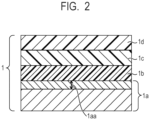
- FIG. 2 illustrates one example of a schematic configuration of the electrophotographic photosensitive member 1.
- the electro-conductive support 1a is illustrated, and the length (L) 1aa of the region on the surface of the electro-conductive support, which satisfies the Expression (1), is illustrated.
- An undercoat layer 1b is illustrated, a charge generation layer 1c is illustrated, and a charge transport layer 1d is illustrated.
- a method for manufacturing the electrophotographic photosensitive member includes a method of: preparing coating liquids for the respective layers, which will be described later; applying the coating liquids in the desired order of the layers, respectively; and drying the coating liquids.
- a coating method of the coating liquid includes a dip coating method, a spray coating method, a curtain coating method and a spin coating method.
- the dip coating method is preferable from the viewpoints of efficiency and productivity.
- the electro-conductive support and each layer will be described below.
- the electrophotographic photosensitive member has an electro-conductive support made from aluminum or an aluminum alloy.
- Shapes of the support include a cylindrical shape, a belt shape and a sheet shape.
- the cylindrical support is preferable.
- the atomic concentration ratio R of the oxygen atom to the aluminum atom on the surface satisfies the following Expression (1): 1.6 ⁇ R
- the surface of the electro-conductive support made from aluminum or an aluminum alloy, which satisfies the Expression (1), is not limited in particular, but is preferably a surface formed by anodization of aluminum in an acidic liquid containing an oxidizing agent.
- an inorganic acid such as sulfuric acid or chromic acid, or an organic acid such as oxalic acid or sulfonic acid
- an electrolytic solution for example, an inorganic acid such as sulfuric acid or chromic acid, or an organic acid such as oxalic acid or sulfonic acid
- Conditions such as a voltage to be applied, a current density, and a temperature and a time period of the treatment can be selected according to the type of the above electrolyte, and to the film thickness.
- the untreated surface may be subjected to the electrolytic treatment followed by sealing treatment.
- hot water treatment, steam treatment or any of various sealing agents such as nickel acetate and nickel fluoride may be used, but it is preferable to treat the surface with nickel acetate which can efficiently seal fine holes.
- the electrophotographic photosensitive member has an undercoat layer directly on the electro-conductive support.
- the undercoat layer in the present disclosure includes a titanium oxide particle that is surface-treated with at least one chemical compound represented by the following Formulae (A-1) to (A-10).
- R 1 to R 10 represent a methyl group, an ethyl group or an acetyl group
- X 1 to X 5 represent a hydrogen atom or a methyl group
- n is 1 to 7.
- the undercoat layer of the present disclosure further contains a polyamide resin.
- the undercoat layer may contain a polyester resin, a polycarbonate resin, a polyvinyl acetal resin, an acrylic resin, an epoxy resin, a melamine resin, a polyurethane resin, a phenol resin, a polyvinyl phenol resin, an alkyd resin, a polyvinyl alcohol resin, a polyethylene oxide resin, a polypropylene oxide resin, a polyamic acid resin, a polyimide resin, a polyamide-imide resin, a cellulose resin, or the like, in such a range as not to impair the effects of the present disclosure.
- the particle size of the titanium oxide particles in the present disclosure are not limited in particular, but the particles having an average primary particle size of 500 nm or less are used.
- the average primary particle size of the particles used here is preferably 10 nm to 200 nm, and more preferably 20 nm to 100 nm.
- a content of the titanium oxide particle in the undercoat layer in the present disclosure is not limited in particular, but it is preferable to be 10% by mass or more and 85% by mass or less, and is more preferable to be 15% by mass or more and 80% by mass or less, based on the total mass of the undercoat layer.
- the undercoat layer may further contain an electron transport material, a metal oxide, a metal, an electro-conductive polymer or the like, for the purpose of improving electric characteristics, in such a range as not to impair the above effects.
- the electron transport materials include a quinone compound, an imide compound, a benzimidazole compound, a cyclopentadienylidene compound, a fluorenone compound, a xanthone compound, a benzophenone compound, a cyanovinyl compound, a halogenated aryl compound, a silole compound and a boron-containing compound.
- the metal oxides include indium tin oxide, tin oxide, indium oxide, titanium oxide, zinc oxide, aluminum oxide and silicon dioxide.
- the metals include gold, silver and aluminum.
- the undercoat layer may also further contain an additive.
- an average film thickness of the undercoat layer is 0.1 ⁇ m or more and 50 ⁇ m or less, is more preferable to be 0.2 ⁇ m or more and 40 ⁇ m or less, and is particularly preferable to be 0.3 ⁇ m or more and 30 ⁇ m or less.
- the undercoat layer can be formed by preparing a coating liquid for the undercoat layer containing the above materials and a solvent, forming its coating film, and drying and/or curing the coating film.
- the solvents to be used for the coating liquid include an alcohol solvent, a ketone solvent, an ether solvent, an ester solvent and an aromatic hydrocarbon solvent.
- the chemical compound used for the surface treatment can be qualitatively determined by a known structural analysis method.
- the analysis method is not limited in particular, but the chemical compound can be analyzed by nuclear magnetic resonance spectroscopy, Fourier transform infrared spectroscopy, pyrolysis gas chromatography/mass spectrometry, time-of-flight secondary ion mass spectrometry, or the like.
- the electrophotographic photosensitive member can be processed into a sample form suitable for the analysis by pretreatment.
- a method of the pretreatment is not limited in particular, but a sample can be obtained, for example, by dissolving and removing the layers formed over the undercoat layer with a solvent to expose the undercoat layer, then extracting the undercoat layer with a solvent, and centrifuging and drying the extract.
- the photosensitive layer of the electrophotographic photosensitive member of the present disclosure is a photosensitive multilayer, and has a charge generation layer containing a charge generation material and a charge transport layer containing a charge transport material.
- the charge generation layer contains the charge generation material and a resin.
- the charge generation materials include an azo pigment, a perylene pigment, a polycyclic quinone pigment, an indigo pigment and a phthalocyanine pigment.
- the pigments the azo pigment and the phthalocyanine pigment are preferable.
- the phthalocyanine pigments a titanium phthalocyanine crystal or a gallium phthalocyanine crystal is preferable.
- titanyl phthalocyanine is more preferable which has a maximum diffraction peak of a Bragg angle, 20 ( ⁇ 0.2°) at least at 27.2° with characteristic CuK ⁇ X-ray, from the viewpoint of stabilization of the exposure potential.
- a content of the charge generation material in the charge generation layer prefferably be 40% by mass or more and 85% by mass or less, and is more preferable to be 60% by mass or more and 80% by mass or less, with respect to a total mass of the charge generation layer.
- the resins include a polyester resin, a polycarbonate resin, a polyvinyl acetal resin, a polyvinyl butyral resin, an acrylic resin, a silicone resin, an epoxy resin, a melamine resin, a polyurethane resin, a phenol resin, a polyvinyl alcohol resin, a cellulose resin, a polystyrene resin, a polyvinyl acetate resin and a polyvinyl chloride resin.
- the polyvinyl butyral resin is more preferable.
- the charge generation layer may further contain additives such as an antioxidizing agent and an ultraviolet absorbing agent.
- additives include a hindered phenol compound, a hindered amine compound, a sulfur compound, a phosphorus compound and a benzophenone compound.
- the average film thickness of the charge generation layer is 0.1 ⁇ m or more and 1 ⁇ m or less, and is more preferable to be 0.15 ⁇ m or more and 0.4 ⁇ m or less.
- the charge generation layer can be formed by preparing a coating liquid for the charge generation layer containing the above materials and a solvent, forming its coating film on the undercoat layer, and drying the coating film.
- the solvents to be used for the coating liquid include an alcohol solvent, a sulfoxide solvent, a ketone solvent, an ether solvent, an ester solvent and an aromatic hydrocarbon solvent.
- the charge transport layer contains a charge transport material and a resin.
- the charge transport materials include a polycyclic aromatic compound, a heterocyclic compound, a hydrazone compound, a styryl compound, an enamine compound, a benzidine compound, a triarylamine compound, and resins having a group derived from these materials.
- the triarylamine compound or the benzidine compound is preferable from the viewpoint of potential stability during repeated use.
- a plurality of charge transport materials may be contained together.
- a content of the charge transport material in the charge transport layer prefferably be 20% by mass or more and 60% by mass or less, and is more preferable to be 30% by mass or more and 50% by mass or less, with respect to the total mass of the charge transport layer.
- a content ratio (mass ratio) between the charge transport material and the resin is preferably 4:10 to 20:10, and is more preferably 5:10 to 10:10.
- the charge transport layer can be formed by forming a coating film from a coating liquid for the charge transport layer, which is prepared by dissolving the charge transport material and a binder resin in a solvent, and then drying the coating film.
- the solvents to be used for the coating liquid for forming the charge transport layer include an alcohol solvent, a sulfoxide solvent, a ketone solvent, an ether solvent, an ester solvent and an aromatic hydrocarbon solvent.
- the charge transport layer may contain additives such as an antioxidizing agent, an ultraviolet absorbing agent, a plasticizing agent, a leveling agent, a slipperiness imparting agent and an abrasion resistance improver.
- additives such as an antioxidizing agent, an ultraviolet absorbing agent, a plasticizing agent, a leveling agent, a slipperiness imparting agent and an abrasion resistance improver.
- the specific additives include a hindered phenol compound, a hindered amine compound, a sulfur compound, a phosphorus compound, a benzophenone compound, a siloxane modified resin, silicone oil, a fluorocarbon resin particle, a polystyrene resin particle, a polyethylene resin particle, an alumina particle and a boron nitride particle.
- an average film thickness of the charge transport layer is 5 ⁇ m or more and 50 ⁇ m or less, is more preferable to be 8 ⁇ m or more and 40 ⁇ m or less, and is particularly preferable to be 10 ⁇ m or more and 30 ⁇ m or less.
- the charge transport layer can be formed by preparing a coating liquid for the charge transport layer containing the above materials and a solvent, forming its coating film, and drying the coating film.
- the solvents to be used for the coating liquid include an alcohol solvent, a ketone solvent, an ether solvent, an ester solvent, and an aromatic hydrocarbon solvent.
- an ether solvent or an aromatic hydrocarbon solvent is preferable.
- a protective layer may be provided on the photosensitive layer in such a range as not to impair the effects of the present disclosure.
- the electrophotographic photosensitive member can improve its durability.
- the protective layer contains an electro-conductive particle and/or a charge transport material, and a resin.
- the electro-conductive particles include particles of metal oxides such as titanium oxide, zinc oxide, tin oxide and indium oxide.
- the charge transport materials include a polycyclic aromatic compound, a heterocyclic compound, a hydrazone compound, a styryl compound, an enamine compound, a benzidine compound, a triarylamine compound, and resins having a group derived from these materials.
- the triarylamine compound and the benzidine compound are preferable.
- the resins include a polyester resin, an acrylic resin, a phenoxy resin, a polycarbonate resin, a polystyrene resin, a phenol resin, a melamine resin and an epoxy resin.
- the polycarbonate resin, the polyester resin and the acrylic resin are preferable.
- the protective layer may be formed as a cured film by polymerization of a composition containing a monomer having a polymerizable functional group. Reactions at this time include a thermal polymerization reaction, a photopolymerization reaction, and a radiation-induced polymerization reaction.
- the polymerizable functional groups that the monomer having a polymerizable functional group has include an acryl group and a methacryl group.
- a material having charge transport capability may be used as a monomer having the polymerizable functional group.
- the protective layer may contain additives such as an antioxidizing agent, an ultraviolet absorbing agent, a plasticizing agent, a leveling agent, a slipperiness imparting agent and an abrasion resistance improver.
- the specific additives include a hindered phenol compound, a hindered amine compound, a sulfur compound, a phosphorus compound, a benzophenone compound, a siloxane modified resin, silicone oil, a fluorocarbon resin particle, a polystyrene resin particle, a polyethylene resin particle, a silica particle, an alumina particle and a boron nitride particle.
- an average film thickness of the protective layer is 0.5 ⁇ m or more and 10 ⁇ m or less, and is preferable to be 1 ⁇ m or more and 7 ⁇ m or less.
- the protective layer can be formed by preparing a coating liquid for the protective layer containing the above materials and a solvent, forming its coating film, and drying and/or curing the coating film.
- the solvents to be used for the coating liquid include an alcohol solvent, a ketone solvent, an ether solvent, a sulfoxide solvent, an ester solvent and an aromatic hydrocarbon solvent.
- the process cartridge of the present disclosure is characterized by integrally supporting the electrophotographic photosensitive member described above, and at least one unit selected from the group consisting of a charging unit, a developing unit, a transfer unit and a cleaning unit and being detachably attachable to a main body of the electrophotographic apparatus.
- the electrophotographic apparatus of the present disclosure includes: the electrophotographic photosensitive member described above; a charging unit; an exposure unit; a developing unit; and a transfer unit.
- FIG. 1 illustrates one example of a schematic configuration of an electrophotographic apparatus having a process cartridge 11 provided with an electrophotographic photosensitive member 1.
- a cylindrical electrophotographic photosensitive member 1 is illustrated, and is rotationally driven around a shaft 2 in an arrow direction at a predetermined circumferential velocity.
- the surface of the electrophotographic photosensitive member 1 is charged to a predetermined positive or negative potential by a charging unit 3.
- a charging unit 3 such as a corona charging system, a proximity charging system or an injection charging system may also be adopted.
- the surface of the charged electrophotographic photosensitive member 1 is irradiated with exposure light 4 emitted from an exposure unit (not illustrated), and an electrostatic latent image corresponding to objective image information is formed on the surface.
- the electrostatic latent image formed on the surface of the electrophotographic photosensitive member 1 is developed by a toner accommodated in a developing unit 5, and a toner image is formed on the surface of the electrophotographic photosensitive member 1.
- the toner image formed on the surface of the electrophotographic photosensitive member 1 is transferred onto a transfer material 7 by a transfer unit 6.
- the transfer material 7 having the toner image transferred thereon is conveyed to a fixing unit 8, is subjected to fixing treatment of the toner image, and is printed out to the outside of the electrophotographic apparatus.
- the electrophotographic apparatus may have a cleaning unit 9 for removing an adherent such as a toner remaining on the surface of the electrophotographic photosensitive member 1 after transferring.
- a cleaning unit may not be separately provided, but a so-called cleaner-less system may be used that removes the above adherent by a developing unit or the like.
- the electrophotographic apparatus may have a neutralization mechanism that subjects the surface of the electrophotographic photosensitive member 1 to neutralization treatment by pre-exposure light 10 emitted from a pre-exposure unit (not illustrated).
- a guiding unit 12 such as a rail may also be provided in order to detachably attach the process cartridge 11 of the present disclosure to a main body of the electrophotographic apparatus.
- the electrophotographic photosensitive member of the present disclosure can be used in a laser beam printer, an LED printer, a copying machine, a facsimile, a combined machine thereof and the like.
- An aluminum cylinder (JIS H4000: 2006A3003P, aluminum alloy) having a diameter of 20 mm and a length of 254.8 mm was prepared by hot extrusion.
- the aluminum cylinder was subjected to cutting work with a diamond sintered tool.
- the cleaned cylinder was subjected to anodic oxidation in a 10 wt% solution of sulfuric acid at a current density of 1.0 A/dm 2 for 20 minutes, and an anodic oxide film was formed on the surface of the cylinder.
- the anodized cylinder was washed with water, and then was immersed in a 1 wt% solution of nickel acetate at 80°C for 15 minutes to be sealed. Furthermore, the cylinder was subjected to pure water washing and drying treatment, and an electro-conductive support (1) was obtained.
- the electro-conductive supports (2) to (5) were manufactured in the same manner as in the electro-conductive support (1), except that the treatment time of the anodic oxidation in the 10 wt% solution of sulfuric acid in the manufacture example of the electro-conductive support (1) was changed to each of the treatment times shown in Table 1.
- the electro-conductive supports (6) and (7) were manufactured in the same manner as in the electro-conductive support (1), except that in the manufacture example of the electro-conductive support (1), the aluminum cylinder was not subjected to the cutting work, and the treatment time of the anodic oxidation was changed to each of the treatment times shown in Table 1.
- Electro-conductive support (8) was manufactured in the same manner as in the electro-conductive support (1), except that the anodic oxide film was not formed and the sealing treatment was not performed, in the manufacture example of the electro-conductive support (1).
- Table 1 Electro-conductive support Presence or absence of cutting work Anodizing time (min) Electro-conductive support (1) Present 20 Electro-conductive support (2) Present 2 Electro-conductive support (3) Present 5 Electro-conductive support (4) Present 30 Electro-conductive support (5) Present 40 Electro-conductive support (6) Absent 20 Electro-conductive support (7) Absent 40 Electro-conductive support (8) Present No anodization
- rutile-type titanium oxide particles (average primary particle size: 50 nm, produced by Tayca Corporation) were stirred and mixed with 500 parts of toluene, and 3.0 parts of ethyl trimethoxy silane was added thereto as a chemical compound represented by the following Formula (A-1) where n is 1 and R 1 is a methyl group, and the mixture was stirred for 8 hours. Then, toluene was evaporated under reduced pressure, the residue was dried at 120°C for 3 hours to obtain rutile-type titanium oxide particles surface-treated with ethyl trimethoxy silane.
- Formula (A-1) where n is 1 and R 1 is a methyl group
- Coating liquids (2) to (24) for undercoat layers were produced in the same manner as the coating liquid (1) for the undercoat layer, except that chemical compounds used for surface treatment of the rutile-type titanium oxide particle were changed to the respective compounds shown in Table 2.
- rutile-type titanium oxide particles (average primary particle size: 50 nm, produced by Tayca Corporation) were mixed and stirred with 500 parts of toluene, and 3.0 parts of ethyl trimethoxy silane was added thereto as a chemical compound represented by the following Formula (A-1) where n is 1 and R 1 is a methyl group, and the mixture was stirred for 8 hours. Then, toluene was evaporated under reduced pressure, and the residue was dried at 120°C for 3 hours to obtain rutile-type titanium oxide particles surface-treated with ethyl trimethoxy silane.
- Formula (A-1) where n is 1 and R 1 is a methyl group
- a coating liquid (27) for the undercoat layer was produced in the same manner as in the coating liquid (1) for the undercoat layer, except that the rutile-type titanium oxide particle was used without being subjected to surface treatment.
- a titanium phthalocyanine crystal (charge generation material) was prepared which had a peak of a Bragg angle, 2 ⁇ 0.3° at 27.2° in CuK ⁇ X-ray diffraction.
- the titanium phthalocyanine crystal in an amount of 1 part, a polyvinyl butyral resin (trade name: S-LEC BX-1, hydroxyl value: 173 mgKOH/g, produced by Sekisui Chemical Co., Ltd.) in an amount of 1 part and tetrahydrofuran in an amount of 100 parts were subjected to dispersion treatment by an ultrasonic disperser for 15 minutes, and a coating liquid for a charge generation layer was prepared.
- the electro-conductive support (1) was dip-coated with the coating liquid (1) for the undercoat layer; the obtained coating film was dried at 100°C for 10 minutes, and then was additionally dried for 10 minutes while the temperature was lowered to 95°C from 100°C to form an undercoat layer having a film thickness of 2.2 ⁇ m.
- the above undercoat layer was dip-coated with the coating liquid for the charge generation layer, and the obtained coating film was dried at 100°C for 10 minutes to form the charge generation layer having a film thickness of 0.27 ⁇ m.
- the above charge generation layer was dip-coated with the coating liquid for the charge transport layer, and the obtained coating film was dried at 125°C for 30 minutes to form the charge transport layer having a film thickness of 15 ⁇ m.
- an electrophotographic photosensitive member (1) was manufactured which had the undercoat layer, the charge generation layer and the charge transport layer on the electro-conductive support.
- Electrophotographic photosensitive members (2) to (34) were obtained in the same manner as in the method of manufacturing the electrophotographic photosensitive member (1), except that the respective electro-conductive supports and the respective compositions of the coating liquids for the undercoat layers were changed to those shown in Table 3.
- Table 3 Electrophotographic photosensitive member Electro-conductive support Coating liquid for undercoat layer Electrophotographic photosensitive member (1) Electro-conductive support (1) Coating liquid for undercoat layer (1) Electrophotographic photosensitive member (2) Electro-conductive support (1) Coating liquid for undercoat layer (2) Electrophotographic photosensitive member (3) Electro-conductive support (1) Coating liquid for undercoat layer (3) Electrophotographic photosensitive member (4) Electro-conductive support (1) Coating liquid for undercoat layer (4) Electrophotographic photosensitive member (5) Electro-conductive support (1) Coating liquid for undercoat layer (5) Electrophotographic photosensitive member (6) Electro-conductive support (1) Coating liquid for undercoat layer (6) Electrophotographic photosensitive member (7) Electro-conductive support (1) Coating liquid for undercoat layer (7) Electrophotographic photosensitive member (8) Electro-conductive support (1) Coating liquid for undercoat layer (8) Electro
- the obtained electrophotographic photosensitive member was mounted on a process cartridge for HP Color Laser JetPro M452dn (manufactured by Hewlett-Packard Company), and was modified so as to mount a potential probe (trade name: model 6000B-8, manufactured by Trek Japan) on the developing position. After that, the potential of the exposed portion at the central portion (position of approximately 127 mm) of the electrophotographic photosensitive member was measured with a surface electrometer (trade name: model 344, manufactured by Trek Japan).
- the electrophotographic photosensitive member was stored at 50.0°C in 95% RH environment for 3 days, then was taken out, and was left for 1 day at 23.0°C in 50% RH environment.
- the potential (VI1) of the exposed portion was measured in the same manner as described above, at the time when the charging potential (Vd) was set at -600 V and the amount of light for image exposure was set at 0.30 ⁇ J/cm 2 .
- the obtained electrophotographic photosensitive member was stored at 50.0°C in 95% RH environment for 3 days, then was taken out, and was left for 1 day at 23.0°C in 50% RH environment.
- the electrophotographic photosensitive member after storage was mounted on a process cartridge for HP Color Laser JetPro M452dn (manufactured by Hewlett-Packard Company), and a halftone image was output.
- the evaluation for the black spot was ranked as described below, based on the output results of the halftone images.
- the potential difference ⁇ Vl based on the evaluation 4 was calculated for the electrophotographic photosensitive member (1), and the result was 3 V Furthermore, the black spot was evaluated based on the Evaluation 5, and the result was rank 1.
- the charge transport layer and the charge generation layer were wiped off with a waste (for example, Kimwipe (TM) (produced by Kimberly-Clark Corporation)) impregnated with an ester solvent (for example, ethyl acetate (produced by Nippon Synthetic Chemical Industry Co., Ltd.)), and the resultant was then dried at 100°C for 30 minutes to expose the undercoat layer.
- a waste for example, Kimwipe (TM) (produced by Kimberly-Clark Corporation)
- an ester solvent for example, ethyl acetate (produced by Nippon Synthetic Chemical Industry Co., Ltd.)
- the exposed undercoat layer was wiped off with a waste (for example, Kimwipe (TM) (produced by Kimberly-Clark Corporation)) impregnated with an alcohol solvent (for example, methanol (produced by Nippon Synthetic Chemical Industry Co., Ltd.), and the resultant was then dried at 100°C for 30 minutes to expose the electro-conductive support.
- the atomic concentration ratio R on the electro-conductive support was measured, based on the Evaluation 1, and as a result, R was 1.75.
- the length L of the region based on the Evaluation 2 was measured, and as a result, L was 6.0 ⁇ m.
- the arithmetic average roughness Sa was measured, based on the Evaluation 3, and as a result, Sa was 1.1 ⁇ m.
- the above electrophotographic photosensitive member (1) By using the above electrophotographic photosensitive member (1), the occurrence of the black spot in the charged portion and the deterioration in sensitivity of the exposed portion were simultaneously suppressed, even after it was stored in the high-temperature and high-humidity environment.
- Examples 2 to 29 and Reference Examples 30 and 31 were evaluated in the same manner as in Example 1, except that in each of the Evaluations 1 to 5, the electrophotographic photosensitive member in Example 1 was replaced with the respective electrophotographic photosensitive members shown in Table 4. The obtained results are shown in Table 4. Also in Examples 2 to 29 and Reference Examples 30 and 31, similarly to Example 1, the occurrence of the black spot in the charged portion and the deterioration in sensitivity of the exposed portion were simultaneously suppressed, even after each of the electrophotographic photosensitive members was stored in the high-temperature and high-humidity environment.
- an electrophotographic photosensitive member that can simultaneously achieve the suppression of the occurrence of the black spot in the charged portion and the suppression of the deterioration in sensitivity of the exposed portion, even after stored in the high-temperature and high-humidity environment.
Landscapes
- Physics & Mathematics (AREA)
- General Physics & Mathematics (AREA)
- Chemical & Material Sciences (AREA)
- Inorganic Chemistry (AREA)
- Engineering & Computer Science (AREA)
- Computer Vision & Pattern Recognition (AREA)
- Photoreceptors In Electrophotography (AREA)
Applications Claiming Priority (1)
| Application Number | Priority Date | Filing Date | Title |
|---|---|---|---|
| JP2019111486A JP7301613B2 (ja) | 2019-06-14 | 2019-06-14 | 電子写真感光体、プロセスカートリッジ及び電子写真装置 |
Publications (2)
| Publication Number | Publication Date |
|---|---|
| EP3751348A1 EP3751348A1 (en) | 2020-12-16 |
| EP3751348B1 true EP3751348B1 (en) | 2024-07-17 |
Family
ID=71143493
Family Applications (1)
| Application Number | Title | Priority Date | Filing Date |
|---|---|---|---|
| EP20179613.3A Active EP3751348B1 (en) | 2019-06-14 | 2020-06-12 | Electrophotographic photosensitive member, process cartridge and electrophotographic apparatus |
Country Status (4)
| Country | Link |
|---|---|
| US (1) | US11150566B2 (OSRAM) |
| EP (1) | EP3751348B1 (OSRAM) |
| JP (1) | JP7301613B2 (OSRAM) |
| CN (1) | CN112083634B (OSRAM) |
Families Citing this family (14)
| Publication number | Priority date | Publication date | Assignee | Title |
|---|---|---|---|---|
| JP7337651B2 (ja) | 2019-10-18 | 2023-09-04 | キヤノン株式会社 | プロセスカートリッジ及び電子写真装置 |
| US11112719B2 (en) | 2019-10-18 | 2021-09-07 | Canon Kabushiki Kaisha | Process cartridge and electrophotographic apparatus capable of suppressing lateral running while maintaining satisfactory potential function |
| JP7337650B2 (ja) | 2019-10-18 | 2023-09-04 | キヤノン株式会社 | プロセスカートリッジおよび電子写真装置 |
| JP7449151B2 (ja) | 2020-04-21 | 2024-03-13 | キヤノン株式会社 | 電子写真感光ドラム |
| JP7483477B2 (ja) | 2020-04-21 | 2024-05-15 | キヤノン株式会社 | 電子写真感光ドラム、プロセスカートリッジおよび電子写真画像形成装置 |
| JP7444691B2 (ja) | 2020-04-21 | 2024-03-06 | キヤノン株式会社 | 電子写真感光体の製造方法 |
| JP7751414B2 (ja) | 2021-08-06 | 2025-10-08 | キヤノン株式会社 | 電子写真感光体、プロセスカートリッジ及び電子写真装置 |
| JP7691305B2 (ja) | 2021-08-06 | 2025-06-11 | キヤノン株式会社 | 電子写真感光体、プロセスカートリッジ及び電子写真装置 |
| JP7752992B2 (ja) | 2021-08-06 | 2025-10-14 | キヤノン株式会社 | 電子写真装置 |
| JP7752991B2 (ja) | 2021-08-06 | 2025-10-14 | キヤノン株式会社 | 電子写真装置 |
| JP7725286B2 (ja) | 2021-08-06 | 2025-08-19 | キヤノン株式会社 | 電子写真感光体、プロセスカートリッジ及び電子写真装置 |
| US12429785B2 (en) | 2021-10-08 | 2025-09-30 | Canon Kabushiki Kaisha | Electrophotographic photosensitive member, process cartridge, and electrophotographic apparatus |
| JP2023061679A (ja) | 2021-10-20 | 2023-05-02 | キヤノン株式会社 | 電子写真感光体、プロセスカートリッジ、および電子写真装置 |
| JP2023131675A (ja) | 2022-03-09 | 2023-09-22 | キヤノン株式会社 | 電子写真装置 |
Family Cites Families (46)
| Publication number | Priority date | Publication date | Assignee | Title |
|---|---|---|---|---|
| JP2002287396A (ja) | 2001-03-27 | 2002-10-03 | Konica Corp | 電子写真感光体、画像形成装置、及びプロセスカートリッジ |
| JP2002372796A (ja) | 2001-06-14 | 2002-12-26 | Konica Corp | 電子写真感光体、画像形成方法、画像形成装置及びプロセスカートリッジ |
| JP3820920B2 (ja) * | 2001-06-06 | 2006-09-13 | コニカミノルタホールディングス株式会社 | 電子写真感光体、画像形成方法、画像形成装置及びプロセスカートリッジ |
| JP2003029440A (ja) * | 2001-07-17 | 2003-01-29 | Konica Corp | 電子写真感光体、画像形成方法、画像形成装置及びプロセスカートリッジ |
| JP3823852B2 (ja) * | 2002-03-08 | 2006-09-20 | 富士ゼロックス株式会社 | 電子写真感光体の製造方法、電子写真感光体、プロセスカートリッジ及び電子写真装置 |
| JP2003177561A (ja) * | 2001-12-12 | 2003-06-27 | Konica Corp | 電子写真感光体、画像形成方法、画像形成装置及びプロセスカートリッジ |
| JP2003215825A (ja) * | 2002-01-22 | 2003-07-30 | Konica Corp | 電子写真感光体、画像形成方法、画像形成装置及びプロセスカートリッジ |
| JP2003345045A (ja) * | 2002-05-27 | 2003-12-03 | Konica Minolta Holdings Inc | 電子写真感光体、画像形成装置、画像形成方法及びプロセスカートリッジ |
| JP4019809B2 (ja) * | 2002-06-13 | 2007-12-12 | 富士ゼロックス株式会社 | 電子写真感光体、電子写真感光体の製造方法、プロセスカートリッジ及び電子写真装置 |
| JP2004101799A (ja) | 2002-09-09 | 2004-04-02 | Konica Minolta Holdings Inc | 画像形成方法及び画像形成装置 |
| JP2005017579A (ja) | 2003-06-25 | 2005-01-20 | Konica Minolta Business Technologies Inc | 有機感光体、プロセスカートリッジ、画像形成装置及び画像形成方法 |
| JP4241490B2 (ja) | 2004-04-22 | 2009-03-18 | コニカミノルタビジネステクノロジーズ株式会社 | 画像形成装置及び画像形成方法 |
| JP2007293322A (ja) * | 2006-03-30 | 2007-11-08 | Mitsubishi Chemicals Corp | 画像形成装置 |
| WO2007135985A1 (ja) | 2006-05-19 | 2007-11-29 | Mitsubishi Chemical Corporation | 下引き層形成用塗布液、該塗布液を塗布してなる下引き層を有する感光体、該感光体を用いる画像形成装置、および該感光体を用いる電子写真カートリッジ |
| JP2007334341A (ja) * | 2006-05-19 | 2007-12-27 | Mitsubishi Chemicals Corp | 下引き層形成用塗布液、該塗布液を塗布してなる下引き層を有する感光体、該感光体を用いる画像形成装置、および該感光体を用いる電子写真カートリッジ |
| JP5347245B2 (ja) * | 2007-06-28 | 2013-11-20 | 三菱化学株式会社 | 電子写真感光体、電子写真感光体カートリッジ及び画像形成装置 |
| JP2009104125A (ja) | 2007-10-03 | 2009-05-14 | Mitsubishi Chemicals Corp | 画像形成装置及びカートリッジ |
| JP5900277B2 (ja) * | 2012-03-23 | 2016-04-06 | 富士ゼロックス株式会社 | 電子写真感光体、プロセスカートリッジ、及び画像形成装置 |
| EP2680075B1 (en) | 2012-06-29 | 2015-12-30 | Canon Kabushiki Kaisha | Electrophotographic photosensitive member, process cartridge, and electrophotographic apparatus |
| US9029054B2 (en) | 2012-06-29 | 2015-05-12 | Canon Kabushiki Kaisha | Electrophotographic photosensitive member, process cartridge, and electrophotographic apparatus |
| US9063505B2 (en) | 2012-06-29 | 2015-06-23 | Canon Kabushiki Kaisha | Electrophotographic photosensitive member, process cartridge, and electrophotographic apparatus |
| JP6155726B2 (ja) * | 2013-03-19 | 2017-07-05 | 富士ゼロックス株式会社 | 電子写真感光体、プロセスカートリッジ及び画像形成装置 |
| JP6463104B2 (ja) | 2013-12-26 | 2019-01-30 | キヤノン株式会社 | 電子写真感光体、プロセスカートリッジ及び電子写真装置 |
| JP2015143831A (ja) | 2013-12-26 | 2015-08-06 | キヤノン株式会社 | 電子写真感光体、プロセスカートリッジ及び電子写真装置 |
| JP2015143822A (ja) | 2013-12-26 | 2015-08-06 | キヤノン株式会社 | 電子写真感光体、プロセスカートリッジ及び電子写真装置 |
| JP6456126B2 (ja) | 2013-12-26 | 2019-01-23 | キヤノン株式会社 | 電子写真感光体の製造方法 |
| US20150346617A1 (en) | 2014-06-03 | 2015-12-03 | Canon Kabushiki Kaisha | Electrophotographic photosensitive member, manufacturing method of electrophotographic photosensitive member, process cartridge and electrophotographic apparatus, and phthalocyanine crystal and manufacturing method of phthalocyanine crystal |
| US20150346616A1 (en) | 2014-06-03 | 2015-12-03 | Canon Kabushiki Kaisha | Electrophotographic photosensitive member, manufacturing method of electrophotographic photosensitive member, process cartridge and electrophotographic apparatus, and phthalocyanine crystal and manufacturing method of phthalocyanine crystal |
| US20150362847A1 (en) | 2014-06-13 | 2015-12-17 | Canon Kabushiki Kaisha | Electrophotographic photosensitive member, process cartridge and electrophotographic apparatus |
| JP6544994B2 (ja) * | 2014-07-09 | 2019-07-17 | キヤノン株式会社 | 電子写真感光体、プロセスカートリッジおよび電子写真装置および電子写真感光体の製造方法 |
| US9563139B2 (en) | 2014-11-05 | 2017-02-07 | Canon Kabushiki Kaisha | Electrophotographic photosensitive member, process cartridge and electrophotographic apparatus |
| US9645516B2 (en) | 2014-11-19 | 2017-05-09 | Canon Kabushiki Kaisha | Electrophotographic photosensitive member, process cartridge and electrophotographic apparatus |
| JP6641969B2 (ja) | 2014-12-17 | 2020-02-05 | 三菱ケミカル株式会社 | 電子写真感光体、電子写真感光体カートリッジ、及び画像形成装置 |
| JP2017010009A (ja) | 2015-06-24 | 2017-01-12 | キヤノン株式会社 | 電子写真感光体、プロセスカートリッジおよび電子写真装置 |
| JP6639256B2 (ja) | 2016-02-10 | 2020-02-05 | キヤノン株式会社 | 電子写真装置、およびプロセスカートリッジ |
| US10416581B2 (en) | 2016-08-26 | 2019-09-17 | Canon Kabushiki Kaisha | Electrophotographic photosensitive member, process cartridge, and electrophotographic apparatus |
| US10203617B2 (en) | 2017-02-28 | 2019-02-12 | Canon Kabushiki Kaisha | Electrophotographic photosensitive member, process cartridge and electrophotographic apparatus |
| EP3367167B1 (en) | 2017-02-28 | 2021-05-26 | Canon Kabushiki Kaisha | Electrophotographic photosensitive member, process cartridge, and electrophotographic apparatus |
| US10162278B2 (en) | 2017-02-28 | 2018-12-25 | Canon Kabushiki Kaisha | Electrophotographic photosensitive member, process cartridge and electrophotographic apparatus |
| JP6850205B2 (ja) | 2017-06-06 | 2021-03-31 | キヤノン株式会社 | 電子写真感光体、プロセスカートリッジおよび電子写真装置 |
| JP6946895B2 (ja) | 2017-09-25 | 2021-10-13 | 富士フイルムビジネスイノベーション株式会社 | 電子写真感光体、プロセスカートリッジ、及び画像形成装置 |
| JP7057104B2 (ja) | 2017-11-24 | 2022-04-19 | キヤノン株式会社 | プロセスカートリッジ及び電子写真画像形成装置 |
| JP7046571B2 (ja) | 2017-11-24 | 2022-04-04 | キヤノン株式会社 | プロセスカートリッジ及び電子写真装置 |
| JP7187270B2 (ja) | 2017-11-24 | 2022-12-12 | キヤノン株式会社 | プロセスカートリッジ及び電子写真装置 |
| JP2020085991A (ja) | 2018-11-19 | 2020-06-04 | キヤノン株式会社 | 電子写真感光体、プロセスカートリッジ及び電子写真装置 |
| JP2020086308A (ja) | 2018-11-29 | 2020-06-04 | キヤノン株式会社 | 電子写真感光体、電子写真装置、およびプロセスカートリッジ |
-
2019
- 2019-06-14 JP JP2019111486A patent/JP7301613B2/ja active Active
-
2020
- 2020-06-03 US US16/891,525 patent/US11150566B2/en active Active
- 2020-06-11 CN CN202010531479.7A patent/CN112083634B/zh active Active
- 2020-06-12 EP EP20179613.3A patent/EP3751348B1/en active Active
Also Published As
| Publication number | Publication date |
|---|---|
| US20200393771A1 (en) | 2020-12-17 |
| US11150566B2 (en) | 2021-10-19 |
| EP3751348A1 (en) | 2020-12-16 |
| JP2020204677A (ja) | 2020-12-24 |
| CN112083634B (zh) | 2023-12-22 |
| JP7301613B2 (ja) | 2023-07-03 |
| CN112083634A (zh) | 2020-12-15 |
Similar Documents
| Publication | Publication Date | Title |
|---|---|---|
| EP3751348B1 (en) | Electrophotographic photosensitive member, process cartridge and electrophotographic apparatus | |
| EP3575878B1 (en) | Electrophotographic photosensitive member, process cartridge and electrophotographic apparatus | |
| EP3367169B1 (en) | Electrophotographic photosensitive member, process cartridge and electrophotographic apparatus | |
| US10942462B2 (en) | Electrophotographic photosensitive member, process cartridge, and electrophotographic apparatus | |
| EP2600198B1 (en) | Electrophotographic photosensitive member, method of producing phthalocyanine crystal, method of producing electrophotographic photosensitive member, process cartridge, electrophotographic apparatus, and phthalocyanine crystal | |
| US10838315B2 (en) | Electrophotographic photosensitive member, process cartridge and electrophotographic apparatus | |
| JP6049329B2 (ja) | 電子写真感光体、電子写真感光体の製造方法、プロセスカートリッジおよび電子写真装置 | |
| EP3534215A1 (en) | Electrophotographic photosensitive member, process cartridge, and electrophotographic apparatus | |
| EP2443519B1 (en) | Electrophotographic photosensitive member, process cartridge, and electrophotographic apparatus | |
| EP1817635B1 (en) | Electrophotographic photosensitive member, process cartridge and electrophotographic apparatus, and process for producing electrophotographic photosensitive member | |
| US9983490B2 (en) | Electrophotographic apparatus | |
| EP4163723A1 (en) | Electrophotographic photosensitive member, process cartridge, and electrophotographic apparatus | |
| US20110104600A1 (en) | Electrophotographic photoconductor and image forming apparatus using the same | |
| US20200064750A1 (en) | Electrophotographic photosensitive member, process cartridge, and electrophotographic apparatus | |
| US20200117105A1 (en) | Image forming apparatus and process cartridge | |
| EP3913436B1 (en) | Electrophotographic photosensitive member, process cartridge and electrophotographic apparatus | |
| US11086241B2 (en) | Electrophotographic photoreceptor, process cartridge, and electrophotographic apparatus | |
| EP4414788A1 (en) | Electrophotographic photoreceptor, process cartridge, and image forming apparatus | |
| US20200096886A1 (en) | Electrophotographic photoreceptor, process cartridge, and image forming apparatus | |
| EP4668022A2 (en) | Electrophotographic photoreceptor, process cartridge, and image forming apparatus | |
| US12416871B2 (en) | Electrophotographic photosensitive member, process cartridge, electrophotographic apparatus, and method of manufacturing electrophotographic photosensitive member | |
| EP4657162A1 (en) | Electrophotographic photoreceptor, process cartridge, and image forming apparatus | |
| JP2025155902A (ja) | 電子写真感光体、プロセスカートリッジ、電子写真装置、及び電子写真感光体の製造方法 | |
| JP2024044626A (ja) | 電子写真感光体、プロセスカートリッジ及び電子写真装置 | |
| JP2001296682A (ja) | 電子写真感光体 |
Legal Events
| Date | Code | Title | Description |
|---|---|---|---|
| PUAI | Public reference made under article 153(3) epc to a published international application that has entered the european phase |
Free format text: ORIGINAL CODE: 0009012 |
|
| STAA | Information on the status of an ep patent application or granted ep patent |
Free format text: STATUS: THE APPLICATION HAS BEEN PUBLISHED |
|
| AK | Designated contracting states |
Kind code of ref document: A1 Designated state(s): AL AT BE BG CH CY CZ DE DK EE ES FI FR GB GR HR HU IE IS IT LI LT LU LV MC MK MT NL NO PL PT RO RS SE SI SK SM TR |
|
| AX | Request for extension of the european patent |
Extension state: BA ME |
|
| STAA | Information on the status of an ep patent application or granted ep patent |
Free format text: STATUS: REQUEST FOR EXAMINATION WAS MADE |
|
| 17P | Request for examination filed |
Effective date: 20210616 |
|
| RBV | Designated contracting states (corrected) |
Designated state(s): AL AT BE BG CH CY CZ DE DK EE ES FI FR GB GR HR HU IE IS IT LI LT LU LV MC MK MT NL NO PL PT RO RS SE SI SK SM TR |
|
| GRAP | Despatch of communication of intention to grant a patent |
Free format text: ORIGINAL CODE: EPIDOSNIGR1 |
|
| STAA | Information on the status of an ep patent application or granted ep patent |
Free format text: STATUS: GRANT OF PATENT IS INTENDED |
|
| INTG | Intention to grant announced |
Effective date: 20240322 |
|
| GRAS | Grant fee paid |
Free format text: ORIGINAL CODE: EPIDOSNIGR3 |
|
| GRAA | (expected) grant |
Free format text: ORIGINAL CODE: 0009210 |
|
| STAA | Information on the status of an ep patent application or granted ep patent |
Free format text: STATUS: THE PATENT HAS BEEN GRANTED |
|
| AK | Designated contracting states |
Kind code of ref document: B1 Designated state(s): AL AT BE BG CH CY CZ DE DK EE ES FI FR GB GR HR HU IE IS IT LI LT LU LV MC MK MT NL NO PL PT RO RS SE SI SK SM TR |
|
| REG | Reference to a national code |
Ref country code: CH Ref legal event code: EP |
|
| REG | Reference to a national code |
Ref country code: DE Ref legal event code: R096 Ref document number: 602020033983 Country of ref document: DE |
|
| REG | Reference to a national code |
Ref country code: IE Ref legal event code: FG4D |
|
| REG | Reference to a national code |
Ref country code: LT Ref legal event code: MG9D |
|
| REG | Reference to a national code |
Ref country code: NL Ref legal event code: MP Effective date: 20240717 |
|
| PG25 | Lapsed in a contracting state [announced via postgrant information from national office to epo] |
Ref country code: PT Free format text: LAPSE BECAUSE OF FAILURE TO SUBMIT A TRANSLATION OF THE DESCRIPTION OR TO PAY THE FEE WITHIN THE PRESCRIBED TIME-LIMIT Effective date: 20241118 |
|
| REG | Reference to a national code |
Ref country code: AT Ref legal event code: MK05 Ref document number: 1704707 Country of ref document: AT Kind code of ref document: T Effective date: 20240717 |
|
| PG25 | Lapsed in a contracting state [announced via postgrant information from national office to epo] |
Ref country code: NL Free format text: LAPSE BECAUSE OF FAILURE TO SUBMIT A TRANSLATION OF THE DESCRIPTION OR TO PAY THE FEE WITHIN THE PRESCRIBED TIME-LIMIT Effective date: 20240717 |
|
| PG25 | Lapsed in a contracting state [announced via postgrant information from national office to epo] |
Ref country code: PT Free format text: LAPSE BECAUSE OF FAILURE TO SUBMIT A TRANSLATION OF THE DESCRIPTION OR TO PAY THE FEE WITHIN THE PRESCRIBED TIME-LIMIT Effective date: 20241118 Ref country code: NL Free format text: LAPSE BECAUSE OF FAILURE TO SUBMIT A TRANSLATION OF THE DESCRIPTION OR TO PAY THE FEE WITHIN THE PRESCRIBED TIME-LIMIT Effective date: 20240717 |
|
| PG25 | Lapsed in a contracting state [announced via postgrant information from national office to epo] |
Ref country code: NO Free format text: LAPSE BECAUSE OF FAILURE TO SUBMIT A TRANSLATION OF THE DESCRIPTION OR TO PAY THE FEE WITHIN THE PRESCRIBED TIME-LIMIT Effective date: 20241017 |
|
| PG25 | Lapsed in a contracting state [announced via postgrant information from national office to epo] |
Ref country code: FI Free format text: LAPSE BECAUSE OF FAILURE TO SUBMIT A TRANSLATION OF THE DESCRIPTION OR TO PAY THE FEE WITHIN THE PRESCRIBED TIME-LIMIT Effective date: 20240717 Ref country code: PL Free format text: LAPSE BECAUSE OF FAILURE TO SUBMIT A TRANSLATION OF THE DESCRIPTION OR TO PAY THE FEE WITHIN THE PRESCRIBED TIME-LIMIT Effective date: 20240717 Ref country code: GR Free format text: LAPSE BECAUSE OF FAILURE TO SUBMIT A TRANSLATION OF THE DESCRIPTION OR TO PAY THE FEE WITHIN THE PRESCRIBED TIME-LIMIT Effective date: 20241018 |
|
| PG25 | Lapsed in a contracting state [announced via postgrant information from national office to epo] |
Ref country code: BG Free format text: LAPSE BECAUSE OF FAILURE TO SUBMIT A TRANSLATION OF THE DESCRIPTION OR TO PAY THE FEE WITHIN THE PRESCRIBED TIME-LIMIT Effective date: 20240717 |
|
| PG25 | Lapsed in a contracting state [announced via postgrant information from national office to epo] |
Ref country code: LV Free format text: LAPSE BECAUSE OF FAILURE TO SUBMIT A TRANSLATION OF THE DESCRIPTION OR TO PAY THE FEE WITHIN THE PRESCRIBED TIME-LIMIT Effective date: 20240717 |
|
| PG25 | Lapsed in a contracting state [announced via postgrant information from national office to epo] |
Ref country code: IS Free format text: LAPSE BECAUSE OF FAILURE TO SUBMIT A TRANSLATION OF THE DESCRIPTION OR TO PAY THE FEE WITHIN THE PRESCRIBED TIME-LIMIT Effective date: 20241117 Ref country code: AT Free format text: LAPSE BECAUSE OF FAILURE TO SUBMIT A TRANSLATION OF THE DESCRIPTION OR TO PAY THE FEE WITHIN THE PRESCRIBED TIME-LIMIT Effective date: 20240717 |
|
| PG25 | Lapsed in a contracting state [announced via postgrant information from national office to epo] |
Ref country code: HR Free format text: LAPSE BECAUSE OF FAILURE TO SUBMIT A TRANSLATION OF THE DESCRIPTION OR TO PAY THE FEE WITHIN THE PRESCRIBED TIME-LIMIT Effective date: 20240717 |
|
| PG25 | Lapsed in a contracting state [announced via postgrant information from national office to epo] |
Ref country code: ES Free format text: LAPSE BECAUSE OF FAILURE TO SUBMIT A TRANSLATION OF THE DESCRIPTION OR TO PAY THE FEE WITHIN THE PRESCRIBED TIME-LIMIT Effective date: 20240717 Ref country code: RS Free format text: LAPSE BECAUSE OF FAILURE TO SUBMIT A TRANSLATION OF THE DESCRIPTION OR TO PAY THE FEE WITHIN THE PRESCRIBED TIME-LIMIT Effective date: 20241017 |
|
| PG25 | Lapsed in a contracting state [announced via postgrant information from national office to epo] |
Ref country code: RS Free format text: LAPSE BECAUSE OF FAILURE TO SUBMIT A TRANSLATION OF THE DESCRIPTION OR TO PAY THE FEE WITHIN THE PRESCRIBED TIME-LIMIT Effective date: 20241017 Ref country code: PL Free format text: LAPSE BECAUSE OF FAILURE TO SUBMIT A TRANSLATION OF THE DESCRIPTION OR TO PAY THE FEE WITHIN THE PRESCRIBED TIME-LIMIT Effective date: 20240717 Ref country code: NO Free format text: LAPSE BECAUSE OF FAILURE TO SUBMIT A TRANSLATION OF THE DESCRIPTION OR TO PAY THE FEE WITHIN THE PRESCRIBED TIME-LIMIT Effective date: 20241017 Ref country code: LV Free format text: LAPSE BECAUSE OF FAILURE TO SUBMIT A TRANSLATION OF THE DESCRIPTION OR TO PAY THE FEE WITHIN THE PRESCRIBED TIME-LIMIT Effective date: 20240717 Ref country code: IS Free format text: LAPSE BECAUSE OF FAILURE TO SUBMIT A TRANSLATION OF THE DESCRIPTION OR TO PAY THE FEE WITHIN THE PRESCRIBED TIME-LIMIT Effective date: 20241117 Ref country code: HR Free format text: LAPSE BECAUSE OF FAILURE TO SUBMIT A TRANSLATION OF THE DESCRIPTION OR TO PAY THE FEE WITHIN THE PRESCRIBED TIME-LIMIT Effective date: 20240717 Ref country code: GR Free format text: LAPSE BECAUSE OF FAILURE TO SUBMIT A TRANSLATION OF THE DESCRIPTION OR TO PAY THE FEE WITHIN THE PRESCRIBED TIME-LIMIT Effective date: 20241018 Ref country code: FI Free format text: LAPSE BECAUSE OF FAILURE TO SUBMIT A TRANSLATION OF THE DESCRIPTION OR TO PAY THE FEE WITHIN THE PRESCRIBED TIME-LIMIT Effective date: 20240717 Ref country code: ES Free format text: LAPSE BECAUSE OF FAILURE TO SUBMIT A TRANSLATION OF THE DESCRIPTION OR TO PAY THE FEE WITHIN THE PRESCRIBED TIME-LIMIT Effective date: 20240717 Ref country code: BG Free format text: LAPSE BECAUSE OF FAILURE TO SUBMIT A TRANSLATION OF THE DESCRIPTION OR TO PAY THE FEE WITHIN THE PRESCRIBED TIME-LIMIT Effective date: 20240717 Ref country code: AT Free format text: LAPSE BECAUSE OF FAILURE TO SUBMIT A TRANSLATION OF THE DESCRIPTION OR TO PAY THE FEE WITHIN THE PRESCRIBED TIME-LIMIT Effective date: 20240717 |
|
| PG25 | Lapsed in a contracting state [announced via postgrant information from national office to epo] |
Ref country code: DK Free format text: LAPSE BECAUSE OF FAILURE TO SUBMIT A TRANSLATION OF THE DESCRIPTION OR TO PAY THE FEE WITHIN THE PRESCRIBED TIME-LIMIT Effective date: 20240717 Ref country code: RO Free format text: LAPSE BECAUSE OF FAILURE TO SUBMIT A TRANSLATION OF THE DESCRIPTION OR TO PAY THE FEE WITHIN THE PRESCRIBED TIME-LIMIT Effective date: 20240717 Ref country code: SM Free format text: LAPSE BECAUSE OF FAILURE TO SUBMIT A TRANSLATION OF THE DESCRIPTION OR TO PAY THE FEE WITHIN THE PRESCRIBED TIME-LIMIT Effective date: 20240717 |
|
| REG | Reference to a national code |
Ref country code: DE Ref legal event code: R097 Ref document number: 602020033983 Country of ref document: DE |
|
| PG25 | Lapsed in a contracting state [announced via postgrant information from national office to epo] |
Ref country code: EE Free format text: LAPSE BECAUSE OF FAILURE TO SUBMIT A TRANSLATION OF THE DESCRIPTION OR TO PAY THE FEE WITHIN THE PRESCRIBED TIME-LIMIT Effective date: 20240717 |
|
| PG25 | Lapsed in a contracting state [announced via postgrant information from national office to epo] |
Ref country code: CZ Free format text: LAPSE BECAUSE OF FAILURE TO SUBMIT A TRANSLATION OF THE DESCRIPTION OR TO PAY THE FEE WITHIN THE PRESCRIBED TIME-LIMIT Effective date: 20240717 |
|
| PG25 | Lapsed in a contracting state [announced via postgrant information from national office to epo] |
Ref country code: SK Free format text: LAPSE BECAUSE OF FAILURE TO SUBMIT A TRANSLATION OF THE DESCRIPTION OR TO PAY THE FEE WITHIN THE PRESCRIBED TIME-LIMIT Effective date: 20240717 |
|
| PLBE | No opposition filed within time limit |
Free format text: ORIGINAL CODE: 0009261 |
|
| STAA | Information on the status of an ep patent application or granted ep patent |
Free format text: STATUS: NO OPPOSITION FILED WITHIN TIME LIMIT |
|
| 26N | No opposition filed |
Effective date: 20250422 |
|
| PGFP | Annual fee paid to national office [announced via postgrant information from national office to epo] |
Ref country code: DE Payment date: 20250520 Year of fee payment: 6 |
|
| PG25 | Lapsed in a contracting state [announced via postgrant information from national office to epo] |
Ref country code: SE Free format text: LAPSE BECAUSE OF FAILURE TO SUBMIT A TRANSLATION OF THE DESCRIPTION OR TO PAY THE FEE WITHIN THE PRESCRIBED TIME-LIMIT Effective date: 20240717 |