EP3540804B1 - Photoelectric conversion element, imaging element and imaging device - Google Patents
Photoelectric conversion element, imaging element and imaging device Download PDFInfo
- Publication number
- EP3540804B1 EP3540804B1 EP17870234.6A EP17870234A EP3540804B1 EP 3540804 B1 EP3540804 B1 EP 3540804B1 EP 17870234 A EP17870234 A EP 17870234A EP 3540804 B1 EP3540804 B1 EP 3540804B1
- Authority
- EP
- European Patent Office
- Prior art keywords
- photoelectric conversion
- substituted
- group
- organic compound
- unsubstituted
- Prior art date
- Legal status (The legal status is an assumption and is not a legal conclusion. Google has not performed a legal analysis and makes no representation as to the accuracy of the status listed.)
- Active
Links
Images



Classifications
-
- H—ELECTRICITY
- H10—SEMICONDUCTOR DEVICES; ELECTRIC SOLID-STATE DEVICES NOT OTHERWISE PROVIDED FOR
- H10K—ORGANIC ELECTRIC SOLID-STATE DEVICES
- H10K85/00—Organic materials used in the body or electrodes of devices covered by this subclass
- H10K85/60—Organic compounds having low molecular weight
- H10K85/649—Aromatic compounds comprising a hetero atom
- H10K85/655—Aromatic compounds comprising a hetero atom comprising only sulfur as heteroatom
-
- H—ELECTRICITY
- H04—ELECTRIC COMMUNICATION TECHNIQUE
- H04N—PICTORIAL COMMUNICATION, e.g. TELEVISION
- H04N25/00—Circuitry of solid-state image sensors [SSIS]; Control thereof
- H04N25/60—Noise processing, e.g. detecting, correcting, reducing or removing noise
- H04N25/63—Noise processing, e.g. detecting, correcting, reducing or removing noise applied to dark current
-
- H—ELECTRICITY
- H10—SEMICONDUCTOR DEVICES; ELECTRIC SOLID-STATE DEVICES NOT OTHERWISE PROVIDED FOR
- H10F—INORGANIC SEMICONDUCTOR DEVICES SENSITIVE TO INFRARED RADIATION, LIGHT, ELECTROMAGNETIC RADIATION OF SHORTER WAVELENGTH OR CORPUSCULAR RADIATION
- H10F30/00—Individual radiation-sensitive semiconductor devices in which radiation controls the flow of current through the devices, e.g. photodetectors
- H10F30/20—Individual radiation-sensitive semiconductor devices in which radiation controls the flow of current through the devices, e.g. photodetectors the devices having potential barriers, e.g. phototransistors
- H10F30/21—Individual radiation-sensitive semiconductor devices in which radiation controls the flow of current through the devices, e.g. photodetectors the devices having potential barriers, e.g. phototransistors the devices being sensitive to infrared, visible or ultraviolet radiation
- H10F30/22—Individual radiation-sensitive semiconductor devices in which radiation controls the flow of current through the devices, e.g. photodetectors the devices having potential barriers, e.g. phototransistors the devices being sensitive to infrared, visible or ultraviolet radiation the devices having only one potential barrier, e.g. photodiodes
- H10F30/223—Individual radiation-sensitive semiconductor devices in which radiation controls the flow of current through the devices, e.g. photodetectors the devices having potential barriers, e.g. phototransistors the devices being sensitive to infrared, visible or ultraviolet radiation the devices having only one potential barrier, e.g. photodiodes the potential barrier being a PIN barrier
-
- H—ELECTRICITY
- H10—SEMICONDUCTOR DEVICES; ELECTRIC SOLID-STATE DEVICES NOT OTHERWISE PROVIDED FOR
- H10F—INORGANIC SEMICONDUCTOR DEVICES SENSITIVE TO INFRARED RADIATION, LIGHT, ELECTROMAGNETIC RADIATION OF SHORTER WAVELENGTH OR CORPUSCULAR RADIATION
- H10F39/00—Integrated devices, or assemblies of multiple devices, comprising at least one element covered by group H10F30/00, e.g. radiation detectors comprising photodiode arrays
- H10F39/10—Integrated devices
- H10F39/12—Image sensors
-
- H—ELECTRICITY
- H10—SEMICONDUCTOR DEVICES; ELECTRIC SOLID-STATE DEVICES NOT OTHERWISE PROVIDED FOR
- H10K—ORGANIC ELECTRIC SOLID-STATE DEVICES
- H10K30/00—Organic devices sensitive to infrared radiation, light, electromagnetic radiation of shorter wavelength or corpuscular radiation
-
- H—ELECTRICITY
- H10—SEMICONDUCTOR DEVICES; ELECTRIC SOLID-STATE DEVICES NOT OTHERWISE PROVIDED FOR
- H10K—ORGANIC ELECTRIC SOLID-STATE DEVICES
- H10K30/00—Organic devices sensitive to infrared radiation, light, electromagnetic radiation of shorter wavelength or corpuscular radiation
- H10K30/20—Organic devices sensitive to infrared radiation, light, electromagnetic radiation of shorter wavelength or corpuscular radiation comprising organic-organic junctions, e.g. donor-acceptor junctions
-
- H—ELECTRICITY
- H10—SEMICONDUCTOR DEVICES; ELECTRIC SOLID-STATE DEVICES NOT OTHERWISE PROVIDED FOR
- H10K—ORGANIC ELECTRIC SOLID-STATE DEVICES
- H10K39/00—Integrated devices, or assemblies of multiple devices, comprising at least one organic radiation-sensitive element covered by group H10K30/00
-
- H—ELECTRICITY
- H10—SEMICONDUCTOR DEVICES; ELECTRIC SOLID-STATE DEVICES NOT OTHERWISE PROVIDED FOR
- H10K—ORGANIC ELECTRIC SOLID-STATE DEVICES
- H10K39/00—Integrated devices, or assemblies of multiple devices, comprising at least one organic radiation-sensitive element covered by group H10K30/00
- H10K39/30—Devices controlled by radiation
- H10K39/32—Organic image sensors
-
- H—ELECTRICITY
- H10—SEMICONDUCTOR DEVICES; ELECTRIC SOLID-STATE DEVICES NOT OTHERWISE PROVIDED FOR
- H10K—ORGANIC ELECTRIC SOLID-STATE DEVICES
- H10K85/00—Organic materials used in the body or electrodes of devices covered by this subclass
- H10K85/30—Coordination compounds
- H10K85/311—Phthalocyanine
-
- H—ELECTRICITY
- H10—SEMICONDUCTOR DEVICES; ELECTRIC SOLID-STATE DEVICES NOT OTHERWISE PROVIDED FOR
- H10K—ORGANIC ELECTRIC SOLID-STATE DEVICES
- H10K85/00—Organic materials used in the body or electrodes of devices covered by this subclass
- H10K85/60—Organic compounds having low molecular weight
- H10K85/631—Amine compounds having at least two aryl rest on at least one amine-nitrogen atom, e.g. triphenylamine
- H10K85/636—Amine compounds having at least two aryl rest on at least one amine-nitrogen atom, e.g. triphenylamine comprising heteroaromatic hydrocarbons as substituents on the nitrogen atom
-
- H—ELECTRICITY
- H10—SEMICONDUCTOR DEVICES; ELECTRIC SOLID-STATE DEVICES NOT OTHERWISE PROVIDED FOR
- H10K—ORGANIC ELECTRIC SOLID-STATE DEVICES
- H10K99/00—Subject matter not provided for in other groups of this subclass
-
- H—ELECTRICITY
- H10—SEMICONDUCTOR DEVICES; ELECTRIC SOLID-STATE DEVICES NOT OTHERWISE PROVIDED FOR
- H10K—ORGANIC ELECTRIC SOLID-STATE DEVICES
- H10K2101/00—Properties of the organic materials covered by group H10K85/00
- H10K2101/30—Highest occupied molecular orbital [HOMO], lowest unoccupied molecular orbital [LUMO] or Fermi energy values
-
- H—ELECTRICITY
- H10—SEMICONDUCTOR DEVICES; ELECTRIC SOLID-STATE DEVICES NOT OTHERWISE PROVIDED FOR
- H10K—ORGANIC ELECTRIC SOLID-STATE DEVICES
- H10K30/00—Organic devices sensitive to infrared radiation, light, electromagnetic radiation of shorter wavelength or corpuscular radiation
- H10K30/30—Organic devices sensitive to infrared radiation, light, electromagnetic radiation of shorter wavelength or corpuscular radiation comprising bulk heterojunctions, e.g. interpenetrating networks of donor and acceptor material domains
-
- H—ELECTRICITY
- H10—SEMICONDUCTOR DEVICES; ELECTRIC SOLID-STATE DEVICES NOT OTHERWISE PROVIDED FOR
- H10K—ORGANIC ELECTRIC SOLID-STATE DEVICES
- H10K85/00—Organic materials used in the body or electrodes of devices covered by this subclass
- H10K85/30—Coordination compounds
- H10K85/321—Metal complexes comprising a group IIIA element, e.g. Tris (8-hydroxyquinoline) gallium [Gaq3]
-
- H—ELECTRICITY
- H10—SEMICONDUCTOR DEVICES; ELECTRIC SOLID-STATE DEVICES NOT OTHERWISE PROVIDED FOR
- H10K—ORGANIC ELECTRIC SOLID-STATE DEVICES
- H10K85/00—Organic materials used in the body or electrodes of devices covered by this subclass
- H10K85/30—Coordination compounds
- H10K85/331—Metal complexes comprising an iron-series metal, e.g. Fe, Co, Ni
-
- H—ELECTRICITY
- H10—SEMICONDUCTOR DEVICES; ELECTRIC SOLID-STATE DEVICES NOT OTHERWISE PROVIDED FOR
- H10K—ORGANIC ELECTRIC SOLID-STATE DEVICES
- H10K85/00—Organic materials used in the body or electrodes of devices covered by this subclass
- H10K85/30—Coordination compounds
- H10K85/341—Transition metal complexes, e.g. Ru(II)polypyridine complexes
- H10K85/342—Transition metal complexes, e.g. Ru(II)polypyridine complexes comprising iridium
-
- H—ELECTRICITY
- H10—SEMICONDUCTOR DEVICES; ELECTRIC SOLID-STATE DEVICES NOT OTHERWISE PROVIDED FOR
- H10K—ORGANIC ELECTRIC SOLID-STATE DEVICES
- H10K85/00—Organic materials used in the body or electrodes of devices covered by this subclass
- H10K85/30—Coordination compounds
- H10K85/341—Transition metal complexes, e.g. Ru(II)polypyridine complexes
- H10K85/346—Transition metal complexes, e.g. Ru(II)polypyridine complexes comprising platinum
-
- H—ELECTRICITY
- H10—SEMICONDUCTOR DEVICES; ELECTRIC SOLID-STATE DEVICES NOT OTHERWISE PROVIDED FOR
- H10K—ORGANIC ELECTRIC SOLID-STATE DEVICES
- H10K85/00—Organic materials used in the body or electrodes of devices covered by this subclass
- H10K85/60—Organic compounds having low molecular weight
- H10K85/615—Polycyclic condensed aromatic hydrocarbons, e.g. anthracene
- H10K85/622—Polycyclic condensed aromatic hydrocarbons, e.g. anthracene containing four rings, e.g. pyrene
-
- H—ELECTRICITY
- H10—SEMICONDUCTOR DEVICES; ELECTRIC SOLID-STATE DEVICES NOT OTHERWISE PROVIDED FOR
- H10K—ORGANIC ELECTRIC SOLID-STATE DEVICES
- H10K85/00—Organic materials used in the body or electrodes of devices covered by this subclass
- H10K85/60—Organic compounds having low molecular weight
- H10K85/615—Polycyclic condensed aromatic hydrocarbons, e.g. anthracene
- H10K85/623—Polycyclic condensed aromatic hydrocarbons, e.g. anthracene containing five rings, e.g. pentacene
-
- H—ELECTRICITY
- H10—SEMICONDUCTOR DEVICES; ELECTRIC SOLID-STATE DEVICES NOT OTHERWISE PROVIDED FOR
- H10K—ORGANIC ELECTRIC SOLID-STATE DEVICES
- H10K85/00—Organic materials used in the body or electrodes of devices covered by this subclass
- H10K85/60—Organic compounds having low molecular weight
- H10K85/615—Polycyclic condensed aromatic hydrocarbons, e.g. anthracene
- H10K85/624—Polycyclic condensed aromatic hydrocarbons, e.g. anthracene containing six or more rings
-
- H—ELECTRICITY
- H10—SEMICONDUCTOR DEVICES; ELECTRIC SOLID-STATE DEVICES NOT OTHERWISE PROVIDED FOR
- H10K—ORGANIC ELECTRIC SOLID-STATE DEVICES
- H10K85/00—Organic materials used in the body or electrodes of devices covered by this subclass
- H10K85/60—Organic compounds having low molecular weight
- H10K85/631—Amine compounds having at least two aryl rest on at least one amine-nitrogen atom, e.g. triphenylamine
- H10K85/633—Amine compounds having at least two aryl rest on at least one amine-nitrogen atom, e.g. triphenylamine comprising polycyclic condensed aromatic hydrocarbons as substituents on the nitrogen atom
-
- Y—GENERAL TAGGING OF NEW TECHNOLOGICAL DEVELOPMENTS; GENERAL TAGGING OF CROSS-SECTIONAL TECHNOLOGIES SPANNING OVER SEVERAL SECTIONS OF THE IPC; TECHNICAL SUBJECTS COVERED BY FORMER USPC CROSS-REFERENCE ART COLLECTIONS [XRACs] AND DIGESTS
- Y02—TECHNOLOGIES OR APPLICATIONS FOR MITIGATION OR ADAPTATION AGAINST CLIMATE CHANGE
- Y02E—REDUCTION OF GREENHOUSE GAS [GHG] EMISSIONS, RELATED TO ENERGY GENERATION, TRANSMISSION OR DISTRIBUTION
- Y02E10/00—Energy generation through renewable energy sources
- Y02E10/50—Photovoltaic [PV] energy
- Y02E10/549—Organic PV cells
Definitions
- the present invention relates to a photoelectric conversion element, an image pickup element, and an image pickup apparatus.
- PTL 1 describes an organic photoelectric conversion element, in which an electron-blocking layer is disposed between a photoelectric conversion layer and an anode and in which dark current is reduced by specifying an energy level relationship between the photoelectric conversion layer and the electron-blocking layer and by specifying the layer thickness of the electron-blocking layer.
- PTL 2 describes an organic photoelectric conversion element, in which a hole-blocking layer is disposed between a photoelectric conversion layer and a cathode and in which dark current is reduced by specifying an energy level relationship between the photoelectric conversion layer and the hole-blocking layer.
- the dark current in the photoelectric conversion element includes dark current generated in the photoelectric conversion layer in addition to current that flows from the anode and from the cathode.
- PTLs 1 and 2 neither describe nor indicate dark current that is generated between a p-type organic semiconductor material and an n-type organic semiconductor material in the photoelectric conversion layer. Therefore, a reduction in dark current in the photoelectric conversion element is insufficient.
- JP 2009 - 290 091 A relates to an organic thin film solar cell material represented by the following general formula:
- an object of the present invention to provide an organic photoelectric conversion element in which dark current that is generated between a p-type organic semiconductor material and an n-type organic semiconductor material in a photoelectric conversion layer in a photoelectric conversion element is reduced.
- EP 3 466 937 A1 (Art. 54(3) EPC) discloses a photoelectric conversion element combining a compound B16 and 'C60' (fullerene).
- a photoelectric conversion element including an anode, a cathode, and a photoelectric conversion layer disposed between the anode and the cathode
- the photoelectric conversion layer contains a first organic compound and a second organic compound
- the oxidation potential of the first organic compound is lower than the oxidation potential of the second organic compound
- ⁇ E denoted by formula (A) below satisfies formula (B) below
- ⁇ E oxidation potential of first organic compound - reduction potential of second organic compound ⁇ E ⁇ 1.5 V
- the first organic compound is denoted by general formula [28] below, wherein the photoelectric conversion element (10) is other than the photoelectric conversion element of Example 53 of EP 3 466 937 A1 .
- R 391 to R 393 , and R 396 is selected from represents a hydrogen atom, a halogen atom, a substituted or unsubstituted alkyl group, a substituted or unsubstituted alkoxy group, a substituted or unsubstituted aryl group, a substituted or unsubstituted heterocyclic group, a substituted or unsubstituted vinyl group, a substituted or unsubstituted amino group, and a cyano group
- R 394 and R 395 form a ring by bonding to each other and R 391 and R 392 may form a ring by bonding together.
- R 1 represents a hydrogen atom, a halogen atom, a substituted or unsubstituted alkyl group, a substituted or unsubstituted alkoxy group, a substituted or unsubstituted aryl group, a substituted or unsubstituted heterocyclic group, a substituted or unsubstituted vinyl group, a substituted or unsubstituted amino group, or a cyano group.
- Z 1 represents a halogen atom, a cyano group, a substituted or unsubstituted heteroaryl group, or any substituent denoted by general formulae [1-1] to [1-9] below.
- each of R 521 to R 588 is selected from a hydrogen atom, a halogen atom, a substituted or unsubstituted alkyl group, a substituted or unsubstituted alkoxy group, a substituted or unsubstituted aryl group, a substituted or unsubstituted heterocyclic group, a substituted or unsubstituted vinyl group, a substituted or unsubstituted amino group, and a cyano group.
- a photoelectric conversion element in which dark current is reduced can be provided.
- the present invention relates to a reduction in dark current in a photoelectric conversion element including a photoelectric conversion layer composed of an organic compound. Dark current can be reduced by increasing an energy difference between two types of organic compounds contained in the photoelectric conversion layer to a specific value or more.
- the dark current can be reduced by setting the activation energy of dark current in the photoelectric conversion element to be a specific value or more.
- the activation energy is the magnitude of energy required for exciting the first organic compound and the second organic compound to a charge separation state.
- Application of energy higher than or equal to the activation energy by the thermal energy causes dark current.
- dark current in a photoelectric conversion element is reduced by setting the activation energy of dark current to be 0.70 eV or more.
- the activation energy of dark current is preferably 0.75 eV or more and further preferably 0.80 eV or more.
- a photoelectric conversion element including a photoelectric conversion layer composed of an organic compound between an anode and a cathode will be described as an example.
- the photoelectric conversion layer included in the photoelectric conversion element according to the present invention is a layer that receives light so as to generate electric charge in accordance with the amount of the light.
- the function of the photoelectric conversion layer is to perform charge separation into holes and electrons on the basis of light absorption so as to convert the light into electric signals.
- the photoelectric conversion layer may contain a plurality of types of organic compounds.
- a layer in which a donor material that carries positive charge into the photoelectric conversion layer and an acceptor material that carries negative charge are mixed at random is called a bulk heterojunction.
- the photoelectric conversion layer contains a plurality of types of organic compounds
- the plurality of types of organic compounds may be mixed in one layer, or the plurality of types of organic compounds may be contained in a plurality of layers.
- the photoelectric conversion layer be a layer containing a p-type organic semiconductor or an n-type organic semiconductor. It is more preferable that bulk heterolayers in which an organic p-type compound and an organic n-type compound are mixed be included in at least some of the photoelectric conversion layers. In other words, the heterolayer may be a mixed layer.
- the photoelectric conversion layer including the bulk heterolayer has high photoelectric conversion efficiency. Further, in the bulk heterolayer having an appropriate mixing ratio, the electron mobility and the hole mobility are high in the photoelectric conversion layer, and the optical response speed of the photoelectric conversion element is high. Therefore, it is preferable that a bulk heterolayer having an optimum mixing ratio be included.
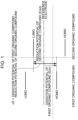
- ⁇ E is an energy gap defined by formula (A) below.
- ⁇ E oxidation potential of first organic compound - reduction potential of second organic compound
- ⁇ E satisfies formula (B) below.
- Fig. 1 is an energy diagram showing ⁇ E.
- the oxidation potential of the first organic compound corresponds to HOMO of the first organic compound.
- the reduction potential of the second organic compound corresponds to LUMO of the second organic compound.
- the oxidation-reduction potential is a potential energy difference between molecules in a solution and an electrode and is a physical property value of the molecule alone.
- Dark current may be generated from a p-type organic semiconductor material to an n-type organic semiconductor material due to thermal charge separation.
- ⁇ E is energy necessary for generation of dark current due to thermal charge separation.
- dark current due to thermal excitation is caused by contact between molecules of a p-type organic semiconductor and molecules of an n-type organic semiconductor, which form a bulk heterojunction.
- the activation energy can be increased and dark current can be reduced by the photoelectric conversion layer including an organic compound that is suppressed from coming into contact with other molecules or an organic compound that suppresses generation of thermal electrons.
- the photoelectric conversion element according to the present embodiment is a photoelectric conversion element in which dark current is reduced because the photoelectric conversion layer contains the first organic compound and the second organic compound, the first organic compound has a property of suppressing contact with other molecules or a property of suppressing generation of thermal electrons.
- the photoelectric conversion layer contains the first organic compound and the second organic compound, and the first organic compound is an electron donor material.
- the first organic compound is the p-type organic semiconductor contained in the photoelectric conversion layer.
- the first organic compound is an organic semiconductor with donor ability and has a property of readily providing electrons.
- the first organic compound is an organic compound having a lower oxidation potential. That is, the first organic compound is an electron donor material, and the second organic compound is an electron acceptor material.
- the first organic compound is preferably within a visible range with an absorption wavelength of 450 nm or more and 700 nm or less.
- the absorption peak wavelength is preferably 500 nm or more.
- 530 nm or more is preferable, and 530 nm or more and 650 nm or less is further preferable.
- absorption peak wavelength falls within the above-described range, absorption also occurs in a blue range of 450 nm or more and 470 nm or less and a red range of 600 nm or more and 630 nm or less, which are nearby ranges, and as a result, panchromatism is improved.
- the absorption peak wavelength can be obtained by, for example, measuring an absorption spectrum in a chloroform solution.
- the absorption peak wavelength of the first organic compound is 530 nm or more
- formula (B) be satisfied and the activation energy of dark current be set to be a specific value or more.
- An organic compound having an absorption peak wavelength of 530 nm or more is an organic compound having a relatively small band gap.
- HOMO thereof tends to approach LUMO of the second organic compound. That is, dark current is readily generated. In this case, great effect is exerted by satisfying formula (B) or satisfying that the activation energy of dark current is set to be a specific value or more.
- the concentration of the first organic compound in the photoelectric conversion layer is preferably less than 35% by weight, where the total of the first organic compound and the second organic compound is assumed to be 100% by weight, and 27.5% by weight or less is more preferable. It is favorable that the concentration of the first organic compound be within the preferable range because dark current can be further reduced.
- the first organic compound is denoted by general formula [28] below.
- R 391 to R 393 , and R 396 is selected from a hydrogen atom, a halogen atom, a substituted or unsubstituted alkyl group, a substituted or unsubstituted alkoxy group, a substituted or unsubstituted aryl group, a substituted or unsubstituted heterocyclic group, a substituted or unsubstituted vinyl group, a substituted or unsubstituted amino group, and a cyano group,
- Z 1 represents a halogen atom, a cyano group, a substituted or unsubstituted heteroaryl group, or any substituent denoted by general formulae [1-1] to [1-9] below.
- each of R 521 to R 588 is selected from a hydrogen atom, a halogen atom, a substituted or unsubstituted alkyl group, a substituted or unsubstituted alkoxy group, a substituted or unsubstituted aryl group, a substituted or unsubstituted heterocyclic group, a substituted or unsubstituted vinyl group, a substituted or unsubstituted amino group, and a cyano group.
- the substituents included in the alkyl group, the aryl group, the heterocyclic group, the amino group, the vinyl group, and the alkoxy group in general formula [28] are substituents described below.
- the substituent include an alkyl group having a carbon atom number of 1 to 4, for example, a methyl group, an ethyl group, a propyl group, and a butyl group, an aralkyl group, for example, a benzyl group, an aryl group, for example, a phenyl group and a biphenyl group, a heterocyclic group in which a heteroatom is a nitrogen atom, for example, a pyridyl group and a pyrrolyl group, an amino group, for example, a dimethylamino group, a diethylamino group, a dibenzylamino group, a diphenylamino group, and a ditolylamino group, an alkoxy group, for
- the first compound has a structure denoted by general formula [28] below.
- Each of R 391 to R 396 is selected from a hydrogen atom, a halogen atom, a substituted or unsubstituted alkyl group, a substituted or unsubstituted alkoxy group, a substituted or unsubstituted aryl group, a substituted or unsubstituted heterocyclic group, a substituted or unsubstituted vinyl group, a substituted or unsubstituted amino group, and a cyano group.
- Two of R 391 to R 396 may form a ring by bonding to each other.
- R 394 and R 395 form a ring by bonding to each other.
- the organic compound denoted by general formula [28] is a material having strong absorption at an absorption peak wavelength of 522 nm or more and 600 nm or less. It is preferable that an absorption peak appear in this wavelength range because the photoelectric conversion layer has panchromatism, as described above.
- a specific example of the first organic compound is compound 1-7 as described below and the others are reference examples outside the scope of the claims but useful to understand the invention.
- Exemplary example 1-7 and reference examples 1-1 to 1-6 and 1-8 to 1-24 are a group of compounds having a sulfur-atom-containing five-membered heterocyclic group at the center.
- the compound which has the heterocyclic group and in which Z 1 is an electron-withdrawing substituent is a compound having a low HOMO level. As a result, ⁇ E can be increased, and generation of thermal electrons that cause dark current is suppressed.
- an organic compound having Ar 1 or Ar 2 has a large excluded volume and, therefore, has a low probability of contact with other molecules. Consequently, an acceptor material does not readily approach, and transfer of electrons due to thermal excitation does not readily occur. As a result, dark current can be reduced.
- Reference examples 2-1 to 2-56 are a group of compounds having a fluoranthene skeleton at the center.
- the fluoranthene skeleton has an electron-withdrawing property and, therefore, is preferable first organic compound because generation of thermal electrons that cause dark current is suppressed.
- Reference examples 3-1 to 3-14 are a group of complex compounds containing a metal atom at the center.
- Each ligand contains a heterocyclic compound as a section having an electron-withdrawing property and, thereby, generation of thermal electrons that cause dark current is suppressed.
- the first organic compound has an oxidation potential of preferably 0.65 V or more.
- the photoelectric conversion layer may contain fullerene or a fullerene derivative as the second organic compound.
- the fullerene or fullerene derivative may function as an n-type organic semiconductor.
- An electron transport path is formed by molecules of fullerene or a fullerene derivative being connected to each other in the photoelectric conversion layer. Consequently, an electron transport property is improved, and high-speed responsiveness of the photoelectric conversion element is improved.
- the content of fullerene or a fullerene derivative may be 40% by weight or more and 85% by weight or less, where the total of the first organic compound and the second organic compound is assumed to be 100% by weight, in consideration of photoelectric conversion efficiency.
- fullerene or fullerene derivative examples include fullerene C60, fullerene C70, fullerene C76, fullerene C78, fullerene C80, fullerene C82, fullerene C84, fullerene C90, fullerene C96, fullerene C240, fullerene 540, mixed fullerene, and fullerene nanotube.
- the fullerene derivative may have a substituent.
- substituents include an alkyl group, an aryl group, and a heterocyclic group.
- the fullerene derivative is preferably fullerene C60.
- the photoelectric conversion layer is preferably non-radiative.
- Non-radiation is denoted as emission quantum efficiency of 1% or less, preferably 0.5% or less, and more preferably 0.1% or less in the visible light range (wavelength of 400 nm to 730 nm).
- emission quantum efficiency of the photoelectric conversion layer is 1% or less, even in the case of application to a sensor or an image pickup element, a preferable image pickup element is realized because an influence exerted on sensing performance or image pickup performance is at a low level.
- the photoelectric conversion element according to the present invention may further include a hole-blocking layer 2 between the anode and the photoelectric conversion layer.
- the hole-blocking layer is a layer that suppresses flowing of holes from the anode into the photoelectric conversion layer, and it is preferable that the ionization potential be high.
- the photoelectric conversion element according to the present invention may further include an electron-blocking layer 3 between the cathode and the photoelectric conversion layer.
- the electron-blocking layer is a layer that suppresses flowing of electrons from the cathode into the photoelectric conversion layer, and it is preferable that the electron affinity or LUMO (lowest unoccupied molecular orbital energy) be low.
- Fig. 2 is a schematic sectional view showing an example of a photoelectric conversion element according to the present embodiment.
- a photoelectric conversion layer 1 that converts light to electric charge is disposed between an anode 4 and a cathode 5 that are a pair of electrodes.
- a protective layer 7, a wavelength selection portion 8, and a microlens 9 are disposed on the anode.
- a reading circuit 6 is connected to the cathode.
- an electrode nearer to a substrate may be called a lower electrode, and an electrode farther from the substrate may be called an upper electrode.
- the lower electrode may be the anode or the cathode.
- the lower electrode may be an electrode having a high reflectance.
- the electrode may be composed of a material having high reflectance, or a reflective layer may be included in addition to the electrode layer.
- the photoelectric conversion element according to the present invention may include the substrate.
- the substrate for example, a silicon substrate, a glass substrate, a flexible substrate, or the like may be used.
- the cathode included in the photoelectric conversion element according to the present invention is an electrode that collects holes of the charge generated in the photoelectric conversion layer.
- the anode is an electrode that collects electrons of the charge generated in the photoelectric conversion layer.
- the material for constituting the cathode and the anode as long as electrical conductivity is high and transparency is provided.
- the materials for constituting the cathode and the anode may be the same or different from each other.
- the material for constituting the electrode include a metal, a metal oxide, a metal nitride, a metal boride, and an organic conductive compound and mixtures of these.
- Further specific examples include a conductive metal oxide, for example, tin oxide doped with antimony, fluorine, or the like (ATO, FTO), tin oxide, zinc oxide, indium oxide, indium tin oxide (ITO), or indium zinc oxide (IZO), a metal, for example, gold, silver, chromium, nickel, titanium, tungsten, or aluminum, a conductive compound, for example, an oxide, a nitride, or the like of these metals (titanium nitride (TiN) is an example), a mixture or a layered material of these metals and a conductive metal oxide, an inorganic conductive substance, for example, copper iodide or copper sulfide, an organic conductive material, for example, a polyaniline, a polythi
- the hole or electron collection electrode included in the photoelectric conversion element according to the present invention is an electrode that collects holes or electrons of the charge generated in the photoelectric conversion layer.
- the collection electrode located at a lower portion may be a pixel electrode in the configuration of an image pickup element. Whether the pixel electrode is a cathode or an anode is determined in accordance with an element configuration or a circuit configuration of a groundwork.
- the order may be substrate/anode/photoelectric conversion layer/cathode on the substrate, or the order may be substrate/cathode/photoelectric conversion layer/anode.
- a method for forming the electrode may be appropriately selected in consideration of suitability for the electrode material. Specifically, formation may be performed by a wet system, for example, a printing system or a coating system, a physical system, for example, a vacuum evaporation method, a sputtering method, or an ion plating method, a chemical system, for example, CVD or a plasma CVD method, or the like.
- a wet system for example, a printing system or a coating system
- a physical system for example, a vacuum evaporation method, a sputtering method, or an ion plating method
- a chemical system for example, CVD or a plasma CVD method, or the like.
- the electrode is ITO
- formation may be performed by, for example, an electron beam method, a sputtering method, a resistance heating evaporation method, a chemical reaction method (sol-gel method or the like), or a method in which a dispersion of indium tin oxide is applied.
- the resulting ITO may be subjected to UV-ozone processing, plasma processing, or the like.
- a reactive sputtering method or other various methods may be used, and annealing, UV-ozone processing, plasma processing, or the like may be further applied.
- a thin film sealing layer there is no particular limitation regarding a thin film sealing layer, and an inorganic material is used for formation.
- Specific examples include silicon oxide, silicon nitride, silicon oxynitride, and aluminum oxide.
- Silicon oxide, silicon nitride, and silicon oxynitride may be formed by a sputtering method or a CVD method.
- Aluminum oxide may be formed by an ALD method (atomic layer deposition method).
- the water permeability has to be 10 -5 g/m 2 ⁇ day or less.
- the layer thickness of the sealing layer there is no particular limitation regarding the layer thickness of the sealing layer, and 0.5 ⁇ m or more is preferable from the viewpoint of sealing performance. On the other hand, smaller thickness is favorable as long as the sealing performance is maintained, and 1 ⁇ m or less is particularly preferable.
- the thin film sealing layer having a smaller thickness is preferable because an effect of reducing color mixing is enhanced as the distance from a photoelectric conversion layer to a color filter decreases in the case of use as an image pickup element.
- an annealing step be included.
- the annealing temperature there is no particular limitation regarding the annealing temperature, and the condition of annealing temperature may be 150°C or higher and 190°C or lower.
- the annealing temperature is appropriately determined in accordance with an annealing time.
- An image pickup element includes a plurality of pixels, and each of the pixels includes a photoelectric conversion element according to the present invention and a reading transistor connected to the photoelectric conversion element.
- the plurality of pixels are arranged in the matrix with a plurality of rows and a plurality of columns.
- Each pixel may be connected to a signal processing circuit.
- the signal processing circuit can obtain an image by receiving a signal from each pixel.
- the reading transistor is a transistor that transfers a signal based on charge generated in the photoelectric conversion element.
- the signal processing circuit may be a CMOS sensor or a CCD sensor.
- the image pickup element may include an optical filter, for example, a color filter.
- a color filter in accordance with the photoelectric conversion element be included.
- one color filter may be disposed for one light-receiving pixel, or one color filter may be disposed for a plurality of light-receiving pixels.
- optical filter examples include, in addition to the color filter, a low-pass filter that transmits wavelengths of infrared rays or higher and a UV cut filter that transmits wavelengths of ultraviolet rays or lower.
- the image pickup element may include an optical member, for example, a microlens.
- the microlens is a lens that condenses light from outside on a photoelectric conversion portion.
- each light-receiving pixel may include one microlens, or one microlens may be disposed so as to address a plurality of light-receiving pixels. In the case in which a plurality of light-receiving pixels are disposed, it is preferable that each of the plurality of light-receiving pixels include one microlens.
- the image pickup element according to the present invention may be used for an image pickup apparatus.
- the image pickup apparatus includes an image pickup optical system including a plurality of lenses and an image pickup element that receives light passing through the image pickup optical system.
- the image pickup apparatus includes the image pickup element and a casing that accommodates the image pickup element.
- the casing may includes a connection portion that can be connected to the image pickup optical system. More specifically, the image pickup apparatus is a digital camera or a digital steel camera.
- the image pickup apparatus may include a receiving portion that receives a signal from outside.
- the signal received by the receiving portion is a signal that can control at least one of an image pickup range, start of image pickup, and finish of image pickup of the image pickup apparatus.
- the image pickup apparatus may further includes a sending portion that sends an acquired image to outside. Examples of the acquired image include a picked-up image and an image sent from another device.
- the image pickup element can be used as a network camera.
- Fig. 3 is a circuit diagram of a pixel including a photoelectric conversion apparatus according to the present invention.
- the photoelectric conversion apparatus 10 is connected to a common conductive line 19 at node A.
- the common conductive line may be connected to the ground.
- a pixel 18 may include the photoelectric conversion element 10 and a reading circuit that reads a signal generated in the photoelectric conversion portion.
- the reading circuit may include, for example, a transfer transistor 11 electrically connected to the photoelectric conversion element, an amplifying transistor 13 including a gate electrode electrically connected to the photoelectric conversion element 10, a selection transistor 14 that selects a pixel from which information is read, and a reset transistor 12 that supplies a reset voltage to the photoelectric conversion element.
- Transfer of the transfer transistor 11 may be controlled by pTX.
- Supply of the voltage to the reset transistor may be controlled by pRES.
- the selection transistor is set to be in the state of selection or non-selection by pSEL.
- the transfer transistor 11, the reset transistor 12, and the amplifying transistor 13 are connected to each other at node B. It is possible to include no transfer transistor in accordance with the configuration.
- the reset transistor is a transistor that supplies a voltage to reset the potential at node B. Supply of the voltage can be controlled by applying pRES to the gate of the reset transistor. It is possible to include no reset transistor in accordance with the configuration.
- the amplifying transistor is a transistor that passes a current in accordance with the potential at node B.
- the amplifying transistor is connected to the selection transistor 14 that selects a pixel from which a signal is output.
- the selection transistor is connected to a current source 16 and a column output portion 15, and the column output portion 15 may be connected to a signal processing portion.
- the selection transistor 14 is connected to a vertical output signal line 17.
- the vertical output signal line 17 is connected to the current source 16 and the column output portion 15.
- Fig. 4 is a diagram showing an image pickup element according to the present invention.
- the image pickup element 20 includes an image pickup region 25 in which a plurality of pixels are two-dimensionally arranged and a peripheral region 26. A region other than the image pickup region is the peripheral region.
- the peripheral region includes a vertical scanning circuit 21, a reading circuit 22, a horizontal scanning circuit 23, and an output amplifier 24, and the output amplifier is connected to a signal processing portion 27.
- the signal processing portion is a signal processing portion that performs signal processing based on the information read by the reading circuit, and examples include a CCD circuit and a CMOS circuit.
- the reading circuit 22 includes, for example, a column amplifier, a CDS circuit, an adding circuit, and the like and performs amplification, addition, and the like relative to signals read through the vertical signal line from pixels in the row selected by the vertical scanning circuit 21.
- the column amplifier, the CDS circuit, the adding circuit, and the like are arranged, for example, on a pixel column or a plurality of pixel columns basis.
- the horizontal scanning circuit 23 generates signals for sequentially reading signals of the reading circuit 22.
- the output amplifier 24 amplifies and outputs signals of a row selected by the horizontal scanning circuit 23.
- the above-described configuration is just a configuration example of the photoelectric conversion apparatus, and the present embodiment is not limited to this.
- one each of the reading circuit 22, the horizontal scanning circuit 23, and the output amplifier 24 is arranged on and under the image pickup region 25.
- three or more output paths may be disposed. Signals output from output amplifiers are combined as an image signal in the signal processing portion.
- Electrochemical characteristics for example, an oxidation potential, can be evaluated by cyclic voltammetry (CV) .
- a CV measurement sample was prepared by dissolving about 1 mg of first organic compound into 10 mL of 0.1-M ortho-dichlorobenzene solution of tetrabutylammonium perchlorate and performing deaeration treatment using nitrogen.
- a three-electrode method was used for the CV measurement.
- a nonaqueous-solvent-based Ag/Ag + reference electrode, a platinum counter electrode having a diameter of 0.5 mm and a length of 5 cm, and a glassy carbon working electrode having an inner diameter of 3 mm (every electrode was produced by BAS Inc.) were used.
- An electrochemical analyzer Model 660C produced by ALS Co., Ltd. was used as an electrochemical measurement apparatus.
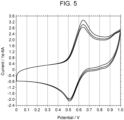
- Fig. 5 is a diagram showing an example of a cyclic voltammogram that determines the oxidation potential and the reduction potential of an organic compound.
- the oxidation potential and the reduction potential can be assumed from a peak value of the cyclic voltammogram.
- the oxidation potential is referred to as Eox and the reduction potential is referred to as Ered.
- Table 1 shows the oxidation potentials of exemplary compounds.
- a photoelectric conversion element was produced by using a combination of a first organic compound and a second organic compound, where ⁇ E ⁇ 1.5 V applied. Dark current was measured by using the resulting photoelectric conversion element.
- the photoelectric conversion element was formed on a Si substrate.
- a cathode, an electron-blocking layer, a photoelectric conversion layer, a hole-blocking layer, and an anode were sequentially formed.
- the photoelectric conversion element was produced in the following steps.
- the Si substrate was prepared, in which a wiring layer and an insulating layer were stacked and, for the purpose of enabling communication, contact holes were disposed from the wiring layer through the insulating layer at a place corresponding to each pixel by forming an opening. This contact hole is connected to a pad portion at a substrate edge by a conductive line.
- An IZO electrode was formed by a sputtering method so as to overlap the contact hole portion. Patterning was performed so as to form 3 mm 2 of IZO electrode (cathode). At this time, the film thickness of the IZO electrode was set to be 100 nm.
- An organic compound layer was formed on the IZO electrode by a vacuum evaporation method.
- the layer configuration and the layer thickness were as shown in Table 2 below.
- IZO serving as an anode was formed by a sputtering method.
- the thickness of the anode was set to be 30 nm.
- the layer configuration of the photoelectric conversion element is shown in Table 2.
- compound (d-1) As the electron-blocking layer, compound (d-1) below was used.
- any one of exemplary compounds 1-1 to 3-14 was used.
- any one of fullerene C60 (d-2), fullerene C70 (d-3), and organic compound (d-4) below was used.
- the characteristics of the photoelectric conversion element were measured and evaluated. A current when 5 V was applied to the element was examined. Regarding every element, the current value at a bright place was at least 10 times the current value at a dark place and, therefore, it was ascertained that the photoelectric conversion element functioned.
- the photoelectric conversion element was held in a constant temperature bath at 60°C and the measurement was performed by bringing a prober wired to a semiconductor parameter analyzer (4155C, Agilent Technologies, Inc.) into contact with an electrode.
- a semiconductor parameter analyzer (4155C, Agilent Technologies, Inc.
- a to C were rated as good, and D and E were rated as poor.
- the dark current evaluation of the photoelectric conversion element of example 1 was C.
- the area is 1.0 ⁇ 10 -6 cm 2 .
- an image pickup element with low dark current can be obtained.
- the low-dark-current characteristics is associated with noise reduction of the image pickup element.
- Photoelectric conversion elements were produced in the same manner as reference example 1 except that the combination of the first organic compound and the second organic compound was changed to a combination shown in Table 5.
- the combination of compounds shown in Table 5 was a combination where ⁇ E ⁇ 1.5 V applied.
- the resulting photoelectric conversion element was subjected to the dark current evaluation in the same measuring method as example 1.
- the concentration of the first organic compound is preferably less than 35% by weight and more preferably 27.5% by weight or less.
- the lower limit concentration is not limited by the present invention and may be, for example, a concentration at which necessary absorptance is obtained.
- Photoelectric conversion elements were produced in the same manner as reference example 1 except that the constituent material and the layer thickness were set to be as shown in Table 7.
- the reference compound shown in Table 8 or comparative compound (e-1) below was used but is expressed as "first organic compound” in Table 7.
- the dark current of each element was measured and relative evaluation was performed.
- the structure of comparative compound (e-1) was as described below.
- the oxidation potential of compound e-1 was 0.92 V.
- the maximum absorption peak wavelength refers to the wavelength of a peak having the greatest absorption coefficient.
- a chloroform solution in which the first organic compound was produced and the absorption spectrum was measured by a spectrophotometer (JASCO Corporation Ubest-550). The maximum absorption peak wavelength and the absorbance were determined on the basis of the measurement results.
- the molar absorptivity was determined from the absorbance in accordance with Lambert-Beer law.
- the compound denoted by general formula [28] can obtain an absorption peak suitable for obtaining a panchromatic absorption band in the visible range and strong absorption with molar absorptivity of 40,000 or more. Strong absorption is associated with a high external quantum yield and, therefore, is important factor for the photoelectric conversion element.
- a photoelectric conversion element was produced in the same manner as reference example 1 except that a silicon nitride layer by using a CVD method was used as the sealing layer.
- the silicon nitride layer having a layer thickness of 1 ⁇ m was formed. Durability was evaluated by irradiating the resulting element with LED light of 365 nm at intensity of 1 W/cm 2 for 24 h.
- the absorptance of the LED light of 365 nm by the resulting SiN (1 ⁇ m) was 75%.
- the value of dark current in this element did not change even after a lapse of 24 h.
- the dark current about 10% increased after light irradiation for 24 hours. This is because the glass cap has lower ultraviolet absorptance than SiN.
- the sealing layer be formed of a material that can absorb ultraviolet rays.
- Fig. 6 is a diagram showing the Arrhenius plot of the photoelectric conversion element in example 1.
- the vertical axis indicates the dark current value normalized by the dark current value at 60°C.
- the vertical axis is graduated in common logarithms.
- the horizontal axis indicates the reciprocal of absolute temperature.
- the absolute value of the gradient increases as the temperature increases from about 60°C.
- the activation energy was determined from this gradient on the basis of formula (5) below.
- T absolute temperature
- k B Boltzmann constant
- E a activation energy
- J current value at temperature T
- J 0 a frequency factor.
- the dark current activation energy determined from the gradient was 0.84 eV.
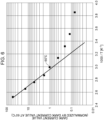
- the activation energy was determined in the same method as example 55 and was plotted relative to corresponding ⁇ E as shown in Fig. 7 . It is shown that the activation energy tends to increase as ⁇ E increases. As is clear from Fig. 7 , when ⁇ E is 1.5 V or more, the activation energy is high. This indicates that when ⁇ E is 1.5 V or more, a probability of charge generation due to thermal excitation is reduced. In this regard, Table 10 shows the relationship between the activation energy and the dark current evaluation. As shown in Table 10, when the activation energy is 0.70 eV or more, the rating of dark current is C or better.
- the activation energy of dark current be 0.70 eV or more.
- the photoelectric conversion element according to the present invention is a photoelectric conversion element in which dark current is reduced.
- An image pickup element including the photoelectric conversion element is preferable because dark current noise resulting from the photoelectric conversion element portion is at a low level.
Landscapes
- Engineering & Computer Science (AREA)
- Physics & Mathematics (AREA)
- Chemical & Material Sciences (AREA)
- Materials Engineering (AREA)
- Spectroscopy & Molecular Physics (AREA)
- Electromagnetism (AREA)
- Signal Processing (AREA)
- Multimedia (AREA)
- Inorganic Chemistry (AREA)
- Light Receiving Elements (AREA)
- Solid State Image Pick-Up Elements (AREA)
- Transforming Light Signals Into Electric Signals (AREA)
- Electroluminescent Light Sources (AREA)
- Organic Low-Molecular-Weight Compounds And Preparation Thereof (AREA)
Applications Claiming Priority (3)
| Application Number | Priority Date | Filing Date | Title |
|---|---|---|---|
| JP2016220717 | 2016-11-11 | ||
| JP2017177880A JP7102114B2 (ja) | 2016-11-11 | 2017-09-15 | 光電変換素子、撮像素子および撮像装置 |
| PCT/JP2017/039722 WO2018088325A1 (ja) | 2016-11-11 | 2017-11-02 | 光電変換素子、撮像素子および撮像装置 |
Publications (3)
| Publication Number | Publication Date |
|---|---|
| EP3540804A1 EP3540804A1 (en) | 2019-09-18 |
| EP3540804A4 EP3540804A4 (en) | 2020-09-16 |
| EP3540804B1 true EP3540804B1 (en) | 2025-01-08 |
Family
ID=62237396
Family Applications (1)
| Application Number | Title | Priority Date | Filing Date |
|---|---|---|---|
| EP17870234.6A Active EP3540804B1 (en) | 2016-11-11 | 2017-11-02 | Photoelectric conversion element, imaging element and imaging device |
Country Status (4)
| Country | Link |
|---|---|
| US (1) | US12336311B2 (https=) |
| EP (1) | EP3540804B1 (https=) |
| JP (1) | JP7102114B2 (https=) |
| CN (1) | CN109937489B (https=) |
Families Citing this family (7)
| Publication number | Priority date | Publication date | Assignee | Title |
|---|---|---|---|---|
| JP7224813B2 (ja) * | 2018-08-31 | 2023-02-20 | キヤノン株式会社 | 有機化合物、有機発光素子、表示装置、撮像装置、電子機器、照明装置及び移動体 |
| CN113557614A (zh) | 2019-03-28 | 2021-10-26 | 索尼集团公司 | 固态摄像元件、固态摄像元件的制造方法、光电转换元件、摄像装置和电子设备 |
| KR20210146289A (ko) * | 2019-03-28 | 2021-12-03 | 소니그룹주식회사 | 고체 촬상 소자 및 고체 촬상 소자의 제조 방법 및 고체 촬상 장치 |
| JP7541820B2 (ja) * | 2019-11-01 | 2024-08-29 | キヤノン株式会社 | 有機化合物及び有機発光素子 |
| CN112174839A (zh) * | 2020-11-05 | 2021-01-05 | 四川大学华西医院 | 一种脂滴特异性标记的荧光探针及其合成方法和应用 |
| CN118435719A (zh) | 2022-01-21 | 2024-08-02 | 日铁化学材料株式会社 | 摄像用的光电转换元件用材料以及光电转换元件 |
| CN116803994A (zh) * | 2023-06-26 | 2023-09-26 | 厦门大学 | 化合物、其立体异构体或光学异构体及制备方法、给体材料、太阳能电池、用电装置及应用 |
Citations (1)
| Publication number | Priority date | Publication date | Assignee | Title |
|---|---|---|---|---|
| EP3466937A1 (en) * | 2016-05-31 | 2019-04-10 | C/o Canon Kabushiki Kaisha | Photoelectric conversion element, two-dimensional sensor, image sensor and imaging device |
Family Cites Families (26)
| Publication number | Priority date | Publication date | Assignee | Title |
|---|---|---|---|---|
| CA2319550A1 (en) * | 1998-02-02 | 1999-08-05 | Uniax Corporation | Image sensors made from organic semiconductors |
| AU2492599A (en) * | 1998-02-02 | 1999-08-16 | Uniax Corporation | Organic diodes with switchable photosensitivity |
| JP2001064640A (ja) * | 1999-08-30 | 2001-03-13 | Toyo Ink Mfg Co Ltd | 有機エレクトロルミネッセンス素子用材料およびそれを使用した有機エレクトロルミネッセンス素子 |
| US7208132B2 (en) * | 2001-10-01 | 2007-04-24 | Tda Research, Inc. | Purification of endohedral and other fullerenes by chemical methods |
| US6972431B2 (en) * | 2003-11-26 | 2005-12-06 | Trustees Of Princeton University | Multilayer organic photodetectors with improved performance |
| WO2006025274A1 (ja) * | 2004-08-30 | 2006-03-09 | Kyoto University | 有機半導体発光装置およびそれを用いた表示装置 |
| JP4677314B2 (ja) | 2005-09-20 | 2011-04-27 | 富士フイルム株式会社 | センサーおよび有機光電変換素子の駆動方法 |
| JP2008066402A (ja) * | 2006-09-05 | 2008-03-21 | Fujifilm Corp | 撮像素子および撮像装置 |
| WO2008146602A1 (ja) * | 2007-05-24 | 2008-12-04 | Konica Minolta Holdings, Inc. | 放射線検出器、放射線検出器の製造方法及び支持基板の製造方法 |
| JP5452888B2 (ja) * | 2008-05-30 | 2014-03-26 | 出光興産株式会社 | 有機薄膜太陽電池 |
| JP5566890B2 (ja) * | 2008-08-22 | 2014-08-06 | コニカミノルタ株式会社 | 有機光電変換素子、太陽電池及び光センサアレイ |
| JP4604128B2 (ja) * | 2008-10-15 | 2010-12-22 | 富士フイルム株式会社 | 光電変換素子及び撮像素子 |
| JP2010147158A (ja) * | 2008-12-17 | 2010-07-01 | Mitsubishi Electric Corp | 半導体受光素子および半導体受光素子の製造方法 |
| JP5659458B2 (ja) * | 2009-03-16 | 2015-01-28 | コニカミノルタ株式会社 | 有機エレクトロニクス素子、有機光電変換素子、及び有機エレクトロルミネッセンス素子 |
| JP5520560B2 (ja) * | 2009-09-29 | 2014-06-11 | 富士フイルム株式会社 | 光電変換素子、光電変換素子材料、光センサ、及び撮像素子 |
| JP5556448B2 (ja) * | 2010-07-01 | 2014-07-23 | ソニー株式会社 | 撮像装置 |
| JP2012084300A (ja) * | 2010-10-08 | 2012-04-26 | Konica Minolta Business Technologies Inc | 光電変換素子および太陽電池 |
| KR20120081505A (ko) * | 2011-01-11 | 2012-07-19 | 삼성전자주식회사 | 이미지 센서 및 그 제조 방법 |
| JP2012188355A (ja) * | 2011-03-08 | 2012-10-04 | Canon Inc | 新規有機化合物およびそれを有する有機発光素子 |
| KR101844952B1 (ko) * | 2011-04-15 | 2018-04-04 | 삼성전자주식회사 | 이미지 센서 |
| JP5814044B2 (ja) * | 2011-08-16 | 2015-11-17 | 富士フイルム株式会社 | 光電変換素子およびその使用方法、撮像素子、光センサ |
| JP5542249B2 (ja) * | 2012-03-28 | 2014-07-09 | 富士フイルム株式会社 | 撮像素子及びこれを用いた撮像装置及び撮像方法 |
| WO2014051007A1 (ja) * | 2012-09-28 | 2014-04-03 | 富士フイルム株式会社 | 光電変換素子およびその使用方法、光センサ、撮像素子 |
| FR3011548A1 (fr) * | 2013-10-07 | 2015-04-10 | Arkema France | Compose organique photoactif |
| CN105742303B (zh) * | 2014-12-26 | 2020-08-25 | 松下知识产权经营株式会社 | 摄像装置 |
| JP6700825B2 (ja) | 2016-02-09 | 2020-05-27 | キヤノン株式会社 | 有機光電変換素子、光エリアセンサ、撮像素子及び撮像装置 |
-
2017
- 2017-09-15 JP JP2017177880A patent/JP7102114B2/ja active Active
- 2017-11-02 CN CN201780069863.6A patent/CN109937489B/zh active Active
- 2017-11-02 EP EP17870234.6A patent/EP3540804B1/en active Active
-
2019
- 2019-05-08 US US16/407,012 patent/US12336311B2/en active Active
Patent Citations (1)
| Publication number | Priority date | Publication date | Assignee | Title |
|---|---|---|---|---|
| EP3466937A1 (en) * | 2016-05-31 | 2019-04-10 | C/o Canon Kabushiki Kaisha | Photoelectric conversion element, two-dimensional sensor, image sensor and imaging device |
Non-Patent Citations (2)
| Title |
|---|
| AL-IBRAHIM M ET AL: "The influence of the optoelectronic properties of poly(3-alkylthiophenes) on the device parameters in flexible polymer solar cells", ORGANIC ELECTRONICS, ELSEVIER, AMSTERDAM, NL, vol. 6, no. 2, 1 April 2005 (2005-04-01), pages 65 - 77, XP027680016, ISSN: 1566-1199, [retrieved on 20050401] * |
| VICTORIEN JEUX ET AL: "Push-Pull Triphenylamine Chromophore Syntheses and Optoelectronic Characterizations", CHEMPLUSCHEM, vol. 80, no. 4, 2 February 2015 (2015-02-02), pages 697 - 703, XP055446578, ISSN: 2192-6506, DOI: 10.1002/cplu.201402386 * |
Also Published As
| Publication number | Publication date |
|---|---|
| CN109937489B (zh) | 2024-03-08 |
| EP3540804A4 (en) | 2020-09-16 |
| JP2018085499A (ja) | 2018-05-31 |
| JP7102114B2 (ja) | 2022-07-19 |
| EP3540804A1 (en) | 2019-09-18 |
| US12336311B2 (en) | 2025-06-17 |
| CN109937489A (zh) | 2019-06-25 |
| US20190267411A1 (en) | 2019-08-29 |
Similar Documents
| Publication | Publication Date | Title |
|---|---|---|
| EP3540804B1 (en) | Photoelectric conversion element, imaging element and imaging device | |
| Jeon et al. | A fluorene-terminated hole-transporting material for highly efficient and stable perovskite solar cells | |
| CN110301052B (zh) | 光电转换元件、和使用其的光学区域传感器、图像拾取元件和图像拾取设备 | |
| Grätzel | The rise of highly efficient and stable perovskite solar cells | |
| Lee et al. | Bandgap tailored nonfullerene acceptors for low-energy-loss near-infrared organic photovoltaics | |
| Wang et al. | Interface engineering of high-performance perovskite photodetectors based on PVP/SnO2 electron transport layer | |
| US20190267545A1 (en) | Photoelectric conversion element, and imaging element and imaging apparatus including the same | |
| EP3466937B1 (en) | Photoelectric conversion element, two-dimensional sensor, image sensor and imaging device | |
| US10978644B2 (en) | Organic compound and organic photoelectric conversion element including the same | |
| Zhang et al. | Extending the Spectral Responsivity of MoS2 Phototransistors by Incorporating Up‐Conversion Microcrystals | |
| Martínez‐Goyeneche et al. | Narrowband monolithic perovskite–perovskite tandem photodetectors | |
| JP6833351B2 (ja) | 有機光電変換素子、光エリアセンサ、撮像素子および撮像装置 | |
| Daskeviciute‐Geguziene et al. | Passivating Defects of Perovskite Solar Cells with Functional Donor‐Acceptor–Donor Type Hole Transporting Materials | |
| JP7051332B2 (ja) | 有機化合物及び光電変換素子 | |
| Bhat et al. | Solution‐Processed Ternary Organic Photodetectors with Ambipolar Small‐Bandgap Polymer for Near‐Infrared Sensing | |
| WO2018147202A1 (ja) | 光電変換素子、及びこれを用いた光エリアセンサ、撮像素子、撮像装置 | |
| Natsuda et al. | Delocalization suppresses nonradiative charge recombination in polymer solar cells | |
| Pyo et al. | Advancing fab-compatible color-selective organic photodiodes: tailored molecular design and nanointerlayers | |
| JP2022100258A (ja) | インドロカルバゾール環を有する化合物、受光素子用材料、有機薄膜、受光素子、及び撮像素子 | |
| JP2018129505A (ja) | 光電変換素子、及びこれを用いた光エリアセンサ、撮像素子、撮像装置 | |
| WO2018088325A1 (ja) | 光電変換素子、撮像素子および撮像装置 | |
| US10468614B2 (en) | Photoelectric conversion element, image pick-up element, and image pick-up apparatus | |
| JP7016662B2 (ja) | 有機化合物、それを用いた光電変換素子および撮像装置 | |
| JP2017034112A (ja) | 近赤外光電変換素子、光センサ及び近赤外光電変換素子用材料 | |
| WO2022158268A1 (ja) | 光電流増倍素子および撮像装置 |
Legal Events
| Date | Code | Title | Description |
|---|---|---|---|
| STAA | Information on the status of an ep patent application or granted ep patent |
Free format text: STATUS: THE INTERNATIONAL PUBLICATION HAS BEEN MADE |
|
| PUAI | Public reference made under article 153(3) epc to a published international application that has entered the european phase |
Free format text: ORIGINAL CODE: 0009012 |
|
| STAA | Information on the status of an ep patent application or granted ep patent |
Free format text: STATUS: REQUEST FOR EXAMINATION WAS MADE |
|
| 17P | Request for examination filed |
Effective date: 20190611 |
|
| AK | Designated contracting states |
Kind code of ref document: A1 Designated state(s): AL AT BE BG CH CY CZ DE DK EE ES FI FR GB GR HR HU IE IS IT LI LT LU LV MC MK MT NL NO PL PT RO RS SE SI SK SM TR |
|
| AX | Request for extension of the european patent |
Extension state: BA ME |
|
| DAV | Request for validation of the european patent (deleted) | ||
| DAX | Request for extension of the european patent (deleted) | ||
| REG | Reference to a national code |
Ref country code: DE Ref legal event code: R079 Free format text: PREVIOUS MAIN CLASS: H01L0051420000 Ipc: H01L0051460000 Ref country code: DE Ref legal event code: R079 Ref document number: 602017087286 Country of ref document: DE Free format text: PREVIOUS MAIN CLASS: H01L0051420000 Ipc: H01L0051460000 |
|
| A4 | Supplementary search report drawn up and despatched |
Effective date: 20200818 |
|
| RIC1 | Information provided on ipc code assigned before grant |
Ipc: H01L 27/30 20060101ALI20200812BHEP Ipc: H04N 5/361 20110101ALI20200812BHEP Ipc: H01L 27/146 20060101ALI20200812BHEP Ipc: H01L 51/46 20060101AFI20200812BHEP |
|
| STAA | Information on the status of an ep patent application or granted ep patent |
Free format text: STATUS: EXAMINATION IS IN PROGRESS |
|
| 17Q | First examination report despatched |
Effective date: 20230119 |
|
| REG | Reference to a national code |
Ref country code: DE Ipc: H10K0085600000 Ref country code: DE Ref legal event code: R079 Ref document number: 602017087286 Country of ref document: DE Free format text: PREVIOUS MAIN CLASS: H01L0051460000 Ipc: H10K0085600000 |
|
| GRAP | Despatch of communication of intention to grant a patent |
Free format text: ORIGINAL CODE: EPIDOSNIGR1 |
|
| STAA | Information on the status of an ep patent application or granted ep patent |
Free format text: STATUS: GRANT OF PATENT IS INTENDED |
|
| RIC1 | Information provided on ipc code assigned before grant |
Ipc: H04N 25/63 20230101ALN20240619BHEP Ipc: H10K 101/30 20230101ALN20240619BHEP Ipc: H10K 30/30 20230101ALN20240619BHEP Ipc: H10K 39/32 20230101ALI20240619BHEP Ipc: H10K 85/60 20230101AFI20240619BHEP |
|
| INTG | Intention to grant announced |
Effective date: 20240708 |
|
| GRAS | Grant fee paid |
Free format text: ORIGINAL CODE: EPIDOSNIGR3 |
|
| GRAA | (expected) grant |
Free format text: ORIGINAL CODE: 0009210 |
|
| STAA | Information on the status of an ep patent application or granted ep patent |
Free format text: STATUS: THE PATENT HAS BEEN GRANTED |
|
| AK | Designated contracting states |
Kind code of ref document: B1 Designated state(s): AL AT BE BG CH CY CZ DE DK EE ES FI FR GB GR HR HU IE IS IT LI LT LU LV MC MK MT NL NO PL PT RO RS SE SI SK SM TR |
|
| REG | Reference to a national code |
Ref country code: GB Ref legal event code: FG4D |
|
| REG | Reference to a national code |
Ref country code: CH Ref legal event code: EP |
|
| REG | Reference to a national code |
Ref country code: DE Ref legal event code: R096 Ref document number: 602017087286 Country of ref document: DE |
|
| REG | Reference to a national code |
Ref country code: IE Ref legal event code: FG4D |
|
| REG | Reference to a national code |
Ref country code: LT Ref legal event code: MG9D |
|
| REG | Reference to a national code |
Ref country code: NL Ref legal event code: MP Effective date: 20250108 |
|
| REG | Reference to a national code |
Ref country code: AT Ref legal event code: MK05 Ref document number: 1759175 Country of ref document: AT Kind code of ref document: T Effective date: 20250108 |
|
| PG25 | Lapsed in a contracting state [announced via postgrant information from national office to epo] |
Ref country code: NL Free format text: LAPSE BECAUSE OF FAILURE TO SUBMIT A TRANSLATION OF THE DESCRIPTION OR TO PAY THE FEE WITHIN THE PRESCRIBED TIME-LIMIT Effective date: 20250108 |
|
| PG25 | Lapsed in a contracting state [announced via postgrant information from national office to epo] |
Ref country code: RS Free format text: LAPSE BECAUSE OF FAILURE TO SUBMIT A TRANSLATION OF THE DESCRIPTION OR TO PAY THE FEE WITHIN THE PRESCRIBED TIME-LIMIT Effective date: 20250408 |
|
| PG25 | Lapsed in a contracting state [announced via postgrant information from national office to epo] |
Ref country code: FI Free format text: LAPSE BECAUSE OF FAILURE TO SUBMIT A TRANSLATION OF THE DESCRIPTION OR TO PAY THE FEE WITHIN THE PRESCRIBED TIME-LIMIT Effective date: 20250108 |
|
| PG25 | Lapsed in a contracting state [announced via postgrant information from national office to epo] |
Ref country code: PL Free format text: LAPSE BECAUSE OF FAILURE TO SUBMIT A TRANSLATION OF THE DESCRIPTION OR TO PAY THE FEE WITHIN THE PRESCRIBED TIME-LIMIT Effective date: 20250108 |
|
| PG25 | Lapsed in a contracting state [announced via postgrant information from national office to epo] |
Ref country code: ES Free format text: LAPSE BECAUSE OF FAILURE TO SUBMIT A TRANSLATION OF THE DESCRIPTION OR TO PAY THE FEE WITHIN THE PRESCRIBED TIME-LIMIT Effective date: 20250108 |
|
| PG25 | Lapsed in a contracting state [announced via postgrant information from national office to epo] |
Ref country code: IS Free format text: LAPSE BECAUSE OF FAILURE TO SUBMIT A TRANSLATION OF THE DESCRIPTION OR TO PAY THE FEE WITHIN THE PRESCRIBED TIME-LIMIT Effective date: 20250508 Ref country code: NO Free format text: LAPSE BECAUSE OF FAILURE TO SUBMIT A TRANSLATION OF THE DESCRIPTION OR TO PAY THE FEE WITHIN THE PRESCRIBED TIME-LIMIT Effective date: 20250408 |
|
| PG25 | Lapsed in a contracting state [announced via postgrant information from national office to epo] |
Ref country code: HR Free format text: LAPSE BECAUSE OF FAILURE TO SUBMIT A TRANSLATION OF THE DESCRIPTION OR TO PAY THE FEE WITHIN THE PRESCRIBED TIME-LIMIT Effective date: 20250108 |
|
| PG25 | Lapsed in a contracting state [announced via postgrant information from national office to epo] |
Ref country code: LV Free format text: LAPSE BECAUSE OF FAILURE TO SUBMIT A TRANSLATION OF THE DESCRIPTION OR TO PAY THE FEE WITHIN THE PRESCRIBED TIME-LIMIT Effective date: 20250108 Ref country code: PT Free format text: LAPSE BECAUSE OF FAILURE TO SUBMIT A TRANSLATION OF THE DESCRIPTION OR TO PAY THE FEE WITHIN THE PRESCRIBED TIME-LIMIT Effective date: 20250508 |
|
| PG25 | Lapsed in a contracting state [announced via postgrant information from national office to epo] |
Ref country code: GR Free format text: LAPSE BECAUSE OF FAILURE TO SUBMIT A TRANSLATION OF THE DESCRIPTION OR TO PAY THE FEE WITHIN THE PRESCRIBED TIME-LIMIT Effective date: 20250409 Ref country code: BG Free format text: LAPSE BECAUSE OF FAILURE TO SUBMIT A TRANSLATION OF THE DESCRIPTION OR TO PAY THE FEE WITHIN THE PRESCRIBED TIME-LIMIT Effective date: 20250108 |
|
| PG25 | Lapsed in a contracting state [announced via postgrant information from national office to epo] |
Ref country code: AT Free format text: LAPSE BECAUSE OF FAILURE TO SUBMIT A TRANSLATION OF THE DESCRIPTION OR TO PAY THE FEE WITHIN THE PRESCRIBED TIME-LIMIT Effective date: 20250108 |
|
| PG25 | Lapsed in a contracting state [announced via postgrant information from national office to epo] |
Ref country code: SE Free format text: LAPSE BECAUSE OF FAILURE TO SUBMIT A TRANSLATION OF THE DESCRIPTION OR TO PAY THE FEE WITHIN THE PRESCRIBED TIME-LIMIT Effective date: 20250108 |
|
| PG25 | Lapsed in a contracting state [announced via postgrant information from national office to epo] |
Ref country code: SM Free format text: LAPSE BECAUSE OF FAILURE TO SUBMIT A TRANSLATION OF THE DESCRIPTION OR TO PAY THE FEE WITHIN THE PRESCRIBED TIME-LIMIT Effective date: 20250108 |
|
| REG | Reference to a national code |
Ref country code: DE Ref legal event code: R097 Ref document number: 602017087286 Country of ref document: DE |
|
| PG25 | Lapsed in a contracting state [announced via postgrant information from national office to epo] |
Ref country code: DK Free format text: LAPSE BECAUSE OF FAILURE TO SUBMIT A TRANSLATION OF THE DESCRIPTION OR TO PAY THE FEE WITHIN THE PRESCRIBED TIME-LIMIT Effective date: 20250108 |
|
| PG25 | Lapsed in a contracting state [announced via postgrant information from national office to epo] |
Ref country code: EE Free format text: LAPSE BECAUSE OF FAILURE TO SUBMIT A TRANSLATION OF THE DESCRIPTION OR TO PAY THE FEE WITHIN THE PRESCRIBED TIME-LIMIT Effective date: 20250108 Ref country code: CZ Free format text: LAPSE BECAUSE OF FAILURE TO SUBMIT A TRANSLATION OF THE DESCRIPTION OR TO PAY THE FEE WITHIN THE PRESCRIBED TIME-LIMIT Effective date: 20250108 |
|
| PG25 | Lapsed in a contracting state [announced via postgrant information from national office to epo] |
Ref country code: RO Free format text: LAPSE BECAUSE OF FAILURE TO SUBMIT A TRANSLATION OF THE DESCRIPTION OR TO PAY THE FEE WITHIN THE PRESCRIBED TIME-LIMIT Effective date: 20250108 |
|
| PG25 | Lapsed in a contracting state [announced via postgrant information from national office to epo] |
Ref country code: SK Free format text: LAPSE BECAUSE OF FAILURE TO SUBMIT A TRANSLATION OF THE DESCRIPTION OR TO PAY THE FEE WITHIN THE PRESCRIBED TIME-LIMIT Effective date: 20250108 |
|
| PLBE | No opposition filed within time limit |
Free format text: ORIGINAL CODE: 0009261 |
|
| STAA | Information on the status of an ep patent application or granted ep patent |
Free format text: STATUS: NO OPPOSITION FILED WITHIN TIME LIMIT |
|
| 26N | No opposition filed |
Effective date: 20251009 |
|
| PGFP | Annual fee paid to national office [announced via postgrant information from national office to epo] |
Ref country code: DE Payment date: 20251022 Year of fee payment: 9 |
|
| PG25 | Lapsed in a contracting state [announced via postgrant information from national office to epo] |
Ref country code: IT Free format text: LAPSE BECAUSE OF FAILURE TO SUBMIT A TRANSLATION OF THE DESCRIPTION OR TO PAY THE FEE WITHIN THE PRESCRIBED TIME-LIMIT Effective date: 20250108 |