EP3521252A1 - Glaskeramik mit ionenleitender restglasphase und verfahren zu ihrer herstellung - Google Patents
Glaskeramik mit ionenleitender restglasphase und verfahren zu ihrer herstellung Download PDFInfo
- Publication number
- EP3521252A1 EP3521252A1 EP19155113.4A EP19155113A EP3521252A1 EP 3521252 A1 EP3521252 A1 EP 3521252A1 EP 19155113 A EP19155113 A EP 19155113A EP 3521252 A1 EP3521252 A1 EP 3521252A1
- Authority
- EP
- European Patent Office
- Prior art keywords
- glass
- ceramic
- mol
- phase
- ion
- Prior art date
- Legal status (The legal status is an assumption and is not a legal conclusion. Google has not performed a legal analysis and makes no representation as to the accuracy of the status listed.)
- Granted
Links
Images


Classifications
-
- H—ELECTRICITY
- H01—ELECTRIC ELEMENTS
- H01B—CABLES; CONDUCTORS; INSULATORS; SELECTION OF MATERIALS FOR THEIR CONDUCTIVE, INSULATING OR DIELECTRIC PROPERTIES
- H01B1/00—Conductors or conductive bodies characterised by the conductive materials; Selection of materials as conductors
- H01B1/06—Conductors or conductive bodies characterised by the conductive materials; Selection of materials as conductors mainly consisting of other non-metallic substances
- H01B1/08—Conductors or conductive bodies characterised by the conductive materials; Selection of materials as conductors mainly consisting of other non-metallic substances oxides
-
- C—CHEMISTRY; METALLURGY
- C03—GLASS; MINERAL OR SLAG WOOL
- C03B—MANUFACTURE, SHAPING, OR SUPPLEMENTARY PROCESSES
- C03B32/00—Thermal after-treatment of glass products not provided for in groups C03B19/00, C03B25/00 - C03B31/00 or C03B37/00, e.g. crystallisation, eliminating gas inclusions or other impurities; Hot-pressing vitrified, non-porous, shaped glass products
- C03B32/02—Thermal crystallisation, e.g. for crystallising glass bodies into glass-ceramic articles
-
- C—CHEMISTRY; METALLURGY
- C03—GLASS; MINERAL OR SLAG WOOL
- C03C—CHEMICAL COMPOSITION OF GLASSES, GLAZES OR VITREOUS ENAMELS; SURFACE TREATMENT OF GLASS; SURFACE TREATMENT OF FIBRES OR FILAMENTS MADE FROM GLASS, MINERALS OR SLAGS; JOINING GLASS TO GLASS OR OTHER MATERIALS
- C03C10/00—Devitrified glass ceramics, i.e. glass ceramics having a crystalline phase dispersed in a glassy phase and constituting at least 50% by weight of the total composition
-
- C—CHEMISTRY; METALLURGY
- C03—GLASS; MINERAL OR SLAG WOOL
- C03C—CHEMICAL COMPOSITION OF GLASSES, GLAZES OR VITREOUS ENAMELS; SURFACE TREATMENT OF GLASS; SURFACE TREATMENT OF FIBRES OR FILAMENTS MADE FROM GLASS, MINERALS OR SLAGS; JOINING GLASS TO GLASS OR OTHER MATERIALS
- C03C3/00—Glass compositions
- C03C3/12—Silica-free oxide glass compositions
- C03C3/16—Silica-free oxide glass compositions containing phosphorus
- C03C3/21—Silica-free oxide glass compositions containing phosphorus containing titanium, zirconium, vanadium, tungsten or molybdenum
-
- C—CHEMISTRY; METALLURGY
- C03—GLASS; MINERAL OR SLAG WOOL
- C03C—CHEMICAL COMPOSITION OF GLASSES, GLAZES OR VITREOUS ENAMELS; SURFACE TREATMENT OF GLASS; SURFACE TREATMENT OF FIBRES OR FILAMENTS MADE FROM GLASS, MINERALS OR SLAGS; JOINING GLASS TO GLASS OR OTHER MATERIALS
- C03C4/00—Compositions for glass with special properties
- C03C4/18—Compositions for glass with special properties for ion-sensitive glass
-
- C—CHEMISTRY; METALLURGY
- C03—GLASS; MINERAL OR SLAG WOOL
- C03C—CHEMICAL COMPOSITION OF GLASSES, GLAZES OR VITREOUS ENAMELS; SURFACE TREATMENT OF GLASS; SURFACE TREATMENT OF FIBRES OR FILAMENTS MADE FROM GLASS, MINERALS OR SLAGS; JOINING GLASS TO GLASS OR OTHER MATERIALS
- C03C8/00—Enamels; Glazes; Fusion seal compositions being frit compositions having non-frit additions
- C03C8/02—Frit compositions, i.e. in a powdered or comminuted form
- C03C8/08—Frit compositions, i.e. in a powdered or comminuted form containing phosphorus
-
- H—ELECTRICITY
- H01—ELECTRIC ELEMENTS
- H01M—PROCESSES OR MEANS, e.g. BATTERIES, FOR THE DIRECT CONVERSION OF CHEMICAL ENERGY INTO ELECTRICAL ENERGY
- H01M10/00—Secondary cells; Manufacture thereof
- H01M10/05—Accumulators with non-aqueous electrolyte
- H01M10/052—Li-accumulators
- H01M10/0525—Rocking-chair batteries, i.e. batteries with lithium insertion or intercalation in both electrodes; Lithium-ion batteries
-
- H—ELECTRICITY
- H01—ELECTRIC ELEMENTS
- H01M—PROCESSES OR MEANS, e.g. BATTERIES, FOR THE DIRECT CONVERSION OF CHEMICAL ENERGY INTO ELECTRICAL ENERGY
- H01M10/00—Secondary cells; Manufacture thereof
- H01M10/05—Accumulators with non-aqueous electrolyte
- H01M10/056—Accumulators with non-aqueous electrolyte characterised by the materials used as electrolytes, e.g. mixed inorganic/organic electrolytes
- H01M10/0561—Accumulators with non-aqueous electrolyte characterised by the materials used as electrolytes, e.g. mixed inorganic/organic electrolytes the electrolyte being constituted of inorganic materials only
- H01M10/0562—Solid materials
-
- H—ELECTRICITY
- H01—ELECTRIC ELEMENTS
- H01M—PROCESSES OR MEANS, e.g. BATTERIES, FOR THE DIRECT CONVERSION OF CHEMICAL ENERGY INTO ELECTRICAL ENERGY
- H01M4/00—Electrodes
- H01M4/02—Electrodes composed of, or comprising, active material
- H01M4/13—Electrodes for accumulators with non-aqueous electrolyte, e.g. for lithium-accumulators; Processes of manufacture thereof
- H01M4/134—Electrodes based on metals, Si or alloys
-
- H—ELECTRICITY
- H01—ELECTRIC ELEMENTS
- H01M—PROCESSES OR MEANS, e.g. BATTERIES, FOR THE DIRECT CONVERSION OF CHEMICAL ENERGY INTO ELECTRICAL ENERGY
- H01M4/00—Electrodes
- H01M4/02—Electrodes composed of, or comprising, active material
- H01M4/62—Selection of inactive substances as ingredients for active masses, e.g. binders, fillers
- H01M4/624—Electric conductive fillers
-
- H—ELECTRICITY
- H01—ELECTRIC ELEMENTS
- H01M—PROCESSES OR MEANS, e.g. BATTERIES, FOR THE DIRECT CONVERSION OF CHEMICAL ENERGY INTO ELECTRICAL ENERGY
- H01M6/00—Primary cells; Manufacture thereof
- H01M6/14—Cells with non-aqueous electrolyte
- H01M6/18—Cells with non-aqueous electrolyte with solid electrolyte
- H01M6/185—Cells with non-aqueous electrolyte with solid electrolyte with oxides, hydroxides or oxysalts as solid electrolytes
-
- H—ELECTRICITY
- H01—ELECTRIC ELEMENTS
- H01M—PROCESSES OR MEANS, e.g. BATTERIES, FOR THE DIRECT CONVERSION OF CHEMICAL ENERGY INTO ELECTRICAL ENERGY
- H01M6/00—Primary cells; Manufacture thereof
- H01M6/14—Cells with non-aqueous electrolyte
- H01M6/18—Cells with non-aqueous electrolyte with solid electrolyte
- H01M6/188—Processes of manufacture
-
- H—ELECTRICITY
- H01—ELECTRIC ELEMENTS
- H01M—PROCESSES OR MEANS, e.g. BATTERIES, FOR THE DIRECT CONVERSION OF CHEMICAL ENERGY INTO ELECTRICAL ENERGY
- H01M10/00—Secondary cells; Manufacture thereof
- H01M10/05—Accumulators with non-aqueous electrolyte
- H01M10/052—Li-accumulators
-
- H—ELECTRICITY
- H01—ELECTRIC ELEMENTS
- H01M—PROCESSES OR MEANS, e.g. BATTERIES, FOR THE DIRECT CONVERSION OF CHEMICAL ENERGY INTO ELECTRICAL ENERGY
- H01M2300/00—Electrolytes
- H01M2300/0017—Non-aqueous electrolytes
- H01M2300/0065—Solid electrolytes
- H01M2300/0068—Solid electrolytes inorganic
-
- H—ELECTRICITY
- H01—ELECTRIC ELEMENTS
- H01M—PROCESSES OR MEANS, e.g. BATTERIES, FOR THE DIRECT CONVERSION OF CHEMICAL ENERGY INTO ELECTRICAL ENERGY
- H01M2300/00—Electrolytes
- H01M2300/0017—Non-aqueous electrolytes
- H01M2300/0065—Solid electrolytes
- H01M2300/0068—Solid electrolytes inorganic
- H01M2300/0071—Oxides
-
- Y—GENERAL TAGGING OF NEW TECHNOLOGICAL DEVELOPMENTS; GENERAL TAGGING OF CROSS-SECTIONAL TECHNOLOGIES SPANNING OVER SEVERAL SECTIONS OF THE IPC; TECHNICAL SUBJECTS COVERED BY FORMER USPC CROSS-REFERENCE ART COLLECTIONS [XRACs] AND DIGESTS
- Y02—TECHNOLOGIES OR APPLICATIONS FOR MITIGATION OR ADAPTATION AGAINST CLIMATE CHANGE
- Y02E—REDUCTION OF GREENHOUSE GAS [GHG] EMISSIONS, RELATED TO ENERGY GENERATION, TRANSMISSION OR DISTRIBUTION
- Y02E60/00—Enabling technologies; Technologies with a potential or indirect contribution to GHG emissions mitigation
- Y02E60/10—Energy storage using batteries
Definitions
- the invention relates to a lithium ion-conducting glass ceramic which has a residual glass phase, which is also ion-conducting, a process for their preparation and their use.
- Lithium-ion batteries and future battery generations such as lithium-air batteries, lithium-sulfur batteries or all-solid state batteries (ASSB), must not only have the highest possible energy density, but also high safety and reliability standards that must be guaranteed over their entire service life. Liquid electrolytes have often been negative in the past because they are highly flammable and tend to decompose, which can lead to a loss of conductivity and / or unwanted degradation products.
- Lithium-ion conductive glass-ceramics for use as solid electrolytes have been studied since the 1980's.
- glass ceramics are isostructural with to the NASICON (Na trium S uper I onic Con ductor) crystal phase li 1 + x - y M y 5 + M x 3 + M 2 - x - y 4 + PO 4 3 of interest because they are z.
- NASICON Na trium S uper I onic Con ductor
- Li 1.3 Al 0.3 Ti 1.7 (PO 4 ) 3 can reach conductivities of up to 10 -3 S / cm and above at room temperature.
- This crystal phase is often referred to as the LATP ( L i A l T i P ) according to the elements contained.
- Ion-conducting materials with NaSICon structure can be produced as ceramics, via sol-gel processes or as glass ceramics.
- the ceramic production is generally carried out by a solid-state reaction, in part using sintering additives and / or binders, without resulting in a homogeneous melting of the material.
- Glass ceramics are produced by melting the raw materials into a glass and subsequent heat treatment, during which the desired crystal phase crystallizes.
- the finished material therefore consists of a crystal phase, the proportion of which is adjustable via the ceramization process, and of an amorphous portion, which is often referred to as residual glass phase.
- both names are used synonymously.
- the production as a glass ceramic offers the advantage of simple scalability, which enables cost-effective industrial production. Furthermore, the shaping possibilities known from the glass industry can be used. In addition, this process can reduce raw material costs through the use of recycled material or scrap material from the manufacturing process.
- a disadvantage of the production of the glass ceramics with NaSICon-type crystal phase is that the glass phase has only a negligible lithium ion conductivity in the order of ⁇ 10 -10 S / cm. This reduces the overall conductivity of the material, sometimes by more than an order of magnitude. Although this problem can be reduced by avoiding amorphous portions in the finished product as much as possible, a thin amorphous layer is often left between the crystallites, hindering ionic conduction. In addition, in order to achieve as complete a crystallization as possible, long ceramization times and / or high temperatures must be used, which increases the energy costs of production.
- solid electrolytes such as the glass ceramics described is carried out either in the form of powder which is embedded in a polymer or in the form of sintered material, which is often produced by means of a tape casting process and subsequent sintering process.
- amorphous phase leads to a reduction in the sintering temperatures, the poor conductivity of the amorphous phase here too can lead to an insulating layer between the crystallites, which reduces the conductivity of the sintered product.
- the low conductivity of the amorphous phase can lead to a significant increase in the contact resistance between the polymer and the ion-conducting powder.
- sintering aids are Li 3 BO 3 or Li 3 -x C x B 1-x O 3 ( US 2016 329539 A1 . JP 2016 103381 A1 ), Li 2 O-BPO 4 ( WO 2015 144074 A1 ) or Li 2 CO 3 and H 3 BO 3 ( US 2015 333365 A1 ).
- the registration US 2014 220454 A1 describes the use of a boron-containing sintering aid with glass former for producing an ASSB, z. B. the addition of Li20 and B 2 O 3 . This achieves a relative increase in conductivity of up to 19%.
- these sintering aids are mixed with the LATP produced otherwise and do not represent the residual glass phase of a glass ceramic. This has the disadvantage in practical production that the production and mixing of both components represents additional process steps, whereby the necessary homogeneity is achieved sometimes complex mixing processes are necessary.
- halide-free compositions are preferably used.
- a LATP ceramic which may contain a small amount of boron (eg, 0.05 wt KR 2016 0053147 A shown. Again, the incorporation of boron into the crystal phase is described. The material is embedded in a polymer in the form of a powder. A residual glass phase with lithium conductivity is not described. The positive effect of B 2 O 3 described in the present invention is observed only from higher boron contents of> 0.2 mol% (corresponds to about 0.1 wt .-%).
- the patent application US 2007 202400 A1 claims an ASSB with NaSICon-type electrolyte and cathode material of the same structure.
- the electrolyte contains, as a framework-forming polyanion BO 3 , BO 4 or PO 4 .
- BO 4 and PO 4 examples of a combination of BO 4 and PO 4 are not considered. Again, the production takes place on ceramic way.
- JP 2013 155068 A claims a germanium-containing glass that is in a glass-ceramic with the main phase Li 1 + x Al x Ge 2-x (PO 4 ) 3 (LAGP) can be converted.
- the glass contains 0.5-10% B 2 O 3 .
- due to the high raw material costs of germanium, such a glass is not suitable for a wider range of applications.
- JP 2013 199386 A claims a starting glass for a LATP glass-ceramic containing 2.6-10% B 2 O 3 .
- higher boron contents of ⁇ 4% are preferably used.
- the advantageous effect of this invention which is the formation of an ion-conductive residual glass phase, does not occur.
- it may essentially contain only Li 2 O, B 2 O 3 and P 2 O 5 . This is the case when the molar ratio of the components present in the crystal Al 2 O 3 and TiO 2 is between 0.05 and 1.
- the patent application WO 2013/180658 A1 describes a LAGP glass-ceramic with low boron content of B 2 O 3 ⁇ 0.5%, preferably ⁇ 0.3%.
- the effect of the conductive residual glass phase according to the invention is only slight at such low boron contents and disappears at values of ⁇ 0.2% B 2 O 3 .
- dispensed with the use of germanium for cost reasons.
- the battery contains two different electrolytes, one of which may be a glass ceramic electrolyte with NaSICon structure, which is from 0 to 20% B 2 O 3 , Al 2 O 3 , Bi 2 O 3 , La 2 O 3 , Y 2 O 3 or Sc 2 O 3 may contain.
- the preparation of the electrolyte, which also contains larger amounts of ZrO 2 is carried out with a combined glass-ceramic / ceramic way: first, a melt without ZrO 2 is prepared, which is then mixed with ZrO 2 and calcined.
- the second electrolyte serves as a sintering aid, preferably a glass with T g ⁇ 650 ° C, z. B. LiPO 3 used. A conductive residual glass phase and a way to produce these is not described.
- a glass that is ceramizable to a glass ceramic with NZP structure (NaZr 2 (PO 4 ) 3 ) is in US 2015 064576 A1 disclosed.
- the phosphorus in the crystal phase partially replaced by boron.
- the formation of the residual glass phase is avoided as much as possible and dopings with more than one dopant are used (Al and Cr, Nb, Ge, Si,).
- dopants have the disadvantage, as far as it concerns polyvalent ions such as Fe or Cr, that the electronic conductivity can increase, which leads to increased self-discharge when used in a battery.
- the use of Nb, Ta or Ge is disadvantageous for cost reasons.
- ASSB will be in CN 106876707 A described.
- doping with Si, Fe or boron is used to improve the ionic conductivity of the crystal phase.
- a boron-containing residual glass phase which has its own ion conductivity is not described.
- the registration WO 2017/141742 A1 describes a zirconium-based material with the crystal structure Li 1 + x Zr 2 + y M1 z M2 w (PO 4 ) 3 , M1 is preferably In, Ce, Y, Ca or Na, a part of the phosphor can be replaced by Si, B, V. become.
- M1 is preferably In, Ce, Y, Ca or Na, a part of the phosphor can be replaced by Si, B, V. become.
- the use of zirconium instead of titanium has the disadvantage that the melting temperatures must be greatly increased, which leads to higher production costs. Furthermore, one often observes a decrease in the conductivity. For these reasons, the use of titanium is preferred in the present invention. If zirconium is used, the ratio ZrO 2 / TiO 2 should be less than 1.
- Starting glasses which are suitable for the conversion (ceramization) into glass ceramics according to the invention should have sufficient crystallization stability so that they can preferably be produced from a molten glass by hot forming, in particular by casting. At the same time, both the glass-ceramics and the starting glasses should have sufficient chemical stability in air, so that problem-free storage is possible.
- the ceramization and / or sintering should preferably take place at temperatures of ⁇ 1000 ° C.
- the glass ceramics according to the invention should preferably find uses in lithium batteries and allow the production of highly conductive solid electrolytes.
- the glass ceramics according to the invention as claimed in claim 1 which comprises an ion-conductive crystal phase with NaSICon structure li 1 + x - y M y 5 + M x 3 + M 2 - x - y 4 + PO 4 3 and a conductive residual glass phase containing as main components Li 2 O and BPO 4 , and the method described in the independent claim for their preparation.
- Preferred embodiments are the subject of the dependent claims.
- the glass ceramic according to the invention has a main crystal phase which is isostructural to the NaSICon crystal phase and whose composition can be described by the following formula: li 1 + x - y M y 5 + M x 3 + M 2 - x - y 4 + PO 4 3 .
- x is greater than 0 and maximum 1, and greater than y.
- Y can take values between 0 and 1.
- the boundary condition is that (1 + x - y)> 1.
- M stands for a cation of valence +3, +4 or +5.
- M 3+ is selected from Al, Y, Sc or B, with at least Al present as the trivalent cation. It is preferred that M 3+ is selected from Al, Y, Sc, more preferably all three cations Al, Y, Sc are present in the glass-ceramic according to the invention.
- M 4+ is selected from Ti, Si or Zr, where at least Ti is present as the tetravalent cation.
- M 5+ is selected from Nb, Ta or La.
- Al 3+ is present as the only trivalent ion.
- Ti 4+ is the only tetravalent cation.
- both conditions are met, so that only Al 3+ is the only trivalent cation in the glass ceramic and at the same time Ti 4+ is the only tetravalent cation in the glass ceramic.
- Al 3+ is the only trivalent cation
- Ti 4+ is the only tetravalent cation and at the same time there is no pentavalent cation in the glass ceramic.
- glass ceramics do not contain germanium. That can lower the cost of the materials.
- gallium as a raw material is much more expensive than aluminum. A positive effect on the glass ceramic can not justify gallium. More preferably, the glass-ceramic is free of oxides of gallium.
- the proportion of further and non-ion-conducting crystal phases in the glass-ceramic is preferably ⁇ 10% by volume, preferably ⁇ 9% by volume, ⁇ 8% by volume, ⁇ 7% by volume, ⁇ 6% by volume and especially preferably ⁇ 5% by volume. With particular preference, no further crystal phases are present apart from the main crystal phase described above.
- the residual glass phase of the glass ceramic according to the invention preferably has a lithium ion conductivity of more than 10 -5 S / cm. It consists essentially of the components Li 2 O, B 2 O 3 and P 2 O 5 , in which case only B 2 O 3 is preferably present in the residual glass phase. Essentially, this means that the proportion of other components in the residual glass phase is less than 20%, preferably less than 15%, more preferably less than 10%. Since the composition of the residual glass phase is usually difficult to access via analysis, a model calculation can be used to determine the composition. It is assumed that a maximum amount of LATP crystallizes and all other components remain in the residual glass phase.
- the composition of the stoichiometric crystal Li 1.3 Al 0.3 Ti 1.7 (PO 4 ) 3 , which is 3.75 mol% Al 2 O 3 , 16.25 mol% Li 2 O, 37.5 mol% P 2 O 5 and 42.5 mol% TiO 2 .
- the amount of Al ions incorporated into the crystal may vary, such an approach allows the estimation of the major components of the residual glass phase.
- the boron content of the glass-ceramic is 0.2 mol% ⁇ B 2 O 3 ⁇ 4 mol%, preferably 0.3 mol% ⁇ B 2 O 3 ⁇ 3 mol%, more preferably 0.5 mol% ⁇ B 2 O 3 ⁇ 2.5 mol%.
- the glass ceramic contains the abovementioned ratio of Al 2 O 3 / TiO 2
- the glass-ceramic is free of harmful substances, in particular free of halides, arsenic, antimony, cadmium and chromium, with the exception of unavoidable impurities introduced via raw materials in the range of ⁇ 1%.
- the electronic conductivity of the glass ceramic is preferably at least a factor 10 4 smaller than the ionic conductivity. Therefore, the glass-ceramic preferably contains as small a proportion as possible of polyvalent elements (except for titanium serving as a crystal component of the main crystal phase). In particular, the content of Fe 2 O 3 is less than 0.2 mol%, preferably less than 0.1 mol%.
- the glass ceramic is preferably obtained from a starting glass produced from a glass melt, the starting glass having a negligible crystallization or a crystallization of exclusively ion-conducting crystal phases during hot forming of the starting glass.
- the glass ceramic is preferably obtained from a starting glass, which with Was formed using a ribbon roll into Glasribbons, then converted by a ceramization in the glass ceramic and then ground. Shaping methods that allow the direct imaging of small particles can also be used (eg a kind of spin-cooling method).
- the glass-ceramic powder is then processed into a sintered body or a sintered layer either in a sintering process or embedded in a polymer. Also an insert in a composite, z. B. as an electrode additive is possible.
- the ceramization and / or sintering are preferably carried out at temperatures ⁇ 1000 ° C, more preferably ⁇ 950 ° C, particularly preferably at temperatures ⁇ 900 ° C.
- the ion-conductive powder of the glass-ceramic according to the invention can be mixed with a conductive polymer or with a non-conductive polymer (optionally with further additives such as conductive salts or ionic liquids) and then has a low contact resistance of ⁇ 1000 ⁇ / ⁇ in contact with this polymer electrolyte. cm 2 .
- the glass-ceramic according to the invention is preferably used as a constituent of a lithium battery, preferably a rechargeable lithium battery, as electrolyte in a lithium battery, as part of an electrode in a lithium battery, as an additive to a liquid electrolyte in a lithium-ion battery or as a coating on an electrode in a lithium battery.
- the main crystal phase of the glass ceramic is formed as a NaSICon isostructural crystal phase having the following composition: li 1 + x - y M y 5 + M x 3 + M 2 - x - y 4 + PO 4 3 .
- x is greater than 0 and maximum 1, and greater than y.
- Y can take values between 0 and 1.
- the boundary condition is that (1 + x - y)> 1.
- M is a cation of valence +3, +4 or +5, wherein at least Al 3+ as a trivalent ion and at least Ti 4+ as a tetravalent ion are included.
- the glass-ceramic contains substantially only Al 3+ as a trivalent cation and essentially only Ti 4+ as a tetravalent cation.
- the ratio of the oxides of aluminum and titanium has a value of 0.05 to 0.1.
- the ratio of the cations of the aluminum (Al 3+ ) to the total content of 3-valent cations greater than 0.5, preferably greater than 0.6, more preferably greater than 0.75.
- the ratio of the cations of titanium (Ti 4+ ) to the total content of 4-valent cations is greater than 0.5, preferably greater than 0.6, particularly preferably greater than 0.75 ,
- the lithium contained serves as ion conductor in the glass ceramic according to the invention and is present in the glass ceramic in an amount of at least 12 mol%, preferably at least 15 mol% in the form of Li 2 O. More preferred are amounts of at least 18 mole%, at least 20 mole% and up to at least 22 mole%.
- the maximum Li 2 O in the glass-ceramic is 28 mol% and preferably 26 mol%, more preferably 24 mol%.
- a larger amount of lithium oxide brings no advantages in terms of lithium ion conductivity and can affect the chemical stability of the glass-ceramic.
- Phosphorus oxide is used as a glass former and also forms the backbone of the crystal phase of the glass ceramic. Preference is given to glass ceramics having a content of 32 to 42 mol% P 2 O 5 , preferably 34 to 40 mol% and more preferably 36 to 38 mol%.
- Alumina acts as a dopant and increases the conductivity of the crystal. Excessive levels of alumina, however, lead to the formation of foreign phases such as AlPO 4 , which adversely affects the conductivity.
- the content of aluminum oxide (Al 2 O 3 ) in the glass ceramic is 1 to 6 mol% Al 2 O 3 , preferably 2 to 5 mol%.
- the content of Al 2 O 3 and TiO 2 is matched to one another, on the one hand to avoid the formation of foreign phases, on the other hand to avoid an accumulation of the two components in the residual glass phase, which reduces the conductivity of the residual glass phase.
- the components Al 2 O 3 and TiO 2 can be fully integrated into the crystal phase and thus the high conductivity can be achieved, the ratio of the two oxides is 0.05 to 0.1.
- the glass ceramic In order to prevent the formation of foreign phases, in particular AlPO 4 , the glass ceramic must have a sufficient amount of lithium oxide in relation to the aluminum oxide.
- the value for the ratio of Al 2 O 3 / Li 2 O is greater than zero and less than 0.25.
- Polyvalent elements such as iron, chromium or vanadium (Fe, Cr, V) are preferably not used. Their proportion should in each case be less than 0.2% mol%, preferably less than 0.1%.
- Titanium dioxide is part of the main crystal phase and should be contained in sufficient amount in the glass ceramic.
- the glass ceramic according to the invention preferably contains 28 to 45 mol% of TiO 2 , more preferably 36 to 42 mol%.
- a partial replacement of TiO 2 by ZrO 2 is possible according to preferred embodiments, but in this case, the proportion of ZrO 2 should be chosen so that neither the total conductivity is reduced, nor the sintering temperatures rise too high.
- the content of ZrO 2 in mol% should therefore be smaller than the content of TiO 2 in mol%. In other words, the ratio of zirconia to titania is always less than 1.
- the optional addition of up to 10 mol% of SiO 2 can positively influence the glass formation and / or the sinterability, but at higher contents, foreign phases often occur without ionic conductivity, which reduces the overall conductivity of the glass ceramic.
- Preferred values for the content of SiO 2 are from 0 to 5 mol%, and more preferably from 0 to 3 mol%.
- the glass ceramic according to the invention may contain other ingredients, for.
- refining and fluxing agents such as SnO 2 , As 2 O 3 or Sb 2 O 3 , in the usual amounts of up to 3 mol%, preferably up to 1.5 mol%.
- impurities that are "introduced" with the usual technical raw materials should not exceed 1 wt .-%, preferably 0.5 wt .-%.
- the glass-ceramic should contain less than 0.5 mole% of other alkali metal oxides (other than lithium oxide), preferably less than 0.2 mole% of other alkali metal oxides, to avoid introducing unwanted alkali metal ions into the lithium battery.
- a glass ceramic is understood as meaning a material which, starting from a starting glass material produced by melting technology, is converted by controlled temperature treatment into a glass ceramic (with glass phase and crystal phase) in a controlled manner. This does not include materials of similar composition produced by solid-state reactions or sol-gel processes.
- the production of the glass-ceramic can be produced either directly by ceramization from a starting glass (bulk starting glass) or by ceramizing and sintering and / or pressing of starting glass powder.
- the property of the starting glasses to be produced without spontaneous crystallization during casting is also advantageous for the sintering process, since, in contrast to already partially crystalline glass powder with non-or very little crystalline glass powder, a denser sintered glass ceramic can be produced.
- the glass ceramics according to the invention can be used as electrolyte in rechargeable lithium batteries, especially in solid lithium batteries.
- they can be used either as a thin layer or membrane as the sole electrolyte or as a constituent of the electrolyte together with other material (for example mixed with a polymer or an ionic liquid).
- other material for example mixed with a polymer or an ionic liquid.
- techniques such as screen printing, film casting or coating techniques can be used in addition to the shaping possibilities of a starting glass (casting, drawing, rolling, floating, etc.).
- the use as a coating on an electrode, for. B. with the application by sputtering or CVD method is possible.
- the glass ceramic can also be used as an additive to the electrode (for example, mixed with an electronically conductive material).
- the use as a separator in a cell filled with a liquid electrolyte is conceivable.
- the individual starting glasses with the compositions listed in Table 1 were melted at 1500 to 1650 ° C and poured into flat ingots (thickness about 3 to 8 mm, diameter 30 to 40 mm) and cooled rapidly to room temperature.
- the crucible material used was quartz glass crucibles or Pt / Rh crucibles.
- Samples were taken from the starting glasses for conductivity measurements (20 mm diameter round disks with a thickness of 1 mm) and XRD measurements.
- the starting glasses were ceramified (i.e., converted into glass-ceramics) after nucleation in the temperature range of 500 ° C to 600 ° C for 0 to 4 hours, at maximum temperatures of 620 to 850 ° C and hold times 6 to 12 hours.
- ceramization temperatures used were determined by means of a DTA measurement (heating rate 5 K / min).
- Test polymer electrolytes were prepared in a glove box (MB brown, water / oxygen content ⁇ 0.1 ppm).
- PEO polyethylene oxide
- LiTFSI lithium bis (trifluoromethanesulfonyl) imide
- Example 2 Example 3
- Example 4 Example 5 Comparative Example 1 mol% Wt .-% mol% Wt .-% mol% Wt .-% mol% Wt .-% mol% Wt .-% mol% Wt .-% Al 2 O 3 3.491 3,753 3.491 3,725 3,456 3,725 3,456 3,682 3,638 3,888 9.00 9.75 Li 2 O 17.579 5,538 17.579 5,496 17.399 5,496 17.399 5,434 16.763 5,250 24.00 7.62 P 2 O 5 37.363 55.912 38.363 56.974 36.981 55.492 38.481 57.088 37.375 55.608 39,00 58.84 TiO 2 39.568 33.330 39.568 33.077 39.164 33.079 39.164 32,704 41.225 34.525 28,00 23.78 B 2 O 3 2,000 1.468 1,000 0.728 3,000
- Fig. 1 shows a measurement curve typical of a LiSICon sample of an impedance measurement on LATP materials. The measurement is fitted using the Nyquist model, which is based on the in Fig. 2 shown equivalent circuit diagram based.
- the conductivity There are two contributions to the conductivity, which can be recognized as semicircles. Based on the measured capacities, the contributions can be assigned: the left, smaller semicircle corresponds to the grain conductivity, ie the conductivity of the crystallites.
- the second article summarizes the conductivity contributions of the remaining constituents of the glass ceramic. It is dominated by the portion with the best conductivity, in the case of the glass ceramics according to the invention this is the residual glass phase (the XRD shows only small amounts of foreign phases such as AlPO 4 , which have no significant ion conductivity).
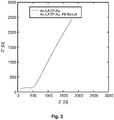
- the conductivities or the capacities of the crystallites and the residual glass phase are closer together, so that the contributions can only be separated with the aid of a fit (see Fig. 3 showing an impedance measurement on a sample according to Example 2).
- Examples 1-5 in Table 1 show the beneficial effect of the experimental compositions.
- 12 mm diameter glass ceramic discs were prepared from the described compositions, which were sputtered for contacting with gold and then measured by means of impedance spectroscopy.
- the total conductivities are in the range of 10 -4 S / cm, the grain conductivities even up to 10 -3 S / cm. These high overall conductivities of the glass ceramics are achieved because the conductivities of the residual glass phase are also in the range of 10 -5 S / cm to 10 -4 S / cm.
- Comparative Example 1 shows a composition without boron, which also has a high grain conductivity of 10 -3 S / cm, whose total conductivity ⁇ b> Table 2 ⁇ / b>
- Example 6 Comparative Example 2 Comparative Example 3 Comparative Example 4 Comparative Example 5 mol% Wt .-% mol% Wt .-% mol% mol% mol% Al 2 O 3 3.38 3.65 4,000 4,230 6 4 6 Ga 2 O 3 Li 2 O 17.96 5.69 16,000 4,960 18 20 18 P 2 O 5 37.08 55,80 38,000 55.980 40 34 38 TiO 2 38.25 32,40 42,000 34.830 32 32 36 B 2 O 3 3.33 2.46 4 10 2 Al 2 O 3 / TiO 2 .0882 0.0952 0.1875 0.1250 .1667 Al 2 O 3 / Li 2 O .1879 0.2500 0.3333 0.0200 0.3333 Crystallization peak (DTA) 652 ° C 669 ° C nb nb ce
- Example 6 represents an example according to the invention. It shows that already at a sintering temperature of 850 ° C. sintering pieces with a total conductivity of 4.4 ⁇ 10 -4 S / cm can be produced. This not only makes sense in terms of energy costs, but also allows the reduction of foreign phase formation such as AlPO 4 , which starts at temperatures ⁇ 900 ° C, such. B. by Yu et al. in Functional Materials Letters, Vol. 5 (2016) 1650066 was shown.
- Comparative Example 2 shows a composition without boron, which requires significantly higher sintering temperatures of up to 1200 ° C and achieves a total conductivity of only 1.1 ⁇ 10 -5 S / cm.
- Comparative Example 3 describes known examples of boron-added LATP glass-ceramics ( JP 2013 199386 A ). However, Comparative Example 3 contains too high a ratio of Al 2 O 3 / TiO 2 in comparison with the present invention, so that a sintering temperature of 1000 ° C. is required for a good conductivity. The same applies to Comparative Example 4, although even a significantly higher boron content was used here.
- Comparative Example 5 shows the effect of too high Al 2 O 3 / Li 2 O ratio. The melt did not show sufficient glass formation.
- Example 7 the contact resistance of PEO was determined on a glass-ceramic with the composition of Example 2.
- Fig. 4 shows the method for determining the contact resistance of the glass ceramic to the polymer electrolyte.
- a PEO membrane was pressed at 60 ° C on the glass ceramic.
- the resistances of the glass ceramic and of the polymer as well as the contact resistance are thereby connected in series. Subtracting the resistances of the glass ceramic and the polymer, only the contact resistance remains.
- the contact resistance between the glass ceramic (composition according to Example 2) and the PEO 610 ⁇ / cm 2 were determined.
Landscapes
- Chemical & Material Sciences (AREA)
- Engineering & Computer Science (AREA)
- General Chemical & Material Sciences (AREA)
- Chemical Kinetics & Catalysis (AREA)
- Materials Engineering (AREA)
- Organic Chemistry (AREA)
- Electrochemistry (AREA)
- Geochemistry & Mineralogy (AREA)
- Life Sciences & Earth Sciences (AREA)
- Manufacturing & Machinery (AREA)
- Ceramic Engineering (AREA)
- Crystallography & Structural Chemistry (AREA)
- Physics & Mathematics (AREA)
- Dispersion Chemistry (AREA)
- General Physics & Mathematics (AREA)
- Inorganic Chemistry (AREA)
- Condensed Matter Physics & Semiconductors (AREA)
- Thermal Sciences (AREA)
- Glass Compositions (AREA)
- Secondary Cells (AREA)
- Battery Electrode And Active Subsutance (AREA)
- Cell Separators (AREA)
- Conductive Materials (AREA)
Abstract

Description
- Die Erfindung betrifft eine Lithiumionen-leitende Glaskeramik, die eine Restglasphase aufweist, die ebenfalls ionenleitend ist, ein Verfahren zu ihrer Herstellung sowie ihre Verwendung.
- Lithium-Ionenbatterien und zukünftige Batteriegenerationen, wie etwa Lithium-Luftbatterien, Lithium-Schwefelbatterien oder All-Solid State Batterien (ASSB), müssen neben einer möglichst hohen Energiedichte auch hohe Ansprüche an Sicherheit und Zuverlässigkeit erfüllen, die über die gesamte Lebensdauer gewährleistet sein müssen. Flüssige Elektrolyten sind hierbei in der Vergangenheit häufig negativ hervorgetreten, da sie leicht entzündlich sind und zu Zersetzungserscheinungen neigen, die zu einem Verlust an Leitfähigkeit und/oder zu unerwünschten Abbauprodukten führen können.
- Lithium-Ionen leitende Glaskeramiken für die Verwendung als Festkörperelektrolyte werden bereits seit den 1980er Jahren untersucht. Dabei sind besonders Glaskeramiken mit zu der NaSICon ( Na trium S uper I onic Con ductor) isostrukturellen Kristallphase

- Die keramische Herstellung erfolgt in der Regel über eine Festkörperreaktion, teilweise unter Verwendung von Sinteradditiven und/oder Bindern, ohne dass es zu einem homogenen Aufschmelzen des Materials kommt.
- Glaskeramiken werden durch ein Aufschmelzen der Rohstoffe zu einem Glas und anschließender Temperaturbehandlung, bei der die gewünschte Kristallphase kristallisiert, hergestellt. Das fertige Material besteht daher aus einer Kristallphase, deren Anteil über den Keramisierungsprozess einstellbar ist, und aus einem amorphen Anteil, der häufig als Restglasphase bezeichnet wird. Im Rahmen dieser Anmeldung werden beide Bezeichnungen synonym verwendet.
- Die Herstellung als Glaskeramik bietet dabei den Vorteil der einfachen Skalierbarkeit, was eine kostengünstige industrielle Produktion ermöglicht. Weiterhin können die aus der Glasindustrie bekannten Formgebungsmöglichkeiten genutzt werden. Außerdem lassen sich bei diesem Verfahren durch den Einsatz von Recycling-Material oder Ausschussmaterial aus dem Herstellungsverfahren die Rohstoffkosten reduzieren.
- Nachteilig bei der Herstellung der Glaskeramiken mit NaSICon-artiger Kristallphase ist jedoch, dass die Glasphase nur eine verschwindend geringe Lithiumionenleitfähigkeit in der Größenordnung von < 10-10 S/cm besitzt. Dadurch wird die Gesamtleitfähigkeit des Materials verringert, teilweise um mehr als eine Größenordnung. Auch wenn sich dieses Problem durch eine möglichst vollständige Vermeidung von amorphen Anteilen im fertigen Produkt reduzieren lässt, bleibt oft eine dünne amorphe Schicht zwischen den Kristalliten erhalten, die die lonenleitung behindert. Zudem müssen, um eine möglichst vollständige Kristallisation zu erreichen, lange Keramisierungszeiten und/oder hohe Temperaturen verwendet werden, was die Energiekosten der Herstellung erhöht.
- Der Einsatz von Festelektrolyten wie den beschriebenen Glaskeramiken erfolgt entweder in Form von Pulver, das in ein Polymer eingebettet wird, oder in Form von gesintertem Material, das häufig mit Hilfe eines Tape-Casting Prozesses und anschließendem Sinterprozess hergestellt wird. Hierbei führt das Vorhandensein einer amorphen Phase zwar zu einer Verringerung der Sintertemperaturen, die schlechte Leitfähigkeit der amorphen Phase kann jedoch auch hier zu einer isolierenden Schicht zwischen den Kristalliten führen, die die Leitfähigkeit des gesinterten Produktes vermindert.
- Bei der Einbettung in ein Polymer kann die geringe Leitfähigkeit der amorphen Phase dagegen zu einer deutlichen Erhöhung des Übergangswiderstands zwischen Polymer und ionenleitendem Pulver führen.
- Die Schrift
US 2003 0205467 A1 beschreibt die Herstellung von Glaskeramiken aus P2O5, TiO2, SiO2, M2O3 (M = Al oder Ga) und Li2O mit der Hauptkristallphase Li(1+x)(Al, Ga)xTi(2-x)(PO4)3 (0 < x ≤ 0,8). Nach der Kristallisation wurde eine lonenleitfähigkeit von 0,6 bis 1,5 × 10⁻³ S/cm erreicht. Die Restglasphase dieser Glaskeramiken weist jedoch eine deutlich niedrigere Leitfähigkeit (typischerweise < 10-10 S/cm bei Raumtemperatur) auf. Dies erschwert die Verwendung des Materials als gesinterter Elektrolyt oder als Komposit mit einem Polymer. - In der Folge wurden zahlreiche Varianten der Glaskeramiken beschrieben. So führt die Substitution von TiO2 durch GeO2 zu einer deutlichen Erhöhung der Leitfähigkeit und einer Verbesserung der Glasbildung (
US 6 030 909 A ). Dies ist jedoch bedingt durch die hohen Rohstoffpreise für eine kommerzielle Herstellung nicht umsetzbar. - Die Sinterung von LATP und verwandten Materialien sollte bei möglichst niedriger Temperatur geschehen, da sich bei Temperaturen ab ca. 900 - 950 °C (je nach Sinterbedingungen und Material teilweise auch darunter) AlPO4 als Fremdphase bildet. Dies wurde z. B. von Yu et al. in Functional Materials Letters, Vol. 9, No. 5 (2016) 1650066 beschrieben: sie finden erste Hinweise auf AlPO4 bei 900 °C (0,4 Gew.-%) und bereits bei 950 °C einen Anstieg auf 3,8 Gew.-%. Bei einer für die Herstellung von Sinterlingen üblichen Temperatur von 1100 °C finden sich schon 11,4 Gew.-% AlPO4. Diese Phase hat keine lonenleitfähigkeit und führt darüber hinaus dazu, dass der Aluminiumgehalt der Kristallphase sich verringert, was wiederum deren Leitfähigkeit verringert. Auch ein Zusammenhang mit der Entstehung von Mikrorissen wird diskutiert.
- Zur Verbesserung der Sinterfähigkeit wurde der Zusatz von Sinterhilfsmitteln vorgeschlagen. Wie aus der Keramikindustrie bekannt, lässt sich hierdurch die Sintertemperatur absenken und die Dichte der Sinterkörper erhöhen. Die US Patentanmeldungen
US 2011 003212 A1 undUS 2012 015234 A1 beschreiben den Einsatz einer borhaltigen Komponente, bevorzugt B2O3, als Sinterhilfsmittel zur Herstellung einer sogenannten All-Solid State Batterie (ASSB). Hierdurch soll eine Delamination der einzelnen Schichten der Batterie während des Sinterprozesses vermieden werden. - Die Patentanmeldung
US 2012 231349 A1 beschreibt einen gesinterten Kompositelektrolyten aus LATP und einem glasigen Sinterhilfsmittel, bevorzugt LiPO3 und/oder Li2O-B2O3. Hiermit konnten Leitfähigkeiten von bis zu 3 × 10⁻⁴ S/cm erreicht werden, allerdings unter Verwendung von einer Sintertemperatur von 920 °C. Die Herstellung einer ASSB mit einem ähnlichen Verfahren wird inWO 2013 175993 A1 beschrieben. - Weitere vorgeschlagene Sinterhilfsmittel sind Li3BO3 oder Li3-xCxB1-xO3 (
US 2016 329539 A1 ,JP 2016 103381 A1 WO 2015 144074 A1 ) oder Li2CO3 und H3BO3 (US 2015 333365 A1 ). - Die Anmeldung
US 2014 220454 A1 beschreibt die Verwendung eines borhaltigen Sinterhilfsmittels mit Glasbildner zur Herstellung einer ASSB, z. B. die Zugabe von Li20 und B2O3. Hierdurch wird eine relative Erhöhung der Leitfähigkeit um bis zu 19 % erreicht. Im Gegensatz zur vorliegenden Erfindung werden diese Sinterhilfsmittel jedoch mit dem anderweitig hergestellten LATP gemischt und stellen nicht die Restglasphase einer Glaskeramik dar. Dies hat in der praktischen Herstellung den Nachteil, dass die Herstellung und Mischung beider Komponenten zusätzliche Prozessschritte darstellt, wobei zum Erreichen der notwendigen Homogenität teilweise aufwendige Mischprozesse notwendig sind. - Der direkte Einbau von Bor in NaSICon-artige Kristallphasen (analog zur Dotierung mit Aluminium, wie sie in LATP vorliegt) ist aus dem Stand der Technik bekannt.
JP 2225310 A JP 2302307 A - Die Kombination der Dotierstoffe Zink, Fluor und Bor zur Erhöhung der Leitfähigkeit in keramisch hergestelltem NaSICon wird in
CN 102456918 A dargestellt. Der Einsatz von Halogeniden wie Fluor führt jedoch bei den zur Herstellung benötigten hohen Temperaturen oft zu Verdampfungsproblemen und kann in Hinblick auf die Arbeitssicherheit bedenklich sein. In der vorliegenden Erfindung werden daher vorzugsweise halogenid-freie Zusammensetzungen eingesetzt. - Eine LATP-Keramik, die eine geringe Menge an Bor enthalten kann (z. B. 0,05 Gew.-%), wird auch in
KR 2016 0053147 A - Die Patentanmeldung
US 2007 202400 A1 beansprucht eine ASSB mit NaSICon-artigem Elektrolyten und Kathodenmaterial derselben Struktur. Der Elektrolyt enthält als gerüstbildendes Polyanion BO3, BO4 oder PO4. Beispiele für eine Kombination von BO4 und PO4 werden jedoch nicht betrachtet. Auch hier erfolgt die Herstellung auf keramischem Weg. - Die Verwendung von Bor als Komponente in Glaskeramik mit NaSICon-Struktur wird in den Anmeldungen
JP 2013 155068 A JP 2013 199386 A JP 2013 155068 A -
JP 2013 199386 A - Die Patentanmeldung
WO 2013/180658 A1 beschreibt eine LAGP-Glaskeramik mit geringem Borgehalt von B2O3 < 0,5 %, bevorzugt < 0,3 %. Der Effekt der erfindungsgemäßen leitfähigen Restglasphase ist bei so niedrigen Borgehalten nur gering und verschwindet bei Werten von < 0,2 % B2O3. Außerdem wird in der vorliegenden Erfindung, wie oben beschrieben, aus Kostengründen auf den Einsatz von Germanium verzichtet. - In der US-Schrift
US 2012 237834 A1 wird die Herstellung einer ASSB beansprucht. Die Batterie enthält dabei zwei verschiedene Elektrolyten, von denen einer ein glaskeramischer Elektrolyt mit NaSICon-Struktur sein kann, der von 0 bis zu 20 % B2O3, Al2O3, Bi2O3, La2O3, Y2O3 oder Sc2O3 enthalten kann. Die Herstellung des Elektrolyten, der außerdem größere Mengen ZrO2 enthält, erfolgt mit einem kombinierten glaskeramischen/keramischen Weg: zunächst wird eine Schmelze ohne ZrO2 hergestellt, die anschließend mit ZrO2 gemischt und kalziniert wird. Der zweite Elektrolyt dient als Sinterhilfsmittel, bevorzugt wird ein Glas mit Tg < 650 °C, z. B. LiPO3, eingesetzt. Eine leitfähige Restglasphase und ein Weg diese herzustellen, wird nicht beschrieben. - Ein Glas, das zu einer Glaskeramik mit NZP-Struktur (NaZr2(PO4)3) keramisierbar ist, wird in
US 2015 064576 A1 offengelegt. Dabei wird der Phosphor in der Kristallphase teilweise durch Bor ersetzt. Um eine möglichst hohe Leitfähigkeit zu erreichen, wird die Bildung der Restglasphase nach Möglichkeit vermieden und Dotierungen mit mehr als einem Dotierstoff verwendet (Al und Cr, Nb, Ge, Si, ...). Der Einsatz dieser Dotierstoffe hat jedoch, sofern es sich um polyvalente Ionen wie Fe oder Cr handelt, den Nachteil, dass die elektronische Leitfähigkeit ansteigen kann, was bei der Verwendung in einer Batterie zu verstärkter Selbstentladung führt. Der Einsatz von Nb, Ta oder Ge ist aus Kostengründen nachteilig. - Eine weitere Variante der ASSB wird in
CN 106876707 A beschrieben. Hier wird eine Dotierung mit Si, Fe oder Bor verwendet, um die lonenleitfähigkeit der Kristallphase zu verbessern. Eine borhaltige Restglasphase, die eine eigene lonenleitfähigkeit aufweist, wird nicht beschrieben. - Die Anmeldung
WO 2017/141742 A1 beschreibt ein zirkonbasiertes Material mit der Kristallstruktur Li1+xZr2+yM1zM2w(PO4)3, M1 ist bevorzugt In, Ce, Y, Ca oder Na, ein Teil des Phosphors kann durch Si, B, V ersetzt werden. Der Einsatz von Zirkon statt Titan hat jedoch den Nachteil, dass die Schmelztemperaturen stark erhöht werden müssen, was zu höheren Herstellkosten führt. Weiterhin beobachtet man häufig eine Abnahme der Leitfähigkeit. Aus diesen Gründen ist in der vorliegenden Erfindung der Einsatz von Titan bevorzugt. Wenn Zirkon eingesetzt wird, sollte das Verhältnis ZrO2/TiO2 kleiner als 1 sein. - Ausgehend von den beschriebenen Problemen ist es die Aufgabe der Erfindung eine Glaskeramik zu finden und herzustellen, die eine ionenleitfähige Restglasphase ausweist und so die Herstellung eines gesinterten lonenleiters mit hoher Gesamtleitfähigkeit oder die Einbettung eines Festelektrolytpulvers in ein Polymer mit geringem Übergangswiderstand erlaubt.
- Zur Umwandlung (Keramisierung) in erfindungsgemäße Glaskeramiken geeignete Ausgangsgläser sollen eine ausreichende Kristallisationsstabilität ausweisen, so dass sie bevorzugt aus einer Glasschmelze durch Heißformgebung, insbesondere durch Gießen, hergestellt werden können. Zugleich sollen sowohl die Glaskeramiken wie auch die Ausgangsgläser eine ausreichende chemische Stabilität an Luft ausweisen, so dass eine problemlose Lagerung möglich ist. Die Keramisierung und/oder Sinterung sollte vorzugsweise bei Temperaturen von < 1000 °C stattfinden.
- Weiterhin sollen die erfindungsgemäßen Glaskeramiken vorzugsweise Verwendungen in Lithiumbatterien finden und die Herstellung von hochleitfähigen Festelektrolyten erlauben.
- Diese Aufgabe wird durch die erfindungsgemäßen Glaskeramiken gemäß Anspruch 1 gelöst, die eine ionenleitfähige Kristallphase mit NaSICon-Struktur

- Im Folgenden werden die erfindungsgemäße Glaskeramik und bevorzugte Ausführungsformen beschrieben.
- Die erfindungsgemäße Glaskeramik weist eine Hauptkristallphase auf, die isostrukturell zur NaSICon Kristallphase ist und deren Zusammensetzung sich mit folgender Formel beschreiben lässt:

- M3+ ist ausgewählt aus Al, Y, Sc oder B, wobei mindestens Al als dreiwertiges Kation vorhanden ist. Bevorzugt ist, dass M3+ ausgewählt ist aus Al, Y, Sc, weiter bevorzugt liegen alle drei Kationen Al, Y, Sc in der erfindungsgemäßen Glaskeramik vor.
- Unabhängig davon ist M4+ ausgewählt aus Ti, Si oder Zr, wobei mindestens Ti als vierwertiges Kation vorhanden ist.
- Unabhängig davon ist M5+ ausgewählt aus Nb, Ta oder La.
- In einer weiteren bevorzugten Ausführungsform liegt Al3+ als einziges dreiwertiges Ion vor.
- In einer weiteren bevorzugten Ausführungsform ist Ti4+ das einzige vierwertige Kation.
- Weiter bevorzugt sind beide Bedingungen erfüllt, so dass nur Al3+ als einziges dreiwertiges Kation in der Glaskeramik vorliegt und gleichzeitig Ti4+ als einziges vierwertiges Kation in der Glaskeramik vorliegt.
- Auch bevorzugt ist die Nebenbedingung, dass y = 0 ist, demnach also kein fünfwertiges Kation in der Glaskeramik vorliegt.
- Gemäß einer weiteren bevorzugten Ausführungsform ist Al3+ das einzige dreiwertige Kation, Ti4+ das einzige vierwertige Kation und gleichzeitig liegt kein fünfwertiges Kation in der Glaskeramik vor.
- Weitere bevorzugte Ausführungsformen der Glaskeramiken enthalten kein Germanium. Das kann die Kosten für die Materialien senken.
- Weitere und andere bevorzugte Ausführungsformen enthalten kein Gallium. Gallium als Rohstoff ist wesentlich teurer als Aluminium. Einen positiven Effekt auf die Glaskeramik kann Gallium nicht begründen. Weiter bevorzugt ist die Glaskeramik frei von Oxiden des Galliums.
- Der Anteil weiterer und nicht-ionenleitender Kristallphasen in der Glaskeramik ist vorzugsweise < 10 Vol.-%, bevorzugt < 9 Vol.-%, < 8 Vol.-%, < 7 Vol.-%, < 6 Vol.-% und besonders bevorzugt < 5 Vol.-%. Besonders bevorzugt liegen außer der oben beschriebenen Hauptkristallphase keine weiteren Kristallphasen vor.
- Die Restglasphase der erfindungsgemäßen Glaskeramik weist bevorzugt eine Lithiumionenleitfähigkeit von mehr als 10-5 S/cm auf. Sie besteht im Wesentlichen aus den Komponenten Li2O, B2O3 und P2O5, wobei besonders nur B2O3 bevorzugt in der Restglasphase vorliegt. Im Wesentlichen bedeutet hierbei, dass der Anteil anderer Komponenten in der Restglasphase geringer als 20 %, bevorzugt geringer als 15 %, weiter bevorzugt geringer als 10 % ist. Da die Zusammensetzung der Restglasphase in der Regel über eine Analyse nur schwer zugänglich ist, kann zur Bestimmung der Zusammensetzung eine Modellrechnung verwendet werden. Hierbei geht man davon aus, dass eine maximale Menge an LATP kristallisiert und alle übrigen Komponenten in der Restglasphase verbleiben. Als Zusammensetzung des LATPs kann die Zusammensetzung des stöchiometrischen Kristalls Li1,3Al0,3Ti1,7(PO4)3 angesetzt werden, die 3,75 Mol-% Al2O3, 16,25 Mol-% Li2O, 37,5 Mol-% P2O5 und 42,5 Mol-% TiO2 entspricht. Auch wenn die Menge der in den Kristall eingebauten Al-lonen variieren kann, erlaubt ein solcher Ansatz die Abschätzung der Hauptkomponenten der Restglasphase.
- Ein Einbau von Bor in die Kristallphase ist zwar möglich, wird aber in der Regel nur bei Borgehalten von > 4 Mol-% beobachtet. Diese hohen Gehalte führen jedoch zu einem unerwünschten Absinken der Leitfähigkeit der Restglasphase.
- Der Bor-Gehalt der Glaskeramik beträgt 0,2 Mol-% < B2O3 < 4 Mol-%, bevorzugt 0,3 Mol-% < B2O3 < 3 Mol-%, weiter bevorzugt 0,5 Mol-% < B2O3 ≤ 2,5 Mol-%.
- Um sicher zu stellen, dass das in Glaskeramik eingesetzte Aluminium und Titan vollständig in der Kristallphase eingebunden werden kann, enthält die Glaskeramik das oben genannte Verhältnis von Al2O3/TiO2
- Die Glaskeramik enthält in einer bevorzugten Ausgestaltung folgende Zusammensetzung (in Mol-%):
- 1 - 6 % Al2O3, weiter bevorzugt 2 - 5 %,
- 12 - 28 % Li2O, weiter bevorzugt 15 - 20 %,
- 32 - 42 % P2O5, weiter bevorzugt 34 - 40 %,
- 28 - 45 % TiO2, weiter bevorzugt 36 - 42 %,
- 0,2 % < B2O3 < 4 %, weiter bevorzugt 0,5 < B2O3 ≤ 2,5 %,
- 0 - 10 % SiO2,
- sowie weitere Bestandteile, z. B. Läuter- oder Flussmittel, 0 bis 3 Mol-%.
- Die Glaskeramik ist in ihrer bevorzugten Ausführungsform frei von gesundheitsschädlichen Stoffen, insbesondere frei von Halogeniden, Arsen, Antimon, Cadmium und Chrom mit Ausnahme von unvermeidlichen über Rohstoffe eingetragene Verunreinigungen im Bereich < 1 %.
- Um eine Verwendung als Elektrolyt in einer Lithiumbatterie zu erlauben, ist die elektronische Leitfähigkeit der Glaskeramik bevorzugt mindestens um einen Faktor 104 kleiner als die ionische Leitfähigkeit. Daher enthält die Glaskeramik bevorzugt einen möglichst geringen Anteil an polyvalenten Elementen (mit Ausnahme von Titan, das als Kristallbestandteil der Hauptkristallphase dient). Besonders ist der Gehalt an Fe2O3 geringer als 0,2 Mol-%, bevorzugt geringer als 0,1 Mol-%.
- Bevorzugt wird die Glaskeramik aus einem aus einer Glasschmelze hergestellten Ausgangsglas erhalten, wobei das Ausgangsglas während einer Heißformgebung des Ausgangsglases eine vernachlässigbare Kristallisation oder eine Kristallisation von ausschließlich ionenleitenden Kristallphasen aufweist.
- Weiterhin wird die Glaskeramik vorzugsweise aus einem Ausgangsglas erhalten, das mit Hilfe einer Ribbonwalze zu Glasribbons geformt wurde, anschließend durch eine Keramisierung in die Glaskeramik umgewandelt wird und anschließend gemahlen wird. Auch Formgebungsverfahren, die eine direkte Darstellung kleiner Partikel ermöglichen, können angewendet werden (z. B. eine Art Spin-Cooling Verfahren). Das Glaskeramikpulver wird dann entweder in einem Sinterprozess zu einem Sinterkörper oder einer gesinterten Schicht verarbeitet oder in ein Polymer eingebettet. Auch ein Einsatz in einem Komposit, z. B. als Elektrodenzusatz ist möglich.
- Die Keramisierung und/oder Sinterung erfolgen bevorzugt bei Temperaturen < 1000 °C, weiter bevorzugt < 950 °C, besonders bevorzugt bei Temperaturen ≤ 900 °C.
- Das ionenleitende Pulver aus der erfindungsgemäßen Glaskeramik kann mit einem leitfähigen Polymer oder mit einem nicht-leitenden Polymer (gegebenenfalls mit weiteren Additiven wie Leitsalzen oder ionischen Flüssigkeiten) gemischt werden und zeigt dann in Kontakt zu diesem Polymer-Elektrolyten einen geringen Übergangswiderstand von < 1000 Ω/cm2.
- Die erfindungsgemäße Glaskeramik findet vorzugsweise Verwendung als Bestandteil einer Lithiumbatterie, vorzugsweise einer wieder aufladbaren Lithiumbatterie, als Elektrolyt in einer Lithiumbatterie, als Teil einer Elektrode in einer Lithiumbatterie, als Additiv zu einem Flüssigelektrolyten in einer Lithiumionenbatterie oder als Beschichtung auf einer Elektrode in einer Lithiumbatterie.
- Als Hauptkristallphase der Glaskeramik bildet sich eine zu NaSICon isostrukturelle Kristallphase mit folgender Zusammensetzung:

- In einer bevorzugten Ausführungsform enthält die Glaskeramik im Wesentlichen nur Al3+ als dreiwertiges Kation und im Wesentlichen nur Ti4+ als vierwertiges Kation.
- Das Verhältnis der Oxide des Aluminiums und des Titans (Al2O3/TiO2) hat einen Wert von 0,05 bis zu 0,1.
- Liegen weitere dreiwertige Kationen in der erfindungsgemäßen Glaskeramik vor, so ist das Verhältnis der Kationen des Aluminiums (Al3+) zum Gesamtgehalt an 3-wertigen Kationen größer als 0,5, bevorzugt größer als 0,6, besonders bevorzugt größer als 0,75.
- Liegen weitere vierwertige Kationen in der erfindungsgemäßen Glaskeramik vor, so ist das Verhältnis der Kationen des Titans (Ti4+) zum Gesamtgehalt an 4-wertigen Kationen größer als 0,5, bevorzugt größer als 0,6, besonders bevorzugt größer als 0,75.
- Das enthaltene Lithium dient in der erfindungsgemäßen Glaskeramik als lonenleiter und liegt in der Glaskeramik in einer Menge von mindestens 12 Mol-%, bevorzugt mindestens 15 Mol-% in der Form von Li2O vor. Weiter bevorzugt sind Mengen von mindestens 18 Mol-%, mindestens 20 Mol-% und bis zu mindestens 22 Mol-%. Der maximale an Li2O in der Glaskeramik beträgt 28 Mol-% und bevorzugt 26 Mol-%, weiter bevorzugt 24 Mol-%. Eine größere Menge an Lithiumoxid bringt keine Vorteile in Hinblick auf die Lithiumionenleitfähigkeit und kann die chemische Stabilität der Glaskeramik beeinträchtigen.
- Phosphoroxid wird als Glasbildner eingesetzt und bildet auch das Grundgerüst der Kristallphase der Glaskeramik. Bevorzugt sind Glaskeramiken mit einem Gehalt von 32 bis 42 Mol-% P2O5, vorzugsweise 34 bis 40 Mol-% und weiter bevorzugt 36 bis 38 Mol-%.
- Aluminiumoxid wirkt als Dotierstoff und erhöht die Leitfähigkeit des Kristalls. Zu hohe Gehalte an Aluminiumoxid führen jedoch führen zur Bildung von Fremdphasen wie beispielsweise AlPO4, was sich nachteilig auf die Leitfähigkeit auswirkt. Der Gehalt an Aluminiumoxid (Al2O3) in der Glaskeramik beträgt 1 bis 6 Mol-% Al2O3, bevorzugt 2 bis 5 Mol-%.
- Der Gehalt von Al2O3 und TiO2 ist aufeinander abgestimmt, um einerseits die Bildung von Fremdphasen zu vermeiden, andererseits eine Anreicherung der beiden Komponenten in der Restglasphase zu vermeiden, was die Leitfähigkeit der Restglasphase verringert.
- Damit die Komponenten Al2O3 und TiO2 vollständig in die Kristallphase eingebunden werden können und damit die hohe Leitfähigkeit erzielt werden kann, beträgt das Verhältnis der beiden Oxide 0,05 bis 0,1.
- Um die Bildung von Fremdphasen zu verhindern, insbesondere von AlPO4, muss die Glaskeramik eine ausreichende Menge an Lithiumoxid im Verhältnis zum Aluminiumoxid aufweisen. Der Wert für das Verhältnis von Al2O3/Li2O ist größer als Null und kleiner als 0,25.
- Ein teilweiser Ersatz von dreiwertigen Kationen des Aluminiums durch andere dreiwertige Elemente, wie beispielsweise Y, La, Ga, Sc, usw. ist möglich, in der Regel jedoch aus Kostengründen eher nachteilig.
- Polyvalente Elemente wie Eisen, Chrom oder Vanadium (Fe, Cr, V) werden bevorzugt nicht eingesetzt. Ihr Anteil sollte jeweils kleiner 0,2 % Mol-%, bevorzugt kleiner 0,1 % sein.
- Titandioxid ist Bestandteil der Hauptkristallphase und sollte in ausreichender Menge in der Glaskeramik enthalten sein. Bevorzugt enthält die erfindungsgemäße Glaskeramik 28 bis 45 Mol-% TiO2, weiter bevorzugt 36 bis 42 Mol-%.
- Ein teilweiser Ersatz von TiO2 durch ZrO2 ist gemäß bevorzugten Ausführungsformen möglich, allerdings sollte für diesen Fall der Anteil des ZrO2 so gewählt werden, dass weder die Gesamtleitfähigkeit verringert wird, noch die Sintertemperaturen zu stark steigen. Der Gehalt an ZrO2 in Mol-% sollte deshalb kleiner sein als der Gehalt an TiO2 in Mol-%. In anderen Worten, das Verhältnis von Zirkoniumdioxid zu Titandioxid ist immer kleiner als 1.
- Der optionale Zusatz von bis zu 10 Mol-% SiO2 kann die Glasbildung und/oder die Sinterfähigkeit positiv beeinflussen, bei höheren Gehalten treten jedoch häufig Fremdphasen ohne lonenleitfähigkeit auf, was die Gesamtleitfähigkeit der Glaskeramik vermindert. Bevorzugte Werte für den Gehalt an SiO2 sind von 0 bis 5 Mol-% und weiter bevorzugt von 0 bis 3 Mol-%.
- Als weitere Komponenten kann die erfindungsgemäße Glaskeramik andere Bestandteile enthalten, z. B. übliche Läuter- und Flussmittel, wie etwa SnO2, As2O3 oder Sb2O3, in den üblichen Mengen von bis zu 3 Mol-%, vorzugsweise bis zu 1,5 Mol-%. Aus Umweltschutzgründen wird jedoch bevorzugt auf den Einsatz von Arsen und Antimon bei den erfindungsgemäßen Glaskeramiken verzichtet.
- Weitere Verunreinigungen, die mit den üblichen technischen Rohstoffen "eingeschleppt" werden, sollten 1 Gew.-%, vorzugsweise 0,5 Gew.-% nicht übersteigen.
- Die Glaskeramik sollte, um das Einbringen von unerwünschten Alkalimetall-Ionen in die Lithiumbatterie zu vermeiden, weniger als 0,5 Mol-% andere Alkalimetalloxide (außer Lithiumoxid), bevorzugt weniger als 0,2 Mol-% andere Alkalimetalloxide, enthalten.
- Unter einer Glaskeramik im Sinne dieser Anmeldung wird ein Werkstoff verstanden, der ausgehend von einem schmelztechnologisch hergestellten Ausgangsglas durch gezielte Temperaturbehandlung kontrolliert in eine Glaskeramik (mit Glasphase und Kristallphase) umgewandelt wird. Nicht hierunter fallen Materialien ähnlicher Zusammensetzung, die durch Festkörperreaktionen oder Sol-Gel Verfahren hergestellt wurden.
- Die Herstellung der Glaskeramik kann entweder direkt durch Keramisieren aus einem Ausgangsglas (Bulkausgangsglas) oder durch Keramisieren und Sintern und/oder Pressen von Ausgangsglaspulver hergestellt werden.
- Die Eigenschaft der Ausgangsgläser, ohne spontane Kristallisation beim Guss herstellbar zu sein, ist auch für den Sinterprozess von Vorteil, da im Gegensatz zu bereits teilkristallinem Glaspulver mit nicht- bzw. sehr wenig kristallinem Glaspulver eine dichter gesinterte Glaskeramik hergestellt werden kann.
- Die erfindungsgemäßen Glaskeramiken können als Elektrolyt in wieder aufladbaren Lithiumbatterien, besonders in Feststoff-Lithiumbatterien verwendet werden. Dazu können sie entweder als dünne Schicht oder Membran als einziger Elektrolyt oder als Bestandteil des Elektrolyten gemeinsam mit anderem Material (z. B. vermischt mit einem Polymer oder einer ionischen Flüssigkeit) zum Einsatz kommen. Zur Herstellung einer solchen Schicht oder Membran können neben den Formgebungsmöglichkeiten eines Ausgangsglases (Gießen, Ziehen, Walzen, Floaten, usw.) Techniken wie Siebdruck, Foliengießen oder Beschichtungstechniken zum Einsatz kommen.
- Auch die Verwendung als Beschichtung auf einer Elektrode, z. B. mit der Auftragung durch Sputterverfahren oder CVD-Verfahren, ist möglich. Weiterhin kann die Glaskeramik auch als Zusatz zur Elektrode (z. B. vermischt mit einem elektronisch leitenden Material) verwendet werden. Auch der Einsatz als Separator in einer mit einem flüssigen Elektrolyten gefüllten Zelle ist denkbar.
- Die Erfindung wird anhand folgender Beispiele näher erläutert.
- Die einzelnen Ausgangsgläser mit den in der Tabelle 1 aufgeführten Zusammensetzungen wurden bei 1500 bis 1650 °C geschmolzen und zu flachen Gussblöcken (Dicke ca. 3 bis 8 mm, Durchmesser 30 bis 40 mm) gegossen und schnell auf Raumtemperatur abgekühlt. Als Tiegelmaterial wurden Quarzglastiegel oder Pt/Rh Tiegel verwendet.
- Aus den Ausgangsgläsern wurden Proben für die Leitfähigkeitsmessungen (Rundscheiben mit einem Durchmesser von 20 mm und einer Dicke von 1 mm) und XRD-Messungen hergestellt.
- Die Ausgangsgläser wurden nach einer Keimbildung im Temperaturbereich von 500 °C bis 600 °C für 0 bis 4 Stunden, bei Maximaltemperaturen von 620 bis 850 °C und Haltezeiten 6 bis 12 Stunden, keramisiert (d. h. in Glaskeramiken umgewandelt).
- Die verwendeten Keramisierungstemperaturen wurden mit Hilfe einer DTA-Messung (Heizrate 5 K/min) bestimmt.
- Test-Polymerelektrolyte wurden in einer Glovebox (MBraun, Wasser-/Sauerstoff-Gehalt < 0,1 ppm) hergestellt. Dazu wurde Polyethylenoxid (PEO, Molekulargewicht 106 g/mol) mit dem Leitsalz Lithium-bis(trifluoromethansulfonyl)imid (LiTFSI) im Verhältnis Li:O = 1:18 gemischt. Durch Heißpressen ergeben sich flexible Membranen mit einer Leitfähigkeit von weniger als 10-5 S/cm.
Tabelle 1 Beispiel 1 Beispiel 2 Beispiel 3 Beispiel 4 Beispiel 5 Vergleichsbeispiel 1 Mol-% Gew.-% Mol-% Gew.-% Mol-% Gew.-% Mol-% Gew.-% Mol-% Gew.-% Mol-% Gew.-% Al2O3 3,491 3,753 3,491 3,725 3,456 3,725 3,456 3,682 3,638 3,888 9,00 9,75 Li2O 17,579 5,538 17,579 5,496 17,399 5,496 17,399 5,434 16,763 5,250 24,00 7,62 P2O5 37,363 55,912 38,363 56,974 36,981 55,492 38,481 57,088 37,375 55,608 39,00 58,84 TiO2 39,568 33,330 39,568 33,077 39,164 33,079 39,164 32,704 41,225 34,525 28,00 23,78 B2O3 2,000 1,468 1,000 0,728 3,000 2,208 1,500 1,091 1,000 0,730 Al2O3/TiO2 0,082 0,082 0,082 0,082 0,082 0,3214 Al2O3/Li2O 0,1986 0,1986 0,1986 0,1986 0,2170 0,3750 Kristallisationspeak (DTA) n. b. 633,9 °C n. b. 636,5 °C n. b. n. b. Keramisierung 850 °C/12 h 850 °C/12 h 850 °C/12 h 850 °C/12 h 850 °C/12 h 950 °C/12 h XRD Li1+xTi2-xAlx(PO4)3 Li1+xTi2-xAlx(PO4)3 Nebenphase: AlPO4 Li1+xTi2-xAlx(PO4)3 Li1+xTi2-xAlx(PO4)3 Nebenphase: AlPO4 Li1+xTi2-xAlx(PO4)3 Li1+xTi2-xAlx(PO4)3 AlPO4 Gesamtleitfähigkeit Glaskeramik (S/cm) 2,16 × 10⁻⁴ 1,83 × 10⁻⁴ 2,19 × 10⁻⁴ 2,5 × 10⁻⁵ 2,4 × 10⁻⁴ 8 × 10⁻⁷ Kornleitfähigkeit Glaskeramik (S/cm) 9,65 × 10⁻⁴ 8,96 × 10⁻⁴ 1,28 × 10⁻³ 6,66 × 10⁻⁴ 6,51 × 10⁻⁴ 1 × 10⁻³ Leitfähigkeit der Restglasphase (S/cm) 2,79 × 10⁻⁴ 2,30 × 10⁻⁴ 2,65 × 10⁻⁴ 2,6 × 10⁻⁵ 3,8 × 10⁻⁴ << 10-6 - Die Leitfähigkeit wurde mit Hilfe von frequenz- und temperaturabhängigen Impedanzmessungen (Alpha-A-High Performance Analyzer Mainframe der Firma Novocontrol) im Bereich 10-2 bis 107 Hz mit einer Spannungsamplitude von 20 mV bei Raumtemperatur an mit Gold besputterten Proben gemessen. Die Messungen wurden mit Hilfe der Nyquist-Austragung (Software: ZView von Scribner Associates, Inc.) ausgewertet, die eine Separation von Kornleitfähigkeit und Leitfähigkeit der restlichen Phasen (hier der Restglasphase in Summe mit möglichen Fremdphasen) und die Bestimmung der Gesamtleitfähigkeit erlaubt.
Fig. 1 zeigt eine für eine LiSICon-Probe typische Messkurve einer Impedanzmessung an LATP Materialien. Die Messung wird mit Hilfe des Nyquist-Modells angefittet, das auf dem inFig. 2 dargestellten Ersatzschaltbild beruht. - Es ergeben sich zwei Beiträge zu der Leitfähigkeit, die als Halbkreise zu erkennen sind. Auf Grund der gemessenen Kapazitäten lassen sich die Beiträge zuordnen: der linke, kleinere Halbkreis entspricht der Kornleitfähigkeit, d. h. der Leitfähigkeit der Kristallite. Der zweite Beitrag fasst die Leitfähigkeitsbeiträge der restlichen Bestandteile der Glaskeramik zusammen. Er wird von dem Anteil mit der besten Leitfähigkeit dominiert, im Fall der erfindungsgemäßen Glaskeramiken ist dies die Restglasphase (die XRD zeigt nur geringe Mengen an Fremdphasen wie AlPO4, die keine nennenswerte lonenleitfähigkeit haben). In den erfindungsgemäßen Glaskeramiken liegen die Leitfähigkeiten bzw. die Kapazitäten der Kristallite und der Restglasphase näher beieinander, so dass sich die Beiträge nur mit Hilfe eines Fits trennen lassen (siehe
Fig. 3 , die eine Impedanzmessung an einer Probe entsprechend Beispiel 2 zeigt). - Die Beispiele 1 - 5 in Tabelle 1 zeigen die vorteilhafte Wirkung der experimentellen Zusammensetzungen. Aus den beschriebenen Zusammensetzungen wurden, wie oben beschrieben, Glaskeramikscheibchen mit einem Durchmesser von 12 mm hergestellt, die zur Kontaktierung mit Gold besputtert und dann mittels Impedanzspektroskopie vermessen wurden.
- Die Gesamtleitfähigkeiten sind im Bereich von 10-4 S/cm, die Kornleitfähigkeiten sogar bis zu 10-3 S/cm. Diese hohen Gesamtleitfähigkeiten der Glaskeramiken werden erreicht, da die Leitfähigkeiten der Restglasphase ebenfalls im Bereich von 10-5 S/cm bis 10-4 S/cm liegen. Das Vergleichsbeispiel 1 zeigt im Gegensatz dazu eine Zusammensetzung ohne Bor, die zwar ebenfalls eine hohe Kornleitfähigkeit von 10-3 S/cm besitzt, deren Gesamtleitfähigkeit
Tabelle 2 Beispiel 6 Vergleichsbeispiel 2 Vergleichsbeispiel 3 Vergleichsbeispiel 4 Vergleichsbeispiel 5 Mol-% Gew.-% Mol-% Gew.-% Mol-% Mol-% Mol-% Al2O3 3,38 3,65 4,000 4,230 6 4 6 Ga2O3 Li2O 17,96 5,69 16,000 4,960 18 20 18 P2O5 37,08 55,80 38,000 55,980 40 34 38 TiO2 38,25 32,40 42,000 34,830 32 32 36 B2O3 3,33 2,46 4 10 2 Al2O3/TiO2 0,0882 0,0952 0,1875 0,1250 0,1667 Al2O3/Li2O 0,1879 0,2500 0,3333 0,0200 0,3333 Kristallisationspeak (DTA) 652 °C 669 °C n. b. n. b. n. b. Keramisierung 850 °C/12 h 950 °C/12 h Kein Glas XRD Li1+xTi2-xAlx(PO4)3 Li1+xTi2-xAlx(PO4)3 Li1+xTi2-xAlx(PO4)3, AlPO4, LiTiPO5 Li1+xTi2-xAlx(PO4)3, (Spuren: AlPO4, LiTiPO5) Sintertemp. 850 °C/12 h 1000 °C/12 h 1000 °C/30 min. 1000 °C/30 min. Leitfähigkeit, gesintert 4,4 × 10⁻⁴ S/cm 1,3 × 10⁻⁶ S/cm 1 × 10⁻⁴ S/cm 1,2 × 10⁻⁴ S/cm Sintertemp. 1200 °C/12 h 1200 °C/12 h Leitfähigkeit, gesintert 3 × 10⁻⁴ S/cm 1,1 × 10⁻⁵ S/cm - Für die Sinterversuche in Tabelle 2 wurden Glasribbons hergestellt. Dazu wurde das flüssige Glas auf zwei rotierende Metallwalzen gegossen. Diese Ribbons wurden bei 850 - 950 °C 12 h lang keramisiert und anschließend gemahlen. Aus dem so erhaltenen Pulver wurden Presslinge hergestellt und gesintert, an denen dann die Leitfähigkeit bestimmt wurde.
- Beispiel 6 stellt ein erfindungsgemäßes Beispiel dar. Es zeigt, dass bereits bei einer Sintertemperatur von 850 °C Sinterlinge mit einer Gesamtleitfähigkeit von 4,4 × 10⁻⁴ S/cm herstellbar sind. Dies ist nicht nur mit Blick auf die Energiekosten sinnvoll, sondern erlaubt auch die Reduktion von Fremdphasenbildung wie AlPO4, die bei Temperaturen ≥ 900 °C einsetzt, wie z. B. von Yu et al. in Functional Materials Letters, Vol. 9, No. 5 (2016) 1650066 gezeigt wurde.
- Weitere Beispiele für das deutlich verbesserte Sinterverhalten, das eine Absenkung der Sintertemperaturen auf bis zu 700°C erlaubt sind in Tabelle 3 dargestellt.
- Es zeigt sich, dass auch bei Sintertemperaturen von nur 700°C bis 750°C Leitfähigkeitswerte von bis zu 1 x 10⁻³ S/cm realisierbar sind.
Tabelle 3 Beispiel 7 Beispiel 8 Beispiel 9 Beispiel 10 47818 47820 49617 49952 mol wt mol wt mol% wt % mol% wt % Al2O3 3,456 3,725 3,638 3,888 3,41 3,68 3,41 3,68 Li2O 17,399 5,496 16,763 5,250 17,79 5,63 17,79 5,63 P2O5 36,981 55,492 37,375 55,608 37,13 55,78 37,13 55,78 TiO2 39,164 33,079 41,225 34,525 38,68 32,70 38,68 32,70 B2O3 3,000 2,208 1,000 0,730 3,00 2,21 3,00 2,21 Al/Ti 8,82% 8,82% 8,82% 8,82% Al/Li 19,86% 21,70% 19,17% 19,17% Keramisierung 850°C/12 h 850°C/12 h 850°C/12 h 850°C/12 h XRD LiTi2(PO4)3 LiTi2(PO4)3 LiTi2(PO4)3, wenig AlPO4 LiTi2(PO4)3 Sintertemp. 700°C/12 h 700°C/12 h 700°C/12 h 700°C/12 h Leitfähigkeit, gesintert 5 x 10⁻⁴ S/cm 4,5 x 10⁻⁴ S/cm 2 x 10⁻⁴ S/cm 2,9 x 10⁻⁴ S/cm Sintertemp. 750°C/12 h 750°C/12 h 750°C/12 h 750°C/12 h Leitfähigkeit, gesintert 1 x 10⁻³ S/cm 7,1 x 10⁻⁴ S/cm 4,1 x 10⁻⁴ S/cm n.b. Sintertemp. 800°C/12 h 800°C/12 h 800°C/12 h 800°C/12 h Leitfähigkeit, gesintert 7 x 10⁻⁴ S/cm 8,2 x 10⁻⁴ S/cm 3,3 x 10⁻⁴ S/cm 5,5 x 10⁻⁴ S/cm Sintertemp. 850°C/12 h 850°C/12 h 850°C/12 h 850°C/12 h Leitfähigkeit, gesintert 6,8 x 10⁻⁴ S/cm 6,4 x 10⁻⁴ S/cm n.b. n.b. - Vergleichsbeispiel 2 zeigt eine Zusammensetzung ohne Bor, die deutlich höhere Sintertemperaturen von bis zu 1200 °C erfordert und insgesamt nur eine Leitfähigkeit von 1,1 × 10⁻⁵ S/cm erreicht.
- Vergleichsbeispiel 3 aus dem Stand der Technik beschreibt bekannte Beispiele von LATP Glaskeramiken mit Bor-Zusatz (
JP 2013 199386 A - Vergleichsbeispiel 5 zeigt die Wirkung von einem zu hohen Al2O3/Li2O Verhältnis. Die Schmelze zeigte keine ausreichende Glasbildung.
- In Beispiel 7 wurde der Übergangswiderstand von PEO auf eine Glaskeramik mit der Zusammensetzung aus Beispiel 2 bestimmt.
-
Fig. 4 zeigt das Verfahren zur Bestimmung des Übergangswiderstandes von der Glaskeramik zum Polymerelektrolyten. Dabei wurde eine PEO-Membran bei 60 °C auf die Glaskeramik gepresst. Die Widerstände der Glaskeramik und des Polymers sowie der Übergangswiderstand werden dadurch in Reihe geschaltet. Subtrahiert man die Widerstände der Glaskeramik und des Polymers, so bleibt lediglich der Übergangswiderstand übrig. - Wie in
Fig. 4 deutlich wird, ist eine Trennung der einzelnen Beiträge der Glaskeramik und des Polymers nicht möglich, da das Spektrum durch die schlechte Leitfähigkeit von PEO dominiert wird. Dennoch kann der Gesamtwiderstand ermittelt werden. Die Summe der Widerstandsbeiträge der Glaskeramik und dem Übergangswiderstand ist kleiner als der Widerstand des Polymers, die Einbettung der erfindungsgemäßen Glaskeramik als Pulver in PEO-Membranen ist daher sinnvoll und erhöht die Gesamtleitfähigkeit des Hybridsystems. - Als Übergangswiderstand zwischen der Glaskeramik (Zusammensetzung entsprechend Beispiel 2) und dem PEO wurden 610 Ω/cm2 bestimmt.
Claims (16)
- Lithiumionenleitfähige Glaskeramik,
wobei die Glaskeramik eine Kristallphase mit der chemischen Zusammensetzung M3+ = ein dreiwertiges Kation eines oder mehrerer Elemente,M4+ = ein vierwertiges Kation eines oder mehrerer Elemente,M5+ = ein fünfwertiges Kation eines oder mehrerer Elemente,x ist größer als 0 und maximal 1,x ist größer als y,y ist 0 bis 1, wobei(1 + x - y) größer 1 ist,wobei mindestens Al3+ als dreiwertiges Ion und mindestens Ti4+ als vierwertiges Ion enthalten sind,
wobei die Glaskeramik eine Glasphase mit einer lonenleitfähigkeit von mehr als 10-5 S/cm aufweist,
wobei die Zusammensetzung der Glasphase Li2O, P2O5 und B2O3 umfasst und der Gehalt an B2O3 Werte von 0,2 Mol-% bis 4 Mol-% hat und
wobei das Verhältnis von Al2O3/TiO2 Werte zwischen 0,05 bis 0,1 hat und
wobei das Verhältnis von Al2O3/Li2O Werte zwischen > 0 und 0,25 hat. - Glaskeramik nach Anspruch 1, wobei die Hauptkristallphase

- Glaskeramik nach einem der vorhergehenden Ansprüche, wobei diese nach der Keramisierung und/oder Sinterung bei Temperaturen < 1000 °C, bevorzugt < 900 °C, eine Gesamtleitleitfähigkeit von mehr als 10-4 S/cm bei 22 °C aufweist.
- Glaskeramik nach einem der vorhergehenden Ansprüche, wobei die Restglasphase im Wesentlichen aus den Komponenten Li20, B2O3 und P2O5 besteht.
- Glaskeramik nach einem der vorhergehenden Ansprüche, wobei der Gehalt an B2O3 Werte von 0,3 Mol-% bis 3 Mol-%, bevorzugt 0,5 Mol-% bis 2,5 Mol-% hat.
- Glaskeramik nach einem der vorhergehenden Ansprüche wobei das Verhältnis Al2O3/Li2O kleiner als 0,24, bevorzugt kleiner als 0,23 und weiter bevorzugt kleiner als 0,22 ist.
- Glaskeramik nach einem der vorhergehenden Ansprüche, die folgende Zusammensetzung in Mol-% umfasst:1 - 6 % Al2O3, bevorzugt 2 - 5 %,12 - 28 % Li2O, bevorzugt 15 - 20 %,32 - 42 % P2O5, bevorzugt 34 - 40 %,28 - 45 % TiO2, bevorzugt 36 - 42 %,0,2 % < B2O3 < 4 %, bevorzugt 0,5 < B2O3 ≤ 2,5 %.
- Glaskeramik nach einem der vorhergehenden Ansprüche die im Wesentlichen frei von Halogeniden und/oder Arsen und/oder Antimon und/oder Cadmium und/oder Chrom ist.
- Glaskeramik nach einem der vorhergehenden Ansprüche, die frei von GeO2 ist.
- Glaskeramik nach einem der vorhergehenden Ansprüche, die frei von GaO2 ist.
- Glaskeramik nach einem der vorhergehenden Ansprüche wobei der Gehalt an Fe2O3 Werte von kleiner als 0,2 Mol-%, bevorzugt kleiner als 0,1 % Mol-% hat.
- Glaskeramik nach einem der vorhergehenden Ansprüche wobei diese in Kontakt zu einem Polymer-Elektrolyten einen Übergangswiderstand von weniger als 1000 Ω/cm2 aufweist.
- Verfahren zur Herstellung eines glaskeramischen Elektrolytmaterials mit einer Hauptkristallphase
 a) Schmelzen der Rohstoffe und Homogenisieren des Ausgangsglases,b) Gießen und Kühlen des Ausgangsglases,c) Keramisieren des Ausgangsglases bei Temperaturen zwischen 750 - 1000 °C, bevorzugt 850 - 950 °C,d) Mahlen des keramisierten Ausgangsglases zu einem Pulver unde) Sintern des Pulvers.
 - Verfahren zur Herstellung eines glaskeramischen Elektrolytmaterials gemäß Anspruch 13, wobei zusätzlich als Schritt e) das Pulver mit einem organischen Material gemischt wird.
- Verfahren zur Herstellung eines glaskeramischen Elektrolytmaterials gemäß Anspruch 14, wobei das organische Material ein Polymer ist.
- Verwendung einer Glaskeramik nach einem der Ansprüche 1 bis 12 als Bestandteil einer Lithiumbatterie, einer All-Solid State Batterie, einer Solid-State-Batterie mit Polymer / Festelektrolyt Komposit, einer Lithium-Schwefel- oder Lithium-Luft-Batterie, als Elektrolyt oder als Teil einer Elektrode in einer der genannten Batterien, als Additiv zu einem Flüssigelektrolyten in einer Lithiumionenbatterie, als Bestandteil eines Polymerelektrolyten oder eines Kompositelektrolyten oder als Beschichtung auf einer Elektrode oder einem Separator in einer Lithiumbatterie.
Applications Claiming Priority (1)
| Application Number | Priority Date | Filing Date | Title |
|---|---|---|---|
| DE102018102387.1A DE102018102387B3 (de) | 2018-02-02 | 2018-02-02 | Glaskeramik mit ionenleitender Restglasphase und Verfahren zu ihrer Herstellung |
Publications (2)
| Publication Number | Publication Date |
|---|---|
| EP3521252A1 true EP3521252A1 (de) | 2019-08-07 |
| EP3521252B1 EP3521252B1 (de) | 2020-10-21 |
Family
ID=65278261
Family Applications (1)
| Application Number | Title | Priority Date | Filing Date |
|---|---|---|---|
| EP19155113.4A Active EP3521252B1 (de) | 2018-02-02 | 2019-02-01 | Glaskeramik mit ionenleitender restglasphase und verfahren zu ihrer herstellung |
Country Status (6)
| Country | Link |
|---|---|
| US (2) | US11136261B2 (de) |
| EP (1) | EP3521252B1 (de) |
| JP (1) | JP6695459B2 (de) |
| KR (1) | KR102006118B1 (de) |
| CN (1) | CN110128017B (de) |
| DE (1) | DE102018102387B3 (de) |
Families Citing this family (10)
| Publication number | Priority date | Publication date | Assignee | Title |
|---|---|---|---|---|
| DE102018102387B3 (de) * | 2018-02-02 | 2019-06-27 | Schott Ag | Glaskeramik mit ionenleitender Restglasphase und Verfahren zu ihrer Herstellung |
| CN114867696B (zh) * | 2019-12-27 | 2024-07-02 | 微宏动力系统(湖州)有限公司 | 包含固体颗粒的电解液及锂离子二次电池 |
| DE102020111658A1 (de) | 2020-04-29 | 2021-11-04 | Schott Ag | Festkörper-Lithiumionenleiter |
| EP3993122A1 (de) | 2020-10-30 | 2022-05-04 | Schott Ag | Festelektrolyt und lithium-ionen-leitende glaskeramik |
| ES3037482T3 (en) * | 2020-12-04 | 2025-10-02 | Schott Ag | Lithium ion conductive material and method for producing the same |
| US20240154158A1 (en) * | 2021-03-31 | 2024-05-09 | Ohara Inc. | Lithium-ion-conductive material |
| EP4257563A1 (de) | 2022-04-08 | 2023-10-11 | Ferro GmbH | Leitfähige lithium-ionen-glaskeramik und ihre herstellung |
| CN118439858A (zh) * | 2024-04-27 | 2024-08-06 | 河北汇泽瓷业有限公司 | 一种低温烧结的环保瓷砖及其制备方法 |
| CN118589028A (zh) * | 2024-06-18 | 2024-09-03 | 中山大学·深圳 | 一种固态电解质材料及其制备方法与应用 |
| CN119874198A (zh) * | 2025-01-14 | 2025-04-25 | 齐鲁工业大学(山东省科学院) | 一种高电化学性能玻璃全固态电池的制备及应用 |
Citations (3)
| Publication number | Priority date | Publication date | Assignee | Title |
|---|---|---|---|---|
| US20120231349A1 (en) * | 2011-03-07 | 2012-09-13 | Sung-Hwan Moon | Solid electrolyte for rechargeable lithium battery and rechargeable lithium battery including same |
| JP2013199386A (ja) * | 2012-03-23 | 2013-10-03 | Nippon Electric Glass Co Ltd | リチウムイオン伝導体前駆体ガラスおよびリチウムイオン伝導体 |
| US20140220454A1 (en) * | 2011-10-06 | 2014-08-07 | Sony Corporation | Battery and method of manufacturing the same |
Family Cites Families (39)
| Publication number | Priority date | Publication date | Assignee | Title |
|---|---|---|---|---|
| EP0275053B1 (de) * | 1987-01-13 | 1991-07-24 | E.I. Du Pont De Nemours And Company | Dielektrische Zusammensetzung zur Verwendung in Vielschicht-Keramikkondensatoren |
| KR900002369A (ko) * | 1988-07-30 | 1990-02-28 | 최근선 | 저온소결유전체 세라믹 조성물(i) |
| JPH02225310A (ja) | 1989-02-23 | 1990-09-07 | Matsushita Electric Ind Co Ltd | 固体電解質およびその製造法 |
| JPH02302307A (ja) | 1989-05-15 | 1990-12-14 | Matsushita Electric Ind Co Ltd | リチウム導電性固体電解質の合成法および電気化学素子の製造法 |
| US5702995A (en) * | 1995-11-15 | 1997-12-30 | Kabushiki Kaisha Ohara | Lithium ion conductive glass-ceramics |
| US7211532B2 (en) | 1995-11-15 | 2007-05-01 | Kabushiki Kaisha Ohara | Alkali ion conductive glass-ceramics and electric cells and gas sensors using the same |
| JP3126306B2 (ja) * | 1995-11-15 | 2001-01-22 | 株式会社オハラ | リチウムイオン伝導性ガラスセラミックス及びその製造方法 |
| EP1029828B1 (de) | 1996-10-28 | 2003-02-26 | Kabushiki Kaisha Ohara | Lithium-Ionen leitende Glaskeramiken und damit hergestellte elektrische Zellen und Glassensoren |
| US6770176B2 (en) * | 2002-08-02 | 2004-08-03 | Itn Energy Systems. Inc. | Apparatus and method for fracture absorption layer |
| CN101040401A (zh) * | 2004-08-17 | 2007-09-19 | 株式会社小原 | 锂离子二次电池及其固体电解质 |
| JP5153065B2 (ja) * | 2005-08-31 | 2013-02-27 | 株式会社オハラ | リチウムイオン二次電池および固体電解質 |
| JP5078120B2 (ja) | 2006-02-24 | 2012-11-21 | 日本碍子株式会社 | 全固体電池 |
| JP4745323B2 (ja) | 2007-11-26 | 2011-08-10 | ナミックス株式会社 | リチウムイオン二次電池、及び、その製造方法 |
| JP5319943B2 (ja) * | 2008-03-19 | 2013-10-16 | 株式会社オハラ | 電池 |
| JP4728385B2 (ja) | 2008-12-10 | 2011-07-20 | ナミックス株式会社 | リチウムイオン二次電池、及び、その製造方法 |
| JP5702542B2 (ja) * | 2010-03-01 | 2015-04-15 | 株式会社オハラ | ガラスセラミックス及びその製造方法 |
| DE102011013018B3 (de) * | 2011-03-04 | 2012-03-22 | Schott Ag | Lithiumionen leitende Glaskeramik und Verwendung der Glaskeramik |
| US8852816B2 (en) | 2011-03-15 | 2014-10-07 | Ohara Inc. | All-solid secondary battery |
| EP2732487A4 (de) * | 2011-07-11 | 2015-04-08 | California Inst Of Techn | Neue separatoren für elektrochemische systeme |
| CN102456918B (zh) | 2011-07-20 | 2015-05-27 | 宁波大学 | 一种F-、Zn2+、B3+离子协同掺杂的NASICON型固体锂离子电解质 |
| US10411288B2 (en) * | 2011-11-29 | 2019-09-10 | Corning Incorporated | Reactive sintering of ceramic lithium-ion solid electrolytes |
| JP2013155068A (ja) | 2012-01-30 | 2013-08-15 | Nippon Electric Glass Co Ltd | リチウムイオン伝導体前駆体ガラスおよびリチウムイオン伝導体 |
| JP5910737B2 (ja) | 2012-05-24 | 2016-04-27 | 株式会社村田製作所 | 全固体電池 |
| WO2013180658A1 (en) | 2012-06-01 | 2013-12-05 | Nanyang Technological University | Glass ceramic electrolyte system |
| WO2015031433A1 (en) | 2013-08-28 | 2015-03-05 | Corning Incorporated | Lithium orthophosphate glasses, corresponding glass-ceramics and lithium ion-conducting nzp glass ceramics |
| DE102014100684B4 (de) * | 2014-01-22 | 2017-05-11 | Schott Ag | lonenleitende Glaskeramik mit granatartiger Kristallstruktur, Verfahren zur Herstellung und Verwendung einer solchen Glaskeramik |
| US20160329539A1 (en) | 2014-02-27 | 2016-11-10 | Hitachi, Ltd. | Lithium Secondary Cell |
| CN104953175A (zh) | 2014-03-28 | 2015-09-30 | 比亚迪股份有限公司 | 一种锂离子电池固体电解质及其制备方法和锂离子电池 |
| JP6455807B2 (ja) | 2014-05-19 | 2019-01-23 | Tdk株式会社 | リチウムイオン二次電池 |
| JP2016051566A (ja) * | 2014-08-29 | 2016-04-11 | 日立化成株式会社 | リチウムイオン二次電池 |
| KR102315177B1 (ko) | 2014-10-31 | 2021-10-22 | 한국전기연구원 | 상온 구동 리튬 인산염―고분자 복합 전해질 및 그를 포함하는 이차전지 |
| DE102014116378B4 (de) * | 2014-11-10 | 2016-07-28 | Schott Ag | Verfahren zum Herstellen eines glaskeramischen Ionenleiters |
| JP2016103381A (ja) | 2014-11-28 | 2016-06-02 | 住友金属鉱山株式会社 | 全固体電池の製造方法 |
| JP6438798B2 (ja) * | 2015-02-24 | 2018-12-19 | 株式会社住田光学ガラス | Ltpまたはlatp結晶粒子の製造方法 |
| JP6932083B2 (ja) * | 2015-05-21 | 2021-09-08 | ビーエイエスエフ・ソシエタス・エウロパエアBasf Se | リチウム−硫黄電池用ガラスセラミック電解質 |
| CN106299468B (zh) | 2015-06-25 | 2019-07-26 | 比亚迪股份有限公司 | 一种固态电解质及其制备方法、锂离子电池 |
| WO2017141742A1 (ja) | 2016-02-18 | 2017-08-24 | 株式会社村田製作所 | 固体電解質及び全固体電池 |
| CN106876707A (zh) | 2017-04-05 | 2017-06-20 | 宁波力赛康新材料科技有限公司 | 一种全固态锂电池 |
| DE102018102387B3 (de) * | 2018-02-02 | 2019-06-27 | Schott Ag | Glaskeramik mit ionenleitender Restglasphase und Verfahren zu ihrer Herstellung |
-
2018
- 2018-02-02 DE DE102018102387.1A patent/DE102018102387B3/de not_active Expired - Fee Related
-
2019
- 2019-01-24 CN CN201910069210.9A patent/CN110128017B/zh active Active
- 2019-01-29 KR KR1020190011020A patent/KR102006118B1/ko active Active
- 2019-02-01 EP EP19155113.4A patent/EP3521252B1/de active Active
- 2019-02-01 JP JP2019016961A patent/JP6695459B2/ja active Active
- 2019-02-04 US US16/266,552 patent/US11136261B2/en active Active
-
2021
- 2021-09-13 US US17/472,824 patent/US11845688B2/en active Active
Patent Citations (3)
| Publication number | Priority date | Publication date | Assignee | Title |
|---|---|---|---|---|
| US20120231349A1 (en) * | 2011-03-07 | 2012-09-13 | Sung-Hwan Moon | Solid electrolyte for rechargeable lithium battery and rechargeable lithium battery including same |
| US20140220454A1 (en) * | 2011-10-06 | 2014-08-07 | Sony Corporation | Battery and method of manufacturing the same |
| JP2013199386A (ja) * | 2012-03-23 | 2013-10-03 | Nippon Electric Glass Co Ltd | リチウムイオン伝導体前駆体ガラスおよびリチウムイオン伝導体 |
Also Published As
| Publication number | Publication date |
|---|---|
| JP2019131458A (ja) | 2019-08-08 |
| CN110128017B (zh) | 2021-09-28 |
| CN110128017A (zh) | 2019-08-16 |
| DE102018102387B3 (de) | 2019-06-27 |
| KR102006118B1 (ko) | 2019-10-01 |
| EP3521252B1 (de) | 2020-10-21 |
| JP6695459B2 (ja) | 2020-05-20 |
| US11136261B2 (en) | 2021-10-05 |
| US20190241463A1 (en) | 2019-08-08 |
| US11845688B2 (en) | 2023-12-19 |
| US20210403372A1 (en) | 2021-12-30 |
Similar Documents
| Publication | Publication Date | Title |
|---|---|---|
| EP3521252B1 (de) | Glaskeramik mit ionenleitender restglasphase und verfahren zu ihrer herstellung | |
| DE102011013018B3 (de) | Lithiumionen leitende Glaskeramik und Verwendung der Glaskeramik | |
| EP3097060B1 (de) | Ionenleitende glaskeramik mit granatartiger kristallstruktur | |
| DE69720640T2 (de) | Lithium-Ionen leitende Glaskeramiken und damit hergestellte elektrische Zellen und Glassensoren | |
| DE102012207424B3 (de) | Lithiumionenleitende Glaskeramik, Verfahren zur Herstellung einer Lithiumionenleitenden Glaskeramik, Ionenleiter und Verwendung des Ionenleiters | |
| EP3499630B1 (de) | Lithiumionenleitendes verbundmaterial, umfassend wenigstens ein polymer und lithiumionenleitende partikel, und verfahren zur herstellung eines lithiumionenleiters aus dem verbundmaterial | |
| US10173921B2 (en) | Lithium orthophosphate glasses, corresponding glass-ceramics and lithium ion-conducting NZP glass ceramics | |
| DE3343159A1 (de) | Ionisch leitendes glas | |
| DE112018002925T5 (de) | Vollfeststoff-Natriumionen-Sekundärbatterie | |
| DE102015111806A1 (de) | Elektrolyt für einen elektrochemischen Energiespeicher | |
| EP3905409A1 (de) | Aluminium-dotierter lithiumionenleiter auf basis einer granatstruktur | |
| DE102014116378B4 (de) | Verfahren zum Herstellen eines glaskeramischen Ionenleiters | |
| DE102010048922A1 (de) | Elektrochemischer Energiespeicher und Verwendung eines glasbasierten Materials zur Herstellung eines Separators für einen solchen | |
| DE112021007743T5 (de) | Ionenleitfähiger feststoff und feststoffbatterie | |
| DE102010048919A1 (de) | Elektrochemischer Energiespeicher und Verwendung eines glasbasierten Materials zur Herstellung eines Separators für einen solchen | |
| WO2025262054A1 (de) | Natrium-ionenleiter, verfahren zu dessen herstellung und dessen verwendung | |
| DE102024117402A1 (de) | Natrium-Ionenleiter, Verfahren zu dessen Herstellung und dessen Verwendung | |
| DE102024117401A1 (de) | Natrium-Ionenleiter, Verfahren zu dessen Herstellung und dessen Verwendung | |
| WO2025262057A1 (de) | Natrium-ionenleiter, verfahren zu dessen herstellung und dessen verwendung | |
| DE69926506T2 (de) | Lithiumionen-leitende Glaskeramiken und damit hergestellte elektrische Zellen und Gassensoren | |
| DE102023102921A1 (de) | Festelektrolyt mit verbesserter Dendritenstabilität | |
| DE112023003391T5 (de) | Ionenleitfähiger festkörper und festkörperbatterie | |
| DE112023001361T5 (de) | Ionenleitender feststoff und feststoffbatterie |
Legal Events
| Date | Code | Title | Description |
|---|---|---|---|
| PUAI | Public reference made under article 153(3) epc to a published international application that has entered the european phase |
Free format text: ORIGINAL CODE: 0009012 |
|
| STAA | Information on the status of an ep patent application or granted ep patent |
Free format text: STATUS: REQUEST FOR EXAMINATION WAS MADE |
|
| 17P | Request for examination filed |
Effective date: 20190201 |
|
| AK | Designated contracting states |
Kind code of ref document: A1 Designated state(s): AL AT BE BG CH CY CZ DE DK EE ES FI FR GB GR HR HU IE IS IT LI LT LU LV MC MK MT NL NO PL PT RO RS SE SI SK SM TR |
|
| AX | Request for extension of the european patent |
Extension state: BA ME |
|
| STAA | Information on the status of an ep patent application or granted ep patent |
Free format text: STATUS: EXAMINATION IS IN PROGRESS |
|
| 17Q | First examination report despatched |
Effective date: 20190917 |
|
| 17Q | First examination report despatched |
Effective date: 20191023 |
|
| GRAP | Despatch of communication of intention to grant a patent |
Free format text: ORIGINAL CODE: EPIDOSNIGR1 |
|
| STAA | Information on the status of an ep patent application or granted ep patent |
Free format text: STATUS: GRANT OF PATENT IS INTENDED |
|
| INTG | Intention to grant announced |
Effective date: 20200117 |
|
| GRAS | Grant fee paid |
Free format text: ORIGINAL CODE: EPIDOSNIGR3 |
|
| GRAA | (expected) grant |
Free format text: ORIGINAL CODE: 0009210 |
|
| STAA | Information on the status of an ep patent application or granted ep patent |
Free format text: STATUS: THE PATENT HAS BEEN GRANTED |
|
| AK | Designated contracting states |
Kind code of ref document: B1 Designated state(s): AL AT BE BG CH CY CZ DE DK EE ES FI FR GB GR HR HU IE IS IT LI LT LU LV MC MK MT NL NO PL PT RO RS SE SI SK SM TR |
|
| REG | Reference to a national code |
Ref country code: GB Ref legal event code: FG4D Free format text: NOT ENGLISH |
|
| REG | Reference to a national code |
Ref country code: CH Ref legal event code: EP |
|
| REG | Reference to a national code |
Ref country code: DE Ref legal event code: R096 Ref document number: 502019000306 Country of ref document: DE |
|
| REG | Reference to a national code |
Ref country code: IE Ref legal event code: FG4D Free format text: LANGUAGE OF EP DOCUMENT: GERMAN |
|
| REG | Reference to a national code |
Ref country code: AT Ref legal event code: REF Ref document number: 1325693 Country of ref document: AT Kind code of ref document: T Effective date: 20201115 |
|
| REG | Reference to a national code |
Ref country code: NL Ref legal event code: MP Effective date: 20201021 |
|
| PG25 | Lapsed in a contracting state [announced via postgrant information from national office to epo] |
Ref country code: GR Free format text: LAPSE BECAUSE OF FAILURE TO SUBMIT A TRANSLATION OF THE DESCRIPTION OR TO PAY THE FEE WITHIN THE PRESCRIBED TIME-LIMIT Effective date: 20210122 Ref country code: NO Free format text: LAPSE BECAUSE OF FAILURE TO SUBMIT A TRANSLATION OF THE DESCRIPTION OR TO PAY THE FEE WITHIN THE PRESCRIBED TIME-LIMIT Effective date: 20210121 Ref country code: FI Free format text: LAPSE BECAUSE OF FAILURE TO SUBMIT A TRANSLATION OF THE DESCRIPTION OR TO PAY THE FEE WITHIN THE PRESCRIBED TIME-LIMIT Effective date: 20201021 Ref country code: PT Free format text: LAPSE BECAUSE OF FAILURE TO SUBMIT A TRANSLATION OF THE DESCRIPTION OR TO PAY THE FEE WITHIN THE PRESCRIBED TIME-LIMIT Effective date: 20210222 Ref country code: RS Free format text: LAPSE BECAUSE OF FAILURE TO SUBMIT A TRANSLATION OF THE DESCRIPTION OR TO PAY THE FEE WITHIN THE PRESCRIBED TIME-LIMIT Effective date: 20201021 |
|
| REG | Reference to a national code |
Ref country code: LT Ref legal event code: MG4D |
|
| PG25 | Lapsed in a contracting state [announced via postgrant information from national office to epo] |
Ref country code: BG Free format text: LAPSE BECAUSE OF FAILURE TO SUBMIT A TRANSLATION OF THE DESCRIPTION OR TO PAY THE FEE WITHIN THE PRESCRIBED TIME-LIMIT Effective date: 20210121 Ref country code: LV Free format text: LAPSE BECAUSE OF FAILURE TO SUBMIT A TRANSLATION OF THE DESCRIPTION OR TO PAY THE FEE WITHIN THE PRESCRIBED TIME-LIMIT Effective date: 20201021 Ref country code: IS Free format text: LAPSE BECAUSE OF FAILURE TO SUBMIT A TRANSLATION OF THE DESCRIPTION OR TO PAY THE FEE WITHIN THE PRESCRIBED TIME-LIMIT Effective date: 20210221 Ref country code: PL Free format text: LAPSE BECAUSE OF FAILURE TO SUBMIT A TRANSLATION OF THE DESCRIPTION OR TO PAY THE FEE WITHIN THE PRESCRIBED TIME-LIMIT Effective date: 20201021 Ref country code: SE Free format text: LAPSE BECAUSE OF FAILURE TO SUBMIT A TRANSLATION OF THE DESCRIPTION OR TO PAY THE FEE WITHIN THE PRESCRIBED TIME-LIMIT Effective date: 20201021 Ref country code: ES Free format text: LAPSE BECAUSE OF FAILURE TO SUBMIT A TRANSLATION OF THE DESCRIPTION OR TO PAY THE FEE WITHIN THE PRESCRIBED TIME-LIMIT Effective date: 20201021 |
|
| PG25 | Lapsed in a contracting state [announced via postgrant information from national office to epo] |
Ref country code: HR Free format text: LAPSE BECAUSE OF FAILURE TO SUBMIT A TRANSLATION OF THE DESCRIPTION OR TO PAY THE FEE WITHIN THE PRESCRIBED TIME-LIMIT Effective date: 20201021 Ref country code: NL Free format text: LAPSE BECAUSE OF FAILURE TO SUBMIT A TRANSLATION OF THE DESCRIPTION OR TO PAY THE FEE WITHIN THE PRESCRIBED TIME-LIMIT Effective date: 20201021 |
|
| REG | Reference to a national code |
Ref country code: DE Ref legal event code: R097 Ref document number: 502019000306 Country of ref document: DE |
|
| PG25 | Lapsed in a contracting state [announced via postgrant information from national office to epo] |
Ref country code: SK Free format text: LAPSE BECAUSE OF FAILURE TO SUBMIT A TRANSLATION OF THE DESCRIPTION OR TO PAY THE FEE WITHIN THE PRESCRIBED TIME-LIMIT Effective date: 20201021 Ref country code: SM Free format text: LAPSE BECAUSE OF FAILURE TO SUBMIT A TRANSLATION OF THE DESCRIPTION OR TO PAY THE FEE WITHIN THE PRESCRIBED TIME-LIMIT Effective date: 20201021 Ref country code: CZ Free format text: LAPSE BECAUSE OF FAILURE TO SUBMIT A TRANSLATION OF THE DESCRIPTION OR TO PAY THE FEE WITHIN THE PRESCRIBED TIME-LIMIT Effective date: 20201021 Ref country code: EE Free format text: LAPSE BECAUSE OF FAILURE TO SUBMIT A TRANSLATION OF THE DESCRIPTION OR TO PAY THE FEE WITHIN THE PRESCRIBED TIME-LIMIT Effective date: 20201021 Ref country code: LT Free format text: LAPSE BECAUSE OF FAILURE TO SUBMIT A TRANSLATION OF THE DESCRIPTION OR TO PAY THE FEE WITHIN THE PRESCRIBED TIME-LIMIT Effective date: 20201021 Ref country code: RO Free format text: LAPSE BECAUSE OF FAILURE TO SUBMIT A TRANSLATION OF THE DESCRIPTION OR TO PAY THE FEE WITHIN THE PRESCRIBED TIME-LIMIT Effective date: 20201021 |
|
| PLBE | No opposition filed within time limit |
Free format text: ORIGINAL CODE: 0009261 |
|
| STAA | Information on the status of an ep patent application or granted ep patent |
Free format text: STATUS: NO OPPOSITION FILED WITHIN TIME LIMIT |
|
| PG25 | Lapsed in a contracting state [announced via postgrant information from national office to epo] |
Ref country code: DK Free format text: LAPSE BECAUSE OF FAILURE TO SUBMIT A TRANSLATION OF THE DESCRIPTION OR TO PAY THE FEE WITHIN THE PRESCRIBED TIME-LIMIT Effective date: 20201021 |
|
| 26N | No opposition filed |
Effective date: 20210722 |
|
| PG25 | Lapsed in a contracting state [announced via postgrant information from national office to epo] |
Ref country code: MC Free format text: LAPSE BECAUSE OF FAILURE TO SUBMIT A TRANSLATION OF THE DESCRIPTION OR TO PAY THE FEE WITHIN THE PRESCRIBED TIME-LIMIT Effective date: 20201021 |
|
| PG25 | Lapsed in a contracting state [announced via postgrant information from national office to epo] |
Ref country code: IT Free format text: LAPSE BECAUSE OF FAILURE TO SUBMIT A TRANSLATION OF THE DESCRIPTION OR TO PAY THE FEE WITHIN THE PRESCRIBED TIME-LIMIT Effective date: 20201021 Ref country code: LU Free format text: LAPSE BECAUSE OF NON-PAYMENT OF DUE FEES Effective date: 20210201 Ref country code: AL Free format text: LAPSE BECAUSE OF FAILURE TO SUBMIT A TRANSLATION OF THE DESCRIPTION OR TO PAY THE FEE WITHIN THE PRESCRIBED TIME-LIMIT Effective date: 20201021 |
|
| PG25 | Lapsed in a contracting state [announced via postgrant information from national office to epo] |
Ref country code: SI Free format text: LAPSE BECAUSE OF FAILURE TO SUBMIT A TRANSLATION OF THE DESCRIPTION OR TO PAY THE FEE WITHIN THE PRESCRIBED TIME-LIMIT Effective date: 20201021 |
|
| PG25 | Lapsed in a contracting state [announced via postgrant information from national office to epo] |
Ref country code: IE Free format text: LAPSE BECAUSE OF NON-PAYMENT OF DUE FEES Effective date: 20210201 |
|
| PG25 | Lapsed in a contracting state [announced via postgrant information from national office to epo] |
Ref country code: IS Free format text: LAPSE BECAUSE OF FAILURE TO SUBMIT A TRANSLATION OF THE DESCRIPTION OR TO PAY THE FEE WITHIN THE PRESCRIBED TIME-LIMIT Effective date: 20210221 |
|
| REG | Reference to a national code |
Ref country code: CH Ref legal event code: PL |
|
| PG25 | Lapsed in a contracting state [announced via postgrant information from national office to epo] |
Ref country code: LI Free format text: LAPSE BECAUSE OF NON-PAYMENT OF DUE FEES Effective date: 20220228 Ref country code: CH Free format text: LAPSE BECAUSE OF NON-PAYMENT OF DUE FEES Effective date: 20220228 |
|
| P01 | Opt-out of the competence of the unified patent court (upc) registered |
Effective date: 20230516 |
|
| PG25 | Lapsed in a contracting state [announced via postgrant information from national office to epo] |
Ref country code: CY Free format text: LAPSE BECAUSE OF FAILURE TO SUBMIT A TRANSLATION OF THE DESCRIPTION OR TO PAY THE FEE WITHIN THE PRESCRIBED TIME-LIMIT Effective date: 20201021 |
|
| PG25 | Lapsed in a contracting state [announced via postgrant information from national office to epo] |
Ref country code: HU Free format text: LAPSE BECAUSE OF FAILURE TO SUBMIT A TRANSLATION OF THE DESCRIPTION OR TO PAY THE FEE WITHIN THE PRESCRIBED TIME-LIMIT; INVALID AB INITIO Effective date: 20190201 |
|
| PG25 | Lapsed in a contracting state [announced via postgrant information from national office to epo] |
Ref country code: MK Free format text: LAPSE BECAUSE OF FAILURE TO SUBMIT A TRANSLATION OF THE DESCRIPTION OR TO PAY THE FEE WITHIN THE PRESCRIBED TIME-LIMIT Effective date: 20201021 |
|
| PG25 | Lapsed in a contracting state [announced via postgrant information from national office to epo] |
Ref country code: TR Free format text: LAPSE BECAUSE OF FAILURE TO SUBMIT A TRANSLATION OF THE DESCRIPTION OR TO PAY THE FEE WITHIN THE PRESCRIBED TIME-LIMIT Effective date: 20201021 |
|
| PG25 | Lapsed in a contracting state [announced via postgrant information from national office to epo] |
Ref country code: MT Free format text: LAPSE BECAUSE OF FAILURE TO SUBMIT A TRANSLATION OF THE DESCRIPTION OR TO PAY THE FEE WITHIN THE PRESCRIBED TIME-LIMIT Effective date: 20201021 |
|
| PGFP | Annual fee paid to national office [announced via postgrant information from national office to epo] |
Ref country code: GB Payment date: 20260219 Year of fee payment: 8 |
|
| PGFP | Annual fee paid to national office [announced via postgrant information from national office to epo] |
Ref country code: DE Payment date: 20260218 Year of fee payment: 8 |
|
| PGFP | Annual fee paid to national office [announced via postgrant information from national office to epo] |
Ref country code: AT Payment date: 20260219 Year of fee payment: 8 |
|
| PGFP | Annual fee paid to national office [announced via postgrant information from national office to epo] |
Ref country code: BE Payment date: 20260218 Year of fee payment: 8 |
|
| PGFP | Annual fee paid to national office [announced via postgrant information from national office to epo] |
Ref country code: FR Payment date: 20260218 Year of fee payment: 8 |