EP3483964B1 - Bindemittelzusammensetzung für sekundärbatterie und elektrode für sekundärbatterie und lithiumsekundärbatterie die diese enthält - Google Patents
Bindemittelzusammensetzung für sekundärbatterie und elektrode für sekundärbatterie und lithiumsekundärbatterie die diese enthält Download PDFInfo
- Publication number
- EP3483964B1 EP3483964B1 EP18776291.9A EP18776291A EP3483964B1 EP 3483964 B1 EP3483964 B1 EP 3483964B1 EP 18776291 A EP18776291 A EP 18776291A EP 3483964 B1 EP3483964 B1 EP 3483964B1
- Authority
- EP
- European Patent Office
- Prior art keywords
- secondary battery
- weight
- acrylate
- methacrylate
- parts
- Prior art date
- Legal status (The legal status is an assumption and is not a legal conclusion. Google has not performed a legal analysis and makes no representation as to the accuracy of the status listed.)
- Active
Links
Images
Classifications
-
- C—CHEMISTRY; METALLURGY
- C08—ORGANIC MACROMOLECULAR COMPOUNDS; THEIR PREPARATION OR CHEMICAL WORKING-UP; COMPOSITIONS BASED THEREON
- C08F—MACROMOLECULAR COMPOUNDS OBTAINED BY REACTIONS ONLY INVOLVING CARBON-TO-CARBON UNSATURATED BONDS
- C08F212/00—Copolymers of compounds having one or more unsaturated aliphatic radicals, each having only one carbon-to-carbon double bond, and at least one being terminated by an aromatic carbocyclic ring
- C08F212/02—Monomers containing only one unsaturated aliphatic radical
- C08F212/04—Monomers containing only one unsaturated aliphatic radical containing one ring
- C08F212/06—Hydrocarbons
- C08F212/08—Styrene
-
- H—ELECTRICITY
- H01—ELECTRIC ELEMENTS
- H01M—PROCESSES OR MEANS, e.g. BATTERIES, FOR THE DIRECT CONVERSION OF CHEMICAL ENERGY INTO ELECTRICAL ENERGY
- H01M4/00—Electrodes
- H01M4/02—Electrodes composed of, or comprising, active material
- H01M4/62—Selection of inactive substances as ingredients for active masses, e.g. binders, fillers
- H01M4/621—Binders
- H01M4/622—Binders being polymers
-
- C—CHEMISTRY; METALLURGY
- C08—ORGANIC MACROMOLECULAR COMPOUNDS; THEIR PREPARATION OR CHEMICAL WORKING-UP; COMPOSITIONS BASED THEREON
- C08F—MACROMOLECULAR COMPOUNDS OBTAINED BY REACTIONS ONLY INVOLVING CARBON-TO-CARBON UNSATURATED BONDS
- C08F265/00—Macromolecular compounds obtained by polymerising monomers on to polymers of unsaturated monocarboxylic acids or derivatives thereof as defined in group C08F20/00
- C08F265/02—Macromolecular compounds obtained by polymerising monomers on to polymers of unsaturated monocarboxylic acids or derivatives thereof as defined in group C08F20/00 on to polymers of acids, salts or anhydrides
-
- C—CHEMISTRY; METALLURGY
- C08—ORGANIC MACROMOLECULAR COMPOUNDS; THEIR PREPARATION OR CHEMICAL WORKING-UP; COMPOSITIONS BASED THEREON
- C08L—COMPOSITIONS OF MACROMOLECULAR COMPOUNDS
- C08L1/00—Compositions of cellulose, modified cellulose or cellulose derivatives
- C08L1/08—Cellulose derivatives
- C08L1/26—Cellulose ethers
- C08L1/28—Alkyl ethers
- C08L1/286—Alkyl ethers substituted with acid radicals, e.g. carboxymethyl cellulose [CMC]
-
- C—CHEMISTRY; METALLURGY
- C08—ORGANIC MACROMOLECULAR COMPOUNDS; THEIR PREPARATION OR CHEMICAL WORKING-UP; COMPOSITIONS BASED THEREON
- C08L—COMPOSITIONS OF MACROMOLECULAR COMPOUNDS
- C08L25/00—Compositions of, homopolymers or copolymers of compounds having one or more unsaturated aliphatic radicals, each having only one carbon-to-carbon double bond, and at least one being terminated by an aromatic carbocyclic ring; Compositions of derivatives of such polymers
- C08L25/02—Homopolymers or copolymers of hydrocarbons
- C08L25/04—Homopolymers or copolymers of styrene
- C08L25/08—Copolymers of styrene
- C08L25/10—Copolymers of styrene with conjugated dienes
-
- C—CHEMISTRY; METALLURGY
- C08—ORGANIC MACROMOLECULAR COMPOUNDS; THEIR PREPARATION OR CHEMICAL WORKING-UP; COMPOSITIONS BASED THEREON
- C08L—COMPOSITIONS OF MACROMOLECULAR COMPOUNDS
- C08L29/00—Compositions of homopolymers or copolymers of compounds having one or more unsaturated aliphatic radicals, each having only one carbon-to-carbon double bond, and at least one being terminated by an alcohol, ether, aldehydo, ketonic, acetal or ketal radical; Compositions of hydrolysed polymers of esters of unsaturated alcohols with saturated carboxylic acids; Compositions of derivatives of such polymers
- C08L29/02—Homopolymers or copolymers of unsaturated alcohols
- C08L29/04—Polyvinyl alcohol; Partially hydrolysed homopolymers or copolymers of esters of unsaturated alcohols with saturated carboxylic acids
-
- C—CHEMISTRY; METALLURGY
- C08—ORGANIC MACROMOLECULAR COMPOUNDS; THEIR PREPARATION OR CHEMICAL WORKING-UP; COMPOSITIONS BASED THEREON
- C08L—COMPOSITIONS OF MACROMOLECULAR COMPOUNDS
- C08L33/00—Compositions of homopolymers or copolymers of compounds having one or more unsaturated aliphatic radicals, each having only one carbon-to-carbon double bond, and only one being terminated by only one carboxyl radical, or of salts, anhydrides, esters, amides, imides or nitriles thereof; Compositions of derivatives of such polymers
- C08L33/04—Homopolymers or copolymers of esters
- C08L33/06—Homopolymers or copolymers of esters of esters containing only carbon, hydrogen and oxygen, which oxygen atoms are present only as part of the carboxyl radical
- C08L33/08—Homopolymers or copolymers of acrylic acid esters
-
- C—CHEMISTRY; METALLURGY
- C08—ORGANIC MACROMOLECULAR COMPOUNDS; THEIR PREPARATION OR CHEMICAL WORKING-UP; COMPOSITIONS BASED THEREON
- C08L—COMPOSITIONS OF MACROMOLECULAR COMPOUNDS
- C08L33/00—Compositions of homopolymers or copolymers of compounds having one or more unsaturated aliphatic radicals, each having only one carbon-to-carbon double bond, and only one being terminated by only one carboxyl radical, or of salts, anhydrides, esters, amides, imides or nitriles thereof; Compositions of derivatives of such polymers
- C08L33/24—Homopolymers or copolymers of amides or imides
- C08L33/26—Homopolymers or copolymers of acrylamide or methacrylamide
-
- C—CHEMISTRY; METALLURGY
- C09—DYES; PAINTS; POLISHES; NATURAL RESINS; ADHESIVES; COMPOSITIONS NOT OTHERWISE PROVIDED FOR; APPLICATIONS OF MATERIALS NOT OTHERWISE PROVIDED FOR
- C09D—COATING COMPOSITIONS, e.g. PAINTS, VARNISHES OR LACQUERS; FILLING PASTES; CHEMICAL PAINT OR INK REMOVERS; INKS; CORRECTING FLUIDS; WOODSTAINS; PASTES OR SOLIDS FOR COLOURING OR PRINTING; USE OF MATERIALS THEREFOR
- C09D125/00—Coating compositions based on homopolymers or copolymers of compounds having one or more unsaturated aliphatic radicals, each having only one carbon-to-carbon double bond, and at least one being terminated by an aromatic carbocyclic ring; Coating compositions based on derivatives of such polymers
- C09D125/02—Homopolymers or copolymers of hydrocarbons
- C09D125/04—Homopolymers or copolymers of styrene
- C09D125/08—Copolymers of styrene
- C09D125/10—Copolymers of styrene with conjugated dienes
-
- H—ELECTRICITY
- H01—ELECTRIC ELEMENTS
- H01M—PROCESSES OR MEANS, e.g. BATTERIES, FOR THE DIRECT CONVERSION OF CHEMICAL ENERGY INTO ELECTRICAL ENERGY
- H01M10/00—Secondary cells; Manufacture thereof
- H01M10/05—Accumulators with non-aqueous electrolyte
- H01M10/052—Li-accumulators
- H01M10/0525—Rocking-chair batteries, i.e. batteries with lithium insertion or intercalation in both electrodes; Lithium-ion batteries
-
- H—ELECTRICITY
- H01—ELECTRIC ELEMENTS
- H01M—PROCESSES OR MEANS, e.g. BATTERIES, FOR THE DIRECT CONVERSION OF CHEMICAL ENERGY INTO ELECTRICAL ENERGY
- H01M4/00—Electrodes
- H01M4/02—Electrodes composed of, or comprising, active material
- H01M4/13—Electrodes for accumulators with non-aqueous electrolyte, e.g. for lithium-accumulators; Processes of manufacture thereof
- H01M4/131—Electrodes based on mixed oxides or hydroxides, or on mixtures of oxides or hydroxides, e.g. LiCoOx
-
- H—ELECTRICITY
- H01—ELECTRIC ELEMENTS
- H01M—PROCESSES OR MEANS, e.g. BATTERIES, FOR THE DIRECT CONVERSION OF CHEMICAL ENERGY INTO ELECTRICAL ENERGY
- H01M4/00—Electrodes
- H01M4/02—Electrodes composed of, or comprising, active material
- H01M4/13—Electrodes for accumulators with non-aqueous electrolyte, e.g. for lithium-accumulators; Processes of manufacture thereof
- H01M4/133—Electrodes based on carbonaceous material, e.g. graphite-intercalation compounds or CFx
-
- H—ELECTRICITY
- H01—ELECTRIC ELEMENTS
- H01M—PROCESSES OR MEANS, e.g. BATTERIES, FOR THE DIRECT CONVERSION OF CHEMICAL ENERGY INTO ELECTRICAL ENERGY
- H01M4/00—Electrodes
- H01M4/02—Electrodes composed of, or comprising, active material
- H01M4/13—Electrodes for accumulators with non-aqueous electrolyte, e.g. for lithium-accumulators; Processes of manufacture thereof
- H01M4/134—Electrodes based on metals, Si or alloys
-
- H—ELECTRICITY
- H01—ELECTRIC ELEMENTS
- H01M—PROCESSES OR MEANS, e.g. BATTERIES, FOR THE DIRECT CONVERSION OF CHEMICAL ENERGY INTO ELECTRICAL ENERGY
- H01M4/00—Electrodes
- H01M4/02—Electrodes composed of, or comprising, active material
- H01M4/36—Selection of substances as active materials, active masses, active liquids
- H01M4/362—Composites
- H01M4/364—Composites as mixtures
-
- H—ELECTRICITY
- H01—ELECTRIC ELEMENTS
- H01M—PROCESSES OR MEANS, e.g. BATTERIES, FOR THE DIRECT CONVERSION OF CHEMICAL ENERGY INTO ELECTRICAL ENERGY
- H01M4/00—Electrodes
- H01M4/02—Electrodes composed of, or comprising, active material
- H01M4/36—Selection of substances as active materials, active masses, active liquids
- H01M4/38—Selection of substances as active materials, active masses, active liquids of elements or alloys
- H01M4/386—Silicon or alloys based on silicon
-
- H—ELECTRICITY
- H01—ELECTRIC ELEMENTS
- H01M—PROCESSES OR MEANS, e.g. BATTERIES, FOR THE DIRECT CONVERSION OF CHEMICAL ENERGY INTO ELECTRICAL ENERGY
- H01M4/00—Electrodes
- H01M4/02—Electrodes composed of, or comprising, active material
- H01M2004/021—Physical characteristics, e.g. porosity, surface area
-
- H—ELECTRICITY
- H01—ELECTRIC ELEMENTS
- H01M—PROCESSES OR MEANS, e.g. BATTERIES, FOR THE DIRECT CONVERSION OF CHEMICAL ENERGY INTO ELECTRICAL ENERGY
- H01M4/00—Electrodes
- H01M4/02—Electrodes composed of, or comprising, active material
- H01M2004/026—Electrodes composed of, or comprising, active material characterised by the polarity
- H01M2004/027—Negative electrodes
-
- Y—GENERAL TAGGING OF NEW TECHNOLOGICAL DEVELOPMENTS; GENERAL TAGGING OF CROSS-SECTIONAL TECHNOLOGIES SPANNING OVER SEVERAL SECTIONS OF THE IPC; TECHNICAL SUBJECTS COVERED BY FORMER USPC CROSS-REFERENCE ART COLLECTIONS [XRACs] AND DIGESTS
- Y02—TECHNOLOGIES OR APPLICATIONS FOR MITIGATION OR ADAPTATION AGAINST CLIMATE CHANGE
- Y02E—REDUCTION OF GREENHOUSE GAS [GHG] EMISSIONS, RELATED TO ENERGY GENERATION, TRANSMISSION OR DISTRIBUTION
- Y02E60/00—Enabling technologies; Technologies with a potential or indirect contribution to GHG emissions mitigation
- Y02E60/10—Energy storage using batteries
Definitions
- the present invention relates to a binder composition for a secondary battery, and an electrode for a secondary battery and a lithium secondary battery which include the same, and more particularly, to a binder composition having an appropriate wet modulus, and an electrode for a secondary battery and a lithium secondary battery which include the same.
- lithium secondary batteries having high energy density, high operating potential, long cycle life, and low self-discharging rate have been commercialized and widely used.
- a slurry is prepared by mixing a positive electrode active material or negative electrode active material and a binder resin component and dispersing the mixture in a solvent, and an electrode of a lithium secondary battery is prepared by coating a surface of an electrode collector with the slurry, drying the coated surface, and then forming a material mixture layer.
- a binder is used to secure adhesion or a binding force between the active materials and between the active material and the electrode collector, but an excessive amount of the binder is required to improve the adhesion between the active material and the electrode collector.
- the excessive amount of the binder may reduce capacity and conductivity of the electrode.
- insufficient adhesion causes an electrode exfoliation phenomenon in a process, such as electrode drying and pressing, to become a cause of increasing an electrode failure rate.
- an electrode having low adhesion may be exfoliated by an external impact, and the electrode exfoliation may become a cause of reduction in electrode output performance by increasing contact resistance between the electrode material and the collector.
- cycle life is reduced because a change in volume of the negative electrode active material due to a reaction with lithium occurs during charge and discharge of the lithium secondary battery and capacity is rapidly reduced as charge and discharge cycles proceed due to the exfoliation of the negative electrode active material from the current collector during continuous charge and discharge or an increase in resistance according to a change in contact interface between the active materials.
- materials such as silicon, tin, and a silicon-tin alloy, are composited and used to increase discharge capacity, since a larger volume change occurs due to a reaction of silicon or tin with lithium, the limitation becomes more apparent.
- binder which may provide a secondary battery having improved performance by providing better adhesion to address a reduction in electrochemical performance due to the electrode exfoliation, the exfoliation of the active material from the current collector, or the change in the contact interface between the active materials, and an electrode for a secondary battery which is prepared by using the binder.
- KR 2009 0019630 A describes a binder for a lithium secondary battery electrode including a first component selected from polyvinyl alcohol or vinyl acetate monomers; a second component selected from the group consisting of a vinyl-based monomer, a conjugated diene-based monomer, and a nitrile group-containing compound; and a third component of a (meth)acrylic acid ester-based monomer.
- KR 2016 0015222 A describes a binder composition for a lithium ion secondary battery electrode, including a particulate polymer and a water-soluble polymer, wherein the water-soluble polymer includes an ethylenically unsaturated carboxylic acid monomer unit in an amount of 20% by weight to 85% by weight, a carboxylic acid amide monomer unit in an amount of 0.1% by weight to 10% by weight, and a crosslinkable monomer unit in an amount of 0.1% by weight to 2.0% by weight.
- the water-soluble polymer includes an ethylenically unsaturated carboxylic acid monomer unit in an amount of 20% by weight to 85% by weight, a carboxylic acid amide monomer unit in an amount of 0.1% by weight to 10% by weight, and a crosslinkable monomer unit in an amount of 0.1% by weight to 2.0% by weight.
- An aspect of the present invention provides a binder composition for a secondary battery which may improve life performance of the battery by maintaining high mechanical properties even after electrolyte solution impregnation while providing better adhesion.
- Another aspect of the present invention provides an electrode for a secondary battery which includes the binder composition for a secondary battery.
- Another aspect of the present invention provides a lithium secondary battery including the electrode for a secondary battery.
- a binder composition for a secondary battery which includes a copolymer binder including (A) a unit derived from a vinyl-based monomer, (B) a unit derived from a conjugated diene-based monomer or a conjugated diene-based polymer, (C) a unit derived from a (meth) acrylic acid ester-based monomer, and (D) a unit derived from a water-soluble polymer, wherein the copolymer binder has a wet modulus of 0.02 MPa or more.
- an electrode for a lithium secondary battery which includes a silicon-based negative electrode active material and the binder composition for a secondary battery.
- a lithium secondary battery including the electrode for a lithium secondary battery.
- a binder composition for a secondary battery according to the present invention includes a copolymer binder including a hydrophilic functional group and the copolymer binder has a predetermined value or more of wet modulus, the copolymer binder not only exhibits improved adhesion, but also maintains high mechanical properties even after electrolyte solution impregnation, and thus, life performance of the battery may be improved.
- a binder composition for a lithium secondary battery according to the present invention includes a copolymer binder which includes (A) a unit derived from a vinyl-based monomer, (B) a unit derived from a conjugated diene-based monomer or a conjugated diene-based polymer, (C) a unit derived from a (meth)acrylic acid ester-based monomer, and (D) a unit derived from a water-soluble polymer, wherein the copolymer binder has a wet modulus of 0.02 MPa or more.
- the copolymer binder has a wet modulus of 0.02 MPa or more, particularly 0.1 MPa or more, and more particularly 0.3 MPa to 0.5 MPa, and, in a case in which the copolymer binder has a wet modulus within the above range, since swelling due to an electrolyte solution may be appropriately suppressed and adequate mechanical properties may be maintained, life characteristics of an electrode and a secondary battery, which include the same, may be improved.
- the wet modulus may be measured by identifying a relationship between tensile stress and tensile strain generated in the copolymer binder through a stress-strain curve obtained by applying a load to the copolymer binder.
- the wet modulus denotes a modulus of the copolymer binder in a state in which the copolymer binder is impregnated in the electrolyte solution like an actual driving environment of the lithium secondary battery
- the wet modulus has a different meaning from high dry modulus in terms of the fact that the wet modulus more directly reflects the modulus of the copolymer binder in the actual driving environment of the lithium secondary battery than the dry modulus.
- a wet modulus value of the copolymer binder may be obtained by adjusting an amount of a hydrophilic functional group of the copolymer binder, and, specifically, the copolymer binder may be allowed to have an appropriate wet modulus value by appropriately adjusting an amount of (D) the unit derived from a water-soluble polymer which is included in the copolymer binder.
- the copolymer may include 1 part by weight to 70 parts by weight of (A) the unit derived from a vinyl-based monomer, 10 parts by weight to 97 parts by weight of (B) the unit derived from a conjugated diene-based monomer or a conjugated diene-based polymer, 1 part by weight to 30 parts by weight of (C) the unit derived from a (meth)acrylic acid ester-based monomer, and 1 part by weight to 70 parts by weight of (D) the unit derived from a water-soluble polymer based on 100 parts by weight of a total weight.
- A the unit derived from a vinyl-based monomer
- B the unit derived from a conjugated diene-based monomer or a conjugated diene-based polymer
- C the unit derived from a (meth)acrylic acid ester-based monomer
- D the unit derived from a water-soluble polymer based on 100 parts by weight of a total weight.
- the copolymer may include 20 parts by weight to 70 parts by weight of (A) the unit derived from a vinyl-based monomer, 10 parts by weight to 60 parts by weight of (B) the unit derived from a conjugated diene-based monomer or a conjugated diene-based polymer, 1 part by weight to 20 parts by weight of (C) the unit derived from a (meth)acrylic acid ester-based monomer, and 1 part by weight to 60 parts by weight of (D) the unit derived from a water-soluble polymer based on 100 parts by weight of the total weight.
- A the unit derived from a vinyl-based monomer
- B the unit derived from a conjugated diene-based monomer or a conjugated diene-based polymer
- C the unit derived from a (meth)acrylic acid ester-based monomer
- D the unit derived from a water-soluble polymer based on 100 parts by weight of the total weight.
- the copolymer may include 30 parts by weight to 60 parts by weight of (A) the unit derived from a vinyl-based monomer, 15 parts by weight to 30 parts by weight of (B) the unit derived from a conjugated diene-based monomer or a conjugated diene-based polymer, 4 parts by weight to 8 parts by weight of (C) the unit derived from a (meth)acrylic acid ester-based monomer, and 2 parts by weight to 50 parts by weight of (D) the unit derived from a water-soluble polymer based on 100 parts by weight of the total weight.
- A the unit derived from a vinyl-based monomer
- B the unit derived from a conjugated diene-based monomer or a conjugated diene-based polymer
- C the unit derived from a (meth)acrylic acid ester-based monomer
- D the unit derived from a water-soluble polymer based on 100 parts by weight of the total weight.
- the copolymer binder may exhibit excellent adhesion and modulus.
- the copolymer binder may have an excellent wet modulus value.
- the copolymer binder is in the form of a particle, and may have an average particle diameter (D 50 ) of 100 nm to 1 ⁇ m, for example, 300 nm to 500 nm.
- the copolymer binder has the above average particle diameter (D 50 )
- appropriate adhesion may be obtained
- an electrolyte solution swelling phenomenon may be insignificant
- appropriate elasticity may be obtained so that the copolymer binder may accommodate changes in thickness of the electrode and may reduce a gas generation phenomenon.
- the average particle diameter (D 50 ) may be defined as a particle diameter at 50% in the cumulative particle diameter distribution.
- the average particle diameter is not particularly limited, but, for example, the average particle diameter may be measured by using a laser diffraction method or a scanning electron microscope (SEM) image.
- the laser diffraction method may generally measure a particle diameter ranging from a submicron level to a few mm, and may obtain highly repeatable and high resolution results.
- the units included in the copolymer binder are as follows.
- the vinyl-based monomer may include at least one selected from the group consisting of styrene, ⁇ -methylstyrene, ⁇ -methylstyrene, p-t-butylstyrene, and divinylbenzene.
- the conjugated diene-based monomer may include 1,3-butadiene, isoprene, chloroprene, or piperylene
- the conjugated diene-based polymer may include at least one selected from the group consisting of a polymer of two or more monomers selected from the group consisting of 1,3-butadiene, isoprene, chloroprene, and piperylene, a styrene-butadiene copolymer, an acrylonitrile-butadiene copolymer, a styrene-isoprene copolymer, an acrylate-butadiene rubber, an acrylonitrile-butadiene-styrene rubber, an ethylene-propylene-diene-based polymer, and a partially hydrogenated, epoxidized, or brominated form thereof.
- the (meth)acrylic acid ester-based monomer may include at least one selected from the group consisting of methyl acrylate, ethyl acrylate, propyl acrylate, isopropyl acrylate, n-butyl acrylate, isobutyl acrylate, n-amyl acrylate, isoamyl acrylate, n-ethylhexyl acrylate, 2-ethylhexyl acrylate, 2-hydroxyethyl acrylate, methyl methacrylate, ethyl methacrylate, propyl methacrylate, isopropyl methacrylate, n-butyl methacrylate, isobutyl methacrylate, n-amyl methacrylate, isoamyl methacrylate, n-hexyl methacrylate, n-ethylhex
- the water-soluble polymer may be a copolymer including at least one unit selected from the group consisting of a unit derived from a (meth)acrylic acid ester-based monomer, a unit derived from a (meth)acrylamide-based monomer, and a unit derived from an unsaturated carboxylic acid-based monomer and a vinyl acetate monomer, and, a preparation method thereof is not particularly limited, but the water-soluble polymer, for example, may be prepared according to a suspension polymerization method, an emulsion polymerization method, or a seed polymerization method.
- the (meth)acrylic acid ester-based monomer may include at least one selected from the group consisting of methyl acrylate, ethyl acrylate, propyl acrylate, isopropyl acrylate, n-butyl acrylate, isobutyl acrylate, n-amyl acrylate, isoamyl acrylate, n-ethylhexyl acrylate, 2-ethylhexyl acrylate, 2-hydroxyethyl acrylate, methyl methacrylate, ethyl methacrylate, propyl methacrylate, isopropyl methacrylate, n-butyl methacrylate, isobutyl methacrylate, n-amyl methacrylate, isoamyl methacrylate, n-hexyl methacrylate, n-ethylhexyl methacrylate, 2-ethylhexyl methacrylate, hydroxy
- the (meth)acrylamide-based monomer may include at least one selected from the group consisting of acrylamide, n-methylol acrylamide, n-butoxymethyl acrylamide, methacrylamide, n-methylol methacrylamide, and n-butoxymethyl methacrylamide.
- the unsaturated carboxylic acid-based monomer may include at least one selected from the group consisting of maleic acid, fumaric acid, methacrylic acid, acrylic acid, glutaric acid, itaconic acid, tetrahydrophthalic acid, crotonic acid, isocrotonic acid, and nadic acid.
- the water-soluble polymer may particularly include at least one selected from the group consisting of polyvinyl alcohol (PVA), polyacrylic acid (PAA), and polyacrylamide (PAM), and may be more particularly polyacrylic acid (PAA).
- PVA polyvinyl alcohol
- PAA polyacrylic acid
- PAM polyacrylamide
- a preparation method of the copolymer binder is not particularly limited, but the copolymer binder, for example, may be prepared according to a suspension polymerization method, an emulsion polymerization method, or a seed polymerization method, and may be specifically prepared by the emulsion polymerization method.
- the copolymer binder may include one or more other components, such as a polymerization initiator, a cross-linking agent, a buffer, a chain transfer agent, and an emulsifier, if necessary.
- the copolymer binder is prepared by an emulsion polymerization method
- other components such as a polymerization initiator, a buffer, a chain transfer agent, and an emulsifier, may be added during the polymerization while the copolymer binder is prepared by the emulsion polymerization method using the vinyl-based monomer, the conjugated diene-based monomer or conjugated diene-based polymer, the water-soluble polymer, and a cross-linking agent.
- a particle diameter of the copolymer binder may be adjusted according to an amount of the emulsifier. Specifically, in a case in which the amount of the emulsifier is increased, the average diameter of the particle may be decreased, and, in a case in which the amount of the emulsifier is reduced, the average diameter of the particle may be increased.
- Polymerization temperature and polymerization time may be appropriately determined depending on a polymerization method or a type of the polymerization initiator.
- the polymerization temperature may be in a range of 50°C to 300°C
- the polymerization time may be in a range of 1 hour to 20 hours, but the polymerization temperature and the polymerization time are not particularly limited.
- the polymerization initiator may include a water-soluble initiator including potassium persulfate, sodium persulfate, and ammonium persulfate, or an oil-soluble initiator including cumene hydroperoxide and benzoyl peroxide.
- An activator may be used together to promote an initiation reaction of the polymerization initiator, and the activator may include at least one selected from the group consisting of sodium formaldehyde sulfoxylate, sodium ethylenediamine tetraacetate, ferrous sulfate, and dextrose.
- the cross-linking agent may be used to promote crosslinking of the binder and, for example, may include amines, such as diethylenetriamine, triethylenetetramine, diethylaminopropylamine, xylenediamine, and isophoronediamine, acid anhydrides, such as dodecyl succinic anhydride and phthalic anhydride, a polyamide resin, a polysulfide resin, a phenol resin, ethylene glycol dimethacrylate, diethylene glycol dimethacrylate, triethylene glycol dimethacrylate, 1,3-butanediol dimethacrylate, 1,6-hexanediol dimethacrylate, neopentyl glycol dimethacrylate, trimethylolpropane trimethacrylate, trimethylol methane triacrylate, and glycidyl methacrylate.
- a grafting agent may be used together, and, for example, the grafting agent may
- the buffer may include NaHCO 3 , NaOH, or NH 4 OH.
- the chain transfer agent may include mercaptans, terpines, such as terpinolene, dipentene, and t-terpinene, or halogenated hydrocarbons such as chloroform and carbon tetrachloride.
- the emulsifier may be an anionic emulsifier, a nonionic emulsifier, or a mixture thereof, and, in a case in which the nonionic emulsifier is used with the anionic emulsifier, additional stabilization in the form of a colloid through van der Waals force of the polymer particles may be provided in addition to electrostatic stabilization of the anionic emulsifier.
- the anionic emulsifier may include a phosphate-based, carboxylate-based, sulfate-based, succinate-based, sulfosuccinate-based, sulfonate-based, or disulfonate-based emulsifier, and, although the anionic emulsifier is not particularly limited, the anionic emulsifier may specifically include sodium alkyl sulfate, sodium polyoxyethylene sulfate, sodium lauryl ether sulfate, sodium polyoxyethylene lauryl ether sulfate, sodium lauryl sulfate, sodium alkyl sulfonate, sodium alkyl ether sulfonate, sodium alkylbenzene sulfonate, sodium linear alkylbenzene sulfonate, sodium alpha-olefin sulfonate, sodium alcohol polyoxyethylene ether sulfonate, sodium dioctylsulfosuccinate
- the nonionic emulsifier may include an ester type, ether type, or ester-ether type emulsifier, and, although the nonionic emulsifier is not particularly limited, the nonionic emulsifier may specifically include polyoxyethylene glycol, polyoxyethylene glycol methyl ether, polyoxyethylene monoallyl ether, polyoxyethylene bisphenol-A ether, polypropylene glycol, polyoxyethylene neopentyl ether, polyoxyethylene cetyl ether, polyoxyethylene lauryl ether, polyoxyethylene oleyl ether, polyoxyethylene stearyl ether, polyoxyethylene decyl ether, and polyoxyethylene octyl ether.
- the binder composition for a secondary battery may be used as a binder in the preparation of an electrode for a lithium secondary battery, and, particularly, in a case in which a silicon-based negative electrode active material is used as a negative electrode active material, the binder composition may be usefully used.
- the present invention provides a negative electrode for a lithium secondary battery which includes a silicon-based negative electrode active material and the binder composition for a secondary battery.
- the silicon-based negative electrode active material may include at least one selected from the group consisting of silicon (Si), silicon oxide particles (SiO x , 0 ⁇ x ⁇ 2), an Si-metal alloy, and an alloy of Si and silicon oxide particles (SiO x , 0 ⁇ x ⁇ 2), and the silicon oxide particles (SiO x , 0 ⁇ x ⁇ 2) may be a composite composed of crystalline SiO 2 and amorphous Si.
- a carbon material capable of intercalating and deintercalating lithium ions, lithium metal, or tin may be typically used as the negative electrode active material.
- the carbon material may be used, wherein both low crystalline carbon and high crystalline carbon may be used as the carbon material.
- Typical examples of the low crystalline carbon may be soft carbon and hard carbon
- typical examples of the high crystalline carbon may be natural graphite, Kish graphite, pyrolytic carbon, mesophase pitch-based carbon fibers, meso-carbon microbeads, mesophase pitches, and high-temperature sintered carbon such as petroleum or coal tar pitch derived cokes.
- the negative electrode for a lithium secondary battery may further include a carbon-based negative electrode active material, and, in this case, the silicon-based negative electrode active material may be included in an amount of 1 wt% to 30 wt%, for example, 5 wt% to 10 wt% in the total negative electrode active material.
- the carbon-based negative electrode active material may specifically include natural graphite, artificial graphite, or a mixture thereof.
- the negative electrode for a lithium secondary battery includes the silicon-based negative electrode active material
- the binder for a secondary battery used in the formation of a negative electrode active material layer of the electrode has a wet modulus of 0.02 MPa or more, particularly 0.1 MPa or more, and more particularly 0.3 MPa to 0.5 MPa, since the swelling due to the electrolyte solution may be appropriately suppressed and adequate mechanical properties may be maintained, the life characteristics of the electrode and secondary battery, which include the same, may be improved.
- the lithium secondary battery may include the negative electrode, a positive electrode, and a separator disposed between the negative electrode and the positive electrode.
- the negative electrode may be prepared by a typical method known in the art, and, for example, the negative electrode active material, the above-described binder, and additives, such as a conductive agent, are mixed and stirred to prepare a negative electrode active material slurry, and a negative electrode collector may then be coated with the slurry, dried, and pressed to prepare the negative electrode.
- An organic solvent such as N-methylpyrrolidone (NMP), dimethylformamide (DMF), acetone, and dimethylacetamide, or water may be used as a solvent used for forming the negative electrode. These solvents may be used alone or in a mixture of two or more thereof. An amount of the solvent used may be sufficient if the solvent may dissolve and disperse the negative electrode active material, the binder, and the conductive agent in consideration of a coating thickness of the slurry and manufacturing yield.
- NMP N-methylpyrrolidone
- DMF dimethylformamide
- acetone acetone
- dimethylacetamide dimethylacetamide
- the binder composition for a secondary battery may be included in an amount of 10 wt% or less, particularly 0.1 wt% to 10 wt%, and more particularly 0.5 wt% to 4 wt% based on a total weight of the slurry for a negative electrode active material.
- amount of the binder is less than 0.1 wt%, it is not desirable because an effect obtained by using the binder is insignificant, and, when the amount of the binder is greater than 10 wt%, it is not desirable because capacity per volume may be reduced due to a relative decrease in the amount of the active material caused by the increase in the amount of the binder.
- any conductive agent may be used without particular limitation so long as it has conductivity without causing adverse chemical changes in the battery, and, examples of the conductive agent may be a conductive material such as: graphite such as natural graphite or artificial graphite; carbon black such as acetylene black, Ketjen black, channel black, furnace black, lamp black, and thermal black; conductive fibers such as carbon fibers and metal fibers; metal powder such as fluorocarbon powder, aluminum powder, and nickel powder; conductive whiskers such as zinc oxide whiskers and potassium titanate whiskers; conductive metal oxide such as titanium oxide; or polyphenylene derivatives.
- the conductive agent may be used in an amount of 1 wt% to 9 wt% based on the total weight of the slurry for a negative electrode active material.
- a negative electrode collector used in the negative electrode according to an embodiment of the present invention may have a thickness of 3 ⁇ m to 500 ⁇ m.
- the negative electrode collector is not particularly limited as long as it has conductivity without causing adverse chemical changes in the battery, and, for example, copper, gold, stainless steel, aluminum, nickel, titanium, fired carbon, copper or stainless steel that is surface-treated with one of carbon, nickel, titanium, silver, or the like, and an aluminum-cadmium alloy may be used.
- microscopic irregularities may be formed on the surface of the collector to improve the adhesion of the negative electrode active material, and the negative electrode collector may be used in various shapes such as a film, a sheet, a foil, a net, a porous body, a foam body, a non-woven fabric body, and the like.
- a viscosity modifier and/or a filler may be included in the active material slurry, if necessary.
- the viscosity modifier may be carboxymethyl cellulose, or polyacrylic acid, and viscosity of the active material slurry may be adjusted so that the preparation of the active material slurry and the coating process of the electrode collector are facilitated by the addition of the viscosity modifier.
- the filler is an auxiliary component for suppressing the expansion of the electrode, wherein it is not particularly limited as long as it is a fibrous material that does not cause chemical changes in the battery, and, for example, the filler may include an olefin-based polymer, such as polyethylene and polypropylene, and a fibrous material such as glass fibers and carbon fibers.
- an olefin-based polymer such as polyethylene and polypropylene
- a fibrous material such as glass fibers and carbon fibers.
- the positive electrode may be prepared by a typical method known in the art. For example, a solvent, the above-described binder, a conductive agent, and a dispersant are mixed with a positive electrode active material and stirred to prepare a slurry, a metal current collector is then coated with the slurry and pressed, and the positive electrode may then be prepared by drying the coated metal current collector.
- the metal current collector is a metal with high conductivity, wherein the metal current collector is not particularly limited so long as it, as a metal to which the slurry of the positive electrode active material may be easily adhered, has high conductivity without causing adverse chemical changes in the battery in a voltage range of the battery, and, for example, stainless steel, aluminum, nickel, titanium, fired carbon, or aluminum or stainless steel that is surface-treated with one of carbon, nickel, titanium, silver, or the like may be used. Also, the metal current collector may have a microscopic uneven surface to improve the adhesion of the positive electrode active material.
- the current collector may be used in various shapes, such as a film, a sheet, a foil, a net, a porous body, a foam body, a non-woven fabric body, and the like, and may have a thickness of 3 ⁇ m to 500 ⁇ m.
- An organic solvent such as N-methylpyrrolidone (NMP), dimethylformamide (DMF), acetone, and dimethylacetamide, or water may be used as the solvent used for forming the positive electrode. These solvents may be used alone or in a mixture of two or more thereof. An amount of the solvent used may be sufficient if the solvent may dissolve and disperse the positive electrode active material, the binder, and the conductive agent in consideration of a coating thickness of the slurry and manufacturing yield.
- NMP N-methylpyrrolidone
- DMF dimethylformamide
- acetone acetone
- dimethylacetamide dimethylacetamide
- Any conductive agent may be used without particular limitation so long as it has conductivity without causing adverse chemical changes in the battery, and, for example, a conductive material such as: graphite such as natural graphite or artificial graphite; carbon black such as acetylene black, Ketjen black, channel black, furnace black, lamp black, and thermal black; conductive fibers such as carbon fibers and metal fibers; conductive tubes such as carbon nanotubes; metal powder such as fluorocarbon powder, aluminum powder, and nickel powder; conductive whiskers such as zinc oxide whiskers and potassium titanate whiskers; conductive metal oxide such as titanium oxide; or polyphenylene derivatives may be used.
- the conductive agent may be used in an amount of 1 wt% to 20 wt% based on a total weight of the positive electrode slurry.
- An aqueous dispersant or an organic dispersant, such as N-methyl-2-pyrrolidone, may be used as the dispersant.
- a typical porous polymer film used as a typical separator for example, a porous polymer film prepared from a polyolefin-based polymer, such as an ethylene homopolymer, a propylene homopolymer, an ethylene/butene copolymer, an ethylene/hexene copolymer, and an ethylene/methacrylate copolymer, may be used alone or in a lamination therewith as the separator.
- a typical porous nonwoven fabric for example, a nonwoven fabric formed of high melting point glass fibers or polyethylene terephthalate fibers may be used, but the separator is not limited thereto.
- a lithium salt which may be included as an electrolyte used in the present invention, may be used without limitation so long as it is typically used in an electrolyte for a lithium secondary battery.
- any organic solvent typically used in an electrolyte solution for a secondary battery may be used without limitation as an organic solvent included in the electrolyte solution and, typically, any one selected from the group consisting of propylene carbonate (PC), ethylene carbonate (EC), diethyl carbonate (DEC), dimethyl carbonate (DMC), ethylmethyl carbonate (EMC), methylpropyl carbonate, dipropyl carbonate, dimethyl sulfoxide, acetonitrile, dimethoxyethane, diethoxyethane, vinylene carbonate, sulfolane, ⁇ -butyrolactone, propylene sulfite, and tetrahydrofuran, or a mixture of two or more thereof may be used.
- PC propylene carbonate
- EC ethylene carbonate
- DEC diethyl carbonate
- DMC dimethyl carbonate
- EMC ethylmethyl carbonate
- methylpropyl carbonate dipropyl carbonate
- the electrolyte solution stored according to the present invention may further include an additive, such as an overcharge inhibitor, that is included in a typical electrolyte solution.
- an additive such as an overcharge inhibitor
- a shape of the lithium secondary battery is not particularly limited, but a cylindrical type using a can, a prismatic type, a pouch type, or a coin type may be used.
- the lithium secondary battery according to the present invention may not only be used in a battery cell that is used as a power source of a small device, but may also be used as a unit cell in a medium and large sized battery module including a plurality of battery cells.
- Potassium persulfate as a polymerization initiator, and a small amount of sodium lauryl sulfate, as an emulsifier, as well as 60 g of styrene, 30 g of 1,3-butadiene, 8 g of butyl acrylate, and 2 g of polyacrylic acid were added to distilled water and reacted while being maintained at 70°C for 5 hours to obtain a copolymer binder having an average particle diameter (D 50 ) of 200 nm.
- D 50 average particle diameter
- a copolymer binder having an average particle diameter (D 50 ) of 350 nm was obtained in the same manner as in Example 1 except that 42 g of polyacrylic acid was used in Example 1.
- a copolymer binder having an average particle diameter (D 50 ) of 450 nm was obtained in the same manner as in Example 1 except that 98 g of polyacrylic acid was used in Example 1.
- Potassium persulfate as a polymerization initiator, and a small amount of sodium lauryl sulfate, as an emulsifier, as well as 40 g of styrene, 40 g of 1,3-butadiene, and 20 g of butyl acrylate were added to distilled water and reacted while being maintained at 70°C for 5 hours to obtain a copolymer binder having an average particle diameter (D 50 ) of 200 nm.
- D 50 average particle diameter
- a copolymer binder having an average particle diameter (D 50 ) of 200 nm was obtained in the same manner as in Comparative Example 1 except that amounts of 1,3-butadiene and butyl acrylate were changed to 50 g and 10 g, respectively.
- a mixed negative electrode active material in which artificial graphite:natural graphite:silicon-based negative electrode active material (SiO) were mixed in a weight ratio of 84.5:10.5:5, a thickener (carboxymethyl cellulose), carbon black as a conductive agent, and the binder prepared in Example 2 were mixed in a weight ratio of 98:1:1:2 using a TK mixer to prepare a negative electrode slurry.
- a 20 ⁇ m thick copper foil was coated with the negative electrode slurry to a thickness of 120 ⁇ m, dried at 100°C for 12 hours in a vacuum oven, and then rolled to an appropriate thickness to prepare a negative electrode.
- LiCoO 2 as a positive electrode active material
- 2 g of acetylene black, and 2 g of polyvinylidene fluoride (PVdF), as a binder were added to N-methyl-2-pyrrolidone (NMP), as a solvent, to prepare a slurry for a positive electrode
- NMP N-methyl-2-pyrrolidone
- Al aluminum
- a mono-cell was prepared by punching the above-prepared negative electrode so that a surface area thereof was 13.33 cm 2 and punching the above-prepared positive electrode so that a surface area thereof was 12.60 cm 2 .
- Taps were respectively attached to upper portions of the positive electrode and the negative electrode, a separator formed of a polyolefin microporous membrane was disposed between the negative electrode and the positive electrode, the resultant product was placed in an aluminum pouch, and 500 mg of an electrolyte solution was then injected into the pouch.
- the electrolyte solution was prepared by dissolving a LiPF 6 electrolyte at a concentration of 1 M using a mixed solvent of ethylene carbonate (EC):diethyl carbonate (DEC):propylene carbonate (PC) (volume ratio of 4:3:3).
- EC ethylene carbonate
- DEC diethyl carbonate
- PC propylene carbonate
- the pouch was subjected to a constant voltage charging process in which constant-current charging was performed at a rate of about 0.05 C and a voltage was maintained until the current was reduced to about 1/6 of the initial value.
- a constant voltage charging process in which constant-current charging was performed at a rate of about 0.05 C and a voltage was maintained until the current was reduced to about 1/6 of the initial value.
- gas since gas is generated in the cell, degassing and resealing processes were performed to complete a lithium secondary battery.
- a negative electrode, a positive electrode, and a lithium secondary battery were prepared in the same manner as in Example 4 except that the copolymer binder of Example 1 was used as a binder and a mixed negative electrode active material, in which artificial graphite:natural graphite:silicon-based negative electrode active material were mixed in a weight ratio of 80:10:10, was used during the preparation of the negative electrode in Example 4.
- Negative electrodes, positive electrodes, and lithium secondary batteries were respectively prepared in the same manner as in Example 4 except that a mixed negative electrode active material, in which artificial graphite:natural graphite:silicon-based negative electrode active material were mixed in a weight ratio of 80:10:10, was used and the copolymer binders of Examples 2 and 3 were respectively used during the preparation of the negative electrode in Example 4.
- a negative electrode, a positive electrode, and a lithium secondary battery were prepared in the same manner as in Example 4 except that a mixed negative electrode active material, in which artificial graphite:silicon-based negative electrode active material were mixed in a weight ratio of 70:30, was used and the copolymer binder of Example 3 was used during the preparation of the negative electrode in Example 4.
- a mixed negative electrode active material in which artificial graphite:silicon-based negative electrode active material were mixed in a weight ratio of 70:30, was used and the copolymer binder of Example 3 was used during the preparation of the negative electrode in Example 4.
- Negative electrodes, positive electrodes, and lithium secondary batteries were respectively prepared in the same manner as in Example 4 except that the copolymer binders prepared in Comparative Examples 1 and 2 were respectively used as a binder during the preparation of the negative electrode in Example 4.
- a negative electrode, a positive electrode, and a lithium secondary battery were prepared in the same manner as in Example 4 except that a mixed negative electrode active material, in which artificial graphite:silicon-based negative electrode active material were mixed in a weight ratio of 70:30, was used and the copolymer binder prepared in Comparative Example 1 was used during the preparation of the negative electrode in Example 4.
- a mixed negative electrode active material in which artificial graphite:silicon-based negative electrode active material were mixed in a weight ratio of 70:30, was used and the copolymer binder prepared in Comparative Example 1 was used during the preparation of the negative electrode in Example 4.
- Dry modulus and wet modulus of each of the copolymer binders prepared in Examples 1 to 3 and Comparative Examples 1 and 2 were measured by a relationship between tensile stress and tensile strain generated in each binder through a stress-strain curve obtained by applying a load to each binder using a universal testing machine (UTM).
- UPM universal testing machine
- each binder dispersed in the solvent which was prepared in Examples 1 to 3 and Comparative Examples 1 and 2
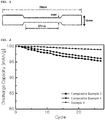
- each binder film was cut into a size as shown in the following FIG. 1 to prepare specimens and experiments were performed.
- the dry modulus was measured using the specimen, and the wet modulus was measured using a specimen in which the specimen was impregnated in a mixed solvent of EC/DEC/PC (volume ratio of 3:2:5) for 48 hours and then dried at room temperature for 5 minutes.
- EC/DEC/PC volume ratio of 3:2:5
- lengths of the specimen and the specimen after the impregnation were compared, and a degree of increase in length after the impregnation was calculated to evaluate a degree of electrolyte solution swelling.
- the results thereof are presented in the following Table 1.
- a charge and discharge test in which a charge and discharge current density was 0.5 C, a charge end voltage was 4.2 V (Li/Li + ), and a discharge end voltage was 3 V (Li/Li + ) , was performed 30 times on the lithium secondary batteries prepared in Example 4 and Comparative Examples 3 and 4.
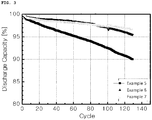
- a charge and discharge test in which a charge and discharge current density was 1 C, a charge end voltage was 4.2 V (Li/Li + ), and a discharge end voltage was 3 V (Li/Li + ), was performed 130 times on the lithium secondary batteries prepared in Examples 5 to 7.
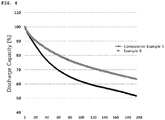
- a charge and discharge test in which a charge and discharge current density was 0.33 C, a charge end voltage was 4.2 V (Li/Li + ), and a discharge end voltage was 3 V (Li/Li + ), was performed 200 times on the lithium secondary batteries prepared in Example 8 and Comparative Example 5.
- FIG. 4 illustrates experimental results for comparing differences in effects depending on the type of the copolymer binder when the negative electrode was prepared by using the negative electrode active material in which the artificial graphite and the silicon-based negative electrode active material were mixed in a weight ratio of 70:30.
- the negative electrode and secondary battery of Example 8 including the copolymer binder of Example 3 exhibited better capacity retention than the negative electrode and secondary battery of Comparative Example 5 including the copolymer binder of Comparative Example 1.
- the copolymer binder of the present invention having a wet modulus of 0.02 MPa or more was used in the negative electrode including the silicon-based negative electrode active material having a large volume change due to charge and discharge, it may be confirmed that, since the copolymer binder exhibited improved adhesion and maintained high mechanical properties, life performance of the secondary battery may be improved.
Landscapes
- Chemical & Material Sciences (AREA)
- Chemical Kinetics & Catalysis (AREA)
- General Chemical & Material Sciences (AREA)
- Electrochemistry (AREA)
- Organic Chemistry (AREA)
- Medicinal Chemistry (AREA)
- Polymers & Plastics (AREA)
- Health & Medical Sciences (AREA)
- Engineering & Computer Science (AREA)
- Materials Engineering (AREA)
- Composite Materials (AREA)
- Manufacturing & Machinery (AREA)
- Life Sciences & Earth Sciences (AREA)
- Wood Science & Technology (AREA)
- Battery Electrode And Active Subsutance (AREA)
Claims (14)
- Bindemittelzusammensetzung für eine Sekundärbatterie, umfassend:ein Copolymerbindemittel, das (A) eine Einheit, die von einem Vinyl-basierten Monomer abgeleitet ist, (B) eine Einheit, die von einem Monomer auf Basis eines konjugierten Diens oder einem Polymer auf Basis eines konjugierten Diens abgeleitet ist, (C) eine Einheit, die von einem (Meth)acrylsäureester-basierten Monomer abgeleitet ist, und (D) eine Einheit, die von einem wasserlöslichen Polymer abgeleitet ist, einschließt,wobei das Copolymerbindemittel einen Modul im nassen Zustand von 0,02 MPa oder mehr aufweist.
- Bindemittelzusammensetzung für eine Sekundärbatterie gemäß Anspruch 1, wobei das Copolymer1 Gewichtsteil bis 70 Gewichtsteile (A) der Einheit, die von einem Vinyl-basierten Monomer abgeleitet ist,10 Gewichtsteile bis 97 Gewichtsteile (B) der Einheit, die von einem Monomer auf Basis eines konjugierten Diens oder von einem Polymer auf Basis eines konjugierten Diens abgeleitet ist,1 Gewichtsteil bis 30 Gewichtsteile (C) der Einheit, die von einem (Meth)acrylsäureester-basierten Monomer abgeleitet ist, und1 Gewichtsteil bis 70 Gewichtsteile (D) der Einheit, die von einem wasserlöslichen Polymer abgeleitet ist, umfasst,wobei die Gewichtsteile auf 100 Gewichtsteile eines Gesamtgewichts des Copolymers bezogen sind.
- Bindemittelzusammensetzung für eine Sekundärbatterie gemäß Anspruch 2, wobei das Copolymer30 Gewichtsteile bis 60 Gewichtsteile (A) der Einheit, die von einem Vinyl-basierten Monomer abgeleitet ist,15 Gewichtsteile bis 30 Gewichtsteile (B) der Einheit, die von einem Monomer auf Basis eines konjugierten Diens oder von einem Polymer auf Basis eines konjugierten Diens abgeleitet ist,4 Gewichtsteil bis 8 Gewichtsteile (C) der Einheit, die von einem (Meth)acrylsäureester-basierten Monomer abgeleitet ist, und2 Gewichtsteil bis 50 Gewichtsteile (D) der Einheit, die von einem wasserlöslichen Polymer abgeleitet ist, umfasst,wobei die Gewichtsteile auf 100 Gewichtsteile eines Gesamtgewichts des Copolymers bezogen sind.
- Bindemittelzusammensetzung für eine Sekundärbatterie gemäß Anspruch 1, wobei das Copolymerbindemittel in Form eines Partikels vorliegt und einen durchschnittlichen Partikeldurchmesser (D50) von 100 nm bis 1 µm aufweist.
- Bindemittelzusammensetzung für eine Sekundärbatterie gemäß Anspruch 1, wobei das Vinyl-basierte Monomer von (A) mindestens eines, ausgewählt aus der Gruppe, bestehend aus Styrol, α-Methylstyrol, β-Methylstyrol, p-t-Butylstyrol und Divinylbenzol, umfasst.
- Bindemittelzusammensetzung für eine Sekundärbatterie gemäß Anspruch 1, wobei das Monomer auf Basis eines konjugierten Diens von (B) 1,3-Butadien, Isopren, Chloropren oder Piperylen umfasst und
das Polymer auf Basis eines konjugierten Diens von (B) mindestens eines, ausgewählt aus der Gruppe, bestehend aus einem Polymer aus zwei oder mehr Monomeren, ausgewählt aus der Gruppe, bestehend aus 1,3-Butadien, Isopren, Chloropren und Piperylen, einem StyrolButadien-Copolymer, einem Acrylonitril-Butadien-Copolymer, einem Styrol-Isopren-Copolymer, einem Acrylat-Butadien-Kautschuk, einem Acrylonitril-Butadien-Styrol-Kautschuk, einem Ethylen-Propylen-Dien-basierten Polymer und einer partiell hydrierten, epoxidierten oder bromierten Form davon, umfasst. - Bindemittelzusammensetzung für eine Sekundärbatterie gemäß Anspruch 1, wobei das wasserlösliche Polymer von (D) mindestens eine Einheit, ausgewählt aus der Gruppe, bestehend aus einer Einheit, die von einem (Meth)acrylsäureester-basierten Monomer abgeleitet ist, einer Einheit, die von einem (Meth)acrylamid-basierten Monomer abgeleitet ist, und einer Einheit, die von einem Monomer auf Basis einer ungesättigten Carbonsäure und einem Vinylacetatmonomer abgeleitet ist, umfasst.
- Bindemittelzusammensetzung für eine Sekundärbatterie gemäß Anspruch 1, wobei das wasserlösliche Polymer von (D) mindestens eines/eine, ausgewählt aus der Gruppe, bestehend aus Polyvinylalkohol (PVA), Polyacrylsäure (PAA) und Polyacrylamid (PAM), umfasst.
- Bindemittelzusammensetzung für eine Sekundärbatterie gemäß Anspruch 7, wobei das (Meth)acrylsäureester-basierte Monomer mindestens eines, ausgewählt aus der Gruppe, bestehend aus Methylacrylat, Ethylacrylat, Propylacrylat, Isopropylacrylat, n-Butylacrylat, Isobutylacrylat, n-Amylacrylat, Isoamylacrylat, n-Ethylhexylacrylat, 2-Ethylhexylacrylat, 2-Hydroxyethylacrylat, Methylmethacrylat, Ethylmethacrylat, Propylmethacrylat, Isopropylmethacrylat, n-Butylmethacrylat, Isobutylmethacrylat, n-Amylmethacrylat, Isoamylmethacrylat, n-Hexylmethacrylat, n-Ethylhexylmethacrylat, 2-Ethylhexylmethacrylat, Hydroxyethylmethacrylat, Hydroxypropylmethacrylat, Methacryloxyethylethylenharnstoff, β-Carboxyethylacrylat, aliphatischem Monoacrylat, Dipropylendiacrylat, Ditrimethylolpropantetraacrylat, Hydroxyethylacrylat, Dipentaerythritolhexaacrylat, Pentaerythritoltriacrylat, Pentaerythritoltetraacrylat, Laurylacrylat, Serylacrylat, Stearylacrylat, Laurylmethacrylat, Cetylmethacrylat und Stearylmethacrylat, umfasst.
- Bindemittelzusammensetzung für eine Sekundärbatterie gemäß Anspruch 7, wobei das (Meth)acrylamid-basierte Monomer mindestens eines, ausgewählt aus der Gruppe, bestehend aus Acrylamid, n-Methylolacrylamid, n-Butoxymethylacrylamid, Methacrylamid, n-Methylolmethacrylamid und n-Butoxymethylmethylacrylamid, umfasst.
- Bindemittelzusammensetzung für eine Sekundärbatterie gemäß Anspruch 7, wobei das Monomer auf Basis einer ungesättigten Carbonsäure mindestens eine, ausgewählt aus der Gruppe, bestehend aus Maleinsäure, Fumarsäure, Methacrylsäure, Acrylsäure, Glutarsäure, Itaconsäure, Tetrahydrophthalsäure, Crotonsäure, Isocrotonsäure und Nadic-Säure, umfasst.
- Negative Elektrode für eine Lithium-Sekundärbatterie, umfassend:ein Silicium-basiertes negatives Elektrodenaktivmaterial unddie Bindemittelzusammensetzung für eine Sekundärbatterie gemäß Anspruch 1.
- Negative Elektrode für eine Lithium-Sekundärbatterie gemäß Anspruch 12, ferner umfassend ein Kohlenstoffbasiertes negatives Elektrodenaktivmaterial,
wobei das Silicium-basierte negative Elektrodenaktivmaterial in einer Menge von 1 Gew.-% bis 30 Gew.-% im gesamten negativen Elektrodenaktivmaterial enthalten ist. - Lithium-Sekundärbatterie, umfassend die negative Elektrode für eine Lithium-Sekundärbatterie gemäß Anspruch 12.
Priority Applications (1)
| Application Number | Priority Date | Filing Date | Title |
|---|---|---|---|
| PL18776291T PL3483964T3 (pl) | 2017-03-31 | 2018-03-29 | Kompozycja środka wiążącego dla akumulatora i elektroda dla akumulatora oraz akumulator litowy, który ją zawiera |
Applications Claiming Priority (3)
| Application Number | Priority Date | Filing Date | Title |
|---|---|---|---|
| KR20170042131 | 2017-03-31 | ||
| KR1020180035834A KR102290957B1 (ko) | 2017-03-31 | 2018-03-28 | 이차전지용 바인더 조성물, 이를 포함하는 이차전지용 전극 및 리튬 이차전지 |
| PCT/KR2018/003746 WO2018182343A1 (ko) | 2017-03-31 | 2018-03-29 | 이차전지용 바인더 조성물, 이를 포함하는 이차전지용 전극 및 리튬 이차전지 |
Publications (3)
| Publication Number | Publication Date |
|---|---|
| EP3483964A1 EP3483964A1 (de) | 2019-05-15 |
| EP3483964A4 EP3483964A4 (de) | 2019-10-23 |
| EP3483964B1 true EP3483964B1 (de) | 2021-02-24 |
Family
ID=63864909
Family Applications (1)
| Application Number | Title | Priority Date | Filing Date |
|---|---|---|---|
| EP18776291.9A Active EP3483964B1 (de) | 2017-03-31 | 2018-03-29 | Bindemittelzusammensetzung für sekundärbatterie und elektrode für sekundärbatterie und lithiumsekundärbatterie die diese enthält |
Country Status (6)
| Country | Link |
|---|---|
| US (1) | US11024851B2 (de) |
| EP (1) | EP3483964B1 (de) |
| JP (1) | JP7034407B2 (de) |
| KR (1) | KR102290957B1 (de) |
| CN (1) | CN109716566B (de) |
| PL (1) | PL3483964T3 (de) |
Cited By (1)
| Publication number | Priority date | Publication date | Assignee | Title |
|---|---|---|---|---|
| EP4641652A4 (de) * | 2022-12-22 | 2026-04-29 | Lg Energy Solution Ltd | Anode für elektrochemische vorrichtung |
Families Citing this family (18)
| Publication number | Priority date | Publication date | Assignee | Title |
|---|---|---|---|---|
| CN111033833B (zh) * | 2017-08-29 | 2023-04-04 | 日本瑞翁株式会社 | 非水系二次电池电极用粘结剂组合物、非水系二次电池电极用浆料组合物、非水系二次电池用电极以及非水系二次电池 |
| CN111933864B (zh) * | 2019-04-25 | 2022-12-20 | 聚电材料股份有限公司 | 能量储存装置 |
| KR102771036B1 (ko) * | 2019-09-23 | 2025-02-19 | 주식회사 엘지에너지솔루션 | 리튬이차전지 음극용 바인더 및 이를 포함하는 리튬이차전지용 음극 |
| KR102893453B1 (ko) * | 2019-11-06 | 2025-12-02 | 주식회사 엘지에너지솔루션 | 리튬 이차전지 전극용 바인더, 이를 포함하는 리튬 이차전지용 양극 및 리튬 이차전지 |
| EP4099450A4 (de) * | 2020-01-30 | 2023-08-02 | Lg Chem, Ltd. | Bindemittelzusammensetzung für negative elektrode, negative elektrode, die dieselbe umfasst, und sekundäre lithiumbatterie, die dieselbe umfasst |
| CN115004400B (zh) * | 2020-02-03 | 2026-03-24 | Apb株式会社 | 用于锂离子电池的正极及其制造方法 |
| JP7547761B2 (ja) * | 2020-04-02 | 2024-09-10 | 株式会社Gsユアサ | 非水電解質蓄電素子 |
| KR102874953B1 (ko) * | 2020-11-30 | 2025-10-22 | 에스케이온 주식회사 | 이차전지 음극용 바인더, 이를 포함하는 이차전지용 음극 및 이를 포함하는 리튬 이차 전지 |
| JP7603443B2 (ja) * | 2020-12-25 | 2024-12-20 | エルジー エナジー ソリューション リミテッド | 二次電池用の負極、負極用スラリー、及び、負極の製造方法 |
| US20240421310A1 (en) * | 2021-10-29 | 2024-12-19 | Zeon Corporation | Binder composition for non-aqueous secondary battery negative electrode, slurry composition for non-aqueous secondary battery negative electrode, negative electrode for non-aqueous secondary battery, and non-aqueous secondary battery |
| US20250115779A1 (en) * | 2022-04-04 | 2025-04-10 | Lg Chem, Ltd. | Manufacturing Method of Positive Electrode Binder or Positive Electrode Insulating Solution for Lithium Secondary Battery and Lithium Secondary Battery Containing Positive Electrode Binder or Positive Electrode Insulating Solution Prepared Thereby |
| CN114975939A (zh) * | 2022-06-08 | 2022-08-30 | 武汉微美新材料科技有限公司 | 水性阴极浆料、阴极极片及锂离子电池 |
| KR102538286B1 (ko) * | 2022-08-30 | 2023-06-01 | 주식회사 한솔케미칼 | 바인더 조성물, 상기 바인더 조성물 포함하는 이차전지용 음극 및 상기 음극을 포함하는 이차전지 |
| KR20240067470A (ko) * | 2022-11-09 | 2024-05-17 | 에스케이온 주식회사 | 이차전지용 음극 및 이를 포함하는 리튬 이차전지 |
| CN118791991A (zh) * | 2023-04-14 | 2024-10-18 | 宁德时代新能源科技股份有限公司 | 二次电池用粘结剂及其制备方法、以及隔膜、电池单体、电池和用电装置 |
| CN116864691B (zh) * | 2023-08-12 | 2026-02-24 | 福建蓝海黑石新材料科技有限公司 | 一种二次电池的水性粘合剂及其制备方法 |
| CN121160252A (zh) * | 2024-06-19 | 2025-12-19 | 眉山茵地乐科技有限公司 | 二次电池电极用水性粘合剂及其应用 |
| CN118630215A (zh) * | 2024-06-28 | 2024-09-10 | 厦门海辰储能科技股份有限公司 | 负极极片及其制备方法、电池、储能装置和用电设备 |
Family Cites Families (27)
| Publication number | Priority date | Publication date | Assignee | Title |
|---|---|---|---|---|
| JPS6032504B2 (ja) | 1978-04-06 | 1985-07-29 | 釜屋化学工業株式会社 | 往復ポンプ |
| KR100431780B1 (ko) * | 1996-10-01 | 2004-05-17 | 제온 코포레이션 | 중합체 분산 조성물 |
| JP4473967B2 (ja) | 1997-03-04 | 2010-06-02 | 日本ゼオン株式会社 | 電池用バインダー、電池用バインダー組成物、電池電極用スラリー、リチウム二次電池用電極およびリチウム二次電池 |
| US6841232B2 (en) * | 2002-11-12 | 2005-01-11 | Innovative Construction And Building Materials | Reinforced wallboard |
| CN101156264B (zh) | 2005-04-07 | 2011-05-25 | Lg化学株式会社 | 用于锂二次电池的具有优良的倍率特性和长期循环性能的粘合剂 |
| CN101243566B (zh) | 2005-09-06 | 2010-05-19 | Lg化学株式会社 | 包含碳纳米管的复合物粘合剂以及使用该粘合剂的锂二次电池 |
| KR101113043B1 (ko) * | 2007-08-21 | 2012-02-27 | 주식회사 엘지화학 | 폴리비닐아세테이트 혹은 폴리비닐알코올계의 공중합체를포함하는 이차 전지용 바인더 |
| EP2197953A4 (de) * | 2007-10-09 | 2011-06-22 | Kraton Polymers Us Llc | Aus speziellen blockcopolymeren hergestellte endanwendungen |
| JP5259373B2 (ja) * | 2008-12-19 | 2013-08-07 | 日本エイアンドエル株式会社 | 非水電解液二次電池電極用バインダー |
| EP2555306B1 (de) * | 2010-03-29 | 2016-09-28 | Zeon Corporation | Lithium-ionen-akkumulator |
| CN103181008B (zh) * | 2010-08-24 | 2015-07-01 | 日本瑞翁株式会社 | 二次电池负极用粘合剂组合物、二次电池负极用浆料组合物、二次电池负极、二次电池及二次电池负极用粘合剂组合物的制造方法 |
| KR101728203B1 (ko) * | 2010-09-30 | 2017-04-18 | 히타치가세이가부시끼가이샤 | 접착제 조성물, 반도체 장치의 제조 방법 및 반도체 장치 |
| KR101464450B1 (ko) * | 2010-10-15 | 2014-11-21 | 아사히 가세이 케미칼즈 가부시키가이샤 | 점접착제용 블록 공중합체, 그의 제조 방법 및 점접착제 조성물 |
| EP2677573A1 (de) * | 2011-02-14 | 2013-12-25 | Showa Denko K.K. | Aus einem zellbindemittel für zellelektroden gewonnene aufschlämmungen, aus diesen aufschlämmungen gewonnene elektroden und aus den elektroden gewonnene lithiumionen-sekundärzelle |
| KR101534899B1 (ko) * | 2012-06-21 | 2015-07-07 | (주)엘지하우시스 | Uv경화형 고무를 포함하는 점착제 조성물 및 이를 사용하는 보호필름 |
| KR20150034261A (ko) | 2012-07-17 | 2015-04-02 | 도요타지도샤가부시키가이샤 | 리튬 이차 전지 및 그 제조 방법 |
| CN104272508A (zh) * | 2012-08-09 | 2015-01-07 | 日本瑞翁株式会社 | 二次电池用负极、二次电池、浆料组合物及制造方法 |
| EP2924785B1 (de) | 2012-10-12 | 2018-12-05 | National Institute of Advanced Industrial Science and Technology | Binder zur verwendung bei einer positivelektrode für eine lithium-ionen-sekundärbatterie, positivelektrode für eine lithium-ionen-sekundärbatterie mit diesem binder, lithium-ionen-sekundärbatterie mit dieser positivelektrode sowie elektrische maschine und vorrichtung |
| KR101706414B1 (ko) | 2013-03-13 | 2017-02-27 | 삼성에스디아이 주식회사 | 이차전지용 바인더 조성물 및 이를 포함하는 리튬이차전지 |
| WO2014196547A1 (ja) | 2013-06-04 | 2014-12-11 | 日本ゼオン株式会社 | リチウムイオン二次電池電極用バインダー組成物、リチウムイオン二次電池電極用スラリー組成物、リチウムイオン二次電池用電極及びリチウムイオン二次電池 |
| JP6358256B2 (ja) | 2013-09-03 | 2018-07-18 | 日本ゼオン株式会社 | リチウムイオン二次電池負極用スラリー組成物、リチウムイオン二次電池負極の製造方法及びリチウムイオン二次電池 |
| JP6581568B2 (ja) * | 2014-04-21 | 2019-09-25 | 富士フイルム和光純薬株式会社 | リチウム電池用結着剤 |
| CN104233510B (zh) * | 2014-10-16 | 2017-06-13 | 恒天海龙(潍坊)新材料有限责任公司 | 一种氨基树脂增强纤维素纤维及其制备方法 |
| KR20160047237A (ko) | 2014-10-22 | 2016-05-02 | 에스케이이노베이션 주식회사 | 리튬 이차 전지용 음극 바인더 및 이를 포함하는 음극 및 리튬 이차 전지 |
| CN105633357B (zh) * | 2014-11-11 | 2019-09-17 | 东莞新能源科技有限公司 | 负极活性材料及其制备方法及锂离子二次电池 |
| KR101953765B1 (ko) | 2015-06-17 | 2019-06-12 | 주식회사 엘지화학 | 이차전지용 바인더 조성물, 이를 사용한 전극 및 리튬 이차전지 |
| CN105576258A (zh) | 2015-11-20 | 2016-05-11 | 陕西聚洁瀚化工有限公司 | 一种Ir0.08Ti0.92O2纳米粉体催化剂的制备方法 |
-
2018
- 2018-03-28 KR KR1020180035834A patent/KR102290957B1/ko active Active
- 2018-03-29 JP JP2019548849A patent/JP7034407B2/ja active Active
- 2018-03-29 US US16/325,500 patent/US11024851B2/en active Active
- 2018-03-29 CN CN201880003405.7A patent/CN109716566B/zh active Active
- 2018-03-29 EP EP18776291.9A patent/EP3483964B1/de active Active
- 2018-03-29 PL PL18776291T patent/PL3483964T3/pl unknown
Non-Patent Citations (1)
| Title |
|---|
| None * |
Cited By (1)
| Publication number | Priority date | Publication date | Assignee | Title |
|---|---|---|---|---|
| EP4641652A4 (de) * | 2022-12-22 | 2026-04-29 | Lg Energy Solution Ltd | Anode für elektrochemische vorrichtung |
Also Published As
| Publication number | Publication date |
|---|---|
| EP3483964A4 (de) | 2019-10-23 |
| KR102290957B1 (ko) | 2021-08-20 |
| US20200235395A1 (en) | 2020-07-23 |
| JP7034407B2 (ja) | 2022-03-14 |
| EP3483964A1 (de) | 2019-05-15 |
| CN109716566B (zh) | 2022-07-12 |
| US11024851B2 (en) | 2021-06-01 |
| PL3483964T3 (pl) | 2021-06-14 |
| JP2019537232A (ja) | 2019-12-19 |
| CN109716566A (zh) | 2019-05-03 |
| KR20180111617A (ko) | 2018-10-11 |
Similar Documents
| Publication | Publication Date | Title |
|---|---|---|
| EP3483964B1 (de) | Bindemittelzusammensetzung für sekundärbatterie und elektrode für sekundärbatterie und lithiumsekundärbatterie die diese enthält | |
| EP2541658B1 (de) | Binder für einen akkumulator mit hervorragender haftkraft | |
| KR101952673B1 (ko) | 이차전지용 바인더 조성물, 및 이를 포함하는 이차전지용 전극 및 리튬 이차전지 | |
| EP2592679B1 (de) | Binder für eine sekundärbatterie mit hervorragender haftkraft | |
| KR102771036B1 (ko) | 리튬이차전지 음극용 바인더 및 이를 포함하는 리튬이차전지용 음극 | |
| CN104798231A (zh) | 用于二次电池的具有优良粘合强度的粘合剂 | |
| KR20150010706A (ko) | 리튬 이온 이차 전지 | |
| US11302923B2 (en) | Additive for electrochemical device, binder composition for electrochemical device, slurry composition for electrochemical device, electrode for electrochemical device, and electrochemical device | |
| CN102473923A (zh) | 具有优异胶粘力的二次电池用粘合剂 | |
| KR20170081635A (ko) | 이차 전지 전극용 바인더 조성물, 이차 전지 전극용 슬러리 조성물, 이차 전지용 전극 및 이차 전지 | |
| JP2018518810A (ja) | リチウム二次電池用電極スラリーの製造方法 | |
| US12315932B2 (en) | Anode including binder formed from (meth) acrylamide, unsaturated organic acid, unsaturated nitrile, and diacrylaminde /diacrylate, and lithium secondary battery comprising same | |
| JPWO2014024823A1 (ja) | スラリー及びリチウムイオン電池用負極 | |
| WO2018182343A1 (ko) | 이차전지용 바인더 조성물, 이를 포함하는 이차전지용 전극 및 리튬 이차전지 | |
| EP4322249A1 (de) | Anodenzusammensetzung, lithiumsekundärbatterieanode damit und lithiumsekundärbatterie mit anode | |
| KR101616721B1 (ko) | 접착력이 향상된 바인더 및 상기 바인더를 포함하는 리튬 이차전지 | |
| KR102102983B1 (ko) | 이차전지용 바인더 조성물, 및 이를 포함하는 이차전지용 전극 및 소듐 이차전지 | |
| KR102244954B1 (ko) | 이차전지용 양극 슬러리 조성물, 및 이를 포함하는 이차전지용 양극 및 리튬 이차전지 | |
| KR101910988B1 (ko) | 이차 전지 부극용 바인더 조성물, 이차 전지 부극용 슬러리 조성물, 이차 전지용 부극 및 이차 전지 | |
| US20190207219A1 (en) | Negative electrode active mass for rechargeable battery, negative electrode for rechargeable battery, and rechargeable battery | |
| KR20240130031A (ko) | 음극 슬러리, 음극 및 이차 전지 | |
| KR20150037276A (ko) | 이차전지용 바인더 조성물 및 이를 포함하는 리튬 이차전지 | |
| KR101743623B1 (ko) | 이차전지용 바인더 조성물 및 이를 포함하는 리튬 이차전지 | |
| KR20210056165A (ko) | 음극 및 이를 포함하는 이차전지 | |
| KR101143307B1 (ko) | 유화 중합으로 제조된 폴리비닐 아세테이트와 폴리비닐알코올의 이중충 바인더 및 이를 포함하고 있는 이차전지 |
Legal Events
| Date | Code | Title | Description |
|---|---|---|---|
| STAA | Information on the status of an ep patent application or granted ep patent |
Free format text: STATUS: THE INTERNATIONAL PUBLICATION HAS BEEN MADE |
|
| PUAI | Public reference made under article 153(3) epc to a published international application that has entered the european phase |
Free format text: ORIGINAL CODE: 0009012 |
|
| STAA | Information on the status of an ep patent application or granted ep patent |
Free format text: STATUS: REQUEST FOR EXAMINATION WAS MADE |
|
| 17P | Request for examination filed |
Effective date: 20190207 |
|
| AK | Designated contracting states |
Kind code of ref document: A1 Designated state(s): AL AT BE BG CH CY CZ DE DK EE ES FI FR GB GR HR HU IE IS IT LI LT LU LV MC MK MT NL NO PL PT RO RS SE SI SK SM TR |
|
| AX | Request for extension of the european patent |
Extension state: BA ME |
|
| REG | Reference to a national code |
Ref country code: DE Ref legal event code: R079 Ref document number: 602018013136 Country of ref document: DE Free format text: PREVIOUS MAIN CLASS: H01M0004620000 Ipc: C08F0212080000 |
|
| A4 | Supplementary search report drawn up and despatched |
Effective date: 20190924 |
|
| RIC1 | Information provided on ipc code assigned before grant |
Ipc: H01M 4/62 20060101ALI20190918BHEP Ipc: H01M 4/131 20100101ALI20190918BHEP Ipc: C08F 212/08 20060101AFI20190918BHEP Ipc: H01M 10/0525 20100101ALI20190918BHEP Ipc: C08L 1/28 20060101ALI20190918BHEP Ipc: C08F 265/02 20060101ALI20190918BHEP Ipc: H01M 4/134 20100101ALI20190918BHEP Ipc: C08F 236/04 20060101ALI20190918BHEP Ipc: C08L 25/10 20060101ALI20190918BHEP Ipc: C08L 51/00 20060101ALI20190918BHEP Ipc: H01M 4/133 20100101ALI20190918BHEP Ipc: H01M 4/36 20060101ALI20190918BHEP Ipc: C08F 220/10 20060101ALI20190918BHEP Ipc: C08L 33/02 20060101ALI20190918BHEP |
|
| DAV | Request for validation of the european patent (deleted) | ||
| DAX | Request for extension of the european patent (deleted) | ||
| GRAP | Despatch of communication of intention to grant a patent |
Free format text: ORIGINAL CODE: EPIDOSNIGR1 |
|
| STAA | Information on the status of an ep patent application or granted ep patent |
Free format text: STATUS: GRANT OF PATENT IS INTENDED |
|
| INTG | Intention to grant announced |
Effective date: 20201116 |
|
| GRAS | Grant fee paid |
Free format text: ORIGINAL CODE: EPIDOSNIGR3 |
|
| GRAA | (expected) grant |
Free format text: ORIGINAL CODE: 0009210 |
|
| STAA | Information on the status of an ep patent application or granted ep patent |
Free format text: STATUS: THE PATENT HAS BEEN GRANTED |
|
| AK | Designated contracting states |
Kind code of ref document: B1 Designated state(s): AL AT BE BG CH CY CZ DE DK EE ES FI FR GB GR HR HU IE IS IT LI LT LU LV MC MK MT NL NO PL PT RO RS SE SI SK SM TR |
|
| REG | Reference to a national code |
Ref country code: CH Ref legal event code: EP |
|
| REG | Reference to a national code |
Ref country code: AT Ref legal event code: REF Ref document number: 1364342 Country of ref document: AT Kind code of ref document: T Effective date: 20210315 |
|
| REG | Reference to a national code |
Ref country code: IE Ref legal event code: FG4D |
|
| REG | Reference to a national code |
Ref country code: DE Ref legal event code: R096 Ref document number: 602018013136 Country of ref document: DE |
|
| REG | Reference to a national code |
Ref country code: LT Ref legal event code: MG9D |
|
| REG | Reference to a national code |
Ref country code: NL Ref legal event code: MP Effective date: 20210224 |
|
| PG25 | Lapsed in a contracting state [announced via postgrant information from national office to epo] |
Ref country code: HR Free format text: LAPSE BECAUSE OF FAILURE TO SUBMIT A TRANSLATION OF THE DESCRIPTION OR TO PAY THE FEE WITHIN THE PRESCRIBED TIME-LIMIT Effective date: 20210224 Ref country code: GR Free format text: LAPSE BECAUSE OF FAILURE TO SUBMIT A TRANSLATION OF THE DESCRIPTION OR TO PAY THE FEE WITHIN THE PRESCRIBED TIME-LIMIT Effective date: 20210525 Ref country code: FI Free format text: LAPSE BECAUSE OF FAILURE TO SUBMIT A TRANSLATION OF THE DESCRIPTION OR TO PAY THE FEE WITHIN THE PRESCRIBED TIME-LIMIT Effective date: 20210224 Ref country code: BG Free format text: LAPSE BECAUSE OF FAILURE TO SUBMIT A TRANSLATION OF THE DESCRIPTION OR TO PAY THE FEE WITHIN THE PRESCRIBED TIME-LIMIT Effective date: 20210524 Ref country code: PT Free format text: LAPSE BECAUSE OF FAILURE TO SUBMIT A TRANSLATION OF THE DESCRIPTION OR TO PAY THE FEE WITHIN THE PRESCRIBED TIME-LIMIT Effective date: 20210624 Ref country code: NO Free format text: LAPSE BECAUSE OF FAILURE TO SUBMIT A TRANSLATION OF THE DESCRIPTION OR TO PAY THE FEE WITHIN THE PRESCRIBED TIME-LIMIT Effective date: 20210524 Ref country code: LT Free format text: LAPSE BECAUSE OF FAILURE TO SUBMIT A TRANSLATION OF THE DESCRIPTION OR TO PAY THE FEE WITHIN THE PRESCRIBED TIME-LIMIT Effective date: 20210224 |
|
| REG | Reference to a national code |
Ref country code: AT Ref legal event code: MK05 Ref document number: 1364342 Country of ref document: AT Kind code of ref document: T Effective date: 20210224 |
|
| PG25 | Lapsed in a contracting state [announced via postgrant information from national office to epo] |
Ref country code: SE Free format text: LAPSE BECAUSE OF FAILURE TO SUBMIT A TRANSLATION OF THE DESCRIPTION OR TO PAY THE FEE WITHIN THE PRESCRIBED TIME-LIMIT Effective date: 20210224 Ref country code: NL Free format text: LAPSE BECAUSE OF FAILURE TO SUBMIT A TRANSLATION OF THE DESCRIPTION OR TO PAY THE FEE WITHIN THE PRESCRIBED TIME-LIMIT Effective date: 20210224 Ref country code: RS Free format text: LAPSE BECAUSE OF FAILURE TO SUBMIT A TRANSLATION OF THE DESCRIPTION OR TO PAY THE FEE WITHIN THE PRESCRIBED TIME-LIMIT Effective date: 20210224 Ref country code: LV Free format text: LAPSE BECAUSE OF FAILURE TO SUBMIT A TRANSLATION OF THE DESCRIPTION OR TO PAY THE FEE WITHIN THE PRESCRIBED TIME-LIMIT Effective date: 20210224 |
|
| PG25 | Lapsed in a contracting state [announced via postgrant information from national office to epo] |
Ref country code: IS Free format text: LAPSE BECAUSE OF FAILURE TO SUBMIT A TRANSLATION OF THE DESCRIPTION OR TO PAY THE FEE WITHIN THE PRESCRIBED TIME-LIMIT Effective date: 20210624 |
|
| PG25 | Lapsed in a contracting state [announced via postgrant information from national office to epo] |
Ref country code: SM Free format text: LAPSE BECAUSE OF FAILURE TO SUBMIT A TRANSLATION OF THE DESCRIPTION OR TO PAY THE FEE WITHIN THE PRESCRIBED TIME-LIMIT Effective date: 20210224 Ref country code: AT Free format text: LAPSE BECAUSE OF FAILURE TO SUBMIT A TRANSLATION OF THE DESCRIPTION OR TO PAY THE FEE WITHIN THE PRESCRIBED TIME-LIMIT Effective date: 20210224 Ref country code: CZ Free format text: LAPSE BECAUSE OF FAILURE TO SUBMIT A TRANSLATION OF THE DESCRIPTION OR TO PAY THE FEE WITHIN THE PRESCRIBED TIME-LIMIT Effective date: 20210224 Ref country code: EE Free format text: LAPSE BECAUSE OF FAILURE TO SUBMIT A TRANSLATION OF THE DESCRIPTION OR TO PAY THE FEE WITHIN THE PRESCRIBED TIME-LIMIT Effective date: 20210224 |
|
| REG | Reference to a national code |
Ref country code: CH Ref legal event code: PL |
|
| REG | Reference to a national code |
Ref country code: DE Ref legal event code: R097 Ref document number: 602018013136 Country of ref document: DE |
|
| PG25 | Lapsed in a contracting state [announced via postgrant information from national office to epo] |
Ref country code: MC Free format text: LAPSE BECAUSE OF FAILURE TO SUBMIT A TRANSLATION OF THE DESCRIPTION OR TO PAY THE FEE WITHIN THE PRESCRIBED TIME-LIMIT Effective date: 20210224 Ref country code: DK Free format text: LAPSE BECAUSE OF FAILURE TO SUBMIT A TRANSLATION OF THE DESCRIPTION OR TO PAY THE FEE WITHIN THE PRESCRIBED TIME-LIMIT Effective date: 20210224 Ref country code: SK Free format text: LAPSE BECAUSE OF FAILURE TO SUBMIT A TRANSLATION OF THE DESCRIPTION OR TO PAY THE FEE WITHIN THE PRESCRIBED TIME-LIMIT Effective date: 20210224 Ref country code: RO Free format text: LAPSE BECAUSE OF FAILURE TO SUBMIT A TRANSLATION OF THE DESCRIPTION OR TO PAY THE FEE WITHIN THE PRESCRIBED TIME-LIMIT Effective date: 20210224 |
|
| REG | Reference to a national code |
Ref country code: BE Ref legal event code: MM Effective date: 20210331 |
|
| PLBE | No opposition filed within time limit |
Free format text: ORIGINAL CODE: 0009261 |
|
| STAA | Information on the status of an ep patent application or granted ep patent |
Free format text: STATUS: NO OPPOSITION FILED WITHIN TIME LIMIT |
|
| PG25 | Lapsed in a contracting state [announced via postgrant information from national office to epo] |
Ref country code: LI Free format text: LAPSE BECAUSE OF NON-PAYMENT OF DUE FEES Effective date: 20210331 Ref country code: IE Free format text: LAPSE BECAUSE OF NON-PAYMENT OF DUE FEES Effective date: 20210329 Ref country code: LU Free format text: LAPSE BECAUSE OF NON-PAYMENT OF DUE FEES Effective date: 20210329 Ref country code: CH Free format text: LAPSE BECAUSE OF NON-PAYMENT OF DUE FEES Effective date: 20210331 Ref country code: AL Free format text: LAPSE BECAUSE OF FAILURE TO SUBMIT A TRANSLATION OF THE DESCRIPTION OR TO PAY THE FEE WITHIN THE PRESCRIBED TIME-LIMIT Effective date: 20210224 Ref country code: ES Free format text: LAPSE BECAUSE OF FAILURE TO SUBMIT A TRANSLATION OF THE DESCRIPTION OR TO PAY THE FEE WITHIN THE PRESCRIBED TIME-LIMIT Effective date: 20210224 |
|
| 26N | No opposition filed |
Effective date: 20211125 |
|
| PG25 | Lapsed in a contracting state [announced via postgrant information from national office to epo] |
Ref country code: SI Free format text: LAPSE BECAUSE OF FAILURE TO SUBMIT A TRANSLATION OF THE DESCRIPTION OR TO PAY THE FEE WITHIN THE PRESCRIBED TIME-LIMIT Effective date: 20210224 |
|
| PG25 | Lapsed in a contracting state [announced via postgrant information from national office to epo] |
Ref country code: IT Free format text: LAPSE BECAUSE OF FAILURE TO SUBMIT A TRANSLATION OF THE DESCRIPTION OR TO PAY THE FEE WITHIN THE PRESCRIBED TIME-LIMIT Effective date: 20210224 |
|
| PG25 | Lapsed in a contracting state [announced via postgrant information from national office to epo] |
Ref country code: IS Free format text: LAPSE BECAUSE OF FAILURE TO SUBMIT A TRANSLATION OF THE DESCRIPTION OR TO PAY THE FEE WITHIN THE PRESCRIBED TIME-LIMIT Effective date: 20210624 |
|
| PG25 | Lapsed in a contracting state [announced via postgrant information from national office to epo] |
Ref country code: BE Free format text: LAPSE BECAUSE OF NON-PAYMENT OF DUE FEES Effective date: 20210331 |
|
| REG | Reference to a national code |
Ref country code: DE Ref legal event code: R081 Ref document number: 602018013136 Country of ref document: DE Owner name: LG ENERGY SOLUTION, LTD., KR Free format text: FORMER OWNER: LG CHEM, LTD., SEOUL, KR |
|
| P01 | Opt-out of the competence of the unified patent court (upc) registered |
Effective date: 20230408 |
|
| PG25 | Lapsed in a contracting state [announced via postgrant information from national office to epo] |
Ref country code: CY Free format text: LAPSE BECAUSE OF FAILURE TO SUBMIT A TRANSLATION OF THE DESCRIPTION OR TO PAY THE FEE WITHIN THE PRESCRIBED TIME-LIMIT Effective date: 20210224 |
|
| PG25 | Lapsed in a contracting state [announced via postgrant information from national office to epo] |
Ref country code: HU Free format text: LAPSE BECAUSE OF FAILURE TO SUBMIT A TRANSLATION OF THE DESCRIPTION OR TO PAY THE FEE WITHIN THE PRESCRIBED TIME-LIMIT; INVALID AB INITIO Effective date: 20180329 |
|
| REG | Reference to a national code |
Ref country code: GB Ref legal event code: 732E Free format text: REGISTERED BETWEEN 20230901 AND 20230906 |
|
| PG25 | Lapsed in a contracting state [announced via postgrant information from national office to epo] |
Ref country code: MK Free format text: LAPSE BECAUSE OF FAILURE TO SUBMIT A TRANSLATION OF THE DESCRIPTION OR TO PAY THE FEE WITHIN THE PRESCRIBED TIME-LIMIT Effective date: 20210224 |
|
| PG25 | Lapsed in a contracting state [announced via postgrant information from national office to epo] |
Ref country code: TR Free format text: LAPSE BECAUSE OF FAILURE TO SUBMIT A TRANSLATION OF THE DESCRIPTION OR TO PAY THE FEE WITHIN THE PRESCRIBED TIME-LIMIT Effective date: 20210224 |
|
| PG25 | Lapsed in a contracting state [announced via postgrant information from national office to epo] |
Ref country code: MT Free format text: LAPSE BECAUSE OF FAILURE TO SUBMIT A TRANSLATION OF THE DESCRIPTION OR TO PAY THE FEE WITHIN THE PRESCRIBED TIME-LIMIT Effective date: 20210224 |
|
| PGFP | Annual fee paid to national office [announced via postgrant information from national office to epo] |
Ref country code: GB Payment date: 20260224 Year of fee payment: 9 |
|
| PGFP | Annual fee paid to national office [announced via postgrant information from national office to epo] |
Ref country code: DE Payment date: 20260220 Year of fee payment: 9 |
|
| PGFP | Annual fee paid to national office [announced via postgrant information from national office to epo] |
Ref country code: FR Payment date: 20260224 Year of fee payment: 9 |
|
| PGFP | Annual fee paid to national office [announced via postgrant information from national office to epo] |
Ref country code: PL Payment date: 20260223 Year of fee payment: 9 |