EP3457486B1 - Multilayer polymer solid electrolyte and all-solid-state battery comprising same - Google Patents
Multilayer polymer solid electrolyte and all-solid-state battery comprising same Download PDFInfo
- Publication number
- EP3457486B1 EP3457486B1 EP18811698.2A EP18811698A EP3457486B1 EP 3457486 B1 EP3457486 B1 EP 3457486B1 EP 18811698 A EP18811698 A EP 18811698A EP 3457486 B1 EP3457486 B1 EP 3457486B1
- Authority
- EP
- European Patent Office
- Prior art keywords
- polymer electrolyte
- solid
- layer
- layer structure
- polymer
- Prior art date
- Legal status (The legal status is an assumption and is not a legal conclusion. Google has not performed a legal analysis and makes no representation as to the accuracy of the status listed.)
- Active
Links
Images


Classifications
-
- H—ELECTRICITY
- H01—ELECTRIC ELEMENTS
- H01M—PROCESSES OR MEANS, e.g. BATTERIES, FOR THE DIRECT CONVERSION OF CHEMICAL ENERGY INTO ELECTRICAL ENERGY
- H01M10/00—Secondary cells; Manufacture thereof
- H01M10/05—Accumulators with non-aqueous electrolyte
- H01M10/056—Accumulators with non-aqueous electrolyte characterised by the materials used as electrolytes, e.g. mixed inorganic/organic electrolytes
- H01M10/0564—Accumulators with non-aqueous electrolyte characterised by the materials used as electrolytes, e.g. mixed inorganic/organic electrolytes the electrolyte being constituted of organic materials only
- H01M10/0565—Polymeric materials, e.g. gel-type or solid-type
-
- H—ELECTRICITY
- H01—ELECTRIC ELEMENTS
- H01M—PROCESSES OR MEANS, e.g. BATTERIES, FOR THE DIRECT CONVERSION OF CHEMICAL ENERGY INTO ELECTRICAL ENERGY
- H01M10/00—Secondary cells; Manufacture thereof
- H01M10/05—Accumulators with non-aqueous electrolyte
- H01M10/052—Li-accumulators
-
- H—ELECTRICITY
- H01—ELECTRIC ELEMENTS
- H01M—PROCESSES OR MEANS, e.g. BATTERIES, FOR THE DIRECT CONVERSION OF CHEMICAL ENERGY INTO ELECTRICAL ENERGY
- H01M10/00—Secondary cells; Manufacture thereof
- H01M10/05—Accumulators with non-aqueous electrolyte
- H01M10/052—Li-accumulators
- H01M10/0525—Rocking-chair batteries, i.e. batteries with lithium insertion or intercalation in both electrodes; Lithium-ion batteries
-
- H—ELECTRICITY
- H01—ELECTRIC ELEMENTS
- H01M—PROCESSES OR MEANS, e.g. BATTERIES, FOR THE DIRECT CONVERSION OF CHEMICAL ENERGY INTO ELECTRICAL ENERGY
- H01M10/00—Secondary cells; Manufacture thereof
- H01M10/05—Accumulators with non-aqueous electrolyte
- H01M10/056—Accumulators with non-aqueous electrolyte characterised by the materials used as electrolytes, e.g. mixed inorganic/organic electrolytes
- H01M10/0561—Accumulators with non-aqueous electrolyte characterised by the materials used as electrolytes, e.g. mixed inorganic/organic electrolytes the electrolyte being constituted of inorganic materials only
- H01M10/0562—Solid materials
-
- H—ELECTRICITY
- H01—ELECTRIC ELEMENTS
- H01M—PROCESSES OR MEANS, e.g. BATTERIES, FOR THE DIRECT CONVERSION OF CHEMICAL ENERGY INTO ELECTRICAL ENERGY
- H01M4/00—Electrodes
- H01M4/02—Electrodes composed of, or comprising, active material
- H01M4/13—Electrodes for accumulators with non-aqueous electrolyte, e.g. for lithium-accumulators; Processes of manufacture thereof
- H01M4/131—Electrodes based on mixed oxides or hydroxides, or on mixtures of oxides or hydroxides, e.g. LiCoOx
-
- H—ELECTRICITY
- H01—ELECTRIC ELEMENTS
- H01M—PROCESSES OR MEANS, e.g. BATTERIES, FOR THE DIRECT CONVERSION OF CHEMICAL ENERGY INTO ELECTRICAL ENERGY
- H01M4/00—Electrodes
- H01M4/02—Electrodes composed of, or comprising, active material
- H01M4/13—Electrodes for accumulators with non-aqueous electrolyte, e.g. for lithium-accumulators; Processes of manufacture thereof
- H01M4/137—Electrodes based on electro-active polymers
-
- H—ELECTRICITY
- H01—ELECTRIC ELEMENTS
- H01M—PROCESSES OR MEANS, e.g. BATTERIES, FOR THE DIRECT CONVERSION OF CHEMICAL ENERGY INTO ELECTRICAL ENERGY
- H01M4/00—Electrodes
- H01M4/02—Electrodes composed of, or comprising, active material
- H01M4/36—Selection of substances as active materials, active masses, active liquids
- H01M4/60—Selection of substances as active materials, active masses, active liquids of organic compounds
- H01M4/602—Polymers
- H01M4/606—Polymers containing aromatic main chain polymers
- H01M4/608—Polymers containing aromatic main chain polymers containing heterocyclic rings
-
- H—ELECTRICITY
- H01—ELECTRIC ELEMENTS
- H01M—PROCESSES OR MEANS, e.g. BATTERIES, FOR THE DIRECT CONVERSION OF CHEMICAL ENERGY INTO ELECTRICAL ENERGY
- H01M4/00—Electrodes
- H01M4/02—Electrodes composed of, or comprising, active material
- H01M4/62—Selection of inactive substances as ingredients for active masses, e.g. binders, fillers
- H01M4/624—Electric conductive fillers
-
- H—ELECTRICITY
- H01—ELECTRIC ELEMENTS
- H01M—PROCESSES OR MEANS, e.g. BATTERIES, FOR THE DIRECT CONVERSION OF CHEMICAL ENERGY INTO ELECTRICAL ENERGY
- H01M4/00—Electrodes
- H01M4/02—Electrodes composed of, or comprising, active material
- H01M2004/021—Physical characteristics, e.g. porosity, surface area
-
- H—ELECTRICITY
- H01—ELECTRIC ELEMENTS
- H01M—PROCESSES OR MEANS, e.g. BATTERIES, FOR THE DIRECT CONVERSION OF CHEMICAL ENERGY INTO ELECTRICAL ENERGY
- H01M4/00—Electrodes
- H01M4/02—Electrodes composed of, or comprising, active material
- H01M2004/026—Electrodes composed of, or comprising, active material characterised by the polarity
- H01M2004/027—Negative electrodes
-
- H—ELECTRICITY
- H01—ELECTRIC ELEMENTS
- H01M—PROCESSES OR MEANS, e.g. BATTERIES, FOR THE DIRECT CONVERSION OF CHEMICAL ENERGY INTO ELECTRICAL ENERGY
- H01M4/00—Electrodes
- H01M4/02—Electrodes composed of, or comprising, active material
- H01M2004/026—Electrodes composed of, or comprising, active material characterised by the polarity
- H01M2004/028—Positive electrodes
-
- H—ELECTRICITY
- H01—ELECTRIC ELEMENTS
- H01M—PROCESSES OR MEANS, e.g. BATTERIES, FOR THE DIRECT CONVERSION OF CHEMICAL ENERGY INTO ELECTRICAL ENERGY
- H01M2300/00—Electrolytes
- H01M2300/0017—Non-aqueous electrolytes
- H01M2300/0025—Organic electrolyte
-
- H—ELECTRICITY
- H01—ELECTRIC ELEMENTS
- H01M—PROCESSES OR MEANS, e.g. BATTERIES, FOR THE DIRECT CONVERSION OF CHEMICAL ENERGY INTO ELECTRICAL ENERGY
- H01M2300/00—Electrolytes
- H01M2300/0017—Non-aqueous electrolytes
- H01M2300/0025—Organic electrolyte
- H01M2300/0045—Room temperature molten salts comprising at least one organic ion
-
- H—ELECTRICITY
- H01—ELECTRIC ELEMENTS
- H01M—PROCESSES OR MEANS, e.g. BATTERIES, FOR THE DIRECT CONVERSION OF CHEMICAL ENERGY INTO ELECTRICAL ENERGY
- H01M2300/00—Electrolytes
- H01M2300/0017—Non-aqueous electrolytes
- H01M2300/0065—Solid electrolytes
- H01M2300/0082—Organic polymers
-
- H—ELECTRICITY
- H01—ELECTRIC ELEMENTS
- H01M—PROCESSES OR MEANS, e.g. BATTERIES, FOR THE DIRECT CONVERSION OF CHEMICAL ENERGY INTO ELECTRICAL ENERGY
- H01M2300/00—Electrolytes
- H01M2300/0085—Immobilising or gelification of electrolyte
-
- H—ELECTRICITY
- H01—ELECTRIC ELEMENTS
- H01M—PROCESSES OR MEANS, e.g. BATTERIES, FOR THE DIRECT CONVERSION OF CHEMICAL ENERGY INTO ELECTRICAL ENERGY
- H01M2300/00—Electrolytes
- H01M2300/0088—Composites
- H01M2300/0091—Composites in the form of mixtures
-
- H—ELECTRICITY
- H01—ELECTRIC ELEMENTS
- H01M—PROCESSES OR MEANS, e.g. BATTERIES, FOR THE DIRECT CONVERSION OF CHEMICAL ENERGY INTO ELECTRICAL ENERGY
- H01M2300/00—Electrolytes
- H01M2300/0088—Composites
- H01M2300/0094—Composites in the form of layered products, e.g. coatings
-
- Y—GENERAL TAGGING OF NEW TECHNOLOGICAL DEVELOPMENTS; GENERAL TAGGING OF CROSS-SECTIONAL TECHNOLOGIES SPANNING OVER SEVERAL SECTIONS OF THE IPC; TECHNICAL SUBJECTS COVERED BY FORMER USPC CROSS-REFERENCE ART COLLECTIONS [XRACs] AND DIGESTS
- Y02—TECHNOLOGIES OR APPLICATIONS FOR MITIGATION OR ADAPTATION AGAINST CLIMATE CHANGE
- Y02E—REDUCTION OF GREENHOUSE GAS [GHG] EMISSIONS, RELATED TO ENERGY GENERATION, TRANSMISSION OR DISTRIBUTION
- Y02E60/00—Enabling technologies; Technologies with a potential or indirect contribution to GHG emissions mitigation
- Y02E60/10—Energy storage using batteries
-
- Y—GENERAL TAGGING OF NEW TECHNOLOGICAL DEVELOPMENTS; GENERAL TAGGING OF CROSS-SECTIONAL TECHNOLOGIES SPANNING OVER SEVERAL SECTIONS OF THE IPC; TECHNICAL SUBJECTS COVERED BY FORMER USPC CROSS-REFERENCE ART COLLECTIONS [XRACs] AND DIGESTS
- Y02—TECHNOLOGIES OR APPLICATIONS FOR MITIGATION OR ADAPTATION AGAINST CLIMATE CHANGE
- Y02P—CLIMATE CHANGE MITIGATION TECHNOLOGIES IN THE PRODUCTION OR PROCESSING OF GOODS
- Y02P70/00—Climate change mitigation technologies in the production process for final industrial or consumer products
- Y02P70/50—Manufacturing or production processes characterised by the final manufactured product
Definitions
- the present invention relates to a multi-layer structure polymer solid electrolyte and an ll solid-state battery comprising the same.
- Lithium secondary batteries have been applied mainly to small-sized applications such as mobile devices and notebook computers, but in recent years, have been expanding their research into medium and large-sized fields and have been widely used in high-power applications mainly in relation to energy storage systems (ESSs), electric vehicles (EVs), etc.
- ESSs energy storage systems
- EVs electric vehicles
- polymer electrolytes based on PEO Polyethylene Oxide
- PEO Polyethylene Oxide
- a polymer solid electrolyte having a multi-layer structure capable of simultaneously and stably operating in a positive electrode in a high voltage region where positive electrode materials such as LCO (Lithium Cobalt Oxide) and LNMO (LiNI 0.5 Mn 1.5 O 4 ) can be used, and in a negative electrode in a low voltage region where negative electrode materials such as Li metal and graphite can be used.
- positive electrode materials such as LCO (Lithium Cobalt Oxide) and LNMO (LiNI 0.5 Mn 1.5 O 4 )
- negative electrode materials such as Li metal and graphite
- Patent Document 3 describes a polymer electrolyte in a multilayered structure for an all-solid-state battery, and more specifically, a polymer electrolyte in a multilayered structure which includes: a first polymer electrolyte layer; and a second polymer electrolyte layer where EO:Li molar ratios of poly(ethylene oxide) (PEO) based polymer and lithium salt are different.
- PEO poly(ethylene oxide)
- Applicants of the present invention have conducted various studies in order to realize a battery that operates stably simultaneously in a positive electrode in a high voltage region and a negative electrode in a low voltage region and have confirmed that as a result of applying a solid electrolyte with a multi-layer structure, which has a different composition for each layer to enable operation over a wide range of operating voltages, to all solid-state batteries, such a solid electrolyte operates stably on the positive electrode in the high voltage region and on the negative electrode in the low voltage region, thereby completing the present invention.
- the present invention provides a polymer electrolyte having a multi-layer structure for all solid-state batteries, which comprises a first polymer electrolyte layer including an aliphatic dinitrile compound represented by the following formula 1, a lithium salt and a lithium ion conductive polymer, and a second polymer electrolyte layer including an ionic liquid, a lithium salt and a lithium ion conductive polymer.
- a first polymer electrolyte layer including an aliphatic dinitrile compound represented by the following formula 1, a lithium salt and a lithium ion conductive polymer
- a second polymer electrolyte layer including an ionic liquid, a lithium salt and a lithium ion conductive polymer.
- the first polymer electrolyte layer comprises 20 to 50 parts by weight of the aliphatic dinitrile compound and 30 to 40 parts by weight of the lithium salt based on 100 parts by weight of the lithium ion conductive polymer.
- the second polymer electrolyte layer comprises 20 to 50 parts by weight of the ionic liquid and 30 to 40 parts by weight of the lithium salt based on 100 parts by weight of the lithium ion conductive polymer.
- the present invention provides an all solid-state battery comprising the polymer electrolyte having the multi-layer structure.
- the polymer electrolyte having the multi-layer structure of the present invention When the polymer electrolyte having the multi-layer structure of the present invention is applied to an all solid-state battery, since there is no decomposition of the electrolyte on the positive electrode in the high voltage region, which is present in the liquid electrolyte, it can be applied to the positive electrode having high voltage of 4.0V or more. In addition, it can be applied without any side reaction and surface reaction on the negative electrode in the low voltage region of 1.5V or less, and also it can exhibit an effect capable of stably operating in the positive electrode in the high voltage region and in the negative electrode in the low voltage region.
- Such an all solid-state battery is preferably applicable in the battery field of an electric vehicle using a high capacity and high-power battery.
- the present invention provides a polymer electrolyte having a multi-layer structure for all solid-state batteries, which comprises a first polymer electrolyte layer including an aliphatic dinitrile compound represented by the following formula 1, a lithium salt and a lithium ion conductive polymer, and a second polymer electrolyte layer including an ionic liquid, a lithium salt and a lithium ion conductive polymer.
- a first polymer electrolyte layer including an aliphatic dinitrile compound represented by the following formula 1, a lithium salt and a lithium ion conductive polymer
- a second polymer electrolyte layer including an ionic liquid, a lithium salt and a lithium ion conductive polymer.
- the present invention provides a polymer electrolyte and an all solid-state battery comprising the same, wherein the polymer electrolyte consists of a multi-layer structure, and thus the polymer electrolyte that contacts the positive electrode in the all solid-state battery shows stable performance without decomposition in the high voltage region unlike the liquid electrolyte, and the polymer electrolyte that contacts the negative electrode can improve the property of not reducing and decomposing in a low voltage region close to 0V.
- the present invention will be described in detail with reference to the drawings.
- FIG. 1 and FIG. 2 are cross-sectional view of the polymer electrolyte having the multi-layer structure for the all solid-state battery.
- the all solid-state batteries 100 and 200 has a structure including positive electrodes 110 and 210, negative electrodes 170 and 250, and a polymer electrolyte layer 130 and 150 interposed therebetween.
- the polymer electrolyte layer has a multi-layer structure and consists of the first polymer electrolyte layer 130 and the second polymer electrolyte layer 150 from the side in contact with the positive electrodes 110 and 210.
- the all solid-state batteries 100 and 200 of the present invention implement an electrolyte having a multi-layer structure by using a polymer electrolyte, and thus the batteries that operates stably both in the positive electrode in the high voltage region and the negative electrode in the low voltage region, compared to a battery made of a conventional polymer electrolyte, are realized.
- the existing polymer electrolyte was fabricated from a single polymer electrolyte film and played the role of electrolyte and separator. However, such existing polymer electrolyte had difficulty in realizing a battery that operates stably and simultaneously on the positive electrode in a high voltage region and on the negative electrode in a low voltage region.
- the present invention proposes a polymer solid electrolyte having a multi-layer structure and an all solid-state battery including the same, wherein the polymer electrolyte, which is in contact with the positive electrode, shows stable performance characteristics without decomposing in the high voltage region unlike the liquid electrolyte and exhibits a voltage stability in the negative electrode without causing reduction and decomposition in a low voltage region close to 0V.
- the polymer electrolyte of the present invention has a multi-layer structure and has an advantage that the operating voltage in each layer can be controlled by varying the composition of each layer.
- the first polymer electrolyte layer 130 of the present invention includes an aliphatic dinitrile compound represented by the following Formula 1, a lithium salt, and a lithium ion conductive polymer: [Formula 1] N ⁇ C-R-C ⁇ N wherein R is (CH 2 ) n and n is an integer of 1 to 6.
- the polymer electrolyte has a high ion conductivity at room temperature of 10 -4 S/cm or more and the electrolyte is not oxidized on the electrode surface in the positive electrode of the region having a high voltage of 4V or more as compared with the liquid electrolyte, thus the electrolyte can exhibit stable performance and effects as compared with the case where the aliphatic dinitrile compound is not contained.
- aromatic nitrile and fluorinated aromatic nitrile compounds are easily decomposed electrochemically within the all solid-state battery to interfere with the migration of Li ions and deteriorate the battery performance, and thus they are undesirable.
- the first polymer electrolyte layer 130 is prepared by selecting from a range of 20 to 50 parts by weight of an aliphatic dinitrile compound based on 100 parts by weight of the lithium ion conductive polymer. If the content of the aliphatic dinitrile compounds exceeds 50 parts by weight, the ion conductivity is reduced, and if the content is less than 20 parts by weight, the effect by the aliphatic dinitrile compound is insignificant. Therefore, it is properly adjusted within the above range. Preferably, if the content of the aliphatic dinitrile compound is 35 to 45 parts by weight, the stability for oxidation and ion conductivity in the high voltage positive electrode can be significantly increased.
- the first polymer electrolyte layer may have an ion conductivity of 5 x 10 -5 S/cm to 5 x 10 -4 S/cm.
- the lithium ion conductive polymer for the first polymer electrolyte layer 130 may be any one selected from the group consisting of polyethylene glycol diacrylate (PEGDA), trimethylolpropane ethoxylate triacrylate(ETPTA), polyacrylonitrile (PAN), polypropylene oxide (PPO), polypropylene carbonate (PPC), polyvinyl alcohol (PVA), polymethyl methacrylate (PMMA), polyvinyl chloride (PVC), polyvinylidene fluoride (PVDF), polyester (PE), polyamide (PA), polyethylene (PE), polyethylene glycol (PEG), polystyrene (PS) and combinations thereof, and may preferably be acrylate-based polymer, and more preferably trimethylolpropane ethoxylate triacrylate (ETPTA).
- PEGDA polyethylene glycol diacrylate
- EDPTA trimethylolpropane ethoxylate triacrylate
- PAN polyacrylonitrile
- PPO polypropy
- the lithium salts which are commonly applied to the first polymer electrolyte layer 130 and the second polymer electrolyte layer 150 according to the present invention, can be dissociated as lithium ions to penetrate into the inside of the first polymer electrolyte layer 130 and the second polymer electrolyte layer 150 and then move freely therein.
- these lithium salts are the source of lithium ions and allow the basic operation of the lithium battery.
- lithium salts can be used as long as they are commonly used in the lithium battery, and may be preferably any one selected from the group consisting of LiCl, LiBr, LiI, LiClO 4 , LiBF 4 , LiB 10 Cl 10 , LiPF 6 , LiCF 3 SO 3 , LiCF 3 CO 2 , LiAsF 6 , LiSbF 6 , LiAlCl 4 , CH 3 SO 3 Li, CF 3 SO 3 Li, LiSCN, LiC (CF 3 SO 2 ) 3 , (CF 3 SO 2 ) 2 NLi, (CF 3 SO 2 ) 2 NLi, (FSO 2 ) 2 NLi, lithium chloroborane, lower aliphatic carboxylic acid lithium, lithium 4-phenylborate, imide and combinations thereof, and more preferably may be LiTFSI (Lithium bis(trifluoromethanesulfonyl)imide) represented by (CF 3 SO 2 ) 2 NLi .
- LiTFSI Li
- the lithium salt is selected within the range of 30 to 40 parts by weight based on 100 parts by weight of the lithium ion conductive polymer.
- the second polymer electrolyte layer 150 includes an ionic liquid, a lithium salt, and a lithium ion conductive polymer.
- the ionic liquid is ionic salts (or molten salts) composed of cation and anion.
- Ionic compounds such as sodium chloride, composed of cation and non-metallic anion, refer to ionic liquid that is ionic salt present in liquid at temperatures of 100 °C or less unlike that melting at a high temperature of 800°C or more.
- the ionic liquid present in a liquid state at room temperature is referred to as a room temperature ionic liquid (RTIL).
- RTIL room temperature ionic liquid
- the ionic liquid is nonvolatile, non-toxic, non-flammable, as compared to the conventional liquid electrolyte and has an excellent thermal stability and ion conductivity.
- the ionic liquid since the ionic liquid has a unique characteristic that it dissolves inorganic and organic metal compounds due to its large polarity and exists as a liquid in a wide temperature range, the ionic liquid is used in a wide range of chemical fields such as catalyst, separation, and electrochemistry, by utilizing the advantage of the ability to obtain various properties by changing the structure of anion and cation constituting the ionic liquid.
- the polymer electrolyte having the multi-layer structure for the all solid-state battery according to an embodiment of the present invention has such an ionic liquid, the stability of the battery is greatly improved in the negative electrode in the low voltage region.
- the ionic liquid has excellent thermal stability and excellent ion conductivity, when the ionic liquid is added to the polymer electrolyte, the thermal stability can be improved without decreasing the ion conductivity. Since the ionic liquid has a large polarity and thus dissolves inorganic and organic metal compounds well and is present as a liquid in a wide temperature range, it can be added to the composition for forming a polymer electrolyte through simple mixing and heating.
- the ionic liquid according to the present invention may include cation and anion, and the cation of the ionic liquid is preferably a cation of heterocyclic compound.
- the heteroatom of the heterocyclic compound can be selected from the group consisting of N, O, S, and combinations thereof.
- the cation of these heterocyclic compound may be a cation of the compounds selected from the group consisting of pyridinium, pyridazinium, pyrimidinium, pyrazinium, pyrazolium, thiazolium, oxazolium, triazolium, pyrrolidinium, piperidinium, imidazolium and combinations thereof.
- the ionic liquid according to the present invention can be formed by a combination of cation and anion.
- the anion of the ionic liquid may be any anion of the compound selected from the group consisting of bis(perfluoroethylsulfonyl) imide, bis(trifluoromethylsulfonyl)imide, bis(fluorosulfonyl)imide, tris(trifluoromethylsulfonylmethide), trifluoromethanesulfonimide, trifluoromethylsulphoneimide, trifluoromethylsulfonate, tris(pentafluoroethyl)trifluoro phosphate, bis(trifluoromethylsulfonyl)imide, tetrafluoroborate, hexafluorophosphate and combinations thereof
- the second polymer electrolyte layer 150 is prepared by selecting the ionic liquid within a range of 20 to 50 parts by weight based on 100 parts by weight of the lithium ion conductive polymer. If the content of the anionc liquid is less than 20 parts by weight, the effects of improvement of swelling and ion conductivity enhancement are not exhibited, and if the content exceeds 50 parts by weight, the phenomena of destruction of negative electrode and reduction of ion conductivity are occurred. Preferably, if the content of the ionic liquid is 35 to 45 parts by weight, the stability for reduction and decomposition and ion conductivity of the electrolyte at the negative electrode in the low voltage region can be significantly increased.
- the second polymer electrolyte layer may have an ion conductivity of 1 x 10 -6 S/cm to 1 x 10 -4 S/cm.
- the lithium ion conductive polymer for the second polymer electrolyte layer 150 may be of the same or different material as that of the first polymer electrolyte layer 130, preferably the same one in view of process convenience.
- the lithium salts which are commonly applied to the first polymer electrolyte layer 130 and the second polymer electrolyte layer 150 according to the present invention, can be dissociated as lithium ions to penetrate into the insides of the first polymer electrolyte layer 130 and the second polymer electrolyte layer 150 and then move freely therein.
- these lithium salts are the source of lithium ions and allow the basic operation of the lithium battery.
- lithium salts can be used as long as they are commonly used in the lithium battery, by may preferably be any one selected from the group consisting of LiCl, LiBr, LiI, LiClO 4 , LiBF 4 , LiB 10 Cl 10 , LiPF 6 , LiCF 3 SO 3 , LiCF 3 CO 2 , LiAsF 6 , LiSbF 6 , LiAlCl 4 , CH 3 SO 3 Li, CF 3 SO 3 Li, LiSCN, LiC (CF 3 SO 2 ) 3 , (CF 3 SO 2 ) 2 NLi, (CF 3 SO 2 ) 2 NLi, (FSO 2 ) 2 NLi, lithium chloroborane, lower aliphatic carboxylic acid lithium, lithium 4-phenylborate, imide and combinations thereof, and more preferably may be LiTFSI (Lithium bis(trifluoromethanesulfonyl)imide) represented by (CF 3 SO 2 ) 2 NLi .
- LiTFSI Li
- the lithium salt is selected within the range of 30 to 40 parts by weight based on 100 parts by weight of the lithium ion conductive polymer.
- At least one of the first polymer electrolyte layer 130 and the second polymer electrolyte layer 150 according to the present invention may include additives which are commonly used in the polymer solid electrolyte field.
- the additive may be at least one selected from the group consisting of an inorganic filler, an organic filler, and a polymer filler, and may be preferably the inorganic filler.
- the inorganic filler In the case of the inorganic filler, it is intended to prevent electrical shorting due to the impact and compression in the electrolyte from the inside/outside of the battery and form aggregates with the lithium ion conductive polymers to improve the heat shrinkage characteristics at high temperature.
- the inorganic filler used has the function of not causing chemical changes and is not particularly limited in its material, and may be any one selected from the group consisting of TiO 2 , BaTiO 3 , Li 2 O, LiF, LiOH, Li 3 N, BaO, Na 2 O, MgO, Li 2 CO 3 , LiAlO 2 , SiO 2 , Al 2 O 3 , PTFE and mixtures thereof
- the content of the inorganic filler in the first polymer electrolyte layer 130 and the second polymer electrolyte layer 150 respectively is preferably 5 wt.% to 10 wt.%.
- the particle size of the inorganic filler is preferably 0.01 ⁇ m ⁇ 0.8 ⁇ m.
- a porous filler is preferred in order to sufficiently secure a path, through which ions are transferred, and to improve the ease of transport of lithium ions in the electrolyte layer.
- the first polymer electrolyte layer 130 and the second polymer electrolyte layer 150 described above need to be limited in their thicknesses in consideration of their functions as an electrolyte.
- the thickness of the final polymer electrolyte layer 190 may be between 50 ⁇ m and 250 ⁇ m. If the thickness exceeds 250 ⁇ m, the resistance in the electrolyte layer increases and the advantage of the rate capability may be lost, and if the thickness is less than 50 ⁇ m, there may be a problem of limitation in the role of supporting the mechanical properties of the electrolyte. At this time, the thickness of each polymer electrolyte layer can be varied depending on the desired voltage range.
- the thickness of the first polymer electrolyte layer 130 may be between 25 ⁇ m and 225 ⁇ m and the thickness of the second polymer electrolyte layer 150 may be between 25 ⁇ m and 225 ⁇ m.
- the first polymer electrolyte layer 130 and the second polymer electrolyte layer 150 may have a thickness ratio of 1:9 to 9:1. Since the present invention provides a multi-layer structure electrolyte for an all solid-state battery that exhibits stable performance on the positive electrode in a high voltage region of 4.0 V or more and on the negative electrode of the low voltage region of 1.5V or less, which contains the aliphatic dinitrile compound, there is an advantage that the thickness of the first polymer electrolyte layer 130 and the second polymer electrolyte layer 150 may be varied depending on the desired voltage range
- the room temperature ion conductivity is high as 10 -4 S/cm or more, and it operates stably even at the high voltage positive electrode of 4V or more, but due to the drawback of vulnerability in the low voltage stability, it is difficult to apply to the Li metal and graphite negative electrode and it can be used restrictively only to lithium titanate (LTO) negative electrode that has a high operating voltage at the 1.5V.
- the polymer electrolyte based on polyethylene oxide (PEO) has good low voltage stability and can operate on the lithium negative electrode and graphite negative electrode, but on the contrary, it is difficult to apply to the high voltage positive electrode of 4V or more due to vulnerability in the high voltage stability. Therefore, in the case of the multi-layer structure electrolyte, it represents a stably applicable feature despite the voltage difference between the positive electrode and the negative electrode.
- the polymer electrolyte of the multi-layer structure according to the present invention can be prepared by any method as long as it is a method capable of forming a film of a multi-layer structure.
- the first coating solution including the aliphatic dinitrile compound represented by Formula 1, the lithium salt, and the lithium ion conductive polymer for the first polymer electrolyte layer 130 is prepared.
- the solvent may be acetonitrile, propionitrile, methoxypropionitrile or glutaronitrile, and acetonitrile may be preferably used.
- the viscosity is secured and the lithium salt can dissociate without solvent, it is also possible to exclude the solvent.
- the viscosity of the coating solution is 100 cp or less at 25 °C, which may vary depending on the coating equipment and coating method.
- the coating thickness to be finally coated can be controlled by controlling the concentration or coating frequency of the coating solution.
- the mixing of the first coating liquid is not particularly limited in the present invention, and a known mixing method can be used.
- various coatings such as gravure coating, die coating, multi-die coating, dip coating and comma coating, or a combination thereof can be used.
- a dip coating or a gravure coating is used to obtain a uniform coating surface.
- the first coating liquid is coated on a substrate and dried to prepare a coating film
- the substrate can be used without any particular limitation.
- the substrate may be a transparent inorganic substrate such as quartz or glass, or may be any one transparent plastic substrate selected from the group consisting of polyethyleneterephthalate (PET), polyethylene naphthalate (PEN), polycarbonate (PC), polystyrene (PS), polypropylene (PP), polyimide (PI), polyethylene sulfonate (PES), polyoxymethylene (POM), polyetheretherketone (PEEK), polyethersulfone (PES) and polyether imide (PEI).
- PET polyethyleneterephthalate
- PEN polyethylene naphthalate
- PC polycarbonate
- PS polystyrene
- PP polypropylene
- PI polyimide
- PES polyethylene sulfonate
- POM polyoxymethylene
- PEEK polyetheretherketone
- PES polyethersulfone
- PEI polyether imide
- the substrate is coated with the first coating solution, dried at room temperature for 24 hours, and dried at 40°C under vacuum to produce a film.
- the drying process is a process for removing the solvent and moisture in the coating solution to dry the coating solution coated on the substrate and may be changed depending on the solvent used.
- Examples of the drying method may include a drying method by warm air, hot air, low-humidity air, vacuum drying, and irradiation with (far)-infrared radiation or electron beam.
- the drying time is not particularly limited but is usually in the range of 30 seconds to 24 hours. After the drying step, a cooling process of slowly cooling to room temperature may be further included.
- the film when a solvent is not contained, the film can be prepared using ultraviolet light in the form of a photo-curing reaction.
- a photo-initiator can be used in the photo-curing reaction.
- the photo-initiator can be used without limitation of its composition as long as it is a compound capable of forming radicals by light such as ultraviolet light.
- Examples of the photopolymerization initiator may be any one selected from the group consisting of 2-hydroxy-2-methyl-1-phenylpropan-1-one (HMPP), benzoin ether, dialkyl acetophenone, hydroxyl alkylketone, phenyl glyoxylate, benzyl dimethyl ketal, acyl phosphine and ⁇ -aminoketone.
- HMPP 2-hydroxy-2-methyl-1-phenylpropan-1-one
- benzoin ether dialkyl acetophenone
- hydroxyl alkylketone phenyl glyoxylate
- benzyl dimethyl ketal acyl phosphine and ⁇ -aminoketone.
- acyl phosphine may be commercially available lucirin TPO, i.e., 2,4,6-trimethylbenzoyl-trimethyl phosphine oxide, and preferably 2-hydroxy-2-methyl-1-phenyl-propan-1-one (HMPP) can be used.
- HMPP 2-hydroxy-2-methyl-1-phenyl-propan-1-one
- the second coating solution for the second polymer electrolyte layer is prepared by using acetonitrile as solvent while adding the ionic liquid, the lithium salt and the lithium ion conductive polymer. Teflon film is coated with the second coating solution, dried at room temperature for 24 hours, and then dried at 40 °C under vacuum to produce a film.
- the polymer electrolyte 190 of the present invention is prepared by laminating the first polymer electrolyte layer 130 and the second polymer electrolyte layer 150.
- the first polymer electrolyte layer 130 and the second polymer electrolyte layer 150 are integrated by a roll lamination pressing process as a laminating method.
- the pressing may be performed by cold-pressing or hot-pressing.
- the cold-pressing has a process advantage in that no special heat treatment is required.
- the pressing may be a hot-pressing process as disclosed in Korean Patent Publication No. 10-2016-0013631 , which may affect the ion conductivity and the improvement of the contact area between particles ( J. Am. Ceram Soc. 94 [6] 1779-1783 (2011 )), and therefore, an electrolyte having a multi-layer structure with improved performance in terms of rate capability can be manufactured.
- the pressing may be performed at a pressure of 50 to 1000 MPa. when the pressure is less than 50 MPa, there arises a problem that the first polymer electrolyte layer 130 and the second polymer electrolyte layer 150 cannot be achieved, and the pressure is limited to the above range.
- the structure of the solid electrolyte is limited as described above, and the other components constituting the battery, that is, the positive electrodes 110 and 210 and the negative electrodes 170 and 250 are not particularly limited in the present invention but are as described below.
- the negative electrodes 170 and 250 of all solid-state batteries 100 and 200 are made of lithium metal alone or are prepared by laminating a negative electrode active material on a negative electrode current collector.
- the negative electrode active material may be one selected from the group consisting of lithium metal, lithium alloy, lithium metal composite oxide, lithium-containing titanium composite oxide (LTO) and combinations thereof.
- the lithium alloy may be an alloy of lithium and at least one metal selected from the group consisting of Na, K, Rb, Cs, Fr, Be, Mg, Ca, Sr, Ba, Ra, Al and Sn.
- the lithium metal composite oxide may be composed of lithium and oxide (MeO x ) of any one metal (Me) selected from the group consisting of Si, Sn, Zn, Mg, Cd, Ce, Ni and Fe, and for example, may be LixFe 2 O 3 (0 ⁇ x ⁇ 1) or LixWO 2 (0 ⁇ x ⁇ 1) .
- the negative electrode active material may be metal composite oxides such as Sn x Me 1-x Me' y O z (Me: Mn, Fe, Pb, Ge; Me': Al, B, P, Si, elements of groups I, II, and III of the Periodic Table, halogens; 0 ⁇ x ⁇ 1; 1 ⁇ y ⁇ 3; 1 ⁇ z ⁇ 8); metal oxides such as SnO, SnO 2 , PbO, PbO 2 , Pb 2 O 3 , Pb 3 O 4 , Sb 2 O 3 , Sb 2 O 4 , Sb 2 O 5 , GeO, GeO2 2 , Bi 2 O 3 , Bi 2 O 4 and Bi 2 O 5 .
- Carbon-based negative electrode active materials such as crystalline carbon, amorphous carbon, or carbon composite can be used alone or in combination of two or more.
- the negative electrode current collector is not particularly limited as long as it has electrical conductivity without causing chemical changes in all solid-state batteries 100 and 200, and may be, for example, made of copper, stainless steel, aluminum, nickel, titanium, baked carbon, copper, or stainless steel surface-treated with carbon, nickel, titanium or silver, an aluminum-cadmium alloy, etc.
- the negative electrode current collector may also be prepared in various forms such as films having fine irregularities at a surface thereof, sheets, foils, nets, porous structures, foams, and non-woven fabrics.
- the positive electrode of the all solid-state battery according to the present invention is not particularly limited and may be a material used in a known all solid-state battery.
- the electrode is a positive electrode, the electrode is a positive electrode current collector, and if the electrode is a negative electrode, the electrode is a negative electrode current collector.
- the positive electrode current collector is not particularly limited as long as it has high electrical conductivity without causing chemical changes in the battery, and may be, for example, made of stainless steel, aluminum, nickel, titanium, baked carbon or aluminum, or stainless steel surface-treated with carbon, nickel, titanium or silver, etc.
- the positive electrode active material may vary depending on the application of the lithium secondary battery.
- the positive electrode active material may be lithium transition metal oxides such as LiNi 0.8-x Co 0 . 2 AlxO 2 , LiCo x Mn y O 2 , LiNi x Co y O 2 , LiNi x Mn y O 2 , LiNi x Co y Mn z O 2 , LiCoO 2 , LiNiO 2 , LiMnO 2 , LiFePO 4 , LiCoPO 4 , LiMnPO 4 and Li 4 Ti 5 O 12 ; chalcogenides such as Cu 2 Mo 6 S 8 , FeS, CoS and MiS, oxides, sulfides or halides of scandium, ruthenium, titanium, vanadium, molybdenum, chromium, manganese, iron, cobalt, nickel, copper, or zinc. More specifically, TiS 2 , ZrS 2 , RuO 2 , Co 3 O 4
- the shape of the positive electrode active material is not particularly limited, and may be a particle shape, for example, a spherical shape, an elliptical shape, a rectangular parallelepiped shape, or the like.
- the average particle diameter of the positive electrode active material may be, but is not limited to, in the range of 1 to 50 ⁇ m.
- the average particle diameter of a positive electrode active material can be obtained, for example, by measuring the particle diameter of the active material observed by a scanning electron microscope and calculating the average value thereof.
- the binder included in the positive electrode is not particularly limited, and fluorine-containing binders such as polyvinylidene fluoride (PVDF) and polytetrafluoroethylene (PTFE) can be used.
- PVDF polyvinylidene fluoride
- PTFE polytetrafluoroethylene
- the content of the binder is not particularly limited as long as it can fix the positive electrode active material and may be in the range of 0 to 10 wt.% based on the total weight of the positive electrode.
- a positive electrode may further contain a conductive material.
- the conductive material is not particularly limited as long as it can improve the electrical conductivity of the positive electrode, and examples thereof may include nickel powder, oxidized cobalt, titanium oxide, carbon and the like.
- Examples of the carbon may be any one selected from the group consisting of Ketjen black, acetylene black, furnace black, graphite, carbon fiber and fullerene, or combinations of two or more.
- the content of the conductive material may be selected in consideration of other conditions of the battery such as the type of the conductive material, and can be, for example, in the range of 1 to 10 wt.%, based on the total weight of the positive electrode
- an all solid-state battery having the above configuration is not particularly limited in the present invention and can be fabricated by a known method.
- the solid electrolyte is placed between the positive electrode and the negative electrode, and then the cell is assembled by its compression molding.
- the first polymer electrolyte layer of the polymer electrolyte can also be fabricated while placing it in contact with the positive electrode.
- Laminate packs such as aluminum, stainless, etc., and cylindrical or square metal containers are very suitable for the exterior.
- the mixed solution was cast on a transparent polyethylene terephthalate (PET) film, and then irradiated with ultraviolet light of 254 ⁇ 365 nm for 90 seconds to prepare the first polymer electrolyte layer film.
- the thickness of the first polymer electrolyte layer film was adjusted to 95 ⁇ m.
- the polymer mixture of PEO (Polyethylene Oxide) and PPC (Polypropylene Carbonate) in a mass ratio of 8:2 respectively was mixed with 32.4 wt.% of LiTFSI as a lithium salt, and then 22.5 wt.% of [EMIM] [FSI] (1-Ethyl-3-methylimidazolium bis(fluorosulfonyl)imide) was additionally added, and 10 ml of acetonitrile was added thereto, followed by stirring for 24 hours.
- PEO Polyethylene Oxide
- PPC Polypropylene Carbonate
- the mixed solution was cast on a Teflon film, dried at room temperature for 24 hours, and further dried at 40 °C under vacuum to prepare a second polymer electrolyte layer film.
- the thickness of the second polymer electrolyte layer film was adjusted to 94 ⁇ m.
- the first polymer electrolyte layer film and the second polymer electrolyte layer film obtained were laminated by roll lamination to obtain a polymer electrolyte layer film.
- the film thickness was adjusted to 189 ⁇ m.
- the ion conductivity and the voltage stability of one prepared polymer solid electrolyte obtained were measured.
- Example 1 was repeated except that the thickness of the first polymer electrolyte layer was adjusted to 67 ⁇ m and the thickness of the second polymer electrolyte layer was adjusted to 65 ⁇ m, and thus the thickness of the polymer solid electrolyte was changed to 132 ⁇ m.
- the mixed solution was cast on a transparent polyethylene terephthalate (PET) film as a substrate, and then irradiated with ultraviolet light of 254 ⁇ 365 nm for 90 seconds to prepare the first polymer electrolyte layer film.
- the thickness of the first polymer electrolyte layer film was adjusted to 182 ⁇ m. The ion conductivity and the voltage stability of the prepared polymer solid electrolyte were measured.
- a polymer mixture of PEO (Polyethylene Oxide) and PPC (Polypropylene Carbonate) in a mass ratio of 8:2 was mixed with 32.4 wt.% LiTFSI as a lithium salt, and then 22.5 wt.% of [EMIM] [FSI] ionic liquid was further added, and 10 mL of acetonitrile was added thereto, followed by stirring for 24 hours.
- PEO Polyethylene Oxide
- PPC Polypropylene Carbonate
- the mixed solution was cast on a Teflon film, dried at room temperature for 24 hours, and further dried at 40 °C under vacuum to prepare a film.
- the thickness of the film was adjusted to 195 ⁇ m.
- the ion conductivity and the voltage stability of the prepared polymer solid electrolyte were measured.
- the ion conductivity of the polymer solid electrolyte prepared in Examples 1 and 2 and Comparative Examples 1 and 2 was measured using the following Equation 1 after measuring their impedance.
- a film sample of the polymer solid electrolyte having a certain width and thickness was prepared for the measurement.
- a SUS substrate having excellent electron conductivity as an ion blocking electrode was brought into contact with both sides of the plate-shaped sample, and then an AC voltage was applied through the electrodes on both sides of the sample.
- the measurement frequency as the applied condition was set to the amplitude range of 1.0 MHz to 0.1 Hz, and the impedance was measured using BioLogic company VMP3.
- the resistance of the bulk electrolyte was determined from the intersection (Rb) where the semicircle or straight line of the trajectory of the measured impedance meets the real-number axis.
- the ion conductivity of the polymer solid electrolyte membrane was calculated from the width and thickness of the sample.
- the multi-layer polymer electrolyte film of Example 1 showed an ion conductivity of 2.14 ⁇ 0.97 x 10 -4 S/cm.
- the multi-layer polymer electrolyte film of Example 2 showed an ion conductivity of 2.13 ⁇ 0.97 x 10 -4 S/cm.
- the first polymer electrolyte film of Comparative Example 1 showed an ion conductivity of 1.77 ⁇ 0.26 x 10 -4 S/cm.
- the second polymer electrolyte film of Comparative Example 2 showed an ion conductivity of 4.01 ⁇ 0.95 x 10 -6 S/cm.
- the multi-layer solid polymer electrolyte of the Example according to the present invention shows an excellent average ion conductivity as compared with the electrolyte of Comparative Example.
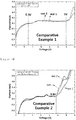
- the voltage stability of the polymer solid electrolytes prepared in Examples 1 to 2 and Comparative Examples 1 to 2 was evaluated using a linear sweep voltammetry (LSV), and BioLogic company VMP3 was used.
- LSV linear sweep voltammetry
- BioLogic company VMP3 BioLogic company VMP3 was used.
- One side of each of the polymer electrolytes in the Examples and Comparative Examples was brought into contact with a lithium metal electrode and the other side was brought into contact with a SUS substrate, thereby forming a coin cell.
- the voltage stability was measured in the range of -1 V to 6 V with a scanning speed of 10 mV/s
- the polymer electrolyte film which was fabricated into a multi-layer form using two films, showed stable characteristics at voltage from 0.5V to 5V.
- the electrolyte layer of Comparative Example 1 was stable at 5V or more but was unstable in a low voltage region of 1.5V or less.
- FIG. 6 in the case of Comparative Example 2, it was stable in the low voltage range of 1.5V or less, but it was unstable at 3.8V or more.
- the polymer electrolyte having the multi-layer structure according to the present invention can be used stably on the positive electrode in the high voltage region and on the negative electrode in the low voltage region, and an all solid-state battery including the same are available as a high capacity and high-power battery in a variety of technical fields.
Landscapes
- Chemical & Material Sciences (AREA)
- General Chemical & Material Sciences (AREA)
- Chemical Kinetics & Catalysis (AREA)
- Electrochemistry (AREA)
- Engineering & Computer Science (AREA)
- Manufacturing & Machinery (AREA)
- General Physics & Mathematics (AREA)
- Condensed Matter Physics & Semiconductors (AREA)
- Inorganic Chemistry (AREA)
- Physics & Mathematics (AREA)
- Materials Engineering (AREA)
- Dispersion Chemistry (AREA)
- Secondary Cells (AREA)
- Conductive Materials (AREA)
Priority Applications (1)
| Application Number | Priority Date | Filing Date | Title |
|---|---|---|---|
| PL18811698T PL3457486T3 (pl) | 2017-06-20 | 2018-05-30 | Wielowarstwowy polimerowy stały elektrolit i zawierająca go bateria całkowicie półprzewodnikowa |
Applications Claiming Priority (3)
| Application Number | Priority Date | Filing Date | Title |
|---|---|---|---|
| KR20170077792 | 2017-06-20 | ||
| KR1020180059591A KR102093970B1 (ko) | 2017-06-20 | 2018-05-25 | 다층 구조 고분자 고체 전해질 및 이를 포함하는 전고체 전지 |
| PCT/KR2018/006146 WO2018236064A1 (ko) | 2017-06-20 | 2018-05-30 | 다층 구조 고분자 고체 전해질 및 이를 포함하는 전고체 전지 |
Publications (3)
| Publication Number | Publication Date |
|---|---|
| EP3457486A1 EP3457486A1 (en) | 2019-03-20 |
| EP3457486A4 EP3457486A4 (en) | 2019-08-28 |
| EP3457486B1 true EP3457486B1 (en) | 2021-06-30 |
Family
ID=65008862
Family Applications (1)
| Application Number | Title | Priority Date | Filing Date |
|---|---|---|---|
| EP18811698.2A Active EP3457486B1 (en) | 2017-06-20 | 2018-05-30 | Multilayer polymer solid electrolyte and all-solid-state battery comprising same |
Country Status (6)
| Country | Link |
|---|---|
| US (1) | US10903520B2 (pl) |
| EP (1) | EP3457486B1 (pl) |
| JP (1) | JP6872096B2 (pl) |
| KR (1) | KR102093970B1 (pl) |
| CN (2) | CN116315072A (pl) |
| PL (1) | PL3457486T3 (pl) |
Families Citing this family (37)
| Publication number | Priority date | Publication date | Assignee | Title |
|---|---|---|---|---|
| US11515556B1 (en) * | 2018-01-22 | 2022-11-29 | North Carolina Agricultural And Technical State University | Solid electrolyte membrane and use thereof in batteries |
| US12107216B2 (en) * | 2018-04-16 | 2024-10-01 | Industry—University Cooperation Foundation Hanyang University Erica Campus | Solid electrolyte, intermediate of solid electrolyte, secondary battery comprising the same, and method of fabricating the same |
| CN108963334B (zh) * | 2018-07-13 | 2020-06-23 | 周伟东 | 一种多层聚合物电解质以及电池 |
| CN109768318A (zh) * | 2019-03-12 | 2019-05-17 | 浙江锋锂新能源科技有限公司 | 一种混合固液电解质锂蓄电池 |
| EP3767728A1 (fr) * | 2019-07-19 | 2021-01-20 | Total Se | Electrolyte polymère solide comprenant un carbonate de polyalcène |
| US12489138B2 (en) * | 2019-10-15 | 2025-12-02 | Industry-University Cooperation Foundation Hanyang University Erica Campus | Intermediate product of solid electrolyte, solid electrolyte using same, secondary battery including same, and method for manufacturing same |
| EP4047683A4 (en) | 2019-10-15 | 2024-03-13 | Industry-University Cooperation Foundation Hanyang University ERICA Campus | Intermediate product of electrode, electrode powder, electrode using same, electrode pellet using same and method for producing each thereof |
| KR102779843B1 (ko) | 2019-11-15 | 2025-03-10 | 주식회사 엘지에너지솔루션 | 전고체 전지용 전해질막 및 이를 포함하는 전고체 전지 |
| KR20210079084A (ko) | 2019-12-19 | 2021-06-29 | 주식회사 엘지에너지솔루션 | 이차전지 및 그의 제조방법 |
| KR20210082575A (ko) | 2019-12-26 | 2021-07-06 | 현대자동차주식회사 | 리튬 이온 전도성이 있는 전고체 전지용 바인더 용액 및 이를 포함하는 전극 슬러리 |
| JP7549320B2 (ja) * | 2020-03-04 | 2024-09-11 | 国立大学法人静岡大学 | 固体電解質、二次電池及びキャパシタ |
| KR102426532B1 (ko) * | 2020-03-24 | 2022-07-29 | 연세대학교 산학협력단 | 고체전해질용 첨가제, 이를 포함하는 고체전해질 조성물 및 이를 이용한 고체전해질의 제조방법 |
| JP6916337B1 (ja) * | 2020-03-27 | 2021-08-11 | 第一工業製薬株式会社 | リチウムイオン二次電池 |
| CN111525179A (zh) * | 2020-04-27 | 2020-08-11 | 长沙矿冶研究院有限责任公司 | 一种全固态电池的制备方法 |
| CN111933999B (zh) * | 2020-09-15 | 2021-03-26 | 江苏时代新能源科技有限公司 | 一种固态电池、电池模组、电池包及其相关的装置 |
| CN112366293A (zh) * | 2020-11-10 | 2021-02-12 | 广东天劲新能源科技股份有限公司 | 一种固态金属锂电池及其制备方法 |
| JPWO2022102767A1 (pl) * | 2020-11-16 | 2022-05-19 | ||
| CN112701347B (zh) * | 2020-12-25 | 2023-01-24 | 珠海冠宇电池股份有限公司 | 一种电化学装置及电子设备 |
| CN112687960A (zh) * | 2020-12-28 | 2021-04-20 | 浙江省科创新材料研究院 | 一种利用锌盐稳定固态电解质/金属负极界面的方法 |
| CN112803066A (zh) * | 2021-01-05 | 2021-05-14 | 青岛大学 | 一种基于多层组合电解质的固态锂金属电池及其制备方法 |
| CN112952191B (zh) * | 2021-02-26 | 2024-09-10 | 南开大学 | 一种高性能的单离子聚合物固态电解质的制备及其应用 |
| CN113013481B (zh) * | 2021-03-10 | 2022-12-06 | 昆山宝创新能源科技有限公司 | 全固态电池及其制备方法 |
| CN113299985A (zh) * | 2021-05-20 | 2021-08-24 | 杭州阳名新能源设备科技有限公司 | 一种丁二腈基双层复合聚合物电解质制备方法及其应用 |
| CN113764615B (zh) * | 2021-09-09 | 2023-06-16 | 珠海冠宇电池股份有限公司 | 一种正极及含有该正极的电化学装置 |
| KR102839858B1 (ko) * | 2021-10-06 | 2025-07-29 | 주식회사 엘지에너지솔루션 | 겔 폴리머 전해질을 포함하는 이차 전지, 및 이의 제조 방법 |
| CN114497718A (zh) * | 2021-12-29 | 2022-05-13 | 哈尔滨工业大学(深圳) | 一种室温工作的耐高压聚合物电解质及其制备方法与电池 |
| CN114335716B (zh) | 2021-12-31 | 2024-12-10 | 北京卫蓝新能源科技股份有限公司 | 一种具有多层结构电解质的原位聚合固态电池及其制备方法 |
| KR102787981B1 (ko) | 2022-02-09 | 2025-03-27 | 한국화학연구원 | 무기 입자의 함량이 조절된 다층 구조의 유무기 하이브리드 고분자 전해질, 이의 제조방법 및 이를 포함하는 전고체 전지 |
| KR102761691B1 (ko) | 2022-02-09 | 2025-02-03 | 한국화학연구원 | 공유결합성 유기 골격체의 함량이 조절된 다층 구조의 고분자 전해질, 이의 제조방법 및 이를 포함하는 전고체 전지 |
| CN114552025B (zh) * | 2022-02-18 | 2023-12-22 | 中国地质大学(武汉) | 一种固态电解质及其制备方法、全固态锂金属电池 |
| CN115189016A (zh) * | 2022-06-10 | 2022-10-14 | 清陶(昆山)能源发展股份有限公司 | 一种复合型电解质及其制备方法、锂离子电池 |
| CN115117440B (zh) * | 2022-07-20 | 2024-08-02 | 哈尔滨工业大学 | 一种氧化物固态电解质片及其制备方法与应用 |
| KR20240081211A (ko) * | 2022-11-30 | 2024-06-07 | 롯데케미칼 주식회사 | 리튬 이차 전지 |
| CN117551244A (zh) * | 2023-02-16 | 2024-02-13 | 吉林省翰驰科技有限公司 | 一种嵌段聚合物及其制备方法和应用、固态电解质及其应用 |
| CN119695301B (zh) * | 2023-09-25 | 2025-11-21 | 中国科学院大连化学物理研究所 | 一种凝胶电解质及其制备方法和应用 |
| KR20250091868A (ko) * | 2023-12-14 | 2025-06-23 | 삼성에스디아이 주식회사 | 전고체 전지 및 이의 제조 방법 |
| KR20250151681A (ko) * | 2024-04-12 | 2025-10-22 | 삼성에스디아이 주식회사 | 전고체 전지 및 이의 제조방법 |
Family Cites Families (25)
| Publication number | Priority date | Publication date | Assignee | Title |
|---|---|---|---|---|
| JP3507926B2 (ja) * | 1995-02-16 | 2004-03-15 | ソニー株式会社 | 固体型電池 |
| WO2002061872A1 (en) | 2001-01-31 | 2002-08-08 | Korea Institute Of Science And Technology | A multi-layered polymer electrolyte and lithium secondary battery comprising the same |
| JP3962806B2 (ja) | 2002-05-16 | 2007-08-22 | 独立行政法人産業技術総合研究所 | 常温溶融塩及び常温溶融塩を用いたリチウム二次電池 |
| KR100490642B1 (ko) | 2002-09-30 | 2005-05-19 | 한국과학기술연구원 | 다층 구조의 고분자 전해질 및 이를 포함하는 리튬이차전지 |
| US9368775B2 (en) * | 2004-02-06 | 2016-06-14 | Polyplus Battery Company | Protected lithium electrodes having porous ceramic separators, including an integrated structure of porous and dense Li ion conducting garnet solid electrolyte layers |
| US8039160B2 (en) | 2004-07-14 | 2011-10-18 | Arkema Inc. | Multi-layer polyelectrolyte membrane |
| JP5032773B2 (ja) | 2006-02-03 | 2012-09-26 | 第一工業製薬株式会社 | イオン性液体を用いたリチウム二次電池 |
| CN100478390C (zh) | 2007-04-18 | 2009-04-15 | 北京科技大学 | 一种复合型聚合物电解质材料及其制备方法 |
| EP2246923A1 (en) * | 2009-02-13 | 2010-11-03 | Panasonic Corporation | Anode for nonaqueous electrolyte secondary battery and nonaqueous electrolyte secondary battery |
| WO2011024837A1 (ja) * | 2009-08-28 | 2011-03-03 | 株式会社エクォス・リサーチ | リチウムイオン電池用電解液 |
| KR101311494B1 (ko) | 2010-06-14 | 2013-09-25 | 주식회사 엘지화학 | 전기화학소자용 전해질, 그 제조방법 및 이를 구비한 전기화학소자 |
| JP5765835B2 (ja) | 2011-06-30 | 2015-08-19 | エルジー ケム. エルティーディ. | 新規なポリマー電解質及びそれを含むリチウム二次電池 |
| WO2013059769A1 (en) | 2011-10-20 | 2013-04-25 | The University Of Akron | Stretchable, solvent free, completely amorphous solid electrolyte films |
| KR101440829B1 (ko) * | 2013-01-08 | 2014-09-17 | 전남대학교산학협력단 | 열안정성 및 계면안정성이 향상된 고분자 전해질 복합막 및 상기 고분자 전해질 복합막을 포함하는 에너지저장장치 |
| KR101622355B1 (ko) | 2014-07-28 | 2016-05-18 | 울산과학기술원 | 고체전해질 복합체, 이의 제조방법, 및 이를 포함하는 전고체전지 |
| KR101747864B1 (ko) | 2014-08-28 | 2017-06-27 | 삼성전자주식회사 | 복합전해질 및 이를 포함하는 리튬전지 |
| HUE064081T2 (hu) * | 2014-08-28 | 2024-02-28 | Samsung Electronics Co Ltd | Kompozit elektrolit és az ezt tartalmazó lítium akkumulátor |
| EP3001495B1 (en) * | 2014-08-29 | 2018-06-06 | Samsung Electronics Co., Ltd. | Composite, method of preparing the composite, electrolyte comprising the composite, and lithium secondary battery comprising the electrolyte |
| KR102386841B1 (ko) * | 2014-12-19 | 2022-04-14 | 삼성전자주식회사 | 복합전해질 및 이를 포함하는 리튬전지 |
| KR20160077962A (ko) | 2014-12-24 | 2016-07-04 | 솔브레인 주식회사 | 고분자 전해질 조성물 및 이를 이용한 리튬 이차 전지 |
| CN104681865B (zh) * | 2015-01-23 | 2017-07-11 | 清华大学深圳研究生院 | 一种全固态聚合物电解质及其在电池中的应用 |
| US10573933B2 (en) * | 2015-05-15 | 2020-02-25 | Samsung Electronics Co., Ltd. | Lithium metal battery |
| FR3040550B1 (fr) | 2015-08-25 | 2017-08-11 | Commissariat Energie Atomique | Batterie au lithium-ion gelifiee |
| EP3136475B1 (en) * | 2015-08-31 | 2021-09-22 | Samsung Electronics Co., Ltd. | Lithium metal battery |
| EP3285324B1 (en) | 2015-10-30 | 2020-01-01 | LG Chem, Ltd. | Polymer electrolyte having multi-layer structure, and all-solid battery comprising same |
-
2018
- 2018-05-25 KR KR1020180059591A patent/KR102093970B1/ko active Active
- 2018-05-30 PL PL18811698T patent/PL3457486T3/pl unknown
- 2018-05-30 JP JP2018563098A patent/JP6872096B2/ja active Active
- 2018-05-30 US US16/305,163 patent/US10903520B2/en active Active
- 2018-05-30 CN CN202310374695.9A patent/CN116315072A/zh active Pending
- 2018-05-30 CN CN201880003128.XA patent/CN109565078A/zh active Pending
- 2018-05-30 EP EP18811698.2A patent/EP3457486B1/en active Active
Also Published As
| Publication number | Publication date |
|---|---|
| JP6872096B2 (ja) | 2021-05-26 |
| PL3457486T3 (pl) | 2021-11-08 |
| EP3457486A4 (en) | 2019-08-28 |
| US10903520B2 (en) | 2021-01-26 |
| KR20180138134A (ko) | 2018-12-28 |
| EP3457486A1 (en) | 2019-03-20 |
| CN109565078A (zh) | 2019-04-02 |
| US20200235427A1 (en) | 2020-07-23 |
| JP2019521475A (ja) | 2019-07-25 |
| CN116315072A (zh) | 2023-06-23 |
| KR102093970B1 (ko) | 2020-04-23 |
Similar Documents
| Publication | Publication Date | Title |
|---|---|---|
| EP3457486B1 (en) | Multilayer polymer solid electrolyte and all-solid-state battery comprising same | |
| Xu et al. | Overcoming the challenges of 5 V spinel LiNi0. 5Mn1. 5O4 cathodes with solid polymer electrolytes | |
| KR102571111B1 (ko) | 리튬 2차 전지용 하이브리드 고상 전해질 | |
| DE102020129335B4 (de) | Verfahren zur lithiierung elektroaktiver materialien | |
| Li et al. | Developments of electrolyte systems for lithium–sulfur batteries: A review | |
| CN104160544B (zh) | 用于宽温操作的可充电锂电池 | |
| CN104471780B (zh) | 锂二次电池 | |
| EP3518333B1 (en) | Hybrid solid electrolyte for secondary battery | |
| KR101667520B1 (ko) | 무기물 코팅층을 포함하는 전극조립체 및 이를 포함하는 이차전지 | |
| KR20180036650A (ko) | 고체 중합체 전해질을 갖는 리튬 금속 배터리 | |
| KR20210049114A (ko) | 재충전가능 리튬 배터리들용 고체 중합체 매트릭스 전해질 (pme), 및 그를 사용하여 제조된 배터리들 | |
| US20170092975A1 (en) | Composite electrolyte film, electrochemical cell including the composite electrolyte film, and method of preparing the composite electrolyte film | |
| WO2018002296A1 (en) | Method of forming a secondary battery | |
| CN107452510A (zh) | 包含具有改进导电性的电解质组合物的混合型超级电容器 | |
| KR101944320B1 (ko) | 자성 물질을 포함하는 이차전지용 바인더 | |
| De Luna et al. | All-solid lithium-sulfur batteries: Present situation and future progress | |
| Kelchtermans et al. | Polymeric backbone eutectogel electrolytes for high-energy lithium-ion batteries | |
| KR20210120187A (ko) | 복합 양극재 및 이를 포함하는 이차전지 양극 및 이의 제조방법 | |
| US10153097B2 (en) | Electrolyte additive for hybrid supercapacitors to reduce charge transfer resistance, and hybrid supercapacitor including the same | |
| EP4325618A1 (en) | Method for preparing polymer solid electrolyte and polymer solid electrolyte prepared thereby | |
| KR101209867B1 (ko) | 수명 특성 및 저온 특성이 향상된 전해액 및 이를 포함하는 전기화학소자 | |
| KR101656082B1 (ko) | 전극의 구성이 상이한 단위셀들을 포함하고 있는 전지셀 | |
| JP7404071B2 (ja) | 固体電解質組成物、固体電解質含有シート及び全固体二次電池並びに固体電解質含有シート及び全固体二次電池の製造方法 | |
| JP6980256B2 (ja) | 電解液および当該電解液を用いた蓄電デバイス | |
| KR102958964B1 (ko) | 수계 전해질, 수계 전해질 복합체 및 이를 포함하는 이차 전지 |
Legal Events
| Date | Code | Title | Description |
|---|---|---|---|
| STAA | Information on the status of an ep patent application or granted ep patent |
Free format text: STATUS: UNKNOWN |
|
| STAA | Information on the status of an ep patent application or granted ep patent |
Free format text: STATUS: THE INTERNATIONAL PUBLICATION HAS BEEN MADE |
|
| PUAI | Public reference made under article 153(3) epc to a published international application that has entered the european phase |
Free format text: ORIGINAL CODE: 0009012 |
|
| STAA | Information on the status of an ep patent application or granted ep patent |
Free format text: STATUS: REQUEST FOR EXAMINATION WAS MADE |
|
| 17P | Request for examination filed |
Effective date: 20181213 |
|
| AK | Designated contracting states |
Kind code of ref document: A1 Designated state(s): AL AT BE BG CH CY CZ DE DK EE ES FI FR GB GR HR HU IE IS IT LI LT LU LV MC MK MT NL NO PL PT RO RS SE SI SK SM TR |
|
| AX | Request for extension of the european patent |
Extension state: BA ME |
|
| A4 | Supplementary search report drawn up and despatched |
Effective date: 20190726 |
|
| RIC1 | Information provided on ipc code assigned before grant |
Ipc: H01M 10/052 20100101ALI20190722BHEP Ipc: H01M 10/0565 20100101AFI20190722BHEP |
|
| STAA | Information on the status of an ep patent application or granted ep patent |
Free format text: STATUS: EXAMINATION IS IN PROGRESS |
|
| 17Q | First examination report despatched |
Effective date: 20191107 |
|
| DAV | Request for validation of the european patent (deleted) | ||
| DAX | Request for extension of the european patent (deleted) | ||
| GRAP | Despatch of communication of intention to grant a patent |
Free format text: ORIGINAL CODE: EPIDOSNIGR1 |
|
| STAA | Information on the status of an ep patent application or granted ep patent |
Free format text: STATUS: GRANT OF PATENT IS INTENDED |
|
| INTG | Intention to grant announced |
Effective date: 20210324 |
|
| GRAS | Grant fee paid |
Free format text: ORIGINAL CODE: EPIDOSNIGR3 |
|
| GRAA | (expected) grant |
Free format text: ORIGINAL CODE: 0009210 |
|
| STAA | Information on the status of an ep patent application or granted ep patent |
Free format text: STATUS: THE PATENT HAS BEEN GRANTED |
|
| AK | Designated contracting states |
Kind code of ref document: B1 Designated state(s): AL AT BE BG CH CY CZ DE DK EE ES FI FR GB GR HR HU IE IS IT LI LT LU LV MC MK MT NL NO PL PT RO RS SE SI SK SM TR |
|
| REG | Reference to a national code |
Ref country code: CH Ref legal event code: EP |
|
| REG | Reference to a national code |
Ref country code: DE Ref legal event code: R096 Ref document number: 602018019497 Country of ref document: DE Ref country code: AT Ref legal event code: REF Ref document number: 1407193 Country of ref document: AT Kind code of ref document: T Effective date: 20210715 |
|
| REG | Reference to a national code |
Ref country code: IE Ref legal event code: FG4D |
|
| REG | Reference to a national code |
Ref country code: SE Ref legal event code: TRGR |
|
| REG | Reference to a national code |
Ref country code: LT Ref legal event code: MG9D |
|
| PG25 | Lapsed in a contracting state [announced via postgrant information from national office to epo] |
Ref country code: BG Free format text: LAPSE BECAUSE OF FAILURE TO SUBMIT A TRANSLATION OF THE DESCRIPTION OR TO PAY THE FEE WITHIN THE PRESCRIBED TIME-LIMIT Effective date: 20210930 Ref country code: FI Free format text: LAPSE BECAUSE OF FAILURE TO SUBMIT A TRANSLATION OF THE DESCRIPTION OR TO PAY THE FEE WITHIN THE PRESCRIBED TIME-LIMIT Effective date: 20210630 Ref country code: HR Free format text: LAPSE BECAUSE OF FAILURE TO SUBMIT A TRANSLATION OF THE DESCRIPTION OR TO PAY THE FEE WITHIN THE PRESCRIBED TIME-LIMIT Effective date: 20210630 |
|
| REG | Reference to a national code |
Ref country code: NL Ref legal event code: MP Effective date: 20210630 |
|
| REG | Reference to a national code |
Ref country code: AT Ref legal event code: MK05 Ref document number: 1407193 Country of ref document: AT Kind code of ref document: T Effective date: 20210630 |
|
| PG25 | Lapsed in a contracting state [announced via postgrant information from national office to epo] |
Ref country code: NO Free format text: LAPSE BECAUSE OF FAILURE TO SUBMIT A TRANSLATION OF THE DESCRIPTION OR TO PAY THE FEE WITHIN THE PRESCRIBED TIME-LIMIT Effective date: 20210930 Ref country code: LV Free format text: LAPSE BECAUSE OF FAILURE TO SUBMIT A TRANSLATION OF THE DESCRIPTION OR TO PAY THE FEE WITHIN THE PRESCRIBED TIME-LIMIT Effective date: 20210630 Ref country code: RS Free format text: LAPSE BECAUSE OF FAILURE TO SUBMIT A TRANSLATION OF THE DESCRIPTION OR TO PAY THE FEE WITHIN THE PRESCRIBED TIME-LIMIT Effective date: 20210630 Ref country code: GR Free format text: LAPSE BECAUSE OF FAILURE TO SUBMIT A TRANSLATION OF THE DESCRIPTION OR TO PAY THE FEE WITHIN THE PRESCRIBED TIME-LIMIT Effective date: 20211001 |
|
| RAP2 | Party data changed (patent owner data changed or rights of a patent transferred) |
Owner name: LG ENERGY SOLUTION LTD. |
|
| PG25 | Lapsed in a contracting state [announced via postgrant information from national office to epo] |
Ref country code: RO Free format text: LAPSE BECAUSE OF FAILURE TO SUBMIT A TRANSLATION OF THE DESCRIPTION OR TO PAY THE FEE WITHIN THE PRESCRIBED TIME-LIMIT Effective date: 20210630 Ref country code: PT Free format text: LAPSE BECAUSE OF FAILURE TO SUBMIT A TRANSLATION OF THE DESCRIPTION OR TO PAY THE FEE WITHIN THE PRESCRIBED TIME-LIMIT Effective date: 20211102 Ref country code: NL Free format text: LAPSE BECAUSE OF FAILURE TO SUBMIT A TRANSLATION OF THE DESCRIPTION OR TO PAY THE FEE WITHIN THE PRESCRIBED TIME-LIMIT Effective date: 20210630 Ref country code: SM Free format text: LAPSE BECAUSE OF FAILURE TO SUBMIT A TRANSLATION OF THE DESCRIPTION OR TO PAY THE FEE WITHIN THE PRESCRIBED TIME-LIMIT Effective date: 20210630 Ref country code: CZ Free format text: LAPSE BECAUSE OF FAILURE TO SUBMIT A TRANSLATION OF THE DESCRIPTION OR TO PAY THE FEE WITHIN THE PRESCRIBED TIME-LIMIT Effective date: 20210630 Ref country code: AT Free format text: LAPSE BECAUSE OF FAILURE TO SUBMIT A TRANSLATION OF THE DESCRIPTION OR TO PAY THE FEE WITHIN THE PRESCRIBED TIME-LIMIT Effective date: 20210630 Ref country code: SK Free format text: LAPSE BECAUSE OF FAILURE TO SUBMIT A TRANSLATION OF THE DESCRIPTION OR TO PAY THE FEE WITHIN THE PRESCRIBED TIME-LIMIT Effective date: 20210630 Ref country code: EE Free format text: LAPSE BECAUSE OF FAILURE TO SUBMIT A TRANSLATION OF THE DESCRIPTION OR TO PAY THE FEE WITHIN THE PRESCRIBED TIME-LIMIT Effective date: 20210630 Ref country code: ES Free format text: LAPSE BECAUSE OF FAILURE TO SUBMIT A TRANSLATION OF THE DESCRIPTION OR TO PAY THE FEE WITHIN THE PRESCRIBED TIME-LIMIT Effective date: 20210630 |
|
| RAP4 | Party data changed (patent owner data changed or rights of a patent transferred) |
Owner name: LG ENERGY SOLUTION, LTD. |
|
| REG | Reference to a national code |
Ref country code: DE Ref legal event code: R097 Ref document number: 602018019497 Country of ref document: DE |
|
| PG25 | Lapsed in a contracting state [announced via postgrant information from national office to epo] |
Ref country code: DK Free format text: LAPSE BECAUSE OF FAILURE TO SUBMIT A TRANSLATION OF THE DESCRIPTION OR TO PAY THE FEE WITHIN THE PRESCRIBED TIME-LIMIT Effective date: 20210630 |
|
| PLBE | No opposition filed within time limit |
Free format text: ORIGINAL CODE: 0009261 |
|
| STAA | Information on the status of an ep patent application or granted ep patent |
Free format text: STATUS: NO OPPOSITION FILED WITHIN TIME LIMIT |
|
| PG25 | Lapsed in a contracting state [announced via postgrant information from national office to epo] |
Ref country code: AL Free format text: LAPSE BECAUSE OF FAILURE TO SUBMIT A TRANSLATION OF THE DESCRIPTION OR TO PAY THE FEE WITHIN THE PRESCRIBED TIME-LIMIT Effective date: 20210630 |
|
| 26N | No opposition filed |
Effective date: 20220331 |
|
| PG25 | Lapsed in a contracting state [announced via postgrant information from national office to epo] |
Ref country code: IT Free format text: LAPSE BECAUSE OF FAILURE TO SUBMIT A TRANSLATION OF THE DESCRIPTION OR TO PAY THE FEE WITHIN THE PRESCRIBED TIME-LIMIT Effective date: 20210630 |
|
| REG | Reference to a national code |
Ref country code: CH Ref legal event code: PL |
|
| REG | Reference to a national code |
Ref country code: BE Ref legal event code: MM Effective date: 20220531 |
|
| PG25 | Lapsed in a contracting state [announced via postgrant information from national office to epo] |
Ref country code: MC Free format text: LAPSE BECAUSE OF FAILURE TO SUBMIT A TRANSLATION OF THE DESCRIPTION OR TO PAY THE FEE WITHIN THE PRESCRIBED TIME-LIMIT Effective date: 20210630 Ref country code: LU Free format text: LAPSE BECAUSE OF NON-PAYMENT OF DUE FEES Effective date: 20220530 Ref country code: LI Free format text: LAPSE BECAUSE OF NON-PAYMENT OF DUE FEES Effective date: 20220531 Ref country code: CH Free format text: LAPSE BECAUSE OF NON-PAYMENT OF DUE FEES Effective date: 20220531 |
|
| PG25 | Lapsed in a contracting state [announced via postgrant information from national office to epo] |
Ref country code: LT Free format text: LAPSE BECAUSE OF FAILURE TO SUBMIT A TRANSLATION OF THE DESCRIPTION OR TO PAY THE FEE WITHIN THE PRESCRIBED TIME-LIMIT Effective date: 20210630 Ref country code: IE Free format text: LAPSE BECAUSE OF NON-PAYMENT OF DUE FEES Effective date: 20220530 |
|
| REG | Reference to a national code |
Ref country code: DE Ref legal event code: R081 Ref document number: 602018019497 Country of ref document: DE Owner name: LG ENERGY SOLUTION, LTD., KR Free format text: FORMER OWNER: LG CHEM, LTD., SEOUL, KR |
|
| PG25 | Lapsed in a contracting state [announced via postgrant information from national office to epo] |
Ref country code: BE Free format text: LAPSE BECAUSE OF NON-PAYMENT OF DUE FEES Effective date: 20220531 |
|
| P01 | Opt-out of the competence of the unified patent court (upc) registered |
Effective date: 20230408 |
|
| REG | Reference to a national code |
Ref country code: GB Ref legal event code: 732E Free format text: REGISTERED BETWEEN 20230901 AND 20230906 |
|
| PG25 | Lapsed in a contracting state [announced via postgrant information from national office to epo] |
Ref country code: HU Free format text: LAPSE BECAUSE OF FAILURE TO SUBMIT A TRANSLATION OF THE DESCRIPTION OR TO PAY THE FEE WITHIN THE PRESCRIBED TIME-LIMIT; INVALID AB INITIO Effective date: 20180530 |
|
| PG25 | Lapsed in a contracting state [announced via postgrant information from national office to epo] |
Ref country code: MK Free format text: LAPSE BECAUSE OF FAILURE TO SUBMIT A TRANSLATION OF THE DESCRIPTION OR TO PAY THE FEE WITHIN THE PRESCRIBED TIME-LIMIT Effective date: 20210630 Ref country code: CY Free format text: LAPSE BECAUSE OF FAILURE TO SUBMIT A TRANSLATION OF THE DESCRIPTION OR TO PAY THE FEE WITHIN THE PRESCRIBED TIME-LIMIT Effective date: 20210630 |
|
| PG25 | Lapsed in a contracting state [announced via postgrant information from national office to epo] |
Ref country code: MT Free format text: LAPSE BECAUSE OF FAILURE TO SUBMIT A TRANSLATION OF THE DESCRIPTION OR TO PAY THE FEE WITHIN THE PRESCRIBED TIME-LIMIT Effective date: 20210630 |
|
| PGFP | Annual fee paid to national office [announced via postgrant information from national office to epo] |
Ref country code: PL Payment date: 20250423 Year of fee payment: 8 Ref country code: DE Payment date: 20250422 Year of fee payment: 8 |
|
| PGFP | Annual fee paid to national office [announced via postgrant information from national office to epo] |
Ref country code: FR Payment date: 20250422 Year of fee payment: 8 |
|
| PGFP | Annual fee paid to national office [announced via postgrant information from national office to epo] |
Ref country code: SE Payment date: 20250422 Year of fee payment: 8 |
|
| PG25 | Lapsed in a contracting state [announced via postgrant information from national office to epo] |
Ref country code: TR Free format text: LAPSE BECAUSE OF FAILURE TO SUBMIT A TRANSLATION OF THE DESCRIPTION OR TO PAY THE FEE WITHIN THE PRESCRIBED TIME-LIMIT Effective date: 20210630 |
|
| PGFP | Annual fee paid to national office [announced via postgrant information from national office to epo] |
Ref country code: GB Payment date: 20260324 Year of fee payment: 9 |