EP3287506A1 - Phenanthren-derivate - Google Patents
Phenanthren-derivate Download PDFInfo
- Publication number
- EP3287506A1 EP3287506A1 EP17194878.9A EP17194878A EP3287506A1 EP 3287506 A1 EP3287506 A1 EP 3287506A1 EP 17194878 A EP17194878 A EP 17194878A EP 3287506 A1 EP3287506 A1 EP 3287506A1
- Authority
- EP
- European Patent Office
- Prior art keywords
- atoms
- substituted
- radicals
- organic
- compounds according
- Prior art date
- Legal status (The legal status is an assumption and is not a legal conclusion. Google has not performed a legal analysis and makes no representation as to the accuracy of the status listed.)
- Granted
Links
- XXPBFNVKTVJZKF-UHFFFAOYSA-N C1c2ccccc2-c2ccccc2C1 Chemical compound C1c2ccccc2-c2ccccc2C1 XXPBFNVKTVJZKF-UHFFFAOYSA-N 0.000 description 1
- PJKDACKVBAGMSS-UHFFFAOYSA-N Cc1c(C)c(cc(B2OCCO2)cc2)c2c2c1cc(B1OCCO1)cc2 Chemical compound Cc1c(C)c(cc(B2OCCO2)cc2)c2c2c1cc(B1OCCO1)cc2 PJKDACKVBAGMSS-UHFFFAOYSA-N 0.000 description 1
Classifications
-
- C—CHEMISTRY; METALLURGY
- C09—DYES; PAINTS; POLISHES; NATURAL RESINS; ADHESIVES; COMPOSITIONS NOT OTHERWISE PROVIDED FOR; APPLICATIONS OF MATERIALS NOT OTHERWISE PROVIDED FOR
- C09K—MATERIALS FOR MISCELLANEOUS APPLICATIONS, NOT PROVIDED FOR ELSEWHERE
- C09K11/00—Luminescent materials, e.g. electroluminescent or chemiluminescent
- C09K11/06—Luminescent materials, e.g. electroluminescent or chemiluminescent containing organic luminescent materials
-
- H—ELECTRICITY
- H05—ELECTRIC TECHNIQUES NOT OTHERWISE PROVIDED FOR
- H05B—ELECTRIC HEATING; ELECTRIC LIGHT SOURCES NOT OTHERWISE PROVIDED FOR; CIRCUIT ARRANGEMENTS FOR ELECTRIC LIGHT SOURCES, IN GENERAL
- H05B33/00—Electroluminescent light sources
- H05B33/12—Light sources with substantially two-dimensional [2D] radiating surfaces
- H05B33/14—Light sources with substantially two-dimensional [2D] radiating surfaces characterised by the chemical or physical composition or the arrangement of the electroluminescent material, or by the simultaneous addition of the electroluminescent material in or onto the light source
-
- H—ELECTRICITY
- H10—SEMICONDUCTOR DEVICES; ELECTRIC SOLID-STATE DEVICES NOT OTHERWISE PROVIDED FOR
- H10K—ORGANIC ELECTRIC SOLID-STATE DEVICES
- H10K10/00—Organic devices specially adapted for rectifying, amplifying, oscillating or switching; Organic capacitors or resistors having potential barriers
-
- H—ELECTRICITY
- H10—SEMICONDUCTOR DEVICES; ELECTRIC SOLID-STATE DEVICES NOT OTHERWISE PROVIDED FOR
- H10K—ORGANIC ELECTRIC SOLID-STATE DEVICES
- H10K85/00—Organic materials used in the body or electrodes of devices covered by this subclass
- H10K85/60—Organic compounds having low molecular weight
- H10K85/615—Polycyclic condensed aromatic hydrocarbons, e.g. anthracene
-
- H—ELECTRICITY
- H10—SEMICONDUCTOR DEVICES; ELECTRIC SOLID-STATE DEVICES NOT OTHERWISE PROVIDED FOR
- H10K—ORGANIC ELECTRIC SOLID-STATE DEVICES
- H10K85/00—Organic materials used in the body or electrodes of devices covered by this subclass
- H10K85/60—Organic compounds having low molecular weight
- H10K85/615—Polycyclic condensed aromatic hydrocarbons, e.g. anthracene
- H10K85/626—Polycyclic condensed aromatic hydrocarbons, e.g. anthracene containing more than one polycyclic condensed aromatic rings, e.g. bis-anthracene
-
- H—ELECTRICITY
- H10—SEMICONDUCTOR DEVICES; ELECTRIC SOLID-STATE DEVICES NOT OTHERWISE PROVIDED FOR
- H10K—ORGANIC ELECTRIC SOLID-STATE DEVICES
- H10K50/00—Organic light-emitting devices
- H10K50/10—OLEDs or polymer light-emitting diodes [PLED]
- H10K50/11—OLEDs or polymer light-emitting diodes [PLED] characterised by the electroluminescent [EL] layers
-
- H—ELECTRICITY
- H10—SEMICONDUCTOR DEVICES; ELECTRIC SOLID-STATE DEVICES NOT OTHERWISE PROVIDED FOR
- H10K—ORGANIC ELECTRIC SOLID-STATE DEVICES
- H10K50/00—Organic light-emitting devices
- H10K50/10—OLEDs or polymer light-emitting diodes [PLED]
- H10K50/14—Carrier transporting layers
-
- H—ELECTRICITY
- H10—SEMICONDUCTOR DEVICES; ELECTRIC SOLID-STATE DEVICES NOT OTHERWISE PROVIDED FOR
- H10K—ORGANIC ELECTRIC SOLID-STATE DEVICES
- H10K85/00—Organic materials used in the body or electrodes of devices covered by this subclass
- H10K85/60—Organic compounds having low molecular weight
- H10K85/631—Amine compounds having at least two aryl rest on at least one amine-nitrogen atom, e.g. triphenylamine
-
- H—ELECTRICITY
- H10—SEMICONDUCTOR DEVICES; ELECTRIC SOLID-STATE DEVICES NOT OTHERWISE PROVIDED FOR
- H10K—ORGANIC ELECTRIC SOLID-STATE DEVICES
- H10K85/00—Organic materials used in the body or electrodes of devices covered by this subclass
- H10K85/60—Organic compounds having low molecular weight
- H10K85/631—Amine compounds having at least two aryl rest on at least one amine-nitrogen atom, e.g. triphenylamine
- H10K85/633—Amine compounds having at least two aryl rest on at least one amine-nitrogen atom, e.g. triphenylamine comprising polycyclic condensed aromatic hydrocarbons as substituents on the nitrogen atom
-
- H—ELECTRICITY
- H10—SEMICONDUCTOR DEVICES; ELECTRIC SOLID-STATE DEVICES NOT OTHERWISE PROVIDED FOR
- H10K—ORGANIC ELECTRIC SOLID-STATE DEVICES
- H10K85/00—Organic materials used in the body or electrodes of devices covered by this subclass
- H10K85/60—Organic compounds having low molecular weight
- H10K85/649—Aromatic compounds comprising a hetero atom
- H10K85/657—Polycyclic condensed heteroaromatic hydrocarbons
-
- H—ELECTRICITY
- H10—SEMICONDUCTOR DEVICES; ELECTRIC SOLID-STATE DEVICES NOT OTHERWISE PROVIDED FOR
- H10K—ORGANIC ELECTRIC SOLID-STATE DEVICES
- H10K85/00—Organic materials used in the body or electrodes of devices covered by this subclass
- H10K85/60—Organic compounds having low molecular weight
- H10K85/649—Aromatic compounds comprising a hetero atom
- H10K85/657—Polycyclic condensed heteroaromatic hydrocarbons
- H10K85/6572—Polycyclic condensed heteroaromatic hydrocarbons comprising only nitrogen in the heteroaromatic polycondensed ring system, e.g. phenanthroline or carbazole
-
- Y—GENERAL TAGGING OF NEW TECHNOLOGICAL DEVELOPMENTS; GENERAL TAGGING OF CROSS-SECTIONAL TECHNOLOGIES SPANNING OVER SEVERAL SECTIONS OF THE IPC; TECHNICAL SUBJECTS COVERED BY FORMER USPC CROSS-REFERENCE ART COLLECTIONS [XRACs] AND DIGESTS
- Y02—TECHNOLOGIES OR APPLICATIONS FOR MITIGATION OR ADAPTATION AGAINST CLIMATE CHANGE
- Y02E—REDUCTION OF GREENHOUSE GAS [GHG] EMISSIONS, RELATED TO ENERGY GENERATION, TRANSMISSION OR DISTRIBUTION
- Y02E10/00—Energy generation through renewable energy sources
- Y02E10/50—Photovoltaic [PV] energy
- Y02E10/549—Organic PV cells
-
- Y—GENERAL TAGGING OF NEW TECHNOLOGICAL DEVELOPMENTS; GENERAL TAGGING OF CROSS-SECTIONAL TECHNOLOGIES SPANNING OVER SEVERAL SECTIONS OF THE IPC; TECHNICAL SUBJECTS COVERED BY FORMER USPC CROSS-REFERENCE ART COLLECTIONS [XRACs] AND DIGESTS
- Y02—TECHNOLOGIES OR APPLICATIONS FOR MITIGATION OR ADAPTATION AGAINST CLIMATE CHANGE
- Y02P—CLIMATE CHANGE MITIGATION TECHNOLOGIES IN THE PRODUCTION OR PROCESSING OF GOODS
- Y02P70/00—Climate change mitigation technologies in the production process for final industrial or consumer products
- Y02P70/50—Manufacturing or production processes characterised by the final manufactured product
-
- Y—GENERAL TAGGING OF NEW TECHNOLOGICAL DEVELOPMENTS; GENERAL TAGGING OF CROSS-SECTIONAL TECHNOLOGIES SPANNING OVER SEVERAL SECTIONS OF THE IPC; TECHNICAL SUBJECTS COVERED BY FORMER USPC CROSS-REFERENCE ART COLLECTIONS [XRACs] AND DIGESTS
- Y10—TECHNICAL SUBJECTS COVERED BY FORMER USPC
- Y10S—TECHNICAL SUBJECTS COVERED BY FORMER USPC CROSS-REFERENCE ART COLLECTIONS [XRACs] AND DIGESTS
- Y10S428/00—Stock material or miscellaneous articles
- Y10S428/917—Electroluminescent
Definitions
- the present invention describes phenanthrene compounds and their use in organic electroluminescent devices.
- OLEDs organic electroluminescent devices
- the general structure of such devices is for example in US 4539507 . US 5151629 . EP 0676461 and WO 98/27136 described.
- OLEDs-containing devices the market introduction has already taken place, such as the car radios of the company Pioneer, the mobile phones of the companies Pioneer and SNMD or a digital camera Kodak with "organic display” occupy. Other such products are about to be launched.
- anthracene derivatives for example 2-Dinaphthylanthracen ( US 5935721 ), known.
- Further anthracene derivatives which are suitable as host materials are, for example, in WO 04/013073 or in WO 04/018588 described.
- Host materials based on aryl-substituted pyrenes and chrysenes are used in WO 04/016575 described.
- This application includes in principle also corresponding anthracene and phenanthrene derivatives, but these are not described in the description, so that it is not obvious to the person skilled in the art which of these derivatives could be used profitably for this purpose.
- the host material used for the emitting dopant plays a crucial role in the properties of the organic electroluminescent device. Therefore, it should be possible to further improve the properties of the OLED by further optimization of the host material.
- these compounds are readily synthetically accessible on a large scale and, unlike many prior art phenanthrene derivatives, have good solubility in a wide range of organic solvents so that they are significantly easier to purify than prior art materials Technology.
- the substitution of the phenanthrene units in the 9- or 9,10-position and the attachment of the aryl substituents in the 2,7-position has surprisingly been found to be particularly suitable compared to the substitution in other positions of the phenanthrene unit.
- the phenanthrene skeleton and the numbering of the individual positions are shown below for the sake of clarity, as are the dihydrophenanthrene, dihydropyrene and tetrahydropyrene skeletons:
- JP 2001/332384 aryl-substituted phenanthrenes are described for use in OLEDs.
- 3,6,9,10-tetraphenyl-substituted phenanthrene are listed here, which are preferred over the compounds listed above by the substitution in the 9,10-position, but still the disadvantage of the 3,6-substitution and thereby have light blue emission.
- Phenanthrene derivatives are described for blue-emitting OLEDs, which fused in the 9,10-position containing a bicyclic aliphatic radical and which may also be substituted in the 2,7-position.
- these compounds have the disadvantage that the condensed bicyclic must be synthesized consuming.
- An aromatic ring system for the purposes of this invention contains 6 to 40 carbon atoms.
- a heteroatomatic ring system in the sense of this invention contains 2 to 40 C atoms and at least one heteroatom, preferably selected from N, O and / or S, the sum of the C atoms and heteroatoms being at least 5.
- An aromatic or heteroaromatic ring system in the sense of this invention is to be understood as meaning a system which is not necessarily only contains aromatic or heteroaromatic groups, but in which several aromatic or heteroaromatic groups by a short, non-aromatic moiety (less than 10% of the atoms other than H, preferably less than 5% of the atoms other than H), such as.
- B. an sp 3 -hybridized carbon atom may be interrupted.
- systems such as 9,9'-spirobifluorene, 9,9-diarylfluorene, etc. are to be understood as aromatic ring systems in the context of this application.
- aromatic ring systems are also simple or fused aromatics, such as phenyl, naphthyl, anthryl, etc., or linked aromatics, such as biphenyl, binaphthyl, etc.
- aromatic ring system is not intended to include a triarylamine group.
- a cyclic alkyl group is understood as meaning a monocyclic, bicyclic or polycyclic alkyl group.
- a C 1 - to C 40 -alkoxy group is particularly preferably understood as meaning methoxy, ethoxy, n-propoxy, isopropoxy, n-butoxy, isobutoxy, s-butoxy, t-butoxy or 2-methylbutoxy.
- An aromatic or heteroaromatic ring system having 5-40 aromatic ring atoms, which may be substituted in each case by the abovementioned radicals R and which may be linked via any position on the aromatic or heteroaromatic radical is understood in particular to mean groups which are derived from benzene, Naphthalene, anthracene, phenanthrene, pyrene, chrysene, perylene, fluoranthene, naphthacene, pentacene, benzpyrene, biphenyl, biphenylene, terphenyl, terphenyls, fluorene, spirobifluorene, dihydrophenanthrene, dihydropyrene, tetrahydropyrene, cis- or trans-indenofluorene, truxene, isotruxene, spirotruxene , Spiroisotruxene, furan, benzofuran, isobenzofuran,
- radicals R 5 to R 10 in formula (1) can also together form another aliphatic ring system. This applies in particular to the substituents R 7 and R 8 , which lead to the formation of a further 6-ring system for the formation of a dihydropyrene system or tetrahydropyrene system.
- R 1 and R 3 identical or different at each occurrence H, F, a straight chain alkyl chain having 1 to 10 carbon atoms or a branched or cyclic alkyl chain having 3 to 10 carbon atoms, each by R 11 may be substituted, in which also one or more H atoms may be replaced by F, Cl, Br, I or CN, or an aromatic or heteroaromatic ring system having 5 to 40 aromatic ring atoms, which is also replaced by one or more radicals R 11 may be substituted; with the proviso that at least one of the two radicals R 1 and R 3 is not H.
- R 1 and R 3 are same or different at each occurrence F, a straight-chain alkyl chain having 1 to 4 carbon atoms or a branched alkyl chain having 3 or 4 carbon atoms, in which also one or more H atoms by F or CN may be replaced, or an aromatic or heteroaromatic ring system having 6 to 25 aromatic ring atoms, which may also be substituted by one or more radicals R 11 .
- R 2 and R 4 are the preferred R 1 ; or R 2 and R 4 are not substituents, but together form a ⁇ -bond, so that instead of the dihydrophenanthrene system, a phenanthrene system results; especially Preferably, R 2 and R 4 together form a ⁇ bond, resulting in a phenanthrene system.
- R 5, R 6, R 7, R 8, R 9 and R 10 are the same or different at each occurrence, H, F, a straight-chain alkyl chain having 1 to 40 carbon atoms, preferably having 1 to 10 carbon atoms or a branched or cyclic alkyl chain having 3 to 40 carbon atoms, preferably having 3 to 10 carbon atoms, each of which may be substituted by R 11 , in which also one or more H atoms may be replaced by F, or a aromatic or heteroaromatic ring system having 5 to 40 aromatic ring atoms, which may also be substituted by one or more radicals R 11 ; two or more radicals R 5 to R 10 may together also form a further mono- or polycyclic, aliphatic ring system.
- R 5 , R 6 , R 7 , R 8 , R 9 and R 10 are the same or different each occurrence of H or F, or positions R 7 and R 8 are represented by a C (R 11 ) 2 -C (R 11 ) 2 chain bridged.
- Y is an aromatic or heteroaromatic ring system having 6 to 30 carbon atoms, which may be substituted or unsubstituted by one or more radicals R 11 ;
- Y is particularly preferably, identical or different at each occurrence, an aromatic or heteroaromatic ring system having 10 to 25 carbon atoms, which may be substituted or unsubstituted by one or more radicals R 11 .
- the index m is preferably 1, 2 or 3, particularly preferably 1 or 2, very particularly preferably 1.
- At least one of the substituents Y contains at least one condensed polycyclic aromatic ring system, in particular naphthalene, anthracene, phenanthrene, pyrene, dihydropyrene, chrysene, naphthacene, pentacene or perylene, very particularly preferably naphthalene, anthracene, phenanthrene or Pyrene, or at least one azaheterocycle, in particular pyridine, pyrazine, pyrimidine, pyridazine, quinoline, isoquinoline, quinoxaline or phenanthroline.
- condensed polycyclic aromatic ring system in particular naphthalene, anthracene, phenanthrene, pyrene, dihydropyrene, chrysene, naphthacene, pentacene or perylene, very particularly preferably naphthalene, anthracene, phenant
- the index m is preferably 1 or 2.
- the index m may also be preferably 3 or 4.
- the compounds according to the invention can be prepared from the corresponding known 2,7-dibromophenanthrene derivatives or the corresponding dihydrophenanthrene, dihydropyrene or tetrahydropyrene derivatives by metal-catalyzed coupling reactions, in particular Suzuki coupling, Hartwig-Buchwald coupling and Heck coupling.
- the synthesis of the dihydrophenanthrene precursors and the phenanthrene precursors is in WO 05/014689 and in the unpublished patent application DE 102004020298.2 described.
- Examples of preferred compounds according to formula (1) are the structures (1) to (24) depicted below.
- the compounds according to formula (1) are particularly suitable for use in organic electroluminescent devices.
- the compound is preferably used in the emitting layer, either as a host material together with a fluorescent or phosphorescent dopant or, in particular with suitable substitution, as a dopant together with a host material.
- the compound is also preferably used as hole transport material in a hole transport layer, in particular if at least one of the substituents represents a diarylamine group.
- the compound is also preferably used as an electron transport material in an electron transport layer, in particular if at least one of the substituents contains a fused and / or electron-poor aromatic or a carbonyl function, an SO 2 , an SO 2 or a phosphine oxide group.
- the compound according to the invention is furthermore preferably used as a hole-blocking material in a hole-blocking layer, in particular in phosphorescent electroluminescent devices.
- Another object of the present invention are therefore mixtures of a compound of formula (1) with a dopant, or from a compound according to formula (1) with a host material, wherein the dopant predominantly contributes to the emission.
- the dopant with which the compound of the formula (1) is mixed or the host material with which the compound of the formula (1) is mixed may also be polymeric.
- Another object of the invention is the use of compounds of formula (1) in organic electronic devices, in particular in organic electroluminescent devices, preferably as a host material or as an emitting material (dopant).
- the invention thus also relates to organic electronic devices, in particular organic electroluminescent devices, with one or more active layers, wherein at least one of these active layers contains one or more compounds according to formula (1).
- the active layer may, for example, be a light-emitting layer and / or a charge-transport layer and / or a charge-injection layer, but preferably a light-emitting layer.
- preferred dopants are organic or organometallic compounds whose emission is longer wavelength than that of the compound of formula (1).
- dopants may be selected which emit light from the singlet or from the triplet state.
- Particularly preferred dopants which emit light from the singlet state are compounds which simultaneously have one or more optionally substituted stilbene units and one or more triarylamine units.
- Particularly preferred dopants which emit light from the triplet state are ortho-metallated iridium complexes and platinum complexes.
- the proportion of the compound according to formula (1) in the mixture is between 1 and 99.9% by weight, preferably between 50 and 99.5% by weight, more preferably between 80 and 99% by weight, in particular between 90 and 99% by weight, if the compound of formula (1) is used as the host material.
- the proportion of the compound of the formula (1) in the mixture is between 0.1 and 99% by weight, preferably between 0.5 and 50% by weight, particularly preferably between 1 and 20% by weight, in particular between 1 and 10% by weight, when the compound according to formula (1) is used as dopant.
- the organic electroluminescent device also contains the anode and cathode in addition to the emitting layer and may also contain further layers. These may be, for example: hole injection layer, hole transport layer, hole blocking layer, electron transport layer and / or electron injection layer. However, it should be noted at this point that not necessarily each of these layers must be present.
- the organic electroluminescent device does not contain a separate hole blocking and / or electron transport layer and the emitting layer directly to the electron injection layer or to the cathode borders. It may likewise be preferred if the organic electroluminescent device does not contain a separate hole transport layer and the emitting layer directly adjoins the hole injection layer or the anode, in particular if the compound according to formula (1) is substituted by at least one diarylamino group. Furthermore, it may be preferred if compounds of the formula (1) are used in more than one layer. These may be the same or different compounds according to formula (1) in the different layers. Thus, for example, these compounds can be used not only in the emitting layer but also in the hole blocking layer or in the electron transport layer or, if appropriately substituted, also in the hole transport layer.
- an organic electroluminescent device characterized in that one or more layers with a sublimation process at a pressure less than 10 -5 mbar, preferably less than 10 -6 mbar, more preferably less than 10 -7 mbar, or with the OVPD (Organic Vapor Phase Deposition) method or by means of a carrier gas sublimation at a pressure between 10 -5 mbar and 1 bar or from solution, such.
- OVPD Organic Vapor Phase Deposition
- the precipitated solid was filtered off with suction, washed three times with 100 ml of water and three times with 100 ml of ethanol. After drying in vacuo (1 mbar, 80 ° C, 16 h), the product was extracted in a Soxhlett extractor with chloroform through a glass fiber extraction sleeve (pore size 0.5 ⁇ m) to remove palladium traces.
- the phenanthrene derivative P1 containing methyl groups in 9- and 10-position on phenanthrene, is characterized by a moderate to good solubility in common organic solvents, whereby it can be easily purified by recrystallization (see Example 1).
- the electronic properties of some 3,6- and 2,7-substituted phenanthrenes were determined by quantum chemical calculations.
- the geometry was semi-empirically optimized in the ground state.
- the HOMO and LUMO values were determined by DFT (Density Functional Theory) calculation (B3PW91 / 6-31g (d)). All calculations were done with the Gaussian 98 program package.
- Table 1 compares the calculated HOMO and LUMO plots and the bandgap for 3,6- and 2,7-dinaphthyl-substituted phenanthrene.
- the bandgap for 2,7-dinaphthyl-substituted phenanthrene is greater than 0.1 eV greater than for the corresponding 3,6-substituted compounds, indicating that the compounds of the invention perform better as host materials for blue-emitting dopants are suitable as compounds according to the prior art.
- Table 1 Comparison between 2,7- and 3,6-disubstituted phenanthrenes connection HOMO [eV] LUMO [eV] Bandgap [eV] phenanthrene (1-naphthyl) 2,7-bis -5.90 -2.43 3:47 phenanthrene (1-naphthyl) 3,6-bis -5.78 -2.43 3:35 phenanthrene (4-methyl-1-naphthyl) 2,7-bis -5.80 -2.39 3:41 phenanthrene (4-methyl-1-naphthyl) 3,6-bis -5.69 -2.39 3.30
- reaction mixture was added with a mixture of 30 ml of acetic acid and 300 ml of water and stirred for 1 h.
- the aqueous phase was separated, the organic was concentrated to dryness.
- the residue was treated with 1000 ml of toluene and 23.4 ml of ethylene glycol and heated for 2 h on a water. After the water had dried, 700 ml of toluene were distilled off and 300 ml of n-heptane were added to the residue.
- the precipitated crude product was filtered off with suction and recrystallized twice from toluene (2 g / ml).
Landscapes
- Chemical & Material Sciences (AREA)
- Engineering & Computer Science (AREA)
- Materials Engineering (AREA)
- Physics & Mathematics (AREA)
- Spectroscopy & Molecular Physics (AREA)
- Organic Chemistry (AREA)
- Electroluminescent Light Sources (AREA)
- Organic Low-Molecular-Weight Compounds And Preparation Thereof (AREA)
- Indole Compounds (AREA)
Abstract
Description
- Die vorliegende Erfindung beschreibt Phenanthren-Verbindungen und deren Verwendung in organischen Elektrolumineszenzvorrichtungen.
- Der Einsatz halbleitender organischer Verbindungen, die zur Emission von Licht im sichtbaren Spektralbereich befähigt sind, in organischen Elektrolumineszenzvorrichtungen (OLEDs) steht gerade am Anfang der Markteinführung. Der allgemeine Aufbau solcher Vorrichtungen ist beispielsweise in
US 4539507 ,US 5151629 ,EP 0676461 undWO 98/27136 - Allerdings zeigen diese Vorrichtungen immer noch erhebliche Probleme, die einer dringenden Verbesserung bedürfen:
- 1. Die operative Lebensdauer ist insbesondere bei blauer Emission immer noch zu gering, so dass bis dato nur einfache Anwendungen kommerziell realisiert werden konnten.
- 2. Die Effizienz ist in den letzten Jahren verbessert worden, ist aber gerade bei fluoreszierenden OLEDs immer noch zu niedrig und muss verbessert werden.
- 3. Die Betriebsspannung ist gerade bei fluoreszierenden OLEDs recht hoch und sollte daher weiter verringert werden, um die Leistungseffizienz zu verbessern. Das ist insbesondere für mobile Anwendungen von großer Bedeutung.
- Als Host-Material gemäß dem Stand der Technik sind Anthracen-Derivate, beispielsweise 2-Dinaphthylanthracen (
US 5935721 ), bekannt. Weitere Anthracen-Derivate, die sich als Host-Materialien eignen, sind beispielsweise inWO 04/013073 WO 04/018588 WO 04/016575 - Es wurde beobachtet, dass das Host-Material, das für den emittierenden Dotanden verwendet wird, eine entscheidende Rolle bei den Eigenschaften der organischen Elektrolumineszenzvorrichtung spielt. Daher sollte es möglich sein, durch weitere Optimierung des Host-Materials auch die Eigenschaften der OLED weiter zu verbessern.
- Es besteht also weiterhin Bedarf an verbesserten Host-Materialien, die insbesondere zusammen mit blau emittierenden Verbindungen in organischen Elektrolumineszenzvorrichtungen zu guten Effizienzen und gleichzeitig zu hohen Lebensdauern führen. Es wurde nun überraschend gefunden, dass bestimmte - im Folgenden aufgeführte - Phenanthren-Derivate, aber auch Dihydrophenanthren-Derivate, Dihydropyren-Derivate oder Tetrahydropyren-Derivate, als Host für blau emittierende Dotanden oder auch als Emitter oder in anderen Funktionen deutliche Verbesserungen gegenüber dem Stand der Technik aufweisen. Mit diesen Materialien ist es möglich, gleichzeitig hohe Effizienzen und lange Lebensdauern zu erhalten. Außerdem sind diese Verbindungen leicht auch in großem Maßstab synthetisch zugänglich und weisen im Gegensatz zu vielen Phenanthren-Derivaten gemäß dem Stand der Technik eine gute Löslichkeit in einer großen Reihe organischer Lösemittel auf, so dass sie deutlich leichter zu reinigen sind als Materialien gemäß dem Stand der Technik. Die Substitution der Phenanthren-Einheiten in 9- bzw. 9,10-Position und die Anknüpfung der Aryl-Substituenten in der 2,7-Position hat sich überraschend als besonders geeignet im Vergleich zur Substitution in anderen Positionen der Phenanthren-Einheit erwiesen.
- Der Phenanthren-Grundkörper und die Nummerierung der einzelnen Positionen ist der Übersichtlichkeit halber im Folgenden abgebildet, ebenso wie die Dihydrophenanthren-, Dihydropyren- und Tetrahydropyren-Grundkörper:


- Ohne an eine bestimmte Theorie gebunden sein zu wollen, vermuten wir weiterhin, dass die Substitution in der 9- und/oder 10-Position zu einer verringerten Reaktivität dieser Positionen führt, was sich in der längeren Lebensdauer widerspiegelt. Weiterhin wird beobachtet, dass die Emission von Verbindungen, die in 2- und 7-Position aryl-substituiert sind, tiefer blau ist als die von entsprechend in 3- und 6-Position substituierten Verbindungen. Daher sind diese Materialien besser als Host-Materialien geeignet.
- Die Verwendung verschiedener Phenanthren-Derivate in OLEDs ist bereits in der Literatur beschrieben. So ist beispielsweise in
WO 04/016575 3,6 -Dinaphthylphenanthren neben anderen Verbindungen als Host-Material für blaue OLEDs abgebildet. Allerdings weist diese Verbindung die oben genannten Schwachpunkte - fehlende Substitution in 9,10-Position und hellblaue Emission durch Substitution in 3,6-Position - auf, so dass diese Verbindung als Hostmaterial nicht zu bevorzugen ist. - In
US 5077142 wird die Verwendung bestimmter aryl-substituierter Aromaten, unter anderem Phenanthrene, in organischen Elektrolumineszenzvorrichtungen beschrieben. Aus der Beschreibung geht allerdings nicht hervor, welche der in der allgemeinen und sehr breiten Strukturformel beschriebenen Verbindungen sich für die Herstellung besonders guter Vorrichtungen eignet. Insbesondere findet sich kein Hinweis darauf, dass es sinnvoll ist, die 9- bzw. 9,10-Position zu substituieren. - In
JP 2001/332384 - In
JP 2003/055276 - Gegenstand der Erfindung sind daher Verbindungen gemäß Formel (1),
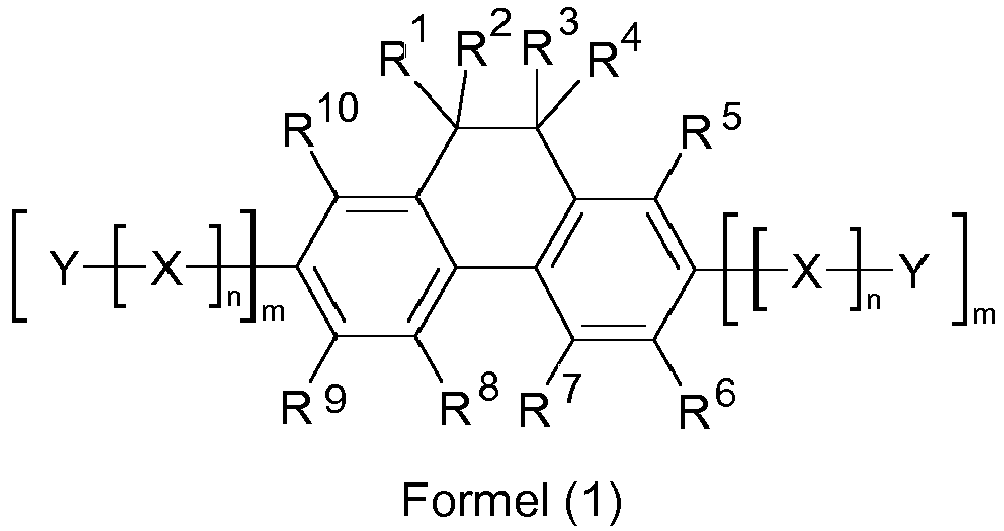
- R1, R3 ist bei jedem Auftreten gleich oder verschieden H, F, eine geradkettige Alkyl- oder Alkoxykette mit 1 bis 40 C-Atomen oder eine verzweigte oder cyclische Alkyl- oder Alkoxykette mit 3 bis 40 C-Atomen, die jeweils durch R11 substituiert sein kann, in der auch ein oder mehrere nicht benachbarte C-Atome durch N-R11, O, S, CO, O-CO-O, CO-O, - CR11=CR11-, -C≡C-, Si(R11)2, SO, SO2 oder PO(R11) ersetzt sein können und in der auch ein oder mehrere H-Atome durch F, Cl, Br, I oder CN ersetzt sein können, oder ein aromatisches oder heteroaromatisches Ringsystem mit 5 bis 60 aromatischen Ringatomen, welches auch durch einen oder mehrere Reste R11 substituiert sein kann;
mit der Maßgabe, dass mindestens einer der beiden Reste R1 und R3 ungleich H ist; - R2, R4 ist bei jedem Auftreten gleich oder verschieden R1, oder R2 und R4 stehen nicht für Substituenten, sondern bilden miteinander eine π-Bindung, so dass sich statt des Dihydrophenanthren-Systems ein Phenanthren-System ergibt;
- R5, R6, R7, R8, R9, R10 ist bei jedem Auftreten gleich oder verschieden H, F, Cl, Br, I, CN, NO2, B(OR11)2, eine geradkettige Alkyl- oder Alkoxykette mit 1 bis 40 C-Atomen oder eine verzweigte oder cyclische Alkyl- oder Alkoxykette mit 3 bis 40 C-Atomen, die jeweils durch R11 substituiert sein kann, in der auch ein oder mehrere nicht benachbarte C-Atome durch N-R11 O, S, CO, O-CO-O, CO-O, Si(R11)2, SO, SO2, PO(R11), -CR11=CR11- oder -C≡C- ersetzt sein können und in der auch ein oder mehrere H-Atome durch F, Cl, Br, I oder CN ersetzt sein können, oder ein aromatisches oder heteroaromatisches Ringsystem mit 5 bis 60 aromatischen Ringatomen, welches auch durch einen oder mehrere Reste R11 substituiert sein kann; dabei können zwei oder mehrere Reste R5 bis R10 miteinander auch ein weiteres mono- oder polycyclisches, aliphatisches Ringsystem bilden;
- X ist bei jedem Auftreten gleich oder verschieden -CR11=CR11-, -C≡C-, -(NY)-, C(=O), P(=O)(Y), S(=O) oder S(=O)2;
- Y ist bei jedem Auftreten gleich oder verschieden ein aromatisches oder heteroaromatisches Ringsystem mit 5 bis 60 aromatischen Ringatomen, welches durch einen oder mehrere Reste R11 substituiert oder unsubstituiert sein kann; dabei können auch zwei oder mehrere Reste Y miteinander ein Ringsystem bilden;
- R11 ist bei jedem Auftreten gleich oder verschieden H, eine geradkettige Alkyl- oder Alkoxykette mit 1 bis 22 C-Atomen oder eine verzweigte oder cyclische Alkyl- oder Alkoxykette mit 3 bis 22 C-Atomen, in der auch ein oder mehrere nicht benachbarte C-Atome durch O, S, SO, SO2, O-CO-O, CO-O, -CH=CH-, -C≡C- ersetzt sein können und in der auch ein oder mehrere H-Atome durch F, Cl, Br, I oder CN ersetzt sein können, oder eine Aryl-, Heteroaryl-, Aryloxy- oder Heteroaryloxygruppe mit 5 bis 40 C-Atomen, welche auch durch einen oder mehrere nicht-aromatische Reste R11 substituiert sein kann; dabei können auch zwei oder mehrere der Reste R11 miteinander und/oder mit R1 bis R10 ein Ringsystem bilden;
- n ist bei jedem Auftreten gleich oder verschieden 0 oder 1;
- m ist bei jedem Auftreten gleich oder verschieden 0, 1, 2, 3 oder 4, mit der Maßgabe, dass mindestens ein Index m ungleich 0 ist, und weiterhin mit der Maßgabe, dass beide Indizes m ungleich 0 sind, falls beide Indizes n gleich 0 sind;
- Ein aromatisches Ringsystem im Sinne dieser Erfindung enthält 6 bis 40 C-Atome. Ein heteroatomatisches Ringsystem im Sinne dieser Erfindung enthält 2 bis 40 C-Atome und mindestens ein Heteroatom, bevorzugt ausgewählt aus N, O und/oder S, wobei die Summe der C-Atome und Heteroatome mindestens 5 ergibt. Unter einem aromatischen oder heteroaromatischen Ringsystem im Sinne dieser Erfindung soll ein System verstanden werden, das nicht notwendigerweise nur aromatische bzw. heteroaromatische Gruppen enthält, sondern in dem auch mehrere aromatische oder heteroaromatische Gruppen durch eine kurze, nicht aromatische Einheit (weniger als 10 % der von H verschiedenen Atome, bevorzugt weniger als 5 % der von H verschiedenen Atome), wie z. B. ein sp3-hybridisiertes C-Atom, unterbrochen sein können. So sollen also beispielsweise auch Systeme wie 9,9'-Spirobifluoren, 9,9-Diarylfluoren, etc. als aromatische Ringsysteme im Sinne dieser Anmeldung verstanden werden. Ebenso werden von diesem Begriff auch einfache oder kondensierte Aromaten, wie beispielsweise Phenyl, Naphthyl, Anthryl, etc., oder miteinander verknüpfte Aromaten, wie beispielsweise Biphenyl, Binaphthyl, etc., mit umfasst. Der Begriff aromatisches Ringsystem soll jedoch keine Triarylamin-Gruppe umfassen.
- Im Rahmen der vorliegenden Erfindung soll unter einer cyclischen Alkylgruppe eine monocyclische, bicyclische oder polycyclische Alkylgruppe verstanden werden. Im Rahmen der vorliegenden Erfindung werden unter einer C1- bis C40-Alkylgruppe, in der auch einzelne H-Atome oder CH2-Gruppen durch die oben genannten Gruppen substituiert sein können, besonders bevorzugt die Reste Methyl, Ethyl, n-Propyl, i-Propyl, n-Butyl, i-Butyl, s-Butyl, t-Butyl, 2-Methylbutyl, n-Pentyl, s-Pentyl, Cyclopentyl, n-Hexyl, Cyclohexyl, n-Heptyl, Cycloheptyl, n-Octyl, Cyclooctyl, 2-Ethylhexyl, Trifluormethyl, Pentafluorethyl, 2,2,2-Trifluorethyl, Ethenyl, Propenyl, Butenyl, Pentenyl, Cyclopentenyl, Hexenyl, Cyclohexenyl, Heptenyl, Cycloheptenyl, Octenyl, Cyclooctenyl, Ethinyl, Propinyl, Butinyl, Pentinyl, Hexinyl oder Octinyl verstanden. Unter einer C1- bis C40-Alkoxygruppe werden besonders bevorzugt Methoxy, Ethoxy, n-Propoxy, i-Propoxy, n-Butoxy, i-Butoxy, s-Butoxy, t-Butoxy oder 2-Methylbutoxy verstanden. Unter einem aromatischen oder heteroaromatischen Ringsystem mit 5 - 40 aromatischen Ringatomen, welches noch jeweils mit den oben genannten Resten R substituiert sein kann und welches über beliebige Positionen am Aromaten bzw. Heteroaromaten verknüpft sein kann, werden insbesondere Gruppen verstanden, die abgeleitet sind von Benzol, Naphthalin, Anthracen, Phenanthren, Pyren, Chrysen, Perylen, Fluoranthen, Naphthacen, Pentacen, Benzpyren, Biphenyl, Biphenylen, Terphenyl, Terphenylen, Fluoren, Spirobifluoren, Dihydrophenanthren, Dihydropyren, Tetrahydropyren, cis- oder trans-Indenofluoren, Truxen, Isotruxen, Spirotruxen, Spiroisotruxen, Furan, Benzofuran, Isobenzofuran, Dibenzofuran, Thiophen, Benzothiophen, Isobenzothiophen, Dibenzothiophen, Pyrrol, Indol, Isoindol, Carbazol, Pyridin, Chinolin, Isochinolin, Acridin, Phenanthridin, Benzo-5,6-chinolin, Benzo-6,7-chinolin, Benzo-7,8-chinolin, Phenothiazin, Phenoxazin, Pyrazol, Indazol, Imidazol, Benzimidazol, Naphthimidazol, Phenanthrimidazol, Pyridimidazol, Pyrazinimidazol, Chinoxalinimidazol, Oxazol, Benzoxazol, Naphthoxazol, Anthroxazol, Phenanthroxazol, Isoxazol, 1,2-Thiazol, 1,3-Thiazol, Benzothiazol, Pyridazin, Benzopyridazin, Pyrimidin, Benzpyrimidin, Chinoxalin, 1,5-Diazaanthracen, 2,7-Diazapyren, 2,3-Diazapyren, 1,6-Diazapyren, 1,8-Diazapyren, 4,5-Diazapyren, 4,5,9,10-Tetraazaperylen, Pyrazin, Phenazin, Phenoxazin, Phenothiazin, Fluorubin, Naphthyridin, Azacarbazol, Benzocarbolin, Phenanthrolin, 1,2,3-Triazol, 1,2,4-Triazol, Benzotriazol, 1,2,3-Oxadiazol, 1,2,4-Oxadiazol, 1,2,5-Oxadiazol, 1,3,4-Oxadiazol, 1,2,3-Thiadiazol, 1,2,4-Thiadiazol, 1,2,5-Thiadiazol, 1,3,4-Thiadiazol, 1,3,5-Triazin, 1,2,4-Triazin, 1,2,3-Triazin, Tetrazol, 1,2,4,5-Tetrazin, 1,2,3,4-Tetrazin, 1,2,3,5-Tetrazin, Purin, Pteridin, Indolizin und Benzothiadiazol.
- Auch wenn dies aus der obigen Beschreibung hervorgeht, sei hier nochmals explizit erwähnt, dass zwei oder mehrere Reste R5 bis R10 in Formel (1) auch miteinander ein weiteres aliphatisches Ringsystem bilden können. Dies gilt insbesondere für die Substituenten R7 und R8, die bei Bildung eines weiteren 6-Ringsystems zur Ausbildung eines Dihydropyren-Systems bzw. Tetrahydropyren-Systems führen.
- In einer bevorzugten Ausführungsform der Erfindung sind R1 und R3, gleich oder verschieden bei jedem Auftreten H, F, eine geradkettige Alkylkette mit 1 bis 10 C-Atomen oder eine verzweigte oder cyclische Alkylkette mit 3 bis 10 C-Atomen, die jeweils durch R11 substituiert sein kann, in der auch ein oder mehrere H-Atome durch F, Cl, Br, I oder CN ersetzt sein können, oder ein aromatisches oder heteroaromatisches Ringsystem mit 5 bis 40 aromatischen Ringatomen, welches auch durch einen oder mehrere Reste R11 substituiert sein kann; mit der Maßgabe, dass mindestens einer der beiden Reste R1 und R3 ungleich H ist. Besonders bevorzugt sind R1 und R3, gleich oder verschieden bei jedem Auftreten F, eine geradkettige Alkylkette mit 1 bis 4 C-Atomen oder eine verzweigte Alkylkette mit 3 oder 4 C-Atomen, in der auch ein oder mehrere H-Atome durch F oder CN ersetzt sein können, oder ein aromatisches oder heteroaromatisches Ringsystem mit 6 bis 25 aromatischen Ringatomen, welches auch durch einen oder mehrere Reste R11 substituiert sein kann.
- In einer weiteren bevorzugten Ausführungsform der Erfindung sind R2 und R4, gleich oder verschieden bei jedem Auftreten, das bevorzugte R1; oder R2 und R4 stehen nicht für Substituenten, sondern bilden miteinander eine π-Bindung, so dass sich statt des Dihydrophenanthren-Systems ein Phenanthren-System ergibt; besonders bevorzugt bilden R2 und R4 miteinander eine π-Bindung, so dass sich ein Phenanthren-System ergibt.
- Weiterhin bevorzugt stehen R5, R6, R7, R8, R9 und R10 gleich oder verschieden bei jedem Auftreten für H, F, eine geradkettige Alkylkette mit 1 bis 40 C-Atomen, bevorzugt mit 1 bis 10 C-Atomen, oder eine verzweigte oder cyclische Alkylkette mit 3 bis 40 C-Atomen, bevorzugt mit 3 bis 10 C-Atomen, die jeweils durch R11 substituiert sein kann, in der auch ein oder mehrere H-Atome durch F ersetzt sein können, oder ein aromatisches oder heteroaromatisches Ringsystem mit 5 bis 40 aromatischen Ringatomen, welches auch durch einen oder mehrere Reste R11 substituiert sein kann; dabei können zwei oder mehrere Reste R5 bis R10 miteinander auch ein weiteres mono- oder polycyclisches, aliphatisches Ringsystem bilden. Besonders bevorzugt stehen R5, R6, R7, R8, R9 und R10 gleich oder verschieden bei jedem Auftreten für H oder F, oder die Positionen R7 und R8 werden durch eine C(R11)2-C(R11)2-Kette überbrückt.
- Weiterhin bevorzugt steht X, gleich oder verschieden bei jedem Auftreten, für -CR11=CR11-, -C≡C-, C(=O), P(=O)(Y) oder -(NY)-; besonders bevorzugt steht X gleich oder verschieden bei jedem Auftreten für -CH=CH-, C(=O), P(=O)(Y) oder -(NY)-.
- Weiterhin bevorzugt steht Y, gleich oder verschieden bei jedem Auftreten, für ein aromatisches oder heteroaromatisches Ringsystem mit 6 bis 30 C-Atomen, welches durch einen oder mehrere Reste R11 substituiert oder unsubstituiert sein kann; besonders bevorzugt steht Y, gleich oder verschieden bei jedem Auftreten, für ein aromatisches oder heteroaromatisches Ringsystem mit 10 bis 25 C-Atomen, welches durch einen oder mehrere Reste R11 substituiert oder unsubstituiert sein kann.
- Weiterhin bevorzugt steht der Index m, gleich oder verschieden bei jedem Auftreten, für 1, 2 oder 3, besonders bevorzugt für 1 oder 2, ganz besonders bevorzugt für 1.
- Besonders bevorzugt enthält mindestens einer der Substituenten Y mindestens ein kondensiertes polycyclisches aromatisches Ringsystem, insbesondere Naphthalin, Anthracen, Phenanthren, Pyren, Dihydropyren, Chrysen, Naphthacen, Pentacen oder Perylen, ganz besonders bevorzugt Naphthalin, Anthracen, Phenanthren oder Pyren, oder mindestens einen Azaheterocyclus, insbesondere Pyridin, Pyrazin, Pyrimidin, Pyridazin, Chinolin, Isochinolin, Chinoxalin oder Phenanthrolin.
- Weiterhin bevorzugt sind Verbindungen gemäß Formel (1), in denen die beiden Substituenten R1 und R3 gleich sind. Ebenso bevorzugt sind Verbindungen gemäß Formel (1), in denen die beiden Substituenten R2 und R4 gleich sind oder miteinander eine π-Bindung bilden. Ebenso bevorzugt sind Verbindungen gemäß Formel (1), in denen die beiden Substituenten [Y-[X]n]m- gleich gewählt sind. Besonders bevorzugt sind Verbindungen, die symmetrisch aufgebaut sind, in denen also beide Substituenten R1 und R3 gleich gewählt sind und in denen beide Substituenten R2 und R4 gleich gewählt sind oder miteinander eine Bindung bilden und in denen beide Substituenten [Y-[X]n]m- gleich gewählt sind.
- Abhängig von der Verwendung der Verbindungen gemäß Formel (1) gelten weiterhin folgende Bevorzugungen:
- Bei Verwendung der Verbindungen gemäß Formel (1) als Host-Material gilt bevorzugt n = 0.
- Bei Verwendung der Verbindungen gemäß Formel (1) als emittierende Verbindungen (Dotanden) gilt bevorzugt, dass mindestens ein Index n = 1 ist, wobei das entsprechende m dann = 1, 2, 3 oder 4 ist, und dass mindestens ein X gleich -CR11=CR11- oder -C≡C- ist; besonders bevorzugt sind beide n = 1 und beide m = 1, 2, 3 oder 4 und X hat die oben beschriebene Bedeutung.
- Bei Verwendung der Verbindungen gemäß Formel (1) als Lochtransportverbindung gilt bevorzugt, dass mindestens ein n = 1 ist, wobei das entsprechende m dann = 1, 2, 3 oder 4 ist, und dass mindestens ein X = N-Y ist; besonders bevorzugt sind beide n = 1 und beide m = 1, 2, 3 oder 4 und X hat die oben beschriebene Bedeutung.
- Bei Verwendung der Verbindungen gemäß Formel (1) als Triplett-Matrixmaterial gilt bevorzugt, dass mindestens ein n = 1 ist, wobei das entsprechende m dann 1, 2, 3 oder 4 ist, und dass mindestens ein X = C(=O), SO, SO2 oder P(=O)(Y) ist; besonders bevorzugt sind beide n = 1 und beide m = 1, 2, 3 oder 4 und X hat die oben beschriebene Bedeutung.
- Abhängig von der Verarbeitungsweise der Verbindungen gemäß Formel (1) sind für den Index m verschiedene Werte bevorzugt. Wird die Verbindung in Vakuumaufdampfverfahren aufgebracht, so ist der Index m bevorzugt 1 oder 2. Wird die Verbindung bevorzugt aus Lösung und/oder durch Druckverfahren aufgebracht, so kann der Index m auch bevorzugt 3 oder 4 sein.
- Die erfindungsgemäßen Verbindungen lassen sich aus den entsprechenden bekannten 2,7-Dibromphenanthren-Derivaten bzw. den entsprechenden Dihydrophenanthren-, Dihydropyren- oder Tetrahydropyren-Derivaten durch metallkatalysierte Kupplungsreaktionen, insbesondere Kupplung gemäß Suzuki, Kupplung gemäß Hartwig-Buchwald und Kupplung gemäß Heck, herstellen. Die Synthese der Dihydrophenanthren-Vorstufen bzw. der Phenanthren-Vorstufen ist in
WO 05/014689 DE 102004020298.2 beschrieben. - Beispiele für bevorzugte Verbindungen gemäß Formel (1) sind die im Folgenden abgebildeten Strukturen (1) bis (24).


(1) (2) (3) 

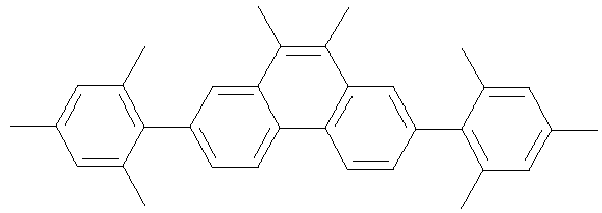
(4) (5) (6) 


(7) (8) (9) 

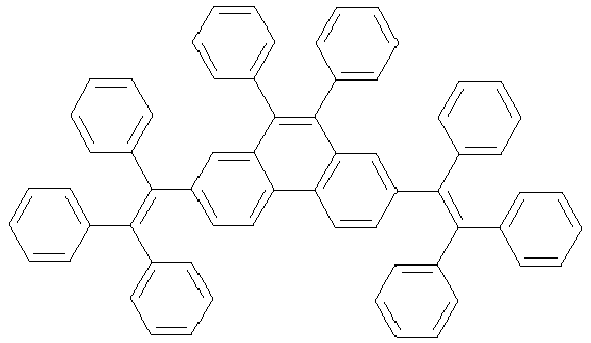
(10) (11) (12) 


(13) (14) (15) 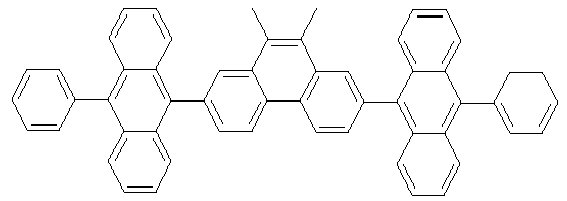


(16) (17) (18) 


(19) (20) (21) 


(22) (23) (24) - Die Verbindungen gemäß Formel (1) eignen sich besonders für die Verwendung in organischen Elektrolumineszenzvorrichtungen. Dabei wird die Verbindung bevorzugt in der emittierenden Schicht eingesetzt, entweder als Hostmaterial zusammen mit einem fluoreszierenden oder phosphoreszierenden Dotanden oder, insbesondere bei geeigneter Substitution, als Dotand zusammen mit einem Hostmaterial. Ebenso bevorzugt wird die Verbindung als Lochtransportmaterial in einer Lochtransportschicht eingesetzt, insbesondere wenn mindestens einer der Substituenten eine Diarylamin-Gruppe darstellt. Ebenso bevorzugt wird die Verbindung als Elektronentransportmaterial in einer Elektronentransportschicht eingesetzt, insbesondere wenn mindestens einer der Substituenten einen kondensierten und/oder elektronenarmen Aromaten oder eine Carbonylfunktion, eine SO-, eine SO2- oder eine Phosphinoxidgruppe enthält. Weiterhin bevorzugt wird die erfindungsgemäße Verbindung als Lochblockiermaterial in einer Lochblockierschicht eingesetzt, insbesondere in phosphoreszierenden Elektrolum ineszenzvorrichtungen.
- Ein weiterer Gegenstand der vorliegenden Erfindung sind daher Mischungen aus einer Verbindung gemäß Formel (1) mit einem Dotanden, bzw. aus einer Verbindung gemäß Formel (1) mit einem Host-Material, wobei der Dotand überwiegend zur Emission beiträgt. Dabei kann der Dotand, mit dem die Verbindung gemäß Formel (1) gemischt ist, oder das Host-Material, mit dem die Verbindung gemäß Formel (1) gemischt ist, auch polymer sein.
- Weiterer Gegenstand der Erfindung ist die Verwendung von Verbindungen gemäß Formel (1) in organischen elektronischen Vorrichtungen, insbesondere in organischen Elektrolumineszenzvorrichtungen, bevorzugt als Hostmaterial oder als emittierendes Material (Dotand).
- Gegenstand der Erfindung sind somit ebenfalls organische elektronische Vorrichtungen, insbesondere organische Elektrolumineszenzvorrichtungen, mit einer oder mehreren aktiven Schichten, wobei mindestens eine dieser aktiven Schichten eine oder mehrere Verbindungen gemäß Formel (1) enthält. Die aktive Schicht kann beispielsweise eine lichtemittierende Schicht und/oder eine Ladungstransportschicht und/oder eine Ladungsinjektionsschicht sein, bevorzugt aber eine lichtemittierende Schicht.
- Wenn die Verbindungen gemäß Formel (1) als Hostmaterial eingesetzt werden, sind bevorzugte Dotanden organische oder metallorganische Verbindungen, deren Emission längerwellig ist als die der Verbindung gemäß Formel (1). Dabei können Dotanden gewählt sein, die aus dem Singulett- oder aus dem Triplett-Zustand Licht emittieren. Besonders bevorzugte Dotanden, die aus dem Singulett-Zustand Licht emittieren, sind Verbindungen, die gleichzeitig eine oder mehrere gegebenenfalls substituierte Stilben-Einheiten und eine oder mehrere Triarylamin-Einheiten aufweisen. Besonders bevorzugte Dotanden, die aus dem Triplett-Zustand Licht emittieren, sind ortho-metallierte Iridium-Komplexe und Platin-Komplexe.
- Der Anteil der Verbindung gemäß Formel (1) in der Mischung beträgt zwischen 1 und 99.9 Gew.%, bevorzugt zwischen 50 und 99.5 Gew.%, besonders bevorzugt zwischen 80 und 99 Gew.%, insbesondere zwischen 90 und 99 Gew.%, wenn die Verbindung gemäß Formel (1) als Host-Material verwendet wird.
- Der Anteil der Verbindung gemäß Formel (1) in der Mischung beträgt zwischen 0.1 und 99 Gew.%, bevorzugt zwischen 0.5 und 50 Gew.%, besonders bevorzugt zwischen 1 und 20 Gew.%, insbesondere zwischen 1 und 10 Gew.%, wenn die Verbindung gemäß Formel (1) als Dotand verwendet wird.
- Die organische Elektrolumineszenzvorrichtung enthält außer der emittierenden Schicht noch Anode und Kathode und kann noch weitere Schichten enthalten. Diese können beispielsweise sein: Lochinjektionsschicht, Lochtransportschicht, Lochblockierschicht, Elektronentransportschicht und/oder Elektroneninjektionsschicht. Es sei aber an dieser Stelle darauf hingewiesen, dass nicht notwendigerweise jede dieser Schichten vorhanden sein muss.
- So werden insbesondere bei Verwendung von Verbindungen gemäß Formel (1) als Host für fluoreszierende oder phosphoreszierende Dotanden weiterhin sehr gute Ergebnisse erhalten, wenn die organische Elektrolumineszenzvorrichtung keine separate Lochblockier- und/oder Elektronentransportschicht enthält und die emittierende Schicht direkt an die Elektroneninjektionsschicht oder an die Kathode grenzt. Ebenfalls kann es bevorzugt sein, wenn die organische Elektrolumineszenzvorrichtung keine separate Lochtransportschicht enthält und die emittierende Schicht direkt an die Lochinjektionsschicht oder an die Anode grenzt, insbesondere wenn die Verbindung gemäß Formel (1) mit mindestens einer Diarylaminogruppe substituiert ist. Weiterhin kann es bevorzugt sein, wenn Verbindungen gemäß Formel (1) in mehr als einer Schicht verwendet werden. Dabei kann es sich in den unterschiedlichen Schichten um die gleichen oder um unterschiedliche Verbindungen gemäß Formel (1) handeln. So können diese Verbindungen beispielsweise nicht nur in der emittierenden Schicht, sondern auch zusätzlich in der Lochblockierschicht oder in der Elektronentransportschicht oder bei entsprechender geeigneter Substitution auch in der Lochtransportschicht verwendet werden.
- Weiterhin bevorzugt ist eine organische Elektrolumineszenzvorrichtung, dadurch gekennzeichnet, dass eine oder mehrere Schichten mit einem Sublimationsverfahren bei einem Druck kleiner 10-5 mbar, bevorzugt kleiner 10-6 mbar, besonders bevorzugt kleiner 10-7 mbar, oder mit dem OVPD (Organic Vapour Phase Deposition) Verfahren oder mit Hilfe einer Trägergassublimation bei einem Druck zwischen 10-5 mbar und 1 bar oder aus Lösung, wie z. B. durch Spincoating, oder mit einem beliebigen Druckverfahren, wie z. B. Siebdruck, Flexodruck, Offsetdruck, LITI (Light Induced Thermal Imaging, Thermotransferdruck) oder Ink-Jet Druck (Tintenstrahl-Druck), beschichtet werden.
- Die oben beschriebenen emittierenden Vorrichtungen weisen folgende überraschende Vorteile gegenüber dem Stand der Technik auf:
- 1. Die Emission von Verbindungen gemäß Formel (1) ist tiefer blau als von Phenanthren-Derivaten gemäß dem Stand der Technik, die in den 3,6-Positionen statt in den 2,7-Positionen substituiert sind. Daher sind diese Verbindungen besser als Host-Materialien für blaue Emission geeignet.
- 2. Die Effizienz entsprechender Vorrichtungen ist höher im Vergleich zu Systemen gemäß dem Stand der Technik.
- 3. Die Stabilität entsprechender Vorrichtungen ist höher im Vergleich zu Systemen gemäß dem Stand der Technik, was sich vor allem in einer höheren Lebensdauer zeigt.
- 4. Die Betriebsspannung wird verringert. Dadurch erhöht sich die Leistungseffizienz. Dies gilt insbesondere, wenn eine Verbindung gemäß Formel (1) als Host-Material mit einem Stilbenamin als fluoreszierendem Dotanden oder mit einem Iridiumkomplex als phosphoreszierendem Dotanden verwendet wird.
- 5. Die Verbindungen gemäß Formel (1) sind leicht synthetisch zugänglich und können ohne Probleme auch im großen Maßstab hergestellt werden.
- 6. Die Verbindungen sind besser löslich als Phenanthren-Derivate, die gemäß dem Stand der Technik in organischen elektronischen Vorrichtungen verwendet werden und die keine Substitution in den 9,10-Positionen aufweisen. Dadurch lassen sie sich leichter reinigen, was einen erheblichen technischen Vorteil darstellt.
- Im vorliegenden Anmeldetext und auch in den im Weiteren folgenden Beispielen wird auf die Verwendung erfindungsgemäßer Verbindungen in Bezug auf OLEDs und die entsprechenden Displays abgezielt. Trotz dieser Beschränkung der Beschreibung ist es für den Fachmann ohne weiteres erfinderisches Zutun möglich, die erfindungsgemäßen Verbindungen auch für weitere Verwendungen in anderen elektronischen Devices (Vorrichtungen) zu benutzen, z. B. für organische Feld-Effekt-Transistoren (O-FETs), organische Dünnfilmtransistoren (O-TFTs), organische integrierte Schaltungen (O-ICs), organische Solarzellen (O-SCs), organische Feld-Quench-Devices (O-FQDs), organische lichtemittierende Transistoren (O-LETs), lichtemittierende elektrochemische Zellen (LECs) oder auch organische Laserdioden (O-Laser), um nur einige Anwendungen zu nennen.
- Die Verwendung der erfindungsgemäßen Verbindungen in den entsprechenden Vorrichtungen ebenso wie diese Vorrichtungen selbst sind ebenfalls ein Gegenstand der vorliegenden Erfindung.
- Die Erfindung wird durch die nachfolgenden Beispiele näher erläutert, ohne sie dadurch einschränken zu wollen.
- Die nachfolgenden Synthesen wurden, sofern nicht anders angegeben, unter einer Schutzgasatmosphäre durchgeführt. Die Edukte wurden von den Fa. ALDRICH bzw. ABCR (4-Methylnaphthalin-1-boronsäure, 1-Naphthyl-phenylamin, Palladium(II)acetat, Tri-o-tolylphosphin, Anorganika, Lösemittel) bezogen. Die Synthese von 2,7-Dibrom-9,10-dimethylphenanthren ist in der nicht offen gelegten Patentanmeldung
DE 102004020298.2 , die von 9-(4-methylnaphthyl)-10-bromanthracen inEP 05009643.7 -

- Eine entgaste, gut gerührte Suspension von 37.2 g (200 mmol) 4-Methylnaphtalin-1-boronsäure, 18.0 g (50 mmol) 2,7-dibrom-9,10-dimethylphenanthren, 52.2 g (210 mmol) Kaliumphosphat-1-Hydrat in einem Gemisch aus 75 ml Dioxan, 150 ml Toluol und 200 ml Wasser wurde mit 457 mg (1.5 mmol) Tri-o-tolylphosphin und dann mit 56 mg (0.25 mmol) Palladium(II)acetat versetzt. Nach 16 h Erhitzen unter Rückfluss und Erkalten der Reaktionsmischung wurde der ausgefallene Feststoff abgesaugt, dreimal mit je 100 ml Wasser und dreimal mit je 100 ml Ethanol gewaschen. Nach Trocknen im Vakuum (1 mbar, 80 °C, 16 h) wurde das Produkt in einem Soxhlett-Extraktor mit Chloroform durch eine Glasfaserextraktionshülse (Porengröße 0.5 µm) extrahiert, um Palladiumspuren zu entfernen. Das nach Einengen des Chloroforms verbliebene Produkt wurde dreimal aus Chlorbenzol (ca. 25 ml/g) und dreimal aus DMF (ca. 60 ml/g) umkristallisiert und anschließend zweimal im Hochvakuum (p = 5 x 10⁻⁵ mbar, T = 320 - 330 °C) sublimiert. Die Ausbeute bei einer Reinheit von 99.9 % nach HPLC betrug 15.6 g (32 mmol), entsprechend 64.2 % der Theorie.
1H-NMR (TCE-d2): □ [ppm] = 8.87 (d, 3JHH = 8.6 Hz, 2H, H4-Phen), 8.27 (d, 4JHH = 1.5 Hz, 2H, H1-Phen), 8.13 (d, 3JHH = 8.5 Hz, 2H, H-Naphth), 8.04 (d, 3JHH = 8.5 Hz, 2H, H-Naphth), 7.81 (dd, 3JHH = 8.6 Hz, 4JHH = 1.5 Hz, 2H, H3-Phen), 7.60 (m, 2H), 7.54 - 7.47 (m, 6H), 2.80 (s, CH3, 6H), 2.76 (s, CH3, 6H). - Das Phenanthren-Derivat-P1, enthaltend Methylgruppen in 9- und 10-Position am Phenanthren, zeichnet sich durch eine mäßige bis gute Löslichkeit in gängigen organischen Lösungsmitteln aus, wodurch es sich leicht durch Umkristallisation reinigen läßt (s. Beispiel 1).
- Dagegen sind strukturell analoge, aber in 9- und 10-Position unsubstituierte Phenanthrene in organischen Lösungsmitteln deutlich schlechter löslich. Dies führt zu erheblichen Problemen bei der Reinigung, da dazu wesentlich größere Apparate und deutlich größere Lösemittelmengen benötigt werden.
- Die elektronischen Eigenschaften einiger 3,6- und 2,7-substituierter Phenanthrene wurden durch quantenchemische Berechnung bestimmt. Die Geometrie wurde im Grundzustand semi-empirisch optimiert. Die HOMO- und LUMO-Werte wurden durch DFT (Dichte Funktional Theorie) Rechnung (B3PW91/6-31g(d)) ermittelt. Alle Berechnungen wurden mit dem Gaussian 98 Programmpaket durchgeführt.
- In Tabelle 1 werden die berechneten HOMO- und LUMO-Lagen, sowie der Bandgap für 3,6- und 2,7-dinaphthylsubstituierte Phenanthrene gegenübergestellt. Wie man diesen Zahlenwerten entnehmen kann, ist der Bandgap für 2,7-dinaphthylsubstituierte Phenanthrene um mehr als 0.1 eV größer als für die entsprechenden 3,6-substituierten Verbindungen, was zeigt, dass die erfindungsgemäßen Verbindungen besser als Host-Materialien für blau emittierende Dotanden geeignet sind als Verbindungen gemäß dem Stand der Technik.
Tabelle 1: Vergleich zwischen 2,7- und 3,6-disubstituierten Phenanthrenen Verbindung HOMO [eV] LUMO [eV] Bandgap [eV] 2,7-Bis(1-naphthyl)phenanthren -5.90 -2.43 3.47 3,6-Bis(1-naphthyl)phenanthren -5.78 -2.43 3.35 2,7-Bis(4-methyl-1-naphthyl)phenanthren -5.80 -2.39 3.41 3,6-Bis(4-methyl-1-naphthyl)phenanthren -5.69 -2.39 3.30 -

- Eine gut gerührte, auf -78 °C gekühlte Suspension aus 73.9 g (203 mmol) 2,7-Dibrom-9,10-dimethylphenanthren in 3000 ml THF wurde während 30 min. mit 640 ml (960 mmol) tert-Buthyllitium, 1.5 molar in Hexan, versetzt und anschließend 5 h bei -78 °C gerührt. Die so erhaltene Suspension wurde zu einem gut gerührten, auf -78 °C gekühlten Gemisch aus 54.0 ml Borsäuretrimethylester und 500 ml THF zügig zugeschlaucht. Nach langsamen Erwärmen auf Raumtemperatur wurde die Reaktionsmischung mit einem Gemisch aus 30 ml Essigsäure und 300 ml Wasser versetzt und 1 h gerührt. Die wässrige Phase wurde abgetrennt, die organische wurde zur Trockene eingeengt. Der Rückstand wurde mit 1000 ml Toluol und 23.4 ml Ethylenglykol versetzt und 2 h am Wasserabscheider erhitzt. Nach dem Versiegen der Wasserabscheidung wurden 700 ml Toluol abdestilliert und der Rückstand mit 300 ml n-Heptan versetzt. Das ausgefallene Rohprodukt wurde abgesaugt und zweimal aus Toluol (2 g/ml) umkristallisiert. Die Ausbeute bei einer Reinheit von 99 % nach 1H-NMR betrug 46.7 g (135 mmol), entsprechend 66.5 % der Theorie.
1H-NMR (CDCl3): □ [ppm] = 8.73 (d, 2H), 8.63 (s, 2H), 8.00 (d, 2H), 4.46 (s, 8H, CH2), 2.78 (s, 6H, CH3). -

- Eine gut gerührte, entgaste Suspension aus 40.1 g (116 mmol) 9,10-Dimethylphenanthren-2,7-bisboronsäureglykolester, 101.0 g (255 mmol) 9-(4-methylnaphthyl)-10-bromanthracen und 108.3 g (510 mmol) Kaliumphosphat in einem Gemisch aus 300 ml Dioxan, 600 ml Toluol und 1000 ml Wasser wurde mit 2.12 g (7.0 mmol) Tri-o-tolylphosphin und dann mit 260 mg (1.2 mmol) Pd(OAc)2 versetzt und anschließend 48 h unter Rückfluss erhitzt. Nach Erkalten wurde der fahlgelbe Niederschlag abgesaugt, dreimal mit 300 ml Toluol, dreimal mit 300 ml eines Gemischs aus Ethanol / Wasser (1:1, v / v) und dreimal mit 300 ml Ethanol gewaschen und anschließend im Vakuum getrocknet. Das Rohprodukt wurde fünfmal aus NMP (70 ml / g) und fünfmal aus Dichlorbenzol (55 ml / g) umkristallisiert, abschließend zweimal in 3 I Ethanol unter Rückfluss ausgerührt und zweimal im Hochvakuum (p = 1 x 10⁻⁵ mbar, T = 460 - 470 °C) sublimiert. Die Ausbeute bei einer Reinheit von 99.8 % nach HPLC betrug 66.3 g (79 mmol), entsprechend 68.1 % der Theorie.
1H-NMR (TCE-d2): □ [ppm] = 9.14 (m, 2H), 8.42 (d, 2H), 8.21 (d, 2H), 7.93 (dd, 2H), 7.87 (dd, 4H), 7.62-7.53 (m, 10H), 7.37 (d, 2H), 7.35 (d, 2H), 7.29-7.25 (m, 8H), 2.92 (s, 6H), 2,82 (dd, 6H). -
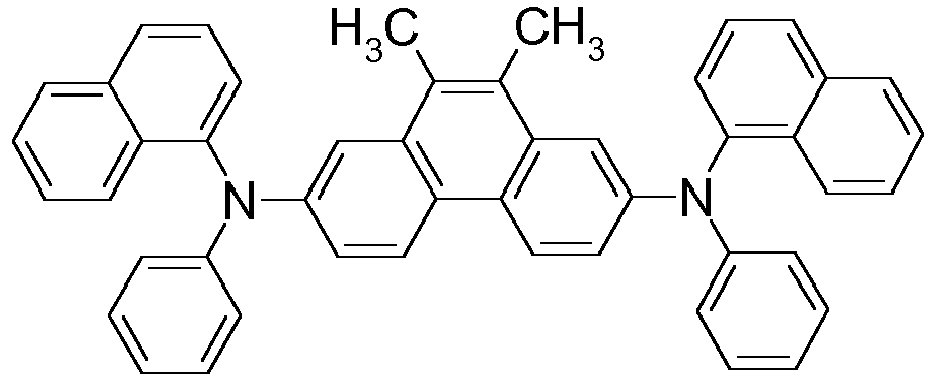
- Eine gut gerührte Suspension aus 60.4 g (166 mmol) 2,7-Dibrom-9,10-dimethylphenanthren und 80.3 g (366 mmol) 1-Naphthyl-phenylamin in 1500 ml Toluol wurde nacheinander mit 1.25 ml (6.6 mmol) Di-tert-butyl-chlorphosphin, 741 mg (3.3 mmol) Palladium(II)acetat und dann 38.7 g (403 mmol) Natrium-tert-butylat versetzt und 2 h unter Rückfluss erhitzt. Nach Erkalten auf 50 °C wurde mit 1000 ml Wasser versetzt, die organische Phase wurde abgetrennt, über Kieselgel filtriert und dann zur Trockene eingeengt. Der Feststoff wurde einmal mit 1000 ml Ethanol, dreimal mit 500 ml Essigsäureethylester und dreimal mit Aceton heiß ausgerührt. Anschließend wurde der Feststoff dreimal aus DMSO (1.5 ml/g) unter Zusatz von Ethanol (0.1 ml/g) nach Erkalten der Lösung auf 80 °C umkristallisiert. Abschließend wurde zweimal mit 500 ml Ethanol unter Rückfluss ausgerührt und zweimal im Hochvakuum (p = 5 x 10⁻⁵ mbar, T = 330 °C) sublimiert. Die Ausbeute bei einer Reinheit von 99.9 % nach HPLC betrug 57.5 g (90 mmol), entsprechend 54.0 % der Theorie.
1H-NMR (CDCl3 - 0.01µ Hydrazinhydrat): □ [ppm] = 8.32 (d, 2H), 7.98, (d, 2H), 7.89 (d, 2H), 7.79 (d, 2H), 7.69 (s, 2H), 7.49 (t, 2H), 7.44 (dd, 2H), 7.39 (d, 2H), 7.32 (d, 2H), 7.24 (dd, 2H), 7.20 (dd, 4H), 7.08 (d, 4H), 6.95 (dd, 2H), 2.34, (s, 6H).

Claims (15)
- Verbindungen gemäß Formel (1),
 R1, R3 ist bei jedem Auftreten gleich oder verschieden H, F, eine geradkettige Alkyl- oder Alkoxykette mit 1 bis 40 C-Atomen oder eine verzweigte oder cyclische Alkyl- oder Alkoxykette mit 3 bis 40 C-Atomen, die jeweils durch R11 substituiert sein kann, in der auch ein oder mehrere nicht benachbarte C-Atome durch N-R11, O, S, CO, O-CO-O, CO-O, Si(R11)2, SO, SO2, PO(R11), -CR11=CR11- oder -C≡C-ersetzt sein können und in der auch ein oder mehrere H-Atome durch F, Cl, Br, I oder CN ersetzt sein können, oder ein aromatisches oder heteroaromatisches Ringsystem mit 5 bis 60 aromatischen Ringatomen, welches auch durch einen oder mehrere Reste R11 substituiert sein kann;
mit der Maßgabe, dass mindestens einer der beiden Reste R1 und R3 ungleich H ist;R2, R4 stehen nicht für Substituenten, sondern bilden miteinander eine Bindung, so dass sich statt des Dihydrophenanthen-Systems ein Phenanthren-System ergibt;R5, R6, R7, R8, R9, R10 ist bei jedem Auftreten gleich oder verschieden H, F, Cl, Br, I, CN, NO2, B(OR11)2, eine geradkettige Alkyl- oder Alkoxykette mit 1 bis 40 C-Atomen oder eine verzweigte oder cyclische Alkyl- oder Alkoxykette mit 3 bis 40 C-Atomen, die jeweils durch R11 substituiert sein kann, in der auch ein oder mehrere nicht benachbarte C-Atome durch N-R11, O, S, CO, O-CO-O, CO-O, SO, SO2, POR11, -CR11=CR11- oder -C≡C- ersetzt sein können und in der auch ein oder mehrere H-Atome durch F, Cl, Br, I oder CN ersetzt sein können, oder ein aromatisches oder heteroaromatisches Ringsystem mit 5 bis 60 aromatischen Ringatomen, welches auch durch einen oder mehrere Reste R11 substituiert sein kann; dabei können zwei oder mehrere Reste R5 bis R10 miteinander auch ein weiteres mono- oder polycyclisches Ringsystem bilden;X ist -(NY)-;Y ist bei jedem Auftreten gleich oder verschieden ein aromatisches oder heteroaromatisches Ringsystem mit 5 bis 60 aromatischen Ringatomen, welches durch einen oder mehrere Reste R11 substituiert oder unsubstituiert sein kann; dabei können zwei Gruppen Y miteinander ein Ringsystem bilden;R11 ist bei jedem Auftreten gleich oder verschieden H, eine geradkettige Alkyl- oder Alkoxykette mit 1 bis 22 C-Atomen oder eine verzweigte oder cyclische Alkyl- oder Alkoxykette mit 3 bis 22 C-Atomen, in der jeweils auch ein oder mehrere nicht benachbarte C-Atome durch O, S, SO, SO2, CO, O-CO-O, CO-O, -CH=CH-, -C≡C- ersetzt sein können und in der auch ein oder mehrere H-Atome durch F, Cl, Br, I oder CN ersetzt sein können, oder eine Aryl-, Heteroaryl-, Aryloxy- oder Heteroaryloxygruppe mit 5 bis 40 C-Atomen, welche auch durch ein oder mehrere nicht-aromatische Reste R11 substituiert sein kann;n ist bei jedem Auftreten gleich oder verschieden 0 oder 1, wobei mindestens ein n gleich 1 ist;m ist bei jedem Auftreten gleich oder verschieden 0 oder 1, mit der Maßgabe, dass mindestens ein Index m ungleich 0 ist. - Verbindungen gemäß Anspruch 1, worin gilt:R1, R3 sind bei jedem Auftreten gleich oder verschieden gewählt aus H, F, geradkettigen Alkylketten mit 1 bis 10 C-Atomen, verzweigten oder cyclischen Alkylketten mit 3 bis 10 C-Atomen, die durch R11 substituiert sein können, in denen auch ein oder mehrere H-Atome durch F, Cl, Br, I oder CN ersetzt sein können, und aromatischen oder heteroaromatischen Ringsystemen mit 5 bis 40 aromatischen Ringatomen, die auch durch einen oder mehrere Reste R11 substituiert sein können; mit der Maßgabe, dass mindestens einer der beiden Reste R1 und R3 ungleich H ist.
- Verbindungen gemäß Anspruch 1 oder 2, worin gilt:R1, R3 sind bei jedem Auftreten gleich oder verschieden gewählt aus H, geradkettigen Alkylketten mit 1 bis 10 C-Atomen und verzweigten oder cyclischen Alkylketten mit 3 bis 10 C-Atomen, die durch R11 substituiert sein können; mit der Maßgabe, dass mindestens einer der beiden Reste R1 und R3 ungleich H ist.
- Verbindungen gemäß einem oder mehreren der Ansprüche 1 bis 3, dadurch gekennzeichnet, dass beide der Reste R1 und R3 ungleich H sind.
- Verbindungen gemäß einem oder mehreren der Ansprüche 1 bis 4, dadurch gekennzeichnet, dass die Reste R1 und R3 gleich sind.
- Verbindungen gemäß einem oder mehreren der Ansprüche 1 bis 5, dadurch gekennzeichnet, dass n gleich 1 ist.
- Verbindungen gemäß einem oder mehreren der Ansprüche 1 bis 6, dadurch gekennzeichnet, dass m gleich 1 ist.
- Verbindungen gemäß einem oder mehreren der Ansprüche 1 bis 7, dadurch gekennzeichnet, dass die Verbindung symmetrisch aufgebaut ist.
- Verbindungen gemäß einem oder mehreren der Ansprüche 1 bis 8, dadurch gekennzeichnet, dass sie aus den folgenden Strukturen ausgewählt sind:

- Mischungen aus mindestens einer Verbindung gemäß einem oder mehreren der Ansprüche 1 bis 9 mit einem Hostmaterial oder mit einem Dotanden.
- Verfahren zur Herstellung von Verbindungen gemäß einem oder mehreren der Ansprüche 1 bis 9, dadurch gekennzeichnet, dass 2,7-Dibromphenanthren-Derivate in einer metallorganischen Kupplungsreaktion, insbesondere einer Hartwig-Buchwald-Kupplungsreaktion, umgesetzt werden.
- Verwendung von Verbindungen oder Mischungen gemäß einem oder mehreren der Ansprüche 1 bis 10 in organischen elektronischen Vorrichtungen, insbesondere in Elektrolumineszenzvorrichtungen.
- Organische elektronische Vorrichtungen, enthaltend Anode, Kathode und mindestens eine Verbindung oder Mischung gemäß einem oder mehreren der Ansprüche 1 bis 10.
- Organische elektronische Vorrichtung gemäß Anspruch 13, dadurch gekennzeichnet, dass es sich um eine organische Elektrolumineszenzvorrichtung (OLED), einen organischen Feld-Effekt-Transistor (O-FET), einen organischen Dünnfilmtransistor (O-TFT), eine organische integrierte Schaltung (O-IC), eine organische Solarzelle (O-SC), ein organisches Feld-Quench-Device (O-FQD), einen organischen lichtemittierenden Transistor (O-LET), eine lichtemittierende elektrochemische Zelle (LEC) oder eine organische Laserdiode (O-Laser) handelt.
- Organische Elektrolumineszenzvorrichtung, enthaltend eine Verbindung gemäß einem oder mehreren der Ansprüche 1 bis 9 als Hostmaterial zusammen mit einem Dotanden, der aus dem Singulett- oder aus dem Triplett-Zustand Licht emittieren kann, oder als Lochtransportmaterial.
Applications Claiming Priority (3)
| Application Number | Priority Date | Filing Date | Title |
|---|---|---|---|
| EP04024204A EP1645610A1 (de) | 2004-10-11 | 2004-10-11 | Phenanthren-Derivate |
| EP05791770.0A EP1797158B1 (de) | 2004-10-11 | 2005-09-20 | Phenanthren-derivate |
| PCT/EP2005/010113 WO2006039982A1 (de) | 2004-10-11 | 2005-09-20 | Phenanthren-derivate |
Related Parent Applications (2)
| Application Number | Title | Priority Date | Filing Date |
|---|---|---|---|
| EP05791770.0A Division-Into EP1797158B1 (de) | 2004-10-11 | 2005-09-20 | Phenanthren-derivate |
| EP05791770.0A Division EP1797158B1 (de) | 2004-10-11 | 2005-09-20 | Phenanthren-derivate |
Publications (2)
| Publication Number | Publication Date |
|---|---|
| EP3287506A1 true EP3287506A1 (de) | 2018-02-28 |
| EP3287506B1 EP3287506B1 (de) | 2020-02-26 |
Family
ID=34926942
Family Applications (3)
| Application Number | Title | Priority Date | Filing Date |
|---|---|---|---|
| EP04024204A Withdrawn EP1645610A1 (de) | 2004-10-11 | 2004-10-11 | Phenanthren-Derivate |
| EP05791770.0A Expired - Lifetime EP1797158B1 (de) | 2004-10-11 | 2005-09-20 | Phenanthren-derivate |
| EP17194878.9A Expired - Lifetime EP3287506B1 (de) | 2004-10-11 | 2005-09-20 | Phenanthren-derivate |
Family Applications Before (2)
| Application Number | Title | Priority Date | Filing Date |
|---|---|---|---|
| EP04024204A Withdrawn EP1645610A1 (de) | 2004-10-11 | 2004-10-11 | Phenanthren-Derivate |
| EP05791770.0A Expired - Lifetime EP1797158B1 (de) | 2004-10-11 | 2005-09-20 | Phenanthren-derivate |
Country Status (7)
| Country | Link |
|---|---|
| US (1) | US8129037B2 (de) |
| EP (3) | EP1645610A1 (de) |
| JP (2) | JP5198866B2 (de) |
| KR (1) | KR101346994B1 (de) |
| CN (1) | CN101068905B (de) |
| TW (1) | TW200628430A (de) |
| WO (1) | WO2006039982A1 (de) |
Families Citing this family (48)
| Publication number | Priority date | Publication date | Assignee | Title |
|---|---|---|---|---|
| EP1645610A1 (de) * | 2004-10-11 | 2006-04-12 | Covion Organic Semiconductors GmbH | Phenanthren-Derivate |
| ATE445672T1 (de) | 2005-03-14 | 2009-10-15 | Basf Se | Neue polymere |
| DE102005026651A1 (de) * | 2005-06-09 | 2006-12-14 | Merck Patent Gmbh | Neue Materialien für organische Elektrolumineszenzvorrichtungen |
| JP4848152B2 (ja) * | 2005-08-08 | 2011-12-28 | 出光興産株式会社 | 芳香族アミン誘導体及びそれを用いた有機エレクトロルミネッセンス素子 |
| KR101556098B1 (ko) * | 2006-09-14 | 2015-10-01 | 시바 홀딩 인크 | 헤테로사이클릭 브릿징된 바이페닐 및 oled에서의 이의 용도 |
| EP2083456B1 (de) * | 2006-11-14 | 2013-01-02 | Idemitsu Kosan Co., Ltd. | Organischer dünnfilmtransistor und organischer dünnfilm-leuchttransistor |
| GB0625540D0 (en) * | 2006-12-22 | 2007-01-31 | Oled T Ltd | Electroluminescent devices |
| KR100857024B1 (ko) * | 2007-04-13 | 2008-09-05 | (주)그라쎌 | 고성능의 전기 발광 화합물 및 이를 채용하는 유기발광소자 |
| US8779655B2 (en) * | 2007-07-07 | 2014-07-15 | Idemitsu Kosan Co., Ltd. | Organic electroluminescence device and material for organic electroluminescence device |
| JP5295957B2 (ja) | 2007-07-07 | 2013-09-18 | 出光興産株式会社 | ナフタレン誘導体、有機el素子用材料及びそれを用いた有機el素子 |
| JP2009051764A (ja) * | 2007-08-27 | 2009-03-12 | Hodogaya Chem Co Ltd | 置換されたフェナントレン環構造を有する化合物および有機エレクトロルミネッセンス素子 |
| US8525156B2 (en) * | 2007-09-26 | 2013-09-03 | Idemitsu Kosan Co., Ltd. | Organic thin film transistor having an amorphous channel control layer with specified inozation potential |
| JP5185591B2 (ja) * | 2007-10-17 | 2013-04-17 | 出光興産株式会社 | 有機el素子 |
| US20090174313A1 (en) * | 2007-11-22 | 2009-07-09 | Idemitsu Kosan Co., Ltd. | Organic electroluminescence device and organic-electroluminescence-material-containing solution |
| CN101868868A (zh) * | 2007-11-22 | 2010-10-20 | 出光兴产株式会社 | 有机el元件 |
| JP2009130141A (ja) * | 2007-11-22 | 2009-06-11 | Idemitsu Kosan Co Ltd | 有機el素子および有機el材料含有溶液 |
| JP2009130142A (ja) * | 2007-11-22 | 2009-06-11 | Idemitsu Kosan Co Ltd | 有機el素子、および、有機el材料含有溶液 |
| EP2221897A4 (de) * | 2007-11-22 | 2012-08-08 | Idemitsu Kosan Co | Organisches el-element und ein organisches el-material enthaltende lösung |
| JP2009147324A (ja) * | 2007-11-22 | 2009-07-02 | Idemitsu Kosan Co Ltd | 有機el素子および有機el材料含有溶液 |
| JP2009215333A (ja) * | 2008-03-07 | 2009-09-24 | Toyo Ink Mfg Co Ltd | 有機エレクトロルミネッセンス素子用材料ならびに有機エレクトロルミネッセンス素子 |
| US8822041B2 (en) * | 2008-03-19 | 2014-09-02 | Idemitsu Kosan Co., Ltd. | Anthracene derivatives, luminescent materials and organic electroluminescent devices |
| JP2009221442A (ja) * | 2008-03-19 | 2009-10-01 | Toyo Ink Mfg Co Ltd | 有機エレクトロルミネッセンス素子用材料ならびに有機エレクトロルミネッセンス素子 |
| KR20100109050A (ko) * | 2009-03-31 | 2010-10-08 | 다우어드밴스드디스플레이머티리얼 유한회사 | 신규한 유기 발광 화합물 및 이를 포함하는 유기 전계 발광소자 |
| CN102482574B (zh) * | 2009-06-18 | 2014-09-24 | 巴斯夫欧洲公司 | 用作场致发光器件的空穴传输材料的菲并唑化合物 |
| WO2011013959A2 (ko) * | 2009-07-28 | 2011-02-03 | 주식회사 동진쎄미켐 | 신규한 페난트렌계 화합물 및 이를 포함하는 유기발광소자 |
| KR101117724B1 (ko) | 2009-09-04 | 2012-03-07 | 삼성모바일디스플레이주식회사 | 유기 발광 소자 |
| KR101642117B1 (ko) | 2010-04-22 | 2016-07-25 | 삼성디스플레이 주식회사 | 유기 발광 소자 |
| KR20110119206A (ko) * | 2010-04-27 | 2011-11-02 | 다우어드밴스드디스플레이머티리얼 유한회사 | 신규한 유기 발광 화합물 및 이를 포함하는 유기 발광 소자 |
| KR101432600B1 (ko) | 2010-12-31 | 2014-08-21 | 제일모직주식회사 | 유기광전소자용 화합물 및 이를 포함하는 유기광전소자 |
| US9065060B2 (en) * | 2011-01-17 | 2015-06-23 | Lg Chem, Ltd. | Compound and organic light-emitting device comprising same |
| CN102516014B (zh) * | 2011-10-27 | 2014-05-14 | 吉林奥来德光电材料股份有限公司 | 一种具有不对称分子结构的蒽衍生物及其制备方法 |
| GB201223369D0 (en) * | 2012-12-24 | 2013-02-06 | Cambridge Display Tech Ltd | Polymer and device |
| CN103288825A (zh) * | 2012-02-27 | 2013-09-11 | 海洋王照明科技股份有限公司 | 含菲啰啉有机半导体材料及其制备方法和应用 |
| JP6567498B2 (ja) * | 2013-04-08 | 2019-08-28 | メルク パテント ゲーエムベーハー | 熱活性化遅延蛍光材料をもつ有機エレクトロルミネッセント素子 |
| JP6591433B2 (ja) * | 2014-03-07 | 2019-10-16 | メルク パテント ゲーエムベーハー | 電子素子のための材料 |
| CN104651941B (zh) * | 2015-02-03 | 2017-08-11 | 湖北大学 | 钾掺杂菲分子晶体及其制备方法 |
| KR102343572B1 (ko) | 2015-03-06 | 2021-12-28 | 삼성디스플레이 주식회사 | 유기 발광 소자 |
| AU2017250778B2 (en) | 2016-04-15 | 2021-09-23 | Beckman Coulter, Inc. | Photoactive macromolecules and uses thereof |
| CN106675551B (zh) * | 2016-12-09 | 2020-04-28 | 华南理工大学 | 可采用环境友好溶剂加工的以萘并茚芴单元为核的双极性小分子发光材料及其制法与应用 |
| CN106675554B (zh) * | 2017-01-04 | 2019-05-14 | 华南理工大学 | 可采用环境友好溶剂加工的以烷基菲单元为核的双极性小分子发光材料及其制备方法与应用 |
| JP2019186500A (ja) * | 2018-04-17 | 2019-10-24 | ソニー株式会社 | 光電変換素子および撮像装置 |
| CN110105225B (zh) * | 2019-05-15 | 2020-06-30 | 陕西莱特光电材料股份有限公司 | 一种有机电致发光材料及包含该材料的有机电致发光器件 |
| TW202200529A (zh) * | 2020-03-13 | 2022-01-01 | 德商麥克專利有限公司 | 有機電致發光裝置 |
| CN114685288B (zh) * | 2020-12-25 | 2024-02-02 | 广州华睿光电材料有限公司 | 多环芳胺类有机化合物及其用途 |
| CN117084000A (zh) * | 2021-04-09 | 2023-11-17 | 默克专利有限公司 | 用于有机电致发光器件的材料 |
| JP7669223B2 (ja) * | 2021-07-27 | 2025-04-28 | キヤノン株式会社 | 有機化合物、有機発光素子、表示装置、光電変換装置、電子機器、照明装置、移動体、および、露光光源 |
| KR20230037756A (ko) * | 2021-09-09 | 2023-03-17 | 롬엔드하스전자재료코리아유한회사 | 복수 종의 호스트 재료 및 이를 포함하는 유기 전계 발광 소자 |
| KR20250160065A (ko) | 2024-05-02 | 2025-11-11 | 듀폰스페셜티머터리얼스코리아 유한회사 | 유기 전계 발광 화합물 및 이를 포함하는 유기 전계 발광 소자 |
Citations (18)
| Publication number | Priority date | Publication date | Assignee | Title |
|---|---|---|---|---|
| US4539507A (en) | 1983-03-25 | 1985-09-03 | Eastman Kodak Company | Organic electroluminescent devices having improved power conversion efficiencies |
| US5077142A (en) | 1989-04-20 | 1991-12-31 | Ricoh Company, Ltd. | Electroluminescent devices |
| US5151629A (en) | 1991-08-01 | 1992-09-29 | Eastman Kodak Company | Blue emitting internal junction organic electroluminescent device (I) |
| JPH06211757A (ja) * | 1993-01-19 | 1994-08-02 | Sankyo Kagaku Kk | 新規な9,10−ビス(n,n−ジアリールアミノ)フェナントレン誘導体およびその製造方法 |
| JPH06346049A (ja) * | 1993-06-11 | 1994-12-20 | Toyo Ink Mfg Co Ltd | 有機エレクトロルミネッセンス素子 |
| EP0676461A2 (de) | 1994-04-07 | 1995-10-11 | Hoechst Aktiengesellschaft | Spiroverbindungen und ihre Verwendung als Elektrolumineszenzmaterialien |
| US5648021A (en) * | 1994-01-17 | 1997-07-15 | Hoechst Aktiengesellschaft | Phenanthrene derivatives and their use in liquid-crystalline mixtures |
| WO1998027136A1 (de) | 1996-12-16 | 1998-06-25 | Aventis Research & Technologies Gmbh & Co Kg | ARYLSUBSTITUIERTE POLY(p-ARYLENVINYLENE), VERFAHREN ZUR HERSTELLUNG UND DEREN VERWENDUNG IN ELEKTROLUMINESZENZBAUELEMENTEN |
| US5935721A (en) | 1998-03-20 | 1999-08-10 | Eastman Kodak Company | Organic electroluminescent elements for stable electroluminescent |
| JP2000012229A (ja) * | 1998-06-29 | 2000-01-14 | Toyo Ink Mfg Co Ltd | 有機エレクトロルミネッセンス素子材料およびそれを使用した有機エレクトロルミネッセンス素子 |
| JP2001332384A (ja) | 2000-05-19 | 2001-11-30 | Toray Ind Inc | 発光素子 |
| US6482478B1 (en) * | 1997-11-05 | 2002-11-19 | Aventis Research & Technologies Gmbh & Co. Kg | Fluorinated derivatives of phenanthrene and the utilization thereof in liquid crystal mixtures |
| JP2003055276A (ja) | 2001-08-10 | 2003-02-26 | Sony Corp | フェナントレン誘導体及びその製造方法、並びにその合成中間体及びその製造方法、及びそのフェナントレン誘導体を用いた有機電界発光素子 |
| WO2004013073A1 (ja) | 2002-08-02 | 2004-02-12 | Idemitsu Kosan Co., Ltd. | アントラセン誘導体及びそれを利用した有機エレクトロルミネッセンス素子 |
| WO2004016575A1 (ja) | 2002-08-12 | 2004-02-26 | Idemitsu Kosan Co., Ltd. | オリゴアリーレン誘導体及びそれを利用した有機エレクトロルミネッセンス素子 |
| WO2004018588A1 (ja) | 2002-07-19 | 2004-03-04 | Idemitsu Kosan Co., Ltd. | 有機エレクトロルミネッセンス素子及び有機発光媒体 |
| WO2005014689A2 (de) | 2003-08-12 | 2005-02-17 | Covion Organic Semiconductors Gmbh | Konjugierte polymere enthaltend dihydrophenanthren-einheiten und deren verwendung |
| DE102004020298A1 (de) | 2004-04-26 | 2005-11-10 | Covion Organic Semiconductors Gmbh | Elektrolumineszierende Polymere und deren Verwendung |
Family Cites Families (9)
| Publication number | Priority date | Publication date | Assignee | Title |
|---|---|---|---|---|
| JP4876333B2 (ja) * | 2000-06-08 | 2012-02-15 | 東レ株式会社 | 発光素子 |
| JP2002229229A (ja) * | 2001-01-30 | 2002-08-14 | Kyocera Mita Corp | 電子写真感光体 |
| JP2002134276A (ja) * | 2000-10-30 | 2002-05-10 | Sony Corp | 有機電界発光素子 |
| KR100577179B1 (ko) * | 2001-10-30 | 2006-05-10 | 엘지전자 주식회사 | 유기 전계 발광 소자 |
| US7273953B2 (en) * | 2002-09-10 | 2007-09-25 | Fujifilm Finechemicals Co., Ltd. | Process for producing arylamine |
| US6713781B1 (en) * | 2002-12-04 | 2004-03-30 | Canon Kabushiki Kaisha | Organic light-emitting device having phenanthroline-fused phenazine |
| TWI316081B (en) * | 2004-10-19 | 2009-10-21 | Ind Tech Res Inst | Phenanthrene derivatives and organic light-emitting diodes containing said phenanthrene derivative |
| US6967255B2 (en) * | 2004-02-06 | 2005-11-22 | Industrial Technology Research Institute | Phenanthrene compounds |
| EP1645610A1 (de) * | 2004-10-11 | 2006-04-12 | Covion Organic Semiconductors GmbH | Phenanthren-Derivate |
-
2004
- 2004-10-11 EP EP04024204A patent/EP1645610A1/de not_active Withdrawn
-
2005
- 2005-09-20 WO PCT/EP2005/010113 patent/WO2006039982A1/de not_active Ceased
- 2005-09-20 KR KR1020077008190A patent/KR101346994B1/ko not_active Expired - Fee Related
- 2005-09-20 EP EP05791770.0A patent/EP1797158B1/de not_active Expired - Lifetime
- 2005-09-20 CN CN2005800347251A patent/CN101068905B/zh not_active Expired - Fee Related
- 2005-09-20 US US11/577,055 patent/US8129037B2/en active Active
- 2005-09-20 JP JP2007536018A patent/JP5198866B2/ja not_active Expired - Fee Related
- 2005-09-20 EP EP17194878.9A patent/EP3287506B1/de not_active Expired - Lifetime
- 2005-09-27 TW TW094133569A patent/TW200628430A/zh unknown
-
2012
- 2012-11-26 JP JP2012257100A patent/JP2013136563A/ja not_active Withdrawn
Patent Citations (18)
| Publication number | Priority date | Publication date | Assignee | Title |
|---|---|---|---|---|
| US4539507A (en) | 1983-03-25 | 1985-09-03 | Eastman Kodak Company | Organic electroluminescent devices having improved power conversion efficiencies |
| US5077142A (en) | 1989-04-20 | 1991-12-31 | Ricoh Company, Ltd. | Electroluminescent devices |
| US5151629A (en) | 1991-08-01 | 1992-09-29 | Eastman Kodak Company | Blue emitting internal junction organic electroluminescent device (I) |
| JPH06211757A (ja) * | 1993-01-19 | 1994-08-02 | Sankyo Kagaku Kk | 新規な9,10−ビス(n,n−ジアリールアミノ)フェナントレン誘導体およびその製造方法 |
| JPH06346049A (ja) * | 1993-06-11 | 1994-12-20 | Toyo Ink Mfg Co Ltd | 有機エレクトロルミネッセンス素子 |
| US5648021A (en) * | 1994-01-17 | 1997-07-15 | Hoechst Aktiengesellschaft | Phenanthrene derivatives and their use in liquid-crystalline mixtures |
| EP0676461A2 (de) | 1994-04-07 | 1995-10-11 | Hoechst Aktiengesellschaft | Spiroverbindungen und ihre Verwendung als Elektrolumineszenzmaterialien |
| WO1998027136A1 (de) | 1996-12-16 | 1998-06-25 | Aventis Research & Technologies Gmbh & Co Kg | ARYLSUBSTITUIERTE POLY(p-ARYLENVINYLENE), VERFAHREN ZUR HERSTELLUNG UND DEREN VERWENDUNG IN ELEKTROLUMINESZENZBAUELEMENTEN |
| US6482478B1 (en) * | 1997-11-05 | 2002-11-19 | Aventis Research & Technologies Gmbh & Co. Kg | Fluorinated derivatives of phenanthrene and the utilization thereof in liquid crystal mixtures |
| US5935721A (en) | 1998-03-20 | 1999-08-10 | Eastman Kodak Company | Organic electroluminescent elements for stable electroluminescent |
| JP2000012229A (ja) * | 1998-06-29 | 2000-01-14 | Toyo Ink Mfg Co Ltd | 有機エレクトロルミネッセンス素子材料およびそれを使用した有機エレクトロルミネッセンス素子 |
| JP2001332384A (ja) | 2000-05-19 | 2001-11-30 | Toray Ind Inc | 発光素子 |
| JP2003055276A (ja) | 2001-08-10 | 2003-02-26 | Sony Corp | フェナントレン誘導体及びその製造方法、並びにその合成中間体及びその製造方法、及びそのフェナントレン誘導体を用いた有機電界発光素子 |
| WO2004018588A1 (ja) | 2002-07-19 | 2004-03-04 | Idemitsu Kosan Co., Ltd. | 有機エレクトロルミネッセンス素子及び有機発光媒体 |
| WO2004013073A1 (ja) | 2002-08-02 | 2004-02-12 | Idemitsu Kosan Co., Ltd. | アントラセン誘導体及びそれを利用した有機エレクトロルミネッセンス素子 |
| WO2004016575A1 (ja) | 2002-08-12 | 2004-02-26 | Idemitsu Kosan Co., Ltd. | オリゴアリーレン誘導体及びそれを利用した有機エレクトロルミネッセンス素子 |
| WO2005014689A2 (de) | 2003-08-12 | 2005-02-17 | Covion Organic Semiconductors Gmbh | Konjugierte polymere enthaltend dihydrophenanthren-einheiten und deren verwendung |
| DE102004020298A1 (de) | 2004-04-26 | 2005-11-10 | Covion Organic Semiconductors Gmbh | Elektrolumineszierende Polymere und deren Verwendung |
Non-Patent Citations (3)
| Title |
|---|
| PATENT ABSTRACTS OF JAPAN vol. 018, no. 575 (C - 1268) 4 November 1994 (1994-11-04) * |
| PATENT ABSTRACTS OF JAPAN vol. 1995, no. 3 28 April 1995 (1995-04-28) * |
| PATENT ABSTRACTS OF JAPAN vol. 2003, no. 6 3 June 2003 (2003-06-03) * |
Also Published As
| Publication number | Publication date |
|---|---|
| JP2008515936A (ja) | 2008-05-15 |
| KR101346994B1 (ko) | 2014-01-02 |
| EP1797158A1 (de) | 2007-06-20 |
| KR20070069158A (ko) | 2007-07-02 |
| EP1797158B1 (de) | 2019-05-01 |
| JP5198866B2 (ja) | 2013-05-15 |
| JP2013136563A (ja) | 2013-07-11 |
| WO2006039982A1 (de) | 2006-04-20 |
| EP3287506B1 (de) | 2020-02-26 |
| US8129037B2 (en) | 2012-03-06 |
| CN101068905A (zh) | 2007-11-07 |
| US20090026919A1 (en) | 2009-01-29 |
| EP1645610A1 (de) | 2006-04-12 |
| CN101068905B (zh) | 2012-02-01 |
| TW200628430A (en) | 2006-08-16 |
Similar Documents
| Publication | Publication Date | Title |
|---|---|---|
| EP1797158B1 (de) | Phenanthren-derivate | |
| DE102009053644B4 (de) | Materialien für organische Elektrolumineszenzvorrichtungen | |
| EP2248869B1 (de) | Verbindungen für organische elektronische vorrichtungen | |
| EP3424907B1 (de) | Verbindungen und organische elektronische vorrichtungen | |
| EP2102309B1 (de) | Carbazol-derivate für organische elektrolumineszenzvorrichtungen | |
| EP3027707B1 (de) | Materialien für elektronische vorrichtungen | |
| EP2705552B1 (de) | Verbindungen für elektronische vorrichtungen | |
| DE112010004381B4 (de) | Materialien für elektronische Vorrichtungen | |
| DE112009004294B4 (de) | Materialien für organische Elektrolumineszenzvorrichtungen, deren Verwendung, Verfahren zu deren Herstellung und elektronische Vorrichtung | |
| DE102009032922B4 (de) | Materialien für organische Elektrolumineszenzvorrichtungen, Verfahren zu deren Herstellung, deren Verwendung sowie elektronische Vorrichtung | |
| EP2276723B1 (de) | Verbindungen für elektronische vorrichtungen | |
| EP2303814B1 (de) | Verbindungen für elektronische vorrichtungen | |
| EP2340290B1 (de) | Neue materialien für organische elektrolumineszenzvorrichtungen | |
| DE102009053645A1 (de) | Materialien für organische Elektrolumineszenzvorrichtung | |
| WO2012016630A1 (de) | Materialien für elektronische vorrichtungen | |
| WO2011057701A1 (de) | Organische verbindungen für elektroluminiszenz vorrichtungen | |
| DE102006025846A1 (de) | Neue Materialien für organische Elektrolumineszenzvorrichtungen | |
| EP2737554A1 (de) | Verbindungen für elektronische vorrichtungen | |
| WO2006005626A2 (de) | Organische elektrolumineszenzvorrichtung | |
| EP2926385B1 (de) | Elektronische vorrichtung | |
| WO2012143079A1 (de) | Verbindungen für elektronische vorrichtungen | |
| DE102012022880B4 (de) | Elektronische Vorrichtungen enthaltend organische Schichten |
Legal Events
| Date | Code | Title | Description |
|---|---|---|---|
| PUAI | Public reference made under article 153(3) epc to a published international application that has entered the european phase |
Free format text: ORIGINAL CODE: 0009012 |
|
| STAA | Information on the status of an ep patent application or granted ep patent |
Free format text: STATUS: REQUEST FOR EXAMINATION WAS MADE |
|
| 17P | Request for examination filed |
Effective date: 20171005 |
|
| AC | Divisional application: reference to earlier application |
Ref document number: 1797158 Country of ref document: EP Kind code of ref document: P |
|
| AK | Designated contracting states |
Kind code of ref document: A1 Designated state(s): AT BE BG CH CY CZ DE DK EE ES FI FR GB GR HU IE IS IT LI LT LU LV MC NL PL PT RO SE SI SK TR |
|
| STAA | Information on the status of an ep patent application or granted ep patent |
Free format text: STATUS: EXAMINATION IS IN PROGRESS |
|
| 17Q | First examination report despatched |
Effective date: 20190522 |
|
| GRAJ | Information related to disapproval of communication of intention to grant by the applicant or resumption of examination proceedings by the epo deleted |
Free format text: ORIGINAL CODE: EPIDOSDIGR1 |
|
| STAA | Information on the status of an ep patent application or granted ep patent |
Free format text: STATUS: GRANT OF PATENT IS INTENDED |
|
| GRAP | Despatch of communication of intention to grant a patent |
Free format text: ORIGINAL CODE: EPIDOSNIGR1 |
|
| INTG | Intention to grant announced |
Effective date: 20190917 |
|
| RIN1 | Information on inventor provided before grant (corrected) |
Inventor name: STOESSEL, PHILIPP Inventor name: VESTWEBER, HORST Inventor name: BUESING, ARNE Inventor name: HEIL, HOLGER |
|
| GRAS | Grant fee paid |
Free format text: ORIGINAL CODE: EPIDOSNIGR3 |
|
| GRAA | (expected) grant |
Free format text: ORIGINAL CODE: 0009210 |
|
| STAA | Information on the status of an ep patent application or granted ep patent |
Free format text: STATUS: THE PATENT HAS BEEN GRANTED |
|
| AC | Divisional application: reference to earlier application |
Ref document number: 1797158 Country of ref document: EP Kind code of ref document: P |
|
| AK | Designated contracting states |
Kind code of ref document: B1 Designated state(s): AT BE BG CH CY CZ DE DK EE ES FI FR GB GR HU IE IS IT LI LT LU LV MC NL PL PT RO SE SI SK TR |
|
| REG | Reference to a national code |
Ref country code: GB Ref legal event code: FG4D Free format text: NOT ENGLISH |
|
| REG | Reference to a national code |
Ref country code: CH Ref legal event code: EP |
|
| REG | Reference to a national code |
Ref country code: DE Ref legal event code: R096 Ref document number: 502005016124 Country of ref document: DE |
|
| REG | Reference to a national code |
Ref country code: AT Ref legal event code: REF Ref document number: 1237606 Country of ref document: AT Kind code of ref document: T Effective date: 20200315 |
|
| REG | Reference to a national code |
Ref country code: IE Ref legal event code: FG4D Free format text: LANGUAGE OF EP DOCUMENT: GERMAN |
|
| PG25 | Lapsed in a contracting state [announced via postgrant information from national office to epo] |
Ref country code: FI Free format text: LAPSE BECAUSE OF FAILURE TO SUBMIT A TRANSLATION OF THE DESCRIPTION OR TO PAY THE FEE WITHIN THE PRESCRIBED TIME-LIMIT Effective date: 20200226 |
|
| REG | Reference to a national code |
Ref country code: NL Ref legal event code: MP Effective date: 20200226 |
|
| REG | Reference to a national code |
Ref country code: LT Ref legal event code: MG4D |
|
| PG25 | Lapsed in a contracting state [announced via postgrant information from national office to epo] |
Ref country code: SE Free format text: LAPSE BECAUSE OF FAILURE TO SUBMIT A TRANSLATION OF THE DESCRIPTION OR TO PAY THE FEE WITHIN THE PRESCRIBED TIME-LIMIT Effective date: 20200226 Ref country code: LV Free format text: LAPSE BECAUSE OF FAILURE TO SUBMIT A TRANSLATION OF THE DESCRIPTION OR TO PAY THE FEE WITHIN THE PRESCRIBED TIME-LIMIT Effective date: 20200226 Ref country code: GR Free format text: LAPSE BECAUSE OF FAILURE TO SUBMIT A TRANSLATION OF THE DESCRIPTION OR TO PAY THE FEE WITHIN THE PRESCRIBED TIME-LIMIT Effective date: 20200527 Ref country code: IS Free format text: LAPSE BECAUSE OF FAILURE TO SUBMIT A TRANSLATION OF THE DESCRIPTION OR TO PAY THE FEE WITHIN THE PRESCRIBED TIME-LIMIT Effective date: 20200626 Ref country code: BG Free format text: LAPSE BECAUSE OF FAILURE TO SUBMIT A TRANSLATION OF THE DESCRIPTION OR TO PAY THE FEE WITHIN THE PRESCRIBED TIME-LIMIT Effective date: 20200526 |
|
| PG25 | Lapsed in a contracting state [announced via postgrant information from national office to epo] |
Ref country code: NL Free format text: LAPSE BECAUSE OF FAILURE TO SUBMIT A TRANSLATION OF THE DESCRIPTION OR TO PAY THE FEE WITHIN THE PRESCRIBED TIME-LIMIT Effective date: 20200226 |
|
| PG25 | Lapsed in a contracting state [announced via postgrant information from national office to epo] |
Ref country code: EE Free format text: LAPSE BECAUSE OF FAILURE TO SUBMIT A TRANSLATION OF THE DESCRIPTION OR TO PAY THE FEE WITHIN THE PRESCRIBED TIME-LIMIT Effective date: 20200226 Ref country code: LT Free format text: LAPSE BECAUSE OF FAILURE TO SUBMIT A TRANSLATION OF THE DESCRIPTION OR TO PAY THE FEE WITHIN THE PRESCRIBED TIME-LIMIT Effective date: 20200226 Ref country code: DK Free format text: LAPSE BECAUSE OF FAILURE TO SUBMIT A TRANSLATION OF THE DESCRIPTION OR TO PAY THE FEE WITHIN THE PRESCRIBED TIME-LIMIT Effective date: 20200226 Ref country code: PT Free format text: LAPSE BECAUSE OF FAILURE TO SUBMIT A TRANSLATION OF THE DESCRIPTION OR TO PAY THE FEE WITHIN THE PRESCRIBED TIME-LIMIT Effective date: 20200719 Ref country code: RO Free format text: LAPSE BECAUSE OF FAILURE TO SUBMIT A TRANSLATION OF THE DESCRIPTION OR TO PAY THE FEE WITHIN THE PRESCRIBED TIME-LIMIT Effective date: 20200226 Ref country code: CZ Free format text: LAPSE BECAUSE OF FAILURE TO SUBMIT A TRANSLATION OF THE DESCRIPTION OR TO PAY THE FEE WITHIN THE PRESCRIBED TIME-LIMIT Effective date: 20200226 Ref country code: ES Free format text: LAPSE BECAUSE OF FAILURE TO SUBMIT A TRANSLATION OF THE DESCRIPTION OR TO PAY THE FEE WITHIN THE PRESCRIBED TIME-LIMIT Effective date: 20200226 Ref country code: SK Free format text: LAPSE BECAUSE OF FAILURE TO SUBMIT A TRANSLATION OF THE DESCRIPTION OR TO PAY THE FEE WITHIN THE PRESCRIBED TIME-LIMIT Effective date: 20200226 |
|
| REG | Reference to a national code |
Ref country code: DE Ref legal event code: R097 Ref document number: 502005016124 Country of ref document: DE |
|
| PLBE | No opposition filed within time limit |
Free format text: ORIGINAL CODE: 0009261 |
|
| STAA | Information on the status of an ep patent application or granted ep patent |
Free format text: STATUS: NO OPPOSITION FILED WITHIN TIME LIMIT |
|
| PG25 | Lapsed in a contracting state [announced via postgrant information from national office to epo] |
Ref country code: IT Free format text: LAPSE BECAUSE OF FAILURE TO SUBMIT A TRANSLATION OF THE DESCRIPTION OR TO PAY THE FEE WITHIN THE PRESCRIBED TIME-LIMIT Effective date: 20200226 |
|
| 26N | No opposition filed |
Effective date: 20201127 |
|
| PG25 | Lapsed in a contracting state [announced via postgrant information from national office to epo] |
Ref country code: SI Free format text: LAPSE BECAUSE OF FAILURE TO SUBMIT A TRANSLATION OF THE DESCRIPTION OR TO PAY THE FEE WITHIN THE PRESCRIBED TIME-LIMIT Effective date: 20200226 Ref country code: PL Free format text: LAPSE BECAUSE OF FAILURE TO SUBMIT A TRANSLATION OF THE DESCRIPTION OR TO PAY THE FEE WITHIN THE PRESCRIBED TIME-LIMIT Effective date: 20200226 |
|
| REG | Reference to a national code |
Ref country code: CH Ref legal event code: PL |
|
| GBPC | Gb: european patent ceased through non-payment of renewal fee |
Effective date: 20200920 |
|
| REG | Reference to a national code |
Ref country code: BE Ref legal event code: MM Effective date: 20200930 |
|
| PG25 | Lapsed in a contracting state [announced via postgrant information from national office to epo] |
Ref country code: LU Free format text: LAPSE BECAUSE OF NON-PAYMENT OF DUE FEES Effective date: 20200920 |
|
| PG25 | Lapsed in a contracting state [announced via postgrant information from national office to epo] |
Ref country code: FR Free format text: LAPSE BECAUSE OF NON-PAYMENT OF DUE FEES Effective date: 20200930 |
|
| PG25 | Lapsed in a contracting state [announced via postgrant information from national office to epo] |
Ref country code: LI Free format text: LAPSE BECAUSE OF NON-PAYMENT OF DUE FEES Effective date: 20200930 Ref country code: GB Free format text: LAPSE BECAUSE OF NON-PAYMENT OF DUE FEES Effective date: 20200920 Ref country code: IE Free format text: LAPSE BECAUSE OF NON-PAYMENT OF DUE FEES Effective date: 20200920 Ref country code: BE Free format text: LAPSE BECAUSE OF NON-PAYMENT OF DUE FEES Effective date: 20200930 Ref country code: CH Free format text: LAPSE BECAUSE OF NON-PAYMENT OF DUE FEES Effective date: 20200930 |
|
| REG | Reference to a national code |
Ref country code: AT Ref legal event code: MM01 Ref document number: 1237606 Country of ref document: AT Kind code of ref document: T Effective date: 20200920 |
|
| PG25 | Lapsed in a contracting state [announced via postgrant information from national office to epo] |
Ref country code: AT Free format text: LAPSE BECAUSE OF NON-PAYMENT OF DUE FEES Effective date: 20200920 |
|
| PG25 | Lapsed in a contracting state [announced via postgrant information from national office to epo] |
Ref country code: TR Free format text: LAPSE BECAUSE OF FAILURE TO SUBMIT A TRANSLATION OF THE DESCRIPTION OR TO PAY THE FEE WITHIN THE PRESCRIBED TIME-LIMIT Effective date: 20200226 Ref country code: CY Free format text: LAPSE BECAUSE OF FAILURE TO SUBMIT A TRANSLATION OF THE DESCRIPTION OR TO PAY THE FEE WITHIN THE PRESCRIBED TIME-LIMIT Effective date: 20200226 |
|
| PG25 | Lapsed in a contracting state [announced via postgrant information from national office to epo] |
Ref country code: MC Free format text: LAPSE BECAUSE OF FAILURE TO SUBMIT A TRANSLATION OF THE DESCRIPTION OR TO PAY THE FEE WITHIN THE PRESCRIBED TIME-LIMIT Effective date: 20200226 |
|
| P01 | Opt-out of the competence of the unified patent court (upc) registered |
Effective date: 20230519 |
|
| PGFP | Annual fee paid to national office [announced via postgrant information from national office to epo] |
Ref country code: DE Payment date: 20230726 Year of fee payment: 19 |
|
| REG | Reference to a national code |
Ref country code: DE Ref legal event code: R119 Ref document number: 502005016124 Country of ref document: DE |
|
| PG25 | Lapsed in a contracting state [announced via postgrant information from national office to epo] |
Ref country code: DE Free format text: LAPSE BECAUSE OF NON-PAYMENT OF DUE FEES Effective date: 20250401 |