EP3079014A2 - Euv-membranrahmen und euv-membran damit - Google Patents
Euv-membranrahmen und euv-membran damit Download PDFInfo
- Publication number
- EP3079014A2 EP3079014A2 EP16162738.5A EP16162738A EP3079014A2 EP 3079014 A2 EP3079014 A2 EP 3079014A2 EP 16162738 A EP16162738 A EP 16162738A EP 3079014 A2 EP3079014 A2 EP 3079014A2
- Authority
- EP
- European Patent Office
- Prior art keywords
- pellicle
- pellicle frame
- glass
- euv
- euv pellicle
- Prior art date
- Legal status (The legal status is an assumption and is not a legal conclusion. Google has not performed a legal analysis and makes no representation as to the accuracy of the status listed.)
- Withdrawn
Links
- 239000000463 material Substances 0.000 claims abstract description 36
- 239000012528 membrane Substances 0.000 claims abstract description 33
- 229910001374 Invar Inorganic materials 0.000 claims description 21
- VYPSYNLAJGMNEJ-UHFFFAOYSA-N Silicium dioxide Chemical compound O=[Si]=O VYPSYNLAJGMNEJ-UHFFFAOYSA-N 0.000 claims description 17
- 239000000853 adhesive Substances 0.000 claims description 17
- 230000001070 adhesive effect Effects 0.000 claims description 17
- 239000011521 glass Substances 0.000 claims description 11
- 229910052751 metal Inorganic materials 0.000 claims description 10
- 239000002184 metal Substances 0.000 claims description 10
- TWNQGVIAIRXVLR-UHFFFAOYSA-N oxo(oxoalumanyloxy)alumane Chemical compound O=[Al]O[Al]=O TWNQGVIAIRXVLR-UHFFFAOYSA-N 0.000 claims description 9
- 239000000919 ceramic Substances 0.000 claims description 8
- 229910052581 Si3N4 Inorganic materials 0.000 claims description 7
- 229910045601 alloy Inorganic materials 0.000 claims description 7
- 239000000956 alloy Substances 0.000 claims description 7
- HQVNEWCFYHHQES-UHFFFAOYSA-N silicon nitride Chemical compound N12[Si]34N5[Si]62N3[Si]51N64 HQVNEWCFYHHQES-UHFFFAOYSA-N 0.000 claims description 7
- 229910000599 Cr alloy Inorganic materials 0.000 claims description 6
- HBMJWWWQQXIZIP-UHFFFAOYSA-N silicon carbide Chemical compound [Si+]#[C-] HBMJWWWQQXIZIP-UHFFFAOYSA-N 0.000 claims description 6
- PZNSFCLAULLKQX-UHFFFAOYSA-N Boron nitride Chemical compound N#B PZNSFCLAULLKQX-UHFFFAOYSA-N 0.000 claims description 5
- 239000005388 borosilicate glass Substances 0.000 claims description 5
- 229910010271 silicon carbide Inorganic materials 0.000 claims description 5
- 239000005361 soda-lime glass Substances 0.000 claims description 5
- 229910052582 BN Inorganic materials 0.000 claims description 4
- PMHQVHHXPFUNSP-UHFFFAOYSA-M copper(1+);methylsulfanylmethane;bromide Chemical compound Br[Cu].CSC PMHQVHHXPFUNSP-UHFFFAOYSA-M 0.000 claims description 4
- 229910000833 kovar Inorganic materials 0.000 claims description 4
- 229910001030 Iron–nickel alloy Inorganic materials 0.000 claims description 3
- 229910017709 Ni Co Inorganic materials 0.000 claims description 3
- 229910003267 Ni-Co Inorganic materials 0.000 claims description 3
- 229910003262 Ni‐Co Inorganic materials 0.000 claims description 3
- 239000005407 aluminoborosilicate glass Substances 0.000 claims description 3
- 239000005354 aluminosilicate glass Substances 0.000 claims description 3
- 238000005516 engineering process Methods 0.000 abstract description 12
- 230000008602 contraction Effects 0.000 abstract description 2
- 229920002120 photoresistant polymer Polymers 0.000 description 13
- 238000012360 testing method Methods 0.000 description 12
- 230000000052 comparative effect Effects 0.000 description 9
- 239000002904 solvent Substances 0.000 description 9
- 239000004973 liquid crystal related substance Substances 0.000 description 8
- 239000004065 semiconductor Substances 0.000 description 7
- 238000000034 method Methods 0.000 description 6
- 239000002245 particle Substances 0.000 description 6
- 239000004925 Acrylic resin Substances 0.000 description 5
- 229920000178 Acrylic resin Polymers 0.000 description 5
- YCKRFDGAMUMZLT-UHFFFAOYSA-N Fluorine atom Chemical compound [F] YCKRFDGAMUMZLT-UHFFFAOYSA-N 0.000 description 5
- 239000011737 fluorine Substances 0.000 description 5
- 229910052731 fluorine Inorganic materials 0.000 description 5
- 239000000047 product Substances 0.000 description 5
- 239000011347 resin Substances 0.000 description 5
- 229920005989 resin Polymers 0.000 description 5
- PXHVJJICTQNCMI-UHFFFAOYSA-N Nickel Chemical compound [Ni] PXHVJJICTQNCMI-UHFFFAOYSA-N 0.000 description 4
- 229910052681 coesite Inorganic materials 0.000 description 4
- 229910052906 cristobalite Inorganic materials 0.000 description 4
- 239000000428 dust Substances 0.000 description 4
- 238000001459 lithography Methods 0.000 description 4
- -1 polyethylene Polymers 0.000 description 4
- 229920000642 polymer Polymers 0.000 description 4
- 239000000377 silicon dioxide Substances 0.000 description 4
- 229920002050 silicone resin Polymers 0.000 description 4
- 229910052682 stishovite Inorganic materials 0.000 description 4
- 229910052905 tridymite Inorganic materials 0.000 description 4
- ZWEHNKRNPOVVGH-UHFFFAOYSA-N 2-Butanone Chemical compound CCC(C)=O ZWEHNKRNPOVVGH-UHFFFAOYSA-N 0.000 description 3
- XEKOWRVHYACXOJ-UHFFFAOYSA-N Ethyl acetate Chemical compound CCOC(C)=O XEKOWRVHYACXOJ-UHFFFAOYSA-N 0.000 description 3
- XUIMIQQOPSSXEZ-UHFFFAOYSA-N Silicon Chemical compound [Si] XUIMIQQOPSSXEZ-UHFFFAOYSA-N 0.000 description 3
- YXFVVABEGXRONW-UHFFFAOYSA-N Toluene Chemical compound CC1=CC=CC=C1 YXFVVABEGXRONW-UHFFFAOYSA-N 0.000 description 3
- 229910052782 aluminium Inorganic materials 0.000 description 3
- XAGFODPZIPBFFR-UHFFFAOYSA-N aluminium Chemical compound [Al] XAGFODPZIPBFFR-UHFFFAOYSA-N 0.000 description 3
- ISQINHMJILFLAQ-UHFFFAOYSA-N argon hydrofluoride Chemical compound F.[Ar] ISQINHMJILFLAQ-UHFFFAOYSA-N 0.000 description 3
- 230000000694 effects Effects 0.000 description 3
- 238000004519 manufacturing process Methods 0.000 description 3
- 229910021421 monocrystalline silicon Inorganic materials 0.000 description 3
- VLKZOEOYAKHREP-UHFFFAOYSA-N n-Hexane Chemical compound CCCCCC VLKZOEOYAKHREP-UHFFFAOYSA-N 0.000 description 3
- 230000002265 prevention Effects 0.000 description 3
- 229910052710 silicon Inorganic materials 0.000 description 3
- 239000010703 silicon Substances 0.000 description 3
- 235000012239 silicon dioxide Nutrition 0.000 description 3
- XEEYBQQBJWHFJM-UHFFFAOYSA-N Iron Chemical compound [Fe] XEEYBQQBJWHFJM-UHFFFAOYSA-N 0.000 description 2
- 239000000020 Nitrocellulose Substances 0.000 description 2
- 239000004698 Polyethylene Substances 0.000 description 2
- FJWGYAHXMCUOOM-QHOUIDNNSA-N [(2s,3r,4s,5r,6r)-2-[(2r,3r,4s,5r,6s)-4,5-dinitrooxy-2-(nitrooxymethyl)-6-[(2r,3r,4s,5r,6s)-4,5,6-trinitrooxy-2-(nitrooxymethyl)oxan-3-yl]oxyoxan-3-yl]oxy-3,5-dinitrooxy-6-(nitrooxymethyl)oxan-4-yl] nitrate Chemical compound O([C@@H]1O[C@@H]([C@H]([C@H](O[N+]([O-])=O)[C@H]1O[N+]([O-])=O)O[C@H]1[C@@H]([C@@H](O[N+]([O-])=O)[C@H](O[N+]([O-])=O)[C@@H](CO[N+]([O-])=O)O1)O[N+]([O-])=O)CO[N+](=O)[O-])[C@@H]1[C@@H](CO[N+]([O-])=O)O[C@@H](O[N+]([O-])=O)[C@H](O[N+]([O-])=O)[C@H]1O[N+]([O-])=O FJWGYAHXMCUOOM-QHOUIDNNSA-N 0.000 description 2
- VZPPHXVFMVZRTE-UHFFFAOYSA-N [Kr]F Chemical compound [Kr]F VZPPHXVFMVZRTE-UHFFFAOYSA-N 0.000 description 2
- 229920002301 cellulose acetate Polymers 0.000 description 2
- 239000013065 commercial product Substances 0.000 description 2
- 238000001035 drying Methods 0.000 description 2
- 239000003822 epoxy resin Substances 0.000 description 2
- 239000000203 mixture Substances 0.000 description 2
- 229920001220 nitrocellulos Polymers 0.000 description 2
- 238000010943 off-gassing Methods 0.000 description 2
- 229920001083 polybutene Polymers 0.000 description 2
- 229920000647 polyepoxide Polymers 0.000 description 2
- 229920000573 polyethylene Polymers 0.000 description 2
- 229920002689 polyvinyl acetate Polymers 0.000 description 2
- 239000011118 polyvinyl acetate Substances 0.000 description 2
- 239000010453 quartz Substances 0.000 description 2
- 239000010935 stainless steel Substances 0.000 description 2
- 229910001220 stainless steel Inorganic materials 0.000 description 2
- XLYOFNOQVPJJNP-UHFFFAOYSA-N water Substances O XLYOFNOQVPJJNP-UHFFFAOYSA-N 0.000 description 2
- RYHBNJHYFVUHQT-UHFFFAOYSA-N 1,4-Dioxane Chemical compound C1COCCO1 RYHBNJHYFVUHQT-UHFFFAOYSA-N 0.000 description 1
- 229910000838 Al alloy Inorganic materials 0.000 description 1
- PIGFYZPCRLYGLF-UHFFFAOYSA-N Aluminum nitride Chemical compound [Al]#N PIGFYZPCRLYGLF-UHFFFAOYSA-N 0.000 description 1
- 229910018569 Al—Zn—Mg—Cu Inorganic materials 0.000 description 1
- DKPFZGUDAPQIHT-UHFFFAOYSA-N Butyl acetate Natural products CCCCOC(C)=O DKPFZGUDAPQIHT-UHFFFAOYSA-N 0.000 description 1
- 229910002974 CaO–SiO2 Inorganic materials 0.000 description 1
- ZAFNJMIOTHYJRJ-UHFFFAOYSA-N Diisopropyl ether Chemical compound CC(C)OC(C)C ZAFNJMIOTHYJRJ-UHFFFAOYSA-N 0.000 description 1
- 229910000640 Fe alloy Inorganic materials 0.000 description 1
- NHTMVDHEPJAVLT-UHFFFAOYSA-N Isooctane Chemical compound CC(C)CC(C)(C)C NHTMVDHEPJAVLT-UHFFFAOYSA-N 0.000 description 1
- NTIZESTWPVYFNL-UHFFFAOYSA-N Methyl isobutyl ketone Chemical compound CC(C)CC(C)=O NTIZESTWPVYFNL-UHFFFAOYSA-N 0.000 description 1
- UIHCLUNTQKBZGK-UHFFFAOYSA-N Methyl isobutyl ketone Natural products CCC(C)C(C)=O UIHCLUNTQKBZGK-UHFFFAOYSA-N 0.000 description 1
- 229910000990 Ni alloy Inorganic materials 0.000 description 1
- CTQNGGLPUBDAKN-UHFFFAOYSA-N O-Xylene Chemical compound CC1=CC=CC=C1C CTQNGGLPUBDAKN-UHFFFAOYSA-N 0.000 description 1
- 125000001931 aliphatic group Chemical group 0.000 description 1
- 229910021417 amorphous silicon Inorganic materials 0.000 description 1
- 239000003849 aromatic solvent Substances 0.000 description 1
- 230000015572 biosynthetic process Effects 0.000 description 1
- 230000001680 brushing effect Effects 0.000 description 1
- 239000003795 chemical substances by application Substances 0.000 description 1
- 229910017052 cobalt Inorganic materials 0.000 description 1
- 239000010941 cobalt Substances 0.000 description 1
- GUTLYIVDDKVIGB-UHFFFAOYSA-N cobalt atom Chemical compound [Co] GUTLYIVDDKVIGB-UHFFFAOYSA-N 0.000 description 1
- 238000011109 contamination Methods 0.000 description 1
- 239000013078 crystal Substances 0.000 description 1
- 239000003599 detergent Substances 0.000 description 1
- JVSWJIKNEAIKJW-UHFFFAOYSA-N dimethyl-hexane Natural products CCCCCC(C)C JVSWJIKNEAIKJW-UHFFFAOYSA-N 0.000 description 1
- 238000007598 dipping method Methods 0.000 description 1
- 239000003759 ester based solvent Substances 0.000 description 1
- 239000004210 ether based solvent Substances 0.000 description 1
- 238000011156 evaluation Methods 0.000 description 1
- 238000001900 extreme ultraviolet lithography Methods 0.000 description 1
- 239000003292 glue Substances 0.000 description 1
- FUZZWVXGSFPDMH-UHFFFAOYSA-N hexanoic acid Chemical compound CCCCCC(O)=O FUZZWVXGSFPDMH-UHFFFAOYSA-N 0.000 description 1
- 238000007654 immersion Methods 0.000 description 1
- 230000010354 integration Effects 0.000 description 1
- 229910052742 iron Inorganic materials 0.000 description 1
- 230000001678 irradiating effect Effects 0.000 description 1
- 239000005453 ketone based solvent Substances 0.000 description 1
- 239000007788 liquid Substances 0.000 description 1
- 238000005259 measurement Methods 0.000 description 1
- 150000002739 metals Chemical class 0.000 description 1
- 229910052750 molybdenum Inorganic materials 0.000 description 1
- 230000007935 neutral effect Effects 0.000 description 1
- 229910052759 nickel Inorganic materials 0.000 description 1
- TVMXDCGIABBOFY-UHFFFAOYSA-N octane Chemical compound CCCCCCCC TVMXDCGIABBOFY-UHFFFAOYSA-N 0.000 description 1
- 230000003287 optical effect Effects 0.000 description 1
- 230000000704 physical effect Effects 0.000 description 1
- 229920001296 polysiloxane Polymers 0.000 description 1
- 230000001681 protective effect Effects 0.000 description 1
- 230000007261 regionalization Effects 0.000 description 1
- 238000012552 review Methods 0.000 description 1
- 229910052703 rhodium Inorganic materials 0.000 description 1
- 229910052707 ruthenium Inorganic materials 0.000 description 1
- 229910052814 silicon oxide Inorganic materials 0.000 description 1
- 238000005507 spraying Methods 0.000 description 1
- 229920001935 styrene-ethylene-butadiene-styrene Polymers 0.000 description 1
- 238000002834 transmittance Methods 0.000 description 1
- 239000012780 transparent material Substances 0.000 description 1
- 230000037303 wrinkles Effects 0.000 description 1
- 239000008096 xylene Substances 0.000 description 1
- RUDFQVOCFDJEEF-UHFFFAOYSA-N yttrium(III) oxide Inorganic materials [O-2].[O-2].[O-2].[Y+3].[Y+3] RUDFQVOCFDJEEF-UHFFFAOYSA-N 0.000 description 1
Images
Classifications
-
- G—PHYSICS
- G03—PHOTOGRAPHY; CINEMATOGRAPHY; ANALOGOUS TECHNIQUES USING WAVES OTHER THAN OPTICAL WAVES; ELECTROGRAPHY; HOLOGRAPHY
- G03F—PHOTOMECHANICAL PRODUCTION OF TEXTURED OR PATTERNED SURFACES, e.g. FOR PRINTING, FOR PROCESSING OF SEMICONDUCTOR DEVICES; MATERIALS THEREFOR; ORIGINALS THEREFOR; APPARATUS SPECIALLY ADAPTED THEREFOR
- G03F1/00—Originals for photomechanical production of textured or patterned surfaces, e.g., masks, photo-masks, reticles; Mask blanks or pellicles therefor; Containers specially adapted therefor; Preparation thereof
- G03F1/62—Pellicles, e.g. pellicle assemblies, e.g. having membrane on support frame; Preparation thereof
- G03F1/64—Pellicles, e.g. pellicle assemblies, e.g. having membrane on support frame; Preparation thereof characterised by the frames, e.g. structure or material, including bonding means therefor
-
- C—CHEMISTRY; METALLURGY
- C09—DYES; PAINTS; POLISHES; NATURAL RESINS; ADHESIVES; COMPOSITIONS NOT OTHERWISE PROVIDED FOR; APPLICATIONS OF MATERIALS NOT OTHERWISE PROVIDED FOR
- C09J—ADHESIVES; NON-MECHANICAL ASPECTS OF ADHESIVE PROCESSES IN GENERAL; ADHESIVE PROCESSES NOT PROVIDED FOR ELSEWHERE; USE OF MATERIALS AS ADHESIVES
- C09J133/00—Adhesives based on homopolymers or copolymers of compounds having one or more unsaturated aliphatic radicals, each having only one carbon-to-carbon double bond, and at least one being terminated by only one carboxyl radical, or of salts, anhydrides, esters, amides, imides, or nitriles thereof; Adhesives based on derivatives of such polymers
-
- C—CHEMISTRY; METALLURGY
- C09—DYES; PAINTS; POLISHES; NATURAL RESINS; ADHESIVES; COMPOSITIONS NOT OTHERWISE PROVIDED FOR; APPLICATIONS OF MATERIALS NOT OTHERWISE PROVIDED FOR
- C09J—ADHESIVES; NON-MECHANICAL ASPECTS OF ADHESIVE PROCESSES IN GENERAL; ADHESIVE PROCESSES NOT PROVIDED FOR ELSEWHERE; USE OF MATERIALS AS ADHESIVES
- C09J183/00—Adhesives based on macromolecular compounds obtained by reactions forming in the main chain of the macromolecule a linkage containing silicon, with or without sulfur, nitrogen, oxygen, or carbon only; Adhesives based on derivatives of such polymers
- C09J183/04—Polysiloxanes
-
- G—PHYSICS
- G03—PHOTOGRAPHY; CINEMATOGRAPHY; ANALOGOUS TECHNIQUES USING WAVES OTHER THAN OPTICAL WAVES; ELECTROGRAPHY; HOLOGRAPHY
- G03F—PHOTOMECHANICAL PRODUCTION OF TEXTURED OR PATTERNED SURFACES, e.g. FOR PRINTING, FOR PROCESSING OF SEMICONDUCTOR DEVICES; MATERIALS THEREFOR; ORIGINALS THEREFOR; APPARATUS SPECIALLY ADAPTED THEREFOR
- G03F7/00—Photomechanical, e.g. photolithographic, production of textured or patterned surfaces, e.g. printing surfaces; Materials therefor, e.g. comprising photoresists; Apparatus specially adapted therefor
- G03F7/70—Microphotolithographic exposure; Apparatus therefor
- G03F7/70008—Production of exposure light, i.e. light sources
- G03F7/70033—Production of exposure light, i.e. light sources by plasma extreme ultraviolet [EUV] sources
-
- G—PHYSICS
- G03—PHOTOGRAPHY; CINEMATOGRAPHY; ANALOGOUS TECHNIQUES USING WAVES OTHER THAN OPTICAL WAVES; ELECTROGRAPHY; HOLOGRAPHY
- G03F—PHOTOMECHANICAL PRODUCTION OF TEXTURED OR PATTERNED SURFACES, e.g. FOR PRINTING, FOR PROCESSING OF SEMICONDUCTOR DEVICES; MATERIALS THEREFOR; ORIGINALS THEREFOR; APPARATUS SPECIALLY ADAPTED THEREFOR
- G03F7/00—Photomechanical, e.g. photolithographic, production of textured or patterned surfaces, e.g. printing surfaces; Materials therefor, e.g. comprising photoresists; Apparatus specially adapted therefor
- G03F7/70—Microphotolithographic exposure; Apparatus therefor
- G03F7/708—Construction of apparatus, e.g. environment aspects, hygiene aspects or materials
- G03F7/70983—Optical system protection, e.g. pellicles or removable covers for protection of mask
Definitions
- the present invention relates to a pellicle for lithography, useful as a dust-fender employed in the scenes of manufacturing semiconductor devices such as LSI and super-LSI, a printed circuit board, or a liquid crystal display panel or the like; and more particularly the invention relates to a pellicle which uses a pellicle frame having a low linear expansion coefficient, which is suitable to a lithography operation wherein an extremely short wave length light is used to obtain highly fine (micro-precision) circuit pattern.
- a circuit pattern is made by irradiating a light to a semiconductor wafer or a negative plate for liquid crystal, but problems occur if a dust particle is sticking to a photographic mask or a reticle (hereinafter these are simply referred to as "photomask") used in this stage; for then the pattern's edges become blurred and what is more the under base gets smeared in black, whereby the dimension, quality, appearance, and other aspects of the resulting product are degraded.
- photomask photographic mask or a reticle
- a pellicle is made in a manner such that a transparent pellicle membrane made of cellulose nitrate, cellulose acetate, a fluorine-containing polymer or the like, which transmit light well, is adhered to an upper annular face of a pellicle frame, which is made of an aluminum, a stainless steel, polyethylene or the like, after applying to the upper annular face a solvent which dissolves the pellicle membrane well, and then by drying the solvent by blown air (ref. IP Publication 1), or after applying to the upper annular face an adhesive made of a material such as an acrylic resin or an epoxy resin (ref. IP Publications 2, 3).
- an agglutinant layer made of a polybutene resin, a polyvinyl acetate resin, an acrylic resin, a silicone resin or the like for attaching the pellicle frame to the photomask, and over this agglutinant layer is laid a releasable liner (separator) for protecting the agglutinant layer.
- a pellicle such as this is adhered to a surface of a photomask and then a photoresist film formed on a semiconductor wafer or on a negative plate for liquid crystal is exposed to the light coming through the photomask film; on this occasion, as described above, foreign particles, if any, are not directly adhering to the surface of the photomask, but only to the pellicle membrane, so that by arranging the lithographic light to focus at the pattern on the photomask, the foreign particles on the pellicle membrane fail to affect the image of the pattern transferred on the photomask.
- next-generation semiconductor devices and liquid crystal displays are required to carry more refined patterns, such as 10-nm-fine or even finer, and it would be impossible to transform such patterns with any technology that may arise from improvement of the conventional exposure technologies which use excimer laser.
- an EUV (Extreme Ultra Violet) exposure technology which uses an EUV light of a dominant wavelength of 13.5mm is in the spotlight.
- EUV Extreme Ultra Violet
- IP Publication 3 discloses a silicon film of a thickness of 0.1 - 2.0 micrometers to act as a pellcile film for EUV lithography which is transparent and does not give rise to optical distortion; however there remain problems unsolved yet which still thwart realization of the EUV light exposure technology.
- the selection has been made solely based on the rigidity and workability of the material, in the case of conventional lithography where the exposure lights used were i-line (wavelength of 365 nm), krypton fluoride (KrF) excimer laser (wavelength of 248 nm), or argon fluoride (ArF) excimer laser (wavelength of 193 nm); consequently such materials as aluminum, stainless and polyethylene have been chiefly used.
- the exposure lights used were i-line (wavelength of 365 nm), krypton fluoride (KrF) excimer laser (wavelength of 248 nm), or argon fluoride (ArF) excimer laser (wavelength of 193 nm); consequently such materials as aluminum, stainless and polyethylene have been chiefly used.
- quartz glass is normally used; and as for the transparent material to make the pellicle membrane, the selection is made depending on the light source: for example, cellulose nitrate, cellulose acetate, fluorine-containing resin or the like have been used in the case where the exposure light used is i-line, krypton fluoride (KrF) excimer laser, or argon fluoride (ArF) excimer laser, and in the case of EUV, silicon or the like is used.
- KrF krypton fluoride
- ArF argon fluoride
- the pellicle membrane is apt to wrinkle, peel off the pellicle frame, be torn, or be broken into pieces, or the photomask may be caused to deform.
- the flatness of the photomask is degraded and the exposure equipment may have a problem of defocusing.
- the pattern formed on the surface of the photomask undergoes a warping, giving rise to a problem that the image of the pattern that is transferred to the wafer by the light irradiation is deformed.
- the adhesive to bind the pellicle membrane is designed to have an elasticity.
- the improvement thus attained does not amount to complete prevention of the pellicle membrane from wrinkling, peeling off the pellicle frame, being torn, or being broken into pieces, nor to prevention of the pattern formed on the photomask from warping.
- the present inventor tackled the problems with a new procedure, namely for the purpose of preventing the pellicle membrane from wrinkling, peeling off the pellicle frame, being torn, or being broken into pieces, and also for the purpose of preventing the photomask from deforming during the EUV exposure operation wherein a pattern of a fineness order of 10 nm or smaller is printed on the photoresist film, the inventor resorted to the pellicle frame rather than to the aforementioned elastic adhesives; as a result of this new endeavor to solve the problems, the inventor found that, in the case of using the EUV exposure technology wherein a pattern of a fineness order of 10 nm or smaller is printed on the photoresist film, temperature rises significantly due to the high light energy at the time of the light exposure, so that it is not proper to select the material for the pellicle frame based only on the rigidity and workability of the material as had been done conventionally; and he paid attention to linear expansion coefficient, another physical property, and after
- the EUV pellicle frame according to the present invention is characteristic in that it is made of a material having a linear expansion coefficient of 10 x 10 -6 (1/K) or smaller.
- the EUV pellicle frame according to the present invention is preferably made of a metal having a linear expansion coefficient of 10 x 10 -6 (1/K) or smaller.
- the EUV pellicle frame according to the present invention is made of glass having a linear expansion coefficient of 10 x 10 -6 (1/K) or smaller.
- the EUV pellicle frame according to the present invention is made of ceramics having a linear expansion coefficient of 10 x 10 -6 (1/K) or smaller.
- the present invention also claims an EUV pellicle wherein the EUV pellicle frame is made of a material having a linear expansion coefficient of 10 x 10 -6 (1/K) or smaller.
- an EUV pellicle frame is made of a material having a linear expansion coefficient of 10 x 10 -6 (1/K) or smaller, so that when a fine pattern is printed on the photoresist film, especially when the EUV exposure technology is used to print a pattern of a fineness order of 10 nm or smaller on the photoresist film, it is possible to restrict the expansion and deformation of the pellicle frame, which are caused by the temperature rise due to the light energy created at the time of the light exposure operation, so that it becomes possible to prevent the pellicle membrane from wrinkling, peeling off the pellicle frame, being torn, or being broken into pieces, and also to prevent the pattern formed on the photomask from warping.
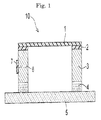
- FIG. 1 A longitudinal cross-sectional view showing an example of the EUV pellicle of the present invention in which the EUV pellicle frame is made of a material having a linear expansion coefficient of 10 x 10 -6 (1/K) or smaller.
- Fig. 1 is a longitudinal cross-sectional view showing an example of the pellicle 10 of the present invention in which the pellicle frame 3 is made of a material having a linear expansion coefficient of 10 x 10 -6 (1/K) or smaller.
- a pellicle membrane 1 is tensely adhered via an adhesive 2 to an upper annular face of a pellicle frame 3, which has a shape corresponding to the shape of a photomask 5 to which the pellicle 10 is adhered, the shape of the pellicle frame 3 being generally quadrilateral (either rectangular or square).
- an agglutinant layer 4 is formed on a lower annular face of the pellicle frame 3 for the purpose of enabling the pellicle 10 to adhere to the photomask 5; and a releasing liner (not shown) is detachably adhered to the exposed lower face of the agglutinant layer 4.
- an air pressure adjustment hole (vent hole) 6 is made through the pellicle frame 3, and a dust stopper filter 7 for prevention of particle contamination is provided to the hole 6.
- amorphous fluorine-containing polymer examples include CYTOP (a commercial product of ASAHI GLASS CO., LTD.) and TeflonTM AF (a commercial product of Du Pont Kabushiki Kaisha) .
- CYTOP a commercial product of ASAHI GLASS CO., LTD.
- TeflonTM AF a commercial product of Du Pont Kabushiki Kaisha
- the pellicle membrane is preferably made of a material having a high transmittance to EUV light such as single crystal silicon, poly-crystal silicon, and amorphous silicon. It is also possible to provide to the membrane a protective sheet of a material such as SiC, SiO2, Si 3 N 4 , SiON, Y 2 O 3 , YN, Mo, Ru, and Rh.
- the pellicle frame of the present invention has a linear expansion coefficient of 10 x 10 -6 (1/K) or smaller (at temperatures experienced when EUV exposure is conducted, generally, from 0 to 200 degrees C) so as to minimize the expansion and deformation of the pellicle frame, which are caused as the temperature rises with the EUV exposure operation.
- the material of which the pellicle frame is made there is no limitation to the material of which the pellicle frame is made, so long as its linear expansion coefficient is 10 x 10 -6 (1/K) or smaller; the material may be, for example, metal, glass, or ceramics. More particularly, it is possible that such material is a metal such as Fe-Ni alloy, Fe-Ni-Co alloy, Fe-Ni-Co-Cr alloy, and Fe-Co-Cr alloy, or a glass such as quartz glass, borosilicate glass, soda-lime glass, aluminoborosilicate glass, aluminosilicate glass, and crystallized glass, or a ceramics such as silicon carbide, silicon nitride, boron nitride, aluminum nitride, and aluminum oxide. These materials can be used singly or in combination of two or more to make the pellicle frame.
- metals such as Invar (Fe-Ni36), Super Invar (Fe-Ni32-Co5), Stainless Invar (Fe-Ni52-Co22-Cr), and Kovar (Fe-Ni29-Co17); glasses such as quartz glass (SiO 2 ), borosilicate glass (Na 2 O-B 2 O 3 -SiO 2 ), and soda-lime glass (Na 2 O-CaO-SiO 2 ); and ceramics such as silicon carbide (SiC), silicon nitride (Si 3 N 4 ), boron nitride (BN), aluminum nitride (AlN), aluminum oxide (Al 2 O 3 ); furthermore, Invar, Super Invar, quartz glass, and aluminum oxide are especially preferable.
- glasses such as quartz glass (SiO 2 ), borosilicate glass (Na 2 O-B 2 O 3 -SiO 2 ), and soda-lime glass (Na 2 O-CaO-Si
- the adhesive 2 for adhering the pellicle membrane 1 to the pellicle frame 3 and the agglutinant 4 for adhering the pellicle frame 3 to the photomask 5 may be made of any materials known to have been conventionally adopted.
- a solvent for the adhesive 2 to adhere the pellicle membrane 1 to the pellicle frame 3, namely by first putting the solvent, which dissolves the pellicle frame material well, to the pellicle frame 3, and attaching the pellicle membrane to the solvent, and then drying the solvent with blown air; or it is good to use an adhesive such as acrylic resin, silicone resin, epoxy resin or the like for the adhesive 2.
- the adhesive 2 is made of a material having low outgassing tendency.
- the agglutinant 4 which adheres the pellicle frame 3 to the photomask 5
- materials such as polybutene resin, polyvinyl acetate, SEBS (poly styrene-ethylene-butadiene-styrene) resin, acrylic resin, or silicone resin; of these acrylic resin and silicone resin are especially preferable.
- the formation of the layers of the adhesive 2 and the agglutinant 3 may be carried out by a method such as dipping, spraying, brushing or by means of an application machine equipped with a dispenser; of these alternatives, use of the application machine with dispenser is the most preferably for the reasons of stability, workability, yield, etc.
- an aromatic solvent such as toluene or xylene, or an aliphatic solvent such as hexane, octane, iso-octane, or iso-paraffine, or a ketone-based solvent such as methyl ethyl ketone or methyl isobutyl ketone, or an ester-based solvent such as ethyl acetate or butyl acetate, or an ether-based solvent such as di-isopropyl ether or 1,4-dioxane, or a mixture of two or more of these.
- aromatic solvent such as toluene or xylene
- an aliphatic solvent such as hexane, octane, iso-octane, or iso-paraffine
- a ketone-based solvent such as methyl ethyl ketone or methyl isobutyl ketone
- an ester-based solvent such as eth
- a rectangular pellicle frame made of Invar which is an alloy of iron and nickel [Fe-Ni36; linear expansion coefficient: 1 x 10 -6 (1/K)], of which the outer periphery measured 149 mm x 122 mm x 5.8 mm (in height) and the thickness 2 mm, was transported into a clean room, where it was washed with a neutral detergent and pure water thoroughly and dried.
- an agglutinant agent X-40-3122 (a product manufactured by Shin-Etsu Chemical Co., Ltd.) as the photomask-bonding agglutinant was applied to the lower annular face of the pellicle frame, and the agglutinant was dried in the air blow until it lost fluidity; then the pellicle frame was heated to 130 degrees C, whereby the agglutinant was completely hardened.
- a silicone-based adhesive KE-101A/B (a product manufactured by Shin-Etsu Chemical Co., Ltd.), which has a low outgassing tendency, was applied to the upper annular face of the pellicle frame, and a pellicle membrane made of single crystal silicon was adhered to the upper annular face of the pellicle frame via the adhesive. That portion of the pellicle membrane of single crystal silicon which extended beyond the outer edges of the pellicle frame was trimmed off with a cutter, whereupon a pellicle was completed.
- KE-101A/B a product manufactured by Shin-Etsu Chemical Co., Ltd.
- a pellicle made of Super Invar [Fe-Ni32-Co5; linear expansion coefficient: 0.1 x 10 -6 (1/K)], which is an alloy consisting of iron, nickel and cobalt, was used, a pellicle was manufactured in the same manner as in Example 1.
- a pellicle made of quartz glass [SiO 2 ; linear expansion coefficient: 0.5 x 10 -6 (1/K)] was used, a pellicle was manufactured in the same manner as in Example 1.
- a pellicle frame made of Invar a pellicle made of aluminum oxide [Al 2 O 3 ; linear expansion coefficient: 6 x 10 -6 (1/K)] was used, a pellicle was manufactured in the same manner as in Example 1.
- a pellicle made of an aluminum alloy of Al-Zn-Mg-Cu composition [JIS A7075; linear expansion coefficient: 23.4 x 10 -6 (1/K)] was used, a pellicle was manufactured in the same manner as in
- the pellicles manufactured in Examples 1 through 4 and Comparative Examples 1 and 2 were individually adhered to a quartz base plate, and were let to sit in an oven at a temperature of 200 degrees C for 24 hours; then they were let to sit at room temperature for another 24 hours; this heat cycle was repeated for 5 times (heat cycle test); thereafter the appearance of the pellicles (especially the pellicle membranes) were visually inspected. Also, the flatness of the pellicles against the quartz base plate after the heat cycle test was measured with FLatMaster (a product of SOL Co., Ltd.); the measurement results were rated according to the estimation standards described below. The rated estimations are shown in Table 1.
- the appearance of the pellicle was good and the flatness of the pellicle was 15 micrometers or smaller.
- the pellicle frames used in Examples 1 through 4 are excellent in stability against heat cycle and hence do not impart ill effects to the pellicle membrane and photomask base plate even when they are subjected to strenuous temperature change between a high temperature and a low temperature repeatedly; consequently, it was confirmed that the pellicle frame of the present invention is most suitable for use with the EUV exposure technology from overall viewpoint.
Landscapes
- Physics & Mathematics (AREA)
- General Physics & Mathematics (AREA)
- Chemical & Material Sciences (AREA)
- Engineering & Computer Science (AREA)
- Organic Chemistry (AREA)
- Plasma & Fusion (AREA)
- Chemical Kinetics & Catalysis (AREA)
- Environmental & Geological Engineering (AREA)
- Epidemiology (AREA)
- Public Health (AREA)
- Health & Medical Sciences (AREA)
- Preparing Plates And Mask In Photomechanical Process (AREA)
- Exposure Of Semiconductors, Excluding Electron Or Ion Beam Exposure (AREA)
- Exposure And Positioning Against Photoresist Photosensitive Materials (AREA)
Applications Claiming Priority (1)
| Application Number | Priority Date | Filing Date | Title |
|---|---|---|---|
| JP2015078209A JP6370255B2 (ja) | 2015-04-07 | 2015-04-07 | ペリクル用フレーム及びそれを用いたペリクル |
Publications (2)
| Publication Number | Publication Date |
|---|---|
| EP3079014A2 true EP3079014A2 (de) | 2016-10-12 |
| EP3079014A3 EP3079014A3 (de) | 2017-06-14 |
Family
ID=55640630
Family Applications (1)
| Application Number | Title | Priority Date | Filing Date |
|---|---|---|---|
| EP16162738.5A Withdrawn EP3079014A3 (de) | 2015-04-07 | 2016-03-30 | Euv-membranrahmen und euv-membran damit |
Country Status (5)
| Country | Link |
|---|---|
| US (1) | US20160299421A1 (de) |
| EP (1) | EP3079014A3 (de) |
| JP (1) | JP6370255B2 (de) |
| KR (2) | KR102731207B1 (de) |
| TW (6) | TWI785826B (de) |
Cited By (2)
| Publication number | Priority date | Publication date | Assignee | Title |
|---|---|---|---|---|
| NL2024717A (en) * | 2017-06-15 | 2020-05-07 | Asml Netherlands Bv | Pellicle and Pellicle Assembly |
| EP3663853A1 (de) * | 2018-12-03 | 2020-06-10 | Shin-Etsu Chemical Co., Ltd. | Pellikel und verfahren zu dessen herstellung |
Families Citing this family (16)
| Publication number | Priority date | Publication date | Assignee | Title |
|---|---|---|---|---|
| US9759997B2 (en) * | 2015-12-17 | 2017-09-12 | Taiwan Semiconductor Manufacturing Company, Ltd. | Pellicle assembly and method for advanced lithography |
| JP6478283B2 (ja) * | 2015-12-24 | 2019-03-06 | 信越化学工業株式会社 | Euv露光用ペリクル |
| JP6844443B2 (ja) * | 2017-06-23 | 2021-03-17 | 信越化学工業株式会社 | フォトリソグラフィ用ペリクル膜、ペリクル及びフォトマスク、露光方法並びに半導体デバイス又は液晶ディスプレイの製造方法 |
| US11143952B2 (en) * | 2017-09-28 | 2021-10-12 | Taiwan Semiconductor Manufacturing Company, Ltd. | Pellicle removal method |
| JP2019070745A (ja) | 2017-10-10 | 2019-05-09 | 信越化学工業株式会社 | ペリクルフレーム及びペリクル |
| KR102873593B1 (ko) * | 2017-11-06 | 2025-10-21 | 에이에스엠엘 네델란즈 비.브이. | 응력 감소를 위한 금속 실리사이드 질화 |
| JP7040427B2 (ja) * | 2018-12-03 | 2022-03-23 | 信越化学工業株式会社 | ペリクル、ペリクル付露光原版、露光方法及び半導体の製造方法 |
| JP7103252B2 (ja) * | 2019-02-01 | 2022-07-20 | 信越化学工業株式会社 | ペリクルフレーム、ペリクル、マスク粘着剤付ペリクルフレーム、ペリクル付露光原版、露光方法及び半導体の製造方法 |
| KR20220137023A (ko) * | 2020-02-04 | 2022-10-11 | 신에쓰 가가꾸 고교 가부시끼가이샤 | 펠리클 프레임, 펠리클, 펠리클 부착 노광 원판 및 노광 방법, 그리고 반도체 장치 또는 액정 표시판의 제조 방법 |
| CN113253566B (zh) * | 2020-02-10 | 2024-04-09 | 永恒光实业股份有限公司 | 复合精细遮罩 |
| JP7623156B2 (ja) * | 2021-02-17 | 2025-01-28 | エア・ウォーター株式会社 | ペリクルおよびペリクルの製造方法 |
| KR102868688B1 (ko) | 2022-08-01 | 2025-10-13 | 주식회사 참그래핀 | 극자외선 노광공정의 포토마스크 보호용 펠리클 및 그 제조방법 |
| KR102877833B1 (ko) | 2022-08-01 | 2025-11-03 | 주식회사 참그래핀 | 극자외선 노광공정의 포토마스크 보호용 펠리클 및 그 제조방법 |
| KR20240135940A (ko) | 2023-03-06 | 2024-09-13 | 주식회사 참그래핀 | 극자외선 노광공정의 포토마스크 보호용 펠리클의 제조방법 |
| KR20240135942A (ko) | 2023-03-06 | 2024-09-13 | 주식회사 참그래핀 | 극자외선 노광공정의 포토마스크 보호용 펠리클의 제조방법 |
| WO2025203872A1 (ja) * | 2024-03-28 | 2025-10-02 | 株式会社巴川コーポレーション | ペリクル用フレーム |
Citations (3)
| Publication number | Priority date | Publication date | Assignee | Title |
|---|---|---|---|---|
| JPS58219023A (ja) | 1982-06-15 | 1983-12-20 | Daicel Chem Ind Ltd | 樹脂薄膜の製造方法 |
| JPS6327707A (ja) | 1986-07-21 | 1988-02-05 | Matsushita Electric Ind Co Ltd | 双曲面鏡検査装置 |
| US4861402A (en) | 1984-10-16 | 1989-08-29 | Du Pont Tau Laboratories, Inc. | Method of making a cellulose acetate butyrate pellicle |
Family Cites Families (32)
| Publication number | Priority date | Publication date | Assignee | Title |
|---|---|---|---|---|
| JP3330045B2 (ja) | 1996-03-01 | 2002-09-30 | 日産自動車株式会社 | ネジ部品の表面処理方法 |
| JPH10163091A (ja) * | 1996-11-29 | 1998-06-19 | Canon Inc | X線露光用マスク構造体およびx線露光装置 |
| US6847434B2 (en) * | 2000-02-10 | 2005-01-25 | Asml Holding N.V. | Method and apparatus for a pellicle frame with porous filtering inserts |
| JP2002040629A (ja) * | 2000-07-31 | 2002-02-06 | Asahi Glass Co Ltd | ペリクル板とペリクルフレームとの接着方法 |
| JP2002040628A (ja) * | 2000-07-31 | 2002-02-06 | Asahi Glass Co Ltd | ペリクルおよびペリクル板とペリクルフレームとの接着方法 |
| US6593035B1 (en) * | 2001-01-26 | 2003-07-15 | Advanced Micro Devices, Inc. | Pellicle for use in small wavelength lithography and a method for making such a pellicle using polymer films |
| US6544693B2 (en) * | 2001-01-26 | 2003-04-08 | Advanced Micro Devices, Inc. | Pellicle for use in small wavelength lithography and a method for making such a pellicle |
| US6623893B1 (en) * | 2001-01-26 | 2003-09-23 | Advanced Micro Devices, Inc. | Pellicle for use in EUV lithography and a method of making such a pellicle |
| JP2002323751A (ja) * | 2001-04-24 | 2002-11-08 | Asahi Glass Co Ltd | ペリクル |
| JP2004012597A (ja) * | 2002-06-04 | 2004-01-15 | Asahi Glass Co Ltd | ペリクル |
| US7014961B2 (en) * | 2002-10-02 | 2006-03-21 | Yazaki Corporation | Photomask assembly incorporating a porous frame |
| US6822731B1 (en) * | 2003-06-18 | 2004-11-23 | Asml Holding N.V. | Method and apparatus for a pellicle frame with heightened bonding surfaces |
| JP2005108938A (ja) * | 2003-09-29 | 2005-04-21 | Sony Corp | ステンシルマスクおよびその製造方法、露光装置および露光方法、並びに電子装置の製造方法 |
| US20060246234A1 (en) * | 2005-04-20 | 2006-11-02 | Yazaki Corporation | Photomask assembly incorporating a metal/scavenger pellicle frame |
| DE102006014380A1 (de) * | 2006-03-27 | 2007-10-11 | Carl Zeiss Smt Ag | Projektionsobjektiv und Projektionsbelichtungsanlage mit negativer Schnittweite der Eintrittspupille |
| JP2008105999A (ja) * | 2006-10-25 | 2008-05-08 | Idemitsu Kosan Co Ltd | アダマンタン誘導体、その製造方法、樹脂組成物およびその硬化物 |
| JP4833356B2 (ja) * | 2009-02-13 | 2011-12-07 | Hoya株式会社 | フォトマスクブランク及びその製造方法、並びにフォトマスク及び半導体装置の製造方法 |
| JP2009146912A (ja) * | 2009-03-27 | 2009-07-02 | Jsr Corp | 異方導電性シートならびにそれを用いた電気的検査方法および電気的接続方法 |
| JP5489966B2 (ja) * | 2009-12-18 | 2014-05-14 | 富士フイルム株式会社 | 遮光性硬化性組成物、ウエハレベルレンズ、及び遮光性カラーフィルタ |
| US8435704B2 (en) * | 2010-03-30 | 2013-05-07 | Hoya Corporation | Mask blank, transfer mask, and methods of manufacturing the same |
| WO2011125407A1 (ja) * | 2010-04-02 | 2011-10-13 | 信越化学工業株式会社 | フォトマスクユニット及びその製造方法 |
| JP5813325B2 (ja) * | 2010-10-04 | 2015-11-17 | 富士フイルム株式会社 | 黒色重合性組成物、及び、黒色層の作製方法 |
| JPWO2012050201A1 (ja) * | 2010-10-14 | 2014-02-24 | 旭化成イーマテリアルズ株式会社 | 感光性樹脂組成物及びその製造方法 |
| JP2012151158A (ja) * | 2011-01-17 | 2012-08-09 | Shin Etsu Chem Co Ltd | Euv用ペリクル膜及びペリクル、並びに該膜の製造方法 |
| KR20130088565A (ko) * | 2012-01-31 | 2013-08-08 | 주식회사 에프에스티 | 그래핀을 이용한 초극자외선용 펠리클 및 그 제조방법 |
| JP6013818B2 (ja) * | 2012-07-13 | 2016-10-25 | 旭化成株式会社 | ペリクル枠体及びペリクル |
| WO2014013931A1 (ja) * | 2012-07-17 | 2014-01-23 | 日本軽金属株式会社 | ペリクル用支持枠の製造方法、ペリクル用支持枠、及びペリクル |
| JP5711703B2 (ja) * | 2012-09-03 | 2015-05-07 | 信越化学工業株式会社 | Euv用ペリクル |
| JP5984187B2 (ja) * | 2013-04-22 | 2016-09-06 | 信越化学工業株式会社 | ペリクルとフォトマスクのアセンブリ |
| KR101707763B1 (ko) * | 2013-05-24 | 2017-02-16 | 미쯔이가가꾸가부시끼가이샤 | 펠리클 및 이것을 포함하는 euv 노광 장치 |
| JP2015018228A (ja) * | 2013-06-10 | 2015-01-29 | 旭化成イーマテリアルズ株式会社 | ペリクル膜及びペリクル |
| US9703197B2 (en) * | 2013-09-26 | 2017-07-11 | National Institute For Materials Science | High-sensitivity multilayer resist film and method of increasing photosensitivity of resist film |
-
2015
- 2015-04-07 JP JP2015078209A patent/JP6370255B2/ja active Active
-
2016
- 2016-03-30 EP EP16162738.5A patent/EP3079014A3/de not_active Withdrawn
- 2016-04-01 TW TW110136810A patent/TWI785826B/zh active
- 2016-04-01 KR KR1020160040203A patent/KR102731207B1/ko active Active
- 2016-04-01 TW TW113105910A patent/TWI874137B/zh active
- 2016-04-01 TW TW111142318A patent/TWI830485B/zh active
- 2016-04-01 TW TW105110435A patent/TWI697731B/zh active
- 2016-04-01 TW TW109118643A patent/TWI745990B/zh active
- 2016-04-01 TW TW111142319A patent/TWI836704B/zh active
- 2016-04-04 US US15/089,917 patent/US20160299421A1/en not_active Abandoned
-
2024
- 2024-11-05 KR KR1020240155101A patent/KR20240161625A/ko not_active Ceased
Patent Citations (3)
| Publication number | Priority date | Publication date | Assignee | Title |
|---|---|---|---|---|
| JPS58219023A (ja) | 1982-06-15 | 1983-12-20 | Daicel Chem Ind Ltd | 樹脂薄膜の製造方法 |
| US4861402A (en) | 1984-10-16 | 1989-08-29 | Du Pont Tau Laboratories, Inc. | Method of making a cellulose acetate butyrate pellicle |
| JPS6327707A (ja) | 1986-07-21 | 1988-02-05 | Matsushita Electric Ind Co Ltd | 双曲面鏡検査装置 |
Cited By (8)
| Publication number | Priority date | Publication date | Assignee | Title |
|---|---|---|---|---|
| NL2024717A (en) * | 2017-06-15 | 2020-05-07 | Asml Netherlands Bv | Pellicle and Pellicle Assembly |
| US11231646B2 (en) | 2017-06-15 | 2022-01-25 | Asml Netherlands B.V. | Pellicle and pellicle assembly |
| US11754918B2 (en) | 2017-06-15 | 2023-09-12 | Asml Netherlands B.V. | Pellicle and pellicle assembly |
| US12117726B2 (en) | 2017-06-15 | 2024-10-15 | Asml Netherlands B.V. | Pellicle and pellicle assembly |
| EP3663853A1 (de) * | 2018-12-03 | 2020-06-10 | Shin-Etsu Chemical Co., Ltd. | Pellikel und verfahren zu dessen herstellung |
| US11237474B2 (en) | 2018-12-03 | 2022-02-01 | Shin-Etsu Chemical Co., Ltd. | Pellicle and method for producing the same |
| US11599018B2 (en) | 2018-12-03 | 2023-03-07 | Shin-Etsu Chemical Co., Ltd. | Pellicle and method for producing the same |
| US11988955B2 (en) | 2018-12-03 | 2024-05-21 | Shin-Etsu Chemical Co., Ltd. | Pellicle and method for producing the same |
Also Published As
| Publication number | Publication date |
|---|---|
| TW202034067A (zh) | 2020-09-16 |
| TWI836704B (zh) | 2024-03-21 |
| JP6370255B2 (ja) | 2018-08-08 |
| TW202424640A (zh) | 2024-06-16 |
| TW202321834A (zh) | 2023-06-01 |
| TWI697731B (zh) | 2020-07-01 |
| EP3079014A3 (de) | 2017-06-14 |
| KR20160120225A (ko) | 2016-10-17 |
| TWI745990B (zh) | 2021-11-11 |
| TWI874137B (zh) | 2025-02-21 |
| TWI830485B (zh) | 2024-01-21 |
| TW202309651A (zh) | 2023-03-01 |
| TW201636728A (zh) | 2016-10-16 |
| TW202205009A (zh) | 2022-02-01 |
| US20160299421A1 (en) | 2016-10-13 |
| KR102731207B1 (ko) | 2024-11-15 |
| JP2016200616A (ja) | 2016-12-01 |
| TWI785826B (zh) | 2022-12-01 |
| KR20240161625A (ko) | 2024-11-12 |
Similar Documents
| Publication | Publication Date | Title |
|---|---|---|
| EP3079014A2 (de) | Euv-membranrahmen und euv-membran damit | |
| TWI895778B (zh) | 防護薄膜框架、防護薄膜組件、曝光方法及半導體元件之製造方法 | |
| US10088745B2 (en) | Pellicle for EUV exposure | |
| KR101762957B1 (ko) | 펠리클 및 그 부착 방법, 그리고 펠리클 부착 마스크 및 마스크 | |
| CN102822744A (zh) | 光掩模单元及其制造方法 | |
| JP6516665B2 (ja) | Euvリソグラフィー用ペリクルに適した接着剤とこれを用いたペリクル | |
| JP4345882B2 (ja) | 大型ペリクル | |
| JP2018049256A (ja) | ペリクル | |
| US10126645B2 (en) | Adhesive suitable for a pellicle for EUV lithography and a pellicle using the same adhesive | |
| KR20230164123A (ko) | 펠리클 프레임, 펠리클, 펠리클 부착 포토마스크, 노광 방법, 반도체 디바이스의 제조 방법 및 액정 디스플레이의 제조 방법 |
Legal Events
| Date | Code | Title | Description |
|---|---|---|---|
| PUAI | Public reference made under article 153(3) epc to a published international application that has entered the european phase |
Free format text: ORIGINAL CODE: 0009012 |
|
| AK | Designated contracting states |
Kind code of ref document: A2 Designated state(s): AL AT BE BG CH CY CZ DE DK EE ES FI FR GB GR HR HU IE IS IT LI LT LU LV MC MK MT NL NO PL PT RO RS SE SI SK SM TR |
|
| AX | Request for extension of the european patent |
Extension state: BA ME |
|
| PUAL | Search report despatched |
Free format text: ORIGINAL CODE: 0009013 |
|
| AK | Designated contracting states |
Kind code of ref document: A3 Designated state(s): AL AT BE BG CH CY CZ DE DK EE ES FI FR GB GR HR HU IE IS IT LI LT LU LV MC MK MT NL NO PL PT RO RS SE SI SK SM TR |
|
| AX | Request for extension of the european patent |
Extension state: BA ME |
|
| RIC1 | Information provided on ipc code assigned before grant |
Ipc: G03F 1/64 20120101AFI20170508BHEP |
|
| STAA | Information on the status of an ep patent application or granted ep patent |
Free format text: STATUS: THE APPLICATION IS DEEMED TO BE WITHDRAWN |
|
| 18D | Application deemed to be withdrawn |
Effective date: 20171215 |