EP3054506B1 - Anode active material for lithium secondary battery, manufacturing method therefor, lithium secondary battery comprising the same - Google Patents
Anode active material for lithium secondary battery, manufacturing method therefor, lithium secondary battery comprising the same Download PDFInfo
- Publication number
- EP3054506B1 EP3054506B1 EP15847257.1A EP15847257A EP3054506B1 EP 3054506 B1 EP3054506 B1 EP 3054506B1 EP 15847257 A EP15847257 A EP 15847257A EP 3054506 B1 EP3054506 B1 EP 3054506B1
- Authority
- EP
- European Patent Office
- Prior art keywords
- acid
- active material
- core
- negative active
- lithium secondary
- Prior art date
- Legal status (The legal status is an assumption and is not a legal conclusion. Google has not performed a legal analysis and makes no representation as to the accuracy of the status listed.)
- Active
Links
Images

Classifications
-
- H—ELECTRICITY
- H01—ELECTRIC ELEMENTS
- H01M—PROCESSES OR MEANS, e.g. BATTERIES, FOR THE DIRECT CONVERSION OF CHEMICAL ENERGY INTO ELECTRICAL ENERGY
- H01M4/00—Electrodes
- H01M4/02—Electrodes composed of, or comprising, active material
- H01M4/36—Selection of substances as active materials, active masses, active liquids
- H01M4/362—Composites
- H01M4/366—Composites as layered products
-
- C—CHEMISTRY; METALLURGY
- C01—INORGANIC CHEMISTRY
- C01D—COMPOUNDS OF ALKALI METALS, i.e. LITHIUM, SODIUM, POTASSIUM, RUBIDIUM, CAESIUM, OR FRANCIUM
- C01D15/00—Lithium compounds
-
- C—CHEMISTRY; METALLURGY
- C01—INORGANIC CHEMISTRY
- C01D—COMPOUNDS OF ALKALI METALS, i.e. LITHIUM, SODIUM, POTASSIUM, RUBIDIUM, CAESIUM, OR FRANCIUM
- C01D15/00—Lithium compounds
- C01D15/02—Oxides; Hydroxides
-
- C—CHEMISTRY; METALLURGY
- C01—INORGANIC CHEMISTRY
- C01G—COMPOUNDS CONTAINING METALS NOT COVERED BY SUBCLASSES C01D OR C01F
- C01G23/00—Compounds of titanium
-
- C—CHEMISTRY; METALLURGY
- C01—INORGANIC CHEMISTRY
- C01G—COMPOUNDS CONTAINING METALS NOT COVERED BY SUBCLASSES C01D OR C01F
- C01G23/00—Compounds of titanium
- C01G23/003—Titanates
- C01G23/005—Alkali titanates
-
- C—CHEMISTRY; METALLURGY
- C23—COATING METALLIC MATERIAL; COATING MATERIAL WITH METALLIC MATERIAL; CHEMICAL SURFACE TREATMENT; DIFFUSION TREATMENT OF METALLIC MATERIAL; COATING BY VACUUM EVAPORATION, BY SPUTTERING, BY ION IMPLANTATION OR BY CHEMICAL VAPOUR DEPOSITION, IN GENERAL; INHIBITING CORROSION OF METALLIC MATERIAL OR INCRUSTATION IN GENERAL
- C23C—COATING METALLIC MATERIAL; COATING MATERIAL WITH METALLIC MATERIAL; SURFACE TREATMENT OF METALLIC MATERIAL BY DIFFUSION INTO THE SURFACE, BY CHEMICAL CONVERSION OR SUBSTITUTION; COATING BY VACUUM EVAPORATION, BY SPUTTERING, BY ION IMPLANTATION OR BY CHEMICAL VAPOUR DEPOSITION, IN GENERAL
- C23C16/00—Chemical coating by decomposition of gaseous compounds, without leaving reaction products of surface material in the coating, i.e. chemical vapour deposition [CVD] processes
- C23C16/56—After-treatment
-
- H—ELECTRICITY
- H01—ELECTRIC ELEMENTS
- H01M—PROCESSES OR MEANS, e.g. BATTERIES, FOR THE DIRECT CONVERSION OF CHEMICAL ENERGY INTO ELECTRICAL ENERGY
- H01M10/00—Secondary cells; Manufacture thereof
- H01M10/05—Accumulators with non-aqueous electrolyte
- H01M10/052—Li-accumulators
-
- H—ELECTRICITY
- H01—ELECTRIC ELEMENTS
- H01M—PROCESSES OR MEANS, e.g. BATTERIES, FOR THE DIRECT CONVERSION OF CHEMICAL ENERGY INTO ELECTRICAL ENERGY
- H01M10/00—Secondary cells; Manufacture thereof
- H01M10/05—Accumulators with non-aqueous electrolyte
- H01M10/052—Li-accumulators
- H01M10/0525—Rocking-chair batteries, i.e. batteries with lithium insertion or intercalation in both electrodes; Lithium-ion batteries
-
- H—ELECTRICITY
- H01—ELECTRIC ELEMENTS
- H01M—PROCESSES OR MEANS, e.g. BATTERIES, FOR THE DIRECT CONVERSION OF CHEMICAL ENERGY INTO ELECTRICAL ENERGY
- H01M4/00—Electrodes
- H01M4/02—Electrodes composed of, or comprising, active material
- H01M4/04—Processes of manufacture in general
- H01M4/0471—Processes of manufacture in general involving thermal treatment, e.g. firing, sintering, backing particulate active material, thermal decomposition, pyrolysis
-
- H—ELECTRICITY
- H01—ELECTRIC ELEMENTS
- H01M—PROCESSES OR MEANS, e.g. BATTERIES, FOR THE DIRECT CONVERSION OF CHEMICAL ENERGY INTO ELECTRICAL ENERGY
- H01M4/00—Electrodes
- H01M4/02—Electrodes composed of, or comprising, active material
- H01M4/04—Processes of manufacture in general
- H01M4/049—Manufacturing of an active layer by chemical means
- H01M4/0492—Chemical attack of the support material
-
- H—ELECTRICITY
- H01—ELECTRIC ELEMENTS
- H01M—PROCESSES OR MEANS, e.g. BATTERIES, FOR THE DIRECT CONVERSION OF CHEMICAL ENERGY INTO ELECTRICAL ENERGY
- H01M4/00—Electrodes
- H01M4/02—Electrodes composed of, or comprising, active material
- H01M4/36—Selection of substances as active materials, active masses, active liquids
- H01M4/48—Selection of substances as active materials, active masses, active liquids of inorganic oxides or hydroxides
- H01M4/485—Selection of substances as active materials, active masses, active liquids of inorganic oxides or hydroxides of mixed oxides or hydroxides for inserting or intercalating light metals, e.g. LiTi2O4 or LiTi2OxFy
-
- H—ELECTRICITY
- H01—ELECTRIC ELEMENTS
- H01M—PROCESSES OR MEANS, e.g. BATTERIES, FOR THE DIRECT CONVERSION OF CHEMICAL ENERGY INTO ELECTRICAL ENERGY
- H01M4/00—Electrodes
- H01M4/02—Electrodes composed of, or comprising, active material
- H01M4/62—Selection of inactive substances as ingredients for active masses, e.g. binders, fillers
- H01M4/628—Inhibitors, e.g. gassing inhibitors, corrosion inhibitors
-
- C—CHEMISTRY; METALLURGY
- C01—INORGANIC CHEMISTRY
- C01P—INDEXING SCHEME RELATING TO STRUCTURAL AND PHYSICAL ASPECTS OF SOLID INORGANIC COMPOUNDS
- C01P2004/00—Particle morphology
- C01P2004/60—Particles characterised by their size
- C01P2004/61—Micrometer sized, i.e. from 1-100 micrometer
-
- C—CHEMISTRY; METALLURGY
- C01—INORGANIC CHEMISTRY
- C01P—INDEXING SCHEME RELATING TO STRUCTURAL AND PHYSICAL ASPECTS OF SOLID INORGANIC COMPOUNDS
- C01P2006/00—Physical properties of inorganic compounds
- C01P2006/40—Electric properties
-
- C—CHEMISTRY; METALLURGY
- C01—INORGANIC CHEMISTRY
- C01P—INDEXING SCHEME RELATING TO STRUCTURAL AND PHYSICAL ASPECTS OF SOLID INORGANIC COMPOUNDS
- C01P2006/00—Physical properties of inorganic compounds
- C01P2006/80—Compositional purity
- C01P2006/82—Compositional purity water content
-
- H—ELECTRICITY
- H01—ELECTRIC ELEMENTS
- H01M—PROCESSES OR MEANS, e.g. BATTERIES, FOR THE DIRECT CONVERSION OF CHEMICAL ENERGY INTO ELECTRICAL ENERGY
- H01M4/00—Electrodes
- H01M4/02—Electrodes composed of, or comprising, active material
- H01M2004/026—Electrodes composed of, or comprising, active material characterised by the polarity
- H01M2004/027—Negative electrodes
-
- Y—GENERAL TAGGING OF NEW TECHNOLOGICAL DEVELOPMENTS; GENERAL TAGGING OF CROSS-SECTIONAL TECHNOLOGIES SPANNING OVER SEVERAL SECTIONS OF THE IPC; TECHNICAL SUBJECTS COVERED BY FORMER USPC CROSS-REFERENCE ART COLLECTIONS [XRACs] AND DIGESTS
- Y02—TECHNOLOGIES OR APPLICATIONS FOR MITIGATION OR ADAPTATION AGAINST CLIMATE CHANGE
- Y02E—REDUCTION OF GREENHOUSE GAS [GHG] EMISSIONS, RELATED TO ENERGY GENERATION, TRANSMISSION OR DISTRIBUTION
- Y02E60/00—Enabling technologies; Technologies with a potential or indirect contribution to GHG emissions mitigation
- Y02E60/10—Energy storage using batteries
-
- Y—GENERAL TAGGING OF NEW TECHNOLOGICAL DEVELOPMENTS; GENERAL TAGGING OF CROSS-SECTIONAL TECHNOLOGIES SPANNING OVER SEVERAL SECTIONS OF THE IPC; TECHNICAL SUBJECTS COVERED BY FORMER USPC CROSS-REFERENCE ART COLLECTIONS [XRACs] AND DIGESTS
- Y02—TECHNOLOGIES OR APPLICATIONS FOR MITIGATION OR ADAPTATION AGAINST CLIMATE CHANGE
- Y02T—CLIMATE CHANGE MITIGATION TECHNOLOGIES RELATED TO TRANSPORTATION
- Y02T10/00—Road transport of goods or passengers
- Y02T10/60—Other road transportation technologies with climate change mitigation effect
- Y02T10/70—Energy storage systems for electromobility, e.g. batteries
Definitions
- the present invention relates to a negative active material for rechargeable lithium secondary batteries capable of inhibiting battery side reactions and gas generation and improving battery performance since moisture formed during an oxidation-reduction (redox) reaction is effectively absorbed into a surface of the negative active material, a method of preparing the same, and a rechargeable lithium secondary battery including the same.
- a negative active material for rechargeable lithium secondary batteries capable of inhibiting battery side reactions and gas generation and improving battery performance since moisture formed during an oxidation-reduction (redox) reaction is effectively absorbed into a surface of the negative active material, a method of preparing the same, and a rechargeable lithium secondary battery including the same.
- Rechargeable lithium secondary batteries e.g., lithium ion batteries
- nickel-hydrogen batteries and other secondary batteries
- rechargeable lithium secondary batteries which are lightweight and may have a high energy density may be desirably used as high-output power sources for vehicle mounting, and thus demand for rechargeable lithium secondary batteries is expected to increase in the future.
- a rechargeable lithium secondary battery is manufactured by installing a porous separation film between a positive electrode and a negative electrode, followed by injecting a liquid electrolyte between the positive electrode and the negative electrode.
- a material in which lithium ions are intercalatable and deintercalatable is used as the negative electrode or a negative active material and negative electrodes.
- electricity may be produced or consumed by a redox reaction caused by intercalation/deintercalation of lithium ions into/from the negative and positive electrodes.
- various types of carbon-based materials in which lithium ions are intercalatable and deintercalatable and which include synthetic graphite, natural graphite, and hard carbon, have been applied as the negative active materials in the case of the rechargeable lithium secondary batteries.
- graphite has a discharge voltage of -0.2 V lower than lithium, and thus secondary batteries in which graphite is used as a negative active material may have a high discharge voltage of 3.6 V.
- graphite has been most widely used since it may be advantageous in terms of the energy density of rechargeable lithium secondary batteries, and may ensure long lifespan of the rechargeable lithium secondary batteries due to excellent reversibility thereof.
- graphite active materials have a problem in that they have low capacity with respect to the energy density of electrode plates per unit volume since graphite has a low density (a theoretical density of 2.2 g/cc), and side reactions with an organic electrolyte solution used at a high discharge voltage may easily occur upon manufacture of the electrode plates, resulting in swelling of the batteries, and thus battery capacity degradation.
- Si-based negative active materials having a much higher capacity than graphite and negative active materials using oxides such as tin oxide, lithium vanadium-based oxide, and lithium titanium-based oxide have been developed and researched.
- the high-capacity, Si-based negative active materials undergo serious changes in volume during charge/discharge cycles, and thus lifespan characteristics may be deteriorated due to particle splitting.
- LTO lithium titanium oxide
- SEI solid electrolyte interface
- LTO is advantageous in terms of an irreversible reaction, and thus has very stable lifespan characteristics.
- LTO may also be desirably used to charge and discharge the secondary batteries at a high speed during intercalation/deintercalation of lithium (Li) ions.
- Li lithium titanium oxide
- LTO has a high content of moisture, and thus has a drawback in that battery performance may be degraded due to the presence of moisture, and thus gas generation.
- US 2011/165465 A1 discloses a negative active material for a rechargeable lithium battery, the active material including a core and a carbon coating layer formed on the core.
- the core includes a compound represented by the formula Li x Ti y O 4 , wherein 0.6 ⁇ x ⁇ 2.5 and 1.2 ⁇ y ⁇ 2.3.
- the carbon coating layer includes amorphous carbon.
- the present invention has been made in view of the above problems, and it is an object of the present invention to provide a negative active material capable of inhibiting battery side reactions and gas generation and improving battery performance since moisture formed during a redox reaction is effectively absorbed into a surface of the negative active material, and a method of preparing the same.
- a negative active material for rechargeable lithium secondary batteries which includes a core including a lithium titanium oxide represented by the following Formula 1, and a coating layer positioned on a surface of the core, wherein the coating layer includes an acid anhydride physically absorbed (i.e., physisorbed) into the core: [Formula 1] Li x Ti y O 4 wherein 0.8 ⁇ x ⁇ 1.4, and 1.6 ⁇ y ⁇ 2.2.
- the core contains at least one surface functional group selected from the group consisting of O - and CO 2 - .
- lithium titanium oxide of Formula 1 may be Li 4 Ti 5 O 12 having a spinel structure.
- the acid anhydride may include at least one selected from the group consisting of a carboxylic anhydride, a maleic anhydride, and an acetic anhydride.
- the coating layer may be included in an amount of 0.5 to 3 parts by weight, based on 100 parts by weight of the core.
- a method of preparing a negative active material for rechargeable lithium secondary batteries which includes preparing a core containing at least one surface functional group selected from the group consisting of O - and CO 2 - by mixing a lithium source and a titanium source so as to prepare a lithium titanium oxide of Formula 1, and calcining the resulting mixture at a temperature of 750 to 800°C, which is less than a typical calcination temperature, and physisorbing an acid anhydride of an organic acid onto a surface of the core by treating the core containing the surface functional group with a solution including the organic acid, and drying the core at 60 to 130°C under vacuum.
- the organic acid may be a carboxylic acid containing 1 to 3 carboxyl groups in a molecule thereof.
- the organic acid may include at least one selected from the group consisting of acetic acid, propionic acid, stearic acid, pyruvic acid, acetoacetic acid, glyoxylic acid, oxalic acid, malonic acid, maleic acid, glutaric acid, adipic acid, phthalic acid, trimellitic acid, and a mixture thereof.
- the organic acid may be included in an amount of 0.5 to 3% by weight, based on the total weight of the solution including the organic acid.
- the present invention is characterized in that a negative active material is prepared by immersing an LTO-based negative active material pretreated to contain a surface functional group in a solution including an organic acid such as maleic acid, drying the LTO-based negative active material, and physisorbing the organic acid onto a surface of LTO in the form of an acid anhydride, and thus may be useful in inhibiting battery side reactions and gas generation and improving battery performance since moisture formed during a redox reaction is effectively absorbed into a surface of the negative active material.
- a negative active material is prepared by immersing an LTO-based negative active material pretreated to contain a surface functional group in a solution including an organic acid such as maleic acid, drying the LTO-based negative active material, and physisorbing the organic acid onto a surface of LTO in the form of an acid anhydride, and thus may be useful in inhibiting battery side reactions and gas generation and improving battery performance since moisture formed during a redox reaction is effectively absorbed into a surface of the negative active material.
- the negative active material for rechargeable lithium secondary batteries includes a core including a lithium titanium oxide represented by the following Formula 1, and a coating layer positioned on a surface of the core, wherein the coating layer includes an acid anhydride physisorbed onto the core: [Formula 1] Li x Ti y O 4 wherein 0.8 ⁇ x ⁇ 1.4, and 1.6 ⁇ y ⁇ 2.2.
- the core may be formed of Li 4 Ti 5 O 12 having a spinel structure.
- the number of moles of oxygen in Formula 1 is represented by a fixed value of 4, but Formula 1 is not limited thereto.
- the number of moles of oxygen may be represented as multiples of the number of moles within a range in which a ratio of the number of moles of the respective elemental atoms in Formula 1 is satisfied. That is, when the number of moles of oxygen in Formula 1 is 12, the lithium titanium oxide of Formula 1 may be represented by Li 3x Ti 3y O 12 .
- Li 4 Ti 5 O 12 having a spinel structure may serve to prevent an SEI film from being formed on a surface of the negative electrode to an excessively large thickness, and improve electrochemical characteristics and safety of the secondary batteries under the control of thermal runaway factors.
- the Li 4 Ti 5 O 12 may promote transportation of Li ions to impart rapid charge/discharge characteristics to the secondary batteries.
- the core contains at least one surface functional group selected from the group consisting of O - and CO 2 - to allow physisorption of the acid anhydride during preparation of the negative active material.
- the core including the above-described lithium titanium oxide may have an average particle diameter of 3 to 15 ⁇ m in consideration of the specific surface area and negative electrode mix density of the active material.
- the coating layer positioned on a surface of the core includes an acid anhydride physisorbed onto the core.
- the acid anhydride is derived from an organic acid, particularly an organic acid containing at least one carboxyl group in a molecule thereof.
- the acid anhydride is present in a state in which the acid anhydride is physisorbed onto a surface of the core, but when moisture is formed during a redox reaction, the acid anhydride preferentially reacts with the moisture so that the acid anhydride is converted into an acid.
- the acid anhydride reacts with the moisture immediately after moisture is formed on a surface of the active material, side reactions and gas generation caused by moisture in all the secondary batteries may be inhibited.
- Types of the acid anhydride may vary according to the type of the organic acid used to prepare the negative active material.
- the acid anhydride may include a carboxylic anhydride, a maleic anhydride, an acetic anhydride, and a mixture thereof.
- the coating layer including the acid anhydride may be included in an amount of 0.5 to 3 parts by weight, based on 100 parts by weight of the core.
- the content of the coating layer is less than 0.5 parts by weight, it is difficult to coat the core completely, and thus the lithium titanium oxide constituting the core may be exposed to the outside, resulting in side reactions caused by generated moisture and thus gas generation.
- the content of the coating layer is greater than 3 parts by weight, reduction in initial battery efficiency and performance degradation may be caused due to an increase in thickness of the coating layer.
- the coating layer may also be included in an amount of 1 to 2 parts by weight, based on 100 parts by weight of the core.
- a method of preparing the above-described negative active material which includes preparing a core containing at least one surface functional group selected from the group consisting of O - and CO 2 - by mixing a lithium source and a titanium source so as to prepare a lithium titanium oxide of Formula 1 and calcining the resulting mixture at a temperature of 750 to 800°C, which is less than a typical calcination temperature, and physisorbing an acid anhydride of an organic acid onto a surface of the core by immersing the core containing the surface functional group in a solution including the organic acid and drying the core at 60 to 130°C under vacuum.
- the first step includes preparing a core including the lithium titanium oxide of Formula 1 containing at least one surface functional group selected from the group consisting of O - and CO 2 - .
- the core may be prepared by mixing a lithium source and a titanium source at an atomic ratio between lithium and titanium (4 lithium atoms and 5 titanium atoms in the case of Li 4 Ti 5 O 12 ), stirring and drying the resulting mixture to prepare a precursor, and calcining the precursor.
- the lithium source may be a solution obtained by dissolving lithium salts, such as lithium hydroxide, lithium carbonate and lithium oxide, in water, and the titanium source may be titanium oxide, etc.
- the core containing a surface functional group selected from O - and CO 2 - both of which are generated when the lithium source is added, may be prepared by mixing the lithium and titanium sources used to prepare the lithium titanium oxide, and calcining the resulting mixture at a temperature of 750 to 800°C, which is less than a typical calcination temperature.
- the second step includes physisorbing the acid anhydride of the organic acid onto a surface of the core containing the surface functional group.
- the core containing the surface functional group is immersed in a solution including the organic acid, and then dried at 60°C or higher, or 60 to 130°C under vacuum to physisorb the organic acid onto a surface of the core in the form of an acid anhydride.
- the organic acid may be an organic acid containing one or more carboxyl groups, or 1 to 3 carboxyl groups in a molecule thereof.
- the organic acid may include a monocarboxylic acid such as acetic acid, propionic acid, stearic acid, pyruvic acid, acetoacetic acid, or glyoxylic acid; or a polyvalent carboxylic acid such as oxalic acid, malonic acid, maleic acid, glutaric acid, adipic acid, phthalic acid, or trimellitic acid, which may be used alone or in combination of two or more thereof.
- acetic acid or maleic acid may be more preferred in an aspect of significant improvement effects.
- the organic acid may be used in a solution phase in which the organic acid is dissolved in water, etc.
- the acid anhydride of the organic acid may be used in a ratio of 0.1 to 3 moles, based on one mole of the lithium titanium oxide, in consideration of the content of the acid anhydride in the finally prepared negative active material capable of showing the effects according to exemplary embodiments of the present invention. Therefore, the solution including the organic acid may include the organic acid in a concentration of 0.1 to 2 moles. Considering this fact, the organic acid may be included in an amount of 0.5 to 3% by weight, based on the total weight of the solution including the organic acid.
- the treatment of the surface-treated core with the organic acid may be performed using a method such as immersion, spraying, coating, etc.
- immersion may be used to treat the core with the organic acid in consideration of surface treatment of the core and ease of processing.
- the drying after treatment with the organic acid may be performed at 60 to 130°C under vacuum.
- the drying temperature is less than 60°C
- the organic acid may be present on a surface of the core in the form of an organic acid rather than an acid anhydride.
- the drying temperature is greater than 130°C
- the acid anhydride and the lithium titanium oxide may chemically react with each other, resulting in ineffective moisture absorption.
- the results of the preparation method as described above show that the organic acid is physisorbed onto a surface of the core including the LTD of Formula 1 in the form of an acid anhydride.
- the acid anhydride may preferentially absorb moisture before the moisture reacts with LTD since the acid anhydride is uniformly distributed on a surface of the core, compared to when the acid anhydride may be simply mixed with the core to prepare a negative electrode, or when a surface of the core is treated with the acid anhydride itself to prepare a negative active material. Owing to such a difference, the negative active material may have superior effects in terms of battery lifespan and rate performance.
- the acid anhydride may be much purer since a smaller amount of residual substances is present on a surface of the core, compared to when the LTO-based core is surface-treated in the form of an acid or a salt thereof. Therefore, the acid anhydride may be more favorable in terms of reduction in side reactions.
- a rechargeable lithium secondary battery including the negative active material prepared by the above-described preparation method.
- the rechargeable lithium secondary battery includes a positive electrode including a positive active material, a negative electrode including a negative active material and arranged to face the positive electrode, and an electrolyte solution interposed between the positive electrode and the negative electrode.
- the negative active material is as described above.
- the rechargeable lithium secondary batteries may be classified into lithium ion batteries, lithium ion polymer batteries, and lithium polymer batteries according to types of separators and electrolytes used herein, and may also be classified into cylindrical secondary batteries, square secondary batteries, coin-type secondary batteries, pouch-type secondary batteries, etc. according to the shapes thereof.
- the rechargeable lithium secondary batteries may be classified into bulk-type secondary batteries and film-type secondary batteries according to the size thereof.
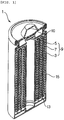
- FIG. 1 is an exploded perspective view showing a rechargeable lithium secondary battery 1 according to one exemplary embodiment of the present invention.
- FIG. 1 is merely an example for the purpose of illustration only, and is not intended to limit the scope of the present invention.
- the rechargeable lithium secondary battery 1 may be prepared by arranging a negative electrode 3 and a positive electrode 5, disposing a separator 7 between the negative electrode 3 and the positive electrode 5 to manufacture an electrode assembly 9, positioning the electrode assembly 9 in a case 15, and injecting an electrolyte (not shown) so that the negative electrode 3, the positive electrode 5, and the separator 7 are impregnated with the electrolyte.
- Conductive lead members 10 and 13 for collecting current occurring when a battery is operating may be attached to the negative electrode 3 and the positive electrode 5, respectively.
- the lead members 10 and 13 may conduct current generated from the positive electrode 5 and the negative electrode 3 to positive and negative electrode terminals, respectively.
- the negative electrode 3 may be manufactured by mixing a negative active material, a binder, and optionally a conductive material to prepare a composition for forming a negative active material layer, followed by applying the composition to a negative current collector such as copper foil.
- the negative active material is as described above.
- the binder serves to attach electrode active material particles to each other, and also attach an electrode active material to a current collector.
- Specific examples of the binder that may be used herein may include polyvinylidene fluoride (PVDF), polyvinyl alcohol, carboxymethyl cellulose (CMC), starch, hydroxypropyl cellulose, regenerated cellulose, polyvinyl pyrrolidone, tetrafluoroethylene, polyethylene, polypropylene, an ethylene-propylene-diene polymer (EPDM), sulfonated EPDM, a styrene-butadiene rubber, a fluorine rubber, and various copolymers thereof.
- PVDF polyvinylidene fluoride
- CMC carboxymethyl cellulose
- EPDM ethylene-propylene-diene polymer
- EPDM ethylene-propylene-diene polymer
- sulfonated EPDM a styrene-butadiene rubber
- fluorine rubber
- solvent may include dimethyl sulfoxide (DMSO), alcohol, N-methylpyrrolidone (NMP), acetone, water, etc.
- DMSO dimethyl sulfoxide
- NMP N-methylpyrrolidone
- acetone water, etc.
- the current collector may include at least one metal selected from the group consisting of copper, aluminum, stainless steel, titanium, silver, palladium, nickel, and alloys and combinations thereof.
- the stainless steel may be surface-treated with carbon, nickel, titanium, or silver, and an aluminum-cadmium alloy may be preferably used as the alloy.
- baked carbon, a non-conductive polymer surface-treated with a conductive material, a conductive polymer, or the like may be used.
- the conductive material is used to provide conductivity to an electrode and may include any materials that are electrically conductive without inducing chemical changes in the battery thus configured.
- Examples of the conductive material that may be used herein may include metal powders and fibers such as natural graphite, synthetic graphite, carbon black, acetylene black, Ketjen black, carbon fiber, copper, nickel, aluminum, silver, etc.
- the conductive materials such as polyphenylene derivatives may be used alone or in combination of one or more thereof.
- the composition for forming a negative active material layer may be distributed onto the current collector, and then uniformly dispersed using a doctor blade. In some cases, distribution and dispersion processes may be carried out as one process. In addition, methods such as die casting, comma coating, screen printing, etc. may also be used.
- the positive electrode 5 may be manufactured by mixing a positive active material, a conductive material, and a binder to prepare a composition for forming a positive active material layer, followed by applying the composition for forming a positive active material layer onto a positive current collector such as aluminum foil and rolling the positive current collector.
- a positive electrode plate may also be manufactured by casting the composition for forming a positive active material layer onto a separate support and then laminating a film obtained through peeling from the support on a metal current collector.
- a compound in which lithium ions are reversibly intercalatable and deintercalatable i.e., a lithiated intercalation compound
- a lithium-containing transition metal oxide is preferably used.
- LiCoO 2 LiNiO 2 , LiMnO 2 , LiMn 2
- the conductive material and the binder are as described above in advance in the negative electrode.
- the electrolyte may include an organic solvent and a lithium salt.
- organic solvent may be used as the organic solvent without particular limitation as long as such an organic solvent can serve as a medium through which ions involved in electrochemical reaction of a battery may migrate.
- organic solvent that may be used herein may include an ester solvent, an ether solvent, a ketone solvent, an aromatic hydrocarbon solvent, an alkoxy alkane solvent, a carbonate solvent, and the like, which may be used alone or in combination of two or more thereof.
- ester solvent may include methyl acetate, ethyl acetate, n-propyl acetate, dimethyl acetate, methyl propionate, ethyl propionate, ⁇ -butyrolactone, decanolide, ⁇ -valerolactone, mevalonolactone, ⁇ -caprolactone, ⁇ -valerolactone, ⁇ -caprolactone, etc.
- ether-based solvent may include dibutyl ether, tetraglyme, 2-methyltetrahydrofuran, tetrahydrofuran, etc.
- ketone-based solvent may include cyclohexanone, etc.
- aromatic hydrocarbon-based organic solvent may include benzene, fluorobenzene, chlorobenzene, iodobenzene, toluene, fluorotoluene, xylene, etc.
- alkoxy alkane solvent may include dimethoxy ethane, diethoxy ethane, etc.
- the carbonate solvent may include dimethyl carbonate (DMC), diethyl carbonate (DEC), dipropyl carbonate (DPC), methylpropyl carbonate (MPC), ethylpropyl carbonate (EPC), methylethyl carbonate (MEC), ethyl methyl carbonate (EMC), ethylene carbonate (EC), propylene carbonate (PC), butylene carbonate (BC), fluoroethylene carbonate (FEC), etc.
- the lithium salt may be used without particular limitation as long as it is a compound that can provide lithium ions used in the rechargeable lithium secondary battery 1.
- the lithium salt that may be used herein may include at least one selected from the group consisting of LiPF 6 , LiClO 4 , LiAsF 6 , LiBF 4 , LiSbF 6 , LiAl0 4 , LiAlCl 4 , LiCF 3 SO 3 , LiC 4 F 9 SO 3 , LiN(C 2 F 5 SO 3 ) 2 , LiN(C 2 F 5 SO 2 ) 2 , LiN(CF 3 SO 2 ) 2 , LiN(C a F 2a+1 SO 2 ) (C b F 2b+1 SO 2 ) (where a and b are integers, preferably 1 ⁇ a ⁇ 20 and 1 ⁇ b ⁇ 20), LiCl, LiI, LiB(C 2 O 4 ) 2 , and a mixture thereof.
- the lithium salt When the lithium salt is dissolved in an electrolyte, the lithium salt functions as a supply source of lithium ions in the lithium secondary battery 1 and may facilitate migration of lithium ions between the positive electrode 5 and the negative electrode 3. Therefore, the lithium salt may be included in a concentration of approximately 0.6 M to 2 M in the electrolyte. When the concentration of the lithium salt is less than 0.6 M, conductivity of the electrolyte may be degraded, resulting in deteriorated electrolyte performance. When the concentration of the lithium salt is greater than 2 M, mobility of lithium ions may be reduced due to increase in viscosity of the electrolyte. Accordingly, the concentration of the lithium salt may be particularly adjusted to approximately 0.7 to 1.6 M in the electrolyte in consideration of electrolyte conductivity and lithium ion mobility.
- the electrolyte may further include additives (hereinafter referred to as "other additives") that may be generally used in the electrolyte so as to enhance battery lifespan characteristics, inhibit decrease in battery capacity, and enhance battery discharge capacity.
- additives hereinafter referred to as "other additives” that may be generally used in the electrolyte so as to enhance battery lifespan characteristics, inhibit decrease in battery capacity, and enhance battery discharge capacity.
- the other additives may include vinylene carbonate (VC), metal fluoride (for example, LiF, RbF, TiF, AgF, AgF 2 , BaF 2 , CaF 2 , CdF 2 , FeF 2 , HgF 2 , Hg 2 F 2 , MnF 2 , NiF 2 , PbF 2 , SnF 2 , SrF 2 , XeF 2 , ZnF 2 , AlF 3 , BF 3 , BiF 3 , CeF 3 , CrF 3 , DyF 3 , EuF 3 , GaF 3 , GdF 3 , FeF 3 , HoF 3 , InF 3 , LaF 3 , LuF 3 , MnF 3 , NdF 3 , PrF 3 , SbF 3 , ScF 3 , SmF 3 , TbF 3 , TiF 3 , TmF 3 , YF 3 , YbF 3 , TbF
- any separator may be used as the separator 7 without particular limitation as long as such separator is generally used in the lithium secondary batteries.
- a separator having low resistance to ion migration of the electrolyte and an excellent ability to moisturize the electrolyte may be used.
- a porous polymer film for example, a porous polymer film manufactured from a polyolefin-based polymer such as an ethylene homopolymer, a propylene homopolymer, an ethylene/butene copolymer, an ethylene/hexene copolymer, and an ethylene/methacrylate copolymer, may be used alone or in a stacked fashion.
- typical porous nonwoven fabrics for example, nonwoven fabrics composed of glass fiber having a high melting point or polyethylene terephthalate fiber may be used, but the present invention is not limited thereto.
- the cylindrical rechargeable lithium secondary battery 1 has been described in this exemplary embodiment, but the detailed description provided herein is not intended to be limiting of the cylindrical lithium secondary battery 1.
- secondary batteries having any shapes may be used as long as such secondary batteries can operate as the rechargeable lithium secondary battery.
- the rechargeable lithium secondary battery including the negative active material exhibits excellent discharge capacity and stable cycle-lifespan and rate characteristics, and thus may be effectively used in portable devices requiring a fast charge velocity, such as cellular phones, laptop computers, digital cameras, and camcorders, electric vehicles such as hybrid electric vehicles (HEVs) and plug-in HEVs (PHEVs), and medium/large energy storage systems.
- portable devices requiring a fast charge velocity such as cellular phones, laptop computers, digital cameras, and camcorders, electric vehicles such as hybrid electric vehicles (HEVs) and plug-in HEVs (PHEVs), and medium/large energy storage systems.
- HEVs hybrid electric vehicles
- PHEVs plug-in HEVs
- a solution (a lithium source) obtained by dissolving lithium hydroxide in the form of a lithium salt in water, and a solution (a titanium source) obtained by dissolving titanium oxide in water were added in a ratio of 4:5.
- the mixed solution was stirred, and dried to prepare a precursor. Thereafter, the precursor was calcined at 750°C to prepare a core including a lithium titanium oxide (Li 4 Ti 5 O 12 ) containing a surface functional group such as O - and CO 2 - .
- the Li 4 Ti 5 O 12 powder had an average particle size of 8 ⁇ m.
- the core including the lithium titanium oxide containing the surface functional group was immersed in 2% by weight of an aqueous acetic acid solution for an hour, taken out, and then dried at 80°C for 6 hours under vacuum to prepare a negative active material.
- the negative active material prepared in Preparative Example 1, a carbon black conductive material, and a PVdF binder were mixed in N-methylpyrrolidone as a solvent in a weight ratio of 92:4:4 to prepare a composition for forming a negative active material layer. Thereafter, the composition was applied to a copper current collector to form a negative active material layer.
- Li metal was used as a counter electrode.
- a separation film made of porous polyethylene was interposed between the above-described positive and negative electrodes to manufacture an electrode assembly. Thereafter, the electrode assembly was positioned inside a case, and an electrolyte solution was then injected into the case to manufacture a rechargeable lithium secondary battery.
- the electrolyte solution was prepared by dissolving 1 M lithium hexafluorophosphate (LiPF 6 ) in an organic solvent including ethylene carbonate, dimethyl carbonate, and ethylmethyl carbonate (at a mixed volume ratio of 3:4:3 for EC, EMC, and DEC).
- a rechargeable lithium secondary battery was manufactured in the same manner as in Example 1, except that a Li 4 Ti 5 O 12 powder whose surface was not treated was used as the negative active material.
- the negative active materials, an Li 4 Ti 5 O 12 powder and an acetic acid anhydride powder, a carbon black conductive material, and a PVdF binder were mixed in N-methylpyrrolidone as a solvent in a weight ratio of 91.5:0.5:4:4 to prepare a composition for forming a negative active material layer. Thereafter, the composition was applied to a copper current collector to form a negative active material layer.
- a rechargeable lithium secondary battery was manufactured in the same manner as in Example 1, except that the negative active material layer thus prepared was used as a negative electrode.
- Example 2 As listed in Table 2, it could be seen that the residual moisture content was low in the case of Example 1 in which the negative active material was surface-treated with an acetic acid anhydride, compared to Comparative Example 1 in which the negative active material was not surface-treated, and Comparative Example 2 in which the acid anhydride was simply mixed with the core. From these results, it could be seen that moisture was effectively absorbed by the acid anhydride physisorbed onto a surface of the core.
- a charge/discharge test was performed on a coin-type half battery of the rechargeable lithium secondary battery prepared in Example 1 under conditions of room temperature (25°C), a voltage ranging from 3.0V to 5 mV, and a current density of 0.1 C, 1 C, 2 C, 3 C, 5 C, and 10 C.
- the capacity retention (%) at room temperature (25°C) according to the C-rate is shown in FIG. 3 .
- the capacity was retained at an identical level for the first cycle, but the capacity retention (%) for the sixth cycle was capacity retention (%) was 80%.
- the capacity dropped sharply from the second cycle, and the capacity retention (%) amounted to 75% for the sixth cycles.
- the negative active material according to the exemplary embodiments of the present invention includes a core including a lithium titanium oxide represented by the following Formula 1, the core containing at least one surface functional group selected from O - and CO 2 - and a coating layer positioned on a surface of the core and including an acid anhydride physisorbed onto the core.
- Formula 1 Li x Ti y O 4
- the negative active material may be used as the negative active material for rechargeable lithium secondary batteries.
- the battery side reactions and gas generation may be inhibited, and thus battery performance may be improved.
- the present invention provides a negative active material for rechargeable lithium secondary batteries capable of inhibiting battery side reactions and gas generation and improving battery performance since moisture formed during redox reaction is effectively absorbed into a surface of the negative active material.
Landscapes
- Chemical & Material Sciences (AREA)
- General Chemical & Material Sciences (AREA)
- Chemical Kinetics & Catalysis (AREA)
- Electrochemistry (AREA)
- Engineering & Computer Science (AREA)
- Organic Chemistry (AREA)
- Materials Engineering (AREA)
- Inorganic Chemistry (AREA)
- Manufacturing & Machinery (AREA)
- Composite Materials (AREA)
- Life Sciences & Earth Sciences (AREA)
- Environmental & Geological Engineering (AREA)
- General Life Sciences & Earth Sciences (AREA)
- Geology (AREA)
- Mechanical Engineering (AREA)
- Metallurgy (AREA)
- Battery Electrode And Active Subsutance (AREA)
- Secondary Cells (AREA)
Priority Applications (1)
| Application Number | Priority Date | Filing Date | Title |
|---|---|---|---|
| PL15847257T PL3054506T3 (pl) | 2014-09-30 | 2015-09-23 | Materiał czynny anody dla litowej baterii akumulatorowej, sposób jego wytwarzania oraz litowa bateria akumulatorowa zawierająca ten materiał |
Applications Claiming Priority (2)
| Application Number | Priority Date | Filing Date | Title |
|---|---|---|---|
| KR1020140131018A KR101751574B1 (ko) | 2014-09-30 | 2014-09-30 | 리튬 이차 전지용 음극 활물질, 이의 제조 방법, 이를 포함하는 리튬 이차 전지용 음극, 및 리튬 이차 전지 |
| PCT/KR2015/010003 WO2016052910A1 (ko) | 2014-09-30 | 2015-09-23 | 리튬이차전지용 음극 활물질, 이의 제조 방법, 이를 포함하는 리튬이차전지용 음극, 및 리튬이차전지 |
Publications (3)
| Publication Number | Publication Date |
|---|---|
| EP3054506A1 EP3054506A1 (en) | 2016-08-10 |
| EP3054506A4 EP3054506A4 (en) | 2016-12-14 |
| EP3054506B1 true EP3054506B1 (en) | 2018-09-12 |
Family
ID=55630885
Family Applications (1)
| Application Number | Title | Priority Date | Filing Date |
|---|---|---|---|
| EP15847257.1A Active EP3054506B1 (en) | 2014-09-30 | 2015-09-23 | Anode active material for lithium secondary battery, manufacturing method therefor, lithium secondary battery comprising the same |
Country Status (8)
| Country | Link |
|---|---|
| US (1) | US10205169B2 (enExample) |
| EP (1) | EP3054506B1 (enExample) |
| JP (1) | JP6563923B2 (enExample) |
| KR (1) | KR101751574B1 (enExample) |
| CN (1) | CN105917497B (enExample) |
| PL (1) | PL3054506T3 (enExample) |
| TW (1) | TWI565129B (enExample) |
| WO (1) | WO2016052910A1 (enExample) |
Families Citing this family (10)
| Publication number | Priority date | Publication date | Assignee | Title |
|---|---|---|---|---|
| KR101746903B1 (ko) * | 2014-09-30 | 2017-06-14 | 주식회사 엘지화학 | 리튬 이차 전지용 음극 활물질, 이의 제조 방법, 이를 포함하는 리튬 이차 전지용 음극, 및 리튬 이차 전지 |
| EP3480873A4 (en) * | 2016-06-30 | 2020-01-08 | UBE Industries, Ltd. | LITHIUM TITANATE POWDER AND ACTIVE MATERIAL FOR AN ENERGY STORAGE DEVICE ELECTRODE AND ELECTRODE FILM AND ENERGY STORAGE DEVICE THEREFOR |
| US10707531B1 (en) | 2016-09-27 | 2020-07-07 | New Dominion Enterprises Inc. | All-inorganic solvents for electrolytes |
| JP6722388B2 (ja) * | 2017-06-22 | 2020-07-15 | トヨタ自動車株式会社 | 非水電解液二次電池 |
| JP6905671B2 (ja) * | 2018-03-20 | 2021-07-21 | トヨタ自動車株式会社 | 非水電解質リチウム二次電池用正極の製造方法 |
| JP6952883B2 (ja) * | 2018-04-10 | 2021-10-27 | 株式会社東芝 | 電極群、非水電解質電池及び電池パック |
| KR102617870B1 (ko) * | 2018-07-25 | 2023-12-22 | 주식회사 엘지에너지솔루션 | 리튬 이차전지용 리튬 금속의 전처리 방법 |
| DE102021127130A1 (de) * | 2020-10-21 | 2022-04-21 | Sk Innovation Co., Ltd. | Zusammensetzung für anode von lithium-sekundärbatterie und lithium-sekundärbatterie, die unter verwendung derselben hergestellt wird |
| CN113964381B (zh) * | 2021-10-22 | 2023-05-16 | 郑州大学 | 一种非对称凝胶态电解质及其制备方法和应用 |
| CN116598509B (zh) * | 2023-07-14 | 2023-11-17 | 宁德时代新能源科技股份有限公司 | 电极及其制备方法、电池和电池应用 |
Family Cites Families (19)
| Publication number | Priority date | Publication date | Assignee | Title |
|---|---|---|---|---|
| JPH09199129A (ja) * | 1996-01-22 | 1997-07-31 | Ricoh Co Ltd | リチウム二次電池用負極体および該負極体を用いたリチウム二次電池 |
| US6139815A (en) * | 1997-07-15 | 2000-10-31 | Sony Corporation | Hydrogen lithium titanate and manufacturing method therefor |
| JP2003242981A (ja) * | 2002-02-14 | 2003-08-29 | Hitachi Maxell Ltd | 非水電解液電池およびその製造方法 |
| JP2004235144A (ja) * | 2003-01-10 | 2004-08-19 | Nichia Chem Ind Ltd | 非水電解質二次電池用負極活物質および非水電解質二次電池 |
| JP5083743B2 (ja) * | 2005-07-06 | 2012-11-28 | 株式会社 東北テクノアーチ | リチウム電池 |
| KR20250004383A (ko) * | 2005-10-20 | 2025-01-07 | 미쯔비시 케미컬 주식회사 | 리튬 2 차 전지 및 그것에 사용하는 비수계 전해액 |
| CN101894974A (zh) * | 2005-10-20 | 2010-11-24 | 三菱化学株式会社 | 锂二次电池以及其中使用的非水电解液 |
| JP2011113924A (ja) | 2009-11-30 | 2011-06-09 | Univ Of Fukui | チタン酸リチウム負極物質の製造方法 |
| KR101155909B1 (ko) * | 2010-01-07 | 2012-06-20 | 삼성에스디아이 주식회사 | 리튬 이차 전지용 음극 활물질, 이의 제조 방법 및 이를 포함하는 리튬 이차 전지 |
| JP2011146154A (ja) * | 2010-01-12 | 2011-07-28 | Toyota Motor Corp | 負極ペーストの製造方法、負極板の製造方法、及び、リチウム二次電池の製造方法 |
| KR101243906B1 (ko) | 2010-06-21 | 2013-03-14 | 삼성에스디아이 주식회사 | 리튬 전지 및 상기 리튬 전지의 제조 방법 |
| KR101244417B1 (ko) * | 2010-12-23 | 2013-03-18 | 한국기초과학지원연구원 | 탄소를 함유하는 리튬 2차 전지용 리튬티타늄산화물 전극재료 및 이의 제조방법 |
| JP5652313B2 (ja) | 2011-04-28 | 2015-01-14 | 日本ゼオン株式会社 | リチウム二次電池用負極スラリー組成物、リチウム二次電池用負極の製造方法、リチウム二次電池用負極及びリチウム二次電池 |
| JP5919942B2 (ja) * | 2011-06-02 | 2016-05-18 | 日産自動車株式会社 | 正極活物質および電極の製造方法、ならびに電極 |
| JP5694208B2 (ja) * | 2012-01-19 | 2015-04-01 | 株式会社東芝 | 非水電解質電池用負極活物質及びその製造方法、非水電解質電池および電池パック |
| KR101375611B1 (ko) | 2012-03-20 | 2014-03-18 | 한국세라믹기술원 | 리튬티타늄산화물 음극 활물질의 제조방법 |
| WO2014010930A1 (ko) | 2012-07-10 | 2014-01-16 | 주식회사 엘지화학 | 이차전지용 음극 및 이를 포함하는 이차전지 |
| JP2014075238A (ja) * | 2012-10-03 | 2014-04-24 | Kaneka Corp | 非水電解質二次電池用負極活物質及びその製造方法並びに非水電解質二次電池 |
| US9059451B2 (en) | 2012-10-18 | 2015-06-16 | GM Global Technology Operations LLC | Coatings for lithium titanate to suppress gas generation in lithium-ion batteries and methods for making and use thereof |
-
2014
- 2014-09-30 KR KR1020140131018A patent/KR101751574B1/ko active Active
-
2015
- 2015-09-23 WO PCT/KR2015/010003 patent/WO2016052910A1/ko not_active Ceased
- 2015-09-23 CN CN201580004074.5A patent/CN105917497B/zh active Active
- 2015-09-23 EP EP15847257.1A patent/EP3054506B1/en active Active
- 2015-09-23 US US15/032,396 patent/US10205169B2/en active Active
- 2015-09-23 PL PL15847257T patent/PL3054506T3/pl unknown
- 2015-09-23 JP JP2016535090A patent/JP6563923B2/ja active Active
- 2015-09-25 TW TW104131797A patent/TWI565129B/zh active
Non-Patent Citations (1)
| Title |
|---|
| None * |
Also Published As
| Publication number | Publication date |
|---|---|
| WO2016052910A1 (ko) | 2016-04-07 |
| KR101751574B1 (ko) | 2017-06-27 |
| CN105917497B (zh) | 2018-12-11 |
| US20160276672A1 (en) | 2016-09-22 |
| EP3054506A4 (en) | 2016-12-14 |
| TWI565129B (zh) | 2017-01-01 |
| CN105917497A (zh) | 2016-08-31 |
| PL3054506T3 (pl) | 2019-02-28 |
| TW201628238A (zh) | 2016-08-01 |
| JP6563923B2 (ja) | 2019-08-21 |
| JP2017530499A (ja) | 2017-10-12 |
| US10205169B2 (en) | 2019-02-12 |
| EP3054506A1 (en) | 2016-08-10 |
| KR20160038339A (ko) | 2016-04-07 |
Similar Documents
| Publication | Publication Date | Title |
|---|---|---|
| US10205169B2 (en) | Anode active material for lithium secondary battery, manufacturing method there-for, anode for lithium secondary battery comprising same, and lithium secondary battery | |
| JP6542784B2 (ja) | リチウム二次電池用負極活物質、その製造方法、それを含むリチウム二次電池用負極、及びリチウム二次電池 | |
| KR20180022247A (ko) | 양극 코팅제를 포함하는 비수전해액 및 리튬 이차전지 | |
| KR101803528B1 (ko) | 전기 화학 소자 | |
| KR20150019994A (ko) | 전해액 및 이를 포함하는 리튬이차전지 | |
| KR20170134156A (ko) | 이차전지용 비수전해액 및 리튬 이차전지 | |
| JP6403770B2 (ja) | 電気化学素子 | |
| KR20150024225A (ko) | 전해액 및 이를 포함하는 리튬이차전지 | |
| JP7127935B2 (ja) | リチウム二次電池用電解質及びこれを含むリチウム二次電池 | |
| KR101584323B1 (ko) | 전극의 제조 방법, 이를 이용하여 제조된 전극, 상기 전극을 포함하는 전기 화학 소자 | |
| KR101747496B1 (ko) | 전기 화학 소자 | |
| KR102187691B1 (ko) | 전해액 및 이를 포함하는 리튬이차전지 | |
| KR101620512B1 (ko) | 전기 화학 소자 | |
| KR20150094055A (ko) | 전기 화학 소자 | |
| KR20150032139A (ko) | 전해액 및 이를 포함하는 리튬이차전지 | |
| EP4621910A1 (en) | Non-aqueous electrolyte and lithium secondary battery comprising same |
Legal Events
| Date | Code | Title | Description |
|---|---|---|---|
| PUAI | Public reference made under article 153(3) epc to a published international application that has entered the european phase |
Free format text: ORIGINAL CODE: 0009012 |
|
| 17P | Request for examination filed |
Effective date: 20160503 |
|
| AK | Designated contracting states |
Kind code of ref document: A1 Designated state(s): AL AT BE BG CH CY CZ DE DK EE ES FI FR GB GR HR HU IE IS IT LI LT LU LV MC MK MT NL NO PL PT RO RS SE SI SK SM TR |
|
| AX | Request for extension of the european patent |
Extension state: BA ME |
|
| A4 | Supplementary search report drawn up and despatched |
Effective date: 20161110 |
|
| RIC1 | Information provided on ipc code assigned before grant |
Ipc: H01M 10/0525 20100101ALN20161104BHEP Ipc: H01M 4/62 20060101ALN20161104BHEP Ipc: C01D 15/02 20060101ALI20161104BHEP Ipc: C01G 23/04 20060101ALI20161104BHEP Ipc: H01M 10/052 20100101ALI20161104BHEP Ipc: H01M 4/36 20060101ALN20161104BHEP Ipc: H01M 4/485 20100101AFI20161104BHEP Ipc: H01M 4/02 20060101ALN20161104BHEP Ipc: C23C 16/56 20060101ALN20161104BHEP Ipc: H01M 4/04 20060101ALN20161104BHEP Ipc: C01G 23/00 20060101ALI20161104BHEP |
|
| DAV | Request for validation of the european patent (deleted) | ||
| DAX | Request for extension of the european patent (deleted) | ||
| 17Q | First examination report despatched |
Effective date: 20180306 |
|
| GRAP | Despatch of communication of intention to grant a patent |
Free format text: ORIGINAL CODE: EPIDOSNIGR1 |
|
| RIC1 | Information provided on ipc code assigned before grant |
Ipc: H01M 4/36 20060101ALN20180522BHEP Ipc: C01D 15/02 20060101ALI20180522BHEP Ipc: H01M 4/02 20060101ALN20180522BHEP Ipc: C01G 23/00 20060101ALI20180522BHEP Ipc: H01M 4/485 20100101AFI20180522BHEP Ipc: H01M 4/62 20060101ALN20180522BHEP Ipc: C23C 16/56 20060101ALN20180522BHEP Ipc: H01M 10/0525 20100101ALN20180522BHEP Ipc: H01M 4/04 20060101ALN20180522BHEP Ipc: C01G 23/04 20060101ALI20180522BHEP Ipc: H01M 10/052 20100101ALI20180522BHEP |
|
| RIC1 | Information provided on ipc code assigned before grant |
Ipc: H01M 4/62 20060101ALN20180529BHEP Ipc: H01M 4/04 20060101ALN20180529BHEP Ipc: H01M 4/36 20060101ALN20180529BHEP Ipc: H01M 4/02 20060101ALN20180529BHEP Ipc: H01M 10/052 20100101ALI20180529BHEP Ipc: H01M 4/485 20100101AFI20180529BHEP Ipc: C01D 15/02 20060101ALI20180529BHEP Ipc: C01G 23/00 20060101ALI20180529BHEP Ipc: C01G 23/04 20060101ALI20180529BHEP Ipc: C23C 16/56 20060101ALN20180529BHEP Ipc: H01M 10/0525 20100101ALN20180529BHEP |
|
| INTG | Intention to grant announced |
Effective date: 20180620 |
|
| GRAS | Grant fee paid |
Free format text: ORIGINAL CODE: EPIDOSNIGR3 |
|
| GRAA | (expected) grant |
Free format text: ORIGINAL CODE: 0009210 |
|
| AK | Designated contracting states |
Kind code of ref document: B1 Designated state(s): AL AT BE BG CH CY CZ DE DK EE ES FI FR GB GR HR HU IE IS IT LI LT LU LV MC MK MT NL NO PL PT RO RS SE SI SK SM TR |
|
| REG | Reference to a national code |
Ref country code: GB Ref legal event code: FG4D |
|
| REG | Reference to a national code |
Ref country code: CH Ref legal event code: EP |
|
| REG | Reference to a national code |
Ref country code: FR Ref legal event code: PLFP Year of fee payment: 4 |
|
| REG | Reference to a national code |
Ref country code: IE Ref legal event code: FG4D |
|
| REG | Reference to a national code |
Ref country code: DE Ref legal event code: R096 Ref document number: 602015016382 Country of ref document: DE |
|
| REG | Reference to a national code |
Ref country code: AT Ref legal event code: REF Ref document number: 1041641 Country of ref document: AT Kind code of ref document: T Effective date: 20181015 |
|
| REG | Reference to a national code |
Ref country code: NL Ref legal event code: MP Effective date: 20180912 |
|
| REG | Reference to a national code |
Ref country code: LT Ref legal event code: MG4D |
|
| PG25 | Lapsed in a contracting state [announced via postgrant information from national office to epo] |
Ref country code: NO Free format text: LAPSE BECAUSE OF FAILURE TO SUBMIT A TRANSLATION OF THE DESCRIPTION OR TO PAY THE FEE WITHIN THE PRESCRIBED TIME-LIMIT Effective date: 20181212 Ref country code: GR Free format text: LAPSE BECAUSE OF FAILURE TO SUBMIT A TRANSLATION OF THE DESCRIPTION OR TO PAY THE FEE WITHIN THE PRESCRIBED TIME-LIMIT Effective date: 20181213 Ref country code: LT Free format text: LAPSE BECAUSE OF FAILURE TO SUBMIT A TRANSLATION OF THE DESCRIPTION OR TO PAY THE FEE WITHIN THE PRESCRIBED TIME-LIMIT Effective date: 20180912 Ref country code: RS Free format text: LAPSE BECAUSE OF FAILURE TO SUBMIT A TRANSLATION OF THE DESCRIPTION OR TO PAY THE FEE WITHIN THE PRESCRIBED TIME-LIMIT Effective date: 20180912 Ref country code: FI Free format text: LAPSE BECAUSE OF FAILURE TO SUBMIT A TRANSLATION OF THE DESCRIPTION OR TO PAY THE FEE WITHIN THE PRESCRIBED TIME-LIMIT Effective date: 20180912 Ref country code: SE Free format text: LAPSE BECAUSE OF FAILURE TO SUBMIT A TRANSLATION OF THE DESCRIPTION OR TO PAY THE FEE WITHIN THE PRESCRIBED TIME-LIMIT Effective date: 20180912 Ref country code: BG Free format text: LAPSE BECAUSE OF FAILURE TO SUBMIT A TRANSLATION OF THE DESCRIPTION OR TO PAY THE FEE WITHIN THE PRESCRIBED TIME-LIMIT Effective date: 20181212 |
|
| PG25 | Lapsed in a contracting state [announced via postgrant information from national office to epo] |
Ref country code: LV Free format text: LAPSE BECAUSE OF FAILURE TO SUBMIT A TRANSLATION OF THE DESCRIPTION OR TO PAY THE FEE WITHIN THE PRESCRIBED TIME-LIMIT Effective date: 20180912 Ref country code: AL Free format text: LAPSE BECAUSE OF FAILURE TO SUBMIT A TRANSLATION OF THE DESCRIPTION OR TO PAY THE FEE WITHIN THE PRESCRIBED TIME-LIMIT Effective date: 20180912 Ref country code: HR Free format text: LAPSE BECAUSE OF FAILURE TO SUBMIT A TRANSLATION OF THE DESCRIPTION OR TO PAY THE FEE WITHIN THE PRESCRIBED TIME-LIMIT Effective date: 20180912 |
|
| REG | Reference to a national code |
Ref country code: AT Ref legal event code: MK05 Ref document number: 1041641 Country of ref document: AT Kind code of ref document: T Effective date: 20180912 |
|
| PG25 | Lapsed in a contracting state [announced via postgrant information from national office to epo] |
Ref country code: IT Free format text: LAPSE BECAUSE OF FAILURE TO SUBMIT A TRANSLATION OF THE DESCRIPTION OR TO PAY THE FEE WITHIN THE PRESCRIBED TIME-LIMIT Effective date: 20180912 Ref country code: EE Free format text: LAPSE BECAUSE OF FAILURE TO SUBMIT A TRANSLATION OF THE DESCRIPTION OR TO PAY THE FEE WITHIN THE PRESCRIBED TIME-LIMIT Effective date: 20180912 Ref country code: NL Free format text: LAPSE BECAUSE OF FAILURE TO SUBMIT A TRANSLATION OF THE DESCRIPTION OR TO PAY THE FEE WITHIN THE PRESCRIBED TIME-LIMIT Effective date: 20180912 Ref country code: RO Free format text: LAPSE BECAUSE OF FAILURE TO SUBMIT A TRANSLATION OF THE DESCRIPTION OR TO PAY THE FEE WITHIN THE PRESCRIBED TIME-LIMIT Effective date: 20180912 Ref country code: CZ Free format text: LAPSE BECAUSE OF FAILURE TO SUBMIT A TRANSLATION OF THE DESCRIPTION OR TO PAY THE FEE WITHIN THE PRESCRIBED TIME-LIMIT Effective date: 20180912 Ref country code: ES Free format text: LAPSE BECAUSE OF FAILURE TO SUBMIT A TRANSLATION OF THE DESCRIPTION OR TO PAY THE FEE WITHIN THE PRESCRIBED TIME-LIMIT Effective date: 20180912 Ref country code: AT Free format text: LAPSE BECAUSE OF FAILURE TO SUBMIT A TRANSLATION OF THE DESCRIPTION OR TO PAY THE FEE WITHIN THE PRESCRIBED TIME-LIMIT Effective date: 20180912 Ref country code: IS Free format text: LAPSE BECAUSE OF FAILURE TO SUBMIT A TRANSLATION OF THE DESCRIPTION OR TO PAY THE FEE WITHIN THE PRESCRIBED TIME-LIMIT Effective date: 20190112 |
|
| REG | Reference to a national code |
Ref country code: CH Ref legal event code: PL |
|
| PG25 | Lapsed in a contracting state [announced via postgrant information from national office to epo] |
Ref country code: SK Free format text: LAPSE BECAUSE OF FAILURE TO SUBMIT A TRANSLATION OF THE DESCRIPTION OR TO PAY THE FEE WITHIN THE PRESCRIBED TIME-LIMIT Effective date: 20180912 Ref country code: PT Free format text: LAPSE BECAUSE OF FAILURE TO SUBMIT A TRANSLATION OF THE DESCRIPTION OR TO PAY THE FEE WITHIN THE PRESCRIBED TIME-LIMIT Effective date: 20190112 Ref country code: SM Free format text: LAPSE BECAUSE OF FAILURE TO SUBMIT A TRANSLATION OF THE DESCRIPTION OR TO PAY THE FEE WITHIN THE PRESCRIBED TIME-LIMIT Effective date: 20180912 |
|
| REG | Reference to a national code |
Ref country code: BE Ref legal event code: MM Effective date: 20180930 |
|
| REG | Reference to a national code |
Ref country code: DE Ref legal event code: R097 Ref document number: 602015016382 Country of ref document: DE |
|
| REG | Reference to a national code |
Ref country code: IE Ref legal event code: MM4A |
|
| PG25 | Lapsed in a contracting state [announced via postgrant information from national office to epo] |
Ref country code: LU Free format text: LAPSE BECAUSE OF NON-PAYMENT OF DUE FEES Effective date: 20180923 |
|
| PLBE | No opposition filed within time limit |
Free format text: ORIGINAL CODE: 0009261 |
|
| STAA | Information on the status of an ep patent application or granted ep patent |
Free format text: STATUS: NO OPPOSITION FILED WITHIN TIME LIMIT |
|
| PG25 | Lapsed in a contracting state [announced via postgrant information from national office to epo] |
Ref country code: MC Free format text: LAPSE BECAUSE OF FAILURE TO SUBMIT A TRANSLATION OF THE DESCRIPTION OR TO PAY THE FEE WITHIN THE PRESCRIBED TIME-LIMIT Effective date: 20180912 Ref country code: DK Free format text: LAPSE BECAUSE OF FAILURE TO SUBMIT A TRANSLATION OF THE DESCRIPTION OR TO PAY THE FEE WITHIN THE PRESCRIBED TIME-LIMIT Effective date: 20180912 Ref country code: IE Free format text: LAPSE BECAUSE OF NON-PAYMENT OF DUE FEES Effective date: 20180923 |
|
| 26N | No opposition filed |
Effective date: 20190613 |
|
| PG25 | Lapsed in a contracting state [announced via postgrant information from national office to epo] |
Ref country code: BE Free format text: LAPSE BECAUSE OF NON-PAYMENT OF DUE FEES Effective date: 20180930 Ref country code: CH Free format text: LAPSE BECAUSE OF NON-PAYMENT OF DUE FEES Effective date: 20180930 Ref country code: SI Free format text: LAPSE BECAUSE OF FAILURE TO SUBMIT A TRANSLATION OF THE DESCRIPTION OR TO PAY THE FEE WITHIN THE PRESCRIBED TIME-LIMIT Effective date: 20180912 Ref country code: LI Free format text: LAPSE BECAUSE OF NON-PAYMENT OF DUE FEES Effective date: 20180930 |
|
| PG25 | Lapsed in a contracting state [announced via postgrant information from national office to epo] |
Ref country code: MT Free format text: LAPSE BECAUSE OF NON-PAYMENT OF DUE FEES Effective date: 20180923 |
|
| PG25 | Lapsed in a contracting state [announced via postgrant information from national office to epo] |
Ref country code: TR Free format text: LAPSE BECAUSE OF FAILURE TO SUBMIT A TRANSLATION OF THE DESCRIPTION OR TO PAY THE FEE WITHIN THE PRESCRIBED TIME-LIMIT Effective date: 20180912 |
|
| PG25 | Lapsed in a contracting state [announced via postgrant information from national office to epo] |
Ref country code: MK Free format text: LAPSE BECAUSE OF NON-PAYMENT OF DUE FEES Effective date: 20180912 Ref country code: CY Free format text: LAPSE BECAUSE OF FAILURE TO SUBMIT A TRANSLATION OF THE DESCRIPTION OR TO PAY THE FEE WITHIN THE PRESCRIBED TIME-LIMIT Effective date: 20180912 Ref country code: HU Free format text: LAPSE BECAUSE OF FAILURE TO SUBMIT A TRANSLATION OF THE DESCRIPTION OR TO PAY THE FEE WITHIN THE PRESCRIBED TIME-LIMIT; INVALID AB INITIO Effective date: 20150923 |
|
| P01 | Opt-out of the competence of the unified patent court (upc) registered |
Effective date: 20230408 |
|
| REG | Reference to a national code |
Ref country code: DE Ref legal event code: R081 Ref document number: 602015016382 Country of ref document: DE Owner name: LG ENERGY SOLUTION, LTD., KR Free format text: FORMER OWNER: LG CHEM, LTD., SEOUL, KR |
|
| REG | Reference to a national code |
Ref country code: GB Ref legal event code: 732E Free format text: REGISTERED BETWEEN 20230824 AND 20230831 |
|
| PGFP | Annual fee paid to national office [announced via postgrant information from national office to epo] |
Ref country code: DE Payment date: 20250820 Year of fee payment: 11 |
|
| PGFP | Annual fee paid to national office [announced via postgrant information from national office to epo] |
Ref country code: PL Payment date: 20250822 Year of fee payment: 11 |
|
| PGFP | Annual fee paid to national office [announced via postgrant information from national office to epo] |
Ref country code: GB Payment date: 20250820 Year of fee payment: 11 |
|
| PGFP | Annual fee paid to national office [announced via postgrant information from national office to epo] |
Ref country code: FR Payment date: 20250821 Year of fee payment: 11 |