EP3051693A1 - Hochfrequenz-halbleiterverstärker - Google Patents
Hochfrequenz-halbleiterverstärker Download PDFInfo
- Publication number
- EP3051693A1 EP3051693A1 EP16152705.6A EP16152705A EP3051693A1 EP 3051693 A1 EP3051693 A1 EP 3051693A1 EP 16152705 A EP16152705 A EP 16152705A EP 3051693 A1 EP3051693 A1 EP 3051693A1
- Authority
- EP
- European Patent Office
- Prior art keywords
- transmission line
- frequency
- impedance
- microstrip line
- load impedance
- Prior art date
- Legal status (The legal status is an assumption and is not a legal conclusion. Google has not performed a legal analysis and makes no representation as to the accuracy of the status listed.)
- Granted
Links
Images
Classifications
-
- H—ELECTRICITY
- H03—ELECTRONIC CIRCUITRY
- H03F—AMPLIFIERS
- H03F1/00—Details of amplifiers with only discharge tubes, only semiconductor devices or only unspecified devices as amplifying elements
- H03F1/02—Modifications of amplifiers to raise the efficiency, e.g. gliding Class A stages, use of an auxiliary oscillation
- H03F1/0205—Modifications of amplifiers to raise the efficiency, e.g. gliding Class A stages, use of an auxiliary oscillation in transistor amplifiers
-
- H—ELECTRICITY
- H03—ELECTRONIC CIRCUITRY
- H03F—AMPLIFIERS
- H03F1/00—Details of amplifiers with only discharge tubes, only semiconductor devices or only unspecified devices as amplifying elements
- H03F1/56—Modifications of input or output impedances, not otherwise provided for
-
- H—ELECTRICITY
- H01—ELECTRIC ELEMENTS
- H01P—WAVEGUIDES; RESONATORS, LINES, OR OTHER DEVICES OF THE WAVEGUIDE TYPE
- H01P5/00—Coupling devices of the waveguide type
- H01P5/02—Coupling devices of the waveguide type with invariable factor of coupling
- H01P5/022—Transitions between lines of the same kind and shape, but with different dimensions
- H01P5/028—Transitions between lines of the same kind and shape, but with different dimensions between strip lines
-
- H—ELECTRICITY
- H03—ELECTRONIC CIRCUITRY
- H03F—AMPLIFIERS
- H03F3/00—Amplifiers with only discharge tubes or only semiconductor devices as amplifying elements
- H03F3/189—High-frequency amplifiers, e.g. radio frequency amplifiers
- H03F3/19—High-frequency amplifiers, e.g. radio frequency amplifiers with semiconductor devices only
-
- H—ELECTRICITY
- H03—ELECTRONIC CIRCUITRY
- H03F—AMPLIFIERS
- H03F3/00—Amplifiers with only discharge tubes or only semiconductor devices as amplifying elements
- H03F3/20—Power amplifiers, e.g. Class B amplifiers, Class C amplifiers
- H03F3/21—Power amplifiers, e.g. Class B amplifiers, Class C amplifiers with semiconductor devices only
- H03F3/217—Class D power amplifiers; Switching amplifiers
-
- H—ELECTRICITY
- H10—SEMICONDUCTOR DEVICES; ELECTRIC SOLID-STATE DEVICES NOT OTHERWISE PROVIDED FOR
- H10W—GENERIC PACKAGES, INTERCONNECTIONS, CONNECTORS OR OTHER CONSTRUCTIONAL DETAILS OF DEVICES COVERED BY CLASS H10
- H10W44/00—Electrical arrangements for controlling or matching impedance
- H10W44/20—Electrical arrangements for controlling or matching impedance at high-frequency [HF] or radio frequency [RF]
-
- H—ELECTRICITY
- H01—ELECTRIC ELEMENTS
- H01P—WAVEGUIDES; RESONATORS, LINES, OR OTHER DEVICES OF THE WAVEGUIDE TYPE
- H01P1/00—Auxiliary devices
- H01P1/24—Terminating devices
-
- H—ELECTRICITY
- H01—ELECTRIC ELEMENTS
- H01P—WAVEGUIDES; RESONATORS, LINES, OR OTHER DEVICES OF THE WAVEGUIDE TYPE
- H01P1/00—Auxiliary devices
- H01P1/24—Terminating devices
- H01P1/28—Short-circuiting plungers
-
- H—ELECTRICITY
- H03—ELECTRONIC CIRCUITRY
- H03F—AMPLIFIERS
- H03F2200/00—Indexing scheme relating to amplifiers
- H03F2200/451—Indexing scheme relating to amplifiers the amplifier being a radio frequency amplifier
-
- H—ELECTRICITY
- H03—ELECTRONIC CIRCUITRY
- H03F—AMPLIFIERS
- H03F3/00—Amplifiers with only discharge tubes or only semiconductor devices as amplifying elements
- H03F3/60—Amplifiers in which coupling networks have distributed constants, e.g. with waveguide resonators
-
- H—ELECTRICITY
- H10—SEMICONDUCTOR DEVICES; ELECTRIC SOLID-STATE DEVICES NOT OTHERWISE PROVIDED FOR
- H10W—GENERIC PACKAGES, INTERCONNECTIONS, CONNECTORS OR OTHER CONSTRUCTIONAL DETAILS OF DEVICES COVERED BY CLASS H10
- H10W44/00—Electrical arrangements for controlling or matching impedance
- H10W44/20—Electrical arrangements for controlling or matching impedance at high-frequency [HF] or radio frequency [RF]
- H10W44/203—Electrical connections
- H10W44/206—Wires
-
- H—ELECTRICITY
- H10—SEMICONDUCTOR DEVICES; ELECTRIC SOLID-STATE DEVICES NOT OTHERWISE PROVIDED FOR
- H10W—GENERIC PACKAGES, INTERCONNECTIONS, CONNECTORS OR OTHER CONSTRUCTIONAL DETAILS OF DEVICES COVERED BY CLASS H10
- H10W44/00—Electrical arrangements for controlling or matching impedance
- H10W44/20—Electrical arrangements for controlling or matching impedance at high-frequency [HF] or radio frequency [RF]
- H10W44/203—Electrical connections
- H10W44/216—Waveguides, e.g. strip lines
- H10W44/219—Waveguides, e.g. strip lines characterised by transitions between different types of waveguides
-
- H—ELECTRICITY
- H10—SEMICONDUCTOR DEVICES; ELECTRIC SOLID-STATE DEVICES NOT OTHERWISE PROVIDED FOR
- H10W—GENERIC PACKAGES, INTERCONNECTIONS, CONNECTORS OR OTHER CONSTRUCTIONAL DETAILS OF DEVICES COVERED BY CLASS H10
- H10W44/00—Electrical arrangements for controlling or matching impedance
- H10W44/20—Electrical arrangements for controlling or matching impedance at high-frequency [HF] or radio frequency [RF]
- H10W44/226—Electrical arrangements for controlling or matching impedance at high-frequency [HF] or radio frequency [RF] for HF amplifiers
- H10W44/234—Arrangements for impedance matching
Definitions
- a high-frequency semiconductor amplifier operating in the high-frequency band of 1 GHz or more has recently been developed.
- Such a high-frequency semiconductor amplifier is used in e.g. radio communication equipment, mobile communication base stations, and radar devices. This high-frequency semiconductor amplifier is required to amplify and transmit signals in the high-frequency band at high power-added efficiency.
- class-F mode high efficiency operation called class-F mode can be achieved when the load impedance for the second harmonic seen from the output electrode end of the semiconductor amplifying element is made near-short, and the load impedance for the third harmonic is made near-open.
- an open-stub that is a tip-open transmission line of 1/8 wavelength of the fundamental is connected to the output electrode end of the semiconductor amplifying element so that the load impedance for the second harmonic seen from the output electrode end of the semiconductor amplifying element is made near-short.
- An open-stub that is a tip-open transmission line of 1/12 wavelength of the fundamental is connected to the output electrode end of the semiconductor amplifying element through a transmission line of 1/8 wavelength of the fundamental so that the load impedance for the third harmonic is made near-open.
- inverse class-F mode can be achieved when the load impedance for the second harmonic seen from the output electrode end of the semiconductor amplifying element is made near-open, and the load impedance for the third harmonic is made near-short.
- the impedance for the second harmonic is controlled without affecting the fundamental by a harmonic impedance adjustment line so that the load impedance for the second harmonic is made near-open.
- a high-frequency semiconductor amplifier includes an input terminal, an input matching circuit, a high-frequency semiconductor amplifying element, an output matching circuit and an output terminal.
- the input terminal is inputted with a fundamental signal.
- the fundamental signal has a first frequency band and a first center frequency in the first frequency band.
- the input matching circuit includes an input end and an output end. The input end of the input matching circuit is connected to the input terminal.
- the high-frequency semiconductor amplifying element includes an input end and an output end. The input end of the high-frequency semiconductor amplifying element is connected to the output end of the input matching circuit.
- the high-frequency semiconductor amplifying element is configured to amplify the fundamental signal.
- the output matching circuit includes an input end and an output end.
- the input end of the output matching circuit is connected to the output end of the high-frequency semiconductor amplifying element.
- the output terminal is connected to the output end of the output matching circuit.
- the output matching circuit includes a first transmission line, a second transmission line, a third transmission line, a fourth transmission line and a wire part.
- the first transmission line includes an input end and an output end.
- the output end of the first transmission line is connected to the output end of the output matching circuit.
- the first transmission line has an electrical length of 72 degrees or more and 108 degrees or less at the first center frequency.
- a characteristic impedance of the first transmission line is lower than a load impedance of an external load connected in parallel to the output terminal.
- the load impedance of the external load is 50 ⁇ .
- the second transmission line includes an input end and an output end.
- the output end of the second transmission line is connected to the input end of the first transmission line.
- the second transmission line has an electrical length of 18 degrees or more and 27 degrees or less at the first center frequency.
- a characteristic impedance of the second transmission line is lower than the characteristic impedance of the first transmission line.
- the third transmission line includes an input end and an output end. The output end of the third transmission line is connected to the input end of the second transmission line.
- the third transmission line has an electrical length of 18 degrees or more and 27 degrees or less at the first center frequency.
- a characteristic impedance of the third transmission line is lower than the characteristic impedance of the first transmission line.
- the characteristic impedance of the third transmission line is higher than resistance of a desired load impedance.
- the desired impedance is an impedance provided to the high-frequency semiconductor amplifying element for fundamental frequency.
- the line width along a second direction of the third transmission line is 0.8 times or more and 1.2 times or less of the line width along the second direction of the second transmission line.
- the fourth transmission line includes an input end and an output end. The output end of the fourth transmission line is connected to the input end of the third transmission line.
- the fourth transmission line has an electrical length of 5 degrees or more and 10 degrees or less at the first center frequency.
- a characteristic impedance of the fourth transmission line is equal to the resistance of the desired load impedance.
- the resistance of the desired load impedance is an impedance provided to the high-frequency semiconductor amplifying element for fundamental frequency.
- the wire part includes an input end and an output end. The output end of the wire part is connected to the input end of the fourth transmission line. The input end of the wire part is connected to the input end of the output matching circuit.
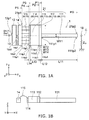
- FIGS. 1A and 1B are schematic views showing the configuration of a high-frequency semiconductor amplifier according to this embodiment.
- the high-frequency semiconductor amplifier 1 is composed of an input terminal 10 inputted a fundamental signal S1 including the first frequency band Bw1, an input matching circuit 12 connected to the input terminal 10, a high-frequency semiconductor amplifying element 14 connected to the input matching circuit 12, an output matching circuit 21 connected to the high-frequency semiconductor amplifying element 14, and an output terminal 18 connected to the output matching circuit 21.
- a high-frequency fundamental signal S1 having a first frequency band Bw1 is inputted to the input terminal 10.
- the input end 12p1 of the input matching circuit 12 is connected to the input terminal 10.
- the input end 14p1 of the high-frequency semiconductor amplifying element 14 is connected to the output end 12p2 of the input matching circuit 12.
- the output end 14p2 of the high-frequency semiconductor amplifying element 14 is connected to the input end 21p1 of the output matching circuit 21.
- the output terminal 18 is connected to the output end 21p2 of the output matching circuit 21.
- the input matching circuit 12 is a circuit for matching the power supply impedance with the input impedance of the high-frequency semiconductor amplifying element 14.
- the high-frequency semiconductor amplifying element 14 is an element for amplifying the high-frequency fundamental signal S1.
- An external load Zo is connected in parallel externally seen from the output terminal 18.
- the load impedance m0 of the external load Zo is e.g. 50 ⁇ .
- the DC circuit for supplying voltage to the high-frequency semiconductor amplifying element 14 is not shown.
- the output matching circuit 21 is formed from a microstrip line 111 (ML111), a microstrip line 112 (ML112), a microstrip line 113 (ML113), a microstrip line 114 (ML114), and a wire part 115.
- the microstrip line is one example of a transmission line.
- the wire part 115 is formed from e.g. six wires.
- the output matching circuit 21 is a circuit for transforming a load impedance m0 of the external load Zo seen from the output terminal 18 to a desired load impedance md provided to the high-frequency semiconductor amplifying element 14.
- the desired load impedance md is determined by e.g. the load-pull measurement.
- the desired load impedance md is e.g. (1+j1) ⁇ .
- an XYZ orthogonal coordinate system is adopted in this specification. More specifically, in FIGS. 1A and 1B , the extending direction of the microstrip line 111 is referred to as "X-direction". A direction orthogonal thereto is referred to as "Y-direction". The direction opposite to the "X-direction” is referred to as "-X-direction”. The direction opposite to the "Y-direction” is referred to as "-Y-direction”. The plane including the X-direction and the Y-direction is referred to as X-Y plane. The upward direction perpendicular to this X-Y plane is referred to as "Z-direction".
- the fundamental signal S1 has a first frequency band Bw1.
- the center frequency in the first frequency band Bw1 is referred to as first center frequency f1 or "fundamental frequency f1".
- the wavelength corresponding to the "fundamental frequency f1" is referred to as “fundamental wavelength ⁇ 1".
- the frequency of twice the "fundamental frequency f1” is referred to as “second harmonic frequency f2”.
- the wavelength corresponding to the "second harmonic frequency f2" is referred to as “second harmonic wavelength ⁇ 2”.
- the frequency of three times the "fundamental frequency f1" is referred to as "third harmonic frequency f3".
- the wavelength corresponding to the "third harmonic frequency f3" is referred to as "third harmonic wavelength ⁇ 3".
- microstrip line 111, the microstrip line 112, the microstrip line 113, and the microstrip line 114 schematically show the pattern of microstrip lines.
- the center line splitting the microstrip line 112 in the Y-direction, the center line splitting the microstrip line 113 in the Y-direction, and the center line splitting the microstrip line 114 in the Y-direction overlap the center line C splitting the microstrip line 111 in the Y-direction.
- the reference plane P0 is a plane tangent to the X-direction end part of the microstrip line 111 and perpendicular to the X-direction.
- the reference plane P1 is a plane tangent to the X-direction end part of the microstrip line 112 and perpendicular to the X-direction.
- the reference plane P2 is a plane tangent to the X-direction end part of the microstrip line 113 and perpendicular to the X-direction.
- the reference plane P3 is a plane tangent to the X-direction end part of the microstrip line 114 and perpendicular to the X-direction.
- the reference plane P4 is a plane tangent to the -X-direction end part of the microstrip line 114 and perpendicular to the X-direction.
- TABLE 1 is a table illustrating the electrical characteristics and dimensions of the microstrip lines in the high-frequency semiconductor amplifier 1 according to this embodiment.
- the X-direction output end 111p2 of the microstrip line 111 (ML111) is connected to the output terminal 18 (the output end 21p2 of the output matching circuit 21) at the reference plane P0.
- the microstrip line 111 has a line width W11 of 0.846 mm along the Y-direction.
- the microstrip line 111 extends from the reference plane P0 by a line length L11 of 9.31 mm along the -X-direction.
- the input end 111p1 of the microstrip line 111 is connected to the output end 112p2 of the microstrip line 112 at the reference plane P1 to which the microstrip line 111 extends.
- the characteristic impedance Zc11 of the microstrip line 111 is 15.9 ⁇ .
- the relative permittivity ⁇ r11 of the microstrip line 111 is 10.
- the substrate thickness t11 of the microstrip line 111 along the Z-direction is 150 ⁇ m.
- the characteristic impedance Zc11 is lower than the load impedance m0 of the external load Zo.
- the electrical length EL11 of the microstrip line 111 is 96 degrees, being approximately 1/4 times the fundamental wavelength ⁇ 1.
- the electrical length EL11 may be 72 degrees or more and 108 degrees or less at the fundamental frequency f1.
- the microstrip line 112 (ML112) extends from the reference plane P1 by a line length L12 of 0.56 mm along the -X-direction with a line width W12 of 5.0 mm along the Y-direction.
- the input end 112p1 of the microstrip line 112 is connected to the output end 113p2 of the microstrip line 113 at the reference plane P2 to which the microstrip line 112 extends.
- the characteristic impedance Zc12 of the microstrip line 112 is 1.13 ⁇ .
- the relative permittivity ⁇ r12 of the microstrip line 112 is 180.
- the substrate thickness t12 of the microstrip line 112 along the Z-direction is 220 ⁇ m.
- the relative permittivity ⁇ r12 of the microstrip line 112 is higher than the relative permittivity ⁇ r11 of the microstrip line 111.
- the characteristic impedance Zc12 of the microstrip line 112 is lower than the characteristic impedance Zc11.
- the electrical length EL12 of the microstrip line 112 is 26 degrees, being approximately 1/16 times the fundamental wavelength ⁇ 1.
- the electrical length EL12 may be 18 degrees or more and 27 degrees or less at the fundamental frequency f1.
- the microstrip line 113 extends from the reference plane P2 by a line length L13 of 2.19 mm along the -X-direction with a line width W13 of 5.11 mm along the Y-direction.
- the input end 113p1 of the microstrip line 113 is connected to the output end 114p2 of the microstrip line 114 at the reference plane P3 to which the microstrip line 113 extends.
- the line width W13 is 0.8 times or more and 1.2 times or less of the line width W12 of the microstrip line 112.
- the characteristic impedance Zc13 of the microstrip line 113 is 4.67 ⁇ .
- the relative permittivity ⁇ r13 of the microstrip line 113 is 10.
- the substrate thickness t13 of the microstrip line 113 along the Z-direction is 220 ⁇ m.
- the relative permittivity ⁇ r12 of the microstrip line 112 is higher than the relative permittivity ⁇ r13 of the microstrip line 113.
- the characteristic impedance Zc13 is lower than the characteristic impedance Zc11.
- the characteristic impedance Zc13 is higher than the resistance R of the desired load impedance md provided to the high-frequency semiconductor amplifying element 14.
- the electrical length EL13 of the microstrip line 113 is 24 degrees, being approximately 1/16 times the fundamental wavelength ⁇ 1.
- the electrical length EL13 may be 8 degrees or more and 27 degrees or less at the fundamental frequency f1.
- the microstrip line 114 (ML114) extends from the reference plane P3 by a line length L14 of 0.21 mm along the -X-direction with a line width W14 of 5.24 mm along the Y-direction.
- the input end 114p1 of the microstrip line 114 is connected to the output end 115p2 of the wire part 115 to which the microstrip line 114 extends.
- the characteristic impedance Zc14 of the microstrip line 114 is 1.00 ⁇ .
- the relative permittivity ⁇ r14 of the microstrip line 114 is 90.
- the substrate thickness t14 of the microstrip line 114 along the Z-direction is 140 ⁇ m.
- the relative permittivity ⁇ r14 of the microstrip line 114 is higher than the relative permittivity ⁇ r11 of the microstrip line 111.
- the relative permittivity ⁇ r14 of the microstrip line 114 is higher than the relative permittivity ⁇ r13 of the microstrip line 113.
- the characteristic impedance Zc14 is nearly equal to the resistance R of the desired load impedance md provided to the high-frequency semiconductor amplifying element 14.
- the electrical length EL14 of the microstrip line 114 is 7 degrees, being approximately 1/50 times the fundamental wavelength ⁇ 1.
- the electrical length EL14 may be 5 degrees or more and 10 degrees or less at the fundamental frequency f1.
- the wire part 115 is provided between the microstrip line 114 and the high-frequency semiconductor amplifying element 14.
- the wire part 115 connects the microstrip line 114 and the high-frequency semiconductor amplifying element 14.
- the wire part 115 is formed from e.g. six wires.
- the input end 115p1 of the wire part 115 is connected to the input end 21p1 of the output matching circuit 21.
- the characteristic impedance Zc13 of the microstrip line 113 is higher than the characteristic impedance Zc12 of the microstrip line 112.
- the characteristic impedance Zc12 of the microstrip line 112 is higher than the characteristic impedance Zc14 of the microstrip line 114.
- the relative permittivity ⁇ r12 of the microstrip line 112 is 1.6 times or more and 2.4 times or less of the relative permittivity ⁇ r14 of the microstrip line 114.
- the relative permittivity ⁇ r13 of the microstrip line 113 is 0.08 times or more and 0.12 times or less of the relative permittivity ⁇ r14 of the microstrip line 114.
- the substrate thickness t12 along the Z-direction of the microstrip line 112 is 1.3 times or more and 1.9 times or less of the substrate thickness t14 along the Z-direction of the microstrip line 114.
- the line width W12 along the Y-direction of the microstrip line 112 is 0.8 times or more and 1.2 times or less of the line width W14 along the Y-direction of the microstrip line 114.
- the line width W13 along the Y-direction of the microstrip line 113 is 0.8 times or more and 1.2 times or less of the line width W14 along the Y-direction of the microstrip line 114.
- the line width W13 along the Y-direction of the microstrip line 113 is longer than the line width W11 along the Y-direction of the microstrip line 111.
- the symbols m11-m15 represent the load impedance at the fundamental frequency f1.
- the symbols m21-m25 represent the load impedance at the second harmonic frequency f2.
- the symbols m31-m35 represent the load impedance at the third harmonic frequency f3.
- This example shows the case where the load impedance m15 at the fundamental frequency f1 seen from the reference plane P5 is transformed to approximately (1+j1) ⁇ .
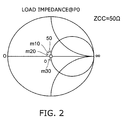
- the side of the output terminal 18 connected with the external load Zo is seen from the reference plane P0. Then, the load impedance m10 at the fundamental frequency f1, the load impedance m20 at the second harmonic frequency f2, and the load impedance m30 at the third harmonic frequency f3 are located at the center point O near 50 ⁇ .
- the load impedance at the fundamental, second harmonic, and third harmonic frequencies can be determined by measurement and simulation, and indicated on the impedance chart.
- the electrical length of the microstrip line 111 at the fundamental frequency f1 is 96 degrees.
- the electrical length of 96 degrees corresponds to approximately a quarter wavelength.
- the microstrip line 111 operates like a quarter wavelength transformer.
- the characteristic impedance Zc11 of the microstrip line 111 is lower than 50 ⁇ , which is the load impedance m0 of the external load Zo.
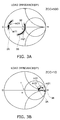
- the load impedance m11 at the fundamental frequency f1 seen from the reference plane P1 is transformed to an impedance lower than 50 ⁇ , which is the load impedance m0 of the external load Zo.
- the load impedance in the first frequency band Bw1 is also transformed to a neighborhood portion including the load impedance m11. This portion is indicated as portion 3A in FIGS. 3A and 3B .
- the electrical length EL11 of the microstrip line 111 is approximately a three-quarter wavelength at the third harmonic frequency f3.
- the load impedance m31 at the third harmonic frequency f3 is transformed to the portion 3A.
- the signal having a frequency of three times that of the fundamental signal S1 is referred to as third harmonic signal S3.
- the load impedance for the third harmonic signal S3 having a frequency band is also transformed to the portion 3A having a low impedance.
- the electrical length EL11 of the microstrip line 111 is approximately a two-quarter wavelength at the second harmonic frequency f2.
- the load impedance m21 at the second harmonic frequency f2 remains near 50 ⁇ without substantial change.
- This portion near 50 ⁇ is indicated as portion 3B in FIGS. 3A and 3B .
- the load impedance m21 for the second harmonic is separated from the load impedance m11 for the fundamental and the load impedance m31 for the third harmonic.
- the characteristic impedance Zc12 of the microstrip line 112 is lower than the characteristic impedance Zc11 of the microstrip line 111.
- the electrical length EL12 at the fundamental frequency f1 is as short as 26 degrees.
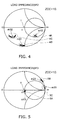
- the load impedance m22 at the second harmonic frequency f2 is transformed to a portion 4B different from the portion 4A.
- the electrical length at the fundamental frequency f1 is as short as approximately 26 degrees.
- the electrical length EL12 is less than or equal to a three-quarter wavelength also at the third harmonic frequency f3.
- the load impedance m32 at the third harmonic frequency f3 is transformed to a portion 4C different from the portion 4A and the portion 4B. That is, the load impedances m12, m22, and m32 at the fundamental, the second harmonic, and the third harmonic are separated.
- the characteristic impedance Zc13 of the microstrip line 113 is higher than that of the microstrip line 112.
- the electrical length EL13 at the fundamental frequency f1 is approximately 24 degrees.
- the microstrip line 113 is added to the microstrip line 112.
- the load impedance m13 at the fundamental frequency f1 seen from the reference plane P3 is transformed to a portion 5A near 1 ⁇ .
- the load impedance m23 at the second harmonic frequency f2 is transformed to a portion 5B.
- the portion 5B is an inductive region near ⁇ ⁇ .
- the load impedance m33 at the third harmonic frequency f3 is transformed to a portion 5C.
- the portion 5C is inductive near ⁇ ⁇ and different from the portion 5B.
- an inductive impedance is indicated in the upper half region of the impedance chart.
- a capacitive impedance is indicated in the lower half region of the impedance chart.
- the characteristic impedance Zc14 of the microstrip line 114 is close to the load impedance m13 at the fundamental frequency f1 seen from the reference plane P3.
- the microstrip line 114 is added to the microstrip line 113.
- the load impedance m14 at the fundamental frequency f1 seen from the reference plane P4 remains near 1 ⁇ without substantial change.
- This portion near 1 ⁇ is indicated as portion 6A in FIG. 6 .
- the load impedance m24 at the second harmonic frequency f2 is transformed to a portion 6B.
- the portion 6B is an inductive region near ⁇ ⁇ .
- the load impedance m34 at the third harmonic frequency f3 is transformed to a portion 6C.
- the portion 6C is a capacitive region. At this stage, the load impedance m34 for the third harmonic is capacitive.
- the wire part 115 is added to the microstrip line 114.
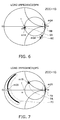
- the load impedance m15 at the fundamental frequency f1 seen from the reference plane P5 is transformed to a portion 7A near (1+j1) ⁇ because of the added inductivity of the wire part 115.
- the load impedance m25 at the second harmonic frequency f2 remains near ⁇ ⁇ .
- This portion near ⁇ ⁇ is indicated as portion 7B in FIG. 7 .
- the load impedance m35 at the third harmonic frequency f3 is transformed to a portion 7C near 0 ⁇ due to resonance between the capacitivity in the aforementioned portion 6C and the inductivity of the wire part 115.
- the amount of capacitivity produced by the addition of the microstrip line 114 may be smaller than the amount of inductivity of the wire part 115.
- the load impedance m35 at the third harmonic frequency f3 is not transformed to approximately 0 ⁇ due to insufficient resonance between capacitivity and inductivity.
- the amount of capacitivity produced by the addition of the microstrip line 114 may be larger than the amount of inductivity of the wire part 115.
- the load impedance m35 at the third harmonic frequency f3 is not transformed to approximately 0 ⁇ due to insufficient resonance between capacitivity and inductivity.
- the electrical length EL14 of the microstrip line 114 needs to be selected so as to achieve resonance between the capacitivity produced by the addition of the microstrip line 114 and the inductivity of the wire part 115.
- the high-frequency semiconductor amplifier 1 has been described with reference to the example in which the load impedance at the fundamental frequency f1 seen from the reference plane P5 is transformed to approximately (1+j1) ⁇ .
- this embodiment is not limited thereto.
- the load impedance may be transformed to a different desired load impedance.
- High power-added efficiency is achieved in the high-frequency semiconductor amplifier by an output matching circuit connected to the output of the high-frequency semiconductor amplifying element.
- the load impedance at the fundamental frequency is matched with a desired impedance.
- the load impedance at even harmonics such as the second harmonic frequency is set to ⁇ ⁇ .
- the load impedance at odd harmonics such as the third harmonic frequency is set to 0 ⁇ .
- Such operation of the high-frequency semiconductor amplifier is referred to as inverse class-F operation.
- the inverse class-F operation of the high-frequency semiconductor amplifier eliminates the even harmonics of voltage and the odd harmonics of current. The voltage and the current both exist only at the fundamental frequency. This realizes high power-added efficiency.
- the load impedance m12 at the fundamental frequency f1 is transformed to the portion 4A shown in FIG. 4 .
- the load impedance m22 at the second harmonic frequency f2 is transformed to the portion 4B shown in FIG. 4 .
- the load impedance m32 at the third harmonic frequency f3 is transformed to the portion 4C shown in FIG. 4 .
- the portions 4A, 4B, and 4C are separate.
- the load impedance m15 at the fundamental frequency f1 seen from the reference plane P5 is easily transformed to the final target of approximately (1+j1) ⁇ .
- the load impedance m25 at the second harmonic frequency f2 is easily transformed to the final target of approximately ⁇ ⁇ .
- the load impedance m35 at the third harmonic frequency f3 is easily transformed to the final target of approximately 0 ⁇ .
- the load impedance m14 at the fundamental frequency f1 remains near 1 ⁇ .
- the load impedance m24 at the second harmonic frequency f2 is transformed to approximately ⁇ ⁇ .
- the load impedance m34 at the third harmonic frequency f3 is transformed to a capacitive region.
- the load impedance m15 at the fundamental frequency f1 is transformed to approximately (1+j1) ⁇ .
- the load impedance m25 at the second harmonic frequency f2 is transformed to approximately ⁇ ⁇ .
- the load impedance m35 at the third harmonic frequency f3 is resonated with the inductivity of the wire part 115 and transformed to approximately 0 ⁇ .
- high power-added efficiency can be achieved by the inverse class-F operation of the high-frequency semiconductor amplifier 1.
- the power-added efficiency can be improved by approximately 5-10%.
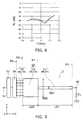
- FIG. 8 is a graph illustrating the return loss RL seen from the reference plane P5 shown in FIGS. 1A and 1B .
- the horizontal axis represents frequency f (GHz).
- the vertical axis represents the return loss RL (dB) for the load impedance m15 provided to the high-frequency semiconductor amplifying element 14.
- the load impedance m15 is e.g. (1+j1) ⁇ .
- the return loss RL at the fundamental frequency f1 can be set to 30 dB or more at frequency f of approximately 2.7-3.1 GHz.
- a high-frequency semiconductor amplifier for performing only the transformation of the load impedance for the fundamental uses a plurality of impedance transformation lines to lower a high impedance to the load impedance provided to the high-frequency semiconductor amplifying element 14.
- the characteristic impedance of the line is made sequentially lower with the decrease of the transformed impedance.
- the line width is also made sequentially wider.
- the high-frequency semiconductor amplifier 1 of this invention controls the load impedance for the second and third harmonics.
- the characteristic impedance Zc13 of the microstrip line 113 needs to be higher than the characteristic impedance Zc12 of the microstrip line 112 and the characteristic impedance Zc14 of the microstrip line 114.
- the line width W13 can be made comparable to the line width W12 and the line width W14.
- FIG. 9 is a schematic view showing the configuration of a high-frequency semiconductor amplifier according to this comparative example.
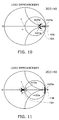
- FIG. 10 is an impedance chart illustrating the load impedance seen from the reference plane P1 shown in FIG. 9 .
- FIG. 11 is an impedance chart illustrating the load impedance seen from the reference plane P2 shown in FIG. 9 .
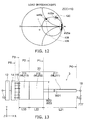
- FIG. 12 is an impedance chart illustrating the load impedance seen from the reference plane P5 shown in FIG. 9 .
- TABLE 2 is a table illustrating the electrical characteristics and dimensions of the microstrip lines in the first comparative example according to this embodiment.
- the output matching circuit 22 in this comparative example is formed from a microstrip line 211 (ML211), a microstrip line 212 (ML212), and a wire part 115.
- the position of the reference plane P0 is similar to the position in the above first embodiment.
- the load impedance m10 at the fundamental frequency f1 is similar to that of the above first embodiment (see FIG. 2 ).
- the load impedance m20 at the second harmonic frequency f2 is also similar to that of the above first embodiment (see FIG. 2 ).
- the load impedance m30 at the third harmonic frequency f3 is also similar to that of the above first embodiment (see FIG. 2 ).
- the characteristic impedance Zc21 of the microstrip line 211 is 18.8 ⁇ .
- the electrical length EL21 at the fundamental frequency f1 is 90 degrees.
- the relative permittivity ⁇ r21 is 10.
- the substrate thickness t21 is 150 ⁇ m.
- the line width W21 is 0.68 mm.
- the line length L21 is 8.83 mm.
- the characteristic impedance Zc22 of the microstrip line 212 is 2.66 ⁇ .
- the electrical length EL22 at the fundamental frequency f1 is 90 degrees.
- the relative permittivity ⁇ r22 is 40.
- the substrate thickness t22 is 250 ⁇ m.
- the line width W22 is 5.06 mm.
- the line length L22 is 4.14 mm.
- the load impedance m11a at the fundamental frequency f1 and the load impedance m31a at the third harmonic frequency f3 are transformed to a portion 10A having an impedance higher than 1 ⁇ and lower than 50 ⁇ .
- the load impedance m21a at the second harmonic frequency f2 remains near 50 ⁇ . This portion near 50 ⁇ is indicated as portion 10B in FIG. 10 .
- the load impedance m12a at the fundamental frequency f1 and the load impedance m32a at the third harmonic frequency f3 are transformed to a portion 11A having an impedance of approximately 1 ⁇ .
- the load impedance m22a at the second harmonic frequency f2 remains near 50 ⁇ . This portion near 50 ⁇ is indicated as portion 11B in FIG. 11 .
- the load impedance m15a at the fundamental frequency f1 is transformed to a portion 12A near (1+j1) ⁇ because of the added inductivity of the wire part 115.
- the load impedance m25a at the second harmonic frequency f2 is transformed to a portion 12B near ⁇ ⁇ .
- the load impedance m35a at the third harmonic frequency f3 is transformed to a portion 12C.
- the load impedance m25a at the second harmonic frequency f2 is set to approximately ⁇ ⁇ , but the load impedance m35a at the third harmonic frequency f3 is not set to approximately 0 ⁇ .
- FIG. 13 is a schematic view showing the configuration of a high-frequency semiconductor amplifier according to the second comparative example of the first embodiment.
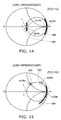
- FIG. 14 is an impedance chart illustrating the load impedance seen from the reference plane P3 shown in FIG. 13 .
- FIG. 15 is an impedance chart illustrating the load impedance seen from the reference plane P5 shown in FIG. 13 .
- TABLE 3 is a table illustrating the electrical characteristics and dimensions of the microstrip lines in the second comparative example according to this embodiment.
- the output matching circuit 23 in the second comparative example of this embodiment is different from the output matching circuit 22 in the above first comparative example in that the microstrip line 313 (ML313) is provided between the microstrip line 212 and the wire part 115.
- the load impedances m10, m11, and m12 at the fundamental frequency f1 are similar to those of the above first comparative example.
- the load impedances m20, m21, and m22 at the second harmonic frequency f2 are similar to those of the above first comparative example.
- the load impedances m30, m31, and m32 at the third harmonic frequency f3 are similar to those of the above first comparative example.
- the characteristic impedance Zc33 of the microstrip line 313 is 1.0 ⁇ .
- the electrical length EL33 at the fundamental frequency f1 is 90 degrees.
- the relative permittivity ⁇ r33 is 90.
- the substrate thickness t33 is 135 ⁇ m.
- the line width W33 is 5.05 mm.
- the line length L33 is 2.71 mm.
- the load impedance m13b at the fundamental frequency f1 remains near 1 ⁇ as in the case viewed from the reference plane P2.
- the load impedance m33b at the third harmonic frequency f3 also remains near 1 ⁇ .
- This portion near 1 ⁇ is indicated as portion 14A.
- the phase can be adjusted by adding e.g. a strip line or wire.
- the load impedance m23b at the second harmonic frequency f2 is transformed to a portion 14B near ⁇ ⁇ .
- the impedance is not substantially changed even if the phase is adjusted by adding e.g. a strip line.
- the load impedance m15b at the fundamental frequency f1 is transformed to a portion 15A near (1+j1) ⁇ because of the added inductivity of the wire part 115.
- the load impedance m25b at the second harmonic frequency f2 remains near ⁇ ⁇ without substantial change. This portion near ⁇ ⁇ is indicated as portion 15B in FIG. 15 .
- the load impedance m35b at the third harmonic frequency f3 is transformed to a portion 15C because of the added inductivity of the wire part 115.
- the load impedance m35b at the third harmonic frequency f3 is not set to approximately 0 ⁇ . Thus, it is difficult to cause the high-frequency semiconductor amplifier 3 to perform the inverse class-F operation.
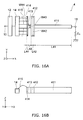
- FIGS. 16A and 16B are schematic views showing the configuration of a high-frequency semiconductor amplifier according to the third comparative example of the first embodiment.
- TABLE 4 is a table illustrating the electrical characteristics and dimensions of the microstrip lines in the third comparative example according to this embodiment.
- the microstrip line 412 (ML412), the microstrip line 413 (ML413), and the microstrip line 414 (ML414) are formed on a substrate having the same permittivity and the same thickness.
- the line width W43 of the microstrip line 413 is smaller than the line width W42 of the microstrip line 412.
- the line width W43 of the microstrip line 413 is smaller than the line width W44 of the microstrip line 414.
- the line width of the microstrip line 412, the microstrip line 413, and the microstrip line 414 is not constant, but a depression occurs. Thus, unnecessary radio waves are emitted from the microstrip line 412, the microstrip line 413, and the microstrip line 414.
- the embodiment described above can provide a high-frequency semiconductor amplifier for amplifying high-frequency signals at high power-added efficiency.
Landscapes
- Engineering & Computer Science (AREA)
- Power Engineering (AREA)
- Microwave Amplifiers (AREA)
- Amplifiers (AREA)
Applications Claiming Priority (1)
| Application Number | Priority Date | Filing Date | Title |
|---|---|---|---|
| JP2015013502A JP6189881B2 (ja) | 2015-01-27 | 2015-01-27 | 高周波半導体増幅器 |
Publications (2)
| Publication Number | Publication Date |
|---|---|
| EP3051693A1 true EP3051693A1 (de) | 2016-08-03 |
| EP3051693B1 EP3051693B1 (de) | 2019-07-24 |
Family
ID=55236272
Family Applications (1)
| Application Number | Title | Priority Date | Filing Date |
|---|---|---|---|
| EP16152705.6A Active EP3051693B1 (de) | 2015-01-27 | 2016-01-26 | Hochfrequenz-halbleiterverstärker |
Country Status (3)
| Country | Link |
|---|---|
| US (1) | US9929693B2 (de) |
| EP (1) | EP3051693B1 (de) |
| JP (1) | JP6189881B2 (de) |
Cited By (1)
| Publication number | Priority date | Publication date | Assignee | Title |
|---|---|---|---|---|
| CN107834139A (zh) * | 2017-10-20 | 2018-03-23 | 绵阳鑫阳知识产权运营有限公司 | 一种低噪声放大器的传输线结构 |
Families Citing this family (2)
| Publication number | Priority date | Publication date | Assignee | Title |
|---|---|---|---|---|
| JP6049673B2 (ja) | 2014-10-31 | 2016-12-21 | 株式会社東芝 | 半導体増幅装置 |
| JP2019110458A (ja) * | 2017-12-19 | 2019-07-04 | 住友電気工業株式会社 | 増幅回路及び基板 |
Citations (5)
| Publication number | Priority date | Publication date | Assignee | Title |
|---|---|---|---|---|
| US7183873B1 (en) * | 2004-09-29 | 2007-02-27 | Rockwell Collins, Inc. | Tapered thickness broadband matching transformer |
| US20100079211A1 (en) * | 2008-09-30 | 2010-04-01 | Panasonic Corporation | Matching circuit, and radio-frequency power amplifier and mobile phone including the same |
| EP2637302A1 (de) * | 2012-03-08 | 2013-09-11 | Kabushiki Kaisha Toshiba | Mikrowellen-Halbleiterverstärker |
| US20140218105A1 (en) * | 2013-02-01 | 2014-08-07 | Fujitsu Limited | Amplifier and amplifying method |
| CN204119176U (zh) * | 2014-10-24 | 2015-01-21 | 天津大学 | 一种高效率f类/逆f类功率放大器 |
Family Cites Families (16)
| Publication number | Priority date | Publication date | Assignee | Title |
|---|---|---|---|---|
| JPH0738548B2 (ja) * | 1993-01-07 | 1995-04-26 | 日本電気株式会社 | 電力整合回路 |
| JP2513146B2 (ja) | 1993-09-20 | 1996-07-03 | 日本電気株式会社 | 高効率増幅回路 |
| JP2001111362A (ja) | 1999-10-06 | 2001-04-20 | Nec Corp | 高調波処理回路及びそれを用いた高電力効率増幅回路 |
| JP4520204B2 (ja) * | 2004-04-14 | 2010-08-04 | 三菱電機株式会社 | 高周波電力増幅器 |
| CN101485042A (zh) * | 2006-07-07 | 2009-07-15 | Nxp股份有限公司 | 包含传输线的电路 |
| KR100814415B1 (ko) * | 2007-02-14 | 2008-03-18 | 포항공과대학교 산학협력단 | 하모닉 제어 회로를 이용한 고효율 도허티 전력 증폭기 |
| JP5056480B2 (ja) * | 2008-02-29 | 2012-10-24 | 三菱電機株式会社 | 高周波半導体増幅器 |
| JP5083201B2 (ja) | 2008-12-25 | 2012-11-28 | 三菱電機株式会社 | 高周波半導体増幅器 |
| JP5603893B2 (ja) * | 2012-03-08 | 2014-10-08 | 株式会社東芝 | 高周波半導体増幅器 |
| JP5468095B2 (ja) | 2012-03-08 | 2014-04-09 | 株式会社東芝 | 高周波半導体増幅器 |
| JP5619055B2 (ja) | 2012-03-08 | 2014-11-05 | 株式会社東芝 | 高周波半導体増幅器 |
| JP2015149626A (ja) | 2014-02-06 | 2015-08-20 | 株式会社東芝 | 高周波半導体増幅器 |
| JP2015149627A (ja) | 2014-02-06 | 2015-08-20 | 株式会社東芝 | 高周波半導体増幅器 |
| JP5812158B2 (ja) * | 2014-06-02 | 2015-11-11 | 富士通株式会社 | 伝送線路、インピーダンス変換器、集積回路搭載装置および通信機モジュール |
| US9641140B2 (en) * | 2014-06-27 | 2017-05-02 | Nxp Usa, Inc. | Method and apparatus for a multi-harmonic matching network |
| JP6648979B2 (ja) | 2015-04-06 | 2020-02-19 | 株式会社東芝 | 半導体増幅装置 |
-
2015
- 2015-01-27 JP JP2015013502A patent/JP6189881B2/ja active Active
-
2016
- 2016-01-26 EP EP16152705.6A patent/EP3051693B1/de active Active
- 2016-01-27 US US15/008,072 patent/US9929693B2/en active Active
Patent Citations (5)
| Publication number | Priority date | Publication date | Assignee | Title |
|---|---|---|---|---|
| US7183873B1 (en) * | 2004-09-29 | 2007-02-27 | Rockwell Collins, Inc. | Tapered thickness broadband matching transformer |
| US20100079211A1 (en) * | 2008-09-30 | 2010-04-01 | Panasonic Corporation | Matching circuit, and radio-frequency power amplifier and mobile phone including the same |
| EP2637302A1 (de) * | 2012-03-08 | 2013-09-11 | Kabushiki Kaisha Toshiba | Mikrowellen-Halbleiterverstärker |
| US20140218105A1 (en) * | 2013-02-01 | 2014-08-07 | Fujitsu Limited | Amplifier and amplifying method |
| CN204119176U (zh) * | 2014-10-24 | 2015-01-21 | 天津大学 | 一种高效率f类/逆f类功率放大器 |
Cited By (1)
| Publication number | Priority date | Publication date | Assignee | Title |
|---|---|---|---|---|
| CN107834139A (zh) * | 2017-10-20 | 2018-03-23 | 绵阳鑫阳知识产权运营有限公司 | 一种低噪声放大器的传输线结构 |
Also Published As
| Publication number | Publication date |
|---|---|
| US20160218677A1 (en) | 2016-07-28 |
| JP6189881B2 (ja) | 2017-08-30 |
| US9929693B2 (en) | 2018-03-27 |
| JP2016139923A (ja) | 2016-08-04 |
| EP3051693B1 (de) | 2019-07-24 |
Similar Documents
| Publication | Publication Date | Title |
|---|---|---|
| US9531329B2 (en) | Power amplifier and transmission apparatus | |
| JP5603893B2 (ja) | 高周波半導体増幅器 | |
| US9787253B2 (en) | Doherty amplifier and transmission apparatus | |
| JP5989578B2 (ja) | 高周波広帯域増幅回路 | |
| EP3051695B1 (de) | Hochfrequenz-halbleiterverstärker | |
| US11296662B2 (en) | High-frequency power amplifier | |
| JP5619055B2 (ja) | 高周波半導体増幅器 | |
| US12176860B2 (en) | High frequency amplifier | |
| EP3051693B1 (de) | Hochfrequenz-halbleiterverstärker | |
| JP2009060169A (ja) | アンテナ装置および信号受信方法 | |
| EP3051694B1 (de) | Hochfrequenz-halbleiterverstärker | |
| KR102564085B1 (ko) | 도허티 증폭기 | |
| WO2021064892A1 (ja) | ドハティ増幅器 | |
| JP6431002B2 (ja) | 電力伝送通信ユニット及び電力伝送通信装置 | |
| CN113366760B (zh) | 谐波处理电路和放大器 | |
| JP2014165724A (ja) | 無線送信機、増幅器及び増幅方法 | |
| CN110168931B (zh) | 功率放大器 | |
| WO2010140406A1 (ja) | アンテナ装置及び無線通信機 | |
| JP7311390B2 (ja) | アンテナ装置 | |
| JP2013219484A (ja) | 高周波半導体増幅器 | |
| JP2017055226A (ja) | 高周波半導体増幅器 | |
| WO2020004130A1 (ja) | アンテナ装置及び電子機器 | |
| JP2016154274A (ja) | アンテナ装置 | |
| JP2001127567A (ja) | 高周波用電力増幅器 |
Legal Events
| Date | Code | Title | Description |
|---|---|---|---|
| PUAI | Public reference made under article 153(3) epc to a published international application that has entered the european phase |
Free format text: ORIGINAL CODE: 0009012 |
|
| 17P | Request for examination filed |
Effective date: 20160126 |
|
| AK | Designated contracting states |
Kind code of ref document: A1 Designated state(s): AL AT BE BG CH CY CZ DE DK EE ES FI FR GB GR HR HU IE IS IT LI LT LU LV MC MK MT NL NO PL PT RO RS SE SI SK SM TR |
|
| AX | Request for extension of the european patent |
Extension state: BA ME |
|
| STAA | Information on the status of an ep patent application or granted ep patent |
Free format text: STATUS: EXAMINATION IS IN PROGRESS |
|
| 17Q | First examination report despatched |
Effective date: 20170316 |
|
| REG | Reference to a national code |
Ref country code: DE Ref legal event code: R079 Ref document number: 602016017156 Country of ref document: DE Free format text: PREVIOUS MAIN CLASS: H03F0003217000 Ipc: H01P0001240000 |
|
| RIC1 | Information provided on ipc code assigned before grant |
Ipc: H03F 3/217 20060101ALI20190213BHEP Ipc: H01P 1/28 20060101ALI20190213BHEP Ipc: H01L 23/66 20060101ALI20190213BHEP Ipc: H03F 1/02 20060101ALI20190213BHEP Ipc: H03F 3/60 20060101ALI20190213BHEP Ipc: H01P 5/02 20060101ALI20190213BHEP Ipc: H03F 1/56 20060101ALI20190213BHEP Ipc: H03F 3/19 20060101ALI20190213BHEP Ipc: H01P 1/24 20060101AFI20190213BHEP |
|
| GRAP | Despatch of communication of intention to grant a patent |
Free format text: ORIGINAL CODE: EPIDOSNIGR1 |
|
| STAA | Information on the status of an ep patent application or granted ep patent |
Free format text: STATUS: GRANT OF PATENT IS INTENDED |
|
| INTG | Intention to grant announced |
Effective date: 20190325 |
|
| GRAS | Grant fee paid |
Free format text: ORIGINAL CODE: EPIDOSNIGR3 |
|
| GRAA | (expected) grant |
Free format text: ORIGINAL CODE: 0009210 |
|
| STAA | Information on the status of an ep patent application or granted ep patent |
Free format text: STATUS: THE PATENT HAS BEEN GRANTED |
|
| AK | Designated contracting states |
Kind code of ref document: B1 Designated state(s): AL AT BE BG CH CY CZ DE DK EE ES FI FR GB GR HR HU IE IS IT LI LT LU LV MC MK MT NL NO PL PT RO RS SE SI SK SM TR |
|
| REG | Reference to a national code |
Ref country code: GB Ref legal event code: FG4D |
|
| REG | Reference to a national code |
Ref country code: CH Ref legal event code: EP |
|
| REG | Reference to a national code |
Ref country code: DE Ref legal event code: R096 Ref document number: 602016017156 Country of ref document: DE |
|
| REG | Reference to a national code |
Ref country code: AT Ref legal event code: REF Ref document number: 1159300 Country of ref document: AT Kind code of ref document: T Effective date: 20190815 |
|
| REG | Reference to a national code |
Ref country code: IE Ref legal event code: FG4D |
|
| REG | Reference to a national code |
Ref country code: NL Ref legal event code: MP Effective date: 20190724 |
|
| REG | Reference to a national code |
Ref country code: LT Ref legal event code: MG4D |
|
| REG | Reference to a national code |
Ref country code: AT Ref legal event code: MK05 Ref document number: 1159300 Country of ref document: AT Kind code of ref document: T Effective date: 20190724 |
|
| PG25 | Lapsed in a contracting state [announced via postgrant information from national office to epo] |
Ref country code: FI Free format text: LAPSE BECAUSE OF FAILURE TO SUBMIT A TRANSLATION OF THE DESCRIPTION OR TO PAY THE FEE WITHIN THE PRESCRIBED TIME-LIMIT Effective date: 20190724 Ref country code: NO Free format text: LAPSE BECAUSE OF FAILURE TO SUBMIT A TRANSLATION OF THE DESCRIPTION OR TO PAY THE FEE WITHIN THE PRESCRIBED TIME-LIMIT Effective date: 20191024 Ref country code: AT Free format text: LAPSE BECAUSE OF FAILURE TO SUBMIT A TRANSLATION OF THE DESCRIPTION OR TO PAY THE FEE WITHIN THE PRESCRIBED TIME-LIMIT Effective date: 20190724 Ref country code: BG Free format text: LAPSE BECAUSE OF FAILURE TO SUBMIT A TRANSLATION OF THE DESCRIPTION OR TO PAY THE FEE WITHIN THE PRESCRIBED TIME-LIMIT Effective date: 20191024 Ref country code: SE Free format text: LAPSE BECAUSE OF FAILURE TO SUBMIT A TRANSLATION OF THE DESCRIPTION OR TO PAY THE FEE WITHIN THE PRESCRIBED TIME-LIMIT Effective date: 20190724 Ref country code: PT Free format text: LAPSE BECAUSE OF FAILURE TO SUBMIT A TRANSLATION OF THE DESCRIPTION OR TO PAY THE FEE WITHIN THE PRESCRIBED TIME-LIMIT Effective date: 20191125 Ref country code: NL Free format text: LAPSE BECAUSE OF FAILURE TO SUBMIT A TRANSLATION OF THE DESCRIPTION OR TO PAY THE FEE WITHIN THE PRESCRIBED TIME-LIMIT Effective date: 20190724 Ref country code: LT Free format text: LAPSE BECAUSE OF FAILURE TO SUBMIT A TRANSLATION OF THE DESCRIPTION OR TO PAY THE FEE WITHIN THE PRESCRIBED TIME-LIMIT Effective date: 20190724 Ref country code: HR Free format text: LAPSE BECAUSE OF FAILURE TO SUBMIT A TRANSLATION OF THE DESCRIPTION OR TO PAY THE FEE WITHIN THE PRESCRIBED TIME-LIMIT Effective date: 20190724 |
|
| PG25 | Lapsed in a contracting state [announced via postgrant information from national office to epo] |
Ref country code: AL Free format text: LAPSE BECAUSE OF FAILURE TO SUBMIT A TRANSLATION OF THE DESCRIPTION OR TO PAY THE FEE WITHIN THE PRESCRIBED TIME-LIMIT Effective date: 20190724 Ref country code: RS Free format text: LAPSE BECAUSE OF FAILURE TO SUBMIT A TRANSLATION OF THE DESCRIPTION OR TO PAY THE FEE WITHIN THE PRESCRIBED TIME-LIMIT Effective date: 20190724 Ref country code: GR Free format text: LAPSE BECAUSE OF FAILURE TO SUBMIT A TRANSLATION OF THE DESCRIPTION OR TO PAY THE FEE WITHIN THE PRESCRIBED TIME-LIMIT Effective date: 20191025 Ref country code: LV Free format text: LAPSE BECAUSE OF FAILURE TO SUBMIT A TRANSLATION OF THE DESCRIPTION OR TO PAY THE FEE WITHIN THE PRESCRIBED TIME-LIMIT Effective date: 20190724 Ref country code: IS Free format text: LAPSE BECAUSE OF FAILURE TO SUBMIT A TRANSLATION OF THE DESCRIPTION OR TO PAY THE FEE WITHIN THE PRESCRIBED TIME-LIMIT Effective date: 20191124 Ref country code: ES Free format text: LAPSE BECAUSE OF FAILURE TO SUBMIT A TRANSLATION OF THE DESCRIPTION OR TO PAY THE FEE WITHIN THE PRESCRIBED TIME-LIMIT Effective date: 20190724 |
|
| PG25 | Lapsed in a contracting state [announced via postgrant information from national office to epo] |
Ref country code: TR Free format text: LAPSE BECAUSE OF FAILURE TO SUBMIT A TRANSLATION OF THE DESCRIPTION OR TO PAY THE FEE WITHIN THE PRESCRIBED TIME-LIMIT Effective date: 20190724 |
|
| PG25 | Lapsed in a contracting state [announced via postgrant information from national office to epo] |
Ref country code: IT Free format text: LAPSE BECAUSE OF FAILURE TO SUBMIT A TRANSLATION OF THE DESCRIPTION OR TO PAY THE FEE WITHIN THE PRESCRIBED TIME-LIMIT Effective date: 20190724 Ref country code: EE Free format text: LAPSE BECAUSE OF FAILURE TO SUBMIT A TRANSLATION OF THE DESCRIPTION OR TO PAY THE FEE WITHIN THE PRESCRIBED TIME-LIMIT Effective date: 20190724 Ref country code: PL Free format text: LAPSE BECAUSE OF FAILURE TO SUBMIT A TRANSLATION OF THE DESCRIPTION OR TO PAY THE FEE WITHIN THE PRESCRIBED TIME-LIMIT Effective date: 20190724 Ref country code: DK Free format text: LAPSE BECAUSE OF FAILURE TO SUBMIT A TRANSLATION OF THE DESCRIPTION OR TO PAY THE FEE WITHIN THE PRESCRIBED TIME-LIMIT Effective date: 20190724 Ref country code: RO Free format text: LAPSE BECAUSE OF FAILURE TO SUBMIT A TRANSLATION OF THE DESCRIPTION OR TO PAY THE FEE WITHIN THE PRESCRIBED TIME-LIMIT Effective date: 20190724 |
|
| PG25 | Lapsed in a contracting state [announced via postgrant information from national office to epo] |
Ref country code: SK Free format text: LAPSE BECAUSE OF FAILURE TO SUBMIT A TRANSLATION OF THE DESCRIPTION OR TO PAY THE FEE WITHIN THE PRESCRIBED TIME-LIMIT Effective date: 20190724 Ref country code: CZ Free format text: LAPSE BECAUSE OF FAILURE TO SUBMIT A TRANSLATION OF THE DESCRIPTION OR TO PAY THE FEE WITHIN THE PRESCRIBED TIME-LIMIT Effective date: 20190724 Ref country code: SM Free format text: LAPSE BECAUSE OF FAILURE TO SUBMIT A TRANSLATION OF THE DESCRIPTION OR TO PAY THE FEE WITHIN THE PRESCRIBED TIME-LIMIT Effective date: 20190724 Ref country code: IS Free format text: LAPSE BECAUSE OF FAILURE TO SUBMIT A TRANSLATION OF THE DESCRIPTION OR TO PAY THE FEE WITHIN THE PRESCRIBED TIME-LIMIT Effective date: 20200224 |
|
| REG | Reference to a national code |
Ref country code: DE Ref legal event code: R097 Ref document number: 602016017156 Country of ref document: DE |
|
| PLBE | No opposition filed within time limit |
Free format text: ORIGINAL CODE: 0009261 |
|
| STAA | Information on the status of an ep patent application or granted ep patent |
Free format text: STATUS: NO OPPOSITION FILED WITHIN TIME LIMIT |
|
| PG2D | Information on lapse in contracting state deleted |
Ref country code: IS |
|
| 26N | No opposition filed |
Effective date: 20200603 |
|
| PG25 | Lapsed in a contracting state [announced via postgrant information from national office to epo] |
Ref country code: MC Free format text: LAPSE BECAUSE OF FAILURE TO SUBMIT A TRANSLATION OF THE DESCRIPTION OR TO PAY THE FEE WITHIN THE PRESCRIBED TIME-LIMIT Effective date: 20190724 Ref country code: SI Free format text: LAPSE BECAUSE OF FAILURE TO SUBMIT A TRANSLATION OF THE DESCRIPTION OR TO PAY THE FEE WITHIN THE PRESCRIBED TIME-LIMIT Effective date: 20190724 |
|
| REG | Reference to a national code |
Ref country code: CH Ref legal event code: PL |
|
| GBPC | Gb: european patent ceased through non-payment of renewal fee |
Effective date: 20200126 |
|
| REG | Reference to a national code |
Ref country code: BE Ref legal event code: MM Effective date: 20200131 |
|
| PG25 | Lapsed in a contracting state [announced via postgrant information from national office to epo] |
Ref country code: LU Free format text: LAPSE BECAUSE OF NON-PAYMENT OF DUE FEES Effective date: 20200126 Ref country code: GB Free format text: LAPSE BECAUSE OF NON-PAYMENT OF DUE FEES Effective date: 20200126 |
|
| PG25 | Lapsed in a contracting state [announced via postgrant information from national office to epo] |
Ref country code: CH Free format text: LAPSE BECAUSE OF NON-PAYMENT OF DUE FEES Effective date: 20200131 Ref country code: LI Free format text: LAPSE BECAUSE OF NON-PAYMENT OF DUE FEES Effective date: 20200131 Ref country code: BE Free format text: LAPSE BECAUSE OF NON-PAYMENT OF DUE FEES Effective date: 20200131 |
|
| PG25 | Lapsed in a contracting state [announced via postgrant information from national office to epo] |
Ref country code: IE Free format text: LAPSE BECAUSE OF NON-PAYMENT OF DUE FEES Effective date: 20200126 |
|
| PG25 | Lapsed in a contracting state [announced via postgrant information from national office to epo] |
Ref country code: MT Free format text: LAPSE BECAUSE OF FAILURE TO SUBMIT A TRANSLATION OF THE DESCRIPTION OR TO PAY THE FEE WITHIN THE PRESCRIBED TIME-LIMIT Effective date: 20190724 Ref country code: CY Free format text: LAPSE BECAUSE OF FAILURE TO SUBMIT A TRANSLATION OF THE DESCRIPTION OR TO PAY THE FEE WITHIN THE PRESCRIBED TIME-LIMIT Effective date: 20190724 |
|
| PG25 | Lapsed in a contracting state [announced via postgrant information from national office to epo] |
Ref country code: MK Free format text: LAPSE BECAUSE OF FAILURE TO SUBMIT A TRANSLATION OF THE DESCRIPTION OR TO PAY THE FEE WITHIN THE PRESCRIBED TIME-LIMIT Effective date: 20190724 |
|
| PGFP | Annual fee paid to national office [announced via postgrant information from national office to epo] |
Ref country code: FR Payment date: 20251128 Year of fee payment: 11 |
|
| PGFP | Annual fee paid to national office [announced via postgrant information from national office to epo] |
Ref country code: DE Payment date: 20251203 Year of fee payment: 11 |