EP2913359A1 - Pastöses harz auf polyvinylchloridbasis und herstellungsverfahren dafür - Google Patents
Pastöses harz auf polyvinylchloridbasis und herstellungsverfahren dafür Download PDFInfo
- Publication number
- EP2913359A1 EP2913359A1 EP13849463.8A EP13849463A EP2913359A1 EP 2913359 A1 EP2913359 A1 EP 2913359A1 EP 13849463 A EP13849463 A EP 13849463A EP 2913359 A1 EP2913359 A1 EP 2913359A1
- Authority
- EP
- European Patent Office
- Prior art keywords
- styrene
- resin
- polyvinyl chloride
- acrylic
- preparation
- Prior art date
- Legal status (The legal status is an assumption and is not a legal conclusion. Google has not performed a legal analysis and makes no representation as to the accuracy of the status listed.)
- Granted
Links
Images

Classifications
-
- C—CHEMISTRY; METALLURGY
- C08—ORGANIC MACROMOLECULAR COMPOUNDS; THEIR PREPARATION OR CHEMICAL WORKING-UP; COMPOSITIONS BASED THEREON
- C08F—MACROMOLECULAR COMPOUNDS OBTAINED BY REACTIONS ONLY INVOLVING CARBON-TO-CARBON UNSATURATED BONDS
- C08F14/00—Homopolymers and copolymers of compounds having one or more unsaturated aliphatic radicals, each having only one carbon-to-carbon double bond, and at least one being terminated by a halogen
- C08F14/02—Monomers containing chlorine
- C08F14/04—Monomers containing two carbon atoms
- C08F14/06—Vinyl chloride
-
- C—CHEMISTRY; METALLURGY
- C08—ORGANIC MACROMOLECULAR COMPOUNDS; THEIR PREPARATION OR CHEMICAL WORKING-UP; COMPOSITIONS BASED THEREON
- C08F—MACROMOLECULAR COMPOUNDS OBTAINED BY REACTIONS ONLY INVOLVING CARBON-TO-CARBON UNSATURATED BONDS
- C08F212/00—Copolymers of compounds having one or more unsaturated aliphatic radicals, each having only one carbon-to-carbon double bond, and at least one being terminated by an aromatic carbocyclic ring
- C08F212/02—Monomers containing only one unsaturated aliphatic radical
- C08F212/04—Monomers containing only one unsaturated aliphatic radical containing one ring
- C08F212/06—Hydrocarbons
- C08F212/08—Styrene
-
- C—CHEMISTRY; METALLURGY
- C08—ORGANIC MACROMOLECULAR COMPOUNDS; THEIR PREPARATION OR CHEMICAL WORKING-UP; COMPOSITIONS BASED THEREON
- C08L—COMPOSITIONS OF MACROMOLECULAR COMPOUNDS
- C08L25/00—Compositions of, homopolymers or copolymers of compounds having one or more unsaturated aliphatic radicals, each having only one carbon-to-carbon double bond, and at least one being terminated by an aromatic carbocyclic ring; Compositions of derivatives of such polymers
- C08L25/02—Homopolymers or copolymers of hydrocarbons
- C08L25/04—Homopolymers or copolymers of styrene
- C08L25/08—Copolymers of styrene
-
- C—CHEMISTRY; METALLURGY
- C08—ORGANIC MACROMOLECULAR COMPOUNDS; THEIR PREPARATION OR CHEMICAL WORKING-UP; COMPOSITIONS BASED THEREON
- C08L—COMPOSITIONS OF MACROMOLECULAR COMPOUNDS
- C08L27/00—Compositions of homopolymers or copolymers of compounds having one or more unsaturated aliphatic radicals, each having only one carbon-to-carbon double bond, and at least one being terminated by a halogen; Compositions of derivatives of such polymers
- C08L27/02—Compositions of homopolymers or copolymers of compounds having one or more unsaturated aliphatic radicals, each having only one carbon-to-carbon double bond, and at least one being terminated by a halogen; Compositions of derivatives of such polymers not modified by chemical after-treatment
- C08L27/04—Compositions of homopolymers or copolymers of compounds having one or more unsaturated aliphatic radicals, each having only one carbon-to-carbon double bond, and at least one being terminated by a halogen; Compositions of derivatives of such polymers not modified by chemical after-treatment containing chlorine atoms
- C08L27/06—Homopolymers or copolymers of vinyl chloride
-
- C—CHEMISTRY; METALLURGY
- C08—ORGANIC MACROMOLECULAR COMPOUNDS; THEIR PREPARATION OR CHEMICAL WORKING-UP; COMPOSITIONS BASED THEREON
- C08L—COMPOSITIONS OF MACROMOLECULAR COMPOUNDS
- C08L33/00—Compositions of homopolymers or copolymers of compounds having one or more unsaturated aliphatic radicals, each having only one carbon-to-carbon double bond, and only one being terminated by only one carboxyl radical, or of salts, anhydrides, esters, amides, imides or nitriles thereof; Compositions of derivatives of such polymers
- C08L33/04—Homopolymers or copolymers of esters
Definitions
- the present invention relates to a polyvinyl chloride paste resin and a preparation method thereof. More specifically, it relates to a polyvinyl chloride paste resin showing excellent foamability and moisture resistance, and a preparation method thereof.
- Polyvinyl chloride paste resin (hereinafter, "PSR") is a kind of general purpose resin that has been widely used for construction supplies, daily necessities such as wallpapers, artificial leathers, fabrics, sheets, and films, and industrial supplies, and it is generally used for foam articles. Most important things to the foam articles are the foam article surface, the foam cell size, and the uniformity of cells, and the characteristics are appellatively called as "foamability".
- the method for modifying PSR itself, 1) a method of regulating the melt viscosity of PSR to be suitable for a foaming condition by controlling the degree of polymerization of the same, 2) a method of increasing the content of an emulsifier such as sodium lauryl sulfate (hereinafter, 'SLS') used for polymerization of PSR for foaming, and 3) a method of dissolving and dispersing acrylate resin powder in dioctyl phthalate (hereinafter, 'DOP') and mixing the same with PSR, and drying and pulverizing the same are known.
- an emulsifier such as sodium lauryl sulfate (hereinafter, 'SLS') used for polymerization of PSR for foaming
- 'DOP' dioctyl phthalate
- a method of controlling the additives used for foam blending a method of changing the combination or the content of a foaming agent and a stabilizer according to the degree of polymerization of the resin, or a method of adding a foaming cell conditioning agent is known.
- the largest factor influencing the foamability of the final product is the foamability of the resin itself. Therefore, if the foaming characteristic of the resin itself is not good, there is a limit to the technology for improving the foamability by controlling (or adding) the additives.
- the easiest method of modifying the foaming characteristics of PSR itself is the method of regulating the degree of polymerization or the method of increasing the content of SLS. These methods have an advantage of increasing the expansion ratio but there is a limit for preparing the product having excellent foamability.
- the method of dissolving acrylic resin powder in DOP, mixing the same with PSR latex, and drying and pulverizing the same has the effect on the improvement of foamability.
- the acrylic resin solution is added to the PSR latex including ion exchanged water as the main component, the acrylic resin solution is poorly dispersed and exists as aggregates because of its poor compatibility with ion exchanged water, and thus it causes the aggregation of primary particles of PSR in the latex or adheres to the sieve or the wall of dryer during transportation or drying process of the latex, and disturbs a normal resin production. Therefore, for resolving this problem, there is an inconvenience of using a surfactant for dispersing the acrylic solution.
- one aspect of the present invention provides a polyvinyl chloride paste resin including a polyvinyl chloride resin; and a styrene/acrylic resin.
- Another aspect of the present invention provides a preparation method of the polyvinyl chloride paste resin including the steps of:
- the polyvinyl chloride paste resin of the present invention shows excellent foamability and moisture resistance and shows improved viscosity characteristic. Therefore, the polyvinyl chloride paste resin prepared by the method of the present invention may be widely applied to high expandable foam articles.
- the preparation method of the polyvinyl chloride paste resin of the present invention it is possible to prepare the polyvinyl chloride paste resin showing excellent foamability and moisture resistance relatively simply without a modification of polyvinyl chloride resin itself by adding the styrene/acrylic resin solution having compatibility with the polyvinyl chloride resin latex.
- the polyvinyl chloride (PVC) paste resin (PSR) of the present invention includes a PVC resin; and a styrene/acrylic resin.
- the preparation method of the PVC paste resin includes the steps of: preparing a PVC resin latex including a PVC resin; adding a styrene/acrylic resin solution to the PVC resin latex; and drying the PVC resin latex to which the styrene/acrylic resin solution is added.
- the terms "the first”, “the second”, and the like are used for explaining various components and said terms are only used for distinguishing one component from the other components.
- the word "on” or “above”, as used in the context of formation or construction of one layer or element, means pertaining to the direct formation or construction of one layer or element on another layer or element directly or the additional formation or construction of one layer or element between layers or on a subject or substrate.
- the polyvinyl chloride (PVC) paste resin (PSR) of the present invention includes a PVC resin; and a styrene/acrylic resin.
- the PVC paste resin means powder of tiny particle form, and the PVC paste resin of the present invention includes a PVC resin; and a styrene/acrylic resin.
- each particle may include only the PVC resin or only the styrene/acrylic resin, or may be a coagulated particle in which the PVC resin and the styrene/acrylic resin are mixed or bonded together, and the PVC paste resin may be a mixture of such particles.
- the PVC resin is a homopolymer of vinyl chloride or a copolymer of vinyl chloride and a comonomer which can be copolymerized with the same.
- the degree of polymerization of the PVC paste resin of the present invention may be about 1,000 to about 1,700, and the weight average molecular weight of the same may be about 45,000 to about 200,000 g/mol.
- the dispersibility of plasticizer is good and it is suitable for the process for plastisol.
- the styrene/acrylic resin is a copolymer of styrene monomer and acrylic monomer. According to one embodiment of the present invention, it may be a copolymer in which the styrene monomer and the acrylic monomer are copolymerized with the weight ratio of about 60:40 to about 80:20, and preferably about 60:40 to about 70:30.
- the styrene/acrylic copolymer copolymerized with the weight ratio is used, the PVC paste resin showing more excellent foamability and moisture resistance can be obtained.
- the styrene monomer may include only styrene or both of styrene and alpha-methylstyrene monomer. When it includes styrene and alpha-methylstyrene monomer together, the weight ratio of styrene and alpha-methylstyrene may be about 50:50 to about 90:10.
- the acrylic monomer may include only acrylic acid or both of acrylic acid and an alkyl acrylate.
- the weight ratio of acrylic acid and the alkyl acrylate may be about 80:20 to about 90:10.
- the styrene/acrylic resin may have the weight average molecular weight (Mw) of about 1,000 to about 20,000 g/mol, preferably about 1,500 to about 15,000 g/mol, and more preferably about 5,000 to about 14,000 g/mol.
- Mw weight average molecular weight
- the weight ratio of the PVC resin and the styrene/acrylic resin may be about 1:0.0005 to about 1:0.2, and preferably about 1:0.001 to about 1:0.1.
- the resin includes the PVC resin and the styrene/acrylic resin with said ratio, it can exhibit excellent foamability and moisture resistance.
- the PVC paste resin for high magnification foaming is foamed with including much forming agent for increasing the expansion ratio in the preparation of plastisol.
- the static viscosity of the same is low and it is easy to roll down when the resin is made into plastisol and coated on a substrate, a defect may occur due to the partial deviation of the thickness.
- the PVC past resin is generally very sensitive to moisture, there is a disadvantage of that the foamability deteriorates and the surface defects occur in a high humidity circumstance.
- the plastisol prepared by using the PVC paste resin of the present invention can be usefully used to various fields such as high foaming mat, sheet, and films because it shows excellent foamability such as good foam surface and uniform foam cells, and high viscosity. Furthermore, it can maintain the foamability even in a high humidity circumstance because it shows excellent moisture resistance.
- a preparation method of the PVC paste resin including the steps of: preparing a PVC resin latex including a PVC resin; adding a styrene/acrylic resin solution to the PVC resin latex; and drying the PVC resin latex to which the styrene/acrylic resin solution is added is provided.
- the PVC latex including the PVC resin is prepared.
- the PVC resin latex is an emulsion of the PVC resin particles of 0.1 to several micrometers( ⁇ m) dispersed in deionized water.
- the method for preparing the PVC resin latex is not limited particularly, and the latex can be prepared by a common method known in the field to which the present invention pertains.
- the latex may be prepare by the processes of adding sole vinyl chloride monomer or a mixture of vinyl chloride monomer and a comonomer copolymerizable with the same, an emulsifier, and a polymerization initiator to an aqueous solvent; homogenizing the mixture solution; and carrying out a micro suspension polymerization of the same.
- the latex may be prepared by carrying out an emulsion polymerization or a seed emulsion polymerization after adding an emulsifier and a water soluble polymerization initiator to an aqueous medium including sole vinyl chloride monomer or a mixture of vinyl chloride monomer and a comonomer copolymerizable with the same.
- the comonomer which can be copolymerized with vinyl chloride monomer may be olefins such as ethylene, propylene, butene, and so on; vinyl esters of carboxylic acids such as vinyl acetate, vinyl propionate, vinyl stearate, and so on; vinyl ethers having an alkyl group such as methyl vinyl ether, ethyl vinyl ether, octyl vinyl ether, lauryl vinyl ether, and so on; vinylidene halides such as vinylidene chloride and so on; unsaturated carboxylic acids and acid anhydrides thereof such as acrylic acid, methacrylic acid, fumaric acid, maleic acid, itaconic acid, maleic anhydride, itaconic anhydride, and so on; unsaturated carboxylic acid esters such as methyl acrylate, ethyl acrylate, monomethyl maleate, dimethyl maleate, butylbenzyl maleate, and so on; aromatic vinyl compounds such as
- Anionic emulsifiers or nonionic emulsifiers may be used solely or in the form of a mixture as the emulsifier.
- the nonionic emulsifier may be a carboxylic acid, an alkyl sulfonic acid, an alkyl benzene sulfonic acid, an ⁇ -olefin sulfonic acid, or an alkyl phosphoric acid.
- the nonionic emulsifier may be a polyoxyethylene ether, a polyoxyethylene alkyl phenyl ether, a polyoxyethylene alkenyl ether, a polyoxyethylene derivative, a glycerin fatty acid ester, a sorbitan fatty acid ester, a polyoxyethylene fatty acid ester, a silicone emulsifier, and so on.
- the emulsifier may be introduced into the aqueous medium at once before the polymerization reaction or continuously during the polymerization reaction. Furthermore, the emulsifier may be added to the latex after the polymerization reaction is finished, and said methods may be used in combination with necessity.
- An assistant dispersant may be further used with necessity during the micro suspension polymerization, the emulsion polymerization, or the seed emulsion polymerization.
- the assistant dispersant is used with the emulsifier for maintaining the stability of the polymerization and the latex, and specifically, it may be higher alcohols such as lauryl alcohol, myristic alcohol, stearyl alcohol, and so on, or higher fatty acids such as lauric acid, myristic acid, palmitic acid, stearic acid, and so on.
- the polymerization initiator for the micro suspension polymerization may be organic peroxide-based initiators such as peroxy dicarbonates such as diisopropyl peroxy dicarbonate and so on, and peroxy esters such as t-butylperoxy pivalate, t-butylperoxy neodecanoate, and so on, or azo-based initiators such as 2,2-azobisisobutyronitrile.
- the initiator may be used solely or in the form of a mixture.
- the polymerization initiator for the emulsion polymerization or the seed emulsion polymerization may be ammonium persulfate, potassium persulfate, sodium persulfate, hydrogen peroxide, and so on, and with necessity, a reducing agent such as sodium sulfite, sodium, ascorbic acid, and so on may be used in addition to the initiator.
- the PVC resin latex may be prepared by mixing and polymerizing said components. After the polymerization is completed, the unreacted monomer may be eliminated therefrom.
- the content of the solid including the PVC resin may be about 30 to about 60 weight% in the PVC resin latex.
- the styrene/acrylic resin solution is added to the PVC resin latex.
- the styrene/acrylic resin is a copolymer of a styrene monomer and an acrylic monomer.
- the resin may be a copolymer in which the styrene monomer and the acrylic monomer are copolymerized with the weight ratio of about 60:40 to about 80:20, and preferably about 60:40 to about 70:30.
- styrene may be used solely or a mixture of styrene and alpha-methyl styrene may be used.
- the weight ratio of styrene and alpha-methyl styrene may be about 50:50 to about 90:10.
- acrylic acid may be used solely or a mixture of acrylic acid and an alkyl acrylate may be used.
- the weight ratio of acrylic acid and the alkyl acrylate may be about 80:20 to about 90:10.
- the styrene/acrylic resin may be obtained by polymerizing the styrene monomer and the acrylic monomer as disclosed above.
- the polymerization method of the styrene/acrylic resin is not limited particularly, and the resin can be polymerized by a common method known in the field to which the present invention pertains.
- the styrene/acrylic resin may be prepared by a method of continuously bulk polymerizing the styrene monomer and the acrylic monomer at the reaction temperature of 150 ⁇ 250 °C in the presence of a mixed solvent of diethyleneglycolmonoethylether or dipropyleneglycolmethylether and water, but the present invention is not limited to or by this.
- the styrene/acrylic resin may have the weight average molecular weight (Mw) of about 1,000 to about 20,000 g/mol, preferably about 1,500 to about 15,000 g/mol, and more preferably 5,000 to 14,000 g/mol.
- Mw weight average molecular weight
- the styrene/acrylic resin solution may be added thereto with the amount of about 0.1 to about 10 parts by weight, and preferably about 1 to about 8 parts by weight, per 100 parts by weight of the PVC resin latex.
- the foamability improvement effect is almost never shown.
- it when it is added thereto too much, over 10 parts by weight, it may cause problems of deterioration of foaming speed, increase in viscosity, coagulation during dry process, and so on.
- the styrene/acrylic resin solution may be an aqueous solution prepared by dissolving the styrene/acrylic resin in deionized water of a weak alkaline condition, for example, pH 8 to 9, with the concentration of about 0.1 to about 50%, and preferably about 1 to about 30 %.
- the styrene/acrylic resin solution is added thereto in the state of an aqueous solution, and thus it can show high compatibility with the PVC resin latex that is dispersed in an aqueous solvent such as deionized water. Therefore, the use of a separate surfactant or an additive is unnecessary.
- the drying process may be carried out by a common method known in the field to which the present invention pertains. For example, it may be carried out according to a spray drying method using a wheel type spray dryer, and at this time, the temperature of the inlet may be about 140 to about 160°C.
- the PVC paste resin (PSR) of fine powder form can be prepared by drying the PVC resin latex.
- the PVC paste resin obtained by the drying process may be prepared into a plastisol by adding a foaming agent, a plasticizer, calcium carbonate, and other additives thereto.
- the plasticizer may be properly selected from the materials known in the field to which the present invention pertains, and the content may be controlled by considering the use.
- phthalic acid derivatives such as dioctyl phthalate, dibutyl phthalate, diisobutyl phthalate, diheptyl phthalate, di-(2-ethylhexyl) phthalate, di-n-octyl phthalate, dinonyl phthalate, diisodecyl phthalate, diundecyl phthalate, dicyclohexyl phthalate, butylbenzyl phthalate, diphenyl phthalate, and so on, isophthalic acid derivatives, adipic acid derivatives, sebacic acid derivatives, maleic acid derivatives, trimellitic acid derivatives, pyromellitic acid derivatives; phosphoric acid derivatives, glycol derivatives, glycerin derivatives, adipic acid-based polyesters, sebacic acid-based
- the foaming agent is also not limited particularly, and it may be properly selected from the materials known in the field to which the present invention pertains, and the content may be controlled by considering the use.
- These foaming agents may be used solely or in the form of a mixture of two or more different foaming agents.
- the plastisol may be prepared by adding other additives, for example, a thermal stabilizer, a filler, a surfactant, a viscosity modifier, a tackifier, a coloring agent, a thinner, a UV absorbent, an antioxidant, a reinforcing agent, and other resins thereto in addition to the plasticizer, the foaming agent, and calcium carbonate, and mixing the same uniformly with necessity.
- additives for example, a thermal stabilizer, a filler, a surfactant, a viscosity modifier, a tackifier, a coloring agent, a thinner, a UV absorbent, an antioxidant, a reinforcing agent, and other resins thereto in addition to the plasticizer, the foaming agent, and calcium carbonate, and mixing the same uniformly with necessity.
- the plastisol prepared as disclosed above can be usefully used to various fields such as high foaming mat, sheet, and films because it shows excellent foamability such as good foam surface and uniform foam cells, and high viscosity. Furthermore, it can maintain the foamability even in a high humidity circumstance because it shows excellent moisture resistance.
- the plastisol including the PVC paste resin of the present invention may show high viscosity of about 500 to about 400,000 cps, preferably about 3,000 to about 10,000 cps, and more preferably about 7,000 to about 10,000 cps, when it is measured at 25 °C by using Brookfield viscometer (spindle #4 ⁇ 6).
- the uniformity of the foam cells calculated by the following Equation 1 is about 2 or less, preferably about 1 to about 2, and more preferably about 1 to 1.5, and thus it can show very uniform foamability.
- the water soluble styrene/acrylic resin was prepared by carrying out a continuous bulk polymerization of styrene monomers (styrene and alpha-methyl styrene) and an acrylic monomer in a 1 L SUS reactor with the amount disclosed in below Table 1.
- the polymerization initiator used was t-butyl peroxy benzoate, and the amount used was 0.2 parts by weight per total weight of monomers.
- a mixture of dipropyleneglycolmethylether and water was used in the amount of 9.0 parts by weight per 100 parts by weight of the monomers as the solvent. At this time, water content in the mixed solvent was 18%.
- the reaction temperature was 217 °C.
- the water soluble styrene/acrylic resin was prepared by carrying out a continuous bulk polymerization of styrene monomers (styrene and alpha-methyl styrene) and an acrylic monomer in a 1 L SUS reactor with the amount disclosed in below Table 1.
- the polymerization initiator used was t-butyl peroxy benzoate, and the amount used was 0.4 parts by weight per total weight of monomers.
- a mixture of dipropyleneglycolmethylether and water was used in the amount of 9.0 parts by weight per 100 parts by weight of the monomers as the solvent. At this time, water content in the mixed solvent was 18%.
- the reaction temperature was 221 °C.
- the PVC latex was prepared by carrying out an emulsion polymerization in the high pressure reactor of 50°C.
- the weight average molecular weight of the prepared PVC resin latex was 170,000 g/mol, and the content of the solid including the PVC resin was 45 %.
- the PVC paste resin was obtained by drying the PVC resin latex to which the styrene/acrylic resin solution was added in a wheel type spray dryer and pulverizing the same.
- the plastisol was prepared by adding 70 g of dioctyl phthalate, 3g of Ba/Zn-based stabilizer, 3 g of azodicarbonamide (ADCA)-based foaming agent, and 40g of calcium carbonate to 100 g of the obtained PVC paste resin, and mixing the same for 15 mins in a vacuum state by using Raikaiki Mixer of Ishikawa Co.,Ltd.
- the PVC paste resin and the plastisol were prepared according to the same method as in Example 1, except that 5 parts by weight of the styrene/acrylic resin solution prepared in Preparation Example 2 was used.
- the PVC paste resin and the plastisol were prepared according to the same method as in Example 1, except that 1 part by weight of the styrene/acrylic resin solution prepared in Preparation Example 1 was used.
- the PVC paste resin and the plastisol were prepared according to the same method as in Example 1, except that the styrene/acrylic resin solution was not added in Example 1.
- the foam sheets were prepared by coating each plastisol prepared in Examples 1 and 2 and Comparative Example 1 on a paper to the thickness of 1.0 mm with an applicator, and foaming the same in an oven of 230 °C.
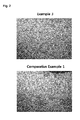
- the foamability of the prepared foam sheets was observed with naked eye, and the photos were taken by using an optical microscope.
- the maximum size and the minimum size of the cells were measured and the uniformity of cells was represented by the ratio of the maximum size/the minimum size.
- Example 1 Example 2 Comparative Example 1 Viscosity 10,000 cps 9,280 cps 6,240 cps Foam Surface Very Good Very Good Good Maximum Cell Size 0.41 mm 0.47 mm 0.82 mm Minimum Cell Size 0.37 mm 0.32 mm 0.30 mm Uniformity of Cells (Maximum Cell Size/ Minimum Cell Size) 1.11 1.47 2.73
- Examples 1 and 2 showed improved foamability such as good foam surface and uniform cell distribution in comparison to Comparative Example 1.
- Example 3 Each plastisol prepared in Example 3 and Comparative Example 1 was moisturized by storing the same in a constant temperature and humidity oven of the temperature of 40 °C and the humidity of 80 % for 4 hrs.
- the foam sheet was prepared by coating the plastisol on a paper to the thickness of 1.0 mm with an applicator, and foaming the same in an oven of 230 °C.
- the foamability of the prepared foam sheets was observed with naked eye, and the photos were taken by using an optical microscope.
- the maximum size and the minimum size of the cells were measured and the uniformity of cells was represented by the ratio of the maximum size/the minimum size.
- Example 3 Comparative Example 1 Viscosity 5,680 cps 7,360 cps Foam Surface Good Bad Maximum Cell Size 0.51 mm Bad cell occurred Minimum Cell Size 0.37 mm - Uniformity of Cells (Maximum Cell Size/ Minimum Cell Size) 1.38 Very bad
- Example 3 showed excellent foamability even after it was exposed to a high humidity circumstance and moisturized. Therefore, it is recognizable that the PVC paste resin of the present invention shows improved moisture resistance and can maintain excellent properties even in a high temperature high humidity circumstance.
Landscapes
- Chemical & Material Sciences (AREA)
- Health & Medical Sciences (AREA)
- Chemical Kinetics & Catalysis (AREA)
- Medicinal Chemistry (AREA)
- Polymers & Plastics (AREA)
- Organic Chemistry (AREA)
- Compositions Of Macromolecular Compounds (AREA)
- Manufacture Of Porous Articles, And Recovery And Treatment Of Waste Products (AREA)
- Processes Of Treating Macromolecular Substances (AREA)
- Addition Polymer Or Copolymer, Post-Treatments, Or Chemical Modifications (AREA)
Applications Claiming Priority (2)
| Application Number | Priority Date | Filing Date | Title |
|---|---|---|---|
| KR20120119763 | 2012-10-26 | ||
| PCT/KR2013/009434 WO2014065570A1 (ko) | 2012-10-26 | 2013-10-22 | 염화비닐계 페이스트 수지, 및 이의 제조방법 |
Publications (3)
| Publication Number | Publication Date |
|---|---|
| EP2913359A1 true EP2913359A1 (de) | 2015-09-02 |
| EP2913359A4 EP2913359A4 (de) | 2016-06-22 |
| EP2913359B1 EP2913359B1 (de) | 2018-10-03 |
Family
ID=50544893
Family Applications (1)
| Application Number | Title | Priority Date | Filing Date |
|---|---|---|---|
| EP13849463.8A Active EP2913359B1 (de) | 2012-10-26 | 2013-10-22 | Pastöses harz auf polyvinylchloridbasis und herstellungsverfahren dafür |
Country Status (5)
| Country | Link |
|---|---|
| EP (1) | EP2913359B1 (de) |
| JP (1) | JP6078654B2 (de) |
| KR (1) | KR101530335B1 (de) |
| CN (1) | CN104837918B (de) |
| WO (1) | WO2014065570A1 (de) |
Cited By (1)
| Publication number | Priority date | Publication date | Assignee | Title |
|---|---|---|---|---|
| EP3617267A4 (de) * | 2017-04-28 | 2020-11-04 | Hanwha Chemical Corporation | Vinylchloridharzlatexzusammensetzung und verfahren zu ihrer herstellung |
Families Citing this family (7)
| Publication number | Priority date | Publication date | Assignee | Title |
|---|---|---|---|---|
| CN108794923A (zh) * | 2018-06-01 | 2018-11-13 | 合肥奇呗数字科技有限公司 | 一种变压电表箱壳体材料的制备方法 |
| CN108948573A (zh) * | 2018-06-01 | 2018-12-07 | 合肥大麦灯箱器材有限公司 | 灯箱壳体材料 |
| KR102405700B1 (ko) * | 2020-05-08 | 2022-06-07 | 주식회사 케이씨씨글라스 | 다층 바닥장식재 |
| CN112048134A (zh) * | 2020-09-02 | 2020-12-08 | 南京鸿瑞塑料制品有限公司 | 一种增强pvc糊树脂的制备方法 |
| CN113698517A (zh) * | 2021-06-17 | 2021-11-26 | 济宁中银电化有限公司 | 一种聚氯乙烯糊树脂及其制备方法 |
| JP7770175B2 (ja) * | 2021-12-14 | 2025-11-14 | 東ソー・ファインケム株式会社 | 上限臨界溶液温度型の温度応答性を有するカルボン酸系ポリマー及びその用途 |
| JP7797606B1 (ja) * | 2024-12-06 | 2026-01-13 | 株式会社サンゲツ | 積層体及びその製造方法、並びに、壁紙及び化粧シート |
Family Cites Families (17)
| Publication number | Priority date | Publication date | Assignee | Title |
|---|---|---|---|---|
| US2988530A (en) * | 1954-09-10 | 1961-06-13 | Monsanto Chemicals | Compositions comprising blends of vinyl chloride polymers with alpha-methylstyrene/acrylonitrile/styrene interpolymers |
| JPS5156853A (ja) * | 1974-11-14 | 1976-05-18 | Sumitomo Chemical Co | Jushisoseibutsu |
| JPS5856536B2 (ja) * | 1978-11-06 | 1983-12-15 | 鐘淵化学工業株式会社 | 塩化ビニル系樹脂組成物 |
| KR830002456B1 (ko) * | 1980-05-17 | 1983-10-26 | 싱에쓰가가꾸고오교가부시끼가이샤 | 염화비닐 기재수지의 셀형 발포체 제조방법 |
| JPS60135440A (ja) * | 1983-12-23 | 1985-07-18 | Shin Etsu Chem Co Ltd | 塩化ビニル系樹脂発泡成形体およびその製造方法 |
| JPH044245A (ja) * | 1990-04-20 | 1992-01-08 | Kanegafuchi Chem Ind Co Ltd | 変性難燃性樹脂組成物 |
| JPH04366152A (ja) * | 1991-06-14 | 1992-12-18 | Toyo Ink Mfg Co Ltd | ポリ塩化ビニル系樹脂用着色剤組成物 |
| JPH06287386A (ja) * | 1993-03-31 | 1994-10-11 | Nippon Zeon Co Ltd | プラスチゾル組成物及び該組成物を用いる成形体 |
| US5391585A (en) * | 1993-11-03 | 1995-02-21 | General Electric Company | Foamable polyvinyl chloride compositions, foamed articles made therefrom, and a process for making vinyl chloride polymeric foamed articles |
| JP3453586B2 (ja) * | 1993-11-04 | 2003-10-06 | 一方社油脂工業株式会社 | 耐光性ラテックス組成物およびラテックスから製造される製品の耐光性改良方法 |
| JP3516226B2 (ja) * | 1997-02-13 | 2004-04-05 | 鐘淵化学工業株式会社 | ゴム高含有mabs樹脂組成物及びゴム変性熱可塑性樹脂組成物 |
| KR100301128B1 (ko) * | 1999-01-27 | 2001-09-13 | 이종학 | 발포성이 우수한 pvc 페이스트 수지의 제조 방법 |
| KR100548630B1 (ko) * | 2003-09-04 | 2006-01-31 | 주식회사 엘지화학 | 아크릴계 공중합체 조성물, 이를 제조하는 방법 및 이를포함하는 염화비닐계 수지 조성물 |
| CN101925653B (zh) * | 2008-01-28 | 2013-08-07 | 株式会社钟化 | 脂环族环氧树脂组合物、其固化物及其制造方法以及含有橡胶状聚合物的树脂组合物 |
| KR101293377B1 (ko) * | 2009-12-24 | 2013-08-05 | 주식회사 엘지화학 | 발포 물성이 우수한 염화비닐계 수지 페이스트 제조 방법 |
| JPWO2012036173A1 (ja) * | 2010-09-15 | 2014-02-03 | 日本エイアンドエル株式会社 | 熱可塑性樹脂用加工助剤及びそれを含む熱可塑性樹脂組成物 |
| CN102532394B (zh) * | 2010-12-22 | 2013-09-11 | 无锡市长盛塑化有限公司 | 聚氯乙烯用丙烯酸酯助剂、其制备方法和应用 |
-
2013
- 2013-10-22 JP JP2015539500A patent/JP6078654B2/ja active Active
- 2013-10-22 EP EP13849463.8A patent/EP2913359B1/de active Active
- 2013-10-22 WO PCT/KR2013/009434 patent/WO2014065570A1/ko not_active Ceased
- 2013-10-22 CN CN201380063279.1A patent/CN104837918B/zh active Active
- 2013-10-23 KR KR1020130126487A patent/KR101530335B1/ko active Active
Cited By (1)
| Publication number | Priority date | Publication date | Assignee | Title |
|---|---|---|---|---|
| EP3617267A4 (de) * | 2017-04-28 | 2020-11-04 | Hanwha Chemical Corporation | Vinylchloridharzlatexzusammensetzung und verfahren zu ihrer herstellung |
Also Published As
| Publication number | Publication date |
|---|---|
| KR20140057157A (ko) | 2014-05-12 |
| EP2913359B1 (de) | 2018-10-03 |
| WO2014065570A1 (ko) | 2014-05-01 |
| KR101530335B1 (ko) | 2015-06-22 |
| CN104837918B (zh) | 2017-09-26 |
| JP6078654B2 (ja) | 2017-02-08 |
| EP2913359A4 (de) | 2016-06-22 |
| JP2015532360A (ja) | 2015-11-09 |
| CN104837918A (zh) | 2015-08-12 |
Similar Documents
| Publication | Publication Date | Title |
|---|---|---|
| EP2913359B1 (de) | Pastöses harz auf polyvinylchloridbasis und herstellungsverfahren dafür | |
| CN104768982B (zh) | 聚氯乙烯树脂和制备该聚氯乙烯树脂的方法 | |
| KR101404828B1 (ko) | 경시 점도 변화가 적은 염화비닐계 페이스트 수지의 제조 방법 | |
| KR102345310B1 (ko) | 염화비닐계 중합체 및 이의 제조방법 | |
| KR101768284B1 (ko) | 페이스트 염화비닐계 수지 및 이의 제조방법 | |
| KR101293377B1 (ko) | 발포 물성이 우수한 염화비닐계 수지 페이스트 제조 방법 | |
| KR100868458B1 (ko) | 가소제 흡수율이 작은 플라스티졸 가공용 염화비닐 수지의제조방법 | |
| EP4029885B1 (de) | Verfahren zur herstellung von vinylchloridbasiertem polymer | |
| KR101944903B1 (ko) | 염화비닐계 페이스트 수지의 제조방법 | |
| KR101338652B1 (ko) | 플라스티졸의 제조방법 | |
| JP2001040012A (ja) | ペースト用塩化ビニル樹脂、その製造方法及びそれよりなるペースト用塩化ビニル樹脂組成物 | |
| KR101433998B1 (ko) | 비발포성 염화비닐계 페이스트 수지 및 그 제조방법 | |
| JP4014775B2 (ja) | アクリル樹脂プラスチゾル組成物 | |
| KR20080051279A (ko) | 페이스트 염화비닐계 수지의 제조방법 | |
| JPH0711036A (ja) | プラスチゾル組成物 | |
| KR102674955B1 (ko) | 염화비닐계 중합체 라텍스, 이의 제조방법 및 이를 포함하는 플라스티졸 | |
| JP2024140905A (ja) | ポリ塩化ビニル系ペースト樹脂の製造方法、プラスチゾル組成物、塩化ビニル系シート及び塩化ビニル系発泡体 | |
| JPS60255842A (ja) | ペ−スト用塩化ビニル系樹脂の製造方法 | |
| KR100301128B1 (ko) | 발포성이 우수한 pvc 페이스트 수지의 제조 방법 | |
| EP4036127A1 (de) | Zusammensetzung zur polymerisierung von vinylchloridbasiertem polymer und verfahren zur herstellung von vinylchloridbasiertem polymer unter verwendung davon | |
| JP2000110097A (ja) | 防カール性加工紙 | |
| JPH11199699A (ja) | 塩化ビニル系樹脂組成物および該組成物よりなる発泡体 | |
| KR20160052180A (ko) | 탄성이 우수한 염화비닐계 페이스트 수지의 제조 방법 |
Legal Events
| Date | Code | Title | Description |
|---|---|---|---|
| PUAI | Public reference made under article 153(3) epc to a published international application that has entered the european phase |
Free format text: ORIGINAL CODE: 0009012 |
|
| 17P | Request for examination filed |
Effective date: 20150521 |
|
| AK | Designated contracting states |
Kind code of ref document: A1 Designated state(s): AL AT BE BG CH CY CZ DE DK EE ES FI FR GB GR HR HU IE IS IT LI LT LU LV MC MK MT NL NO PL PT RO RS SE SI SK SM TR |
|
| AX | Request for extension of the european patent |
Extension state: BA ME |
|
| DAX | Request for extension of the european patent (deleted) | ||
| RA4 | Supplementary search report drawn up and despatched (corrected) |
Effective date: 20160523 |
|
| RIC1 | Information provided on ipc code assigned before grant |
Ipc: C08L 25/08 20060101ALI20160517BHEP Ipc: C08F 14/06 20060101ALI20160517BHEP Ipc: C08L 33/04 20060101ALI20160517BHEP Ipc: C08L 27/06 20060101AFI20160517BHEP |
|
| 17Q | First examination report despatched |
Effective date: 20170206 |
|
| GRAP | Despatch of communication of intention to grant a patent |
Free format text: ORIGINAL CODE: EPIDOSNIGR1 |
|
| RIC1 | Information provided on ipc code assigned before grant |
Ipc: C08F 212/08 20060101ALN20180410BHEP Ipc: C08F 220/06 20060101ALN20180410BHEP Ipc: C08L 25/14 20060101ALI20180410BHEP Ipc: C08L 27/06 20060101AFI20180410BHEP Ipc: C08F 14/06 20060101ALN20180410BHEP |
|
| INTG | Intention to grant announced |
Effective date: 20180503 |
|
| GRAS | Grant fee paid |
Free format text: ORIGINAL CODE: EPIDOSNIGR3 |
|
| GRAA | (expected) grant |
Free format text: ORIGINAL CODE: 0009210 |
|
| AK | Designated contracting states |
Kind code of ref document: B1 Designated state(s): AL AT BE BG CH CY CZ DE DK EE ES FI FR GB GR HR HU IE IS IT LI LT LU LV MC MK MT NL NO PL PT RO RS SE SI SK SM TR |
|
| REG | Reference to a national code |
Ref country code: GB Ref legal event code: FG4D |
|
| REG | Reference to a national code |
Ref country code: CH Ref legal event code: EP Ref country code: AT Ref legal event code: REF Ref document number: 1048539 Country of ref document: AT Kind code of ref document: T Effective date: 20181015 |
|
| REG | Reference to a national code |
Ref country code: DE Ref legal event code: R096 Ref document number: 602013044635 Country of ref document: DE Ref country code: IE Ref legal event code: FG4D |
|
| REG | Reference to a national code |
Ref country code: NL Ref legal event code: MP Effective date: 20181003 |
|
| REG | Reference to a national code |
Ref country code: LT Ref legal event code: MG4D |
|
| PGFP | Annual fee paid to national office [announced via postgrant information from national office to epo] |
Ref country code: ES Payment date: 20181102 Year of fee payment: 15 |
|
| REG | Reference to a national code |
Ref country code: AT Ref legal event code: MK05 Ref document number: 1048539 Country of ref document: AT Kind code of ref document: T Effective date: 20181003 |
|
| PG25 | Lapsed in a contracting state [announced via postgrant information from national office to epo] |
Ref country code: NL Free format text: LAPSE BECAUSE OF FAILURE TO SUBMIT A TRANSLATION OF THE DESCRIPTION OR TO PAY THE FEE WITHIN THE PRESCRIBED TIME-LIMIT Effective date: 20181003 |
|
| PG25 | Lapsed in a contracting state [announced via postgrant information from national office to epo] |
Ref country code: AT Free format text: LAPSE BECAUSE OF FAILURE TO SUBMIT A TRANSLATION OF THE DESCRIPTION OR TO PAY THE FEE WITHIN THE PRESCRIBED TIME-LIMIT Effective date: 20181003 Ref country code: LV Free format text: LAPSE BECAUSE OF FAILURE TO SUBMIT A TRANSLATION OF THE DESCRIPTION OR TO PAY THE FEE WITHIN THE PRESCRIBED TIME-LIMIT Effective date: 20181003 Ref country code: NO Free format text: LAPSE BECAUSE OF FAILURE TO SUBMIT A TRANSLATION OF THE DESCRIPTION OR TO PAY THE FEE WITHIN THE PRESCRIBED TIME-LIMIT Effective date: 20190103 Ref country code: ES Free format text: LAPSE BECAUSE OF FAILURE TO SUBMIT A TRANSLATION OF THE DESCRIPTION OR TO PAY THE FEE WITHIN THE PRESCRIBED TIME-LIMIT Effective date: 20181003 Ref country code: LT Free format text: LAPSE BECAUSE OF FAILURE TO SUBMIT A TRANSLATION OF THE DESCRIPTION OR TO PAY THE FEE WITHIN THE PRESCRIBED TIME-LIMIT Effective date: 20181003 Ref country code: PL Free format text: LAPSE BECAUSE OF FAILURE TO SUBMIT A TRANSLATION OF THE DESCRIPTION OR TO PAY THE FEE WITHIN THE PRESCRIBED TIME-LIMIT Effective date: 20181003 Ref country code: HR Free format text: LAPSE BECAUSE OF FAILURE TO SUBMIT A TRANSLATION OF THE DESCRIPTION OR TO PAY THE FEE WITHIN THE PRESCRIBED TIME-LIMIT Effective date: 20181003 Ref country code: BG Free format text: LAPSE BECAUSE OF FAILURE TO SUBMIT A TRANSLATION OF THE DESCRIPTION OR TO PAY THE FEE WITHIN THE PRESCRIBED TIME-LIMIT Effective date: 20190103 Ref country code: CZ Free format text: LAPSE BECAUSE OF FAILURE TO SUBMIT A TRANSLATION OF THE DESCRIPTION OR TO PAY THE FEE WITHIN THE PRESCRIBED TIME-LIMIT Effective date: 20181003 Ref country code: IS Free format text: LAPSE BECAUSE OF FAILURE TO SUBMIT A TRANSLATION OF THE DESCRIPTION OR TO PAY THE FEE WITHIN THE PRESCRIBED TIME-LIMIT Effective date: 20190203 Ref country code: FI Free format text: LAPSE BECAUSE OF FAILURE TO SUBMIT A TRANSLATION OF THE DESCRIPTION OR TO PAY THE FEE WITHIN THE PRESCRIBED TIME-LIMIT Effective date: 20181003 |
|
| PGFP | Annual fee paid to national office [announced via postgrant information from national office to epo] |
Ref country code: IT Payment date: 20190129 Year of fee payment: 6 |
|
| PG25 | Lapsed in a contracting state [announced via postgrant information from national office to epo] |
Ref country code: GR Free format text: LAPSE BECAUSE OF FAILURE TO SUBMIT A TRANSLATION OF THE DESCRIPTION OR TO PAY THE FEE WITHIN THE PRESCRIBED TIME-LIMIT Effective date: 20190104 Ref country code: RS Free format text: LAPSE BECAUSE OF FAILURE TO SUBMIT A TRANSLATION OF THE DESCRIPTION OR TO PAY THE FEE WITHIN THE PRESCRIBED TIME-LIMIT Effective date: 20181003 Ref country code: AL Free format text: LAPSE BECAUSE OF FAILURE TO SUBMIT A TRANSLATION OF THE DESCRIPTION OR TO PAY THE FEE WITHIN THE PRESCRIBED TIME-LIMIT Effective date: 20181003 Ref country code: PT Free format text: LAPSE BECAUSE OF FAILURE TO SUBMIT A TRANSLATION OF THE DESCRIPTION OR TO PAY THE FEE WITHIN THE PRESCRIBED TIME-LIMIT Effective date: 20190203 Ref country code: SE Free format text: LAPSE BECAUSE OF FAILURE TO SUBMIT A TRANSLATION OF THE DESCRIPTION OR TO PAY THE FEE WITHIN THE PRESCRIBED TIME-LIMIT Effective date: 20181003 |
|
| REG | Reference to a national code |
Ref country code: CH Ref legal event code: PL |
|
| PG25 | Lapsed in a contracting state [announced via postgrant information from national office to epo] |
Ref country code: LU Free format text: LAPSE BECAUSE OF NON-PAYMENT OF DUE FEES Effective date: 20181022 |
|
| REG | Reference to a national code |
Ref country code: DE Ref legal event code: R097 Ref document number: 602013044635 Country of ref document: DE |
|
| REG | Reference to a national code |
Ref country code: IE Ref legal event code: MM4A |
|
| PG25 | Lapsed in a contracting state [announced via postgrant information from national office to epo] |
Ref country code: DK Free format text: LAPSE BECAUSE OF FAILURE TO SUBMIT A TRANSLATION OF THE DESCRIPTION OR TO PAY THE FEE WITHIN THE PRESCRIBED TIME-LIMIT Effective date: 20181003 |
|
| PLBE | No opposition filed within time limit |
Free format text: ORIGINAL CODE: 0009261 |
|
| STAA | Information on the status of an ep patent application or granted ep patent |
Free format text: STATUS: NO OPPOSITION FILED WITHIN TIME LIMIT |
|
| PG25 | Lapsed in a contracting state [announced via postgrant information from national office to epo] |
Ref country code: RO Free format text: LAPSE BECAUSE OF FAILURE TO SUBMIT A TRANSLATION OF THE DESCRIPTION OR TO PAY THE FEE WITHIN THE PRESCRIBED TIME-LIMIT Effective date: 20181003 Ref country code: SK Free format text: LAPSE BECAUSE OF FAILURE TO SUBMIT A TRANSLATION OF THE DESCRIPTION OR TO PAY THE FEE WITHIN THE PRESCRIBED TIME-LIMIT Effective date: 20181003 Ref country code: MC Free format text: LAPSE BECAUSE OF FAILURE TO SUBMIT A TRANSLATION OF THE DESCRIPTION OR TO PAY THE FEE WITHIN THE PRESCRIBED TIME-LIMIT Effective date: 20181003 Ref country code: CH Free format text: LAPSE BECAUSE OF NON-PAYMENT OF DUE FEES Effective date: 20181031 Ref country code: LI Free format text: LAPSE BECAUSE OF NON-PAYMENT OF DUE FEES Effective date: 20181031 Ref country code: EE Free format text: LAPSE BECAUSE OF FAILURE TO SUBMIT A TRANSLATION OF THE DESCRIPTION OR TO PAY THE FEE WITHIN THE PRESCRIBED TIME-LIMIT Effective date: 20181003 Ref country code: SM Free format text: LAPSE BECAUSE OF FAILURE TO SUBMIT A TRANSLATION OF THE DESCRIPTION OR TO PAY THE FEE WITHIN THE PRESCRIBED TIME-LIMIT Effective date: 20181003 |
|
| 26N | No opposition filed |
Effective date: 20190704 |
|
| PG25 | Lapsed in a contracting state [announced via postgrant information from national office to epo] |
Ref country code: SI Free format text: LAPSE BECAUSE OF FAILURE TO SUBMIT A TRANSLATION OF THE DESCRIPTION OR TO PAY THE FEE WITHIN THE PRESCRIBED TIME-LIMIT Effective date: 20181003 Ref country code: IE Free format text: LAPSE BECAUSE OF NON-PAYMENT OF DUE FEES Effective date: 20181022 |
|
| PG25 | Lapsed in a contracting state [announced via postgrant information from national office to epo] |
Ref country code: MT Free format text: LAPSE BECAUSE OF NON-PAYMENT OF DUE FEES Effective date: 20181022 |
|
| PG25 | Lapsed in a contracting state [announced via postgrant information from national office to epo] |
Ref country code: TR Free format text: LAPSE BECAUSE OF FAILURE TO SUBMIT A TRANSLATION OF THE DESCRIPTION OR TO PAY THE FEE WITHIN THE PRESCRIBED TIME-LIMIT Effective date: 20181003 |
|
| PG25 | Lapsed in a contracting state [announced via postgrant information from national office to epo] |
Ref country code: MK Free format text: LAPSE BECAUSE OF NON-PAYMENT OF DUE FEES Effective date: 20181003 Ref country code: HU Free format text: LAPSE BECAUSE OF FAILURE TO SUBMIT A TRANSLATION OF THE DESCRIPTION OR TO PAY THE FEE WITHIN THE PRESCRIBED TIME-LIMIT; INVALID AB INITIO Effective date: 20131022 Ref country code: CY Free format text: LAPSE BECAUSE OF FAILURE TO SUBMIT A TRANSLATION OF THE DESCRIPTION OR TO PAY THE FEE WITHIN THE PRESCRIBED TIME-LIMIT Effective date: 20181003 |
|
| REG | Reference to a national code |
Ref country code: BE Ref legal event code: MM Effective date: 20191031 |
|
| PG25 | Lapsed in a contracting state [announced via postgrant information from national office to epo] |
Ref country code: BE Free format text: LAPSE BECAUSE OF NON-PAYMENT OF DUE FEES Effective date: 20191031 |
|
| PG25 | Lapsed in a contracting state [announced via postgrant information from national office to epo] |
Ref country code: IT Free format text: LAPSE BECAUSE OF NON-PAYMENT OF DUE FEES Effective date: 20191022 |
|
| P01 | Opt-out of the competence of the unified patent court (upc) registered |
Effective date: 20230608 |
|
| PGFP | Annual fee paid to national office [announced via postgrant information from national office to epo] |
Ref country code: GB Payment date: 20250911 Year of fee payment: 13 |
|
| PGFP | Annual fee paid to national office [announced via postgrant information from national office to epo] |
Ref country code: FR Payment date: 20250922 Year of fee payment: 13 |
|
| PGFP | Annual fee paid to national office [announced via postgrant information from national office to epo] |
Ref country code: DE Payment date: 20250916 Year of fee payment: 13 |