EP2807529B1 - Ineinandergreifende flexible segmente aus einem steifen material - Google Patents
Ineinandergreifende flexible segmente aus einem steifen material Download PDFInfo
- Publication number
- EP2807529B1 EP2807529B1 EP13708282.2A EP13708282A EP2807529B1 EP 2807529 B1 EP2807529 B1 EP 2807529B1 EP 13708282 A EP13708282 A EP 13708282A EP 2807529 B1 EP2807529 B1 EP 2807529B1
- Authority
- EP
- European Patent Office
- Prior art keywords
- rigid material
- interlocking features
- geometric pattern
- apertures
- flex
- Prior art date
- Legal status (The legal status is an assumption and is not a legal conclusion. Google has not performed a legal analysis and makes no representation as to the accuracy of the status listed.)
- Active
Links
Images








Classifications
-
- B—PERFORMING OPERATIONS; TRANSPORTING
- B23—MACHINE TOOLS; METAL-WORKING NOT OTHERWISE PROVIDED FOR
- B23K—SOLDERING OR UNSOLDERING; WELDING; CLADDING OR PLATING BY SOLDERING OR WELDING; CUTTING BY APPLYING HEAT LOCALLY, e.g. FLAME CUTTING; WORKING BY LASER BEAM
- B23K26/00—Working by laser beam, e.g. welding, cutting or boring
- B23K26/36—Removing material
- B23K26/38—Removing material by boring or cutting
-
- G—PHYSICS
- G06—COMPUTING OR CALCULATING; COUNTING
- G06F—ELECTRIC DIGITAL DATA PROCESSING
- G06F1/00—Details not covered by groups G06F3/00 - G06F13/00 and G06F21/00
- G06F1/16—Constructional details or arrangements
- G06F1/1613—Constructional details or arrangements for portable computers
-
- B—PERFORMING OPERATIONS; TRANSPORTING
- B21—MECHANICAL METAL-WORKING WITHOUT ESSENTIALLY REMOVING MATERIAL; PUNCHING METAL
- B21D—WORKING OR PROCESSING OF SHEET METAL OR METAL TUBES, RODS OR PROFILES WITHOUT ESSENTIALLY REMOVING MATERIAL; PUNCHING METAL
- B21D31/00—Other methods for working sheet metal, metal tubes, metal profiles
- B21D31/04—Expanding other than provided for in groups B21D1/00 - B21D28/00, e.g. for making expanded metal
-
- B—PERFORMING OPERATIONS; TRANSPORTING
- B29—WORKING OF PLASTICS; WORKING OF SUBSTANCES IN A PLASTIC STATE IN GENERAL
- B29C—SHAPING OR JOINING OF PLASTICS; SHAPING OF MATERIAL IN A PLASTIC STATE, NOT OTHERWISE PROVIDED FOR; AFTER-TREATMENT OF THE SHAPED PRODUCTS, e.g. REPAIRING
- B29C53/00—Shaping by bending, folding, twisting, straightening or flattening; Apparatus therefor
-
- B—PERFORMING OPERATIONS; TRANSPORTING
- B29—WORKING OF PLASTICS; WORKING OF SUBSTANCES IN A PLASTIC STATE IN GENERAL
- B29C—SHAPING OR JOINING OF PLASTICS; SHAPING OF MATERIAL IN A PLASTIC STATE, NOT OTHERWISE PROVIDED FOR; AFTER-TREATMENT OF THE SHAPED PRODUCTS, e.g. REPAIRING
- B29C53/00—Shaping by bending, folding, twisting, straightening or flattening; Apparatus therefor
- B29C53/02—Bending or folding
- B29C53/04—Bending or folding of plates or sheets
- B29C53/06—Forming folding lines by pressing or scoring
- B29C53/063—Forming folding lines by pressing or scoring combined with folding
-
- B—PERFORMING OPERATIONS; TRANSPORTING
- B65—CONVEYING; PACKING; STORING; HANDLING THIN OR FILAMENTARY MATERIAL
- B65D—CONTAINERS FOR STORAGE OR TRANSPORT OF ARTICLES OR MATERIALS, e.g. BAGS, BARRELS, BOTTLES, BOXES, CANS, CARTONS, CRATES, DRUMS, JARS, TANKS, HOPPERS, FORWARDING CONTAINERS; ACCESSORIES, CLOSURES, OR FITTINGS THEREFOR; PACKAGING ELEMENTS; PACKAGES
- B65D85/00—Containers, packaging elements or packages, specially adapted for particular articles or materials
-
- E—FIXED CONSTRUCTIONS
- E05—LOCKS; KEYS; WINDOW OR DOOR FITTINGS; SAFES
- E05D—HINGES OR SUSPENSION DEVICES FOR DOORS, WINDOWS OR WINGS
- E05D1/00—Pinless hinges; Substitutes for hinges
- E05D1/02—Pinless hinges; Substitutes for hinges made of one piece
-
- G—PHYSICS
- G06—COMPUTING OR CALCULATING; COUNTING
- G06F—ELECTRIC DIGITAL DATA PROCESSING
- G06F1/00—Details not covered by groups G06F3/00 - G06F13/00 and G06F21/00
- G06F1/16—Constructional details or arrangements
- G06F1/1613—Constructional details or arrangements for portable computers
- G06F1/1615—Constructional details or arrangements for portable computers with several enclosures having relative motions, each enclosure supporting at least one I/O or computing function
- G06F1/1616—Constructional details or arrangements for portable computers with several enclosures having relative motions, each enclosure supporting at least one I/O or computing function with folding flat displays, e.g. laptop computers or notebooks having a clamshell configuration, with body parts pivoting to an open position around an axis parallel to the plane they define in closed position
-
- G—PHYSICS
- G06—COMPUTING OR CALCULATING; COUNTING
- G06F—ELECTRIC DIGITAL DATA PROCESSING
- G06F1/00—Details not covered by groups G06F3/00 - G06F13/00 and G06F21/00
- G06F1/16—Constructional details or arrangements
- G06F1/1613—Constructional details or arrangements for portable computers
- G06F1/1633—Constructional details or arrangements of portable computers not specific to the type of enclosures covered by groups G06F1/1615 - G06F1/1626
- G06F1/1675—Miscellaneous details related to the relative movement between the different enclosures or enclosure parts
- G06F1/1681—Details related solely to hinges
-
- Y—GENERAL TAGGING OF NEW TECHNOLOGICAL DEVELOPMENTS; GENERAL TAGGING OF CROSS-SECTIONAL TECHNOLOGIES SPANNING OVER SEVERAL SECTIONS OF THE IPC; TECHNICAL SUBJECTS COVERED BY FORMER USPC CROSS-REFERENCE ART COLLECTIONS [XRACs] AND DIGESTS
- Y10—TECHNICAL SUBJECTS COVERED BY FORMER USPC
- Y10T—TECHNICAL SUBJECTS COVERED BY FORMER US CLASSIFICATION
- Y10T428/00—Stock material or miscellaneous articles
- Y10T428/13—Hollow or container type article [e.g., tube, vase, etc.]
Definitions
- the present invention relates generally to creating flexible portions within a rigid material and more specifically, to creating flexible segments for components of electronic devices.
- Many electronic devices, peripheral components or devices may include housings or enclosures made of a relatively rigid material, such as plastic or metal. These types of enclosures are typically at least somewhat rigid in order to provide protection for internal components housed within the enclosures. However, due to the rigidity of the material, in order for these type of enclosures or housings to bend or flex, a separate element, such as a hinge, may need to be connected to the rigid material.
- laptop enclosures may include two separate rigid components interconnected together by one or more hinges that allow the two components to move relative to each other. These additional components, such as hinges, may increase the size of the enclosures and thus the size of the electronic devices or peripheral devices, as well as increase manufacturing costs as additional components may need to be assembled together.
- US 2007/0199176 A1 discloses a living hinge and the appended claims are characterised over this document.
- US 5,028,075 discloses a field blueprint carrier.
- the present invention provides a housing and a method of manufacturing a flexible component as defined in the appended claims.
- Examples of embodiments described herein may take the form of a method for creating an enclosure for an electronic device.
- the method includes providing a rigid material and removing sections of the rigid material to create a geometric pattern of interlocking features.
- the geometric pattern may define the flex of the rigid material.
- inventions may take the form of an enclosure formed of a substantially rigid material.
- the enclosure may include a first plurality of flex apertures defined within the rigid material along a first row and a second plurality of flex apertures defined within the rigid material along a second row.
- the second row is positioned below the first row and the first plurality of flex apertures are misaligned with the second plurality of flex apertures such that a first end of each of the first plurality of flex apertures is in a different vertical plane from a first end of each of the second plurality of flex apertures.
- inventions of the disclosure may take the form of a housing formed of a substantially rigid material.
- the housing may include a first plurality of interlocking features defined within the rigid material, a second plurality of interlocking features defined within the rigid material, and a plurality of flex apertures defined between the first plurality of interlocking features and the second plurality of interlocking features to separate the first plurality of interlocking features from the second plurality of interlocking features.
- the first plurality of interlocking features is movable relative to the second plurality of interlocking features.
- inventions of the disclosure may take the form of a method of manufacturing a flexible component.
- the method includes providing a substantially rigid material and removing portions of the rigid material to create a plurality of flex apertures.
- the flex apertures are defined by interlocking features of the rigid material, the interlocking features are adjacent to each other and spaced apart from one another by the flex apertures.
- Each one of the interlocking features has at least one sidewall and an angle of the sidewall determines a radial bend the rigid material.
- the rigid material formed using the disclosed method may be non-cylindrical, e.g., planar or a three-dimensional object that includes curves but is not substantially cylindrical.
- Some embodiments described herein may take the form of a method for creating a flexible portion or element within a rigid or substantially rigid material.
- rigid material as used herein is meant to encompass rigid materials, semi-rigid (partially flexible materials), and substantially any materials where an increased flexibility may be desired.
- the rigid material may be metal, carbon fiber, composites, ceramics, glass, sapphire, plastic, or the like.
- the flexible portion or portions defined in the rigid material may function as a living hinge or mechanical hinge and allow the rigid material to bend to a predetermined angle in a predetermined direction.
- the flexible portion may be positioned at substantially any location of the rigid material and may span across one or more dimensions of the rigid material (e.g., across a width, length, or height of the rigid material).
- the rigid material may be substantially flat or planar, may represent a three-dimensional object (e.g., a molded or machined component), or the like.
- the flexible portion may be defined by a geometric pattern that may be recessed and/or cut into the rigid material.
- the geometric pattern may define one more movable elements that are interlocked together.
- the movable elements or interlocking features may move relative to adjacent elements, but may be prevented from disconnecting from those adjacent elements.
- the flexible portion may include a plurality of movable interlocked elements, each of which may move a predetermined amount, so that the combination of the plurality of movable elements creates a bend point or area for the rigid material or device or enclosure made from the material.
- the amount of bending may be varied by changing either the degree of movement between individual interlocked movable elements or the shape of one or more elements.
- the bend angle, direction, pitch, and bend or flexing axis may vary with the geometric pattern of the cuts. For example, a first geometric pattern may allow the rigid material to only bend along a single axis where as a second geometric pattern may allow the rigid material to bend along multiple axes.
- the flexing radius may be modified.
- the rigid material may include one or more different patterns, angles, or the like.
- the rigid material may have some sections that are more flexible than others, which may be done by modifying the geometric pattern, the angulation of the pattern, or the like.
- the method for creating the flexible portion may be used to create enclosures for electronic devices, including portable and/or peripheral devices.
- an enclosure for a laptop may be created from a rigid material having a flexible portion defined around approximately a midpoint of the material.
- the flexible portion may allow the rigid material to be folded in half and thus acts as a laptop clamshell.
- a top portion may support a display screen and a bottom portion may support a keyboard, track pad, and the like, while an interior defined by sidewalls of the rigid material may house a variety of electronic components in accordance with conventional laptop computing devices.
- the enclosure (or a portion thereof) may be created from a single rigid material, while still providing flexibility and bending for the enclosure.
- the method may be used to create a flexible cover for an electronic device, such as a cover for a tablet computer or smart phone.
- the method may be used to create a housing or a portion of a housing for headphones.
- the flexible segments may cooperate to form an enclosure encompassing, and protecting, a wire where it enters the enclosure of the headphone.
- the enclosure at the connection location to the wire or cable may flex around one or more axes to provide bending in multiple directions. This flexibility may substantially prevent the enclosure from cracking as the wire moves relative to the earpieces because the connection portion of the earpiece may move, at least in part, with the movement of the communication wire. Additionally, the flexibility may also help to prevent internal wires of the cable from breaking as the flexibility of the housing may increase the radius that the cable or wire may bend, thus providing strain relief to the internal wires as it is bent.
- the method may be used to create a band that may support an electronic device, such as an arm band for holding a portable electronic device on a user's bicep.
- the method may also be used to create strain relief sections for cables, straps, or the like.
- the method may further be used to create handles, cases, bags, purses, or the like.
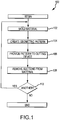
- Fig. 1 is a flow chart for a method 100 for creating a flexible portion within a rigid material.
- the method 100 may begin with operation 102 and the rigid material may be formed or otherwise provided.
- the rigid material may be metal injection molded into a desired shape, the shape of the rigid material may be milled or otherwise cut from a block or sheet of material, or other manufacturing techniques may be used.
- the rigid material may be substantially any material where an increased flexibility is desired.
- the material may include metals, metal alloys, plastics, composite materials (e.g., carbon fiber reinforced plastic, magnetic or conductive materials, glass fiber reinforced materials, or the like), ceramics, sapphire, glasses, printed circuit boards, and the like.
- the rigid material may include a combination of two or more materials connected together (e.g., through adhesive, welding, or the like).
- a first material may be brittle (e.g., glass)
- the material may be laminated or otherwise connected to another less brittle material and then the combined material may be modified using the method 100.
- the formation process used in operation 102 to create the rigid material may be varied depending on the type of material used and/or the size/dimensions of the desired shape. For example, in instances where the material is a hard plastic, injection molding may be used to create the material. However, injection molding may not be desired for other types of materials. Additionally, operation 102 may be optional. For example, in some instances, the rigid material may be provided from another source(e.g., manufacturer) and then may be manipulated, as discussed in more detail below, to provide the flexible portion. Accordingly, in some instances, the rigid material may be in the form of a three-dimensional shape, such as the formed shape of a molded or milled component. Also, it should be noted that the thickness of the rigid material may vary as desired based on the use of the material or shape of the component.
- the shape of the rigid material after operation 102 may not be the final shape of the component as some features such as a small or complex apertures, or finishes such as rounded edges, coatings, painting, and the like may be completed after the method 100 has completed. In other embodiments, such as those where the rigid material may be injection molded, the shape of the rigid material after operation 102 may be substantially the same as the final shape of the rigid material (excluding the changes in shape due to operation 108 discussed in more detail below).
- FIG. 3A illustrates a top plan view of the rigid material after operation 102, and is discussed in more detail below.
- the rigid material may include one or finishes, coatings, decorations, or the like, prior to being manipulated during the method 100. For example, the rigid material may be painted, anodized, layered with one or more coatings, films, or the like, may be applied to the material prior to operations 104 and 106 (discussed below).
- the method 100 may proceed to operation 104 and a geometric pattern may be determined.
- a geometric pattern may be determined.
- the desired bending direction or axis, bending angle or degree, size of apertures within the material, and/or spring rate for the flexible portion may be analyzed to determine the desired geometric pattern.
- the geometric pattern may be created by a processor executing one more algorithms or may be determined by a user.
- the pattern may take into account a number of desired characteristics for the flexibility of the rigid material. For example, increasing the angle of the cuts in the geometric pattern may increase the bending radius of the material. As another example, decreasing the width of the cuts or the removed material may reduce the bending radius.
- geometric pattern In addition to the bending characteristics listed above, there may be additional characteristics of the geometric pattern, such as an aesthetic appearance of the pattern, type of material to be used, and so on that may also be taken into account. Different examples of geometric patterns having one or more of the above-listed characteristics are discussed in more detail below with respect to FIGS. 4A , 5A , 6A , and 7A .
- the geometric pattern chosen may include one or more patterns.
- a first section of the material may be selected to have a first geometric pattern with a first bend radius whereas a second section of the material may be selected to have a second geometric pattern with a second bend radius.
- the two sections of the material may have different bend flexibilities.
- a first side of the material may include a first geometric pattern and a second side of the material may include a second geometric pattern.
- the front side pattern may not match the backside pattern.
- the material may have a first bend radius when bent in a first direction (e.g., the front rolled upon itself) and a second bend radius when bent in a second direction (e.g., the back side rolled upon itself).
- the method 100 may proceed to operation 106 and the pattern may be provided to a cutting mechanism or device.
- the geometric pattern may include sharp corners and/or small apertures.
- the cutting device may be a laser cutting machine, which may use a laser to cut or engrave the geometric pattern into the rigid material.
- the cutting device may be an electrical discharge machine, which may use a wire or probe to remove material in the shape of the geometric pattern.
- the geometric pattern may be provided to the cutting device in the form of data.
- the geometric pattern may be provided to the cutting device by communicating data, such as in the form engineering drawings, computer-aided-design (CAD) files, computer aided manufacturing (CAM) files, or computer numerical control (CNC) files, to a processor or other component within the cutting device.
- data such as in the form engineering drawings, computer-aided-design (CAD) files, computer aided manufacturing (CAM) files, or computer numerical control (CNC) files, to a processor or other component within the cutting device.
- CAD computer-aided-design
- CAM computer aided manufacturing
- CNC computer numerical control
- the method 100 may proceed to operation 108 and the geometric pattern may be incorporated into the rigid material.
- the cutting device may remove sections or portions of the rigid material to form the geometric pattern.
- a laser beam may cut apertures into the rigid material or remove one or more layers of the rigid material to create a recess within the rigid material.
- the laser beam may melt, cut, burn, and/or vaporize the material to create the apertures and/or recesses (engraved portions) within the rigid material.
- the laser may include a multi-axis head that can shift as appropriate to create the angulation and other requirements of the geometric pattern or patterns. For example, the position of the head of the laser may be modified based on the shape of the cuts, while maintaining a single cut through a portion of the material.
- the material may be removed by a pressurized stream water which may optionally include one or more abrasive materials to assist in removing the rigid material.
- a pressurized stream water which may optionally include one or more abrasive materials to assist in removing the rigid material.
- Other cutting devices are also envisioned, but may depend on the complexity of the geometric pattern and/or the type of material for the rigid material. For example, electrical discharge machining (EDM) may be used and a wire or probe may be used to remove material in the shape of the geometric pattern.
- EDM electrical discharge machining
- portions of the geometric pattern may have apertures defined through the rigid material, whereas other portions of the geometric pattern may include recesses defined only through one or two layers of the rigid material (that is, they do not pierce through the rigid material).
- the method 100 may proceed to operation 110.
- operation 110 a computer and/or a user may determine whether another component should be manufactured. If another component is to be manufactured, the method 100 may return to operation 102. However, if another component is not going to be manufactured, the method 100 may terminate at an end state.
- the method may include an additional operation of finalizing or finishing the material.
- one or more coatings, paints, decorations, or finishes may be applied to the material after it has been cut.
- the coatings may be applied to extend around the sidewalls of the material formed by the cuts.
- the material or component may be substantially finalized or otherwise may include the desired finishes prior to being cut. In these instances, the material may not need to be further processed.
- the flexible sections may be created in a rigid material that is mounted within another component or fixture.
- the method 100 may also be used to create components having one or more flexible portions or components that are entirely flexible.
- sheets or large portions of a rigid material may be cut using the method 100, and once cut with a geometric pattern, one or more shapes or smaller components may be cut therefrom.
- a large sheet of a rigid material may be cut with a geometric pattern along its entire length and then a plurality of smaller pieces of the material may be cut or stamped from the large sheet.
- the smaller pieces may be entirely flexible along their entire length, width, or other dimension.
- the rigid material that is cut using the method 100 may include one or more extrusions, apertures, or the like.
- a hole or aperture may be cut into a center of the rigid material (before or after the rigid material is processed using the method 100) and the geometric pattern may extend around the aperture.
- the edges of the aperture may flex due to the geometric pattern, allowing the material surrounding the aperture to remain flexible.
- the method 100 and the geometric patterns discussed in more detail below may be used to create interlocking segments for a material, where the material shape may not be cylindrical.
- the geometric patterns such as those patterns utilizing angled sidewalls or angulation, may allow sheets and other non-cylindrical items to be cut and remain connected together.
- the geometric pattern rather than relying solely on the shape of the object itself to maintain the connection of the components of the geometric pattern, the geometric pattern, rather than the shape of the object, may be used to allow the object to remain interconnected, despite the apertures defined through the object.
- the method 100 may be used to create components and materials for number of different apparatuses and items.
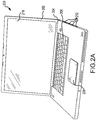
- FIG. 2A is a perspective view of an electronic device 200 including an enclosure 202 formed of a substantially rigid material 230 including a strain relief or flexible portion 204.
- the enclosure 202 may at least partially surround one or more components of the electronic device 200, such as a keyboard 206, track pad 208, and/or a display 210. Further, although not shown, the enclosure 202 may house one or more internal components (also not shown) of the electronic device 200, such as a processor, storage medium, and so on.
- the electronic device 200 in FIG. 2A is illustrated as a computer, other electronic devices are envisioned.
- the enclosure 202 may be used for smart phones, digital music players, display screens or televisions, video game consoles, set top boxes, telephones, and so on.
- the method 100 may also be used to create enclosures (or portions thereof) for one more peripheral devices such as keyboards, mice, connection cables or cords, earphones, and so on.
- the method 100 may be used to create bands (such as an arm band to support an electronic device), garage doors, straps, handles, cases, bags, covers for electronic devices such as tablet computers or electronic reading devices, shades or blinds, and substantially any other components which may require flexibility.
- the enclosure 202 may also include one or more connection apertures 212 defined therein.
- the connection apertures 212 may be defined during the method 100, or in another manner (e.g., while the rigid material is being formed).
- the connection apertures 212 may receive one or more cables, such as communication, data, and/or power cables, to provide a connection port for the cables to the electronic device 200.
- the connection apertures 212 may define an input/output port for universal serial bus (USB) cable, a power cable, or a tip ring sleeve connector.
- USB universal serial bus
- the position, size, number, and/or shape of the connection apertures may be varied depending on the desired connectivity for the electronic device 200.
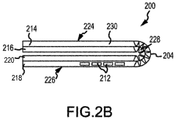
- FIG. 2B is a side elevation view of the electronic device 200 in a closed position, with the enclosure 202 folded at the flexible portion 204.
- the enclosure 202 may bend so that a top 224 of the enclosure 202 may be folded onto or positioned adjacent to a bottom 226 of the enclosure 202.
- the top 224 may be rotated from a perpendicular, obtuse, or other angular orientation with respect to the bottom 226 (see Fig. 2A ) to a substantially parallel orientation with the respect to the bottom 226.
- the display 210 may be operably connected to the top 224 and may be rotated downwards towards the bottom 226, closing the electronic device 200.
- the enclosure 202 may function as a clamshell in that it may selectively rotate around an axis to position the top 224 relative to the bottom 226.
- both the top and bottom 224, 226 may rotate relative to each other or only one of the top or bottom 224, 226 may rotate.
- the flexible portion 204 and the rotation of the top 224 and bottom 226 will be discussed in more detail below.
- the top 224 and bottom 226 may include one more portions operably connected together.
- the top 224 may include a first or outer portion 214 and a second or inner portion 216 operably connected to define a cavity within the top 224.
- the bottom 226 may include a first or outer portion 218 and a second or inner portion 220 that may be operably connected together to define a cavity within the bottom 226.
- the cavities may receive the one or more internal components of the electronic device 200, as well as may at least partially receive the display 210, the keyboard 206, and/or the track pad 208.
- the outer portion 214, 218 may have substantially the same depth as the respective inner portion 216, 220.
- the outer portion 214 may have a depth that may be approximately half the depth of the cavity and the second portion 216 may have a depth that may have approximately half of the depth of the cavity.
- the outer portions 214, 218 may be formed of a single rigid material 230 and the inner portions 216, 220 may be formed of a separate rigid material that may be operably connected to the outer portions 214, 218.
- the outer portions 214, 218 may include the flexible portion 204 and the inner portions 216, 220 may include an inner or second flexible portion 228.
- the inner flexible portion 228 may be substantially the same as the outer flexible portion 204, so that the inner portions 216, 220 may have approximately the same bend angle and movement range as the outer portions 214, 218.
- the second inner flexible portion 228 defined on the inner portions 216, 220 may be substantially similar to the flexible portion 204.
- the inner portions 216, 220 may be panels or plates, or may have otherwise have a reduced depth compared to the depth of the outer portions 214, 218.
- the top 224 and bottom 226 may include a single portion, and the cavity may be created by removing material through one or more apertures within the top 224 and/or bottom 226.
- FIG. 2C is a side elevation view of the top 224 and bottom 226 formed of a single rigid material 230.
- the top 224 may be at least partially hollowed out to define a surface and four sidewalls extending therefrom, and the display 210 may be operably connected to the surface and sidewalls to enclose the surface.
- the bottom 226 may be formed to receive the keyboard 206, which may form the cover portion for the bottom 226 cavity to cover the internal components.
- the construction of the enclosure 202 may be varied depending on the desired size, dimensions, and/or electronic device 200 be housed by the enclosure 202.
- the respective portions may terminate prior to the flexible portion 204 and thus the flexible portion 204 may form the entire hinge for the top 224 and bottom 226.
- the flexible portion 204 may form the only hinge for the enclosure 202.
- a single material portion may form the entire enclosure 202. That is, the enclosure 202 may be substantially unibody in that it may be formed form a single piece of material.
- the enclosure 202 may bend in order to fold the top 224 towards the bottom 226 or vice versa.
- the flexible portion 204 includes a geometric pattern including interconnected elements that may move or change shape relative to each other in order to provide a flexibility to the rigid material 230 forming the enclosure 202.
- FIG. 3A is a top perspective view of an at least partially rigid material 230 prior to being formed with the flexible portion 204.
- the rigid material 230 may form one of the outer portions 214, 218 and/or one of the inner portions 216, 220 (see FIG. 2B ). In other embodiments, the rigid material 230 may form both the top 224 and bottom 226 when formed of a single portion (see FIG. 2C ).
- the method 100 may be used to create the flexible portion 204 within the rigid material 230 by defining a geometric pattern into the rigid material 230.
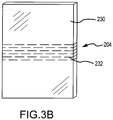
- FIG. 3B is a top plan view of the rigid material 230 including a geometric pattern 232.
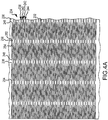
- FIG. 4A is an enlarged top plan view of the rigid material 230 with a geometric pattern 232 formed therein to define the flexible portion 204.
- the geometric pattern 232 may be varied depending on the desired bend angle, position, spring rate, and the like.
- the geometric pattern 232 may be a series of interconnected flex apertures 234 positioned apart from one another to define spacing sections or interlocking features 236.
- a first row 238 may include flex apertures 234 offset from flex apertures 234 within a second row 240 positioned directly below the first row 238. In this manner, the flex apertures 234 of adjacent rows 238, 240 may begin and terminate at varying locations from one another.
- the flex apertures 234, as discussed in more detail below, may be generally linearly shaped apertures formed within the rigid material 230.
- the flex apertures 234 may have a diameter or width that may be selected so that before the rigid material 230 is flexed or bent, the flex apertures 234 may not be substantially visible, improving the aesthetic appearance of the rigid material 230. In other words, prior to bending, the flexible portion 204 may not substantially stand out in appearance from the other surfaces of the rigid material 230.
- the flex apertures 234 may be formed so that the sidewalls surrounding each aperture 234 may have different angular orientations throughout the thickness of the material 230. That is, the flex apertures 234 may have different dimensions through the thickness of the material 230, as the sidewalls 254 may vary in angular orientation (width). The varying dimensions of the flex apertures 234 may allow the rigid material 230 forming the sidewalls 254 to be able to bend or fold, while still maintaining structural strength.
- a third row 242 may include flex apertures 234 that may be substantially aligned with the flex apertures 234 of the first row 238.
- a fourth row 244 may include flex apertures 232 that may be substantially aligned with the flex apertures 234 of the second row 240.
- the flex apertures 234 may be considered to be aligned if a first end 246 of the flex aperture 234 is positioned in a same vertical plane as the first end 246 of another flex aperture 234 and a second end 248 may be positioned in a same vertical plane as the second end 248 of another flex aperture 234 in another row.
- the shape and/or dimensions of the flex apertures 234 may be varied depending on the desired flexibility of the rigid material 230.
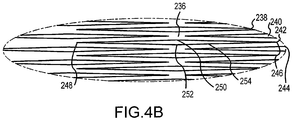
- FIG. 4B is an enlarged view of a portion of the geometric pattern 232 during bending.
- the flex apertures 234 may deform or stretch to be generally diamond shaped as rigid material 230 is stretched.
- the flex apertures 234 may be generally linearly shaped when formed and during bending may stretch for form a diamond shape in order to accommodate the bending force without breaking the material 230.
- the aperture may expand in a triangularly shaped manner, to form two apexes 250, 252, a top apex 250 and a bottom apex 250, 252.
- the two apexes 250, 252 may be aligned with one another, such that the top apex 250 may be positioned over the bottom apex 252. From the two apexes 250, 252 the aperture 234 may descend downwards towards the second end 248. The second end 248 may be substantially laterally aligned with the first end 246. As the bending force is applied to the rigid material 230, the top surface of the flex aperture 234 and the bottom surface may expand away from each other to define the apexes 250, 252. As the bending force increases, the apexes 250, 252 may expand farther away from one another.
- the flex apertures 234 may be diamond shaped when formed, and thus the diamond may be expanded rather than the portions of a linear line expanding into a diamond shape due to the bending force.
- the rigid material 230 may experience some plastic deformation in that the shape of the flex apertures 234 may be somewhat deformed and remain in the diamond shape, rather than the linear shape as originally formed.
- the sidewalls 254 may resiliently return to their original shape, so that after the bending force is removed the shape of the flex apertures 234 when the bending ends, may return to the original linear shape.
- the flex apertures 234 may be defined by sidewalls 254 within the rigid material 230. That is, the flex apertures 234 may be defined by the material surrounding the portions of material removed by the cutting machine during operation 108 of the method 100 in FIG. 1 .
- the sidewalls 254 may allow the size of the flex aperture 234 to vary in dimension as the flexible portion 204 bends. For example, the two apexes 250, 252 may extend away from each other to increase the size of the flex aperture 234 or may extend towards each other to decrease the size of the flex aperture 234. Similarly, the two ends 246, 248 may be compressed towards each other or extend away from each other to vary the size of the flex aperture 234.
- the shape of the flex apertures 234 may change along a depth or thickness of the rigid material 230.
- the flex apertures 234 may have a first size and/or shape and on a second side 262 of the material 230 the flex apertures 234 may have a second size and/or shape. This may be possible as the sidewalls 254 may vary in size along a thickness of the material.
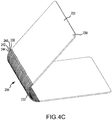
- FIG. 4C is a side perspective view of the rigid material 230 being partially bent.
- FIG. 4D is a side perspective view of the rigid material 230 being more fully bent. As shown best in FIG.
- a first side 260 of the flex aperture 234 may have a smaller diameter and a second side 262 of the flex aperture 234 may have a diameter that is larger than the diameter on the first side 260 of the material 230.
- the sidewalls 254 may form a triangular or frustum shape in profile.
- the first side 260 may include a first geometric pattern and the second side may include a second geometric pattern, one or both patterns may also be selected not only for angulation and bend radius, but also based on aesthetics.
- the first side geometric pattern may be selected based on its bending properties and the second side geometric pattern may be selected based on its aesthetic properties.
- the geometric pattern on both sides of the material may be selected to be substantially identical.
- the triangular shape of the sidewalls 254 may help to prevent the sidewalls 254 of adjacent rows 238, 240 from encountering each other as the rigid material 230 is folded or otherwise bent. Further, the triangular shape of the sidewalls 254 may allow the flex apertures 234 to be more flexible on the inner surface 262 of the material 230 than on the outer surface 260 as the sidewalls 254 may be thicker in width towards the outer surface 260.
- the angular orientation of the sidewalls 254 may also act as a "stop" to prevent, reduce, or resist bending in a particular direction. This may help to protect internal components of the electronic device 200 from damage.
- the angular orientation of the sidewalls 254 may prevent bending past a predetermined angle so that enclosure 202 does not "over bend” and potentially damage internal components from damage. Additionally, the angle of the sidewalls 254 may prevent or substantially resist bending in a particular direction. Further, by varying the thickness or size of the sidewalls 254, the flexible portion may become more or less rigid.
- the shape of the sidewalls 254 may allow the flex apertures 234 to have an increased expansion during bending in the middle of each aperture 234, which may simultaneously minimize stresses on the sidewalls 254 surrounding the apertures 234. This allows the flexible portion 204 to bend without breaking or cracking the rigid material 230, including the sidewalls 254 surrounding each of the flex apertures 234.
- the flexible portion 204 may bend along one or more axes, although the flexible portion 204 may be an integral portion of the rigid material 230.
- the top 224 is shown folded over the bottom 226. To cause the top 224 to be forced towards the bottom 226, a force may be applied to the top 224 compressing it towards the bottom 226 and the flex apertures 234 surrounding a rotation axis A may vary in size. Some of the flex apertures 234 may expand whereas others may decrease. Additionally, the sidewalls 254 surrounding the rotation axis A may be compressed towards one another.
- a thickness of the sidewalls 254 may be decreased on the inner side 262 of the rigid material 230 (due to the shape of the flex apertures 234), which provides additional flexibility to the rigid material 230 and specifically the sidewall 254.
- the rotation axis A may be varied depending on the position of the compression force acting on the top 224.
- the top 224 in a second position of the enclosure 202, the top 224 may be positioned substantially parallel to the bottom 226, and depending on the thickness of the top 224 and/or bottom 226, the top 224 and bottom 226 may be positioned in contact with one another.
- the flexible portion 204 may have a spring force, such that as the flex apertures 234 vary in shape to accommodate the bending forces of the top 224 and/or bottom 226, a spring force may accumulate. In these examples, depending on the weight of the top 226 (and other components operably connected thereto), when the bending force is released, the flexible portion 204 may return to an open or first position.
- the weight of the top 226, the spring force of the flexible portion 204, or the weight of any components operably connected to the top 224 may allow the top 224 to remain in position until adjusted by a user or the like. For instance, after the top 224 has been positioned in the closed position, it may remain substantially in position, at least partially parallel to the bottom 226.
- the geometric pattern 232 may be varied so that the flex apertures 234 may be configured to maintain the enclosure 202 in a predetermined position.
- the geometric pattern 232 may be configured so that the sidewalls 254 may be substantially rigid or may deform slightly so that after the bending force is removed, the rigid material 230 may remain in the bent position.
- certain portions of the geometric pattern 232 may have different shapes, sizes, or other characteristics in order to allow the enclosure 202 to remain in a partially bent or fully bent configuration when the bending force is removed.
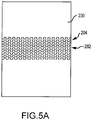
- FIG. 5A is a top plan view of the rigid material 230 including another embodiment of the geometric pattern 282.
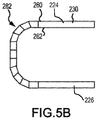
- FIG. 5B is a side elevation view of the rigid material 230 including the geometric pattern 282 in an bent position.
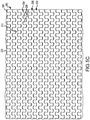
- FIG. 5C is an enlarged top elevation view of flexible portion 204 of FIG. 5A .
- FIG. 5D is an enlarged view of a row of the geometric pattern removed from the rigid material 230.
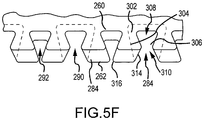
- FIG. 5E is an enlarged view of the geometric pattern 282 in FIG. 5B .
- the geometric pattern 282 in this embodiment may include one or more interlocking features 286 separated from one another by flex apertures 284.
- Each of the interlocking features 286 may move relative to adjacent interlocking features 286 due to the flex apertures 284.
- the flex apertures 284 may not stretch or expand due to the bending force as in the FIG. 4A embodiment, but rather may be increased or decreased due to the relative movement of the interlocking features 286 with respect to each other.
- the interlocking features 286 may be shaped in a number of different manners, which may vary the bending available for the flexible portion 204.
- the interlocking features 286 may include a narrow neck 302 extending from an edge of the rigid material 230 or for interlocking features 286 within an inner portion of the geometric pattern 282, a strip 312 of material.
- the neck 302 may expand outwards forming a head 304.
- the neck 302 and the head 304 may form an inverted frustum, with the head 304 extending away from the edge 306 of the rigid material 230 or an edge of the strip 312.
- Adjacent interlocking features 286 extending from the same edge 306 or strip 312 may be substantially similar. As the flex apertures 284 are defined by the sidewalls of the interlocking features 286, the perimeter of the flex apertures 284 may generally trace the perimeter of the interlocking features 286. As such, the flex apertures 284 may also be generally frustum shaped. However, the flex apertures 284 may be aligned oppositely to the interlocking features 286 (for a single row 298, 300) such that the head or wide portion 308 of the flex aperture 284 may extend into the strip 312 of material, whereas the head 304 of the interlocking features 286 may extend away from the strip 312.
- the flex apertures 284 may be cut between rows to define the interlocking features 286, and as such, the interlocking features 286 of vertically adjacent rows may be received in the flex apertures 284 of the adjacent row and the flex apertures 284 may separate rows of interlocking features 286 from each other.
- the width of the flex apertures 284 may be selected based on a desired bend radius of the material. For example, the finer the width of the flex apertures 284, the smaller the bend radius.
- the flex apertures may be integrally formed apertures that extend along an entire dimension of the rigid material, e.g., along the entire length or width.
- the flex apertures may form curved or undulating lines that separate two portions of the material from each other by a spacing gap. Due to the curved nature of the flex apertures, the interlocking features may be locked together, although the material may be disconnected by the flex apertures.
- the spacing gap or the size of the flex apertures may be varied between a first side of the material and a second side of the material.
- the rows 298, 300 may define strips 312 or lengths of rigid material 230 having interlocking features 286 extending from either side.
- a row 298, 300 may be positioned between two other rows, and thus may include interlocking features 286 extending from opposite sides thereof in order to interlock with the adjacent rows.
- the rigid material may have a plurality of rows that extend along its entire length or width, so that the material may be flexible along an entire dimension.
- the interlocking features 286 may include sidewalls 294 forming an outer perimeter of each respective interlocking feature 286.
- the sidewalls 294 may extend between the inner surface 262 and the outer surface 260.
- the sidewalls 294 may vary in thickness between the inner surface 262 and the outer surface 260.
- the sidewalls 294 may angle upwards from one surface 260, 262 towards the other, such that the angle of the sidewalls 294 with respect to a plane of the outer surface 260 may vary along the depth or thickness of the sidewall 294.
- the sidewalls 294 may be varied in angular orientation from each other (with respect to the plane of the outer surface 260).
- the first sidewall 316 may extend into the flex aperture 284 and a second sidewall 314 may extend away from the flex aperture 284.
- a first sidewall 316 may form a first side of the interlocking feature 286 and the second sidewall 314 may form a second side of the interlocking feature 286. Accordingly, the first side of the interlocking feature 286 may be angled inwards from the outer surface 260 to the inner surface 262 and the second side of the interlocking feature 286 may be angled outwards from the outer surface 260 to the inner surface 262. In some embodiments, laterally adjacent interlocking features 286 may have opposite sides that extend inwards or outwards.
- a first interlocking feature 286 may have a right side extending inwards and a left side extending outwards and a second interlocking feature 286 adjacent to the first interlocking feature 286 may have a right side extending outwards and a left side extending inwards.
- the angled sidewalls may allow the base or rigid material to be shaped in a number of different ways.
- the angled walls may allow the rigid material to have a substantially planar shape and as the material bends (due to the flex apertures), the flex apertures may remain interconnected through the angled walls.
- the pitch of the sidewalls may be varied to vary the bending radius, and the pitch may be variable in the material, such that certain portions of the material may have a first bending radius and other portions of the material may have a second bending radius.
- the interlocking features 286 may appear to be substantially the same dimensions. However, along the inner surface 262, the interlocking features 286 may have varying sidewall 294 thicknesses. For example, a first flex aperture 290 may have a decreased diameter along the inner surface 262 as compared with a second laterally adjacent flex aperture 292. The varying thicknesses, may allow laterally adjacent interlocking features 286 to have differing angles of movement.
- a first interlocking feature 286 received within the first flex aperture 290 may be able to extend downwards towards the inner surface 262, whereas a second interlocking feature 286 received within the second flex aperture 292 may not be able to extend the same amount inwards towards the inner surface 262 due to the decreased size of the second flex aperture 292. Conversely, the first interlocking feature received within the first flex aperture 290 may not be able to extend as far upwards towards the outer surface 260 as the second interlocking feature received within the second flex aperture 292.
- the dimensions of the flex apertures 284 defined by laterally adjacent interlocking features 286 may be different from each other. That is, a first flex aperture 290 may be larger (when viewed from the inner surface 262) than a second flex aperture 292 defined along the same row 298 and laterally adjacent to the first flex aperture 290.
- the varying dimensions of the flex apertures 284 due the varying angular changes of the sidewalls 294, may function to interlock the interlocking features 286 from adjacent rows together, while still allowing the interlocking features 286 to move relative to each other.
- the rigid material 230 may bend along an axis A positioned within the flexible portion 204.
- the force may cause one or more rows 298, 300 of the interlocking features 286 to move relative to each other.
- select interlocking features 286 may extend slightly outwards away from a plane of the material 230.
- the interlocking features 286 may remain substantially secured together. The freedom of movement in at least one direction may provide sufficient strain relief for the rigid material 230 to allow it to bend along the axis A without cracking or breaking.
- rotation axes are possible other than axis A.
- the location of the rotation axis A may depend on the orientation of the geometric pattern 282 as well as the location of the bending force.
- the rotation axis A may be positioned substantially anywhere along the flexible portion 204.
- the rotation axis may be fixed in a single position and may form a living hinge in that the material 230 such that the material 230 may only be able to rotate along that single axis.
- the rotation axis may be defined by the degree of movement between adjacent interlocking features. Accordingly, by restricting or reducing the movement of certain features relative to others, the flexible portion 204 may be configured to only rotate or bend along an axis that may be aligned with other features that may have increased movement relative to other interlocking features.
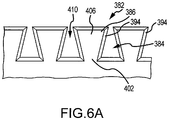
- FIG. 6A is a top plan view of another embodiment of the interlocking features for the geometric pattern 382.
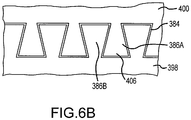
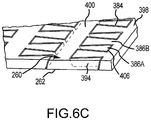
- interlocking features 386 may be movably secured together by a neck portion 410 of the flex apertures 384. That is, a head portion 406 of the interlocking features 386 may substantially touch laterally adjacent head portions 406 so that the neck portion 410 may be relatively narrow.
- the head portions 406 of interlocking rows may be pinched by the head portions 402 of the other row of interlocking features 386.
- FIG. 6B is an enlarged view of a first row 398 interlocked with a second row 400.
- FIG. 6C is an enlarged perspective view of the geometric pattern 382.
- first row 398 may be substantially prevented from becoming disconnected from the second row 400.
- the first row 398 may move in a first plane relative to the second row 400, until the sidewalls of the first interlocking feature 386A encounter the sidewalls of the second interlocking features 386B defining the flex aperture 384.
- the sidewalls 394 may be angled as they extend from the outer surface 260 to the inner surface 262, so that the upper portions of the sidewalls 394 may be narrower than the bottom portions of the sidewalls 394. This may allow the top portions of the sidewalls 394 to be movable relative to adjacent interlocking features 386, while the bottom portions of the sidewalls 394 may be secured in place. Additionally, in some embodiments, the sidewalls of the interlocking features 386 for the first row 398 may be oppositely angled from the sidewall of the interlocking features 386 for the second row 400.
- first interlocking feature 386A may also move in a second plane, e.g., in the Y direction away from the plane of the rigid material 230.
- a portion of the first interlocking feature 386A may be pinched within the neck portion 410 of the flex aperture 384 (due to the head portions 406 of adjacent interlocking features) such that the head portion 406 of the first interlocking feature 386A may extend upwards or downwards relative to the second row 400 while remaining secured thereto.
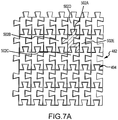
- FIG. 7A is a bottom fragmentary perspective view of another embodiment of the geometric pattern 482 including interlocking features 502 that may bend in two directions.
- FIG. 7B is a top perspective view of the geometric pattern 482.
- FIG. 7C is a top plan view of an interlocking feature 502A removed from the geometric pattern 482.
- rows 498, 500 may be formed of a series of separately interlocked features 502A, 502B, 502C, 502D, 502E.
- the interlocking features 502 may be discrete elements movable connected together to form rows 498, 500. That is, unlike the rows 298, 300 and rows 398, 400 which may include a main portion with adjacent interlocking features extending therefrom, the rows 498, 500 may be formed of separate interlocking features 502 movably connected together.
- each interlocking feature 502A-502E may include a main body 510 with one more locking members extending therefrom.
- the interlocking features 502A-502E may include two legs 512, 514 extending from a first end of the main body 510, a head 520 extending from a second end of the main body 510 opposite the legs 512, 514, and a back portion 516 extending from a first side of the main body 510.
- a second side of the main body 510 may define a receiving aperture 524.
- the receiving aperture 524 may include a neck portion 528 defined by two pinching members 522, 526 that may extend into the receiving aperture 524 at the edge of the second side of the main body 510.
- a head receiving aperture 530 may be defined between the two legs 512, 514 of the interlocking feature 502.
- the edges of the rigid material 230 surrounding the flexible portion 204 may define portions of the interlocking features 502A-502E.
- these portions of interlocking features 502 may operably connect to one or more other interlocking features 502A-502E.
- some portions of the geometric pattern 482 may include non-discrete interlocking features.
- the interlocking features 502A-502E may be operably connected to one or more other interlocking features 502A-502E.
- a first interlocking feature 502A may be operably connected to four other interlocking features 502B, 502C, 502D, and 502E.
- the head 520 of the interlocking feature 502C may be received within the head receiving aperture 530 in the first interlocking feature 502A, where the back portion 516 of the first interlocking feature 502A may be received within the receiving aperture 524 of the second interlocking feature 502B, the head 520 of the first interlocking feature 502A may be received within the head receiving aperture 530 within the fourth interlocking feature 502D, and the back portion 516 of the fifth interlocking feature 502E may be received within the receiving aperture 524 of the first interlocking feature 502A.
- the first interlocking feature 502A may be operably connected to each of the other interlocking features 502B, 502C, 502D, 502E.
- the bending radius of the rigid material or forming material may be modified by varying one or more parameters of the geometric pattern.
- a few parameters include, width of the flex aperture, angulation of the sidewalls boarding the flex apertures or grooves, pitch of the cuts, and thickness of the rigid material.
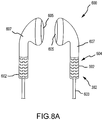
- FIG. 8A is a perspective view of another embodiment of an electronic device 600.
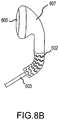
- FIG. 8B is a perspective view of the electronic device in a flexed position.
- the electronic device 600 is an audio output mechanism such as headphones operably and electronically connected to a communication cable 603.
- the communication cable 603 may be operably connected to a speaker 605 by the enclosure 602.
- the enclosure 602 may be formed of the rigid material 230 and may optionally be operably connected to a second portion of top of the enclosure 607.
- the enclosure 602 may be a substantially unitary structure, with the flexible portion 604 being located near the connection to the cable 603.
- the enclosure 602, as shown in FIGS. 8A and 8B may include the geometric pattern 382 of FIGS. 6A-6C along the length of the flexible portion 604. This may allow the enclosure 602 to bend, while still maintaining a rigid connection to the speaker 605.
- the communication cable 603 may be flexible and may move relative to the enclosure 602, which in conventional rigid enclosures may cause the enclosure to wear and/or crack over time. As the enclosure 602 may bend and flex as the communication cable 603 may move.
- the enclosure 602 may be substantially prevented from breaking or cracking due to the movement of the communication cable 603. Additionally, the flexibility of the enclosure 602 may increase the bending radius of the communication cable 603 at the connection location. This may provide a strain relief for the cable 603, which may help to prevent internal wires or the cable 603 itself from breaking due to a bending force. It should be noted that although the enclosure 602 is positioned at the end of the cable closest to the speakers, it should be noted that the enclosure may be positioned at other locations where strain relief may be desired. For example, the flexile portion of the enclosure may be positioned at a second end of the cable that may connect the cable to an electronic device (e.g., through an audio port or the like). In this example, the flexibility of the enclosure may allow the cable to remain connected to the port, but may also flex or bend.
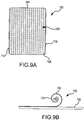
- FIG. 9A is a top plan view of a cover for an electronic device including a geometric pattern defined therein.
- FIG. 9B is a side elevation view of the cover and the electronic device of FIG. 9A with the cover partially retracted.
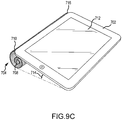
- FIG. 9C is a top perspective view of the cover and the electronic device of FIG. 9A with the cover fully retracted and acting as a support or stand for the electronic device.
- an electronic device 700 includes a cover 704 having the geometric pattern 282 defined therein.
- the geometric pattern 282 may include a plurality of flex apertures 284 and interlocking features that allow the rigid material forming the cover 704 to bend or flex.
- the angulation of the features defined in the cover 704 allows the cover 704 to be rolled around itself.
- the geometric pattern 282 may be substantially the same as the pattern shown in FIG. 5C .
- the flex apertures 284 may be defined in vertical columns that extend along a height of the computing device 702. This configuration may allow the entire cover 704 to flex about an axis parallel to the length axis of the computing device 702.
- the cover 704 may roll or flex in a direction substantially parallel to the direction of the columns of the flex apertures 284.
- the geometric pattern for the cover may be selected based on a desired flex direction, bend radius, and the like.
- the geometric pattern and the bending direction illustrated in FIGS. 9A-9C are illustrative only.
- the cover 704 may lie substantially flat against the top surface of the computing device 702 and may protect a display 712 or other portions of the computing device 702.
- a first end 708 of the cover 704 may be rolled towards a second end 710 forming a rolled portion 706.
- the display 712 or other portions of the computing device 702 may be exposed.
- the cover 702 may be configured to roll and wrap around an edge of the computing device 702 to act as a support stand. For example, a portion of the computing device 702 may rest on the rolled portion 706 of the cover 704, which may allow the computing device 702 to be supported above a surface at a support angle 714.
- the support angle 714 may generally correspond to the outermost radius of the bend portion 706.
- the radial bend of the cover 704 may be defined by geometric pattern, the angulation of the sidewalls defining the flex apertures and the features.
- the second end 710 of the cover 704 may be anchored to an edge 716 of the computing device 702 and may rotate about the edge 716, allowing the rolled portion 706 of the cover 704 to rotate around the edge 716 to a backside of the computing device 702.
Landscapes
- Engineering & Computer Science (AREA)
- Theoretical Computer Science (AREA)
- Mechanical Engineering (AREA)
- Computer Hardware Design (AREA)
- Physics & Mathematics (AREA)
- Human Computer Interaction (AREA)
- General Engineering & Computer Science (AREA)
- General Physics & Mathematics (AREA)
- Mathematical Physics (AREA)
- Optics & Photonics (AREA)
- Plasma & Fusion (AREA)
- Casings For Electric Apparatus (AREA)
Claims (9)
- Gehäuse aus einem im Wesentlichen steifen Material (230), das aufweist und gekennzeichnet ist durch:eine erste Vielzahl von ineinandergreifenden Merkmalen (286), die in dem steifen Material (230) definiert sind;eine zweite Vielzahl von ineinandergreifenden Merkmalen (286), die in dem steifen Material (230) definiert sind;
undeine Vielzahl von Öffnungen (284, 290, 292), die zwischen der ersten Vielzahl von ineinandergreifenden Merkmalen (286) und der zweiten Vielzahl von ineinandergreifenden Merkmalen (286) definiert sind, um die erste Vielzahl von ineinandergreifenden Merkmalen (286) von der zweiten Vielzahl von ineinandergreifenden Merkmalen (286) zu trennen; wobei die Öffnungen durch Entfernen von Abschnitten des steifen Materials erzeugt sind, unddie erste Vielzahl von ineinandergreifenden Merkmalen mit der zweiten Vielzahl von ineinandergreifenden Merkmalen ineinandergreift;und wobei die erste Vielzahl von ineinandergreifenden Merkmalen (286) beweglich relativ zu der zweiten Vielzahl von ineinandergreifenden Merkmalen (286) ist. - Gehäuse gemäß Anspruch 1, wobei die erste Vielzahl von ineinandergreifenden Merkmalen (286) und die zweite Vielzahl von ineinandergreifenden Merkmalen (286) im Wesentlichen kegelstumpfförmig sind.
- Gehäuse gemäß Anspruch 1, wobei jede der ersten Vielzahl von ineinandergreifenden Merkmalen (286) Seitenwände (294) umfasst, wobei die Seitenwände (294) sich in einer Winkelorientierung von einer ersten Oberfläche (262) des steifen Materials (230) zu einer zweiten Oberfläche (260) des steifen Materials (230) ändern.
- Gehäuse gemäß Anspruch 3, wobei jedes der zweiten Vielzahl von ineinandergreifenden Merkmalen (286) Seitenwände (294) umfasst, wobei die Seitenwände (294) sich in einer Winkelorientierung von der ersten Oberfläche (262) des steifen Materials (230) zu zweiten Oberfläche (260) des steifen Materials (230) ändert.
- Verfahren zum Herstellen einer flexiblen Komponente, das aufweist:Bereitstellen eines im Wesentlichen steifen Materials (230); undEntfernen von Abschnitten des steifen Materials (230), um eine Vielzahl von Öffnungen (284, 290, 292) zu erzeugen,gekennzeichnet durch:wobei die Öffnungen (284, 290, 292) durch ineinandergreifende Merkmale (286) definiert sind, die benachbart zueinander und von den Öffnungen (284, 290, 292) beabstandet sind; undwobei die erste Vielzahl von ineinandergreifenden Merkmalen mit der zweiten Vielzahl von ineinandergreifenden Merkmalen ineinandergreift; und wobei jedes ineinandergreifende Merkmal (286) Seitenwände (294) hat, und die Winkel der Seitenwände (294) eine radiale Krümmung des steifen Materials (230) bestimmen; unddas steife Material (230) nicht zylindrisch ist.
- Verfahren gemäß Anspruch 5, wobei das steife Material (230) eben ist.
- Verfahren gemäß Anspruch 5, wobei ein geometrisches Muster (282) in dem steifen Material (230) durch die Vielzahl von Öffnungen (284, 290, 292) definiert ist.
- Verfahren gemäß Anspruch 7, wobei eine erste Seite (262) des steifen Materials (232) ein erstes geometrisches Muster (282) und die zweite Seite (260) des steifen Materials (230) ein zweites geometrisches Muster (282) hat.
- Verfahren gemäß Anspruch 5, wobei das Entfernen von Abschnitten des steifen Materials (230) entweder durch einen Multiachsenlaser oder elektroerosive Bearbeitung gemacht ist.
Priority Applications (1)
| Application Number | Priority Date | Filing Date | Title |
|---|---|---|---|
| EP18150293.1A EP3324265B1 (de) | 2012-02-16 | 2013-02-15 | Ineinandergreifende flexible segmente aus einem steifen material |
Applications Claiming Priority (2)
| Application Number | Priority Date | Filing Date | Title |
|---|---|---|---|
| US201261599766P | 2012-02-16 | 2012-02-16 | |
| PCT/US2013/026384 WO2013123353A1 (en) | 2012-02-16 | 2013-02-15 | Interlocking flexible segments formed from a rigid material |
Related Child Applications (1)
| Application Number | Title | Priority Date | Filing Date |
|---|---|---|---|
| EP18150293.1A Division EP3324265B1 (de) | 2012-02-16 | 2013-02-15 | Ineinandergreifende flexible segmente aus einem steifen material |
Publications (2)
| Publication Number | Publication Date |
|---|---|
| EP2807529A1 EP2807529A1 (de) | 2014-12-03 |
| EP2807529B1 true EP2807529B1 (de) | 2018-01-10 |
Family
ID=47843399
Family Applications (2)
| Application Number | Title | Priority Date | Filing Date |
|---|---|---|---|
| EP13708282.2A Active EP2807529B1 (de) | 2012-02-16 | 2013-02-15 | Ineinandergreifende flexible segmente aus einem steifen material |
| EP18150293.1A Active EP3324265B1 (de) | 2012-02-16 | 2013-02-15 | Ineinandergreifende flexible segmente aus einem steifen material |
Family Applications After (1)
| Application Number | Title | Priority Date | Filing Date |
|---|---|---|---|
| EP18150293.1A Active EP3324265B1 (de) | 2012-02-16 | 2013-02-15 | Ineinandergreifende flexible segmente aus einem steifen material |
Country Status (5)
| Country | Link |
|---|---|
| US (2) | US20130216740A1 (de) |
| EP (2) | EP2807529B1 (de) |
| KR (1) | KR101764109B1 (de) |
| CN (2) | CN109865764B (de) |
| WO (1) | WO2013123353A1 (de) |
Cited By (1)
| Publication number | Priority date | Publication date | Assignee | Title |
|---|---|---|---|---|
| IT202100000617A1 (it) * | 2021-01-14 | 2022-07-14 | Petrozzi S N C Di Petrozzi Alessandro & C | Lastra di pmma comprendente una porzione di piegatura elastica e reversibile |
Families Citing this family (98)
| Publication number | Priority date | Publication date | Assignee | Title |
|---|---|---|---|---|
| US9132510B2 (en) | 2012-05-02 | 2015-09-15 | Apple Inc. | Multi-step pattern formation |
| US10086484B2 (en) | 2012-10-12 | 2018-10-02 | Apple Inc. | Manufacturing of computing devices |
| TWI524996B (zh) | 2013-01-25 | 2016-03-11 | 財團法人工業技術研究院 | 可撓性電子裝置 |
| US9205629B2 (en) * | 2013-03-15 | 2015-12-08 | Ann Livingston-Peters | Composite structure with a flexible section forming a hinge |
| KR102132780B1 (ko) * | 2013-08-28 | 2020-07-13 | 삼성디스플레이 주식회사 | 표시 장치 및 그 제조 방법 |
| GB2517782B (en) * | 2013-09-02 | 2020-08-19 | Nokia Technologies Oy | An apparatus and method of providing an apparatus comprising a bendable portion |
| GB2520271A (en) | 2013-11-13 | 2015-05-20 | Nokia Corp | An apparatus and method of providing an apparatus comprising a bendable portion |
| GB2521152A (en) * | 2013-12-10 | 2015-06-17 | Nokia Technologies Oy | An apparatus and method of providing an apparatus comprising a bendable portion |
| RO129866A3 (ro) | 2013-12-20 | 2015-06-30 | Eulac Laser Srl | Procedeu şi utilaj pentru obţinerea unui material flexibil dintr-un material rigid |
| US9321677B2 (en) | 2014-01-29 | 2016-04-26 | Corning Incorporated | Bendable glass stack assemblies, articles and methods of making the same |
| DE202014101366U1 (de) * | 2014-03-24 | 2014-03-28 | Igus Gmbh | Leitungsführungseinrichtung mit einstückigem Gelenk, entsprechendes Kettenglied und Gelenkband |
| US9852723B2 (en) | 2014-03-27 | 2017-12-26 | Apple Inc. | Acoustic modules |
| US20150277506A1 (en) | 2014-03-29 | 2015-10-01 | Bok Eng Cheah | Micro-hinge for an electronic device |
| US9451065B2 (en) | 2014-04-03 | 2016-09-20 | Apple Inc. | Adaptive plug for edge protection |
| US9946312B2 (en) | 2014-04-23 | 2018-04-17 | Microsoft Technology Licensing, Llc | Articulated screen cover for accommodating objects |
| USD769209S1 (en) * | 2014-05-30 | 2016-10-18 | Lg Electronics Inc. | Cellular phone |
| USD767526S1 (en) * | 2014-06-09 | 2016-09-27 | Lg Electronics Inc. | Cellular phone |
| USD788726S1 (en) * | 2014-06-09 | 2017-06-06 | Lg Electronics Inc. | Cellular phone |
| US10975603B2 (en) | 2014-06-12 | 2021-04-13 | Microsoft Technology Licensing, Llc | Flexible display computing device |
| US9684343B2 (en) * | 2014-06-12 | 2017-06-20 | Microsoft Technology Licensing, Llc | Radius hinge |
| USD772225S1 (en) * | 2014-08-07 | 2016-11-22 | Samsung Electronics Co., Ltd. | Electronic device |
| US10335979B2 (en) | 2014-09-30 | 2019-07-02 | Apple Inc. | Machining features in a ceramic component for use in an electronic device |
| US10071539B2 (en) | 2014-09-30 | 2018-09-11 | Apple Inc. | Co-sintered ceramic for electronic devices |
| US9625953B2 (en) | 2014-11-11 | 2017-04-18 | Microsoft Technology Licensing, Llc | Covered multi-pivot hinge |
| US9910465B2 (en) * | 2014-11-11 | 2018-03-06 | Microsoft Technology Licensing, Llc | Covered radius hinge |
| US9625954B2 (en) | 2014-11-26 | 2017-04-18 | Microsoft Technology Licensing, Llc | Multi-pivot hinge |
| US9970222B1 (en) * | 2014-12-17 | 2018-05-15 | The United States Of America As Represented By The Secretary Of The Air Force | Compliant hinge for membrane-like structures |
| KR102339856B1 (ko) | 2014-12-24 | 2021-12-16 | 삼성전자주식회사 | 전자장치 |
| CN105786101B (zh) * | 2014-12-25 | 2019-07-26 | 联想(北京)有限公司 | 电子设备 |
| US9851759B2 (en) * | 2014-12-31 | 2017-12-26 | Microsoft Technology Licensing, Llc | Multi-pivot hinge cover |
| US9769551B2 (en) | 2014-12-31 | 2017-09-19 | Skullcandy, Inc. | Method of connecting cable to headphone, and headphone formed using such methods |
| US10174534B2 (en) | 2015-01-27 | 2019-01-08 | Microsoft Technology Licensing, Llc | Multi-pivot hinge |
| US10207387B2 (en) | 2015-03-06 | 2019-02-19 | Apple Inc. | Co-finishing surfaces |
| USD797070S1 (en) * | 2015-03-09 | 2017-09-12 | Lg Electronics Inc. | Mobile phone |
| KR102414855B1 (ko) * | 2015-04-30 | 2022-07-01 | 삼성전자주식회사 | 플렉시블 전자 장치 |
| KR102325211B1 (ko) * | 2015-06-01 | 2021-11-12 | 삼성디스플레이 주식회사 | 플렉시블 디스플레이 장치 제조방법 |
| KR101765121B1 (ko) * | 2015-06-10 | 2017-08-04 | (주) 프렉코 | 연동구조를 가지는 플렉시블 힌지 장치 |
| US10216233B2 (en) | 2015-09-02 | 2019-02-26 | Apple Inc. | Forming features in a ceramic component for an electronic device |
| US9997305B2 (en) | 2015-09-03 | 2018-06-12 | Apple Inc. | Laser processing of fabric for electronic devices |
| US9947882B2 (en) | 2015-09-25 | 2018-04-17 | Apple Inc. | Electronic devices with robust flexible displays |
| US10162389B2 (en) | 2015-09-25 | 2018-12-25 | Microsoft Technology Licensing, Llc | Covered multi-axis hinge |
| USD814435S1 (en) | 2015-10-26 | 2018-04-03 | Lenovo (Beijing) Co., Ltd. | Flexible electronic device |
| USD814455S1 (en) | 2015-10-26 | 2018-04-03 | Lenovo (Beijing) Co., Ltd. | Flexible electronic device |
| USD828321S1 (en) * | 2015-11-04 | 2018-09-11 | Lenovo (Beijing) Co., Ltd. | Flexible smart mobile phone |
| USD791753S1 (en) * | 2015-12-15 | 2017-07-11 | Samsung Electronics Co., Ltd. | Electronic device |
| KR102550697B1 (ko) * | 2015-12-30 | 2023-07-04 | 삼성디스플레이 주식회사 | 플렉서블 디스플레이 장치 |
| CN105739619A (zh) * | 2016-01-29 | 2016-07-06 | 联想(北京)有限公司 | 电子设备 |
| KR102465337B1 (ko) * | 2016-04-27 | 2022-11-10 | 삼성전자주식회사 | 폴더블 디스플레이 장치 |
| CN106304724A (zh) * | 2016-08-23 | 2017-01-04 | 东莞华清光学科技有限公司 | 一种移动终端壳体及其制备方法、移动终端 |
| KR102636648B1 (ko) * | 2016-09-13 | 2024-02-15 | 삼성전자주식회사 | 플렉서블 디스플레이 전자 장치 |
| CN107846484B (zh) * | 2016-09-20 | 2020-01-10 | 华为机器有限公司 | 一种移动终端的折叠机构及移动终端 |
| US10437293B2 (en) | 2016-09-23 | 2019-10-08 | Microsoft Technology Licensing, Llc | Multi-axis hinge |
| US10303218B2 (en) | 2017-02-01 | 2019-05-28 | Apple Inc. | Foldable cover and display for an electronic device |
| US10219744B2 (en) | 2017-04-21 | 2019-03-05 | Combobutronics Llc | Systems and methods for applying or receiving signals to or from biological tissues |
| USD901495S1 (en) * | 2017-05-31 | 2020-11-10 | Samsung Display Co., Ltd. | Display device |
| KR102369212B1 (ko) * | 2017-07-28 | 2022-03-03 | 삼성디스플레이 주식회사 | 표시 장치 |
| US10542628B2 (en) | 2017-08-02 | 2020-01-21 | Apple Inc. | Enclosure for an electronic device having a shell and internal chassis |
| USD901489S1 (en) * | 2017-09-27 | 2020-11-10 | Samsung Electronics Co., Ltd. | Electronic device |
| USD949147S1 (en) * | 2017-12-27 | 2022-04-19 | Samsung Display Co., Ltd. | Display device |
| WO2019163436A1 (ja) * | 2018-02-23 | 2019-08-29 | Nissha株式会社 | 電子機器用バックカバーとそれを用いた電子機器用筐体、およびスイッチカバー |
| KR102567096B1 (ko) | 2018-04-03 | 2023-08-17 | 삼성디스플레이 주식회사 | 표시 장치 및 그것의 제조 방법 |
| KR102521326B1 (ko) * | 2018-07-06 | 2023-04-13 | 삼성전자주식회사 | 전자 장치의 케이스 및 그의 제조 방법 |
| US11290818B1 (en) * | 2018-07-11 | 2022-03-29 | Apple Inc. | Wearable electronic device with speakers and sensors |
| US10642318B1 (en) * | 2018-09-14 | 2020-05-05 | Apple Inc. | Planar hinge assembly |
| CN109189305B (zh) * | 2018-09-26 | 2020-09-01 | 维沃移动通信有限公司 | 一种铰链、电子设备及电子设备控制方法 |
| JP1643782S (de) * | 2018-10-24 | 2019-10-21 | ||
| US11204627B2 (en) | 2019-01-08 | 2021-12-21 | Samsung Display Co., Ltd. | Foldable device |
| US20220103670A1 (en) * | 2019-02-01 | 2022-03-31 | Huawei Technologies Co., Ltd. | Support sheet used for foldable terminal device and foldable terminal device |
| US11137802B2 (en) * | 2019-04-21 | 2021-10-05 | Lenovo (Singapore) Pte. Ltd. | Anti-warp bezel for foldable device |
| US11818851B2 (en) * | 2019-05-03 | 2023-11-14 | Evolutive Labs Co., Ltd. | Foldable apparatus for foldable device |
| US20220306523A1 (en) * | 2019-05-03 | 2022-09-29 | Corning Incorporated | Glass article with a living hinge |
| CN210783287U (zh) * | 2019-08-19 | 2020-06-19 | 上海爱派娅科技有限公司 | 一种环保化妆盒 |
| KR102773861B1 (ko) * | 2019-10-08 | 2025-02-28 | 삼성디스플레이 주식회사 | 표시 장치 및 이의 제조 방법 |
| US11256293B2 (en) * | 2019-10-24 | 2022-02-22 | Samsung Display Co., Ltd. | Display device |
| KR102875985B1 (ko) * | 2019-11-08 | 2025-10-27 | 삼성디스플레이 주식회사 | 폴더블 표시 장치 |
| US11048295B1 (en) | 2020-01-10 | 2021-06-29 | Sharp Kabushiki Kaisha | Flexible window for foldable display |
| US12200881B2 (en) | 2020-01-29 | 2025-01-14 | Huawei Technologies Co., Ltd. | Flexible support structure for a sliding flexible display |
| US11503727B2 (en) | 2020-02-14 | 2022-11-15 | Samsung Display Co., Ltd. | Display device |
| US11449108B2 (en) * | 2020-03-05 | 2022-09-20 | Microsoft Technology Licensing, Llc | Flexible hinge device |
| US11775017B2 (en) * | 2020-04-03 | 2023-10-03 | Hewlett-Packard Development Company, L.P. | Bendable displays |
| CN111508357A (zh) * | 2020-04-26 | 2020-08-07 | 武汉华星光电半导体显示技术有限公司 | 可折叠显示装置 |
| JP6971354B2 (ja) * | 2020-05-13 | 2021-11-24 | レノボ・シンガポール・プライベート・リミテッド | ディスプレイアセンブリ、携帯用情報機器、ディスプレイアセンブリの製造方法、及び携帯用情報機器の製造方法 |
| EP3936485A1 (de) * | 2020-07-06 | 2022-01-12 | Schott Ag | Flexibles glaselement und verfahren zur herstellung davon |
| CN111862824B (zh) * | 2020-08-27 | 2025-04-25 | 京东方科技集团股份有限公司 | 显示组件及显示装置 |
| KR20220031839A (ko) * | 2020-09-04 | 2022-03-14 | 삼성디스플레이 주식회사 | 표시 장치 |
| KR20220091665A (ko) * | 2020-12-23 | 2022-07-01 | 삼성디스플레이 주식회사 | 폴더블 표시 장치 |
| CN112885238B (zh) * | 2021-02-03 | 2022-12-23 | 京东方科技集团股份有限公司 | 贴合治具、贴合装置及贴合方法 |
| US20220275638A1 (en) * | 2021-02-26 | 2022-09-01 | Usg Ceilings Plus, Llc | Free standing one-piece space divider |
| GB2610813B (en) * | 2021-09-13 | 2024-02-21 | Mbda Uk Ltd | Foldable moveable member for an air vehicle |
| EP4413561A4 (de) * | 2021-10-07 | 2025-06-25 | Dynamic Research, Inc. | Gelenkiger fussgängerdummy zur fahrzeugprüfung |
| CN116136230B (zh) * | 2021-11-16 | 2025-08-05 | 北京小米移动软件有限公司 | 支撑组件、可折叠显示屏和终端设备 |
| KR20230097671A (ko) * | 2021-12-24 | 2023-07-03 | 엘지디스플레이 주식회사 | 폴더블 표시 장치 |
| CN114627767A (zh) * | 2022-04-01 | 2022-06-14 | 武汉华星光电半导体显示技术有限公司 | 支撑构件及可折叠显示装置 |
| TWI849960B (zh) * | 2022-06-14 | 2024-07-21 | 國立臺灣大學 | 具有鉸接式接頭的板體結構以及其拼接物件 |
| EP4311810A1 (de) * | 2022-07-29 | 2024-01-31 | Schott Ag | Flexibles anorganisches element und verfahren zu seiner herstellung |
| KR20240042315A (ko) * | 2022-09-23 | 2024-04-02 | 삼성디스플레이 주식회사 | 표시 장치 |
| KR20240102279A (ko) * | 2022-12-26 | 2024-07-03 | 엘지디스플레이 주식회사 | 표시 장치 |
| US12411558B2 (en) * | 2023-05-19 | 2025-09-09 | Apple Inc. | Keyboard accessory for electronic device |
Citations (1)
| Publication number | Priority date | Publication date | Assignee | Title |
|---|---|---|---|---|
| US20070256387A1 (en) * | 2006-04-07 | 2007-11-08 | Dorsy Sean C | Multi-tiered, expandable panel structures and methods of manufacturing the same |
Family Cites Families (85)
| Publication number | Priority date | Publication date | Assignee | Title |
|---|---|---|---|---|
| US3123910A (en) | 1964-03-10 | neilson | ||
| US1675910A (en) | 1926-02-19 | 1928-07-03 | Andrew L Riker | Tool for drawing tubular bosses |
| US2909281A (en) | 1954-05-19 | 1959-10-20 | Chrysler Corp | Closed end sleeve-like boss and method of making |
| US2859510A (en) | 1955-01-13 | 1958-11-11 | Wheeling Steel Corp | Method of forming a boiler head or the like |
| US3202561A (en) | 1961-03-30 | 1965-08-24 | Johns Manville | Method for making acoustical tile with thermoplastic film covering |
| FR2337600A1 (fr) | 1976-01-09 | 1977-08-05 | Creusot Loire | Procede et installation de fabrication d'une tubulure d'attente sur une paroi de tres forte epaisseur |
| US4038783A (en) | 1976-09-03 | 1977-08-02 | Leon Rosenthal | Method and apparatus for generating optic lenses |
| US4164704A (en) | 1976-11-01 | 1979-08-14 | Metropolitan Circuits, Inc. | Plural probe circuit card fixture using a vacuum collapsed membrane to hold the card against the probes |
| US4223480A (en) * | 1978-11-01 | 1980-09-23 | Welty Gary A | Potted plant transplant liner |
| US4232928A (en) | 1979-06-27 | 1980-11-11 | Dit-Mco International Corporation | Apparatus employing flexible diaphragm for effecting substantially uniform force, individual couplings with multiple electrical contacts or the like |
| CH651773A5 (fr) | 1983-03-31 | 1985-10-15 | Comadur Sa | Procede pour former une lentille convergente dans une plaque d'un materiau mineral transparent. |
| JPS60244493A (ja) | 1984-05-19 | 1985-12-04 | Katsuhiko Kaneko | 円盤状刃物とレ−ザ加工を併用した切断装置 |
| US4911796A (en) | 1985-04-16 | 1990-03-27 | Protocad, Inc. | Plated through-holes in a printed circuit board |
| DE3530893A1 (de) | 1985-08-29 | 1987-03-05 | Interatom | Wachstumskompensierender metallischer abgaskatalysatortraegerkoerper und blech zu seiner herstellung |
| US5217335A (en) | 1990-04-24 | 1993-06-08 | National Optronics, Inc. | Plastic lens generator and method |
| CA2081553A1 (en) * | 1990-05-09 | 1991-11-10 | Marc Stevens Newkirk | Thin metal matrix composites and production method |
| US5028075A (en) * | 1990-07-16 | 1991-07-02 | Donnelly Dana M | Field blueprint carrier |
| GB9510465D0 (en) * | 1995-05-24 | 1995-07-19 | Petroline Wireline Services | Connector assembly |
| DE29514495U1 (de) | 1995-09-08 | 1995-11-02 | Bürkert Werke GmbH & Co., 74653 Ingelfingen | Ventil mit piezoelektrischer Lamelle |
| US5843117A (en) | 1996-02-14 | 1998-12-01 | Inflow Dynamics Inc. | Implantable vascular and endoluminal stents and process of fabricating the same |
| JPH10114135A (ja) | 1996-10-12 | 1998-05-06 | Riso Kagaku Corp | 減圧式孔版印刷方法及び装置 |
| US6149506A (en) | 1998-10-07 | 2000-11-21 | Keltech Engineering | Lapping apparatus and method for high speed lapping with a rotatable abrasive platen |
| JPH11263415A (ja) * | 1998-01-08 | 1999-09-28 | Xerox Corp | エンドレス継ぎ目ベルトの製造方法および製造装置 |
| DE69827768D1 (de) | 1998-04-02 | 2004-12-30 | Comadur Sa | Uhrglas mit einer Linse und Verfahren zur Herstellung einer solchen Linse |
| JP2000061745A (ja) | 1998-08-17 | 2000-02-29 | Ikuo Tanabe | 加工途中で部品の中間組立を行う締結システム |
| US6183347B1 (en) | 1999-08-24 | 2001-02-06 | General Electric Company | Sustained surface step scrubbing |
| US6517995B1 (en) | 1999-09-14 | 2003-02-11 | Massachusetts Institute Of Technology | Fabrication of finely featured devices by liquid embossing |
| US6464080B1 (en) | 2000-03-10 | 2002-10-15 | International Business Machines Corporation | Cushioning structure |
| US6700773B1 (en) * | 2000-11-03 | 2004-03-02 | Revolutionary Learning Systems, Inc. | Method and apparatus for implementing a configurable personal computing device |
| JP2004528169A (ja) * | 2001-04-11 | 2004-09-16 | ナムローゼ・フェンノートシャップ・ベーカート・ソシエテ・アノニム | 金属繊維フィルタ要素および金属繊維フィルタ要素を作製する方法 |
| EP1379287A1 (de) | 2001-04-12 | 2004-01-14 | Therics, Inc. | Verfahren und vorrichtung für veränderte regenerative biostrukturen |
| US20050006019A1 (en) | 2001-06-13 | 2005-01-13 | Ratcliffe Blake Edward | System for manufacturing an inlay panel using a laser |
| WO2003002289A1 (en) | 2001-06-28 | 2003-01-09 | Electro Scientific Industries, Inc. | Multistep laser processing of wafers supporting surface device layers |
| US6850684B2 (en) | 2001-08-10 | 2005-02-01 | 3M Innovative Properties Company | Three dimensional optical circuits |
| DE50200667D1 (de) | 2002-05-31 | 2004-08-26 | Festo Ag & Co | Piezoventil |
| JP4493651B2 (ja) * | 2003-04-17 | 2010-06-30 | ノキア コーポレイション | 双安定ヒンジ及びそれを使用したシステム |
| JP4425569B2 (ja) | 2003-06-09 | 2010-03-03 | 株式会社幸伸技研 | 厚肉縁付薄肉筒状製品の成形方法及び装置 |
| RU2395924C2 (ru) * | 2003-07-10 | 2010-07-27 | Нокиа Корпорейшн | Мобильная станция |
| JP2005062343A (ja) | 2003-08-08 | 2005-03-10 | Tdk Corp | ピットパターンの形成方法、スタンパおよび記録媒体の製造方法 |
| US7274117B1 (en) * | 2003-09-05 | 2007-09-25 | The Watt Stopper, Inc. | Radio wall switch |
| GB2407861A (en) * | 2003-11-07 | 2005-05-11 | Andrew Charles Firth | A device for projecting into a substance |
| US20060008614A1 (en) * | 2004-07-12 | 2006-01-12 | Rockwell Anthony L | Die cut mesh material from polymer fiber |
| GB0417077D0 (en) | 2004-07-30 | 2004-09-01 | Angiomed Ag | Medical implant such as a stent |
| US7354639B2 (en) * | 2004-12-16 | 2008-04-08 | Industrial Origami, Inc. | Method of bending sheet materials and sheet therefor |
| TWI268196B (en) | 2005-02-23 | 2006-12-11 | Univ Chung Yuan Christian | Computer aided detecting and suppressing system for cutting chatter comprising a network monitor unit, a signal acquisition system, a chatter detecting unit and a chatter suppressing system |
| US7618016B2 (en) | 2005-04-15 | 2009-11-17 | Brown Garrett W | Equipoising support apparatus |
| CN101166635B (zh) | 2005-04-26 | 2010-06-16 | 长岛工艺株式会社 | 仿镶嵌装饰品的制造方法 |
| CA2556644A1 (en) | 2005-08-19 | 2007-02-19 | Christopher P. Mroz | Methods for producing wood inlays and article produced thereby |
| US7582175B2 (en) | 2005-12-30 | 2009-09-01 | Jorge Trejo-Rincon | Method of inlaying stone in wood |
| GB0601811D0 (en) | 2006-01-30 | 2006-03-08 | Nothelfer Uk Ltd | Drilling and riveting |
| US7685676B2 (en) * | 2006-02-24 | 2010-03-30 | Mc Clellan W Thomas | Living hinge |
| EP2054537A2 (de) | 2006-08-02 | 2009-05-06 | Boston Scientific Scimed, Inc. | Endoprothese mit dreidimensionaler desintegrationssteuerung |
| US20080097583A1 (en) * | 2006-10-18 | 2008-04-24 | Conor Medsystems, Inc. | Stent with flexible hinges |
| US20080206509A1 (en) | 2006-11-02 | 2008-08-28 | Richard Kent | Inlaid Decorative Panels |
| US8568551B2 (en) | 2007-05-22 | 2013-10-29 | The Boeing Company | Pre-patterned layup kit and method of manufacture |
| ITUD20070092A1 (it) | 2007-05-29 | 2008-11-30 | Lima Lto S P A | Elemento protesico e relativo procedimento di realizzazione |
| US20090043228A1 (en) | 2007-08-06 | 2009-02-12 | Boston Scientific Scimed, Inc. | Laser shock peening of medical devices |
| US9072390B2 (en) * | 2007-08-21 | 2015-07-07 | Elisana S.A.R.L. | Method for manufacturing a foam spring for pillow, cushion, mattresses, or the like |
| CN101437373B (zh) | 2007-11-16 | 2012-09-26 | 鸿富锦精密工业(深圳)有限公司 | 金属壳体成型方法 |
| US8564961B2 (en) | 2007-11-30 | 2013-10-22 | Apple Inc. | Methods and apparatus for providing holes through portions of a housing of an electronic device |
| CN201248054Y (zh) | 2008-07-25 | 2009-05-27 | 西安理工大学 | 一种陶瓷高分子复合结构的手机壳体 |
| ES2615826T3 (es) | 2008-11-11 | 2017-06-08 | Shifamed Holdings, Llc | Conjunto de electrodos de perfil bajo |
| CN101754624B (zh) | 2008-12-19 | 2012-07-25 | 鸿富锦精密工业(深圳)有限公司 | 金属壳体及其成型方法 |
| US8460060B2 (en) | 2009-01-30 | 2013-06-11 | Smr Patents S.A.R.L. | Method for creating a complex surface on a substrate of glass |
| US8911474B2 (en) | 2009-07-16 | 2014-12-16 | Howmedica Osteonics Corp. | Suture anchor implantation instrumentation system |
| CN101992651A (zh) | 2009-08-18 | 2011-03-30 | 深圳富泰宏精密工业有限公司 | 镶金方法及由该方法制得的镶金电子装置外壳 |
| WO2011090756A2 (en) | 2009-12-29 | 2011-07-28 | Saint-Gobain Performance Plastics Corporation | Springs and methods of forming same |
| CN102316179A (zh) | 2010-07-06 | 2012-01-11 | 希姆通信息技术(上海)有限公司 | 手持移动终端 |
| GB201011815D0 (en) | 2010-07-13 | 2010-08-25 | Ostomycure As | Surgical implant |
| CN201940834U (zh) | 2011-02-14 | 2011-08-24 | 常州华德机械有限公司 | 一种用于轴箱上体配合止口加工的活动夹具 |
| FR2985137B1 (fr) | 2011-12-23 | 2015-12-04 | Saint Gobain Ct Recherches | Dispositif de communication |
| US20130251934A1 (en) | 2012-03-23 | 2013-09-26 | Maria Veronica Caracciolo | Ornamented substrate and methods for forming the same |
| US9132510B2 (en) | 2012-05-02 | 2015-09-15 | Apple Inc. | Multi-step pattern formation |
| US9420713B2 (en) | 2012-05-29 | 2016-08-16 | Apple Inc. | Double anodizing processes |
| US8994608B2 (en) | 2012-09-14 | 2015-03-31 | Apple Inc. | Compound parts |
| US20140082926A1 (en) | 2012-09-27 | 2014-03-27 | Apple Inc. | Conformal fixture cover |
| US10086484B2 (en) | 2012-10-12 | 2018-10-02 | Apple Inc. | Manufacturing of computing devices |
| CN202872871U (zh) | 2012-10-23 | 2013-04-10 | 宸华国际有限公司 | 一种手机壳 |
| CN103873619B (zh) | 2014-03-23 | 2016-09-07 | 郑景文 | 杀菌手机护壳 |
| US9852723B2 (en) | 2014-03-27 | 2017-12-26 | Apple Inc. | Acoustic modules |
| US9451065B2 (en) | 2014-04-03 | 2016-09-20 | Apple Inc. | Adaptive plug for edge protection |
| CN103951420B (zh) | 2014-04-18 | 2015-12-30 | 中材高新材料股份有限公司 | 一种陶瓷手机壳及其制备方法 |
| US10335979B2 (en) | 2014-09-30 | 2019-07-02 | Apple Inc. | Machining features in a ceramic component for use in an electronic device |
| US10071539B2 (en) | 2014-09-30 | 2018-09-11 | Apple Inc. | Co-sintered ceramic for electronic devices |
| US10076168B2 (en) * | 2015-05-20 | 2018-09-18 | World Richman Manufacturing Corporation | Pivot panel case construction for an electronic device |
-
2013
- 2013-02-15 EP EP13708282.2A patent/EP2807529B1/de active Active
- 2013-02-15 CN CN201910127698.6A patent/CN109865764B/zh active Active
- 2013-02-15 EP EP18150293.1A patent/EP3324265B1/de active Active
- 2013-02-15 WO PCT/US2013/026384 patent/WO2013123353A1/en not_active Ceased
- 2013-02-15 US US13/768,943 patent/US20130216740A1/en not_active Abandoned
- 2013-02-15 KR KR1020147024244A patent/KR101764109B1/ko active Active
- 2013-02-15 CN CN201380009797.5A patent/CN104115090B/zh active Active
-
2017
- 2017-07-10 US US15/645,780 patent/US10532428B2/en active Active
Patent Citations (1)
| Publication number | Priority date | Publication date | Assignee | Title |
|---|---|---|---|---|
| US20070256387A1 (en) * | 2006-04-07 | 2007-11-08 | Dorsy Sean C | Multi-tiered, expandable panel structures and methods of manufacturing the same |
Cited By (1)
| Publication number | Priority date | Publication date | Assignee | Title |
|---|---|---|---|---|
| IT202100000617A1 (it) * | 2021-01-14 | 2022-07-14 | Petrozzi S N C Di Petrozzi Alessandro & C | Lastra di pmma comprendente una porzione di piegatura elastica e reversibile |
Also Published As
| Publication number | Publication date |
|---|---|
| US20170304948A1 (en) | 2017-10-26 |
| US10532428B2 (en) | 2020-01-14 |
| WO2013123353A1 (en) | 2013-08-22 |
| HK1254662A1 (en) | 2019-07-26 |
| CN104115090B (zh) | 2019-02-22 |
| KR20140117664A (ko) | 2014-10-07 |
| KR101764109B1 (ko) | 2017-08-03 |
| CN104115090A (zh) | 2014-10-22 |
| EP3324265B1 (de) | 2021-09-08 |
| CN109865764B (zh) | 2021-05-14 |
| US20130216740A1 (en) | 2013-08-22 |
| EP3324265A1 (de) | 2018-05-23 |
| CN109865764A (zh) | 2019-06-11 |
| EP2807529A1 (de) | 2014-12-03 |
Similar Documents
| Publication | Publication Date | Title |
|---|---|---|
| US10532428B2 (en) | Interlocking flexible segments formed from a rigid material | |
| EP3285465B1 (de) | Gehäuse, verfahren zur herstellung des gehäuses und mobiles endgerät | |
| US9399316B2 (en) | Housing for portable electronic device and method of manufacturing the same | |
| US10931800B2 (en) | Method for manufacturing housing and mobile terminal | |
| CN105657101B (zh) | 一种壳体的净空区域的加工方法、壳体和移动终端 | |
| CN106461152B (zh) | 织物层叠到组件 | |
| CN101124054A (zh) | 弯曲板材的方法和板材 | |
| KR101122400B1 (ko) | 체결식 구조의 금속 판재를 포함하는 휴대단말기의 보호케이스와 그 제조 방법 | |
| CN109947181A (zh) | 外壳、电子设备、装置、方法及扁平物体弹出器组件 | |
| EP1813089A1 (de) | Aus gestapelten elementen bestehender mobilstations-hauptteil | |
| CN107621853B (zh) | 一种连接部件及柔性电子设备 | |
| CN110856384A (zh) | 电子设备壳体及其制备方法和电子设备 | |
| CN104972283A (zh) | 提高移动终端金属外框外观表现力的方法 | |
| HK1254662B (en) | Interlocking flexible segments formed from a rigid material | |
| CN109108576A (zh) | 制备中框的方法、中框以及电子设备 | |
| CN205610699U (zh) | 壳体和移动终端 | |
| EP2610520B1 (de) | Biegefeder und gleitmechanismus | |
| US10613592B1 (en) | Bendable device | |
| KR101757723B1 (ko) | 완전 평판 디스플레이장치용 모듈커버 제조방법 및 그 모듈커버 | |
| EP4050869B1 (de) | Gehäuse einer elektronischen vorrichtung und herstellungsverfahren dafür sowie elektronische vorrichtung | |
| CN210297785U (zh) | 电子设备壳体和电子设备 | |
| JP5538699B2 (ja) | 積層板の周縁部加工方法及び装置 | |
| KR102094463B1 (ko) | 전지 | |
| CN101175587B (zh) | 片材材料弯折线偏移工具和方法 | |
| CN107824732B (zh) | 一种壳体制作方法、壳体及移动终端 |
Legal Events
| Date | Code | Title | Description |
|---|---|---|---|
| PUAI | Public reference made under article 153(3) epc to a published international application that has entered the european phase |
Free format text: ORIGINAL CODE: 0009012 |
|
| 17P | Request for examination filed |
Effective date: 20140827 |
|
| AK | Designated contracting states |
Kind code of ref document: A1 Designated state(s): AL AT BE BG CH CY CZ DE DK EE ES FI FR GB GR HR HU IE IS IT LI LT LU LV MC MK MT NL NO PL PT RO RS SE SI SK SM TR |
|
| DAX | Request for extension of the european patent (deleted) | ||
| 17Q | First examination report despatched |
Effective date: 20160920 |
|
| STAA | Information on the status of an ep patent application or granted ep patent |
Free format text: STATUS: EXAMINATION IS IN PROGRESS |
|
| RIC1 | Information provided on ipc code assigned before grant |
Ipc: B29C 53/00 20060101ALI20170330BHEP Ipc: G06F 1/16 20060101AFI20170330BHEP Ipc: B21D 31/04 20060101ALI20170330BHEP |
|
| GRAP | Despatch of communication of intention to grant a patent |
Free format text: ORIGINAL CODE: EPIDOSNIGR1 |
|
| STAA | Information on the status of an ep patent application or granted ep patent |
Free format text: STATUS: GRANT OF PATENT IS INTENDED |
|
| INTG | Intention to grant announced |
Effective date: 20170705 |
|
| GRAS | Grant fee paid |
Free format text: ORIGINAL CODE: EPIDOSNIGR3 |
|
| GRAJ | Information related to disapproval of communication of intention to grant by the applicant or resumption of examination proceedings by the epo deleted |
Free format text: ORIGINAL CODE: EPIDOSDIGR1 |
|
| GRAL | Information related to payment of fee for publishing/printing deleted |
Free format text: ORIGINAL CODE: EPIDOSDIGR3 |
|
| STAA | Information on the status of an ep patent application or granted ep patent |
Free format text: STATUS: EXAMINATION IS IN PROGRESS |
|
| GRAR | Information related to intention to grant a patent recorded |
Free format text: ORIGINAL CODE: EPIDOSNIGR71 |
|
| STAA | Information on the status of an ep patent application or granted ep patent |
Free format text: STATUS: GRANT OF PATENT IS INTENDED |
|
| GRAA | (expected) grant |
Free format text: ORIGINAL CODE: 0009210 |
|
| STAA | Information on the status of an ep patent application or granted ep patent |
Free format text: STATUS: THE PATENT HAS BEEN GRANTED |
|
| INTC | Intention to grant announced (deleted) | ||
| AK | Designated contracting states |
Kind code of ref document: B1 Designated state(s): AL AT BE BG CH CY CZ DE DK EE ES FI FR GB GR HR HU IE IS IT LI LT LU LV MC MK MT NL NO PL PT RO RS SE SI SK SM TR |
|
| INTG | Intention to grant announced |
Effective date: 20171201 |
|
| REG | Reference to a national code |
Ref country code: CH Ref legal event code: EP Ref country code: AT Ref legal event code: REF Ref document number: 963067 Country of ref document: AT Kind code of ref document: T Effective date: 20180115 |
|
| REG | Reference to a national code |
Ref country code: IE Ref legal event code: FG4D |
|
| REG | Reference to a national code |
Ref country code: DE Ref legal event code: R096 Ref document number: 602013032051 Country of ref document: DE |
|
| REG | Reference to a national code |
Ref country code: NL Ref legal event code: MP Effective date: 20180110 |
|
| REG | Reference to a national code |
Ref country code: AT Ref legal event code: MK05 Ref document number: 963067 Country of ref document: AT Kind code of ref document: T Effective date: 20180110 |
|
| PG25 | Lapsed in a contracting state [announced via postgrant information from national office to epo] |
Ref country code: NL Free format text: LAPSE BECAUSE OF FAILURE TO SUBMIT A TRANSLATION OF THE DESCRIPTION OR TO PAY THE FEE WITHIN THE PRESCRIBED TIME-LIMIT Effective date: 20180110 |
|
| PG25 | Lapsed in a contracting state [announced via postgrant information from national office to epo] |
Ref country code: ES Free format text: LAPSE BECAUSE OF FAILURE TO SUBMIT A TRANSLATION OF THE DESCRIPTION OR TO PAY THE FEE WITHIN THE PRESCRIBED TIME-LIMIT Effective date: 20180110 Ref country code: NO Free format text: LAPSE BECAUSE OF FAILURE TO SUBMIT A TRANSLATION OF THE DESCRIPTION OR TO PAY THE FEE WITHIN THE PRESCRIBED TIME-LIMIT Effective date: 20180410 Ref country code: HR Free format text: LAPSE BECAUSE OF FAILURE TO SUBMIT A TRANSLATION OF THE DESCRIPTION OR TO PAY THE FEE WITHIN THE PRESCRIBED TIME-LIMIT Effective date: 20180110 Ref country code: LT Free format text: LAPSE BECAUSE OF FAILURE TO SUBMIT A TRANSLATION OF THE DESCRIPTION OR TO PAY THE FEE WITHIN THE PRESCRIBED TIME-LIMIT Effective date: 20180110 Ref country code: FI Free format text: LAPSE BECAUSE OF FAILURE TO SUBMIT A TRANSLATION OF THE DESCRIPTION OR TO PAY THE FEE WITHIN THE PRESCRIBED TIME-LIMIT Effective date: 20180110 Ref country code: CY Free format text: LAPSE BECAUSE OF FAILURE TO SUBMIT A TRANSLATION OF THE DESCRIPTION OR TO PAY THE FEE WITHIN THE PRESCRIBED TIME-LIMIT Effective date: 20180110 |
|
| RAP2 | Party data changed (patent owner data changed or rights of a patent transferred) |
Owner name: APPLE INC. |
|
| PG25 | Lapsed in a contracting state [announced via postgrant information from national office to epo] |
Ref country code: IS Free format text: LAPSE BECAUSE OF FAILURE TO SUBMIT A TRANSLATION OF THE DESCRIPTION OR TO PAY THE FEE WITHIN THE PRESCRIBED TIME-LIMIT Effective date: 20180510 Ref country code: BG Free format text: LAPSE BECAUSE OF FAILURE TO SUBMIT A TRANSLATION OF THE DESCRIPTION OR TO PAY THE FEE WITHIN THE PRESCRIBED TIME-LIMIT Effective date: 20180410 Ref country code: PL Free format text: LAPSE BECAUSE OF FAILURE TO SUBMIT A TRANSLATION OF THE DESCRIPTION OR TO PAY THE FEE WITHIN THE PRESCRIBED TIME-LIMIT Effective date: 20180110 Ref country code: GR Free format text: LAPSE BECAUSE OF FAILURE TO SUBMIT A TRANSLATION OF THE DESCRIPTION OR TO PAY THE FEE WITHIN THE PRESCRIBED TIME-LIMIT Effective date: 20180411 Ref country code: AT Free format text: LAPSE BECAUSE OF FAILURE TO SUBMIT A TRANSLATION OF THE DESCRIPTION OR TO PAY THE FEE WITHIN THE PRESCRIBED TIME-LIMIT Effective date: 20180110 Ref country code: LV Free format text: LAPSE BECAUSE OF FAILURE TO SUBMIT A TRANSLATION OF THE DESCRIPTION OR TO PAY THE FEE WITHIN THE PRESCRIBED TIME-LIMIT Effective date: 20180110 Ref country code: SE Free format text: LAPSE BECAUSE OF FAILURE TO SUBMIT A TRANSLATION OF THE DESCRIPTION OR TO PAY THE FEE WITHIN THE PRESCRIBED TIME-LIMIT Effective date: 20180110 Ref country code: RS Free format text: LAPSE BECAUSE OF FAILURE TO SUBMIT A TRANSLATION OF THE DESCRIPTION OR TO PAY THE FEE WITHIN THE PRESCRIBED TIME-LIMIT Effective date: 20180110 |
|
| REG | Reference to a national code |
Ref country code: CH Ref legal event code: PL |
|
| REG | Reference to a national code |
Ref country code: DE Ref legal event code: R097 Ref document number: 602013032051 Country of ref document: DE |
|
| PG25 | Lapsed in a contracting state [announced via postgrant information from national office to epo] |
Ref country code: EE Free format text: LAPSE BECAUSE OF FAILURE TO SUBMIT A TRANSLATION OF THE DESCRIPTION OR TO PAY THE FEE WITHIN THE PRESCRIBED TIME-LIMIT Effective date: 20180110 Ref country code: IT Free format text: LAPSE BECAUSE OF FAILURE TO SUBMIT A TRANSLATION OF THE DESCRIPTION OR TO PAY THE FEE WITHIN THE PRESCRIBED TIME-LIMIT Effective date: 20180110 Ref country code: AL Free format text: LAPSE BECAUSE OF FAILURE TO SUBMIT A TRANSLATION OF THE DESCRIPTION OR TO PAY THE FEE WITHIN THE PRESCRIBED TIME-LIMIT Effective date: 20180110 Ref country code: MC Free format text: LAPSE BECAUSE OF FAILURE TO SUBMIT A TRANSLATION OF THE DESCRIPTION OR TO PAY THE FEE WITHIN THE PRESCRIBED TIME-LIMIT Effective date: 20180110 Ref country code: RO Free format text: LAPSE BECAUSE OF FAILURE TO SUBMIT A TRANSLATION OF THE DESCRIPTION OR TO PAY THE FEE WITHIN THE PRESCRIBED TIME-LIMIT Effective date: 20180110 |
|
| PLBE | No opposition filed within time limit |
Free format text: ORIGINAL CODE: 0009261 |
|
| STAA | Information on the status of an ep patent application or granted ep patent |
Free format text: STATUS: NO OPPOSITION FILED WITHIN TIME LIMIT |
|
| REG | Reference to a national code |
Ref country code: IE Ref legal event code: MM4A |
|
| REG | Reference to a national code |
Ref country code: BE Ref legal event code: MM Effective date: 20180228 |
|
| PG25 | Lapsed in a contracting state [announced via postgrant information from national office to epo] |
Ref country code: CH Free format text: LAPSE BECAUSE OF NON-PAYMENT OF DUE FEES Effective date: 20180228 Ref country code: CZ Free format text: LAPSE BECAUSE OF FAILURE TO SUBMIT A TRANSLATION OF THE DESCRIPTION OR TO PAY THE FEE WITHIN THE PRESCRIBED TIME-LIMIT Effective date: 20180110 Ref country code: LU Free format text: LAPSE BECAUSE OF NON-PAYMENT OF DUE FEES Effective date: 20180215 Ref country code: SM Free format text: LAPSE BECAUSE OF FAILURE TO SUBMIT A TRANSLATION OF THE DESCRIPTION OR TO PAY THE FEE WITHIN THE PRESCRIBED TIME-LIMIT Effective date: 20180110 Ref country code: SK Free format text: LAPSE BECAUSE OF FAILURE TO SUBMIT A TRANSLATION OF THE DESCRIPTION OR TO PAY THE FEE WITHIN THE PRESCRIBED TIME-LIMIT Effective date: 20180110 Ref country code: LI Free format text: LAPSE BECAUSE OF NON-PAYMENT OF DUE FEES Effective date: 20180228 Ref country code: DK Free format text: LAPSE BECAUSE OF FAILURE TO SUBMIT A TRANSLATION OF THE DESCRIPTION OR TO PAY THE FEE WITHIN THE PRESCRIBED TIME-LIMIT Effective date: 20180110 |
|
| REG | Reference to a national code |
Ref country code: FR Ref legal event code: ST Effective date: 20181031 |
|
| 26N | No opposition filed |
Effective date: 20181011 |
|
| GBPC | Gb: european patent ceased through non-payment of renewal fee |
Effective date: 20180410 |
|
| PG25 | Lapsed in a contracting state [announced via postgrant information from national office to epo] |
Ref country code: IE Free format text: LAPSE BECAUSE OF NON-PAYMENT OF DUE FEES Effective date: 20180215 |
|
| PG25 | Lapsed in a contracting state [announced via postgrant information from national office to epo] |
Ref country code: SI Free format text: LAPSE BECAUSE OF FAILURE TO SUBMIT A TRANSLATION OF THE DESCRIPTION OR TO PAY THE FEE WITHIN THE PRESCRIBED TIME-LIMIT Effective date: 20180110 Ref country code: GB Free format text: LAPSE BECAUSE OF NON-PAYMENT OF DUE FEES Effective date: 20180410 Ref country code: BE Free format text: LAPSE BECAUSE OF NON-PAYMENT OF DUE FEES Effective date: 20180228 Ref country code: FR Free format text: LAPSE BECAUSE OF NON-PAYMENT OF DUE FEES Effective date: 20180312 |
|
| PG25 | Lapsed in a contracting state [announced via postgrant information from national office to epo] |
Ref country code: MT Free format text: LAPSE BECAUSE OF NON-PAYMENT OF DUE FEES Effective date: 20180215 |
|
| PG25 | Lapsed in a contracting state [announced via postgrant information from national office to epo] |
Ref country code: TR Free format text: LAPSE BECAUSE OF FAILURE TO SUBMIT A TRANSLATION OF THE DESCRIPTION OR TO PAY THE FEE WITHIN THE PRESCRIBED TIME-LIMIT Effective date: 20180110 |
|
| PG25 | Lapsed in a contracting state [announced via postgrant information from national office to epo] |
Ref country code: PT Free format text: LAPSE BECAUSE OF FAILURE TO SUBMIT A TRANSLATION OF THE DESCRIPTION OR TO PAY THE FEE WITHIN THE PRESCRIBED TIME-LIMIT Effective date: 20180110 Ref country code: HU Free format text: LAPSE BECAUSE OF FAILURE TO SUBMIT A TRANSLATION OF THE DESCRIPTION OR TO PAY THE FEE WITHIN THE PRESCRIBED TIME-LIMIT; INVALID AB INITIO Effective date: 20130215 |
|
| PG25 | Lapsed in a contracting state [announced via postgrant information from national office to epo] |
Ref country code: MK Free format text: LAPSE BECAUSE OF NON-PAYMENT OF DUE FEES Effective date: 20180110 |
|
| PGFP | Annual fee paid to national office [announced via postgrant information from national office to epo] |
Ref country code: DE Payment date: 20241224 Year of fee payment: 13 |