EP2689846A1 - Selective catalytic reduction of nitrogen oxides in the presence of iron-containing aluminosilicate zeolites - Google Patents
Selective catalytic reduction of nitrogen oxides in the presence of iron-containing aluminosilicate zeolites Download PDFInfo
- Publication number
- EP2689846A1 EP2689846A1 EP13005098.2A EP13005098A EP2689846A1 EP 2689846 A1 EP2689846 A1 EP 2689846A1 EP 13005098 A EP13005098 A EP 13005098A EP 2689846 A1 EP2689846 A1 EP 2689846A1
- Authority
- EP
- European Patent Office
- Prior art keywords
- iron
- zeolite
- catalytic reduction
- selective catalytic
- nitrogen oxides
- Prior art date
- Legal status (The legal status is an assumption and is not a legal conclusion. Google has not performed a legal analysis and makes no representation as to the accuracy of the status listed.)
- Ceased
Links
Images

Classifications
-
- B—PERFORMING OPERATIONS; TRANSPORTING
- B01—PHYSICAL OR CHEMICAL PROCESSES OR APPARATUS IN GENERAL
- B01D—SEPARATION
- B01D53/00—Separation of gases or vapours; Recovering vapours of volatile solvents from gases; Chemical or biological purification of waste gases, e.g. engine exhaust gases, smoke, fumes, flue gases, aerosols
- B01D53/34—Chemical or biological purification of waste gases
- B01D53/74—General processes for purification of waste gases; Apparatus or devices specially adapted therefor
- B01D53/86—Catalytic processes
- B01D53/8621—Removing nitrogen compounds
- B01D53/8625—Nitrogen oxides
- B01D53/8628—Processes characterised by a specific catalyst
-
- B—PERFORMING OPERATIONS; TRANSPORTING
- B01—PHYSICAL OR CHEMICAL PROCESSES OR APPARATUS IN GENERAL
- B01D—SEPARATION
- B01D53/00—Separation of gases or vapours; Recovering vapours of volatile solvents from gases; Chemical or biological purification of waste gases, e.g. engine exhaust gases, smoke, fumes, flue gases, aerosols
- B01D53/34—Chemical or biological purification of waste gases
- B01D53/92—Chemical or biological purification of waste gases of engine exhaust gases
- B01D53/94—Chemical or biological purification of waste gases of engine exhaust gases by catalytic processes
- B01D53/9404—Removing only nitrogen compounds
- B01D53/9409—Nitrogen oxides
- B01D53/9413—Processes characterised by a specific catalyst
- B01D53/9418—Processes characterised by a specific catalyst for removing nitrogen oxides by selective catalytic reduction [SCR] using a reducing agent in a lean exhaust gas
-
- B—PERFORMING OPERATIONS; TRANSPORTING
- B01—PHYSICAL OR CHEMICAL PROCESSES OR APPARATUS IN GENERAL
- B01J—CHEMICAL OR PHYSICAL PROCESSES, e.g. CATALYSIS OR COLLOID CHEMISTRY; THEIR RELEVANT APPARATUS
- B01J29/00—Catalysts comprising molecular sieves
- B01J29/04—Catalysts comprising molecular sieves having base-exchange properties, e.g. crystalline zeolites
- B01J29/06—Crystalline aluminosilicate zeolites; Isomorphous compounds thereof
- B01J29/08—Crystalline aluminosilicate zeolites; Isomorphous compounds thereof of the faujasite type, e.g. type X or Y
- B01J29/10—Crystalline aluminosilicate zeolites; Isomorphous compounds thereof of the faujasite type, e.g. type X or Y containing iron group metals, noble metals or copper
- B01J29/14—Iron group metals or copper
- B01J29/146—Y-type faujasite
-
- B—PERFORMING OPERATIONS; TRANSPORTING
- B01—PHYSICAL OR CHEMICAL PROCESSES OR APPARATUS IN GENERAL
- B01J—CHEMICAL OR PHYSICAL PROCESSES, e.g. CATALYSIS OR COLLOID CHEMISTRY; THEIR RELEVANT APPARATUS
- B01J29/00—Catalysts comprising molecular sieves
- B01J29/04—Catalysts comprising molecular sieves having base-exchange properties, e.g. crystalline zeolites
- B01J29/06—Crystalline aluminosilicate zeolites; Isomorphous compounds thereof
- B01J29/08—Crystalline aluminosilicate zeolites; Isomorphous compounds thereof of the faujasite type, e.g. type X or Y
- B01J29/16—Crystalline aluminosilicate zeolites; Isomorphous compounds thereof of the faujasite type, e.g. type X or Y containing arsenic, antimony, bismuth, vanadium, niobium, tantalum, polonium, chromium, molybdenum, tungsten, manganese, technetium or rhenium
- B01J29/166—Y-type faujasite
-
- B—PERFORMING OPERATIONS; TRANSPORTING
- B01—PHYSICAL OR CHEMICAL PROCESSES OR APPARATUS IN GENERAL
- B01J—CHEMICAL OR PHYSICAL PROCESSES, e.g. CATALYSIS OR COLLOID CHEMISTRY; THEIR RELEVANT APPARATUS
- B01J29/00—Catalysts comprising molecular sieves
- B01J29/04—Catalysts comprising molecular sieves having base-exchange properties, e.g. crystalline zeolites
- B01J29/06—Crystalline aluminosilicate zeolites; Isomorphous compounds thereof
- B01J29/18—Crystalline aluminosilicate zeolites; Isomorphous compounds thereof of the mordenite type
- B01J29/20—Crystalline aluminosilicate zeolites; Isomorphous compounds thereof of the mordenite type containing iron group metals, noble metals or copper
- B01J29/24—Iron group metals or copper
-
- B—PERFORMING OPERATIONS; TRANSPORTING
- B01—PHYSICAL OR CHEMICAL PROCESSES OR APPARATUS IN GENERAL
- B01J—CHEMICAL OR PHYSICAL PROCESSES, e.g. CATALYSIS OR COLLOID CHEMISTRY; THEIR RELEVANT APPARATUS
- B01J29/00—Catalysts comprising molecular sieves
- B01J29/04—Catalysts comprising molecular sieves having base-exchange properties, e.g. crystalline zeolites
- B01J29/06—Crystalline aluminosilicate zeolites; Isomorphous compounds thereof
- B01J29/18—Crystalline aluminosilicate zeolites; Isomorphous compounds thereof of the mordenite type
- B01J29/26—Crystalline aluminosilicate zeolites; Isomorphous compounds thereof of the mordenite type containing arsenic, antimony, bismuth, vanadium, niobium, tantalum, polonium, chromium, molybdenum, tungsten, manganese, technetium or rhenium
-
- B—PERFORMING OPERATIONS; TRANSPORTING
- B01—PHYSICAL OR CHEMICAL PROCESSES OR APPARATUS IN GENERAL
- B01J—CHEMICAL OR PHYSICAL PROCESSES, e.g. CATALYSIS OR COLLOID CHEMISTRY; THEIR RELEVANT APPARATUS
- B01J29/00—Catalysts comprising molecular sieves
- B01J29/04—Catalysts comprising molecular sieves having base-exchange properties, e.g. crystalline zeolites
- B01J29/06—Crystalline aluminosilicate zeolites; Isomorphous compounds thereof
- B01J29/40—Crystalline aluminosilicate zeolites; Isomorphous compounds thereof of the pentasil type, e.g. types ZSM-5, ZSM-8 or ZSM-11, as exemplified by patent documents US3702886, GB1334243 and US3709979, respectively
- B01J29/42—Crystalline aluminosilicate zeolites; Isomorphous compounds thereof of the pentasil type, e.g. types ZSM-5, ZSM-8 or ZSM-11, as exemplified by patent documents US3702886, GB1334243 and US3709979, respectively containing iron group metals, noble metals or copper
- B01J29/46—Iron group metals or copper
-
- B—PERFORMING OPERATIONS; TRANSPORTING
- B01—PHYSICAL OR CHEMICAL PROCESSES OR APPARATUS IN GENERAL
- B01J—CHEMICAL OR PHYSICAL PROCESSES, e.g. CATALYSIS OR COLLOID CHEMISTRY; THEIR RELEVANT APPARATUS
- B01J29/00—Catalysts comprising molecular sieves
- B01J29/04—Catalysts comprising molecular sieves having base-exchange properties, e.g. crystalline zeolites
- B01J29/06—Crystalline aluminosilicate zeolites; Isomorphous compounds thereof
- B01J29/40—Crystalline aluminosilicate zeolites; Isomorphous compounds thereof of the pentasil type, e.g. types ZSM-5, ZSM-8 or ZSM-11, as exemplified by patent documents US3702886, GB1334243 and US3709979, respectively
- B01J29/48—Crystalline aluminosilicate zeolites; Isomorphous compounds thereof of the pentasil type, e.g. types ZSM-5, ZSM-8 or ZSM-11, as exemplified by patent documents US3702886, GB1334243 and US3709979, respectively containing arsenic, antimony, bismuth, vanadium, niobium tantalum, polonium, chromium, molybdenum, tungsten, manganese, technetium or rhenium
-
- B—PERFORMING OPERATIONS; TRANSPORTING
- B01—PHYSICAL OR CHEMICAL PROCESSES OR APPARATUS IN GENERAL
- B01J—CHEMICAL OR PHYSICAL PROCESSES, e.g. CATALYSIS OR COLLOID CHEMISTRY; THEIR RELEVANT APPARATUS
- B01J29/00—Catalysts comprising molecular sieves
- B01J29/04—Catalysts comprising molecular sieves having base-exchange properties, e.g. crystalline zeolites
- B01J29/06—Crystalline aluminosilicate zeolites; Isomorphous compounds thereof
- B01J29/65—Crystalline aluminosilicate zeolites; Isomorphous compounds thereof of the ferrierite type, e.g. types ZSM-21, ZSM-35 or ZSM-38, as exemplified by patent documents US4046859, US4016245 and US4046859, respectively
- B01J29/66—Crystalline aluminosilicate zeolites; Isomorphous compounds thereof of the ferrierite type, e.g. types ZSM-21, ZSM-35 or ZSM-38, as exemplified by patent documents US4046859, US4016245 and US4046859, respectively containing iron group metals, noble metals or copper
- B01J29/68—Iron group metals or copper
-
- B—PERFORMING OPERATIONS; TRANSPORTING
- B01—PHYSICAL OR CHEMICAL PROCESSES OR APPARATUS IN GENERAL
- B01J—CHEMICAL OR PHYSICAL PROCESSES, e.g. CATALYSIS OR COLLOID CHEMISTRY; THEIR RELEVANT APPARATUS
- B01J29/00—Catalysts comprising molecular sieves
- B01J29/04—Catalysts comprising molecular sieves having base-exchange properties, e.g. crystalline zeolites
- B01J29/06—Crystalline aluminosilicate zeolites; Isomorphous compounds thereof
- B01J29/65—Crystalline aluminosilicate zeolites; Isomorphous compounds thereof of the ferrierite type, e.g. types ZSM-21, ZSM-35 or ZSM-38, as exemplified by patent documents US4046859, US4016245 and US4046859, respectively
- B01J29/69—Crystalline aluminosilicate zeolites; Isomorphous compounds thereof of the ferrierite type, e.g. types ZSM-21, ZSM-35 or ZSM-38, as exemplified by patent documents US4046859, US4016245 and US4046859, respectively containing arsenic, antimony, bismuth, vanadium, niobium, tantalum, polonium, chromium, molybdenum, tungsten, manganese, technetium or rhenium
-
- B—PERFORMING OPERATIONS; TRANSPORTING
- B01—PHYSICAL OR CHEMICAL PROCESSES OR APPARATUS IN GENERAL
- B01J—CHEMICAL OR PHYSICAL PROCESSES, e.g. CATALYSIS OR COLLOID CHEMISTRY; THEIR RELEVANT APPARATUS
- B01J29/00—Catalysts comprising molecular sieves
- B01J29/04—Catalysts comprising molecular sieves having base-exchange properties, e.g. crystalline zeolites
- B01J29/06—Crystalline aluminosilicate zeolites; Isomorphous compounds thereof
- B01J29/70—Crystalline aluminosilicate zeolites; Isomorphous compounds thereof of types characterised by their specific structure not provided for in groups B01J29/08 - B01J29/65
- B01J29/72—Crystalline aluminosilicate zeolites; Isomorphous compounds thereof of types characterised by their specific structure not provided for in groups B01J29/08 - B01J29/65 containing iron group metals, noble metals or copper
- B01J29/7215—Zeolite Beta
-
- B—PERFORMING OPERATIONS; TRANSPORTING
- B01—PHYSICAL OR CHEMICAL PROCESSES OR APPARATUS IN GENERAL
- B01J—CHEMICAL OR PHYSICAL PROCESSES, e.g. CATALYSIS OR COLLOID CHEMISTRY; THEIR RELEVANT APPARATUS
- B01J29/00—Catalysts comprising molecular sieves
- B01J29/04—Catalysts comprising molecular sieves having base-exchange properties, e.g. crystalline zeolites
- B01J29/06—Crystalline aluminosilicate zeolites; Isomorphous compounds thereof
- B01J29/70—Crystalline aluminosilicate zeolites; Isomorphous compounds thereof of types characterised by their specific structure not provided for in groups B01J29/08 - B01J29/65
- B01J29/72—Crystalline aluminosilicate zeolites; Isomorphous compounds thereof of types characterised by their specific structure not provided for in groups B01J29/08 - B01J29/65 containing iron group metals, noble metals or copper
- B01J29/76—Iron group metals or copper
- B01J29/7615—Zeolite Beta
-
- B—PERFORMING OPERATIONS; TRANSPORTING
- B01—PHYSICAL OR CHEMICAL PROCESSES OR APPARATUS IN GENERAL
- B01J—CHEMICAL OR PHYSICAL PROCESSES, e.g. CATALYSIS OR COLLOID CHEMISTRY; THEIR RELEVANT APPARATUS
- B01J29/00—Catalysts comprising molecular sieves
- B01J29/04—Catalysts comprising molecular sieves having base-exchange properties, e.g. crystalline zeolites
- B01J29/06—Crystalline aluminosilicate zeolites; Isomorphous compounds thereof
- B01J29/70—Crystalline aluminosilicate zeolites; Isomorphous compounds thereof of types characterised by their specific structure not provided for in groups B01J29/08 - B01J29/65
- B01J29/78—Crystalline aluminosilicate zeolites; Isomorphous compounds thereof of types characterised by their specific structure not provided for in groups B01J29/08 - B01J29/65 containing arsenic, antimony, bismuth, vanadium, niobium, tantalum, polonium, chromium, molybdenum, tungsten, manganese, technetium or rhenium
- B01J29/7815—Zeolite Beta
-
- B—PERFORMING OPERATIONS; TRANSPORTING
- B01—PHYSICAL OR CHEMICAL PROCESSES OR APPARATUS IN GENERAL
- B01J—CHEMICAL OR PHYSICAL PROCESSES, e.g. CATALYSIS OR COLLOID CHEMISTRY; THEIR RELEVANT APPARATUS
- B01J29/00—Catalysts comprising molecular sieves
- B01J29/88—Ferrosilicates; Ferroaluminosilicates
-
- B—PERFORMING OPERATIONS; TRANSPORTING
- B01—PHYSICAL OR CHEMICAL PROCESSES OR APPARATUS IN GENERAL
- B01J—CHEMICAL OR PHYSICAL PROCESSES, e.g. CATALYSIS OR COLLOID CHEMISTRY; THEIR RELEVANT APPARATUS
- B01J35/00—Catalysts, in general, characterised by their form or physical properties
- B01J35/50—Catalysts, in general, characterised by their form or physical properties characterised by their shape or configuration
- B01J35/56—Foraminous structures having flow-through passages or channels, e.g. grids or three-dimensional [3D] monoliths
-
- B—PERFORMING OPERATIONS; TRANSPORTING
- B01—PHYSICAL OR CHEMICAL PROCESSES OR APPARATUS IN GENERAL
- B01J—CHEMICAL OR PHYSICAL PROCESSES, e.g. CATALYSIS OR COLLOID CHEMISTRY; THEIR RELEVANT APPARATUS
- B01J35/00—Catalysts, in general, characterised by their form or physical properties
- B01J35/60—Catalysts, in general, characterised by their form or physical properties characterised by their surface properties or porosity
- B01J35/61—Surface area
- B01J35/615—100-500 m2/g
-
- B—PERFORMING OPERATIONS; TRANSPORTING
- B01—PHYSICAL OR CHEMICAL PROCESSES OR APPARATUS IN GENERAL
- B01J—CHEMICAL OR PHYSICAL PROCESSES, e.g. CATALYSIS OR COLLOID CHEMISTRY; THEIR RELEVANT APPARATUS
- B01J35/00—Catalysts, in general, characterised by their form or physical properties
- B01J35/60—Catalysts, in general, characterised by their form or physical properties characterised by their surface properties or porosity
- B01J35/61—Surface area
- B01J35/617—500-1000 m2/g
-
- B—PERFORMING OPERATIONS; TRANSPORTING
- B01—PHYSICAL OR CHEMICAL PROCESSES OR APPARATUS IN GENERAL
- B01J—CHEMICAL OR PHYSICAL PROCESSES, e.g. CATALYSIS OR COLLOID CHEMISTRY; THEIR RELEVANT APPARATUS
- B01J35/00—Catalysts, in general, characterised by their form or physical properties
- B01J35/60—Catalysts, in general, characterised by their form or physical properties characterised by their surface properties or porosity
- B01J35/63—Pore volume
- B01J35/633—Pore volume less than 0.5 ml/g
-
- B—PERFORMING OPERATIONS; TRANSPORTING
- B01—PHYSICAL OR CHEMICAL PROCESSES OR APPARATUS IN GENERAL
- B01J—CHEMICAL OR PHYSICAL PROCESSES, e.g. CATALYSIS OR COLLOID CHEMISTRY; THEIR RELEVANT APPARATUS
- B01J37/00—Processes, in general, for preparing catalysts; Processes, in general, for activation of catalysts
- B01J37/02—Impregnation, coating or precipitation
- B01J37/024—Multiple impregnation or coating
- B01J37/0246—Coatings comprising a zeolite
-
- F—MECHANICAL ENGINEERING; LIGHTING; HEATING; WEAPONS; BLASTING
- F01—MACHINES OR ENGINES IN GENERAL; ENGINE PLANTS IN GENERAL; STEAM ENGINES
- F01N—GAS-FLOW SILENCERS OR EXHAUST APPARATUS FOR MACHINES OR ENGINES IN GENERAL; GAS-FLOW SILENCERS OR EXHAUST APPARATUS FOR INTERNAL-COMBUSTION ENGINES
- F01N3/00—Exhaust or silencing apparatus having means for purifying, rendering innocuous, or otherwise treating exhaust
- F01N3/02—Exhaust or silencing apparatus having means for purifying, rendering innocuous, or otherwise treating exhaust for cooling, or for removing solid constituents of, exhaust
- F01N3/021—Exhaust or silencing apparatus having means for purifying, rendering innocuous, or otherwise treating exhaust for cooling, or for removing solid constituents of, exhaust by means of filters
- F01N3/022—Exhaust or silencing apparatus having means for purifying, rendering innocuous, or otherwise treating exhaust for cooling, or for removing solid constituents of, exhaust by means of filters characterised by specially adapted filtering structure, e.g. honeycomb, mesh or fibrous
- F01N3/0222—Exhaust or silencing apparatus having means for purifying, rendering innocuous, or otherwise treating exhaust for cooling, or for removing solid constituents of, exhaust by means of filters characterised by specially adapted filtering structure, e.g. honeycomb, mesh or fibrous the structure being monolithic, e.g. honeycombs
-
- B—PERFORMING OPERATIONS; TRANSPORTING
- B01—PHYSICAL OR CHEMICAL PROCESSES OR APPARATUS IN GENERAL
- B01D—SEPARATION
- B01D2255/00—Catalysts
- B01D2255/20—Metals or compounds thereof
- B01D2255/207—Transition metals
- B01D2255/20738—Iron
-
- B—PERFORMING OPERATIONS; TRANSPORTING
- B01—PHYSICAL OR CHEMICAL PROCESSES OR APPARATUS IN GENERAL
- B01D—SEPARATION
- B01D2255/00—Catalysts
- B01D2255/50—Zeolites
-
- B—PERFORMING OPERATIONS; TRANSPORTING
- B01—PHYSICAL OR CHEMICAL PROCESSES OR APPARATUS IN GENERAL
- B01D—SEPARATION
- B01D2258/00—Sources of waste gases
- B01D2258/01—Engine exhaust gases
- B01D2258/012—Diesel engines and lean burn gasoline engines
-
- Y—GENERAL TAGGING OF NEW TECHNOLOGICAL DEVELOPMENTS; GENERAL TAGGING OF CROSS-SECTIONAL TECHNOLOGIES SPANNING OVER SEVERAL SECTIONS OF THE IPC; TECHNICAL SUBJECTS COVERED BY FORMER USPC CROSS-REFERENCE ART COLLECTIONS [XRACs] AND DIGESTS
- Y02—TECHNOLOGIES OR APPLICATIONS FOR MITIGATION OR ADAPTATION AGAINST CLIMATE CHANGE
- Y02A—TECHNOLOGIES FOR ADAPTATION TO CLIMATE CHANGE
- Y02A50/00—TECHNOLOGIES FOR ADAPTATION TO CLIMATE CHANGE in human health protection, e.g. against extreme weather
- Y02A50/20—Air quality improvement or preservation, e.g. vehicle emission control or emission reduction by using catalytic converters
-
- Y—GENERAL TAGGING OF NEW TECHNOLOGICAL DEVELOPMENTS; GENERAL TAGGING OF CROSS-SECTIONAL TECHNOLOGIES SPANNING OVER SEVERAL SECTIONS OF THE IPC; TECHNICAL SUBJECTS COVERED BY FORMER USPC CROSS-REFERENCE ART COLLECTIONS [XRACs] AND DIGESTS
- Y02—TECHNOLOGIES OR APPLICATIONS FOR MITIGATION OR ADAPTATION AGAINST CLIMATE CHANGE
- Y02T—CLIMATE CHANGE MITIGATION TECHNOLOGIES RELATED TO TRANSPORTATION
- Y02T10/00—Road transport of goods or passengers
- Y02T10/10—Internal combustion engine [ICE] based vehicles
- Y02T10/12—Improving ICE efficiencies
Definitions
- the present invention relates to a method of directly synthesizing iron-containing aluminosilicate zeolites.
- the present disclosure also relates to iron-containing aluminosilicate zeolites, wherein the structures of the zeolite has both framework iron and iron cations on the ion-exchange sites, as well as methods of using such zeolites, including for selective catalytic reduction (SCR) of nitrogen oxides (NOx) in exhaust gases.
- SCR selective catalytic reduction
- Nitric oxides have long been known to be polluting gases, principally by reason of their corrosive action. In fact, they are the primary reason for the cause of acid rain.
- a major contributor of pollution by NO x 's is their emission in the exhaust gases of diesel automobiles and stationary sources such as coal-fired power plants and turbines.
- SCR is employed and involves the use of zeolitic catalysts in converting NO x to nitrogen and water.
- aluminosilicate zeolites for such applications were made by doping with a metal by ion-exchange or impregnation.
- Drawbacks associated with traditional metal doping of a zeolite include the necessity of a separate, additional step in the manufacture of a zeolite, and the difficulty in controlling the metal loading within the zeolite using ion-exchange or impregnation.
- U.S. Patent No. 4,961,917 discloses the use of metal promoted (Fe and Cu) zeolites for reduction of NOx with ammonia.
- the zeolite disclosed therein has a silica to alumina ration (SAR) of at least about 10, a pore diameter of at least 7 Angstroms, and is selected from the group consisting of USY, Beta, and ZSM-20.
- SAR silica to alumina ration
- Beta zeolite was synthesized, calcined, ion-exchanged with NH 4 NO 3 , and then ion-exchanged with Fe or Cu.
- U.S. Patent No. 5,451,387 discloses the use of Fe-containing ZSM-5 zeolites for NOx reduction with ammonia, where iron is introduced into ZSM-5 zeolites by ion-exchange with ferrous salts.
- the zeolite disclosed therein has a SAR of at least 5 and a pore diameter of less than about 7 Angstroms.
- U.S. Patent Nos. 6,689,709 and 7,118,722 disclose stabilized Fe-promoted zeolites for NOx reduction.
- the zeolites are selected from USY, Beta, and ZSM-20 types and have a pore diameter of at least about 7 Angstroms.
- the Beta zeolites described therein are first steamed at high temperature and then ion-exchanged with iron sulphate solution.
- U.S. Patent No. 6,890,501 discloses a process for simultaneously removing NOx and N 2 O with ammonia using Beta zeolite loaded with iron and having a SAR ranging between 8 and 100.
- the Beta zeolite disclosed therein was prepared by ion-exchange or impregnation with Fe(NO 3 ) 3 . Additionally, it teaches that the iron incorporated into the zeolite network during synthesis does not provide any catalytic activity.
- U.S. Patent No. 4,952,385 discloses a process for preparing an aluminum-free ferrisilicate ZSM-5 zeolite and that such a zeolite is useful in Fischer-Tropsch synthesis to directly convert mixtures of carbon monoxide and hydrogen to hydrocarbons. Finally, preparation and characterization of substantially aluminum-free ferrisilicate mordenite is reported in Zeolites, vol. 11, no. 1, pp. 42-7 (1991 ).
- iron-containing aluminosilicate zeolites wherein the structure of the zeolite has both framework iron and iron cations on the ion- exchange sites, and methods of directly synthesizing these iron-containing aluminosilicate zeolites.
- an iron-containing aluminosilicate zeolite wherein the structure of the zeolite has both framework iron and iron cations on the ion- exchange sites.
- an iron-containing aluminosilicate zeolite comprising: mixing a source of alumina, a source of silica, optionally an organic structural directing agent, and with an iron constituent to form an iron containing synthesis mixture; and performing at least one heating step on the iron containing mixture to form an aluminosilicate zeolite wherein the structure of the zeolite has both framework iron and iron cations on the ion-exchange sites.
- the inventive method does not require calcining prior to metal addition, it is possible to coat a monolith with an uncalcined iron-containing aluminosilicate zeolite described herein, and calcine the entire coated structure.
- a monolith coated with an iron-containing aluminosilicate zeolite wherein the structure of the zeolite has both framework iron and iron cations on the ion-exchange sites.
- the present invention provides the following items 1 to 39:
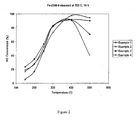
- FIG. 1 is a graph of catalytic behavior of various inventive and comparable fresh Fe-containing ZSM-5 materials in the selective catalytic reduction of NO x .
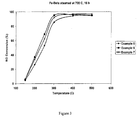
- FIG. 2 is a graph of catalytic behavior of various inventive and comparable hydrothermally aged Fe-containing ZSM-5 in the selective catalytic reduction of NO x .
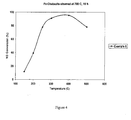
- FIG. 3 is a graph of catalytic behavior of various inventive and comparable hydrothermally aged Fe-beta materials in the selective catalytic reduction of NO x .
- FIG. 4 is a graph of catalytic behavior of hydrothermally aged Fe-chabazite in the selective catalytic reduction of NO x .
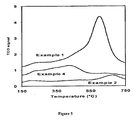
- FIG. 5 is a graph of Hydrogen Temperature-prvgrammed reduction (H 2 -TPR) profiles for fresh samples of Example 1, 2 and 4.
- Zeolites are the aluminosilicate members of the family of microporous solids known as "molecular sieves". This phrase refers to the ability to selectively sort molecules based primarily on a size exclusion process, and is a function of the regular pore structure of molecular dimensions associated with zeolites. The maximum size of the molecular or ionic species that can enter the pores of a zeolite is controlled and defined by the diameters of the rings.
- the term “10 ring” or more commonly “10R” refers to a closed loop that is built from 10 tetrahedrally coordinated silicon (or aluminium) atoms and 10 oxygen atoms.
- the pore openings for all rings of one size are generally not identical, due to various effects, including bond-induced strain.
- the present disclosure is directed to a variety of zeolites, including those encompassed by 8R to 18R zeolites, and methods of making those zeolites.
- NH 3 storage is a central feature of NH 3 -SCR (selective catalytic reduction of nitrogen oxides using NH 3 ) catalysts, because NO x (NO + NO 2 ) in exhaust gas can react with stored NH 3 in the absence of NH 3 in the feed.
- NH 3 storage sites help reduce ammonia slip and can also allow flexibility for the NH 3 dosing strategy.
- Framework Al-sites in zeolites are acidic and adsorb NH 3 readily and are thus suitable as NH 3 storage sites. The importance of acid sites for NH 3 -SCR has been discussed in Applied Catalysis B: Environmental, vol. 66, pp. 208-216, 2006 .
- NO oxidation is an important step in the overall NH 3 -SCR reaction, especially in cases where NO 2 is absent in the feed, i.e. when the NO/NO x ratio is close to unity.
- Fe-exchanged zeolites have been studied for NH 3 -SCR, and NO oxidation has been suggested to be a key step for the reaction on these materials ( Applied Catalysis A: General, vol. 235, pp. 241-251, 2002 ).
- the iron-containing aluminosilicate zeolites described herein contain acid sites, framework iron, and exchangeable Fe-sites.
- Aluminum atoms in the zeolite framework create acid sites that are necessary for NH 3 storage for SCR reaction.
- Part of Fe is in the framework after synthesis and part of Fe will be present at exchange sites when the Fe content in the material is sufficiently high.
- Such iron-containing zeolite as fresh is active for NH 3 -SCR reaction.
- the framework iron will migrate out of the framework during hydrothermal aging, and the framework Fe then becomes a source for providing additional Fe to exchange sites needed for SCR reaction.
- the novel iron-containing zeolites are more durable for NH 3 -SCR reaction upon hydrothermal aging or in a practical use than a conventional Fe-exchanged zeolite or Fe-silicate without aluminum.
- an iron-containing aluminosilicate zeolite wherein the structure of the zeolite has both framework iron and iron cations on the ion-exchange sites.
- framework iron refers to iron cations present in the framework of an aluminosilicate zeolite to balance the negative charge of the zeolite. Framework iron is inactive and generally the result of direct synthesis, not ion-exchange or impregnation.
- the phrase "iron cations on ion-exhange sites” (or any version thereof) refers to iron cations that are not in the zeolite framework and are active for NO x reduction. Iron cations on ion-exhange sites may result from ion-exchange or, as in the present case, may also result from direct synthesis.
- the inventors have discovered the product according to the present disclosure wherein the structure of the zeolite has both framework iron and iron cations on the ion-exchange sites. Therefore, the zeolites of the present invention are active even in the absence of an activation step and they remain active after exposure to steam and/or heat.
- a method of making iron-containing aluminosilicate zeolites that is based on the ability to add an iron constituent during the synthesis step of the zeolite.
- the phrase "direct synthesis" refers to a method that does not require a metal-doping process after the zeolite has been formed, such as a subsequent ion-exchange or impregnation method.
- the Inventors have discovered that the direct synthesis method according to the present disclosure makes it easier to control the amount of iron in the zeolite than traditional ion-exchange and impregnation methods.
- the method does not require an additional step to extract the transition metal from the zeolite framework, such as steam treatment, as active iron is already present in the zeolite.
- the iron-containing aluminosilicate zeolites made according to the present disclosure are hydrothermally stable.
- hydrothermally stable refers to the ability to retain at least some catalytic activity under high temperature conditions of use, such as under traditional driving conditions of an automobile.
- zeolites made according to the present disclosure are hydrothermally stable at 700°C for 16 hours.
- the resulting iron-containing aluminosilicate zeolite is hydrothermally stable in the presence of sulfur compounds since sulfur or sulfur compounds are typically found in exhaust gases of coal-fired power plants and of turbines or other engines fueled with sulfur-containing fuels, such as fuel oils and the like.
- a method of making a iron-containing aluminosilicate zeolite that comprises adding an Iron constituent during synthesis of the zeolite.
- the direct addition of the iron constituent enables the synthesis of an aluminosilicate zeolite with at least 0.2% by weight, and more typically from 1.0 to 5.0 % by weight of iron, such as Fe2+ and Fe3+.
- the inventive method adds the iron constituent during the synthesis process, and not on the finished zeolite, e.g., not after calcination.
- the present invention also does not require an additional step to extract the transition metal from the zeolite framework, such as steam treatment.
- another benefit of the present invention is that it enables the inventive material to be coated on a monolithic substrate and the entire substrate be calcined.
- the iron-containing aluminosilicate zeolite described herein is made via a direct synthesis process.
- additional iron cations and/or at least one additional metal cation on the ion-exchange sites via an ion-exchange process is chosen from copper, manganese, cobalt, and silver.
- the iron-containing aluminosilicate zeolite described herein may exhibit a selective catalytic reduction of nitrogen oxides with NH 3 or urea of greater than 40% conversion at temperatures at 250-300°C in exhaust gases prior to aging or exposure to steam.
- the iron-containing aluminosilicate zeolite described herein exhibits a selective catalytic reduction of nitrogen oxides with NH 3 or urea of greater than 80% conversion at temperatures between 300°C and 500°C in exhaust gases after hydrothermal aging or exposure to steam.
- the present method is directed to making by direct synthesis any type of iron-containing aluminosilicate zeolite by mixing a source of alumina, a source of silica, a source of iron, and optionally with a structural directing agent to directly synthesize iron-containing aluminosilicate zeolites.
- a structural directing agent to directly synthesize iron-containing aluminosilicate zeolites.
- the use of structural directing agent could vary.
- a method of making iron-Beta zeolites by mixing the sources of alumina, silica and iron with water and an organic structural directing agent, such as tetraethylammonium hydroxide (TEAOH).
- an organic structural directing agent such as tetraethylammonium hydroxide (TEAOH).
- Non-limiting examples of sources of alumina that may be used in the present disclosure include sodium aluminate, aluminum hydroxide, alumina, aluminum nitrate, and aluminum sulfate.
- the method may comprise an additional step of removing any residual sodium from the product. This is typically done via an ion-exchange process with known salts or the like, including ammonium salts of Cl, SO 4 . NO 3 .
- residual sodium is removed prior to calcining by slurrying the product in a desired salt, such as NH 4 NO 3 .
- the source of iron is typically an iron salt is chosen from ferric nitrate, ferric chloride, ferrous chloride, and ferrous sulfate.
- the source of silica may comprise a silica sol, which is typically added under vigorous stirring conditions.
- Non-limiting examples of other sources of silica that might be used include known silicates, such as sodium silicate, and sodium metalsilicate, as well as colloidal silica, silica gel, precipitated silica, silica-alumina, and the like.
- a zeolite source such as a beta-zeolite and ZSM-5, is optionally added in the form of crystallization seeds.
- the crystallization seeds are added in amounts ranging from 0.1 to 5.0% by weight.
- the gel is heated to form a product.
- Heating of the gel may be performed in an autoclave at a temperature ranging from 140°C to 250°C for a time ranging from 4-72 hours, such as 24-48 hours.
- the treatment temperature may be lowered when a zeolite-Y is synthesized. For example, the temperature may range from 80 to 105°C, if a Y-type zeolite is formed.
- the calcination step may be performed after the inventive iron-containing aluminosilicate zeolite is coated on a monolith.
- the product is further subject to an ion-exchange and/or impregnation step to increase the amount of iron or add at least one additional metal, such as copper, manganese, cobalt, and silver.
- a hydrothermally stable iron-containing aluminosilicate zeolite made according to previously described method, including one containing at least 0.2% by weight of Fe2+ or Fe3+ made by a direct synthesis method.
- the iron-containing aluminosilicate zeolite described herein typically has a silica to alumina ratio of 5 to 100, or less than 60, or even 5-50, depending on the type of zeolite.
- a Y-type zeolite typically has a silica to alumina ratio of 5 to 40
- a beta-zeolite has a silica to alumina ratio of 10-80
- a ZSM-5 zeolite has a silica to alumina ratio of 15 to 100.
- a method of using the disclosed iron-containing aluminosilicate zeolite there is disclosed a method of using the disclosed iron-containing aluminosilicate zeolite.
- a typical exhaust gas of a diesel engine contains from about 2 to 15 volume percent oxygen and from about 20 to 500 volume parts per million nitrogen oxides (normally comprising a mixture of NO and NO 2 ).
- the reduction of nitrogen oxides with ammonia to form nitrogen and H 2 O can be catalyzed by metal-promoted zeolites, hence the process is often referred to as the "selective" catalytic reduction ("SCR”) of nitrogen oxides.
- SCR selective catalytic reduction
- a method of SCR of nitrogen oxides in exhaust gases which comprises at least partially contacting an exhaust gas with the iron-containing aluminosilicate zeolite disclosed herein.
- ammonia is typically added to the gaseous stream containing the nitrogen oxides.
- ammonia is used to allow the gaseous stream, when contacted with the inventive ferrialuminosilicate zeolite at elevated temperatures, to catalyze the reduction of nitrogen oxides.
- a urea solution may be used to provide the ammonia to the gaseous stream. This is particularly true when used in automotive exhaust treatment applications and stationary NO x reduction applications.
- Non-limiting examples of the types of exhaust gases that may be treated with the disclosed zeolites include both automotive exhaust, from on and off road vehicles, including diesel engines.
- exhaust from stationary sources such as power plants, stationary diesel engines, and coal-fired plants, may be treated.
- the iron-containing aluminosilicate zeolite of the present invention may be provided in the form of a fine powder which is admixed with or coated by a suitable refractory binder, such as alumina, bentonite, silica, or silica-alumina, and formed into a slurry which is deposited upon a suitable refractory substrate.
- a suitable refractory binder such as alumina, bentonite, silica, or silica-alumina
- the carrier substrate may be "honeycomb" structure. Such carriers are well known in the art as having a many fine, parallel gas flow passages extending therethrough.
- One non-limiting examples of the material used to make the honeycomb structure comprises cordierite, mullite, silicon carbide, alumina, titania, zirconia, silica, alumina-silica, alumina-zirconia, stainless steel, Fe--Cr--Al alloy and the combinations thereof.
- a method of making a monolith coated with an uncalcined iron-containing aluminosilicate zeolite does not require ion-exchange to be performed on a calcined structure, it is possible to coat a monolith with an uncalcined zeolite described herein, and calcine the entire coated structure. This would be beneficial in that it would further ease the processing steps of the zeolite manufacturer.
- This method would comprise mixing a source of alumina, a source of silica, and a structural directing agent with an iron constituent to form an iron containing product and performing at least one heating step on the iron containing product to form a iron-containing aluminosilicate zeolite having at least 0.2%, such as an amount ranging from 1 to 5% by weight of Fe2+ or Fe3+.
- a washcoat or uncalcined zeolite is made, it can be directly coated onto a monolith. The entire coated monolith could then be calcined to remove the structural directing agent.
- the iron-containing aluminosilicate zeolite may be provided in discrete forms (as opposed to a coating on a substrate).
- Non-limiting examples of such forms include pellets, tablets or particles of any other suitable shape, for use in a packed bed, for example.
- the iron-containing aluminosilicate zeolite according to the present invention may also be formed into shaped pieces such as plates, tubes, or the like.
- the gel was loaded into a 2-liter autoclave and heated to 185°C for 24 hours. After cooling, the product was recovered by filtration and washing. X-ray diffraction pattern of the product showed pure-phase ZSM-5 zeolite.
- the solid was slurried in a 3 M NH 4 NO 3 solution and stirred at 80°C for 2 hours. After filtering, washing, and drying, the final product had silica-to-alumina ratio (SAR) of 31 and 2.2 wt.% Fe.
- SAR silica-to-alumina ratio
- the BET surface area of the product was 404 m 2 /g and micropore volume was 0.14 cc/g.
- Crystalline ZSM-5 was obtained after 2 days with identical crystal morphology shown in Journal of Catalysis, vol. 195, pp. 287-297, 2000 .
- the solid was filtered, washed, and dried in the oven.
- the solid was then calcined at 550°C for 10 hours to remove the organic agent.
- the calcined material was slurried in a 2 M NH 4 NO 3 solution and stirred at 80°C for 2 hours. After filtering, washing, and drying, the final product had SAR of 88 and 0.58 wt.% Fe.
- the BET surface area of the calcined product was 432 m 2 /g and micropore volume was 0.15 cc/g.
- Example 3 (Comparable) Fe-containing ZSM-5 (3% Fe, no aluminum) prepared In presence of organic structure direction agent
- the mixture was transferred to a 2-liter autoclave and heated to 170°C for 6 days without agitation.
- the solid was filtered, washed, and dried in the oven. X-ray diffraction pattern showed the solid was a pure ZSM-5 phase.
- the solid was then calcined at 550°C for 6 hours to remove the organic agent.
- the calcined material was slurried in a 2 M NH 4 NO 3 solution and stirred at 80°C for 2 hours. After filtering, washing, and drying, the final product had a Si/Fe molar ratio of 39 and 2.3 wt.% Fe.
- the BET surface area of the calcined product was 427 m 2 /g and micropore volume was 0.14 cc/g.
- the gel was loaded into a 2 liter autoclave and heated to 160°C for 2 days. After cooling, the product was recovered by filtration and washing. X-ray diffraction pattern of the product showed pure-phase Beta zeolite.
- the product was then slurried in a 2 M NH 4 NO 3 solution and stirred at 80°C for 2 hours. After filtering, washing, and drying, the product was calcined at 550°C for 10 hours.
- the final product had silica-to-alumina ratio (SAR) of 24 and 1.1 wt.% Fe.
- SAR silica-to-alumina ratio
- the BET surface area of the calcined product was 728 m 2 /g and micropore volume was 0.20 cc/g.
- Example 9 The synthesis procedures of Example 9 were repeated except that the amount of Fe(NO 3 ) 3 •9H 2 O added was 43.5 grams.
- the gel composition is: 25.7 SiO 2 : 1.0 Al 2 O 3 : 0.21 Fe 2 O 3 : 1.7 Na 2 O : 3.1 TEAOH: 198 H 2 O
- the final product After contacting with NH 4 NO 3 solution and calcination, the final product had SAR of 25 and 1.5 wt.% Fe.
- the BET surface area of the calcined product was 718 m 2 /g and micropore volume was 0.20 cc/g.
- TMAAOH N,N,N-Trimethyl-1-adamantammonium hydroxide solution
- alumina 53 wt.% Al 2 O 3
- Fe(NO 3 ) 3 •9H 2 O 150 grams of dried silica gel ( ⁇ 90% silica) were added to the above mixture under vigorous stirring.
- chabazite zeolite was added to the synthesis gel as crystallization seeds.
- the gel has the following molar composition. 40.0 SiO 2 : 1.0 Al 2 O 3 : 0.22 Fe 2 O 3 : 3.8 Na 2 O : 6.0 TMAAOH : 1000 H 2 O
- the gel was loaded into an autoclave and heated to 160°C for 96 hours. After cooling, the product was recovered by filtration and washing. X-ray diffraction pattern of the product showed pure-phase chabazite zeolite (CHA).
- the product was calcined at 550°C for 10 hours. To remove residual sodium, the product was then slurried in a 2 M NH 4 NO 3 solution and stirred at 80°C for 2 hours. After filtering, washing, and drying, the final product had silica-to-alumina ratio (SAR) of 34 and 1.1 wt.% Fe.
- SAR silica-to-alumina ratio
- the BET surface area of the product was 817 m 2 /g and micropore volume was 0.30 cc/g.
- Figure 1 compares SCR of NO x with NH 3 on fresh Fe-containing ZSM-5 materials made in Examples 1-4 above.
- the samples from comparable Example 2 having low Fe content and high SAR (88) and Example 3 having no aluminum show much lower activity than the sample from inventive Example 1 having high Fe-content and low SAR (31).
- Figure 2 compares SCR of NO x with NH 3 on Fe-containing ZSM-5 materials made by Examples 1-4 above and hydrothermally aged at 700°C for 16 hours in 10% by volume of water vapor.
- the sample from Example 1 shows the highest activity in the low temperature region and also has stable activity in the high temperature region.
- Figure 3 compares SCR of NOx conversion with NH3 on Fe-Beta materials made by Examples 5-7 above and hydrothermally aged at 700°C for 16 hours in 10% by volume of water vapor.
- Figure 4 shows SCR of NOx conversion with NH3 on an Fe-chabazite material made by Example 8 above and hydrothermally aged at 700°C for 16 hours in 10% by volume of water vapor.
- FIG. 5 shows a Hydrogen Temperature-programmed reduction (H 2 -TPR) profiles for fresh samples of Example 1, 2 and 4. [Ramping rate: 10 °C/min. Gas: 15 cc/min 5% H 2 /Ar. The H 2 consumption was measured using a thermal conductivity detector.]
- Example 4 made by an exchange process contains exchanged Fe but no framework Fe and has peaks in the 300-500 °C region corresponding to reduction of exchanged trivalent Fe to divalent Fe.
- Example 2 shows no evidence of exchanged Fe, but only framework Fe with a reduction peak around 650 °C.
- Fresh sample of Example 1 contains framework Fe (peak ⁇ 600°C) and a shoulder at 450-500 °C corresponding to Fe on the exchange sits. The samples with larger amounts of iron on exchange sites are more active for NH 3 -SCR of NO (see Figure 1 ).
Landscapes
- Chemical & Material Sciences (AREA)
- Engineering & Computer Science (AREA)
- Chemical Kinetics & Catalysis (AREA)
- Materials Engineering (AREA)
- Organic Chemistry (AREA)
- Crystallography & Structural Chemistry (AREA)
- Environmental & Geological Engineering (AREA)
- Biomedical Technology (AREA)
- Health & Medical Sciences (AREA)
- Analytical Chemistry (AREA)
- General Chemical & Material Sciences (AREA)
- Oil, Petroleum & Natural Gas (AREA)
- Combustion & Propulsion (AREA)
- Mechanical Engineering (AREA)
- General Engineering & Computer Science (AREA)
- Catalysts (AREA)
- Silicates, Zeolites, And Molecular Sieves (AREA)
- Exhaust Gas Treatment By Means Of Catalyst (AREA)
Applications Claiming Priority (2)
| Application Number | Priority Date | Filing Date | Title |
|---|---|---|---|
| US93543607P | 2007-08-13 | 2007-08-13 | |
| EP08795258A EP2192982A2 (en) | 2007-08-13 | 2008-08-13 | Novel iron-containing aluminosilicate zeolites and methods of making and using same |
Related Parent Applications (1)
| Application Number | Title | Priority Date | Filing Date |
|---|---|---|---|
| EP08795258A Division EP2192982A2 (en) | 2007-08-13 | 2008-08-13 | Novel iron-containing aluminosilicate zeolites and methods of making and using same |
Publications (1)
| Publication Number | Publication Date |
|---|---|
| EP2689846A1 true EP2689846A1 (en) | 2014-01-29 |
Family
ID=40262119
Family Applications (2)
| Application Number | Title | Priority Date | Filing Date |
|---|---|---|---|
| EP13005098.2A Ceased EP2689846A1 (en) | 2007-08-13 | 2008-08-13 | Selective catalytic reduction of nitrogen oxides in the presence of iron-containing aluminosilicate zeolites |
| EP08795258A Withdrawn EP2192982A2 (en) | 2007-08-13 | 2008-08-13 | Novel iron-containing aluminosilicate zeolites and methods of making and using same |
Family Applications After (1)
| Application Number | Title | Priority Date | Filing Date |
|---|---|---|---|
| EP08795258A Withdrawn EP2192982A2 (en) | 2007-08-13 | 2008-08-13 | Novel iron-containing aluminosilicate zeolites and methods of making and using same |
Country Status (5)
| Country | Link |
|---|---|
| US (2) | US8541331B2 (enExample) |
| EP (2) | EP2689846A1 (enExample) |
| JP (2) | JP6176891B2 (enExample) |
| CN (2) | CN102764590B (enExample) |
| WO (1) | WO2009023202A2 (enExample) |
Families Citing this family (78)
| Publication number | Priority date | Publication date | Assignee | Title |
|---|---|---|---|---|
| US7998423B2 (en) | 2007-02-27 | 2011-08-16 | Basf Corporation | SCR on low thermal mass filter substrates |
| AR065501A1 (es) * | 2007-02-27 | 2009-06-10 | Basf Catalysts Llc | Catalizadores de zeolita cha de cobre |
| US10384162B2 (en) * | 2007-03-26 | 2019-08-20 | Pq Corporation | High silica chabazite for selective catalytic reduction, methods of making and using same |
| MX2009011443A (es) | 2007-04-26 | 2010-01-18 | Johnson Matthey Plc | Catalizadores de reduccion catalitica selectiva de metal de transicion/zeolita. |
| US20090196812A1 (en) * | 2008-01-31 | 2009-08-06 | Basf Catalysts Llc | Catalysts, Systems and Methods Utilizing Non-Zeolitic Metal-Containing Molecular Sieves Having the CHA Crystal Structure |
| JP5670320B2 (ja) * | 2008-06-06 | 2015-02-18 | トタル リサーチ アンド テクノロジー フエリユイ | 結晶質メタロシリケートの製造方法 |
| EP2161242A1 (en) * | 2008-08-29 | 2010-03-10 | Total Petrochemicals Research Feluy | Method for Preparing Crystalline Metalloaluminophosphate (MeAPO) Molecular Sieve from Amorphous Materials |
| US10583424B2 (en) | 2008-11-06 | 2020-03-10 | Basf Corporation | Chabazite zeolite catalysts having low silica to alumina ratios |
| KR101251499B1 (ko) * | 2008-12-05 | 2013-04-05 | 오덱(주) | 질소 산화물 제거용 제올라이트 촉매, 이의 제조 방법 및 이를 이용한 질소 산화물 제거 방법 |
| CN104876237A (zh) | 2009-06-18 | 2015-09-02 | 巴斯夫欧洲公司 | 生产沸石材料的无有机模板合成方法 |
| US8865121B2 (en) | 2009-06-18 | 2014-10-21 | Basf Se | Organotemplate-free synthetic process for the production of a zeolitic material |
| GB2475740B (en) * | 2009-11-30 | 2017-06-07 | Johnson Matthey Plc | Catalysts for treating transient NOx emissions |
| US8293199B2 (en) * | 2009-12-18 | 2012-10-23 | Basf Corporation | Process for preparation of copper containing molecular sieves with the CHA structure, catalysts, systems and methods |
| US8293198B2 (en) * | 2009-12-18 | 2012-10-23 | Basf Corporation | Process of direct copper exchange into Na+-form of chabazite molecular sieve, and catalysts, systems and methods |
| JP5594121B2 (ja) * | 2009-12-22 | 2014-09-24 | 東ソー株式会社 | 新規メタロシリケート及び窒素酸化物浄化触媒 |
| CN102666387B (zh) * | 2009-12-22 | 2015-04-01 | 东曹株式会社 | 新型金属硅酸盐及其生产方法、氮氧化物除去催化剂及其生产方法和使用所述催化剂的氮氧化物除去方法 |
| JP5609620B2 (ja) * | 2009-12-25 | 2014-10-22 | 東ソー株式会社 | 新規メタロシリケート |
| US8440586B2 (en) * | 2010-02-26 | 2013-05-14 | Corning Incorporated | Low pressure drop extruded catalyst filter |
| JP5882238B2 (ja) * | 2010-03-11 | 2016-03-09 | ジョンソン、マッセイ、パブリック、リミテッド、カンパニーJohnson Matthey Publiclimited Company | NOxの選択触媒還元のための無秩序なモレキュラーシーブ担体 |
| US9352307B2 (en) | 2010-04-08 | 2016-05-31 | Basf Corporation | Cu-CHA/Fe-MFI mixed zeolite catalyst and process for the treatment of NOx in gas streams |
| CN102946998A (zh) * | 2010-04-08 | 2013-02-27 | 巴斯夫欧洲公司 | Cu-CHA/Fe-MFI混合沸石催化剂和使用其处理气流中的NOx的方法 |
| CN102971065B (zh) * | 2010-05-21 | 2015-11-25 | Pq公司 | 用于NOx还原的新型含金属的沸石β |
| FR2962923B1 (fr) * | 2010-07-22 | 2015-01-02 | Peugeot Citroen Automobiles Sa | Composition catalytique et dispositif de traitement des gaz comprenant une telle composition |
| US8987161B2 (en) | 2010-08-13 | 2015-03-24 | Ut-Battelle, Llc | Zeolite-based SCR catalysts and their use in diesel engine emission treatment |
| US8987162B2 (en) | 2010-08-13 | 2015-03-24 | Ut-Battelle, Llc | Hydrothermally stable, low-temperature NOx reduction NH3-SCR catalyst |
| EP2441513B1 (en) * | 2010-10-13 | 2013-08-07 | Ibiden Co., Ltd. | Honeycomb catalyst body and method for manufacturing honeycomb catalyst body |
| JP5625735B2 (ja) * | 2010-10-22 | 2014-11-19 | 東ソー株式会社 | 高耐熱水性scr触媒及びその製造方法 |
| CN102464326B (zh) * | 2010-11-04 | 2013-10-09 | 中国石油化工股份有限公司 | 合成高硅丝光沸石的方法 |
| EP2646149B1 (en) * | 2010-12-02 | 2020-03-25 | Johnson Matthey Public Limited Company | Zeolite catalyst containing metal |
| US20120251422A1 (en) * | 2011-04-04 | 2012-10-04 | Pq Corporation | Fe-SAPO-34 CATALYST AND METHODS OF MAKING AND USING THE SAME |
| WO2012145323A1 (en) * | 2011-04-18 | 2012-10-26 | Pq Corporation | Large crystal, organic-free chabazite, methods of making and using the same |
| US9539565B2 (en) | 2011-05-17 | 2017-01-10 | Tosoh Corporation | B-type iron silicate composition and method for reducing nitrogen oxides |
| WO2013035077A1 (en) * | 2011-09-09 | 2013-03-14 | Basf Se | Process for the organotemplate-free synthetic production of a zeolitic material using recycled mother liquor |
| JP5821540B2 (ja) * | 2011-11-07 | 2015-11-24 | いすゞ自動車株式会社 | 尿素scr触媒の製造方法 |
| JP5817522B2 (ja) * | 2011-12-28 | 2015-11-18 | いすゞ自動車株式会社 | 尿素scr触媒の製造方法 |
| JP5970927B2 (ja) * | 2012-04-05 | 2016-08-17 | いすゞ自動車株式会社 | 尿素scr触媒の製造方法 |
| JP5988743B2 (ja) * | 2012-07-18 | 2016-09-07 | ユニゼオ株式会社 | Fe(II)置換ベータ型ゼオライト、それを含むガス吸着剤及びその製造方法、並びに一酸化窒素及びハイドロカーボンの除去方法 |
| JP6127232B2 (ja) * | 2012-07-19 | 2017-05-17 | 株式会社 Acr | 抗シンタリング触媒 |
| JP6028195B2 (ja) * | 2012-07-19 | 2016-11-16 | 株式会社ゼオライト・アーティフィシャル | ゼオライト金属塩複合体及びその製造方法 |
| KR102143811B1 (ko) | 2012-08-17 | 2020-08-12 | 존슨 맛쎄이 퍼블릭 리미티드 컴파니 | 제올라이트 촉진된 V/Tⅰ/W 촉매 |
| EP2908944B1 (en) | 2012-10-19 | 2025-03-19 | BASF Mobile Emissions Catalysts LLC | 8-ring small pore molecular sieve with promoter to improve low temperature performance |
| PL2908946T3 (pl) | 2012-10-19 | 2021-03-08 | Basf Corporation | 8-pierścieniowe sito molekularne o małych porach jako katalizator wysokotemperaturowy scr |
| JP6058433B2 (ja) | 2013-03-12 | 2017-01-11 | ユニゼオ株式会社 | ハイドロカーボンリフォーマトラップ材及びハイドロカーボンの除去方法 |
| JP6153196B2 (ja) * | 2013-06-14 | 2017-06-28 | ユニゼオ株式会社 | Mn+置換ベータ型ゼオライト、それを含むガス吸着剤及びその製造方法、並びに一酸化窒素の除去方法 |
| WO2015077484A1 (en) | 2013-11-25 | 2015-05-28 | University Of Idaho | Biochar water treatment |
| US11207666B2 (en) | 2013-12-02 | 2021-12-28 | Johnson Matthey Public Limited Company | Mixed template synthesis of high silica Cu-CHA |
| US20150231617A1 (en) * | 2014-02-19 | 2015-08-20 | Ford Global Technologies, Llc | Fe-SAPO-34 CATALYST FOR USE IN NOX REDUCTION AND METHOD OF MAKING |
| US20150231620A1 (en) * | 2014-02-19 | 2015-08-20 | Ford Global Technologies, Llc | IRON-ZEOLITE CHABAZITE CATALYST FOR USE IN NOx REDUCTION AND METHOD OF MAKING |
| JP2017512630A (ja) * | 2014-02-28 | 2017-05-25 | ジョンソン、マッセイ、パブリック、リミテッド、カンパニーJohnson Matthey Public Limited Company | 低温性能が改善されたscr触媒及びその製造ならびに使用方法 |
| US20150290632A1 (en) * | 2014-04-09 | 2015-10-15 | Ford Global Technologies, Llc | IRON AND COPPER-CONTAINING CHABAZITE ZEOLITE CATALYST FOR USE IN NOx REDUCTION |
| JP6126141B2 (ja) * | 2014-05-30 | 2017-05-10 | トヨタ自動車株式会社 | 排ガス浄化用触媒の製造方法 |
| CN107073377B (zh) | 2014-09-03 | 2021-02-26 | 康宁股份有限公司 | 具有活性堵塞物的废气过滤器 |
| KR20170083606A (ko) * | 2014-11-14 | 2017-07-18 | 존슨 맛쎄이 퍼블릭 리미티드 컴파니 | Afx 제올라이트 |
| JP2018505120A (ja) | 2015-01-29 | 2018-02-22 | ジョンソン、マッセイ、パブリック、リミテッド、カンパニーJohnson Matthey Public Limited Company | Sapo−34(cha)型材料への鉄錯体の直接的な取り込み |
| CN105032163A (zh) * | 2015-07-02 | 2015-11-11 | 黄立维 | 一种从气流中去除氮氧化物和二氧化硫的方法及其装置 |
| WO2017109705A1 (en) * | 2015-12-22 | 2017-06-29 | Basf Corporation | Process for preparing iron(iii)-exchanged zeolite composition |
| KR102688876B1 (ko) * | 2016-02-01 | 2024-07-29 | 토프쉐 에이/에스 | 철-함유 aei-제올라이트 촉매의 직접 합성 방법 |
| CN105921170A (zh) * | 2016-05-03 | 2016-09-07 | 新疆大学 | 用于烟气脱硝的新型纳米级FeZSM-5催化剂的技术方法 |
| KR101679793B1 (ko) * | 2016-06-08 | 2016-11-25 | 한국건설기술연구원 | 철성분 함유 다공성 제올라이트의 제조방법 및 이에 의해 제조된 다공성 제올라이트 |
| CN106187595A (zh) * | 2016-07-12 | 2016-12-07 | 山东胜伟园林科技有限公司 | 一种基于脱硫石膏的盐碱地改良肥的配方 |
| RU2770116C2 (ru) * | 2016-08-05 | 2022-04-14 | Басф Корпорейшн | Изделия и системы для селективного каталитического восстановления |
| RU2020102860A (ru) * | 2017-07-11 | 2021-08-11 | Шелл Интернэшнл Рисерч Маатсхаппий Б.В. | Катализатор и способ его применения для конверсии nox и n2o |
| KR102578657B1 (ko) * | 2017-07-11 | 2023-09-15 | 쉘 인터내셔날 리써취 마트샤피지 비.브이. | 촉매 및 이의 사용 방법 |
| CN107899608B (zh) * | 2017-11-24 | 2020-07-28 | 中国科学院长春应用化学研究所 | 一种自支撑金属改性Beta分子筛的制备方法及其在合成异戊二烯中的应用 |
| CN108217681B (zh) * | 2018-01-19 | 2021-07-06 | 山东齐鲁华信高科有限公司 | 一种高铁含量的Fe-ZSM-5分子筛的制备方法 |
| EP3768638A4 (en) * | 2018-03-21 | 2021-12-29 | BASF Corporation | Cha zeolite material and related method of synthesis |
| US20190321761A1 (en) * | 2018-04-18 | 2019-10-24 | Kohler Co. | Filter member and method of making same |
| JP7176717B2 (ja) * | 2018-05-02 | 2022-11-22 | 公立大学法人北九州市立大学 | ゼオライト構造体・ゼオライト担持白金構造体とゼオライト構造体の製造方法、1,3-ブタジエンの製造方法 |
| CN108751335A (zh) * | 2018-05-04 | 2018-11-06 | 中山大学 | 一种光-芬顿体系协同催化氧化降解水环境中抗生素的方法 |
| US11278874B2 (en) * | 2018-11-30 | 2022-03-22 | Johnson Matthey Public Limited Company | Enhanced introduction of extra-framework metal into aluminosilicate zeolites |
| GB201900484D0 (en) * | 2019-01-14 | 2019-02-27 | Johnson Matthey Catalysts Germany Gmbh | Iron-loaded small pore aluminosilicate zeolites and method of making metal loaded small pore aluminosilicate zeolites |
| CN115870014A (zh) * | 2019-01-18 | 2023-03-31 | 康明斯排放处理公司 | 具有增强的抗硫性的经处理的scr催化剂 |
| WO2020222105A2 (en) * | 2019-04-27 | 2020-11-05 | Sud Chemie India Pvt. Ltd. | Methods of preparation of metal exchanged zeolites |
| EP4021638A4 (en) * | 2019-08-29 | 2023-11-08 | BASF Corporation | IRON ACTIVATED ZEOLITE AND CATALYST MADE THEREFROM |
| JP2023502595A (ja) | 2019-11-19 | 2023-01-25 | ビーエーエスエフ コーポレーション | ゼオライト合成 |
| CN117430126B (zh) * | 2022-07-12 | 2026-03-24 | 中国石油化工股份有限公司 | 一种含铁zsm-5分子筛及其制备方法和应用 |
| US20240174524A1 (en) * | 2022-11-29 | 2024-05-30 | Saudi Arabian Oil Company | Method for synthesizing nano-sized zeolite beta |
| CN118047392A (zh) * | 2024-01-08 | 2024-05-17 | 黄冈师范学院 | 一种Fe-Beta分子筛、制备及作为脱硝催化剂的应用 |
Citations (8)
| Publication number | Priority date | Publication date | Assignee | Title |
|---|---|---|---|---|
| US4952385A (en) | 1987-03-02 | 1990-08-28 | Georgia Tech Research Corp. | Ferrisilicate molecular sieve and use as a catalyst |
| US4961917A (en) | 1989-04-20 | 1990-10-09 | Engelhard Corporation | Method for reduction of nitrogen oxides with ammonia using promoted zeolite catalysts |
| US5256614A (en) * | 1992-04-27 | 1993-10-26 | N. E. Chemcat Corporation | Catalyst for purification of exhaust gas |
| US5451387A (en) | 1994-07-07 | 1995-09-19 | Mobil Oil Corporation | Selective catalytic reduction of nitrogen oxides using an iron impregnated zeolite catalyst |
| US6689709B1 (en) | 2000-11-15 | 2004-02-10 | Engelhard Corporation | Hydrothermally stable metal promoted zeolite beta for NOx reduction |
| US6843971B2 (en) * | 2000-04-22 | 2005-01-18 | Umicore Ag & Co. Kg | Process and catalyst for reducing nitrogen oxides |
| US6890501B2 (en) | 1999-02-18 | 2005-05-10 | Genevieve Neveu | Method for simultaneously abating nitric oxides and nitrous oxides in gases containing them |
| US20060088469A1 (en) | 2002-11-25 | 2006-04-27 | Yara International Asa | Method for preparation and activation of multimetallic zeolite catalysts, a catalyst composition and application for n2o abatement |
Family Cites Families (8)
| Publication number | Priority date | Publication date | Assignee | Title |
|---|---|---|---|---|
| US5185136A (en) * | 1985-08-08 | 1993-02-09 | Exxon Research And Engineering Co. | Trivalent transition-metal-aluminosilicate hydrocarbon conversion catalysts having mazzite-like structures, ECR-23-T (C-2491) |
| DD281172A5 (de) * | 1988-03-28 | 1990-08-01 | Akad Wissenschaften Ddr | Zeolithischer katalysator und verfahren zu seiner herstellung |
| JP2659840B2 (ja) * | 1990-02-05 | 1997-09-30 | 三菱重工業株式会社 | 窒素酸化物含有排ガスの浄化方法 |
| US5676912A (en) * | 1995-02-22 | 1997-10-14 | Mobil Oil Corporation | Process for exhaust gas NOx, CO, and hydrocarbon removal |
| JP3839565B2 (ja) * | 1997-01-20 | 2006-11-01 | 日本碍子株式会社 | 高シリカ珪酸塩系分子篩の合成方法 |
| US6914026B2 (en) * | 2001-09-07 | 2005-07-05 | Engelhard Corporation | Hydrothermally stable metal promoted zeolite beta for NOx reduction |
| FR2869894B1 (fr) * | 2004-05-10 | 2007-02-23 | Inst Francais Du Petrole | Methode de synthese de metalloaluminosilicate cristallise par synthese directe |
| JP4957176B2 (ja) * | 2006-10-24 | 2012-06-20 | 東ソー株式会社 | 窒素酸化物浄化触媒及び窒素酸化物浄化方法 |
-
2008
- 2008-08-13 JP JP2010521012A patent/JP6176891B2/ja active Active
- 2008-08-13 US US12/190,993 patent/US8541331B2/en active Active
- 2008-08-13 WO PCT/US2008/009653 patent/WO2009023202A2/en not_active Ceased
- 2008-08-13 EP EP13005098.2A patent/EP2689846A1/en not_active Ceased
- 2008-08-13 EP EP08795258A patent/EP2192982A2/en not_active Withdrawn
- 2008-08-13 CN CN201210123893.XA patent/CN102764590B/zh not_active Expired - Fee Related
- 2008-08-13 CN CN2008801030115A patent/CN101827654B/zh active Active
-
2010
- 2010-02-16 US US12/706,655 patent/US8512659B2/en active Active
-
2015
- 2015-05-27 JP JP2015107726A patent/JP2015205270A/ja active Pending
Patent Citations (9)
| Publication number | Priority date | Publication date | Assignee | Title |
|---|---|---|---|---|
| US4952385A (en) | 1987-03-02 | 1990-08-28 | Georgia Tech Research Corp. | Ferrisilicate molecular sieve and use as a catalyst |
| US4961917A (en) | 1989-04-20 | 1990-10-09 | Engelhard Corporation | Method for reduction of nitrogen oxides with ammonia using promoted zeolite catalysts |
| US5256614A (en) * | 1992-04-27 | 1993-10-26 | N. E. Chemcat Corporation | Catalyst for purification of exhaust gas |
| US5451387A (en) | 1994-07-07 | 1995-09-19 | Mobil Oil Corporation | Selective catalytic reduction of nitrogen oxides using an iron impregnated zeolite catalyst |
| US6890501B2 (en) | 1999-02-18 | 2005-05-10 | Genevieve Neveu | Method for simultaneously abating nitric oxides and nitrous oxides in gases containing them |
| US6843971B2 (en) * | 2000-04-22 | 2005-01-18 | Umicore Ag & Co. Kg | Process and catalyst for reducing nitrogen oxides |
| US6689709B1 (en) | 2000-11-15 | 2004-02-10 | Engelhard Corporation | Hydrothermally stable metal promoted zeolite beta for NOx reduction |
| US7118722B2 (en) | 2000-11-15 | 2006-10-10 | Engelhard Corporation | Hydrothermally stable metal promoted zeolite beta for NOx reduction |
| US20060088469A1 (en) | 2002-11-25 | 2006-04-27 | Yara International Asa | Method for preparation and activation of multimetallic zeolite catalysts, a catalyst composition and application for n2o abatement |
Non-Patent Citations (12)
| Title |
|---|
| A. BRÜCKNER ET AL.: "E.p.r. study on the incorporation of Fe(III) ions in ZSM-5 zeolites in dependence on the preparation conditions", ZEOLITES, vol. 12, 1992, pages 380 - 385, XP002515106 * |
| APPLIED CATALYSIS A: GENERAL, vol. 235, 2002, pages 241 - 251 |
| APPLIED CATALYSIS B: ENVIRONMENTAL, vol. 66, 2006, pages 208 - 216 |
| AZHAR UDDIN ET AL: "SELECTIVE CATALYTIC REDUCTION OF NITRIC OXIDE WITH AMMONIA ON MFI- TYPE FERRISILICATE", JOURNAL OF THE CHEMICAL SOCIETY. FARADAY TRANSACTIONS, ROYAL SOCIETY OF CHEMISTRY, CAMBRIDGE, GB, vol. 91, no. 18, 21 September 1995 (1995-09-21), pages 3275 - 3279, XP000531630, ISSN: 0956-5000 * |
| JOURNAL OF CATALYSIS, vol. 100, no. 2, 1986, pages 555 - 7 |
| JOURNAL OF CATALYSIS, vol. 195, 2000, pages 287 - 297 |
| JOURNAL OF PHYSICAL CHEMISTRY, vol. 89, 1985, pages 1569 - 71 |
| KOMATSU T ET AL: "CU2+-EXCHANGED MFI-FERRISILICATE CATALYSTS FOR THE REDUCTION OF NITRIC OXIDE WITH AMMONIA", JOURNAL OF THE CHEMICAL SOCIETY. FARADAY TRANSACTIONS, ROYAL SOCIETY OF CHEMISTRY, CAMBRIDGE, GB, vol. 94, no. 7, 7 April 1998 (1998-04-07), pages 949 - 953, XP000767955, ISSN: 0956-5000 * |
| M AMIRIDIS: "Kinetic and Infrared Spectroscopic Studies of Fe-Y Zeolites for the Selective Catalytic Reduction of Nitric Oxide by Ammonia", JOURNAL OF CATALYSIS, vol. 142, no. 2, 1 August 1993 (1993-08-01), pages 572 - 584, XP055092463, ISSN: 0021-9517, DOI: 10.1006/jcat.1993.1232 * |
| P. WU ET AL.: "Isomorphous substitution of Fe3+ in the framework of aluminosilicate mordenite by hydrothermal synthesis", MICROPOROUS AND MESOPOROUS MATERIALS, vol. 20, 1998, pages 139 - 147, XP002515319 * |
| PEREZ-RAMIREZ J ET AL: "Evolution of isomorphously substituted iron zeolites during activation: comparison of Fe-beta and Fe-ZSM-5", JOURNAL OF CATALYSIS, ACADEMIC PRESS, DULUTH, MN, US, vol. 232, no. 2, 10 June 2005 (2005-06-10), pages 318 - 334, XP004905894, ISSN: 0021-9517 * |
| ZEOLITES, vol. 11, no. 1, 1991, pages 42 - 7 |
Also Published As
| Publication number | Publication date |
|---|---|
| US8512659B2 (en) | 2013-08-20 |
| CN102764590A (zh) | 2012-11-07 |
| US20100143224A1 (en) | 2010-06-10 |
| EP2192982A2 (en) | 2010-06-09 |
| JP6176891B2 (ja) | 2017-08-09 |
| CN101827654A (zh) | 2010-09-08 |
| CN101827654B (zh) | 2013-11-06 |
| JP2015205270A (ja) | 2015-11-19 |
| JP2010536692A (ja) | 2010-12-02 |
| CN102764590B (zh) | 2015-05-13 |
| WO2009023202A2 (en) | 2009-02-19 |
| US20090048095A1 (en) | 2009-02-19 |
| WO2009023202A3 (en) | 2009-04-23 |
| US8541331B2 (en) | 2013-09-24 |
Similar Documents
| Publication | Publication Date | Title |
|---|---|---|
| US8512659B2 (en) | Iron-containing aluminosilicate zeolites and methods of making and using same | |
| US11786864B2 (en) | Metal-containing zeolite beta for NOx reduction and methods of making the same | |
| JP5261189B2 (ja) | Nox選択的触媒還元効率の改善されたゼオライト触媒 | |
| EP3388392B1 (en) | Copper-containing zeolites having a low alkali metal content, method of making thereof, and their use as scr catalysts | |
| EP2150328B1 (en) | SCR METHOD AND SYSTEM USING Cu/SAPO-34 ZEOLITE CATALYST | |
| KR20030059250A (ko) | NOx 환원을 위한 열수 안정성 금속-촉진 제올라이트 베타 | |
| KR20040034701A (ko) | NOx 환원을 위한 열수 안정성 금속-촉진 제올라이트베타 | |
| US20240075466A1 (en) | One-Pot Synthesis of Transition Metal-Promoted Chabazites | |
| KR20250170043A (ko) | 개질된 구리 제올라이트, 및 NOx를 함유하는 가스 스트림의 처리를 위한 이의 사용 방법 |
Legal Events
| Date | Code | Title | Description |
|---|---|---|---|
| PUAI | Public reference made under article 153(3) epc to a published international application that has entered the european phase |
Free format text: ORIGINAL CODE: 0009012 |
|
| AC | Divisional application: reference to earlier application |
Ref document number: 2192982 Country of ref document: EP Kind code of ref document: P |
|
| AK | Designated contracting states |
Kind code of ref document: A1 Designated state(s): AT BE BG CH CY CZ DE DK EE ES FI FR GB GR HR HU IE IS IT LI LT LU LV MC MT NL NO PL PT RO SE SI SK TR |
|
| AX | Request for extension of the european patent |
Extension state: MK |
|
| RIN1 | Information on inventor provided before grant (corrected) |
Inventor name: WILLIAM E. CORMIER Inventor name: BJORN MODEN Inventor name: HONG-XIN LI |
|
| 17P | Request for examination filed |
Effective date: 20140729 |
|
| RAX | Requested extension states of the european patent have changed |
Extension state: MK Payment date: 20140729 |
|
| RBV | Designated contracting states (corrected) |
Designated state(s): AT BE BG CH CY CZ DE DK EE ES FI FR GB GR HR HU IE IS IT LI LT LU LV MC MT NL NO PL PT RO SE SI SK TR |
|
| 17Q | First examination report despatched |
Effective date: 20160311 |
|
| STAA | Information on the status of an ep patent application or granted ep patent |
Free format text: STATUS: EXAMINATION IS IN PROGRESS |
|
| STAA | Information on the status of an ep patent application or granted ep patent |
Free format text: STATUS: THE APPLICATION HAS BEEN REFUSED |
|
| 18R | Application refused |
Effective date: 20220602 |