EP2668239B1 - High temperature stable thermally conductive materials - Google Patents
High temperature stable thermally conductive materials Download PDFInfo
- Publication number
- EP2668239B1 EP2668239B1 EP12702642.5A EP12702642A EP2668239B1 EP 2668239 B1 EP2668239 B1 EP 2668239B1 EP 12702642 A EP12702642 A EP 12702642A EP 2668239 B1 EP2668239 B1 EP 2668239B1
- Authority
- EP
- European Patent Office
- Prior art keywords
- composition
- component
- thermally conductive
- metal
- oxide
- Prior art date
- Legal status (The legal status is an assumption and is not a legal conclusion. Google has not performed a legal analysis and makes no representation as to the accuracy of the status listed.)
- Active
Links
Images
Classifications
-
- C—CHEMISTRY; METALLURGY
- C09—DYES; PAINTS; POLISHES; NATURAL RESINS; ADHESIVES; COMPOSITIONS NOT OTHERWISE PROVIDED FOR; APPLICATIONS OF MATERIALS NOT OTHERWISE PROVIDED FOR
- C09K—MATERIALS FOR MISCELLANEOUS APPLICATIONS, NOT PROVIDED FOR ELSEWHERE
- C09K5/00—Heat-transfer, heat-exchange or heat-storage materials, e.g. refrigerants; Materials for the production of heat or cold by chemical reactions other than by combustion
- C09K5/08—Materials not undergoing a change of physical state when used
- C09K5/14—Solid materials, e.g. powdery or granular
-
- C—CHEMISTRY; METALLURGY
- C08—ORGANIC MACROMOLECULAR COMPOUNDS; THEIR PREPARATION OR CHEMICAL WORKING-UP; COMPOSITIONS BASED THEREON
- C08G—MACROMOLECULAR COMPOUNDS OBTAINED OTHERWISE THAN BY REACTIONS ONLY INVOLVING UNSATURATED CARBON-TO-CARBON BONDS
- C08G77/00—Macromolecular compounds obtained by reactions forming a linkage containing silicon with or without sulfur, nitrogen, oxygen or carbon in the main chain of the macromolecule
- C08G77/04—Polysiloxanes
-
- C—CHEMISTRY; METALLURGY
- C08—ORGANIC MACROMOLECULAR COMPOUNDS; THEIR PREPARATION OR CHEMICAL WORKING-UP; COMPOSITIONS BASED THEREON
- C08K—Use of inorganic or non-macromolecular organic substances as compounding ingredients
- C08K3/00—Use of inorganic substances as compounding ingredients
- C08K3/18—Oxygen-containing compounds, e.g. metal carbonyls
- C08K3/20—Oxides; Hydroxides
- C08K3/22—Oxides; Hydroxides of metals
-
- C—CHEMISTRY; METALLURGY
- C08—ORGANIC MACROMOLECULAR COMPOUNDS; THEIR PREPARATION OR CHEMICAL WORKING-UP; COMPOSITIONS BASED THEREON
- C08K—Use of inorganic or non-macromolecular organic substances as compounding ingredients
- C08K5/00—Use of organic ingredients
- C08K5/0091—Complexes with metal-heteroatom-bonds
-
- C—CHEMISTRY; METALLURGY
- C08—ORGANIC MACROMOLECULAR COMPOUNDS; THEIR PREPARATION OR CHEMICAL WORKING-UP; COMPOSITIONS BASED THEREON
- C08K—Use of inorganic or non-macromolecular organic substances as compounding ingredients
- C08K5/00—Use of organic ingredients
- C08K5/16—Nitrogen-containing compounds
- C08K5/34—Heterocyclic compounds having nitrogen in the ring
-
- C—CHEMISTRY; METALLURGY
- C08—ORGANIC MACROMOLECULAR COMPOUNDS; THEIR PREPARATION OR CHEMICAL WORKING-UP; COMPOSITIONS BASED THEREON
- C08K—Use of inorganic or non-macromolecular organic substances as compounding ingredients
- C08K5/00—Use of organic ingredients
- C08K5/16—Nitrogen-containing compounds
- C08K5/34—Heterocyclic compounds having nitrogen in the ring
- C08K5/3412—Heterocyclic compounds having nitrogen in the ring having one nitrogen atom in the ring
- C08K5/3415—Five-membered rings
- C08K5/3417—Five-membered rings condensed with carbocyclic rings
-
- C—CHEMISTRY; METALLURGY
- C08—ORGANIC MACROMOLECULAR COMPOUNDS; THEIR PREPARATION OR CHEMICAL WORKING-UP; COMPOSITIONS BASED THEREON
- C08L—COMPOSITIONS OF MACROMOLECULAR COMPOUNDS
- C08L101/00—Compositions of unspecified macromolecular compounds
- C08L101/12—Compositions of unspecified macromolecular compounds characterised by physical features, e.g. anisotropy, viscosity or electrical conductivity
-
- C—CHEMISTRY; METALLURGY
- C08—ORGANIC MACROMOLECULAR COMPOUNDS; THEIR PREPARATION OR CHEMICAL WORKING-UP; COMPOSITIONS BASED THEREON
- C08L—COMPOSITIONS OF MACROMOLECULAR COMPOUNDS
- C08L83/00—Compositions of macromolecular compounds obtained by reactions forming in the main chain of the macromolecule a linkage containing silicon with or without sulfur, nitrogen, oxygen or carbon only; Compositions of derivatives of such polymers
-
- C—CHEMISTRY; METALLURGY
- C08—ORGANIC MACROMOLECULAR COMPOUNDS; THEIR PREPARATION OR CHEMICAL WORKING-UP; COMPOSITIONS BASED THEREON
- C08L—COMPOSITIONS OF MACROMOLECULAR COMPOUNDS
- C08L83/00—Compositions of macromolecular compounds obtained by reactions forming in the main chain of the macromolecule a linkage containing silicon with or without sulfur, nitrogen, oxygen or carbon only; Compositions of derivatives of such polymers
- C08L83/04—Polysiloxanes
-
- F—MECHANICAL ENGINEERING; LIGHTING; HEATING; WEAPONS; BLASTING
- F28—HEAT EXCHANGE IN GENERAL
- F28F—DETAILS OF HEAT-EXCHANGE AND HEAT-TRANSFER APPARATUS, OF GENERAL APPLICATION
- F28F21/00—Constructions of heat-exchange apparatus characterised by the selection of particular materials
- F28F21/06—Constructions of heat-exchange apparatus characterised by the selection of particular materials of plastics material
- F28F21/067—Details
-
- F—MECHANICAL ENGINEERING; LIGHTING; HEATING; WEAPONS; BLASTING
- F28—HEAT EXCHANGE IN GENERAL
- F28F—DETAILS OF HEAT-EXCHANGE AND HEAT-TRANSFER APPARATUS, OF GENERAL APPLICATION
- F28F23/00—Features relating to the use of intermediate heat-exchange materials, e.g. selection of compositions
-
- H—ELECTRICITY
- H01—ELECTRIC ELEMENTS
- H01B—CABLES; CONDUCTORS; INSULATORS; SELECTION OF MATERIALS FOR THEIR CONDUCTIVE, INSULATING OR DIELECTRIC PROPERTIES
- H01B1/00—Conductors or conductive bodies characterised by the conductive materials; Selection of materials as conductors
- H01B1/20—Conductive material dispersed in non-conductive organic material
- H01B1/22—Conductive material dispersed in non-conductive organic material the conductive material comprising metals or alloys
-
- C—CHEMISTRY; METALLURGY
- C08—ORGANIC MACROMOLECULAR COMPOUNDS; THEIR PREPARATION OR CHEMICAL WORKING-UP; COMPOSITIONS BASED THEREON
- C08G—MACROMOLECULAR COMPOUNDS OBTAINED OTHERWISE THAN BY REACTIONS ONLY INVOLVING UNSATURATED CARBON-TO-CARBON BONDS
- C08G77/00—Macromolecular compounds obtained by reactions forming a linkage containing silicon with or without sulfur, nitrogen, oxygen or carbon in the main chain of the macromolecule
- C08G77/04—Polysiloxanes
- C08G77/12—Polysiloxanes containing silicon bound to hydrogen
-
- C—CHEMISTRY; METALLURGY
- C08—ORGANIC MACROMOLECULAR COMPOUNDS; THEIR PREPARATION OR CHEMICAL WORKING-UP; COMPOSITIONS BASED THEREON
- C08G—MACROMOLECULAR COMPOUNDS OBTAINED OTHERWISE THAN BY REACTIONS ONLY INVOLVING UNSATURATED CARBON-TO-CARBON BONDS
- C08G77/00—Macromolecular compounds obtained by reactions forming a linkage containing silicon with or without sulfur, nitrogen, oxygen or carbon in the main chain of the macromolecule
- C08G77/04—Polysiloxanes
- C08G77/20—Polysiloxanes containing silicon bound to unsaturated aliphatic groups
-
- C—CHEMISTRY; METALLURGY
- C08—ORGANIC MACROMOLECULAR COMPOUNDS; THEIR PREPARATION OR CHEMICAL WORKING-UP; COMPOSITIONS BASED THEREON
- C08K—Use of inorganic or non-macromolecular organic substances as compounding ingredients
- C08K3/00—Use of inorganic substances as compounding ingredients
- C08K3/18—Oxygen-containing compounds, e.g. metal carbonyls
- C08K3/20—Oxides; Hydroxides
- C08K3/22—Oxides; Hydroxides of metals
- C08K2003/2217—Oxides; Hydroxides of metals of magnesium
-
- C—CHEMISTRY; METALLURGY
- C08—ORGANIC MACROMOLECULAR COMPOUNDS; THEIR PREPARATION OR CHEMICAL WORKING-UP; COMPOSITIONS BASED THEREON
- C08K—Use of inorganic or non-macromolecular organic substances as compounding ingredients
- C08K3/00—Use of inorganic substances as compounding ingredients
- C08K3/18—Oxygen-containing compounds, e.g. metal carbonyls
- C08K3/20—Oxides; Hydroxides
- C08K3/22—Oxides; Hydroxides of metals
- C08K2003/2227—Oxides; Hydroxides of metals of aluminium
-
- C—CHEMISTRY; METALLURGY
- C08—ORGANIC MACROMOLECULAR COMPOUNDS; THEIR PREPARATION OR CHEMICAL WORKING-UP; COMPOSITIONS BASED THEREON
- C08K—Use of inorganic or non-macromolecular organic substances as compounding ingredients
- C08K3/00—Use of inorganic substances as compounding ingredients
- C08K3/18—Oxygen-containing compounds, e.g. metal carbonyls
- C08K3/20—Oxides; Hydroxides
- C08K3/22—Oxides; Hydroxides of metals
- C08K2003/2296—Oxides; Hydroxides of metals of zinc
-
- C—CHEMISTRY; METALLURGY
- C08—ORGANIC MACROMOLECULAR COMPOUNDS; THEIR PREPARATION OR CHEMICAL WORKING-UP; COMPOSITIONS BASED THEREON
- C08K—Use of inorganic or non-macromolecular organic substances as compounding ingredients
- C08K3/00—Use of inorganic substances as compounding ingredients
- C08K3/01—Use of inorganic substances as compounding ingredients characterized by their specific function
- C08K3/013—Fillers, pigments or reinforcing additives
-
- C—CHEMISTRY; METALLURGY
- C08—ORGANIC MACROMOLECULAR COMPOUNDS; THEIR PREPARATION OR CHEMICAL WORKING-UP; COMPOSITIONS BASED THEREON
- C08K—Use of inorganic or non-macromolecular organic substances as compounding ingredients
- C08K3/00—Use of inorganic substances as compounding ingredients
- C08K3/10—Metal compounds
- C08K3/14—Carbides
-
- C—CHEMISTRY; METALLURGY
- C08—ORGANIC MACROMOLECULAR COMPOUNDS; THEIR PREPARATION OR CHEMICAL WORKING-UP; COMPOSITIONS BASED THEREON
- C08K—Use of inorganic or non-macromolecular organic substances as compounding ingredients
- C08K3/00—Use of inorganic substances as compounding ingredients
- C08K3/28—Nitrogen-containing compounds
-
- C—CHEMISTRY; METALLURGY
- C08—ORGANIC MACROMOLECULAR COMPOUNDS; THEIR PREPARATION OR CHEMICAL WORKING-UP; COMPOSITIONS BASED THEREON
- C08K—Use of inorganic or non-macromolecular organic substances as compounding ingredients
- C08K5/00—Use of organic ingredients
- C08K5/16—Nitrogen-containing compounds
- C08K5/34—Heterocyclic compounds having nitrogen in the ring
- C08K5/3467—Heterocyclic compounds having nitrogen in the ring having more than two nitrogen atoms in the ring
-
- C—CHEMISTRY; METALLURGY
- C08—ORGANIC MACROMOLECULAR COMPOUNDS; THEIR PREPARATION OR CHEMICAL WORKING-UP; COMPOSITIONS BASED THEREON
- C08K—Use of inorganic or non-macromolecular organic substances as compounding ingredients
- C08K5/00—Use of organic ingredients
- C08K5/56—Organo-metallic compounds, i.e. organic compounds containing a metal-to-carbon bond
-
- C—CHEMISTRY; METALLURGY
- C08—ORGANIC MACROMOLECULAR COMPOUNDS; THEIR PREPARATION OR CHEMICAL WORKING-UP; COMPOSITIONS BASED THEREON
- C08L—COMPOSITIONS OF MACROMOLECULAR COMPOUNDS
- C08L2205/00—Polymer mixtures characterised by other features
- C08L2205/02—Polymer mixtures characterised by other features containing two or more polymers of the same C08L -group
Definitions
- Thermally conductive gels and encapsulants are soft, compliant and highly conductive materials used to transfer heat away from heat-generating electronic components. It is important that the physical properties of these materials, such as hardness and compliancy, are retained during the life of the electronic component, to protect the electronic devices and maintain good contact with the heat conducting substrates. However, it is often found that with long exposure to temperatures in the 90 to 150°C range, the hardness of the thermally conductive gels or encapsulants can significantly increase, and the effectiveness of the gels or encapsulants decrease as they begin to fail stay in close contact with the electronic components. Thermally conductive gels and encapsulants have high loading of a thermally-conductive filler in typically an organosiloxane elastomer matrix.
- organosiloxane elastomer matrix is stable to temperatures in the 90 to 150°C range, it is believed that with the filler (and the large amount of surface area from the filler), there are numerous side reactions that can contribute to the increase in hardness over time.
- Phthalocyanine compounds and metal derivatives of these compounds have been used as pigments in silicone resins and in organosiloxane compositions that are subsequently cured to form elastomers either by the use of organic peroxides and heating or by the reaction of hydroxyl-terminated polydiorganosiloxanes with alkyl silicates or organohydrogensiloxanes.
- References disclosing this use of phthalocyanine compounds include U.S. Pat. No. 3,364,161 British patent no. 1,470,465 ; and Japanese patent publication nos. 1/279,981 and 62/223,788 .
- indanthrene blue, terphenyl, phthalocyanines or metal phthalocyanines to impart a resistance to degradation in the presence of heat and ionizing radiation to specified types of silicone elastomers is taught in British patent no. 893,399 .
- the elastomers are cured using an organic peroxide, sulfur or alkyl silicates in the presence of metal salts of carboxylic acids or amines as catalysts.
- U.S. Pat. No. 2,723,964 teaches using polynuclear benzenoid compounds such as copper phthalocyanine and ingoid dyes to improve the thermal stability of silicone elastomers cured using organic peroxides.
- the present disclosure relates to a gel or encapsulant composition, a cured silicone product, a method of increasing the stability of a thermally conductive polyorganosiloxane composition, and a method of conducting heat from a first component to a second component, all as claimed hereafter.
- Preferred embodiments of the invention are set forth in the dependent claims.
- the additive is a metal-containing phthalocyanine compound.
- the metal is copper.
- the copper-containing phthalocyanine compound is 29H, 31H-phthalocyaninato (2-)-N29, N30, N31, N32 Copper.
- the thermally conductive filler of the composition of the invention is selected from aluminum nitride, aluminum oxide, aluminum trihydrate, barium titanate, beryllium oxide, boron nitride, carbon fibers, diamond, graphite, magnesium hydroxide, magnesium oxide, metal particulate, onyx, silicon carbide, tungsten carbide, zinc oxide, and a combination thereof.
- the present invention relates to a gel or encapsulant composition
- a gel or encapsulant composition comprising
- Thermally conductive organopolysiloxane materials after curing have the tendency to harden over time at an elevated temperature.
- the stabilizing additive delays or prevents the progress of this increase in hardness.
- the instant disclosure presents phthalocyanine compounds that are useful as stabilizing additives.
- the organoalkylpolysiloxane polymer that constitutes component (A) contains in one molecule on average at least 2 silicon-bonded alkenyl groups.
- the organoalkylpolysiloxane may have a linear molecular structure or, to some extent, branched linear, or dendrite molecular structure. It may be in the form of a single polymer, copolymer, or a mixture of two or more polymers.
- the silicon-bonded alkenyl groups of component (A) are exemplified by vinyl, allyl, butenyl, pentenyl, hexenyl, or hepteny groups, of which preferable are vinyl, allyl, or hexenyl groups. More than one kind of alkenyl groups may be found in one molecule.
- the aliphatically unsaturated organic groups in component (A) may be located at terminal, pendant, or both terminal and pendant positions.
- the remaining silicon-bonded organic groups in component (A) may be monovalent organic groups free of aliphatic unsaturation. These monovalent organic groups may have at least one and as many as 2, 3, 4, 5, 6, 7, 8, 9, 10, 11, 12, 16, 18, and 20 carbon atoms, and are exemplified by, but not limited to alkyl groups such as methyl, ethyl, propyl, butyl, pentyl, octyl, decyl, undecyl, dodecyl and octadecyl; cycloalkyl groups such as cyclopentyl and cyclohexyl; and aromatic (aryl) groups such as phenyl, tolyl, xylyl, benzyl, and 2-phenylethyl; and 3,3,3,-trifluoropropyl, or similar halogenated alkyl groups. In certain embodiments, the organic groups are methyl or phenyl groups.
- the terminal groups may be alkyl or aryl groups as described in the preceding paragraph, alkoxy groups exemplified by methoxy, ethoxy, or propoxy groups, or hydroxyl groups.
- component (A) may be described by the following formulae: Formula (I): R 1 2 R 2 SiO(R 1 2 SiO) d (R 1 R 2 SiO) e SiR 1 2 R 2 , Formula (II): R 1 3 SiO(R 1 2 SiO) f (R 1 R 2 SiO) g SiR 1 3 , or a combination thereof.
- each R 1 is independently a monovalent organic group free of aliphatic unsaturation and each R 2 is independently an aliphatically unsaturated organic group.
- Subscript d has an average value of at least 0.1, typically at least 0.5, more typically at least 0.8, and most typically, at least 2, alternatively subscript d may have a value ranging from 0.1 to 2000.
- Subscript e may be 0 or a positive number. Alternatively, subscript e may have an average value ranging from 0 to 2000.
- Subscript f may be 0 or a positive number. Alternatively, subscript f may have an average value ranging from 0 to 2000.
- Subscript g has an average value of at least 0.1, typically at least 0.5, more typically at least 0.8, and most typically, at least 2. Alternatively subscript g may have an average value ranging from 0.1 to 2000.
- Suitable monovalent organic groups for R 1 include, but are not limited to, alkyl such as methyl, ethyl, propyl, pentyl, octyl, undecyl, and octadecyl; cycloalkyl such as cyclopentyl and cyclohexyl; and aryl such as phenyl, tolyl, xylyl, benzyl, and 2-phenylethyl.
- Each R 2 is independently an aliphatically unsaturated monovalent organic group, exemplified by alkenyl groups such as vinyl, allyl, butenyl, pentenyl, hexenyl, or heptenyl group.
- Exemplary molecules useful as component (A) are:
- Component (A) can be one single base polymer or a combination comprising two or more base polymers that differ in at least one of the following properties: structure, viscosity, average molecular weight, siloxane units, and sequence.
- component (A) Methods of preparing polyorganoalkylsiloxane fluids suitable for use as component (A), such as hydrolysis and condensation of the corresponding organohalosilanes or equilibration of cyclic polydiorganosiloxanes, are well known in the art.
- component (A) may further comprise a resin such as an MQ resin consisting essentially of R x SiO 1/2 units and SiO 4/2 units, a TD resin consisting essentially of R x SiO 3/2 units and R x 2 SiO 2/2 units, an MT resin consisting essentially of R x SiO units and R x SiO 3/2 units, an MTD resin consisting essentially of R x SiO 1/2 units, R x SiO 3/2 units, and R x 2 SiO 2/2 units, or a combination thereof.
- R x designates any monovalent organic group, for example but are not limited to, monovalent hydrocarbon groups and monovalent halogenated hydrocarbon groups.
- Monovalent hydrocarbon groups include, but are not limited to, alkyl such as methyl, ethyl, propyl, pentyl, octyl, undecyl, and octadecyl; cycloalkyl such as cyclohexyl; alkenyl such as vinyl, allyl, butenyl, and hexenyl; alkynyl such as ethynyl, propynyl, and butynyl; and aryl such as phenyl, tolyl, xylyl, benzyl, and 2-phenylethyl.
- alkyl such as methyl, ethyl, propyl, pentyl, octyl, undecyl, and octadecyl
- cycloalkyl such as cyclohexyl
- alkenyl such as vinyl, allyl, butenyl, and hexenyl
- Component (B) comprises a silane or an organopolysiloxane that has in one molecule on average at least 2 silicon- bonded hydrogen atoms, which participate in a hydrosilylation reaction with alkyl groups of component (A) and, as a result, cross-links and cures component (A).
- Component (B) may have a linear, branched, partially branched linear, cyclic, dendrite, or resinous molecular structure.
- the silicon-bonded hydrogen atoms in component (B) may be located at terminal, pendant, or at both terminal and pendant positions.
- the amount of component (B) relative to component (A) should be such that it is sufficient to provide a molar ratio of SiH groups in component (B) to aliphatically unsaturated organic groups in component (A) (commonly referred to as the SiH:Vi ratio) ranging from 10:1 to 0.1:1, depending on the desired properties of the cured product of the composition.
- the SiH:Vi ratio is within the range of 3:1, and in other embodiments, about 2:1 or about 0.3:1; preferably from 1.5:1 to 0.5:1
- Silicon-bonded groups of component (B) other than silicon-bonded hydrogen atoms may be represented by monovalent hydrocarbon groups which do not contain unsaturated aliphatic bonds, such as methyl, ethyl, propyl, butyl, pentyl, hexyl, heptyl, octyl, decyl, undecyl, dodecyl, or similar alkyl groups; cyclopentyl, cyclohexyl, or similar cycloalkyl groups; phenyl, tolyl, xylyl, or similar aryl groups; benzyl, phenethyl, or similar aralkyl groups; or 3,3,3- trifluoropropyl, 3-chloropropyl, or similar halogenated alkyl group.
- Preferable are alkyl and aryl groups, in particular, methyl and phenyl groups.
- Component (B) may comprise siloxane units including, but not limited to, HR 3 2 Si0 1/2 , R 3 3 Si0 1/2 , HR 3 SiO 2/2 , R 3 2 SiO 2/2 , R 3 SiO 3/2 , and SiO 4/2 units-
- each R 3 is independently selected from monovalent organic groups free of aliphatic unsaturation.
- Component (B) may comprise a compound of the formulae (III) R 3 3 SiO(R 3 2 SiO) h (R 3 HSiO) i SiR 3 3 , (IV) R 3 2 HSiO(R 3 2 SiO) j (R 3 HSiO) k SiR 3 2 H, or a combination thereof.
- subscript h has an average value ranging from 0 to 2000
- subscript i has an average value ranging from 2 to 2000
- subscript j has an average value ranging from 0 to 2000
- subscript k has an average value ranging from 0 to 2000.
- Each R 3 is independently a monovalent organic group.
- Suitable monovalent organic groups include alkyl such as methyl, ethyl, propyl, pentyl, octyl, decyl, undecyl, dodecyl, and octadecyl; cycloalkyl such as cyclopentyl and cyclohexyl; alkenyl such as vinyl, allyl, butenyl, and hexenyl; alkynyl such as ethynyl, propynyl, and butynyl; and aryl such as phenyl, tolyl, xylyl, benzyl, and 2-phenylethyl.
- Exemplary molecules useful as component (B) are:
- Component (B) may be a combination of two or more organohydrogenpolysiloxanes that differ in at least one of the following properties: structure, average molecular weight, viscosity, siloxane units, and sequence.
- Component (B) may include a silane.
- Dimethylhydrogensiloxy-terminated polydimethylsiloxanes having relatively low degrees of polymerization are commonly referred to as chain extenders, and a portion of component (B) may be a chain extender.
- organohydrogenpolysiloxanes suitable for use as component (B) such as hydrolysis and condensation of organohalosilanes, are well known in the art.
- Methods of preparing organohydrogenpolysiloxane resins suitable for use as component (B) are also well known as exemplified in U.S. Patents 5,310,843 ; 4,370,358 ; and 4,707,531 .
- Component (C) is a catalyst that accelerates the hydrosilylation reaction. Suitable hydrosilylation catalysts are known in the art and commercially available. Component (C) may comprise a platinum group metal selected from platinum, rhodium, ruthenium, palladium, osmium or iridium metal or organometallic compound thereof, or a combination thereof.
- Component (C) is used in an amount such that in terms of weight units the content of platinum group metal is in the range of 0.01 to 1,000 ppm, alternatively 0.1 to 500 ppm alternatively 1 to 500 ppm, alternatively 2 to 200, alternatively 5 to 150 ppm, per the total weight of components (A) and (B).
- Component (C) is exemplified by a fine platinum metal powder, platinum black, platinum dichloride, platinum tetrachloride; chloroplatinic acid, alcohol-modified chloroplatinic acid, chloroplatinic acid hexahydrate; and complexes of said compounds, such as platinum complex of olefin, platinum complex of carbonyl, platinum complex of alkenylsiloxane, e.g.
- 1,3-divinyltetramethyldisiloxane platinum complex of low molecular weight organopolysiloxanes, for example 1,3-diethenyl-1,1,3,3-tetramethyldisiloxane, a complex of chloroplatinic acid with ⁇ -diketone, a complex a chloroplatinic acid with olefin, and a complex of a chloroplatinic acid with 1,3-divinyltetramethyldisiloxane.
- Component (C) may also be a rhodium compound, such as those expressed by formulae: RhX 3 [(R 4 ) 2 S] 3 ; (R 5 3 P) 2 Rh(CO)X, (R 5 3 P) 2 Rh(CO)H, Rh 2 X 2 Y 4 , H f Rh g (En) h Cl i , or Rh[O(CO)R] 3 - j (OH) j (where X designates a hydrogen atom, chlorine atom, bromine atom, or iodine atom; Y designates a methyl group, ethyl group, or a similar alkyl group, CO, C 8 H 14 , or 0.5 C 8 H 12 ; R 4 designates a methyl, ethyl, propyl, or a similar alkyl group; a cycloheptyl, cyclohexyl, or a similar cycloalkyl group; or a phenyl, xyly
- the rhodium compounds are RhCl(Ph 3 P) 3 , RhCl 3 [S(C 4 H 9 ) 2 ] 3 , [Rh(O 2 CCH 3 ) 2 ] 2 , Rh(OCCH 3 ) 3 , Rh 2 (C 8 H 15 O 2 ) 4 , Rh(C 5 H 7 O 2 ) 3 , Rh(C 5 H 7 O 2 )(CO) 2 , and Rh(CO)[Ph 3 P](C 5 H 7 O 2 ).
- Component (C) may also be iridium group catalysts represented by the following formulae: Ir(OOCCH 3 ) 3 , Ir(C 5 H 7 O 2 ) 3 , [Ir(Z)(En) 2 ] 2 , or [Ir(Z)(Dien)] 2 (where “Z” designates a chlorine atom, bromine atom, iodine atom, or a methoxy group, ethoxy group, or a similar alkoxy group; “En” designates ethylene, propylene, butene, hexene, or a similar olefin; and “Dien” designates cyclooctadiene)tetrakis(triphenyl).
- Component (C) may also be palladium, a mixture of palladium black and triphenylphosphine.
- These complexes may be microencapsulated in a resin matrix or coreshell type structure, or may be mixed and embedded in thermoplastic organic resin powder composed of methylmethacrylate resin, carbonate resin, polystyrene resin, silicone resin, or similar resins.
- Component (D) is a thermally conductive filler selected from aluminum nitride, aluminum oxide, aluminum trihydrate, barium titanate, beryllium oxide, boron nitride, carbon fibers, diamond, graphite, magnesium hydroxide, magnesium oxide, metal particulate, onyx, silicon carbide, tungsten carbide, zinc oxide, and a combination thereof.
- Component (D) may be both thermally conductive and electrically conductive.
- component (D) may be thermally conductive and electrically insulating. Thermally conductive fillers are known in the art, see for example, U.S. Patent 6,169,142 (col. 4, lines 7-33).
- Component (D) may comprise a metallic filler, an inorganic filler, a meltable filler, or a combination thereof.
- the amount of component (D) in the composition depends on various factors including the silicone cure mechanism selected for the composition and the thermally conductive filler selected for component (D). However, the amount of component (D) ranges from 50 % to 97 %, alternatively 50 % to 95 % by volume of the composition.
- Metallic fillers include particles of metals and particles of metals having layers on the surfaces of the particles. These layers may be, for example, metal nitride layers or metal oxide layers on the surfaces of the particles. Suitable metallic fillers are exemplified by particles of metals selected from the group consisting of aluminum, copper, gold, nickel, tin, silver, and combinations thereof, and alternatively aluminum. Suitable metallic fillers are further exemplified by particles of the metals listed above having layers on their surfaces selected from the group consisting of aluminum nitride, aluminum oxide, copper oxide, nickel oxide, silver oxide, and combinations thereof. For example, the metallic filler may comprise aluminum particles having aluminum oxide layers on their surfaces.
- Inorganic fillers are exemplified by onyx; aluminum trihydrate, metal oxides such as aluminum oxide, beryllium oxide, magnesium oxide, and zinc oxide; nitrides such as aluminum nitride and boron nitride; carbides such as silicon carbide and tungsten carbide; and combinations thereof, barium titanate, carbon fibers, diamond, graphite, magnesium hydroxide, and a combination thereof.
- meltable fillers may comprise Bi, Ga, In, Sn, or an alloy thereof.
- the meltable filler may optionally further comprise Ag, Au, Cd, Cu, Pb, Sb, Zn, or a combination thereof.
- suitable meltable fillers include Ga, In-Bi-Sn alloys, Sn-In-Zn alloys, Sn-In-Ag alloys, Sn-Ag-Bi alloys, Sn-Bi-Cu-Ag alloys, Sn-Ag-Cu-Sb alloys, Sn-Ag-Cu alloys, Sn-Ag alloys, Sn-Ag-Cu-Zn alloys, and combinations thereof.
- the meltable filler may have a melting point ranging from 50°C to 250°C, alternatively 150°C to 225°C.
- the meltable filler may be a eutectic alloy, a non-eutectic alloy, or a pure metal. Meltable fillers are commercially available.
- the shape of the thermally conductive filler particles is not specifically restricted, however, rounded or spherical particles may prevent viscosity increase to an undesirable level upon high loading of the thermally conductive filler in the composition.
- the average particle size of the thermally conductive filler will depend on various factors including the type of thermally conductive filler selected for component (D) and the exact amount added to the curable composition, as well as the bondline thickness of the device in which the cured product of the composition will be used. In some particular instances, the thermally conductive filler may have an average particle size ranging from 0.1 micrometer to 80 micrometers, alternatively 0.1 micrometer to 50 micrometers, and alternatively 0.1 micrometer to 10 micrometers.
- Component (D) may be a single thermally conductive filler or a combination of two or more thermally conductive fillers that differ in at least one property such as particle shape, average particle size, particle size distribution, and type of filler.
- combinations of metallic and inorganic fillers such as a combination of aluminum and aluminum oxide fillers; a combination of aluminum and zinc oxide fillers; or a combination of aluminum, aluminum oxide, and zinc oxide fillers may be used.
- An example would be mixing two aluminum oxide preparations having different average particle sizes.
- thermally conductive filler materials with difference sizes may be used, for example, a combination of an aluminum oxide having a larger average particle size with a zinc oxide having a smaller average particle size.
- metallic fillers such as a first aluminum having a larger average particle size and a second aluminum having a smaller average particle size.
- Use of a first filler having a larger average particle size and a second filler having a smaller average particle size than the first filler may improve packing efficiency, may reduce viscosity, and may enhance heat transfer.
- Thermally conductive fillers are commercially available.
- meltable fillers may be obtained from Indium Corporation of America, Utica, N.Y., U.S.A.; Arconium, Buffalo, R.I., U.S.A.; and AIM Solder, Cranston, R.I., U.S.A.
- Aluminum fillers are commercially available, for example, from Toyal America, Inc. of Naperville, Illinois, U.S.A. and Valimet Inc., of Stockton, California, U.S.A.
- Silver filler is commercially available from Metalor Technologies U.S.A. Corp. of Attleboro, Massachusetts, U.S.A.
- Zinc oxides such as zinc oxides having trademarks KADOX® and XX®, are commercially available from Zinc Corporation of America of Monaca, Pennsylvania, U.S.A.
- CB-A20S and Al-43-Me are aluminum oxide fillers of differing particle sizes commercially available from Showa-Denko, and AA-04, AA-2, and AA 18 are aluminum oxide fillers commercially available from Sumitomo Chemical Company.
- Boron nitride filler is commercially available from Momentive Corporation, Cleveland, Ohio, U.S.A.
- Component (E) is a pigment that has an effect of preserving the desired physical characteristic of the thermally conductive silicone materials, namely the appropriate softness and compliant nature.
- Component (E) comprises a phthalocyanine compound.
- Component (E) is added to the thermally conductive polyorganosiloxane composition in an amount such that in terms of weight units the phthalocyanine compound is within the range of 0.01 to 5.0% of the composition as a whole.
- the phthalocyanine compound comprises 0.05 to 0.2% of the composition.
- phthalocyanine compound comprises 0.07 to 0.1% of the composition.
- Suitable phthalocyanine compounds are represented by formula (V).
- X each independently represents a hydrogen or halogen atom. Suitable halogen atoms are chlorine, bromine, and iodine. Preferably, the phthalocyanine compound is 29H, 31 H-phthalocyanine.
- the metal phthalocyanine compounds can be represented by the following formula (VI)
- X has the same definition as in formula (V) and M is a metal atom selected from copper, nickel, cobalt, iron, chromium, zinc, platinum, and vanadium. [When M is copper, all X are hydrogens.]
- a preferred phthalocyanine compound is 29H, 31H-phthalocyaninato (2-)-N29, N30, N31, N32 copper. Phthalocyanine compounds are available commercially, such as Stan-toneTM 40SP03 from PolyOne Corporation, Avon Lake, Ohio, USA.
- the organopolysiloxane composition may comprise other optional components.
- the additional Component may be selected from the group consisting of (F) a spacer, (G) a reinforcing or extending filler, (H) filler treating agent, (I) an adhesion promoter, (J) a vehicle, (K) a surfactant, (L) a flux agent, (M) an acid acceptor, (N) a hydrosilylation inhibitor, (O) an additional stabilizer (e.g., a hydro silylation cure stabilizer, a heat stabilizer, or a UV stabilizer), and a combination thereof.
- F a spacer
- H filler treating agent
- I an adhesion promoter
- J a vehicle
- K a surfactant
- L a flux agent
- M an acid acceptor
- N a hydrosilylation inhibitor
- O an additional stabilizer (e.g., a hydro silylation cure stabilizer, a heat stabilizer, or a UV stabilizer
- Component (F) is a spacer.
- Spacers can comprise organic particles, inorganic particles, or a combination thereof. Spacers can be thermally conductive, electrically conductive, or both. Spacers can have a particle size of at least 25 micrometers up to 125 micrometers. Spacers can comprise monodisperse beads, such as glass or polymer (e.g., polystyrene) beads. Spacers can comprise thermally conductive fillers such as alumina, aluminum nitride, atomized metal powders, boron nitride, copper, and silver.
- the amount of Component (F) depends on various factors including the particle size distribution, pressure to be applied during placement of the curable composition or cured product prepared therefrom, and temperature during placement. However, the composition may contain an amount of Component (F) ranging from 0.05 % to 2 %, alternatively 0.1 % to 1 %. Component (F) may be added to control bondline thickness of the cured product of the curable
- Component (G) is a reinforcing and/or extending filler.
- the amount of component (G) in the composition depends on various factors including the materials selected for components (A), (B), (C), (D) and (E) and the end use of the composition. However, the amount of component (G) may range from 0.1 wt % to 10 wt % based on the weight of the composition.
- Suitable reinforcing and extending fillers are known in the art and are exemplified by precipitated and ground silica, precipitated and ground calcium carbonate, quartz, talc, chopped fiber such as chopped KEVLAR®, or a combination thereof.
- thermally conductive filler for component (D) and the reinforcing and/or extending filler for component (G) and/or the spacer for component (F), if present, may optionally be surface treated with component (H) a treating agent.
- Treating agents and treating methods are known in the art, see for example, U.S. Patent 6,169,142 (col. 4, line 42 to col. 5, line 2).
- the amount of component (H) may vary depending on various factors including the type and amounts of fillers selected for components (D) and (G) and whether the filler is treated with component (H) in situ or before being combined with other components of the composition. However, the composition may comprise an amount ranging from 0.1 % to 2 % of component (H).
- the component (H) may comprise an alkoxysilane having the formula: R 6 m Si(OR 7 ) (4-m) , where subscript m is 1, 2, or 3; alternatively m is 3.
- Each R 6 is independently a monovalent organic group, such as a hydrocarbon group of 1 to 50 carbon atoms, alternatively 6 to 18 carbon atoms.
- R 6 is exemplified by alkyl groups such as hexyl, octyl, dodecyl, tetradecyl, hexadecyl, and octadecyl; and aromatic groups such as benzyl, phenyl and phenylethyl.
- R 6 can be saturated or unsaturated, branched or unbranched, and unsubstituted.
- R 6 can be saturated, unbranched, and unsubstituted.
- Each R 7 may be an unsubstituted, saturated hydrocarbon group of 1 to 4 carbon atoms, alternatively 1 to 2 carbon atoms.
- Alkoxysilanes for component (H) are exemplified by hexyltrimethoxysilane, octyltriethoxysilane, decyltrimethoxysilane, dodecyltrimethoxysilane, tetradecyltrimethoxysilane, phenyltrimethoxysilane, phenylethyltrimethoxysilane, octadecyltrimethoxysilane, octadecyltriethoxysilane, and a combination thereof.
- Alkoxy-functional oligosiloxanes can also be used as treatment agents. Alkoxy-functional oligosiloxanes and methods for their preparation are known in the art, see for example, EP 1 101 167 A2 .
- suitable alkoxy-functional oligosiloxanes include those of the formula (R 8 O) n Si(OSiR 9 2 R 10 ) (4-n) . In this formula, subscript n is 1, 2, or 3, alternatively n is 3.
- Each R 8 can be an alkyl group.
- Each R 9 can be independently selected from saturated and unsaturated monovalent hydrocarbon groups of 1 to 10 carbon atoms.
- Each R 10 can be a saturated or unsaturated monovalent hydrocarbon group having at least 11 carbon atoms.
- Metal fillers can be treated with alkylthiols such as octadecyl mercaptan and others, and fatty acids such as oleic acid, stearic acid, titanates, titanate coupling agents, zirconate coupling agents, and a combination thereof.
- alkylthiols such as octadecyl mercaptan and others
- fatty acids such as oleic acid, stearic acid, titanates, titanate coupling agents, zirconate coupling agents, and a combination thereof.
- Treatment agents for alumina or passivated aluminum nitride may include alkoxysilyl functional alkylmethyl polysiloxanes (e.g., partial hydrolysis condensate of R 11 o R 12 p Si(OR 13 ) (4-o-p) or cohydrolysis condensates or mixtures), or similar materials where the hydrolyzable group may comprise silazane, acyloxy or oximo.
- a group tethered to Si such as R 11 in the formula above, is a long chain unsaturated monovalent hydrocarbon or monovalent aromatic-functional hydrocarbon.
- Each R 12 is independently a monovalent hydrocarbon group
- each R 13 is independently a monovalent hydrocarbon group of 1 to 4 carbon atoms.
- subscript o is 1, 2, or 3 and subscript p is 0, 1, or 2, with the proviso that the sum o + p is 1, 2, or 3.
- One skilled in the art could optimize a specific treatment to aid dispersion of the filler without undue experimentation.
- Component (I) is an adhesion promoter.
- Suitable adhesion promoters may comprise alkoxysilanes of the formula R 14 q Si(OR 15 ) (4-q) , where subscript q is 1, 2, or 3, alternatively q is 3.
- Each R 14 is independently a monovalent organofunctional group.
- R 14 can be an epoxyfunctional group such as glycidoxypropyl or (epoxycyclohexyl)ethyl, an amino functional group such as aminoethylaminopropyl or aminopropyl, a methacryloxypropyl, or an unsaturated organic group.
- Each R 15 is independently an unsubstituted, saturated hydrocarbon group of at least 1 carbon atom.
- R 15 may have 1 to 4 carbon atoms, alternatively 1 to 2 carbon atoms.
- R 15 is exemplified by methyl, ethyl, n-propyl, and iso- propyl.
- adhesion promoters examples include glycidoxypropyltrimethoxysilane and a combination of glycidoxypropyltrimethoxysilane with an aluminum chelate or zirconium chelate.
- adhesion promoters for hydro silylation curable compositions may be found in U.S. Patent 4,087,585 and U.S. Patent 5,194,649 .
- the curable composition may comprise 0.5 % to 5 % of adhesion promoter based on the weight of the composition.
- Component (J) is a vehicle such as a solvent or diluent.
- Component (J) can be added during preparation of the composition, for example, to aid mixing and delivery. All or a portion of component (J) may optionally be removed after the composition is prepared.
- Component (K) is a surfactant.
- Suitable surfactants include silicone polyethers, ethylene oxide polymers, propylene oxide polymers, copolymers of ethylene oxide and propylene oxide, other non-ionic surfactants, and combinations thereof.
- the composition may comprise up to 0.05 % of the surfactant based on the weight of the composition.
- Component (L) is a flux agent.
- the composition may comprise up to 2 % of the flux agent based on the weight of the composition.
- Molecules containing chemically active functional groups such as carboxylic acid and amines can be used as flux agents.
- Such flux agents can include aliphatic acids such as succinic acid, abietic acid, oleic acid, and adipic acid; aromatic acids such as benzoic acids; aliphatic amines and their derivatives, such as triethanolamine, hydrochloride salts of amines, and hydrobromide salts of amines. Flux agents are known in the art and are commercially available.
- Component (M) is an acid acceptor. Suitable acid acceptors include magnesium oxide, calcium oxide, and combinations thereof.
- the composition may comprise up to 2 % of component (M) based on the weight of the composition.
- Component (N) is a hydrosilylation stabilizer to prevent premature curing of the curable composition.
- the composition may be further combined with an alkyne alcohol, enyne compound, benzotriazole, amines such as tetramethyl ethylenediamine, dialkyl fumarates, dialkenyl fumarates, dialkoxyalkyl fumarates, maleates such as diallyl maleate, and a combination thereof.
- the stabilizer may comprise an acetylenic alcohol.
- Such compounds such as 2-methyl-3-butyn-2-ol, 3-methyl-1-butyn-3-ol, 3,5-dimethyl-1-hexyn-3-ol, 2-phenyl-3-butyn-2-ol, 3-phenyl-1-butyn-3-ol, 1-ethynyl-1-cyclohexanol, 1,1-dimethyl-2-propynyl)oxy)trimethylsilane, methyl(tris(1,1-dimethyl-2-propynyloxy))silane, or similar acetylene-type compounds; 3-methyl-3-penten-1-yne, 3,5-dimethyl-3-hexen-1-yne, or similar en-yne compounds;
- Other additives may comprise hydrazine-based compounds, phosphines-based compounds, mercaptane-based compounds, cycloalkenylsiloxanes such as methylvinylcyclosiloxanes such as
- the content of such inhibitors in the hydrosilation-curable thermoconductive silicone elastomer composition may be within the range of 0.0001 to 5 parts by weight per 100 parts by weight of component (A).
- Suitable hydro silylation cure inhibitors are disclosed by, for example, U.S. Patents 3,445,420 ; 3,989,667 ; 4,584,361 ; and 5,036,117 .
- Component (O) is an additional stabilizer. Plasticizing agents and other known agents to stabilize the composition against heat, UV, and other physical conditions may be added to further enhance the stability of the curable and cured compositions.
- the composition can be prepared by a method comprising combining all ingredients by any convenient means such as mixing at ambient or elevated temperature.
- the composition may be prepared by mixing some components into a first mixture (i.e. part (a)) and separately mixing other components into a second mixture (i.e. part (b)), and then mixing the two parts immediately before curing.
- Part (a) and part (b) may both contain some of the same components.
- the temperature during preparation is less than the curing temperature of the composition.
- the composition may optionally be prepared by surface treating ingredient (D) (and ingredient (G), if present) with ingredient (H) and thereafter mixing the product thereof with the other ingredients of the composition.
- the composition may be prepared as a multiple part composition, for example, when ingredient (N) is absent or when the composition will be stored for a long period of time before use.
- the crosslinker and catalyst are stored in separate parts, and the parts are combined shortly before use of the composition.
- a two part curable silicone composition may be prepared by combining ingredients comprising base polymer, catalyst, thermally conductive filler and plasticizer, and one or more additional ingredients in a base part by any convenient means such as mixing.
- a curing agent part may be prepared by combining ingredients comprising crosslinker, base polymer, thermally conductive filler and plasticizer, and one or more additional ingredients by any convenient means such as mixing.
- the ingredients may be combined at ambient or elevated temperature, depending on the cure mechanism selected.
- the weight ratio of amounts of base to curing agent may range from 1:1 to 10:1.
- One skilled in the art would be able to prepare a curable composition without undue experimentation.
- compositions described herein are formulated so that, when cured, they have certain desired characteristics as described in the following sections.
- the composition can be formulated to form a cured silicone having a thermal conductivity ranging from 0.2 to 7 W/mK. Thermal impedance depends on various factors including the thickness of the cured silicone and the amount and type of the filler selected for ingredient (D).
- composition described above may be cured to form a thermal interface material (TIM).
- a method of forming a TIM may comprise:
- the method may comprise:
- the interface material comprises: 1) a cured silicone prepared by curing the composition described above, where the cured silicone is formed as a flat member, a hemispherical nubbin, a convex member, a pyramid, or a cone.
- the composition may optionally be applied to a surface of a support before step 1).
- the support is exemplified by a carbon fiber mesh, metal foil, a perforated metal foil (mesh), a filled or unfilled plastic film (such as a polyamide sheet, a polyimide sheet, polyethylene naphthalate sheet, a polyethylene terephthalate polyester sheet, a polysulfone sheet, a polyether imide sheet, or a polyphenylene sulfide sheet), or a woven or nonwoven substrate (such as fiberglass cloth, fiberglass mesh, or aramid paper).
- the composition may be coated on two sides of the support.
- the interface material may further comprise II) a release sheet covering a surface of the cured silicone opposite the support.
- the heat source may comprise an (opto)electronic component such as a light emitting diode (LED), a semiconductor, a transistor, an integrated circuit, or a discrete device.
- the heat dissipator may comprise a heat sink, a thermally conductive plate, a thermally conductive cover, a fan, a circulating coolant system, or a combination thereof.
- Part (a) of the two-part mixture was prepared as by mixing components (A), (C), (D), and (H).
- Part (b) of the two-part mixture was prepared by mixing components (A), (B), (D), (H), (N), and carbon black pigment to add color.
- Component (A) was a vinyl-terminated polydimethylsiloxane having a viscosity ranging from 300 to 1000 centiStokes (cSt).
- Component (B) was a trimethyl terminated poly(dimethyl-hydrogen siloxane) polymer and a dimethylpolysiloxane capped at both molecular terminals with dimethylhydrogensiloxy groups.
- Component (C) was a mixture of platinum catalyst in silicone fluid.
- Component (D) was alumina with average particle size of 2 ⁇ m.
- Component (H) was n-octyltrimethoxysilane. 3,5-Dimethyl-1-hexyn-3-ol, was added as component (N).
- part (a) and part (b) were combined.
- the SiH/Vi ratio of the composition after the two parts were combined was 0.7.
- the alumina particles accounted for 83 wt% of the composition.
- the catalytic platinum consisted 180 ppm of the composition and the hydrosilylation stabilizer consisted 0.005 wt% of the composition.
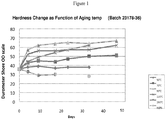
- Example 1 The composition of Example 1 was allowed to cure by letting the combined component stand for 60 minutes at 125°C, and the hardness of the cured material was measured and shown according to Durometer Shore Type OO scale (ASTM D 2240). The cured material was then kept in a constant temperature atmosphere for up to 50 days in an oven. The results are shown in Figure 1 , which shows the hardness change of the cured material as a function of aging temperature. The hardness was measured for batch 23178-36 kept at 50 ( ⁇ blue), 70 ( ⁇ brown), 90 ( ⁇ green), 120 ( ⁇ purple), and 150 ( * light blue) degrees Celsius atmosphere, on day 4, 9, 17, 23, 33, 46 and 100. The cured material was also kept at 85 degrees Celsius and controlled humidity of 85% ( ⁇ , orange,85/85). As seen in Figure 1 , the hardness increased at elevated temperatures over time. Table 1 also shows the data in a numeric form.
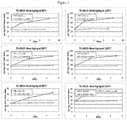
- Figure 2 also shows the results of three different preparations, 23534-11, 11A/144B, and 148A/11B.
- the composition containing phthalocyanine copper (+Blue, orange circle in Figure 2 ) retained its pliant nature for the duration of the trial at either temperature, whereas the composition without phthalocyanine copper (light blue in Figure 2 ) increased in hardness.
- Two-part composition was prepared as described in Example 1, except that the alumina filler was a mixture of one type with average particle size of 35 ⁇ m (56.52 wt%) and a second type with average particle size of 2 ⁇ m (33.45 wt%) and the SiH/Vi ratio was 0.7.
- the composition also included a long chain silicone treating agent as an additional component (0.15 wt%).
- 0.08 wt% (relative to the final combined composition) of phthalocyanine copper (0.2% Harwick Stan-ToneTM 40SP03 (PolyOne, Ohio, USA) blue pigment) was added to some samples by mixing it in Part (b).
- the cured compositions were kept at 90 degrees Celsius and 120 degrees Celsius for up to 37 days.
- Table 3a-3b shows the result.
- the composition containing phthalocyanine copper retained its pliant nature for the duration of the trial, whereas the composition without phthalocyanine copper increased in hardness.
- Table 3a Sample 23178-58 Storage Temp Storage Time at Temperature (Days) 0 2 8 21 90°C 48 67 77 85 120°C 48 72 82 83
- Table 3b Sample 23178-58 with addition of 0.2% Stantone Blue Storage Temp Storage Time at Temperature (Days) 0 2 8 21 37 90°C 48 48 49 49 46 120°C 48 48 48 48 49 49
Landscapes
- Chemical & Material Sciences (AREA)
- Chemical Kinetics & Catalysis (AREA)
- Organic Chemistry (AREA)
- Health & Medical Sciences (AREA)
- Medicinal Chemistry (AREA)
- Polymers & Plastics (AREA)
- Engineering & Computer Science (AREA)
- Physics & Mathematics (AREA)
- Thermal Sciences (AREA)
- Mechanical Engineering (AREA)
- General Engineering & Computer Science (AREA)
- Combustion & Propulsion (AREA)
- Materials Engineering (AREA)
- Dispersion Chemistry (AREA)
- Spectroscopy & Molecular Physics (AREA)
- Compositions Of Macromolecular Compounds (AREA)
Applications Claiming Priority (2)
| Application Number | Priority Date | Filing Date | Title |
|---|---|---|---|
| US201161436214P | 2011-01-26 | 2011-01-26 | |
| PCT/US2012/020699 WO2012102852A1 (en) | 2011-01-26 | 2012-01-10 | High temperature stable thermally conductive materials |
Publications (2)
| Publication Number | Publication Date |
|---|---|
| EP2668239A1 EP2668239A1 (en) | 2013-12-04 |
| EP2668239B1 true EP2668239B1 (en) | 2018-08-15 |
Family
ID=45563525
Family Applications (1)
| Application Number | Title | Priority Date | Filing Date |
|---|---|---|---|
| EP12702642.5A Active EP2668239B1 (en) | 2011-01-26 | 2012-01-10 | High temperature stable thermally conductive materials |
Country Status (7)
| Country | Link |
|---|---|
| US (2) | US9598575B2 (OSRAM) |
| EP (1) | EP2668239B1 (OSRAM) |
| JP (1) | JP6048416B2 (OSRAM) |
| KR (1) | KR101866299B1 (OSRAM) |
| CN (2) | CN109401333A (OSRAM) |
| TW (1) | TWI620797B (OSRAM) |
| WO (1) | WO2012102852A1 (OSRAM) |
Families Citing this family (70)
| Publication number | Priority date | Publication date | Assignee | Title |
|---|---|---|---|---|
| EP2764055B1 (en) * | 2011-10-06 | 2018-03-21 | Dow Corning Corporation | Method of forming a gel having improved thermal stability |
| CN103946314A (zh) * | 2011-10-06 | 2014-07-23 | 道康宁公司 | 具有改善的热稳定性的凝胶 |
| KR102174540B1 (ko) | 2013-03-15 | 2020-11-05 | 다우 실리콘즈 코포레이션 | 알칼리 토금속을 포함하는 아릴 기-함유 실록산 조성물 |
| US9070660B2 (en) * | 2013-03-15 | 2015-06-30 | Intel Corporation | Polymer thermal interface material having enhanced thermal conductivity |
| JP6205824B2 (ja) * | 2013-04-26 | 2017-10-04 | 富士電機株式会社 | パワーモジュール |
| CN105705599B (zh) * | 2013-09-18 | 2018-10-23 | 美国陶氏有机硅公司 | 树脂-线性有机硅氧烷嵌段共聚物的组合物 |
| US10174433B2 (en) | 2013-12-05 | 2019-01-08 | Honeywell International Inc. | Stannous methanesulfonate solution with adjusted pH |
| WO2015131370A1 (en) * | 2014-03-06 | 2015-09-11 | Ablestik (Shanghai) Ltd. | A single crystal alumina filled die attach paste |
| CN106536609B (zh) | 2014-07-07 | 2022-04-29 | 霍尼韦尔国际公司 | 具有离子清除剂的热界面材料 |
| JP6395153B2 (ja) * | 2014-11-04 | 2018-09-26 | 日本タングステン株式会社 | コーティング膜、その製造方法およびコーティング膜形成方法 |
| WO2016086410A1 (en) | 2014-12-05 | 2016-06-09 | Honeywell International Inc. | High performance thermal interface materials with low thermal impedance |
| CN104497574A (zh) * | 2014-12-10 | 2015-04-08 | 深圳市博恩实业有限公司 | 多功能有机硅热界面材料 |
| US10312177B2 (en) | 2015-11-17 | 2019-06-04 | Honeywell International Inc. | Thermal interface materials including a coloring agent |
| US10941924B2 (en) | 2015-12-15 | 2021-03-09 | Wangs Alliance Corporation | LED lighting methods and apparatus |
| US11686459B2 (en) | 2015-12-15 | 2023-06-27 | Wangs Alliance Corporation | LED lighting methods and apparatus |
| US10208935B2 (en) | 2015-12-15 | 2019-02-19 | Wangs Alliance Corporation | LED lighting apparatus with adjustable beam angle lens |
| WO2017152353A1 (en) | 2016-03-08 | 2017-09-14 | Honeywell International Inc. | Phase change material |
| US10501671B2 (en) | 2016-07-26 | 2019-12-10 | Honeywell International Inc. | Gel-type thermal interface material |
| US11464438B2 (en) | 2016-08-11 | 2022-10-11 | Willowwood Global Llc | Conductive human interfaces |
| US11213409B2 (en) | 2016-08-11 | 2022-01-04 | Willowwood Global Llc | Conductive human interfaces |
| SG10201607550RA (en) * | 2016-09-09 | 2018-04-27 | 3M Innovative Properties Co | Thermal Interface Material |
| US11357974B2 (en) | 2016-10-06 | 2022-06-14 | Willowwood Global Llc | Electrically conductive gel and conductive human interfaces and electrodes formed using electrically conductive gel |
| JP6702233B2 (ja) * | 2017-03-09 | 2020-05-27 | 信越化学工業株式会社 | 付加硬化型オルガノポリシロキサン樹脂組成物、該組成物の硬化物及び該硬化物を有する半導体装置 |
| JP6941810B2 (ja) * | 2017-04-19 | 2021-09-29 | パナソニックIpマネジメント株式会社 | 樹脂組成物ならびにそれを用いた電子部品および電子機器 |
| WO2019004150A1 (ja) * | 2017-06-27 | 2019-01-03 | 積水ポリマテック株式会社 | 熱伝導性シート |
| US11812525B2 (en) | 2017-06-27 | 2023-11-07 | Wangs Alliance Corporation | Methods and apparatus for controlling the current supplied to light emitting diodes |
| US11674040B2 (en) * | 2017-07-24 | 2023-06-13 | Dow Toray Co., Ltd. | Thermally-conductive silicone gel composition, thermally-conductive member, and heat dissipation structure |
| KR102625363B1 (ko) | 2017-07-24 | 2024-01-17 | 다우 도레이 캄파니 리미티드 | 다성분 경화형 열전도성 실리콘 겔 조성물, 열전도성 부재 및 방열 구조체 |
| EP3660101B1 (en) | 2017-07-24 | 2024-10-02 | Dow Toray Co., Ltd. | Thermally-conductive silicone gel composition, thermally-conductive member, and heat dissipation structure |
| US11041103B2 (en) | 2017-09-08 | 2021-06-22 | Honeywell International Inc. | Silicone-free thermal gel |
| CN112770848A (zh) | 2017-09-15 | 2021-05-07 | 道康宁东丽株式会社 | 电子零件或其前驱体、它们的制造方法 |
| WO2019054370A1 (ja) | 2017-09-15 | 2019-03-21 | 東レ・ダウコーニング株式会社 | 硬化性オルガノポリシロキサン組成物およびパターン形成方法 |
| US10344194B2 (en) * | 2017-09-27 | 2019-07-09 | Momentive Performance Materials Inc. | Thermal interface composition comprising ionically modified siloxane |
| US10428256B2 (en) | 2017-10-23 | 2019-10-01 | Honeywell International Inc. | Releasable thermal gel |
| JP6646643B2 (ja) * | 2017-12-14 | 2020-02-14 | 株式会社ノリタケカンパニーリミテド | 感光性組成物とその利用 |
| US11072706B2 (en) | 2018-02-15 | 2021-07-27 | Honeywell International Inc. | Gel-type thermal interface material |
| EP3527615A1 (en) * | 2018-02-16 | 2019-08-21 | Venator Germany GmbH | Thermoconductive filler particles and polymer compositions containing them |
| JP7144542B2 (ja) * | 2018-06-27 | 2022-09-29 | ダウ シリコーンズ コーポレーション | サーマルギャップフィラー及びバッテリーマネジメントシステムへのその用途 |
| JP6956697B2 (ja) * | 2018-09-18 | 2021-11-02 | 住友理工株式会社 | シリコーンゴム組成物およびシリコーンゴム架橋体 |
| CN109261207B (zh) * | 2018-09-26 | 2021-05-28 | 合肥国轩高科动力能源有限公司 | 光催化材料及其制法和在废旧锂电池电解液处理中的应用 |
| WO2020080326A1 (ja) * | 2018-10-18 | 2020-04-23 | ダウ・東レ株式会社 | 耐寒性に優れる硬化性オルガノポリシロキサン組成物、パターン形成方法および電子部品等 |
| JP7033047B2 (ja) * | 2018-10-26 | 2022-03-09 | 信越化学工業株式会社 | 熱伝導性シリコーン組成物及びその硬化物 |
| US20210403716A1 (en) * | 2018-12-29 | 2021-12-30 | Dow Global Technologies Llc | Thermally conductive composition containing mgo filler and methods and devices in which said composition is used |
| US11373921B2 (en) | 2019-04-23 | 2022-06-28 | Honeywell International Inc. | Gel-type thermal interface material with low pre-curing viscosity and elastic properties post-curing |
| CN110172250A (zh) * | 2019-05-22 | 2019-08-27 | 平湖阿莱德实业有限公司 | 一种新能源汽车用超低密度高导热填隙界面材料及其制备方法 |
| CN112437788B (zh) * | 2019-06-24 | 2022-09-13 | 富士高分子工业株式会社 | 耐热性导热性组合物及耐热性导热性片材 |
| MX2022005934A (es) * | 2019-11-19 | 2022-06-22 | Henkel Ag & Co Kgaa | Materiales de interfaz termica y metodos de aplicacion. |
| US11598517B2 (en) | 2019-12-31 | 2023-03-07 | Lumien Enterprise, Inc. | Electronic module group |
| CN110985903B (zh) | 2019-12-31 | 2020-08-14 | 江苏舒适照明有限公司 | 一种灯模组 |
| US12281783B2 (en) | 2019-12-31 | 2025-04-22 | Lumien Enterprise, Inc. | Electronic module group |
| CN113661215B (zh) * | 2020-02-13 | 2024-07-23 | 富士高分子工业株式会社 | 耐热性有机硅树脂组合物及耐热性有机硅树脂复合材料 |
| WO2021178119A1 (en) * | 2020-03-05 | 2021-09-10 | Dow Global Technologies Llc | Shear thinning thermally conductive silicone compositions |
| JP7462062B2 (ja) * | 2020-03-13 | 2024-04-04 | ディディピー スペシャルティ エレクトロニック マテリアルズ ユーエス,エルエルシー | 水酸化マグネシウム含有熱界面材料 |
| WO2021184149A1 (en) * | 2020-03-16 | 2021-09-23 | Dow Silicones Corporation | Thermal conductive silicone composition |
| CN111503556B (zh) | 2020-04-23 | 2020-11-27 | 江苏舒适照明有限公司 | 一种射灯结构 |
| US12195666B2 (en) * | 2020-07-27 | 2025-01-14 | Google Llc | Thermal interface material and method for making the same |
| US12187951B2 (en) | 2020-07-27 | 2025-01-07 | Google Llc | Thermal interface material and method for making the same |
| WO2022061559A1 (en) * | 2020-09-23 | 2022-03-31 | Dow Global Technologies Llc | Thermal interface material with low dispensing viscosity, low vertical flow after dispensing, and low thermal impedance after cure |
| CN114539781A (zh) * | 2020-11-25 | 2022-05-27 | 深圳先进电子材料国际创新研究院 | 一种导热凝胶及其制备方法 |
| JPWO2022215510A1 (OSRAM) * | 2021-04-09 | 2022-10-13 | ||
| US12230950B2 (en) | 2021-07-29 | 2025-02-18 | Lumien Enterprise, Inc. | Junction box |
| WO2023087233A1 (en) * | 2021-11-19 | 2023-05-25 | Dow Silicones Corporation | Silicone rubber composition |
| WO2023171352A1 (ja) | 2022-03-08 | 2023-09-14 | 信越化学工業株式会社 | 熱伝導性付加硬化型シリコーン組成物及びそのシリコーン硬化物 |
| KR20240157075A (ko) | 2022-03-08 | 2024-10-31 | 신에쓰 가가꾸 고교 가부시끼가이샤 | 2액형 열전도성 부가 경화형 실리콘 조성물 및 그 실리콘 경화물 |
| CN115214202A (zh) * | 2022-04-26 | 2022-10-21 | 北京科技大学 | 一种高导热层状热界面材料及其制备方法 |
| US11802682B1 (en) | 2022-08-29 | 2023-10-31 | Wangs Alliance Corporation | Modular articulating lighting |
| JP2025534882A (ja) | 2022-10-19 | 2025-10-20 | ダウ シリコーンズ コーポレーション | 液体シリコーンゴム組成物 |
| KR20250086759A (ko) | 2022-10-19 | 2025-06-13 | 다우 실리콘즈 코포레이션 | 액체 실리콘 고무 조성물 |
| CN120077094A (zh) | 2022-10-19 | 2025-05-30 | 美国陶氏有机硅公司 | 液体硅酮橡胶组合物 |
| WO2025039204A1 (en) * | 2023-08-23 | 2025-02-27 | Dow Silicones Corporation | High temperature stable thermally conductive materials |
Citations (1)
| Publication number | Priority date | Publication date | Assignee | Title |
|---|---|---|---|---|
| EP2516554A1 (en) * | 2009-12-24 | 2012-10-31 | Dow Corning Toray Co., Ltd. | Silicone elastomer composition |
Family Cites Families (43)
| Publication number | Priority date | Publication date | Assignee | Title |
|---|---|---|---|---|
| GB731166A (en) | 1952-05-27 | 1955-06-01 | Midland Silicones Ltd | Improvements in or relating to organosiloxane elastomers |
| GB893399A (en) | 1959-09-24 | 1962-04-11 | Dow Corning | Improvements in or relating to organosiloxane compositions |
| NL129346C (OSRAM) | 1966-06-23 | |||
| US3364161A (en) | 1967-01-19 | 1968-01-16 | Navy Usa | Silicone rubber composition containing corrosion inhibiting curing agent |
| US3989667A (en) | 1974-12-02 | 1976-11-02 | Dow Corning Corporation | Olefinic siloxanes as platinum inhibitors |
| GB1470465A (en) | 1975-01-20 | 1977-04-14 | Int Paint Co | Coated marine surfaces |
| US4087585A (en) | 1977-05-23 | 1978-05-02 | Dow Corning Corporation | Self-adhering silicone compositions and preparations thereof |
| US4370358A (en) | 1980-09-22 | 1983-01-25 | General Electric Company | Ultraviolet curable silicone adhesives |
| JPS61195129A (ja) | 1985-02-22 | 1986-08-29 | Toray Silicone Co Ltd | 有機けい素重合体の製造方法 |
| US4584361A (en) | 1985-06-03 | 1986-04-22 | Dow Corning Corporation | Storage stable, one part polyorganosiloxane compositions |
| JPS62223788A (ja) | 1986-03-26 | 1987-10-01 | 株式会社日立製作所 | デイスプレイ装置 |
| JP2670804B2 (ja) | 1988-05-06 | 1997-10-29 | コスモ石油株式会社 | 塗膜塗料組成物 |
| JP2796744B2 (ja) * | 1989-10-31 | 1998-09-10 | 東レ・ダウコーニング・シリコーン株式会社 | 硬化性オルガノポリシロキサンゴム組成物 |
| US5036117A (en) | 1989-11-03 | 1991-07-30 | Dow Corning Corporation | Heat-curable silicone compositions having improved bath life |
| JP3029680B2 (ja) | 1991-01-29 | 2000-04-04 | 東レ・ダウコーニング・シリコーン株式会社 | オルガノペンタシロキサンおよびその製造方法 |
| JP2511348B2 (ja) | 1991-10-17 | 1996-06-26 | 東レ・ダウコーニング・シリコーン株式会社 | オルガノポリシロキサンおよびその製造方法 |
| JP3046484B2 (ja) * | 1993-12-28 | 2000-05-29 | ジーイー東芝シリコーン株式会社 | 安定した電気特性を有するシリコーンゴム組成物 |
| KR20000064867A (ko) | 1997-02-07 | 2000-11-06 | 아이. 데이비드 크로산 | 전도성,수지-기재 조성물 |
| JPH1145965A (ja) * | 1997-07-28 | 1999-02-16 | Kyocera Corp | 伝熱性化合物およびこれを用いた半導体装置 |
| JP3444199B2 (ja) | 1998-06-17 | 2003-09-08 | 信越化学工業株式会社 | 熱伝導性シリコーンゴム組成物及びその製造方法 |
| EP1101167B1 (en) | 1998-07-24 | 2006-04-12 | Sun Microsystems, Inc. | Method and apparatus for achieving deterministic memory allocation response in a computer system |
| JP4727017B2 (ja) * | 1999-11-15 | 2011-07-20 | 東レ・ダウコーニング株式会社 | 熱伝導性シリコーンゴム組成物 |
| US20030207128A1 (en) * | 2000-04-10 | 2003-11-06 | Tomoaki Uchiya | Thermally conductive sheet |
| US20040092655A1 (en) * | 2001-04-02 | 2004-05-13 | Takayoshi Otomo | Mouldable silicone gel compositions |
| JP3580366B2 (ja) * | 2001-05-01 | 2004-10-20 | 信越化学工業株式会社 | 熱伝導性シリコーン組成物及び半導体装置 |
| US20040195678A1 (en) * | 2001-07-02 | 2004-10-07 | Yoshinao Yamazaki | Thermoconductive composition |
| JP4551074B2 (ja) | 2003-10-07 | 2010-09-22 | 信越化学工業株式会社 | 硬化性オルガノポリシロキサン組成物および半導体装置 |
| JP4413649B2 (ja) * | 2004-03-03 | 2010-02-10 | 日産自動車株式会社 | 放熱構造体及びその製造方法 |
| US20050228097A1 (en) * | 2004-03-30 | 2005-10-13 | General Electric Company | Thermally conductive compositions and methods of making thereof |
| US7655719B2 (en) * | 2004-07-13 | 2010-02-02 | Cool Options, Inc. | Thermally conductive polymer compositions having moderate tensile and flexural properties |
| JP4828145B2 (ja) * | 2005-03-30 | 2011-11-30 | 東レ・ダウコーニング株式会社 | 熱伝導性シリコーンゴム組成物 |
| JP4828146B2 (ja) * | 2005-03-30 | 2011-11-30 | 東レ・ダウコーニング株式会社 | 熱伝導性シリコーンゴム組成物 |
| US20070219312A1 (en) * | 2006-03-17 | 2007-09-20 | Jennifer Lynn David | Silicone adhesive composition and method for preparing the same |
| TWI380325B (en) * | 2006-09-26 | 2012-12-21 | Polytronics Technology Corp | Heat-conductive dielectric polymer composition and heat dissipation substrate containing the same |
| DE102006048575A1 (de) * | 2006-10-13 | 2008-04-17 | Evonik Degussa Gmbh | Oberflächenmodifizierte Kieselsäuren |
| JP4970987B2 (ja) * | 2007-03-08 | 2012-07-11 | 株式会社メニコン | 眼用レンズ材料用シリコーンインク組成物 |
| CN101835830B (zh) * | 2007-08-31 | 2013-02-20 | 卡伯特公司 | 热界面材料 |
| JP4572243B2 (ja) | 2008-03-27 | 2010-11-04 | 信越化学工業株式会社 | 熱伝導性積層体およびその製造方法 |
| JP5329114B2 (ja) * | 2008-03-31 | 2013-10-30 | 株式会社ジーシー | 歯科用シリコーン系適合試験材組成物 |
| KR20110133608A (ko) * | 2009-03-12 | 2011-12-13 | 다우 코닝 코포레이션 | 열계면 물질 및 이의 제조 및 사용을 위한 방법 |
| JP5783128B2 (ja) | 2012-04-24 | 2015-09-24 | 信越化学工業株式会社 | 加熱硬化型熱伝導性シリコーングリース組成物 |
| JP5947267B2 (ja) | 2013-09-20 | 2016-07-06 | 信越化学工業株式会社 | シリコーン組成物及び熱伝導性シリコーン組成物の製造方法 |
| EP3150672B1 (en) | 2015-10-02 | 2018-05-09 | Shin-Etsu Chemical Co., Ltd. | Thermal conductive silicone composition and semiconductor device |
-
2012
- 2012-01-10 KR KR1020137019092A patent/KR101866299B1/ko active Active
- 2012-01-10 WO PCT/US2012/020699 patent/WO2012102852A1/en not_active Ceased
- 2012-01-10 EP EP12702642.5A patent/EP2668239B1/en active Active
- 2012-01-10 JP JP2013551984A patent/JP6048416B2/ja active Active
- 2012-01-10 CN CN201811365168.7A patent/CN109401333A/zh active Pending
- 2012-01-10 US US13/990,446 patent/US9598575B2/en active Active
- 2012-01-10 CN CN2012800052058A patent/CN103298887A/zh active Pending
- 2012-01-18 TW TW101102003A patent/TWI620797B/zh active
-
2017
- 2017-02-22 US US15/439,644 patent/US10000680B2/en active Active
Patent Citations (1)
| Publication number | Priority date | Publication date | Assignee | Title |
|---|---|---|---|---|
| EP2516554A1 (en) * | 2009-12-24 | 2012-10-31 | Dow Corning Toray Co., Ltd. | Silicone elastomer composition |
Also Published As
| Publication number | Publication date |
|---|---|
| CN103298887A (zh) | 2013-09-11 |
| TWI620797B (zh) | 2018-04-11 |
| US10000680B2 (en) | 2018-06-19 |
| EP2668239A1 (en) | 2013-12-04 |
| WO2012102852A1 (en) | 2012-08-02 |
| US20170158937A1 (en) | 2017-06-08 |
| CN109401333A (zh) | 2019-03-01 |
| KR20140007823A (ko) | 2014-01-20 |
| KR101866299B1 (ko) | 2018-06-12 |
| US9598575B2 (en) | 2017-03-21 |
| JP6048416B2 (ja) | 2016-12-21 |
| TW201245338A (en) | 2012-11-16 |
| US20130248163A1 (en) | 2013-09-26 |
| JP2014503680A (ja) | 2014-02-13 |
Similar Documents
| Publication | Publication Date | Title |
|---|---|---|
| EP2668239B1 (en) | High temperature stable thermally conductive materials | |
| CN102341459B (zh) | 热界面材料和它们的制备与使用方法 | |
| TWI851537B (zh) | 導熱性聚矽氧凝膠組合物、導熱性構件及散熱結構體 | |
| CN112805334B (zh) | 导热组合物以及使用所述组合物的方法和装置 | |
| US12258496B2 (en) | Curable silicone composition, cured product of same and method for producing same | |
| EP3954739A1 (en) | Curable silicone composition, cured product of same, and method for manufacturing same | |
| CN104822790A (zh) | 制造电子器件的方法 | |
| EP2721108B1 (en) | Cross-linkable silicone composition and cross-linked product thereof | |
| TWI779092B (zh) | 導熱組成物 | |
| EP2673786B1 (en) | Soft tacky gel for use in power converters | |
| US20230050175A1 (en) | Curable organopolysiloxane composition, cured product thereof, protective agent or adhesive, and electric/electronic device | |
| WO2022038888A1 (ja) | 硬化性オルガノポリシロキサン組成物、熱伝導性部材および放熱構造体 | |
| KR102847440B1 (ko) | 내한성이 우수한 경화성 오가노폴리실록산 조성물, 패턴 형성 방법 및 전자 부품 등 | |
| WO2025039204A1 (en) | High temperature stable thermally conductive materials | |
| US20230159755A1 (en) | Thermal conductive silicone composition |
Legal Events
| Date | Code | Title | Description |
|---|---|---|---|
| PUAI | Public reference made under article 153(3) epc to a published international application that has entered the european phase |
Free format text: ORIGINAL CODE: 0009012 |
|
| 17P | Request for examination filed |
Effective date: 20130606 |
|
| AK | Designated contracting states |
Kind code of ref document: A1 Designated state(s): AL AT BE BG CH CY CZ DE DK EE ES FI FR GB GR HR HU IE IS IT LI LT LU LV MC MK MT NL NO PL PT RO RS SE SI SK SM TR |
|
| DAX | Request for extension of the european patent (deleted) | ||
| 17Q | First examination report despatched |
Effective date: 20160304 |
|
| STAA | Information on the status of an ep patent application or granted ep patent |
Free format text: STATUS: EXAMINATION IS IN PROGRESS |
|
| GRAP | Despatch of communication of intention to grant a patent |
Free format text: ORIGINAL CODE: EPIDOSNIGR1 |
|
| STAA | Information on the status of an ep patent application or granted ep patent |
Free format text: STATUS: GRANT OF PATENT IS INTENDED |
|
| RIC1 | Information provided on ipc code assigned before grant |
Ipc: C08K 5/3467 20060101ALN20180216BHEP Ipc: C08K 5/56 20060101ALN20180216BHEP Ipc: C08K 5/34 20060101ALI20180216BHEP Ipc: C08L 83/04 20060101AFI20180216BHEP Ipc: C08G 77/20 20060101ALN20180216BHEP Ipc: C08K 3/22 20060101ALN20180216BHEP Ipc: C08G 77/12 20060101ALN20180216BHEP Ipc: C09K 5/14 20060101ALI20180216BHEP |
|
| INTG | Intention to grant announced |
Effective date: 20180307 |
|
| GRAS | Grant fee paid |
Free format text: ORIGINAL CODE: EPIDOSNIGR3 |
|
| GRAA | (expected) grant |
Free format text: ORIGINAL CODE: 0009210 |
|
| STAA | Information on the status of an ep patent application or granted ep patent |
Free format text: STATUS: THE PATENT HAS BEEN GRANTED |
|
| RAP1 | Party data changed (applicant data changed or rights of an application transferred) |
Owner name: DOW SILICONES CORPORATION |
|
| AK | Designated contracting states |
Kind code of ref document: B1 Designated state(s): AL AT BE BG CH CY CZ DE DK EE ES FI FR GB GR HR HU IE IS IT LI LT LU LV MC MK MT NL NO PL PT RO RS SE SI SK SM TR |
|
| REG | Reference to a national code |
Ref country code: CH Ref legal event code: EP Ref country code: GB Ref legal event code: FG4D Ref country code: AT Ref legal event code: REF Ref document number: 1029711 Country of ref document: AT Kind code of ref document: T Effective date: 20180815 |
|
| REG | Reference to a national code |
Ref country code: IE Ref legal event code: FG4D |
|
| REG | Reference to a national code |
Ref country code: DE Ref legal event code: R096 Ref document number: 602012049752 Country of ref document: DE |
|
| REG | Reference to a national code |
Ref country code: NL Ref legal event code: MP Effective date: 20180815 |
|
| REG | Reference to a national code |
Ref country code: LT Ref legal event code: MG4D |
|
| REG | Reference to a national code |
Ref country code: AT Ref legal event code: MK05 Ref document number: 1029711 Country of ref document: AT Kind code of ref document: T Effective date: 20180815 |
|
| PG25 | Lapsed in a contracting state [announced via postgrant information from national office to epo] |
Ref country code: FI Free format text: LAPSE BECAUSE OF FAILURE TO SUBMIT A TRANSLATION OF THE DESCRIPTION OR TO PAY THE FEE WITHIN THE PRESCRIBED TIME-LIMIT Effective date: 20180815 Ref country code: RS Free format text: LAPSE BECAUSE OF FAILURE TO SUBMIT A TRANSLATION OF THE DESCRIPTION OR TO PAY THE FEE WITHIN THE PRESCRIBED TIME-LIMIT Effective date: 20180815 Ref country code: AT Free format text: LAPSE BECAUSE OF FAILURE TO SUBMIT A TRANSLATION OF THE DESCRIPTION OR TO PAY THE FEE WITHIN THE PRESCRIBED TIME-LIMIT Effective date: 20180815 Ref country code: NO Free format text: LAPSE BECAUSE OF FAILURE TO SUBMIT A TRANSLATION OF THE DESCRIPTION OR TO PAY THE FEE WITHIN THE PRESCRIBED TIME-LIMIT Effective date: 20181115 Ref country code: IS Free format text: LAPSE BECAUSE OF FAILURE TO SUBMIT A TRANSLATION OF THE DESCRIPTION OR TO PAY THE FEE WITHIN THE PRESCRIBED TIME-LIMIT Effective date: 20181215 Ref country code: GR Free format text: LAPSE BECAUSE OF FAILURE TO SUBMIT A TRANSLATION OF THE DESCRIPTION OR TO PAY THE FEE WITHIN THE PRESCRIBED TIME-LIMIT Effective date: 20181116 Ref country code: SE Free format text: LAPSE BECAUSE OF FAILURE TO SUBMIT A TRANSLATION OF THE DESCRIPTION OR TO PAY THE FEE WITHIN THE PRESCRIBED TIME-LIMIT Effective date: 20180815 Ref country code: NL Free format text: LAPSE BECAUSE OF FAILURE TO SUBMIT A TRANSLATION OF THE DESCRIPTION OR TO PAY THE FEE WITHIN THE PRESCRIBED TIME-LIMIT Effective date: 20180815 Ref country code: BG Free format text: LAPSE BECAUSE OF FAILURE TO SUBMIT A TRANSLATION OF THE DESCRIPTION OR TO PAY THE FEE WITHIN THE PRESCRIBED TIME-LIMIT Effective date: 20181115 Ref country code: LT Free format text: LAPSE BECAUSE OF FAILURE TO SUBMIT A TRANSLATION OF THE DESCRIPTION OR TO PAY THE FEE WITHIN THE PRESCRIBED TIME-LIMIT Effective date: 20180815 |
|
| PG25 | Lapsed in a contracting state [announced via postgrant information from national office to epo] |
Ref country code: HR Free format text: LAPSE BECAUSE OF FAILURE TO SUBMIT A TRANSLATION OF THE DESCRIPTION OR TO PAY THE FEE WITHIN THE PRESCRIBED TIME-LIMIT Effective date: 20180815 Ref country code: AL Free format text: LAPSE BECAUSE OF FAILURE TO SUBMIT A TRANSLATION OF THE DESCRIPTION OR TO PAY THE FEE WITHIN THE PRESCRIBED TIME-LIMIT Effective date: 20180815 Ref country code: LV Free format text: LAPSE BECAUSE OF FAILURE TO SUBMIT A TRANSLATION OF THE DESCRIPTION OR TO PAY THE FEE WITHIN THE PRESCRIBED TIME-LIMIT Effective date: 20180815 |
|
| PG25 | Lapsed in a contracting state [announced via postgrant information from national office to epo] |
Ref country code: ES Free format text: LAPSE BECAUSE OF FAILURE TO SUBMIT A TRANSLATION OF THE DESCRIPTION OR TO PAY THE FEE WITHIN THE PRESCRIBED TIME-LIMIT Effective date: 20180815 Ref country code: CZ Free format text: LAPSE BECAUSE OF FAILURE TO SUBMIT A TRANSLATION OF THE DESCRIPTION OR TO PAY THE FEE WITHIN THE PRESCRIBED TIME-LIMIT Effective date: 20180815 Ref country code: PL Free format text: LAPSE BECAUSE OF FAILURE TO SUBMIT A TRANSLATION OF THE DESCRIPTION OR TO PAY THE FEE WITHIN THE PRESCRIBED TIME-LIMIT Effective date: 20180815 Ref country code: RO Free format text: LAPSE BECAUSE OF FAILURE TO SUBMIT A TRANSLATION OF THE DESCRIPTION OR TO PAY THE FEE WITHIN THE PRESCRIBED TIME-LIMIT Effective date: 20180815 Ref country code: IT Free format text: LAPSE BECAUSE OF FAILURE TO SUBMIT A TRANSLATION OF THE DESCRIPTION OR TO PAY THE FEE WITHIN THE PRESCRIBED TIME-LIMIT Effective date: 20180815 Ref country code: EE Free format text: LAPSE BECAUSE OF FAILURE TO SUBMIT A TRANSLATION OF THE DESCRIPTION OR TO PAY THE FEE WITHIN THE PRESCRIBED TIME-LIMIT Effective date: 20180815 |
|
| REG | Reference to a national code |
Ref country code: DE Ref legal event code: R097 Ref document number: 602012049752 Country of ref document: DE |
|
| PG25 | Lapsed in a contracting state [announced via postgrant information from national office to epo] |
Ref country code: DK Free format text: LAPSE BECAUSE OF FAILURE TO SUBMIT A TRANSLATION OF THE DESCRIPTION OR TO PAY THE FEE WITHIN THE PRESCRIBED TIME-LIMIT Effective date: 20180815 Ref country code: SM Free format text: LAPSE BECAUSE OF FAILURE TO SUBMIT A TRANSLATION OF THE DESCRIPTION OR TO PAY THE FEE WITHIN THE PRESCRIBED TIME-LIMIT Effective date: 20180815 Ref country code: SK Free format text: LAPSE BECAUSE OF FAILURE TO SUBMIT A TRANSLATION OF THE DESCRIPTION OR TO PAY THE FEE WITHIN THE PRESCRIBED TIME-LIMIT Effective date: 20180815 |
|
| PLBE | No opposition filed within time limit |
Free format text: ORIGINAL CODE: 0009261 |
|
| STAA | Information on the status of an ep patent application or granted ep patent |
Free format text: STATUS: NO OPPOSITION FILED WITHIN TIME LIMIT |
|
| 26N | No opposition filed |
Effective date: 20190516 |
|
| PG25 | Lapsed in a contracting state [announced via postgrant information from national office to epo] |
Ref country code: SI Free format text: LAPSE BECAUSE OF FAILURE TO SUBMIT A TRANSLATION OF THE DESCRIPTION OR TO PAY THE FEE WITHIN THE PRESCRIBED TIME-LIMIT Effective date: 20180815 Ref country code: MC Free format text: LAPSE BECAUSE OF FAILURE TO SUBMIT A TRANSLATION OF THE DESCRIPTION OR TO PAY THE FEE WITHIN THE PRESCRIBED TIME-LIMIT Effective date: 20180815 |
|
| REG | Reference to a national code |
Ref country code: CH Ref legal event code: PL |
|
| PG25 | Lapsed in a contracting state [announced via postgrant information from national office to epo] |
Ref country code: LU Free format text: LAPSE BECAUSE OF NON-PAYMENT OF DUE FEES Effective date: 20190110 |
|
| REG | Reference to a national code |
Ref country code: BE Ref legal event code: MM Effective date: 20190131 |
|
| REG | Reference to a national code |
Ref country code: IE Ref legal event code: MM4A |
|
| PG25 | Lapsed in a contracting state [announced via postgrant information from national office to epo] |
Ref country code: BE Free format text: LAPSE BECAUSE OF NON-PAYMENT OF DUE FEES Effective date: 20190131 |
|
| PG25 | Lapsed in a contracting state [announced via postgrant information from national office to epo] |
Ref country code: LI Free format text: LAPSE BECAUSE OF NON-PAYMENT OF DUE FEES Effective date: 20190131 Ref country code: CH Free format text: LAPSE BECAUSE OF NON-PAYMENT OF DUE FEES Effective date: 20190131 |
|
| PG25 | Lapsed in a contracting state [announced via postgrant information from national office to epo] |
Ref country code: IE Free format text: LAPSE BECAUSE OF NON-PAYMENT OF DUE FEES Effective date: 20190110 |
|
| PG25 | Lapsed in a contracting state [announced via postgrant information from national office to epo] |
Ref country code: TR Free format text: LAPSE BECAUSE OF FAILURE TO SUBMIT A TRANSLATION OF THE DESCRIPTION OR TO PAY THE FEE WITHIN THE PRESCRIBED TIME-LIMIT Effective date: 20180815 |
|
| PG25 | Lapsed in a contracting state [announced via postgrant information from national office to epo] |
Ref country code: PT Free format text: LAPSE BECAUSE OF FAILURE TO SUBMIT A TRANSLATION OF THE DESCRIPTION OR TO PAY THE FEE WITHIN THE PRESCRIBED TIME-LIMIT Effective date: 20181215 Ref country code: MT Free format text: LAPSE BECAUSE OF NON-PAYMENT OF DUE FEES Effective date: 20190110 |
|
| PG25 | Lapsed in a contracting state [announced via postgrant information from national office to epo] |
Ref country code: CY Free format text: LAPSE BECAUSE OF FAILURE TO SUBMIT A TRANSLATION OF THE DESCRIPTION OR TO PAY THE FEE WITHIN THE PRESCRIBED TIME-LIMIT Effective date: 20180815 |
|
| PG25 | Lapsed in a contracting state [announced via postgrant information from national office to epo] |
Ref country code: HU Free format text: LAPSE BECAUSE OF FAILURE TO SUBMIT A TRANSLATION OF THE DESCRIPTION OR TO PAY THE FEE WITHIN THE PRESCRIBED TIME-LIMIT; INVALID AB INITIO Effective date: 20120110 |
|
| PG25 | Lapsed in a contracting state [announced via postgrant information from national office to epo] |
Ref country code: MK Free format text: LAPSE BECAUSE OF FAILURE TO SUBMIT A TRANSLATION OF THE DESCRIPTION OR TO PAY THE FEE WITHIN THE PRESCRIBED TIME-LIMIT Effective date: 20180815 |
|
| P01 | Opt-out of the competence of the unified patent court (upc) registered |
Effective date: 20230526 |
|
| PGFP | Annual fee paid to national office [announced via postgrant information from national office to epo] |
Ref country code: GB Payment date: 20241205 Year of fee payment: 14 |
|
| PGFP | Annual fee paid to national office [announced via postgrant information from national office to epo] |
Ref country code: FR Payment date: 20241209 Year of fee payment: 14 |
|
| PGFP | Annual fee paid to national office [announced via postgrant information from national office to epo] |
Ref country code: DE Payment date: 20241203 Year of fee payment: 14 |