EP2607065B1 - Luftreifen und Herstellungsverfahren dafür - Google Patents
Luftreifen und Herstellungsverfahren dafür Download PDFInfo
- Publication number
- EP2607065B1 EP2607065B1 EP12196688.1A EP12196688A EP2607065B1 EP 2607065 B1 EP2607065 B1 EP 2607065B1 EP 12196688 A EP12196688 A EP 12196688A EP 2607065 B1 EP2607065 B1 EP 2607065B1
- Authority
- EP
- European Patent Office
- Prior art keywords
- tread
- rubber
- winding
- width direction
- tire width
- Prior art date
- Legal status (The legal status is an assumption and is not a legal conclusion. Google has not performed a legal analysis and makes no representation as to the accuracy of the status listed.)
- Not-in-force
Links
- 238000004519 manufacturing process Methods 0.000 title claims description 23
- 229920001971 elastomer Polymers 0.000 claims description 240
- 239000005060 rubber Substances 0.000 claims description 240
- 238000004804 winding Methods 0.000 claims description 164
- 230000002093 peripheral effect Effects 0.000 claims description 15
- 238000000034 method Methods 0.000 description 20
- 239000011324 bead Substances 0.000 description 11
- 238000010276 construction Methods 0.000 description 11
- 230000000052 comparative effect Effects 0.000 description 9
- 230000007547 defect Effects 0.000 description 6
- 230000020169 heat generation Effects 0.000 description 5
- 239000011248 coating agent Substances 0.000 description 4
- 238000000576 coating method Methods 0.000 description 4
- 239000000945 filler Substances 0.000 description 3
- 230000003014 reinforcing effect Effects 0.000 description 3
- 239000005062 Polybutadiene Substances 0.000 description 2
- VYPSYNLAJGMNEJ-UHFFFAOYSA-N Silicium dioxide Chemical compound O=[Si]=O VYPSYNLAJGMNEJ-UHFFFAOYSA-N 0.000 description 2
- 230000033228 biological regulation Effects 0.000 description 2
- 238000001125 extrusion Methods 0.000 description 2
- 229920003049 isoprene rubber Polymers 0.000 description 2
- 229920002857 polybutadiene Polymers 0.000 description 2
- 238000003825 pressing Methods 0.000 description 2
- 230000000630 rising effect Effects 0.000 description 2
- 229920001875 Ebonite Polymers 0.000 description 1
- 244000043261 Hevea brasiliensis Species 0.000 description 1
- 229910000831 Steel Inorganic materials 0.000 description 1
- 239000003963 antioxidant agent Substances 0.000 description 1
- 230000003078 antioxidant effect Effects 0.000 description 1
- 229920005549 butyl rubber Polymers 0.000 description 1
- 239000006229 carbon black Substances 0.000 description 1
- 239000003795 chemical substances by application Substances 0.000 description 1
- 230000001419 dependent effect Effects 0.000 description 1
- 238000009826 distribution Methods 0.000 description 1
- 230000000694 effects Effects 0.000 description 1
- 238000009434 installation Methods 0.000 description 1
- 238000002156 mixing Methods 0.000 description 1
- 238000000465 moulding Methods 0.000 description 1
- 229920003052 natural elastomer Polymers 0.000 description 1
- 229920001194 natural rubber Polymers 0.000 description 1
- 238000011056 performance test Methods 0.000 description 1
- 239000004014 plasticizer Substances 0.000 description 1
- 239000002994 raw material Substances 0.000 description 1
- 239000000377 silicon dioxide Substances 0.000 description 1
- 239000010959 steel Substances 0.000 description 1
- 229920003048 styrene butadiene rubber Polymers 0.000 description 1
- 238000004073 vulcanization Methods 0.000 description 1
Images



Classifications
-
- B—PERFORMING OPERATIONS; TRANSPORTING
- B60—VEHICLES IN GENERAL
- B60C—VEHICLE TYRES; TYRE INFLATION; TYRE CHANGING; CONNECTING VALVES TO INFLATABLE ELASTIC BODIES IN GENERAL; DEVICES OR ARRANGEMENTS RELATED TO TYRES
- B60C11/00—Tyre tread bands; Tread patterns; Anti-skid inserts
- B60C11/0008—Tyre tread bands; Tread patterns; Anti-skid inserts characterised by the tread rubber
-
- B—PERFORMING OPERATIONS; TRANSPORTING
- B29—WORKING OF PLASTICS; WORKING OF SUBSTANCES IN A PLASTIC STATE IN GENERAL
- B29D—PRODUCING PARTICULAR ARTICLES FROM PLASTICS OR FROM SUBSTANCES IN A PLASTIC STATE
- B29D30/00—Producing pneumatic or solid tyres or parts thereof
- B29D30/06—Pneumatic tyres or parts thereof (e.g. produced by casting, moulding, compression moulding, injection moulding, centrifugal casting)
- B29D30/08—Building tyres
-
- B—PERFORMING OPERATIONS; TRANSPORTING
- B29—WORKING OF PLASTICS; WORKING OF SUBSTANCES IN A PLASTIC STATE IN GENERAL
- B29D—PRODUCING PARTICULAR ARTICLES FROM PLASTICS OR FROM SUBSTANCES IN A PLASTIC STATE
- B29D30/00—Producing pneumatic or solid tyres or parts thereof
- B29D30/06—Pneumatic tyres or parts thereof (e.g. produced by casting, moulding, compression moulding, injection moulding, centrifugal casting)
- B29D30/52—Unvulcanised treads, e.g. on used tyres; Retreading
- B29D30/58—Applying bands of rubber treads, i.e. applying camel backs
- B29D30/60—Applying bands of rubber treads, i.e. applying camel backs by winding narrow strips
-
- Y—GENERAL TAGGING OF NEW TECHNOLOGICAL DEVELOPMENTS; GENERAL TAGGING OF CROSS-SECTIONAL TECHNOLOGIES SPANNING OVER SEVERAL SECTIONS OF THE IPC; TECHNICAL SUBJECTS COVERED BY FORMER USPC CROSS-REFERENCE ART COLLECTIONS [XRACs] AND DIGESTS
- Y10—TECHNICAL SUBJECTS COVERED BY FORMER USPC
- Y10T—TECHNICAL SUBJECTS COVERED BY FORMER US CLASSIFICATION
- Y10T152/00—Resilient tires and wheels
- Y10T152/10—Tires, resilient
- Y10T152/10495—Pneumatic tire or inner tube
Definitions
- the present invention relates to a pneumatic tire having a tread rubber, and a manufacturing method of the same.
- JP-A-2006-130 880 discloses a pneumatic tire structured such that a ribbon rubber is wound from a starting point which is positioned in a center portion of a tread toward one side in a tire width direction in a tire meridian cross section, is next folded back to the other side in the tire width direction in a tread end on the one side, and is wound toward a tread end on the other side beyond the starting point, and a winding start end and a winding terminal end of the ribbon rubber are arranged in a center portion of the tread rubber (in the vicinity of a tire equator).
- JP-A-2002-46 194 discloses a pneumatic tire such that a ribbon rubber is wound from a tread end on one side in a tire width direction as a start point toward a tread end on the other side, is next folded back to the one side in the tire width direction at the tread end on the other side, and is wound toward the tread end on the one side, and a winding start end and a winding terminal end of the ribbon rubber are arranged in the tread ends.
- JP-A- 2006-062 196 a method for producing a rubber member for a tire is disclosed.
- the method includes a process in which to an annular wound body, winding start ends of a rubber strips are fixed at inside positions in the width direction from the side edges of the rubber member R, the first winding process in which the first rubber strip is wound spirally toward the side edge, and the second rubber strip is wound spirally toward the side edge to form a first layer.
- the second winding process in which the first rubber strip is folded back at the side edge and wound spirally toward the side edge, and the second rubber strip is folded back at the side edge and wound spirally toward the side edge to form the second layer continuously on the outside of the first layer.
- EP 1 629 964 A2 discloses a method for manufacturing a tire rubber member and a pneumatic tire involving fixedly attaching winding start points of a rubber strips at positions located further inside in a width direction than respective sides e1, e2 of a rubber member R.
- a second winding step of respectively turning the first rubber strip up at the one side and the second rubber strip at the other side e2 so as to form a second layer outside of the first layer 10.
- a winding end point of the rubber strips are attached to positions further inside in the width direction than the respective sides.
- the present invention has been made by paying attention to the problem mentioned above, and an object of the present invention is to provide a pneumatic tire which suppresses a defect and has an improved high-speed durability, and a manufacturing method of the same.
- the present invention provides a pneumatic tire according to independent claim 1, and a manufacturing method of a pneumatic tire according to independent claim 5. Further embodiments of the invention are realized according to the corresponding dependent claims.
- the present invention employs the following means for achieving the object.
- a pneumatic tire including a tread rubber that is formed by a ribbon rubber which is spirally wound around a tire rotating axis, wherein the ribbon rubber is wound from a start point which is positioned closer to a center side than tread ends toward one side in a tire width direction in a tire meridian cross section, is next folded back to the other side in the tire width direction at the tread end on the one side, is wound toward the tread end on the other side beyond the start point, is next folded back to the one side in the tire width direction at the tread end on the other side, and is wound toward a terminal end which is positioned closer to the center side than the tread ends, wherein the ribbon rubber has a winding start end and a winding terminal end in the vicinity of the tread ends avoiding the tread ends and the tread center portion.
- the vicinity of the tread ends means a range between 5 % and 25 % of a maximum width of the tread rubber from the tread ends toward the center side.
- the winding start end and the winding terminal end of the ribbon rubber are arranged in the vicinity of the tread end avoiding the tread center portion, an influence of the centrifugal force is reduced in comparison with the case that the winding start end and the winding terminal end are arranged in the tread center portion, and it is possible to improve the high-speed durability.
- the winding terminal end of the ribbon rubber is arranged at a position at which a main groove extending in a tire peripheral direction is formed. According to this structure, at the forming position of the main groove, the thickness of the rubber becomes thinner, and heat generation at the time of the high-speed rotation is suppressed in conjunction therewith. Therefore, it is possible to suppress the failure caused by such a heat generation, and it is possible to improve the high-speed durability.
- the tread rubber has a three-layer structure portion in which the ribbon rubber wound toward the one side in the tire width direction is folded back, is wound toward the other side in the tire width direction, is thereafter folded back again and is wound toward the one side in the tire width direction, at the position closer to the center side than the tread ends.
- the tire having the three-layer structure mentioned above can be manufactured without narrowing the winding pitch of the ribbon rubber as well as raising the ribbon rubber, on the contrary, even in a state in which the winding pitch of the ribbon rubber is widened and the ribbon rubber is laid down, it is possible to easily secure the thickness of the tread rubber.
- the ribbon rubber forms a first layer which has the vicinity portion of the tread end on the one side in the tire width direction as a start point, among the vicinity portions of the pair treads to the tread end on the other side in the tire width direction, next forms a second layer which is folded back to the one side in the tire width direction at the tread end on the other side in the tire width direction and reaches the tread end on the one side beyond the start point, and next forms a third layer which is folded back to the other side in the tire width direction at the tread end on the one side and has the vicinity portion of the tread end on the other side in the tire width direction as a terminal end.
- a manufacturing method of a pneumatic tire including a tread rubber forming step of forming a tread rubber by spirally winding a ribbon rubber around a tire rotating axis, wherein the tread rubber forming step includes a stage of winding the ribbon rubber from a start point which is positioned closer to a center side than tread ends in a tire meridian cross section toward one side in a tire width direction, next folding back the ribbon rubber to the other side in the tire width direction at the tread end on the one side, winding the ribbon rubber toward the tread end on the other side beyond the start point, next folding back the ribbon rubber to the one side in the tire width direction at the tread end on the other side, and winding the ribbon rubber toward a terminal end which is positioned closer to the center side than the tread ends, and the ribbon rubber has a winding start end and a winding terminal end in the vicinity portion of the tread end avoiding the tread end and the tread center
- the tread rubber can be formed by one winding process without disconnecting the ribbon rubber from the start point to the terminal end, it is possible to improve a forming efficiency of the tread rubber. Further, as mentioned above, it is possible to improve the high-speed durability, and it is further possible to suppress defects.
- the winding terminal end is at the forming position of the main groove extending in the tire peripheral direction.
- the three-layer structure portion In order to easily secure the thickness of the tread rubber, it is desirable to form the three-layer structure portion by folding back the ribbon rubber which is wound toward the one side in the tire width direction, at the position which is closer to the center side than the tread ends, winding the ribbon rubber toward the other side in the tire width direction, and thereafter folding back the ribbon rubber again so as to wind toward the one side in the tire width direction.
- a first layer by moving the winding position of the ribbon rubber to the tread end on the other side in the tire width direction from the start point of the vicinity portion of the tread end on the one side in the tire width direction, among the vicinity portions of the pair treads, next form a second layer by folding back the winding position of the ribbon rubber to the one side in the tire width direction at the tread end on the other side in the tire width direction and moving to the tread end on the one side beyond the start point, and next form a third layer by folding back the winding position of the ribbon rubber to the other side in the tire width direction at the tread end on the one side and defining the vicinity portion of the tread end on the other side in the tire width direction as a terminal end.
- a pneumatic tire T shown in Fig. 1 is provided with a pair of bead portions 1, side wall portions 2 each of which extends to an outer side in a tire diametrical direction from each of the bead portions 1, and a tread portion 3 which is connected to an outer end in the tire diametrical direction of each of the side wall portions 2.
- An annular bead core 1a formed by coating a converged body of steel wires with a rubber, and a bead filler 1b made of a hard rubber are arranged in the bead portion 1.
- a toroidal carcass layer 7 is arranged between a pair of bead portions 1, and an end portion thereof is locked in a state of being wound up via the bead core 1a.
- the carcass layer 7 is constructed by at least one (two in the present embodiment) carcass ply, and the carcass ply is formed by coating a cord extending at an angle of about 90° with respect to the tire peripheral direction with a topping rubber.
- An inner liner rubber 5 for retaining a pneumatic pressure is arranged in an inner periphery of the carcass layer 7.
- the bead portion 1 is provided on an outer side of the carcass layer 7 with a rim strip rubber 4 which comes into contact with a rim (not shown) at the time of installation of the rim.
- the side wall portion 2 is provided on the outer side of the carcass layer 7 with a side wall rubber 9.
- each of the rim strip rubber 4 and the side wall rubber 9 is formed by a conductive rubber.
- a belt layer 6 constructed by a plurality of (two in the present embodiment) belt plies is arranged on the outer side of the carcass layer 7.
- Each of the belt plies is formed by coating a cord which extends while inclining with respect to the tire peripheral direction with a topping rubber, and is laminated in such a manner that the cord intersects inversely to each other between the plies.
- a belt reinforcing layer 8 formed by coating a cord which substantially extends in the tire peripheral direction with a topping rubber is arranged at an outer periphery of the belt layer 6, however, may be omitted as occasion demands.
- a tread rubber 10 is provided at the outer periphery of the belt layer 6.
- the tread rubber 10 has a cap portion 12 which constructs a ground plane, and a base portion 11 which is provided on an inner side in the tire diametrical direction of the cap portion 12.
- the base 11 is made of a different kind of rubber from the cap 12.
- a raw material rubber of the rubber layer mentioned above there can be listed up a natural rubber, a styrene butadiene rubber (SBR), a butadiene rubber (BR), an isoprene rubber (IR), an isobutylene isoprene rubber (IIR) and the like, and they are used independently or are used by mixing two or more. Further, the rubbers are reinforced by a filler such as carbon black or silica, and are appropriately blended with a vulcanizing agent, a vulcanization accelerator, a plasticizer, an antioxidant or the like.
- SBR styrene butadiene rubber
- BR butadiene rubber
- IR isoprene rubber
- IIR isobutylene isoprene rubber
- the tread rubber 10, particularly the cap portion 12 is formed by a so-called ribbon winding construction method.
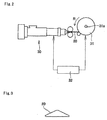
- the ribbon winding construction method is a construction method for forming a rubber member having a desired cross sectional shape by spirally winding a narrow and unvulcanized ribbon rubber 20 shown in Fig. 3 around a tire rotating axis (refer to Fig. 2 and Fig. 5 ).
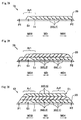
- the tread rubber 10 formed by the ribbon winding construction method has a winding start end S1 and a winding terminal end E1 of the ribbon rubber 20, as shown in Fig. 7C .
- the winding start end S1, the winding terminal end E1 and a moving route of a winding position can be checked out in a tire meridian cross section. Details thereof will be mentioned later.
- a main groove 15 extending in the tire peripheral direction is formed on a surface of the tread rubber 10.
- a projection is provided in a tire mold which is used for the vulcanizing treatment, and the main groove 15 is formed by pressing the projection against the tread rubber 10.
- the tread rubber 10 is appropriately provided with a transverse groove which extends in a direction intersecting the main groove 15.
- the tread rubber 10 shown in Fig. 1 is formed by the ribbon winding construction method.
- a forming step of the tread rubber 10 includes a stage which winds the ribbon rubber 20 supplied from a ribbon rubber forming device 30 to a rotation support body 31, while rotating the rotation support body 31, as shown in Fig. 2 .
- the rubber ribbon 20 is formed by a nonconductive rubber, as shown in Fig. 3 .
- a lower side in Fig. 3 comes to an inner peripheral side which is opposed to the rotation support body 31, at the winding time.
- the width and the thickness of the ribbon rubber are not particularly limited, however, are preferably desirable to be set between 15 mm and 40 mm in width and between 0.5 mm to 3.0 mm in thickness.
- the ribbon rubber forming device 30 is structured so as to form the ribbon rubber 20 by extruding the rubber.
- the rotation support body 31 is structured so as to achieve a rotation in a direction R around an axis 31 a, and a movement in an axial direction.
- a control device 32 carries out the operation control of the ribbon rubber forming device 30 and the rotation support body 31.
- a cross section of the ribbon rubber 20 is formed as a triangular shape, however, is not limited to this, but may also be formed in other shapes such as an oval shape, a quadrangular shape and the like.
- the rotation support body 31 is structured so as to move in the axial direction, however, the ribbon rubber forming device 30 may be moved with respect to the rotation support body 31.
- the rotation support body 31 it is possible to employ any structure as long as the rotation support body 31 can move relatively along the axis direction with respect to the ribbon rubber forming device 30.
- the base portion 11 is formed in an outer peripheral surface of the rotation support body 31.
- the belt layer 6 and the belt reinforcing layer 8 are provided previously on an outer peripheral surface of the rotation support body 31 (refer to Fig. 1 ), and the base portion 11 is formed on them.
- the base portion 11 may be formed by any one of a so-called extrusion molding method and a ribbon winding construction method.
- the extrusion molding method is a construction method which has a step of extruding and molding an unvulcanized band-like rubber member having a desired cross sectional shape, and jointing end portions thereof so as to form annularly.
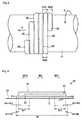
- a winding pitch P20 of the ribbon rubber 20 is set to be smaller than a ribbon width W20 of the ribbon rubber 20.
- the adjacent ribbon rubbers 20 and 20 are spirally wound in a state of being in contact with each other.
- An arrow D indicates a moving direction of the ribbon winding position, and the adjacent ribbon rubbers 20 overlap their edge portions with each other along the direction.
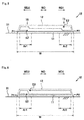
- Fig. 6 conceptually shows a moving route of the winding position of the ribbon rubber 20, in the forming step of the tread rubber shown in Fig. 4 .
- one side (a right side in the drawing) of the tire width direction WD in the tire meridian cross section is defined as WD1
- the other side is defined as WD2 (a left side in the drawing).
- the ribbon rubber is wound from the start point S1 which is positioned closer to the center side than tread ends P1 and P2 in the tire meridian cross section toward the tire width direction WD1 side.
- the ribbon rubber is folded back to a tire width direction WD2 side at the tread end P2 closer to the WD1 side, and is wound toward the tread end P1 on the WD2 side beyond the start point S1.
- the ribbon rubber is folded back to the tire width direction WD1 side at the tread end P1 in the WD2 side, and is wound toward the end point E1 which is positioned closer to the center side than the tread end P2.
- the ribbon rubber has the winding start end S1 and the winding terminal end E1 in the tread end vicinity portions Ar1 and Ar2.
- a value of 5 % or more in the definition of the tread end vicinity portion means avoidance of the tapered tread end.
- 25 % or less means avoidance of the tread center portion, however, 20 % or less is preferable for seeking out an improvement of the high-speed durability.
- Fig. 7 is drawn conceptually, and a cross sectional area ratio of each of the ribbon rubbers 20 with respect to the tread rubber 10 may be smaller.
- Fig. 7A corresponds to the stage in Fig. 4B , and the winding position of the ribbon rubber moves to the tire width direction WD1 side (the right side) by defining the tread end vicinity portion Ar1 on the tire width direction WD2 side (the left side) among the pair of tread end vicinity portions Ar1 and Ar2 as the start point S1, and reaches the tread end P2 on the tire width direction WD1 side (the right side). Accordingly, a first layer L1 of the ribbon rubber 20 is formed.
- Fig. 7B corresponds to the stage in Fig. 4C , and the winding position of the ribbon rubber folds back to the tire width direction WD2 side (the left side) at the tread end P2 on the tire width direction WD 1 side (the right side), goes over the start point S1, and reaches the tread end P1 on the tire width direction WD2 side (the left side). Accordingly, a second layer L2 of the ribbon rubber 20 is formed.
- Fig. 7C corresponds to the stage in Fig. 4D , and the winding position of the ribbon rubber folds back to the tire width direction WD1 side (the right side) at the tread end P1 in the tire width direction WD2 side (the left side), reaches the tread end vicinity portion Ar2 in the tire width direction WD1 side (the right side), and defines this as the end point E1. Accordingly, a third layer L3 of the ribbon rubber 20 is formed.
- the pneumatic tire of the present embodiment provides a pneumatic tire T in which the tread rubber 10 is formed by the ribbon rubber 20 spirally wound around the tire rotating axis, wherein the ribbon rubber 20 is wound toward the one side (WD1) in the tire width direction WD from the start point S1 which is positioned closer to the center side than the tread ends P1 and P2 in the tire meridian cross section, is next folded back to the other side (WD2) in the tire width direction WD at the tread end P2 on the one side (W1), goes over the start point S1 so as to be wound toward the tread end P1 on the other side (WD2), is next folded back to the one side (WD 1) in the tire width direction WD at the tread end P1 on the other side (WD2), and is wound toward the end point E1 which is positioned closer to the center side than the tread ends P1 and P2, and wherein the ribbon rubber 20 has the winding start end S1 and the winding terminal end E1 in the tread end vicinity portions Ar1 and Ar2 avoiding the tread ends
- the manufacturing method of the pneumatic tire of the present embodiment is a manufacturing method of a pneumatic tire including a tread rubber forming step of forming the tread rubber 10 by spirally winding the ribbon rubber 20 around the tire rotating axis, wherein the tread rubber forming step includes: a stage of winding the ribbon rubber 20 from the start point S1 which is positioned closer to the center side than the tread ends P1 and P2 in the tire meridian cross section toward the one side (WD1) in the tire width direction WD; next folding back the ribbon rubber to the other side (WD2) in the tire width direction WD at the tread end P2 on the one side (WD1), winding the ribbon rubber toward the tread end P1 on the other side (WD2) beyond the start point S1; next folding back the ribbon rubber to the one side (WD1) in the tire width direction WD at the tread end P1 on the other side (WD2); and winding the ribbon rubber toward the end point E1 which is positioned closer
- the tread end vicinity portions Ar1 and Ar2 mean a range between 5 and 25 % of a tread rubber maximum width W from the tread ends P1 and P2 toward the center side.
- the tread rubber 10 can be formed by one winding process without disconnecting the ribbon rubber 20 from the start point S1 to the end point E1, it is possible to improve the forming efficiency of the tread rubber 10.
- the winding start end S1 and the winding terminal end E1 of the ribbon rubber 20 are arranged at the tread end vicinity portions Ar1 and Ar2 avoiding the tread center portion, it is possible to reduce the influence of the centrifugal force and to improve the high-speed durability, in comparison with the case that the winding start end S1 and the winding terminal end E1 are arranged in the tread center portion.
- winding start end S1 and the winding terminal end E1 are arranged at the tread end vicinity portions Ar1 and Ar2 avoiding the tread ends P1 and P2, it is possible to appropriately push the ribbon rubber 20, and it is possible to suppress the defect.
- the ribbon rubber 20 forms the first layer L1 which reaches the tread end P2 on the other side (WD1) in the tire width direction by defining a tread end vicinity portion Ar1 on the one side (WD2) in the tire width direction WD among the paired tread end vicinity portions Ar1 and Ar2 as the start point S1, next forms the second layer L2 which reaches the tread end P1 on the one side (WD2) beyond the start point S1 by folding back to the one side (WD2) in the tire width direction at the tread end P2 on the other side (WD1) in the tire width direction, and next forms the third layer L3 which defines the tread end vicinity portion Ar2 on the other side (WD1) in the tire width direction as the end point E1 by folding back to the other side (WD1) in the tire width direction at the tread end P1 on the one side (WD2).
- the thickness of the tread rubber 10 since it is possible to secure the thickness of the tread rubber 10 without narrowing the winding pitch P20 of the ribbon rubber 20 as well as raising the ribbon rubber 20, it is possible to improve both the securing of the thickness and the winding controllability of the ribbon rubber. Particularly, it is useful for forming the tire which requires a greater thickness such as a truck and a bus.
- the ribbon rubber is folded back at the position P3 so as to be wound toward the one side (WD2) in the tire width direction beyond the start point S2, is folded to the other side (WD1) in the tire width direction at the tread end P1 on the one side (WD2), and is wound toward the tread end P2 on the other side (WD1) beyond the start point S2.
- the ribbon rubber is folded back at the tread end P2 on the other side (WD1), and is wound to the terminal end E2 which is positioned closer to the center side than the tread end P2.
- the winding start end S1 and the winding terminal end E1 are kept away at 180° in the tire peripheral direction.
- a radial force variation (RFV) is improved and a ground surface pressure distribution on a periphery becomes uniform as long as the winding start end S1 and the winding terminal end E1 are in a positional relationship which is symmetrical around the tire rotating axis, it is possible to improve the high-speed durability.
- the high-speed durability was evaluated by using a test tire having a tire size 215/45R17.
- the high-speed durability was tested on the basis of a condition about tire of a speed mark H (210 km/h) which was defined as load/speed performance test procedure by a supplementary provision 7 of Regulation No. 30 of Economic Commission for Europe (Regulation No. 30 Uniform Provisions Concerning the Approval of Pneumatic Tires for Motor Vehicles and Their Trailers).
- the high-speed durability was evaluated by traveling at a high speed by a drum tester until the tire broke down, according to a method of increasing the traveling speed at 10 km/h per ten minutes. Therefore, the higher speed indicates the more excellent high-speed durability.
- the tire was produced by arranging the winding start end of the ribbon rubber to the center portion in the tire width direction, winding the ribbon rubber like a infinity symbol shape, and arranging the winding terminal end at the center portion (the equator portion) in the tire width direction (refer to JP-A-2006-130 880 .
- the tread rubber was formed by winding the ribbon rubber via the route shown in Fig. 6 .
- the winding start end S1 and the winding terminal end E1 of the ribbon rubber 20 were arranged respectively at positions which were 12.5 % of the maximum width W of the tread rubber from the tread ends P1 and P2 toward the center side.
- the same structures as in the Comparative Example were applied with the exception of the above.
- the tread rubber was formed by winding the ribbon rubber via the route shown in Fig. 8 .
- the winding start end S2 and the winding terminal end E2 of the ribbon rubber 20 were arranged respectively at positions which were 20 % of the maximum width W of the tread rubber from the tread ends P1 and P2 toward the center side.
- the same structures as in the Comparative Example were applied with the exception of the above.
- the tread rubber was formed by winding the ribbon rubber via the route shown in Fig. 9 .
- the winding start end S2 and the winding terminal end E3 of the ribbon rubber 20 were arranged respectively at positions which were 24.1 % of the maximum width W of the tread rubber from the tread end P1 toward the center side.
- the same structures as in the Comparative Example were applied with the exception of the above.
- the tread rubber was formed by winding the ribbon rubber via the route shown in Fig. 10 .
- the winding start end S2 and the winding terminal end E2 of the ribbon rubber 20 were arranged respectively at positions which were 23.2 % of the maximum width W of the tread rubber from the tread ends P1 and P2 toward the center side.
- the same structures as in the Comparative Example were applied with the exception of the above.
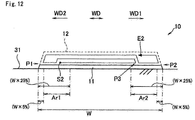
- the tread rubber was formed by winding the ribbon rubber via the route shown in Fig. 12 .
- the winding start end S2 and the winding terminal end E2 of the ribbon rubber 20 were arranged respectively at positions which were 20 % the maximum width W of the tread rubber from the tread ends P1 and P2 toward the center side.
- the same structures as in the Comparative Example were applied with the exception of the above.
- Table 1 Comparative Example Example 1 Example 2
- Example 3 Example 4
- Example 5 High-speed durability 280 km/h 310 km/h 310 km/h 300 km/h 290 km/h 300 km/h
- the failure was generated at 280 km/h, however, the speeds at which the failure was generated were higher in all the Examples 1 to 5 than in the Comparative Example. Accordingly, it is known that the high-speed durability is improved. In this case, it can be thought that the Example 4 is lower in the high-speed durability in comparison with the Examples 1 to 3 since the fold-back end of the ribbon rubber 20 exists at the tread intermediate portion between the paired tread end vicinity portions Ar1 and Ar2.
- the tread intermediate portion (including the tire equator) does not have any fold-back end.
- each of the embodiments it is possible to apply the structure employed in each of the embodiments to the other optional embodiment.
- the particular structure of each of the portions is not limited to the embodiments mentioned above, but can be variously modified within a range which does not deviate from the scope of the present invention.
Landscapes
- Engineering & Computer Science (AREA)
- Mechanical Engineering (AREA)
- Tyre Moulding (AREA)
- Tires In General (AREA)
Claims (8)
- Luftreifen, der Folgendes aufweist:- ein Laufflächengummimaterial (10), wobei das Laufflächengummimaterial (10) durch ein bandförmiges Gummimaterial (20) gebildet ist, das spiralförmig um eine Reifenrotationsachse gewickelt ist,- wobei das bandförmige Gummimaterial (20) ein Wickelanfangsende (S1) und ein Wickelabschlussende (E1) in Laufflächenenden-nahen Bereichen (Ar1, Ar2) mit Ausnahme von Laufflächenenden (P1, P2) und einem zentralen Laufflächenbereich aufweist, wobei sich die Laufflächenenden-nahen Bereiche (Ar1, Ar2) in einem Bereich von gleich oder mehr als 5 % bis gleich oder mehr als 25 % der maximalen Breite (W) des Laufflächengummimaterials (10) von den Laufflächenenden (P1, P2) zu der Zentrumsseite hin befinden, und- wobei das bandförmige Gummimaterial (20) in einem Reifenmeridianschnitt von dem Wickelanfangsende (S1) in Richtung auf die eine Seite in der Reifenbreitenrichtung (WD) gewickelt ist, sodann an dem Laufflächenende auf der einen Seite zu der anderen Seite in der Reifenbreitenrichtung (WD) zurück umgeschlagen ist, in Richtung auf das Laufflächenende auf der anderen Seite über das Wickelanfangsende (S1) hinaus gewickelt ist, sodann an dem Laufflächenende auf der anderen Seite zu der einen Seite in der Reifenbreitenrichtung (WD) zurück umgeschlagen ist sowie in Richtung auf das Wickelabschlussende (E1) gewickelt ist.
- Luftreifen nach Anspruch 1,
wobei das Wickelabschlussende (E1) an einer Stelle angeordnet ist, an der eine sich in Reifenumfangsrichtung erstreckende Hauptnut (15) gebildet ist. - Luftreifen nach Anspruch 1 oder 2,
wobei das Laufflächengummimaterial (10) einen dreilagigen Strukturbereich aufweist, in dem das zu der einen Seite in der Reifenbreitenrichtung (WD) gewickelte bandförmige Gummimaterial (20) zurück umgeschlagen ist, in Richtung auf die andere Seite in der Reifenbreitenrichtung (WD) gewickelt ist, danach wiederum zurück umgeschlagen ist und in Richtung auf die eine Seite in der Reifenbreitenrichtung (WD) gewickelt ist, und zwar an der Stelle, die sich näher bei der Zentrumsseite als die Laufflächenenden (P1, P2) befindet. - Luftreifen nach einem der Ansprüche 1 bis 3,
wobei bei dem bandförmigen Gummimaterial (20) das Wickelanfangsende (S1) in dem Laufflächenenden-nahen Bereich (Ar1) auf der einen Seite in der Reifenbreitenrichtung (WD) angeordnet ist und das Wickelabschlussende (E1) in dem Laufflächenenden-nahen Bereich (Ar2) auf der anderen Seite in der Reifenbreitenrichtung (WD) angeordnet ist, und
wobei das bandförmige Gummimaterial (20) eine erste Lage bildet, die ausgehend von dem Wickelanfangsende (S1) das Laufflächenende auf der anderen Seite in der Reifenbreitenrichtung (WD) erreicht, als nächstes eine zweite Lage bildet, die an dem Laufflächenende auf der anderen Seite in der Reifenbreitenrichtung (WD) zu der einen Seite in der Reifenbreitenrichtung zurück umgeschlagen ist und das Laufflächenende auf der einen Seite jenseits des Wickelanfangsendes (S1) erreicht, und sodann eine dritte Lage bildet, die an dem Laufflächenende auf der einen Seite zu der anderen Seite in der Reifenbreitenrichtung (WD) zurück umgeschlagen ist und das Wickelabschlussende (E1) erreicht. - Herstellungsverfahren für einen Luftreifen, das folgende Schritte aufweist:- einen Schritt zum Bilden von Laufflächengummimaterial (10), in dem ein Laufflächengummimaterial (10) durch spiralförmiges Wickeln eines bandförmigen Gummimaterials (20) um eine Reifenrotationsachse gebildet wird,- wobei das bandförmige Gummimaterial (20) ein Wickelanfangsende (S1) und ein Wickelabschlussende (E1) in Laufflächenenden-nahen Bereichen (Ar1, Ar2) mit Ausnahme von Laufflächenenden (P1, P2) und einem zentralen Laufflächenbereich aufweist, wobei sich die Laufflächenenden-nahen Bereiche (Ar1, Ar2) in einem Bereich von gleich oder mehr als 5 % bis gleich oder mehr als 25 % der maximalen Breite (W) des Laufflächengummimaterials (10) von den Laufflächenenden (P1, P2) zu der Zentrumsseite hin befinden, und- wobei der Schritt zum Bilden des Laufflächengummimaterials ein Stadium aufweist, in dem das bandförmige Gummimaterial (20) in einem Reifenmeridianschnitt von einem Wickelanfangsende (S1) in Richtung auf die eine Seite in der Reifenbreitenrichtung (WD) gewickelt wird, sodann das bandförmige Gummimaterial (20) an dem Lauf-flächenende auf der einen Seite zu der anderen Seite in der Reifenbreitenrichtung (WD) zurück umgeschlagen wird, das bandförmige Gummimaterial (20) in Richtung auf das Laufflächenende auf der anderen Seite über das Wickelanfangsende (S1) hinaus gewickelt wird, sodann das bandförmige Gummimaterial (20) an dem Laufflächenende auf der anderen Seite zu der einen Seite in der Reifenbreitenrichtung (WD) zurück umgeschlagen wird sowie das bandförmige Gummimaterial (20) in Richtung auf das Wickelabschlussende (E1) gewickelt wird.
- Herstellungsverfahren nach Anspruch 5,
wobei das Wickelabschlussende (E1) an der Ausbildungsstelle der sich in der Reifenumfangsrichtung erstreckenden Hauptnut (15) angeordnet wird. - Herstellungsverfahren nach Anspruch 5 oder 6,
wobei der dreilagige Strukturbereich gebildet wird, indem das zu der einen Seite in der Reifenbreitenrichtung (WD) gewickelte bandförmige Gummimaterial (20) an der Stelle, die sich näher bei der Zentrumsseite als die Laufflächenenden (P1, P2) befindet, zurück umgeschlagen wird, das bandförmige Gummimaterial (20) in Richtung auf die andere Seite in der Reifenbreitenrichtung (WD) gewickelt wird und anschließend das bandförmige Gummimaterial (20) wiederum zurück umgeschlagen wird und somit in Richtung auf die eine Seite in der Reifenbreitenrichtung (WD) gewickelt wird. - Herstellungsverfahren nach einem der Ansprüche 5 bis 7,
wobei eine erste Lage gebildet wird, indem die Wickelposition des bandförmigen Gummimaterials (20) von dem Wickelanfangsende (S1) des Bereichs in der Nähe des Laufflächenendes auf der einen Seite in der Reifenbreitenrichtung (WD) von den Bereichen in der Nähe des Paares von Laufflächenenden-nahen Bereichen zu dem Laufflächenende auf der anderen Seite in der Reifenbreitenrichtung (WD) verlagert wird, als nächstes eine zweite Lage gebildet wird, indem die Wickelposition des bandförmigen Gummimaterials (20) an dem Laufflächenende auf der anderen Seite in der Reifenbreitenrichtung (WD) zu der einen Seite in der Reifenbreitenrichtung (WD) zurück umgeschlagen wird und zu dem Laufflächenende auf der einen Seite jenseits des Wickelanfangsendes (S1) verlagert wird, und sodann eine dritte Lage gebildet wird, indem die die Wickelposition des bandförmigen Gummimaterials (20) an dem Laufflächenende auf der einen Seite zu der anderen Seite in der Reifenbreitenrichtung zurück umgeschlagen wird und der Bereich in der Nähe des Laufflächenendes auf der anderen Seite in der Reifenbreitenrichtung (WD) als Wickelabschlussende (E1) definiert wird.
Applications Claiming Priority (2)
| Application Number | Priority Date | Filing Date | Title |
|---|---|---|---|
| JP2011277608 | 2011-12-19 | ||
| JP2012200587A JP6061577B2 (ja) | 2011-12-19 | 2012-09-12 | 空気入りタイヤ及びその製造方法 |
Publications (2)
| Publication Number | Publication Date |
|---|---|
| EP2607065A1 EP2607065A1 (de) | 2013-06-26 |
| EP2607065B1 true EP2607065B1 (de) | 2016-04-27 |
Family
ID=47325946
Family Applications (1)
| Application Number | Title | Priority Date | Filing Date |
|---|---|---|---|
| EP12196688.1A Not-in-force EP2607065B1 (de) | 2011-12-19 | 2012-12-12 | Luftreifen und Herstellungsverfahren dafür |
Country Status (4)
| Country | Link |
|---|---|
| US (1) | US20130340904A1 (de) |
| EP (1) | EP2607065B1 (de) |
| JP (1) | JP6061577B2 (de) |
| CN (2) | CN103158441B (de) |
Families Citing this family (6)
| Publication number | Priority date | Publication date | Assignee | Title |
|---|---|---|---|---|
| JP6117082B2 (ja) * | 2013-11-21 | 2017-04-19 | 東洋ゴム工業株式会社 | ストリップゴムの貼付け方法及び貼付け装置 |
| JP5986325B1 (ja) | 2014-10-17 | 2016-09-06 | 住友ゴム工業株式会社 | 空気入りタイヤ用ゴム組成物 |
| JP6235990B2 (ja) * | 2014-10-17 | 2017-11-22 | 住友ゴム工業株式会社 | シーラントタイヤ |
| JP5918456B1 (ja) | 2014-10-17 | 2016-05-18 | 住友ゴム工業株式会社 | 空気入りタイヤ及びその製造方法 |
| JP7494482B2 (ja) * | 2020-02-18 | 2024-06-04 | 住友ゴム工業株式会社 | トレッドゴム形成方法及びトレッドゴム形成装置 |
| CN111267553B (zh) * | 2020-03-24 | 2022-03-11 | 江苏通用科技股份有限公司 | 多层式型胶胎面结构 |
Family Cites Families (21)
| Publication number | Priority date | Publication date | Assignee | Title |
|---|---|---|---|---|
| US3177918A (en) * | 1959-12-24 | 1965-04-13 | Voit Rubber Corp | Method of building a tread on pneumatic tires |
| JPH0655562B2 (ja) * | 1986-04-22 | 1994-07-27 | 株式会社ブリヂストン | 空気入りタイヤ |
| EP0524703B1 (de) * | 1987-06-18 | 1996-08-21 | Sumitomo Rubber Industries Limited | Einrichtung zur Herstellung eines Gürtels für Radial-Reifen |
| JP2639703B2 (ja) * | 1988-09-02 | 1997-08-13 | 横浜ゴム株式会社 | タイヤベルト補強層の巻付け方法 |
| JP3236046B2 (ja) * | 1991-12-27 | 2001-12-04 | 横浜ゴム株式会社 | ゴムストリップの巻付け方法 |
| DE4212295B4 (de) * | 1992-04-11 | 2005-02-17 | Uniroyal Englebert Reifen Gmbh | Fahrzeugluftreifen |
| JP2000202921A (ja) * | 1999-01-12 | 2000-07-25 | Sumitomo Rubber Ind Ltd | タイヤ用ゴム部材の製造方法およびタイヤ |
| JP4308978B2 (ja) * | 1999-06-17 | 2009-08-05 | 横浜ゴム株式会社 | 重荷重用空気入りラジアルタイヤ |
| JP2001038822A (ja) * | 1999-07-30 | 2001-02-13 | Bridgestone Corp | 大型空気入りタイヤおよびその製造方法 |
| JP4039895B2 (ja) * | 2002-06-24 | 2008-01-30 | 横浜ゴム株式会社 | タイヤトレッド構成部材の成形方法及び空気入りタイヤ |
| JP4437888B2 (ja) * | 2003-01-24 | 2010-03-24 | 株式会社ブリヂストン | 空気入りタイヤ |
| DE602005010345D1 (de) * | 2004-08-26 | 2008-11-27 | Sumitomo Rubber Ind | Verfahren zur Herstellung eines Luftreifens und damit hergestellter Luftreifen |
| JP4589684B2 (ja) * | 2004-08-26 | 2010-12-01 | 住友ゴム工業株式会社 | タイヤ用ゴム部材の製造方法及び空気入りタイヤ |
| JP4585307B2 (ja) * | 2004-12-24 | 2010-11-24 | 住友ゴム工業株式会社 | 自動二輪車用タイヤの製造方法 |
| JP4921793B2 (ja) * | 2005-12-29 | 2012-04-25 | 住友ゴム工業株式会社 | タイヤ用生ゴム部材の製造方法、及び空気入りタイヤ |
| JP4750853B2 (ja) * | 2006-08-31 | 2011-08-17 | 東洋ゴム工業株式会社 | 空気入りタイヤの製造方法 |
| JP5226970B2 (ja) * | 2007-05-18 | 2013-07-03 | 住友ゴム工業株式会社 | 空気入りタイヤ及びその製造方法 |
| JP4392444B2 (ja) * | 2007-11-21 | 2010-01-06 | 住友ゴム工業株式会社 | 空気入りタイヤ及びその製造方法 |
| US20100258227A1 (en) * | 2007-11-21 | 2010-10-14 | Takeshi Kuroki | Pneumatic tire and production method therefor |
| JP4575979B2 (ja) * | 2008-11-11 | 2010-11-04 | 住友ゴム工業株式会社 | 空気入りタイヤ及びその製造方法 |
| JP5456074B2 (ja) * | 2011-09-21 | 2014-03-26 | 東洋ゴム工業株式会社 | 空気入りタイヤの製造方法 |
-
2012
- 2012-09-12 JP JP2012200587A patent/JP6061577B2/ja active Active
- 2012-11-15 CN CN201210460314.0A patent/CN103158441B/zh not_active Expired - Fee Related
- 2012-11-15 CN CN201610546721.1A patent/CN106114067B/zh not_active Expired - Fee Related
- 2012-11-27 US US13/685,846 patent/US20130340904A1/en not_active Abandoned
- 2012-12-12 EP EP12196688.1A patent/EP2607065B1/de not_active Not-in-force
Also Published As
| Publication number | Publication date |
|---|---|
| JP6061577B2 (ja) | 2017-01-18 |
| JP2013147243A (ja) | 2013-08-01 |
| EP2607065A1 (de) | 2013-06-26 |
| US20130340904A1 (en) | 2013-12-26 |
| CN106114067B (zh) | 2018-06-22 |
| CN103158441B (zh) | 2016-08-10 |
| CN106114067A (zh) | 2016-11-16 |
| CN103158441A (zh) | 2013-06-19 |
Similar Documents
| Publication | Publication Date | Title |
|---|---|---|
| JP5456074B2 (ja) | 空気入りタイヤの製造方法 | |
| EP2607065B1 (de) | Luftreifen und Herstellungsverfahren dafür | |
| EP2481560B1 (de) | Verfahren zur Herstellung von pneumatischen Reifen | |
| EP2308694B1 (de) | Luftreifen | |
| CN109551797B (zh) | 充气轮胎及其制造方法 | |
| JP4585307B2 (ja) | 自動二輪車用タイヤの製造方法 | |
| EP2974891B1 (de) | Luftreifen | |
| US20140138006A1 (en) | Pneumatic tire and manufacturing method of the same | |
| US10894376B2 (en) | Pneumatic tire and manufacturing method therefor | |
| JP6043553B2 (ja) | 空気入りタイヤ | |
| JP6084444B2 (ja) | 空気入りタイヤ及びその製造方法 | |
| JP2013079050A (ja) | 空気入りタイヤ | |
| JP6025463B2 (ja) | 空気入りタイヤ | |
| EP1800845B1 (de) | Luftreifen und Verfahren zu seiner Herstellung. | |
| EP2865542B1 (de) | Luftreifen und verfahren zur herstellung eines luftreifens | |
| JP4997861B2 (ja) | 空気入りタイヤの製造方法 | |
| JP6177282B2 (ja) | 空気入りタイヤ | |
| JP6077281B2 (ja) | 空気入りタイヤ及びその製造方法 | |
| JP2024061153A (ja) | 空気入りタイヤ | |
| JP6121185B2 (ja) | 空気入りタイヤ | |
| JP2013169848A (ja) | 空気入りタイヤ |
Legal Events
| Date | Code | Title | Description |
|---|---|---|---|
| AK | Designated contracting states |
Kind code of ref document: A1 Designated state(s): AL AT BE BG CH CY CZ DE DK EE ES FI FR GB GR HR HU IE IS IT LI LT LU LV MC MK MT NL NO PL PT RO RS SE SI SK SM TR |
|
| AX | Request for extension of the european patent |
Extension state: BA ME |
|
| PUAI | Public reference made under article 153(3) epc to a published international application that has entered the european phase |
Free format text: ORIGINAL CODE: 0009012 |
|
| 17P | Request for examination filed |
Effective date: 20131220 |
|
| RBV | Designated contracting states (corrected) |
Designated state(s): AL AT BE BG CH CY CZ DE DK EE ES FI FR GB GR HR HU IE IS IT LI LT LU LV MC MK MT NL NO PL PT RO RS SE SI SK SM TR |
|
| 17Q | First examination report despatched |
Effective date: 20140818 |
|
| GRAP | Despatch of communication of intention to grant a patent |
Free format text: ORIGINAL CODE: EPIDOSNIGR1 |
|
| INTG | Intention to grant announced |
Effective date: 20151022 |
|
| GRAS | Grant fee paid |
Free format text: ORIGINAL CODE: EPIDOSNIGR3 |
|
| GRAA | (expected) grant |
Free format text: ORIGINAL CODE: 0009210 |
|
| AK | Designated contracting states |
Kind code of ref document: B1 Designated state(s): AL AT BE BG CH CY CZ DE DK EE ES FI FR GB GR HR HU IE IS IT LI LT LU LV MC MK MT NL NO PL PT RO RS SE SI SK SM TR |
|
| REG | Reference to a national code |
Ref country code: GB Ref legal event code: FG4D |
|
| REG | Reference to a national code |
Ref country code: CH Ref legal event code: EP |
|
| REG | Reference to a national code |
Ref country code: AT Ref legal event code: REF Ref document number: 794252 Country of ref document: AT Kind code of ref document: T Effective date: 20160515 |
|
| REG | Reference to a national code |
Ref country code: IE Ref legal event code: FG4D |
|
| REG | Reference to a national code |
Ref country code: DE Ref legal event code: R096 Ref document number: 602012017607 Country of ref document: DE |
|
| REG | Reference to a national code |
Ref country code: LT Ref legal event code: MG4D |
|
| REG | Reference to a national code |
Ref country code: NL Ref legal event code: MP Effective date: 20160427 |
|
| REG | Reference to a national code |
Ref country code: AT Ref legal event code: MK05 Ref document number: 794252 Country of ref document: AT Kind code of ref document: T Effective date: 20160427 |
|
| PG25 | Lapsed in a contracting state [announced via postgrant information from national office to epo] |
Ref country code: NL Free format text: LAPSE BECAUSE OF FAILURE TO SUBMIT A TRANSLATION OF THE DESCRIPTION OR TO PAY THE FEE WITHIN THE PRESCRIBED TIME-LIMIT Effective date: 20160427 |
|
| PG25 | Lapsed in a contracting state [announced via postgrant information from national office to epo] |
Ref country code: FI Free format text: LAPSE BECAUSE OF FAILURE TO SUBMIT A TRANSLATION OF THE DESCRIPTION OR TO PAY THE FEE WITHIN THE PRESCRIBED TIME-LIMIT Effective date: 20160427 Ref country code: NO Free format text: LAPSE BECAUSE OF FAILURE TO SUBMIT A TRANSLATION OF THE DESCRIPTION OR TO PAY THE FEE WITHIN THE PRESCRIBED TIME-LIMIT Effective date: 20160727 Ref country code: PL Free format text: LAPSE BECAUSE OF FAILURE TO SUBMIT A TRANSLATION OF THE DESCRIPTION OR TO PAY THE FEE WITHIN THE PRESCRIBED TIME-LIMIT Effective date: 20160427 Ref country code: LT Free format text: LAPSE BECAUSE OF FAILURE TO SUBMIT A TRANSLATION OF THE DESCRIPTION OR TO PAY THE FEE WITHIN THE PRESCRIBED TIME-LIMIT Effective date: 20160427 |
|
| PG25 | Lapsed in a contracting state [announced via postgrant information from national office to epo] |
Ref country code: SE Free format text: LAPSE BECAUSE OF FAILURE TO SUBMIT A TRANSLATION OF THE DESCRIPTION OR TO PAY THE FEE WITHIN THE PRESCRIBED TIME-LIMIT Effective date: 20160427 Ref country code: GR Free format text: LAPSE BECAUSE OF FAILURE TO SUBMIT A TRANSLATION OF THE DESCRIPTION OR TO PAY THE FEE WITHIN THE PRESCRIBED TIME-LIMIT Effective date: 20160728 Ref country code: RS Free format text: LAPSE BECAUSE OF FAILURE TO SUBMIT A TRANSLATION OF THE DESCRIPTION OR TO PAY THE FEE WITHIN THE PRESCRIBED TIME-LIMIT Effective date: 20160427 Ref country code: AT Free format text: LAPSE BECAUSE OF FAILURE TO SUBMIT A TRANSLATION OF THE DESCRIPTION OR TO PAY THE FEE WITHIN THE PRESCRIBED TIME-LIMIT Effective date: 20160427 Ref country code: HR Free format text: LAPSE BECAUSE OF FAILURE TO SUBMIT A TRANSLATION OF THE DESCRIPTION OR TO PAY THE FEE WITHIN THE PRESCRIBED TIME-LIMIT Effective date: 20160427 Ref country code: LV Free format text: LAPSE BECAUSE OF FAILURE TO SUBMIT A TRANSLATION OF THE DESCRIPTION OR TO PAY THE FEE WITHIN THE PRESCRIBED TIME-LIMIT Effective date: 20160427 Ref country code: PT Free format text: LAPSE BECAUSE OF FAILURE TO SUBMIT A TRANSLATION OF THE DESCRIPTION OR TO PAY THE FEE WITHIN THE PRESCRIBED TIME-LIMIT Effective date: 20160829 Ref country code: ES Free format text: LAPSE BECAUSE OF FAILURE TO SUBMIT A TRANSLATION OF THE DESCRIPTION OR TO PAY THE FEE WITHIN THE PRESCRIBED TIME-LIMIT Effective date: 20160427 |
|
| PG25 | Lapsed in a contracting state [announced via postgrant information from national office to epo] |
Ref country code: IT Free format text: LAPSE BECAUSE OF FAILURE TO SUBMIT A TRANSLATION OF THE DESCRIPTION OR TO PAY THE FEE WITHIN THE PRESCRIBED TIME-LIMIT Effective date: 20160427 Ref country code: BE Free format text: LAPSE BECAUSE OF FAILURE TO SUBMIT A TRANSLATION OF THE DESCRIPTION OR TO PAY THE FEE WITHIN THE PRESCRIBED TIME-LIMIT Effective date: 20160427 |
|
| REG | Reference to a national code |
Ref country code: DE Ref legal event code: R097 Ref document number: 602012017607 Country of ref document: DE |
|
| PG25 | Lapsed in a contracting state [announced via postgrant information from national office to epo] |
Ref country code: RO Free format text: LAPSE BECAUSE OF FAILURE TO SUBMIT A TRANSLATION OF THE DESCRIPTION OR TO PAY THE FEE WITHIN THE PRESCRIBED TIME-LIMIT Effective date: 20160427 Ref country code: DK Free format text: LAPSE BECAUSE OF FAILURE TO SUBMIT A TRANSLATION OF THE DESCRIPTION OR TO PAY THE FEE WITHIN THE PRESCRIBED TIME-LIMIT Effective date: 20160427 Ref country code: SK Free format text: LAPSE BECAUSE OF FAILURE TO SUBMIT A TRANSLATION OF THE DESCRIPTION OR TO PAY THE FEE WITHIN THE PRESCRIBED TIME-LIMIT Effective date: 20160427 Ref country code: CZ Free format text: LAPSE BECAUSE OF FAILURE TO SUBMIT A TRANSLATION OF THE DESCRIPTION OR TO PAY THE FEE WITHIN THE PRESCRIBED TIME-LIMIT Effective date: 20160427 Ref country code: EE Free format text: LAPSE BECAUSE OF FAILURE TO SUBMIT A TRANSLATION OF THE DESCRIPTION OR TO PAY THE FEE WITHIN THE PRESCRIBED TIME-LIMIT Effective date: 20160427 |
|
| PG25 | Lapsed in a contracting state [announced via postgrant information from national office to epo] |
Ref country code: SM Free format text: LAPSE BECAUSE OF FAILURE TO SUBMIT A TRANSLATION OF THE DESCRIPTION OR TO PAY THE FEE WITHIN THE PRESCRIBED TIME-LIMIT Effective date: 20160427 |
|
| PLBE | No opposition filed within time limit |
Free format text: ORIGINAL CODE: 0009261 |
|
| STAA | Information on the status of an ep patent application or granted ep patent |
Free format text: STATUS: NO OPPOSITION FILED WITHIN TIME LIMIT |
|
| 26N | No opposition filed |
Effective date: 20170130 |
|
| PG25 | Lapsed in a contracting state [announced via postgrant information from national office to epo] |
Ref country code: SI Free format text: LAPSE BECAUSE OF FAILURE TO SUBMIT A TRANSLATION OF THE DESCRIPTION OR TO PAY THE FEE WITHIN THE PRESCRIBED TIME-LIMIT Effective date: 20160427 |
|
| REG | Reference to a national code |
Ref country code: CH Ref legal event code: PL |
|
| GBPC | Gb: european patent ceased through non-payment of renewal fee |
Effective date: 20161212 |
|
| PG25 | Lapsed in a contracting state [announced via postgrant information from national office to epo] |
Ref country code: MC Free format text: LAPSE BECAUSE OF FAILURE TO SUBMIT A TRANSLATION OF THE DESCRIPTION OR TO PAY THE FEE WITHIN THE PRESCRIBED TIME-LIMIT Effective date: 20160427 |
|
| REG | Reference to a national code |
Ref country code: FR Ref legal event code: ST Effective date: 20170831 |
|
| REG | Reference to a national code |
Ref country code: IE Ref legal event code: MM4A |
|
| PG25 | Lapsed in a contracting state [announced via postgrant information from national office to epo] |
Ref country code: LI Free format text: LAPSE BECAUSE OF NON-PAYMENT OF DUE FEES Effective date: 20161231 Ref country code: FR Free format text: LAPSE BECAUSE OF NON-PAYMENT OF DUE FEES Effective date: 20170102 Ref country code: LU Free format text: LAPSE BECAUSE OF NON-PAYMENT OF DUE FEES Effective date: 20161212 Ref country code: CH Free format text: LAPSE BECAUSE OF NON-PAYMENT OF DUE FEES Effective date: 20161231 |
|
| PG25 | Lapsed in a contracting state [announced via postgrant information from national office to epo] |
Ref country code: IE Free format text: LAPSE BECAUSE OF NON-PAYMENT OF DUE FEES Effective date: 20161212 Ref country code: GB Free format text: LAPSE BECAUSE OF NON-PAYMENT OF DUE FEES Effective date: 20161212 |
|
| PG25 | Lapsed in a contracting state [announced via postgrant information from national office to epo] |
Ref country code: CY Free format text: LAPSE BECAUSE OF FAILURE TO SUBMIT A TRANSLATION OF THE DESCRIPTION OR TO PAY THE FEE WITHIN THE PRESCRIBED TIME-LIMIT Effective date: 20160427 Ref country code: HU Free format text: LAPSE BECAUSE OF FAILURE TO SUBMIT A TRANSLATION OF THE DESCRIPTION OR TO PAY THE FEE WITHIN THE PRESCRIBED TIME-LIMIT; INVALID AB INITIO Effective date: 20121212 |
|
| PG25 | Lapsed in a contracting state [announced via postgrant information from national office to epo] |
Ref country code: TR Free format text: LAPSE BECAUSE OF FAILURE TO SUBMIT A TRANSLATION OF THE DESCRIPTION OR TO PAY THE FEE WITHIN THE PRESCRIBED TIME-LIMIT Effective date: 20160427 Ref country code: IS Free format text: LAPSE BECAUSE OF FAILURE TO SUBMIT A TRANSLATION OF THE DESCRIPTION OR TO PAY THE FEE WITHIN THE PRESCRIBED TIME-LIMIT Effective date: 20160427 Ref country code: MK Free format text: LAPSE BECAUSE OF FAILURE TO SUBMIT A TRANSLATION OF THE DESCRIPTION OR TO PAY THE FEE WITHIN THE PRESCRIBED TIME-LIMIT Effective date: 20160427 |
|
| PG25 | Lapsed in a contracting state [announced via postgrant information from national office to epo] |
Ref country code: BG Free format text: LAPSE BECAUSE OF FAILURE TO SUBMIT A TRANSLATION OF THE DESCRIPTION OR TO PAY THE FEE WITHIN THE PRESCRIBED TIME-LIMIT Effective date: 20160427 |
|
| PG25 | Lapsed in a contracting state [announced via postgrant information from national office to epo] |
Ref country code: MT Free format text: LAPSE BECAUSE OF NON-PAYMENT OF DUE FEES Effective date: 20161212 |
|
| PG25 | Lapsed in a contracting state [announced via postgrant information from national office to epo] |
Ref country code: AL Free format text: LAPSE BECAUSE OF FAILURE TO SUBMIT A TRANSLATION OF THE DESCRIPTION OR TO PAY THE FEE WITHIN THE PRESCRIBED TIME-LIMIT Effective date: 20160427 |
|
| PGFP | Annual fee paid to national office [announced via postgrant information from national office to epo] |
Ref country code: DE Payment date: 20221102 Year of fee payment: 11 |
|
| REG | Reference to a national code |
Ref country code: DE Ref legal event code: R119 Ref document number: 602012017607 Country of ref document: DE |
|
| PG25 | Lapsed in a contracting state [announced via postgrant information from national office to epo] |
Ref country code: DE Free format text: LAPSE BECAUSE OF NON-PAYMENT OF DUE FEES Effective date: 20240702 |
|
| PG25 | Lapsed in a contracting state [announced via postgrant information from national office to epo] |
Ref country code: DE Free format text: LAPSE BECAUSE OF NON-PAYMENT OF DUE FEES Effective date: 20240702 |