EP2531891B1 - Negative lichtempfindliche harzzusammensetzung, strukturformungsverfahren und flüssigkeitsausstosskopf - Google Patents
Negative lichtempfindliche harzzusammensetzung, strukturformungsverfahren und flüssigkeitsausstosskopf Download PDFInfo
- Publication number
- EP2531891B1 EP2531891B1 EP11739806.5A EP11739806A EP2531891B1 EP 2531891 B1 EP2531891 B1 EP 2531891B1 EP 11739806 A EP11739806 A EP 11739806A EP 2531891 B1 EP2531891 B1 EP 2531891B1
- Authority
- EP
- European Patent Office
- Prior art keywords
- group
- acid
- salt
- atom
- resin composition
- Prior art date
- Legal status (The legal status is an assumption and is not a legal conclusion. Google has not performed a legal analysis and makes no representation as to the accuracy of the status listed.)
- Not-in-force
Links
- 239000011342 resin composition Substances 0.000 title claims description 42
- 239000007788 liquid Substances 0.000 title claims description 28
- 238000000034 method Methods 0.000 title claims description 26
- 230000007261 regionalization Effects 0.000 title claims description 5
- 239000002253 acid Substances 0.000 claims description 118
- 239000003795 chemical substances by application Substances 0.000 claims description 109
- 150000003839 salts Chemical class 0.000 claims description 67
- 125000004432 carbon atom Chemical group C* 0.000 claims description 41
- -1 sulfonium salt compound Chemical class 0.000 claims description 35
- 150000001875 compounds Chemical class 0.000 claims description 34
- 229910052731 fluorine Inorganic materials 0.000 claims description 33
- 125000001153 fluoro group Chemical group F* 0.000 claims description 33
- 150000001450 anions Chemical class 0.000 claims description 30
- 239000000758 substrate Substances 0.000 claims description 17
- 238000010438 heat treatment Methods 0.000 claims description 13
- 229910052757 nitrogen Inorganic materials 0.000 claims description 13
- 125000004433 nitrogen atom Chemical group N* 0.000 claims description 13
- 229920000647 polyepoxide Polymers 0.000 claims description 13
- 125000003118 aryl group Chemical group 0.000 claims description 12
- 239000003822 epoxy resin Substances 0.000 claims description 11
- 150000001768 cations Chemical class 0.000 claims description 10
- 229920005989 resin Polymers 0.000 claims description 9
- 239000011347 resin Substances 0.000 claims description 9
- NBIIXXVUZAFLBC-UHFFFAOYSA-N Phosphoric acid Chemical compound OP(O)(O)=O NBIIXXVUZAFLBC-UHFFFAOYSA-N 0.000 claims description 8
- 239000004843 novolac epoxy resin Substances 0.000 claims description 8
- OAICVXFJPJFONN-UHFFFAOYSA-N Phosphorus Chemical group [P] OAICVXFJPJFONN-UHFFFAOYSA-N 0.000 claims description 7
- 125000000217 alkyl group Chemical group 0.000 claims description 7
- IISBACLAFKSPIT-UHFFFAOYSA-N bisphenol A Chemical compound C=1C=C(O)C=CC=1C(C)(C)C1=CC=C(O)C=C1 IISBACLAFKSPIT-UHFFFAOYSA-N 0.000 claims description 6
- 125000004430 oxygen atom Chemical group O* 0.000 claims description 6
- 125000003342 alkenyl group Chemical group 0.000 claims description 5
- 125000003277 amino group Chemical group 0.000 claims description 5
- 238000007599 discharging Methods 0.000 claims description 5
- XMBWDFGMSWQBCA-UHFFFAOYSA-N hydrogen iodide Chemical group I XMBWDFGMSWQBCA-UHFFFAOYSA-N 0.000 claims description 5
- 125000002887 hydroxy group Chemical group [H]O* 0.000 claims description 5
- ZOXJGFHDIHLPTG-UHFFFAOYSA-N Boron Chemical group [B] ZOXJGFHDIHLPTG-UHFFFAOYSA-N 0.000 claims description 4
- 125000003545 alkoxy group Chemical group 0.000 claims description 4
- 229910000147 aluminium phosphate Inorganic materials 0.000 claims description 4
- AQTIRDJOWSATJB-UHFFFAOYSA-K antimonic acid Chemical compound O[Sb](O)(O)=O AQTIRDJOWSATJB-UHFFFAOYSA-K 0.000 claims description 4
- 229910052787 antimony Inorganic materials 0.000 claims description 4
- WATWJIUSRGPENY-UHFFFAOYSA-N antimony atom Chemical group [Sb] WATWJIUSRGPENY-UHFFFAOYSA-N 0.000 claims description 4
- 125000004104 aryloxy group Chemical group 0.000 claims description 4
- KGBXLFKZBHKPEV-UHFFFAOYSA-N boric acid Chemical compound OB(O)O KGBXLFKZBHKPEV-UHFFFAOYSA-N 0.000 claims description 4
- 239000004327 boric acid Substances 0.000 claims description 4
- 229910052796 boron Inorganic materials 0.000 claims description 4
- 229910052801 chlorine Inorganic materials 0.000 claims description 4
- 125000001309 chloro group Chemical group Cl* 0.000 claims description 4
- 125000004093 cyano group Chemical group *C#N 0.000 claims description 4
- 125000000623 heterocyclic group Chemical group 0.000 claims description 4
- 125000004435 hydrogen atom Chemical group [H]* 0.000 claims description 4
- 125000000449 nitro group Chemical group [O-][N+](*)=O 0.000 claims description 4
- RWSOTUBLDIXVET-UHFFFAOYSA-O sulfonium Chemical compound [SH3+] RWSOTUBLDIXVET-UHFFFAOYSA-O 0.000 claims description 4
- ISWSIDIOOBJBQZ-UHFFFAOYSA-N Phenol Chemical compound OC1=CC=CC=C1 ISWSIDIOOBJBQZ-UHFFFAOYSA-N 0.000 claims description 3
- 125000004423 acyloxy group Chemical group 0.000 claims description 3
- 125000002723 alicyclic group Chemical group 0.000 claims description 3
- 125000004453 alkoxycarbonyl group Chemical group 0.000 claims description 3
- 125000004448 alkyl carbonyl group Chemical group 0.000 claims description 3
- 125000004644 alkyl sulfinyl group Chemical group 0.000 claims description 3
- 125000004390 alkyl sulfonyl group Chemical group 0.000 claims description 3
- 125000004414 alkyl thio group Chemical group 0.000 claims description 3
- 125000005529 alkyleneoxy group Chemical group 0.000 claims description 3
- 125000000304 alkynyl group Chemical group 0.000 claims description 3
- 125000005129 aryl carbonyl group Chemical group 0.000 claims description 3
- 125000005161 aryl oxy carbonyl group Chemical group 0.000 claims description 3
- 125000005135 aryl sulfinyl group Chemical group 0.000 claims description 3
- 125000004391 aryl sulfonyl group Chemical group 0.000 claims description 3
- 125000005110 aryl thio group Chemical group 0.000 claims description 3
- 229940106691 bisphenol a Drugs 0.000 claims description 3
- 125000000753 cycloalkyl group Chemical group 0.000 claims description 3
- 125000005520 diaryliodonium group Chemical group 0.000 claims description 3
- 125000005843 halogen group Chemical group 0.000 claims description 3
- 125000005842 heteroatom Chemical group 0.000 claims description 3
- 238000006116 polymerization reaction Methods 0.000 claims description 3
- 125000005409 triarylsulfonium group Chemical group 0.000 claims description 3
- XLYOFNOQVPJJNP-UHFFFAOYSA-N water Chemical group O XLYOFNOQVPJJNP-UHFFFAOYSA-N 0.000 claims description 3
- 239000004593 Epoxy Substances 0.000 claims description 2
- KRHYYFGTRYWZRS-UHFFFAOYSA-N Fluorane Chemical group F KRHYYFGTRYWZRS-UHFFFAOYSA-N 0.000 claims description 2
- 125000002947 alkylene group Chemical group 0.000 claims description 2
- 230000000694 effects Effects 0.000 claims description 2
- 125000003700 epoxy group Chemical group 0.000 claims description 2
- 125000000843 phenylene group Chemical group C1(=C(C=CC=C1)*)* 0.000 claims description 2
- 125000001183 hydrocarbyl group Chemical group 0.000 claims 7
- 101000795074 Homo sapiens Tryptase alpha/beta-1 Proteins 0.000 description 25
- 102100029639 Tryptase alpha/beta-1 Human genes 0.000 description 25
- 238000000465 moulding Methods 0.000 description 22
- 238000004519 manufacturing process Methods 0.000 description 18
- 239000002904 solvent Substances 0.000 description 14
- 101000830822 Physarum polycephalum Terpene synthase 2 Proteins 0.000 description 13
- 238000011156 evaluation Methods 0.000 description 13
- 101000662819 Physarum polycephalum Terpene synthase 1 Proteins 0.000 description 12
- 230000035945 sensitivity Effects 0.000 description 10
- 150000002430 hydrocarbons Chemical group 0.000 description 8
- 238000011161 development Methods 0.000 description 7
- 230000018109 developmental process Effects 0.000 description 7
- 239000000126 substance Substances 0.000 description 7
- KFZMGEQAYNKOFK-UHFFFAOYSA-N Isopropanol Chemical compound CC(C)O KFZMGEQAYNKOFK-UHFFFAOYSA-N 0.000 description 6
- JUJWROOIHBZHMG-UHFFFAOYSA-N Pyridine Chemical compound C1=CC=NC=C1 JUJWROOIHBZHMG-UHFFFAOYSA-N 0.000 description 6
- 238000006243 chemical reaction Methods 0.000 description 6
- 238000005516 engineering process Methods 0.000 description 6
- 239000013078 crystal Substances 0.000 description 5
- 239000000203 mixture Substances 0.000 description 5
- LSNNMFCWUKXFEE-UHFFFAOYSA-M Bisulfite Chemical compound OS([O-])=O LSNNMFCWUKXFEE-UHFFFAOYSA-M 0.000 description 4
- ZRALSGWEFCBTJO-UHFFFAOYSA-N Guanidine Chemical compound NC(N)=N ZRALSGWEFCBTJO-UHFFFAOYSA-N 0.000 description 4
- NQRYJNQNLNOLGT-UHFFFAOYSA-N Piperidine Chemical compound C1CCNCC1 NQRYJNQNLNOLGT-UHFFFAOYSA-N 0.000 description 4
- KYQCOXFCLRTKLS-UHFFFAOYSA-N Pyrazine Chemical compound C1=CN=CC=N1 KYQCOXFCLRTKLS-UHFFFAOYSA-N 0.000 description 4
- XUIMIQQOPSSXEZ-UHFFFAOYSA-N Silicon Chemical compound [Si] XUIMIQQOPSSXEZ-UHFFFAOYSA-N 0.000 description 4
- 150000007513 acids Chemical class 0.000 description 4
- 230000000052 comparative effect Effects 0.000 description 4
- 230000006866 deterioration Effects 0.000 description 4
- SWSQBOPZIKWTGO-UHFFFAOYSA-N dimethylaminoamidine Natural products CN(C)C(N)=N SWSQBOPZIKWTGO-UHFFFAOYSA-N 0.000 description 4
- 229910052710 silicon Inorganic materials 0.000 description 4
- 239000010703 silicon Substances 0.000 description 4
- 239000007787 solid Substances 0.000 description 4
- ARXJGSRGQADJSQ-UHFFFAOYSA-N 1-methoxypropan-2-ol Chemical compound COCC(C)O ARXJGSRGQADJSQ-UHFFFAOYSA-N 0.000 description 3
- OISVCGZHLKNMSJ-UHFFFAOYSA-N 2,6-dimethylpyridine Chemical compound CC1=CC=CC(C)=N1 OISVCGZHLKNMSJ-UHFFFAOYSA-N 0.000 description 3
- ZWEHNKRNPOVVGH-UHFFFAOYSA-N 2-Butanone Chemical compound CCC(C)=O ZWEHNKRNPOVVGH-UHFFFAOYSA-N 0.000 description 3
- CDAWCLOXVUBKRW-UHFFFAOYSA-N 2-aminophenol Chemical class NC1=CC=CC=C1O CDAWCLOXVUBKRW-UHFFFAOYSA-N 0.000 description 3
- QTBSBXVTEAMEQO-UHFFFAOYSA-M Acetate Chemical compound CC([O-])=O QTBSBXVTEAMEQO-UHFFFAOYSA-M 0.000 description 3
- QTBSBXVTEAMEQO-UHFFFAOYSA-N Acetic acid Chemical compound CC(O)=O QTBSBXVTEAMEQO-UHFFFAOYSA-N 0.000 description 3
- XEKOWRVHYACXOJ-UHFFFAOYSA-N Ethyl acetate Chemical compound CCOC(C)=O XEKOWRVHYACXOJ-UHFFFAOYSA-N 0.000 description 3
- NTIZESTWPVYFNL-UHFFFAOYSA-N Methyl isobutyl ketone Chemical compound CC(C)CC(C)=O NTIZESTWPVYFNL-UHFFFAOYSA-N 0.000 description 3
- UIHCLUNTQKBZGK-UHFFFAOYSA-N Methyl isobutyl ketone Natural products CCC(C)C(C)=O UIHCLUNTQKBZGK-UHFFFAOYSA-N 0.000 description 3
- RWRDLPDLKQPQOW-UHFFFAOYSA-N Pyrrolidine Chemical compound C1CCNC1 RWRDLPDLKQPQOW-UHFFFAOYSA-N 0.000 description 3
- GSEJCLTVZPLZKY-UHFFFAOYSA-N Triethanolamine Chemical compound OCCN(CCO)CCO GSEJCLTVZPLZKY-UHFFFAOYSA-N 0.000 description 3
- 238000004040 coloring Methods 0.000 description 3
- 238000013461 design Methods 0.000 description 3
- CATSNJVOTSVZJV-UHFFFAOYSA-N heptan-2-one Chemical compound CCCCCC(C)=O CATSNJVOTSVZJV-UHFFFAOYSA-N 0.000 description 3
- RAXXELZNTBOGNW-UHFFFAOYSA-N imidazole Natural products C1=CNC=N1 RAXXELZNTBOGNW-UHFFFAOYSA-N 0.000 description 3
- 229940043265 methyl isobutyl ketone Drugs 0.000 description 3
- JGTNAGYHADQMCM-UHFFFAOYSA-N perfluorobutanesulfonic acid Chemical compound OS(=O)(=O)C(F)(F)C(F)(F)C(F)(F)C(F)(F)F JGTNAGYHADQMCM-UHFFFAOYSA-N 0.000 description 3
- RUOJZAUFBMNUDX-UHFFFAOYSA-N propylene carbonate Chemical compound CC1COC(=O)O1 RUOJZAUFBMNUDX-UHFFFAOYSA-N 0.000 description 3
- UMJSCPRVCHMLSP-UHFFFAOYSA-N pyridine Natural products COC1=CC=CN=C1 UMJSCPRVCHMLSP-UHFFFAOYSA-N 0.000 description 3
- 230000005855 radiation Effects 0.000 description 3
- HZAXFHJVJLSVMW-UHFFFAOYSA-N 2-Aminoethan-1-ol Chemical compound NCCO HZAXFHJVJLSVMW-UHFFFAOYSA-N 0.000 description 2
- ICSNLGPSRYBMBD-UHFFFAOYSA-N 2-aminopyridine Chemical compound NC1=CC=CC=N1 ICSNLGPSRYBMBD-UHFFFAOYSA-N 0.000 description 2
- CUYKNJBYIJFRCU-UHFFFAOYSA-N 3-aminopyridine Chemical compound NC1=CC=CN=C1 CUYKNJBYIJFRCU-UHFFFAOYSA-N 0.000 description 2
- YEJRWHAVMIAJKC-UHFFFAOYSA-N 4-Butyrolactone Chemical compound O=C1CCCO1 YEJRWHAVMIAJKC-UHFFFAOYSA-N 0.000 description 2
- VHYFNPMBLIVWCW-UHFFFAOYSA-N 4-Dimethylaminopyridine Chemical compound CN(C)C1=CC=NC=C1 VHYFNPMBLIVWCW-UHFFFAOYSA-N 0.000 description 2
- FVCSARBUZVPSQF-UHFFFAOYSA-N 5-(2,4-dioxooxolan-3-yl)-7-methyl-3a,4,5,7a-tetrahydro-2-benzofuran-1,3-dione Chemical compound C1C(C(OC2=O)=O)C2C(C)=CC1C1C(=O)COC1=O FVCSARBUZVPSQF-UHFFFAOYSA-N 0.000 description 2
- KDCGOANMDULRCW-UHFFFAOYSA-N 7H-purine Chemical compound N1=CNC2=NC=NC2=C1 KDCGOANMDULRCW-UHFFFAOYSA-N 0.000 description 2
- GJNKQJAJXSUJBO-UHFFFAOYSA-N 9,10-diethoxyanthracene Chemical compound C1=CC=C2C(OCC)=C(C=CC=C3)C3=C(OCC)C2=C1 GJNKQJAJXSUJBO-UHFFFAOYSA-N 0.000 description 2
- IJGRMHOSHXDMSA-UHFFFAOYSA-N Atomic nitrogen Chemical compound N#N IJGRMHOSHXDMSA-UHFFFAOYSA-N 0.000 description 2
- RWSOTUBLDIXVET-UHFFFAOYSA-N Dihydrogen sulfide Chemical class S RWSOTUBLDIXVET-UHFFFAOYSA-N 0.000 description 2
- YNAVUWVOSKDBBP-UHFFFAOYSA-N Morpholine Chemical compound C1COCCN1 YNAVUWVOSKDBBP-UHFFFAOYSA-N 0.000 description 2
- CHJJGSNFBQVOTG-UHFFFAOYSA-N N-methyl-guanidine Natural products CNC(N)=N CHJJGSNFBQVOTG-UHFFFAOYSA-N 0.000 description 2
- PCNDJXKNXGMECE-UHFFFAOYSA-N Phenazine Natural products C1=CC=CC2=NC3=CC=CC=C3N=C21 PCNDJXKNXGMECE-UHFFFAOYSA-N 0.000 description 2
- GLUUGHFHXGJENI-UHFFFAOYSA-N Piperazine Chemical compound C1CNCCN1 GLUUGHFHXGJENI-UHFFFAOYSA-N 0.000 description 2
- WTKZEGDFNFYCGP-UHFFFAOYSA-N Pyrazole Chemical compound C=1C=NNC=1 WTKZEGDFNFYCGP-UHFFFAOYSA-N 0.000 description 2
- CZPWVGJYEJSRLH-UHFFFAOYSA-N Pyrimidine Chemical compound C1=CN=CN=C1 CZPWVGJYEJSRLH-UHFFFAOYSA-N 0.000 description 2
- 239000000654 additive Substances 0.000 description 2
- 125000003282 alkyl amino group Chemical group 0.000 description 2
- MWPLVEDNUUSJAV-UHFFFAOYSA-N anthracene Chemical compound C1=CC=CC2=CC3=CC=CC=C3C=C21 MWPLVEDNUUSJAV-UHFFFAOYSA-N 0.000 description 2
- ADCOVFLJGNWWNZ-UHFFFAOYSA-N antimony trioxide Chemical compound O=[Sb]O[Sb]=O ADCOVFLJGNWWNZ-UHFFFAOYSA-N 0.000 description 2
- 230000015572 biosynthetic process Effects 0.000 description 2
- 150000001732 carboxylic acid derivatives Chemical class 0.000 description 2
- 238000004132 cross linking Methods 0.000 description 2
- JHIVVAPYMSGYDF-UHFFFAOYSA-N cyclohexanone Chemical compound O=C1CCCCC1 JHIVVAPYMSGYDF-UHFFFAOYSA-N 0.000 description 2
- BGTOWKSIORTVQH-UHFFFAOYSA-N cyclopentanone Chemical compound O=C1CCCC1 BGTOWKSIORTVQH-UHFFFAOYSA-N 0.000 description 2
- 238000010586 diagram Methods 0.000 description 2
- 238000009792 diffusion process Methods 0.000 description 2
- 238000005530 etching Methods 0.000 description 2
- LZCLXQDLBQLTDK-UHFFFAOYSA-N ethyl 2-hydroxypropanoate Chemical compound CCOC(=O)C(C)O LZCLXQDLBQLTDK-UHFFFAOYSA-N 0.000 description 2
- QEWYKACRFQMRMB-UHFFFAOYSA-N fluoroacetic acid Chemical compound OC(=O)CF QEWYKACRFQMRMB-UHFFFAOYSA-N 0.000 description 2
- 230000000415 inactivating effect Effects 0.000 description 2
- 238000005259 measurement Methods 0.000 description 2
- 125000002496 methyl group Chemical group [H]C([H])([H])* 0.000 description 2
- QWVGKYWNOKOFNN-UHFFFAOYSA-N o-cresol Chemical compound CC1=CC=CC=C1O QWVGKYWNOKOFNN-UHFFFAOYSA-N 0.000 description 2
- 239000004065 semiconductor Substances 0.000 description 2
- 238000003860 storage Methods 0.000 description 2
- 125000001424 substituent group Chemical group 0.000 description 2
- BJAARRARQJZURR-UHFFFAOYSA-N trimethylazanium;hydroxide Chemical compound O.CN(C)C BJAARRARQJZURR-UHFFFAOYSA-N 0.000 description 2
- WLOQLWBIJZDHET-UHFFFAOYSA-N triphenylsulfonium Chemical compound C1=CC=CC=C1[S+](C=1C=CC=CC=1)C1=CC=CC=C1 WLOQLWBIJZDHET-UHFFFAOYSA-N 0.000 description 2
- 239000012953 triphenylsulfonium Substances 0.000 description 2
- MPBCUCGKHDEUDD-UHFFFAOYSA-N (5-methylpyrazin-2-yl)methanamine Chemical compound CC1=CN=C(CN)C=N1 MPBCUCGKHDEUDD-UHFFFAOYSA-N 0.000 description 1
- KYVBNYUBXIEUFW-UHFFFAOYSA-N 1,1,3,3-tetramethylguanidine Chemical compound CN(C)C(=N)N(C)C KYVBNYUBXIEUFW-UHFFFAOYSA-N 0.000 description 1
- YJTKZCDBKVTVBY-UHFFFAOYSA-N 1,3-Diphenylbenzene Chemical group C1=CC=CC=C1C1=CC=CC(C=2C=CC=CC=2)=C1 YJTKZCDBKVTVBY-UHFFFAOYSA-N 0.000 description 1
- QDVBKXJMLILLLB-UHFFFAOYSA-N 1,4'-bipiperidine Chemical compound C1CCCCN1C1CCNCC1 QDVBKXJMLILLLB-UHFFFAOYSA-N 0.000 description 1
- 125000006017 1-propenyl group Chemical group 0.000 description 1
- 125000000530 1-propynyl group Chemical group [H]C([H])([H])C#C* 0.000 description 1
- BAXOFTOLAUCFNW-UHFFFAOYSA-N 1H-indazole Chemical compound C1=CC=C2C=NNC2=C1 BAXOFTOLAUCFNW-UHFFFAOYSA-N 0.000 description 1
- RNFJDJUURJAICM-UHFFFAOYSA-N 2,2,4,4,6,6-hexaphenoxy-1,3,5-triaza-2$l^{5},4$l^{5},6$l^{5}-triphosphacyclohexa-1,3,5-triene Chemical compound N=1P(OC=2C=CC=CC=2)(OC=2C=CC=CC=2)=NP(OC=2C=CC=CC=2)(OC=2C=CC=CC=2)=NP=1(OC=1C=CC=CC=1)OC1=CC=CC=C1 RNFJDJUURJAICM-UHFFFAOYSA-N 0.000 description 1
- FTVFPPFZRRKJIH-UHFFFAOYSA-N 2,2,6,6-tetramethylpiperidin-4-amine Chemical compound CC1(C)CC(N)CC(C)(C)N1 FTVFPPFZRRKJIH-UHFFFAOYSA-N 0.000 description 1
- DHGUMNJVFYRSIG-UHFFFAOYSA-N 2,3,4,5-tetrahydropyridin-6-amine Chemical compound NC1=NCCCC1 DHGUMNJVFYRSIG-UHFFFAOYSA-N 0.000 description 1
- KEQTWHPMSVAFDA-UHFFFAOYSA-N 2,3-dihydro-1h-pyrazole Chemical compound C1NNC=C1 KEQTWHPMSVAFDA-UHFFFAOYSA-N 0.000 description 1
- WOXFMYVTSLAQMO-UHFFFAOYSA-N 2-Pyridinemethanamine Chemical compound NCC1=CC=CC=N1 WOXFMYVTSLAQMO-UHFFFAOYSA-N 0.000 description 1
- 125000004974 2-butenyl group Chemical group C(C=CC)* 0.000 description 1
- 125000000069 2-butynyl group Chemical group [H]C([H])([H])C#CC([H])([H])* 0.000 description 1
- BFSVOASYOCHEOV-UHFFFAOYSA-N 2-diethylaminoethanol Chemical compound CCN(CC)CCO BFSVOASYOCHEOV-UHFFFAOYSA-N 0.000 description 1
- 229940013085 2-diethylaminoethanol Drugs 0.000 description 1
- BSKHPKMHTQYZBB-UHFFFAOYSA-N 2-methylpyridine Chemical compound CC1=CC=CC=N1 BSKHPKMHTQYZBB-UHFFFAOYSA-N 0.000 description 1
- CJNRGSHEMCMUOE-UHFFFAOYSA-N 2-piperidin-1-ylethanamine Chemical compound NCCN1CCCCC1 CJNRGSHEMCMUOE-UHFFFAOYSA-N 0.000 description 1
- 125000003903 2-propenyl group Chemical group [H]C([*])([H])C([H])=C([H])[H] 0.000 description 1
- 125000001494 2-propynyl group Chemical group [H]C#CC([H])([H])* 0.000 description 1
- NAHHNSMHYCLMON-UHFFFAOYSA-N 2-pyridin-3-ylethanamine Chemical compound NCCC1=CC=CN=C1 NAHHNSMHYCLMON-UHFFFAOYSA-N 0.000 description 1
- IDLHTECVNDEOIY-UHFFFAOYSA-N 2-pyridin-4-ylethanamine Chemical compound NCCC1=CC=NC=C1 IDLHTECVNDEOIY-UHFFFAOYSA-N 0.000 description 1
- WRXNJTBODVGDRY-UHFFFAOYSA-N 2-pyrrolidin-1-ylethanamine Chemical compound NCCN1CCCC1 WRXNJTBODVGDRY-UHFFFAOYSA-N 0.000 description 1
- WAVOOWVINKGEHS-UHFFFAOYSA-N 3-(diethylamino)phenol Chemical compound CCN(CC)C1=CC=CC(O)=C1 WAVOOWVINKGEHS-UHFFFAOYSA-N 0.000 description 1
- CWLKGDAVCFYWJK-UHFFFAOYSA-N 3-aminophenol Chemical compound NC1=CC=CC(O)=C1 CWLKGDAVCFYWJK-UHFFFAOYSA-N 0.000 description 1
- 229940018563 3-aminophenol Drugs 0.000 description 1
- RGDQRXPEZUNWHX-UHFFFAOYSA-N 3-methylpyridin-2-amine Chemical compound CC1=CC=CN=C1N RGDQRXPEZUNWHX-UHFFFAOYSA-N 0.000 description 1
- MCGBIXXDQFWVDW-UHFFFAOYSA-N 4,5-dihydro-1h-pyrazole Chemical compound C1CC=NN1 MCGBIXXDQFWVDW-UHFFFAOYSA-N 0.000 description 1
- DUFGYCAXVIUXIP-UHFFFAOYSA-N 4,6-dihydroxypyrimidine Chemical compound OC1=CC(O)=NC=N1 DUFGYCAXVIUXIP-UHFFFAOYSA-N 0.000 description 1
- NUKYPUAOHBNCPY-UHFFFAOYSA-N 4-aminopyridine Chemical compound NC1=CC=NC=C1 NUKYPUAOHBNCPY-UHFFFAOYSA-N 0.000 description 1
- ORLGLBZRQYOWNA-UHFFFAOYSA-N 4-methylpyridin-2-amine Chemical compound CC1=CC=NC(N)=C1 ORLGLBZRQYOWNA-UHFFFAOYSA-N 0.000 description 1
- FYTLHYRDGXRYEY-UHFFFAOYSA-N 5-Methyl-3-pyrazolamine Chemical compound CC=1C=C(N)NN=1 FYTLHYRDGXRYEY-UHFFFAOYSA-N 0.000 description 1
- WQUNBEPKWJLYJD-UHFFFAOYSA-N 5-methyl-2-(4-methylphenyl)pyrazol-3-amine Chemical compound N1=C(C)C=C(N)N1C1=CC=C(C)C=C1 WQUNBEPKWJLYJD-UHFFFAOYSA-N 0.000 description 1
- CMBSSVKZOPZBKW-UHFFFAOYSA-N 5-methylpyridin-2-amine Chemical compound CC1=CC=C(N)N=C1 CMBSSVKZOPZBKW-UHFFFAOYSA-N 0.000 description 1
- QUXLCYFNVNNRBE-UHFFFAOYSA-N 6-methylpyridin-2-amine Chemical compound CC1=CC=CC(N)=N1 QUXLCYFNVNNRBE-UHFFFAOYSA-N 0.000 description 1
- QGZKDVFQNNGYKY-UHFFFAOYSA-O Ammonium Chemical compound [NH4+] QGZKDVFQNNGYKY-UHFFFAOYSA-O 0.000 description 1
- WKBOTKDWSSQWDR-UHFFFAOYSA-N Bromine atom Chemical group [Br] WKBOTKDWSSQWDR-UHFFFAOYSA-N 0.000 description 1
- 239000007848 Bronsted acid Substances 0.000 description 1
- DKPFZGUDAPQIHT-UHFFFAOYSA-N Butyl acetate Natural products CCCCOC(C)=O DKPFZGUDAPQIHT-UHFFFAOYSA-N 0.000 description 1
- 238000000018 DNA microarray Methods 0.000 description 1
- PIICEJLVQHRZGT-UHFFFAOYSA-N Ethylenediamine Chemical compound NCCN PIICEJLVQHRZGT-UHFFFAOYSA-N 0.000 description 1
- 239000002841 Lewis acid Substances 0.000 description 1
- AFVFQIVMOAPDHO-UHFFFAOYSA-N Methanesulfonic acid Chemical compound CS(O)(=O)=O AFVFQIVMOAPDHO-UHFFFAOYSA-N 0.000 description 1
- AKNUHUCEWALCOI-UHFFFAOYSA-N N-ethyldiethanolamine Chemical compound OCCN(CC)CCO AKNUHUCEWALCOI-UHFFFAOYSA-N 0.000 description 1
- CTQNGGLPUBDAKN-UHFFFAOYSA-N O-Xylene Chemical compound CC1=CC=CC=C1C CTQNGGLPUBDAKN-UHFFFAOYSA-N 0.000 description 1
- LINDOXZENKYESA-UHFFFAOYSA-N TMG Natural products CNC(N)=NC LINDOXZENKYESA-UHFFFAOYSA-N 0.000 description 1
- SLINHMUFWFWBMU-UHFFFAOYSA-N Triisopropanolamine Chemical compound CC(O)CN(CC(C)O)CC(C)O SLINHMUFWFWBMU-UHFFFAOYSA-N 0.000 description 1
- 125000002252 acyl group Chemical group 0.000 description 1
- 239000003513 alkali Substances 0.000 description 1
- 125000005336 allyloxy group Chemical group 0.000 description 1
- 125000004103 aminoalkyl group Chemical group 0.000 description 1
- 125000005001 aminoaryl group Chemical group 0.000 description 1
- IMUDHTPIFIBORV-UHFFFAOYSA-N aminoethylpiperazine Chemical compound NCCN1CCNCC1 IMUDHTPIFIBORV-UHFFFAOYSA-N 0.000 description 1
- 229950011175 aminopicoline Drugs 0.000 description 1
- 150000003868 ammonium compounds Chemical class 0.000 description 1
- 125000002178 anthracenyl group Chemical group C1(=CC=CC2=CC3=CC=CC=C3C=C12)* 0.000 description 1
- 125000001769 aryl amino group Chemical group 0.000 description 1
- 230000001174 ascending effect Effects 0.000 description 1
- 125000004429 atom Chemical group 0.000 description 1
- 150000007514 bases Chemical class 0.000 description 1
- 125000000484 butyl group Chemical group [H]C([*])([H])C([H])([H])C([H])([H])C([H])([H])[H] 0.000 description 1
- 229910052799 carbon Inorganic materials 0.000 description 1
- BVKZGUZCCUSVTD-UHFFFAOYSA-N carbonic acid Chemical compound OC(O)=O BVKZGUZCCUSVTD-UHFFFAOYSA-N 0.000 description 1
- 238000010538 cationic polymerization reaction Methods 0.000 description 1
- 239000011248 coating agent Substances 0.000 description 1
- 238000000576 coating method Methods 0.000 description 1
- 238000004891 communication Methods 0.000 description 1
- 239000003431 cross linking reagent Substances 0.000 description 1
- 125000001995 cyclobutyl group Chemical group [H]C1([H])C([H])([H])C([H])(*)C1([H])[H] 0.000 description 1
- 125000000113 cyclohexyl group Chemical group [H]C1([H])C([H])([H])C([H])([H])C([H])(*)C([H])([H])C1([H])[H] 0.000 description 1
- 125000001511 cyclopentyl group Chemical group [H]C1([H])C([H])([H])C([H])([H])C([H])(*)C1([H])[H] 0.000 description 1
- 125000001559 cyclopropyl group Chemical group [H]C1([H])C([H])([H])C1([H])* 0.000 description 1
- 150000004985 diamines Chemical class 0.000 description 1
- SBZXBUIDTXKZTM-UHFFFAOYSA-N diglyme Chemical compound COCCOCCOC SBZXBUIDTXKZTM-UHFFFAOYSA-N 0.000 description 1
- LVTYICIALWPMFW-UHFFFAOYSA-N diisopropanolamine Chemical compound CC(O)CNCC(C)O LVTYICIALWPMFW-UHFFFAOYSA-N 0.000 description 1
- 229940043276 diisopropanolamine Drugs 0.000 description 1
- 238000001312 dry etching Methods 0.000 description 1
- 238000001035 drying Methods 0.000 description 1
- 125000001301 ethoxy group Chemical group [H]C([H])([H])C([H])([H])O* 0.000 description 1
- 125000003754 ethoxycarbonyl group Chemical group C(=O)(OCC)* 0.000 description 1
- 125000001495 ethyl group Chemical group [H]C([H])([H])C([H])([H])* 0.000 description 1
- 229940116333 ethyl lactate Drugs 0.000 description 1
- 125000004705 ethylthio group Chemical group C(C)S* 0.000 description 1
- 230000001747 exhibiting effect Effects 0.000 description 1
- 229960004979 fampridine Drugs 0.000 description 1
- 239000003063 flame retardant Substances 0.000 description 1
- 125000002541 furyl group Chemical group 0.000 description 1
- LNEPOXFFQSENCJ-UHFFFAOYSA-N haloperidol Chemical compound C1CC(O)(C=2C=CC(Cl)=CC=2)CCN1CCCC(=O)C1=CC=C(F)C=C1 LNEPOXFFQSENCJ-UHFFFAOYSA-N 0.000 description 1
- MBAKFIZHTUAVJN-UHFFFAOYSA-I hexafluoroantimony(1-);hydron Chemical compound F.F[Sb](F)(F)(F)F MBAKFIZHTUAVJN-UHFFFAOYSA-I 0.000 description 1
- FUZZWVXGSFPDMH-UHFFFAOYSA-N hexanoic acid Chemical compound CCCCCC(O)=O FUZZWVXGSFPDMH-UHFFFAOYSA-N 0.000 description 1
- MTNDZQHUAFNZQY-UHFFFAOYSA-N imidazoline Chemical compound C1CN=CN1 MTNDZQHUAFNZQY-UHFFFAOYSA-N 0.000 description 1
- 150000002484 inorganic compounds Chemical class 0.000 description 1
- 229910010272 inorganic material Inorganic materials 0.000 description 1
- 230000001678 irradiating effect Effects 0.000 description 1
- 125000003253 isopropoxy group Chemical group [H]C([H])([H])C([H])(O*)C([H])([H])[H] 0.000 description 1
- 125000001449 isopropyl group Chemical group [H]C([H])([H])C([H])(*)C([H])([H])[H] 0.000 description 1
- 150000007517 lewis acids Chemical class 0.000 description 1
- 238000000691 measurement method Methods 0.000 description 1
- 125000000956 methoxy group Chemical group [H]C([H])([H])O* 0.000 description 1
- 125000001160 methoxycarbonyl group Chemical group [H]C([H])([H])OC(*)=O 0.000 description 1
- 125000002816 methylsulfanyl group Chemical group [H]C([H])([H])S[*] 0.000 description 1
- 238000002156 mixing Methods 0.000 description 1
- 238000012986 modification Methods 0.000 description 1
- 230000004048 modification Effects 0.000 description 1
- MKQLBNJQQZRQJU-UHFFFAOYSA-N morpholin-4-amine Chemical compound NN1CCOCC1 MKQLBNJQQZRQJU-UHFFFAOYSA-N 0.000 description 1
- XRPITCBWOUOJTH-UHFFFAOYSA-N n,n-diethylpyridin-2-amine Chemical compound CCN(CC)C1=CC=CC=N1 XRPITCBWOUOJTH-UHFFFAOYSA-N 0.000 description 1
- PSHKMPUSSFXUIA-UHFFFAOYSA-N n,n-dimethylpyridin-2-amine Chemical compound CN(C)C1=CC=CC=N1 PSHKMPUSSFXUIA-UHFFFAOYSA-N 0.000 description 1
- RHFUXPCCELGMFC-UHFFFAOYSA-N n-(6-cyano-3-hydroxy-2,2-dimethyl-3,4-dihydrochromen-4-yl)-n-phenylmethoxyacetamide Chemical compound OC1C(C)(C)OC2=CC=C(C#N)C=C2C1N(C(=O)C)OCC1=CC=CC=C1 RHFUXPCCELGMFC-UHFFFAOYSA-N 0.000 description 1
- RWIVICVCHVMHMU-UHFFFAOYSA-N n-aminoethylmorpholine Chemical compound NCCN1CCOCC1 RWIVICVCHVMHMU-UHFFFAOYSA-N 0.000 description 1
- 125000006606 n-butoxy group Chemical group 0.000 description 1
- 125000004708 n-butylthio group Chemical group C(CCC)S* 0.000 description 1
- RIWRFSMVIUAEBX-UHFFFAOYSA-N n-methyl-1-phenylmethanamine Chemical compound CNCC1=CC=CC=C1 RIWRFSMVIUAEBX-UHFFFAOYSA-N 0.000 description 1
- 125000003506 n-propoxy group Chemical group [H]C([H])([H])C([H])([H])C([H])([H])O* 0.000 description 1
- 125000004706 n-propylthio group Chemical group C(CC)S* 0.000 description 1
- 150000002790 naphthalenes Chemical class 0.000 description 1
- 125000001624 naphthyl group Chemical group 0.000 description 1
- 125000005029 naphthylthio group Chemical group C1(=CC=CC2=CC=CC=C12)S* 0.000 description 1
- 239000003960 organic solvent Substances 0.000 description 1
- 238000000059 patterning Methods 0.000 description 1
- 125000000951 phenoxy group Chemical group [H]C1=C([H])C([H])=C(O*)C([H])=C1[H] 0.000 description 1
- 125000001997 phenyl group Chemical group [H]C1=C([H])C([H])=C(*)C([H])=C1[H] 0.000 description 1
- 125000003356 phenylsulfanyl group Chemical group [*]SC1=C([H])C([H])=C([H])C([H])=C1[H] 0.000 description 1
- 125000005496 phosphonium group Chemical group 0.000 description 1
- 150000004714 phosphonium salts Chemical group 0.000 description 1
- 238000000206 photolithography Methods 0.000 description 1
- 229920002120 photoresistant polymer Polymers 0.000 description 1
- 230000000704 physical effect Effects 0.000 description 1
- 239000003505 polymerization initiator Substances 0.000 description 1
- 150000003141 primary amines Chemical class 0.000 description 1
- 238000007639 printing Methods 0.000 description 1
- 125000001436 propyl group Chemical group [H]C([*])([H])C([H])([H])C([H])([H])[H] 0.000 description 1
- DNXIASIHZYFFRO-UHFFFAOYSA-N pyrazoline Chemical compound C1CN=NC1 DNXIASIHZYFFRO-UHFFFAOYSA-N 0.000 description 1
- 150000003222 pyridines Chemical class 0.000 description 1
- LJXQPZWIHJMPQQ-UHFFFAOYSA-N pyrimidin-2-amine Chemical compound NC1=NC=CC=N1 LJXQPZWIHJMPQQ-UHFFFAOYSA-N 0.000 description 1
- OYRRZWATULMEPF-UHFFFAOYSA-N pyrimidin-4-amine Chemical compound NC1=CC=NC=N1 OYRRZWATULMEPF-UHFFFAOYSA-N 0.000 description 1
- FVLAYJRLBLHIPV-UHFFFAOYSA-N pyrimidin-5-amine Chemical compound NC1=CN=CN=C1 FVLAYJRLBLHIPV-UHFFFAOYSA-N 0.000 description 1
- YAAWASYJIRZXSZ-UHFFFAOYSA-N pyrimidine-2,4-diamine Chemical compound NC1=CC=NC(N)=N1 YAAWASYJIRZXSZ-UHFFFAOYSA-N 0.000 description 1
- 150000003230 pyrimidines Chemical class 0.000 description 1
- IZBNHIWUATWXHK-UHFFFAOYSA-N pyrrolidin-2-amine Chemical compound NC1CCCN1 IZBNHIWUATWXHK-UHFFFAOYSA-N 0.000 description 1
- NGXSWUFDCSEIOO-UHFFFAOYSA-N pyrrolidin-3-amine Chemical compound NC1CCNC1 NGXSWUFDCSEIOO-UHFFFAOYSA-N 0.000 description 1
- 125000001453 quaternary ammonium group Chemical group 0.000 description 1
- 150000003242 quaternary ammonium salts Chemical group 0.000 description 1
- 238000005488 sandblasting Methods 0.000 description 1
- 150000003335 secondary amines Chemical class 0.000 description 1
- 238000007493 shaping process Methods 0.000 description 1
- PNGLEYLFMHGIQO-UHFFFAOYSA-M sodium;3-(n-ethyl-3-methoxyanilino)-2-hydroxypropane-1-sulfonate;dihydrate Chemical compound O.O.[Na+].[O-]S(=O)(=O)CC(O)CN(CC)C1=CC=CC(OC)=C1 PNGLEYLFMHGIQO-UHFFFAOYSA-M 0.000 description 1
- 241000894007 species Species 0.000 description 1
- 238000004528 spin coating Methods 0.000 description 1
- 229910052717 sulfur Inorganic materials 0.000 description 1
- 125000004434 sulfur atom Chemical group 0.000 description 1
- 125000004213 tert-butoxy group Chemical group [H]C([H])([H])C(O*)(C([H])([H])[H])C([H])([H])[H] 0.000 description 1
- 125000005931 tert-butyloxycarbonyl group Chemical group [H]C([H])([H])C(OC(*)=O)(C([H])([H])[H])C([H])([H])[H] 0.000 description 1
- 150000003512 tertiary amines Chemical class 0.000 description 1
- 125000005207 tetraalkylammonium group Chemical group 0.000 description 1
- 125000001544 thienyl group Chemical group 0.000 description 1
- XOLBLPGZBRYERU-UHFFFAOYSA-N tin dioxide Chemical compound O=[Sn]=O XOLBLPGZBRYERU-UHFFFAOYSA-N 0.000 description 1
- 229910001887 tin oxide Inorganic materials 0.000 description 1
- RKBCYCFRFCNLTO-UHFFFAOYSA-N triisopropylamine Chemical compound CC(C)N(C(C)C)C(C)C RKBCYCFRFCNLTO-UHFFFAOYSA-N 0.000 description 1
- ODHXBMXNKOYIBV-UHFFFAOYSA-N triphenylamine Chemical compound C1=CC=CC=C1N(C=1C=CC=CC=1)C1=CC=CC=C1 ODHXBMXNKOYIBV-UHFFFAOYSA-N 0.000 description 1
- 125000000391 vinyl group Chemical group [H]C([*])=C([H])[H] 0.000 description 1
- 230000000007 visual effect Effects 0.000 description 1
- 239000008096 xylene Substances 0.000 description 1
Images

Classifications
-
- B—PERFORMING OPERATIONS; TRANSPORTING
- B41—PRINTING; LINING MACHINES; TYPEWRITERS; STAMPS
- B41J—TYPEWRITERS; SELECTIVE PRINTING MECHANISMS, i.e. MECHANISMS PRINTING OTHERWISE THAN FROM A FORME; CORRECTION OF TYPOGRAPHICAL ERRORS
- B41J2/00—Typewriters or selective printing mechanisms characterised by the printing or marking process for which they are designed
- B41J2/005—Typewriters or selective printing mechanisms characterised by the printing or marking process for which they are designed characterised by bringing liquid or particles selectively into contact with a printing material
- B41J2/01—Ink jet
- B41J2/135—Nozzles
- B41J2/16—Production of nozzles
- B41J2/1601—Production of bubble jet print heads
- B41J2/1603—Production of bubble jet print heads of the front shooter type
-
- B—PERFORMING OPERATIONS; TRANSPORTING
- B41—PRINTING; LINING MACHINES; TYPEWRITERS; STAMPS
- B41J—TYPEWRITERS; SELECTIVE PRINTING MECHANISMS, i.e. MECHANISMS PRINTING OTHERWISE THAN FROM A FORME; CORRECTION OF TYPOGRAPHICAL ERRORS
- B41J2/00—Typewriters or selective printing mechanisms characterised by the printing or marking process for which they are designed
- B41J2/005—Typewriters or selective printing mechanisms characterised by the printing or marking process for which they are designed characterised by bringing liquid or particles selectively into contact with a printing material
- B41J2/01—Ink jet
- B41J2/135—Nozzles
- B41J2/16—Production of nozzles
- B41J2/1621—Manufacturing processes
- B41J2/1623—Manufacturing processes bonding and adhesion
-
- B—PERFORMING OPERATIONS; TRANSPORTING
- B41—PRINTING; LINING MACHINES; TYPEWRITERS; STAMPS
- B41J—TYPEWRITERS; SELECTIVE PRINTING MECHANISMS, i.e. MECHANISMS PRINTING OTHERWISE THAN FROM A FORME; CORRECTION OF TYPOGRAPHICAL ERRORS
- B41J2/00—Typewriters or selective printing mechanisms characterised by the printing or marking process for which they are designed
- B41J2/005—Typewriters or selective printing mechanisms characterised by the printing or marking process for which they are designed characterised by bringing liquid or particles selectively into contact with a printing material
- B41J2/01—Ink jet
- B41J2/135—Nozzles
- B41J2/16—Production of nozzles
- B41J2/1621—Manufacturing processes
- B41J2/1626—Manufacturing processes etching
- B41J2/1628—Manufacturing processes etching dry etching
-
- B—PERFORMING OPERATIONS; TRANSPORTING
- B41—PRINTING; LINING MACHINES; TYPEWRITERS; STAMPS
- B41J—TYPEWRITERS; SELECTIVE PRINTING MECHANISMS, i.e. MECHANISMS PRINTING OTHERWISE THAN FROM A FORME; CORRECTION OF TYPOGRAPHICAL ERRORS
- B41J2/00—Typewriters or selective printing mechanisms characterised by the printing or marking process for which they are designed
- B41J2/005—Typewriters or selective printing mechanisms characterised by the printing or marking process for which they are designed characterised by bringing liquid or particles selectively into contact with a printing material
- B41J2/01—Ink jet
- B41J2/135—Nozzles
- B41J2/16—Production of nozzles
- B41J2/1621—Manufacturing processes
- B41J2/1632—Manufacturing processes machining
- B41J2/1634—Manufacturing processes machining laser machining
-
- B—PERFORMING OPERATIONS; TRANSPORTING
- B41—PRINTING; LINING MACHINES; TYPEWRITERS; STAMPS
- B41J—TYPEWRITERS; SELECTIVE PRINTING MECHANISMS, i.e. MECHANISMS PRINTING OTHERWISE THAN FROM A FORME; CORRECTION OF TYPOGRAPHICAL ERRORS
- B41J2/00—Typewriters or selective printing mechanisms characterised by the printing or marking process for which they are designed
- B41J2/005—Typewriters or selective printing mechanisms characterised by the printing or marking process for which they are designed characterised by bringing liquid or particles selectively into contact with a printing material
- B41J2/01—Ink jet
- B41J2/135—Nozzles
- B41J2/16—Production of nozzles
- B41J2/1621—Manufacturing processes
- B41J2/1635—Manufacturing processes dividing the wafer into individual chips
-
- B—PERFORMING OPERATIONS; TRANSPORTING
- B41—PRINTING; LINING MACHINES; TYPEWRITERS; STAMPS
- B41J—TYPEWRITERS; SELECTIVE PRINTING MECHANISMS, i.e. MECHANISMS PRINTING OTHERWISE THAN FROM A FORME; CORRECTION OF TYPOGRAPHICAL ERRORS
- B41J2/00—Typewriters or selective printing mechanisms characterised by the printing or marking process for which they are designed
- B41J2/005—Typewriters or selective printing mechanisms characterised by the printing or marking process for which they are designed characterised by bringing liquid or particles selectively into contact with a printing material
- B41J2/01—Ink jet
- B41J2/135—Nozzles
- B41J2/16—Production of nozzles
- B41J2/1621—Manufacturing processes
- B41J2/1637—Manufacturing processes molding
- B41J2/1639—Manufacturing processes molding sacrificial molding
-
- B—PERFORMING OPERATIONS; TRANSPORTING
- B41—PRINTING; LINING MACHINES; TYPEWRITERS; STAMPS
- B41J—TYPEWRITERS; SELECTIVE PRINTING MECHANISMS, i.e. MECHANISMS PRINTING OTHERWISE THAN FROM A FORME; CORRECTION OF TYPOGRAPHICAL ERRORS
- B41J2/00—Typewriters or selective printing mechanisms characterised by the printing or marking process for which they are designed
- B41J2/005—Typewriters or selective printing mechanisms characterised by the printing or marking process for which they are designed characterised by bringing liquid or particles selectively into contact with a printing material
- B41J2/01—Ink jet
- B41J2/135—Nozzles
- B41J2/16—Production of nozzles
- B41J2/1621—Manufacturing processes
- B41J2/164—Manufacturing processes thin film formation
- B41J2/1645—Manufacturing processes thin film formation thin film formation by spincoating
-
- G—PHYSICS
- G03—PHOTOGRAPHY; CINEMATOGRAPHY; ANALOGOUS TECHNIQUES USING WAVES OTHER THAN OPTICAL WAVES; ELECTROGRAPHY; HOLOGRAPHY
- G03F—PHOTOMECHANICAL PRODUCTION OF TEXTURED OR PATTERNED SURFACES, e.g. FOR PRINTING, FOR PROCESSING OF SEMICONDUCTOR DEVICES; MATERIALS THEREFOR; ORIGINALS THEREFOR; APPARATUS SPECIALLY ADAPTED THEREFOR
- G03F7/00—Photomechanical, e.g. photolithographic, production of textured or patterned surfaces, e.g. printing surfaces; Materials therefor, e.g. comprising photoresists; Apparatus specially adapted therefor
- G03F7/004—Photosensitive materials
- G03F7/0045—Photosensitive materials with organic non-macromolecular light-sensitive compounds not otherwise provided for, e.g. dissolution inhibitors
-
- G—PHYSICS
- G03—PHOTOGRAPHY; CINEMATOGRAPHY; ANALOGOUS TECHNIQUES USING WAVES OTHER THAN OPTICAL WAVES; ELECTROGRAPHY; HOLOGRAPHY
- G03F—PHOTOMECHANICAL PRODUCTION OF TEXTURED OR PATTERNED SURFACES, e.g. FOR PRINTING, FOR PROCESSING OF SEMICONDUCTOR DEVICES; MATERIALS THEREFOR; ORIGINALS THEREFOR; APPARATUS SPECIALLY ADAPTED THEREFOR
- G03F7/00—Photomechanical, e.g. photolithographic, production of textured or patterned surfaces, e.g. printing surfaces; Materials therefor, e.g. comprising photoresists; Apparatus specially adapted therefor
- G03F7/004—Photosensitive materials
- G03F7/0046—Photosensitive materials with perfluoro compounds, e.g. for dry lithography
-
- G—PHYSICS
- G03—PHOTOGRAPHY; CINEMATOGRAPHY; ANALOGOUS TECHNIQUES USING WAVES OTHER THAN OPTICAL WAVES; ELECTROGRAPHY; HOLOGRAPHY
- G03F—PHOTOMECHANICAL PRODUCTION OF TEXTURED OR PATTERNED SURFACES, e.g. FOR PRINTING, FOR PROCESSING OF SEMICONDUCTOR DEVICES; MATERIALS THEREFOR; ORIGINALS THEREFOR; APPARATUS SPECIALLY ADAPTED THEREFOR
- G03F7/00—Photomechanical, e.g. photolithographic, production of textured or patterned surfaces, e.g. printing surfaces; Materials therefor, e.g. comprising photoresists; Apparatus specially adapted therefor
- G03F7/004—Photosensitive materials
- G03F7/038—Macromolecular compounds which are rendered insoluble or differentially wettable
Definitions
- the present invention relates to a negative photosensitive resin composition. More specifically, the present invention relates to a negative photosensitive resin composition usable for production of a liquid discharge head that is used in a liquid discharge recording method for generating a liquid droplet such as an ink droplet. Further, the present invention relates to a pattern formation method, a liquid discharge head, and a liquid discharge head production method using the negative photosensitive resin composition.
- a photolithography technology for forming a pattern or a structure by performing exposure and development of a negative photosensitive resin composition
- the technology has been utilized widely for producing semiconductor integrated circuits, semiconductor exposure masks, and various microelectromechanical systems (MEMS), and the like.
- MEMS microelectromechanical systems
- the technology is applied to a production of a nozzle of a liquid discharge head.
- there has been a demand for producing a structure having more complicated and high definition configuration as well as high heat resistance in recent years and, therefore, there has been a demand for a negative photosensitive resin composition that exhibits high heat resistance and molding accuracy.
- Japanese Patent Application Laid-Open No. 2008-256980 discusses a negative photosensitive resin composition containing a polyfunctional epoxy resin and a photoacid generating agent.
- U.S. Patent No. 5,218,376 discusses a configuration including a nozzle for a liquid discharging device, wherein an ink droplet is discharged by providing communication between air bubbles generated by heating a heating resistance element and an outside air.
- JP 2009-244779 A discloses a negative type resist composition containing an alkali-soluble resin, a cross-linking agent cross-linking the alkali-soluble resin through reaction of an acid, a compound advancing cross-linking reaction by irradiation with an active light beam or radiation, and a compound having a cation polymerizable group; as well as pattern forming method using said resin composition.
- US 2008/0153030 A1 discloses a positive resist composition at least comprising: a resin component comprising a repeating unit; a photoacid generator generating sulfonic acid upon exposure to a high energy beam; and an onium salt where a cation is sulfonium or ammonium.
- US 2008/0292993 A1 discloses a method for manufacturing a liquid discharge head, the method comprising the steps of forming a layer of a negative type photosensitive resin on a substrate and exposing the layer to light having a wavelength of 365 nm, wherein the negative type photosensitive resin comprises an epoxy resin, a photo-cationic polymerization initiator, and a polycyclic aromatic compound comprising an atom having a non-covalent electron pair, which is directly bonded to an aromatic ring or which is incorporated in a heterocyclic ring.
- the present invention is directed to a negative photosensitive resin composition having high heat resistance and shaping accuracy. Further, the present invention is directed to a liquid discharge head having a discharge port member provided with discharge ports formed from the composition and having high-definition shape.
- the photosensitive resin composition claimed in claim 1 the pattern formation method claimed in claim 12, and the liquid discharge head claimed in claim 13.
- the other claims relate to further developments.
- a negative photosensitive resin composition having high heat resistance and capable of forming a cured matter having good molding accuracy. Further, it is possible to provide a liquid discharge head having a discharge port member provided with high-definition shape discharge ports.
- a negative photosensitive resin composition contains: (a) an acid-polymerizable compound; (b) at least one photoacid generating agent; and (c) a salt exchanging agent, wherein the salt exchanging agent is a salt having a cation portion having either one of a quaternary ammonium structure and a quaternary phosphonium structure and an anion portion.
- the photosensitive resin composition comprises, as a cationically polymerizable compound, a polyfunctional epoxy compound having a plurality of epoxy groups in one molecule.
- the polyfunctional epoxy resin include a polyfunctional alicyclic epoxy resin, a polyfunctional phenol novolac epoxy resin, a polyfunctional ortho-cresol novolac epoxy resin, a polyfunctional triphenyl novolac epoxy resin, a polyfunctional bisphenol-A novolac epoxy resin, and the like.
- the polyfunctional bisphenol-A novolac epoxy resin, the polyfunctional alicyclic epoxy resin, or the polyfunctional phenol novolac epoxy resin may be preferably used.
- the functionality may be preferably pentafunctional or more, and, for example, "Epicoat 157S70” manufactured by Japan Epoxy Resin Co., Ltd., “Epiclon N-865" manufactured by DIC Corporation, and “EHPE 3150” manufactured by Daicel Chemical Industries, Ltd., are commercially available and may be more preferably used.
- a softening point of the polyfunctional epoxy resin may be preferably, but not limited to, 50° to 180° C, more preferably 60° to 160° C.
- a content of the polyfunctional epoxy resin may be preferably 40 mass% (percent by mass) to 99.9 mass%, more preferably 45 mass% to 99.9 mass%, further preferably 50 mass% to 99.2 mass%. With the content, it is possible to obtain a resist layer having an appropriate hardness when applied on a support body.
- the component (b) is a substance that is decomposed after sensing light to directly or indirectly generate acid.
- the acid generated from the photoacid generating agent has an effect of starting or accelerating a polymerization reaction. Further, the acid includes a cation.
- a sulfonium salt compound or a iodonium salt compound is used as photoacid generating agent.
- a monoarylsulfonium salt, a diarylsulfonium salt, and a triarylsulfonium salt having one or more aryl groups at a cation portion may be preferably used as the sulfonium salt compound.
- a diaryliodonium salt may be preferably used as the iodonium salt compound.
- the photoacid generating agent include the monoarylsulfonium salt, diarylsulfonium salt, triarylsulfonium salt, and diaryliodonium salt from the view point of generating an acid having acid strength that is sufficiently curing the epoxy resin.
- an acid having a value of Hammette acidity function-HO that is equal to or larger than 18 is preferred.
- a strong acid such as a nonafluorobutanesulfonic acid or an acid stronger than nonafluorobutanesulfonic acid are preferred.
- “Strong acid equal to or stronger than nonafluorobutanesulfonic acid” means an acid having a value of PKa that is equal to or larger than -3.57.
- PKa a value of PKa that is equal to or larger than -3.57.
- specific examples of an anion portion structure in a sulfonium salt and an iodonium salt to be a generation source of the strong acid will be described.
- the compounds are not more than examples, and the present invention is not limited to the exemplified compounds.
- anion portion structure includes (b-1) to (b-14) among the above examples. It is possible to obtain a cured matter with high molding accuracy by using the anion portion structure that is the generation source of stronger acid.
- a content of the component (b) may be ordinarily 0.01 to 20 mass%, preferably 0.1 to 15 mass%, more preferably 0.15 to 10 mass%.
- the salt exchanging agent is a quaternary ammonium salt or a quaternary phosphonium salt that is capable of forming a second acid having acid strength lower than that of a first acid when exchanged with an anion portion of the first acid derived from the anion portion of the photoacid generating agent after the photoacid generating agent is resolved by sensing light.
- the type, structure, and the like thereof are not particularly limited insofar as the salt exchanging agent has the above-described property.
- the salt exchanging agent has an anion portion corresponding to the anion portion of a second acid which is a fluorine atom-containing antimonic acid, a fluorine atom-containing phosphoric acid, a fluorine atom-containing boric acid, a sulfonic acid which may contain a fluorine atom, or a carboxylic acid.
- a second acid which is a fluorine atom-containing antimonic acid, a fluorine atom-containing phosphoric acid, a fluorine atom-containing boric acid, a sulfonic acid which may contain a fluorine atom, or a carboxylic acid.
- a compound satisfying the following Formula ⁇ 1 > is capable of capturing the acid (first acid) generated from the photoacid generating agent (b) and discharging the acid (second acid) having lower acid strength than the captured acid and is usable as the salt exchanging agent in the present invention.
- “Anion portion” means a unit containing a symbol expressed by "-" as a negative charge, and "conversion into acid” means addition of H + to the anion portion.
- M - /S + represents the photoacid generating agent (b) ; E represents a process of irradiation with energy light; M - /H + represents the acid generated from the photoacid generating agent (b) after the light exposure; and N - /A + represents the salt exchanging agent (c).
- M - /H + represents the strong acid and N - /H + represents the weak acid in Formula ⁇ 2> for convenience.
- the unit having the sign "-" represents the anion portion, and the unit having the sign "+” represents the cation portion.
- the photoacid generating agent (b) and the salt exchanging agent (c) are counter ion salts in which the anion portion and the cation portion are 1:1 in Formula ⁇ 2>.
- S + is triphenylsulfonium
- a + is tetraalkylammonium
- M - is (b-1) described above
- N - is pentafluoroantimonate.
- the acid M - /H + generated from the photoacid generating agent is converted into N - /H + which is a weaker acid when the acid M - /H + encounters N - /A + which is the salt exchanging agent (c) during PEB (Post-Exposure Baking) which is a process for performing image formation by diffusion of generated acid and a heat treatment (post-baking) after development.
- salt exchanging agent c
- PEB Post-Exposure Baking
- the cause of the failure is the combination of the presence of strong acid and the high temperature heating to find that it is possible to improve heat resistance of the cured film by converting the acid generated from the acid generator (b) into an acid having lower acid strength and a stable salt by using the salt exchanging agent.
- the stable salt means M-/A+ which is a salt compound formed after the acid generated from the photoacid generating agent (b) is entrapped by the salt exchanging agent (c) and does not modify the cured film since it is stable at high temperatures.
- the solution is provided by using the salt exchange reaction of the present invention.
- A represents a nitrogen atom or a phosphor atom
- R 1 to R 4 represent an aryl group having 6 to 30 carbon atoms in total, a heterocyclic group having 4 to 30 carbon atoms in total, an alkyl group having 1 to 30 carbon atoms in total, an alkenyl group having 2 to 30 carbon atoms in total, and an alkynyl group having 2 to 30 carbon atoms in total, each of which may be substituted by at least one specie selected from the group consisting of an alkyl group, a hydroxyl group, a cycloalkyl group, an alkenyl group, an alkoxy group, an alkylcarbonyl group, an arylcarbonyl group, an alkoxycarbonyl group, an aryloxycarbonyl group, an arylthiocarbonyl group, an acyloxy group, an arylthio group, an alkylthio group, an aryl group, a hetero atom-containing aromatic ring group, an
- substituent groups include an alkyl group having 1 to 6 carbon atoms (for example, methyl group, ethyl group, propyl group, isopropyl group, and butyl group), a hydroxyl group, a cycloalkyl group having 3 to 6 carbon atoms (for example, cyclopropyl group, cyclobutyl group, cyclopentyl group, and cyclohexyl group), an alkenyl group having 2 to 6 carbon atoms (for example, vinyl group, 1-propenyl group, 2-propenyl group, and 2-butenyl group), an alkynyl group having 2 to 6 carbon atoms (for example, acetylenyl group, 1-propynyl group, 2-propynyl group, and 2-butynyl group), an alkoxy group having 1 to 6 carbon atoms (for example, methoxy group, ethoxy group, n-propoxy group, iso-propoxy group
- salt exchanging agent (c) A part of specific examples of the salt exchanging agent (c) are given below. However, the compounds are not more than examples and are not limitative.
- the acid that is discharged from the salt exchanging agent (c) and has lower acid strength than the captured acid may be preferably a fluorine atom-containing antimonic acid, a fluorine atom-containing phosphoric acid, a fluorine atom-containing boric acid, a sulfonic acid which may contain a fluorine atom, or a carboxylic acid among the acids derived from the anion portion of Formula ⁇ 1>.
- the antimonic acid containing fluorine atom include a hexafluoroantimonic acid and a fluoroantimonic acid in which 1 to 5 hydroxyl groups are substituted.
- Examples of the phosphoric acid containing fluorine atom include a hexafluorophosphoric acid and a fluorophosphoric acid in which one or two fluorine atom-containing alkyl groups are substituted.
- Examples of the boric acid containing fluorine atom include a tetrafluoroboric acid.
- Examples of the sulfonic acid which may contain a fluorine atom or the carbonic acid include a methylsulfonic acid, a fluoroacetic acid, an acetic acid, and the like.
- a content of the salt exchanging agent (c) may be ordinarily 0.001 to 15 mass%, preferably 0.01 to 8 mass%, more preferably 0.05 to 7 mass% in a total solid content.
- the content of the salt exchanging agent (c) may preferably satisfy a relationship of "number of moles of photoacid generating agent generating acid having highest acid strength among photoacid generating agents (b) ⁇ number of moles of salt exchanging agent (c) ⁇ 4" without particular limitation thereto.
- the content of the salt exchanging agent (c) may be preferably larger than 1/4 times of the number of moles of the photoacid generating agent generating the acid having the highest acid strength.
- the salt exchanging agent (c) converts the strong acid generated from the photoacid generating agent (b) into a sufficiently weak acid, and, therefore, it is possible to improve the heat resistance of the cured film.
- the valence of the generated acid is plural, the number of moles of the photoacid generating agent has the number of moles multiplied by the valence.
- a relationship of "number of moles of photoacid generating agent generating acid having highest acid strength among photoacid generating agents (b) ⁇ number of moles ⁇ 2 of salt exchanging agent (c)" may be more preferably satisfied.
- the content of the salt exchanging agent (c) may be more preferably larger than 1/2 times of the number of moles of the photoacid generating agent generating the acid having the highest acid strength.
- a relationship of "number of moles of photoacid generating agent generating acid having highest acid strength among photoacid generating agents (b) ⁇ number of moles of salt exchanging agent (c)” may be particularly preferably satisfied.
- the content of the salt exchanging agent (c) may particularly preferably be larger than the number of moles of the photoacid generating agent generating the acid having the highest acid strength.
- the content of salt exchanging agent (c) may be preferably smaller than 20 times of the number of moles of the photoacid generating agent generating the acid having the highest acid strength.
- the photoacid generating agent (b) and the salt exchanging agent (c) may be used in appropriate combination with the above-described acid strength within an equivalence relationship. If the heat resistance is emphasized, it is preferable to select the salt exchanging agent (c) generating a weaker acid as the salt exchanging agent. In this case, the degree of weak acid is adjusted so that a preferable sensitivity range is attained. If a balance between the molding accuracy and the heat resistance is emphasized, it is preferable to select the photoacid generating agent generating a stronger acid as the photoacid generating agent (b) and to select the salt exchanging agent generating a weaker acid as the salt exchanging agent (c).
- the salt exchanging agent (c) in view of weakness of the weaker acid so that a preferable sensitivity range is attained. Further, if the sensitivity is emphasized, it is preferable to select the photoacid generating agent generating a stronger acid as the photoacid generating agent (b) and to select the salt exchanging agent generating a weaker acid as the salt exchanging agent (c). In this case, it is desirable to select the salt exchanging agent (c) in view of strength of the stronger acid so that a preferable heat resistance range is attained.
- the negative resin composition of the present invention it is possible to obtain the cured matter exhibiting good molding accuracy and heat resistance by containing (a) the acid-polymerizable compound, (b) the photoacid generating agent, and (c) salt exchanging agent, and the following additives may be added as required for improving various properties.
- the additives are not more than examples and not limited to the following compounds.
- An amine compound refers to a basic compound containing a nitrogen atom and exhibits basicity derived from an isolated electron pair of the nitrogen atom.
- the amine compound is capable of entrapping the acid generated from the photoacid generating agent, for example, and inactivating the acidity. Therefore, it is possible to improve pattern resolution by controlling an acid diffusion length during a process of diffusing acid by heat, and it is possible to suppress a sensitivity change during storage of a photosensitive resin composition solution by inactivating a very small amount of acid generated from the photoacid generating agent by a dark reaction during the storage.
- the amine compound having two or more nitrogen atoms in different chemical environments is preferred without particular limitation thereto.
- a compound containing at least one substituted or unsubstituted amino group and at least one nitrogen atom-containing ring structure is preferred, and, further, a compound having at least one alkylamino group is preferred.
- Examples of the amine compound include guanidine, pyridine, pyrrolidine, indazole, imidazole, pyrazole, pyrazine, pyrimidine, purine, imidazoline, pyrazoline, piperidine, piperidine, morpholine, and the like. These compounds may be substituted.
- Examples of the substituent group include an amino group, an aminoalkyl group, an alkylamino group, an aminoaryl group, an arylamino group, an alkyl group, an alkoxy group, an acyl group, an allyloxy group, an aryl group, an aryloxy group, a nitro group, a hydroxyl group, a cyano group, and the like.
- amine compound examples include tertiary amines such as triphenylamine, triethanolamine, triisopropylamine, triisopropanolamine, N,N-diethyl-3-aminophenol, N-ethyldiethanolamine, and 2-diethylaminoethanol; secondary amines such as ethanolamine, diisopropanolamine, and N-methylbenzylamine; primary amine such as monomethyl; diamine such as ethylenediamine; a pyrimidine compounds and derivatives thereof such as aminepyrimidine, 2-aminopyrimidine, 4-aminopyrimidine, and 5-aminopyrimidine; a pyridine compounds and derivatives thereof such as pyridine, methylpyridine, 2,6-dimethylpyridine; and aminophenols and derivatives thereof such as 2-aminophenol and 3-aminophenol.
- tertiary amines such as triphenylamine, triethanolamine, triisopropylamine, triisoprop
- preferred amine compounds include guanidine, pyridine, 1,1-dimethylguanidine, 1,1,3,3-tetramethylguanidine, 2-aminopyridine, 3-aminopyridine, 4-aminopyridine, 2-dimethylaminopyridine, 4-dimethylaminopyridine, 2-diethylaminopyridine, 2-(aminomethyl)pyridine, 2-amino-3-methylpyridine, 2-amino-4-methylpyridine, 2-amino-5-methylpyridine, 2-amino-6-methylpyridine, 3-aminoethylpyridine, 4-aminoethylpyridine, 3-aminopyrrolidine, 2-aminopyrrolidine, piperazine, N-(2-aminoethyl)piperazine, N-(2-aminoethyl)piperidine, 4-amino-2,2,6,6-tetramethylpiperidine, 4-piperidinopiperidine, 2-iminopiperidine, 1-(2-aminoethy
- a content of the amino compound may be ordinarily 0.001 to 10 mass%, preferably 0.005 to 5 mass%, more preferably 0.01 to 4 mass%, in a total solid content.
- a sensitizer may be used for attaining the high sensitivity. If the exposure light source emits an i-line, it is preferable to use a sensitizer formed from a naphthalene derivative or anthracene or its derivative, each of which is capable of improving sensitivity of a sulfonium salt photoacid generating agent and an iodonium salt photoacid generating agent. However, since the sensitizer can influence on the molding accuracy depending on a content and a compound type, it is preferable to appropriately select the type and the amount.
- a solvent to be used in the present invention is not particularly limited, and a conventionally known solvent may be used.
- the solvent include ⁇ -butyrolactone, ethyl lactate, propylene carbonate, propyleneglycolmonomethylether acetate, methylisobutylketone, butyl acetate, methylamylketone, 2-heptanone, ethyl acetate, methylethylketone, diglyme, xylene, cyclohexanone, cyclopentanone, and the like.
- the solvent may be contained in an amount of 5 to 99 parts by mass, preferably 10 to 95 pars by mass, to 100 parts by mass of the acid-polymerizable compound.
- Fig. 2 is a perspective view schematically illustrating an example of a liquid discharge head formed by using the negative photosensitive resin composition according to the exemplary embodiment of the present invention.
- An example of the liquid discharge head illustrated in Fig. 2 is an inkjet recording head without particular limitation thereto.
- an ink flow path forming layer 4 is formed on a substrate 1 having a plurality of energy generation elements 2, and ink discharge ports 5 and an ink flow path 3c that communicates with the ink discharge ports 5 and retains an ink are formed on the ink flow path forming layer 4.
- an ink supply port 6 that supplies the ink to the ink flow path 3c is provided on the substrate 1.
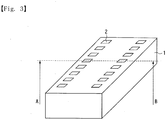
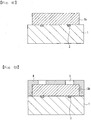
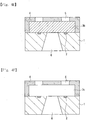
- the plurality of energy generation elements 2 are disposed on the substrate 1 at a predetermined pitch. Illustrated in Figs. 4A to 4F are production steps in sectional views taken along line A-B of Fig. 2 or 3 .
- a control signal input electrode (not illustrated) is connected to the energy generating elements 2 to operate the elements 2.
- the substrate 1 having the energy generation elements 2 is prepared.
- the substrate 1 may be preferably a Si substrate.
- the substrate 1 may be preferably a silicon single crystal, and, in the case of performing perforation of thorough-holes of the substrate 1 by anisotropic etching, the substrate 1 may be preferably a silicon single crystal having a crystal orientation of 100.
- a silicon single crystal having a crystal orientation of 110 or the like may be used.
- the energy generation element 2 is not particularly limited insofar as the energy generation element 2 is capable of imparting discharge energy for discharging ink droplets to the ink and discharging the ink droplets from the ink discharge port. If a heating resistance element is used as the energy generation element 2, for example, the discharge energy is generated by causing a state change of the ink by heating the ink in the vicinity of the heating resistance element by the heating resistance element.
- a soluble resin composition is applied on the substrate 1 to form an ink flow path pattern layer 3a.
- a positive photosensitive resin for example, is appropriately dissolved into a solvent and the applied on the substrate 1 by spin coating or the like. After that, heating is performed to form the ink flow path pattern layer 3a.
- a thickness of the ink flow path pattern layer 3a may be equal to a height of a desired ink flow path and is not particularly limited. For example, the thickness may be preferably 2 to 50 ⁇ m (micrometers).
- an ink flow path pattern 3b is formed by irradiating the ink flow path pattern layer 3a with radiation, followed by development.
- the ink flow path forming layer 4 formed from the negative photosensitive resin composition of the present invention is formed on the ink flow path pattern 3b and the substrate 1.
- a thickness of the ink flow path forming layer 4 may be preferably 2 ⁇ m or more as a thickness on the ink flow path pattern 3b. Further, the thickness of the ink flow path forming layer 4 may be preferably 100 ⁇ m or less as a thickness on the ink flow path pattern 3b though the thickness is not particularly limited insofar as the thickness is within a range that does not impair the developability of the ink discharge port part.
- the ink flow path forming layer 4 is irradiated with radiation, followed by development using MIBK (methylisobutylketone) or the like. Further, the ink discharge ports 5 are formed by performing a rinsing treatment with IPA (isopropyl alcohol).
- the ink supply port 6 is formed by employing an appropriate method such as an etching treatment.
- the ink flow path pattern 3b is removed by dissolving the ink flow path pattern 3b into an appropriate solvent.
- the appropriate solvent used herein may be an alkali solution or an organic solvent.
- a heat treatment may be performed at 200o C for one hour by using an oven to cure the ink flow path forming layer 4.
- the substrate 1 is cut and separated by using a dicing saw or the like to obtain chips, and electrical bonding for driving the energy generation elements 2 is performed. Further, a chip tank member for ink supply is connected to obtain the inkjet recording head.
- the above-described method is not limited to the inkjet recording head production method and effective as a pattern formation method for forming a hollow pattern.
- the inkjet recording head is used as the example to which the present invention is applied in the foregoing description, the applicable range of the present invention is not limited to the inkjet recording head, and the present invention is applicable to biochip fabrication and a production of a liquid discharge head for electronic circuit printing.
- the liquid discharge head include a head for color filter production in addition to the inkjet recording head.
- compositions (unit is mass%) illustrated in Tables 1 to 4 polyfunctional epoxy resins as the component (a), photoacid generating agents as the component (b), the components (c), a solvent, a sensitizer as required, and the component (d) are blended to obtain negative photosensitive resin compositions.
- pre-bake drying was performed at 90o C for 5 minutes, thereby obtaining a negative photosensitive resin composition layer having a film thickness of 20 ⁇ m.
- patterning exposure was performed via a mask on which a desired pattern is drawn by using FPA-3000 i5+ (i-line stepper, manufactured by Cannon Inc.), and post-exposure baking was performed by using a hot plate at 90Q C for 4 minutes.
- a development treatment was performed by using CDS-630+ (manufactured by Cannon Inc.).
- a resin pattern after the development underwent post-baking at 140Q C for one hour and 300o C for 20 minutes by using an oven, thereby obtaining a resist pattern cured on the support body.
- a method for estimating acid strengths obtained by converting an anion portion of the photoacid generating agent (b) and an anion portion of the salt exchanging agent (c) into acids by using measured values will be described.
- Stepwise i-line exposure within a range of 500 J/m 2 to 40000 J/m 2 was performed during the exposure process, and an exposure amount required for forming a circle pattern having a diameter of 16 ⁇ m with a circular nozzle discharge port having a bore having a diameter of 16 ⁇ m as mask design dimension was measured.
- the detected exposure amount is illustrated in the item of exposure amount in Table 5.
- the exposure amounts were listed in ascending order to illustrate a rank order.
- the rank order is illustrated in the item of rank order of acid strength in Table 5. It is indicated that the smaller the exposure amount, i.e. , the higher the sensitivity, the higher the acid strength of the acid generated from the photoacid generating agent (b) is.
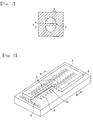
- a model pattern that was bridged by a line pattern (c) having a width of 3 ⁇ m along the minor axis was transcribed to form a negative resist pattern (see Fig. 1 ).
- the part at which the oval and the bridge line pattern interest with each other was observed by using a scanning electron microscope (SEM) to measure resolution. As illustrated in Fig.
- molding accuracy is 0 ⁇ m, i.e., the pattern is identical to the mask design dimension, when the actual pattern is resolved to the end part (a) of the crescent shape.
- a value of the molding accuracy is determined by the degree of a range of the negative substance.
- TPS1 compound expressed by formula (E-1)
- TPS2 compound expressed by formula (E-2)
- TPS1 Triphenylsulfonium (compound expressed by the following formula)
- Examples 1 to 9 were capable of forming patterned cured matters having good heat resistance.
- the molding accuracy was 1.5 ⁇ m or less, which was minute.
- Example 2 a composition was prepared in the same manner as in Example 1 except for adding trimethyl ammonium hydroxide, which is known as an ammonium compound, in the same amount in place of the salt exchanging agent (c) to conduct the evaluations. However, no pattern was formed. It is inferred that strong basicity of trimethyl ammonium hydroxide inhibited image formation.
- trimethyl ammonium hydroxide which is known as an ammonium compound
- the negative photosensitive resin composition according to the exemplary embodiments enables forming a pattern having high resistance and excellent molding accuracy. Consequently, the negative photosensitive resin composition according to the exemplary embodiments can be suitably used for various devices on which microfabrication for MEMS and the like is performed.
Landscapes
- Engineering & Computer Science (AREA)
- Manufacturing & Machinery (AREA)
- Physics & Mathematics (AREA)
- General Physics & Mathematics (AREA)
- Spectroscopy & Molecular Physics (AREA)
- Optics & Photonics (AREA)
- Materials For Photolithography (AREA)
- Compositions Of Macromolecular Compounds (AREA)
- Exposure And Positioning Against Photoresist Photosensitive Materials (AREA)
- Epoxy Resins (AREA)
Claims (13)
- Negativ lichtempfindliche Harzzusammensetzung, umfassend:als eine kationisch polymerisierbare Verbindung eine polyfuntionale Epoxidverbindung, die mehrere Epoxidgruppen in einem Molekül aufweist; undals ein Photosäure-Erzeugungsmittel eine Sulfoniumsalzverbindung (M-/ S+) oder eine lodoniumsalzverbindung (M-/S+), die einen Kationenabschnitt (S+) mit einer Sulfonium- oder lodoniumstruktur aufweist sowie einen Anionenabschnitt (M-) zum Erzeugen einer ersten Säure (M-/H+) als Photosäure, die eine Polymerisation der kationisch polymerisierbaren Verbindung bewirkt und somit das Harz aushärtet;dadurch gekennzeichnet, dass diese ferner ein Salzaustauschmittel (N-/A+) umfasst, das einen Kationenabschnitt (A+) und einen Anionenabschnitt (N-) aufweist, wobei das Salzaustauschmittel eine oder mehrere Verbindungen mit der folgenden Strukturformel enthält:
 wobei A ein Stickstoffatom oder ein Phosphoratom darstellt;wobei R1 bis R4 eine Arylgruppe mit insgesamt 6 bis 30 Kohlenstoffatomen, eine heterocyclische Gruppe mit insgesamt 4 bis 30 Kohlenstoffatomen, eine Alkylgruppe mit insgesamt 1 bis 30 Kohlenstoffatomen, eine Alkenylgruppe mit insgesamt 2 bis 30 Kohlenstoffatomen und eine Alkinylgruppe mit insgesamt 2 bis 30 Kohlenstoffatomen darstellen,wobei jede davon substituiert sein kann durch mindestens eine Spezies, die ausgewählt ist aus der Gruppe bestehend aus einer Alkylgruppe, einer Hydroxylgruppe, einer Cycloalkylgruppe, einer Alkenylgruppe, einer Alkoxygruppe, einer Alkylcarbonylgruppe, einer Arylcarbonylgruppe, einer Alkoxycarbonylgruppe, einer Aryloxycarbonylgruppe, einer Arylthiocarbonylgruppe, einer Acyloxygruppe, einer Arylthiogruppe, einer Alkylthiogruppe, einer Arylgruppe, einer ein Heteroatom enthaltenden aromatischen Ringgruppe, einer Aryloxygruppe, einer Alkylsulfinylgruppe, einer Arylsulfinylgruppe, einer Alkylsulfonylgruppe, einer Arylsulfonylgruppe, einer Alkylenoxygruppe, einer Aminogruppe, einer Cyangruppe, einer Nitrogruppe und einer Halogengruppe;wobei, falls A ein Stickstoffatom ist, R1 und R4 eine Doppelbindung bilden können, um R2-N+(=R6)-R3 zu bilden;wobei X ausgewählt ist aus einem Stickstoffatom, einem Phosphoratom, einem Antimonatom, einem Boratom und einem Sauerstoffatom;wobei, falls X ein Stickstoffatom ist: m + n ist 2; n eine ganze Zahl ist, die ausgewählt ist aus 0 und 1; und Y ausgewählt ist aus -S(=O)2-, einer Alkylenfluoridgruppe, -O-CF2-, -C(=O)-CF2-, -O-C( =O)-CF2-, -C(=O)-O-CF2-, und einer Einfachbindung; und R5 eine Kohlenwasserstoffgruppe mit 1 bis 30 Kohlenstoffatomen darstellt, die durch ein Fluoratom substituiert sein kann, und die Kohlenwasserstoffgruppe mindestens ein Fluoratom aufweist, falls n gleich 0 ist und Y ausgewählt ist aus -S(=O)2- oder der Einfachbindung;wobei, falls X ein Phosphoratom oder ein Antimonatom ist: m + n ist 6; n eine ganze Zahl ist, die ausgewählt ist aus 0 bis 6; und Y ausgewählt ist aus -S(=O)2-, -O-CF2-, -C(=O)-CF2-, -O-C(=O)-CF2-, -C(=O)-O-CF2-, -O-, und einer Einfachbindung; und R5 eine Gruppe darstellt, die ausgewählt ist aus einer Kohlenwasserstoffgruppe, die durch ein Fluoratom substituiert sein kann und 1 bis 30 Kohlenstoffatome und ein Wasserstoffatom aufweist, und die Kohlenwasserstoffgruppe mindestens ein Fluoratom aufweist, falls n 0 ist und Y ausgewählt ist aus -S(=O)2-, -O-, oder der Einfachbindung;wobei, falls X ein Boratom ist: m + n ist 4; n eine ganze Zahl ist, die ausgewählt ist aus 0 bis 4; und Y ausgewählt ist aus -S(=O)2-, -O-CF2-, -C(=O)-CF2-, -O-C(=O)-CF2-, -C(=O)-O-CF2-, einer Phenylengruppe, die fluorsubstituiert sein kann, und einer Einfachbindung; und R5 eine Gruppe darstellt, die ausgewählt ist aus einer Kohlenwasserstoffgruppe, die durch ein Fluoratom substituiert sein kann und 1 bis 30 Kohlenstoffatome aufweist, einem Fluoratom und einem Wasserstoffatom, und die Kohlenwasserstoffgruppe mindestens ein Fluoratom aufweist, falls n 0 ist und Y ausgewählt ist aus --S(=O)2- oder der Einfachbindung; undwobei, falls X ein Sauerstoffatom ist: m ist 1; n eine ganze Zahl des Werts 0 ist; und Y ausgewählt ist aus -S(=O)2- und -C(=O)-; und R5 eine Hydroxidgruppe, ein Chloratom oder eine Kohlenwasserstoffgruppe darstellt, die durch ein Fluoratom substituiert sein kann und 1 bis 30 Kohlenstoffatome aufweist;wobei eine zweite Säure (N-/H+), die dem Anionenabschnitt (N-) des Salzaustauschmittels entspricht, eine geringere Säurestärke als die erste Säure (M-/H+) aufweist, die dem Anionenabschnitt (M-) des Photosäure-Erzeugungsmittels entspricht.
 - Harzzusammensetzung nach Anspruch 1, wobei das Photosäure-Erzeugungsmittel ein Sulfonium- oder lodoniumsalz mit einem der folgenden Anionenabschnitte (M-) enthält:


- Harzzusammensetzung nach Anspruch 2, wobei das Photosäure-Erzeugungsmittel ein Sulfonium- oder lodoniumsalz enthält, das einen der Anionenabschnitte (b-1) bis (b-14) aufweist, die im Anspruch 2 definiert sind.
- Harzzusammensetzung nach Anspruch 1, wobei die Sulfoniumsalzverbindung (M-/S+) oder lodoniumsalzverbindung (M-/S+) ein Monoarylsulfoniumsalz, ein Diarylsulfoniumsalz, ein Triarylsulfoniumsalz oder ein Diaryliodoniumsalz ist.
- Harzzusammensetzung nach Anspruch 1, wobei das Photosäure-Erzeugungsmittel mehrere Verbindungsarten enthält und eine Molzahl des Salzes größer als ein 1/4-faches einer Molzahl des Photosäure-Erzeugungsmittels ist, das die Säure erzeugt, die die höchste Säurestärke unter den mehreren Verbindungsarten aufweist.
- Harzzusammensetzung nach Anspruch 5, wobei die Molzahl des Salzes größer als das 1/2-fache der Molzahl des Photosäure-Erzeugungsmittels ist, das die Säure erzeugt, die die höchste Säurestärke unter den mehreren Verbindungsarten aufweist.
- Harzzusammensetzung nach Anspruch 6, wobei die Molzahl des Salzes größer ist als die Molzahl des Photosäure-Erzeugungsmittels, das die Säure erzeugt, die die höchste Säurefestigkeit unter den mehreren Verbindungsarten aufweist.
- Harzzusammensetzung nach Anspruch 1, wobei die zweite Säure eine Fluoratom enthaltende Antimonsäure, eine Fluoratom enthaltende Phosphorsäure oder eine Fluoratom enthaltende Borsäure ist.
- Harzzusammensetzung nach Anspruch 1, wobei das Salzaustauschmittel eine oder mehrere der folgenden Verbindungen enthält:


- Harzzusammensetzung nach Anspruch 1, ferner umfassend eine Aminverbindung.
- Harzzusammensetzung nach Anspruch 1, wobei die kationisch polymerisierbare Verbindung ein polyfunktionales Bisphenol-A-Novolac-Epoxidharz, ein polyfunktionales alicyclisches Epoxidharz oder ein polyfunktionales Phenol-Novolac-Epoxidharz ist.
- Musterbildungsverfahren, umfassend:Herstellen eines Substrats (1), auf dem die lichtempfindliche Harzzusammensetzung (4) nach einem der Ansprüche 1 bis 11 vorgesehen ist;Aussetzen eines Teils der lichtempfindlichen Harzzusammensetzung zu Licht, um den ausgesetzten Teil auszuhärten; undErwärmen des durch das Aushärten erhaltenen gehärteten Teils.
- Flüssigkeitsausstoßkopf (1-6), umfassend:ein Ausstoßöffnungselement (3c, 4, 5), das mit einer Ausstoßöffnung (5) zum Ausstoßen von Flüssigkeit versehen ist,wobei das Ausstoßöffnungselement aus einer ausgehärteten Substanz der lichtempfindlichen Harzzusammensetzung nach einem der Ansprüche 1 bis 11 gebildet ist.
Applications Claiming Priority (2)
| Application Number | Priority Date | Filing Date | Title |
|---|---|---|---|
| JP2010024682 | 2010-02-05 | ||
| PCT/JP2011/052204 WO2011096458A1 (en) | 2010-02-05 | 2011-01-27 | Negative photosensitive resin composition, pattern formation method, and liquid discharge head |
Publications (3)
| Publication Number | Publication Date |
|---|---|
| EP2531891A1 EP2531891A1 (de) | 2012-12-12 |
| EP2531891A4 EP2531891A4 (de) | 2013-10-23 |
| EP2531891B1 true EP2531891B1 (de) | 2020-04-15 |
Family
ID=44355451
Family Applications (1)
| Application Number | Title | Priority Date | Filing Date |
|---|---|---|---|
| EP11739806.5A Not-in-force EP2531891B1 (de) | 2010-02-05 | 2011-01-27 | Negative lichtempfindliche harzzusammensetzung, strukturformungsverfahren und flüssigkeitsausstosskopf |
Country Status (6)
| Country | Link |
|---|---|
| US (1) | US9061499B2 (de) |
| EP (1) | EP2531891B1 (de) |
| JP (1) | JP5709561B2 (de) |
| CN (1) | CN102741749B (de) |
| RU (1) | RU2495468C1 (de) |
| WO (1) | WO2011096458A1 (de) |
Families Citing this family (7)
| Publication number | Priority date | Publication date | Assignee | Title |
|---|---|---|---|---|
| JP5787720B2 (ja) * | 2010-12-16 | 2015-09-30 | キヤノン株式会社 | 感光性ネガ型樹脂組成物 |
| JP6120574B2 (ja) * | 2012-01-31 | 2017-04-26 | キヤノン株式会社 | 感光性ネガ型樹脂組成物、微細構造体、微細構造体の製造方法及び液体吐出ヘッド |
| US10527934B2 (en) * | 2012-10-31 | 2020-01-07 | Rohm And Haas Electronic Materials Llc | Photoresists comprising ionic compound |
| JP6071718B2 (ja) * | 2013-04-10 | 2017-02-01 | キヤノン株式会社 | 感光性ネガ型樹脂組成物 |
| CN106459995B (zh) | 2013-11-07 | 2020-02-21 | 爱迪塔斯医药有限公司 | 使用统治型gRNA的CRISPR相关方法和组合物 |
| US20200208019A1 (en) * | 2015-12-02 | 2020-07-02 | Threebond Co., Ltd. | Cation-curable resin composition |
| PH12021553301A1 (en) * | 2019-12-23 | 2022-08-15 | Illumina Inc | Resin composition and flow cells incorporating the same |
Family Cites Families (36)
| Publication number | Priority date | Publication date | Assignee | Title |
|---|---|---|---|---|
| GB1526923A (en) | 1974-09-18 | 1978-10-04 | Ici Ltd | Photopolymerisable compositions |
| IE42085B1 (en) | 1974-09-18 | 1980-06-04 | Ici Ltd | Photopolymerisable compositions |
| JPH0412859A (ja) | 1990-04-28 | 1992-01-17 | Canon Inc | 液体噴射方法、該方法を用いた記録ヘッド及び該方法を用いた記録装置 |
| DE69126996T2 (de) | 1990-04-27 | 1998-02-19 | Canon Kk | Aufzeichnungsverfahren und -gerät |
| US5639802A (en) | 1991-05-20 | 1997-06-17 | Spectra Group Limited, Inc. | Cationic polymerization |
| JPH07145346A (ja) | 1993-11-22 | 1995-06-06 | Dainippon Ink & Chem Inc | ソルダーレジストインキ用樹脂組成物 |
| JPH08157510A (ja) | 1994-12-09 | 1996-06-18 | Nippon Kayaku Co Ltd | 光重合開始剤、これを含有するエネルギー線硬化性組成物及びその硬化物 |
| JPH0925393A (ja) | 1995-05-09 | 1997-01-28 | Toray Ind Inc | 繊維強化複合材料用エポキシ樹脂組成物、プリプレグおよび繊維強化複合材料 |
| JPH0912615A (ja) | 1995-06-29 | 1997-01-14 | Nippon Kayaku Co Ltd | エネルギー線硬化性組成物及びその硬化物 |
| CN1195356A (zh) | 1996-06-12 | 1998-10-07 | 日本化药株式会社 | 光聚合引发剂和包含它的可能量射线固化的组合物 |
| JPH107680A (ja) | 1996-06-18 | 1998-01-13 | Nippon Kayaku Co Ltd | 光重合開始剤、これを含有するエネルギー線硬化性組成物及びその硬化物 |
| TW460509B (en) * | 1996-07-12 | 2001-10-21 | Ciba Sc Holding Ag | Curing process for cationically photocurable formulations |
| JPH10152554A (ja) | 1996-11-21 | 1998-06-09 | Nippon Kayaku Co Ltd | エネルギー線硬化性組成物及びその硬化物 |
| JPH10212286A (ja) | 1997-01-30 | 1998-08-11 | Nippon Kayaku Co Ltd | 光重合開始剤、これを含有するエネルギー線硬化性組成物及びその硬化物 |
| JPH11322900A (ja) | 1998-03-19 | 1999-11-26 | Nippon Soda Co Ltd | 光硬化性組成物および硬化方法 |
| JP4385437B2 (ja) | 1999-05-10 | 2009-12-16 | Jsr株式会社 | カラーフィルタ用感放射線性組成物およびそれを用いたカラーフィルタ |
| KR100795759B1 (ko) | 2000-06-15 | 2008-01-21 | 쓰리엠 이노베이티브 프로퍼티즈 캄파니 | 미세유체 물품의 제조 방법 |
| JP3880912B2 (ja) | 2002-10-10 | 2007-02-14 | ジャパンエポキシレジン株式会社 | 半導体封止用エポキシ樹脂組成物 |
| KR101197539B1 (ko) | 2003-11-04 | 2012-11-12 | 헨켈 아게 운트 코. 카게아아 | 술포늄염 광개시제 및 그의 용도 |
| JP4569759B2 (ja) * | 2004-02-23 | 2010-10-27 | 日産化学工業株式会社 | 染料含有レジスト組成物及びそれを用いるカラーフィルター |
| JP4593309B2 (ja) | 2005-01-21 | 2010-12-08 | 東京応化工業株式会社 | 精密微細空間の天板部形成方法 |
| JP2006241384A (ja) | 2005-03-07 | 2006-09-14 | Fuji Photo Film Co Ltd | インク組成物、インクジェット記録方法、印刷物、平版印刷版及びその製造方法 |
| JP2007034153A (ja) | 2005-07-29 | 2007-02-08 | Toyo Ink Mfg Co Ltd | 感エネルギー線重合性組成物およびそれを用いたネガ型レジストおよびそれを用いた画像パターン形成方法。 |
| KR100753542B1 (ko) * | 2006-04-19 | 2007-08-30 | 삼성전자주식회사 | 수지 조성물, 이를 이용한 패턴 형성 방법 및 커패시터형성 방법 |
| US20080292993A1 (en) * | 2006-12-22 | 2008-11-27 | Canon Kabushiki Kaisha | Photo-cationic polymerizable epoxy resin composition, liquid discharge head, and manufacturing method thereof |
| JP4355725B2 (ja) * | 2006-12-25 | 2009-11-04 | 信越化学工業株式会社 | ポジ型レジスト材料及びパターン形成方法 |
| JP4564977B2 (ja) | 2007-04-05 | 2010-10-20 | 東京応化工業株式会社 | 感光性樹脂組成物、レジストパターンの製造方法、積層体、及びデバイス |
| JP5039442B2 (ja) | 2007-06-15 | 2012-10-03 | 東京応化工業株式会社 | 感光性樹脂組成物、感光性樹脂積層体、及びパターン形成方法 |
| JP4998112B2 (ja) | 2007-06-27 | 2012-08-15 | 住友化学株式会社 | 化学増幅型ポジ型レジスト組成物 |
| JP4480182B2 (ja) * | 2007-09-06 | 2010-06-16 | キヤノン株式会社 | インクジェット記録ヘッド用基板及びインクジェット記録ヘッドの製造方法 |
| JP2010276623A (ja) | 2008-03-26 | 2010-12-09 | Panasonic Electric Works Co Ltd | 立体基板上に透明樹脂構造体を形成させる方法 |
| JP2009244779A (ja) | 2008-03-31 | 2009-10-22 | Fujifilm Corp | ネガ型レジスト組成物及びパターン形成方法 |
| JP2009258506A (ja) * | 2008-04-18 | 2009-11-05 | Fujifilm Corp | ネガ型レジスト組成物およびレジストパターン形成方法 |
| JP5208573B2 (ja) | 2008-05-06 | 2013-06-12 | サンアプロ株式会社 | スルホニウム塩、光酸発生剤、光硬化性組成物及びこの硬化体 |
| JP5247396B2 (ja) * | 2008-07-02 | 2013-07-24 | 日本化薬株式会社 | Mems用感光性樹脂組成物及びその硬化物 |
| US8853290B2 (en) | 2009-06-08 | 2014-10-07 | Sanyo Chemical Industries, Ltd. | Photosensitive composition |
-
2011
- 2011-01-27 EP EP11739806.5A patent/EP2531891B1/de not_active Not-in-force
- 2011-01-27 RU RU2012137723/04A patent/RU2495468C1/ru active
- 2011-01-27 CN CN201180008290.9A patent/CN102741749B/zh not_active Expired - Fee Related
- 2011-01-27 WO PCT/JP2011/052204 patent/WO2011096458A1/en not_active Ceased
- 2011-01-27 US US13/576,906 patent/US9061499B2/en not_active Expired - Fee Related
- 2011-02-03 JP JP2011021766A patent/JP5709561B2/ja active Active
Non-Patent Citations (1)
| Title |
|---|
| None * |
Also Published As
| Publication number | Publication date |
|---|---|
| JP5709561B2 (ja) | 2015-04-30 |
| US20120306961A1 (en) | 2012-12-06 |
| RU2495468C1 (ru) | 2013-10-10 |
| CN102741749B (zh) | 2014-10-08 |
| CN102741749A (zh) | 2012-10-17 |
| JP2011180585A (ja) | 2011-09-15 |
| WO2011096458A1 (en) | 2011-08-11 |
| EP2531891A1 (de) | 2012-12-12 |
| US9061499B2 (en) | 2015-06-23 |
| EP2531891A4 (de) | 2013-10-23 |
Similar Documents
| Publication | Publication Date | Title |
|---|---|---|
| EP2531891B1 (de) | Negative lichtempfindliche harzzusammensetzung, strukturformungsverfahren und flüssigkeitsausstosskopf | |
| US8980968B2 (en) | Photosensitive resin composition, method for producing structure, and liquid discharge head | |
| US8944580B2 (en) | Photosensitive resin composition, method for manufacturing structural body, and liquid discharge head | |
| US20080292993A1 (en) | Photo-cationic polymerizable epoxy resin composition, liquid discharge head, and manufacturing method thereof | |
| JP5787720B2 (ja) | 感光性ネガ型樹脂組成物 | |
| US20080213596A1 (en) | Photosensitive Laminate Film for Forming Top Plate Portion of Precision Fine Space and Method of Forming Precision Fine Space | |
| US20110244393A1 (en) | Photosensitive resin composition and method for producing liquid discharge head | |
| KR101032154B1 (ko) | 감광성 수지 조성물, 감광성 수지 적층체, 및 패턴 형성방법 | |
| US9707757B2 (en) | Photosensitive negative resin composition | |
| JP2013178492A (ja) | 感光性ネガ型樹脂組成物、微細構造体、微細構造体の製造方法及び液体吐出ヘッド | |
| KR101354538B1 (ko) | 크산텐 구조를 포함하는 바인더 수지 및 이를 포함하는 유기절연막 조성물 | |
| US10265960B2 (en) | Method for manufacturing liquid ejection head | |
| JP2006215271A (ja) | レジスト組成物及びそれを用いたパターン形成方法 | |
| JP2024065358A (ja) | 感光性樹脂組成物及びその硬化物 | |
| JP2004117876A (ja) | ネガ型レジスト組成物 | |
| US20240345482A1 (en) | Micro pattern manufacturing method using photosensitive resin compound | |
| JP2004070055A (ja) | ポジ型レジスト組成物 |
Legal Events
| Date | Code | Title | Description |
|---|---|---|---|
| PUAI | Public reference made under article 153(3) epc to a published international application that has entered the european phase |
Free format text: ORIGINAL CODE: 0009012 |
|
| 17P | Request for examination filed |
Effective date: 20120723 |
|
| AK | Designated contracting states |
Kind code of ref document: A1 Designated state(s): AL AT BE BG CH CY CZ DE DK EE ES FI FR GB GR HR HU IE IS IT LI LT LU LV MC MK MT NL NO PL PT RO RS SE SI SK SM TR |
|
| DAX | Request for extension of the european patent (deleted) | ||
| A4 | Supplementary search report drawn up and despatched |
Effective date: 20130923 |
|
| RIC1 | Information provided on ipc code assigned before grant |
Ipc: B41J 2/05 20060101ALI20130917BHEP Ipc: G03F 7/038 20060101ALI20130917BHEP Ipc: G03F 7/004 20060101AFI20130917BHEP Ipc: B41J 2/16 20060101ALI20130917BHEP |
|
| STAA | Information on the status of an ep patent application or granted ep patent |
Free format text: STATUS: EXAMINATION IS IN PROGRESS |
|
| 17Q | First examination report despatched |
Effective date: 20180629 |
|
| GRAP | Despatch of communication of intention to grant a patent |
Free format text: ORIGINAL CODE: EPIDOSNIGR1 |
|
| STAA | Information on the status of an ep patent application or granted ep patent |
Free format text: STATUS: GRANT OF PATENT IS INTENDED |
|
| INTG | Intention to grant announced |
Effective date: 20191129 |
|
| GRAS | Grant fee paid |
Free format text: ORIGINAL CODE: EPIDOSNIGR3 |
|
| GRAA | (expected) grant |
Free format text: ORIGINAL CODE: 0009210 |
|
| STAA | Information on the status of an ep patent application or granted ep patent |
Free format text: STATUS: THE PATENT HAS BEEN GRANTED |
|
| AK | Designated contracting states |
Kind code of ref document: B1 Designated state(s): AL AT BE BG CH CY CZ DE DK EE ES FI FR GB GR HR HU IE IS IT LI LT LU LV MC MK MT NL NO PL PT RO RS SE SI SK SM TR |
|
| REG | Reference to a national code |
Ref country code: GB Ref legal event code: FG4D Ref country code: CH Ref legal event code: EP |
|
| REG | Reference to a national code |
Ref country code: DE Ref legal event code: R096 Ref document number: 602011066264 Country of ref document: DE |
|
| REG | Reference to a national code |
Ref country code: IE Ref legal event code: FG4D |
|
| REG | Reference to a national code |
Ref country code: AT Ref legal event code: REF Ref document number: 1258022 Country of ref document: AT Kind code of ref document: T Effective date: 20200515 |
|
| REG | Reference to a national code |
Ref country code: NL Ref legal event code: MP Effective date: 20200415 |
|
| REG | Reference to a national code |
Ref country code: LT Ref legal event code: MG4D |
|
| PG25 | Lapsed in a contracting state [announced via postgrant information from national office to epo] |
Ref country code: SE Free format text: LAPSE BECAUSE OF FAILURE TO SUBMIT A TRANSLATION OF THE DESCRIPTION OR TO PAY THE FEE WITHIN THE PRESCRIBED TIME-LIMIT Effective date: 20200415 Ref country code: IS Free format text: LAPSE BECAUSE OF FAILURE TO SUBMIT A TRANSLATION OF THE DESCRIPTION OR TO PAY THE FEE WITHIN THE PRESCRIBED TIME-LIMIT Effective date: 20200815 Ref country code: NL Free format text: LAPSE BECAUSE OF FAILURE TO SUBMIT A TRANSLATION OF THE DESCRIPTION OR TO PAY THE FEE WITHIN THE PRESCRIBED TIME-LIMIT Effective date: 20200415 Ref country code: PT Free format text: LAPSE BECAUSE OF FAILURE TO SUBMIT A TRANSLATION OF THE DESCRIPTION OR TO PAY THE FEE WITHIN THE PRESCRIBED TIME-LIMIT Effective date: 20200817 Ref country code: LT Free format text: LAPSE BECAUSE OF FAILURE TO SUBMIT A TRANSLATION OF THE DESCRIPTION OR TO PAY THE FEE WITHIN THE PRESCRIBED TIME-LIMIT Effective date: 20200415 Ref country code: FI Free format text: LAPSE BECAUSE OF FAILURE TO SUBMIT A TRANSLATION OF THE DESCRIPTION OR TO PAY THE FEE WITHIN THE PRESCRIBED TIME-LIMIT Effective date: 20200415 Ref country code: NO Free format text: LAPSE BECAUSE OF FAILURE TO SUBMIT A TRANSLATION OF THE DESCRIPTION OR TO PAY THE FEE WITHIN THE PRESCRIBED TIME-LIMIT Effective date: 20200715 Ref country code: GR Free format text: LAPSE BECAUSE OF FAILURE TO SUBMIT A TRANSLATION OF THE DESCRIPTION OR TO PAY THE FEE WITHIN THE PRESCRIBED TIME-LIMIT Effective date: 20200716 |
|
| REG | Reference to a national code |
Ref country code: AT Ref legal event code: MK05 Ref document number: 1258022 Country of ref document: AT Kind code of ref document: T Effective date: 20200415 |
|
| PG25 | Lapsed in a contracting state [announced via postgrant information from national office to epo] |
Ref country code: BG Free format text: LAPSE BECAUSE OF FAILURE TO SUBMIT A TRANSLATION OF THE DESCRIPTION OR TO PAY THE FEE WITHIN THE PRESCRIBED TIME-LIMIT Effective date: 20200715 Ref country code: LV Free format text: LAPSE BECAUSE OF FAILURE TO SUBMIT A TRANSLATION OF THE DESCRIPTION OR TO PAY THE FEE WITHIN THE PRESCRIBED TIME-LIMIT Effective date: 20200415 Ref country code: HR Free format text: LAPSE BECAUSE OF FAILURE TO SUBMIT A TRANSLATION OF THE DESCRIPTION OR TO PAY THE FEE WITHIN THE PRESCRIBED TIME-LIMIT Effective date: 20200415 Ref country code: RS Free format text: LAPSE BECAUSE OF FAILURE TO SUBMIT A TRANSLATION OF THE DESCRIPTION OR TO PAY THE FEE WITHIN THE PRESCRIBED TIME-LIMIT Effective date: 20200415 |
|
| PG25 | Lapsed in a contracting state [announced via postgrant information from national office to epo] |
Ref country code: AL Free format text: LAPSE BECAUSE OF FAILURE TO SUBMIT A TRANSLATION OF THE DESCRIPTION OR TO PAY THE FEE WITHIN THE PRESCRIBED TIME-LIMIT Effective date: 20200415 |
|
| REG | Reference to a national code |
Ref country code: DE Ref legal event code: R097 Ref document number: 602011066264 Country of ref document: DE |
|
| PG25 | Lapsed in a contracting state [announced via postgrant information from national office to epo] |
Ref country code: DK Free format text: LAPSE BECAUSE OF FAILURE TO SUBMIT A TRANSLATION OF THE DESCRIPTION OR TO PAY THE FEE WITHIN THE PRESCRIBED TIME-LIMIT Effective date: 20200415 Ref country code: SM Free format text: LAPSE BECAUSE OF FAILURE TO SUBMIT A TRANSLATION OF THE DESCRIPTION OR TO PAY THE FEE WITHIN THE PRESCRIBED TIME-LIMIT Effective date: 20200415 Ref country code: IT Free format text: LAPSE BECAUSE OF FAILURE TO SUBMIT A TRANSLATION OF THE DESCRIPTION OR TO PAY THE FEE WITHIN THE PRESCRIBED TIME-LIMIT Effective date: 20200415 Ref country code: EE Free format text: LAPSE BECAUSE OF FAILURE TO SUBMIT A TRANSLATION OF THE DESCRIPTION OR TO PAY THE FEE WITHIN THE PRESCRIBED TIME-LIMIT Effective date: 20200415 Ref country code: RO Free format text: LAPSE BECAUSE OF FAILURE TO SUBMIT A TRANSLATION OF THE DESCRIPTION OR TO PAY THE FEE WITHIN THE PRESCRIBED TIME-LIMIT Effective date: 20200415 Ref country code: CZ Free format text: LAPSE BECAUSE OF FAILURE TO SUBMIT A TRANSLATION OF THE DESCRIPTION OR TO PAY THE FEE WITHIN THE PRESCRIBED TIME-LIMIT Effective date: 20200415 Ref country code: AT Free format text: LAPSE BECAUSE OF FAILURE TO SUBMIT A TRANSLATION OF THE DESCRIPTION OR TO PAY THE FEE WITHIN THE PRESCRIBED TIME-LIMIT Effective date: 20200415 Ref country code: ES Free format text: LAPSE BECAUSE OF FAILURE TO SUBMIT A TRANSLATION OF THE DESCRIPTION OR TO PAY THE FEE WITHIN THE PRESCRIBED TIME-LIMIT Effective date: 20200415 |
|
| PLBE | No opposition filed within time limit |
Free format text: ORIGINAL CODE: 0009261 |
|
| STAA | Information on the status of an ep patent application or granted ep patent |
Free format text: STATUS: NO OPPOSITION FILED WITHIN TIME LIMIT |
|
| PG25 | Lapsed in a contracting state [announced via postgrant information from national office to epo] |
Ref country code: SK Free format text: LAPSE BECAUSE OF FAILURE TO SUBMIT A TRANSLATION OF THE DESCRIPTION OR TO PAY THE FEE WITHIN THE PRESCRIBED TIME-LIMIT Effective date: 20200415 Ref country code: PL Free format text: LAPSE BECAUSE OF FAILURE TO SUBMIT A TRANSLATION OF THE DESCRIPTION OR TO PAY THE FEE WITHIN THE PRESCRIBED TIME-LIMIT Effective date: 20200415 |
|
| 26N | No opposition filed |
Effective date: 20210118 |
|
| PG25 | Lapsed in a contracting state [announced via postgrant information from national office to epo] |
Ref country code: SI Free format text: LAPSE BECAUSE OF FAILURE TO SUBMIT A TRANSLATION OF THE DESCRIPTION OR TO PAY THE FEE WITHIN THE PRESCRIBED TIME-LIMIT Effective date: 20200415 |
|
| PGFP | Annual fee paid to national office [announced via postgrant information from national office to epo] |
Ref country code: DE Payment date: 20201217 Year of fee payment: 11 |
|
| PG25 | Lapsed in a contracting state [announced via postgrant information from national office to epo] |
Ref country code: MC Free format text: LAPSE BECAUSE OF FAILURE TO SUBMIT A TRANSLATION OF THE DESCRIPTION OR TO PAY THE FEE WITHIN THE PRESCRIBED TIME-LIMIT Effective date: 20200415 |
|
| REG | Reference to a national code |
Ref country code: CH Ref legal event code: PL |
|
| GBPC | Gb: european patent ceased through non-payment of renewal fee |
Effective date: 20210127 |
|
| PG25 | Lapsed in a contracting state [announced via postgrant information from national office to epo] |
Ref country code: LU Free format text: LAPSE BECAUSE OF NON-PAYMENT OF DUE FEES Effective date: 20210127 |
|
| REG | Reference to a national code |
Ref country code: BE Ref legal event code: MM Effective date: 20210131 |
|
| PG25 | Lapsed in a contracting state [announced via postgrant information from national office to epo] |
Ref country code: FR Free format text: LAPSE BECAUSE OF NON-PAYMENT OF DUE FEES Effective date: 20210131 |
|
| PG25 | Lapsed in a contracting state [announced via postgrant information from national office to epo] |
Ref country code: LI Free format text: LAPSE BECAUSE OF NON-PAYMENT OF DUE FEES Effective date: 20210131 Ref country code: GB Free format text: LAPSE BECAUSE OF NON-PAYMENT OF DUE FEES Effective date: 20210127 Ref country code: CH Free format text: LAPSE BECAUSE OF NON-PAYMENT OF DUE FEES Effective date: 20210131 |
|
| PG25 | Lapsed in a contracting state [announced via postgrant information from national office to epo] |
Ref country code: IE Free format text: LAPSE BECAUSE OF NON-PAYMENT OF DUE FEES Effective date: 20210127 |
|
| PG25 | Lapsed in a contracting state [announced via postgrant information from national office to epo] |
Ref country code: BE Free format text: LAPSE BECAUSE OF NON-PAYMENT OF DUE FEES Effective date: 20210131 |
|
| REG | Reference to a national code |
Ref country code: DE Ref legal event code: R119 Ref document number: 602011066264 Country of ref document: DE |
|
| PG25 | Lapsed in a contracting state [announced via postgrant information from national office to epo] |
Ref country code: DE Free format text: LAPSE BECAUSE OF NON-PAYMENT OF DUE FEES Effective date: 20220802 |
|
| PG25 | Lapsed in a contracting state [announced via postgrant information from national office to epo] |
Ref country code: HU Free format text: LAPSE BECAUSE OF FAILURE TO SUBMIT A TRANSLATION OF THE DESCRIPTION OR TO PAY THE FEE WITHIN THE PRESCRIBED TIME-LIMIT; INVALID AB INITIO Effective date: 20110127 Ref country code: CY Free format text: LAPSE BECAUSE OF FAILURE TO SUBMIT A TRANSLATION OF THE DESCRIPTION OR TO PAY THE FEE WITHIN THE PRESCRIBED TIME-LIMIT Effective date: 20200415 |
|
| PG25 | Lapsed in a contracting state [announced via postgrant information from national office to epo] |
Ref country code: MK Free format text: LAPSE BECAUSE OF FAILURE TO SUBMIT A TRANSLATION OF THE DESCRIPTION OR TO PAY THE FEE WITHIN THE PRESCRIBED TIME-LIMIT Effective date: 20200415 |
|
| PG25 | Lapsed in a contracting state [announced via postgrant information from national office to epo] |
Ref country code: TR Free format text: LAPSE BECAUSE OF FAILURE TO SUBMIT A TRANSLATION OF THE DESCRIPTION OR TO PAY THE FEE WITHIN THE PRESCRIBED TIME-LIMIT Effective date: 20200415 |
|
| PG25 | Lapsed in a contracting state [announced via postgrant information from national office to epo] |
Ref country code: MT Free format text: LAPSE BECAUSE OF FAILURE TO SUBMIT A TRANSLATION OF THE DESCRIPTION OR TO PAY THE FEE WITHIN THE PRESCRIBED TIME-LIMIT Effective date: 20200415 |