EP2487134A1 - Pulver aus hexagonalem boronnitrid und herstellungsverfahren dafür - Google Patents
Pulver aus hexagonalem boronnitrid und herstellungsverfahren dafür Download PDFInfo
- Publication number
- EP2487134A1 EP2487134A1 EP10821757A EP10821757A EP2487134A1 EP 2487134 A1 EP2487134 A1 EP 2487134A1 EP 10821757 A EP10821757 A EP 10821757A EP 10821757 A EP10821757 A EP 10821757A EP 2487134 A1 EP2487134 A1 EP 2487134A1
- Authority
- EP
- European Patent Office
- Prior art keywords
- powder
- boron nitride
- hexagonal boron
- nitride powder
- average particle
- Prior art date
- Legal status (The legal status is an assumption and is not a legal conclusion. Google has not performed a legal analysis and makes no representation as to the accuracy of the status listed.)
- Granted
Links
- 0 CCCNC(CC)C[C@@]1C(CCC*(CC)*C(C)(C)[Fe])(COCCCCC[Fe])C1 Chemical compound CCCNC(CC)C[C@@]1C(CCC*(CC)*C(C)(C)[Fe])(COCCCCC[Fe])C1 0.000 description 1
Images



Classifications
-
- B—PERFORMING OPERATIONS; TRANSPORTING
- B01—PHYSICAL OR CHEMICAL PROCESSES OR APPARATUS IN GENERAL
- B01J—CHEMICAL OR PHYSICAL PROCESSES, e.g. CATALYSIS OR COLLOID CHEMISTRY; THEIR RELEVANT APPARATUS
- B01J2/00—Processes or devices for granulating materials, e.g. fertilisers in general; Rendering particulate materials free flowing in general, e.g. making them hydrophobic
-
- C—CHEMISTRY; METALLURGY
- C01—INORGANIC CHEMISTRY
- C01B—NON-METALLIC ELEMENTS; COMPOUNDS THEREOF; METALLOIDS OR COMPOUNDS THEREOF NOT COVERED BY SUBCLASS C01C
- C01B21/00—Nitrogen; Compounds thereof
- C01B21/06—Binary compounds of nitrogen with metals, with silicon, or with boron, or with carbon, i.e. nitrides; Compounds of nitrogen with more than one metal, silicon or boron
- C01B21/064—Binary compounds of nitrogen with metals, with silicon, or with boron, or with carbon, i.e. nitrides; Compounds of nitrogen with more than one metal, silicon or boron with boron
-
- C—CHEMISTRY; METALLURGY
- C01—INORGANIC CHEMISTRY
- C01B—NON-METALLIC ELEMENTS; COMPOUNDS THEREOF; METALLOIDS OR COMPOUNDS THEREOF NOT COVERED BY SUBCLASS C01C
- C01B21/00—Nitrogen; Compounds thereof
- C01B21/06—Binary compounds of nitrogen with metals, with silicon, or with boron, or with carbon, i.e. nitrides; Compounds of nitrogen with more than one metal, silicon or boron
- C01B21/064—Binary compounds of nitrogen with metals, with silicon, or with boron, or with carbon, i.e. nitrides; Compounds of nitrogen with more than one metal, silicon or boron with boron
- C01B21/0645—Preparation by carboreductive nitridation
-
- C—CHEMISTRY; METALLURGY
- C01—INORGANIC CHEMISTRY
- C01B—NON-METALLIC ELEMENTS; COMPOUNDS THEREOF; METALLOIDS OR COMPOUNDS THEREOF NOT COVERED BY SUBCLASS C01C
- C01B21/00—Nitrogen; Compounds thereof
- C01B21/06—Binary compounds of nitrogen with metals, with silicon, or with boron, or with carbon, i.e. nitrides; Compounds of nitrogen with more than one metal, silicon or boron
- C01B21/064—Binary compounds of nitrogen with metals, with silicon, or with boron, or with carbon, i.e. nitrides; Compounds of nitrogen with more than one metal, silicon or boron with boron
- C01B21/0648—After-treatment, e.g. grinding, purification
-
- C—CHEMISTRY; METALLURGY
- C01—INORGANIC CHEMISTRY
- C01P—INDEXING SCHEME RELATING TO STRUCTURAL AND PHYSICAL ASPECTS OF SOLID INORGANIC COMPOUNDS
- C01P2004/00—Particle morphology
- C01P2004/01—Particle morphology depicted by an image
- C01P2004/03—Particle morphology depicted by an image obtained by SEM
-
- C—CHEMISTRY; METALLURGY
- C01—INORGANIC CHEMISTRY
- C01P—INDEXING SCHEME RELATING TO STRUCTURAL AND PHYSICAL ASPECTS OF SOLID INORGANIC COMPOUNDS
- C01P2004/00—Particle morphology
- C01P2004/50—Agglomerated particles
-
- C—CHEMISTRY; METALLURGY
- C01—INORGANIC CHEMISTRY
- C01P—INDEXING SCHEME RELATING TO STRUCTURAL AND PHYSICAL ASPECTS OF SOLID INORGANIC COMPOUNDS
- C01P2004/00—Particle morphology
- C01P2004/54—Particles characterised by their aspect ratio, i.e. the ratio of sizes in the longest to the shortest dimension
-
- C—CHEMISTRY; METALLURGY
- C01—INORGANIC CHEMISTRY
- C01P—INDEXING SCHEME RELATING TO STRUCTURAL AND PHYSICAL ASPECTS OF SOLID INORGANIC COMPOUNDS
- C01P2004/00—Particle morphology
- C01P2004/60—Particles characterised by their size
- C01P2004/61—Micrometer sized, i.e. from 1-100 micrometer
-
- C—CHEMISTRY; METALLURGY
- C01—INORGANIC CHEMISTRY
- C01P—INDEXING SCHEME RELATING TO STRUCTURAL AND PHYSICAL ASPECTS OF SOLID INORGANIC COMPOUNDS
- C01P2006/00—Physical properties of inorganic compounds
- C01P2006/32—Thermal properties
-
- Y—GENERAL TAGGING OF NEW TECHNOLOGICAL DEVELOPMENTS; GENERAL TAGGING OF CROSS-SECTIONAL TECHNOLOGIES SPANNING OVER SEVERAL SECTIONS OF THE IPC; TECHNICAL SUBJECTS COVERED BY FORMER USPC CROSS-REFERENCE ART COLLECTIONS [XRACs] AND DIGESTS
- Y10—TECHNICAL SUBJECTS COVERED BY FORMER USPC
- Y10T—TECHNICAL SUBJECTS COVERED BY FORMER US CLASSIFICATION
- Y10T428/00—Stock material or miscellaneous articles
- Y10T428/29—Coated or structually defined flake, particle, cell, strand, strand portion, rod, filament, macroscopic fiber or mass thereof
- Y10T428/2982—Particulate matter [e.g., sphere, flake, etc.]
Definitions
- the present invention relates to hexagonal boron nitride powder and a method for producing the same. More specifically, the present invention relates to hexagonal boron nitride powder having improved heat conductivity and electrical insulation and a method for producing the same.
- Hexagonal boron nitride (h-BN) powder is widely used in various fields including solid lubricant, mold release agent for glass, insulating and heat dissipation materials, and materials for cosmetics.
- Such hexagonal boron nitride powder as described above is conventionally produced, for example, by a method of reacting a boron compound such as boric acid or boric acid salt with a nitrogen compound such as urea or amine at a relatively low temperature to produce coarse h-BN powder having low crystallinity and then heating the coarse h-BN powder thus obtained at a relatively high temperature to grow crystals as disclosed in JP-A 09-295801 .
- h-BN powder has a layered structure similar to that of graphite and exhibits advantageous characteristics as an electrical material, such as: (1) high thermal conductivity and good heat dissipation properties; (2) good electrical insulation and high dielectric strength; and (3) the lowest dielectric constant among ceramics.
- an electrical material such as: (1) high thermal conductivity and good heat dissipation properties; (2) good electrical insulation and high dielectric strength; and (3) the lowest dielectric constant among ceramics.
- resin materials such as epoxy resin, silicon rubber and the like.
- the present invention relates to improvement of the hexagonal boron nitride powder disclosed in JP-A 2007 308360 and an object thereof is to provide hexagonal boron nitride powder, in which shapes of agglomerated particles are made more spherical than in JP-A 2007 308360 to improve chargeability and strength of powder and purity of h-BN is enhanced than in JP-A 2007 308360 to successfully improve electrical insulation and stabilize threshold voltage of a heat dissipation sheet or the like in which h-BN powder is charged.
- another object of the present invention is to provide hexagonal boron nitride powder, in which shape of Fe remaining as impurity in h-BN powder is controlled, or more specifically, made more spherical to eventually alleviate the tolerable content of residual Fe, as compared with JP-A 2007 308360 .
- Fe of which content exceeds the tolerable value is inevitably mixed (by approximately 1000 ppm) in h-BN powder due to Fe component (Fe 2 O 3 ) contained in boric acid as a raw material of B 4 C, as well as Fe derived from a pulverizing device used in an agglomeration-pulverizing process after production of B 4 C. Accordingly, Fe is removed by magnetic separation, acid cleaning treatment or the like after production of the h-BN powder in the conventional method.
- Fe removal treatment makes the whole production process complicated and increases the production cost. Above all, such Fe removal process has a problem in terms of reliability.
- the inventors of the present invention made a keen study to find a method which enables making particles of h-BN powder more spherical than the conventional method without requiring any separate pulverizing process after production of the powder and also enables reducing content of Fe mixed into the powder as impurity.
- the inventors of the present invention discovered that Fe as impurity is effectively removed by evaporation by carrying out depressurizing treatment either during a nitridization process of B 4 C as a raw material or after a decarbonizing process subsequent to the nitridization process, in the production process of h-BN powder.
- the inventors discovered that the aforementioned depressurizing treatment not only removes Fe by evaporation and also, if some Fe remains in h-BN powder, makes the residual Fe spherical and harmless. Yet further, the inventors also discovered that, when the aforementioned depressurizing treatment is conducted, agglomerated particle bodies of obtained h-BN powder are made denser and more spherical than in the prior art, whereby the powder stably exhibits enhanced strength and significantly high bulk density (0.5 g/cm 3 to 1.0 g/cm 3 ). The present invention has been contrived on the basis of the discoveries described above.
- Hexagonal boron nitride powder characterized in that: ratio (D/d) of long diameter (D) with respect to thickness (d) of a primary particle is in the range of 5 to 10; average particle diameter (D 50 ) of an agglomerated particle body made of the primary particles is in the range of 2 ⁇ m to 200 ⁇ m (inclusive of 2 ⁇ m and 200 ⁇ m); and bulk density of the powder is in the range of 0.5 g/cm 3 to 1.0 g/cm 3 .
- a method for producing hexagonal boron nitride powder characterized in that it comprises the steps of:
- shape of agglomerated particle body of h-BN powder can be more spherical and thus the powder can be made denser than the conventional h-BN powder.
- powder strength enhances, chargeability and thus thermal conductivity improves, and dielectric constant is made stable in the h-BN powder of the present invention.
- not only Fe remaining in h-BN powder can be effectively removed but also, if some Fe remains in h-BN powder, the residual Fe can be made spherical and harmless, so that electrical insulation of the powder improves.
- withstand voltage is made stable because Fe, which deteriorates withstand voltage of h-BN powder, is made to exist as spherical particles having relatively small maximum dimension.
- Ratio of long diameter with respect to thickness of primary particle 5 to 10 It is difficult to set the average of ratio (D/d) of long diameter (D) with respect to thickness (d) of a primary particle to be less than 5 in actual production. On the other hand, the ratio (D/d) exceeding 10 on average results in specific orientation in particles, decreasing density (i.e. increasing void ratio) of agglomerated powder body. Accordingly, the ratio (D/d) is restricted in the range of 5 to 10. D/d is preferably in the range of 6 to 9.
- the long diameter (D) and thickness (d) of primary particle are preferably in the ranges of 2 ⁇ m to 8 ⁇ m and 0.1 ⁇ m to 1.6 ⁇ m, respectively.
- Size of agglomerated particle body made of primary particles is in the range of 2 ⁇ m to 200 ⁇ m (inclusive of 2 ⁇ m and 200 ⁇ m)
- the average particle diameter (D 50 ) is smaller than 2 ⁇ m, the agglomerated body has actually been pulverized to primary particles and has already ended up with scale-like structures, failing to remain as agglomerated particle body.
- the average particle diameter (D 50 ) exceeds 200 ⁇ m, the agglomerated body cannot reliably maintain the shape thereof, thereby being susceptible to abrasive pulverization during the production process and thus variation in particle size.
- size of agglomerated particle body made of primary particles is to be restricted such that D 50 is in the range of 2 ⁇ m to 200 ⁇ m (inclusive of 2 ⁇ m and 200 ⁇ m) and preferably in the range of 5 ⁇ m to 100 ⁇ m (inclusive of 5 ⁇ m and 100 ⁇ m).
- D 50 is more preferably in the range of 20 ⁇ m to 80 ⁇ m (inclusive of 20 ⁇ m and 80 ⁇ m) because void ratio drops to 50% or less and agglomerated particle body is significantly made dense when D 50 satisfies this optimum range of particle diameter.
- void ratio of agglomerated particle body can be determined by measuring volume of micropores by using a mercury porosimeter.
- Bulk density of agglomerated particle body made of primary particles 0.5 g/cm 3 to 1.0 g/cm 3
- h-BN powder cannot be sufficiently added to resin.
- the bulk density reaches the upper limit thereof at 1.0 g/cm 3 where the powder is most densely charged. Accordingly, bulk density of agglomerated particle body made of primary particles is to be set in the range of 0.5 g/cm 3 to 1.0 g/cm 3 and more preferably in the range of 0.6 g/cm 3 to 0.9 g/cm 3 .
- Powder strength at least 0.4
- powder strength is represented by a ratio of one average particle diameter with respect to another average particle diameter of agglomerated particle body; the one average particle diameter is obtained by injecting hexagonal boron nitride powder at pressure of 0.3 MPa and measuring particle diameters of the agglomerated particle bodies after injection in a dry condition to calculate the average particle diameter of the agglomerated particle bodies; and the another average particle diameter is obtained by injecting hexagonal boron nitride powder at pressure of 0.01 MPa and measuring particle diameters of the agglomerated particle bodies after injection in a dry condition to calculate the average particle diameter of the agglomerated particle bodies.
- powder strength thereof is expressed as a result of bonding of particles to each other during the particle growth process. It should be noted that, in the process of the present invention, the upper limit of powder strength is around 0.85 because the bonding of particles described above occurs concurrent with a reaction of removing carbon as CO. Powder strength of hexagonal boron nitride powder obtained by the method disclosed in JP-A 09 295801 , analyzed by the powder strength measurement method as specified in the present invention, is only 0.2 or so.
- primary particle represents a single particle constituting each scale-like structure.
- agglomerated particle body represents secondary particle as agglomeration of primary particles in which two or more primary particles are chemically bonded to each other.
- the proportion of agglomerated particle body with respect to the powder as a whole is preferably at least 80%.
- the upper limit of the proportion of agglomerated particle body is around 97% because some agglomerated particle bodies are inevitably destroyed as a result of particle-size adjustment by pulverization.
- hexagonal boron nitride powder is produced by baking boron carbide (B 4 C) as a raw material in nitrogen atmosphere and subjecting the product thus obtained to decarbonizing treatment, pulverization and particle-size classification in this order, as shown in a flow chart of FIG. 1 .
- the present invention characteristically carries out a depressurizing process either during the nitridization treatment of B 4 C or after the decarbonizing treatment subsequent to the nitridization treatment. Respective production processes will be described hereinafter.
- B 4 C boric acid (H 3 BO 3 ) as a raw material is reacted with a carbon-containing material in non-oxidizing atmosphere at a relatively high temperature and a product thus obtained is subjected to pulverization and particle-size classification to obtain B 4 C powder.
- 4 H 3 BO 3 + 7C ⁇ B 4 C + 6H 2 O + 6CO Coke which is typically used as the carbon-containing material described above, contains Fe as impurity.
- Fe derived from a pulverizing device is inevitably mixed into the B 4 C powder in the pulverizing operation because B 4 C thus synthesized is a very hard material. This Fe contamination is particularly distinct in B 4 C powder for use in the present invention because the B 4 C powder should be thoroughly pulverized to facilitate chemical reactions.
- the B 4 C powder thus obtained is then baked in nitrogen atmosphere (i.e. subjected to nitridization treatment) to obtain BN powder by a reaction of formula (1) below.
- (1/2)B 4 C + N 2 ⁇ 2BN + (1/2)C (1)
- nitrogen partial pressure is at least 5 kPa and baking temperature is in the range of 1800 °C to 2200 °C, preferably in the range of 1900 °C to 2100 °C.
- Nitrogen partial pressure below 5 kPa slows the nitridization reaction, thereby prolonging time required for the reaction to finish. Accordingly, atmosphere having relatively high nitrogen partial pressure is effective in terms of facilitating the nitridization reaction.
- the upper limit of nitrogen partial pressure is to be around 1000 kPa in view of security reason in handling high-pressure gas.
- Baking temperature lower than 1800 °C slows the reaction time. Baking temperature exceeding 2200 °C causes a reverse reaction and stops the nitridization reaction after all.
- Particle size of the B 4 C powder as a raw material is not particularly restricted but set to be not larger than 1000 ⁇ m (and preferably not smaller than 2 ⁇ m) in terms of reactivity.
- the BN powder thus obtained by the aforementioned reaction is then subjected to decarbonizing treatment to remove carbon remaining in the BN powder.
- the BN powder is mixed with B 2 O 3 and/or precursor thereof (which B 2 O 3 and/or precursor thereof may occasionally be referred to as "B 2 O 3 and the like” hereinafter), so that residual C is removed as CO (gas) by a reaction of formula (2) below.
- the afrementioned decarbonizing treatment is preferably carried out in non-oxidizing atmosphere under the conditions of temperature: 1500 °C to 2200 °C (preferably 1800 °C to 2200 °C) and time: at least one hour (preferably at least 6 hours and not longer than 15 hours).
- temperature 1500 °C to 2200 °C (preferably 1800 °C to 2200 °C) and time: at least one hour (preferably at least 6 hours and not longer than 15 hours).
- Sufficiently high temperature and sufficiently long treatment time result in successful reduction of carbon content in the BN powder to 0.5 mass % or lower (preferably, 0.2 mass % or lower).
- the carbon content cannot be reduced lower than 0.01 mass % according to the current production process.
- the normal pressure suffices during the decarbonizing treatment.
- the nitridized material such as BN powder and "B 2 O 3 and the like" are mixed with each other in the aforementioned decarbonizing treatment preferably by using a dry-type mixing device such as a V-blender, although the mixing may be done in a wet method by adding a solvent in a ball mill.
- the mixing is to be carried out until the mixture reaches in a homogeneous state. Specifically, mixing until the mixture visually exhibits uniform grey color suffices.
- the precursor of B 2 O 3 is a boron compound which can be converted into B 2 O 3 by heating, and specific examples of the precursor include ammonium salt of boric acid, orthoboric acid, methaboric acid, tetraboric acid, and the like. B 2 O 3 is particularly preferable among these examples of "B 2 O 3 and the like", i.e. B 2 O 3 and the precursor thereof.
- the by-product carbon generated during production of BN powder is removed as carbon monoxide by the reaction of general formula (2) above.
- the reaction of general formula (2) proceeds at temperature equal to or higher than 1500 °C.
- Evaporation of B 2 O 3 proceeds at temperature equal to or higher than 1600 °C. Since both the reaction of general formula (2) and evaporation of B 2 O 3 are involved with generation of gases, effective removal of gases thus generated facilitates the reaction and the evaporation effectively.
- the present invention characteristically carries out a depressurizing process either during the nitridization treatment of B 4 C or after the decarbonizing treatment subsequent to the nitridization treatment described above, thereby producing dense BN powder, sufficiently removing Fe in BN and making shape of residual Fe spherical and thus making residual Fe harmless.
- the aforementioned characteristic features of the present invention will be described in detail hereinafter.
- the boric acid material for B 4 C production includes as impurities Fe 2 O 3 , CaO, SiO 2 , Al 2 O 3 , and the like. Among these impurities, electrically insulating CaO, SiO 2 , Al 2 O 3 and the like do not particularly cause problems, if they remain in BN powder, as long as contents thereof is less than 5%.
- Fe 2 O 3 is preferably removed as much as possible because Fe 2 O 3 is electrically conductive.
- Fe 2 O 3 content exceeds 500 ppm, electrical insulation of h-BN deteriorates.
- Fe 2 O 3 content is preferably set to be not higher than 500 ppm. Specifically, good electrical insulation can be stably maintained by setting Fe 2 O 3 content not to exceed 250 ppm.
- the lower limit of Fe 2 O 3 content although the limit value depends on Fe content in materials, is generally 20 ppm because Fe is slightly mixed into the product during the particle-size classification process.
- Fe as impurity exists in a state as shown in FIG. 2A in B 4 C powder.
- Fe is removed in the nitridization process
- the temperature is to be set generally in the rage of 1800 °C to 2200 °C. Provision of gas flow is effective in facilitating discharge of Fe vapor.
- BN particles in such a state as shown in FIG. 2B to a depressurizing process results in effective removal of Fe existing between BN particles by evaporation through clearances between the particles. Further, if some Fe remains between BN particles without being removed by the depressurizing process, shape of such residual Fe is made spherical by the depressurization, whereby electrical insulation of BN is ensured and withstand voltage of BN is made stable.
- Fe concentration in BN powder can be reduced to 500 ppm or less by this treatment. Withstand voltage properties of BN powder also improve by decreasing Fe concentration in the BN powder preferably to 400 ppm or less and more preferably to 250 ppm or less. More specifically, furnace internal pressure during the pressurizing process is preferably 80 kPa or less and more preferably 60 kPa or less. Removal of Fe by evaporation is facilitated and thus residual Fe can be further reduced by lowering the furnace internal pressure in such ranges as described above. The lower limit of Fe concentration, however, is 50 ppm according to the current production process. Regarding the lower limit of the furnace internal pressure, 20 kPa suffices in actual operations, although the limit depends on the capacity of the furnace.
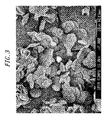
- FIGS. 3 to 5 show microscope photographs of BN particles after the aforementioned treatment, respectively.
- FIGS. 3 and 4 show Fe derived from B 4 C, respectively, which Fe exists between BN particles, looks white and has been made spherical in the photographs.
- FIG. 5 shows Fe (white substances) derived from a pulverizing device (a hammer), which Fe has been generally dispersed over the field in the photograph.
- Fe in BN can be removed by carrying out a depressurizing process similar to that described above not in the nitridization process but in the decarbonizing process thereafter.
- the depressurizing process need be conducted after completion of decarbonizing reaction because conducting depressurizing treatment prior to and during decarbonizing reaction causes disadvantage that evaporation loss of B 2 O 3 and the like necessary for decarbonization increases.
- the temperature is to be kept generally in the range of 1500 °C to 2000 °C. Provision of gas flow effectively facilitates discharge of Fe vapor in this case, as well.
- the block of BN thus obtained is then subjected to pulverization and particle-size classification, to produce BN powder.
- Fe concentration in BN powder can be reduced to 500 ppm or less in a stable manner by conducting such a depressurizing process as described above sufficiently (e.g. for 1 to 15 hours). Further, according to the present invention, Fe existing between BN particles can be effectively removed in a uniform manner, whereby residual Fe as a simple substance reduces volume thereof, diameter of spherical Fe is decreased and thus deterioration of electrical insulation due to Fe can be effectively prevented. Diameter of spherical Fe is preferably not larger than 50 ⁇ m. The possible lower limit of the diameter is 0.2 ⁇ m.
- residual B 2 O 3 can be effectively removed in a uniform manner by carrying out a depressurizing process either in the nitridization process of B 4 C or after the decarbonizing process subsequent to the nitridization process, whereby strength of obtained h-BN powder increases and relatively high bulk density of the h-BN powder in the range of 0.5 g/cm 3 to 1.0 g/cm 3 is obtained in a stable manner.
- a ratio of long diameter with respect to thickness of primary particle of BN powder can be determined by measuring long diameters and thicknesses of primary particles from an electron microscope photograph, calculating the averages of the long diameters and thicknesses, respectively, and obtaining a ratio of the average of the long diameters with respect to the average of the thicknesses.
- each sample product thus obtained by baking was collected and mixed with 35.2 g of commercially available B 2 O 3 .
- the mixing was carried out by using a V-blender with inner volume of 1L and rotating the blender for 30 minutes under the condition of 1 Hz.
- the powdery mixture obtained by the mixing was charged into a carbon crucible (inner diameter: 90 mm, height: 100 mm) and subjected to decarbonizing treatment in nitrogen flow at 2000 °C for 10 hours, whereby a product by second baking was obtained.
- the product thus obtained by the second baking was white agglomerated particle body.
- Carbon content in the product powder was measured by using a tubular electrical resistance furnace (manufactured by Shimadzu Corporation) according to the infrared absorbing method. Further, oxygen content in the product powder was measured by using a simultaneous oxygen and nitrogen analyzer ("EMGA-550" manufactured by HORIBA, Ltd.) according to inner gas-impulse heat melting thermal conductivity detection.
- Fe content in the product powder was measured by the phenanthroline absorption spectroscopy (JIS K 0102) or acid-dissolution ICP-mass spectroscopy and it was evaluated how spherical residual Fe was by using electron microscope photographs. Specifically, at least 25 images of Fe having diameter of at least 10 ⁇ m in the electron microscope photographs were analyzed and the average value of the diameters was calculated, thereby estimating diameter of spherical Fe.
- the h-BN powder thus obtained was classified according to particle size, to prepare various powder fractions having different sizes of agglomerated powder body and different bulk densities.
- the average long diameter (D), the average thickness (d), the average particle diameter (D 50 ) and void rate of the agglomerated particle body, and powder strength and bulk density of the BN powder product were then analyzed.
- Table 1 shows the results of the analysis.
- increase in charge ratio of h-BN powder with respect to resin generally enhances viscosity and facilitates generation of voids in the product h-BN, thereby possibly disturbing improvement of thermal conductivity, deteriorating electrical insulation and thus eventually lowering withstand voltage properties of the product h-BN.
- a composite sheet was produced by using each of the BN powder samples and resin at the maximum possible charge ratio of the BN powder, i.e. the maximum viscosity which narrowly allowed molding of the mixture.
- Epoxy resin "Epicoat 807” manufactured by Japan Epoxy Resin Co., Ltd.
- Epicure 807 modified alicyclic amine-grade curing agent manufactured by Japan Epoxy Resin Co., Ltd.
- each sample of the h-BN powder according to the present invention exhibits powder strength of at least 0.4, bulk density of at least 0.5, and possible maximum charge ratio with respect to resin of at least 60%, thereby demonstrating excellent thermal conductivity and withstand voltage properties.
- each sample of the h-BN powder according to the present invention has thermal conductivity which is at least 1.3 times as high as that of Conventional Example; has achieved significant reduction of Fe concentration and Fe particle diameter due to the depressurizing process, as compared with Conventional and Comparative Examples; and exhibits withstand voltage properties which is improved due to a synergetic effect caused by the aforementioned superior effects in combination with better chargeability, as compared with Conventional and Comparative Examples.
- boron carbide powder (purity: 98 mass %) was sieved by using a 44 ⁇ m sieve.
- the raw material powder thus sieved (101.8 g) was charged into a carbon crucible (inner diameter: 90 mm, height: 100 mm) and baked (subjected to nitridization treatment) in nitrogen atmosphere at a constant furnace internal pressure under conditions of temperature: 2000 °C and time: 10 hours.
- 69.3 g of the product thus obtained by baking was then collected and mixed with 35.2 g of commercially available B 2 O 3 .
- the mixing was carried out by using a V-blender with inner volume of 1L and rotating the blender for 30 minutes under the condition of 1 Hz.
- the powdery mixture obtained by the mixing was charged into a carbon crucible (inner diameter: 90 mm, height: 100 mm) and subjected to decarbonizing treatment with nitrogen flow at 2000 °C for 10 hours and then a depressurizing process of retaining the furnace internal pressure at 100 kPa or lower at the furnace temperature: 2000 °C.
- the yield of each of sample products thus obtained by the second baking was 176.6 g.
- each h-BN powder product thus obtained was classified according to particle size, to prepare various powder fractions having different sizes of agglomerated powder body and different bulk densities.
- the average long diameter (D), the average thickness (d), the average particle diameter (D 50 ) and void ratio of the agglomerated particle body, and powder strength and bulk density of the BN powder product were analyzed.
- Table 3 shows the results of the analysis.
- a composite sheet was produced by using each of the BN powder samples and resin in the same manner in Example 1. Thermal conductivity and withstand voltage properties of each of the composite sheets thus prepared were analyzed. Further, concentrations of impurities and the diameter of spherical Fe of each of the BN powder samples were analyzed. The results of these analyses are shown in combination in Table 4.
- each sample of the h-BN powder according to the present invention exhibits powder strength of at least 0.4, bulk density of at least 0.5, and possible maximum charge ratio with respect to resin of at least 60%, thereby demonstrating excellent thermal conductivity and withstand voltage properties.
- a ratio of dielectric breakdown voltage of each Example according to the present invention with respect to that of Conventional Example (No. 1) unanimously exceeded 1.3.
- Comparative Examples with production conditions beyond the optimum ranges of the present invention each exhibit Fe content exceeding the tolerable value and, needless to say, poorer powder strength and bulk density than those of Examples according to the present invention; and each have poorer thermal conductivity and withstand voltage properties than those of Examples according to the present invention.
- FIG. 7 shows in a summarized manner relationships between void ratio, bulk density and powder strength
- FIG. 8 shows in a summarized manner relationship between void ratio and thermal conductivity. It is understood from FIG. 7 that decreasing void ratio to 50% or lower enhances bulk density to 0.50 g/cm 3 or higher and powder strength to 0.40 or higher. Further, it is understood from FIG. 8 that decreasing void ratio to 50% or lower results in good values of thermal conductivity, i.e. at least 5.0 W/m ⁇ K.
- chargeability of h-BN powder with respect to resin can be improved and thermal conductivity of a heat dissipation sheet or film made of the h-BN powder can be enhanced by making agglomerated particle body of h-BN powder denser, making shape of particles of the powder more spherical, and increasing strength of the powder.
- Fe remaining in h-BN powder can be effectively removed to improve electrical insulation of the powder.
- shape of the residual Fe can be made spherical and thus harmless.
- no post-treatment is required after production of h-BN powder, whereby processing time can be shortened and thus production cost can be reduced.
- type of resin is not particularly limited and resins used in electric/electronic parts in general can be used.
Landscapes
- Chemical & Material Sciences (AREA)
- Organic Chemistry (AREA)
- Inorganic Chemistry (AREA)
- Chemical Kinetics & Catalysis (AREA)
- Ceramic Products (AREA)
- Compositions Of Macromolecular Compounds (AREA)
Applications Claiming Priority (2)
| Application Number | Priority Date | Filing Date | Title |
|---|---|---|---|
| JP2009235647 | 2009-10-09 | ||
| PCT/JP2010/006027 WO2011043082A1 (ja) | 2009-10-09 | 2010-10-08 | 六方晶窒化ホウ素粉末およびその製造方法 |
Publications (3)
| Publication Number | Publication Date |
|---|---|
| EP2487134A1 true EP2487134A1 (de) | 2012-08-15 |
| EP2487134A4 EP2487134A4 (de) | 2015-04-08 |
| EP2487134B1 EP2487134B1 (de) | 2017-08-09 |
Family
ID=43856564
Family Applications (1)
| Application Number | Title | Priority Date | Filing Date |
|---|---|---|---|
| EP10821757.1A Active EP2487134B1 (de) | 2009-10-09 | 2010-10-08 | Pulver aus hexagonalem boronnitrid und herstellungsverfahren dafür |
Country Status (7)
| Country | Link |
|---|---|
| US (1) | US8679429B2 (de) |
| EP (1) | EP2487134B1 (de) |
| JP (1) | JP4750220B2 (de) |
| KR (1) | KR101398682B1 (de) |
| CN (1) | CN102574684B (de) |
| CA (1) | CA2774842C (de) |
| WO (1) | WO2011043082A1 (de) |
Cited By (7)
| Publication number | Priority date | Publication date | Assignee | Title |
|---|---|---|---|---|
| EP2902361A1 (de) | 2012-09-28 | 2015-08-05 | Mizushima Ferroalloy Co. Ltd. | Stark wasserabweisendes und stark ölabsorbierendes bornitridpulver, herstellungsverfahren dafür und kosmetikum |
| TWI505985B (zh) * | 2013-03-07 | 2015-11-01 | Denki Kagaku Kogyo Kk | Boron nitride powder and a resin composition containing the same |
| EP3106429A4 (de) * | 2014-02-12 | 2017-11-08 | Denka Company Limited | Bornitridpartikel und herstellungsverfahren dafür |
| US9822294B2 (en) | 2011-11-29 | 2017-11-21 | Mitsubishi Chemical Corporation | Agglomerated boron nitride particles, composition containing said particles, and three-dimensional integrated circuit having layer comprising said composition |
| EP3421420A4 (de) * | 2016-02-22 | 2019-10-16 | Showa Denko K.K. | Hexagonales bornitridpulver, herstellungsverfahren dafür, harzzusammensetzung und harzfilm |
| EP3560890A4 (de) * | 2016-12-26 | 2020-08-12 | Tokuyama Corporation | Pulver aus hexagonalem boronnitrid und verfahren zur herstellung davon |
| EP3564185A4 (de) * | 2016-12-28 | 2020-08-19 | Showa Denko K.K. | Pulver aus hexagonalem bornitrid, verfahren zur herstellung davon, harzzusammensetzung und harzfolie |
Families Citing this family (48)
| Publication number | Priority date | Publication date | Assignee | Title |
|---|---|---|---|---|
| JP5598242B2 (ja) * | 2010-10-14 | 2014-10-01 | 株式会社リコー | 一成分現像用トナー、現像剤入り容器、画像形成方法、プロセスカートリッジ及び画像形成装置 |
| JP5883253B2 (ja) * | 2011-09-01 | 2016-03-09 | デンカ株式会社 | 六方晶炭窒化ホウ素、その製造方法及び組成物 |
| JPWO2013073496A1 (ja) * | 2011-11-14 | 2015-04-02 | 三菱電機株式会社 | 電磁コイル及びその製造方法、並びに絶縁テープ |
| JP6118667B2 (ja) * | 2012-07-04 | 2017-04-19 | 水島合金鉄株式会社 | ハイブリッド型bn凝集粒子およびその製造方法ならびに高分子材料 |
| JP6519876B2 (ja) * | 2014-01-08 | 2019-05-29 | デンカ株式会社 | 六方晶窒化ホウ素の製造方法、及び放熱シートの製造方法 |
| WO2015122379A1 (ja) * | 2014-02-12 | 2015-08-20 | 電気化学工業株式会社 | 球状窒化ホウ素微粒子およびその製造方法 |
| JP6413478B2 (ja) * | 2014-08-21 | 2018-10-31 | 住友ベークライト株式会社 | 造粒粉、放熱用樹脂組成物、放熱シート、半導体装置、および放熱部材 |
| JP6356025B2 (ja) * | 2014-09-17 | 2018-07-11 | 株式会社トクヤマ | 窒化硼素粉末及びその製造方法 |
| GB2538283B (en) * | 2015-05-14 | 2021-06-23 | Mahle Int Gmbh | Plain bearing and method |
| JP6516553B2 (ja) * | 2015-05-14 | 2019-05-22 | 株式会社トクヤマ | 六方晶窒化硼素粉末 |
| US10781352B2 (en) | 2015-09-03 | 2020-09-22 | Showa Denko K.K. | Powder of hexagonal boron nitride, process for producing same, resin composition, and resin sheet |
| KR102337986B1 (ko) * | 2016-10-07 | 2021-12-10 | 덴카 주식회사 | 질화 붕소 덩어리 형상의 입자, 그 제조 방법 및 이를 이용한 열전도 수지 조성물 |
| WO2018101241A1 (ja) * | 2016-12-01 | 2018-06-07 | 株式会社トクヤマ | 六方晶窒化ホウ素粉末及びその製造方法 |
| JP6822836B2 (ja) | 2016-12-28 | 2021-01-27 | 昭和電工株式会社 | 六方晶窒化ホウ素粉末、その製造方法、樹脂組成物及び樹脂シート |
| JP7063705B2 (ja) * | 2017-04-28 | 2022-05-09 | 積水化学工業株式会社 | 窒化ホウ素粒子の凝集体及び熱硬化性材料 |
| WO2019049707A1 (ja) * | 2017-09-06 | 2019-03-14 | デンカ株式会社 | 熱伝導性シート |
| US12187608B2 (en) | 2017-10-13 | 2025-01-07 | Denka Company Limited | Boron nitride powder, method for producing same, and heat-dissipating member produced using same |
| JP7069485B2 (ja) | 2017-12-27 | 2022-05-18 | 昭和電工株式会社 | 六方晶窒化ホウ素粉末及びその製造方法、並びにそれを用いた組成物及び放熱材 |
| JP2018145090A (ja) * | 2018-03-28 | 2018-09-20 | 住友ベークライト株式会社 | 造粒粉、放熱用樹脂組成物、放熱シート、半導体装置、および放熱部材 |
| JP7069314B2 (ja) * | 2018-06-29 | 2022-05-17 | デンカ株式会社 | 塊状窒化ホウ素粒子、窒化ホウ素粉末、窒化ホウ素粉末の製造方法、樹脂組成物、及び放熱部材 |
| JP2020053531A (ja) * | 2018-09-26 | 2020-04-02 | スリーエム イノベイティブ プロパティズ カンパニー | 熱伝導性シート前駆体、並びに該前駆体から得られる熱伝導性シート及びその製造方法 |
| WO2020098301A1 (zh) | 2018-11-15 | 2020-05-22 | 段沧桑 | 一类实现升降旋转动作的机械机构及其构成的综合自锁装置 |
| WO2020158758A1 (ja) | 2019-01-29 | 2020-08-06 | デンカ株式会社 | 窒化ホウ素粉末及び樹脂組成物 |
| WO2020175377A1 (ja) * | 2019-02-27 | 2020-09-03 | 三菱ケミカル株式会社 | 窒化ホウ素凝集粉末、放熱シート及び半導体デバイス |
| US20220154059A1 (en) | 2019-03-27 | 2022-05-19 | Denka Company Limited | Boron nitride aggregated particles, thermal conductive resin composition, and heat dissipation member |
| JP7101871B2 (ja) | 2019-03-27 | 2022-07-15 | デンカ株式会社 | 塊状窒化ホウ素粒子、熱伝導樹脂組成物及び放熱部材 |
| JP7624925B2 (ja) * | 2019-08-28 | 2025-01-31 | 株式会社トクヤマ | 改質窒化ホウ素粉末 |
| KR102878578B1 (ko) * | 2019-10-23 | 2025-10-29 | 덴카 주식회사 | 질화 붕소 분말 및 그의 제조 방법, 탄질화 붕소 분말, 및 복합재 및 방열 부재 |
| CN114555518B (zh) * | 2019-10-28 | 2024-03-29 | 株式会社德山 | 六方氮化硼粉末的制造方法、六方氮化硼粉末以及树脂组合物 |
| JP7273700B2 (ja) * | 2019-12-03 | 2023-05-15 | 株式会社東芝 | 耐アーク性樹脂成形物、ガス遮断器用のノズル、ガス遮断器及び耐アーク性樹脂成形物の製造方法 |
| EP4079684A4 (de) * | 2019-12-19 | 2024-02-14 | Tokuyama Corporation | Pulver aus hexagonalem bornitrid und produktionsverfahren dafür |
| KR20220160527A (ko) * | 2020-03-31 | 2022-12-06 | 덴카 주식회사 | 괴상 질화 붕소 입자 및 그의 제조 방법 |
| JP7541090B2 (ja) | 2020-06-12 | 2024-08-27 | デンカ株式会社 | 熱伝導性樹脂組成物及び放熱シート |
| CN115697899A (zh) | 2020-08-20 | 2023-02-03 | 电化株式会社 | 含有具有中空部的氮化硼粒子的片材 |
| WO2022071245A1 (ja) * | 2020-09-30 | 2022-04-07 | デンカ株式会社 | 六方晶窒化ホウ素粉末、及び焼結体の製造方法 |
| US20230357008A1 (en) * | 2020-09-30 | 2023-11-09 | Denka Company Limited | Boron nitride powder, and method for producing boron nitride powder |
| JPWO2022071227A1 (de) * | 2020-09-30 | 2022-04-07 | ||
| JP7140939B2 (ja) * | 2020-09-30 | 2022-09-21 | デンカ株式会社 | 窒化ホウ素粉末、及び窒化ホウ素粉末の製造方法 |
| WO2022202825A1 (ja) | 2021-03-25 | 2022-09-29 | デンカ株式会社 | 窒化ホウ素粉末及び樹脂組成物 |
| US20240174908A1 (en) | 2021-03-25 | 2024-05-30 | Denka Company Limited | Boron nitride powder and resin composition |
| CN117999241A (zh) * | 2021-09-27 | 2024-05-07 | 杰富意矿物合金株式会社 | 填料用六方氮化硼粉末 |
| JP7748293B2 (ja) * | 2022-01-26 | 2025-10-02 | デンカ株式会社 | 窒化ホウ素粉末、樹脂組成物、及び樹脂組成物の硬化物 |
| JP2023120878A (ja) * | 2022-02-18 | 2023-08-30 | デンカ株式会社 | 窒化ホウ素粉末の製造方法、及び窒化ホウ素粉末 |
| US20250215192A1 (en) * | 2022-03-30 | 2025-07-03 | Denka Company Limited | Boron nitride powder, resin composition, and method for producing boron nitride powder |
| CN115613163B (zh) * | 2022-12-06 | 2023-03-21 | 山东工业陶瓷研究设计院有限公司 | 一种氮化硼前驱体纤维的脱碳方法 |
| JP7555524B1 (ja) | 2023-03-28 | 2024-09-24 | 株式会社トクヤマ | 六方晶窒化ホウ素粉末、樹脂組成物および樹脂シート |
| JP7753453B1 (ja) * | 2024-06-07 | 2025-10-14 | 株式会社トクヤマ | 六方晶窒化ホウ素粉末、樹脂シート、樹脂組成物および六方晶窒化ホウ素粉末の製造方法 |
| WO2026014459A1 (ja) * | 2024-07-11 | 2026-01-15 | 三菱瓦斯化学株式会社 | 六方晶窒化ホウ素-微粒子凝集体、樹脂組成物、樹脂シート、多層体、半導体素子、および、六方晶窒化ホウ素-微粒子凝集体の製造方法 |
Family Cites Families (16)
| Publication number | Priority date | Publication date | Assignee | Title |
|---|---|---|---|---|
| US4107276A (en) * | 1974-12-30 | 1978-08-15 | Elektroschmelzwerk Kempten Gmbh | Manufacture of hexagonal boron nitride |
| DE2713014C2 (de) * | 1977-03-24 | 1983-09-08 | Westerhoff, Heinz, Dipl.-Ing., 4330 Mülheim | Vorrichtung zum Kühlen der Auflagen für das Wärmgut eines Wärmofens |
| JPS6033204A (ja) * | 1983-08-04 | 1985-02-20 | Showa Denko Kk | Bν粉末の製造法 |
| JPS62100404A (ja) * | 1985-10-28 | 1987-05-09 | Kawasaki Steel Corp | 高純度六方晶窒化硼素粉末の製造方法 |
| JPS62176904A (ja) * | 1986-01-30 | 1987-08-03 | Kawasaki Steel Corp | 水可溶性硼素化合物の少ない六方晶窒化硼素とその製造方法 |
| JPH05808A (ja) * | 1991-06-18 | 1993-01-08 | Showa Denko Kk | 窒化ほう素粉末の製造方法 |
| JP3461651B2 (ja) * | 1996-01-24 | 2003-10-27 | 電気化学工業株式会社 | 六方晶窒化ほう素粉末及びその用途 |
| US5898009A (en) * | 1996-03-19 | 1999-04-27 | Advanced Ceramics Corporation | High density agglomerated boron nitride particles |
| JPH09295801A (ja) | 1996-04-26 | 1997-11-18 | Mitsui Toatsu Chem Inc | 六方晶窒化ホウ素粉末の製造方法 |
| JP4155473B2 (ja) * | 1998-02-27 | 2008-09-24 | モーメンティブ・パフォーマンス・マテリアルズ・インク | 高密度窒化ホウ素および高密度凝集窒化ホウ素粒子の製造法 |
| US5869015A (en) * | 1998-05-04 | 1999-02-09 | General Electric Company | Method for producing cubic boron nitride using melamine as a catalyst |
| US7976941B2 (en) * | 1999-08-31 | 2011-07-12 | Momentive Performance Materials Inc. | Boron nitride particles of spherical geometry and process for making thereof |
| JP5000808B2 (ja) | 2001-03-29 | 2012-08-15 | 日本電産コパル株式会社 | カメラ用絞り機構 |
| US7192644B2 (en) * | 2002-04-22 | 2007-03-20 | Stc.Unm | Non-aqueous borate routes to boron nitride |
| US7494635B2 (en) * | 2003-08-21 | 2009-02-24 | Saint-Gobain Ceramics & Plastics, Inc. | Boron nitride agglomerated powder |
| JP5081488B2 (ja) * | 2006-04-20 | 2012-11-28 | Jfeスチール株式会社 | 六方晶窒化ホウ素粉末 |
-
2010
- 2010-10-08 KR KR1020127009087A patent/KR101398682B1/ko active Active
- 2010-10-08 CN CN201080045046.5A patent/CN102574684B/zh active Active
- 2010-10-08 JP JP2010228124A patent/JP4750220B2/ja active Active
- 2010-10-08 CA CA2774842A patent/CA2774842C/en active Active
- 2010-10-08 EP EP10821757.1A patent/EP2487134B1/de active Active
- 2010-10-08 WO PCT/JP2010/006027 patent/WO2011043082A1/ja not_active Ceased
-
2012
- 2012-04-05 US US13/440,859 patent/US8679429B2/en active Active
Cited By (12)
| Publication number | Priority date | Publication date | Assignee | Title |
|---|---|---|---|---|
| US9822294B2 (en) | 2011-11-29 | 2017-11-21 | Mitsubishi Chemical Corporation | Agglomerated boron nitride particles, composition containing said particles, and three-dimensional integrated circuit having layer comprising said composition |
| EP3269682A1 (de) * | 2011-11-29 | 2018-01-17 | Mitsubishi Chemical Corporation | Agglomerierte bornitridpartikel, zusammensetzung mit den besagten partikeln und dreidimensionaler integrierter schaltkreis mit schicht mit der besagten zusammensetzung |
| US10400151B2 (en) | 2011-11-29 | 2019-09-03 | Mitsubishi Chemical Corporation | Agglomerated boron nitride particles, composition containing said particles, and three- dimensional integrated circuit having layer comprising said composition |
| EP2902361A1 (de) | 2012-09-28 | 2015-08-05 | Mizushima Ferroalloy Co. Ltd. | Stark wasserabweisendes und stark ölabsorbierendes bornitridpulver, herstellungsverfahren dafür und kosmetikum |
| EP2902361A4 (de) * | 2012-09-28 | 2016-05-04 | Mizushima Ferroalloy Co Ltd | Stark wasserabweisendes und stark ölabsorbierendes bornitridpulver, herstellungsverfahren dafür und kosmetikum |
| TWI505985B (zh) * | 2013-03-07 | 2015-11-01 | Denki Kagaku Kogyo Kk | Boron nitride powder and a resin composition containing the same |
| US9656868B2 (en) | 2013-03-07 | 2017-05-23 | Denka Company Limited | Boron-nitride powder and resin composition containing same |
| EP3106429A4 (de) * | 2014-02-12 | 2017-11-08 | Denka Company Limited | Bornitridpartikel und herstellungsverfahren dafür |
| US10017387B2 (en) | 2014-02-12 | 2018-07-10 | Denka Company Limited | Boron nitride fine particles and production method thereof |
| EP3421420A4 (de) * | 2016-02-22 | 2019-10-16 | Showa Denko K.K. | Hexagonales bornitridpulver, herstellungsverfahren dafür, harzzusammensetzung und harzfilm |
| EP3560890A4 (de) * | 2016-12-26 | 2020-08-12 | Tokuyama Corporation | Pulver aus hexagonalem boronnitrid und verfahren zur herstellung davon |
| EP3564185A4 (de) * | 2016-12-28 | 2020-08-19 | Showa Denko K.K. | Pulver aus hexagonalem bornitrid, verfahren zur herstellung davon, harzzusammensetzung und harzfolie |
Also Published As
| Publication number | Publication date |
|---|---|
| EP2487134A4 (de) | 2015-04-08 |
| KR101398682B1 (ko) | 2014-05-27 |
| KR20120101345A (ko) | 2012-09-13 |
| JP2011098882A (ja) | 2011-05-19 |
| US8679429B2 (en) | 2014-03-25 |
| JP4750220B2 (ja) | 2011-08-17 |
| CN102574684A (zh) | 2012-07-11 |
| CA2774842C (en) | 2015-07-14 |
| EP2487134B1 (de) | 2017-08-09 |
| CN102574684B (zh) | 2015-04-29 |
| CA2774842A1 (en) | 2011-04-14 |
| US20120196128A1 (en) | 2012-08-02 |
| WO2011043082A1 (ja) | 2011-04-14 |
Similar Documents
| Publication | Publication Date | Title |
|---|---|---|
| EP2487134B1 (de) | Pulver aus hexagonalem boronnitrid und herstellungsverfahren dafür | |
| EP2612838B1 (de) | Pulver aus kugelförmigem aluminiumnitrid | |
| EP2623458B1 (de) | Verfahren zur herstellung eines pulvers aus aluminiumnitridkugeln | |
| EP2650259B1 (de) | Aluminiumnitridpulver und verfahren zu seiner herstellung | |
| EP2530049B1 (de) | Verfahren zur herstellung eines pulvers aus aluminiumnitridkugeln sowie in diesem verfahren hergestelltes pulver aus aluminiumnitridkugeln | |
| JP5081488B2 (ja) | 六方晶窒化ホウ素粉末 | |
| JP7592181B2 (ja) | フィラー用六方晶窒化ホウ素粉末 | |
| EP2952476B1 (de) | Verfahren zur herstellung eines gesinterten aluminiumnitridgranulats und verwendung in wärmestrahlenden materialien | |
| KR102871810B1 (ko) | 질화 붕소 분말, 및 질화 붕소 분말의 제조 방법 | |
| TWI821185B (zh) | 氮化鋁系粉末及其製造方法 | |
| KR102871805B1 (ko) | 질화 붕소 분말, 및 질화 붕소 분말의 제조 방법 | |
| JP2024173160A (ja) | 窒化ホウ素含有粉末、放熱フィラー、及び、樹脂組成物 |
Legal Events
| Date | Code | Title | Description |
|---|---|---|---|
| PUAI | Public reference made under article 153(3) epc to a published international application that has entered the european phase |
Free format text: ORIGINAL CODE: 0009012 |
|
| 17P | Request for examination filed |
Effective date: 20120419 |
|
| AK | Designated contracting states |
Kind code of ref document: A1 Designated state(s): AL AT BE BG CH CY CZ DE DK EE ES FI FR GB GR HR HU IE IS IT LI LT LU LV MC MK MT NL NO PL PT RO RS SE SI SK SM TR |
|
| DAX | Request for extension of the european patent (deleted) | ||
| RA4 | Supplementary search report drawn up and despatched (corrected) |
Effective date: 20150311 |
|
| RIC1 | Information provided on ipc code assigned before grant |
Ipc: C01B 21/064 20060101AFI20150305BHEP |
|
| 17Q | First examination report despatched |
Effective date: 20160414 |
|
| GRAP | Despatch of communication of intention to grant a patent |
Free format text: ORIGINAL CODE: EPIDOSNIGR1 |
|
| STAA | Information on the status of an ep patent application or granted ep patent |
Free format text: STATUS: GRANT OF PATENT IS INTENDED |
|
| INTG | Intention to grant announced |
Effective date: 20170309 |
|
| GRAS | Grant fee paid |
Free format text: ORIGINAL CODE: EPIDOSNIGR3 |
|
| GRAA | (expected) grant |
Free format text: ORIGINAL CODE: 0009210 |
|
| STAA | Information on the status of an ep patent application or granted ep patent |
Free format text: STATUS: THE PATENT HAS BEEN GRANTED |
|
| AK | Designated contracting states |
Kind code of ref document: B1 Designated state(s): AL AT BE BG CH CY CZ DE DK EE ES FI FR GB GR HR HU IE IS IT LI LT LU LV MC MK MT NL NO PL PT RO RS SE SI SK SM TR |
|
| REG | Reference to a national code |
Ref country code: GB Ref legal event code: FG4D |
|
| REG | Reference to a national code |
Ref country code: CH Ref legal event code: EP Ref country code: AT Ref legal event code: REF Ref document number: 916585 Country of ref document: AT Kind code of ref document: T Effective date: 20170815 |
|
| REG | Reference to a national code |
Ref country code: IE Ref legal event code: FG4D |
|
| REG | Reference to a national code |
Ref country code: DE Ref legal event code: R096 Ref document number: 602010044339 Country of ref document: DE |
|
| REG | Reference to a national code |
Ref country code: FR Ref legal event code: PLFP Year of fee payment: 8 |
|
| REG | Reference to a national code |
Ref country code: NL Ref legal event code: MP Effective date: 20170809 |
|
| REG | Reference to a national code |
Ref country code: LT Ref legal event code: MG4D |
|
| REG | Reference to a national code |
Ref country code: AT Ref legal event code: MK05 Ref document number: 916585 Country of ref document: AT Kind code of ref document: T Effective date: 20170809 |
|
| PG25 | Lapsed in a contracting state [announced via postgrant information from national office to epo] |
Ref country code: AT Free format text: LAPSE BECAUSE OF FAILURE TO SUBMIT A TRANSLATION OF THE DESCRIPTION OR TO PAY THE FEE WITHIN THE PRESCRIBED TIME-LIMIT Effective date: 20170809 Ref country code: NO Free format text: LAPSE BECAUSE OF FAILURE TO SUBMIT A TRANSLATION OF THE DESCRIPTION OR TO PAY THE FEE WITHIN THE PRESCRIBED TIME-LIMIT Effective date: 20171109 Ref country code: LT Free format text: LAPSE BECAUSE OF FAILURE TO SUBMIT A TRANSLATION OF THE DESCRIPTION OR TO PAY THE FEE WITHIN THE PRESCRIBED TIME-LIMIT Effective date: 20170809 Ref country code: FI Free format text: LAPSE BECAUSE OF FAILURE TO SUBMIT A TRANSLATION OF THE DESCRIPTION OR TO PAY THE FEE WITHIN THE PRESCRIBED TIME-LIMIT Effective date: 20170809 Ref country code: NL Free format text: LAPSE BECAUSE OF FAILURE TO SUBMIT A TRANSLATION OF THE DESCRIPTION OR TO PAY THE FEE WITHIN THE PRESCRIBED TIME-LIMIT Effective date: 20170809 Ref country code: HR Free format text: LAPSE BECAUSE OF FAILURE TO SUBMIT A TRANSLATION OF THE DESCRIPTION OR TO PAY THE FEE WITHIN THE PRESCRIBED TIME-LIMIT Effective date: 20170809 Ref country code: SE Free format text: LAPSE BECAUSE OF FAILURE TO SUBMIT A TRANSLATION OF THE DESCRIPTION OR TO PAY THE FEE WITHIN THE PRESCRIBED TIME-LIMIT Effective date: 20170809 |
|
| PG25 | Lapsed in a contracting state [announced via postgrant information from national office to epo] |
Ref country code: RS Free format text: LAPSE BECAUSE OF FAILURE TO SUBMIT A TRANSLATION OF THE DESCRIPTION OR TO PAY THE FEE WITHIN THE PRESCRIBED TIME-LIMIT Effective date: 20170809 Ref country code: IS Free format text: LAPSE BECAUSE OF FAILURE TO SUBMIT A TRANSLATION OF THE DESCRIPTION OR TO PAY THE FEE WITHIN THE PRESCRIBED TIME-LIMIT Effective date: 20171209 Ref country code: BG Free format text: LAPSE BECAUSE OF FAILURE TO SUBMIT A TRANSLATION OF THE DESCRIPTION OR TO PAY THE FEE WITHIN THE PRESCRIBED TIME-LIMIT Effective date: 20171109 Ref country code: ES Free format text: LAPSE BECAUSE OF FAILURE TO SUBMIT A TRANSLATION OF THE DESCRIPTION OR TO PAY THE FEE WITHIN THE PRESCRIBED TIME-LIMIT Effective date: 20170809 Ref country code: LV Free format text: LAPSE BECAUSE OF FAILURE TO SUBMIT A TRANSLATION OF THE DESCRIPTION OR TO PAY THE FEE WITHIN THE PRESCRIBED TIME-LIMIT Effective date: 20170809 Ref country code: PL Free format text: LAPSE BECAUSE OF FAILURE TO SUBMIT A TRANSLATION OF THE DESCRIPTION OR TO PAY THE FEE WITHIN THE PRESCRIBED TIME-LIMIT Effective date: 20170809 Ref country code: GR Free format text: LAPSE BECAUSE OF FAILURE TO SUBMIT A TRANSLATION OF THE DESCRIPTION OR TO PAY THE FEE WITHIN THE PRESCRIBED TIME-LIMIT Effective date: 20171110 |
|
| PG25 | Lapsed in a contracting state [announced via postgrant information from national office to epo] |
Ref country code: DK Free format text: LAPSE BECAUSE OF FAILURE TO SUBMIT A TRANSLATION OF THE DESCRIPTION OR TO PAY THE FEE WITHIN THE PRESCRIBED TIME-LIMIT Effective date: 20170809 Ref country code: RO Free format text: LAPSE BECAUSE OF FAILURE TO SUBMIT A TRANSLATION OF THE DESCRIPTION OR TO PAY THE FEE WITHIN THE PRESCRIBED TIME-LIMIT Effective date: 20170809 Ref country code: CZ Free format text: LAPSE BECAUSE OF FAILURE TO SUBMIT A TRANSLATION OF THE DESCRIPTION OR TO PAY THE FEE WITHIN THE PRESCRIBED TIME-LIMIT Effective date: 20170809 |
|
| REG | Reference to a national code |
Ref country code: DE Ref legal event code: R097 Ref document number: 602010044339 Country of ref document: DE |
|
| PG25 | Lapsed in a contracting state [announced via postgrant information from national office to epo] |
Ref country code: MC Free format text: LAPSE BECAUSE OF FAILURE TO SUBMIT A TRANSLATION OF THE DESCRIPTION OR TO PAY THE FEE WITHIN THE PRESCRIBED TIME-LIMIT Effective date: 20170809 Ref country code: SM Free format text: LAPSE BECAUSE OF FAILURE TO SUBMIT A TRANSLATION OF THE DESCRIPTION OR TO PAY THE FEE WITHIN THE PRESCRIBED TIME-LIMIT Effective date: 20170809 Ref country code: EE Free format text: LAPSE BECAUSE OF FAILURE TO SUBMIT A TRANSLATION OF THE DESCRIPTION OR TO PAY THE FEE WITHIN THE PRESCRIBED TIME-LIMIT Effective date: 20170809 Ref country code: SK Free format text: LAPSE BECAUSE OF FAILURE TO SUBMIT A TRANSLATION OF THE DESCRIPTION OR TO PAY THE FEE WITHIN THE PRESCRIBED TIME-LIMIT Effective date: 20170809 Ref country code: IT Free format text: LAPSE BECAUSE OF FAILURE TO SUBMIT A TRANSLATION OF THE DESCRIPTION OR TO PAY THE FEE WITHIN THE PRESCRIBED TIME-LIMIT Effective date: 20170809 |
|
| REG | Reference to a national code |
Ref country code: CH Ref legal event code: PL |
|
| PLBE | No opposition filed within time limit |
Free format text: ORIGINAL CODE: 0009261 |
|
| STAA | Information on the status of an ep patent application or granted ep patent |
Free format text: STATUS: NO OPPOSITION FILED WITHIN TIME LIMIT |
|
| 26N | No opposition filed |
Effective date: 20180511 |
|
| REG | Reference to a national code |
Ref country code: IE Ref legal event code: MM4A |
|
| PG25 | Lapsed in a contracting state [announced via postgrant information from national office to epo] |
Ref country code: LU Free format text: LAPSE BECAUSE OF NON-PAYMENT OF DUE FEES Effective date: 20171008 Ref country code: LI Free format text: LAPSE BECAUSE OF NON-PAYMENT OF DUE FEES Effective date: 20171031 Ref country code: CH Free format text: LAPSE BECAUSE OF NON-PAYMENT OF DUE FEES Effective date: 20171031 |
|
| REG | Reference to a national code |
Ref country code: BE Ref legal event code: MM Effective date: 20171031 |
|
| PG25 | Lapsed in a contracting state [announced via postgrant information from national office to epo] |
Ref country code: BE Free format text: LAPSE BECAUSE OF NON-PAYMENT OF DUE FEES Effective date: 20171031 Ref country code: SI Free format text: LAPSE BECAUSE OF FAILURE TO SUBMIT A TRANSLATION OF THE DESCRIPTION OR TO PAY THE FEE WITHIN THE PRESCRIBED TIME-LIMIT Effective date: 20170809 |
|
| PG25 | Lapsed in a contracting state [announced via postgrant information from national office to epo] |
Ref country code: MT Free format text: LAPSE BECAUSE OF NON-PAYMENT OF DUE FEES Effective date: 20171008 |
|
| REG | Reference to a national code |
Ref country code: FR Ref legal event code: PLFP Year of fee payment: 9 |
|
| PG25 | Lapsed in a contracting state [announced via postgrant information from national office to epo] |
Ref country code: IE Free format text: LAPSE BECAUSE OF NON-PAYMENT OF DUE FEES Effective date: 20171008 |
|
| PG25 | Lapsed in a contracting state [announced via postgrant information from national office to epo] |
Ref country code: HU Free format text: LAPSE BECAUSE OF FAILURE TO SUBMIT A TRANSLATION OF THE DESCRIPTION OR TO PAY THE FEE WITHIN THE PRESCRIBED TIME-LIMIT; INVALID AB INITIO Effective date: 20101008 |
|
| PG25 | Lapsed in a contracting state [announced via postgrant information from national office to epo] |
Ref country code: CY Free format text: LAPSE BECAUSE OF NON-PAYMENT OF DUE FEES Effective date: 20170809 |
|
| PG25 | Lapsed in a contracting state [announced via postgrant information from national office to epo] |
Ref country code: MK Free format text: LAPSE BECAUSE OF FAILURE TO SUBMIT A TRANSLATION OF THE DESCRIPTION OR TO PAY THE FEE WITHIN THE PRESCRIBED TIME-LIMIT Effective date: 20170809 |
|
| PG25 | Lapsed in a contracting state [announced via postgrant information from national office to epo] |
Ref country code: TR Free format text: LAPSE BECAUSE OF FAILURE TO SUBMIT A TRANSLATION OF THE DESCRIPTION OR TO PAY THE FEE WITHIN THE PRESCRIBED TIME-LIMIT Effective date: 20170809 |
|
| PG25 | Lapsed in a contracting state [announced via postgrant information from national office to epo] |
Ref country code: PT Free format text: LAPSE BECAUSE OF FAILURE TO SUBMIT A TRANSLATION OF THE DESCRIPTION OR TO PAY THE FEE WITHIN THE PRESCRIBED TIME-LIMIT Effective date: 20170809 |
|
| PG25 | Lapsed in a contracting state [announced via postgrant information from national office to epo] |
Ref country code: AL Free format text: LAPSE BECAUSE OF FAILURE TO SUBMIT A TRANSLATION OF THE DESCRIPTION OR TO PAY THE FEE WITHIN THE PRESCRIBED TIME-LIMIT Effective date: 20170809 |
|
| PGFP | Annual fee paid to national office [announced via postgrant information from national office to epo] |
Ref country code: DE Payment date: 20251021 Year of fee payment: 16 |
|
| PGFP | Annual fee paid to national office [announced via postgrant information from national office to epo] |
Ref country code: GB Payment date: 20251016 Year of fee payment: 16 |
|
| PGFP | Annual fee paid to national office [announced via postgrant information from national office to epo] |
Ref country code: FR Payment date: 20251030 Year of fee payment: 16 |