EP2432005A1 - Epitaktisches substrat für elektronische geräte und verfahren zu seiner herstellung - Google Patents
Epitaktisches substrat für elektronische geräte und verfahren zu seiner herstellung Download PDFInfo
- Publication number
- EP2432005A1 EP2432005A1 EP10774710A EP10774710A EP2432005A1 EP 2432005 A1 EP2432005 A1 EP 2432005A1 EP 10774710 A EP10774710 A EP 10774710A EP 10774710 A EP10774710 A EP 10774710A EP 2432005 A1 EP2432005 A1 EP 2432005A1
- Authority
- EP
- European Patent Office
- Prior art keywords
- layer
- laminate
- buffer
- superlattice
- substrate
- Prior art date
- Legal status (The legal status is an assumption and is not a legal conclusion. Google has not performed a legal analysis and makes no representation as to the accuracy of the status listed.)
- Withdrawn
Links
Images


Classifications
-
- H—ELECTRICITY
- H10—SEMICONDUCTOR DEVICES; ELECTRIC SOLID-STATE DEVICES NOT OTHERWISE PROVIDED FOR
- H10D—INORGANIC ELECTRIC SEMICONDUCTOR DEVICES
- H10D62/00—Semiconductor bodies, or regions thereof, of devices having potential barriers
- H10D62/80—Semiconductor bodies, or regions thereof, of devices having potential barriers characterised by the materials
- H10D62/85—Semiconductor bodies, or regions thereof, of devices having potential barriers characterised by the materials being Group III-V materials, e.g. GaAs
- H10D62/854—Semiconductor bodies, or regions thereof, of devices having potential barriers characterised by the materials being Group III-V materials, e.g. GaAs further characterised by the dopants
-
- H—ELECTRICITY
- H10—SEMICONDUCTOR DEVICES; ELECTRIC SOLID-STATE DEVICES NOT OTHERWISE PROVIDED FOR
- H10P—GENERIC PROCESSES OR APPARATUS FOR THE MANUFACTURE OR TREATMENT OF DEVICES COVERED BY CLASS H10
- H10P14/00—Formation of materials, e.g. in the shape of layers or pillars
- H10P14/20—Formation of materials, e.g. in the shape of layers or pillars of semiconductor materials
-
- H—ELECTRICITY
- H10—SEMICONDUCTOR DEVICES; ELECTRIC SOLID-STATE DEVICES NOT OTHERWISE PROVIDED FOR
- H10D—INORGANIC ELECTRIC SEMICONDUCTOR DEVICES
- H10D30/00—Field-effect transistors [FET]
- H10D30/40—FETs having zero-dimensional [0D], one-dimensional [1D] or two-dimensional [2D] charge carrier gas channels
- H10D30/47—FETs having zero-dimensional [0D], one-dimensional [1D] or two-dimensional [2D] charge carrier gas channels having two-dimensional [2D] charge carrier gas channels, e.g. nanoribbon FETs or high electron mobility transistors [HEMT]
- H10D30/471—High electron mobility transistors [HEMT] or high hole mobility transistors [HHMT]
- H10D30/475—High electron mobility transistors [HEMT] or high hole mobility transistors [HHMT] having wider bandgap layer formed on top of lower bandgap active layer, e.g. undoped barrier HEMTs such as i-AlGaN/GaN HEMTs
-
- H—ELECTRICITY
- H10—SEMICONDUCTOR DEVICES; ELECTRIC SOLID-STATE DEVICES NOT OTHERWISE PROVIDED FOR
- H10D—INORGANIC ELECTRIC SEMICONDUCTOR DEVICES
- H10D62/00—Semiconductor bodies, or regions thereof, of devices having potential barriers
- H10D62/10—Shapes, relative sizes or dispositions of the regions of the semiconductor bodies; Shapes of the semiconductor bodies
- H10D62/17—Semiconductor regions connected to electrodes not carrying current to be rectified, amplified or switched, e.g. channel regions
- H10D62/351—Substrate regions of field-effect devices
- H10D62/357—Substrate regions of field-effect devices of FETs
-
- H—ELECTRICITY
- H10—SEMICONDUCTOR DEVICES; ELECTRIC SOLID-STATE DEVICES NOT OTHERWISE PROVIDED FOR
- H10D—INORGANIC ELECTRIC SEMICONDUCTOR DEVICES
- H10D62/00—Semiconductor bodies, or regions thereof, of devices having potential barriers
- H10D62/80—Semiconductor bodies, or regions thereof, of devices having potential barriers characterised by the materials
- H10D62/81—Semiconductor bodies, or regions thereof, of devices having potential barriers characterised by the materials of structures exhibiting quantum-confinement effects, e.g. single quantum wells; of structures having periodic or quasi-periodic potential variation
- H10D62/815—Semiconductor bodies, or regions thereof, of devices having potential barriers characterised by the materials of structures exhibiting quantum-confinement effects, e.g. single quantum wells; of structures having periodic or quasi-periodic potential variation of structures having periodic or quasi-periodic potential variation, e.g. superlattices or multiple quantum wells [MQW]
- H10D62/8161—Semiconductor bodies, or regions thereof, of devices having potential barriers characterised by the materials of structures exhibiting quantum-confinement effects, e.g. single quantum wells; of structures having periodic or quasi-periodic potential variation of structures having periodic or quasi-periodic potential variation, e.g. superlattices or multiple quantum wells [MQW] potential variation due to variations in composition or crystallinity, e.g. heterojunction superlattices
- H10D62/8162—Semiconductor bodies, or regions thereof, of devices having potential barriers characterised by the materials of structures exhibiting quantum-confinement effects, e.g. single quantum wells; of structures having periodic or quasi-periodic potential variation of structures having periodic or quasi-periodic potential variation, e.g. superlattices or multiple quantum wells [MQW] potential variation due to variations in composition or crystallinity, e.g. heterojunction superlattices having quantum effects only in the vertical direction, i.e. layered structures having quantum effects solely resulting from vertical potential variation
- H10D62/8164—Semiconductor bodies, or regions thereof, of devices having potential barriers characterised by the materials of structures exhibiting quantum-confinement effects, e.g. single quantum wells; of structures having periodic or quasi-periodic potential variation of structures having periodic or quasi-periodic potential variation, e.g. superlattices or multiple quantum wells [MQW] potential variation due to variations in composition or crystallinity, e.g. heterojunction superlattices having quantum effects only in the vertical direction, i.e. layered structures having quantum effects solely resulting from vertical potential variation comprising only semiconductor materials
-
- H—ELECTRICITY
- H10—SEMICONDUCTOR DEVICES; ELECTRIC SOLID-STATE DEVICES NOT OTHERWISE PROVIDED FOR
- H10P—GENERIC PROCESSES OR APPARATUS FOR THE MANUFACTURE OR TREATMENT OF DEVICES COVERED BY CLASS H10
- H10P10/00—Bonding of wafers, substrates or parts of devices
-
- H—ELECTRICITY
- H10—SEMICONDUCTOR DEVICES; ELECTRIC SOLID-STATE DEVICES NOT OTHERWISE PROVIDED FOR
- H10D—INORGANIC ELECTRIC SEMICONDUCTOR DEVICES
- H10D62/00—Semiconductor bodies, or regions thereof, of devices having potential barriers
- H10D62/80—Semiconductor bodies, or regions thereof, of devices having potential barriers characterised by the materials
- H10D62/85—Semiconductor bodies, or regions thereof, of devices having potential barriers characterised by the materials being Group III-V materials, e.g. GaAs
- H10D62/8503—Nitride Group III-V materials, e.g. AlN or GaN
-
- H—ELECTRICITY
- H10—SEMICONDUCTOR DEVICES; ELECTRIC SOLID-STATE DEVICES NOT OTHERWISE PROVIDED FOR
- H10P—GENERIC PROCESSES OR APPARATUS FOR THE MANUFACTURE OR TREATMENT OF DEVICES COVERED BY CLASS H10
- H10P14/00—Formation of materials, e.g. in the shape of layers or pillars
- H10P14/20—Formation of materials, e.g. in the shape of layers or pillars of semiconductor materials
- H10P14/29—Formation of materials, e.g. in the shape of layers or pillars of semiconductor materials characterised by the substrates
- H10P14/2901—Materials
- H10P14/2902—Materials being Group IVA materials
- H10P14/2904—Silicon carbide
-
- H—ELECTRICITY
- H10—SEMICONDUCTOR DEVICES; ELECTRIC SOLID-STATE DEVICES NOT OTHERWISE PROVIDED FOR
- H10P—GENERIC PROCESSES OR APPARATUS FOR THE MANUFACTURE OR TREATMENT OF DEVICES COVERED BY CLASS H10
- H10P14/00—Formation of materials, e.g. in the shape of layers or pillars
- H10P14/20—Formation of materials, e.g. in the shape of layers or pillars of semiconductor materials
- H10P14/32—Formation of materials, e.g. in the shape of layers or pillars of semiconductor materials characterised by intermediate layers between substrates and deposited layers
- H10P14/3202—Materials thereof
- H10P14/3214—Materials thereof being Group IIIA-VA semiconductors
- H10P14/3216—Nitrides
-
- H—ELECTRICITY
- H10—SEMICONDUCTOR DEVICES; ELECTRIC SOLID-STATE DEVICES NOT OTHERWISE PROVIDED FOR
- H10P—GENERIC PROCESSES OR APPARATUS FOR THE MANUFACTURE OR TREATMENT OF DEVICES COVERED BY CLASS H10
- H10P14/00—Formation of materials, e.g. in the shape of layers or pillars
- H10P14/20—Formation of materials, e.g. in the shape of layers or pillars of semiconductor materials
- H10P14/32—Formation of materials, e.g. in the shape of layers or pillars of semiconductor materials characterised by intermediate layers between substrates and deposited layers
- H10P14/3202—Materials thereof
- H10P14/3238—Materials thereof being insulating materials
-
- H—ELECTRICITY
- H10—SEMICONDUCTOR DEVICES; ELECTRIC SOLID-STATE DEVICES NOT OTHERWISE PROVIDED FOR
- H10P—GENERIC PROCESSES OR APPARATUS FOR THE MANUFACTURE OR TREATMENT OF DEVICES COVERED BY CLASS H10
- H10P14/00—Formation of materials, e.g. in the shape of layers or pillars
- H10P14/20—Formation of materials, e.g. in the shape of layers or pillars of semiconductor materials
- H10P14/32—Formation of materials, e.g. in the shape of layers or pillars of semiconductor materials characterised by intermediate layers between substrates and deposited layers
- H10P14/3242—Structure
- H10P14/3244—Layer structure
- H10P14/3251—Layer structure consisting of three or more layers
- H10P14/3252—Alternating layers, e.g. superlattice
-
- H—ELECTRICITY
- H10—SEMICONDUCTOR DEVICES; ELECTRIC SOLID-STATE DEVICES NOT OTHERWISE PROVIDED FOR
- H10P—GENERIC PROCESSES OR APPARATUS FOR THE MANUFACTURE OR TREATMENT OF DEVICES COVERED BY CLASS H10
- H10P14/00—Formation of materials, e.g. in the shape of layers or pillars
- H10P14/20—Formation of materials, e.g. in the shape of layers or pillars of semiconductor materials
- H10P14/34—Deposited materials, e.g. layers
- H10P14/3402—Deposited materials, e.g. layers characterised by the chemical composition
- H10P14/3414—Deposited materials, e.g. layers characterised by the chemical composition being group IIIA-VIA materials
- H10P14/3416—Nitrides
Definitions
- the present invention relates to an epitaxial substrate for electronic devices and a method of producing the same.
- the present invention specifically relates to an epitaxial substrate for HEMTs and a method of producing the same.
- HEMTs High electron mobility transistors
- FETs Field effect transistors
- Such a field effect transistor is formed, as schematically illustrated in FIG. 1 , for example by stacking a channel layer 22 and an electron supply layer 23 on a substrate 21 and then providing a surface of the electron supply layer 23 with a source electrode 24, a drain electrode 25, and a gate electrode 26.
- a lateral direction is a current flow direction. This movement of electrons in the lateral direction, i.e.
- the current flow direction is controlled by the voltage applied to the gate electrode 26.
- the voltage applied to the gate electrode 26 In HEMTs, electrons generated at a joint interface between the electron supply layer 23 and the channel layer 22 which have band gaps different from each other can move significantly fast, as compared with electrons in normal semiconductors.
- leakage current refers to leakage current that flows between two electrodes (for example, between the source electrode 24 and the drain electrode 25) arranged on a surface on the electron supply layer 23 side.
- Vertical leakage current refers to leakage current that flows between two electrodes separately arranged on a surface on the electron supply layer 23 side and a surface on the substrate 21 side.
- an electronic device having a layered structure using a Group III nitride material use of a SiC substrate is proposed, which is excellent in heat dissipation.
- a SiC substrate is generally used.
- JP 2008-85123 (A ) discloses a HEMT structure including a superlattice buffer layer, a channel layer, and an electron supply layer, on a conductive SiC substrate.
- JP 2005-85852 (A ) discloses a HEMT structure including a superlattice buffer layer that is doped with p-type impurities, a channel layer, and an electron supply layer on a Si or SiC substrate with a GaN intervening layer therebetween.
- the invention described in JP 2008-85123 insulating properties of the superlattice buffer layer is not well considered, so the invention has a problem of deterioration in the vertical breakdown voltage. Further, the invention described in JP 2005-85852 had the following problem. When a Group III nitride layer is grown on a substrate, a GaN-based low-temperature buffer layer is used; therefore, when a SiC substrate is used, and when an Al-containing superlattice buffer layer is used for the purpose of improving the insulating properties to obtain an epitaxial substrate, the epitaxial substrate would be cracked.
- An object of the present invention is to provide an epitaxial substrate for electronic devices, in which a conductive SiC substrate is used as a substrate, both decrease in the lateral leakage current and improvement in the lateral breakdown voltage characteristics are successfully achieved, and the vertical breakdown voltage is improved, and besides, crack generation is suppressed; and a method of producing the same.
- the present invention primarily includes the following components.
- a method of producing an epitaxial substrate for an electronic device comprising a conductive SiC single crystal substrate, a buffer as an insulating layer on the SiC single crystal substrate, and a main laminate formed by epitaxially growing a plurality of Group III nitride layers on the buffer, wherein a lateral direction is a current flow direction.
- the buffer includes at least an initial growth layer in contact with the SiC single crystal substrate and a superlattice laminate having a superlattice multi-layer structure on the initial growth layer.
- An epitaxial substrate for electronic devices includes a buffer having an initial growth layer made of an Al-containing Group III nitride and a given superlattice laminate, and a given main laminate, on a conductive SiC substrate.
- the superlattice laminate and/or a portion of the main laminate on the buffer side has a C concentration of 1 ⁇ 10 18 /cm 3 or more, so that not only both decrease in the lateral leakage current and improvement in the lateral breakdown voltage characteristics are successfully achieved, but also vertical breakdown voltage can be improved.
- use of the conductive SiC substrate can improve heat dissipation and reduce crack generation.
- an epitaxial substrate for electronic devices which includes a buffer having an initial growth layer made of an Al-containing Group III nitride and a given superlattice laminate, and a given main laminate, can be produced.
- the superlattice laminate and/or a portion of the main laminate on the buffer side has a C concentration of 1 ⁇ 10 18 /cm 3 or more, so that not only both decrease in the lateral leakage current and improvement in the lateral breakdown voltage characteristics are successfully achieved, but also vertical breakdown voltage can be improved.
- use of a conductive SiC substrate can improve heat dissipation and reduce crack generation.
- FIG. 2 schematically shows a cross-section structure of an epitaxial substrate for electronic devices according to the present invention. Note that the epitaxial substrate in Fig. 2 is enlarged in the thickness direction for the sake of explanation.
- an epitaxial substrate 1 for electronic devices has the following characteristic features.
- the lateral direction is a current flow direction.
- the epitaxial substrate 1 comprises a conductive SiC single crystal substrate 2, a buffer 3 as an insulating layer formed on the conductive SiC single crystal substrate 2, and a main laminate 4 formed by epitaxially growing a plurality of Group III nitride layers on the buffer 3.
- the buffer 3 at least includes an initial growth layer 5 in contact with the Si single crystal substrate 2 and a superlattice laminate 6 having a superlattice multi-layer structure on the initial growth layer 5.
- the superlattice laminate 6 and/or a portion 4' of the main laminate 4 on the buffer 3 side has a C concentration of 1 ⁇ 10 18 /cm 3 or more.
- Substrates having various crystal structures may be used for the conductive SiC single crystal substrate 2; specifically, a 4H or 6H substrate is preferable.
- the crystal plane is not limited in particular, and (0001), (10-10), (11-20) planes and the like can be used. However, to grow the (0001) plane of a Group III nitride with good surface flatness, the (0001) plane is desirably used. Further, either p-type or n-type conductivity may be employed. With respect to the conductivity of the SiC single crystal substrate 2, a low resistance substrate having a resistivity of 1000 ⁇ cm or less can be used as appropriate depending on the use.
- SiC substrates having a resistivity of 1000 ⁇ cm or less are herein referred to as conductive SiC substrates.
- Such a conductive SiC single crystal substrate 2 can be produced using various methods such as a sublimation method; alternatively, SiC can be homoepitaxially grown on a surface of a substrate.
- a substrate having a surface provided with a thin film formed from an oxide film, a nitride film, or a carbide film can be used. Note that the reason that it is difficult to increase the resistivity of the SiC substrate is because nitrogen, which is the main constituent of air, easily contaminates the SiC substrate as an impurity, i.e. an n-type dopant, to reduce resistivity.
- the initial growth layer 5 preferably has higher Al composition than the layer which has the least Al composition in the superlattice laminate.
- the AIN may include Ga or In above or other impurities such as Si, H, O, C, B, Mg, As, or P.
- the thickness of the initial growth layer is preferably within the range of 10 nm to 200 nm. When the initial layer is too thin, the stretching stress in the superlattice laminate cannot be fully suppressed, so cracks would occur in the superlattice laminate. When the initial layer is too thick, the stretching stress in the initial layer would accumulate to generate cracks in the initial layer.
- the lateral direction is a current flow direction
- the lateral direction refers to a state where, as illustrated in Fig. 1 , electric current flows from the source electrode 24 to the drain electrode 25, mainly in the width direction of the laminate.
- This state is different from, for example, the state where electric current flows mainly in the vertical direction, that is, the direction of the thickness of the laminate as in a structure in which a semiconductor is sandwiched between a pair of electrodes.
- alternate stacking for forming the superlattice laminate means to stack in such a way that the laminate cyclically includes the first layer 6a and the second layer 6b.
- the laminate can include layers other than the first layer 6a and the second layer 6b (such as a compositional transition layer).
- the concentration of C in the portion 4' of the main laminate 4 on the buffer 3 side is preferably higher than the concentration of C in the superlattice laminate 6.
- a phenomenon in which dislocation bends in a lateral or oblique direction is observed, which forms a path allowing leakage current to flow easily. Therefore, leakage current flows more easily in the portion 4' than in the buffer layer 3.
- the C concentration as described above is desired. Further, when the thickness of this portion 4' of the main laminate 4 on the buffer 3 side is less than 0.1 ⁇ m, the dislocation would noticeably bend even in a portion with low C concentration.
- the thickness is preferably set to 0.1 ⁇ m or more.
- the upper limit of the thickness of the portion 4' is not specified in particular in terms of breakdown voltage improvement and reduction in leakage current, and it is set as appropriate in terms of reducing warpage and cracks of the substrate.
- the composition difference is preferably 0.5 or more.
- the Al composition difference is preferably large; however, it is desired that the second layer having a small band gap contains at least Al, and the Al composition difference is smaller than 1 since insulation of the AlGaN layer itself is promoted to improve breakdown voltage. This is because when the second layer contains at least Al, C can be efficiently introduced.
- the number of superlattice pairs is at least 40 pairs or more and the total film thickness is 1 ⁇ m or more, variation in breakdown voltage can be reduced, which is preferable.
- this superlattice layer is thicker, the breakdown voltage can be increased, which is preferable for uses under high voltage.
- the thickness of the superlattice layer is selected as appropriate depending on the use.
- the thickness of the first layer 6a having a large band gap is preferably larger enough to suppress a tunnel current and is preferably smaller enough to prevent cracks.
- the thickness of the first layer 6a is preferably 2 nm to 10 nm.
- the thickness of the second layer 6b is set as appropriate in terms of suppressing cracks and controlling warpage.
- the thickness of the layer having a relatively small band gap may be larger than that of the layer having a relatively large band gap to make the superlattice multilayer structure effectively demonstrate a strain-alleviating effect and suppress generation of cracks, and may be 40 nm or less.
- the layers in the superlattice laminate are not necessarily stacked with the same film thickness, or the same composition.
- the epitaxial substrate 1 for electronic devices can be used for various uses where the lateral direction is the current flow direction. It is preferably used for HEMTs.
- either layer can be made of a single or a plurality of compositions.
- at least a portion of the channel layer 4a which is in contact with the electron supply layer 4b is preferably made of a GaN material.
- a portion of the channel layer 4a on the side opposite to the buffer layer preferably has a low C concentration, and the concentration is preferably set at 4 ⁇ 10 16 /cm 3 or less. This is because since this portion corresponds to the current flowing portion of an electronic device, it is preferable that the portion does not include impurities which hinder electrical conductivity or generate current collapse. Further, in order to suppress leakage owing to remaining carriers caused by n-type impurities, the C concentration is preferably 1 ⁇ 10 15 /cm 3 or more.
- a buffer 3 as an insulating layer and a main laminate 4 having a HEMT structure including a plurality of Group III nitride layers epitaxially grown on the buffer 3 are formed in this order on a conductive SiC single crystal substrate 2, in which the lateral direction is a current flow direction.
- the epitaxial substrate 1 is characteristically formed as follows.
- the buffer 3 includes an initial growth layer 5 in contact with the SiC single crystal substrate 2 and a superlattice laminate 6 having a superlattice multi-layer structure on the initial growth layer 5;
- an epitaxial substrate for electronic devices can be manufactured in which vertical breakdown voltage characteristics and lateral breakdown voltage characteristics are both favorably achieved, and lateral leakage current can be reduced.
- the amounts of the other impurities are not limited in particular; however, intrusion of donor impurities (Si, O, Ge) having a relatively shallow impurity level is preferably suppressed. When C is contained as much as being able to compensate such a donor level, the intrusion of donor impurities is permitted to some extent. Note that with respect to the impurity concentration, while etching is performed from the surface side, the impurity concentration profile in the depth direction was measured using SIMS analysis.
- the modification may be either abrupt or continuous.
- a source gas containing C is additionally added during the growth of a Group III nitride. Methane, ethane, ethylene, acetylene, benzene, cyclopentane, and the like are given as examples.
- Second method A methyl group, an ethyl group, or the like in an organic metal is mixed into an epitaxial growth layer depending on the Group III nitride growth conditions.
- the growth temperature, growth pressure, growth rate; and the ammonia flow rate, hydrogen flow rate, or nitrogen flow rate at the time of growth; and the like are determined as appropriate so as to suppress decomposition of the organic metal; thus, the concentration of C to be added to the epitaxial growth layer can be controlled.
- the concentration of C in the superlattice laminate 6 is a value measured by SIMS at a spot of the superlattice laminate 6 exposed after the half thickness of the superlattice laminate 6 is removed.
- the concentration of C in the portion 4' of the main laminate 4 on the buffer 3 side is a value measured by SIMS at a spot of the portion 4' exposed after the half thickness of the portion 4' is removed.
- Fig. 1 and Fig. 2 merely show examples of representative embodiments, and the present invention is not limited to these embodiments.
- interlayers which would not adversely affect the effect of the present invention may be inserted or another superlattice layer may be inserted between each layer, or the composition may be graded.
- a nitride film, a carbide film, an Al layer, or the like can be formed on the conductive SiC single crystal surface.
- the layered structure of the present invention can be applied not only to conductive SiC substrates, but also to other conductive substrates made of a variety of metal materials or low resistance semiconductor materials (such as Ge, GaN, AlGaN, GaAs, and ZnO) in which cracks generate if the initial growth layer is GaN.
- metal materials or low resistance semiconductor materials such as Ge, GaN, AlGaN, GaAs, and ZnO
- This can provide advantages of the present invention in that even when using a conductive substrate, crack generation can be suppressed, lateral leakage current is reduced, and breakdown voltage characteristics in the lateral direction and the vertical direction can be improved.
- an initial growth layer (A1N material, thickness: 100 nm) and a superlattice laminate (A1N, film thickness: 4 nm and Al 0.15 Ga 0.85 N, film thickness: 25 nm, 85 layers in total) were grown to form a buffer.
- a channel layer (GaN material, thickness: 1.5 ⁇ m) and an electron supply layer (Al 0.25 Ga 0.75 N material, thickness: 20 nm) were epitaxially grown on the superlattice laminate to form a main laminate having a HEMT structure.
- Samples 1 to 3 were obtained.
- the concentration of C in the superlattice laminate was changed, and the concentration of C in a portion of the main laminate on the buffer side was in the range of 1.5 ⁇ 10 18 /cm 3 to 2.0 ⁇ 10 18 /cm 3 in each result.
- a portion of the channel layer on the electron supply layer side had a C concentration in the range of 0.8 ⁇ 10 16 /cm 3 to 3.5 ⁇ 10 16 /cm 3 .
- the growth temperature and pressure of each layer are shown in Table 1.
- P 1 in the table was controlled to control the C concentration, and the deposition pressure was reduced to increase the C concentration.
- MOCVD was used as a growth method.
- TMA trimethylaluminium
- TMG trimethylgallium
- Hydrogen gas and nitrogen gas were used as carrier gases.
- the deposition temperature here means a temperature of the substrate itself, measured during the growth using a radiation thermometer. Note that the SIMS measurement of the C concentration was performed by etching from the epitaxial layer side with a measuring apparatus manufactured by Cameca using Cs - as an ion source at an ion energy of 8 keV.
- Fig. 3(a), Fig. 3(b), and Fig. 3(c) show measurement results of the lateral breakdown voltage, the lateral leakage current, and the vertical breakdown voltage of Sample 2, respectively.
- the measurement was performed as follows. Vertical direction: a 80 ⁇ m ⁇ ohmic electrode having a Ti/Al layered structure was formed on the substrate surface, and the outside of the ohmic electrode was etched by a thickness of 50 nm. After that, the rear surface of the substrate was grounded to a metal plate, and the value of electric current flowing between the electrodes was measured with changing a voltage.
- the vertical breakdown voltage was defined as such a voltage value that a value obtained by converting the value of vertical current into the value per unit area by dividing by the electrode area amounts to 10 -4 A/cm 2 ;
- the lateral breakdown voltage was defined as such a voltage value that a value obtained by converting the value of lateral current into the value per side length of the electrodes amounts to 10 -4 A/cm;
- the lateral leakage current was defined as a value of current at a lateral voltage of 100 V between the two electrodes.
- the concentration of C in the superlattice laminate 6 was obtained by measurement using SIMS, at a spot of the superlattice laminate 6 exposed after the half thickness of the superlattice laminate 6 is removed.
- the concentration of C in the portion 4' of the main laminate 4 on the buffer 3 side was obtained by measurement using SIMS, at a spot of the portion 4' exposed after the half thickness of the portion 4' was removed.
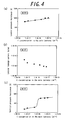
- Samples 4 to 6 were fabricated by similar methods to Samples 1 to 3 in Experiment Example 1 except that the growth pressure of the superlattice laminate was set at 10 kPa, the concentration of C in the portion of the main laminate on the buffer side was changed, and the growth temperature and pressure of each layer were set as shown in Table 2. P 2 in the table was controlled to control the C concentration, and the deposition pressure was reduced to increase the C concentration. The concentration of C in the superlattice laminate was in the range of 1.5 ⁇ 10 18 /cm 3 to 2.5 ⁇ 10 18 /cm 3 in each result.
- Fig. 4(a), Fig. 4(b), and Fig. 4(c) show measurement results of the lateral breakdown voltage, the lateral leakage current, and the vertical breakdown voltage of Sample 4, respectively.
- the vertical breakdown voltage of Sample 4 was found to specifically increase steeply as the concentration of C in the portion of the main laminate on the buffer side exceeded 1 ⁇ 10 18 /cm 3 .
- the surface of each epitaxial substrate fabricated in the experiment example was observed under an optical microscope (100 power), and no cracks were found.
- Sample 7 was fabricated by a similar method to Sample 2 in Experiment Example 1 except that the initial growth layer was made of a GaN material (thickness: 20 nm) grown at 700 °C, and the growth temperature and pressure of each layer were set as shown in Table 3.
- Samples 8 to 10 were fabricated by similar methods to Samples 1 to 3 in Experiment Example 1 except that the initial growth layer was made of an Al 0.5 Ga 0.5 N material to perform the same experiments. As a result, each sample was found to have a similar result to Fig. 3(a), Fig. 3(b), and Fig. 3(c) , and to exhibit favorable characteristics such as a sheet resistance value of 450 ⁇ / ⁇ (square) or less and a mobility of 1550 cm 2 /Vs or more. The surface of each epitaxial substrate fabricated in the experiment example was observed under an optical microscope (100 power), and no cracks were found.
- Samples 11 to 13 were fabricated by similar methods to Samples 4 to 6 in Experiment Example 2 except that the initial growth layer was made of an Al 0.5 Ga 0.5 N material to perform the same experiments. As a result, each sample was found to have a similar result to Fig. 4(a), Fig. 4(b), and Fig. 4(c) . The surface of each epitaxial substrate fabricated in the experiment example was observed under an optical microscope (100 power), and no cracks were found.
- An epitaxial substrate for electronic devices includes a buffer having an Al-containing initial growth layer and a given superlattice laminate, and a given main laminate on a conductive SiC substrate; and the superlattice laminate and/or a portion of the main laminate on the buffer side has a C concentration of 1 ⁇ 10 18 /cm 3 or more.
Landscapes
- Junction Field-Effect Transistors (AREA)
- Crystals, And After-Treatments Of Crystals (AREA)
- Chemical Vapour Deposition (AREA)
Applications Claiming Priority (3)
| Application Number | Priority Date | Filing Date | Title |
|---|---|---|---|
| JP2009114860 | 2009-05-11 | ||
| JP2010107821A JP4685961B2 (ja) | 2009-05-11 | 2010-05-10 | 電子デバイス用エピタキシャル基板およびその製造方法 |
| PCT/JP2010/003162 WO2010131451A1 (ja) | 2009-05-11 | 2010-05-10 | 電子デバイス用エピタキシャル基板およびその製造方法 |
Publications (2)
| Publication Number | Publication Date |
|---|---|
| EP2432005A1 true EP2432005A1 (de) | 2012-03-21 |
| EP2432005A4 EP2432005A4 (de) | 2015-05-27 |
Family
ID=43084836
Family Applications (1)
| Application Number | Title | Priority Date | Filing Date |
|---|---|---|---|
| EP10774710.7A Withdrawn EP2432005A4 (de) | 2009-05-11 | 2010-05-10 | Epitaktisches substrat für elektronische geräte und verfahren zu seiner herstellung |
Country Status (7)
| Country | Link |
|---|---|
| US (1) | US8426893B2 (de) |
| EP (1) | EP2432005A4 (de) |
| JP (1) | JP4685961B2 (de) |
| KR (1) | KR101321625B1 (de) |
| CN (1) | CN102460664B (de) |
| TW (1) | TWI466290B (de) |
| WO (1) | WO2010131451A1 (de) |
Cited By (1)
| Publication number | Priority date | Publication date | Assignee | Title |
|---|---|---|---|---|
| AT521082A3 (de) * | 2013-07-30 | 2020-01-15 | Sumitomo Chemical Co | Halbleiterwafer und Verfahren zur Herstellung des Halbleiterwafers |
Families Citing this family (23)
| Publication number | Priority date | Publication date | Assignee | Title |
|---|---|---|---|---|
| EP2498282A4 (de) * | 2009-11-04 | 2014-06-25 | Dowa Electronics Materials Co Ltd | Epitaktisch beschichtetes gruppe-iii-nitrid-substrat |
| JP5514920B2 (ja) * | 2012-01-13 | 2014-06-04 | Dowaエレクトロニクス株式会社 | Iii族窒化物エピタキシャル基板および該基板を用いた深紫外発光素子 |
| JP5228122B1 (ja) | 2012-03-08 | 2013-07-03 | 株式会社東芝 | 窒化物半導体素子及び窒化物半導体ウェーハ |
| CN102969341A (zh) * | 2012-11-09 | 2013-03-13 | 中国电子科技集团公司第五十五研究所 | 组分渐变AlyGa1-yN缓冲层的氮化物高电子迁移率晶体管外延结构 |
| JP5787417B2 (ja) * | 2013-05-14 | 2015-09-30 | コバレントマテリアル株式会社 | 窒化物半導体基板 |
| JP2015053328A (ja) * | 2013-09-05 | 2015-03-19 | 富士通株式会社 | 半導体装置 |
| US9159788B2 (en) | 2013-12-31 | 2015-10-13 | Industrial Technology Research Institute | Nitride semiconductor structure |
| CN106415802B (zh) * | 2014-05-26 | 2019-07-02 | 夏普株式会社 | 氮化物类化合物半导体 |
| KR102318317B1 (ko) | 2014-05-27 | 2021-10-28 | 실라나 유브이 테크놀로지스 피티이 리미티드 | 반도체 구조물과 초격자를 사용하는 진보된 전자 디바이스 구조 |
| US11322643B2 (en) | 2014-05-27 | 2022-05-03 | Silanna UV Technologies Pte Ltd | Optoelectronic device |
| CN106415854B (zh) | 2014-05-27 | 2019-10-01 | 斯兰纳Uv科技有限公司 | 包括n型和p型超晶格的电子装置 |
| JP6817072B2 (ja) | 2014-05-27 | 2021-01-20 | シランナ・ユー・ブイ・テクノロジーズ・プライベート・リミテッドSilanna Uv Technologies Pte Ltd | 光電子デバイス |
| US9608103B2 (en) * | 2014-10-02 | 2017-03-28 | Toshiba Corporation | High electron mobility transistor with periodically carbon doped gallium nitride |
| TWI657578B (zh) | 2014-11-07 | 2019-04-21 | 日商住友化學股份有限公司 | 半導體基板及半導體基板的檢查方法 |
| US11335799B2 (en) * | 2015-03-26 | 2022-05-17 | Chih-Shu Huang | Group-III nitride semiconductor device and method for fabricating the same |
| JP6736577B2 (ja) | 2015-03-31 | 2020-08-05 | スウェガン、アクチボラグSwegan Ab | ヘテロ構造体およびその生成方法 |
| JP6615075B2 (ja) * | 2016-09-15 | 2019-12-04 | サンケン電気株式会社 | 半導体デバイス用基板、半導体デバイス、及び、半導体デバイス用基板の製造方法 |
| JP6796467B2 (ja) * | 2016-11-30 | 2020-12-09 | 住友化学株式会社 | 半導体基板 |
| JP6376257B2 (ja) * | 2017-09-01 | 2018-08-22 | 富士通株式会社 | 半導体装置 |
| CN112750904B (zh) | 2019-10-30 | 2024-01-02 | 联华电子股份有限公司 | 具有应力松弛层的半导体元件 |
| JP7654367B2 (ja) * | 2020-08-24 | 2025-04-01 | エア・ウォーター株式会社 | 化合物半導体基板および化合物半導体デバイス |
| WO2022068256A1 (zh) * | 2020-09-30 | 2022-04-07 | 苏州能讯高能半导体有限公司 | 半导体器件的外延结构及其制备方法 |
| TWI818379B (zh) * | 2021-12-08 | 2023-10-11 | 財團法人工業技術研究院 | 高電子遷移率電晶體元件 |
Family Cites Families (16)
| Publication number | Priority date | Publication date | Assignee | Title |
|---|---|---|---|---|
| KR100545999B1 (ko) * | 1997-01-09 | 2006-01-25 | 니치아 카가쿠 고교 가부시키가이샤 | 질화물반도체소자 |
| JP3946969B2 (ja) | 2001-05-31 | 2007-07-18 | 日本碍子株式会社 | 電界効果トランジスタ、及びヘテロ接合型バイポーラトランジスタ |
| US7030428B2 (en) * | 2001-12-03 | 2006-04-18 | Cree, Inc. | Strain balanced nitride heterojunction transistors |
| CN100403549C (zh) * | 2002-12-19 | 2008-07-16 | 松下电器产业株式会社 | 半导体器件及保持电路 |
| JP4530171B2 (ja) * | 2003-08-08 | 2010-08-25 | サンケン電気株式会社 | 半導体装置 |
| WO2005024955A1 (ja) * | 2003-09-05 | 2005-03-17 | Sanken Electric Co., Ltd. | 半導体装置 |
| JP3960957B2 (ja) | 2003-09-05 | 2007-08-15 | 古河電気工業株式会社 | 半導体電子デバイス |
| JP2006114655A (ja) | 2004-10-14 | 2006-04-27 | Hitachi Cable Ltd | 半導体エピタキシャルウェハ及び電界効果トランジスタ |
| JP4542912B2 (ja) * | 2005-02-02 | 2010-09-15 | 株式会社東芝 | 窒素化合物半導体素子 |
| US7491626B2 (en) * | 2005-06-20 | 2009-02-17 | Sensor Electronic Technology, Inc. | Layer growth using metal film and/or islands |
| JP2007214384A (ja) * | 2006-02-09 | 2007-08-23 | Rohm Co Ltd | 窒化物半導体素子 |
| JP5064824B2 (ja) * | 2006-02-20 | 2012-10-31 | 古河電気工業株式会社 | 半導体素子 |
| WO2008012877A1 (fr) * | 2006-07-26 | 2008-01-31 | Fujitsu Limited | DISPOSITIF À SEMI-CONDUCTEURS COMPOSÉ EMPLOYANT UN SUBSTRAT DE SiC ET PROCÉDÉ POUR PRODUIRE CELUI-CI |
| JP2008085123A (ja) | 2006-09-28 | 2008-04-10 | Covalent Materials Corp | 化合物半導体デバイス用基板およびそれを用いた化合物半導体デバイス |
| JP5224311B2 (ja) * | 2007-01-05 | 2013-07-03 | 古河電気工業株式会社 | 半導体電子デバイス |
| GB2460197A (en) | 2007-02-16 | 2009-11-25 | Sumitomo Chemical Co | Gallium nitride epitaxial crystal, method for production thereof and field effect transistor |
-
2010
- 2010-05-10 EP EP10774710.7A patent/EP2432005A4/de not_active Withdrawn
- 2010-05-10 KR KR1020117029263A patent/KR101321625B1/ko active Active
- 2010-05-10 US US13/319,910 patent/US8426893B2/en active Active
- 2010-05-10 CN CN201080031291.0A patent/CN102460664B/zh active Active
- 2010-05-10 WO PCT/JP2010/003162 patent/WO2010131451A1/ja not_active Ceased
- 2010-05-10 JP JP2010107821A patent/JP4685961B2/ja active Active
- 2010-05-11 TW TW099114928A patent/TWI466290B/zh active
Non-Patent Citations (1)
| Title |
|---|
| See references of WO2010131451A1 * |
Cited By (1)
| Publication number | Priority date | Publication date | Assignee | Title |
|---|---|---|---|---|
| AT521082A3 (de) * | 2013-07-30 | 2020-01-15 | Sumitomo Chemical Co | Halbleiterwafer und Verfahren zur Herstellung des Halbleiterwafers |
Also Published As
| Publication number | Publication date |
|---|---|
| JP2010287882A (ja) | 2010-12-24 |
| US8426893B2 (en) | 2013-04-23 |
| KR20120023761A (ko) | 2012-03-13 |
| TW201101486A (en) | 2011-01-01 |
| WO2010131451A1 (ja) | 2010-11-18 |
| CN102460664B (zh) | 2014-08-13 |
| EP2432005A4 (de) | 2015-05-27 |
| KR101321625B1 (ko) | 2013-10-23 |
| CN102460664A (zh) | 2012-05-16 |
| JP4685961B2 (ja) | 2011-05-18 |
| TWI466290B (zh) | 2014-12-21 |
| US20120091435A1 (en) | 2012-04-19 |
Similar Documents
| Publication | Publication Date | Title |
|---|---|---|
| US8426893B2 (en) | Epitaxial substrate for electronic device and method of producing the same | |
| EP2360719B1 (de) | Epitaktisches substrat für elektronische vorrichtungen und herstellungsverfahren dafür | |
| US9685323B2 (en) | Buffer layer structures suited for III-nitride devices with foreign substrates | |
| US8847203B2 (en) | Group III nitride epitaxial laminate substrate | |
| US8946863B2 (en) | Epitaxial substrate for electronic device comprising a high resistance single crystal substrate on a low resistance single crystal substrate, and method of manufacturing | |
| US10388517B2 (en) | Epitaxial substrate for electronic device and method of producing the same | |
| JP5787417B2 (ja) | 窒化物半導体基板 | |
| US20140209862A1 (en) | Group iii nitride epitaxial substrate and method for manufacturing the same | |
| US8785942B2 (en) | Nitride semiconductor substrate and method of manufacturing the same | |
| EP2565906A1 (de) | Epitaktisches substrat und verfahren zur herstellung des epitaktischen substrats | |
| EP2565928A1 (de) | Epitaktisches substrat und verfahren zur herstellung des epitaktischen substrats | |
| EP2290696B1 (de) | Epitaxiesubstrat für Halbleiterbauelement, Halbleiterbauelement und Verfahren zur Herstellung eines Epitaxiesubstrats für ein Halbleiterbauelement | |
| EP2455964A1 (de) | Epitaxiales substrat für elektronische vorrichtung unter verwendung der transversen richtung als richtung der stromführung und herstellungsverfahren dafür | |
| US20190157081A1 (en) | Method for Forming a Semiconductor Structure for a Gallium Nitride Channel Device | |
| CN103314429A (zh) | 用于控制异质外延生长的iii族氮化物层的应力的层结构 | |
| JP2015070085A (ja) | 電子デバイス用エピタキシャル基板およびその製造方法 | |
| JP2015070091A (ja) | Iii族窒化物半導体基板 | |
| JP2011258782A (ja) | 窒化物半導体基板 | |
| JP6404738B2 (ja) | 電子デバイス用エピタキシャル基板および高電子移動度トランジスタならびにそれらの製造方法 |
Legal Events
| Date | Code | Title | Description |
|---|---|---|---|
| PUAI | Public reference made under article 153(3) epc to a published international application that has entered the european phase |
Free format text: ORIGINAL CODE: 0009012 |
|
| 17P | Request for examination filed |
Effective date: 20111117 |
|
| AK | Designated contracting states |
Kind code of ref document: A1 Designated state(s): AL AT BE BG CH CY CZ DE DK EE ES FI FR GB GR HR HU IE IS IT LI LT LU LV MC MK MT NL NO PL PT RO SE SI SK SM TR |
|
| DAX | Request for extension of the european patent (deleted) | ||
| RA4 | Supplementary search report drawn up and despatched (corrected) |
Effective date: 20150424 |
|
| RIC1 | Information provided on ipc code assigned before grant |
Ipc: H01L 29/15 20060101ALI20150420BHEP Ipc: H01L 29/207 20060101ALI20150420BHEP Ipc: H01L 29/20 20060101ALI20150420BHEP Ipc: H01L 29/778 20060101AFI20150420BHEP |
|
| STAA | Information on the status of an ep patent application or granted ep patent |
Free format text: STATUS: THE APPLICATION IS DEEMED TO BE WITHDRAWN |
|
| 18D | Application deemed to be withdrawn |
Effective date: 20151124 |