EP2379064B1 - Long circulating nanoparticles for sustained release of therapeutic agents - Google Patents
Long circulating nanoparticles for sustained release of therapeutic agents Download PDFInfo
- Publication number
- EP2379064B1 EP2379064B1 EP09835578.7A EP09835578A EP2379064B1 EP 2379064 B1 EP2379064 B1 EP 2379064B1 EP 09835578 A EP09835578 A EP 09835578A EP 2379064 B1 EP2379064 B1 EP 2379064B1
- Authority
- EP
- European Patent Office
- Prior art keywords
- nanoparticles
- docetaxel
- therapeutic agent
- pla
- poly
- Prior art date
- Legal status (The legal status is an assumption and is not a legal conclusion. Google has not performed a legal analysis and makes no representation as to the accuracy of the status listed.)
- Active
Links
Images






Classifications
-
- A—HUMAN NECESSITIES
- A61—MEDICAL OR VETERINARY SCIENCE; HYGIENE
- A61K—PREPARATIONS FOR MEDICAL, DENTAL OR TOILETRY PURPOSES
- A61K9/00—Medicinal preparations characterised by special physical form
- A61K9/48—Preparations in capsules, e.g. of gelatin, of chocolate
- A61K9/50—Microcapsules having a gas, liquid or semi-solid filling; Solid microparticles or pellets surrounded by a distinct coating layer, e.g. coated microspheres, coated drug crystals
- A61K9/51—Nanocapsules; Nanoparticles
- A61K9/5107—Excipients; Inactive ingredients
- A61K9/513—Organic macromolecular compounds; Dendrimers
- A61K9/5146—Organic macromolecular compounds; Dendrimers obtained otherwise than by reactions only involving carbon-to-carbon unsaturated bonds, e.g. polyethylene glycol, polyamines, polyanhydrides
- A61K9/5153—Polyesters, e.g. poly(lactide-co-glycolide)
-
- A—HUMAN NECESSITIES
- A61—MEDICAL OR VETERINARY SCIENCE; HYGIENE
- A61K—PREPARATIONS FOR MEDICAL, DENTAL OR TOILETRY PURPOSES
- A61K31/00—Medicinal preparations containing organic active ingredients
- A61K31/33—Heterocyclic compounds
- A61K31/335—Heterocyclic compounds having oxygen as the only ring hetero atom, e.g. fungichromin
- A61K31/337—Heterocyclic compounds having oxygen as the only ring hetero atom, e.g. fungichromin having four-membered rings, e.g. taxol
-
- A—HUMAN NECESSITIES
- A61—MEDICAL OR VETERINARY SCIENCE; HYGIENE
- A61K—PREPARATIONS FOR MEDICAL, DENTAL OR TOILETRY PURPOSES
- A61K31/00—Medicinal preparations containing organic active ingredients
- A61K31/33—Heterocyclic compounds
- A61K31/395—Heterocyclic compounds having nitrogen as a ring hetero atom, e.g. guanethidine or rifamycins
- A61K31/435—Heterocyclic compounds having nitrogen as a ring hetero atom, e.g. guanethidine or rifamycins having six-membered rings with one nitrogen as the only ring hetero atom
- A61K31/4353—Heterocyclic compounds having nitrogen as a ring hetero atom, e.g. guanethidine or rifamycins having six-membered rings with one nitrogen as the only ring hetero atom ortho- or peri-condensed with heterocyclic ring systems
- A61K31/436—Heterocyclic compounds having nitrogen as a ring hetero atom, e.g. guanethidine or rifamycins having six-membered rings with one nitrogen as the only ring hetero atom ortho- or peri-condensed with heterocyclic ring systems the heterocyclic ring system containing a six-membered ring having oxygen as a ring hetero atom, e.g. rapamycin
-
- A—HUMAN NECESSITIES
- A61—MEDICAL OR VETERINARY SCIENCE; HYGIENE
- A61K—PREPARATIONS FOR MEDICAL, DENTAL OR TOILETRY PURPOSES
- A61K31/00—Medicinal preparations containing organic active ingredients
- A61K31/33—Heterocyclic compounds
- A61K31/395—Heterocyclic compounds having nitrogen as a ring hetero atom, e.g. guanethidine or rifamycins
- A61K31/435—Heterocyclic compounds having nitrogen as a ring hetero atom, e.g. guanethidine or rifamycins having six-membered rings with one nitrogen as the only ring hetero atom
- A61K31/47—Quinolines; Isoquinolines
- A61K31/475—Quinolines; Isoquinolines having an indole ring, e.g. yohimbine, reserpine, strychnine, vinblastine
-
- A—HUMAN NECESSITIES
- A61—MEDICAL OR VETERINARY SCIENCE; HYGIENE
- A61K—PREPARATIONS FOR MEDICAL, DENTAL OR TOILETRY PURPOSES
- A61K31/00—Medicinal preparations containing organic active ingredients
- A61K31/33—Heterocyclic compounds
- A61K31/395—Heterocyclic compounds having nitrogen as a ring hetero atom, e.g. guanethidine or rifamycins
- A61K31/495—Heterocyclic compounds having nitrogen as a ring hetero atom, e.g. guanethidine or rifamycins having six-membered rings with two or more nitrogen atoms as the only ring heteroatoms, e.g. piperazine or tetrazines
- A61K31/505—Pyrimidines; Hydrogenated pyrimidines, e.g. trimethoprim
- A61K31/519—Pyrimidines; Hydrogenated pyrimidines, e.g. trimethoprim ortho- or peri-condensed with heterocyclic rings
-
- A—HUMAN NECESSITIES
- A61—MEDICAL OR VETERINARY SCIENCE; HYGIENE
- A61K—PREPARATIONS FOR MEDICAL, DENTAL OR TOILETRY PURPOSES
- A61K47/00—Medicinal preparations characterised by the non-active ingredients used, e.g. carriers or inert additives; Targeting or modifying agents chemically bound to the active ingredient
- A61K47/50—Medicinal preparations characterised by the non-active ingredients used, e.g. carriers or inert additives; Targeting or modifying agents chemically bound to the active ingredient the non-active ingredient being chemically bound to the active ingredient, e.g. polymer-drug conjugates
- A61K47/51—Medicinal preparations characterised by the non-active ingredients used, e.g. carriers or inert additives; Targeting or modifying agents chemically bound to the active ingredient the non-active ingredient being chemically bound to the active ingredient, e.g. polymer-drug conjugates the non-active ingredient being a modifying agent
- A61K47/54—Medicinal preparations characterised by the non-active ingredients used, e.g. carriers or inert additives; Targeting or modifying agents chemically bound to the active ingredient the non-active ingredient being chemically bound to the active ingredient, e.g. polymer-drug conjugates the non-active ingredient being a modifying agent the modifying agent being an organic compound
- A61K47/542—Carboxylic acids, e.g. a fatty acid or an amino acid
-
- A—HUMAN NECESSITIES
- A61—MEDICAL OR VETERINARY SCIENCE; HYGIENE
- A61K—PREPARATIONS FOR MEDICAL, DENTAL OR TOILETRY PURPOSES
- A61K47/00—Medicinal preparations characterised by the non-active ingredients used, e.g. carriers or inert additives; Targeting or modifying agents chemically bound to the active ingredient
- A61K47/50—Medicinal preparations characterised by the non-active ingredients used, e.g. carriers or inert additives; Targeting or modifying agents chemically bound to the active ingredient the non-active ingredient being chemically bound to the active ingredient, e.g. polymer-drug conjugates
- A61K47/51—Medicinal preparations characterised by the non-active ingredients used, e.g. carriers or inert additives; Targeting or modifying agents chemically bound to the active ingredient the non-active ingredient being chemically bound to the active ingredient, e.g. polymer-drug conjugates the non-active ingredient being a modifying agent
- A61K47/56—Medicinal preparations characterised by the non-active ingredients used, e.g. carriers or inert additives; Targeting or modifying agents chemically bound to the active ingredient the non-active ingredient being chemically bound to the active ingredient, e.g. polymer-drug conjugates the non-active ingredient being a modifying agent the modifying agent being an organic macromolecular compound, e.g. an oligomeric, polymeric or dendrimeric molecule
- A61K47/59—Medicinal preparations characterised by the non-active ingredients used, e.g. carriers or inert additives; Targeting or modifying agents chemically bound to the active ingredient the non-active ingredient being chemically bound to the active ingredient, e.g. polymer-drug conjugates the non-active ingredient being a modifying agent the modifying agent being an organic macromolecular compound, e.g. an oligomeric, polymeric or dendrimeric molecule obtained otherwise than by reactions only involving carbon-to-carbon unsaturated bonds, e.g. polyureas or polyurethanes
- A61K47/593—Polyesters, e.g. PLGA or polylactide-co-glycolide
-
- A—HUMAN NECESSITIES
- A61—MEDICAL OR VETERINARY SCIENCE; HYGIENE
- A61K—PREPARATIONS FOR MEDICAL, DENTAL OR TOILETRY PURPOSES
- A61K47/00—Medicinal preparations characterised by the non-active ingredients used, e.g. carriers or inert additives; Targeting or modifying agents chemically bound to the active ingredient
- A61K47/50—Medicinal preparations characterised by the non-active ingredients used, e.g. carriers or inert additives; Targeting or modifying agents chemically bound to the active ingredient the non-active ingredient being chemically bound to the active ingredient, e.g. polymer-drug conjugates
- A61K47/51—Medicinal preparations characterised by the non-active ingredients used, e.g. carriers or inert additives; Targeting or modifying agents chemically bound to the active ingredient the non-active ingredient being chemically bound to the active ingredient, e.g. polymer-drug conjugates the non-active ingredient being a modifying agent
- A61K47/56—Medicinal preparations characterised by the non-active ingredients used, e.g. carriers or inert additives; Targeting or modifying agents chemically bound to the active ingredient the non-active ingredient being chemically bound to the active ingredient, e.g. polymer-drug conjugates the non-active ingredient being a modifying agent the modifying agent being an organic macromolecular compound, e.g. an oligomeric, polymeric or dendrimeric molecule
- A61K47/59—Medicinal preparations characterised by the non-active ingredients used, e.g. carriers or inert additives; Targeting or modifying agents chemically bound to the active ingredient the non-active ingredient being chemically bound to the active ingredient, e.g. polymer-drug conjugates the non-active ingredient being a modifying agent the modifying agent being an organic macromolecular compound, e.g. an oligomeric, polymeric or dendrimeric molecule obtained otherwise than by reactions only involving carbon-to-carbon unsaturated bonds, e.g. polyureas or polyurethanes
- A61K47/60—Medicinal preparations characterised by the non-active ingredients used, e.g. carriers or inert additives; Targeting or modifying agents chemically bound to the active ingredient the non-active ingredient being chemically bound to the active ingredient, e.g. polymer-drug conjugates the non-active ingredient being a modifying agent the modifying agent being an organic macromolecular compound, e.g. an oligomeric, polymeric or dendrimeric molecule obtained otherwise than by reactions only involving carbon-to-carbon unsaturated bonds, e.g. polyureas or polyurethanes the organic macromolecular compound being a polyoxyalkylene oligomer, polymer or dendrimer, e.g. PEG, PPG, PEO or polyglycerol
-
- A—HUMAN NECESSITIES
- A61—MEDICAL OR VETERINARY SCIENCE; HYGIENE
- A61K—PREPARATIONS FOR MEDICAL, DENTAL OR TOILETRY PURPOSES
- A61K47/00—Medicinal preparations characterised by the non-active ingredients used, e.g. carriers or inert additives; Targeting or modifying agents chemically bound to the active ingredient
- A61K47/50—Medicinal preparations characterised by the non-active ingredients used, e.g. carriers or inert additives; Targeting or modifying agents chemically bound to the active ingredient the non-active ingredient being chemically bound to the active ingredient, e.g. polymer-drug conjugates
- A61K47/69—Medicinal preparations characterised by the non-active ingredients used, e.g. carriers or inert additives; Targeting or modifying agents chemically bound to the active ingredient the non-active ingredient being chemically bound to the active ingredient, e.g. polymer-drug conjugates the conjugate being characterised by physical or galenical forms, e.g. emulsion, particle, inclusion complex, stent or kit
- A61K47/6921—Medicinal preparations characterised by the non-active ingredients used, e.g. carriers or inert additives; Targeting or modifying agents chemically bound to the active ingredient the non-active ingredient being chemically bound to the active ingredient, e.g. polymer-drug conjugates the conjugate being characterised by physical or galenical forms, e.g. emulsion, particle, inclusion complex, stent or kit the form being a particulate, a powder, an adsorbate, a bead or a sphere
- A61K47/6925—Medicinal preparations characterised by the non-active ingredients used, e.g. carriers or inert additives; Targeting or modifying agents chemically bound to the active ingredient the non-active ingredient being chemically bound to the active ingredient, e.g. polymer-drug conjugates the conjugate being characterised by physical or galenical forms, e.g. emulsion, particle, inclusion complex, stent or kit the form being a particulate, a powder, an adsorbate, a bead or a sphere the form being a microcapsule, nanocapsule, microbubble or nanobubble
-
- A—HUMAN NECESSITIES
- A61—MEDICAL OR VETERINARY SCIENCE; HYGIENE
- A61K—PREPARATIONS FOR MEDICAL, DENTAL OR TOILETRY PURPOSES
- A61K47/00—Medicinal preparations characterised by the non-active ingredients used, e.g. carriers or inert additives; Targeting or modifying agents chemically bound to the active ingredient
- A61K47/50—Medicinal preparations characterised by the non-active ingredients used, e.g. carriers or inert additives; Targeting or modifying agents chemically bound to the active ingredient the non-active ingredient being chemically bound to the active ingredient, e.g. polymer-drug conjugates
- A61K47/69—Medicinal preparations characterised by the non-active ingredients used, e.g. carriers or inert additives; Targeting or modifying agents chemically bound to the active ingredient the non-active ingredient being chemically bound to the active ingredient, e.g. polymer-drug conjugates the conjugate being characterised by physical or galenical forms, e.g. emulsion, particle, inclusion complex, stent or kit
- A61K47/6921—Medicinal preparations characterised by the non-active ingredients used, e.g. carriers or inert additives; Targeting or modifying agents chemically bound to the active ingredient the non-active ingredient being chemically bound to the active ingredient, e.g. polymer-drug conjugates the conjugate being characterised by physical or galenical forms, e.g. emulsion, particle, inclusion complex, stent or kit the form being a particulate, a powder, an adsorbate, a bead or a sphere
- A61K47/6927—Medicinal preparations characterised by the non-active ingredients used, e.g. carriers or inert additives; Targeting or modifying agents chemically bound to the active ingredient the non-active ingredient being chemically bound to the active ingredient, e.g. polymer-drug conjugates the conjugate being characterised by physical or galenical forms, e.g. emulsion, particle, inclusion complex, stent or kit the form being a particulate, a powder, an adsorbate, a bead or a sphere the form being a solid microparticle having no hollow or gas-filled cores
- A61K47/6929—Medicinal preparations characterised by the non-active ingredients used, e.g. carriers or inert additives; Targeting or modifying agents chemically bound to the active ingredient the non-active ingredient being chemically bound to the active ingredient, e.g. polymer-drug conjugates the conjugate being characterised by physical or galenical forms, e.g. emulsion, particle, inclusion complex, stent or kit the form being a particulate, a powder, an adsorbate, a bead or a sphere the form being a solid microparticle having no hollow or gas-filled cores the form being a nanoparticle, e.g. an immuno-nanoparticle
- A61K47/6931—Medicinal preparations characterised by the non-active ingredients used, e.g. carriers or inert additives; Targeting or modifying agents chemically bound to the active ingredient the non-active ingredient being chemically bound to the active ingredient, e.g. polymer-drug conjugates the conjugate being characterised by physical or galenical forms, e.g. emulsion, particle, inclusion complex, stent or kit the form being a particulate, a powder, an adsorbate, a bead or a sphere the form being a solid microparticle having no hollow or gas-filled cores the form being a nanoparticle, e.g. an immuno-nanoparticle the material constituting the nanoparticle being a polymer
- A61K47/6935—Medicinal preparations characterised by the non-active ingredients used, e.g. carriers or inert additives; Targeting or modifying agents chemically bound to the active ingredient the non-active ingredient being chemically bound to the active ingredient, e.g. polymer-drug conjugates the conjugate being characterised by physical or galenical forms, e.g. emulsion, particle, inclusion complex, stent or kit the form being a particulate, a powder, an adsorbate, a bead or a sphere the form being a solid microparticle having no hollow or gas-filled cores the form being a nanoparticle, e.g. an immuno-nanoparticle the material constituting the nanoparticle being a polymer the polymer being obtained otherwise than by reactions involving carbon to carbon unsaturated bonds, e.g. polyesters, polyamides or polyglycerol
- A61K47/6937—Medicinal preparations characterised by the non-active ingredients used, e.g. carriers or inert additives; Targeting or modifying agents chemically bound to the active ingredient the non-active ingredient being chemically bound to the active ingredient, e.g. polymer-drug conjugates the conjugate being characterised by physical or galenical forms, e.g. emulsion, particle, inclusion complex, stent or kit the form being a particulate, a powder, an adsorbate, a bead or a sphere the form being a solid microparticle having no hollow or gas-filled cores the form being a nanoparticle, e.g. an immuno-nanoparticle the material constituting the nanoparticle being a polymer the polymer being obtained otherwise than by reactions involving carbon to carbon unsaturated bonds, e.g. polyesters, polyamides or polyglycerol the polymer being PLGA, PLA or polyglycolic acid
-
- A—HUMAN NECESSITIES
- A61—MEDICAL OR VETERINARY SCIENCE; HYGIENE
- A61K—PREPARATIONS FOR MEDICAL, DENTAL OR TOILETRY PURPOSES
- A61K9/00—Medicinal preparations characterised by special physical form
- A61K9/0012—Galenical forms characterised by the site of application
- A61K9/0019—Injectable compositions; Intramuscular, intravenous, arterial, subcutaneous administration; Compositions to be administered through the skin in an invasive manner
-
- A—HUMAN NECESSITIES
- A61—MEDICAL OR VETERINARY SCIENCE; HYGIENE
- A61K—PREPARATIONS FOR MEDICAL, DENTAL OR TOILETRY PURPOSES
- A61K9/00—Medicinal preparations characterised by special physical form
- A61K9/14—Particulate form, e.g. powders, Processes for size reducing of pure drugs or the resulting products, Pure drug nanoparticles
- A61K9/16—Agglomerates; Granulates; Microbeadlets ; Microspheres; Pellets; Solid products obtained by spray drying, spray freeze drying, spray congealing,(multiple) emulsion solvent evaporation or extraction
- A61K9/1605—Excipients; Inactive ingredients
- A61K9/1629—Organic macromolecular compounds
- A61K9/1641—Organic macromolecular compounds obtained otherwise than by reactions only involving carbon-to-carbon unsaturated bonds, e.g. polyethylene glycol, poloxamers
-
- A—HUMAN NECESSITIES
- A61—MEDICAL OR VETERINARY SCIENCE; HYGIENE
- A61P—SPECIFIC THERAPEUTIC ACTIVITY OF CHEMICAL COMPOUNDS OR MEDICINAL PREPARATIONS
- A61P35/00—Antineoplastic agents
-
- B—PERFORMING OPERATIONS; TRANSPORTING
- B82—NANOTECHNOLOGY
- B82Y—SPECIFIC USES OR APPLICATIONS OF NANOSTRUCTURES; MEASUREMENT OR ANALYSIS OF NANOSTRUCTURES; MANUFACTURE OR TREATMENT OF NANOSTRUCTURES
- B82Y5/00—Nanobiotechnology or nanomedicine, e.g. protein engineering or drug delivery
Definitions
- Nanoparticles for the delivery of therapeutic agents have the potential to circumvent many challenges associated with traditional delivery approaches including lack of patient compliance to prescribed therapy, adverse effects, and inferior clinical efficacy due to lack of targeted delivery.
- Important technological advantages of nanoparticles for drug delivery include the ability to deliver water-insoluble and unstable drugs, incorporation of both hydrophobic and hydrophilic therapeutic agents, and ability to utilize various routes of administration. Nanoparticle delivery systems may also facilitate targeted drug delivery and controlled release applications, enhance drug bioavailability at the site of action, reduce dosing frequency, and minimize side effects.
- nanoparticulate systems have been examined for use as drug delivery vehicles, including polymeric micelles, polymers, liposomes, low-density lipoproteins, dendrimers, hydrophilic drug-polymer complexes, and ceramic nanoparticles.
- Typical polymeric materials utilized in polymeric particulate drug delivery systems include polylactic acid (PLA), poly(D,L-glycolide) (PLG), and poly(lactide-co-glycolide) (PLGA).
- PLA and PLGA are listed as Generally Recognized as Safe (GRAS) under Sections 201(s) and 409 of the Federal Food, Drug, and Cosmetic Act, and are approved for use in commercially available microparticulate systems, including Decapeptyl®, Parlodel LA®, and Enantone Depot®, as well as in implant devices, such as Zoladex®.
- GRAS Generally Recognized as Safe
- nanoparticle systems such as liposomes
- polymeric nanoparticles developed to date have limited effectiveness, in part because such nanoparticles clear from the body quickly once administered and/or may accumulate in healthy tissue where treatment is not needed. Control of delivery of an active agent, using nanosystems, remains a challenge.
- biocompatible compositions capable of extended delivery of active agents, e.g., anti-neoplastic agents, that provide for prolonged and/or increased plasma drug concentrations in a patient, especially as compared to administration of an active agent alone.
- active agents e.g., anti-neoplastic agents
- the invention provides a biocompatible nanoparticle composition comprising a plurality of long circulating nanoparticles, each comprising:
- the biocompatible polymer matrix releases the therapeutic agent at a rate allowing controlled release of the agent over at least about 12 hours, or in some embodiments, at least about 24 hours.
- an area under the plasma concentration time curve may be increased by at least 100% over the AUC provided when the therapeutic agent is administered alone to a patient.
- disclosed nanoparticles may provide an actual peak plasma concentration (C max ) that is at least 10% higher, or even at least 100% higher, as compared to a C max of said therapeutic agent when administered alone.
- C max peak plasma concentration
- disclosed nanoparticles may provide a volume of distribution when administered to the patient that is less than or equal to about 5 plasma volumes.
- disclosed nanoparticles and/or compositions may decrease the volume of distribution (V z ) by at least 50% as compared to the V z of the patient when the therapeutic agent is administered alone.
- the disclosed biocompatible nanoparticle compositions include long circulating nanoparticles that comprise a biocompatible polymer coupled to a targeting moiety, for example, a targeting moiety that is selected from the group consisting of a protein, peptide, antibody, antibody fragment, saccharide, carbohydrate, small molecule, glycan, cytokine, chemokine, nucleotide, lectin, lipid, receptor, steroid, neurotransmitter, cell surface marker, cancer antigen, or glycoprotein antigen.
- a targeting moiety may bind to prostate membrane specific antigen (PMSA).
- a disclosed nanoparticle may include a biocompatible polymer coupled to a targeting moiety, e.g., a nanoparticle may include PLA-PEG-(( S,S -2- ⁇ 3-[1-carboxy-5-amino-pentyl]-ureido ⁇ -pentanedioic acid.
- Disclosed long circulating nanoparticles include 1 to about 4% by weight, or 2% to about 4% by weight, of a biocompatible polymer coupled to a targeting moiety.
- disclosed long circulating nanoparticles may further comprise a biodegradable polymer, such as poly(lactic) acid.
- a biodegradable polymer such as poly(lactic) acid.
- Compositions that include such biocompatible nanoparticles and a therapeutic agent may provide a peak plasma concentration (C max ) of a therapeutic agent at least 100% higher than the C max of the therapeutic agent when administered alone, and/or the area under the plasma concentration time curve (AUC) may increase by at least 200% over the AUC of the therapeutic agent when administered alone to the patient.
- C max peak plasma concentration
- AUC area under the plasma concentration time curve
- Disclosed nanoparticle compositions include a therapeutic agent selected from the group consisting of vincristine, vinblastine, methotrexate, paclitaxel, and sirolimus.
- Disclosed nanoparticle compositions may further include an aqueous solution of a saccharide.
- a disclosed nanoparticle composition for use in a method of treating a solid tumor cancer, comprising administering a disclosed nanoparticle composition to a patient (e.g. a mammal or primate) in need thereof.
- a patient e.g. a mammal or primate
- Such methods may provide wherein at least 24 hours after administration, a solid tumor has significant concentration of therapeutic agent.
- the composition may have an amount of therapeutic agent effective to inhibit the growth of said tumor, for example, a single dose of said composition may provide extended elevated plasma concentrations of said therapeutic agent in the patient for a least one day, (e.g. the peak plasma concentration (C max ) of the therapeutic agent after administration of the composition to the mammal is at least 10% higher than the C max of said therapeutic agent if administered in a non-nanoparticle formulation.)
- nanoparticle composition for use in a method of minimizing unwanted side effects or toxicity of an active agent in a patient, wherein said composition is capable of delivery a higher plasma concentration of therapeutic agent to the patient as compared to administering the therapeutic agent alone, and wherein upon administering the nanoparticle composition the volume distribution of the active agent in the patient is reduced, as compared to the volume distribution if the therapeutic agent was administered alone.
- the term "about” means plus or minus 10% of the numerical value of the number with which it is being used. Therefore, about 50% means in the range of 40%-60%.
- an “effective amount” or “therapeutically effective amount” of a composition, as used herein, is a predetermined amount calculated to achieve a desired effect.
- long-circulating refers to enhanced stability in the circulatory system of a patient, regardless of biological activity.
- nanophase and “nanosize” refer to a special state of subdivision implying that a particle has an average dimension smaller than about 1000 nm (1000 x 10 -9 m).
- poly(ethylene glycol) or "PEG” and “poly(ethylene oxide)” or “PEO” denote polyethers comprising repeat -CH 2 -CH 2 -O- units.
- PEG and/or PEO can be different polymers depending upon end groups and molecular weights.
- poly(ethylene glycol) and PEG describes either type of polymer.
- a-hydroxy polyester refers to polymers having monomers based on one or more ⁇ -hydroxy acid, such as poly(lactic) acid, poly(glycolic) acid, poly-lactic-co-glycolic acid, polycaprolactone.
- target refers to the cell type or tissue to which enhanced delivery of the therapeutic agent is desired.
- diseased tissue may be a target for therapy.
- therapeutic agent means a compound utilized to image, impact, treat, combat, ameliorate, prevent or improve an unwanted condition or disease of a patient.
- the nanoparticles are designed to circulate in a vascular compartment of a patient for an extended period of time, distribute and accumulate at a target, and release the encapsulated therapeutic agent in a controlled manner. These characteristics can result in an increased level of therapeutic agent in the target and a potential reduction in off-target exposure.
- the disclosed nanoparticles remain in circulation longer because, upon administration to a patient (e.g. a mammal, primate (e.g. human)), the disclosed nanoparticles are substantially confined to the vascular compartment of the patient, and are engineered to be cleared very slowly.
- the activity of many therapeutic agents is dependent on their pharmacokinetic behavior. This pharmacokinetic behavior defines the drug concentrations and period of time over which cells are exposed to the drug. For most therapeutics, e.g. anti-neoplasties, longer exposure times are preferred as this results in increased killing of the cancer cells.
- peak plasma concentration, or maximum plasma concentration (C max ) and area under the curve (AUC) are examples.
- AUC is a measure of plasma drug levels over time and provides an indication of the total drug exposure. Generally, plasma concentration and plasma AUC for a therapeutic agent correlate with increased therapeutic efficacy.
- Disclosed nanoparticle compositions may provide a therapeutic effect for at least 12 hours, at least 24 hours, or at least 36 hours, or 48 hours or more, upon administration to a patient.
- peak plasma concentration (C max ) of the therapeutic agent of such nanoparticles e.g. when the composition is administered to a patient, may be least 10% higher, 20% higher, or about 10% to about 100% higher, or more, than the C max of the same therapeutic agent when administered alone.
- Actual peak plasma concentration of delivered therapeutic agent includes both agent that is released from the nanoparticle (e.g. after administration) and therapeutic agent remaining in any nanoparticle remaining in the plasma, e.g. at a given time.
- Disclosed nanoparticles may provide upon administration to a patient, an area under the plasma concentration time curve (AUC), that may be increased by at least 100%, at least 200%, or about 100% to about 500% or more, over the AUC of the therapeutic agent when administered alone to the patient and may decrease the volume of distribution (V z ) of distributed active agent, upon administration, in a patient by at least 10%, or by at least 20%, or about 10% to about 100%, as compared to the V z of the patient when the therapeutic agent is administered alone.
- AUC area under the plasma concentration time curve
- V z volume of distribution
- a provided nanoparticle composition may provide V z in a patient that is on the same order of magnitude that the of plasma volume and/or a volume of distribution less than about 10 plasma volumes.
- a disclosed nanoparticle composition may provide a Vz that is less than, or about, 2 times the plasma volume, or less than or about 8 plasma volumes.
- a disclosed nanoparticle composition may provide a V z in a patient that is on about the same order of plasma volume, (e.g. about 5L for an exemplary 70 kg patient), e.g. about a V z that indicates administered nanoparticles are substantially in the patient's plasma and not substantially in other tissues.
- disclosed nanoparticles may be used as a drug delivery vehicle based on the encapsulation of a therapeutic agent in a polymer matrix with controlled porosity and/or a soluble shell or matrix that upon dissolution releases the therapeutic agent in the immediate vicinity of the targeted area.
- the protection of the therapeutic agent provided by the polymer shell or matrix allows for the delivery of therapeutic agents that are water-insoluble or unstable.
- dissolution kinetics of the polymer can be designed to provide sustained release of therapeutic agents at a target for an extended period of time.
- Disclosed nanoparticles can be used for a variety of applications, such as, without limitation, drug delivery, gene therapy, medical diagnosis, and for medical therapeutics for cancer, pathogen-borne diseases, hormone-related diseases, reaction-by-products associated with organ transplants, and other abnormal cell or tissue growth.
- Disclosed nanoparticles may be used in methods for treating a patient e.g. a mammal suffering from cancer, e.g. a solid tumor cancer, prostate cancer, breast cancer or lung cancer.
- cancer e.g. a solid tumor cancer, prostate cancer, breast cancer or lung cancer.
- contemplated diseases that may be treated using disclosed nanoparticles include a broad range of diseases and find limitation only by e.g. the therapeutic agent, the availability of a marker and/or a targeting ligand for the disease.
- a nanoparticle delivery system mitigates against colloidal instability, agglomeration, polydispersity in nanoparticle size and shape, swelling, and leakage of encapsulated materials.
- Disclosed nanoparticles may exhibit encapsulation efficiency. Encapsulation efficiency is affected by factors including, for example, material characteristics of the polymer utilized as the carrier matrix, the chemical and physical properties of the therapeutic agent to be encapsulated, and type of solvents used in the nanoparticle fabrication process.
- Disclosed nanoparticle may exhibit particle heterogeneity.
- Conventional polymeric nanoparticle fabrication techniques generally provide multimodal particle size distributions as a result of self- aggregation during nanoprecipitation of both the polymer and the drug molecules.
- Disclosed nanoparticles may reduce or eliminate burst release effects.
- Conventional polymeric nanoparticle carriers frequently exhibit a bimodal drug release pattern with up to about 40-80% or more of the encapsulated drug released during the first several hours. After 24 to 48 hours, drug release is significantly reduced due to the increased diffusion barrier for drug molecules located deep within the polymer matrix.
- poorly encapsulated drug molecules diffuse quickly into solution, which may lead to significant toxicity in vivo.
- the nanoparticles generally have little or no remaining therapeutic efficacy.
- Disclosed nanoparticles may evade rapid capture by the reticuloendothelial system (RES), leading to extended circulation time and elevated concentration of the nanoparticles in the blood. Rapid capture and elimination is typically caused by the process of opsonization in which opsonin proteins present in the blood serum quickly bind to conventional nanoparticles, allowing macrophages to easily recognize and remove these particulates before they can perform their designed therapeutic function.
- opsonin proteins present in the blood serum quickly bind to conventional nanoparticles, allowing macrophages to easily recognize and remove these particulates before they can perform their designed therapeutic function.
- the extent and nature of opsonin adsorption at the surface of nanoparticles and their simultaneous blood clearance depend on the physicochemical properties of the particles, such as size, surface charge, and surface hydrophobicity.
- a nanoparticle composition including a biodegradable and/or biocompatible polymer matrix and a therapeutic agent coupled to the biodegradable and/or biocompatible polymer matrix wherein the clearance rate of said therapeutic agent coupled to the biodegradable and/or biocompatible polymer matrix is lower than the clearance rate of said therapeutic agent when administered alone.
- methods are provided that mask or camouflage disclosed nanoparticles in order to evade uptake by the RES.
- One such method is the engineering of particles in which polyethers, such as poly(ethylene glycol) (PEG) or PEG containing surfactants, are deployed on the surface of nanoparticles.
- PEG poly(ethylene glycol)
- PEG-containing copolymers e.g. on the surface of nanoparticles can result in an increase in the blood circulation half-life of the nanoparticles by several orders of magnitude.
- This method creates a hydrophilic protective layer around the nanoparticles that is able to repel the absorption of opsonin proteins via steric repulsion forces, thereby blocking and delaying the first step in the opsonization process.
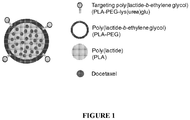
- FIG. 1 schematically illustrates a nanoparticle according to one aspect of the present invention.
- docetaxel 100 an anti-neoplastic agent approved for the treatment of hormone refractory prostate cancer (HRPC)
- HRPC hormone refractory prostate cancer
- a matrix 110 derived from the biodegradable and/or biocompatible polymers PLA and poly(lactide- b- ethylene glycol) (PLA-PEG).
- the polymer matrix 110 contains a targeting polymer (PLA-PEG-lys(urea)glu) 120 that is end-functionalized (through the 5 amino moiety) with the lysine-urea-glutamate heterodimer ( S,S- 2- ⁇ 3-[1-carboxy-5-amino-pentyl]-ureido ⁇ -pentanedioic acid (lys(urea)glu) 130, a small molecule ligand that selectively binds to PSMA, a clinically relevant prostate cancer cell surface marker.
- a targeting polymer PDA-PEG-lys(urea)glu
- S,S- 2- ⁇ 3-[1-carboxy-5-amino-pentyl]-ureido ⁇ -pentanedioic acid lys(urea)glu
- a small molecule ligand that selectively binds to PSMA, a clinically relevant prostate cancer cell surface marker.
- the nanoparticles may be biologically degraded by, for example, enzymatic activity or cellular machinery into monomers and/or other moieties that cells can either use or excrete.
- the dissolution or degradation rate of the nanoparticles is influenced by the composition of the polymer shell or matrix.
- the half-life of the polymer (the time at which 50% of the polymer is degraded into monomers and/or other nonpolymeric moieties) may be on the order of days, weeks, months, or years, depending on the polymer.
- nanoparticle delivery characteristics such as water uptake, controlled release of therapeutic agent, and polymer degradation kinetics may be optimized through selection of polymer shell or matrix composition.
- Disclosed nanoparticles may include about 10 to 15 weight percent active agent, and about 86 to about 90 weight percent PLA-PEG (with PLA about 16 kDa and PEG about 5kDa, e.g. about 87.5% PLA- PEG(16kDa/5kDa)), and optionally e.g. a PLA-PEG-lys(urea)-glu (e.g. at 2.5 weight percent).
- PLA-PEG with PLA about 16 kDa and PEG about 5kDa, e.g. about 87.5% PLA- PEG(16kDa/5kDa)
- optionally e.g. a PLA-PEG-lys(urea)-glu e.g. at 2.5 weight percent.
- Such substantially homopolymeric poly(lactic) or poly(lactic)-co-poly(glycolic) acid may have a weight average molecular weight of about 10 to about 130 kDa, for example, about 20 to about 30 kDa, or about 100 to about 130 kDa.
- Such homopolymeric PLA may have a number average molecule weight of about 5 to about 90 kDa, or about 5 to about 12 kDa, about 15 to about 30 kDa, or about 60 to about 90 kDa.
- Exemplary homopolymeric PLA may have a number average molecular weight of about 80 kDa or a weight average molecular weight of about 124 kDa.
- molecular weight of polymers can be related to an inherent viscosity.
- homopolymer PLA may have an inherent viscosity of about 0.2 to about 0.4, e.g. about 0.3; in other embodiments, PLA may have an inherent viscosity of about 0.6 to about 0.8.
- Exemplary PLGA may have a number average molecular weight of about 8 to about 12 kDa.
- modified surface chemistry and/or small particle size of disclosed nanoparticles may contribute to the effectiveness of the nanoparticles in the delivery of a therapeutic agent.
- nanoparticle surface charge may be modified to achieve slow biodegradation and reduce clearance of the nanoparticles.
- porosity of the polymer shell or matrix is optimized to achieve extended and controlled release of the therapeutic agent.
- the nanoparticles may have porosity in the range of about 10 to about 90 percent and/or a pore diameters in the range of about 0.001 to about 0.01 microns.
- the nanoparticles according to some embodiments of the invention may be able to penetrate the altered and often compromised vasculature of tumors via the enhanced permeability and retention (EPR) effect resulting in preferential accumulation of nanoparticles in tumor interstitium.
- EPR enhanced permeability and retention
- contemplated nanoparticles may include more than one therapeutic agent. Such nanoparticles may be useful, for example, in aspects where it is desirable to monitor a targeting moiety as such moiety directs a nanoparticle containing a drug to a particular target in a subject.
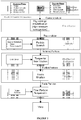
- Disclosed nanoparticles may be formed using an emulsion process, e.g. as presented as a block diagram in FIG. 2 .
- an organic polymer/drug solution containing docetaxel, PLA, PLA-PEG, and PLA-PEG-lys(urea)glu dissolved in a co-solvent mixture of ethyl acetate and benzyl alcohol is dispersed in an aqueous solution of sodium cholate, ethyl acetate, and benzyl alcohol to form a coarse emulsion.
- the conditions under which the emulsion process is performed favor the orientation of the PEG and/or PEG-lys(urea)glu polymer chains toward the particle surface.
- an orientation is achieved where the PEG is folded within the nanoparticle polymer shell or matrix.
- a coarse emulsion can be passed through a high pressure homogenizer to reduce the droplet size, forming a fine emulsion.
- the fine emulsion is diluted into an excess volume of a quench solution of cold water containing polysorbate 80.
- the presence of polysorbate 80 serves to remove excess therapeutic agent that has not been encapsulated in the nanoparticle.
- polysorbate 80 may also be adhered or associated with a nanoparticle surfaces. While not wishing to be bound by theory, polysorbate 80 coupled to the nanoparticle surfaces may impact characteristics such as controlled release of therapeutic agent and polymer degradation kinetics.
- Quenching may be performed at least partially at a temperature of about 5 °C or less.
- water used in the quenching may be at a temperature that is less that room temperature (e.g., about 0 to about 10°C, or about 0 to about 5 °C).
- not all of the therapeutic agent is encapsulated in the particles at this stage, and a drug solubilizer is added to the quenched phase to form a solubilized phase.
- the drug solubilizer may be for example, Tween 80, Tween 20, polyvinyl pyrrolidone, cyclodextran, sodium dodecyl sulfate, or sodium cholate.
- Tween-80 may added to the quenched nanoparticle suspension to solubilize the free drug and prevent the formation of drug crystals.
- a ratio of drug solubilizer to therapeutic agent e.g., docetaxel
- a ratio of drug solubilizer to therapeutic agent is about 100:1 to about 10:1.
- Ethyl acetate and benzyl alcohol are extracted from the organic phase droplets, resulting in formation of a hardened nanoparticle suspension.
- the active agent may be encapsulated at e.g. a loading level of 10% w/w; corresponding to more than 10,000 drug molecules per nanoparticle.
- the nanoparticle suspension is processed using tangential flow ultrafiltration/diafiltration (UF/DF) with cold water to remove processing aids and to concentrate the nanoparticles to a desired value. Residual precursor materials and excess organics present in unwashed nanoparticle suspensions may have a detrimental impact on biomedical applications as well as undesired toxic effects on the physiological system.
- the washed nanoparticle suspension is then passed through a prefilter and at least two sterilizing-grade filters.
- the nanoparticles may be combined with an acceptable carrier to produce a pharmaceutical formulation, according to another aspect of the invention.
- the carrier may be selected based on factors including, but not limited to, the route of administration, the location of the targeted disease tissue, the therapeutic agent being delivered, and/or the time course of delivery of the therapeutic agent.
- a concentrated sucrose solution is aseptically added to the sterile nanoparticle suspension to produce a pharmaceutical formulation.
- the sucrose serves as a cryoprotectant and a tonicity agent.
- the resulting pharmaceutical formulation is a sterile, aqueous, injectable suspension of docetaxel encapsulated in nanoparticles comprised of biocompatible and biodegradable polymers.
- the suspension is assayed for drug content, and may be aseptically diluted to the desired concentration.
- the particle suspension is aseptically filled and sealed in glass vials.
- the bulk drug product suspension is stored frozen at -20 °C +/- 5 °C prior to filling into vials.
- nanoparticles of the invention may be modified in some embodiments to achieve desired drug-delivery features.
- nanoparticle characteristics such as surface functionality, surface charge, particle size, zeta ( ⁇ ) potential, hydrophobicity, controlled release capability, and ability to control immunogenicity, and the like, may be optimized for the effective delivery of a variety of therapeutic agents.
- the long-circulating nanoparticles produced according to the emulsion process shown in FIG. 2 are well dispersed and unagglomerated, which facilitates conjugation or functionalization of the nanoparticle surfaces with targeting moieties.
- Disclosed nanoparticles may include optional targeting moieties, which may be selected to ensure that the nanoparticles selectively attach to, or otherwise associate with, a selected marker or target.
- disclosed nanoparticles may be functionalized with an amount of targeting moiety effective for the treatment of prostate cancer in a subject (e.g., a low-molecular weight PSMA ligand).
- an amount of targeting moiety effective for the treatment of prostate cancer in a subject e.g., a low-molecular weight PSMA ligand.
- targeting moieties effective for the treatment of prostate cancer in a subject
- the nanoparticles are effective only at targeted sites, which minimizes adverse side effects and improves efficacy.
- Targeted delivery also allows for the administration of a lower dose of therapeutic agent, which may reduce undesirable side effects commonly associated with traditional treatments of disease.
- disclosed nanoparticles may be optimized with a specific density of targeting moities on the nanoparticle surface, such that e.g., an effective amount of targeting moiety is associated with the nanoparticle for delivery of a therapeutic agent.
- the fraction of the biodegradable and/or biocompatible polymer matrix functionalized with a targeting moiety may be less than 80% of the total.
- the fraction of the biodegradable and/or biocompatible polymer matrix functionalized with a targeting moiety is less than about 50% of the total.
- Increased density of the targeting moiety may, in some embodiments, increase target binding (cell binding/target uptake).
- targeting moieties include, for example, proteins, peptides, antibodies, antibody fragments, saccharides, carbohydrates, glycans, cytokines, chemokines, nucleotides, lectins, lipids, receptors, steroids, neurotransmitters and combinations thereof.
- markers that may be useful in embodiments of the invention include, but are not limited to, cell surface markers, a cancer antigen (CA), a glycoprotein antigen, a melanoma associated antigen (MAA), a proteolytic enzyme, an angiogenesis marker, a prostate membrane specific antigen (PMSA), a small cell lung carcinoma antigen (SCLCA), a hormone receptor, a tumor suppressor gene antigen, a cell cycle regulator antigen, a proliferation marker, and a human carcinoma antigen.
- exemplary targeting moieties include: -lys-(urea)glu, which may be conjugated to PEG, e.g.
- a disclosed nanoparticle may include PLA-PEG-targeting moiety, e.g. S,S -2- ⁇ 3-[1-carboxy-5-amino-pentyl]-ureido ⁇ -pentanedioic acid.
- PLA-PEG-targeting moiety e.g. S,S -2- ⁇ 3-[1-carboxy-5-amino-pentyl]-ureido ⁇ -pentanedioic acid.
- disclosed nanoparticles may include about 10 to 15 weight percent active agent, and about 86 to about 90 weight percent PLA-PEG (with PLA about 16 kDa and PEG about 5kDa), and about 2 to about 3 weight percent PLA-PEG-lys(urea)glu (16kDa/5kDa PLA-PEG).
- targeting moieties are targeted to an antigen associated with a disease of a patient's immune system or a pathogen-borne condition.
- targeting moieties are targeted to cells present in normal healthy conditions. Such targeting moieties may be directly targeted to a molecule or other target or indirectly targeted to a molecule or other target associated with a biological molecular pathway related to a condition.
- the amount of nanoparticles administered to a patient may vary and may depend on the size, age, and health of the patient, the therapeutic agent to be delivered, the disease being treated, and the location of diseased tissue. Moreover, the dosage may vary depending on the mode of administration.
- the nanoparticles are administered to a subject systemically.
- methods of administration may include, but are not limited to, intravascular injection, intravenous injection, intraperitoneal injection, subcutaneous injection, and intramuscular injection.
- the nanoparticles necessitate only a single or very few treatment sessions to provide effective treatment of disease, which ultimately may facilitate patient compliance.
- administration of the nanoparticles can occur via intravenous infusion once every three weeks.
- the disclosed nanoparticles may be used in methods of treating solid tumors, e.g. prostate, lung, breast or other cancers, comprising administering a disclosed nanoparticle composition to a patient, e.g. a mammal in need thereof.
- a patient e.g. a mammal in need thereof.
- the solid tumor may have significant concentration of therapeutic agent, e.g. may have an increase in tumor drug concentration of at least about 20%, or at least about 30% or more active agent as compared to the amount present in a tumor after administration of (e.g. the same dosage) of therapeutic agent alone (e.g. not in a disclosed nanoparticle composition).
- the disclosed nanoparticles may be used in a method of treating a solid tumor in a mammal wherein the composition has an amount of therapeutic agent effective to inhibit the growth of said tumor, for example, wherein single dose of said composition provides extended release of said therapeutic agent for a least one day.
- Such methods may provide an actual peak plasma concentration (C max ) of the therapeutic agent after administration of the composition to the mammal that is at least 10% higher, or at least 20% higher or 100% higher or more than the C max of said therapeutic agent if administered in a non-nanoparticle formulation.
- Disclosed methods may provide, upon administration of nanoparticles, an area under the plasma concentration time curve (AUC) in a patient that is increased by at least 100% over the AUC provided when the therapeutic agent is administered alone to a patient.
- disclosed methods may also, alone or in addition to the above plasma parameters, decrease the volume of distribution (V z ) of the therapeutic agent upon administration by at least 50% as compared to the V z of the patient when the therapeutic agent is administered alone.
- Disclosed nanoparticles may, upon administration, provide a higher plasma concentration of therapeutic agent as compared to administering an equivalent dosage of therapeutic agent alone. However, upon administration, in some embodiments, disclosed nanoparticles circulate substantially in the vascular compartment, and therefore may not contribute significantly to other areas that may cause toxicity or unwanted side effects.
- a suspension of docetaxel encapsulated in nanoparticles fabricated according to the emulsion process depicted in FIG. 2 and Reference Example 12 using 87.5 weight percent PLA-PEG, 10 wt.% docetaxel, and 2.5 wt. percent docetaxel (Formulation A) (all docetaxel nanoparticle formulations used in these Examples were in a composition of 5% nanoparticles, 65% water, and 30% sucrose), was placed in a dialysis cassette and incubated in a reservoir of phosphate buffered saline (PBS) at 37 °C with stirring. Samples of the dialysate were collected and analyzed for docetaxel using reversed phase high performance liquid chromatography (HPLC). For comparison, conventional docetaxel was analyzed under the same procedure.
- PBS phosphate buffered saline
- Figure 3 presents the in vitro release profile of docetaxel encapsulated in nanoparticles compared to conventional docetaxel. Release of the encapsulated docetaxel from the polymer matrix was essentially linear over the first 24 hours with the remainder gradually released over a period of about 96 hours.
- Figure 4 and Example Table 2.1 present the observed pharmacokinetic profiles and pharmacokinetic parameters, respectively, of docetaxel encapsulated in nanoparticles and conventional docetaxel.
- Example Table 2.1 further includes data from the preclinical development of TAXOTERE® for comparative reference (Bissery et al. 1995). The results for conventional docetaxel were consistent with those reported in literature (Bissery et al. 1995), indicating docetaxel was rapidly cleared from the blood and distributed to tissues. The peak plasma concentration (C max ) was observed at the first sampling time point for all treatments.
- the C max and AUC of the docetaxel encapsulated in nanoparticles were approximately 100 times higher than that for conventional docetaxel. The difference in the C max may be attributable to having missed the rapid initial tissue distribution phase for conventional docetaxel.
- the data indicate that the docetaxel encapsulated in nanoparticles largely remains in circulation upon injection and is slowly cleared over a 24 hour period. The data further shows that docetaxel is released from the nanoparticles in a controlled manner during the 24 hour period (e.g., rapid burst release is not observed). If the nanoparticles were very quickly cleared from circulation, the large increase in AUC would not be observed.
- Blood was drawn at 1, 3, 6, 12, and 24 hours post-dosing and processed to plasma. Immediately following blood collection, the rats were euthanized by CO 2 asphyxiation and tissues were immediately collected, blotted, weighed, and frozen on dry ice. Tissue samples were stored frozen (approximately -70 °C) until analysis for radioactivity by liquid scintillation (LS) counting.
- LS liquid scintillation
- the profiles of the docetaxel encapsulated in nanoparticles wherein the ligand of the PLA-PEG-lys(urea)glu targeting polymer was 14 C-labeled and the docetaxel encapsulated in nanoparticles wherein the encapsulated docetaxel was 14 C-labeled would be superimposable.
- Example Tables 3.1, 3.2, and 3.3 present the tissue distribution of radioactivity determined in rats after intravenous (IV) administration of (1) docetaxel encapsulated in nanoparticles in which the ligand of the PLA-PEG-lys(urea)glu targeting polymer was 14 Clabeled, (2) docetaxel encapsulated in nanoparticles in which the encapsulated docetaxel was 14 C-labeled, and (3) 14 C-labeled conventional docetaxel, respectively.
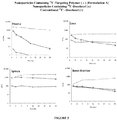
- Example Figure 5 contains the radioactivity concentration curves of the test articles determined in plasma, liver, spleen, and bone marrow.
- the concentration of docetaxel encapsulated in nanoparticles was higher in most tissues than conventional docetaxel.
- concentration of docetaxel derived from the nanoparticles was lower than or approximately the same as the concentration of conventional docetaxel in all of the tissues evaluated, except the spleen.
- mice Male severe combined immunodeficiency (SCID) mice were subcutaneously inoculated with human LNCaP prostate cancer cells. Three to four weeks after inoculation, the mice were assigned to different treatment groups such that the average tumor volume in each group was 300 mm 3 . At this time, a single intravenous (IV) dose of 50 mg/kg docetaxel was administered as either docetaxel encapsulated in nanoparticles or conventional docetaxel. The test subjects were sacrificed 2 hour or 12 hour post-dose. The tumors from each group were excised and assayed for docetaxel using liquid chromatography-mass spectrometry (LC-MS).
- IV intravenous
- Example Table 4.1 The measured docetaxel concentrations in tumors excised from the test subjects dosed with docetaxel encapsulated in nanoparticles or conventional docetaxel are presented in Example Table 4.1 and Figure 6 .
- the tumor docetaxel concentration in test subjects receiving docetaxel encapsulated in nanoparticles was approximately 7 times higher than in the test subjects receiving conventional docetaxel.
- mice Male severe combined immunodeficiency (SCID) mice were subcutaneously inoculated with human LNCaP prostate cancer cells. Three to four weeks after inoculation, the mice were assigned to different treatment groups such that the average tumor volume in each group was 250 mm3. Subsequently, the mice were treated every other day (Q2D) for four doses, with an eight day holiday, followed by another four doses at the Q2D schedule.
- Q2D every other day
- Example Figure 7 Average tumor volumes for each treatment group are shown in Example Figure 7 .
- Treatment with either conventional docetaxel or docetaxel encapsulated in nanoparticles resulted in appreciable reduction in tumor volume.
- Tumor volume reduction was greater in test subjects receiving docetaxel encapsulated in nanoparticles compared to conventional docetaxel.
- Nasal and eye discharges appeared with a pattern that was unrelated to dose level, test article, sex of the animals, or time after dosing, and this clinical sign was considered to be possibly related to docetaxel and/or to stress from the dosing procedure.
- Example Table 6.1 male and female rats dosed with either conventional docetaxel or docetaxel encapsulated in nanoparticles showed generally minor deficits in body weight gain or actual body weight losses that were considered to be due to docetaxel toxicity.
- the no-adverse effect level (NOAEL) of nanoparticles doped with docetaxel in this study was considered to be 7.5 mg/kg.
- Example Table 6.1 Example Table 6.1.
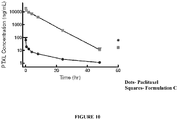
- rats were intravenously dosed with 1.0 mg/kg with either nanoparticles prepared as in Figure 2 having paclitaxel and PLA-PEG (formulation C) and no specific targeting moiety (passively targeted nanoparticles (PTNP); or paclitaxel alone.
- the release profiles are shown in Figure 10 .
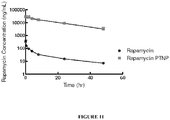
- rats were intravenously dosed with 2.0 mg/kg with either nanoparticles prepared as in Figure 2 and Example 16, having rapamycin and PLA-PEG and no specific targeting moiety (passively targeted nanoparticles (PTNP); or rapamycin alone.
- the release profiles are shown in Figure 11 .
- Plasma samples were analyzed using LC/MS and the PK analysis was performed using WinNonlin software.
- a comparison of the pharmacokinetics of the nanoparticles with rapamcyin alone is as follows: Comparison with rapamcyin alone C max (ng/mL) 297-fold ⁇ t 1/2 (hr) 3-fold ⁇ AUC inf (hr ⁇ ng/mL) 600-fold ⁇ V z (mL/kg) 1512-fold ⁇ Cl (mL/hr/kg) 516-fold ⁇
- mice with MX -1 breast tumors were randomized into three groups, receiving docetaxel (3 mice), passively targeted nanoparticles (Formulation A, without a targeting moiety, PTNP), or Formulation A.
- the average tumor mass was 1.7g (RSD 34%).
- Mice were then injected with 10 mg/kg of the test article, then euthanized 24 hours later and the tumors were removed and analyzed for docetaxel content using LC/MS/MS. Results are depicted in Figure 12 .
- the percent of injected dose in the tumor was 3% (for docetaxel alone), 30% for PTNP, and 30% Formulation A.
- the dosing day was 1 day and the formulations were administered by 30 minute IV infusion at 25 mg/m 2 docetaxel or 50 mg/m 2 docetaxel (animals were randomized and then dosed with 50 mg/m2 on day 29 and PK, hematology and clinical chemistry were measured for 21 days).
- PK, hematology and clinical chemistry collected over a 21 day period were assessed.
- Figure 12 depicts the results of male (M) and female (F) PNP.
- a comparison of the pharmacokinetics of the nanoparticles of Formulation A (25 mg/m 2 dose) with docetaxel alone is as follows: Comparison with docetaxel alone C max (ng/mL) 180-fold ⁇ t 1/2 (hr) 3-fold ⁇ AUC inf (hr ⁇ ng/mL) 213-fold ⁇ V z (mL/kg) 617-fold ⁇ Cl (mL/hr/kg) 212-fold ⁇
- Formulation A 25 mg/m2 50 mg/m2 M F M F C max (ng/mL) 89500 85500 95700 117000 C max /D 3580 3420 1914 2340 AUC (hr ⁇ ng/mL) 495408 627216 352778 748073 AUC/D 19816 25089 7056 14961 t 1/2 (hr) 7.6 9.1 5.6 6.8 V z (mL/m2) 554 526 1140 654 Cl(mL/hr/m2) 50 40 142 67 C.
- Formulation B 25 mg/m2 50 mg/m2 M F M F C max (ng/mL) 64500 101500 128000 116000 C max /D 2580 4060 2560 2320 AUC (hr ⁇ ng/mL) 956312 1442885 1960145 1395580 AUC/D 38252 57715 39203 27912 t 1/2 (hr) 13.9 17.8 17.8 15.5 V z (mL/m2) 525 445 657 803 Cl(mL/hr/m2) 26.1 17.3 25.5 35.8
- An organic phase is formed composed of a mixture of docetaxel (DTXL) and polymer (homopolymer, co-polymer, and co-polymer with ligand).
- the organic phase is mixed with an aqueous phase at approximately a 1:5 ratio (oil phase:aqueous phase) where the aqueous phase is composed of a surfactant and some dissolved solvent.
- aqueous phase is composed of a surfactant and some dissolved solvent.
- about 30% solids in the organic phase is used.
- the primary, coarse emulsion is formed by the combination of the two phases under simple mixing or through the use of a rotor stator homogenizer.
- the rotor/stator yielded a homogeneous milky solution, while the stir bar produced a visibly larger coarse emulsion. It was observed that the stir bar method resulted in significant oil phase droplets adhering to the side of the feed vessel, suggesting that while the coarse emulsion size is not a process parameter critical to quality, it should be made suitably fine in order to prevent yield loss or phase separation. Therefore the rotor stator is used as the standard method of coarse emulsion formation, although a high speed mixer may be suitable at a larger scale.
- the primary emulsion is then formed into a fine emulsion through the use of a high pressure homogenizer.
- Organic phase was emulsified 5:1 O:W with standard aqueous phase, and multiple discreet passes were performed, quenching a small portion of emulsion after each pass.
- the indicated scale represents the total solids of the formulation.
- Table A summarizes the emulsification process parameters. TABLE A Parameter Value Coarse emulsion formation Rotor stator homogenizer Homogenizer feed pressure 4000-5000 psi per chamber Interaction chamber(s) 2x200 ⁇ m Z-chamber Number of homogenizer passes 2-3 passes Water phase [sodium cholate] 0.1% W:O ratio 5:1 [Solids] in oil phase 30%
- the fine emulsion is then quenched by addition to deionized water at a given temperature under mixing.
- the emulsion is added to a cold aqueous quench under agitation. This serves to extract a significant portion of the oil phase solvents, effectively hardening the nanoparticles for downstream filtration. Chilling the quench significantly improved drug encapsulation.
- the quench:emulsion ratio is approximately 5:1.
- Tween-80 acts as a drug solubilizer, allowing for effective removal of unencapsulated drug during filtration.
- Table B indicates each of the quench process parameters. Table B: Summary quench process parameters. Parameter Value Initial quench temperature ⁇ 5°C [Tween-80] solution 35% Tween-80:drug ratio 25:1 Q:E ratio 5:1 Quench hold/processing temp ⁇ 5°C (with current: 5:1 Q:E ratio, 25:1 Tween-80:drug ratio)
- the temperature must remain cold enough with a dilute enough suspension (low enough concentration of solvents) to remain below the T g of the particles. If the Q:E ratio is not high enough, then the higher concentration of solvent plasticizes the particles and allows for drug leakage. Conversely, colder temperatures allow for high drug encapsulation at low Q:E ratios (to about3:1), making it possible to run the process more efficiently.
- the nanoparticles are then isolated through a tangential flow filtration process to concentrate the nanoparticle suspension and buffer exchange the solvents, free drug, and drug solubilizer from the quench solution into water.
- a regenerated cellulose membrane is used with with a molecular weight cutoffs (MWCO) of 300.
- a constant volume diafiltration (DF) is performed to remove the quench solvents, free drug and Tween-80.
- DF constant volume diafiltration
- buffer is added to the retentate vessel at the same rate the filtrate is removed.
- Crossflow rate refers to the rate of the solution flow through the feed channels and across the membrane. This flow provides the force to sweep away molecules that can foul the membrane and restrict filtrate flow.
- the transmembrane pressure is the force that drives the permeable molecules through the membrane.
- Table C TFF Parameters Parameter Value Membrane Material Regenerated cellulose - Coarse Screen Me mbrane Molecular Weight Cut off 300 kDa Crossflow Rate 11 L/min/m 2 Transmembrane Pressure 20 psid Concentration of Nanoparticle Suspension for Diafiltration 30 mg/ml Number of Diavolumes ⁇ 15 (based on flux increase) Membrane Area ⁇ 1 m 2 /kg
- the filtered nanoparticle slurry is then thermal cycled to an elevated temperature during workup.
- a small portion typically 5-10% of the encapsulated drug is released from the nanoparticles very quickly after its first exposure to 25°C.
- the nanoparticle suspension (concentration 50 mg/ml),is passed through a sterilizing grade filter (0.2 ⁇ m absolute).
- Pre-filters are used to protect the sterilizing grade filter in order to use a reasonable filtration area/ time for the process. Filtration flow rate is about 1.3 L/min/m 2 .
- the filtration train is Ertel Alsop Micromedia XL depth filter M953P membrane (0.2 ⁇ m Nominal); Pall SUPRAcap with Seitz EKSP depth filter media (0.1 - 0.3 ⁇ m Nominal); Pall Life Sciences Supor EKV 0.65/ 0.2 micron sterilizing grade PES filter. 0.2 m of filtration surface area per kg of nanoparticles for depth filters and 1.3 m 2 of filtration surface area per kg of nanoparticles for the sterilizing grade filters can be used.
- the nanoparticle preparation protocol described in Reference Example 12 was modified to produce slow release nanoparticles.
- a batch of nanoparticles was produced that incorporated a 50:50 ratio of 100 DL 7E PLA (see Table 1) with the 16/5 PLA-PEG copolymer.
- the addition of high molecular weight PLA is thought to decrease drug diffusion by increasing crystallinity, raising the glass transition temperature, or reducing drug solubility in the polymer.
- Table 1 High Molecular Weight PLA Tested PLA Manufacturer Molecular Weight (Mn) Molecular Weight (Mw) 100 DL 7E Lakeshore Polymer 80 kDa 124 kDa
- Nanoparticle batches were prepared using the general procedure of Reference Example 12, with 80% (w/w) Polymer-PEG or Polymer-PEG with homopolymer PLA at 40% (w/w) each, with a batch of % total solids of 5%, 15% and 30%. Solvents used were: 21% benzyl alcohol and 79% ethyl acetate (w/w). For each 2 gram batch size, 400 mg of drug was used and 1.6 g of 16-5 Polymer-PEG or 0.8 g of 16-5 Polymer-PEG + 0.8 g of 10 kDa PLA (homopolymer) was used.
- the organic phase (drug and polymer) is prepared in 2 g batches: To 20 mL scintillation vial add drug and polymer(s). The mass of solvents needed at % solids concentration is: 5% solids: 7.98 g benzyl alcohol + 30.02 g ethyl acetate; 30% solids: 0.98 g benzyl alcohol + 3.69 g ethyl acetate.
- An aqueous solution is prepared with 0.5% sodium cholate, 2% benzyl alcohol, and 4% ethyl acetate in water. Add to the bottle 7.5g sodium cholate, 1402.5g of DI water, 30g of benzyl alcohol and 6Og of ethyl acetate, and mix on stir plate until dissolved.
- a ratio of aqueous phase to oil phase is 5: 1.
- the organic phase is poured into the aqueous solution and homogenized using IKA for 10 seconds at room temperature to form course emulsion.
- the solution is fed through the homogenizer (110S) at 9 Kpsi (45 psi on gauge) for 2 discreet passes to form nanoemulsion.
- the emulsion is poured into quench (D.I. water) at ⁇ 5°C while stirring on stir plate. Ratio of quench to emulsion is 8:1. 35% (w/w) Tween 80 is added in water to quench at ratio of 25:1 Tween 80 to drug.
- the nanoparticles are concentrated through TFF and the quench is concentrated on TFF with 500 kDa Pall cassette (2 membrane) to -100 mL. Diafiltering is used using about 20 diavolumes (2 liters) of cold DI water, and the volume is brought down to minimal volume then collect final slurry, about 100 mL.
- the solids concentration of unfiltered final slurry is determined by the using tared 20 mL scintillation vial and adding 4 mL final slurry and dry under vacuum on lyo/oven and the weight of nanoparticles in the 4 mL of slurry dried down is determined.
- Concentrated sucrose (0.666 g/g) is added to final slurry sample to attain 10% sucrose.
- Solids concentration of 0.45 um filtered final slurry was determined by filtering about 5mL of final slurry sample before addition of sucrose through 0.45 ⁇ m syringe filter; to tared 20 mL scintillation vial add 4 mL of filtered sample and dry under vacuum on lyo/oven.
- the remaining sample of unfiltered final slurry was frozen with sucrose.
- Drug was dissolved in the inner aqueous phase consisting of water with 1-arginine or NaOH used for solubilizing the drug.
- the polymer (16-5 PLA-PEG) was dissolved in the oil phase organic solvent system, such as dichloromethane (DCM) at 20% solid concentration.
- the outer aqueous phase consisted mainly of water with 1% sodium cholate (SC) as surfactant, unless noted otherwise.
- the w/o emulsion was prepared by adding the inner aqueous phase into the oil phase under rotor stator homogenization or sonication (using Branson Digital Sonifier) at a w/o ratio of 1 : 10.
- the coarse w/o/w emulsion was also prepared by adding the w/o emulsion into an outer aqueous phase under either rotor stator homogenization or sonication at o/w ratio of 1 : 10.
- the fine w/o/w emulsion was then prepared by processing the coarse emulsion through a Microfluidics high pressure homogenizer (MHOS pneumatic) at 45000 psi with a 100 ⁇ m Z-interaction chamber.
- the fine emulsion was then quenched into cold DI water at 10:1 quench: emulsion ratio.
- Polysorbate 80 (Tween 80) was then added as a process solubilizer to solubilize the unencapsulated drug. No drug precipitation was observed at a drug:Tween 80 ratio of 1:200.
- the batch was then processed with ultrafiltration followed by diafiltration to remove solvents, unencapsulated drug and solubilizer. The particle size measurements were performed by Brookhaven DLS and/or Horiba laser diffraction. To determine drug load, slurry samples were analyzed by HPLC and solid concentration analysis. The slurry retains were then diluted with sucrose to 10% before freezing. All ratios listed are on a w/w basis, unless specified otherwise.
- both the inner w/o and outer w/o/w emulsions were formed by rotor stator homogenization followed by 2 passes at 45k psi using a high pressure homogenizer.
- the nanoparticle suspension was quenched in cold DI water followed by ultrafiltration/diafiltration work-up. HPLC and PSD analysis was used to determine that the drug load stayed at 0.38% for 131 nm particles.
- the emulsion process for all three batches remained similar. The highest drug load was obtained for the 16/5 PLA-PEG batch at 2.23% while the drug load was 0.2% and 0.04% for other batches.
- An organic phase is formed composed of a mixture of sirolimus and polymer (homopolymer, co-polymer, and co-polymer with ligand).
- the organic phase is mixed with an aqueous phase at approximately a 1:5 ratio (oil phase:aqueous phase) where the aqueous phase is composed of a surfactant and some dissolved solvent.
- aqueous phase is composed of a surfactant and some dissolved solvent.
- the primary, coarse emulsion is formed by the combination of the two phases under simple mixing or through the use of a rotor stator homogenizer.
- the primary emulsion is then formed into a fine emulsion through the use of a high pressure homogenizer. The process is continued as in Reference Example 12.
- Rapamycin (sirolimus) formulations are representative Rapamycin (sirolimus) formulations:
Landscapes
- Health & Medical Sciences (AREA)
- Chemical & Material Sciences (AREA)
- Pharmacology & Pharmacy (AREA)
- General Health & Medical Sciences (AREA)
- Medicinal Chemistry (AREA)
- Life Sciences & Earth Sciences (AREA)
- Engineering & Computer Science (AREA)
- Animal Behavior & Ethology (AREA)
- Public Health (AREA)
- Veterinary Medicine (AREA)
- Epidemiology (AREA)
- Bioinformatics & Cheminformatics (AREA)
- Nanotechnology (AREA)
- Biomedical Technology (AREA)
- Physics & Mathematics (AREA)
- Optics & Photonics (AREA)
- General Engineering & Computer Science (AREA)
- Dermatology (AREA)
- Biophysics (AREA)
- Medical Informatics (AREA)
- Molecular Biology (AREA)
- Crystallography & Structural Chemistry (AREA)
- Biotechnology (AREA)
- Immunology (AREA)
- Nuclear Medicine, Radiotherapy & Molecular Imaging (AREA)
- Chemical Kinetics & Catalysis (AREA)
- Organic Chemistry (AREA)
- General Chemical & Material Sciences (AREA)
- Medicinal Preparation (AREA)
- Pharmaceuticals Containing Other Organic And Inorganic Compounds (AREA)
- Medicines That Contain Protein Lipid Enzymes And Other Medicines (AREA)
Applications Claiming Priority (4)
| Application Number | Priority Date | Filing Date | Title |
|---|---|---|---|
| US12247908P | 2008-12-15 | 2008-12-15 | |
| US24902209P | 2009-10-06 | 2009-10-06 | |
| US26020009P | 2009-11-11 | 2009-11-11 | |
| PCT/US2009/068028 WO2010075072A2 (en) | 2008-12-15 | 2009-12-15 | Long circulating nanoparticles for sustained release of therapeutic agents |
Publications (3)
| Publication Number | Publication Date |
|---|---|
| EP2379064A2 EP2379064A2 (en) | 2011-10-26 |
| EP2379064A4 EP2379064A4 (en) | 2012-06-20 |
| EP2379064B1 true EP2379064B1 (en) | 2020-02-26 |
Family
ID=42288375
Family Applications (1)
| Application Number | Title | Priority Date | Filing Date |
|---|---|---|---|
| EP09835578.7A Active EP2379064B1 (en) | 2008-12-15 | 2009-12-15 | Long circulating nanoparticles for sustained release of therapeutic agents |
Country Status (6)
| Country | Link |
|---|---|
| US (5) | US20100216804A1 (enExample) |
| EP (1) | EP2379064B1 (enExample) |
| JP (4) | JP2012512175A (enExample) |
| EA (1) | EA201100765A1 (enExample) |
| ES (1) | ES2776126T3 (enExample) |
| WO (1) | WO2010075072A2 (enExample) |
Families Citing this family (190)
| Publication number | Priority date | Publication date | Assignee | Title |
|---|---|---|---|---|
| WO2007001448A2 (en) | 2004-11-04 | 2007-01-04 | Massachusetts Institute Of Technology | Coated controlled release polymer particles as efficient oral delivery vehicles for biopharmaceuticals |
| US9267937B2 (en) | 2005-12-15 | 2016-02-23 | Massachusetts Institute Of Technology | System for screening particles |
| WO2008105773A2 (en) | 2006-03-31 | 2008-09-04 | Massachusetts Institute Of Technology | System for targeted delivery of therapeutic agents |
| WO2007150030A2 (en) | 2006-06-23 | 2007-12-27 | Massachusetts Institute Of Technology | Microfluidic synthesis of organic nanoparticles |
| US9217129B2 (en) | 2007-02-09 | 2015-12-22 | Massachusetts Institute Of Technology | Oscillating cell culture bioreactor |
| US20090074828A1 (en) | 2007-04-04 | 2009-03-19 | Massachusetts Institute Of Technology | Poly(amino acid) targeting moieties |
| ATE530169T1 (de) | 2007-09-28 | 2011-11-15 | Bind Biosciences Inc | Krebszellen-targeting mit nanopartikeln |
| MX2010003642A (es) | 2007-10-12 | 2010-08-09 | Massachusetts Inst Technology | Nanotecnologia de vacuna. |
| EA020753B1 (ru) | 2008-06-16 | 2015-01-30 | Бинд Терапьютикс, Инк. | Терапевтические полимерные наночастицы, содержащие алкалоиды vinca, и их применение |
| WO2010005726A2 (en) | 2008-06-16 | 2010-01-14 | Bind Biosciences Inc. | Therapeutic polymeric nanoparticles with mtor inhibitors and methods of making and using same |
| AU2009268923B2 (en) | 2008-06-16 | 2015-09-17 | Pfizer Inc. | Drug loaded polymeric nanoparticles and methods of making and using same |
| US8277812B2 (en) | 2008-10-12 | 2012-10-02 | Massachusetts Institute Of Technology | Immunonanotherapeutics that provide IgG humoral response without T-cell antigen |
| US8591905B2 (en) | 2008-10-12 | 2013-11-26 | The Brigham And Women's Hospital, Inc. | Nicotine immunonanotherapeutics |
| WO2010068866A2 (en) | 2008-12-12 | 2010-06-17 | Bind Biosciences | Therapeutic particles suitable for parenteral administration and methods of making and using same |
| EA201100765A1 (ru) * | 2008-12-15 | 2012-04-30 | Бинд Биосаиэнсис | Наночастицы длительной циркуляции для замедленного высвобождения терапевтических средств |
| CN102811743B (zh) | 2009-12-11 | 2015-11-25 | 佰恩德治疗股份有限公司 | 冻干治疗颗粒的稳定制剂 |
| EP2512459A4 (en) * | 2009-12-15 | 2013-08-07 | THERAPEUTIC POLYMERIC NANOPARTICLES COMPRISING EPOTHILONE AND METHODS OF MAKING AND USING SAME | |
| JP5965844B2 (ja) | 2009-12-15 | 2016-08-10 | バインド セラピューティックス インコーポレイテッド | 高いガラス転移温度または高分子量のコポリマーを有する治療用ポリマーナノ粒子組成物 |
| EP2512487A4 (en) * | 2009-12-15 | 2013-08-07 | THERAPEUTIC POLYMERNANOPARTICLES WITH CORTICOSTEROIDS AND METHOD FOR THE PRODUCTION AND USE THEREOF | |
| US8889193B2 (en) | 2010-02-25 | 2014-11-18 | The Johns Hopkins University | Sustained delivery of therapeutic agents to an eye compartment |
| CA2807552A1 (en) | 2010-08-06 | 2012-02-09 | Moderna Therapeutics, Inc. | Engineered nucleic acids and methods of use thereof |
| EP2857499A1 (en) | 2010-10-01 | 2015-04-08 | Moderna Therapeutics, Inc. | Engineered nucleic acids and methods of use thereof |
| JP2014505666A (ja) | 2010-11-18 | 2014-03-06 | ザ ジェネラル ホスピタル コーポレイション | 癌治療のための降圧剤の組成物および使用 |
| WO2012109363A2 (en) | 2011-02-08 | 2012-08-16 | The Johns Hopkins University | Mucus penetrating gene carriers |
| CA2831613A1 (en) | 2011-03-31 | 2012-10-04 | Moderna Therapeutics, Inc. | Delivery and formulation of engineered nucleic acids |
| US8987354B2 (en) * | 2011-04-25 | 2015-03-24 | Jingxu Zhu | Biocompatible polymer nanoparticle coating composition and method of production thereof |
| CN107320734A (zh) | 2011-04-29 | 2017-11-07 | 西莱克塔生物科技公司 | 从合成纳米载体中控制释放免疫抑制剂 |
| US9464124B2 (en) | 2011-09-12 | 2016-10-11 | Moderna Therapeutics, Inc. | Engineered nucleic acids and methods of use thereof |
| PT3682905T (pt) | 2011-10-03 | 2022-04-07 | Modernatx Inc | Nucleósidos, nucleótidos e ácidos nucleicos modificados e respetivas utilizações |
| ES2923757T3 (es) | 2011-12-16 | 2022-09-30 | Modernatx Inc | Composiciones de ARNm modificado |
| WO2013151664A1 (en) | 2012-04-02 | 2013-10-10 | modeRNA Therapeutics | Modified polynucleotides for the production of proteins |
| US9572897B2 (en) | 2012-04-02 | 2017-02-21 | Modernatx, Inc. | Modified polynucleotides for the production of cytoplasmic and cytoskeletal proteins |
| CN104411338A (zh) | 2012-04-02 | 2015-03-11 | 现代治疗公司 | 用于产生与人类疾病相关的生物制剂和蛋白质的修饰多核苷酸 |
| US9283287B2 (en) | 2012-04-02 | 2016-03-15 | Moderna Therapeutics, Inc. | Modified polynucleotides for the production of nuclear proteins |
| US10501512B2 (en) | 2012-04-02 | 2019-12-10 | Modernatx, Inc. | Modified polynucleotides |
| US10555911B2 (en) * | 2012-05-04 | 2020-02-11 | Yale University | Highly penetrative nanocarriers for treatment of CNS disease |
| US9314532B2 (en) | 2012-08-10 | 2016-04-19 | University Of North Texas Health Science Center | Drug delivery vehicle |
| HUE043998T2 (hu) | 2012-09-17 | 2019-09-30 | Pfizer | Eljárás terápiás nanorészecskék elõállítására |
| PT2922554T (pt) | 2012-11-26 | 2022-06-28 | Modernatx Inc | Arn modificado nas porções terminais |
| US9309114B2 (en) * | 2013-01-14 | 2016-04-12 | Xerox Corporation | Porous nanoparticles produced by solvent-free emulsification |
| US10568975B2 (en) | 2013-02-05 | 2020-02-25 | The Johns Hopkins University | Nanoparticles for magnetic resonance imaging tracking and methods of making and using thereof |
| US10258698B2 (en) | 2013-03-14 | 2019-04-16 | Modernatx, Inc. | Formulation and delivery of modified nucleoside, nucleotide, and nucleic acid compositions |
| US8980864B2 (en) | 2013-03-15 | 2015-03-17 | Moderna Therapeutics, Inc. | Compositions and methods of altering cholesterol levels |
| CN105307641A (zh) | 2013-05-03 | 2016-02-03 | 西莱克塔生物科技公司 | 用于降低不期望体液免疫应答的给药组合 |
| EP3004183B1 (en) | 2013-05-28 | 2017-07-05 | Sintef TTO AS | Process for preparing stealth nanoparticles |
| US20140378083A1 (en) * | 2013-06-25 | 2014-12-25 | Plantronics, Inc. | Device Sensor Mode to Identify a User State |
| WO2014210485A1 (en) * | 2013-06-28 | 2014-12-31 | Bind Therapeutics, Inc. | Docetaxel polymeric nanoparticles for cancer treatment |
| PL3019619T3 (pl) | 2013-07-11 | 2022-01-10 | Modernatx, Inc. | Kompozycje zawierające syntetyczne polinkleotydy kodujące białka powiązane z crispr i syntetyczne sgrna oraz sposoby ich stosowania |
| WO2015013566A1 (en) * | 2013-07-25 | 2015-01-29 | Nemucore Medical Innovations, Inc. | Nanoemulsions of hydrophobic platinum derivative |
| CA2923029A1 (en) | 2013-09-03 | 2015-03-12 | Moderna Therapeutics, Inc. | Chimeric polynucleotides |
| WO2015034925A1 (en) | 2013-09-03 | 2015-03-12 | Moderna Therapeutics, Inc. | Circular polynucleotides |
| HUE034490T2 (en) | 2013-09-16 | 2018-02-28 | Astrazeneca Ab | Therapeutic polymer nanoparticles and methods for their preparation and use |
| CN103446060B (zh) * | 2013-09-22 | 2015-09-02 | 上海市第八人民医院 | 载多西紫杉醇聚羟基丁酸酯纳米粒及制备方法、豌豆凝集素修饰方法和应用 |
| US10023626B2 (en) | 2013-09-30 | 2018-07-17 | Modernatx, Inc. | Polynucleotides encoding immune modulating polypeptides |
| KR20160067219A (ko) | 2013-10-03 | 2016-06-13 | 모더나 세라퓨틱스, 인코포레이티드 | 저밀도 지단백질 수용체를 암호화하는 폴리뉴클레오타이드 |
| BR112016011195A2 (pt) | 2013-11-18 | 2017-09-19 | Rubius Therapeutics Inc | Células eritroides enucleadas e seus métodos de fabricação, composição farmacêutica e seu uso, uso de uma população de células eritroides, biorreator, mistura de células e dispositivo médico |
| JP6324405B2 (ja) * | 2013-11-22 | 2018-05-16 | 株式会社サンノハシ | ボルト、ナット、および歪測定システム |
| SI3071696T1 (sl) | 2013-11-22 | 2019-11-29 | Mina Therapeutics Ltd | C/EBP alfa kratko delujoči RNA sestavki in postopki uporabe |
| US20160303236A1 (en) * | 2013-12-10 | 2016-10-20 | The Regents Of The University Of California | Regionally activated drug delivery nanoparticles |
| EP3116547B1 (en) | 2014-03-14 | 2019-06-05 | Pfizer Inc | Therapeutic nanoparticles comprising a therapeutic agent and methods of making and using same |
| CN106456744A (zh) | 2014-04-01 | 2017-02-22 | 鲁比厄斯治疗法股份有限公司 | 用于免疫调节的方法和组合物 |
| WO2015175545A1 (en) | 2014-05-12 | 2015-11-19 | The Johns Hopkins University | Highly stable biodegradable gene vector platforms for overcoming biological barriers |
| WO2016011226A1 (en) | 2014-07-16 | 2016-01-21 | Moderna Therapeutics, Inc. | Chimeric polynucleotides |
| EP3171895A1 (en) | 2014-07-23 | 2017-05-31 | Modernatx, Inc. | Modified polynucleotides for the production of intrabodies |
| WO2016020901A1 (en) | 2014-08-07 | 2016-02-11 | Acerta Pharma B.V. | Methods of treating cancers, immune and autoimmune diseases, and inflammatory diseases based on btk occupancy and btk resynthesis rate |
| EA201790551A1 (ru) | 2014-09-07 | 2017-07-31 | Селекта Байосайенсиз, Инк. | Способы и композиции для ослабления иммунных ответов к пропускающему экзон вирусному трансферному вектору |
| AU2015342968B2 (en) * | 2014-11-05 | 2021-05-27 | Selecta Biosciences, Inc. | Methods and compositions related to the use of low HLB surfactants in the production of synthetic nanocarriers comprising a rapalog |
| JP6846351B2 (ja) | 2015-01-27 | 2021-03-24 | ザ・ジョンズ・ホプキンス・ユニバーシティー | 粘膜表面における活性薬剤の増強された輸送のための低張ヒドロゲル製剤 |
| HRP20220156T1 (hr) | 2015-09-17 | 2022-04-15 | Modernatx, Inc. | Spojevi i pripravci za unutarstaničnu isporuku terapeutskih sredstava |
| US20170079985A1 (en) | 2015-09-21 | 2017-03-23 | Teva Pharmaceuticals International Gmbh | Sustained release olanzapine formulations |
| DE20164728T1 (de) | 2015-10-22 | 2021-09-30 | Modernatx, Inc. | Impfstoffe gegen atemwegsvirus |
| PE20181531A1 (es) | 2015-10-22 | 2018-09-26 | Modernatx Inc | Vacuna del virus herpes simple |
| US20180271970A1 (en) | 2015-10-22 | 2018-09-27 | Modernatx, Inc. | Respiratory syncytial virus vaccine |
| SG11201803360UA (en) | 2015-10-22 | 2018-05-30 | Modernatx Inc | Nucleic acid vaccines for varicella zoster virus (vzv) |
| EP3364981A4 (en) | 2015-10-22 | 2019-08-07 | ModernaTX, Inc. | VACCINE AGAINST THE HUMAN CYTOMEGALOVIRUS |
| MA46023A (fr) | 2015-10-22 | 2019-07-03 | Modernatx Inc | Vaccin contre le virus de la grippe à large spectre |
| DK3386484T3 (da) | 2015-12-10 | 2022-07-04 | Modernatx Inc | Sammensætninger og fremgangsmåder til afgivelse af terapeutiske midler |
| EP3389720A1 (en) | 2015-12-18 | 2018-10-24 | The General Hospital Corporation | Polyacetal polymers, conjugates, particles and uses thereof |
| RS63051B1 (sr) | 2015-12-22 | 2022-04-29 | Modernatx Inc | Jedinjenja i kompozicije za intracelularnu isporuku agenasa |
| SMT202200310T1 (it) | 2015-12-23 | 2022-09-14 | Modernatx Inc | Metodi di utilizzo dei polinucleotidi codificanti il ligando di ox40 |
| US20190241658A1 (en) | 2016-01-10 | 2019-08-08 | Modernatx, Inc. | Therapeutic mRNAs encoding anti CTLA-4 antibodies |
| WO2017147240A1 (en) | 2016-02-23 | 2017-08-31 | Tarveda Therapeutics, Inc. | Hsp90 targeted conjugates and particles and formulations thereof |
| EP3538067A1 (en) | 2016-11-08 | 2019-09-18 | Modernatx, Inc. | Stabilized formulations of lipid nanoparticles |
| EP4599848A3 (en) | 2017-03-11 | 2025-12-03 | Cartesian Therapeutics, Inc. | Methods and compositions related to combined treatment with anti-inflammatories and synthetic nanocarriers comprising an immunosuppressant |
| JP7332478B2 (ja) | 2017-03-15 | 2023-08-23 | モデルナティエックス インコーポレイテッド | 脂質ナノ粒子製剤 |
| RS63953B1 (sr) | 2017-03-15 | 2023-02-28 | Modernatx Inc | Jedinjenje i kompozicije za intracelularnu isporuku terapeutskih sredstava |
| WO2018170322A1 (en) | 2017-03-15 | 2018-09-20 | Modernatx, Inc. | Crystal forms of amino lipids |
| EP3600258A1 (en) | 2017-03-20 | 2020-02-05 | Teva Pharmaceuticals International GmbH | Sustained release olanzapine formulaitons |
| EP4253544A3 (en) | 2017-05-18 | 2023-12-20 | ModernaTX, Inc. | Modified messenger rna comprising functional rna elements |
| AU2018270111B2 (en) | 2017-05-18 | 2022-07-14 | Modernatx, Inc. | Polynucleotides encoding tethered interleukin-12 (IL12) polypeptides and uses thereof |
| EP3638292A1 (en) | 2017-06-14 | 2020-04-22 | ModernaTX, Inc. | Polynucleotides encoding coagulation factor viii |
| EP3638678B1 (en) | 2017-06-14 | 2025-12-03 | ModernaTX, Inc. | Compounds and compositions for intracellular delivery of agents |
| WO2018236797A1 (en) * | 2017-06-20 | 2018-12-27 | Tarveda Therapeutics, Inc. | Hsp90 targeted conjugates and particle formulations thereof |
| CA3064564C (en) | 2017-06-22 | 2021-11-30 | SNBioScience Inc. | Particle and pharmaceutical composition comprising an insoluble camptothecin compound with double core-shell structure and method for manufacturing the same |
| WO2019048645A1 (en) | 2017-09-08 | 2019-03-14 | Mina Therapeutics Limited | STABILIZED COMPOSITIONS OF SMALL ACTIVATOR RNA (PARNA) FROM CEBPA AND METHODS OF USE |
| WO2019048632A1 (en) | 2017-09-08 | 2019-03-14 | Mina Therapeutics Limited | STABILIZED COMPOSITIONS OF SMALL ACTIVATORY RNA (PARNA) OF HNF4A AND METHODS OF USE |
| EP3714048B1 (en) | 2017-11-22 | 2025-04-09 | ModernaTX, Inc. | Polynucleotides encoding ornithine transcarbamylase for the treatment of urea cycle disorders |
| JP7424976B2 (ja) | 2017-11-22 | 2024-01-30 | モダーナティエックス・インコーポレイテッド | プロピオン酸血症の治療用のプロピオニルCoAカルボキシラーゼアルファ及びベータサブユニットをコードするポリヌクレオチド |
| US11939601B2 (en) | 2017-11-22 | 2024-03-26 | Modernatx, Inc. | Polynucleotides encoding phenylalanine hydroxylase for the treatment of phenylketonuria |
| US11802146B2 (en) | 2018-01-05 | 2023-10-31 | Modernatx, Inc. | Polynucleotides encoding anti-chikungunya virus antibodies |
| JP2021515037A (ja) * | 2018-02-26 | 2021-06-17 | アントルクス,インコーポレーテッド | 寛容原性リポソーム及びその使用方法 |
| EP3773477A1 (en) | 2018-04-03 | 2021-02-17 | Vaxess Technologies, Inc. | Microneedle comprising silk fibroin applied to a dissolvable base |
| US20210163928A1 (en) | 2018-04-11 | 2021-06-03 | Modernatx, Inc. | Messenger rna comprising functional rna elements |
| US11566246B2 (en) | 2018-04-12 | 2023-01-31 | Mina Therapeutics Limited | SIRT1-saRNA compositions and methods of use |
| CN112654710A (zh) | 2018-05-16 | 2021-04-13 | 辛瑟高公司 | 用于指导rna设计和使用的方法和系统 |
| MA52709A (fr) | 2018-05-23 | 2021-03-31 | Modernatx Inc | Administration d'adn |
| WO2020023390A1 (en) | 2018-07-25 | 2020-01-30 | Modernatx, Inc. | Mrna based enzyme replacement therapy combined with a pharmacological chaperone for the treatment of lysosomal storage disorders |
| MA53545A (fr) | 2018-09-02 | 2021-07-14 | Modernatx Inc | Polynucléotides codant pour l'acyl-coa déshydrogénase à très longue chaîne pour le traitement de l'insuffisance en acyl-coa déshydrogénase à très longue chaîne |
| JP2022500436A (ja) | 2018-09-13 | 2022-01-04 | モダーナティエックス・インコーポレイテッドModernaTX, Inc. | 糖原病を処置するためのグルコース−6−ホスファターゼをコードするポリヌクレオチド |
| US12644102B2 (en) | 2018-09-13 | 2026-06-02 | Modernatx, Inc. | Polynucleotides encoding branched-chain alpha-ketoacid dehydrogenase complex E1-α, E1-β, and E2 subunits for the treatment of maple syrup urine disease |
| MA53615A (fr) | 2018-09-14 | 2021-07-21 | Modernatx Inc | Polynucléotides codant pour le polypeptide a1, de la famille de l'uridine diphosphate glycosyltransférase 1, pour le traitement du syndrome de crigler-najjar |
| US12151029B2 (en) | 2018-09-19 | 2024-11-26 | Modernatx, Inc. | PEG lipids and uses thereof |
| CN112996854B (zh) | 2018-09-19 | 2024-08-30 | 摩登纳特斯有限公司 | 高纯度peg脂质和其用途 |
| EP3853202A1 (en) | 2018-09-19 | 2021-07-28 | ModernaTX, Inc. | Compounds and compositions for intracellular delivery of therapeutic agents |
| WO2020069169A1 (en) | 2018-09-27 | 2020-04-02 | Modernatx, Inc. | Polynucleotides encoding arginase 1 for the treatment of arginase deficiency |
| US20220001026A1 (en) | 2018-11-08 | 2022-01-06 | Modernatx, Inc. | Use of mrna encoding ox40l to treat cancer in human patients |
| RU2681933C1 (ru) * | 2018-11-28 | 2019-03-14 | Федеральное государственное бюджетное учреждение "Национальный исследовательский центр "Курчатовский институт" | Способ получения полимерных противоопухолевых частиц в проточном микрореакторе и лиофилизата на их основе |
| AU2020210884A1 (en) | 2019-01-25 | 2021-08-12 | Synthego Corporation | Systems and methods for modulating CRISPR activity |
| US11179334B1 (en) * | 2019-02-04 | 2021-11-23 | Florida A&M University | Targeted carriers for tacrolimus for ocular inflammation |
| WO2020210805A1 (en) | 2019-04-11 | 2020-10-15 | The Johns Hopkins University | Nanoparticles for drug delivery to brain |
| EP3953473A1 (en) | 2019-04-12 | 2022-02-16 | MiNA Therapeutics Limited | Sirt1-sarna compositions and methods of use |
| WO2020227642A1 (en) | 2019-05-08 | 2020-11-12 | Modernatx, Inc. | Compositions for skin and wounds and methods of use thereof |
| US12553041B2 (en) | 2019-06-04 | 2026-02-17 | Cartesian Therapeutics Inc. | Formulations and doses of pegylated uricase |
| EP3987027A1 (en) | 2019-06-24 | 2022-04-27 | ModernaTX, Inc. | Endonuclease-resistant messenger rna and uses thereof |
| MA56517A (fr) | 2019-06-24 | 2022-04-27 | Modernatx Inc | Arn messager comprenant des éléments d'arn fonctionnels et leurs utilisations |
| KR20220034717A (ko) | 2019-07-19 | 2022-03-18 | 신테고 코포레이션 | 안정화된 crispr 복합체 |
| EP4031524A1 (en) | 2019-09-19 | 2022-07-27 | ModernaTX, Inc. | Branched tail lipid compounds and compositions for intracellular delivery of therapeutic agents |
| AU2020351220A1 (en) | 2019-09-19 | 2022-04-07 | Modernatx, Inc. | Carbonate containing lipid compounds and compositions for intracellular delivery of therapeutic agents |
| AU2020355000A1 (en) | 2019-09-23 | 2022-03-17 | Sepia Therapeutics, Inc. | Compositions and methods for modulating apolipoprotein B (APOB) gene expression |
| CN114729376A (zh) | 2019-09-23 | 2022-07-08 | 欧米茄治疗公司 | 用于调节肝细胞核因子4α(HNF4α)基因表达的组合物和方法 |
| WO2021183720A1 (en) | 2020-03-11 | 2021-09-16 | Omega Therapeutics, Inc. | Compositions and methods for modulating forkhead box p3 (foxp3) gene expression |
| AU2021285812A1 (en) | 2020-06-01 | 2023-01-05 | Modernatx, Inc. | Phenylalanine hydroxylase variants and uses thereof |
| JP2023533174A (ja) | 2020-06-12 | 2023-08-02 | ユニバーシティ オブ ロチェスター | ACE-tRNAのコード化及び発現 |
| CA3199784A1 (en) | 2020-11-13 | 2022-05-19 | Modernatx, Inc. | Polynucleotides encoding cystic fibrosis transmembrane conductance regulator for the treatment of cystic fibrosis |
| CN112294974A (zh) * | 2020-11-18 | 2021-02-02 | 西安组织工程与再生医学研究所 | 具有多级缓控释作用的载药微粒及其制备方法 |
| GB2603454A (en) | 2020-12-09 | 2022-08-10 | Ucl Business Ltd | Novel therapeutics for the treatment of neurodegenerative disorders |
| US20240100012A1 (en) | 2021-01-18 | 2024-03-28 | Mark Hasleton | Pharmaceutical dosage form |
| US11524023B2 (en) | 2021-02-19 | 2022-12-13 | Modernatx, Inc. | Lipid nanoparticle compositions and methods of formulating the same |
| WO2022204390A1 (en) | 2021-03-24 | 2022-09-29 | Modernatx, Inc. | Lipid nanoparticles containing polynucleotides encoding phenylalanine hydroxylase and uses thereof |
| US20240207374A1 (en) | 2021-03-24 | 2024-06-27 | Modernatx, Inc. | Lipid nanoparticles containing polynucleotides encoding glucose-6-phosphatase and uses thereof |
| WO2022204369A1 (en) | 2021-03-24 | 2022-09-29 | Modernatx, Inc. | Polynucleotides encoding methylmalonyl-coa mutase for the treatment of methylmalonic acidemia |
| WO2022204380A1 (en) | 2021-03-24 | 2022-09-29 | Modernatx, Inc. | Lipid nanoparticles containing polynucleotides encoding propionyl-coa carboxylase alpha and beta subunits and uses thereof |
| US20240189449A1 (en) | 2021-03-24 | 2024-06-13 | Modernatx, Inc. | Lipid nanoparticles and polynucleotides encoding ornithine transcarbamylase for the treatment of ornithine transcarbamylase deficiency |
| US20240175033A1 (en) | 2021-03-26 | 2024-05-30 | Mina Therapeutics Limited | TMEM173 saRNA Compositions and Methods of Use |
| WO2022240806A1 (en) | 2021-05-11 | 2022-11-17 | Modernatx, Inc. | Non-viral delivery of dna for prolonged polypeptide expression in vivo |
| US20240384277A1 (en) | 2021-06-15 | 2024-11-21 | Modernatx, Inc. | Engineered polynucleotides for cell-type or microenvironment-specific expression |
| US20240376445A1 (en) | 2021-06-22 | 2024-11-14 | Modernatx, Inc. | Polynucleotides encoding uridine diphosphate glycosyltransferase 1 family, polypeptide a1 for the treatment of crigler-najjar syndrome |
| EP4366726A1 (en) | 2021-07-06 | 2024-05-15 | Mark Hasleton | Treatment of serotonin reuptake inhibitor withdrawal syndrome |
| WO2023283359A2 (en) | 2021-07-07 | 2023-01-12 | Omega Therapeutics, Inc. | Compositions and methods for modulating secreted frizzled receptor protein 1 (sfrp1) gene expression |
| WO2023055998A2 (en) * | 2021-09-30 | 2023-04-06 | The Trustees Of Princeton University | Dna valency sorting chromatography |
| US20250017867A1 (en) | 2021-10-01 | 2025-01-16 | Modernatx, Inc. | Polynucleotides encoding relaxin for the treatment of fibrosis and/or cardiovascular disease |
| WO2023099884A1 (en) | 2021-12-01 | 2023-06-08 | Mina Therapeutics Limited | Pax6 sarna compositions and methods of use |
| GB202117758D0 (en) | 2021-12-09 | 2022-01-26 | Ucl Business Ltd | Therapeutics for the treatment of neurodegenerative disorders |
| AU2023215397A1 (en) | 2022-02-07 | 2024-08-22 | University Of Rochester | Optimized sequences for enhanced trna expression or/and nonsense mutation suppression. |
| US20250327041A1 (en) | 2022-02-24 | 2025-10-23 | Io Biotech Aps | Nucleotide delivery of cancer therapy |
| WO2023170435A1 (en) | 2022-03-07 | 2023-09-14 | Mina Therapeutics Limited | Il10 sarna compositions and methods of use |
| WO2023183909A2 (en) | 2022-03-25 | 2023-09-28 | Modernatx, Inc. | Polynucleotides encoding fanconi anemia, complementation group proteins for the treatment of fanconi anemia |
| WO2023196399A1 (en) | 2022-04-06 | 2023-10-12 | Modernatx, Inc. | Lipid nanoparticles and polynucleotides encoding argininosuccinate lyase for the treatment of argininosuccinic aciduria |
| WO2023215498A2 (en) | 2022-05-05 | 2023-11-09 | Modernatx, Inc. | Compositions and methods for cd28 antagonism |
| WO2023250117A2 (en) | 2022-06-24 | 2023-12-28 | Vaxess Technologies, Inc. | Applicator for medicament patch |
| EP4562163A1 (en) | 2022-07-26 | 2025-06-04 | ModernaTX, Inc. | Engineered polynucleotides for temporal control of expression |
| WO2024097639A1 (en) | 2022-10-31 | 2024-05-10 | Modernatx, Inc. | Hsa-binding antibodies and binding proteins and uses thereof |
| US20260191905A1 (en) | 2022-12-01 | 2026-07-09 | Modernatx, Inc. | Gpc3-specific antibodies, binding domains, and related proteins and uses thereof |
| TW202440929A (zh) | 2022-12-14 | 2024-10-16 | 加拿大商普羅維登斯治療控股公司 | 用於感染性疾病的組合物和方法 |
| WO2024130158A1 (en) | 2022-12-16 | 2024-06-20 | Modernatx, Inc. | Lipid nanoparticles and polynucleotides encoding extended serum half-life interleukin-22 for the treatment of metabolic disease |
| US20260218178A1 (en) | 2022-12-22 | 2026-07-30 | Mina Therapeutics Limited | Chemically Modified saRNA Compositions and Methods of Use |
| WO2024178172A1 (en) | 2023-02-23 | 2024-08-29 | University Of Rochester | Agents and methods for making closed-end dna thread molecules |
| WO2024182301A2 (en) | 2023-02-27 | 2024-09-06 | Modernatx, Inc. | Lipid nanoparticles and polynucleotides encoding galactose-1-phosphate uridylyltransferase (galt) for the treatment of galactosemia |
| WO2024181817A1 (ko) * | 2023-03-02 | 2024-09-06 | 주식회사 펄스인마이어스 | 암의 예방 또는 치료를 위한 adp-리보오스 결합 펩티드 및 adp-리보오스의 병용 요법 |
| WO2024197033A1 (en) | 2023-03-21 | 2024-09-26 | Modernatx, Inc. | Polynucleotides encoding relaxin for the treatment of heart failure |
| WO2024206126A1 (en) | 2023-03-27 | 2024-10-03 | Modernatx, Inc. | Cd16-binding antibodies and uses thereof |
| WO2024206329A1 (en) | 2023-03-27 | 2024-10-03 | Modernatx, Inc. | Nucleic acid molecules encoding bi-specific secreted engagers and uses thereof |
| EP4704816A1 (en) | 2023-05-03 | 2026-03-11 | ModernaTX, Inc. | Polynucleotides encoding cystic fibrosis transmembrane conductance regulator for the treatment of cystic fibrosis |
| EP4716741A2 (en) | 2023-05-23 | 2026-04-01 | Flagship Labs 114, Inc. | Compositions and methods for reducing cxcl9, cxcl10, and cxcl11 gene expression |
| EP4731294A1 (en) | 2023-06-23 | 2026-04-29 | Vaxess Technologies, Inc. | Applicator for medicament patch |
| WO2025042806A2 (en) | 2023-08-21 | 2025-02-27 | Modernatx, Inc. | C-met binding antibodies, nucleic acids encoding same, and methods of use |
| EP4520345A1 (en) | 2023-09-06 | 2025-03-12 | Myneo Nv | Product |
| WO2025072482A1 (en) | 2023-09-27 | 2025-04-03 | Modernatx, Inc. | Immunoglobulin a protease polypeptides, polynucleotides, and uses thereof |
| WO2025101685A1 (en) | 2023-11-09 | 2025-05-15 | University Of Rochester | Suppression of nonsense mutations using anticodon engineered (ace)-trnas |
| WO2025255199A1 (en) | 2024-06-05 | 2025-12-11 | Modernatx, Inc. | Argininosuccinate synthase 1 and argininosuccinate lyase polypeptides and polynucleotides and uses thereof |
| WO2026006151A2 (en) | 2024-06-24 | 2026-01-02 | University Of Rochester | Functionalization of ace-trna encoding synthetic linear picovectors |
| WO2026030209A1 (en) | 2024-07-29 | 2026-02-05 | University Of Rochester | Use of decoding trnas to boost protein expression or function |
| WO2026027887A2 (en) | 2024-08-02 | 2026-02-05 | Mina Therapeutics Limited | Hbg1/2-sarna compositions and methods of use |
| US12409234B1 (en) * | 2024-08-16 | 2025-09-09 | Yumin Yuan | Nanoparticles comprising a functional agent and method of preparation and use thereof |
| WO2026044055A1 (en) | 2024-08-23 | 2026-02-26 | Modernatx, Inc. | Muc16 binding molecules, nucleic acids encoding same, and methods of use |
| WO2026075820A1 (en) | 2024-10-03 | 2026-04-09 | Modernatx, Inc. | 4-1bb binding molecules, nucleic acids encoding same, and methods of use |
| WO2026112050A2 (en) | 2024-11-21 | 2026-05-28 | Modernatx, Inc. | Claudin 6 binding molecules, nucleic acids encoding same, and methods of use |
| WO2026122882A2 (en) | 2024-12-06 | 2026-06-11 | Modernatx, Inc. | Solid tumor t cell engagers and uses thereof |
| WO2026151698A1 (en) | 2025-01-07 | 2026-07-16 | Modernatx, Inc. | Lag3 binding molecules, nucleic acids encoding same, and methods of use |
| WO2026155976A1 (en) | 2025-01-14 | 2026-07-23 | Modernatx, Inc. | Pd-1 binding proteins, nucleic acids encoding same, and methods of use |
Family Cites Families (156)
| Publication number | Priority date | Publication date | Assignee | Title |
|---|---|---|---|---|
| ATE113468T1 (de) | 1987-07-29 | 1994-11-15 | Liposome Co Inc | Verfahren zur trennung von teilchen nach grösse. |
| US5542935A (en) | 1989-12-22 | 1996-08-06 | Imarx Pharmaceutical Corp. | Therapeutic delivery systems related applications |
| US5766635A (en) * | 1991-06-28 | 1998-06-16 | Rhone-Poulenc Rorer S.A. | Process for preparing nanoparticles |
| ES2129048T3 (es) * | 1991-12-09 | 1999-06-01 | Asahi Chemical Ind | Composicion estabilizada de hormona paratiroide. |
| US5302401A (en) * | 1992-12-09 | 1994-04-12 | Sterling Winthrop Inc. | Method to reduce particle size growth during lyophilization |
| US5543158A (en) * | 1993-07-23 | 1996-08-06 | Massachusetts Institute Of Technology | Biodegradable injectable nanoparticles |
| US5565215A (en) * | 1993-07-23 | 1996-10-15 | Massachusettes Institute Of Technology | Biodegradable injectable particles for imaging |
| GB9412273D0 (en) | 1994-06-18 | 1994-08-10 | Univ Nottingham | Administration means |
| US6007845A (en) * | 1994-07-22 | 1999-12-28 | Massachusetts Institute Of Technology | Nanoparticles and microparticles of non-linear hydrophilic-hydrophobic multiblock copolymers |
| ATE252894T1 (de) | 1995-01-05 | 2003-11-15 | Univ Michigan | Oberflächen-modifizierte nanopartikel und verfahren für ihre herstellung und verwendung |
| US6346274B1 (en) * | 1995-03-10 | 2002-02-12 | Roche Diagnostics Gmbh | Polypeptide-containing pharmaceutical forms of administration in the form of microparticles and method for the preparation thereof |
| US6902743B1 (en) * | 1995-05-22 | 2005-06-07 | The United States Of America As Represented By The Secretary Of The Army | Therapeutic treatment and prevention of infections with a bioactive material(s) encapuslated within a biodegradable-bio-compatable polymeric matrix |
| US7422902B1 (en) * | 1995-06-07 | 2008-09-09 | The University Of British Columbia | Lipid-nucleic acid particles prepared via a hydrophobic lipid-nucleic acid complex intermediate and use for gene transfer |
| JPH09208494A (ja) * | 1995-11-30 | 1997-08-12 | Kanebo Ltd | 微粒子製剤 |
| FR2742357B1 (fr) * | 1995-12-19 | 1998-01-09 | Rhone Poulenc Rorer Sa | Nanoparticules stabilisees et filtrables dans des conditions steriles |
| US5792477A (en) | 1996-05-07 | 1998-08-11 | Alkermes Controlled Therapeutics, Inc. Ii | Preparation of extended shelf-life biodegradable, biocompatible microparticles containing a biologically active agent |
| US6275809B1 (en) * | 1996-05-15 | 2001-08-14 | Hitachi, Ltd. | Business processing system employing a notice board business system database and method of processing the same |
| US8038994B2 (en) * | 1996-05-15 | 2011-10-18 | Quest Pharmatech Inc. | Combination therapy for treating disease |
| JP2942508B2 (ja) | 1997-01-14 | 1999-08-30 | 順也 藤森 | 温度感受性徐放性基剤及び温度感受性徐放性システム |
| US6201072B1 (en) * | 1997-10-03 | 2001-03-13 | Macromed, Inc. | Biodegradable low molecular weight triblock poly(lactide-co- glycolide) polyethylene glycol copolymers having reverse thermal gelation properties |
| US6254890B1 (en) * | 1997-12-12 | 2001-07-03 | Massachusetts Institute Of Technology | Sub-100nm biodegradable polymer spheres capable of transporting and releasing nucleic acids |
| US6541606B2 (en) * | 1997-12-31 | 2003-04-01 | Altus Biologics Inc. | Stabilized protein crystals formulations containing them and methods of making them |
| CN1321092A (zh) | 1998-06-30 | 2001-11-07 | 安姆根有限公司 | 用于生物活性剂的延缓给药的热敏生物可降解水凝胶 |
| US6265609B1 (en) * | 1998-07-06 | 2001-07-24 | Guilford Pharmaceuticals Inc. | Thio-substituted pentanedioic acid derivatives |
| US6395718B1 (en) * | 1998-07-06 | 2002-05-28 | Guilford Pharmaceuticals Inc. | Pharmaceutical compositions and methods of inhibiting angiogenesis using naaladase inhibitors |
| KR100274842B1 (ko) | 1998-10-01 | 2001-03-02 | 김효근 | 미립구를 이용한 레티노익산의 서방형 약물방출 시스템 |
| DE19856432A1 (de) | 1998-12-08 | 2000-06-15 | Basf Ag | Nanopartikuläre Kern-Schale Systeme sowie deren Verwendung in pharmazeutischen und kosmetischen Zubereitungen |
| US6194006B1 (en) | 1998-12-30 | 2001-02-27 | Alkermes Controlled Therapeutics Inc. Ii | Preparation of microparticles having a selected release profile |
| US7311924B2 (en) * | 1999-04-01 | 2007-12-25 | Hana Biosciences, Inc. | Compositions and methods for treating cancer |
| US6528499B1 (en) * | 2000-04-27 | 2003-03-04 | Georgetown University | Ligands for metabotropic glutamate receptors and inhibitors of NAALADase |
| CA2321321A1 (en) * | 1999-09-30 | 2001-03-30 | Isotis B.V. | Polymers loaded with bioactive agents |
| US6136846A (en) * | 1999-10-25 | 2000-10-24 | Supergen, Inc. | Formulation for paclitaxel |
| US20050037086A1 (en) * | 1999-11-19 | 2005-02-17 | Zycos Inc., A Delaware Corporation | Continuous-flow method for preparing microparticles |
| KR100416242B1 (ko) * | 1999-12-22 | 2004-01-31 | 주식회사 삼양사 | 약물전달체용 생분해성 블록 공중합체의 액체 조성물 및이의 제조방법 |
| US6890946B2 (en) | 1999-12-23 | 2005-05-10 | Indiana University Research And Technology Corporation | Use of parthenolide to inhibit cancer |
| US7217770B2 (en) * | 2000-05-17 | 2007-05-15 | Samyang Corporation | Stable polymeric micelle-type drug composition and method for the preparation thereof |
| US6495164B1 (en) | 2000-05-25 | 2002-12-17 | Alkermes Controlled Therapeutics, Inc. I | Preparation of injectable suspensions having improved injectability |
| KR100418916B1 (ko) * | 2000-11-28 | 2004-02-14 | 한국과학기술원 | 생분해성 고분자와 항암제의 접합체를 이용한 서방형미셀제제의 제조방법 |
| KR100446101B1 (ko) | 2000-12-07 | 2004-08-30 | 주식회사 삼양사 | 수난용성 약물의 서방성 제형 조성물 |
| AU2002232824A1 (en) | 2000-12-21 | 2002-07-01 | Inhale Therapeutic Systems, Inc. | Induced phase transition method for the production of microparticles containing hydrophobic active agents |
| US6623761B2 (en) * | 2000-12-22 | 2003-09-23 | Hassan Emadeldin M. | Method of making nanoparticles of substantially water insoluble materials |
| DK1345597T3 (da) * | 2000-12-27 | 2007-12-10 | Ares Trading Sa | Amfifile lipidanopartikler til peptid- og/eller proteininkorporering |
| CA2436408A1 (en) | 2001-02-07 | 2002-12-12 | Beth Israel Deaconess Medical Center | Modified psma ligands and uses related thereto |
| WO2002080846A2 (en) | 2001-04-03 | 2002-10-17 | Kosan Biosciences, Inc. | Epothilone derivatives and methods for making and using the same |
| JP2005500304A (ja) * | 2001-06-21 | 2005-01-06 | アルタス バイオロジックス インコーポレイテッド | 球状タンパク質粒子およびそれらの作製方法および使用方法 |
| WO2003017987A1 (en) | 2001-08-31 | 2003-03-06 | Mcgill University | Biodegradable polymeric nanocapsules and uses thereof |
| US6592899B2 (en) * | 2001-10-03 | 2003-07-15 | Macromed Incorporated | PLA/PLGA oligomers combined with block copolymers for enhancing solubility of a drug in water |
| WO2003055469A1 (en) | 2001-12-21 | 2003-07-10 | Celator Technologies Inc. | Improved polymer-lipid delivery vehicles |
| ES2541908T3 (es) * | 2001-10-10 | 2015-07-28 | Pierre Fabre Medicament | Microesferas biodegradables de liberación prolongada y su procedimiento de preparación |
| WO2003032906A2 (en) | 2001-10-15 | 2003-04-24 | Crititech, Inc. | Delivery of poorly soluble drugs |
| US20030235619A1 (en) * | 2001-12-21 | 2003-12-25 | Christine Allen | Polymer-lipid delivery vehicles |
| DE60329274D1 (de) * | 2002-01-10 | 2009-10-29 | Univ Johns Hopkins | Kontrastmittel und verfahren zum imaging von naaldase oder psma |
| WO2003086369A2 (en) | 2002-04-05 | 2003-10-23 | Valorisation-Recherche, Societe En Commandite | Stealthy polymeric biodegradable nanospheres and uses thereof |
| US20030232887A1 (en) * | 2002-04-10 | 2003-12-18 | Johnson Douglas Giles | Preparation and use of a stable formulation of allosteric effector compounds |
| US6890950B2 (en) * | 2002-04-23 | 2005-05-10 | Case Western Reserve University | Lapachone delivery systems, compositions and uses related thereto |
| JP2003342168A (ja) * | 2002-05-24 | 2003-12-03 | Nano Career Kk | 注射用薬物含有ポリマーミセル製剤の製造方法 |
| US7767803B2 (en) * | 2002-06-18 | 2010-08-03 | Archemix Corp. | Stabilized aptamers to PSMA and their use as prostate cancer therapeutics |
| US7879351B2 (en) * | 2002-10-29 | 2011-02-01 | Transave, Inc. | High delivery rates for lipid based drug formulations, and methods of treatment thereof |
| JP2006514698A (ja) * | 2002-10-30 | 2006-05-11 | スフェリックス, インコーポレイテッド | ナノ粒子生物活性物質 |
| CA2508279A1 (en) | 2002-12-23 | 2004-07-22 | Vical Incorporated | Method for freeze-drying nucleic acid/block copolymer/cationic surfactant complexes |
| US6841547B2 (en) * | 2003-02-28 | 2005-01-11 | Albert Einstein College Of Medicine Of Yeshevia University | Method for decreasing low density lipoprotein |
| US20040185170A1 (en) * | 2003-03-21 | 2004-09-23 | Shubha Chungi | Method for coating drug-containing particles and formulations and dosage units formed therefrom |
| DE602004014747D1 (de) * | 2003-03-26 | 2008-08-14 | Egalet As | Matrixzubereitungen für die kontrollierte darreichung von arzneistoffen |
| CA2518223A1 (en) * | 2003-03-26 | 2004-10-07 | Ltt Bio-Pharma Co., Ltd. | Intravenous nanoparticles for targeting drug delivery and sustained drug release |
| JP4927535B2 (ja) | 2003-04-03 | 2012-05-09 | ジェシー エル エス オウ | 腫瘍を標的指向化する薬物を封入した粒子 |
| US20040247624A1 (en) * | 2003-06-05 | 2004-12-09 | Unger Evan Charles | Methods of making pharmaceutical formulations for the delivery of drugs having low aqueous solubility |
| US7727969B2 (en) * | 2003-06-06 | 2010-06-01 | Massachusetts Institute Of Technology | Controlled release nanoparticle having bound oligonucleotide for targeted delivery |
| US20050256071A1 (en) * | 2003-07-15 | 2005-11-17 | California Institute Of Technology | Inhibitor nucleic acids |
| US20050142205A1 (en) * | 2003-07-18 | 2005-06-30 | Julia Rashba-Step | Methods for encapsulating small spherical particles prepared by controlled phase separation |
| AU2004259209A1 (en) | 2003-07-23 | 2005-02-03 | Pr Pharmaceuticals, Inc. | Controlled release compositions |
| CN1870995A (zh) | 2003-09-02 | 2006-11-29 | 诺瓦提斯公司 | 使用埃坡霉素的癌症治疗 |
| US7311901B2 (en) * | 2003-10-10 | 2007-12-25 | Samyang Corporation | Amphiphilic block copolymer and polymeric composition comprising the same for drug delivery |
| US7846412B2 (en) * | 2003-12-22 | 2010-12-07 | Emory University | Bioconjugated nanostructures, methods of fabrication thereof, and methods of use thereof |
| US20070053845A1 (en) * | 2004-03-02 | 2007-03-08 | Shiladitya Sengupta | Nanocell drug delivery system |
| JP2007526322A (ja) * | 2004-03-02 | 2007-09-13 | マサチューセッツ インスティテュート オブ テクノロジー | ナノセル薬物送達系 |
| US8043631B2 (en) * | 2004-04-02 | 2011-10-25 | Au Jessie L S | Tumor targeting drug-loaded particles |
| US20080124400A1 (en) * | 2004-06-24 | 2008-05-29 | Angiotech International Ag | Microparticles With High Loadings Of A Bioactive Agent |
| WO2006080951A2 (en) * | 2004-07-01 | 2006-08-03 | Yale University | Targeted and high density drug loaded polymeric materials |
| US7473678B2 (en) * | 2004-10-14 | 2009-01-06 | Biomimetic Therapeutics, Inc. | Platelet-derived growth factor compositions and methods of use thereof |
| JP2006131577A (ja) | 2004-11-09 | 2006-05-25 | Ltt Bio-Pharma Co Ltd | 異なる粒子径を有する薬物封入ナノ粒子の作製方法および当該方法で得られたナノ粒子 |
| EP1830902A2 (en) | 2004-12-30 | 2007-09-12 | Cinvention Ag | Combination comprising an agent providing a signal, an implant material and a drug |
| WO2006093991A1 (en) | 2005-03-02 | 2006-09-08 | The Cleveland Clinic Foundation | Compounds which bind psma and uses thereof |
| AU2006231506B2 (en) | 2005-04-04 | 2012-08-30 | Intersect Ent, Inc. | Device and methods for treating paranasal sinus conditions |
| JP2006321763A (ja) | 2005-05-20 | 2006-11-30 | Hosokawa Funtai Gijutsu Kenkyusho:Kk | 生体適合性ナノ粒子及びその製造方法 |
| CA2611985C (en) | 2005-06-17 | 2016-08-16 | The University Of North Carolina At Chapel Hill | Nanoparticle fabrication methods, systems, and materials |
| MY144590A (en) * | 2005-07-11 | 2011-10-14 | Wyeth Corp | Glutamate aggrecanase inhibitors |
| WO2007019232A2 (en) * | 2005-08-03 | 2007-02-15 | Immunogen, Inc. | Immunoconjugate formulations |
| CN101291658B (zh) * | 2005-08-31 | 2014-04-16 | 阿布拉科斯生物科学有限公司 | 用于制备稳定性增加的水难溶性药物的组合物和方法 |
| WO2007028341A1 (fr) | 2005-09-09 | 2007-03-15 | Beijing Diacrid Medical Technology Co., Ltd. | Nanomicelles servant de medicaments anticancereux a polyethylene phospholipides glycolyles contenant des vinca alcaloides |
| US20090022806A1 (en) * | 2006-12-22 | 2009-01-22 | Mousa Shaker A | Nanoparticle and polymer formulations for thyroid hormone analogs, antagonists and formulations and uses thereof |
| JP2009508936A (ja) * | 2005-09-20 | 2009-03-05 | イッサム リサーチ ディベロップメント カンパニー | 活性物質の標的化送達用ナノ粒子 |
| US9393215B2 (en) | 2005-12-02 | 2016-07-19 | Novartis Ag | Nanoparticles for use in immunogenic compositions |
| EP1985309B1 (en) | 2005-12-26 | 2016-11-23 | LTT Bio-Pharma Co., Ltd. | Nanoparticles containing water-soluble non-peptide low-molecular weight drug |
| US7842312B2 (en) * | 2005-12-29 | 2010-11-30 | Cordis Corporation | Polymeric compositions comprising therapeutic agents in crystalline phases, and methods of forming the same |
| KR20090006062A (ko) * | 2006-02-23 | 2009-01-14 | 에리모스 파마슈티컬스 엘엘씨 | 인플루엔자 바이러스 감염의 치료 방법 |
| DE102006013531A1 (de) | 2006-03-24 | 2007-09-27 | Lts Lohmann Therapie-Systeme Ag | Polylactid-Nanopartikel |
| KR20070096729A (ko) * | 2006-03-24 | 2007-10-02 | 고쿠리츠다이가쿠호진 규슈다이가쿠 | 유기 화합물 |
| WO2008105773A2 (en) | 2006-03-31 | 2008-09-04 | Massachusetts Institute Of Technology | System for targeted delivery of therapeutic agents |
| US8367113B2 (en) * | 2006-05-15 | 2013-02-05 | Massachusetts Institute Of Technology | Polymers for functional particles |
| BRPI0715113A2 (pt) * | 2006-07-26 | 2013-06-04 | Sandoz Ag Sandoz Sa Sandoz Ltd | formulaÇço de caspofungina |
| WO2008016602A2 (en) | 2006-07-31 | 2008-02-07 | Neurosystec Corporation | Free base gacyclidine nanoparticles |
| US20100144845A1 (en) | 2006-08-04 | 2010-06-10 | Massachusetts Institute Of Technology | Oligonucleotide systems for targeted intracellular delivery |
| US20080057103A1 (en) * | 2006-08-21 | 2008-03-06 | Wouter Roorda | Methods of using medical devices for controlled drug release |
| US20100008998A1 (en) * | 2006-09-26 | 2010-01-14 | Samyang Corporation | Submicron nanoparticle of poorly water soluble camptothecin derivatives and process for preparation thereof |
| ES2684322T3 (es) * | 2006-11-08 | 2018-10-02 | Molecular Insight Pharmaceuticals, Inc. | Heterodímeros de ácido glutámico |
| US20100303723A1 (en) | 2006-11-20 | 2010-12-02 | Massachusetts Institute Of Technology | Drug delivery systems using fc fragments |
| CN1957911A (zh) | 2006-12-01 | 2007-05-09 | 济南康泉医药科技有限公司 | 一种抗实体肿瘤缓释剂 |
| CN101433520A (zh) | 2006-12-12 | 2009-05-20 | 济南帅华医药科技有限公司 | 含埃坡霉素的抗癌缓释剂 |
| CN101396340A (zh) | 2006-12-12 | 2009-04-01 | 济南帅华医药科技有限公司 | 一种含埃坡霉素衍生物的抗癌缓释注射剂 |
| CN101396342A (zh) | 2006-12-12 | 2009-04-01 | 济南帅华医药科技有限公司 | 含埃坡霉素衍生物的抗癌缓释注射剂 |
| CN1969816A (zh) | 2006-12-12 | 2007-05-30 | 济南帅华医药科技有限公司 | 一种含埃坡霉素的抗癌缓释剂 |
| CN1969818A (zh) | 2006-12-12 | 2007-05-30 | 济南帅华医药科技有限公司 | 一种含埃坡霉素衍生物的抗癌缓释注射剂 |
| CN1961864A (zh) | 2006-12-12 | 2007-05-16 | 济南帅华医药科技有限公司 | 一种抗癌的组合物 |
| US20100015050A1 (en) * | 2006-12-21 | 2010-01-21 | Wayne State University | Peg and targeting ligands on nanoparticle surface |
| JP2008162904A (ja) * | 2006-12-27 | 2008-07-17 | Ltt Bio-Pharma Co Ltd | 気管支喘息治療剤 |
| EP3417859A1 (en) | 2007-03-07 | 2018-12-26 | Abraxis BioScience, LLC | Nanoparticle comprising rapamycin and albumin as anticancer agent |
| CN101053553B (zh) | 2007-03-16 | 2011-04-20 | 吉林大学 | 一种生物可降解氟尿嘧啶聚酯载药纳米球及其制备方法 |
| US20090074828A1 (en) * | 2007-04-04 | 2009-03-19 | Massachusetts Institute Of Technology | Poly(amino acid) targeting moieties |
| WO2008124634A1 (en) | 2007-04-04 | 2008-10-16 | Massachusetts Institute Of Technology | Polymer-encapsulated reverse micelles |
| WO2008139804A1 (ja) | 2007-05-14 | 2008-11-20 | Ltt Bio-Pharma Co., Ltd. | 徐放性の陰荷電基を持つ低分子薬物含有ナノ粒子 |
| WO2009026461A2 (en) * | 2007-08-21 | 2009-02-26 | Board Of Regents, The University Of Texas System | Thermo-kinetic mixing for pharmaceutical applications |
| US20090061009A1 (en) * | 2007-08-29 | 2009-03-05 | Joseph Schwarz | Composition and Method of Treatment of Bacterial Infections |
| ATE530169T1 (de) * | 2007-09-28 | 2011-11-15 | Bind Biosciences Inc | Krebszellen-targeting mit nanopartikeln |
| US20090306120A1 (en) * | 2007-10-23 | 2009-12-10 | Florencia Lim | Terpolymers containing lactide and glycolide |
| US9422234B2 (en) | 2007-11-30 | 2016-08-23 | The Johns Hopkins University | Prostate specific membrane antigen (PSMA) targeted nanoparticles for therapy of prostate cancer |
| DE102007059752A1 (de) | 2007-12-10 | 2009-06-18 | Bayer Schering Pharma Aktiengesellschaft | Funktionalisierte, feste Polymernanopartikel enthaltend Epothilone |
| WO2009084801A1 (en) | 2007-12-31 | 2009-07-09 | Samyang Corporation | Amphiphilic block copolymer micelle composition containing taxane and manufacturing process of the same |
| EP2106806A1 (en) | 2008-03-31 | 2009-10-07 | Fraunhofer-Gesellschaft zur Förderung der Angewandten Forschung e.V. | Nanoparticles for targeted delivery of active agents to the lung |
| AU2009268923B2 (en) * | 2008-06-16 | 2015-09-17 | Pfizer Inc. | Drug loaded polymeric nanoparticles and methods of making and using same |
| WO2010005726A2 (en) * | 2008-06-16 | 2010-01-14 | Bind Biosciences Inc. | Therapeutic polymeric nanoparticles with mtor inhibitors and methods of making and using same |
| JP2011525180A (ja) | 2008-06-16 | 2011-09-15 | バインド バイオサイエンシズ インコーポレイテッド | 治療的標的化ナノ粒子の製作に用いるためのジブロックコポリマーで官能化された標的薬の製造方法 |
| EA020753B1 (ru) * | 2008-06-16 | 2015-01-30 | Бинд Терапьютикс, Инк. | Терапевтические полимерные наночастицы, содержащие алкалоиды vinca, и их применение |
| KR20110040886A (ko) * | 2008-07-08 | 2011-04-20 | 아보트 러보러터리즈 | 프로스타글란딘 e2 결합 단백질 및 이의 용도 |
| WO2010030763A2 (en) * | 2008-09-10 | 2010-03-18 | Bind Biosciences, Inc. | High throughput fabrication of nanoparticles |
| WO2010068866A2 (en) * | 2008-12-12 | 2010-06-17 | Bind Biosciences | Therapeutic particles suitable for parenteral administration and methods of making and using same |
| EA201100765A1 (ru) | 2008-12-15 | 2012-04-30 | Бинд Биосаиэнсис | Наночастицы длительной циркуляции для замедленного высвобождения терапевтических средств |
| WO2010114768A1 (en) | 2009-03-30 | 2010-10-07 | Cerulean Pharma Inc. | Polymer-epothilone conjugates, particles, compositions, and related methods of use |
| WO2010114770A1 (en) | 2009-03-30 | 2010-10-07 | Cerulean Pharma Inc. | Polymer-agent conjugates, particles, compositions, and related methods of use |
| BRPI1014854A2 (pt) | 2009-03-30 | 2016-05-03 | Cerulean Pharma Inc | "conjugados polímero-agente, partículas, composições, e métodos de uso relacionados" |
| JP6072539B2 (ja) * | 2009-05-27 | 2017-02-01 | アルカーメス ファーマ アイルランド リミテッド | ナノ粒子活性物質組成物におけるフレーク状凝集の軽減 |
| JP5442746B2 (ja) | 2009-10-01 | 2014-03-12 | 三洋電機株式会社 | 画像表示装置 |
| CN102811743B (zh) * | 2009-12-11 | 2015-11-25 | 佰恩德治疗股份有限公司 | 冻干治疗颗粒的稳定制剂 |
| EP2512459A4 (en) | 2009-12-15 | 2013-08-07 | THERAPEUTIC POLYMERIC NANOPARTICLES COMPRISING EPOTHILONE AND METHODS OF MAKING AND USING SAME | |
| JP5965844B2 (ja) * | 2009-12-15 | 2016-08-10 | バインド セラピューティックス インコーポレイテッド | 高いガラス転移温度または高分子量のコポリマーを有する治療用ポリマーナノ粒子組成物 |
| EP2512487A4 (en) * | 2009-12-15 | 2013-08-07 | THERAPEUTIC POLYMERNANOPARTICLES WITH CORTICOSTEROIDS AND METHOD FOR THE PRODUCTION AND USE THEREOF | |
| WO2011079279A2 (en) | 2009-12-23 | 2011-06-30 | Board Of Trustees Of The University Of Illinois | Nanoconjugates and nanoconjugate formulations |
| US20110237686A1 (en) | 2010-03-26 | 2011-09-29 | Cerulean Pharma Inc | Formulations and methods of use |
| EP2395259B1 (de) * | 2010-06-11 | 2012-11-07 | iwis motorsysteme GmbH & Co. KG | Spannvorrichtung mit Rastspange |
| WO2012040513A1 (en) | 2010-09-22 | 2012-03-29 | The Board Of Regents Of The University Of Texas System | Compositions and methods for the delivery of beta lapachone |
| EA201390600A1 (ru) | 2010-10-22 | 2013-09-30 | Байнд Терапьютикс, Инк. | Терапевтические наночастицы с сополимерами с большим молекулярным весом |
| US20140308363A1 (en) | 2011-05-31 | 2014-10-16 | Bind Therapeutics, Inc. | Drug loaded polymeric nanoparticles and methods of making and using same |
| WO2013044219A1 (en) | 2011-09-22 | 2013-03-28 | Bind Biosciences | Methods of treating cancers with therapeutic nanoparticles |
| ES2685743T3 (es) | 2012-02-29 | 2018-10-11 | Merck Patent Gmbh | Procedimiento para la fabricación de nanopartículas cargadas con principio activo |
| BR112015005878A2 (pt) | 2012-09-17 | 2017-07-04 | Bind Therapeutics Inc | nanopartículas terapêuticas compreendendo agente terapêutico e métodos de preparar e usar as mesmas |
| HUE043998T2 (hu) | 2012-09-17 | 2019-09-30 | Pfizer | Eljárás terápiás nanorészecskék elõállítására |
| WO2014210485A1 (en) | 2013-06-28 | 2014-12-31 | Bind Therapeutics, Inc. | Docetaxel polymeric nanoparticles for cancer treatment |
-
2009
- 2009-12-15 EA EA201100765A patent/EA201100765A1/ru unknown
- 2009-12-15 WO PCT/US2009/068028 patent/WO2010075072A2/en not_active Ceased
- 2009-12-15 EP EP09835578.7A patent/EP2379064B1/en active Active
- 2009-12-15 JP JP2011540968A patent/JP2012512175A/ja active Pending
- 2009-12-15 US US12/638,297 patent/US20100216804A1/en not_active Abandoned
- 2009-12-15 ES ES09835578T patent/ES2776126T3/es active Active
-
2011
- 2011-05-16 US US13/108,361 patent/US20110217377A1/en not_active Abandoned
-
2012
- 2012-07-24 US US13/556,647 patent/US9308179B2/en active Active
-
2013
- 2013-12-09 US US14/100,695 patent/US9198874B2/en active Active
-
2015
- 2015-04-23 JP JP2015088181A patent/JP2015143268A/ja not_active Withdrawn
- 2015-10-26 US US14/922,755 patent/US20160045608A1/en not_active Abandoned
-
2017
- 2017-06-28 JP JP2017125985A patent/JP2017165780A/ja not_active Withdrawn
-
2019
- 2019-04-22 JP JP2019081186A patent/JP2019142924A/ja active Pending
Non-Patent Citations (1)
| Title |
|---|
| None * |
Also Published As
| Publication number | Publication date |
|---|---|
| US9198874B2 (en) | 2015-12-01 |
| WO2010075072A2 (en) | 2010-07-01 |
| US20130034608A1 (en) | 2013-02-07 |
| US20140093579A1 (en) | 2014-04-03 |
| JP2017165780A (ja) | 2017-09-21 |
| JP2015143268A (ja) | 2015-08-06 |
| EP2379064A2 (en) | 2011-10-26 |
| ES2776126T3 (es) | 2020-07-29 |
| US9308179B2 (en) | 2016-04-12 |
| US20160045608A1 (en) | 2016-02-18 |
| JP2012512175A (ja) | 2012-05-31 |
| US20100216804A1 (en) | 2010-08-26 |
| EP2379064A4 (en) | 2012-06-20 |
| US20110217377A1 (en) | 2011-09-08 |
| JP2019142924A (ja) | 2019-08-29 |
| WO2010075072A3 (en) | 2010-10-14 |
| EA201100765A1 (ru) | 2012-04-30 |
Similar Documents
| Publication | Publication Date | Title |
|---|---|---|
| US9308179B2 (en) | Long circulating nanoparticles for sustained release of therapeutic agents | |
| US9872848B2 (en) | Stable formulations for lyophilizing therapeutic particles | |
| US9351933B2 (en) | Therapeutic polymeric nanoparticles comprising vinca alkaloids and methods of making and using same | |
| G. Nava-Arzaluz et al. | Single emulsion-solvent evaporation technique and modifications for the preparation of pharmaceutical polymeric nanoparticles | |
| JP6175237B2 (ja) | コルチコステロイドを含む治療用ポリマーナノ粒およびそれを製造かつ使用する方法 | |
| US20170266293A1 (en) | Methods of treating cancers with therapeutic nanoparticles | |
| Van Butsele et al. | Functional amphiphilic and biodegradable copolymers for intravenous vectorisation | |
| US20100069426A1 (en) | Therapeutic polymeric nanoparticles with mTor inhibitors and methods of making and using same | |
| HK1211492A1 (zh) | 载药的聚合物纳米微粒及其制备和使用方法 | |
| KR20160112005A (ko) | 친수성 활성 화합물의 나노캡슐화 | |
| Al-Amili et al. | Self-assembled micelles of amphiphilic PEGylated drugs for cancer treatment | |
| EP4417204A1 (en) | Composition containing antitumor drug, and preparation method therefor and use thereof | |
| Jain et al. | PLGA-based nanoparticulate systems: new trends in nanomedicine | |
| Higaki | Recent development of nanomedicine for the treatment of inflammatory diseases |
Legal Events
| Date | Code | Title | Description |
|---|---|---|---|
| PUAI | Public reference made under article 153(3) epc to a published international application that has entered the european phase |
Free format text: ORIGINAL CODE: 0009012 |
|
| 17P | Request for examination filed |
Effective date: 20110707 |
|
| AK | Designated contracting states |
Kind code of ref document: A2 Designated state(s): AT BE BG CH CY CZ DE DK EE ES FI FR GB GR HR HU IE IS IT LI LT LU LV MC MK MT NL NO PL PT RO SE SI SK SM TR |
|
| AX | Request for extension of the european patent |
Extension state: AL BA RS |
|
| A4 | Supplementary search report drawn up and despatched |
Effective date: 20120518 |
|
| RIC1 | Information provided on ipc code assigned before grant |
Ipc: A61K 9/32 20060101AFI20120511BHEP Ipc: A61K 9/00 20060101ALI20120511BHEP Ipc: A61K 9/22 20060101ALI20120511BHEP Ipc: A61K 9/51 20060101ALI20120511BHEP Ipc: A61K 9/16 20060101ALI20120511BHEP Ipc: A61K 47/48 20060101ALI20120511BHEP Ipc: A61K 9/19 20060101ALI20120511BHEP Ipc: A61P 35/00 20060101ALI20120511BHEP |
|
| 17Q | First examination report despatched |
Effective date: 20130320 |
|
| RAP1 | Party data changed (applicant data changed or rights of an application transferred) |
Owner name: BIND THERAPEUTICS, INC. |
|
| RAP1 | Party data changed (applicant data changed or rights of an application transferred) |
Owner name: PFIZER INC. |
|
| STAA | Information on the status of an ep patent application or granted ep patent |
Free format text: STATUS: EXAMINATION IS IN PROGRESS |
|
| RIC1 | Information provided on ipc code assigned before grant |
Ipc: A61K 9/22 20060101ALI20190506BHEP Ipc: A61K 9/32 20060101AFI20190506BHEP Ipc: A61K 9/16 20060101ALI20190506BHEP Ipc: A61K 9/00 20060101ALI20190506BHEP Ipc: A61K 9/51 20060101ALI20190506BHEP Ipc: A61P 35/00 20060101ALI20190506BHEP Ipc: A61K 9/19 20060101ALI20190506BHEP |
|
| GRAP | Despatch of communication of intention to grant a patent |
Free format text: ORIGINAL CODE: EPIDOSNIGR1 |
|
| STAA | Information on the status of an ep patent application or granted ep patent |
Free format text: STATUS: GRANT OF PATENT IS INTENDED |
|
| INTG | Intention to grant announced |
Effective date: 20190619 |
|
| GRAJ | Information related to disapproval of communication of intention to grant by the applicant or resumption of examination proceedings by the epo deleted |
Free format text: ORIGINAL CODE: EPIDOSDIGR1 |
|
| STAA | Information on the status of an ep patent application or granted ep patent |
Free format text: STATUS: EXAMINATION IS IN PROGRESS |
|
| INTC | Intention to grant announced (deleted) | ||
| GRAP | Despatch of communication of intention to grant a patent |
Free format text: ORIGINAL CODE: EPIDOSNIGR1 |
|
| STAA | Information on the status of an ep patent application or granted ep patent |
Free format text: STATUS: GRANT OF PATENT IS INTENDED |
|
| INTG | Intention to grant announced |
Effective date: 20191030 |
|
| GRAS | Grant fee paid |
Free format text: ORIGINAL CODE: EPIDOSNIGR3 |
|
| GRAA | (expected) grant |
Free format text: ORIGINAL CODE: 0009210 |
|
| STAA | Information on the status of an ep patent application or granted ep patent |
Free format text: STATUS: THE PATENT HAS BEEN GRANTED |
|
| AK | Designated contracting states |
Kind code of ref document: B1 Designated state(s): AT BE BG CH CY CZ DE DK EE ES FI FR GB GR HR HU IE IS IT LI LT LU LV MC MK MT NL NO PL PT RO SE SI SK SM TR |
|
| AX | Request for extension of the european patent |
Extension state: AL BA RS |
|
| REG | Reference to a national code |
Ref country code: GB Ref legal event code: FG4D |
|
| REG | Reference to a national code |
Ref country code: CH Ref legal event code: EP |
|
| REG | Reference to a national code |
Ref country code: DE Ref legal event code: R096 Ref document number: 602009061302 Country of ref document: DE |
|
| REG | Reference to a national code |
Ref country code: AT Ref legal event code: REF Ref document number: 1236790 Country of ref document: AT Kind code of ref document: T Effective date: 20200315 |
|
| REG | Reference to a national code |
Ref country code: IE Ref legal event code: FG4D |
|
| REG | Reference to a national code |
Ref country code: ES Ref legal event code: FG2A Ref document number: 2776126 Country of ref document: ES Kind code of ref document: T3 Effective date: 20200729 |
|
| PG25 | Lapsed in a contracting state [announced via postgrant information from national office to epo] |
Ref country code: NO Free format text: LAPSE BECAUSE OF FAILURE TO SUBMIT A TRANSLATION OF THE DESCRIPTION OR TO PAY THE FEE WITHIN THE PRESCRIBED TIME-LIMIT Effective date: 20200526 Ref country code: FI Free format text: LAPSE BECAUSE OF FAILURE TO SUBMIT A TRANSLATION OF THE DESCRIPTION OR TO PAY THE FEE WITHIN THE PRESCRIBED TIME-LIMIT Effective date: 20200226 |
|
| REG | Reference to a national code |
Ref country code: NL Ref legal event code: MP Effective date: 20200226 |
|
| REG | Reference to a national code |
Ref country code: LT Ref legal event code: MG4D |
|
| PG25 | Lapsed in a contracting state [announced via postgrant information from national office to epo] |
Ref country code: SE Free format text: LAPSE BECAUSE OF FAILURE TO SUBMIT A TRANSLATION OF THE DESCRIPTION OR TO PAY THE FEE WITHIN THE PRESCRIBED TIME-LIMIT Effective date: 20200226 Ref country code: LV Free format text: LAPSE BECAUSE OF FAILURE TO SUBMIT A TRANSLATION OF THE DESCRIPTION OR TO PAY THE FEE WITHIN THE PRESCRIBED TIME-LIMIT Effective date: 20200226 Ref country code: IS Free format text: LAPSE BECAUSE OF FAILURE TO SUBMIT A TRANSLATION OF THE DESCRIPTION OR TO PAY THE FEE WITHIN THE PRESCRIBED TIME-LIMIT Effective date: 20200626 Ref country code: BG Free format text: LAPSE BECAUSE OF FAILURE TO SUBMIT A TRANSLATION OF THE DESCRIPTION OR TO PAY THE FEE WITHIN THE PRESCRIBED TIME-LIMIT Effective date: 20200526 Ref country code: HR Free format text: LAPSE BECAUSE OF FAILURE TO SUBMIT A TRANSLATION OF THE DESCRIPTION OR TO PAY THE FEE WITHIN THE PRESCRIBED TIME-LIMIT Effective date: 20200226 Ref country code: GR Free format text: LAPSE BECAUSE OF FAILURE TO SUBMIT A TRANSLATION OF THE DESCRIPTION OR TO PAY THE FEE WITHIN THE PRESCRIBED TIME-LIMIT Effective date: 20200527 |
|
| PG25 | Lapsed in a contracting state [announced via postgrant information from national office to epo] |
Ref country code: NL Free format text: LAPSE BECAUSE OF FAILURE TO SUBMIT A TRANSLATION OF THE DESCRIPTION OR TO PAY THE FEE WITHIN THE PRESCRIBED TIME-LIMIT Effective date: 20200226 |
|
| PG25 | Lapsed in a contracting state [announced via postgrant information from national office to epo] |
Ref country code: PT Free format text: LAPSE BECAUSE OF FAILURE TO SUBMIT A TRANSLATION OF THE DESCRIPTION OR TO PAY THE FEE WITHIN THE PRESCRIBED TIME-LIMIT Effective date: 20200719 Ref country code: SK Free format text: LAPSE BECAUSE OF FAILURE TO SUBMIT A TRANSLATION OF THE DESCRIPTION OR TO PAY THE FEE WITHIN THE PRESCRIBED TIME-LIMIT Effective date: 20200226 Ref country code: LT Free format text: LAPSE BECAUSE OF FAILURE TO SUBMIT A TRANSLATION OF THE DESCRIPTION OR TO PAY THE FEE WITHIN THE PRESCRIBED TIME-LIMIT Effective date: 20200226 Ref country code: SM Free format text: LAPSE BECAUSE OF FAILURE TO SUBMIT A TRANSLATION OF THE DESCRIPTION OR TO PAY THE FEE WITHIN THE PRESCRIBED TIME-LIMIT Effective date: 20200226 Ref country code: EE Free format text: LAPSE BECAUSE OF FAILURE TO SUBMIT A TRANSLATION OF THE DESCRIPTION OR TO PAY THE FEE WITHIN THE PRESCRIBED TIME-LIMIT Effective date: 20200226 Ref country code: DK Free format text: LAPSE BECAUSE OF FAILURE TO SUBMIT A TRANSLATION OF THE DESCRIPTION OR TO PAY THE FEE WITHIN THE PRESCRIBED TIME-LIMIT Effective date: 20200226 Ref country code: RO Free format text: LAPSE BECAUSE OF FAILURE TO SUBMIT A TRANSLATION OF THE DESCRIPTION OR TO PAY THE FEE WITHIN THE PRESCRIBED TIME-LIMIT Effective date: 20200226 Ref country code: CZ Free format text: LAPSE BECAUSE OF FAILURE TO SUBMIT A TRANSLATION OF THE DESCRIPTION OR TO PAY THE FEE WITHIN THE PRESCRIBED TIME-LIMIT Effective date: 20200226 |
|
| PGFP | Annual fee paid to national office [announced via postgrant information from national office to epo] |
Ref country code: IE Payment date: 20200817 Year of fee payment: 12 |
|
| REG | Reference to a national code |
Ref country code: AT Ref legal event code: MK05 Ref document number: 1236790 Country of ref document: AT Kind code of ref document: T Effective date: 20200226 |
|
| REG | Reference to a national code |
Ref country code: DE Ref legal event code: R097 Ref document number: 602009061302 Country of ref document: DE |
|
| PLBE | No opposition filed within time limit |
Free format text: ORIGINAL CODE: 0009261 |
|
| STAA | Information on the status of an ep patent application or granted ep patent |
Free format text: STATUS: NO OPPOSITION FILED WITHIN TIME LIMIT |
|
| PG25 | Lapsed in a contracting state [announced via postgrant information from national office to epo] |
Ref country code: AT Free format text: LAPSE BECAUSE OF FAILURE TO SUBMIT A TRANSLATION OF THE DESCRIPTION OR TO PAY THE FEE WITHIN THE PRESCRIBED TIME-LIMIT Effective date: 20200226 |
|
| PGFP | Annual fee paid to national office [announced via postgrant information from national office to epo] |
Ref country code: GB Payment date: 20201002 Year of fee payment: 12 Ref country code: FR Payment date: 20201217 Year of fee payment: 12 Ref country code: DE Payment date: 20200508 Year of fee payment: 12 Ref country code: IT Payment date: 20201106 Year of fee payment: 12 |
|
| 26N | No opposition filed |
Effective date: 20201127 |
|
| PG25 | Lapsed in a contracting state [announced via postgrant information from national office to epo] |
Ref country code: SI Free format text: LAPSE BECAUSE OF FAILURE TO SUBMIT A TRANSLATION OF THE DESCRIPTION OR TO PAY THE FEE WITHIN THE PRESCRIBED TIME-LIMIT Effective date: 20200226 Ref country code: PL Free format text: LAPSE BECAUSE OF FAILURE TO SUBMIT A TRANSLATION OF THE DESCRIPTION OR TO PAY THE FEE WITHIN THE PRESCRIBED TIME-LIMIT Effective date: 20200226 |
|
| PGFP | Annual fee paid to national office [announced via postgrant information from national office to epo] |
Ref country code: ES Payment date: 20210105 Year of fee payment: 12 |
|
| REG | Reference to a national code |
Ref country code: CH Ref legal event code: PL |
|
| PG25 | Lapsed in a contracting state [announced via postgrant information from national office to epo] |
Ref country code: MC Free format text: LAPSE BECAUSE OF FAILURE TO SUBMIT A TRANSLATION OF THE DESCRIPTION OR TO PAY THE FEE WITHIN THE PRESCRIBED TIME-LIMIT Effective date: 20200226 |
|
| REG | Reference to a national code |
Ref country code: BE Ref legal event code: MM Effective date: 20201231 |
|
| PG25 | Lapsed in a contracting state [announced via postgrant information from national office to epo] |
Ref country code: LU Free format text: LAPSE BECAUSE OF NON-PAYMENT OF DUE FEES Effective date: 20201215 |
|
| PG25 | Lapsed in a contracting state [announced via postgrant information from national office to epo] |
Ref country code: LI Free format text: LAPSE BECAUSE OF NON-PAYMENT OF DUE FEES Effective date: 20201231 Ref country code: CH Free format text: LAPSE BECAUSE OF NON-PAYMENT OF DUE FEES Effective date: 20201231 |
|
| PG25 | Lapsed in a contracting state [announced via postgrant information from national office to epo] |
Ref country code: TR Free format text: LAPSE BECAUSE OF FAILURE TO SUBMIT A TRANSLATION OF THE DESCRIPTION OR TO PAY THE FEE WITHIN THE PRESCRIBED TIME-LIMIT Effective date: 20200226 Ref country code: MT Free format text: LAPSE BECAUSE OF FAILURE TO SUBMIT A TRANSLATION OF THE DESCRIPTION OR TO PAY THE FEE WITHIN THE PRESCRIBED TIME-LIMIT Effective date: 20200226 Ref country code: CY Free format text: LAPSE BECAUSE OF FAILURE TO SUBMIT A TRANSLATION OF THE DESCRIPTION OR TO PAY THE FEE WITHIN THE PRESCRIBED TIME-LIMIT Effective date: 20200226 |
|
| PG25 | Lapsed in a contracting state [announced via postgrant information from national office to epo] |
Ref country code: MK Free format text: LAPSE BECAUSE OF FAILURE TO SUBMIT A TRANSLATION OF THE DESCRIPTION OR TO PAY THE FEE WITHIN THE PRESCRIBED TIME-LIMIT Effective date: 20200226 |
|
| REG | Reference to a national code |
Ref country code: DE Ref legal event code: R119 Ref document number: 602009061302 Country of ref document: DE |
|
| PG25 | Lapsed in a contracting state [announced via postgrant information from national office to epo] |
Ref country code: BE Free format text: LAPSE BECAUSE OF NON-PAYMENT OF DUE FEES Effective date: 20201231 |
|
| GBPC | Gb: european patent ceased through non-payment of renewal fee |
Effective date: 20211215 |
|
| PG25 | Lapsed in a contracting state [announced via postgrant information from national office to epo] |
Ref country code: IE Free format text: LAPSE BECAUSE OF NON-PAYMENT OF DUE FEES Effective date: 20211215 Ref country code: GB Free format text: LAPSE BECAUSE OF NON-PAYMENT OF DUE FEES Effective date: 20211215 Ref country code: DE Free format text: LAPSE BECAUSE OF NON-PAYMENT OF DUE FEES Effective date: 20220701 |
|
| PG25 | Lapsed in a contracting state [announced via postgrant information from national office to epo] |
Ref country code: FR Free format text: LAPSE BECAUSE OF NON-PAYMENT OF DUE FEES Effective date: 20211231 |
|
| PG25 | Lapsed in a contracting state [announced via postgrant information from national office to epo] |
Ref country code: IT Free format text: LAPSE BECAUSE OF NON-PAYMENT OF DUE FEES Effective date: 20211215 |
|
| REG | Reference to a national code |
Ref country code: ES Ref legal event code: FD2A Effective date: 20230307 |
|
| PG25 | Lapsed in a contracting state [announced via postgrant information from national office to epo] |
Ref country code: ES Free format text: LAPSE BECAUSE OF NON-PAYMENT OF DUE FEES Effective date: 20211216 |