EP2339629A2 - Festkörperabbildungsvorrichtung - Google Patents
Festkörperabbildungsvorrichtung Download PDFInfo
- Publication number
- EP2339629A2 EP2339629A2 EP10194854A EP10194854A EP2339629A2 EP 2339629 A2 EP2339629 A2 EP 2339629A2 EP 10194854 A EP10194854 A EP 10194854A EP 10194854 A EP10194854 A EP 10194854A EP 2339629 A2 EP2339629 A2 EP 2339629A2
- Authority
- EP
- European Patent Office
- Prior art keywords
- mos transistor
- reset
- voltage
- amplifying
- vth
- Prior art date
- Legal status (The legal status is an assumption and is not a legal conclusion. Google has not performed a legal analysis and makes no representation as to the accuracy of the status listed.)
- Withdrawn
Links
Images


Classifications
-
- H—ELECTRICITY
- H10—SEMICONDUCTOR DEVICES; ELECTRIC SOLID-STATE DEVICES NOT OTHERWISE PROVIDED FOR
- H10F—INORGANIC SEMICONDUCTOR DEVICES SENSITIVE TO INFRARED RADIATION, LIGHT, ELECTROMAGNETIC RADIATION OF SHORTER WAVELENGTH OR CORPUSCULAR RADIATION
- H10F39/00—Integrated devices, or assemblies of multiple devices, comprising at least one element covered by group H10F30/00, e.g. radiation detectors comprising photodiode arrays
- H10F39/80—Constructional details of image sensors
- H10F39/803—Pixels having integrated switching, control, storage or amplification elements
-
- H—ELECTRICITY
- H10—SEMICONDUCTOR DEVICES; ELECTRIC SOLID-STATE DEVICES NOT OTHERWISE PROVIDED FOR
- H10F—INORGANIC SEMICONDUCTOR DEVICES SENSITIVE TO INFRARED RADIATION, LIGHT, ELECTROMAGNETIC RADIATION OF SHORTER WAVELENGTH OR CORPUSCULAR RADIATION
- H10F39/00—Integrated devices, or assemblies of multiple devices, comprising at least one element covered by group H10F30/00, e.g. radiation detectors comprising photodiode arrays
- H10F39/80—Constructional details of image sensors
- H10F39/803—Pixels having integrated switching, control, storage or amplification elements
- H10F39/8037—Pixels having integrated switching, control, storage or amplification elements the integrated elements comprising a transistor
-
- H—ELECTRICITY
- H10—SEMICONDUCTOR DEVICES; ELECTRIC SOLID-STATE DEVICES NOT OTHERWISE PROVIDED FOR
- H10F—INORGANIC SEMICONDUCTOR DEVICES SENSITIVE TO INFRARED RADIATION, LIGHT, ELECTROMAGNETIC RADIATION OF SHORTER WAVELENGTH OR CORPUSCULAR RADIATION
- H10F39/00—Integrated devices, or assemblies of multiple devices, comprising at least one element covered by group H10F30/00, e.g. radiation detectors comprising photodiode arrays
- H10F39/10—Integrated devices
- H10F39/12—Image sensors
- H10F39/18—Complementary metal-oxide-semiconductor [CMOS] image sensors; Photodiode array image sensors
Definitions
- the present invention relates to a solid-state imaging apparatus and an imaging system.
- an amplifying unit such as a source follower amplifier or the like is provided in each of pixels.
- a 1/f noise or an RTS (random telegraph signal) noise which arises in a MOS (metal oxide semiconductor) transistor used for the amplifying unit causes noises in the amplifying unit.
- MOS metal oxide semiconductor
- Japanese Patent Application Laid-Open No. 2000-244818 discloses that a source follower amplifier is constituted by a depletion type amplifying MOS transistor, and further discloses that the drain voltage of a reset MOS transistor of which one end is connected to a photoelectric converting unit is set to be lower than the drain voltage of the amplifying MOS transistor. It is said that the reason why such a voltage relationship is established is to have a MOS transistor which is used as a constant current load of a signal line, and operate this transistor in a saturation region.
- the channel of the amplifying MOS transistor, which constitutes the source follower amplifier In order to reduce the 1/f noise or the RTS noise, it is effective to form the channel of the amplifying MOS transistor, which constitutes the source follower amplifier, at a position which is deep from the surface of the semiconductor. However, if the channel is formed at the deep position, a threshold voltage decreases (in a case of an N-channel MOS transistor). As a result, there is a case where the amplifying MOS transistor which constitutes the source follower amplifier operates in a region other than a saturation region. Alternatively, there is a case where the amplifying MOS transistor operates in a transition region between the saturation region and a linear region. Here, if the MOS transistor operates in the linear region, linearity of an output signal from the source follower amplifier deteriorates.
- the amplifying MOS transistor is arranged for each pixel or for plural pixels, there is a possibility that the amplifying MOS transistor which operates in the saturation region and the MOS transistor which operates in the linear region coexist due to a variation of these devices.
- the present invention aims to provide a solid-state imaging apparatus which can secure excellent and satisfactory linearity and also can reduce noises.
- a solid-state imaging apparatus is characterized by an apparatus which has plural pixels each comprising: a photoelectric converting unit configured to perform photoelectric conversion of incident light; an amplifying MOS transistor configured to output a signal based on a charge generated by the photoelectric converting unit; and a reset MOS transistor configured to reset a gate potential of the amplifying MOS transistor, wherein the amplifying MOS transistor is an N-type buried-channel MOS transistor, and a voltage to be applied to a gate of the reset MOS transistor for setting the reset MOS transistor in a conduction state is lower than a voltage to be applied to a drain of the reset MOS transistor.
- the present invention it is possible to provide the solid-state imaging apparatus in which linearity is excellent and satisfactory and noises are reduced.
- FIG. 1 is a circuit diagram illustrating a pixel to be arranged in a solid-state imaging apparatus according to one embodiment of the present invention.
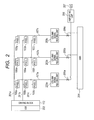
- FIG. 2 is a block diagram illustrating the solid-state imaging apparatus according to one embodiment of the present invention.
- FIG. 3 is a block diagram illustrating an imaging system in which the solid-state imaging apparatus according to the present invention is arranged.
- a pixel is constituted by an N-channel MOS transistor
- the present invention is also applicable to a case where the pixel is constituted by a P-channel MOS transistor. In this case, it only has to invert all polarities of voltages.
- FIG. 1 is a circuit diagram illustrating a pixel to be arranged in a solid-state imaging apparatus according to the first embodiment of the present invention.
- a pixel 100 includes a photodiode 101, a transfer MOS transistor 102, an FD (floating diffusion) 103, an amplifying MOS transistor 104, a reset MOS transistor 105, and a selection transistor 106.
- the photodiode 101 is one example of a photoelectric converting unit.
- the photoelectric converting unit only has to perform photoelectrical conversion for incident light.
- the transfer MOS transistor 102 transfers signal charges generated by the photoelectric conversion to the FD 103.
- the FD 103 is electrically connected to the gate of the amplifying MOS transistor 104.
- the amplifying MOS transistor 104 which constitutes a part of a source follower amplifier, outputs signals according to an amount of the signal charges transferred to the FD 103.
- the gate of the amplifying MOS transistor 104 is the input of the source follower amplifier.
- the reset MOS transistor 105 functions to reset the voltage of the FD 103 to a power supply voltage SVDD. Namely, in the present embodiment, the drain voltages of the amplifying MOS transistor 104 and the reset MOS transistor 105 are equivalent to the common power supply voltage SVDD.
- the selection transistor 106 selects a row from which signal charges should be output.
- the output of the source follower amplifier is connected to a vertical reading line 107, and a constant current source 108 is connected to the vertical reading line 107.
- the amplifying MOS transistor 104 and the constant current source 108 together constitute the source follower amplifier.
- a transfer MOS transistor driving line 109 is connected to the gate of the transfer MOS transistor 102, a reset MOS transistor driving line 110 is connected to the gate of the reset MOS transistor 105, and a selection transistor driving line 111 is connected to the gate of the selection transistor 106.
- the amplifying MOS transistor 104 is a buried-channel MOS transistor.
- P-type impurities are implanted into the semiconductor region near the interface of a gate insulating layer if necessary.
- the P-type impurity boron or the like can be used.
- N-type impurities are implanted into the semiconductor region which is below the semiconductor region into which the P-type impurities have been implanted.
- arsenic or the like can be used as the N-type impurity.
- the N-type semiconductor region is arranged at a deep position of the substrate as compared with the interface between the substrate and the gate insulating layer, the buried-channel MOS transistor can be established.
- the reset MOS transistor 105 and the selection transistor 106 may be the buried-channel MOS transistors respectively.
- a procedure of processes can be simplified. More specifically, in a case where ion implantation is performed to the channel portions of the respective transistors, the ion implantation concerned can be achieved by using a single mask, whereby manufacturing costs can be reduced.
- the transfer MOS transistor 102 which transfers the signal charges generated by the photoelectric conversion to the FD 103 is included in the pixel.
- a predetermined voltage is applied to the gate of the transfer MOS transistor 102 to make the transfer MOS transistor 102 in conduction state, whereby the signal charge in the photodiode 101 is transferred to the FD.
- complete depletion transfer is performed to the charge in the photodiode 101. That is, the constitution for performing the complete depletion transfer to the charge in the photodiode 101 is achieved by providing the transfer MOS transistor 102, whereby occurrence of a leak current in the photodiode 101 can be reduced.
- the driving block 112 supplies a signal, which is necessary for an imaging operation, to the pixel. More specifically, a pulse which is transferred from a vertical shift register is input to a terminal 113, and driving pulses are input to terminals 114, 115 and 116 respectively. Then, a logical operation to the pulse from the vertical shift register and the driving pulse is performed by each logical operation circuit which is included in the driving block 112. Subsequently, outputs from the logical operation circuits are input to driving circuits 117, 118 and 119 respectively.
- the driving circuit 117 supplies the signal to the gate of the reset MOS transistor 105
- the driving circuit 118 supplies the signal to the gate of the transfer MOS transistor 102
- the driving circuit 119 supplies the signal to the gate of the selection transistor 106.
- a voltage VresH is applied to the gate of the reset MOS transistor 105 in a case where the reset MOS transistor is in a conduction state
- a ground potential VSS is applied to the gate of the reset MOS transistor 105 in a case where the reset MOS transistor is in a non-conduction state
- a power supply voltage VDD is applied to the gates of the transfer MOS transistor 102 and the selection transistor 106 in a case where conduction arises in these transistors
- the ground potential VSS is applied to the gates of the transfer MOS transistor 102 and the selection transistor 106 in a case where conduction does not arise in these transistors.
- a negative voltage which is lower than the ground potential may be applied to the gate of the transfer MOS transistor 102 in the case where conduction does not arise in the transfer MOS transistor 102.
- the voltage which is applied to the gate refers the voltage which is applied to the gate of a transistor to make the transistor in a conduction state.
- the power supply voltage SVDD of the source follower amplifier is different from the power supply voltage VDD of the driving circuit which supplies the voltage to the gate of each transistor.
- the power supply voltage VDD is higher than the power supply voltage SVDD.
- the power supply voltage VDD may be the same as the power supply voltage SVDD or less.
- the present embodiment is characterized in that the voltage VresH which is applied to the gate of the reset MOS transistor is lower than the power supply voltage SVDD of the power supply.
- the drain of the amplifying MOS transistor and the drain of the reset MOS transistor are connected to the power supply. Moreover, it is desirable to set the voltage VresH to be lower than the power supply voltage VDD.
- FIG. 2 is a block diagram illustrating the solid-state imaging apparatus in which the pixel circuit illustrated in FIG. 1 is used.
- each of pixels 100a, 100b, 100c, 100d, 100e, 100f, 100g and 100i is equivalent to the pixel 100 illustrated in FIG. 1 .
- FIG. 2 shows an arrangement in which the pixels of 3 rows ⁇ 3 columns are arranged, the present invention is not limited to this. Namely, plural pixels may be arranged linearly or in matrix in the solid-state imaging apparatus.
- each of the horizontal driving lines 201a, 201b and 201c is equivalent to the transfer MOS transistor driving line 109, the reset MOS transistor driving line 110 and the selection transistor driving line 111 respectively illustrated in FIG. 1 .
- a VSR (vertical shift register) 202 is connected to the driving block 112.
- the detailed constitution of the driving block 112 is illustrated in FIG. 1 .
- Column signal reading units 203a, 203b and 203c are used to process the signals output from the pixels.
- An HSR (horizontal shift register) 204 generates a control signal to be used to sequentially read the pixel signals held by each of the column signal reading units 203a, 203b and 203c.
- the pixel signals are sequentially transferred to an amplifying unit 206 by selecting switches 205a, 205b and 205c. Then, the pixel signal is amplified by the amplifying unit 206, and the amplified signal is output from an output terminal 207.
- the voltage VresH is applied to the gate of the reset MOS transistor 105 in the case where conduction arises in the reset MOS transistor 105.
- the driving circuit 117 which supplies the voltage to the gate of the reset MOS transistor 105 is constituted by an inverter circuit, and the power supply voltage of the inverter circuit concerned is given as VresH.
- the power supply voltage VresH is lower than the power supply voltage SVDD to be supplied to the drain of the reset MOS transistor 105.
- VGS VresH - Vth_res
- the gate voltage VGS of the amplifying MOS transistor 104 decreases.
- the power supply voltage SVDD is applied to the drain of the amplifying MOS transistor 104.
- a threshold voltage of the amplifying MOS transistor is given as Vth_sf. SVDD ⁇ VGS - Vth_sf
- the voltage VresH which is applied to the gate of the reset MOS transistor may satisfy the following expression (3) which is obtained from the expressions (1) and (2).
- the voltage VresH is lower than the sum of the drain voltage SVDD of the amplifying MOS transistor, the threshold voltage Vth_sf of the amplifying MOS transistor and the threshold voltage Vth_res of the reset MOS transistor.
- the amplifying MOS transistor 104 can easily operate in the saturation region. Further, since there is provided the driving circuit which supplies the signals by which the voltages at the time of conduction satisfy the conditions given by the expression (3) and (4), the solid-state imaging apparatus of which the linearity is more excellent and satisfactory can be obtained.
- the power supply voltage SVDD of the power supply which is connected to the drain of the reset MOS transistor 105 is 4.8V
- the voltage VDD which is applied to each of the gates of the transfer MOS transistor 102 and the selection transistor 106 in the case conduction arises in each of these transistors is 5.0V
- each of the threshold voltage Vth_sf of the amplifying MOS transistor 104 and the threshold voltage Vth_res of the reset MOS transistor 105 is -0.2V
- the voltage VresH which is applied to the gate of the reset MOS transistor 105 in the case where conduction arises in this transistor is 3.8V.
- the threshold voltage Vth_sf of the amplifying MOS transistor has a value close to 0V or becomes a negative voltage.
- the threshold voltage Vth_res of the reset MOS transistor likewise has a value close to 0V or becomes a negative voltage.
- the drain voltage of the reset MOS transistor 105 and the drain voltage of the amplifying MOS transistor 104 are common to each other. Namely, the number of wirings can be reduced by connecting the respective drains to the common power supply wiring.
- the photodiode 101, the transfer MOS transistor 102, the FD 103, the amplifying MOS transistor 104, the reset MOS transistor 105 and the selection transistor 106 which are included in one pixel are formed on a pixel region of a semiconductor substrate. Further, the pixel regions are arranged linearly or in matrix on the semiconductor substrate. Incidentally, a device separating portion may be arranged between the pixel regions.
- the drain of the amplifying MOS transistor 104 and the drain of the reset MOS transistor 105 are connected to the single wiring which is arranged on the pixel region through an insulating film.
- a substantial aperture ratio of the photoelectric converting unit can be improved.
- the drain voltage of the reset MOS transistor 105 may be supplied independently of the drain voltage of the amplifying MOS transistor 104.
- a constitution in which the gate potential is higher than or equal to the drain potential when conduction arises in the reset MOS transistor will be described as a comparative example.
- a voltage which is substantially the same as the drain voltage of the reset MOS transistor is supplied to the gate of the amplifying MOS transistor which constitutes the source follower amplifier. If the common power supply voltage SVDD is supplied to the drain of the reset MOS transistor and the drain of the amplifying MOS transistor, SVDD ⁇ VGS is obtained in the expression (2). For this reason, in order to satisfy the condition that the amplifying MOS transistor operates in the saturation region, or in order to satisfy the expression (2), the threshold voltage Vth has to be a positive voltage.
- the buried-channel MOS transistor of which the threshold voltage Vth is negative does not operate in the saturation region. Further, even if the average value of the threshold voltages Vth of the plural pixels is positive, there is a possibility that the threshold voltages Vth of the amplifying MOS transistors of the partial pixels are negative because of a variation of devices due to a manufacturing process and the like. For this reason, linearity cannot be improved by the constitution of the comparative example.
- the voltage which is applied to the gate of the reset MOS transistor is lower than the power supply voltage VDD.
- the buried-channel MOS transistor which is used for the source follower amplifier operates easily in the saturation region.
- a voltage which is applied to the gate of the reset MOS transistor 105 is not decreased. Instead, a threshold voltage Vth of the reset MOS transistor 105 is increased. More specifically, the power supply of the driving circuit 117 is set to have a power supply voltage VDD, so that the voltage to be applied to the gate of the reset MOS transistor 105 is set to the power supply voltage VDD.
- the threshold voltage Vth of the reset MOS transistor 105 is set to satisfy the following expression (5) which is obtained by substituting the power supply voltage VDD to the threshold voltage VresH in the expression (3).
- the threshold voltage Vth_res of the reset MOS transistor 105 is equal to or higher than 0.2V.
- the threshold value of the reset MOS transistor 105 is the value which satisfies the expression (5).
- FIG. 3 is a block diagram illustrating a digital still camera as an example of the imaging system.
- a barrier 1 is used to protect a lens 2, and the lens 2 provides an optical image of a subject on a solid-state imaging apparatus 4.
- a diaphragm 3 varies an amount of light which passed through the lens 2, and the solid-state imaging apparatus 4, which has been described in the above embodiments, converts the optical image provided by the lens 2 into image data.
- an A/D (analog-to-digital) converter is provided on the substrate of the solid-state imaging apparatus 4.
- a signal processing unit 7 performs various processes such as a correction process, a compression process and the like to the image data output from the solid-state imaging apparatus 4, a timing generation unit 8 generates timing signals to the solid-state imaging apparatus 4 and the signal processing unit 7, an overall controlling/calculating unit 9 which performs various calculations and controls the overall of the digital still camera, a memory unit 10 is used to temporarily store the image data, a recording medium control I/F (interface) unit 11 is used to perform recording or reading to a recording medium 12, the recording medium 12 such as a detachably provided semiconductor memory or the like is used to record and/or read the image data, and an external I/F unit 13 is used to perform communication with an external computer and the like.
- the timing signal or the like may be input from the outside of the imaging system, and the imaging system only has to provide at least the solid-state imaging apparatus 4 and the signal processing unit 7 for processing the image signal output from the solid-state imaging apparatus 4.
- the solid-state imaging apparatus 4 and the A/D converter are provided on the same substrate.
- the solid-state imaging apparatus 4 and the A/D converter may be provided respectively on different substrates.
- the solid-state imaging apparatus 4 and the signal processing unit 7 may be provided on the same substrate.
- the solid-state imaging apparatus according to the present invention can be applied to the camera system. That is, if the solid-state imaging apparatus according to the present invention is applied to the camera system, an image in which in which linearity is excellent and satisfactory and noises are reduced can be taken.
- the pixel is exemplarily constituted by the N-channel MOS transistor.
- the present invention is also applicable to a case where the pixel is constituted by a P-channel MOS transistor.
- the amplifying MOS transistor is constituted by the P-channel MOS transistor, the 1/f noise is reduced as compared with the case where the N-channel MOS transistor is used.
- the pixel in the case where the pixel is constituted by the P-channel MOS transistor, it only has to invert all the polarities of the voltages. That is, a ground potential SVSS is applied to the drain of the reset MOS transistor and the drain of the amplifying MOS transistor.
- a power supply voltage SVSS of the power supply to which the drain of the reset MOS transistor and the drain of the amplifying MOS transistor are connected is a negative voltage which is lower than the ground potential.
- the voltage VSS which is applied to the date of each transistor in the case where conduction arises in the transistor concerned is a negative voltage which is lower than the ground potential.
- the pixel is constituted by the P-channel MOS transistor
- a voltage which is higher than the voltage to be applied to the drain of the amplifying MOS transistor is applied to the gate of the reset MOS transistor.
- the power supply voltage SVDD is replaced by the drain voltage SVSS, and the direction of the inequality sign is inverted.
- the amplifying MOS transistor is the P-type buried-channel MOS transistor
- the threshold voltage shifts from a negative voltage to a positive voltage.
- the P-channel MOS transistor As a concrete constitution by which the P-channel MOS transistor is applied to the pixel, a constitution in which holes are collected as signal charges is conceivable. In such a case, all the transistors in the pixels can be constituted by the P-channel MOS transistors. As a result, since all the MOS transistors of the pixels can be formed in an N-type well, the pixel can easily be made fine. Besides, the amplifying MOS transistor which is constituted by the P-channel MOS transistor may be arranged in the N-type well by using electrons as the signal charges.
- the transfer MOS transistor is formed in a P-type well, for example, a back-illuminated constitution in which circuits to be arranged at the stage subsequent to the floating diffusion are formed on a substrate which is different from the photoelectric converting unit is conceived in case of making the pixel fine.
- a solid-state imaging apparatus is characterized in that a reset gate voltage VresH to be applied to a gate of a reset MOS transistor is lower than a power supply voltage SVDD of a power supply to which drains of an amplifying MOS transistor and the reset MOS transistor are connected.
Landscapes
- Solid State Image Pick-Up Elements (AREA)
- Transforming Light Signals Into Electric Signals (AREA)
Applications Claiming Priority (1)
| Application Number | Priority Date | Filing Date | Title |
|---|---|---|---|
| JP2009295442A JP5538876B2 (ja) | 2009-12-25 | 2009-12-25 | 固体撮像装置 |
Publications (2)
| Publication Number | Publication Date |
|---|---|
| EP2339629A2 true EP2339629A2 (de) | 2011-06-29 |
| EP2339629A3 EP2339629A3 (de) | 2012-05-23 |
Family
ID=43877076
Family Applications (1)
| Application Number | Title | Priority Date | Filing Date |
|---|---|---|---|
| EP10194854A Withdrawn EP2339629A3 (de) | 2009-12-25 | 2010-12-14 | Festkörperabbildungsvorrichtung |
Country Status (4)
| Country | Link |
|---|---|
| US (1) | US8525896B2 (de) |
| EP (1) | EP2339629A3 (de) |
| JP (1) | JP5538876B2 (de) |
| CN (1) | CN102110701B (de) |
Cited By (1)
| Publication number | Priority date | Publication date | Assignee | Title |
|---|---|---|---|---|
| CN103716559A (zh) * | 2014-01-13 | 2014-04-09 | 中国科学院上海高等研究院 | 像素单元读出装置及方法、像素阵列读出装置及方法 |
Families Citing this family (14)
| Publication number | Priority date | Publication date | Assignee | Title |
|---|---|---|---|---|
| KR102056905B1 (ko) * | 2011-07-25 | 2019-12-18 | 삼성전자주식회사 | 광센싱 장치 및 그 구동 방법, 광센싱 장치를 포함하는 광터치 스크린 장치 |
| US9891102B2 (en) | 2010-04-22 | 2018-02-13 | Samsung Electronics Co., Ltd. | Simplified light sensing circuit, light sensing apparatus including the light sensing circuit, method of driving the light sensing apparatus, and image acquisition apparatus and optical touch screen apparatus including the light sensing apparatus |
| US8445828B2 (en) | 2010-07-01 | 2013-05-21 | Silicon Optronics, Inc. | High dynamic range image sensor with in pixel memory |
| WO2013027524A1 (ja) * | 2011-08-24 | 2013-02-28 | シャープ株式会社 | 固体撮像素子 |
| JP5864990B2 (ja) | 2011-10-03 | 2016-02-17 | キヤノン株式会社 | 固体撮像装置およびカメラ |
| JP5967915B2 (ja) | 2011-12-09 | 2016-08-10 | キヤノン株式会社 | 固体撮像装置の駆動方法 |
| JP5967944B2 (ja) | 2012-01-18 | 2016-08-10 | キヤノン株式会社 | 固体撮像装置およびカメラ |
| JP6023437B2 (ja) | 2012-02-29 | 2016-11-09 | キヤノン株式会社 | 固体撮像装置及びカメラ |
| JP6174901B2 (ja) | 2013-05-10 | 2017-08-02 | キヤノン株式会社 | 固体撮像装置及びカメラ |
| US9654714B2 (en) | 2013-11-01 | 2017-05-16 | Silicon Optronics, Inc. | Shared pixel with fixed conversion gain |
| JP6109125B2 (ja) | 2014-08-20 | 2017-04-05 | キヤノン株式会社 | 半導体装置、固体撮像装置、および撮像システム |
| JP6700656B2 (ja) * | 2014-10-31 | 2020-05-27 | キヤノン株式会社 | 撮像装置 |
| JP6738200B2 (ja) | 2016-05-26 | 2020-08-12 | キヤノン株式会社 | 撮像装置 |
| US10319765B2 (en) | 2016-07-01 | 2019-06-11 | Canon Kabushiki Kaisha | Imaging device having an effective pixel region, an optical black region and a dummy region each with pixels including a photoelectric converter |
Citations (3)
| Publication number | Priority date | Publication date | Assignee | Title |
|---|---|---|---|---|
| JP2000244818A (ja) | 1999-02-24 | 2000-09-08 | Sharp Corp | 増幅型固体撮像装置 |
| US20030146993A1 (en) * | 2002-02-06 | 2003-08-07 | Fujitsu Limited | CMOS image sensor |
| JP2005286168A (ja) | 2004-03-30 | 2005-10-13 | Canon Inc | 半導体装置及びそれを用いた固体撮像装置並びにそれらの製造方法 |
Family Cites Families (32)
| Publication number | Priority date | Publication date | Assignee | Title |
|---|---|---|---|---|
| JP3461265B2 (ja) | 1996-09-19 | 2003-10-27 | 株式会社東芝 | 固体撮像装置および固体撮像装置応用システム |
| US6674470B1 (en) * | 1996-09-19 | 2004-01-06 | Kabushiki Kaisha Toshiba | MOS-type solid state imaging device with high sensitivity |
| JP3487575B2 (ja) * | 1997-12-26 | 2004-01-19 | キヤノン株式会社 | 光電変換装置 |
| JP3428875B2 (ja) * | 1997-09-29 | 2003-07-22 | キヤノン株式会社 | 光電変換装置 |
| JP3466886B2 (ja) * | 1997-10-06 | 2003-11-17 | キヤノン株式会社 | 固体撮像装置 |
| US6242728B1 (en) * | 1998-08-20 | 2001-06-05 | Foveon, Inc. | CMOS active pixel sensor using native transistors |
| JP3725007B2 (ja) * | 2000-06-06 | 2005-12-07 | シャープ株式会社 | 対数変換型画素構造およびそれを用いた固体撮像装置 |
| CA2436988C (en) * | 2000-12-26 | 2008-12-23 | Honda Giken Kogyo Kabushiki Kaisha | Image processor |
| DE60326544D1 (de) * | 2002-01-24 | 2009-04-23 | Koninkl Philips Electronics Nv | Abbildungsvorrichtung |
| JP3921093B2 (ja) * | 2002-01-29 | 2007-05-30 | シャープ株式会社 | 増幅型固体撮像装置 |
| JP4164733B2 (ja) * | 2002-02-05 | 2008-10-15 | ソニー株式会社 | 固体撮像装置及びその駆動方法 |
| JP4242258B2 (ja) * | 2003-11-21 | 2009-03-25 | シャープ株式会社 | 固体撮像素子 |
| JP4067054B2 (ja) * | 2004-02-13 | 2008-03-26 | キヤノン株式会社 | 固体撮像装置および撮像システム |
| JP2006073736A (ja) * | 2004-09-01 | 2006-03-16 | Canon Inc | 光電変換装置、固体撮像装置及び固体撮像システム |
| JP4916101B2 (ja) * | 2004-09-01 | 2012-04-11 | キヤノン株式会社 | 光電変換装置、固体撮像装置及び固体撮像システム |
| JP4513497B2 (ja) * | 2004-10-19 | 2010-07-28 | ソニー株式会社 | 固体撮像装置 |
| JP2006197392A (ja) * | 2005-01-14 | 2006-07-27 | Canon Inc | 固体撮像装置、カメラ、及び固体撮像装置の駆動方法 |
| JP4416668B2 (ja) * | 2005-01-14 | 2010-02-17 | キヤノン株式会社 | 固体撮像装置、その制御方法及びカメラ |
| JP4459064B2 (ja) * | 2005-01-14 | 2010-04-28 | キヤノン株式会社 | 固体撮像装置、その制御方法及びカメラ |
| JP4677258B2 (ja) * | 2005-03-18 | 2011-04-27 | キヤノン株式会社 | 固体撮像装置及びカメラ |
| JP4459099B2 (ja) * | 2005-03-18 | 2010-04-28 | キヤノン株式会社 | 固体撮像装置及びカメラ |
| JP4459098B2 (ja) * | 2005-03-18 | 2010-04-28 | キヤノン株式会社 | 固体撮像装置及びカメラ |
| JP4110193B1 (ja) * | 2007-05-02 | 2008-07-02 | キヤノン株式会社 | 固体撮像装置および撮像システム |
| JP4991436B2 (ja) * | 2007-08-02 | 2012-08-01 | キヤノン株式会社 | 撮像装置及び撮像システム |
| JP2009117613A (ja) * | 2007-11-06 | 2009-05-28 | Toshiba Corp | 半導体装置 |
| JP5167799B2 (ja) * | 2007-12-18 | 2013-03-21 | ソニー株式会社 | 固体撮像装置およびカメラ |
| JP5156434B2 (ja) * | 2008-02-29 | 2013-03-06 | キヤノン株式会社 | 撮像装置および撮像システム |
| JP5568880B2 (ja) * | 2008-04-03 | 2014-08-13 | ソニー株式会社 | 固体撮像装置、固体撮像装置の駆動方法および電子機器 |
| JP5089514B2 (ja) * | 2008-07-11 | 2012-12-05 | キヤノン株式会社 | 撮像装置、及び撮像システム |
| JP4617372B2 (ja) * | 2008-08-29 | 2011-01-26 | キヤノン株式会社 | 撮像装置及び撮像システム |
| US8913166B2 (en) * | 2009-01-21 | 2014-12-16 | Canon Kabushiki Kaisha | Solid-state imaging apparatus |
| JP2011091474A (ja) * | 2009-10-20 | 2011-05-06 | Sony Corp | 固体撮像装置及び撮像機器 |
-
2009
- 2009-12-25 JP JP2009295442A patent/JP5538876B2/ja not_active Expired - Fee Related
-
2010
- 2010-12-01 US US12/957,797 patent/US8525896B2/en not_active Expired - Fee Related
- 2010-12-14 EP EP10194854A patent/EP2339629A3/de not_active Withdrawn
- 2010-12-21 CN CN2010105972529A patent/CN102110701B/zh not_active Expired - Fee Related
Patent Citations (3)
| Publication number | Priority date | Publication date | Assignee | Title |
|---|---|---|---|---|
| JP2000244818A (ja) | 1999-02-24 | 2000-09-08 | Sharp Corp | 増幅型固体撮像装置 |
| US20030146993A1 (en) * | 2002-02-06 | 2003-08-07 | Fujitsu Limited | CMOS image sensor |
| JP2005286168A (ja) | 2004-03-30 | 2005-10-13 | Canon Inc | 半導体装置及びそれを用いた固体撮像装置並びにそれらの製造方法 |
Cited By (2)
| Publication number | Priority date | Publication date | Assignee | Title |
|---|---|---|---|---|
| CN103716559A (zh) * | 2014-01-13 | 2014-04-09 | 中国科学院上海高等研究院 | 像素单元读出装置及方法、像素阵列读出装置及方法 |
| CN103716559B (zh) * | 2014-01-13 | 2017-02-15 | 中国科学院上海高等研究院 | 像素单元读出装置及方法、像素阵列读出装置及方法 |
Also Published As
| Publication number | Publication date |
|---|---|
| JP2011135515A (ja) | 2011-07-07 |
| CN102110701A (zh) | 2011-06-29 |
| CN102110701B (zh) | 2013-12-18 |
| US8525896B2 (en) | 2013-09-03 |
| US20110157398A1 (en) | 2011-06-30 |
| EP2339629A3 (de) | 2012-05-23 |
| JP5538876B2 (ja) | 2014-07-02 |
Similar Documents
| Publication | Publication Date | Title |
|---|---|---|
| EP2339629A2 (de) | Festkörperabbildungsvorrichtung | |
| US8085330B2 (en) | Image pickup apparatus | |
| US9083901B2 (en) | Solid-state image pickup device and method of resetting the same | |
| US8253833B2 (en) | Solid-state imaging device driving method | |
| US8427567B2 (en) | Image sensing apparatus and image capturing system | |
| US20110221943A1 (en) | Solid image pickup device, image pickup system and method of driving solid image pickup device | |
| JP5316606B2 (ja) | 固体撮像素子及びその製造方法 | |
| KR101031982B1 (ko) | 고상 촬상 디바이스 및 그 구동 방법 | |
| CN102316279B (zh) | 固体摄像元件 | |
| EP1583351B1 (de) | Verstärkender Festkörperbildsensor | |
| US7541571B2 (en) | Image sensor having first and second charge transmitters | |
| CN100539631C (zh) | 放大型固态图像摄取装置 | |
| CN115767294B (zh) | 摄像元件及摄像装置 | |
| JP5645553B2 (ja) | 固体撮像装置及び撮像システム | |
| US7859032B2 (en) | Solid-state imaging device and method for driving the same | |
| US7030915B2 (en) | Signal processing apparatus | |
| JP2006100761A (ja) | 固体撮像素子及びその製造方法並びに固体撮像素子の駆動方法 | |
| JP3597176B2 (ja) | Ccd型固体撮像素子 | |
| JP4618170B2 (ja) | 固体撮像装置 | |
| JP3585898B2 (ja) | Ccd型固体撮像素子を用いたカメラ | |
| JP4561651B2 (ja) | 固体撮像素子 | |
| JP4760325B2 (ja) | 固体撮像素子及びその製造方法 | |
| JP2007019681A (ja) | 固体撮像素子の駆動方法 |
Legal Events
| Date | Code | Title | Description |
|---|---|---|---|
| PUAI | Public reference made under article 153(3) epc to a published international application that has entered the european phase |
Free format text: ORIGINAL CODE: 0009012 |
|
| AK | Designated contracting states |
Kind code of ref document: A2 Designated state(s): AL AT BE BG CH CY CZ DE DK EE ES FI FR GB GR HR HU IE IS IT LI LT LU LV MC MK MT NL NO PL PT RO RS SE SI SK SM TR |
|
| AX | Request for extension of the european patent |
Extension state: BA ME |
|
| PUAL | Search report despatched |
Free format text: ORIGINAL CODE: 0009013 |
|
| AK | Designated contracting states |
Kind code of ref document: A3 Designated state(s): AL AT BE BG CH CY CZ DE DK EE ES FI FR GB GR HR HU IE IS IT LI LT LU LV MC MK MT NL NO PL PT RO RS SE SI SK SM TR |
|
| AX | Request for extension of the european patent |
Extension state: BA ME |
|
| RIC1 | Information provided on ipc code assigned before grant |
Ipc: H01L 27/146 20060101AFI20120418BHEP |
|
| 17P | Request for examination filed |
Effective date: 20121123 |
|
| 17Q | First examination report despatched |
Effective date: 20151022 |
|
| GRAP | Despatch of communication of intention to grant a patent |
Free format text: ORIGINAL CODE: EPIDOSNIGR1 |
|
| INTG | Intention to grant announced |
Effective date: 20170323 |
|
| STAA | Information on the status of an ep patent application or granted ep patent |
Free format text: STATUS: THE APPLICATION HAS BEEN WITHDRAWN |
|
| 18W | Application withdrawn |
Effective date: 20170523 |