EP2305614B1 - Lithium silicate materials - Google Patents
Lithium silicate materials Download PDFInfo
- Publication number
- EP2305614B1 EP2305614B1 EP10013130.9A EP10013130A EP2305614B1 EP 2305614 B1 EP2305614 B1 EP 2305614B1 EP 10013130 A EP10013130 A EP 10013130A EP 2305614 B1 EP2305614 B1 EP 2305614B1
- Authority
- EP
- European Patent Office
- Prior art keywords
- glass
- blank
- temperature
- lithium
- starting
- Prior art date
- Legal status (The legal status is an assumption and is not a legal conclusion. Google has not performed a legal analysis and makes no representation as to the accuracy of the status listed.)
- Expired - Lifetime
Links
- PAZHGORSDKKUPI-UHFFFAOYSA-N lithium metasilicate Chemical compound [Li+].[Li+].[O-][Si]([O-])=O PAZHGORSDKKUPI-UHFFFAOYSA-N 0.000 title claims abstract description 112
- 229910052912 lithium silicate Inorganic materials 0.000 title claims abstract description 105
- 239000000463 material Substances 0.000 title claims abstract description 44
- 238000003754 machining Methods 0.000 claims abstract description 20
- 239000011521 glass Substances 0.000 claims description 87
- 238000000034 method Methods 0.000 claims description 69
- 238000010438 heat treatment Methods 0.000 claims description 36
- 239000000919 ceramic Substances 0.000 claims description 32
- 239000013078 crystal Substances 0.000 claims description 30
- 238000003801 milling Methods 0.000 claims description 26
- VYPSYNLAJGMNEJ-UHFFFAOYSA-N Silicium dioxide Chemical compound O=[Si]=O VYPSYNLAJGMNEJ-UHFFFAOYSA-N 0.000 claims description 25
- DLYUQMMRRRQYAE-UHFFFAOYSA-N tetraphosphorus decaoxide Chemical compound O1P(O2)(=O)OP3(=O)OP1(=O)OP2(=O)O3 DLYUQMMRRRQYAE-UHFFFAOYSA-N 0.000 claims description 24
- 239000005368 silicate glass Substances 0.000 claims description 20
- 238000007731 hot pressing Methods 0.000 claims description 18
- 238000004519 manufacturing process Methods 0.000 claims description 16
- 239000002241 glass-ceramic Substances 0.000 claims description 15
- PNEYBMLMFCGWSK-UHFFFAOYSA-N aluminium oxide Inorganic materials [O-2].[O-2].[O-2].[Al+3].[Al+3] PNEYBMLMFCGWSK-UHFFFAOYSA-N 0.000 claims description 14
- 239000000155 melt Substances 0.000 claims description 14
- 229910052906 cristobalite Inorganic materials 0.000 claims description 12
- 239000000377 silicon dioxide Substances 0.000 claims description 12
- 229910052681 coesite Inorganic materials 0.000 claims description 11
- 229910052593 corundum Inorganic materials 0.000 claims description 11
- 229910052751 metal Inorganic materials 0.000 claims description 11
- 239000002184 metal Substances 0.000 claims description 11
- 229910052682 stishovite Inorganic materials 0.000 claims description 11
- 229910052905 tridymite Inorganic materials 0.000 claims description 11
- 229910001845 yogo sapphire Inorganic materials 0.000 claims description 11
- FUJCRWPEOMXPAD-UHFFFAOYSA-N Li2O Inorganic materials [Li+].[Li+].[O-2] FUJCRWPEOMXPAD-UHFFFAOYSA-N 0.000 claims description 10
- XUCJHNOBJLKZNU-UHFFFAOYSA-M dilithium;hydroxide Chemical compound [Li+].[Li+].[OH-] XUCJHNOBJLKZNU-UHFFFAOYSA-M 0.000 claims description 10
- 238000000227 grinding Methods 0.000 claims description 10
- 238000001816 cooling Methods 0.000 claims description 9
- NOTVAPJNGZMVSD-UHFFFAOYSA-N potassium monoxide Inorganic materials [K]O[K] NOTVAPJNGZMVSD-UHFFFAOYSA-N 0.000 claims description 6
- CHWRSCGUEQEHOH-UHFFFAOYSA-N potassium oxide Chemical compound [O-2].[K+].[K+] CHWRSCGUEQEHOH-UHFFFAOYSA-N 0.000 claims description 6
- 239000000956 alloy Substances 0.000 claims description 4
- 229910045601 alloy Inorganic materials 0.000 claims description 4
- 230000010485 coping Effects 0.000 claims description 4
- 238000007493 shaping process Methods 0.000 claims description 4
- 238000002425 crystallisation Methods 0.000 description 36
- WVMPCBWWBLZKPD-UHFFFAOYSA-N dilithium oxido-[oxido(oxo)silyl]oxy-oxosilane Chemical compound [Li+].[Li+].[O-][Si](=O)O[Si]([O-])=O WVMPCBWWBLZKPD-UHFFFAOYSA-N 0.000 description 34
- 239000000047 product Substances 0.000 description 28
- 230000008025 crystallization Effects 0.000 description 23
- 239000003103 lithium disilicate glass Substances 0.000 description 19
- 238000012360 testing method Methods 0.000 description 19
- MCMNRKCIXSYSNV-UHFFFAOYSA-N Zirconium dioxide Chemical compound O=[Zr]=O MCMNRKCIXSYSNV-UHFFFAOYSA-N 0.000 description 12
- 239000000203 mixture Substances 0.000 description 12
- 238000007711 solidification Methods 0.000 description 11
- 230000008023 solidification Effects 0.000 description 11
- 239000000126 substance Substances 0.000 description 11
- 238000004040 coloring Methods 0.000 description 9
- 239000006065 metasilicate glass ceramic Substances 0.000 description 9
- 238000004458 analytical method Methods 0.000 description 7
- 230000015572 biosynthetic process Effects 0.000 description 7
- 238000005259 measurement Methods 0.000 description 7
- 239000000523 sample Substances 0.000 description 7
- QTBSBXVTEAMEQO-UHFFFAOYSA-N Acetic acid Chemical compound CC(O)=O QTBSBXVTEAMEQO-UHFFFAOYSA-N 0.000 description 6
- 210000004268 dentin Anatomy 0.000 description 6
- 229910044991 metal oxide Inorganic materials 0.000 description 6
- 150000004706 metal oxides Chemical class 0.000 description 6
- 230000006911 nucleation Effects 0.000 description 6
- 238000010899 nucleation Methods 0.000 description 6
- RVTZCBVAJQQJTK-UHFFFAOYSA-N oxygen(2-);zirconium(4+) Chemical compound [O-2].[O-2].[Zr+4] RVTZCBVAJQQJTK-UHFFFAOYSA-N 0.000 description 6
- 238000012545 processing Methods 0.000 description 6
- 229910001928 zirconium oxide Inorganic materials 0.000 description 6
- KKCBUQHMOMHUOY-UHFFFAOYSA-N Na2O Inorganic materials [O-2].[Na+].[Na+] KKCBUQHMOMHUOY-UHFFFAOYSA-N 0.000 description 5
- 229910000831 Steel Inorganic materials 0.000 description 5
- 238000002441 X-ray diffraction Methods 0.000 description 5
- 230000003287 optical effect Effects 0.000 description 5
- 239000010959 steel Substances 0.000 description 5
- 239000011248 coating agent Substances 0.000 description 4
- 238000000576 coating method Methods 0.000 description 4
- 238000005245 sintering Methods 0.000 description 4
- XLYOFNOQVPJJNP-UHFFFAOYSA-N water Substances O XLYOFNOQVPJJNP-UHFFFAOYSA-N 0.000 description 4
- 238000005452 bending Methods 0.000 description 3
- 238000006243 chemical reaction Methods 0.000 description 3
- 239000003795 chemical substances by application Substances 0.000 description 3
- 238000010304 firing Methods 0.000 description 3
- 239000000156 glass melt Substances 0.000 description 3
- 239000008187 granular material Substances 0.000 description 3
- 238000011835 investigation Methods 0.000 description 3
- 229910001386 lithium phosphate Inorganic materials 0.000 description 3
- 239000002245 particle Substances 0.000 description 3
- 238000009966 trimming Methods 0.000 description 3
- 229910052684 Cerium Inorganic materials 0.000 description 2
- 239000006088 Fotoceram Substances 0.000 description 2
- -1 MeIIO Inorganic materials 0.000 description 2
- 229910052777 Praseodymium Inorganic materials 0.000 description 2
- 229910052771 Terbium Inorganic materials 0.000 description 2
- GWEVSGVZZGPLCZ-UHFFFAOYSA-N Titan oxide Chemical compound O=[Ti]=O GWEVSGVZZGPLCZ-UHFFFAOYSA-N 0.000 description 2
- 229910010293 ceramic material Inorganic materials 0.000 description 2
- 238000010276 construction Methods 0.000 description 2
- 229940023487 dental product Drugs 0.000 description 2
- 238000001938 differential scanning calorimetry curve Methods 0.000 description 2
- 230000000694 effects Effects 0.000 description 2
- 229910052742 iron Inorganic materials 0.000 description 2
- 229910052748 manganese Inorganic materials 0.000 description 2
- NUJOXMJBOLGQSY-UHFFFAOYSA-N manganese dioxide Chemical compound O=[Mn]=O NUJOXMJBOLGQSY-UHFFFAOYSA-N 0.000 description 2
- 239000006089 photosensitive glass Substances 0.000 description 2
- BASFCYQUMIYNBI-UHFFFAOYSA-N platinum Chemical compound [Pt] BASFCYQUMIYNBI-UHFFFAOYSA-N 0.000 description 2
- 239000000843 powder Substances 0.000 description 2
- 239000013074 reference sample Substances 0.000 description 2
- 238000001878 scanning electron micrograph Methods 0.000 description 2
- 229910052715 tantalum Inorganic materials 0.000 description 2
- 229910052719 titanium Inorganic materials 0.000 description 2
- TWQULNDIKKJZPH-UHFFFAOYSA-K trilithium;phosphate Chemical compound [Li+].[Li+].[Li+].[O-]P([O-])([O-])=O TWQULNDIKKJZPH-UHFFFAOYSA-K 0.000 description 2
- 229910052720 vanadium Inorganic materials 0.000 description 2
- 229910052727 yttrium Inorganic materials 0.000 description 2
- 229910007562 Li2SiO3 Inorganic materials 0.000 description 1
- 229910019142 PO4 Inorganic materials 0.000 description 1
- 238000007545 Vickers hardness test Methods 0.000 description 1
- QCWXUUIWCKQGHC-UHFFFAOYSA-N Zirconium Chemical compound [Zr] QCWXUUIWCKQGHC-UHFFFAOYSA-N 0.000 description 1
- 238000010521 absorption reaction Methods 0.000 description 1
- 230000002378 acidificating effect Effects 0.000 description 1
- 239000000654 additive Substances 0.000 description 1
- 230000002411 adverse Effects 0.000 description 1
- 239000004411 aluminium Substances 0.000 description 1
- 229910052782 aluminium Inorganic materials 0.000 description 1
- XAGFODPZIPBFFR-UHFFFAOYSA-N aluminium Chemical compound [Al] XAGFODPZIPBFFR-UHFFFAOYSA-N 0.000 description 1
- 238000013459 approach Methods 0.000 description 1
- 230000009286 beneficial effect Effects 0.000 description 1
- 239000002419 bulk glass Substances 0.000 description 1
- 229910052799 carbon Inorganic materials 0.000 description 1
- 150000004649 carbonic acid derivatives Chemical class 0.000 description 1
- 238000005266 casting Methods 0.000 description 1
- CETPSERCERDGAM-UHFFFAOYSA-N ceric oxide Chemical compound O=[Ce]=O CETPSERCERDGAM-UHFFFAOYSA-N 0.000 description 1
- 229910000422 cerium(IV) oxide Inorganic materials 0.000 description 1
- 238000012733 comparative method Methods 0.000 description 1
- 150000001875 compounds Chemical class 0.000 description 1
- 238000011960 computer-aided design Methods 0.000 description 1
- 238000005520 cutting process Methods 0.000 description 1
- 230000007423 decrease Effects 0.000 description 1
- 238000011161 development Methods 0.000 description 1
- 229910003460 diamond Inorganic materials 0.000 description 1
- 239000010432 diamond Substances 0.000 description 1
- 238000000113 differential scanning calorimetry Methods 0.000 description 1
- 230000004069 differentiation Effects 0.000 description 1
- 239000006136 disilicate glass ceramic Substances 0.000 description 1
- VQCBHWLJZDBHOS-UHFFFAOYSA-N erbium(III) oxide Inorganic materials O=[Er]O[Er]=O VQCBHWLJZDBHOS-UHFFFAOYSA-N 0.000 description 1
- 239000012467 final product Substances 0.000 description 1
- 239000012530 fluid Substances 0.000 description 1
- 230000009477 glass transition Effects 0.000 description 1
- 238000001483 high-temperature X-ray diffraction Methods 0.000 description 1
- 238000007373 indentation Methods 0.000 description 1
- JEIPFZHSYJVQDO-UHFFFAOYSA-N iron(III) oxide Inorganic materials O=[Fe]O[Fe]=O JEIPFZHSYJVQDO-UHFFFAOYSA-N 0.000 description 1
- MRELNEQAGSRDBK-UHFFFAOYSA-N lanthanum oxide Inorganic materials [O-2].[O-2].[O-2].[La+3].[La+3] MRELNEQAGSRDBK-UHFFFAOYSA-N 0.000 description 1
- 239000007788 liquid Substances 0.000 description 1
- 150000002739 metals Chemical class 0.000 description 1
- 239000012768 molten material Substances 0.000 description 1
- 210000000214 mouth Anatomy 0.000 description 1
- 239000002667 nucleating agent Substances 0.000 description 1
- KTUFCUMIWABKDW-UHFFFAOYSA-N oxo(oxolanthaniooxy)lanthanum Chemical compound O=[La]O[La]=O KTUFCUMIWABKDW-UHFFFAOYSA-N 0.000 description 1
- 239000006132 parent glass Substances 0.000 description 1
- 235000021317 phosphate Nutrition 0.000 description 1
- 150000003013 phosphoric acid derivatives Chemical class 0.000 description 1
- 229910052697 platinum Inorganic materials 0.000 description 1
- PXXKQOPKNFECSZ-UHFFFAOYSA-N platinum rhodium Chemical compound [Rh].[Pt] PXXKQOPKNFECSZ-UHFFFAOYSA-N 0.000 description 1
- 238000013001 point bending Methods 0.000 description 1
- 239000012254 powdered material Substances 0.000 description 1
- 238000002360 preparation method Methods 0.000 description 1
- 238000003825 pressing Methods 0.000 description 1
- 238000010791 quenching Methods 0.000 description 1
- 230000000171 quenching effect Effects 0.000 description 1
- 238000005488 sandblasting Methods 0.000 description 1
- 239000006017 silicate glass-ceramic Substances 0.000 description 1
- 230000003381 solubilizing effect Effects 0.000 description 1
- 230000003595 spectral effect Effects 0.000 description 1
- 239000007858 starting material Substances 0.000 description 1
- 230000009897 systematic effect Effects 0.000 description 1
- PBCFLUZVCVVTBY-UHFFFAOYSA-N tantalum pentoxide Inorganic materials O=[Ta](=O)O[Ta](=O)=O PBCFLUZVCVVTBY-UHFFFAOYSA-N 0.000 description 1
- 229910052845 zircon Inorganic materials 0.000 description 1
- 229910052726 zirconium Inorganic materials 0.000 description 1
Images



Classifications
-
- C—CHEMISTRY; METALLURGY
- C03—GLASS; MINERAL OR SLAG WOOL
- C03C—CHEMICAL COMPOSITION OF GLASSES, GLAZES OR VITREOUS ENAMELS; SURFACE TREATMENT OF GLASS; SURFACE TREATMENT OF FIBRES OR FILAMENTS MADE FROM GLASS, MINERALS OR SLAGS; JOINING GLASS TO GLASS OR OTHER MATERIALS
- C03C10/00—Devitrified glass ceramics, i.e. glass ceramics having a crystalline phase dispersed in a glassy phase and constituting at least 50% by weight of the total composition
- C03C10/0018—Devitrified glass ceramics, i.e. glass ceramics having a crystalline phase dispersed in a glassy phase and constituting at least 50% by weight of the total composition containing SiO2, Al2O3 and monovalent metal oxide as main constituents
- C03C10/0027—Devitrified glass ceramics, i.e. glass ceramics having a crystalline phase dispersed in a glassy phase and constituting at least 50% by weight of the total composition containing SiO2, Al2O3 and monovalent metal oxide as main constituents containing SiO2, Al2O3, Li2O as main constituents
-
- A—HUMAN NECESSITIES
- A61—MEDICAL OR VETERINARY SCIENCE; HYGIENE
- A61K—PREPARATIONS FOR MEDICAL, DENTAL OR TOILETRY PURPOSES
- A61K6/00—Preparations for dentistry
- A61K6/70—Preparations for dentistry comprising inorganic additives
- A61K6/78—Pigments
-
- A—HUMAN NECESSITIES
- A61—MEDICAL OR VETERINARY SCIENCE; HYGIENE
- A61K—PREPARATIONS FOR MEDICAL, DENTAL OR TOILETRY PURPOSES
- A61K6/00—Preparations for dentistry
- A61K6/80—Preparations for artificial teeth, for filling teeth or for capping teeth
- A61K6/802—Preparations for artificial teeth, for filling teeth or for capping teeth comprising ceramics
- A61K6/807—Preparations for artificial teeth, for filling teeth or for capping teeth comprising ceramics comprising magnesium oxide
-
- A—HUMAN NECESSITIES
- A61—MEDICAL OR VETERINARY SCIENCE; HYGIENE
- A61K—PREPARATIONS FOR MEDICAL, DENTAL OR TOILETRY PURPOSES
- A61K6/00—Preparations for dentistry
- A61K6/80—Preparations for artificial teeth, for filling teeth or for capping teeth
- A61K6/802—Preparations for artificial teeth, for filling teeth or for capping teeth comprising ceramics
- A61K6/818—Preparations for artificial teeth, for filling teeth or for capping teeth comprising ceramics comprising zirconium oxide
-
- A—HUMAN NECESSITIES
- A61—MEDICAL OR VETERINARY SCIENCE; HYGIENE
- A61K—PREPARATIONS FOR MEDICAL, DENTAL OR TOILETRY PURPOSES
- A61K6/00—Preparations for dentistry
- A61K6/80—Preparations for artificial teeth, for filling teeth or for capping teeth
- A61K6/831—Preparations for artificial teeth, for filling teeth or for capping teeth comprising non-metallic elements or compounds thereof, e.g. carbon
- A61K6/833—Glass-ceramic composites
-
- C—CHEMISTRY; METALLURGY
- C03—GLASS; MINERAL OR SLAG WOOL
- C03C—CHEMICAL COMPOSITION OF GLASSES, GLAZES OR VITREOUS ENAMELS; SURFACE TREATMENT OF GLASS; SURFACE TREATMENT OF FIBRES OR FILAMENTS MADE FROM GLASS, MINERALS OR SLAGS; JOINING GLASS TO GLASS OR OTHER MATERIALS
- C03C10/00—Devitrified glass ceramics, i.e. glass ceramics having a crystalline phase dispersed in a glassy phase and constituting at least 50% by weight of the total composition
- C03C10/0036—Devitrified glass ceramics, i.e. glass ceramics having a crystalline phase dispersed in a glassy phase and constituting at least 50% by weight of the total composition containing SiO2, Al2O3 and a divalent metal oxide as main constituents
-
- C—CHEMISTRY; METALLURGY
- C03—GLASS; MINERAL OR SLAG WOOL
- C03C—CHEMICAL COMPOSITION OF GLASSES, GLAZES OR VITREOUS ENAMELS; SURFACE TREATMENT OF GLASS; SURFACE TREATMENT OF FIBRES OR FILAMENTS MADE FROM GLASS, MINERALS OR SLAGS; JOINING GLASS TO GLASS OR OTHER MATERIALS
- C03C3/00—Glass compositions
- C03C3/04—Glass compositions containing silica
- C03C3/076—Glass compositions containing silica with 40% to 90% silica, by weight
- C03C3/097—Glass compositions containing silica with 40% to 90% silica, by weight containing phosphorus, niobium or tantalum
-
- C—CHEMISTRY; METALLURGY
- C03—GLASS; MINERAL OR SLAG WOOL
- C03C—CHEMICAL COMPOSITION OF GLASSES, GLAZES OR VITREOUS ENAMELS; SURFACE TREATMENT OF GLASS; SURFACE TREATMENT OF FIBRES OR FILAMENTS MADE FROM GLASS, MINERALS OR SLAGS; JOINING GLASS TO GLASS OR OTHER MATERIALS
- C03C4/00—Compositions for glass with special properties
- C03C4/0007—Compositions for glass with special properties for biologically-compatible glass
- C03C4/0021—Compositions for glass with special properties for biologically-compatible glass for dental use
Definitions
- the invention relates to lithium silicate materials which can be easily shaped by machining and subsequently converted into shaped products with high strength.
- DE-A-197 50 794 discloses lithium disilicate glass ceramics which are primarily intended to be shaped to the desired geometry by a hot-pressing process wherein the molten material is pressed in the viscous state. It is also possible for these materials to be shaped by computer aided milling processes. However, it has been shown that the machining of these materials results in a very high wear of the tools and very long processing times. These disadvantages are caused by the high strength and toughness primarily imparted to the materials by the lithium disilicate crystalline phase. Moreover, it has been shown that the machined restorations show only a poor edge strength. The term "edge strength" refers to the strength of parts of the restoration having only a small thickness in the range of few 1/10 mm.
- EP-B-774 993 and EP-B-817 597 describe ceramic materials on the basis of Al 2 O 3 or ZrO 2 which are machined in an unsintered state which is also referred to as "green state". Subsequently, the green bodys are sintered to increase the strength.
- these ceramic materials suffer from a drastical shrinkage of up to 50 % by volume (or up to 30 % as linear shrinkage) during the final sintering step. This leads to difficulties in preparing the restorations with exactly the dimensions as desired. The substantial shrinkage represents a particular problem if complicated restorations are manufactured, such as a multi-span bridge.
- US 6 455 451 B1 is related to a process for preparing a dental restoration.
- the process comprises: providing a melt of a glass comprising SiO 2 , Li 2 O, K 2 O, Al 2 O 3 and P 2 O 5 as the main components; water quenching the melt or casting it into steel molds to produce a starting blank; subjecting the starting blank to a nucleation step carried out in the range of 450°C to 700°C and preferably in the range of 500°C to 650°C for 0.5 to 4 hours; subsequently carrying out a crystal growth step in the range of 800°C to 1000°C and preferably in the range of 830°C to 930°C for 0.5 to 48 hours; and subjecting the blank to viscous deformation, e.g.
- the prior art materials show a couple of shortcomings. It is, therefore, an object of the present invention to eliminate these disadvantages and in particular to provide a material which, above all, can be easily shaped by computer-aided milling and trimming processes and can subsequently be converted into high-strength dental products which also display a high chemical durability and excellent optical properties and exhibit a drastically reduced shrinkage during said final conversion.
- the invention relates to the use of a lithium silicate glass according to claims 1 to 8 and to a process for preparing a dental restoration according to claims 9 to 12.
- the lithium silicate glass used according to the invention may comprise the following components Component Wt.% SiO 2 64.0 - 73.0 Li 2 O 13.0 - 17.0 K 2 O 2.0 - 5.0 Al 2 O 3 0.5 - 5.0 P 2 O 5 2.0 - 5.0.
- the lithium silicate glass further comprises the following additional components independently from each other Component Wt.% ZnO 0.5 - 6.0, preferably 2.0 - 6.0 Na 2 O 0.0 - 2.0 Me II O 0.0 - 7.0, preferably 0.0 - 5.0 ZrO 2 0.0 - 2.0 colouring and fluorescent metal oxides 0.5 - 7.5, with Me II O being one or more members selected from the group consisting of CaO, BaO, SrO and MgO.
- a lithium silicate glass which comprises the following components, independently of one another, in the following amounts is particularly preferred: Component wt. -% SiO 2 65.0 - 70.0 Li 2 O 14.0 - 16.0 K 2 O 2.0 - 5.0 Al 2 O 3 1.0 - 5.0 P 2 O 5 2.0 - 5.0 ZnO 2.0 - 6.0 Na 2 O 0.1 - 2.0 Me II O 0.1 - 7.0, preferably 0.1 - 5.0 ZrO 2 0.1 - 2.0 coloring and fluorescent metal oxides 0.5 - 3.5 with Me II O being one or more members selected from the group consisting of CaO, BaO, SrO and MgO, and with the metal of the one or more coloring and fluorescent metal oxides being preferably selected from the group consisting of Ta, Tb, Y, La, Er, Pr, Ce, Ti, V, Fe and Mn.
- colouring components or fluorescent components for example oxides of f-elements may be used, i.e. the list of metals given above is not to be seen as terminal.
- the colouring or fluorescent components ensure that the colour of the final dental product matches that of the natural tooth material of the patient in question.
- composition P 2 O 5 acts as a nucleation agent for the lithium metasilicate crystals and a concentration of at least 2 wt% is required for the necessary nucleation.
- the glass may further comprise additional components to enhance the glass technical processability.
- additional components may therefore be in particular compounds such as B 2 O 3 and F which in general amount to 0 to 5.0 % by weight.
- a lithium silicate glass as described above is particularly preferred which comprises 67.0 to 70.0 wt% of SiO 2 .
- the glass contains nuclei suitable for forming a lithium metasilicate crystalline phase that forms 20 to 50 vol% and in particular 30 to 40 vol% of the lithium silicate material. Such a part of the volume leads to the crystals being present rather remote from each other and hence avoids a too high strength of the lithium silicate material.
- the lithium metasilicate crystals are preferably of lamellar or platelet form. This leads to a very good machinability of the lithium silicate material without use of high energy and without uncontrolled breaking.
- the latter aspect of uncontrolled breaking is for example known from glasses which are generally unsuitable for machining. It is assumed that the preferred morphology of the lithium metasilicate crystals is also responsible for the surprisingly high edge strength of products, e.g. complicated dental restorations, can be made from the lithium silicate material.
- the lithium silicate glass used according to the invention preferably is in the form of a blank.
- the blank usually takes the form of a small cylinder or a rectangular block. The exact form depends on the specific apparatus used for the desired computer-aided machining of the blank.
- the lithium silicate glass has preferably the shape of a dental restoration, such as an inlay, an onlay, a bridge, an abutment, a facing, a veneer, a facet, a crown, a partial crown, a framework or a coping.
- a dental restoration such as an inlay, an onlay, a bridge, an abutment, a facing, a veneer, a facet, a crown, a partial crown, a framework or a coping.
- a lithium disilicate material which is formed in a process which includes a step wherein a phase comprising primarily crystalline lithium metasilicate is produced, the lithium metasilicate being subsequently converted to lithium disilicate.
- a dental product made from lithium disilicate, said lithium disilicate being formed in a process which includes a step wherein a phase comprising primarily crystalline lithium metasilicate is produced, the lithium metasilicate being subsequently converted to lithium disilicate.
- a lithium silicate glass is prepared by a process which comprises
- step (a) further comprises ZnO, Na 2 O, Me II O, ZrO 2 , and coloring and fluorescent metal oxides, with Me II O being one or more members selected from the group consisting of CaO, BaO, SrO and MgO is preferred.
- step (a) comprises the following initial components, independently of one another, in the following amounts Component wt. -% SiO 2 65.0 - 70.0 Li 2 O 14.0 - 16.0 K 2 O 2.0 - 5.0 Al 2 O 3 1.0 - 5.0 P 2 O 5 2.0 - 5.0 ZnO 2.0 - 6.0 Na 2 O 0.1 - 2.0 Me II O 0.1 - 7.0, preferably 0.1 - 5.0 ZrO 2 0.1 - 2.0 coloring and fluorescent metal oxides 0.5 - 3.5 with Me II O being one or more members selected from the group consisting of CaO, BaO, SrO and MgO and with the metal (s) of the one or more coloring and fluorescent metal oxides being preferably selected from the group consisting of Ta, Tb, Y, La, Er, Pr, Ce, Ti, V, Fe and Mn is even more preferred.
- Me II O being one or more members selected from the group consisting of CaO, BaO, SrO and MgO
- a melt of a starting glass is produced which contains the components of the glass ceramic.
- a corresponding mixture of suitable starting materials such as carbonates, oxides, and phosphates, is prepared and heated to temperatures of, in particular 1300 to 1600°C, for 2 to 10 hours.
- the glass melt obtained may be poured into water to form glass granules and the glass granules obtained are melted again.
- step (b) the melt of the starting glass is poured into a corresponding mould, e.g. a steel mould, and cooled to room temperature to give a glass product.
- a corresponding mould e.g. a steel mould
- the cooling is preferably conducted in a controlled manner so as to allow a relaxation of the glass and to prevent stresses in the structure associated with rapid temperature changes.
- the melt is therefore poured into preheated moulds, e.g. of a temperature of about 400°C. Subsequently, the product can slowly be cooled in a furnace to room temperature.
- step (c) the starting glass product is subjected to a first heat treatment at a first temperature to cause formation of nuclei for lithium metasilicate crystals.
- this first heat treatment involves a heating of the glass product for a period of 5 minutes to 1 hour at a first temperature of 450 to 550 °C.
- step b) and step c) it is convenient to combine step b) and step c) in order to relax the glass article and nucleate the lithium metasilicate crystals in one single heat treatment.
- step (c) is replaced by modifying step (b) such that during the cooling process a temperature of about 450 to 550 °C is held for a period of about 5 minutes to 50 minutes to produce the glass product which contains nuclei suitable for formation of the lithium metasilicate crystals during step (b) forms a further embodiment of the invention.
- step (c) wherein in step (c) the first heat treatment comprises heating the starting glass blank to a temperature of about 450 to 550 °C for a period of about 5 minutes to 1 hour forms another preferred embodiment of the invention.
- the glass product comprising the desired nuclei is cooled to room temperature.
- the glass product having the desired nuclei of Li 2 SiO 3 may be subjected to a second heat treatment at a second temperature which is higher than the first temperature.
- This second heat treatment results in the desired formation of lithium metasilicate crystals as predominant and preferably as only crystalline phase.
- this second heat treatment of step (d) comprises heating the glass product which contains nuclei suitable for formation of lithium silicate crystals to a second temperature of about 600 to 700 °C for a period of about 10 to 30 minutes.
- step a the temperature decreases for relaxation of the product in a temperature range of 500 to 450 °C (2).
- the temperature can then be brought to room temperature (solid line), step b), and afterwards be brought to a temperature of about 450 to 550 °C or can be kept in the temperature range of 450 to 500 °C (dotted line).
- step c nucleation occurs at a temperature of 450 to 550 °C and is influenced by P 2 O 5 .
- the glass material can be heated directly to a temperature in the range of 600 to 700 °C and kept at said temperature (4) during which time lithium metasilicate forms, step d). Subsequently the material can be cooled down (solid line) to e.g. about room temperature for grinding, milling or CAD-CAM processing and can afterwards be brought to a temperature of about 700 to 950 °C or can directly be brought to 700 to 950 °C (dotted line) at which temperature (5) the second crystallization occurs forming the lithium disilicate and where additional heat treatment or hot pressing can be undertaken.
- the obtained glass containing nuclei suitable for forming lithium metasilicate is shaped.
- This is preferably effected by machining to a desired geometry, in particular the shape of a dental restoration.
- the machining is preferably carried out by trimming or milling. It is further preferred that the machining is controlled by a computer, in particular by using CAD/CAM-based milling devices. This allows a so-called chair-side treatment of the patient by the dentist.
- Lithium disilicate dental restorations can be produced in many different ways. Commonly used by dental technicians are the CAD/CAM and the hot pressing technique. Dentists can use a CAD/CAM method (Cerec 2®, Cerec 3®) to produce chair-side an all-ceramic lithium disilicate restoration. The final result is always a dental restoration with lithium disilicate as the main crystalline phase.
- the blank can be a lithium silicate glass used according to the invention.
- the glass used according to the invention can therefore be processed in both ways, by CAD/CAM or by hot-pressing, which is very advantageous for the user.
- a lithium silicate glass ingot having nuclei for lithium metasilicate is subjected to a heat treatment of about 700 to 1200°C to convert it into a viscous state.
- the heat treatment will be conducted in a special furnace (EP 500®, EP 600®, Ivoclar Vivadent AG).
- the ingot is embedded in a special investment material. During the heat treatment the ingot will be crystallized.
- the main crystal phase is then lithium disilicate.
- the viscous glass ceramic flows under a pressure of 1 to 4 MPa into the cavity of the investment material to obtain the desired shape of the dental restoration.
- After cooling the investment mould to room temperature the lithium disilicate restoration can be divested by sand blasting.
- the framework can be further coated with a glass or a glass ceramic by sintering or hot pressing technique to get the finalized dental restoration with natural aesthetics.
- the lithium silicate glass used according to the present invention can be easily machined in a CAM unit like Cerec 2® or Cerec 3® (Sirona, Germany). Larger milling machines such as DCS precimill® (DCS, Switzerland) are also suitable. The block is therefore positioned in the grinding chamber by a fixed or integrated holder.
- the CAD construction of the dental restoration is done by a scanning process or an optical camera in combination with a software tool. The milling process needs for one unit 10 to 15 minutes. Copy milling units such as Celay® (Celay, Switzerland) are also suitable for machining the blocks. First, a 1:1 copy of the desired restoration is fabricated in hard wax.
- the wax model is then mechanically scanned and 1:1 mechanically transmitted to the grinding tool.
- the grinding process is therefore not controlled by a computer.
- the milled dental restoration has to be subjected to a heat treatment to get the desired lithium disilicate glass ceramic with high strength and tooth like color.
- the heat treatment is conducted in the range of 700 to 900°C for a period of about 5 to 30 minutes.
- the framework can be further coated with a glass or a glass ceramic by sintering or hot pressing technique to get the finalized dental restoration with natural aesthetics.
- Blocks with lithium disilicate as main crystalline phase can only be grinded in a large milling machine such as DCS precimill® (DCS, Switzerland) due to the high strength and toughness of the glass ceramic.
- the block is therefore positioned in the grinding chamber by a fixed metal holder.
- the CAD construction of the dental restoration is done by a scanning process in combination with a software tool. An additional heat treatment in the range of 700 to 900°C could be conducted in order to close surface flaws which were induced by the grinding process.
- the framework can be further coated with a glass or a glass ceramic by sintering or hot pressing technique to get the finalized dental restoration with natural aesthetics.
- the glass product containing nuclei suitable for forming lithium metasilicate of step (c) is shaped to a desired geometry by machining or by hot pressing to form a shaped lithium silicate product.
- Such a process, wherein the shaped lithium silicate product is a dental restoration is more preferred and a process wherein the dental restoration is an inlay, an onlay, a bridge, an abutment, a facing, a veneer, a facet, a crown, a partial crown, a framework or a coping is even more preferred.
- a process as described above, wherein the machining is performed by grinding or milling forms a preferred embodiment of the invention, whereby a process wherein the machining is controlled by a computer is even more preferred.
- a process as described above but further comprising subjecting the shaped lithium silicate product to a third heat treatment at a third temperature of about 700 to 950 °C for a period of about 5 to 30 minutes is another aspect of the present invention.
- a process as described above wherein the lithium silicate product subjected to the third heat treatment comprises the glass product containing nuclei suitable for forming lithium metasilicate crystals, and wherein lithium disilicate crystals are crystallized directly from the nuclei suitable for forming lithium metasilicate crystals is also preferred.
- Another preferred embodiment of the present invention is a process as described above, wherein the shrinkage that occurs during the third heat treatment is less than 0.5 %, preferably less than 0.3%, by volume.
- a process as described above which comprises shaping of a lithium silicate glass to the desired geometry by hot pressing to produce the dental restoration is also an object of the invention, with a process for manufacturing a dental restoration as described above being preferred wherein the hot pressing comprises subjecting the lithium silicate glass to a heat treatment at a temperature of about 500 to 1200 °C to convert the lithium silicate material into a viscous state and pressing the viscous lithium silicate material under a pressure of about 1 to 4 MPa into a mould or dye to obtain the dental restoration with a desired geometry.
- a further preferred embodiment of the present invention is formed by a process as described above which comprises an increasing of strength and fracture toughness of the lithium silicate material.
- a process for the manufacture of a dental restoration as described above is preferred, wherein the dental restoration has a biaxial strength of at least 250 MPa and a fracture toughness of at least 1.5 MPam 0.5 .
- a process for the manufacture of a dental restoration as described above further comprising finishing the dental restoration to obtain a natural appearance is preferred.
- finishing step comprises applying a coating to the dental restoration by layering with powdered materials or by hot pressing a coating material onto the unfinished dental restoration.
- a process as described above wherein the third heat treatment occurs during a firing of the layering materials or the hot pressing of the coating material onto unfinished the dental restoration is even more preferred.
- lithium disilicate glass ceramic product which is obtainable by the above process for its preparation and has lithium disilicate as main crystalline phase.
- the lithium disilicate glass ceramic product is in the form of a dental restoration. It is further preferred that in the lithium disilicate glass ceramic the lithium disilicate crystals form 60 to 80 % by volume of the glass ceramic.
- the conversion of a lithium metasilicate glass ceramic to a lithium disilicate glass ceramic product is associated with a surprisingly high increase in strength by a factor of up to about 4.
- the lithium metasilicate glass ceramic has a strength of about 100 MPa, and the conversion leads to a lithium disilicate glass ceramic having a strength of more than 400 MPa (measured as biaxial strength).
- the invention is also directed to the use of a lithium silicate glass in the form of a blank as described above, wherein the holder is jointed and connected with the holder.
- a lithium silicate blank as described above, wherein the holder is from a different material from the blank forms one embodiment of the invention.
- a lithium silicate material blank as described above, wherein the holder is made from an alloy, from a metal, from a glass ceramic or from a ceramic forms a preferred embodiment of the invention.
- a lithium silicate blank as described above, wherein the holder is made from the same material as the blank and is integral with the blank is another embodiment of the invention.
- a lithium silicate blank as described above, wherein the blank is labelled with information is another preferred embodiment.
- lithium silicate blank as described above, wherein the information on the blank comprises the material, the size and the type of the shape, which is to be machined from the blank.
- a method for manufacturing a lithium silicate restoration comprising preparing a lithium silicate blank as described above, and thereafter coating a dental restoration with the lithium silicate blank.
- a method for manufacturing a dental restoration as described above wherein a dental framework is coated by hot pressing the lithium silicate blank onto the dental framework is preferred.
- a method for manufacturing a dental restoration as described above, wherein the dental framework is a crown, a partial crown, a bridge, a coping, a veneer, a facing or an abutment is more preferred and such a method, wherein the dental framework is made from a metal, an alloy, a ceramic or a glass ceramic is even more preferred.
- a method for manufacturing a dental restoration as described above, wherein the ceramic comprises zirconium oxide, aluminium oxide, a zirconium mix oxide, an aluminium mix oxide, or a combination thereof forms a particularly preferred embodiment.
- a method for manufacturing a dental restoration as described above wherein the lithium silicate blank comprises nuclei suitable for forming lithium metasilicate crystals which crystallize as lithium disilicate crystals during the hot pressing of the lithium silicate blank onto the dental framework is also described.
- a total of 18 different lithium metasilicate glass ceramic products as well as two ceramics for comparison with the chemical compositions given in Table III were prepared by carrying out stages (a) to (d) of the process described above and finally converted to lithium disilicate glass ceramic products by step (e) of the process described above:
- samples of the corresponding starting glasses were melted in a platinum-rhodium crucible at a temperature of 1500 °C and for a period of 3 hours (a).
- the glass melts obtained were then poured into steel moulds which were preheated to 300 °C. After 1 minute the glass blanks were transferred into a furnace which was preheated to a temperature between 450 and 550 °C. The exact values, KB T [°C] and KB t [min], are given for each sample in Table III. After this relaxation and nucleation process (b and c) the blocks were allowed to cool to room temperature. The nucleated samples were homogeneous and transparent.
- step (d) i.e. the second heat treatment
- step (d) to crystallize lithium metasilicate, which means that the glass blanks were exposed to a temperature of about 650 °C for a period of about 20 minutes, except example 3, which was crystallized at 600 °C.
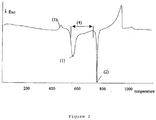
- FIG. 2 shows a DSC-plot of one of the examples, example 13, a quenched and powdered glass sample, which was heated with a heating rate of 10 K/min.
- the crystallisation of lithium metasilicate (1), the crystallisation of lithium disilicate (2) as well as the glass transition temperature (3) and the temperature range (4) for the first crystallisation are clearly visible from said DSC-plot.
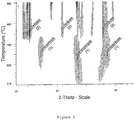
- Figure 3 therefore shows the measurement of a bulk glass sample at a constant heating rate of 2 K/min. It can be recognized from said measurement that in this case the crystallisation of the lithium metasilicate (1) occurs at a temperature of 510 °C and that in this case the resolution of the lithium metasilicate and the crystallization of the lithium disilicate (2) occur at a temperature of 730 °C.
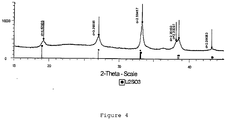
- Figure 4 represents a phase analysis by XRD of example 13 after nucleation at 500 °C for 7 min and first crystallisation at 650 °C and 20 min.
- Table I 1 2 3 d-spacing in 0.1 nm of scan d-spacing in 0.1 nm of pattern Index 4.628 4.690 LS 020 3.296 3.301 LS 111 2.708 LS 130 2.685 2.700 LS 200 2.355 2.342 LS 131 2.333 2.331 LS 002
- Figure 5 shows an SEM-micrograph, backscattered electrons, of the same example having the same thermal history, with the surface being etched with 1 % HF for 8 s. Clearly visible are holes that show former lithium metasilicate crystals.
- step (e) means shaping the lithium metasilicate glass ceramic to the desired shape, either by saw cutting, or by milling it in a CAD-CAM milling machine (i.e. CEREC 3®).
- the obtained lithium metasilicate glass ceramic blanks were analyzed for their machinability and their edge strength. 10 discs were cut from a rod with 12 mm diameter for biaxial strength measurements. The results of these analyses are given in Table IV. Ten more discs were prepared and subjected to a third heat treatment (f).
- the blocks in the state of the metasilicate appear to have a reddish or bluish colour. This effect vanishes when the disilicate phase forms and the blanks turn to the colour that is desired.
- the lithium metasilicate glass ceramic blanks were subjected to a second crystallization, step (f), at 850 °C for 10 min, except example 3 which was crystallized at 830 °C, i.e. the third heat treatment which is in general performed at temperatures of 700 to 950 °C, preferably 820 to 880 °C and for a period of 5 to 30 minutes, preferably 5 to 20 minutes, to convert the lithium metasilicate into lithium disilicate.
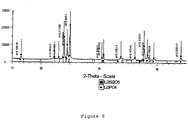
- Table II 1 2 3 d-spacing in 0.1 nm of scan d-spacing in 0.1 nm of pattern Index 5.369 5.420 LS2 110 3.986 3.978 LP 120 3.855 3.834 LP 101 3.714 3.737 LS2 130 3.629 3.655 LS2 040 3.562 3.581 LS2 111 2.929 2.930 LS2 131 2.901 2.908 LS2 200 2.379 2.388 LS2 002 2.346 2.35 LS2 221 2.283 2.29 LS2 151 2.050 2.054 LS2 241
- Figure 7 shows an SEM-micrograph, backscattered electrons, of the same example having the same thermal history, with the surface being etched with 3 % HF for 30 s leading to the glassy phase being etched out and leaving the lithium disilicate crystals.
- the edge strength was determined as follows: With a milling unit (CEREC® 3) blanks were milled to result in Lego-minicubes. With a 1.6 mm cylindrical diamond cutter blind holes were milled. The quality of said blind holes was determined by comparing the area of the broken out edges with those of a reference sample (ProCAD®). The relation of the area of the broken out edges to the area of the blind bore is an allocation for the edge strength.
- An edge strength is considered to be "very good” in case the relation of said areas is smaller than that of the reference, it is considered to be “good” in case the relations are about the same and it is considered to be “acceptable” in case the area is bigger than 110 % of the reference sample.
- the chemical durability was determined according to ISO 6872, i.e. as loss of mass after 16 h in 4 % acetic acid at 80 °C. "Good” means that the solubility according to said method is below 100 ⁇ g/cm 2 .
- the strength was measured as biaxial strength according to ISO 6872 or as 3 point bending strength according to EN 843-1: Bars of 12 mm diameter were casted and crystallized once. From these bars 20 discs with a thickness of 1,2 mm each were sawn. 10 of these discs were then smoothed and the surfaces of the discs were polished using SiC-paper of grain size 1000. Biaxial strength was measured as is disclosed in ISO 6872. The other 10 discs were crystallized a second time at 800 to 900 °C to give the lithium disilicate phase. These solidified samples were smoothed on both sides and the surfaces were polished using SiC-paper of grain size 1000. Biaxial strength was then measured according to ISO 6872.
- fracture toughness was determined by applying a Vickers indentation onto a polished surface and measuring the size of the flaws originating from the edges (Indentation Force Method ... IF). This method is useful as comparative method but does not result in absolute values. For comparison measurements were performed on notched bending samples (SENB, SEVNB). For the lithium disilicate glass ceramics fracture toughness values > 2 MPam 0.5 were obtained.
- Translucence was determined after the second crystallization: a test piece 16 mm diameter and having a thickness of 2 mm was prepared and polished on both sides.
- the contrast value CR was determined according to BS 5612 (British Standard) using a spectral colorimeter (Minolta CM-3700d). The determination of the contrast value consisted of two single measurements.
- the test piece to be analyzed is therefor placed in front of a black ceramic body having a reflexion of 4 % at most and accordingly in front of a white ceramic body having a reflexion of 86 % at minimum which are then colourmetrically determined.
- the glass was molten at a temperature of 1500 °C for 3 hours and was then poured into steel moulds which were preheated to 300 °C. After one minute the glass bars were transferred into a cooling furnace and were tempered at 500 °C for 10 minutes and then cooled to room temperature.
- the glass was homogeneous and transparent.
- the milling time of test bodys was measured.
- the milling time of the test body was one minute below that of ProCAD®, which was used as reference.
- the edge strength was good.
- Biaxial strength was 359 +/- 117 MPa which correlates to a solidification factor of 3.0.
- Fracture toughness (IF) was 1.6 MPam 0.5 .
- the chemical stability according to ISO 6872 (4% acetic acid, 80 °C, 16 h) was 37 ⁇ g/cm 2 .
- Glass bars were produced according to example 1. The glass again was homogeneous and transparent.
- the first crystallization was performed at 650 °C for a period of 20 minutes.
- Lithium metasilicate was determined to be the main phase with traces of lithium disilicate also being present. Biaxial strength was 135 +/- 24 MPa.
- the milling time of a test body was measured.
- the milling time of the test body was one minute below that of ProCAD®, which again was used as reference.
- the edge strength was very good.
- the biaxial strength was 472 +/- 85 MPa which correlates to a solidification factor of 3.5.
- Fracture toughness (IF) was 2.3 MPam 0.5 .
- Glass bars were produced according to example 1. The glass again was homogeneous and transparent.
- the first crystallization was performed at 650 °C for a period of 20 minutes.
- Lithium metasilicate was determined to be the only phase.
- Biaxial strength was 112 +/- 13 MPa.
- the milling time of a test body was measured.
- the milling time of the test body was one minute below that of ProCAD®, which again was used as reference.
- the edge strength was good.
- the biaxial strength was 356 +/- 96 MPa which correlates to a solidification factor of 3.16.
- Fracture toughness (IF) was 1.9 MPam 0.5 .
- Glass bars were produced according to example 1. The glass again was homogeneous and transparent.
- the first crystallization was performed at 650 °C for a period of 20 minutes.
- Lithium disilicate was determined as the main phase and lithium metasilicate was only present in traces. Biaxial strength was 194 +/- 35 MPa.
- the milling time of a test body was measured.
- the milling time of the test body was four minutes longer that of ProCAD®, which again was used as reference.
- the edge strength was poor.
- Fracture toughness (IF) was 1.88 MPam 0.5 .
- the following examples 21 to 23 show the usefulness of the lithium silicate glass according to the invention which comprises nuclei suitable for the formation of lithium metasilicate and subsequently lithium disilicate glass ceramics.
- a glass melt having the composition according to example 14 was melted in a platinum crucible at a temperature of 1500°C for 3 hours. The glass was not poured in a steel mould, but quenched in water. Thus, a glass granulate formed which was dried and subsequently heated to 500°C for 30 minutes to produce nuclei suitable for the formation of lithium metasilicate crystals. The obtained glass was milled to a particle size of less than 45 ⁇ m.
- the obtained powder was mixed with a modelling liquid consisting of more than 95% water and additives for improving moldability and layered on a crown cap of densely sintered zirconium oxide, e.g. DCS-zircon.
- a modelling liquid consisting of more than 95% water and additives for improving moldability and layered on a crown cap of densely sintered zirconium oxide, e.g. DCS-zircon.
- the crown cap was fired in a dental furnace at a temperature of 900°C with 2 minutes holding time.
- the applied. glass powder containing nuclei for the crystallization was simultaneously crystallized and densely sintered so that a dentine core of lithium disilicate glass ceramic resulted.
- a suitable incisal mass having a suitable expansion coefficient was applied.
- the final anterior tooth restoration showed good resistance against rapid temperature changes up to 160°C. This proves a good bond between the dentine layer of lithium disilicate glass ceramic and the framework of high-strength zirconium oxide.
- Bars of a glass having a composition according to example 14 were prepared in the same manner as in example 1.
- the glass bars were homogenous, transparent and light yellow coloured.
- a crown cap of densely-sintered zirconium oxide was circularly reduced.
- a dentine core was layered with dental wax and the crown margin was modeled on the stump.
- the restoration was provided with a cast-on channel.
- the crown cap was applied on a muffle basis and embedded in investment material, (Empress Speed, Ivoclar). After the required binding time the muffle was preheated to 850°C resulting in the removal of the wax.
- the final product was a zirconium oxide cap having a dentine layer of lithium disilicate glass ceramic.
- This dental restoration showed an excellent fit of the circular edge on the model. Furthermore, the so-prepared dentine layer was free from porosities.
- a metal cap of an alloy having an expansion coefficient of 12.8 ⁇ 10 -6 1/K and a solidification temperature of 1100°C was prepared in a cast process, sand-blasted and by an oxidation-firing step prepared for the further processing.
- a dentine core was applied on the cap using modeling wax.
- the metal cap was embedded, and the wax was removed by firing in a furnace.
- a blank of the lithium silicate glass having suitable nuclei was hot-pressed on the metal cap at 900°C.
- the so-prepared dental restoration showed a good bond between metal framework and the lithium disilicate glass ceramic and also had a high resistance against drastic temperature changes of above 160°C.
Landscapes
- Health & Medical Sciences (AREA)
- Chemical & Material Sciences (AREA)
- Life Sciences & Earth Sciences (AREA)
- Engineering & Computer Science (AREA)
- Oral & Maxillofacial Surgery (AREA)
- Ceramic Engineering (AREA)
- Materials Engineering (AREA)
- Chemical Kinetics & Catalysis (AREA)
- Animal Behavior & Ethology (AREA)
- General Health & Medical Sciences (AREA)
- Public Health (AREA)
- Veterinary Medicine (AREA)
- Organic Chemistry (AREA)
- Geochemistry & Mineralogy (AREA)
- General Chemical & Material Sciences (AREA)
- Epidemiology (AREA)
- Plastic & Reconstructive Surgery (AREA)
- Dispersion Chemistry (AREA)
- Crystallography & Structural Chemistry (AREA)
- Inorganic Chemistry (AREA)
- Molecular Biology (AREA)
- Glass Compositions (AREA)
- Dental Preparations (AREA)
- Dental Prosthetics (AREA)
- Silicates, Zeolites, And Molecular Sieves (AREA)
- Re-Forming, After-Treatment, Cutting And Transporting Of Glass Products (AREA)
Applications Claiming Priority (2)
| Application Number | Priority Date | Filing Date | Title |
|---|---|---|---|
| DE10336913.9A DE10336913C9 (de) | 2003-08-07 | 2003-08-07 | Verwendung eines Lithiumsilicatmaterials |
| EP04018339A EP1505041B1 (en) | 2003-08-07 | 2004-08-03 | Lithium silicate materials |
Related Parent Applications (2)
| Application Number | Title | Priority Date | Filing Date |
|---|---|---|---|
| EP04018339.4 Division | 2004-08-03 | ||
| EP04018339A Division EP1505041B1 (en) | 2003-08-07 | 2004-08-03 | Lithium silicate materials |
Publications (3)
| Publication Number | Publication Date |
|---|---|
| EP2305614A2 EP2305614A2 (en) | 2011-04-06 |
| EP2305614A3 EP2305614A3 (en) | 2011-05-11 |
| EP2305614B1 true EP2305614B1 (en) | 2019-11-27 |
Family
ID=33547185
Family Applications (6)
| Application Number | Title | Priority Date | Filing Date |
|---|---|---|---|
| EP10013130.9A Expired - Lifetime EP2305614B1 (en) | 2003-08-07 | 2004-08-03 | Lithium silicate materials |
| EP20206464.8A Withdrawn EP3795545A1 (en) | 2003-08-07 | 2004-08-03 | Lithium silicate materials |
| EP04018339A Expired - Lifetime EP1505041B1 (en) | 2003-08-07 | 2004-08-03 | Lithium silicate materials |
| EP10013142.4A Expired - Lifetime EP2269960B1 (en) | 2003-08-07 | 2004-08-03 | Lithium silicate materials |
| EP10013131.7A Expired - Lifetime EP2284133B1 (en) | 2003-08-07 | 2004-08-03 | Use of a lithium silicate blank for the manufacture of a dental restoration and process for preparing a dental restoration |
| EP12163270.7A Expired - Lifetime EP2479153B1 (en) | 2003-08-07 | 2004-08-03 | Lithium silicate blank and lithium silicate glass precursor thereof for a dental restoration |
Family Applications After (5)
| Application Number | Title | Priority Date | Filing Date |
|---|---|---|---|
| EP20206464.8A Withdrawn EP3795545A1 (en) | 2003-08-07 | 2004-08-03 | Lithium silicate materials |
| EP04018339A Expired - Lifetime EP1505041B1 (en) | 2003-08-07 | 2004-08-03 | Lithium silicate materials |
| EP10013142.4A Expired - Lifetime EP2269960B1 (en) | 2003-08-07 | 2004-08-03 | Lithium silicate materials |
| EP10013131.7A Expired - Lifetime EP2284133B1 (en) | 2003-08-07 | 2004-08-03 | Use of a lithium silicate blank for the manufacture of a dental restoration and process for preparing a dental restoration |
| EP12163270.7A Expired - Lifetime EP2479153B1 (en) | 2003-08-07 | 2004-08-03 | Lithium silicate blank and lithium silicate glass precursor thereof for a dental restoration |
Country Status (9)
| Country | Link |
|---|---|
| US (4) | US7316740B2 (enExample) |
| EP (6) | EP2305614B1 (enExample) |
| JP (6) | JP4777625B2 (enExample) |
| AT (1) | ATE553071T1 (enExample) |
| DE (3) | DE10336913C9 (enExample) |
| DK (1) | DK2269960T3 (enExample) |
| ES (3) | ES2806031T3 (enExample) |
| HU (1) | HUE027211T2 (enExample) |
| PL (1) | PL2269960T3 (enExample) |
Families Citing this family (124)
| Publication number | Priority date | Publication date | Assignee | Title |
|---|---|---|---|---|
| US9220576B2 (en) | 2003-08-07 | 2015-12-29 | Ivoclar Vivadent Ag | Machining of ceramic materials |
| DE10362377C5 (de) * | 2003-08-07 | 2018-10-25 | Ivoclar Vivadent Ag | Lithiumsilicatrohling und dessen Verwendung |
| DE10336913C9 (de) | 2003-08-07 | 2019-02-21 | Ivoclar Vivadent Ag | Verwendung eines Lithiumsilicatmaterials |
| DE10362378C5 (de) * | 2003-08-07 | 2019-02-14 | Ivoclar Vivadent Ag | Verfahren zur Herstellung eines Lithiumsilicatrohlings |
| EP1688397A1 (en) * | 2005-02-08 | 2006-08-09 | Ivoclar Ag | Lithium silicate glass ceramic |
| US8444756B2 (en) | 2003-08-07 | 2013-05-21 | Ivoclar Vivadent Ag | Lithium silicate materials |
| US7955159B2 (en) * | 2003-08-07 | 2011-06-07 | Ivoclar Vivadent Ag | Machining of ceramic materials |
| ES2489523T3 (es) | 2005-02-08 | 2014-09-02 | Ivoclar Vivadent Ag | Material vitrocerámico de silicato de litio |
| PL1688398T3 (pl) * | 2005-02-08 | 2014-10-31 | Ivoclar Vivadent Ag | Ceramika szklana na bazie krzemianu litu |
| TW200724506A (en) * | 2005-10-07 | 2007-07-01 | Ohara Kk | Inorganic composition |
| ATE508728T1 (de) | 2006-09-29 | 2011-05-15 | Ivoclar Vivadent Ag | Glas für dentale anwendungen |
| DE102007011337A1 (de) | 2007-03-06 | 2008-09-11 | Hermsdorfer Institut Für Technische Keramik E.V. | Verblendkeramik für dentale Restaurationen aus yttriumstabilisiertem Zirkoniumdioxid und Verfahren zur Verblendung von dentalen Restaurationen aus yttriumstabilisiertem Zirkoniumdioxid |
| US10260811B2 (en) * | 2008-03-05 | 2019-04-16 | Ivoclar Vivadent Ag | Dental furnace |
| US7892995B2 (en) | 2008-04-11 | 2011-02-22 | James R. Glidewell Dental Ceramics, Inc. | Lithium silicate glass ceramic and method for fabrication of dental appliances |
| US9241879B2 (en) * | 2008-04-11 | 2016-01-26 | James R. Glidewell Dental Ceramics, Inc. | Lithium silicate glass ceramic for fabrication of dental appliances |
| US9277971B2 (en) | 2008-04-11 | 2016-03-08 | James R. Glidewell Dental Ceramics, Inc. | Lithium silicate glass ceramic for fabrication of dental appliances |
| JP5501642B2 (ja) | 2009-03-23 | 2014-05-28 | 株式会社ノリタケカンパニーリミテド | 蛍光性ジルコニア材料 |
| DE202009019061U1 (de) | 2009-12-23 | 2016-02-23 | Degudent Gmbh | Lithiummetasilicat-Glaskeramik und deren Verwendung |
| US8865606B2 (en) | 2010-04-16 | 2014-10-21 | Ivoclar Vivadent Ag | Process for the preparation of dental restorations |
| EP2377830B1 (de) | 2010-04-16 | 2016-04-13 | Ivoclar Vivadent AG | Lithiumsilikat-Glaskeramik und -Glas mit Übergangsmetalloxid |
| DE102010035545A1 (de) | 2010-08-24 | 2012-03-01 | Fraunhofer-Gesellschaft zur Förderung der angewandten Forschung e.V. | Verblendkeramik für dentale Restaurationen aus yttriumstabilisiertem Zirkoniumdioxid sowie Verfahren zu deren Auftrag |
| JP5762707B2 (ja) * | 2010-09-08 | 2015-08-12 | 株式会社オハラ | 結晶化ガラスの製造方法および結晶化ガラス物品 |
| DE102010050275A1 (de) | 2010-11-02 | 2012-05-03 | Degudent Gmbh | Lithiumsilikat-Gläser oder -Glaskeramiken, Verfahren zu deren Herstellung sowie deren Verwendung |
| SE535361C2 (sv) | 2010-11-10 | 2012-07-10 | Biomain Ab | Dentalbryggor och superstrukturer, samt metoder för att tillverka dessa |
| US20120148988A1 (en) * | 2010-12-14 | 2012-06-14 | James R. Glidewell Dental Ceramics, Inc. | Indirect restoration technology |
| US9206077B2 (en) | 2011-06-22 | 2015-12-08 | Fraunhofer-Gesellschaft zur Förderung der angewandten Forschung e. V. | Dental restoration, method for production thereof and glass ceramic |
| RU2631484C2 (ru) * | 2011-06-22 | 2017-09-22 | Вита Цанфабрик Х. Раутер Гмбх Унд Ко. Кг | Стоматологический восстановительный материал, способ его изготовления и заготовка |
| FR2978137A1 (fr) * | 2011-07-21 | 2013-01-25 | Saint Gobain Ct Recherches | Produit fondu a base de lithium |
| PL2765979T3 (pl) | 2011-10-14 | 2016-07-29 | Ivoclar Vivadent Ag | Litowokrzemianowa ceramika szklana i szkło z tlenkiem pięciowartościowego metalu |
| CN108996911A (zh) | 2011-10-14 | 2018-12-14 | 义获嘉伟瓦登特公司 | 包含四价金属氧化物的硅酸锂玻璃陶瓷和硅酸锂玻璃 |
| BR112014008579A2 (pt) | 2011-10-14 | 2017-04-18 | Ivoclar Vivadent Ag | vitrocerâmica e vidro de silicato de lítio com óxido de metal divalente |
| US9101439B2 (en) | 2011-10-14 | 2015-08-11 | Ivoclar Vivadent, Ag | Lithium silicate glass ceramic and lithium silicate glass comprising a monovalent metal oxide |
| MX351160B (es) | 2011-10-14 | 2017-10-04 | Ivoclar Vivadent Ag | Vidrio y cerámica de vidrio de silicato de litio con óxido de metal hexavalente. |
| KR20140075777A (ko) | 2011-10-14 | 2014-06-19 | 이보클라 비바덴트 아게 | 3가 금속 산화물을 포함하는 리튬 실리케이트 유리 세라믹 및 리튬 실리케이트 유리 |
| EP2804842B1 (en) * | 2012-01-20 | 2020-12-02 | Straumann Holding AG | Prosthetic element |
| US9371249B2 (en) | 2012-05-04 | 2016-06-21 | Ivoclar Vivadent Ag | Lithium disilicate-apatite glass-ceramic |
| BR112014028027A2 (pt) * | 2012-05-11 | 2017-06-27 | Ivoclar Vivadent Ag | peça em bruto pré-sinterizada para fins dentários |
| CN104334509B (zh) * | 2012-05-11 | 2018-01-02 | 义获嘉伟瓦登特公司 | 用于牙科目的的预烧结坯料 |
| DE102012108153A1 (de) | 2012-09-03 | 2014-03-06 | Ludwig-Maximilians-Universität München | Rohling und Verfahren zur Herstellung einer Dentalrestauration durch substraktive Bearbeitung |
| DE102012111683A1 (de) * | 2012-11-30 | 2014-06-05 | Degudent Gmbh | Verfahren zum Herstellen von Zahnersatz |
| EP2765119B1 (de) | 2013-02-12 | 2021-07-28 | Ivoclar Vivadent AG | Rohling für dentale Zwecke |
| EP2792345B1 (de) | 2013-04-15 | 2019-10-09 | Ivoclar Vivadent AG | Lithiumsilikat-Glaskeramik und -Glas mit Gehalt an Cäsiumoxid |
| EP2792649B1 (de) | 2013-04-15 | 2019-11-27 | Ivoclar Vivadent AG | Lithiumsilikat-Glaskeramik und -Glas mit Gehalt an Rubidiumoxid |
| DE102013104561A1 (de) * | 2013-05-03 | 2014-11-06 | Degudent Gmbh | Verfahren zur Herstellung eines Rohlings sowie Rohling |
| CN103265170B (zh) * | 2013-05-06 | 2016-06-29 | 朱晓明 | 一种工业研磨球及其制作工艺 |
| US12029936B2 (en) | 2013-09-04 | 2024-07-09 | Thomas Harrison Hunt | Neck exercise device and system |
| KR101524482B1 (ko) * | 2013-10-14 | 2015-06-02 | 주식회사 하스 | 지르코니아 상단에 안착되는 리튬 실리케이트 유리 또는 리튬 실리케이트 결정화 유리 및 이의 제조방법 |
| ES2891275T3 (es) * | 2013-11-05 | 2022-01-26 | Ivoclar Vivadent Ag | Vitrocerámica de disilicato de litio-apatita con óxido de metal de transición |
| DE102014104401A1 (de) | 2014-03-28 | 2015-10-01 | Degudent Gmbh | Verfahren zur Herstellung eines Lithiumsilikat-Glasrohlings und eines Lithiumsilikat-Glaskeramikrohlings |
| RU2564037C1 (ru) * | 2014-04-03 | 2015-09-27 | Общество с ограниченной ответственностью "НеоСцинт" | Способ стабилизации редкоземельных ионов в трехвалентном состоянии в силикатных стеклах и композитах |
| EP2944619B1 (de) * | 2014-05-13 | 2023-08-09 | Ivoclar Vivadent AG | Verfahren zur Herstellung von Lithiumsilikatgläsern und Lithiumsilikat-Glaskeramiken |
| CN105217959A (zh) * | 2014-06-18 | 2016-01-06 | 深圳爱尔创口腔技术有限公司 | 一种用于牙科修复体的锂基玻璃陶瓷制备方法 |
| CN105174724A (zh) * | 2014-06-18 | 2015-12-23 | 深圳爱尔创口腔技术有限公司 | 一种用于牙科修复体的锂基玻璃陶瓷制备方法 |
| WO2015200017A1 (en) | 2014-06-23 | 2015-12-30 | 3M Innovative Properties Company | Process for producing a sintered lithium disilicate glass ceramic dental restoration and kit of parts |
| EP3011929A4 (en) | 2014-08-27 | 2017-05-31 | GC Corporation | Method for producing dental prosthesis, method for producing lithium disilicate blank for dental prostheses, and lithium disilicate blank for dental prostheses |
| US11166795B2 (en) | 2014-08-27 | 2021-11-09 | Gc Corporation | Method for producing dental prosthesis, method for producing lithium disilicate blank for dental prosthesis and lithium disilicate blank for dental prosthesis |
| JP6537256B2 (ja) * | 2014-12-05 | 2019-07-03 | 京セラ株式会社 | ガラスブロック、ガラスブロックの製造方法および歯科補綴物の製造方法 |
| JP6537257B2 (ja) * | 2014-12-05 | 2019-07-03 | 京セラ株式会社 | ガラスセラミックスおよびガラスセラミックスの製造方法 |
| JP2016108180A (ja) * | 2014-12-05 | 2016-06-20 | 京セラメディカル株式会社 | ガラスセラミックス |
| EP3050856B1 (de) | 2015-01-30 | 2019-05-29 | Ivoclar Vivadent AG | Lithiumsilikat-Diopsid-Glaskeramik |
| DE102015101691B4 (de) | 2015-02-05 | 2019-10-17 | Dentsply Sirona Inc. | Verfahren zur Herstellung eines aus Lithiumsilikat-Glaskeramik bestehenden Formkörpers sowie Formkörper |
| DE102016109139B4 (de) * | 2015-05-18 | 2025-01-30 | Schott Ag | Kontinuierliche Herstellung fotosensitiver Glaskörper |
| US10138154B2 (en) | 2015-05-21 | 2018-11-27 | Dentsply Sirona Inc. | Method for producing a dental prosthesis |
| DE102015108178A1 (de) * | 2015-05-22 | 2016-11-24 | Degudent Gmbh | Verfahren zum Herstellen einer dentalen Struktur sowie dentale Struktur |
| DE102015108169A1 (de) | 2015-05-22 | 2016-11-24 | Degudent Gmbh | Verfahren zur Erhöhung der Festigkeit eines aus Lithiumsilikat-Glaskeramik bestehenden Formkörpers |
| DE102015108173A1 (de) | 2015-05-22 | 2016-11-24 | Degudent Gmbh | Verfahren zur Erhöhung der Festigkeit von aus Lithiumsilikat-Glaskeramik bestehendem Formkörper |
| DE102015108171A1 (de) | 2015-05-22 | 2016-11-24 | Degudent Gmbh | Verfahren zur Erhöhung der Festigkeit von aus Lithiumsilikat-Glaskeramik bestehendem Formkörper |
| ES2983090T3 (es) | 2015-08-25 | 2024-10-21 | Ivoclar Vivadent Ag | Vitrocerámica de silicato de litio y cuarzo alfa |
| EP3150563B1 (de) | 2015-09-30 | 2019-05-22 | Ivoclar Vivadent AG | Lithiumsilikat-wollastonit-glaskeramik |
| WO2017067909A1 (en) | 2015-10-19 | 2017-04-27 | Vita Zahnfabrik H. Rauter Gmbh & Co. Kg | Process for producing a workpiece with low translucency |
| DE102015121858B9 (de) * | 2015-12-15 | 2025-04-10 | Kulzer Gmbh | Verfahren zur Herstellung grosser polymerisierter dentaler Materialblöcke |
| EP3356304B1 (en) * | 2016-02-19 | 2020-06-10 | Ferro Corporation | Sintering aid glasses for machinable phyllosilicate based structures |
| US20170342383A1 (en) | 2016-05-27 | 2017-11-30 | Corning Incorporated | Lithium disilicate glass-ceramic compositions and methods thereof |
| DE102016119108A1 (de) | 2016-10-07 | 2018-04-12 | Degudent Gmbh | Lithiumsilikat-Glaskeramik |
| DE102016119934A1 (de) * | 2016-10-19 | 2018-05-03 | Degudent Gmbh | Verfahren zur Herstellung eines Rohlings, Rohling sowie eine dentale Restauration |
| DE102016119935A1 (de) | 2016-10-19 | 2018-04-19 | Degudent Gmbh | Verfahren zur Herstellung einer dentalen Restauration |
| US10479729B2 (en) | 2017-02-22 | 2019-11-19 | James R. Glidewell Dental Ceramics, Inc. | Shaded zirconia ceramic material and machinable sintered ceramic bodies made therefrom |
| US10537411B2 (en) | 2017-03-08 | 2020-01-21 | Dentsply Sirona Inc. | Method to produce a monolithic form body |
| RU2731375C1 (ru) | 2017-03-08 | 2020-09-02 | Дентсплай Сирона Инк. | Способ изготовления монолитного фасонного элемента |
| ES2927633T3 (es) | 2017-03-09 | 2022-11-08 | Hass Co Ltd | Método para preparar materiales vitrocerámicos, capaz de ajustar la maquinabilidad o la translucidez a través del cambio de temperatura del tratamiento térmico |
| KR101988221B1 (ko) * | 2017-06-08 | 2019-06-12 | 한국세라믹기술원 | 치관용 글래스세라믹의 제조방법 |
| WO2019108558A1 (en) | 2017-11-28 | 2019-06-06 | Corning Incorporated | High liquidus viscosity bioactive glass |
| CN111417603B (zh) | 2017-11-28 | 2023-10-31 | 康宁股份有限公司 | 生物活性硼酸盐玻璃及其方法 |
| TWI794344B (zh) | 2017-11-28 | 2023-03-01 | 美商康寧公司 | 經化學強化之生物活性玻璃陶瓷 |
| WO2019108556A1 (en) | 2017-11-28 | 2019-06-06 | Corning Incorporated | Bioactive glass compositions and dentin hypersensitivity remediation |
| CN107915412A (zh) * | 2017-12-01 | 2018-04-17 | 成都光明光电股份有限公司 | 微晶玻璃及其基板 |
| ES2997483T3 (en) | 2018-08-02 | 2025-02-17 | Ivoclar Vivadent Ag | Mulicolored blank for dental purposes |
| ES2902184T3 (es) | 2018-08-14 | 2022-03-25 | Dentsply Sirona Inc | Prótesis dental |
| CN109095950A (zh) * | 2018-08-24 | 2018-12-28 | 爱迪特(秦皇岛)科技股份有限公司 | 一种牙科氧化锆陶瓷用遮色液及其制备方法和应用 |
| ES2962942T3 (es) | 2018-08-29 | 2024-03-21 | Ivoclar Vivadent Ag | Procedimiento para la producción de una pieza en bruto de vitrocerámica para fines dentales |
| EP3659989A1 (de) | 2018-11-29 | 2020-06-03 | Ivoclar Vivadent AG | Schlicker und verfahren zur herstellung von keramischen und glaskeramischen 3d strukturen |
| EP3659728B1 (en) | 2018-11-29 | 2021-01-27 | Ivoclar Vivadent AG | Method for layer-wise additive manufacturing of a shaped body |
| EP3696149A1 (de) | 2019-02-14 | 2020-08-19 | Ivoclar Vivadent AG | Fluoreszierende glaskeramiken und gläser mit gehalt an cer und zinn |
| EP3696150A1 (de) | 2019-02-14 | 2020-08-19 | Ivoclar Vivadent AG | Fluoreszierende glaskeramiken und gläser mit gehalt an europium |
| CN113710213A (zh) * | 2019-03-29 | 2021-11-26 | 株式会社Gc | 牙科修复体用块体 |
| ES2926479T3 (es) * | 2019-04-04 | 2022-10-26 | Ivoclar Vivadent Ag | Procedimiento para la producción de piezas en bruto de vitrocerámica de varios colores |
| EP3772492A1 (de) | 2019-08-09 | 2021-02-10 | VITA-ZAHNFABRIK H. Rauter GmbH & Co. KG | Rohling aus poröser lithiumsilikatglaskeramik mit füllstoff |
| EP3845504A1 (de) | 2019-12-30 | 2021-07-07 | Ivoclar Vivadent AG | Verfahren zur herstellung einer mehrfarbigen dentalrestauration |
| DE102020103720A1 (de) | 2020-02-13 | 2021-08-19 | Ivoclar Vivadent Ag | Verwendung eines Rohlings mit Halter zur Herstellung von dentalen Restaurationen |
| CN111470882B (zh) * | 2020-03-02 | 2022-11-15 | 北京大学口腔医学院 | 一种用于牙科的氧化锆表面处理方法 |
| KR102446071B1 (ko) * | 2020-09-28 | 2022-09-22 | 주식회사 하스 | 절삭가공을 위한 치과용 벌크 블록 및 그 제조방법 |
| CN112850729B (zh) * | 2021-01-28 | 2023-04-18 | 西安理工大学 | 一种Ce3+掺杂二硅酸锂纳米颗粒的制备方法 |
| CN113248152B (zh) * | 2021-05-21 | 2022-06-10 | 常熟佳合显示科技有限公司 | 一种三维微晶玻璃及其制备方法 |
| CN113264684A (zh) * | 2021-06-11 | 2021-08-17 | 辽宁爱尔创生物材料有限公司 | 一种牙科用硅酸锂玻璃陶瓷及其制备方法、硅酸锂玻璃陶瓷修复体 |
| CN113387585A (zh) * | 2021-06-29 | 2021-09-14 | 爱迪特(秦皇岛)科技股份有限公司 | 一种二硅酸锂玻璃陶瓷及其制备方法和应用 |
| KR102642739B1 (ko) * | 2021-07-26 | 2024-03-04 | 주식회사 하스 | 글라스 세라믹 기판의 제조방법 및 이로부터 제조된 글라스 세라믹 기판 |
| EP4140963A1 (de) | 2021-08-23 | 2023-03-01 | Ivoclar Vivadent AG | Lithiumsilikat-glaskeramik mit leichter bearbeitbarkeit |
| EP4140962A1 (de) | 2021-08-23 | 2023-03-01 | Ivoclar Vivadent AG | Lithiumsilikat-glaskeramik mit leichter bearbeitbarkeit |
| CN113603365A (zh) * | 2021-09-03 | 2021-11-05 | 北京赢冠口腔医疗科技股份有限公司 | 硅酸锂微晶玻璃和饰面瓷粉及其制备方法、金属烤瓷牙 |
| CN113698082B (zh) * | 2021-09-10 | 2023-03-21 | 成都光明光电股份有限公司 | 微晶玻璃成型体的制造方法 |
| CN113788622B (zh) * | 2021-09-28 | 2023-07-18 | 东北大学秦皇岛分校 | 一种采用鼓泡工艺制备牙科用二硅酸锂微晶玻璃的方法 |
| CN113831016B (zh) * | 2021-10-28 | 2023-03-14 | 爱迪特(秦皇岛)科技股份有限公司 | 一种具有高透明度的荧光玻璃陶瓷及其制备方法 |
| CN113831021B (zh) * | 2021-11-15 | 2023-09-26 | 清远南玻节能新材料有限公司 | 微晶玻璃及其制备方法、玻璃保护层、玻璃盖板与电子器件 |
| CN114195394B (zh) * | 2021-12-24 | 2022-09-09 | 深圳市新旗滨科技有限公司 | 一种玻璃组合物、微晶玻璃及其制备方法和应用 |
| CN114149256B (zh) * | 2021-12-30 | 2023-04-14 | 爱迪特(秦皇岛)科技股份有限公司 | 用于提高牙科氧化锆表面粘接性的陶瓷材料、修复材料、其制备方法及粘结方法 |
| CN114920459B (zh) * | 2022-06-15 | 2023-12-12 | 山西省玻璃陶瓷科学研究所(有限公司) | 一种二硅酸锂玻璃陶瓷材料的制备方法 |
| EP4382495A1 (de) | 2022-12-08 | 2024-06-12 | Ivoclar Vivadent AG | Lithiumsilikat-glaskeramik mit leichter bearbeitbarkeit |
| CN115745407A (zh) * | 2023-01-10 | 2023-03-07 | 山东新华医疗器械股份有限公司 | 一种用于牙齿修复材料的微晶玻璃及其制备方法 |
| EP4424294B1 (en) * | 2023-02-28 | 2025-06-18 | DENTSPLY SIRONA Inc. | An esthetic, robust, hybrid and biomimetic dental composition |
| CN116947315B (zh) | 2023-06-14 | 2025-09-23 | 爱迪特(秦皇岛)科技股份有限公司 | 一种非晶相硅酸锂玻璃制品及其制备方法和应用 |
| EP4527809A1 (de) | 2023-09-20 | 2025-03-26 | Ivoclar Vivadent AG | Fluoreszierendes glas mit hohem gehalt an cer und zinn |
| EP4527808A1 (de) | 2023-09-20 | 2025-03-26 | Ivoclar Vivadent AG | Fluoreszierende gläser und glaskeramiken mit hohem gehalt an cer und zinn |
| CN117819824B (zh) * | 2023-10-10 | 2024-10-01 | 常熟佳合显示科技有限公司 | 一种锂铝硅微晶玻璃及其制备方法 |
| CN118930055B (zh) * | 2024-02-02 | 2025-09-09 | 重庆鑫景特种玻璃有限公司 | 一种微晶玻璃、化学强化微晶玻璃及其应用 |
Family Cites Families (45)
| Publication number | Priority date | Publication date | Assignee | Title |
|---|---|---|---|---|
| BE513836A (enExample) | 1951-08-30 | |||
| BE526937A (enExample) | 1953-03-05 | 1954-09-03 | ||
| US3022180A (en) * | 1959-09-23 | 1962-02-20 | Gen Electric | Ceramic material and method of making the same |
| NL298704A (enExample) * | 1962-10-03 | |||
| US3252778A (en) * | 1964-02-26 | 1966-05-24 | Goodman Philip | Method of making a high strength semicrystalline article |
| GB1374605A (en) * | 1971-05-24 | 1974-11-20 | Pilkington Brothers Ltd | Method of manufacturing glass ceramic material |
| US3816704A (en) * | 1972-03-20 | 1974-06-11 | Gen Electric | Surface heating apparatus |
| US3977857A (en) * | 1973-10-29 | 1976-08-31 | Westinghouse Electric Corporation | Metal bonding glass-ceramic compositions having improved hardness |
| DE2451121A1 (de) * | 1973-10-31 | 1975-05-07 | Gen Electric | Verfahren zum herstellen von glaskeramiken |
| US4189325A (en) * | 1979-01-09 | 1980-02-19 | The Board of Regents, State of Florida, University of Florida | Glass-ceramic dental restorations |
| US4473653A (en) * | 1982-08-16 | 1984-09-25 | Rudoi Boris L | Ballistic-resistant glass-ceramic and method of preparation |
| US4515634A (en) * | 1983-10-17 | 1985-05-07 | Johnson & Johnson Dental Products Company | Castable glass-ceramic composition useful as dental restorative |
| JPS6071206U (ja) * | 1983-10-24 | 1985-05-20 | 野本 吉輝 | 焼成台 |
| US4480044A (en) * | 1984-02-01 | 1984-10-30 | Corning Glass Works | High expansion glass-ceramic articles |
| CH665551A5 (de) * | 1984-03-06 | 1988-05-31 | Werner Hans Dr Med De Moermann | Rohling zur herstellung zahntechnischer formteile. |
| JP2764771B2 (ja) | 1991-10-01 | 1998-06-11 | 富士写真フイルム株式会社 | 感光性組成物 |
| US5176961A (en) * | 1991-10-07 | 1993-01-05 | Corning Incorporated | Colored, textured glass-ceramic articles |
| US5219799A (en) | 1991-10-07 | 1993-06-15 | Corning Incorporated | Lithium disilicate-containing glass-ceramics some of which are self-glazing |
| SE501333C2 (sv) | 1993-05-27 | 1995-01-16 | Sandvik Ab | Metod för framställning av keramiska tandrestaurationer |
| JP3193555B2 (ja) * | 1994-01-27 | 2001-07-30 | 株式会社トクヤマ | ガラスセラミックス歯冠の製造方法 |
| US6485849B2 (en) | 1994-05-31 | 2002-11-26 | Tec Ventures, Inc. | Method for molding dental restorations and related apparatus |
| US5507981A (en) * | 1994-05-31 | 1996-04-16 | Tel Ventures, Inc. | Method for molding dental restorations |
| US5562718A (en) | 1994-06-03 | 1996-10-08 | Palermo; Francis X. | Electronic neuromuscular stimulation device |
| DE19511396A1 (de) | 1995-03-28 | 1996-10-02 | Arnold Wohlwend | Verfahren zur Herstellung eines prothetischen Zahninlays bzw. einer prothetischen Zahnkrone |
| JPH08299365A (ja) * | 1995-05-10 | 1996-11-19 | Technol Res Assoc Of Medical & Welfare Apparatus | 歯科補綴物の製造方法 |
| US5968856A (en) * | 1996-09-05 | 1999-10-19 | Ivoclar Ag | Sinterable lithium disilicate glass ceramic |
| ATE186286T1 (de) * | 1996-09-05 | 1999-11-15 | Ivoclar Ag | Sinterbare lithiumdisilikat-glaskeramik |
| JP2880697B2 (ja) * | 1996-10-17 | 1999-04-12 | 雄二郎 辻川 | 歯科用鋳造修復物の製造方法及び歯科用鋳造修復物製造用の支持台 |
| JPH10323354A (ja) * | 1997-05-23 | 1998-12-08 | Noritake Co Ltd | 歯科用結晶化陶材フレームコア及びその製造方法 |
| DE19725555A1 (de) * | 1997-06-12 | 1998-12-24 | Ivoclar Ag | Transluzente Apatit-Glaskeramik |
| DE19750794A1 (de) * | 1997-11-10 | 1999-06-17 | Ivoclar Ag | Verfahren zur Herstellung von geformten transluzenten Lithiumdisilikat-Glaskeramik-Produkten |
| US6420288B2 (en) * | 1997-11-10 | 2002-07-16 | Ivoclar Ag | Process for the preparation of shaped translucent lithium disilicate glass ceramic products |
| US6802894B2 (en) * | 1998-12-11 | 2004-10-12 | Jeneric/Pentron Incorporated | Lithium disilicate glass-ceramics |
| US20050127544A1 (en) * | 1998-06-12 | 2005-06-16 | Dmitri Brodkin | High-strength dental restorations |
| US6517623B1 (en) * | 1998-12-11 | 2003-02-11 | Jeneric/Pentron, Inc. | Lithium disilicate glass ceramics |
| EP1149058B1 (en) * | 1998-12-11 | 2015-02-18 | Ivoclar Vivadent AG | Method for making pressable lithium disilicate glass ceramics |
| JP2001288027A (ja) * | 2000-02-24 | 2001-10-16 | Tec Ventures Inc | 歯科修復物の形成方法及び関連の装置 |
| US6790126B2 (en) * | 2000-10-06 | 2004-09-14 | 3M Innovative Properties Company | Agglomerate abrasive grain and a method of making the same |
| EP1339345B1 (de) * | 2000-12-07 | 2009-05-06 | Eidgenössische Technische Hochschule Zürich Nichtmetallische Werkstoffe | Haltevorrichtung für einen keramikrohling |
| JP2003047622A (ja) * | 2001-08-03 | 2003-02-18 | Noritake Co Ltd | 歯科セラミックフレーム及びその製造並びに該フレームを含む歯科補綴物 |
| NZ539520A (en) * | 2002-09-25 | 2007-12-21 | Univ Johns Hopkins Med | Biocompatible cross-linked polymer matrices, and methods of making and using same |
| DE10336913C9 (de) | 2003-08-07 | 2019-02-21 | Ivoclar Vivadent Ag | Verwendung eines Lithiumsilicatmaterials |
| ES2489523T3 (es) * | 2005-02-08 | 2014-09-02 | Ivoclar Vivadent Ag | Material vitrocerámico de silicato de litio |
| US7892995B2 (en) * | 2008-04-11 | 2011-02-22 | James R. Glidewell Dental Ceramics, Inc. | Lithium silicate glass ceramic and method for fabrication of dental appliances |
| CN108996911A (zh) | 2011-10-14 | 2018-12-14 | 义获嘉伟瓦登特公司 | 包含四价金属氧化物的硅酸锂玻璃陶瓷和硅酸锂玻璃 |
-
2003
- 2003-08-07 DE DE10336913.9A patent/DE10336913C9/de not_active Expired - Fee Related
-
2004
- 2004-08-03 ES ES12163270T patent/ES2806031T3/es not_active Expired - Lifetime
- 2004-08-03 EP EP10013130.9A patent/EP2305614B1/en not_active Expired - Lifetime
- 2004-08-03 EP EP20206464.8A patent/EP3795545A1/en not_active Withdrawn
- 2004-08-03 HU HUE10013142A patent/HUE027211T2/en unknown
- 2004-08-03 EP EP04018339A patent/EP1505041B1/en not_active Expired - Lifetime
- 2004-08-03 DK DK10013142.4T patent/DK2269960T3/en active
- 2004-08-03 EP EP10013142.4A patent/EP2269960B1/en not_active Expired - Lifetime
- 2004-08-03 ES ES10013142.4T patent/ES2565514T3/es not_active Expired - Lifetime
- 2004-08-03 EP EP10013131.7A patent/EP2284133B1/en not_active Expired - Lifetime
- 2004-08-03 PL PL10013142T patent/PL2269960T3/pl unknown
- 2004-08-03 EP EP12163270.7A patent/EP2479153B1/en not_active Expired - Lifetime
- 2004-08-03 AT AT04018339T patent/ATE553071T1/de active
- 2004-08-03 ES ES10013131T patent/ES2859782T3/es not_active Expired - Lifetime
- 2004-08-03 DE DE202004021965U patent/DE202004021965U1/de not_active Ceased
- 2004-08-03 DE DE202004021964U patent/DE202004021964U1/de not_active Ceased
- 2004-08-06 US US10/913,095 patent/US7316740B2/en not_active Expired - Lifetime
- 2004-08-06 JP JP2004231738A patent/JP4777625B2/ja not_active Expired - Lifetime
-
2007
- 2007-11-05 US US11/935,203 patent/US8047021B2/en active Active
- 2007-11-05 US US11/935,221 patent/US8042358B2/en active Active
-
2009
- 2009-07-27 US US12/509,959 patent/US7816291B2/en not_active Expired - Lifetime
-
2010
- 2010-02-26 JP JP2010043535A patent/JP5735747B2/ja not_active Expired - Lifetime
- 2010-09-27 JP JP2010216160A patent/JP5946986B2/ja not_active Expired - Lifetime
-
2015
- 2015-07-03 JP JP2015134594A patent/JP6322163B2/ja not_active Expired - Lifetime
-
2017
- 2017-01-24 JP JP2017010380A patent/JP2017128502A/ja not_active Withdrawn
-
2018
- 2018-08-31 JP JP2018163452A patent/JP2019011246A/ja not_active Withdrawn
Non-Patent Citations (1)
| Title |
|---|
| None * |
Also Published As
Similar Documents
| Publication | Publication Date | Title |
|---|---|---|
| US11744685B2 (en) | Lithium silicate materials | |
| EP2305614B1 (en) | Lithium silicate materials | |
| US7867933B2 (en) | Lithium silicate glass ceramic | |
| EP1688398B1 (en) | Lithium silicate glass ceramic | |
| EP1688397A1 (en) | Lithium silicate glass ceramic |
Legal Events
| Date | Code | Title | Description |
|---|---|---|---|
| PUAI | Public reference made under article 153(3) epc to a published international application that has entered the european phase |
Free format text: ORIGINAL CODE: 0009012 |
|
| AC | Divisional application: reference to earlier application |
Ref document number: 1505041 Country of ref document: EP Kind code of ref document: P |
|
| AK | Designated contracting states |
Kind code of ref document: A2 Designated state(s): AT BE BG CH CY CZ DE DK EE ES FI FR GB GR HU IE IT LI LU MC NL PL PT RO SE SI SK TR |
|
| PUAL | Search report despatched |
Free format text: ORIGINAL CODE: 0009013 |
|
| AK | Designated contracting states |
Kind code of ref document: A3 Designated state(s): AT BE BG CH CY CZ DE DK EE ES FI FR GB GR HU IE IT LI LU MC NL PL PT RO SE SI SK TR |
|
| 17P | Request for examination filed |
Effective date: 20111111 |
|
| 17Q | First examination report despatched |
Effective date: 20130919 |
|
| REG | Reference to a national code |
Ref country code: DE Ref legal event code: R079 Ref document number: 602004054383 Country of ref document: DE Free format text: PREVIOUS MAIN CLASS: C03C0010040000 Ipc: C03C0010000000 |
|
| GRAP | Despatch of communication of intention to grant a patent |
Free format text: ORIGINAL CODE: EPIDOSNIGR1 |
|
| STAA | Information on the status of an ep patent application or granted ep patent |
Free format text: STATUS: GRANT OF PATENT IS INTENDED |
|
| RIC1 | Information provided on ipc code assigned before grant |
Ipc: A61K 6/02 20060101ALI20190705BHEP Ipc: A61K 6/027 20060101ALI20190705BHEP Ipc: C03C 3/097 20060101ALI20190705BHEP Ipc: C03C 4/00 20060101ALI20190705BHEP Ipc: C03C 10/00 20060101AFI20190705BHEP Ipc: A61K 6/00 20060101ALI20190705BHEP |
|
| INTG | Intention to grant announced |
Effective date: 20190729 |
|
| GRAS | Grant fee paid |
Free format text: ORIGINAL CODE: EPIDOSNIGR3 |
|
| GRAA | (expected) grant |
Free format text: ORIGINAL CODE: 0009210 |
|
| STAA | Information on the status of an ep patent application or granted ep patent |
Free format text: STATUS: THE PATENT HAS BEEN GRANTED |
|
| AC | Divisional application: reference to earlier application |
Ref document number: 1505041 Country of ref document: EP Kind code of ref document: P |
|
| AK | Designated contracting states |
Kind code of ref document: B1 Designated state(s): AT BE BG CH CY CZ DE DK EE ES FI FR GB GR HU IE IT LI LU MC NL PL PT RO SE SI SK TR |
|
| REG | Reference to a national code |
Ref country code: GB Ref legal event code: FG4D |
|
| REG | Reference to a national code |
Ref country code: CH Ref legal event code: EP |
|
| REG | Reference to a national code |
Ref country code: DE Ref legal event code: R096 Ref document number: 602004054383 Country of ref document: DE |
|
| REG | Reference to a national code |
Ref country code: CH Ref legal event code: NV Representative=s name: KELLER AND PARTNER PATENTANWAELTE AG, CH |
|
| REG | Reference to a national code |
Ref country code: AT Ref legal event code: REF Ref document number: 1206486 Country of ref document: AT Kind code of ref document: T Effective date: 20191215 |
|
| REG | Reference to a national code |
Ref country code: IE Ref legal event code: FG4D |
|
| REG | Reference to a national code |
Ref country code: NL Ref legal event code: FP |
|
| PG25 | Lapsed in a contracting state [announced via postgrant information from national office to epo] |
Ref country code: SE Free format text: LAPSE BECAUSE OF FAILURE TO SUBMIT A TRANSLATION OF THE DESCRIPTION OR TO PAY THE FEE WITHIN THE PRESCRIBED TIME-LIMIT Effective date: 20191127 Ref country code: BG Free format text: LAPSE BECAUSE OF FAILURE TO SUBMIT A TRANSLATION OF THE DESCRIPTION OR TO PAY THE FEE WITHIN THE PRESCRIBED TIME-LIMIT Effective date: 20200227 Ref country code: FI Free format text: LAPSE BECAUSE OF FAILURE TO SUBMIT A TRANSLATION OF THE DESCRIPTION OR TO PAY THE FEE WITHIN THE PRESCRIBED TIME-LIMIT Effective date: 20191127 Ref country code: ES Free format text: LAPSE BECAUSE OF FAILURE TO SUBMIT A TRANSLATION OF THE DESCRIPTION OR TO PAY THE FEE WITHIN THE PRESCRIBED TIME-LIMIT Effective date: 20191127 Ref country code: GR Free format text: LAPSE BECAUSE OF FAILURE TO SUBMIT A TRANSLATION OF THE DESCRIPTION OR TO PAY THE FEE WITHIN THE PRESCRIBED TIME-LIMIT Effective date: 20200228 |
|
| PG25 | Lapsed in a contracting state [announced via postgrant information from national office to epo] |
Ref country code: CZ Free format text: LAPSE BECAUSE OF FAILURE TO SUBMIT A TRANSLATION OF THE DESCRIPTION OR TO PAY THE FEE WITHIN THE PRESCRIBED TIME-LIMIT Effective date: 20191127 Ref country code: RO Free format text: LAPSE BECAUSE OF FAILURE TO SUBMIT A TRANSLATION OF THE DESCRIPTION OR TO PAY THE FEE WITHIN THE PRESCRIBED TIME-LIMIT Effective date: 20191127 Ref country code: PT Free format text: LAPSE BECAUSE OF FAILURE TO SUBMIT A TRANSLATION OF THE DESCRIPTION OR TO PAY THE FEE WITHIN THE PRESCRIBED TIME-LIMIT Effective date: 20200419 Ref country code: EE Free format text: LAPSE BECAUSE OF FAILURE TO SUBMIT A TRANSLATION OF THE DESCRIPTION OR TO PAY THE FEE WITHIN THE PRESCRIBED TIME-LIMIT Effective date: 20191127 Ref country code: DK Free format text: LAPSE BECAUSE OF FAILURE TO SUBMIT A TRANSLATION OF THE DESCRIPTION OR TO PAY THE FEE WITHIN THE PRESCRIBED TIME-LIMIT Effective date: 20191127 |
|
| REG | Reference to a national code |
Ref country code: DE Ref legal event code: R097 Ref document number: 602004054383 Country of ref document: DE |
|
| PG25 | Lapsed in a contracting state [announced via postgrant information from national office to epo] |
Ref country code: SK Free format text: LAPSE BECAUSE OF FAILURE TO SUBMIT A TRANSLATION OF THE DESCRIPTION OR TO PAY THE FEE WITHIN THE PRESCRIBED TIME-LIMIT Effective date: 20191127 |
|
| REG | Reference to a national code |
Ref country code: CH Ref legal event code: PFA Owner name: IVOCLAR VIVADENT AG, LI Free format text: FORMER OWNER: IVOCLAR VIVADENT AG, LI |
|
| PLBE | No opposition filed within time limit |
Free format text: ORIGINAL CODE: 0009261 |
|
| STAA | Information on the status of an ep patent application or granted ep patent |
Free format text: STATUS: NO OPPOSITION FILED WITHIN TIME LIMIT |
|
| 26N | No opposition filed |
Effective date: 20200828 |
|
| PG25 | Lapsed in a contracting state [announced via postgrant information from national office to epo] |
Ref country code: SI Free format text: LAPSE BECAUSE OF FAILURE TO SUBMIT A TRANSLATION OF THE DESCRIPTION OR TO PAY THE FEE WITHIN THE PRESCRIBED TIME-LIMIT Effective date: 20191127 Ref country code: PL Free format text: LAPSE BECAUSE OF FAILURE TO SUBMIT A TRANSLATION OF THE DESCRIPTION OR TO PAY THE FEE WITHIN THE PRESCRIBED TIME-LIMIT Effective date: 20191127 |
|
| PG25 | Lapsed in a contracting state [announced via postgrant information from national office to epo] |
Ref country code: MC Free format text: LAPSE BECAUSE OF FAILURE TO SUBMIT A TRANSLATION OF THE DESCRIPTION OR TO PAY THE FEE WITHIN THE PRESCRIBED TIME-LIMIT Effective date: 20191127 |
|
| PG25 | Lapsed in a contracting state [announced via postgrant information from national office to epo] |
Ref country code: LU Free format text: LAPSE BECAUSE OF NON-PAYMENT OF DUE FEES Effective date: 20200803 |
|
| REG | Reference to a national code |
Ref country code: BE Ref legal event code: MM Effective date: 20200831 |
|
| PG25 | Lapsed in a contracting state [announced via postgrant information from national office to epo] |
Ref country code: IE Free format text: LAPSE BECAUSE OF NON-PAYMENT OF DUE FEES Effective date: 20200803 Ref country code: BE Free format text: LAPSE BECAUSE OF NON-PAYMENT OF DUE FEES Effective date: 20200831 |
|
| PG25 | Lapsed in a contracting state [announced via postgrant information from national office to epo] |
Ref country code: TR Free format text: LAPSE BECAUSE OF FAILURE TO SUBMIT A TRANSLATION OF THE DESCRIPTION OR TO PAY THE FEE WITHIN THE PRESCRIBED TIME-LIMIT Effective date: 20191127 Ref country code: CY Free format text: LAPSE BECAUSE OF FAILURE TO SUBMIT A TRANSLATION OF THE DESCRIPTION OR TO PAY THE FEE WITHIN THE PRESCRIBED TIME-LIMIT Effective date: 20191127 |
|
| P01 | Opt-out of the competence of the unified patent court (upc) registered |
Effective date: 20230607 |
|
| PGFP | Annual fee paid to national office [announced via postgrant information from national office to epo] |
Ref country code: IT Payment date: 20230614 Year of fee payment: 20 |
|
| PGFP | Annual fee paid to national office [announced via postgrant information from national office to epo] |
Ref country code: NL Payment date: 20230727 Year of fee payment: 20 |
|
| PGFP | Annual fee paid to national office [announced via postgrant information from national office to epo] |
Ref country code: GB Payment date: 20230817 Year of fee payment: 20 Ref country code: CH Payment date: 20230902 Year of fee payment: 20 Ref country code: AT Payment date: 20230725 Year of fee payment: 20 |
|
| PGFP | Annual fee paid to national office [announced via postgrant information from national office to epo] |
Ref country code: FR Payment date: 20230810 Year of fee payment: 20 Ref country code: DE Payment date: 20230613 Year of fee payment: 20 |
|
| REG | Reference to a national code |
Ref country code: AT Ref legal event code: UEP Ref document number: 1206486 Country of ref document: AT Kind code of ref document: T Effective date: 20191127 |
|
| REG | Reference to a national code |
Ref country code: DE Ref legal event code: R071 Ref document number: 602004054383 Country of ref document: DE |
|
| REG | Reference to a national code |
Ref country code: NL Ref legal event code: MK Effective date: 20240802 |
|
| REG | Reference to a national code |
Ref country code: CH Ref legal event code: PL |
|
| REG | Reference to a national code |
Ref country code: GB Ref legal event code: PE20 Expiry date: 20240802 |
|
| REG | Reference to a national code |
Ref country code: AT Ref legal event code: MK07 Ref document number: 1206486 Country of ref document: AT Kind code of ref document: T Effective date: 20240803 |
|
| PG25 | Lapsed in a contracting state [announced via postgrant information from national office to epo] |
Ref country code: GB Free format text: LAPSE BECAUSE OF EXPIRATION OF PROTECTION Effective date: 20240802 |
|
| PG25 | Lapsed in a contracting state [announced via postgrant information from national office to epo] |
Ref country code: GB Free format text: LAPSE BECAUSE OF EXPIRATION OF PROTECTION Effective date: 20240802 |