EP2295516A1 - Ultraviolet absorbent composition - Google Patents
Ultraviolet absorbent composition Download PDFInfo
- Publication number
- EP2295516A1 EP2295516A1 EP09742748A EP09742748A EP2295516A1 EP 2295516 A1 EP2295516 A1 EP 2295516A1 EP 09742748 A EP09742748 A EP 09742748A EP 09742748 A EP09742748 A EP 09742748A EP 2295516 A1 EP2295516 A1 EP 2295516A1
- Authority
- EP
- European Patent Office
- Prior art keywords
- group
- substituted
- unsubstituted
- ultraviolet absorbent
- ultraviolet
- Prior art date
- Legal status (The legal status is an assumption and is not a legal conclusion. Google has not performed a legal analysis and makes no representation as to the accuracy of the status listed.)
- Withdrawn
Links
- 0 CCN(*)C(CC1)=CC1=C(*)* Chemical compound CCN(*)C(CC1)=CC1=C(*)* 0.000 description 4
Images

Classifications
-
- C—CHEMISTRY; METALLURGY
- C09—DYES; PAINTS; POLISHES; NATURAL RESINS; ADHESIVES; COMPOSITIONS NOT OTHERWISE PROVIDED FOR; APPLICATIONS OF MATERIALS NOT OTHERWISE PROVIDED FOR
- C09K—MATERIALS FOR MISCELLANEOUS APPLICATIONS, NOT PROVIDED FOR ELSEWHERE
- C09K15/00—Anti-oxidant compositions; Compositions inhibiting chemical change
- C09K15/04—Anti-oxidant compositions; Compositions inhibiting chemical change containing organic compounds
- C09K15/16—Anti-oxidant compositions; Compositions inhibiting chemical change containing organic compounds containing nitrogen
- C09K15/18—Anti-oxidant compositions; Compositions inhibiting chemical change containing organic compounds containing nitrogen containing an amine or imine moiety
-
- C—CHEMISTRY; METALLURGY
- C08—ORGANIC MACROMOLECULAR COMPOUNDS; THEIR PREPARATION OR CHEMICAL WORKING-UP; COMPOSITIONS BASED THEREON
- C08K—Use of inorganic or non-macromolecular organic substances as compounding ingredients
- C08K5/00—Use of organic ingredients
- C08K5/04—Oxygen-containing compounds
- C08K5/13—Phenols; Phenolates
- C08K5/132—Phenols containing keto groups, e.g. benzophenones
-
- C—CHEMISTRY; METALLURGY
- C08—ORGANIC MACROMOLECULAR COMPOUNDS; THEIR PREPARATION OR CHEMICAL WORKING-UP; COMPOSITIONS BASED THEREON
- C08K—Use of inorganic or non-macromolecular organic substances as compounding ingredients
- C08K5/00—Use of organic ingredients
- C08K5/16—Nitrogen-containing compounds
-
- C—CHEMISTRY; METALLURGY
- C08—ORGANIC MACROMOLECULAR COMPOUNDS; THEIR PREPARATION OR CHEMICAL WORKING-UP; COMPOSITIONS BASED THEREON
- C08K—Use of inorganic or non-macromolecular organic substances as compounding ingredients
- C08K5/00—Use of organic ingredients
- C08K5/36—Sulfur-, selenium-, or tellurium-containing compounds
- C08K5/41—Compounds containing sulfur bound to oxygen
- C08K5/42—Sulfonic acids; Derivatives thereof
-
- C—CHEMISTRY; METALLURGY
- C09—DYES; PAINTS; POLISHES; NATURAL RESINS; ADHESIVES; COMPOSITIONS NOT OTHERWISE PROVIDED FOR; APPLICATIONS OF MATERIALS NOT OTHERWISE PROVIDED FOR
- C09D—COATING COMPOSITIONS, e.g. PAINTS, VARNISHES OR LACQUERS; FILLING PASTES; CHEMICAL PAINT OR INK REMOVERS; INKS; CORRECTING FLUIDS; WOODSTAINS; PASTES OR SOLIDS FOR COLOURING OR PRINTING; USE OF MATERIALS THEREFOR
- C09D7/00—Features of coating compositions, not provided for in group C09D5/00; Processes for incorporating ingredients in coating compositions
- C09D7/40—Additives
- C09D7/48—Stabilisers against degradation by oxygen, light or heat
-
- C—CHEMISTRY; METALLURGY
- C09—DYES; PAINTS; POLISHES; NATURAL RESINS; ADHESIVES; COMPOSITIONS NOT OTHERWISE PROVIDED FOR; APPLICATIONS OF MATERIALS NOT OTHERWISE PROVIDED FOR
- C09K—MATERIALS FOR MISCELLANEOUS APPLICATIONS, NOT PROVIDED FOR ELSEWHERE
- C09K15/00—Anti-oxidant compositions; Compositions inhibiting chemical change
- C09K15/04—Anti-oxidant compositions; Compositions inhibiting chemical change containing organic compounds
- C09K15/30—Anti-oxidant compositions; Compositions inhibiting chemical change containing organic compounds containing heterocyclic ring with at least one nitrogen atom as ring member
-
- C—CHEMISTRY; METALLURGY
- C08—ORGANIC MACROMOLECULAR COMPOUNDS; THEIR PREPARATION OR CHEMICAL WORKING-UP; COMPOSITIONS BASED THEREON
- C08K—Use of inorganic or non-macromolecular organic substances as compounding ingredients
- C08K5/00—Use of organic ingredients
- C08K5/16—Nitrogen-containing compounds
- C08K5/17—Amines; Quaternary ammonium compounds
Definitions
- the present invention relates to an ultraviolet absorbent composition.
- Ultraviolet absorbents have been used in combination with various resins or the like for providing materials with ultraviolet-absorptivity.
- an ultraviolet absorbent an inorganic ultraviolet absorbent and an organic ultraviolet absorbent may be used.
- the inorganic ultraviolet absorbent (see, for example. Patent Literatures 1 to 3) is superior in durability such as weather resistance and heat resistance.
- the freedom in selecting the compound is limited, because the absorption wavelength is determined by the band gap of the compound.
- UV-A long-wavelength ultraviolet
- Patent Literatures 5 and 6 have the wavelength of maximal absorption in the long-wavelength ultraviolet range, but they however are inferior in light stability, and their absorption capability declines with time.
- benzophenone- and benzotriazole-based ultraviolet absorbents are relatively high in light stability, and increase in concentration or film thickness leads to relatively clean blocking of the light in the longer-wavelength range (see, for example. Patent Literatures 7 and 8 ).
- the film thickness is limited to several tens of ⁇ m at the most.
- simple increase in concentration only results in a problem of precipitation and bleed-out of the ultraviolet absorbent during long-term use.
- an ultraviolet absorbent having the wavelength of maximal absorption in the long-wavelength ultraviolet range, when it also has absorption in the range of 400 nm or more, the material becomes yellowish. Thus, it deteriorates the tone of the color image observed in transmission. Accordingly, increase in concentration leads to distinct problems. Under the circumstances, there is a need for an ultraviolet absorbent that blocks the light in a wide ultraviolet range and yet has no absorption in the visible range, further satisfying light deterioration resistance and the other properties.
- the present invention overcomes the aforementioned problems, and address to the provision of an ultraviolet absorbent composition having excellent ultraviolet absorptivity in both the UV-A and the UV-B ranges and yet having no absorption in the visible range, further satisfying light deterioration resistance and the other properties.
- Thai is, when the light in the entire ultraviolet range is blocked with a single molecule ultraviolet absorbent, the absorption intensity mostly becomes smaller, and thus, increase in addition amount is needed to block the ultraviolet light effectively. The increase in addition amount, which may lead to bleed-out, is undesirable.
- the compound having absorption in a wide wavelength range has broad absorption spectra with its wavelength of maximal absorption at the center.
- the spectral shape of a compound is constantly related to the energy level of its electron states as well as the levels of vibration and rotation. Restriction of the factors of molecular vibration and rotation would thus be effective in narrowing the absorbent body and giving a sharper spectral shape.
- the spectral shape may broaden, if the structure has side absorption in addition to its main absorption, the intensity of the side absorption is large, and the side absorption occurs in a wavelength range significantly separated from that of the main absorption.
- the inventors have also found that when the compound represented by formulae (1) is used as the ultraviolet absorbent, it is possible to solve the aforementioned problems of compatibility with a polymer and solubility in a solvent. Further, as a result of intensive studies in details, the inventors have found that the ultraviolet stabilizer can maintain its ultraviolet absorptive capacity over a long time in use together with a particular compound, even though the ultraviolet stabilizer is a material that does not maintain its ultraviolet absorptive capacity over a long time when the material is singly used. Even more surprising, the present inventors have found a significant effect of the compound represented by formula (1) having high solubility shows the remarkable effect to suppress bleeding-out of additives from a polymer.
- JP-A-8-239509 (paragraph [0036] thereof) describes that, in the case of using a compound represented by formula (1) described below in an optical polymer film, various known additives such as a dispersant, a fluorescent dye, an antifoam, a lubricant, an anti-fading agent, or a preservative may be used, if needed.
- various known additives such as a dispersant, a fluorescent dye, an antifoam, a lubricant, an anti-fading agent, or a preservative may be used, if needed.
- specific kinds and structures of the additives are unmentioned in the publication, and effects of the additives are not described therein.
- JP-A-62-260152 page 15, lower left column, lines 11-13
- JP-A-62-260152 page 15, lower left column, lines 11-13
- an antioxidant, a quenching material, or the like may be incorporated for the purpose of increasing fastness of images or for other purposes.
- specific structures of these materials and effects obtained thereby are not described therein.
- the present invention has been made on the basis of these findings.
- the present invention provides the following means:
- R a1 and R a2 each independently represent a hydrogen atom, a substituted or unsubstituted alkyl group, a substituted or unsubstituted aryl group or a substituted or unsubstituted heterocyclic group; R a1 and R a2 may bond to each other to form a nitrogen-containing ring; R a3 and R a4 each independently represent a substituent having a Hammett substituent constant ⁇ p value of 0.2 or more; R a3 and R a4 may bond to each other to form a ring; R a5 , R a6 and R a7 each represent a hydrogen atom or a monovalent substituent; and any two of R a1 , R a5 , R a6 and R a7 may bond with each other to form a ring; and
- X 1 and X 2 each independently represent a hydrogen atom, a halogen atom, a hydroxyl group, a substituted or unsubstituted alkyl group, a substituted or unsubstituted phenyl group, a substituted or unsubstituted alkoxy group, a substituted or unsubstituted alkylsulfonyl group, a substituted or unsubstituted arylsulfonyl group, a sulfonic acid group, a substituted or unsubstituted alkyloxycarbonyl group, a substituted or unsubstituted aryloxycarbonyl group or a substituted or unsubstituted amino group; and s 1 and s 2 each independently represent an integer of 1 to 3; and wherein, in formula (2-b), X 1 represents a hydrogen atom, a halogen atom, a hydroxyl group, a substituted or
- R 11 represents a hydrogen atom, an aliphatic group, an aromatic group, a heterocyclic group bound via a carbon atom, or a hydrolysable protective group
- R 12 , R 13 , R 14 , R 15 and R 16 each independently represent a hydrogen atom or a substituent
- R 11 and R 12 , R 12 and R 13 , R 13 and R 14 , R 14 and R 15 , R 15 and R 16 and R 16 and R 11 may bond to each other to form a ring
- R 21 represents a hydrogen atom, an aliphatic group, an acyl group, a sulfonyl group, a sulfinyl group, an oxy radical group or a hydroxyl group
- Q represents a group of nonmetallic atoms necessary for forming a 5-, 6- or 7-membered ring
- R 22 , R 23 , R 24 and R 25 each independently represents a hydrogen atom, an alipha
- the ultraviolet absorbent composition of the present invention is superior, as advantageous effect, in ultraviolet-absorbing capacity in the UV-A and UV-B ranges, yet having no absorption in the visible range, further satisfying excellent light deterioration resistance and the other properties. Furthermore, the inventive ultraviolet possesses so high compatibility to a polymer that it can prevent bleed out, and also possesses so high solubility to various solvents that it can improve manufacturing operation efficiency.
- a solution for measuring the spectral absorption maximum wavelength is obtained by dissolving the ultraviolet absorbent compositions (A), (B), and the compound (C) in an organic or inorganic solvent or water, either singly or as a mixture.
- organic solvent examples include amide-series solvents (e.g., N,N-dimethylformamide, N,N-dimethylacetamide, and 1-methyl-2-pyrrolidone), sulfone-series solvents (e.g., sulfolane), sulfoxide-series solvents (e.g., dimethyl sulfoxide), ureido-series solvents (e.g., tetramethylurea), ether-series solvents (e.g., dioxane, tetrahydrofuran, and cyclopentyl methyl ether), ketone-series solvents (e.g., acetone and cyclohexanone), hydrocarbon-series solvents (e.g., toluene, xylene, and n-decane), halogen-containing solvents (e.g., tetrachloroethane, chlorobenzene, and chloronaphthal
- amide-series solvents sulfone-series solvents, sulfoxide-series solvents, ureido-series solvents, ether-series solvents, ketone-series solvents, halogen-containing solvents, alcohol-series solvents, ester-series solvents, and nitrile-series solvents are preferable from the viewpoint of solubility of ultraviolet absorbents.
- concentrations of the ultraviolet absorbent compositions (A) and (B) for measurement are not particularly limited insofar as the maximum wavelength of spectral absorption can be confirmed, and are preferably in a range of from 1 ⁇ 10 -7 mol/L to 1 ⁇ 10 13 mol/L.
- the measurement temperatures are not particularly limited, and are preferably from 0°C to 80°C.
- a common spectral absorption measurement apparatus e.g., U-4100 spectrophotometer, trade name, manufactured by Hitachi High-Technologies Corp.
- U-4100 spectrophotometer trade name, manufactured by Hitachi High-Technologies Corp.
- the aliphatic group means an alkyl group, a substituted alkyl group, an alkenyl group, a substituted alkenyl group, an alkynyl group, a substituted alkynyl group, an aralkyl group, and a substituted aralkyl group.
- the aforementioned alkyl group may have a branch or may form a ring.
- the alkyl group preferably has 1 to 20 carbon atoms, and more preferably 1 to 18 carbon atoms.
- the alkyl moiety in the aforementioned substituted alkyl group is the same as the above mentioned alkyl group.
- the aforementioned alkenyl group may have a branch or may form a ring.
- the alkenyl group has preferably 2 to 20 carbon atoms, and more preferably 2 to 18 carbon atoms.
- the alkenyl moiety in the aforementioned substituted alkenyl group is the same as the above mentioned alkenyl group.
- the aforementioned alkynyl group may have a branch or may form a ring.
- the alkynyl group has preferably 2 to 20 carbon atoms, and more preferably 2 to 18 carbon atoms.
- the alkynyl moiety in the aforementioned substituted alkynyl group is the same as the above mentioned alkynyl group.
- the alkyl moiety in the aforementioned aralkyl group and substituted aralkyl group is the same as the above mentioned alkyl group.
- the aryl moiety in the aforementioned aralkyl group and substituted aralkyl group is the same as the aryl group mentioned below.
- substituent in the alkyl portion of the substituted alkyl group, the substituted alkenyl group, the substituted alkynyl group, and the substituted aralkyl group include: a halogen atom (e.g. a chlorine atom, a bromine atom, or an iodine atom); an alkyl group [which represents a substituted or unsubstituted linear, branched, or cyclic alkyl group, and which includes an alkyl (preferably an alkyl having 1 to 30 carbon atoms, e.g.
- a cycloalkyl group preferably a substituted or unsubstituted cycloalkyl group having 3 to 30 carbon atoms, e.g. cyclohexyl, cyclopentyl, or 4-n-dodecylcyclohexyl
- a bicycloalkyl group preferably a substituted or unsubstituted bicycloalkyl group having 5 to 30 carbon atoms, i.e.
- a monovalent group obtained by removing one hydrogen atom from a bicycloalkane having 5 to 30 carbon atoms e.g. bicyclo[1,2,2]heptan-2-yl or bicyclo[2,2,2]octan-3-yl), and a tricyclo or higher structure having three or more ring structures; and an alkyl group in substituents described below (e.g. an alkyl group in an alkylthio group) represents such an alkyl group of the above concept];
- an alkenyl group [which represents a substituted or unsubstituted linear, branched, or cyclic alkenyl group, and which includes an alkenyl group (preferably a substituted or unsubstituted alkenyl group having 2 to 30 carbon atoms, e.g. vinyl, allyl, prenyl, geranyl, or oleyl), a cycloalkenyl group (preferably a substituted or unsubstituted cycloalkenyl group having 3 to 30 carbon atoms, i.e. a monovalent group obtained by removing one hydrogen atom from a cycloalkene having 3 to 30 carbon atoms, e.g.
- bicycloalkenyl group which represents a substituted or unsubstituted bicycloalkenyl group, preferably a substituted or unsubstituted bicycloalkenyl group having 5 to 30 carbon atoms, i.e. a monovalent group obtained by removing one hydrogen atom from a bicycloalkene having one double bond, e.g.
- alkynyl group preferably a substituted or unsubstituted alkynyl group having 2 to 30 carbon atoms, e.g. ethynyl, propargyl, or trimethylsilylethynyl
- an aryl group preferably a substituted or unsubstituted aryl group having 6 to 30 carbon atoms, e.g. phenyl, p-tolyl, naphthyl, m-chlorophenyl, or o-hexadecanoylaminophenyl
- a heterocyclic group preferably a monovalent group obtained by removing one hydrogen atom from a substituted or unsubstituted 5- or 6-membered aromatic or nonaromatic heterocyclic compound; more preferably a 5- or 6-membered aromatic heterocyclic group having 3 to 30 carbon atoms, e.g.
- a silyloxy group preferably a silyloxy group having 3 to 20 carbon atoms, e.g. trimethylsilyloxy or t-butyldimethylsilyloxy
- a heterocyclic oxy group preferably a substituted or unsubstituted heterocyclic oxy group having 2 to 30 carbon atoms, e.g.
- acyloxy group preferably a formyloxy group, a substituted or unsubstituted alkylcarbonyloxy group having 2 to 30 carbon atoms, or a substituted or unsubstituted arylcarbonyloxy group having 7 to 30 carbon atoms, e.g. formyloxy, acetyloxy, pivaloyloxy, stearoyloxy, benzoyloxy, or p-methoxyphenylcarbonyloxy); a carbamoyloxy group (preferably a substituted or unsubstituted carbamoyloxy group having 1 to 30 carbon atoms, e.g.
- an alkoxycarbonyloxy group preferably a substituted or unsubstituted alkoxycarbonyloxy group having 2 to 30 carbon atoms, e.g. methoxycarbonyloxy, ethoxycarbonyloxy, t-butoxycarbonyloxy, or n-octylcarbonyloxy
- an aryloxycarbonyloxy group preferably a substituted or unsubstituted aryloxycarbonyloxy group having 7 to 30 carbon atoms, e.g.
- phenoxycarbonyloxy p-methoxyphenoxycarbonyloxy, or p-n-hexadecyloxyphenoxycarbonyloxy
- an amino group preferably an amino group, a substituted or unsubstituted alkylamino group having 1 to 30 carbon atoms, or a substituted or unsubstituted arylamino group having 6 to 30 carbon atoms, e.g.
- an acylamino group (preferably a formylamino group, a substituted or unsubstituted alkylcarbonylamino group having 1 to 30 carbon atoms, or a substituted or unsubstituted arylcarbonylamino group having 6 to 30 carbon atoms, e.g. formylamino, acetylamino, pivaloylamino, lauroylamino, benzoylamino, or 3,4,5-tri-n-octyloxyphenylcarbonylamino);
- aminocarbonylamino group preferably a substituted or unsubstituted aminocarbonylamino group having 1 to 30 carbon atoms, e.g. carbamoylamino, N,N-dimethylaminocarbonylamino, N,N-diethylaminocarbonylamino, or morpholinocarbonylamino
- alkoxycarbonylamino group preferably a substituted or unsubstituted alkoxycarbonylamino group having 2 to 30 carbon atoms, e.g.
- aryloxycarbonylamino group preferably a substituted or unsubstituted aryloxycarbonylamino group having 7 to 30 carbon atoms, e.g.
- phenoxycarbonylamino p-chlorophenoxycarbonylamino, or m-n-octyloxyphenoxycarbonylamino
- a sulfamoylamino group preferably a substituted or unsubstituted sulfamoylamino group having 0 to 30 carbon atoms, e.g. sulfamoylamino, N,N-dimethylaminosulfonylamino, or N-n-octylaminosulfonylamino
- sulfamoylamino group preferably a substituted or unsubstituted sulfamoylamino group having 0 to 30 carbon atoms, e.g. sulfamoylamino, N,N-dimethylaminosulfonylamino, or N-n-octylaminosulfonylamino
- alkyl- or aryl-sulfonylamino group preferably a substituted or unsubstituted alkylsulfonylamino group having 1 to 30 carbon atoms, or a substituted or unsubstituted arylsulfonylamino group having 6 to 30 carbon atoms, e.g.
- alkyl- or aryl-sulfinyl group preferably a substituted or unsubstituted alkylsulfinyl group having 1 to 30 carbon atoms, or a substituted or unsubstituted arylsulfinyl group having 6 to 30 carbon atoms, e.g.
- methylsulfinyl ethylsulfinyl, phenylsulfinyl, or p-methylphenylsulfinyl
- an alkyl- or aryl-sulfonyl group preferably a substituted or unsubstituted alkylsulfonyl group having 1 to 30 carbon atoms, or a substituted or unsubstituted arylsulfonyl group having 6 to 30 carbon atoms, e.g.
- acyl group preferably a formyl group, a substituted or unsubstituted alkylcarbonyl group having 2 to 30 carbon atoms, a substituted or unsubstituted arylcarbonyl group having 7 to 30 carbon atoms, or a substituted or unsubstituted heterocyclic carbonyl group having 4 to 30 carbon atoms, which is bonded to said carbonyl group through a carbon atom, e.g.
- an aryloxycarbonyl group preferably a substituted or unsubstituted aryloxycarbonyl group having 7 to 30 carbon atoms, e.g. phenoxycarbonyl, o-chlorophenoxycarbonyl, m-nitrophenoxycarbonyl, or p-t-butylphenoxycarbonyl
- an alkoxycarbonyl group preferably a substituted or unsubstituted alkoxycarbonyl group having 2 to 30 carbon atoms, e.g.
- a carbamoyl group preferably a substituted or unsubstituted carbamoyl group having 1 to 30 carbon atoms, e.g.
- carbamoyl N-methylcarbamoyl, N,N-dimethylcarbamoyl, N,N-di-n-octylcarbamoyl, or N-(methylsulfonyl)carbamoyl); an aryl- or heterocyclic-azo group (preferably a substituted or unsubstituted aryl azo group having 6 to 30 carbon atoms, or a substituted or unsubstituted heterocyclic azo group having 3 to 30 carbon atoms, e.g. phenylazo, p-chlorophenylazo, or 5-ethylthio-1,3,4-thiadiazol-2-ylazo); an imido group (preferably N-succinimido or N-phthalimido);
- a phosphino group (preferably a substituted or unsubstituted phosphino group having 2 to 30 carbon atoms, e.g. dimethylphosphino, diphenylphosphino, or methylphenoxyphosphino); a phosphinyl group (preferably a substituted or unsubstituted phosphinyl group having 2 to 30 carbon atoms, e.g. phosphinyl, dioctyloxyphosphinyl, or diethoxyphosphinyl); a phosphinyloxy group (preferably a substituted or unsubstituted phosphinyloxy group having 2 to 30 carbon atoms, e.g.
- phosphinylamino group preferably a substituted or unsubstituted phosphinylamino group having 2 to 30 carbon atoms, e.g. dimethoxyphosphinylamino or dimethylaminophosphinylamino
- silyl group preferably a substituted or unsubstituted silyl group having 3 to 30 carbon atoms, e.g. trimethylsilyl, t-butyldimethylsilyl, or phenyldimethylsilyl.
- the hydrogen atom may be removed and be substituted by any of the above-mentioned substituents.
- substituents include: an alkylcarbonylaminosulfonyl group, an arylcarbonylaminosulfonyl group, an alkylsulfonylaminocarbonyl group, and an arylsulfonylaminocarbonyl group.
- Specific examples thereof include a methylsulfonylaminocarbonyl group, a p-methylphenylsulfonylaminocarbonyl group, an acetylaminosulfonyl group, and a benzoylaminosulfonyl group.
- Examples of a substituent of the aryl portion of the substituted aralkyl group are similar to the examples of a substituent of the substituted aryl groups mentioned later.
- the aromatic groups refer to aryl groups and substituted aryl groups.
- an aliphatic ring, another aromatic ring, or a heterocycle may be condensed.
- the aromatic group preferably has 6 to 40 carbon atoms, more preferably 6 to 30 carbon atoms, and even more preferably 6 to 20 carbon atoms.
- phenyl or naphthyl is preferable as the aryl group, and phenyl is particularly preferable.
- the aryl portion of the substituted aryl group is similar to the above-mentioned aryl groups.
- Examples of a substituent of the substituted aryl groups are similar to the above-mentioned examples of the substituent of the alkyl portions of the substituted alkyl group, the substituted alkenyl group, the substituted alkynyl group, and the substituted aralkyl group.
- the heterocyclic groups preferably contain a 5-membered or 6-membered, saturated or unsaturated heterocycle.
- an aliphatic ring, an aromatic ring, or another heterocycle may be condensed.
- a heteroatom of the heterocycle include B, N, O, S, Se, and Te.
- N, O, and S are preferable.
- a carbon atom of the heterocycle has a free valence (monovalent) (the heterocyclic group is preferably to be bonded at a carbon atom thereof).
- the heterocyclic group preferably has 1 to 40 carbon atoms, more preferably 1 to 30 carbon atoms, and even more preferably 1 to 20 carbon atoms.
- Examples of the saturated heterocycle include a pyrrolidine ring, a morpholine ring, a 2-bora-1,3-dioxolane ring, and 1,3-thiazolidine ring.
- Examples of the unsaturated heterocycles include an imidazole ring, a thiazole ring, a benzothiazole ring, a benzoxazole ring, a benzotriazole ring, a benzoselenazole ring, a pyridine ring, a pyrimidine ring, and a quinoline ring.
- the heterocyclic groups may have a substituent.
- Examples of the substituent are similar to the previously-mentioned examples of the substituent of the alkyl portions of the substituted alkyl group, the substituted alkenyl group, the substituted alkynyl group, and the substituted aralkyl group.
- the ultraviolet absorbent composition according to the present invention characteristically contains an ultraviolet absorbent A represented by formula (1) and an ultraviolet absorbent B represented by formula (2-a) or (2-b) each having a particular absorption spectral shape, and a compound C, which is at least one kind of compound selected from a singlet oxygen scavenger, an antioxidant and a radical trapping agent.
- the blending ratio of the ultraviolet absorbent A to the ultraviolet absorbent B represented by formula (2-a) or (2-b) may be arbitrary.
- the ratio of the ultraviolet absorbent A to the ultraviolet absorbent B (A:B) is arbitrary excluding 0:1 1 and 1:0. It is preferably 1:10 to 10:1, more preferably 1:5 to 5:1, particularly preferably 1:4 to 4:1, most preferably 1:2 to 2:1.
- the blending ratio in the present invention is expressed by molar ratio. It is possible to convert the molar ratio to the weight ratio, when the molecular weight of the ultraviolet absorbent is known, and thus, those with normal skill in the art can mix the ingredients based on weight ratio.
- the ultraviolet absorbent composition according to the present invention preferably includes two or less kinds of compounds, particularly preferably one kind of compound, as the ultraviolet absorbent A. It preferably includes three or less kinds of compounds, more preferably two or less kinds of compounds, and particularly preferably one kind of compound, as the ultraviolet absorbent B.
- the ultraviolet absorbent having a particular absorption spectral shape according to the present invention particular will be described below.
- the ultraviolet absorbent A represented by formula (1) has an absorption maximum wavelength preferably of 350 nm or more and 400 nm or less, and a half value width of 55 nm or less. Further, it is preferable to be the molar extinction coefficient at the maximum absorption wavelength of 50,000 or more.
- the ultraviolet absorbent B represented by formula (2-a) or (2-b) preferably has an absorption maximum wavelength of 350 nm or less. Further, the absorbance at 320 nm of the ultraviolet absorbent B represented by formula (2-a) or (2-b) preferably shows 30% or more of the absorbance at the absorption maximum wavelength. In particular, the absorbance of the ultraviolet absorbent B at 320 nm is preferably 50% or more of the absorbance at the absorption maximum wavelength.
- the material can be classified into an ultraviolet absorbent (B-(1)) having an absorption maximum wavelength of less than 320 nm and an ultraviolet absorbent (B-(2)) having an absorption maximum wavelength of from 320 nm to 350 nm.
- Fig. 1 shows preferable absorption spectra of the ultraviolet absorbent A and the ultraviolet absorbent B for use in the present invention.
- the absorption maximum wavelength and the half value specified in the present invention can be determined easily by a skilled person in the art.
- the measuring methods are described, for example, in Chemical Society of Japan Ed., "Experimental Chemistry Lecture, Chapter 7 Spectroscopy II", 4th Ed., (Maruzen, 1992), p. 180 to 186 .
- they are determined by dissolving a sample in a suitable solvent and measuring the spectrum in a spectrophotometer by using two quartz or glass cells for the sample and control.
- the solvent for use is required to be capable of dissolving the sample, have no absorption in the measurement wavelength range, have smaller interaction with the solute molecule, and have relatively low volatility. Any solvent may be used, as long as it satisfies the conditions above.
- the measurement is made by using ethyl acetate (EtOAc) as the solvent.
- the absorption maximum wavelength and the half value width of the dyes in the present invention are determined by preparing a solution in ethyl acetate as the solvent at a concentration of approximately 5 ⁇ 10 -5 mol ⁇ dm -3 and by measurement while using a quartz cell having an optical path length of 10 mm.
- the spectral half value width is described, for example, in Chemical Society of Japan Ed., "Experimental Chemistry Lecture, Chapter 3 Basic Operation III", 4th Ed., (Maruzen, 1991), p. 154 .
- the half value width is described in the literature above by using wave number as abscissa, but the half value width is plotted against wavelength in the present invention and thus, the unit of the half value width is nm. Specifically, it is defined as the width of the absorption band at an absorbance of 1/2 of that at the absorption maximum wavelength and used as an indicator of the absorption spectral shape.
- a spectrum having a smaller half value width is a sharp spectrum, while that having a large half value width, a broad spectrum.
- An ultraviolet absorbent giving a broad spectrum has absorption in a wider range from the absorption maximum wavelength to the long-wavelength side. For this reason, for shielding the light in the long-wavelength ultraviolet range effectively without yellowing, an ultraviolet absorbent showing a spectrum having a smaller half value width is preferable.
- the absorption intensity that is the oscillator intensity of light
- the absorption intensity is proportional with the integral of the molar extinction coefficient.
- the oscillator intensity is proportional to the product of the absorbance at the absorption maximum wavelength and the half value width (in such a case, the half value width is a value expressed by wavelength), which means that a compound having a spectrum having a smaller half value width has larger absorbance at the absorption maximum wavelength, even when the transition moment is the same.
- Such an ultraviolet absorbent has an advantage that it is possible to block the light in the range around the absorption maximum wavelength effectively even when it is added in a small amount, but the absorbance drops rapidly as the wavelength is shifted slightly from the absorption maximum wavelength, prohibiting light blocking over a wide range.
- the ultraviolet absorbent A in the present invention preferably has an absorption maximum wavelength of from 350 nm to 400 nm and a half value width of 55 nm or less.
- the use of the ultraviolet absorbent A having the absorption of the above-described wavelength range in combination with the ultraviolet absorbent B is suitable for the coverage of the ultraviolet absorption range.
- a possibility of yellow-color development of a composition has been expected.
- improvement of light deterioration resistance is expected to be achieved by the use together with a compound C, it was difficult for a skilled person in the art to come up with such combination because problems occur most often with respect to solubility.
- ultraviolet absorbent A represented by formula (1) for use in the present invention will be described.
- R a1 and R a2 each independently represent a hydrogen atom, a substituted or unsubstituted alkyl group, a substituted or unsubstituted aryl group or a substituted or unsubstituted heterocyclic group.
- R a1 and R a2 may bond to each other to form a nitrogen-containing ring.
- R a3 and R a4 each independently represent a substituent having a Hammett substituent constant ⁇ p value of 0.2 or more.
- R a3 and R a4 may bond to each other to form a ring.
- R a5 , R a6 and R a7 each represent a hydrogen atom or a monovalent substituent. Any two of R a1 , R a5 , R a6 and R a7 may bond with each other to form a ring.
- R a1 and R a2 each independently represent a hydrogen atom, a substituted or unsubstituted alkyl group, a substituted or unsubstituted aryl group or a substituted or unsubstituted heterocyclic group.
- the alkyl group is preferably an alkyl group having 1 to 20 carbon atoms, and examples thereof include a methyl group, an ethyl group and a propyl group.
- the alkyl group may have one or more monovalent substituents at any position of the alkyl group.
- Examples of the monovalent substituent include a halogen atom (e.g., a fluorine atom, a chlorine atom, a bromine atom, an iodine atom), an alkyl group (e.g., methyl, ethyl), an aryl group (e.g., phenyl, naphthyl), a cyano group, a carboxyl group, an alkoxycarbonyl group (e.g., methoxycarbonyl), an aryloxycarbonyl group (e.g., phenoxycarbonyl), a substituted or unsubstituted carbamoyl group (e.g., carbamoyl, N-phenylcarbamoyl, N,N-dimethylearbamoyl), an alkylcarbonyl group (e.g., acetyl), an arylcarbonyl group (e.g., benzoyl), a nitro group, a substituted
- the aryl group is preferably an aryl group having 6 to 20 carbon atoms, and examples thereof include a phenyl group and a naphthyl group.
- the aryl group may have one or more monovalent substituents at any position of the aryl group.
- the monovalent substituent is, for example, the monovalent substituent described above.
- the heterocyclic group is preferably a heterocyclic group having 6 to 20 carbon atoms, and examples thereof include a pyridyl group, a piperidino group, and a morpholino group.
- the heterocyclic group may have a monovalent substituent at an arbitrary position thereof.
- the monovalent substituent is, for example, the monovalent substituent described above.
- R a1 and R a2 may bond to each other to form a nitrogen-containing ring.
- the ring to be formed is preferably a nitrogen-containing 5-or 6-membered ring.
- the ring include a pyrrolidine ring, a pyrroline ring, an imidazolidine ring, an imidazoline ring, a oxazoline ring, a thiazoline ring, a pyperidine ring, a morpholine ring, and a pyperadine ring.
- These rings may have a monovalent substituent on their rings. Examples of the substituent include examples of monovalent substituents described above. Further, the ring may form a ring-fused structure with an aromatic ring or the like.
- R a3 and R a4 each independently represent a substituent having a Hammett substituent constant ⁇ p value of 0.2 or more.
- the expression "Hammett substituent constant ⁇ value" used herein will be briefly described.
- Hammett's rule is a rule of thumb advocated by L. P. Hammett in 1935 for quantitatively considering the effect of substituents on the reaction or equilibrium of benzene derivatives, and the appropriateness thereof is now widely recognized.
- the substituent constant determined in the Hammett's rule involves ⁇ p value and ⁇ m value.
- the substituent having a Hammett substituent constant ⁇ p of 0.2 or more in the present invention is an electron-withdrawing group.
- the ⁇ p value is preferably 0.25 or more, more preferably 0.3 or more, and particularly preferably 0.35 or more.
- R a3 and R a4 include a cyano group (0.66), a carboxyl group (-COOH: 0.45), an alkoxycarbonyl group (e.g. -COOMe: 0.45), an aryloxycarbonyl group (e.g. -COOPh: 0.44), a carbamoyl group (-CONH 2 : 0.36), an alkylcarbonyl group (e.g. -COMe: 0.50), an arylcarbonyl group (e.g. -COPh: 0.43), an alkylsulfonyl group (e.g. -SO 2 Me: 0.72), an arylsulfonyl group (e.g.
- R a3 and R a4 may bond to each other to form a ring.
- the ⁇ p values of R a3 and R a4 may not be specified when, for example, a ring is formed by R a3 and R a4 .
- the ⁇ p values thereof when a ring is formed are defined, assuming that partial ring structures are substituted respectively as R a3 and R a4 , in the present invention.
- benzoyl groups are considered to be substituted respectively as R a3 and R a4 .
- R a5 , R a6 and R a7 each independently represent a hydrogen atom or a monovalent substituent.
- the monovalent substituent is, for example, the monovalent substituent described above. It is preferably a hydrogen atom, an alkyl group, an aryl group or an alkoxy group.
- any two of R a1 , R a5 , R a6 and R a7 may bind with each other to form a ring.
- a combination of binding is not particularly limited.
- the ring is preferably formed by a pair of R a1 and R a5 , or a pair of R a5 and R a7 .
- the ring to be formed it is more preferable to form 4- to 8-membered ring containing the a carbon atom or nitrogen atom as previously defined in the above-described formula (1) is more preferable.
- the ultraviolet absorbent represented by formula (1) may be an ultraviolet absorbent represented by formula (1-2) or (1-3). Next, the ultraviolet absorbent represented by formula (1-2) or (1-3) will be described in detail.
- R a21 represents a hydrogen atom, a substituted or unsubstituted alkyl group, a substituted or unsubstituted aryl group, or a substituted or unsubstituted heterocyclic group
- R a31 and R a41 each represent -CN, -COOR a25 , -CONR a26 R a27 , -COR a28 or -SO 2 R a29
- R a25 , R a26 , R a27 and R a28 each independently represent a hydrogen atom, a substituted or unsubstituted alkyl group, a substituted or unsubstituted aryl group, or a substituted or unsubstituted heterocyclic group
- R a26 and R a27 may bond to each other to form a nitrogen-containing ring
- R a29 represents a substituted or unsubstituted alkyl group, a substituted or unsubstituted al
- R a12 and R a22 each independently represent a hydrogen atom, an alkyl group, an aryl group, or a heterocyclic group; R a12 and R a22 may bond to each other to form a nitrogen-containing ring
- R a32 and R a42 each represent -CN, -COOR a35 , -CONR a36 R a37 , -COR a38 or -SO 2 R a39
- R a35 , R a36 , R a37 and R a38 each independently represent a hydrogen atom, an alkyl group, an aryl group, or a heterocyclic group
- R a36 and R a37 may bond to each other to form a nitrogen-containing ring
- R a39 represents an alkyl group, an aryl group, or a heterocyclic group
- R a62 represents a hydrogen atom or a monovalent substituent
- Z a2 represents a group of atoms necessary for
- R a21 represents a hydrogen atom, a substituted or unsubstituted alkyl group, a substituted or unsubstituted aryl group, or a substituted or unsubstituted heterocyclic group.
- Examples of the substituted or unsubstituted alkyl group, the substituted or unsubstituted aryl group, and the substituted or unsubstituted heterocyclic group are the same as those of R a1 in the above-described formula (1), and preferable examples thereof are also the same as preferable examples of R a1 .
- R a31 and R a41 each represent -CN, -COOR a25 , -CONR a26 R a27 , -COR a28 or-SO 2 R a29 .
- R a25 , R a26 , R a27 and R a28 each independently represent a hydrogen atom, a substituted or unsubstituted alkyl group, a substituted or unsubstituted aryl group, or a substituted or unsubstituted heterocyclic group.
- R a29 represents a substituted or unsubstituted alkyl group, a substituted or unsubstituted aryl group, or a substituted or unsubstituted heterocyclic group.
- R a25 to R a29 examples of the substituted or unsubstituted alkyl group, the substituted or unsubstituted aryl group, and the substituted or unsubstituted heterocyclic group, all of which are represented by R a25 to R a29 are the same as those of R a1 in the above-described formula (1), and preferable examples thereof are also the same as preferable examples of R a1 .
- R a26 and R a27 may bond to each other to form a nitrogen-containing ring.
- the ring to be formed is preferably a nitrogen-containing 5-to 8-membered ring.
- R a61 and R a71 each represent a hydrogen atom or a monovalent substituent.
- R a61 and R a71 may bind to each other to form a ring.
- R a61 and R a71 each have the same meaning as those of R a6 and R a7 in formula (1), respectively, and the favorable examples thereof are also the same.
- Z a1 represents a group of atoms necessary for forming a 4- to 8-membered ring with the carbon atom and the nitrogen atom.
- Examples of the ring include a pyrrolidine ring, a pyrroline ring, an imidazolidine ring, an imidazoline ring, a oxazoline ring, a thiazoline ring, a pyperidine ring, a morpholine ring, and a pyperadine ring.
- These rings may have a monovalent substituent.
- Examples of the substituent include examples of the monovalent substituent as described above. Further, these rings may form a ring-fused structure with an aromatic ring or the like.
- R a12 and R a22 each independently represent a hydrogen atom, a substituted or unsubstituted alkyl group, a substituted or unsubstituted aryl group, or a substituted or unsubstituted heterocyclic group.
- Examples of the substituted or unsubstituted alkyl group, the substituted or unsubstituted aryl group, and the substituted or unsubstituted heterocyclic group are the same as those of R a1 and R a2 in the above-described formula (1), and preferable examples thereof are also the same as preferable examples of R a1 and R a2 .
- R a12 and R a22 may bond to each other to form a nitrogen-containing ring.
- Examples of the ring to be formed are the same as those of R a1 and R a2 in the above-described formula (I), and preferable examples thereof are also the same as preferable examples of R a1 and R a2 .
- R a32 and R a42 each represent -CN, -COOR a35 , -CONR a36 R a37 , -COR a38 or - SO 2 R a39 .
- R a35 to R a39 each have the same meaning as those of R a25 to R a29 in formula (1-2), respectively, and the favorable examples thereof are also the same.
- R a62 represents a hydrogen atom or a monovalent substituent.
- R a62 has the same meaning as that of R a6 in formula (1), and the favorable examples thereof are also the same.
- Z a2 represents a group of atoms necessary for forming a 4- to 8-membered ring with the carbon atoms.
- the ring include a cyclopentene ring, a cyclohexene ring, a cycloheptene ring, a pyrroline ring, an imidazoline ring, a oxazoline ring, a thiazoline ring, an oxole ring, an azine ring, an oxazine ring, and a diazine ring.
- These rings may have a monovalent substituent. Examples of the substituent include examples of the monovalent substituent as described above. Further, these rings may form a ring-fused structure with an aromatic ring or the like.
- R a32 is a substituent selected from -CN, -COOR a35 or -SO 2 R a39
- R a42 is a substituent selected from -CN, -COOR a35 or -SO 2 R a39
- the case in which R a32 and R a42 are a combination of - CN and -COO R a35 are excluded.
- At least one of R a12 and R a22 is preferably a substituent selected from the group consisting of an allyl group, a hydroxyethyl group, and a benzyl group. Especially, it is preferable that both of R a31 and R a32 are the same substituent selected from these groups.
- the ultraviolet absorbent represented by any one of the above-described formulae (1), (1-2) and (1-3) can be synthesized with reference to known patent bulletins and literatures, for example, from page 6, upper right column, line 1 to page 8, upper right column, line 15 in JP-A-51-56620 , page 8, left column, line 1 to right column, line 3 in JP-A-53-128333 ; page 8, upper right column, line 10 to lower right column, line 5 in JP-A-62-56957 ; from page 10, column 20, line 19 to page 11, column 22, line 4 in JP-B-1-53455 ; page 10, upper left column, lines 6 to 18 in JP-A-4-257486 ; page 66, paragraph No. 0115 to paragraph No. 0117 in Japanese Patent Application National phase Publication No. 2005-538072 ; and Experimental Section of J. Am. Chem. Soc., 1247 .
- the ultraviolet absorbent represented by any one of formulae (1), (1-2) and (1-3) for use in the present invention may have a tautomer, depending on its structure and the environment to which the compound is exposed. In the present specification, only a typical tautomer is described, but the other tautomer different from that described in the present specification are also included in the compound of the present invention.
- the ultraviolet absorbent represented by any one of formulae (1), (1-2) and (1-3) for use in the present invention may have an isotopic element (such as 2 H, 3 H, 13 C, 15 N, 17 O, or 18 O).
- a polymer having the structure of the ultraviolet absorbent represented by any one of formulae (1), (1-2), and (1-3) above in its repeating unit as the ultraviolet absorptive group can also be used favorably in the present invention.
- examples of the repeating unit containing the structure of the ultraviolet absorbent represented by formula (1), (1-2), or (1-3) above will be shown.
- the polymer may be a homopolymer having one kind of repeating unit or a copolymer having two or more kinds of repeating units. It may be a copolymer having another repeating unit additionally. Hereinafter, examples of the other repeating unit are shown.
- JP-B-1-53455 means examined Japanese patent publication
- left column line 39 to p. 12, right column, line 38
- JP-A-61-189530 p. 3, right upper column, line 8 to p. 7, left lower column, line 15
- JP-A-62-260152 right lower column, line 3 to p. 12, right upper column, line 10
- JP-A-63-53544 left upper column, line 1 to p. 15, right lower column, line 19
- JP-A-63-56651 , p. 2, right upper column, line 10 to p. 14, left lower column, line 3
- EP Patent No. 27242 p. 4, line 29 to p. 16, line 34
- WO 2006/009451 pamphlet p. 3, line 28 to p. 26, line 1.
- the polymer can be prepared with reference to the methods described in these Patent Documents.
- the ultraviolet absorbent A represented by any one of formulae (1), (1-2) and (1-3) for use in the present invention the exemplified compound (47) is most preferable.
- a content of the above-described ultraviolet absorbent A in the ultraviolet absorbent composition of the present invention is in the range of preferably from 5 to 85% by mole, and more preferably from 20 to 70% by mole.
- ultraviolet absorbent B represented by formula (2-a) or (2-b) for use in the present invention will be described.
- X 1 and X 2 each independently represent a hydrogen atom, a halogen atom, a hydroxyl group, a substituted or unsubstituted alkyl group, a substituted or unsubstituted phenyl group, a substituted or unsubstituted alkoxy group, a substituted or unsubstituted alkylsulfonyl group, a substituted or unsubstituted aryl-sulfonyl group, a sulfonic acid group, a substituted or unsubstituted alkyloxycarbonyl group, a substituted or unsubstituted aryloxycarbonyl group or a substituted or unsubstituted amino group; and s 1 and s 2 each independently represent an integer of 1 to 3.
- X 1 represents a hydrogen atom, a halogen atom, a hydroxyl group, a substituted or unsubstituted alkyl group, a substituted or unsubstituted phenyl group, a substituted or unsubstituted alkoxy group, a substituted or unsubstituted alkylsulfonyl group, a substituted or unsubstituted arylsulfonyl group, a sulfonic acid group, a substituted or unsubstituted alkyloxycarbonyl group, a substituted or unsubstituted aryloxycarbonyl group, or a substituted or unsubstituted amino group; s1 represents an integer of 1 to 3; Lg represents a divalent substituent or a single bond; w represents 0 or 1; tb represents 1 or 2; and when tb is 1, X 3 represents a hydrogen atom, a halogen atom, a hydroxy
- X 1 and X 2 each independently represent a hydrogen atom, a halogen atom, a hydroxyl group, a substituted or unsubstituted alkyl group, a substituted or unsubstituted phenyl group, a substituted or unsubstituted alkoxy group, a substituted or unsubstituted alkylsulfonyl group, a substituted or unsubstituted arylsulfonyl group, a sulfonic acid group, a substituted or unsubstituted alkyloxycarbonyl group, a substituted or unsubstituted aryloxycarbonyl group, or a substituted or unsubstituted amino group.
- X 1 and X 2 each are preferably a hydrogen atom, a chlorine atom, a hydroxyl group, a substituted or unsubstituted alkyl group having 1 to 18 carbon atoms, a substituted or unsubstituted aryl group having 6 to 24 carbon atoms, a substituted or unsubstituted alkoxy group having 1 to 18 carbon atoms, an alkyloxycarbonyl group having 2 to 18 carbon atoms, an aryloxycarbonyl group having 7 to 24 carbon atoms, a sulfonic acid group or a substituted or unsubstituted amino group having 1 to 16 carbon atoms; and particularly preferably a hydrogen atom, a hydroxyl group, a substituted or unsubstituted alkoxy group having 1 to 18 carbon atoms, a sulfonic acid group or a substituted or unsubstituted amino group having 1 to 16 carbon atoms.
- tb is 1 or 2
- w is 0 or 1
- s1 is an integer of 1 to 3.
- the substituent X 1 represents a hydrogen atom, a halogen atom, a hydroxyl group, a substituted or unsubstituted alkyl group, a substituted or unsubstituted phenyl group, a substituted or unsubstituted alkoxy group, a substituted or unsubstituted alkylsulfonyl group, a substituted or unsubstituted arylsulfonyl group, a sulfonic acid group, a substituted or unsubstituted alkyloxycarbonyl group, a substituted or unsubstituted aryloxycarbonyl group, or a substituted or unsubstituted amino group.
- X 1 is preferably a hydrogen atom, a chlorine atom, a hydroxyl group, a substituted or unsubstituted alkyl group having 1 to 18 carbon atoms, a substituted or unsubstituted aryl group having 6 to 24 carbon atoms, a substituted or unsubstituted alkoxy group having 1 to 18 carbon atoms, a substituted or unsubstituted alkyloxycarbonyl group having 2 to 18 carbon atoms, an aryloxycarbonyl group having 7 to 24 carbon atoms, a sulfonic acid group or a substituted or unsubstituted amino group having 1 to 16 carbon atoms; and particularly preferably a hydrogen atom, a hydroxyl group, a substituted or unsubstituted alkoxy group having 1 to 18 carbon atoms, a sulfonic acid group or a substituted, or unsubstituted amino group having 1 to 16 carbon atoms.
- -Lg- represents a divalent linking group or a single bond.
- w represents an integer of 0 or 1. The case where w is 0 (zero) means that X 3 directly bonds with the benzene ring without involving Lg, that is, -Lg- represents a single bond.
- the divalent linking group -Lg- is explained.
- the divalent linking group Lg is a divalent substituent represented by formula (b).
- mg1, mg2, mg3, mg4 and mg5 each represent an integer of 0 to 2.
- Lg 1 , Lg 2 , Lg 3 , Lg 4 and Lg 5 each independently represent -CO-, -O-, -SO 2 -, -SO-, -NRg L -, a substituted or unsubstituted divalent alkyl group, a substituted or unsubstituted divalent alkenyl group, or a substituted or unsubstituted divalent aryl group.
- Rg L represents a hydrogen atom, a substituted or unsubstituted alkyl group or a substituted or unsubstituted aryl group.
- Rg L examples include a hydrogen atom, a methyl group, an ethyl group, a propyl group, a hexyl group, an octyl group, a phenyl group and a naphthyl group.
- the group may be substituted with one or more monovalent substituents at any position of the alkyl or aryl groups.
- the monovalent substituent is, for example, the monovalent substituent described above.
- Rg L is preferably a substituted or unsubstituted alkyl group having 3 to 20 carbon atoms, or a substituted or unsubstituted aryl group having 6 to 14 carbon atoms; and more preferably a substituted or unsubstituted alkyl group having 6 to 12 carbon atoms, or a substituted or unsubstituted aryl group having 6 to 10 carbon atoms.
- divalent substituent -Lg- examples include -O-, -O-CO-C 2 H 4 -CO-O-, -O-C 4 H 8 -O-, -O-CO-C 3 H 6 -, -NH-CO-C 3 H 6 -CO-NH-, -NH-CO-C 4 H 8 -, -CH 2 -, -C 2 H 4 -, -C 3 H 6 -, -C 4 H 8 -, -C 5 H 10 -, -C 8 H 16 -, -C 4 H 8 -CO-O-, -C 6 H 4 -C 6 H 4 - and -NH-SO 2 -C 3 H 6 -.
- X 3 represents a hydrogen atom, a halogen atom, a hydroxyl group, a substituted or unsubstituted phenyl group, a substituted or unsubstituted alkyl group, a substituted or unsubstituted alkoxy group, a substituted or unsubstituted alkylsulfonyl group, a substituted or unsubstituted arylsulfonyl group, a sulfonic acid group, a substituted or unsubstituted alkyloxycarbonyl group, a substituted or unsubstituted aryloxycarbonyl group or a substituted or unsubstituted amino group.
- X 3 is preferably a hydrogen atom, a hydroxyl group, a chlorine atom, a substituted or unsubstituted alkyl group having 1 to 18 carbon atoms, a substituted or unsubstituted aryl group having 6 to 24 carbon atoms, a substituted or unsubstituted alkoxy group having 1 to 18 carbon atoms, a substituted or unsubstituted alkyloxycarbonyl group having 2 to 18 carbon atoms, an aryloxycarbonyl group having 7 to 24 carbon atoms, a sulfonic acid group, or a substituted or unsubstituted amino group having 1 to 16 carbon atoms.
- X 3 is particularly preferably a hydrogen atom, a hydroxyl group, a substituted or unsubstituted alkoxy group having 1 to 18 carbon atoms, a sulfonic acid group, or a substituted or unsubstituted amino group having 1 to 16 carbon atoms.
- X 3 represents a divalent substituent.
- examples of X 3 include the same examples as the above-described divalent substituent -L-.
- X 3 is preferably -CH 2 -, -C 4 H 8 -, -O-C 4 H 8 -O-, -O-CO,C 2 H 4 -CO-O-, or -NH-CO-C 3 H 6 -CO-NH-.
- tb is particularly preferably 1. That is, the component of formula (2-b) is preferable combined as follows. Specifically, when tb is 1, a preferable combination is that X 1 is a hydrogen atom, a hydroxyl group, a substituted or unsubstituted alkoxy group having 1 to 18 carbon atoms, a sulfonic acid group, or a substituted or unsubstituted amino group having 1 to 16 carbon atoms; Lg is -O-, -O-CO-C 2 H 4 -CO-O-, -O-C 4 H 8 -O-, -O-CO-C 3 H 6 -, -NH-CO-C 3 H 6 -CO-NH-, -NH-CO-C 4 H 8 -, -CH 2 -, -C 2 H 4 -, -C 3 H 6 -, -C 4 H 8 -, -C 5 H 10 -, -C 8 H 16 -,
- X 1 is a hydrogen atom, a hydroxyl group, a substituted or unsubstituted alkoxy group having 1 to 18 carbon atoms, a sulfonic acid group, or a substituted or unsubstituted amino group having 1 to 16 carbon atoms;
- Lg is -O-, -O-CO-C 2 H 4 -CO-O-, -O-C 4 H 8 -O-, -O-CO-C 3 H 6 -, -NH-CO-C 3 H 6 -CO-NH-, -NH-CO-C 4 H 8 -, -CH 2 -, -C 2 H 4 -, -C 3 H 6 -, -C 4 H 8 -, -C 5 H 10 -, -C 8 H 16 -, -C 4 H 8 -CO-O-, -C 6 H 4 -C 6 H 4 -, -NH-SO 2
- Typical examples of the ultraviolet absorbent B represented by formula (2-a) or (2-b) include 2,4-dihydroxybenzophenone, 2-hydroxy-4-methoxybenzophenone, 2-hydroxy-4-octyloxybenzophenone, 2-hydroxy-4-decyloxybenzophenone, 2-hydroxy-4-dodecyloxybenzophenone, 2-hydroxy-4-benzyloxybenzophenone, 2-hydroxy-4-(2-hydroxy-3-methacryloxypropoxy)benzophenone, 2-hydroxy-4-methoxy-5-sulfobenzophenone, 2-hydroxy-4-methoxy-5-sulfobenzophenone trihydrate, 2-hydroxy-4-methoxy-2'-carboxybenzophenone, 2-hydroxy-4-octadecyloxybenzophenone, 2-hydroxy-4-diethylamino-2'-hexyloxycarbonylbenzophenone, 2,2'-dihydroxy-4-methoxybenzophenone, 2,2',4,4'-tetrahydroxybenz
- ultraviolet absorbent B represented by formula (2-a) or (2-b)
- hexyl 2-(4-diethylamino-2-hydroxybenzoyl)benzoate 2,2'-dihydroxy-4,4'-dimethoxybenzophenone, 2-hydroxy-4-methoxybenzophenone, 1,4-bis(4-benzoyl-3-hydroxyphenoxy)butane, 2-hydroxy-4-octoxybenzophenone, 2-hydroxy-4-methoxybenzophenone-5-sulfonic acid, 2,2',4,4'-tetrahydroxybenzophenone and 2,4-dihydroxybenzophenone are further preferable.
- the compound (B-1) has the following structure, and is commercially available as trade name Uvinul 3049 (manufactured by BASF Japan Ltd.).
- the compound (B-2) has the following structure, and is commercially available as trade name Visorb 110 (manufactured by KYODO CHEMICAL CO., LTD.).
- the compound (B-3) has the following structure, and is commercially available as trade name Uvinul 3050 (manufactured by BASF Japan Ltd.).
- the compound (B-4) has the following structure, and is commercially available as trade name Uvinul 3000 (manufactured by BASF Japan Ltd.).
- the compound (B-5) has the following structure, and is commercially available as trade name Chimassorb 81 (manufactured by Ciba Specialty Chemicals).
- the compound (B-6) has the following structure, and is commercially available as trade name Seesorb 151 (manufactured by SHIPRO KASEI KAISHA LTD.).
- the ultraviolet absorbent B preferably shows 30% or more, more preferably of 50% or more, of absorbance at 320 nm of the absorbance at the absorption maximum wavelength. If the absorbance at 320 nm is less than 30% of the absorbance at the absorption maximum wavelength, a wavelength range that cannot be entirely covered by both the ultraviolet absorbent A and the ultraviolet absorbent B generates in the ultraviolet range (250 nm to 400 nm).
- the absorption maximum wavelength of the ultraviolet absorbent B is preferably 350 nm or less.
- the ultraviolet absorbent B that has an absorption maximum wavelength of 350 nm or less and showing 30% or more of absorbance at 320 nm of the absorbance at the absorption maximum wavelength
- two types of the ultraviolet absorbent i.e., the ultraviolet absorbent B-(1) having an absorption maximum wavelength of 320 nm or less and the ultraviolet absorbent B-(2) having an absorption maximum wavelength of from 320 nm to 350 nm, are considered as described above. Both are preferable.
- the ultraviolet absorbent B-(1) having an absorption maximum wavelength of 320 nm or less and showing 30% or more of absorbance at 320 nm is used when any other short-wavelength ultraviolet-absorbing element is not present at the time of, for example, kneading the ultraviolet absorbent into a plastic molding, or a polymer.
- any other element capable of absorbing a short-wavelength ultraviolet of 300 nm or less is not present at the time of kneading the ultraviolet absorbent into the plastic molding, or the polymer
- usage of the ultraviolet absorbent B-(1) enables to prevent the plastic molding itself and its content from ultraviolet lays without another short-wavelength ultraviolet range-absorbing filter. Further, such unexpected effects that both compatibility with respect to a polymer and light fastness are improved are achieved by using the ultraviolet absorbent A together.
- the ultraviolet absorbent B-(2) having an absorption maximum wavelength of 320 nm or more and 350 nm or less and showing 30% or more of absorbance at 320 nm is used when another short-wavelength ultraviolet-absorbing element is present at the time of, for example, coating the ultraviolet absorbent on a glass film or dissolving the ultraviolet absorbent with a polymer to coat on a substrate.
- the ultraviolet absorbent B-(2) is excellent in shielding efficiency (capability) light of around 320 nm, and is capable of efficiently absorbing a short-wavelength ultraviolet range of 300 nm or less. However, it is sometimes difficult for the ultraviolet absorbent B-(2) to absorb the short-wavelength ultraviolet range.
- the ultraviolet absorbent B-(2) is coated on a polymer or a glass substrate capable of shielding efficiently the short-wavelength ultraviolet range and capable of using as a filter. Further, in the solvent-coating process, improvement of both solubility to the solvent (for example, ethyl acetate, methylethyl ketone, toluene) and light fastness are unexpectedly achieved by using the ultraviolet absorbent B-(2) in combination with the ultraviolet absorbent A that is used in the present invention.
- the solvent for example, ethyl acetate, methylethyl ketone, toluene
- a content of the above-described ultraviolet absorbent B in the ultraviolet absorbent composition of the present invention is in the range of preferably from 15 to 95 mol% by mole, and more preferably from 30 to 80 mol% by mole.
- the compound C for use in the present invention is at least one kind of compound selected from a singlet oxygen scavenger, an antioxidant and a radical trapping agent.
- a singlet oxygen trapping agent refers to a compound or composition that traps singlet oxygen.
- the singlet oxygen quencher may be selected from quenchers mentioned in, for example, already known publications such as patent specifications.
- an antioxidantt refers to a compound or composition that prevents oxidation.
- an antioxidantt it is possible to use materials as described in Kobunshi Zairyo no Rekka ⁇ Henshoku mekanizumu to sono Anteika Gijutsu-Nouhau -Syu (Mechanism of Deterioration ⁇ Discoloration of Polymeric materials and Their Stabilization Technique-Collection of Know-how), published by Kabushiki kaisha Gijutsu Jyoho Kyokai (Gijutsu Jyoho Kyokai, 2006), pages 42 to 71 .
- a radical trapping agent refers to a compound or composition that traps various kinds of radicals.
- a radical trapping agent refers to a compound or composition that traps various kinds of radicals.
- materials as described in Saishin Tenkazai Zensyu-Kinosei Fuyo no tameno Saiteki Haigo ⁇ Hyoka (Complete work of Current Additives-Optimal Composition for Imparting Functionality ⁇ Evaluation-), published by Kabushiki kaisha Gijutsu Jyoho Kyokai (Gijutsu Jyoho Kyokai, 2006), pages 23 to 37 .
- Examples of such compound C include Seesorb 612 NH (trade name, Shipro Co., Ltd.), organic nickel-series compounds such as Irgastab 2002 (Ciba Specialty Chemicals), hindered amine-series compounds such as Tinuvin 744 (Ciba Specialty Chemicals), phenol-series compounds such as Irganox 1076 (Ciba Specialty Chemicals), amine-series compounds such as Sumilizer 9A (Sumitomo Chemical Co., Ltd.,), sulfur-containing compounds such as Sumilizer TPM (Sumitomo Chemical Co., Ltd.), and phosphorus-containing compounds such as Sumilizer TPPR (Sumitomo Chemical Co., Ltd.) (each trade name).
- the composition of the present invention contains at least one of these compounds.
- a content of the compound C in the composition of the present invention is in the range of preferably from 0.01 to 10, more preferably from 0.02 to 7, further preferably from 0.02 to 5, and still further preferably from 0.02 to 2, in terms of a ratio of a total number of moles of the compound C to the sum of mole numbers of the ultraviolet absorbent A and mole numbers of the ultraviolet absorbent B.
- the compound C is preferably a compound represented by formula (3-a) or (3-b), particularly preferably a compound represented by formula (3-b).
- the compound represented by formula (3-a) or (3-b) will be described in detail.
- R 11 represents a hydrogen atom, an aliphatic group, an aromatic group, a heterocyclic group bound via a carbon atom, or a hydrolysable protective group
- R 12 , R 13 , R 14 , R 15 and R 16 each independently represent a hydrogen atom or a substituent
- R 11 and R 12 , R 12 and R 13 , R 13 and R 14 , R 14 and R 15 , R 15 and R 16 and/or R 16 and R 11 may bond to each other to form a ring
- R 21 represents a hydrogen atom, an aliphatic group, an acyl group, a sulfonyl group, a sulfinyl group, an oxy radical group or a hydroxyl group
- Q represents a group of nonmetallic atoms necessary for forming a 5-, 6- or 7-membered ring
- R 22 , R 23 , R 24 and R 25 each independently represents a hydrogen atom, an aliphatic group, an aromatic group,
- the hydrolysable protective group represented by R 11 is a silyl group, a phosphate group, or a group represented by the following formula (4):
- R 111 -Y 111 -Z 111 - wherein R 111 represents an aliphatic group, an aromatic group, or a heterocyclic group bound via a carbon atom; Y 111 represents a single bond, -O-, -S-, -N(R 112 )-, -C-, or its bound group; R 112 represents a hydrogen atom, an aliphatic group, an aromatic group, a heterocyclic group bound via a carbon atom, an acyl group, or a sulfonyl group; and Z 111 represents -CO- or -SO 2 -.
- R 11 is preferably a hydrogen atom, an aliphatic group having 1 to 20 carbon atoms, an aromatic group having 6 to 20 carbon atoms, a heterocyclic group having 2 to 20 carbon atoms bound via a carbon atom, or a hydrolysable protective group having 1 to 20 carbon atoms, more preferably a hydrogen atom, an aliphatic group having 1 to 10 carbon atoms, or a hydrolysable protective group having 1 to 10 carbon atoms, still more preferably a hydrogen atom, an aliphatic group having 1 to 8 carbon atoms, a silyl group having 1 to 10 carbon atoms, a phosphate group having 1 to 10 carbon atoms, or a hydrolysable protective group having 1 to 10 carbon atoms bound via a carbonyl group, further more preferably a hydrogen atom, an aliphatic group having 1 to 4 carbon atoms, a silyl group having 3 to 6 carbon atoms, a phosphate group having 2 to 8 carbon atom
- R 12 , R 13 , R 14 , R 15 and R 16 each are preferably a hydrogen atom, a halogen atom, an alkyl group, an alkenyl group, an alkynyl group, an aryl group, a cyano group, a hydroxyl group, a carboxyl group, an alkoxy group, an aryloxy group, a silyloxy group, an acyloxy group, a carbamoyloxy group, an alkoxycarbonyloxy group, an aryloxycarbonyloxy group, an ammo group, an acylamino group, an aminocarbonylamino group, an alkoxycarbonylamino group, an aryloxycarbonylamino group, a sulfamoylamino group, an alkyl- or aryl-sulfonylamino group, a mercapto group, an alkylthio group, an arylthio group, a sulfamo
- R 21 is preferably a hydrogen atom, an aliphatic group having 1 to 10 carbon atoms, an acyl group having 2 to 10 carbon atoms, an oxy radical group or a hydroxyl group; more preferably a hydrogen atom, an alkyl group having 1 to 3 carbon atoms, an acyl group having 2 to 7 carbon atoms, an oxy radical group or a hydroxyl group; further preferably a hydrogen atom, an acetyl group, an oxy radical group or a hydroxyl group; and most preferably a hydrogen atom.
- Each of R 22 , R 23 , R 24 and R 25 is preferably a hydrogen atom or an aliphatic group having 1 to 10 carbon atoms; more preferably a hydrogen atom or an alkyl group having 1 to 5 carbon atoms; further more preferably a hydrogen atom or an alkyl group having 1 to 2 carbon atoms; and most preferably all of R 22 to R 25 are a methyl group.
- Q is preferably a group of nonmetallic atoms necessary for forming a 5- to 7-membered ring selected from a carbon atom, a hydrogen atom, an oxygen atom, a sulfur atom and a nitrogen atom; more preferably a group of nonmetallic atoms necessary for forming a 5- to 7-membered ring selected from a carbon atom, a hydrogen atom, an oxygen atom and a nitrogen atom; further preferably a group of nonmetallic atoms necessary for forming a 5- to 7-membered ring selected from a carbon atom, a hydrogen atom and a nitrogen atom; and most preferably a group of nonmetallic atoms necessary for a piperidine ring.
- the exemplified compounds (C-48) and (C-52) are preferable; the exemplified compound (C-48) is most preferable.
- the compounds represented by formula (3-a) or (3-b) can be synthesized by methods described in U.K. Patent No. 1,326,889 , U.K. Patent No. 1,354,313 , U.K. Patent No. 1,410,846 , U.S. Patent No. 3,336,135 , U.S. Patent No. 4,268,593 , U.S. Patent No. 4,558,131 , U.S. Patent No.
- the ultraviolet absorbent A and B, and the compound C used in the present invention may be individually present, or may be connected to each other previously or by binding together with each other in a composition. Further, a polymerizable group may be bound with each of the ultraviolet absorbent A and B , and the compound C to form a polymerizable monomer respectively, followed by polymerization of these monomers to form a copolymer including these monomers as a unit structure. Alternatively, these compounds may be used together with other monomers free of the ultraviolet absorbent A and B , and the compound C to form a copolymer.
- a preferable embodiment is that a composition is constructed by monomers, and a copolymer is formed by polymerization of the monomers at a desired time.
- the ultraviolet absorbent composition according to the present invention may be in any form, for example, liquid dispersion, solution, polymer material, or the like.
- the ultraviolet absorbent composition according to the present invention may contain any other desirable components according to application, in addition to the ultraviolet absorbent A and B, and the compound C.
- the ultraviolet absorbent composition according to the present invention is preferably in the dispersed state as dispersed in a dispersing medium.
- a dispersing medium for dispersing the ultraviolet absorbent according to the present invention.
- the medium for dispersing the ultraviolet absorbent according to the present invention is arbitrary. Examples thereof include water, organic solvents, resins, resin solutions, and the like. These media may be used alone or in combination of two or more.
- organic solvents as the dispersing medium examples include hydrocarbon-based solvents such as pentane, hexane and octane; aromatic solvents such as benzene, toluene and xylene; ether-based solvents such as diethylether and methyl-t-butylether; alcoholic solvents such as methanol, ethanol and isopropanol; ester-based solvents such as acetone, ethyl acetate and butyl acetate; ketone-based solvents such as methyl ethyl ketone; nitrile-based solvents such as acetonitrile and propionitrile; amide-based solvents such as N,N-dimethylformamide, N,N-dimethylacetamide and N-methylpyrrolidone; sulfoxide-based solvents such as dimethylsulfoxide; amine-based solvents such as triethylamine and tribu
- thermoplastic resins examples include polyethylene series resins, polypropylene series resins, poly(meth)acrylic ester series resins, polystyrene series resins, styrene-acrylonitrile series resins, acrylonitrile-butadiene-styrene series resins, polyvinyl chloride series resins, polyvinylidene chloride series resins, polyvinyl acetate series resins, polyvinylbutyral series resins, ethylene-vinyl acetate series copolymers, ethylene-vinylalcohol series resins, polyethylene terephthalate resins (PET), polybutylene terephthalate resins (PBT), liquid crystal polyester resins (LCP), polyacetal resins (POM), polyamide resins (PA), polycarbonate resins
- the resin may be used as a thermoplastic molding material containing a natural resin and additionally a filler such as glass fiber, carbon fiber, semi-carbonized fiber, cellulosic fiber or glass bead, a flame retardant, and the like.
- resin additives conventionally used such as polyolefin series resin fine powder, polyolefin series wax, ethylene bisamide wax, and metal soap, may be used alone or in combination.
- thermosetting resins examples include epoxy resins, melamine resins, and unsaturated polyester resins, and the resin may be used as a thermosetting molding material containing a natural resin and additionally a filler, such as glass fiber, carbon fiber, semi-carbonized fiber, cellulosic fiber or glass bead, and a flame retardant.
- a filler such as glass fiber, carbon fiber, semi-carbonized fiber, cellulosic fiber or glass bead, and a flame retardant.
- the ultraviolet absorbent dispersion according to the present invention may contain other additives such as dispersant, antifoam, preservative, antifreezing agent, surfactant and others.
- the dispersion may contain any other compounds additionally.
- the other additives include dye, pigment, infrared absorbent, flavoring agent, polymerizable compound, polymer, inorganic material and metal.
- a high-shearing force high-speed-agitation dispersing machine or a high-strength ultrasonic dispersing machine may be used as the apparatus for preparation of the ultraviolet absorbent dispersion according to the present invention.
- Specific examples thereof include colloid mill, homogenizer, capillary emulsifier, liquid siren, electromagnetic-distortion ultrasonic wave generator, emulsifier having a Pallmann whistle, and the like.
- the high-speed-agitation dispersing machine favorably used in the present invention is a dispersing machine in which a dispersing part is revolving in liquid at high speed (500 to 15,000 rpm, preferably 2,000 to 4,000 rpm) such as dissolver, polytron, homomixer, homoblender, keddy mill, or jet agitator.
- the high-speed-agitation dispersing machine that can be used in the present invention is also called a dissolver or a high-speed impeller dispersing machine, and, as described in JP-A-55-129136 , a dispersing machine having impellers of saw-teeth shaped plate alternately bent in the vertical direction that are connected to the shaft revolving at high speed is also a favorable example.
- Various methods may be used in preparation of an emulsified dispersion containing a hydrophobic compound.
- the hydrophobic compound in dissolving a hydrophobic compound in an organic solvent, the hydrophobic compound is dissolved in a solvent or a mixture of two or more arbitrarily selected from high-boiling point organic materials, water-immiscible low boiling point organic solvents and water-miscible organic solvents, and the solution is then dispersed in water or an aqueous hydrophilic colloid solution in the presence of a surfactant compound.
- the water-insoluble phase containing the hydrophobic compound and the aqueous phase may be mixed by the so-called normal mixing method of adding the water-insoluble phase into the agitated aqueous phase or by the reverse mixing method of adding the phases reversely.
- the content of the ultraviolet absorbent composition in the ultraviolet absorbent dispersion according to the present invention may not be determined specifically, because it varies according to application and type of usage, and is the concentration is arbitrary according to application.
- the content is preferably 0.001 to 50 mass%, more preferably 0.01 to 20 mass%, with respect to the total amount of the ultraviolet absorbent dispersion.
- the ultraviolet absorbent composition according to the present invention is favorably used in the state of a solution dissolved in a liquid medium.
- the ultraviolet absorbent solution according to the present invention will be described.
- the liquid dissolving the ultraviolet absorbent composition according to the present invention is arbitrary. It is, for example, water, an organic solvent, a resin, a resin solution, or the like. Examples of the organic solvent, the resin, and the resin solution include those described above as the dispersing medium. These may be used alone or in combination.
- the solution of the ultraviolet absorbent composition according to the present invention may contain any other compounds additionally.
- the other additives include dye, pigment, infrared absorbent, flavoring agent, polymerizable compound, polymer, inorganic material, metal and the like.
- Components other than the ultraviolet absorbent composition according to the present invention may not necessarily be dissolved.
- the content of the ultraviolet absorbent composition in the ultraviolet absorbent solution according to the present invention may not be determined specifically, because it varies according to application and type of usage, and thus the concentration is arbitrary according to application.
- the concentration in the entire solution is preferably 0.001 to 50 mass%.
- Both the ultraviolet absorbent A and the ultraviolet absorbent B used in the present invention are compounds that exhibit high solubility. Accordingly, they can be used even in a concentration as high as, for example, the range of from 10% by mass to 50% by mass.
- a solution at higher concentration may be prepared in advance and diluted at a desired time before use.
- the dilution solvent is selected arbitrarily from the solvents described above.
- the polymer composition is used in preparation of the polymer material according to the present invention.
- the polymer composition for use in the present invention contains a polymer substance described below and the ultraviolet absorbent composition according to the present invention.
- the ultraviolet absorbent composition according to the present invention may be contained in the polymer substance in various methods. When the ultraviolet absorbent composition according to the present invention is compatible with the polymer substance, the ultraviolet absorbent composition according to the present invention may be added to the polymer substance directly.
- the ultraviolet absorbent composition according to the present invention may be dissolved in a cosolvent compatible with the polymer substance, and then the obtained solution be added to the polymer substance.
- the ultraviolet absorbent composition according to the present invention may be dispersed in a high-boiling point organic solvent or a polymer, and the obtained dispersion be added to the polymer substance.
- the boiling point of the high-boiling point organic solvent is preferably 180°C or higher, more preferably 200°C or higher.
- the melting point of the high-boiling point organic solvent is preferably 150°C or lower, more preferably 100°C or lower.
- the high-boiling point organic solvents include phosphoric esters, phosphonic esters, benzoic esters, phthalic esters, fatty acid esters, carbonate esters, amides, ethers, halogenated hydrocarbons, alcohols and paraffins. Phosphoric esters, phosphonic esters, phthalic ester, benzoic esters and fatty acid esters are preferable.
- the method of adding the ultraviolet absorbent composition according to the present invention is determined, by reference to the description in JP-A-58-209735 , JP-A-63-264748 , JP-A-4-191851 , JP-A-8-272058 , and British Patent No. 2016017A .
- the content of the ultraviolet absorbent composition in the ultraviolet absorbent solution according to the present invention is not determined specifically, because it varies according to application and type of usage, and the concentration is arbitrary according to application. It is preferably 0.001 to 10 mass%, more preferably 0.01 to 5 mass%, in the polymer material.
- the ultraviolet absorbent composition according to the present invention is preferably used for a polymer material.
- the polymer material according to the present invention will be described.
- a white pigment which has higher hiding power such as titanium oxide may be used for assurance.
- a trace (0.05 mass% or less) amount of colorant may be used additionally, if the appearance or the color tone is of a problem or as needed.
- a fluorescent brightener may be used additionally for applications demanding transparency or whiteness. Examples of the fluorescent brighteners include commercialized products, the compounds represented by Formula [1] and typical exemplary compounds 1 to 35 described in JP-A-2002-53824 , and the like.
- the polymer substance is a natural or synthetic polymer or copolymer. Examples thereof include the followings:
- Polyolefins that is, polymers of the monoolefins exemplified in the paragraph above, preferably polyethylene and polypropylene, may be prepared by various methods, particularly by the following methods:
- Copolymers of a monoolefin and a diolefin or a monoolefin or diolefin with another vinyl monomer such as ethylene/propylene copolymer, mixture of linear low-density polyethylene (LLDPE) and its low-density polyethylene (LDPE), propylene/but-1-ene copolymer, propylene/isobutylene copolymer, ethylene/but-1-ene copolymer, ethylene/hexene copolymer, ethylene/methylpentene copolymer, ethylene/heptene copolymer, ethylene/octene copolymer, ethylene/vinylcyclohexane copolymer, ethylene/cycloolefin copolymer (such as COC (Cyclo-Olefin Copolymer) of ethylene/norbornene), ethylene/1-olefin copolymer producing 1-olefin in situ, propylene/but
- the homopolymers and copolymers described in ⁇ 1> to ⁇ 4> above may have any steric structure, syndiotactic, isotactic, hemiisotactic or atactic; and atactic polymers are preferable.
- Stereoblock polymers are also included.
- the homopolymers and copolymers may have any steric structure, syndiotactic, isotactic, hemiisotactic or atactic; and atactic polymers are preferable. Stereoblock polymers are also included.
- ⁇ 6b> Hydrogenated aromatic polymers prepared from the hydrogenated polymers described in ⁇ 6>, in particular polycyclohexylethylene (PCHE), often called polyvinylcyclohexane (PVCH), prepared by hydrogenation of atactic polystyrene.
- PCHE polycyclohexylethylene
- PVCH polyvinylcyclohexane
- the homopolymers and copolymers may have any steric structure, syndiotactic, isotactic, hemiisotactic or atactic, and atactic polymers are preferable. Stereoblock polymers are also included.
- Graft copolymers of an aromatic vinyl monomer such as styrene or ⁇ -methylstyrene including graft copolymers of polybutadiene/styrene; polybutadienestyrene or polybutadiene-acrylonitrile copolymer/styrene; polybutadiene/styrene and acrylonitrile (or mathacrylonitrile); polybutadiene/styrene, acrylonitrile and methyl methacrylate; polybutadiene/styrene and maleic anhydride; polybutadiene/styrene, acrylonitrile and maleic anhydride or maleimide; polybutadiene/styrene and maleimide; polybutadiene/styrene and alkyl acrylate or methacrylate; ethylene/propylene/diene terpolymer/styrene and acrylonitrile; polyalkyl
- Halogen-containing polymers such as polychloroprene, chlorinated rubber, chlorinated or brominated copolymers of isobutylene-isoprene (halobutyl rubbers), chlorinated or sulfochlorinated polyethylene, ethylene-chlorinated ethylene copolymer, and epichlorohydrin homopolymer and copolymers; in particular, polymers of a halogen-containing vinyl compound such as polyvinyl chloride, polyvinylidene chloride, polyvinyl fluoride, polyvinylidene fluoride, and copolymers thereof such as polyvinyl chloride/vinylidene chloride, polyvinyl chloride/vinyl acetate or vinylidene chloride/vinyl acetate copolymer.
- halogen-containing vinyl compound such as polyvinyl chloride, polyvinylidene chloride, polyvinyl fluoride, polyvinylidene fluoride, and copoly
- Copolymers of the monomers described in ⁇ 9> above or with another unsaturated monomer such as acrylonitrile/butadiene copolymer, acrylonitrile/alkyl acrylate copolymer, acrylonitrile/alkoxyalkyl acrylate or acrylonitrile/vinyl halide copolymer and acrylonitrile/alkyl methacrylate/butadiene terpolymer.
- cyclic ether such as polyalkylene glycols, polyethyleneoxide, polypropyleneoxide or bisglycidylether, and the copolymers thereof.
- Polyacetals such as polyoxymethylene and polyoxymethylene containing ethyleneoxide as the comonomer; acrylate or MOBS.
- Polyamides and copolyamides derived from a diamine and a dicarboxylic acid and/or aminocarboxylic acid or the corresponding lactam such as polyamide 4, polyamide 6, polyamides 6/6, 6/10, 6/9, 6/12, 4/6 and 12/12, polyamide 11, polyamide 12, and an aromatic polyamide from m-xylenediamine and adipic acid; polyamides prepared from hexamethylenediamine and isophthalic and/or terephthalic acid, in the presence or absence of a modifying agent elastomer such as poly-2,4,4-trimethylhexamethylene terephthalamide and poly-m-phenylene isophthalamide; block copolymers of the polyamides above with polyolefin, olefin copolymer, ionomer or chemically bonded or grafted elastomer; block copolymers of the polyamides above with polyether such as polyethylene glycol, polypropylene glycol
- Polyesters derived from a dicarboxylic acid and a diol and/or a hydroxycarboxylic acid or the corresponding lactone such as polyethylene terephthalate, polybutylene terephthalate, poly-1,4-dimethylolcyclohexane terephthalate, polyalkylene naphthalate (PAN) and polyhydroxybenzoate; block copolyether esters derived from hydroxyl terminal polyethers; and polyesters modified with polycarbonate or MBS; the polyesters and polyester copolymers specified in U.S. Patent No. 5,807,932 (2nd column, line 53) are also incorporated herein by reference.
- Substituted acrylates for example, crosslinkable acrylic resins derived from epoxy acrylate, urethane acrylate or polyester acrylate.
- Crosslinked epoxy resins derived from an aliphatic, alicyclic, heterocyclic or aromatic glycidyl compound, for example, glycidyl ether products ofbisphenol A or bisphenol F crosslinked with a common curing agent such as anhydride or amine in the presence or absence of an accelerator.
- Natural polymers such as cellulose, rubber, gelatin and chemically modified derivatives of their homologous series such as cellulose acetate, cellulose propionate and cellulose butyrate, and cellulose ethers such as methylcellulose; and rosins and the derivatives thereof.
- Polymer blends of the polymers described above such as PP/EPDM, polyamide/EPDM or ABS, PVC/EVA, PVC/ABS, PVC/MBS, PC/ABS, PBTP/ABS, PC/ASA, PC/PBT, PVC/CPE, PVC/acrylate, POM/acrylate, POM/MBS, PPO/HIPS, PPO/PA6.6 and copolymer, PA/HDPE, PA/PP, PA/PPO, PBT/PC/ABS and PBT/PET/PC.
- polymers described above such as PP/EPDM, polyamide/EPDM or ABS, PVC/EVA, PVC/ABS, PVC/MBS, PC/ABS, PBTP/ABS, PC/ASA, PC/PBT, PVC/CPE, PVC/acrylate, POM/acrylate, POM/MBS, PPO/HIPS, PPO/PA6.6 and copolymer, PA/HDPE, PA/PP, PA/PPO, PBT
- Natural and synthetic organic materials of a pure monomeric compound or a mixture of the compounds such as mineral oils, animal and vegetable fats, oils and waxes, or synthetic ester (such as phthalate, adipate, phosphate or trimellitate)-based oils, fats and waxes, and mixtures thereof with a synthetic ester and mineral oil at any rate, mixtures typically used as a fiber-spinning composition, and the aqueous emulsions thereof.
- Aqueous emulsions of natural or synthetic rubber for example, a natural latex or latexes of a carboxylated styrene/butadiene copolymer.
- Polysiloxanes for example, the soft hydrophilic polysiloxane described in U.S. Patent No. 4,259,467 and the hard polyorganosiloxane described in U.S. Patent No. 4,355,147 .
- Polyketimines in combination with an unsaturated acrylpolyacetoacetate resin or an unsaturated acrylic resin including urethane acrylate, polyester acrylate, vinyl or acrylic copolymers having a pendant unsaturated group, and acrylated melamines are prepared from a polyamine and a ketone in the presence of an acid catalyst.
- Radiant ray-hardening compositions containing an ethylenically unsaturated monomer or oligomer and a polyunsaturated aliphatic oligomer.
- Epoxy melamine resins such as photostabilized epoxy resins crosslinked with a coetherified high-solid content melamine resin sensitive to epoxy groups, such as LSE-4103 (trade name, manufactured by Monsanto).
- the polymer substance for use in the present invention is preferably a synthetic polymer, more preferably a polyolefin, an acrylic polymer, polyester, polycarbonate, or a cellulose ester.
- polyethylene, polypropylene, poly(4-methylpentene), polymethyl methacrylate, polycarbonate, polyethylene terephthalate, polyethylene naphthalate, polybutylene terephthalate, and triacetylcellulose are particularly preferable.
- the polymer substance for use in the present invention is preferably a thermoplastic resin.
- the polymer material according to the present invention may contain, in addition to the ultraviolet absorbent of the present invention, any additives such as processing stabilizer, antidegradant, and compatibilizer, as needed.
- the polymer material according to the present invention contains the polymer substance above.
- the polymer material according to the present invention may be made only of the above polymer substance, or may be formed by using the polymer substance dissolved in an arbitrary solvent.
- the polymer material according to the present invention is applicable to any application where synthetic resin is used, and particularly favorably to applications where there is possibility of exposure to light such as sunlight or ultraviolet light.
- Specific examples thereof include glass alternatives and their surface-coating agent; coating agents for the window glass, lighting glass and light source-protecting glass such as of house, facility, and vehicle; interior and exterior materials such as of house, facility and vehicle, paints for the interior and exterior materials; materials for ultraviolet-emission sources such as fluorescent lamp and mercury lamp; materials for precision machines and electric and electronic devices; materials for shielding electromagnetic and other waves emitted from various displays; containers or packaging material for food, chemicals, medicine and others; discoloration inhibitors for agricultural and industrial sheet or film, print, colored products, dyes and pigments; cosmetics such as anti-sunburn cream, shampoo, rinse, and hair dressing; apparel fiber products such as sport wear, stockings and cap and the fibers; home interior products such as curtain, carpet and wall paper; medical devices such as plastic lens, contact lens and artificial eye; optical materials such as optical filter, prism, mirror, and photographic material; stationery products such as tape and ink; display plates and devices and the surface-coating agents thereof, and the like.
- the shape of the polymer material according to the present invention may be flat film, powder, spherical particle, crushed particle, bulky continuous particle, fiber, solenoid, hollow fiber, granule, plate, porous particle, or the other.
- the polymer material according to the present invention which contains the ultraviolet absorbent composition according to the present invention, is superior in light resistance (ultraviolet fastness), causing no precipitation or bleed out of the ultraviolet absorbent during long-term use.
- the polymer material according to the present invention which has superior long-wavelength ultraviolet absorption capability, can be used as an ultraviolet-absorbing filter or container, for protection, for example, of an ultraviolet-sensitive compound therein. It is possible to obtain a molded article (such as container) of the polymer material according to the present invention, for example, by molding the polymer substance by any molding method such as extrusion molding or injection molding. It is also possible to prepare a molded article coated with an ultraviolet-absorbing film made of the polymer material according to the present invention, by coating and drying a solution of the polymer substance on a separately prepared molded article.
- the polymer substance is preferably transparent.
- transparent polymer materials include cellulose esters (such as diacetylcellulose, triacetylcellulose (TAC), propionylcellulose, butyrylcellulose, acetyl propionyl cellulose, and nitrocellulose), polyamides, polycarbonates, polyesters (such as polyethylene terephthalate, polyethylene naphthalate, polybutylene terephthalate, poly-1,4-cyclohexane dimethylene terephthalate, polyethylene-1,2-diphenoxyethane-4,4'-dicarboxylate, and polybutylene terephthalate), polystyrenes (such as syndiotactic polystyrene), polyolefins (such as polyethylene, polypropylene, and polymethylpentene), polymethyl methacrylate, syndiotactic polystyrene, polysulfones
- TAC triacetylcellulose
- propionylcellulose butyrylcellulose
- cellulose esters Preferable are cellulose esters, polycarbonates, polyesters, polyolefins, and acrylic resins.
- the polymer material according to the present invention may be used as a transparent support, and the transmittance of the transparent support in such a case is preferably 80% or more, more preferably 86% or more.
- the packaging material containing the ultraviolet absorbent composition according to the present invention may be a packaging material of any kind of polymer, as long as it contains the ultraviolet absorbent A and B, and the compound C above-described.
- thermoplastic resins described in JP-A-8-208765 examples include the thermoplastic resins described in JP-A-8-208765 ; the polyvinylalcohols described in JP-A-8-151455 ; the polyvinyl chlorides described in JP-A-8-245849 ; the polyesters described in JP-A-10-168292 and JP-A-2004-285189 ; the heat-shrinkable polyesters described in JP-A-2001-323082 ; the styrene-based resins described in JP-A-1 0-298397 ; the polyolefins described in JP-A-11-315175 , JP-A-2001-26081 , and JP-A-2005-305745 ; the ROMP's described in JP-T-2003-524019 ; and the like.
- the resin having a vapor-deposition thin film layer of an inorganic compound described in JP-A-2004-50460 or JP-A-2004-243674 may be, for example, the paper coated with a resin containing the ultraviolet absorbent described in JP-A-2006-240734 .
- the packaging material containing the ultraviolet absorbent composition according to the present invention may be that for packaging anything such as food, beverage, cosmetics, or individual health care product.
- Examples thereof include the food packaging materials described in JP-A-11-34261 and JP-A-2003-237825 ; the photographic photosensitive material packaging materials described in JP-A-7-287353 ; the photograph film packaging materials described in JP-A-2000-56433 ; the UV-hardening ink packaging materials described in JP-A-2005-178832 ; the shrink labels described in JP-A-2003-200966 and JP-A-2006-323339 ; and the like.
- the packaging material containing the ultraviolet absorbent composition according to the present invention may be the transparent packaging material described, for example, in JP-A-2004-51174 or the light-shielding packaging material described, for example, in JP-A-2006-224317 .
- the packaging material containing the ultraviolet absorbent composition according to the present invention may have ultraviolet light-shielding property as well as other properties, as described, for example, in JP-A-2001-26081 and JP-A-2005-305745 .
- Examples thereof include the packaging materials having gas-barrier property described, for example, in JP-A-2002-160321 ; those containing an oxygen indicator as described, for example, in JP-A-2005-156220 ; those containing both an ultraviolet absorbent and a fluorescent brightener described, for example, in JP-A-2005-146278 ; and the like.
- the packaging material containing the ultraviolet absorbent composition according to the present invention may be prepared by any method.
- the method include the method of melt-extruding and laminating a resin containing an ultraviolet absorbent described, for example, in JP-A-2001-323082 and JP-A-2005-305745 ; the method of dispersing an ultraviolet absorbent in an adhesive described, for example, in JP-A-9-157626 ; and the like.
- the container containing the ultraviolet absorbent composition according to the present invention may be a container of any kind of polymer, as long as it contains the ultraviolet absorbent A and B, and the compound C.
- thermoplastic resin containers described in JP-A-8-324572 examples thereof include the thermoplastic resin containers described in JP-A-8-324572 ; the polyester containers described in JP-A-2001-48153 , JP-A-2005-105004 , and JP-A-2006-1568 ; the polyethylene naphthalate containers described in JP-A-2000-238857 ; the polyethylene containers described in JP-A-2001-88815 ; the cyclic olefin-based resin composition containers described in JP-A-7-216152 ; the plastic containers described in JP-A-2001-270531 ; the transparent polyamide containers described in JP-A-2004-83858 ; and the like.
- the container containing the ultraviolet absorbent composition according to the present invention is used as containers in various applications including food, beverage, cosmetics, individual health care product, shampoo and the like.
- Examples thereof include the liquid fuel-storing containers described in JP-A-5-139434 ; the golf ball containers described in JP-A-7-289665 ; the food containers described in JP-A-9-295664 and JP-A-2003-237825 ; the liquor containers described in JP-A-9-58687 ; the beverage containers described in JP-A-8-324572 and JP-A-2006-298456 ; the oily food containers described in JP-A-9-86570 ; the analytical reagent solution containers described in JP-A-9-113494 ; the instant noodle containers described in JP-A-9-239910 ; the light-resistant cosmetic preparation containers described in JP-A-11-180474 , JP-A-2002-68322 , and JP-A-2005-278678 ; the high-purity chemical solution containers
- the container containing the ultraviolet absorbent composition according to the present invention may have ultraviolet-shielding property as well as other properties, as described, for example, in JP-A-5-305975 and JP-A-7-40954 .
- Examples of such containers include the antimicrobial containers described in JP-A-10-237312 ; the flexible containers described in JP-A-2000-152974 ; the dispenser containers described in JP-A-2002-264979 ; the biodegradable containers described in, for example, JP-A-2005-255736 ; and the like.
- the container containing the ultraviolet absorbent composition according to the present invention may be prepared by any method.
- the method include the two-layer stretching blow-molding method described in JP-A-2002-370723 ; the multilayer coextrusion blow-molding method described in JP-A-2001-88815 ; the method of forming an ultraviolet-absorbing layer on the external surface of an container described in JP-A-9-241407 ; the methods of using a shrinkable film described in JP-A-8-91385 , JP-A-9-48935 , JP-T-11-514387 , JP-A-2000-66603 , JP-A-2001-323082 , JP-A-2005-105032 , and WO 99/29490 pamphlet; the method of using a supercritical fluid described in JP-A-11-255925 ; and the like.
- the paint containing the ultraviolet absorbent composition according to the present invention may be a paint of any composition, as long as it contains the ultraviolet absorbent A and B, the compound C.
- examples thereof include those of acrylic resin-base, aminoalkyd resin-base, epoxy resin-base, silicone resin-base, and fluororesin-base.
- a base compound, curing agent, diluent, leveling agent, cissing inhibitor or the like may be arbitrarily added.
- the curing agent is preferably a polyisocyanate
- the diluent is preferably a hydrocarbon-based solvent such as toluene and xylene, an ester-based solvent such as isobutyl acetate, butyl acetate and amyl acetate, or an alcohol-based solvent such as isopropyl alcohol and butyl alcohol.
- the polyisocyanate is, for example, tolylene diisocyanate, diphenylmethane diisocyanate, polymethylene polyphenylene polyisocyanate, tolidine diisocyanate, naphthalene diisocyanate, hexamethylene diisocyanate, isophorone diisocyanate, xylylene diisocyanate, dicyclohexylmethane diisocyanate, hexamethylene diisocyanate or the like.
- transparent resin components include polymethyl methacrylate, polymethyl methacrylate/styrene copolymer, polyvinyl chloride, polyvinyl acetate, and the like.
- a leveling agent such as an acrylic or silicone resin, a silicone-based or acrylic cissing inhibitor, and others may be arbitrarily added as needed.
- the paint containing the ultraviolet absorbent composition according to the present invention may be used in any application.
- Examples thereof include the ultraviolet-shielding paints described in JP-A-7-26177 , JP-A-9-169950 , JP-A-9-221631 , and JP-A-2002-80788 ; the ultraviolet- and near-infrared-shielding paints described in JP-A-10-88039 ; the electromagnetic wave-shielding paints described in JP-A-2001- 55541 ; the clear paints described in JP-A-8-81643 ; the metallic paint compositions described in JP-A-2000-186234 ; the cationic electrodeposition paints described in JP-A-7-166112 ; the antimicrobial and lead-free cationic electrodeposition paints described in JP-A-2002-294165 ; the powder paints described in JP-A-2000-273362 , JP-A-2001- 279189 , and JP-A-2002-2712
- the paint containing the ultraviolet absorbent composition according to the present invention generally contains a paint (containing a transparent resin component as the principal component) and an ultraviolet absorbent.
- the paint contains the ultraviolet absorbent preferably in an amount of 0 to 20 mass% with respect to the resin.
- the thickness of the film coated is preferably 2 to 1,000 ⁇ m, more preferably 5 to 200 ⁇ m.
- the method of coating the paint is arbitrary, and examples of the method include a spray method, a dipping method, a roller coating method, a flow coater method, a curtain-flow coating method, and the like.
- the drying after coating is preferably carried out at a temperature of approximately room temperature to 120°C for 10 to 90 minutes, although the condition may vary according to the paint composition.
- the coated film containing the ultraviolet absorbent composition according to the present invention is a coated film formed by using the paint containing the ultraviolet absorbent according to the present invention that contains the ultraviolet absorbent A and B, and the compound C.
- the ink containing the ultraviolet absorbent composition according to the present invention may be any ink in any form, as long as it contains the ultraviolet absorbent A and B, and the compound C.
- it may be a dye ink, a pigment ink, an aqueous ink, a solvent ink, or the like. It may be used in any application.
- Examples of the applications include the screen printing ink described in JP-A-8-3502 ; the flexographic printing ink described in JP-T-2006-521941 ; the gravure printing ink described in JP-T-2005-533915 ; the lithographic offset printing ink described in JP-T-11-504954 ; the letterpress printing ink described in JP-T-2005-533915 ; the UV ink described in JP-A-5-254277 ; the EB ink described in JP-A-2006-30596 ; and the like.
- JP-A-11-199808 WO 99/67337 pamphlet
- JP-A-2005-325150 JP-A-2005-350559
- JP-A-2006-8811 JP-T-2006-514130
- the photochromic ink described in JP-A-2006-257165 the thermal transfer ink described in JP-A-8-108650
- the masking ink described in JP-A-2005-23111 the fluorescence ink described in JP-A-2004-75888
- the security ink described in JP-A-7-164729 the DNA ink described in JP-A-2006-22300 ; and the like.
- the fiber containing the ultraviolet absorbent composition according to the present invention may be a fiber of any kind of polymer, as long as it contains the ultraviolet absorbent A and B, and the compound C.
- the fiber containing the ultraviolet absorbent composition according to the present invention may be prepared by any method.
- the method include the method, as described in JP-A-6-228818 , of processing a polymer previously containing the ultraviolet absorbent agent A and B, and the compound C into fiber, and the methods, as described, for example, in JP-A-5-9870 , JP-A-8-188921 , and JP-A-10-1587 , of processing a material processed in a fiber form with a solution containing the ultraviolet absorbent A and B, and the compound C.
- the fiber may be processed by using a supercritical fluid.
- the fiber containing the ultraviolet absorbent composition according to the present invention can be used in various applications.
- Examples thereof include the clothing described in JP-A-5-148703 ; the backing cloth described in JP-A-2004-285516 ; the underwear described in JP-A-2004-285517 ; the blanket described in JP-A-2003-339503 ; the hosiery described in JP-A-2004-11062 ; the synthetic leather described in JP-A-11-302982 ; the moth-repellent mesh sheet described in JP-A-7-289097 ; the mesh sheet for construction described in JP-A-10-1868 ; the carpet described in JP-A-5-256464 ; the moisture-permeable water-repellent sheet described in JP-A-5-193037 ; the nonwoven fabric described in JP-A-6-114991 ; the ultrafine fiber described in JP-A-11-247028 ; the fibrous sheet described in JP-A-2000-144583 ; the refreshing clothing described in J
- the construction material containing the ultraviolet absorbent composition according to the present invention may be a construction material of any kind of polymer, as long as it contains the ultraviolet absorbent A and B, and the compound C.
- Examples thereof include the vinyl chloride-based material described in JP-A-10-6451 ; the olefinic-based material described in JP-A-10-16152 ; the polyester-based material described in JP-A-2002- 161158 ; the polyphenylene ether-based material described in JP-A-2003-49065 ; the polycarbonate-based material described in JP-A-2003-160724 ; and the like.
- the construction material containing the ultraviolet absorbent composition according to the present invention may be prepared by any method.
- the method include the method, as described in JP-A-8-269850 , of forming a material containing the ultraviolet absorbent A and B, and the compound C into a desired shape; the methods, as described, for example, in JP-A-10-205056 , of forming a laminate of a material containing the ultraviolet absorbent A and B, and the compound C; the methods, as described, for example, in JP-A-8-151457 , of forming a coated layer containing the ultraviolet absorbent A and B, and the compound C; and the methods, as described, for example, in JP-A-2001-172531 , of forming it by coating a paint containing the ultraviolet absorbent A and B, and the compound C.
- the construction material containing the ultraviolet absorbent composition according to the present invention can be used in various applications.
- Examples thereof include the external construction materials described in JP-A-7-3955 , JP-A-8-151457 , and JP-A-2006-266042 ; the wood structure for construction described in JP-A-8-197511 ; the roofing material for construction described in JP-A-9-183159 ; the antimicrobial construction material described in JP-A-11-236734 ; the base construction material described in JP-A-10-205056 ; the antifouling construction material described in JP-A-11-300880 ; the flame-resistant material described in JP-A-2001-9811 ; the ceramic construction material described in JP-A-2001-172531 ; the decorative construction material described in JP-A-2003-328523 ; the painted matter for construction described in JP-A-2002-226764 ; the facing materials described in JP-A-10-6451 , JP-A-10-16152 , and JP-A-
- the recording medium containing the ultraviolet absorbent composition according to the present invention may be any medium, as long as it contains the ultraviolet absorbent A and B, and the compound C.
- Examples thereof include the inkjet recording media described in JP-A-9-309260 , JP-A-2002-178625 , JP-A-2002-212237 , JP-A-2003-266926 , JP-A-2003-266927 , and JP-A-2004-181813 ; the image-receiving medium for thermal transfer ink described in JP-A-8-108650 ; the image-receiving sheet for sublimation transfer described in JP-A-10-203033 ; the image-recording medium described in JP-A-2001-249430 ; the heat-sensitive recording medium described in JP-A-8-258415 ; the reversible heat-sensitive recording media described in JP-A-9-95055 , JP-A-
- the image display device containing the ultraviolet absorbent composition according to the present invention may be any device, as long as it contains the ultraviolet absorbent A and B, and the compound C. Examples thereof include the image display device employing an electrochromic element described in JP-A-2006-301268 ; the image display device of so-called electronic paper described in JP-A-2006-293155 ; the plasma display described in JP-A-9-306344 ; the image display device employing an organic EL element described in JP-A-2000-223271 ; and the like.
- the ultraviolet absorbent composition according to the present invention may be contained, for example, in the ultraviolet-absorbing layer formed in the laminated structure described in JP-A-2000-223271 , or in a necessary part such as the circularly polarizing plate described, for example, in JP-A-2005-189645 .
- the solar cell cover containing the ultraviolet absorbent composition according to the present invention may be made of any type of element. Examples thereof include a crystalline silicon solar cell, an amorphous silicon solar cell, and a dye-sensitized solar cell. As described in JP-A-2000-174296 , a cover material has been used as a part for providing a crystalline silicon solar cell or an amorphous silicon solar cell with antifouling property, impact resistance, and durability.
- dye-sensitized solar batteries which employ a metal oxide-based semiconductor that is activated by excitation of light (in particular, ultraviolet light) as its electrode material, have a problem of the photosensitizer colorant adsorbed being decomposed and thus the photovoltaic efficiency gradually declining, and for that reason, installation of an additional ultraviolet-absorbing layer was proposed.
- light in particular, ultraviolet light
- the solar cell cover containing the ultraviolet absorbent composition according to the present invention may be a cover of any kind of polymer.
- the polymer include the polyester described in JP-A-2006-310461 ; the thermosetting transparent resin described in JP-A-2006-257144 ; the ⁇ -olefin polymer described in JP-A-2006-210906 ; the polypropylene described in JP-A-2003-168814 ; the polyether sulfone described in JP-A-2005-129713 ; the acrylic resin described in JP-A-2004-227843 ; the transparent fluorine resin described in JP-A-2004-168057 ; and the like.
- the solar cell cover containing the ultraviolet absorbent composition according to the present invention may be prepared by any method.
- the ultraviolet-absorbing layer described in JP-A-11-40833 may be formed; the layers respectively containing the ultraviolet absorbent may be laminated, as described in JP-A-2005-129926 ; it may be contained in the filler layer resin, as described in JP-A-2000-91611 ; or a film may be formed, together with the ultraviolet absorbent-containing polymer described in JP-A-2005-346999 .
- the solar cell cover containing the ultraviolet absorbent composition according to the present invention may be in any form. Examples thereof include the film and sheet described in JP-A-2000-91610 and JP-A-11-261085 ; the laminate film described, for example, in JP-A-11-40833 ; the cover glass structure described in JP-A-11-214736 ; and the like.
- the ultraviolet absorbent may be contained in the sealer described in JP-A-2001-261904 .
- applications include the illumination light source covers described in JP-A-8-102296 , JP-A-2000-67629 , and JP-A-2005-353554 ; the synthetic leathers described in JP-A-5-272076 and JP-A-2003-239181 ; the sport goggle described in JP-A-2006-63162 ; the deflection lens described in JP-A-2007-93649 ; the hard-coat for various plastic products described in JP-A-2001-214121 , JP-A-2001-214122 , JP-A-2001-315263 , JP-A-2003-206422 , JP-A-2003-25478 , JP-A-2004-137457 , and JP-A-2005-132999 ; the hard-coat for bonding on external window described in JP-A-2002-36441 ; the window film described in JP-A-10-250004 ; the high-definition antiglare hard-coat film described in JP-A-A-
- Patent No. 6,225,384 the electrodeposition coat and the basecoat described in JP-A-2004-352783 ; the wood surface-protecting agent described in JP-A-7-268253 ; the light-controlling materials, light-controlling films, and light-controlling glasses described in JP-A-2003-253265 , JP-A-2005-105131 , JP-A-2005-300962 , and Japanese Patent No.
- the photodegradation of polymer materials can be evaluated by the method described in JIS-K7105:1981, JIS-K7101:1981, JIS-K7102:1981, JIS-K7219:1998, JIS-K7350-1:1995, JIS-K7350-2:1995, JIS-K7350-3:1996, JIS-K7350-4:1996 or a method referring to those.
- the light stability in the packaging or container application can be evaluated by the method of JIS-K7105 and a method referring to that.
- Typical examples thereof include the light transmittance and transparency evaluation of the bottle body and the functional test evaluation of the bottle content after ultraviolet irradiation by using a xenon light source described in JP-A-2006-298456 ; the haze value evaluation after xenon lamp irradiation described in JP-A-2000-238857 ; the haze value evaluation by using a halogen lamp as the light source described in JP-A-2006-224317 ; the yellowing evaluation after mercury lamp irradiation by using a blue wool scale described in JP-A-2006-240734 ; the haze value evaluation and the visual observation of color development by using Sunshine Weather Meter described in JP-A-2005-105004 and JP-A-2006-1568 ; the ultraviolet light transmittance evaluation described in JP-A-7-40954 , JP-A-8-151455 , J
- the long-term durability in the case where the polymer material is used in the coating material and coated film applications, can be evaluated according to the method of JIS-K5400, JIS-K5600-7-5:1999, JIS-K5600-7-6:2002, JIS-K5600-7-7:1999, JIS-K5600-7-8:1999, or JIS-K8741 or a method referring to those.
- Typical examples thereof include the evaluation using the color density, the color difference ⁇ Ea*b* in the CIE L*a*b* color coordinates, and the residual brilliance after photoirradiation in an xenon light-endurance test machine and an UVCON apparatus described in JP-T-2000-509082 ; the absorbance evaluation after photoirradiation on a film placed on a quartz slide in an xenon arc light-endurance test machine, and the evaluation of the color density and the color difference ⁇ Ea*b* in the CIE L*a*b* color coordinates after fluorescent or UV lamp irradiation on wax described in JP-T-2004-520284 ; the color tone evaluation after photoirradiation in a Metalweather weather-resistance test machine described in JP-A-2006-160847 ; the evaluation of brilliance retention rate and the evaluation by using color difference ⁇ Ea*b* after photoirradiation test by using a metal halide lamp, and the evaluation of glossiness after photo
- the light stability in the case where the polymer material is used in the ink application, is determined by the method of JIS-K5701-1:2000, JIS-K7360-2, or IBO105-B02 or a method referring to those. Specific examples thereof include the evaluation of the color density and the measurement by the CIE L*a*b* color coordinates after photoirradiation by using an office fluorescent lamp or a discoloration tester described in JP-T-2006-514130 ; the electrophoretic evaluation after ultraviolet light irradiation by using a xenon arc light source described in JP-A-2006-22300 ; the print concentration evaluation with a xenon fade meter described in JP-A-2006-8811 ; the ink blurring evaluation by using a 100W chemical lamp described in JP-A-2005-23111 ; the evaluation of the dye residual ratio in the image-forming range by using a weather meter described in JP-A-2005-325150 ; the evaluation of print chalking and discoloration by using an
- the light stability of the solar cell module can be evaluated according to the method of JIS-C8917:1998 or JIS-C8938:1995 or a method referring to those.
- Specific examples thereof include the I-V-measuring photovoltaic efficiency evaluation after photoirradiation by a xenon lamp light source having a sunlight-simulating compensation filter described in JP-A-2006-282970 ; and the evaluation of discoloration gray scale degree, color, and apparent adhesiveness after photoirradiation by using Sunshine Weather Meter or a fade mater described in JP-A-11-261085 and JP-A-2000-144583 .
- the light stability of fibers and fiber products can be evaluated according to the method of JIS-L1096:1999, JIS-A5905:2003, JIS-L0842, JIS-K6730, JIS-K7107, DIN75.202, SAEJ1885, SN-ISO-105-B02, or AS/NZS4399 or a method referring to those.
- Examples thereof include the ultraviolet light transmittance evaluation described in JP-A-10-1587 , JP-A-2006-299428 , and JP-A-2006-299438 ; the blue scale discoloration evaluation after photoirradiation by using a xenon light source or a carbon arc light source described in JP-A-6-228816 , JP-A-7-76580 , JP-A-8-188921 , JP-A-11-247028 , JP-A-11-247027 , JP-A-2000-144583 , JP-A-2002-322360 , JP-A-2003-339503 , and JP-A-2004-11062 ; the UV-blocking rate evaluation described in JP-A-2003- 147617 ; the ultraviolet-blocking property evaluation described in JP-A-2003-41434 ; the blue scale discoloration evaluation after dry cleaning and after irradiation by using a carbon arc light source described in JP-A-11-302982 ;
- the light stability of the construction material can be evaluated according to the method of JIS-A1415:1999 or a method referring to that.
- Specific examples thereof include the surface color tone evaluation after photoirradiation by using Sunshine Weather-O-Meter described in JP-A-2006-266402 ; the appearance evaluation after irradiation by using a carbon arc light source, the post-irradiation appearance evaluation by using an Eye Super UV Tester, the post-irradiation absorbance evaluation, the post-irradiation chromaticity and color difference evaluation, and the evaluation by using the color difference ⁇ Ea*b* of CIE L*a*b* color coordinates and brilliance retention rate after photoirradiation by using a metal halide lamp light source described in JP-A-2004-3191 and JP-A-2006-306020 ; the evaluation of the change in haze value after photoirradiation by using Sunshine Weather Meter, and the elongation retention rate after photoirradiation by using a tensile
- the light stability when the polymer material is used in the recording medium application can be evaluated according to the method of JIS-K7350 or a method referring to that.
- Specific examples thereof include the evaluation of the difference in base color in the printing unit after fluorescent lamp irradiation described in JP-A-2006-167996 ; the evaluation of image density residual rate after irradiation by using a xenon weather meter described in JP-A-10-203033 and JP-A-2004-181813 ; the evaluation of the change in optical reflection density after irradiation by using a xenon weather meter described in JP-A-2002-207845 ; the yellowing degree evaluation based on the L*a*b* evaluation system after irradiation by using a Suntest CPS photodiscoloration tester described in JP-A-2003-266926 ; the post-irradiation discoloration evaluation by using a fade meter described in JP-A-2003-145949 ; the visual evaluation of post-irradiation
- evaluation methods include those of JIS-K7103 and ISO/DIS9050 or a method referring to those. Specific examples thereof include the appearance evaluation of a polycarbonate coating film after irradiation by a UV tester described in JP-A-2006-89697 ; the blue scale evaluation of a synthetic hair after irradiation with ultraviolet light described in JP-A-2006-316395 ; the evaluation of water contact angle on a test cloth after irradiation by using an accelerated weather-resistance test machine described in JP-A-2006-335855 ; the evaluation of a visual image projected on a projection screen after irradiation by using a weather-resistance test machine described in JP-A-2005-55615 ; the evaluation of the deterioration of sample surface and visual evaluation of ornamental change after irradiation by using a Sunshine Weather Meter or a metal weather meter described in JP-A-2005-74735 ; the visual evaluation of appearance after photoirradiation by using a metal lamp reflect
- Ultraviolet absorbent composition samples 1 to 7 in combination of ultraviolet absorbents A and B, and the compound C were prepared, as shown in the following Table.
- Table 1-1 the ratio of the ultraviolet absorbents A to B, and the compound C (A:B:C) is expressed by molar ratio.
- the ultraviolet absorbent A was subjected to be a solution in ethyl acetate at a concentration of approximately 5 ⁇ 10 -5 mol ⁇ dm -3 , and the UV spectrum of the solution was measured in a 1-cm quartz cell by using a spectrophotometer UV-3600 (trade name) manufactured by Shimadzu Corporation.
- the absorption maximum wavelength, the half value width, and the rate of the absorbance at 320 nm relative to that at the absorption maximum wavelength were calculated form the spectral chart obtained.
- absorption maximum wavelength was 369 nm
- the half value width was 34 nm
- the molar extinction coefficient at the maximum absorption wavelength was 50,000 or more.
- measurement of the maximum absorption wavelength was performed in the same manner as the above. Results are summarized in the following Table 1-2.
- the compound X-1 has the following structure, and is commercially available as trade name TINUVIN 329 (manufactured by Ciba Specialty Chemicals).
- the compound X-2 has the following structure, and is commercially available as trade name TINUVIN 460 (manufactured by Ciba Specialty Chemicals).
- the obtained paints 1 to 10 were stood at room temperature for one week. Thereafter, a color of the paint liquid and deposits were visually observed. The results are shown in Table 2. Evaluation was performed with respect to a paint immediately after preparation (flesh) and another paint after over time at room temperature, and the case in which neither discoloration nor deposit is observed was determined as ⁇ , whereas the case in which discoloration and/or deposit are observed was determined as ⁇ .
- the paint 1 was coated on a polyethyleneterephthalate (PET) film having a thickness of 100 ⁇ m using a coil bar (#3).
- PET polyethyleneterephthalate
- the obtained coating film was dried at 80°C for 1 minute to produce coating film 1.
- Coating films 2 to 10 were produced in the same manner as the coating film 1, except that the sample 1 was substituted by the samples 2 to 10.
- the obtained coating films 1 to 10 were stood at room temperature for one week. Thereafter, a surface state of each coating film was visually observed. The results are shown in Table 2. Evaluation was performed with respect to a coating film immediately after preparation (flesh) and another coating film after a period at room temperature, and the case in which the surface state is clear was determined as ⁇ , whereas the case in which there are defects of the surface state such as bleeding out was determined as x.
- each coating film was exposed to light from a xenon lamp (a product of Eagle Engineering) equipped with a WG 320 filter (a product of SCHOTT AG) at an illumination intensity of 170,000 lux. Transmittance spectrum of the coating film which has been exposed for 10 hours was measured. Evaluation was performed with respect to a coating film before exposure and another coating film after exposure, and the case in which transmittance at 390 nm is 0.5% or less was determined as o. In contrast, the case in which transmittance at 390 nm is more than 0.5% was determined as ⁇ The results are shown in Table 3.
- the ultraviolet absorbent composition of the present invention shows a wide-wavelength range of ultraviolet absorptive capacity and high resistance to light in combination. Further, it is understood that, in a case in which the ultraviolet absorbent composition of the present invention is used as paints, a pot life property is conspicuously improved, and in a case in which the ultraviolet absorbent composition of the present invention is formed as a coating film, bleeding out of the ultraviolet absorbent is suppressed.
- the ultraviolet absorbent composition of the present invention may be favorably used, for example, in an ultraviolet absorbing filter, an ultraviolet absorbing film, a wrapping material, a container, a paint, an ink, a fiber, an architectural material, a recording medium, a liquid crystal display device, and a cover for a solar cell.
- the ultraviolet absorbent composition of the present invention may be favorably used, for example, as dispersion, a solution, or a polymeric material.
Landscapes
- Chemical & Material Sciences (AREA)
- Organic Chemistry (AREA)
- Health & Medical Sciences (AREA)
- Chemical Kinetics & Catalysis (AREA)
- Medicinal Chemistry (AREA)
- Polymers & Plastics (AREA)
- Engineering & Computer Science (AREA)
- Materials Engineering (AREA)
- Life Sciences & Earth Sciences (AREA)
- Wood Science & Technology (AREA)
- Compositions Of Macromolecular Compounds (AREA)
- Cosmetics (AREA)
Abstract
an ultraviolet absorbent A represented by formula (1);
an ultraviolet absorbent B represented by formula(2-a) or (2-b); and
a compound C, which is at least one kind of compound selected from the group consisting of a singlet oxygen scavenger, an antioxidant and a radical trapping agent:

Ra1 and Ra2 each independently represent a hydrogen atom or a specific substituent; Ra3 and Ra4 each independently represent a substituent having a Hammett substituent constant σp value of 0.2 or more; Ra5 to Ra7 each represent a hydrogen atom or a monovalent substituent;

Description
- The present invention relates to an ultraviolet absorbent composition.
- Ultraviolet absorbents have been used in combination with various resins or the like for providing materials with ultraviolet-absorptivity. As an ultraviolet absorbent, an inorganic ultraviolet absorbent and an organic ultraviolet absorbent may be used. The inorganic ultraviolet absorbent (see, for example.
Patent Literatures 1 to 3) is superior in durability such as weather resistance and heat resistance. However, the freedom in selecting the compound is limited, because the absorption wavelength is determined by the band gap of the compound. There is hence no inorganic absorbent available that absorbs the light in a long-wavelength ultraviolet (UV-A) range of 320 to 400 nm, and the one can absorbs long-wavelength ultraviolet should have color because it would have absorption also in the visible range. It is known that a film having a shielding effect over a wide ultraviolet range can be obtained by coating a cerium oxide-based ultraviolet-shielding agent that blocks the UV-A range onto the surface of a specific titanic acid having a UV-B range blocking property (see, for example, Patent Literature 4).
In contrast, as to the organic ultraviolet absorbent, the freedom in designing the absorbent structure is much wider, and thus, it is possible to obtain absorbents having various absorption wavelengths by designing the absorbent chemical structure properly. - Various organic ultraviolet absorbent systems have been studied, and for absorption in the long-wavelength ultraviolet range, it is conceivable either to use an absorbent having the wavelength of maximal absorption in the long-wavelength ultraviolet range or to use a high concentration of absorbent. The absorbents described in, for example. Patent Literatures 5 and 6 have the wavelength of maximal absorption in the long-wavelength ultraviolet range, but they however are inferior in light stability, and their absorption capability declines with time.
- In this regard, benzophenone- and benzotriazole-based ultraviolet absorbents are relatively high in light stability, and increase in concentration or film thickness leads to relatively clean blocking of the light in the longer-wavelength range (see, for example. Patent Literatures 7 and 8 ). However, when such an ultraviolet absorbent is applied as mixed with a resin or the like, the film thickness is limited to several tens of µm at the most. For blocking the light in the longer-wavelength range with the above-described film thickness to, it is necessary to add the ultraviolet absorbent to a considerably high concentration. However, simple increase in concentration only results in a problem of precipitation and bleed-out of the ultraviolet absorbent during long-term use. In addition, as an ultraviolet absorbent having the wavelength of maximal absorption in the long-wavelength ultraviolet range, when it also has absorption in the range of 400 nm or more, the material becomes yellowish. Thus, it deteriorates the tone of the color image observed in transmission. Accordingly, increase in concentration leads to distinct problems.
Under the circumstances, there is a need for an ultraviolet absorbent that blocks the light in a wide ultraviolet range and yet has no absorption in the visible range, further satisfying light deterioration resistance and the other properties. - Patent Literature 1:
JP-A-5-339033 - Patent Literature 2:
JP-A-5-345639 - Patent Literature 3:
JP-A-6-56466 - Patent Literature 4:
JP-A-2006-316107 - Patent Literature 5:
JP-A-6-145387 - Patent Literature 6:
JP-A-2003-177235 - Patent Literature 7:
JP-T-2005-517787 - Patent Literature 8:
JP-A-7-285927 - The present invention overcomes the aforementioned problems, and address to the provision of an ultraviolet absorbent composition having excellent ultraviolet absorptivity in both the UV-A and the UV-B ranges and yet having no absorption in the visible range, further satisfying light deterioration resistance and the other properties.
- The inventors conducted intensive studies on compounds having absorption in the ultraviolet range and also studies into making the compounds block the light in the wider ultraviolet range and the UV light in the long-wavelength ultraviolet range more effectively and yet have no absorption in the visible range. As a result, the inventors found that it is not easy to solve the above problems with a single molecular compound that does not have a plurality of ultraviolet-absorbing structures. Thai is, when the light in the entire ultraviolet range is blocked with a single molecule ultraviolet absorbent, the absorption intensity mostly becomes smaller, and thus, increase in addition amount is needed to block the ultraviolet light effectively. The increase in addition amount, which may lead to bleed-out, is undesirable. The compound having absorption in a wide wavelength range has broad absorption spectra with its wavelength of maximal absorption at the center. Thus, when a wavelength range to be blocked reliably and a wavelength range to be transmitted reliably are close to each other, it is quite difficult to satisfy both requirements at the same time. In contrast, the compound having sharp absorption blocks the light only in a narrow range with its wavelength of maximal absorption at the center.
Based on these findings, it might be thought to employ an ultraviolet absorbent that does not have absorption on the long-wavelength side of the visible range but has sufficient absorption in the ultraviolet range, i.e., an ultraviolet absorbent having a steep spectrum in the long-wavelength range for absorption in the long-wavelength ultraviolet range, together with another ultraviolet absorbent for absorption in the other range where absorption is insufficient. It is thereby considered to be able to provide an ultraviolet absorbent composition blocking the light in the entire ultraviolet range and the light in the long-wavelength ultraviolet range effectively. However, when ultraviolet absorbents properly selected according to the aforementioned finding were used in combination, poor compatibility with the polymer resulted in a problem of bleed-out of the ultraviolet absorbents, and moreover poor solubility in the solvent caused a problem of inferior operating efficiency. Further, these ultraviolet absorbents were not fully satisfactory in terms of stability to light and heat. - Further, the inventors studied such ultraviolet-absorbing compounds having such a spectral shape. As described in Sumio Tokita "Chemistry Seminar 9. Color Chemistry" (Maruzen, 1982), p. 150 to 161, the spectral shape of a compound is constantly related to the energy level of its electron states as well as the levels of vibration and rotation. Restriction of the factors of molecular vibration and rotation would thus be effective in narrowing the absorbent body and giving a sharper spectral shape. However, even when the factors of vibration and rotation are restricted, the spectral shape may broaden, if the structure has side absorption in addition to its main absorption, the intensity of the side absorption is large, and the side absorption occurs in a wavelength range significantly separated from that of the main absorption. It was difficult to sharpen the spectral shape of a common ultraviolet absorbent, such as the benzotriazole- and triazine-based absorbents, which have been generally used as ultraviolet absorbents having broad absorption, for the above reasons. The inventors considered it essential for sharpening the spectral shape to depart from these structures and select a compound in the structure wherein the contribution of vibration and rotation is smaller and there is smaller side absorption. As a result, it was found to be possible to solve the problems in absorption effectively by using the compound represented by formulae (1) satisfying the requirements above as the ultraviolet absorbent. The inventors have also found that when the compound represented by formulae (1) is used as the ultraviolet absorbent, it is possible to solve the aforementioned problems of compatibility with a polymer and solubility in a solvent. Further, as a result of intensive studies in details, the inventors have found that the ultraviolet stabilizer can maintain its ultraviolet absorptive capacity over a long time in use together with a particular compound, even though the ultraviolet stabilizer is a material that does not maintain its ultraviolet absorptive capacity over a long time when the material is singly used. Even more surprising, the present inventors have found a significant effect of the compound represented by formula (1) having high solubility shows the remarkable effect to suppress bleeding-out of additives from a polymer.
-
JP-A-8-239509 JP-A-62-260152
The present invention has been made on the basis of these findings. - The present invention provides the following means:
- <1> An ultraviolet absorbent composition, comprising:
- an ultraviolet absorbent A represented by formula (1);
- an ultraviolet absorbent B represented by formula(2-a) or (2-b); and
- a compound C, which is at least one kind of compound selected from the group consisting of a singlet oxygen scavenger, an antioxidant and a radical trapping agent:
-

- wherein
Ra1 and Ra2 each independently represent a hydrogen atom, a substituted or unsubstituted alkyl group, a substituted or unsubstituted aryl group or a substituted or unsubstituted heterocyclic group; Ra1 and Ra2 may bond to each other to form a nitrogen-containing ring;
Ra3 and Ra4 each independently represent a substituent having a Hammett substituent constant σp value of 0.2 or more; Ra3 and Ra4 may bond to each other to form a ring; Ra5, Ra6 and Ra7 each represent a hydrogen atom or a monovalent substituent; and any two of Ra1, Ra5, Ra6 and Ra7 may bond with each other to form a ring; and -
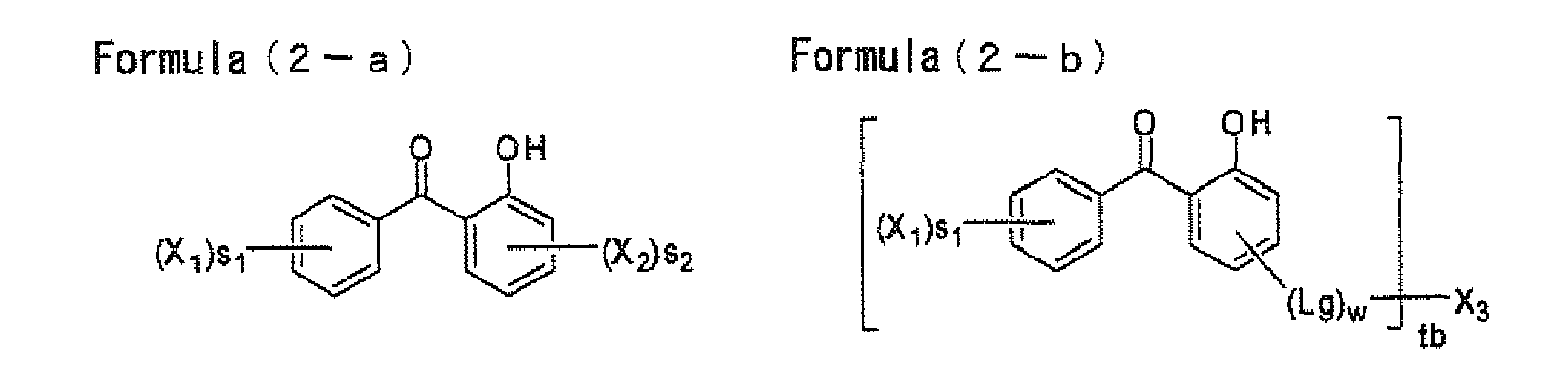
- wherein, in formula (2-a),
X1 and X2 each independently represent a hydrogen atom, a halogen atom, a hydroxyl group, a substituted or unsubstituted alkyl group, a substituted or unsubstituted phenyl group, a substituted or unsubstituted alkoxy group, a substituted or unsubstituted alkylsulfonyl group, a substituted or unsubstituted arylsulfonyl group, a sulfonic acid group, a substituted or unsubstituted alkyloxycarbonyl group, a substituted or unsubstituted aryloxycarbonyl group or a substituted or unsubstituted amino group; and s1 and s2 each independently represent an integer of 1 to 3; and wherein, in formula (2-b),
X1 represents a hydrogen atom, a halogen atom, a hydroxyl group, a substituted or unsubstituted alkyl group, a substituted or unsubstituted phenyl group, a substituted or unsubstituted alkoxy group, a substituted or unsubstituted alkylsulfonyl group, a substituted or unsubstituted arylsulfonyl group, a sulfonic acid group, a substituted or unsubstituted alkyloxycarbonyl group, a substituted or unsubstituted aryloxycarbonyl group, or a substituted or unsubstituted amino group; s1 represents an integer of 1 to 3; Lg represents a divalent substituent or a single bond; w represents 0 or 1;
tb represents 1 or 2; X3 represents, when tb is 1, a hydrogen atom, a halogen atom, a hydroxyl group, a substituted or unsubstituted alkyl group, a substituted or unsubstituted phenyl group, a substituted or unsubstituted alkoxy group, a substituted or unsubstituted alkylsulfonyl group, a substituted or unsubstituted arylsulfonyl group, a sulfonic acid group, a substituted or unsubstituted alkyloxycarbonyl group, a substituted or unsubstituted aryloxycarbonyl group, or a substituted or unsubstituted amino group; and when tb is 2, X3 represents a divalent substituent. - <2> The ultraviolet absorbent composition described in the above item <1>, wherein the compound C is a compound represented by formula (3-a) or (3-b):
-

- wherein
in formula (3-a), R11 represents a hydrogen atom, an aliphatic group, an aromatic group, a heterocyclic group bound via a carbon atom, or a hydrolysable protective group; R12, R13, R14, R15 and R16 each independently represent a hydrogen atom or a substituent; and R11 and R12, R12 and R13, R13 and R14, R14 and R15, R15 and R16 and R16 and R11 may bond to each other to form a ring; and
in formula (3-b), R21 represents a hydrogen atom, an aliphatic group, an acyl group, a sulfonyl group, a sulfinyl group, an oxy radical group or a hydroxyl group; Q represents a group of nonmetallic atoms necessary for forming a 5-, 6- or 7-membered ring; R22, R23, R24 and R25 each independently represents a hydrogen atom, an aliphatic group, an aromatic group, or a heterocyclic group bound via a carbon atom; and R21 and R22, R22 and R23, R24 and R25, and R21 and R24 may bond to each other to form a ring. - <3> The ultraviolet absorbent composition described in the above item <1> or <2>, wherein the ultraviolet absorbent A has the maximum absorption wavelength of 350 nm or more and 400 nm or less, the half width of 55 nm or less, and the molar extinction coefficient at the maximum absorption wavelength of 50,000 or more.
- <4> The ultraviolet absorbent composition described in any one of the above items <1> to <3>, wherein the ultraviolet absorbent B has the maximum absorption wavelength of less than 320 nm.
- <5> The ultraviolet absorbent composition described in any one of the above items <1> to <3>, wherein the ultraviolet absorbent B has the maximum absorption wavelength of 320 nm or more and 350 nm or less.
- <6> The ultraviolet absorbent composition described in any one of the above items <1> to <5>, wherein a mixing ratio of the ultraviolet absorbent A the ultraviolet absorbent B is 1:10 to 10:1.
- <7> The ultraviolet absorbent composition described in any one of the above items <2> to <6>, wherein the compound C is the compound represented by formula (3-b).
- <8> An ultraviolet absorbent dispersion, comprising the ultraviolet absorbent composition described in any one of the above items <1> to <7>.
- <9> An ultraviolet absorbent solution, comprising the ultraviolet absorbent composition described in any one of the above items <1> to <7>.
- <10> A polymer material, comprising the ultraviolet absorbent composition described in any one of the above items <1> to <7>.
- The ultraviolet absorbent composition of the present invention is superior, as advantageous effect, in ultraviolet-absorbing capacity in the UV-A and UV-B ranges, yet having no absorption in the visible range, further satisfying excellent light deterioration resistance and the other properties. Furthermore, the inventive ultraviolet possesses so high compatibility to a polymer that it can prevent bleed out, and also possesses so high solubility to various solvents that it can improve manufacturing operation efficiency.
- Other and further features and advantages of the invention will appear more fully from the following description, taking the accompanying drawing into consideration.
-
- [
Fig. 1] Fig. 1 shows an example of preferred absorption spectrum of the ultraviolet absorbents A and B for use in the present invention. - Hereinafter, the present invention will be described in detail.
A solution for measuring the spectral absorption maximum wavelength is obtained by dissolving the ultraviolet absorbent compositions (A), (B), and the compound (C) in an organic or inorganic solvent or water, either singly or as a mixture. - Examples of the organic solvent include amide-series solvents (e.g., N,N-dimethylformamide, N,N-dimethylacetamide, and 1-methyl-2-pyrrolidone), sulfone-series solvents (e.g., sulfolane), sulfoxide-series solvents (e.g., dimethyl sulfoxide), ureido-series solvents (e.g., tetramethylurea), ether-series solvents (e.g., dioxane, tetrahydrofuran, and cyclopentyl methyl ether), ketone-series solvents (e.g., acetone and cyclohexanone), hydrocarbon-series solvents (e.g., toluene, xylene, and n-decane), halogen-containing solvents (e.g., tetrachloroethane, chlorobenzene, and chloronaphthalene), alcohol-series solvents (e.g., methanol, ethanol, isopropyl alcohol, ethylene glycol, cyclohexanol, and phenol), pyridine-series solvents (e.g., pyridine, γ-picoline, and 2,6-lutidine), ester-series solvents (e.g., ethyl acetate and butyl acetate), carboxylic acid-series solvents (e.g., acetic acid and propionic acid), nitrile-series solvents (e.g., acetonitrile), sulfonic acid-series solvents (e.g., methanesulfonic acid), and amine-series solvents (e.g., triethylamine and tributylamine). Examples of the inorganic solvent include sulfuric acid and phosphoric acid.
- Among these, amide-series solvents, sulfone-series solvents, sulfoxide-series solvents, ureido-series solvents, ether-series solvents, ketone-series solvents, halogen-containing solvents, alcohol-series solvents, ester-series solvents, and nitrile-series solvents are preferable from the viewpoint of solubility of ultraviolet absorbents. The concentrations of the ultraviolet absorbent compositions (A) and (B) for measurement are not particularly limited insofar as the maximum wavelength of spectral absorption can be confirmed, and are preferably in a range of from 1 × 10⁻⁷ mol/L to 1 × 10¹³ mol/L. The measurement temperatures are not particularly limited, and are preferably from 0°C to 80°C.
- As measurement apparatus, a common spectral absorption measurement apparatus (e.g., U-4100 spectrophotometer, trade name, manufactured by Hitachi High-Technologies Corp.) can be used.
- In the present specification, the aliphatic group means an alkyl group, a substituted alkyl group, an alkenyl group, a substituted alkenyl group, an alkynyl group, a substituted alkynyl group, an aralkyl group, and a substituted aralkyl group. The aforementioned alkyl group may have a branch or may form a ring. The alkyl group preferably has 1 to 20 carbon atoms, and more preferably 1 to 18 carbon atoms. The alkyl moiety in the aforementioned substituted alkyl group is the same as the above mentioned alkyl group. The aforementioned alkenyl group may have a branch or may form a ring. The alkenyl group has preferably 2 to 20 carbon atoms, and more preferably 2 to 18 carbon atoms. The alkenyl moiety in the aforementioned substituted alkenyl group is the same as the above mentioned alkenyl group. The aforementioned alkynyl group may have a branch or may form a ring. The alkynyl group has preferably 2 to 20 carbon atoms, and more preferably 2 to 18 carbon atoms. The alkynyl moiety in the aforementioned substituted alkynyl group is the same as the above mentioned alkynyl group. The alkyl moiety in the aforementioned aralkyl group and substituted aralkyl group is the same as the above mentioned alkyl group. The aryl moiety in the aforementioned aralkyl group and substituted aralkyl group is the same as the aryl group mentioned below.
- Specific examples of the substituent in the alkyl portion of the substituted alkyl group, the substituted alkenyl group, the substituted alkynyl group, and the substituted aralkyl group include: a halogen atom (e.g. a chlorine atom, a bromine atom, or an iodine atom); an alkyl group [which represents a substituted or unsubstituted linear, branched, or cyclic alkyl group, and which includes an alkyl (preferably an alkyl having 1 to 30 carbon atoms, e.g. methyl, ethyl, n-propyl, isopropyl, t-butyl, n-octyl, eicosyl, 2-chloroethyl, 2-cyanoethyl, or 2-ethylhexyl), a cycloalkyl group (preferably a substituted or unsubstituted cycloalkyl group having 3 to 30 carbon atoms, e.g. cyclohexyl, cyclopentyl, or 4-n-dodecylcyclohexyl), a bicycloalkyl group (preferably a substituted or unsubstituted bicycloalkyl group having 5 to 30 carbon atoms, i.e. a monovalent group obtained by removing one hydrogen atom from a bicycloalkane having 5 to 30 carbon atoms, e.g. bicyclo[1,2,2]heptan-2-yl or bicyclo[2,2,2]octan-3-yl), and a tricyclo or higher structure having three or more ring structures; and an alkyl group in substituents described below (e.g. an alkyl group in an alkylthio group) represents such an alkyl group of the above concept];
- an alkenyl group [which represents a substituted or unsubstituted linear, branched, or cyclic alkenyl group, and which includes an alkenyl group (preferably a substituted or unsubstituted alkenyl group having 2 to 30 carbon atoms, e.g. vinyl, allyl, prenyl, geranyl, or oleyl), a cycloalkenyl group (preferably a substituted or unsubstituted cycloalkenyl group having 3 to 30 carbon atoms, i.e. a monovalent group obtained by removing one hydrogen atom from a cycloalkene having 3 to 30 carbon atoms, e.g. 2-cyclopenten-1-yl or 2-cyclohexen-1-yl), and a bicycloalkenyl group (which represents a substituted or unsubstituted bicycloalkenyl group, preferably a substituted or unsubstituted bicycloalkenyl group having 5 to 30 carbon atoms, i.e. a monovalent group obtained by removing one hydrogen atom from a bicycloalkene having one double bond, e.g. bicyclo[2,2,1]hept-2-en-1-yl or bicyclo[2,2,2]oct-2-en-4-yl)]; an alkynyl group (preferably a substituted or unsubstituted alkynyl group having 2 to 30 carbon atoms, e.g. ethynyl, propargyl, or trimethylsilylethynyl);
- an aryl group (preferably a substituted or unsubstituted aryl group having 6 to 30 carbon atoms, e.g. phenyl, p-tolyl, naphthyl, m-chlorophenyl, or o-hexadecanoylaminophenyl); a heterocyclic group (preferably a monovalent group obtained by removing one hydrogen atom from a substituted or unsubstituted 5- or 6-membered aromatic or nonaromatic heterocyclic compound; more preferably a 5- or 6-membered aromatic heterocyclic group having 3 to 30 carbon atoms, e.g. 2-furyl, 2-thienyl, 2-pyrimidinyl, 2-benzothiazolyl); a cyano; a hydroxyl; a nitro; a carboxyl; an alkoxy (preferably a substituted or unsubstituted alkoxy having 1 to 30 carbon atoms, e.g. methoxy, ethoxy, isopropoxy, t-butoxy, n-octyloxy, or 2-methoxyethoxy); an aryloxy (preferably a substituted or unsubstituted aryloxy having 6 to 30 carbon atoms, e.g. phenoxy, 2-methylphenoxy, 4-t-butylphenoxy, 3-nitrophenoxy, or 2-tetradecanoylaminophenoxy);
- a silyloxy group (preferably a silyloxy group having 3 to 20 carbon atoms, e.g. trimethylsilyloxy or t-butyldimethylsilyloxy); a heterocyclic oxy group (preferably a substituted or unsubstituted heterocyclic oxy group having 2 to 30 carbon atoms, e.g. 1-phenyltetrazol-5-oxy or 2-tetrahydropyranyloxy); an acyloxy group (preferably a formyloxy group, a substituted or unsubstituted alkylcarbonyloxy group having 2 to 30 carbon atoms, or a substituted or unsubstituted arylcarbonyloxy group having 7 to 30 carbon atoms, e.g. formyloxy, acetyloxy, pivaloyloxy, stearoyloxy, benzoyloxy, or p-methoxyphenylcarbonyloxy); a carbamoyloxy group (preferably a substituted or unsubstituted carbamoyloxy group having 1 to 30 carbon atoms, e.g. N,N-dimethylcarbamoyloxy, N,N-diethylcarbamoyloxy, morpholinocarbonyloxy, N,N-di-n-octylaminocarbonyloxy, or N-n-octylcarbamoyloxy);
- an alkoxycarbonyloxy group (preferably a substituted or unsubstituted alkoxycarbonyloxy group having 2 to 30 carbon atoms, e.g. methoxycarbonyloxy, ethoxycarbonyloxy, t-butoxycarbonyloxy, or n-octylcarbonyloxy); an aryloxycarbonyloxy group (preferably a substituted or unsubstituted aryloxycarbonyloxy group having 7 to 30 carbon atoms, e.g. phenoxycarbonyloxy, p-methoxyphenoxycarbonyloxy, or p-n-hexadecyloxyphenoxycarbonyloxy); an amino group (preferably an amino group, a substituted or unsubstituted alkylamino group having 1 to 30 carbon atoms, or a substituted or unsubstituted arylamino group having 6 to 30 carbon atoms, e.g. amino, methylamino, dimethylamino, anilino, N-methyl-anilino, or diphenylamino); an acylamino group (preferably a formylamino group, a substituted or unsubstituted alkylcarbonylamino group having 1 to 30 carbon atoms, or a substituted or unsubstituted arylcarbonylamino group having 6 to 30 carbon atoms, e.g. formylamino, acetylamino, pivaloylamino, lauroylamino, benzoylamino, or 3,4,5-tri-n-octyloxyphenylcarbonylamino);
- an aminocarbonylamino group (preferably a substituted or unsubstituted aminocarbonylamino group having 1 to 30 carbon atoms, e.g. carbamoylamino, N,N-dimethylaminocarbonylamino, N,N-diethylaminocarbonylamino, or morpholinocarbonylamino); an alkoxycarbonylamino group (preferably a substituted or unsubstituted alkoxycarbonylamino group having 2 to 30 carbon atoms, e.g. methoxycarbonylamino, ethoxycarbonylamino, t-butoxycarbonylamino, n-octadecyloxycarbonylamino, or N-methyl-methoxycarbonylamino); an aryloxycarbonylamino group (preferably a substituted or unsubstituted aryloxycarbonylamino group having 7 to 30 carbon atoms, e.g. phenoxycarbonylamino, p-chlorophenoxycarbonylamino, or m-n-octyloxyphenoxycarbonylamino); a sulfamoylamino group (preferably a substituted or unsubstituted sulfamoylamino group having 0 to 30 carbon atoms, e.g. sulfamoylamino, N,N-dimethylaminosulfonylamino, or N-n-octylaminosulfonylamino);
- an alkyl- or aryl-sulfonylamino group (preferably a substituted or unsubstituted alkylsulfonylamino group having 1 to 30 carbon atoms, or a substituted or unsubstituted arylsulfonylamino group having 6 to 30 carbon atoms, e.g. methylsulfonylamino, butylsulfonylamino, phenylsulfonylamino, 2,3,5-trichlorophenylsulfonylamino, or p-methylphenylsulfonylamino); a mercapto group; an alkylthio group (preferably a substituted or unsubstituted alkylthio group having 1 to 30 carbon atoms, e.g. methylthio, ethylthio, or n-hexadecylthio); an arylthio group (preferably a substituted or unsubstituted arylthio group having 6 to 30 carbon atoms, e.g. phenylthio, p-chlorophenylthio, or m-methoxyphenylthio); a heterocyclic thio group (preferably a substituted or unsubstituted heterocyclic thio group having 2 to 30 carbon atoms, e.g. 2-benzothiazolylthio or 1-phenyltetrazol-5-ylthio); a sulfamoyl group (preferably a substituted or unsubstituted sulfamoyl group having 0 to 30 carbon atoms, e.g. N-ethylsulfamoyl, N-(3-dodecyloxypropyl)sulfamoyl, N,N-dimethylsulfamoyl, N-acetylsulfamoyl, N-benzoylsulfamoyl, or N-(N'-phenylcarbamoyl)sulfamoyl); a sulfo group;
- an alkyl- or aryl-sulfinyl group (preferably a substituted or unsubstituted alkylsulfinyl group having 1 to 30 carbon atoms, or a substituted or unsubstituted arylsulfinyl group having 6 to 30 carbon atoms, e.g. methylsulfinyl, ethylsulfinyl, phenylsulfinyl, or p-methylphenylsulfinyl); an alkyl- or aryl-sulfonyl group (preferably a substituted or unsubstituted alkylsulfonyl group having 1 to 30 carbon atoms, or a substituted or unsubstituted arylsulfonyl group having 6 to 30 carbon atoms, e.g. methylsulfonyl, ethylsulfonyl, phenylsulfonyl, or p-methylphenylsulfonyl); an acyl group (preferably a formyl group, a substituted or unsubstituted alkylcarbonyl group having 2 to 30 carbon atoms, a substituted or unsubstituted arylcarbonyl group having 7 to 30 carbon atoms, or a substituted or unsubstituted heterocyclic carbonyl group having 4 to 30 carbon atoms, which is bonded to said carbonyl group through a carbon atom, e.g. acetyl, pivaloyl, 2-chloroacetyl, stearoyl, benzoyl, p-n-octyloxyphenylcarbonyl, 2-pyridylcarbonyl, or 2-furylcarbonyl);
- an aryloxycarbonyl group (preferably a substituted or unsubstituted aryloxycarbonyl group having 7 to 30 carbon atoms, e.g. phenoxycarbonyl, o-chlorophenoxycarbonyl, m-nitrophenoxycarbonyl, or p-t-butylphenoxycarbonyl); an alkoxycarbonyl group (preferably a substituted or unsubstituted alkoxycarbonyl group having 2 to 30 carbon atoms, e.g. methoxycarbonyl, ethoxycarbonyl, t-butoxycarbonyl, or n-octadecyloxycarbonyl); a carbamoyl group (preferably a substituted or unsubstituted carbamoyl group having 1 to 30 carbon atoms, e.g. carbamoyl, N-methylcarbamoyl, N,N-dimethylcarbamoyl, N,N-di-n-octylcarbamoyl, or N-(methylsulfonyl)carbamoyl); an aryl- or heterocyclic-azo group (preferably a substituted or unsubstituted aryl azo group having 6 to 30 carbon atoms, or a substituted or unsubstituted heterocyclic azo group having 3 to 30 carbon atoms, e.g. phenylazo, p-chlorophenylazo, or 5-ethylthio-1,3,4-thiadiazol-2-ylazo); an imido group (preferably N-succinimido or N-phthalimido);
- a phosphino group (preferably a substituted or unsubstituted phosphino group having 2 to 30 carbon atoms, e.g. dimethylphosphino, diphenylphosphino, or methylphenoxyphosphino); a phosphinyl group (preferably a substituted or unsubstituted phosphinyl group having 2 to 30 carbon atoms, e.g. phosphinyl, dioctyloxyphosphinyl, or diethoxyphosphinyl);a phosphinyloxy group (preferably a substituted or unsubstituted phosphinyloxy group having 2 to 30 carbon atoms, e.g. diphenoxyphosphinyloxy or dioctyloxyphosphinyloxy); a phosphinylamino group (preferably a substituted or unsubstituted phosphinylamino group having 2 to 30 carbon atoms, e.g. dimethoxyphosphinylamino or dimethylaminophosphinylamino); and a silyl group (preferably a substituted or unsubstituted silyl group having 3 to 30 carbon atoms, e.g. trimethylsilyl, t-butyldimethylsilyl, or phenyldimethylsilyl).
- Among the substituents, with respect to one having a hydrogen atom, the hydrogen atom may be removed and be substituted by any of the above-mentioned substituents. Examples thereof include: an alkylcarbonylaminosulfonyl group, an arylcarbonylaminosulfonyl group, an alkylsulfonylaminocarbonyl group, and an arylsulfonylaminocarbonyl group. Specific examples thereof include a methylsulfonylaminocarbonyl group, a p-methylphenylsulfonylaminocarbonyl group, an acetylaminosulfonyl group, and a benzoylaminosulfonyl group.
- Examples of a substituent of the aryl portion of the substituted aralkyl group are similar to the examples of a substituent of the substituted aryl groups mentioned later.
- In this specification, the aromatic groups refer to aryl groups and substituted aryl groups. To the aromatic groups, an aliphatic ring, another aromatic ring, or a heterocycle may be condensed. The aromatic group preferably has 6 to 40 carbon atoms, more preferably 6 to 30 carbon atoms, and even more preferably 6 to 20 carbon atoms. Among the above, phenyl or naphthyl is preferable as the aryl group, and phenyl is particularly preferable.
- The aryl portion of the substituted aryl group is similar to the above-mentioned aryl groups. Examples of a substituent of the substituted aryl groups are similar to the above-mentioned examples of the substituent of the alkyl portions of the substituted alkyl group, the substituted alkenyl group, the substituted alkynyl group, and the substituted aralkyl group.
- In this specification, the heterocyclic groups preferably contain a 5-membered or 6-membered, saturated or unsaturated heterocycle. To the heterocycle, an aliphatic ring, an aromatic ring, or another heterocycle may be condensed. Examples of a heteroatom of the heterocycle include B, N, O, S, Se, and Te. As the heteroatom, N, O, and S are preferable. It is preferable that a carbon atom of the heterocycle has a free valence (monovalent) (the heterocyclic group is preferably to be bonded at a carbon atom thereof). The heterocyclic group preferably has 1 to 40 carbon atoms, more preferably 1 to 30 carbon atoms, and even more preferably 1 to 20 carbon atoms. Examples of the saturated heterocycle include a pyrrolidine ring, a morpholine ring, a 2-bora-1,3-dioxolane ring, and 1,3-thiazolidine ring. Examples of the unsaturated heterocycles include an imidazole ring, a thiazole ring, a benzothiazole ring, a benzoxazole ring, a benzotriazole ring, a benzoselenazole ring, a pyridine ring, a pyrimidine ring, and a quinoline ring. The heterocyclic groups may have a substituent. Examples of the substituent are similar to the previously-mentioned examples of the substituent of the alkyl portions of the substituted alkyl group, the substituted alkenyl group, the substituted alkynyl group, and the substituted aralkyl group.
- The ultraviolet absorbent composition according to the present invention characteristically contains an ultraviolet absorbent A represented by formula (1) and an ultraviolet absorbent B represented by formula (2-a) or (2-b) each having a particular absorption spectral shape, and a compound C, which is at least one kind of compound selected from a singlet oxygen scavenger, an antioxidant and a radical trapping agent.
- The blending ratio of the ultraviolet absorbent A to the ultraviolet absorbent B represented by formula (2-a) or (2-b) may be arbitrary. The ratio of the ultraviolet absorbent A to the ultraviolet absorbent B (A:B) is arbitrary excluding 0:1 1 and 1:0. It is preferably 1:10 to 10:1, more preferably 1:5 to 5:1, particularly preferably 1:4 to 4:1, most preferably 1:2 to 2:1. The blending ratio in the present invention is expressed by molar ratio. It is possible to convert the molar ratio to the weight ratio, when the molecular weight of the ultraviolet absorbent is known, and thus, those with normal skill in the art can mix the ingredients based on weight ratio.
- The ultraviolet absorbent composition according to the present invention preferably includes two or less kinds of compounds, particularly preferably one kind of compound, as the ultraviolet absorbent A. It preferably includes three or less kinds of compounds, more preferably two or less kinds of compounds, and particularly preferably one kind of compound, as the ultraviolet absorbent B.
- The ultraviolet absorbent having a particular absorption spectral shape according to the present invention particular will be described below.
The ultraviolet absorbent A represented by formula (1) has an absorption maximum wavelength preferably of 350 nm or more and 400 nm or less, and a half value width of 55 nm or less. Further, it is preferable to be the molar extinction coefficient at the maximum absorption wavelength of 50,000 or more.
The ultraviolet absorbent B represented by formula (2-a) or (2-b) preferably has an absorption maximum wavelength of 350 nm or less. Further, the absorbance at 320 nm of the ultraviolet absorbent B represented by formula (2-a) or (2-b) preferably shows 30% or more of the absorbance at the absorption maximum wavelength. In particular, the absorbance of the ultraviolet absorbent B at 320 nm is preferably 50% or more of the absorbance at the absorption maximum wavelength. - As preferred ultraviolet absorbent B, for example, as shown in
Fig. 1 , the material can be classified into an ultraviolet absorbent (B-(1)) having an absorption maximum wavelength of less than 320 nm and an ultraviolet absorbent (B-(2)) having an absorption maximum wavelength of from 320 nm to 350 nm.Fig. 1 shows preferable absorption spectra of the ultraviolet absorbent A and the ultraviolet absorbent B for use in the present invention. - The absorption maximum wavelength and the half value specified in the present invention can be determined easily by a skilled person in the art. The measuring methods are described, for example, in Chemical Society of Japan Ed., "Experimental Chemistry Lecture, Chapter 7 Spectroscopy II", 4th Ed., (Maruzen, 1992), p. 180 to 186. Specifically, they are determined by dissolving a sample in a suitable solvent and measuring the spectrum in a spectrophotometer by using two quartz or glass cells for the sample and control. For example, the solvent for use is required to be capable of dissolving the sample, have no absorption in the measurement wavelength range, have smaller interaction with the solute molecule, and have relatively low volatility. Any solvent may be used, as long as it satisfies the conditions above. In the present invention, the measurement is made by using ethyl acetate (EtOAc) as the solvent.
- The absorption maximum wavelength and the half value width of the dyes in the present invention are determined by preparing a solution in ethyl acetate as the solvent at a concentration of approximately 5 × 10⁻⁵ mol·dm-3 and by measurement while using a quartz cell having an optical path length of 10 mm.
- The spectral half value width is described, for example, in Chemical Society of Japan Ed., "Experimental Chemistry Lecture, Chapter 3 Basic Operation III", 4th Ed., (Maruzen, 1991), p. 154. The half value width is described in the literature above by using wave number as abscissa, but the half value width is plotted against wavelength in the present invention and thus, the unit of the half value width is nm. Specifically, it is defined as the width of the absorption band at an absorbance of 1/2 of that at the absorption maximum wavelength and used as an indicator of the absorption spectral shape. A spectrum having a smaller half value width is a sharp spectrum, while that having a large half value width, a broad spectrum. An ultraviolet absorbent giving a broad spectrum has absorption in a wider range from the absorption maximum wavelength to the long-wavelength side. For this reason, for shielding the light in the long-wavelength ultraviolet range effectively without yellowing, an ultraviolet absorbent showing a spectrum having a smaller half value width is preferable.
- As described in Sumio Tokita, "Chemistry Seminar 9, Color Chemistry ", (Maruzen, 1982), p. 154 to 155, the absorption intensity, that is the oscillator intensity of light, is proportional with the integral of the molar extinction coefficient. When the absorption spectra is symmetrical, the oscillator intensity is proportional to the product of the absorbance at the absorption maximum wavelength and the half value width (in such a case, the half value width is a value expressed by wavelength), which means that a compound having a spectrum having a smaller half value width has larger absorbance at the absorption maximum wavelength, even when the transition moment is the same. Such an ultraviolet absorbent has an advantage that it is possible to block the light in the range around the absorption maximum wavelength effectively even when it is added in a small amount, but the absorbance drops rapidly as the wavelength is shifted slightly from the absorption maximum wavelength, prohibiting light blocking over a wide range.
- The ultraviolet absorbent A in the present invention preferably has an absorption maximum wavelength of from 350 nm to 400 nm and a half value width of 55 nm or less. The use of the ultraviolet absorbent A having the absorption of the above-described wavelength range in combination with the ultraviolet absorbent B is suitable for the coverage of the ultraviolet absorption range. However, a possibility of yellow-color development of a composition has been expected. In view of the possibility, it was difficult for a skilled person in the art to come up with the combination of these ultraviolet absorbents. Though improvement of light deterioration resistance is expected to be achieved by the use together with a compound C, it was difficult for a skilled person in the art to come up with such combination because problems occur most often with respect to solubility.
- Hereinafter, the ultraviolet absorbent A represented by formula (1) for use in the present invention will be described.

- [In formula (1), Ra1 and Ra2 each independently represent a hydrogen atom, a substituted or unsubstituted alkyl group, a substituted or unsubstituted aryl group or a substituted or unsubstituted heterocyclic group. Ra1 and Ra2 may bond to each other to form a nitrogen-containing ring.
Ra3 and Ra4 each independently represent a substituent having a Hammett substituent constant σp value of 0.2 or more. Ra3 and Ra4 may bond to each other to form a ring. Ra5, Ra6 and Ra7 each represent a hydrogen atom or a monovalent substituent. Any two of Ra1, Ra5, Ra6 and Ra7 may bond with each other to form a ring.] - In formula (1), Ra1 and Ra2 each independently represent a hydrogen atom, a substituted or unsubstituted alkyl group, a substituted or unsubstituted aryl group or a substituted or unsubstituted heterocyclic group. The alkyl group is preferably an alkyl group having 1 to 20 carbon atoms, and examples thereof include a methyl group, an ethyl group and a propyl group. The alkyl group may have one or more monovalent substituents at any position of the alkyl group.
- Examples of the monovalent substituent include a halogen atom (e.g., a fluorine atom, a chlorine atom, a bromine atom, an iodine atom), an alkyl group (e.g., methyl, ethyl), an aryl group (e.g., phenyl, naphthyl), a cyano group, a carboxyl group, an alkoxycarbonyl group (e.g., methoxycarbonyl), an aryloxycarbonyl group (e.g., phenoxycarbonyl), a substituted or unsubstituted carbamoyl group (e.g., carbamoyl, N-phenylcarbamoyl, N,N-dimethylearbamoyl), an alkylcarbonyl group (e.g., acetyl), an arylcarbonyl group (e.g., benzoyl), a nitro group, a substituted or unsubstituted amino group (e.g., amino, dimethylamino, anilino), an acylamino group (e.g., acetamino, ethoxycarbonylamino), a sulfonamido group (e.g., methanesulfonamido), an imido group (e.g., succinimido, phthalimido), an imino group (e.g., benzylideneimino), a hydroxyl group, an alkoxy group (e.g., methoxy), an aryloxy group (e.g., phenoxy), an acyloxy group (e.g., acetoxy), an alkylsulfonyloxy group (e.g., methanesulfonyloxy), an arylsulfonyloxy group (e.g., benzenesulfonyloxy), a sulfo group, a substituted or unsubstituted sulfamoyl group (e.g., sulfamoyl, N-phenylsulfamoyl), an alkylthio group (e.g., methylthio), an arylthio group (e.g., phenylthio), an alkylsulfonyl group (e.g., methanesulfonyl), an arylsulfonyl group (e.g., benzenesulfonyl), and a heterocyclic group (e.g., pyridyl, morpholino). The substituent may be further substituted. In the case where there are a plurality of substituents, they may be the same as or different from. Alternatively, they may bond together to form a ring.
- The aryl group is preferably an aryl group having 6 to 20 carbon atoms, and examples thereof include a phenyl group and a naphthyl group. The aryl group may have one or more monovalent substituents at any position of the aryl group. The monovalent substituent is, for example, the monovalent substituent described above.
- The heterocyclic group is preferably a heterocyclic group having 6 to 20 carbon atoms, and examples thereof include a pyridyl group, a piperidino group, and a morpholino group. The heterocyclic group may have a monovalent substituent at an arbitrary position thereof. The monovalent substituent is, for example, the monovalent substituent described above.
- Ra1 and Ra2 may bond to each other to form a nitrogen-containing ring. The ring to be formed is preferably a nitrogen-containing 5-or 6-membered ring. Examples of the ring include a pyrrolidine ring, a pyrroline ring, an imidazolidine ring, an imidazoline ring, a oxazoline ring, a thiazoline ring, a pyperidine ring, a morpholine ring, and a pyperadine ring. These rings may have a monovalent substituent on their rings. Examples of the substituent include examples of monovalent substituents described above. Further, the ring may form a ring-fused structure with an aromatic ring or the like.
- Ra3 and Ra4 each independently represent a substituent having a Hammett substituent constant σp value of 0.2 or more. The expression "Hammett substituent constant σ value" used herein will be briefly described. Hammett's rule is a rule of thumb advocated by L. P. Hammett in 1935 for quantitatively considering the effect of substituents on the reaction or equilibrium of benzene derivatives, and the appropriateness thereof is now widely recognized. The substituent constant determined in the Hammett's rule involves σp value and σm value. These values can be found in a multiplicity of general publications, and are detailed in, for example, "Lange's Handbook of Chemistry" 12th edition by J. A. Dean, 1979 (McGraw-Hill), "Kagaku no Ryoiki" special issue, No. 122, pp. 96 to 103, 1979 (Nankodo) and Chem.Rev., vol. 91, pp. 165 to 195, 1991. The substituent having a Hammett substituent constant σp of 0.2 or more in the present invention is an electron-withdrawing group. The σp value is preferably 0.25 or more, more preferably 0.3 or more, and particularly preferably 0.35 or more.
- Examples of Ra3 and Ra4 include a cyano group (0.66), a carboxyl group (-COOH: 0.45), an alkoxycarbonyl group (e.g. -COOMe: 0.45), an aryloxycarbonyl group (e.g. -COOPh: 0.44), a carbamoyl group (-CONH2: 0.36), an alkylcarbonyl group (e.g. -COMe: 0.50), an arylcarbonyl group (e.g. -COPh: 0.43), an alkylsulfonyl group (e.g. -SO2Me: 0.72), an arylsulfonyl group (e.g. -SO2Ph: 0.68) and the like. In the present specification, "Me" represents a methyl group and "Ph" represents a phenyl group. The values in parenthesis are the σp values of typical substituents, as extracted from Chem. Rev., 1991, vol. 91, p. 165 to 195.
- Ra3 and Ra4 may bond to each other to form a ring. The σp values of Ra3 and Ra4 may not be specified when, for example, a ring is formed by Ra3 and Ra4. However, the σp values thereof when a ring is formed are defined, assuming that partial ring structures are substituted respectively as Ra3 and Ra4, in the present invention. For example, when a 1,3-indandione ring is formed, benzoyl groups are considered to be substituted respectively as Ra3 and Ra4.
- Ra5, Ra6 and Ra7 each independently represent a hydrogen atom or a monovalent substituent. The monovalent substituent is, for example, the monovalent substituent described above. It is preferably a hydrogen atom, an alkyl group, an aryl group or an alkoxy group.
- Any two of Ra1, Ra5, Ra6 and Ra7 may bind with each other to form a ring. A combination of binding is not particularly limited. In the case of forming a ring, the ring is preferably formed by a pair of Ra1 and Ra5, or a pair of Ra5 and Ra7. As the ring to be formed, it is more preferable to form 4- to 8-membered ring containing the a carbon atom or nitrogen atom as previously defined in the above-described formula (1) is more preferable.
- The ultraviolet absorbent represented by formula (1) may be an ultraviolet absorbent represented by formula (1-2) or (1-3). Next, the ultraviolet absorbent represented by formula (1-2) or (1-3) will be described in detail.
-

- [In formula (1-2),
Ra21 represents a hydrogen atom, a substituted or unsubstituted alkyl group, a substituted or unsubstituted aryl group, or a substituted or unsubstituted heterocyclic group;
Ra31 and Ra41 each represent -CN, -COORa25, -CONRa26Ra27, -CORa28 or -SO2Ra29 (Ra25, Ra26, Ra27 and Ra28 each independently represent a hydrogen atom, a substituted or unsubstituted alkyl group, a substituted or unsubstituted aryl group, or a substituted or unsubstituted heterocyclic group; Ra26 and Ra27 may bond to each other to form a nitrogen-containing ring; and Ra29 represents a substituted or unsubstituted alkyl group, a substituted or unsubstituted aryl group, or a substituted or unsubstituted heterocyclic group);
Ra61 and Ra71 each represent a hydrogen atom or a monovalent substituent; Ra61 and Ra71 may bind to each other to form a ring; and
Za1 represents a group of atoms necessary for forming a 4- to 8-membered ring with the carbon atom and the nitrogen atom.] -

- [In formula (1-3),
Ra12 and Ra22 each independently represent a hydrogen atom, an alkyl group, an aryl group, or a heterocyclic group; Ra12 and Ra22 may bond to each other to form a nitrogen-containing ring
Ra32 and Ra42 each represent -CN, -COORa35, -CONRa36Ra37, -CORa38 or -SO2Ra39 (Ra35, Ra36, Ra37 and Ra38 each independently represent a hydrogen atom, an alkyl group, an aryl group, or a heterocyclic group; Ra36 and Ra37 may bond to each other to form a nitrogen-containing ring; and Ra39 represents an alkyl group, an aryl group, or a heterocyclic group);
Ra62 represents a hydrogen atom or a monovalent substituent; and
Za2 represents a group of atoms necessary for forming a 4- to 8-membered ring with the carbon atoms.] - In formula (1-2), Ra21 represents a hydrogen atom, a substituted or unsubstituted alkyl group, a substituted or unsubstituted aryl group, or a substituted or unsubstituted heterocyclic group. Examples of the substituted or unsubstituted alkyl group, the substituted or unsubstituted aryl group, and the substituted or unsubstituted heterocyclic group are the same as those of Ra1 in the above-described formula (1), and preferable examples thereof are also the same as preferable examples of Ra1.
- Ra31 and Ra41 each represent -CN, -COORa25, -CONRa26Ra27, -CORa28 or-SO2Ra29. Ra25, Ra26, Ra27 and Ra28 each independently represent a hydrogen atom, a substituted or unsubstituted alkyl group, a substituted or unsubstituted aryl group, or a substituted or unsubstituted heterocyclic group. Ra29 represents a substituted or unsubstituted alkyl group, a substituted or unsubstituted aryl group, or a substituted or unsubstituted heterocyclic group. Examples of the substituted or unsubstituted alkyl group, the substituted or unsubstituted aryl group, and the substituted or unsubstituted heterocyclic group, all of which are represented by Ra25 to Ra29 are the same as those of Ra1 in the above-described formula (1), and preferable examples thereof are also the same as preferable examples of Ra1. Ra26 and Ra27 may bond to each other to form a nitrogen-containing ring. The ring to be formed is preferably a nitrogen-containing 5-to 8-membered ring.
- Ra61 and Ra71 each represent a hydrogen atom or a monovalent substituent. Ra61 and Ra71 may bind to each other to form a ring. Ra61 and Ra71 each have the same meaning as those of Ra6 and Ra7 in formula (1), respectively, and the favorable examples thereof are also the same.
Za1 represents a group of atoms necessary for forming a 4- to 8-membered ring with the carbon atom and the nitrogen atom. Examples of the ring include a pyrrolidine ring, a pyrroline ring, an imidazolidine ring, an imidazoline ring, a oxazoline ring, a thiazoline ring, a pyperidine ring, a morpholine ring, and a pyperadine ring. These rings may have a monovalent substituent. Examples of the substituent include examples of the monovalent substituent as described above. Further, these rings may form a ring-fused structure with an aromatic ring or the like. - In formula (1-3), Ra12 and Ra22 each independently represent a hydrogen atom, a substituted or unsubstituted alkyl group, a substituted or unsubstituted aryl group, or a substituted or unsubstituted heterocyclic group. Examples of the substituted or unsubstituted alkyl group, the substituted or unsubstituted aryl group, and the substituted or unsubstituted heterocyclic group are the same as those of Ra1 and Ra2 in the above-described formula (1), and preferable examples thereof are also the same as preferable examples of Ra1 and Ra2. Ra12 and Ra22 may bond to each other to form a nitrogen-containing ring. Examples of the ring to be formed are the same as those of Ra1 and Ra2 in the above-described formula (I), and preferable examples thereof are also the same as preferable examples of Ra1 and Ra2.
Ra32 and Ra42 each represent -CN, -COORa35, -CONRa36Ra37, -CORa38 or - SO2Ra39. Ra35 to Ra39 each have the same meaning as those of Ra25 to Ra29 in formula (1-2), respectively, and the favorable examples thereof are also the same. - Ra62 represents a hydrogen atom or a monovalent substituent. Ra62 has the same meaning as that of Ra6 in formula (1), and the favorable examples thereof are also the same.
- Za2 represents a group of atoms necessary for forming a 4- to 8-membered ring with the carbon atoms. Examples of the ring include a cyclopentene ring, a cyclohexene ring, a cycloheptene ring, a pyrroline ring, an imidazoline ring, a oxazoline ring, a thiazoline ring, an oxole ring, an azine ring, an oxazine ring, and a diazine ring. These rings may have a monovalent substituent. Examples of the substituent include examples of the monovalent substituent as described above. Further, these rings may form a ring-fused structure with an aromatic ring or the like.
- In the ultraviolet absorbent represented by formula (1-3), it is preferable that Ra32 is a substituent selected from -CN, -COORa35 or -SO2Ra39, and Ra42 is a substituent selected from -CN, -COORa35 or -SO2Ra39. However, both the case in which both of Ra32 and Ra42 are -COO Ra35, and the case in which Ra32 and Ra42 are a combination of - CN and -COO Ra35, are excluded.
Further, with respect to the ultraviolet absorbent represented by the above-described formula (1-3), at least one of Ra12 and Ra22 is preferably a substituent selected from the group consisting of an allyl group, a hydroxyethyl group, and a benzyl group. Especially, it is preferable that both of Ra31 and Ra32 are the same substituent selected from these groups. - The ultraviolet absorbent represented by any one of the above-described formulae (1), (1-2) and (1-3) can be synthesized with reference to known patent bulletins and literatures, for example, from page 6, upper right column,
line 1 to page 8, upper right column, line 15 inJP-A-51-56620 line 1 to right column, line 3 inJP-A-53-128333 JP-A-62-56957 JP-B-1-53455 JP-A-4-257486 2005-538072 - Hereinafter, specific examples of the ultraviolet absorbent represented by any one of formulae (1), (1-2) and (1-3) for use in the present invention will be shown, but the present invention should not be considered to be limited thereto.
-


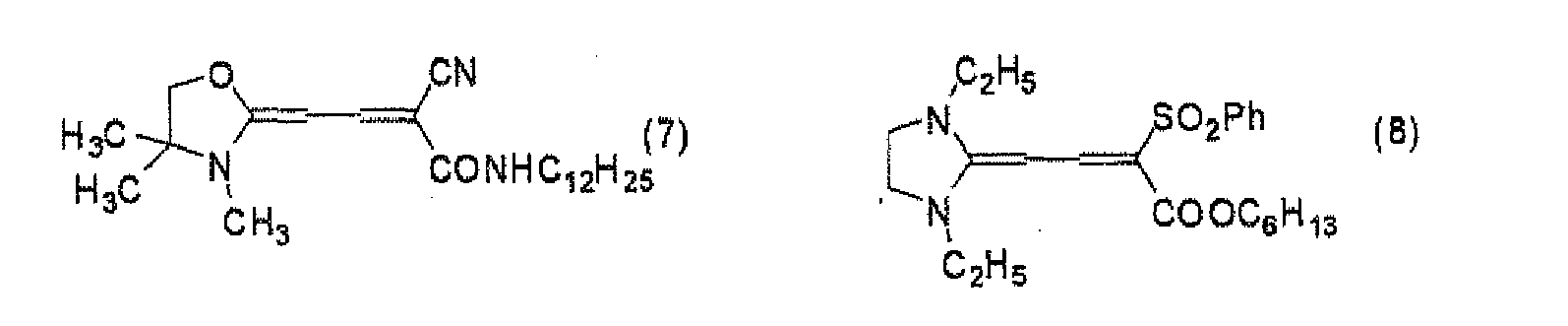


-


-

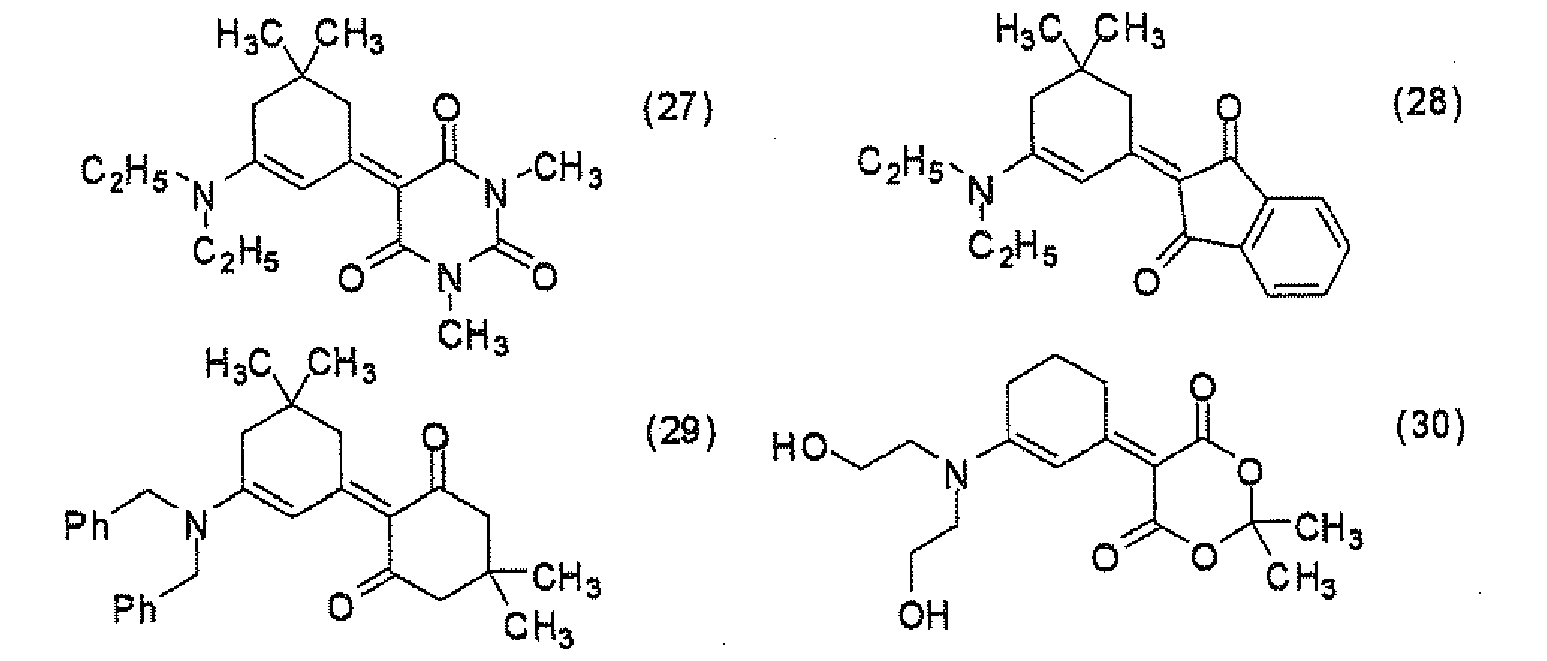


-


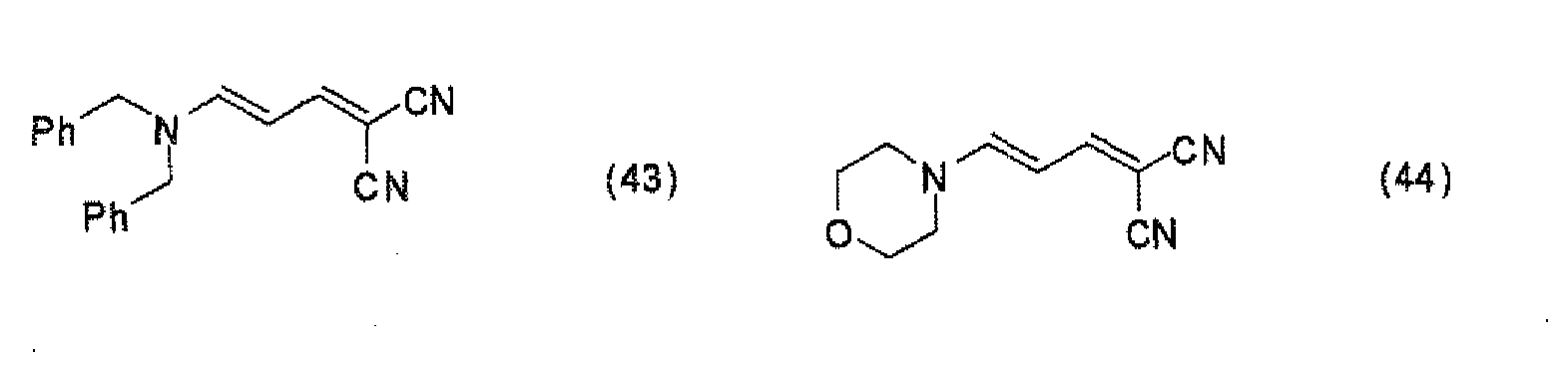


-


-


- The ultraviolet absorbent represented by any one of formulae (1), (1-2) and (1-3) for use in the present invention may have a tautomer, depending on its structure and the environment to which the compound is exposed. In the present specification, only a typical tautomer is described, but the other tautomer different from that described in the present specification are also included in the compound of the present invention.
- The ultraviolet absorbent represented by any one of formulae (1), (1-2) and (1-3) for use in the present invention may have an isotopic element (such as 2H, 3H, 13C, 15N, 17O, or 18O).
- A polymer having the structure of the ultraviolet absorbent represented by any one of formulae (1), (1-2), and (1-3) above in its repeating unit as the ultraviolet absorptive group can also be used favorably in the present invention. Hereinafter, examples of the repeating unit containing the structure of the ultraviolet absorbent represented by formula (1), (1-2), or (1-3) above will be shown.
-


- The polymer may be a homopolymer having one kind of repeating unit or a copolymer having two or more kinds of repeating units. It may be a copolymer having another repeating unit additionally. Hereinafter, examples of the other repeating unit are shown.
-

- Examples of the polymer having the structure of the ultraviolet absorbent in the repeating unit are described, for example, in
JP-B-1-53455 JP-A-61-189530 JP-A-62-260152 JP-A-63-53544 line 1 to p. 15, right lower column, line 19;JP-A-63-56651 EP Patent No. 27242 WO 2006/009451 pamphlet, p. 3, line 28 to p. 26,line 1. The polymer can be prepared with reference to the methods described in these Patent Documents. - As the ultraviolet absorbent A represented by any one of formulae (1), (1-2) and (1-3) for use in the present invention, the exemplified compound (47) is most preferable.
- A content of the above-described ultraviolet absorbent A in the ultraviolet absorbent composition of the present invention is in the range of preferably from 5 to 85% by mole, and more preferably from 20 to 70% by mole.
- Next, the ultraviolet absorbent B represented by formula (2-a) or (2-b) for use in the present invention will be described.
-

- (In formula (2-a), X1 and X2 each independently represent a hydrogen atom, a halogen atom, a hydroxyl group, a substituted or unsubstituted alkyl group, a substituted or unsubstituted phenyl group, a substituted or unsubstituted alkoxy group, a substituted or unsubstituted alkylsulfonyl group, a substituted or unsubstituted aryl-sulfonyl group, a sulfonic acid group, a substituted or unsubstituted alkyloxycarbonyl group, a substituted or unsubstituted aryloxycarbonyl group or a substituted or unsubstituted amino group; and s1 and s2 each independently represent an integer of 1 to 3.)
- (In formula (2-b), X1 represents a hydrogen atom, a halogen atom, a hydroxyl group, a substituted or unsubstituted alkyl group, a substituted or unsubstituted phenyl group, a substituted or unsubstituted alkoxy group, a substituted or unsubstituted alkylsulfonyl group, a substituted or unsubstituted arylsulfonyl group, a sulfonic acid group, a substituted or unsubstituted alkyloxycarbonyl group, a substituted or unsubstituted aryloxycarbonyl group, or a substituted or unsubstituted amino group; s1 represents an integer of 1 to 3;
Lg represents a divalent substituent or a single bond; w represents 0 or 1;
tb represents 1 or 2; and when tb is 1, X3 represents a hydrogen atom, a halogen atom, a hydroxyl group, a substituted or unsubstituted alkyl group, a substituted or unsubstituted phenyl group, a substituted or unsubstituted alkoxy group, a substituted or unsubstituted alkylsulfonyl group, a substituted or unsubstituted arylsulfonyl group, a sulfonic acid group, a substituted or unsubstituted alkyloxycarbonyl group, a substituted or unsubstituted aryloxycarbonyl group, or a substituted or unsubstituted amino group; and when tb is 2, X3 represents a divalent substituent.) - (Formula (2-a))
X1 and X2 each independently represent a hydrogen atom, a halogen atom, a hydroxyl group, a substituted or unsubstituted alkyl group, a substituted or unsubstituted phenyl group, a substituted or unsubstituted alkoxy group, a substituted or unsubstituted alkylsulfonyl group, a substituted or unsubstituted arylsulfonyl group, a sulfonic acid group, a substituted or unsubstituted alkyloxycarbonyl group, a substituted or unsubstituted aryloxycarbonyl group, or a substituted or unsubstituted amino group. X1 and X2 each are preferably a hydrogen atom, a chlorine atom, a hydroxyl group, a substituted or unsubstituted alkyl group having 1 to 18 carbon atoms, a substituted or unsubstituted aryl group having 6 to 24 carbon atoms, a substituted or unsubstituted alkoxy group having 1 to 18 carbon atoms, an alkyloxycarbonyl group having 2 to 18 carbon atoms, an aryloxycarbonyl group having 7 to 24 carbon atoms, a sulfonic acid group or a substituted or unsubstituted amino group having 1 to 16 carbon atoms; and particularly preferably a hydrogen atom, a hydroxyl group, a substituted or unsubstituted alkoxy group having 1 to 18 carbon atoms, a sulfonic acid group or a substituted or unsubstituted amino group having 1 to 16 carbon atoms. - (Formula (2-b))
tb is 1 or 2, w is 0 or 1, and s1 is an integer of 1 to 3.
The substituent X1 represents a hydrogen atom, a halogen atom, a hydroxyl group, a substituted or unsubstituted alkyl group, a substituted or unsubstituted phenyl group, a substituted or unsubstituted alkoxy group, a substituted or unsubstituted alkylsulfonyl group, a substituted or unsubstituted arylsulfonyl group, a sulfonic acid group, a substituted or unsubstituted alkyloxycarbonyl group, a substituted or unsubstituted aryloxycarbonyl group, or a substituted or unsubstituted amino group. - X1 is preferably a hydrogen atom, a chlorine atom, a hydroxyl group, a substituted or unsubstituted alkyl group having 1 to 18 carbon atoms, a substituted or unsubstituted aryl group having 6 to 24 carbon atoms, a substituted or unsubstituted alkoxy group having 1 to 18 carbon atoms, a substituted or unsubstituted alkyloxycarbonyl group having 2 to 18 carbon atoms, an aryloxycarbonyl group having 7 to 24 carbon atoms, a sulfonic acid group or a substituted or unsubstituted amino group having 1 to 16 carbon atoms; and particularly preferably a hydrogen atom, a hydroxyl group, a substituted or unsubstituted alkoxy group having 1 to 18 carbon atoms, a sulfonic acid group or a substituted, or unsubstituted amino group having 1 to 16 carbon atoms.
- -Lg- represents a divalent linking group or a single bond. w represents an integer of 0 or 1. The case where w is 0 (zero) means that X3 directly bonds with the benzene ring without involving Lg, that is, -Lg- represents a single bond.
The divalent linking group -Lg- is explained. The divalent linking group Lg is a divalent substituent represented by formula (b).
Formula (b) -(Lg1)mg1-(Lg2)mg2-(Lg3)mg3-(Lg4)mg4-(Lg5)mg5-
- In formula (b), mg1, mg2, mg3, mg4 and mg5 each represent an integer of 0 to 2.
Lg1, Lg2, Lg3, Lg4 and Lg5 each independently represent -CO-, -O-, -SO2-, -SO-, -NRgL-, a substituted or unsubstituted divalent alkyl group, a substituted or unsubstituted divalent alkenyl group, or a substituted or unsubstituted divalent aryl group. RgL represents a hydrogen atom, a substituted or unsubstituted alkyl group or a substituted or unsubstituted aryl group. - Examples of RgL include a hydrogen atom, a methyl group, an ethyl group, a propyl group, a hexyl group, an octyl group, a phenyl group and a naphthyl group.
The group may be substituted with one or more monovalent substituents at any position of the alkyl or aryl groups. The monovalent substituent is, for example, the monovalent substituent described above. RgL is preferably a substituted or unsubstituted alkyl group having 3 to 20 carbon atoms, or a substituted or unsubstituted aryl group having 6 to 14 carbon atoms; and more preferably a substituted or unsubstituted alkyl group having 6 to 12 carbon atoms, or a substituted or unsubstituted aryl group having 6 to 10 carbon atoms. - That is, preferred examples of the divalent substituent -Lg- include -O-, -O-CO-C2H4-CO-O-, -O-C4H8-O-, -O-CO-C3H6-, -NH-CO-C3H6-CO-NH-, -NH-CO-C4H8-, -CH2-, -C2H4-, -C3H6-, -C4H8-, -C5H10-, -C8H16-, -C4H8-CO-O-, -C6H4-C6H4- and -NH-SO2-C3H6-.
- When tb is 1, X3 represents a hydrogen atom, a halogen atom, a hydroxyl group, a substituted or unsubstituted phenyl group, a substituted or unsubstituted alkyl group, a substituted or unsubstituted alkoxy group, a substituted or unsubstituted alkylsulfonyl group, a substituted or unsubstituted arylsulfonyl group, a sulfonic acid group, a substituted or unsubstituted alkyloxycarbonyl group, a substituted or unsubstituted aryloxycarbonyl group or a substituted or unsubstituted amino group.
When tb is 1, X3 is preferably a hydrogen atom, a hydroxyl group, a chlorine atom, a substituted or unsubstituted alkyl group having 1 to 18 carbon atoms, a substituted or unsubstituted aryl group having 6 to 24 carbon atoms, a substituted or unsubstituted alkoxy group having 1 to 18 carbon atoms, a substituted or unsubstituted alkyloxycarbonyl group having 2 to 18 carbon atoms, an aryloxycarbonyl group having 7 to 24 carbon atoms, a sulfonic acid group, or a substituted or unsubstituted amino group having 1 to 16 carbon atoms.
X3 is particularly preferably a hydrogen atom, a hydroxyl group, a substituted or unsubstituted alkoxy group having 1 to 18 carbon atoms, a sulfonic acid group, or a substituted or unsubstituted amino group having 1 to 16 carbon atoms. - When tb is 2, X3 represents a divalent substituent.
When tb is 2, examples of X3 include the same examples as the above-described divalent substituent -L-. When tb is 2, X3 is preferably -CH2-, -C4H8-, -O-C4H8-O-, -O-CO,C2H4-CO-O-, or -NH-CO-C3H6-CO-NH-. - In formula (2-b), tb is particularly preferably 1.
That is, the component of formula (2-b) is preferable combined as follows.
Specifically, when tb is 1, a preferable combination is that
X1 is a hydrogen atom, a hydroxyl group, a substituted or unsubstituted alkoxy group having 1 to 18 carbon atoms, a sulfonic acid group, or a substituted or unsubstituted amino group having 1 to 16 carbon atoms;
Lg is -O-, -O-CO-C2H4-CO-O-, -O-C4H8-O-, -O-CO-C3H6-, -NH-CO-C3H6-CO-NH-, -NH-CO-C4H8-, -CH2-, -C2H4-, -C3H6-, -C4H8-, -C5H10-, -C8H16-, -C4H8-COO-, -C6H4-C6H4-, -NH-SO2-C3H6-, or a single bond; and
X3 is a hydrogen atom, a hydroxyl group, a chlorine atom, a substituted or unsubstituted alkyl group having 1 to 18 carbon atoms, a substituted or unsubstituted aryl group having 6 to 24 carbon atoms, a substituted or unsubstituted alkoxy group having 1 to 18 carbon atoms, a substituted or unsubstituted alkyloxycarbonyl group having 2 to 18 carbon atoms, an aryloxycarbonyl group having 7 to 24 carbon atoms, a sulfonic acid group, or a substituted or unsubstituted amino group having 1 to 16 carbon atoms. - When tb is 2, a preferable combination is that
X1 is a hydrogen atom, a hydroxyl group, a substituted or unsubstituted alkoxy group having 1 to 18 carbon atoms, a sulfonic acid group, or a substituted or unsubstituted amino group having 1 to 16 carbon atoms;
Lg is -O-, -O-CO-C2H4-CO-O-, -O-C4H8-O-, -O-CO-C3H6-, -NH-CO-C3H6-CO-NH-, -NH-CO-C4H8-, -CH2-, -C2H4-, -C3H6-, -C4H8-, -C5H10-, -C8H16-, -C4H8-CO-O-, -C6H4-C6H4-, -NH-SO2-C3H6-, or a single bond; and X3 is -CH2-, -C4H8-, -O-C4H8-O-, -O-CO-C2H4-CO-O-, or -NH-CO-C3H6-CO-NH-. - Typical examples of the ultraviolet absorbent B represented by formula (2-a) or (2-b) include 2,4-dihydroxybenzophenone, 2-hydroxy-4-methoxybenzophenone, 2-hydroxy-4-octyloxybenzophenone, 2-hydroxy-4-decyloxybenzophenone, 2-hydroxy-4-dodecyloxybenzophenone, 2-hydroxy-4-benzyloxybenzophenone, 2-hydroxy-4-(2-hydroxy-3-methacryloxypropoxy)benzophenone, 2-hydroxy-4-methoxy-5-sulfobenzophenone, 2-hydroxy-4-methoxy-5-sulfobenzophenone trihydrate, 2-hydroxy-4-methoxy-2'-carboxybenzophenone, 2-hydroxy-4-octadecyloxybenzophenone, 2-hydroxy-4-diethylamino-2'-hexyloxycarbonylbenzophenone, 2,2'-dihydroxy-4-methoxybenzophenone, 2,2',4,4'-tetrahydroxybenzophenone, 2,2'-dihydroxy-4,4'-dimethoxybenzophenone, 1,4-bis(4-benzyloxy-3-hydroxyphenoxy)butane, hexyl 2-(4-diethylamino-2-hydroxybenzoyl)benzoate, 1,4-bis(4-benzoyl-3-hydroxyphenoxy)butane, 2-hydroxy-4-octoxybenzophenone, and 2-hydroxy-4-methoxybenzophenone-5-sulfonic acid.
- As the ultraviolet absorbent B represented by formula (2-a) or (2-b), hexyl 2-(4-diethylamino-2-hydroxybenzoyl)benzoate, 2,2'-dihydroxy-4,4'-dimethoxybenzophenone, 2-hydroxy-4-methoxybenzophenone, 1,4-bis(4-benzoyl-3-hydroxyphenoxy)butane, 2-hydroxy-4-octoxybenzophenone, 2-hydroxy-4-methoxybenzophenone-5-sulfonic acid, 2,2',4,4'-tetrahydroxybenzophenone and 2,4-dihydroxybenzophenone are further preferable.
- Further preferred examples thereof include:
- (B-1) 2,2'-hydroxy-4,4'-dimethoxybenzophenone;
- (B-2) 2-hydroxy-4-methoxybenzophenone;
- (B-3) 2,2',4,4'- tetrahydroxybenzophenone;
- (B-4) 2,4-dihydroxybenzophenone;
- (B-5) 2-hydroxy-4-octoxybenzophenone; and
- (B-6) 1,4-bis(4-benzoyl-3-hydroxyphenoxy)butane.
- The compound (B-1) has the following structure, and is commercially available as trade name Uvinul 3049 (manufactured by BASF Japan Ltd.).
The compound (B-2) has the following structure, and is commercially available as trade name Visorb 110 (manufactured by KYODO CHEMICAL CO., LTD.).
The compound (B-3) has the following structure, and is commercially available as trade name Uvinul 3050 (manufactured by BASF Japan Ltd.).
The compound (B-4) has the following structure, and is commercially available as trade name Uvinul 3000 (manufactured by BASF Japan Ltd.).
The compound (B-5) has the following structure, and is commercially available as trade name Chimassorb 81 (manufactured by Ciba Specialty Chemicals).
The compound (B-6) has the following structure, and is commercially available as trade name Seesorb 151 (manufactured by SHIPRO KASEI KAISHA LTD.). -


- The ultraviolet absorbent B preferably shows 30% or more, more preferably of 50% or more, of absorbance at 320 nm of the absorbance at the absorption maximum wavelength. If the absorbance at 320 nm is less than 30% of the absorbance at the absorption maximum wavelength, a wavelength range that cannot be entirely covered by both the ultraviolet absorbent A and the ultraviolet absorbent B generates in the ultraviolet range (250 nm to 400 nm). The absorption maximum wavelength of the ultraviolet absorbent B is preferably 350 nm or less.
- As the ultraviolet absorbent B that has an absorption maximum wavelength of 350 nm or less and showing 30% or more of absorbance at 320 nm of the absorbance at the absorption maximum wavelength, two types of the ultraviolet absorbent, i.e., the ultraviolet absorbent B-(1) having an absorption maximum wavelength of 320 nm or less and the ultraviolet absorbent B-(2) having an absorption maximum wavelength of from 320 nm to 350 nm, are considered as described above. Both are preferable.
- For example, it is especially preferable that the ultraviolet absorbent B-(1) having an absorption maximum wavelength of 320 nm or less and showing 30% or more of absorbance at 320 nm is used when any other short-wavelength ultraviolet-absorbing element is not present at the time of, for example, kneading the ultraviolet absorbent into a plastic molding, or a polymer. On account that any other element capable of absorbing a short-wavelength ultraviolet of 300 nm or less is not present at the time of kneading the ultraviolet absorbent into the plastic molding, or the polymer, usage of the ultraviolet absorbent B-(1) enables to prevent the plastic molding itself and its content from ultraviolet lays without another short-wavelength ultraviolet range-absorbing filter. Further, such unexpected effects that both compatibility with respect to a polymer and light fastness are improved are achieved by using the ultraviolet absorbent A together.
- It is especially preferable that the ultraviolet absorbent B-(2) having an absorption maximum wavelength of 320 nm or more and 350 nm or less and showing 30% or more of absorbance at 320 nm is used when another short-wavelength ultraviolet-absorbing element is present at the time of, for example, coating the ultraviolet absorbent on a glass film or dissolving the ultraviolet absorbent with a polymer to coat on a substrate. The ultraviolet absorbent B-(2) is excellent in shielding efficiency (capability) light of around 320 nm, and is capable of efficiently absorbing a short-wavelength ultraviolet range of 300 nm or less. However, it is sometimes difficult for the ultraviolet absorbent B-(2) to absorb the short-wavelength ultraviolet range. Accordingly, it is preferable that the ultraviolet absorbent B-(2) is coated on a polymer or a glass substrate capable of shielding efficiently the short-wavelength ultraviolet range and capable of using as a filter. Further, in the solvent-coating process, improvement of both solubility to the solvent (for example, ethyl acetate, methylethyl ketone, toluene) and light fastness are unexpectedly achieved by using the ultraviolet absorbent B-(2) in combination with the ultraviolet absorbent A that is used in the present invention.
- A content of the above-described ultraviolet absorbent B in the ultraviolet absorbent composition of the present invention is in the range of preferably from 15 to 95 mol% by mole, and more preferably from 30 to 80 mol% by mole.
- Next, the compound C for use in the present invention will be described in detail.
The compound C for use in the present invention is at least one kind of compound selected from a singlet oxygen scavenger, an antioxidant and a radical trapping agent. In the present specification, the term "a singlet oxygen trapping agent" refers to a compound or composition that traps singlet oxygen. The singlet oxygen quencher may be selected from quenchers mentioned in, for example, already known publications such as patent specifications. Specific examples thereof include those mentioned inJP-A-58-175693 JP-A-59-81194 JP-A-60-18387 JP-A-60-19586 JP-A-60-19587 JP-A-60-35054 JP-A-60-36190 JP-A-60-36191 JP-A-60-44554 JP-A-60-44555 JP-A-60-44389 JP-A-60-44390 JP-A-60-54892 JP-A-60-47069 JP-A-63-209995 JP-A-4-25492 JP-B-1-38680 JP-B-6-26028 350399 , and p. 1141 of the October, 1992 issue of Journal of the Chemical Society of Japan.
In the present specification, the term "an antioxidantt" refers to a compound or composition that prevents oxidation. For example, it is possible to use materials as described in Kobunshi Zairyo no Rekka · Henshoku mekanizumu to sono Anteika Gijutsu-Nouhau -Syu (Mechanism of Deterioration · Discoloration of Polymeric materials and Their Stabilization Technique-Collection of Know-how), published by Kabushiki kaisha Gijutsu Jyoho Kyokai (Gijutsu Jyoho Kyokai, 2006), pages 42 to 71.
In the present specification, the term "a radical trapping agent" refers to a compound or composition that traps various kinds of radicals. For example, it is possible to use materials as described in Saishin Tenkazai Zensyu-Kinosei Fuyo no tameno Saiteki Haigo · Hyoka (Complete work of Current Additives-Optimal Composition for Imparting Functionality·Evaluation-), published by Kabushiki kaisha Gijutsu Jyoho Kyokai (Gijutsu Jyoho Kyokai, 2006), pages 23 to 37.
Examples of such compound C include Seesorb 612 NH (trade name, Shipro Co., Ltd.), organic nickel-series compounds such as Irgastab 2002 (Ciba Specialty Chemicals), hindered amine-series compounds such as Tinuvin 744 (Ciba Specialty Chemicals), phenol-series compounds such as Irganox 1076 (Ciba Specialty Chemicals), amine-series compounds such as Sumilizer 9A (Sumitomo Chemical Co., Ltd.,), sulfur-containing compounds such as Sumilizer TPM (Sumitomo Chemical Co., Ltd.), and phosphorus-containing compounds such as Sumilizer TPPR (Sumitomo Chemical Co., Ltd.) (each trade name). The composition of the present invention contains at least one of these compounds. - A content of the compound C in the composition of the present invention is in the range of preferably from 0.01 to 10, more preferably from 0.02 to 7, further preferably from 0.02 to 5, and still further preferably from 0.02 to 2, in terms of a ratio of a total number of moles of the compound C to the sum of mole numbers of the ultraviolet absorbent A and mole numbers of the ultraviolet absorbent B.
- The compound C is preferably a compound represented by formula (3-a) or (3-b), particularly preferably a compound represented by formula (3-b). Next, the compound represented by formula (3-a) or (3-b) will be described in detail.
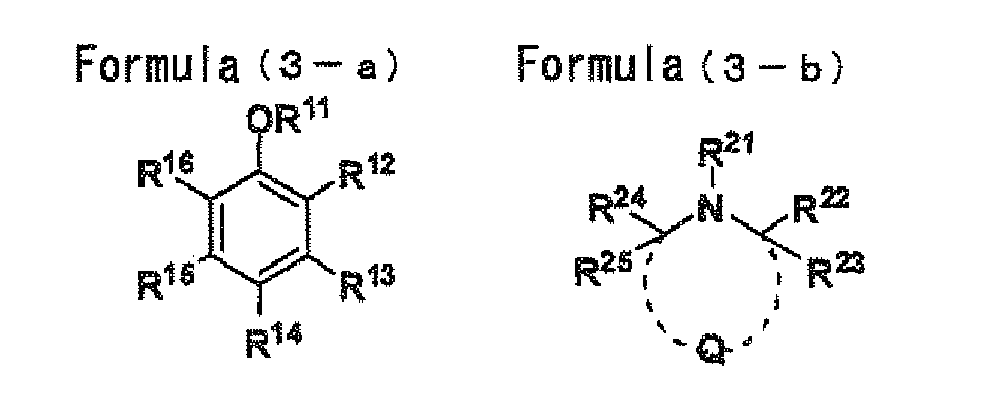
- [In formula (3-a), R11 represents a hydrogen atom, an aliphatic group, an aromatic group, a heterocyclic group bound via a carbon atom, or a hydrolysable protective group; R12, R13, R14, R15 and R16 each independently represent a hydrogen atom or a substituent; and R11 and R12, R12 and R13, R13 and R14, R14 and R15, R15 and R16 and/or R16 and R11 may bond to each other to form a ring; and
in formula (3-b), R21 represents a hydrogen atom, an aliphatic group, an acyl group, a sulfonyl group, a sulfinyl group, an oxy radical group or a hydroxyl group; Q represents a group of nonmetallic atoms necessary for forming a 5-, 6- or 7-membered ring; R22, R23, R24 and R25 each independently represents a hydrogen atom, an aliphatic group, an aromatic group, or a heterocyclic group bound via a carbon atom; and R21 and R22, R22 and R23, R24 and R25 and/or R21 and R24 may bond to each other to form a ring.] - In formula (3-a), the hydrolysable protective group represented by R11 is a silyl group, a phosphate group, or a group represented by the following formula (4):
-
Formula (4) R111-Y111-Z111-
wherein R111 represents an aliphatic group, an aromatic group, or a heterocyclic group bound via a carbon atom; Y111 represents a single bond, -O-, -S-, -N(R112)-, -C-, or its bound group; R112 represents a hydrogen atom, an aliphatic group, an aromatic group, a heterocyclic group bound via a carbon atom, an acyl group, or a sulfonyl group; and Z111 represents -CO- or -SO2-. - R11 is preferably a hydrogen atom, an aliphatic group having 1 to 20 carbon atoms, an aromatic group having 6 to 20 carbon atoms, a heterocyclic group having 2 to 20 carbon atoms bound via a carbon atom, or a hydrolysable protective group having 1 to 20 carbon atoms, more preferably a hydrogen atom, an aliphatic group having 1 to 10 carbon atoms, or a hydrolysable protective group having 1 to 10 carbon atoms, still more preferably a hydrogen atom, an aliphatic group having 1 to 8 carbon atoms, a silyl group having 1 to 10 carbon atoms, a phosphate group having 1 to 10 carbon atoms, or a hydrolysable protective group having 1 to 10 carbon atoms bound via a carbonyl group, further more preferably a hydrogen atom, an aliphatic group having 1 to 4 carbon atoms, a silyl group having 3 to 6 carbon atoms, a phosphate group having 2 to 8 carbon atoms, or a hydrolysable protective group having 1 to 8 carbon atoms bound via a carbonyl group, even more preferably a hydrogen atom, a trimethylsilyl group, a dimethyl or diethyl phosphate group, a benzoyl group, or an acetyl group, most preferably a hydrogen atom.
- R12, R13, R14, R15 and R16 each are preferably a hydrogen atom, a halogen atom, an alkyl group, an alkenyl group, an alkynyl group, an aryl group, a cyano group, a hydroxyl group, a carboxyl group, an alkoxy group, an aryloxy group, a silyloxy group, an acyloxy group, a carbamoyloxy group, an alkoxycarbonyloxy group, an aryloxycarbonyloxy group, an ammo group, an acylamino group, an aminocarbonylamino group, an alkoxycarbonylamino group, an aryloxycarbonylamino group, a sulfamoylamino group, an alkyl- or aryl-sulfonylamino group, a mercapto group, an alkylthio group, an arylthio group, a sulfamoyl group, a sulfo group, an alkyl- or aryl-sulfinyl group, an alkyl- or aryl-sulfonyl group, an acyl group, an aryloxycarbonyl group, an alkoxycarbonyl group, a carbamoyl group, an imido group, a phosphino group, a phosphinyl group, a phosphinyloxy group, a phosphinylamino group or a silyl group; further preferably a hydrogen atom, a halogen atom, an alkyl group, an alkenyl group, an aryl group, a cyano group, a hydroxyl group, a carboxyl group, an alkoxy group, an aryloxy group, a silyloxy group, an acyloxy group, a carbamoyloxy group, an alkoxycarbonyloxy group, an aryloxycarbonyloxy group, an amino group, an acylamino group, an alkylthio group, an arylthio group, an acyl group, an aryloxycarbonyl group, an alkoxycarbonyl group, a carbamoyl group, or a silyl group; furthermore preferably a hydrogen atom, a halogen atom, an alkyl group, an aryl group, a hydroxyl group, an alkoxy group, an acyloxy group, an acylamino group, a carbamoyloxy group or an alkylthio group; furthermore preferably a hydrogen atom, a halogen atom, an alkyl group, a hydroxyl group, an alkoxy group or an acylamino group; and most preferably a hydrogen atom or an alkyl group. It is preferably that one or both of R12 and R16 is/are a tertiary alkyl group.
- In the formula (3-b), R21 is preferably a hydrogen atom, an aliphatic group having 1 to 10 carbon atoms, an acyl group having 2 to 10 carbon atoms, an oxy radical group or a hydroxyl group; more preferably a hydrogen atom, an alkyl group having 1 to 3 carbon atoms, an acyl group having 2 to 7 carbon atoms, an oxy radical group or a hydroxyl group; further preferably a hydrogen atom, an acetyl group, an oxy radical group or a hydroxyl group; and most preferably a hydrogen atom. Each of R22, R23, R24 and R25 is preferably a hydrogen atom or an aliphatic group having 1 to 10 carbon atoms; more preferably a hydrogen atom or an alkyl group having 1 to 5 carbon atoms; further more preferably a hydrogen atom or an alkyl group having 1 to 2 carbon atoms; and most preferably all of R22 to R25 are a methyl group. Q is preferably a group of nonmetallic atoms necessary for forming a 5- to 7-membered ring selected from a carbon atom, a hydrogen atom, an oxygen atom, a sulfur atom and a nitrogen atom; more preferably a group of nonmetallic atoms necessary for forming a 5- to 7-membered ring selected from a carbon atom, a hydrogen atom, an oxygen atom and a nitrogen atom; further preferably a group of nonmetallic atoms necessary for forming a 5- to 7-membered ring selected from a carbon atom, a hydrogen atom and a nitrogen atom; and most preferably a group of nonmetallic atoms necessary for a piperidine ring.
- Hereinafter, specific examples of the compound C represented by formula (3-a) or (3-b) will be shown, but the present invention should not be considered to be limited thereto.
-

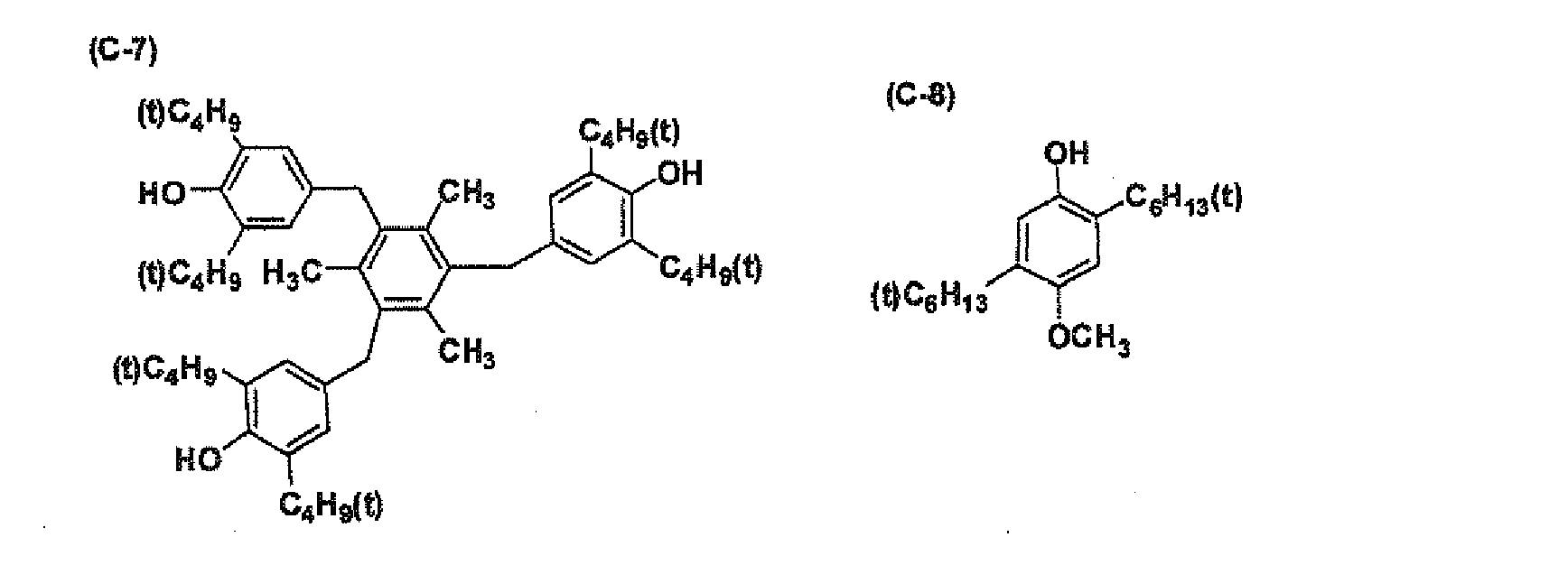

-


-


-


-


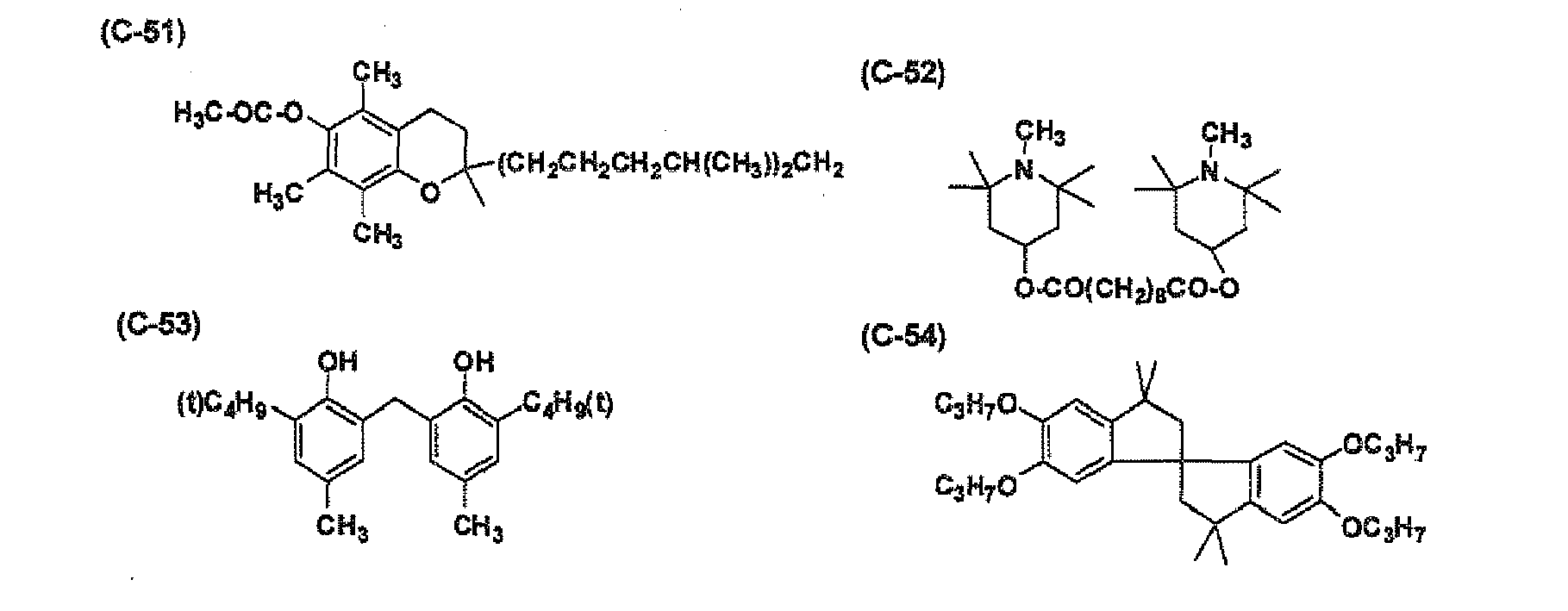
- In the present invention, among these, the exemplified compounds (C-48) and (C-52) are preferable; the exemplified compound (C-48) is most preferable.
- The compounds represented by formula (3-a) or (3-b) can be synthesized by methods described in
U.K. Patent No. 1,326,889 U.K. Patent No. 1,354,313 U.K. Patent No. 1,410,846 U.S. Patent No. 3,336,135 ,U.S. Patent No. 4,268,593 ,U.S. Patent No. 4,558,131 ,U.S. Patent No. 4,584,265 ,JP-B-51-1420 JP-B-52-6523 JP-A-58-114036 JP-A-59-5246 JP-A-61-73152 JP-A-61-86750 JP-A-61-90155 JP-A-61-90156 JP-A-61-172246 - The ultraviolet absorbent A and B, and the compound C used in the present invention may be individually present, or may be connected to each other previously or by binding together with each other in a composition. Further, a polymerizable group may be bound with each of the ultraviolet absorbent A and B , and the compound C to form a polymerizable monomer respectively, followed by polymerization of these monomers to form a copolymer including these monomers as a unit structure. Alternatively, these compounds may be used together with other monomers free of the ultraviolet absorbent A and B , and the compound C to form a copolymer. A preferable embodiment is that a composition is constructed by monomers, and a copolymer is formed by polymerization of the monomers at a desired time.
- The ultraviolet absorbent composition according to the present invention may be in any form, for example, liquid dispersion, solution, polymer material, or the like. The ultraviolet absorbent composition according to the present invention may contain any other desirable components according to application, in addition to the ultraviolet absorbent A and B, and the compound C.
- The ultraviolet absorbent composition according to the present invention is preferably in the dispersed state as dispersed in a dispersing medium. Hereinafter, the ultraviolet absorbent dispersion according to the present invention will be described.
The medium for dispersing the ultraviolet absorbent according to the present invention is arbitrary. Examples thereof include water, organic solvents, resins, resin solutions, and the like. These media may be used alone or in combination of two or more. - Examples of the organic solvents as the dispersing medium that can be used in the present invention include hydrocarbon-based solvents such as pentane, hexane and octane; aromatic solvents such as benzene, toluene and xylene; ether-based solvents such as diethylether and methyl-t-butylether; alcoholic solvents such as methanol, ethanol and isopropanol; ester-based solvents such as acetone, ethyl acetate and butyl acetate; ketone-based solvents such as methyl ethyl ketone; nitrile-based solvents such as acetonitrile and propionitrile; amide-based solvents such as N,N-dimethylformamide, N,N-dimethylacetamide and N-methylpyrrolidone; sulfoxide-based solvents such as dimethylsulfoxide; amine-based solvents such as triethylamine and tributylamine; carboxylic acid-based solvents such as acetic acid and propionic acid; halogen-based solvents such as methylene chloride and chloroform; and heterocycle-based solvents such as tetrahydrofuran and pyridine. These solvents may be used as a mixture at any rate.
- Examples of the resins as the dispersing medium that can be used in the present invention include various known thermoplastic and thermosetting resins conventionally used for production of molded article, sheet, film and others. Examples of the thermoplastic resins include polyethylene series resins, polypropylene series resins, poly(meth)acrylic ester series resins, polystyrene series resins, styrene-acrylonitrile series resins, acrylonitrile-butadiene-styrene series resins, polyvinyl chloride series resins, polyvinylidene chloride series resins, polyvinyl acetate series resins, polyvinylbutyral series resins, ethylene-vinyl acetate series copolymers, ethylene-vinylalcohol series resins, polyethylene terephthalate resins (PET), polybutylene terephthalate resins (PBT), liquid crystal polyester resins (LCP), polyacetal resins (POM), polyamide resins (PA), polycarbonate resins, polyurethane resins, and polyphenylene sulfide resins (PPS), and these resins may be used alone or as polymer blend or alloy of two or more. The resin may be used as a thermoplastic molding material containing a natural resin and additionally a filler such as glass fiber, carbon fiber, semi-carbonized fiber, cellulosic fiber or glass bead, a flame retardant, and the like. As needed, resin additives conventionally used, such as polyolefin series resin fine powder, polyolefin series wax, ethylene bisamide wax, and metal soap, may be used alone or in combination.
- Examples of the thermosetting resins include epoxy resins, melamine resins, and unsaturated polyester resins, and the resin may be used as a thermosetting molding material containing a natural resin and additionally a filler, such as glass fiber, carbon fiber, semi-carbonized fiber, cellulosic fiber or glass bead, and a flame retardant.
- The ultraviolet absorbent dispersion according to the present invention may contain other additives such as dispersant, antifoam, preservative, antifreezing agent, surfactant and others. The dispersion may contain any other compounds additionally. Examples of the other additives include dye, pigment, infrared absorbent, flavoring agent, polymerizable compound, polymer, inorganic material and metal.
- For example, a high-shearing force high-speed-agitation dispersing machine or a high-strength ultrasonic dispersing machine may be used as the apparatus for preparation of the ultraviolet absorbent dispersion according to the present invention. Specific examples thereof include colloid mill, homogenizer, capillary emulsifier, liquid siren, electromagnetic-distortion ultrasonic wave generator, emulsifier having a Pallmann whistle, and the like. The high-speed-agitation dispersing machine favorably used in the present invention is a dispersing machine in which a dispersing part is revolving in liquid at high speed (500 to 15,000 rpm, preferably 2,000 to 4,000 rpm) such as dissolver, polytron, homomixer, homoblender, keddy mill, or jet agitator. The high-speed-agitation dispersing machine that can be used in the present invention is also called a dissolver or a high-speed impeller dispersing machine, and, as described in
JP-A-55-129136 - Various methods may be used in preparation of an emulsified dispersion containing a hydrophobic compound. For example, in dissolving a hydrophobic compound in an organic solvent, the hydrophobic compound is dissolved in a solvent or a mixture of two or more arbitrarily selected from high-boiling point organic materials, water-immiscible low boiling point organic solvents and water-miscible organic solvents, and the solution is then dispersed in water or an aqueous hydrophilic colloid solution in the presence of a surfactant compound. The water-insoluble phase containing the hydrophobic compound and the aqueous phase may be mixed by the so-called normal mixing method of adding the water-insoluble phase into the agitated aqueous phase or by the reverse mixing method of adding the phases reversely.
- The content of the ultraviolet absorbent composition in the ultraviolet absorbent dispersion according to the present invention may not be determined specifically, because it varies according to application and type of usage, and is the concentration is arbitrary according to application. The content is preferably 0.001 to 50 mass%, more preferably 0.01 to 20 mass%, with respect to the total amount of the ultraviolet absorbent dispersion.
- The ultraviolet absorbent composition according to the present invention is favorably used in the state of a solution dissolved in a liquid medium. Hereinafter, the ultraviolet absorbent solution according to the present invention will be described.
The liquid dissolving the ultraviolet absorbent composition according to the present invention is arbitrary. It is, for example, water, an organic solvent, a resin, a resin solution, or the like. Examples of the organic solvent, the resin, and the resin solution include those described above as the dispersing medium. These may be used alone or in combination. - The solution of the ultraviolet absorbent composition according to the present invention may contain any other compounds additionally. Examples of the other additives include dye, pigment, infrared absorbent, flavoring agent, polymerizable compound, polymer, inorganic material, metal and the like. Components other than the ultraviolet absorbent composition according to the present invention may not necessarily be dissolved.
- The content of the ultraviolet absorbent composition in the ultraviolet absorbent solution according to the present invention may not be determined specifically, because it varies according to application and type of usage, and thus the concentration is arbitrary according to application. The concentration in the entire solution is preferably 0.001 to 50 mass%. Both the ultraviolet absorbent A and the ultraviolet absorbent B used in the present invention are compounds that exhibit high solubility. Accordingly, they can be used even in a concentration as high as, for example, the range of from 10% by mass to 50% by mass.
A solution at higher concentration may be prepared in advance and diluted at a desired time before use. The dilution solvent is selected arbitrarily from the solvents described above. - The polymer composition is used in preparation of the polymer material according to the present invention. The polymer composition for use in the present invention contains a polymer substance described below and the ultraviolet absorbent composition according to the present invention.
The ultraviolet absorbent composition according to the present invention may be contained in the polymer substance in various methods. When the ultraviolet absorbent composition according to the present invention is compatible with the polymer substance, the ultraviolet absorbent composition according to the present invention may be added to the polymer substance directly. The ultraviolet absorbent composition according to the present invention may be dissolved in a cosolvent compatible with the polymer substance, and then the obtained solution be added to the polymer substance. The ultraviolet absorbent composition according to the present invention may be dispersed in a high-boiling point organic solvent or a polymer, and the obtained dispersion be added to the polymer substance. - The boiling point of the high-boiling point organic solvent is preferably 180°C or higher, more preferably 200°C or higher. The melting point of the high-boiling point organic solvent is preferably 150°C or lower, more preferably 100°C or lower. Examples of the high-boiling point organic solvents include phosphoric esters, phosphonic esters, benzoic esters, phthalic esters, fatty acid esters, carbonate esters, amides, ethers, halogenated hydrocarbons, alcohols and paraffins. Phosphoric esters, phosphonic esters, phthalic ester, benzoic esters and fatty acid esters are preferable.
The method of adding the ultraviolet absorbent composition according to the present invention is determined, by reference to the description inJP-A-58-209735 JP-A-63-264748 JP-A-4-191851 JP-A-8-272058 2016017A . - The content of the ultraviolet absorbent composition in the ultraviolet absorbent solution according to the present invention is not determined specifically, because it varies according to application and type of usage, and the concentration is arbitrary according to application. It is preferably 0.001 to 10 mass%, more preferably 0.01 to 5 mass%, in the polymer material.
- The ultraviolet absorbent composition according to the present invention is preferably used for a polymer material. Hereinafter, the polymer material according to the present invention will be described.
Although practically sufficient ultraviolet-shielding effect is obtained only with the ultraviolet absorbent composition according to the present invention in the present invention, a white pigment which has higher hiding power such as titanium oxide may be used for assurance. In addition, a trace (0.05 mass% or less) amount of colorant may be used additionally, if the appearance or the color tone is of a problem or as needed. Alternatively, a fluorescent brightener may be used additionally for applications demanding transparency or whiteness. Examples of the fluorescent brighteners include commercialized products, the compounds represented by Formula [1] and typicalexemplary compounds 1 to 35 described inJP-A-2002-53824 - Hereinafter, the polymer substance that can be used in the polymer composition will be described. The polymer substance is a natural or synthetic polymer or copolymer. Examples thereof include the followings:
- <1> Monoolefinic and diolefinic polymers such as polypropylene, polyisobutylene, polybut-1-ene, poly-4-methyl pent-1-ene, polyvinylcyclohexane, polyisoprene and polybutadiene; cycloolefin polymers such as of cyclopentene or norbornene; polyethylenes (crosslinkable as needed) such as high-density polyethylene (HDPE), high-density and high-molecular weight polyethylene (HDPE-HMW), high-density and ultrahigh molecular weight polyethylene (HDPE-UHMW), medium-density polyethylene (MDPE), low-density polyethylene (LDPE), and linear low-density polyethylene (LLDPE), (VLDPE) and (ULDPE).
- Polyolefins (that is, polymers of the monoolefins exemplified in the paragraph above), preferably polyethylene and polypropylene, may be prepared by various methods, particularly by the following methods:
- a) Radical polymerization (normally under high pressure and elevated temperature), and
- b) Catalytic polymerization normally by using one or more metals in the groups IVb, Vb, VIb and VIII of the Periodic Table.
- <2> Mixture of the polymers described in <1> above such as polypropylene/polyisobutylene, polypropylene/polyethylene mixture (such as PP/HDPE and PP/LDPE), and mixture of different type of polyethylenes (such as LDPE/HDPE).
- <3> Copolymers of a monoolefin and a diolefin or a monoolefin or diolefin with another vinyl monomer such as ethylene/propylene copolymer, mixture of linear low-density polyethylene (LLDPE) and its low-density polyethylene (LDPE), propylene/but-1-ene copolymer, propylene/isobutylene copolymer, ethylene/but-1-ene copolymer, ethylene/hexene copolymer, ethylene/methylpentene copolymer, ethylene/heptene copolymer, ethylene/octene copolymer, ethylene/vinylcyclohexane copolymer, ethylene/cycloolefin copolymer (such as COC (Cyclo-Olefin Copolymer) of ethylene/norbornene), ethylene/1-olefin copolymer producing 1-olefin in situ, propylene/butadiene copolymer, isobutylene/isoprene copolymer, ethylene/vinylcyclohexene copolymer, ethylene/alkyl acrylate copolymer, ethylene/alkyl methacrylate copolymer, ethylene/vinyl acetate copolymer or ethylene/acrylic acid copolymer and the salts thereof (ionomers); and terpolymers of ethylene and propyrene with diene such as hexadiene, dicyclopentadiene or ethylidene-norbornene; and mixtures of such copolymers and the polymer described in the above 1) such as polypropylene/ethylene-propylene copolymer, LDPE/ethylene-vinyl acetate copolymer (EVA), LDPE/ethylene-acrylic acid copolymer (EAA), LLDPE/EVA, LLDPE/EAA and alternating or random polyalkylene/carbon monoxide copolymer and the mixture thereof with other polymer such as polyamide.
- <4> Mixtures of hydrocarbon resins (for example, having 5 to 9 carbon atoms) containing hydrogenated derivatives (such as tackifier) and polyalkylene and starch.
- The homopolymers and copolymers described in <1> to <4> above may have any steric structure, syndiotactic, isotactic, hemiisotactic or atactic; and atactic polymers are preferable. Stereoblock polymers are also included.
- <5> Polystyrene, poly(p-methylstyrene), and poly(α-methylstyrene).
- <6> Aromatic homopolymer and copolymers prepared from aromatic vinyl monomers including all isomers of styrene, α-methylstyrene, and vinyltoluene, in particular all isomers of p-vinyltoluene, ethylstyrene, propylstyrene, vinyl biphenyl, vinylnaphthalene, and vinylanthracene, and the mixture thereof. The homopolymers and copolymers may have any steric structure, syndiotactic, isotactic, hemiisotactic or atactic; and atactic polymers are preferable. Stereoblock polymers are also included.
- <6a> Copolymers of the aromatic vinyl monomers or comonomers selected from ethylene, propylene, dienes, nitriles, acids, maleic anhydride, maleimide, vinyl acetate and vinyl chloride or its acryl derivative and the mixture thereof, such as styrene/butadiene, styrene/acrylonitrile, styrene/ethylene (copolymer), styrene/alkyl methacrylate, styrene/butadiene/alkyl acrylate, styrene/butadiene/alkyl methacrylate, styrene/maleic anhydride, and styrene/acrylonitrile/methyl acrylate; styrene copolymers and other polymers including high shock-resistant mixtures such as polyacrylate, diene polymer, and ethylene/propylene/diene terpolymer; and styrene block copolymers such as styrene/butadiene/styrene, styrene/isoprene/styrene, styrene/ethylene/butylene/styrene and styrene/ethylene/propylene/styrene.
- <6b> Hydrogenated aromatic polymers prepared from the hydrogenated polymers described in <6>, in particular polycyclohexylethylene (PCHE), often called polyvinylcyclohexane (PVCH), prepared by hydrogenation of atactic polystyrene.
- <6c> Hydrogenated aromatic polymers prepared by hydrogenation of the polymers described in <6a> above.
- The homopolymers and copolymers may have any steric structure, syndiotactic, isotactic, hemiisotactic or atactic, and atactic polymers are preferable. Stereoblock polymers are also included.
- <7> Graft copolymers of an aromatic vinyl monomer such as styrene or α-methylstyrene, including graft copolymers of polybutadiene/styrene; polybutadienestyrene or polybutadiene-acrylonitrile copolymer/styrene; polybutadiene/styrene and acrylonitrile (or mathacrylonitrile); polybutadiene/styrene, acrylonitrile and methyl methacrylate; polybutadiene/styrene and maleic anhydride; polybutadiene/styrene, acrylonitrile and maleic anhydride or maleimide; polybutadiene/styrene and maleimide; polybutadiene/styrene and alkyl acrylate or methacrylate; ethylene/propylene/diene terpolymer/styrene and acrylonitrile; polyalkyl acrylate or polyalkyl methacrylate/styrene and acrylonitrile; acrylate/butadiene copolymer/styrene and acrylonitrile; and mixtures thereof with the copolymers described in <6> above such as known copolymer mixtures of ABS, SAN, MBS, ASA and AES polymer.
- <8> Halogen-containing polymers such as polychloroprene, chlorinated rubber, chlorinated or brominated copolymers of isobutylene-isoprene (halobutyl rubbers), chlorinated or sulfochlorinated polyethylene, ethylene-chlorinated ethylene copolymer, and epichlorohydrin homopolymer and copolymers; in particular, polymers of a halogen-containing vinyl compound such as polyvinyl chloride, polyvinylidene chloride, polyvinyl fluoride, polyvinylidene fluoride, and copolymers thereof such as polyvinyl chloride/vinylidene chloride, polyvinyl chloride/vinyl acetate or vinylidene chloride/vinyl acetate copolymer.
- <9> Polymers derived from α,β-unsaturated acid and the derivatives thereof such as polyacrylates and polymethacrylates; and high-impact polymethyl methacrylate, polyacrylamide and polyacrylonitrile modified with butyl acrylate.
- <10> Copolymers of the monomers described in <9> above or with another unsaturated monomer such as acrylonitrile/butadiene copolymer, acrylonitrile/alkyl acrylate copolymer, acrylonitrile/alkoxyalkyl acrylate or acrylonitrile/vinyl halide copolymer and acrylonitrile/alkyl methacrylate/butadiene terpolymer.
- <11> Polymers derived from an unsaturated alcohol and an amine, and acyl derivatives or acetals thereof such as polyvinylalcohol, polyvinyl acetate, polyvinyl stearate, polyvinyl benzoate, polyvinyl maleate, polyvinylbutyral, polyallyl phthalate and polyallylmelamine; and copolymers thereof with the olefin described in <1> above.
- <12> Homopolymers and copolymers of cyclic ether such as polyalkylene glycols, polyethyleneoxide, polypropyleneoxide or bisglycidylether, and the copolymers thereof.
- <13> Polyacetals such as polyoxymethylene and polyoxymethylene containing ethyleneoxide as the comonomer; acrylate or MOBS.
- <14> Mixtures of polyphenyleneoxide and sulfide, and those of polyphenyleneoxide and styrene polymer or polyamide.
- <15> Polyamides and copolyamides derived from a diamine and a dicarboxylic acid and/or aminocarboxylic acid or the corresponding lactam, such as polyamide 4, polyamide 6, polyamides 6/6, 6/10, 6/9, 6/12, 4/6 and 12/12, polyamide 11, polyamide 12, and an aromatic polyamide from m-xylenediamine and adipic acid; polyamides prepared from hexamethylenediamine and isophthalic and/or terephthalic acid, in the presence or absence of a modifying agent elastomer such as poly-2,4,4-trimethylhexamethylene terephthalamide and poly-m-phenylene isophthalamide; block copolymers of the polyamides above with polyolefin, olefin copolymer, ionomer or chemically bonded or grafted elastomer; block copolymers of the polyamides above with polyether such as polyethylene glycol, polypropylene glycol or polytetramethylene glycol; polyamides or copolyamides modified with EPDM or ABS; and polyamides condensed during processing (RIM polyamides).
- <16> Polyurea, polyimide, polyamide-imide, polyether imide, polyester-imide, polyhydantoin and polybenzimidazole.
- <17> Polyesters derived from a dicarboxylic acid and a diol and/or a hydroxycarboxylic acid or the corresponding lactone such as polyethylene terephthalate, polybutylene terephthalate, poly-1,4-dimethylolcyclohexane terephthalate, polyalkylene naphthalate (PAN) and polyhydroxybenzoate; block copolyether esters derived from hydroxyl terminal polyethers; and polyesters modified with polycarbonate or MBS; the polyesters and polyester copolymers specified in
U.S. Patent No. 5,807,932 (2nd column, line 53) are also incorporated herein by reference. - <18> Polycarbonates and polyester carbonates.
- <19> Polyketones.
- <20> Polysulfones, polyether sulfones and polyether ketones.
- <21> Crosslinked polymers derived from an aldehyde component and another phenol component and also from urea and melamine such as phenol/formaldehyde resin, urea/formaldehyde resin and melamine/formaldehyde resin.
- <22> Dry and non-dry alkyd resins.
- <23> Unsaturated polyester resins derived from saturated and unsaturated dicarboxylic acids, a polyvalent alcohol, and a crosslinking agent vinyl compound, and less flammable halogen-containing derivatives thereof.
- <24> Substituted acrylates, for example, crosslinkable acrylic resins derived from epoxy acrylate, urethane acrylate or polyester acrylate.
- <25> Crosslinked alkyd, polyester and acrylate resins crosslinked with a melamine resin, urea resin, isocyanate, isocyanurate, polyisocyanate or epoxy resin.
- <26> Crosslinked epoxy resins derived from an aliphatic, alicyclic, heterocyclic or aromatic glycidyl compound, for example, glycidyl ether products ofbisphenol A or bisphenol F crosslinked with a common curing agent such as anhydride or amine in the presence or absence of an accelerator.
- <27> Natural polymers such as cellulose, rubber, gelatin and chemically modified derivatives of their homologous series such as cellulose acetate, cellulose propionate and cellulose butyrate, and cellulose ethers such as methylcellulose; and rosins and the derivatives thereof.
- <28> Polymer blends (polyblends) of the polymers described above such as PP/EPDM, polyamide/EPDM or ABS, PVC/EVA, PVC/ABS, PVC/MBS, PC/ABS, PBTP/ABS, PC/ASA, PC/PBT, PVC/CPE, PVC/acrylate, POM/acrylate, POM/MBS, PPO/HIPS, PPO/PA6.6 and copolymer, PA/HDPE, PA/PP, PA/PPO, PBT/PC/ABS and PBT/PET/PC.
- <29> Natural and synthetic organic materials of a pure monomeric compound or a mixture of the compounds such as mineral oils, animal and vegetable fats, oils and waxes, or synthetic ester (such as phthalate, adipate, phosphate or trimellitate)-based oils, fats and waxes, and mixtures thereof with a synthetic ester and mineral oil at any rate, mixtures typically used as a fiber-spinning composition, and the aqueous emulsions thereof.
- <30> Aqueous emulsions of natural or synthetic rubber, for example, a natural latex or latexes of a carboxylated styrene/butadiene copolymer.
- <31> Polysiloxanes, for example, the soft hydrophilic polysiloxane described in
U.S. Patent No. 4,259,467 and the hard polyorganosiloxane described inU.S. Patent No. 4,355,147 . - <32> Polyketimines in combination with an unsaturated acrylpolyacetoacetate resin or an unsaturated acrylic resin including urethane acrylate, polyester acrylate, vinyl or acrylic copolymers having a pendant unsaturated group, and acrylated melamines. The polyketimine is prepared from a polyamine and a ketone in the presence of an acid catalyst.
- <33> Radiant ray-hardening compositions containing an ethylenically unsaturated monomer or oligomer and a polyunsaturated aliphatic oligomer.
- <34> Epoxy melamine resins such as photostabilized epoxy resins crosslinked with a coetherified high-solid content melamine resin sensitive to epoxy groups, such as LSE-4103 (trade name, manufactured by Monsanto).
- The polymer substance for use in the present invention is preferably a synthetic polymer, more preferably a polyolefin, an acrylic polymer, polyester, polycarbonate, or a cellulose ester. Among them, polyethylene, polypropylene, poly(4-methylpentene), polymethyl methacrylate, polycarbonate, polyethylene terephthalate, polyethylene naphthalate, polybutylene terephthalate, and triacetylcellulose are particularly preferable.
The polymer substance for use in the present invention is preferably a thermoplastic resin. - The polymer material according to the present invention may contain, in addition to the ultraviolet absorbent of the present invention, any additives such as processing stabilizer, antidegradant, and compatibilizer, as needed.
- The polymer material according to the present invention contains the polymer substance above. The polymer material according to the present invention may be made only of the above polymer substance, or may be formed by using the polymer substance dissolved in an arbitrary solvent.
The polymer material according to the present invention is applicable to any application where synthetic resin is used, and particularly favorably to applications where there is possibility of exposure to light such as sunlight or ultraviolet light. Specific examples thereof include glass alternatives and their surface-coating agent; coating agents for the window glass, lighting glass and light source-protecting glass such as of house, facility, and vehicle; interior and exterior materials such as of house, facility and vehicle, paints for the interior and exterior materials; materials for ultraviolet-emission sources such as fluorescent lamp and mercury lamp; materials for precision machines and electric and electronic devices; materials for shielding electromagnetic and other waves emitted from various displays; containers or packaging material for food, chemicals, medicine and others; discoloration inhibitors for agricultural and industrial sheet or film, print, colored products, dyes and pigments; cosmetics such as anti-sunburn cream, shampoo, rinse, and hair dressing; apparel fiber products such as sport wear, stockings and cap and the fibers; home interior products such as curtain, carpet and wall paper; medical devices such as plastic lens, contact lens and artificial eye; optical materials such as optical filter, prism, mirror, and photographic material; stationery products such as tape and ink; display plates and devices and the surface-coating agents thereof, and the like. - The shape of the polymer material according to the present invention may be flat film, powder, spherical particle, crushed particle, bulky continuous particle, fiber, solenoid, hollow fiber, granule, plate, porous particle, or the other.
- The polymer material according to the present invention, which contains the ultraviolet absorbent composition according to the present invention, is superior in light resistance (ultraviolet fastness), causing no precipitation or bleed out of the ultraviolet absorbent during long-term use. In addition, the polymer material according to the present invention, which has superior long-wavelength ultraviolet absorption capability, can be used as an ultraviolet-absorbing filter or container, for protection, for example, of an ultraviolet-sensitive compound therein. It is possible to obtain a molded article (such as container) of the polymer material according to the present invention, for example, by molding the polymer substance by any molding method such as extrusion molding or injection molding. It is also possible to prepare a molded article coated with an ultraviolet-absorbing film made of the polymer material according to the present invention, by coating and drying a solution of the polymer substance on a separately prepared molded article.
- When the polymer material according to the present invention is used as an ultraviolet-absorbing filter or film, the polymer substance is preferably transparent. Examples of the transparent polymer materials include cellulose esters (such as diacetylcellulose, triacetylcellulose (TAC), propionylcellulose, butyrylcellulose, acetyl propionyl cellulose, and nitrocellulose), polyamides, polycarbonates, polyesters (such as polyethylene terephthalate, polyethylene naphthalate, polybutylene terephthalate, poly-1,4-cyclohexane dimethylene terephthalate, polyethylene-1,2-diphenoxyethane-4,4'-dicarboxylate, and polybutylene terephthalate), polystyrenes (such as syndiotactic polystyrene), polyolefins (such as polyethylene, polypropylene, and polymethylpentene), polymethyl methacrylate, syndiotactic polystyrene, polysulfones, polyether sulfones, polyether ketones, polyether imides, polyoxyethylene, and the like. Preferable are cellulose esters, polycarbonates, polyesters, polyolefins, and acrylic resins. The polymer material according to the present invention may be used as a transparent support, and the transmittance of the transparent support in such a case is preferably 80% or more, more preferably 86% or more.
- Hereinafter, the packaging material containing the ultraviolet absorbent composition according to the present invention will be described. The packaging material containing the ultraviolet absorbent composition according to the present invention may be a packaging material of any kind of polymer, as long as it contains the ultraviolet absorbent A and B, and the compound C above-described. Examples thereof include the thermoplastic resins described in
JP-A-8-208765 JP-A-8-151455 JP-A-8-245849 JP-A-10-168292 JP-A-2004-285189 JP-A-2001-323082 JP-A-1 0-298397 JP-A-11-315175 JP-A-2001-26081 JP-A-2005-305745 JP-T-2003-524019 JP-A-2004-50460 JP-A-2004-243674 JP-A-2006-240734 - The packaging material containing the ultraviolet absorbent composition according to the present invention may be that for packaging anything such as food, beverage, cosmetics, or individual health care product. Examples thereof include the food packaging materials described in
JP-A-11-34261 JP-A-2003-237825 JP-A-7-287353 JP-A-2000-56433 JP-A-2005-178832 JP-A-2003-200966 JP-A-2006-323339 - The packaging material containing the ultraviolet absorbent composition according to the present invention may be the transparent packaging material described, for example, in
JP-A-2004-51174 JP-A-2006-224317 - The packaging material containing the ultraviolet absorbent composition according to the present invention may have ultraviolet light-shielding property as well as other properties, as described, for example, in
JP-A-2001-26081 JP-A-2005-305745 JP-A-2002-160321 JP-A-2005-156220 JP-A-2005-146278 - The packaging material containing the ultraviolet absorbent composition according to the present invention may be prepared by any method. Examples of the method include the method of melt-extruding and laminating a resin containing an ultraviolet absorbent described, for example, in
JP-A-2001-323082 JP-A-2005-305745 JP-A-9-157626 - Hereinafter, the container containing the ultraviolet absorbent composition according to the present invention will be described. The container containing the ultraviolet absorbent composition according to the present invention may be a container of any kind of polymer, as long as it contains the ultraviolet absorbent A and B, and the compound C. Examples thereof include the thermoplastic resin containers described in
JP-A-8-324572 JP-A-2001-48153 JP-A-2005-105004 JP-A-2006-1568 JP-A-2000-238857 JP-A-2001-88815 JP-A-7-216152 JP-A-2001-270531 JP-A-2004-83858 JP-A-2001-114262 JP-A-2001-213427 JP-A-7-242444 JP-A-8-133787 JP-A-2005-320408 - The container containing the ultraviolet absorbent composition according to the present invention is used as containers in various applications including food, beverage, cosmetics, individual health care product, shampoo and the like. Examples thereof include the liquid fuel-storing containers described in
JP-A-5-139434 JP-A-7-289665 JP-A-9-295664 JP-A-2003-237825 JP-A-9-58687 JP-A-8-324572 JP-A-2006-298456 JP-A-9-86570 JP-A-9-113494 JP-A-9-239910 JP-A-11-180474 JP-A-2002-68322 JP-A-2005-278678 JP-A-11-290420 JP-A-2001-106218 JP-A-2005-178832 WO 04/93775 - The container containing the ultraviolet absorbent composition according to the present invention may have ultraviolet-shielding property as well as other properties, as described, for example, in
JP-A-5-305975 JP-A-7-40954 JP-A-10-237312 JP-A-2000-152974 JP-A-2002-264979 JP-A-2005-255736 - The container containing the ultraviolet absorbent composition according to the present invention may be prepared by any method. Examples of the method include the two-layer stretching blow-molding method described in
JP-A-2002-370723 JP-A-2001-88815 JP-A-9-241407 JP-A-8-91385 JP-A-9-48935 JP-T-11-514387 JP-A-2000-66603 JP-A-2001-323082 JP-A-2005-105032 WO 99/29490 JP-A-11-255925 - Hereinafter, the paint and the coated film containing the ultraviolet absorbent composition according to the present invention will be described. The paint containing the ultraviolet absorbent composition according to the present invention may be a paint of any composition, as long as it contains the ultraviolet absorbent A and B, the compound C. Examples thereof include those of acrylic resin-base, aminoalkyd resin-base, epoxy resin-base, silicone resin-base, and fluororesin-base. To these resins, a base compound, curing agent, diluent, leveling agent, cissing inhibitor or the like may be arbitrarily added.
- For example, when a silicon acrylic resin is selected as the transparent resin component, the curing agent is preferably a polyisocyanate; and the diluent is preferably a hydrocarbon-based solvent such as toluene and xylene, an ester-based solvent such as isobutyl acetate, butyl acetate and amyl acetate, or an alcohol-based solvent such as isopropyl alcohol and butyl alcohol. In such a case, the polyisocyanate is, for example, tolylene diisocyanate, diphenylmethane diisocyanate, polymethylene polyphenylene polyisocyanate, tolidine diisocyanate, naphthalene diisocyanate, hexamethylene diisocyanate, isophorone diisocyanate, xylylene diisocyanate, dicyclohexylmethane diisocyanate, hexamethylene diisocyanate or the like. Examples of other transparent resin components include polymethyl methacrylate, polymethyl methacrylate/styrene copolymer, polyvinyl chloride, polyvinyl acetate, and the like. In addition to these components, a leveling agent such as an acrylic or silicone resin, a silicone-based or acrylic cissing inhibitor, and others may be arbitrarily added as needed.
- The paint containing the ultraviolet absorbent composition according to the present invention may be used in any application. Examples thereof include the ultraviolet-shielding paints described in
JP-A-7-26177 JP-A-9-169950 JP-A-9-221631 JP-A-2002-80788 JP-A-10-88039 JP-A-2001- 55541 JP-A-8-81643 JP-A-2000-186234 JP-A-7-166112 JP-A-2002-294165 JP-A-2000-273362 JP-A-2001- 279189 JP-A-2002-271227 JP-A-2001-9357 JP-A-2001-316630 JP-A-2002-356655 JP-A-2004-937 JP-A-2004-2700 JP-A-2004-169182 JP-A-2004-107700 JP-A-6-49368 JP-A-2002-38084 JP-A-2005-307161 JP-A-5-78606 JP-A-5-185031 JP-A-10-140089 JP-T-2000-509082 JP-T-2004-520284 WO 2006/097201 pamphlet; the paints for a coated steel plate described inJP-A-6-1945 JP-A-6-313148 JP-A-7-3189 JP-A-7-82454 JP-A-7-118576 JP-A-2004-217727 JP-A-2005-314495 JP-A-10-298493 JP-A-9-241534 JP-A-2002-235028 JP-A-2000-345109 JP-A-6-346022 JP-A-2002-167545 JP-A-8-324576 JP-A-9-12924 JP-A-9-157581 JP-A-9-59539 JP-A-2001-181558 JP-A-10-183057 JP-A-2001-115080 JP-A-2001-262056 JP-A-9-263729 JP-A-2001-288410 JP-A-2002-69331 JP-A-2002-80781 JP-T-2003-525325 JP-A-2004-162021 JP-A-2006-233010 JP-T-11-514689 JP-A-2001-59068 JP-A-2006-160847 JP-A-2002-69331 - The paint containing the ultraviolet absorbent composition according to the present invention generally contains a paint (containing a transparent resin component as the principal component) and an ultraviolet absorbent. The paint contains the ultraviolet absorbent preferably in an amount of 0 to 20 mass% with respect to the resin. The thickness of the film coated is preferably 2 to 1,000 µm, more preferably 5 to 200 µm. The method of coating the paint is arbitrary, and examples of the method include a spray method, a dipping method, a roller coating method, a flow coater method, a curtain-flow coating method, and the like. The drying after coating is preferably carried out at a temperature of approximately room temperature to 120°C for 10 to 90 minutes, although the condition may vary according to the paint composition.
- The coated film containing the ultraviolet absorbent composition according to the present invention is a coated film formed by using the paint containing the ultraviolet absorbent according to the present invention that contains the ultraviolet absorbent A and B, and the compound C.
- Hereinafter, the ink containing the ultraviolet absorbent composition according to the present invention will be described. The ink containing the ultraviolet absorbent composition according to the present invention may be any ink in any form, as long as it contains the ultraviolet absorbent A and B, and the compound C. For example, it may be a dye ink, a pigment ink, an aqueous ink, a solvent ink, or the like. It may be used in any application. Examples of the applications include the screen printing ink described in
JP-A-8-3502 JP-T-2006-521941 JP-T-2005-533915 JP-T-11-504954 JP-T-2005-533915 JP-A-5-254277 JP-A-2006-30596 JP-A-11-199808 WO 99/67337 JP-A-2005-325150 JP-A-2005-350559 JP-A-2006-8811 JP-T-2006-514130 JP-A-2006-257165 JP-A-8-108650 JP-A-2005-23111 JP-A-2004-75888 JP-A-7-164729 JP-A-2006-22300 - Hereinafter, the fiber containing the ultraviolet absorbent composition according to the present invention will be described. The fiber containing the ultraviolet absorbent composition according to the present invention may be a fiber of any kind of polymer, as long as it contains the ultraviolet absorbent A and B, and the compound C. Examples thereof include the polyester fibers described in
JP-A-5-117508 JP-A-7-119036 JP-A-7-196631 JP-A-8-188921 JP-A-10-237760 JP-A-2000- 54287 JP-A-2006-299428 JP-A-2006-299438 JP-A-2002-322360 JP-A-2006-265770 JP-A-7-76580 JP-A-2001-348785 JP-A-2003-41434 JP-A-2003-239136 WO 03/2661 JP-A-10-251981 JP-A-6-228816 JP-T-2005-517822 - The fiber containing the ultraviolet absorbent composition according to the present invention may be prepared by any method. Examples of the method include the method, as described in
JP-A-6-228818 JP-A-5-9870 JP-A-8-188921 JP-A-10-1587 JP-A-2002-212884 JP-A-2006-16710 - The fiber containing the ultraviolet absorbent composition according to the present invention can be used in various applications. Examples thereof include the clothing described in
JP-A-5-148703 JP-A-2004-285516 JP-A-2004-285517 JP-A-2003-339503 JP-A-2004-11062 JP-A-11-302982 JP-A-7-289097 JP-A-10-1868 JP-A-5-256464 JP-A-5-193037 JP-A-6-114991 JP-A-11-247028 JP-A-2000-144583 JP-A-5-148703 JP-A-5-193037 JP-A-7-18584 JP-A-8-41785 JP-A-8-193136 JP-A-8-269850 JP-A-8-284063 JP-A-9-57889 JP-A-9-137335 JP-A-10-165045 JP-A-11-247027 11-247028 JP-A-7-310283 JP-T-2003-528974 JP-A-2001-30861 JP-A-7-324283 JP-A-8-20579 JP-A-2003-147617 - Hereinafter, the construction material containing the ultraviolet absorbent composition according to the present invention will be described. The construction material containing the ultraviolet absorbent composition according to the present invention may be a construction material of any kind of polymer, as long as it contains the ultraviolet absorbent A and B, and the compound C. Examples thereof include the vinyl chloride-based material described in
JP-A-10-6451 JP-A-10-16152 JP-A-2002- 161158 JP-A-2003-49065 JP-A-2003-160724 - The construction material containing the ultraviolet absorbent composition according to the present invention may be prepared by any method. Examples of the method include the method, as described in
JP-A-8-269850 JP-A-10-205056 JP-A-8-151457 JP-A-2001-172531 - The construction material containing the ultraviolet absorbent composition according to the present invention can be used in various applications. Examples thereof include the external construction materials described in
JP-A-7-3955 JP-A-8-151457 JP-A-2006-266042 JP-A-8-197511 JP-A-9-183159 JP-A-11-236734 JP-A-10-205056 JP-A-11-300880 JP-A-2001-9811 JP-A-2001-172531 JP-A-2003-328523 JP-A-2002-226764 JP-A-10-6451 JP-A-10-16152 JP-A-2006-306020 JP-A-8-269850 JP-A-9-277414 JP-A-10-1868 JP-A-7-269016 JP-A-2003-211538 JP-A-9-239921 JP-A-9-254345 JP-A-10-44352 JP-A-8-73825 JP-A-8-207218 JP-A-2003-82608 JP-A-2001-139700 JP-A-5-253559 JP-A-2005-2941780 JP-A-9-183159 JP-A-10-44352 JP-A-2000-226778 JP-A-2003-211538 JP-A-2003-211606 JP-A-2004-3191 - Hereinafter, the recording medium containing the ultraviolet absorbent composition according to the present invention will be described. The recording medium containing the ultraviolet absorbent composition according to the present invention may be any medium, as long as it contains the ultraviolet absorbent A and B, and the compound C. Examples thereof include the inkjet recording media described in
JP-A-9-309260 JP-A-2002-178625 JP-A-2002-212237 JP-A-2003-266926 JP-A-2003-266927 JP-A-2004-181813 JP-A-8-108650 JP-A-10-203033 JP-A-2001-249430 JP-A-8-258415 JP-A-9-95055 JP-A-2003- 145949 JP-A-2006-167996 JP-A-2002-367227 - Hereinafter, the image display device containing the ultraviolet absorbent composition according to the present invention will be described. The image display device containing the ultraviolet absorbent composition according to the present invention may be any device, as long as it contains the ultraviolet absorbent A and B, and the compound C. Examples thereof include the image display device employing an electrochromic element described in
JP-A-2006-301268 JP-A-2006-293155 JP-A-9-306344 JP-A-2000-223271 JP-A-2000-223271 JP-A-2005-189645 - Hereinafter, the solar cell cover containing the ultraviolet absorbent composition according to the present invention will be described. The solar cell according to the present invention may be made of any type of element. Examples thereof include a crystalline silicon solar cell, an amorphous silicon solar cell, and a dye-sensitized solar cell. As described in
JP-A-2000-174296 JP-A-2006-282970 - The solar cell cover containing the ultraviolet absorbent composition according to the present invention may be a cover of any kind of polymer. Examples of the polymer include the polyester described in
JP-A-2006-310461 JP-A-2006-257144 JP-A-2006-210906 JP-A-2003-168814 JP-A-2005-129713 JP-A-2004-227843 JP-A-2004-168057 - The solar cell cover containing the ultraviolet absorbent composition according to the present invention may be prepared by any method. For example, the ultraviolet-absorbing layer described in
JP-A-11-40833 JP-A-2005-129926 JP-A-2000-91611 JP-A-2005-346999 - The solar cell cover containing the ultraviolet absorbent composition according to the present invention may be in any form. Examples thereof include the film and sheet described in
JP-A-2000-91610 JP-A-11-261085 JP-A-11-40833 JP-A-11-214736 JP-A-2001-261904 - Other examples of applications include the illumination light source covers described in
JP-A-8-102296 JP-A-2000-67629 JP-A-2005-353554 JP-A-5-272076 JP-A-2003-239181 JP-A-2006-63162 JP-A-2007-93649 JP-A-2001-214121 JP-A-2001-214122 JP-A-2001-315263 JP-A-2003-206422 JP-A-2003-25478 JP-A-2004-137457 JP-A-2005-132999 JP-A-2002-36441 JP-A-10-250004 JP-A-2002-36452 JP-A-2003-39607 JP-A-2004-114355 JP-A-2002-113937 JP-A-2002-293706 JP-A-2006-274179 JP-A-2005-326761 JP-A-2006-335855 JP-A-10-34841 JP-A-2002-114879 JP-T-2004-532306 JP-T-2004-530024 JP-T-2004-525273 JP-A-10-194796 JP-A-10-287804 JP-A-2000-71626 JP-A-2001-139700 JP-A-2001-159228 JP-A-2002-127310 JP-A-2002-189415 JP-A-2002-130591 JP-A-2002-307619 JP-A-2002-307845 JP-A-2006-316395 WO 99/29490 JP-A-2004-352847 JP-A-2000-224942 JP-A-8-208976 JP-A-8-318592 JP-A-2005-504735 JP-A-2005-105032 JP-A-2005-37642 JP-A-2005-55615 JP-A-9-300537 JP-A-2000-25180 JP-A-2003-19776 JP-A-2005-74735 JP-A-2001-207144 JP-T-2002-543265 JP-T-2002-543266 U.S. Patent No. 6,225,384 ; the electrodeposition coat and the basecoat described inJP-A-2004-352783 JP-A-7-268253 JP-A-2003-253265 JP-A-2005-105131 JP-A-2005-300962 3915339 JP-A-2005-304340 JP-A-2005-44154 JP-A-2006-274197 JP-A-2006-89697 JP-A-2000-231044 JP-T-2002-527559 - Hereinafter, the method of evaluating the light stability of the polymer material will be described. Preferable methods of evaluating the light stability of the polymer material are described, for example, in "Methods for Improving the Photostability of Polymers" (CMC Publishing, 2000), pp. 85 to 107; "Basis and Physical Properties of High Functional Coatings" (CMC Publishing, 2003), pp. 314 to 359; "Durability of Polymer Materials and Composite Material Products" (CMC Publishing, 2005); "Elongation of Lifetime of Polymer Materials and Environmental Measures" (CMC Publishing, 2000); H. Zweifel Ed., "Plastics Additives Handbook, 5th Edition" (Hanser Publishers), pp. 238 to 244; and Tadahiko Kutsura, ".
In addition, the light stability in each application can be attained by the following known evaluation methods.
The photodegradation of polymer materials can be evaluated by the method described in JIS-K7105:1981, JIS-K7101:1981, JIS-K7102:1981, JIS-K7219:1998, JIS-K7350-1:1995, JIS-K7350-2:1995, JIS-K7350-3:1996, JIS-K7350-4:1996 or a method referring to those. - The light stability in the packaging or container application can be evaluated by the method of JIS-K7105 and a method referring to that. Typical examples thereof include the light transmittance and transparency evaluation of the bottle body and the functional test evaluation of the bottle content after ultraviolet irradiation by using a xenon light source described in
JP-A-2006-298456 JP-A-2000-238857 JP-A-2006-224317 JP-A-2006-240734 JP-A-2005-105004 JP-A-2006-1568 JP-A-7-40954 JP-A-8-151455 JP-A-10-168292 JP-A-2001-323082 JP-A-2005-146278 JP-A-9-48935 9-142539 JP-A-9-241407 JP-A-2004-243674 JP-A-2005- 320408 JP-A-2005-305745 JP-A-2005-156220 JP-A-2005-178832 JP-A-2005-278678 JP-A-2004-51174 JP-A-2004-285189 JP-A-2003-237825 JP-A-2003-20966 JP-A-2002-68322 JP-A-2001-26081 JP-A-10-298397 JP-A-10-237312 JP-A-9-239910 JP-A-9-86570 JP-A-8-301363 JP-A-8-208765 JP-A-7-216152 JP-A-5-139434 - The long-term durability, in the case where the polymer material is used in the coating material and coated film applications, can be evaluated according to the method of JIS-K5400, JIS-K5600-7-5:1999, JIS-K5600-7-6:2002, JIS-K5600-7-7:1999, JIS-K5600-7-8:1999, or JIS-K8741 or a method referring to those. Typical examples thereof include the evaluation using the color density, the color difference ΔEa*b* in the CIE L*a*b* color coordinates, and the residual brilliance after photoirradiation in an xenon light-endurance test machine and an UVCON apparatus described in
JP-T-2000-509082 JP-T-2004-520284 JP-A-2006-160847 JP-A-2005-307161 JP-A-2002-69331 JP-A-2002-38084 JP-A-2001-59068 JP-A-2001-115080 JP-A-6-49368 JP-A-2001-262056 JP-A-8-324576 JP-A-9-12924 JP-A-9-169950 JP-A-9-241534 JP-A-2001-181558 JP-A-2000-186234 JP-A-10-298493 JP-A-7-26177 JP-A-7-3189 JP-A-9-263729 JP-A-6-1945 JP-A-6-313148 JP-A-6-346022 JP-A-5-185031 JP-A-5-78606 JP-A-2006-63162 - The light stability, in the case where the polymer material is used in the ink application, is determined by the method of JIS-K5701-1:2000, JIS-K7360-2, or IBO105-B02 or a method referring to those. Specific examples thereof include the evaluation of the color density and the measurement by the CIE L*a*b* color coordinates after photoirradiation by using an office fluorescent lamp or a discoloration tester described in
JP-T-2006-514130 JP-A-2006-22300 JP-A-2006-8811 JP-A-2005-23111 JP-A-2005-325150 JP-A-2002-127596 JP-A-11-199808 JP-A-8-108650 JP-A-7-164729 - The light stability of the solar cell module can be evaluated according to the method of JIS-C8917:1998 or JIS-C8938:1995 or a method referring to those.
Specific examples thereof include the I-V-measuring photovoltaic efficiency evaluation after photoirradiation by a xenon lamp light source having a sunlight-simulating compensation filter described inJP-A-2006-282970 JP-A-11-261085 JP-A-2000-144583 - The light stability of fibers and fiber products can be evaluated according to the method of JIS-L1096:1999, JIS-A5905:2003, JIS-L0842, JIS-K6730, JIS-K7107, DIN75.202, SAEJ1885, SN-ISO-105-B02, or AS/NZS4399 or a method referring to those. Examples thereof include the ultraviolet light transmittance evaluation described in
JP-A-10-1587 JP-A-2006-299428 JP-A-2006-299438 JP-A-6-228816 JP-A-7-76580 JP-A-8-188921 JP-A-11-247028 JP-A-11-247027 JP-A-2000-144583 JP-A-2002-322360 JP-A-2003-339503 JP-A-2004-11062 JP-A-2003- 147617 JP-A-2003-41434 JP-A-11-302982 JP-A-7-119036 JP-A-10-251981 JP-A-9-57889 JP-A-9-137335 JP-A-10-1868 JP-A-10-237760 JP-A-8-41785 JP-A-8-193136 JP-T-2003- 528974 JP-T-2005-517822 JP-A-8-20579 JP-A- 6-228818 JP-A-7-324283 JP-A-7-196631 JP-A-7-18584 JP-A-7-289097 JP-A-7-289665 JP-T-2003-528974 - The light stability of the construction material can be evaluated according to the method of JIS-A1415:1999 or a method referring to that. Specific examples thereof include the surface color tone evaluation after photoirradiation by using Sunshine Weather-O-Meter described in
JP-A-2006-266402 JP-A-2004-3191 JP-A-2006-306020 JP-A-10-44352 JP-A-2003-211538 JP-A-9-239921 JP-A-9-254345 JP-A-2003-211606 JP-A-2002-161158 JP-A-2002-226764 JP-A-2001-172531 JP-A-11-300880 JP-A-10-205056 JP-A-8-207218 JP-A-9-183159 JP-A-8-151457 JP-A-7-3955 - The light stability when the polymer material is used in the recording medium application can be evaluated according to the method of JIS-K7350 or a method referring to that. Specific examples thereof include the evaluation of the difference in base color in the printing unit after fluorescent lamp irradiation described in
JP-A-2006-167996 JP-A-10-203033 JP-A-2004-181813 JP-A-2002-207845 JP-A-2003-266926 JP-A-2003-145949 JP-A-2002-212237 JP-A-2002-178625 JP-A-2002-367227 JP-A-2001-249430 JP-A-9-95055 JP-A-9-309260 JP-A-8-258415 JP-A-2000-223271 JP-A-2005-189645 - Other evaluation methods include those of JIS-K7103 and ISO/DIS9050 or a method referring to those. Specific examples thereof include the appearance evaluation of a polycarbonate coating film after irradiation by a UV tester described in
JP-A-2006-89697 JP-A-2006-316395 JP-A-2006-335855 JP-A-2005-55615 JP-A-2005-74735 JP-A-2005-326761 JP-A-2002-189415 JP-A-2004-352847 JP-A-2003-19776 JP-A-2002-36441 JP-A-2003-25478 JP-A-2003-239181 JP-A-2003-253265 JP-A-2002-307619 JP-A-2002-293706 JP-A-2002-114879 JP-A-2001-139700 JP-A-2011-315263 JP-A-2001-214121 JP-A-2001-214122 JP-A-2001-207144 JP-A-2000-67629 JP-A-10-194796 JP-A-8-318592 JP-A-8-208976 JP-A-7-268253 JP-T-2002-5443265 JP-T-2002-543266 JP-T-2004-532306 - The present invention will be described in more detail based on the following examples, but the invention is not intended to be limited thereby.
- Ultraviolet
absorbent composition samples 1 to 7 in combination of ultraviolet absorbents A and B, and the compound C were prepared, as shown in the following Table. In the following Table 1-1, the ratio of the ultraviolet absorbents A to B, and the compound C (A:B:C) is expressed by molar ratio.
The ultraviolet absorbent A was subjected to be a solution in ethyl acetate at a concentration of approximately 5 × 10⁻⁵ mol·dm-3, and the UV spectrum of the solution was measured in a 1-cm quartz cell by using a spectrophotometer UV-3600 (trade name) manufactured by Shimadzu Corporation. The absorption maximum wavelength, the half value width, and the rate of the absorbance at 320 nm relative to that at the absorption maximum wavelength were calculated form the spectral chart obtained. As a result, absorption maximum wavelength was 369 nm, the half value width was 34 nm and the molar extinction coefficient at the maximum absorption wavelength was 50,000 or more. Further, with respect to the compound used as the ultraviolet absorbent B, measurement of the maximum absorption wavelength was performed in the same manner as the above. Results are summarized in the following Table 1-2. -
Table 1-1 Sample Ultraviolet absorbent Compound C (A:B:C) Remarks A B 1 (47) B-1 C-48 1 : 2 : 0.06 This invention 2 (47) B-2 C-48 1 : 2 : 0.06 This invention 3 (47) B-3 C-48 1 : 1.5 : 0.06 This invention 4 (47) B-4 C-48 1 : 2 : 0.06 This invention 5 (47) B-4 C-48 1 : 3 : 0.06 This invention 6 (47) B-4 C-48 1 : 2 : 0.06 This invention 7 (47) B-1 C-2 1 : 2 : 0.5 This invention 8 (47) X-1 C-48 1 : 2 : 0.06 Comparative example 9 (47) X-2 C-48 2 : 1 : 0.06 Comparative example 10 (47) B-4 C-48 1 : 2 : 0 Comparative example -
Table 1-2 Compound Absorption maximum wavelength (nm) Absorbance at 320 nm relative to that at the absorption maximum wavelength (%) B-1 346 61 B-2 286 62 B-3 282 57 B-4 288 62 X-1 339 76 X-2 346 57 - The compound X-1 has the following structure, and is commercially available as trade name TINUVIN 329 (manufactured by Ciba Specialty Chemicals).
The compound X-2 has the following structure, and is commercially available as trade name TINUVIN 460 (manufactured by Ciba Specialty Chemicals). -

- 10g of a polymethylmethacrylate resin (PMMA resin), 80g of a mixed liquid of ethyl acetate: 2-buthanone = 1:1, and 20g of
sample 1 were mixed, and dissolved while stirring. Thereby,paint 1 was obtained. Further, paints 2 to 10 were obtained in the same manner as thepaint 1, except that thesample 1 was substituted by thesamples 2 to 10. - The obtained paints 1 to 10 were stood at room temperature for one week. Thereafter, a color of the paint liquid and deposits were visually observed. The results are shown in Table 2. Evaluation was performed with respect to a paint immediately after preparation (flesh) and another paint after over time at room temperature, and the case in which neither discoloration nor deposit is observed was determined as ○, whereas the case in which discoloration and/or deposit are observed was determined as ×.
- The
paint 1 was coated on a polyethyleneterephthalate (PET) film having a thickness of 100 µm using a coil bar (#3). The obtained coating film was dried at 80°C for 1 minute to producecoating film 1.Coating films 2 to 10 were produced in the same manner as thecoating film 1, except that thesample 1 was substituted by thesamples 2 to 10. - The obtained
coating films 1 to 10 were stood at room temperature for one week. Thereafter, a surface state of each coating film was visually observed. The results are shown in Table 2. Evaluation was performed with respect to a coating film immediately after preparation (flesh) and another coating film after a period at room temperature, and the case in which the surface state is clear was determined as ○, whereas the case in which there are defects of the surface state such as bleeding out was determined as x. -
Table 2 Sample Evaluation-1 Evaluation-2 Remarks Flesh After a period Flesh After a period 1 ○ ○ ○ ○ This invention 2 ○ ○ ○ ○ This invention 3 ○ ○ ○ ○ This invention 4 ○ ○ ○ ○ This invention 5 ○ ○ ○ ○ This invention 6 ○ ○ ○ ○ This invention 7 ○ ○ ○ ○ This invention 8 ○ × × × Comparative example 9 × × × × Comparative example 10 ○ × ○ × Comparative example - As is apparent from Table 2, it is understood that the paint and the coating films (
samples 1 to 7) in each of which the ultraviolet absorbent composition of the present invention is used are excellent in both pot life of paint and surface state of coating film. On the other hand, in the case (samples 8 and 9) in which the compounds other than the compound represented by formula (2-a) or (2-b) are used as the ultraviolet absorbent B, when the paints were stood for a long time, there were deposits. In the case (sample 10) in which the compound C is not added, its color was changed, and were inferior as to the pot life of paint and surface state of coating film. - With respect to each of the obtained
coating films 1 to 10, a portion the surface state of which is clear was cut off. Transmittance spectrum of the portion was measured using a spectrophotometer (U-4100 SPECTROPHOTOMETER, trade name, manufactured by Hitachi High-Technologies Corporation). The case in which both transmittances at 320 nm and 390 nm are less than 1% was determined as ○. In contrast, the case in which both transmittances at 320 nm and 390 nm are equal to 1% or more than 1% was determined as ×.
Further, each coating film was exposed to light from a xenon lamp (a product of Eagle Engineering) equipped with aWG 320 filter (a product of SCHOTT AG) at an illumination intensity of 170,000 lux. Transmittance spectrum of the coating film which has been exposed for 10 hours was measured. Evaluation was performed with respect to a coating film before exposure and another coating film after exposure, and the case in which transmittance at 390 nm is 0.5% or less was determined as o. In contrast, the case in which transmittance at 390 nm is more than 0.5% was determined as ×
The results are shown in Table 3. -
Table 3 Film Evaluation-3 Remarks Transmittance Deterioration resistance to light 320 nm 390 nm Before irradiation After irradiation 1 ○ ○ ○ ○ This invention 2 ○ ○ ○ ○ This invention 3 ○ ○ ○ ○ This invention 4 ○ ○ ○ ○ This invention 5 ○ ○ ○ ○ This invention 6 ○ ○ ○ ○ This invention 7 ○ ○ ○ ○ This invention 8 × ○ ○ ○ Comparative example 9 × ○ ○ ○ Comparative example 10 ○ ○ ○ × Comparative example - As is apparent from Table 3, it is understood that the cases (
coating films 1 to 7) in each of which the ultraviolet absorbent composition of the present invention is used are excellent in both transmittance and deterioration resistance to light. On the other hand, it is understood that the cases (samples 8 and 9) in which the compounds other than the compound represented by formula (2-a) or (2-b) are used as the ultraviolet absorbent B show inferior transmittance at near-320 nm. Further, it is understood that the case (sample 10) in which the compound C is not added shows inferior resistance to light, and transmittance at near-390 nm is deteriorated after xenon lamp irradiation test. - From the above-described results, it is understood that the ultraviolet absorbent composition of the present invention shows a wide-wavelength range of ultraviolet absorptive capacity and high resistance to light in combination. Further, it is understood that, in a case in which the ultraviolet absorbent composition of the present invention is used as paints, a pot life property is conspicuously improved, and in a case in which the ultraviolet absorbent composition of the present invention is formed as a coating film, bleeding out of the ultraviolet absorbent is suppressed.
- The ultraviolet absorbent composition of the present invention may be favorably used, for example, in an ultraviolet absorbing filter, an ultraviolet absorbing film, a wrapping material, a container, a paint, an ink, a fiber, an architectural material, a recording medium, a liquid crystal display device, and a cover for a solar cell. The ultraviolet absorbent composition of the present invention may be favorably used, for example, as dispersion, a solution, or a polymeric material.
- Having described our invention as related to the present embodiments, it is our intention that the invention not be limited by any of the details of the description, unless otherwise specified, but rather be construed broadly within its spirit and scope as set out in the accompanying claims.
- This application claims priority on Patent Application No.
2008-123714
Claims (10)
- An ultraviolet absorbent composition, comprising:an ultraviolet absorbent A represented by formula (1);an ultraviolet absorbent B represented by formula(2-a) or (2-b); anda compound C, which is at least one kind of compound selected from the group consisting of a singlet oxygen scavenger, an antioxidant and a radical trapping agent:wherein
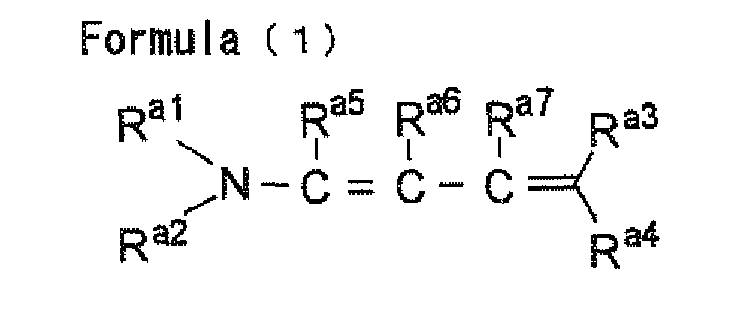 Ra1 and Ra2 each independently represent a hydrogen atom, a substituted or unsubstituted alkyl group, a substituted or unsubstituted aryl group, or a substituted orunsubstituted heterocyclic group; Ra1 and Ra2 may bond to each other to form a nitrogen-containing ring;Ra3 and Ra4 each independently represent a substituent having a Hammett substituent constant σp value of 0.2 or more; Ra3 and Ra4 may bond to each other to form a ring;Ra5, Ra6 and Ra7 each represent a hydrogen atom or a monovalent substituent; and any two of Ra1, Ra5, Ra6 and Ra7 may bond with each other to form a ring; and
 wherein, in formula (2-a),X1 and X2 each independently represent a hydrogen atom, a halogen atom, a hydroxyl group, a substituted or unsubstituted alkyl group, a substituted or unsubstituted phenyl group, a substituted or unsubstituted alkoxy group, a substituted or unsubstituted alkylsulfonyl group, a substituted or unsubstituted arylsulfonyl group, a sulfonic acid group, a substituted or unsubstituted alkyloxycarbonyl group, a substituted or unsubstituted aryloxycarbonyl group or a substituted or unsubstituted amino group; ands1 and s2 each independently represent an integer of 1 to 3; andwherein, in formula (2-b),X1 represents a hydrogen atom, a halogen atom, a hydroxyl group, a substituted orunsubstituted alkyl group, a substituted or unsubstituted phenyl group, a substituted orunsubstituted alkoxy group, a substituted or unsubstituted alkylsulfonyl group, a substituted or unsubstituted arylsulfonyl group, a sulfonic acid group, a substituted orunsubstituted alkyloxycarbonyl group, a substituted or unsubstituted aryloxycarbonyl group, or a substituted or unsubstituted amino group; s1 represents an integer of 1 to 3;Lg represents a divalent substituent or a single bond; w represents 0 or 1;tb represents 1 or 2; X3 represents, when tb is 1, a hydrogen atom, a halogen atom, a hydroxyl group, a substituted or unsubstituted alkyl group, a substituted or unsubstituted phenyl group, a substituted or unsubstituted alkoxy group, a substituted or unsubstituted alkylsulfonyl group, a substituted or unsubstituted arylsulfonyl group, a sulfonic acid group, a substituted or unsubstituted alkyloxycarbonyl group, a substituted orunsubstituted aryloxycarbonyl group, or a substituted or unsubstituted amino group; and when tb is 2, X3 represents a divalent substituent.
 - The ultraviolet absorbent composition according to Claim 1, wherein the compound C is a compound represented by formula (3-a) or (3-b):
 in formula (3-a), R11 represents a hydrogen atom, an aliphatic group, an aromatic group, a heterocyclic group bound via a carbon atom, or a hydrolysable protective group; R12, R13, R14, R15 and R16 each independently represent a hydrogen atom or a substituent;and R11 and R12, R12 and R13, R13 and R14, R14 and R15, R15 and R16, and R16 and R11 may bond to each other to form a ring; andin formula (3-b), R21 represents a hydrogen atom, an aliphatic group, an acyl group, a sulfonyl group, a sulfinyl group, an oxy radical group or a hydroxyl group; Q represents a group of nonmetallic atoms necessary for forming a 5-, 6- or 7-membered ring; R22, R23, R24 and R25 each independently represents a hydrogen atom, an aliphatic group, an aromatic group, or a heterocyclic group bound via a carbon atom; and R21 and R22, R22 and R23, R24 and R25, and R21 and R24 may bond to each other to form a ring.
 - The ultraviolet absorbent composition according to Claim 1 or 2, wherein the ultraviolet absorbent A has the maximum absorption wavelength of 3 50 nm or more and 400 nm or less, the half width of 55 nm or less, and the molar extinction coefficient at the maximum absorption wavelength of 50,000 or more.
- The ultraviolet absorbent composition according to any one of Claims 1 to 3, wherein the ultraviolet absorbent B has the maximum absorption wavelength of less than 320 nm.
- The ultraviolet absorbent composition according to any one of Claims 1 to 3, wherein the ultraviolet absorbent B has the maximum absorption wavelength of 320 nm or more and 350 nm or less.
- The ultraviolet absorbent composition according to any one of Claims 1 to 5, wherein a mixing ratio of the ultraviolet absorbent A the ultraviolet absorbent B is 1:10 to 10:1.
- The ultraviolet absorbent composition according to any one of Claims 2 to 6, wherein the compound C is the compound represented by formula (3-b).
- An ultraviolet absorbent dispersion, comprising the ultraviolet absorbent composition according to any one of Claims 1 to 7.
- An ultraviolet absorbent solution, comprising the ultraviolet absorbent composition according to any one of Claims 1 to 7.
- A polymer material, comprising the ultraviolet absorbent composition according to any one of Claims 1 to 7.
Applications Claiming Priority (2)
| Application Number | Priority Date | Filing Date | Title |
|---|---|---|---|
| JP2008123714A JP2009270062A (en) | 2008-05-09 | 2008-05-09 | Ultraviolet absorbent composition |
| PCT/JP2009/058643 WO2009136624A1 (en) | 2008-05-09 | 2009-05-07 | Ultraviolet absorbent composition |
Publications (2)
| Publication Number | Publication Date |
|---|---|
| EP2295516A1 true EP2295516A1 (en) | 2011-03-16 |
| EP2295516A4 EP2295516A4 (en) | 2011-10-26 |
Family
ID=41264678
Family Applications (1)
| Application Number | Title | Priority Date | Filing Date |
|---|---|---|---|
| EP09742748A Withdrawn EP2295516A4 (en) | 2008-05-09 | 2009-05-07 | Ultraviolet absorbent composition |
Country Status (4)
| Country | Link |
|---|---|
| US (1) | US20110057155A1 (en) |
| EP (1) | EP2295516A4 (en) |
| JP (1) | JP2009270062A (en) |
| WO (1) | WO2009136624A1 (en) |
Cited By (1)
| Publication number | Priority date | Publication date | Assignee | Title |
|---|---|---|---|---|
| EP2330171A4 (en) * | 2008-09-01 | 2012-03-21 | Fujifilm Corp | Ultraviolet absorbing agent composition |
Families Citing this family (9)
| Publication number | Priority date | Publication date | Assignee | Title |
|---|---|---|---|---|
| KR101745039B1 (en) | 2010-01-19 | 2017-06-08 | 스미토모 세이카 가부시키가이샤 | Composition for ultraviolet ray-absorbable member, and ultraviolet ray-absorbable member comprising same |
| JP2011184414A (en) | 2010-03-11 | 2011-09-22 | Fujifilm Corp | Polymer film, ultraviolet absorber, merocyanine based compound, and production method of merocyanine based compound |
| JP5688333B2 (en) * | 2011-06-23 | 2015-03-25 | 富士フイルム株式会社 | Polymer film, retardation film, polarizing plate, liquid crystal display device, Rth enhancer and merocyanine compound |
| JP2015125168A (en) * | 2013-12-25 | 2015-07-06 | コニカミノルタ株式会社 | Dielectric multilayer film |
| JP6504176B2 (en) * | 2014-09-19 | 2019-04-24 | Agc株式会社 | Optical filter |
| CN116144292A (en) * | 2015-12-25 | 2023-05-23 | 日东电工株式会社 | Adhesive layer for organic EL display device, polarizing film with adhesive layer for organic EL display device, and organic EL display device |
| JPWO2018173979A1 (en) * | 2017-03-21 | 2019-11-07 | 富士フイルム株式会社 | Adhesive composition and adhesive sheet |
| WO2021006046A1 (en) * | 2019-07-09 | 2021-01-14 | 富士フイルム株式会社 | Multilayer body, liquid crystal display device and organic electroluminescent display device |
| JP2026017172A (en) * | 2024-07-23 | 2026-02-04 | 三菱鉛筆株式会社 | Writing instrument parts and writing instruments |
Family Cites Families (412)
| Publication number | Priority date | Publication date | Assignee | Title |
|---|---|---|---|---|
| GB9100257D0 (en) | 1991-01-07 | 1991-02-20 | Sandoz Ltd | Improvements in or relating to organic compounds |
| DE350399C (en) | 1919-09-19 | 1922-03-20 | Qu Bernd Ziemert | Projection screen |
| BE636841A (en) | 1962-08-30 | |||
| JPS4920973B1 (en) | 1970-05-28 | 1974-05-29 | ||
| JPS4920974B1 (en) | 1970-06-01 | 1974-05-29 | ||
| JPS511420B1 (en) | 1971-04-05 | 1976-01-17 | ||
| DE2351865A1 (en) | 1972-10-19 | 1974-04-25 | Ciba Geigy Ag | 1-AZA-4-THIACYCLOHEXAN-4,4-DIOXIDE DERIVATIVES AND THEIR USE AS LIGHT PROTECTION AGENTS |
| JPS526523B2 (en) | 1972-12-26 | 1977-02-23 | ||
| CA1065180A (en) | 1974-09-17 | 1979-10-30 | Eastman Kodak Company | Photographic element having 1-amino-4-cyano-1,3-butadiene derivative as ultraviolet filter |
| JPS53128333A (en) | 1977-04-15 | 1978-11-09 | Fuji Photo Film Co Ltd | Prevention of influences of ultraviolet ray upon photosensitive material of silver halogenide |
| JPS6056175B2 (en) | 1978-02-13 | 1985-12-09 | コニカ株式会社 | Method for producing impregnated polymer latex composition |
| DE2963689D1 (en) | 1978-11-06 | 1982-11-04 | Ciba Geigy Ag | Colour-photographic recording material, process for its stabilisation and production of colour-photographic images |
| JPS55129136A (en) | 1979-03-27 | 1980-10-06 | Fuji Photo Film Co Ltd | Emulsifying method |
| IT1206995B (en) | 1979-10-12 | 1989-05-17 | Minnesota Mining & Mfg | POLYMERIC ULTRAVIOLET ABSORBENTS PHOTOGRAPHIC MATERIAL CONTAINING THEM AND METHOD FOR INTRODUCING THEM INTO said PHOTOGRAPHIC MATERIAL |
| US4259467A (en) | 1979-12-10 | 1981-03-31 | Bausch & Lomb Incorporated | Hydrophilic contact lens made from polysiloxanes containing hydrophilic sidechains |
| US4355147A (en) | 1981-02-26 | 1982-10-19 | Bausch & Lomb Incorporated | Polysiloxane with polycyclic modifier composition and biomedical devices |
| EP0082817B1 (en) | 1981-12-17 | 1987-03-04 | Ciba-Geigy Ag | Colour-photographic recording material |
| JPS58175693A (en) | 1982-04-08 | 1983-10-14 | Ricoh Co Ltd | High-density optical information recording medium |
| JPS58178351A (en) | 1982-04-14 | 1983-10-19 | Fuji Photo Film Co Ltd | Photosensitive silver halide material |
| JPS58209735A (en) | 1982-06-01 | 1983-12-06 | Konishiroku Photo Ind Co Ltd | Color photographic sensitive material |
| JPS595246A (en) | 1982-06-30 | 1984-01-12 | Konishiroku Photo Ind Co Ltd | Silver halide color photographic product |
| JPS5981194A (en) | 1982-11-01 | 1984-05-10 | Tdk Corp | Optical information medium |
| JPS5955795A (en) | 1982-09-27 | 1984-03-30 | Tdk Corp | Optical recording medium |
| DE3375431D1 (en) | 1982-11-18 | 1988-02-25 | Ciba Geigy Ag | Colour-photographic recording material |
| EP0114029B1 (en) | 1982-12-16 | 1987-09-16 | Ciba-Geigy Ag | Colour-photographic recording material |
| JPS6018387A (en) | 1983-07-11 | 1985-01-30 | Tdk Corp | Optical recording medium |
| JPS6019586A (en) | 1983-07-13 | 1985-01-31 | Tdk Corp | Optical recording medium |
| JPS6019587A (en) | 1983-07-13 | 1985-01-31 | Tdk Corp | Optical recording medium |
| JPS6032856A (en) | 1983-07-30 | 1985-02-20 | Dainippon Ink & Chem Inc | Resin composition for coating compound for repairing automobile |
| JPS6035054A (en) | 1983-08-05 | 1985-02-22 | Tdk Corp | Optical recording medium |
| JPS6036191A (en) | 1983-08-09 | 1985-02-25 | Tdk Corp | Optical recording medium |
| JPS6036190A (en) | 1983-08-09 | 1985-02-25 | Tdk Corp | Optical recording medium |
| JPS6044554A (en) | 1983-08-20 | 1985-03-09 | Tdk Corp | Light recording medium |
| JPS6044555A (en) | 1983-08-20 | 1985-03-09 | Tdk Corp | Light recording medium |
| JPS6044389A (en) | 1983-08-23 | 1985-03-09 | Tdk Corp | Optical recording medium |
| JPS6044390A (en) | 1983-08-23 | 1985-03-09 | Tdk Corp | Optical recording medium |
| JPS6047069A (en) | 1983-08-24 | 1985-03-14 | Tdk Corp | Optical recording medium |
| JPS6054892A (en) | 1983-09-05 | 1985-03-29 | Tdk Corp | optical recording medium |
| JPH0626028B2 (en) | 1984-02-06 | 1994-04-06 | 株式会社リコー | Optical information recording medium |
| JPS6190155A (en) | 1984-10-09 | 1986-05-08 | Konishiroku Photo Ind Co Ltd | Silver halide color photographic sensitive material |
| JPS6173152A (en) | 1984-09-19 | 1986-04-15 | Konishiroku Photo Ind Co Ltd | Silver halide color photographic sensitive material |
| DE3435443A1 (en) | 1984-09-27 | 1986-04-03 | Agfa-Gevaert Ag, 5090 Leverkusen | PHOTOGRAPHIC RECORDING MATERIAL |
| JPS6190156A (en) | 1984-10-09 | 1986-05-08 | Konishiroku Photo Ind Co Ltd | Silver halide color photographic sensitive material |
| JPS61172246A (en) | 1985-01-28 | 1986-08-02 | Mitsubishi Electric Corp | Magnetic recording and reproducing device |
| DE3505423A1 (en) | 1985-02-16 | 1986-08-21 | Agfa-Gevaert Ag, 5090 Leverkusen | Light-sensitive, stabilised photographic recording material |
| DE3531383A1 (en) | 1985-09-03 | 1987-03-05 | Agfa Gevaert Ag | PHOTOGRAPHIC RECORDING MATERIAL WITH A UV ABSORBER AND NEW UV ABSORBER |
| JPH0687154B2 (en) | 1986-05-06 | 1994-11-02 | コニカ株式会社 | Image-receiving element in thermal transfer material with excellent light fastness of dye image |
| US4839405A (en) * | 1986-07-08 | 1989-06-13 | Plasticolors, Inc. | Ultraviolet stabilizer compositions, stabilized organic materials, and methods |
| JPS6353544A (en) | 1986-08-25 | 1988-03-07 | Konica Corp | Silver halide photographic sensitive material preventing sweating phenomenon and formation of static mark |
| JPS6356651A (en) | 1986-08-27 | 1988-03-11 | Konica Corp | Silver halide photographic sensitive material preventing sweating phenomenon and formation of static mark |
| JPS63209995A (en) | 1987-02-27 | 1988-08-31 | Fuji Photo Film Co Ltd | Optical data recording medium |
| JPH0652393B2 (en) | 1987-04-22 | 1994-07-06 | 富士写真フイルム株式会社 | Silver halide color photographic light-sensitive material |
| JP3009909B2 (en) | 1990-05-21 | 2000-02-14 | ティーディーケイ株式会社 | Optical recording medium |
| EP0477140B1 (en) | 1990-09-17 | 1995-12-13 | Ciba-Geigy Ag | Pressure- or heat-sensitive recording material |
| JPH04125552A (en) * | 1990-09-17 | 1992-04-27 | Fuji Photo Film Co Ltd | Silver halide photographic sensitive material |
| JP2717883B2 (en) | 1990-11-27 | 1998-02-25 | 富士写真フイルム株式会社 | Silver halide color photographic materials |
| KR100187320B1 (en) | 1991-02-21 | 1999-04-01 | 월터 클리웨인 | Coating compositions resistant to light deterioration |
| ES2124259T3 (en) | 1991-04-26 | 1999-02-01 | Ppg Industries Inc | PRESSURIZABLE THERMOPLASTIC CONTAINER PRESENTING AN EXTERNAL LAYER OF POLYURETHANE AND MANUFACTURING PROCEDURE FOR SUCH CONTAINER. |
| DE59203628D1 (en) | 1991-05-02 | 1995-10-19 | Ciba Geigy Ag | Process for improving the lightfastness of leather. |
| JP3620545B2 (en) | 1991-07-05 | 2005-02-16 | 東レ株式会社 | Fiber structure with good light resistance and method for producing the same |
| JPH05117508A (en) | 1991-10-28 | 1993-05-14 | Kuraray Co Ltd | Polyester composition having ultraviolet shielding performance, method for producing the polyester composition and fiber |
| JPH05139434A (en) | 1991-11-11 | 1993-06-08 | Idemitsu Kosan Co Ltd | Liquid fuel storing container |
| JPH05148703A (en) | 1991-11-27 | 1993-06-15 | Toray Ind Inc | Cool clothing |
| JP3070218B2 (en) | 1992-01-16 | 2000-07-31 | 東レ株式会社 | Tough, breathable and waterproof sheet |
| JPH05185031A (en) | 1992-01-17 | 1993-07-27 | Nissan Motor Co Ltd | Topcoating film for automobile |
| JP3142942B2 (en) | 1992-03-10 | 2001-03-07 | 株式会社東芝 | Waste treatment method |
| JP3364238B2 (en) | 1992-03-11 | 2003-01-08 | 大日本印刷株式会社 | Printed matter having printed layer by ultraviolet curable ink and method for producing the same |
| JP2980299B2 (en) | 1992-03-12 | 1999-11-22 | 株式会社クラレ | Hot carpet and hot carpet cover |
| JPH05339033A (en) | 1992-03-31 | 1993-12-21 | Sumitomo Cement Co Ltd | Manufacture of uv shielding glass and window glass for automobile and window glass for building |
| JPH05345639A (en) | 1992-04-15 | 1993-12-27 | Honjiyou Chem Kk | Solution composition for forming transparent zinc oxide film |
| JPH05305975A (en) | 1992-04-17 | 1993-11-19 | Goou Kagaku Kogyo Kk | Container equipped with ultraviolet shielding function |
| JPH061945A (en) | 1992-06-19 | 1994-01-11 | Toray Ind Inc | Paint composition for painted steel sheets |
| JPH0656466A (en) | 1992-08-05 | 1994-03-01 | Asahi Glass Co Ltd | Glass having low sunlight transmittance and low ultraviolet light transmittance |
| JPH06114991A (en) | 1992-10-02 | 1994-04-26 | Toray Ind Inc | Composite non-woven |
| JP2972827B2 (en) | 1992-11-09 | 1999-11-08 | セントラル硝子株式会社 | UV absorbing transparent body |
| JP2750491B2 (en) * | 1992-12-14 | 1998-05-13 | 石原薬品株式会社 | Colored air freshener gel |
| EP0603130B1 (en) | 1992-12-17 | 2001-09-05 | Ciba SC Holding AG | Cationic compounds, their preparation and their use in the photochemical stabilisation of basic dyeable polyamide fibre materials |
| JP3232381B2 (en) | 1992-12-29 | 2001-11-26 | タキロン株式会社 | Building materials |
| JPH06228818A (en) | 1993-02-01 | 1994-08-16 | Teijin Ltd | Method for producing modified polyester fiber |
| JPH06228816A (en) | 1993-02-02 | 1994-08-16 | Kuraray Co Ltd | Manufacturing method of polyurethane fiber with excellent light resistance |
| JPH06313148A (en) | 1993-04-28 | 1994-11-08 | Central Glass Co Ltd | Coating composition for stainless steel |
| JP2995376B2 (en) | 1993-06-03 | 1999-12-27 | 株式会社ホーネンコーポレーション | Concrete peeling paint and formwork coated with the paint |
| JPH073189A (en) | 1993-06-21 | 1995-01-06 | Akiyama Seiji | Insectproof coating material for lamp |
| JPH0718584A (en) | 1993-06-30 | 1995-01-20 | Toray Ind Inc | Flame-retardant artificial suede-like structure and manufacturing method thereof |
| JPH0726177A (en) | 1993-07-16 | 1995-01-27 | Sekisui Jushi Co Ltd | Ultraviolet-screening coating and ultravioletscreening transparent body |
| JPH0740954A (en) | 1993-07-19 | 1995-02-10 | Mitsubishi Chem Corp | UV blocking multi-layer container |
| JP3326445B2 (en) | 1993-09-10 | 2002-09-24 | 日産自動車株式会社 | Thermosetting coating composition and coated body |
| JPH07119036A (en) | 1993-10-15 | 1995-05-09 | Teijin Ltd | Polyester fiber with improved lightfastness |
| JPH07118576A (en) | 1993-10-19 | 1995-05-09 | Saraya Kk | Photosensitized antifungal coating |
| JP2001114262A (en) | 1993-11-30 | 2001-04-24 | Dainippon Printing Co Ltd | Paper container |
| EP0657577A1 (en) | 1993-12-06 | 1995-06-14 | Ciba-Geigy Ag | Process for photochemical and thermal stabilization of dyed and undyed or printed polyester fibrous materials |
| JPH07166112A (en) | 1993-12-10 | 1995-06-27 | Nippon Paint Co Ltd | Cationic electrodeposition coating composition |
| JPH07164729A (en) | 1993-12-17 | 1995-06-27 | Mitsui Toatsu Chem Inc | Security ink printed matter |
| JPH07216152A (en) | 1994-02-07 | 1995-08-15 | Mitsui Petrochem Ind Ltd | Cyclic olefin resin composition container |
| DE59510278D1 (en) | 1994-02-10 | 2002-08-22 | Ciba Sc Holding Ag | Wood preservative |
| JPH07242444A (en) | 1994-02-28 | 1995-09-19 | Nippon Electric Glass Co Ltd | Production of ultraviolet rays absorbing glass article for medicine |
| BE1009558A5 (en) | 1994-03-24 | 1997-05-06 | Clariant Finance Bvi Ltd | DERIVATIVES OF S-TRIAZINE, THEIR PREPARATION AND THEIR USE AS UV ABSORBERS. |
| DE4410539A1 (en) | 1994-03-26 | 1995-09-28 | Sandoz Ag | Use of 4 H-3,1-benzoxazin-4-one compounds to improve the light fastness of textile materials |
| JPH07269016A (en) | 1994-03-29 | 1995-10-17 | Shin Etsu Polymer Co Ltd | Building material film |
| US6576797B1 (en) * | 1994-03-31 | 2003-06-10 | Ciba Specialty Chemicals Corporation | Thioether substituted hydroxybenzophenones and stabilized compositions |
| GB9407822D0 (en) | 1994-04-20 | 1994-06-15 | Ciba Geigy Ag | Treatment of textile fibres |
| JPH07287353A (en) | 1994-04-20 | 1995-10-31 | Fuji Photo Film Co Ltd | Packing material for photographic sensitive material, its manufacture and package of photographic sensitive material |
| JPH07289097A (en) | 1994-04-25 | 1995-11-07 | Kuraray Co Ltd | Insect repellent mesh sheet |
| JPH07289665A (en) | 1994-04-27 | 1995-11-07 | Dainippon Printing Co Ltd | Golf ball container and manufacturing method thereof |
| DE4421561A1 (en) | 1994-06-20 | 1995-12-21 | Bayer Ag | High temperature resistant flexible screen printing inks |
| JP3663640B2 (en) | 1994-07-26 | 2005-06-22 | 東レ株式会社 | Olefin resin tarpaulin |
| JP3461040B2 (en) | 1994-09-01 | 2003-10-27 | 日立化成工業株式会社 | Rubber-based adhesive composition |
| JPH0881643A (en) | 1994-09-12 | 1996-03-26 | Kansai Paint Co Ltd | Clear coating and coating method therewith |
| JP3598404B2 (en) | 1994-09-29 | 2004-12-08 | 釜屋化学工業株式会社 | Decorative container |
| JP3186466B2 (en) | 1994-09-30 | 2001-07-11 | 松下電工株式会社 | Method of manufacturing light source cover for lighting device |
| JPH08151457A (en) | 1994-09-30 | 1996-06-11 | Takiron Co Ltd | Resin molding and its production |
| JPH08108650A (en) | 1994-10-13 | 1996-04-30 | Brother Ind Ltd | Image receiving sheet for thermal transfer ink and cassette for label printing |
| JP4143983B2 (en) | 1994-10-14 | 2008-09-03 | チバ ホールディング インコーポレーテッド | Increased molecular weight of polycondensate |
| JPH08208976A (en) | 1994-10-31 | 1996-08-13 | Dainippon Ink & Chem Inc | Micro beads containing fluorescent pigment and / or fluorescent dye |
| JPH08133787A (en) | 1994-11-11 | 1996-05-28 | Asai Glass Kk | Glass vessel for cosmetics |
| JPH08151455A (en) | 1994-11-29 | 1996-06-11 | Kuraray Co Ltd | Method for producing polyvinyl alcohol film |
| DK0716123T4 (en) | 1994-12-09 | 2002-08-19 | Crompton Vinyl Additives Gmbh | Polyvinyl chloride stabilized |
| JP2973846B2 (en) | 1994-12-28 | 1999-11-08 | 東レ株式会社 | Polyester fiber with improved weather resistance, method for producing the same, and fiber product using the fiber |
| JP3389720B2 (en) | 1995-01-17 | 2003-03-24 | 東レ株式会社 | Highly transparent flame-retardant film materials, exterior wall materials, roofing materials and agricultural houses |
| JPH08197511A (en) | 1995-01-26 | 1996-08-06 | Sanyo Chem Ind Ltd | Ligneous structure for building material |
| JPH08208765A (en) | 1995-01-31 | 1996-08-13 | Dainippon Ink & Chem Inc | Thermoplastic resin composition, method for producing the same, weather resistance modifier and polymer composition containing the same |
| JPH08207218A (en) | 1995-02-02 | 1996-08-13 | Dainippon Shikizai Kogyo Kk | Soft polyvinyl chloride sheet and civil engineering structure |
| JPH08239509A (en) * | 1995-03-06 | 1996-09-17 | Fuji Photo Film Co Ltd | Polymer film |
| JPH08258415A (en) | 1995-03-24 | 1996-10-08 | Toppan Printing Co Ltd | Thermal recording medium |
| AR001448A1 (en) | 1995-03-27 | 1997-10-22 | Grupo Cydsa Sa De Cv | Heat shrinkable thermoplastic sheet or film and methods of protecting containers using such sheet or film. |
| JPH08269850A (en) | 1995-03-30 | 1996-10-15 | Toray Ind Inc | Nets and meshes for building materials |
| JP3615590B2 (en) | 1995-03-31 | 2005-02-02 | 富士写真フイルム株式会社 | Silver halide color photographic light-sensitive material |
| JPH08284063A (en) | 1995-04-10 | 1996-10-29 | Toray Ind Inc | Electret sheet, manufacturing method thereof, and filter substrate |
| JPH08301363A (en) | 1995-05-02 | 1996-11-19 | Green Cross Corp:The | Liquid formulation packaging bag |
| DE19516028A1 (en) | 1995-05-04 | 1996-11-07 | Henkel Kgaa | Aromatic-free solvents for printing inks |
| JP2822164B2 (en) | 1995-05-25 | 1998-11-11 | 日本ペイント株式会社 | Pre-coated metal plate |
| JPH0948935A (en) | 1995-05-31 | 1997-02-18 | Mitsubishi Rayon Co Ltd | Coating composition for container and container having cured film thereof |
| JPH08324576A (en) | 1995-06-05 | 1996-12-10 | Toyo Ink Mfg Co Ltd | Method for protecting surface of resin container and paint used for protecting surface of resin container |
| JPH0912924A (en) | 1995-06-29 | 1997-01-14 | Inter Seputo Kk | Water-repellent protecting coating material |
| JPH0958687A (en) | 1995-08-11 | 1997-03-04 | Fuji Seal Co Ltd | Sake container |
| JPH0959539A (en) | 1995-08-21 | 1997-03-04 | Nippon Paint Co Ltd | Alkali-soluble protective coating composition |
| JPH0957889A (en) | 1995-08-23 | 1997-03-04 | Toray Ind Inc | Antifouling film material |
| JP3702503B2 (en) | 1995-09-21 | 2005-10-05 | 東洋製罐株式会社 | Oily food container |
| JPH0995055A (en) | 1995-09-28 | 1997-04-08 | Toppan Printing Co Ltd | Reversible thermosensitive recording medium |
| EP0765922A1 (en) | 1995-09-29 | 1997-04-02 | Basf Corporation | Coatings containing hydrazide compounds for enhanced durability |
| JPH09113494A (en) | 1995-10-24 | 1997-05-02 | Tosoh Corp | Solution container for analytical reagent |
| JPH09183159A (en) | 1995-10-30 | 1997-07-15 | Toray Ind Inc | Bonding sheet material |
| DE19540977A1 (en) | 1995-11-03 | 1997-05-07 | Basf Lacke & Farben | Aqueous powder coating dispersions |
| JPH09142539A (en) | 1995-11-14 | 1997-06-03 | Toppan Printing Co Ltd | UV blocking packaging material |
| JP3475610B2 (en) | 1995-11-15 | 2003-12-08 | 東レ株式会社 | Land net |
| JPH09157581A (en) | 1995-12-06 | 1997-06-17 | Arakawa Toryo Kogyo Kk | Method for reinforcement of plate glass and coating material for preventing broken glass piece from scattering |
| JPH09157626A (en) | 1995-12-07 | 1997-06-17 | Toppan Printing Co Ltd | Adhesive for wrapping and wrapping member using this adhesive |
| US6025433A (en) | 1995-12-20 | 2000-02-15 | Basf Coatings Ag | Thermosetting paint composition |
| JPH09241407A (en) | 1996-03-07 | 1997-09-16 | Japan Atom Energy Res Inst | Processing method for thermoplastic synthetic resin containers |
| JPH09241534A (en) | 1996-03-11 | 1997-09-16 | Toyo Ink Mfg Co Ltd | Graded coating composition |
| JPH09239910A (en) | 1996-03-13 | 1997-09-16 | Toppan Printing Co Ltd | Lid material for instant noodle containers |
| JPH09239921A (en) | 1996-03-13 | 1997-09-16 | Toray Ind Inc | Laminated film |
| JPH09254345A (en) | 1996-03-26 | 1997-09-30 | Toray Ind Inc | Laminated film |
| JPH09263729A (en) | 1996-03-27 | 1997-10-07 | Koji Tagami | One-can ultraviolet-intercepting, protective, and scatter-preventing composition |
| JPH09277414A (en) | 1996-04-18 | 1997-10-28 | Mitsui Toatsu Chem Inc | Breathable waterproof sheet for building materials and manufacturing method thereof |
| JPH09295664A (en) | 1996-04-30 | 1997-11-18 | Heisei Polymer Co Ltd | Lid material for food containers |
| JPH09306344A (en) | 1996-05-07 | 1997-11-28 | Toray Ind Inc | Manufacturing method of plasma display |
| JPH09300537A (en) | 1996-05-20 | 1997-11-25 | Dainippon Printing Co Ltd | Makeup sheet |
| JP3146474B2 (en) | 1996-05-21 | 2001-03-19 | 日本製紙株式会社 | Ink jet recording medium |
| JPH101587A (en) | 1996-06-13 | 1998-01-06 | Kuraray Co Ltd | UV absorber |
| JP3603477B2 (en) | 1996-06-14 | 2004-12-22 | 東レ株式会社 | Mesh sheet for construction work and method of manufacturing the same |
| JPH106451A (en) | 1996-06-20 | 1998-01-13 | Achilles Corp | Decorative material made of vinyl chloride resin |
| JPH1016152A (en) | 1996-06-28 | 1998-01-20 | Achilles Corp | Olefin resin laminated film |
| JPH1034841A (en) | 1996-07-19 | 1998-02-10 | Toray Ind Inc | Agricultural coating |
| JPH1044352A (en) | 1996-08-02 | 1998-02-17 | Toray Ind Inc | Laminated film |
| JPH1088039A (en) | 1996-09-20 | 1998-04-07 | Nobuhito Oohara | UV / NIR blocking paint |
| FR2755444B1 (en) | 1996-11-07 | 2004-10-08 | Ciba Sc Holding Ag | COATING COMPOSITION COMPRISING A STABILIZING COMPOUND THEREOF AND USE THEREOF |
| JPH10194796A (en) | 1996-11-13 | 1998-07-28 | Sekisui Chem Co Ltd | Interlayer for laminated glass and laminated glass |
| JPH10203033A (en) | 1996-11-21 | 1998-08-04 | Ricoh Co Ltd | Sublimation transfer image receiving medium and thermal recording method |
| JPH10165045A (en) | 1996-12-06 | 1998-06-23 | Toray Ind Inc | Underwater net |
| JPH10168292A (en) | 1996-12-17 | 1998-06-23 | Teijin Ltd | Stretched polyester film |
| JPH10183057A (en) | 1996-12-25 | 1998-07-07 | Wakamiya Sangyo:Kk | Floor coating material |
| JPH10205056A (en) | 1997-01-29 | 1998-08-04 | Toray Ind Inc | Base material for building materials |
| JPH10237760A (en) | 1997-02-21 | 1998-09-08 | Toray Ind Inc | Polyester fiber structure |
| JPH10237312A (en) | 1997-02-25 | 1998-09-08 | Toppan Printing Co Ltd | Antibacterial resin composition and molded article |
| JPH10251981A (en) | 1997-03-04 | 1998-09-22 | Teijin Ltd | Method for improving light resistance of meta-based aramid fiber structure |
| JPH10250004A (en) | 1997-03-10 | 1998-09-22 | Diafoil Co Ltd | Window pasting film |
| JPH10287804A (en) | 1997-04-16 | 1998-10-27 | Teijin Chem Ltd | Composition for optical functional sheet and prism sheet |
| JP3516833B2 (en) | 1997-04-24 | 2004-04-05 | 大塚化学ホールディングス株式会社 | Super weather resistant paint composition |
| JPH10298397A (en) | 1997-04-25 | 1998-11-10 | Kyodo Yakuhin Kk | Styrene-based resin composition |
| DE19721142A1 (en) | 1997-05-21 | 1998-11-26 | Kalle Nalo Gmbh | Multi-layer, biaxially stretched food casing with two oxygen barrier layers |
| JP4491841B2 (en) | 1997-07-22 | 2010-06-30 | 東レ株式会社 | Laminated film for solar cell cover |
| JP3138754B2 (en) | 1997-12-05 | 2001-02-26 | グンゼ株式会社 | Low temperature heat shrinkable film for labels |
| JP3749365B2 (en) | 1997-12-22 | 2006-02-22 | 株式会社資生堂 | Cosmetic container |
| JPH11199808A (en) | 1998-01-16 | 1999-07-27 | Seiko Epson Corp | Aqueous ink composition, recording method using the same, and recorded matter recorded using the same |
| EP0931814A1 (en) | 1998-01-21 | 1999-07-28 | Fina Research S.A. | Polyolefins and uses thereof |
| JP3363367B2 (en) | 1998-01-28 | 2003-01-08 | ミサワホーム株式会社 | Cover glass structure for solar cell module |
| JPH11236734A (en) | 1998-02-20 | 1999-08-31 | Kawai Musical Instr Mfg Co Ltd | Antibacterial building materials |
| JPH11247027A (en) | 1998-03-04 | 1999-09-14 | Toray Ind Inc | Ultrafine fiber and method for producing the same |
| JPH11247028A (en) | 1998-03-05 | 1999-09-14 | Toray Ind Inc | Ultrafine fiber having light resistance and method for producing the same |
| JPH11261085A (en) | 1998-03-10 | 1999-09-24 | Mitsubishi Plastics Ind Ltd | Backsheet for solar cell |
| JP3444781B2 (en) | 1998-03-10 | 2003-09-08 | 旭化成アイミー株式会社 | Method for modifying medical polymer and medical polymer substrate |
| JP4167745B2 (en) | 1998-04-08 | 2008-10-22 | アイセロ化学株式会社 | Container for high-purity chemical liquid and method for discharging high-purity chemical liquid |
| JPH11302982A (en) | 1998-04-17 | 1999-11-02 | Toray Ind Inc | Artificial leather |
| JPH11300880A (en) | 1998-04-24 | 1999-11-02 | Toto Ltd | Building material |
| WO1999067337A1 (en) | 1998-06-24 | 1999-12-29 | Seiko Epson Corporation | Ink composition providing image excellent in light stability |
| JP4070885B2 (en) | 1998-07-10 | 2008-04-02 | 東セロ株式会社 | Cosmetic sheet and method for producing the same |
| JP4061726B2 (en) | 1998-07-31 | 2008-03-19 | 王子製紙株式会社 | Newsprint for offset printing and method for producing the same |
| JP2000056433A (en) | 1998-08-07 | 2000-02-25 | Fuji Photo Film Co Ltd | Photographic film package |
| JP2000066603A (en) | 1998-08-20 | 2000-03-03 | Fuji Seal Inc | Polystyrene-based frost-tone thermal contraction label |
| JP2000067629A (en) | 1998-08-25 | 2000-03-03 | Mitsubishi Rayon Co Ltd | Lighting cover |
| JP2000071626A (en) | 1998-08-31 | 2000-03-07 | Dainippon Printing Co Ltd | Protective layer transfer sheet and printed matter |
| JP2000091610A (en) | 1998-09-17 | 2000-03-31 | Dainippon Printing Co Ltd | Solar cell cover film, method of manufacturing the same, and solar cell module using the cover film |
| JP2000091611A (en) | 1998-09-17 | 2000-03-31 | Dainippon Printing Co Ltd | Solar cell cover film, method of manufacturing the same, and solar cell module using the cover film |
| US6262153B1 (en) | 1998-10-12 | 2001-07-17 | Clariant Finance (Bvi) Limited | Colored wax articles |
| JP2000144583A (en) | 1998-11-12 | 2000-05-26 | Toray Ind Inc | Sheet |
| EP1002512A3 (en) | 1998-11-19 | 2001-01-24 | Bracco International B.V. | Flexible container for the containment and delivery of fluids |
| JP4176259B2 (en) | 1998-11-30 | 2008-11-05 | 東レ株式会社 | Breathable waterproof fabric |
| JP2000174296A (en) | 1998-12-07 | 2000-06-23 | Bridgestone Corp | Cover material for solar cell, sealing film, and solar cell |
| JP2000186234A (en) | 1998-12-21 | 2000-07-04 | Toagosei Co Ltd | Metallic coating composition |
| JP2000223271A (en) | 1999-01-29 | 2000-08-11 | Fuji Electric Co Ltd | Organic EL device |
| JP2000224942A (en) | 1999-02-04 | 2000-08-15 | Shimano Inc | Fishing article |
| JP4010689B2 (en) | 1999-02-12 | 2007-11-21 | 信越化学工業株式会社 | Optical fiber ribbon |
| JP2000238857A (en) | 1999-02-22 | 2000-09-05 | Teijin Ltd | Polyethylene naphthalate container and method of using the same |
| JP2000273362A (en) | 1999-03-25 | 2000-10-03 | Honda Motor Co Ltd | Powder coating composition and method for forming laminated coating film including the coating film |
| US6191199B1 (en) | 1999-05-03 | 2001-02-20 | Ciba Speciatly Chemicals Corporation | Stabilized adhesive compositions containing highly soluble, high extinction photostable hydroxyphenyl-s-triazine UV absorbers and laminated articles derived therefrom |
| CN1186417C (en) | 1999-05-03 | 2005-01-26 | 西巴特殊化学品控股有限公司 | Stabilized adhesive compositions containing highly soluble, red-shifted, photostable benzotriazole ultraviolet absorbers and laminates made therefrom |
| JP2000345109A (en) | 1999-06-02 | 2000-12-12 | Mitsuo Oyanagi | Peelable coating material having excellent appearance and peeling properties |
| JP2001003357A (en) | 1999-06-24 | 2001-01-09 | Shimizu Corp | Steel pipe pile |
| US6355707B1 (en) | 1999-06-28 | 2002-03-12 | Samhwa Paints Ind. Co., Ltd. | Coating material for shielding electromagnetic waves |
| JP2001009811A (en) | 1999-06-29 | 2001-01-16 | Takashi Ueda | Mixture of cellulose and flame retardant and manufacture thereof |
| JP2001026081A (en) | 1999-07-13 | 2001-01-30 | Fujimori Kogyo Co Ltd | Packaging laminate |
| JP2001048153A (en) | 1999-08-03 | 2001-02-20 | Teijin Ltd | Polyester container, method of regenerating and using the same |
| JP2001059068A (en) | 1999-08-23 | 2001-03-06 | Toray Ind Inc | Resin composition for paint |
| JP4608750B2 (en) | 1999-08-31 | 2011-01-12 | Dic株式会社 | Photo-curable resin compound and its curing method |
| JP3915339B2 (en) | 1999-09-10 | 2007-05-16 | 富士ゼロックス株式会社 | Light control glass |
| JP2001088815A (en) | 1999-09-17 | 2001-04-03 | Alpha Techno Co Ltd | Container made of polyethylene for 2-cyanoacrylate composition |
| JP2001106218A (en) | 1999-10-05 | 2001-04-17 | Taisei Kako Co Ltd | Container for liquid |
| JP2001115080A (en) | 1999-10-13 | 2001-04-24 | Nippon Shokubai Co Ltd | Emulsion coating |
| JP2001159228A (en) | 1999-12-03 | 2001-06-12 | Dainippon Printing Co Ltd | Floor sheet |
| JP2001172531A (en) | 1999-12-21 | 2001-06-26 | Asahi Glass Co Ltd | Compositions for fluororesin coatings and ceramic building materials |
| JP4609816B2 (en) | 1999-12-27 | 2011-01-12 | 日本エイアンドエル株式会社 | Water-based temporary protective coating composition |
| JP2001207144A (en) | 2000-01-27 | 2001-07-31 | Taoka Chem Co Ltd | Hot-melt adhesive composition |
| JP3841141B2 (en) | 2000-02-04 | 2006-11-01 | 信越化学工業株式会社 | Undercoat composition and coating method |
| JP4092525B2 (en) | 2000-02-04 | 2008-05-28 | 信越化学工業株式会社 | Coating agent composition, coating method and coated article |
| CA2399871A1 (en) | 2000-02-22 | 2001-08-30 | Ciba Specialty Chemicals Holding Inc. | Romp with oligomeric uv-absorbers |
| JP2003524696A (en) | 2000-02-28 | 2003-08-19 | バイエル アクチェンゲゼルシャフト | Waterborne paint for high solids baking lacquer |
| JP2001249430A (en) | 2000-03-07 | 2001-09-14 | Fuji Photo Film Co Ltd | Image recording medium |
| JP4690517B2 (en) | 2000-03-22 | 2011-06-01 | 三井・デュポンポリケミカル株式会社 | Ethylene copolymer composition |
| JP2001262056A (en) | 2000-03-23 | 2001-09-26 | Kansai Paint Co Ltd | Two-component aqueous coating composition |
| JP2001270531A (en) | 2000-03-23 | 2001-10-02 | Toppan Printing Co Ltd | Plastic container |
| DE10015086A1 (en) | 2000-03-28 | 2001-10-04 | Basf Ag | Textile fiber affine UV absorber mixture |
| JP4802355B2 (en) | 2000-03-29 | 2011-10-26 | Dic株式会社 | Method for producing powder coating |
| DE10016194A1 (en) | 2000-03-31 | 2001-10-04 | Bayer Ag | Coating system containing UV-curable, isocyanate group-containing urethane (meth) acrylates and hydroxyl group-containing urethane (meth) acrylates |
| JP4710102B2 (en) | 2000-05-15 | 2011-06-29 | 東洋紡績株式会社 | Heat-shrinkable polyester film |
| JP2001315263A (en) | 2000-05-01 | 2001-11-13 | Mitsubishi Rayon Co Ltd | Hard coat sheet, resin molded product using the same, and method of manufacturing the same |
| JP2001316630A (en) | 2000-05-09 | 2001-11-16 | Nippon Paint Co Ltd | Top coating composition |
| JP2002053824A (en) | 2000-06-02 | 2002-02-19 | Fuji Photo Film Co Ltd | Ultraviolet light absorbing tacky film |
| JP2001348785A (en) | 2000-06-06 | 2001-12-21 | Du Pont Toray Co Ltd | Method for treating wholly aromatic polyamide fiber and treated fiber |
| JP4326679B2 (en) | 2000-07-19 | 2009-09-09 | リンテック株式会社 | Hard coat film |
| JP3862941B2 (en) | 2000-07-21 | 2006-12-27 | リンテック株式会社 | High definition antiglare hard coat film |
| JP2002038084A (en) | 2000-07-21 | 2002-02-06 | Kansai Paint Co Ltd | Anionic electrodeposition coating |
| CO5231248A1 (en) | 2000-07-26 | 2002-12-27 | Ciba Sc Holding Ag | LOW CONSISTENCY POLYMER TRANSPARENT ITEMS |
| JP2002127596A (en) | 2000-08-15 | 2002-05-08 | Dainippon Ink & Chem Inc | Composition for ink receiving layer, recording material, and printed matter using the same |
| JP2002068322A (en) | 2000-08-24 | 2002-03-08 | Shiseido Co Ltd | Evaluation method for yellowing of light-fast cosmetic containers and colorless and transparent cosmetic containers |
| JP2002069331A (en) | 2000-08-30 | 2002-03-08 | Dainippon Ink & Chem Inc | Electron beam curable coating composition |
| JP4311869B2 (en) | 2000-09-06 | 2009-08-12 | 富士フイルム株式会社 | UV absorbing paint |
| JP2002080781A (en) | 2000-09-11 | 2002-03-19 | Nippon Yushi Basf Coatings Kk | Thermosetting coating composition |
| JP2002113937A (en) | 2000-10-06 | 2002-04-16 | Kobayashi Kirokushi Co Ltd | Forgery protection slip |
| JP4438976B2 (en) | 2000-10-25 | 2010-03-24 | 大日本印刷株式会社 | Glass plate with water droplet adhesion prevention and heat ray blocking |
| JP2002130591A (en) | 2000-10-26 | 2002-05-09 | Nippon Mitsubishi Oil Corp | Refueling cup and refueling device |
| JP2002160321A (en) | 2000-11-22 | 2002-06-04 | Haruhiko Watanabe | Gas barrier plastic |
| JP2002161158A (en) | 2000-11-24 | 2002-06-04 | C I Kasei Co Ltd | Polyester resin building materials |
| ES2232683T3 (en) | 2000-11-27 | 2005-06-01 | Ciba Specialty Chemicals Holding Inc. | DERIVATIVES OF 2- (2-HIDDROXIFENIL) -2H-BENZOTRIAZOLS, REPLACED IN POSITION 5 BY ARILO AND IN POSITION 5 BY HETEROARILO, AS UV ABSORBENTS. |
| JP2001213427A (en) | 2000-11-29 | 2001-08-07 | Dainippon Printing Co Ltd | Paper container |
| JP3981239B2 (en) | 2000-12-01 | 2007-09-26 | 関西ペイント株式会社 | Anti-corrosion paint composition for one-time paint finish |
| JP4418583B2 (en) | 2000-12-11 | 2010-02-17 | ダイセル化学工業株式会社 | Resin composition for inkjet recording and recording sheet |
| JP2002189415A (en) | 2000-12-20 | 2002-07-05 | Dainippon Printing Co Ltd | Light-blocking printed label |
| JP2002207845A (en) | 2001-01-09 | 2002-07-26 | Un Tochi Riyo Kenkyusho:Kk | Land utilization promotion system |
| JP2002212884A (en) | 2001-01-12 | 2002-07-31 | Teijin Ltd | Method for imparting functions to fiber structures |
| JP2002212237A (en) | 2001-01-15 | 2002-07-31 | Ipposha Oil Ind Co Ltd | UV absorber for inkjet recording sheet |
| JP2002293706A (en) | 2001-01-25 | 2002-10-09 | Nishinihon Green Research Institute | Turf purpura inhibitor |
| JP2002226764A (en) | 2001-01-31 | 2002-08-14 | Asahi Glass Co Ltd | Painted articles for building materials |
| JP2002235028A (en) | 2001-02-09 | 2002-08-23 | Ishihara Chem Co Ltd | Photocatalytic coating composition |
| JP2002322360A (en) | 2001-02-21 | 2002-11-08 | Toray Ind Inc | Polyphenylene sulfide member |
| JP2002271227A (en) | 2001-03-09 | 2002-09-20 | Aiwa Co Ltd | Radio communication equipment |
| JP2002264979A (en) | 2001-03-12 | 2002-09-18 | Shiseido Co Ltd | Dispenser-container for highly viscous contents |
| ATE279503T1 (en) | 2001-03-27 | 2004-10-15 | Ciba Sc Holding Ag | LAUNDRY DETERGENT CONTAINING A BENZTRIAZOLE AS A UV ABSORBENT |
| JP3984488B2 (en) | 2001-03-27 | 2007-10-03 | 日本ペイント株式会社 | Curable coating composition and coating film forming method |
| JP2002294165A (en) | 2001-03-30 | 2002-10-09 | Nippon Paint Co Ltd | Method of preventing cissing for cationic electrodeposition paint and cissing inhibitor |
| US6562083B2 (en) | 2001-04-02 | 2003-05-13 | Ciba Specialty Chemicals Corporation | Candle wax stabilized with s-triazines/hals |
| JP4601850B2 (en) | 2001-04-11 | 2010-12-22 | 大日本印刷株式会社 | Hard film coated article |
| JP2002307845A (en) | 2001-04-16 | 2002-10-23 | Dainippon Printing Co Ltd | Intermediate transfer recording medium and image forming method |
| JP2002367227A (en) | 2001-06-04 | 2002-12-20 | Fuji Photo Film Co Ltd | Optical information recording medium |
| US6562085B1 (en) | 2001-06-06 | 2003-05-13 | Ciba Specialty Chemicals Corporation | Candle wax compositions stabilized with UV absorber-metal combinations |
| JP2002370723A (en) | 2001-06-13 | 2002-12-24 | Toppan Printing Co Ltd | PET two-layer stretch blow molded container |
| JP3722093B2 (en) | 2001-06-27 | 2005-11-30 | 大日本インキ化学工業株式会社 | Pavement material for walking path and method for manufacturing the same |
| EP1454956B1 (en) | 2001-06-28 | 2007-01-03 | Toray Industries, Inc. | Epoxy resin composition excellent in weather resistance and fiber-reinforced composite materials |
| DE60203010T2 (en) | 2001-07-02 | 2005-07-07 | Ciba Specialty Chemicals Holding Inc. | HIGH-MOLECULAR HYDROXYPHENYLBENZOTRIAZOL COMPOUNDS AS UV ABSORBER FOR THIN FILM APPLICATIONS |
| JP2003020966A (en) | 2001-07-04 | 2003-01-24 | Toyota Motor Corp | Lock standby operation control method of engine operating characteristic changing means |
| JP4947479B2 (en) | 2001-07-06 | 2012-06-06 | 大日本印刷株式会社 | Polyolefin decorative sheet for decorative steel sheet and decorative steel sheet |
| JP3926117B2 (en) | 2001-07-17 | 2007-06-06 | リンテック株式会社 | Hard coat film |
| JP2003041434A (en) | 2001-07-23 | 2003-02-13 | Toray Ind Inc | Polyamide fiber for clothing |
| JP4224227B2 (en) | 2001-07-27 | 2009-02-12 | リンテック株式会社 | Antistatic hard coat film and method for producing the same |
| JP2003049065A (en) | 2001-08-07 | 2003-02-21 | Ge Plastics Japan Ltd | Polyphenylene ether resin composition |
| JP2003160724A (en) | 2001-09-11 | 2003-06-06 | Ge Plastics Japan Ltd | Polycarbonate resin-based composition |
| JP2003168814A (en) | 2001-09-18 | 2003-06-13 | Dainippon Printing Co Ltd | Back protection sheet for solar cell module and solar cell module using the same |
| US6872766B2 (en) | 2001-10-03 | 2005-03-29 | Eastman Kodak Company | Ultraviolet light filter element |
| US20030080236A1 (en) * | 2001-10-31 | 2003-05-01 | Armstrong Gilbert B. | Rolled wire net and fence dispensing apparatus |
| JP3994256B2 (en) | 2001-11-07 | 2007-10-17 | グンゼ株式会社 | Ultraviolet absorbing fiber product and method for producing the same |
| JP2003145949A (en) | 2001-11-08 | 2003-05-21 | Minolta Co Ltd | Reversible heat-sensitive recording medium and information recording display card having the same |
| JP2003200966A (en) | 2002-01-08 | 2003-07-15 | Dainippon Printing Co Ltd | Light-shielding shrink film |
| JP4145050B2 (en) | 2002-01-16 | 2008-09-03 | 株式会社パイロットコーポレーション | Water-based ink composition |
| JP2003211606A (en) | 2002-01-17 | 2003-07-29 | Teijin Dupont Films Japan Ltd | Polyester film for molding parts |
| JP2003211538A (en) | 2002-01-25 | 2003-07-29 | Teijin Dupont Films Japan Ltd | Polyester film for dressing |
| JP2003237825A (en) | 2002-02-12 | 2003-08-27 | Nakagawa Kaseihin Kk | Transparent resin composition for food container and packaging material |
| JP2003239181A (en) | 2002-02-12 | 2003-08-27 | Toray Ind Inc | Artificial leather and manufacturing method thereof |
| JP2003239136A (en) | 2002-02-12 | 2003-08-27 | Teijin Ltd | Highly light-resistant wholly aromatic polyamide fiber structure |
| US7425222B2 (en) | 2002-02-18 | 2008-09-16 | Ciba Specialty Chemicals Corp. | Process for improving the sun protection factor of cellulosic fibre material |
| EP1476503A1 (en) | 2002-02-19 | 2004-11-17 | Ciba SC Holding AG | Containers or films comprising hydroxyphenylbenzotriazole uv absorbers for protecting contents against the effects of uv radiation |
| JP2003253265A (en) | 2002-02-27 | 2003-09-10 | Dainippon Ink & Chem Inc | Dimming layer forming material and liquid crystal device |
| JP2003266926A (en) | 2002-03-18 | 2003-09-25 | Mitsubishi Paper Mills Ltd | Inkjet recording material |
| JP2003266927A (en) | 2002-03-19 | 2003-09-25 | Mitsubishi Paper Mills Ltd | Inkjet recording material |
| WO2003089534A2 (en) | 2002-04-01 | 2003-10-30 | Nippon Steel Corporation | Coating composition for precoated metal sheet hardly causing electrostatic failure and precoated metal sheet |
| JP2004000937A (en) | 2002-04-09 | 2004-01-08 | Hiraga Kikai Kogyo Kk | Adhesive adherence preventing apparatus |
| JP4056293B2 (en) | 2002-05-09 | 2008-03-05 | クボタ松下電工外装株式会社 | Decorative building materials |
| JP3992141B2 (en) | 2002-05-31 | 2007-10-17 | 大日本印刷株式会社 | Floor material and manufacturing method thereof |
| JP2003339503A (en) | 2002-05-31 | 2003-12-02 | Toray Ind Inc | Thermal blanket |
| DE10224947B4 (en) | 2002-06-05 | 2006-07-06 | Ems Chemie Ag | Transparent polyamide molding compounds with improved transparency, chemical resistance and dynamic loading capacity |
| JP2004011062A (en) | 2002-06-07 | 2004-01-15 | Toray Ind Inc | Warm socks |
| AU2003250866B2 (en) | 2002-07-10 | 2008-10-02 | Ciba Holding Inc. | Merocyanine derivatives for cosmetic use |
| JP2004050460A (en) | 2002-07-17 | 2004-02-19 | Dainippon Printing Co Ltd | Inorganic vapor-deposited resin film and laminated material using the same |
| JP4550352B2 (en) | 2002-07-22 | 2010-09-22 | 富山化学工業株式会社 | Transparent packaging bag and liquid preparation package packaged outside with this |
| MXPA04012888A (en) | 2002-07-26 | 2005-03-31 | Ciba Sc Holding Ag | Organic solvent-based printing inks. |
| JP2004162021A (en) | 2002-07-26 | 2004-06-10 | Sanyo Chem Ind Ltd | Powder coating and slurry coating |
| JP2004075888A (en) | 2002-08-20 | 2004-03-11 | Konica Minolta Holdings Inc | Fluorescent coating material or fluorescent ink and fluorescent image, and its formation method |
| JP4566525B2 (en) | 2002-08-22 | 2010-10-20 | リンテック株式会社 | Surface protective film for polycarbonate |
| JP4081332B2 (en) | 2002-09-13 | 2008-04-23 | 日本ペイント株式会社 | Wire coating method and insulated wire |
| JP4216031B2 (en) | 2002-09-24 | 2009-01-28 | リンテック株式会社 | Hard coat film for touch panel or display |
| JP4309744B2 (en) | 2002-11-07 | 2009-08-05 | パナソニック電工株式会社 | Fluorine-based composite resin film and solar cell |
| JP2004169182A (en) | 2002-11-08 | 2004-06-17 | Nippon Paint Co Ltd | Cured inclined coating film and method for forming laminated coating film including this coating film |
| JP2004181813A (en) | 2002-12-04 | 2004-07-02 | Fuji Photo Film Co Ltd | Inkjet recording sheet |
| JP4671583B2 (en) | 2003-01-10 | 2011-04-20 | Jts株式会社 | Anti-eye strain paint composition |
| JP2004227843A (en) | 2003-01-21 | 2004-08-12 | Mitsubishi Rayon Co Ltd | Acrylic resin film for dye-sensitized solar cell protection |
| JP4563820B2 (en) | 2003-01-29 | 2010-10-13 | チバ ホールディング インコーポレーテッド | Inkjet ink and recording material |
| JP2004243674A (en) | 2003-02-14 | 2004-09-02 | Toppan Printing Co Ltd | Transparent barrier packaging material with ultraviolet blocking properties |
| JP2004285189A (en) | 2003-03-20 | 2004-10-14 | Mitsubishi Plastics Ind Ltd | Uv-intercepting polyester sheet and package |
| JP2004285516A (en) | 2003-03-24 | 2004-10-14 | Toray Ind Inc | lining |
| JP2004285517A (en) | 2003-03-24 | 2004-10-14 | Toray Ind Inc | underwear |
| DK176859B1 (en) | 2003-04-01 | 2010-01-04 | Tresu Anlaeg As | Printing plant, printing machine with such printing plant, tools for use in the printing machine and method for using the printing plant for printing with flexo colors and varnish |
| EP1616549B1 (en) | 2003-04-23 | 2012-10-10 | Otsuka Pharmaceutical Factory, Inc. | Drug solution filling plastic ampoule and process for producing the same |
| JP2004352783A (en) | 2003-05-27 | 2004-12-16 | Matsushita Electric Works Ltd | Resin composition for sealing |
| JP2004352847A (en) | 2003-05-29 | 2004-12-16 | Teijin Dupont Films Japan Ltd | Labels for polyester films and bottles |
| JP2005005565A (en) | 2003-06-13 | 2005-01-06 | Matsushita Electric Ind Co Ltd | Semiconductor device |
| JP2005023111A (en) | 2003-06-30 | 2005-01-27 | Union Chemicar Co Ltd | Ink for masking |
| JP2005037642A (en) | 2003-07-14 | 2005-02-10 | Nippon Telegr & Teleph Corp <Ntt> | Multi-channel optical module |
| JP2005044154A (en) | 2003-07-23 | 2005-02-17 | Gunze Ltd | Touch panel |
| JP2005055615A (en) | 2003-08-01 | 2005-03-03 | Dainippon Printing Co Ltd | Projection screen |
| JP2005074735A (en) | 2003-08-29 | 2005-03-24 | Dainippon Printing Co Ltd | Sheet metal sheet |
| JP4297425B2 (en) | 2003-09-26 | 2009-07-15 | 株式会社Adeka | Polyester resin container with improved weather resistance |
| JP2005105032A (en) | 2003-09-29 | 2005-04-21 | Asahi Kasei Chemicals Corp | Heat-shrinkable film comprising a polymer composition |
| JP2005105131A (en) | 2003-09-30 | 2005-04-21 | Dainippon Ink & Chem Inc | Light control material, light control film and method for producing the same |
| JP4644854B2 (en) | 2003-10-03 | 2011-03-09 | 三井・デュポンポリケミカル株式会社 | Sheet for solar cell encapsulant |
| JP2005129713A (en) | 2003-10-23 | 2005-05-19 | Sharp Corp | Thin film solar cell and manufacturing method thereof |
| JP4581376B2 (en) | 2003-10-31 | 2010-11-17 | Dic株式会社 | How to make a hard coat film |
| US7157547B2 (en) | 2003-11-13 | 2007-01-02 | Eastman Chemical Company | Ultraviolet blocking composition for protection of package or container contents |
| JP4356431B2 (en) | 2003-11-21 | 2009-11-04 | 凸版印刷株式会社 | Oxygen indicator and package with oxygen indicator |
| JP2005178832A (en) | 2003-12-19 | 2005-07-07 | Konica Minolta Medical & Graphic Inc | Packaging material for ultraviolet curing type ink, and container for ultraviolet curing type ink |
| JP2005189645A (en) | 2003-12-26 | 2005-07-14 | Fuji Photo Film Co Ltd | Circularly polarizing plate and organic el display element having circularly polarizing plate |
| FR2867160B1 (en) | 2004-03-05 | 2006-07-14 | Oreal | PACKAGING COATED WITH PROTECTIVE VARNISH AGAINST LIGHT |
| JP2005255736A (en) | 2004-03-09 | 2005-09-22 | Toyo Seikan Kaisha Ltd | Biodegradable container with barrier properties and transparency |
| JP2005307161A (en) | 2004-03-22 | 2005-11-04 | Kansai Paint Co Ltd | Anionic electrodeposition coating material and coated artice |
| JP2005278678A (en) | 2004-03-26 | 2005-10-13 | Nippon Zeon Co Ltd | How to store cosmetic containers and nail polish |
| JP4373838B2 (en) | 2004-04-02 | 2009-11-25 | 信越ポリマー株式会社 | Cover member for pushbutton switch |
| JP2005300962A (en) | 2004-04-13 | 2005-10-27 | Dainippon Ink & Chem Inc | Light control material, light control film, light control glass and production method thereof |
| JP4729265B2 (en) | 2004-04-19 | 2011-07-20 | パナソニック電工株式会社 | Guard light |
| JP2005305745A (en) | 2004-04-20 | 2005-11-04 | Toppan Printing Co Ltd | Ultraviolet absorbing film and packaging body using the film |
| JP2005314495A (en) | 2004-04-27 | 2005-11-10 | Dainichiseika Color & Chem Mfg Co Ltd | Antifogging paint, antifogging film and method for producing the same |
| JP2005320408A (en) | 2004-05-07 | 2005-11-17 | Dainippon Ink & Chem Inc | Water-based coating for glass container and glass container |
| JP2005325150A (en) | 2004-05-12 | 2005-11-24 | Fuji Photo Film Co Ltd | Ink composition |
| JP2005326761A (en) | 2004-05-17 | 2005-11-24 | Mitsubishi Rayon Co Ltd | Light guide with excellent optical properties |
| JP2005346999A (en) | 2004-06-01 | 2005-12-15 | Mitsubishi Polyester Film Copp | Polyester film for dye-sensitized solar cells |
| JP2006022300A (en) | 2004-06-09 | 2006-01-26 | National Printing Bureau | Light-resistant DNA ink |
| JP2005350559A (en) | 2004-06-10 | 2005-12-22 | Fuji Photo Film Co Ltd | Ink composition |
| JP4548007B2 (en) | 2004-06-14 | 2010-09-22 | パナソニック電工株式会社 | lighting equipment |
| JP4666957B2 (en) | 2004-06-16 | 2011-04-06 | 株式会社Adeka | Polyester resin container with improved weather resistance |
| JP2006008811A (en) | 2004-06-24 | 2006-01-12 | Canon Inc | Dispersible color material and water-based inkjet recording ink containing the color material |
| JP2006016710A (en) | 2004-06-30 | 2006-01-19 | Teijin Techno Products Ltd | Method for treating synthetic fiber |
| JP2006030596A (en) | 2004-07-16 | 2006-02-02 | Dainippon Printing Co Ltd | Lenticular lens sheet, manufacturing method thereof, transmissive screen, and rear projection display device |
| WO2006009451A1 (en) | 2004-07-23 | 2006-01-26 | Fuji Photo Film B.V. | Dendrimer-aminobutadiene-based uv-screens |
| JP2006063162A (en) | 2004-08-26 | 2006-03-09 | Tsutsunaka Plast Ind Co Ltd | Ultraviolet-curing type coating material |
| JP4653991B2 (en) | 2004-09-27 | 2011-03-16 | 日本ペイント株式会社 | Polycarbonate film coating method |
| JP2006137936A (en) * | 2004-10-13 | 2006-06-01 | Toyo Ink Mfg Co Ltd | Near-infrared absorbing coating agent and near-infrared absorbing laminate using the same |
| JP2006160847A (en) | 2004-12-06 | 2006-06-22 | Dainippon Ink & Chem Inc | Plastic paint molding |
| JP2006167996A (en) | 2004-12-13 | 2006-06-29 | Ricoh Co Ltd | Reversible thermosensitive recording medium, reversible thermosensitive recording label, reversible thermosensitive recording member, image processing apparatus and image processing method |
| JP5366109B2 (en) | 2004-12-28 | 2013-12-11 | 三井化学東セロ株式会社 | Solar cell encapsulant |
| JP2006224317A (en) | 2005-02-15 | 2006-08-31 | Toppan Printing Co Ltd | Light-shielding laminated film and light-shielding package using the film |
| JP2006233010A (en) | 2005-02-24 | 2006-09-07 | Chugoku Electric Power Co Inc:The | Repair coating |
| JP2006257165A (en) | 2005-03-15 | 2006-09-28 | Bii Son Yun | Photochromic ink composition, method for producing the same and method for printing raw fabric by utilizing the same |
| JP2006257144A (en) | 2005-03-15 | 2006-09-28 | Dainippon Printing Co Ltd | Surface protection sheet for solar cell module |
| DE102005012056A1 (en) | 2005-03-16 | 2006-09-28 | Basf Coatings Ag | Multicoat paint systems, process for their preparation and their use in the automotive industry |
| JP4736494B2 (en) | 2005-03-24 | 2011-07-27 | 東レ株式会社 | Blended yarn or blended yarn or knitted fabric containing polyphenylene sulfide nanofiber |
| JP2006266402A (en) | 2005-03-24 | 2006-10-05 | Kayaba Ind Co Ltd | Relief valve |
| JP2006266042A (en) | 2005-03-25 | 2006-10-05 | Matsushita Electric Works Ltd | Building material and its color tone changing method |
| JP2006274197A (en) | 2005-03-30 | 2006-10-12 | Gunze Ltd | Sealing agent for joining resin film sheet, tubular film, device for detecting part uncoated with sealing agent, device for adding absorbent for invisible light, system for detecting part uncoated with sealing agent, and method for detecting part uncoated with sealing agent |
| JP2006274179A (en) | 2005-03-30 | 2006-10-12 | Ntn Corp | High dielectric elastomer composition and electronic part for high frequency |
| JP5034205B2 (en) | 2005-03-31 | 2012-09-26 | 大日本印刷株式会社 | Decorative sheet |
| JP4660252B2 (en) | 2005-04-05 | 2011-03-30 | 帝人デュポンフィルム株式会社 | Dye-sensitized solar cell laminated film and dye-sensitized solar cell electrode using the same |
| JP4959147B2 (en) | 2005-04-13 | 2012-06-20 | 富士フイルム株式会社 | Image display device |
| JP2006299428A (en) | 2005-04-15 | 2006-11-02 | Teijin Fibers Ltd | Ultraviolet light-absorbing polyester fiber excellent in clarity, fabric and method for weaving the fiber |
| JP2006299438A (en) | 2005-04-18 | 2006-11-02 | Teijin Fibers Ltd | Fabrics and textiles with excellent UV protection and daylighting |
| JP2006301268A (en) | 2005-04-20 | 2006-11-02 | Fuji Photo Film Co Ltd | Image display device and image forming method |
| JP4808469B2 (en) | 2005-04-20 | 2011-11-02 | グンゼ株式会社 | Shrink label |
| JP4683991B2 (en) | 2005-04-22 | 2011-05-18 | 東洋インキ製造株式会社 | Beverage container |
| JP2006310461A (en) | 2005-04-27 | 2006-11-09 | Teijin Dupont Films Japan Ltd | Polyester film for solar cell back surface protective film and solar cell back surface protective film using the same |
| US20060247338A1 (en) * | 2005-05-02 | 2006-11-02 | General Electric Company | Poly(arylene ether) compositions with improved ultraviolet light stability, and related articles |
| JP2006316107A (en) | 2005-05-10 | 2006-11-24 | Nippon Denko Kk | Composite UV blocker, cosmetic and resin composition |
| JP2006316395A (en) | 2005-05-16 | 2006-11-24 | Kaneka Corp | Flame-retardant polyester artificial hair |
| JP4730886B2 (en) | 2005-06-01 | 2011-07-20 | 信越化学工業株式会社 | UV-absorbing group-containing organopolysiloxane, method for producing the polysiloxane, and treatment agent comprising the polysiloxane |
| JP2007093649A (en) | 2005-09-27 | 2007-04-12 | Tsutsunaka Plast Ind Co Ltd | Polarizing lens |
| JP2007262323A (en) * | 2006-03-29 | 2007-10-11 | Fujifilm Corp | Near-infrared absorbing material |
| US8318980B2 (en) * | 2007-09-18 | 2012-11-27 | Fujifilm Manufacturing Europe B.V. | UV absorbing compounds |
-
2008
- 2008-05-09 JP JP2008123714A patent/JP2009270062A/en not_active Abandoned
-
2009
- 2009-05-07 WO PCT/JP2009/058643 patent/WO2009136624A1/en not_active Ceased
- 2009-05-07 EP EP09742748A patent/EP2295516A4/en not_active Withdrawn
- 2009-05-07 US US12/991,044 patent/US20110057155A1/en not_active Abandoned
Cited By (1)
| Publication number | Priority date | Publication date | Assignee | Title |
|---|---|---|---|---|
| EP2330171A4 (en) * | 2008-09-01 | 2012-03-21 | Fujifilm Corp | Ultraviolet absorbing agent composition |
Also Published As
| Publication number | Publication date |
|---|---|
| WO2009136624A1 (en) | 2009-11-12 |
| US20110057155A1 (en) | 2011-03-10 |
| JP2009270062A (en) | 2009-11-19 |
| EP2295516A4 (en) | 2011-10-26 |
Similar Documents
| Publication | Publication Date | Title |
|---|---|---|
| JP5250289B2 (en) | UV absorber composition | |
| EP2295516A1 (en) | Ultraviolet absorbent composition | |
| EP2116585B1 (en) | Ultraviolet absorber composition | |
| JP2009067973A (en) | Polymer materials containing UV absorbers | |
| JP5244437B2 (en) | UV absorber composition | |
| WO2010038743A1 (en) | Solid polymer material | |
| JP5667955B2 (en) | Novel triazine derivative, UV absorber | |
| JP5276876B2 (en) | UV absorber composition | |
| JP5376885B2 (en) | Polymer materials containing UV absorbers | |
| JP5613482B2 (en) | Novel triazine derivative, ultraviolet absorber and resin composition | |
| JP2010180288A (en) | Ultraviolet absorber composition | |
| WO2011089968A1 (en) | Ultraviolet light absorbent composition | |
| US20100010123A1 (en) | Ultraviolet absorbent and polymer material containing the same | |
| JP2010100787A (en) | Ultraviolet absorber and polymeric material containing the same | |
| WO2011089970A1 (en) | Coating composition and silicon resin composition | |
| JP2009096984A (en) | UV absorber | |
| JP2010095661A (en) | Ultraviolet absorber | |
| JP2009067876A (en) | UV stabilizer | |
| JP2010018687A (en) | Ultraviolet absorbent and polymeric material containing the same | |
| JP2011168759A (en) | Silicone resin composition | |
| JP2011178900A (en) | Polyolefin resin composition |
Legal Events
| Date | Code | Title | Description |
|---|---|---|---|
| PUAI | Public reference made under article 153(3) epc to a published international application that has entered the european phase |
Free format text: ORIGINAL CODE: 0009012 |
|
| 17P | Request for examination filed |
Effective date: 20101124 |
|
| AK | Designated contracting states |
Kind code of ref document: A1 Designated state(s): AT BE BG CH CY CZ DE DK EE ES FI FR GB GR HR HU IE IS IT LI LT LU LV MC MK MT NL NO PL PT RO SE SI SK TR |
|
| AX | Request for extension of the european patent |
Extension state: AL BA RS |
|
| DAX | Request for extension of the european patent (deleted) | ||
| A4 | Supplementary search report drawn up and despatched |
Effective date: 20110922 |
|
| RIC1 | Information provided on ipc code assigned before grant |
Ipc: C09D 201/00 20060101ALI20110916BHEP Ipc: C09D 7/12 20060101ALI20110916BHEP Ipc: C09D 5/32 20060101ALI20110916BHEP Ipc: C08L 101/00 20060101ALI20110916BHEP Ipc: C08K 5/3412 20060101ALI20110916BHEP Ipc: C08K 5/17 20060101ALI20110916BHEP Ipc: C08K 5/132 20060101ALI20110916BHEP Ipc: C08K 5/06 20060101ALI20110916BHEP Ipc: C09K 3/00 20060101AFI20110916BHEP |
|
| STAA | Information on the status of an ep patent application or granted ep patent |
Free format text: STATUS: THE APPLICATION HAS BEEN WITHDRAWN |
|
| 18W | Application withdrawn |
Effective date: 20120202 |