EP2248512A2 - Zusammensetzungen enthaltend Acylglycinate - Google Patents
Zusammensetzungen enthaltend Acylglycinate Download PDFInfo
- Publication number
- EP2248512A2 EP2248512A2 EP20100008258 EP10008258A EP2248512A2 EP 2248512 A2 EP2248512 A2 EP 2248512A2 EP 20100008258 EP20100008258 EP 20100008258 EP 10008258 A EP10008258 A EP 10008258A EP 2248512 A2 EP2248512 A2 EP 2248512A2
- Authority
- EP
- European Patent Office
- Prior art keywords
- formula
- less
- amounts
- fatty acid
- acylglycinates
- Prior art date
- Legal status (The legal status is an assumption and is not a legal conclusion. Google has not performed a legal analysis and makes no representation as to the accuracy of the status listed.)
- Ceased
Links
Classifications
-
- A—HUMAN NECESSITIES
- A61—MEDICAL OR VETERINARY SCIENCE; HYGIENE
- A61Q—SPECIFIC USE OF COSMETICS OR SIMILAR TOILETRY PREPARATIONS
- A61Q19/00—Preparations for care of the skin
-
- A—HUMAN NECESSITIES
- A61—MEDICAL OR VETERINARY SCIENCE; HYGIENE
- A61K—PREPARATIONS FOR MEDICAL, DENTAL OR TOILETRY PURPOSES
- A61K8/00—Cosmetics or similar toiletry preparations
- A61K8/18—Cosmetics or similar toiletry preparations characterised by the composition
- A61K8/30—Cosmetics or similar toiletry preparations characterised by the composition containing organic compounds
- A61K8/40—Cosmetics or similar toiletry preparations characterised by the composition containing organic compounds containing nitrogen
- A61K8/44—Aminocarboxylic acids or derivatives thereof, e.g. aminocarboxylic acids containing sulfur; Salts; Esters or N-acylated derivatives thereof
-
- C—CHEMISTRY; METALLURGY
- C07—ORGANIC CHEMISTRY
- C07C—ACYCLIC OR CARBOCYCLIC COMPOUNDS
- C07C231/00—Preparation of carboxylic acid amides
- C07C231/02—Preparation of carboxylic acid amides from carboxylic acids or from esters, anhydrides, or halides thereof by reaction with ammonia or amines
Definitions
- the invention relates to a process for the preparation of acylglycinates and compositions containing acylglycinates.
- R 1a -C (O) represents a linear or branched, saturated alkanoyl group having 6 to 30, preferably 8 to 22, particularly preferably 8 to 18 carbon atoms, or a linear or branched, mono- or polyunsaturated alkenoyl group having 6 to 30, preferably 8 to 22 and more preferably 12 to 18 carbon atoms
- Q a + is a cation selected from the alkali metals Li + , Na + , K + , the alkaline earth metals Mg ++ , Ca ++ , but also for Al +++ and / or NH 4 + , a monoalkylammonium, dialkylammonium , Trialkylammonium and / or tetraalkylammonium ion, wherein the alkyl substituents of the amines independently of one another can be (C 1 -C 22 ) -alkyl radicals or (C 2 -C 10 ) -hydroxyalkyl radicals, are sur
- the surfactants especially the sodium and potassium cocoylglycinate, foam excellently in a slightly alkaline solution and produce a pleasant, non-oily skin feel.
- acylglycinates can be obtained in water without additional solvent only in purities of just over 90% and form in the Schotten-Baumann reaction very high viscosity reaction solutions. This high viscosity promotes hydrolysis of the fatty acid chloride used in the preparation which results in reduced purity of the acylglycinate.
- the JP 8053693 Therefore, in the production of acylglycinates, it proposes the addition of alcohols such as isopropanol, isobutanol or tert-butanol.
- the process should also enable the direct production of high active content compositions of acylglycinate and of low viscosities.
- the invention therefore provides a process for the preparation of acylglycinates of the formula (I) wherein R 1 is a linear or branched, saturated alkanoyl group having 6 to 30, preferably 8 to 22 and particularly preferably 8 to 18 carbon atoms, or a linear or branched, mono- or polyunsaturated alkenoyl group having 6 to 30, preferably 8 to 22 and particularly preferably 12 to 18 carbon atoms, and, Q + is a cation selected from the alkali metal cations Li + , Na + and K + , preferably selected from Na + and K + and particularly preferred for Na + , characterized in that glycine with fatty acid chloride R 1 Cl, wherein R 1 has the meaning given in formula (I), in water and in the presence of a basic alkali compound, the cations Q + selected from Li + , Na + and K + , preferably selected from Na + and K + and more preferably Na + , but in the absence of organic solvents, is reacted at 30-
- linear or branched, saturated alkanoyl groups R 1 from formula (I) and the linear or branched, mono- or polyunsaturated alkenoyl groups R 1 from formula (I) together are also referred to as "acyl groups”.
- the fatty acid chlorides having a low proportion of long-chain acyl groups used in the process according to the invention can be obtained by methods known to the person skilled in the art, for example by B. by distillation from ordinary fatty acid chlorides.
- the basic alkali metal compounds used are preferably carbonates or hydroxides, preferably hydroxides, of the alkali metal cations Li + , Na + or K + or mixtures thereof. Particularly preferred are NaOH and / or KOH, more preferably NaOH.
- the process according to the invention is preferably carried out at a pH of 9 to 13, more preferably 12 to 13.
- the process according to the invention is carried out in such a way that glycine and fatty acid chloride are used in equimolar amounts.
- the fatty acid chloride is particularly preferably used in slight excess relative to glycine.
- the molar ratio of glycine to fatty acid chloride R 1 Cl is particularly preferably from 1.1: 1.0 to 1.0: 1.0, and more preferably from 1.05: 1.0 to 1.0: 1.0.
- fatty acid chlorides R 1 Cl are containing acyl groups R 1 having 8 to 18 carbon atoms, the proportion of fatty acid chloride R 1 Cl containing acyl groups R 1 having 18 carbon atoms, based on the total amount of fatty acid chloride R 1 Cl used, less than 2.0% by weight, in the presence of a basic alkali compound, provides the cations Q + selected from Li + , Na + and K + , preferably selected from Na + and K + and particularly preferably Na + , implemented.
- the basic alkali metal compounds are preferably carbonates or hydroxides, preferably hydroxides, the alkali metal cations Li + , Na + or K + or mixtures thereof, more preferably NaOH or KOH and particularly preferably NaOH.
- C 8-18 fatty acid chlorides preferably cocoyl chlorides, which contain a proportion of fatty acid chloride with C 18 -acyl groups of less than 2.0% by weight, based on the total amount of fatty acid chloride used, in the presence a basic alkali compound which provides cations Q + selected from Li + , Na + and K + , preferably selected from Na + and K +, and more preferably Na + .
- the basic alkali metal compounds are preferably carbonates or hydroxides, preferably hydroxides, the alkali metal cations Li + , Na + or K + or mixtures thereof, more preferably NaOH or KOH and particularly preferably NaOH.
- Cocoylchloride with C 8-18 acyl groups and wherein the proportion of fatty acid chlorides with C 18 acyl groups, based on the total amount of cocoyl chloride used, less than 2.0, and preferably less than 1.0 Wt .-% is reacted in the presence of a basic alkali compound which provides Na + cations.
- the basic alkali metal compounds are preferably Na 2 CO 3 or NaOH and particularly preferably NaOH.
- Cocoylchloride with C 8 - 18 acyl groups are Cocoylchloride with C 8 - 18 acyl groups, and wherein the proportion of fatty acid chlorides with C 8 - and C 10 acyl groups together greater than 5.0 wt .-%, preferably from 10.0 to 14.0 wt .-%, the proportion of fatty acid chlorides with C 12 acyl groups from 50.0 to 72.0 wt .-%, and the proportion of fatty acid chlorides with C 18 acyl groups less than 2.0 and preferably less than 1 , 0 wt .-%, each based on the total amount of cocoyl chloride used, is reacted in the presence of a basic alkali compound which provides Na + cations.
- Both Basic alkali metal compounds are preferably Na 2 CO 3 or NaOH and more preferably NaOH.
- fatty acid chlorides R 1 Cl wherein R 1 is an acyl group having 12 carbon atoms, in the presence of a basic alkali compound, the cations Q + selected from Li + , Na + and K + , preferably selected from Na + and K + and more preferably Na + , provides, reacted.
- the basic alkali metal compounds are preferably carbonates or hydroxides, preferably hydroxides, the alkali metal cations Li + , Na + or K + or mixtures thereof, more preferably NaOH or KOH and particularly preferably NaOH.
- the fatty acid chlorides mentioned are preferably lauroyl chloride.
- fatty acid chlorides R 1 Cl wherein R 1 is an acyl group having 12 carbon atoms, and additionally fatty acid chlorides R 1 Cl, wherein R 1 is an acyl group having 14 carbon atoms, in the presence of a basic alkali compound, the Cations Q + selected from Li + , Na + and K + , preferably selected from Na + and K + and more preferably Na + , provides, reacted.
- the basic alkali metal compounds are preferably carbonates or hydroxides, preferably hydroxides, the alkali metal cations Li + , Na + or K + or mixtures thereof, more preferably NaOH or KOH and particularly preferably NaOH.
- the process according to the invention is preferably carried out in such a way that glycine is introduced into water in the presence of the basic alkali compound, for example NaOH, and the fatty acid chloride is added at 30 to 35 ° C.
- the addition of the fatty acid chloride is preferably carried out slowly with stirring.
- Fatty acid salt which are low in viscosity and therefore easy to handle and, moreover, are cost effective since no separation step has to be performed. In addition, no organic reaction solvent is needed, which must be separated again and possibly disposed of.
- Q + is selected from Li + , Na + and K + , preferably selected from Na + and K +, and more preferably Q + is Na + .
- the compositions according to the invention contain one or more components as component a) Acylglycinates of the formula (I) wherein R 1 is an acyl group having 8 to 18 carbon atoms, and Q + is a cation selected from Li + , Na + and K + , preferably selected from Na + and K +, and more preferably Na + , in amounts of from 21.0 to 28.0 wt .-% and preferably in amounts of 23.0 to 27.0 wt .-%, based on the total composition, and wherein the proportion of acylglycinates of the formula ( I) containing acyl groups R 1 having 18 carbon atoms, based on the total amount of Acylglycinaten of formula (I), less than 2.0, preferably less than 1.8, wt .-% is.
- compositions containing sodium cocoylglycinate wherein the cocoyl has only small amounts of C 18 acyl groups.
- the inventive compositions contain, as component a) sodium cocoylglycinate with C 8-18 acyl groups in amounts of from 21.0 to 28.0 wt .-%, and preferably in amounts of from 23.0 - 27.0 wt .-%, based on the total composition, and wherein the proportion of acylglycinates of formula (I) with C 18 acyl groups less than 2.0, preferably less than 1.8, and more preferably less than 1.0 wt. %, based on the total amount of sodium cocoylglycinate.
- Q + in Q + Cl - and in the fatty acid salt of formula (II) is Na + .
- the inventive compositions contain, as component a) sodium cocoylglycinate with C 8-18 acyl groups in amounts of from 21.0 to 28.0 wt .-%, and preferably in amounts of from 23.0 - 27.0 wt %, based on the total composition, and wherein the proportion of acylglycinates of formula (I) with C 8 and C 10 acyl groups together greater than 5.0 wt .-%, preferably from 10.0 to 14.0 % By weight, the proportion of acylglycinates of the formula (I) with C 12 acyl groups of 50.0 to 72.0% by weight, and the proportion of acylglycinates of the formula (I) with C 18 acyl groups of less than 2 , 0, preferably less than 1.8, and particularly preferably less than 1.0 wt .-%, each based on the total amount of Natriumcocoylglycinat is.
- compositions according to the invention contain as component a) one or more acylglycinates of the formula (I) in which R 1 is an acyl group having 12 carbon atoms and Q + is a cation selected from Li + , Na + and K + , preferably selected from Na + and K + and particularly preferred for Na + , in amounts of 21.0 - 28.0 wt .-% and preferably in amounts of 23.0 - 27.0 wt .-% , based on the total composition.
- R 1 is an acyl group having 12 carbon atoms
- Q + is a cation selected from Li + , Na + and K + , preferably selected from Na + and K + and particularly preferred for Na + , in amounts of 21.0 - 28.0 wt .-% and preferably in amounts of 23.0 - 27.0 wt .-% , based on the total composition.
- acylglycinates of the formula (I) preference is again given to those in which the
- compositions according to the invention comprise as component a) one or more acylglycinates of the formula (I) in which R 1 is an acyl group having 12 carbon atoms, and additionally one or more acylglycinates of the formula (I) in which R is 1 is an acyl group having 14 carbon atoms, and Q + is each a cation selected from Li + , Na + and K + , preferably selected from Na + and K +, and more preferably Na + , together in amounts of 21, 0-28.0% by weight and preferably in amounts of 23.0-27.0% by weight, based on the total composition.
- compositions of the invention may be advantageously used for cosmetic applications.
- compositions according to the invention contain Q + Cl - in quantities of 1.0 to 8.0% by weight, so that a separate addition of Q + Cl - can be dispensed with as viscosity regulator in the final formulations.
- compositions according to the invention contain 1.0 to 8.0, preferably 2.0 to 7.0 and particularly preferably 4.0 to 6.0 wt .-% Q + Cl - , based on the entire composition.
- compositions according to the invention contain only small amounts of fatty acid salt.
- the compositions according to the invention therefore contain less than 1.8, preferably less than 1.5, and more preferably less than 1.0 wt .-% of fatty acid salt of the formula (II), based on the total composition.
- the lower limit is preferably in each case greater than 0.01% by weight and particularly preferably in each case greater than 0.1% by weight, based on the total composition.
- compositions of the invention are liquid.
- compositions according to the invention have viscosities at 35 ° C. of less than 5,000 mPa ⁇ s, preferably from 400 to 2,000 mPa ⁇ s and particularly preferably from 500 to 1,000 mPa ⁇ s.
- the device used to determine the viscosity is a rotameter manufactured by Thermo Haake (Viskotester 550).
- the spindle used was MV-DIN (45.3 revolutions / minute).
- compositions of the invention contain no organic solvents, such as lower alcohols, diols or other solvents.
- compositions according to the invention consist of components a), b), c) and d).
- the compositions of the invention consist of the components a), b), c), d) and H 2 NCH 2 COO - Q + , where Q + is a cation selected from Li + , Na + and K + , preferably selected from Na + and K + and particularly preferably Na + , stands.
- Q + is a cation selected from Li + , Na + and K + , preferably selected from Na + and K + and particularly preferably Na +
- the compound H 2 NCH 2 COO - Q + based on the total composition according to the invention, preferably from 0.01 to 1.0 and particularly preferably from 0.05 to 0.5 wt .-%, contained.
- Another object of the invention also relates to the preparation of the compositions according to the invention by the method according to the invention.
- compositions according to the invention are advantageously suitable for the preparation of cosmetic preparations.
- Another object of the invention therefore relates to the use of the compositions according to the invention for the preparation of a cosmetic preparation. It is particularly advantageous in this case that the compositions according to the invention can be used as obtained from the process according to the invention, ie without further work-up or purification.
- compositions of the invention are also advantageously suitable as surfactants in cosmetic preparations.
- compositions according to the invention as surfactants in cosmetic preparations.
- the compositions according to the invention can also be used here directly as obtained from the process according to the invention.
- Cocoyl chloride (A) Coconut cut with reduced content of C 16 and C 18 Specification of the cocoyl chloride used:
- the product obtained has the following properties: liquid, opal, dry residue (1 h, 140 ° C): 31.0%, glycine salt (HPLC): 0.6%, fatty acid salt (HPLC): 0.6%, viscosity (35 ° C): 756 mPa.s, NaCl (titration): 5.3%, active content: 24.5%
- the approach is biphasic (fatty acid salt).
- the elevated temperature leads predominantly to the hydrolysis of cocoyl chloride.
- the product obtained has the following properties: liquid, turbid, dry residue (1 h, 140 ° C): 30.9%, glycine salt (HPLC): 1.3%, fatty acid salt (HPLC): 2.4%, viscosity: not determined , NaCl (titration): 5.3%, active content: 21.9%
- the product obtained has the following properties: liquid, opal, dry residue (1 h, 140 ° C): 31.3%, glycine salt (HPLC): 1.3%, fatty acid salt (HPLC): 0.2%, viscosity (35 ° C): 980 mPa.s, NaCl (titration): 5.1%, active content: 24.7%
- the product obtained has the following properties: liquid, opal, dry residue (1 h, 140 ° C): 32.7%, glycine salt (HPLC): 0.8%, fatty acid salt (HPLC): 1.3%, viscosity (35 ° C): 4.500 mPa.s, NaCl (titration): 5.6%, active content: 25.0%
- the aqueous phase is separated off and the organic phase is adjusted to pH 4.6 with sodium hydroxide solution (33%).
- After addition of 740 g of water is adjusted to pH 7.0 with sodium hydroxide solution (33%).
- the mixture is then distilled off under reduced pressure (about 140-160 mbar) and 55 ° C propanol-2 / water until the propanol-2 content in the product has fallen below 1%.
- reduced pressure about 140-160 mbar
- a solids content of 30% and a pH of 10.0 is set.
- the product has the following properties: liquid, clear, dry residue (1 h, 140 ° C): 30.3%, glycine salt (HPLC): ⁇ 0.1%, fatty acid salt (HPLC): 1.0%, propanol-2 ( GC): ⁇ 0.1%, chloride (titration): 0.35%, viscosity: not determined, NaCl (titration): 0.6%, active content: 28.7% Comparative Example 7
- the product obtained has the following properties: liquid, turbid, dry residue (1 h, 140 ° C): 25.8%, glycine salt (HPLC): 0.8%, fatty acid salt (HPLC): 1.2%, viscosity: not determined , NaCl (titration): 4.1%, active content: 19.7%
- Example 1 shows that highly concentrated alkali metal salt glycinate solutions with> 22.0%, preferably> 23.0% and particularly preferably> 24.0% active content by using a C 18 -f poor Cocosfettklaireites and reaction in water without additional solvent at 30 - 35 ° C can be obtained (Example 1, Example 4, Example 5).
- Example 1 a purity of the glycinate solution of 97.6% acylglycinate based on the Sum of fatty acid salt and Acylglycinat be achieved.
- higher reaction temperatures (Comparative Example 2) lead to greatly increased fatty acid salt contents.
- Lower reaction temperatures (Comparative Example 3) also lead to undesirably high levels of fatty acid salts.
- C 16 / 1C 18 -rich fatty acid chlorides When using C 16 / 1C 18 -rich fatty acid chlorides (Comparative Example 7) undesirably low active contents are obtained.
Landscapes
- Chemical & Material Sciences (AREA)
- Health & Medical Sciences (AREA)
- Organic Chemistry (AREA)
- Life Sciences & Earth Sciences (AREA)
- Animal Behavior & Ethology (AREA)
- Public Health (AREA)
- Veterinary Medicine (AREA)
- General Health & Medical Sciences (AREA)
- Chemical Kinetics & Catalysis (AREA)
- Dermatology (AREA)
- Birds (AREA)
- Epidemiology (AREA)
- Organic Low-Molecular-Weight Compounds And Preparation Thereof (AREA)
- Cosmetics (AREA)
- Detergent Compositions (AREA)
Abstract
Description
- Die Erfindung betrifft ein Verfahren zur Herstellung von Acylglycinaten sowie Zusammensetzungen enthaltend Acylglycinate.
-

R1a-C(O) für eine lineare oder verzweigte, gesättigte Alkanoylgruppe mit 6 bis 30, vorzugsweise 8 bis 22, besonders bevorzugt 8 bis 18 Kohlenstoffatomen, oder für eine lineare oder verzweigte, ein- oder mehrfach ungesättigte Alkenoylgruppe mit 6 bis 30, vorzugsweise 8 bis 22 und besonders bevorzugt 12 bis 18 Kohlenstoffatomen steht, und
Qa + für ein Kation steht, ausgewählt aus den Alkalimetallen Li+, Na+, K+, den Erdalkalimetallen Mg++, Ca++, aber auch für Al+++ und/oder NH4 +, ein Monoalkylammonium-, Dialkylammonium-, Trialkylammonium- und/oder Tetraalkylammoniumion, wobei es sich bei den Alkylsubstituenten der Amine unabhängig voneinander um (C1 - C22)-Alkylreste oder (C2 - C10)-Hydroxyalkylreste handeln kann,
sind Tenside, die besonders in der Kosmetik für Gesichtsreinigungsrezepturen in Asien in Hautreinigungsprodukten geschätzt werden. Dies gilt insbesondere für Natrium- und Kaliumcocoylglycinat. - Die Tenside, insbesondere das Natrium- und das Kaliumcocoylglycinat, schäumen in leicht alkalischer Lösung exzellent und erzeugen ein angenehmes, nicht öliges Hautgefühl.
- Im Gegensatz zu den entsprechenden N-Methylglycinderivaten, den sogenannten Sarkosinaten, weisen Glycinate bei der Herstellung jedoch problematische Eigenschaften auf. Wie in
JP 8053693 JP 8053693 - Diese Vorgehensweise ist jedoch wegen des Geruchs der Alkohole nicht vorteilhaft, weshalb die Alkohole aus der Reaktionsmischung auch nach Ansäuern und Phasentrennung wieder entfernt werden und das gewünschte Alkanoylglycinat nach Neutralisation meist als salzarme Qualität erhalten wird. Dieses Verfahren ist aufwendig und verursacht kochsalzhaltige Abwässer, die entsorgt werden müssen.
- Es bestand daher die Aufgabe, ein Verfahren zur Herstellung von Acylglycinaten bzw. von Zusammensetzungen enthaltend Acylglycinate zur Verfügung zu stellen, das die oben genannten Nachteile nicht aufweist oder diese Nachteile zumindest abschwächt und insbesondere den Vorteil aufweist, dass es ohne Einsatz von organischen Lösemitteln erfolgen kann und Acylglycinate von hoher Reinheit liefert. Das Verfahren sollte auch die direkte Herstellung von Zusammensetzungen mit hohem Aktivgehalt an Acylglycinat und mit niedrigen Viskositäten ermöglichen.
- Überraschenderweise wurde gefunden, dass diese Aufgabe gelöst wird, wenn die Acylglycinate durch Umsetzung von Glycin mit Fettsäurechlorid in Wasser und in Gegenwart einer basischen Alkaliverbindung, aber in Abwesenheit von organischen Lösungsmitteln, hergestellt werden, die Herstellung der Acylglycinate bei einer Temperatur von 30 - 35°C durchgeführt wird, und der Anteil an Fettsäurechlorid enthaltend Acylgruppen mit 18 oder mehr Kohlenstoffatomen, bezogen auf die Gesamtmenge an eingesetztem Fettsäurechlorid, kleiner als 2,0 Gew.-% ist.
- Gegenstand der Erfindung ist daher ein Verfahren zur Herstellung von Acylglycinaten der Formel (I)

R1 für eine lineare oder verzweigte, gesättigte Alkanoylgruppe mit 6 bis 30, vorzugsweise 8 bis 22 und besonders bevorzugt 8 bis 18 Kohlenstoffatomen, oder für eine lineare oder verzweigte, ein- oder mehrfach ungesättigte Alkenoylgruppe mit 6 bis 30, vorzugsweise 8 bis 22 und besonders bevorzugt 12 bis 18 Kohlenstoffatomen, steht, und
Q+ für ein Kation ausgewählt aus den Alkalimetallkationen Li+, Na+ und K+, vorzugsweise ausgewählt aus Na+ und K+ und besonders bevorzugt für Na+, steht,
dadurch gekennzeichnet, dass Glycin mit Fettsäurechlorid R1Cl, wobei R1 die in Formel (I) angegebene Bedeutung besitzt, in Wasser und in Gegenwart einer basischen Alkaliverbindung, die Kationen Q+ ausgewählt aus Li+, Na+ und K+, vorzugsweise ausgewählt aus Na+ und K+ und besonders bevorzugt Na+, liefert, aber in Abwesenheit von organischen Lösungsmitteln, bei 30 - 35 °C umgesetzt wird, und der Anteil an Fettsäurechlorid R1Cl enthaltend Acylgruppen R1 mit 18 oder mehr Kohlenstoffatomen, bezogen auf die Gesamtmenge an eingesetztem Fettsäurechlorid, kleiner als 2,0 Gew.-% ist. - Im Rahmen der vorliegenden Erfindung werden die linearen oder verzweigten, gesättigten Alkanoylgruppen R1 aus Formel (I) und die linearen oder verzweigten, ein- oder mehrfach ungesättigten Alkenoylgruppen R1 aus Formel (I) zusammen auch als "Acylgruppen" bezeichnet.
- Die im erfindungsgemäßen Verfahren verwendeten Fettsäurechloride mit niedrigem Anteil an langkettigen Acylgruppen können nach dem Fachmann bekannten Methoden erhalten werden, z. B. durch Destillation aus gewöhnlichen Fettsäurechloriden.
- Als basische Alkaliverbindungen werden vorzugsweise Carbonate oder Hydroxide, vorzugsweise Hydroxide, der Alkalimetallkationen Li+, Na+ oder K+ oder Mischungen davon eingesetzt. Besonders bevorzugt sind NaOH und/oder KOH, insbesondere bevorzugt ist NaOH.
- Das erfindungsgemäße Verfahren wird vorzugsweise bei einem pH-Wert von 9 bis 13, besonders bevorzugt 12 bis 13, durchgeführt.
- Weiterhin bevorzugt wird das erfindungsgemäße Verfahren derart durchgeführt, dass Glycin und Fettsäurechlorid in equimolaren Mengen eingesetzt werden. Besonders bevorzugt wird das Fettsäurechlorid bezogen auf Glycin in leichtem Unterschuss eingesetzt. Das molare Verhältnis von Glycin zu Fettsäurechlorid R1Cl ist insbesondere bevorzugt von 1,1 : 1,0 bis 1,0 : 1,0 und außerordentlich bevorzugt von 1,05 : 1,0 bis 1,0 : 1,0.
- In einer weiteren bevorzugten Ausführungsform des erfindungsgemäßen Verfahrens werden Fettsäurechloride R1Cl enthaltend Acylgruppen R1 mit 8 bis 18 Kohlenstoffatomen, wobei der Anteil an Fettsäurechlorid R1Cl enthaltend Acylgruppen R1 mit 18 Kohlenstoffatomen, bezogen auf die Gesamtmenge an eingesetztem Fettsäurechlorid R1Cl, kleiner als 2,0 Gew.-% ist, in Gegenwart einer basischen Alkaliverbindung, die Kationen Q+ ausgewählt aus Li+, Na+ und K+, vorzugsweise ausgewählt aus Na+ und K+ und besonders bevorzugt Na+, liefert, umgesetzt. Bei den basischen Alkaliverbindungen handelt es sich vorzugsweise um Carbonate oder Hydroxide, vorzugsweise um Hydroxide, der Alkalimetallkationen Li+, Na+ oder K+ oder Mischungen davon, besonders bevorzugt um NaOH oder KOH und insbesondere bevorzugt um NaOH.
- In einer weiteren bevorzugten Ausführungsform des erfindungsgemäßen Verfahrens werden C8-18-Fettsäurechloride, vorzugsweise Cocoylchloride, die einen Anteil an Fettsäurechlorid mit C18-Acylgruppen kleiner 2,0 Gew.-%, bezogen auf die Gesamtmenge an eingesetztem Fettsäurechlorid, enthalten, in Gegenwart einer basischen Alkaliverbindung, die Kationen Q+ ausgewählt aus Li+, Na+ und K+, vorzugsweise ausgewählt aus Na+ und K+ und besonders bevorzugt Na+, liefert, umgesetzt. Bei den basischen Alkaliverbindungen handelt es sich vorzugsweise um Carbonate oder Hydroxide, vorzugsweise um Hydroxide, der Alkalimetallkationen Li+, Na+ oder K+ oder Mischungen davon, besonders bevorzugt um NaOH oder KOH und insbesondere bevorzugt um NaOH.
- In einer besonders bevorzugten Ausführungsform des erfindungsgemäßen Verfahrens werden Cocoylchloride mit C8-18-Acylgruppen, und wobei der Anteil an Fettsäurechloriden mit C18-Acylgruppen, bezogen auf die Gesamtmenge an eingesetztem Cocoylchlorid, kleiner als 2,0 und bevorzugt kleiner als 1,0 Gew.-% ist, in Gegenwart einer basischen Alkaliverbindung, die Na+-Kationen liefert, umgesetzt. Bei den basischen Alkaliverbindungen handelt es sich vorzugsweise um Na2CO3 oder NaOH und besonders bevorzugt um NaOH.
- In einer insbesondere bevorzugten Ausführungsform des erfindungsgemäßen Verfahrens werden Cocoylchloride mit C8-18-Acylgruppen, und wobei der Anteil an Fettsäurechloriden mit C8- und C10-Acylgruppen zusammen größer als 5,0 Gew.-%, bevorzugt von 10,0 bis 14,0 Gew.-%, der Anteil an Fettsäurechloriden mit C12-Acylgruppen von 50,0 bis 72,0 Gew.-%, und der Anteil an Fettsäurechloriden mit C18-Acylgruppen kleiner als 2,0 und bevorzugt kleiner als 1,0 Gew.-%, jeweils bezogen auf die Gesamtmenge an eingesetztem Cocoylchlorid, ist, in Gegenwart einer basischen Alkaliverbindung, die Na+-Kationen liefert, umgesetzt. Bei den basischen Alkaliverbindungen handelt es sich vorzugsweise um Na2CO3 oder NaOH und besonders bevorzugt um NaOH.
- In einer weiteren bevorzugten Ausführungsform des erfindungsgemäßen Verfahrens werden Fettsäurechloride R1Cl, worin R1 für eine Acylgruppe mit 12 Kohlenstoffatomen steht, in Gegenwart einer basischen Alkaliverbindung, die Kationen Q+ ausgewählt aus Li+, Na+ und K+, vorzugsweise ausgewählt aus Na+ und K+ und besonders bevorzugt Na+, liefert, umgesetzt. Bei den basischen Alkaliverbindungen handelt es sich vorzugsweise um Carbonate oder Hydroxide, vorzugsweise um Hydroxide, der Alkalimetallkationen Li+, Na+oder K+ oder Mischungen davon, besonders bevorzugt um NaOH oder KOH und insbesondere bevorzugt um NaOH. Bei den genannten Fettsäurechloriden handelt es sich vorzugsweise um Lauroylchlorid.
- In einer weiteren bevorzugten Ausführungsform des erfindungsgemäßen Verfahrens werden Fettsäurechloride R1Cl, worin R1 für eine Acylgruppe mit 12 Kohlenstoffatomen steht, und zusätzlich Fettsäurechloride R1Cl, worin R1 für eine Acylgruppe mit 14 Kohlenstoffatomen steht, in Gegenwart einer basischen Alkaliverbindung, die Kationen Q+ ausgewählt aus Li+, Na+ und K+, vorzugsweise ausgewählt aus Na+ und K+ und besonders bevorzugt Na+, liefert, umgesetzt. Bei den basischen Alkaliverbindungen handelt es sich vorzugsweise um Carbonate oder Hydroxide, vorzugsweise um Hydroxide, der Alkalimetallkationen Li+, Na+ oder K+ oder Mischungen davon, besonders bevorzugt um NaOH oder KOH und insbesondere bevorzugt um NaOH.
- Das erfindungsgemäße Verfahren wird vorzugsweise derart ausgeführt, dass Glycin in Wasser in Gegenwart der basischen Alkaliverbindung wie beispielsweise NaOH vorgelegt wird und das Fettsäurechlorid bei 30 bis 35 °C zugegeben wird. Die Zugabe des Fettsäurechlorids erfolgt dabei vorzugsweise langsam unter Rühren.
- Durch das erfindungsgemäße Verfahren können höher konzentrierte, salzhaltige Glycinatlösungen mit niedrigem Gehalt an Nebenprodukten (wie beispielsweise
- Fettsäuresalz) hergestellt werden, die niedrigviskos und dementsprechend einfach zu handhaben sind und darüber hinaus kosteneffektiv sind, da kein Separationsschritt durchgeführt werden muss. Außerdem wird dabei kein organisches Reaktionslösungsmittel benötigt, das wieder abgetrennt und gegebenenfalls entsorgt werden muss.
- Weiterer Gegenstand der Erfindung sind daher Zusammensetzungen enthaltend
- a) ein oder mehrere Acylglycinate der Formel (I)

R1 für eine lineare oder verzweigte, gesättigte Alkanoylgruppe mit 6 bis 30, vorzugsweise 8 bis 22 und besonders bevorzugt 8 bis 18 Kohlenstoffatomen, oder für eine lineare oder verzweigte, ein- oder mehrfach ungesättigte Alkenoylgruppe mit 6 bis 30, vorzugsweise 8 bis 22 und besonders bevorzugt 12 bis 18 Kohlenstoffatomen, steht, und
Q+ für ein Kation ausgewählt aus den Alkalimetallkationen Li+, Na+ und K+, vorzugsweise ausgewählt aus Na+ und K+ und besonders bevorzugt für Na+, steht,
in Mengen von 21,0 - 28,0 Gew.-%, bezogen auf die gesamte Zusammensetzung,
und wobei der Anteil an Acylglycinaten der Formel (I) enthaltend Acylgruppen R1 mit 18 oder mehr Kohlenstoffatomen, bezogen auf die Gesamtmenge an Acylglycinaten der Formel (I), kleiner als 2,0, bevorzugt kleiner als 1,8, Gew.-% ist, - b) ein oder mehrere Substanzen Q+Cl-, worin Q+ die Bedeutung von Q+ aus Formel (I) hat, in Mengen größer oder gleich 1,0 Gew.-%, bezogen auf die gesamte Zusammensetzung,
- c) ein oder mehrere Fettsäuresalze der Formel (II)
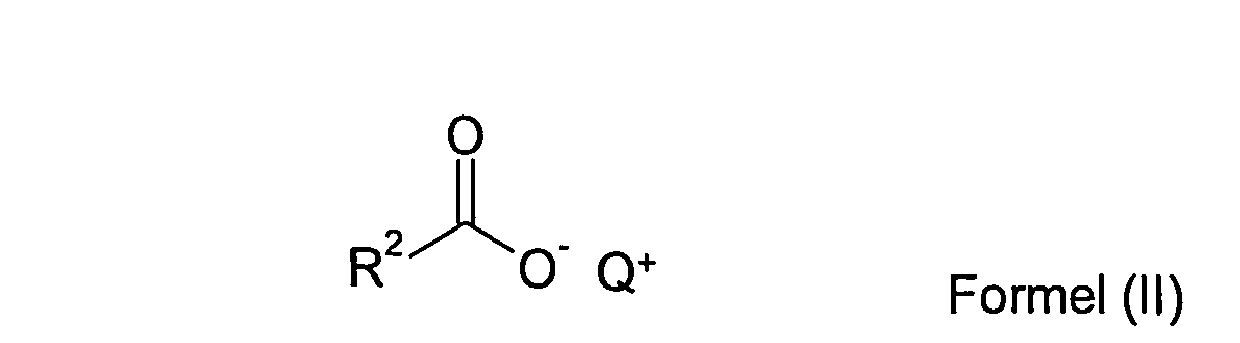
R2CO die Bedeutung von R1 aus Formel (I) und
Q+ die Bedeutung von Q+ aus Formel (I) hat,
in Mengen kleiner als 2,0 Gew.-%, vorzugsweise in Mengen größer als 0,01 Gew.-% und kleiner als 2,0 Gew.-% und besonders bevorzugt in Mengen größer als 0,1 Gew.-% und kleiner als 2,0 Gew.-%, bezogen auf die gesamte Zusammensetzung, und - d) Wasser,
- e) aber keine organischen Lösungsmittel.
Q+Cl- wird auch als QCI bezeichnet, z.B. Na+Cl- als NaCl. - In den Verbindungen der Formeln (I) und (II) sowie in Q+Cl- ist Q+ ausgewählt aus Li+, Na+ und K+, vorzugsweise ausgewählt aus Na+ und K+ und besonders bevorzugt steht Q+ für Na+.
- In einer bevorzugten Ausführungsform der Erfindung enthalten die erfindungsgemäßen Zusammensetzungen als Komponente a) ein oder mehrere Acylglycinate der Formel (I), worin R1 für eine Acylgruppe mit 8 bis 18 Kohlenstoffatomen steht, und Q+ für ein Kation ausgewählt aus Li+, Na+ und K+, vorzugsweise ausgewählt aus Na+ und K+ und besonders bevorzugt für Na+, steht, in Mengen von 21,0 - 28,0 Gew.-% und vorzugsweise in Mengen von 23,0 - 27,0 Gew.-%, bezogen auf die gesamte Zusammensetzung, und wobei der Anteil an Acylglycinaten der Formel (I) enthaltend Acylgruppen R1 mit 18 Kohlenstoffatomen, bezogen auf die Gesamtmenge an Acylglycinaten der Formel (I), kleiner als 2,0, bevorzugt kleiner als 1,8, Gew.-% ist.
- Besonders bevorzugt sind Zusammensetzungen enthaltend Natriumcocoylglycinat, wobei der Cocoylschnitt nur geringe Mengen an C18-Acylgruppen aufweist.
- In einer besonders bevorzugten Ausführungsform der Erfindung enthalten die erfindungsgemäßen Zusammensetzungen als Komponente a) Natriumcocoylglycinat mit C8-18-Acylgruppen in Mengen von 21,0 - 28,0 Gew.-% und vorzugsweise in Mengen von 23,0 - 27,0 Gew.-%, bezogen auf die gesamte Zusammensetzung, und wobei der Anteil an Acylglycinaten der Formel (I) mit C18-Acylgruppen kleiner als 2,0, bevorzugt kleiner als 1,8, und besonders bevorzugt kleiner als 1,0 Gew.-%, bezogen auf die Gesamtmenge an Natriumcocoylglycinat, ist. In dieser Ausführungsform ist Q+ in Q+Cl- und in dem Fettsäuresalz der Formel (II) Na+.
- In einer insbesondere bevorzugten Ausführungsform der Erfindung enthalten die erfindungsgemäßen Zusammensetzungen als Komponente a) Natriumcocoylglycinat mit C8-18-Acylgruppen in Mengen von 21,0 - 28,0 Gew.-% und vorzugsweise in Mengen von 23,0 - 27,0 Gew.-%, bezogen auf die gesamte Zusammensetzung, und wobei der Anteil an Acylglycinaten der Formel (I) mit C8- und C10-Acylgruppen zusammen größer als 5,0 Gew.-%, bevorzugt von 10,0 bis 14,0 Gew.-%, der Anteil an Acylglycinaten der Formel (I) mit C12-Acylgruppen von 50,0 bis 72,0 Gew.-%, und der Anteil an Acylglycinaten der Formel (I) mit C18-Acylgruppen kleiner als 2,0, bevorzugt kleiner als 1,8, und besonders bevorzugt kleiner als 1,0 Gew.-%, jeweils bezogen auf die Gesamtmenge an Natriumcocoylglycinat, ist. In dieser Ausführungsform ist Q+ in Q+Cl- und in dem Fettsäuresalz der Formel (II) Na+.
- In einer außerordentlich bevorzugten Ausführungsform der Erfindung ist die Reinheit der in den erfindungsgemäßen Zusammensetzungen enthaltenen Natriumcocoylglycinate 97 % oder größer. Diese Reinheit ist auf die Summe an Fettsäuresalz der Formel (II) und Acylglycinat der Formel (I) bezogen. Sie berechnet sich nach der Formel "Reinheit der Natriumcocoylglycinate = [Menge an Natriumcocoylglycinat : (Menge an Natriumcocoylglycinat + Menge an Fettsäuresalz)]".
- In einer weiteren bevorzugten Ausführungsform der Erfindung enthalten die erfindungsgemäßen Zusammensetzungen als Komponente a) ein oder mehrere Acylglycinate der Formel (I), worin R1 für eine Acylgruppe mit 12 Kohlenstoffatomen steht, und Q+ für ein Kation ausgewählt aus Li+, Na+ und K+, vorzugsweise ausgewählt aus Na+ und K+ und besonders bevorzugt für Na+, steht, in Mengen von 21,0 - 28,0 Gew.-% und vorzugsweise in Mengen von 23,0 - 27,0 Gew.-%, bezogen auf die gesamte Zusammensetzung. Unter diesen Acylglycinaten der Formel (I) sind wiederum diejenigen bevorzugt, in denen sich die Acylgruppe von Lauroylchlorid ableitet.
- In einer weiteren bevorzugten Ausführungsform der Erfindung enthalten die erfindungsgemäßen Zusammensetzungen als Komponente a) ein oder mehrere Acylglycinate der Formel (I), worin R1 für eine Acylgruppe mit 12 Kohlenstoffatomen steht, und zusätzlich ein oder mehrere Acylglycinate der Formel (I), worin R1 für eine Acylgruppe mit 14 Kohlenstoffatomen steht, und Q+ jeweils für ein Kation ausgewählt aus Li+, Na+ und K+, vorzugsweise ausgewählt aus Na+ und K+ und besonders bevorzugt für Na+, steht, zusammen in Mengen von 21,0 - 28,0 Gew.-% und vorzugsweise in Mengen von 23,0 - 27,0 Gew.-%, bezogen auf die gesamte Zusammensetzung.
- Die erfindungsgemäßen Zusammensetzungen können beispielsweise vorteilhaft für kosmetische Anwendungen verwendet werden.
- Für die kosmetischen Anwendungen sehr vorteilhaft ist, dass die erfindungsgemäßen Zusammensetzungen Q+Cl- in Mengen von 1,0 bis 8,0 Gew.-% enthalten, so dass eine gesonderte Zugabe von Q+Cl- als Viskositätsregulierer in den Endformulierungen entfallen kann.
- In einer weiteren bevorzugten Ausführungsform der Erfindung enthalten die erfindungsgemäßen Zusammensetzungen daher 1,0 bis 8,0, bevorzugt 2,0 bis 7,0 und besonders bevorzugt 4,0 bis 6,0 Gew.-% Q+Cl-, bezogen auf die gesamte Zusammensetzung.
- Ein weiterer Vorteil der erfindungsgemäßen Zusammensetzungen ist, dass diese nur geringe Mengen an Fettsäuresalz enthalten.
- In einer weiteren bevorzugten Ausführungsform der Erfindung enthalten die erfindungsgemäßen Zusammensetzungen daher weniger als 1,8, bevorzugt weniger als 1,5 und besonders bevorzugt weniger als 1,0 Gew.-% an Fettsäuresalz der Formel (II), bezogen auf die gesamte Zusammensetzung. Dabei ist die untere Grenze vorzugsweise jeweils größer 0,01 Gew.-% und besonders bevorzugt jeweils größer 0,1 Gew.-%, bezogen auf die gesamte Zusammensetzung.
- Die erfindungsgemäßen Zusammensetzungen sind flüssig.
- Sehr vorteilhaft ist auch die relativ geringe Viskosität und damit eine einfache Handhabung der erfindungsgemäßen Zusammensetzungen.
- In einer weiteren bevorzugten Ausführungsform der Erfindung weisen die erfindungsgemäßen Zusammensetzungen Viskositäten bei 35 °C von kleiner als 5.000 mPa·s, bevorzugt von 400 bis 2.000 mPa·s und besonders bevorzugt von 500 bis 1.000 mPa·s auf.
- Bei dem für die Bestimmung der Viskosität verwendeten Gerät handelt es sich um ein Rotameter der Firma Thermo Haake (Viskotester 550). Als Spindel wurde MV-DIN (45,3 Umdrehungen / Minute) verwendet.
- Die erfindungsgemäßen Zusammensetzungen enthalten keine organischen Lösungsmittel, wie beispielsweise niedere Alkohole, Diole oder andere Lösungsmittel.
- In einer besonders bevorzugten Ausführungsform der Erfindung bestehen die erfindungsgemäßen Zusammensetzungen aus den Komponenten a), b), c) und d).
- In einer weiteren besonders bevorzugten Ausführungsform der Erfindung bestehen die erfindungsgemäßen Zusammensetzungen aus den Komponenten a), b), c), d) und H2NCH2COO- Q+, wobei Q+ für ein Kation ausgewählt aus Li+, Na+ und K+, vorzugsweise ausgewählt aus Na+ und K+ und besonders bevorzugt für Na+, steht. In diesen erfindungsgemäßen Zusammensetzung ist die Verbindung H2NCH2COO- Q+, bezogen auf die gesamte erfindungsgemäße Zusammensetzung, vorzugsweise von 0,01 bis 1,0 und besonders bevorzugt von 0,05 bis 0,5 Gew.-%, enthalten.
- Ein weiterer Gegenstand der Erfindung betrifft auch die Herstellung der erfindungsgemäßen Zusammensetzungen durch das erfindungsgemäße Verfahren.
- Die erfindungsgemäßen Zusammensetzungen sind in vorteilhafter Weise zur Herstellung kosmetischer Zubereitungen geeignet.
- Ein weiterer Gegenstand der Erfindung betrifft daher die Verwendung der erfindungsgemäßen Zusammensetzungen zur Herstellung einer kosmetischen Zubereitung. Besonders vorteilhaft dabei ist, dass die erfindungsgemäßen Zusammensetzungen wie aus dem erfindungsgemäßen Verfahren erhalten, d. h. ohne weitere Aufarbeitung oder Aufreinigung, verwendet werden können.
- Die erfindungsgemäßen Zusammensetzungen sind zudem in vorteilhafter Weise als Tenside in kosmetischen Zubereitungen geeignet.
- Ein weiterer Gegenstand der Erfindung betrifft daher die Verwendung der erfindungsgemäßen Zusammensetzungen als Tenside in kosmetischen Zubereitungen. Die erfindungsgemäßen Zusammensetzungen können auch hierbei direkt wie aus dem erfindungsgemäßen Verfahren erhalten verwendet werden.
- Die nachfolgenden Beispiele und Anwendungen sollen die Erfindung näher erläutern, ohne sie jedoch darauf zu beschränken. Bei allen Prozentangaben handelt es sich um Gewichtsprozent (Gew.-%).
-
C8/C10: 10,0 -14,0 % C12: 60,0 - 62,0 % C14: 19,0 - 24,0 % C16: 3,0 - 10,0 % C18: < 2,0 % - 37,8 g (0,504 mol) Glycin wird in 276 g VE-Wasser (vollentsalztes Wasser) unter Rühren gelöst und der pH-Wert (telquel) mit Natronlauge (33 %) auf 12-13 eingestellt. Anschließend wird unter Rühren auf 30 - 35 °C aufgeheizt und 106,4 g (0,478 mol) Cocoylchlorid (A) innerhalb 6 Stunden bei 30 - 35 °C unter Kühlung des Reaktionsgemisches zudosiert. Der pH-Wert wird durch gleichzeitige Dosierung von Natronlauge (33 %) bei 12-13 gehalten. Gegen Ende der Dosierung des Cocoylchlorids lässt man den pH-Wert auf 9,5 - 10,5 abfallen. Zur Vervollständigung der Reaktion wird noch 2 Stunden bei pH 9,5 - 10,5 gerührt.
- Das erhaltene Produkt hat folgende Eigenschaften: flüssig, opal, Trockenrückstand (1 h, 140 °C): 31,0 %, Glycinsalz (HPLC): 0,6 %, Fettsäuresalz (HPLC): 0,6 %, Viskosität (35 °C): 756 mPa·s, NaCl (Titration): 5,3 %, Aktivgehalt: 24,5 %
- Die Berechnung der Gewichtsmenge an Acylglycinat in den erfindungsgemäßen Zusammensetzungen erfolgt durch die Formel "Gewichtsmenge an Acylglycinat = Trockenrückstand - Fettsäuresalz - Glycinsalz - Q+Cl-". Der Wert wird im Rahmen der vorliegenden Erfindung als "Aktivgehalt" bezeichnet.
- 37,8 g (0,504 mol) Glycin wird in 276 g VE-Wasser unter Rühren gelöst und der pH-Wert (telquel) mit Natronlauge (33 %) auf 12-13 eingestellt. Anschließend wird unter Rühren auf 45 - 50 °C aufgeheizt und 106,4 g (0,478 mol) Cocoylchlorid (A) innerhalb 6 Stunden bei 45 - 50 °C zudosiert. Der pH-Wert wird durch gleichzeitige Dosierung von Natronlauge (33 %) bei 12-13 gehalten. Nach ca. 1/6 der Dosierung des Cocoylchlorids wird der Ansatz gestoppt, da bereits die berechnete Menge an Natronlauge (33 %) des gesamten Ansatzes verbraucht ist.
- Der Ansatz ist zweiphasig (Fettsäuresalz). Die erhöhte Temperatur führt vorwiegend zur Hydrolyse des Cocoylchlorids.
- 37,8 g (0,504 mol) Glycin wird in 276 g VE-Wasser unter Rühren gelöst und der pH-Wert (telquel) mit Natronlauge (33 %) auf 12-13 eingestellt. Anschließend wird unter Rühren auf 25 - 30 °C aufgeheizt und 106,4 g (0,478 mol) Cocoylchlorid (A) innerhalb 6 Stunden bei 25 - 30 °C unter Kühlung des Reaktionsgemisches zudosiert. Der pH-Wert wird durch gleichzeitige Dosierung von Natronlauge (33 %) bei 12-13 gehalten. Gegen Ende der Dosierung des Cocoylchlorids lässt man den pH-Wert auf 9,5 - 10,5 abfallen. Zur Vervollständigung der Reaktion wird noch 2 Stunden bei pH 9,5 -10,5 gerührt.
- Das erhaltene Produkt hat folgende Eigenschaften: flüssig, trüb, Trockenrückstand (1 h, 140 °C): 30,9 %, Glycinsalz (HPLC): 1,3 %, Fettsäuresalz (HPLC): 2,4 %, Viskosität: nicht bestimmt, NaCl (Titration): 5,3%, Aktivgehalt: 21,9 %
- 37,8 g (0,504 mol) Glycin wird in 250 g VE-Wasser unter Rühren gelöst und der pH-Wert (telquel) mit Natronlauge (33 %) auf 12-13 eingestellt. Anschließend wird unter Rühren auf 30 - 35 °C aufgeheizt und 95,2 g (0,428 mol) Cocoylchlorid (A) innerhalb 6 Stunden bei 30 - 35 °C unter Kühlung des Reaktionsgemisches zudosiert. Der pH-Wert wird durch gleichzeitige Dosierung von Natronlauge (33 %) bei 12-13 gehalten. Gegen Ende der Dosierung des Cocoylchlorids lässt man den pH-Wert auf 9,5 - 10,5 abfallen. Zur Vervollständigung der Reaktion wird noch 2 Stunden bei pH 9,5 - 10,5 gerührt.
- Das erhaltene Produkt hat folgende Eigenschaften: flüssig, opal, Trockenrückstand (1 h, 140 °C): 31,3 %, Glycinsalz (HPLC): 1,3%, Fettsäuresalz (HPLC): 0,2 %, Viskosität (35 °C): 980 mPa·s, NaCl (Titration): 5,1 %, Aktivgehalt: 24,7 %
- 37,8 g (0,504 mol) Glycin wird in 246 g VE-Wasser unter Rühren gelöst und der pH-Wert (telquel) mit Natronlauge (33 %) auf 12-13 eingestellt. Anschließend wird unter Rühren auf 30 - 35 °C aufgeheizt und 106,4 g (0,478 mol) Cocoylchlorid (A) innerhalb 6 Stunden bei 30 - 35 °C unter Kühlung des Reaktionsgemisches zudosiert. Der pH-Wert wird durch gleichzeitige Dosierung von Natronlauge (33 %) bei 12-13 gehalten. Gegen Ende der Dosierung des Cocoylchlorids lässt man den pH-Wert auf 9,5 -10,5 abfallen. Zur Vervollständigung der Reaktion wird noch 2 Stunden bei pH 9,5 - 10,5 gerührt.
- Das erhaltene Produkt hat folgende Eigenschaften: flüssig, opal, Trockenrückstand (1 h, 140 °C): 32,7 %, Glycinsalz (HPLC): 0,8 %, Fettsäuresalz (HPLC): 1,3 %, Viskosität (35 °C): 4.500 mPa·s, NaCl (Titration): 5,6 %, Aktivgehalt: 25,0 %
- 94,5 g (1,26 mol) Glycin wird in 400 g VE-Wasser und 276 g Propanol-2 unter Rühren gelöst und der pH-Wert (telquel) mit Natronlauge (33 %) auf 12-13 eingestellt. Anschließend werden unter Rühren bei 25 - 27 °C 283,9 g (1,24 mol) Cocoylchlorid (A) innerhalb 6 Stunden unter Kühlung des Reaktionsgemisches zudosiert. Der pH-Wert wird durch gleichzeitige Dosierung von Natronlauge (33 %) bei 12-13 gehalten. Zur Vervollständigung der Reaktion wird noch 2 Stunden bei pH 12-13 gerührt. Das erhaltene Produkt wird mit konz. Salzsäure auf pH 1 gestellt. Nach Abschalten des Rührers beginnt sofort die Phasentrennung. Die wässrige Phase wird abgetrennt und die organische Phase mit Natronlauge (33 %) auf pH 4,6 eingestellt. Nach Zugabe von 740 g Wasser wird mit Natronlauge (33 %) auf pH 7,0 gestellt. Anschließend wird bei vermindertem Druck (ca. 140-160 mbar) und 55 °C Propanol-2/Wasser abdestilliert bis der Propanol-2-Gehalt im Produkt unter 1 % gefallen ist. Mit Hilfe von Wasser und Natronlauge wird ein Feststoffgehalt von 30 % und ein pH-Wert von 10,0 eingestellt.
- Das Produkt hat folgende Eigenschaften: flüssig, klar, Trockenrückstand (1 h, 140 °C): 30,3 %, Glycinsalz (HPLC): <0,1 %, Fettsäuresalz (HPLC): 1,0 %, Propanol-2 (GC): <0,1 %, Chlorid (Titration): 0,35 %, Viskosität: nicht bestimmt, NaCl (Titration): 0,6 %, Aktivgehalt: 28,7 % Vergleichsbeispiel 7: Cocosschnitt mit erhöhtem Anteil an C16/18, hydriert Verteilung des verwendeten Cocoylchlorids (B) :
C12: 55,6% C14: 23,0% C16: 11,1% C18 gesättigt: 10,3% - 36,0 g (0,480 mol) Glycin wird in 280 g VE-Wasser unter Rühren gelöst und der pH-Wert (telquel) mit Natronlauge (33 %) auf 12-13 eingestellt. Anschließend wird unter Rühren auf 30 - 35 °C aufgeheizt und 109,6 g (0,456 mol) Cocoylchlorid (B) innerhalb 6 Stunden bei 30 - 35 °C unter Kühlung des Reaktionsgemisches zudosiert. Der pH-Wert wird durch gleichzeitige Dosierung von Natronlauge (33 %) bei 12-13 gehalten. Im Laufe der Dosierung des Cocoylchlorids wird der Ansatz immer zähflüssiger bis er nicht mehr rührbar ist. Durch Zugabe von 110 g Wasser und anschließende Erhöhung der Reaktionstemperatur auf 40 °C bleibt der Ansatz einigermaßen rührbar. Gegen Ende der Dosierung des Cocoylchlorids lässt man den den pH-Wert auf 9,5 - 10,5 abfallen. Zur Vervollständigung der Reaktion wird noch 2 Stunden bei pH 9,5 - 10,5 gerührt.
- Das erhaltene Produkt hat folgende Eigenschaften: flüssig, trüb, Trockenrückstand (1 h, 140 °C): 25,8 %, Glycinsalz (HPLC): 0,8 %, Fettsäuresalz (HPLC): 1,2 %, Viskosität: nicht bestimmt, NaCl (Titration): 4,1 %, Aktivgehalt: 19,7 %
- Die beschriebenen Beispiele belegen, dass hochkonzentrierte Alkalisalzglycinatlösungen mit > 22,0 %, vorzugsweise > 23,0 % und besonders bevorzugt > 24,0 % Aktivgehalt durch Verwendung eines C18-armen Cocosfettsäureschnitts und Reaktion in Wasser ohne zusätzliche Lösungsmittel bei 30 - 35 °C erhalten werden können (Beispiel 1, Beispiel 4, Beispiel 5). In Beispiel 1 konnte eine Reinheit der Glycinatlösung von 97,6 % Acylglycinat bezogen auf die Summe aus Fettsäuresalz und Acylglycinat erreicht werden. Dagegen führen höhere Reaktionstemperaturen (Vergleichsbeispiel 2) zu stark erhöhten Fettsäuresalzgehalten. Niedrigere Reaktionstemperaturen (Vergleichsbeispiel 3) führen ebenfalls zu unerwünscht hohen Anteilen an Fettsäuresalzen. Bei Verwendung C16/1C18-reicher Fettsäurechloride (Vergleichsbeispiel 7) werden unerwünscht niedrige Aktivgehalte erhalten.
Claims (11)
- Zusammensetzung enthaltenda) ein oder mehrere Acylglycinate der Formel (I)

R1 für eine lineare oder verzweigte, gesättigte Alkanoylgruppe mit 6 bis 30, vorzugsweise 8 bis 22 und besonders bevorzugt 8 bis 18 Kohlenstoffatomen, oder für eine lineare oder verzweigte, ein- oder mehrfach ungesättigte Alkenoylgruppe mit 6 bis 30, vorzugsweise 8 bis 22 und besonders bevorzugt 12 bis 18 Kohlenstoffatomen, steht, und
Q+ für ein Kation ausgewählt aus den Alkalimetallkationen Li+, Na+ und K+, vorzugsweise ausgewählt aus Na+ und K+ und besonders bevorzugt für Na+, steht,
in Mengen von 21,0 - 28,0 Gew.-%, bezogen auf die gesamte Zusammensetzung,
und wobei der Anteil an Acylglycinaten der Formel (I) enthaltend Acylgruppen R1 mit 18 oder mehr Kohlenstoffatomen, bezogen auf die Gesamtmenge an Acylglycinaten der Formel (I), kleiner als 2,0, bevorzugt kleiner als 1,8, Gew.-% ist,b) ein oder mehrere Substanzen Q+Cl-, worin Q+ die Bedeutung von Q+ aus Formel (I) hat, in Mengen größer oder gleich 1,0 Gew.-%, bezogen auf die gesamte Zusammensetzung,c) ein oder mehrere Fettsäuresalze der Formel (II)
R2CO die Bedeutung von R1 aus Formel (I) und
Q+ die Bedeutung von Q+ aus Formel (I) hat,
in Mengen kleiner als 2,0 Gew.-%, vorzugsweise in Mengen größer als 0,01 Gew.-% und kleiner als 2,0 Gew.-% und besonders bevorzugt in Mengen größer als 0,1 Gew.-% und kleiner als 2,0 Gew.-%, bezogen auf die gesamte Zusammensetzung, undd) Wasser,e) aber keine organischen Lösungsmittel. - Zusammensetzung nach Anspruch 1, dadurch gekennzeichnet, dass sie als Komponente a) ein oder mehrere Acylglycinate der Formel (I), worin R1 für eine Acylgruppe mit 8 bis 18 Kohlenstoffatomen steht, und Q+ für ein Kation ausgewählt aus Li+, Na+ und K+, vorzugsweise ausgewählt aus Na+ und K+ und besonders bevorzugt für Na+, steht, in Mengen von 21,0 - 28,0 Gew.-% und vorzugsweise in Mengen von 23,0 - 27,0 Gew.-%, bezogen auf die gesamte Zusammensetzung, enthält, und wobei der Anteil an Acylglycinaten der Formel (I) enthaltend Acylgruppen R1 mit 18 Kohlenstoffatomen, bezogen auf die Gesamtmenge an Acylglycinaten der Formel (I), kleiner als 2,0, bevorzugt kleiner als 1,8, Gew.-% ist.
- Zusammensetzung nach Anspruch 1 oder 2, dadurch gekennzeichnet, dass sie als Komponente a) Natriumcocoylglycinat mit C8-18-Acylgruppen in Mengen von 21,0 - 28,0 Gew.-% und vorzugsweise in Mengen von 23,0 - 27,0 Gew.-%, bezogen auf die gesamte Zusammensetzung, enthält, und wobei der Anteil an Acylglycinaten der Formel (I) mit C18-Acylgruppen kleiner als 2,0, bevorzugt kleiner als 1,8, und besonders bevorzugt kleiner als 1,0 Gew.-%, bezogen auf die Gesamtmenge an Natriumcocoylglycinat, ist.
- Zusammensetzung nach einem oder mehreren der Ansprüche 1 bis 3, dadurch gekennzeichnet, dass sie als Komponente a) Natriumcocoylglycinat mit C8-18-Acylgruppen in Mengen von 21,0 - 28,0 Gew.-% und vorzugsweise in Mengen von 23,0 - 27,0 Gew.-%, bezogen auf die gesamte Zusammensetzung, enthält, und wobei der Anteil an Acylglycinaten der Formel (I) mit C8- und C10-Acylgruppen zusammen größer als 5,0 Gew.-%, bevorzugt von 10,0 bis 14,0 Gew.-%, der Anteil an Acylglycinaten der Formel (I) mit C12-Acylgruppen von 50,0 bis 72,0 Gew.-%, und der Anteil an Acylglycinaten der Formel (I) mit C18-Acylgruppen kleiner als 2,0, bevorzugt kleiner als 1,8, und besonders bevorzugt kleiner als 1,0 Gew.-%, jeweils bezogen auf die Gesamtmenge an Natriumcocoylglycinat, ist.
- Zusammensetzung nach Anspruch 1, dadurch gekennzeichnet, dass sie als Komponente a) ein oder mehrere Acylglycinate der Formel (I), worin R1 für eine Acylgruppe mit 12 Kohlenstoffatomen steht, und Q+ für ein Kation ausgewählt aus Li+, Na+ und K+, vorzugsweise ausgewählt aus Na+ und K+ und besonders bevorzugt für Na+, steht, in Mengen von 21,0 - 28,0 Gew.-% und vorzugsweise in Mengen von 23,0 - 27,0 Gew.-%, bezogen auf die gesamte Zusammensetzung, enthält.
- Zusammensetzung nach Anspruch 1, dadurch gekennzeichnet, dass sie als Komponente a) ein oder mehrere Acylglycinate der Formel (I), worin R1 für eine Acylgruppe mit 12 Kohlenstoffatomen steht, und zusätzlich ein oder mehrere Acylglycinate der Formel (I), worin R1 für eine Acylgruppe mit 14 Kohlenstoffatomen steht, und Q+ jeweils für ein Kation ausgewählt aus Li+, Na+ und K+, vorzugsweise ausgewählt aus Na+ und K+ und besonders bevorzugt für Na+, steht, zusammen in Mengen von 21,0 - 28,0 Gew.-% und vorzugsweise in Mengen von 23,0 - 27,0 Gew.-%, bezogen auf die gesamte Zusammensetzung, enthält.
- Zusammensetzung nach einem oder mehreren der Ansprüche 1 bis 6, dadurch gekennzeichnet, dass sie, bezogen auf die gesamte Zusammensetzung, 1,0 bis 8,0, bevorzugt 2,0 bis 7,0 und besonders bevorzugt 4,0 bis 6,0 Gew.-% Q+Cl- enthält.
- Zusammensetzung nach einem oder mehreren der Ansprüche 1 bis 7, dadurch gekennzeichnet, dass sie, bezogen auf die gesamte Zusammensetzung, weniger als 1,8, bevorzugt weniger als 1,5 und besonders bevorzugt weniger als 1,0 Gew.-% an Fettsäuresalz der Formel (II) enthält.
- Zusammensetzung nach einem oder mehreren der Ansprüche 1 bis 8, dadurch gekennzeichnet, dass sie eine Viskosität bei 35 °C von kleiner als 5.000 mPa·s, bevorzugt von 400 bis 2.000 mPa·s und besonders bevorzugt von 500 bis 1.000 mPa·s aufweist.
- Verwendung einer Zusammensetzung nach einem oder mehreren der Ansprüche 1 bis 9 zur Herstellung einer kosmetischen Zubereitung.
- Verwendung einer Zusammensetzung nach einem oder mehreren der Ansprüche 1 bis 9 als Tensid in einer kosmetischen Zubereitung.
Applications Claiming Priority (2)
| Application Number | Priority Date | Filing Date | Title |
|---|---|---|---|
| DE102007055265A DE102007055265A1 (de) | 2007-11-20 | 2007-11-20 | Verfahren zur Herstellung von Acylglycinaten |
| EP08852108.3A EP2212278B1 (de) | 2007-11-20 | 2008-11-14 | Verfahren zur herstellung von acylglycinaten |
Related Parent Applications (2)
| Application Number | Title | Priority Date | Filing Date |
|---|---|---|---|
| EP08852108.3 Division | 2008-11-14 | ||
| EP08852108.3A Division-Into EP2212278B1 (de) | 2007-11-20 | 2008-11-14 | Verfahren zur herstellung von acylglycinaten |
Publications (2)
| Publication Number | Publication Date |
|---|---|
| EP2248512A2 true EP2248512A2 (de) | 2010-11-10 |
| EP2248512A3 EP2248512A3 (de) | 2012-01-25 |
Family
ID=40394359
Family Applications (2)
| Application Number | Title | Priority Date | Filing Date |
|---|---|---|---|
| EP08852108.3A Not-in-force EP2212278B1 (de) | 2007-11-20 | 2008-11-14 | Verfahren zur herstellung von acylglycinaten |
| EP20100008258 Ceased EP2248512A3 (de) | 2007-11-20 | 2008-11-14 | Zusammensetzungen enthaltend Acylglycinate |
Family Applications Before (1)
| Application Number | Title | Priority Date | Filing Date |
|---|---|---|---|
| EP08852108.3A Not-in-force EP2212278B1 (de) | 2007-11-20 | 2008-11-14 | Verfahren zur herstellung von acylglycinaten |
Country Status (8)
| Country | Link |
|---|---|
| US (1) | US8338483B2 (de) |
| EP (2) | EP2212278B1 (de) |
| JP (1) | JP5496905B2 (de) |
| CN (1) | CN101903336B (de) |
| BR (1) | BRPI0819337A2 (de) |
| DE (1) | DE102007055265A1 (de) |
| ES (1) | ES2530217T3 (de) |
| WO (1) | WO2009065530A2 (de) |
Families Citing this family (24)
| Publication number | Priority date | Publication date | Assignee | Title |
|---|---|---|---|---|
| DE102006038853A1 (de) * | 2006-08-18 | 2008-02-21 | Clariant International Limited | Verfahren zur Herstellung von Acylglycinaten mittels Direktoxidation |
| DE102008003825A1 (de) * | 2008-01-10 | 2009-07-16 | Clariant International Ltd. | Verfahren zur Herstellung von Acylglycinaten mittels Direktoxidation |
| DE102011107503A1 (de) * | 2011-07-15 | 2012-03-01 | Clariant International Ltd. | Verfahren zur Herstellung von Acylglycinaten und Zusammensetzungen enthaltend derartige Verbindungen |
| US8822711B2 (en) * | 2011-07-28 | 2014-09-02 | Conopco, Inc. | Method for preparing fatty acyl amido carboxylic acid based surfactants |
| US8658589B2 (en) | 2011-07-28 | 2014-02-25 | Conopco, Inc. | Fatty acyl amido based surfactant concentrates |
| MY185147A (en) | 2012-07-03 | 2021-04-30 | Stepan Co | Process for preparing n-acyl amino acid salts |
| ES2597033T5 (es) * | 2012-08-23 | 2020-01-30 | Galaxy Surfactants Ltd | Método para producir tensioactivos de N-acilaminoácidos usando tensioactivos de N-acilaminoácidos o los anhídridos correspondientes como catalizadores |
| CN102863352A (zh) * | 2012-09-05 | 2013-01-09 | 长沙普济生物科技有限公司 | 一种椰油酰基氨基酸钠的合成方法 |
| BR112015031783A2 (pt) | 2013-07-05 | 2017-07-25 | Akzo Nobel Chemicals Int Bv | composto; uso de um composto; método para flotação de espuma de minérios não sulfídicos; e polpa |
| ES2670770T3 (es) | 2013-08-19 | 2018-06-01 | Stepan Company | Proceso para la preparación de sales de N-acil aminoácidos |
| CN105683151B (zh) | 2013-10-31 | 2020-11-03 | 味之素株式会社 | 包含n-长链酰基酸性氨基酸和/或其盐的水溶液及其制造方法 |
| CN104649927B (zh) * | 2013-11-25 | 2017-10-31 | 江苏四新界面剂科技有限公司 | 一种正十一烷二酰基二谷氨酸三乙醇胺盐及其制备方法 |
| JP6434980B2 (ja) | 2013-12-09 | 2018-12-05 | ユニリーバー・ナームローゼ・ベンノートシヤープ | アダマンタンアミド製造方法 |
| CN103965072B (zh) * | 2014-04-02 | 2016-08-17 | 烟台恒迪克能源科技有限公司 | 一种癸二酰基谷氨酸的合成方法 |
| CN103951581B (zh) * | 2014-04-05 | 2016-04-27 | 烟台恒迪克能源科技有限公司 | 一种正十一碳二酰基二天门冬氨酸-双-二甘醇胺盐的合成 |
| DE102015014929A1 (de) * | 2015-11-13 | 2017-05-18 | Bernd Kunze | Verfahren zur Herstellung von N-Acylderivaten, die Fettsäure-Reste enthalten |
| WO2019088249A1 (ja) | 2017-11-06 | 2019-05-09 | 味の素株式会社 | 洗浄剤組成物 |
| US12123004B2 (en) | 2018-07-18 | 2024-10-22 | Modular Genetics, Inc. | Generation of acyl amino acids |
| EP3647303B1 (de) * | 2018-10-31 | 2022-08-31 | Clariant International Ltd | Verfahren zur herstellung von fettsäurechloriden und n-acyl-aminosäure-salzen |
| CN111187174A (zh) * | 2020-01-16 | 2020-05-22 | 广东丽臣奥威实业有限公司 | 一种脂肪酰甘氨酸盐或脂肪衍生物酰甘氨酸盐的生产及纯化方法 |
| CA3200645A1 (en) * | 2021-06-08 | 2022-12-15 | Victor Manuel Arredondo | N-acyl amino acid surfactants and derivatives thereof |
| CN114369036B (zh) * | 2021-12-30 | 2024-04-19 | 广州花语精细化工有限公司 | 一种降低甘氨酸类表面活性剂中胺类副产物的方法 |
| CN115160169B (zh) * | 2022-07-25 | 2024-04-16 | 湖州欧利生物科技有限公司 | 椰油酰甘氨酸盐表面活性剂的生产工艺 |
| CN117003661A (zh) * | 2023-07-07 | 2023-11-07 | 广东聚石科技研究院有限公司 | 一种n-酰基氨基酸的制备方法 |
Citations (4)
| Publication number | Priority date | Publication date | Assignee | Title |
|---|---|---|---|---|
| US2729657A (en) * | 1951-07-19 | 1956-01-03 | Colgate Palmolive Co | Preparation of fatty acyl derivatives of amino acids |
| JPH0761957A (ja) * | 1993-08-25 | 1995-03-07 | Ajinomoto Co Inc | N−混合飽和脂肪酸アシル中性アミノ酸の製造法 |
| JPH0853693A (ja) | 1994-06-07 | 1996-02-27 | Ajinomoto Co Inc | 洗浄剤組成物 |
| US6828452B2 (en) * | 2001-01-18 | 2004-12-07 | Cognis Deutschland Gmbh & Co. Kg | Method for producing acyl amino acids |
Family Cites Families (19)
| Publication number | Priority date | Publication date | Assignee | Title |
|---|---|---|---|---|
| LU86587A1 (fr) * | 1986-09-15 | 1988-04-05 | Oreal | Dentifrice contenant un tensio-actif non ionique poly(hydroxypropylether)et un sel d'un derive specifique d'un produit de degradation des proteines |
| FR2676922B1 (fr) * | 1991-06-03 | 1995-01-20 | Givaudan Lavirotte | Applications en cosmetique de derives n-acyles de melanges d'acides amines issus d'hydrolysats de proteines vegetales. |
| JP2969397B2 (ja) * | 1991-09-10 | 1999-11-02 | 花王株式会社 | N−長鎖アシル−β−アラニンの製造方法 |
| ES2139737T3 (es) | 1993-03-30 | 2000-02-16 | Ajinomoto Kk | Composicion detergente. |
| DE4415312A1 (de) * | 1994-05-02 | 1995-11-09 | Hoechst Ag | Verfahren zur Herstellung von N-Acylglycinderivaten |
| US5710295A (en) | 1995-06-06 | 1998-01-20 | Hampshire Chemical Corp. | Preparation of alkali metal acyl amino acids |
| JPH1081656A (ja) * | 1996-09-06 | 1998-03-31 | Ajinomoto Co Inc | N−長鎖アシル酸性アミノ酸またはその塩の製造法 |
| FR2765109B1 (fr) * | 1997-06-25 | 2001-02-09 | Seppic Sa | Composition comprenant un lipoaminoacide et les constituants d'un extrait de plantes riches en tanins et utilisation en cosmetique |
| JP4407846B2 (ja) | 1998-02-27 | 2010-02-03 | 花王株式会社 | 1級アルコールの酸化方法 |
| JP4392884B2 (ja) * | 1998-12-28 | 2010-01-06 | 旭化成ケミカルズ株式会社 | N−長鎖アシル酸性アミノ酸塩、およびその製造方法 |
| JP2001278778A (ja) * | 2000-03-31 | 2001-10-10 | Shiseido Co Ltd | 皮膚洗浄料 |
| US6703517B2 (en) * | 2001-11-26 | 2004-03-09 | Ajinomoto Co., Inc. | Method for preparing N-long chain acyl neutral amino acid |
| ES2313068T3 (es) | 2003-10-03 | 2009-03-01 | Ajinomoto Co., Inc. | Composiciones detergentes y procedimiento para su produccion. |
| DE102004048324A1 (de) | 2003-10-08 | 2005-05-12 | Ajinomoto Kk | Kristalle von N-langkettigen Acyglycin-Salzen, Verfahren zu ihrer Herstellung und diese Kristalle enthaltende Reinigungsmittel-Zusammensetzungen |
| JP2007269662A (ja) | 2006-03-30 | 2007-10-18 | Ajinomoto Co Inc | クリーム状皮膚洗浄剤組成物 |
| US7307187B1 (en) | 2006-06-27 | 2007-12-11 | Conopco, Inc. | Process for converting primary amidoalcohols to amidocarboxylic acids in high yield |
| US20070299269A1 (en) | 2006-06-27 | 2007-12-27 | Conopco, Inc., D/B/A Unilever | Process for converting primary amidoalcohols to amidocarboxylic acids in high yield |
| DE102006038853A1 (de) | 2006-08-18 | 2008-02-21 | Clariant International Limited | Verfahren zur Herstellung von Acylglycinaten mittels Direktoxidation |
| DE102008003825A1 (de) | 2008-01-10 | 2009-07-16 | Clariant International Ltd. | Verfahren zur Herstellung von Acylglycinaten mittels Direktoxidation |
-
2007
- 2007-11-20 DE DE102007055265A patent/DE102007055265A1/de not_active Withdrawn
-
2008
- 2008-11-14 CN CN200880121606.3A patent/CN101903336B/zh active Active
- 2008-11-14 BR BRPI0819337 patent/BRPI0819337A2/pt not_active IP Right Cessation
- 2008-11-14 JP JP2010534399A patent/JP5496905B2/ja not_active Expired - Fee Related
- 2008-11-14 US US12/743,458 patent/US8338483B2/en not_active Expired - Fee Related
- 2008-11-14 WO PCT/EP2008/009646 patent/WO2009065530A2/de not_active Ceased
- 2008-11-14 EP EP08852108.3A patent/EP2212278B1/de not_active Not-in-force
- 2008-11-14 EP EP20100008258 patent/EP2248512A3/de not_active Ceased
- 2008-11-14 ES ES08852108.3T patent/ES2530217T3/es active Active
Patent Citations (4)
| Publication number | Priority date | Publication date | Assignee | Title |
|---|---|---|---|---|
| US2729657A (en) * | 1951-07-19 | 1956-01-03 | Colgate Palmolive Co | Preparation of fatty acyl derivatives of amino acids |
| JPH0761957A (ja) * | 1993-08-25 | 1995-03-07 | Ajinomoto Co Inc | N−混合飽和脂肪酸アシル中性アミノ酸の製造法 |
| JPH0853693A (ja) | 1994-06-07 | 1996-02-27 | Ajinomoto Co Inc | 洗浄剤組成物 |
| US6828452B2 (en) * | 2001-01-18 | 2004-12-07 | Cognis Deutschland Gmbh & Co. Kg | Method for producing acyl amino acids |
Non-Patent Citations (1)
| Title |
|---|
| FEREIDOON SHAHIDI: "BAILEY'S INDUSTRIAL OIL AND FAT PRODUCTS, 6TH ED.", vol. 6, April 2005, JOHN WILEY & SONS, article GERVAJIO, G. C.: "FATTY ACIDS AND DERIVATIVES FROM COCONUT OIL", pages: 1 - 56, XP055035497 |
Also Published As
| Publication number | Publication date |
|---|---|
| WO2009065530A3 (de) | 2009-09-03 |
| US8338483B2 (en) | 2012-12-25 |
| JP2011503218A (ja) | 2011-01-27 |
| BRPI0819337A2 (pt) | 2015-05-12 |
| ES2530217T3 (es) | 2015-02-27 |
| US20100273879A1 (en) | 2010-10-28 |
| CN101903336B (zh) | 2014-06-25 |
| EP2248512A3 (de) | 2012-01-25 |
| DE102007055265A1 (de) | 2009-05-28 |
| EP2212278A2 (de) | 2010-08-04 |
| CN101903336A (zh) | 2010-12-01 |
| JP5496905B2 (ja) | 2014-05-21 |
| WO2009065530A2 (de) | 2009-05-28 |
| EP2212278B1 (de) | 2015-01-07 |
Similar Documents
| Publication | Publication Date | Title |
|---|---|---|
| EP2212278B1 (de) | Verfahren zur herstellung von acylglycinaten | |
| EP2731929B1 (de) | Verfahren zur herstellung von acylglycinaten und zusammensetzungen enthaltend derartige verbindungen | |
| EP3478655B1 (de) | Verfahren zur herstellung von tensiden | |
| EP0560114A2 (de) | Wässrige flüssige Lösung eines Betains mit mindestens 40 Gew.-% Festkörpergehalt | |
| DE1291749B (de) | Verfahren zur Herstellung von Aminoxyden | |
| EP0353580A2 (de) | Verfahren zur Herstellung von konzentrierten fliessfähigen wässrigen Lösungen von Betainen | |
| DE102014214674A1 (de) | Verfahren zur Herstellung substituierter Imidazoliumsalze | |
| EP2655586A1 (de) | Zusammensetzungen enthaltend sekundäres paraffinsulfonat und alkoholalkoxylat | |
| EP1354905B1 (de) | Verwendung von Ethercarbonsäuren mit niedrigem Stockpunkt | |
| EP0647613B1 (de) | Verfahren zur Herstellung hochkonzentrierter fliessfähiger wässriger Lösungen von Betainen | |
| EP3630056B1 (de) | Verfahren zur herstellung von hellfarbigem disalz | |
| DE4412481A1 (de) | Verfahren zur Herstellung hochkonzentrierter fließfähiger wäßriger Lösungen von Betainen | |
| EP2655585A1 (de) | Zusammensetzungen enthaltend sekundäres paraffinsulfonat und alkoholalkoxylat | |
| DE2362648C2 (de) | Verfahren zur Herstellung von o-Hydroxyhalogenbenzolsulfonaten | |
| EP0452349A1 (de) | Verfahren zur herstellung von amphoteren grenzflächenaktiven imidazolinderivaten. | |
| DE2534481A1 (de) | Waessrige keimtoetende seifenzusammensetzung | |
| DE1085159B (de) | Verfahren zur Herstellung von N, N-Diisopropylbenzthiazolyl-2-sulfenamid | |
| DE10228407A1 (de) | Verfahren zur Herstellung von 2-Acetyl-2-chlor-gamma-butyrolacton durch Umsetzung von 2-Acetyl-gamma-butyrolacton Salz mit Chlor in Gegenwart von Wasser | |
| EP0040346A1 (de) | Verfahren zur Raffination des rohen Kondensationsproduktes aus Aminoalkylalkanolaminen und Fettsäuren sowie gewünschtenfalls zur anschliessenden Gewinnung von Amphotensiden mit erhöhter Lagerstabilität | |
| DE4307709C2 (de) | Hochkonzentrierte Lösungen von amphoteren Glycinverbindungen und Verfahren zu ihrer Herstellung | |
| EP2655584A1 (de) | Zusammensetzungen enthaltend sekundäres paraffinsulfonat und tetrahydroxypropylethylendiamin | |
| EP1247880B1 (de) | Verfahren zur Herstellung von Glycinderivaten | |
| EP3246008A1 (de) | Wässrige tensid-zusammensetzungen | |
| DE19712012A1 (de) | Verfahren zur Herstellung kristalliner 3,6,9-Triaza-3,6-9-tris(carboxymethyl)-4-(4- ethoxybenzyl)-undecandisäure | |
| DE2725780A1 (de) | Stickstoffhaltige kondensationsprodukte |
Legal Events
| Date | Code | Title | Description |
|---|---|---|---|
| PUAI | Public reference made under article 153(3) epc to a published international application that has entered the european phase |
Free format text: ORIGINAL CODE: 0009012 |
|
| AC | Divisional application: reference to earlier application |
Ref document number: 2212278 Country of ref document: EP Kind code of ref document: P |
|
| AK | Designated contracting states |
Kind code of ref document: A2 Designated state(s): AT BE BG CH CY CZ DE DK EE ES FI FR GB GR HR HU IE IS IT LI LT LU LV MC MT NL NO PL PT RO SE SI SK TR |
|
| PUAL | Search report despatched |
Free format text: ORIGINAL CODE: 0009013 |
|
| AK | Designated contracting states |
Kind code of ref document: A3 Designated state(s): AT BE BG CH CY CZ DE DK EE ES FI FR GB GR HR HU IE IS IT LI LT LU LV MC MT NL NO PL PT RO SE SI SK TR |
|
| RIC1 | Information provided on ipc code assigned before grant |
Ipc: A61Q 19/10 20060101ALI20111219BHEP Ipc: A61K 8/44 20060101AFI20111219BHEP |
|
| 17P | Request for examination filed |
Effective date: 20120725 |
|
| 17Q | First examination report despatched |
Effective date: 20130605 |
|
| TPAC | Observations filed by third parties |
Free format text: ORIGINAL CODE: EPIDOSNTIPA |
|
| TPAC | Observations filed by third parties |
Free format text: ORIGINAL CODE: EPIDOSNTIPA |
|
| TPAC | Observations filed by third parties |
Free format text: ORIGINAL CODE: EPIDOSNTIPA |
|
| APBK | Appeal reference recorded |
Free format text: ORIGINAL CODE: EPIDOSNREFNE |
|
| APBN | Date of receipt of notice of appeal recorded |
Free format text: ORIGINAL CODE: EPIDOSNNOA2E |
|
| APAF | Appeal reference modified |
Free format text: ORIGINAL CODE: EPIDOSCREFNE |
|
| APBT | Appeal procedure closed |
Free format text: ORIGINAL CODE: EPIDOSNNOA9E |
|
| STAA | Information on the status of an ep patent application or granted ep patent |
Free format text: STATUS: THE APPLICATION HAS BEEN REFUSED |
|
| 18R | Application refused |
Effective date: 20150925 |