EP2185641B1 - Stabilisatormischung - Google Patents
Stabilisatormischung Download PDFInfo
- Publication number
- EP2185641B1 EP2185641B1 EP08802956A EP08802956A EP2185641B1 EP 2185641 B1 EP2185641 B1 EP 2185641B1 EP 08802956 A EP08802956 A EP 08802956A EP 08802956 A EP08802956 A EP 08802956A EP 2185641 B1 EP2185641 B1 EP 2185641B1
- Authority
- EP
- European Patent Office
- Prior art keywords
- alkyl
- tert
- butyl
- bis
- methyl
- Prior art date
- Legal status (The legal status is an assumption and is not a legal conclusion. Google has not performed a legal analysis and makes no representation as to the accuracy of the status listed.)
- Active
Links
- 0 CC(CNC1C(*)C(*)(*)N(*)C(C)(*)C1)N Chemical compound CC(CNC1C(*)C(*)(*)N(*)C(C)(*)C1)N 0.000 description 2
Classifications
-
- C—CHEMISTRY; METALLURGY
- C09—DYES; PAINTS; POLISHES; NATURAL RESINS; ADHESIVES; COMPOSITIONS NOT OTHERWISE PROVIDED FOR; APPLICATIONS OF MATERIALS NOT OTHERWISE PROVIDED FOR
- C09K—MATERIALS FOR MISCELLANEOUS APPLICATIONS, NOT PROVIDED FOR ELSEWHERE
- C09K15/00—Anti-oxidant compositions; Compositions inhibiting chemical change
- C09K15/04—Anti-oxidant compositions; Compositions inhibiting chemical change containing organic compounds
- C09K15/30—Anti-oxidant compositions; Compositions inhibiting chemical change containing organic compounds containing heterocyclic ring with at least one nitrogen atom as ring member
-
- C—CHEMISTRY; METALLURGY
- C08—ORGANIC MACROMOLECULAR COMPOUNDS; THEIR PREPARATION OR CHEMICAL WORKING-UP; COMPOSITIONS BASED THEREON
- C08K—Use of inorganic or non-macromolecular organic substances as compounding ingredients
- C08K5/00—Use of organic ingredients
- C08K5/16—Nitrogen-containing compounds
- C08K5/34—Heterocyclic compounds having nitrogen in the ring
- C08K5/3412—Heterocyclic compounds having nitrogen in the ring having one nitrogen atom in the ring
- C08K5/3432—Six-membered rings
- C08K5/3435—Piperidines
-
- C—CHEMISTRY; METALLURGY
- C07—ORGANIC CHEMISTRY
- C07D—HETEROCYCLIC COMPOUNDS
- C07D211/00—Heterocyclic compounds containing hydrogenated pyridine rings, not condensed with other rings
- C07D211/04—Heterocyclic compounds containing hydrogenated pyridine rings, not condensed with other rings with only hydrogen or carbon atoms directly attached to the ring nitrogen atom
- C07D211/06—Heterocyclic compounds containing hydrogenated pyridine rings, not condensed with other rings with only hydrogen or carbon atoms directly attached to the ring nitrogen atom having no double bonds between ring members or between ring members and non-ring members
- C07D211/36—Heterocyclic compounds containing hydrogenated pyridine rings, not condensed with other rings with only hydrogen or carbon atoms directly attached to the ring nitrogen atom having no double bonds between ring members or between ring members and non-ring members with hetero atoms or with carbon atoms having three bonds to hetero atoms with at the most one bond to halogen, e.g. ester or nitrile radicals, directly attached to ring carbon atoms
- C07D211/56—Nitrogen atoms
- C07D211/58—Nitrogen atoms attached in position 4
-
- C—CHEMISTRY; METALLURGY
- C07—ORGANIC CHEMISTRY
- C07D—HETEROCYCLIC COMPOUNDS
- C07D249/00—Heterocyclic compounds containing five-membered rings having three nitrogen atoms as the only ring hetero atoms
- C07D249/16—Heterocyclic compounds containing five-membered rings having three nitrogen atoms as the only ring hetero atoms condensed with carbocyclic rings or ring systems
- C07D249/18—Benzotriazoles
- C07D249/20—Benzotriazoles with aryl radicals directly attached in position 2
-
- C—CHEMISTRY; METALLURGY
- C08—ORGANIC MACROMOLECULAR COMPOUNDS; THEIR PREPARATION OR CHEMICAL WORKING-UP; COMPOSITIONS BASED THEREON
- C08K—Use of inorganic or non-macromolecular organic substances as compounding ingredients
- C08K5/00—Use of organic ingredients
- C08K5/04—Oxygen-containing compounds
- C08K5/13—Phenols; Phenolates
- C08K5/134—Phenols containing ester groups
- C08K5/1345—Carboxylic esters of phenolcarboxylic acids
-
- C—CHEMISTRY; METALLURGY
- C08—ORGANIC MACROMOLECULAR COMPOUNDS; THEIR PREPARATION OR CHEMICAL WORKING-UP; COMPOSITIONS BASED THEREON
- C08K—Use of inorganic or non-macromolecular organic substances as compounding ingredients
- C08K5/00—Use of organic ingredients
- C08K5/16—Nitrogen-containing compounds
- C08K5/34—Heterocyclic compounds having nitrogen in the ring
- C08K5/3467—Heterocyclic compounds having nitrogen in the ring having more than two nitrogen atoms in the ring
- C08K5/3472—Five-membered rings
- C08K5/3475—Five-membered rings condensed with carbocyclic rings
-
- C—CHEMISTRY; METALLURGY
- C08—ORGANIC MACROMOLECULAR COMPOUNDS; THEIR PREPARATION OR CHEMICAL WORKING-UP; COMPOSITIONS BASED THEREON
- C08K—Use of inorganic or non-macromolecular organic substances as compounding ingredients
- C08K5/00—Use of organic ingredients
- C08K5/16—Nitrogen-containing compounds
- C08K5/34—Heterocyclic compounds having nitrogen in the ring
- C08K5/3467—Heterocyclic compounds having nitrogen in the ring having more than two nitrogen atoms in the ring
- C08K5/3477—Six-membered rings
- C08K5/3492—Triazines
- C08K5/34926—Triazines also containing heterocyclic groups other than triazine groups
-
- C—CHEMISTRY; METALLURGY
- C08—ORGANIC MACROMOLECULAR COMPOUNDS; THEIR PREPARATION OR CHEMICAL WORKING-UP; COMPOSITIONS BASED THEREON
- C08L—COMPOSITIONS OF MACROMOLECULAR COMPOUNDS
- C08L23/00—Compositions of homopolymers or copolymers of unsaturated aliphatic hydrocarbons having only one carbon-to-carbon double bond; Compositions of derivatives of such polymers
- C08L23/02—Compositions of homopolymers or copolymers of unsaturated aliphatic hydrocarbons having only one carbon-to-carbon double bond; Compositions of derivatives of such polymers not modified by chemical after-treatment
- C08L23/10—Homopolymers or copolymers of propene
- C08L23/12—Polypropene
-
- C—CHEMISTRY; METALLURGY
- C08—ORGANIC MACROMOLECULAR COMPOUNDS; THEIR PREPARATION OR CHEMICAL WORKING-UP; COMPOSITIONS BASED THEREON
- C08L—COMPOSITIONS OF MACROMOLECULAR COMPOUNDS
- C08L2666/00—Composition of polymers characterized by a further compound in the blend, being organic macromolecular compounds, natural resins, waxes or and bituminous materials, non-macromolecular organic substances, inorganic substances or characterized by their function in the composition
- C08L2666/66—Substances characterised by their function in the composition
- C08L2666/78—Stabilisers against oxidation, heat, light or ozone
Definitions
- Inanimate organic materials especially plastics, are known to be destroyed very quickly, especially by the action of light, oxygen and / or heat. This destruction usually manifests itself in yellowing, discoloration, cracking or embrittlement of the material. With light stabilizers and stabilizers, therefore, a satisfactory protection against the destruction of inanimate organic material by light, oxygen and / or heat should be achieved.
- HALS hindered amine light stabilizers
- WO 2004/046234 A2 From the WO 2004/046234 A2 are stabilizer mixtures containing a UV absorber and at least one other component selected from a group of five classes of compounds known. Among others, benzoates are mentioned as UV absorbers and one of the other components may also be sterically hindered amines. A combination of hydroxy benzoates with HALS compounds is not disclosed.
- Expressions of the form C a -C b designate in the context of this invention chemical compounds or substituents with a certain number of carbon atoms.
- the number of carbon atoms can be selected from the entire range from a to b, including a and b, a is at least 1 and b is always greater than a.
- Further specification of the chemical compounds or substituents is made by terms of the form C a -C b -V.
- V here stands for a chemical compound class or substituent class, for example for alkyl compounds or alkyl substituents.
- Halogen is fluorine, chlorine, bromine or iodine, preferably fluorine, chlorine or bromine, more preferably fluorine or chlorine.
- C 3 -C 15 cycloalkyl monocyclic, saturated hydrocarbon groups having 3 to 15 carbon ring members, preferably C 3 -C 8 cycloalkyl such as cyclopropyl, cyclobutyl, cyclopentyl, cyclohexyl, cycloheptyl or cyclooctyl and a saturated or unsaturated cyclic system such as.
- C 1 -C 22 alkanoyl a straight-chain or branched alkyl group having 1 to 22 carbon atoms (as mentioned above) which are attached via a carbonyl group (-CO-), for example C 1 -C 11 alkanoyl or C 12 -C 22 Alkanoyl, preferably C 1 -C 11 -alkanoyl, such as C 1 -C 6 -alkanoyl, such as formyl, acetyl, n- or iso-propionyl, n-, iso-, sec- or tert-butanoyl, n-, iso-, sec- or tert-pentanoyl, hexanoyl, or C 9 -C 12 alkanoyl such as n- or iso-nonanoyl, or n-dodecanoyl.
- -CO- carbonyl group
- Aryl a mono- to trinuclear aromatic ring system containing 6 to 14 carbon ring members, e.g. As phenyl, hydroxyphenyl, naphthyl or anthracenyl, preferably a mono- to binuclear, more preferably a mononuclear aromatic ring system.
- Substituted aryls Aryls which may be substituted at any position, but not more than five times, preferably not more than four times, more preferably not more than three times and very particularly preferably twice or once by C 1 -C 20 alkyl or hydroxy.
- Aralkyl aryl-substituted alkyls.
- naphthylmethyl, diphenylmethyl or methylbenzyl especially 1-phenylethyl, 2-phenylethyl, 1-phenylpropyl, 2-phenylpropyl, 3-phenylpropyl, 2-phenyl-prop-2-yl, 4-phenylbutyl, 2,2-dimethyl-2 phenylethyl, 5-phenylamyl, 10-phenyldecyl, 12-phenyldodecyl or especially benzyl.
- C 7 -C 18 aralkyl aryl-substituted alkyls having 7 to 18 carbon atoms.
- Suitable tolyl radicals are ortho, meta and especially p-tolyl.
- Heterocycles five- to twelve-membered, preferably five- to nine-membered, particularly preferably five- to six-membered, oxygen, nitrogen and / or sulfur atoms, ring rings optionally containing several rings such as furyl, thiophenyl, pyrryl, pyridyl, imidazoyl, indolyl, benzoxazolyl, Dioxolyl, dioxo, benzimidazolyl, benzthiazolyl, Dimethylpyridyl, methylquinolyl, dimethylpyrryl, methoxyfuryl, dimethoxypyridyl, difluoropyridyl, methylthiophenyl, isopropylthiophenyl or tert-butylthiophenyl.
- C 1 -C 20 -alkoxy represents a straight-chain or branched alkyl group having 1 to 20 carbon atoms (as mentioned above) which are attached via an oxygen atom (-O-), for example C 1 -C 10 -alkoxy, such as n-hexoxy, iso Hexoxy, n-octoxy, 2-ethylhexoxy and iso-octoxy, but also methoxy, ethoxy, n-propoxy, isopropoxy, n-butoxy, isobutoxy, sec-butoxy, tert-butoxy, n- Pentoxy, n-nonoxy, n-decoxy, or C 11 -C 20 -alkoxy, such as n-undecoxy and n-dodecoxy, preferably C 1 -C 10 -alkyloxy, particularly preferably C 1 -C 3 -alkoxy, for example methoxy, Ethoxy, propoxy.
- C 1 -C 22 -alkylene straight-chain or branched hydrocarbon radicals having 1 to 22 carbon atoms, for example C 2 -C 10 -alkylene or C 11 -C 22 -alkylene, preferably C 2 -C 10 -alkylene, in particular methylene, dimethylene, trimethylene , Tetramethylene, pentamethylene or hexamethylene.
- C 5 -C 22 -cycloalkylene straight-chain or branched hydrocarbon radicals having 5 to 22 carbon atoms, wherein an alkylene is interrupted by a cycloalkyl group, ie two hydrogens of the cycloalkyl group are replaced by alkylenes.
- C 8 -C 14 -Phenylalkylene straight-chain or branched hydrocarbon radicals having 8 to 14 carbon atoms, wherein the alkylene chain is interrupted by a phenylene group.
- C 1 -C 22 hydroxyalkyl a C 1 -C 22 alkyl substituted at any position by hydroxy group.
- C 1 -C 22 -Aminoalkyl an optionally substituted by an amino group substituted C 1 -C 22 alkyl.
- the substituents R 1 to R 17 listed in detail may each be interrupted at any position by one or more heteroatoms, the number of these heteroatoms being not more than 10, preferably not more than 8, very particularly preferably not more than 5 and in particular not more is 3, and / or in any position, but not more than five times, preferably not more than four times and more preferably not more than three times, by C 1 -C 30 alkyl, C 1 -C 20 alkoxy, aryl, Heterocycles, heteroatoms or halogen may be substituted, which may also be substituted at most twice, preferably at most once with said groups or substituted arylene.
- Heteroatoms are preferably oxygen, nitrogen, sulfur or phosphorus.
- Acid addition salts are the salts of the respective compounds with mineral acids such as HCl, or organic acids such as acetic acid.
- component (a) may comprise one or more different oligomeric compounds containing recurring units of general formula (I) or their acid addition salts.
- component (b) may comprise one or more different compounds of general formula (II) or their acid addition salts.
- component (c) one or more different compounds of general formula (III) and component (d) may optionally comprise one or more additives.
- the oligomeric compounds of component (a) generally have an average molecular weight of from 1000 to 50,000, preferably from 1,500 to 10,000, in particular from 3,000 to 5,000.
- the molecular weight data are number average molecular weights.
- the average number of repeating units in the oligomeric compounds is 3 to 100, preferably 4 to 30, in particular 5 to 10.
- R 1 is particularly preferably H, methyl, C 1 -C 6 -alkoxy, in particular H.
- the radical R 2 is preferably C 12 -C 30 -alkyl. Furthermore, the radical R 2 may be a mixture of C 14 -C 28 -alkyl groups, preferably C 16 -C 24 -alkyl, in particular C 18 -C 22 -alkyl. R 2 is preferably linear alkyl groups.
- a mixture of alkyl groups for R 2 is to be understood as meaning that, on average over the total number of alkyl groups present, two particular alkyl groups which may not differ by more than two C atoms are at least 30%, preferably at least 40 each Make up% of this mixture.
- these are mixtures of 3 specific alkyl groups, for For example, octadecyl, eicosyl and docosyl, where two of these groups, which differ by 2 C atoms, account for more than 40% and the third group account for 3 to 18% of the mixture;
- radicals R 3, R 4, R 5 and R 6 are preferably C 1 -C 4 alkyl, more preferably methyl, each R 4, R 5 and R are particularly preferably all the radicals R 3, 6 is methyl.
- oligomeric compound of component (a) is an oligomeric compound having the repeating unit (Ia) and a number average molecular weight of 3000-4000 g / mol.
- Such a compound is available under the name Uvinul® 5050 H from BASF Aktiengesellschaft, Ludwigshafen, Germany.
- Particularly preferred oligomeric compounds of component (a) are those in which as many as possible, in particular all, substituents, symbols and indices assume their preferred or particularly preferred meaning.
- the weight ratio of components (b) and (c) in the mixtures according to the invention is generally from 10: 1 to 1: 2, preferably from 5: 1 to 1: 1, more preferably from 2: 1 to 1: 1, particularly preferred is a mixture in a weight ratio of about 2: 1.
- the weight ratio of the sum of components (a) and (b) to component (c) in the mixtures according to the invention, if component (a) and component (b) are present, is generally from 10: 1 to 1: 2, preferably from 5: 1 to 1: 1, more preferably from 2: 1 to 1: 1 is particularly preferred, a mixture in a weight ratio of about 2: 1.
- the mixture according to the invention can be added to the inanimate organic material to be protected as a prefabricated mixture of components (a) and / or (b) and (c), but the separate addition of components (a) and / or (b) and ( c) possible to the material to be protected, the mixture then arises only in the material to be protected. In the case of a separate addition of the components (a) and / or (b) and (c), these can take place simultaneously or with a time offset, the order in general being insignificant.
- the group a) of the 4,4-diarylbutadienes include, for example, compounds of the formula (aa)
- the connections are from the EP-A-916,335 known.
- the substituents R 19 and R 20 independently of one another, the same or different, preferably C 1 -C 8 -alkyl and C 5 -C 8 -cycloalkyl.
- the group c) of the benzotriazoles includes, for example, 2- (2'-hydroxyphenyl) benzotriazoles, such as 2- (2'-hydroxy-5'-methylphenyl) benzotriazole, 2- (3 ', 5'-di-tert-butyl) 2'-hydroxyphenyl) benzotriazole, 2- (5'-tert-butyl-2'-hydroxyphenyl) benzotriazole, 2- (2'-hydroxy-5 '- (1,1,3,3-tetramethylbutyl) phenyl) benzotriazole , 2- (3 ', 5'-di-tert-butyl-2'-hydroxyphenyl) -5-chloro-benzotriazole, 2- (3'-tert-butyl-2'-hydroxy-5'-methylphenyl) -5 -chloro-benzotriazole, 2- (3'-sec-butyl-5'-tert-butyl-2'-hydroxyphenyl) -benzotriazole, 2- (2
- the group e) of the diphenylcyanoacrylates includes, for example, ethyl 2-cyano-3,3-diphenylacrylate, which is obtainable, for example, commercially under the name Uvinul® 3035 from BASF AG, Ludwigshafen, 2-ethylhexyl-2-cyano-3, 3-diphenylacrylate, which is commercially available, for example, as Uvinul® 3039 from BASF AG, Ludwigshafen, and 1,3-bis - [(2'-cyano-3 ', 3'-diphenylacryloyl) oxy] -2,2 bis ⁇ [2'-cyano-3 ', 3'-diphenyl-acryloyl) oxy] methyl ⁇ propane, which is available, for example, commercially under the name Uvinul® 3030 Fa. BASF AG, Ludwigshafen.
- Hydroxybenzyl aromatics such as 1,3,5-tris (3,5-di-tert-butyl-4-hydroxybenzyl) -2,4,6-trimethylbenzene, 1,4-bis (3,5-di-tert-butyl) tert -butyl-4-hydroxybenzyl) -2,3,5,6-tetramethylbenzene, 2,4,6-tris (3,5-di-tert-butyl-4-hydroxybenzyl) phenol.
- Triazine compounds such as 2,4-bis (octylmercapto) -6- (3,5-di-tert-butyl-4-hydroxyanilino) -1,3,5-triazine, 2-octylmercapto-4,6-bis (3 , 5-di-tert-butyl-4-hydroxyanilino) -1,3,5-triazine, 2-octylmercapto-4,6-bis (3,5-di-tert-butyl-4-hydroxyphenoxy) -1,3 , 5-triazine, 2,4,6-tris (3,5-di-tert-butyl-4-hydroxyphenoxy) -1,2,3-triazine, 1,3,5-tris (3,5-di tert-butyl-4-hydroxybenzyl) isocyanurate, 1,3,5-tris (4-tert-butyl-3-hydroxy-2,6-dimethylbenzyl) isocyanurate, 2,4,6-tri
- Esters of 3,5-di-tert-butyl-4-hydroxyphenylacetic acid with mono- or polyhydric alcohols such as.
- group i) of the nickel compounds includes nickel complexes of 2,2'-thio-bis [4- (1,1,3,3-tetramethylbutyl) phenol], such as the 1: 1 or 1: 2 complex. optionally with additional ligands such as n-butylamine, triethanolamine or N-Cyclohexyldiethanolamin, Nickeldibutyldithiocarbamat, nickel salts of 4-hydroxy-3,5-di-tert-butylbenzylphosphonklamonoalkylester such.
- nickel complexes of ketoximes such. For example, from 2-hydroxy-4-methylphenylundecylketoxim, nickel complex of 1-phenyl-4-lauroyl-5-hydroxypyrazole, optionally with additional ligands.
- the group k) of the metal deactivators include, for example, N, N'-diphenyloxalic acid diamide, N-salicylal-N'-salicyloyl-hydrazine, N, N'-bis (salicyloyl) hydrazine, N, N'-bis (3,5-di -tert-butyl-4-hydroxyphenylpropionyl) hydrazine, 3-salicyloylamino-1,2,4-triazole, bis (benzylidene) -oxalyldihydrazide, oxanilide, isophthaloyldihydrazide, sebacoylbisphenylhydrazide, N, N'-diacetyladipic dihydrazide, N, N'-bis ( salicyloyl) oxalic acid dihydrazide, N, N'-bis (salicyloyl) thiopropiony
- the group I) of the phosphites and phosphonites include, for example, triphenyl phosphite, diphenyl alkyl phosphites, phenyl dialkyl phosphites, tris (nonylphenyl) phosphite, trilauryl phosphite, trioctadecyl phosphite, distearyl pentaerythritol diphosphite, tris (2,4-di-tert-butylphenyl) phosphite, diisodecyl pentaerythritol diphosphite, bis (2,4 -di-tert-butylphenyl) pentaerythritol diphosphite, bis (2,6-di-tert-butyl-4-methylphenyl) pentaerythritol diphosphite, diisodecyloxypentaerythri
- the n) group of nitrones include, for example, N-benzyl- ⁇ -phenylnitrone, N-ethyl- ⁇ -methylnitrone, N-octyl- ⁇ -heptylnitrone, N-lauryl- ⁇ -undecylnitrone, N-tetradecyl- ⁇ -tridecylnitrone, N-hexadecyl- ⁇ pentadecyl nitrone, N-octadecyl- ⁇ -heptadecyl nitrone, N-hexadecyl- ⁇ -heptadecyl nitrone, N-octadecyl- ⁇ -pentadecyl nitrone, N-heptadecyl- ⁇ heptadecyl nitrone, N-octadecyl- ⁇ -hexadecyl nitrone, N-methyl- ⁇ -heptadec
- the group o) of the amine oxides include, for example, amine oxide derivatives as described in the U.S. Patent No. 5,844,029 and 5,880,191 didecylmethylamine oxide, tridecylamine oxide, tridodecylamine oxide and trihexadecylamine oxide.
- the group p) of the benzofuranones and indolinones include, for example, those in the U.S. Patents 4,325,863 ; 4,338,244 ; 5,175,312 ; 5,216,052 ; 5,252,643 ; in the DE-A-4316611 ; in the DE-A-4316622 ; in the DE-A-4316876 ; in the EP-A-0589839 or EP-A-0591102 or 3- [4- (2-acetoxyethoxy) phenyl] -5,7-di-tert-butylbenzofuran-2-one, 5,7-di-tert-butyl-3- [4- (2-stearoyloxyethoxy ) phenyl] benzofuran-2-one, 3,3'-bis [5,7-di-tert-butyl-3- (4- [2-hydroxy-ethoxy] -phenyl) -benzofuran-2-one], 5,7-di
- the group q) of thiosynergists includes, for example, dilauryl thiodipropionate or distearyl thiodipropionate.
- the group r) of the peroxide-destroying compounds include, for example, esters of ⁇ -thiodipropionic acid, for example the lauryl, stearyl, myristyl or tridecyl ester, mercaptobenzimidazole or the zinc salt of 2-mercaptobenzimidazole, zinc dibutyldithiocarbamate, dioctadecyl disulfide, pentaerythritol tetrakis ( ⁇ -dodecylmercapto ) propionate.
- esters of ⁇ -thiodipropionic acid for example the lauryl, stearyl, myristyl or tridecyl ester
- mercaptobenzimidazole or the zinc salt of 2-mercaptobenzimidazole zinc dibutyldithiocarbamate
- dioctadecyl disulfide pentaerythritol tetrakis ( ⁇ -
- the group s) of the basic costabilizers include, for example, melamine, polyvinyl pyrrolidone, dicyandiamide, triallyl cyanurate, urea derivatives, hydrazine derivatives, amines, polyamides, polyurethanes, higher fatty acid alkali and alkaline earth salts, for example calcium stearate, zinc stearate, magnesium behenate, magnesium stearate, sodium ricinoleate and potassium palmitate, antimony catechinate or zinc catechinate.
- the mixture according to the invention as component (d) or the plastic may contain other additives and additives.
- Suitable additives of group t) are the customary additives, such as.
- Suitable pigments are inorganic pigments, for example titanium dioxide in its three modifications rutile, anatase or brookite, ultramarine blue, iron oxides, bismuth vanadates or carbon black and the class of organic pigments, for example compounds from the class of phthalocyanines, perylenes, azo compounds, isoindolines, quinophthalones, diketopyrolopyrols, quinacridones, dioxazines, indanthrones.
- inorganic pigments for example titanium dioxide in its three modifications rutile, anatase or brookite, ultramarine blue, iron oxides, bismuth vanadates or carbon black
- class of organic pigments for example compounds from the class of phthalocyanines, perylenes, azo compounds, isoindolines, quinophthalones, diketopyrolopyrols, quinacridones, dioxazines, indanthrones.
- Dyes are to be understood as meaning all colorants which dissolve completely in the plastic used or are present in a molecularly disperse distribution and can thus be used for the highly transparent, non-scattering coloring of polymers. Also to be considered as dyes organic compounds having a fluorescence in the visible part of the electromagnetic spectrum as fluorescent dyes.
- Suitable nucleating agents include, for example, inorganic substances, for example talc, metal oxides such as titanium dioxide or magnesium oxide, phosphates, carbonates or sulfates of, preferably, alkaline earth metals; organic compounds such as mono- or polycarboxylic acids and their salts such. For example, 4-tert-butylbenzoic acid, adipic acid, diphenylacetic acid, sodium succinate or sodium benzoate; polymeric compounds, such as ionic copolymers ("ionomers").
- Suitable fillers or reinforcing agents include, for example, calcium carbonate, silicates, talc, mica, kaolin, mica, barium sulfate, metal oxides and hydroxides, carbon black, graphite, wood flour and flours or fibers of other natural products, synthetic fibers.
- fibrous or powdery fillers are also carbon or glass fibers in the form of glass fabrics, glass mats or glass silk rovings, chopped glass, glass beads and wollstonite into consideration. The incorporation of glass fibers can take place both in the form of short glass fibers and in the form of continuous fibers (rovings).
- Suitable antistatic agents include, for example, amine derivatives such as N, N-bis (hydroxyalkyl) alkylamines or alkylene amines, polyethylene glycol esters and ethers, ethoxylated carboxylic ester and amide and glycerol mono- and distearates, and mixtures thereof.
- Polymers of monoolefins and diolefins such as low and high density polyethylene, polypropylene, linear polybutene-1, polyisoprene, polybutadiene and copolymers of monoolefins or diolefins or mixtures of said polymers; Copolymers of mono- or diolefins with other vinyl monomers, such as ethylene-alkyl acrylate copolymers, ethylene-alkyl methacrylate copolymers, ethylene-vinyl acetate copolymers or ethylene-acrylic acid copolymers; Polystyrene and copolymers of styrene or ⁇ -methylstyrene with dienes and / or acrylic derivatives, for example styrene-butadiene, styrene-acrylonitrile (SAN), styrene-ethyl methacrylate, styrene-butadiene-ethyl acrylate
- Polyurethanes polyamides, polyureas, polyesters, polycarbonates, polysulfones, polyethersulfones and polyether ketones.
- lacquer coatings can be stabilized with the mixtures according to the invention, for example industrial coatings.
- baking finishes among which, in turn, vehicle finishes, preferably two-coat finishes, deserve special mention.
- Another field of use are, for example, paints for exterior painting of buildings, other structures or technical equipment.
- the mixtures according to the invention can be added in solid or dissolved form to the paint. Their good solubility in paint systems is of particular advantage.
- the mixtures according to the invention are preferably used for stabilizing thermoplastic elastomers, for example based on polyolefin.
- the mixtures of the invention are used in the stabilization of molding compositions of the materials mentioned.
- Another preferred application is the stabilization of low and high density polyethylene, as well as polypropylene and polyamide, for example, fibers thereof.
- the mixtures according to the invention show improved stabilization of inanimate organic matter against light having a high UV content and / or high light intensity. Furthermore, the mixtures according to the invention are based on readily available starting materials. With the aid of the mixtures according to the invention, it is possible to ensure efficient protection of inanimate organic matter from oxygen or heat.
- the above embodiments of the method according to the invention and the following examples illustrate by way of example the present invention. However, many other variations of the method and combinations of the features of the method according to the invention are conceivable for the person skilled in the art without departing from the scope of the patent claims.
- TPO flakes are based on polyolefin-based thermoplastic elastomer (polypropylene, AW161C, "reactor grade” TPO from Sumitomo Chemical Industries Co., Ltd.)
- Beige colored TPO platelets with various stabilizers were prepared and then weathered according to SAE J 1885.
- the gloss retention (measured at 60 ° angle) was measured after irradiation of 150 and 300 MJ / m 2 .
- the gloss is a measure of the smoothness of the surfaces. If the surface is damaged, it becomes rough and the gloss value drops.
- HALS IV is poly [[6 - [(1,1,3,3-tetramethylbutyl) amino] -1,3,5-triazine-2,4-diyl] [(2,2,6,6-tetramethyl 4-piperidinyl) imino] 1,6-hexanediyl [(
- HALS V is N, N "'- [1,2-ethane-diyl-bis [[[4,6-bis- [butyl (1,2,2,6,6-pentamethyl-4-piperidinyl) -amino] - 1,3,5-triazine-2-yl] imino] -3,1-propanediyl]] to [N ', N "-dibutyl-N', N" -bis (1,2,2,6,6- pentamethyl-4-piperidinyl) -1,3,5-triazines-2,4,6-triamines (CAS No. 106990-43-6, Chimassorb 199)
Landscapes
- Chemical & Material Sciences (AREA)
- Organic Chemistry (AREA)
- Health & Medical Sciences (AREA)
- Chemical Kinetics & Catalysis (AREA)
- Medicinal Chemistry (AREA)
- Polymers & Plastics (AREA)
- Engineering & Computer Science (AREA)
- Materials Engineering (AREA)
- Compositions Of Macromolecular Compounds (AREA)
- Organic Low-Molecular-Weight Compounds And Preparation Thereof (AREA)
- Anti-Oxidant Or Stabilizer Compositions (AREA)
Description
- Die Erfindung betrifft Mischungen, die
- (a) eine oligomere Verbindung, enthaltend Wiederholeinheiten der allgemeinen Formel (I) oder deren Säureadditionssalze,

- R1
- H, C1-C30-Alkyl, C2-C22-Alkenyl, C1-C20-Alkoxy, Cyanomethyl, 2-Hydroxyethyl, Formyl, C2-C6-Alkanoyl, Benzyl oder einen Rest der Formel -CR7=CH-CO-OR8,
- R2
- H, C1-C30-Alkyl, Mischung aus C14- bis C28-Alkylgruppen,
- R3, R4, R5, R6
- unabhängig voneinander, gleich oder verschieden, C1-C30-Alkyl,
- R7
- H, C1-C6-Alkyl, oder einen Rest der Formel CO-OR8,
- R8
- C1-C18-Alkyl, C3-C15-Cycloakyl, C7-C18-Aralkyl, Phenyl oder Tolyl,
und/oder - (b) eine Verbindung der allgemeinen Formel (II) oder deren Säureadditionssalze,

- n
- 1 oder 2,
- R9
- H, C1-C4-Alkyl,
- R10, R11, R12, R13
- unabhängig voneinander, gleich oder verschieden, C1-C4-Alkyl oder R10 und R11 oder R12 und R13 zusammen eine Tetramethylen- oder Pentamethylengruppe,
- R14
- H, C1-C30-Alkyl, C2- C22-Alkenyl, gegebenenfalls durch C1-C4-Alkyl, Halogen, C1-C4-Alkoxy, Methylendioxy, Ethy- lendioxy und/oder Di-C1-C4-alkylamino substituiertes C7- C12-Phenylalkyl, C1-C22-Alkanoyl, C2-C3-Cyanalkyl, C1- C22-Hydroxyalkyl oder C2-C22-Aminoalkyl
- R16
- H, C1-C30-Alkyl,
- wenn n = 1 ist -- R15
- H, C1-C22-Alkyl, C2-C22-Alkenyl, C3-C12-Cycloalkyl oder Bicycloalkyl, durch Cyan, Hydroxy oder Carbo-C1-C4-alkoxy substituiertes C2-C22-Alkyl, durch Ethersauerstoff, Stickstoff oder Schwefel unterbrochenes C4-C22-Alkyl, gegebenenfalls durch C1-C4-Alkyl, Halogen, C1-C4-Alkoxy, Methylendioxy, Ethy- lendioxy oder Di-C1-C4-alkylamino substituiertes C7-C22-Phenyl- oder Diphenylalkyl, gegebenenfalls durch C1-C4-Alkyl oder Carbo-C1-C4-alkoxy substituiertes Phe- nyl, ein Rest der allgemeinen Formel (IV)

- wenn n = 2 ist -- R15
- C2-C22-Alkylen, C5-C22-Cycloalkylen, C8-C14-Phenylalkylen, Phenylen oder durch Ethersauerstoff, Stickstoff, Schwefel oder 5 - oder 6-gliedrige Heterocyclen unterbrochenes C4-C30-Alkylen
und - (c) wenigstens eine Verbindung der allgemeinen Formel (III),

- R17
- C1-C20-Alkyl, Aryl,
und
optional weitere Zusatzstoffe - Weitere Ausführungsformen der vorliegenden Erfindung sind den Ansprüchen, der Beschreibung und den Beispielen zu entnehmen. Es versteht sich, dass die vorstehend genannten und die nachstehend noch zu erläuternden Merkmale des erfindungsgemäßen Gegenstandes nicht nur in der jeweils konkret angegebenen Kombination, sondern auch in anderen Kombinationen verwendbar sind, ohne den Rahmen der Erfindung zu verlassen. Bevorzugt beziehungsweise ganz bevorzugt sind insbesondere auch diejenigen Ausführungsformen der vorliegenden Erfindung, in denen alle Merkmale des erfindungsgemäßen Gegenstandes die bevorzugten beziehungsweise ganz bevorzugten Bedeutungen haben.
- Unbelebtes organisches Materialien, insbesondere Kunststoffe, werden bekanntermaßen sehr schnell, vor allem durch Einwirkung von Licht, Sauerstoff und/oder Wärme zerstört. Diese Zerstörung zeigt sich üblicherweise in Vergilbung, Verfärbung, Rissbildung oder Versprödung des Materials. Mit Lichtschutzmitteln und Stabilisatoren soll daher ein zufriedenstellender Schutz gegen die Zerstörung von unbelebtem organischem Material durch Licht, Sauerstoff und/oder Wärme erzielt werden.
- Derivate des 2,2,6,6-Tetraalkylpiperidins sind unter der Bezeichnung HALS (Hindered Amine Light Stabilizers) schon seit ungefähr drei Jahrzehnten als Lichtschutzmittel und Stabilisatoren, insbesondere für Kunststoffe und Lacke, kommerziell im Einsatz.
- Aus der
WO 2004/046234 A2 sind Stabilisatormischungen, die einen UV-Absorber und mindestens eine weitere Komponente, ausgewählt aus einer Gruppe von fünf Verbindungsklassen enthalten, bekannt. Als UV-Absorber sind unter anderem Benzoate genannt und eine der weiteren Komponenten können auch sterisch gehinderte Amine sein. Eine Kombination aus Hydroxy-Benzoaten mit HALS-Verbindungen ist nicht offenbart. -
JP 2003253083 - Aus der
JP 10195258 - Das
US Patent 6,897,250 B1 beschreibt Automobilteile aus themoplastischen Elastomeren, die 0,001-10% Alkylbenoate und 0,1-0,5% HALS enthalten. - Obwohl sich diese Verbindungen und Mischungen in der kommerziellen Praxis bereits hervorragend bewähren, bleibt doch Raum für Verbesserungen, insbesondere was die Stabilität gegenüber Licht mit einem hohen UV-Anteil betrifft.
- Eine Aufgabe der vorliegenden Erfindung war es daher Mischungen bereitzustellen, die eine verbesserte Stabilisierung von unbelebter organischer Materie gegenüber Licht mit einem hohen UV-Anteil und/oder hoher Lichtintensität gewährleisten. Eine weitere Aufgabe der Erfindung war es, Mischungen bereitzustellen die ein hohes Maß an Stabilisierung bieten und auf einfach zugänglichen Ausgangsstoffen beruhen. Eine weitere Teilaufgabe der vorliegenden Erfindung war es Mischungen bereitzustellen, die eine verbesserte Stabilität von unbelebter organischer Materie gegenüber Sauerstoff oder Wärme gewährleisten.
- Dementsprechend wurden die eingangs beschriebenen Mischungen gefunden.
- Ausdrücke der Form Ca-Cb bezeichnen im Rahmen dieser Erfindung chemische Verbindungen oder Substituenten mit einer bestimmten Anzahl von Kohlenstoffatomen. Die Anzahl an Kohlenstoffatomen kann aus dem gesamten Bereich von a bis b, einschließlich a und b gewählt werden, a ist mindestens 1 und b immer größer als a. Eine weitere Spezifizierung der chemischen Verbindungen oder der Substituenten erfolgt durch Ausdrücke der Form Ca-Cb-V. V steht hierbei für eine chemische Verbindungsklasse oder Substituentenklasse, beispielsweise für Alkylverbindungen oder Alkylsubstituenten.
- Halogen steht für Fluor, Chlor, Brom, oder Iod, vorzugsweise für Fluor, Chlor, oder Brom, besonders bevorzugt für Fluor oder Chlor.
- Im einzelnen haben die verschiedenen angegebenen Sammelbegriffe folgende Bedeutung:
- C1-C30-Alkyl: geradkettige oder verzweigte Kohlenwasserstoffreste mit bis zu 30 Kohlenstoffatomen, beispielsweise C1-C18-Alkyl, C1-C10-Alkyl oder C11-C20-Alkyl, bevorzugt C1-C10-Alkyl beispielsweise C1-C6-Alkyl, C1-C4-Alkyl, C1-C3-Alkyl, wie Methyl, Ethyl, n-Propyl, Isopropyl, oder C4-C6-Alkyl, n-Butyl, sec-Butyl, 1,1-Dimethylethyl, Pentyl, 2-Methylbutyl, 1,1-Dimethylpropyl, 1,2-Dimethylpropyl, 2,2-Dimethylpropyl, 1-Ethylpropyl, Hexyl, 2-Methylpentyl, 3-Methyl-pentyl, 1,1-Dimethylbutyl, 1,2-Dimethylbutyl, 1,3-Dimethylbutyl, 2,2-Dimethylbutyl, 2,3-Dimethylbutyl, 3,3-Dimethylbutyl, 2-Ethylbutyl, 1,1,2-Trimethylpropyl, 1,2,2-Tri-methylpropyl, 1-Ethyl-1-methylpropyl, 1-Ethyl-2-methylpropyl, oder C7-C10-Alkyl, wie Heptyl, Octyl, 2-Ethyl-hexyl, 2,4,4-Trimethylpentyl, 1,1,3,3-Tetramethylbutyl, Nonyl oder Decyl (z.B. 2-Propylheptyl) sowie deren Isomere.
- C2-C22-Alkenyl: ungesättigte, geradkettige oder verzweigte Kohlenwasserstoffreste mit 2 bis 22 Kohlenstoffatomen und mindestens einer Doppelbindung, bevorzugt einer Doppelbindung, in einer beliebigen Position, beispielsweise C2-C10-Alkenyl oder C11-C22-Alkenyl, bevorzugt C2-C10-Alkenyl wie C2-C4-Alkenyl, wie Ethenyl, 1-Propenyl, 2-Propenyl, 1-Methylethenyl, 1-Butenyl, 2-Butenyl, 3-Butenyl, 1-Methyl-1-propenyl, 2-Methyl-1-propenyl, 1-Methyl-2-propenyl, 2-Methyl-2-propenyl, oder C5-C6-Alkenyl, wie 1-Pentenyl, 2-Pentenyl, 3-Pentenyl, 4-Pentenyl, 1-Methyl-1-butenyl, 2-Methyl-1-butenyl, 3-Methyl-1-butenyl, 1-Methyl-2-butenyl, 2-Methyl-2-bu-tenyl, 3-Methyl-2-butenyl, 1-Methyl-3-butenyl, 2-Methyl-3-butenyl, 3-Methyl-3-butenyl, 1,1-Dimethyl-2-propenyl, 1,2-Dimethyl-1-propenyl, 1,2-Dimethyl-2-propenyl, 1-Ethyl-1-propenyl, 1-Ethyl-2-propenyl, 1-Hexenyl, 2-Hexenyl, 3-Hexenyl, 4-Hexenyl, 5-Hexenyl, 1-Methyl-1-pentenyl, 2-Methyl-1-pentenyl, 3-Methyl-1-pentenyl, 4-Methyl-1-pentenyl, 1-Methyl-2-pentenyl, 2-Methyl-2-pentenyl, 3-Methyl-2-pentenyl, 4-Methyl-2-pentenyl, 1-Methyl-3-pentenyl, 2-Methyl-3-pentenyl, 3-Methyl-3-pentenyl, 4-Methyl-3-pentenyl, 1-Methyl-4-pentenyl, 2-Methyl-4-pentenyl, 3-Methyl-4-pentenyl, 4-Methyl-4-pentenyl, 1,1-Dimethyl-2-butenyl, 1,1-Dimethyl-3-butenyl, 1,2-Dimethyl-1-butenyl, 1,2-Dimethyl-2-butenyl, 1,2-Dimethyl-3-butenyl, 1 ,3-Dimethyl-1-butenyl, 1,3-Dimethyl-2-butenyl, 1,3-Dimethyl-3-butenyl, 2,2-Dimethyl-3-butenyl, 2,3-Dimethyl-1-butenyl, 2,3-Dimethyl-2-butenyl, 2,3-Dimethyl-3-butenyl, 3,3-Dimethyl-1-butenyl, 3,3-Dimethyl-2-butenyl, 1-Ethyl-1-butenyl, 1-Ethyl-2-butenyl, 1-Ethyl-3-butenyl, 2-Ethyl-1-butenyl, 2-Ethyl-2-butenyl, 2-Ethyl-3-butenyl, 1,1,2-Trimethyl-2-propenyl, 1-Ethyl-1-methyl-2-propenyl, 1-Ethyl-2-methyl-1-propenyl oder 1-Ethyl-2-methyl-2-propenyl, sowie C7-C10-Alkenyl, wie die Isomere von Heptenyl, Octenyl, Nonenyl oder Decenyl.
- C3-C15-Cycloalkyl: monocyclische, gesättigte Kohlenwasserstoffgruppen mit 3 bis zu 15 Kohlenstoffringgliedern, bevorzugt C3-C8-Cycloalkyl wie Cyclopropyl, Cyclobutyl, Cyclopentyl, Cyclohexyl, Cycloheptyl oder Cyclooctyl sowie ein gesättigtes oder ungesättigtes cyclisches System wie z. B. Norbornyl oder Norbenyl. Besonders bevorzugt C5-C6-Cycloalkyl.
- C1-C22-Alkanoyl: eine geradkettige oder verzweigte Alkylgruppe mit 1 bis 22 Kohlenstoffatomen (wie vorstehend genannt), welche über eine Carbonylgruppe (-CO-) angebunden sind, beispielsweise C1-C11-Alkanoyl oder C12-C22-Alkanoyl, bevorzugt C1-C11-Alkanoyl wie C1-C6-Alkanoyl, wie Formyl, Acetyl, n- oder iso-Propionyl, n-, iso-, secoder tert.-Butanoyl, n-, iso-, sec- oder tert.-Pentanoyl, Hexanoyl, oder C9-C12-Alkanoyl wie n- oder iso-Nonanoyl, oder n-Dodecanoyl.
- Aryl: ein ein- bis dreikerniges aromatisches Ringsystem enthaltend 6 bis 14 Kohlenstoffringglieder, z. B. Phenyl, Hydroxyphenyl, Naphthyl oder Anthracenyl, bevorzugt ein ein- bis zweikerniges, besonders bevorzugt ein einkerniges aromatisches Ringsystem.
- Substituierte Aryle: Aryle, die an beliebiger Position, allerdings nicht mehr als fünfmal, bevorzugt nicht mehr als viermal, besonders bevorzugt nicht mehr als dreimal und ganz besonders bevorzugt zweimal oder einmal durch C1-C20-Alkyl oder Hydroxy substituiert sein können.
- Aralkyl: arylsubstituierte Alkyle. Beispielsweise Naphthylmethyl, Diphenylmethyl oder Methylbenzyl, insbesondere 1-Phenylethyl, 2-Phenylethyl, 1-Phenylpropyl, 2-Phenylpropyl, 3-Phenylpropyl, 2-Phenyl-prop-2-yl, 4-Phenylbutyl, 2,2-Dimethyl-2-phenylethyl, 5-Phenylamyl, 10-Phenyldecyl, 12-Phenyldodecyl oder vor allem Benzyl. Bevorzugt C7-C18-Aralkyl: arylsubstituierte Alkyle mit 7 bis 18 Kohlenstoffatomen.
- Als Tolylreste kommen ortho-, meta und vor allem p-Tolyl in Betracht.
- Heterocyclen: fünf- bis zwölfgliedrige, bevorzugt fünf- bis neungliedrige, besonders bevorzugt fünf- bis sechsgliedrige, Sauerstoff-, Stickstoff- und/oder Schwefelatome, gegebenenfalls mehrere Ringe aufweisende Ringsysteme wie Furyl, Thiophenyl, Pyrryl, Pyridyl, Imidazoyl, Indolyl, Benzoxazolyl, Dioxolyl, Dioxyl, Benzimidazolyl, Benzthiazolyl, Dimethylpyridyl, Methylchinolyl, Dimethylpyrryl, Methoxyfuryl, Dimethoxypyridyl, Difluorpyridyl, Methylthiophenyl, Isopropylthiophenyl oder tert.-Butylthiophenyl.
- C1-C20-Alkoxy bedeutet eine geradkettige oder verzweigte Alkylgruppe mit 1 bis 20 Kohlenstoffatomen (wie vorstehend genannt), welche über ein Sauerstoffatom (-O-) angebunden sind, beispielsweise C1-C10-Alkoxy wie n-Hexoxy, iso-Hexoxy, n-Octoxy, 2-Ethylhexoxy und iso-Octoxy, daneben aber auch Methoxy, Ethoxy, n-Propoxy, iso-Propoxy, n-Butoxy, iso-Butoxy, sec.-Butoxy, tert.-Butoxy, n-Pentoxy, n-Nonoxy, n-Decoxy, oder C11-C20-Alkoxy wie n-Undecoxy und n-Dodecoxy, bevorzugt C1-C10-Alkyloxy, insbesondere bevorzugt C1-C3-Alkoxy, wie beispielweise Methoxy, Ethoxy, Propoxy.
- C1-C22-Alkylen: geradkettige oder verzweigte Kohlenwasserstoffreste mit 1 bis 22 Kohlenstoffatomen, beispielsweise C2-C10-Alkylen oder C11-C22-Alkylen, bevorzugt C2-C10-Alkylen, insbesondere Methylen, Dimethylen, Trimethylen, Tetramethylen, Pentamethylen oder Hexamethylen.
- C5-C22-Cycloalkylen: geradkettige oder verzweigte Kohlenwasserstoffreste mit 5 bis 22 Kohlenstoffatomen, wobei ein Alkylen durch eine Cycloalkylgruppe unterbrochen ist, d.h. zwei Wasserstoffe der Cycloalkylgruppe durch Alkylene ersetzt sind.
- C8-C14-Phenylalkylen: geradkettige oder verzweigte Kohlenwasserstoffreste mit 8 bis 14 Kohlenstoffatomen, wobei die Alkylenkette durch eine Phenylengruppe unterbrochen ist.
- C1-C22-Hydroxyalkyl: ein an beliebiger Position durch Hydroxygruppe substituiertes C1-C22-Alkyl.
- C1-C22-Aminoalkyl: ein an beliebiger Position durch eine Aminogruppe substituiertes C1-C22-Alkyl.
- Die im einzelnen aufgeführten Substituenten R1 bis R17 können jeweils an beliebiger Position durch ein oder mehrere Heteroatome unterbrochen sein, wobei die Anzahl dieser Heteroatome nicht mehr als 10, bevorzugt nicht mehr als 8, ganz besonders bevorzugt nicht mehr als 5 und insbesondere nicht mehr als 3 beträgt, und/oder jeweils an beliebiger Position, allerdings nicht mehr als fünfmal, bevorzugt nicht mehr als viermal und besonders bevorzugt nicht mehr als dreimal, durch C1-C30-Alkyl, C1-C20-Alkoxy, Aryl, Heterocyclen, Heteroatome oder Halogen substituiert sein können, wobei diese ebenfalls maximal zweimal, bevorzugt maximal einmal mit den genannten Gruppen oder substituierten Arylen substituiert sein können.
- Die in dieser Gruppe genannten Verbindungsklassen C1-C30-Alkyl, C1-C20-Alkoxy, Aryl und Heterocyclen haben die zuvor genannte Bedeutung.
- Heteroatome sind bevorzugt Sauerstoff, Stickstoff, Schwefel oder Phosphor.
- Säureadditionssalze sind die Salze der jeweiligen Verbindungen mit Mineralsäuren, wie beispielsweise HCl, oder organischen Säuren, wie beispielsweise Essigsäure.
- In den erfindungsgemäßen Mischungen kann Komponente (a) ein oder mehrere verschiedene oligomere Verbindungen, enthaltend Wiederholeinheiten der allgemeinen Formel (I) oder deren Säureadditionssalze umfassen.
- Weiterhin kann in den erfindungsgemäßen Mischungen Komponente (b) ein oder mehrere verschiedene Verbindung der allgemeinen Formel (II) oder deren Säureadditionssalze umfassen.
- Weiterhin kann in den erfindungsgemäßen Mischungen Komponente (c) ein oder mehrere verschiedene Verbindung der allgemeinen Formel (III) und Komponente (d) optional einen oder mehrere Zusatzstoffe umfassen.
- Die oligomeren Verbindungen der Komponente (a) weisen im Allgemeinen ein mittleres Molekulargewicht von 1000 bis 50000, bevorzugt von 1500 bis 10000, insbesondere von 3000 bis 5000 auf. Bei den Molekulargewichtsangaben handelt es sich um zahlengemittelte mittlere Molekulargewichte.
- Die durchschnittliche Zahl der Wiederholeinheiten in den oligomeren Verbindungen beträgt 3 bis 100, bevorzugt 4 bis 30, insbesondere 5 bis 10.
- Der Rest R1 ist bevorzugt H, C1-C6-Alkyl, Formyl, Acyl, C1-C6-Alkoxy, Benzyl, oder ein Rest der Formel -CH=CH-CO-R', wobei R' C1-C6-Alkyl, insbesondere Methyl oder Ethyl, bedeutet. Besonders bevorzugt ist R1 H, Methyl, C1-C6-Alkoxy, insbesondere H.
- Der Rest R2 ist bevorzugt C12-C30-Alkyl. Weiterhin kann der Rest R2 eine Mischung aus C14-C28-Alkylgruppen sein, vorzugsweise C16-C24-Alkyl, insbesondere C18-C22-Alkyl. Bei R2 handelt es sich vorzugsweise um lineare Alkylgruppen.
- Das Vorliegen einer Mischung von Alkylgruppen für R2 ist so zu verstehen, dass im statistischen Mittel über die Gesamtzahl aller vorliegenden Alkylgruppen zwei bestimmte Alkylgruppen, die sich um nicht mehr als zwei C-Atome unterscheiden dürfen, jeweils mindestens 30 %, vorzugsweise jeweils mindestens 40 % dieser Mischung ausmachen. Insbesondere sind dies Mischungen von 3 bestimmten Alkylgruppen, zum Beispiel Octadecyl, Eicosyl und Docosyl, wobei zwei dieser Gruppen, die sich um 2 C-Atome unterscheiden, mehr als 40 % und die dritte Gruppe 3 bis 18 % der Mischung ausmachen; hierbei können weitere Alkylgruppen mit etwas weniger als 18 oder etwas mehr als 22 C-Atomen in geringfügigen Mengen, üblicherweise weniger als 2 %, in der Mischung vorliegen.
- Die Reste R3, R4, R5 und R6 sind bevorzugt C1-C4-Alkyl, besonders bevorzugt Methyl, insbesondere bevorzugt haben jeweils alle Reste R3, R4, R5 und R6 die Bedeutung Methyl.
- Insbesondere bevorzugt als oligomere Verbindung der Komponente (a) ist eine oligomere Verbindung mit der Wiederholeinheit (la)

- Eine solche Verbindung ist unter der Bezeichnung Uvinul® 5050 H von der BASF Aktiengesellschaft, Ludwigshafen, Deutschland erhältlich.
- Besonders bevorzugte oligomere Verbindungen der Komponente (a) sind diejenigen, bei denen möglichst viele, insbesondere alle, Substituenten, Symbole und Indizes ihre bevorzugte bzw. besonders bevorzugte Bedeutung annehmen.
- Die Herstellung der oligomeren Verbindungen der Komponente (a) kann, falls die Verbindungen nicht kommerziell erhältlich sind, nach den in der
WO 94/12544 - Von den Verbindungen der allgemeinen Formel (II) der Komponente (b) sind solche bevorzugt, bei denen die Symbole und Indizes folgende Bedeutungen haben:
- R14 ist bevorzugt H, C1-C4-Alkyl, Formyl, Acyl oder Benzyl, besonders bevorzugt H, Methyl, Formyl, Acyl oder Benzyl, insbesondere H.
- R10, R11, R12 und R13 sind bevorzugt C1-C4-Alkyl, besonders bevorzugt Methyl, insbesondere bevorzugt sind alle Reste R10, R11, R12 und R13 Methyl.
- R16 ist bevorzugt H.
- n ist bevorzugt 2.
- Falls n = 2 ist, so ist R15 bevorzugt C2-C22-Alkylen, besonders bevorzugt C4-C10-Alkylen, ganz besonders bevorzugt C6-C8-Alkylen, insbesondere C6-Alkylen.
- Insbesondere bevorzugt als Verbindung der allgemeinen Formel (II) der Komponente (b) ist die Verbindung (IIa),

- Besonders bevorzugte Verbindungen der allgemeinen Formel (II) der Komponente (b) sind solche, bei denen möglichst viele, insbesondere alle, Substituenten, Symbole und Indizes ihre bevorzugte bzw. besonders bevorzugte Bedeutung annehmen.
- Die Herstellung von Verbindungen der allgemeinen Formel (II), insbesondere von Verbindungen der Formel (IIa), kann, soweit sie nicht kommerziell erhältlich sind, nach den in der
EP-A 0 316 582 undGB 2311292 - Von den Verbindungen der allgemeinen Formel (III) der Komponente (c) sind solche bevorzugt, bei denen die Symbole und Indizes folgende Bedeutungen haben:
- R17 ist bevorzugt C10-C20-Alkyl oder ein substituiertes Aryl, ganz bevorzugt C14-C18-Alkyl oder ein substituiertes Phenyl, insbesondere ein C16-Alkyl (C16H33) oder Disubstituiertes-phenyl. Ganz besonders bevorzugt ist R17 entweder ein lineares C16-Alkyl oder ein 2,4 Di-t-butyl-phenyl.
- Die Herstellung von Verbindungen der allgemeinen Formel (III) kann, soweit sie nicht kommerziell erhältlich sind, nach bekannten, dem Fachmann geläufigen Methoden erfolgen, wie beispielsweise in den Schriften
US 4128726 bzw.EP 139919 - Das Gewichtsverhältnis der Komponenten (a) und (b) in den erfindungsgemäßen Mischungen beträgt, falls beide Komponenten vorhanden sind, im Allgemeinen von 5:1 bis 1:5, bevorzugt von 2:1 bis 1:2, besonders bevorzugt von 1,2:1 bis 1:1,2, insbesondere bevorzugt ist eine Mischung im Gewichtsverhältnis von etwa 1:1.
- Das Gewichtsverhältnis der Komponenten (a) und (c) in den erfindungsgemäßen Mischungen beträgt, falls keine Komponente (b) vorhanden ist, im Allgemeinen von 10:1 bis 1:2, bevorzugt von 5:1 bis 1:1, besonders bevorzugt von 2:1 bis 1:1, insbesondere bevorzugt ist eine Mischung im Gewichtsverhältnis von etwa 2:1.
- Das Gewichtsverhältnis der Komponenten (b) und (c) in den erfindungsgemäßen Mischungen beträgt, falls keine Komponente (a) vorhanden ist, im Allgemeinen von 10:1 bis 1:2, bevorzugt von 5:1 bis 1:1, besonders bevorzugt von 2:1 bis 1:1, insbesondere bevorzugt ist eine Mischung im Gewichtsverhältnis von etwa 2:1.
- Das Gewichtsverhältnis der Summe der Komponenten (a) und (b) zu Komponente (c) in den erfindungsgemäßen Mischungen beträgt, falls Komponente (a) und Komponente (b) vorhanden sind, im Allgemeinen von 10:1 bis 1:2, bevorzugt von 5:1 bis 1:1, besonders bevorzugt von 2:1 bis 1:1 insbesondere bevorzugt ist eine Mischung im Gewichtsverhältnis von etwa 2:1.
- Die Herstellung der erfindungsgemäßen Mischungen kann nach bekannten, dem Fachmann geläufigen Verfahren erfolgen.
- Vorzugsweise kann man die Komponente (c) einer Schmelze der Komponenten (a) und/oder (b) zusetzen, homogenisieren, in die gewünschte Form, beispielsweise Pastillen, bringen und erkalten lassen.
- Man kann aber auch Lösungen der Komponenten (c) und (a) und/oder (b) mischen und das oder die Lösungsmittel dann entfernen.
- Auch ein Vermengen der Produkte, die gegebenenfalls vorher gemahlen wurden, ist möglich. Die Mischung kann gegebenenfalls auch nach dem Mischen in eine geeignete Form gebracht werden, zum Beispiel durch Granulierung.
- Gegenstand der Erfindung ist daher auch ein entsprechendes Verfahren zur Herstellung der erfindungsgemäßen Mischungen.
- Besonders bevorzugt sind die folgenden Kombinationen von Verbindungen der Komponenten (c) und (a) und/oder (b):
- die Kombination der Verbindungen (IIIa) oder (IIIb) mit (la), (IIIa) oder (IIIb) mit (IIa) sowie einer Mischung aus (la) und (IIb) mit (IIIa) oder (IIIb)

- Insbesondere bevorzugt ist die Kombination der Verbindung (la) mit der Verbindung (IIIa) und die Kombination der Verbindungen (la) und (IIIb).
- Die erfindungsgemäßen Mischungen eignen sich in hervorragender Weise zur Verwendung als Stabilisatoren zum Stabilisieren von unbelebtem organischem Material gegen die Einwirkung von Licht, Sauerstoff und Wärme. Die erfindungsgemäßen Mischungen werden den zu stabilisierenden unbelebten organischen Materialien in der Regel in einer Konzentration zugesetzt, die ausreicht um die gewünschte Stabilisationswirkung zu erreichen. Bevorzugt werden die erfindungsgemäßen Mischungen in einer Konzentration von 0,01 bis 5 Gew.-%, vorzugsweise von 0,02 bis 1 Gew.-%, bezogen auf das unbelebte organische Material, vor, während oder nach der Herstellung des unbelebten organischen Materials zugesetzt.
- Die erfindungsgemäße Mischung kann dem zu schützenden unbelebten organischen Material als vorgefertigte Mischung der Komponenten (a) und/oder (b) und (c) zugesetzt werden, ebenso ist jedoch die getrennte Zugabe der Komponenten (a) und/oder (b) und (c) zu dem zu schützenden Material möglich, die Mischung entsteht dann erst in dem zu schützenden Material. Bei einer getrennten Zugabe der Komponenten (a) und/oder (b) und (c) kann diese gleichzeitig oder zeitlich versetzt erfolgen, wobei die Reihenfolge im Allgemeinen unerheblich ist.
- Unter unbelebtem organischem Material sind beispielsweise kosmetische Präparate wie Salben und Lotionen, Arzneimittelformulierungen wie Pillen und Zäpfchen, photografisches Aufzeichnungsmaterial wie photografische Emulsionen oder Vorprodukte für Kunststoffe und Lacke, insbesondere jedoch Kunststoff und Lacke selbst, zu verstehen. Aus unbelebtem organischen Material lassen sich Gegenstände herstellen.
- Gegenstand der Erfindung ist außerdem gegen die Einwirkung von Licht, Sauerstoff und Wärme stabilisiertes unbelebtes organisches Material, insbesondere Kunststoffe und Lacke, welches die erfindungsgemäßen Mischungen, vorzugsweise in den oben angegebenen Konzentrationen enthält.
- Zur Vermischung der erfindungsgemäßen Mischung vor allem mit Kunststoffen können alle bekannten Vorrichtungen und Methoden zum Einmischen von Stabilisierungsmitteln oder anderen Zusätzen in Polymere angewandt werden.
- Wahlweise enthält die erfindungsgemäße Mischung als Komponente (d) oder das durch die Mischung zu stabilisierende unbelebte organische Material zusätzlich wenigstens einen weiteren Lichtstabilisator und/oder weitere (Co)stabilisatoren. Geeignete Lichtstabilisatoren und weitere (Co)stabilisatoren sind beispielsweise aus den Gruppen a) bis s) ausgewählt:
- a) 4,4-Diarylbutadiene,
- b) Zimtsäureester,
- c) Benzotriazole,
- d) Hydroxybenzophenone,
- e) Diphenylcyanacrylate,
- f) Oxamide,
- g) 2-Phenyl-1,3,5-triazine,
- h) Antioxidantien,
- i) Nickelverbindungen,
- j) Von den Verbindungen der allgemeinen Formeln (I) und (II) verschiedene sterisch gehinderte Amine,
- k) Metalldesaktivatoren,
- l) Phosphite und Phosphonite,
- m) Hydroxylamine,
- n) Nitrone,
- o) Aminoxide,
- p) Benzofuranone und Indolinone,
- q) Thiosynergisten,
- r) Peroxid-zerstörende Verbindungen und
- s) basische Costabilisatoren.
- Zur Gruppe a) der 4,4-Diarylbutadiene zählen beispielsweise Verbindungen der Formel (aa)

- Die Verbindungen sind aus der
EP-A-916 335 - Zur Gruppe b) der Zimtsäureester zählen beispielsweise 4-Methoxyzimtsäure-2-isoamylester, 4-Methoxyzimtsäure-2-ethylhexylester, Methyl-α-methoxycarbonylcinnamat, Methyl-α-cyano-β-methyl-p-methoxycinnamat, Butyl-α-cyano-β-methyl-p-methoxy-cinnamat und Methyl-α-methoxycarbonyl-p-methoxycinnamat.
- Zur Gruppe c) der Benzotriazole zählen beispielsweise 2-(2'-Hydroxyphenyl)-benzotriazole wie 2-(2'-Hydroxy-5'-methylphenyl)-benzotriazol, 2-(3',5'-Di-tert-butyl-2'-hydroxyphenyl)benzotriazol, 2-(5'-tert-Butyl-2'-hydroxyphenyl)-benzotriazol, 2-(2'-Hydroxy-5'-(1,1,3,3-tetramethylbutyl)phenyl)benzotriazol, 2-(3',5'-Di-tert-butyl-2'-hydroxyphenyl)-5-chlor-benzotriazol, 2-(3'-tert-Butyl-2'-hydroxy-5'-methylphenyl)-5-chlor-benzotriazol, 2-(3'-sec-Butyl-5'-tert-butyl-2'-hydroxyphenyl)-benzotriazol, 2-(2'-Hydroxy-4'-octyloxyphenyl)-benzotriazol, 2-(3',5'-Di-tert-amyl-2'-hydroxyphenyl)-benzotriazol, 2-(3',5'-Bis-(α,α-dimethylbenzyl)-2'-hydroxyphenyl)-benzotriazol, 2-(3'-tert-Butyl-2'-hydroxy-5'-(2-octyloxycarbonylethyl)phenyl)-5-chlor-benzotriazol, 2-(3'-tert-Butyl-5'-[2-(2-ethylhexyloxy)-carbonylethyl]-2'-hydroxyphenyl)-5-chlor-benzotriazol, 2-(3'-tert-Butyl-2'-hydroxy-5'-(2-methoxycarbonylethyl)phenyl)-5-chlor-benzotriazol, 2-(3'-tert-Butyl-2'-hydroxy-5'-(2-methoxycarbonylethyl)phenyl)-benzotriazol, 2-(3'-tert-Butyl-2'-hydroxy-5'-(2-octyloxycarbonylethyl)phenyl)-benzotriazol, 2-(3'-tert-Butyl-5'-[2-(2-ethylhexyloxy)carbonylethyl]-2'-hydroxyphenyl)-benzotriazol, 2-(3'-Dodecyl-2'-hydroxy-5'-methylphenyl)-benzotriazol und 2-(3'-tert-Butyl-2'-hydroxy-5'-(2-isooctyloxy-carbonylethyl)-phenylbenzotriazol, 2,2'-Methylen-bis[4-(1,1,3,3-tetramethylbutyl)-6-benzotriazol-2-yl-phenol]; das Produkt der Veresterung von 2-[3'-tert-Butyl-5'-(2-methoxycarbonylethyl)-2'-hydroxyphenyl]-2H-benzotriazol mit Polyethylenglycol 300; [R-CH2CH2-COO(CH2)3]2, mit R = 3'-tert-Butyl-4'-hydroxy-5'-2H-benzotriazol-2-yl-phenyl und Gemische davon.
- Zur Gruppe d) der Hydroxybenzophenone zählen beispielsweise 2-Hydroxybenzophenone wie 2-Hydroxy-4-methoxybenzophenon, 2,2'-Dihydroxy-4-methoxybenzophenon, 2,4-Dihydroxybenzophenon, 2,2',4,4'-Tetrahydroxybenzophenon, 2,2'-Dihydroxy-4,4'-dimethoxybenzophenon, 2,2'-Dihydroxy-4,4'-dimethoxybenzophenon, 2-Hydroxy-4-(2-ethylhexyloxy)benzophenon, 2-Hydroxy-4-(n-octyloxy)benzophenon, 2-Hydroxy-4-methoxy-4'-methylbenzophenon, 2-Hydroxy-3-carboxybenzophenon, 2-Hydroxy-4-methoxybenzophenon-5-sulfonsäure und deren Natriumsalz, 2,2'-Dihydroxy-4,4'-dimethoxybenzophenon-5,5'-bissulfonsäure und deren Natriumsalz.
- Zur Gruppe e) der Diphenylcyanacrylate zählen beispielsweise Ethyl-2-cyan-3,3-diphenylacrylat, das beispielsweise im Handel unter dem Namen Uvinul® 3035 der Fa. BASF AG, Ludwigshafen erhältlich ist, 2-Ethylhexyl-2-cyan-3,3-diphenylacrylat, das beispielsweise im Handel als Uvinul® 3039 der Fa. BASF AG, Ludwigshafen, erhältlich ist und 1,3-Bis-[(2'-cyano-3',3'-diphenylacryloyl)oxy]-2,2-bis{[2'-cyano-3',3'-diphenyl-acryloyl)oxy]methyl}propan, das beispielsweise im Handel unter dem Namen Uvinul® 3030 der Fa. BASF AG, Ludwigshafen erhältlich ist.
- Zur Gruppe f) der Oxamide zählen beispielsweise 4,4'-Dioctyloxyoxanilid, 2,2'-Diethoxyoxanilid, 2,2'-Dioctyloxy-5,5'-di-tert-butoxanilid, 2,2'-Didodecyloxy-5,5'-di-tert-butoxanilid, 2-Ethoxy-2'-ethyloxanilid, N,N'-Bis(3-dimethylaminopropyl)oxamid, 2-Ethoxy-5-tert-butyl-2'-ethoxanilid und dessen Mischung mit 2-Ethoxy-2'-ethyl-5,4'-di-tert-butoxanilid sowie Mischungen von ortho-, para-Methoxy-disubstituierten Oxaniliden und Mischungen von ortho- und para-Ethoxy disubstituierten Oxaniliden.
- Zur Gruppe g) der 2-Phenyl-1,3,5-triazine zählen beispielsweise 2-(2-Hydroxyphenyl)-1,3,5-triazine wie 2,4,6-Tris(2-hydroxy-4-octyloxyphenyl)-1,3,5-triazin, 2-(2-Hydroxy-4-octyloxyphenyl)-4,6-bis(2,4-dimethylphenyl)-1,3,5-triazin, 2-(2,4-Dihydroxyphenyl)-4,6-bis(2,4-dimethylphenyl)-1,3,5-triazin, 2,4-Bis(2-hydroxy-4-propyloxyphenyl)-6-(2,4-dimethylphenyl)-1,3,5-triazin, 2-(2-Hydroxy-4-octyloxyphenyl)-4,6-bis(4-methylphenyl)-1,3,5-triazin, 2-(2-Hydroxy-4-dodecyloxyphenyl)-4,6-bis(2,4-dimethylphenyl)-1,3,5-triazin, 2-(2-Hydroxy-4-tridecyloxyphenyl)-4,6-bis(2,4-dimethylphenyl)-1,3,5-triazin, 2-[2-Hydroxy-4-(2-hydroxy-3-butyloxy-propoxy)-phenyl]-4,6-bis(2,4-dimethyl)-1,3,5-triazin, 2-[2-Hydroxy-4-(2-hydroxy-3-octyloxy-propoxy)phenyl]-4,6-bis(2,4-dimethyl)-1,3,5-triazin, 2-[4-(Dodecyloxy/tridecyloxy-2-hydroxypropoxy)-2-hydroxy-phenyl]-4,6-bis(2,4-dimethylphenyl)-1,3,5-triazin, 2-[2-Hydroxy-4-(2-hydroxy-3-dodecyloxy-propoxy)phenyl]-4,6-bis-(2,4-dimethylphenyl)-1,3,5-triazin, 2-(2-Hydroxy-4-hexyloxyphenyl)-4,6-diphenyl-1,3,5-triazin, 2-(2-Hydroxy-4-methoxyphenyl)-4,6-diphenyl-1,3,5-triazin, 2,4,6-Tris[2-hydroxy-4-(3-butoxy-2-hydroxy-propoxy)phenyl]-1,3,5-triazin und 2-(2-Hydroxyphenyl)-4-(4-methoxyphenyl)-6-phenyl-1,3,5-triazin.
- Die Gruppe h) der Antioxidantien umfasst beispielsweise:
- Alkylierte Monophenole wie beispielsweise 2,6-Di-tert-butyl-4-methylphenol, 2-tert-Butyl-4,6-dimethylphenol, 2,6-Di-tert-butyl-4-ethylphenol, 2,6-Di-tert-butyl-4-n-butylphenol, 2,6-Di-tert-butyl-4-isobutylphenol, 2,6-Dicyclopentyl-4-methylphenol, 2-(α-Methylcyclohexyl)-4,6-dimethylphenol, 2,6-Dioctadecyl-4-methylphenol, 2,4,6-Tricyclohexylphenol, 2,6-Di-tert-butyl-4-methoxymethylphenol, unverzweigte oder in der Seitenkette verzweigte Nonylphenole wie beispielsweise 2,6-Di-nonyl-4-methylphenol, 2,4-Dimethyl-6-(1-methylundec-1-yl)-phenol, 2,4-Dimethyl-6-(1-methylheptadec-1-yl)-phenol, 2,4-Dimethyl-6-(1-methyltridec-1-yl-)phenol und Gemische davon.
- Alkylthiomethylphenole wie zum Beispiel 2,4-Dioctylthiomethyl-6-tert-butylphenol, 2,4-Dioctylthiomethyl-6-methylphenol, 2,4-Dioctylthiomethyl-6-ethylphenol, 2,6-Didodecylthiomethyl-4-nonylphenol.
- Hydrochinone und alkylierte Hydrochinone wie zum Beispiel 2,6-Di-tert-butyl-4-methoxyphenol, 2,5-Di-tert-butylhydrochinon, 2,5-Di-tert-amylhydrochinon, 2,6-Diphenyl-4-octadecyloxyphenol, 2,6-Di-tert-butylhydrochinon, 2,5-Di-tert-butyl-4-hydroxyanisol, 3,5-Di-tert-butyl-4-hydroxyanisol, 3,5-Di-tert-butyl-4-hydroxyphenylstearat, Bis-(3,5-di-tert-butyl-4-hydroxyphenyl)adipat.
- Tocopherole, wie zum Beispiel α-Tocopherol, β-Tocopherol, γ-Tocopherol, δ-Tocopherol und Gemische davon (Vitamin E).
- Hydroxylierte Thiodiphenylether wie zum Beispiel 2,2'-Thio-bis(6-tert-butyl-4-methylphenol), 2,2'-Thio-bis(4-octylphenol), 4,4'-Thio-bis(6-tert-butyl-3-methylphenol), 4,4'-Thio-bis(6-tert-butyl-2-methylphenol), 4,4'-Thio-bis-(3,6-di-sec-amylphenol), 4,4'-Bis(2,6-dimethyl-4-hydroxyphenyl)disulfid.
- Alkyliden-Bisphenole wie zum Beispiel 2,2'-Methylen-bis(6-tert-butyl-4-methylphenol), 2,2'-Methylen-bis(6-tert-butyl-4-ethylphenol), 2,2'-Methylen-bis[4-methyl-6-(α-methylcyclohexyl)-phenol], 2,2'-Methylen-bis(4-methyl-6-cyclohexylphenol), 2,2'-Methylen-bis(6-nonyl-4-methylphenol), 2,2'-Methylen-bis(4,6-di-tert-butylphenol), 2,2'-Ethyliden-bis(4,6-di-tert-butylphenol), 2,2'-Ethyliden-bis(6-tert-butyl-4-isobutylphenol), 2,2'-Methylen-bis[6-(α-methylbenzyl)-4-nonylphenol], 2,2'-Methylen-bis[6-(α,α-dimethylbenzyl)-4-nonylphenol], 4,4'-Methylen-bis(2,6-di-tert-butylphenol), 4,4'-Methylen-bis(6-tert-butyl-2-methylphenol), 1,1-Bis(5-tert-butyl-4-hydroxy-2-methylphenyl)-butan, 2,6-Bis(3-tert-butyl-5-methyl-2-hydroxybenzyl)-4-methylphenol, 1,1,3-Tris(5-tert-butyl-4-hydroxy-2-methylphenyl)butan, 1,1-Bis(5-tert-butyl-4-hydroxy-2-methyl-phenyl)-3-n-dodecylmercaptobutan, Ethylenglycol-bis-[3,3-bis(3-tert-butyl-4-hydroxyphenyl)butyrat], Bis(3-tert-butyl-4-hydroxy-5-methyl-phenyl)dicyclopentadien, Bis[2-(3'-tert-butyl-2-hydroxy-5- methylbenzyl)-6-tert-butyl-4-methylphenyl]terephthalat, 1,1-Bis-(3, 5-dimethyl-2-hydroxyphenyl)butan, 2,2-Bis-(3,5-di-tert-butyl-4-hydroxyphenyl)propan, 2,2-Bis-(5-tert-butyl-4-hydroxy-2-methylphenyl)-4-n-dodecylmercaptobutan, 1,1,5,5-Tetra-(5-tert-butyl-4-hydroxy-2-methylphenyl)-pentan.
- Benzylverbindungen wie zum Beispiel 3,5,3',5'-Tetra-tert-butyl-4,4'-dihydroxydibenzylether, Octadecyl-4-hydroxy-3,5-dimethylbenzylmercaptoacetat, Tridecyl-4-hydroxy-3,5-di-tert-butylbenzylmercaptoacetat, Tris(3,5-di-tert-butyl-4-hydroxybenzyl)amin, 1,3,5-Tri-(3,5-di-tert-butyl-4-hydroxybenzyl)-2,4,6-trimethylbenzol, Di-(3,5-Di-tert-butyl-4-hydroxybenzyl)sulfid, 3,5-Di-tert-butyl-4-hydroxybenzyl-mercapto-essigsäureisooctylester, Bis-(4-tert-butyl-3-hydroxy-2,6-dimethylbenzyl)dithiolterephthalat, 1,3,5-Tris-(3,5-di-tert-butyl-4-hydroxybenzyl)isocyanurat, 1,3,5-Tris-(4-tert-butyl-3-hydroxy-2, 6-dimethylbenzyl)isocyanurat, 3,5-Di-tert-butyl-4-hydroxybenzyl-phosphorsäuredioctadecylester und 3,5-Di-tert-butyl-4-hydroxybenzyl-phosphorsäuremonoethylester, Calciumsalz.
- Hydroxybenzylierte Malonate wie zum Beispiel Dioctadecyl-2,2-bis-(3,5-di-tert butyl-2-hydroxybenzyl)-malonat, Di-octadecyl-2-(3-tert-butyl-4-hydroxy-5-methylbenzyl)-malonat, Di-dodecylmercaptoethyl-2,2-bis-(3,5-di-tert-butyl-4-hydroxybenzyl)malonat, Bis[4-(1,1,3,3-tetramethylbutyl)phenyl]-2,2-bis(3,5-di-tert-butyl-4-hydroxybenzyl)malonat.
- Hydroxybenzyl-Aromaten wie zum Beispiel 1,3,5-Tris-(3, 5-di-tert-butyl-4-hydroxybenzyl)-2,4,6-trimethylbenzol, 1,4-Bis(3,5-di-tert-butyl-4-hydroxybenzyl)-2,3,5,6-tetramethylbenzol, 2,4,6-Tris(3,5-di-tert-butyl-4-hydroxybenzyl)phenol.
- Triazinverbindungen wie zum Beispiel 2,4-Bis(octylmercapto)-6-(3,5-di-tert-butyl-4-hydroxyanilino)-1,3,5-triazin, 2-Octylmercapto-4,6-bis(3,5-di-tert-butyl-4-hydroxyanilino)-1,3,5-triazin, 2-Octylmercapto-4,6-bis(3,5-di-tert-butyl-4-hydroxyphenoxy)-1,3,5-triazin, 2,4,6-Tris(3,5-di-tert-butyl-4-hydroxyphenoxy)-1,2,3-triazin, 1,3,5-Tris-(3,5-di-tert-butyl-4-hydroxybenzyl)-isocyanurat, 1,3,5-Tris(4-tert-butyl-3-hydroxy-2,6-dimethylbenzyl)-isocyanurat, 2,4,6-Tris(3,5-di-tert-butyl-4-hydroxyphenylethyl)-1,3,5-triazin, 1,3,5-Tris(3,5-di-tert-butyl-4-hydroxyphenylpropionyl)-hexahydro-1,3,5-triazin, 1,3,5-Tris(3,5-dicyclohexyl-4-hydroxybenzyl)-isocyanurat.
- Benzylphosphonate wie zum Beispiel Dimethyl-2,5-di-tert-butyl-4-hydroxybenzylphosphonat, Diethyl-3,5-di-tert-butyl-4-hydroxybenzylphosphonat ((3,5-Bis(1,1-dimethylethyl)-4-hydroxyphenyl)methyl)Iphosphonsäurediethylester), Dioctade-cyl-3,5-di-tert-butyl-4-hydroxybenzylphosphonat, Dioctadecyl-5-tert-butyl-4-hydroxy-3-methylbenzylphosphonat, Calciumsalz des 3,5-Di-tert-butyl-4-hydroxybenzylphosphonsäure-monoethylesters.
- Acylaminophenole wie zum Beispiel 4-Hydroxy-laurinsäureanilid, 4-Hydroxystearinsäureanilid, 2,4-Bis-octylmercapto-6-(3,5-tert-butyl-4-hydroxyanilino)-s-triazin und Octyl-N-(3,5-di-tert-butyl-4-hydroxyphenyl)-carbamat.
- Ester der β-(3,5-Di-tert-butyl-4-hydroxyphenyl)propionsäure mit ein- oder mehrwertigen Alkoholen wie z. B. mit Methanol, Ethanol, n-Octanol, i-Octanol, Octadecanol, 1,6-Hexandiol, 1,9-Nonandiol, Ethylenglycol, 1,2-Propandiol, Neopentylglycol, Thiodiethylenglycol, Diethylenglycol, Triethylenglycol, Pentaerythrit, Tris(hydroxyethyl)-isocyanurat, N,N'-Bis-(Hydroxyethyl)oxalsäurediamid, 3-Thiaundecanol, 3-Thiapentadecanol, Trimethylhexandiol, Trimethylolpropan, 4-Hydroxymethyl-1-phospha-2,6,7-trioxabicyclo[2.2.2]octan.
- Ester der β-(5-tert-Butyl-4-hydroxy-3-methylphenyl)propionsäure mit ein- oder mehrwertigen Alkoholen, wie z. B. mit Methanol, Ethanol, n-Octanol, i-Octanol, Octadecanol, 1,6-Hexandiol, 1,9-Nonandiol, Ethylenglycol, 1,2-Propandiol, Neopentylglycol, Thiodiethylenglycol, Diethylenglycol, Triethylenglycol, Pentaerythrit, Tris(hydroxyethyl)-isocyanurat, N,N'-Bis(hydroxyethyl)oxalsäurediamid, 3-Thiaundecanol, 3-Thiapentadecanol, Trimethylhexandiol, Trimethylolpropan, 4-Hydroxymethyl-1-phospha-2,6,7-trioxabicyclo[2.2.2] octan.
- Ester der β-(3,5-Dicyclohexyl-4-hydroxyphenyl)propionsäure mit ein- oder mehrwertigen Alkoholen wie z. B. mit Methanol, Ethanol, Octanol, Octadecanol, 1,6-Hexandiol, 1,9-Nonandiol, Ethylenglycol, 1,2-Propandiol, Neopentylglycol, Thiodiethylenglycol, Diethylenglycol, Triethylenglycol, Pentaerythrit, Tris-(hydroxyethyl)-isocyanurat, N,N'-Bis(hydroxyethyl)-oxalsäurediamid, 3-Thiaundecanol, 3-Thiapentadecanol, Trimethylhexandiol, Trimethylolpropan, 4-Hydroxymethyl-1-phospha-2,6,7-trioxabicyclo [2.2.2]octan.
- Ester der 3,5-Di-tert-butyl-4-hydroxyphenylessigsäure mit ein- oder mehrwertigen Alkoholen, wie z. B. mit Methanol, Ethanol, Octanol, Octadecanol, 1,6-Hexandiol, 1,9-Nonandiol, Ethylenglycol, 1,2-Propandiol, Neopentylglycol, Thiodiethylenglycol, Diethylenglycol, Triethylenglycol, Pentaerythrit, Tris(hydroxyethyl)-isocyanurat, N,N'-Bis(hydroxyethyl)-oxalsäurediamid, 3-Thiaundecanol, 3-Thiapentadecanol, Trimethylhexanediol, Trimethylolpropan, 4-Hydroxymethyl-1-phospha-2,6,7-trioxabi-cyclo[2.2.2]octan.
- Amide der β-(3, 5-Di-tert-butyl-4-hydroxyphenyl)propionsäure, wie z. B. N,N'-Bis(3,5-di-tert-butyl-4-hydroxyphenylpropionyl)-hexamethylendiamid, N,N'-Bis(3,5-di-tert-butyl-4-hydroxyphenylpropionyl)-trimethylendiamid, N,N'-Bis(3,5-di-tert-butyl-4-hydroxyphenylpropionyl)-hydrazid, N,N'-Bis[2-(3-[3,5-di-tert-butyl-4-hydroxyphenyl]-propionyloxy)ethyl]-oxamid (z. B. Naugard®XL-1 der Firma Uniroyal).
- Aminische Antioxidantien, wie zum Beispiel N,N'-Di-isopropyl-p-phenylendiamin, N,N'-Di-sec-butyl-p-phenylendiamin, N,N'-Bis(1,4-dimethylpentyl)-p-phenylendiamin, N,N'-Bis(1-ethyl-3-methylpentyl)-p-phenylendiamin, N,N'-Bis(1-methylheptyl)-p-phenylendiamin, N, N'-Dicyclohexyl-p-phenylendiamin, N, N'-Diphenyl-p-phenylendiamin, N,N'-Bis(2-naphthyl)-p-phenylendiamin, N-Isopropyl-N'-phenyl-p-phenylendiamin, N-(1,3-Dimethylbutyl)-N'-phenyl-p-phenylendiamin, N-(1-Methylheptyl)-N'-phenyl-p-phenylendiamin, N-Cyclohexyl-N'-phenyl-p-phenylendiamin, 4-(p-Toluolsulfamoyl)diphenylamin, N,N'-Dimethyl-N,N'-di-sec-butyl-p-phenylendiamin, Diphenylamin, N-Allyldiphenylamin, 4-Isopropoxydiphenylamin, N-Phenyl-1-naphthylamin, N-(4-tert-Octylphenyl)-1-naphthylamin, N-Phenyl-2-naphthylamin, octyliertes Diphenylamin, zum Beispiel p,p'-Di-tert-octyldiphenylamin, 4-n-Butylaminophenol, 4-Butyrylaminophenol, 4-Nonanoylaminophenol, 4-Dodecanoylaminophenol, 4-Octadecanoylaminophenol, Bis-(4-methoxyphenyl)amin, 2,6-Di-tert-butyl-4-dimethylaminomethylphenol, 2,4'-Diaminodiphenylmethan, 4,4'-Diaminodiphenylmethan, N,N,N',N'-Tetramethyl-4,4'-diaminodiphenylmethan, 1,2-Bis-[(2-methylphenyl)amino]ethan,1,2-Bis(phenylamino)-propan, (o-Tolyl)-biguanid, Bis[4-(1',3'-dimethylbutyl)phenyl]amin, tert-octyliertes N-Phenyl-1-naphthylamin, Gemisch aus mono- und dialkylierten tert-Butyl/tert-Octyldiphenylaminen, Gemisch aus mono-und dialkylierten Nonyldiphenylaminen, Gemisch aus mono- und dialkylierten Dodecyldiphenylaminen, Gemisch aus mono- und dialkylierten Isopropyl/Isohexyldiphenylaminen, Gemisch aus mono- und dialkylierten tert-Butyldiphenylaminen, 2,3-Dihydro-3,3-dimethyl-4H-1,4-benzothiazin, Phenothiazin, Gemisch aus mono- und dialkylierten tert-Butyl/tert-Octyl-phenothiazinen, Gemisch aus mono- und dialkylierten tert-Octyl-phenothiazinen, N-Allylphenothiazin, N,N,N',N'-Tetraphenyl-1,4-diaminobut-2-en, N,N-Bis-(2,2,6,6-tetramethyl-piperidin-4-yl-hexamethylendiamin, 2,2,6,6-Tetramethylpiperidin-4-on, 2,2,6,6 Tetramethylpiperidin-4-ol, das Dimethylsuccinat-Polymer mit 4-Hydroxy-2,2,6,6-tetramethyl-1-piperidinethanol [CAS Nummer 65447-77-0], (beispielsweise Tinuvin® 622 der Fa. Ciba Specialty Chemicals, Inc.), Polymer of 2,2,4,4-Tetramethyl-7-oxa-3,20-diaza-dispiro[5.1.11.2]-heeicosan-21-on und Epichlorhydrin [CAS-No.: 202483-55-4], beispielsweise (Hostavin® N 30 der Fa. Clariant).
- Zu Gruppe i) der Nickelverbindungen gehören zum Beispiel Nickel-Komplexe des 2,2'-Thio-bis-[4-(1,1,3,3-tetramethylbutyl)phenols], wie der 1:1 oder 1:2 Komplex, gegebenenfalls mit zusätzlichen Liganden wie n-Butylamin, Triethanolamin oder N-Cyclohexyldiethanolamin, Nickeldibutyldithiocarbamat, Nickelsalze von 4-Hydroxy-3,5-di-tert-butylbenzylphosphonsäuremonoalkylester wie z. B. der Methyl- oder Ethylester, Nickelkomplexe von Ketoximen wie z. B. von 2-Hydroxy-4-methylphenylundecylketoxim, Nickelkomplex von 1-Phenyl-4-lauroyl-5-hydroxypyrazol, gegebenenfalls mit zusätzlichen Liganden.
- Zur Gruppe j) der sterisch gehinderten Amine gehören zum Beispiel 4-Hydroxy-2,2,6,6-tetramethylpiperidin, 1-Allyl-4-hydroxy-2,2,6,6-tetramethylpiperidin, 1-Benzyl-4-hydroxy-2,2,6,6-tetramethylpiperidin, Bis(2,2,6,6-tetramethyl-4-piperidyl)sebacat, Bis(2,2,6,6-tetramethyl-4-piperidyl)succinat, Bis(1,2,2,6,6-pentamethyl-4-piperidyl)sebacat, Bis(1-octyloxy-2, 2,6,6-tetramethyl-4-piperidyl)sebacat, Bis(1,2,2,6,6-pentamethyl-4-piperidyl)-n-butyl-3,5-di-tert-butyl-4-hydroxybenzylmalonat (n-Butyl-3,5-di-tert-butyl-4-hydroxy-benzyl-malonsäure-bis(1,2,2,6,6-pentamethylpiperidyl)-ester), Kondensationsprodukt aus 1-(2-Hydroxyethyl)-2,2,6,6-tetramethyl-4-hydroxypiperidin und Bernsteinsäure, lineare oder cyclische Kondensationsprodukte aus N,N'-Bis(2,2,6,6-tetramethyl-4-piperidyl)hexamethylendiamin und 4-tert-Octylamino-2,6-dichlor-1,3,5-triazin, Tris(2,2,6,6-tetramethyl-4-piperidyl)-nitrilotriacetat, Tetrakis(2,2,6,6-tetramethyl-4-piperidyl)-1,2,3,4-butan-tetracarboxylat, 1,1'-(1, 2-Ethandiyl)-bis(3,3,5,5-tetramethylpiperazinon), 4-Benzoyl-2,2,6,6-tetramethylpiperidin, 4-Stearyloxy-2,2,6,6-tetramethylpiperidin, Bis-(1,2,2,6,6-pentamethylpiperidyl)-2-n-butyl-2-(2-hydroxy-3,5-di-tert butylbenzyl)malonat, 3-n-Octyl-7,7,9,9-tetramethyl-1,3,8-triazaspiro [4.5]decan-2,4-dion, Bis-(1-octyloxy-2,2,6,6-tetramethylpiperidyl)-sebacat, Bis-(1-octyloxy-2,2,6,6-tetramethyl-piperidyl)-succinat, lineare oder cyclische Kondensationsprodukte von N,N'-Bis-(2,2,6,6-tetramethyl-4-piperidyl)hexamethylendiamin und 4-Morpholino-2,6-dichlor-1,3,5-triazin, Kondensationsprodukt von 2-Chlor-4,6-bis(4-n-butylamino-2, 2,6,6-tetramethylpiperidyl)-1,3,5-triazin und 1,2-Bis(3-aminopropylamino)ethan, Kondensationsprodukt von 2-Chlor-4,6-di-(4-n-butylamino-1,2,2,6,6-pentamethylpiperidyl)-1,3,5-triazin und 1,2-Bis-(3-aminopropylamino)ethan, 8-Acetyl-3-dodecyl-7,7,9,9-tetramethyl-1,3,8-triazaspiro[4.5]decan-2,4-dion, 3-Dodecyl-1-(2,2,6,6-tetramethyl-4-piperidyl)pyrrolidin-2,5-dion, 3-Dodecyl-1-(1,2,2,6,6-pentamethyl-4-piperidyl)pyrrolidin-2,5-dion, Gemisch von 4-Hexadecyloxy-und 4-Stearyloxy-2,2,6,6-tetramethylpiperidin, Kondensationsprodukt aus N,N'-Bis(2,2,6,6-tetramethyl-4-piperidyl)hexamethylendiamin und 4-Cyclohexylamino-2,6-dichlor-1,3,5-triazin, Kondensationsprodukt aus 1,2-Bis(3-aminopropylamino)ethan und 2,4,6-Trichlor-1,3,5-triazin sowie 4-Butylamino-2,2,6,6-tetramethylpiperidin (CAS Reg. No. [136504-96-6]); N-(2,2,6,6-Tetramethyl-4-piperidyl)-n-dodecylsuccinimid, N-(1,2,2,6,6-Pentamethyl-4-piperidyl)-n-dodecylsuccinimid, 2-Undecyl-7,7,9,9-tetramethyl-1-oxa-3,8-diaza-4-oxospiro[4, 5]decan, Reaktionsprodukt von 7,7,9,9-Tetramethyl-2-cycloundecyl-1-oxa-3,8-diaza-4-oxospiro[4, 5]decan und Epichlorhydrin, 1,1-Bis(1,2,2,6,6-pentamethyl-4-piperidyloxycarbonyl)-2-(4-methoxyphenyl)ethen, Diester der 4-Methoxy-methylenmalonsäure mit 1,2,2,6,6-Pentamethyl-4-hydroxypiperidin, Poly[methylpropyl-3-oxo-4-(2,2,6,6-tetramethyl-4-piperidyl)]siloxan, 1-(2-Hydroxy-2-methylpropoxy)-4-octadecanoyloxy-2,2,6,6-tetramethylpiperidin, 1-(2-Hydroxy-2-methylpropoxy)-4-hexadecanoyloxy-2, 2,6,6-tetramethylpiperidin, das Reaktionsprodukt aus 1-Oxyl-4-hydroxy-2,2,6,6-tetramethylpiperidin und einem Kohlenstoffrest von t-Amylalkohol, 1-(2-Hydroxy-2-methylpropoxy)-4-hydroxy-2,2,6,6-tetramethylpiperidin, 1-(2-Hydroxy-2-methylpropoxy)-4oxo-2,2,6,6-tetramethylpiperidin, Bis(1-(2-hydroxy-2-methylpropoxy)-2,2,6,6-tetramethylpiperidin-4-yl)sebacat, Bis(1-(2-hydroxy-2-methylpropoxy)-2, 2,6,6-tetramethylpiperidin-4-yl)adipat, Bis(1-(2-hydroxy-2-methylpropoxy)-2, 2,6,6-tetramethylpiperidin-4-yl)succinat, Bis(1-(2-hydroxy-2-methylpropoxy)-2, 2,6,6-tetramethylpiperidin-4-yl)glutarat, 2,4-bis{N[1-(2-hydroxy-2-methylpropoxy)-2,2,6,6-tetramethylpiperidin-4-yl]-N-butylamino}-6-(2hydroxyethylamino)-s-triazin, Hexahydro-2,6-bis(2,2,6,6-tetramethyl-4-piperidyl)-1 H,4H,5H,8H-2,3a,4a,6,7a,8a-hexaazacyclopenta[def]fluoren-4,8-dion (z. B. Uvinul® 4049 der Fa. BASF AG, Ludwigshafen), Poly[[6-[(1,1,3,3-tetramethylbutyl)amino]-1,3,5-triazin-2,4-diyl][(2,2,6,6-tetramethyl-4-piperidinyl)imino]1,6-hexandiyl[(2,2,6,6-tetramethyl-4-piperidinyl)imino]]) [CAS Nr. 71878-19-8], 1,3,5-Triazin-2,4,6-triamin,N,N"'-[1,2-ethan-diyl-bis [[4,6-bis-[butyl(1,2,2,6,6-pentamethyl-4-piperidinyl)amino]-1,3,5-triazin-2-yl]imino]-3,1-propandiyl]]bis[N',N"-dibutyl-N',N"-bis(1,2,2,6,6-pentamethyl-4-piperidinyl)- (CAS Nr. 106990-43-6) (z. B. Chimassorb 119 der Fa. Ciba Specialty Chemicals, Inc.).
- Zur Gruppe k) der Metalldesaktivatoren gehören zum Beispiel N,N'-Diphenyloxalsäurediamid, N-Salicylal-N'-salicyloyl-hydrazin, N,N'-Bis(salicyloyl)hydrazin, N, N'-Bis(3,5-di-tert-butyl-4-hydroxyphenylpropionyl)hydrazin, 3-Salicyloylamino-1,2,4-triazol, Bis(benzyliden)-oxalyldihydrazid, Oxanilid, Isophthaloyldihydrazid, Sebacoylbisphenylhydrazid, N, N'-Diacetyladipinsäuredihydrazid, N,N'-Bis(salicyloyl)oxalsäuredihydrazid, N,N'-Bis(salicyloyl)thiopropionyldihydrazid.
- Zur Gruppe I) der Phosphite und Phosphonite gehören zum Beispiel Triphenylphosphit, Diphenylalkylphosphite, Phenyldialkylphosphite, Tris(nonylphenyl)phosphit, Trilaurylphosphit, Trioctadecylphosphit, Distearylpentaerythritdiphosphit, Tris(2,4-di-tert-butylphenyl)phosphit, Diisodecylpentaerythritdiphosphit, Bis(2,4-di-tert-butylphenyl)pentaerythritdiphosphit, Bis(2,6-di-tert-butyl-4-methylphenyl)-pentaerythritdiphosphit, Diisodecyloxypentaerythritdiphosphit, Bis(2,4-di-tert-butyl-6-methylphenyl)-pentaerythritdiphosphit, Bis(2,4,6-tris(tert-butylphenyl)pentaerythrit-diphosphit, Tristearylsorbittriphosphit, Tetrakis-(2,4-di-tert-butylphenyl)-4,4'-biphenylendiphosphonit, 6-Isooctyloxy-2,4,8,10-tetra-tert-butyl-dibenz[d,f][1,3,2]di-oxaphosphepin, 6-Fluor-2,4,8,10-tetra-tert-butyl-12-methyl-dibenz[d,g][1,3,2]di-oxaphosphocin, Bis(2,4-di-tert-butyl-6-methylphenyl)methylphosphit, Bis(2,4-di-tert-butyl-6-methylphenyl)ethylphosphit, 2,2',2"-Nitrilo[triethyl-tris(3,3', 5,5'-tetra-tert-butyl-1,1'-biphenyl-2,2'-diyl)phosphit], 2- Ethylhexyl-(3,3', 5,5'-tetra-tert-butyl-1,1'-biphenyl-2,2'-diyl)phosphit .
- Zur Gruppe m) der Hydroxylamine gehören zum Beispiel N, N-Dibenzylhydroxylamin, N, N-Diethylhydroxylamin, N,N-Dioctylhydroxylamin, N,N-Dilaurylhydroxylamin, N,N-Ditetradecylhydroxylamin, N,N-Dihexadecylhydroxylamin, N,N-Dioctadecyl-hydroxylamin, N-Hexadecyl-N-octadecylhydroxylamin, N-Heptadecyl-N-octadecylhydroxylamin, N-Methyl-N-octadecylhydroxylamin und N, N-Dialkylhydroxylamin aus hydrierten Talgfettaminen.
- Zur Gruppe n) der Nitrone gehören zum Beispiel N-Benzyl-α-phenylnitron, N-Ethyl-αmethylnitron, N-Octyl-α-heptylnitron, N-Lauryl-α-undecylnitron, N-Tetradecyl-αtridecylnitron, N-Hexadecyl-α-pentadecylnitron, N-Octadecyl-α-heptadecylnitron, N-Hexadecyl-α-heptadecylnitron, N-Ocatadecyl-α-pentadecylnitron, N-Heptadecyl-αheptadecylnitron, N-Octadecyl-α-hexadecylnitron, N-Methyl-α-heptadecylnitron und Nitrone, abgeleitet von N,N-Dialkylhydroxylaminen hergestellt aus hydrierten Talkfettaminen.
- Zur Gruppe o) der Aminoxide gehören zum Beispiel Aminoxidderivate wie sie in den
U.S. Patenten Nr. 5,844,029 und5,880,191 beschrieben sind, Didecylmethylaminoxid, Tridecylaminoxid, Tridodecylaminoxid und Trihexadecylaminoxid. - Zur Gruppe p) der Benzofuranone und Indolinone gehören zum Beispiel die in den
US-Patenten 4,325,863 ;4,338,244 ;5,175,312 ;5,216,052 ;5,252,643 ; in derDE-A-4316611 ; in derDE-A-4316622 ; in derDE-A-4316876 ; in derEP-A-0589839 oderEP-A-0591102 beschriebenen oder 3-[4-(2-Acetoxyethoxy)phenyl]-5,7-di-tert-butyl-benzofuran-2-on, 5,7-Di-tert-butyl-3-[4-(2-stearoyloxyethoxy)phenyl]benzofuran-2-on, 3,3'-Bis[5,7-di-tert-butyl-3-(4-[2-hydroxyethoxy]phenyl)benzofuran-2-on], 5,7-Di-tert-butyl-3-(4-ethoxyphenyl)benzofuran-2-on, 3-(4-Acetoxy-3,5-dimethylphenyl)-5,7-di-tert-butyl-benzofuran-2-on, 3-(3,5-Dimethyl-4-pivaloyloxyphenyl)-5,7-di-tert-butyl-benzofuran-2-on, 3-(3,4-Dimethylphenyl)-5,7-di-tert-butyl-benzofuran-2-on, Irganoxs HP-136 der Firma Ciba Specialty Chemicals, und 3-(2,3-Dimethylphenyl)-5,7-di-tert-butyl-benzofuran-2-on. - Zur Gruppe q) der Thiosynergisten gehören zum Beispiel Dilaurylthiodipropionat oder Distearylthiodipropionat.
- Zur Gruppe r) der peroxidzerstörende Verbindungen gehören zum Beispiel Ester der β-Thiodipropionsäure, zum Beispiel der Lauryl-, Stearyl-, Myristyl- oder Tridecylester, Mercaptobenzimidazol oder das Zinksalz des 2-Mercaptobenzimidazols, Zinkdibutyldithiocarbamat, Dioctadecyldisulfid, Pentaerythrit-tetrakis(β-dodecylmercapto)-propionat.
- Zur Gruppe s) der basischen Costabilisatoren gehören zum Beispiel Melamin, Polyvinylpyrrolidon, Dicyandiamid, Triallylcyanurat, Harnstoffderivate, Hydrazinderivative, Amine, Polyamide, Polyurethane, Alkali- und Erdalkalisalze höherer Fettsäuren, zum Beispiel Calciumstearat, Zinkstearat, Magnesiumbehenat, Magnesiumstearat, Natriumricinoleat und Kaliumpalmitat, Antimonbrenzcatechinat oder Zinkbrenzcatechinat.
- Weiterhin kann die erfindungsgemäße Mischung als Komponente (d) oder der Kunststoff sonstige Additive und Zusatzstoffe enthalten. Als geeignete Additive der Gruppe t) kommen die üblichen Zusatzstoffe, wie z. B., Pigmente, Farbstoffe, Nukleierungsmittel, Füll- oder Verstärkungsmittel, Beschlagverhinderungsmittel, Biozide und Antistatika, in Betracht.
- Geeignete Pigmente sind anorganische Pigmente, beispielsweise Titandioxid in seinen drei Modifikationen Rutil, Anatas oder Brookit, Ultramarinblau, Eisenoxide, Bismutvanadate oder Ruß sowie die Klasse der organischen Pigmente, beispielsweise Verbindungen aus der Klasse der Phthalocyanine, Perylene, Azoverbindungen, Isoindoline, Chinophthalone, Diketopyrolopyrole, Chinacridone, Dioxazine, Indanthrone.
- Unter Farbstoffen sind alle Farbmittel zu verstehen, die sich im verwendeten Kunststoff vollständig lösen bzw. in einer molekulardispersen Verteilung vorliegen und somit zur hochtransparenten, nichtstreuenden Einfärbung von Polymeren verwendet werden können. Ebenfalls als Farbstoffe sind organische Verbindungen anzusehen, die eine Fluoreszenz im sichtbaren Teil des elektromagnetischen Spektrums aufweisen wie Fluoreszenzfarbstoffe.
- Geeignete Nukleierungsmittel umfassen zum Beispiel anorganische Stoffe, beispielsweise Talk, Metalloxide wie Titandioxid oder Magnesiumoxid, Phosphate, Carbonate oder Sulfate von vorzugsweise Erdalkalimetallen; organische Verbindungen wie Mono-oder Polycarbonsäuren sowie ihre Salze wie z. B. 4-tert-Butylbenzoesäure, Adipinsäure, Diphenylessigsäure, Natriumsuccinat oder Natriumbenzoat; polymere Verbindungen, wie beispielsweise ionische Copolymerisate ("Ionomere").
- Geeignete Füll- oder Verstärkungsstoffe umfassen zum Beispiel Calciumcarbonat, Silikate, Talk, Mica, Kaolin, Glimmer, Bariumsulfat, Metalloxide und -hydroxide, Ruß, Graphit, Holzmehl und Mehle oder Fasern anderer Naturprodukte, synthetische Fasern. Als Beispiele für faserförmige bzw. pulverförmige Füllstoffe kommen außerdem Kohlenstoff- oder Glasfasern in Form von Glasgeweben, Glasmatten oder Glasseidenrovings, Schnittglas, Glaskugeln sowie Wollstonit in Betracht. Die Einarbeitung von Glasfasern kann sowohl in Form von Kurzglasfasern als auch in Form von Endlosfasern (Rovings) erfolgen.
- Geeignete Antistatika sind beispielsweise Aminderivate wie N,N-Bis(hydroxyalkyl)alkylamine oder -alkylenamine, Polyethylenglycolester und -ether, ethoxylierte Carbonsäureester- und -amide und Glycerinmono- und - distearate, sowie deren Mischungen.
- Als Kunststoffe, die durch die erfindungsgemäßen Mischungen stabilisiert werden können, seien beispielsweise genannt:
- Polymere von Mono- und Diolefinen, wie zum Beispiel Polyethylen niedriger und hoher Dichte, Polypropylen, lineares Polybuten-1, Polyisopren, Polybutadien sowie Copolymerisate von Mono- oder Diolefinen oder Mischungen der genannten Polymeren;
Copolymerisate von Mono- oder Diolefinen mit anderen Vinylmonomeren, wie zum Beispiel Ethylen-Alkylacrylat-Copolymere, Ethylen-Alkylmethacrylat-Copolymere, Ethylen-Vinylacetat-Copolymere oder Ethylen-Acrylsäure-Copolymere;
Polystyrol sowie Copolymere von Styrol oder α-Methylstyrol mit Dienen und/oder Acrylderivaten, wie zum Beispiel Styrol-Butadien, Styrol-Acrylnitril (SAN), Styrol-Ethylmethacrylat, Styrol-Butadien-Ethylacrylat, Styrol-Acrylnitril-Methacrylat, AcrylnitrilButadien-Styrol (ABS) oder Methylmethacrylat-Butadien-Styrol (MBS);
Halogenhaltige Polymere, wie zum Beispiel Polyvinylchlorid, Polyvinylfluorid, Polyvinylidenfluorid sowie deren Copolymere;
Polymere, die sich von α,β-ungesättigten Säuren und deren Derivaten ableiten, wie Polyacrylate, Polymethacrylate, Polyacrylamide und Polyacrylnitrile;
Polymere, die sich von ungesättigten Alkoholen und Aminen bzw. von deren Acrylderivaten oder Acetalen ableiten, zum Beispiel Polyvinylalkohol und Polyvinylacetat; - Polyurethane, Polyamide, Polyharnstoffe, Polyester, Polycarbonate, Polysulfone, Polyethersulfone und Polyetherketone.
- Weiterhin können mit den erfindungsgemäßen Mischungen Lacküberzüge stabilisiert werden, zum Beispiel Industrielackierungen. Unter diesen sind Einbrennlackierungen, unter diesen wiederum Fahrzeuglackierungen, vorzugsweise Zweischichtlackierungen, besonders hervorzuheben. Ein anderes Verwendungsgebiet sind zum Beispiel Anstrichmittel für Außenanstriche von Gebäuden, anderen Bauwerken oder technischen Apparaturen.
- Die erfindungsgemäßen Mischungen können in fester oder gelöster Form dem Lack zugesetzt werden. Ihre gute Löslichkeit in Lacksystemen ist dabei von besonderem Vorteil.
- Bevorzugt werden die erfindungsgemäßen Mischungen zum Stabilisieren von thermoplastischen Elastomeren eingesetzt, zum Beispiel auf Polyolefinbasis. Insbesondere finden die erfindungsgemäßen Mischungen Einsatz in der Stabilisierung von Formmassen aus den genannten Materialien.
- Ein weiteres bevorzugtes Einsatzgebiet ist die Stabilisierung von Polyethylen niedriger und hoher Dichte, sowie von Polypropylen und Polyamid, beispielsweise auch von Fasern hieraus.
- Das erfindungsgemäßen Mischungen zeigen eine verbesserte Stabilisierung unbelebter organischer Materie gegenüber Licht mit einem hohen UV-Anteil und/oder hoher Lichtintensität. Weiterhin beruhen die erfindungsgemäßen Mischungen auf einfach zugänglichen Ausgangsstoffen. Mit Hilfe der erfindungsgemäßen Mischungen ist es möglich einen effizienten Schutz unbelebter organischer Materie gegenüber Sauerstoff oder Wärme zu gewährleisten.
Die vorstehenden Ausführungsformen des erfindungsgemäßen Verfahrens und die nachfolgenden Beispiele verdeutlichen beispielhaft die vorliegende Erfindung. Es sind jedoch viele weitere Variationen des Verfahrens und Kombinationen der Merkmale des erfindungsgemäßen Verfahrens für den Fachmann denkbar, ohne den Rahmen der Patentansprüche zu verlassen. - TPO-Plättchen basieren auf thermoplastischem Elastomer auf Polyolefinbasis (Polypropylen, AW161C, "reactor grade" TPO der Firma Sumitomo Chemical Industries Co., Ltd.)
-
- 1a) 100 g Poly-{3-(eicosyl-tetracosyl)-1-[2,2,6,6-tetramethylpiperidin-4-yl]-pyrrolidin-2,5-dion} (CAS Nr. 152261-33-1; HALS Ia) wurden durch Erwärmen geschmolzen und mit 50 g Hexadecyl-3,5-di-tert-butyl-4-hydroxybenzoat (IIIa) versetzt. Nach der Homogenisierung wurden aus der heißen Mischung Pastillen geformt, die beim Erkalten erstarrten.
- 1b) 40 g N,N'-Bisformyl-N,N'-bis-(2,2,6,6-tetramethyl-4-piperidinyl)-hexamethylendiamin (IIa) und 20 g 2,4-Di-tert-butyl-phenyl-3,5-Di-tert-butyl-4-hydroxybenzoat wurden in einem Taumelmischer zusammengegeben und innig vermengt.
- Beige eingefärbte TPO-Plättchen mit verschiedenen Stabilisatoren wurden hergestellt und anschließend gemäß SAE J 1885 bewittert. Die Farbänderung (ΔE) wurde nach einer Bestrahlung von 450 MJ/m2 gemessen. Die Ergebnisse sind in den folgenden Tabellen dargestellt (je geringer die Farbänderung ausfällt, desto besser sind die Resultate):
Stabilisierung ΔE nach 450 MJ/m2 1 0.15% HALS la 5,3 2 0.1% HALS la 4,4 0.05% Benzoat IIIb Stabilisierung ΔE nach 450 MJ/m2 1 0.075% HALS Ia 3,9 0,075% HALS IIa 2 0.05% HALS Ia 0,2 0.05% HALS IIa 0,05% Benzoat IIIa - Anhand der Ergebnisse ist zu erkennen, dass die erfindungsgemäßen Mischungen (jeweils Nr. 2) bessere Resultate zeigen, als die entsprechenden Vergleichsversuche (jeweils Nr. 1) mit (Mischungen von) HALS-Verbindungen.
- Beige eingefärbte TPO-Plättchen mit verschiedenen Stabilisatoren wurden hergestellt und anschließend gemäß SAE J 1885 bewittert. Der Glanzerhalt (unter 60°-Winkel gemessen) wurde nach einer Bestrahlung von 150 und 300 MJ/m2 gemessen. Der Glanz ist ein Maß für die Glätte der Oberflächen. Bei Schädigung der Oberfläche wird diese rau, und der Glanzwert fällt ab. Die Ergebnisse sind in der folgenden Tabelle dargestellt:
Stabilisierung Glanz (60 °),
ReferenzGlanz (60 °)
nach 150 MJ/m2Glanz (60 °)
nach 300 MJ/m21 0.1% HALS Ia 72,2 51,8 4,8 0.05% Benzoat IIIb 2 0.1% HALS IIa 69,5 62,7 55,2 0.05% Benzoat IIIb 3 0.05% HALS Ia 73,9 57,6 48,8 0.05% HALS IIa 0.05% Benzoat IIIb 4 0.1 % HALS IV* 70,4 13,0 2,3 0.05% Benzoat IIIb 5 0,1% HALS V* 71,7 7,1 2,3 0,05% Benzoat IIIb *) HALS IV ist Poly[[6-[(1,1,3,3-tetramethylbutyl)amino]-1,3,5-triazin-2,4-diyl][(2,2,6,6-tetramethyl-4-piperidinyl)imino]1,6-hexandiyl[(2,2,6,6-tetramethyl-4-piperidinyl)imino]]) (CAS Nr. 71878-19-8, Chimassorb 944); HALS V ist N,N"'-[1,2-ethane-diyl-bis [[[4,6-bis-[butyl (1,2,2,6,6-pentamethyl-4-piperidinyl)amino]-1,3,5-triazine-2-yl] imino]-3,1-propanediyl]] bis [N',N"- dibutyl-N',N"-bis(1,2,2,6,6-pentamethyl-4-piperidinyl)-1,3,5-Triazine-2,4,6-triamine (CAS-Nr. 106990-43-6, Chimassorb 199) - Die vorliegenden Ergebnisse zeigen deutlich, dass die erfindungsgemäßen Mischungen von HALS und Benzoat (Nr. 1-3) eine gute Stabilisierungswirkung gegenüber den Vergleichsversuchen mit HALS IV (Nr. 4) bzw. HALS V (Nr. 5) aufweisen.
Claims (14)
- Mischungen, enthaltend(a) eine oligomere Verbindung, enthaltend Wiederholeinheiten der allgemeinen Formel (I) oder deren Säureadditionssalze,
 R1 H, C1-C30-Alkyl, C2-C22-Alkenyl, C1-C20-Alkoxy, Cyanomethyl, 2-Hydroxyethyl, Formyl, C2-C6-Alkanoyl, Benzyl oder einen Rest der Formel -CR7=CH-CO-OR8R2 H, C1-C30-Alkyl, Mischung aus C14- bis C28-Alkylgruppen,R3, R4, R5, R6 unabhängig voneinander, gleich oder verschieden, C1-C30-Alkyl,R7 H, C1-C6-Alkyl, oder einen Rest der Formel CO-OR8,R8 C1-C18-Alkyl, C3-C15-Cycloakyl, C7-C18-Aralkyl, Phenyl oder Tolyl,bedeuten,
und/oder(b) eine Verbindung der allgemeinen Formel (II) oder deren Säureadditionssalze,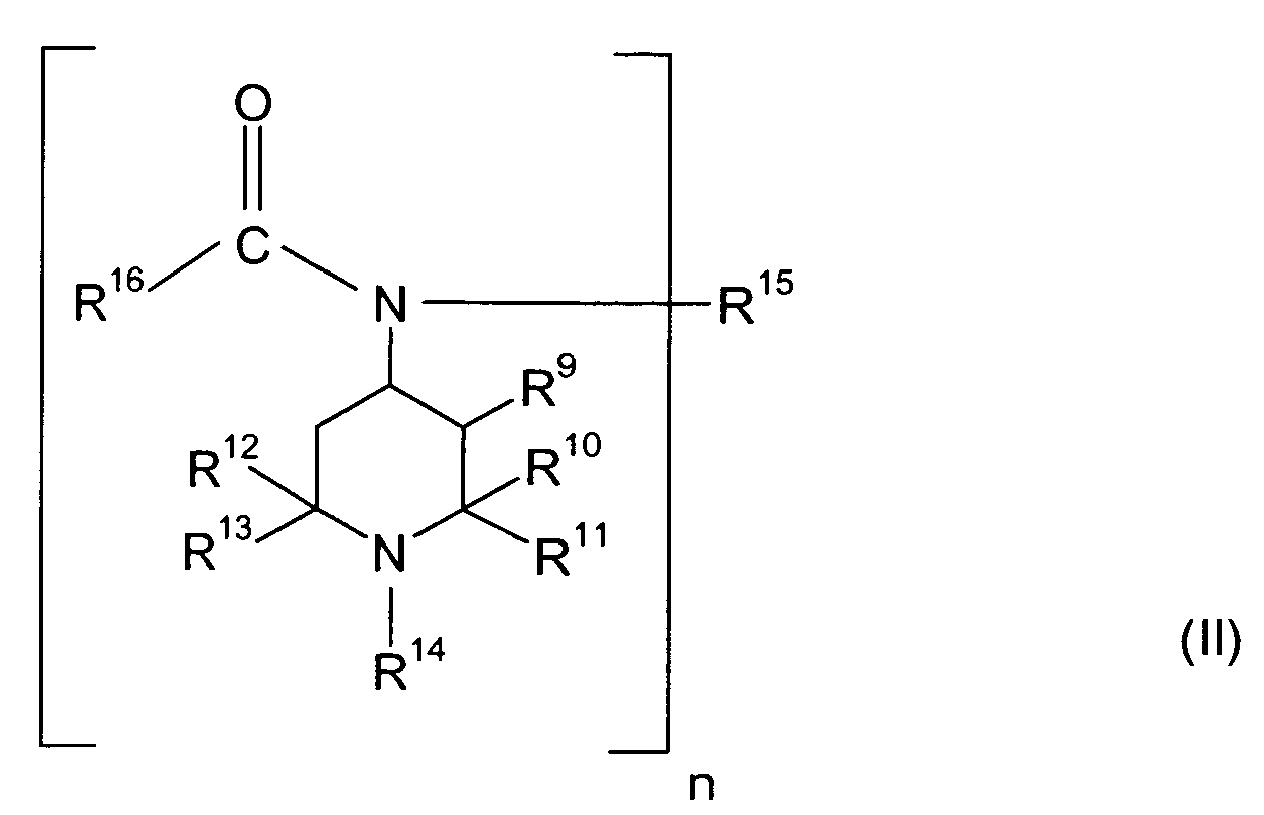 n 1 oder 2,R9 H, C1-C4-Alkyl,R10, R11, R12, R13 unabhängig voneinander, gleich oder verschieden, C1-C4-Alkyl oder R10 und R11 oder R12 und R13 zusammen eine Tetramethylen- oder Pentamethylengruppe,R14 H, C1-C30-Alkyl, C2- C22-Alkenyl, gegebenenfalls durch C1-C4-Alkyl, Halogen, C1-C4-Alkoxy, Methylendioxy, Ethy- lendioxy und/oder Di-C1-C4-alkylamino substituiertes C7- C12-Phenylalkyl, C1-C22-Alkanoyl, C2-C3-Cyanalkyl, C1- C22-Hydroxyalkyl oder C2-C22-AminoalkylR16 H, C1-C30-Alkyl,und
- wenn n = 1 ist -R15 H, C1-C22-Alkyl, C2-C22-Alkenyl, C3-C12-Cycloalkyl oder Bicycloalkyl, durch Cyan, Hydroxy oder Carbo-C1-C4-alkoxy substituiertes C2-C22-Alkyl, durch Ethersauerstoff, Stickstoff oder Schwefel unterbrochenes C4-C22-Alkyl, gegebenenfalls durch C1-C4-Alkyl, Halogen, C1-C4-Alkoxy, Methylendioxy, Ethy- lendioxy oder Di-C1-C4-alkylamino substituiertes C7-C22-Phenyl- oder Diphenylalkyl, gegebenenfalls durch C1-C4-Alkyl oder Carbo-C1-C4-alkoxy substituiertes Phe- nyl, ein Rest der allgemeinen Formel (IV)oder
- wenn n = 2 ist -R15 C2-C22-Alkylen, C5-C22-Cycloalkylen, C8-C14-Phenylalkylen, Phenylen oder durch Ethersauerstoff, Stickstoff, Schwefel oder 5 - oder 6-gliedrige Heterocyclen unterbrochenes C4-C30-Alkylenbedeuten,
und(c) wenigstens eine Verbindung der allgemeinen Formel (III), R17 C1-C20-Alkyl, Aryl,bedeutet,
und(d) optional weitere Zusatzstoffe,
wobei,
die Substituenten R1 bis R17 jeweils an beliebiger Position durch ein oder mehrere Heteroatome unterbrochen sein können, wobei die Anzahl dieser Heteroatome nicht mehr als 10 beträgt, und/oder jeweils an beliebiger Position, allerdings nicht mehr als fünfmal, durch C1-C30-Alkyl, C1-C20-Alkoxy, Aryl, Heterocyclen, Heteroatome oder Halogen substituiert sein können, wobei diese ebenfalls maximal zweimal, bevorzugt maximal einmal mit den genannten Gruppen oder substituierten Arylen substituiert sein können. - Mischung nach Anspruch 1, wobei zusätzlich als Komponente (d) Antioxidantien enthalten sind.
- Mischung nach Anspruch 1 oder 2, mit R2 entsprechend einer Mischung aus C14-bis C28-Alkylgruppen, wobei zwei dieser Alkylgruppen, die sich um nicht mehr als zwei C-Atome unterscheiden dürfen, jeweils mindestens 30 % dieser Mischung ausmachen.
- Mischung nach den Ansprüchen 1 bis 3, wobei Komponente (a) eine oligomere Verbindung mit einer Wiederholeinheit der allgemeinen Formel (I) mit R3, R4, R5 und R6 = CH3 und R2 = C16-C26-Alkyl enthält.
- Mischung nach den Ansprüchen 1 bis 4, wobei Komponente (b) eine Verbindung der allgemeinen Formel (II) enthält, wobei R3, R4, R5 und R6 für Methyl und R2 für ein Wasserstoffatom oder C2-C10-Alkyl steht.
- Mischung nach den Ansprüchen 1 bis 5, wobei Komponente (c) eine Verbindung der allgemeinen Formel (III) mit R17=C16-Alkyl enthält.
- Mischung nach den Ansprüchen 1 bis 6, wobei Komponente (c) eine Verbindung der allgemeinen Formel (III) mit R17 = 2,4 Di-t-butyl-phenyl enthält.
- Mischung nach den Ansprüchen 1 bis 7, wobei das Gewichtsverhältnis der Komponenten (a) und/oder (b) zu der Komponente (c) zwischen 10:1 und 1:2 liegt.
- Verwendung der Mischung gemäß den Ansprüchen 1 bis 8 zur Stabilisierung von unbelebten organischen Materialien gegen die Einwirkung von Licht, Sauerstoff und/oder Wärme.
- Verwendung nach Anspruch 9 zur Stabilisierung von Kunststoffen, bestehend aus mindestens einem Polymer, ausgewählt aus thermoplastischen Elastomeren, Polyolefinen, Polstyrol, Copolymeren von Styrol oder α-Methylstyrols, Polyestern, Polycarbonaten, Polyvinylchlorid, Polyacrylaten, Polymethacrylaten, Polyurethanen sowie physikalischen Blends der zuvor genannten Polymere.
- Verwendung nach Anspruch 10 zur Stabilisierung von thermoplastischen Elastomeren auf Olefinbasis.
- Unbelebte organische Materialien, enthaltend wenigstens eine Mischung gemäß den Ansprüchen 1 bis 8.
- Gegenstände, hergestellt aus unbelebten organischen Materialien gemäß Anspruch 12.
- Verfahren zur Stabilisierung von unbelebten organischen Materialien, gegen die Einwirkung von Licht, Sauerstoff und/oder Wärme, dadurch gekennzeichnet, dass man den unbelebten organischen Materialien mindestens eine Mischung gemäß den Ansprüchen 1 bis 8 in einer effektiven Menge zugibt.
Priority Applications (1)
| Application Number | Priority Date | Filing Date | Title |
|---|---|---|---|
| EP08802956A EP2185641B1 (de) | 2007-08-28 | 2008-08-01 | Stabilisatormischung |
Applications Claiming Priority (3)
| Application Number | Priority Date | Filing Date | Title |
|---|---|---|---|
| EP07115133 | 2007-08-28 | ||
| PCT/EP2008/060173 WO2009027180A1 (de) | 2007-08-28 | 2008-08-01 | Stabilisatormischung |
| EP08802956A EP2185641B1 (de) | 2007-08-28 | 2008-08-01 | Stabilisatormischung |
Publications (2)
| Publication Number | Publication Date |
|---|---|
| EP2185641A1 EP2185641A1 (de) | 2010-05-19 |
| EP2185641B1 true EP2185641B1 (de) | 2010-12-29 |
Family
ID=39996632
Family Applications (1)
| Application Number | Title | Priority Date | Filing Date |
|---|---|---|---|
| EP08802956A Active EP2185641B1 (de) | 2007-08-28 | 2008-08-01 | Stabilisatormischung |
Country Status (10)
| Country | Link |
|---|---|
| US (2) | US8822575B2 (de) |
| EP (1) | EP2185641B1 (de) |
| JP (1) | JP5393678B2 (de) |
| KR (1) | KR101587292B1 (de) |
| CN (1) | CN101796119B (de) |
| AT (1) | ATE493467T1 (de) |
| BR (1) | BRPI0815973A2 (de) |
| DE (1) | DE502008002175D1 (de) |
| ES (1) | ES2358082T3 (de) |
| WO (1) | WO2009027180A1 (de) |
Families Citing this family (3)
| Publication number | Priority date | Publication date | Assignee | Title |
|---|---|---|---|---|
| JP6046482B2 (ja) * | 2012-12-21 | 2016-12-14 | ポリプラスチックス株式会社 | ポリアセタール樹脂組成物 |
| JP6143326B2 (ja) * | 2013-01-25 | 2017-06-07 | 株式会社Adeka | 樹脂組成物 |
| CN115028939B (zh) | 2022-07-13 | 2023-07-14 | 塔里木大学 | 一种蛭石制备层状类水滑石pvc热稳定剂方法 |
Family Cites Families (29)
| Publication number | Priority date | Publication date | Assignee | Title |
|---|---|---|---|---|
| US4128726A (en) * | 1977-12-22 | 1978-12-05 | American Cyanamid Company | Process for the preparation of aryl esters of 3,5-di-t-butyl-4-hydroxybenzoic acid |
| GB2042562B (en) * | 1979-02-05 | 1983-05-11 | Sandoz Ltd | Stabilising polymers |
| US4528395A (en) | 1983-08-15 | 1985-07-09 | American Cyanamid Co. | Process for esterifying 3,5-di-tert-butyl-4-hydroxybenzoic acid |
| DE3738736A1 (de) | 1987-11-14 | 1989-05-24 | Basf Ag | 4-formylaminopiperidinderivate und deren verwendung als stabilisatoren |
| US5175312A (en) * | 1989-08-31 | 1992-12-29 | Ciba-Geigy Corporation | 3-phenylbenzofuran-2-ones |
| JP2803300B2 (ja) | 1990-03-14 | 1998-09-24 | 住友化学工業株式会社 | 安定化されたポリプロピレン樹脂組成物 |
| US5252643A (en) * | 1991-07-01 | 1993-10-12 | Ciba-Geigy Corporation | Thiomethylated benzofuran-2-ones |
| TW206220B (de) * | 1991-07-01 | 1993-05-21 | Ciba Geigy Ag | |
| TW260686B (de) | 1992-05-22 | 1995-10-21 | Ciba Geigy | |
| GB2267490B (en) | 1992-05-22 | 1995-08-09 | Ciba Geigy Ag | 3-(Carboxymethoxyphenyl)benzofuran-2-one stabilisers |
| NL9300801A (nl) | 1992-05-22 | 1993-12-16 | Ciba Geigy | 3-(acyloxyfenyl)benzofuran-2-on als stabilisatoren. |
| MX9305489A (es) | 1992-09-23 | 1994-03-31 | Ciba Geigy Ag | 3-(dihidrobenzofuran-5-il)benzofuran-2-onas, estabilizadores. |
| TW255902B (de) | 1992-09-23 | 1995-09-01 | Ciba Geigy | |
| DE4239437A1 (de) | 1992-11-24 | 1994-05-26 | Basf Ag | Maleinsäureimid-alpha-Olefin-Copolymerisate und ihre Verwendung als Lichtschutzmittel und Stabilisatoren für organisches Material |
| TW360678B (en) * | 1995-05-03 | 1999-06-11 | Ciba Sc Holding Ag | Synergistic stabilizer mixture for polyolefins |
| US5844029A (en) * | 1995-09-25 | 1998-12-01 | General Electric Company | Polymer compositions containing hydrocarbon amine oxide and hydrocarbon amine oxide stabilizer compositions |
| DK29697A (da) | 1996-03-22 | 1997-09-23 | Ciba Geigy Ag | Stabilisatorkombination indeholdende 4-acyl-amido-piperidin-forbindelser til chlorholdige polymerer |
| JPH10195258A (ja) | 1997-01-08 | 1998-07-28 | Asahi Denka Kogyo Kk | 農業用フィルム組成物 |
| EP0916335B1 (de) | 1997-08-13 | 2004-11-03 | Basf Aktiengesellschaft | Photostabile UV-Filter enthaltende kosmetsche und pharmazeutische Zubereitungen |
| GB2332678B (en) * | 1997-12-23 | 2000-09-27 | Ciba Sc Holding Ag | Stabilizer mixtures containing a sterically hindered amine |
| US6897250B1 (en) * | 1998-04-27 | 2005-05-24 | Asahi Denka Kogyo K. K. | Automobile interior or exterior trim material |
| DE19920590A1 (de) * | 1999-05-04 | 2000-11-09 | Basf Ag | Mischungen, enthaltend Stabilisatoren und Iminophosphorane |
| JP4428597B2 (ja) * | 2000-02-18 | 2010-03-10 | 株式会社Adeka | 合成樹脂組成物及びその用途 |
| DE10016379A1 (de) * | 2000-04-04 | 2001-10-18 | Basf Ag | 4-Formylamino-N-methylpiperidinderivate, deren Verwendung als Stabilisatoren und damit stabilisiertes organisches Material |
| DE10123732A1 (de) * | 2001-05-15 | 2002-11-21 | Basf Ag | Stabilisierte Metallocen-Polyolefine |
| DE10161861A1 (de) * | 2001-12-14 | 2003-07-03 | Basf Ag | Stabilisatorzusammensetzung I |
| JP2003253083A (ja) | 2002-02-28 | 2003-09-10 | Japan Polychem Corp | 表面外観の均一性に優れるポリプロピレン系樹脂組成物及びそれを用いた成形品 |
| DE10254548A1 (de) | 2002-11-21 | 2004-06-17 | Basf Ag | Verwendung UV-Absorber enthaltender Polymerpulver zur Stabilisierung von Polymeren gegen die Einwirkung von UV-Strahlung |
| CN101370865B (zh) | 2006-01-13 | 2011-09-28 | 巴斯夫欧洲公司 | 稳定剂混合物 |
-
2008
- 2008-08-01 CN CN200880105102.2A patent/CN101796119B/zh active Active
- 2008-08-01 DE DE502008002175T patent/DE502008002175D1/de active Active
- 2008-08-01 EP EP08802956A patent/EP2185641B1/de active Active
- 2008-08-01 WO PCT/EP2008/060173 patent/WO2009027180A1/de not_active Ceased
- 2008-08-01 JP JP2010522288A patent/JP5393678B2/ja active Active
- 2008-08-01 ES ES08802956T patent/ES2358082T3/es active Active
- 2008-08-01 BR BRPI0815973-4A2A patent/BRPI0815973A2/pt not_active IP Right Cessation
- 2008-08-01 US US12/675,037 patent/US8822575B2/en active Active
- 2008-08-01 KR KR1020107006486A patent/KR101587292B1/ko active Active
- 2008-08-01 AT AT08802956T patent/ATE493467T1/de active
-
2014
- 2014-07-24 US US14/339,520 patent/US20140336312A1/en not_active Abandoned
Also Published As
| Publication number | Publication date |
|---|---|
| CN101796119B (zh) | 2013-06-12 |
| KR101587292B1 (ko) | 2016-01-21 |
| JP5393678B2 (ja) | 2014-01-22 |
| US20110130493A1 (en) | 2011-06-02 |
| WO2009027180A1 (de) | 2009-03-05 |
| DE502008002175D1 (de) | 2011-02-10 |
| JP2010537020A (ja) | 2010-12-02 |
| US8822575B2 (en) | 2014-09-02 |
| BRPI0815973A2 (pt) | 2015-02-18 |
| US20140336312A1 (en) | 2014-11-13 |
| ATE493467T1 (de) | 2011-01-15 |
| EP2185641A1 (de) | 2010-05-19 |
| KR20100068260A (ko) | 2010-06-22 |
| CN101796119A (zh) | 2010-08-04 |
| ES2358082T3 (es) | 2011-05-05 |
Similar Documents
| Publication | Publication Date | Title |
|---|---|---|
| EP2215156B1 (de) | Flüssige stabilisatormischung | |
| EP2004742B1 (de) | Zusammensetzung, enthaltend polymere, farbmittel und stabilisatoren | |
| DE60120309T2 (de) | Mischungen aus phenolischen und anorganischen Materialien, die antimikrobielle Aktivität zeigen | |
| DE60205048T2 (de) | Verfahren um den Restaldehygehalt in Polyester- und Polyamidzusammensetzungen zu reduzieren | |
| DE10116305B4 (de) | Synergistische Gemische von UV-Absorptionsmitteln in Polyolefinen | |
| DE19907945B4 (de) | Herstellung von sterisch gehinderten Aminethern | |
| DE60106583T2 (de) | Synergistische stabilisatorzusammensetzungen für thermoplastische polymere, die im längeren kontakt mit wasser stehen | |
| EP1976925B1 (de) | Stabilisatormischung | |
| DE19882401B3 (de) | Blockoligomere, enthaltend 1-Kohlenwasserstoffoxy-2,2,6,6-tetramethyl-4-piperidyl-Gruppen als Stabilisatoren für organische Materialien | |
| WO2008084046A1 (de) | Weichmacher für polyvinylacetale und polysulfide | |
| EP2318454B1 (de) | Stabilisatoren für unbelebte organische materialien | |
| DE19882402B3 (de) | Blockoligomere, enthaltend 1-Kohlenwasserstoffoxy-2,2,6,6-tetramethyl-4-piperidyl-Gruppen als Stabilisatoren für organische Materialien | |
| EP1263856B1 (de) | Stabilisatorzusammensetzung | |
| WO2009027180A1 (de) | Stabilisatormischung | |
| DE19924984A1 (de) | Durch Dioxopiperazinylderivate stabilisierte Zusammensetzungen | |
| EP1268426A1 (de) | 4-formylamino-n-methylpiperidinderivate, deren verwendung als stabilisatoren und damit stabilisiertes organisches material | |
| DE102007011838A1 (de) | Stabilisierung organischer Materialien mit N-haltigen Heterocyclen | |
| EP0909785A2 (de) | Antistatisch-ausgerüstete Polymere | |
| DE102007007860A1 (de) | Schwefelhaltige Verbindungen zur Stabilisierung von unbelebten organischen Materialien | |
| WO2010072768A1 (de) | Uv-absorber agglomerate |
Legal Events
| Date | Code | Title | Description |
|---|---|---|---|
| PUAI | Public reference made under article 153(3) epc to a published international application that has entered the european phase |
Free format text: ORIGINAL CODE: 0009012 |
|
| 17P | Request for examination filed |
Effective date: 20100329 |
|
| AK | Designated contracting states |
Kind code of ref document: A1 Designated state(s): AT BE BG CH CY CZ DE DK EE ES FI FR GB GR HR HU IE IS IT LI LT LU LV MC MT NL NO PL PT RO SE SI SK TR |
|
| AX | Request for extension of the european patent |
Extension state: AL BA MK RS |
|
| GRAP | Despatch of communication of intention to grant a patent |
Free format text: ORIGINAL CODE: EPIDOSNIGR1 |
|
| GRAS | Grant fee paid |
Free format text: ORIGINAL CODE: EPIDOSNIGR3 |
|
| GRAA | (expected) grant |
Free format text: ORIGINAL CODE: 0009210 |
|
| DAX | Request for extension of the european patent (deleted) | ||
| AK | Designated contracting states |
Kind code of ref document: B1 Designated state(s): AT BE BG CH CY CZ DE DK EE ES FI FR GB GR HR HU IE IS IT LI LT LU LV MC MT NL NO PL PT RO SE SI SK TR |
|
| REG | Reference to a national code |
Ref country code: GB Ref legal event code: FG4D Free format text: NOT ENGLISH |
|
| REG | Reference to a national code |
Ref country code: CH Ref legal event code: EP |
|
| REG | Reference to a national code |
Ref country code: IE Ref legal event code: FG4D Free format text: LANGUAGE OF EP DOCUMENT: GERMAN |
|
| REF | Corresponds to: |
Ref document number: 502008002175 Country of ref document: DE Date of ref document: 20110210 Kind code of ref document: P |
|
| REG | Reference to a national code |
Ref country code: DE Ref legal event code: R096 Ref document number: 502008002175 Country of ref document: DE Effective date: 20110210 |
|
| REG | Reference to a national code |
Ref country code: NL Ref legal event code: VDEP Effective date: 20101229 |
|
| PG25 | Lapsed in a contracting state [announced via postgrant information from national office to epo] |
Ref country code: LT Free format text: LAPSE BECAUSE OF FAILURE TO SUBMIT A TRANSLATION OF THE DESCRIPTION OR TO PAY THE FEE WITHIN THE PRESCRIBED TIME-LIMIT Effective date: 20101229 |
|
| REG | Reference to a national code |
Ref country code: ES Ref legal event code: FG2A Ref document number: 2358082 Country of ref document: ES Kind code of ref document: T3 Effective date: 20110420 |
|
| LTIE | Lt: invalidation of european patent or patent extension |
Effective date: 20101229 |
|
| PG25 | Lapsed in a contracting state [announced via postgrant information from national office to epo] |
Ref country code: CY Free format text: LAPSE BECAUSE OF FAILURE TO SUBMIT A TRANSLATION OF THE DESCRIPTION OR TO PAY THE FEE WITHIN THE PRESCRIBED TIME-LIMIT Effective date: 20101229 Ref country code: SE Free format text: LAPSE BECAUSE OF FAILURE TO SUBMIT A TRANSLATION OF THE DESCRIPTION OR TO PAY THE FEE WITHIN THE PRESCRIBED TIME-LIMIT Effective date: 20101229 Ref country code: HR Free format text: LAPSE BECAUSE OF FAILURE TO SUBMIT A TRANSLATION OF THE DESCRIPTION OR TO PAY THE FEE WITHIN THE PRESCRIBED TIME-LIMIT Effective date: 20101229 Ref country code: BG Free format text: LAPSE BECAUSE OF FAILURE TO SUBMIT A TRANSLATION OF THE DESCRIPTION OR TO PAY THE FEE WITHIN THE PRESCRIBED TIME-LIMIT Effective date: 20110329 Ref country code: LV Free format text: LAPSE BECAUSE OF FAILURE TO SUBMIT A TRANSLATION OF THE DESCRIPTION OR TO PAY THE FEE WITHIN THE PRESCRIBED TIME-LIMIT Effective date: 20101229 Ref country code: SI Free format text: LAPSE BECAUSE OF FAILURE TO SUBMIT A TRANSLATION OF THE DESCRIPTION OR TO PAY THE FEE WITHIN THE PRESCRIBED TIME-LIMIT Effective date: 20101229 Ref country code: FI Free format text: LAPSE BECAUSE OF FAILURE TO SUBMIT A TRANSLATION OF THE DESCRIPTION OR TO PAY THE FEE WITHIN THE PRESCRIBED TIME-LIMIT Effective date: 20101229 |
|
| REG | Reference to a national code |
Ref country code: IE Ref legal event code: FD4D |
|
| PG25 | Lapsed in a contracting state [announced via postgrant information from national office to epo] |
Ref country code: IS Free format text: LAPSE BECAUSE OF FAILURE TO SUBMIT A TRANSLATION OF THE DESCRIPTION OR TO PAY THE FEE WITHIN THE PRESCRIBED TIME-LIMIT Effective date: 20110429 Ref country code: GR Free format text: LAPSE BECAUSE OF FAILURE TO SUBMIT A TRANSLATION OF THE DESCRIPTION OR TO PAY THE FEE WITHIN THE PRESCRIBED TIME-LIMIT Effective date: 20110330 Ref country code: PT Free format text: LAPSE BECAUSE OF FAILURE TO SUBMIT A TRANSLATION OF THE DESCRIPTION OR TO PAY THE FEE WITHIN THE PRESCRIBED TIME-LIMIT Effective date: 20110429 Ref country code: NO Free format text: LAPSE BECAUSE OF FAILURE TO SUBMIT A TRANSLATION OF THE DESCRIPTION OR TO PAY THE FEE WITHIN THE PRESCRIBED TIME-LIMIT Effective date: 20110329 Ref country code: EE Free format text: LAPSE BECAUSE OF FAILURE TO SUBMIT A TRANSLATION OF THE DESCRIPTION OR TO PAY THE FEE WITHIN THE PRESCRIBED TIME-LIMIT Effective date: 20101229 Ref country code: CZ Free format text: LAPSE BECAUSE OF FAILURE TO SUBMIT A TRANSLATION OF THE DESCRIPTION OR TO PAY THE FEE WITHIN THE PRESCRIBED TIME-LIMIT Effective date: 20101229 |
|
| PG25 | Lapsed in a contracting state [announced via postgrant information from national office to epo] |
Ref country code: NL Free format text: LAPSE BECAUSE OF FAILURE TO SUBMIT A TRANSLATION OF THE DESCRIPTION OR TO PAY THE FEE WITHIN THE PRESCRIBED TIME-LIMIT Effective date: 20101229 Ref country code: PL Free format text: LAPSE BECAUSE OF FAILURE TO SUBMIT A TRANSLATION OF THE DESCRIPTION OR TO PAY THE FEE WITHIN THE PRESCRIBED TIME-LIMIT Effective date: 20101229 Ref country code: SK Free format text: LAPSE BECAUSE OF FAILURE TO SUBMIT A TRANSLATION OF THE DESCRIPTION OR TO PAY THE FEE WITHIN THE PRESCRIBED TIME-LIMIT Effective date: 20101229 |
|
| PG25 | Lapsed in a contracting state [announced via postgrant information from national office to epo] |
Ref country code: IE Free format text: LAPSE BECAUSE OF FAILURE TO SUBMIT A TRANSLATION OF THE DESCRIPTION OR TO PAY THE FEE WITHIN THE PRESCRIBED TIME-LIMIT Effective date: 20101229 Ref country code: DK Free format text: LAPSE BECAUSE OF FAILURE TO SUBMIT A TRANSLATION OF THE DESCRIPTION OR TO PAY THE FEE WITHIN THE PRESCRIBED TIME-LIMIT Effective date: 20101229 |
|
| PLBE | No opposition filed within time limit |
Free format text: ORIGINAL CODE: 0009261 |
|
| STAA | Information on the status of an ep patent application or granted ep patent |
Free format text: STATUS: NO OPPOSITION FILED WITHIN TIME LIMIT |
|
| 26N | No opposition filed |
Effective date: 20110930 |
|
| PG25 | Lapsed in a contracting state [announced via postgrant information from national office to epo] |
Ref country code: MT Free format text: LAPSE BECAUSE OF FAILURE TO SUBMIT A TRANSLATION OF THE DESCRIPTION OR TO PAY THE FEE WITHIN THE PRESCRIBED TIME-LIMIT Effective date: 20101229 |
|
| REG | Reference to a national code |
Ref country code: DE Ref legal event code: R097 Ref document number: 502008002175 Country of ref document: DE Effective date: 20110930 |
|
| BERE | Be: lapsed |
Owner name: BASF SE Effective date: 20110831 |
|
| PG25 | Lapsed in a contracting state [announced via postgrant information from national office to epo] |
Ref country code: MC Free format text: LAPSE BECAUSE OF NON-PAYMENT OF DUE FEES Effective date: 20110831 |
|
| PG25 | Lapsed in a contracting state [announced via postgrant information from national office to epo] |
Ref country code: BE Free format text: LAPSE BECAUSE OF NON-PAYMENT OF DUE FEES Effective date: 20110831 |
|
| REG | Reference to a national code |
Ref country code: CH Ref legal event code: PL |
|
| GBPC | Gb: european patent ceased through non-payment of renewal fee |
Effective date: 20120801 |
|
| PG25 | Lapsed in a contracting state [announced via postgrant information from national office to epo] |
Ref country code: CH Free format text: LAPSE BECAUSE OF NON-PAYMENT OF DUE FEES Effective date: 20120831 Ref country code: LI Free format text: LAPSE BECAUSE OF NON-PAYMENT OF DUE FEES Effective date: 20120831 |
|
| PG25 | Lapsed in a contracting state [announced via postgrant information from national office to epo] |
Ref country code: LU Free format text: LAPSE BECAUSE OF NON-PAYMENT OF DUE FEES Effective date: 20110801 |
|
| PG25 | Lapsed in a contracting state [announced via postgrant information from national office to epo] |
Ref country code: GB Free format text: LAPSE BECAUSE OF NON-PAYMENT OF DUE FEES Effective date: 20120801 |
|
| PG25 | Lapsed in a contracting state [announced via postgrant information from national office to epo] |
Ref country code: TR Free format text: LAPSE BECAUSE OF FAILURE TO SUBMIT A TRANSLATION OF THE DESCRIPTION OR TO PAY THE FEE WITHIN THE PRESCRIBED TIME-LIMIT Effective date: 20101229 |
|
| PG25 | Lapsed in a contracting state [announced via postgrant information from national office to epo] |
Ref country code: HU Free format text: LAPSE BECAUSE OF FAILURE TO SUBMIT A TRANSLATION OF THE DESCRIPTION OR TO PAY THE FEE WITHIN THE PRESCRIBED TIME-LIMIT Effective date: 20101229 |
|
| PG25 | Lapsed in a contracting state [announced via postgrant information from national office to epo] |
Ref country code: RO Free format text: LAPSE BECAUSE OF FAILURE TO SUBMIT A TRANSLATION OF THE DESCRIPTION OR TO PAY THE FEE WITHIN THE PRESCRIBED TIME-LIMIT Effective date: 20101229 |
|
| REG | Reference to a national code |
Ref country code: AT Ref legal event code: MM01 Ref document number: 493467 Country of ref document: AT Kind code of ref document: T Effective date: 20130801 |
|
| PG25 | Lapsed in a contracting state [announced via postgrant information from national office to epo] |
Ref country code: AT Free format text: LAPSE BECAUSE OF NON-PAYMENT OF DUE FEES Effective date: 20130801 |
|
| REG | Reference to a national code |
Ref country code: FR Ref legal event code: PLFP Year of fee payment: 8 |
|
| PGFP | Annual fee paid to national office [announced via postgrant information from national office to epo] |
Ref country code: ES Payment date: 20150923 Year of fee payment: 8 |
|
| PGFP | Annual fee paid to national office [announced via postgrant information from national office to epo] |
Ref country code: FR Payment date: 20150831 Year of fee payment: 8 |
|
| REG | Reference to a national code |
Ref country code: FR Ref legal event code: ST Effective date: 20170428 |
|
| PG25 | Lapsed in a contracting state [announced via postgrant information from national office to epo] |
Ref country code: FR Free format text: LAPSE BECAUSE OF NON-PAYMENT OF DUE FEES Effective date: 20160831 |
|
| PG25 | Lapsed in a contracting state [announced via postgrant information from national office to epo] |
Ref country code: ES Free format text: LAPSE BECAUSE OF NON-PAYMENT OF DUE FEES Effective date: 20160802 |
|
| REG | Reference to a national code |
Ref country code: ES Ref legal event code: FD2A Effective date: 20181129 |
|
| P01 | Opt-out of the competence of the unified patent court (upc) registered |
Effective date: 20230314 |
|
| PGFP | Annual fee paid to national office [announced via postgrant information from national office to epo] |
Ref country code: DE Payment date: 20250827 Year of fee payment: 18 |
|
| PGFP | Annual fee paid to national office [announced via postgrant information from national office to epo] |
Ref country code: IT Payment date: 20250825 Year of fee payment: 18 |