EP0589839A1 - 3-(Dihydrobenzofuran-5-yl)benzofuran-2-one als Stabilisatoren - Google Patents
3-(Dihydrobenzofuran-5-yl)benzofuran-2-one als Stabilisatoren Download PDFInfo
- Publication number
- EP0589839A1 EP0589839A1 EP93810652A EP93810652A EP0589839A1 EP 0589839 A1 EP0589839 A1 EP 0589839A1 EP 93810652 A EP93810652 A EP 93810652A EP 93810652 A EP93810652 A EP 93810652A EP 0589839 A1 EP0589839 A1 EP 0589839A1
- Authority
- EP
- European Patent Office
- Prior art keywords
- hydrogen
- tert
- alkyl
- butyl
- bis
- Prior art date
- Legal status (The legal status is an assumption and is not a legal conclusion. Google has not performed a legal analysis and makes no representation as to the accuracy of the status listed.)
- Granted
Links
Classifications
-
- C—CHEMISTRY; METALLURGY
- C07—ORGANIC CHEMISTRY
- C07D—HETEROCYCLIC COMPOUNDS
- C07D307/00—Heterocyclic compounds containing five-membered rings having one oxygen atom as the only ring hetero atom
- C07D307/77—Heterocyclic compounds containing five-membered rings having one oxygen atom as the only ring hetero atom ortho- or peri-condensed with carbocyclic rings or ring systems
- C07D307/78—Benzo [b] furans; Hydrogenated benzo [b] furans
- C07D307/82—Benzo [b] furans; Hydrogenated benzo [b] furans with hetero atoms or with carbon atoms having three bonds to hetero atoms with at the most one bond to halogen, e.g. ester or nitrile radicals, directly attached to carbon atoms of the hetero ring
- C07D307/83—Oxygen atoms
-
- C—CHEMISTRY; METALLURGY
- C07—ORGANIC CHEMISTRY
- C07D—HETEROCYCLIC COMPOUNDS
- C07D407/00—Heterocyclic compounds containing two or more hetero rings, at least one ring having oxygen atoms as the only ring hetero atoms, not provided for by group C07D405/00
- C07D407/02—Heterocyclic compounds containing two or more hetero rings, at least one ring having oxygen atoms as the only ring hetero atoms, not provided for by group C07D405/00 containing two hetero rings
- C07D407/04—Heterocyclic compounds containing two or more hetero rings, at least one ring having oxygen atoms as the only ring hetero atoms, not provided for by group C07D405/00 containing two hetero rings directly linked by a ring-member-to-ring-member bond
-
- C—CHEMISTRY; METALLURGY
- C08—ORGANIC MACROMOLECULAR COMPOUNDS; THEIR PREPARATION OR CHEMICAL WORKING-UP; COMPOSITIONS BASED THEREON
- C08K—Use of inorganic or non-macromolecular organic substances as compounding ingredients
- C08K5/00—Use of organic ingredients
- C08K5/04—Oxygen-containing compounds
- C08K5/15—Heterocyclic compounds having oxygen in the ring
- C08K5/151—Heterocyclic compounds having oxygen in the ring having one oxygen atom in the ring
- C08K5/1535—Five-membered rings
Definitions
- the present invention relates to new 3- (dihydrobenzofuran-5-yl) benzofuran-2-ones, compositions containing an organic material, preferably a polymer and the new stabilizers, and the use thereof for stabilizing organic materials against oxidative, thermal or light-induced Degradation.
- the present invention therefore relates to compounds of the formula (1) wherein R1 is hydrogen, C1-C4-alkyl, unsubstituted or substituted by C1-C4-alkyl phenyl, R2, R3, R4 and R5 independently of one another hydrogen, chlorine, C1-C25-alkyl, C7-C9-phenylalkyl, phenyl which is unsubstituted or substituted by C1-C4-alkyl, unsubstituted or substituted by C1-C4-alkyl C5-C8-cycloalkyl ; C1-C18 alkoxy, C1-C18-alkylthio, hydroxy, C1-C4-alkylamino, di- (C1-C4-alkyl) amino, C1-C25-alkanoyloxy, C1-C25-alkanoylamino, C3-C25-alkenoyloxy, by oxygen, sulfur or ⁇ N -R16 interrupted
- Alkyl having up to 25 carbon atoms means a branched or unbranched radical, such as, for example, methyl, ethyl, propyl, isopropyl, n-butyl, sec-butyl, isobutyl, tert-butyl, 2-ethylbutyl, n-pentyl, isopentyl, 1-methylpentyl, 1,3-dimethylbutyl, n-hexyl, 1-methylhexyl, n-heptyl, isoheptyl, 1,1,3,3-tetramethylbutyl, 1-methylheptyl, 3-methylheptyl, n-octyl, 2-ethylhexyl, 1,1, 3-trimethylhexyl, 1,1,3,3-tetramethylpentyl, nonyl, decyl, undecyl, 1-methylundecyl, dodecyl, 1,1,3,3,5,5-hexamethyl
- C7-C9-phenylalkyl means, for example, benzyl, ⁇ -methylbenzyl, ⁇ , ⁇ -dimethylbenzyl or 2-phenylethyl. Benzyl is preferred.
- Phenyl substituted by C1-C4-alkyl which preferably contains 1 to 3, in particular 1 or 2, alkyl groups means, for example, o-, m- or p-methylphenyl, 2,3-dimethylphenyl, 2,4-dimethylphenyl, 2,5- Dimethylphenyl, 2,6-dimethylphenyl, 3,4-dimethylphenyl, 3,5-dimethylphenyl, 2-methyl-6-ethylphenyl, 4-tert-butylphenyl, 2-ethylphenyl or 2,6-diethylphenyl.
- C5-C8-cycloalkyl means for example cyclopentyl, methylcyclopentyl, dimethylcyclopentyl, cyclohexyl, methylcyclohexyl, dimethylcyclohexyl, trimethylcyclohexyl, tert-butylcyclohexyl, cycloheptyl or cyclooctyl. Cyclohexyl and tert-butylcyclohexyl are preferred.
- Alkoxy with up to 18 carbon atoms means a branched or unbranched radical such as methoxy, ethoxy, propoxy, isopropoxy, n-butoxy, isobutoxy, pentoxy, isopentoxy, hexoxy, heptoxy, octoxy, decyloxy, tetradecyloxy, hexadecyloxy or octadecyloxy.
- Alkylthio with up to 18 carbon atoms means a branched or unbranched radical such as methylthio, ethylthio, propylthio, isopropylthio, n-butylthio, isobutylthio, pentylthio, isopentylthio, hexylthio, heptylthio, octylthio, decylthio, tetradecylthio or hex.
- Alkylamino with up to 4 carbon atoms means a branched or unbranched radical such as methylamino, ethylamino, propylamino, isopropylamino, n-butylamino, isobutylamino or tert-butylamino.
- Di- (C1-C4) alkylamino also means that the two radicals are independently branched or unbranched, such as, for example, dimethylamino, methylethylamino, diethylamino, methyl-n-propylamino, methylisopropylamino, methyl-n-butylamino, methylisobutylamino, ethylisopropylamino, ethyl-n -butylamino, ethylisobutylamino, ethyl-tert-butylamino, diethylamino, diisopropylamino, isopropyl-n-butylamino, isopropylisobutylamino, di-n-butylamino or di-isobutylamino.
- Alkanoyloxy with up to 25 carbon atoms means a branched or unbranched radical such as, for example, formyloxy, acetyloxy, propionyloxy, butanoyloxy, pentanoyloxy, hexanoyloxy, heptanoyloxy, octanoyloxy, nonanoyloxy, decanoyloxy, undecanoyloxy, dodecanoyloxy, tridecanoyloxy, tridecanoyloxy, tridecanoyloxy, tridecanoyloxy Eicosanoyloxy or docosanoyloxy.
- Alkanoylamino with up to 25 carbon atoms means a branched or unbranched radical such as, for example, formylamino, acetylamino, propionylamino, butanoylamino, pentanoylamino, hexanoylamino, heptanoylamino, octanoylamino, nonanoylamino, decanoylaminoadino, undecanoylamino, dodecanoyanoyaminoad, todecanoyanoyaminoad Eicosanoylamino or Docosanoylamino.
- Alkenoyloxy with 3 to 25 carbon atoms means a branched or unbranched radical such as, for example, propenoyloxy, 2-butenoyloxy, 3-butenoyloxy, isobutenoyloxy, n-2,4-pentadienoyloxy, 3-methyl-2-butenoyloxy, n-2-octenoyloxy, n- 2-dodecenoyloxy, iso-dodecenoyloxy, oleoyloxy, n-2-octadecenoyloxy or n-4-octadecenoyloxy.
- C3-C25 alkanoyloxy interrupted by oxygen, sulfur or ⁇ N-R16 means, for example, CH3-O-CH2COO-, CH3-S-CH2COO-, CH3-NH-CH2COO-, CH3-N (CH3) -CH2COO-, CH3- O-CH2CH2-O-CH2COO-, CH3- (O-CH2CH2-) 2O-CH2COO-, CH3- (O-CH2CH2-) 3O-CH2COO- or CH3- (O-CH2CH2-) 4O-CH2COO-.
- C6-C9-Cycloalkylcarbonyloxy means for example Cyclopentylcarbonyloxy, Cyclohexylcarbonyloxy, Cycloheptylcarbonyloxy or Cyclooctylcarbonyloxy. Cyclohexylcarbonyloxy is preferred.
- Benzoyloxy substituted by C1-C12-alkyl means, for example, o-, m- or p-methylbenzoyloxy, 2,3-dimethylbenzoyloxy, 2,4-dimethylbenzoyloxy, 2,5-dimethylbenzoyloxy, 2,6-dimethylbenzoyloxy, 3,4-dimethylbenzoyloxy, 3,5-dimethylbenzoyloxy, 2-methyl-6-ethylbenzoyloxy, 4-tert-butylbenzoyloxy, 2-ethylbenzoyloxy, 2,4,6-trimethylbenzoyloxy, 2,6-dimethyl-4-tert-butylbenzoyloxy or 3,5-di- tert-butylbenzoyloxy.
- C1-C4-alkyl substituted C5-C8-cycloalkylidene ring which preferably contains 1 to 3, in particular 1 or 2 branched or unbranched alkyl group radicals, means, for example, cyclopentylidene, methylcyclopentylidene, dimethylcyclopentylidene, cyclohexylidene, methylcyclohexylidene, dimethylcyclohexylidene, trimethylcyclohexylhexylidene, trimethylcyclohexylidene, , Cycloheptylidene or cyclooctylidene. Cyclohexylidene and tert-butylcyclohexylidene are preferred.
- a mono-, di- or trivalent metal cation is preferably an alkali metal, alkaline earth metal or aluminum cation, for example Na+, K+, Mg++, Ca++ or Al+++.
- Preferred compounds of the formula (1) are those in which R1 is hydrogen, C1-C4-alkyl or phenyl, R2, R3, R4 and R5 independently of one another hydrogen, chlorine, C1-C18-alkyl, benzyl, phenyl, C5-C8-cycloalkyl, C1-C18-alkoxy, C 1-C18-alkylthio, C1-C18-alkanoyloxy, C1- C18 alkanoylamino, C3-C18 alkenoyloxy or benzoyloxy, or further the radicals R2 and R3 or the radicals R4 and R5 together with the carbon atoms to which they are bonded, form a phenyl ring or when R3, R5, R6, R7 and R10 are hydrogen, R4 additionally denotes a radical of the formula (2), R9 and R'9 represent hydrogen or C1-C4-alkyl, with the condition that at least one of the radicals R9 and R'9 is
- R1 is hydrogen or C1-C4-alkyl
- R2 and R4 are independently hydrogen, C1-C18 alkyl, benzyl, phenyl, C5-C8 cycloalkyl or C1-C18 alkoxy, or when R3, R5, R6, R7 and R10 are hydrogen
- R4 additionally a radical of the formula (2) means R3 and R5 independently represent hydrogen or C1-C4 alkyl
- R6 represents hydrogen or a radical of the formula (3), where R4 does not represent a radical of the formula (2)
- R7, R8, R9, R'9 and R10 are hydrogen
- R12 and R13 are either methyl groups or, together with the carbon atom to which they are attached, form a C5-C8 cycloalkylidene ring.
- R1 is hydrogen or methyl
- R2 is hydrogen or C1-C18 alkyl
- R3, R5, R7, R8, R9, R'9 and R10 are hydrogen
- R4 represents hydrogen or C1-C4-alkyl
- R6 additionally denotes a radical of the formula (2)
- R6 is hydrogen or a radical of the formula (3), where R4 is not a radical of the formula (2)
- R12 and R13 are either methyl groups or together with the carbon atom to which they are attached form a cyclohexylidene ring.
- the compounds of formula (1) according to the invention can be prepared in a manner known per se.
- a phenol of formula (4) wherein R2, R3, R4 and R5 have the meanings given, with an allyloxy-mandelic acid derivative of the formula (5) substituted on the phenyl ring, wherein R1, R7, R8, R9, R'9 and R10 have the meanings given, with increased Temperature, in particular temperatures of 130 to 200 ° C. in the melt or in a solvent, if appropriate under a slight vacuum, to give compounds of the formula (6) implemented.
- the reaction is preferably carried out in a solvent such as acetic acid or formic acid in a temperature range from 50 to 130 ° C.
- the reaction can be catalyzed by adding an acid such as hydrochloric acid, sulfuric acid or methanesulfonic acid.
- the reaction can be carried out, for example, in the manner described in the literature references given in the introduction to the description.
- mandelic acids of formula (5) substituted on the phenyl ring are known in the literature or can be described, for example, according to W. Bradley et al., J. Chem. Soc. 1956 , 1622; EP-A-146269, EP-B-182507 (Example 1, page 4) or DE-A-2 944 295 can be prepared in an analogous manner.
- the phenols of the formula (4) are also known or can be obtained by processes known per se.
- Bisphenol compounds of formula (7) can be prepared according to Houben-Weyl, Methods of Organic Chemistry, Volume 6 / 1c, 1030.
- the compounds of the formula (6) are converted into the compounds of the formula (8) under Claisen rearrangement conditions, at elevated temperature, in particular temperatures of 200 to 240 ° C. in the melt or in a solvent. relocated.
- These compounds can be isolated or cyclized without purification in a solvent, such as acetic acid, with a catalytic amount of a strong acid, such as methanesulfonic acid, at elevated temperature, in particular temperatures from 50 to 130 ° C., to give the compounds of the formula (1) according to the invention will.
- the compounds of formula (1) according to the invention are suitable for stabilizing organic materials against thermal, oxidative or light-induced degradation.
- Preferred organic materials are polymers, e.g. synthetic polymers, especially thermoplastic polymers.
- the compounds of the formula (1) are preferably added to the material to be stabilized in amounts of 0.0005 to 5%, in particular 0.001 to 2%, for example 0.01 to 2%, based on the weight of the organic material to be stabilized.
- the costabilizers are added, for example, in concentrations of 0.01 to 10%, based on the total weight of the material to be stabilized.
- compositions according to the invention therefore preferably contain, in addition to compounds of the formula (1), phenolic antioxidants, in particular those as listed in items 1.1 to 1.16 above.
- compositions contain at least one organic phosphite or phosphonite.
- the incorporation of the compounds of the formula (1) and, if appropriate, further additives into the polymeric, organic material is carried out by known methods, for example before or during shaping or else by applying the dissolved or dispersed compounds to the polymeric, organic material, if appropriate with subsequent evaporation of the solvent.
- the compounds of the formula (1) can also be added to the materials to be stabilized in the form of a masterbatch, which contains them, for example, in a concentration of 2.5 to 25% by weight.
- the compounds of formula (1) can also be added before or during the polymerization or before the crosslinking.
- the compounds of formula (1) can be incorporated into the material to be stabilized in pure form or encapsulated in waxes, oils or polymers.
- the compounds of formula (1) can also be sprayed onto the polymer to be stabilized. They are able to dilute other additives (e.g. the conventional additives specified above) or their melts, so that they can also be sprayed onto the polymer to be stabilized together with these additives.
- the addition by spraying during the deactivation of the polymerization catalysts is particularly advantageous, e.g. the steam used for deactivation can be used for spraying.
- spherically polymerized polyolefins e.g. be advantageous to apply the compounds of the formula (1), if appropriate together with other additives, by spraying.
- a preferred embodiment of the present invention is therefore the use of compounds of the formula (1) for stabilizing organic materials against oxidative, thermal or light-induced degradation.
- the materials stabilized in this way can be used in various forms, e.g. as foils, fibers, tapes, molding compounds, profiles or as binders for paints, adhesives or putties.
- the present invention also relates to a method for stabilizing an organic material against oxidative, thermal or light-induced degradation, which is characterized in that at least one compound of the formula (1) is incorporated into or applied to it.
- the compounds according to the invention are particularly advantageous used as stabilizers in polyolefins, especially as thermal stabilizers. Excellent stabilization is obtained, for example, when used in combination with organic phosphites or phosphonites.
- the compounds according to the invention have the advantage that they are effective even in extremely small amounts. They are used, for example, in amounts of 0.0001 to 0.015, in particular 0.0001 to 0.008% by weight, based on the polyolefin.
- the organic phosphite or phosphonite is expediently used in an amount of 0.01 to 2, in particular 0.01 to 1% by weight, also based on the polyolefin.
- organic phosphites or phosphonites used are preferably those as described in DE-A-4 202 276. See there in particular the patent claims, the examples and pages 5, last paragraph to page 8. Particularly expedient phosphites and phosphonites can also be found in item 4 of the above list of costabilizers.
- Example 1 Preparation of 5,7-di-tert-butyl-3- (2-methyl-dihydrobenzofuran-5-yl) benzofuran-2-one (Compound (101), Table 1).
- the reaction mixture is then stirred for a further 12 hours, then neutralized with concentrated hydrochloric acid and washed with twice 75 ml of petroleum ether.
- the aqueous phase is then acidified with concentrated hydrochloric acid and extracted several times with ether.
- the organic phases are combined, dried over magnesium sulfate and concentrated on a vacuum rotary evaporator.
- the following preparations are thus obtained: 4-hydroxy-3-methyl-mandelic acid, mp. 115-120 ° C., yield 55%; 4-hydroxy-3-tert-butylmandelic acid, mp. 156-158 ° C, yield 26%; and 3-isopropyl-4-hydroxy-2-methylmandelic acid, mp 114-119 ° C, yield 20%.
- a mixture of 20.6 g (0.10 mol) of 2,4-di-tert-butyl-phenol and 22.6 g (0.10 mol) of 4-methallyloxy-mandelic acid (preparation see Example 1) is carried out under reduced pressure (50 mbar) held at 155 ° C for 8 hours.
- the reaction mixture is then heated to 220 ° C. under a nitrogen atmosphere and kept at this temperature for about 100 minutes. After cooling to about 120 ° C., 100 ml of acetic acid and 2 ml of methanesulfonic acid are added and the solution is refluxed for 3 hours.
- the reaction mixture is cooled, 10 ml of ethanol are added and the product is filtered.
- Example 3 Preparation of 3,3'-bis- [3- (2,2-dimethyl-dihydrobenzofuran-5-yl) -5,7-di-tert-butyl-benzofuran-2-one] (Compound (105) , Table 1).
- Example 4 Stabilization of polypropylene in multiple extrusion.
- Example 5 Stabilization of polyethylene during processing.
Landscapes
- Chemical & Material Sciences (AREA)
- Organic Chemistry (AREA)
- Health & Medical Sciences (AREA)
- Chemical Kinetics & Catalysis (AREA)
- Medicinal Chemistry (AREA)
- Polymers & Plastics (AREA)
- Compositions Of Macromolecular Compounds (AREA)
- Furan Compounds (AREA)
Abstract
Description
- Die vorliegende Erfindung betrifft neue 3-(Dihydrobenzofuran-5-yl)benzofuran-2-one, Zusammensetzungen, enthaltend ein organisches Material, bevorzugt ein Polymer und die neuen Stabilisatoren, sowie die Verwendung derselben zum Stabilisieren von organischen Materialien gegen oxidativen, thermischen oder lichtinduzierten Abbau.
- Einzelne 3-(Alkoxyphenyl)benzofuran-2-one wurden beispielsweise von M. Auger et al, Bull. Soc. Chim. Fr. 1970, 4024; L. Jurd, Aust. J. Chem., 31, 347 (1978) und C.S. Foote et al, J. Amer. Chem. Soc. 95, 586 (1973) und in DE-A-3 006 268 beschrieben.
- Die Verwendung von einigen Benzofuran-2-onen als Stabilisatoren für organische Polymere ist beispielsweise aus US-A-4,325,863; US-A-4,338,244 und EP-A-415 887 bekannt.
- Es wurde nun gefunden, dass eine ausgewahlte Gruppe solcher Benzofuran-2-one sich besonders gut als Stabilisatoren für organische Materialien, die gegen oxidativen, thermischen oder lichtinduzierten Abbau empfindlich sind, eignen.
- Die vorliegende Erfindung betrifft daher Verbindungen der Formel (1)

worin
R₁ Wasserstoff, C₁-C₄-Alkyl, unsubstituiertes oder durch C₁-C₄-Alkyl substituiertes Phenyl bedeutet,
R₂, R₃, R₄ und R₅ unabhängig voneinander Wasserstoff, Chlor, C₁-C₂₅-Alkyl, C₇-C₉-Phenylalkyl, unsubstituiertes oder durch C₁-C₄-Alkyl substituiertes Phenyl, unsubstituiertes oder durch C₁-C₄-Alkyl substituiertes C₅-C₈-Cycloalkyl; C₁-C₁₈-Alkoxy, C₁-C₁₈-Alkylthio, Hydroxy, C₁-C₄-Alkylamino, Di-(C₁-C₄-alkyl)amino, C₁-C₂₅-Alkanoyloxy, C₁-C₂₅-Alkanoylamino, C₃-C₂₅-Alkenoyloxy, durch Sauerstoff, Schwefel oder 〉N-R₁₆ unterbrochenes C₃-C₂₅-Alkanoyloxy; C₆-C₉-Cycloalkylcarbonyloxy, Benzoyloxy oder durch C₁-C₁₂-Alkyl substituiertes Benzoyloxy darstellen, oder ferner die Reste R₂ und R₃ oder die Reste R₃ und R₄ oder die Reste R₄ und R₅ zusammen mit den Kohlenstoffatomen, an die sie gebunden sind, einen Phenylring bilden, R₄ zusätzlich -(CH₂)n-COR₁₁ darstellt, oder wenn R₃, R₅, R₆, R₇ und R₁₀ Wasserstoff sind, R₄ zusätzlich einen Rest der Formel (2)
bedeutet,
R₆ Wasserstoff oder einen Rest der Formel (3)
darstellt, wobei R₄ nicht einen Rest der Formel (2) bedeutet,
R₇ und R₈ unabhängig voneinander Wasserstoff oder C₁-C₄-Alkyl darstellen,
R₉ und R'₉ Wasserstoff, C₁-C₄-Alkyl oder Phenyl bedeuten, mit der Bedingung, dass mindestens einer der Reste R₉ und R'₉ Wasserstoff ist,
R₁₀ Wasserstoff oder C₁-C₄-Alkyl darstellt,
R₁₁ Hydroxy,
C₁-C₁₈-Alkoxy oder
bedeutet,
R₁₂ und R₁₃ unabhängig voneinander Wasserstoff, CF₃, C₁-C₁₂-Alkyl oder Phenyl darstellen, oder R₁₂ und R₁₃ zusammen mit dem C-Atom, an das sie gebunden sind, einen unsubstituierten oder durch 1 bis 3 C₁-C₄-Alkyl substituierten C₅-C₈-Cycloalkylidenring bilden;
R₁₄ und R₁₅ unabhängig voneinander Wasserstoff oder C₁-C₁₈-Alkyl darstellen,
R₁₆ Wasserstoff oder C₁-C₈-Alkyl bedeutet,
M ein r-wertiges Metallkation ist,
n 0, 1 oder 2 und
r 1,2 oder 3 bedeutet. - Alkyl mit bis zu 25 Kohlenstoffatomen bedeutet einen verzweigten oder unverzweigten Rest wie beispielsweise Methyl, Ethyl, Propyl, Isopropyl, n-Butyl, sec-Butyl, Isobutyl, tert-Butyl, 2-Ethylbutyl, n-Pentyl, Isopentyl, 1-Methylpentyl, 1,3-Dimethylbutyl, n-Hexyl, 1-Methylhexyl, n-Heptyl, Isoheptyl, 1,1,3,3-Tetramethylbutyl, 1-Methylheptyl, 3-Methylheptyl, n-Octyl, 2-Ethylhexyl, 1,1,3-Trimethylhexyl, 1,1,3,3-Tetramethylpentyl, Nonyl, Decyl, Undecyl, 1-Methylundecyl, Dodecyl, 1,1,3,3,5,5-Hexamethylhexyl, Tridecyl, Tetradecyl, Pentadecyl, Hexadecyl, Heptadecyl, Octadecyl, Eicosyl oder Docosyl. Eine der bevorzugten Bedeutungen von R₂ und R₄ ist beispielweise C₁-C₁₈-Alkyl. Eine besonders bevorzugte Bedeutung von R₄ ist C₁-C₄-Alkyl.
- C₇-C₉-Phenylalkyl bedeutet beispielsweise Benzyl, α-Methylbenzyl, α,α-Dimethylbenzyl oder 2-Phenylethyl. Benzyl ist bevorzugt.
- Durch C₁-C₄-Alkyl substituiertes Phenyl, das vorzugsweise 1 bis 3, insbesondere 1 oder 2 Alkylgruppen enthält, bedeutet beispielsweise o-, m- oder p-Methylphenyl, 2,3-Dimethylphenyl, 2,4-Dimethylphenyl, 2,5-Dimethylphenyl, 2,6-Dimethylphenyl, 3,4-Dimethylphenyl, 3,5-Dimethylphenyl, 2-Methyl-6-ethylphenyl, 4-tert-butylphenyl, 2-Ethylphenyl oder 2,6-Diethylphenyl.
- Unsubstituiertes oder durch C₁-C₄-Alkyl substituiertes C₅-C₈-Cycloalkyl bedeutet beispielsweise Cyclopentyl, Methylcyclopentyl, Dimethylcyclopentyl, Cyclohexyl, Methylcyclohexyl, Dimethylcyclohexyl, Trimethylcyclohexyl, tert-Butylcyclohexyl, Cycloheptyl oder Cyclooctyl. Bevorzugt ist Cyclohexyl und tert-Butylcyclohexyl.
- Alkoxy mit bis zu 18 Kohlenstoffatomen bedeutet einen verzweigten oder unverzweigten Rest wie beispielsweise Methoxy, Ethoxy, Propoxy, Isopropoxy, n-Butoxy, Isobutoxy, Pentoxy, Isopentoxy, Hexoxy, Heptoxy, Octoxy, Decyloxy, Tetradecyloxy, Hexadecyloxy oder Octadecyloxy.
- Alkylthio mit bis zu 18 Kohlenstoffatomen bedeutet einen verzweigten oder unverzweigten Rest wie beispielsweise Methylthio, Ethylthio, Propylthio, Isopropylthio, n-Butylthio, Isobutylthio, Pentylthio, Isopentylthio, Hexylthio, Heptylthio, Octylthio, Decylthio, Tetradecylthio, Hexadecylthio oder Octadecylthio.
- Alkylamino mit bis zu 4 Kohlenstoffatomen bedeutet einen verzweigten oder unverzweigten Rest wie beispielsweise Methylamino, Ethylamino, Propylamino, Isopropylamino, n-Butylamino, Isobutylamino oder tert-Butylamino.
- Di-(C₁-C₄)alkylamino bedeutet auch, dass die beiden Reste unabhängig voneinander verzweigt oder unverzweigt sind wie beispielsweise Dimethylamino, Methylethylamino, Diethylamino, Methyl-n-propylamino, Methylisopropylamino, Methyl-n-butylamino, Methylisobutylamino, Ethylisopropylamino, Ethyl-n-butylamino, Ethylisobutylamino, Ethyl-tert-butylamino, Diethylamino, Diisopropylamino, Isopropyl-n-butylamino, Isopropylisobutylamino, Di-n-butylamino oder Di-isobutylamino.
- Alkanoyloxy mit bis zu 25 Kohlenstoffatomen bedeutet einen verzweigten oder unverzweigten Rest wie beispielsweise Formyloxy, Acetyloxy, Propionyloxy, Butanoyloxy, Pentanoyloxy, Hexanoyloxy, Heptanoyloxy, Octanoyloxy, Nonanoyloxy, Decanoyloxy, Undecanoyloxy, Dodecanoyloxy, Tridecanoyloxy, Tetradecanoyloxy, Pentadecanoyloxy, Hexadecanoyloxy, Heptadecanoyloxy, Octadecanoyloxy, Eicosanoyloxy oder Docosanoyloxy.
- Alkanoylamino mit bis zu 25 Kohlenstoffatomen bedeutet einen verzweigten oder unverzweigten Rest wie beispielsweise Formylamino, Acetylamino, Propionylamino, Butanoylamino, Pentanoylamino, Hexanoylamino, Heptanoylamino, Octanoylamino, Nonanoylamino, Decanoylamino, Undecanoylamino, Dodecanoylamino, Tridecanoylamino, Tetradecanoylamino, Pentadecanoylamino, Hexadecanoylamino, Heptadecanoylamino, Octadecanoylamino, Eicosanoylamino oder Docosanoylamino.
- Alkenoyloxy mit 3 bis 25 Kohlenstoffatomen bedeutet einen verzweigten oder unverzweigten Rest wie beispielsweise Propenoyloxy, 2-Butenoyloxy, 3-Butenoyloxy, Isobutenoyloxy, n-2,4-Pentadienoyloxy, 3-Methyl-2-butenoyloxy, n-2-Octenoyloxy, n-2-Dodecenoyloxy, iso-Dodecenoyloxy, Oleoyloxy, n-2-Octadecenoyloxy oder n-4-Octadecenoyloxy.
- Durch Sauerstoff, Schwefel oder 〉N-R₁₆ unterbrochenes C₃-C₂₅-Alkanoyloxy bedeutet beispielsweise CH₃-O-CH₂COO-, CH₃-S-CH₂COO-, CH₃-NH-CH₂COO-, CH₃-N(CH₃)-CH₂COO-, CH₃-O-CH₂CH₂-O-CH₂COO-, CH₃-(O-CH₂CH₂-)₂O-CH₂COO-, CH₃-(O-CH₂CH₂-)₃O-CH₂COO- oder CH₃-(O-CH₂CH₂-)₄O-CH₂COO-.
- C₆-C₉-Cycloalkylcarbonyloxy bedeutet beispielsweise Cyclopentylcarbonyloxy, Cyclohexylcarbonyloxy, Cycloheptylcarbonyloxy oder Cyclooctylcarbonyloxy. Cyclohexylcarbonyloxy ist bevorzugt.
- Durch C₁-C₁₂-Alkyl substituiertes Benzoyloxy bedeutet beispielsweise o-, m- oder p-Methylbenzoyloxy, 2,3-Dimethylbenzoyloxy, 2,4-Dimethylbenzoyloxy, 2,5-Dimethylbenzoyloxy, 2,6-Dimethylbenzoyloxy, 3,4-Dimethylbenzoyloxy, 3,5-Dimethylbenzoyloxy, 2-Methyl-6-ethylbenzoyloxy, 4-tert-Butylbenzoyloxy, 2-Ethylbenzoyloxy, 2,4,6-Trimethylbenzoyloxy, 2,6-Dimethyl-4-tert-butylbenzoyloxy oder 3,5-Di-tert-butylbenzoyloxy.
- Durch C₁-C₄-Alkyl substituierter C₅-C₈-Cycloalkylidenring, der vorzugsweise 1 bis 3, insbesondere 1 oder 2 verzweigte oder unverzweigte Alkylgruppen-Reste enthält, bedeutet beispielsweise Cyclopentyliden, Methylcyclopentyliden, Dimethylcyclopentyliden, Cyclohexyliden, Methylcyclohexyliden, Dimethylcyclohexyliden, Trimethylcyclohexyliden, tert-Butylcyclohexyliden, Cycloheptyliden oder Cyclooctyliden. Bevorzugt ist Cyclohexyliden und tert-Butylcyclohexyliden.
- Ein ein-, zwei- oder drei-wertiges Metallkation ist vorzugsweise ein Alkalimetall-, Erdalkalimetall- oder Aluminium-Kation, beispielsweise Na⁺, K⁺, Mg⁺⁺, Ca⁺⁺ oder Al⁺⁺⁺.
- Bevorzugt sind Verbindungen der Formel (1), worin
R₁ Wasserstoff, C₁-C₄-Alkyl oder Phenyl bedeutet,
R₂, R₃, R₄ und R₅ unabhängig voneinander Wasserstoff, Chlor, C₁-C₁₈-Alkyl, Benzyl, Phenyl, C₅-C₈-Cycloalkyl, C₁-C₁₈-Alkoxy, C ₁-C₁₈-Alkylthio, C₁-C₁₈-Alkanoyloxy, C₁-C₁₈-Alkanoylamino, C₃-C₁₈-Alkenoyloxy oder Benzoyloxy darstellen, oder ferner die Reste R₂ und R₃ oder die Reste R₄ und R₅ zusammen mit den Kohlenstoffatomen, an die sie gebunden sind, einen Phenylring bilden, oder wenn R₃, R₅, R₆, R₇ und R₁₀ Wasserstoff sind, R₄ zusätzlich einen Rest der Formel (2) bedeutet,
R₉ und R'₉ Wasserstoff oder C₁-C₄-Alkyl darstellen, mit der Bedingung, dass mindestens einer der Reste R₉ und R'₉ Wasserstoff ist, und
R₁₂ und R₁₃ entweder Methylgruppen sind, oder zusammen mit dem C-Atom, an das sie gebunden sind, einen unsubstituierten oder durch 1 bis 3 C₁-C₄-Alkyl substituierten C₅-C₈-Cycloalkylidenring bilden. - Bevorzugt sind auch Verbindungen der Formel (1), worin mindestens zwei der Reste R₂, R₃, R₄ und R₅ Wasserstoff sind.
- Ebenfalls bevorzugt sind Verbindungen der Formel (1), worin R₃ und R₅ Wasserstoff sind.
- Besonders bevorzugt sind Verbindungen der Formel (1), worin
R₁ Wasserstoff oder C₁-C₄-Alkyl bedeutet,
R₂ und R₄ unabhängig voneinander Wasserstoff, C₁-C₁₈-Alkyl, Benzyl, Phenyl, C₅-C₈-Cycloalkyl oder C₁-C₁₈-Alkoxy darstellen, oder wenn R₃, R₅, R₆, R₇ und R₁₀ Wasserstoff sind, R₄ zusätzlich einen Rest der Formel (2) bedeutet,
R₃ und R₅ unabhängig voneinander Wasserstoff oder C₁-C₄-Alkyl darstellen,
R₆ Wasserstoff oder einen Rest der Formel (3) darstellt, wobei R₄ nicht einen Rest der Formel (2) bedeutet,
R₇, R₈, R₉, R'₉ und R₁₀ Wasserstoff sind, und
R₁₂ und R₁₃ entweder Methylgruppen sind, oder zusammen mit dem C-Atom, an das sie gebunden sind, einen C₅-C₈-Cycloalkylidenring bilden. - Speziell von besonderem Interesse sind Verbindungen der Formel (1), worin
R₁ Wasserstoff oder Methyl ist,
R₂ Wasserstoff oder C₁-C₁₈-Alkyl bedeutet,
R₃, R₅, R₇, R₈, R₉, R'₉ und R₁₀ Wasserstoff sind,
R₄ Wasserstoff oder C₁-C₄-Alkyl darstellt, oder wenn R₆ Wasserstoff ist, R₄ zusätzlich einen Rest der Formel (2) bedeutet,
R₆ Wasserstoff oder einen Rest der Formel (3) darstellt, wobei R₄ nicht einen Rest der Formel (2) bedeutet, und
R₁₂ und R₁₃ entweder Methylgruppen sind, oder zusammen mit dem C-Atom, an das sie gebunden sind, einen Cyclohexylidenring bilden. - Die erfindungsgemässen Verbindungen der Formel (1) können auf an sich bekannte Weise hergestellt werden.
- Beispielsweise, und dies ist bevorzugt, wird ein Phenol der Formel (4),

worin R₂, R₃, R₄ und R₅ die angegebenen Bedeutungen haben, mit einem am Phenylring substituierten Allyloxy-Mandelsäure-Derivat der Formel (5), worin R₁, R₇, R₈, R₉, R'₉ und R₁₀ die angegebenen Bedeutungen haben, bei erhöhter Temperatur, insbesondere Temperaturen von 130 bis 200°C in der Schmelze oder in einem Lösungsmittel gegebenenfalls unter leichtem Vakuum, zu Verbindungen der Formel (6)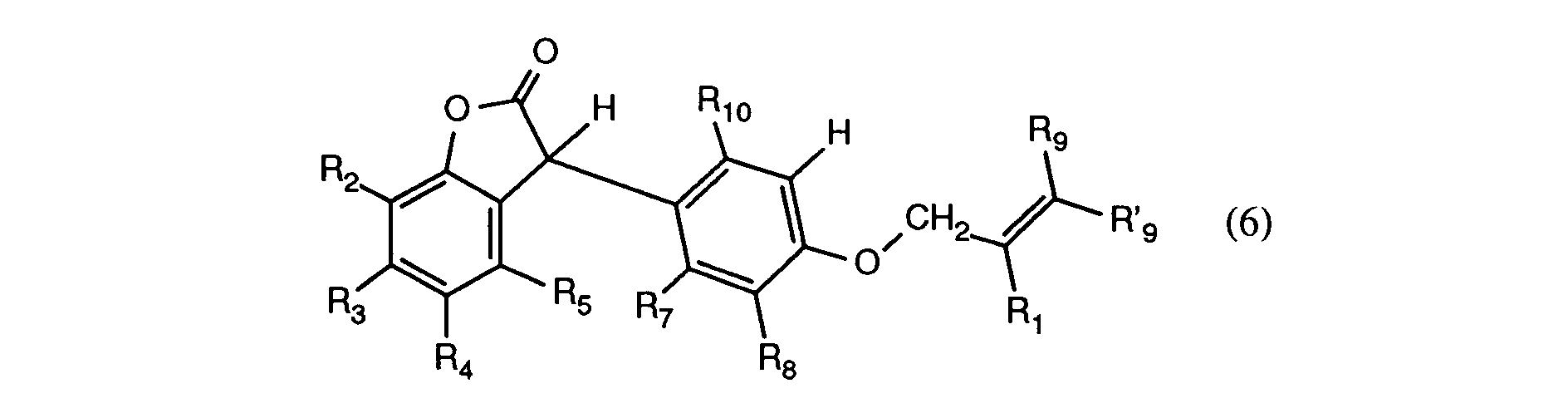
umgesetzt. Bevorzugt wird die Reaktion in einem Lösungsmittel wie beispielsweise Essigsäure oder Ameisensäure in einem Temperaturbereich von 50 bis 130°C durchgeführt. Die Reaktion kann durch Zusatz einer Säure wie Salzsäure, Schwefelsäure oder Methansulfonsäure katalysiert werden. Die Umsetzung kann z.B. in der Weise durchgeführt werden, wie sie in den in der Beschreibungseinleitung angegebenen Literaturstellen beschrieben ist. - Die am Phenylring substituierten Mandelsäuren der Formel (5) sind in der Literatur bekannt oder können beispielsweise gemäss W. Bradley et al, J. Chem. Soc. 1956, 1622; EP-A-146269, EP-B-182507 (Beispiel 1, Seite 4) oder DE-A-2 944 295 in analoger Weise hergestellt werden.
- Die Phenole der Formel (4) sind ebenfalls bekannt oder können nach an sich bekannten Verfahren erhalten werden.
- Bisphenolverbindungen der Formel (7)

können gemäss Houben-Weyl, Methoden der organischen Chemie, Band 6/1c, 1030, hergestellt werden. - Die Verbindungen der Formel (6) werden unter Claisen-Umlagerungsbedingungen, bei erhöhter Temperatur, insbesondere Temperaturen von 200 bis 240°C in der Schmelze oder in einem Lösungsmittel zu den Verbindungen der Formel (8)

umgelagert. Diese Verbindungen können isoliert oder direkt ohne Reinigung in einem Lösungsmittel, wie beispielsweise Essigsäure, mit einer katalytischen Menge einer starken Säure, wie beispielsweise Methansulfonsäure, bei erhöhter Temperatur, insbesondere Temperaturen von 50 bis 130°C zu den erfindungsgemässen Verbindungen der Formel (1) cyclisiert werden.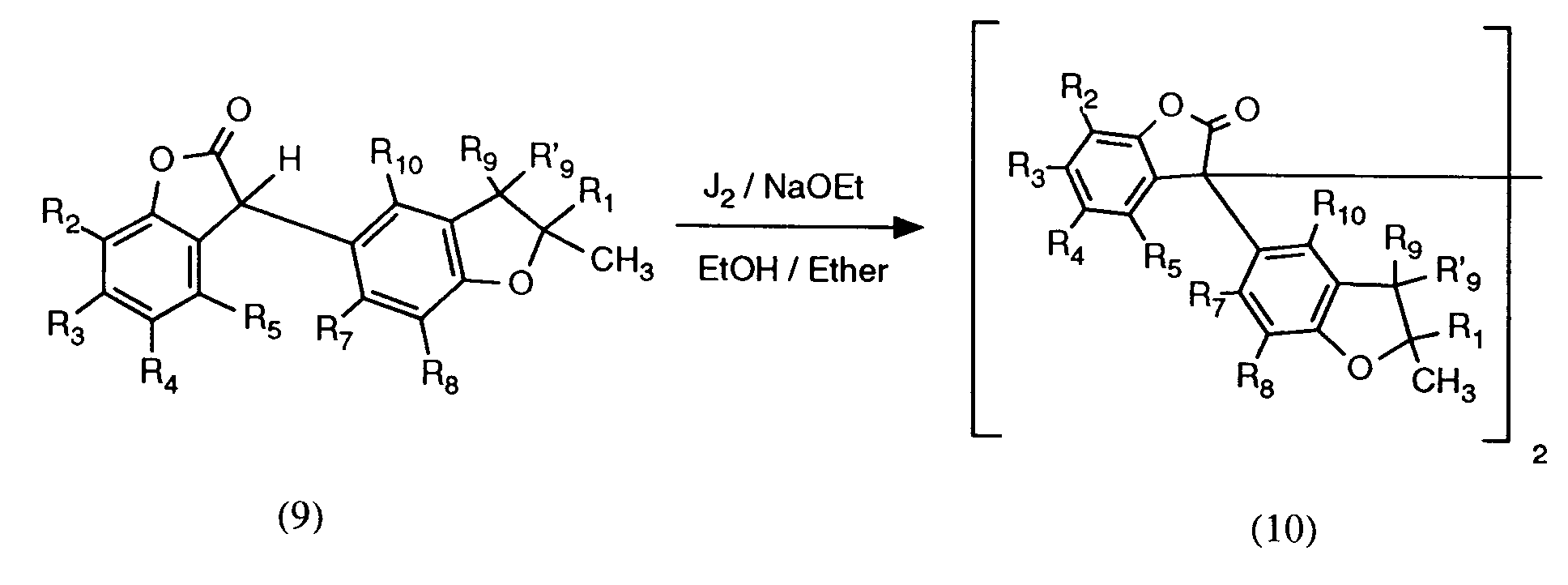
- Die Dimerisierung der Verbindungen der Formel (9) zur Herstellung von Verbindungen der Formel (1), worin R₆ eine Gruppe der Formel (3) ist [Verbindungen der Formel (10)] erfolgt durch Oxidation mit beispielsweise Jod unter basischen Bedingungen in einem organischen Lösungsmittel bei Raumtemperatur. Als Base eignet sich besonders Natriumethylat, als Lösungsmittel Ethanol und Diethylether.
- Die erfindungsgemässen Verbindungen der Formel (1) eignen sich zum Stabilisieren von organischen Materialien gegen thermischen, oxidativen oder lichtinduzierten Abbau.
-
- 1. Polymere von Mono- und Diolefinen, beispielsweise Polypropylen, Polyisobutylen, Polybuten-1, Poly-4-methylpenten- 1, Polyisopren oder Polybutadien sowie Polymerisate von Cycloolefinen wie z.B. von Cyclopenten oder Norbornen; ferner Polyethylen (das gegebenenfalls vernetzt sein kann), z.B. Polyethylen hoher Dichte (HDPE), Polyethylen niederer Dichte (LDPE), lineares Polyethylen niederer Dichte (LLDPE), verzweigtes Polyethylen niederer Dichte (VLDPE).
Polyolefine, d.h. Polymere von Monoolefinen, wie sie beispielhaft im vorstehenden Absatz erwähnt sind, insbesondere Polyethylen und Polypropylen, können nach verschiedenen Verfahren hergestellt werden, insbesondere nach den folgenden Methoden:- a) radikalisch (gewöhnlich bei hohem Druck und hoher Temperatur).
- b) mittels Katalysator, wobei der Katalysator gewöhnlich ein oder mehrere Metalle der Gruppe IVb, Vb, VIb oder VIII enthält. Diese Metalle besitzen gewöhnlich einen oder mehrere Liganden wie Oxide, Halogenide, Alkoholate, Ester, Ether, Amine, Alkyle, Alkenyle und/oder Aryle, die entweder π- oder σ-koordiniert sein können. Diese Metallkomplexe können frei oder auf Träger fixiert sein, wie beispielsweise auf aktiviertem Magnesiumchlorid, Titan(III)chlorid, Aluminiumoxid oder Siliziumoxid. Diese Katalysatoren können im Polymerisationsmedium löslich oder unlöslich sein. Die Katalysatoren können als solche in der Polymerisation aktiv sein, oder es können weitere Aktivatoren verwendet werden, wie beispielsweise Metallalkyle, Metallhydride, Metallalkylhalogenide, Metallalkyloxide oder Metallalkyloxane, wobei die Metalle Elemente der Gruppen Ia, IIa und/oder IIIa sind. Die Aktivatoren können beipielsweise mit weiteren Ester-, Ether-, Amin- oder Silylether-Gruppen modifiziert sein. Diese Katalysatorsysteme werden gewöhnlich als Phillips, Standard Oil Indiana, Ziegler (-Natta), TNZ (DuPont), Metallocen oder Single Site Katalysatoren (SSC) bezeichnet.
- 2. Mischungen der unter 1) genannten Polymeren, z.B. Mischungen von Polypropylen mit Polyisobutylen, Polypropylen mit Polyethylen (z.B. PP/HDPE, PP/LDPE) und Mischungen verschiedener Polyethylentypen (z.B. LDPE/HDPE).
- 3. Copolymere von Mono- und Diolefinen untereinander oder mit anderen Vinylmonomeren, wie z.B. Ethylen-Propylen-Copolymere, lineares Polyethylen niederer Dichte (LLDPE) und Mischungen desselben mit Polyethylen niederer Dichte (LDPE), Propylen-Buten-1-Copolymere, Propylen-Isobutylen-Copolymere, Ethylen-Buten-1-Copolymere, Ethylen-Hexen-Copolymere, Ethylen-Methylpenten-Copolymere, Ethylen-Hepten-Copolymere, Ethylen-Octen-Copolymere, Propylen-Butadien-Copolymere, Isobutylen-Isopren-Copolymere, Ethylen-Alkylacrylat-Copolymere, Ethylen-Alkylmethacrylat- Copolymere, Ethylen-Vinylacetat-Copolymere und deren Copolymere mit Kohlenstoffmonoxid, oder Ethylen-Acrylsäure-Copolymere und deren Salze (Ionomere), sowie Terpolymere von Ethylen mit Propylen und einem Dien, wie Hexadien, Dicyclopentadien oder Ethylidennorbornen; ferner Mischungen solcher Copolymere untereinander und mit unter 1) genannten Polymeren, z.B. Polypropylen/Ethylen-Propylen-Copolymere, LDPE/Ethylen-Vinylacetat-Copolymere, LDPE/Ethylen-Acrylsäure-Copolymere, LLDPE/Ethylen-Vinylacetat-Copolymere, LLDPE/Ethylen-Acrylsäure-Copolymere und alternierend oder statistisch aufgebaute Polyalkylen/Kohlenstoffmonoxid-Copolymere und deren Mischungen mit anderen Polymeren wie z.B. Polyamiden.
- 4. Kohlenwasserstoffharze (z.B. C₅-C₉) inklusive hydrierte Modifikationen davon (z.B. Klebrigmacherharze) und Mischungen von Polyalkylenen und Stärke.
- 5. Polystyrol, Poly-(p-methylstyrol), Poly-(α-methylstyrol).
- 6. Copolymere von Styrol oder α-Methylstyrol mit Dienen oder Acrylderivaten, wie z.B. Styrol-Butadien, Styrol-Acrylnitril, Styrol-Alkylmethacrylat, Styrol-Butadien-Alkylacrylat und -methacrylat, Styrol-Maleinsäureanhydrid, Styrol-Acrylnitril-Methylacrylat;
Mischungen von hoher Schlagzahigkeit aus Styrol-Copolymeren und einem anderen Polymer, wie z.B. einem Polyacrylat, einem Dien-Polymeren oder einem Ethylen-Propylen-Dien-Terpolymeren; sowie Block-Copolymere des Styrols, wie z.B. Styrol-Butadien-Styrol, Styrol-Isopren-Styrol, Styrol-Ethylen/Butylen-Styrol oder Styrol-Ethylen/Propylen-Styrol. - 7. Pfropfcopolymere von Styrol oder α-Methylstyrol, wie z.B. Styrol auf Polybutadien, Styrol auf Polybutadien-Styrol- oder Polybutadien-Acrylnitril-Copolymere, Styrol und Acrylnitril (bzw. Methacrylnitril) auf Polybutadien; Styrol, Acrylnitril und Methylmethacrylat auf Polybutadien; Styrol und Maleinsäureanhydrid auf Polybutadien; Styrol, Acrylnitril und Maleinsäureanhydrid oder Maleinsäureimid auf Polybutadien; Styrol und Maleinsäureimid auf Polybutadien, Styrol und Alkylacrylate bzw. Alkylmethacrylate auf Polybutadien, Styrol und Acrylnitril auf Ethylen-Propylen-Dien-Terpolymeren, Styrol und Acrylnitril auf Polyalkylacrylaten oder Polyalkylmethacrylaten, Styrol und Acrylnitril auf Acrylat-Butadien-Copolymeren, sowie deren Mischungen mit den unter 6) genannten Copolymeren, wie sie z.B. als sogenannte ABS-, MBS-, ASA- oder AES-Polymere bekannt sind.
- 8. Halogenhaltige Polymere, wie z.B. Polychloropren, Chlorkautschuk, chloriertes oder chlorsulfoniertes Polyethylen, Copolymere von Ethylen und chloriertem Ethylen, Epichlorhydrinhomo- und -copolymere, insbesondere Polymere aus halogenhaltigen Vinylverbindungen, wie z.B. Polyvinylchlorid, Polyvinylidenchlorid, Polyvinylfluorid, Polyvinylidenfluorid; sowie deren Copolymere, wie Vinylchlorid-Vinylidenchlorid, Vinylchlorid-Vinylacetat oder Vinylidenchlorid-Vinylacetat.
- 9. Polymere, die sich von α,β-ungesättigten Säuren und deren Derivaten ableiten, wie Polyacrylate und Polymethacrylate, mit Butylacrylat schlagzäh modifizierte Polymethylmethacrylate, Polyacrylamide und Polyacrylnitrile.
- 10. Copolymere der unter 9) genannten Monomeren untereinander oder mit anderen ungesättigten Monomeren, wie z.B. Acrylnitril-Butadien-Copolymere, Acrylnitril-Alkylacrylat-Copolymere, Acrylnitril-Alkoxyalkylacrylat-Copolymere, Acrylnitril-VinylhalogenidCopolymere oder Acrylnitril-Alkylmethacrylat-Butadien-Terpolymere.
- 11. Polymere, die sich von ungesättigten Alkoholen und Aminen bzw. deren Acylderivaten oder Acetalen ableiten, wie Polyvinylalkohol, Polyvinylacetat, -stearat, -benzoat, -maleat, Polyvinylbutyral, Polyallylphthalat, Polyallylmelamin; sowie deren Copolymere mit in Punkt 1 genannten Olefinen.
- 12. Homo- und Copolymere von cyclischen Ethern, wie Polyalkylenglykole, Polyethylenoxyd, Polypropylenoxyd oder deren Copolymere mit Bisglycidylethern.
- 13. Polyacetale, wie Polyoxymethylen, sowie solche Polyoxymethylene, die Comonomere, wie z.B. Ethylenoxid, enthalten; Polyacetale, die mit thermoplastischen Polyurethanen, Acrylaten oder MBS modifiziert sind.
- 14. Polyphenylenoxide und -sulfide und deren Mischungen mit Styrolpolymeren oder Polyamiden.
- 15. Polyurethane, die sich von Polyethern, Polyestern und Polybutadienen mit endständigen Hydroxylgruppen einerseits und aliphatischen oder aromatischen Polyisocyanaten andererseits ableiten, sowie deren Vorprodukte.
- 16. Polyamide und Copolyamide, die sich von Diaminen und Dicarbonsäuren und/oder von Aminocarbonsäuren oder den entsprechenden Lactamen ableiten, wie Polyamid 4, Polyamid 6, Polyamid 6/6, 6/10, 6/9, 6/12, 4/6, 12/12, Polyamid 11, Polyamid 12, aromatische Polyamide ausgehend von m-Xylol, Diamin und Adipinsäure; Polyamide, hergestellt aus Hexamethylendiamin und Iso- und/oder Terephthalsäure und gegebenenfalls einem Elastomer als Modifikator, z.B. Poly-2,4,4-trimethylhexamethylenterephthalamid oder Poly-m-phenylen-isophthalamid. Block-Copolymere der vorstehend genanntenPolyamide mit Polyolefinen, Olefin-Copolymeren, Ionomeren oder chemisch gebundenen oder gepfropften Elastomeren; oder mit Polyethern, wie z.B. mit Polyethylenglykol, Polypropylenglykol oder Polytetramethylenglykol. Ferner mit EPDM oder ABS modifizierte Polyamide oder Copolyamide; sowie während der Verarbeitung kondensierte Polyamide ("RIM-Polyamidsysteme").
- 17. Polyharnstoffe, Polyimide, Polyamid-imide und Polybenzimidazole.
- 18. Polyester, die sich von Dicarbonsäuren und Dialkoholen und/oder von Hydroxycarbonsäuren oder den entsprechenden Lactonen ableiten, wie Polyethylenterephthalat, Polybutylenterephthalat, Poly-1,4-dimethylolcyclohexanterephthalat, Polyhydroxybenzoate, sowie Block-Polyether-ester, die sich von Polyethern mit Hydroxylendgruppen ableiten; ferner mit Polycarbonaten oder MBS modifizierte Polyester.
- 19. Polycarbonate und Polyestercarbonate.
- 20. Polysulfone, Polyethersulfone und Polyetherketone.
- 21. Vernetzte Polymere, die sich von Aldehyden einerseits und Phenolen, Harnstoff oder Melamin andererseits ableiten, wie Phenol-Formaldehyd-, Harnstoff-Formaldehyd- und Melamin-Formaldehydharze.
- 22. Trocknende und nicht-trocknende Alkydharze.
- 23. Ungesättigte Polyesterharze, die sich von Copolyestern gsättigter und ungesättigter Dicarbonsäuren mit mehrwertigen Alkoholen, sowie Vinylverbindungen als Vernetzungsmittel ableiten, wie auch deren halogenhaltige, schwerbrennbare Modifikationen.
- 24. Vernetzbare Acrylharze, die sich von substituierten Acrylsäureestern ableiten, wie z.B. von Epoxyacrylaten, Urethan-acrylaten oder Polyester-acrylaten.
- 25. Alkydharze, Polyesterharze und Acrylatharze, die mit Melaminharzen, Harnstoffharzen, Polyisocyanaten oder Epoxidharzen vernetzt sind.
- 26. Vernetzte Epoxidharze, die sich von Polyepoxiden ableiten, z.B. von Bis-glycidylethern oder von cycloaliphatischen Diepoxiden.
- 27. Natürliche Polymere, wie Cellulose, Naturkautschuk, Gelatine, sowie deren polymerhomolog chemisch abgewandelte Derivate, wie Celluloseacetate, -propionate und -butyrate, bzw. die Celluloseether, wie Methylcellulose; sowie Kolophoniumharze und Derivate.
- 28. Mischungen (Polyblends) der vorgenannten Polymeren, wie z.B. PP/EPDM, Polyamid/EPDM oder ABS, PVC/EVA, PVC/ABS, PVC/MBS, PC/ABS, PBTP/ABS, PC/ASA, PC/PBT, PVC/CPE, PVC/Acrylate, POM/thermoplastisches PUR, PC/thermoplastisches PUR, POM/Acrylat, POM/MBS, PPO/HIPS, PPO/PA 6.6 und Copolymere, PA/HDPE, PA/PP, PA/PPO.
- 29. Natürliche und synthetische organische Stoffe, die reine monomere Verbindungen oder Mischungen von solchen darstellen, beispielsweise Mineralöle, tierische oder pflanzliche Fette, Oele und Wachse, oder Oele, Wachse und Fette auf Basis synthetischer Ester (z.B. Phthalate, Adipate, Phosphate oder Trimellitate), sowie Abmischungen synthetischer Ester mit Mineralölen in beliebigen Gewichtsverhältnissen, wie sie z.B. als Spinnpräparationen Anwendung finden, sowie deren wässrige Emulsionen.
- 30.Wässrige Emulsionen natürlicher oder synthetischer Kautschuke, wie z.B. Naturkautschuk-Latex oder Latices von carboxylierten Styrol-Butadien-Copolymeren.
- Weitere Gegenstände der Erfindung sind daher auch Zusammensetzungen enthaltend ein dem oxidativen, thermischen oder lichtinduzierten Abbau unterworfenes organisches Material und mindestens eine Verbindung der Formel (1).
- Bevorzugte organische Materialien sind Polymere, z.B. synthetische Polymere, insbesondere thermoplastische Polymere. Besonders bevorzugt sind Polyacetale oder Polyolefine, z.B. Polypropylen oder Polyethylen.
- Besonders hervorzuheben ist die Wirkung der erfindungsgemässen Verbindungen gegen thermischen und oxidativen Abbau, vor allem bei thermischer Belastung, wie sie bei der Verarbeitung von Thermoplasten auftritt. Die erfindungsgemässen Verbindungen sind daher hervorragend als Verarbeitungsstabilisatoren einzusetzen.
- Vorzugsweise werden die Verbindungen der Formel (1) dem zu stabilisierenden Material in Mengen von 0,0005 bis 5 %, insbesondere 0,001 bis 2 %, beispielsweise 0,01 bis 2 %, zugesetzt, bezogen auf das Gewicht des zu stabilisierenden organischen Materials.
- Zusätzlich zu den Verbindungen der Formel (1) können die erfindungsgemässen Zusammensetzungen weitere Costabilisatoren enthalten, wie beispielsweise die folgenden:
- 1. Antioxidantien
- 1.1. Alkylierte Monophenole, z.B. 2,6-Di-tert-butyl-4-methylphenol, 2-butyl-4,6-dimethylphenol, 2,6-Di-tert-butyl-4-ethylphenol, 2,6-Di-tert-butyl-4-n-butylphenol, 2,6-Di-tert-butyl-4-iso-butylphenol, 2,6-Di-cyclopentyl-4-methylphenol, 2-(α-Methylcyclohexyl)-4,6-dimethylphenol, 2,6-Di-octadecyl-4-methylphenol, 2,4,6-Tri-cyclohexylphenol, 2,6-Di-tert-butyl-4-methoxymethylphenol, 2,6-Di-nonyl-4-methylphenol, 2,4-Dimethyl-6-(1'-methyl-undec-1'-yl)-phenol, 2,4-Dimethyl-6-(1'-methyl-heptadec-1'-yl)-phenol, 2,4-Dimethyl-6-(1'-methyl-tridec-1'-yl)-phenol und Mischungen davon.
- 1.2. Alkylthiomethylphenole, z.B. 2,4-Di-octylthiomethyl-6-tert-butylphenol, 2,4-Di-octylthiomethyl-6-methylphenol, 2,4-Di-octylthiomethyl-6-ethylphenol, 2,6-Di-dodecylthiomethyl-4-nonylphenol.
- 1.3. Hydrochinone und alkylierte Hydrochinone, z.B. 2,6-Di-tert-butyl-4-methoxyphenol, 2,5-Di-tert-butyl-hydrochinon, 2,5-Di-tert-amyl-hydrochinon, 2,6-Diphenyl-4-octadecyloxyphenol, 2,6-Di-tert-butyl-hydrochinon, 2,5-Di-tert-butyl-4-hydroxyanisol, 3,5-Di-tertbutyl-4-hydroxyanisol, 3,5-Di-tert-butyl-4-hydroxyphenyl-stearat, Bis-(3,5-di-tert-butyl4-hydroxyphenyl)adipat.
- 1.4. Hydroxylierte Thiodiphenylether, z.B. 2,2'-Thio-bis-(6-tert-butyl-4-methylphenol), 2,2'-Thio-bis-(4-octylphenol), 4,4'-Thio-bis-(6-tert-butyl-3-methylphenol), 4,4'-Thio-bis-(6-tert-butyl-2-methylphenol), 4,4'-Thio-bis-(3,6-di-sec.-amylphenol), 4,4'-Bis-(2,6-di-methyl-4-hydroxyphenyl)-disulfid.
- 1.5. Alkyliden-Bisphenole, z.B. 2,2'-Methylen-bis-(6-tert-butyl-4-methylphenol), 2,2'-Methylen-bis-(6-tert-butyl-4-ethylphenol), 2,2'-Methylen-bis-[4-methyl-6-(α-methyl- cyclohexyl)-phenol], 2,2'-Methylen-bis-(4-methyl-6-cyclohexylphenol), 2,2'-Methylen-bis-(6-nonyl-4-methylphenol), 2,2'-Methylen-bis-(4,6-di-tert-butylphenol), 2,2'-Ethyliden-bis-(4,6-di-tert-butylphenol), 2,2'-Ethyliden-bis-(6-tert-butyl-4-isobutylphenol), 2,2'-Methylen-bis-[6-(α-methylbenzyl)-4-nonylphenol], 2,2'-Methylen-bis-[6-(α,α-di-methylbenzyl)-4-nonylphenol], 4,4'-Methylen-bis-(2,6-di-tert-butylphenol), 4,4'-Methylen-bis-(6-tert-butyl-2-methylphenol), 1,1-Bis-(5-tert-butyl-4-hydroxy-2-methylphenyl)butan, 2,6-Bis-(3-tert-butyl-5-methyl-2-hydroxybenzyl)-4-methylphenol, 1,1,3-Tris-(5-tert-butyl-4-hydroxy-2-methylphenyl)-butan, 1,1-Bis-(5-tert-butyl-4-hydroxy-2-methylphenyl)-3-n-dodecylmercaptobutan, Ethylenglycol-bis-[3,3-bis-(3'-tert-butyl-4'-hydroxyphenyl)-butyrat], Bis-(3-tert-butyl-4-hydroxy-5-methyl-phenyl)-dicyclopentadien, Bis-[2-(3'-tert-butyl-2'-hydroxy-5'-methyl-benzyl)-6-tert-butyl-4-methyl-phenyl]-terephthalat, 1,1-Bis-(3,5-dimethyl-2-hydroxyphenyl)-butan, 2,2-Bis-(3,5-di-tert-butyl-4-hydroxyphenyl)-propan, 2,2-Bis-(5-tert-butyl-4-hydroxy-2-methylphenyl)-4-n-dodecylmercaptobutan, 1,1,5,5-Tetra-(5-tert-butyl-4-hydroxy-2-methylphenyl)-pentan.
- 1.6. O-, N- und S-Benzylverbindungen, z.B. 3,5,3',5'-Tetra-tert-butyl-4,4'-dihydroxydibenzylether, Octadecyl-4-hydroxy-3,5-dimethylbenzyl-mercaptoacetat, Tris-(3,5-di-tert-butyl-4-hydroxybenzyl)-amin, Bis-(4-tert-butyl-3-hydroxy-2,6-dimethylbenzyl)-di-thioterephthalat, Bis-(3,5-di-tert-butyl-4-hydroxybenzyl)-sulfid, Isooctyl-3,5-di-tert-butyl-4-hydroxybenzyl-mercaptoacetat.
- 1.7. Hydroxybenzylierte Malonate, z.B. Dioctadecyl-2,2-bis-(3,5-di-tert-butyl-2-hydroxybenzyl)-malonat, Di-octadecyl-2-(3-tert-butyl-4-hydroxy-5-methylbenzyl)-malonat, Di-dodecylmercaptoethyl-2,2-bis-(3,5-di-tert-butyl-4-hydroxybenzyl)-malonat, Di-[4-(1,1,3,3-tetramethylbutyl)-phenyl]-2,2-bis-(3,5-di-tert-butyl-4-hydroxybenzyl)-malonat.
- 1.8. Hydroxybenzyl-Aromaten, z.B. 1,3,5-Tris-(3,5-di-tert-butyl-4-hydroxybenzyl)-2,4,6-trimethylbenzol, 1,4-Bis-(3,5-di-tert-butyl-4-hydroxybenzyl)-2,3,5,6-tetramethylbenzol, 2,4,6-Tris-(3,5-di-tert-butyl-4-hydroxybenzyl)-phenol.
- 1.9. Triazinverbindungen, z.B. 2,4-Bis-octylmercapto-6-(3,5-di-tert-butyl-4-hydroxyanilino)-1,3,5-triazin, 2-Octylmercapto-4,6-bis-(3,5-di-tert-butyl-4-hydroxyanilino)-1,3,5-triazin, 2-Octylmercapto-4,6-bis-(3,5-di-tert-butyl-4-hydroxyphenoxy)-1,3,5-triazin, 2,4,6-Tris-(3,5-di-tert-butyl-4-hydroxyphenoxy)-1,2,3-triazin, 1,3,5-Tris-(3,5-di-tert-butyl-4-hydroxybenzyl)-isocyanurat, 1,3,5-Tris-(4-tert-butyl-3-hydroxy-2,6-dimethylbenzyl)-isocyanurat, 2,4,6-Tris-(3,5-di-tert-butyl-4-hydroxyphenylethyl)-1,3,5-triazin, 1,3,5-Tris-(3,5-di-tert-butyl-4-hydroxyphenylpropionyl)-hexahydro-1,3,5-triazin, 1,3,5-Tris-(3,5-dicyclohexyl-4-hydroxybenzyl)-isocyanurat.
- 1.10. Benzylphosphonate, z.B. Dimethyl-2,5-di-tert-butyl-4-hydroxybenzylphosphonat, Diethyl-3,5-di-tert-butyl-4-hydroxybenzylphosphonat, Dioctadecyl-3,5-di-tert-butyl-4-hydroxybenzylphosphonat, Dioctadecyl-5-tert-butyl-4-hydroxy-3-methylbenzylphosphonat, Ca-Salz des 3,5-Di-tert-butyl-4-hydroxybenzyl-phosphonsäure-monoethylesters.
- 1.11. Acylaminophenole, z.B. 4-Hydroxy-laurinsäureanilid, 4-Hydroxystearinsäureanilid, N-(3,5-di-tert-butyl-4-hydroxyphenyl)-carbaminsäureoctylester.
- 1.12. Ester der β-(3,5-Di-tert-butyl-4-hydroxyphenyl)-propionsäure mit ein- oder mehr wertigen Alkoholen, wie z.B. mit Methanol, Ethanol, Octadecanol, 1,6-Hexandiol, 1,9-Nonandiol, Ethylenglycol, 1,2-Propandiol, Neopentylglycol, Thiodiethylenglycol, Diethylenglycol, Triethylenglycol, Pentaerythrit, Tris-(hydroxyethyl)-isocyanurat, N,N'-Bis-(hydroxyethyl)-oxalsäurediamid, 3-Thiaundecanol, 3-Thiapentadecanol, Trimethylhexandiol, Trimethylolpropan, 4-Hydroxymethyl-1-phospha-2,6,7-trioxabicyclo-[2.2.2]-octan.
- 1.13. Ester der β-(5-tert-Butyl-4-hydroxy-3-methylphenyl)-propionsäure mit ein- oder mehrwertigen Alkoholen, wie z.B. mit Methanol, Ethanol, Octadecanol, 1,6-Hexandiol, 1,9-Nonandiol, Ethylenglycol, 1,2-Propandiol, Neopentylglycol, Thiodiethylenglycol, Diethylenglycol, Triethylenglycol, Pentaerythrit, Tris-(hydroxy)ethyl-isocyanurat, N,N'-Bis-(hydroxyethyl)-oxalsäurediamid, 3-Thiaundecanol, 3-Thiapentadecanol, Trimethylhexandiol, Trimethylolpropan, 4-Hydroxymethyl-1-phospha-2,6,7-trioxabicyclo-[2.2.2]-octan.
- 1.14. Ester der β-(3,5-Dicyclohexyl-4-hydroxyphenyl)-propionsäure mit ein- oder mehr wertigen Alkoholen, wie z.B. mit Methanol, Ethanol, Octadecanol, 1,6-Hexandiol, 1,9-Nonandiol, Ethylenglycol, 1,2-Propandiol, Neopentylglycol, Thiodiethylenglycol, Diethylenglycol, Triethylenglycol, Pentaerythrit, Tris-(hydroxy)ethyl-isocyanurat, N,N'-Bis-(hydroxyethyl)-oxalsäurediamid, 3-Thiaundecanol, 3-Thiapentadecanol, Trimethylhexandiol, Trimethylolpropan, 4-Hydroxymethyl-1-phospha-2,6,7-trioxabicyclo-[2.2.2]-octan.
- 1.15. Ester der 3,5-Di-tert-butyl-4-hydroxyphenylessigsäure mit ein- oder mehrwertigen Alkoholen, wie z.B. mit Methanol, Ethanol, Octadecanol, 1,6-Hexandiol, 1,9-Nonandiol, Ethylenglycol, 1,2-Propandiol, Neopentylglycol, Thiodiethylenglycol, Diethylenglycol, Triethylenglycol, Pentaerythrit, Tris-(hydroxy)ethyl-isocyanurat, N,N'-Bis-(hydroxyethyl)-oxalsäurediamid, 3-Thiaundecanol, 3-Thiapentadecanol, Trimethylhexandiol, Trimethylolpropan, 4-Hydroxymethyl-1-phospha-2,6,7-trioxabicyclo-[2.2.2]-octan.
- 1.16. Amide der β(3,5-Di-tert-butyl-4-hydroxyphenyl)-propionsäure, wie z.B. N,N'-Bis-(3,5-di-tert-butyl-4-hydroxyphenylpropionyl)-hexamethylendiamin, N,N'-Bis-(3,5-di-tert-butyl-4-hydroxyphenylpropionyl)-trimethylendiamin, N,N'-Bis-(3,5-di-tert-butyl-4-hydroxyphenylpropionyl)-hydrazin.
- 2. UV-Absorber und Lichtschutzmittel
- 2.1. 2-(2'-Hydroxyphenyl)-benztriazole, wie z.B. 2-(2'-Hydroxy-5'-methylphenyl)-benztriazol, 2-(3',5'-Di-tert-butyl-2'-hydroxyphenyl)-benztriazol, 2-(5'-tert-Butyl-2'-hydroxyphenyl)-benztriazol, 2-(2'-Hydroxy-5'-(1,1,3,3-tetramethylbutyl)phenyl)-benztriazol, 2-(3',5'-Di-tert-butyl-2'-hydroxyphenyl)-5-chlor-benztriazol, 2-(3'-tert-Butyl- 2'-hydroxy-5'-methylphenyl)-5-chlor-benztriazol, 2-(3'-sec-Butyl-5'-tert-butyl-2'-hydroxyphenyl)-benztriazol, 2-(2'-Hydroxy-4'-octoxyphenyl)-benztriazol, 2-(3',5'-Di-tert-amyl-2'-hydroxyphenyl)-benztriazol, 2-(3',5'-Bis-(α,α-dimethylbenzyl)-2'-hydroxyphenyl)- benztriazol, Mischung aus 2-(3'-tert-Butyl-2'-hydroxy-5'-(2-octyloxycarbonylethyl)phenyl)-5-chlor-benztriazol, 2-(3'-tert-Butyl-5'-[2-(2-ethylhexyloxy)-carbonylethyl]-2'-hydroxyphenyl)-5-chlor-benztriazol, 2-(3'-tert-Butyl-2'-hydroxy-5'-(2-methoxycarbonylethyl)phenyl)-5-chlor-benztriazol, 2-(3'-tert-Butyl-2'-hydroxy-5'-(2-methoxycarbonylethyl)phenyl)-benztriazol, 2-(3'-tert-Butyl-2'-hydroxy-5'-(2-octyloxycarbonylethyl)phenyl)-benztriazol, 2-(3'-tert-Butyl-5'-[2-(2-ethylhexyloxy)carbonylethyl]-2'-hydroxyphenyl)-benztriazol, 2-(3'-Dodecyl-2'-hydroxy-5'-methylphenyl)-benztriazol, und 2-(3'-tert-Butyl-2'-hydroxy-5'-(2-isooctyloxycarbonylethyl)phenyl-benztriazol, 2,2'-Methylen-bis[4-(1,1,3,3-tetramethylbutyl)-6-benztriazol-2-yl-phenol]; Umesterungsprodukt von 2-[3'-tert-Butyl-5'-(2-methoxycarbonylethyl)-2'-hydroxy-phenyl]-benztriazol mit Polyethylenglycol 300; [R-CH₂CH₂-COO(CH₂)₃mit R = 3'-tert-Butyl-4'-hydroxy-5'-2H-benztriazol-2-yl-phenyl.

- 2.2. 2-Hydroxybenzophenone, wie z.B. das 4-Hydroxy-, 4-Methoxy-, 4-Octoxy-, 4-Decyloxy-, 4-Dodecyloxy-, 4-Benzyloxy-, 4,2',4'-Trihydroxy-, 2'-Hydroxy-4,4'-dimethoxy-Derivat.
- 2.3. Ester von gegebenenfalls substituierten Benzoesäuren, wie z.B. 4-tert-Butyl-phenylsalicylat, Phenylsalicylat, Octylphenyl-salicylat, Dibenzoylresorcin, Bis-(4-tert-butylbenzoyl)-resorcin, Benzoylresorcin, 3,5-Di-tert-butyl-4-hydroxybenzoesäure-2,4-di-tert-butylphenylester, 3,5-Di-tert-butyl-4-hydroxybenzoesäurehexadecylester, 3,5-Di-tert-butyl-4-hydroxybenzoesäure-octadecylester, 3,5-Di-tert-butyl-4-hydroxybenzoesäure-2-methyl-4,6-di-tert-butylphenylester.
- 2.4. Acrylate, wie z.B. α-Cyan-β,β-diphenylacrylsäure-ethylester bzw. -isooctylester, α-Carbomethoxy-zimtsäuremethylester, α-Cyano-β-methyl-p-methoxy-zimtsäuremethylester bzw. -butylester, α-Carbomethoxy-p-methoxy-zimtsäure-methylester, N-(β-Carbomethoxy-β-cyanovinyl)-2-methyl-indolin.
- 2.5. Nickelverbindungen, wie z.B. Nickelkomplexe des 2,2'-Thio-bis-[4-(1,1,3,3-tetramethylbutyl)-phenols], wie der 1:1- oder der 1:2-Komplex, gegebenenfalls mit zusätzlichen Liganden, wie n-Butylamin, Triethanolamin oder N-Cyclohexyl-diethanolamin, Nickeldibutyldithiocarbamat, Nickelsalze von 4-Hydroxy-3,5-di-tert-butylbenzylphosphonsäure-monoalkylestern, wie vom Methyl- oder Ethylester, Nickelkomplexe von Ketoximen, wie von 2-Hydroxy-4-methyl-phenyl-undecylketoxim, Nickelkomplexe des 1-Phenyl-4-lauroyl-5-hydroxy-pyrazols, gegebenenfalls mit zusätzlichen Liganden.
- 2.6. Sterisch gehinderte Amine, wie z.B. Bis-(2,2,6,6-tetramethyl-piperidyl)-sebacat, Bis-(2,2,6,6-tetramethyl-piperidyl)-succinat, Bis-(1,2,2,6,6-pentamethylpiperidyl)-sebacat, n-Butyl-3,5-di-tert-butyl-4-hydroxybenzyl-malonsäure-bis(1,2,2,6,6-pentamethylpiperidyl)-ester, Kondensationsprodukt aus 1-Hydroxyethyl-2,2,6,6-tetramethyl-4-hydroxypiperidin und Bernsteinsäure, Kondensationsprodukt aus N,N'-Bis-(2,2,6,6-Tetramethyl-4-piperidyl)-hexamethylendiamin und 4-tert-Octylamino-2,6-dichlor-1,3,5-s-triazin, Tris-(2,2,6,6-tetramethyl- 4-piperidyl)-nitrilotriacetat, Tetrakis-(2,2,6,6-tetramethyl-4-piperidyl)-1,2,3,4-butantetraoat, 1,1'-(1,2-Ethandiyl)-bis-(3,3,5,5-tetramethyl-piperazinon), 4-Benzoyl-2,2,6,6-tetramethylpiperidin, 4-Stearyloxy-2,2,6,6-tetramethylpiperidin, Bis-(1,2,2,6,6-pentamethylpipendyl)-2-n-butyl-2-(2-hydroxy-3,5-di-tert-butylbenzyl)-malonat, 3-n-Octyl-7,7,9,9-tetramethyl-1,3,8-triazaspiro[4.5]decan-2,4-dion, Bis-(1-octyloxy-2,2,6,6-tetramethylpiperidyl)-sebacat, Bis-(1-octyloxy-2,2,6,6-tetramethylpiperidyl)succinat, Kondensationsprodukt aus N,N'-Bis-(2,2,6,6-tetramethyl-4-piperidyl)-hexamethylendiamin und 4-Morpholino-2,6-dichlor-1,3,5-triazin, Kondensationsprodukt aus 2-Chlor-4,6-di-(4-n-butylamino-2,2,6,6-tetramethylpiperidyl)- 1,3 ,5-triazin und 1,2-Bis-(3-aminopropylamino)äthan, Kondensationsprodukt aus 2-Chlor-4,6-di-(4-n-butylamino-1,2,2,6,6-pentamethylpiperidyl)-1,3,5-triazin und 1,2-Bis-(3-aminopropylamino)-äthan, 8-Acetyl-3-dodecyl-7,7,9,9-tetramethyl-1,3,8-triazaspiro[4.5]decan-2,4-dion, 3-Dodecyl-1-(2,2,6,6-tetramethyl-4-piperidyl)pyrrolidin-2,5-dion, 3-Dodecyl-1-(1,2,2,6,6-pentamethyl-4-piperidyl)-pyrrolidin-2,5-dion.
- 2.7. Oxalsäurediamide, wie z.B. 4,4'-Di-octyloxy-oxanilid, 2,2'-Di-octyloxy-5,5'-di-tert-butyl-oxanilid, 2,2'-Di-dodecyloxy-5,5,di-tert-butyl-oxanilid, 2-Ethoxy-2'-ethyl-oxanilid, N,N'-Bis-(3-dimethylaminopropyl)-oxalamid, 2-Ethoxy-5-tert-butyl-2'-ethyloxanilid und dessen Gemisch mit 2-Ethoxy-2'-ethyl-5,4'-di-tert-butyl-oxanilid, Gemische von o- und p-Methoxy- sowie von o- und p-Ethoxy-di-substituierten Oxaniliden.
- 2.8. 2-(2-Hydroxyphenyl)-1,3,5-triazine, wie z.B. 2,4,6-Tris(2-hydroxy-4-octyloxyphenyl)-1,3,5-triazin, 2-(2-Hydroxy-4-octyloxyphenyl)-4,6-bis-(2,4-dimethylphenyl)-1,3,5-triazin, 2-(2,4-Dihydroxyphenyl)-4,6-bis(2,4-dimethylphenyl)-1,3,5-triazin, 2,4-Bis-(2-hydroxy-4-propyloxyphenyl)-6-(2,4-dimethylphenyl)-1,3,5-triazin, 2-(2-Hydroxy-4-octyloxyphenyl)-4,6-bis(4-methylphenyl)-1,3,5-triazin, 2-(2-Hydroxy-4-dodecyloxyphenyl)-4,6-bis(2,4-dimethylphenyl)-1,3,5-triazin, 2-[2-hydroxy-4-(2-hydroxy-3-butyloxy-propyloxy)phenyl]-4,6-bis(2,4-dimethylphenyl)-1,3,5-triazin, 2-[2-hydroxy-4-(2-hydroxy-3-octyloxy-propyloxy)phenyl]-4,6-bis(2,4-dimethylphenyl)-1,3,5-triazin.
- 2.1. 2-(2'-Hydroxyphenyl)-benztriazole, wie z.B. 2-(2'-Hydroxy-5'-methylphenyl)-benztriazol, 2-(3',5'-Di-tert-butyl-2'-hydroxyphenyl)-benztriazol, 2-(5'-tert-Butyl-2'-hydroxyphenyl)-benztriazol, 2-(2'-Hydroxy-5'-(1,1,3,3-tetramethylbutyl)phenyl)-benztriazol, 2-(3',5'-Di-tert-butyl-2'-hydroxyphenyl)-5-chlor-benztriazol, 2-(3'-tert-Butyl- 2'-hydroxy-5'-methylphenyl)-5-chlor-benztriazol, 2-(3'-sec-Butyl-5'-tert-butyl-2'-hydroxyphenyl)-benztriazol, 2-(2'-Hydroxy-4'-octoxyphenyl)-benztriazol, 2-(3',5'-Di-tert-amyl-2'-hydroxyphenyl)-benztriazol, 2-(3',5'-Bis-(α,α-dimethylbenzyl)-2'-hydroxyphenyl)- benztriazol, Mischung aus 2-(3'-tert-Butyl-2'-hydroxy-5'-(2-octyloxycarbonylethyl)phenyl)-5-chlor-benztriazol, 2-(3'-tert-Butyl-5'-[2-(2-ethylhexyloxy)-carbonylethyl]-2'-hydroxyphenyl)-5-chlor-benztriazol, 2-(3'-tert-Butyl-2'-hydroxy-5'-(2-methoxycarbonylethyl)phenyl)-5-chlor-benztriazol, 2-(3'-tert-Butyl-2'-hydroxy-5'-(2-methoxycarbonylethyl)phenyl)-benztriazol, 2-(3'-tert-Butyl-2'-hydroxy-5'-(2-octyloxycarbonylethyl)phenyl)-benztriazol, 2-(3'-tert-Butyl-5'-[2-(2-ethylhexyloxy)carbonylethyl]-2'-hydroxyphenyl)-benztriazol, 2-(3'-Dodecyl-2'-hydroxy-5'-methylphenyl)-benztriazol, und 2-(3'-tert-Butyl-2'-hydroxy-5'-(2-isooctyloxycarbonylethyl)phenyl-benztriazol, 2,2'-Methylen-bis[4-(1,1,3,3-tetramethylbutyl)-6-benztriazol-2-yl-phenol]; Umesterungsprodukt von 2-[3'-tert-Butyl-5'-(2-methoxycarbonylethyl)-2'-hydroxy-phenyl]-benztriazol mit Polyethylenglycol 300; [R-CH₂CH₂-COO(CH₂)₃
- 3. Metalldesaktivatoren, wie z.B. N,N'-Diphenyloxalsäurediamid, N-Salicylal-N'-salicyloylhydrazin, N,N'-Bis-(salicyloyl)-hydrazin, N,N'-Bis-(3,5-di-tert-butyl-4-hydroxyphenylpropionyl)-hydrazin, 3-Salicyloylamino-1,2,4-triazol, Bis-(benzyliden)-oxalsäuredihydrazid, Oxanilid, Isophthalsäure-dihydrazid, Sebacinsäure-bis-phenylhydrazid, N,N'-Diacetyl-adipinsäure-dihydrazid, N,N'-Bis-salicyloyl-oxalsäure-dihydrazid, N,N'-Bis-salicyloyl-thiopropionsäure-dihydrazid.
- 4. Phosphite und Phosphonite, wie z.B. Triphenylphosphit, Diphenylalkylphosphite, Phenyldialkylphosphite, Tris-(nonylphenyl)-phosphit, Trilaurylphosphit, Trioctadecylphosphit, Distearyl-pentaerythritdiphosphit, Tris-(2,4-di-tert-butylphenyl)-phosphit, Diisodecylpentaerythrit-diphosphit, Bis-(2,4-di-tert-butylphenyl)-pentaerythritdiphosphit, Bis-(2,6-di-tert-butyl-4-methylphenyl)-pentaerythritdiphosphit, Bis-isodecyloxy-pentaerythrit-diphosphit, Bis-(2,4-di-tert-butyl-6-methylphenyl)-pentaerythritdiphosphit, Bis-(2,4,6-tri- tert-butylphenyl)-pentaerythritdiphosphit, Tristearyl-sorbit-triphosphit, Tetrakis-(2,4-di-tert-butylphenyl)-4,4'-biphenylen-diphosphonit, 6-Isooctyloxy-2,4,8,10-tetra-tert-butyl-12H-dibenz[d,g]-1,3,2-dioxaphosphocin, 6-Fluor-2,4,8,10-tetra-tert-butyl-12-methyl-di-benz[d,g]-1,3,2-dioxaphosphocin, Bis-(2,4-di-tert-butyl-6-methylphenyl)-methylphosphit, Bis-(2,4-di-tert-butyl-6-methylphenyl)-ethylphosphit.
- 5. Peroxidzerstörende Verbindungen, wie z.B. Ester der β-Thio-dipropionsäure, beispielsweise der Lauryl-, Stearyl-, Myristyl- oder Tridecylester, Mercaptobenzimidazol, das Zinksalz des 2-Mercaptobenzimidazols, Zink-dibutyl-dithiocarbamat, Dioctadecyldisulfid, Pentaerythrit-tetrakis-(β-dodecylmercapto)-propionat
- 6. Polyamidstabilisatoren, wie z.B. Kupfersalze in Kombination mit Jodiden und/oder Phosphorverbindungen und Salze des zweiwertigen Mangans.
- 7. Basische Co-Stabilisatoren, wie z.B. Melamin, Polyvinylpyrrolidon, Dicyandiamid, Triallylcyanurat, Harnstoff-Derivate, Hydrazin-Derivate, Amine, Polyamide, Polyurethane, Alkali- und Erdalkalisalze höherer Fettsäuren, beispielsweise Ca-Stearat, Zn-Stearat, Mg-Behenat, Mg-Stearat, Na-Ricinoleat, K-Palmitat, Antimonbrenzcatechinat oder Zinnbrenzcatechinat.
- 8. Nukleierungsmittel, wie z.B. 4-tert-Butylbenzoesäure, Adipinsäure, Diphenylessigsäure.
- 9. Füllstoffe und Verstärkungsmittel, wie z.B. Calciumcarbonat, Silikate, Glasfasern, Asbest, Talk, Kaolin, Glimmer, Bariumsulfat, Metalloxide und -hydroxide, Ruß, Graphit.
- 10. Sonstige Zusätze, wie z.B. Weichmacher, Gleitmittel, Emulgatoren, Pigmente, Optische Aufheller, Flammschutzmittel, Antistatika, Treibmittel.
- Die Costabilisatoren werden beispielsweise in Konzentrationen von 0,01 bis 10 %, bezogen auf das Gesamtgewicht des zu stabilisierenden Materials, zugesetzt.
- Die erfindungsgemässen Verbindungen der Formel (1) können insbesondere zusammen mit phenolischen Antioxidantien eingesetzt werden. Die erfindungsgemässen Zusammensetzungen enthalten daher vorzugsweise neben Verbindungen der Formel (1) phenolische Antioxidantien, insbesondere solche, wie sie in den obigen Punkten 1.1 bis 1.16 aufgelistet sind.
- Andere bevorzugte Zusammensetzungen enthalten neben den Verbindungen der Formel (1) mindestens ein organisches Phosphit oder Phosphonit.
- Die Einarbeitung der Verbindungen der Formel (1) sowie gegebenenfalls weiterer Additive in das polymere, organische Material erfolgt nach bekannten Methoden, beispielsweise vor oder während der Formgebung oder auch durch Aufbringen der gelösten oder dispergierten Verbindungen auf das polymere, organische Material, gegebenenfalls unter nachträglichem Verdunsten des Lösungsmittels. Die Verbindungen der Formel (1) können auch in Form eines Masterbatches, der diese beispielsweise in einer Konzentration von 2,5 bis 25 Gew.-% enthält, den zu stabilisierenden Materialien zugesetzt werden.
- Die Verbindungen der Formel (1) können auch vor oder während der Polymerisation oder vor der Vernetzung zugegeben werden.
- Die Verbindungen der Formel (1) können in reiner Form oder in Wachsen, Oelen oder Polymeren verkapselt in das zu stabilisierende Material eingearbeitet werden.
- Die Verbindungen der Formel (1) können auch auf das zu stabilisierende Polymer aufgesprüht werden. Sie sind in der Lage, andere Zusätze (z.B. die oben angegebenen herkömmlichen Additive) bzw. deren Schmelzen zu verdünnen, so dass sie auch zusammen mit diesen Zusätzen auf das zu stabilisierende Polymer aufgesprüht werden können. Besonders vorteilhaft ist die Zugabe durch Aufsprühen während der Desaktivierung der Polymerisationskatalysatoren, wobei z.B. der zur Desaktivierung verwendete Dampf zum Versprühen verwendet werden kann.
- Bei kugelförmig polymerisierten Polyolefinen kann es z.B. vorteilhaft sein, die Verbindungen der Formel (1), gegebenenfalls zusammen mit anderen Additiven, durch Aufsprühen zu applizieren.
- Eine bevorzugte Ausführungsform der vorliegenden Erfindung ist daher die Verwendung von Verbindungen der Formel (1) zum Stabilisieren von organischen Materialien gegen oxidativen, thermischen oder lichtinduzierten Abbau.
- Die so stabilisierten Materialien können in verschiedenster Form angewendet werden, z.B. als Folien, Fasern, Bändchen, Formmassen, Profile oder als Bindemittel für Lacke, Klebstoffe oder Kitte.
- Die vorliegende Erfindung betrifft auch ein Verfahren zum Stabilisieren eines organischen Materials gegen oxidativen, thermischen oder lichtinduzierten Abbau, das dadurch gekennzeichnet ist, dass man diesem mindestens eine Verbindung der Formel (1) einverleibt oder auf dieses aufbringt.
- Wie bereits hervorgehoben, werden die erfindungsgemässen Verbindungen besonders vorteilhaft als Stabilisatoren in Polyolefinen eingesetzt, vor allem als Thermostabilisatoren. Ausgezeichnete Stabilisierung wird z.B. dann erhalten, wenn man sie in Kombination mit organischen Phosphiten oder Phosphoniten einsetzt. Dabei weisen die erfindungsgemässen Verbindungen den Vorteil auf, dass sie bereits in ausserordentlich geringen Mengen wirksam sind. Sie werden z.B. in Mengen von 0,0001 bis 0,015, insbesondere 0,0001 bis 0,008 Gew. % bezogen auf das Polyolefin, eingesetzt. Das organische Phosphit oder Phosphonit wird zweckmässig in einer Menge von 0,01 bis 2, insbesondere 0,01 bis 1 Gew. %, ebenfalls bezogen auf das Polyolefin, eingesetzt. Als organische Phosphite bzw. Phosphonite werden vorzugsweise solche eingesetzt, wie sie in DE-A-4 202 276 beschrieben sind. Siehe dort insbesondere die Patentansprüche, die Beispiele sowie die Seiten 5, letzter Absatz bis Seite 8. Besonders zweckmässige Phosphite und Phosphonite sind auch Punkt 4 der obigen Auflistung von Costabilisatoren zu entnehmen.
- Die folgenden Beispiele erläutern die Erfindung weiter. Angaben in Teilen oder Prozenten beziehen sich auf das Gewicht.
- 3,80 g (10,0 mMol) 3-(4-Allyloxyphenyl)-5,7-di-tert-butyl-benzofuran-2-on werden unter Stickstoffatmosphäre während ca. 4 Stunden bei 220°C gehalten. Anschliessend wird abgekühlt, mit 10 ml Essigsäure und 0,3 ml Methansulfonsäure versetzt und noch 7 Stunden am Rückfluss gekocht. Nach dem Verdünnen mit 100 ml Wasser wird das Produkt mit Dichlormethan extrahiert. Die organischen Phasen werden mit Wasser gewaschen, vereinigt, über Natriumsulfat getrocknet und am Vakuumrotationsverdampfer eingeengt. Chromatographie des Rückstandes an Kieselgel mit dem Laufmittelsystem Dichlormethan/Hexan = 1:2 und Kristallisation der reinen Fraktionen aus Ligroin liefert 1.07 g (28 %) 5,7-Di-tert-butyl-3-(2-methyl-dihydrobenzofuran-5-yl)benzofuran-2-on, Smp. 136-152°C als Diastereomeren-Gemisch (Verbindung (101), Tabelle 1).
- Das für die Umsetzung benötigte 3-(4-Allyloxyphenyl)-5,7-di-tert-butyl-benzofuran-2-on lässt sich folgendermassen herstellen:
- Ein Gemisch von 309 g (1,50 Mol) 2,4-Di-tert-butyl-phenol und 192 g (1,00 Mol) 4-Allyloxymandelsäure (hergestellt nach EP-B-182507, Beispiel 1, Seite 4) wird unter Stickstoffatmosphäre während 2 Stunden bei 140-150°C gerührt. Anschliessend wird unter leichtem Vakuum (50 mbar) noch während 1,5 Stunden bei 150°C nachgerührt. Das überschüssige 2,4-Di-tert-butyl-phenol wird am Hochvakuum abdestilliert. Kristallisation des Rückstandes aus Xylol und Ethanol liefert 230,1 g (61 %) 3-(4-Allyloxyphenyl)-5,7-di-tert-butylbenzofuran-2-on, Smp. 112-114°C.
- 20,8 g (0,10 Mol) 4-Hydroxymandelsäure-Natriumsalz-Monohydrat und 6,6 g (0,10 Mol) Kaliumhydroxid werden mit 1,0 g (6,7 mMol) Natriumiodid in 75 ml Methanol gelöst. Danach wird 0,12 Mol Allylbromid (im Falle des Methallyls wird Methallylchlorid verwendet) zugegeben und unter Stickstoffatmosphäre während 16 Stunden unter Rückfluss gekocht. Das Reaktionsgemisch wird am Vakuumrotationsverdampfer eingeengt und der Rückstand mit konzentrierter Salzsäure angesäuert. Das Produkt wird mit Butylacetat dreimal extrahiert. Die organischen Phasen werden mit Wasser gewaschen, vereinigt, über Natriumsulfat getrocknet und am Vakuumrotationsverdampfer eingeengt. Kristallisation des Rückstandes aus Toluol/Benzin liefert die 4-Allyloxy-mandelsäuren, wie z.B. 4-Allyloxy-mandelsäure, amorphes Pulver (70 %) und 4-Methallyloxy-mandelsäure, Smp. 121-126° (65 %).
- 0,30 Mol Ausgangsphenol (beispielsweise o-Kresol, 2-tert-Butyl-phenol oder 2-Isopropyl-3-methyl-phenol) wird in 150 ml 2N Natriumhydroxid-Lösung unter Stickstoffatmosphäre gelöst. Nach Abkühlen auf +5°C werden 4,8 g (0,12 Mol) Natriumhydroxid und 13,3 ml (0,12 Mol) 50 %wässrige Glyoxylsäure zugegeben und das Reaktionsgemisch während 4 Stunden bei Raumtemperatur gerührt. Nach jeweils 4 Stunden werden zweimal weitere 0,12 Mol Natriumhydroxid und Glyoxylsäure zugegeben (total 0,36 Mol). Das Reaktionsgemisch wird anschliessend noch 12 Stunden gerührt, dann mit konzentrierter Salzsäure neutralisiert und mit zweimal 75 ml Petrolether gewaschen. Die wässrige Phase wird nun mit konzentrierter Salzsäure angesäuert und mit Ether mehrmals extrahiert. Die organischen Phasen werden vereinigt, über Magnesiumsulfat getrocknet und am Vakuumrotationsverdampfer eingeengt. Es werden so die folgenden Präparate erhalten: 4-Hydroxy-3-methyl-mandelsäure, Smp. 115-120°C, Ausbeute 55 %; 4-Hydroxy-3-tert-butylmandelsäure, Smp. 156-158°C, Ausbeute 26 %; und 3-Isopropyl-4-hydroxy-2-methylmandelsäure, Smp. 114-119°C, Ausbeute 20 %.
- Ein Gemisch von 20,6 g (0,10 Mol) 2,4-Di-tert-butyl-phenol und 22,6 g (0,10 Mol) 4-Methallyloxy-mandelsäure (Herstellung siehe Beispiel 1) wird unter vermindertem Druck (50 mbar) während 8 Stunden bei 155°C gehalten. Das Reaktionsgemisch wird anschliessend unter Stickstoffatmosphäre auf 220°C erwärmt und während ca. 100 Minuten bei dieser Temperatur gehalten. Nach dem Abkühlen auf etwa 120°C werden 100 ml Essigsäure und 2 ml Methansulfonsäure zugegeben und die Lösung noch während 3 Stunden unter Rückfluss gekocht. Das Reaktionsgemisch wird abgekühlt, mit 10 ml Ethanol versetzt und das Produkt filtriert. Umkristallisation aus Ethanol(100 ml)/Essigsäure (8 ml) liefert 8,0 g (20 %) 3-(2,2-Dimethyl-dihydrobenzofuran-5-yl)-5,7-di-tert-butyl-benzofuran-2-on, Smp. 164-166°C (Verbindung (102), Tabelle 1).
- In Analogie zu Beispiel 2 werden aus den entsprechenden Phenolen und 4-Methallyloxymandelsäure die Verbindungen (103) und (104) hergestellt. Bei der Herstellung von Verbindung (104) werden zwei Aequivalente 4-Methallyloxy-mandelsäure bezüglich eingesetztem Bishenol verwendet.
- Zu einer Natriummethylat-Lösung, hergestellt durch Zugabe von 0,69 g (30,0 mMol) Natrium in 120 ml absoluten Methanol, wird unter Stickstoffatmosphäre 11,77 g (30 mMol) 3-(2,2-Dimethyl-dihydrobenzofuran-5-yl)-5,7-di-tert-butyl-benzofuran-2-on (Verbindung (102), Beispiel 2) gegeben. Anschliessend wird bei Raumtemperatur während ca. 10 Minuten eine Lösung von 3,8 g (15,0 mMol) Jod in 60 ml Diethylether zugetropft. Das Reaktionsgemisch wird noch 30 Minuten nachgerührt, danach mit 500 ml Wasser verdünnt und dreimal mit je 100 ml Diethylether extrahiert. Die organischen Phasen werden abgetrennt, mit Wasser gewaschen, vereinigt, über Magnesiumsulfat getrocknet und am Vakuumrotationsverdampfer eingeengt. Zweimalige Kristallisation des Rückstandes aus Methanol liefert 3,1 g (26 %) des 3,3'-Bis-[3-(2,2-dimethyl-dihydrobenzofuran-5-yl)-5,7-di-tert-butylbenzofuran-2-on] Smp. 202-210°C (Verbindung (105), Tabelle 1).


- 1,3 kg Polypropylenpulver (Profax 6501), das mit 0,025 % Irganox® 1076 (3-[3,5-Di-tert-butyl-4-hydroxyphenyl]propionsäure-n-octadecylester) vorstabilisiert wurde (mit einem bei 230°C und mit 2,16 kg gemessenen Schmelzindex von 3,2), wird gemischt mit 0,05 % Irganox® 1010 (Pentaerythrit-tetrakis-[3-(3,5-di-tert-butyl-4-hydroxyphenyl)-pro- pionat), 0,05 % Calciumstearat, 0,03 % DHT 4A® (Kyowa Chemical Industry Co., Ltd., [Mg4.5Al₂(OH)₁₃CO₃·3,5 H₂O]) und 0,015 % Verbindung aus Tabelle 1. Diese Mischung wird in einem Extruder mit einem Zylinderdurchmesser von 20 mm und einer Länge von 400 mm mit 100 Umdrehungen pro Minute extrudiert, wobei die 3 Heizzonen auf die folgenden Temperaturen eingestellt werden: 260, 270, 280°C. Das Extrudat wird zur Kühlung durch ein Wasserbad gezogen und anschliessend granuliert. Dieses Granulat wird wiederholt extrudiert. Nach 3 Extrusionen wird der Schmelzindex gemessen (bei 230°C mit 2,16 kg). Grosse Zunahme des Schmelzindex bedeutet starken Kettenabbau, also schlechte Stabilisierung. Die Resultate sind in Tabelle 2 zusammengefasst.
Tabelle 2: Verbindung aus Tabelle 1 Schmelzindex nach 3 Extrusionen - 20,0 101 5,3 102 5,9 103 5,6 - 100 Teile Polyethylenpulver (Lupolen® 5260 Z) werden mit 0,05 Teilen Pentaerythrittetrakis-[3-(3,5-di-tert-butyl-4-hydroxyphenyl)-propionat], 0,05 Teilen Tris-(2,4-di-tert-butyl-phenyl)-phosphit und 0,05 Teilen Verbindung aus Tabelle 1 gemischt und in einem Brabender Plastographen bei 220°C und 50 Umdrehungen pro Minute geknetet. Während dieser Zeit wird der Knetwiderstand als Drehmoment kontinuierlich registriert. Im Verlauf der Knetzeit beginnt das Polymere nach längerer Konstanz zu vernetzen, was anhand der raschen Zunahme des Drehmoments festgestellt werden kann. In der Tabelle 3 ist die Zeit bis zur merklichen Zunahme des Drehmoments als Mass der Stabilisatorwirkung angegeben. Je länger diese Zeit ist, desto besser ist die Stabilisatorwirkung.
Tabelle 3: Verbindung aus Tabelle 1 Zeit bis zum Anstieg von Drehmoment (Min) - 9,0 101 34,5 102 28,5 103 32,5
Claims (12)
- Verbindungen der Formel (1)

R₁ Wasserstoff, C₁-C₄-Alkyl, unsubstituiertes oder durch C₁-C₄-Alkyl substituiertes Phenyl bedeutet,
R₂, R₃, R₄ und R₅ unabhängig voneinander Wasserstoff, Chlor, C₁-C₂₅-Alkyl, C₇-C₉-Phenylalkyl, unsubstituiertes oder durch C₁-C₄-Alkyl substituiertes Phenyl, unsubstituiertes oder durch C₁-C₄-Alkyl substituiertes C₅-C₈-Cycloalkyl; C₁-C₁₈-Alkoxy, C₁-C₁₈-Alkylthio, Hydroxy, C₁-C₄-Alkylamino, Di-(C₁-C₄-alkyl)amino, C₁-C₂₅-Alkanoyloxy, C₁-C₂₅-Alkanoylamino, C₃-C₂₅-Alkenoyloxy, durch Sauerstoff, Schwefel oder 〉N-R₁₆ unterbrochenes C₃-C₂₅-Alkanoyloxy; C₆-C₉-Cycloalkylcarbonyloxy, Benzoyloxy oder durch C₁-C₁₂-Alkyl substituiertes Benzoyloxy darstellen, oder ferner die Reste R₂ und R₃ oder die Reste R₃ und R₄ oder die Reste R₄ und R₅ zusammen mit den Kohlenstoffatomen, an die sie gebunden sind, einen Phenylring bilden, R₄ zusätzlich -(CH₂)n-COR₁₁ darstellt, oder wenn R₃, R₅, R₆, R₇ und R₁₀ Wasserstoff sind, R₄ zusätzlich einen Rest der Formel (2)
R₆ Wasserstoff oder einen Rest der Formel (3)
R₇ und R₈ unabhängig voneinander Wasserstoff oder C₁-C₄-Alkyl darstellen,
R₉ und R'₉ Wasserstoff, C₁-C₄-Alkyl oder Phenyl bedeuten, mit der Bedingung, dass mindestens einer der Reste R₉ und R'₉ Wasserstoff ist,
R₁₀ Wasserstoff oder C₁-C₄-Alkyl darstellt,
R₁₁ Hydroxy,

R₁₂ und R₁₃ unabhängig voneinander Wasserstoff, CF₃, C₁-C₁₂-Alkyl oder Phenyl darstellen, oder R₁₂ und R₁₃ zusammen mit dem C-Atom, an das sie gebunden sind, einen unsubstituierten oder durch 1 bis 3 C₁-C₄-Alkyl substituierten C₅-C₈-Cycloalkylidenring bilden;
R₁₄ und R₁₅ unabhängig voneinander Wasserstoff oder C₁-C₁₈-Alkyl darstellen,
R₁₆ Wasserstoff oder C₁-C₈-Alkyl bedeutet,
M ein r-wertiges Metallkation ist,
n 0, 1 oder 2 und
r 1,2 oder 3 bedeutet. - Verbindungen gemäss Anspruch 1, worin
R₁ Wasserstoff, C₁-C₄-Alkyl oder Phenyl bedeutet,
R₂, R₃, R₄ und R₅ unabhängig voneinander Wasserstoff, Chlor, C₁-C₁₈-Alkyl, Benzyl, Phenyl, C₅-C₈-Cycloalkyl, C₁-C₁₈-Alkoxy, C₁-C₁₈-Alkylthio, C₁-C₁₈-Alkanoyloxy, C₁-C₁₈-Alkanoylamino, C₃-C₁₈-Alkenoyloxy oder Benzoyloxy darstellen, oder ferner die Reste R₂ und R₃ oder die Reste R₄ und R₅ zusammen mit den Kohlenstoffatomen, an die sie gebunden sind, einen Phenylring bilden, oder wenn R₃, R₅, R₆, R₇ und R₁₀ Wasserstoff sind, R₄ zusätzlich einen Rest der Formel (2) bedeutet,
R₉ und R'₉ Wasserstoff oder C₁-C₄-Alkyl darstellen, mit der Bedingung, dass mindestens einer der Reste R₉ und R'₉ Wasserstoff ist, und
R₁₂ und R₁₃ entweder Methylgruppen sind, oder zusammen mit dem C-Atom, an das sie gebunden sind, einen unsubstituierten oder durch 1 bis 3 C₁-C₄-Alkyl substituierten C₅-C₈-Cycloalkylidenring bilden. - Verbindungen gemäss Anspruch 1, worin mindestens zwei der Reste R₂, R₃, R₄ und R₅ Wasserstoff sind.
- Verbindungen gemäss Anspruch 1, worin R₃ und R₅ Wasserstoff sind.
- Verbindungen gemäss Anspruch 1, worin
R₁ Wasserstoff oder C₁-C₄-Alkyl bedeutet,
R₂ und R₄ unabhängig voneinander Wasserstoff, C₁-C₁₈-Alkyl, Benzyl, Phenyl, C₅-C₈-Cycloalkyl oder C₁-C₁₈-Alkoxy darstellen, oder wenn R₃, R₅, R₆, R₇ und R₁₀ Wasserstoff sind, R₄ zusätzlich einen Rest der Formel (2) bedeutet,
R₃ und R₅ unabhängig voneinander Wasserstoff oder C₁-C₄-Alkyl darstellen,
R₆ Wasserstoff oder einen Rest der Formel (3) darstellt, wobei R₄ nicht einen Rest der Formel (2) bedeutet,
R₇, R₈, R₉, R'₉ und R₁₀ Wasserstoff sind, und
R₁₂ und R₁₃ entweder Methylgruppen sind, oder zusammen mit dem C-Atom, an das sie gebunden sind, einen C₅-C₈-Cycloalkylidenring bilden. - Verbindungen gemäss Anspruch 1, worin
R₁ Wasserstoff oder Methyl ist,
R₂ Wasserstoff oder C₁-C₁₈-Alkyl bedeutet,
R₃, R₅, R₇, R₈, R₉, R'₉ und R₁₀ Wasserstoff sind,
R₄ Wasserstoff oder C₁-C₄-Alkyl darstellt, oder wenn R₆ Wasserstoff ist, R₄ zusätzlich einen Rest der Formel (2) bedeutet,
R₆ Wasserstoff oder einen Rest der Formel (3) darstellt, wobei R₄ nicht einen Rest der Formel (2) bedeutet, und
R₁₂ und R₁₃ entweder Methylgruppen sind, oder zusammen mit dem C-Atom, an das sie gebunden sind, einen Cyclohexylidenring bilden. - Zusammensetzung enthaltenda) ein dem oxidativen, thermischen oder lichtinduzierten Abbau unterworfenes organisches Material undb) mindestens eine Verbindung der Formel (1) gemäss Anspruch 1.
- Zusammensetzung gemäss Anspruch 7, worin die Komponente a) ein synthetisches Polymer ist.
- Zusammensetzung gemäss Anspruch 7, worin die Komponente b) in einer Menge von 0,0005 bis 5 % bezogen auf das Gewicht der Komponente a) vorliegt.
- Zusammensetzung gemäss Anspruch 7, enthaltend zusätzlich ein organisches Phosphit oder Phosphonit.
- Verwendung der Verbindungen der in Anspruch 1 definierten Formel (1) als Stabilisatoren für organische Materialien gegen oxidativen, thermischen oder lichtinduzierten Abbau.
- Verfahren zum Stabilisieren eines organischen Materials gegen oxidativen, thermischen oder lichtinduzierten Abbau, dadurch gekennzeichnet, dass man diesem mindestens eine Verbindung der in Anspruch 1 definierten Formel (1) einverleibt oder auf dieses aufbringt.
Applications Claiming Priority (3)
| Application Number | Priority Date | Filing Date | Title |
|---|---|---|---|
| CH2980/92 | 1992-09-23 | ||
| CH298092 | 1992-09-23 | ||
| CH298092 | 1992-09-23 |
Publications (2)
| Publication Number | Publication Date |
|---|---|
| EP0589839A1 true EP0589839A1 (de) | 1994-03-30 |
| EP0589839B1 EP0589839B1 (de) | 2000-05-10 |
Family
ID=4245960
Family Applications (1)
| Application Number | Title | Priority Date | Filing Date |
|---|---|---|---|
| EP93810652A Expired - Lifetime EP0589839B1 (de) | 1992-09-23 | 1993-09-14 | 3-(Dihydrobenzofuran-5-yl)benzofuran-2-one als Stabilisatoren |
Country Status (10)
| Country | Link |
|---|---|
| US (1) | US5428177A (de) |
| EP (1) | EP0589839B1 (de) |
| JP (1) | JP3293006B2 (de) |
| KR (1) | KR100292984B1 (de) |
| BR (1) | BR9303868A (de) |
| CA (1) | CA2106608A1 (de) |
| CZ (1) | CZ284407B6 (de) |
| DE (1) | DE59310035D1 (de) |
| MX (1) | MX9305489A (de) |
| SK (1) | SK279840B6 (de) |
Cited By (158)
| Publication number | Priority date | Publication date | Assignee | Title |
|---|---|---|---|---|
| FR2710063A1 (fr) * | 1993-09-17 | 1995-03-24 | Ciba Geigy Ag | 3-Aryl-benzofurannones, utilisées en tant que stabilisants, compositions les contenant, et leur utilisation. |
| EP0648765A1 (de) * | 1993-09-17 | 1995-04-19 | Ciba-Geigy Ag | Verfahren zur Herstellung von 3-Arylbenzofuranonen |
| EP0665233A2 (de) | 1994-01-24 | 1995-08-02 | Ciba-Geigy Ag | Silangruppen enthaltende 1-Hydrocarbyloxy-Piperidin-Verbindungen als Stabilisatoren für organisches Material |
| EP0704437A2 (de) | 1994-07-27 | 1996-04-03 | Ciba-Geigy Ag | Rotverschobene Tris-aryl-s-triazine und damit stabilisierte Zusammensetzungen |
| EP0711804A2 (de) | 1994-11-14 | 1996-05-15 | Ciba-Geigy Ag | Kryptolichtschutzmittel |
| EP0716076A2 (de) | 1994-12-05 | 1996-06-12 | Ciba-Geigy Ag | Bisphenolesterderivate |
| EP0750011A1 (de) | 1995-06-23 | 1996-12-27 | Ciba SC Holding AG | Polysiloxane als Lichtschutzmittel |
| EP0771814A1 (de) | 1995-11-02 | 1997-05-07 | Ciba SC Holding AG | Amorphe und Kristallmodifikation des 1,1',1''-Nitrilotriethyl-tris (2,2'-Methylen-bis-(4,6-tert-Butyl-Phenyl)) Phosphits |
| US5654430A (en) * | 1994-04-13 | 1997-08-05 | Ciba-Geigy Corporation | Oligomeric aliphatic HALS phosphites and HALS phosphonites as stabilizers |
| US5665273A (en) * | 1994-04-13 | 1997-09-09 | Ciba-Geigy Corporation | Hals phosphonites as stabilizers |
| EP0839623A1 (de) * | 1996-10-30 | 1998-05-06 | Ciba SC Holding AG | Stabilisatorkombination für das Rotomolding-Verfahren |
| US5925758A (en) * | 1994-04-13 | 1999-07-20 | Ciba Specialty Chemicals Corporation | HALS phosphites and HALS phosphoramides as stabilizers |
| US5932642A (en) * | 1996-12-24 | 1999-08-03 | Ciba Specialty Chemicals Corporation | Cyclic phosphinic acid derivatives as stabilizers |
| US6046261A (en) * | 1997-08-11 | 2000-04-04 | Sumitomo Chemical Company, Limited | Piperidine compound |
| US6096886A (en) * | 1997-12-08 | 2000-08-01 | Cytec Technology Corp. | Morpholino end-capped, hindered amine substituted aminotriazine |
| US6239276B1 (en) | 1998-06-22 | 2001-05-29 | Cytec Technology Corporation | Non-yellowing para-tertiary-alkyl phenyl substituted triazine and pyrimidine ultraviolet light absorbers |
| US6297377B1 (en) | 1998-06-22 | 2001-10-02 | Cytec Technology Corporation | Benzocycle-substituted triazine and pyrimidine ultraviolet light absorbers |
| US6306939B1 (en) | 1998-06-22 | 2001-10-23 | Ciba Specialty Chemicals Corporation | Poly-trisaryl-1,3,5-Triazine carbamate ultraviolet light absorbers |
| US6414155B1 (en) | 2000-11-03 | 2002-07-02 | Cytec Technology Corp. | Oligomeric hindered amine light stabilizers based on multi-functional carbonyl compounds and methods of making same |
| WO2002055411A1 (en) | 2001-01-15 | 2002-07-18 | Ciba Specialty Chemicals Holding Inc. | Antistatic flexible intermediate bulk container |
| US6492521B2 (en) | 2000-11-03 | 2002-12-10 | Cytec Technology Corp. | Hindered amine light stabilizers based on multi-functional carbonyl compounds and methods of making same |
| US6545156B1 (en) | 2000-11-03 | 2003-04-08 | Cytec Technology Corp. | Oligomeric hindered amine light stabilizers based on multi-functional carbonyl compounds and methods of making same |
| US6646035B2 (en) | 2000-02-25 | 2003-11-11 | Clariant Finance (Bvi) Limited | Synergistic combinations of phenolic antioxidants |
| US6727300B2 (en) | 2000-11-03 | 2004-04-27 | Cytec Technology Corp. | Polymeric articles containing hindered amine light stabilizers based on multi-functional carbonyl compounds |
| US6787591B2 (en) | 2000-02-25 | 2004-09-07 | Clariant Finance (Bvi) Limited | Synergistic stabilizer compositions for themoplastic polymers in prolonged contact with water |
| WO2004076419A1 (en) | 2003-02-26 | 2004-09-10 | Ciba Specialty Chemicals Holding Inc. | Water compatible sterically hindered alkoxyamines and hydroxy substituted alkoxyamines |
| US6867250B1 (en) | 2000-10-30 | 2005-03-15 | Cytec Technology Corp. | Non-yellowing ortho-dialkyl aryl substituted triazine ultraviolet light absorbers |
| US6995200B2 (en) | 2001-02-22 | 2006-02-07 | Clariant Finance (Bvi) Limited | Color improving stabilizing compositions comprising leucine |
| EP1655303A2 (de) | 2000-05-19 | 2006-05-10 | Ciba SC Holding AG | Hydroxylaminester als Polymerisationsinitiatoren |
| US7060425B1 (en) * | 1998-10-19 | 2006-06-13 | Ciba Specialty Chemicals Corp. | Color photographic material |
| EP1676887A1 (de) | 2004-12-29 | 2006-07-05 | Ciba Specialty Chemicals Holding Inc. | Zusammensetzung und Verfahren zur Verbesserung der Wärmestabilität und der Witterungsstabilität von segementierten Polyurethanpolymeren |
| US7297734B2 (en) | 2002-02-06 | 2007-11-20 | Clariant Produkte (Deutschland) Gmbh | Process for preparing synergistic stabilizer mixtures |
| EP2009041A1 (de) | 2003-12-19 | 2008-12-31 | Ciba Holding Inc. | Fluorkohlenstoff-abgeschlossene Oligo- und Polycarbonate als Oberflächenmodifizierer |
| EP2028228A2 (de) | 2004-10-25 | 2009-02-25 | Ciba Holding Inc. | Funktionalisierte Nanopartikel |
| DE102007040925A1 (de) | 2007-08-30 | 2009-03-05 | Bayer Materialscience Ag | Thermoplastische Zusammensetzungen mit geringer Trübung |
| WO2009034016A1 (en) | 2007-09-13 | 2009-03-19 | Basf Se | Silane coupling agents for filled rubbers |
| EP2112198A1 (de) | 2008-04-24 | 2009-10-28 | 3V SIGMA S.p.A | Mischungen aus sterisch gehinderten Aminen zur stabilisierung von Polymeren |
| EP2112141A1 (de) | 2008-04-23 | 2009-10-28 | 3V SIGMA S.p.A | Oligomere, sterisch gehinderte Amine und deren Verwendung als Polymerstabilisatoren |
| EP2138534A1 (de) | 2008-06-26 | 2009-12-30 | Sumitomo Chemical Company, Limited | Polyesterzusammensetzungen |
| WO2010023155A2 (en) | 2008-08-27 | 2010-03-04 | Basf Se | Flame retardant compositions with polymeric dispersing agents |
| EP2160945A1 (de) | 2008-09-09 | 2010-03-10 | Polymers CRC Limited | Antimikrobieller Artikel |
| EP2186845A1 (de) | 2008-11-18 | 2010-05-19 | Basf Se | Ammoniumfunktionalisierte Polymere als antistatische Additive |
| US7728057B2 (en) | 2002-11-21 | 2010-06-01 | Basf Aktiengesellschaft | Use of polymer powder containing UV absorber for the stabilisation of polymers against the effects of UV radiation |
| WO2010072768A1 (de) | 2008-12-23 | 2010-07-01 | Basf Se | Uv-absorber agglomerate |
| WO2010076278A1 (en) | 2009-01-05 | 2010-07-08 | Basf Se | Phosphorus based dispersants for inorganic particles in polymer matrices |
| EP2216364A1 (de) | 2009-02-09 | 2010-08-11 | 3V SIGMA S.p.A | Sterisch gehinderte Amine und Ihre Verwendung als Polymer-Stabilisatoren |
| WO2010108837A1 (en) | 2009-03-24 | 2010-09-30 | Basf Se | Preparation of shaped metal particles and their uses |
| WO2010112395A1 (en) | 2009-04-02 | 2010-10-07 | Basf Se | S-perfluoroalkyl substituted hydroxybenzylthioethers and derivatives as surface modifiers |
| WO2011009876A1 (en) | 2009-07-24 | 2011-01-27 | Basf Se | Derivatives of diphosphines as flame retardants in aromatic and/or heteroaromatic epoxy resins |
| WO2011020760A1 (en) | 2009-08-18 | 2011-02-24 | Basf Se | Photovoltaic module with stabilized polymeric encapsulant |
| WO2011020762A1 (en) | 2009-08-18 | 2011-02-24 | Basf Se | An uv-stabilized photovoltaic module |
| WO2011023584A2 (en) | 2009-08-27 | 2011-03-03 | Polymers Crc Ltd. | Nano silver-zinc oxide composition |
| WO2011029744A1 (en) | 2009-09-10 | 2011-03-17 | Basf Se | Sterically hindered amine stabilizer |
| EP2319832A1 (de) | 2009-10-20 | 2011-05-11 | Basf Se | Sterisch gehinderte Amine |
| WO2011064192A1 (en) | 2009-11-27 | 2011-06-03 | Basf Se | Photovoltaic module with uv-stabilized encapsulant |
| US7988881B2 (en) | 2008-09-30 | 2011-08-02 | E. I. Du Pont De Nemours And Company | Multilayer laminates comprising chiral nematic liquid crystals |
| WO2011107513A1 (en) | 2010-03-05 | 2011-09-09 | Basf Se | Sterically hindered amines |
| WO2011107515A2 (en) | 2010-03-05 | 2011-09-09 | Basf Se | Sterically hindered amines |
| WO2011110550A1 (en) | 2010-03-09 | 2011-09-15 | Polymers Crc Ltd | Process for the preparation of an antimicrobial article |
| EP2366732A2 (de) | 2010-03-15 | 2011-09-21 | 3V SIGMA S.p.A | Mischungen aus steril gehinderten Aminen zur Polymerstabilisierung |
| WO2011161105A2 (en) | 2010-06-24 | 2011-12-29 | Basf Se | Herbicidal compositions |
| EP2402390A1 (de) | 2010-06-30 | 2012-01-04 | Basf Se | Partikel mit gehinderten Amin-Lichtstabilisatoren und einem mikroporösen organischen Polymer |
| WO2012000992A1 (en) | 2010-06-29 | 2012-01-05 | Basf Se | Process for improving the flow properties of polymer melts |
| WO2012052377A1 (en) | 2010-10-20 | 2012-04-26 | Basf Se | Sterically hindered amine light stabilizers with mixed functionalization |
| WO2012052376A1 (en) | 2010-10-20 | 2012-04-26 | Basf Se | Oligomeric light stabilizers with a specific functionalization |
| WO2012055965A1 (en) | 2010-10-28 | 2012-05-03 | 3V Sigma S.P.A. | New sterically hindered polymeric amines and their use as polymer stabilizers |
| EP2450400A2 (de) | 2008-08-28 | 2012-05-09 | Basf Se | Stabilisatoren für unbelebte organische materialien |
| EP2450401A1 (de) | 2008-09-05 | 2012-05-09 | THOR GmbH | Flammschutzzusammensetzung enthaltend ein Phosphonsäurederivat |
| WO2012065919A1 (en) | 2010-11-16 | 2012-05-24 | Basf Se | Stabilizer composition for polymers |
| WO2012082578A2 (en) | 2010-12-13 | 2012-06-21 | Cytec Technology Corp. | Processing additives and uses of same in rotational molding |
| WO2012153260A1 (en) | 2011-05-10 | 2012-11-15 | 3V Sigma S.P.A. | Mixture of sterically hindered amines for polymer stabilization |
| WO2013041592A1 (en) | 2011-09-23 | 2013-03-28 | Borealis Ag | Stabilizing of organic material with amino-triazine based mannich-compounds |
| US8519035B2 (en) | 2007-09-04 | 2013-08-27 | Basf Se | Cyclic phosphines as flame retardants |
| WO2013139799A1 (en) | 2012-03-20 | 2013-09-26 | Basf Se | Isoindolo[2,1-a]quinazoline derivatives for stabilization of organic materials |
| WO2013139802A1 (en) | 2012-03-20 | 2013-09-26 | Basf Se | Polyamide compositions with improved optical properties |
| WO2013139800A2 (en) | 2012-03-20 | 2013-09-26 | Basf Se | Urea compounds for improving the solid state properties of polyamide resins |
| WO2013188490A1 (en) | 2012-06-13 | 2013-12-19 | Cytec Technology Corp. | Stabilizer compositions containing substituted chroman compounds and methods of use |
| WO2014009361A1 (en) | 2012-07-13 | 2014-01-16 | Basf Se | Polyglycol bis-[3-(7-tert-butyl-2-oxo-3-phenyl-3h-benzofuran-5-yl-)propanoyl] derivatives as stabilizers of organic material |
| US8680183B2 (en) | 2007-11-28 | 2014-03-25 | Basf Se | Liquid stabilizer mixture |
| US8822575B2 (en) | 2007-08-28 | 2014-09-02 | Basf Se | Stabilizer mixture |
| US8853314B2 (en) | 2008-10-23 | 2014-10-07 | Datalase Ltd. | Heat absorbing additives |
| EP2876126A1 (de) | 2013-11-25 | 2015-05-27 | Basf Se | Stabilisatormischung |
| WO2015077635A2 (en) | 2013-11-22 | 2015-05-28 | Polnox Corporation | Macromolecular antioxidants based on dual type moiety per molecule: structures methods of making and using the same |
| US9267042B2 (en) | 2008-10-27 | 2016-02-23 | Datalase Ltd. | Coating composition for marking substrates |
| EP2993168A1 (de) | 2004-11-02 | 2016-03-09 | Basf Se | Verfahren zur synthese von n-alkoxyaminen |
| US9309379B2 (en) | 2008-05-15 | 2016-04-12 | Basf Se | Basic stabilisation systems for emulsion polymerised rubber |
| US9328219B2 (en) | 2012-03-20 | 2016-05-03 | Basf Se | Polyamide compositions with improved optical properties |
| US9333786B2 (en) | 2007-07-18 | 2016-05-10 | Datalase, Ltd. | Laser-sensitive coating formulations |
| EP3050919A1 (de) | 2015-01-29 | 2016-08-03 | Basf Se | Lignocellulosehaltige materialen enthaltend mischungen mit salzen von n-substituierten carbamidsäuren |
| WO2016131791A1 (en) | 2015-02-20 | 2016-08-25 | Basf Se | Light stabilized polyolefin films, tapes and monofilaments |
| WO2017025431A1 (en) | 2015-08-10 | 2017-02-16 | Basf Se | 3-phenyl-benzofuran-2-one derivatives containing phosphorus as stabilizers |
| US9732254B2 (en) | 2014-04-29 | 2017-08-15 | Basf Se | Multi-layered film and the use thereof |
| WO2018046301A1 (en) | 2016-09-12 | 2018-03-15 | Basf Se | Additive mixture |
| US9951207B2 (en) | 2014-02-17 | 2018-04-24 | Basf Se | 3-phenyl-benzofuran-2-one derivatives containing phosphorus as stabilizers |
| US9969864B2 (en) | 2013-07-08 | 2018-05-15 | Basf Se | Light stabilizers |
| WO2018145283A1 (en) | 2017-02-09 | 2018-08-16 | Dow Global Technologies Llc | Polyurethane foams having low levels of aldehyde emissions |
| WO2018148959A1 (en) | 2017-02-20 | 2018-08-23 | Dow Global Technologies Llc | Polyurethanes having reduced aldehyde emissions |
| US10072136B2 (en) | 2014-08-05 | 2018-09-11 | Basf Se | 3-phenyl-benzofuran-2-one diphosphite derivatives as stabilizers |
| WO2018177846A1 (en) | 2017-03-28 | 2018-10-04 | Basf Se | Light stabilizer mixture |
| US10119039B2 (en) | 2013-10-29 | 2018-11-06 | Basf Se | Use of 2-(2-hydroxyphenyl)benzotriazole compounds as an UV absorbing agent in coatings |
| WO2018202707A1 (en) | 2017-05-03 | 2018-11-08 | Basf Se | Nucleating agents, methods for their production, and associated polymer compositions |
| EP3424977A1 (de) | 2017-06-30 | 2019-01-09 | 3V SIGMA S.p.A | Gehinderte polymere amine |
| WO2019007935A1 (en) | 2017-07-06 | 2019-01-10 | Basf Se | POLYETHYLENE PIPE |
| WO2019008002A1 (en) | 2017-07-03 | 2019-01-10 | Basf Se | PHENOLIC METAL SALTS AND THEIR PHENOLIC ACIDS AS STABILIZERS OF POLYMERS |
| EP3428156A1 (de) | 2017-07-11 | 2019-01-16 | 3V SIGMA S.p.A | Gehinderte amine |
| WO2019053187A1 (en) | 2017-09-18 | 2019-03-21 | Basf Se | MIXTURE OF ADDITIVES |
| US10253164B2 (en) | 2014-05-15 | 2019-04-09 | Basf Se | Highly effective stabilizer |
| DE10316198B4 (de) | 2002-04-12 | 2019-09-05 | Ciba Holding Inc. | Stabilisatorgemisch, enthaltend drei spezielle sterisch gehinderte Aminverbindungen, das Stabilisatorgemisch enthaltende Zusammensetzung und Verfahren zur Stabilisierung von organischem Material gegen durch Licht, Wärme oder Oxidation hervorgerufene Zersetzung |
| WO2019192982A1 (en) | 2018-04-04 | 2019-10-10 | Basf Se | Use of an ultraviolet radiation absorbing polymer composition (uvrap) as an uv absorbing agent in a coating for non-living and non-keratinous materials |
| WO2019192943A1 (en) | 2018-04-04 | 2019-10-10 | Basf Se | Use of an ultraviolet radiation absorbing composition as a light stabilizer for a shaped artificial polymer article |
| WO2019243267A1 (en) | 2018-06-21 | 2019-12-26 | Basf Se | 3-phenyl-benzofuran-2-one diphosphate derivatives as stabilizers |
| WO2020024236A1 (en) | 2018-08-02 | 2020-02-06 | Dow Global Technologies Llc | Methods for reducing aldehyde emissions in polyurethane foams |
| WO2020024235A1 (en) | 2018-08-02 | 2020-02-06 | Dow Global Technologies Llc | Methods for reducing aldehyde emissions in polyurethane foams |
| WO2020024233A1 (en) | 2018-08-02 | 2020-02-06 | Dow Global Technologies Llc | Methods for reducing aldehyde emissions in polyurethane foams |
| WO2020024231A1 (en) | 2018-08-02 | 2020-02-06 | Dow Global Technologies Llc | Methods for reducing aldehyde emissions in polyurethane foams |
| WO2020114810A1 (en) | 2018-12-04 | 2020-06-11 | Basf Se | Polyethylene or polypropylene articles |
| US10683409B2 (en) | 2016-01-21 | 2020-06-16 | Basf Se | Additive mixture for stabilization of polyol and polyurethane |
| DE10150793B4 (de) | 2000-10-17 | 2020-06-18 | Basf Se | Stabilisiertes Metallocenpolypropylen und Verfahren zum Stabilisieren von Metallocenpolypropylen |
| WO2020126752A1 (en) | 2018-12-21 | 2020-06-25 | Basf Se | A polypropylene composition |
| WO2020182709A1 (en) | 2019-03-12 | 2020-09-17 | Basf Se | Shaped artificial polymer articles |
| WO2020182587A1 (en) | 2019-03-08 | 2020-09-17 | Basf Se | Sterically hindered amine stabilizer mixtures |
| WO2021035662A1 (en) | 2019-08-30 | 2021-03-04 | Dow Global Technologies Llc | Methods for reducing aldehyde emissions in polyether polyols and polyurethane foams |
| WO2021160524A1 (en) | 2020-02-10 | 2021-08-19 | Basf Se | Light stabilizer mixture |
| WO2021170615A1 (en) | 2020-02-26 | 2021-09-02 | Basf Se | Additive mixtures for rheology modification of polymers |
| WO2021170599A1 (en) | 2020-02-27 | 2021-09-02 | Basf Se | Polyolefin compositions |
| US11180476B2 (en) | 2013-10-17 | 2021-11-23 | Basf Se | Hindered amine light stabilizers |
| WO2022096356A1 (en) | 2020-11-03 | 2022-05-12 | Basf Se | Method for stabilizing an organic material using a stabilizer mixture |
| WO2022122868A1 (en) | 2020-12-09 | 2022-06-16 | Basf Se | An organic material based shaped article |
| WO2022122818A1 (en) | 2020-12-09 | 2022-06-16 | Basf Se | Additive mixtures |
| WO2022207787A1 (en) | 2021-04-01 | 2022-10-06 | Basf Se | Stabilizer mixture |
| WO2022210295A1 (ja) | 2021-03-30 | 2022-10-06 | 住友化学株式会社 | 亜リン酸エステル化合物、その製造方法及びその用途 |
| WO2022243306A1 (en) | 2021-05-21 | 2022-11-24 | Rhodia Operations | Stabilized polymer resin systems having heteropolyoxometalates for antimicrobial properties and uses thereof |
| WO2022255116A1 (ja) | 2021-05-31 | 2022-12-08 | 住友化学株式会社 | 亜リン酸エステル組成物 |
| WO2023286616A1 (ja) | 2021-07-15 | 2023-01-19 | 住友化学株式会社 | フェノール化合物、有機材料用安定剤、樹脂組成物、及び有機材料の安定化方法 |
| WO2023001717A1 (en) | 2021-07-17 | 2023-01-26 | Basf Se | An additive mixture for stabilization of organic material |
| WO2023030859A1 (en) | 2021-09-02 | 2023-03-09 | Basf Se | Stabilizer combination for preventing degradation of synthetic polymers |
| WO2023041690A1 (en) | 2021-09-16 | 2023-03-23 | Basf Se | Stabilizer formulation |
| WO2023117980A1 (en) | 2021-12-21 | 2023-06-29 | Basf Se | Environmental attributes for plastic additives |
| WO2023129464A1 (en) | 2022-01-01 | 2023-07-06 | Cytec Industries Inc. | Polymer compositions having densification accelerators and rotational molding processes for making hollow articles therefrom |
| WO2023141089A1 (en) | 2022-01-18 | 2023-07-27 | Basf Se | Shaped artificial polymer articles with hybrid metal oxide particles |
| WO2023141091A1 (en) | 2022-01-18 | 2023-07-27 | Basf Se | Shaped artificial polymer articles with closed-cell metal oxide particles |
| WO2023166978A1 (ja) | 2022-03-03 | 2023-09-07 | 住友化学株式会社 | 加工安定剤、有機材料組成物、及び有機材料の安定化方法 |
| WO2023227472A1 (en) | 2022-05-24 | 2023-11-30 | Basf Se | Polycarbonate composition containing combination of hydroxyphenyl triazines and uv absorbers |
| WO2024037851A1 (en) | 2022-08-19 | 2024-02-22 | Basf Se | Use of additives for improving the processing of polyethylenes |
| WO2024052176A1 (en) | 2022-09-07 | 2024-03-14 | Basf Se | Rheology modifying of polymers with a radical initiator and thiourethane |
| WO2024068415A1 (en) | 2022-09-29 | 2024-04-04 | Basf Se | Co-stabilizers for hydroxyphenyl triazine stabilized polymers |
| WO2024075651A1 (ja) | 2022-10-03 | 2024-04-11 | 住友化学株式会社 | 安定剤、有機材料組成物、及び有機材料の安定化方法 |
| US12006417B2 (en) | 2015-07-27 | 2024-06-11 | Basf Se | Additive mixture containing a particular sterically hindered amine compound and a heat reflecting interference pigment |
| WO2024133667A1 (en) | 2022-12-21 | 2024-06-27 | Basf Se | A method for improving the processing of polyethylene |
| WO2024150714A1 (ja) | 2023-01-13 | 2024-07-18 | 住友化学株式会社 | 加工安定剤、樹脂組成物、および有機材料の安定化方法 |
| WO2024153547A1 (en) | 2023-01-16 | 2024-07-25 | Basf Se | Hydroxyphenyltriazine co-stabilizers for stabilized polyesters |
| WO2024153546A1 (en) | 2023-01-16 | 2024-07-25 | Basf Se | Phenyl triazine co-stabilizers for stabilized polyurethanes |
| WO2025087886A1 (en) | 2023-10-26 | 2025-05-01 | Basf Se | Polyolefin pipe comprising a hydrotalcite mineral and a hydrazide |
| WO2025223984A1 (en) | 2024-04-22 | 2025-10-30 | Basf Se | Flame retardant articles comprising polylactic acid |
| WO2026046898A1 (en) | 2024-08-30 | 2026-03-05 | Basf Se | An interlayer film for laminated glass comprising a resorcinol triazine uv absorber |
| EP4722276A1 (de) | 2024-10-01 | 2026-04-08 | Clariant International Ltd | Niedrigschmelzende carboxamid-hals zur verbesserten stabilisierung von polyamiden |
| EP4722284A1 (de) | 2024-10-01 | 2026-04-08 | Clariant International Ltd | Niedrigschmelzende carboxamid-hals zur verbesserten stabilisierung von polymeren oder harzen |
| WO2026093052A1 (en) | 2024-10-28 | 2026-05-07 | Basf Se | Flame retardant articles comprising polypropylene |
Families Citing this family (32)
| Publication number | Priority date | Publication date | Assignee | Title |
|---|---|---|---|---|
| DE19516701A1 (de) * | 1995-05-10 | 1996-11-14 | Hoechst Ag | Kunststoff mit verminderter Geschwindigkeit der Schwefelaufnahme |
| US6521681B1 (en) | 1996-07-05 | 2003-02-18 | Ciba Specialty Chemicals Corporation | Phenol-free stabilization of polyolefin fibres |
| EP0857765B1 (de) * | 1997-02-05 | 2003-12-03 | Ciba SC Holding AG | Stabilisatoren für Pulverlacke |
| ES2149678B1 (es) | 1997-03-06 | 2001-05-16 | Ciba Sc Holding Ag | Estabilizacion de policarbonatos, poliesteres y policetonas. |
| DE19820157B4 (de) | 1997-05-13 | 2010-04-08 | Clariant Produkte (Deutschland) Gmbh | Neue Verbindungen auf Basis von Polyalkyl-1-oxa-diazaspirodecan-Verbindungen |
| GB2333296B (en) * | 1998-01-15 | 2000-09-27 | Ciba Sc Holding Ag | Stabilisers and anti-ozonants for elastomers |
| EP1089985B1 (de) | 1998-06-22 | 2005-09-21 | Cytec Technology Corp. | Rotverschobene trisaryl-1,3,5-triazine als uv- licht-absorber |
| KR100712873B1 (ko) | 1999-09-01 | 2007-05-02 | 다우 글로벌 테크놀로지스 인크. | 시안아크릴산 에스테르 안정제 화합물을 포함하는 폴리카보네이트 수지 조성물 및 이로부터 제조된 제품 |
| ATE287901T1 (de) * | 1999-12-09 | 2005-02-15 | Ciba Sc Holding Ag | Verwendung von einer zusatzzusammensetzung zur erhöhung der lagerstabilität von äthylenischen ungesättigten harzen |
| GB0019465D0 (en) * | 2000-08-09 | 2000-09-27 | Clariant Int Ltd | Synergistic stabilizer for color stable pigmented thermoplastic polyners in prolonged contact with water |
| EP1379584B1 (de) * | 2001-03-20 | 2005-08-24 | Ciba Specialty Chemicals Holding Inc. | Flammhemmende zusammensetzungen |
| GB0119137D0 (en) * | 2001-08-06 | 2001-09-26 | Clariant Int Ltd | Property enhancement of polyamides by co-condensation with lightstabilizers |
| US20080237544A1 (en) * | 2004-01-22 | 2008-10-02 | Scaiano Juan C | Thermally Modulated Antioxidants |
| AU2006249383A1 (en) * | 2005-05-26 | 2006-11-30 | Performance Materials Na, Inc. | Multilayer laminates comprising twisted nematic liquid crystals |
| EP1904301A2 (de) * | 2005-05-26 | 2008-04-02 | E.I. Dupont De Nemours And Company | Verdrillte nematische flüssigkristalle enthaltende hochfeste mehrlagige laminate |
| US7736532B2 (en) | 2005-12-29 | 2010-06-15 | E.I. Du Pont De Nemours And Company | Composition for reducing the transmission of infrared radiation |
| US20070289693A1 (en) * | 2006-06-15 | 2007-12-20 | Anderson Jerrel C | Thermoplastic resin compositions suitable for use in transparent laminates |
| EP2167570A1 (de) | 2007-06-29 | 2010-03-31 | Basell Poliolefine Italia S.R.L. | Bestrahlte polyolefinzusammensetzung mit nicht-phenolischem stabilisator |
| US8399096B2 (en) | 2008-10-31 | 2013-03-19 | E I Du Pont De Nemours And Company | High-clarity ionomer compositions and articles comprising the same |
| EP2376549B1 (de) | 2008-12-30 | 2013-12-25 | E. I. du Pont de Nemours and Company | Hochreine ionomergemischzusammensetzungen und artikel damit |
| EP2376548B1 (de) | 2008-12-31 | 2020-04-01 | Performance Materials NA, Inc. | Ionomerzusammensetzungen mit geringer opazität und hoher feuchtigkeitsbeständigkeit sowie artikel damit |
| CN102471090B (zh) | 2009-07-07 | 2015-11-25 | 巴斯夫欧洲公司 | 钾铯钨青铜颗粒 |
| US8286405B1 (en) * | 2009-08-11 | 2012-10-16 | Agp Plastics, Inc. | Fire and impact resistant window and building structures |
| US11267951B2 (en) | 2010-12-13 | 2022-03-08 | Cytec Technology Corp. | Stabilizer compositions containing substituted chroman compounds and methods of use |
| TWI403507B (zh) * | 2011-03-17 | 2013-08-01 | Chitec Technology Co Ltd | 苯并呋喃衍生物及其應用 |
| JP6241702B2 (ja) * | 2012-09-14 | 2017-12-06 | 国立大学法人九州大学 | メカノクロミック材料 |
| WO2015044785A2 (en) | 2013-09-27 | 2015-04-02 | Basf Se | Polyolefin compositions for building materials |
| TWI685524B (zh) | 2013-12-17 | 2020-02-21 | 美商畢克美國股份有限公司 | 預先脫層之層狀材料 |
| KR102580043B1 (ko) | 2015-07-20 | 2023-09-20 | 바스프 에스이 | 난연성 폴리올레핀 물품 |
| PL3841166T5 (pl) | 2018-08-22 | 2025-08-18 | Basf Se | Stabilizowana poliolefina wytwarzana w procesie formowania rotacyjnego |
| US20220282064A1 (en) | 2019-07-30 | 2022-09-08 | Basf Se | Stabilizer composition |
| KR20250169347A (ko) | 2023-04-04 | 2025-12-02 | 바스프 에스이 | 안정화제 혼합물을 함유하는 열가소성 중합체 조성물 |
Citations (6)
| Publication number | Priority date | Publication date | Assignee | Title |
|---|---|---|---|---|
| US3862133A (en) * | 1973-04-30 | 1975-01-21 | Goodrich Co B F | Gamma-lactones of o-hydroxyphenylacetic acids |
| WO1980001566A1 (fr) * | 1979-02-05 | 1980-08-07 | Sandoz Ag | Composes benzofuran-2-oniques ou indolin-2-oniques en tant que stabilisateurs de polymeres |
| CH647773A5 (en) * | 1980-02-05 | 1985-02-15 | Sandoz Ag | 2-Benzofuranone and 2-indolinone compounds |
| EP0415887A2 (de) * | 1989-08-31 | 1991-03-06 | Ciba-Geigy Ag | 3-Phenylbenzofuran-2-one |
| DE4202276A1 (de) * | 1991-01-31 | 1992-08-13 | Ciba Geigy Ag | Stabilisiertes polyolefin |
| GB2257141A (en) * | 1991-07-01 | 1993-01-06 | Ciba Geigy Ag | Thiomethylated benzofuran-2-ones and their use as stabilizer for organic materials |
Family Cites Families (5)
| Publication number | Priority date | Publication date | Assignee | Title |
|---|---|---|---|---|
| FR2440350A1 (fr) * | 1978-11-03 | 1980-05-30 | Hoechst France | Procede de fabrication de l'acide parahydroxymandelique racemique |
| DE3006268A1 (de) * | 1980-02-20 | 1981-08-27 | Agfa-Gevaert Ag, 5090 Leverkusen | Farbphotografisches aufzeichnungsmaterial mit nicht diffundierenden elektronendonor-vorlaeuferverbindungen |
| DE3480926D1 (de) * | 1983-12-16 | 1990-02-08 | Ici Plc | Hetero-polycyclische, aromatische verbindung. |
| GB8429170D0 (en) * | 1984-11-19 | 1984-12-27 | Ici Plc | Hetero-polycyclic aromatic compound |
| US5175312A (en) * | 1989-08-31 | 1992-12-29 | Ciba-Geigy Corporation | 3-phenylbenzofuran-2-ones |
-
1993
- 1993-09-08 MX MX9305489A patent/MX9305489A/es unknown
- 1993-09-14 DE DE59310035T patent/DE59310035D1/de not_active Expired - Fee Related
- 1993-09-14 EP EP93810652A patent/EP0589839B1/de not_active Expired - Lifetime
- 1993-09-20 KR KR1019930019007A patent/KR100292984B1/ko not_active Expired - Fee Related
- 1993-09-20 US US08/124,138 patent/US5428177A/en not_active Expired - Fee Related
- 1993-09-21 SK SK1018-93A patent/SK279840B6/sk unknown
- 1993-09-21 CA CA002106608A patent/CA2106608A1/en not_active Abandoned
- 1993-09-21 CZ CZ931962A patent/CZ284407B6/cs not_active IP Right Cessation
- 1993-09-22 BR BR9303868A patent/BR9303868A/pt not_active Application Discontinuation
- 1993-09-24 JP JP26156193A patent/JP3293006B2/ja not_active Expired - Fee Related
Patent Citations (6)
| Publication number | Priority date | Publication date | Assignee | Title |
|---|---|---|---|---|
| US3862133A (en) * | 1973-04-30 | 1975-01-21 | Goodrich Co B F | Gamma-lactones of o-hydroxyphenylacetic acids |
| WO1980001566A1 (fr) * | 1979-02-05 | 1980-08-07 | Sandoz Ag | Composes benzofuran-2-oniques ou indolin-2-oniques en tant que stabilisateurs de polymeres |
| CH647773A5 (en) * | 1980-02-05 | 1985-02-15 | Sandoz Ag | 2-Benzofuranone and 2-indolinone compounds |
| EP0415887A2 (de) * | 1989-08-31 | 1991-03-06 | Ciba-Geigy Ag | 3-Phenylbenzofuran-2-one |
| DE4202276A1 (de) * | 1991-01-31 | 1992-08-13 | Ciba Geigy Ag | Stabilisiertes polyolefin |
| GB2257141A (en) * | 1991-07-01 | 1993-01-06 | Ciba Geigy Ag | Thiomethylated benzofuran-2-ones and their use as stabilizer for organic materials |
Non-Patent Citations (1)
| Title |
|---|
| PATENT ABSTRACTS OF JAPAN vol. 12, no. 316 (C-524)26. August 1988 & JP-A-63 088 173 ( KURARAY CO. LTD. ) * |
Cited By (197)
| Publication number | Priority date | Publication date | Assignee | Title |
|---|---|---|---|---|
| FR2710063A1 (fr) * | 1993-09-17 | 1995-03-24 | Ciba Geigy Ag | 3-Aryl-benzofurannones, utilisées en tant que stabilisants, compositions les contenant, et leur utilisation. |
| US5607624A (en) * | 1993-09-17 | 1997-03-04 | Ciba-Geigy Corporation | Process for the preparation of 3-arylbenzofuranones |
| US5814692A (en) * | 1993-09-17 | 1998-09-29 | Ciba Specialty Chemicals Corporation | 3-arylbenzofuranones as stabilizers |
| US5773631A (en) * | 1993-09-17 | 1998-06-30 | Ciba Specialty Chemicals Corporation | 3-arylbenzofuranones as stabilizers |
| US5516920A (en) * | 1993-09-17 | 1996-05-14 | Ciba-Geigy Corporation | 3-arylbenzofuranones |
| US6346630B1 (en) | 1993-09-17 | 2002-02-12 | Ciba Specialty Chemicals Corporation | 3-Arylbenzofuranones as stabilizers |
| EP0648765A1 (de) * | 1993-09-17 | 1995-04-19 | Ciba-Geigy Ag | Verfahren zur Herstellung von 3-Arylbenzofuranonen |
| BE1008613A4 (fr) * | 1993-09-17 | 1996-06-04 | Ciba Geigy Ag | 3-aryl-benzofurannones, utilisees en tant que stabilisants, compositions les contenant, et leur utilisation. |
| US6359148B1 (en) | 1993-09-17 | 2002-03-19 | Peter Nesvadba | 3-arylbenzofuranones as stabilizers |
| EP0665233A2 (de) | 1994-01-24 | 1995-08-02 | Ciba-Geigy Ag | Silangruppen enthaltende 1-Hydrocarbyloxy-Piperidin-Verbindungen als Stabilisatoren für organisches Material |
| US5925758A (en) * | 1994-04-13 | 1999-07-20 | Ciba Specialty Chemicals Corporation | HALS phosphites and HALS phosphoramides as stabilizers |
| US5654430A (en) * | 1994-04-13 | 1997-08-05 | Ciba-Geigy Corporation | Oligomeric aliphatic HALS phosphites and HALS phosphonites as stabilizers |
| US5665273A (en) * | 1994-04-13 | 1997-09-09 | Ciba-Geigy Corporation | Hals phosphonites as stabilizers |
| EP0704437A2 (de) | 1994-07-27 | 1996-04-03 | Ciba-Geigy Ag | Rotverschobene Tris-aryl-s-triazine und damit stabilisierte Zusammensetzungen |
| EP0711804A2 (de) | 1994-11-14 | 1996-05-15 | Ciba-Geigy Ag | Kryptolichtschutzmittel |
| EP0716076A2 (de) | 1994-12-05 | 1996-06-12 | Ciba-Geigy Ag | Bisphenolesterderivate |
| EP0750011A1 (de) | 1995-06-23 | 1996-12-27 | Ciba SC Holding AG | Polysiloxane als Lichtschutzmittel |
| EP0771814A1 (de) | 1995-11-02 | 1997-05-07 | Ciba SC Holding AG | Amorphe und Kristallmodifikation des 1,1',1''-Nitrilotriethyl-tris (2,2'-Methylen-bis-(4,6-tert-Butyl-Phenyl)) Phosphits |
| EP0839623A1 (de) * | 1996-10-30 | 1998-05-06 | Ciba SC Holding AG | Stabilisatorkombination für das Rotomolding-Verfahren |
| US5883165A (en) * | 1996-10-30 | 1999-03-16 | Ciba Specialty Chemicals Corporation | Stabilizer combination for the rotomolding process |
| US5932642A (en) * | 1996-12-24 | 1999-08-03 | Ciba Specialty Chemicals Corporation | Cyclic phosphinic acid derivatives as stabilizers |
| US6046261A (en) * | 1997-08-11 | 2000-04-04 | Sumitomo Chemical Company, Limited | Piperidine compound |
| US6096886A (en) * | 1997-12-08 | 2000-08-01 | Cytec Technology Corp. | Morpholino end-capped, hindered amine substituted aminotriazine |
| US6239276B1 (en) | 1998-06-22 | 2001-05-29 | Cytec Technology Corporation | Non-yellowing para-tertiary-alkyl phenyl substituted triazine and pyrimidine ultraviolet light absorbers |
| US6306939B1 (en) | 1998-06-22 | 2001-10-23 | Ciba Specialty Chemicals Corporation | Poly-trisaryl-1,3,5-Triazine carbamate ultraviolet light absorbers |
| US6297377B1 (en) | 1998-06-22 | 2001-10-02 | Cytec Technology Corporation | Benzocycle-substituted triazine and pyrimidine ultraviolet light absorbers |
| US6384113B1 (en) | 1998-06-22 | 2002-05-07 | Cytec Technology Corp. | Benzocycle-substituted triazine and pyrimidine ultraviolet light absorbers |
| US6509399B2 (en) | 1998-06-22 | 2003-01-21 | Cytec Technology Corp | Non-yellowing part-tertiary-alkyl phenyl substituted triazine and pyrimidine ultraviolet light absorbers |
| US7060425B1 (en) * | 1998-10-19 | 2006-06-13 | Ciba Specialty Chemicals Corp. | Color photographic material |
| US6787591B2 (en) | 2000-02-25 | 2004-09-07 | Clariant Finance (Bvi) Limited | Synergistic stabilizer compositions for themoplastic polymers in prolonged contact with water |
| US6646035B2 (en) | 2000-02-25 | 2003-11-11 | Clariant Finance (Bvi) Limited | Synergistic combinations of phenolic antioxidants |
| EP1655303A2 (de) | 2000-05-19 | 2006-05-10 | Ciba SC Holding AG | Hydroxylaminester als Polymerisationsinitiatoren |
| DE10150793B4 (de) | 2000-10-17 | 2020-06-18 | Basf Se | Stabilisiertes Metallocenpolypropylen und Verfahren zum Stabilisieren von Metallocenpolypropylen |
| US6867250B1 (en) | 2000-10-30 | 2005-03-15 | Cytec Technology Corp. | Non-yellowing ortho-dialkyl aryl substituted triazine ultraviolet light absorbers |
| US6696570B2 (en) | 2000-11-03 | 2004-02-24 | Cytec Technology Corp. | Oligomeric hindered amine light stabilizers based on multi-functional carbonyl compounds and methods of making same |
| US6545156B1 (en) | 2000-11-03 | 2003-04-08 | Cytec Technology Corp. | Oligomeric hindered amine light stabilizers based on multi-functional carbonyl compounds and methods of making same |
| US6492521B2 (en) | 2000-11-03 | 2002-12-10 | Cytec Technology Corp. | Hindered amine light stabilizers based on multi-functional carbonyl compounds and methods of making same |
| US6414155B1 (en) | 2000-11-03 | 2002-07-02 | Cytec Technology Corp. | Oligomeric hindered amine light stabilizers based on multi-functional carbonyl compounds and methods of making same |
| US6727300B2 (en) | 2000-11-03 | 2004-04-27 | Cytec Technology Corp. | Polymeric articles containing hindered amine light stabilizers based on multi-functional carbonyl compounds |
| WO2002055411A1 (en) | 2001-01-15 | 2002-07-18 | Ciba Specialty Chemicals Holding Inc. | Antistatic flexible intermediate bulk container |
| US6995200B2 (en) | 2001-02-22 | 2006-02-07 | Clariant Finance (Bvi) Limited | Color improving stabilizing compositions comprising leucine |
| US7297734B2 (en) | 2002-02-06 | 2007-11-20 | Clariant Produkte (Deutschland) Gmbh | Process for preparing synergistic stabilizer mixtures |
| DE10316198B4 (de) | 2002-04-12 | 2019-09-05 | Ciba Holding Inc. | Stabilisatorgemisch, enthaltend drei spezielle sterisch gehinderte Aminverbindungen, das Stabilisatorgemisch enthaltende Zusammensetzung und Verfahren zur Stabilisierung von organischem Material gegen durch Licht, Wärme oder Oxidation hervorgerufene Zersetzung |
| US8461235B2 (en) | 2002-11-21 | 2013-06-11 | Basf Se | Use of polymer powder containing UV absorber for the stabilisation of polymers against the effects of UV radiation |
| US7728057B2 (en) | 2002-11-21 | 2010-06-01 | Basf Aktiengesellschaft | Use of polymer powder containing UV absorber for the stabilisation of polymers against the effects of UV radiation |
| WO2004076419A1 (en) | 2003-02-26 | 2004-09-10 | Ciba Specialty Chemicals Holding Inc. | Water compatible sterically hindered alkoxyamines and hydroxy substituted alkoxyamines |
| EP2009041A1 (de) | 2003-12-19 | 2008-12-31 | Ciba Holding Inc. | Fluorkohlenstoff-abgeschlossene Oligo- und Polycarbonate als Oberflächenmodifizierer |
| EP2028228A2 (de) | 2004-10-25 | 2009-02-25 | Ciba Holding Inc. | Funktionalisierte Nanopartikel |
| EP2993168A1 (de) | 2004-11-02 | 2016-03-09 | Basf Se | Verfahren zur synthese von n-alkoxyaminen |
| EP1676887A1 (de) | 2004-12-29 | 2006-07-05 | Ciba Specialty Chemicals Holding Inc. | Zusammensetzung und Verfahren zur Verbesserung der Wärmestabilität und der Witterungsstabilität von segementierten Polyurethanpolymeren |
| US9333786B2 (en) | 2007-07-18 | 2016-05-10 | Datalase, Ltd. | Laser-sensitive coating formulations |
| US8822575B2 (en) | 2007-08-28 | 2014-09-02 | Basf Se | Stabilizer mixture |
| DE102007040925A1 (de) | 2007-08-30 | 2009-03-05 | Bayer Materialscience Ag | Thermoplastische Zusammensetzungen mit geringer Trübung |
| US8519035B2 (en) | 2007-09-04 | 2013-08-27 | Basf Se | Cyclic phosphines as flame retardants |
| US8252862B2 (en) | 2007-09-13 | 2012-08-28 | Basf Se | Silane coupling agents for filled rubbers |
| WO2009034016A1 (en) | 2007-09-13 | 2009-03-19 | Basf Se | Silane coupling agents for filled rubbers |
| US8680183B2 (en) | 2007-11-28 | 2014-03-25 | Basf Se | Liquid stabilizer mixture |
| EP2112141A1 (de) | 2008-04-23 | 2009-10-28 | 3V SIGMA S.p.A | Oligomere, sterisch gehinderte Amine und deren Verwendung als Polymerstabilisatoren |
| EP2112198A1 (de) | 2008-04-24 | 2009-10-28 | 3V SIGMA S.p.A | Mischungen aus sterisch gehinderten Aminen zur stabilisierung von Polymeren |
| US7713444B2 (en) | 2008-04-24 | 2010-05-11 | 3V Sigma S.P.A. | Mixtures of sterically hindered amines for the stabilisation of polymers |
| US9309379B2 (en) | 2008-05-15 | 2016-04-12 | Basf Se | Basic stabilisation systems for emulsion polymerised rubber |
| US9562148B2 (en) | 2008-05-15 | 2017-02-07 | Basf Se | Basic stabilisation systems for emulsion polymerised rubber |
| EP2138534A1 (de) | 2008-06-26 | 2009-12-30 | Sumitomo Chemical Company, Limited | Polyesterzusammensetzungen |
| WO2010023155A2 (en) | 2008-08-27 | 2010-03-04 | Basf Se | Flame retardant compositions with polymeric dispersing agents |
| EP2450400A2 (de) | 2008-08-28 | 2012-05-09 | Basf Se | Stabilisatoren für unbelebte organische materialien |
| US8377192B2 (en) | 2008-08-28 | 2013-02-19 | Basf Se | Stabilisers for inanimate organic materials |
| EP2450401A1 (de) | 2008-09-05 | 2012-05-09 | THOR GmbH | Flammschutzzusammensetzung enthaltend ein Phosphonsäurederivat |
| EP2160945A1 (de) | 2008-09-09 | 2010-03-10 | Polymers CRC Limited | Antimikrobieller Artikel |
| US7988881B2 (en) | 2008-09-30 | 2011-08-02 | E. I. Du Pont De Nemours And Company | Multilayer laminates comprising chiral nematic liquid crystals |
| US8853314B2 (en) | 2008-10-23 | 2014-10-07 | Datalase Ltd. | Heat absorbing additives |
| US9267042B2 (en) | 2008-10-27 | 2016-02-23 | Datalase Ltd. | Coating composition for marking substrates |
| EP2186845A1 (de) | 2008-11-18 | 2010-05-19 | Basf Se | Ammoniumfunktionalisierte Polymere als antistatische Additive |
| WO2010072768A1 (de) | 2008-12-23 | 2010-07-01 | Basf Se | Uv-absorber agglomerate |
| WO2010076278A1 (en) | 2009-01-05 | 2010-07-08 | Basf Se | Phosphorus based dispersants for inorganic particles in polymer matrices |
| EP2216364A1 (de) | 2009-02-09 | 2010-08-11 | 3V SIGMA S.p.A | Sterisch gehinderte Amine und Ihre Verwendung als Polymer-Stabilisatoren |
| US8802151B2 (en) | 2009-03-24 | 2014-08-12 | Basf Se | Preparation of shaped metal particles and their uses |
| WO2010108837A1 (en) | 2009-03-24 | 2010-09-30 | Basf Se | Preparation of shaped metal particles and their uses |
| WO2010112395A1 (en) | 2009-04-02 | 2010-10-07 | Basf Se | S-perfluoroalkyl substituted hydroxybenzylthioethers and derivatives as surface modifiers |
| WO2011009876A1 (en) | 2009-07-24 | 2011-01-27 | Basf Se | Derivatives of diphosphines as flame retardants in aromatic and/or heteroaromatic epoxy resins |
| WO2011020760A1 (en) | 2009-08-18 | 2011-02-24 | Basf Se | Photovoltaic module with stabilized polymeric encapsulant |
| WO2011020762A1 (en) | 2009-08-18 | 2011-02-24 | Basf Se | An uv-stabilized photovoltaic module |
| WO2011023584A2 (en) | 2009-08-27 | 2011-03-03 | Polymers Crc Ltd. | Nano silver-zinc oxide composition |
| WO2011029744A1 (en) | 2009-09-10 | 2011-03-17 | Basf Se | Sterically hindered amine stabilizer |
| EP2319832A1 (de) | 2009-10-20 | 2011-05-11 | Basf Se | Sterisch gehinderte Amine |
| WO2011064192A1 (en) | 2009-11-27 | 2011-06-03 | Basf Se | Photovoltaic module with uv-stabilized encapsulant |
| WO2011107513A1 (en) | 2010-03-05 | 2011-09-09 | Basf Se | Sterically hindered amines |
| WO2011107515A2 (en) | 2010-03-05 | 2011-09-09 | Basf Se | Sterically hindered amines |
| WO2011110550A1 (en) | 2010-03-09 | 2011-09-15 | Polymers Crc Ltd | Process for the preparation of an antimicrobial article |
| EP2366732A2 (de) | 2010-03-15 | 2011-09-21 | 3V SIGMA S.p.A | Mischungen aus steril gehinderten Aminen zur Polymerstabilisierung |
| WO2011161105A2 (en) | 2010-06-24 | 2011-12-29 | Basf Se | Herbicidal compositions |
| WO2012000992A1 (en) | 2010-06-29 | 2012-01-05 | Basf Se | Process for improving the flow properties of polymer melts |
| EP2402390A1 (de) | 2010-06-30 | 2012-01-04 | Basf Se | Partikel mit gehinderten Amin-Lichtstabilisatoren und einem mikroporösen organischen Polymer |
| WO2012052376A1 (en) | 2010-10-20 | 2012-04-26 | Basf Se | Oligomeric light stabilizers with a specific functionalization |
| WO2012052377A1 (en) | 2010-10-20 | 2012-04-26 | Basf Se | Sterically hindered amine light stabilizers with mixed functionalization |
| WO2012055965A1 (en) | 2010-10-28 | 2012-05-03 | 3V Sigma S.P.A. | New sterically hindered polymeric amines and their use as polymer stabilizers |
| WO2012065919A1 (en) | 2010-11-16 | 2012-05-24 | Basf Se | Stabilizer composition for polymers |
| WO2012082578A2 (en) | 2010-12-13 | 2012-06-21 | Cytec Technology Corp. | Processing additives and uses of same in rotational molding |
| EP3786216A1 (de) | 2010-12-13 | 2021-03-03 | Cytec Technology Corp. | Verarbeitungszusätze und ihre verwendung für rotationsformen |
| WO2012153260A1 (en) | 2011-05-10 | 2012-11-15 | 3V Sigma S.P.A. | Mixture of sterically hindered amines for polymer stabilization |
| US9546261B2 (en) | 2011-09-23 | 2017-01-17 | Borealis Ag | Stabilizing of organic material with amino-triazine based mannich-compounds |
| WO2013041592A1 (en) | 2011-09-23 | 2013-03-28 | Borealis Ag | Stabilizing of organic material with amino-triazine based mannich-compounds |
| WO2013139800A2 (en) | 2012-03-20 | 2013-09-26 | Basf Se | Urea compounds for improving the solid state properties of polyamide resins |
| US9328219B2 (en) | 2012-03-20 | 2016-05-03 | Basf Se | Polyamide compositions with improved optical properties |
| WO2013139799A1 (en) | 2012-03-20 | 2013-09-26 | Basf Se | Isoindolo[2,1-a]quinazoline derivatives for stabilization of organic materials |
| WO2013139802A1 (en) | 2012-03-20 | 2013-09-26 | Basf Se | Polyamide compositions with improved optical properties |
| WO2013188490A1 (en) | 2012-06-13 | 2013-12-19 | Cytec Technology Corp. | Stabilizer compositions containing substituted chroman compounds and methods of use |
| WO2014009361A1 (en) | 2012-07-13 | 2014-01-16 | Basf Se | Polyglycol bis-[3-(7-tert-butyl-2-oxo-3-phenyl-3h-benzofuran-5-yl-)propanoyl] derivatives as stabilizers of organic material |
| US9969864B2 (en) | 2013-07-08 | 2018-05-15 | Basf Se | Light stabilizers |
| US11180476B2 (en) | 2013-10-17 | 2021-11-23 | Basf Se | Hindered amine light stabilizers |
| US10119039B2 (en) | 2013-10-29 | 2018-11-06 | Basf Se | Use of 2-(2-hydroxyphenyl)benzotriazole compounds as an UV absorbing agent in coatings |
| WO2015077635A2 (en) | 2013-11-22 | 2015-05-28 | Polnox Corporation | Macromolecular antioxidants based on dual type moiety per molecule: structures methods of making and using the same |
| EP2876126A1 (de) | 2013-11-25 | 2015-05-27 | Basf Se | Stabilisatormischung |
| US9951207B2 (en) | 2014-02-17 | 2018-04-24 | Basf Se | 3-phenyl-benzofuran-2-one derivatives containing phosphorus as stabilizers |
| US10259931B2 (en) | 2014-02-17 | 2019-04-16 | Basf Se | 3-phenyl-benzofuran-2-one derivatives containing phosphorus as stabilizers |
| EP3428228A1 (de) | 2014-02-17 | 2019-01-16 | Basf Se | 3-phenyl-benzofuran-2-on-derivate mit phosphor als stabilisatoren |
| US9732254B2 (en) | 2014-04-29 | 2017-08-15 | Basf Se | Multi-layered film and the use thereof |
| US10253164B2 (en) | 2014-05-15 | 2019-04-09 | Basf Se | Highly effective stabilizer |
| US10717847B2 (en) | 2014-05-15 | 2020-07-21 | Basf Se | Highly effective stabilizer |
| US10072136B2 (en) | 2014-08-05 | 2018-09-11 | Basf Se | 3-phenyl-benzofuran-2-one diphosphite derivatives as stabilizers |
| EP3050919A1 (de) | 2015-01-29 | 2016-08-03 | Basf Se | Lignocellulosehaltige materialen enthaltend mischungen mit salzen von n-substituierten carbamidsäuren |
| EP3473670A1 (de) | 2015-02-20 | 2019-04-24 | Basf Se | Lichtstabilisierte polyolefinfolien, bänder und monofilamente |
| US11021585B2 (en) | 2015-02-20 | 2021-06-01 | Basf Se | Light stabilized polyolefin films, tapes and monofilaments |
| US10689495B2 (en) | 2015-02-20 | 2020-06-23 | Basf Se | Light stabilized polyolefin films, tapes and monofilaments |
| WO2016131791A1 (en) | 2015-02-20 | 2016-08-25 | Basf Se | Light stabilized polyolefin films, tapes and monofilaments |
| US12006417B2 (en) | 2015-07-27 | 2024-06-11 | Basf Se | Additive mixture containing a particular sterically hindered amine compound and a heat reflecting interference pigment |
| WO2017025431A1 (en) | 2015-08-10 | 2017-02-16 | Basf Se | 3-phenyl-benzofuran-2-one derivatives containing phosphorus as stabilizers |
| US10590263B2 (en) | 2015-08-10 | 2020-03-17 | Basf Se | 3-phenyl-benzofuran-2-one derivatives containing phosphorus as stabilizers |
| US10683409B2 (en) | 2016-01-21 | 2020-06-16 | Basf Se | Additive mixture for stabilization of polyol and polyurethane |
| US10927236B2 (en) | 2016-09-12 | 2021-02-23 | Basf Se | Additive mixture |
| WO2018046301A1 (en) | 2016-09-12 | 2018-03-15 | Basf Se | Additive mixture |
| WO2018145283A1 (en) | 2017-02-09 | 2018-08-16 | Dow Global Technologies Llc | Polyurethane foams having low levels of aldehyde emissions |
| WO2018148959A1 (en) | 2017-02-20 | 2018-08-23 | Dow Global Technologies Llc | Polyurethanes having reduced aldehyde emissions |
| US11136444B2 (en) | 2017-02-20 | 2021-10-05 | Dow Global Technologies Llc | Polyurethanes having reduced aldehyde emissions |
| WO2018177846A1 (en) | 2017-03-28 | 2018-10-04 | Basf Se | Light stabilizer mixture |
| US11542386B2 (en) | 2017-03-28 | 2023-01-03 | Basf Se | Light stabilizer mixture |
| US11414531B2 (en) | 2017-05-03 | 2022-08-16 | Basf Se | Nucleating agents, methods for their production, and associated polymer compositions |
| WO2018202707A1 (en) | 2017-05-03 | 2018-11-08 | Basf Se | Nucleating agents, methods for their production, and associated polymer compositions |
| EP3424977A1 (de) | 2017-06-30 | 2019-01-09 | 3V SIGMA S.p.A | Gehinderte polymere amine |
| WO2019008002A1 (en) | 2017-07-03 | 2019-01-10 | Basf Se | PHENOLIC METAL SALTS AND THEIR PHENOLIC ACIDS AS STABILIZERS OF POLYMERS |
| WO2019007935A1 (en) | 2017-07-06 | 2019-01-10 | Basf Se | POLYETHYLENE PIPE |
| US12421379B2 (en) | 2017-07-06 | 2025-09-23 | Basf Se | Polyethylene pipe |
| EP3428156A1 (de) | 2017-07-11 | 2019-01-16 | 3V SIGMA S.p.A | Gehinderte amine |
| WO2019053187A1 (en) | 2017-09-18 | 2019-03-21 | Basf Se | MIXTURE OF ADDITIVES |
| US11773277B2 (en) | 2018-04-04 | 2023-10-03 | Basf Se | Use of an ultraviolet radiation absorbing polymer composition (UVRAP) as an UV absorbing agent in a coating for non-living and non-keratinous materials |
| US11981793B2 (en) | 2018-04-04 | 2024-05-14 | Basf Se | Use of an ultraviolet radiation absorbing composition as a light stabilizer for a shaped artificial polymer article |
| WO2019192943A1 (en) | 2018-04-04 | 2019-10-10 | Basf Se | Use of an ultraviolet radiation absorbing composition as a light stabilizer for a shaped artificial polymer article |
| WO2019192982A1 (en) | 2018-04-04 | 2019-10-10 | Basf Se | Use of an ultraviolet radiation absorbing polymer composition (uvrap) as an uv absorbing agent in a coating for non-living and non-keratinous materials |
| WO2019243267A1 (en) | 2018-06-21 | 2019-12-26 | Basf Se | 3-phenyl-benzofuran-2-one diphosphate derivatives as stabilizers |
| WO2020024236A1 (en) | 2018-08-02 | 2020-02-06 | Dow Global Technologies Llc | Methods for reducing aldehyde emissions in polyurethane foams |
| WO2020024235A1 (en) | 2018-08-02 | 2020-02-06 | Dow Global Technologies Llc | Methods for reducing aldehyde emissions in polyurethane foams |
| WO2020024233A1 (en) | 2018-08-02 | 2020-02-06 | Dow Global Technologies Llc | Methods for reducing aldehyde emissions in polyurethane foams |
| WO2020024231A1 (en) | 2018-08-02 | 2020-02-06 | Dow Global Technologies Llc | Methods for reducing aldehyde emissions in polyurethane foams |
| WO2020114810A1 (en) | 2018-12-04 | 2020-06-11 | Basf Se | Polyethylene or polypropylene articles |
| US12269938B2 (en) | 2018-12-04 | 2025-04-08 | Basf Se | Polyethylene or polypropylene articles |
| US12209174B2 (en) | 2018-12-21 | 2025-01-28 | Basf Se | Polypropylene composition |
| WO2020126752A1 (en) | 2018-12-21 | 2020-06-25 | Basf Se | A polypropylene composition |
| WO2020182587A1 (en) | 2019-03-08 | 2020-09-17 | Basf Se | Sterically hindered amine stabilizer mixtures |
| WO2020182709A1 (en) | 2019-03-12 | 2020-09-17 | Basf Se | Shaped artificial polymer articles |
| WO2021035662A1 (en) | 2019-08-30 | 2021-03-04 | Dow Global Technologies Llc | Methods for reducing aldehyde emissions in polyether polyols and polyurethane foams |
| WO2021160524A1 (en) | 2020-02-10 | 2021-08-19 | Basf Se | Light stabilizer mixture |
| US12595343B2 (en) | 2020-02-26 | 2026-04-07 | Basf Se | Additive mixtures for rheology modification of polymers |
| WO2021170615A1 (en) | 2020-02-26 | 2021-09-02 | Basf Se | Additive mixtures for rheology modification of polymers |
| WO2021170599A1 (en) | 2020-02-27 | 2021-09-02 | Basf Se | Polyolefin compositions |
| WO2022096356A1 (en) | 2020-11-03 | 2022-05-12 | Basf Se | Method for stabilizing an organic material using a stabilizer mixture |
| WO2022122818A1 (en) | 2020-12-09 | 2022-06-16 | Basf Se | Additive mixtures |
| WO2022122868A1 (en) | 2020-12-09 | 2022-06-16 | Basf Se | An organic material based shaped article |
| WO2022210295A1 (ja) | 2021-03-30 | 2022-10-06 | 住友化学株式会社 | 亜リン酸エステル化合物、その製造方法及びその用途 |
| WO2022207787A1 (en) | 2021-04-01 | 2022-10-06 | Basf Se | Stabilizer mixture |
| WO2022243306A1 (en) | 2021-05-21 | 2022-11-24 | Rhodia Operations | Stabilized polymer resin systems having heteropolyoxometalates for antimicrobial properties and uses thereof |
| WO2022255116A1 (ja) | 2021-05-31 | 2022-12-08 | 住友化学株式会社 | 亜リン酸エステル組成物 |
| WO2023286616A1 (ja) | 2021-07-15 | 2023-01-19 | 住友化学株式会社 | フェノール化合物、有機材料用安定剤、樹脂組成物、及び有機材料の安定化方法 |
| WO2023001717A1 (en) | 2021-07-17 | 2023-01-26 | Basf Se | An additive mixture for stabilization of organic material |
| WO2023030859A1 (en) | 2021-09-02 | 2023-03-09 | Basf Se | Stabilizer combination for preventing degradation of synthetic polymers |
| WO2023041690A1 (en) | 2021-09-16 | 2023-03-23 | Basf Se | Stabilizer formulation |
| WO2023117980A1 (en) | 2021-12-21 | 2023-06-29 | Basf Se | Environmental attributes for plastic additives |
| WO2023129464A1 (en) | 2022-01-01 | 2023-07-06 | Cytec Industries Inc. | Polymer compositions having densification accelerators and rotational molding processes for making hollow articles therefrom |
| WO2023141091A1 (en) | 2022-01-18 | 2023-07-27 | Basf Se | Shaped artificial polymer articles with closed-cell metal oxide particles |
| WO2023141089A1 (en) | 2022-01-18 | 2023-07-27 | Basf Se | Shaped artificial polymer articles with hybrid metal oxide particles |
| WO2023166978A1 (ja) | 2022-03-03 | 2023-09-07 | 住友化学株式会社 | 加工安定剤、有機材料組成物、及び有機材料の安定化方法 |
| WO2023227472A1 (en) | 2022-05-24 | 2023-11-30 | Basf Se | Polycarbonate composition containing combination of hydroxyphenyl triazines and uv absorbers |
| WO2024037851A1 (en) | 2022-08-19 | 2024-02-22 | Basf Se | Use of additives for improving the processing of polyethylenes |
| WO2024052176A1 (en) | 2022-09-07 | 2024-03-14 | Basf Se | Rheology modifying of polymers with a radical initiator and thiourethane |
| WO2024068415A1 (en) | 2022-09-29 | 2024-04-04 | Basf Se | Co-stabilizers for hydroxyphenyl triazine stabilized polymers |
| WO2024075651A1 (ja) | 2022-10-03 | 2024-04-11 | 住友化学株式会社 | 安定剤、有機材料組成物、及び有機材料の安定化方法 |
| WO2024133667A1 (en) | 2022-12-21 | 2024-06-27 | Basf Se | A method for improving the processing of polyethylene |
| WO2024150714A1 (ja) | 2023-01-13 | 2024-07-18 | 住友化学株式会社 | 加工安定剤、樹脂組成物、および有機材料の安定化方法 |
| EP4650401A1 (de) | 2023-01-13 | 2025-11-19 | Sumitomo Chemical Company, Limited | Verarbeitungsstabilisator, harzzusammensetzung und verfahren zur stabilisierung von organischem material |
| WO2024153547A1 (en) | 2023-01-16 | 2024-07-25 | Basf Se | Hydroxyphenyltriazine co-stabilizers for stabilized polyesters |
| WO2024153546A1 (en) | 2023-01-16 | 2024-07-25 | Basf Se | Phenyl triazine co-stabilizers for stabilized polyurethanes |
| WO2025087886A1 (en) | 2023-10-26 | 2025-05-01 | Basf Se | Polyolefin pipe comprising a hydrotalcite mineral and a hydrazide |
| WO2025223984A1 (en) | 2024-04-22 | 2025-10-30 | Basf Se | Flame retardant articles comprising polylactic acid |
| WO2026046898A1 (en) | 2024-08-30 | 2026-03-05 | Basf Se | An interlayer film for laminated glass comprising a resorcinol triazine uv absorber |
| EP4722276A1 (de) | 2024-10-01 | 2026-04-08 | Clariant International Ltd | Niedrigschmelzende carboxamid-hals zur verbesserten stabilisierung von polyamiden |
| EP4722284A1 (de) | 2024-10-01 | 2026-04-08 | Clariant International Ltd | Niedrigschmelzende carboxamid-hals zur verbesserten stabilisierung von polymeren oder harzen |
| WO2026073748A1 (en) | 2024-10-01 | 2026-04-09 | Clariant International Ltd | Low melting carboxamide hals for improved stabilization of polyamides |
| WO2026073747A1 (en) | 2024-10-01 | 2026-04-09 | Clariant International Ltd | Low melting carboxamide hals for improved stabilization of polymers or resins |
| WO2026093052A1 (en) | 2024-10-28 | 2026-05-07 | Basf Se | Flame retardant articles comprising polypropylene |
Also Published As
| Publication number | Publication date |
|---|---|
| DE59310035D1 (de) | 2000-06-15 |
| JP3293006B2 (ja) | 2002-06-17 |
| SK279840B6 (sk) | 1999-04-13 |
| BR9303868A (pt) | 1994-03-29 |
| JPH06199826A (ja) | 1994-07-19 |
| CZ196293A3 (en) | 1994-04-13 |
| US5428177A (en) | 1995-06-27 |
| EP0589839B1 (de) | 2000-05-10 |
| KR940007415A (ko) | 1994-04-27 |
| CA2106608A1 (en) | 1994-03-24 |
| MX9305489A (es) | 1994-03-31 |
| SK101893A3 (en) | 1994-08-10 |
| KR100292984B1 (ko) | 2001-09-17 |
| CZ284407B6 (cs) | 1998-11-11 |
Similar Documents
| Publication | Publication Date | Title |
|---|---|---|
| EP0589839B1 (de) | 3-(Dihydrobenzofuran-5-yl)benzofuran-2-one als Stabilisatoren | |
| EP0591102B1 (de) | 3-(2-Acyloxyethoxyphenyl)benzofuran-2-one als Stabilisatoren | |
| EP0644190B1 (de) | Benzofuran-2-one als Stabilisatoren | |
| DE4316622A1 (de) | 3-(Carboxymethoxyphenyl)benzofuran-2-one als Stabilisatoren | |
| DE4220992A1 (de) | Thiomethylierte benzofuran-2-one | |
| DE4221068A1 (de) | Bisbenzofuran-2-one | |
| DE4316876A1 (de) | 3-(Alkoxyphenyl)benzofuran-2-one als Stabilisatoren | |
| DE4316611A1 (de) | 3-(Acyloxyphenyl)benzofuran-2-one als Stabilisatoren | |
| EP0415887B1 (de) | 3-Phenylbenzofuran-2-one | |
| EP0502821B1 (de) | Silylierte 2-(2-Hydroxyphenyl)-4,6-diaryl-1,3,5-triazine | |
| EP0601973B1 (de) | Oligomere HALS-Phosphite und HALS-Phosphonite als Stabilisatoren | |
| EP0594539B1 (de) | Phenylphosphite als Stabilisatoren für organische Materialien | |
| DE4337372A1 (de) | alpha,w-Alkandiphenole | |
| DE4226439A1 (de) | N-methyliertes bis-4-piperidyl-phosphit | |
| EP0677529A1 (de) | Oligomere Aliphatische HALS-Phosphite und HALS-Phosphonite als Stabilisatoren | |
| EP0579576B1 (de) | 2,4-Dialkyl-6-sec-alkylphenole | |
| EP0685519A1 (de) | Oligomere HALS-Phosphite und HALS-Phosphonite als Stabilisatoren | |
| EP0608198A1 (de) | Cyclische Diphenylacetonitrile als Stabilisatoren | |
| EP0707035B1 (de) | HALS-Phosphorinane als Stabilisatoren | |
| DE19513585A1 (de) | HALS-Phosphite und HALS-Phophoramide als Stabilisatoren | |
| EP0553059B1 (de) | Neue Cycloalkyliden-bisphenol-phosphite | |
| EP0545861B1 (de) | Diphenylessigsäurederivate als Stabilisatoren für organisches Material | |
| DE4305422A1 (de) | ||
| EP0634450A2 (de) | Polyether mit abspaltbaren gehinderten Aminen als Stabilisatoren | |
| EP0850946A1 (de) | Cyclische Phosphinsäurederivate als Stabilisatoren |
Legal Events
| Date | Code | Title | Description |
|---|---|---|---|
| PUAI | Public reference made under article 153(3) epc to a published international application that has entered the european phase |
Free format text: ORIGINAL CODE: 0009012 |
|
| AK | Designated contracting states |
Kind code of ref document: A1 Designated state(s): BE DE FR GB IT NL |
|
| 17P | Request for examination filed |
Effective date: 19940831 |
|
| RAP1 | Party data changed (applicant data changed or rights of an application transferred) |
Owner name: CIBA SC HOLDING AG |
|
| RAP3 | Party data changed (applicant data changed or rights of an application transferred) |
Owner name: CIBA SPECIALTY CHEMICALS HOLDING INC. |
|
| GRAG | Despatch of communication of intention to grant |
Free format text: ORIGINAL CODE: EPIDOS AGRA |
|
| 17Q | First examination report despatched |
Effective date: 19990504 |
|
| GRAG | Despatch of communication of intention to grant |
Free format text: ORIGINAL CODE: EPIDOS AGRA |
|
| GRAH | Despatch of communication of intention to grant a patent |
Free format text: ORIGINAL CODE: EPIDOS IGRA |
|
| GRAH | Despatch of communication of intention to grant a patent |
Free format text: ORIGINAL CODE: EPIDOS IGRA |
|
| GRAA | (expected) grant |
Free format text: ORIGINAL CODE: 0009210 |
|
| AK | Designated contracting states |
Kind code of ref document: B1 Designated state(s): BE DE FR GB IT NL |
|
| PG25 | Lapsed in a contracting state [announced via postgrant information from national office to epo] |
Ref country code: NL Free format text: LAPSE BECAUSE OF FAILURE TO SUBMIT A TRANSLATION OF THE DESCRIPTION OR TO PAY THE FEE WITHIN THE PRESCRIBED TIME-LIMIT Effective date: 20000510 Ref country code: IT Free format text: LAPSE BECAUSE OF FAILURE TO SUBMIT A TRANSLATION OF THE DESCRIPTION OR TO PAY THE FEE WITHIN THE PRE;WARNING: LAPSES OF ITALIAN PATENTS WITH EFFECTIVE DATE BEFORE 2007 MAY HAVE OCCURRED AT ANY TIME BEFORE 2007. THE CORRECT EFFECTIVE DATE MAY BE DIFFERENT FROM THE ONE RECORDED.SCRIBED TIME-LIMIT Effective date: 20000510 Ref country code: FR Free format text: LAPSE BECAUSE OF FAILURE TO SUBMIT A TRANSLATION OF THE DESCRIPTION OR TO PAY THE FEE WITHIN THE PRESCRIBED TIME-LIMIT Effective date: 20000510 |
|
| REF | Corresponds to: |
Ref document number: 59310035 Country of ref document: DE Date of ref document: 20000615 |
|
| GBT | Gb: translation of ep patent filed (gb section 77(6)(a)/1977) |
Effective date: 20000620 |
|
| PG25 | Lapsed in a contracting state [announced via postgrant information from national office to epo] |
Ref country code: BE Free format text: LAPSE BECAUSE OF NON-PAYMENT OF DUE FEES Effective date: 20000930 |
|
| NLV1 | Nl: lapsed or annulled due to failure to fulfill the requirements of art. 29p and 29m of the patents act | ||
| EN | Fr: translation not filed | ||
| PLBE | No opposition filed within time limit |
Free format text: ORIGINAL CODE: 0009261 |
|
| STAA | Information on the status of an ep patent application or granted ep patent |
Free format text: STATUS: NO OPPOSITION FILED WITHIN TIME LIMIT |
|
| BERE | Be: lapsed |
Owner name: CIBA SPECIALTY CHEMICALS HOLDING INC. Effective date: 20000930 |
|
| 26N | No opposition filed | ||
| PGFP | Annual fee paid to national office [announced via postgrant information from national office to epo] |
Ref country code: DE Payment date: 20010810 Year of fee payment: 9 |
|
| PGFP | Annual fee paid to national office [announced via postgrant information from national office to epo] |
Ref country code: GB Payment date: 20010823 Year of fee payment: 9 |
|
| REG | Reference to a national code |
Ref country code: GB Ref legal event code: IF02 |
|
| PG25 | Lapsed in a contracting state [announced via postgrant information from national office to epo] |
Ref country code: GB Free format text: LAPSE BECAUSE OF NON-PAYMENT OF DUE FEES Effective date: 20020914 |
|
| PG25 | Lapsed in a contracting state [announced via postgrant information from national office to epo] |
Ref country code: DE Free format text: LAPSE BECAUSE OF NON-PAYMENT OF DUE FEES Effective date: 20030401 |
|
| GBPC | Gb: european patent ceased through non-payment of renewal fee |
Effective date: 20020914 |