EP2119457B1 - Method of producing a hyperpolarised contrast agent - Google Patents
Method of producing a hyperpolarised contrast agent Download PDFInfo
- Publication number
- EP2119457B1 EP2119457B1 EP09009608A EP09009608A EP2119457B1 EP 2119457 B1 EP2119457 B1 EP 2119457B1 EP 09009608 A EP09009608 A EP 09009608A EP 09009608 A EP09009608 A EP 09009608A EP 2119457 B1 EP2119457 B1 EP 2119457B1
- Authority
- EP
- European Patent Office
- Prior art keywords
- agent
- polarisation
- solid
- contrast agent
- omri contrast
- Prior art date
- Legal status (The legal status is an assumption and is not a legal conclusion. Google has not performed a legal analysis and makes no representation as to the accuracy of the status listed.)
- Expired - Lifetime
Links
- 0 *CC(CN=O)(C(CO)(CO)O)*=C Chemical compound *CC(CN=O)(C(CO)(CO)O)*=C 0.000 description 4
Images

Classifications
-
- G—PHYSICS
- G01—MEASURING; TESTING
- G01R—MEASURING ELECTRIC VARIABLES; MEASURING MAGNETIC VARIABLES
- G01R33/00—Arrangements or instruments for measuring magnetic variables
- G01R33/20—Arrangements or instruments for measuring magnetic variables involving magnetic resonance
- G01R33/44—Arrangements or instruments for measuring magnetic variables involving magnetic resonance using nuclear magnetic resonance [NMR]
- G01R33/48—NMR imaging systems
- G01R33/54—Signal processing systems, e.g. using pulse sequences ; Generation or control of pulse sequences; Operator console
- G01R33/56—Image enhancement or correction, e.g. subtraction or averaging techniques, e.g. improvement of signal-to-noise ratio and resolution
- G01R33/5601—Image enhancement or correction, e.g. subtraction or averaging techniques, e.g. improvement of signal-to-noise ratio and resolution involving use of a contrast agent for contrast manipulation, e.g. a paramagnetic, super-paramagnetic, ferromagnetic or hyperpolarised contrast agent
-
- A—HUMAN NECESSITIES
- A61—MEDICAL OR VETERINARY SCIENCE; HYGIENE
- A61K—PREPARATIONS FOR MEDICAL, DENTAL OR TOILETRY PURPOSES
- A61K49/00—Preparations for testing in vivo
- A61K49/06—Nuclear magnetic resonance [NMR] contrast preparations; Magnetic resonance imaging [MRI] contrast preparations
- A61K49/08—Nuclear magnetic resonance [NMR] contrast preparations; Magnetic resonance imaging [MRI] contrast preparations characterised by the carrier
-
- A—HUMAN NECESSITIES
- A61—MEDICAL OR VETERINARY SCIENCE; HYGIENE
- A61K—PREPARATIONS FOR MEDICAL, DENTAL OR TOILETRY PURPOSES
- A61K49/00—Preparations for testing in vivo
- A61K49/06—Nuclear magnetic resonance [NMR] contrast preparations; Magnetic resonance imaging [MRI] contrast preparations
- A61K49/08—Nuclear magnetic resonance [NMR] contrast preparations; Magnetic resonance imaging [MRI] contrast preparations characterised by the carrier
- A61K49/10—Organic compounds
-
- A—HUMAN NECESSITIES
- A61—MEDICAL OR VETERINARY SCIENCE; HYGIENE
- A61K—PREPARATIONS FOR MEDICAL, DENTAL OR TOILETRY PURPOSES
- A61K49/00—Preparations for testing in vivo
- A61K49/06—Nuclear magnetic resonance [NMR] contrast preparations; Magnetic resonance imaging [MRI] contrast preparations
- A61K49/18—Nuclear magnetic resonance [NMR] contrast preparations; Magnetic resonance imaging [MRI] contrast preparations characterised by a special physical form, e.g. emulsions, microcapsules, liposomes
-
- A—HUMAN NECESSITIES
- A61—MEDICAL OR VETERINARY SCIENCE; HYGIENE
- A61K—PREPARATIONS FOR MEDICAL, DENTAL OR TOILETRY PURPOSES
- A61K49/00—Preparations for testing in vivo
- A61K49/06—Nuclear magnetic resonance [NMR] contrast preparations; Magnetic resonance imaging [MRI] contrast preparations
- A61K49/18—Nuclear magnetic resonance [NMR] contrast preparations; Magnetic resonance imaging [MRI] contrast preparations characterised by a special physical form, e.g. emulsions, microcapsules, liposomes
- A61K49/1806—Suspensions, emulsions, colloids, dispersions
- A61K49/1815—Suspensions, emulsions, colloids, dispersions compo-inhalant, e.g. breath tests
-
- G—PHYSICS
- G01—MEASURING; TESTING
- G01R—MEASURING ELECTRIC VARIABLES; MEASURING MAGNETIC VARIABLES
- G01R33/00—Arrangements or instruments for measuring magnetic variables
- G01R33/20—Arrangements or instruments for measuring magnetic variables involving magnetic resonance
- G01R33/28—Details of apparatus provided for in groups G01R33/44 - G01R33/64
- G01R33/282—Means specially adapted for hyperpolarisation or for hyperpolarised contrast agents, e.g. for the generation of hyperpolarised gases using optical pumping cells, for storing hyperpolarised contrast agents or for the determination of the polarisation of a hyperpolarised contrast agent
-
- G—PHYSICS
- G01—MEASURING; TESTING
- G01R—MEASURING ELECTRIC VARIABLES; MEASURING MAGNETIC VARIABLES
- G01R33/00—Arrangements or instruments for measuring magnetic variables
- G01R33/20—Arrangements or instruments for measuring magnetic variables involving magnetic resonance
- G01R33/62—Arrangements or instruments for measuring magnetic variables involving magnetic resonance using double resonance
Definitions
- This invention relates to a method of producing a hyperpolarised solution of an agent for magnetic resonance investigation of a human or non-human animal body.
- Magnetic resonance imaging is a diagnostic technique that has become particularly attractive to physicians as it is non-invasive and does not involve exposing the patient under study to potentially harmful radiation such as X-rays.
- MR contrast agents e.g. paramagnetic metal species
- Contrast enhancement has also been achieved by utilising the "Overhauser effect" in which an esr transition in an administered paramagnetic species (hereinafter an OMRI contrast agent) is coupled to the nuclear spin system of the imaging nuclei (see, e.g., EP-A-0 355 884 ).
- the Overhauser effect (also known as dynamic nuclear polarisation) can significantly increase the population difference between excited and ground nuclear spin states of selected nuclei and thereby amplify the MR signal intensity by a factor of a hundred or more allowing OMRI images to be generated rapidly and with relatively low primary magnetic fields.
- Most of the OMRI contrast agents disclosed to date are radicals which are used to effect polarisation of imaging nuclei in vivo.
- polarising agents for example conventional OMRI contrast agents or hyperpolarised gases to achieve ex vivo polarisation of administrable MR imaging nuclei.
- polarising agent is meant any agent suitable for performing ex vivo polarisation of an MR imagine agent.
- the ex vino method has inter alia the advantage that it is possible to avoid administering the whole of, or substantially the whole of, the polarising agent to the sample under investigation, whilst still achieving the desired polarisation.
- the method is less constrained by physiological factors such as the constraints imposed by the administrability, biodegradability and toxicity of OMRI contrast agents in in vivo techniques.
- ex vivo methods of magnetic resonance imaging may be improved by using polarised MR imaging agents comprising nuclei capable of emitting magnetic resonance signals in a uniform magnetic field (eg MR imaging nuclei such as 13 C or 15 N nuclei) and capable of exhibiting a long T 1 relaxation time, preferably additionally a long T 2 relaxation time.
- polarised MR imaging agents comprising nuclei capable of emitting magnetic resonance signals in a uniform magnetic field (eg MR imaging nuclei such as 13 C or 15 N nuclei) and capable of exhibiting a long T 1 relaxation time, preferably additionally a long T 2 relaxation time.
- Such agents will be preferred to hereinafter as "high T 1 agents”.
- the molecules of a high T 1 agent will contain MR imaging nuclei in an amount greater than the natural abundance of said nuclei in said molecules (i.e. the agent will be enriched with said nuclei)
- the present invention provides a method of producing a hyperpolarised solution of a high T 1 agent for magnetic resonance investigation of a human or non-human animal body, said method comprising:
- hypopolarised we mean polarised to a level over that found at room temperature and 1T, preferably polarised to a polarisation degree in excess of 0.1%, more preferably 1%, even more preferably 10%.
- P has a maximum value of 1 (100% polarization) and a minimum value of 0 (0% polarization).
- physiologically tolerable solvent we mean any solvent, solvent mixture or solution that is tolerated by the human or non-human animal body, e.g. water, aqueous solutions such as saline, perfluorocarbons, etc.
- the agent can be hyperpolarised at a site remote from its end use and transported to its place of use in a magnetic field and at a low temperature and there dissolved and administered.
- the magnetic field is preferably greater than 10 mT, more preferably greater than 0.1T, even more preferably greater than 0.5T, yet more preferably greater than 1T.
- low temperature we preferably mean lower than 80K, more preferably lower than 4.2K, most preferably lower than 1K.
- the magnetic field is preferably greater than 10 mT, more preferably greater than 0.1T, even more preferably greater than 0.5T, yet more preferably greater than 1T.
- a yet further embodiment of the invention provides a method as described above wherein a magnetic field is present during the dissolution stage.
- the magnetic field is preferably greater than 10 mT, more preferable greater than 0.1T, even more preferably greater than 0.5T, yet more preferably greater than 1T.
- Suitable high T 1 agents may contain nuclei such as protons.
- nuclei such as protons.
- other non-zero nuclear spin nuclei may be useful (eg 19 F, 3 Li, 13 C, 15 N, 29 Si or 31 P, as well as 1 H), preferably 1 H, 13 C, 15 N, 19 F, 29 Si and 31 P nuclei, with 13 C and 15 N nuclei being particularly preferred.
- the MR signals from which the image is generated will be substantially only from the high T 1 agent itself.
- the polarised high T 1 agent is present in high concentration in administrable media , there may be significant enough transfer of magnetisation to the protons to be able to perform 1 H-MPT on the protons of the media.
- the polarised high T 1 agent may have a significant enough effect on in vivo protons for conventional 1 H-MRI to be carried out on those protons.
- the method according to the invention has the benefit of being able to provide significant spatial weighting to a generated image.
- the administration of a polarised high T 1 agent to a selected region of a sample means that the contrast effect may be localised to that region.
- the precise effect depends on the extent of biodistribution over the period in which the high T 1 agent remains significantly polarised.
- specific body volumes i.e. regions of interest such as the vascular system or specific organs such as the brain, kidney, heart or liver
- the agent may be defined with improved signal to noise (particularly improved contrast to noise) properties of the resulting images in these volumes.
- a "native image" of the sample e.g. body
- a "native image” may be generated to provide structural (eg. anatomical) information upon which the image obtained in the method according to the invention may be superimposed.
- a "native image” is generally not available where 13 C or 15 N is the imaging nucleus because of the low abundance of 13 C and 15 N in the body.
- a proton MR image may be taken to provide the anatomical information upon which the 13 C or 15 N image may be superimposed.
- the high T 1 agent should of course be physiologically tolerable or be capable of being provided in a physiologically tolerable, administrable form.
- Preferred high T 1 agents are soluble in aqueous media (eg. water) and are of course non-toxic where the intended end use is in vivo.
- the high T 1 agent once polarised will remain so for a period sufficiently long to allow the imaging procedure to be carried out in a comfortable time span.
- sufficient polarisation will be retained by the high T 1 agent in its administrable form (eg. in injection solution) if it has a T 1 value (at a field strength of 0.01-5T and a temperature in the range 20-40°C) of at least 5s, more preferably at least 10s, especially preferably 30s or longer, more especially preferably 70s or more, yet more especially preferably 100s or more (for example at 37°C in water at 1T and a concentration of at least 1mM).
- the high T 1 agent may be advantageously an agent with a long T 2 relaxation time.
- the long T 1 relaxation time of certain 13 C nuclei is particularly advantageous and certain high T 1 agents containing 13 C nuclei are therefore preferred for use in the present method.
- the ⁇ -factor of carbon is about 1 ⁇ 4 of the ⁇ -factor for hydrogen resulting in a Larmor frequency of about 10 MHz at 1 T.
- the rf-absorption and reflections in a patient is consequently and advantageously less than in water (proton) imaging.
- the signal-to-noise ratio is found to be independent of the MRI field strength when the corresponding frequency is higher than a few MHz.
- the polarised high T 1 agent has an effective 13 C nuclear polarisation corresponding to the one obtained at thermal equilibrium at 300K in a field of 0.1T or more, more preferably 25T or more, particularly preferably 100T or more, especially preferably 5000T or more (for example 50 kT).
- the chemical shift effect When the electron cloud of a given molecule interacts with atoms in surrounding tissue, the shielding of the atom responsibly for the the MR signal is changed giving rise to a shift in the MR frequency ("the chemical shift effect").
- the chemical shift will be changed and high T 1 agents in different chemical surroundings may be visualised separately using pulses sensitive to chemical shift.
- the frequency difference between high T 1 molecules in different surroundings is 10 Hz or higher, preferably 20 Hz or higher, most preferably 150 Hz or higher (corresponding to 3.5ppm or higher at 1T)
- the two components may be excited separately and visualised in two images. Standard chemical shift selective excitation pulses may then be utilised.
- the two components may not be separated by using frequency selective rf-pulses.
- the phase difference created during the time delay after the excitation pulse and before the detection of the MR signal may then be used to separate the two components.
- Phase sensitive imaging pulse sequence methods ( Dixon, Radiology, 1984, 153: 189-194 and Sepponen, Mag Res. Imaging, 3, 163-167, 1985 ) may be used to generate images visualising different chemcial surroundings or different metabolites.
- the long T 2 relaxation time which may be a characteristic of a high T 1 agent will under these circumstances make it possible to use long echo times (TE) and still get a high signal-to-noise ratio.
- high T 1 agents used in the present method exhibit a chemical shift dependent on the local composition of the body in which they are localised.
- Preferred high T 1 agents will exhibit at 1T a chemical shift of more than 2ppm, preferably more than 10ppm depending on whether the high T 1 agent is localised inside or outside the vascular system. More preferred high T 1 agents will exhibit a chemical shift of more than 2 ppm, preferably more than 10 ppm, per 2 pH units or per Kelvin or upon being metabolised.
- High T 1 agents containing polarised 13 C nuclei (or 15 X nuclei) exhibit large changes in chemical shift in response to physiological changes (eg. pH, pO 2 , pCO 2 , redox potential, temperature or ionic concentrations of for example Na + , K + , Ca 2+ ) or metabolic activity and therefore may be used to monitor these parameters.
- Solid high T 1 agents may exhibit very long T 1 relaxation times and for this reason are especially preferred for use in the present method.
- the T 1 relaxation time may be several hours in the bulk phase, although this may be reduced by reduction of grain size and/or addition of paramagnetic impurities eg. molecular oxygen.
- the long relaxation time of solids advantageously allows the procedure to be conveniently carried out with less haste and is particularly advantageous in allowing the polarised solid high T 1 agent to be stored or transported prior to pharmaceutical formulation and administration.
- the polarised high T 1 agent may be stored at low temperature and prior to administration, the high T 1 agent may be rapidly warmed to physiological temperatures using conventional techniques such as infrared or microwave radiation or simply by adding hot, sterile administrable media eg saline.
- a polarized solid high T 1 agent is dissolved in administrable media (eg water or saline), administered to a subject and conventional MR imaging performed.
- administrable media eg water or saline
- soli high T 1 agents are preferably rapidly soluble (eg. water soluble) to assist in formulating administrable media.
- the high T 1 agent should dissolve in a physiologically tolerable carrier (eg water or Ringers solution) to a concentration of at least 1mM at a rate of 1mM/3T 1 or more, particularly preferably 1mM/2T 1 or more, especially preferably 1mM/T 1 or more.
- the adminstrable medium may be heated, preferably to an extent such that the temperature of the medium after mixing is close to 37°C.
- a polarised high T 1 agent may be administered (either alone or with additional components such as additional high T 1 agents) in liquid form.
- the retention of polarisation in a liquid medium vis-a-vis a gas medium is significantly greater.
- T 1 and T 2 are in general shorter for the liquid, the T 2 ⁇ effect due to diffusion is 10 5 times less significant for the liquid. Consequently for gaseous high T 1 agents the imaging sequence used generally has to be FLASH or GRASS while in contrast, more efficient imaging sequences may be used for liquids.
- liquids generally have slower diffusion which makes it possible to use sequences such as echo planar imaging (EPI).
- EPI echo planar imaging
- the overall technique will be faster and yield better resolution (voxel size ⁇ 1mm) than conventional techniques (voxel size approx. 1-5mm) at current acquisition times. It will give good images at all fields including in low field (eg. 0.01-0.5T) machines.
- the hyperpolarised agent is stored (and/or transported) at low temperature and in an applied field as described above, since the method of the invention should be carried out within the time that the hyperpolarised solution of the high T 1 agent remains significantly polarised, it is desirable for administration of the polarised high T 1 agent to be effected rapidly and for the MR measurement to follow shortly thereafter.
- the preferred administration route for the polarised high T 1 agent is parenteral eg by bolus injection, by intravenous, intraarterial or peroral injection.
- the injection time should be equivalent to 5T 1 or less, preferably 3T 1 or less, particularly preferably T 1 or less, especially 0.1T 1 or less.
- the lungs may be imaged by spray, eg by aerosol spray.
- the high T 1 agent should be preferably enriched with nuclei (eg. 15 N and/or 13 C nuclei) having a long T 1 relaxation time.
- nuclei eg. 15 N and/or 13 C nuclei
- 13 C enriched high T 1 agents having 13 C at one particular position (or more than one particular position) in an amount in excess of the natural abundance, i.e. above about 1%.
- a single carbon position will have 5% or more 13 C, particularly preferably 10% or more, especially preferably 25% or more, more especially preferably 50% or more, even more preferably in excess of 99% (e.g. 99.9%).
- the 13 C nuclei should preferably amount to >2% of all carbon atoms in the compound.
- the high T 1 agent is preferably 13 C enriched at one or more carbonyl or quaternary carbon postions, given that a 13 C nucleus in a carbonyl group or in certain quaternary carbons may have a T 1 relaxation time typically of more than 2s, preferably more than 5s, especially preferably more than 30s.
- the 13 C enriched compound should be deuterium labelled, especially adjacent the 13 C nucleus.
- the present invention may be used for providing a composition comprising a hyperpolarised solution of a polarised 13 C, 15 N, 19 F, 29 Si, 31 P or 1 H enriched compound together with one or more physiologically acceptable carriers or excipients.
- the present invention may be used for providing a contrast medium comprising a hyperpolarised solution of a polarised high.
- T 1 agent being enriched with 13 C, 15 N, 19 F, 29 Si, 31 P or 1 H nuclei having a T 1 relaxation time of 2s or more, preferably 10 secs or more, more preferably 30 secs or more, especially preferably 60 secs or more in solution at magnetic fields of 0.005-10T, preferably 0.01-10T, together with one or more physiologically acceptable carriers or excipients.
- Preferred 13 C enriched compounds are those in which the 13 C nucleus is surrounded by one or more non-MR active nuclei such as O, S, C or a double bond.
- Specifically preferred 13 C enriched agents are 13 CO 3 2- and H 13 CO 3 - (sodium salt for injection and calcium or potassium salt for polarisation).
- R, R', R'' and R'' denote any suitable substituent, preferably a substituent bound by a non-magnetic nucleus.
- the partly or wholly deuterated or 19 F analogues of any of these compounds are particularly preferred.
- 13 C enriched amino acids and any known contrast agents from the fields of x-ray contrast agents and MRI contrast agents are preferred as high T 1 agents.
- the chelating agent without the metal counterion eg conventional Gd chelating agents without Gd
- the chelating agent without the metal counterion eg conventional Gd chelating agents without Gd
- the citric acid cycle eg. fumaric acid and pyruvic acid are preferred for the imaging of metabolic activity.
- T 1 values for 13 C enriched compounds useful in the invention are reported in the literature or may be routinely determined. Examples include:
- hyperpolarisation may be carried out by three methods which are described hereinbelow. It should however be noted that the method of the invention is limited to the method of claim 1 comprising hyperpolarisation of a solid sample of a high T1 agent by dynamic nuclear polarisation effected by an OMRI contrast agent, the high T1 agent being in a solid state during polarisation and in close contact with the OMRI contrast agent which is also in a solid state.
- the level of polarisation achieved should be sufficient to allow the hyperpolarised solution of the high T 1 agent to achieve a diagnostically effective contrast enhancement in the sample to which it is subsequently administered in whatever form.
- a level of polarisation which is at least a factor of 2 or more above the field in which MRI is performed, preferably a factor of 10 or more, particularly preferably 100 or more and especially preferably 1000 or more, eg. 50000.
- the OMRI contrast agent and high T 1 agent are present as a composition during polarisation.
- Dynamic nuclear polarisation may be attained by three possible mechanisms (1) the Overhauser effect, (2) the solid effect and (3) thermal mixing effect (see A.Abragam and M. Goldman, Nuclear Magnetism: order and disorder, Oxford University Press, 1982 ).
- the Overhauser effect is a relaxation driven process that occurs when the electron-nucleus interaction is time-dependent (due to thermal motion or relaxation effects) on the time scale of the inverse electron Larmor frequency or shorter. Electron-nuclear cross-relaxation results in an exchange of energy with the lattice giving rise to an enhanced nuclear polarisation.
- the overall enhancement depends on the relative strength of the scalar and dipolar electron-nuclear interaction and the microwave power. For static systems both thermal mixing and the solid effect are operative.
- the electron spin system is irradiated at a frequency that corresponds to the sum or difference of the electronic and nuclear Larmor frequencies.
- the nuclear Zeeman reservoir absorbs or emits the energy difference and its spin temperature is modified, resulting in an enhanced nuclear polarisation.
- the efficiency depends on the transition probabilities of otherwise forbidden transitions that are allowed due to the mixing of nuclear states by non-secular terms of the electron-nuclear dipolar interaction.
- Thermal mixing arises when the electron-electron dipolar reservoir establishes thermal contact with the nuclear zeeman reservoir. This takes place when the characteristic electronic resonance line width is of the order of the nuclear Larmor frequency.
- Electron-electron cross relaxation between spins with difference in energy equal to the nuclear Zeeman energy is absorbed or emitted by the electronic dipolar reservoir, changing its spin temperature and the nuclear polarisation is enhanced.
- the forbidden and the allowed transitions can be involved.
- the method may be conveniently carried out by using a first magnet for providing the polarising magnetic field and a second magnet for providing the primary magnetic field for MR imaging.
- the same magnet could be used for both purposes.
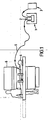
- Figure 1 of the accompanying drawings is a schematic representation of an apparatus suitable for carrying out the first embodiment of the invention.
- a freestanding polarising magnet (1) optionally together with a filter surrounds an EPR resonator (2) which provides the nuclear polarisation.
- a container (3) comprising a pump is provided for carrying the contrast composition which is delivered to a subject (4) by a delivery line (5).
- the subject is situated within a conventional MR scanner (6).
- a dielectric resonator may be used in the dynamic nuclear polarisation process.
- dynamic nuclear polarisation requires a volume with a fairly strong high frequency magnetic field and an accompanying electric field which is made as small as possible.
- a dielectric resonator may be used to provide a preferred field arrangement in which the magnetic field lines are shaped like a straw in a sheaf of corn with an electric field forming circles like the thread binding the sheaf.
- a field arrangement of this type may be formed by one of several rings or tubes of a material with a high dielectric constant and low loss. The man skilled in the art will appreciate that such a tube will exhibit different electromagnetic resonant modes.
- One of the dominant modes has the desired characteristic of electric field circulating around the tube axis within the wall and being zero at the axis and everywhere perpendicular to it.
- the magnetic field on the other hand is concentrated around the tube axis and mainly directed along it.
- the composition to be polarised is conveniently placed inside the resonator which is itself placed inside a metal box with a clearance typically of the order of the size of the resonator, and is excited to the desired resonances with a coupling loop or the like.
- the metal box ensures that the electromagnetic energy does not leak away by radiation.
- Figure 2 of the accompanying drawings shows a dielectric resonator (1) (with an axis of rotational symmetry (2)) within a metal box (3).
- a resonant cavity of which several are known to those skilled in the art is a metal box, such as a cylindrical metal box.
- a suitable mode is the one known as TM1,1,0 which produces a perpendicular Magnetic field on the axis of the cavity. It is possible to excite two such modes in the same cavity at the same frequency producing fields which are mutually perpendicular. By arranging them to have a 90° phase difference a rotating field can be produced which is especially efficient for implementing dynamic polarisation with a minimum of dissipation in the sample. Modes with similar field distributions for different shapes of cavities e.g. rectangular cavities are familiar to those skilled in the art.
- the composition may also be dispersed into a plurality of compartments during the dynamic nuclear polarisation step.
- the composition might be typically divided into parallel channels provided, for example, by parallel separating plates, discs or tubes, typically open-ended tubes.
- the electric losses (eddy currents) in the composition caused by the magnetic field are decreased by dividing the composition into smaller volumes using electrically isolating barriers, preferably situated perpendicular to the field.
- the isolating barriers would be planes passing radially from the vessel axis to its wall
- a simper and more practical arrangement is to polarised the composition in a container which contains a plurality of thin-walled tubes of an isolating material such as quartz, glass or plastic. This has the advantage of reducing the electric losses in the composition which allows a larger volume of composition to be polarised for the same applied electromagnetic power.
- the walls, the inner, outer or both of the tubes may similarly serve as the substrate onto which the OMRI contrast agent is bound so that pressure applied to one end of the container may force the polarized, substantially OMRI contrast agent free, fluid high T 1 agent from the container, for example with a delivery line leading to the subject (patient) undergoing MR examination.
- the radical may be conveniently prepared in situ from a stable radical precursor by a conventional physical or chemical radical generation step shortly before polarisation, or alternatively by the use of ionising radiation. This is particularly important where the radical has a short half-life. In these cases, the radical will normally be non-reusable and may conveniently be discarded once the separation step of the method according to the invention has been completed.
- a chosen OMRI contrast agent will exhibit a long half-life (preferably at least one hour), long relaxation times (T 1e and T 2e ), high relaxivity and a small number of ESR transition lines.
- the paramagnetic oxygen-based, sulphur-based or carbon-based organic free radicals or magnetic particles referred to in WO-A-88/10419 , WO-A-90/00904 , WO-A-91/12024 , WO-A-93/02711 or WO-A-96/39367 would be suitable OMRI contrast agents.
- OMRI contrast agents useful in the present method are not limited to paramagnetic organic free radicals.
- Particle exhibiting the magnetic properties of paramagnetism, superparamagnetism, ferromagnetism or ferrimagnetism may also be useful OMRI contrast agents, as may be other particles having associated free electrons.
- Superparamagnetic nanoparticles eg. iron or iron oxide nanoparticles
- Magnetic particles have the advantages over organic free radicals of high stability and a strong electronic/nuclear spin coupling (i.e. high relativity) leading to greater overhauser enhancement factors.
- the high T 1 agent should be preferably administered in the absence of the whole of, or substantially the whole of, the OMRI contrast agent.
- at least 80% of the OMRI contrast agent is removed, particularly preferably 90% or more, especially Preferably 95% or more, most especially 99% or more.
- preferred OMRI contrast agents for use in the first embodiment of the method according to the invention are those which can be conveniently and rapidly separated from the polarised high T 1 MR imaging agent using known techniques as discussed below.
- the separation step may be omitted.
- a solid (eg. frozen) composition comprising an OMRI contrast agent and a high T 1 agent which has been subjected to polarisation may be rapidly dissolved in saline (eg. warm saline) and the mixture injected shortly thereafter.
- the separation step of the method of the invention it is desirable to remove substantially the whole of the OMRI contrast agent from the composition (or at least to reduce it to physiologically tolerable levels) as rapidly as possible.
- Many physical and chemical separation or extraction techniques are known in the art and may be employed to effect rapid and efficient separation of the OMRI contrast agent and high T 1 agent.
- the more preferred separation techniques are those which can be effected rapidly and particularly those which allow separation in less than one second.
- magnetic particles eg. superparamagnetic particles
- the OMRI contrast agent or the particle may be conveniently separated from the liquid (i.e. if the solid bead is magnetic by an appropriately applied magnetic field).
- the combination of the two be a heterogeneous system, eg. a two phase liquid, a solid in liquid suspension or a relatively high surface area solid substrate within a liquid, eg. a solid in the form of beads fibres or sheets disposed within a liquid phase high T 1 agent.
- a heterogeneous system eg. a two phase liquid, a solid in liquid suspension or a relatively high surface area solid substrate within a liquid, eg. a solid in the form of beads fibres or sheets disposed within a liquid phase high T 1 agent.
- the diffusion distance between the high T 1 agent and OMRI contrast agent must be small enough to achieve an effective overhauger enhancement.
- Certain OMRI contrast agents are inherently particulate in nature, eg. the paramagnetic particles and superparamagnetic agents referred to above. Others may be immobilized on, absorbed in or coupled to a solid substrate or support: (eg.
- OMRI contrast agent may be bound to a water insoluble substrate/support prior to the polarisation or the OMRI contrast agent may be attached/bound to the substrate/support after polarisation.
- the OMRI contrast agent may then be separated from the high T 1 agent e.g. by filtration before administration.
- the OMRI contrast agent may also be bound to a water soluble macromolecule and the OMRI contrast agent-macromolecule may be separated from the high T 1 agent before administration.
- an OMRI contrast agent and high T 1 agent is a heterogeneous system
- one phase is aqueous and the other non-aqueous (solid or liquid) it may be possible to simply decant one phase from the other.
- the OMRI contrast agent is a solid or solid substrate (eg. a bead) suspended in a liquid high T 1 agent the solid may be separated from the liquid by conventional means eg. filtration, gravimetric, chromatographic or centrifugal means.
- the OMRI contrast agents may comprise lipophilic moieties and so be separated from the high T 1 agent by passage over or through a fixed lipophilic medium or the OMRI contrast agent may be chemically bound to a lipophilic solid bead.
- the high T 1 agent is in a solid (eg. frozen) state during polarisation and in close contact with a solid OMRI contrast agent. After polarisation it may be dissolved in heated water or saline or melted and removed or separated from the OMRI contrast agent where the latter may be toxic and cannot be administered.
- One separation technique makes use of a cation exchange polymer and a cationic OMRI contrast agent, eg. a triarylmethyl radical carrying pendant carboxylate groups.
- a cationic OMRI contrast agent eg. a triarylmethyl radical carrying pendant carboxylate groups.
- acidifying the solution to around pH 4 may cause the OMRI contrast agent to precipitate out. Separation may then be carried out for example by filtration followed by neutralisation.
- An alternative technique involves adding ions which causes precipitation of ionic OMRI agents which may then be filtered off.
- OMRI contrast agents such as the triarylmethyl radical
- a composition containing an OMRI contrast agent with a protein affinity may be passed through or over a protein in a form which exposes a large surface area to the agent eg. in particulate or surface bound form.
- binding of the OMRI contrast agent to the protein enables it to be removed from the composition.
- a hydrophilic high T 1 agent when in a solid (eg. frozen) form it may be brought into contact with a hydrophobic OMRI contrast agent which is dissolved in an organic fluid with a melting temperature higher than the high T 1 agent.
- the mixture is frozen and polarisation performed. After polarisation, the mixture is heated and the solid OMRI contrast agent and its solvent are removed.
- the high T 1 agent will remain hyperpolarised for a significant time in the frozen state and may be transported long distances before being dissolved in water or saline for injection.
- hyperpolarisation of nuclei may be effected by a hyperpolarised gas or by the use of a high field.
- Hyperpolarisation of the nuclei may be effected by a hyperpolarisable gas.
- This example comprises:
- hyperpolarisable gas is meant a gas with a non-zero spin angular momentum capable of undergoing an electron transition to an excited electron state and thereafter of decaying back to the ground state.
- gases suitable for use in the second embodiment of the method of the invention include the noble gases He (eg. He or 4 He) and Xe (eg. 129 Xe), preferably He, particularly preferably 3 He.
- Alkali metal vapours may also be used eg. Na, K, Rb, Cs vapours. Mixtures of the gases may also be used or the hyperolarisable gas may be used in liquid or solid form.
- hyperpolarisable gas also covers any gas with non-zero nuclear spin which may be polarised by optical pumping and is preferably 129 Xe or 3 He.
- the hyperpolarised gas may transfer polarisation to the nuclear spin system of a high T 1 agent directly or indirectly.
- the high T 1 agent is to be polarised indirectly by water vapour, it may be advantageously water soluble.
- the high T 1 agent may be generally in gaseous, liquid or solid form.
- a hyperpolarised fluid eg. 129 Xe at elevated pressure and/or low temperature is passed through a column of solid 13 C enriched and/or 19 F enriched high T 1 agent until steady state polarisation of the solid is almost achieved.
- a hyperpolarised fluid eg. 129 Xe at elevated pressure and/or low temperature is passed through a column of solid 13 C enriched and/or 19 F enriched high T 1 agent until steady state polarisation of the solid is almost achieved.
- 13 C enriched agents may be used.
- a hyperpolarised gas is frozen/crystallised on the solid/frozen surface of a solid high T 1 agent which has been prepared with as large a surface area as possible.
- the mixture may be transported before warm administrable media (eg. saline) is added and physiological temperature reached before injection.
- warm administrable media eg. saline
- 129 Xe gas can be produced in a highly spin polarised state in macroscopic quantities. Due to the limited solubility and inert nature of xenon there is interest in transferring the polarisation to other nuclei.
- a polarising agent e.g. with an electron spin resonance transition stimulating radiation (e.g. microwave radiation).
- an electron spin resonance transition stimulating radiation e.g. microwave radiation.
- said polarising agent is preferably a substance containing an unpaired electron, for example nitroxide, trityl, Cr(V), or the OMRI agents mentioned above.
- irradiation of frozen Xe in the presence of a free radical metal ion, trityl radical, nitroxide, etc.
- a free radical metal ion, trityl radical, nitroxide, etc.
- the radical would be added either in pure form or bound:to a matrix.
- heating of the sample would release the hyperpolarised gas and a new batch of Xe could be condensed and irradiated. Since the hyperpolarisation in this case is carried out on solid Xe, the possibilities of producing large amounts of gas would be considerable.
- the main relaxation mechanism for solid 129 Xe is spin exchange with the rapidly relaxing 131 Xe, the major component in natural xenon.
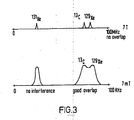
- the magnetogyric ratio of 129 Xe and 131 Xe differs by a factor of four. Normally the line widths of the resonances of solids are on the order of a few kHz. When the difference in Larmor frequency is on the same order as the line width, the polarisation of the nuclei will rapidly equilibrate.
- Figure 3 shows the behaviour of such a system at various field strengths.
- One important factor to take into account is that all the nuclei in the sample must be taken into consideration. This method will work for transfer from 129 Xe to 13 C and possibly to 27 Si but it is not expected to work with 16 N which has a resonance frequency that is closer to 131 Xe than to 129 Xe. There will be interference from quadrupolar nuclei like 23 Na, 79 Br, 81 Br, 127 I and a number of transition metals, all having resonance frequencies similar to carbon.
- the gas In order to generate a hyperpolarised gas, the gas is first subjected to a discharge or other means of excitation (eg. an appropriate radiofrequency) which creates a metastable unaired electron spin state and is then optically (eg. laser) pumped at an appropriate frequency to create electron hyperpolarisation.
- a discharge or other means of excitation eg. an appropriate radiofrequency
- optically eg. laser
- Preferred hyperpolarisable gases are those which can be conveniently and rapidly separated from the polarised high T 1 agent.
- Noble gases are particularly useful given their very low boiling points and inertness.
- the chosen gas will exhibit a long hyperpolarisability half-life (preferably at least 1000s, particularly preferably at least 4000s and especially preferably 8000s or more).
- a hyperpolarised gas may, if desired, be stored for extended periods of time in a hyperpolarised state. This is achieved by maintaining the gas at very low temperatures, preferably in a frozen state.
- the combination of the two may be advantageously a heterogeneous system, eg. the high T 1 agent is a solid at ambient temperatures.
- the diffusion distance between the high T 1 agent and gas, fluid or solid must be small enough to achieve an effective polarisation.
- the separation step it is desirable to remove substantially the whole of the hyperpolarisable gas from the composition (or at least to reduce it to physiologically tolerable levels) as rapidly as possible. If desired, the gas may be reused which may be an important consideration given the expense of noble gases.
- Many physical and chemical separation or extraction techniques known in the art may be employed to effect rapid and efficient separation of the hyperpolarisable gas and high T 1 agent. Clearly the more preferred separation techniques are those which can be effected rapidly and particularly those which allow separation in a fraction of the relaxation time T 1 of the high T 1 agent.
- hyperpolarisation of the MR imaging nuclei is effected by the use of a high field as described in US-A-5479925 (GEC) and US-A-5617859 (GEC).
- US-A-5479925 discloses a method for generating MR angiograms in which a contrast agent is passed through a small, high field polarising magnet ex vivo , in order to generate a high longitudinal magnetisation in the agent prior to its administration to the subject. There is however no mention or suggestion of the use of high T 1 agents to achieve an improved effect.
- polarisation of an MR imaging nuclei may be achieved by thermodynamic equilibration at low temperature and:high magnetic field.
- the contrast medium to be administered is a solid material (e.g. crystalline)
- it may be introduced into a magnetic field at very low temperature.
- T 1 is very long (typically many hours or months) and consequently it takes an unacceptably long time for the medium to reach thermodynamic equilibrium.
- the contrast medium undergoes small movements in the gradient field for example by exposure to a magnetic field gradient and ultrasound or by relative movement within the gradient field, T 1 will drop.
- thermodynamic equilibrium is attained, all nuclei in the contrast medium will:be highly polarised relative to room temperature and to normal magnetic fields used in MRI.
- This procedure has the advantage of allowing the contrast medium to be removed from the magnet and transported in a "ready-to-use" form to the place where it is to be used. Preferably but not essentially transport may take place at a relatively low temperature (e.g. at liquid nitrogen temperature).
- the T 1 of the high T 1 solid contrast medium will be long enough to allow transport at ambient temperature before use.
- T 1 values at low temperatures and high fields, typically several weeks at temperatures below 1 K are the long; T 1 values at low temperatures and high fields, typically several weeks at temperatures below 1 K.
- T 1 values at low temperatures and high fields typically several weeks at temperatures below 1 K.
- T 1 T 1 , 0 + cB 2
- T 1,0 is the time constant for relaxation at no external magnetic field
- c is a constant
- B is the external magnetic field
- M max is the magnetisation of the sample after complete relaxation at the final field. Since the field-dependence of the time constant is non-linear, it will be possible to obtain a larger magnetisation at a given time by constantly tuning the external magnetic field so that the rate of magnetisation all the time is as big as possible.
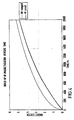
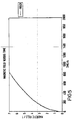
- the example shown in attached Figures 4 and 5 was chosen to simulate the behaviour of the carbonyl carbon in solid sodium acetate.
- the T 1 at 7 T is 1700 seconds and the T 1,0 is about 5 seconds.
- the time to reach the same degree of magnetisation as after 1700 seconds at a constant field of 7 T is reduced to 1390 seconds, a reduction of almost 20%, which could easily reduce the equilibration time by one week at milliKelvin temperatures.
- one of the main obstacles in using so-called 'brute force' polarisation as a method for hyperpolarising samples is the long T 1 values found at low temperatures and high fields, typically several weeks at temperatures below 1 K. It is possible to use the technique of low-field matching to increase the relaxation rate and the degree of polarisation of the nuclear spins in solids at low temperature. This has the additional advantage that a brute force polariser does not need to possess any radio frequency electronics.
- a crude way of stating the Hartman-Hahn condition is to say that spin diffusion is efficient when the resonance lines of the two nuclei overlap.
- the substrate to be a solid material with a half-height line width of 5 kHz.. This linewidth is caused by dipolar coupling and is independent of the external field.
- the Hartman-Hahn condition is now restated as follows. Efficient spin-diffusion takes place when the maxima of the two resonances are separated by less than the sum of their half-height line-widths.
- the field where this condition is fulfilled is derived as follows.
- This field is within a factor 3 of the earth's magnetic field which means that if the sample is removed from the polarising magnet for a few seconds the polarisation will equilibrate between carbon and hydrogen on a time scale similar to T 2 so there will be plenty of time to put the sample back into the magnet again before the T 1 relaxation becomes significant, even if it has to be kept in mind that the T 1 shortens dramatically for solids in low fields. It will, however, never be as short as the T 2 .
- the magnetic field strength should be as high as possible, preferably >1T, more preferably 5T or more, especially preferably 15T or more.
- the temperature should be very low e.g. 100K or less, preferably 4.2K or less, more preferably 1K or less, even more preferably 0.1K or less, especially preferably 1mK or less.
- a method for preparing polarised high T 1 agents may comprise :
- the T 1 shortening effect may be provided by exposure to a variable magnetic field gradient but it may also be achieved by adding magnetic material (e.g. paramagnetic, superparamagnetic or ferromagnetic materials) to the agent during the period when the agent is exposed to low temperature, field cycling to a field allowing cross polarisation, gradually increasing the magnetic field at such a rate that the increase in polarisation of the high T 1 agent is maximised, gradually decreasing the temperature at such a rate that the increase in polarisation of the high T 1 agent is maximised, or adding a material with unpaired electrons during the period when the high T 1 agent is exposed to said low temperature.
- Possible T1 shortening agents include Gd and NO• but preferred T 1 shortening agents are O 2 and NO which may be conveniently separated from the high T 1 agent before transportation and subsequent use.
- Both the high T 1 agent and the aqueous solvent (eg. water) in which it is dissolved may be polarised. This may be carried out at low temperature conveniently in the same magnetic field and after mixing the administrable composition should be warmed very rapidly prior to administration.
- aqueous solvent eg. water
- composition comprising a polarised high T 1 agent and polarised water is provided.
- the high T 1 agents used in the method according to the invention may be conveniently formulated with conventional pharmaceutical or veterinary carriers or excipients.
- Formulations manufactured or used according to this invention may contain, besides the high T 1 agent, formulation aids such as are conventional for therapeutic and diagnostic compositions in human or veterinary medicine.
- the formulation may for example include stabilizers, antioxidants, osmolality adjusting agents, solubilizing agents, emulsifiers, viscosity enhancers, buffers, etc.
- the formulation may be in forms suitable for parenteral (eg. intravenous or intraarterial) or enteral (eg.
- oral or rectal application for example for application directly into body cavities having external voidance ducts (such as the lungs, the gastrointestinal tract, the bladder and the uterus), or for injection or infusion into the cardiovascular system.
- external voidance ducts such as the lungs, the gastrointestinal tract, the bladder and the uterus
- solutions, suspensions and dispersions in physiological tolerable carriers will generally be preferred.
- the formulation which preferably will be substantially isotonic, may conveniently be administered at a concentration sufficient to yield a 1 micromolar to 10M concentration of the high T 1 agent in the imaging zone; however the precise concentration and dosage will of course depend upon a range of factors such as toxicity, the organ targeting ability of the high T 1 agent and the administration route.
- the optimum concentration for the MR imaging agent represents a balance between various factors. In general, optimum concentrations would in most cases lie in the range 0.1mM to 10M, preferably more than 10mM, especially more than 100mM. Isotonic solution may be especially preferred. In certain circumstances concentrations above 1M are preferred.
- Formulations for intravenous or intraarterial administration would preferably contain the high T 1 agent in concentrations of 10mM to 10M, especially more than 50mM.
- concentration may conveniently be 0.1mM to 56M, preferably more than 200mM, more preferably more than 500mM. In certain circumstances, the preferred concentration is above 1M, even more preferably above 5M.
- Parenterally administrable forms should of course be sterile and free from physiologically unacceptable agents, and should have low osmolality to minimize irritation or other adverse effects upon administration and thus the formulation should preferably be isotonic or slightly hypertonic.
- Suitable vehicles include aqueous vehicles customarily used for administering parenteral solutions such as Sodium Chloride solution, Ringer's solution, Dextrose solution, Dextrose and Sodium Chloride solution, Lactated Ringer's solution and other solutions such as are described in Remington's Pharmaceutical Sciences, 15th ed., Easton: Mack Publishing Co., pp. 1405-1412 and 1461-1487 (1975 ) and The National Formulary XIV, 14th ed. Washington: American Pharmaceutical Association (1975 ).
- the compositions can contain preservatives, antimicrobial agents, buffers and antioxidants conventionally used for parenteral solutions, excipients and other additives which are compatible with the high T 1 agents and which will not interfere with the manufacture, storage or use of the products.
- the high T 1 agent is to be injected, it may be convenient to inject simultaneously at a series of administration sites such that a greater proportion of the vascular tree may be visualized before the polarization is lost through relaxation.
- the dosages of the high T 1 agent used according to the method of the present invention will vary according to the precise nature of the high T 1 agents used, of the tissue or organ of interest and of the measuring apparatus. Preferably the dosage should be kept as low as possible while still achieving a detectable contrast effect. In general, the maximum dosage will depend on toxicity constraints.
- a high T 1 agent is placed in a chamber at very low temperature (about 4K). Fluent O 2 is added and crystallised on the surface of the high T 1 agent. In a separate chamber, frozen H 2 O is subjected to the same treatment as the high T 1 agent. Both chambers are placed in a strong magnetic field (about 15T) and the temperature kept low.
- thermodynamic equilibrium When thermodynamic equilibrium is reached, the temperature is increased to about 200K. The oxygen disappears as a gas. The high T 2 agent and the frozen H 2 O are mixed and stored until needed. The temperature is increased and the solution comprising polarised high T 1 agent and hyperpolarised water is injected.
- 300 mg of sterile Na 2 13 CO 3 or NaH 13 CO 3 is placed inside a 10 ml plastic injection syringe.
- the gas inside the syringe is enriched with >20% oxygen.
- the syringe is placed inside a magnet (1-20T) at a temperature of about 4K (0.001-5K) until thermodynamic equilibrium is reached.
- the syringe is removed and transported to the subject located in the MRI magnet.
- 10 ml of sterile Ringers Solution (at 37°C, pH 7.4) is aspirated and injected at a rate of 10 ml/sec immediately after the high T 1 agent has dissolved.
- 13 C MRI is performed using a fast pulse sequence.
- T 1 ip the blood is about 20s and the distribution of the agent is followed on the MR imager.
- the sample is polarized by microwaves (70 GHz) for at least one hour at a field of 2.5 T at a temperature of 4.2 K.
- the progress of the polarization process is followed by in situ NMR (fast adiabatic passage).
- the ampule is rapidly removed from the polarizer and, while handled in a magnetic field of no less than 50 mT, cracked open and the contents are quickly discharged and dissolved in warm (40°C) water.
- the sample is polarized by microwaves (70 GHz) for at least 1 hour at a field of 2.5 T at a temperature of 4.2 K.
- the progress of the polarization process is followed by in situ NMR (fast adiabatic passage).
- the ampule is rapidly removed from the polarizer and, while handled in a magnetic field of no less than 50 mT, cracked open and the contents are quickly discharged and dissolved in warm (40°C) water.
- a sample of solid 1- 13 C-1/1-bis(hydroxydideuteromethyl)-2,2,3,3-tetradeuterocyclopropane was subjected to a magnetic field of 6.56 T at a temperature of 2.5 K for 10 minutes. The sample was then removed from the centre of the magnet to the stray field (7 mT) for a duration of 1 s and then returned to the magnet. After another 10 minutes the process was repeated one more.
- a 13 C-NMR spectrum of the solid sample was recorded and the signal was found to be in accordance with thermal equilibrium at 6.56 T and 2.5 K.
- the sample was inserted into the spectrometer and a 13 C-spectrum was recorded.
- the whole process of moving the sample out of the cryomagnet, dissolution, sample preparation, transport and spectroscopy took 35 s.
- the intensity of the 13 C-signal was compared to the intensity after the sample had reached thermal equilibrium at 40°C and 7 T. An enhancement factor of 12 was found.
- the sample was inserted into the spectrometer and a 13 C-spectrum was recorded.
- the whole process of moving the sample out of the cryomagnet, dissolution, sample preparation, transport and spectroscopy took 35 s.
- the intensity of the 13 C-signal was compared to the intensity after the sample had reached thermal equilibrium at 40°C and 7 T. An enhancement factor of 21 was found.
Landscapes
- Health & Medical Sciences (AREA)
- Physics & Mathematics (AREA)
- General Health & Medical Sciences (AREA)
- Nuclear Medicine, Radiotherapy & Molecular Imaging (AREA)
- Radiology & Medical Imaging (AREA)
- Epidemiology (AREA)
- Veterinary Medicine (AREA)
- Public Health (AREA)
- Animal Behavior & Ethology (AREA)
- Life Sciences & Earth Sciences (AREA)
- Condensed Matter Physics & Semiconductors (AREA)
- General Physics & Mathematics (AREA)
- Chemical & Material Sciences (AREA)
- Medicinal Chemistry (AREA)
- High Energy & Nuclear Physics (AREA)
- Signal Processing (AREA)
- Engineering & Computer Science (AREA)
- Dispersion Chemistry (AREA)
- Medicines Containing Antibodies Or Antigens For Use As Internal Diagnostic Agents (AREA)
- Magnetic Resonance Imaging Apparatus (AREA)
- General Induction Heating (AREA)
- Magnetic Ceramics (AREA)
- Control Of Motors That Do Not Use Commutators (AREA)
Applications Claiming Priority (3)
| Application Number | Priority Date | Filing Date | Title |
|---|---|---|---|
| GBGB9800158.9A GB9800158D0 (en) | 1998-01-05 | 1998-01-05 | Method |
| GBGB9813795.3A GB9813795D0 (en) | 1998-06-25 | 1998-06-25 | Method |
| EP98962629A EP1046051A1 (en) | 1998-01-05 | 1998-12-23 | Method of magnetic resonance investigation |
Related Parent Applications (1)
| Application Number | Title | Priority Date | Filing Date |
|---|---|---|---|
| EP98962629A Division EP1046051A1 (en) | 1998-01-05 | 1998-12-23 | Method of magnetic resonance investigation |
Publications (2)
| Publication Number | Publication Date |
|---|---|
| EP2119457A1 EP2119457A1 (en) | 2009-11-18 |
| EP2119457B1 true EP2119457B1 (en) | 2012-10-03 |
Family
ID=26312888
Family Applications (2)
| Application Number | Title | Priority Date | Filing Date |
|---|---|---|---|
| EP09009608A Expired - Lifetime EP2119457B1 (en) | 1998-01-05 | 1998-12-23 | Method of producing a hyperpolarised contrast agent |
| EP98962629A Withdrawn EP1046051A1 (en) | 1998-01-05 | 1998-12-23 | Method of magnetic resonance investigation |
Family Applications After (1)
| Application Number | Title | Priority Date | Filing Date |
|---|---|---|---|
| EP98962629A Withdrawn EP1046051A1 (en) | 1998-01-05 | 1998-12-23 | Method of magnetic resonance investigation |
Country Status (15)
| Country | Link |
|---|---|
| US (2) | US6278893B1 (https=) |
| EP (2) | EP2119457B1 (https=) |
| JP (1) | JP4764548B2 (https=) |
| KR (1) | KR100699396B1 (https=) |
| CN (2) | CN1138154C (https=) |
| AU (1) | AU752308C (https=) |
| BR (1) | BRPI9813244B1 (https=) |
| CA (1) | CA2317526C (https=) |
| ES (1) | ES2393833T3 (https=) |
| HU (1) | HU229718B1 (https=) |
| IL (1) | IL136780A0 (https=) |
| NO (1) | NO334035B1 (https=) |
| NZ (1) | NZ505151A (https=) |
| RU (1) | RU2221255C2 (https=) |
| WO (1) | WO1999035508A1 (https=) |
Families Citing this family (150)
| Publication number | Priority date | Publication date | Assignee | Title |
|---|---|---|---|---|
| FI982069A7 (fi) * | 1996-03-29 | 1998-11-10 | Lawrence Berkeley Nat Laboratory | NMR:n ja MRI:n tehostaminen hyperpolaroitujen jalokaasujen läsnä olles sa |
| US8765099B2 (en) * | 1996-04-08 | 2014-07-01 | Koninklijke Philips N.V. | Magnetic resonance imaging hyperpolarization of liquids or solids by light with orbital angular momentum |
| WO2009081360A1 (en) * | 2007-12-20 | 2009-07-02 | Koninklijke Philips Electronics N.V. | Magnetic resonance imaging using hyperpolarization of liquids or solids by light with orbital angular momentum |
| EP0951650B1 (en) * | 1997-01-08 | 2003-12-10 | Amersham Health AS | Method of magnetic resonance imaging |
| US6278893B1 (en) * | 1998-01-05 | 2001-08-21 | Nycomed Imaging As | Method of magnetic resonance imaging of a sample with ex vivo polarization of an MR imaging agent |
| BR9911346A (pt) * | 1998-06-17 | 2001-03-13 | Medi Physics Inc | Dispositivo de transporte de gás hiperpolarizado e método de transporte associado |
| US6237363B1 (en) * | 1998-09-30 | 2001-05-29 | Medi-Physics, Inc. | Hyperpolarized noble gas extraction methods masking methods and associated transport containers |
| US6284222B1 (en) | 1998-11-03 | 2001-09-04 | Medi--Physics, Inc. | Hyperpolarized helium-3 microbubble gas entrapment methods |
| US7501236B1 (en) * | 1998-12-30 | 2009-03-10 | Ge Healthcare Limited | NMR spectroscopic in vitro assay using hyperpolarization |
| EP1155339A1 (en) | 1999-02-23 | 2001-11-21 | Medi-Physics, Inc. | Portable system for monitoring the polarization level of a hyperpolarized gas during transport |
| US6574496B1 (en) * | 1999-05-19 | 2003-06-03 | Amersham Health As | Magnetic resonance imaging |
| US20020058869A1 (en) * | 1999-05-19 | 2002-05-16 | Oskar Axelsson | Methods of magnetic resonance imaging (MRI) using contract agent solutions formed from the dissolution of hyperpolarised materials |
| US6295834B1 (en) | 1999-06-30 | 2001-10-02 | Medi-Physics, Inc. | NMR polarization monitoring coils, hyperpolarizers with same, and methods for determining the polarization level of accumulated hyperpolarized noble gases during production |
| DE10009166A1 (de) * | 2000-02-26 | 2001-08-30 | Philips Corp Intellectual Pty | Verfahren zur Lokalisierung von Objekten in der interventionellen Radiologie |
| US6630126B2 (en) | 2000-03-13 | 2003-10-07 | Medi-Physics, Inc. | Diagnostic procedures using direct injection of gaseous hyperpolarized 129Xe and associated systems and products |
| GB0009353D0 (en) * | 2000-04-14 | 2000-05-31 | Nycomed Imaging As | Method |
| GB0014463D0 (en) * | 2000-06-14 | 2000-08-09 | Nycomed Amersham Plc | NMR Method |
| CA2414610A1 (en) * | 2000-07-13 | 2002-01-24 | Medi-Physics, Inc. | Diagnostic procedures using 129xe spectroscopy characteristic chemical shift to detect pathology in vivo |
| GB0022341D0 (en) * | 2000-09-12 | 2000-10-25 | Nycomed Imaging As | Method |
| NO20004561D0 (no) * | 2000-09-13 | 2000-09-13 | Nycomed Imaging As | Metode for magnetisk resonansavbildning |
| BR0115124B1 (pt) * | 2000-11-03 | 2012-12-25 | dispositivo para fundir uma amostra hiperpolarizada sàlida, mÉtodo para produzir uma amostra hiperpolarizada fundida, e, uso de um dispositivo ou mÉtodo. | |
| JP4061192B2 (ja) | 2000-11-03 | 2008-03-12 | ジーイー・ヘルスケア・アクスイェ・セルスカプ | 分極nmr試料用のデバイス及び方法 |
| US7126332B2 (en) * | 2001-07-20 | 2006-10-24 | Baker Hughes Incorporated | Downhole high resolution NMR spectroscopy with polarization enhancement |
| GB0122049D0 (en) * | 2001-09-12 | 2001-10-31 | Nycomed Imaging As | Method |
| RU2281527C2 (ru) * | 2001-11-02 | 2006-08-10 | Амершем Хелт АС | Способ и устройство для плавления поляризованных ямр-образцов |
| NO20023357D0 (no) * | 2002-04-19 | 2002-07-11 | Amersham Health As | Blanding |
| GB0219954D0 (en) * | 2002-08-29 | 2002-10-02 | Amersham Health R & D Ab | Method and apparatus for producing contrast agents for magnetic resonance imaging |
| NO20025124D0 (no) | 2002-10-25 | 2002-10-25 | Amersham Health As | Metode |
| NO20025711D0 (no) * | 2002-11-27 | 2002-11-27 | Amersham Health As | Magnetisk resonansmetode |
| US20060173283A1 (en) * | 2002-11-27 | 2006-08-03 | Oskar Axelsson | Method of magnetic resonance imaging |
| NO20025738D0 (no) * | 2002-11-29 | 2002-11-29 | Amersham Health As | Metode |
| DE10259793B4 (de) * | 2002-12-19 | 2009-10-15 | Siemens Ag | Verfahren zur Bildgebung eines Stoffwechselvorgangs eines Lebewesens |
| DE10335663A1 (de) * | 2003-08-04 | 2005-03-10 | Siemens Ag | Verfahren zur automatischen Kalibrierung von Perfusionsparameterbildern |
| ES2545377T3 (es) * | 2004-07-30 | 2015-09-10 | Ge Healthcare As | Radicales y su uso como agentes paramagnéticos en un proceso de polarización nuclear dinámica |
| WO2006011810A2 (en) * | 2004-07-30 | 2006-02-02 | Ge Healthcare As | Mr imaging method for the discrimination between healthy and tumour tissue |
| NZ552898A (en) * | 2004-07-30 | 2011-02-25 | Ge Healthcare As | Method of producing a composition, composition and its use |
| NO338547B1 (no) * | 2004-07-30 | 2016-09-05 | Ge Healthcare As | Fremgangsmåte for fremstilling av en flytende sammensetning omfattende hyperpolarisert 13C-pyruvat, sammensetningen og anvendelse av den for fremstilling av hyperpolarisert 13C-pyruvat |
| WO2006054903A2 (en) * | 2004-11-19 | 2006-05-26 | Ge Healthcare As | Method of cardiac imaging with the use of hyperpolarized 13 c-pyruvate |
| US7276905B2 (en) * | 2005-07-11 | 2007-10-02 | General Electric Company | Method and system of tracking an intracorporeal device with MR imaging |
| JP2007021008A (ja) * | 2005-07-20 | 2007-02-01 | Hitachi Ltd | Dnp過分極手段を備えた磁気共鳴イメージング装置 |
| US20070025918A1 (en) * | 2005-07-28 | 2007-02-01 | General Electric Company | Magnetic resonance imaging (MRI) agents: water soluble carbon-13 enriched fullerene and carbon nanotubes for use with dynamic nuclear polarization |
| WO2007035871A1 (en) * | 2005-09-21 | 2007-03-29 | Massachusetts Institute Of Technology | Systems and methods for tuning properties of nanoparticles |
| WO2007038626A2 (en) * | 2005-09-28 | 2007-04-05 | President And Fellows Of Harvard College | Hyperpolarized solid materials with long spin relaxation times for use as imaging agents in magnetic resonance imaging |
| WO2007044867A2 (en) * | 2005-10-11 | 2007-04-19 | Huntington Medical Research Institutes | Imaging agents and methods of use thereof |
| US20080287774A1 (en) * | 2005-11-06 | 2008-11-20 | Rachel Katz-Brull | Magnetic Resonance Imaging and Spectroscopy Means and Methods Thereof |
| JP5475995B2 (ja) * | 2005-12-01 | 2014-04-16 | ジーイー・ヘルスケア・アクスイェ・セルスカプ | 動的核分極(dnp)法 |
| NO20055681D0 (no) * | 2005-12-01 | 2005-12-01 | Amersham Health As | Method of dynamic nuclear polarisation |
| WO2007070466A2 (en) * | 2005-12-10 | 2007-06-21 | The President And Fellows Of Harvard College | In situ hyperpolarization of imaging agents |
| PL1962912T3 (pl) * | 2005-12-16 | 2013-03-29 | Ge Healthcare As | Sposób wytwarzania hiperpolaryzowanych karboksylanów amin organicznych |
| EP1984757A4 (en) * | 2006-01-11 | 2009-11-04 | Harvard College | EX-VIVO HYPERPOLARIZATION OF ILLUSTRATORS |
| US8703102B2 (en) | 2008-04-04 | 2014-04-22 | Millikelvin Technologies Llc | Systems and methods for producing hyperpolarized materials and mixtures thereof |
| WO2012129512A1 (en) * | 2011-03-23 | 2012-09-27 | Millikelvin Technologies Llc | Improved techniques, systems and machine readable programs for magnetic resonance |
| AU2013205838B2 (en) * | 2006-02-21 | 2016-03-17 | Avrum Belzer | Hyperpolarization Methods, Systems and Compositions |
| EP1986702A4 (en) | 2006-02-21 | 2012-12-12 | Avrum Belzer | HYPERPOLARIZATION PROCEDURES, SYSTEMS AND COMPOSITIONS |
| US20100233096A1 (en) * | 2006-03-29 | 2010-09-16 | Lerche Mathilde H | Method to produce hyperpolarised carboxylates and sulphonates |
| US7205764B1 (en) * | 2006-04-11 | 2007-04-17 | Varian, Inc. | Method and apparatus for increasing the detection sensitivity in a high resolution NMR analysis |
| EP2015889B1 (en) * | 2006-05-11 | 2014-07-09 | Bell Helicopter Textron Inc. | Device and method for repairing structural components |
| WO2007134160A2 (en) * | 2006-05-12 | 2007-11-22 | Massachusetts Institute Of Technology | Temperature-jump dynamic nuclear polarization |
| EP2018545A4 (en) * | 2006-05-12 | 2011-03-09 | Massachusetts Inst Technology | BIRDICAL POLARIZATION AGENTS FOR DYNAMIC NUCLEAR POLARIZATION APPLICATIONS |
| US8623327B2 (en) | 2006-06-19 | 2014-01-07 | Beth Israel Deaconess Medical Center, Inc. | Imaging agents for use in magnetic resonance blood flow/perfusion imaging |
| CN101506679B (zh) * | 2006-08-18 | 2013-03-06 | 通用电气医疗集团股份有限公司 | 细胞死亡的13c-mr成像或波谱分析 |
| KR20140144312A (ko) | 2006-08-30 | 2014-12-18 | 지이 헬스케어 에이에스 | 동적 핵 분극화 방법 및 이러한 방법에서 사용되는 화합물 및 조성물 |
| CA3065182C (en) | 2006-10-03 | 2022-05-17 | Duke University | Systems and methods for assessing pulmonary gas transfer using hyperpolarized 129xe mri |
| US7631507B2 (en) | 2006-11-02 | 2009-12-15 | General Electric Company | Methods and devices for polarized samples for use in MRI |
| US8849372B2 (en) * | 2006-11-22 | 2014-09-30 | The General Hospital Corporation | Method for magnetic resonance imaging using stimulus induced rotary saturation with a contrast agent |
| WO2008072142A1 (en) * | 2006-12-11 | 2008-06-19 | Koninklijke Philips Electronics N.V. | Fibre tracking on the basis of macroscopic information |
| WO2008086534A1 (en) * | 2007-01-11 | 2008-07-17 | Huntington Medical Research Institutes | Imaging agents and methods of use thereof |
| US20080240998A1 (en) | 2007-03-28 | 2008-10-02 | Urbahn John A | Fluid path system for dissolution and transport of a hyperpolarized material |
| US7519492B2 (en) * | 2007-05-02 | 2009-04-14 | General Electric Company | Apparatus and method for fully automated closed system quality control of a substance |
| US7610157B2 (en) * | 2007-05-02 | 2009-10-27 | General Electric Company | Apparatus and method for fully automated closed system pH measurement |
| US20080275668A1 (en) * | 2007-05-02 | 2008-11-06 | General Electric Company | Apparatus and method for fully automated closed system optical measurement of volume |
| US7741844B2 (en) | 2007-05-07 | 2010-06-22 | General Electric Company | Method and system for magnetic resonance imaging using labeled contrast agents |
| US9042978B2 (en) * | 2007-05-11 | 2015-05-26 | Neurometrix, Inc. | Method and apparatus for quantitative nerve localization |
| GB2450316A (en) * | 2007-06-18 | 2008-12-24 | Univ York | Hyperpolarizing nuclei |
| DE102007028901B4 (de) * | 2007-06-22 | 2010-07-22 | Siemens Ag | Verfahren und Vorrichtung zur automatischen Bestimmung von Perfusion mittels einer Magnetresonanzanlage |
| US20080314836A1 (en) * | 2007-06-22 | 2008-12-25 | General Electric Company | Methods and devices for dynamic filtration of pharmaceutical products |
| US9227173B2 (en) | 2007-06-22 | 2016-01-05 | General Electric Company | Methods for dynamic filtration of pharmaceutical products |
| GB0713074D0 (en) * | 2007-07-05 | 2007-08-15 | Univ London | A method of hyperpolarising a magnetic resonance agent |
| PL2180902T3 (pl) * | 2007-08-27 | 2012-07-31 | Ge Healthcare Ltd | Ośrodek obrazujący zawierający hiperpolaryzowany ¹³C-octan oraz jego zastosowanie |
| US20100233089A1 (en) * | 2007-10-05 | 2010-09-16 | Huntington Medical Research Institutes | Imaging of genetic material with magnetic resonance |
| EP2072061A1 (en) | 2007-12-19 | 2009-06-24 | GE Healthcare Limited | Composition and method for generating a metabolic profile using 13C-MR detection |
| JP4871311B2 (ja) * | 2008-02-26 | 2012-02-08 | 株式会社日立製作所 | 核磁気共鳴装置、磁気共鳴イメージング装置および磁気共鳴分析装置 |
| GB0804422D0 (en) * | 2008-03-10 | 2008-04-16 | Univ Southampton | An agent for transporting nuclear spin order and for magnetic resonance imaging |
| US20140223923A1 (en) * | 2008-04-04 | 2014-08-14 | Millikelvin Technologies Llc | Systems and methods for producing hyperpolarized materials and mixtures thereof |
| WO2009129265A1 (en) * | 2008-04-14 | 2009-10-22 | Huntington Medical Research Institutes | Methods and apparatus for pasadena hyperpolarization |
| US8763410B2 (en) | 2008-04-21 | 2014-07-01 | General Electric Company | Method and apparatus for the dissolution and filtration of a hyperpolarized agent with a neutral dissolution media |
| US20110038802A1 (en) | 2008-05-02 | 2011-02-17 | Zhong-Min Hu | Method of determining alanine transaminase (alt) activity by 13c-mr detection using hyperpolarised 13c-pyruvate |
| US9658300B1 (en) * | 2008-08-19 | 2017-05-23 | California Institute Of Technology | Method and apparatus for preparation of spin polarized reagents |
| US9289518B2 (en) * | 2008-08-22 | 2016-03-22 | The Brigham And Women's Hospital | Enhanced 13C NMR by thermal mixing with hyperpolarized 129XE |
| US7633290B1 (en) | 2008-09-09 | 2009-12-15 | General Electric Company | Apparatus and method for a fully automated preparation of a hyperpolarizing imaging agent |
| US20100092390A1 (en) * | 2008-10-09 | 2010-04-15 | President And Fellows Of Harvard College | Methods for Making Particles Having Long Spin-Lattice Relaxation Times |
| EP2374016B1 (en) | 2008-12-10 | 2017-05-10 | University of York | Pulse sequencing with hyperpolarisable nuclei |
| AU2010230330B2 (en) | 2009-04-02 | 2015-06-25 | Ge Healthcare Limited | Use of a magnetic resonance imaging medium comprising hyperpolarized 13C pyruvate for the detection of inflammation or infection |
| CN102460136A (zh) * | 2009-06-19 | 2012-05-16 | 皇家飞利浦电子股份有限公司 | 与利用具有轨道角动量的光子的超极化装置组合的mri温度测定 |
| CA2772190A1 (en) * | 2009-08-31 | 2011-03-03 | Millikelvin Technologies Llc | Systems and methods for producing hyperpolarized materials and mixtures thereof |
| EP2473199A1 (en) | 2009-08-31 | 2012-07-11 | Brain Watch Ltd. | Isotopically labeled neurochemical agents and uses thereof for diagnosing conditions and disorders |
| US8968703B2 (en) | 2009-09-10 | 2015-03-03 | Ge Healthcare Limited | 13C-MR detection using hyperpolarised 13C-fructose |
| US8427161B2 (en) * | 2009-12-18 | 2013-04-23 | General Electric Company | Method and apparatus for generating hyperpolarized materials |
| EP2343568A1 (en) * | 2009-12-30 | 2011-07-13 | Koninklijke Philips Electronics N.V. | Dynamic nuclear polarization apparatus with sample transport system |
| BR112012020235A2 (pt) * | 2010-02-16 | 2017-11-07 | Koninl Philips Electronics Nv | "dispensador para a produção de um agente de contraste hiperpolarizado e sistema de exame de ressonância magnética" |
| JP5758982B2 (ja) | 2010-04-08 | 2015-08-05 | ブラッコ・イメージング・ソシエタ・ペル・アチオニBracco Imaging S.P.A. | 過分極基質の製造方法およびmriのための方法 |
| US8970217B1 (en) | 2010-04-14 | 2015-03-03 | Hypres, Inc. | System and method for noise reduction in magnetic resonance imaging |
| JP5879333B2 (ja) | 2010-05-03 | 2016-03-08 | ジーイー・ヘルスケア・リミテッド | Ldh活性を決定するための過分極乳酸塩造影剤 |
| DE102010017568B4 (de) | 2010-06-24 | 2012-09-13 | Johann Wolfgang Goethe-Universität Frankfurt am Main | Hyperpolarisationseinrichtung und Verfahren zur Verabreichung eines hyperpolarisierten flüssigen Kontrastmittels |
| WO2012056447A1 (en) | 2010-10-25 | 2012-05-03 | Brain Watch Ltd. | Isotopically labeled deoxy-glucose and derivatives thereof, compositions comprising them and uses thereof |
| US8786284B2 (en) * | 2011-01-11 | 2014-07-22 | Bridge12 Technologies, Inc. | Integrated high-frequency generator system utilizing the magnetic field of the target application |
| US20140099262A1 (en) | 2011-06-01 | 2014-04-10 | Brain Watch Ltd. | Isotopically labeled cdp-choline and uses thereof |
| WO2013053839A1 (en) | 2011-10-12 | 2013-04-18 | Bracco Imaging Spa | Process for the preparation of hyperpolarized derivatives for use in mri analysis |
| US9693828B2 (en) | 2011-12-05 | 2017-07-04 | Bracco Imaging S.P.A. | Composition comprising acetic anhydride and a gadolinium complex, and method for the use in hyperpolarisation in MRI analysis |
| GB2498181A (en) | 2011-12-29 | 2013-07-10 | Bruker Biospin Gmbh | Device and method for rapid dynamic nuclear polarisation |
| IL223935A (en) | 2012-01-13 | 2016-11-30 | Gen Electric | Fluid track system for decomposition and transport of hyper-polarized material |
| EP2624004A1 (en) * | 2012-02-06 | 2013-08-07 | Koninklijke Philips Electronics N.V. | Temperature determination using magnetic resonance B1 field mapping |
| US8715621B2 (en) | 2012-03-15 | 2014-05-06 | Massachusetts Institute Of Technology | Radical polarizing agents for dynamic nuclear polarization |
| EP2642310A1 (en) | 2012-03-22 | 2013-09-25 | Koninklijke Philips N.V. | Interpolated three-dimensional thermal dose estimates using magnetic resonance imaging |
| WO2013149935A1 (en) | 2012-04-02 | 2013-10-10 | Bracco Imaging Spa | Hyperpolarized amino acids |
| US9329245B2 (en) * | 2012-04-11 | 2016-05-03 | Bruker Biospin Ag | MRI compatible method and device for rapid DNP on a solid state hyperpolarized sample material |
| WO2013167587A1 (en) | 2012-05-07 | 2013-11-14 | Albeda Innovation Aps | Intra-operative cancer diagnosis based on a hyperpolarized marker |
| US8825132B2 (en) | 2012-07-04 | 2014-09-02 | Bruker Biospin Gmbh | Field cycling method for magnetic resonance |
| US9381257B2 (en) | 2012-07-13 | 2016-07-05 | Bracco Imaging S.P.A. | Triarylmethyl radicals |
| US9329246B2 (en) | 2012-10-03 | 2016-05-03 | Bruker Biospin Ag | Method for hyperpolarization transfer in the liquid state |
| WO2014064194A1 (en) | 2012-10-25 | 2014-05-01 | Bracco Imaging Spa | Hyperpolarized 2-oxoglutarate as metabolic agent in mr |
| US9404984B2 (en) | 2012-11-06 | 2016-08-02 | Bruker Uk Limited | Method of hyperpolarization applying brute force using particulate acceleration agents |
| US20140200437A1 (en) * | 2013-01-16 | 2014-07-17 | Empire Technology Development Llc | Detection of internal gas leakage |
| US10265421B2 (en) | 2013-01-31 | 2019-04-23 | Bracco Imaging S.P.A. | Hyperpolarized esters as metabolic markers in MR |
| EP3016687B1 (en) * | 2013-07-01 | 2017-08-09 | Bracco Imaging S.p.A | Hyperpolarized 1-13c-1,1-bis(acetoxy(methyl))-2,2'-cyclopropane as metabolic marker for mr |
| US9642924B2 (en) * | 2013-08-29 | 2017-05-09 | Duke University | Contrast agents based on long-lived nuclear singlet states and related methods |
| US9874622B2 (en) | 2013-09-27 | 2018-01-23 | General Electric Company | Hyperpolarized media transport vessel |
| EP2863229A1 (en) | 2013-10-15 | 2015-04-22 | Technische Universität München | pH-biosensors based on compounds with pH-sensitive enolic groups for magnetic resonance imaging and spectroscopy and their uses |
| EP2891500B1 (en) | 2014-01-07 | 2018-08-01 | Cambridge Enterprise Limited | Contrast agent for determination of aldehyde dehydrogenase (ALDH) activity |
| EP3015855A1 (en) | 2014-10-27 | 2016-05-04 | Klinikum rechts der Isar der Technischen Universität München | Metal biosensors based on compounds with metal-sensitive chemical shifts for magnetic resonance spectroscopy and imaging |
| US10088536B2 (en) * | 2015-03-27 | 2018-10-02 | Bruker Biospin Corporation | Sample introduction system and method for polarization |
| JP2018514795A (ja) * | 2015-05-22 | 2018-06-07 | ウニヴェルズィテート・ウルム | 核スピンを超偏極させる方法 |
| WO2017059092A1 (en) | 2015-09-30 | 2017-04-06 | Duke University | Ascorbate formulations and methods of use as contrast agents |
| CN105738397B (zh) * | 2016-02-04 | 2017-09-29 | 浙江大学 | 化合物中季碳纵向驰豫时间(t1)的分析方法 |
| CN105866158B (zh) * | 2016-03-31 | 2017-12-15 | 武汉大学 | 基于磁共振耦合的无损溶液浓度检测装置及检测方法 |
| EP3258285B1 (en) | 2016-06-14 | 2020-10-21 | Bruker BioSpin GmbH | Method for predicting chemical shift values of nmr spin systems in a sample of a fluid class, in particular in a sample of a biofluid |
| US10390727B2 (en) * | 2017-04-21 | 2019-08-27 | The Charles Stark Draper Laboratory, Inc. | Apparatus and method for imaging currents using nanoparticles and low-field magnetic resonance imaging (MRI) |
| GB201710677D0 (en) * | 2017-07-03 | 2017-08-16 | Univ York | Polorisation transfer via a second metal complex |
| EP3692013A4 (en) * | 2017-09-12 | 2021-05-05 | Memorial Sloan-Kettering Cancer Center | HYPERPOLARIZED AND DEUTERIUM EXCHANGED HYPERPOLARIZED 13C AND 15C LABELED XANTHINE, ARGININE, GLUTAMINE AND UREA PROBES |
| US10520561B2 (en) | 2017-09-27 | 2019-12-31 | General Electric Company | System and method for hyperpolarizing a substance and quenching radicals therein |
| US11771779B2 (en) * | 2018-01-26 | 2023-10-03 | Hadasit Medical Research Services & Development Limited | Non-metallic magnetic resonance contrast agent |
| US10942237B2 (en) | 2019-05-07 | 2021-03-09 | GE Precision Healthcare LLC | System and method for hyperpolarizing a substance |
| US11428763B2 (en) * | 2020-02-28 | 2022-08-30 | Government Of The United States Of America, As Represented By The Secretary Of Commerce | Planar inverse anapole microresonator and performing inductive-detection electron paramagnetic resonance spectroscopy |
| WO2021198776A2 (en) * | 2020-03-31 | 2021-10-07 | Nvision Imaging Technologies Gmbh | Systems and method for generation of hyperpolarized materials |
| CN112268918A (zh) * | 2020-07-10 | 2021-01-26 | 中国科学院过程工程研究所 | 一种基于固体核磁共振波谱仪的材料吸附气体原位分析装置 |
| WO2022045748A1 (ko) * | 2020-08-25 | 2022-03-03 | 바이오그래핀 주식회사 | 탄소-13 함유 그래핀 양자점을 포함하는 mri 조영제 및 이의 제조 방법 |
| CN114690099B (zh) * | 2020-12-30 | 2025-05-06 | 中国科学技术大学 | 光超极化核磁共振成像装置及方法 |
| WO2022269618A1 (en) * | 2021-06-25 | 2022-12-29 | Beacon Mri Ltd | Particles for use in hyperpolarization |
| GB202111734D0 (en) | 2021-08-16 | 2021-09-29 | Cambridge Entpr Ltd | Hyperpolarisation method and product |
| WO2024191654A1 (en) * | 2023-03-10 | 2024-09-19 | North Carolina State University | Magnetic field control of sabre hyperpolarized molecules for processing and administration |
Family Cites Families (23)
| Publication number | Priority date | Publication date | Assignee | Title |
|---|---|---|---|---|
| ES2058714T3 (es) | 1987-06-23 | 1994-11-01 | Nycomed Innovation Ab | Mejoras introducidas en formacion de imagenes por resonancia magnetica. |
| GB8817137D0 (en) | 1988-07-19 | 1988-08-24 | Nycomed As | Compositions |
| GB8819753D0 (en) * | 1988-08-19 | 1988-09-21 | Nycomed As | Apparatus |
| JPH02111747A (ja) * | 1988-10-21 | 1990-04-24 | Nippon Steel Chem Co Ltd | 炭素13標識5‐アミノレブリン酸及びその誘導体の製造方法 |
| JP3166160B2 (ja) * | 1989-02-15 | 2001-05-14 | 味の素株式会社 | 新規な▲上1▼▲上3▼c標識アミノ酸及びその発酵的又は酵素的製造法 |
| JP3175940B2 (ja) | 1990-02-12 | 2001-06-11 | ニコムド イノベーション アーベー | トリアリールメチルラジカルおよび磁気共鳴造影法における不活性炭素フリーラジカルの用途 |
| US5413917A (en) * | 1990-07-18 | 1995-05-09 | Board Of Regents, The University Of Texas System | Method of determining sources of acetyl-CoA under nonsteady-state conditions |
| AU668691B2 (en) | 1991-08-09 | 1996-05-16 | Nycomed Innovation Ab | Use of persistent free-radicals in magnetic resonance imaging |
| JPH0597711A (ja) * | 1991-10-04 | 1993-04-20 | 節 ▲築▼山 | 生体組織代謝検査法 |
| RU2063702C1 (ru) * | 1992-07-20 | 1996-07-20 | Леонид Аврамович Тютин | Способ магнитно-резонансной томографии и устройство для его осуществления |
| US5464696A (en) * | 1992-08-13 | 1995-11-07 | Bracco International B.V. | Particles for NMR imaging |
| GB9305351D0 (en) * | 1993-03-16 | 1993-05-05 | Nycomed Imaging As | Improvements in or relating to contrast agents |
| US5545396A (en) | 1994-04-08 | 1996-08-13 | The Research Foundation Of State University Of New York | Magnetic resonance imaging using hyperpolarized noble gases |
| US5479925A (en) | 1994-06-23 | 1996-01-02 | General Electric Company | Magnetic resonance (MR) angiography in a low-field imaging magnet |
| GB9419203D0 (en) | 1994-09-23 | 1994-11-09 | Nycomed Innovation Ab | Contrast media |
| US5617859A (en) | 1995-10-02 | 1997-04-08 | General Electric Company | Apparatus and methods for magnetic resonance (MR) imaging of cavities using fluids polarized at low temperatures |
| JP3897841B2 (ja) * | 1995-10-31 | 2007-03-28 | 独立行政法人科学技術振興機構 | 標識アシル−l−カルニチンを用いた疾患診断剤 |
| FI982069A7 (fi) | 1996-03-29 | 1998-11-10 | Lawrence Berkeley Nat Laboratory | NMR:n ja MRI:n tehostaminen hyperpolaroitujen jalokaasujen läsnä olles sa |
| GB9614139D0 (en) | 1996-07-05 | 1996-09-04 | Nycomed Imaging As | Method |
| EP0951650B1 (en) | 1997-01-08 | 2003-12-10 | Amersham Health AS | Method of magnetic resonance imaging |
| US6278893B1 (en) * | 1998-01-05 | 2001-08-21 | Nycomed Imaging As | Method of magnetic resonance imaging of a sample with ex vivo polarization of an MR imaging agent |
| US6125654A (en) | 1998-10-16 | 2000-10-03 | Syracuse University | Bulk production and usage of hyperpolarized 129 Xenon |
| FR2833953B1 (fr) | 2001-12-21 | 2004-12-03 | Sanofi Synthelabo | DERIVES DE 3-HETEROARYL-3,5-DIHYDRO-4-OXO-4H-PYRIDAZINO [4,5-b]INDOLE-1-CARBOXAMIDE, LEUR PREPARATION ET LEUR APPLICATION EN THERAPEUTIQUE |
-
1998
- 1998-10-09 US US09/169,148 patent/US6278893B1/en not_active Expired - Lifetime
- 1998-12-23 CA CA002317526A patent/CA2317526C/en not_active Expired - Fee Related
- 1998-12-23 BR BRPI9813244A patent/BRPI9813244B1/pt not_active IP Right Cessation
- 1998-12-23 HU HU0102093A patent/HU229718B1/hu not_active IP Right Cessation
- 1998-12-23 RU RU2000120670/09A patent/RU2221255C2/ru not_active IP Right Cessation
- 1998-12-23 CN CNB988129531A patent/CN1138154C/zh not_active Expired - Fee Related
- 1998-12-23 ES ES09009608T patent/ES2393833T3/es not_active Expired - Lifetime
- 1998-12-23 KR KR1020007007423A patent/KR100699396B1/ko not_active Expired - Fee Related
- 1998-12-23 NZ NZ505151A patent/NZ505151A/xx not_active IP Right Cessation
- 1998-12-23 CN CNB2003101131420A patent/CN100347562C/zh not_active Expired - Fee Related
- 1998-12-23 AU AU17753/99A patent/AU752308C/en not_active Ceased
- 1998-12-23 EP EP09009608A patent/EP2119457B1/en not_active Expired - Lifetime
- 1998-12-23 JP JP2000527838A patent/JP4764548B2/ja not_active Expired - Fee Related
- 1998-12-23 IL IL13678098A patent/IL136780A0/xx not_active IP Right Cessation
- 1998-12-23 WO PCT/GB1998/003904 patent/WO1999035508A1/en not_active Ceased
- 1998-12-23 EP EP98962629A patent/EP1046051A1/en not_active Withdrawn
-
2000
- 2000-06-22 NO NO20003251A patent/NO334035B1/no not_active IP Right Cessation
- 2000-06-30 US US09/609,153 patent/US6466814B1/en not_active Expired - Lifetime
Also Published As
| Publication number | Publication date |
|---|---|
| NO20003251D0 (no) | 2000-06-22 |
| BR9813244A (pt) | 2000-10-10 |
| JP2002501006A (ja) | 2002-01-15 |
| EP2119457A1 (en) | 2009-11-18 |
| NZ505151A (en) | 2002-11-26 |
| HUP0102093A3 (en) | 2004-09-28 |
| CA2317526C (en) | 2008-09-16 |
| AU752308C (en) | 2003-05-15 |
| IL136780A0 (en) | 2001-06-14 |
| JP4764548B2 (ja) | 2011-09-07 |
| BRPI9813244B1 (pt) | 2016-12-13 |
| CN100347562C (zh) | 2007-11-07 |
| WO1999035508A1 (en) | 1999-07-15 |
| HUP0102093A2 (hu) | 2001-09-28 |
| AU752308B2 (en) | 2002-09-12 |
| US6278893B1 (en) | 2001-08-21 |
| CN1527066A (zh) | 2004-09-08 |
| EP1046051A1 (en) | 2000-10-25 |
| NO334035B1 (no) | 2013-11-25 |
| ES2393833T3 (es) | 2012-12-28 |
| HU229718B1 (hu) | 2014-05-28 |
| NO20003251L (no) | 2000-06-22 |
| KR20010040318A (ko) | 2001-05-15 |
| HK1069635A1 (zh) | 2005-05-27 |
| CN1285044A (zh) | 2001-02-21 |
| US6466814B1 (en) | 2002-10-15 |
| RU2221255C2 (ru) | 2004-01-10 |
| CN1138154C (zh) | 2004-02-11 |
| AU1775399A (en) | 1999-07-26 |
| CA2317526A1 (en) | 1999-07-15 |
| KR100699396B1 (ko) | 2007-03-27 |
Similar Documents
| Publication | Publication Date | Title |
|---|---|---|
| EP2119457B1 (en) | Method of producing a hyperpolarised contrast agent | |
| US6311086B1 (en) | Overhauser magnetic resonance imaging (ORMI) method comprising ex vivo polarization of a magnetic resonance (MR) imaging agent | |
| US6453188B1 (en) | Method of magnetic resonance imaging | |
| US20020058869A1 (en) | Methods of magnetic resonance imaging (MRI) using contract agent solutions formed from the dissolution of hyperpolarised materials | |
| ES2348596T3 (es) | Procedimiento de investigación por resonancia magnetica de una muestra usando un agente de formación de imagenes de resonancia magnetica polarizado de espin nuclear. | |
| US6108574A (en) | Overhauser enhanced magnetic resonance imaging technique (OMRI or PEDRI or ESREMRI) | |
| IE63397B1 (en) | Magnetic resonance imaging | |
| US20110050228A1 (en) | agent for transporting nuclear spin order and for magnetic resonance imaging | |
| RU2337059C2 (ru) | СПОСОБ ПРИГОТОВЛЕНИЯ ГИПЕРПОЛЯРИЗОВАННОГО 129Xe | |
| WO2000072031A1 (en) | Methods of magnetic resonance imaging (mri) using contract agent solutions formed from the dissolution of hyperpolarised materials | |
| AU2003274845B2 (en) | Method for the production of hyperpolarized 129Xe | |
| HK1069635B (en) | Method of magnetic resonance investigation |
Legal Events
| Date | Code | Title | Description |
|---|---|---|---|
| PUAI | Public reference made under article 153(3) epc to a published international application that has entered the european phase |
Free format text: ORIGINAL CODE: 0009012 |
|
| AC | Divisional application: reference to earlier application |
Ref document number: 1046051 Country of ref document: EP Kind code of ref document: P |
|
| AK | Designated contracting states |
Kind code of ref document: A1 Designated state(s): AT BE CH CY DE DK ES FI FR GB GR IE IT LI LU MC NL PT SE |
|
| 17P | Request for examination filed |
Effective date: 20091102 |
|
| 17Q | First examination report despatched |
Effective date: 20091203 |
|
| REG | Reference to a national code |
Ref country code: DE Ref legal event code: R079 Ref document number: 69842861 Country of ref document: DE Free format text: PREVIOUS MAIN CLASS: A61K0049060000 Ipc: G01R0033280000 |
|
| GRAP | Despatch of communication of intention to grant a patent |
Free format text: ORIGINAL CODE: EPIDOSNIGR1 |
|
| RIC1 | Information provided on ipc code assigned before grant |
Ipc: A61K 49/18 20060101ALI20120329BHEP Ipc: G01R 33/28 20060101AFI20120329BHEP Ipc: A61K 49/10 20060101ALI20120329BHEP Ipc: G01R 33/56 20060101ALI20120329BHEP Ipc: G01R 33/62 20060101ALN20120329BHEP Ipc: A61K 49/08 20060101ALI20120329BHEP |
|
| RTI1 | Title (correction) |
Free format text: METHOD OF PRODUCING A HYPERPOLARISED CONTRAST AGENT |
|
| GRAS | Grant fee paid |
Free format text: ORIGINAL CODE: EPIDOSNIGR3 |
|
| GRAA | (expected) grant |
Free format text: ORIGINAL CODE: 0009210 |
|
| AC | Divisional application: reference to earlier application |
Ref document number: 1046051 Country of ref document: EP Kind code of ref document: P |
|
| AK | Designated contracting states |
Kind code of ref document: B1 Designated state(s): AT BE CH CY DE DK ES FI FR GB GR IE IT LI LU MC NL PT SE |
|
| REG | Reference to a national code |
Ref country code: GB Ref legal event code: FG4D |
|
| REG | Reference to a national code |
Ref country code: AT Ref legal event code: REF Ref document number: 578206 Country of ref document: AT Kind code of ref document: T Effective date: 20121015 Ref country code: CH Ref legal event code: EP |
|
| REG | Reference to a national code |
Ref country code: IE Ref legal event code: FG4D |
|
| REG | Reference to a national code |
Ref country code: CH Ref legal event code: NV Representative=s name: ISLER & PEDRAZZINI AG |
|
| REG | Reference to a national code |
Ref country code: DE Ref legal event code: R096 Ref document number: 69842861 Country of ref document: DE Effective date: 20121206 |
|
| REG | Reference to a national code |
Ref country code: NL Ref legal event code: T3 |
|
| REG | Reference to a national code |
Ref country code: ES Ref legal event code: FG2A Ref document number: 2393833 Country of ref document: ES Kind code of ref document: T3 Effective date: 20121228 |
|
| REG | Reference to a national code |
Ref country code: AT Ref legal event code: MK05 Ref document number: 578206 Country of ref document: AT Kind code of ref document: T Effective date: 20121003 |
|
| PG25 | Lapsed in a contracting state [announced via postgrant information from national office to epo] |
Ref country code: SE Free format text: LAPSE BECAUSE OF FAILURE TO SUBMIT A TRANSLATION OF THE DESCRIPTION OR TO PAY THE FEE WITHIN THE PRESCRIBED TIME-LIMIT Effective date: 20121003 Ref country code: FI Free format text: LAPSE BECAUSE OF FAILURE TO SUBMIT A TRANSLATION OF THE DESCRIPTION OR TO PAY THE FEE WITHIN THE PRESCRIBED TIME-LIMIT Effective date: 20121003 |
|
| PG25 | Lapsed in a contracting state [announced via postgrant information from national office to epo] |
Ref country code: BE Free format text: LAPSE BECAUSE OF FAILURE TO SUBMIT A TRANSLATION OF THE DESCRIPTION OR TO PAY THE FEE WITHIN THE PRESCRIBED TIME-LIMIT Effective date: 20121003 Ref country code: GR Free format text: LAPSE BECAUSE OF FAILURE TO SUBMIT A TRANSLATION OF THE DESCRIPTION OR TO PAY THE FEE WITHIN THE PRESCRIBED TIME-LIMIT Effective date: 20130104 Ref country code: CY Free format text: LAPSE BECAUSE OF FAILURE TO SUBMIT A TRANSLATION OF THE DESCRIPTION OR TO PAY THE FEE WITHIN THE PRESCRIBED TIME-LIMIT Effective date: 20121003 Ref country code: PT Free format text: LAPSE BECAUSE OF FAILURE TO SUBMIT A TRANSLATION OF THE DESCRIPTION OR TO PAY THE FEE WITHIN THE PRESCRIBED TIME-LIMIT Effective date: 20130204 |
|
| PG25 | Lapsed in a contracting state [announced via postgrant information from national office to epo] |
Ref country code: AT Free format text: LAPSE BECAUSE OF FAILURE TO SUBMIT A TRANSLATION OF THE DESCRIPTION OR TO PAY THE FEE WITHIN THE PRESCRIBED TIME-LIMIT Effective date: 20121003 |
|
| PG25 | Lapsed in a contracting state [announced via postgrant information from national office to epo] |
Ref country code: MC Free format text: LAPSE BECAUSE OF NON-PAYMENT OF DUE FEES Effective date: 20121231 Ref country code: DK Free format text: LAPSE BECAUSE OF FAILURE TO SUBMIT A TRANSLATION OF THE DESCRIPTION OR TO PAY THE FEE WITHIN THE PRESCRIBED TIME-LIMIT Effective date: 20121003 |
|
| PLBE | No opposition filed within time limit |
Free format text: ORIGINAL CODE: 0009261 |
|
| STAA | Information on the status of an ep patent application or granted ep patent |
Free format text: STATUS: NO OPPOSITION FILED WITHIN TIME LIMIT |
|
| 26N | No opposition filed |
Effective date: 20130704 |
|
| REG | Reference to a national code |
Ref country code: IE Ref legal event code: MM4A |
|
| PG25 | Lapsed in a contracting state [announced via postgrant information from national office to epo] |
Ref country code: IE Free format text: LAPSE BECAUSE OF NON-PAYMENT OF DUE FEES Effective date: 20121223 |
|
| REG | Reference to a national code |
Ref country code: DE Ref legal event code: R097 Ref document number: 69842861 Country of ref document: DE Effective date: 20130704 |
|
| PG25 | Lapsed in a contracting state [announced via postgrant information from national office to epo] |
Ref country code: LU Free format text: LAPSE BECAUSE OF NON-PAYMENT OF DUE FEES Effective date: 20121223 |
|
| PGFP | Annual fee paid to national office [announced via postgrant information from national office to epo] |
Ref country code: NL Payment date: 20141226 Year of fee payment: 17 |
|
| PGFP | Annual fee paid to national office [announced via postgrant information from national office to epo] |
Ref country code: IT Payment date: 20141227 Year of fee payment: 17 |
|
| REG | Reference to a national code |
Ref country code: FR Ref legal event code: PLFP Year of fee payment: 18 |
|
| REG | Reference to a national code |
Ref country code: NL Ref legal event code: MM Effective date: 20160101 |
|
| PG25 | Lapsed in a contracting state [announced via postgrant information from national office to epo] |
Ref country code: NL Free format text: LAPSE BECAUSE OF NON-PAYMENT OF DUE FEES Effective date: 20160101 |
|
| REG | Reference to a national code |
Ref country code: FR Ref legal event code: PLFP Year of fee payment: 19 |
|
| PG25 | Lapsed in a contracting state [announced via postgrant information from national office to epo] |
Ref country code: IT Free format text: LAPSE BECAUSE OF NON-PAYMENT OF DUE FEES Effective date: 20151223 |
|
| PGFP | Annual fee paid to national office [announced via postgrant information from national office to epo] |
Ref country code: GB Payment date: 20161228 Year of fee payment: 19 Ref country code: CH Payment date: 20161227 Year of fee payment: 19 |
|
| PGFP | Annual fee paid to national office [announced via postgrant information from national office to epo] |
Ref country code: FR Payment date: 20161227 Year of fee payment: 19 Ref country code: ES Payment date: 20161227 Year of fee payment: 19 |
|
| PGFP | Annual fee paid to national office [announced via postgrant information from national office to epo] |
Ref country code: DE Payment date: 20161229 Year of fee payment: 19 |
|
| REG | Reference to a national code |
Ref country code: DE Ref legal event code: R082 Ref document number: 69842861 Country of ref document: DE |
|
| REG | Reference to a national code |
Ref country code: DE Ref legal event code: R119 Ref document number: 69842861 Country of ref document: DE |
|
| REG | Reference to a national code |
Ref country code: CH Ref legal event code: PL |
|
| GBPC | Gb: european patent ceased through non-payment of renewal fee |
Effective date: 20171223 |
|
| REG | Reference to a national code |
Ref country code: FR Ref legal event code: ST Effective date: 20180831 |
|
| PG25 | Lapsed in a contracting state [announced via postgrant information from national office to epo] |
Ref country code: FR Free format text: LAPSE BECAUSE OF NON-PAYMENT OF DUE FEES Effective date: 20180102 Ref country code: DE Free format text: LAPSE BECAUSE OF NON-PAYMENT OF DUE FEES Effective date: 20180703 |
|
| PG25 | Lapsed in a contracting state [announced via postgrant information from national office to epo] |
Ref country code: LI Free format text: LAPSE BECAUSE OF NON-PAYMENT OF DUE FEES Effective date: 20171231 Ref country code: CH Free format text: LAPSE BECAUSE OF NON-PAYMENT OF DUE FEES Effective date: 20171231 Ref country code: GB Free format text: LAPSE BECAUSE OF NON-PAYMENT OF DUE FEES Effective date: 20171223 |
|
| REG | Reference to a national code |
Ref country code: ES Ref legal event code: FD2A Effective date: 20190703 |
|
| PG25 | Lapsed in a contracting state [announced via postgrant information from national office to epo] |
Ref country code: ES Free format text: LAPSE BECAUSE OF NON-PAYMENT OF DUE FEES Effective date: 20171224 |