EP1901039A2 - Mobiles Endgerät und zugehöriges Programm - Google Patents
Mobiles Endgerät und zugehöriges Programm Download PDFInfo
- Publication number
- EP1901039A2 EP1901039A2 EP07015918A EP07015918A EP1901039A2 EP 1901039 A2 EP1901039 A2 EP 1901039A2 EP 07015918 A EP07015918 A EP 07015918A EP 07015918 A EP07015918 A EP 07015918A EP 1901039 A2 EP1901039 A2 EP 1901039A2
- Authority
- EP
- European Patent Office
- Prior art keywords
- terminal device
- mobile terminal
- style
- destination
- display
- Prior art date
- Legal status (The legal status is an assumption and is not a legal conclusion. Google has not performed a legal analysis and makes no representation as to the accuracy of the status listed.)
- Granted
Links
Images





Classifications
-
- G—PHYSICS
- G01—MEASURING; TESTING
- G01C—MEASURING DISTANCES, LEVELS OR BEARINGS; SURVEYING; NAVIGATION; GYROSCOPIC INSTRUMENTS; PHOTOGRAMMETRY OR VIDEOGRAMMETRY
- G01C21/00—Navigation; Navigational instruments not provided for in groups G01C1/00 - G01C19/00
- G01C21/20—Instruments for performing navigational calculations
-
- H—ELECTRICITY
- H04—ELECTRIC COMMUNICATION TECHNIQUE
- H04B—TRANSMISSION
- H04B1/00—Details of transmission systems, not covered by a single one of groups H04B3/00 - H04B13/00; Details of transmission systems not characterised by the medium used for transmission
- H04B1/38—Transceivers, i.e. devices in which transmitter and receiver form a structural unit and in which at least one part is used for functions of transmitting and receiving
- H04B1/40—Circuits
-
- G—PHYSICS
- G01—MEASURING; TESTING
- G01C—MEASURING DISTANCES, LEVELS OR BEARINGS; SURVEYING; NAVIGATION; GYROSCOPIC INSTRUMENTS; PHOTOGRAMMETRY OR VIDEOGRAMMETRY
- G01C21/00—Navigation; Navigational instruments not provided for in groups G01C1/00 - G01C19/00
- G01C21/26—Navigation; Navigational instruments not provided for in groups G01C1/00 - G01C19/00 specially adapted for navigation in a road network
- G01C21/34—Route searching; Route guidance
-
- G—PHYSICS
- G01—MEASURING; TESTING
- G01C—MEASURING DISTANCES, LEVELS OR BEARINGS; SURVEYING; NAVIGATION; GYROSCOPIC INSTRUMENTS; PHOTOGRAMMETRY OR VIDEOGRAMMETRY
- G01C21/00—Navigation; Navigational instruments not provided for in groups G01C1/00 - G01C19/00
- G01C21/26—Navigation; Navigational instruments not provided for in groups G01C1/00 - G01C19/00 specially adapted for navigation in a road network
- G01C21/34—Route searching; Route guidance
- G01C21/36—Input/output arrangements for on-board computers
-
- H—ELECTRICITY
- H04—ELECTRIC COMMUNICATION TECHNIQUE
- H04M—TELEPHONIC COMMUNICATION
- H04M1/00—Substation equipment, e.g. for use by subscribers
- H04M1/72—Mobile telephones; Cordless telephones, i.e. devices for establishing wireless links to base stations without route selection
- H04M1/724—User interfaces specially adapted for cordless or mobile telephones
- H04M1/72448—User interfaces specially adapted for cordless or mobile telephones with means for adapting the functionality of the device according to specific conditions
- H04M1/72457—User interfaces specially adapted for cordless or mobile telephones with means for adapting the functionality of the device according to specific conditions according to geographic location
-
- H—ELECTRICITY
- H04—ELECTRIC COMMUNICATION TECHNIQUE
- H04M—TELEPHONIC COMMUNICATION
- H04M1/00—Substation equipment, e.g. for use by subscribers
- H04M1/02—Constructional features of telephone sets
- H04M1/0202—Portable telephone sets, e.g. cordless phones, mobile phones or bar type handsets
- H04M1/0206—Portable telephones comprising a plurality of mechanically joined movable body parts, e.g. hinged housings
- H04M1/0241—Portable telephones comprising a plurality of mechanically joined movable body parts, e.g. hinged housings using relative motion of the body parts to change the operational status of the telephone set, e.g. switching on/off, answering incoming call
- H04M1/0245—Portable telephones comprising a plurality of mechanically joined movable body parts, e.g. hinged housings using relative motion of the body parts to change the operational status of the telephone set, e.g. switching on/off, answering incoming call using open/close detection
-
- H—ELECTRICITY
- H04—ELECTRIC COMMUNICATION TECHNIQUE
- H04M—TELEPHONIC COMMUNICATION
- H04M2250/00—Details of telephonic subscriber devices
- H04M2250/10—Details of telephonic subscriber devices including a GPS signal receiver
-
- H—ELECTRICITY
- H04—ELECTRIC COMMUNICATION TECHNIQUE
- H04M—TELEPHONIC COMMUNICATION
- H04M2250/00—Details of telephonic subscriber devices
- H04M2250/16—Details of telephonic subscriber devices including more than one display unit
Definitions
- the present invention relates to a mobile terminal device having a navigation function for guiding a user to a destination, and a program.
- a known mobile phone having a navigation function generally uses GPS (Global Positioning System) or the like to recognize current position, and displays the current position by a marking on a displayed map.
- GPS Global Positioning System
- Such the mobile phone is disclosed in a reference, for example, Unexamined Japanese Patent Application Publication No. 2005-274293 .
- Those mobile phones with such the navigation functions have problems.
- One of the problems is about incurrence of communication fees for using the GPS or downloading map images.
- Another problem is about increase of power consumption caused by the image processing for displaying guidance images.
- some devices employ a technique for automatically turning off the guidance display after an elapse of a predetermined time.
- An object of the present invention is to provide a simple navigation screen display with improved convenience, in a mobile terminal device having a navigation function.
- a mobile terminal device (100) having a navigation function comprises:
- a program according to a second aspect of the present invention is a program for causing a computer (110) configured to control a mobile terminal device (100) having a navigation function, to realize functions of:
- FIG. 1 is a block diagram showing a configuration of a navigation system 1 for providing a position information service being available by the mobile phone of the present embodiment.
- This navigation system 1 is, as illustrated, may comprise a communication network, such as a mobile phone network 2 and Internet 4, and a server 3 connected with these communication networks, or the like.
- the server 3 provides a position information service (navigation service) that guides a route between designated positions.
- Terminal devices such as the mobile phones access the server 3 via the mobile phone network 2 or the Internet 4 to use the position information service.
- the server 3 is, for example, a server device, which is operated by a contents provider providing the navigation service, and performs a route search, etc., based on the position information obtained from the terminal, and provides the position information service by sending a map image, etc., that provides a guide for a route searched by the terminal.
- a terminal device used by the navigation system 1 according to the present embodiment is a mobile phone described above.
- the mobile phone 100 according to the present embodiment is configured so that it can receive GPS signals from GPS satellites as shown in FIG. 1. By using such the GPS function, the position data representing the current position of the mobile phone 100 can be obtained. That is, the mobile phone 100 recognizes its position wherever it is.
- the mobile phone 100 has a data communication function which enables data communications through the mobile phone network 2, etc, in addition to a fundamental telephony function.
- the navigation function showing the route and azimuth to the destination is realized by obtaining the current position of the mobile phone 100 via the GPS function, and having access to the server 3 through the data communication function.
- the mobile phone 100 according to the present embodiment also has an electronic compass (e-compass) function which detects the azimuth and which is used for detecting the azimuth at the time of executing the navigation function.
- e-compass electronic compass
- the mobile phone 100 has a folding-type casing, which is capable of opening and closing, and FIG. 2A shows the appearance of the mobile phone 100 when the casing is open (hereinafter referred to as "open style"), and FIG. 2B shows the appearance of the mobile phone 100 when the casing is closed (hereinafter referred to as "closed style").
- open style the appearance of the mobile phone 100 when the casing is open
- closed style the appearance of the mobile phone 100 when the casing is closed
- casing of the mobile phone 100 is structured by a couple of movable casing units comprising a first casing 100A on which a keypad is provided and a second casing 100B on which a display is provided, and the first and second casings are hinged by a hinging portion 100C thus the folding-type casing is structured.
- the open style as shown in FIG. 2A is a style which is employed when a user uses prime functions of the mobile phone 100. Therefore, the components necessary for using various functions of the mobile phone 100 are located on surfaces of the first casing 100A and the second casing 100B which are exposed when the mobile phone 100 is in the open style.
- a function keys including a power button and a menu button, and keypads for entering numbers and characters, are located on the surface of the first casing 100A.
- a main display 100D which is viewable in the open style, is provided on the surface of the second casing 100B.
- the main display 100D may be comprised of, for example, a liquid crystal display panel or an EL display panel, or the like.
- the mobile phone 100 is in the closed style which is a style employed when the user carries the mobile phone 100 without operations.
- a sub display 100E disposed on an outer surface of the second casing 100B becomes viewable while the main display 100D is hidden as shown in FIG. 2B.
- This sub display 100E may be comprised of, for example, a liquid crystal display panel, an EL display panel, or the like. Since the display size of the sub display 100E is smaller than that of the main display 100D, the sub display 100E is used for displaying minimized information. In this embodiment, the sub display 100E may have a circular shape as shown in FIG. 2B.
- FIG. 3 is a block diagram showing fundamental components of the mobile phone 100.
- the mobile phone 100 may comprises a control unit 110, a CCU (Communications Control Unit) 120, an input unit 130, a display controller 140, an audio processor 150, an open/close sensor 160, a GPS receiver 170, an azimuth sensor 180, a storage unit 190, and the like which are interconnected with each other via an information transmission channel such as a bus.
- a control unit 110 a CCU (Communications Control Unit) 120
- an input unit 130 a display controller 140
- an audio processor 150 an open/close sensor 160
- a GPS receiver 170 GPS receiver 170
- azimuth sensor 180 azimuth sensor
- storage unit 190 a storage unit 190
- the control unit 110 may be a CPU (Central Processing Unit) which is a core central processing unit for controlling the entire components in the mobile phone 100 by executing programs stored in the storage unit 190 or the like. In this case, the control unit 110 realizes each process described later by performing various operations based on inputs from each unit being connected to the control unit 110.
- CPU Central Processing Unit
- the CCU 120 may be a baseband circuit or the like employed for controlling wireless communications based on CDMA (Code Division Multiple Access) or the like.
- the CCU 120 controls radio wave transmission via an antenna 121, thus wireless access to nearby base stations is realized.
- the mobile phone 100 can connect to the mobile phone network 2.
- the CCU 120 demodulates signals in the radio wave received by the antenna 121, into baseband signals, while modulating signals provided from the control unit 110 and the like which will be released from the antenna 121.
- the telephony function and the data communication function of the mobile phone 100 according to the present embodiment are realized by such the operations of the CCU 120.
- the input unit 130 may include function keys, keypads, and the like (hereinafter, simply referred to as "keys") which are located on a first casing 100A as shown in FIG. 2.
- the input unit 130 generates key input signals according to operations on the keys, and enters the key input signals into the control unit 110. According to these key input signals input to the control unit 110, dialing operation, character input operation, command input operation, and the like are realized.
- the display controller 140 may be a display driver circuit which controls the main display 100D and sub display 100E with processing image signals provided from the control unit 110. According to the control operation of the display controller 140, prime screen images such as a standby screen, a menu screen, and the like are displayed on the main display 100D. Additionally, a simplified screen for displaying minimized information, for example, date and time, short messages, icons, and the like are displayed on the sub display 100E.
- the audio processor 150 may be an audio codec circuit, or the like which performs an audio process mainly relating to the telephony function of the mobile phone 100.
- the audio processor 150 decodes audio signals received/demodulated by the CCU 120 into analog audio signals, and outputs them to a speaker 151 or an earpiece 152 for sound output, while encoding the analog audio signals input by a microphone 153 into digital audio data to be given to the CCU 120. According to such the operations of the audio processor 150, the audio related functions such as the telephony function of the mobile phone 100 are realized.
- the open/close sensor 160 may be comprised of magnetic sensors, micro switches, and the like, for detecting the positioning condition of the two casings (the first casing 100A and the second casing 100B) structuring a body of the mobile phone 100. In other words, the open/close sensor 160 detects the open/close conditions of the first casing 100A and the second casing 100B, and enters detection signals into the control unit 110.
- the GPS receiver 170 may be a GPS module or the like for receiving and processing GPS signals, which obtains the position data (longitude and latitude information) representing the current position of the mobile phone 100, based on the GPS signals from GPS satellites 5 received by a GPS antenna 171.
- the azimuth sensor 180 may be comprised of geomagnetic sensors or the like, arranged in the mobile phone 100 for detecting the azimuth of the mobile phone 100 based on the earth magnetism.
- the electronic compass function of the mobile phone 100 is realized based on the detection results of the azimuth sensor 180. It is preferable that the azimuth sensor 180 is a tri-axial geomagnetic sensor having magnetic sensors that detect the earth magnetism in back/forth, right/left, and up/down directions thus being able to measure 16 azimuths.
- the storage unit 190 may be a memory device such as a flash memory, a hard disk drive, or the like which stores data generated in the mobile phone 100 or used for functions of the mobile phone 100.
- the storage unit 190 also stores programs to be executed by the control unit 110.
- the memory 191 may be a RAM (Random Access Memory) or the like, which provides a work area or the like for the control unit 110.
- RAM Random Access Memory
- the memory 191 may be saved in the storage unit 190 if necessary.
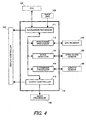
- FIG. 4 is a functional block diagram showing functions that are realized by the control unit 110.
- control unit 110 functions as a navigation processor 111, a positioning processor 112, a style detector 113, an electronic compass (e-compass) processor 114, an output controller 115, and the like when the navigation function is executed.
- the navigation processor 111 collaborates with the CCU 120, the input unit 130, and the like, and accesses the server device 3 providing the position information service to receive and send necessary information, when the navigation function is executed in the mobile phone 100.
- the navigation processor 111 requests the server device 3 to provide a route search service by sending the current position of the mobile phone 100 obtained by the GPS function, etc., and the information showing the destination entered by a user with operating the input unit 130.
- the navigation processor 111 obtains navigation screen images and the like that have been sent by the server device 3 according to the request.
- the navigation screen in this case, may have map images including a route indicator showing a route from the current position to the destination.
- the positioning processor 112 controls the GPS receiver 170 to obtain position data.
- the positioning processor 112 obtains the position data representing the current position of the mobile phone 100 from the GPS receiver 170 at every predetermined time interval (for example, 20 seconds interval), thus constantly recognizes the position of the mobile phone 100.
- the positioning processor 112 also controls the CCU 120 to obtain the position data representing the position of the destination from the server device 3.
- the style detector 113 controls the open/close sensor 160 to detect whether the mobile phone 100 is in the open style or in the closed style, based on the detection signals from the open/close sensor 160.
- the electronic compass (e-compass) processor 114 controls the azimuth sensor 180 to obtain the azimuth information showing the azimuth that has been measured by the azimuth sensor 180, and realizes the electronic compass function.
- the electronic compass processor 114 calculates the direction of the mobile phone 100 and the azimuth toward the specified destination based on the azimuth measured by the azimuth sensor 180.
- the direction of the mobile phone 100 means the direction of the first casing 100A. That is, the first casing 100A is held by the user when the mobile phone 100 is in the open style as shown in FIG. 2A, because the keypads and the like which are necessary for the operations are located on the first casing 100A.
- the user uses the main display 100D to see the navigation screen.
- the first casing 100A held horizontally by the user's hand, thus the upper end of the first casing 100A faces toward the forward direction of the user.
- the sub display 100E will be used for showing the navigation screen.
- the upper end of the first casing 100A still faces toward the forward direction of the user.
- the electronic compass processor 114 calculates the direction of the mobile phone 100 (hereinafter referred to as "device direction") by calculating the azimuth that the upper end of the first casing 100A is facing toward, based on the azimuth measured by the azimuth sensor 180.
- the electronic compass processor 114 also calculates the azimuth toward the destination with respect to the device direction of the mobile phone 100, based on the current position of the mobile phone 100 and the position data about the destination that has been obtained by the positioning processor 112.
- the output controller 115 controls the display controller 140, and performs display-switching between the main display 100D and the sub display 100E, according to the style of the mobile phone 100 detected by the style detector 113.
- the output controller 115 also generates the display image according to the intended display and provides it to the display controller 140.
- the display which is viewable to a user will be the main display 100D, so the output controller 115 controls the display controller 140 so as to display the navigation screen on the main display 100D.
- the display viewable to a user will be the sub display 100E, so the output controller 115 controls the display controller 140 so as to display the navigation screen on the sub display 100E.
- the navigation screen provided from the server device 3 to be displayed on the main display 100D is a detailed navigation screen (route guidance screen) including a map image as shown in FIG. 5. Therefore, the output controller 115 will control the display controller 140 such that the detailed navigation screen will be displayed on the large size main display 100D.
- the output controller 115 adjusts the direction of the screen image to be displayed so that the azimuth of the calculated device direction coincides with the same azimuth on the map to be displayed. For example, if the user is forwarding toward east, the output controller 115 adjusts the direction of the navigation screen so that east end on the map faces the upper end of the main display 100D.
- the output controller 115 when the style of the mobile phone 100 is changed to the closed style under executing the navigation function, a display that is viewable to a user will be the sub display 100E for displaying a simplified screen.
- the output controller 115 generates a direction guidance screen (simple navigation screen) as shown in FIG. 6B, which shows the direction toward the destination with respect to the device direction that has been calculated by the electronic compass processor 114, and controls the display controller 140 to display thus generated simple navigation screen.
- the simple navigation screen may be shaped circular as shown in FIG. 6B.
- the output controller 115 may also control voice guidance.
- the output controller 115 outputs audio signals representing voice guidance to the audio processor 150, thus the voice guidance will be output from the speaker 151, while displaying the detailed navigation screen.
- each operation described in these flowcharts is realized by the sequential executions of the program codes stored in the storage unit 190 by the control unit 110. Additionally, the operations may be realized by real time execution of the program which is given via any network media such as a mobile telephone network 2 and Internet 4 as well as the case where such the program is supplied by any recording media.
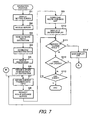
- FIG. 7 and FIG. 8 show a characteristic part of the operation (navigation function) in the present embodiment, out of the general operations of the mobile phone 100, and after the process flows in FIG. 7 and FIG. 8, operations will be performed based on the process flow of the general operations (not shown).
- FIG. 7 and FIG. 8 are flowcharts for explaining "Navigation Process" which starts upon the user operation with the input unit 130 under the mobile phone 100 is in the open style.
- key input signals generated by the input unit 130 in accordance with the user's key operation are entered into the control unit 110, which will lead to a program execution relating to the navigation function, and then each function component shown in FIG. 4 will be realized.
- Step S1 the navigation processor 111 and the output controller 115 will output a setting screen for the navigation on the main display 100D (Step S1).
- keyword(s) for specifying an arbitrary destination is entered by keypads operation performed by a user.
- Key input signals representing the keyword(s) are generated by the input unit 130, and then entered into the control unit 110.
- the navigation processor 111 will store the relevant keyword in the memory 191, while controlling the CCU 120 to access the server device 3 (Step S2).
- the navigation processor 111 requests the position data about the relevant destination by sending the keyword stored in the memory 191 to the server device 3 (Step S3).
- the server device 3 various kinds of information relating to the navigation is accumulated in a database, and the information showing the relevant destination is searched from the database, based on the keyword that has been sent from the mobile phone 100.
- the server device 3 sends the searched destination information to the mobile phone 100 in order to confirm if the searched destination information is a destination which is requested by the user of the mobile phone 100.
- the CCU 120 receives the destination information and enters it in the control unit 110, thus the destination information is downloaded (Step S4).
- the downloaded destination information will be listed in the setting screen by the output controller 115. Any given candidate will be selected and specified from this list through the keypad operation performed by the user.
- the navigation processor 111 controls the CCU 120 to obtain the position data (longitude and latitude information) about this potential selection (destination) from the server device 3.
- the navigation processor 111 temporarily memorizes the position data about the designated destination in the work area of the memory 191 (Step S6).
- the positioning processor 112 controls the GPS receiver 170 to obtain the position data representing the current position of the mobile phone 100 (Step S7).
- the positioning processor 112 notifies thus obtained current position to the navigation processor 111.
- the navigation processor 111 requests the server device 3 to send a route from this current position to the destination (Step S8).
- the server device 3 performs a route search based on request, and sends map data showing the searched route to the mobile phone 100.
- the navigation processor 111 receives by downloading the map data including the route guidance sent by the server device 3 (Step S9), the output controller 115 outputs this map image including the route guidance as a detailed navigation screen on the main display 100D (Step S10).
- FIG. 5 exemplifies the detailed navigation screen displayed on the main display 100D.
- the detailed navigation screen indicates the current position and destination on the map, while showing a route guidance image indicating the route from the current position to the destination with a bold line.
- the output controller 115 adjusts the direction of the navigation screen so that the azimuth on the map in the navigation screen coincides with the azimuth of the device direction (that is, the forward direction) calculated by the electronic compass processor 114.
- the output controller 115 in addition to displaying thus adjusted navigation screen, may also controls the audio processor 150 to output voice guidance such as instructions for right/left turn according to the current position.
- the style detector 113 obtains detection signals from the open/close sensor 160 constantly to detect whether the style of the mobile phone 100 is changed to the "closed style” from the “open style” (Step S11), and then notifies the positioning processor 112 of the detection result.
- the positioning processor 112 will detect whether the specified time (e.g. 20 seconds, etc.) has been passed after the current position is obtained from the GPS receiver 170, in other words, whether it falls on the timing for updating the position data representing the current position of the mobile phone 100 (Step S12).
- the specified time e.g. 20 seconds, etc.
- Step S12 If it is not the timing for updating the position data (Step S12: No), that condition will be notified to the navigation processor 111. In this case, the navigation processor 111 determines whether any end event indicating the end of the navigation process has occurred or not (Step S 13).
- Step S13 No
- the process flow goes back to step S11 and operations at steps S11 to S 13 are performed repeatedly.
- Step S12 determines that it is the timing for updating the position data (Step S12: Yes)
- Step S12: Yes determines that it is the timing for updating the position data.
- the positioning processor 112 obtains new current position data from the GPS receiver 170 whenever the timing for updating the position data arrives.
- the navigation processor 111 downloads another map image including updated route indication based on the newly obtained information from the server device 3.
- the output controller 115 sequentially updates the navigation screen that has been displayed on the main display 100D by rewriting the screen images into the newly downloaded images.
- the map image having the latest route indication, which has been downloaded most recently, is stored in the memory 191.
- the detailed navigation screen provided from the server device 3 is displayed on the main display 100D, when a user uses the navigation function under the mobile phone 100 is in the open style.
- the user of the mobile phone 100 uses the navigation function as in the manner described above with the open styled mobile phone 100.
- the route on the user is simple (for example, going along a large straight street for a while, or the like) such the detailed navigation may not be always necessary.
- the user may change the style of the mobile phone 100 to "closed style" because the closed style is easier to carry the mobile phone 100.
- the style detector 113 determines that the "open style” has been changed to the "closed style", based on the detection signals from the open/close sensor 160 (Step S11: Yes). In this case, the style detector 113 notifies it to the output controller 115 and the positioning processor 112.
- the output unit 115 controls the display controller 140 to turn off the main display 100D by, for example, stopping the power supply thereto (Step S 14), which leads to the end of navigation display using the main display 100D.
- the positioning processor 112 that has been notified of the style change from the style detector 113, newly obtains current position data by controlling the GPS receiver 170 (Step S 15), and notifies the obtained current position data to the navigation processor 111.
- the navigation processor 111 calculates the distance from the current position to the destination, based on the notified current position and the destination position that is temporarily memorized in the memory 191 (Step S16).
- the direct distance from the current position to the destination may be calculated, but by referring to the previously obtained map having the route and the scale thereof, and obtaining the traveling distance while tracing the route on the map, the movement distance along the route may be calculated based on this traveling distance and scale of the map.
- the navigation processor 111 notifies the current position and the calculated distance to the electronic compass processor 114.
- the electronic compass processor 114 calculates the azimuth toward the destination (hereinafter referred to as "destination direction") with respect to the current position, using the current position and the destination position (Step S17).
- destination direction the azimuth toward the destination
- FIG. 6A illustrates the relationship between the azimuth that has been measured by the azimuth sensor 180 based on the current position (device direction), and the azimuth toward the destination.
- FIG. 6A exemplifies a case where azimuth "east-northeast" has been calculated as the destination direction.
- the electronic compass processor 114 accesses the azimuth sensor 180, and based on the measured azimuth, calculates the direction of the first casing 100A (device direction) (Step S 18).
- the electronic compass processor 114 outputs into the output controller 115, the distance from the current position notified by the navigation processor 111 to the destination, the destination direction calculated in Step S 17, and the device direction calculated in Step 18.
- the output controller 115 generates the simple navigation screen (direction guidance screen) to be displayed on the sub display 100E, based on the distance that has been output from the electronic compass processor 114, the destination direction, and the device direction.
- An example of the simple navigation screen displayed on the sub display 100E is shown in FIG. 6B.
- the destination direction that is based on the azimuth that has been measured by the azimuth sensor 180 (device direction), is displayed in a manner of guidance on the sub display 100E.
- the device direction (the direction of the first casing 100A) is "southeast" while the destination direction is "east-northeast".
- the sub display 100E displays the direction guidance screen as shown in FIG. 6B, on which cardinal points (NSEW) are displayed with a plurality of concentric circles with intersecting linings, one of which is a vertical line between "0 o'clock” position and “6 o'clock” position of a clock face, and another of which is a horizontal line between "3 o'clock” position and "9 o'clock” position, for indicating back/forth and right/left directions based on the device direction (forward direction).
- NSEW cardinal points
- the output controller 115 displays the simple navigation screen on the sub display 100E so that the forward direction points "0 o'clock" position based on the calculated device direction. In this case, the direction of the vertical line between 0 o'clock position and 6 o'clock position coincide with the forward direction, so the output controller 115 displays an arrow image indicating the forward direction (forward direction indicator) at the upper part of the screen, as shown in FIG. 6B. Additionally, the calculated distance from the current position to the destination is numerically displayed in the center of the navigation screen (2800m, for example, in FIG.6B).
- the output controller 115 generates a forward direction indicator image at "0 o'clock" position on a virtual clock face corresponding to the circular sub display 100E (or the circular simple navigation screen), and sets the calculated device direction (forward direction) with the 0 o'clock direction (Step S19).
- the electronic compass processor 114 also calculates constantly the difference of the azimuth toward the destination from the device direction as a relative direction, and outputs it to the output controller 115.
- the output controller 115 adjusts the cardinal points (NSEW) on the sub display 100E, based on the calculated relative direction, while displaying the arrow image (destination direction indicator) indicating the destination direction from the current position, on the sub display 100E (Step S20).
- the electronic compass processor 114 detects whether or not the device direction and the azimuth of the destination coincide in respect of the azimuth (Step S21).
- the direction which a user should proceed to is provided by changing the display color of the simple navigation screen (direction guidance screen).
- the electronic compass processor 114 constantly detects whether or not the device direction and azimuth of the destination coincide with each other, and if the device direction and the azimuth of the destination coincide in respect of the direction (Step S21: Yes), the condition is notified to the output controller 115.
- the electronic compass processor 114 may judge that the device direction and the azimuth of the destination coincide, in the case where an angle between a direction which is one of 16 azimuths measurable by the azimuth sensor 180 being approximated to the destination direction and the device direction is less than a predetermined threshold angle.
- the output controller 115 sets the background color (BG color) of the simple navigation screen displayed on the sub display 100E, for example, green to inform that the forward direction of the user is correct (Step S22).
- Step S21 if the coincidence of the azimuth is not notified (Step S21: No), the output controller 115 sets the background color (BG color) of the simple navigation screen displayed on the sub display 100E, for example, yellow to warn that the forward direction of the user is wrong (Step S23).
- BG color background color
- the navigation processor 111 constantly calculates the distance from the current position to the destination, and outputs it into the output controller 115.
- the output controller 115 displays the distance to the destination in the center of the simple navigation screen, based on the output from the navigation processor 111 (Step S24).
- the voice guidance as performed with the navigation using the main display 100D is not to be performed.
- the electronic compass processor 114 obtains the device direction by accessing the azimuth sensor 180 (Step S25) as needed, and determines whether the device direction has been changed by comparing the latest device direction with the device direction previously obtained (Step S26).
- Step S26 Yes
- the electronic compass processor 114 notifies it to the output controller 115.
- the process flow goes back to Step 19, and subsequently, the output controller 115 change the display contents of the navigation screen according to the amount of change of the device direction (Step S19 to S24).
- Step S26 if the device direction has not changed and is the same as previous one (Step S26: No), the navigation processor 111 will determine whether the predetermined time (e.g. 20 seconds, etc.) has been passed since the current position was obtained from the GPS receiver 170, in other words, if it falls on the timing for updating the position data (Step S27).
- the predetermined time e.g. 20 seconds, etc.
- the style detector 113 controls the open/close sensor 160 to detect whether the style of the mobile phone 100 has been changed to the "open style” or not (Step S28).
- Step S28 If it is determined that the mobile phone 100 is still in the "closed style" (Step S28: No), the process flow goes back to Step S25, and subsequently the device will be in the standby state with repeating the above operations (Step S25 to S28).
- Step S27: Yes if the predetermined time has been passed, that is, it is determined that it is the timing for updating the position data (Step S27: Yes), the Steps S15 to S24 will be executed. In other words, while the navigation function is executed in the "closed style", the screen contents will be updated by rewriting the contents of the navigation screen of the sub display 100E, based on the current position newly obtained from the GPS receiver 170, whenever the timing for updating the position data arrives.
- Step S28 if it determined that the style of the mobile phone 100 has been changed from the "closed style” to the "open style” (Step S28: Yes), the style detector 113 notifies it to the output controller 115. In this case, the output controller 115 executes operations at Step S7 shown in FIG. 7 after turning off the sub display 100E by, for example, stopping the power supply thereto (Step S29).
- Step S7 if the current position is newly obtained in Step S7, the server device 3 will be requested to provide the navigation screen based on the obtained current position, so new map information showing the route from the updated current position to the destination will be downloaded from the server device 3.
- Such detailed navigation screen is displayed on the main display 100D, so in the case that the style of the mobile phone 100 is changed from the closed style to the open style during the execution of the navigation function, the display of the navigation screen is switched from the sub display 100E to the main display 100D.
- control unit 110 obtains the current position from the GPS receiver 170 during the operation of the navigation function, while detecting the style of the device body by accessing the open/close sensor 160, switches a display to be used for the navigation according to the style at the time, and switches either the detailed display that guides the route from the current position to the destination, or the simple display that guides the destination direction.
- control unit 110 calculates the distance from the current position to the destination and performs a distance display together with the destination guidance display, which can lead to a useful guidance even in a narrow or small screen.
- the map information in the case of displaying the route in a manner of guidance on the map, the map information will be obtained by downloading, but in the case of performing a direction guidance display for the destination direction, the map information will not be obtained by communication, which will make it possible to significantly save power consumption and communication fees.
- a voice guidance performed along with the navigation display may be turned on/off by the change of the current style, without controlling the volume, in a certain case where the voice guidance causes problems to the third person.
- Such configuration provides benefit of power consumption, as well.
- the current position is obtained from the GPS receiver 170, as well as the map images including the route indication, but if the mobile phone 100 has an autonomous positioning function, the continuous calculations of the position measurement may be performed on the side of the mobile phone 100, after obtaining the current position from the GPS receiver 170.
- the predetermined time e.g. 20 seconds
- the map images including the route indication may not be downloaded while the calculation of the position by use of the autonomous positioning function, and it may be downloaded when a new current position has been obtained from the GPS receiver 170. Additionally, the subsequent new map information may be obtained by downloading when the current position reaches at the edge of the navigation screen (the edge of the map).
- the background color is changed depending on whether or not the device direction and the azimuth of the destination coincide in respect of the direction, but the display method is optional, and, for example, the coincidence/non-coincidence of the direction may be visually displayed by changing the color of the destination direction indicator.
- the sub display 100E is a black and while display, the coincidence/non-coincidence of the direction may also be displayed, for example, by highlighting or blinking the destination direction indicator.
- the difference between the device direction and the azimuth of the destination is large (e.g. in opposite direction), it may be warned by alarm sound or the like.
- the sub display 100E is a black and white display
- the power consumption will be significantly reduced compared with a color display.
- the open/close-typed mobile phone is exemplified, but a slide-type, rotary-type, or biaxial rotary-type mobile phone are also adaptable to the present invention. In this case, it can be selectively determined which style to associate with each of the modes of display, the route guidance display and the direction guidance display.
- the route guidance display is performed on the main display 100D, and the direction guidance display is performed in the sub display 100E, but, for example, in a slide-type mobile phone, the route guidance display and the direction guidance display may be switched from one another on one display section.
- the route guidance display may be displayed in the large screen and the direction guidance display may be compactly displayed.
- the distance from the current position to the destination is calculated, and the distance is displayed together with the direction guidance, but the distance to the destination may be displayed together with the detailed guidance screen having the map images showing a route.
- a map showing a route is displayed in a manner of guidance, but the display may be simpler route guidance.
- the voice guidance is inactivated in the case of the direction guidance display, but the frequency of the voice guidance may be controlled according to the style.
- the present invention is not limited to the application to the navigation function for pedestrian assistance, and this mobile phone 100 may be brought into a vehicle and thereby used as a so-called car navigation device.
- the GPS receiver 170 is used, but, for example, the current position of a user may be measured by a plurality of base stations of a ground system for conducting the mobile wireless communications.
- the position information about the destination is supplied from the external device, but the same information as the position information accumulated in the server device 3, may be accumulated within the mobile phone 100 itself.
- the position information about the specified destination can be obtained without communicating with an external source, so the position information about the destination can be obtained without any communication costs.
- the mobile terminal of the present invention is not limited to the mobile phone, as it is also applicable to a mobile terminal device such as a PDA, a digital camera, a watch, and a music player even if these have the navigation function.
- a mobile terminal device such as a PDA, a digital camera, a watch, and a music player even if these have the navigation function.
- the mobile terminal device having in advance necessary functions for achieving the present invention can be provided, but also an existing mobile terminal device is able to act as the mobile terminal device according to the present invention by applying programs for realizing the above functions by the control unit 110.
- a same program as the program executed by the above control unit 110 is applied to the existing mobile terminal device, and the program is executed by a computer controlled by the relevant mobile terminal device, to thereby make such devise as to serve as a mobile terminal device having the same function as the above mobile phone 100.
- Such the program may be distributed arbitrary, for example, it can be distributed by being stored in a memory media such as a CD-ROM and a memory card, as well as distributed through a communication media such as Internet by being superposed on carrier waves.
Landscapes
- Engineering & Computer Science (AREA)
- Radar, Positioning & Navigation (AREA)
- Remote Sensing (AREA)
- Physics & Mathematics (AREA)
- Automation & Control Theory (AREA)
- General Physics & Mathematics (AREA)
- Signal Processing (AREA)
- Computer Networks & Wireless Communication (AREA)
- Environmental & Geological Engineering (AREA)
- Human Computer Interaction (AREA)
- Navigation (AREA)
- Traffic Control Systems (AREA)
- Instructional Devices (AREA)
Applications Claiming Priority (1)
| Application Number | Priority Date | Filing Date | Title |
|---|---|---|---|
| JP2006247645A JP4251653B2 (ja) | 2006-09-13 | 2006-09-13 | 携帯端末装置及びプログラム |
Publications (3)
| Publication Number | Publication Date |
|---|---|
| EP1901039A2 true EP1901039A2 (de) | 2008-03-19 |
| EP1901039A3 EP1901039A3 (de) | 2010-12-01 |
| EP1901039B1 EP1901039B1 (de) | 2018-11-28 |
Family
ID=38736085
Family Applications (1)
| Application Number | Title | Priority Date | Filing Date |
|---|---|---|---|
| EP07015918.1A Not-in-force EP1901039B1 (de) | 2006-09-13 | 2007-08-13 | Mobiles Endgerät und zugehöriges Programm |
Country Status (5)
| Country | Link |
|---|---|
| US (1) | US7756638B2 (de) |
| EP (1) | EP1901039B1 (de) |
| JP (1) | JP4251653B2 (de) |
| KR (1) | KR100871786B1 (de) |
| CN (1) | CN101144721B (de) |
Cited By (4)
| Publication number | Priority date | Publication date | Assignee | Title |
|---|---|---|---|---|
| WO2009065425A1 (en) * | 2007-11-22 | 2009-05-28 | Nokia Corporation | Apparatus and computer program for providing navigational information to a secondary visual user interface of a portable electronic device and method of assembling this device |
| EP2251643A1 (de) * | 2009-05-13 | 2010-11-17 | Oberthur Technologies | Mikrochipkarte für elektronische Einheit |
| DE102013221629A1 (de) * | 2013-10-24 | 2015-04-30 | Volkswagen Aktiengesellschaft | Ansteuereinrichtung und Verfahren zum Anzeigen ein Richtungs- und Entfernungsanzeige |
| FR3047311A1 (fr) * | 2016-02-02 | 2017-08-04 | Duhamel Sas | Procede d'orientation spatiale utilisant les coordonnees gps d'un telephone portable |
Families Citing this family (30)
| Publication number | Priority date | Publication date | Assignee | Title |
|---|---|---|---|---|
| JP4433002B2 (ja) * | 2007-06-19 | 2010-03-17 | 株式会社カシオ日立モバイルコミュニケーションズ | 電子機器及びプログラム |
| US8331898B2 (en) * | 2007-10-03 | 2012-12-11 | Texas Instruments Incorporated | Power-saving receiver circuits, systems and processes |
| US20090119005A1 (en) * | 2007-10-16 | 2009-05-07 | Fujitsu Ten Limited | Navigation control device, navigation equipment, server and destination setting system |
| US9341494B2 (en) * | 2007-12-21 | 2016-05-17 | Nokia Technologies Oy | Apparatuses and methods for managing route navigation via mobile devices |
| JP4543342B2 (ja) * | 2008-05-12 | 2010-09-15 | ソニー株式会社 | ナビゲーション装置及び情報提供方法 |
| US9171221B2 (en) * | 2010-07-18 | 2015-10-27 | Spatial Cam Llc | Camera to track an object |
| JP2011041261A (ja) * | 2009-07-16 | 2011-02-24 | Panasonic Corp | アンテナ装置 |
| US20110054775A1 (en) * | 2009-08-25 | 2011-03-03 | Thomas David Snyder | Electronic device with gps application triggered display |
| JPWO2011080920A1 (ja) * | 2009-12-28 | 2013-05-09 | パナソニック株式会社 | 経路情報生成装置及び経路情報生成方法 |
| JP5374463B2 (ja) * | 2010-09-01 | 2013-12-25 | 株式会社ゼンリンデータコム | ナビゲーション端末、ナビゲーションシステム、ナビゲーション方法、およびプログラム |
| US9212913B2 (en) * | 2010-10-05 | 2015-12-15 | Mitsubishi Electric Corporation | Navigation apparatus and mobile data terminal |
| US8457654B1 (en) * | 2011-03-31 | 2013-06-04 | Google Inc. | Directional feedback |
| JP2012251960A (ja) * | 2011-06-07 | 2012-12-20 | Casio Comput Co Ltd | 腕装着型端末、ナビゲーションシステム、及び、プログラム |
| JP5624101B2 (ja) | 2012-10-05 | 2014-11-12 | 株式会社小松製作所 | 掘削機械の表示システム、掘削機械及び掘削機械の表示用コンピュータプログラム |
| US9494441B2 (en) * | 2014-07-28 | 2016-11-15 | Toyota Motor Engineering & Manufacturing North America, Inc. | Personalized route calculation system for a vehicle |
| CN104236560B (zh) * | 2014-09-17 | 2017-07-28 | 百度在线网络技术(北京)有限公司 | 一种导航方法及装置 |
| US9207092B1 (en) * | 2014-12-22 | 2015-12-08 | Google Inc. | Displaying navigation information within a secondary user interface of a mobile device |
| CN104596518A (zh) * | 2015-02-12 | 2015-05-06 | 广东欧珀移动通信有限公司 | 一种商场出口导航方法和商场出口导航装置 |
| JP6663648B2 (ja) * | 2015-04-10 | 2020-03-13 | シャープ株式会社 | 表示制御装置、情報処理装置、表示制御方法、および制御プログラム |
| US20160356622A1 (en) * | 2015-06-07 | 2016-12-08 | Apple Inc. | Walking Guidance During Transit Navigation |
| CN105066977A (zh) * | 2015-08-02 | 2015-11-18 | 龙文凯 | 可便携无线导航led指示表 |
| JP6521847B2 (ja) * | 2015-12-02 | 2019-05-29 | 株式会社ゼンリンデータコム | 情報処理装置、情報処理装置の制御方法及びプログラム |
| JP6534921B2 (ja) * | 2015-12-02 | 2019-06-26 | 株式会社ゼンリンデータコム | ウェアラブルデバイス、ウェアラブルデバイスの制御方法及びプログラム |
| CN106996788A (zh) * | 2016-01-26 | 2017-08-01 | 上海大形智能科技有限公司 | 一种导航界面显示方法及装置 |
| KR102198282B1 (ko) * | 2016-07-08 | 2021-02-02 | 주식회사 달빛기사 | 휴대 단말기의 길안내 장치 및 방법 |
| CN108871350B (zh) * | 2017-05-11 | 2021-05-18 | 北京嘀嘀无限科技发展有限公司 | 一种地图导航模式的显示方法、显示系统及计算机装置 |
| JP2023081438A (ja) * | 2021-12-01 | 2023-06-13 | ヤンマーホールディングス株式会社 | 自動走行方法、作業車両及び自動走行システム |
| CN114501323B (zh) * | 2021-12-30 | 2023-12-22 | 珠海原子科技有限公司 | 一种森林智慧导航系统及方法 |
| CN114459490B (zh) * | 2022-01-17 | 2024-02-23 | 珠海读书郎软件科技有限公司 | 一种多屏电话手表地图导航的方法、存储介质及设备 |
| CN114754643A (zh) * | 2022-04-26 | 2022-07-15 | 宏大爆破工程集团有限责任公司 | 一种露天台阶爆破中rtk线放样布孔施工方法 |
Citations (1)
| Publication number | Priority date | Publication date | Assignee | Title |
|---|---|---|---|---|
| JP2005274293A (ja) | 2004-03-24 | 2005-10-06 | Sanyo Electric Co Ltd | 通信装置及び携帯電話装置 |
Family Cites Families (29)
| Publication number | Priority date | Publication date | Assignee | Title |
|---|---|---|---|---|
| US6320496B1 (en) * | 1999-04-29 | 2001-11-20 | Fuji Xerox Co., Ltd | Systems and methods providing tactile guidance using sensory supplementation |
| JP3791249B2 (ja) * | 1999-07-12 | 2006-06-28 | 株式会社日立製作所 | 携帯端末 |
| GB2359888A (en) * | 2000-03-01 | 2001-09-05 | Hewlett Packard Co | Displaying directional indications in handheld devices |
| DE10030805A1 (de) * | 2000-06-29 | 2002-01-10 | Nokia Mobile Phones Ltd | Verfahren und Mobilstation zur Wegführung |
| JP2002058057A (ja) | 2000-08-09 | 2002-02-22 | Nippon Telegr & Teleph Corp <Ntt> | 歩行者ナビゲーション方法およびシステム |
| JP2002108531A (ja) | 2000-09-29 | 2002-04-12 | Sanyo Electric Co Ltd | 通信端末装置および設定項目表示方法 |
| DE10058492A1 (de) * | 2000-11-24 | 2001-08-30 | Horst Neuser | Zielsuchsystem für Mobiltelefon |
| JP4040252B2 (ja) | 2000-12-19 | 2008-01-30 | シャープ株式会社 | 携帯端末装置 |
| JP2002281131A (ja) | 2001-03-21 | 2002-09-27 | Nec Saitama Ltd | 移動体通信機 |
| US20030054830A1 (en) * | 2001-09-04 | 2003-03-20 | Zi Corporation | Navigation system for mobile communication devices |
| KR100601364B1 (ko) | 2001-09-07 | 2006-07-13 | 주식회사 리버트론 | 간이 네비게이션 기능을 지원하는 이동통신 단말기 및 그제어방법. |
| DE10153528A1 (de) * | 2001-10-30 | 2003-05-15 | Bosch Gmbh Robert | Verfahren zur Bereitstellung von Zielführungshinweisen für einen Nutzer |
| CN1784047A (zh) | 2001-11-08 | 2006-06-07 | 雅马哈株式会社 | 移动终端 |
| JP4278952B2 (ja) | 2001-11-08 | 2009-06-17 | ヤマハ株式会社 | 携帯端末 |
| US7299129B2 (en) * | 2002-04-02 | 2007-11-20 | Garmin Ltd. | Portable navigation device with releasable antenna |
| JP2003099156A (ja) | 2002-05-14 | 2003-04-04 | Hitachi Ltd | 携帯型情報処理装置 |
| JP2004028854A (ja) | 2002-06-27 | 2004-01-29 | Nec Corp | 携帯端末、位置情報サーバおよび使用者誘導システム |
| JP2004064302A (ja) * | 2002-07-26 | 2004-02-26 | Matsushita Electric Ind Co Ltd | 携帯端末装置 |
| JP4080395B2 (ja) * | 2002-08-02 | 2008-04-23 | シャープ株式会社 | 携帯型情報処理装置 |
| JP2004101366A (ja) | 2002-09-10 | 2004-04-02 | Hitachi Ltd | 携帯通信端末及びこれを用いたナビゲーションシステム |
| KR100485839B1 (ko) * | 2003-01-30 | 2005-04-28 | 삼성전자주식회사 | 특정장소의 방향 지시 기능을 갖는 개인 휴대형 장치 및그 제어방법 |
| CN2662553Y (zh) | 2003-11-28 | 2004-12-08 | 华冠通讯股份有限公司 | 双屏幕手机 |
| JP4762501B2 (ja) | 2004-04-12 | 2011-08-31 | 京セラ株式会社 | 携帯通信端末とその情報表示方法および地磁気センサの誤差補正方法 |
| JP2006003269A (ja) | 2004-06-18 | 2006-01-05 | Aichi Steel Works Ltd | 携帯端末 |
| US20050288858A1 (en) * | 2004-06-29 | 2005-12-29 | Amer Osama A | Mecca finder |
| JP2006105640A (ja) | 2004-10-01 | 2006-04-20 | Hitachi Ltd | ナビゲーション装置 |
| KR20060078076A (ko) | 2004-12-30 | 2006-07-05 | 엘지전자 주식회사 | 네비게이션 시스템의 지도 표시모드 변경방법 |
| KR101135100B1 (ko) * | 2005-12-07 | 2012-04-16 | 엘지전자 주식회사 | 차량 단말기에서의 네비게이션 간편화면 표시 장치 및 방법 |
| US8619040B2 (en) * | 2007-07-05 | 2013-12-31 | Sony Corporation | Electronic apparatus |
-
2006
- 2006-09-13 JP JP2006247645A patent/JP4251653B2/ja not_active Expired - Fee Related
-
2007
- 2007-08-09 US US11/891,123 patent/US7756638B2/en active Active
- 2007-08-13 EP EP07015918.1A patent/EP1901039B1/de not_active Not-in-force
- 2007-08-13 KR KR1020070081053A patent/KR100871786B1/ko not_active Expired - Fee Related
- 2007-09-13 CN CN2007101547646A patent/CN101144721B/zh not_active Expired - Fee Related
Patent Citations (1)
| Publication number | Priority date | Publication date | Assignee | Title |
|---|---|---|---|---|
| JP2005274293A (ja) | 2004-03-24 | 2005-10-06 | Sanyo Electric Co Ltd | 通信装置及び携帯電話装置 |
Cited By (5)
| Publication number | Priority date | Publication date | Assignee | Title |
|---|---|---|---|---|
| WO2009065425A1 (en) * | 2007-11-22 | 2009-05-28 | Nokia Corporation | Apparatus and computer program for providing navigational information to a secondary visual user interface of a portable electronic device and method of assembling this device |
| EP2251643A1 (de) * | 2009-05-13 | 2010-11-17 | Oberthur Technologies | Mikrochipkarte für elektronische Einheit |
| FR2945699A1 (fr) * | 2009-05-13 | 2010-11-19 | Oberthur Technologies | Carte a microcircuit pour entite electronique |
| DE102013221629A1 (de) * | 2013-10-24 | 2015-04-30 | Volkswagen Aktiengesellschaft | Ansteuereinrichtung und Verfahren zum Anzeigen ein Richtungs- und Entfernungsanzeige |
| FR3047311A1 (fr) * | 2016-02-02 | 2017-08-04 | Duhamel Sas | Procede d'orientation spatiale utilisant les coordonnees gps d'un telephone portable |
Also Published As
| Publication number | Publication date |
|---|---|
| JP2008070176A (ja) | 2008-03-27 |
| US20080065326A1 (en) | 2008-03-13 |
| KR100871786B1 (ko) | 2008-12-05 |
| CN101144721B (zh) | 2011-04-06 |
| CN101144721A (zh) | 2008-03-19 |
| JP4251653B2 (ja) | 2009-04-08 |
| EP1901039A3 (de) | 2010-12-01 |
| US7756638B2 (en) | 2010-07-13 |
| EP1901039B1 (de) | 2018-11-28 |
| KR20080024435A (ko) | 2008-03-18 |
Similar Documents
| Publication | Publication Date | Title |
|---|---|---|
| EP1901039B1 (de) | Mobiles Endgerät und zugehöriges Programm | |
| KR100424462B1 (ko) | 휴대용 단말기의 방향 및 위치 정보 표시장치 및 그 제어방법 | |
| KR101561913B1 (ko) | 이동 단말기의 영상 표시 방법 및 그 장치 | |
| US8532678B2 (en) | Portable GPS navigation device | |
| US8994851B2 (en) | Displaying image data and geographic element data | |
| US9547435B2 (en) | Rendering across terminals | |
| US8751155B2 (en) | Mobile vehicle navigation method and apparatus thereof | |
| US8072354B2 (en) | Mobile vehicle navigation method and apparatus thereof | |
| US8433244B2 (en) | Orientation based control of mobile device | |
| KR100991669B1 (ko) | 휴대 단말기의 경로 검색 방법 | |
| KR101220600B1 (ko) | 휴대 전자 기기 및 지자기 센서 교정 방법 | |
| KR20080092463A (ko) | 휴대 전자기기와 그 방위 표시 방법 | |
| US8386162B2 (en) | Electronic device and recording medium | |
| KR101570413B1 (ko) | 이동 단말기의 영상 표시 방법 및 그 장치 | |
| CN101097140A (zh) | 步行导引方法及装置 | |
| KR101677615B1 (ko) | 이동 단말기의 관심 지점 등록 방법 및 그 장치 | |
| JP2006133132A (ja) | 携帯ナビゲーション装置 | |
| JP2005223782A (ja) | 移動携帯端末 | |
| JP2001041765A (ja) | 行先案内システム | |
| KR101513633B1 (ko) | 텔래매틱스 단말기의 통화 제어 방법 및 그 장치 | |
| JP2006157474A (ja) | 携帯端末装置 | |
| KR100525532B1 (ko) | 이동통신용 네비게이션 시스템 및 그 제어방법 | |
| KR101553948B1 (ko) | 이동 단말기의 poi 정보 제공 방법 및 그 장치 | |
| KR200291353Y1 (ko) | 휴대폰을 이용한 자동 목적지 표시장치 | |
| JP2003014487A (ja) | 携帯ナビゲーション装置 |
Legal Events
| Date | Code | Title | Description |
|---|---|---|---|
| PUAI | Public reference made under article 153(3) epc to a published international application that has entered the european phase |
Free format text: ORIGINAL CODE: 0009012 |
|
| 17P | Request for examination filed |
Effective date: 20070813 |
|
| AK | Designated contracting states |
Kind code of ref document: A2 Designated state(s): AT BE BG CH CY CZ DE DK EE ES FI FR GB GR HU IE IS IT LI LT LU LV MC MT NL PL PT RO SE SI SK TR |
|
| AX | Request for extension of the european patent |
Extension state: AL BA HR MK YU |
|
| RAP1 | Party data changed (applicant data changed or rights of an application transferred) |
Owner name: NEC CASIO MOBILE COMMUNICATIONS LTD. |
|
| RAP1 | Party data changed (applicant data changed or rights of an application transferred) |
Owner name: NEC CASIO MOBILE COMMUNICATIONS, LTD. |
|
| PUAL | Search report despatched |
Free format text: ORIGINAL CODE: 0009013 |
|
| AK | Designated contracting states |
Kind code of ref document: A3 Designated state(s): AT BE BG CH CY CZ DE DK EE ES FI FR GB GR HU IE IS IT LI LT LU LV MC MT NL PL PT RO SE SI SK TR |
|
| AX | Request for extension of the european patent |
Extension state: AL BA HR MK RS |
|
| AKX | Designation fees paid |
Designated state(s): DE FR GB |
|
| RAP1 | Party data changed (applicant data changed or rights of an application transferred) |
Owner name: NEC CORPORATION |
|
| RAP1 | Party data changed (applicant data changed or rights of an application transferred) |
Owner name: LENOVO INNOVATIONS LIMITED (HONG KONG) |
|
| 17Q | First examination report despatched |
Effective date: 20170817 |
|
| GRAP | Despatch of communication of intention to grant a patent |
Free format text: ORIGINAL CODE: EPIDOSNIGR1 |
|
| INTG | Intention to grant announced |
Effective date: 20180727 |
|
| GRAS | Grant fee paid |
Free format text: ORIGINAL CODE: EPIDOSNIGR3 |
|
| GRAA | (expected) grant |
Free format text: ORIGINAL CODE: 0009210 |
|
| AK | Designated contracting states |
Kind code of ref document: B1 Designated state(s): DE FR GB |
|
| REG | Reference to a national code |
Ref country code: GB Ref legal event code: FG4D |
|
| REG | Reference to a national code |
Ref country code: DE Ref legal event code: R096 Ref document number: 602007056957 Country of ref document: DE |
|
| REG | Reference to a national code |
Ref country code: DE Ref legal event code: R097 Ref document number: 602007056957 Country of ref document: DE |
|
| PLBE | No opposition filed within time limit |
Free format text: ORIGINAL CODE: 0009261 |
|
| STAA | Information on the status of an ep patent application or granted ep patent |
Free format text: STATUS: NO OPPOSITION FILED WITHIN TIME LIMIT |
|
| PGFP | Annual fee paid to national office [announced via postgrant information from national office to epo] |
Ref country code: DE Payment date: 20190830 Year of fee payment: 13 |
|
| 26N | No opposition filed |
Effective date: 20190829 |
|
| PGFP | Annual fee paid to national office [announced via postgrant information from national office to epo] |
Ref country code: GB Payment date: 20190829 Year of fee payment: 13 |
|
| PG25 | Lapsed in a contracting state [announced via postgrant information from national office to epo] |
Ref country code: FR Free format text: LAPSE BECAUSE OF NON-PAYMENT OF DUE FEES Effective date: 20190831 |
|
| REG | Reference to a national code |
Ref country code: DE Ref legal event code: R119 Ref document number: 602007056957 Country of ref document: DE |
|
| GBPC | Gb: european patent ceased through non-payment of renewal fee |
Effective date: 20200813 |
|
| PG25 | Lapsed in a contracting state [announced via postgrant information from national office to epo] |
Ref country code: DE Free format text: LAPSE BECAUSE OF NON-PAYMENT OF DUE FEES Effective date: 20210302 |
|
| PG25 | Lapsed in a contracting state [announced via postgrant information from national office to epo] |
Ref country code: GB Free format text: LAPSE BECAUSE OF NON-PAYMENT OF DUE FEES Effective date: 20200813 |