EP1747807B1 - Game program, game device, and game method - Google Patents
Game program, game device, and game method Download PDFInfo
- Publication number
- EP1747807B1 EP1747807B1 EP05736714A EP05736714A EP1747807B1 EP 1747807 B1 EP1747807 B1 EP 1747807B1 EP 05736714 A EP05736714 A EP 05736714A EP 05736714 A EP05736714 A EP 05736714A EP 1747807 B1 EP1747807 B1 EP 1747807B1
- Authority
- EP
- European Patent Office
- Prior art keywords
- event
- replay
- label
- game
- replay images
- Prior art date
- Legal status (The legal status is an assumption and is not a legal conclusion. Google has not performed a legal analysis and makes no representation as to the accuracy of the status listed.)
- Expired - Lifetime
Links
- 238000000034 method Methods 0.000 title claims description 24
- 230000006870 function Effects 0.000 claims description 72
- 230000001174 ascending effect Effects 0.000 claims description 4
- 238000011156 evaluation Methods 0.000 description 11
- 238000010586 diagram Methods 0.000 description 6
- 230000005236 sound signal Effects 0.000 description 3
- 238000006243 chemical reaction Methods 0.000 description 2
- 230000007935 neutral effect Effects 0.000 description 2
- 238000003672 processing method Methods 0.000 description 2
- 230000003044 adaptive effect Effects 0.000 description 1
- 230000002860 competitive effect Effects 0.000 description 1
- 230000003287 optical effect Effects 0.000 description 1
- 239000004065 semiconductor Substances 0.000 description 1
Images


Classifications
-
- A—HUMAN NECESSITIES
- A63—SPORTS; GAMES; AMUSEMENTS
- A63F—CARD, BOARD, OR ROULETTE GAMES; INDOOR GAMES USING SMALL MOVING PLAYING BODIES; VIDEO GAMES; GAMES NOT OTHERWISE PROVIDED FOR
- A63F13/00—Video games, i.e. games using an electronically generated display having two or more dimensions
- A63F13/45—Controlling the progress of the video game
- A63F13/49—Saving the game status; Pausing or ending the game
- A63F13/497—Partially or entirely replaying previous game actions
-
- A—HUMAN NECESSITIES
- A63—SPORTS; GAMES; AMUSEMENTS
- A63F—CARD, BOARD, OR ROULETTE GAMES; INDOOR GAMES USING SMALL MOVING PLAYING BODIES; VIDEO GAMES; GAMES NOT OTHERWISE PROVIDED FOR
- A63F13/00—Video games, i.e. games using an electronically generated display having two or more dimensions
- A63F13/45—Controlling the progress of the video game
- A63F13/48—Starting a game, e.g. activating a game device or waiting for other players to join a multiplayer session
-
- A—HUMAN NECESSITIES
- A63—SPORTS; GAMES; AMUSEMENTS
- A63F—CARD, BOARD, OR ROULETTE GAMES; INDOOR GAMES USING SMALL MOVING PLAYING BODIES; VIDEO GAMES; GAMES NOT OTHERWISE PROVIDED FOR
- A63F13/00—Video games, i.e. games using an electronically generated display having two or more dimensions
- A63F13/60—Generating or modifying game content before or while executing the game program, e.g. authoring tools specially adapted for game development or game-integrated level editor
-
- A—HUMAN NECESSITIES
- A63—SPORTS; GAMES; AMUSEMENTS
- A63F—CARD, BOARD, OR ROULETTE GAMES; INDOOR GAMES USING SMALL MOVING PLAYING BODIES; VIDEO GAMES; GAMES NOT OTHERWISE PROVIDED FOR
- A63F2300/00—Features of games using an electronically generated display having two or more dimensions, e.g. on a television screen, showing representations related to the game
- A63F2300/60—Methods for processing data by generating or executing the game program
- A63F2300/6009—Methods for processing data by generating or executing the game program for importing or creating game content, e.g. authoring tools during game development, adapting content to different platforms, use of a scripting language to create content
-
- A—HUMAN NECESSITIES
- A63—SPORTS; GAMES; AMUSEMENTS
- A63F—CARD, BOARD, OR ROULETTE GAMES; INDOOR GAMES USING SMALL MOVING PLAYING BODIES; VIDEO GAMES; GAMES NOT OTHERWISE PROVIDED FOR
- A63F2300/00—Features of games using an electronically generated display having two or more dimensions, e.g. on a television screen, showing representations related to the game
- A63F2300/60—Methods for processing data by generating or executing the game program
- A63F2300/63—Methods for processing data by generating or executing the game program for controlling the execution of the game in time
- A63F2300/634—Methods for processing data by generating or executing the game program for controlling the execution of the game in time for replaying partially or entirely the game actions since the beginning of the game
-
- A—HUMAN NECESSITIES
- A63—SPORTS; GAMES; AMUSEMENTS
- A63F—CARD, BOARD, OR ROULETTE GAMES; INDOOR GAMES USING SMALL MOVING PLAYING BODIES; VIDEO GAMES; GAMES NOT OTHERWISE PROVIDED FOR
- A63F2300/00—Features of games using an electronically generated display having two or more dimensions, e.g. on a television screen, showing representations related to the game
- A63F2300/60—Methods for processing data by generating or executing the game program
- A63F2300/63—Methods for processing data by generating or executing the game program for controlling the execution of the game in time
- A63F2300/636—Methods for processing data by generating or executing the game program for controlling the execution of the game in time involving process of starting or resuming a game
Definitions
- the preset invention relates to a game program, particularly to a game program for implementing a game in which a replay image corresponding to various events can be displayed on a monitor in a computer. Furthermore, the present invention relates to a game device and a game method implemented with this game program.
- play types are set in order to identify the content of plays. These play types are grouped by, for example, the actions in plays performed during the execution of the game, and the results of plays performed during the execution of the game. Taking a baseball game for example, the play types include actions and results such as "the batter will get a hit/has gotten a hit,” "the runner will steal/has stolen a base,” “the fielder will make/has made an error,” and the like. When plays corresponding to these play types occur, evaluation points will be awarded to each play in accordance with the quality of the play.
- a high evaluation score will be awarded, for example, to a skillful play, a play having a high level of difficulty, and a timely play.
- replay images will be generated for a play when a predetermined evaluation score or greater is awarded. Because of this, replay images of a play to which a predetermined evaluation score or greater has been awarded will be displayed as the latest replay images on a monitor immediately after the play has occurred, and replay images comprised of a plurality of replay images of plays for which a predetermined evaluation score or was awarded will be displayed as highlight replay images on a monitor Japan Patent No. 3227447 .
- AU768349B2 discloses a reply method in a game.
- a replay event in the reply method is defined in terms of criteria which can be set by a user. The criteria are utilized for setting an event that a player may wish to reply.
- replay images will not be generated for a play in which an evaluation score that is less than a predetermined value has been awarded, and thus a problem could occur in which the latest replay images of a play cannot be provided to a player immediately after the play.
- a problem could occur in which highlight replay images cannot be provided to a player after a sufficient number of games.
- the threshold of the evaluation score must be sufficiently low in order to solve this problem.
- the threshold is set to be low, the number of replay images that will be saved in a memory unit will increase, and thus there is a possibility that the volume of the replay images will fill the free space in the memory unit. Therefore, the inventor of the present application formulated a method by which replay images such as the latest replay images, highlight replay images, and the like, can be provided to a player without using a method in which a reference value, such as an evaluation score, is set.
- a game program in accordance with a first aspect is a game program for implementing the following functions in a computer that can implement a game in which replay images corresponding to various events can be displayed on a monitor.
- the first event table setting function sets the first event table in order to identify event content and identify the importance level thereof.
- the second event table setting function saves replay images of an event that has occurred during the execution of the game in the memory unit.
- the first event table is referenced during the execution of the game, and the importance level of the replay images saved in the memory unit is set.
- a second event table used to identify the importance level of the replay images is set.
- at least either the latest replay images saved in the memory unit, or the replay images saved in the memory unit in accordance with the importance level thereof, or both, are displayed on the monitor.
- the first event table that identifies event content and the importance level thereof, and the second event table that identifies the importance level of the replay images by referencing the first event table are set. Then, at least either the latest replay images saved in the memory unit, or the replay images saved in the memory unit in accordance with the importance level thereof, or both, will be displayed on the monitor as replay images of an event(s) that occurred during the execution of the game. Thus, at least either the latest replay images, or the replay images saved in the memory unit in accordance with the importance level thereof, or both, can be displayed on the monitor by setting the first event table and the second event table. In other words, it possible to provide a player with replay images without setting a reference value for the replay images.
- the first event table setting function and the second event table setting function in the game program comprise the following functions.
- the first event table setting function comprises:
- the second event table setting function comprises:
- the first event label setting function sets the first event labels in order to identify the event content.
- the first label table generating function generates the first event table comprised of the first event labels in accordance with the importance level of the event content.
- the first replay saving function saves the replay images that occurred during the execution of the game in the first area in the memory unit.
- the replay image label setting function sets the second event label used to identify the content of the replay images to the replay image saved in the first area in the memory unit.
- the event label detecting function detects whether or not the second event label matches one of the first event labels by sequentially referencing the first event table.
- the second label table generating function sets the importance level of the replay images, based on the number of references, when a second event label that matches one of the first event labels is detected, and generates the second event table comprised of the second event label in accordance with the importance level of the replay images.
- the second replay saving function saves the second event table, and the replay images corresponding to the second event label in the second event table, in the second area in the memory unit.
- the first event labels are tabulated in accordance with the importance level of the event content, and thus the first event table is generated.
- replay images of an event that occurred during the execution of the game is saved in the first area in the memory unit.
- the first event table is sequentially referenced, and the importance level of the replay images is set, based on the number of references, when the second event label corresponds to one of the first event labels.
- the second event table is generated by tabulating the second event labels therein in accordance with the importance level of the replay images.
- the second event table, and the replay images corresponding to the second event labels in the second event table are saved in the second area in the memory unit.
- At least either the latest replay images, or the replay images saved in the memory unit in accordance with the importance level thereof, or both, can be displayed on the monitor by generating the first event table and the second event table and saving the replay images in the first and second areas in the memory unit.
- the first label table generating function generates the first event table by sequentially arranging the first event labels in descending order of importance of the event content.
- the event label detecting function sets the number of times in which the first event labels in the first event table are repeatedly and sequentially referenced in descending order of importance of the event content as the number of references.
- the event label detecting function sets the number of times in which the first event labels in the first event table are repeatedly and sequentially referenced in descending order of importance of the event content as the number of references. Therefore, a first event label with a smaller number of references corresponds to a higher importance level, and a first event label with a larger number of references corresponds to a lower importance level.
- the second label table generating function can set the importance level of the replay images in accordance with the number of references.
- the first label table generating function generates the first event table by sequentially arranging the first event labels in ascending order of importance of the event content.
- the event label detecting function sets the number of times in which the first event labels in the first event table are repeatedly and sequentially referenced in descending order of importance of the event content as the number of references. In this case, even if the first label table generating function generates the first event table by arranging the first event labels in ascending order of importance of the event content, the event label detecting function will repeatedly and sequentially reference the first event labels in the first event table in descending order of importance of the event content.
- the second label table generating function can set the importance level of the replay images in accordance with the number of references.
- the second label table generating function selectively tabulates a predetermined number of second event labels having a high importance level.
- the predetermined number of the second event labels with a high importance level are selectively tabulated. Therefore, it is possible to prevent the number of the replay images saved in the memory unit from increasing and prevent the volume of the replay images from filling the free space of the memory unit.
- only the replay images corresponding to the second event labels having a high importance level can be preferentially displayed on the monitor.
- the replay image displaying function uses the latest replay images saved in the first area in the memory unit in order to display replay images on the monitor that replays an event that occurred during execution of the game immediately after the event.
- the replay images for replaying an event that occurred during the execution of the game are displayed on the monitor immediately after the event by using the latest replay images saved in the first area in the memory unit. Therefore, when the latest replay images are requested, it is possible to provide a player with the latest replay images without setting a reference value to the replay images.
- the replay image displaying function displays replay images on the monitor with the replay images saved in the second area in the memory unit in order to replay highlights of the game.
- the replay images for replaying highlights of the game are displayed on the monitor with the replay images saved in the second area in the memory unit. Therefore, when a highlight replay is requested, it is possible to provide a player with the highlight replay without setting a reference value to the replay images.
- a game device in accordance with another aspect is a game device for implementing a game in which replay images corresponding to various events can be displayed on a monitor, and comprises a first event table setting means, a second event table setting means, and a replay image displaying means.
- the first event table setting means sets a first event table in order to identify event content and the importance level thereof.
- the second event table setting means saves replay images of an event that occurred during the execution of the game in a memory unit, sets the importance level of the replay images saved in the memory unit by referencing the first event table during the execution of the game, and sets a second event table that identifies the importance level of the replay images.
- a replay image displaying means displays replay images of an event that occurred during the execution of the game by using at least either the latest replay images that are saved in the memory unit, or the replay images that are saved in the memory unit in accordance with the importance level of the replay image, or both, wherein the first event table setting means comprises:
- a game method in accordance with another aspect is a game method for implementing a game in which replay images corresponding to various events can be displayed on a monitor, and comprises a first event table setting step, a second event table setting step, and a replay image displaying step.
- the first event table setting step sets a first event table in order to identify event content and the importance level thereof.
- the second event table setting step saves replay images of an event that occurred during the execution of the game in a memory unit, sets the importance level of the replay images saved in the memory unit by referencing the first event table during the execution of the game, and sets a second event table in order to identify the importance level of the replay images.
- the replay image displaying step displays replay images of an event that occurred during the execution of the game on the monitor by using at least either the latest replay images that are saved in the memory unit, or replay images that are saved in the memory unit in accordance with the importance level of the replay images, or both, wherein the first event table setting step comprises:
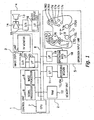
- Fig. 1 shows the basic configuration of a game device in accordance with an embodiment of the present invention.
- a home video game device As an example of the video game device, a home video game device will be hereinafter explained.
- the home video game device comprises a home video game console and a home television set.
- a recording medium 10 can be loaded in the home video game console.
- Game data is read out of the recording medium 10 and a game is executed.
- the content of the game executed herewith is displayed on the home television set.
- the game system of the home video game device is comprised of a control unit 1, a memory unit 2, an image display unit 3, an audio output unit 4, an operation input unit 5, and each of these units is connected to each other through a bus 6.
- This bus 6 includes an address bus, a data bus, a control bus, and the like.
- the control unit 1, the memory unit 2, the audio output unit 4, and the operation input unit 5 are included in the home video game console of the home video game device, and the image display unit 3 is included in the home television set.
- the control unit 1 is mainly provided for controlling the progress of the overall game based on the game program.
- the control unit 1 is comprised of a CPU (Central Processing Unit) 7, a signal processor 8, and an image processor 9, for instance.
- the CPU 7, the signal processor 8, the image processor 9 are connected to each other through the bus 6.
- the CPU 7 interprets commands from the game program and performs various types of data processing and data control.
- the CPU 7 commands the signal processor 8 to provide the image data to the image processor.
- the signal processor 8 primarily performs computations in three-dimensional space, position conversion computations from the three-dimensional space to a virtual three-dimensional space, a light source computation processing, and data generation and processing of image and audio data.
- the image processor 9 primarily performs a process to write image data to be rendered to a RAM 12 based on the computation results and processing results of the signal processor 8.
- the memory unit 2 is provided mainly for storing the program data, various types of data used for the program data, and the like.
- the memory unit 2 is comprised of the recording medium 10, an interface circuit 11, and the RAM (Random Access Memory) 12, for instance.
- the interface circuitry 11 is connected to the recording medium 10.
- the interface circuitry 11 and the RAM 12 are then connected through the bus 6.
- the recording medium 10 stores program data of the operation system, game data comprised of image data, audio data, and various types of program data, and the like.
- this recording medium 10 is a ROM (Read Only Memory) cassette, an optical disk, a flexible disk, or the like.
- the program data of the operating system, the game data, and the like are stored on this recording medium 10.
- a card memory is also included in the category of the recording medium 10 and primarily used for storing various game parameters at the point at which the game is interrupted.
- the RAM 12 is used for temporarily storing various types of data read out of the recording medium 10, and for temporarily recording the processing results from the control unit 1.
- This RAM 12 is mounted in the interior of the game device and functions as an internal memory unit.
- address data indicating the memory location of various types of data is stored in the RAM 12, and it is possible to specify an arbitrary address and read and write data from/to the address.
- the image display unit 3 is primarily provided for outputting the image data written to the RAM 12 by the image processor 9, the image data read out of the recording medium 10, and the like, as an image.
- This image display unit 3 is comprised of a television monitor 20, an interface circuit 21, and a D/A converter (digital-to-analog converter) 22, for instance.
- the D/A converter 22 is connected to the television monitor 20, and the interface circuit 21 is connected to the D/A converter 22.
- the bus 6 is connected to the interface circuit 21.
- the image data is provided to the D/A converter 22 through the interface circuit 21, and is converted into an analog image signal. Then, the analog image signal is output to the television monitor 20 as an image.
- the audio output unit 4 is primarily provided for outputting the audio data read out of the recording medium 10 as audio.
- the audio output unit 4 is comprised of a speaker 13, an amplifier circuit 14, a D/A converter 15, and an interface circuit 16, for instance.
- the amplifier circuit 14 is connected to the speaker 13.
- the D/A converter 15 is connected to the amplifier circuit 14.
- the interface circuit 16 is connected to the D/A converter 15.
- the bus 6 is connected to the interface circuit 16.
- the audio data is provided to the D/A converter 15 through the interface circuit 16 and is converted into an analog audio signal.
- the analog audio signal is amplified by the amplifier circuit 14 and output as audio by the speaker 13.
- ADPCM Adaptive Differential Pulse Code Modulation
- PCM Pulse Code Modulation
- the audio can be output by the speaker 13 with the same type of processing method as described above.
- the PCM data if the PCM data is converted to the ADPCM data in the RAM 12, the audio can be output by the speaker 13 with the same type of processing method as described above.
- the operation input unit 5 is primarily comprised of a controller 17, an operation information interface circuit 18, and an interface circuit 19.
- the operation information interface circuit 18 is connected to the controller 17, and the interface circuit 19 is connected to the operation information interface circuit 18.
- the bus 6 is connected to the interface circuit 19.
- the controller 17 is an operation unit used for the input of various operation commands by the video game player and transmits operation signals to the CPU 7 in accordance with the video game player's operation.
- a first button 17a, a second button 17b, a third button 17c, a fourth button 17d, an up key 17U, a down key 17D, a left key 17L, a right key 17R, a L1 button 17L1, a L2 button 17L2, a R1 button 17R1, a R2 button 17R2, a start button 17e, a select button 17f, a left stick 17SL, and a right stick 17SR are provided with the controller 17.
- the up key 17U, the down key 17D, the left key 17L, and the right key 17R are used to provide the CPU 7 with commands which cause the characters and a cursor to move up, down, left, and right on the screen of the television monitor 20, for instance.
- the start button 17e is used to command the CPU 7 to load the game program from the recording medium 10, and the like.
- the select button 17f is used for commanding the CPU 7 to execute various selections with respect to the game program loaded from the recording medium 10, for instance.
- the left stick 17SL and the right stick 17SR are stick-shaped controllers with approximately the same constitution as a so-called joystick.
- This stick-shaped controller includes a upright stick.
- This stick is configured to be able to incline from the upright position and rotate 360 degrees around the fulcrum, including the front, back, left, and right directions.
- the left stick 17SL and the right stick 17SR transmit x and y coordinate values with the origin being the upright position to the CPU 7 through the operation information interface circuit 18 and the interface circuit 19 as the operation signal in accordance with the direction and angle of incline of the stick.
- first button 17a Various functions are allocated to the first button 17a, the second button 17b, the third button 17c, the fourth button 17d, the L1 button 17L1, the L2 button 17L2, the R1 button 17R1, and the R2 button 17R2 in accordance with the game program that is loaded from the recording medium 10.
- each button and each key provided with the controller 17 other than the left stick 17SL and the right stick 17SR are configured to function as ON/OFF switches that turn on when pressed from the neutral position by external pressure and turn off when the pressure is released and then return to the neutral position.
- the CPU 7 reads out image data, audio data, and program data from the recording medium 10 based on the operating system stored in the recording medium 10. All or part of the read-out data including the image data, the audio data, and the program data are stored in the RAM 12. Then, the CPU 7 issues commands for the image data and the audio data, both of which are stored in the RAM 12, based on the program data stored in the RAM 12.
- the signal processor 8 first performs a positional computation, a light source computation, and the like for a character in the three-dimensional space based on the command from the CPU 7.
- the image processor 9 writes the image data to be rendered to the RAM 12 based on the computation results by the signal processor 8.
- the image data written to the RAM 12 is provided to the D/A converter 17 through the interface circuit 13.
- the image data is converted into an analog image signal by the D/A converter 17.
- the image data is provided to the television monitor 20 and displayed as an image.
- the signal processor 8 first generates and processes audio data based on a command from the CPU 7.
- processing such as pitch conversion, noise addition, envelope setting, rank setting, and reverb addition is performed for the audio data.
- the audio data is output from the signal processor 8 and provided to the D/A converter 15 through the interface circuit 16.
- the audio data is converted into an analog audio signal.
- the audio data is output as audio by the speaker 13 through the amplifier circuit 14.
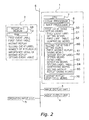
- Fig. 2 is a functional block diagram primarily for explaining means controlled by the control unit 1 shown in Fig. 1 .
- Various means that play a primary role in the present invention will be explained with reference to the functional block diagram.
- the present game device serves to implement a game in which replay images corresponding to various events can be displayed on the television monitor 20, and comprises first event table setting means 50, second event table setting means 60, and replay image displaying means 70.
- the first event table setting means 50 is means for implementing a function which sets a first event table in order to identify event content and the importance level of event content.
- the first event table setting means 50 sets the first event table in the memory unit 2, and the first event table is used so that the control unit 1 can identify event content that is controlled and executed by the control unit 1 during execution of the game, and identify the importance level of event content during execution of the game.
- the first event table setting means 50 with this configuration comprises first event label setting means 51 and first label table generating means 52.
- the first event label setting means 51 is a means for implementing a function which sets first event labels in order to identify event content.
- the first event label setting means 51 sets a first event label corresponding to each event content in the memory unit 2 in order to identify event content that is controlled and executed by the control unit 1 during execution of the game.
- the first label table generating means 52 is a means for implementing a function which generates a first event table comprised of the first event labels in accordance with the importance level of event content.
- the first label table generating means 52 in the control unit 1 generates the first event table comprised of the first event labels in the memory unit 2. At this time, the control unit 1 rearranges the order of the first event labels in the first event table in descending order of the importance of the event content.
- the second event table setting means 60 is a means for implementing a function to save replay images of an event that occurred during the execution of the game in the memory unit 2, set the importance level of the replay images saved in the memory unit 2 by referencing the first event table during execution of the game, and set a second event table used to identify the importance level of the replay images.
- the second event table setting means 60 saves the replay images of an event that occurred during the execution of the game in the memory unit 2. Then, the first event table is referenced during the execution of the game, and the importance level of the replay images saved in the memory unit 2 is set. Furthermore, the second event table is set in the memory unit 2.
- the second event table setting means 60 with this configuration comprises first replay image saving means 61, replay image label setting means 62, event label detecting means 63, second label table generating means 64, and second replay image saving means 65.
- the first replay image saving means 61 is a means for implementing a function which saves the replay images of an event that occurred during the execution of the game in a first area of the memory unit 2.
- the first replay image saving means 61 saves the replay images of an event that occurred during the execution of the game in the first area of the memory unit 2.
- the replay image label setting means 62 is a means for setting a second event label to the replay images saved in the first area of the memory unit 2 in order to identify the content of the replay image.
- the replay image label setting means 62 in the control unit 1 sets the second event label used to identify the content of the replay image to the replay images saved in the first area of the memory unit 2.
- the event label detecting means 63 is a means for detecting if a second event label corresponds to one of the first event labels by sequentially referencing the first event table.
- the event label detecting means 63 in the control unit 1 sequentially references the first event table, and then detects if the second event label of the replay images corresponds to one of the first event labels in the first event table.
- the number of times in which the control unit 1 repeatedly and sequentially references the first event labels in the first event table in descending order of the importance of the event content is set in the memory unit 2 as the number of references.
- the second label table generating means 64 is a means for setting the importance level of the replay images, based on the number of references, if a second event label corresponding to one of the first event labels is detected, and generates a second event table comprised of second event labels in accordance with the importance level of the replay images.
- the second label table generating means 64 in the control unit 1 sets the importance level of the replay images, based on the number of references, if a second event label corresponding to one of the first event labels is detected. Then, the control unit 1 generates the second event table comprised of second event labels in the memory unit 2 in accordance with the importance level of the replay images. At this time, a predetermined number of second event labels having a high importance level is selectively tabulated in the second event table by the control unit 1.
- the second replay image saving means 65 is a means for implementing a function which saves the second event table and the replay image corresponding to one of the second event labels in the second event table in a second area in the memory unit 2.
- the second replay image saving means 65 saves the second event table and the replay image corresponding to one of the second event labels in the second event table in the second area in the memory unit 2.
- the replay image displaying means 70 is a means for implementing a function which displays, on the television monitor 20, at least either the latest replay images to be saved in the memory unit 2, or the replay images saved in the memory unit 2 in accordance with the importance level of the replay images, or both.
- the replay image displaying means 70 displays at least either the latest replay images to be saved in the memory unit 2, or the replay images saved in the memory unit 2 in accordance with the importance level of the replay images, on the television monitor 20, or both.
- the replay images for replaying an event that occurred during the execution of the game are displayed on the television monitor 20 by using the latest replay images saved in the first area of the memory unit 2 immediately after the event occurred.
- replay images for replaying highlights of the game can be displayed on the television monitor 20 by using the replay images saved in the second area of the memory unit 2.
- a first event table 30 is preconfigured in the RAM 12.
- the first event table 30 is used when the control unit 1 identifies event content that is controlled and executed by the control unit 1 during execution of the game, and identifies the importance level of this event content during the execution of the game.
- a first event label 31 that corresponds to the content of each event is read out from the recording medium 10 and set in the RAM 12 so that the control unit 1 can identify the event content that is controlled and executed by the control unit 1 during execution of the game (Step S1). For example, as shown in Fig.
- first event labels 31 which includes "walk-off victory”, “moment in which all-time record was achieved”, “shutout”, “completed game”, “hitting a come-from behind home run when losing”, “hitting a come-from-behind hit when losing”, “hitting a home run when the score is tied”, “hitting a come-from-behind hit when the score is tied”, “hitting a score-tying home run when losing”, “scoring point(s) in order to even the score when losing", “failing to come from behind when losing,” “failing to tie the game when losing,” “failing to hit a go-ahead run when the score is tied,” “a home run not classified above,” “hitting a triple,” “hitting a double,” “hitting a sacrifice fly,” “hitting a sacrifice hit,” “error,” “out,” and the like.
- the control unit 1 generates the first event table 30 comprised of the first event labels 31 in accordance with the importance level of the event content (Step S2).
- the control unit 1 rearranges the order of the first event labels 31 in the first event table 30 in descending order of the importance of the event content.
- the order of the first event labels 31 is rearranged in the first event table 30 in descending order of the importance of the event content.
- the first event table 30 comprised of the first event labels 31 is set, and the control unit 1 controls and starts the baseball video game after the video game player completes various default settings before the start of the baseball video game (Step S3).
- the baseball video game is executed by the player's operation of the controller 17.
- the control unit 1 executes various events, that is, various plays in accordance with the pace of the game (Steps S4 and S5).
- Step S6 Every time the control unit 1 executes an event during the baseball video game, i.e., a play, replay images of the play are saved in the first area of the RAM 12 (Step S6).
- a series of actions performed from the home plate umpire's declaration of the start of a play until the end of the play are saved in the first area in the RAM 12 as replay images of an event, i.e., replay images of a play.
- a play corresponds to a series of actions in which the pitcher starts throwing a ball and then the catcher catches the ball, a series of actions in which a pitcher starts throwing a ball, then the batter hits a home run, and finally the batter and one or more runners on base cross the plate, and the like.
- the control unit 1 sets a second event label 41, used to identify the content of the replay images, to the replay images saved in the first area in the RAM 12 (Step S7).
- the 21 labels noted above including "walk-off victory”, “moment in which all-time record was achieved”, “shutout”, “completed game”, “hitting a come-from behind home run when losing”, “hitting a come-from-behind hit when losing”, “hitting a home run when the score is tied”, “hitting a come-from-behind hit when the score is tied”, “hitting a score-tying home run when losing”, “scoring point(s) in order to even the score when losing”, “failing to come from behind when losing,” “failing to tie the game when losing,” “failing to hit a go-ahead run when the score is tied,” “a home run not classified above,” “hitting a triple,” “hitting a double,” “hitting a sacrifice fly,” “hitting a sacrifice hit,” “error,” “out,” and the like, and in addition, labels other than these that correspond to various plays, are prepared as the second event labels 41.
- control unit 1 sequentially references the first event table 30, and detects whether or not the second event label 41 that was set to the replay images corresponds to one of the first event labels 31 in the first event table 30.
- control unit 1 sequentially references the first event table 30, and executes a label determination process in order to detect whether the second event label 41 that was set to the replay images corresponds to one of the first event labels 31 in the first event table 30.
- the number of times in which the control unit 1 repeatedly and sequentially references the first event labels 31 in the first event table 30 in descending order of importance of the event content is set in the RAM 12 as the number of references n.
- the control unit 1 repeatedly and sequentially refers to the first event labels 31 in the first event table 30 in descending order of importance of the event content (Step S81).
- the first to the twenty-first labels of the first event label 31 are sequentially referenced one by one from the top to the bottom of the first event table 30 shown in Fig. 5 in order to determine whether the second event label 41 corresponds to one of the first event labels 31 in the first event table 30.
- the control unit 1 determines whether the n-th first event label 31 matches the second event label 41 (Step S82). If the n-th first event label 31 does not match the second event label 41 (No in Step S82), the number of references n is sequentially incremented by one until the second event label 41 matches one of the first event labels 31. Thus, the number of references n can be sequentially changed from "2" to "22 (the maximum number of references)" (Step S83). Then, it is determined whether or not the incremented number of references n has reached the maximum number of reference "22" (Step S84). Unless the incremented number of references n has reached the maximum number of reference "22" (No in Step S84), steps S82 to S84 are repeatedly executed.
- Step S84 the label determination process is completed.
- the case in which the label determination process is thus completed corresponds to the case in which a second event label 41 that matches one of the first event labels 31 was not detected (No in Step S8).
- the control unit 1 moves to the next event execution process without reflecting the second event label 41 in the second event table 40 (Step S4).
- Step S81 if the control unit 1 repeatedly and sequentially references the first event labels 31 in the first event table 30 in descending order of importance of the event content (Step S81), and the n-th first event label 31 matches the second event label 41 (Yes in Step S82), the number of references n is set (Step S82).
- the number of references n at which a first event label 31 matches the second event label 41 is set to be "n.” For example, if the second event label 41 is "hitting a come-from behind home run when losing," the first event label 31 in the first event table 30 which matches “hitting a come-from behind home run when losing,” is arranged as the fifth label in the first event table 30, as shown in Fig. 5 .
- the number of references n is set to be “5,” and this "5" is saved in the RAM 12 as the number of references n.
- the second event label 41 is "failing to come from behind when losing”
- the first event label 31 in the first event table 30 which matches "failing to come from behind when losing” is arranged as the eleventh label in the first event table 30, as shown in Fig. 5 . Therefore, the number of references n is set to be “11,” and this "11” is saved in the RAM 12 as the number of references n.
- the second event label 41 is "failing to get a go-ahead run when the score is tied"
- the first event label 31 in the first event table 30 which matches “failing to get a go-ahead run when the score is tied” is arranged as the thirteenth label in the first event table 30, as shown in Fig. 5 . Therefore, the number of references n is set to be “13,” and this "13" is saved in the RAM 12 as the number of references n. Thus, if the number of references n is set, the label determination process is completed. This case corresponds to the case in which a second event label 41 that matches one of the first event labels 31 was detected (Yes in Step S8).
- the control unit 1 sets the importance level 42 of the replay images based on the number of references n (Step S9).
- the importance level 42 set to the replay images is determined by the number of references n. For example, the importance level 42 is determined to be higher as the number of references n becomes smaller. On the other hand, the importance level 42 is determined to be lower as the number of references n becomes larger. For example, if the second event label 41 that matches one of the first event labels 31 is "hitting a come-from behind home run when losing," the number of references n is "5.” Thus, "5" is set to the replay images as the importance level 42.
- the second event label 41 matching one of the first event labels 31 is "failing to come from behind when losing," the number of references n is "11.” Thus, "11" is set to the replay images as the importance level 42.
- the second event label 41 that matches the first event label 31 is “failing to get a go-ahead run when the score is tied,” the number of references n is "13.” Thus, "13” is set to the replay images as the importance level 42.
- the second event table 40 that is comprised of the second event labels 41 is generated in the RAM 12 in accordance with the importance level 42 of the replay images (Step S10).
- a predetermined number of second event labels 41 having a high importance level 42 is selectively tabulated in the second event table 40 by the control unit 1.
- a predetermined number of second event labels 41 having a high importance level 42 will be selectively tabulated in the second event table 40.
- the selection of the second event label 41 in the second event table 40 will be implemented by replacing the second event label 41 with the lowest importance level 42 with the second event label 42 with an importance level 42 that is higher than the lowest importance level 42. For example, as shown in Fig.
- the second event table 40 includes "hitting a come-from behind home run when losing" with the importance level 42 of "5", “failing to come from behind when losing” with the importance level 42 of "11”, and “failing to get a go-ahead run when the score is tied” with the importance level “13”, and “walk-off victory” with an importance level 42 that is higher than that of "failing to get a go-ahead run when the score is tied” with the lowest importance level 42 occurs during the execution of the baseball video game, "failing to get a go-ahead run when the score is tied” with the importance level 42 of "13” will be displaced by the second event label 41 of "walk-off victory” with an importance level 42 of "1" in the second event table 40.
- Step S12 replay images for replaying an event that occurred during the execution of the game are displayed on the television monitor 20 by using the latest replay images saved in the first area of the RAM 12 immediately after the event occurred.
- the above described process is repeatedly executed every time an event, i.e., a play, occurs until the game is over (No in Step S 13).
- the replay images for replaying highlights of the game are displayed on the television monitor 20 by using the replay images saved in the second area of the RAM 12 (Step S14).
- the second event table 40 whose predetermined number of second event labels 41 is three, and the replay images corresponding to the second event labels 41 in the second event table 40, are saved in the second area in the RAM 12. Therefore, the replay images corresponding to three second event labels 41 are displayed on the television monitor 20 as the highlight replay images.
- the first event table 30 that identifies event content and identifies the importance level thereof, and the second event table 40 that identifies the importance level 42 of the replay images by referencing the first event table 30, are set.
- the replay images saved in the first area in the RAM 12, and the replay images corresponding to the second event labels 41 saved in the second area in the RAM 12 are displayed on the television monitor 20 as the latest replay images and the highlight replay images of the events that occurred during the execution of the game.
- the latest replay images and the highlight replay images can be displayed on the television monitor 20 by setting the first event table 30 and the second event table 40. In other words, it is possible to provide a player with the latest replay images and highlight replay images without setting a reference value to the replay images.
- a predetermined number of second event labels 41 having high importance levels 42 are selectively tabulated in the event table, and accordingly, it will be possible to prevent the number of replay images saved in the RAM 12 from increasing and the volume of the replay images from filling the free space of the RAM 12. Furthermore, the replay images corresponding to the second event labels 41 with a higher importance level 42 can be preferentially displayed on the television monitor 20.
- the first event table for identifying the event content and identifying the importance level thereof, and the second event table for identifying the importance level of replay images by referencing the first event table are set. Then, at least either the latest replay images saved in the memory unit, or the replay images saved in the memory unit in accordance with the importance level of the replay images, will be displayed on the monitor as replay images of an event(s) that occurred during the execution of the game. Thus, at least either the latest replay images, or the replay images saved in the memory unit in accordance with the importance level thereof, or both, can be displayed on the monitor by setting the first event table and the second event table. In other words, it possible to provide a player with replay images without setting a reference value to the replay images.
- replay images for replaying an event that occurred during the execution of the game are displayed on the monitor by using the latest replay images saved in the first area in the memory unit immediately after the event occurred. Therefore, when the latest replay images are requested, it is possible to provide a player with the latest replay images without setting a reference value to the replay images.
- the replay images saved in the memory unit in accordance with the importance levels thereof that is, the replay images for replaying highlights of the game, are displayed on the monitor with the replay images saved in the second area in the memory unit. Therefore, when the highlight replay images are requested, it is possible to provide a player with highlight replay images without setting a reference value to the replay images. Furthermore, a predetermined number of second event labels with high importance levels are selectively tabulated.
Landscapes
- Engineering & Computer Science (AREA)
- Multimedia (AREA)
- Processing Or Creating Images (AREA)
Applications Claiming Priority (2)
| Application Number | Priority Date | Filing Date | Title |
|---|---|---|---|
| JP2004163865A JP4121978B2 (ja) | 2004-05-01 | 2004-05-01 | ゲームプログラム、ゲーム装置及びゲーム方法 |
| PCT/JP2005/008010 WO2005105239A1 (ja) | 2004-05-01 | 2005-04-27 | ゲームプログラム、ゲーム装置及びゲーム方法 |
Publications (3)
| Publication Number | Publication Date |
|---|---|
| EP1747807A1 EP1747807A1 (en) | 2007-01-31 |
| EP1747807A4 EP1747807A4 (en) | 2007-08-22 |
| EP1747807B1 true EP1747807B1 (en) | 2010-04-14 |
Family
ID=35241466
Family Applications (1)
| Application Number | Title | Priority Date | Filing Date |
|---|---|---|---|
| EP05736714A Expired - Lifetime EP1747807B1 (en) | 2004-05-01 | 2005-04-27 | Game program, game device, and game method |
Country Status (7)
| Country | Link |
|---|---|
| US (1) | US7717789B2 (enExample) |
| EP (1) | EP1747807B1 (enExample) |
| JP (1) | JP4121978B2 (enExample) |
| KR (1) | KR100862327B1 (enExample) |
| DE (1) | DE602005020607D1 (enExample) |
| TW (1) | TWI255202B (enExample) |
| WO (1) | WO2005105239A1 (enExample) |
Families Citing this family (17)
| Publication number | Priority date | Publication date | Assignee | Title |
|---|---|---|---|---|
| JP4849829B2 (ja) * | 2005-05-15 | 2012-01-11 | 株式会社ソニー・コンピュータエンタテインメント | センタ装置 |
| JP2007199944A (ja) * | 2006-01-25 | 2007-08-09 | Sega Corp | シミュレーション映像のダイジェストを表示制御するプログラム |
| WO2008117490A1 (ja) * | 2007-03-22 | 2008-10-02 | Konami Digital Entertainment Co., Ltd. | ゲームプログラム、ゲーム装置及びゲーム制御方法 |
| US8515253B2 (en) * | 2008-02-15 | 2013-08-20 | Sony Computer Entertainment America Llc | System and method for automated creation of video game highlights |
| JP5264335B2 (ja) * | 2008-07-10 | 2013-08-14 | 株式会社コナミデジタルエンタテインメント | ゲームシステム、ゲーム装置の制御方法、及びプログラム |
| US8088012B2 (en) * | 2009-01-29 | 2012-01-03 | Disney Enterprises, Inc. | System and method for dynamic video game recap |
| JP5437683B2 (ja) * | 2009-03-30 | 2014-03-12 | 株式会社コナミデジタルエンタテインメント | ゲーム装置、ゲーム装置の制御方法及びプログラム |
| KR101436308B1 (ko) * | 2012-11-14 | 2014-09-03 | (주)네오위즈게임즈 | 게임 리플레이 제공 방법, 이를 수행하는 게임 리플레이 제공 서버 및 이를 저장한 기록 매체 |
| JP5906208B2 (ja) * | 2013-03-06 | 2016-04-20 | 株式会社コナミデジタルエンタテインメント | ゲーム装置、ゲーム制御プログラム、及びゲームシステム |
| US10335679B2 (en) | 2014-10-27 | 2019-07-02 | Sony Interactive Entertainment Inc. | Video processing device, video processing method, and program |
| JP6947560B2 (ja) * | 2017-07-14 | 2021-10-13 | グリー株式会社 | ゲーム処理プログラム、ゲーム処理方法及びゲーム処理装置 |
| CN110033295B (zh) * | 2018-01-11 | 2023-08-29 | 韩国电子通信研究院 | 对游戏中事件的奖励重要性的检测装置及方法 |
| KR102075385B1 (ko) * | 2018-01-11 | 2020-02-11 | 한국전자통신연구원 | 인게임 이벤트에 대한 보상 중요도 측정 장치 및 방법 |
| KR102074504B1 (ko) * | 2018-02-28 | 2020-02-06 | 엔에이치엔 주식회사 | 게임 플레이 영상 리플레이 방법 |
| US11344807B2 (en) * | 2019-08-07 | 2022-05-31 | Lenovo (Singapore) Pte. Ltd. | Electronic game moment identification |
| JP7254676B2 (ja) * | 2019-10-17 | 2023-04-10 | 株式会社ソニー・インタラクティブエンタテインメント | 情報処理装置および動画像編集方法 |
| US11517826B2 (en) * | 2020-06-10 | 2022-12-06 | Snap Inc. | Game result overlay system |
Family Cites Families (10)
| Publication number | Priority date | Publication date | Assignee | Title |
|---|---|---|---|---|
| US5354202A (en) * | 1990-08-01 | 1994-10-11 | Atari Games Corporation | System and method for driver training with multiple driver competition |
| US5779548A (en) * | 1994-06-28 | 1998-07-14 | Sega Enterprises, Ltd. | Game apparatus and method of replaying game |
| JPH10201958A (ja) * | 1996-11-21 | 1998-08-04 | Konami Co Ltd | ビデオゲームシステムにおける得点場面再生装置、該再生方法及び得点場面再生プログラムを記憶した媒体 |
| KR100581483B1 (ko) * | 1997-04-03 | 2006-05-22 | 가부시키가이샤 세가 | 게임의 화상 표시 방법 및 그 제어 방법 |
| JP2000070549A (ja) * | 1998-09-01 | 2000-03-07 | Konami Co Ltd | ゲームシステム、画像の保存方法及びゲームプログラムが記録された記録媒体 |
| JP3209988B2 (ja) * | 1999-11-05 | 2001-09-17 | 株式会社ナムコ | ゲーム装置、処理方法および記録媒体 |
| JP3227447B2 (ja) * | 1999-12-28 | 2001-11-12 | 株式会社ナムコ | ゲームシステム及び情報記憶媒体 |
| US6699127B1 (en) * | 2000-06-20 | 2004-03-02 | Nintendo Of America Inc. | Real-time replay system for video game |
| AU768349B2 (en) * | 2000-09-07 | 2003-12-11 | Canon Kabushiki Kaisha | Method of recording and replaying a game |
| US7214133B2 (en) * | 2003-05-09 | 2007-05-08 | Microsoft Corporation | Method and apparatus for retrieving recorded races for use in a game |
-
2004
- 2004-05-01 JP JP2004163865A patent/JP4121978B2/ja not_active Expired - Lifetime
-
2005
- 2005-04-19 TW TW094112426A patent/TWI255202B/zh not_active IP Right Cessation
- 2005-04-27 WO PCT/JP2005/008010 patent/WO2005105239A1/ja not_active Ceased
- 2005-04-27 KR KR1020067025087A patent/KR100862327B1/ko not_active Expired - Fee Related
- 2005-04-27 DE DE602005020607T patent/DE602005020607D1/de not_active Expired - Lifetime
- 2005-04-27 EP EP05736714A patent/EP1747807B1/en not_active Expired - Lifetime
-
2006
- 2006-11-01 US US11/555,282 patent/US7717789B2/en not_active Expired - Fee Related
Also Published As
| Publication number | Publication date |
|---|---|
| US7717789B2 (en) | 2010-05-18 |
| EP1747807A4 (en) | 2007-08-22 |
| EP1747807A1 (en) | 2007-01-31 |
| KR20070012844A (ko) | 2007-01-29 |
| TW200538192A (en) | 2005-12-01 |
| DE602005020607D1 (enExample) | 2010-05-27 |
| KR100862327B1 (ko) | 2008-10-13 |
| TWI255202B (en) | 2006-05-21 |
| WO2005105239A1 (ja) | 2005-11-10 |
| JP4121978B2 (ja) | 2008-07-23 |
| US20070060389A1 (en) | 2007-03-15 |
| JP2005319231A (ja) | 2005-11-17 |
Similar Documents
| Publication | Publication Date | Title |
|---|---|---|
| EP1747807A1 (en) | Game program, game device, and game method | |
| JP2005319231A5 (enExample) | ||
| EP1666108B1 (en) | Video game program, video game device, and video game method | |
| US20080200223A1 (en) | Game program, game device, and game method | |
| EP1666107A1 (en) | Video game program, video game device, and video game method | |
| JP3227447B2 (ja) | ゲームシステム及び情報記憶媒体 | |
| EP2127712A1 (en) | Game program, game machine, and game control method | |
| JP2003079952A (ja) | ビデオゲームのプログラムを記録したコンピュータ読み取り可能な記録媒体及びビデオゲームのプログラム及びビデオゲーム処理方法及びビデオゲーム処理装置 | |
| WO2007135867A1 (ja) | ゲームプログラム、ゲーム装置及びゲーム制御方法 | |
| EP1958679A1 (en) | Game program, game machine, and game method | |
| JP4115488B2 (ja) | ゲームプログラム、ゲーム装置及びゲーム制御方法 | |
| TWI300001B (enExample) | ||
| JP4128576B2 (ja) | ゲームプログラム、ゲーム装置及びゲーム制御方法 | |
| JP4115487B2 (ja) | ゲームプログラム、ゲーム装置及びゲーム制御方法 | |
| WO2007072607A1 (ja) | ゲームプログラム、ゲーム装置及びゲーム方法 | |
| JP2007068824A (ja) | ゲームプログラム、ゲーム装置及びゲーム方法 | |
| JP2007236572A (ja) | ゲームプログラム、ゲーム装置及びゲーム方法 | |
| JP4128589B2 (ja) | ゲームプログラム、ゲーム装置及びゲーム制御方法 | |
| JPH09253265A (ja) | 電子野球スコアブック | |
| JP2008005953A (ja) | ゲームプログラム、ゲーム装置及びゲーム制御方法 | |
| JP2007190049A5 (enExample) | ||
| JP2007190049A (ja) | ゲームプログラム、ゲーム装置及びゲーム方法 | |
| HK1092402B (en) | Video game device and video game control method | |
| JP2009273522A (ja) | ゲームプログラム、ゲーム装置及びゲーム制御方法 |
Legal Events
| Date | Code | Title | Description |
|---|---|---|---|
| PUAI | Public reference made under article 153(3) epc to a published international application that has entered the european phase |
Free format text: ORIGINAL CODE: 0009012 |
|
| 17P | Request for examination filed |
Effective date: 20061115 |
|
| AK | Designated contracting states |
Kind code of ref document: A1 Designated state(s): DE FR GB |
|
| RBV | Designated contracting states (corrected) |
Designated state(s): DE FR GB |
|
| DAX | Request for extension of the european patent (deleted) | ||
| A4 | Supplementary search report drawn up and despatched |
Effective date: 20070725 |
|
| 17Q | First examination report despatched |
Effective date: 20071108 |
|
| RAP1 | Party data changed (applicant data changed or rights of an application transferred) |
Owner name: KONAMI DIGITAL ENTERTAINMENT CO., LTD. |
|
| GRAP | Despatch of communication of intention to grant a patent |
Free format text: ORIGINAL CODE: EPIDOSNIGR1 |
|
| RIN1 | Information on inventor provided before grant (corrected) |
Inventor name: SHIMIZU, MITOMU Inventor name: TANIBUCHI, HIROSHI |
|
| GRAS | Grant fee paid |
Free format text: ORIGINAL CODE: EPIDOSNIGR3 |
|
| GRAA | (expected) grant |
Free format text: ORIGINAL CODE: 0009210 |
|
| AK | Designated contracting states |
Kind code of ref document: B1 Designated state(s): DE FR GB |
|
| REG | Reference to a national code |
Ref country code: GB Ref legal event code: FG4D |
|
| REF | Corresponds to: |
Ref document number: 602005020607 Country of ref document: DE Date of ref document: 20100527 Kind code of ref document: P |
|
| PLBE | No opposition filed within time limit |
Free format text: ORIGINAL CODE: 0009261 |
|
| STAA | Information on the status of an ep patent application or granted ep patent |
Free format text: STATUS: NO OPPOSITION FILED WITHIN TIME LIMIT |
|
| 26N | No opposition filed |
Effective date: 20110117 |
|
| REG | Reference to a national code |
Ref country code: FR Ref legal event code: PLFP Year of fee payment: 11 |
|
| PGFP | Annual fee paid to national office [announced via postgrant information from national office to epo] |
Ref country code: GB Payment date: 20150420 Year of fee payment: 11 Ref country code: DE Payment date: 20150421 Year of fee payment: 11 |
|
| PGFP | Annual fee paid to national office [announced via postgrant information from national office to epo] |
Ref country code: FR Payment date: 20150421 Year of fee payment: 11 |
|
| REG | Reference to a national code |
Ref country code: DE Ref legal event code: R119 Ref document number: 602005020607 Country of ref document: DE |
|
| GBPC | Gb: european patent ceased through non-payment of renewal fee |
Effective date: 20160427 |
|
| REG | Reference to a national code |
Ref country code: FR Ref legal event code: ST Effective date: 20161230 |
|
| PG25 | Lapsed in a contracting state [announced via postgrant information from national office to epo] |
Ref country code: DE Free format text: LAPSE BECAUSE OF NON-PAYMENT OF DUE FEES Effective date: 20161101 Ref country code: FR Free format text: LAPSE BECAUSE OF NON-PAYMENT OF DUE FEES Effective date: 20160502 Ref country code: GB Free format text: LAPSE BECAUSE OF NON-PAYMENT OF DUE FEES Effective date: 20160427 |