EP1596374B1 - Optisches aufzeichnungsverfahren und optische aufzeichnungseinrichtung, - Google Patents
Optisches aufzeichnungsverfahren und optische aufzeichnungseinrichtung, Download PDFInfo
- Publication number
- EP1596374B1 EP1596374B1 EP04712706A EP04712706A EP1596374B1 EP 1596374 B1 EP1596374 B1 EP 1596374B1 EP 04712706 A EP04712706 A EP 04712706A EP 04712706 A EP04712706 A EP 04712706A EP 1596374 B1 EP1596374 B1 EP 1596374B1
- Authority
- EP
- European Patent Office
- Prior art keywords
- recording
- pulse
- speed
- pulses
- signal
- Prior art date
- Legal status (The legal status is an assumption and is not a legal conclusion. Google has not performed a legal analysis and makes no representation as to the accuracy of the status listed.)
- Expired - Lifetime
Links
- 230000003287 optical effect Effects 0.000 title claims description 230
- 238000000034 method Methods 0.000 title claims description 109
- 230000001678 irradiating effect Effects 0.000 claims abstract description 6
- 238000001816 cooling Methods 0.000 claims description 58
- 239000010410 layer Substances 0.000 description 102
- 238000010438 heat treatment Methods 0.000 description 86
- 229910045601 alloy Inorganic materials 0.000 description 32
- 239000000956 alloy Substances 0.000 description 32
- 239000000758 substrate Substances 0.000 description 32
- 239000000203 mixture Substances 0.000 description 31
- 238000005259 measurement Methods 0.000 description 28
- 239000000463 material Substances 0.000 description 22
- 239000011241 protective layer Substances 0.000 description 20
- 230000015572 biosynthetic process Effects 0.000 description 15
- 239000010408 film Substances 0.000 description 14
- 238000001514 detection method Methods 0.000 description 13
- 238000002425 crystallisation Methods 0.000 description 12
- 230000008025 crystallization Effects 0.000 description 12
- 238000007726 management method Methods 0.000 description 12
- 238000012360 testing method Methods 0.000 description 12
- 230000008859 change Effects 0.000 description 11
- 238000000137 annealing Methods 0.000 description 8
- 229910052751 metal Inorganic materials 0.000 description 8
- 239000002184 metal Substances 0.000 description 8
- 230000008569 process Effects 0.000 description 8
- 229910052709 silver Inorganic materials 0.000 description 8
- VYPSYNLAJGMNEJ-UHFFFAOYSA-N Silicium dioxide Chemical compound O=[Si]=O VYPSYNLAJGMNEJ-UHFFFAOYSA-N 0.000 description 7
- 230000007246 mechanism Effects 0.000 description 7
- 239000004065 semiconductor Substances 0.000 description 7
- 229910052782 aluminium Inorganic materials 0.000 description 6
- 230000000694 effects Effects 0.000 description 6
- 230000010485 coping Effects 0.000 description 5
- 238000012937 correction Methods 0.000 description 5
- 238000012545 processing Methods 0.000 description 5
- IJGRMHOSHXDMSA-UHFFFAOYSA-N Atomic nitrogen Chemical compound N#N IJGRMHOSHXDMSA-UHFFFAOYSA-N 0.000 description 4
- 230000014509 gene expression Effects 0.000 description 4
- 229910052737 gold Inorganic materials 0.000 description 4
- 150000004767 nitrides Chemical class 0.000 description 4
- 238000010791 quenching Methods 0.000 description 4
- 239000011347 resin Substances 0.000 description 4
- 229920005989 resin Polymers 0.000 description 4
- NINIDFKCEFEMDL-UHFFFAOYSA-N Sulfur Chemical compound [S] NINIDFKCEFEMDL-UHFFFAOYSA-N 0.000 description 3
- 229910001215 Te alloy Inorganic materials 0.000 description 3
- 230000003044 adaptive effect Effects 0.000 description 3
- 229910052681 coesite Inorganic materials 0.000 description 3
- 229910052906 cristobalite Inorganic materials 0.000 description 3
- 230000001419 dependent effect Effects 0.000 description 3
- 238000013461 design Methods 0.000 description 3
- 230000002542 deteriorative effect Effects 0.000 description 3
- 238000010586 diagram Methods 0.000 description 3
- 230000007613 environmental effect Effects 0.000 description 3
- 230000006872 improvement Effects 0.000 description 3
- 239000012782 phase change material Substances 0.000 description 3
- 230000000704 physical effect Effects 0.000 description 3
- 230000001681 protective effect Effects 0.000 description 3
- 230000000171 quenching effect Effects 0.000 description 3
- 229910052710 silicon Inorganic materials 0.000 description 3
- 239000000377 silicon dioxide Substances 0.000 description 3
- 229910052682 stishovite Inorganic materials 0.000 description 3
- 229910052717 sulfur Inorganic materials 0.000 description 3
- 239000011593 sulfur Substances 0.000 description 3
- 238000012546 transfer Methods 0.000 description 3
- 229910052905 tridymite Inorganic materials 0.000 description 3
- OKTJSMMVPCPJKN-UHFFFAOYSA-N Carbon Chemical compound [C] OKTJSMMVPCPJKN-UHFFFAOYSA-N 0.000 description 2
- 101000606504 Drosophila melanogaster Tyrosine-protein kinase-like otk Proteins 0.000 description 2
- 208000011738 Lichen planopilaris Diseases 0.000 description 2
- 238000010521 absorption reaction Methods 0.000 description 2
- 239000000853 adhesive Substances 0.000 description 2
- 230000001070 adhesive effect Effects 0.000 description 2
- QVGXLLKOCUKJST-UHFFFAOYSA-N atomic oxygen Chemical compound [O] QVGXLLKOCUKJST-UHFFFAOYSA-N 0.000 description 2
- 229910052799 carbon Inorganic materials 0.000 description 2
- 229910052804 chromium Inorganic materials 0.000 description 2
- 229910052802 copper Inorganic materials 0.000 description 2
- 230000001186 cumulative effect Effects 0.000 description 2
- 238000005520 cutting process Methods 0.000 description 2
- 230000003247 decreasing effect Effects 0.000 description 2
- 230000009977 dual effect Effects 0.000 description 2
- 239000000428 dust Substances 0.000 description 2
- 230000007274 generation of a signal involved in cell-cell signaling Effects 0.000 description 2
- 239000011521 glass Substances 0.000 description 2
- 229910052745 lead Inorganic materials 0.000 description 2
- 238000004519 manufacturing process Methods 0.000 description 2
- 230000008018 melting Effects 0.000 description 2
- 238000002844 melting Methods 0.000 description 2
- 229910052757 nitrogen Inorganic materials 0.000 description 2
- -1 oxide Chemical class 0.000 description 2
- 229910052760 oxygen Inorganic materials 0.000 description 2
- 239000001301 oxygen Substances 0.000 description 2
- 229910052763 palladium Inorganic materials 0.000 description 2
- 229920005668 polycarbonate resin Polymers 0.000 description 2
- 239000004431 polycarbonate resin Substances 0.000 description 2
- 238000004321 preservation Methods 0.000 description 2
- 208000011797 pustulosis palmaris et plantaris Diseases 0.000 description 2
- 238000001953 recrystallisation Methods 0.000 description 2
- 230000003252 repetitive effect Effects 0.000 description 2
- 230000002123 temporal effect Effects 0.000 description 2
- 229910052719 titanium Inorganic materials 0.000 description 2
- 229910001316 Ag alloy Inorganic materials 0.000 description 1
- UFHFLCQGNIYNRP-UHFFFAOYSA-N Hydrogen Chemical compound [H][H] UFHFLCQGNIYNRP-UHFFFAOYSA-N 0.000 description 1
- 229910052779 Neodymium Inorganic materials 0.000 description 1
- 229910002668 Pd-Cu Inorganic materials 0.000 description 1
- 229910052774 Proactinium Inorganic materials 0.000 description 1
- 229910052581 Si3N4 Inorganic materials 0.000 description 1
- BQCADISMDOOEFD-UHFFFAOYSA-N Silver Chemical compound [Ag] BQCADISMDOOEFD-UHFFFAOYSA-N 0.000 description 1
- 230000001133 acceleration Effects 0.000 description 1
- 239000000654 additive Substances 0.000 description 1
- 230000000996 additive effect Effects 0.000 description 1
- 238000004458 analytical method Methods 0.000 description 1
- 229910052797 bismuth Inorganic materials 0.000 description 1
- 150000004770 chalcogenides Chemical class 0.000 description 1
- 150000001875 compounds Chemical class 0.000 description 1
- 238000007796 conventional method Methods 0.000 description 1
- PMHQVHHXPFUNSP-UHFFFAOYSA-M copper(1+);methylsulfanylmethane;bromide Chemical compound Br[Cu].CSC PMHQVHHXPFUNSP-UHFFFAOYSA-M 0.000 description 1
- 238000005336 cracking Methods 0.000 description 1
- 238000013500 data storage Methods 0.000 description 1
- 230000007547 defect Effects 0.000 description 1
- 230000001934 delay Effects 0.000 description 1
- 230000003111 delayed effect Effects 0.000 description 1
- 238000000151 deposition Methods 0.000 description 1
- 230000008021 deposition Effects 0.000 description 1
- 230000006866 deterioration Effects 0.000 description 1
- QDOXWKRWXJOMAK-UHFFFAOYSA-N dichromium trioxide Chemical compound O=[Cr]O[Cr]=O QDOXWKRWXJOMAK-UHFFFAOYSA-N 0.000 description 1
- 238000010894 electron beam technology Methods 0.000 description 1
- 239000003822 epoxy resin Substances 0.000 description 1
- 230000005496 eutectics Effects 0.000 description 1
- 238000011156 evaluation Methods 0.000 description 1
- 229910052733 gallium Inorganic materials 0.000 description 1
- 239000007789 gas Substances 0.000 description 1
- 229910052732 germanium Inorganic materials 0.000 description 1
- BIXHRBFZLLFBFL-UHFFFAOYSA-N germanium nitride Chemical compound N#[Ge]N([Ge]#N)[Ge]#N BIXHRBFZLLFBFL-UHFFFAOYSA-N 0.000 description 1
- 229910052735 hafnium Inorganic materials 0.000 description 1
- 239000001257 hydrogen Substances 0.000 description 1
- 229910052739 hydrogen Inorganic materials 0.000 description 1
- 229910052738 indium Inorganic materials 0.000 description 1
- 238000007733 ion plating Methods 0.000 description 1
- 238000010030 laminating Methods 0.000 description 1
- 229910052749 magnesium Inorganic materials 0.000 description 1
- 229910052748 manganese Inorganic materials 0.000 description 1
- 150000002736 metal compounds Chemical class 0.000 description 1
- 238000012986 modification Methods 0.000 description 1
- 230000004048 modification Effects 0.000 description 1
- 238000012544 monitoring process Methods 0.000 description 1
- 229910052759 nickel Inorganic materials 0.000 description 1
- 229910052758 niobium Inorganic materials 0.000 description 1
- 238000001579 optical reflectometry Methods 0.000 description 1
- 239000012860 organic pigment Substances 0.000 description 1
- 230000010355 oscillation Effects 0.000 description 1
- TWNQGVIAIRXVLR-UHFFFAOYSA-N oxo(oxoalumanyloxy)alumane Chemical compound O=[Al]O[Al]=O TWNQGVIAIRXVLR-UHFFFAOYSA-N 0.000 description 1
- RVTZCBVAJQQJTK-UHFFFAOYSA-N oxygen(2-);zirconium(4+) Chemical compound [O-2].[O-2].[Zr+4] RVTZCBVAJQQJTK-UHFFFAOYSA-N 0.000 description 1
- 230000000149 penetrating effect Effects 0.000 description 1
- 239000011295 pitch Substances 0.000 description 1
- 229910052697 platinum Inorganic materials 0.000 description 1
- 229920003229 poly(methyl methacrylate) Polymers 0.000 description 1
- 239000004417 polycarbonate Substances 0.000 description 1
- 229920000515 polycarbonate Polymers 0.000 description 1
- 229920000647 polyepoxide Polymers 0.000 description 1
- 229920001721 polyimide Polymers 0.000 description 1
- 239000009719 polyimide resin Substances 0.000 description 1
- 239000004926 polymethyl methacrylate Substances 0.000 description 1
- 229920005672 polyolefin resin Polymers 0.000 description 1
- 239000010453 quartz Substances 0.000 description 1
- 230000035945 sensitivity Effects 0.000 description 1
- 238000000926 separation method Methods 0.000 description 1
- HBMJWWWQQXIZIP-UHFFFAOYSA-N silicon carbide Chemical compound [Si+]#[C-] HBMJWWWQQXIZIP-UHFFFAOYSA-N 0.000 description 1
- 229910010271 silicon carbide Inorganic materials 0.000 description 1
- HQVNEWCFYHHQES-UHFFFAOYSA-N silicon nitride Chemical compound N12[Si]34N5[Si]62N3[Si]51N64 HQVNEWCFYHHQES-UHFFFAOYSA-N 0.000 description 1
- 239000004332 silver Substances 0.000 description 1
- 230000000087 stabilizing effect Effects 0.000 description 1
- 239000000126 substance Substances 0.000 description 1
- 229920003002 synthetic resin Polymers 0.000 description 1
- 239000000057 synthetic resin Substances 0.000 description 1
- 229910052715 tantalum Inorganic materials 0.000 description 1
- 230000008719 thickening Effects 0.000 description 1
- 239000010409 thin film Substances 0.000 description 1
- 238000012549 training Methods 0.000 description 1
- 238000007740 vapor deposition Methods 0.000 description 1
- 229910052724 xenon Inorganic materials 0.000 description 1
- FHNFHKCVQCLJFQ-UHFFFAOYSA-N xenon atom Chemical compound [Xe] FHNFHKCVQCLJFQ-UHFFFAOYSA-N 0.000 description 1
- 229910052726 zirconium Inorganic materials 0.000 description 1
- 229910001928 zirconium oxide Inorganic materials 0.000 description 1
Images







Classifications
-
- G—PHYSICS
- G11—INFORMATION STORAGE
- G11B—INFORMATION STORAGE BASED ON RELATIVE MOVEMENT BETWEEN RECORD CARRIER AND TRANSDUCER
- G11B7/00—Recording or reproducing by optical means, e.g. recording using a thermal beam of optical radiation by modifying optical properties or the physical structure, reproducing using an optical beam at lower power by sensing optical properties; Record carriers therefor
- G11B7/12—Heads, e.g. forming of the optical beam spot or modulation of the optical beam
- G11B7/125—Optical beam sources therefor, e.g. laser control circuitry specially adapted for optical storage devices; Modulators, e.g. means for controlling the size or intensity of optical spots or optical traces
- G11B7/126—Circuits, methods or arrangements for laser control or stabilisation
- G11B7/1263—Power control during transducing, e.g. by monitoring
-
- G—PHYSICS
- G11—INFORMATION STORAGE
- G11B—INFORMATION STORAGE BASED ON RELATIVE MOVEMENT BETWEEN RECORD CARRIER AND TRANSDUCER
- G11B7/00—Recording or reproducing by optical means, e.g. recording using a thermal beam of optical radiation by modifying optical properties or the physical structure, reproducing using an optical beam at lower power by sensing optical properties; Record carriers therefor
- G11B7/004—Recording, reproducing or erasing methods; Read, write or erase circuits therefor
- G11B7/0045—Recording
-
- G—PHYSICS
- G11—INFORMATION STORAGE
- G11B—INFORMATION STORAGE BASED ON RELATIVE MOVEMENT BETWEEN RECORD CARRIER AND TRANSDUCER
- G11B7/00—Recording or reproducing by optical means, e.g. recording using a thermal beam of optical radiation by modifying optical properties or the physical structure, reproducing using an optical beam at lower power by sensing optical properties; Record carriers therefor
- G11B7/004—Recording, reproducing or erasing methods; Read, write or erase circuits therefor
- G11B7/0045—Recording
- G11B7/00456—Recording strategies, e.g. pulse sequences
-
- G—PHYSICS
- G11—INFORMATION STORAGE
- G11B—INFORMATION STORAGE BASED ON RELATIVE MOVEMENT BETWEEN RECORD CARRIER AND TRANSDUCER
- G11B20/00—Signal processing not specific to the method of recording or reproducing; Circuits therefor
- G11B20/10—Digital recording or reproducing
- G11B20/10009—Improvement or modification of read or write signals
- G11B20/10222—Improvement or modification of read or write signals clock-related aspects, e.g. phase or frequency adjustment or bit synchronisation
-
- G—PHYSICS
- G11—INFORMATION STORAGE
- G11B—INFORMATION STORAGE BASED ON RELATIVE MOVEMENT BETWEEN RECORD CARRIER AND TRANSDUCER
- G11B7/00—Recording or reproducing by optical means, e.g. recording using a thermal beam of optical radiation by modifying optical properties or the physical structure, reproducing using an optical beam at lower power by sensing optical properties; Record carriers therefor
- G11B7/004—Recording, reproducing or erasing methods; Read, write or erase circuits therefor
- G11B7/006—Overwriting
- G11B7/0062—Overwriting strategies, e.g. recording pulse sequences with erasing level used for phase-change media
-
- G—PHYSICS
- G11—INFORMATION STORAGE
- G11B—INFORMATION STORAGE BASED ON RELATIVE MOVEMENT BETWEEN RECORD CARRIER AND TRANSDUCER
- G11B7/00—Recording or reproducing by optical means, e.g. recording using a thermal beam of optical radiation by modifying optical properties or the physical structure, reproducing using an optical beam at lower power by sensing optical properties; Record carriers therefor
- G11B7/24—Record carriers characterised by shape, structure or physical properties, or by the selection of the material
- G11B7/241—Record carriers characterised by shape, structure or physical properties, or by the selection of the material characterised by the selection of the material
- G11B7/242—Record carriers characterised by shape, structure or physical properties, or by the selection of the material characterised by the selection of the material of recording layers
- G11B7/243—Record carriers characterised by shape, structure or physical properties, or by the selection of the material characterised by the selection of the material of recording layers comprising inorganic materials only, e.g. ablative layers
- G11B2007/24302—Metals or metalloids
- G11B2007/24314—Metals or metalloids group 15 elements (e.g. Sb, Bi)
-
- G—PHYSICS
- G11—INFORMATION STORAGE
- G11B—INFORMATION STORAGE BASED ON RELATIVE MOVEMENT BETWEEN RECORD CARRIER AND TRANSDUCER
- G11B7/00—Recording or reproducing by optical means, e.g. recording using a thermal beam of optical radiation by modifying optical properties or the physical structure, reproducing using an optical beam at lower power by sensing optical properties; Record carriers therefor
- G11B7/24—Record carriers characterised by shape, structure or physical properties, or by the selection of the material
- G11B7/241—Record carriers characterised by shape, structure or physical properties, or by the selection of the material characterised by the selection of the material
- G11B7/242—Record carriers characterised by shape, structure or physical properties, or by the selection of the material characterised by the selection of the material of recording layers
- G11B7/243—Record carriers characterised by shape, structure or physical properties, or by the selection of the material characterised by the selection of the material of recording layers comprising inorganic materials only, e.g. ablative layers
- G11B2007/24302—Metals or metalloids
- G11B2007/24316—Metals or metalloids group 16 elements (i.e. chalcogenides, Se, Te)
-
- G—PHYSICS
- G11—INFORMATION STORAGE
- G11B—INFORMATION STORAGE BASED ON RELATIVE MOVEMENT BETWEEN RECORD CARRIER AND TRANSDUCER
- G11B20/00—Signal processing not specific to the method of recording or reproducing; Circuits therefor
- G11B20/10—Digital recording or reproducing
- G11B2020/10898—Overwriting or replacing recorded data
-
- G—PHYSICS
- G11—INFORMATION STORAGE
- G11B—INFORMATION STORAGE BASED ON RELATIVE MOVEMENT BETWEEN RECORD CARRIER AND TRANSDUCER
- G11B7/00—Recording or reproducing by optical means, e.g. recording using a thermal beam of optical radiation by modifying optical properties or the physical structure, reproducing using an optical beam at lower power by sensing optical properties; Record carriers therefor
- G11B7/002—Recording, reproducing or erasing systems characterised by the shape or form of the carrier
- G11B7/0037—Recording, reproducing or erasing systems characterised by the shape or form of the carrier with discs
-
- G—PHYSICS
- G11—INFORMATION STORAGE
- G11B—INFORMATION STORAGE BASED ON RELATIVE MOVEMENT BETWEEN RECORD CARRIER AND TRANSDUCER
- G11B7/00—Recording or reproducing by optical means, e.g. recording using a thermal beam of optical radiation by modifying optical properties or the physical structure, reproducing using an optical beam at lower power by sensing optical properties; Record carriers therefor
- G11B7/004—Recording, reproducing or erasing methods; Read, write or erase circuits therefor
- G11B7/0045—Recording
- G11B7/00454—Recording involving phase-change effects
Definitions
- the present invention relates to an optical recording method and an optical recording apparatus that are capable of recording information on a phase-change optical recording medium such as an optical disk and an optical card at a high multiplied speed (at least a quadruple speed).
- phase-change recording medium that is repeatedly rewritable and an optical recording method for such a medium will be explained below.
- a laser beam pulse is applied (emitted) to a phase-change recording medium to melt and quench a recording layer and form an amorphous recorded mark on the recording layer.
- the reflectance of this recorded mark is lower than that of a crystallized state of the recording layer and is optically readable as recorded information.
- laser power smaller than recording power is applied to heat the recording layer to a temperature above a crystallization temperature and below a melting point, or a temperature above the melting point. Thereafter, the recording layer is annealed to change the amorphous state into a crystallized state. This realizes overwriting.
- An optical recording medium employing a recording layer made of such recording materials usually has a dielectric layer, which is heat resistive and transparent, on each face of the recording layer, to prevent the deformation and cracking of the recording layer during recording.
- an interf ace layer made of nitride or oxide may be arranged on one or both faces of the recording layer, to prevent S from penetrating the recording layer.
- a metal reflective layer mainly containing Al, Ag, or the like is laminated, to realize a high reflectance.
- Optical recording methods of recording information on the phase-change recording medium of the above-mentioned configuration are disclosed in Japanese Patent Publication No. 2765938 , Japanese Patent Publication No. 3266971 , and Japanese Patent Publication No. 3171103 explained below.
- These recording methods modulate laser beam pulses of high power according to mark lengths to be recorded on a recording layer of a phase-change recording medium.
- these methods employ a multi-pulse optical recording strategy that divides a pulse within a clock period T.
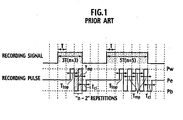
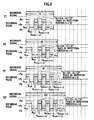
- Fig.1 is a view showing recording pulses according to a multi-pulse strategy of a conventional optical recording method.
- T represents a clock period.
- the laser power of a laser beam is modulated with three values, i.e., recording power Pw, erase power Pe, and bias power Pb (Pw > Pe > Pb), to generate recording pulses corresponding to recording signals (rectangular pulses) having lengths 3T and 5T, thereby forming marks having lengths 3T and 5T on a recording layer of a medium.
- recording power Pw recording power
- erase power Pe erase power
- bias power Pb bias power
- the recording pulses corresponding to the rectangular pulse of length 3T are multi-pulses consisting of a top pulse T top , an intermediate pulse T mp , and a rear-end pulse T cl arranged in series.
- the recording pulses corresponding to the rectangular pulse of length 5T are multi-pulses consisting of a top pulse T top , three intermediate pulses T mp , and a rear-end pulse T cl arranged in series.
- Recent phase-change recording media have high recording density, and therefore, need high recording speed.
- the recording speed must further be increased. Even if the recording speed is increased, factors mentioned below prevent marks from being properly recorded on a recording layer of a DVD medium.
- a first factor is that increasing a recording linear speed necessitates increasing write laser power (laser strength). Consumer lasers of relatively low price used for DVD medium recorders and the like hardly provide laser strength sufficient for high-speed recording.
- a second factor is that the responsibility of divided pulses (multi-pulses) of recording laser power is poor.
- a sextuple linear speed (21 m/s) for a DVD medium corresponds to a clock period of about 6.3 ns.
- a current laser needs about 3.0 ns in total for the rise and fall of a rectangular pulse. Accordingly, a pulse having the above-mentioned pulse width of about 2.5 ns becomes an incomplete rectangular wave, or a triangular wave whose peak power is below a set value (recording power level Pw or bias power level Pb). Then, it is difficult to apply a set heat quantity to the recording layer of a medium. This results in forming a mark not having a specified shape.
- a third factor is that the material of a recording layer of a DVD medium is incapable of coping with high-speed divided pulses of recording laser power.
- the material of a recording layer tends to be adjusted in a direction of easy crystallization. This is equal to a direction of making it difficult to achieve an amorphous state at a given cooling speed.
- a time for applying divided pulses extends as the length of a mark elongates, to achieve an annealing thermal history as a whole. Accordingly, a recording layer made for quick crystallization speed easily crystallizes. Then, the longer the length of a mark, the thinner the mark becomes, to provide an insufficient signal amplitude.
- optical recording method that employs a string of 2T-based recording pulses.
- ODS '00 Optical Data Storage Conference 2000
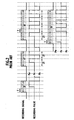
- Technical Digest PD1 "High speed rewritable DVD up to 20 m/s with nucleation-free eutectic phase-change material of Ge (Sb 70 Te 30 ) + Sb" discloses an optical recording method.that conducts 4.8X-speed recording on a DVD medium by providing high- speed divided pulses of write laser power such that a recording power period reaching a recording power level Pw and a bias power period reaching a bias power level Pb are contained within a double clock period of 2T.
- Fig.2 is a view showing a 2T-based recording pulse string according to the Technical Digest PD1 of ODS' 00.
- the optical recording method employing 2T-based recording pulse strings expands the width of each divided recording pulse.
- this method can secure the rise and fall time of a recording pulse of recording laser power, to provide a complete rectangular pulse.
- the rectangular pulse can have a peak level that sufficiently reaches the recording power level Pw or the bias power level Pb. Extending a period of bias power results in achieving a quenching schedule to provide a specified recording pulse signal amplitude with a consumer laser having relatively low recording power.
- a PULSTEC MSG2B signal generator already marketed incorporates a circuit for carrying out a multi-pulse strategy based on 2T-based recording pulse strings with pulse-width-changed recording pulses generated within a double clock period of 2T.
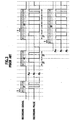
- Fig.3 is a view showing 2T-based recording pulse strings incorporated in the PULSTEC MSG2B signal generator.
- the optical recording method ( Fig. 3 ) can secure a specified recording pulse signal amplitude with relatively low recording power.
- the end of a recording pulse corresponding to a mark length includes a modulated pulse (a relatively thin pulse in Fig. 3 ) within a clock period of 1T. This results in an insufficient bias power time and an insufficient annealing time corresponding thereto.
- the multi-pulse strategy employing 2T-based recording pulse strings causes the problem of insufficiently keeping a bias power time at the end of a recording pulse. This causes a shortage of annealing time and a thinning phenomenon at the end of a mark recorded on a recording layer. This problem is solved by an embodiment of the present invention.
- One solution may be to particularly consider the rise of a top pulse or the fall of a rear-end pulse in the multi-pulse strategy employing 2T-based recording pulse strings.
- This solution involves an inconvenience of causing recording characteristic differences between recording pulses for forming a mark (having a length of, for example, 2T, 4T, and the like) corresponding to an even number of recording clock periods T and recording pulses for forming a mark (having a length of, for example, 3T, 5T, and the like) corresponding to an odd number of recording clock periods T.
- multi-pulses are formed so that a time for recording power Pw and a time for bias power Pb are contained within 2T. If the trailing edge of a recording pulse is adjusted to the training edge of a recording signal, the width of an intermediate pulse existing between a top pulse and a rear-end pulse must be adjusted. For this, an adjusting width of (1/2)T is needed.
- the optical recording method of Fig.3 adjusts the rise of a top pulse of recording pulses to a position 1T after the rise of a recording signal. Accordingly, if the trailing edge of a recording pulse is adjusted to the trailing edge of the recording signal, the width of an intermediate pulse existing between the top pulse and rear-end pulse must be adjusted. For this, an adjusting width of (1/2)T is needed.
- the width of a recorded mark has information. Accordingly, it is necessary to record a mark without distortion. Namely, it is necessary to record a mark on a recording film in a front-rear symmetrical manner.
- a part of a disk irradiated with a laser beam when recording a signal involves a higher temperature at an end point than a start point due to a heat accumulating effect.
- a recorded mark is wider at its rear end than at its front end.
- the recorded mark has a teardrop shape having a thin front end and a thick rear end. This sort of thermal recording is known to change recording conditions depending on recording speed variations.
- Japanese Unexamined Patent Application Publication No. 2001-209940 of this applicant records temporal information (strategy) with pre-pits on a disk, the temporal information including maker's optimum recording power, optimum erase power, a top pulse width, an intermediate multi-pulse width, a rear-end pulse width, and the like. This is because each disk has specific optimum recording power, optimum erase power, a top pulse width, an intermediate multi-pulse width, a rear-end pulse width, and the like. Due to a rapid advance of multiplied speed, there is available information for 1X speed (a linear speed of 3.49 m/s) but no information is available for high multiplied speed.
- 1X speed a linear speed of 3.49 m/s
- an apparatus compatible with 1X, 2X, and 4X speeds can record information on the disk only at 1X speed, or at 4X speed through time consuming processes of testing recording power and strategy and finding optimum power for 4X speed.
- keeping a user waiting several tens of seconds is not acceptable for a commercial commodity.
- an apparatus compatible with 1X- and 2X-speed recording can record information on the disk only at 1X speed, or at 2X speed through time consuming processes of testing recording power and strategy and finding optimum power for 2X speed.
- US Patent No. 6,256,277 B1 discloses an information recording apparatus for injecting an energy beam into a recording medium to form locally a region different in physical properties from a non-recording region to thereby record information.
- the apparatus has a drive for driving an energy generation source for changing the number of injected energy pulses in a mark forming period in accordance with the mark length so that the interval between arbitrary two points of the change of injected power level at the time of information recording is substantially set to be longer than a half of a detection window width in order to make it easy to drive a recording energy generation source to thereby form said mark accurately and speedily and, at the same time, in order to secure a sufficient time required for cooling the recording medium.
- Japanese patent application, Publication No. JP 2003030833 A provides a recording method of an optical recording medium and an optical recorder capable of compensating a rapidly cooled state which can be converted to an amorphous state, and also capable of forming a recording mark having a small edge shift by using recording drive consisting of a plurality of pulse trains even for an optical recording medium for recording with high density and high transfer rate.
- recording is carried out in such a manner that the recording start position to form the start end part of the mark to be recorded is changed at least in accordance with the length of the mark to be recorded and the length of a space just before it, and the recording end position to form the rear end part of the mark to be recorded is changed at least in accordance with the length of the mark to be recorded and the length of the space directly after it.
- the present invention has been devised in consideration of these requirements. According to the present invention, there is provided an optical recording method as set out in Claim 1 and an optical recording apparatus as set out in Claim 2.
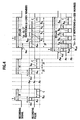
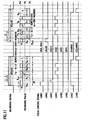
- Fig.4 is a view explaining strings of divided pulse strings of the first background example optical recording method.
- a clock period T is employed for a multiplied linear speed.
- Constant strength periods (At) of the recording power Pw are set as A t T, A l T, ... , and A m T.
- nT a laser beam is modulated in order of A t T, B t T, A l T, B l T, ... , A m T, B m T, and CT.
- the length of C may be changed according to n.
- a modulation method for a recording signal may be 1-7 modulation, 8-16 modulation (EFM), EFM+ modulation, and the like.
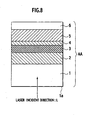
- Fig.8 shows an optical recording medium AA.
- a first protective layer (lower dielectric layer) 2 On a substrate 1, a first protective layer (lower dielectric layer) 2, a recording layer 3, a second protective layer (upper dielectric layer) 4, a reflective layer 5, and a protective film 6 are successively laminated.
- a recording or reproducing laser beam is made incident to an incident face 1a of the substrate 1 (in an irradiating direction L).
- Material for the substrate 1 of the optical recording medium AA may be selected from various types of transparent synthetic resin, transparent glass, and the like. To avoid the influence of dust or flaws on the substrate 1, it is preferable to employ a transparent substrate and to record data from the substrate 1 side with a condensed laser beam.
- Material for the transparent substrate 1 may be glass, polycarbonate, polymethyl methacrylate, polyolefinresin, epoxy resin, polyimide resin, and the like. In particular, polycarbonate resin is preferable because it involves small optical birefringence and small moisture absorption and is easy to mold.
- the thickness of the substrate 1 is not particularly limited. In consideration of compatibility with digital versatile disks (hereinafter referred to as DVDs), it is preferable to be 0.6 mm. In practice, the thickness must be in the range of 0.01 mm to 5 mm. If the thickness of the substrate 1 is smaller than 0.01 mm, dust will influence even if recording is conducted with a condensed laser beammade incident to the substrate 1 side. If the thickness is over 5 mm, it will be difficult to increase the numerical aperture of an object lens, to thereby increase the size of a laser beam spot and deteriorate recording density.
- the substrate 1 may be flexible or rigid.
- a flexible substrate may be in the form of a tape, sheet, or card.
- a rigid substrate may be in the form of a card or disk.
- Two pieces of the substrates 1 each having the laminated recording layer 3, protective layers 2 and 4, reflective layer 5, and protective film 6 may be attached back to back to form an air sandwich structure, an air incident structure, or a tightly bonded structure.
- the first and second protective layers 2 and 4 prevent thermal deformation of the substrate 1 and recording layer 3 and deterioration of a recording characteristic during recording. In this way, the protective layers 2 and 4 provide an effect of protecting the substrate 1 and recording layer 3 from heat , an optical interference effect, and an effect of improving a signal contrast during reproduction.
- the first protective layer 2 and second protective layer 4 may be made of different materials or compositions.
- a mixed film of ZnS and SiO 2 is preferable because it can secure recording sensitivity, C/N, erase rate, and the like with respect to repetitive recording and erasing operations.
- the thickness of the first protective layer 2 is in the range of about 5 to 500 nm. It is preferable to be in the range of 40 to 300 nm with which the first protective layer 2 is hardly removed from the substrate 1 and recording layer 3 to thereby prevent defects such as cracks.
- the thickness of the second protective layer 4 is preferably in the range of 0.5 to 50 nm to secure recording characteristics such as C/N and erase rate and stabilize many times of rewrite operation.
- the reflective layer 5 may be made of an alloy containing light reflective metal such as Al, Au, and Ag as a main component and an additive including at least one kind of metal or semiconductor, or a mixture of metal such as Al, Au, and Ag and a metal compound such as nitride, oxide, and chalcogenide of Al and Si.
- Metal such as Al, Au, and Ag and alloys containing such metal as a main component are preferable because they have high light reflectivity and high thermal conductivity.
- alloys are those made of Al with at least one of Si, Mg, Cu, Pd, Ti, Cr, Hf, Ta, Nb, Mn, and Zr, or Au or Ag with at least one of Cr, Ag, Cu, Pd, Pt, Ni, and Nd.
- metal or an alloy containing Ag as a main component is preferable because Ag has a high thermal conductivity and realizes a proper recording characteristic.
- the thickness of this reflective layer 5 is dependent on the thermal conductivity of the metal or alloy that forms the reflective layer 5. It is preferable that the thickness is in the range of 50 nm to 300 nm.
- the thickness of reflective layer 5 greater than 50 nm may have no optical influence, i.e., no influence on reflectance but it influences a cooling speed.
- the thickness greater than 300 nm elongates a manufacturing time. Accordingly, the layer thickness of the reflective layer 5 must be controlled by employing a material having a high thermal conductivity. If the reflective layer 5 is made of pure silver or a silver alloy, it is preferable to employ material containing no S for a layer that is in contact with the reflective layer 5, to prevent the formation of an AgS compound.
- the recording layer 3 may be an alloy layer made of an Sb-Te alloy containing Ge or at least one of In, Ag, Si, Al, Ti, Bi, and Ga.
- the thickness of the recording layer 3 is preferably in the range of 10 to 25 nm, which can reduce recording laser power.
- Each or both faces of the recording layer 3 may be provided with an interface layer. It is important that this interface layer must be made of material containing no sulfur. If the interface layer is made of material containing sulfur, repetitive overwrite operations may diffuse the sulfur in the interface layer into the recording layer 3 to deteriorate recording characteristics.
- Preferable material is material containing at least one of nitride, oxide, and carbide. More precisely, material containing at least one of germanium nitride, silicon nitride, aluminum nitride, aluminum oxide, zirconium oxide, chrome oxide, silicon carbide, and carbon is preferable.
- the material may additionally contain oxygen, nitrogen, or hydrogen.
- the nitride, oxide, or carbide mentioned above may be not of a stoichiometric composition. It may be in excess of or in short of nitrogen, oxygen, or carbon. This sometimes leads to improving the characteristics of the interface layer, such as the adhesion, quality preservation, and durability of the interface layer.
- Laminating the protective layers 2 and 4, recording layer 3, reflective layer 5, and the like on the substrate 1 may be conducted according to a known vacuum thin film forming method such as a vacuum vapor deposition method (resistive heating type or electron beam type), an ion plating method, or a spattering method (DC spattering, AC spattering, or reactive spattering).
- a vacuum vapor deposition method resistive heating type or electron beam type
- an ion plating method or a spattering method (DC spattering, AC spattering, or reactive spattering).
- the spattering method is preferable because it can easily control composition and film thickness.
- the thicknesses of the protective layers 2 and 4, recording layer 3, reflective layer 5, and the like to be formed are easy to control by controlling the power and time of a spattering power source or by monitoring a deposition state with, for example, a quartz oscillation film thickness meter.
- Formation of the protective layers 2 and 4, recording layer 3, reflective layer 5, and the like may be made with the substrate 1 being fixed, moved, or rotated. To realize a uniform in-plane film thickness, rotating the substrate 1 is preferable. It is more preferable to additionally revolve the substrate 1. The substrate 1 may be cooled as and when needed, to reduce warp of the substrate 1.
- a dielectric layer made of ZnS or SiO 2 or a resin protective layer made of ultraviolet-ray hardening resin may be formed as and when needed within the range of not deteriorating the effect of the techniques described herein, after the formation of the reflective layer 5 and the like to prevent deformation of the reflective layer 5 and the like.
- two substrates 1 may be faced and adhered to each other with, for example, an adhesive.
- the recording layer 3 Before actual recording, it is preferable to crystallize the recording layer 3 with a laser beam or a beam from a xenon flash lamp.
- Each layer was formed on a substrate 1 made of polycarbonate resin having a diameter of 120 mm and a plate thickness of 0.6 mm.
- the substrate 1 was provided with blank grooves at track pitches of 0.74 ⁇ m.
- the grooves had a depth of 25 nm and the ratio of a groove width to a land width of about 40:60.
- a vacuum chamber was discharged to 3 x 10 -4 Pa, and in an Ar gas atmosphere of 2 x 10 -1 Pa, ZnS containing 20-mol% SiO 2 was subjected to a highfrequency magnetron spattering method to form a first protective layer 2 having a layer thickness of 60 nm on the substrate 1.
- a recording layer 3 having a layer thickness of 16 nm (composition ratio of Ge 2 In 5 Sb 76 Te 17 ) was formed by co-spattering of a three-element single alloy target In-Sb-Te and a simple Ge target.
- a second protective layer 4 of 16 nm thick was formed from the same material as that of the first protective layer 2, and then, a reflective layer 5 of 120 nm thick was formed from an Ag-Pd-Cu target.
- the substrate 1 was taken out of the vacuum chamber.
- acryl-based ultraviolet-ray hardening resin (SONY CHEMICAL SK5110) was spin-coated and was hardened with ultraviolet rays to form a protective film 6 having a film thickness of 3 ⁇ m.
- an optical disk was obtained.
- Two substrates 1 made as mentioned above were bonded together with an adhesive seal, to provide a both-side-recording optical disk.
- the optical disk was irradiated with a wide laser beam having a track-direction beam width wider than a radial-direction beam width.
- the beam heated the recording layer 3 above a crystallization temperature, to finish an initialization process. Recording was made from the substrate 1 side to a guide groove of the phase-change recording layer 3.
- the groove had a convex shape when seen from the laser beam incident direction.
- clock-to-data jitters and signal strength (hereinafter referred to as modulation factor) were measured on reproduced signals.
- modulation factor clock-to-data jitters and signal strength
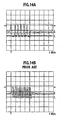
- Fig. 14A shows a waveform of pulses emitted for 14T at 6X speed. It is understood that the pulses completely rise to substantially form a rectangle.
- the other conditions were the same as those of the recording strategy of the first example.
- the other conditions were the same as those of the recording strategy of the second example.
- the recording layer 3 was made by the co-spattering of a three-element single alloy target of In-Sb-Te and a simple Sb target, to have a composition ratio of In 5 Sb 74 Te 21 . Except this, the same conditions as those of the first example were used to form an optical recording medium.
- the same 4X-speed measurement as that of the second example was conducted, and as shown in Fig. 9 , substantially the same characteristics as those of the second example were obtained.
- the recording layer 3 was made by the co-spattering of a three-element single alloy target of In-Sb-Te and a simple Sb target, to have a composition ratio of In 5 Sb 79 Te 16 . Except this, the same conditions as those of the first example were used to form an optical recording medium.
- the same 6X-speed measurement as that of the second example was conducted, and as shown in Fig. 9 , substantially the same characteristics as those of the second example were obtained.
- the recording layer 3 was made by the co-spattering of a three-element single alloy target of In-Sb-Te and a Ge target, to have a composition ratio of In 2 Sb 80 Te 18 .
- the recording layer 3 was made by the co-spattering of a three-element single alloy target of In-Sb-Te and a Ge target, to have a composition ratio of Ge 4 In 5 Sb 75 Te 16 . Except this, the same optical recording medium as that of the second example was prepared. Measurements similar to those of the second example were carried out, and as shown in Fig.9 , characteristics substantially equivalent to those of the second example were obtained for both the 4X-speed recording and 6X-speed recording.
- the recording layer 3 was made by the co-spattering of a four-element single alloy target of Ge-In-Sb-Te and an Ag target, to have a composition ratio of Ge 1 In 5 Sb 76 Te 1 Ag 1 . Except this, the same optical recording medium as that of the second example was prepared. Measurements similar to those of the second example were carried out, and as shown in Fig.9 , characteristics substantially equivalent to those of the second example were obtained for both the 4X-speed recording and 6X-speed recording.
- the recording layer 3 was made by the co-spattering of a four-element single alloy target of Ge-In-Sb-Te and a Ti target, to have a composition ratio of Ge 1 In 5 Sb 76 Te 17 Ti 1 . Except this, the same optical recording medium as that of the second example was prepared. Measurements similar to those of the second example were carried out, and as shown in Fig.9 , characteristics substantially equivalent to those of the second example were obtained for both the 4X-speed recording and 6X-speed recording.
- the recording layer 3 was made by the co-spattering of a four-element single alloy target of Ge-In-Sb-Te and an Si target, to have a composition ratio of Ge 1 In 5 Sb 76 Te 17 Si 1 . Except this, the same optical recording medium as that of the second example was prepared. Measurements similar to those of the second example were carried out, and as shown in Fig.9 , characteristics substantially equivalent to those of the second example were obtained for both the 4X-speed recording and 6X-speed recording.
- the recording layer 3 was made by the co-spattering of a four-element single alloy target of Ge-In-Sb-Te and an Al target, to have a composition ratio of Ge 1 In 5 Sb 76 Te 17 Al 1 . Except this, the same optical recording medium as that of the second example was prepared. Measurements similar to those of the second example were carried out, and as shown in Fig.9 , characteristics substantially equivalent to those of the second example were obtained for both the 4X-speed recording and 6X-speed recording.
- the recording layer 3 was made by the co-spattering of a four-element single alloy target of Ge-In-Sb-Te and a Bi target, to have a composition ratio of Ge 1 In 5 Sb 74 Te 16 Bi 2 . Except this, the same optical recording medium as that of the second example was prepared. Measurements similar to those of the second example were carried out, and as shown in Fig.9 , characteristics substantially equivalent to those of the second example were obtained for both the 4X-speed recording and 6X-speed recording.
- the recording layer 3 was made by the co-spattering of a four-element single alloy target of Ge-In-Sb-Te and a Ga target, to have a composition ratio of Ge 1 In 5 Sb 74 Te 16 Ga 2 . Except this, the same optical recording medium as that of the second example was prepared. Measurements similar to those of the second example were carried out, and as shown in Fig.9 , characteristics substantially equivalent to those of the second example were obtained for both the 4X-speed recording and 6X-speed recording.
- jitters were 9.9% and 16.2% and modulation factors were 50% and 41% at 4X speed and 6X speed, respectively.
- the modulation factors were significantly inferior to those of the first to thirteenth examples (eye patterns for the 6X-speed recording are shown in Fig.12B ).
- Fig.14B shows a waveform of pulses emitted for 14T at 6X speed. It is understood that the pulses incompletely rise and fall and form triangular waves not reaching the peak power Pw and bottom power Pb.
- jitters were 10.4% and 15.2% and modulation factors were 70% and 66% at 4X speed and 6X speed, respectively.
- the jitter at 6X speed was significantly inferior to those of the first to thirteenth examples.
- a strategy ( Fig.3 ) of modulation within 2T that is incorporated in PULSTEC MSG2B signal generator was used to conduct recording at 4X speed and 6X speed with optimum pulse widths on an optical recording medium that is similar to that of the second example.
- jitters were 12.7% and 16.2% and modulation factors were 69% and 64% at 4X speed and 6X speed, respectively.
- the jitter was significantly inferior to those of the first to thirteenth examples.
- the recording layer 3 was made by the co-spattering of a three-element single alloy target of In-Sb-Te and an Sb target, to have a composition ratio of In 5 Sb 72 Te 23 . Except this, the same optical recording medium as that of the second example was prepared. However, at or over 4X speed where the recording pulse strategy described above becomes effective, a crystallization speed was insufficient and part of a mark was formed in a space portion to hinder proper recording.
- the recording layer 3 was made by the co-spattering of a three-element single alloy target of In-Sb-Te and an Sb target, to have a composition ratio of In 5 Sb 80 Te 15 . Except this, the same optical recording medium as that of the second example was prepared. However, as shown in Fig. 9 , a modulation factor of 60% of the DVD standard was not sufficiently obtained and hindered proper recording.
- the recording layer 3 was made by the co-spattering of a three-element single alloy target of In-Sb-Te and a Ge target, to have a composition ratio of Ge 7 In 5 Sb 72 Te 16 . Except this, the same optical recording medium as that of the second example was prepared. Measurements similar to those of the second example were conducted, and as shown in Fig.9 , characteristics substantially equivalent to those of the second example were obtained for both the 4X-speed recording and 6X-speed recording. However, as shown in Fig.9 , jitters were 14.1% and 17.3% and modulation factors were 71% and 68% at 4X speed and 6X speed, respectively. The jitter was significantly inferior to those of the first to thirteenth examples.
- the recording layer 3 was made by the co-spattering of a two-element single alloy target of Sb-Te and an Sb target, to have a composition ratio of Sb 80 Te 20 . Except this, the same optical recording medium as that of the second example was prepared. Although good recording characteristics were obtained at both the 4X-speed recording and 6X-speed recording, the sample crystallized (mark disappeared) and was extremely inferior during a preservation characteristic test (acceleration test at 80°C).
- the recording layer 3 was made by the co-spattering of a three-element single alloy target of In-Sb-Te and a Co target, to have a composition ratio of In 5 Sb 76 Te 17 CO 2 . Except this, the same optical recording medium as that of the second example was prepared. Measurements similar to those of the second example were conducted. As shown in Fig.9 , jitters were 17.4% and 20.3% at the 4X-speed recording and 6X-speed recording, respectively. The jitters were significantly inferior to those of the first to thirteenth examples.
- the comparison 1 employs the conventional multi-pulse strategy ( Fig.1 ). Due to the influence of rise and fall characteristics of a laser ( Fig.14B ), an amplitude sufficient for recording is not obtained, and therefore, a mark to be written becomes incompletely amorphous. This seems to be the reason why the drastically inferior modification factors of 50% and 41% were obtained.
- the comparison 2 employs the recording strategy ( Fig.2 ) that employs a halved recording clock. This resulted in drastically inferior jitters at 6X speed. The reason of this has been clarified that the recording pulses of a 4T signal that greatly affect jitters included two recording pulses and the latter pulse elongated the trailing edge of the 4T mark to deteriorate jitters. When generating a 9T signal, this recording strategy must change the clock timing of the other multi-pulses, to increase circuit size.
- the comparison 3 employs the strategy ( Fig.3 ) that conducts modulation within 2T. Compared with the comparison 2, this example shortens the width of a rear-end pulse for 4T and other signals, to improve jitters. For a medium compatible with high linear speeds, employing a doubled clock only for the rear-end pulse results in forming an insufficient mark like the conventional multi-pulse strategy of the comparison 1, and therefore, is incapable of improving jitters.
- the shape of the start of a mark to be formed on, in particular, a phase-change medium and to influence jitters is substantially uniquely determined by the rise characteristics of a laser.
- the shape of the end of the mark is determined by the material of the medium, a crystallization speed corresponding to a linear speed, and the like, and therefore, is hardly sharpened to improve jitters.
- the cooling interval C is part of a cooling pulse interval necessary for forming the trailing edge of a mark and is an element time period determined by the physical properties of a medium, a recording linear speed, and the like.
- any recording signal of an odd number T may be made from the top pulse A tod and B tod based on the recording signal 3T followed by multi-pulses (intermediate pulses) A m of 2T.
- Any recording signal of an even number T may be made from the top pulse A tev and B tev based on the recording signal 4T followed by multi-pulses A m of 2T.
- alternating the recording top pulses between a recording signal of odd T (length of odd number times the length T) and a recording signal of even T (length of even number times the length T), inverting the phases of multi-pulses (intermediate pulses) or shifting them by 1T between adjacent recording signals T, and adding a multi-pulse (intermediate pulse) of a period 2T whenever a recording signal is elongated by 2T can equalize recording pulse waveforms at the trailing edge of each recording signal T, thereby reducing jitters.
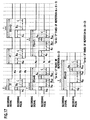
- Fig. 5 shows a phase relationship that a recording pulse at a 3T position from the leading edge of a recording signal of length 5T involves an intermediate pulse A m , and on the other hand, a recording pulse at a 3T position from the leading edge of a recording signal of length 6T involves no intermediate pulse.
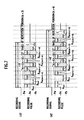
- Fig.6 shows a phase relationship that recording pulses at 3T and 5T positions from the leading edge of a recording signal of length 7T involve two intermediate pulses A m , and on the other hand, recording pulses at 3T and 5T positions from the leading edge of a recording signal of length 8T involve no intermediate pulses. Also shown is a phase relationship that recording pulses at 3T, 5T, and 7T positions from the leading edge of a recording signal of length 9T involve three intermediate pulses A m , and on the other hand, recording pulses at 3T, 5T, and 7T positions from the leading edge of a recording signal of length 10T involve no intermediate pulses.
- Forming these recording pulse waveforms is realized by a circuit structure based on the above-mentioned combination. Namely, a simple circuit structure is sufficient to achieve the waveforms.
- Fig.15 shows recording signals of 3T to 10T because, as explained above, the same idea is applicable to generate any recording pulse.
- Fig.15 is 1T behind Fig.4 .
- This phase relationship difference is simply a design matter. Even if Fig.15 is behind Fig. 4 by 2T, the same operation and effect will be provided.
- 2T i.e., two clock periods as a period of a multi-pulse
- 2T i.e., two clock periods as a period of a multi-pulse
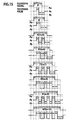
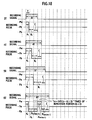
- Fig. 15 is a view explaining divided pulse strings according to the second background example of an optical recording method.
- Heating pulses for minimum period recording data 3T and 4T are used to form strategies for data of 5T or longer. Namely, a heating pulse for an odd 3T is used as a top heating pulse for odd data, and a heating pulse for an even 4T is used as a top heating pulse for even data.
- An adjustment is made to form an equal relationship for the phases of pulses at the trailing edges of even and odd data according to the lengths of the data.
- the phase adjustment is carried out by shifting one clock corresponding to a half phase of a two-clock period. This method can equalize the formation of a mark trailing edge for each T, to optimize jitters of data.
- Heating pulses of the minimum period recording data 3T, 4T, and 5T are used to form strategies for data of 6T or longer.
- Heating pulses for 6T consisting of 3T plus 3 clocks are made by adding the heating pulses of 3T to the start of a 6T strategy.
- Heating pulses for 7T consisting of 4T plus 3 clocks are made by adding the heating pulses of 4T to the start of a 7T strategy.
- Heating pulses for 8T consisting of 5T plus 3 clocks are made by adding the heating pulses of 5T to the start of an 8T strategy.
- the top pulse of a three-clock period is followed by multi-pulses each of three-clock period, the multi-pulse being shifted by one clock corresponding to a third of the three-clock period according to the length of data, to maintain the same phase relationship for a pulse at the trailing edge of the data.
- This phase relationship adjusting method can equalize the formation of a mark trailing edge for each T, to optimize jitters of data.
- Each multi-pulse that follows the top heating pulse mentioned above is formed by dividing the frequency of a recording clock by p.
- the top pulse of a p-clock period is followed by multi-pulses each of p-clock period, the multi-pulse being shifted by one clock corresponding to 1/p of the p-clock period according to the length of data, to maintain the same phase relationship for a pulse at the trailing edge of the data.
- This phase relationship adjusting method can equalize the formation of a mark trailing edge for each T, to optimize jitters.
- short data such as 3T, 4T, and 5T can be improved by finely changing the data according to the recording grooves of a medium, the characteristics of a recording film, and the overshoot of a laser. Accordingly, instead of employing heating pulses at the start of short data as they are for long data, the heating pulses at the start may finely be adjusted according to respective T.
- This explanation has been made based on the 8-16 modulation method with shortest data 3T serving as a base.
- a modulation method using shortest data of 2T of 1-7 modulation and the like may also be employable by replacing 3T in the above explanation with 2T as shortest data.
- the number of multi-pulses is given by subtracting a coefficient k determined by recording characteristics from recording data and by dividing the difference by a frequency dividing ratio p of a recording clock.
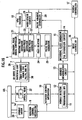
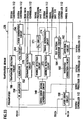
- a rotation control mechanism 9 including a spindle motor 29 for rotating the phase-change optical disk AA.
- An object lens for condensing and emitting a laser beam to the phase-change optical disk AA and a light source such as a semiconductor laser LD 28 are provided for an optical head 27, which is freely movable in a radial direction of the disk, to seek the disk.
- An object lens driver and output system of the optical head 27 are connected to an actuator control mechanism 10.
- the actuator control mechanism 10 is connected to a wobble detector 12 including a programmable BPF 11.
- the wobble detector 12 is connected to an address demodulation circuit 13 for demodulating an address from a detected wobble signal.
- the address demodulation circuit 13 is connected to a recording clock generator 15 including a PLL synthesizer circuit 14.
- the PLL synthesizer circuit 14 is connected to a drive controller 16.
- the drive controller 16 is connected to a system controller 17 and also to the rotation control mechanism 9, actuator control mechanism 10, wobble detector 12, and address demodulation circuit 13.
- the system controller 17 is connected to an EFM encoder 18, a mark length counter 19, and a pulse number controller 20.
- the EFM encoder 18, mark length counter 19 (including the determination of an odd number or an even number), and pulse number controller 20 (including the control of an odd or even number of multi-pulses A m ) are connected to a recording pulse string controller 8.
- the recording pulse string controller 8 includes a heating pulse generator (recording pulse generator, top pulse generator) 21 to generate a heating pulse control signal containing a top heating portion and a succeeding heating portion (and a cooling pulse portion), an erase pulse generator 22 to generate an erase pulse control signal, a multi-pulse generator 23 to generate a control signal for multi-pulses A m , an edge selector 24 serving as a selector, and a pulse edge generator 25.
- a heating pulse generator recording pulse generator, top pulse generator
- an erase pulse generator 22 to generate an erase pulse control signal
- a multi-pulse generator 23 to generate a control signal for multi-pulses A m
- an edge selector 24 serving as a selector
- a pulse edge generator 25 serving as a selector
- An output side of the recording pulse string controller 8 is connected to an LD driver 26 to switch a drive current source 30 for heating power (recording power) Pw, cooling power (bias power) Pb, and erase power Pe to thereby drive the semiconductor laser 28 in the optical head 27.
- Pw and Pb in the drive current source 30 serve as heating power driver and cooling power driver, respectively, and Pe as an erase power driver.
- the rotation control mechanism 9 controls the rotation speed of the spindle motor 29 at a recording linear speed corresponding to an objective recording speed. Thereafter, the optical head 27 provides a push-pull signal from which the programmable BPF 11 detects and separates a wobble signal, which is demodulated into an address. Then, the PLL synthesizer circuit 14 generates a recording channel clock.
- the semiconductor laser LD 28 generates a recording pulse string.
- the recording pulse string controller 8 receives the recording channel clock and EFM data which is recording information, and the heating pulse generator 21 in the recording pulse string controller 8 generates a top heating pulse control signal.
- the multi-pulse generator 23 in the recording pulse string controller 8 generates a succeeding heating multi-pulse control signal.
- the erase pulse generator 22 generates an erase pulse control signal for an erase portion.
- the LD driver 26 switches the drive current source 30 to provide light emission power Pw, Pb, and Pe to thereby provide LD light emission waveforms for the recording pulse string.
- the heating pulse generator 21 is provided with the multi-stage pulse edge generator 25 having a resolution of 1/40 of a recording channel clock period T.
- An edge pulse supplied to the edge selector (multiplexer) 24 and selected by the system controller 17 is used to generate the top heating pulse control signal and heating multi-pulse control signal. This realizes an adaptive adjustment.
- a multi-stage delay circuit for the pulse edge generator 25 may consist of high-resolution gate delay elements, a ring oscillator, and a PLL circuit.
- the heating pulses thus generated generate a multi-pulse string in synchronization with the recording channel clock, and at the same time, the duty of a heating multi-pulse width determines the pulse width of a cooling pulse.
- the heating pulse generator 21 separately incorporates a last cooling pulse generator or a cooling pulse generator that includes a multi-stage delay circuit. This delay circuit generates an edge pulse, which is supplied to the edge selector 24 and is selected by the system controller 17 to determine the trailing edge of the last cooling pulse.
- the erase pulse generator 22 can finely change a pulse width according to the timing of a heating pulse generated by another multi-stage delay circuit.
- a group of these pulses forms an overall recording multi-pulse string.
- the mark length counter 19 counts, according to a recording clock (period T) (also called a recording channel clock), the mark length of an EFM signal provided by the EFM encoder 18. It determines whether the mark length of the EFM signal is an even number or an odd number. If it is an odd number, the above-mentioned 2T-based top heating pulse is generated, and if it is an even number, the above-mentioned 3T-based top heating pulse is generated. Thereafter, according to the equations 1, 2, and 3 mentioned above, a set of a heating multi-pulse and a cooling multi-pulse associated with the heating multi-pulse is generated whenever the mark count value is incremented by 2T. These multi-pulses are generated through the pulse count controller 20.
- a recording clock also called a recording channel clock
- the multi-pulse generation timing is such that it is generated after the 2T-based top heating pulse if an odd number is counted, and if an even number is counted, it is generated after the 3T-based top heating pulse with a 1T-delay from the multi-pulse of the odd-number case.
- This operation is realized by selecting the trailing edge of a top heating pulse with the edge selector 24, selecting the leading edge of a succeeding multi-pulse with an edge pulse generated at the next recording channel clock period, and selecting the trailing edge of the multi-pulse with a pulse edge generated at the next recording channel clock period.
- the multi-pulse generator may be configured to generate a frequency-divided recording clock by halving the frequency of the-recording channel clock, generate an inverted frequency-divided recording clock by inverting the phase of the frequency-divided recording clock by 180 degrees, generate an edge pulse with the use of the generated clock and a multi-stage delay circuit, select front and rear edges with the edge selector, generate a set of a heating multi-pulse and cooling multi-pulse whenever the recording channel clock is incremented by 2T according to the above-mentioned relational expressions, determine whether the mark length of an EFM signal is an even number or an odd number, employ the frequency-divided recording clock if it is an odd number, and employ the inverted frequency-divided recording clock if it is an even number, to generate a phase difference of 1T depending on an even/odd number. According to this configuration, an actual operation frequency of the multi-pulse generator becomes 1/2 to further increase the speed of a recording operation.
- a conventional phase-change optical disk 1 such as a CD-RW or DVD-RW involves a recording pulse string controller to generate pulses such that a set of heating and cooling pulses is incremented set by set whenever a mark data length is incremented by 1T at a given recording speed.
- a recording speed selected from a predetermined recording speed range, a top heating pulse width Atop, a succeeding heating multi-pulse width A m , a last cooling pulse width Bt, and respective light emission power are optimized.
- the presently described example may select a recording speed exceeding the predetermined recording speed range.
- the recording pulse string controller 8 is switched to generate pulses so as to increase the number of heating and cooling pulses set by set whenever a mark data length is incremented by 2T.
- an information recording/reproducing apparatus can be provided that can cope with a wide range of recording speeds. For example, it is possible to record information on a DVD-RW medium compatible with 2X to 4X recording speed at a high recording speed of about 4X to 8X speed.
- a DVD-RW medium may be tuned to the high-speed recording method of this example to realize better recording.
- a standard information recording/reproducing apparatus employs a semiconductor laser LD4A as a light source.
- An inexpensive driving circuit can at most provide a rise/fall time of an emission waveform of about 2 nsec.
- sufficient heating time and cooling time are needed. It is necessary, therefore, to secure a settling time of about 2 nsec or over. Accordingly, a maximum recording channel clock frequency will be about 100 MHz. This is equal to about 4X speed (26.16 MHz x 4) for DVD-RW.
- the information recording/reproducing apparatus of the present example can halve the practical frequency of an emission waveform and realize 4X speed to about 8X speed for DVD-RW without increasing the speed of the LD driver 26 serving as a light source driver or without employing expensive arrangements.
- top heating pulse width, last cooling pulse width, and other set values mentioned above are typical values. In practice, optimum values may be employed according to recording materials and medium phase structures.
- a different recording modulation method, a different recording density, or a different laser beam spot diameter on a medium involves a different cumulative recording waveform length and a different mark length, and therefore, the above-mentioned correspondence examples between mark lengths and recording waveforms may vary.
- the number of multi-pulses is set to be an integer expressed as INT((n-3)/3).
- a recording clock for forming a recording signal strategy is achievable with the use of 3T and by finely adjusting the timing of a leading edge and/or a trailing edge. This can reduce circuit scale and jitters.
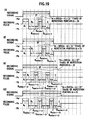
- Fig.17 is a view explaining divided pulse strings according to the third background example of an optical recording method.
- a clock period T is employed at a given linear speed, to record a mark of length nT.
- the laser power of an irradiating laser beam is modulated with three values of recording power Pw, erase power Pe, and bias power Pb (where Pw > Pe > Pb).
- Constant strength periods (A t ) of the recording power Pw are set as A t T, A 1 T, ..., and A m T.
- Constant strength periods (B t ) of the bias power Pb are set as B t T, B 1f T.
- the power is applied in order of A t T, B t T, B 1f T, A 1 T, B 1e T, ..., B mf T, A m T, B me T, and CT to modulate a laser beam.
- nT a laser beam is modulated in order of A t T, B t T, A 1 T, B 1 T, ... , A m T, B m T, and CT.
- the length of C may be changed according to n.
- recording pulses at 3T to 5T positions from the leading edge of a recording signal of length 6T involve an intermediate pulse A m only at a 4T position (one intermediate pulse A m in a 3Tperiod).
- recording pulses at 4T to 6T positions from the leading edge of a recording signal of length 7T involve an intermediate pulse A m only at a 5T position.
- Recording pulses at 5T to 7T positions from the leading edge of a recording signal of length 8T involve an intermediate pulse A m only at a 6T position.
- Recording pulses at 3T to 5T positions from the leading edge of a recording signal of length 9T involve an intermediate pulse A m at a 4T position, and recording pulses at 6T to 8T positions from the leading edge thereof involve an intermediate pulse A m at a 7T position.
- Recording pulses at 4T to 6T positions from the leading edge of a recording signal of length 10T involve an intermediate pulse A m at a 5T position, and recording pulses at 7T to 9T positions from the leading edge thereof involve an intermediate pulse A m at an 8T position.
- recording pulses at 5T to 7T positions from the leading edge of a recording signal of length 11T involve an intermediate pulse A m at a 6T position, and recording pulses at 8T to 10Tpositions from the leasing edge thereof involve an intermediate pulse am at a 9T position.
- Recording pulses at 5T to 7T positions from the leading edge of a recording signal of length 14T involve an intermediate pulse A m at a 6T position, and recording pulses at 8T to 10T and 11T to 13T positions from the leading edge thereof involve intermediate pulses A m at 9T and 12T positions, respectively.
- a recording signal modulation method may be 1-7 modulation, 8-16 (EFM) modulation, EFM+ modulation, and the like.
- An optical recording medium used is the same as the optical recording medium AA shown in Fig.8 , and therefore, the explanation thereof is omitted.
- clock-to-data jitters and signal strength (hereinafter referred to as modulation factor) were measured on reproduced signals.
- modulation factor clock-to-data jitters and signal strength
- the jitters were 9.0As and 10.5%, respectively, and the modulation factors were 72% and 67%, respectively. These values indicate good characteristics (refer to Fig.12A for eye patterns of 6X speed).
- the modulation factor is expressed as (I14)/(I14H) x 100 (refer to Fig.13 ).
- duties sigma (T) of delay times of the top pulses At of mark lengths 3T, 4T, and 5T or longer that follow a 3T space were set as 0.1, 0.2, and 0.2
- duties ⁇ (T) of delay times of the top pulses A t of mark lengths 3T, 4T, and 5T or longer that follow a 4T space were set as 0.2, 0.2, and 0.3
- duties ⁇ (T) of delay times of the top pulses A t of mark lengths 3T, 4T, and 5T or longer that follow a 5T space were set as 0.3, 0.3, and 0.4.
- the other conditions were the same as those of the recording strategy of the twenty-first example.
- the recording layer 3 was made by the co-spattering of a two-element single alloy target of Sb-Te and a Ge target, to have a composition ratio of Ge 2 Sb 80 Te 18 . Except this, the same optical recording medium as that of the twenty-first example was prepared. Measurements similar to those of the twenty-first example were carried out, and as shown in Fig.21 , characteristics substantially equivalent to those of the twenty-first example were obtained for both the 4X-speed recording and 6X-speed recording.
- the recording layer 3 was made by the co-spattering of a three-element single alloy target of In-Sb-Te and a Ge target, to have a composition ratio of Ge 4 In 5 Sb 75 Te 16 . Except this, the same optical recording medium as that of the twenty-first example was prepared. Measurements similar to those of the twenty-first example were carried out, and as shown in Fig.21 , characteristics substantially equivalent to those of the twenty-first example were obtained for both the 4X-speed recording and 6X-speed recording.
- the recording layer 3 was made by the co-spattering of a four-element single alloy target of Ge-In-Sb-Te and an Ag target, to have a composition ratio of Ge 1 In 5 Sb 76 Te 17 Ag 1 . Except this, the same optical recording medium as that of the twenty-first example was prepared. Measurements similar to those of the twenty-first example were carried out, and as shown in Fig.21 , characteristics substantially equivalent to those of the twenty-first example were obtained for both the 4X-speed recording and 6X-speed recording.
- the recording layer 3 was made by the co-spattering of a four-element single alloy target of Ge-In-Sb-Te and a Ti target, to have a composition ratio of Ge 1 In 5 Sb 76 Te 17 Ti 1 . Except this, the same optical recording medium as that of the twenty-first example was prepared. Measurements similar to those of the twenty-first example were carried out, and as shown in Fig.21 , characteristics substantially equivalent to those of the twenty-first example were obtained for both the 4X-speed recording and 6X-speed recording.
- the recording layer 3 was made by the co-spattering of a four-element single alloy target of Ge-In-Sb-Te and an Si target, to have a composition ratio of Ge 1 In 5 Sb 76 Te 17 Si 1 . Except this, the same optical recording medium as that of the twenty-first example was prepared. Measurements similar to those of the twenty-first example were carried out, and as shown in Fig. 21 , characteristics substantially equivalent to those of the twenty-first example were obtained for both the 4X-speed recording and 6X-speed recording .
- the recording layer 3 was made by the co-spattering of a four-element single alloy target of Ge-In-Sb-Te and an A1 target, to have a composition ratio of Ge 1 In 5 Sb 76 Te 17 Al 1 . Except this, the same optical recording medium as that of the twenty-first example was prepared. Measurements similar to those of the twenty-first example were carried out, and as shown in Fig. 21 , characteristics substantially equivalent to those of the twenty-first example were obtained for both the 4X-speed recording and 6X-speed recording.
- the recording layer 3 was made by the co-spattering of a four-element single alloy target of Ge-In-Sb-Te and a Bi target, to have a composition ratio of Ge 1 In 5 Sb 74 Te 16 Bi 2 . Except this, the same optical recording medium as that of the twenty-first example was prepared. Measurements similar to those of the twenty-first example were carried out, and as shown in Fig.21 , characteristics substantially equivalent to those of the twenty-first example were obtained for both the 4X-speed recording and 6X-speed recording.
- the recording layer 3 was made by the co-spattering of a four-element single alloy target of Ge-In-Sb-Te and a Ga target, to have a composition ratio of Ge 1 In 5 Sb 74 Te 16 Ga 2 . Except this, the same optical recording medium as that of the twenty-first example was prepared. Measurements similar to those of the twenty-first example were carried out, and as shown in Fig.21 , characteristics substantially equivalent to those of the twenty-first example were obtained for both the 4X-speed recording and 6X-speed recording.
- the cooling interval C is part of a cooling pulse interval necessary for forming the trailing edge of a mark and is an element time period determined by the physical properties of a medium, a recording linear speed, and the like.
- INT is an integer operation to provide a number closer to 0 so that the three equations can be made common to 3 1 , 3 1 +1, and 3 1 +2.
- n 2
- resultant digits below a decimal point are cut to provide a target value.
- alternating the recording top pulses between a recording signal of 3 1 (length of 3 1 times the length T), a recording signal of 3 1 +1 (length of 3 1 +1 times the length T), and a recording signal of 3 1 +2 (length of 3 1 +2 times the length T) inverting the phases of multi-pulses (intermediate pulses) by 120 degrees or shifting them by 1T between adjacent recording signals T, and adding a multi-pulse (intermediate pulse) of a period 3T whenever a recording signal is elongated by 3T can equalize the waveform of a recording pulse at the trailing edge of each recording signal T, thereby reducing jitters.
- An information recording/reproducing apparatus as an example of an optical recording medium recording apparatus for recording information on an optical recording medium (optical recording medium AA) with the use of the above-mentioned third background example of an optical recording method will be explained with reference to Fig.16 .
- the same components as those mentioned above will be represented with the same marks and their explanations are omitted. Different points from the optical recording method of the first background example shown in Fig. 4 will be explained.
- a system controller 17 is connected to an EFM encoder 18, a mark length counter 19, and a pulse number controller 20.
- the EFM encoder 18, mark length counter 19 (including the determination of 3T, 4T, 5T, 31T, (31+1)T,
- a pulse number controller 20 (including the control of multi-pulses A m of 3 1 , 3 1 +1, and 3 1 +2) are connected to a recording pulse string controller 8.
- a rotation control mechanism 9 controls the rotation speed of a spindle motor 29 at a recording linear speed corresponding to an objective recording speed.
- an optical head 27 provides a push-pull signal from which a programmable BPF 11 detects and separates awobble signal, which is demodulated into an address.
- a PLL synthesizer circuit 14 generates a recording channel clock.
- a semiconductor laser LD 28 generates a recording pulse string.
- the recording pulse string controller 8 receives the recording channel clock and EFM data which is recording information, and a heating pulse generator 21 in the recording pulse string controller 8 generates a top heating pulse control signal.
- a multi-pulse generator 23 in the recording pulse string controller 8 generates a succeeding heating multi-pulse control signal.
- An erase pulse generator 22 generates an erase pulse control signal for an erase portion.
- An LD driver 26 switches a drive current source 30 to provide light emission power Pw, Pb, and Pe to thereby provide LD light emission waveforms for the recording pulse string.
- the heating pulse generator 21 is provided with a multi-stage pulse edge generator 25 having a resolution of 1/40 of a recording channel clock period T.
- An edge pulse supplied to an edge selector (multiplexer) 24 and selected by the system controller 17 is used to generate the top heating pulse control signal and heating multi-pulse control signal. This realizes an adaptive adjustment.
- a multi-stage delay circuit for the pulse edge generator 25 may consist of a high-resolution gate delay element, ring oscillator, and PLL circuit.
- the heating pulses thus generated generate a multi-pulse string in synchronization with the recording channel clock, and at the same time, the duty of a heating multi-pulse width determines the pulse width of a cooling pulse.
- the heating pulse generator 21 separately incorporates a last cooling pulse generator or a cooling pulse generator that includes a multi-stage delay circuit. This delay circuit generates an edge pulse, which is supplied to the edge selector 24 and is selected by the system controller 17 to determine the trailing edge of the last cooling pulse.
- the erase pulse generator 22 can finely change a pulse width according to the timing of a heating pulse generated by another multi-stage delay circuit.
- a group of these pulses forms an overall recording multi-pulse string.
- the recording pulse string controller 8 is provided with the mark length counter 19 that counts, according to a recording clock (period T) (also called a recording channel clock), the mark length of an EFM signal provided by the EFM encoder 18. It determines whether the mark length of the EFM signal is (31), (31+1), or (31+2). If it is (31), the above-mentioned 2T-based top heating pulse is generated, if it is (31+1), the above-mentioned 3T-based top heating pulse is generated, and if it is (31+2), the above-mentioned 4T-based top heating pulse is generated.
- a recording clock also called a recording channel clock
- a set of a heating multi-pulse and a cooling multi-pulse associated with the multi-pulse is generated whenever the mark count value is incremented by 3T.
- These multi-pulses are generated through the pulse count controller 20.
- the multi-pulses are generated after the 2T-based top heating pulse if the EFM signal mark length is (31), they are generated after the 3T-based top heating pulse if the length is (31+1), and they are generated with a 1T-delay compared with the multi-pulses of the odd-number case if the length is (31+2).
- This operation is realized by selecting the trailing edge of a top heating pulse with the edge selector 24, selecting the leading edge of a succeeding multi-pulse with an edge pulse generated at the next recording channel clock period, and selecting the trailing edge of the multi-pulse with a pulse edge generated at the next recording channel clock period.
- the multi-pulse generator may be configured to generate a frequency-divided recording clock by dividing the frequency of the recording channel clock by 3, generate an inverted frequency-divided recording clock by shifting the phase of the frequency-divided recording clock by 120 degrees, generate an edge pulse with the use of the generated clock and a multi- stage delay circuit, select front and rear edges with the edge selector, generate a set of a heating multi-pulse and cooling multi-pulse whenever the recording channel clock is incremented by 3T according to the above-mentioned relational expressions, determine whether the mark length of an EFM signal is (3 1 ), (3 1 +1), or (3 1 +2), employ the frequency-divided recording clock if it is (3 1 ), employ the 120-degree inverted frequency-divided recording clock if it is (3 1 +1), and employ the 240-degree inverted frequency-divided recording clock if it is (3 1 +2), to generate a phase difference of 1T depending on (3 1 ), (3 1 +1), or (3 1 +2).
- an actual operation frequency of the multi-pulse generator becomes 1/3 to further increase the speed of a recording operation.
- a general strategy (refer to Fig.1 ) used for a conventional phase-change optical disk such as a CD-RW or DVD-RW involves a recording pulse string controller to generate pulses such that a set of heating and cooling pulses is incremented set by set whenever a mark data length is incremented by 1T at a given recording speed.
- a recording speed selected from a predetermined recording speed range a top heating pulse width T top , a succeeding heating multi-pulse width T mp , a last cooling pulse width T c1 , and respective light emission power are optimized.
- this example may select a recording speed exceeding the predetermined recording speed range.
- the recording pulse string controller 8 is switched to generate pulses so as to increase the number of heating and cooling pulses set by set whenever a mark data length is incremented by 3T.
- a standard information recording/reproducing apparatus employs a semiconductor laser LD28 as a light source.
- An inexpensive driving circuit can at most provide a rise/fall time of an emission waveform of about 2 nsec.
- sufficient heating time and cooling time are needed. It is necessary, therefore, to secure a settling time of about 2 nsec or over.
- a maximum recording channel clock frequency will be about 100 MHz. This is equal to about 4X speed (26.16 MHz x 4) for DVD-RW.
- the information recording/reproducing apparatus of the present example can reduce the practical frequency of an emission waveform to 1/3 and realize 6X speed to about 12X speed for DVD-RW without increasing the speed of the LD driver 2 serving as a light source driver or without employing expensive arrangements.
- top heating pulse width, last cooling pulse width, and other set values mentioned above are typical values. In practice, optimum values may be employed according to recording materials and medium phase structures.
- a different recording modulation method, a different recording density, or a different laser beam spot diameter on a medium involves a different cumulative recording waveform length and a different mark length, and therefore, the above-mentioned correspondence examples between mark lengths and recording waveforms may vary.
- short data such as 3T, 4T, and 5T can be improved by finely changing the data according to the recording grooves of a medium, the characteristics of a recording film, and the overshoot of a laser. Accordingly, instead of employing heating pulses at the start of short data as they are for long data, the heating pulses at the start may finely be adjusted according to respective T.
- An optical disk described herein is capable of coping with rapidly advancing high multiplied speed without changing standards, consuming environmental energy, or modifying equipment design, capable of realizing smooth standardization to expedite market advancement, and capable of coping with multiple speeds while eliminating useless information, effectively improving redundancy, and effectively using areas.
- An optical disk described herein records information with a laser beam emitted from an optical pickup and has an information management area and an information recording area.
- the information management area stores, in a plurality of recording management information sections corresponding to multiplied-speed information, recording power and recording strategy information used to store information in the information recording area, as well as multiplied-speed information used to record information on the optical disk.
- An optical disk recording/reproducing apparatus described herein is capable of grasping the multiple speed of an inserted optical disk as described herein, selecting an optimum multiplied speed for the optical disk to record information thereon, dropping an equipment's standard multiplied recording speed to a recordable speed if the optical disk is suffered from a temperature increase, surface misalignment, or eccentricity, and easily, quickly, reliably reading information from an optical disk that is compatible with multiple speeds, has no useless information, and includes high redundancy.
- Fig.22 shows a recording waveform of a DVD-RW.
- This recording data is an example of an input waveform of an 8-16 modulation signal.
- T is a clock period of a recording clock to record data.
- recording signal power levels corresponding to 8T and 3T involve recording power Po for a recording portion, erase power Pe for an erase portion, and bias power Pb for a multi-pulse contained in the recording power and for a cooling pulse T c1 generated at a switching point between recording and erasing.
- the bias power Pb is equal to reproducing power of DVD-RW.
- a recording timing strategy conducts optimum recording by optimizing a recording top T top , the duty of a multi-pulse T mp , and the time of a cooling pulse T c1 .
- an optical disk DVD-R is realized by changing the erase power Pe of the DVD-RW to reproducing power and eliminating the cooling power T c1 of the DVD-RW. Then, the DVD-R can be explained like the DVD-RW. Instead of employing multi-pulses between the recording power and the reproducing power, a strategy for DVD-RW is realizable by decreasing the power level of an intermediate section lower than that of the top and last sections. This can be explained by defining a decrease level of the intermediate power and the timing thereof.
- DVD-R and DVD-RW involve a recordable data area and a lead-in area in which recording groove tracks wobble (at a given frequency (about 140 KHz at a 1X linear speed of 3.49 m/s)).
- a land between grooves embeds address information in the form of land pre-pits (hereinafter referred to as LPPs).
- the LPP information has an ECC block length, which is a recording/reproducing correction unit of a recording signal, and consists of an address and other information that form a unit.
- ECC block length is a recording/reproducing correction unit of a recording signal, and consists of an address and other information that form a unit.
- One block consists of 16 fields. The details thereof are shown in Figs.23 to 29 .
- the unit information is called a field ID.
- Fig. 25 shows a field ID0.
- This information is the contents of a normal data area.
- a field ID consists of a part A and part B.
- the part A includes an ECC block address and its parity.
- the part B stores information specific to the field ID.
- the field ID0 includes part A and part B that store two ECC block addresses, their parities , and a field ID value.
- the field IDs include ID0 to ID5 as shown in Fig. 23 . Except the field ID0, all field IDs are recorded in a lead-in area.
- the part B of the field ID1 stores a field ID value, an application code representing usage information such as general use, special use, and the like, and a physical code representing physical specification information such asatrackpitch, a linear speed, a diameter, reflectance, a recording method type (phase change or other than that), recordable, rewritable, and the like.
- the parts B of the fields ID3 and ID4 include field ID values and manufacturer IDs.
- the part B of the field ID2 shown in Fig. 26 includes a field ID value (2), an OPC recommended code, and a write strategy code 1.
- the OPC recommended code specifies recording power Po of Fig. 22 recommended by a disk maker, erase power Pe (or the ratio ⁇ (Pe/Po) of the erase power Pe to the recording power Po), and if needed, B or a recommended asymmetry value (optimum recording information) to determine recording conditions, i.e., the position of a short T relative to a long T in the amplitudes of a signal of 8-16 modulation reproduced from a recorded signal.
- the write strategy code 1 includes recommended time information about T top , T mp , and T c1 of the strategy of Fig.22 .
- the part B of the field ID5 shown in Fig.27 includes a field ID value (5), a write strategy code 2, and information corresponding to a multiplied speed value.
- the write strategy code 2 includes recommended time information of T top , T mp , and T c1 of a strategy having a different waveform from Fig.22 .
- the multiplied speed value indicates a multiplied speed at which the disk is recordable.
- a recommended multiplied speed value for example, if a 1X linear speed is 3.49 m/ s, the value of 3.49, or the multiplied speed value of 1, or a hexadecimal code thereof
- recommended values for optimum recording information B or an asymmetry value (optimum recording information) to determine recording conditions, i.e., the position of a short T relative to a long T in the amplitudes of a signal reproduced from a recorded signal.
- a disk having many multiplied speeds include many field IDs.
- the contents shown in the field ID2 and field ID5 are values for 1X speed as shown in the field ID5.
- the multiplied speed value may be omitted.
- Fig.24 shows the structure of field IDs of a disk compatible with 1X speed (a linear speed of 3.49 m/s), 2X speed (a linear speed of 3.49*2 m/s), and mX speed (for example, 4X, 6X, or 8X) (a linear speed of 3.49*m m/s).
- a part encircled with a thick line is the same as that of Fig.23 except the description of 1X speed.
- a field ID6 in Fig.24 is the case with n of Fig.28 being 6 and includes a field ID value (6) corresponding to 2X speed, an OPC recommended code, and a write strategy code 1.
- the OPC recommended code is of 2X speed recommended by a disk maker and indicates recording power Po and erase power Pe of Fig. 22 , and if required, ⁇ or an asymmetry value (optimum recording information) to determine recording conditions, i.e., the position of a short T relative to a long T in the amplitudes of a signal reproduced from a recorded signal.
- the write strategy code 1 describes recommended time information about T top , T mp , and T c1 of the strategy of Fig.22 .
- a field ID7 of Fig. 24 is of when n+1 of Fig. 29 is 7. Like the part B of the field ID 5 of Fig.27 , it describes a 2X speed field ID value (7), a write strategy code 2, and a multiplied speed value.
- the write strategy code 2 describes recommended time information for T top , T mp , and T c1 of a strategy having a different waveform from Fig. 22 .
- a field IDn of Fig. 24 shows, like Fig. 28 , a structure that is basically the same as that of the field ID2 when the disk is compatible with mX speed (for example, 4X, 6X, or 8X speed).
- a field IDn+1 of Fig.24 shows, like Fig.29 , a structure that is basically the same as that of the field ID5 when the disk is compatible with mX speed. This is characterized by employing a strategy (described in detail in the above-mentioned examples) based on a clock period of 2T obtained by halving the frequency of a data recording clock.
- any strategy based on a clock period T that is the same as a data recording clock is unable to conduct recording due to a high recording clock frequency.
- parameters necessary for a strategy are written in a new filed ID area added for 4X speed or higher.
- the clock period 2T may be insufficient to conduct recording because an actual recording clock frequency is high.
- the frequency of a data recording clock is further divided to provide a strategy employing a clock period of 3T or 4T, and necessary parameters are recorded.
- the field ID1 may be provided with an extension code.
- the extension code is 0 up to ID5.
- the maximum ID is ID7, and therefore, ID6 and ID7 are added and the extension code is set to 2. Namely, the maximum number of IDs minus 5 determines an extension code. If IDn+1 is the maximum, then an extension code for this is n-4.
- Figs.30 and 31 show an arrangement of field IDs on a disk.
- Fig.31 shows a total area from an inner circumference to an outer circumference of the disk.
- the data area is to record and reproduce data.
- a disk without record includes a wobble signal and an LPP, i.e., an address signal written in grooves of the disk with the units of ECC blocks.
- LPP i.e., an address signal written in grooves of the disk with the units of ECC blocks.
- a readable emboss area of DVD-RW is a reproduction-only area, is made of emboss pre-pits, and contains only wobble information and no LPP information.
- Figs.30 and 31 explain DVD-RW as an example.
- the readable emboss area may be a recordable/reproducible area.
- Fig.30 explains an arrangement of field IDs in the lead-in area.
- the data area arranges ID0 having two addresses. From a lead-in start position (start ECC block address) to a lead-in end position (end ECC block address), ID1 to IDn+1 are repeatedly arranged. If a compatible multiplied speed is only 1X speed, ID0 to ID5 are repeated. If the number of compatible mult iplied speeds is large, IDs are increased up to IDn+1. This results in decreasing the number of repetitions. For each compatible multiplied speed, necessary IDs are provided, so that the disk has no useless space and can reproduce information within a shortest time at a given multiplied speed.
- the number of repetitions is sometimes indivisible by the total number of ECC blocks in the lead-in area when the repetitions are carried out for the number of IDs (for example, the number of IDs is six for 1X speed).
- a remainder section on the inner circumference side from the lead-in end position is provided with ID0 having dual addresses that are the same as those of the data area.
- the data area is subjected to real-time recording/reproducing, and therefore, it is necessary to surely read LPP addresses to surely carry out recording or reproducing. Accordingly, the data area has ID0 having dual LPP addresses. When starting data recording, addresses must correctly be read. For this, several ECC blocks on the inner side of the lead-in end position record ID0s in sections remained from ID repetitions, so that addresses can surely be read.
- DVD-RW has a readable emboss area that has no LPP information, i.e., no field ID.
- ID0s it is preferable for this case to arrange ID0s in a remainder section on the inner circumferential side of the readable emboss start position. This results in surely confirming the readable emboss start position.
- ID0s are arranged on several tracks on the outer circumferential side of a readable emboss end position. This results in surely confirming the readable emboss end position.
- the optical disk recording/reproducing apparatus ( Fig.32 ) is equal to the optical recording medium recording apparatus ( Fig.16 ) plus a reproducing system.
- the optical disk recording/reproducing apparatus has a different block configuration from the optical recording medium recording apparatus ( Fig.16 ).
- a key input unit 110 is used to enter a reproducing/recording start instruction, which is detected by a system controller 112 and is sent to a signal processing unit 114 and a servo processor 116.
- the serve processor 116 drives a spindle motor 120 through a driver 118, to turn a disk AA (the optical disk ( Fig.31 )).
- a signal read by an optical pickup 124 is supplied to a preamplifier 126 whose details are shown in Fig. 33 to generate a reproduced signal and a servo signal.
- a servo error signal is generated by a servo error signal generation circuit 149.
- the servo processor 116 processes the servo signal, to generate focusing and tracking signals related to tracks of the optical disk AA. According to these signals, the driver 118 drives an actuator of the optical pickup 124, to thereby conduct a cycle of servo control on the optical pickup 124.
- the reproduced signal is supplied to the preamplifier 126 shown in Fig.33 and is amplified by an RF amplifier 150.
- the frequency characteristics of the amplified reproduced signal are optimized by an equalizer 152 and are subjected to PLL control by a PLL circuit 154.
- a jitter generation circuit 156 From a comparison between a PLL bit clock and a data time axis, a jitter generation circuit 156 generates a jitter value, which is A/D-converted and measured by the system controller 112. According to this value, a recording waveform correction circuit is changed.
- the jitter detection timing of the jitter generation circuit 156 is controlled by a timing generation circuit 174 to be explained later.
- the signal processing unit 114 converts the reproduced signal into a digital signal to detect synchronization.
- an 8-16 modulation signal on the disk AA is decoded into NRZ data on which an error correction process is carried out to provide a selector address signal and a data signal.
- This signal is a signal compressed at a variable transfer rate, and therefore, is stored in a temporary memory 128 (4-MB DRAM) to adjust a time axis at the variable transfer rate (absorption of the time axis).
- a signal read from the temporary memory 128 is expanded and separated by an AV encoder/decoder 130 into audio and video signals. These signals are converted by a D/A converter (not shown) into analog audio and video signals.
- the AV encoder/decoder 130 compresses externally input data
- the signal processing unit 114 conducts a format process to record the data on the optical disk AA
- the preamplifier 126 conducts laser modulation to generate a recording waveform such as one shown in Fig. 22 and record the same on the optical disk AA.
- the PLL circuit 154 ( Fig.33 ) of the preamplifier 126 generates a speed signal of the optical disk AA, which is sent to the servo processor 116 to conduct CLV rotation control of the optical disk AA according to the speed signal.
- a rotational position signal from, for example, a Hall element of the spindle motor 120 is fed back to the serve processor 116. According to a speed signal generated from the signal is used to conduct constant rotation FG control.
- the reproduced signal from the RF amplifier 150 is used by an asymmetry detection circuit 170 (or B detection circuit) to determine the position of the center of a shortest signal 3T relative to an amplitude position of the peak and bottom of a longest signal 11T of an 8-16 modulation signal. A result thereof is transferred to the system controller 112.
- the asymmetry detection timing is controlled by the timing generation circuit 174.
- An output of the servo error signal generation circuit 149 is used by an address detection circuit 173 to generate an address signal of the disk AA and a recording/reproducing timing signal and is also used by a wobble detection circuit 172 to generate a speed signal of the spindle motor 120 and a wobble frequency signal serving as a base of a recording clock signal.
- the frequency signal obtained by the wobble detection circuit 172 is used by a PLL circuit 171 to generate the speed signal of the spindle motor 120 and a recording clock signal.
- the signals are sent to the signal processor to generate recording data and to the timing generation circuit 174 to be explained later.
- the address signal of the disk AA and recording/reproducing timing signal obtained by the address detection circuit 173 are sent to the system controller 112 and signal processing unit 114.
- the recording/reproducing timing signal is sent to the timing generation circuit 174 to generate a timing signal used to conduct test recording and reproduce an area where the test recording is conducted.
- the timing generation circuit 174 sends, at the time of recording, a timing signal to a test pattern generation circuit 164, the system controller 112, and the signal processing unit 114, and a timing signal for reproducing a test recording area to the asymmetry detection circuit 170 and jitter generation circuit 156.
- the resolution of an image to be recorded, the separation of a high-speed scene such as a car race scene, key input to set recording time priority, external control data, and the like are recognized by a microcomputer (not shown), so that a switching terminal may change a recording time or an external user may select settings.
- a waveform correction circuit 160 may be composed of a delay element and an AND circuit. Namely, an input signal is delayed by the delay element and a logical product with the first input signal is obtained to provide a recording waveform of Fig.22 .
- a switching circuit 162 switches a linear speed under the control of the system controller 112 and roughly switches a time axis, and the waveform correction circuit 160 finely sets a time relationship of Fig.22 to optimize an asymmetry value or a jitter value, as will be explained later.
- the feedback signal from the above-mentioned monitor diode is supplied to an A/D converter of the system controller 112 and can be monitored.
- the timing signal from the timing generation circuit 174 is supplied to the asymmetry detection circuit 170 .
- the timing generation circuit 174 receives the wobble signal from the wobble detection circuit 172 and PLL circuit 171 and a land pre-pit (LPP) signal from the address detection circuit 173 .
- LPP land pre-pit
- a wobble signal for example, about 140 KHz at 1X speed, i.e., a linear speed of 3.49 m/s
- a recording clock signal about 26.16 MHz
- an LPP signal reproduced from the disk is supplied to the timing generation circuit 174.
- the timing generation circuit 174 conducts a counting operation according to the position of the LPP signal and according to the recording clock signal to generate a timing signal corresponding to the recording start position of a sector in an ECC block.
- a disk is inserted into the apparatus.
- At the start at least one of field IDs that are repeatedly recorded at intervals of n+2 pieces (n+2 from 0 to n+1) as LPPs in a lead-in area is reproduced. It is confirmed whether or not the number of existing IDs satisfies the number of the read IDs according to an extension code of the field ID1. From a field ID2, ID5, or ID6 or above, necessary recording/reproducing information such as recording power, erase power, a strategy, and the like corresponding to a multiplied speed (linear speed) appropriate for the recording apparatus is reproduced. If the apparatus is capable of recording at 2X and 4X speeds and if the disk is recordable at 1X, 2X, and 4X speeds, the highest 4X speed is selected and stored.
- the recording/reproducing apparatus conducts, for example, a first recording/reproducingmethod that sets necessary recording/reproducing information such as the recording power, erase power, and strategy value of the recording/reproducing apparatus and carries out an information recording process.
- the read information is used to access a PCA (power calibration area) or a data area on the inner circumferential side of an RMD area to be explained later that is on the inner circumferential side of the lead-in area.
- PCA power calibration area
- test recording is carried out by changing the recording power, erase power, strategy value, and the like.
- the test recorded data is read to measure an asymmetry (or B) value, a jitter, an error rate, a modulation factor, and the like. According to the measurements, optimum recording power, erase power, strategy value, and the like are determined, and user data is recorded.
- Fig.34 shows the contents of RMD (recording management data).
- RMD has areas to record various pieces of management information.
- An RMD field 1 records recording conditions and apparatus specific information when the recording/reproducing apparatus records data in a data area. Thereafter, when the disk is inserted, the specific information is used to determine whether or not the recording conditions of the disk meet with those of the apparatus. If the conditions meet with each other and are effective, the conditions are used to conduct recording. This can reduce a time to start recording.
- This area stores an apparatus manufacturer ID (such as a maker name), an apparatus serial number, a model number, a strategy code that is dependent on a multiplied speed (linear speed) and corresponds to an actual recording condition in a field ID, recording power, date and time information about test recording, a recording calibration position in a PCA area, running OPC information (a condition for optimizing recording power during recording and resultant information) if necessary, erase power (or the ratio ⁇ (Pe/Po) of erase power Pe to recording power Po) that is dependent on a multiplied speed and corresponds to an actual recording multiplied speed (linear speed) in a field ID, recording power (encoded as 8-bit data), optimum recording information (asymmetry value or ⁇ value for determining optimum recording power), multiplied speed information (or linear speed information) at which recording was carried out, and the like.
- These recording contents are not always entirely recorded, and a combination of necessary information pieces may be recorded.
- Recording power, erase power, strategy value, and the like for a different multiplied speed may be recorded together with the multiplied speed value (linear speed), to correctly determine whether or not the recording apparatus can effectively conduct recording at a given multiplied speed.
- the recording apparatus capable of recording at 4X speed in a normal condition must decrease the linear speed to 2X speed. In such a case, the recorded multiplied speed value (linear speed) is useful to correctly obtain recording conditions.
- An addition of one multiplied speed involves an addition of two field IDs.
- the number of added field IDs may be one, three, or over depending on the number of bytes thereof and the like.
- Items to be recorded may additionally include information about a servo system gain related to a multiplied speed and information about a modulation factor and a jitter.
- the present background example has been explained in connection with a rewritable phase-change DVD-RW.
- the present example is also applicable to DVD+RWs, next-generation DVR blue formats, once-recordable organic pigment DVD-Rs, DVD+Rs, and next-generation blue formats by omitting erase power.
- the example is not limited to the recording strategy waveform of Fig. 22 .
- a recording strategy entirely includes the control of amplitude and time direction of a recording waveform.
- the example is naturally applicable to magnetic recording MDs, DWDDs, ASMOs, and next-generation formats such as MAMMOS.
- an optical disk capable of coping with rapidly advancing high multiplied speed without changing standards, consuming environmental energy, or modifying equipment design, capable of realizing smooth standardization to expedite market advancement, and capable of coping with multiple speeds while eliminating useless information, effectively improving redundancy, and effectively using areas.
- the above-mentioned method or apparatus is also capable of easily reading information even from an optical disk compatible with a plurality of multiple speeds, involving no useless information, quickly obtaining necessary information, involving high redundancy, and reliably acquiring information.
- the background examples mentioned above align the trailing edge of a mark between an even mark and an odd mark by adjusting a multi-pulse phase relationship between the top of an even mark and that of an odd mark.
- a reproduced waveform is deformed at or around the top of a mark depending on a phase-change material that forms a medium (optical disk) recording layer, a recording linear speed, laser power, or other standards or conditions.
- optical recording, method of an embodiment of the present invention can solve this problem. Based on the embodiment of an optical recording method, there is provided an optical recording medium having a structure to record the above-mentioned data.
- Fig.35 is a view explaining a first strategy employed by the embodiment of an optical recording method according to the present invention.
- Fig.35(a) shows a recording strategy waveform corresponding to a 3T mark
- Fig.35(b) shows a recording strategy waveform corresponding to an even T mark (4T, 6T, 8T, 10T, or 14T mark)
- Fig. 35 (c) shows a recording strategy waveform corresponding to an odd T mark (5T, 7T, 9T, or 11T mark).
- the first recording strategy waveform employs a basic period obtained by halving the frequency of a recording data clock as mentioned above.
- the recording strategy waveform corresponding to the 3T mark shown in Fig. 35(a) includes a top pulse length section T3, a section dT3 to adjust the top pulse length, and a rear-end cooling power section 3Tcl.
- the recording strategy waveform corresponding to the even T mark equal to or greater than 4T (4T, 6T, 8t, 10T, or 14T mark) shown in Fig. 35(b) includes three time sections, i.e., a multi-pulse period Tmp obtained by halving the frequency of a recording clock, a bias power section "(2T - Tmp) - eTdlp" before a rear-end recording pulse, a rear-end recording pulse section "Tmp - eTdlp," and a cooling power section eTcl.
- the recording strategy corresponding to the odd T mark equal to or greater than 5T (5T, 7T, 9T, or 11T mark waveform) shown in Fig. 35(c) includes three time sections, i.e., a multi-pulse period Tmp obtained by halving the frequency of the recording clock, a bias power period "(2T - Tmp) + oTdlp" before a rear-end recording pulse, a rear-end recording pulse section "Tmp + oTdlp," and a cooling power section oTcl.
- Figs.37A and 37B show eye patterns of first recording and 10-times recording, respectively, according to the first recording strategy of Fig.35 .
- reproduced jitters according to this recording strategy are substantially the same as those of the above-mentioned result.
- an inclination of the 3T waveform is different from those of 4T and 5T. It is found that the inclination also changes depending on the number of times of recording. From this result, it is presumed that the sizes of recorded marks on a medium are not proper for 3T, 4T, and 5T. A reproduced jitter at the track center of the medium is not so bad.
- the difference in the sizes of the recorded marks of 3T, 4T, and 5T deteriorates jitters. From this waveform, binary data is formed. A slight change in a slice level for binarization greatly deteriorates jitter values. This sort of circuit problem occurs.
- a 2T clock formed by halving the frequency of a recording data clock is used as a base period to generate the timing of recording data of units of T.
- the formation of a trailing edge is controlled.
- data of, for example, an even T employs a single parameter eTdlp to determine a trailing edge recording pulse section width (Tmp - eTdlp) and a preceding bias power section width ((2T - Tmp) - eTdlp). This may form the timing of a trailing edge of a last mark to determine a jitter.
- the shape of the trailing edge of a last recording mark formed with the rear-end recording pulse is not optimized.
- an inclination of a reproduced signal of a 4T mark or a 5T mark differs from an inclination of other signals.
- the first recording strategy waveform ( Fig. 35 ) has been improved to the second recording strategy waveform of Fig. 36 .
- Fig. 36 is a view explaining the second recording strategy used for the embodiment of an optical recording method according to the present invention.
- Fig. 36(a) shows a recording strategy waveform corresponding to a 3T mark
- Fig. 36(b) shows a recording strategy waveform corresponding to an even mark (4T, 6T, 8T, 10T, or 14T mark)
- Fig. 36(c) shows a recording strategy waveform corresponding to an odd mark (5T, 7T, 9T, or 11T mark).
- the second recording strategy waveform employs a clock obtained by halving a recording data clock as a base period like the above example.
- the recording strategy waveform corresponding to the formation of a 3T mark shown in Fig. 36 (a) has a top pulse length section T3, a top pulse length adjusting section dT3, and a rear-end cooling power section 3Tcl.
- the recording strategy waveform corresponding to the 3T mark is unchanged between the first and second recording strategy waveforms.
- the recording strategy waveform corresponding to an even T mark equal to or greater than 4T (4T, 6T, 8T, 10T, or 14T mark waveform) shown in Fig.36(b) has a multi-pulse period Tmp obtained by halving the frequency of a recording clock, a bias power section "(2T - Tmp) - eTdlp1" before a rear-end recording pulse, a rear-end recording pulse section "Tmp - eTdlp2,” and a cooling power section eTcl. Namely, there are three time sections.
- the recording strategy corresponding to an odd T mark equal to or greater than 5T (5T, 7T, 9T, or 11T mark waveform) shown in Fig.36(c) has a multi-pulse period Tmp obtained by halving the frequency of the recording clock, a bias power section "(2T-Tmp) + oTdlp1" before a rear-end recording pulse, a rear-end recording pulse section "Tmp + oTdlp2 ,” and a cooling power section oTcl. Namely, there are three time sections.
- Fig. 37C and 37D show eye patterns of first recording and 10-times recording, respectively, according to the second recording strategy of Fig.36 .
- reproduced jitters according to this recording strategy show the same or slightly better result compared with the result of the first recording strategy waveform ( Fig.35 ).
- an inclination of the 3T waveform shows no difference from inclinations of 4T and 5T irrespective of the number of times of recording. It is presumed from this result that the sizes of recording marks formed on a medium are proper for 3T, 4T, and 5T. This solves the problem that off-track from the center of a track of a medium deteriorates jitters of the recording marks of 3T, 4T, and 5T.
- the frequency of a recording data clock is halved to form a 2T clock as a base period to generate recording data timing for units of T.
- the shape of a last mark is controlled.
- eTdlpl is used to adjust the time of even data and odd data with a preceding bias power section width.
- a rear-end recording pulse section width is independently determined with the use of eTdlp2. This determines the timing of the trailing edge of a mark and a jitter.
- the shape of a recording mark formed by the rear-end recording pulse is thus controlled.
- Figs.35(d) and 36(d) show parameter values for 4X speed of a DVD-RW 4X-speed medium, as well as parameters at which optimum jitters are obtained for 4X-speed recording and 6X-speed recording on a 6X-speed medium compatible with 6X speed.
- parameters eTdlp1, eTdlp2, oTdlp1, and oTdlp2 relative to linear speeds
- common parameters for a medium that is compatible with a certain linear speed and has a certain crystallization speed may be usable to adjust a phase difference.
- the ratio of a frequency divided clock may be applied to the common parameters to adjust a phase difference of recording data (a phase difference between even number data and odd number data if the frequency is halved, and a phase difference of 1/3 phase for every 3T if the frequency is divided by 3).
- a phase difference of recording data a phase difference between even number data and odd number data if the frequency is halved, and a phase difference of 1/3 phase for every 3T if the frequency is divided by 3.
- a medium compatible with a certain linear speed has a fixed crystallization speed.
- a single medium may be compatible with a plurality of linear recording speeds.
- each T of recording data period of frequency divided phase needs three time elements including a recording pulse time section for forming an optimum mark end shape, a bias power time section for adjusting a divided frequency period phase, and a cooling pulse time section for forming a last mark trailing edge.
- the information management area stores recording power and recording strategy information used to store information in the information recording area, as well as linear speed information used to record information on the optical disk.
- the recording strategy information is used when forming, at a linear speed compatible with the optical disk, a mark corresponding to data having a length nT (n being an integer and T being a recording data clock period) by modulating the laser power of the laser beam with three values of recording power Pw, erase power Pe, and bias power Pb (where Pw > Pe > Pb).
- the recording strategy information includes a recording strategy employing the clock period T as a base period to be used for a low linear speed and is capable of adjusting the recording strategy according to the clock period T by changing three time sections among divided recording pulses for forming a mark, i.e., a top recording pulse width, an intermediate multi-pulse width, and a rear-end cooling power section.
- the recording strategy information includes a recording strategy employing a period pT obtained by dividing the frequency of the clock period by p as a base period to be used for a high linear speed and is capable of adjusting the recording strategy according to the period pT by changing three time sections among divided recording pulses for forming a mark, i.e., a bias power section before a rear-end recording pulse, a rear-end recording pulse section, and a cooling power section.
- the recording strategy information is beforehand stored in a plurality of recording management information sections corresponding to multiplied-speed information.
- an optical disk for recording information with a laser beam emitted from an optical pickup and having an information management area and an information recording area is provided.
- the information management area stores recording power and recording strategy information used to store information in the information recording area, as well as linear speed information used to record information on the optical disk.
- the recording strategy information is used when forming, at a linear speed compatible with the optical disk, a mark corresponding to data having a length nT (n being an integer and T being a recording data clock period) by modulating the laser power of the laser beam with three values of recording power Pw, erase power Pe, and bias power Pb (where Pw > Pe > Pb).
- the recording strategy information includes a recording strategy employing the clock period T as a base period to be used for a low linear speed and is capable of adjusting the recording strategy according to the clock period T by changing three time sections among divided recording pulses for forming a mark, i.e., a top recording pulse width, an intermediate multi-pulse width, and a rear-end cooling power section.
- the recording strategy information includes a recording strategy employing a period 2T obtained by dividing the frequency of the clock period by 2 as a base period to be used for a high linear speed and is capable of adjusting the recording strategy according to the period 2T by changing, according to even or odd number data, three time sections among divided recording pulses for forming a mark, i.e., a bias power section before a rear-end recording pulse, a rear-end recording pulse section, and a cooling power section.
- the recording strategy information is beforehand stored in a plurality of recording management information sections corresponding to multiplied-speed information.
- the optical disk recording/reproducing apparatus includes means for reading a necessary one from among a plural pieces of the recording power and recording strategy information stored in the plurality of information management sections of the optical disk, and according to the read recording power and recording strategy, recording information in the information recording area of the optical disk.
- the low linear speed according to the present invention is 1X speed (multiplied speed) or 2X speed
- the high linear speed of the present invention is 4X speed, 6X speed, 8X speed, or the like.
- the position of the field ID2 prerecords an OPC recommended code/write strategy code 1
- the position of the field ID5 prerecords a write strategy code 2.
- the part B of the field ID2 describes, as shown in Fig. 26 , a field ID value, an OPC recommended code, a write strategy code 1, and parity.
- the OPC recommended code states disk maker recommended recording power Po of Fig. 22 , erase power Pe (or the ratio ⁇ (Pe/Po) of erase power Pe to recording power Po), and if needed, ⁇ or a recommended asymmetry value (optimum recording information) to determine recording conditions, i.e., the position of a short T relative to a long T in the amplitudes of a signal of 8-16 modulation reproduced from a recorded signal.
- the write strategy code 1 states recommended time information of T top , T mp , and T cl of the strategy of Fig. 22 .
- the part B of the field ID5 states, as shown in Fig. 27 , a field ID value, a write strategy code 2, and information corresponding to a multiplied speed value (1X).
- the write strategy code 2 includes recommended time information of T top , T mp , and T cl of a strategy having a different waveform from Fig.22 .
- the multiplied speed value indicates a multiplied speed at which the disk is recordable. What are written are a recommended multiplied speed value (for example, if a 1X linear speed is 3.49 m/s, the value of 3.49, or the multiplied speed value of 1, or a hexadecimal code thereof), and preferably, recommended values for optimum recording information (B or an asymmetry value (optimum recording information) to determine recording conditions, i.e., the position of a short T relative to a long T in the amplitudes of a signal reproduced from a recorded signal).
- optimum recording information B or an asymmetry value (optimum recording information)
- the optimum recording information may be written in the OPC recommended code.
- the more the multiplied speeds to be recorded the more the number of field IDs.
- the contents shown in the field ID2 and field ID5 are values for 1X speed shown in the field ID5. For a disk compatible only with 1X speed, the multiplied speed value may be omitted.
- Fig.24 shows the structure of field IDs of a disk compatible with 1X speed (a linear speed of 3.49 m/s), 2X speed (a linear speed of 3.49*2 m/s), and mX speed (for example, 4X, 6X, or 8X) (a linear speed of 3.49*m m/s).
- a part encircled with a thick line is the same as that of Fig.23 except the description of 1X speed. More precisely, in Fig.24 , the position of a field ID2 in a lead- in area prerecords an OPC recommended code/write strategy code 1 (1X), and the position of a field ID5 prerecords a write strategy code 2 (1X). Further, the position of a field ID6 prerecords a write strategy code 1 (2X). The position of a field ID7 prerecords a write strategy code 2 (2X), ... , the position of a field IDn prerecords an OPC recommended code/write strategy code 1 (mX), and the position of a field IDn+1 prerecords a write strategy code 2 (mX).
- ID6 shown in Fig.24 is the case when n of Fig.28 is 6 like the part B of the ID field ID2 and includes a field ID value (6) corresponding to 2X speed, an OPC recommended code, and a strategy code 1.
- the OPC recommended code is of 2X speed recommended by a disk maker and indicates recording power Po of Fig.22 , erase power Pe, and when required, ⁇ or an asymmetry value (optimum recording information) to determine recording conditions, i.e., the position of a short T relative to a long T in the amplitudes of a signal reproduced from a recorded signal.
- the write strategy code 1 describes recommended time information about T top , T mp , and T cl of the strategy of Fig.22 .
- ID 7 of Fig.24 is of when n+1 of Fig.29 is 7. Like the part B of the field ID5 of Fig.27 , it describes a 2X speed field ID value (7), a write strategy code 2, and a multiplied-speed value.
- the write strategy code 2 describes recommended time information for T top , T mp , and T cl of a strategy having a different waveform from Fig. 22 , or the recording strategy shown in Fig. 36 .
- IDn of Fig. 24 shows, like Fig. 28 , a structure that is basically the same as that of the field ID2 when the disk is compatible with mX speed (for example, 4X, 6X, or 8X speed).
- IDn+1 of Fig. 24 shows, like Fig. 29 , a structure that is basically the same as that of the field ID5 when the disk is compatible with mX speed.
- This is characterized by employing the strategy (described in detail in the above-mentioned examples) based on a clock period of 2T obtained by halving the frequency of a data recording clock. This is because, at 4X speed, 6X speed, or 8X speed, any strategy based on a clock period T that is the same as a data recording clock is unable to conduct recording as mentioned above due to a high recording clock frequency.
- the clock period 2T may be insufficient to conduct recording because an actual recording clock frequency is high.
- the frequency of a data recording clock is further divided to provide a strategy employing a clock period of 3T or 4T, and necessary parameters are recorded.
- the field ID1 may be provided with an extension code.
- the extension code is 0 up to ID5.
- the maximum ID is ID7, and therefore, ID6 and ID7 are added and the extension code is set to 2. Namely, the maximum number of IDs minus 5 determines an extension code. If IDn+1 is the maximum, then an extension code for this is n-4.
- the present invention is applicable to, for example, recording information on a DVD medium at or above 6X linear speed.
- the recording is conducted according to an optical recording method employing a multi-pulse strategy based on 2T-based recording pulse strings, the problems of an insufficient bias power time and an insufficient annealing time occur.
- adjusting the position of the top pulse is performed according to an optical recording method employing a multi-pulse strategy based on 2T-based recording pulse strings.
- an optical recording method capable of relatively differing a phase relationship of the rise (or fall) of a rear-end pulse forming a recording strategy (multi-pulse) between the formation of an even mark and the formation of an odd mark.
- the present invention can provide an optical recording method employing a recording strategy that relatively differs a phase relationship of the rise (or fall) of a rear-end pulse between the formation of an even mark and the formation of an odd mark.
- the optical recording method causes no substantial distortion on the shape of the trailing edge of an even mark and the shape of the trailing edge of an odd mark formed on a medium.
Landscapes
- Physics & Mathematics (AREA)
- Optics & Photonics (AREA)
- Engineering & Computer Science (AREA)
- Signal Processing (AREA)
- Optical Recording Or Reproduction (AREA)
- Optical Head (AREA)
- Optical Record Carriers And Manufacture Thereof (AREA)
Claims (4)
- Optisches Aufzeichnungsverfahren zum Ausbilden einer Markierung entsprechend Daten mit einer Länge nT, wobei n eine Ganzzahl ist und T eine Aufzeichnungsdaten-Taktperiode ist, durch Modulieren der Laserleistung eines einstrahlenden Laserstrahls mit drei Werten von Aufzeichnungsleistung Pw, Löschleistung Pe und Vorstellleistung Pb, wobei Pw > Pe > Pb, unter Einsatz einer Aufzeichnungsstrategie, die als Basisperiode zum Erzeugen des Aufzeichnungsdatentimings eine Taktperiode pT einsetzt, die durch Teilen der Frequenz der Aufzeichnungsdaten-Taktperiode T durch das Periodenverhältnis P erhalten wird, wobei P eine Ganzzahl gleich oder größer 2 ist, wobei die Aufzeichnungsstrategie-Wellenform geteilte Aufzeichnungsimpulse beinhaltet, wobei das Verfahren den Schritt umfasst:Einstellen der Aufzeichnungsstrategie-Wellenform anhand der Markierungslänge nT und der Taktperiode pT durch Ändern der nachfolgenden drei Zeitabschnitte aus den geteilten Aufzeichnungsimpulsen zum Ausbilden der Markierung:einem Vorstellleistungsabschnitt vor einem rückseitigen Aufzeichnungsimpuls,einem rückwärtigen Aufzeichnungsimpulsabschnitt, undeinem Kühlleistungsabschnitt.
- Optische Aufzeichnungsvorrichtung zum Ausbilden einer Markierung entsprechend Daten mit einer Länge nT, wobei n eine Ganzzahl ist und T eine Aufzeichnungsdaten-Taktperiode ist, durch Modulieren der Laserleistung eines einstrahlenden Laserstrahls mit drei Werten von Aufzeichnungsleistung Pw, Löschleistung Pe, und Vorstellleistung Pb, wobei Pw > Pe > Pb, unter Verwendung einer Aufzeichnungsstrategie, die als Basisperiode zum Erzeugen eines Aufzeichnungsdatentimings eine Taktperiode pT verwendet, die durch Teilen der Frequenz der Aufzeichnungsdatentaktperiode T durch das Periodenverhältnis P erhalten wird, wobei P eine Ganzzahl gleich oder größer 2 ist, wobei die Aufzeichnungsstrategie-Wellenform geteilte Aufzeichnungsimpulse beinhaltet, wobei die Vorrichtung umfasst:Mittel zum Einstellen der Aufzeichnungsstrategie-Wellenform anhand der Markierungslänge nT und der Taktperiode pT, dadurch gekennzeichnet, dass das Mittel die Aufzeichnungsstrategie-Wellenform durch Ändern der nachfolgenden drei Zeitabschnitte aus den geteilten Aufzeichnungsimpulsen zum Ausbilden der Markierung einstellt:einen Vorstellleistungsabschnitt vor einem rückseitigen Aufzeichnungsimpuls,einen rückwärtigen Aufzeichnungsimpulsabschnitt, undeinen Kühlleistungsabschnitt.
- Optisches Aufzeichnungsverfahren gemäß Anspruch 1, wobei die Änderung der drei Zeitabschnitte abhängig davon vorgenommen wird, ob die Ganzzahl n gerad- oder ungeradzahlig ist.
- Optische Aufzeichnungsvorrichtung gemäß Anspruch 2, wobei die Änderung der drei Zeitabschnitte abhängig davon vorgenommen wird, ob die Ganzzahl n gerad- oder ungeradzahlig ist.
Priority Applications (1)
| Application Number | Priority Date | Filing Date | Title |
|---|---|---|---|
| EP10197371A EP2299441A3 (de) | 2003-02-19 | 2004-02-19 | Optisches Aufzeichnungsverfahren und optische Aufzeichnungsvorrichtung |
Applications Claiming Priority (11)
| Application Number | Priority Date | Filing Date | Title |
|---|---|---|---|
| JP2003040793 | 2003-02-19 | ||
| JP2003040793 | 2003-02-19 | ||
| JP2003077216 | 2003-03-20 | ||
| JP2003077216 | 2003-03-20 | ||
| JP2003107494 | 2003-04-11 | ||
| JP2003107494 | 2003-04-11 | ||
| JP2003289786 | 2003-08-08 | ||
| JP2003289786 | 2003-08-08 | ||
| JP2003309693 | 2003-09-02 | ||
| JP2003309693 | 2003-09-02 | ||
| PCT/JP2004/001869 WO2004075181A1 (ja) | 2003-02-19 | 2004-02-19 | 光記録方法、光記録媒体、光記録媒体記録装置、光記録装置、光ディスク、光ディスク記録再生装置 |
Related Child Applications (1)
| Application Number | Title | Priority Date | Filing Date |
|---|---|---|---|
| EP10197371.7 Division-Into | 2010-12-30 |
Publications (3)
| Publication Number | Publication Date |
|---|---|
| EP1596374A1 EP1596374A1 (de) | 2005-11-16 |
| EP1596374A4 EP1596374A4 (de) | 2009-01-14 |
| EP1596374B1 true EP1596374B1 (de) | 2011-10-12 |
Family
ID=32913281
Family Applications (2)
| Application Number | Title | Priority Date | Filing Date |
|---|---|---|---|
| EP04712706A Expired - Lifetime EP1596374B1 (de) | 2003-02-19 | 2004-02-19 | Optisches aufzeichnungsverfahren und optische aufzeichnungseinrichtung, |
| EP10197371A Withdrawn EP2299441A3 (de) | 2003-02-19 | 2004-02-19 | Optisches Aufzeichnungsverfahren und optische Aufzeichnungsvorrichtung |
Family Applications After (1)
| Application Number | Title | Priority Date | Filing Date |
|---|---|---|---|
| EP10197371A Withdrawn EP2299441A3 (de) | 2003-02-19 | 2004-02-19 | Optisches Aufzeichnungsverfahren und optische Aufzeichnungsvorrichtung |
Country Status (6)
| Country | Link |
|---|---|
| US (2) | US9025424B2 (de) |
| EP (2) | EP1596374B1 (de) |
| JP (3) | JPWO2004075181A1 (de) |
| KR (1) | KR100659685B1 (de) |
| CN (6) | CN100411025C (de) |
| WO (1) | WO2004075181A1 (de) |
Families Citing this family (20)
| Publication number | Priority date | Publication date | Assignee | Title |
|---|---|---|---|---|
| KR100598285B1 (ko) | 2001-06-21 | 2006-07-07 | 엘지전자 주식회사 | 멀티채널 스트림 기록장치 및 방법과, 그에 따른 기록매체 |
| KR100752480B1 (ko) | 2001-06-21 | 2007-08-28 | 엘지전자 주식회사 | 멀티채널 스트림 기록장치 및 방법과, 그에 따른 기록매체 |
| US7643727B2 (en) | 2001-07-24 | 2010-01-05 | Lg Electronics Inc. | Method and apparatus of recording a multi-channel stream, and a recording medium containing a multi-channel stream recorded by said method |
| CN100411025C (zh) * | 2003-02-19 | 2008-08-13 | 日本胜利株式会社 | 光记录方法、光记录媒体、光记录媒体记录装置、光记录装置、光盘、光盘记录再现装置 |
| US20060274625A1 (en) * | 2003-04-04 | 2006-12-07 | Atsushi Nakamura | Recording medium data recording method and device |
| JP4395396B2 (ja) * | 2004-03-24 | 2010-01-06 | 太陽誘電株式会社 | 光情報記録装置 |
| JP2006236421A (ja) * | 2005-02-22 | 2006-09-07 | Toshiba Corp | 記憶媒体、再生方法及び記録方法 |
| JP2006236420A (ja) * | 2005-02-22 | 2006-09-07 | Toshiba Corp | 記憶媒体、再生方法及び記録方法 |
| WO2006109230A2 (en) * | 2005-04-15 | 2006-10-19 | Koninklijke Philips Electronics N.V. | Recording system for setting write strategy |
| EP1891631A2 (de) * | 2005-06-03 | 2008-02-27 | Koninklijke Philips Electronics N.V. | Verfahren und vorrichtung zur aufzeichnung von markierungen auf einer informationsschicht einer optischen platte |
| US8268371B2 (en) * | 2005-08-22 | 2012-09-18 | Kraft Foods Global Brands Llc | Degradable chewing gum |
| JP2007317343A (ja) * | 2006-04-28 | 2007-12-06 | Sharp Corp | 記録パラメータ設定装置、そのプログラムおよび該プログラムを記録したコンピュータ読取り可能な記録媒体、情報記録媒体、ならびに記録パラメータ設定方法 |
| US20080298201A1 (en) * | 2007-05-29 | 2008-12-04 | Taiyo Yuden Co., Ltd. | Method and program for obtaining and setting of recording setting information, and data recording/playback device |
| JP2009266277A (ja) * | 2008-04-23 | 2009-11-12 | Nec Corp | 情報記録装置及び記録条件調整方法 |
| CN102947829B (zh) * | 2010-06-18 | 2016-03-16 | 三菱电机株式会社 | 数据处理装置以及数据处理方法 |
| JP2012069215A (ja) * | 2010-09-24 | 2012-04-05 | Hitachi-Lg Data Storage Inc | 光ディスク装置、情報記録方法及び光ディスク |
| CN102134698B (zh) * | 2010-12-31 | 2013-01-02 | 中国科学院上海微系统与信息技术研究所 | 用于相变存储器的Al-Sb-Te系列相变材料及其制备方法 |
| JP2012169012A (ja) * | 2011-02-15 | 2012-09-06 | Sony Corp | 記録装置、原盤製造装置、光ディスク記録媒体製造方法 |
| KR101683730B1 (ko) * | 2015-07-13 | 2016-12-07 | 현대오트론 주식회사 | 속도 구간을 이용한 타이어 압력 모니터링 장치 및 그 방법 |
| DE102018210034A1 (de) * | 2018-06-20 | 2019-12-24 | Mahle International Gmbh | Verfahren zum digitalen Steuern einer Heizanordnung und die Heizanordnung |
Family Cites Families (35)
| Publication number | Priority date | Publication date | Assignee | Title |
|---|---|---|---|---|
| JP2560298B2 (ja) | 1986-12-23 | 1996-12-04 | ヤマハ株式会社 | 光デイスク記録装置 |
| JP2765938B2 (ja) | 1989-04-19 | 1998-06-18 | 株式会社日立製作所 | 情報の書き換え方法 |
| JP3266971B2 (ja) | 1992-03-23 | 2002-03-18 | 松下電器産業株式会社 | 光学情報の記録方法 |
| JPH087277A (ja) | 1994-06-23 | 1996-01-12 | Hitachi Ltd | 情報の記録方法及び記録装置 |
| JP3171103B2 (ja) | 1995-03-31 | 2001-05-28 | 三菱化学株式会社 | 光記録方法および光記録媒体 |
| JP3138610B2 (ja) | 1995-04-13 | 2001-02-26 | 株式会社リコー | 相変化型光ディスク用記録方法 |
| JP3081551B2 (ja) | 1995-04-14 | 2000-08-28 | 株式会社リコー | 情報記録再生方法 |
| KR100456957B1 (ko) * | 1995-10-09 | 2005-01-17 | 마츠시타 덴끼 산교 가부시키가이샤 | 광학적정보의기록방법및기록장치 |
| JPH09134525A (ja) * | 1995-11-08 | 1997-05-20 | Ricoh Co Ltd | 情報記録方式 |
| JP3608926B2 (ja) | 1996-12-26 | 2005-01-12 | 株式会社日立製作所 | 情報記録装置 |
| JPH10289461A (ja) * | 1997-04-15 | 1998-10-27 | Hitachi Ltd | 情報記録再生装置及び情報記録方法 |
| JPH11175976A (ja) * | 1997-12-09 | 1999-07-02 | Hitachi Ltd | 情報記録装置 |
| JP2000195110A (ja) * | 1998-12-25 | 2000-07-14 | Teijin Ltd | 相変化型光記録媒体の製造方法 |
| EP1376563B1 (de) * | 1999-05-19 | 2006-08-30 | Mitsubishi Kagaku Media Co., Ltd. | Optisches Aufzeichnungsmedium und Aufzeichnungsverfahren |
| JP4419110B2 (ja) | 1999-09-09 | 2010-02-24 | 日本ビクター株式会社 | 情報記録媒体、情報記録媒体記録方法、情報記録媒体記録装置、情報記録媒体再生方法、および情報記録媒体再生装置 |
| US6459666B1 (en) * | 1999-09-06 | 2002-10-01 | Ricoh Company, Ltd. | Information recording apparatus and method |
| JP2001209940A (ja) * | 1999-11-16 | 2001-08-03 | Victor Co Of Japan Ltd | 光ディスク記録再生装置、光ディスク記録再生方法および光ディスク |
| JP3714117B2 (ja) | 2000-02-21 | 2005-11-09 | 日本ビクター株式会社 | プリピット検出装置、プリピット検出方法、位置及び周波数信号の検出回路 |
| JP3793437B2 (ja) * | 2000-10-10 | 2006-07-05 | Tdk株式会社 | 光記録方法および光記録媒体 |
| KR100399998B1 (ko) * | 2001-01-09 | 2003-09-29 | 삼성전자주식회사 | 틸트 보상 방법 및 그 장치 |
| JP2002245624A (ja) * | 2001-02-14 | 2002-08-30 | Tdk Corp | 光記録方法、光記録装置および光記録媒体 |
| JP2002288828A (ja) | 2001-03-23 | 2002-10-04 | Ricoh Co Ltd | 光記録方法および光記録媒体 |
| JP4480295B2 (ja) * | 2001-05-02 | 2010-06-16 | 株式会社リコー | 情報記録方法、情報記録装置及び情報処理装置 |
| JP2002312934A (ja) | 2001-04-12 | 2002-10-25 | Ricoh Co Ltd | 情報記録方法及び情報記録装置 |
| US6801240B2 (en) * | 2001-04-12 | 2004-10-05 | Ricoh Company, Ltd. | Information recording with effective pulse control scheme |
| JP2002358646A (ja) | 2001-05-30 | 2002-12-13 | Hitachi Ltd | 光学的情報記録再生方式、およびその記録媒体と装置 |
| JP2003030833A (ja) | 2001-07-13 | 2003-01-31 | Matsushita Electric Ind Co Ltd | 光記録媒体、光記録媒体の記録方法及び光記録媒体の記録装置 |
| JP2003030836A (ja) | 2001-07-16 | 2003-01-31 | Hitachi Maxell Ltd | 情報の記録方法、情報記録媒体及び情報記録装置 |
| JP2003045036A (ja) | 2001-07-27 | 2003-02-14 | Toshiba Corp | 光ディスク、光ディスク記録再生装置及び光ディスク記録再生方法 |
| JP4560251B2 (ja) * | 2001-09-10 | 2010-10-13 | パイオニア株式会社 | 情報記録装置および情報記録方法 |
| US7106680B2 (en) * | 2002-05-10 | 2006-09-12 | Ricoh Company, Ltd. | Device and method for recording data to optical disk using multi-pulse to enhance power pulse |
| JP2004046966A (ja) * | 2002-07-11 | 2004-02-12 | Ricoh Co Ltd | 光情報記録媒体、記録条件決定方法、光情報記録装置及び情報処理装置 |
| US7260044B2 (en) * | 2002-09-06 | 2007-08-21 | Ricoh Company, Ltd. | Recording method for a phase-change optical recording medium |
| CN100411025C (zh) * | 2003-02-19 | 2008-08-13 | 日本胜利株式会社 | 光记录方法、光记录媒体、光记录媒体记录装置、光记录装置、光盘、光盘记录再现装置 |
| JP2004310954A (ja) * | 2003-04-10 | 2004-11-04 | Sony Corp | 光ディスク装置及びその制御方法 |
-
2004
- 2004-02-19 CN CNB2004800045810A patent/CN100411025C/zh not_active Expired - Lifetime
- 2004-02-19 JP JP2005502759A patent/JPWO2004075181A1/ja not_active Withdrawn
- 2004-02-19 CN CN2008100837449A patent/CN101276605B/zh not_active Expired - Lifetime
- 2004-02-19 EP EP04712706A patent/EP1596374B1/de not_active Expired - Lifetime
- 2004-02-19 CN CN2008101316025A patent/CN101339777B/zh not_active Expired - Lifetime
- 2004-02-19 EP EP10197371A patent/EP2299441A3/de not_active Withdrawn
- 2004-02-19 KR KR1020057015434A patent/KR100659685B1/ko not_active Expired - Lifetime
- 2004-02-19 CN CN2008100837453A patent/CN101286324B/zh not_active Expired - Lifetime
- 2004-02-19 WO PCT/JP2004/001869 patent/WO2004075181A1/ja not_active Ceased
- 2004-02-19 US US10/545,321 patent/US9025424B2/en active Active
- 2004-02-19 CN CN2010101985534A patent/CN101840708B/zh not_active Expired - Lifetime
- 2004-02-19 CN CN2008101316010A patent/CN101339783B/zh not_active Expired - Fee Related
-
2008
- 2008-12-26 JP JP2008335172A patent/JP4986985B2/ja not_active Expired - Lifetime
-
2010
- 2010-07-26 JP JP2010166944A patent/JP2010267375A/ja active Pending
-
2015
- 2015-04-06 US US14/679,045 patent/US9418694B2/en not_active Expired - Fee Related
Non-Patent Citations (1)
| Title |
|---|
| MICHIKAZU HONE ET AL: "High speed rewritable DVD up to 20m/s with nucleation-free eutectic phase-change material of Ge(Sb70Te30)+Sb", PROCEEDINGS OF THE SPIE,, vol. 4090, 1 January 2000 (2000-01-01), pages 135 - 143, XP007906729 * |
Also Published As
| Publication number | Publication date |
|---|---|
| CN101339777B (zh) | 2013-03-20 |
| CN101339783A (zh) | 2009-01-07 |
| US9025424B2 (en) | 2015-05-05 |
| CN101286324A (zh) | 2008-10-15 |
| CN101339783B (zh) | 2011-01-12 |
| CN1751341A (zh) | 2006-03-22 |
| JP2009070561A (ja) | 2009-04-02 |
| CN101286324B (zh) | 2011-06-15 |
| US20060140094A1 (en) | 2006-06-29 |
| EP1596374A1 (de) | 2005-11-16 |
| JP2010267375A (ja) | 2010-11-25 |
| EP2299441A2 (de) | 2011-03-23 |
| CN101840708B (zh) | 2012-01-11 |
| WO2004075181A1 (ja) | 2004-09-02 |
| EP2299441A3 (de) | 2011-07-13 |
| JP4986985B2 (ja) | 2012-07-25 |
| KR20050101346A (ko) | 2005-10-21 |
| US9418694B2 (en) | 2016-08-16 |
| CN101276605B (zh) | 2012-11-21 |
| JPWO2004075181A1 (ja) | 2006-06-01 |
| EP1596374A4 (de) | 2009-01-14 |
| CN101339777A (zh) | 2009-01-07 |
| KR100659685B1 (ko) | 2006-12-21 |
| CN100411025C (zh) | 2008-08-13 |
| US20150279409A1 (en) | 2015-10-01 |
| CN101840708A (zh) | 2010-09-22 |
| CN101276605A (zh) | 2008-10-01 |
Similar Documents
| Publication | Publication Date | Title |
|---|---|---|
| US9418694B2 (en) | Optical recording method, optical recording medium, optical recording medium recording apparatus, optical recording apparatus, optical disk, and optical disk recording/reproducing apparatus | |
| US7609603B2 (en) | Rewritable optical recording medium and optical recording method | |
| JP2001331936A (ja) | 光記録方法及び光記録媒体 | |
| EP1381033B1 (de) | Optisches Informationsaufzeichnungsmedium, Verfahren zur Festellung der Aufzeichnungsbedingung, optisches Informationsaufzeichnungsgerät und Informationsverarbeitungsgerät | |
| EP1555668B1 (de) | Aufzeichnungsverfahren und Aufzeichnungslegierung | |
| US7800993B2 (en) | Optical recording medium, recording method thereof and evaluation method of optical recording medium | |
| US7715293B2 (en) | Optical recording medium and method of recording to the same | |
| US7903519B2 (en) | Recording mark formation method, information recording device, information recording method, and information recording medium | |
| JP2005004800A (ja) | 情報記録方法、情報記録装置及び情報記録媒体 | |
| JP2005243213A (ja) | 光記録媒体 | |
| JP2007185776A (ja) | 情報記録媒体 | |
| JP2009059450A (ja) | 情報記録媒体 | |
| JP2005243217A (ja) | 光記録媒体、光記録方法及び光記録装置 | |
| JP2005243212A (ja) | 光記録方法、光記録装置及び光記録媒体 | |
| JP2002329317A (ja) | 光記録媒体および光記録再生方法 | |
| JP2005243210A (ja) | 光記録方法、光記録装置及び光記録媒体 |
Legal Events
| Date | Code | Title | Description |
|---|---|---|---|
| PUAI | Public reference made under article 153(3) epc to a published international application that has entered the european phase |
Free format text: ORIGINAL CODE: 0009012 |
|
| 17P | Request for examination filed |
Effective date: 20050819 |
|
| AK | Designated contracting states |
Kind code of ref document: A1 Designated state(s): AT BE BG CH CY CZ DE DK EE ES FI FR GB GR HU IE IT LI LU MC NL PT RO SE SI SK TR |
|
| AX | Request for extension of the european patent |
Extension state: AL LT LV MK |
|
| RIN1 | Information on inventor provided before grant (corrected) |
Inventor name: UEKI, YASUHIRO Inventor name: YONEHARA, KAZUO Inventor name: TABATA, HIROSHI |
|
| DAX | Request for extension of the european patent (deleted) | ||
| RBV | Designated contracting states (corrected) |
Designated state(s): DE FR GB |
|
| RIN1 | Information on inventor provided before grant (corrected) |
Inventor name: UEKI, YASUHIRO Inventor name: YONEHARA, KAZUO Inventor name: TABATA, HIROSHI |
|
| A4 | Supplementary search report drawn up and despatched |
Effective date: 20081212 |
|
| 17Q | First examination report despatched |
Effective date: 20090326 |
|
| RTI1 | Title (correction) |
Free format text: OPTICAL RECORDING METHOD AND OPTICAL RECORDING APPARATUS |
|
| GRAJ | Information related to disapproval of communication of intention to grant by the applicant or resumption of examination proceedings by the epo deleted |
Free format text: ORIGINAL CODE: EPIDOSDIGR1 |
|
| GRAP | Despatch of communication of intention to grant a patent |
Free format text: ORIGINAL CODE: EPIDOSNIGR1 |
|
| GRAP | Despatch of communication of intention to grant a patent |
Free format text: ORIGINAL CODE: EPIDOSNIGR1 |
|
| GRAS | Grant fee paid |
Free format text: ORIGINAL CODE: EPIDOSNIGR3 |
|
| GRAA | (expected) grant |
Free format text: ORIGINAL CODE: 0009210 |
|
| AK | Designated contracting states |
Kind code of ref document: B1 Designated state(s): DE FR GB |
|
| REG | Reference to a national code |
Ref country code: GB Ref legal event code: FG4D |
|
| RIN1 | Information on inventor provided before grant (corrected) |
Inventor name: UEKI, YASUHIRO Inventor name: YONEHARA, KAZUO Inventor name: TABATA, HIROSHI |
|
| REG | Reference to a national code |
Ref country code: DE Ref legal event code: R096 Ref document number: 602004034810 Country of ref document: DE Effective date: 20111208 |
|
| REG | Reference to a national code |
Ref country code: DE Ref legal event code: R082 Ref document number: 602004034810 Country of ref document: DE Representative=s name: HOFFMANN - EITLE, DE |
|
| REG | Reference to a national code |
Ref country code: DE Ref legal event code: R082 Ref document number: 602004034810 Country of ref document: DE Representative=s name: HOFFMANN - EITLE, DE Effective date: 20120430 Ref country code: DE Ref legal event code: R081 Ref document number: 602004034810 Country of ref document: DE Owner name: JVC KENWOOD CORPORATION, JP Free format text: FORMER OWNER: VICTOR COMPANY OF JAPAN, LTD., YOKOHAMA, JP Effective date: 20120430 Ref country code: DE Ref legal event code: R081 Ref document number: 602004034810 Country of ref document: DE Owner name: JVC KENWOOD CORPORATION, YOKOHAMA-SHI, JP Free format text: FORMER OWNER: VICTOR COMPANY OF JAPAN, LTD., YOKOHAMA, KANAGAWA, JP Effective date: 20111017 Ref country code: DE Ref legal event code: R081 Ref document number: 602004034810 Country of ref document: DE Owner name: JVC KENWOOD CORPORATION, YOKOHAMA-SHI, JP Free format text: FORMER OWNER: VICTOR COMPANY OF JAPAN, LTD., YOKOHAMA, JP Effective date: 20120430 Ref country code: DE Ref legal event code: R082 Ref document number: 602004034810 Country of ref document: DE Representative=s name: HOFFMANN - EITLE PATENT- UND RECHTSANWAELTE PA, DE Effective date: 20120430 Ref country code: DE Ref legal event code: R081 Ref document number: 602004034810 Country of ref document: DE Owner name: JVC KENWOOD CORPORATION, JP Free format text: FORMER OWNER: VICTOR COMPANY OF JAPAN, LTD., YOKOHAMA, JP Effective date: 20111017 |
|
| PLBE | No opposition filed within time limit |
Free format text: ORIGINAL CODE: 0009261 |
|
| STAA | Information on the status of an ep patent application or granted ep patent |
Free format text: STATUS: NO OPPOSITION FILED WITHIN TIME LIMIT |
|
| 26N | No opposition filed |
Effective date: 20120713 |
|
| REG | Reference to a national code |
Ref country code: DE Ref legal event code: R097 Ref document number: 602004034810 Country of ref document: DE Effective date: 20120713 |
|
| REG | Reference to a national code |
Ref country code: GB Ref legal event code: 732E Free format text: REGISTERED BETWEEN 20140403 AND 20140409 |
|
| REG | Reference to a national code |
Ref country code: FR Ref legal event code: PLFP Year of fee payment: 13 |
|
| REG | Reference to a national code |
Ref country code: FR Ref legal event code: PLFP Year of fee payment: 14 |
|
| REG | Reference to a national code |
Ref country code: FR Ref legal event code: PLFP Year of fee payment: 15 |
|
| PGFP | Annual fee paid to national office [announced via postgrant information from national office to epo] |
Ref country code: GB Payment date: 20221230 Year of fee payment: 20 |
|
| PGFP | Annual fee paid to national office [announced via postgrant information from national office to epo] |
Ref country code: FR Payment date: 20230110 Year of fee payment: 20 |
|
| PGFP | Annual fee paid to national office [announced via postgrant information from national office to epo] |
Ref country code: DE Payment date: 20221229 Year of fee payment: 20 |
|
| P01 | Opt-out of the competence of the unified patent court (upc) registered |
Effective date: 20230509 |
|
| REG | Reference to a national code |
Ref country code: DE Ref legal event code: R071 Ref document number: 602004034810 Country of ref document: DE |
|
| REG | Reference to a national code |
Ref country code: GB Ref legal event code: PE20 Expiry date: 20240218 |
|
| PG25 | Lapsed in a contracting state [announced via postgrant information from national office to epo] |
Ref country code: GB Free format text: LAPSE BECAUSE OF EXPIRATION OF PROTECTION Effective date: 20240218 |