EP1550908B1 - Illuminator und projektionsbildanzeige damit - Google Patents
Illuminator und projektionsbildanzeige damit Download PDFInfo
- Publication number
- EP1550908B1 EP1550908B1 EP03754017.6A EP03754017A EP1550908B1 EP 1550908 B1 EP1550908 B1 EP 1550908B1 EP 03754017 A EP03754017 A EP 03754017A EP 1550908 B1 EP1550908 B1 EP 1550908B1
- Authority
- EP
- European Patent Office
- Prior art keywords
- face
- light
- angle
- rod integrator
- incident
- Prior art date
- Legal status (The legal status is an assumption and is not a legal conclusion. Google has not performed a legal analysis and makes no representation as to the accuracy of the status listed.)
- Expired - Lifetime
Links
- 230000003287 optical effect Effects 0.000 claims description 66
- 230000004907 flux Effects 0.000 claims description 41
- 230000002093 peripheral effect Effects 0.000 claims description 3
- 230000002194 synthesizing effect Effects 0.000 description 31
- 238000010586 diagram Methods 0.000 description 21
- 238000005286 illumination Methods 0.000 description 15
- 238000000034 method Methods 0.000 description 9
- 239000000463 material Substances 0.000 description 7
- 239000011521 glass Substances 0.000 description 6
- 238000009826 distribution Methods 0.000 description 4
- 238000009434 installation Methods 0.000 description 4
- 239000007787 solid Substances 0.000 description 4
- 238000004364 calculation method Methods 0.000 description 3
- 239000010408 film Substances 0.000 description 3
- 238000004904 shortening Methods 0.000 description 3
- NAWXUBYGYWOOIX-SFHVURJKSA-N (2s)-2-[[4-[2-(2,4-diaminoquinazolin-6-yl)ethyl]benzoyl]amino]-4-methylidenepentanedioic acid Chemical compound C1=CC2=NC(N)=NC(N)=C2C=C1CCC1=CC=C(C(=O)N[C@@H](CC(=C)C(O)=O)C(O)=O)C=C1 NAWXUBYGYWOOIX-SFHVURJKSA-N 0.000 description 2
- 230000002411 adverse Effects 0.000 description 2
- 230000002776 aggregation Effects 0.000 description 2
- 238000004220 aggregation Methods 0.000 description 2
- 230000005540 biological transmission Effects 0.000 description 2
- 230000008859 change Effects 0.000 description 2
- 239000011248 coating agent Substances 0.000 description 2
- 238000000576 coating method Methods 0.000 description 2
- 239000003086 colorant Substances 0.000 description 2
- 238000004519 manufacturing process Methods 0.000 description 2
- QSHDDOUJBYECFT-UHFFFAOYSA-N mercury Chemical compound [Hg] QSHDDOUJBYECFT-UHFFFAOYSA-N 0.000 description 2
- 229910052753 mercury Inorganic materials 0.000 description 2
- 239000010453 quartz Substances 0.000 description 2
- VYPSYNLAJGMNEJ-UHFFFAOYSA-N silicon dioxide Inorganic materials O=[Si]=O VYPSYNLAJGMNEJ-UHFFFAOYSA-N 0.000 description 2
- 239000010409 thin film Substances 0.000 description 2
- 229910052782 aluminium Inorganic materials 0.000 description 1
- XAGFODPZIPBFFR-UHFFFAOYSA-N aluminium Chemical compound [Al] XAGFODPZIPBFFR-UHFFFAOYSA-N 0.000 description 1
- 230000008901 benefit Effects 0.000 description 1
- 239000003989 dielectric material Substances 0.000 description 1
- 238000006073 displacement reaction Methods 0.000 description 1
- 229910052736 halogen Inorganic materials 0.000 description 1
- 150000002367 halogens Chemical class 0.000 description 1
- 239000004973 liquid crystal related substance Substances 0.000 description 1
- 229910001507 metal halide Inorganic materials 0.000 description 1
- 150000005309 metal halides Chemical class 0.000 description 1
- 239000013307 optical fiber Substances 0.000 description 1
- 238000005498 polishing Methods 0.000 description 1
- 238000007517 polishing process Methods 0.000 description 1
- 230000004044 response Effects 0.000 description 1
- 229910052709 silver Inorganic materials 0.000 description 1
- 239000004332 silver Substances 0.000 description 1
- 230000001131 transforming effect Effects 0.000 description 1
- 229910052724 xenon Inorganic materials 0.000 description 1
- FHNFHKCVQCLJFQ-UHFFFAOYSA-N xenon atom Chemical compound [Xe] FHNFHKCVQCLJFQ-UHFFFAOYSA-N 0.000 description 1
Images









Classifications
-
- G—PHYSICS
- G02—OPTICS
- G02B—OPTICAL ELEMENTS, SYSTEMS OR APPARATUS
- G02B27/00—Optical systems or apparatus not provided for by any of the groups G02B1/00 - G02B26/00, G02B30/00
- G02B27/18—Optical systems or apparatus not provided for by any of the groups G02B1/00 - G02B26/00, G02B30/00 for optical projection, e.g. combination of mirror and condenser and objective
-
- G—PHYSICS
- G02—OPTICS
- G02B—OPTICAL ELEMENTS, SYSTEMS OR APPARATUS
- G02B27/00—Optical systems or apparatus not provided for by any of the groups G02B1/00 - G02B26/00, G02B30/00
- G02B27/09—Beam shaping, e.g. changing the cross-sectional area, not otherwise provided for
- G02B27/0938—Using specific optical elements
- G02B27/0994—Fibers, light pipes
-
- G—PHYSICS
- G02—OPTICS
- G02B—OPTICAL ELEMENTS, SYSTEMS OR APPARATUS
- G02B13/00—Optical objectives specially designed for the purposes specified below
- G02B13/0095—Relay lenses or rod lenses
-
- G—PHYSICS
- G02—OPTICS
- G02B—OPTICAL ELEMENTS, SYSTEMS OR APPARATUS
- G02B27/00—Optical systems or apparatus not provided for by any of the groups G02B1/00 - G02B26/00, G02B30/00
- G02B27/09—Beam shaping, e.g. changing the cross-sectional area, not otherwise provided for
- G02B27/0905—Dividing and/or superposing multiple light beams
-
- G—PHYSICS
- G03—PHOTOGRAPHY; CINEMATOGRAPHY; ANALOGOUS TECHNIQUES USING WAVES OTHER THAN OPTICAL WAVES; ELECTROGRAPHY; HOLOGRAPHY
- G03B—APPARATUS OR ARRANGEMENTS FOR TAKING PHOTOGRAPHS OR FOR PROJECTING OR VIEWING THEM; APPARATUS OR ARRANGEMENTS EMPLOYING ANALOGOUS TECHNIQUES USING WAVES OTHER THAN OPTICAL WAVES; ACCESSORIES THEREFOR
- G03B21/00—Projectors or projection-type viewers; Accessories therefor
- G03B21/14—Details
-
- G—PHYSICS
- G03—PHOTOGRAPHY; CINEMATOGRAPHY; ANALOGOUS TECHNIQUES USING WAVES OTHER THAN OPTICAL WAVES; ELECTROGRAPHY; HOLOGRAPHY
- G03B—APPARATUS OR ARRANGEMENTS FOR TAKING PHOTOGRAPHS OR FOR PROJECTING OR VIEWING THEM; APPARATUS OR ARRANGEMENTS EMPLOYING ANALOGOUS TECHNIQUES USING WAVES OTHER THAN OPTICAL WAVES; ACCESSORIES THEREFOR
- G03B21/00—Projectors or projection-type viewers; Accessories therefor
- G03B21/14—Details
- G03B21/20—Lamp housings
- G03B21/2006—Lamp housings characterised by the light source
- G03B21/2013—Plural light sources
-
- G—PHYSICS
- G03—PHOTOGRAPHY; CINEMATOGRAPHY; ANALOGOUS TECHNIQUES USING WAVES OTHER THAN OPTICAL WAVES; ELECTROGRAPHY; HOLOGRAPHY
- G03B—APPARATUS OR ARRANGEMENTS FOR TAKING PHOTOGRAPHS OR FOR PROJECTING OR VIEWING THEM; APPARATUS OR ARRANGEMENTS EMPLOYING ANALOGOUS TECHNIQUES USING WAVES OTHER THAN OPTICAL WAVES; ACCESSORIES THEREFOR
- G03B21/00—Projectors or projection-type viewers; Accessories therefor
- G03B21/14—Details
- G03B21/20—Lamp housings
- G03B21/208—Homogenising, shaping of the illumination light
-
- H—ELECTRICITY
- H04—ELECTRIC COMMUNICATION TECHNIQUE
- H04N—PICTORIAL COMMUNICATION, e.g. TELEVISION
- H04N5/00—Details of television systems
- H04N5/74—Projection arrangements for image reproduction, e.g. using eidophor
-
- H—ELECTRICITY
- H04—ELECTRIC COMMUNICATION TECHNIQUE
- H04N—PICTORIAL COMMUNICATION, e.g. TELEVISION
- H04N5/00—Details of television systems
- H04N5/74—Projection arrangements for image reproduction, e.g. using eidophor
- H04N5/7416—Projection arrangements for image reproduction, e.g. using eidophor involving the use of a spatial light modulator, e.g. a light valve, controlled by a video signal
Definitions
- the present invention relates to illuminators and projection image display devices using the same.
- EP-A-0 691 552 A2 discloses an illuminator according to the preamble of claim 1.
- Said illuminator comprises one single light source comprising a lamp and a concave mirror.
- JP 2001 356404 A discloses an image display device, which is equipped with two separate light emitting means emitting two separate parallel beams and a joint light condensing device provided with a parabolic light condensing mirror reflecting said parallel beams emitted from the light source means.
- JP 2002 062588 A and US-A-5 526 273 show an illuminator which comprises one single light source consisting of a lamp and a concave mirror. Furthermore a rod integrator is provided having side surfaces arranged parallel to each other.
- US 2001/048562 A A1 discloses an arrangement of a rod integrator for use in combination with two or more light sources.
- the first entrance face of the rod integrator is divided into single reflecting faces so that each reflecting face cooperates with the respective light source.
- the side surfaces of the rod integrator are in parallel to each other.
- JP 2000 2501136 A shows a display device comprising plural light sources.
- the light beams of said light sources further reflected toward the front side of rod integrator having side surfaces arranged parallel to each other.
- JP 2000 075407 A discloses a light source devise having two light sources each comprising a lamp and a mirror. The light beams of said light sources are transmitted toward a tapered front side of a rod integrator having side surfaces arranged parallel to each other. A similar device is shown in WO 00 67057 A1 .
- projection image display devices by which a small light valve displaying an image in response to a video signal is illuminated and the image is magnified and projected using a projection lens, are known as a method for displaying large-screen videos.
- Some light valves use a transmissive type or a reflective type liquid crystal panel and some light valves use a digital mirror device, which is an aggregation of micro-mirrors, and projection image display devices using these have been put into practical use.
- the following is a description of a conventional projection image display device.
- FIG. 21 is a conceptual diagram of an optical system showing a projection image display device that uses a conventional columnar optical element (hereafter, "rod integrator"), and a light valve.
- reference numeral 2 is a lamp
- reference numeral 3 is an elliptical concave mirror
- reference numeral 4 is a relay lens system
- reference numeral 5 is a field lens
- reference numeral 6 is a transmissive light valve
- reference numeral 7 is a projection lens
- reference numeral 15 is a rod integrator made of a glass material.
- the light-emitting center of the lamp 2 is arranged in the vicinity of a first focal point of the elliptical concave mirror 3. After the light flux emitted from the lamp 2 is reflected by the elliptical concave mirror 3, the light is converged in the vicinity of a second focal point of the elliptical concave mirror 3.
- the incident face of the rod integrator 15 is arranged in the vicinity of the second focal point. The light flux of the incident light is totally reflected as appropriate by side surfaces in the longitudinal direction of the rod integrator 15 and emitted by the rod integrator 15.
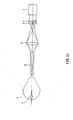
- FIG. 22 is a top view of the operation of an incident light ray
- FIG. 23 is a lateral view of the operation of an incident light ray.
- the light ray which is incident at an angle ⁇ , is totally reflected as appropriate by side surfaces in the longitudinal direction of the rod integrator 15.
- the light ray is transmitted while maintaining its angle, and the light is emitted at an angle ⁇ . Accordingly, if the maximum value of the converging angle of the elliptical concave mirror 3 is 30° for example, a light ray of a maximum 30° corresponding to this is emitted from the rod integrator 15.
- the angles of the incident light rays are different, the number of times the light is totally reflected as appropriate by the side surfaces in the longitudinal direction of the rod integrator 15 is different. Since these are merged at the exit face, the light rays are superimposed at the exit face even when there is an uneven illumination distribution at the incident face. A result of this is that it is possible to obtain an illumination light flux at the exit face of the rod integrator 15 that has superior uniformity and that has a form that is approximately equivalent to a desired illumination range. Note, however, that since better uniformity can be achieved with a larger the number of reflections, a sufficient length of the rod integrator 15 obviously has to be ensured.
- the light flux emitted from the rod integrator 15 illuminates the transmissive light valve 6 via a relay lens system 4, which is configured by at least one lens, and a field lens 5.
- the transmissive light valve 6 displays an image based on an electric signal that is output from a drive circuit (not shown).
- the image displayed on the transmissive light valve 6 is magnified by a projection lens 7 and projected onto a screen (not shown).
- Patent Document 1 emitted light fluxes from a plurality of light sources are synthesized using a light guiding means such as an optical fiber, and a method in which light sources are arranged in predetermined positions and reflected light is synthesized by a reflective mirror and a reflective prism or the like.
- Patent Document 3 there is one light source, but a tapered portion is formed in the rod integrator that continuously increases in cross section from the incident end face to the exit end face.
- a method disclosed in Patent Document 1 which attempts to increase brightness by using a plurality of light sources, is a synthesizing method in which the converging angles of light rays emitted from light sources, which are made of a light source and an elliptical concave mirror, are left unchanged for emission.
- light rays emitted from the elliptical concave mirror with a converging angle of about 15° will have a maximum divergence angle of about 30° that is synthesized and emitted.
- Patent Document 3 With a configuration of Patent Document 3, the divergence angles at the exit end face can be controlled using a rod integrator with a tapered portion.
- this technique is for controlling the parallelism of light fluxes in both horizontal and vertical directions using tapered surfaces formed in the rod integrator in both the horizontal and vertical directions. That is, Patent Document 3 does not disclose a technique addressing the enlargement of the maximum divergence angle when using two light sources.
- the present invention solves the above-described conventional problems and it is an object thereof to provide an illuminator and a projection image display device using this illuminator that can achieve high brightness and uniformity from a plurality of light sources onto an area to be illuminated.
- an illuminator according to the present invention is provided with a light source including a lamp and a concave mirror; a rod integrator; and a relay lens system that guides a light flux emitted from the rod integrator; wherein the rod integrator is a columnar optical element having an incident end face at a front side and an exit end face at a back side; wherein, when a long-side direction of the exit end face is a horizontal direction and a short-side direction is a vertical direction, of four side surfaces other than the front side and the back side of the columnar optical element, one pair of opposing side surfaces is formed as tapered surfaces in which the side surfaces face each other at an inclination of a predetermined angle such that a distance between the side surfaces in the horizontal direction or the vertical direction increases from the incident end face toward the exit end face; wherein light from the light source is converged and irradiated onto a vicinity of the incident end face of the rod
- a projection image display device is provided with a light source including a lamp and a concave mirror; a rod integrator; a relay lens system that guides a light flux emitted from the rod integrator; a light valve that modulates a light flux guided from the relay lens system and forms an image; and a projection lens that projects an image formed by the light valve;
- the rod integrator is a columnar optical element having an incident end face at a front side and an exit end face at a back side; wherein, when a long-side direction of the exit end face is a horizontal direction and a short-side direction is a vertical direction, of four side surfaces other than the front side and the back side of the columnar optical element, one pair of opposing side surfaces is formed as tapered surfaces in which the side surfaces face each other at an inclination of a predetermined angle such that a distance between the side surfaces in the horizontal direction or the vertical direction increases from the incident end face toward the exit end face; wherein light from the light source is converge
- one pair of opposing side surfaces is provided with a portion in which the side surfaces are parallel to each other, and the other pair of opposing side surfaces is formed as tapered surfaces in which the side surfaces face each other at an inclination of a predetermined angle such that the distance between the two side surfaces increases from the incident end face toward the exit end face.
- light reflected by the side surfaces of the pair of parallel planes is such that the divergence angle of light at the incident end face and the divergence angle of light at the exit end face are the same, and light reflected by the tapered surfaces is such that the divergence angle of light at the incident end face and the divergence angle of light at the exit end face are different.
- this makes it possible to achieve a divergence angle of light at the exit end face that is substantially equivalent in the horizontal direction and the vertical direction even when the divergence angles of light at the incident end face are different in the horizontal direction and the vertical direction.
- the illuminator when the two light sources are a first light source and a second light source, the illuminator further comprises a first reflector for guiding light from the first light source to the incident end face of the rod integrator and a second reflector for guiding light from the second light source to the incident end face of the rod integrator.
- an angle between a center line of the rod integrator and an optical axis of the concave mirror that passes through an apex of the concave mirror is an incident angle; an angle formed by a light flux emitted from a most peripheral area of an effective aperture of the concave mirror and a center line of the rod integrator at the incident end face is a maximum angle; and a difference between the maximum angle and the incident angle is a converging angle; then the incident angle is smaller than the converging angle.
- a further two light sources are arranged, and of four side surfaces other than the front side and the back side of the columnar optical element, both pairs of opposing side faces are formed as tapered surfaces in which the side surfaces face each other at an inclination of a predetermined angle such that the distance between the two side surfaces increases from the incident end face toward the exit end face.
- a maximum value in the horizontal direction and a maximum value in the vertical direction of the divergence angle of light emitted from the exit end face of the rod integrator are substantially the same.
- the two light sources are arranged such that a divergence angle of light entering the incident end face of the rod integrator has a maximum value in the second direction that is larger than a maximum value in the first direction; that light corresponding to the maximum value in the second direction is reflected by the tapered surfaces of the rod integrator and light corresponding to the maximum value in the first direction is reflected by the parallel planes of the rod integrator; and that a divergence angle of light at the exit end face has a maximum value in the first direction that is substantially the same as a maximum value in the first direction at the incident end face, and the maximum value of the divergence angle of the exit end face in the second direction is smaller than the maximum value in the second direction at the incident end face.
- the tapered surfaces of the rod integrator can be used to make the divergence angle of light in the horizontal direction at the exit end face different from the divergence angle of light in the horizontal direction at the incident end face.
- the first light source and the second light source are arranged such that the second light source is in an emission direction of the first light source.
- the illuminator further comprises a projection lens, and that optical axes of the concave mirrors of the two light sources and an optical axis of the projection lens are perpendicular.
- the first light source and the second light source are arranged such that an optical axis of a concave mirror of the first light source and an optical axis of a concave mirror of the second light source do not intersect a center line of the rod integrator.
- the first and second reflector are constituted by a reflection mirror or prism coated with a dielectric material.
- a ratio of the incident angle to the converging angle is in a range of at least 60% and at most 80%. With this configuration, it is possible to achieve excellent convergence efficiency.
- the projection image display device is provided with a means for turning light that turns a light flux emitted from the rod integrator around a center line of the rod integrator and guides the light flux to the light valve in accordance with an arrangement of the light valve.
- a means for turning light that turns a light flux emitted from the rod integrator around a center line of the rod integrator and guides the light flux to the light valve in accordance with an arrangement of the light valve.
- FIG. 1 is a top view of a conceptual diagram of an optical system according to Embodiment 1.
- the projection image display device is provided with two light sources 101 and 102, a rod integrator 1, a relay lens system 4 that guides the light flux emitted from the rod integrator 1, a field lens 5, a transmissive light valve 6 that modulates the light flux guided by the relay lens system 4 and forms an image, and a projection lens 7 that projects the image formed by the light valve 6.
- FIG. 1 although an example is shown of a projection image display device, the structure from the two light sources 101 and 102 to the relay lens system 4 in the order in which the light flux proceeds also may be an illuminator, which can be used independently. Furthermore, a projection lens further may be added to the illuminator. This is also true for the embodiments described below.
- the light sources 101 and 102 have the same structure and are respectively provided with a light source 2, and a concave mirror 3 which is a condenser optical system that condenses light from the light sources 2.
- a concave mirror 3 which is a condenser optical system that condenses light from the light sources 2.
- An extra-high pressure mercury lamp, a metal halide lamp, a xenon lamp, or a white lamp such as a halogen lamp can be used as the light sources 2.
- the concave mirrors 3 are elliptical concave mirrors.
- the rod integrator 1 is formed with a glass material that has good heat resistance.
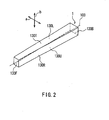
- FIG. 2 is a perspective view and FIG. 3A is a top view of the rod integrator 1.
- FIG. 3B includes a lateral view and left and right lateral views.
- the rod integrator 1 is a columnar optical element provided with an incident end face 130F at a front side, an exit end face 130B at a back side, and four side surfaces (130T, 130U, 130L, and 130R). Of the side surfaces that face each other, in one direction there are the side surfaces 130T and 130U, which are parallel planes (see FIG. 3B ).
- opposing side surfaces 130L and 130R which are planes that face each other at an inclination of a predetermined angle such that both side surfaces 130L and 130R become farther apart from each other from the incident end face 130F toward the exit end face 130B (see FIG. 3A ).
- horizontal direction refers to the long-side direction of the exit end face 130B (the direction of arrow “a” in FIG. 2 ) and “vertical direction” refers to the short-side direction of the exit end face 130B (the direction of arrow “b” in FIG. 2 ). This is also the same in embodiments below.
- the pair of side surfaces 130T and 130U are formed parallel, but when viewed in the horizontal direction, the pair of side surfaces 130R and 130L are arranged in a tapered shape such that they widen from the incident end face 130F toward the exit end face 130B.
- the two light sources of the pair of light sources 101 and 102 which include the lamps 2 and the concave mirrors 3, are arranged in the horizontal direction (the direction of the arrow "a"). Furthermore, the light-emitting centers of the lamps 2 of the light sources 101 and 102 are positioned in the vicinity of a first focal point of the concave mirrors 3.
- Each of the light sources 101 and 102 is arranged at an incident light angle ⁇ to the incident end face 130F, and the light fluxes emitted from each of the lamps 2 are reflected by the concave mirrors 3, then converged and irradiated onto the vicinity of the incident end face 130F, that is, a second focal point of the concave mirrors 3.
- incident light angle refers to the angle between a center line 103 of the rod integrator and the optical axes of the concave mirrors 3, which pass through apexes 3a of the concave mirrors 3.
- the angle ⁇ corresponds to the incident light angle.
- light ray intersecting the apex 3a of the concave mirror 3 refers to a light ray that intersects the apex 3a of the concave mirror 3 via the reflective surface and traveling through an intersecting point of the center line 103 and the incident end face 103F.
- the incident end face 130F of the rod integrator 1 is arranged in the vicinity of the second focal point of the concave mirror 3.
- the incident light fluxes are totally reflected as appropriate by side surfaces of the rod integrator 1 in the vertical and horizontal directions and emitted from the exit end face 130B of the rod integrator 1.
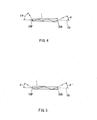
- FIG. 4 is a top view of the rod integrator 1 showing the behavior of the incident light ray.
- FIG. 5 is a lateral view of the rod integrator 1 showing the behavior of the incident light ray.
- FIG. 4 shows how the incident light ray enters the incident end face 130F at a maximum angle (2 ⁇ ), and is then reflected inside the rod integrator 1 and emitted from the exit end face 130B.
- maximum angle refers to the maximum angle corresponding to one of the light sources of the light entering the incident end face 130F of the rod integrator 1.
- maximum angle refers to the angle between the light flux emitted from the most peripheral area of the effective aperture of the concave mirror 3 (effective diameter R in FIG. 1 ) and the center line 103 of the rod integrator 1 at the incident end face 130F.
- the angle ⁇ M corresponds to the maximum angle.
- converging angle here refers to the angle obtained by subtracting the incident angle from the maximum angle.
- both the incident angle ⁇ E and the converging angle ⁇ c are ⁇ and the maximum angle ⁇ MAX is 2 ⁇ .
- an incident light ray at the maximum angle 2 ⁇ is emitted from the exit end face 130B at an angle ⁇ ' that is different from the maximum angle 2 ⁇ due to being totally reflected as appropriate by the pair of tapered surfaces of the rod integrator 1.
- the maximum angle of the concave mirrors 3 is 60°.
- the maximum emission angle of the exit end face 130B can be set to approximately 60°.
- the maximum value of the angle of incident light at the incident end face even when two concave mirrors 3 are arranged is no different from when there is a single concave mirror 3.
- the maximum value is 60°, with the angle being maintained and transmitted while light is reflected between the parallel surfaces to be emitted at 60°.
- the emission angle at the exit end face 130B can be set to approximately 60° in both the horizontal and vertical directions.
- the divergence angle of the light flux emitted from the exit end face 130B can be set such that the maximum value in the horizontal direction and the maximum value in the vertical direction are approximately equal.
- color display can be achieved by arranging in the vicinity of the emission portion of the rod integrator 1 a color wheel (not shown in FIG. 1 ) constituted by dichroic filters that allow the transmission of at least the three primary colors red, blue, and green, and that rotates to separate white light on a time-division basis.
- a color wheel (not shown in FIG. 1 ) constituted by dichroic filters that allow the transmission of at least the three primary colors red, blue, and green, and that rotates to separate white light on a time-division basis.
- a property of the thin films used in coating the dichroic mirrors that constitute the color wheel is that they usually are rated to support an incident angle of 30°, so that in this case, the desired angle of the incident angle of the concave mirrors 3 is 30°.
- the angles of the incident light rays are different, the number of times the light is totally reflected as appropriate on the respective pairs of side surfaces in the horizontal direction and vertical direction of the rod integrator 1 will be different. And since they are merged at the exit face, the light rays are superimposed at the exit face even when there is an uneven illumination distribution at the incident face. A result of this is that it is possible to obtain an illumination light flux at the exit end face 130B of the rod integrator 1 that has superior uniformity and that has a form that is approximately equivalent to a desired illumination range.
- FIG. 6 is a top view of the rod integrator 1.
- number of reflections on the tapered surfaces 130R and 130L of the incident light ray with the maximum angle of the light incident on the incident end face 130F hereafter, "number of reflections"
- number of reflections it is necessary to determine the number of reflections on the tapered surfaces 130R and 130L of the incident light ray with the maximum angle of the light incident on the incident end face 130F (hereafter, "number of reflections") and derive a tapering angle ⁇ T and a horizontal length L' of the incident end face 130F.
- values for a horizontal length L of the exit end face 130B, the maximum angle of the light source ⁇ MAX, and a refractive index nd of the rod integrator 1 are required, but these are constants. This is because the length L is determined according to such factors as the form of the light valve, the maximum angle ⁇ MAX is determined by the incident angle of each light source, and the refractive index nd is determined by the material that constitutes the rod integrator. Furthermore, the value for the emission angle ⁇ E is also required, but this value is a requirement determined according to the maximum angle ⁇ MAX, so this too is a constant.
- ⁇ R1 90 - ⁇ MAX - ⁇ T
- ⁇ Rn ⁇ R ⁇ 1 + 2 ⁇ ⁇ T ⁇ n - 1
- V (mm) is the length in the vertical direction of the rod integrator
- ⁇ V (degrees) is the maximum incident angle in the vertical direction
- L (mm) is the length in the horizontal direction of the exit end face 130B.
- the length L, the number of reflections n, the maximum angle ⁇ MAX, and the emission angle ⁇ E are determined, it is possible to derive the length L', the tapering angle ⁇ T, and the length H in the longitudinal direction, and thus it is possible to determine the form of the rod integrator 1.
- ⁇ T (degrees) in formula (9) is in the following range: ⁇ MAX - ⁇ / 2 ⁇ n - 1 ⁇ ⁇ T ⁇ ⁇ MAX - ⁇ / 2 ⁇ n + 1
- ⁇ T degrees
- ⁇ 5' minutes
- the length L of the side surface in the horizontal direction of the exit end face 130B is 7.6 mm, based on the formula (10) it is possible to determine a length L' of the incident end face 130F of 4.38786 mm.
- Table 1 shows the results of calculating the tapering angle ⁇ T from ⁇ MAX and the number of reflections n.
- Table 2 shows the results of calculating the length L' of the incident end face 130F from ⁇ MAX and the exit end face length L.
- Table 3 shows the results of calculating the length H by varying the number of reflections n and the maximum angle ⁇ MAX using the tapering angle ⁇ T, the length L of the exit end face 130B, and the length L' of the incident end face 130F.
- the nd of the rod integrator 1 is taken to be 1.45874 and the emission angle ⁇ E at the exit end face 130B is taken to be 30°.
- the light flux emitted from the rod integrator 1 determined in this way illuminates the transmissive light valve 6 via a relay lens system 4, which is configured by at least one lens, and a field lens 5.
- the transmissive light valve 6 displays an image based on an electric signal that is output from a drive circuit (not shown).
- the image displayed on the transmissive light valve 6 is magnified by the projection lens 7 and projected onto a screen (not shown).
- the present embodiment it is possible to achieve control such that while the divergence angle of light in the vertical direction of the exit end face 130B is kept approximately equivalent to the divergence angle of light in the vertical direction of the incident end face 130F (see FIG. 5 ), the divergence angle of light in the horizontal direction of the exit end face 130B is different from the divergence angle (maximum angle) of light in the horizontal direction of the incident end face 130F (see FIG. 4 ).
- the divergence angle of light emitted from the exit end face 130B when using two light sources has a maximum angle in the horizontal direction and a maximum angle in the vertical direction that is the same angle of 60°, and it is possible to obtain a light having high brightness and uniformity.
- brightness it is possible to achieve a brightness that is approximately 1.7 to 1.8 times that achievable with a single light source.
- the time until the light source of each light source expires is increased, and therefore it is possible to achieve approximately double the light source life compared to a device with one light source.
- the present embodiment was described using an example of a projection image display device, but if using a device provided with at least, in the direction in which light proceeds, the structure from the light source 2 to the relay lens system 4 as an illuminator, it is possible to achieve an illuminator that can emit a light having high brightness and uniformity.
- FIG. 7 is a conceptual diagram of an optical system of a projection image display device according to Embodiment 2 not belonging to the present invention.
- the same reference numerals are used for items with the same structure as in the projection image display device according to Embodiment 1 shown in FIG. 1 , and detailed description of such items is omitted here.
- the arrangement of the two light sources 101 and 102 is different in the structure shown in FIG. 7 and a first reflector 48 and a second reflector 49 are provided.
- synthesizing prisms 48 and 49 are used as the first and second reflector.
- the synthesizing prisms 48 and 49 are formed from a glass material with excellent heat resistance and their reflective surfaces are coated with a multi-layer dielectric film with an excellent reflectance ratio.
- the first reflector 48 guides light from the light source 102 to the incident end face 130F of the rod integrator 1 and the second reflector 49 guides light from the light source 101 to the incident end face 130F of the rod integrator 1.
- the first reflector 48 and the second reflector 49 are arranged such that they form a ">"-shape opening toward the side opposite to the incident end face 130F of the rod integrator 1 (which is substantially a V shape when viewed from the incident end face 130F).
- the inclination angles of the reflective surfaces of the first reflector 48 and the second reflector 49 are half of the maximum angle.
- the light sources 101 and 102 are arranged opposing each other in the horizontal direction. That is, both light sources 2 and concave mirrors 3 face each other in the horizontal direction.
- the light fluxes emitted from the light sources 2 are reflected by the concave mirrors 3, then respectively reflected by the first reflector 48 and the second reflector 49.
- the reflected light is converged and irradiated at angles 0, which are equivalent with respect to the center line 103 of the rod integrator, in the vicinity of the incident end face 130F, that is, in the vicinity of the second focal point of the concave mirrors 3.
- FIG. 8 is a lateral view of a conceptual diagram of an optical system also not belonging to the present embodiment.
- the dotted line portion shows a state in which an installation adjustment angle 9 is adjusted in the elevation angle direction in accordance with the position of a screen (not shown).
- the life of a light source is shortened by the influence of heat and other factors when it is slanted in the optical axis direction.
- the optical axes of the concave mirrors 3 of the two light sources 101 and 102 and the optical axis of the projection lens 7 are arranged perpendicularly, the optical axes of the light sources are not slanted when the installation adjustment angle 9 is changed.
- FIG. 9 is a conceptual diagram showing an optical system of a projection image display device according to Embodiment 3.
- the same reference numerals are used for items with the same structure as in the projection image display device according to Embodiment 1 shown in FIG. 1 , and detailed description of such items is omitted here. Note, however, that the light sources 101 and 102 are shown as more concrete objects, and the concave mirrors 3 are shown as cross sections (same for following diagrams).
- the arrangement of the two light sources 101 and 102 is different in the structure shown in FIG. 9 and a synthesizing mirror 61 (first reflector) and a synthesizing mirror 62 (second reflector) are provided.
- the synthesizing mirrors 61 and 62 are reflection mirrors coated with a multi-layer dielectric film for example.
- the structure of the rod integrator 1 itself is the same as in Embodiment 1, but in contrast to the arrangement in Embodiment 1, the rod integrator 1 of the present embodiment is rotated 90° around the center axis 103.
- the light sources 2 and the concave mirrors 3 face each other in the vertical direction. Furthermore, the reflective surfaces of the synthesizing mirrors 61 and 62 respectively face the lamps 2. Furthermore, the reflective surfaces of the synthesizing mirrors 61 and 62 are respectively inclined 45° in the vertical direction, and the directions of inclination of the synthesizing mirror 61 and the synthesizing mirror 62 are reversed. In this way, the light fluxes from the lamps 2 are turned 90° by the reflective surface of the synthesizing mirror 61 and the reflective surface of the synthesizing mirror 62 and guided to the incident end face 130F of the rod integrator 1.
- the reflective surface of the synthesizing mirror 61 is inclined 15° (the direction of arrow "c” in FIG. 9 ), which is half the converging angle of the concave mirror 3, in the horizontal direction
- the reflective surface of the synthesizing mirror 62 is inclined 15° (the direction of arrow "d” in FIG. 9 ), which is half the converging angle of the concave mirror 3, in the horizontal direction.
- FIG. 10A shows the device shown in FIG. 9 as viewed from the side of the exit end face 130B of the rod integrator 1.
- the light sources 101 and 102 are arranged such that the optical axis of the concave mirror 3 of the light source 101 and the optical axis of the concave mirror 3 of the light source 102 do not intersect with the center line 103 of the rod integrator 1. That is, both of these optical axes are separated such that they are parallel, and neither of the optical axes intersects with the center line 103 of the rod integrator 1.
- the arrangement of the synthesizing mirrors 61 and 62 corresponds to the arrangement of these light sources 101 and 102.
- FIG. 10B is a lateral view showing the vicinity of the incident end face 130F of the rod integrator 1.
- FIG. 13 is a perspective view of an example arrangement of the synthesizing mirrors 61 and 62 that is shown in order to facilitate understanding of the arrangement of the synthesizing mirrors 61 and 62. Using these drawings, it is evident that the light fluxes from the light sources 101 and 102 are reflected by the inclined surfaces of the synthesizing mirrors 61 and 62.
- the light from the lamps 2 is reflected by the synthesizing mirrors 61 and 62, then converged and irradiated at incident angles ⁇ (30°), which are equivalent with respect to the center line 103, in the vicinity of the incident end face 130F, that is, in the vicinity of the second focal point of the concave mirrors 3.
- the light sources 101 and 102 are arranged such that the optical axis of the concave mirror 3 of the light source 101 and the optical axis of the concave mirror 3 of the light source 102 do not intersect with the center line 103 of the rod integrator 1, and the synthesizing mirrors 61 and 62 are arranged in correspondence to this.
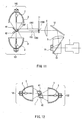
- FIG. 11 is a conceptual diagram showing an optical system of a projection image display device according to Embodiment 4.
- the same reference numerals are used for items with the same structure as in the projection image display device according to Embodiment 1 shown in FIG. 1 , and detailed description of such items is omitted here.
- FIG. 12 shows the device shown in FIG. 11 as viewed from the side of the exit end face 130B of the rod integrator 1. As shown in FIGS. 11 and 12 , the structure from the lamps 2 to the rod integrator 1 in the order of progression of the light fluxes is the same as in Embodiment 4.
- the light flux emitted from the rod integrator 1 illuminates a reflective light valve 14 via a color wheel 11, a relay lens system 4 constituted by at least one lens, a total reflection mirror 12, a field lens 5, and a total reflection prism 13. Modulated light that forms an optical image is emitted by the light valve 14.
- the light flux from the light valve 14 reaches the projection lens 7 via the total reflection prism 13 and the projection lens 7 projects the optical image formed by the light valve 14.
- Color display is made possible by the color wheel 11 arranged in the vicinity of the exit end face 130B of the rod integrator 1.
- the color wheel 11 is constituted by dichroic filters that allow the transmission of at least the three primary colors red, blue, and green, and rotates to separate white light on a time-division basis.
- a property of the thin films used in coating the dichroic mirrors that constitute the color wheel 11 is that they are commonly rated to support an incident angle of 30°, so that in this case, the desired angle of the incident angle is 30°.
- the total reflection mirror 12 and the total reflection prism 13 are configured as means for turning light and are arranged such that the light flux emitted from the rod integrator 1 is turned with the center line 103 as the center when viewed from the direction of the center line 103 of the rod integrator.
- the angle of turning is determined to match the arrangement of the reflective light valve 14 and is 90° in the example of FIG. 11 .
- the illuminating light emitted from the exit end face 130B of the rod integrator 1 illuminates the reflective light valve 14 in a state in which it is turned 90°.
- the turning angle can be adjusted by setting the angle of the boundary with the atmosphere of the total reflection prism 13 that uses total reflection to guide the light flux to the reflective light valve 14 and the angle of the total reflection mirror 12 to desired angles.
- the means for turning light are provided in this way to improve the convergence efficiency.
- the reflective light valve 14 has a sufficient surface area, that is, when it is possible to ensure a short-side length of the exit face of the rod integrator 1 of a sufficient length, to miniaturize the set, the light valve also must be miniaturized, and when making the converging angle of the illuminating light appropriate for an F-number of 2 using a reflective light valve with a diagonal length of 17.78 mm for example, it is necessary for the short-side length of the exit face of the rod integrator 1 to be approximately 6 mm. In this case, applying a tapering angle based on an approximately 6-mm short-side length of the exit face further shortens the length of the incident face and reduces the convergence efficiency.
- the product of the surface area of the illumination area and the solid angle of the illuminating light is constant, the product of the surface area of the exit face of the rod integrator 1 and the emission angle of the illuminating light is of course equivalent to the product of the surface area of the transmissive light valve 14 and the solid angle of the illuminating light.
- the light sources 101 and 102 are arranged such that, as in Embodiment 3, the optical axis of the concave mirror 3 of the light source 101 and the optical axis of the concave mirror 3 of the light source 102 do not intersect with the center line 103 of the rod integrator 1, and the synthesizing mirrors 61 and 62 are arranged in correspondence to this. This makes it possible to achieve an image with higher brightness and uniformity.
- the arrangement of the two left and right lamps 2 also changes in accordance with the rotation angle. Even in this case, if the light sources 101 and 102 and the synthesizing mirrors 61 and 62 shown in FIG. 12 are rotated around the center line 103 while maintaining their positional relationship, it is possible to accommodate the arrangement of the above-described rotated rod integrator.
- the reflective light valve 14 is constituted by a digital mirror device, which is an aggregation of micro-mirrors, and displays an image based on an electric signal that output from a drive circuit (not shown).
- the image displayed by the reflective light valve 14 is magnified and projected via the total reflection prism 13 and the projection lens 7 and projected onto a screen (not shown).
- FIG. 14A is a top view of a projection image display device according to Embodiment 5 and FIG. 14B is a lateral view.
- the projection image display device is provided with four light sources 201 to 204, a rod integrator 20, a relay lens system 4 that guides the light flux emitted from the rod integrator 20, a field lens 5, a transmissive light valve 6 that modulates the light flux guided by the relay lens system 4 to form an image, and a projection lens 7 that projects the image formed by the light valve 6.
- Reference numeral 206 indicates the center line of the rod integrator 20.
- the light sources 201 to 204 have the same structure and are respectively provided with a lamp 200, and a concave mirror 205 which is a condenser optical system that condenses light from the light source 2.
- the number of light sources is different compared to the structure shown in FIG. 1 , but the structure of each of the light sources is the same as the light sources in FIG. 1 .
- FIG. 15 is a perspective view of the rod integrator 20, while FIG. 16A is a top view and FIG. 16B includes a lateral view and left and right lateral views.
- the rod integrator 20 is a columnar optical element provided with an incident end face 230F at a front side, an exit end face 230B at a back side, and four side surfaces (230T, 230U, 230L, and 230R).
- the two pairs of side faces are formed as tapered surfaces.
- the opposing side surfaces 230L and 230R face each other at an inclination of a predetermined angle such that both side surfaces 230L and 230R become farther apart from each other from the incident end face 230F toward the exit end face 230B (see FIG. 16A ).
- the incident end face 230F of the rod integrator 20 is arranged in the vicinity of the second focal point of the concave mirrors 205 and incident light is totally reflected as appropriate in the vertical direction and horizontal direction of the rod integrator 20, and then emitted from the exit end face 230B of the rod integrator 20.
- the pair of two light sources 201 and 202 are arranged in the horizontal direction (the direction of the arrow "a"). In this case, the pair of two light sources 203 and 204 are arranged in the same way behind the paper plane. Furthermore, in FIG. 14B , the pair of two light sources 201 and 203 are arranged in the vertical direction (the direction of the arrow "b"). In this case, the pair of two light sources 202 and 204 are arranged in the same way behind the paper plane.
- the structure of the light sources of Embodiment 5 has two light sources arranged in the horizontal direction or the vertical direction and a further two light sources arranged parallel to these.
- the light sources are provided in accordance with the two respective pairs of tapered surfaces and there is a total of four light sources.
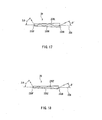
- FIG. 17 is a top view of the rod integrator 20 showing the behavior of an incident light ray.
- FIG. 18 is a lateral view of the rod integrator 20 showing the behavior of an incident light ray.
- FIG. 17 shows how the incident light ray enters the incident end face 230F at the maximum angle (20), and is then reflected inside the rod integrator 20 and emitted from the exit end face 230B.
- an incident light ray at the maximum angle 2 ⁇ is emitted from the exit end face 230B at an angle ⁇ ' that is different from the maximum angle 2 ⁇ due to being totally reflected as appropriate by the pair of tapered surfaces 230L and 230R of the rod integrator 20.
- the incident light ray at an angle of 2 ⁇ in the horizontal direction and the incident light ray at an angle of 2 ⁇ in the vertical direction are both emitted at the exit end face 230B at an angle of ⁇ '.
- the divergence angle of light at the exit end face can be made smaller than the divergence angle of light at the incident end face in the horizontal direction and the vertical direction as described above, which is advantageous when a light of a very high brightness is desired.
- Embodiment 1 was described with an example in which the incident angle and the converging angle of the light incident at the rod integrator 1 were the same, but in Embodiment 6, the incident angle is smaller than the converging angle.
- FIG. 19 is a top view of a conceptual diagram of an optical system according to Embodiment 6. Except for the relationship between the incident angle and the converging angle, the configuration shown in this diagram is the same configuration as shown in FIG. 1 of Embodiment 1, and therefore the same reference numerals as FIG. 1 are used and a further description of each part is omitted.
- ⁇ E is the incident angle and ⁇ c is the converging angle.
- the incident angle ⁇ E is smaller than the converging angle ⁇ c.
- the 20 of the incident end face 130F in FIG. 4 is ⁇ E + ⁇ c in the present embodiment, and this becomes the angle ⁇ ' at the exit end face 130B, which is an angle that is different from the incident end face 130F, just like in Embodiment 1. Furthermore, as shown in FIG. 5 , the incident angle ⁇ " likewise is maintained and transmitted, then emitted.
- the incident angle ⁇ " in FIG. 5 is 30°, the light is transmitted maintaining this angle, and then emitted at an angle of 30°.
- Table 4 shows calculated values of the tapering angle ⁇ T, the incident face length L', the rod integrator length M, and the convergence efficiency normalized to a maximum value of 1, for various incident angles.
- the effective lengths of the exit face of the rod integrator are an effective horizontal length of 7.5 mm and an effective vertical length of 5.8 mm, and a substantially ideal relay lens system is used for the calculated values of the convergence efficiency.
- the number of reflections is set to 3, 4, and 5.
- the converging angle ⁇ c is fixed at 30° and the incident angle ⁇ E is changed in increasing increments of 3 degrees from 15° to 30°. Except for when the incident angle ⁇ E is 30°, the relationship between the two is such that the incident angle is smaller than the converging angle.
- the letter E in Table 4 is the convergence efficiency. The convergence efficiency was calculated using simulation software for evaluating illumination optical systems in which optical devices such as light sources, lenses, and mirrors are modeled to determine what amount of the desired light rays reaches the screen onto which the light rays emitted from the light source are projected. The values shown in Table 4 are normalized to a maximum value of 1 for each of the settings for the number of reflections in the rod integrator.
- FIG. 20 shows the relationship between convergence efficiency and incident angle, using the numerical values in Table 4.
- the horizontal axis ⁇ is the incident angle and the vertical axis E is the convergence efficiency.
- the rod integrator 1 may be configured such that at least a portion of one pair of opposing side surfaces is made of parallel planes and at least a portion of the other pair of opposing side surfaces is made of planes that face each other with a predetermined angle of inclination. This is because the emission angle can be narrowed to a desired angle and uniform illumination can be achieved by reflecting a light flux between pairs of planes that face each other with a predetermined angle of inclination. This aspect is true also for embodiments 1 through 5.
- the exit end face 130B of the rod integrator has to be polished during production.
- the end portions of the rod integrator 1 that is, the four edges and four corners of the exit end face 130B, are sometimes chipped during the polishing process.
- the size of the chipped of portions may be 0.1 mm or more.
- the form of the rod integrator is determined using a length L1 in which an extra length is added to the desired standard length L of the four edges of the rod integrator.
- the extra length is within the range of up to 0.2 mm for example. This is true also for Embodiments 1 through 5.
- the rod integrator in the above-described embodiments was described with examples using a glass material, but it also may be a columnar optical element that is hollow with the four inner wall surfaces formed with mirrors. The incident light flux in this configuration is also totally reflected as appropriate by the mirrors of the inner wall surfaces.
- the present invention since control can be achieved such that the divergence angle of light in the horizontal direction at the exit end face is different from the divergence angle of light in the horizontal direction at the incident end face, light having high brightness and uniformity can be obtained. For this reason, the present invention is useful in illuminators and projection image display devices equipped with a rod integrator.
Landscapes
- Physics & Mathematics (AREA)
- General Physics & Mathematics (AREA)
- Optics & Photonics (AREA)
- Engineering & Computer Science (AREA)
- Multimedia (AREA)
- Signal Processing (AREA)
- Projection Apparatus (AREA)
Claims (11)
- Beleuchtungsvorrichtung mit:einer Lichtquelle, die eine Lampe und einen konkaven Spiegel enthält;einem Stabintegrator (1); undeinem Relaylinsensystem (4) zur Führung eines von dem Stabintegrator (1) emittierten Lichtflusses;wobei der Stabintegrator (1) ein säulenförmiges optisches Element ist, das eine Auftreffendfläche (130F, 230F) an einer Vorderseite und eine Austrittsendfläche (130B, 230B) an einer Rückseite aufweist,wobei dann, wenn eine Langseitenrichtung der Austrittsendfläche eine Horizontalrichtung und eine Kurzseitenrichtung eine Vertikalrichtung ist, von den vier Seitenflächen, welche nicht die Vorderseite und die Rückseite des säulenförmigen optischen Elementes bilden, ein Paar einander gegenüberliegender Seitenflächen als zueinander in einem vorbestimmten Winkel geneigte Oberflächen ausgebildet ist, wobei der Abstand zwischen den Seitenflächen in der Horizontalrichtung oder der Vertikalrichtung von der Auftreffendfläche (130F, 230F) zur Austrittsendfläche (130B, 230B) zunimmt,dadurch gekennzeichnet,
dass die Beleuchtungsvorrichtung eine erste und eine zweite Lichtquelle (101, 102, 201, 202, 301, 302) mit jeweils einer Lampe (2, 200) und einem konkaven Spiegel (3, 205) aufweist,dass Licht von der ersten und der zweiten Lichtquelle (101, 102, 201, 202, 301, 302) von dem konkaven Spiegel (3, 205) reflektiert und direkt auf die Auftreffendfläche (130F, 230F) des Stabintegrators (1) aufgestrahlt wird,dass die erste und die zweite Lichtquelle (101, 102, 201, 202, 301, 302) in der horizontalen oder der vertikalen Richtung angeordnet sind,wobei ein Winkel zwischen einer Mittellinie (103) des Stabintegrators (1) und einer optischen Achse des konkaven Spiegels (3, 205), die auf die Auftreffendfläche (130F, 230F) des Stabintegrators (1) auftrifft und durch den Scheitel des konkaven Spiegels (3, 205) verläuft, ein Auftreffwinkel ist,und ein Winkel, der gebildet ist durch einen von dem äußersten Randbereich einer effektiven Öffnung des konkaven Spiegels (3, 205) ausgehenden Lichtfluss und die optische Achse des konkaven Spiegels (3, 205), welche durch einen Scheitel des konkaven Spiegels (3, 205) verläuft, ein Konvergenzwinkel ist,wobei der Auftreffwinkel kleiner als der Konvergenzwinkel ist. - Beleuchtungsvorrichtung nach Anspruch 1, bei welcher von den vier Seitenflächen, welche nicht die Frontseite und die Rückseite des säulenförmigen optischen Elementes sind, ein Paar einander gegenüberliegender Seitenflächen einen Teil aufweist, in welchem die Seitenflächen parallel zueinander verlaufen, und ein anderes Paar einander gegenüberliegender Seitenflächen als zueinander geneigte Seitenflächen ausgebildet ist, wobei die Seitenflächen einander mit einer Neigung eines vorbestimmten Winkels gegenüberliegen, sodass der Abstand zwischen den beiden Seitenflächen von der Auftreffendfläche zur Austrittsendfläche zunimmt.
- Beleuchtungsvorrichtung nach Anspruch 1, bei welcher von den vier Seitenflächen, welche nicht die Frontseite und die Rückseite des säulenförmigen optischen Elementes sind, ein Paar einander gegenüberliegender Seitenflächen in der Kurzseitenrichtung der Austrittsendfläche einen Abschnitt aufweist, in welchem die Seitenflächen parallel zueinander verlaufen, und ein Paar gegenüberliegender Seitenflächen in Längsseitenrichtung der Austrittsendfläche als gegeneinander geneigte Oberflächen gebildet sind, bei welcher die Seitenflächen unter einer Neigung eines vorbestimmten Winkels einander zugewandt sind, sodass der Abstand zwischen den beiden Seitenflächen von der Auftreffendfläche zur Austrittsendfläche zunimmt.
- Beleuchtungsvorrichtung nach Anspruch 2 oder 3;
wobei dann, wenn eine normale Richtung des Paares paralleler Fläche eine erste Richtung ist und eine Richtung, welche senkrecht zu einer Mittellinie des Stabintegrators (1) und senkrecht zu der ersten Richtung liegt, eine zweite Richtung ist:die erste und die zweite Lichtquelle (101, 102, 201, 202, 301, 302) so angeordnet sind, dass ein Divergenzwinkel des Lichts, welches in die Auftreffendfläche des Stabintegrators (1) eintritt, einen maximalen Wert in der zweiten Richtung hat, welcher größer als ein maximaler Wert in der ersten Richtung ist. - Beleuchtungsvorrichtung nach Anspruch 1, bei welcher ein Maximalwert in der Horizontalrichtung und ein Maximalwert in der Vertikalrichtung des Divergenzwinkels des von der Austrittsendfläche des Stabintegrators (1) austretenden Lichtes im Wesentlichen gleich sind.
- Beleuchtungsvorrichtung nach Anspruch 5, bei welcher die erste Lichtquelle (101, 201, 301) und die zweite Lichtquelle (102, 202, 302) derart angeordnet sind, dass die zweite Lichtquelle (102, 202, 302) in einer Emissionsrichtung der ersten Lichtquelle (101, 201, 301) liegt.
- Beleuchtungsvorrichtung nach Anspruch 6, ferner mit einer Projektionslinse (7), wobei die optischen Achsen der konkaven Spiegel (3) der ersten und der zweiten Lichtquelle (101, 102, 201, 202, 301, 302) und eine optische Achse der Projektionslinse (7) rechtwinklig zueinander verlaufen.
- Beleuchtungsvorrichtung nach Anspruch 6, nach welcher die erste Lichtquelle (101, 201, 301) und die zweite Lichtquelle (102, 202, 302) so angeordnet sind, dass eine optische Achse eines konkaven Spiegels (3) der ersten Lichtquelle (101, 201, 301) und eine optische Achse eines konkaven Spiegels (3) der zweiten Lichtquelle (102, 202, 302) sich nicht in der Mittellinie des Stabintegrators (1) durchschneiden.
- Beleuchtungsvorrichtung nach Anspruch 1, welcher das Verhältnis des Auftreffwinkels zum Konvergenzwinkel in einem Bereich von mindestens 60 % und höchstens 80 % liegt.
- Projektionsbildwiedergabevorrichtung mit:einem Lichtventil (6, 14), welches einen Lichtfluss moduliert, der von dem Relaylinsensystem (4) geführt wird und ein Bild formt; undeiner Projektionslinse (7), welche das von dem Lichtventil (6, 14) gebildete Bild projiziert,
gekennzeichnet durcheine Beleuchtungsvorrichtung nach einem der vorstehenden Ansprüche. - Projektionsbildwiedergabevorrichtung nach Anspruch 10 mit einer Lichtdreheinrichtung, welche den von dem Stabintegrator (1) emittierten Lichtfluss dreht und ihn zu dem Lichtventil (14) leitet, in Übereinstimmung mit einer Anordnung des Lichtventils (14).
Applications Claiming Priority (7)
| Application Number | Priority Date | Filing Date | Title |
|---|---|---|---|
| JP2002295547 | 2002-10-09 | ||
| JP2002295547 | 2002-10-09 | ||
| JP2003142489 | 2003-05-20 | ||
| JP2003142489 | 2003-05-20 | ||
| JP2003325810 | 2003-09-18 | ||
| JP2003325810 | 2003-09-18 | ||
| PCT/JP2003/012865 WO2004034143A1 (ja) | 2002-10-09 | 2003-10-08 | 照明装置及びそれを用いた投写型画像表示装置 |
Publications (3)
| Publication Number | Publication Date |
|---|---|
| EP1550908A1 EP1550908A1 (de) | 2005-07-06 |
| EP1550908A4 EP1550908A4 (de) | 2009-05-20 |
| EP1550908B1 true EP1550908B1 (de) | 2014-07-23 |
Family
ID=32096704
Family Applications (1)
| Application Number | Title | Priority Date | Filing Date |
|---|---|---|---|
| EP03754017.6A Expired - Lifetime EP1550908B1 (de) | 2002-10-09 | 2003-10-08 | Illuminator und projektionsbildanzeige damit |
Country Status (6)
| Country | Link |
|---|---|
| US (1) | US7316484B2 (de) |
| EP (1) | EP1550908B1 (de) |
| KR (1) | KR100704203B1 (de) |
| CA (1) | CA2487853A1 (de) |
| TW (1) | TW200420139A (de) |
| WO (1) | WO2004034143A1 (de) |
Cited By (2)
| Publication number | Priority date | Publication date | Assignee | Title |
|---|---|---|---|---|
| CN104407495A (zh) * | 2014-12-04 | 2015-03-11 | 成都思邦力克科技有限公司 | 投影仪 |
| EP3436740A1 (de) * | 2016-04-01 | 2019-02-06 | Robe Lighting, Inc | Spezieller blumeneffektstrahl und washlight-leuchte |
Families Citing this family (31)
| Publication number | Priority date | Publication date | Assignee | Title |
|---|---|---|---|---|
| US6956701B1 (en) * | 2004-04-26 | 2005-10-18 | Infocus Corporation | Method and apparatus for combining light paths of multiple colored light sources through a common integration tunnel |
| WO2005119123A1 (en) * | 2004-05-26 | 2005-12-15 | Thomson Licensing | Two lamp illumination system |
| JP2006091257A (ja) * | 2004-09-22 | 2006-04-06 | Olympus Corp | 導光装置,照明装置及び画像投影装置 |
| JP4696666B2 (ja) * | 2005-04-27 | 2011-06-08 | コニカミノルタオプト株式会社 | 照明光学系およびそれを備えた画像投影装置 |
| US20060268417A1 (en) * | 2005-05-27 | 2006-11-30 | Texas Instruments Incorporated | A Refractive Scheme for Dual Lamp High Brightness Projection System |
| TW200700883A (en) * | 2005-06-20 | 2007-01-01 | Benq Corp | Light source module of a projector and color wheel thereof |
| TW200823497A (en) * | 2006-11-17 | 2008-06-01 | Benq Corp | Light integrating system |
| KR100883593B1 (ko) * | 2006-06-20 | 2009-02-13 | 엘지전자 주식회사 | 프로젝션 장치 |
| JP2008216840A (ja) * | 2007-03-07 | 2008-09-18 | Mitsubishi Electric Corp | 投写型表示装置 |
| US8408721B2 (en) * | 2008-08-14 | 2013-04-02 | 3M Innovative Properties Company | Projection system with imaging light source module |
| US20100061118A1 (en) * | 2008-09-09 | 2010-03-11 | Keh-Shium Liu | Lens Beam-Concentrating Device |
| TWI376563B (en) * | 2008-10-15 | 2012-11-11 | Delta Electronics Inc | Light uniform device and dlp projection system comprising same |
| CN101726972B (zh) * | 2008-10-16 | 2011-09-21 | 台达电子工业股份有限公司 | 均光装置及包含该均光装置的数字光学处理投影系统 |
| JP4516622B2 (ja) * | 2008-12-08 | 2010-08-04 | 三菱電機株式会社 | 投写型表示装置 |
| JP5428346B2 (ja) * | 2009-01-15 | 2014-02-26 | セイコーエプソン株式会社 | 照明装置及びこれを備えるプロジェクター |
| JP4570680B1 (ja) * | 2009-06-12 | 2010-10-27 | シャープ株式会社 | 光照射装置および検査装置 |
| JP4953149B2 (ja) * | 2009-06-18 | 2012-06-13 | Necディスプレイソリューションズ株式会社 | 光学ユニットおよび投写型表示装置 |
| JP2011048226A (ja) * | 2009-08-28 | 2011-03-10 | Seiko Epson Corp | プロジェクター |
| JP4856266B1 (ja) * | 2010-06-29 | 2012-01-18 | シャープ株式会社 | 光源装置およびそれを備えた擬似太陽光照射装置 |
| JP5274528B2 (ja) * | 2010-10-08 | 2013-08-28 | シャープ株式会社 | 擬似太陽光照射装置および太陽電池パネル用検査装置 |
| US8517586B2 (en) | 2011-01-30 | 2013-08-27 | Chi Lin Technology Co., Ltd. | Illumination device having light-aggregation, light-mix and light-absorbing components |
| CN102231010A (zh) * | 2011-06-15 | 2011-11-02 | 杭州晶景光电有限公司 | 用于微型投影光引擎的宽尺寸面光源整形系统 |
| CN103365046B (zh) * | 2012-03-26 | 2015-09-09 | 中强光电股份有限公司 | 投影装置及其集光柱 |
| CN102768458A (zh) * | 2012-07-12 | 2012-11-07 | 芜湖雅图数字视频技术有限公司 | 一种双灯照明系统及投影仪 |
| JP6421930B2 (ja) * | 2014-01-09 | 2018-11-14 | パナソニックIpマネジメント株式会社 | 照明装置及び投写型映像表示装置 |
| EP3165952A4 (de) * | 2014-07-02 | 2018-03-07 | Mitsubishi Electric Corporation | Lichthomogenisierungsvorrichtung |
| KR101658854B1 (ko) * | 2015-09-15 | 2016-09-22 | 김우중 | 무대용 조명장치의 광원 발생장치 |
| CN109581641A (zh) * | 2018-12-27 | 2019-04-05 | 武汉沃亿生物有限公司 | 结构光显微成像的照明系统 |
| CN111830719A (zh) * | 2020-08-07 | 2020-10-27 | 谷东科技有限公司 | 照明装置和增强现实显示设备 |
| JP7494873B2 (ja) * | 2022-03-28 | 2024-06-04 | セイコーエプソン株式会社 | プロジェクター |
| CN218158706U (zh) * | 2022-08-29 | 2022-12-27 | 中强光电股份有限公司 | 照明系统及投影装置 |
Family Cites Families (28)
| Publication number | Priority date | Publication date | Assignee | Title |
|---|---|---|---|---|
| JPH0572628A (ja) | 1991-09-18 | 1993-03-26 | Sigma Bureshijiyon:Kk | 光源装置 |
| US5764845A (en) | 1993-08-03 | 1998-06-09 | Fujitsu Limited | Light guide device, light source device, and liquid crystal display device |
| US5526237A (en) * | 1993-12-10 | 1996-06-11 | General Electric Company | Lighting system for increasing brightness to a light guide |
| US5625738A (en) * | 1994-06-28 | 1997-04-29 | Corning Incorporated | Apparatus for uniformly illuminating a light valve |
| JPH0943562A (ja) * | 1995-07-31 | 1997-02-14 | Sharp Corp | 投影型カラー液晶表示装置 |
| JP3455614B2 (ja) | 1995-08-04 | 2003-10-14 | 三菱電機株式会社 | 投写型表示装置 |
| US5765934A (en) * | 1995-08-04 | 1998-06-16 | Mitsubishi Denki Kabushiki Kaisha | Projection type display |
| KR100188698B1 (ko) | 1996-05-30 | 1999-06-01 | 윤종용 | 프로젝터용 조명장치 |
| US5902033A (en) * | 1997-02-18 | 1999-05-11 | Torch Technologies Llc | Projector system with hollow light pipe optics |
| JPH11142780A (ja) | 1997-11-12 | 1999-05-28 | Mitsubishi Electric Corp | 光源装置及び投写型表示装置 |
| US6464375B2 (en) * | 1998-03-12 | 2002-10-15 | Matsushita Electric Industrial Co., Ltd. | Lens element and illumination optical apparatus and projection display apparatus |
| US6227669B1 (en) * | 1998-05-26 | 2001-05-08 | Industrial Technology Research Institute | Illumination device and image projection apparatus comprising the device |
| JP3448223B2 (ja) | 1998-08-31 | 2003-09-22 | シャープ株式会社 | 光源装置 |
| JP2000206455A (ja) | 1999-01-14 | 2000-07-28 | Seiko Epson Corp | 投写型表示装置 |
| JP2000231344A (ja) * | 1999-02-10 | 2000-08-22 | Toshiba Corp | 投写型表示装置の照明装置 |
| JP3945068B2 (ja) * | 1999-03-04 | 2007-07-18 | 三菱電機株式会社 | 投写型表示装置 |
| JP4447173B2 (ja) * | 1999-04-23 | 2010-04-07 | コーニンクレッカ フィリップス エレクトロニクス エヌ ヴィ | 投射装置 |
| EP1175633A1 (de) | 1999-04-30 | 2002-01-30 | Cogent Light Technologies, Inc. | Verbesserte kopplung des lichts einer kleinen bogenlampe in ein grösseres optisches element |
| US6545814B2 (en) * | 1999-12-28 | 2003-04-08 | Texas Instruments Incorporated | Optical architectures for combining multiple lamps in light valve projectors |
| US6375330B1 (en) * | 1999-12-30 | 2002-04-23 | Gain Micro-Optics, Inc. | Reflective liquid-crystal-on-silicon projection engine architecture |
| JP3823659B2 (ja) | 2000-02-04 | 2006-09-20 | セイコーエプソン株式会社 | プロジェクタ |
| JP3829270B2 (ja) * | 2000-02-08 | 2006-10-04 | ミネベア株式会社 | 面状照明装置 |
| JP2001305656A (ja) | 2000-04-24 | 2001-11-02 | Ushio Inc | カラー像投影装置 |
| JP2001356404A (ja) | 2000-06-09 | 2001-12-26 | Mitsubishi Electric Corp | 画像表示装置 |
| JP2002062588A (ja) * | 2000-08-23 | 2002-02-28 | Minolta Co Ltd | 平滑化光学素子および照明光学系 |
| JP3607211B2 (ja) * | 2001-03-13 | 2005-01-05 | 株式会社東芝 | 光導波路、光モジュール、光ファイバレーザ装置 |
| WO2003040816A1 (en) * | 2001-11-02 | 2003-05-15 | Honeywell International Inc. | Hollow wedge shape light guide for back illumination |
| TWM245425U (en) * | 2003-04-11 | 2004-10-01 | Delta Electronics Inc | Light-uniformed device and optical apparatus with light-uniformed device |
-
2003
- 2003-10-08 KR KR1020047020786A patent/KR100704203B1/ko not_active Expired - Fee Related
- 2003-10-08 CA CA002487853A patent/CA2487853A1/en not_active Abandoned
- 2003-10-08 US US10/514,006 patent/US7316484B2/en not_active Expired - Lifetime
- 2003-10-08 WO PCT/JP2003/012865 patent/WO2004034143A1/ja not_active Ceased
- 2003-10-08 EP EP03754017.6A patent/EP1550908B1/de not_active Expired - Lifetime
- 2003-10-09 TW TW092128063A patent/TW200420139A/zh not_active IP Right Cessation
Cited By (3)
| Publication number | Priority date | Publication date | Assignee | Title |
|---|---|---|---|---|
| CN104407495A (zh) * | 2014-12-04 | 2015-03-11 | 成都思邦力克科技有限公司 | 投影仪 |
| EP3436740A1 (de) * | 2016-04-01 | 2019-02-06 | Robe Lighting, Inc | Spezieller blumeneffektstrahl und washlight-leuchte |
| EP3436740B1 (de) * | 2016-04-01 | 2025-05-28 | ROBE lighting s.r.o. | Eine wash light leuchte mit spezialeffekten |
Also Published As
| Publication number | Publication date |
|---|---|
| KR20050014870A (ko) | 2005-02-07 |
| US20050146891A1 (en) | 2005-07-07 |
| TW200420139A (en) | 2004-10-01 |
| WO2004034143A1 (ja) | 2004-04-22 |
| KR100704203B1 (ko) | 2007-04-05 |
| EP1550908A1 (de) | 2005-07-06 |
| US7316484B2 (en) | 2008-01-08 |
| CA2487853A1 (en) | 2004-04-22 |
| EP1550908A4 (de) | 2009-05-20 |
| TWI325278B (de) | 2010-05-21 |
Similar Documents
| Publication | Publication Date | Title |
|---|---|---|
| EP1550908B1 (de) | Illuminator und projektionsbildanzeige damit | |
| US6371617B1 (en) | Projector | |
| US20020048172A1 (en) | Lens element and illumination optical apparatus and projection display apparatus | |
| CN101770146A (zh) | 投影机 | |
| KR20030019588A (ko) | 프로젝션 디스플레이 디바이스 | |
| JP2004258666A (ja) | 投射型ディスプレイ光学系 | |
| WO2002101457A1 (en) | Lighting device and projection type image display device | |
| US8123366B2 (en) | Light source with truncated ellipsoidal reflector | |
| JP3715295B2 (ja) | 照明装置及びそれを用いた投写型画像表示装置 | |
| US7329007B2 (en) | Projector | |
| JP2927679B2 (ja) | 液晶表示装置 | |
| JP2005234551A (ja) | 投影システムおよび複数光源の投影システムを用いる方法 | |
| EP1014159B1 (de) | Beleuchtungsvorrichtung und Projektionsvorrichtung | |
| US7636200B2 (en) | Projector | |
| KR20130043975A (ko) | 등화 렌즈를 구비한 빔 프로젝터 | |
| CN100559260C (zh) | 照明装置以及使用该照明装置的投影图像显示器 | |
| JP2010152263A (ja) | プロジェクタ | |
| US7267443B2 (en) | Light-modulating projector | |
| JP3980036B2 (ja) | 照明装置及びそれを用いた投写型画像表示装置 | |
| KR100342651B1 (ko) | 다중 스크린을 갖는 프로젝션 시스템 | |
| US20060007399A1 (en) | Projector | |
| US6135598A (en) | Optical device with light path changing element and projection-type display apparatus | |
| JP3640367B2 (ja) | 液晶ビデオプロジェクタ | |
| US7798654B2 (en) | Image display apparatus | |
| JP2003307777A (ja) | 表示装置 |
Legal Events
| Date | Code | Title | Description |
|---|---|---|---|
| PUAI | Public reference made under article 153(3) epc to a published international application that has entered the european phase |
Free format text: ORIGINAL CODE: 0009012 |
|
| 17P | Request for examination filed |
Effective date: 20041204 |
|
| AK | Designated contracting states |
Kind code of ref document: A1 Designated state(s): AT BE BG CH CY CZ DE DK EE ES FI FR GB GR HU IE IT LI LU MC NL PT RO SE SI SK TR |
|
| RBV | Designated contracting states (corrected) |
Designated state(s): BE DE GB |
|
| RAP1 | Party data changed (applicant data changed or rights of an application transferred) |
Owner name: PANASONIC CORPORATION |
|
| A4 | Supplementary search report drawn up and despatched |
Effective date: 20090421 |
|
| 17Q | First examination report despatched |
Effective date: 20110408 |
|
| GRAP | Despatch of communication of intention to grant a patent |
Free format text: ORIGINAL CODE: EPIDOSNIGR1 |
|
| INTG | Intention to grant announced |
Effective date: 20140328 |
|
| GRAS | Grant fee paid |
Free format text: ORIGINAL CODE: EPIDOSNIGR3 |
|
| GRAA | (expected) grant |
Free format text: ORIGINAL CODE: 0009210 |
|
| AK | Designated contracting states |
Kind code of ref document: B1 Designated state(s): BE DE GB |
|
| REG | Reference to a national code |
Ref country code: GB Ref legal event code: FG4D |
|
| REG | Reference to a national code |
Ref country code: DE Ref legal event code: R096 Ref document number: 60346526 Country of ref document: DE Effective date: 20140904 |
|
| REG | Reference to a national code |
Ref country code: DE Ref legal event code: R097 Ref document number: 60346526 Country of ref document: DE |
|
| REG | Reference to a national code |
Ref country code: DE Ref legal event code: R119 Ref document number: 60346526 Country of ref document: DE |
|
| PLBE | No opposition filed within time limit |
Free format text: ORIGINAL CODE: 0009261 |
|
| STAA | Information on the status of an ep patent application or granted ep patent |
Free format text: STATUS: NO OPPOSITION FILED WITHIN TIME LIMIT |
|
| PG25 | Lapsed in a contracting state [announced via postgrant information from national office to epo] |
Ref country code: BE Free format text: LAPSE BECAUSE OF NON-PAYMENT OF DUE FEES Effective date: 20141031 |
|
| 26N | No opposition filed |
Effective date: 20150424 |
|
| PG25 | Lapsed in a contracting state [announced via postgrant information from national office to epo] |
Ref country code: DE Free format text: LAPSE BECAUSE OF NON-PAYMENT OF DUE FEES Effective date: 20150501 |
|
| PG25 | Lapsed in a contracting state [announced via postgrant information from national office to epo] |
Ref country code: BE Free format text: LAPSE BECAUSE OF FAILURE TO SUBMIT A TRANSLATION OF THE DESCRIPTION OR TO PAY THE FEE WITHIN THE PRESCRIBED TIME-LIMIT Effective date: 20140723 |
|
| PGFP | Annual fee paid to national office [announced via postgrant information from national office to epo] |
Ref country code: GB Payment date: 20221019 Year of fee payment: 20 |
|
| REG | Reference to a national code |
Ref country code: GB Ref legal event code: PE20 Expiry date: 20231007 |
|
| PG25 | Lapsed in a contracting state [announced via postgrant information from national office to epo] |
Ref country code: GB Free format text: LAPSE BECAUSE OF EXPIRATION OF PROTECTION Effective date: 20231007 |
|
| PG25 | Lapsed in a contracting state [announced via postgrant information from national office to epo] |
Ref country code: GB Free format text: LAPSE BECAUSE OF EXPIRATION OF PROTECTION Effective date: 20231007 |