EP1524015A1 - Boxspielsystem - Google Patents
Boxspielsystem Download PDFInfo
- Publication number
- EP1524015A1 EP1524015A1 EP03741301A EP03741301A EP1524015A1 EP 1524015 A1 EP1524015 A1 EP 1524015A1 EP 03741301 A EP03741301 A EP 03741301A EP 03741301 A EP03741301 A EP 03741301A EP 1524015 A1 EP1524015 A1 EP 1524015A1
- Authority
- EP
- European Patent Office
- Prior art keywords
- game
- boxer
- inputting apparatus
- player
- boxing
- Prior art date
- Legal status (The legal status is an assumption and is not a legal conclusion. Google has not performed a legal analysis and makes no representation as to the accuracy of the status listed.)
- Withdrawn
Links
Images







Classifications
-
- A—HUMAN NECESSITIES
- A63—SPORTS; GAMES; AMUSEMENTS
- A63F—CARD, BOARD, OR ROULETTE GAMES; INDOOR GAMES USING SMALL MOVING PLAYING BODIES; VIDEO GAMES; GAMES NOT OTHERWISE PROVIDED FOR
- A63F13/00—Video games, i.e. games using an electronically generated display having two or more dimensions
-
- A—HUMAN NECESSITIES
- A63—SPORTS; GAMES; AMUSEMENTS
- A63F—CARD, BOARD, OR ROULETTE GAMES; INDOOR GAMES USING SMALL MOVING PLAYING BODIES; VIDEO GAMES; GAMES NOT OTHERWISE PROVIDED FOR
- A63F13/00—Video games, i.e. games using an electronically generated display having two or more dimensions
- A63F13/80—Special adaptations for executing a specific game genre or game mode
- A63F13/833—Hand-to-hand fighting, e.g. martial arts competition
-
- A—HUMAN NECESSITIES
- A63—SPORTS; GAMES; AMUSEMENTS
- A63B—APPARATUS FOR PHYSICAL TRAINING, GYMNASTICS, SWIMMING, CLIMBING, OR FENCING; BALL GAMES; TRAINING EQUIPMENT
- A63B69/00—Training appliances or apparatus for special sports
-
- A—HUMAN NECESSITIES
- A63—SPORTS; GAMES; AMUSEMENTS
- A63F—CARD, BOARD, OR ROULETTE GAMES; INDOOR GAMES USING SMALL MOVING PLAYING BODIES; VIDEO GAMES; GAMES NOT OTHERWISE PROVIDED FOR
- A63F13/00—Video games, i.e. games using an electronically generated display having two or more dimensions
- A63F13/20—Input arrangements for video game devices
- A63F13/21—Input arrangements for video game devices characterised by their sensors, purposes or types
- A63F13/211—Input arrangements for video game devices characterised by their sensors, purposes or types using inertial sensors, e.g. accelerometers or gyroscopes
-
- A—HUMAN NECESSITIES
- A63—SPORTS; GAMES; AMUSEMENTS
- A63F—CARD, BOARD, OR ROULETTE GAMES; INDOOR GAMES USING SMALL MOVING PLAYING BODIES; VIDEO GAMES; GAMES NOT OTHERWISE PROVIDED FOR
- A63F13/00—Video games, i.e. games using an electronically generated display having two or more dimensions
- A63F13/20—Input arrangements for video game devices
- A63F13/21—Input arrangements for video game devices characterised by their sensors, purposes or types
- A63F13/212—Input arrangements for video game devices characterised by their sensors, purposes or types using sensors worn by the player, e.g. for measuring heart beat or leg activity
-
- A—HUMAN NECESSITIES
- A63—SPORTS; GAMES; AMUSEMENTS
- A63F—CARD, BOARD, OR ROULETTE GAMES; INDOOR GAMES USING SMALL MOVING PLAYING BODIES; VIDEO GAMES; GAMES NOT OTHERWISE PROVIDED FOR
- A63F13/00—Video games, i.e. games using an electronically generated display having two or more dimensions
- A63F13/20—Input arrangements for video game devices
- A63F13/23—Input arrangements for video game devices for interfacing with the game device, e.g. specific interfaces between game controller and console
- A63F13/235—Input arrangements for video game devices for interfacing with the game device, e.g. specific interfaces between game controller and console using a wireless connection, e.g. infrared or piconet
-
- A—HUMAN NECESSITIES
- A63—SPORTS; GAMES; AMUSEMENTS
- A63F—CARD, BOARD, OR ROULETTE GAMES; INDOOR GAMES USING SMALL MOVING PLAYING BODIES; VIDEO GAMES; GAMES NOT OTHERWISE PROVIDED FOR
- A63F13/00—Video games, i.e. games using an electronically generated display having two or more dimensions
- A63F13/20—Input arrangements for video game devices
- A63F13/24—Constructional details thereof, e.g. game controllers with detachable joystick handles
- A63F13/245—Constructional details thereof, e.g. game controllers with detachable joystick handles specially adapted to a particular type of game, e.g. steering wheels
-
- A—HUMAN NECESSITIES
- A63—SPORTS; GAMES; AMUSEMENTS
- A63F—CARD, BOARD, OR ROULETTE GAMES; INDOOR GAMES USING SMALL MOVING PLAYING BODIES; VIDEO GAMES; GAMES NOT OTHERWISE PROVIDED FOR
- A63F13/00—Video games, i.e. games using an electronically generated display having two or more dimensions
- A63F13/45—Controlling the progress of the video game
-
- A—HUMAN NECESSITIES
- A63—SPORTS; GAMES; AMUSEMENTS
- A63F—CARD, BOARD, OR ROULETTE GAMES; INDOOR GAMES USING SMALL MOVING PLAYING BODIES; VIDEO GAMES; GAMES NOT OTHERWISE PROVIDED FOR
- A63F13/00—Video games, i.e. games using an electronically generated display having two or more dimensions
- A63F13/55—Controlling game characters or game objects based on the game progress
- A63F13/58—Controlling game characters or game objects based on the game progress by computing conditions of game characters, e.g. stamina, strength, motivation or energy level
-
- A—HUMAN NECESSITIES
- A63—SPORTS; GAMES; AMUSEMENTS
- A63F—CARD, BOARD, OR ROULETTE GAMES; INDOOR GAMES USING SMALL MOVING PLAYING BODIES; VIDEO GAMES; GAMES NOT OTHERWISE PROVIDED FOR
- A63F13/00—Video games, i.e. games using an electronically generated display having two or more dimensions
- A63F13/90—Constructional details or arrangements of video game devices not provided for in groups A63F13/20 or A63F13/25, e.g. housing, wiring, connections or cabinets
- A63F13/98—Accessories, i.e. detachable arrangements optional for the use of the video game device, e.g. grip supports of game controllers
-
- A—HUMAN NECESSITIES
- A63—SPORTS; GAMES; AMUSEMENTS
- A63F—CARD, BOARD, OR ROULETTE GAMES; INDOOR GAMES USING SMALL MOVING PLAYING BODIES; VIDEO GAMES; GAMES NOT OTHERWISE PROVIDED FOR
- A63F2300/00—Features of games using an electronically generated display having two or more dimensions, e.g. on a television screen, showing representations related to the game
- A63F2300/10—Features of games using an electronically generated display having two or more dimensions, e.g. on a television screen, showing representations related to the game characterized by input arrangements for converting player-generated signals into game device control signals
- A63F2300/1025—Features of games using an electronically generated display having two or more dimensions, e.g. on a television screen, showing representations related to the game characterized by input arrangements for converting player-generated signals into game device control signals details of the interface with the game device, e.g. USB version detection
- A63F2300/1031—Features of games using an electronically generated display having two or more dimensions, e.g. on a television screen, showing representations related to the game characterized by input arrangements for converting player-generated signals into game device control signals details of the interface with the game device, e.g. USB version detection using a wireless connection, e.g. Bluetooth®, infrared connections
-
- A—HUMAN NECESSITIES
- A63—SPORTS; GAMES; AMUSEMENTS
- A63F—CARD, BOARD, OR ROULETTE GAMES; INDOOR GAMES USING SMALL MOVING PLAYING BODIES; VIDEO GAMES; GAMES NOT OTHERWISE PROVIDED FOR
- A63F2300/00—Features of games using an electronically generated display having two or more dimensions, e.g. on a television screen, showing representations related to the game
- A63F2300/10—Features of games using an electronically generated display having two or more dimensions, e.g. on a television screen, showing representations related to the game characterized by input arrangements for converting player-generated signals into game device control signals
- A63F2300/105—Features of games using an electronically generated display having two or more dimensions, e.g. on a television screen, showing representations related to the game characterized by input arrangements for converting player-generated signals into game device control signals using inertial sensors, e.g. accelerometers, gyroscopes
-
- A—HUMAN NECESSITIES
- A63—SPORTS; GAMES; AMUSEMENTS
- A63F—CARD, BOARD, OR ROULETTE GAMES; INDOOR GAMES USING SMALL MOVING PLAYING BODIES; VIDEO GAMES; GAMES NOT OTHERWISE PROVIDED FOR
- A63F2300/00—Features of games using an electronically generated display having two or more dimensions, e.g. on a television screen, showing representations related to the game
- A63F2300/10—Features of games using an electronically generated display having two or more dimensions, e.g. on a television screen, showing representations related to the game characterized by input arrangements for converting player-generated signals into game device control signals
- A63F2300/1062—Features of games using an electronically generated display having two or more dimensions, e.g. on a television screen, showing representations related to the game characterized by input arrangements for converting player-generated signals into game device control signals being specially adapted to a type of game, e.g. steering wheel
-
- A—HUMAN NECESSITIES
- A63—SPORTS; GAMES; AMUSEMENTS
- A63F—CARD, BOARD, OR ROULETTE GAMES; INDOOR GAMES USING SMALL MOVING PLAYING BODIES; VIDEO GAMES; GAMES NOT OTHERWISE PROVIDED FOR
- A63F2300/00—Features of games using an electronically generated display having two or more dimensions, e.g. on a television screen, showing representations related to the game
- A63F2300/60—Methods for processing data by generating or executing the game program
- A63F2300/65—Methods for processing data by generating or executing the game program for computing the condition of a game character
-
- A—HUMAN NECESSITIES
- A63—SPORTS; GAMES; AMUSEMENTS
- A63F—CARD, BOARD, OR ROULETTE GAMES; INDOOR GAMES USING SMALL MOVING PLAYING BODIES; VIDEO GAMES; GAMES NOT OTHERWISE PROVIDED FOR
- A63F2300/00—Features of games using an electronically generated display having two or more dimensions, e.g. on a television screen, showing representations related to the game
- A63F2300/80—Features of games using an electronically generated display having two or more dimensions, e.g. on a television screen, showing representations related to the game specially adapted for executing a specific type of game
- A63F2300/8029—Fighting without shooting
Definitions
- the present invention relates to a boxing game system. More specifically, the present invention relates to a novel sensory boxing game system in which a globe-type inputting apparatus is attached to a hand, and by operating the inputting apparatus as if to actually play boxing in a real space, boxing is played against an opponent boxer displayed on a monitor screen.
- the home-use television game is a television game in which, by operating a controller of a game machine by a finger, a player operates a character (boxer) in a screen. This lacks a real sensation or feeling of playing boxing.
- a boxing game system is a boxing game system, and comprises: an inputting apparatus swung in a real space, which is held by a hand of a game player, or attached to the hand of the game player, including an acceleration sensor for detecting a magnitude of a swing of the inputting apparatus, and a wireless transmitting means for transmitting in a wireless manner acceleration information detected by the acceleration sensor; a wireless receiving means for receiving the acceleration information transmitted by the wireless transmitting means; and a game processor for receiving the acceleration information received by the wireless receiving means, wherein the game processor determines an intensity of a punch based on the acceleration information.
- the acceleration sensor may be a piezoelectric buzzer including a metal plate and a piezoelectric ceramic plate pasted on the metal plate, and outputs an acceleration correlated signal corresponding to a magnitude of the swing in a direction angular to a surface of the piezoelectric ceramic plate.
- the wireless transmitting means includes an infrared-light transmitting means
- the wireless receiving means includes an infrared-light receiving means
- the inputting apparatus includes a boxing glove-shaped cushion member, and a main body provided to be integrated with the cushion member and held by the hand of the game player.
- the inputting apparatus includes a wristband provided to be integrated with the cushion member, and attached to a wrist of the game player.
- a glove-type inputting apparatus (34) shown in an embodiment includes a main body (40) held by a hand of a game player and swung in a real space, and in this main body, an acceleration sensor formed of a piezoelectric buzzer element (82) is accommodated, for example.
- an acceleration sensor formed of a piezoelectric buzzer element (82) is accommodated, for example.
- An MCU (60) provided in the glove-type inputting apparatus drives an infrared LED (62) corresponding to the acceleration information. Therefore, the acceleration information is transmitted in a wireless manner.
- an infrared light-receiving demodulating portion (32) is provided in a game machine (12), and the light-receiving demodulating portion receives an infrared light, and demodulates the acceleration information.
- the acceleration information is input into a game processor (64) provided in the game machine.
- the game processor displays a graphics of a boxer on a monitor, and changes a game screen corresponding to a game state. Furthermore, the game processor determines an intensity of the punch based on the acceleration information. In addition, the game processor, if required, calculates a damage value according to the intensity of the punch, calculates a stamina value of the boxer on the game screen from the damage value, and displays the stamina value.
- the inputting apparatus is swung in the real space as if to actually play boxing so that the game is progressed, thus possible to realize a real sensory boxing game as if to actually play boxing for the game player.
- the acceleration information from the inputting apparatus is transmitted in a wireless manner to the game processor so that when swinging the inputting apparatus as if to actually play boxing, too, functionality of the inputting apparatus is not destroyed.
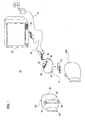
- a sensory boxing game system 10 that is, one embodiment of the present invention, includes a game machine 12.
- a direct current (DC) power is supplied to this game machine 12 by an AC adapter 14. It is noted that this may be replaced by a battery 16.
- the game machine 12 is connected to an AV terminal 18 of a television monitor 20 through an AV cable 22.
- the game machine 12 includes a housing, and above this housing, a power switch 24, a direction button 26, a determination key 28, and a cancel key 30 are provided.
- the direction button 26 has separate buttons for four directions (up and down, and right and left), and is used for moving a cursor in order to select a menu or a game mode on a display screen of the television monitor 20, for example.
- the determination key 28 is used for determining an input into the game machine 12.
- the cancel key 30 is used for canceling the input into the game machine 12.
- the game machine 12 is provided with an infrared light-receiving portion 32, and this infrared light-receiving portion 32 receives an infrared signal from an infrared LED 62 ( Figure 3, Figure 4) of a glove-type inputting apparatus 34 (34L, 34R) described later.
- the glove-type inputting apparatus 34 includes a portion (glove) 36 that is shaped like a boxing glove made of a cushion member covered by a nylon material, for example.
- a wristband 38 is mounted in an edge portion on a near side of the glove 36.
- the wristband 38 is rendered opened and closed by a hook and loop fastener (trademark: Magic Tape), for example.
- an inputting apparatus main body 40 shown in detail in Figure 4 is mounted.
- a power switch 42 and a guard key 44 are provided in the main body 40.
- the power switch 42 is a switch for turning on a power (not shown) when this glove-type inputting apparatus 34 is used.
- the guard key 44 is a key switch for allowing a boxer on a player's side to perform a "left guard” or a "right guard” described later during a game play, and is used for guarding a punch from an opponent boxer. It is noted that this guard key 44 offers an equivalent function to the above-described determination key 28 of the game machine 12 at a time of "select a game mode and an opponent boxer" described later, and so forth.
- the glove 36 functions as a cushion in order to prevent danger caused when the inputting apparatus main body 40 is erroneously hit against a television 20 or an adjacent person, and in addition, the glove 36 is shaped like an actual boxing glove, thus effective to give a real sensation or feeling of playing boxing to the player.
- the glove-type inputting apparatus 34 is connected to the player's wrist by the wristband 38 so that even if the player erroneously releases the main body 40, the glove-type inputting apparatus 34 is not thrown out from the player's hand.
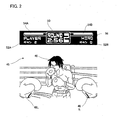
- the glove-type inputting apparatus 34 is provided with a piezoelectric buzzer element used as an acceleration sensor, and the game machine 12 receives an acceleration correlated signal from the piezoelectric buzzer element so as to play the boxing game against an opponent boxer 46 on the game screen shown in Figure 2.
- a game screen 45 displayed on the television monitor 20 in the sensory boxing game system 10 is displayed as a graphic seen from a player's viewpoint, and the boxer on the player's side (player's boxer) is displayed by the glove.
- the opponent boxer 46 and the gloves 48L and 48R of the player's boxer are displayed as a moving image display-use object (sprite) together with one portion of a boxing ring.
- a still image display-use object text screen
- a round displaying portion 50 is formed, and in this round displaying portion 50, the number of rounds and a remaining time-period are displayed.
- a player's boxer displaying portion 52A is formed, and at the right, an opponent's displaying portion 52B is formed.
- stamina value portions 54A and 54B are provided, and in addition, in the opponent boxer displaying portion 52B, a name displaying portion 56 for displaying a name of the opponent boxer ("HIRO" in this embodiment) is further provided.
- a displaying manner such as this game screen 45 is merely an example.
- a game processor 64 detects the acceleration correlated signal from the piezoelectric buzzer element or a state of the guard key 44 ( Figure 1) by the infrared signal transmitted from the infrared LED 62 ( Figure 4) to the infrared light-receiving portion 32, and based on this, an intensity of the punch is calculated, a status of each boxer is changed, and so forth, for example.
- left-handed glove-type inputting apparatus 34L and the right-handed glove-type inputting apparatus 34R have the completely same structure as shown in this Figure 4 so that "L” indicating left-handed, and "R” indicating right-handed will be omitted unless otherwise specified.
- the glove-type inputting apparatus 34 includes an acceleration sensor circuit 58, the acceleration sensor circuit 58 includes a piezoelectric buzzer element 82 shown in Figure 4 described later and its associated circuit, and the acceleration correlated signal from this acceleration sensor 58 is applied to the MCU 60.
- the MCU 60 is 8 bits of a 1-chip microcomputer, for example, and converts the acceleration correlated signal from the piezoelectric buzzer element into a digital signal, and applies this digital signal to the infrared LED 62. It is noted that in the glove-type inputting apparatus 34, the above-described guard key 44 (Figure 1) is further provided, and a state (value) of this guard key 44 is also read by the MCU 60.
- the digitally modulated infrared signals from each of the infrared LEDs 62 of the two glove-type inputting apparatuses 34 is received by an infrared light-receiving demodulating portion 32 of the game machine 12, digitally demodulated, and then, input into the game processor 64.
- One bit of this digital signal is transmitted as "1” or "0” corresponding to whether or not the guard key 44 is turned on or off, and therefore, the game processor 64 is capable of recognizing whether "right guard” is set or "left guard” is set by checking the bit.
- the game processor 64 an arbitrary kind of a processor is used.
- a high-speed processor (trademark:XaviX) developed by the applicant of the present invention and already filed as a patent application is used.
- This high-speed processor is disclosed in detail in Japanese Patent Laying-open No.10-307790 [G06F13/36,15/78] and US Patent Application No.6,070,205 corresponding thereto.
- the game processor 64 includes an A/D converter used for fetching an analog signal, and an input/output control circuit that receives an input signal such as an key operation signal and an infrared signal and applies an output signal to an external device. Therefore, the demodulated signal from the infrared light-receiving portion 32 and the input signal from the operation keys 26 -30 are applied to the operation processor via this input/output control circuit.
- the operation processor executes a necessary operation corresponding to the input signal, and applies a result to the graphic processor, and etc. Therefore, the graphic processor and the sound processor execute an image process and a sound process corresponding to the operation result.
- the infrared LED 62 provided in the main body 40 of the glove-type inputting apparatus 34 forms one portion of a wireless transmitting means
- the infrared light-receiving demodulating portion 32 provided in the game machine 12 is to form one portion of a wireless receiving means.
- the wireless transmitting means and the wireless receiving means may be a means that uses a normal radio wave, besides an infrared light.
- an internal memory 66 is provided, and the internal memory 66 includes a ROM or a RAM (SRAM and/or DRAM).
- the RAM is used as a temporary memory, a working memory, or a counter or a register area (temporary data area), and a flag area.
- the external memory 68 (ROM and/or RAM) is connected to the processor 64 through an external bus. A game program is stored to this external memory 68 in advance.
- the processor 64 executes operations, graphic processes, sound processes, and etc., in each of the above-described processors according to the input signal from the infrared light-receiving demodulating portion 32 and the operation keys 26 - 30, and outputs a video signal and an audio signal.
- the video signal is a signal composed of a text screen and a sprite image shown in Figure 2 described above, and the video signal and the audio signal are applied to the television monitor 20 through the AV cable 22 and the AV terminal 18. Therefore, the game screen 45 as shown in Figure 2 is displayed on the screen of the television monitor 20, together with a necessary sound playing (sound effect, game music), for example.
- the main body 40 of the glove-type inputting apparatus 34 includes a housing 70 molded of transparent (or translucent: transparency to light) plastic, and in this housing 70, a concavity and convexity 72 into which the fingers for holding the housing 70 fit with each other is formed. Inside the housing 70, a main board 74 is stored, and on this board 74, the above-described MCU 60 is mounted. In addition, on the main board 74, the power switch 42 is further provided, and in addition, one infrared LED 62 is fixed. Another infrared LED 62 is fixed on an upper portion of the housing 70.
- a piezoelectric buzzer case 76 is mounted between the substrate 74 and the above LED 62 within the housing 70, and in this piezoelectric buzzer case 76, a mounting portion 78 is formed. Within the mounting portion 78, the piezoelectric buzzer element 82 is mounted via a rubber packing 80. This piezoelectric buzzer element 82 forms the acceleration sensor circuit 58 ( Figure 5).
- the piezoelectric buzzer element 82 includes a ceramic plate 86 pasted on a metal plate 84, and if a power voltage is applied between the metal plate 84 and an electrode on the ceramic plate 86, a buzzer sound is generated.
- the piezoelectric buzzer element 82 thus structured is used as the acceleration sensor. That is, the ceramic plate 84 is a piezoelectric ceramic, and it is well known that when a stress is worked onto the piezoelectric ceramic, an electric signal is generated from the piezoelectric ceramic.
- the electric signal generated in the ceramic plate 86 is fetched between the metal plate 84 and the above-described electrode.
- an acceleration correlated digital signal or data is to be fetched by the MCU 60.
- the above-described guard key 44 is mounted.
- the piezoelectric buzzer element 82 described above is included in the acceleration sensor circuit 58.
- an externally attached oscillating circuit 88 is provided for the MCU 60, and the MCU 60 operates in response to a clock signal from this oscillating circuit 88.
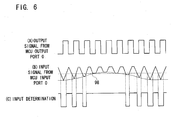
- the MCU 60 outputs a rectangular-shaped waveform signal from an output port 0, and applies this signal to one electrode 82a of the piezoelectric buzzer element 82 through 10 kilo ohms of a resistance, for example.
- the electrode 82a of the piezoelectric buzzer element 82 may be the above-described metal plate 84, and is grounded via a capacitor 90 such as 0.1 ⁇ F, for example.
- a diode circuit 94 is connected to the electrode 82a, and a fluctuation band of the voltage is thereby rendered within a predetermined range.
- the other electrode 82b of the piezoelectric buzzer element 82 is connected to an input port 0 of the MCU 60, and in addition, connected to the diode circuit 94. Thereby, the fluctuation band of the voltage is rendered within the predetermined range. It is noted that the two electrodes 82a and 82b of the piezoelectric buzzer element 82 is electrically separated by a relatively high resistance 96 such as 1 Mega ohms, for example.
- a triangular waveform signal as in Figure 7 (B) is input into the input port 0 of the MCU 60. It is noted that a size (waveform high value) of the rectangular-shaped waveform signal and a size (waveform high value) of the triangular waveform signal are restrained by the diode circuits 92 and 94, respectively.
- the MCU 60 converts a level change on the minus side of such the triangular waveform signal into acceleration data or acceleration correlated data, and drives the LED 62 ( Figure 3) corresponding to the acceleration data.
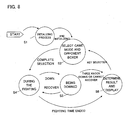
- FIG. 7 and 8 a schematic operation of the sensory boxing game system 10 of the Figure 1 embodiment will be described.
- the power switches 24 and 42 shown in Figure 1 are turned on so as to start the game.
- the game processor 64 shown in Figure 3 executes an initializing process in a step S1. More specifically, a system hardware and each variable are initialized.
- the game processor 64 updates the image signal in a step S2 in Figure 7 and 8 so as to update the image displayed on the monitor 20. It is noted that this displayed image updating is executed by each 1 frame (television frame or video frame).
- the game processor 64 executes a process corresponding to the game state.
- the process to be done first is "select game mode and opponent boxer".
- the operator or the game player operates a selection key 26 shown in Figure 1 in a step S3 in Figure 7 and 8 so as to selectively set the game mode, a level of difficulty of the game, and the opponent boxer.
- step S2 ( Figure 7)
- step S8 in Figure 7 the sound process of a step S8 in Figure 7 is executed when a sound interruption occurred, and the game music and the sound effect are thereby output.
- the game processor 64 receives the infrared signal (code) input from the infrared light-receiving portion 32 in a step S9 in Figure 7.
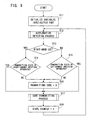
- Figure 9 shows a whole operation of the MCU 60 of the glove-type inputting apparatus 34, and in a first step S11, the MCU 60 initializes variables that the MCU 60 handles such as a detection offset value, an offset counter, and etc., described later, and in addition, initializes the input port and the output port ( Figure 5).
- variables that the MCU 60 handles such as a detection offset value, an offset counter, and etc., described later, and in addition, initializes the input port and the output port ( Figure 5).
- the MCU 60 determines whether the glove-type inputting apparatus 34 is the right-handed inputting apparatus 34R or the left-handed inputting apparatus 34L. If a specific input port of the MCU 60 is set to "1", the apparatus 34 is the right-handed inputting apparatus 34R, and if "0", the apparatus 34 is the left-handed inputting apparatus 34L in a step S13 so that the specific input port of the MCU 60 needs to be sensed in the step S13. Then, it is determined whether or not the current state is the transmitting state in a step S13.
- step S13 determines whether "YES” in the step S13, that is, in a case of the right-handed inputting apparatus 34R, the determination is made in a step S14, and if "NO” in the step S13, that is, in a case of the left-handed inputting apparatus 34L, the determination is made in a step S15.
- the MCU 60 has a state counter as a software counter, and the transmitting state is established at each time that this state counter becomes a predetermined value. Therefore, it is detected whether or not this state counter is rendered the predetermined value in the steps S14 and S15.
- the transmitting code is rendered "0" in a step S16, or in a case of "YES” in the step S14 or S15, the process directly advances to a code transmitting process (described in detail later) in a step S17. After executing the code transmitting process in the step S17, the process increments (+1) the state counter (not shown) in a step S18, and then, returns to the step S12. It is noted that as described later, the code transmitting process is performed in a bit serial, and a necessary time-period for transmitting 1 bit is approximately some micro seconds, that is, extremely short period of time.
- Figure 10 is a flowchart showing in detail the step S12 in Figure 9, and in a first step S21 of this acceleration detecting process, the MCU 60 copies to the offset counter (not shown) a detected offset value set to the register (not shown).
- the "detected offset value” is a value for inputting in an equal manner in time a high level and a low level of a rectangular waveform determination shown in Figure 6 (A) when no voltage is generated in the piezoelectric buzzer element 82, and this detected offset value is set to an arbitrary default value at a time of starting the operation.
- step S22 that follows the step S21, the MCU 60 sets "1" to the output port 0. That is, "1", that is, the high level, is output.
- step S23 the MCU 60 reads data from the input port 0.
- a step S24 it is determined whether or not the data of the input port 0 read in the step S23 is "1". If “YES”, the MCU 60 increments (+1) an accumulating counter (not shown) in a succeeding step S25.
- the "accumulating counter” is a counter for calculating a period during which the high level is being read, incremented when the input port is "1" or the high level, and is left intact when the input port is "0".
- the MCU 60 increments the offset counter, and determines whether or not the count value of the offset counter reaches the predetermined value in a next step S27. That is, as long as "NO” is determined in this step S27 after setting "1" to the output port 0 in the step S22, the MCU 60 continuously outputs "1" of the output port 0.
- the MCU 60 sets "0", that is, the low level, to the output port 0.
- the MCU 60 copies to the offset counter the detected offset value set to the register.
- step S30 the MCU 60 reads the data from the input port 0.
- step S31 it is determined whether or not the data of the input port 0 read in the step S30 is "1". If "YES”, the MCU 60 increments (+1) the accumulating counter in a next step S32.
- the MCU 60 decrements (-1) the offset counter in a succeeding step S33, and determines whether or not the count value of the offset counter reaches 0 (zero) in a next step S34. That is, as long as "NO” is determined in this step S34 after setting "0" to the output port 0 in the step S28, the MCU 60 continuously outputs "0" of the output port 0.
- the MCU 60 subtracts an intermediate value from the count value of the accumulating counter so as to evaluate the difference.
- the intermediate value is "N/2" where "N” is the total number of repetitions of the number of repetitions for the high level detection returning from the step S27 to the step S23, and the number of repetitions for the low level detection returning from the step S34 to the step S30.
- the reason why the difference is evaluated by using the intermediate value in this step S35 is that a ratio (duty 50%) of a period between the high level and the low level of an ideal piezoelectric buzzer element, and in a state that no acceleration correlated voltage is generated in the piezoelectric buzzer element is used as a reference for determining the acceleration.
- a count value of the accumulating counter is the number of reading "1" or the high level into the input port 0 as described above, and in a case of being the ideal piezoelectric buzzer element and that no voltage is generated, the difference of the "accumulated counter intermediate value" is supposed to be zero (0). Therefore, in a case that any voltage is generated to the piezoelectric buzzer element 82, a meaningful value is obtained as the difference.
- a displacing acceleration of the glove-type inputting apparatus 34 is determined according to this difference value. Basically, data that multiplies the difference value data by a predetermined coefficient is the acceleration data or the acceleration correlated data.
- the detected offset value is corrected based on the difference value evaluated in the step S35. That is, in an initial state, the game player or the operator does not swing the glove-type inputting apparatus 34 so that the acceleration correlated voltage is not generated in the piezoelectric buzzer element 82.
- the meaning that the difference value that is not 0 (zero) is detected in the step S35 is that the set detected offset value set in the step S21 is not correct, in view of a characteristic of the piezoelectric buzzer element used for the glove-type inputting apparatus. That is, this means that the piezoelectric buzzer element is not the ideal piezoelectric buzzer element.
- the detected offset value is made to be corrected according to the difference value in the step S37.
- the detected offset value is always made to be changed or to be corrected in the step S37, even if the piezoelectric buzzer element is the difference value that as a result of the acceleration correlated voltage being actually generated, the detected offset value is to be corrected.
- a voltage generating period of the piezoelectric buzzer element is very short compared to other periods.
- the MCU 60 reads from the input port 1 the value "1" or "0" of the key switch, that is, the guard key 44, and in a succeeding step S39, the MCU 60 further adds a parity bit based on the value from the guard key 44 and the displacing acceleration or a moving acceleration of the glove-type inputting apparatus 34 determined in the preceding step S36, calculates the transmission code, and then, returns to the step S13 ( Figure 9) of a main routine.
- the MCU 60 copies the transmission code created in the step S12 or step S16 to a temporary data register (not shown). Then, it is determined whether or not the most significant bit is "1". If the most significant bit is "1", "YES” is determined in a step S42, and in a succeeding step S43, the MCU 60 sets "1" to the output port 1, and turns on the infrared LED 62 ( Figure 3). Thereafter, a predetermined waiting time-period is elapsed in a step S44. However, if "NO" in the step S42, that is, if the most significant bit is "0”, the process directly advances to the step S44.
- step S45 the MCU 60 sets "0" to the output port 1, and turns off the infrared LED 62. Thereafter, the predetermined waiting time-period is elapsed in a step S46.
- the MCU 60 After the predetermined waiting time-period is elapsed in the step S46, the MCU 60 makes a left shift by 1 bit, and renders the bit that has been a least significant bit in a step S47. That is, a transmission bit is exchanged for a bit serial transmission. Then, in a step S48, it is determined whether or not the transmission of all bits is completed. If “NO”, the process returns to the step S42, and if "YES", the process is ended, and then, advances to the step S18 shown in Figure 9.
- the game processor 64 determines whether or not there is a timer interruption in a first step S51. Unless the timer interruption, this is an interruption started by a transmission start bit. If "NO”, the timer interruption is set in a step S52, and if "YES", the process directly advances to a step S53.
- the game processor 64 retains a code receiving-use temporary data area within the internal memory 66 ( Figure 3). Then, in a succeeding step S54, data of the input port having the output signal being input from the infrared light-receiving portion 32 is read. In a succeeding step S55, the game processor 64 applies a right shift to the temporary data, and renders the data read in the step S54 the least significant bit of the temporary data.
- step S56 it is determined whether or not it is completed to receive all bits in a step S56, and if "NO", a next time interruption is waited in a step S57. If "YES”, the timer interruption is cancelled in a step S58, and in a step S59, the temporary data is copied as the receiving code.
- the game processor 64 uses this receiving code so as to execute the game process in Figure 7.
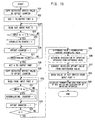
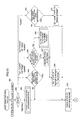
- the game processor 64 executes a "during the fight" process in the next step S4. More specifically, this during-the-fight process is executed according to a flowchart shown in Figure 13 and Figure 14.
- the game process 64 checks a state of the player's boxer so as to determine the state in the step S62. If this state is a "neutral", the process executes a player's boxer behavior determining process in a step S63.
- the game processor 64 checks the input data from the glove-type inputting apparatus 34 obtained as a result of the receiving process in Figure 12 so as to determine whether or not there is the acceleration signal input from the left-handed inputting apparatus 34L in a step S92, whether or not there is the acceleration signal input from the right-handed inputting apparatus 34R in a step S93, whether or not the guard key 44 of the left-handed inputting apparatus 34L is depressed in a step S94, and whether or not the guard key 44 of the right-handed inputting apparatus 34R in a step S95, respectively.
- step S92 determines whether “YES” is determined in the step S92, that is, if the acceleration signal is input from the left-handed inputting apparatus 34L. If “YES” is determined in the step S92, that is, if the acceleration signal is input from the left-handed inputting apparatus 34L, the game processor 64 sets a "left punch” as the state of the player's boxer in a succeeding step S96, and sets the "left punch” as an animation of the player's boxer to be displayed on the game screen 45 at that time.
- step S93 determines whether “YES” is determined in the step S93, that is, if the acceleration signal is input from the right-handed inputting apparatus 34R.
- the game processor 64 sets a "right punch” as the state of the player's boxer in a succeeding step S98, and sets the "right punch” as an animation of the player's boxer to be displayed on the game screen 45 at that time.
- the game processor 64 determines an "intensity of the punch" of the left punch or the right punch from a magnitude of the acceleration at that time in a step S100. In this step S100, more specifically, the game processor 64 calculates from the magnitude of the acceleration the intensity of the punch according to the predetermined coefficient for the conversion.
- step S94 determines whether “YES” is determined in the step S94, that is, if the guard key 44 of the left-handed inputting apparatus 34L is turned on.
- the game processor 64 sets a "left guard” as the state of the player's boxer in a succeeding step S101, and sets a "left guard” as the animation of the player's boxer to be displayed at that time on the game screen 45 in a step S102.
- the game processor 64 sets the "right guard” as the state of the player's boxer in a succeeding step S103, and sets the "right guard” as the animation of the player's boxer to be displayed at that time on the game screen 45.
- the player's boxer behavior determining process in the step S63 according to the input signal (information) from the input apparatus 34, only the state (in a case of the punch, the intensity is included) of the player's boxer (boxer of the game player), and the setting of the animation are performed.
- the game processor 64 determines whether or not the predetermined time period is elapsed after starting the guard in a succeeding step S64. If “NO”, the process advances to a step S71, and if "YES”, the state of the player's boxer is set to the "neutral” in a step S65. That is, in a case that the predetermined time period is elapsed after the guard key 44 is depressed, the state of the player's boxer is returned to the "neutral".
- the game processor 64 determines whether or not the punch of the player's boxer reaches a location of the opponent boxer in a next step S66. If “NO”, the location of the punch is updated in a step S67, and if "YES”, a result determining process of the punch of the player's boxer is executed in the step S68.
- step S68 The detailed process shown in this step S68 is shown in a subroutine in Figure 16.
- the game processor 64 checks the state of the opponent boxer, and in a step S112, it is determined whether or not the state of the opponent boxer is an "avert". If "YES" is determined, in a succeeding step S113, the game processor 64 determines that the result of the punch of the player's boxer is a "miss swing".
- step S112 it is determined whether or not the state of the opponent boxer is the "guard” in a next step S114. That is, it is determined whether or not the opponent boxer performs the left guard (right from a player's side) if the player's boxer throws the right punch, or whether or not the opponent boxer performs the right guard (left from a player's side) if the player's boxer throws the left punch.
- a step S120 the game processor 64 determines whether or not the stamina value of the opponent boxer having the damage value by the punch of the player's boxer subtracted is rendered equal to or smaller than "0" (zero). In a case of determining "NO” in this step S120, that is, in a case that the stamina value that is equal to or more than 1 is remained as the stamina value of the opponent boxer, in a step S121, as the animation of the opponent boxer to be displayed on the game screen, "the punch is hit" is set.
- the game processor 64 determines whether or not the predetermined time period is elapsed after the down in a step S69. If “NO”, the process advances to the step S71, and if "YES”, the game state is set to "being downed” in a step S70.
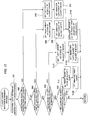
- step S71 the game processor 64 checks the state of the opponent boxer. Thereafter, a similar operation to the case of determining the state of the player's boxer described before is performed. However, the state "avert” exists in the opponent boxer, in a case of the behavior determination of the player's boxer described before, no “avert” exists. Therefore, although "avert" exists in steps S73 - S82, the process is basically similar to the preceding steps S62 - S70.
- a first step S72 in Figure 14 the game processor 64 determines the state of the opponent boxer. If this state is "neutral”, in the step S73, based on the behavior algorism similar to the behavior determining process of the player's boxer shown in Figure 15, an opponent-boxer behavior determining process is executed, for example.
- the game processor 64 determines whether or not the predetermined time period is elapsed after starting the guard in a next step S74. If “NO”, the process advances to the step S83, and if "YES”, the state of the opponent boxer is set to "neutral” in the step S75.
- the game processor 64 determines whether or not the punch of the opponent boxer reaches the location of the player's boxer in a next step S76. If “NO” , the location of the punch of the opponent boxer is updated in the step S77, and if "YES", the result determining process of the punch of the opponent boxer is executed in the step S78.
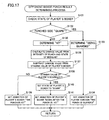
- step S78 A detailed description shown in this step S78 is displayed in a subroutine in Figure 17.
- the game processor 64 checks the state of the player's boxer, and determines whether or not the state of the player's boxer is "guard" in a step S132. That is, it is determined whether or not the player's boxer performs the right guard if the opponent boxer throws the left punch (right from a player's side), or whether or not the player's boxer performs the left guard if the opponent boxer throws the right punch (right from a player's side).
- step S132 the game processor 64 determines that the result of the punch of the opponent boxer is "guarded” in a step S133, and in succeeding step S134, sets the animation of the player's boxer to be displayed on the game screen 45 ( Figure 2) to "the punch is guarded”.
- step S132 determines that the result of the punch of the opponent boxer is "hit”. Then, in a next step S136, the game processor 64 calculates the damage of the player's boxer from the intensity of the punch (S100 in Figure 15) and the state at a time of being hit. Then, in a step S137, the calculated damage value is subtracted from the stamina value of the player's boxer.
- a step S138 the game processor 64 determines whether or not the stamina value of the player's boxer that subtracts the damage value by the punch of the opponent boxer is rendered equal to or smaller than "0" (zero). If “NO” is determined in the step S138, that is, in a case that the stamina value of the player's boxer that is equal to or larger than 1 is remained, in a step S139, as the animation of the player's boxer displayed on the game screen, "punch is hit” is set. On the contrary, when the stamina value of the player's boxer is run out, in the step S138, "YES" is determined. In this case, the game processor 64 sets the state of the player's boxer to "down” in a next step S140, and sets the animation of the player's boxer to "down after the punch is hit” in a step S141.
- step S77 after updating the location of the punch in the step S77, or after the result of the punch of the opponent boxer is processed in the step S78, the process advances to the succeeding step S75 so as to set the state of the opponent boxer to "neutral".
- the game processor 64 determines whether or not the predetermined time period is elapsed from starting averting in a next step S79. If “NO”, the process advances to the step S83. However, if "YES”, the process sets the state of the opponent boxer to "neutral” in the step S80.
- the game processor 64 determines whether or not the predetermined time period is elapse after being downed in the step S81. If “NO”, the process advances to the step S83, and if "YES”, the process sets the game state to "during being downed” in the step S82, and thereafter, advances to the step S83. In the step S83, the game processor 64 determines whether or not the remaining time period is 0 (zero), and if "YES", the game state is set to "determine result and display” in a step S84. However, if "NO”, an animation control for a game screen display is executed in the step S85.
- the voltage signal is extracted as the acceleration correlated signal generated in the piezoelectric buzzer element.
- the signal may be extracted as a current signal.
Landscapes
- Engineering & Computer Science (AREA)
- Multimedia (AREA)
- Human Computer Interaction (AREA)
- General Health & Medical Sciences (AREA)
- Health & Medical Sciences (AREA)
- Computer Networks & Wireless Communication (AREA)
- Life Sciences & Earth Sciences (AREA)
- Biophysics (AREA)
- Cardiology (AREA)
- Heart & Thoracic Surgery (AREA)
- Theoretical Computer Science (AREA)
- Physical Education & Sports Medicine (AREA)
- Arrangements For Transmission Of Measured Signals (AREA)
- User Interface Of Digital Computer (AREA)
- Pinball Game Machines (AREA)
- Processing Or Creating Images (AREA)
Applications Claiming Priority (3)
| Application Number | Priority Date | Filing Date | Title |
|---|---|---|---|
| JP2002209201A JP3865663B2 (ja) | 2002-07-18 | 2002-07-18 | ボクシングゲームシステム |
| JP2002209201 | 2002-07-18 | ||
| PCT/JP2003/008742 WO2004009196A1 (ja) | 2002-07-18 | 2003-07-09 | ボクシングゲームシステム |
Publications (2)
| Publication Number | Publication Date |
|---|---|
| EP1524015A1 true EP1524015A1 (de) | 2005-04-20 |
| EP1524015A4 EP1524015A4 (de) | 2010-11-17 |
Family
ID=30767678
Family Applications (1)
| Application Number | Title | Priority Date | Filing Date |
|---|---|---|---|
| EP03741301A Withdrawn EP1524015A4 (de) | 2002-07-18 | 2003-07-09 | Boxspielsystem |
Country Status (8)
| Country | Link |
|---|---|
| US (1) | US7371164B2 (de) |
| EP (1) | EP1524015A4 (de) |
| JP (1) | JP3865663B2 (de) |
| KR (1) | KR100932593B1 (de) |
| CN (1) | CN100384494C (de) |
| AU (1) | AU2003281500A1 (de) |
| TW (1) | TWI288014B (de) |
| WO (1) | WO2004009196A1 (de) |
Cited By (1)
| Publication number | Priority date | Publication date | Assignee | Title |
|---|---|---|---|---|
| EP1870141B1 (de) * | 2006-06-20 | 2020-05-20 | Nintendo Co., Ltd. | Speichermedium mit Spielprogramm und Spielvorrichtung |
Families Citing this family (49)
| Publication number | Priority date | Publication date | Assignee | Title |
|---|---|---|---|---|
| US7682237B2 (en) * | 2003-09-22 | 2010-03-23 | Ssd Company Limited | Music game with strike sounds changing in quality in the progress of music and entertainment music system |
| JP4397741B2 (ja) * | 2004-06-11 | 2010-01-13 | 株式会社コナミデジタルエンタテインメント | ゲーム装置 |
| WO2006059743A1 (en) * | 2004-12-03 | 2006-06-08 | Ssd Company Limited | Boxing game processing method, display control method, position detection method, cursor control method, energy consumption calculating method and exercise system |
| JP2006185109A (ja) * | 2004-12-27 | 2006-07-13 | Hitachi Ltd | 画像計測装置及び画像計測方法 |
| KR100659888B1 (ko) * | 2005-01-07 | 2006-12-20 | 엘지전자 주식회사 | 이동 단말기의 3차원 영상 처리방법 |
| JP4372083B2 (ja) * | 2005-10-28 | 2009-11-25 | 株式会社コナミデジタルエンタテインメント | ゲームシステム及びゲーム機 |
| US7874918B2 (en) * | 2005-11-04 | 2011-01-25 | Mattel Inc. | Game unit with motion and orientation sensing controller |
| US8574050B2 (en) | 2005-11-04 | 2013-11-05 | Mattel, Inc. | Game unit with dual joystick controllers |
| JP5089079B2 (ja) * | 2006-05-08 | 2012-12-05 | 任天堂株式会社 | プログラム、情報記憶媒体及び画像生成システム |
| JP4700584B2 (ja) * | 2006-09-21 | 2011-06-15 | 株式会社ソニー・コンピュータエンタテインメント | 情報処理装置、情報処理方法及びプログラム |
| CN101209382B (zh) * | 2006-12-27 | 2010-06-23 | 鸿富锦精密工业(深圳)有限公司 | 动作传感装置 |
| US20080207325A1 (en) * | 2007-02-27 | 2008-08-28 | Hsu Kent T J | Control arrangement for operating video game console |
| JP5420824B2 (ja) * | 2007-03-30 | 2014-02-19 | 任天堂株式会社 | ゲーム装置およびゲームプログラム |
| WO2008126419A1 (ja) * | 2007-04-10 | 2008-10-23 | Ssd Company Limited | 運動支援方法 |
| US20080268943A1 (en) | 2007-04-26 | 2008-10-30 | Sony Computer Entertainment America Inc. | Method and apparatus for adjustment of game parameters based on measurement of user performance |
| TWI395604B (zh) * | 2007-05-03 | 2013-05-11 | Pixart Imaging Inc | Interactive game method and system with anti - sports injury function |
| US9317110B2 (en) * | 2007-05-29 | 2016-04-19 | Cfph, Llc | Game with hand motion control |
| JP4327868B2 (ja) | 2007-06-29 | 2009-09-09 | 株式会社コナミデジタルエンタテインメント | ゲーム装置、ゲーム制御方法、ゲーム制御プログラム、及び該プログラムを記録したコンピュータ読み取り可能な記録媒体。 |
| KR100943039B1 (ko) * | 2008-06-12 | 2010-02-19 | 한국과학기술원 | 디지털 운동기구와 신체부착센서를 이용한 멀티게임 구동시스템 |
| US8461468B2 (en) | 2009-10-30 | 2013-06-11 | Mattel, Inc. | Multidirectional switch and toy including a multidirectional switch |
| US9044198B2 (en) * | 2010-07-15 | 2015-06-02 | The Cleveland Clinic Foundation | Enhancement of the presentation of an athletic event |
| US10398959B2 (en) | 2012-03-02 | 2019-09-03 | Clarence V. Hall | Multi-head, multi-abdomen, multi-armed apparatus for use with a slip and counter fight simulation / workout machine or stand alone device for fight simulation |
| US9050518B2 (en) | 2013-02-28 | 2015-06-09 | Clarence V. Hall | Slip and counter fight simulation / workout machine |
| US9044659B2 (en) | 2012-03-02 | 2015-06-02 | Clarence V. Hall | Slip and counter fight simulation / workout machine |
| US9821208B2 (en) | 2014-03-20 | 2017-11-21 | Clarence V. Hall | Multi-headed, multi-abdomen, multi-armed apparatus for use with a slip and counter fight simulation/workout machine or stand alone device for fight simulation |
| US10493346B2 (en) | 2012-03-02 | 2019-12-03 | Clarence V. Hall | Multi-headed, multi-abdomen, multi-armed apparatus for use with a slip and counter fight simulation / workout machine or stand alone device for fight simulation |
| WO2013142085A1 (en) * | 2012-03-23 | 2013-09-26 | Li Man On | Methods, systems, and devices for collecting and analyzing movement data of an athlete |
| KR101326349B1 (ko) * | 2012-05-30 | 2013-11-11 | 유실근 | 스마트 악력 운동기 |
| US8696422B1 (en) | 2012-07-20 | 2014-04-15 | Rafael Santiago | Electronic boxing game, gear, method and systems |
| CN103721406A (zh) * | 2012-10-11 | 2014-04-16 | 成都哆可梦网络科技有限公司 | 一种基于移动互联网的多方互动拳击游戏系统 |
| TWI468212B (zh) * | 2012-11-09 | 2015-01-11 | Borden Technology Corp | 拳擊機遊戲系統及其方法 |
| WO2014157755A1 (ko) * | 2013-03-29 | 2014-10-02 | 엘지전자 주식회사 | 게임 장치 및 그의 구동방법 |
| KR101537866B1 (ko) * | 2013-12-06 | 2015-07-23 | 주식회사 스타폴 | 격투시합 제어용 전자기기 |
| CN104368147A (zh) * | 2014-10-24 | 2015-02-25 | 苏州德鲁森自动化系统有限公司 | 一种体感游戏系统控制方法 |
| US9931560B2 (en) * | 2014-12-22 | 2018-04-03 | H. Carnell Caroll-James | Shadow gloves |
| CN105457255A (zh) * | 2016-01-13 | 2016-04-06 | 薛晓东 | 拳击手套与运动数据处理方法及装置 |
| US10702770B2 (en) * | 2016-05-03 | 2020-07-07 | Disney Enterprises, Inc. | System and method of configuring disparate physical objects to provide control signals for controlling a game |
| JP6877893B2 (ja) * | 2016-06-06 | 2021-05-26 | 任天堂株式会社 | ゲーム装置、ゲームシステム、ゲームプログラム、および振り入力判定方法 |
| CN107454857A (zh) * | 2016-07-29 | 2017-12-08 | 深圳市柔宇科技有限公司 | 一种运动装置 |
| KR101738870B1 (ko) * | 2016-12-12 | 2017-05-23 | 주식회사 디플즈 | Vr글러브 기반 게임 시스템 및 이를 이용한 게임 진행 방법 |
| US10120455B2 (en) * | 2016-12-28 | 2018-11-06 | Industrial Technology Research Institute | Control device and control method |
| JP6544869B2 (ja) * | 2017-07-27 | 2019-07-17 | 任天堂株式会社 | ゲームシステム、アクセサリ、ゲームプログラム、ゲーム装置、ゲーム処理方法、および厚紙部材 |
| WO2019193601A1 (en) * | 2018-04-03 | 2019-10-10 | MANTRI, Shamla T. | Piezoelectric sensors integrated hand gesture recognition device |
| US10918949B2 (en) | 2019-07-01 | 2021-02-16 | Disney Enterprises, Inc. | Systems and methods to provide a sports-based interactive experience |
| US11273367B1 (en) * | 2019-09-24 | 2022-03-15 | Wayne Hughes Beckett | Non-CRT pointing device |
| JP2022114834A (ja) * | 2021-01-27 | 2022-08-08 | 大日本印刷株式会社 | 打撃型遊具及び遊具システム |
| CN112933610A (zh) * | 2021-05-13 | 2021-06-11 | 江西中业光文化科技有限公司 | 数据交互方法、系统及可读存储介质 |
| CN115025472B (zh) * | 2022-04-07 | 2024-01-12 | 杭州景而腾科技有限公司 | 一种拳击锻炼用计数系统 |
| US20240058648A1 (en) * | 2022-08-20 | 2024-02-22 | oluwaseun olaoluwa | Exercise data tracking systems, kits, and methods of use |
Family Cites Families (14)
| Publication number | Priority date | Publication date | Assignee | Title |
|---|---|---|---|---|
| JPS5861774A (ja) * | 1981-10-07 | 1983-04-12 | カシオ計算機株式会社 | ゲ−ム機能を備えた小型電子機器 |
| DE3339648A1 (de) | 1983-11-02 | 1985-05-09 | Georg F. 1000 Berlin Brückner | Handschutz fuer sportler |
| JPH02199526A (ja) * | 1988-10-14 | 1990-08-07 | David G Capper | 制御インターフェース装置 |
| US5229756A (en) * | 1989-02-07 | 1993-07-20 | Yamaha Corporation | Image control apparatus |
| JPH0810446A (ja) * | 1994-06-29 | 1996-01-16 | Copcom Co Ltd | ゲーム用入力装置、およびゲーム装置 |
| JP3780369B2 (ja) | 1996-04-25 | 2006-05-31 | 株式会社ブレイニー | パンチ力測定用グローブ |
| JPH09325081A (ja) * | 1996-06-05 | 1997-12-16 | Casio Comput Co Ltd | 運動測定装置及び運動測定装置を備えた電子式ゲーム装置 |
| JP4194165B2 (ja) * | 1998-04-10 | 2008-12-10 | 富士通コンポーネント株式会社 | ポインティングデバイス |
| JP2002007057A (ja) * | 2000-06-23 | 2002-01-11 | Shinsedai Kk | プロセサ用入力装置 |
| CN2429215Y (zh) * | 2000-07-11 | 2001-05-09 | 张珊珊 | 一种拳击娱乐机 |
| CN2447027Y (zh) * | 2000-10-27 | 2001-09-12 | 郭鹏飞 | 电子游戏仿真格斗装置 |
| JP4027031B2 (ja) | 2000-11-16 | 2007-12-26 | 株式会社コナミデジタルエンタテインメント | 対戦式3dビデオゲーム装置 |
| JP2002200339A (ja) * | 2000-12-28 | 2002-07-16 | Mitsumi Electric Co Ltd | ゲーム装置 |
| JP4872504B2 (ja) * | 2006-07-19 | 2012-02-08 | 富士ゼロックス株式会社 | 分類情報管理装置、分類情報管理システムおよび分類情報管理プログラム |
-
2002
- 2002-07-18 JP JP2002209201A patent/JP3865663B2/ja not_active Expired - Fee Related
-
2003
- 2003-07-09 US US10/493,302 patent/US7371164B2/en not_active Expired - Fee Related
- 2003-07-09 KR KR1020047007154A patent/KR100932593B1/ko not_active Expired - Fee Related
- 2003-07-09 CN CNB038017601A patent/CN100384494C/zh not_active Expired - Fee Related
- 2003-07-09 AU AU2003281500A patent/AU2003281500A1/en not_active Abandoned
- 2003-07-09 EP EP03741301A patent/EP1524015A4/de not_active Withdrawn
- 2003-07-09 WO PCT/JP2003/008742 patent/WO2004009196A1/ja not_active Ceased
- 2003-07-14 TW TW092119101A patent/TWI288014B/zh not_active IP Right Cessation
Cited By (1)
| Publication number | Priority date | Publication date | Assignee | Title |
|---|---|---|---|---|
| EP1870141B1 (de) * | 2006-06-20 | 2020-05-20 | Nintendo Co., Ltd. | Speichermedium mit Spielprogramm und Spielvorrichtung |
Also Published As
| Publication number | Publication date |
|---|---|
| JP2004049436A (ja) | 2004-02-19 |
| US20050014542A1 (en) | 2005-01-20 |
| CN100384494C (zh) | 2008-04-30 |
| KR100932593B1 (ko) | 2009-12-17 |
| AU2003281500A1 (en) | 2004-02-09 |
| US7371164B2 (en) | 2008-05-13 |
| JP3865663B2 (ja) | 2007-01-10 |
| TW200403091A (en) | 2004-03-01 |
| CN1606465A (zh) | 2005-04-13 |
| EP1524015A4 (de) | 2010-11-17 |
| KR20050047034A (ko) | 2005-05-19 |
| WO2004009196A1 (ja) | 2004-01-29 |
| TWI288014B (en) | 2007-10-11 |
Similar Documents
| Publication | Publication Date | Title |
|---|---|---|
| EP1524015A1 (de) | Boxspielsystem | |
| CN1662283B (zh) | 网球游戏系统 | |
| US6183365B1 (en) | Movement measuring device, electronic game machine including movement measuring device, and method of playing game machine | |
| WO2004002593A1 (ja) | ストロボスコープを使った入力システムを備える情報処理装置 | |
| JP6508061B2 (ja) | 情報処理装置、情報処理方法、およびプログラム | |
| EP2302487A2 (de) | Speichermedium mit einem Informationsverarbeitungsprogramm und Informationsverarbeitungsgerät zum Erkennen der Schwungrichtung eines Eingabegeräts | |
| JP2002007057A (ja) | プロセサ用入力装置 | |
| US7335105B2 (en) | Soccer game apparatus | |
| HK1072213A (en) | Boxing game system | |
| JP2003053032A (ja) | サッカーゲーム装置 | |
| JP4771343B2 (ja) | 体感ゲーム装置、体感ゲーム方法、及び、記録媒体 | |
| JP4831261B2 (ja) | プロセサ用入力装置 | |
| JPH10179934A (ja) | 電子式ゲーム装置 | |
| JP2009217302A (ja) | 入力装置及び情報処理システム | |
| HK1050496A (en) | Soccer game apparatus | |
| JP2011243225A (ja) | プロセサ用入力装置 | |
| HK1069789B (en) | Tennis game system | |
| JP2008246201A (ja) | 入力装置及び情報処理システム | |
| JP2000157728A (ja) | 携帯ゲーム機 | |
| JPH0910438A (ja) | ビデオゲーム機 | |
| HK1070852A (en) | Information processor having input system using stroboscope |
Legal Events
| Date | Code | Title | Description |
|---|---|---|---|
| PUAI | Public reference made under article 153(3) epc to a published international application that has entered the european phase |
Free format text: ORIGINAL CODE: 0009012 |
|
| 17P | Request for examination filed |
Effective date: 20040510 |
|
| AK | Designated contracting states |
Kind code of ref document: A1 Designated state(s): AT BE BG CH CY CZ DE DK EE ES FI FR GB GR HU IE IT LI LU MC NL PT RO SE SI SK TR |
|
| AX | Request for extension of the european patent |
Extension state: AL LT LV MK |
|
| REG | Reference to a national code |
Ref country code: HK Ref legal event code: DE Ref document number: 1072213 Country of ref document: HK |
|
| DAX | Request for extension of the european patent (deleted) | ||
| A4 | Supplementary search report drawn up and despatched |
Effective date: 20101014 |
|
| RIC1 | Information provided on ipc code assigned before grant |
Ipc: A63F 13/06 20060101ALI20101008BHEP Ipc: A63F 13/12 20060101ALI20101008BHEP Ipc: A63F 13/00 20060101AFI20040206BHEP |
|
| 17Q | First examination report despatched |
Effective date: 20110804 |
|
| REG | Reference to a national code |
Ref country code: HK Ref legal event code: WD Ref document number: 1072213 Country of ref document: HK |
|
| STAA | Information on the status of an ep patent application or granted ep patent |
Free format text: STATUS: THE APPLICATION IS DEEMED TO BE WITHDRAWN |
|
| 18D | Application deemed to be withdrawn |
Effective date: 20111215 |