EP1387419A2 - Verfahren zur Behandlung von Elektrodenlaschen für Lithium Sekundärbatterienzelle und so hergestellte Zelle und Batterie - Google Patents
Verfahren zur Behandlung von Elektrodenlaschen für Lithium Sekundärbatterienzelle und so hergestellte Zelle und Batterie Download PDFInfo
- Publication number
- EP1387419A2 EP1387419A2 EP02258978A EP02258978A EP1387419A2 EP 1387419 A2 EP1387419 A2 EP 1387419A2 EP 02258978 A EP02258978 A EP 02258978A EP 02258978 A EP02258978 A EP 02258978A EP 1387419 A2 EP1387419 A2 EP 1387419A2
- Authority
- EP
- European Patent Office
- Prior art keywords
- grids
- anode
- cathode
- crude cell
- plates
- Prior art date
- Legal status (The legal status is an assumption and is not a legal conclusion. Google has not performed a legal analysis and makes no representation as to the accuracy of the status listed.)
- Withdrawn
Links
- 229910052744 lithium Inorganic materials 0.000 title claims abstract description 65
- WHXSMMKQMYFTQS-UHFFFAOYSA-N Lithium Chemical compound [Li] WHXSMMKQMYFTQS-UHFFFAOYSA-N 0.000 title claims abstract description 62
- 238000000034 method Methods 0.000 title claims abstract description 47
- 238000003466 welding Methods 0.000 claims abstract description 26
- 238000005452 bending Methods 0.000 claims abstract description 9
- 238000005520 cutting process Methods 0.000 claims abstract description 5
- 239000000853 adhesive Substances 0.000 claims description 28
- 230000001070 adhesive effect Effects 0.000 claims description 28
- -1 polypropylene Polymers 0.000 claims description 10
- 239000003792 electrolyte Substances 0.000 claims description 9
- 239000004743 Polypropylene Substances 0.000 claims description 8
- 229920001155 polypropylene Polymers 0.000 claims description 8
- 229920001940 conductive polymer Polymers 0.000 claims description 6
- 150000002500 ions Chemical class 0.000 claims description 5
- 239000004698 Polyethylene Substances 0.000 claims description 4
- 229920000573 polyethylene Polymers 0.000 claims description 4
- NIXOWILDQLNWCW-UHFFFAOYSA-M Acrylate Chemical compound [O-]C(=O)C=C NIXOWILDQLNWCW-UHFFFAOYSA-M 0.000 claims description 3
- 239000004642 Polyimide Substances 0.000 claims description 3
- 229920001721 polyimide Polymers 0.000 claims description 3
- 229920001296 polysiloxane Polymers 0.000 claims description 3
- 239000000126 substance Substances 0.000 claims description 3
- 229920006254 polymer film Polymers 0.000 claims description 2
- 229920000642 polymer Polymers 0.000 description 8
- 238000010586 diagram Methods 0.000 description 7
- 229920005989 resin Polymers 0.000 description 7
- 239000011347 resin Substances 0.000 description 7
- 229910052782 aluminium Inorganic materials 0.000 description 5
- XAGFODPZIPBFFR-UHFFFAOYSA-N aluminium Chemical compound [Al] XAGFODPZIPBFFR-UHFFFAOYSA-N 0.000 description 5
- 238000004519 manufacturing process Methods 0.000 description 5
- 238000007789 sealing Methods 0.000 description 5
- PXHVJJICTQNCMI-UHFFFAOYSA-N Nickel Chemical compound [Ni] PXHVJJICTQNCMI-UHFFFAOYSA-N 0.000 description 4
- 230000003247 decreasing effect Effects 0.000 description 3
- 230000000694 effects Effects 0.000 description 3
- 229910052751 metal Inorganic materials 0.000 description 3
- 239000002184 metal Substances 0.000 description 3
- 239000007773 negative electrode material Substances 0.000 description 3
- 229920002239 polyacrylonitrile Polymers 0.000 description 3
- 239000007774 positive electrode material Substances 0.000 description 3
- 238000004804 winding Methods 0.000 description 3
- HBBGRARXTFLTSG-UHFFFAOYSA-N Lithium ion Chemical compound [Li+] HBBGRARXTFLTSG-UHFFFAOYSA-N 0.000 description 2
- 239000002033 PVDF binder Substances 0.000 description 2
- 239000011248 coating agent Substances 0.000 description 2
- 238000000576 coating method Methods 0.000 description 2
- 230000007547 defect Effects 0.000 description 2
- 238000001035 drying Methods 0.000 description 2
- 239000011888 foil Substances 0.000 description 2
- 238000005304 joining Methods 0.000 description 2
- 239000011244 liquid electrolyte Substances 0.000 description 2
- 150000002641 lithium Chemical class 0.000 description 2
- 229910001416 lithium ion Inorganic materials 0.000 description 2
- 239000000463 material Substances 0.000 description 2
- 229910052759 nickel Inorganic materials 0.000 description 2
- 239000005486 organic electrolyte Substances 0.000 description 2
- 229920003229 poly(methyl methacrylate) Polymers 0.000 description 2
- 239000004926 polymethyl methacrylate Substances 0.000 description 2
- 229920002981 polyvinylidene fluoride Polymers 0.000 description 2
- 238000012545 processing Methods 0.000 description 2
- 239000007784 solid electrolyte Substances 0.000 description 2
- 239000002904 solvent Substances 0.000 description 2
- RYGMFSIKBFXOCR-UHFFFAOYSA-N Copper Chemical compound [Cu] RYGMFSIKBFXOCR-UHFFFAOYSA-N 0.000 description 1
- UFHFLCQGNIYNRP-UHFFFAOYSA-N Hydrogen Chemical compound [H][H] UFHFLCQGNIYNRP-UHFFFAOYSA-N 0.000 description 1
- NIXOWILDQLNWCW-UHFFFAOYSA-N acrylic acid group Chemical group C(C=C)(=O)O NIXOWILDQLNWCW-UHFFFAOYSA-N 0.000 description 1
- 239000004411 aluminium Substances 0.000 description 1
- 239000005030 aluminium foil Substances 0.000 description 1
- OJIJEKBXJYRIBZ-UHFFFAOYSA-N cadmium nickel Chemical compound [Ni].[Cd] OJIJEKBXJYRIBZ-UHFFFAOYSA-N 0.000 description 1
- 239000011889 copper foil Substances 0.000 description 1
- 239000007772 electrode material Substances 0.000 description 1
- 229910052739 hydrogen Inorganic materials 0.000 description 1
- 239000001257 hydrogen Substances 0.000 description 1
- 238000009413 insulation Methods 0.000 description 1
- 238000003475 lamination Methods 0.000 description 1
- 239000004816 latex Substances 0.000 description 1
- 229920000126 latex Polymers 0.000 description 1
- 239000007788 liquid Substances 0.000 description 1
- 230000007257 malfunction Effects 0.000 description 1
- 239000000203 mixture Substances 0.000 description 1
- QELJHCBNGDEXLD-UHFFFAOYSA-N nickel zinc Chemical compound [Ni].[Zn] QELJHCBNGDEXLD-UHFFFAOYSA-N 0.000 description 1
- 229920006284 nylon film Polymers 0.000 description 1
- 238000012856 packing Methods 0.000 description 1
- 229920005597 polymer membrane Polymers 0.000 description 1
- 238000012827 research and development Methods 0.000 description 1
- 239000007787 solid Substances 0.000 description 1
- 229920003048 styrene butadiene rubber Polymers 0.000 description 1
Images



Classifications
-
- H—ELECTRICITY
- H01—ELECTRIC ELEMENTS
- H01M—PROCESSES OR MEANS, e.g. BATTERIES, FOR THE DIRECT CONVERSION OF CHEMICAL ENERGY INTO ELECTRICAL ENERGY
- H01M10/00—Secondary cells; Manufacture thereof
- H01M10/05—Accumulators with non-aqueous electrolyte
- H01M10/058—Construction or manufacture
- H01M10/0583—Construction or manufacture of accumulators with folded construction elements except wound ones, i.e. folded positive or negative electrodes or separators, e.g. with "Z"-shaped electrodes or separators
-
- H—ELECTRICITY
- H01—ELECTRIC ELEMENTS
- H01M—PROCESSES OR MEANS, e.g. BATTERIES, FOR THE DIRECT CONVERSION OF CHEMICAL ENERGY INTO ELECTRICAL ENERGY
- H01M10/00—Secondary cells; Manufacture thereof
- H01M10/04—Construction or manufacture in general
- H01M10/0431—Cells with wound or folded electrodes
-
- H—ELECTRICITY
- H01—ELECTRIC ELEMENTS
- H01M—PROCESSES OR MEANS, e.g. BATTERIES, FOR THE DIRECT CONVERSION OF CHEMICAL ENERGY INTO ELECTRICAL ENERGY
- H01M50/00—Constructional details or processes of manufacture of the non-active parts of electrochemical cells other than fuel cells, e.g. hybrid cells
- H01M50/40—Separators; Membranes; Diaphragms; Spacing elements inside cells
- H01M50/409—Separators, membranes or diaphragms characterised by the material
- H01M50/411—Organic material
- H01M50/414—Synthetic resins, e.g. thermoplastics or thermosetting resins
- H01M50/417—Polyolefins
-
- H—ELECTRICITY
- H01—ELECTRIC ELEMENTS
- H01M—PROCESSES OR MEANS, e.g. BATTERIES, FOR THE DIRECT CONVERSION OF CHEMICAL ENERGY INTO ELECTRICAL ENERGY
- H01M50/00—Constructional details or processes of manufacture of the non-active parts of electrochemical cells other than fuel cells, e.g. hybrid cells
- H01M50/40—Separators; Membranes; Diaphragms; Spacing elements inside cells
- H01M50/463—Separators, membranes or diaphragms characterised by their shape
- H01M50/466—U-shaped, bag-shaped or folded
-
- H—ELECTRICITY
- H01—ELECTRIC ELEMENTS
- H01M—PROCESSES OR MEANS, e.g. BATTERIES, FOR THE DIRECT CONVERSION OF CHEMICAL ENERGY INTO ELECTRICAL ENERGY
- H01M50/00—Constructional details or processes of manufacture of the non-active parts of electrochemical cells other than fuel cells, e.g. hybrid cells
- H01M50/50—Current conducting connections for cells or batteries
- H01M50/531—Electrode connections inside a battery casing
- H01M50/536—Electrode connections inside a battery casing characterised by the method of fixing the leads to the electrodes, e.g. by welding
-
- H—ELECTRICITY
- H01—ELECTRIC ELEMENTS
- H01M—PROCESSES OR MEANS, e.g. BATTERIES, FOR THE DIRECT CONVERSION OF CHEMICAL ENERGY INTO ELECTRICAL ENERGY
- H01M10/00—Secondary cells; Manufacture thereof
- H01M10/05—Accumulators with non-aqueous electrolyte
- H01M10/052—Li-accumulators
-
- H—ELECTRICITY
- H01—ELECTRIC ELEMENTS
- H01M—PROCESSES OR MEANS, e.g. BATTERIES, FOR THE DIRECT CONVERSION OF CHEMICAL ENERGY INTO ELECTRICAL ENERGY
- H01M10/00—Secondary cells; Manufacture thereof
- H01M10/05—Accumulators with non-aqueous electrolyte
- H01M10/052—Li-accumulators
- H01M10/0525—Rocking-chair batteries, i.e. batteries with lithium insertion or intercalation in both electrodes; Lithium-ion batteries
-
- Y—GENERAL TAGGING OF NEW TECHNOLOGICAL DEVELOPMENTS; GENERAL TAGGING OF CROSS-SECTIONAL TECHNOLOGIES SPANNING OVER SEVERAL SECTIONS OF THE IPC; TECHNICAL SUBJECTS COVERED BY FORMER USPC CROSS-REFERENCE ART COLLECTIONS [XRACs] AND DIGESTS
- Y02—TECHNOLOGIES OR APPLICATIONS FOR MITIGATION OR ADAPTATION AGAINST CLIMATE CHANGE
- Y02E—REDUCTION OF GREENHOUSE GAS [GHG] EMISSIONS, RELATED TO ENERGY GENERATION, TRANSMISSION OR DISTRIBUTION
- Y02E60/00—Enabling technologies; Technologies with a potential or indirect contribution to GHG emissions mitigation
- Y02E60/10—Energy storage using batteries
-
- Y—GENERAL TAGGING OF NEW TECHNOLOGICAL DEVELOPMENTS; GENERAL TAGGING OF CROSS-SECTIONAL TECHNOLOGIES SPANNING OVER SEVERAL SECTIONS OF THE IPC; TECHNICAL SUBJECTS COVERED BY FORMER USPC CROSS-REFERENCE ART COLLECTIONS [XRACs] AND DIGESTS
- Y02—TECHNOLOGIES OR APPLICATIONS FOR MITIGATION OR ADAPTATION AGAINST CLIMATE CHANGE
- Y02P—CLIMATE CHANGE MITIGATION TECHNOLOGIES IN THE PRODUCTION OR PROCESSING OF GOODS
- Y02P70/00—Climate change mitigation technologies in the production process for final industrial or consumer products
- Y02P70/50—Manufacturing or production processes characterised by the final manufactured product
-
- Y—GENERAL TAGGING OF NEW TECHNOLOGICAL DEVELOPMENTS; GENERAL TAGGING OF CROSS-SECTIONAL TECHNOLOGIES SPANNING OVER SEVERAL SECTIONS OF THE IPC; TECHNICAL SUBJECTS COVERED BY FORMER USPC CROSS-REFERENCE ART COLLECTIONS [XRACs] AND DIGESTS
- Y10—TECHNICAL SUBJECTS COVERED BY FORMER USPC
- Y10T—TECHNICAL SUBJECTS COVERED BY FORMER US CLASSIFICATION
- Y10T29/00—Metal working
- Y10T29/49—Method of mechanical manufacture
- Y10T29/49002—Electrical device making
- Y10T29/49108—Electric battery cell making
-
- Y—GENERAL TAGGING OF NEW TECHNOLOGICAL DEVELOPMENTS; GENERAL TAGGING OF CROSS-SECTIONAL TECHNOLOGIES SPANNING OVER SEVERAL SECTIONS OF THE IPC; TECHNICAL SUBJECTS COVERED BY FORMER USPC CROSS-REFERENCE ART COLLECTIONS [XRACs] AND DIGESTS
- Y10—TECHNICAL SUBJECTS COVERED BY FORMER USPC
- Y10T—TECHNICAL SUBJECTS COVERED BY FORMER US CLASSIFICATION
- Y10T29/00—Metal working
- Y10T29/49—Method of mechanical manufacture
- Y10T29/49002—Electrical device making
- Y10T29/49108—Electric battery cell making
- Y10T29/49114—Electric battery cell making including adhesively bonding
Definitions
- the present invention relates to a lithium secondary battery, and more particularly, to a method for treating electrode tabs of a crude cell for a lithium secondary battery, in which the capacity of the battery can be increased by increasing the length of electrode members without changing the predetermined specification of a battery package member, and stability of portions of electrode tabs where the tabs are welded to grids, respectively, can be enhanced by using insulation tap, and a crude cell for a lithium secondary battery manufactured according to the method and a lithium secondary battery employing the crude cell.
- a nickel cadmium battery, nickel hydrogen battery, nickel zinc battery, lithium secondary battery, or the like is used as an electric power source of electronic appliances, and the lithium secondary battery of those batteries is generally used in consideration of its life time and capacity.
- the lithium secondary battery can be classified into a lithium metal battery and a lithium ion battery which employ a liquid electrolyte, and a lithium polymer battery which employs a polymer solid electrolyte.
- the lithium polymer battery can be classified into a full-solid type lithium polymer battery which does not contain an organic electrolyte, and a lithium ion polymer battery which employs a gel type electrolyte containing organic electrolyte liquid.
- FIG. 1 is a perspective view schematically illustrating a structure of a conventional lithium secondary battery.
- the lithium secondary battery 10 comprises a crude cell 20 and a package member 40 for receiving the crude cell 20.
- the crude cell 20 has a structure stacked with a plurality of unit cells 28 or bi-cells 27 according to a capacity of a battery.
- each unit cell 28 is composed of an anode plate 22, a separator 24, and a cathode plate 26 in sequence
- each bi-cell 27 is composed of an anode plate 21, a separator 23, a cathode plate 25, a separator 23, and a cathode plate 25 in sequence.
- the crude cell 20 includes an anode tab 12 and a cathode tab 14.
- the anode tab 12 is formed by gathering anode grids 16 provided at respective anode plates and joining the anode grids 16 to an anode tab member 11 by welding.
- the cathode tab 14 is formed by gathering cathode grids 18 provided at respective cathode plates and joining the cathode grids 18 to a cathode tab member 13 by welding.
- the tab members 11 and 13 are provided with resin members 17 adhered to non-resin members 15 made of aluminum or nickel, respectively.
- the package member 40 is provided with a receiving portion 32 into which the crude cell 20 is received and a sealing portion 34 which is hermetically sealed after the receiving portion 32 is filled with an electrolyte.
- the receiving portion 32 is composed of a first receiving portion 36 into which the anode and cathode plates are substantially received, and a second receiving portion 38 into which anode and cathode tabs 16 and 18 are received.
- the resin members 17 are interposed between the sealing portions 34, prevent the electrolyte (not shown) from leaking out, and prevent possible short circuit in the region of the tab members 11 and 13.
- the capacity of the battery depends on the length of the battery, in particular, the length of electrode plates which contains an electrode material. Therefore, in order to increase the capacity of the battery, there is a method of increasing the length d3 of the first receiving portion 36 by decreasing the length d1 or length d2 of the whole length d of the battery, i.e., the length d1 of the second receiving portion 38 which is occupied by the anode/cathode tabs 12 and 14, or the length d2 of the sealing portion 34.
- the length d3 of the first receiving portion 36 can be relatively increased as much as the decreased length of the length d1 of the second receiving portion 38 or the length d2 of the sealing portion 34.
- the second receiving portion 38 is to be considered as a dead space in the manufacturing process of the lithium secondary battery until now,
- a method of treating electrode tabs of a crude cell for a lithium secondary battery including the steps of: (a) welding a tab member to one ends of grids of the crude cell; and (b) attaching insulating tape to the circumference of an electrode tab so that the insulating tape can wrap around the electrode tab which is formed by a welded portion of the grids and the tab member.
- a method of treating electrode tabs of a crude cell for a lithium secondary battery including the steps of: (a) respectively, gathering anode grids and cathode grids of the crude cell provided with a plurality of anode plates having respective anode grids, a plurality of anode plates having respective anode grids, and a separator strip interposed between the anode plates and the cathode plates which are disposed alternately; (b) welding an anode tab member and a cathode tab to respective end portions of the anode grids and the cathode grids to form an anode side welded portion and a cathode side welded portion; and (c) attaching insulating tape to the anode side welded portion and the cathode side welded portion with an adhesive so that the insulating tape wraps around the welded portions.
- a method of treating electrode tabs of a crude cell provided with a plurality of anode plates having respective anode grids, a plurality of anode plates having respective anode grids, and a separator strip interposed, in a fold to fold manner, between the anode plates and the cathode plates which are disposed alternately including the steps of: (a) gathering the anode grids and the cathode grids, respectively, so that the grids can be close to a first surface and be substantially parallel to the first surface, and cutting the end portions of the anode grids and the cathode grids so that the anode grids and the cathode grids can have the shortest length required for being welded to respective tab members; (b) welding an anode tab member and a cathode tab member to respective end portions of the anode grids and the cathode grids to form an anode side welded portion and a cathode side welded portion having length
- the insulating tape is made of polyimide or polypropylene film having characteristics of heat-resistance and chemical inertness, and the insulating tape is attached with an acrylate-based adhesive or silicone-based adhesive.
- the first bend portions are formed at respective positions within respective areas where the insulating tape is attached to the anode grids and the cathode grids except the areas of the welded portions
- each of the second bend portions are formed at a position which is at least farther than the welded portion from the first bend portion, and is positioned within the portion of the tab member to which the insulating tape is attached.
- first bend portion and the second bend portion may be formed at positions which are substantially close to both sides of the insulating tape.
- the separator is provided with a single-layered or multi-layered porous polymer film made of polyethylene or polypropylene, has the form of a single strip, and is multiply folded in a fold to fold fashion so that the anode plates and the cathode plates can be stacked alternately; (b) the anode plates having the same predetermined size are equidistantly attached to one surface of the separator with an ion conductive polymer adhesive; and (c) the cathode plates having the same predetermined size are attached to the other surface of the separator at positions corresponding to the anode plates with an ion conductive polymer adhesive.
- the circumferential surface of the crude cell formed in a fold to fold configuration is wrapped with wrapping tape.
- welding is not performed at the same time at the cathode side and the anode side, and any one of two tab members is welded to corresponding grids first and the other tab member is welded to the other grids.
- a lithium secondary battery including a crude cell made according to any one of the above-mentioned methods; and a package member which receives the crude cell so that any substantial dead space may not be formed at an electrode tab portion of the crude cell, and can be hermetically sealed after an electrolyte is filled into the package member.
- a crude cell for a lithium secondary battery including: a plurality of anode plates having respective grids; a plurality of cathode plates having respective grids; a separator; an anode tab member and a cathode tab member; and insulating tape; wherein the anode tab member and the cathode tab member are welded to the anode grids and the cathode grids, respectively, and the welded portions are wrapped with the insulating tape.
- At least two bend portions are formed at a grid portion and a tab member portion.
- a lithium secondary battery including: a crude cell of claim; a package member for receiving the crude cell; and an electrolyte filled in the package member.
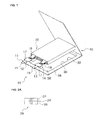
- FIG. 4 is an exploded perspective view schematically illustrating a lithium secondary battery according to a preferred embodiment of the present invention
- FIG. 5 is a section view of the battery of FIG. 4 in the assembled state.
- a lithium secondary battery is comprised of a crude cell 110 having a structure of an anode plate/a separator/a cathode plate, and a package member 120 capable of receiving the crude cell 110 and being sealed.
- crude cell 110 may be a lithium secondary ion battery or a lithium secondary polymer battery.
- the crude cell 110 may be a unit cell or bi-cell, or a cell formed by stacking the unit cells or the bi-cells,
- each electrode plate (the anode plate or the cathode plate) is comprised of a main body of an electrode plate, and a grid extending from the electrode plate.
- the grids are classified into anode grids and cathode grids, and the anode grids and the cathode grids may be disposed at opposite side positions with respect to the lengthwise direction of the crude cell 110. However, in this embodiment, it is assumed that the anode grids and the cathode grids are disposed at the same side position with respect to the lengthwise direction of the crude cell 110.
- the crude cell 110 is distinguished from a battery 100, in itself, in which the crude cell 110 is received in the package member 120, an electrolyte is filled in the package member 120, and the package member 120 is hermetically sealed.
- the term 'crude cell' is used together with the term 'battery assembly (electrode assembly)', the term 'crude cell' is used in this embodiment unless specifically stated otherwise.
- the crude cell may have any of various structures described above, it is preferable that the crude cell 110 is manufactured by the apparatus as disclosed in Korean Patent Application No. 10-2001-28493 (Automated system for manufacturing lithium secondary battery), Korean Patent Application No. 10-2001-28494 (Lamination Apparatus for automated system for manufacturing lithium secondary battery), and Korean Patent Application No. 10-2001-28495 (Packing apparatus for automated system for manufacturing lithium secondary battery), which were filed on May 23, 2001 by the applicant of the present invention.
- a schematic structure of the crude cell 110 is a laminated structure having 3 layers of an anode plate/a separator/a cathode plate, and will be described as follows.
- the anode plate 111 is made by coating a positive active material on one or both surfaces of a metal foil collector such as an aluminium foil collector, and drying the positive active material, and an anode grid is formed to be extended from a portion of the collector where the positive active material is not coated.
- the cathode plate 113 is made by coating a negative active material on one or both surfaces of a metal foil collector such as a copper foil collector, and drying the negative active material, and a cathode grid is formed to be extended from a portion of the collector where the negative active material is not coated.
- the separator 115 includes at least one porous polymer membrane of polyethylene (PE) or polypropylene (PP), and has a single-layered or multi-layered structure.
- the separator 115 further includes adhesive portions to which the anode plate 111 and the cathode plate 113 are attached, an insulating portion for insulating the anode plate and the cathode plate from each other, and a winding portion for winding the surface of a laminate when the laminate is finally formed with the anode/cathode plates.
- the adhesive portion and the insulating portion are formed in sequence, and the length of the insulating portion is set to be slightly longer than that of the adhesive length.
- the adhesive portion has the same width as the width of the anode plate or the cathode plate
- the insulating portion must have an additional length as much as the thickness of the anode plate or the cathode plate since the insulating portion must be folded about a side of the anode plate or the cathode plate.
- the winding portion has a sufficient length enough to wind the electrode laminate.
- an ion-conductive polymer adhesive (not shown) which is applied to the surface of the separator 115 is selected among solvent type adhesives utilizing ion-conductive polymers, for example, an styrene-butadiene rubber (SBR) latex-based adhesive, an acrylic solvent adhesive, an adhesive utilizing polyacrylonitrile (PAN), an adhesive using a blend of PAN and polyvinylidene fluoride (PVDF), an polymer adhesive using polymethyl methacrylate (PMMA), or ther like.
- solvent type adhesives utilizing ion-conductive polymers for example, an styrene-butadiene rubber (SBR) latex-based adhesive, an acrylic solvent adhesive, an adhesive utilizing polyacrylonitrile (PAN), an adhesive using a blend of PAN and polyvinylidene fluoride (PVDF), an polymer adhesive using polymethyl methacrylate (PMMA), or ther like.
- SBR styrene-butadiene rubber
- PVDF poly
- the separator 115 is folded in a zigzag manner, more accurately in a fold to fold manner so that the anode plates and the cathode plates may alternate with each other, the folded separator 115 is taped with a given length of tape 117 for convenience of subsequent processes.
- the package member 120 comprises a first receiving portion 121 for receiving a main body of the crude cell 110, a sealing portion 123 provided around the first receiving portion 121, and a second receiving portion 131 for receiving an electrode tab 130 portion.
- the package member 120 is made of a thin aluminium plate having a thickness of about 20 ⁇ 50 ⁇ m, and a polypropylene film 129 having a thickness of about 30 ⁇ m is attached with an adhesive 127 to the inner surfaces of the aluminum member 125, i.e., the surfaces for receiving the crude cell 110, and a nylon film 122 is attached with an adhesive 127 to the outer surfaces of the aluminum member 125.
- the length of the electrode plates can be lengthened while the space of the electrode tab portion is reduced on the premise that the width of the battery and the number of the electrode plates (the anode plates and the cathode plates) are the same as a conventional battery.
- the length D1 of the second receiving portion 131 occupied by the electrode tab 130 portion is reduced less than the length d1 of that of a conventional battery
- the length D3 of the first receiving portion 121 can be longer than the length d3 of that of the conventional battery. Consequently, the unnecessary dead space can be reduced and the capacity of the battery can be increased.
- the thickness T of the battery i.e., the number of the electrode plates, and the width W of the battery have constant values since the specification of a battery is predetermined by requirements of electronic appliances which use the battery.
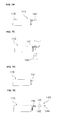
- FIGS. 7A through 7H are process diagrams conceptually illustrating a method of treating electrode tabs according to a preferred embodiment of the present invention
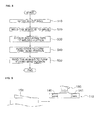
- FIG. 8 is a flowchart illustrating the steps of the method.
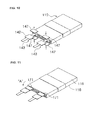
- a method of treating electrode tabs includes the steps of gathering and cutting grids 141 of a crude cell 110 (S10), welding the grids 141 to a tab member 143 (S20), attaching an insulating tape 147 to a welded portion 145 (S30) bending the grids 141 to form a first bend portion (S40), and bending the tab member 143 to form a second bend portion (S50).
- the grids 141 are gathered so that the end portions of the grids 141 may be close to a first surface 116 of the crude cell 110, and be substantially parallel to the first surface 116. Then, the end portions of the grids 141 are cut.
- the grids 141 of the crude cell 110 are disposed to be substantially parallel to the direction of electrode plates (anode plates or cathode plates), or are randomly scattered. Therefore, in order to weld such grids 141 to the tab member 143 at one position, it is necessary to gather and arrange the grids 143. In addition, in order to minimize the dead space, it is necessary that the grids 141 are cut to have a minimum length.
- step S10 when a slope 151 is moved to contact the grids 141 while the crude cell 110 shown in FIG. 7A is fixed by a jig 150, the grids 141 are pushed to the direction of the first surface 118 of the crude cell 110, and are gathered to be substantially parallel to the first surface 116, as shown in FIG. 7B.
- FIG. 7C when a cutter 160 having a predetermined shape is raised while the crude cell is fixed, unnecessary portions of the end portions of the grids 141 are cut away, and the end portions of the grids 141 are gathered more compactly, as shown in FIG. 7D.
- the tab member 143 comprising a resin portion 142 and a non-resin portion 144 is welded to the grids 141 of the crude cell 110 shown in FIG. 7D, and laser welding, ultrasonic welding, spot welding or the like is mainly used in this embodiment.
- the width of the tab member 143 is wider than that of the grids 141. Therefore, although welding may be performed with the tab member 143 disposed under the grids 141, it is preferable that welding is performed with the tab member 143 disposed on the grids 141.
- the length of a welded portion 145 formed by welding the grids 141 to the end portion of the non-resin portion 144 of the tab member 143 is in a range of about 1.0 through 2.5 mm.
- welding can be performed so that the length of the welded portion 145 may be shorter than a minimum length of the range, the possibility of welding defects increases, To the contrary, when the length of the welded portion 145 is longer than a maximum length of the range, it is undesirable that the unnecessary dead space and material cost increase.
- the welded portion is wrapped with tape so that metal (aluminum) portions 127 (FIG. 6) of the package member 120 can be prevented from being damaged by the grids 141 or the tab member 143, and therefore the battery 100 can be prevented from being short-circuited
- Insulating tape 147 is attached with an adhesive (not shown) to the upper and lower surfaces of the welded portion 145.
- the insulating tape 147 is made of polyimide or polypropylene film having characteristics of heat-resistance and chemical inertness.
- an acrylate-based adhesive or a silicone-based adhesive is used as an adhesive for attaching the insulating tape 147 to the welded portion 145. It is preferable that dimensions of the insulating tape 147 attached to the upper and lower surfaces of the welded portion 145 are sufficiently extended in the lengthwise direction of the grids 141 and the tab member 143 and in the widthwise direction of the grids 141 with reference to the center of the welded portion 145.
- the grids 141 are bent at a first bend portion 171 in the direction of arrow A in FIG, 11 so that the grids 141 may be close to a second surface 118 which is opposite to the first surface 116 of the crude cell 119, and may be perpendicular to the second surface 118.
- the first bend portion 171 is formed at the welded portion 145.
- the first bend portion 171 may be formed at a portion of the grids 141 to which the insulating tape is not attached, it is preferable that the first bend portion 171 is formed at the portion of the grids 141 to which the insulating tape 147 is attached.
- the strength of the grids 141 can be maintained at the bent portion.
- the insulating tape 147 can protect the grids 141 from damage.
- step S50 the tab member 143 is bent at the second bend portion 173 in the direction of arrow B so that the tab member 143 may be close to the first bend portion 171 and may be substantially parallel to the first surface 116. It is not preferable that the second bend portion 173 is formed at the welded portion 145, and it is preferable that the second bend portion 173 is formed at a position which is at least farther than the welded portion 145 from the first bend portion 171, and is positioned within the portion of the tab member 143 to which the insulating tape 147 is attached.
- the distance between the first bend portion 171 and the second bend portions 173 is adjusted to be appropriate for the number of stacked electrode plates of the crude cell 110 (the thickness of the crude cell 110). That is, it is preferable that when the number of stacked electrode plates is relatively large, the distance is set to be correspondingly long, and when the number of stacked electrode plates is relatively small, the distance is set to be correspondingly short.
- first bend portion 171 and the second bend portion 173 may be formed at positions which are substantially close to both sides of the insulating tape 147. That is, the first bend portion 171 may be formed at a position within the portion composed of the grids 141 only, and the second bend portion 173 may be formed at a position within the portion composed of the tab member 143 only so that the insulating tape 147 may not be bent.
- the lithium secondary battery 100 of the preferred embodiment of the present invention is manufactured by the above-described method of treating electrode tabs of a crude cell, the welded portion of the tab member 143 to the grids 141 can be protected by the insulating tape 147, and since the first bend portion 171 and the second bend portion 173 are formed at portions to which the insulating tape 147 are attached, the bent configuration of the bent portions can be more stably fixed, and the grids 141 and the tab member 143 can be protected from damage.
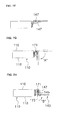
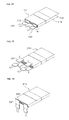
- FIGS. 13 through 15 are process diagrams schematically illustrating the steps of a method of treating electrode tabs of a crude cell for a lithium secondary battery according to another embodiment of the present invention
- FIG. 16 is a schematic section view of a lithium secondary battery employing the crude cell shown in FIG. 15.
- a method of treating electrode tabs of a crude cell 210 for a lithium secondary battery according to this embodiment further includes the step of forming a third bend portion 250 in addition to a first bend portion 220 and a second bend portion 240.
- the third bend portion 250 is mainly intended to flexibly meet different processing conditions due to variations in the length of a welded portion 245, for example, a longer length of the welded portion 245, and variations in the thickness of a battery determined by the number of stacked electrode plates (anode plates and cathode plates).
- the number of processing steps increases correspondingly
- a non-resin portion 242 of a tab member 243 is set to be relatively longer, and, as shown in FIG. 16, the tab member 243 is bent together with insulating tape 247 at the third bend portion 250.
- the insulating tape 247 having a length longer than that of the insulating tape 147 of the previous embodiment is used.
- FIG. 17 is a schematic section view illustrating a structure of a lithium secondary battery employing a crude cell according to still another embodiment of the present invention.
- a crude cell 310 has a structure in which after grids 311 are gathered and are welded to a tab member 313 to form a welded portion 315, insulating tape 317 is attached to the circumference of the welded portion 315 without forming any bent portion.
- a liquid electrolyte (not shown) is filled Into the receiving portion 322, and then the package member 320 is hermetically sealed, the manufacture of a lithium secondary battery is completed.
- the crude cell 310 may be a unit cell or bi-cell, or a cell formed by stacking the unit cells or the bi-cells.
- the lithium secondary battery 300 according to this embodiment is not related to a decrease of the dead space, and is intended to prevent a short circuit from being formed.
- the method of treating electrode tabs of a crude cell for a lithium secondary battery according to the present invention and the crude cell and the battery according to the method have the following effects.
- the dead space can be reduced to be smaller than that of a conventional battery, and since the length of the electrode plates can be lengthened as much as the reduced dead space, there is an effect that the capacity of the battery can be increased when the battery is compared to a conventional battery having the same dimensional specifications.
- the strength of the bent portions can be enhanced, and there is an effect in which the bent portions are prevented from being damaged when the portions are being bent.
Landscapes
- Chemical & Material Sciences (AREA)
- Chemical Kinetics & Catalysis (AREA)
- Electrochemistry (AREA)
- General Chemical & Material Sciences (AREA)
- Engineering & Computer Science (AREA)
- Manufacturing & Machinery (AREA)
- Connection Of Batteries Or Terminals (AREA)
- Secondary Cells (AREA)
- Battery Electrode And Active Subsutance (AREA)
- Cell Separators (AREA)
Applications Claiming Priority (2)
| Application Number | Priority Date | Filing Date | Title |
|---|---|---|---|
| KR10-2002-0032762A KR100483994B1 (ko) | 2002-06-12 | 2002-06-12 | 리튬 2차 전지용 크루드 셀의 전극탭 처리 방법 및 그에따른 크루드 셀 및 이를 채용한 리튬 2차 전지 |
| KR2002032762 | 2002-06-12 |
Publications (2)
| Publication Number | Publication Date |
|---|---|
| EP1387419A2 true EP1387419A2 (de) | 2004-02-04 |
| EP1387419A3 EP1387419A3 (de) | 2004-04-07 |
Family
ID=29728630
Family Applications (1)
| Application Number | Title | Priority Date | Filing Date |
|---|---|---|---|
| EP02258978A Withdrawn EP1387419A3 (de) | 2002-06-12 | 2002-12-24 | Verfahren zur Behandlung von Elektrodenlaschen für Lithium Sekundärbatterienzelle und so hergestellte Zelle und Batterie |
Country Status (6)
| Country | Link |
|---|---|
| US (4) | US7067218B2 (de) |
| EP (1) | EP1387419A3 (de) |
| JP (1) | JP4065915B2 (de) |
| KR (1) | KR100483994B1 (de) |
| CN (2) | CN1941491A (de) |
| TW (1) | TWI222233B (de) |
Cited By (2)
| Publication number | Priority date | Publication date | Assignee | Title |
|---|---|---|---|---|
| US9806321B2 (en) | 2010-02-19 | 2017-10-31 | Samsung Sdi Co., Ltd. | Electrode assembly having compact electrode tabs and secondary battery using the same |
| CN111554865A (zh) * | 2020-05-15 | 2020-08-18 | 广东佐林新能源科技有限公司 | 一种盘式铝转镍极耳包胶方法 |
Families Citing this family (84)
| Publication number | Priority date | Publication date | Assignee | Title |
|---|---|---|---|---|
| KR100601548B1 (ko) * | 2004-05-25 | 2006-07-19 | 삼성에스디아이 주식회사 | 이차전지 |
| US9508973B2 (en) * | 2004-05-25 | 2016-11-29 | Samsung Sdi Co., Ltd. | Secondary battery |
| US20060051652A1 (en) * | 2004-07-28 | 2006-03-09 | Edward Samuels | Interleave machine and method for stacking flat objects |
| KR100590009B1 (ko) * | 2004-09-07 | 2006-06-14 | 삼성에스디아이 주식회사 | 이차 전지와 이에 사용되는 전극 조립체 |
| KR100860002B1 (ko) * | 2004-11-15 | 2008-09-25 | 주식회사 엘지화학 | 교번 배향 구조의 이차전지 팩 |
| KR100624953B1 (ko) * | 2004-11-29 | 2006-09-18 | 삼성에스디아이 주식회사 | 리튬 이차 전지 |
| EP2426758B1 (de) * | 2005-11-08 | 2021-07-21 | LG Chem, Ltd. | Sekundärbatterie |
| JP4599314B2 (ja) * | 2006-02-22 | 2010-12-15 | 株式会社東芝 | 非水電解質電池、電池パック及び自動車 |
| JP4557920B2 (ja) * | 2006-03-30 | 2010-10-06 | 株式会社東芝 | 非水電解質電池 |
| KR100891078B1 (ko) * | 2006-04-03 | 2009-03-30 | 주식회사 엘지화학 | 안전성과 용량이 증가된 리튬 이차전지 |
| KR100848788B1 (ko) | 2006-07-24 | 2008-07-30 | 주식회사 엘지화학 | 결합부에서 전극 탭들의 크기가 동일한 전극조립체 및 이를포함하고 있는 전기화학 셀 |
| KR100888284B1 (ko) * | 2006-07-24 | 2009-03-10 | 주식회사 엘지화학 | 탭-리드 결합부의 전극간 저항차를 최소화한 전극조립체 및이를 포함하고 있는 전기화학 셀 |
| US8268477B2 (en) * | 2006-07-31 | 2012-09-18 | Lg Chem, Ltd. | Secondary battery with top sealed portion of improved structure |
| KR100818196B1 (ko) * | 2006-08-11 | 2008-04-01 | 주식회사 코캄 | 2차 전지의 그리드와 전극 탭의 연결 방법 및 구조체 |
| US8717932B2 (en) * | 2006-11-29 | 2014-05-06 | Broadcom Corporation | Method and system for determining and securing proximity information over a network |
| KR100810601B1 (ko) | 2006-12-29 | 2008-03-06 | 새한에너테크 주식회사 | 대면적 2차전지용 크루드 셀 및 그 제조방법 |
| KR101048226B1 (ko) * | 2007-01-25 | 2011-07-08 | 에스케이이노베이션 주식회사 | 리튬 이차 전지 |
| US20090081552A1 (en) | 2007-09-24 | 2009-03-26 | Greatbatch Ltd. | Electrochemical cell with tightly held electrode assembly |
| KR101352651B1 (ko) * | 2008-01-11 | 2014-01-16 | 주식회사 엘지화학 | 탭 보호필름을 포함하는 이차전지 |
| JP5157500B2 (ja) * | 2008-02-06 | 2013-03-06 | ソニー株式会社 | 非水電解質電池およびその製造方法 |
| JP2009199825A (ja) * | 2008-02-20 | 2009-09-03 | Sumitomo Chemical Co Ltd | 電極群を有するデバイス |
| KR100954590B1 (ko) | 2008-02-20 | 2010-04-26 | 삼성에스디아이 주식회사 | 전극 조립체 및 이를 구비하는 이차 전지 |
| US7875382B2 (en) * | 2008-08-28 | 2011-01-25 | International Battery, Inc. | Battery |
| CN102197530B (zh) * | 2008-09-09 | 2015-10-21 | 江森自控帅福得先进能源动力系统有限责任公司 | 具有折叠电极的电化学电池单元 |
| FR2944150B1 (fr) * | 2009-04-07 | 2011-05-06 | Saft Groupe Sa | Accumulateur et procede de fabrication |
| US20110052969A1 (en) * | 2009-09-01 | 2011-03-03 | Gm Global Technology Operations, Inc. | Cell tab joining for battery modules |
| KR101136156B1 (ko) | 2009-11-02 | 2012-04-17 | 삼성에스디아이 주식회사 | 이차전지 및 그 이차전지의 제조방법 |
| JP5520017B2 (ja) * | 2009-11-30 | 2014-06-11 | 旭化成株式会社 | ラミネートフィルム外装体を有する蓄電素子 |
| KR101156344B1 (ko) * | 2009-12-07 | 2012-06-13 | 삼성에스디아이 주식회사 | 이차전지 및 그 제조 방법 |
| JP2011129263A (ja) * | 2009-12-15 | 2011-06-30 | Murata Mfg Co Ltd | 蓄電デバイスとその製造方法 |
| KR101100990B1 (ko) * | 2009-12-15 | 2011-12-29 | 삼성에스디아이 주식회사 | 이차전지 |
| CA137223S (en) * | 2010-03-23 | 2011-08-22 | Heiniger Ag | Cattle clipper blade |
| JP2011210662A (ja) * | 2010-03-30 | 2011-10-20 | Sanyo Electric Co Ltd | 積層式電池 |
| US8962179B2 (en) * | 2010-08-30 | 2015-02-24 | Samsung Sdi Co., Ltd. | Secondary battery |
| JP2012054029A (ja) * | 2010-08-31 | 2012-03-15 | Sanyo Electric Co Ltd | 積層式電池 |
| US9490464B2 (en) | 2010-10-01 | 2016-11-08 | Samsung Sdi Co., Ltd. | Secondary battery |
| JP5844052B2 (ja) * | 2011-02-04 | 2016-01-13 | 三洋電機株式会社 | 積層式電池およびその製造方法 |
| JP2012199162A (ja) * | 2011-03-23 | 2012-10-18 | Sanyo Electric Co Ltd | ラミネート外装体二次電池 |
| US9142840B2 (en) | 2011-10-21 | 2015-09-22 | Blackberry Limited | Method of reducing tabbing volume required for external connections |
| US10446828B2 (en) | 2011-10-21 | 2019-10-15 | Blackberry Limited | Recessed tab for higher energy density and thinner batteries |
| EP2584630B1 (de) * | 2011-10-21 | 2016-04-13 | BlackBerry Limited | Methode zur Reduzierung des für die externen Anschlüsse einer Elektrodenbaugruppe notwendigen Volumens |
| US20140335400A1 (en) * | 2012-02-24 | 2014-11-13 | Amita Technologies Inc Ltd. | Lithium battery |
| JP6058037B2 (ja) | 2012-04-16 | 2017-01-11 | エルジー・ケム・リミテッド | 正極と負極の溶接部位の形状が異なる電極組立体及びそれを含む二次電池 |
| JP6313227B2 (ja) * | 2012-04-16 | 2018-04-18 | エルジー・ケム・リミテッド | 互いに異なる形状の正極及び負極を含む電極組立体及び二次電池 |
| JP2014038817A (ja) * | 2012-08-21 | 2014-02-27 | Toc Capacita Co Ltd | 蓄電器の電極タブとタブリードの接続構造及び接続方法 |
| JP6160350B2 (ja) * | 2013-08-06 | 2017-07-12 | 株式会社豊田自動織機 | 蓄電装置 |
| KR101610680B1 (ko) | 2013-09-02 | 2016-04-20 | 주식회사 엘지화학 | 이차전지의 전극탭 용접방법 및 이를 이용하여 제조된 전극조립체 |
| KR101666418B1 (ko) * | 2013-09-24 | 2016-10-14 | 주식회사 엘지화학 | 전극리드-전극 탭 결합부 보호용 필름부재를 포함하는 파우치형 전지셀 |
| JP6394867B2 (ja) * | 2014-07-30 | 2018-09-26 | 株式会社豊田自動織機 | 蓄電装置 |
| KR102324343B1 (ko) | 2015-01-07 | 2021-11-10 | 삼성에스디아이 주식회사 | 이차 전지 |
| WO2016121339A1 (ja) * | 2015-01-29 | 2016-08-04 | 三洋電機株式会社 | 非水電解質二次電池 |
| KR102266594B1 (ko) * | 2015-03-13 | 2021-06-17 | 삼성에스디아이 주식회사 | 이차 전지 |
| CN107851852B (zh) * | 2015-08-26 | 2020-05-29 | 松下知识产权经营株式会社 | 蓄电装置 |
| WO2017037981A1 (ja) * | 2015-08-31 | 2017-03-09 | パナソニックIpマネジメント株式会社 | 非水電解質二次電池 |
| KR102525618B1 (ko) * | 2015-10-28 | 2023-04-24 | 삼성에스디아이 주식회사 | 전극 조립체와 이를 포함하는 이차 전지 |
| KR102018849B1 (ko) * | 2015-11-11 | 2019-09-05 | 주식회사 엘지화학 | 돌출 연장부와 탭 연결부를 구비한 전극 리드를 포함하고 있는 전지셀 |
| KR102510884B1 (ko) | 2015-11-19 | 2023-03-16 | 삼성에스디아이 주식회사 | 이차전지 |
| KR102562335B1 (ko) * | 2015-11-23 | 2023-07-31 | 삼성에스디아이 주식회사 | 이차 전지용 외장재 및 이를 포함하는 이차 전지 |
| KR101746993B1 (ko) * | 2015-12-24 | 2017-06-14 | 주식회사 포스코 | Fe-Ni계 합금 금속 포일의 전기도금장치 및 방법 |
| JP6960586B2 (ja) * | 2016-02-29 | 2021-11-05 | パナソニックIpマネジメント株式会社 | 電極体の製造方法、及び非水電解質二次電池の製造方法 |
| KR102071868B1 (ko) | 2016-08-26 | 2020-01-31 | 주식회사 엘지화학 | 에어 블로잉 유닛을 포함하는 전극조립체 제조 장치 |
| KR102289692B1 (ko) * | 2016-09-06 | 2021-08-13 | 삼성에스디아이 주식회사 | 두께의 차이를 갖는 전극탭의 제조방법 및 이를 포함하는 이차전지 |
| CN206250261U (zh) | 2016-12-02 | 2017-06-13 | 宁德时代新能源科技股份有限公司 | 二次电池 |
| CN107470404A (zh) * | 2017-09-14 | 2017-12-15 | 浙江谷神能源科技股份有限公司 | 一种锂离子电池极耳弯折装置及其工艺 |
| JP7165526B2 (ja) * | 2017-09-28 | 2022-11-04 | マクセル株式会社 | 電気化学素子 |
| TWI676315B (zh) * | 2017-10-20 | 2019-11-01 | 輝能科技股份有限公司 | 複合式電池芯 |
| USD871671S1 (en) * | 2017-10-24 | 2019-12-31 | Javier Aguilar Garcia | Haircutting machine blade |
| CN110556500A (zh) * | 2018-05-31 | 2019-12-10 | 比亚迪股份有限公司 | 锂离子二次电池组件及其制备方法和锂离子二次电池 |
| CN112242499A (zh) * | 2019-07-19 | 2021-01-19 | 宁德新能源科技有限公司 | 电芯及具有所述电芯的电池 |
| KR102845683B1 (ko) * | 2019-08-14 | 2025-08-12 | 현대자동차주식회사 | 리튬이온 이차전지 및 그 제조방법 |
| KR102869017B1 (ko) * | 2019-09-18 | 2025-10-02 | 현대자동차주식회사 | 리튬이온 이차전지 및 그 제조방법 |
| JP7264077B2 (ja) * | 2020-01-31 | 2023-04-25 | トヨタ自動車株式会社 | 全固体電池 |
| WO2021192406A1 (ja) * | 2020-03-25 | 2021-09-30 | 株式会社村田製作所 | 二次電池 |
| EP4203091A4 (de) * | 2020-08-18 | 2024-10-16 | SANYO Electric Co., Ltd. | Sekundärbatterie mit nichtwässrigem elektrolyten |
| KR102654648B1 (ko) * | 2021-04-08 | 2024-04-04 | 삼성에스디아이 주식회사 | 이차전지 |
| KR102899566B1 (ko) * | 2021-06-24 | 2025-12-12 | 주식회사 엘지에너지솔루션 | 전극 탭 보호 테이프 및 이를 포함하는 이차전지 |
| CN113675535B (zh) * | 2021-07-14 | 2024-02-23 | 宁德新能源科技有限公司 | 电芯及电子装置 |
| CN113972448B (zh) * | 2021-10-19 | 2022-08-09 | 东莞新能安科技有限公司 | 一种电化学装置及包含该电化学装置的电子装置 |
| KR20230085534A (ko) * | 2021-12-07 | 2023-06-14 | 주식회사 엘지에너지솔루션 | 모따기 된 보호 테이프가 형성된 전지셀 |
| EP4485674A4 (de) * | 2022-04-15 | 2025-10-15 | Lg Energy Solution Ltd | Pouchzelle, bei der der verbindungsteil zwischen elektrodenlasche und elektrodenleitung mit isoliermaterial abgedeckt ist |
| DE102022211098A1 (de) * | 2022-10-20 | 2024-04-25 | Volkswagen Aktiengesellschaft | Batteriezelle sowie Verfahren zu deren Herstellung |
| DE102022213900A1 (de) * | 2022-12-19 | 2024-06-20 | Volkswagen Aktiengesellschaft | Batteriepouchzelle |
| SE2350706A1 (en) * | 2023-06-09 | 2024-12-10 | Northvolt Ab | Apparatus and method for shaping electrode tabs |
| JP2025066401A (ja) * | 2023-10-11 | 2025-04-23 | プライムプラネットエナジー&ソリューションズ株式会社 | 蓄電デバイスの製造方法 |
Family Cites Families (14)
| Publication number | Priority date | Publication date | Assignee | Title |
|---|---|---|---|---|
| US5354629A (en) * | 1991-10-09 | 1994-10-11 | Sanyo Electric Co., Ltd. | Monaqueous electrolyte battery |
| US5705297A (en) * | 1996-03-04 | 1998-01-06 | Bell Communications Research, Inc. | Electrical connection for a polymeric laminate battery structure |
| JPH11260417A (ja) * | 1998-03-12 | 1999-09-24 | Toshiba Battery Co Ltd | 高分子電解質リチウム二次電池 |
| WO2000059063A1 (en) * | 1999-03-26 | 2000-10-05 | Matsushita Electric Industrial Co., Ltd. | Laminate sheath type battery |
| KR100342045B1 (ko) * | 1999-04-16 | 2002-06-27 | 김순택 | 2차전지 |
| KR100428971B1 (ko) | 1999-04-21 | 2004-04-28 | 삼성에스디아이 주식회사 | 리튬 폴리머 2차전지 및 그 제조 방법 |
| US6844110B2 (en) * | 2000-05-24 | 2005-01-18 | Ngk Insulators, Ltd. | Lithium secondary cell and assembly thereof |
| JP2002075324A (ja) * | 2000-09-04 | 2002-03-15 | Mitsubishi Chemicals Corp | 電 池 |
| CN1350968A (zh) * | 2000-10-27 | 2002-05-29 | 厦门宝龙工业股份有限公司 | 电池电极片的绝缘方法 |
| KR20020039097A (ko) * | 2000-11-20 | 2002-05-25 | 이원재 | 리튬 2차전지의 제조방법 및 이를 위한 전극 탭 |
| KR100449757B1 (ko) * | 2001-11-23 | 2004-09-22 | 삼성에스디아이 주식회사 | 전지부와 이를 채용한 이차전지 |
| JP3733917B2 (ja) * | 2002-02-28 | 2006-01-11 | 三菱マテリアル株式会社 | ポリマー二次電池の端子接続構造及びその端子接続方法 |
| KR200289707Y1 (ko) * | 2002-06-12 | 2002-09-19 | 주식회사 코캄엔지니어링 | 리튬 2차 전지용 크루드 셀 및 이에 따른 리튬 2차 전지 |
| JP4449447B2 (ja) * | 2003-12-22 | 2010-04-14 | 日産自動車株式会社 | 固体電解質電池の製造方法 |
-
2002
- 2002-06-12 KR KR10-2002-0032762A patent/KR100483994B1/ko not_active Ceased
- 2002-12-24 EP EP02258978A patent/EP1387419A3/de not_active Withdrawn
- 2002-12-27 CN CNA2006101039358A patent/CN1941491A/zh active Pending
- 2002-12-27 CN CNB021595569A patent/CN1326260C/zh not_active Expired - Fee Related
-
2003
- 2003-01-28 TW TW092101901A patent/TWI222233B/zh not_active IP Right Cessation
- 2003-02-17 JP JP2003037677A patent/JP4065915B2/ja not_active Expired - Fee Related
- 2003-05-23 US US10/446,272 patent/US7067218B2/en not_active Expired - Fee Related
-
2006
- 2006-06-26 US US11/474,877 patent/US20060286454A1/en not_active Abandoned
-
2007
- 2007-10-12 US US11/871,175 patent/US20080028598A1/en not_active Abandoned
- 2007-10-12 US US11/871,177 patent/US20080083113A1/en not_active Abandoned
Non-Patent Citations (1)
| Title |
|---|
| None |
Cited By (3)
| Publication number | Priority date | Publication date | Assignee | Title |
|---|---|---|---|---|
| US9806321B2 (en) | 2010-02-19 | 2017-10-31 | Samsung Sdi Co., Ltd. | Electrode assembly having compact electrode tabs and secondary battery using the same |
| CN111554865A (zh) * | 2020-05-15 | 2020-08-18 | 广东佐林新能源科技有限公司 | 一种盘式铝转镍极耳包胶方法 |
| CN111554865B (zh) * | 2020-05-15 | 2022-04-12 | 广东佐林新能源科技有限公司 | 一种盘式铝转镍极耳包胶方法 |
Also Published As
| Publication number | Publication date |
|---|---|
| TW200308113A (en) | 2003-12-16 |
| KR100483994B1 (ko) | 2005-04-18 |
| EP1387419A3 (de) | 2004-04-07 |
| US20060286454A1 (en) | 2006-12-21 |
| US20080028598A1 (en) | 2008-02-07 |
| US7067218B2 (en) | 2006-06-27 |
| CN1466236A (zh) | 2004-01-07 |
| KR20030095519A (ko) | 2003-12-24 |
| CN1941491A (zh) | 2007-04-04 |
| US20080083113A1 (en) | 2008-04-10 |
| JP2004022534A (ja) | 2004-01-22 |
| JP4065915B2 (ja) | 2008-03-26 |
| CN1326260C (zh) | 2007-07-11 |
| US20030232243A1 (en) | 2003-12-18 |
| TWI222233B (en) | 2004-10-11 |
Similar Documents
| Publication | Publication Date | Title |
|---|---|---|
| US7067218B2 (en) | Method for treating electrode tabs of crude cell for lithium secondary battery, and crude cell and lithium secondary battery according to the method | |
| JP6735445B2 (ja) | 捲回型電池 | |
| JP5174840B2 (ja) | 二次電池 | |
| JP6859059B2 (ja) | リチウムイオン二次電池及びその製造方法 | |
| KR101136156B1 (ko) | 이차전지 및 그 이차전지의 제조방법 | |
| JP5214543B2 (ja) | 二次電池 | |
| US8119277B2 (en) | Stack type battery | |
| JP4276102B2 (ja) | パウチ型リチウム二次電池とその製造方法 | |
| US20060008702A1 (en) | Secondary battery | |
| JPWO2018020906A1 (ja) | 角形二次電池 | |
| CN107851768B (zh) | 电化学器件的制造方法 | |
| CN1713417A (zh) | 电极组件和使用该电极组件的可再充电电池 | |
| US20110076544A1 (en) | Stack type battery | |
| KR20220109177A (ko) | 외형고정틀이 구비된 전극조립체 및 이를 포함하는 리튬 이차전지 | |
| JP3221324B2 (ja) | 薄型電池およびその製造法 | |
| KR20170049275A (ko) | 전극 조립체와 이를 포함하는 이차 전지 | |
| KR20170095072A (ko) | 이차 전지 및 이차 전지 제조방법 | |
| KR200289707Y1 (ko) | 리튬 2차 전지용 크루드 셀 및 이에 따른 리튬 2차 전지 | |
| JP2002175839A (ja) | 密閉型電池 | |
| JP2016029617A (ja) | 非水電解質二次電池 | |
| JP2015207362A (ja) | 蓄電デバイスの製造方法 | |
| KR20150072107A (ko) | 미 열융착 라인을 통해 파우치형 케이스의 주변 부위가 접힌 이차전지 | |
| US6541155B2 (en) | Bicell battery apparatus | |
| KR20240033576A (ko) | 젤리롤 타입 배터리 셀 | |
| KR20230048927A (ko) | 리튬 이차전지 및 그 제조방법 |
Legal Events
| Date | Code | Title | Description |
|---|---|---|---|
| PUAI | Public reference made under article 153(3) epc to a published international application that has entered the european phase |
Free format text: ORIGINAL CODE: 0009012 |
|
| AK | Designated contracting states |
Kind code of ref document: A2 Designated state(s): AT BE BG CH CY CZ DE DK EE ES FI FR GB GR IE IT LI LU MC NL PT SE SI SK TR |
|
| AX | Request for extension of the european patent |
Extension state: AL LT LV MK RO |
|
| PUAL | Search report despatched |
Free format text: ORIGINAL CODE: 0009013 |
|
| AK | Designated contracting states |
Kind code of ref document: A3 Designated state(s): AT BE BG CH CY CZ DE DK EE ES FI FR GB GR IE IT LI LU MC NL PT SE SI SK TR |
|
| AX | Request for extension of the european patent |
Extension state: AL LT LV MK RO |
|
| RIC1 | Information provided on ipc code assigned before grant |
Ipc: 7H 01M 2/26 B Ipc: 7H 01M 10/04 B Ipc: 7H 01M 2/02 A |
|
| 17P | Request for examination filed |
Effective date: 20040728 |
|
| AKX | Designation fees paid |
Designated state(s): AT BE BG CH CY CZ DE DK EE ES FI FR GB GR IE IT LI LU MC NL PT SE SI SK TR |
|
| RAP1 | Party data changed (applicant data changed or rights of an application transferred) |
Owner name: EAGLEPICHER KOKAM CO., LTD. |
|
| RAP1 | Party data changed (applicant data changed or rights of an application transferred) |
Owner name: KOKAM CO., LTD. |
|
| 17Q | First examination report despatched |
Effective date: 20100318 |
|
| RIC1 | Information provided on ipc code assigned before grant |
Ipc: H01M 2/02 20060101AFI20120720BHEP Ipc: H01M 2/18 20060101ALI20120720BHEP Ipc: H01M 2/26 20060101ALI20120720BHEP Ipc: H01M 2/16 20060101ALI20120720BHEP Ipc: H01M 10/04 20060101ALI20120720BHEP |
|
| GRAP | Despatch of communication of intention to grant a patent |
Free format text: ORIGINAL CODE: EPIDOSNIGR1 |
|
| STAA | Information on the status of an ep patent application or granted ep patent |
Free format text: STATUS: THE APPLICATION IS DEEMED TO BE WITHDRAWN |
|
| 18D | Application deemed to be withdrawn |
Effective date: 20130116 |