EP1134824A2 - Batterie mit nichtwässrigem Elektrolyt - Google Patents
Batterie mit nichtwässrigem Elektrolyt Download PDFInfo
- Publication number
- EP1134824A2 EP1134824A2 EP01302081A EP01302081A EP1134824A2 EP 1134824 A2 EP1134824 A2 EP 1134824A2 EP 01302081 A EP01302081 A EP 01302081A EP 01302081 A EP01302081 A EP 01302081A EP 1134824 A2 EP1134824 A2 EP 1134824A2
- Authority
- EP
- European Patent Office
- Prior art keywords
- negative electrode
- active material
- electrode active
- nonaqueous electrolyte
- battery
- Prior art date
- Legal status (The legal status is an assumption and is not a legal conclusion. Google has not performed a legal analysis and makes no representation as to the accuracy of the status listed.)
- Withdrawn
Links
- 239000011255 nonaqueous electrolyte Substances 0.000 title claims abstract description 43
- 239000007773 negative electrode material Substances 0.000 claims abstract description 63
- 229910052783 alkali metal Inorganic materials 0.000 claims abstract description 26
- 150000001340 alkali metals Chemical class 0.000 claims abstract description 26
- 229910052787 antimony Inorganic materials 0.000 claims abstract description 21
- 229910017695 AgAsMg Inorganic materials 0.000 claims abstract description 16
- 239000013078 crystal Substances 0.000 claims abstract description 16
- 229910018301 Cu2MnAl Inorganic materials 0.000 claims abstract description 15
- 229910052797 bismuth Inorganic materials 0.000 claims abstract description 10
- 229910052698 phosphorus Inorganic materials 0.000 claims abstract description 10
- 229910052718 tin Inorganic materials 0.000 claims abstract description 10
- 229910052782 aluminium Inorganic materials 0.000 claims abstract description 9
- 229910052732 germanium Inorganic materials 0.000 claims abstract description 9
- 229910052710 silicon Inorganic materials 0.000 claims abstract description 8
- 150000001875 compounds Chemical class 0.000 claims description 29
- 239000000463 material Substances 0.000 claims description 23
- 238000002844 melting Methods 0.000 claims description 15
- 230000008018 melting Effects 0.000 claims description 15
- 239000002245 particle Substances 0.000 claims description 14
- 239000002033 PVDF binder Substances 0.000 claims description 13
- 229920002981 polyvinylidene fluoride Polymers 0.000 claims description 13
- WATWJIUSRGPENY-UHFFFAOYSA-N antimony atom Chemical compound [Sb] WATWJIUSRGPENY-UHFFFAOYSA-N 0.000 claims description 12
- OKTJSMMVPCPJKN-UHFFFAOYSA-N Carbon Chemical compound [C] OKTJSMMVPCPJKN-UHFFFAOYSA-N 0.000 claims description 11
- 229910005483 Ni2MnSb Inorganic materials 0.000 claims description 11
- 239000011230 binding agent Substances 0.000 claims description 11
- 239000006258 conductive agent Substances 0.000 claims description 11
- -1 polytetrafluoroethylene Polymers 0.000 claims description 11
- 239000000203 mixture Substances 0.000 claims description 7
- 238000002156 mixing Methods 0.000 claims description 6
- 229920001343 polytetrafluoroethylene Polymers 0.000 claims description 6
- 239000004810 polytetrafluoroethylene Substances 0.000 claims description 6
- 239000006230 acetylene black Substances 0.000 claims description 5
- 239000010439 graphite Substances 0.000 claims description 5
- 229910002804 graphite Inorganic materials 0.000 claims description 5
- 229910021212 Co2MgSb Inorganic materials 0.000 claims description 3
- 229910021211 Co2MnSb Inorganic materials 0.000 claims description 3
- 229910021298 Co3Sn Inorganic materials 0.000 claims description 3
- 229910019287 CoMgSb Inorganic materials 0.000 claims description 3
- 229910019353 CoMnSb Inorganic materials 0.000 claims description 3
- 229910018859 CoNbSb Inorganic materials 0.000 claims description 3
- 229910019107 CoTiSb Inorganic materials 0.000 claims description 3
- 229910019379 CoVSb Inorganic materials 0.000 claims description 3
- 229910016521 CuMgSb Inorganic materials 0.000 claims description 3
- 229910017372 Fe3Al Inorganic materials 0.000 claims description 3
- 229910017384 Fe3Si Inorganic materials 0.000 claims description 3
- 229910005447 FeVSb Inorganic materials 0.000 claims description 3
- 229910005415 Ni2MgSb Inorganic materials 0.000 claims description 3
- 229910005102 Ni3Sn Inorganic materials 0.000 claims description 3
- 229910005814 NiMgSb Inorganic materials 0.000 claims description 3
- 229910005811 NiMnSb Inorganic materials 0.000 claims description 3
- 229910005863 NiNbSb Inorganic materials 0.000 claims description 3
- 229910005912 NiTiSb Inorganic materials 0.000 claims description 3
- 229910006169 NiVSb Inorganic materials 0.000 claims description 3
- 239000006229 carbon black Substances 0.000 claims description 3
- 229920001973 fluoroelastomer Polymers 0.000 claims description 3
- 239000011164 primary particle Substances 0.000 claims description 3
- 239000011163 secondary particle Substances 0.000 claims description 3
- 229920002134 Carboxymethyl cellulose Polymers 0.000 claims description 2
- 239000005062 Polybutadiene Substances 0.000 claims description 2
- 229920002857 polybutadiene Polymers 0.000 claims description 2
- 230000001351 cycling effect Effects 0.000 abstract 1
- 229910052744 lithium Inorganic materials 0.000 description 23
- WHXSMMKQMYFTQS-UHFFFAOYSA-N Lithium Chemical compound [Li] WHXSMMKQMYFTQS-UHFFFAOYSA-N 0.000 description 19
- 239000002904 solvent Substances 0.000 description 13
- 239000002131 composite material Substances 0.000 description 10
- 239000003792 electrolyte Substances 0.000 description 10
- 239000000843 powder Substances 0.000 description 10
- 238000006243 chemical reaction Methods 0.000 description 9
- 239000007774 positive electrode material Substances 0.000 description 7
- 239000000470 constituent Substances 0.000 description 6
- 239000011888 foil Substances 0.000 description 6
- NUJOXMJBOLGQSY-UHFFFAOYSA-N manganese dioxide Chemical compound O=[Mn]=O NUJOXMJBOLGQSY-UHFFFAOYSA-N 0.000 description 6
- 229910000733 Li alloy Inorganic materials 0.000 description 5
- 230000015572 biosynthetic process Effects 0.000 description 5
- WUKWITHWXAAZEY-UHFFFAOYSA-L calcium difluoride Chemical group [F-].[F-].[Ca+2] WUKWITHWXAAZEY-UHFFFAOYSA-L 0.000 description 5
- 238000005868 electrolysis reaction Methods 0.000 description 5
- 238000010438 heat treatment Methods 0.000 description 5
- 239000001989 lithium alloy Substances 0.000 description 5
- 239000007784 solid electrolyte Substances 0.000 description 5
- KMTRUDSVKNLOMY-UHFFFAOYSA-N Ethylene carbonate Chemical compound O=C1OCCO1 KMTRUDSVKNLOMY-UHFFFAOYSA-N 0.000 description 4
- 229920003171 Poly (ethylene oxide) Polymers 0.000 description 4
- 238000000034 method Methods 0.000 description 4
- 239000000178 monomer Substances 0.000 description 4
- 238000002360 preparation method Methods 0.000 description 4
- 238000003825 pressing Methods 0.000 description 4
- 238000003786 synthesis reaction Methods 0.000 description 4
- XOLBLPGZBRYERU-UHFFFAOYSA-N tin dioxide Chemical compound O=[Sn]=O XOLBLPGZBRYERU-UHFFFAOYSA-N 0.000 description 4
- WEVYAHXRMPXWCK-UHFFFAOYSA-N Acetonitrile Chemical compound CC#N WEVYAHXRMPXWCK-UHFFFAOYSA-N 0.000 description 3
- RYGMFSIKBFXOCR-UHFFFAOYSA-N Copper Chemical compound [Cu] RYGMFSIKBFXOCR-UHFFFAOYSA-N 0.000 description 3
- SECXISVLQFMRJM-UHFFFAOYSA-N N-Methylpyrrolidone Chemical compound CN1CCCC1=O SECXISVLQFMRJM-UHFFFAOYSA-N 0.000 description 3
- USHGRFXQYJEHII-UHFFFAOYSA-M [O-]P(O)(O)=O.[Li+].F.F.F.F.F.F Chemical compound [O-]P(O)(O)=O.[Li+].F.F.F.F.F.F USHGRFXQYJEHII-UHFFFAOYSA-M 0.000 description 3
- 239000011149 active material Substances 0.000 description 3
- XAGFODPZIPBFFR-UHFFFAOYSA-N aluminium Chemical compound [Al] XAGFODPZIPBFFR-UHFFFAOYSA-N 0.000 description 3
- 230000000052 comparative effect Effects 0.000 description 3
- 239000011889 copper foil Substances 0.000 description 3
- 150000005676 cyclic carbonates Chemical class 0.000 description 3
- JBTWLSYIZRCDFO-UHFFFAOYSA-N ethyl methyl carbonate Chemical compound CCOC(=O)OC JBTWLSYIZRCDFO-UHFFFAOYSA-N 0.000 description 3
- 229910003480 inorganic solid Inorganic materials 0.000 description 3
- 150000002642 lithium compounds Chemical class 0.000 description 3
- 229910003002 lithium salt Inorganic materials 0.000 description 3
- 159000000002 lithium salts Chemical class 0.000 description 3
- 239000012071 phase Substances 0.000 description 3
- 238000003746 solid phase reaction Methods 0.000 description 3
- DHKHKXVYLBGOIT-UHFFFAOYSA-N 1,1-Diethoxyethane Chemical compound CCOC(C)OCC DHKHKXVYLBGOIT-UHFFFAOYSA-N 0.000 description 2
- YEJRWHAVMIAJKC-UHFFFAOYSA-N 4-Butyrolactone Chemical compound O=C1CCCO1 YEJRWHAVMIAJKC-UHFFFAOYSA-N 0.000 description 2
- XKRFYHLGVUSROY-UHFFFAOYSA-N Argon Chemical compound [Ar] XKRFYHLGVUSROY-UHFFFAOYSA-N 0.000 description 2
- 229910018999 CoSi2 Inorganic materials 0.000 description 2
- 229910002993 LiMnO2 Inorganic materials 0.000 description 2
- 229910014994 LiMnxCo1-xO2 Inorganic materials 0.000 description 2
- 229910019752 Mg2Si Inorganic materials 0.000 description 2
- 229910019743 Mg2Sn Inorganic materials 0.000 description 2
- 229910019465 NaTl Inorganic materials 0.000 description 2
- 229910012990 NiSi2 Inorganic materials 0.000 description 2
- 239000004698 Polyethylene Substances 0.000 description 2
- WYURNTSHIVDZCO-UHFFFAOYSA-N Tetrahydrofuran Chemical compound C1CCOC1 WYURNTSHIVDZCO-UHFFFAOYSA-N 0.000 description 2
- NXPZICSHDHGMGT-UHFFFAOYSA-N [Co].[Mn].[Li] Chemical compound [Co].[Mn].[Li] NXPZICSHDHGMGT-UHFFFAOYSA-N 0.000 description 2
- PFYQFCKUASLJLL-UHFFFAOYSA-N [Co].[Ni].[Li] Chemical compound [Co].[Ni].[Li] PFYQFCKUASLJLL-UHFFFAOYSA-N 0.000 description 2
- KLARSDUHONHPRF-UHFFFAOYSA-N [Li].[Mn] Chemical compound [Li].[Mn] KLARSDUHONHPRF-UHFFFAOYSA-N 0.000 description 2
- 239000003575 carbonaceous material Substances 0.000 description 2
- 150000001786 chalcogen compounds Chemical class 0.000 description 2
- 239000011248 coating agent Substances 0.000 description 2
- 238000000576 coating method Methods 0.000 description 2
- CKFRRHLHAJZIIN-UHFFFAOYSA-N cobalt lithium Chemical compound [Li].[Co] CKFRRHLHAJZIIN-UHFFFAOYSA-N 0.000 description 2
- 229920001577 copolymer Polymers 0.000 description 2
- 238000001035 drying Methods 0.000 description 2
- FKRCODPIKNYEAC-UHFFFAOYSA-N ethyl propionate Chemical compound CCOC(=O)CC FKRCODPIKNYEAC-UHFFFAOYSA-N 0.000 description 2
- 238000010348 incorporation Methods 0.000 description 2
- 239000011244 liquid electrolyte Substances 0.000 description 2
- RSNHXDVSISOZOB-UHFFFAOYSA-N lithium nickel Chemical compound [Li].[Ni] RSNHXDVSISOZOB-UHFFFAOYSA-N 0.000 description 2
- 238000004519 manufacturing process Methods 0.000 description 2
- 239000011812 mixed powder Substances 0.000 description 2
- 239000012046 mixed solvent Substances 0.000 description 2
- 229920002239 polyacrylonitrile Polymers 0.000 description 2
- 229920000573 polyethylene Polymers 0.000 description 2
- 229920000642 polymer Polymers 0.000 description 2
- 239000002861 polymer material Substances 0.000 description 2
- 239000000047 product Substances 0.000 description 2
- RUOJZAUFBMNUDX-UHFFFAOYSA-N propylene carbonate Chemical compound CC1COC(=O)O1 RUOJZAUFBMNUDX-UHFFFAOYSA-N 0.000 description 2
- 239000010935 stainless steel Substances 0.000 description 2
- 229910001220 stainless steel Inorganic materials 0.000 description 2
- 239000000725 suspension Substances 0.000 description 2
- JWUJQDFVADABEY-UHFFFAOYSA-N 2-methyltetrahydrofuran Chemical compound CC1CCCO1 JWUJQDFVADABEY-UHFFFAOYSA-N 0.000 description 1
- 229910017073 AlLi Inorganic materials 0.000 description 1
- 229910004577 CdLi Inorganic materials 0.000 description 1
- 229910021242 Co2MnSb0.8Al0.2 Inorganic materials 0.000 description 1
- 229910021241 Co2MnSb0.8Bi0.2 Inorganic materials 0.000 description 1
- 229910021240 Co2MnSb0.8P0.2 Inorganic materials 0.000 description 1
- 229910019105 CoTiSn0.8Ge0.2 Inorganic materials 0.000 description 1
- 229910019103 CoTiSn0.8Si0.2 Inorganic materials 0.000 description 1
- OIFBSDVPJOWBCH-UHFFFAOYSA-N Diethyl carbonate Chemical compound CCOC(=O)OCC OIFBSDVPJOWBCH-UHFFFAOYSA-N 0.000 description 1
- BWGNESOTFCXPMA-UHFFFAOYSA-N Dihydrogen disulfide Chemical compound SS BWGNESOTFCXPMA-UHFFFAOYSA-N 0.000 description 1
- XTHFKEDIFFGKHM-UHFFFAOYSA-N Dimethoxyethane Chemical compound COCCOC XTHFKEDIFFGKHM-UHFFFAOYSA-N 0.000 description 1
- 229910005266 GaLi Inorganic materials 0.000 description 1
- 229910007857 Li-Al Inorganic materials 0.000 description 1
- 229910020465 Li0.1Co2MnSb Inorganic materials 0.000 description 1
- 229910012772 Li3PO4—Li2S Inorganic materials 0.000 description 1
- 229910013048 LiCoC2 Inorganic materials 0.000 description 1
- 229910015915 LiNi0.8Co0.2O2 Inorganic materials 0.000 description 1
- 229910014063 LiNi1-xCoxO2 Inorganic materials 0.000 description 1
- 229910014402 LiNi1—xCoxO2 Inorganic materials 0.000 description 1
- 229910014633 LiNi2MnSb Inorganic materials 0.000 description 1
- HBBGRARXTFLTSG-UHFFFAOYSA-N Lithium ion Chemical compound [Li+] HBBGRARXTFLTSG-UHFFFAOYSA-N 0.000 description 1
- 229910008447 Li—Al Inorganic materials 0.000 description 1
- PWHULOQIROXLJO-UHFFFAOYSA-N Manganese Chemical compound [Mn] PWHULOQIROXLJO-UHFFFAOYSA-N 0.000 description 1
- RJUFJBKOKNCXHH-UHFFFAOYSA-N Methyl propionate Chemical compound CCC(=O)OC RJUFJBKOKNCXHH-UHFFFAOYSA-N 0.000 description 1
- 229910016823 Mn3Si Inorganic materials 0.000 description 1
- 229910005481 Ni2MnSb0.8Al0.2 Inorganic materials 0.000 description 1
- 229910005479 Ni2MnSb0.8Bi0.2 Inorganic materials 0.000 description 1
- 229910005477 Ni2MnSb0.8P0.2 Inorganic materials 0.000 description 1
- 229910006166 NiTiSn0.8Ge0.2 Inorganic materials 0.000 description 1
- 229910006165 NiTiSn0.8Si0.2 Inorganic materials 0.000 description 1
- PXHVJJICTQNCMI-UHFFFAOYSA-N Nickel Chemical compound [Ni] PXHVJJICTQNCMI-UHFFFAOYSA-N 0.000 description 1
- 229910021543 Nickel dioxide Inorganic materials 0.000 description 1
- OAICVXFJPJFONN-UHFFFAOYSA-N Phosphorus Chemical compound [P] OAICVXFJPJFONN-UHFFFAOYSA-N 0.000 description 1
- 239000004743 Polypropylene Substances 0.000 description 1
- VYPSYNLAJGMNEJ-UHFFFAOYSA-N Silicium dioxide Chemical compound O=[Si]=O VYPSYNLAJGMNEJ-UHFFFAOYSA-N 0.000 description 1
- 229910005176 SnSi1-xPxO3 Inorganic materials 0.000 description 1
- 229910005166 SnSi1−xPxO3 Inorganic materials 0.000 description 1
- 229910005792 SnSiO3 Inorganic materials 0.000 description 1
- ATJFFYVFTNAWJD-UHFFFAOYSA-N Tin Chemical compound [Sn] ATJFFYVFTNAWJD-UHFFFAOYSA-N 0.000 description 1
- 241000219094 Vitaceae Species 0.000 description 1
- QMDYMCDOBQRJFO-UHFFFAOYSA-M [Li+].[F-].F.F.F.F.F.[AsH3] Chemical compound [Li+].[F-].F.F.F.F.F.[AsH3] QMDYMCDOBQRJFO-UHFFFAOYSA-M 0.000 description 1
- JFBZPFYRPYOZCQ-UHFFFAOYSA-N [Li].[Al] Chemical compound [Li].[Al] JFBZPFYRPYOZCQ-UHFFFAOYSA-N 0.000 description 1
- XHCLAFWTIXFWPH-UHFFFAOYSA-N [O-2].[O-2].[O-2].[O-2].[O-2].[V+5].[V+5] Chemical class [O-2].[O-2].[O-2].[O-2].[O-2].[V+5].[V+5] XHCLAFWTIXFWPH-UHFFFAOYSA-N 0.000 description 1
- 239000003513 alkali Substances 0.000 description 1
- 150000001447 alkali salts Chemical class 0.000 description 1
- 229910045601 alloy Inorganic materials 0.000 description 1
- 239000000956 alloy Substances 0.000 description 1
- PNEYBMLMFCGWSK-UHFFFAOYSA-N aluminium oxide Inorganic materials [O-2].[O-2].[O-2].[Al+3].[Al+3] PNEYBMLMFCGWSK-UHFFFAOYSA-N 0.000 description 1
- 229910052786 argon Inorganic materials 0.000 description 1
- JCXGWMGPZLAOME-UHFFFAOYSA-N bismuth atom Chemical compound [Bi] JCXGWMGPZLAOME-UHFFFAOYSA-N 0.000 description 1
- 229910052799 carbon Inorganic materials 0.000 description 1
- 150000004649 carbonic acid derivatives Chemical class 0.000 description 1
- 229910010293 ceramic material Inorganic materials 0.000 description 1
- 239000007795 chemical reaction product Substances 0.000 description 1
- 229920001940 conductive polymer Polymers 0.000 description 1
- 238000002788 crimping Methods 0.000 description 1
- 150000004292 cyclic ethers Chemical class 0.000 description 1
- 230000006866 deterioration Effects 0.000 description 1
- IEJIGPNLZYLLBP-UHFFFAOYSA-N dimethyl carbonate Chemical compound COC(=O)OC IEJIGPNLZYLLBP-UHFFFAOYSA-N 0.000 description 1
- 230000000694 effects Effects 0.000 description 1
- 230000008030 elimination Effects 0.000 description 1
- 238000003379 elimination reaction Methods 0.000 description 1
- 150000002170 ethers Chemical class 0.000 description 1
- 230000008020 evaporation Effects 0.000 description 1
- 238000001704 evaporation Methods 0.000 description 1
- 239000010419 fine particle Substances 0.000 description 1
- 239000007789 gas Substances 0.000 description 1
- 239000011521 glass Substances 0.000 description 1
- 235000021021 grapes Nutrition 0.000 description 1
- 239000012535 impurity Substances 0.000 description 1
- 239000011261 inert gas Substances 0.000 description 1
- 239000012212 insulator Substances 0.000 description 1
- 229910000625 lithium cobalt oxide Inorganic materials 0.000 description 1
- 229910001416 lithium ion Inorganic materials 0.000 description 1
- IDBFBDSKYCUNPW-UHFFFAOYSA-N lithium nitride Chemical compound [Li]N([Li])[Li] IDBFBDSKYCUNPW-UHFFFAOYSA-N 0.000 description 1
- MHCFAGZWMAWTNR-UHFFFAOYSA-M lithium perchlorate Chemical compound [Li+].[O-]Cl(=O)(=O)=O MHCFAGZWMAWTNR-UHFFFAOYSA-M 0.000 description 1
- BFZPBUKRYWOWDV-UHFFFAOYSA-N lithium;oxido(oxo)cobalt Chemical compound [Li+].[O-][Co]=O BFZPBUKRYWOWDV-UHFFFAOYSA-N 0.000 description 1
- MCVFFRWZNYZUIJ-UHFFFAOYSA-M lithium;trifluoromethanesulfonate Chemical compound [Li+].[O-]S(=O)(=O)C(F)(F)F MCVFFRWZNYZUIJ-UHFFFAOYSA-M 0.000 description 1
- 238000005551 mechanical alloying Methods 0.000 description 1
- 229910052751 metal Inorganic materials 0.000 description 1
- 239000002184 metal Substances 0.000 description 1
- 229940017219 methyl propionate Drugs 0.000 description 1
- 238000012986 modification Methods 0.000 description 1
- 230000004048 modification Effects 0.000 description 1
- 239000004570 mortar (masonry) Substances 0.000 description 1
- 239000004745 nonwoven fabric Substances 0.000 description 1
- 239000011368 organic material Substances 0.000 description 1
- AHLBNYSZXLDEJQ-FWEHEUNISA-N orlistat Chemical compound CCCCCCCCCCC[C@H](OC(=O)[C@H](CC(C)C)NC=O)C[C@@H]1OC(=O)[C@H]1CCCCCC AHLBNYSZXLDEJQ-FWEHEUNISA-N 0.000 description 1
- 239000011574 phosphorus Substances 0.000 description 1
- 229920000058 polyacrylate Polymers 0.000 description 1
- 229920001155 polypropylene Polymers 0.000 description 1
- 230000002035 prolonged effect Effects 0.000 description 1
- 238000010298 pulverizing process Methods 0.000 description 1
- 230000009257 reactivity Effects 0.000 description 1
- 238000012827 research and development Methods 0.000 description 1
- 239000007787 solid Substances 0.000 description 1
- 238000007711 solidification Methods 0.000 description 1
- 230000008023 solidification Effects 0.000 description 1
- 238000004544 sputter deposition Methods 0.000 description 1
- 239000007858 starting material Substances 0.000 description 1
- 229920003002 synthetic resin Polymers 0.000 description 1
- 239000000057 synthetic resin Substances 0.000 description 1
- YLQBMQCUIZJEEH-UHFFFAOYSA-N tetrahydrofuran Natural products C=1C=COC=1 YLQBMQCUIZJEEH-UHFFFAOYSA-N 0.000 description 1
- 150000003568 thioethers Chemical class 0.000 description 1
- 229910001935 vanadium oxide Inorganic materials 0.000 description 1
Images
Classifications
-
- H—ELECTRICITY
- H01—ELECTRIC ELEMENTS
- H01M—PROCESSES OR MEANS, e.g. BATTERIES, FOR THE DIRECT CONVERSION OF CHEMICAL ENERGY INTO ELECTRICAL ENERGY
- H01M10/00—Secondary cells; Manufacture thereof
- H01M10/34—Gastight accumulators
-
- H—ELECTRICITY
- H01—ELECTRIC ELEMENTS
- H01M—PROCESSES OR MEANS, e.g. BATTERIES, FOR THE DIRECT CONVERSION OF CHEMICAL ENERGY INTO ELECTRICAL ENERGY
- H01M4/00—Electrodes
- H01M4/02—Electrodes composed of, or comprising, active material
- H01M4/13—Electrodes for accumulators with non-aqueous electrolyte, e.g. for lithium-accumulators; Processes of manufacture thereof
- H01M4/134—Electrodes based on metals, Si or alloys
-
- H—ELECTRICITY
- H01—ELECTRIC ELEMENTS
- H01M—PROCESSES OR MEANS, e.g. BATTERIES, FOR THE DIRECT CONVERSION OF CHEMICAL ENERGY INTO ELECTRICAL ENERGY
- H01M4/00—Electrodes
- H01M4/02—Electrodes composed of, or comprising, active material
- H01M4/36—Selection of substances as active materials, active masses, active liquids
- H01M4/38—Selection of substances as active materials, active masses, active liquids of elements or alloys
-
- H—ELECTRICITY
- H01—ELECTRIC ELEMENTS
- H01M—PROCESSES OR MEANS, e.g. BATTERIES, FOR THE DIRECT CONVERSION OF CHEMICAL ENERGY INTO ELECTRICAL ENERGY
- H01M4/00—Electrodes
- H01M4/02—Electrodes composed of, or comprising, active material
- H01M4/36—Selection of substances as active materials, active masses, active liquids
- H01M4/38—Selection of substances as active materials, active masses, active liquids of elements or alloys
- H01M4/46—Alloys based on magnesium or aluminium
-
- H—ELECTRICITY
- H01—ELECTRIC ELEMENTS
- H01M—PROCESSES OR MEANS, e.g. BATTERIES, FOR THE DIRECT CONVERSION OF CHEMICAL ENERGY INTO ELECTRICAL ENERGY
- H01M10/00—Secondary cells; Manufacture thereof
- H01M10/05—Accumulators with non-aqueous electrolyte
- H01M10/052—Li-accumulators
-
- H—ELECTRICITY
- H01—ELECTRIC ELEMENTS
- H01M—PROCESSES OR MEANS, e.g. BATTERIES, FOR THE DIRECT CONVERSION OF CHEMICAL ENERGY INTO ELECTRICAL ENERGY
- H01M4/00—Electrodes
- H01M4/02—Electrodes composed of, or comprising, active material
- H01M4/13—Electrodes for accumulators with non-aqueous electrolyte, e.g. for lithium-accumulators; Processes of manufacture thereof
- H01M4/131—Electrodes based on mixed oxides or hydroxides, or on mixtures of oxides or hydroxides, e.g. LiCoOx
-
- Y—GENERAL TAGGING OF NEW TECHNOLOGICAL DEVELOPMENTS; GENERAL TAGGING OF CROSS-SECTIONAL TECHNOLOGIES SPANNING OVER SEVERAL SECTIONS OF THE IPC; TECHNICAL SUBJECTS COVERED BY FORMER USPC CROSS-REFERENCE ART COLLECTIONS [XRACs] AND DIGESTS
- Y02—TECHNOLOGIES OR APPLICATIONS FOR MITIGATION OR ADAPTATION AGAINST CLIMATE CHANGE
- Y02E—REDUCTION OF GREENHOUSE GAS [GHG] EMISSIONS, RELATED TO ENERGY GENERATION, TRANSMISSION OR DISTRIBUTION
- Y02E60/00—Enabling technologies; Technologies with a potential or indirect contribution to GHG emissions mitigation
- Y02E60/10—Energy storage using batteries
Definitions
- the present invention relates to a battery with a nonaqueous electrolyte, and more particularly to a battery with a nonaqueous electrolyte, using an improved negative electrode active material.
- lithium ion batteries using LiCoO 2 , LiMn 2 O 4 or the like as the positive electrode active material and a carbon material, capable of occluding and releasing lithium, as the negative electrode active material have been extensively put to practical use.
- rechargeable batteries using a lithium metal, a lithium alloy, or a lithium compound as the negative electrode active material have been expected to have high capacity. They, however, have not yet been put to practical use. The reason for this is mainly that the use of the lithium metal leads to a deterioration of lithium as a result of a reaction of a nonaqueous electrolysis solution with the lithium metal and, in addition, the elimination of lithium due to the occurrence of dendritic lithium upon the repetition of discharge and charge and thus poses problems of internal short circuit and short cycle life. In order to solve these problems, studies have been made on the use of lithium alloys or lithium compounds as the negative electrode.
- the reactivity with the nonaqueous electrolysis solution can be reduced to improve the charge and discharge efficiency.
- the repetition of a high level of discharge and a high level of charge causes crumbling of the electrode. Therefore, an improvement in cycle life characteristics is unsatisfactory.
- chalcogen compounds such as oxides
- the negative electrode active material has been proposed from the viewpoint of increasing the capacity in the negative electrode (for example, SnO and SnO 2 ; see Japanese Patent Laid-Open Nos. 122274/1995).
- a proposal has been made to use amorphous oxides, such as SnSiO 3 or SnSi 1-x P x O 3 , to improve cycle characteristics (see Japanese Patent Laid-Open No. 288123/1995).
- amorphous oxides such as SnSiO 3 or SnSi 1-x P x O 3
- the present invention has been made with a view to solving the above problem of the prior art, and it is an object of the present invention to provide a battery with a nonaqueous electrolyte, which possesses a combination of high capacity with excellent cycle life, through the use of a negative electrode active material possessing a high capacity and excellent charge-discharge cycle characteristics.
- a battery with a nonaqueous electrolyte comprising: a positive electrode; a negative electrode having a negative electrode active material capable of occluding and releasing an alkali metal; and a nonaqueous electrolyte, said negative electrode active material containing at least one element selected from the group consisting of group 4B elements and group 5B elements and having at least one crystal structure selected from the group consisting of BiF 3 structure, Cu 2 MnAl structure, and AgAsMg structure.
- 4B elements and group 5B elements are selected from the group consisting of Si, Ge, Sn, P, Sb and Bi. Since Al does so the same effect as Sb, it can be replaced with and adopted as Sb.
- the negative electrode can be contained the active material, the active material containing at least one element selected from the group consisting of Al, Si, Ge, Sn, P, Sb and Bi,and the active material having at least one crystal structure selected from the group consisting of BiF 3 structure, Cu 2 MnAl structure and AgAsMg structure.
- the negative electrode active material further contains an alkali metal.
- the above negative electrode active material can occlude a large amount of an alkali metal such as lithium, and, at the same time, has high reversibility between an occlusion reaction and a release reaction and can solve the problem of crumbling involved in charge-discharge cycles.
- this negative electrode active material can realize a negative electrode possessing a long life and a high capacity.
- the crystal structure preferably comprises at least one member selected from the group consisting of BiF 3 structure, Cu 2 MnAl structure, and AgAsMg structure, and, more preferably, the negative electrode active material further contains an alkali metal from the viewpoint of long service life.
- At least one element selected from the group consisting of of Al, Si, Ge, Sn, P, Sb and Bi is preferably contained from the viewpoint of high capacity.
- the negative electrode active material preferably contains antimony as an indispensable component.
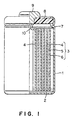
- Fig. 1 is a partially sectional view showing an embodiment of a rechargeable lithium battery (a cylindrical rechargeable lithium battery) according to the present invention.
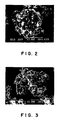
- Figs. 2 and 3 are photomicrographs of particles of a negative electrode active material (Ni 2 MnSb) (magnification: 3000 times).
- the rechargeable battery with a nonaqueous electrolyte (for example, a cylindrical rechargeable battery with a nonaqueous electrolyte) according to the present invention will be described with reference to Fig. 1.
- Fig. 1 shows an embodiment of a rechargeable battery with a nonaqueous electrolyte according to the present invention.
- an insulator 2 is disposed at the bottom of a closed-end cylindrical container 1 made of stainless steel.
- a group of electrodes 3 are housed in the container 1.
- the group of electrodes 3 have a structure such that a strip formed by stacking the positive electrode 4, the separator 5, the negative electrode 6, and the separator 5 in that order on top of one another is spirally wound in such a manner that the separator 5 is located outermost.
- An electrolysis solution is placed within the container 1.
- An insulating paper 7 having an opening in its center is disposed above the group of electrodes 3 within the container 1.
- An insulating seal plate 8 is disposed in an upper opening in the container 1, and is fixed to the container 1 by inwardly crimping a portion around the upper opening.
- a positive electrode terminal 9 is fitted into the center of the insulating seal plate 8.
- One end of a positive electrode lead 10 is connected to the positive electrode 4 with the other end being connected to the positive electrode terminal 9.
- the negative electrode 6 is connected to the container 1 as the negative electrode terminal through a negative electrode lead (not shown).
- the positive electrode 4 may be prepared by suspending a positive electrode active material, a conductive agent, and a binder in a suitable solvent, coating the suspension onto a current collector, such as an aluminum foil, drying the coated current collector, and pressing the dried, coated current collector into a strip electrode.
- a current collector such as an aluminum foil
- Various oxides and sulfides are usable as the positive electrode active material, and examples thereof include: manganese dioxide (MnO 2 ), lithium manganese composite oxides (for example, LiMn 2 O 4 or LiMnO 2 ), lithium nickel composite oxides (for example, LiNiO 2 ), lithium cobalt composite oxides (for example, LiCoO 2 ), lithium nickel cobalt composite oxides (for example, LiNi 1-x Co x O 2 ), lithium manganese cobalt composite oxides (for example, LiMn x Co 1-x O 2 ), and vanadium oxides (for example, V 2 O 5 ). Further, organic materials such as electrically conductive polymer materials and disulfide polymer materials may also be used.
- Lithium manganese composite oxide (LiMn 2 O 4 ), lithium nickel composite oxide (LiNiO 2 ), lithium cobalt composite oxide (LiCoO 2 ), lithium nickel cobalt composite oxide (LiNi 0.8 Co 0.2 O 2 ), lithium manganese cobalt composite oxides (LiMn x Co 1-x O 2 ) and the like are more preferred positive electrodes from the viewpoint of high battery voltage.
- Examples of conductive agents usable herein include acetylene black, carbon black, and graphite.
- binders usable herein include polytetrafluoroethylene (PTFE), polyvinylidene fluoride (PVdF), and fluororubber.
- the mixing ratio of the positive electrode active material to the conductive agent to the binder is preferably 80 to 95% by weight of the positive electrode active material : 3 to 20% by weight of the conductive agent : 2 to 7% by weight of the binder.
- the separator 5 may be formed of, for example, a nonwoven fabric of synthetic resin, a porous film of polyethylene, or a porous film of polypropylene.
- the negative electrode 6 may be prepared by suspending a conductive agent and a binder in a suitable solvent, coating the suspension onto a metal foil, such as a copper foil, drying the coated foil, and pressing the dried, coated foil to form a strip electrode.
- a part of the negative electrode active material is constituted by a material which comprises at least one member selected from the group consisting of Al Si, Ge, Sn, P, Sb and Bi and has at least one crystal structure selected from the group consisting of BiF 3 structure, Cu 2 MnAl structure, and AgAsMg structure.
- the negative electrode active material preferably contains antimony as an indispensable component.
- antimony as an indispensable component.
- the negative electrode active material having Cu 2 MnAl structure is preferably at least one member selected from the group consisting of Ni 2 MnSb, Co 2 MnSb, Ni 2 MgSb, and Co 2 MgSb.
- a preferred specific example of the negative electrode active material having AgAsMg structure is at least one member selected from the group consisting of FeVSb, CoTiSb, NiTiSb, NiNbSb, CoNbSb, NiVSb, CoVSb, CuMgSb, NiMnSb, CoMnSb, NiMgSb, and CoMgSb.
- a preferred specific example of the negative electrode active material having BiF 3 structure is at least one member selected from the group consisting of Ni 3 Sn, Co 3 Sn, Fe 3 Al, and Fe 3 Si.
- the above negative electrode active material can occlude a large amount of an alkali metal such as lithium, and, at the same time, has high reversibility between an occlusion reaction and a release reaction and can solve the problem of crumbling involved in charge-discharge cycles.
- this negative electrode active material can realize a negative electrode possessing a long life and a high capacity.
- the crystal structure preferably comprise at least one member selected from the group consisting of BiF 3 structure, Cu 2 MnAl structure, and AgAsMg structure, and, more preferably, the negative electrode active material further contains an alkali metal from the viewpoint of long life.
- the AgAsMg structure is a structure belonging to cF12 of Pearson Symbol.
- CaF 2 structure also belongs to cF12.
- Compounds having CaF 2 structure such as CoSi 2 , NiSi2, Mg 2 Si, and Mg 2 Sn, can occlude alkali metals, such as lithium, and, as with compounds having AgAsMg structure according to the present invention, can be utilized as a high-capacity negative electrode active material. Rather, many compounds having CaF 2 structure have higher capacity than the compounds having AgAsMg structure according to the present invention.
- the compounds having CaF 2 structure In the case of the compounds having CaF 2 structure, however, at the time of occlusion and release of lithium, the crystal lattice undergoes a significant change in volume, and the repetition of charge and discharge causes disintegration of the crystal and thus results in significantly deteriorated cycle life. This makes it difficult to practically use these compounds.
- the compounds having AgAsMg structure according to the present invention have an advantageous feature such that they can moderately occlude lithium and undergo no significant change in volume and thus possesses excellent cycle life characteristics.
- the BiF 3 structure and the Cu 2 MnAl structure belong to cF16 of Pearson Symbol.
- NaTl structure also belong to cF16.
- Compounds having NaTl structure include lithium alloys such as AlLi, CdLi, and GaLi. As described above, these lithium alloys are known as negative electrode active materials having very high capacity.
- these compounds have a problem that a change in volume of crystal at the time of charge and discharge is so large that the cycle life characteristics are deteriorated.
- compounds having BiF 3 structure and the Cu 2 MnAl structure according to the present invention can occlude a suitable amount of lithium and undergo no significant change in volume and thus advantageously possess excellent cycle life characteristics.
- At least one element selected from the group consisting of Al, Si, Ge, Sn, P, Sb and Bi is preferably contained from the viewpoint of high capacity.
- the incorporation of antimony as an indispensable component is particularly preferred.
- the negative electrode active material according to the present invention may be formed, for example, by arc melting, high frequency melting, mechanical alloying, CVD, and sputtering, and the method for forming the negative electrode active material is not particularly limited.
- the production of the negative electrode active material using a solid phase reaction is advantageous in that a high-performance negative electrode active material can be simply produced.
- This method comprises the steps of mixing powders of elements for constituting the compound together and heat treating the mixed powder to cause a solid phase reaction, thereby giving a contemplated compound.
- the heat treatment temperature is preferably below the melting points of the elements for constituting the compound.
- heat treatment at a temperature of the melting point of the constituent elements or above has a fear that, after melting and solidification steps, a second compound other than the contemplated compound is contained as an impurity phase.
- the synthesized compound is likely to be bulky. Therefore, in use of the compound as the negative electrode active material, this compound should be pulverized.
- powder particles produced by pulverization are particles having smooth surface which have a small specific surface area and, upon a change in volume, are less likely to relieve strain.
- Fig. 2 is a photomicrograph (magnification: 3000 times) of particles of a compound (Ni 2 MnSb) which has been produced at the melting point of the constituent elements or above and has been pulverized as described above.
- Fig. 3 is a photomicrograph (magnification: 3000 times) of particles of a compound (Ni 2 MnSb) which has been produced at a temperature below the melting point of the constituent elements.
- a powder is obtained which comprises primary particles of 0.05 to 2 ⁇ m connected to one another like a bunch of grapes.
- the compound in this form has a high specific surface area and can effectively relieve strain caused by a change in volume. This is also advantageous in that the disintegration of the particle form can be prevented.
- the negative electrode active material according to the present invention is preferably produced in a synthesis temperature region which does not melt the constituent elements.
- the Si have an excessively high melting point which leads to synthesis at a relatively high reaction rate and thus makes it difficult to synthesize the compound in a form as shown in Fig. 3.
- tin, bismuth, phosphorus and the like have excessively low melting point which leads to synthesis at a low reaction rate and thus, here again, makes it difficult to synthesize the compound in a form as shown in Fig. 3.
- antimony has a melting point of about 630°C which can realize an ideal reaction rate and advantageously enables the compound in a form as shown in Fig. 3 to be easily synthesized. Therefore, the incorporation of antimony as an indispensable component into the negative electrode active material according to the present invention is particularly preferred from the technical viewpoint of the above-described production method.
- Figs. 2 and 3 show the results of synthesis of Ni 2 MnSb.
- Figs. 2 and 3 are different from each other in that Fig. 2 shows a product which has been synthesized at 850°C, that is, a temperature above the melting point of antimony, while Fig. 3 shows a product which has been synthesized at 550°C, that is, a temperature below the melting point of antimony.
- the surface of particles synthesized at 850°C is smooth and has a small specific surface area
- particles synthesized at 550°C are constituted by aggregates (secondary particles) of small primary particles and have a large specific surface area.
- the use of a material, into which an alkali metal (for example, lithium) has been previously incorporated, for example, LiCoO 2 , LiMnO 2 , or LiNiO 2 , as a positive electrode permits the alkali metal (for example, lithium) to migrate from the positive electrode to the material according to the present invention at the time of initial charge of the battery and, thereafter, permits the material of the present invention to reversibly occlude and release the alkali metal to function as a negative electrode of the rechargeable battery.
- an alkali metal-containing material as a negative electrode active material is preferred even when the alkali metal-containing material is used as the positive electrode.
- a material, into which an alkali metal has not been previously incorporated for example, CoO 2 , MnO 2 , or NiO 2
- a method may be adopted wherein a material, into which an alkali metal has been previously incorporated, is used as the negative electrode active material, or alternatively a laminate of an alkali metal and an alkali metal-free material according to the present invention is used to electrochemically produce an alkali metal-containing material.
- the battery is a primary battery of a battery with a nonaqueous electrolyte
- the negative electrode active material preferably has an average particle diameter (an average diameter of secondary particles) in the range of 0.1 to 100 ⁇ m.
- the negative electrode active material may be produced by mixing powders as a starting material together so as to provide a predetermined stochiometric amount ratio and heat treating the mixture at a temperature of 400 to 1200°C in an inert gas atmosphere, a reducing atmosphere or in vacuo.
- the heat treatment is carried out at a temperature below 400°C, the time necessary for the compound to be produced by the reaction is long, leading to poor productivity.
- a high temperature above 1200°C cause significant dissipation due to evaporation of an atom having high vapor pressure, such as antimony, which results in a significant change in composition from the time when the powders are mixed together.
- Conductive agents usable herein include, for example, acetylene black, carbon black, and graphite.
- Binders usable herein include, for example, polytetrafluoroethylene (PTFE), polyvinylidene fluoride (PVdF), fluororubber, ethylene-butadiene rubber (SBR), and carboxymethylcellulose (CMC).
- PTFE polytetrafluoroethylene
- PVdF polyvinylidene fluoride
- SBR ethylene-butadiene rubber
- CMC carboxymethylcellulose
- the mixing ratio of the negative electrode active material to the conductive agent to the binder is preferably 70 to 95% by weight of the negative electrode active material : 0 to 25% by weight of the conductive agent : 2 to 10% by weight of the binder.
- Nonaqueous electrolytes usable herein include a liquid electrolyte prepared by dissolving an electrolyte in a nonaqueous solvent, a polymeric gel-like electrolyte prepared by incorporating the nonaqueous solvent and the electrolyte into a polymeric material, a polymeric solid electrolyte containing the electrolyte alone, and a lithium ion-conductive inorganic solid electrolyte.
- a nonaqueous solvent prepared by dissolving a lithium salt as an electrolyte in a nonaqueous solvent in a lithium battery may be used as the liquid electrolyte.
- a nonaqueous solvent composed mainly of a cyclic carbonate such as ethylene carbonate (EC) or propylene carbonate (PC)
- a nonaqueous solvent composed mainly of a mixed solvent comprised of the cyclic carbonate and a nonaqueous solvent having a lower viscosity than the cyclic carbonate hereinafter referred to as "second solvent").
- Examples of the second solvent include: linear carbonates, such as dimethyl carbonate, methylethyl carbonate, and diethyl carbonate; ⁇ -butyrolactone; acetonitrile; methyl propionate; ethyl propionate; cyclic ethers, such as tetrahydrofuran and 2-methyltetrahydrofuran; an linear ethers, such as dimethoxyethane and diethoxyethane.
- linear carbonates such as dimethyl carbonate, methylethyl carbonate, and diethyl carbonate
- ⁇ -butyrolactone acetonitrile
- methyl propionate ethyl propionate
- cyclic ethers such as tetrahydrofuran and 2-methyltetrahydrofuran
- an linear ethers such as dimethoxyethane and diethoxyethane.
- Lithium salts include lithium phosphate hexafluoride (LiPF 6 ), lithium borofluoride (LiBF 4 ), arsenic lithium hexafluoride (LiAsF 6 ), lithium perchlorate (LiClO 4 ), and lithium trifluoromethanesulfonate (LiCF 3 SO 3 ).
- LiPF 6 lithium phosphate hexafluoride
- LiBF 4 lithium borofluoride
- the solubility of the electrolyte in the nonaqueous solvent is preferably 0.5 to 2.0 moles/liter.
- the gel-like electrolyte is one prepared by dissolving the solvent and the electrolyte in a polymeric material to form a gel.
- Polymeric materials usable herein include polyacrylonitrile, polyacrylate, polyvinylidene fluoride (PVdF) and polyethylene oxide (PEO), or copolymers of monomers constituting the above polymers with other monomers.
- the solid electrolyte is one prepared by dissolving the electrolyte in a polymeric material to form a solid.
- Polymeric materials usable herein include polyacrylonitrile, polyvinylidene fluoride (PVdF) and polyethylene oxide (PEO), or copolymers of monomers constituting the above polymers with other monomers.
- Inorganic solid electrolytes include lithium-containing ceramic materials. Among others, Li 3 N, Li 3 PO 4 -Li 2 S glass and the like may be mentioned as the inorganic solid electrolyte.
- Fig. 1 an embodiment of the present invention is shown wherein the present invention has been applied to a cylindrical battery with a nonaqueous electrolyte.
- the present invention can be further applied to batteries in other forms, for example, polygonal batteries with a nonaqueous electrolyte and button batteries with a nonaqueous electrolyte.
- the group of electrodes housed in the container of the battery are not limited to a spiral form, and may be in the form of a stack prepared by stacking a plurality of units on top of the other or one another, each unit composed of a positive electrode, a separator, and a negative electrode stacked in that order.
- LiCoC 2 lithium cobalt oxide
- acetylene black 2.5% by weight of acetylene black, 3% by weight of graphite, and 4% by weight of polyvinylidene fluoride (PVdF) were added to and mixed with an N-methylpyrrolidone (NMP) solution.
- NMP N-methylpyrrolidone
- the mixture was coated on a 15 ⁇ m-thick aluminum foil as a current collector.
- the coated aluminum foil was dried, followed by pressing to prepare a positive electrode having an electrode density of 3.0 g/cm 3 .
- a nickel powder having a purity of 99% and an average particle diameter of 20 ⁇ m, a manganese powder having a purity of 99% and an average particle diameter of 20 ⁇ m, and an antimony powder having a purity of 99.9% and an average particle diameter of 20 ⁇ m were mixed together so as to provide an atomic equivalent ratio of 2 : 1 : 1.
- the mixture was thoroughly stirred by means of a V mixer.
- the thoroughly stirred mixed powder was filled into an alumina crucible, and was then heat treated under an argon gas stream at 600°C for 120 hr, whereby these powders were allowed to react with one another.
- the material obtained by the heat treatment was analyzed by XRD.
- Ni 2 MnSb phase having Cu 2 MnAl structure was ground in an agate mortar to prepare an Ni 2 MnSb powder having an average particle diameter of 20 ⁇ m.
- 5% by weight of graphite, 3% by weight of acetylene black, 7% by weight of PVdF, and an NMP solution were added to and mixed with 85% by weight of the Ni 2 MnSb powder.
- the mixture was coated on a current collector of a 12 ⁇ m-thick copper foil. The coated copper foil was dried, followed by pressing to prepare a negative electrode.
- the positive electrode, a separator formed of a porous film of polyethylene, the negative electrode, and the separator were stacked in that order on top of one another, and the stack was spirally wound so that the negative electrode was located outermost. Thus, a group of electrodes was prepared.
- LiPF 6 Lithium phosphate hexafluoride
- EC ethylene carbonate
- MEC methyl ethyl carbonate
- the group of electrodes and the electrolysis solution were housed in a closed-end cylindrical stainless steel container to assemble a cylindrical rechargeable battery with a nonaqueous electrolyte as shown in Fig. 1.
- Example 1 The procedure of Example 1 was repeated, except that negative electrode active materials described in Table 1 were used instead of the negative electrode active material in Example 1. Thus, rechargeable batteries with a nonaqueous electrolyte of Examples 2 to 35 and Comparative Examples 1 to 12 were assembled.
- the negative electrode active materials according to the present invention can provide rechargeable batteries with a nonaqueous electrolyte which have a high capacity and, at the same time, have excellent charge-discharge cycle characteristics.
- the present invention can provide batteries with a nonaqueous electrolyte which are improved in both discharge capacity and service life, that is, have high discharge capacity and, at the same time, have prolonged service life.
Landscapes
- Chemical & Material Sciences (AREA)
- Chemical Kinetics & Catalysis (AREA)
- Electrochemistry (AREA)
- General Chemical & Material Sciences (AREA)
- Engineering & Computer Science (AREA)
- Materials Engineering (AREA)
- Manufacturing & Machinery (AREA)
- Secondary Cells (AREA)
- Battery Electrode And Active Subsutance (AREA)
Applications Claiming Priority (2)
| Application Number | Priority Date | Filing Date | Title |
|---|---|---|---|
| JP2000072377 | 2000-03-15 | ||
| JP2000072377 | 2000-03-15 |
Publications (2)
| Publication Number | Publication Date |
|---|---|
| EP1134824A2 true EP1134824A2 (de) | 2001-09-19 |
| EP1134824A3 EP1134824A3 (de) | 2003-10-29 |
Family
ID=18590801
Family Applications (1)
| Application Number | Title | Priority Date | Filing Date |
|---|---|---|---|
| EP01302081A Withdrawn EP1134824A3 (de) | 2000-03-15 | 2001-03-07 | Batterie mit nichtwässrigem Elektrolyt |
Country Status (4)
| Country | Link |
|---|---|
| US (1) | US6686090B2 (de) |
| EP (1) | EP1134824A3 (de) |
| KR (1) | KR100541896B1 (de) |
| CN (1) | CN1242503C (de) |
Cited By (1)
| Publication number | Priority date | Publication date | Assignee | Title |
|---|---|---|---|---|
| KR100382767B1 (ko) * | 2001-08-25 | 2003-05-09 | 삼성에스디아이 주식회사 | 리튬 2차 전지용 음극 박막 및 그의 제조방법 |
Families Citing this family (16)
| Publication number | Priority date | Publication date | Assignee | Title |
|---|---|---|---|---|
| JP3471244B2 (ja) * | 1999-03-15 | 2003-12-02 | 株式会社東芝 | 非水電解液二次電池の製造方法 |
| EP1638158A4 (de) * | 2003-05-22 | 2010-08-25 | Panasonic Corp | Sekundärbatterie mit wasserfreiem elektrolyt und verfahren zu ihrer herstellung |
| US7947392B2 (en) * | 2004-10-01 | 2011-05-24 | Rutgers The State University of New Jersey, U.S. | Bismuth fluoride based nanocomposites as electrode materials |
| US8039149B2 (en) * | 2004-10-01 | 2011-10-18 | Rutgers, The State University | Bismuth oxyfluoride based nanocomposites as electrode materials |
| DE102005020719B3 (de) * | 2005-05-04 | 2006-09-14 | Drägerwerk AG | Offner elektrochemischer Sensor |
| KR100874387B1 (ko) * | 2006-06-13 | 2008-12-18 | 주식회사 엘지화학 | 둘 이상의 작동 전압을 제공하는 중첩식 이차전지 |
| EP2373726A1 (de) * | 2008-12-11 | 2011-10-12 | FutureCarbon GmbH | Leitfähige zubereitung sowie verfahren zu deren herstellung |
| CN104081568B (zh) * | 2012-02-16 | 2017-03-08 | 株式会社Lg 化学 | 包含含有水性粘合剂的负极的锂二次电池 |
| WO2013166074A1 (en) * | 2012-05-01 | 2013-11-07 | Altairnano, Inc. | Improved lithium titanate cell |
| US9692039B2 (en) | 2012-07-24 | 2017-06-27 | Quantumscape Corporation | Nanostructured materials for electrochemical conversion reactions |
| TWI504048B (zh) * | 2013-10-08 | 2015-10-11 | Christine Jill Lee | 製備鋰電池電極之方法 |
| WO2015130831A1 (en) | 2014-02-25 | 2015-09-03 | Quantumscape Corporation | Hybrid electrodes with both intercalation and conversion materials |
| WO2016025866A1 (en) | 2014-08-15 | 2016-02-18 | Quantumscape Corporation | Doped conversion materials for secondary battery cathodes |
| WO2017213057A1 (ja) * | 2016-06-06 | 2017-12-14 | 住友電気工業株式会社 | 電気二重層キャパシタ電極用の多孔質炭素材料、その製造方法および電気二重層キャパシタ電極 |
| WO2019184939A1 (zh) | 2018-03-28 | 2019-10-03 | 华南师范大学 | 基于电化学和光电化学的离子去除装置及其制备方法和应用 |
| CN108675404B (zh) * | 2018-05-17 | 2020-08-18 | 华南师范大学 | 一种利用流体电池氧化还原反应进行连续低耗能除盐的方法及其应用 |
Family Cites Families (8)
| Publication number | Priority date | Publication date | Assignee | Title |
|---|---|---|---|---|
| JPH07122274A (ja) | 1993-10-22 | 1995-05-12 | Fuji Photo Film Co Ltd | 非水二次電池 |
| JP3498380B2 (ja) | 1994-02-28 | 2004-02-16 | 宇部興産株式会社 | 非水二次電池 |
| US5807646A (en) * | 1995-02-23 | 1998-09-15 | Tosoh Corporation | Spinel type lithium-mangenese oxide material, process for preparing the same and use thereof |
| JPH0963651A (ja) | 1995-06-12 | 1997-03-07 | Hitachi Ltd | 非水系二次電池及びその負極材料 |
| JP3805053B2 (ja) * | 1997-02-10 | 2006-08-02 | 旭化成エレクトロニクス株式会社 | リチウム二次電池 |
| WO2000003443A1 (en) * | 1998-07-09 | 2000-01-20 | The University Of Chicago | Novel anodes for rechargeable lithium batteries |
| JP2001015102A (ja) * | 1999-07-01 | 2001-01-19 | Matsushita Electric Ind Co Ltd | 非水電解質二次電池およびその製造法 |
| JP2001345098A (ja) * | 1999-08-09 | 2001-12-14 | Toshiba Corp | 非水電解質電池 |
-
2001
- 2001-03-05 US US09/797,883 patent/US6686090B2/en not_active Expired - Lifetime
- 2001-03-07 EP EP01302081A patent/EP1134824A3/de not_active Withdrawn
- 2001-03-14 KR KR1020010013092A patent/KR100541896B1/ko not_active Expired - Fee Related
- 2001-03-15 CN CNB011114789A patent/CN1242503C/zh not_active Expired - Fee Related
Cited By (1)
| Publication number | Priority date | Publication date | Assignee | Title |
|---|---|---|---|---|
| KR100382767B1 (ko) * | 2001-08-25 | 2003-05-09 | 삼성에스디아이 주식회사 | 리튬 2차 전지용 음극 박막 및 그의 제조방법 |
Also Published As
| Publication number | Publication date |
|---|---|
| US6686090B2 (en) | 2004-02-03 |
| CN1313645A (zh) | 2001-09-19 |
| KR100541896B1 (ko) | 2006-01-10 |
| US20010046629A1 (en) | 2001-11-29 |
| CN1242503C (zh) | 2006-02-15 |
| KR20010092311A (ko) | 2001-10-24 |
| EP1134824A3 (de) | 2003-10-29 |
Similar Documents
| Publication | Publication Date | Title |
|---|---|---|
| US8808920B2 (en) | Positive electrode active material, positive electrode, nonaqueous electrolyte cell, and method of preparing positive electrode active material | |
| EP0696075B1 (de) | Sekundärbatterie mit nichtwässrigem Elektrolyten | |
| US20040110064A1 (en) | Non-aqueous electrolyte secondary battery | |
| EP1494302A1 (de) | Nichtwässrige sekundärbatterie | |
| US6686090B2 (en) | Battery with a nonaqueous electrolyte and a negative electrode having a negative electrode active material occluding and releasing an active material | |
| JP2009016245A (ja) | 負極材料、負極および電池、ならびにそれらの製造方法 | |
| EP3486977B1 (de) | Positive elektrode für wiederaufladbare lithium-batterie, wiederaufladbare lithium-batterie mit dem gleichen und batterie-modul | |
| US6884548B2 (en) | Nonaqueous electrolyte battery containing an alkali, transition metal negative electrode | |
| KR20010034470A (ko) | 비수성 전해질 이차 전지 | |
| JP2003317705A (ja) | 電 池 | |
| JP3848187B2 (ja) | 非水電解質二次電池用負極材料及び非水電解質二次電池 | |
| JP2005317447A (ja) | 電池 | |
| US6383684B1 (en) | Lithium secondary battery comprising tungsten-containing oxide of monoclinic crystal structure | |
| KR100681465B1 (ko) | 고용량 및 장수명 특성을 갖는 전극활물질 및 이를포함하는 리튬 이차 전지 | |
| JP2001345098A (ja) | 非水電解質電池 | |
| JP2002110152A (ja) | 非水電解質二次電池 | |
| JP2001052691A (ja) | 非水電解質二次電池 | |
| JPH06267539A (ja) | リチウム二次電池 | |
| JP2004193005A (ja) | 非水電解質電池用電極材料、電極及び非水電解質電池 | |
| JP3324365B2 (ja) | リチウム二次電池用負極 | |
| JP3648458B2 (ja) | 非水電解質電池 | |
| JP3984184B2 (ja) | 非水電解質二次電池 | |
| JP4077423B2 (ja) | 非水電解質二次電池 | |
| JP4128972B2 (ja) | 非水電解質二次電池 | |
| JP2000277113A (ja) | リチウム二次電池 |
Legal Events
| Date | Code | Title | Description |
|---|---|---|---|
| PUAI | Public reference made under article 153(3) epc to a published international application that has entered the european phase |
Free format text: ORIGINAL CODE: 0009012 |
|
| 17P | Request for examination filed |
Effective date: 20010319 |
|
| AK | Designated contracting states |
Kind code of ref document: A2 Designated state(s): AT BE CH CY DE DK ES FI FR GB GR IE IT LI LU MC NL PT SE TR |
|
| AX | Request for extension of the european patent |
Free format text: AL;LT;LV;MK;RO;SI |
|
| PUAL | Search report despatched |
Free format text: ORIGINAL CODE: 0009013 |
|
| AK | Designated contracting states |
Kind code of ref document: A3 Designated state(s): AT BE CH CY DE DK ES FI FR GB GR IE IT LI LU MC NL PT SE TR |
|
| AX | Request for extension of the european patent |
Extension state: AL LT LV MK RO SI |
|
| AKX | Designation fees paid |
Designated state(s): DE FR GB |
|
| STAA | Information on the status of an ep patent application or granted ep patent |
Free format text: STATUS: THE APPLICATION IS DEEMED TO BE WITHDRAWN |
|
| 18D | Application deemed to be withdrawn |
Effective date: 20111001 |