EP1074603A2 - Verfahren und Vorrichtung zur Herstellung von oxidischen Nanokristallen - Google Patents
Verfahren und Vorrichtung zur Herstellung von oxidischen Nanokristallen Download PDFInfo
- Publication number
- EP1074603A2 EP1074603A2 EP00115377A EP00115377A EP1074603A2 EP 1074603 A2 EP1074603 A2 EP 1074603A2 EP 00115377 A EP00115377 A EP 00115377A EP 00115377 A EP00115377 A EP 00115377A EP 1074603 A2 EP1074603 A2 EP 1074603A2
- Authority
- EP
- European Patent Office
- Prior art keywords
- reactor
- nanocrystals
- heating zone
- oxidic
- oder
- Prior art date
- Legal status (The legal status is an assumption and is not a legal conclusion. Google has not performed a legal analysis and makes no representation as to the accuracy of the status listed.)
- Granted
Links
Images


Classifications
-
- B—PERFORMING OPERATIONS; TRANSPORTING
- B82—NANOTECHNOLOGY
- B82Y—SPECIFIC USES OR APPLICATIONS OF NANOSTRUCTURES; MEASUREMENT OR ANALYSIS OF NANOSTRUCTURES; MANUFACTURE OR TREATMENT OF NANOSTRUCTURES
- B82Y30/00—Nanotechnology for materials or surface science, e.g. nanocomposites
-
- C—CHEMISTRY; METALLURGY
- C01—INORGANIC CHEMISTRY
- C01B—NON-METALLIC ELEMENTS; COMPOUNDS THEREOF; METALLOIDS OR COMPOUNDS THEREOF NOT COVERED BY SUBCLASS C01C
- C01B13/00—Oxygen; Ozone; Oxides or hydroxides in general
- C01B13/14—Methods for preparing oxides or hydroxides in general
- C01B13/20—Methods for preparing oxides or hydroxides in general by oxidation of elements in the gaseous state; by oxidation or hydrolysis of compounds in the gaseous state
-
- C—CHEMISTRY; METALLURGY
- C01—INORGANIC CHEMISTRY
- C01F—COMPOUNDS OF THE METALS BERYLLIUM, MAGNESIUM, ALUMINIUM, CALCIUM, STRONTIUM, BARIUM, RADIUM, THORIUM, OR OF THE RARE-EARTH METALS
- C01F17/00—Compounds of rare earth metals
- C01F17/20—Compounds containing only rare earth metals as the metal element
- C01F17/206—Compounds containing only rare earth metals as the metal element oxide or hydroxide being the only anion
- C01F17/218—Yttrium oxides or hydroxides
-
- C—CHEMISTRY; METALLURGY
- C09—DYES; PAINTS; POLISHES; NATURAL RESINS; ADHESIVES; COMPOSITIONS NOT OTHERWISE PROVIDED FOR; APPLICATIONS OF MATERIALS NOT OTHERWISE PROVIDED FOR
- C09K—MATERIALS FOR MISCELLANEOUS APPLICATIONS, NOT PROVIDED FOR ELSEWHERE
- C09K11/00—Luminescent materials, e.g. electroluminescent or chemiluminescent
- C09K11/08—Luminescent materials, e.g. electroluminescent or chemiluminescent containing inorganic luminescent materials
- C09K11/77—Luminescent materials, e.g. electroluminescent or chemiluminescent containing inorganic luminescent materials containing rare earth metals
- C09K11/7701—Chalogenides
- C09K11/7703—Chalogenides with alkaline earth metals
-
- C—CHEMISTRY; METALLURGY
- C09—DYES; PAINTS; POLISHES; NATURAL RESINS; ADHESIVES; COMPOSITIONS NOT OTHERWISE PROVIDED FOR; APPLICATIONS OF MATERIALS NOT OTHERWISE PROVIDED FOR
- C09K—MATERIALS FOR MISCELLANEOUS APPLICATIONS, NOT PROVIDED FOR ELSEWHERE
- C09K11/00—Luminescent materials, e.g. electroluminescent or chemiluminescent
- C09K11/08—Luminescent materials, e.g. electroluminescent or chemiluminescent containing inorganic luminescent materials
- C09K11/77—Luminescent materials, e.g. electroluminescent or chemiluminescent containing inorganic luminescent materials containing rare earth metals
- C09K11/7728—Luminescent materials, e.g. electroluminescent or chemiluminescent containing inorganic luminescent materials containing rare earth metals containing europium
- C09K11/7729—Chalcogenides
- C09K11/7731—Chalcogenides with alkaline earth metals
-
- C—CHEMISTRY; METALLURGY
- C01—INORGANIC CHEMISTRY
- C01P—INDEXING SCHEME RELATING TO STRUCTURAL AND PHYSICAL ASPECTS OF SOLID INORGANIC COMPOUNDS
- C01P2002/00—Crystal-structural characteristics
- C01P2002/50—Solid solutions
- C01P2002/52—Solid solutions containing elements as dopants
- C01P2002/54—Solid solutions containing elements as dopants one element only
-
- C—CHEMISTRY; METALLURGY
- C01—INORGANIC CHEMISTRY
- C01P—INDEXING SCHEME RELATING TO STRUCTURAL AND PHYSICAL ASPECTS OF SOLID INORGANIC COMPOUNDS
- C01P2002/00—Crystal-structural characteristics
- C01P2002/70—Crystal-structural characteristics defined by measured X-ray, neutron or electron diffraction data
- C01P2002/72—Crystal-structural characteristics defined by measured X-ray, neutron or electron diffraction data by d-values or two theta-values, e.g. as X-ray diagram
-
- C—CHEMISTRY; METALLURGY
- C01—INORGANIC CHEMISTRY
- C01P—INDEXING SCHEME RELATING TO STRUCTURAL AND PHYSICAL ASPECTS OF SOLID INORGANIC COMPOUNDS
- C01P2004/00—Particle morphology
- C01P2004/60—Particles characterised by their size
- C01P2004/64—Nanometer sized, i.e. from 1-100 nanometer
Definitions
- the present invention relates to a method and an apparatus for producing oxidic nanocrystals.
- Oxidic nanocrystals in particular doped oxidic nanocrystals, such as, for example, yttrium oxide (Y 2 O 3 : Eu) activated with europium, have received increasing attention in recent years when used as phosphors for lighting devices (US Pat. No. 5,455,489). For this reason, a wide variety of oxidic nanocrystals were examined for their ability to be used as a phosphor. Corresponding methods and devices for producing such nanocrystals have also been presented.
- Y 2 O 3 : Eu yttrium oxide
- the conversion of the amorphous respectively monoclinic in the cubic phase through an additional temperature treatment at approximately 900 ° C accomplished.
- this is accompanied by a significant grain growth, so that the cubic Phase is only single-phase with particle sizes above about 50 nm.
- This means on the one hand, a high expenditure of energy and time in the production of such nanocrystals.
- the relatively large particle size limits the possible uses of these oxidic nanocrystals produced by processes according to the prior art. So far it has not been possible to use phosphors with small particle sizes, in particular up to 20 nm that show high efficiency.
- the particle size is the grain size of the Phosphor after thermal treatment, which lead to partial agglomeration can, understood. The agglomeration can be classified as low if not yet The grains are sintered at the interfaces, but grains are already lined up could be. In contrast, the term particle size is used when the original Grain size before a thermal treatment is meant.
- vaporizer means an evaporation system consisting of essentially from the components container and associated heating.
- oxidic nanocrystals which are in a thermodynamic equilibrium phase and which have an average particle size of at most 100 nm, preferably from 1 to 20 nm, in particular a particle size in the range around 10 nm and a cubic crystal structure. In particular, these can be little agglomerated, preferably with an average particle size of up to 20 nm.
- the cubic equilibrium phase of the oxide is already reached during the production process.
- the cubic equilibrium phase is particularly important for phosphors based on such oxides with high quantum efficiency, such as yttrium oxide (Y 2 O 3 ), gadolinium oxide (Gd 2 O 3 ) or corresponding garnets such as YAG: Ce or (YGd) AG: Ce.
- Other applications relate to YAM, YAP or BAM and CAT phosphors.
- phosphors with a narrower size can be used Create size distribution.
- a fluctuation range of 2 to 5 nm around is typical average particle size.
- the method is particularly suitable for oxidic or Oxisulfide nanocrystals, mainly based on the elements Y, Gd, Mg, Ca, Ba and Al and other rare earth metals.
- the resulting gas phase is generated using one or more carrier gases and / or carrier gas mixtures are transported into the heating zone of the reactor. This makes it possible not only undoped oxides, but also doped ones (especially in terms of activation) to produce nanocrystalline oxides.
- the doping is built directly into the host lattice.
- the undoped or doped nanocrystalline oxides are used as Phosphors for lighting devices with low or high luminance.
- fluorescent lamps noble gas (Xe) excimer lamps, displays, as well to think organic and non-organic LEDs.
- the host lattice ions are Elements of II. To VI. Main group of the periodic table of the elements.
- Doping ions are rare earth elements such as Eu, Ce or Tb.
- organometallic complexes of Host lattice ions (or doping ions with hydrogen tetramethylheptanedionate) are good suitable.
- Chlorides for example, are suitable as volatile inorganic compounds.
- the first and second evaporators each have a temperature of approximately 30 ° -900 ° C.
- the Temperature in the heating zone of the reactor is approximately 600 ° - 1600 ° C.
- Carrier gases inert gases or gas mixtures are used.
- the noble gases are found here or nitrogen or mixtures thereof. Oxygen or has become the reaction gas preserves an oxygen-containing mixture.
- the flow rate of the reaction gas and / or the reaction gas mixtures is 50 ml / min. up to 100 l / min ..
- the pressure in the overall system is kept at 1 to 1500 mbar.
- a device according to the invention for producing oxidic nanocrystals consists of at least one evaporator, at least one reactor with at least one heating zone, at least one adsorption trap and at least one vacuum pump. With this device it is possible to use the desired oxidic nanocrystals for use as phosphors to manufacture. Another additional temperature treatment outside the heating zone of the Reactor to achieve the desired cubic crystal shape of the nanocrystals is in the In contrast to the prior art, this is no longer necessary.
- the evaporators Evaporator heaters which are designed as oil baths.
- the temperature of the oil baths is each about 140 ° to 180 ° C.
- the reactor is advantageously designed as a flow reactor.
- the Reactor consisting of an aluminum tube and a cylindrical heating zone.
- a baffle plate is arranged within the reactor in the heating zone. Because of the arrangement Baffle plate is convection in the back direction, i. H. against the inflow direction of the Prevents gas phase, so that the formation of the oxide nanocrystals in the desired Areas of the heating zone of the reactor takes place.
- a filter between one of the first adsorption trap and the second adsorption trap Vacuum pump arranged a filter.
- the second adsorption trap and the filter prevent that the vacuum pump is contaminated.
- Adsorption traps designed as cold traps.
- a device 10 shown in FIG. 1 for producing oxidic nanocrystals comprises a first and a second evaporator 12, 14, a reactor 16 with a heating zone 18, a first adsorption trap 20 connected downstream of the reactor 16 and one of the first Adsorption trap 20 downstream and connected vacuum pump 24. Between the Vacuum pump 24 and the first adsorption trap 20, a second cold trap 22 is arranged.
- the device 10 shown in the exemplary embodiment serves for the production of doped oxidic nanocrystals, namely yttrium oxide (Y 2 O 3 : Eu) doped with europium (Eu).
- yttrium oxide Y 2 O 3 : Eu
- Eu europium
- Organometallic complexes of yttrium or europium namely yttrium tetramethylheptanedionate and Eu-tetramethylheptanedionate (Y (TMHD) 3 or Eu (TMHD) 3
- Y (TMHD) 3 or Eu (TMHD) 3 yttrium tetramethylheptanedionate
- argon is used as the carrier gas, which is fed into the system from a carrier gas source 34.
- the flow rate of the carrier gas is typically 20 ml / min by means of a first flow controller 26 and a second flow controller 28.
- - 50 l / min. Preferably 150 - 250 ml / min. regulated.
- Both evaporators 12, 14 each have a temperature of approximately 30 ° -900 ° C., preferably 140 ° -180 ° C., which are generated by evaporator heaters which are designed as oil baths.
- the reactor 16 is designed as a flow reactor (FIG. 2) and consists of a Aluminum tube 52 and the cylindrical heating zone 18. At the end of the heating zone 18th a baffle plate 40 is arranged inside the reactor 16 (cf. FIG. 2). The baffle 40 serves to regulate the convection within the reactor 16 or within the Heating zone 18.
- the temperature in heating zone 18 of reactor 16 is approximately 600 ° -1600 ° C. preferably 900 ° - 1100 ° C.
- a reaction gas or a mixture thereof is introduced into the reactor 16 from a reaction gas source 32.
- Oxygen or mixtures thereof is usually used as the reaction gas.
- a feed line 44 carries the reaction gas oxygen at a flow rate of 50 ml / min. - 100 l / min., Preferably 700 - 900 ml / min., Which is controlled by means of a third flow controller 30, into the reactor space.
- the organometallic complexes decompose and the oxidic nanocrystals are formed immediately, in particular the Y 2 O 3 : Eu nanocrystals.
- a first adsorption trap 20 is connected downstream of the reactor 16. This adsorption trap is 20 designed as a cold trap on which the resulting nanocrystals are deposited.
- the first Adsorption trap 20, the vacuum pump 24 is connected downstream, the pressure in the overall system holds at around 40 - 60 mbar. There are also pressures between 1 - 1500 mbar in the overall system conceivable.
- a second adsorption trap 22 which also is designed as a cold trap, and a filter (not shown) interposed.
- the doped oxidic nanocrystals produced in this way namely Y 2 O 3 : Eu nanocrystals, have a cubic crystal structure and a particle size between 1 nm and 100 nm, in particular 5 to 20 nm. In addition, they are less agglomerated.
- Y 2 O 3 : Eu is a phosphor.
- the oxidic nanocrystals produced in this way are used as phosphors for lighting devices with low or high luminance.
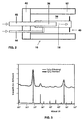
- FIG. 2 shows a schematic representation of a portion of the reactor 16 with the Baffle 40, which in the interior 38 of the reactor 16, d. H. inside the aluminum tube 52, is arranged. It can also be seen that the aluminum tube 52 by means of a Flange 42 is closed on one side. The leads 44 and 46 lead through openings in the Flange 42 into the interior of the reactor or the heating zone 18 of the reactor 16.
- a feed line 46 carries the carrier gas and the gaseous organometallic complex of the host lattice ion and the lead 44 the Reaction gas and the gaseous organometallic complex of the doping ion in the reactor 16 a.
- FIG. 3 shows a diffractogram of nanocrystalline Y 2 O 3 which has been produced using the device 10 according to the method of the invention.
- the powdery Y 2 O 3 standard, against which the diffractogram of the Y 2 O 3 produced has been plotted, has a purity of 99.999% and a grain size of approximately 10 ⁇ m.
- a standard is a powder that is sufficiently coarse-crystalline so that its optical properties match those of a corresponding single crystal.
- the comparison shows that the diffraction patterns of the Y 2 O 3 and the Y 2 O 3 standard produced in accordance with the invention match perfectly. It can be seen that the nanocrystals produced according to the invention have a cubic crystal structure (like the single crystal) without the need for additional temperature treatment.
- the nanocrystalline Y 2 O 3 and Y 2 O 3 : Eu produced according to the invention show a shift in the absorption edge (assigned to the host lattice) (located at the boring end) by approx. 10 nm to shorter wavelengths (correspondingly higher energy) compared to coarse crystalline reference material.
- the consequence of this is that the excitation optimum is also at higher excitation energies.
- the emission properties remain unchanged. This property is remarkable in two ways:
- FIG. 4a shows a comparison between the standard (average particle size 10 ⁇ m) and the powder according to the invention (average particle size 10 nm).
Landscapes
- Chemical & Material Sciences (AREA)
- Organic Chemistry (AREA)
- Engineering & Computer Science (AREA)
- Inorganic Chemistry (AREA)
- Materials Engineering (AREA)
- Nanotechnology (AREA)
- General Physics & Mathematics (AREA)
- Condensed Matter Physics & Semiconductors (AREA)
- Composite Materials (AREA)
- Crystallography & Structural Chemistry (AREA)
- Physics & Mathematics (AREA)
- Life Sciences & Earth Sciences (AREA)
- Geology (AREA)
- Luminescent Compositions (AREA)
- Oxygen, Ozone, And Oxides In General (AREA)
- Compounds Of Alkaline-Earth Elements, Aluminum Or Rare-Earth Metals (AREA)
- Organic Low-Molecular-Weight Compounds And Preparation Thereof (AREA)
- Investigating Or Analyzing Non-Biological Materials By The Use Of Chemical Means (AREA)
Abstract
Description
- Figur 1
- eine schematische Darstellung der erfindungsgemäßen Vorrichtung zur Herstellung von oxidischen Nanokristallen;
- Figur 2
- eine schematische Darstellung eines Teilbereichs eines Reaktors der erfindungsgemäßen Vorrichtung zur Herstellung von oxidischen Nanokristallen;
- Figur 3
- ein Diffraktogramm der gemäß dem erfindungsgemäßen Verfahren hergestellten oxidischen Nanokristalle;
- Figur 4
- das diffuse Reflexionsspektrum von Y2O3 (Figur 4a) sowie das Anregungsspektrum von Eu-dotiertem Y2O3 (Figur 4b), jeweils grobkörniger Standard verglichen mit nanokristallinem Pulver.
Claims (26)
- Verfahren zur Herstellung von oxidischen Nanokristallen,
dadurch gekennzeichnet,
daß das Verfahren folgende Schritte umfaßt:a) Einbringen von Wirtsgitterionen als metallorganische Komplexe oder flüchtige anorganische Verbindungen in mindestens einen ersten Verdampfer (12),b) Überführen der Komplexe oder Verbindungen in die Gasphase undc) Transport der resultierenden Gasphase mit Hilfe eines oder mehrerer Trägergase und/oder Trägergasgemische in mindestens eine Heizzone (18) mindestens eines Reaktors (16) und Zuführung eines oder mehrerer Reaktionsgase und/oder Reaktionsgasgemische,d) Zersetzung der Komplexe oder Verbindungen in der Heizzone (18) des Reaktors (16) bei einem Druck zwischen 1 - 1000 mbar und sofortige Ausbildung der oxidischen Nanokristalle, unde) Abscheiden der oxidischen Nanokristalle an mindestens einer Adsorptionsfalle (20). - Verfahren nach Anspruch 1,
dadurch gekennzeichnet,
daß im Verfahrensschritt a) mit den Wirtsgitterionen Dotierionen als metallorganische Komplexe oder flüchtige anorganische Verbindungen in einen zweiten Verdampfer (14) eingebracht werden und die Komplexe oder Verbindungen in die Gasphase überführt werden und die resultierende Gasphase mit Hilfe eines oder mehrerer Trägergase und/oder Trägergasgemische in die Heizzone (18) des Reaktors (16) transportiert wird. - Verfahren nach einem der vorhergehenden Ansprüche,
dadurch gekennzeichnet,
daß die Wirtsgitterionen Elemente der II. bis VI. Hauptgruppe des Periodensystems der Elemente sind, insbesondere Seltenerdmetalle, bevorzugt Y, Gd, sowie Mg, Ca, Ba, und Al. - Verfahren nach einem der vorhergehenden Ansprüche,
dadurch gekennzeichnet,
daß die Dotierionen Ionen der Selten-Erd-Elemente sind. - Verfahren nach einem der vorhergehenden Ansprüche,
dadurch gekennzeichnet,
daß die metallorganischen Komplexe Verbindungen der Wirtsgitter- oder Dotierionen mit Wasserstoff-Tetramethylheptandionat sind. - Verfahren nach einem der Ansprüche 2 bis 5,
dadurch gekennzeichnet,
daß die resultierenden dotierten, oxidischen Nanokristalle Leuchtstoffe sind. - Verfahren nach einem der vorhergehenden Ansprüche,
dadurch gekennzeichnet,
daß der erste und zweite Verdampfer (12, 14) eine Temperatur von ca. 30 - 900°C aufweist. - Verfahren nach einem der vorhergehenden Ansprüche,
dadurch gekennzeichnet,
daß die Temperatur in der Heizzone (18) des Reaktors (16) ca. 600 - 1600°C beträgt. - Verfahren nach einem der vorhergehenden Ansprüche,
dadurch gekennzeichnet,
daß als Trägergase inerte Gase oder Gasgemische verwendet werden. - Verfahren nach einem der vorhergehenden Ansprüche,
dadurch gekennzeichnet,
daß als Reaktiongas Sauerstoff oder Gemische davon verwendet werden. - Verfahren nach einem der vorhergehenden Ansprüche,
dadurch gekennzeichnet,
daß die Durchflußrate des Trägergases oder der Trägergasgemische im System 20 ml/min. - 50 l/min. beträgt. - Verfahren nach einem der vorhergehenden Ansprüche,
dadurch gekennzeichnet,
daß die Durchflußrate des Reaktionsgases oder der Reaktionsgasgemische im System 50 ml/min. - 100 l/min. beträgt. - Verfahren nach einem der vorhergehenden Ansprüche,
dadurch gekennzeichnet,
daß der Druck im Gesamtsystem ca. 1 - 1500 mbar beträgt. - Verfahren nach einem der vorhergehenden Ansprüche,
dadurch gekennzeichnet,
daß die resultierenden oxidischen Nanokristalle in der thermoynamischen Gleichgewichtsphase vorliegen. - Verfahren nach Anspruch 14,
dadurch gekennzeichnet,
daß die resultierenden oxidischen Nanokristalle eine Teilchengröße von höchstens 100 nm, bevorzugt höchstens 20 nm, und eine kubische Kristallstruktur aufweisen. - Vorrichtung zur Herstellung von oxidischen Nanokristallen,
dadurch gekennzeichnet,
daß die Vorrichtung (10) mindestens einen Verdampfer (12, 14), mindestens einen Reaktor (16) mit mindestens einer Heizzone (18), mindestens einer Adsorptionsfalle (20, 22) und mindestens einer Vakuumpumpe (24) besteht. - Vorrichtung nach Anspruch 16,
dadurch gekennzeichnet,
daß die Verdampfer (12, 14) Verdampferheizungen aufweisen, die als Ölbäder ausgebildet sind. - Vorrichtung nach Anspruch 16 oder 17,
dadurch gekennzeichnet,
daß der Reaktor (16) ein Durchflußreaktor ist. - Vorrichtung nach einem der Ansprüche 16 bis 18,
dadurch gekennzeichnet,
daß zwischen dem oder den Verdampfern (12, 14) und dem Reaktor (16) jeweils eine beheizbare Röhre (48, 50) angeordnet ist. - Vorrichtung nach einem der Ansprüche 16 bis 19,
dadurch gekennzeichnet,
daß der Reaktor (16) aus einer Aluminiumröhre (52) und einer zylindrisch ausgebildeten Heizzone (18) besteht. - Vorrichtung nach Anspruch 20,
dadurch gekennzeichnet,
daß am Ende der Heizzone (18) innerhalb des Reaktors (16) ein Prallblech (40) angeordnet ist. - Vorrichtung nach einem der Ansprüche 16 bis 21,
dadurch gekennzeichnet,
daß zwischen der der ersten Adsorptionsfalle (20) nachgeschalteten zweiten Adsorptionsfalle (22) und der Vakuumpumpe (24) ein Filter angeordnet ist. - Vorrichtung nach einem der Ansprüche 16 bis 22,
dadurch gekennzeichnet,
daß die Adsorptionsfalle (20, 22) Kühlfallen sind. - Verwendung der nach dem Verfahren gemäß einem der Ansprüche 1 bis 15 hergestellten oxidischen Nanokristalle als Leuchtstoffe für Beleuchtungsvorrichtungen mit niedrigen oder hohen Leuchtdichten.
- Leuchtstoff für Beleuchtungsvorrichtungen mit einem Wirtsgitter aus oxidischen Kristallen, insbesondere Oxiden oder Oxisulfiden, der Metalle Y, Gd, Mg, Ca, Ba, Al, wobei das Wirtsgitter mit Seltenerdmetallen aktiviert ist, wobei der Leuchtstoff aus Nanokristallen geringer Agglomeration besteht, mit einer mittleren Partikelgröße von 1 bis 20 nm und kubischer Kristallstruktur.
- Leuchtstoff nach Anspruch 25, dadurch gekennzeichnet, daß die Absorptionskante des Wirtsgitters gegenüber einem Standard des gleichen Materials zu kürzeren Wellenlängen hin verschoben ist.
Applications Claiming Priority (2)
| Application Number | Priority Date | Filing Date | Title |
|---|---|---|---|
| DE19936868A DE19936868A1 (de) | 1999-08-05 | 1999-08-05 | Verfahren und Vorrichtung zur Herstellung von oxidischen Nanokristallen |
| DE19936868 | 1999-08-05 |
Publications (3)
| Publication Number | Publication Date |
|---|---|
| EP1074603A2 true EP1074603A2 (de) | 2001-02-07 |
| EP1074603A3 EP1074603A3 (de) | 2001-05-16 |
| EP1074603B1 EP1074603B1 (de) | 2018-04-04 |
Family
ID=7917259
Family Applications (1)
| Application Number | Title | Priority Date | Filing Date |
|---|---|---|---|
| EP00115377.4A Expired - Lifetime EP1074603B1 (de) | 1999-08-05 | 2000-07-15 | Verfahren und Vorrichtung zur Herstellung von oxidischen Nanokristallen |
Country Status (7)
| Country | Link |
|---|---|
| US (3) | US6391273B1 (de) |
| EP (1) | EP1074603B1 (de) |
| JP (2) | JP5366344B2 (de) |
| CN (1) | CN1217860C (de) |
| CA (1) | CA2314649A1 (de) |
| DE (1) | DE19936868A1 (de) |
| HU (1) | HU230317B1 (de) |
Cited By (1)
| Publication number | Priority date | Publication date | Assignee | Title |
|---|---|---|---|---|
| DE10316769A1 (de) * | 2003-04-10 | 2004-10-28 | Patent-Treuhand-Gesellschaft für elektrische Glühlampen mbH | Leuchtstoffbassierte LED und zugehöriger Leuchtstoff |
Families Citing this family (23)
| Publication number | Priority date | Publication date | Assignee | Title |
|---|---|---|---|---|
| US6692660B2 (en) * | 2001-04-26 | 2004-02-17 | Nanogram Corporation | High luminescence phosphor particles and related particle compositions |
| US6849334B2 (en) | 2001-08-17 | 2005-02-01 | Neophotonics Corporation | Optical materials and optical devices |
| JP4148635B2 (ja) * | 2000-06-12 | 2008-09-10 | 国立大学法人 奈良先端科学技術大学院大学 | ナノサイズの希土類酸化物、及びその光化学反応を用いた製法 |
| US7241399B2 (en) * | 2000-09-08 | 2007-07-10 | Centrum Fuer Angewandte Nanotechnologie (Can) Gmbh | Synthesis of nanoparticles |
| JP2003277747A (ja) * | 2002-03-25 | 2003-10-02 | Konica Corp | 蛍光体の製造方法及び蛍光体 |
| US7053625B2 (en) * | 2002-09-11 | 2006-05-30 | Electric Power Research Institute, Inc. | Method and apparatus for detecting wear in components of high voltage electrical equipment |
| TW200510250A (en) * | 2003-09-01 | 2005-03-16 | Showa Denko Kk | Method for producing microparticles of metal oxide |
| US7449128B2 (en) * | 2004-06-21 | 2008-11-11 | General Electric Company | Scintillator nanoparticles and method of making |
| US7405002B2 (en) | 2004-08-04 | 2008-07-29 | Agency For Science, Technology And Research | Coated water-soluble nanoparticles comprising semiconductor core and silica coating |
| US7534489B2 (en) * | 2004-09-24 | 2009-05-19 | Agency For Science, Technology And Research | Coated composites of magnetic material and quantum dots |
| CN100406387C (zh) * | 2005-04-04 | 2008-07-30 | 北京大学 | 具有特定表面性质的稀土氧化物粉体及其制备方法 |
| KR100719695B1 (ko) * | 2005-04-22 | 2007-05-18 | 주식회사 하이닉스반도체 | 플래쉬 메모리 소자의 제조방법 |
| WO2008056292A1 (en) * | 2006-11-07 | 2008-05-15 | Philips Intellectual Property & Standards Gmbh | Arrangement for emitting mixed light |
| WO2008063652A1 (en) | 2006-11-21 | 2008-05-29 | Qd Vision, Inc. | Blue emitting semiconductor nanocrystals and compositions and devices including same |
| WO2008063653A1 (en) | 2006-11-21 | 2008-05-29 | Qd Vision, Inc. | Semiconductor nanocrystals and compositions and devices including same |
| WO2008063658A2 (en) | 2006-11-21 | 2008-05-29 | Qd Vision, Inc. | Semiconductor nanocrystals and compositions and devices including same |
| KR101995370B1 (ko) | 2008-04-03 | 2019-07-02 | 삼성 리서치 아메리카 인코포레이티드 | 양자점들을 포함하는 발광 소자 |
| US9525148B2 (en) | 2008-04-03 | 2016-12-20 | Qd Vision, Inc. | Device including quantum dots |
| KR101282142B1 (ko) * | 2012-02-15 | 2013-07-04 | 한국과학기술연구원 | 복합 나노입자의 제조장치 및 제조방법 |
| CN102765742B (zh) * | 2012-07-17 | 2014-03-05 | 内蒙古科技大学 | 一种二氧化铈微球的制备方法 |
| US9209597B2 (en) * | 2013-06-06 | 2015-12-08 | Gokhan Bilir | Method and device for producing white light from Y2O3 nano-powders |
| JP6746102B2 (ja) * | 2015-07-23 | 2020-08-26 | 昭栄化学工業株式会社 | 金属酸化物ナノ結晶の製造方法、多元素酸化物ナノ結晶の製造方法および金属酸化物ナノ結晶 |
| EP3922698A1 (de) * | 2020-06-12 | 2021-12-15 | Seaborough IP I B.V. | Y2o3:re-nanopartikel |
Family Cites Families (20)
| Publication number | Priority date | Publication date | Assignee | Title |
|---|---|---|---|---|
| JPS61186207A (ja) * | 1985-02-14 | 1986-08-19 | Olympus Optical Co Ltd | 微粒子酸化物結晶粉末の製造方法および製造装置 |
| JPS61201604A (ja) * | 1985-03-05 | 1986-09-06 | Hiroyoshi Inoue | 球状金属酸化物超微粒子の製造方法 |
| DE3688768T2 (de) * | 1985-03-05 | 1993-11-11 | Idemitsu Kosan Co | Verfahren zur Herstellung von sehr feinen kugelförmigen Metalloxydteilchen. |
| JPS62100420A (ja) * | 1985-10-28 | 1987-05-09 | Toda Kogyo Corp | 高純度ヘマタイト超微粒子粉末及びその製造方法 |
| JPH03253570A (ja) * | 1990-03-02 | 1991-11-12 | Toto Ltd | 化学気相析出法による金属酸化物の製造方法 |
| JPH056792A (ja) * | 1991-06-27 | 1993-01-14 | Matsushita Electric Ind Co Ltd | 蛍光体薄膜の製造方法 |
| US5358695A (en) * | 1993-01-21 | 1994-10-25 | Physical Sciences, Inc. | Process for producing nanoscale ceramic powders |
| US5958361A (en) * | 1993-03-19 | 1999-09-28 | Regents Of The University Of Michigan | Ultrafine metal oxide powders by flame spray pyrolysis |
| JP3410777B2 (ja) * | 1993-09-13 | 2003-05-26 | 株式会社東芝 | 超微粒子無機蛍光体標識特異的結合物質およびこれを用いた検出方法 |
| US5455489A (en) | 1994-04-11 | 1995-10-03 | Bhargava; Rameshwar N. | Displays comprising doped nanocrystal phosphors |
| US5514350A (en) * | 1994-04-22 | 1996-05-07 | Rutgers, The State University Of New Jersey | Apparatus for making nanostructured ceramic powders and whiskers |
| US5876683A (en) * | 1995-11-02 | 1999-03-02 | Glumac; Nicholas | Combustion flame synthesis of nanophase materials |
| JP3818691B2 (ja) * | 1996-02-22 | 2006-09-06 | 同和鉱業株式会社 | 希土類元素のcvd用原料化合物およびこれを用いた成膜法 |
| US5637258A (en) * | 1996-03-18 | 1997-06-10 | Nanocrystals Technology L.P. | Method for producing rare earth activited metal oxide nanocrystals |
| US5851507A (en) * | 1996-09-03 | 1998-12-22 | Nanomaterials Research Corporation | Integrated thermal process for the continuous synthesis of nanoscale powders |
| US5876503A (en) * | 1996-11-27 | 1999-03-02 | Advanced Technology Materials, Inc. | Multiple vaporizer reagent supply system for chemical vapor deposition utilizing dissimilar precursor compositions |
| US7132783B1 (en) * | 1997-10-31 | 2006-11-07 | Nanogram Corporation | Phosphor particles having specific distribution of average diameters |
| US6090200A (en) * | 1997-11-18 | 2000-07-18 | Gray; Henry F. | Nanoparticle phosphors manufactured using the bicontinuous cubic phase process |
| US6036886A (en) * | 1998-07-29 | 2000-03-14 | Nanocrystals Technology L.P. | Microemulsion method for producing activated metal oxide nanocrystals |
| US6475813B1 (en) * | 2001-08-13 | 2002-11-05 | Sharp Laboratories Of America, Inc. | MOCVD and annealing processes for C-axis oriented ferroelectric thin films |
-
1999
- 1999-08-05 DE DE19936868A patent/DE19936868A1/de not_active Withdrawn
-
2000
- 2000-07-15 EP EP00115377.4A patent/EP1074603B1/de not_active Expired - Lifetime
- 2000-07-20 US US09/619,802 patent/US6391273B1/en not_active Expired - Lifetime
- 2000-07-25 CA CA002314649A patent/CA2314649A1/en not_active Abandoned
- 2000-08-02 JP JP2000234162A patent/JP5366344B2/ja not_active Expired - Fee Related
- 2000-08-04 HU HU0003120A patent/HU230317B1/hu not_active IP Right Cessation
- 2000-08-04 CN CN001224875A patent/CN1217860C/zh not_active Expired - Fee Related
-
2001
- 2001-11-06 US US09/992,883 patent/US6702957B2/en not_active Expired - Lifetime
-
2003
- 2003-09-04 US US10/655,169 patent/US7285252B2/en not_active Expired - Lifetime
-
2013
- 2013-03-12 JP JP2013049197A patent/JP2013166690A/ja active Pending
Cited By (2)
| Publication number | Priority date | Publication date | Assignee | Title |
|---|---|---|---|---|
| DE10316769A1 (de) * | 2003-04-10 | 2004-10-28 | Patent-Treuhand-Gesellschaft für elektrische Glühlampen mbH | Leuchtstoffbassierte LED und zugehöriger Leuchtstoff |
| WO2004093203A3 (de) * | 2003-04-10 | 2005-05-12 | Patent Treuhand Ges Fuer Elektrische Gluehlampen Mbh | Leuchtstoffbasierte led und zugehöriger leuchtstoff |
Also Published As
| Publication number | Publication date |
|---|---|
| DE19936868A1 (de) | 2001-02-15 |
| CN1283591A (zh) | 2001-02-14 |
| JP5366344B2 (ja) | 2013-12-11 |
| HU0003120D0 (en) | 2000-10-28 |
| US6391273B1 (en) | 2002-05-21 |
| EP1074603B1 (de) | 2018-04-04 |
| CA2314649A1 (en) | 2001-02-05 |
| HU230317B1 (hu) | 2016-01-28 |
| US20020051740A1 (en) | 2002-05-02 |
| EP1074603A3 (de) | 2001-05-16 |
| US6702957B2 (en) | 2004-03-09 |
| US20040052720A1 (en) | 2004-03-18 |
| CN1217860C (zh) | 2005-09-07 |
| JP2013166690A (ja) | 2013-08-29 |
| HUP0003120A3 (en) | 2002-01-28 |
| JP2001072402A (ja) | 2001-03-21 |
| HUP0003120A2 (hu) | 2001-04-28 |
| US7285252B2 (en) | 2007-10-23 |
Similar Documents
| Publication | Publication Date | Title |
|---|---|---|
| EP1074603B1 (de) | Verfahren und Vorrichtung zur Herstellung von oxidischen Nanokristallen | |
| DE112005000044B4 (de) | Leuchtstoff, Verfahren zu dessen Herstellung und dessen Verwendung | |
| DE112005000930B4 (de) | α-SiAlON-Pulver und Verfahren zur Herstellung davon | |
| DE69626911T2 (de) | Verfahren zur Herstellung eines Aluminatleuchtstoffs | |
| DE69313381T2 (de) | Verfahren zur Herstellung von seltenen Erdenphosphaten und so erhaltene Produkte | |
| EP1151057B1 (de) | Zinksulfidische elektroluminophore sowie verfahren zu ihrer herstellung | |
| DE2954603C2 (de) | ||
| DE68905888T2 (de) | Leuchtendes, terbiumaktiviertes borat, leuchtschirm mit einem derartigen borat und niederdruckquecksilberdampfentladungslampe mit einem derartigen schirm. | |
| DE112005001429T5 (de) | Verfahren und Vorrichtung zum Bilden von Nanopartikeln unter Verwendung von Hochfrequenzplasmen | |
| DE112005002127T5 (de) | Leuchtstoff, Verfahren zur Herstellung desselben und lichtemittierende Vorrichtung unter Verwendung desselben | |
| DE69604134T2 (de) | Anwendung als Phosphor eines Seltenerdmetallphosphate-Verbundmaterial für Plasmasystemen | |
| DE69909751T2 (de) | Verfahren zur herstellung rotstrahlenden phosphors von keinen partikeln mit hoher helligkeit und der phosphor | |
| DE112018000135T5 (de) | Nitrid-Lumineszenzmaterial und lumineszierende Vorrichtung mit diesem Nitrid-Lumineszenzmaterial | |
| DE102006013055A1 (de) | Gasphasen-Infiltrierung von Leuchtstoffen in das Porensystem von inversen Opalen | |
| DE69828434T2 (de) | Anzeigeeinrichtungen und photolithographische Zusammensetzungen, die Phosphorpartikel enthalten, und Herstellungsverfahren für diese Partikel | |
| DE60221456T2 (de) | Verfahren und Vorrichtung zur Wiedergewinnung von Quecksilber aus verbrauchten Röhrenlampen | |
| DE102006059812A1 (de) | Polykristalline transparente Keramik-Gegenstände und Verfahren zu deren Herstellung | |
| DE69601587T2 (de) | Graphiteinlagerungsverbindungen und deren Herstellung | |
| DE112008000505T5 (de) | Verfahren zur Darstellung von grün emittierenden Borat-Leuchtstoffen | |
| DE2450153C3 (de) | Leuchtstoffschicht | |
| Cybińska | Temperature dependent morphology variation of red emitting microcrystalline YPO4: Eu3+ fabricated by hydrothermal method | |
| DE69916375T2 (de) | Polykristalline hocheffiziente Phosphore und Verfahren zur Herstellung | |
| DE112015005609B4 (de) | Leuchtstoff, lichtemittierendes element und lichtemittierende vorrichtung | |
| DE3844630C2 (de) | ||
| DE102013100429A1 (de) | Verfahren zur Herstellung eines pulverförmigen Precursormaterials, pulverförmiges Precursormaterial und seine Verwendung |
Legal Events
| Date | Code | Title | Description |
|---|---|---|---|
| PUAI | Public reference made under article 153(3) epc to a published international application that has entered the european phase |
Free format text: ORIGINAL CODE: 0009012 |
|
| AK | Designated contracting states |
Kind code of ref document: A2 Designated state(s): AT BE CH CY DE DK ES FI FR GB GR IE IT LI LU MC NL PT SE |
|
| AX | Request for extension of the european patent |
Free format text: AL;LT;LV;MK;RO;SI |
|
| PUAL | Search report despatched |
Free format text: ORIGINAL CODE: 0009013 |
|
| RIC1 | Information provided on ipc code assigned before grant |
Free format text: 7C 09K 11/08 A, 7C 01B 13/20 B, 7C 09K 11/46 B |
|
| AK | Designated contracting states |
Kind code of ref document: A3 Designated state(s): AT BE CH CY DE DK ES FI FR GB GR IE IT LI LU MC NL PT SE |
|
| AX | Request for extension of the european patent |
Free format text: AL;LT;LV;MK;RO;SI |
|
| 17P | Request for examination filed |
Effective date: 20011105 |
|
| AKX | Designation fees paid |
Free format text: AT BE CH CY DE DK ES FI FR GB GR IE IT LI LU MC NL PT SE |
|
| 17Q | First examination report despatched |
Effective date: 20030331 |
|
| 17Q | First examination report despatched |
Effective date: 20030331 |
|
| STAA | Information on the status of an ep patent application or granted ep patent |
Free format text: STATUS: EXAMINATION IS IN PROGRESS |
|
| RAP1 | Party data changed (applicant data changed or rights of an application transferred) |
Owner name: LEDVANCE GMBH |
|
| GRAP | Despatch of communication of intention to grant a patent |
Free format text: ORIGINAL CODE: EPIDOSNIGR1 |
|
| STAA | Information on the status of an ep patent application or granted ep patent |
Free format text: STATUS: GRANT OF PATENT IS INTENDED |
|
| RIC1 | Information provided on ipc code assigned before grant |
Ipc: C01B 13/20 20060101ALI20170822BHEP Ipc: C09K 11/08 20060101AFI20170822BHEP |
|
| INTG | Intention to grant announced |
Effective date: 20170921 |
|
| GRAJ | Information related to disapproval of communication of intention to grant by the applicant or resumption of examination proceedings by the epo deleted |
Free format text: ORIGINAL CODE: EPIDOSDIGR1 |
|
| STAA | Information on the status of an ep patent application or granted ep patent |
Free format text: STATUS: EXAMINATION IS IN PROGRESS |
|
| GRAR | Information related to intention to grant a patent recorded |
Free format text: ORIGINAL CODE: EPIDOSNIGR71 |
|
| GRAS | Grant fee paid |
Free format text: ORIGINAL CODE: EPIDOSNIGR3 |
|
| STAA | Information on the status of an ep patent application or granted ep patent |
Free format text: STATUS: GRANT OF PATENT IS INTENDED |
|
| INTC | Intention to grant announced (deleted) | ||
| GRAA | (expected) grant |
Free format text: ORIGINAL CODE: 0009210 |
|
| STAA | Information on the status of an ep patent application or granted ep patent |
Free format text: STATUS: THE PATENT HAS BEEN GRANTED |
|
| AK | Designated contracting states |
Kind code of ref document: B1 Designated state(s): AT BE CH CY DE DK ES FI FR GB GR IE IT LI LU MC NL PT SE |
|
| INTG | Intention to grant announced |
Effective date: 20180226 |
|
| REG | Reference to a national code |
Ref country code: GB Ref legal event code: FG4D Free format text: NOT ENGLISH |
|
| REG | Reference to a national code |
Ref country code: CH Ref legal event code: EP |
|
| REG | Reference to a national code |
Ref country code: AT Ref legal event code: REF Ref document number: 985589 Country of ref document: AT Kind code of ref document: T Effective date: 20180415 |
|
| REG | Reference to a national code |
Ref country code: DE Ref legal event code: R096 Ref document number: 50016501 Country of ref document: DE |
|
| REG | Reference to a national code |
Ref country code: IE Ref legal event code: FG4D Free format text: LANGUAGE OF EP DOCUMENT: GERMAN |
|
| REG | Reference to a national code |
Ref country code: NL Ref legal event code: MP Effective date: 20180404 |
|
| PG25 | Lapsed in a contracting state [announced via postgrant information from national office to epo] |
Ref country code: NL Free format text: LAPSE BECAUSE OF FAILURE TO SUBMIT A TRANSLATION OF THE DESCRIPTION OR TO PAY THE FEE WITHIN THE PRESCRIBED TIME-LIMIT Effective date: 20180404 |
|
| PG25 | Lapsed in a contracting state [announced via postgrant information from national office to epo] |
Ref country code: FI Free format text: LAPSE BECAUSE OF FAILURE TO SUBMIT A TRANSLATION OF THE DESCRIPTION OR TO PAY THE FEE WITHIN THE PRESCRIBED TIME-LIMIT Effective date: 20180404 Ref country code: SE Free format text: LAPSE BECAUSE OF FAILURE TO SUBMIT A TRANSLATION OF THE DESCRIPTION OR TO PAY THE FEE WITHIN THE PRESCRIBED TIME-LIMIT Effective date: 20180404 Ref country code: ES Free format text: LAPSE BECAUSE OF FAILURE TO SUBMIT A TRANSLATION OF THE DESCRIPTION OR TO PAY THE FEE WITHIN THE PRESCRIBED TIME-LIMIT Effective date: 20180404 |
|
| PG25 | Lapsed in a contracting state [announced via postgrant information from national office to epo] |
Ref country code: GR Free format text: LAPSE BECAUSE OF FAILURE TO SUBMIT A TRANSLATION OF THE DESCRIPTION OR TO PAY THE FEE WITHIN THE PRESCRIBED TIME-LIMIT Effective date: 20180705 |
|
| PG25 | Lapsed in a contracting state [announced via postgrant information from national office to epo] |
Ref country code: PT Free format text: LAPSE BECAUSE OF FAILURE TO SUBMIT A TRANSLATION OF THE DESCRIPTION OR TO PAY THE FEE WITHIN THE PRESCRIBED TIME-LIMIT Effective date: 20180806 |
|
| REG | Reference to a national code |
Ref country code: DE Ref legal event code: R097 Ref document number: 50016501 Country of ref document: DE |
|
| PG25 | Lapsed in a contracting state [announced via postgrant information from national office to epo] |
Ref country code: DK Free format text: LAPSE BECAUSE OF FAILURE TO SUBMIT A TRANSLATION OF THE DESCRIPTION OR TO PAY THE FEE WITHIN THE PRESCRIBED TIME-LIMIT Effective date: 20180404 |
|
| REG | Reference to a national code |
Ref country code: CH Ref legal event code: PK Free format text: BERICHTIGUNGEN |
|
| REG | Reference to a national code |
Ref country code: DE Ref legal event code: R119 Ref document number: 50016501 Country of ref document: DE |
|
| PLBE | No opposition filed within time limit |
Free format text: ORIGINAL CODE: 0009261 |
|
| STAA | Information on the status of an ep patent application or granted ep patent |
Free format text: STATUS: NO OPPOSITION FILED WITHIN TIME LIMIT |
|
| RIC2 | Information provided on ipc code assigned after grant |
Ipc: C01B 13/20 20060101ALI20170822BHEP Ipc: C09K 11/08 20060101AFI20170822BHEP |
|
| PG25 | Lapsed in a contracting state [announced via postgrant information from national office to epo] |
Ref country code: IT Free format text: LAPSE BECAUSE OF FAILURE TO SUBMIT A TRANSLATION OF THE DESCRIPTION OR TO PAY THE FEE WITHIN THE PRESCRIBED TIME-LIMIT Effective date: 20180404 |
|
| REG | Reference to a national code |
Ref country code: CH Ref legal event code: PL |
|
| 26N | No opposition filed |
Effective date: 20190107 |
|
| GBPC | Gb: european patent ceased through non-payment of renewal fee |
Effective date: 20180715 |
|
| PG25 | Lapsed in a contracting state [announced via postgrant information from national office to epo] |
Ref country code: LU Free format text: LAPSE BECAUSE OF NON-PAYMENT OF DUE FEES Effective date: 20180715 Ref country code: MC Free format text: LAPSE BECAUSE OF FAILURE TO SUBMIT A TRANSLATION OF THE DESCRIPTION OR TO PAY THE FEE WITHIN THE PRESCRIBED TIME-LIMIT Effective date: 20180404 |
|
| REG | Reference to a national code |
Ref country code: BE Ref legal event code: MM Effective date: 20180731 |
|
| REG | Reference to a national code |
Ref country code: IE Ref legal event code: MM4A |
|
| PG25 | Lapsed in a contracting state [announced via postgrant information from national office to epo] |
Ref country code: DE Free format text: LAPSE BECAUSE OF NON-PAYMENT OF DUE FEES Effective date: 20190201 Ref country code: CH Free format text: LAPSE BECAUSE OF NON-PAYMENT OF DUE FEES Effective date: 20180731 Ref country code: GB Free format text: LAPSE BECAUSE OF NON-PAYMENT OF DUE FEES Effective date: 20180715 Ref country code: LI Free format text: LAPSE BECAUSE OF NON-PAYMENT OF DUE FEES Effective date: 20180731 Ref country code: FR Free format text: LAPSE BECAUSE OF NON-PAYMENT OF DUE FEES Effective date: 20180731 Ref country code: IE Free format text: LAPSE BECAUSE OF NON-PAYMENT OF DUE FEES Effective date: 20180715 |
|
| PG25 | Lapsed in a contracting state [announced via postgrant information from national office to epo] |
Ref country code: BE Free format text: LAPSE BECAUSE OF NON-PAYMENT OF DUE FEES Effective date: 20180731 |
|
| REG | Reference to a national code |
Ref country code: AT Ref legal event code: MM01 Ref document number: 985589 Country of ref document: AT Kind code of ref document: T Effective date: 20180715 |
|
| PG25 | Lapsed in a contracting state [announced via postgrant information from national office to epo] |
Ref country code: AT Free format text: LAPSE BECAUSE OF NON-PAYMENT OF DUE FEES Effective date: 20180715 |
|
| PG25 | Lapsed in a contracting state [announced via postgrant information from national office to epo] |
Ref country code: CY Free format text: LAPSE BECAUSE OF FAILURE TO SUBMIT A TRANSLATION OF THE DESCRIPTION OR TO PAY THE FEE WITHIN THE PRESCRIBED TIME-LIMIT Effective date: 20180404 |