EP1069221A2 - Façonner - Google Patents
Façonner Download PDFInfo
- Publication number
- EP1069221A2 EP1069221A2 EP00119914A EP00119914A EP1069221A2 EP 1069221 A2 EP1069221 A2 EP 1069221A2 EP 00119914 A EP00119914 A EP 00119914A EP 00119914 A EP00119914 A EP 00119914A EP 1069221 A2 EP1069221 A2 EP 1069221A2
- Authority
- EP
- European Patent Office
- Prior art keywords
- area
- stitches
- stitch
- inactivated
- knitted fabric
- Prior art date
- Legal status (The legal status is an assumption and is not a legal conclusion. Google has not performed a legal analysis and makes no representation as to the accuracy of the status listed.)
- Granted
Links
- 238000007493 shaping process Methods 0.000 title description 2
- 239000004744 fabric Substances 0.000 claims abstract description 81
- 238000009940 knitting Methods 0.000 claims abstract description 16
- 238000004519 manufacturing process Methods 0.000 claims abstract description 7
- 238000000034 method Methods 0.000 claims description 59
- 230000007423 decrease Effects 0.000 claims description 25
- 230000002779 inactivation Effects 0.000 claims description 16
- 230000004913 activation Effects 0.000 claims description 4
- 239000000463 material Substances 0.000 claims description 4
- 239000004753 textile Substances 0.000 claims description 4
- 230000000415 inactivating effect Effects 0.000 claims description 2
- 206010000496 acne Diseases 0.000 description 13
- 230000008569 process Effects 0.000 description 13
- 230000009467 reduction Effects 0.000 description 10
- 230000002441 reversible effect Effects 0.000 description 5
- 230000015572 biosynthetic process Effects 0.000 description 4
- 230000000694 effects Effects 0.000 description 4
- 230000009849 deactivation Effects 0.000 description 3
- 230000003247 decreasing effect Effects 0.000 description 3
- 238000005516 engineering process Methods 0.000 description 3
- 229920001817 Agar Polymers 0.000 description 2
- 230000006735 deficit Effects 0.000 description 2
- 238000010586 diagram Methods 0.000 description 2
- 230000007704 transition Effects 0.000 description 2
- 241000380131 Ammophila arenaria Species 0.000 description 1
- 230000008901 benefit Effects 0.000 description 1
- 239000002131 composite material Substances 0.000 description 1
- 238000011161 development Methods 0.000 description 1
- 230000018109 developmental process Effects 0.000 description 1
- 239000013013 elastic material Substances 0.000 description 1
- 239000000835 fiber Substances 0.000 description 1
- 238000003780 insertion Methods 0.000 description 1
- 230000037431 insertion Effects 0.000 description 1
- 238000000465 moulding Methods 0.000 description 1
- 238000000746 purification Methods 0.000 description 1
- 238000011946 reduction process Methods 0.000 description 1
- 238000012421 spiking Methods 0.000 description 1
- 239000000126 substance Substances 0.000 description 1
- 230000001360 synchronised effect Effects 0.000 description 1
- 230000003313 weakening effect Effects 0.000 description 1
Images


Classifications
-
- D—TEXTILES; PAPER
- D04—BRAIDING; LACE-MAKING; KNITTING; TRIMMINGS; NON-WOVEN FABRICS
- D04B—KNITTING
- D04B1/00—Weft knitting processes for the production of fabrics or articles not dependent on the use of particular machines; Fabrics or articles defined by such processes
- D04B1/22—Weft knitting processes for the production of fabrics or articles not dependent on the use of particular machines; Fabrics or articles defined by such processes specially adapted for knitting goods of particular configuration
-
- D—TEXTILES; PAPER
- D04—BRAIDING; LACE-MAKING; KNITTING; TRIMMINGS; NON-WOVEN FABRICS
- D04B—KNITTING
- D04B1/00—Weft knitting processes for the production of fabrics or articles not dependent on the use of particular machines; Fabrics or articles defined by such processes
- D04B1/10—Patterned fabrics or articles
- D04B1/102—Patterned fabrics or articles with stitch pattern
- D04B1/108—Gussets, e.g. pouches or heel or toe portions
-
- D—TEXTILES; PAPER
- D10—INDEXING SCHEME ASSOCIATED WITH SUBLASSES OF SECTION D, RELATING TO TEXTILES
- D10B—INDEXING SCHEME ASSOCIATED WITH SUBLASSES OF SECTION D, RELATING TO TEXTILES
- D10B2403/00—Details of fabric structure established in the fabric forming process
- D10B2403/03—Shape features
- D10B2403/032—Flat fabric of variable width, e.g. including one or more fashioned panels
-
- D—TEXTILES; PAPER
- D10—INDEXING SCHEME ASSOCIATED WITH SUBLASSES OF SECTION D, RELATING TO TEXTILES
- D10B—INDEXING SCHEME ASSOCIATED WITH SUBLASSES OF SECTION D, RELATING TO TEXTILES
- D10B2403/00—Details of fabric structure established in the fabric forming process
- D10B2403/03—Shape features
- D10B2403/033—Three dimensional fabric, e.g. forming or comprising cavities in or protrusions from the basic planar configuration, or deviations from the cylindrical shape as generally imposed by the fabric forming process
- D10B2403/0332—Three dimensional fabric, e.g. forming or comprising cavities in or protrusions from the basic planar configuration, or deviations from the cylindrical shape as generally imposed by the fabric forming process with gussets folding into three dimensional shape, e.g. seat covers
Definitions
- the present invention relates to a method for manufacturing of a three-dimensional knitted fabric.
- Spikeln become needles inactivated in predetermined sections of the needle bed and reactivated after a predetermined number of stitches. Bulge the non-inactivated, i.e. knitted areas this, because when you reactivate the inactivated Needle through the interconnected rows of stitches in the inactivated areas are contracted between which one or more rows of stitches of the knitted Range can be arranged.
- This inactivation / activation can also be done step by step, i.e. in sections realize from course to course, so that one in a pre-defined way it gets knitted fabrics that are e.g. Let it be used as preformed seat covers.
- a first process for the production of three-dimensional knitted fabrics exists in the increase / decrease technique.
- This increase technique is therefore associated with a widening of the knitted fabric.
- When gaining weight are at least on one side in a first type of procedure the increase in the stitches around the desired increase width moved outwards.
- Knitted stitches in two needle areas separately and then by reassembling at least one area with each other connected.
- the transfer of the stitches is preferably carried out as follows.
- the stitches are transferred from an active needle bed to a Auxiliary needle bed transferred.
- the auxiliary needle bed among other things can also be an active needle bed, is now compared to the active needle bed moved. Then the stitches again, but now in a staggered position, to the active one Needle bed hung back.
- Another method of making three-dimensional knitted fabrics is that needles in certain areas of the Knitted fabrics are inactivated while using the needles in the other areas. Through later activation these inactivated needles e.g. after one or more Rows of stitches are achieved in this inactivated area Contracting the knitted fabric, what again in the desired manner can be used to achieve certain shapes. If e.g. with a knitted fabric in the edge areas of the flat knitting machine Needles inactivated and this inactivation at a distance some rows of stitches repeated in different widths, so you get a spherical structure with a very homogeneous Structure. Again, the needles should only be inactivated over a few rows of stitches, so that excessive deformations of the knitted fabric can be avoided in one place.
- the width (number of needles) of the deactivation can be changed alternately be, so that this also causes a scattering of the deformed Places in the deformation area can be achieved.
- These points are at the points where an inactivated Area adjoins a knitted area.
- weft and / or warp threads introduced which on the one hand lead to this area is reinforced, and on the other hand that the holes on the inhomogeneous Positions to be closed.
- This shrinking of the Holes can be improved, among other things, if shot and / or Warp threads made of elastic material, e.g. Elastic threads be used.
- Another technique to reduce the holes on the inhomogeneous make the increase / decrease / pimples to the normal knitted fabric consists of one or more edge stitches in this inhomogeneous area on catch.
- One way is to pass the outermost stitch an inactivation of the mesh one or more additional (horizontal) stitch (s) is knitted, which afterwards in the later Activate is knitted in. This way, in achieved greater volume in the area of inactivation.
- additional vertical Stitch is achieved, in contrast to another horizontal outer stitch if there is an additional stitch in the last active rows outer stitch is knitted.
- several can vertical stitches can be attached. Both methods effect an increase in volume at the pecking line, i.e. the Line in which the last stitch row before the inactivated Area connected to the first row of stitches after inactivation becomes.
- this technology can also be used to Knitted sections of any shape with each other to connect as described later in a detailed example becomes.
- the insertion techniques described above of weft and / or warp threads that catch stitches, splitting stitches and knitting additional ones horizontal or vertical stitches can be used in all operations such as pimples, increases and decreases, if necessary combined, applied to, in particular, a staircase Increase / decrease or with a step-like pimple a dense and homogeneous increase / decrease line or peckel line to obtain.
- the stitches can be knitted tighter to the formation of holes in this area prevent.
- Knitting area can be knitted with the A needle while in the inhomogeneity area knitting with A and B needles to increase the knitting density in this area.
- a and B needles to increase the knitting density in this area.
- a and B needles to increase the knitting density in this area.
- a and B needles to increase the knitting density in this area.
- Fig. 1 shows a mesh of a knitted fabric 10, the width was increased by increasing a stitch. You start chronologically with the increase process, it can be seen that in the bottom row five stitches 12,14,16,18,20 on five needles hung. In the row knitted afterwards, the stitches became 18th and 20 shifted one stitch to the right, causing the third needle from the right in this row of stitches remained free. In The following row of stitches is also this free needle a mesh thread fed so that the knitted fabric in the penultimate row already has one stitch more.
- the stitch is split during stitch formation the stitch 18 before the increase a first grit 18a generated on the active needle bed while a second Auxiliary stitch 18b on an auxiliary needle bed or another active needle bed is generated.
- This auxiliary needle bed can the needle bed through which can be quite advantageous the outer stitches 18 and 20 are hung outwards.
- the stitch 20 created on the active needle bed will also open the auxiliary needle bed, and the two on the auxiliary needle bed Stitches 18b and 20 located by side Moving the auxiliary needle bed or other active needle bed relative to the first active needle bed by one needle outwards Then the stitches 18b and 20 from the auxiliary needle bed be hung back on the active needle bed.
- FIG. 2 shows the knitted fabric 10 from FIG. 1 in the area of the reduction for a stitch.
- the figure shows the first two courses the six stitches 12, 14, 16, 18a, 18b and 20 as they were obtained by the increase according to FIG. 1.
- the stitches 18a and 18b hung together on a needle, which in the course of the further Knit the two on a needle in the last row of stitches connected stitches 18a and 18b combined to form stitch 18 become.
- This process was therefore the reverse 1.
- the merging of the stitches 18b and 18a, the stitches 18b and 20 being offset by a needle connected to the left is described briefly.
- the stitches 18b and 20 are placed on an auxiliary needle bed or on another active needle bed This needle bed or others
- the active needle bed is then moved one needle to the left shifted and the stitches 18b and 20 are hung back. There on the left of the two needles of the active needle bed the stitch 18a hangs, the stitches 18a and 18b are thus hung together and when feeding the next stitch thread 18 replaced by a stitch.
- Fig. 7 shows a knitted fabric 30, the first one in the direction of the stick extending increase area 32 and then one in Has removal area 34 extending in the direction of the rod. Both Areas 32, 34 are characterized in that per row of stitches, or every other row of stitches increased two stitches (32) or reduced (34).
- the knitting process will explained in more detail below.
- the corner stitches 36 and 38 of the knitted fabric hang on needles next to each other.
- the increase takes place in such a way that after each row of stitches or every other row of stitches, the stitches on both sides of the stitch 36.38 to be moved outwards by one stitch. This after Moving outside has already been described in connection with FIG. 1 been. By moving it outside, inside two needles free when feeding the next stitch thread be filled with new stitches.
- the knitted fabric will increase in area 32 constantly wider until 40.42 x new on each side of the edge Have been knitted.
- the knitted fabric 30 has 2 times more stitches than at the beginning. These 2x new stitches hang between the original ones Stitches 36, 38 that are next to each other at the beginning of the knitted fabric hung from the needle bed. The reverse occurs in the area of reduction Process.
- edges 44,46 are in each course or two stitches in every second row of stitches combined into one, as it is in connection with Fig. 2 has been described.
- a pick was shown, within which a piece of knitted fabric is additionally inserted into a knitted fabric. It is of course possible to first knit the take-off area and then the increase area, whereby a "cut-out" pimple is obtained. It is alternatively possible to effect the increase by knitting the stitches from the edge to the stitches 36 and 38 on separate sections of the needle bed and then hanging them together and connecting them together, for example by meshing or side catch stitches.
- Fig. 3 shows a knitted fabric 50 with a stair nib 52.
- the area of the stair nib 52 becomes a three-dimensional shape of the knitted fabric 50 is now achieved by needles on the left edge of the knitted fabric are deactivated so that in this area over one or more rows of needles is not knitted.
- the Inactivation does not become a mesh thread for the inactivated needles fed so that on these needles, the stitches before Inactivation of the needles get caught.
- the later again Activation of the needles will be the new stitches then the last knitted before the needles were deactivated Mesh connected.
- the Spickel technology is of course not on the in Fig. 3 shown Spickel limited.
- Per Row of needles will be inactivated / activated, whereby you get quite moderate deformations.
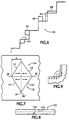
- Fig. 4 shows a knitted fabric 60 with a spickle 62 which against Flat steps 64 at the beginning and end (one row of stitches, two Rows of stitches wide). In the transition, levels 66 normal high (one row of stitches, one stitch wide) and go in the middle in higher steps 68 (two rows of stitches, one course wide) over.
- Fig. 4 shows how strong the shape of the pimple and thus the type of deformation by variation the step height by a stitch row and variation of the Step width can be changed by one stitch. The variation is however possible within very large limits, e.g. over almost the entire width of the knitted fabric and up to ten rows of stitches Height.
- Fig. 5 shows a knitting scheme for producing an approximately spherical Knitted fabrics.
- the figure actually shows that knitted textile surface 70.
- the shape of the textile is now achieved in that within a mutual area the textile surface needles at different intervals and in of a different width can be deactivated.
- the needles are deactivated in a first area 72, which, for example, only goes over 20 needles.
- a few Rows of stitches further, the stitches are deactivated in a region 74, which extends over the width of 60 needles.
- the needles are over activated a width 76 between the two above Widths, e.g. Needles.
- Other areas 78 are like this wide that these areas are from both sides of the knitted fabric overlap.
- the points at which there is a deformation of the knitted fabric 70 occurs are the points 71 where the inactivated Adjacent areas 72 to 78 to the knitted areas. Therefore, the width of the inactivated areas, i.e. the number of inactivated needles varies continuously, so that the deformation points 11 evenly within the deformation range b are distributed. This way you avoid furthermore a defined structuring of the acceptance, which in turn would be associated with weakening the knitted fabric.
- the mutual distance of inactivations 72,74,76,78 is relative constant, so that the deformation points 71 also in the direction of the mesh have an approximately uniform distance. In this way, the deformation points 11 become uniform in the knitted fabric 70 distributed. It is readily apparent from Fig.
- the inhomogeneities occurring in the marginal area of the inactivations 71 are undesirable because they reduce mechanical Stability and / or impairment of the Appearance of the knitted fabric.
- About inhomogeneity of the knitted fabric in the edge area of the inactivated sections if possible There are different ways to keep it low.
- the edge stitch 80 is the knitted fabric Area of the inactivated area 74 adjacent to the top left, placed on catch.
- area 73 of the opposite Deactivation on the right is a stitch in the border area between active and inactivated area split 82, so that one occurring due to the inhomogeneity Hole, as already shown in Fig. 1, can be covered.
- Another way of reducing inhomogeneities consists of a weft 84 at least in the course in front of and behind an inactivated section. This way the knitted fabric will be around the inactivated section amplified around. If the weft 84 from a flexible Material is there, the knitted fabric can be around the inhomogeneous Area around.
- Fig. 6 shows an enlarged portion of an edge of a Spickels 52 according to FIG. 3 or an increase / decrease area 32, 34 according to FIG. 7
- a spickle or at an increase / decrease in inhomogeneity in the area the spiked edge or increase / decrease edge.
- the steps of the stairs 90 are two rows of stitches and the width of two stitches.
- the illustrated Techniques to reduce edge inhomogeneities can also be used at levels with a lower or a higher level Step height and step width can be applied.
- the edge stitch 92 can be, for example, in the case of a double layer Knitted fabric on the front needle bed on the next lower staircase stitch to be hanged while on the back needle bed the next higher stair mesh is hung. In addition there is the possibility to close the meshes of both beds cross. This ensures the homogeneity of the knitted fabric in the area the edge raised.
- step 94 another horizontal is added to the step Edge knitted on, which afterwards when knitting together the edge areas can be so entangled that a larger opening in the knitted fabric is closed.
- a stitch can Don't just be appended horizontally by simply adding another one Stitch is knitted on the outside, but such a stitch can also be vertically knitted as shown in section 96 are not inactivated by the outer needle for a stitch height becomes.
- This stitch can also be knitted together afterwards be drawn so that a hole is covered with it can.
- FIG. 6 Possibility of splitting stitches, which also means that Volume and density of the knitted fabric in the area of the pimple edge or the increase / decrease edge can be increased.
- the options given can of course in technologically feasible interlinked become.
- Fig. 8 shows a two-layer knitted fabric 100, in which in the upper Position the edge 102 of a pimple, or an increase or Reduction relative to edge 104 of the lower layer by at least a mesh width is offset. This causes inhomogeneities better laminated in the edge area and a better mechanical Stability of the knitted fabric achieved.
- Fig. 9 shows a corner pimple.
- knitting course A becomes the stitch hanging on needle 1 of the inactivated area reassigned to the active area.
- those on the Needles 2 to 5 hanging stitches shifted to the right by one needle. This process is repeated until every five stitches of the inactive area has been reassigned to the active area are. In this way, a corner is created in the knitted fabric.
- One or more weft and / or Warp threads from the courses / wales coming into the edge merge to reinforce the edge, so that they run along the edge. In this way the edge is reinforced.
- elastic weft or Warp threads make it easier to compress the edge area and drape.
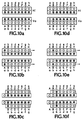
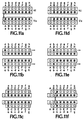
- 10 and 11 show the technique of reducing or vice versa Process flow the technique of gaining double-faced Knitted on four-bed machines or two-bed machines with an auxiliary needle bed for each bed.
- the needles of the two main needle beds or the first and second needle beds are marked with capital letters A to H.
- the needles the auxiliary needle beds or the third and fourth needle beds are labeled a to h.
- Fig. 10 shows the decrease starting from the needle A of the front and rear main needle bed.
- the corresponding stitches are reassigned to the needles a of the outer needle beds.
- the outer needle beds in process step b moved one needle position to the right. This position is shown in process step c.
- the needles a der outer needle beds now lie next to needles B of the inner one Needle beds.
- the one on the needles a of the outer needle beds hanging stitch on needle B of the inner needle beds hung back.
- the outer needle beds again in their starting position, i.e. moved back one position to the left.
- This starting position is again in process step d shown.
- this process step now the next stitch B from the inner needle beds to the outer needles b of the outer needle beds.
- step e the outer needle beds will move back one position move to the right as shown in step e is, so that finally position f is reached again becomes.
- the stitch hanging on the needles b of the outer needle beds is now transferred to the needles C of the inner needle beds.
- the outer needle beds are then returned to their original position moved back.
- FIG. 11 shows an alternative increase / decrease to FIG. 10.
- the stitches become from the inner needle beds not on the corresponding outer needle bed, but on the opposite one outer needle bed slung. That is, the left back stitch is from needle A of the back inner Needle bed on the needle a of the outer front needle bed reassigned. Conversely, a stitch is removed from the needle A of the front inner needle bed on the needle a of the rear the outer needle bed. Then be in analog 10 to the outer needle beds by one position Move right and the stitches from the outer needle beds reassigned to the associated inner needle beds. In the procedural step d becomes the stitch B of the inner front and back Needle beds on the needle b of the corresponding outer needle beds reassigned.
- a particularly dense one can be used Structure in the area of increase / decrease / spikles reached when knitting with all needles in this area, while in the rest of the area only with one of the two twin needles is knitted.
- the edge area can be defined by a Procedures are knit tighter than the rest Knitted area. If a left and right reduction is provided , these can be processed sequentially. Of course can be used to close all the holes described above Techniques for both increase / decrease and for use the spiked. Another purification of Increase / decrease / pimple edges can be done by single or combined Use split, shot, catch techniques.
Landscapes
- Engineering & Computer Science (AREA)
- Textile Engineering (AREA)
- Knitting Of Fabric (AREA)
- Knitting Machines (AREA)
Applications Claiming Priority (3)
| Application Number | Priority Date | Filing Date | Title |
|---|---|---|---|
| DE19616003 | 1996-04-18 | ||
| DE19616003A DE19616003A1 (de) | 1996-04-18 | 1996-04-18 | Spickeln/Zunehmen/Mindern |
| EP97922857A EP0904439A1 (fr) | 1996-04-18 | 1997-04-18 | Fa onner/augmenter/diminuer des tricots |
Related Parent Applications (1)
| Application Number | Title | Priority Date | Filing Date |
|---|---|---|---|
| EP97922857A Division EP0904439A1 (fr) | 1996-04-18 | 1997-04-18 | Fa onner/augmenter/diminuer des tricots |
Publications (3)
| Publication Number | Publication Date |
|---|---|
| EP1069221A2 true EP1069221A2 (fr) | 2001-01-17 |
| EP1069221A3 EP1069221A3 (fr) | 2001-02-14 |
| EP1069221B1 EP1069221B1 (fr) | 2005-01-19 |
Family
ID=7792086
Family Applications (6)
| Application Number | Title | Priority Date | Filing Date |
|---|---|---|---|
| EP97922857A Ceased EP0904439A1 (fr) | 1996-04-18 | 1997-04-18 | Fa onner/augmenter/diminuer des tricots |
| EP00119900A Expired - Lifetime EP1074648B1 (fr) | 1996-04-18 | 1997-04-18 | Façonner |
| EP00119912A Expired - Lifetime EP1074650B1 (fr) | 1996-04-18 | 1997-04-18 | Façonner |
| EP00119911A Expired - Lifetime EP1074649B1 (fr) | 1996-04-18 | 1997-04-18 | aggrégation, augmentation et diminution |
| EP00119899A Expired - Lifetime EP1074647B1 (fr) | 1996-04-18 | 1997-04-18 | Faconner |
| EP00119914A Expired - Lifetime EP1069221B1 (fr) | 1996-04-18 | 1997-04-18 | Façonner |
Family Applications Before (5)
| Application Number | Title | Priority Date | Filing Date |
|---|---|---|---|
| EP97922857A Ceased EP0904439A1 (fr) | 1996-04-18 | 1997-04-18 | Fa onner/augmenter/diminuer des tricots |
| EP00119900A Expired - Lifetime EP1074648B1 (fr) | 1996-04-18 | 1997-04-18 | Façonner |
| EP00119912A Expired - Lifetime EP1074650B1 (fr) | 1996-04-18 | 1997-04-18 | Façonner |
| EP00119911A Expired - Lifetime EP1074649B1 (fr) | 1996-04-18 | 1997-04-18 | aggrégation, augmentation et diminution |
| EP00119899A Expired - Lifetime EP1074647B1 (fr) | 1996-04-18 | 1997-04-18 | Faconner |
Country Status (5)
| Country | Link |
|---|---|
| US (3) | US6116057A (fr) |
| EP (6) | EP0904439A1 (fr) |
| JP (1) | JP2001501259A (fr) |
| DE (6) | DE19616003A1 (fr) |
| WO (1) | WO1997040220A1 (fr) |
Cited By (1)
| Publication number | Priority date | Publication date | Assignee | Title |
|---|---|---|---|---|
| CN106012279A (zh) * | 2016-07-13 | 2016-10-12 | 江阴芗菲服饰有限公司 | 羊毛衫的无线自动锁眼法 |
Families Citing this family (34)
| Publication number | Priority date | Publication date | Assignee | Title |
|---|---|---|---|---|
| DE19616005A1 (de) * | 1996-04-18 | 1997-10-23 | Beckmann Wolfgang Dr | Verfahren zur Herstellung eines dreidimensionalen Gestricks und Textilmaterial hergestellt nach diesem Verfahren |
| DE19616003A1 (de) * | 1996-04-18 | 1997-10-23 | Beckmann Wolfgang Dr | Spickeln/Zunehmen/Mindern |
| DE19717415A1 (de) * | 1997-04-25 | 1998-10-29 | Stoll & Co H | Verfahren zur Herstellung von räumlichen, ein- oder mehrflächigen Gestrickstücken auf einer Flachstrickmaschine |
| GB2325941B (en) * | 1997-06-03 | 2001-08-22 | Gen Motors Corp | A knitted cover |
| EP1130146A4 (fr) * | 1998-11-10 | 2004-09-08 | Shima Seiki Mfg | Procede de tricotage d'un tricot tridimensionnel |
| KR100706657B1 (ko) * | 2001-02-19 | 2007-04-11 | 가부시키가이샤 시마세이키 세이사쿠쇼 | 편성포 편성방법 |
| ES2291257T3 (es) * | 2001-08-28 | 2008-03-01 | H. STOLL GMBH & CO. | Procedimiento para la realizacion de una malla que se extiende sobre bastantes agujas. |
| WO2004063447A1 (fr) * | 2003-01-15 | 2004-07-29 | Shima Seiki Manufacturing, Ltd. | Tricot tubulaire et son procede de tricotage |
| SG168521A1 (en) | 2005-12-23 | 2011-02-28 | British Airways Plc | Aircraft passenger seat |
| US8192311B2 (en) * | 2008-06-27 | 2012-06-05 | Nike, Inc. | Sport ball with a textile restriction structure |
| DE102010012151B4 (de) * | 2010-03-20 | 2013-08-01 | H. Stoll Gmbh & Co. Kg | Verfahren zur Herstellung eines Schlauch-Rund-Fertiggestricks |
| JP5922903B2 (ja) * | 2011-10-03 | 2016-05-24 | 株式会社島精機製作所 | 編地の編成方法 |
| US10299531B2 (en) * | 2013-05-14 | 2019-05-28 | Nike, Inc. | Article of footwear incorporating a knitted component for a heel portion of an upper |
| AU2014303042B2 (en) * | 2013-06-25 | 2017-06-15 | Nike Innovate C.V. | Article of footwear with braided upper |
| US20140373389A1 (en) * | 2013-06-25 | 2014-12-25 | Nike, Inc. | Braided Upper With Overlays For Article Of Footwear |
| US10863794B2 (en) | 2013-06-25 | 2020-12-15 | Nike, Inc. | Article of footwear having multiple braided structures |
| DE102013218420A1 (de) * | 2013-09-13 | 2015-03-19 | Bsn-Jobst Gmbh | Kompressionsartikel |
| US10100445B2 (en) | 2014-04-03 | 2018-10-16 | Nike, Inc. | Method of forming a unitary knit article using flat-knit construction |
| US10688357B2 (en) * | 2014-08-07 | 2020-06-23 | Warrior Sport, Inc. | Lacrosse head pocket and related method of manufacture |
| US9259883B1 (en) | 2014-08-07 | 2016-02-16 | Warrior Sports, Inc. | Lacrosse head pocket and related method of manufacture |
| US10695631B2 (en) * | 2014-08-07 | 2020-06-30 | Warrior Sports, Inc. | Lacrosse head pocket and related method of manufacture |
| US10376760B2 (en) * | 2014-08-07 | 2019-08-13 | Warrior Sports, Inc. | Lacrosse head pocket and related method of manufacture |
| JP2017525505A (ja) * | 2014-08-28 | 2017-09-07 | ナイキ イノヴェイト シーヴィー | アッパーのかかと部用のニット構成要素を組み込んだ履物製品 |
| US10674791B2 (en) | 2014-12-10 | 2020-06-09 | Nike, Inc. | Braided article with internal midsole structure |
| US9668544B2 (en) | 2014-12-10 | 2017-06-06 | Nike, Inc. | Last system for articles with braided components |
| US10555581B2 (en) | 2015-05-26 | 2020-02-11 | Nike, Inc. | Braided upper with multiple materials |
| US20160345675A1 (en) | 2015-05-26 | 2016-12-01 | Nike, Inc. | Hybrid Braided Article |
| US11103028B2 (en) | 2015-08-07 | 2021-08-31 | Nike, Inc. | Multi-layered braided article and method of making |
| DE102015115228B3 (de) * | 2015-09-10 | 2016-09-15 | Medi Gmbh & Co. Kg | Flachgestrick in Form eines das Gesäß umfassenden Hosenteils, kompressive Hose umfassend ein solches Flachgestrick sowie Verfahren zur Herstellung eines solchen Flachgestricks |
| DE102016119052A1 (de) * | 2016-10-07 | 2018-04-12 | Rheinisch-Westfälische Technische Hochschule (Rwth) Aachen | Verfahren zum Stricken eines dreidimensionalen Gestricks |
| US11202483B2 (en) | 2017-05-31 | 2021-12-21 | Nike, Inc. | Braided articles and methods for their manufacture |
| US10806210B2 (en) | 2017-05-31 | 2020-10-20 | Nike, Inc. | Braided articles and methods for their manufacture |
| US11051573B2 (en) | 2017-05-31 | 2021-07-06 | Nike, Inc. | Braided articles and methods for their manufacture |
| IT202300028053A1 (it) * | 2023-12-27 | 2025-06-27 | S M T Soc Manifattura Tessile S R L | Semilavorato in tessuto di maglia e metodo per realizzarlo |
Family Cites Families (18)
| Publication number | Priority date | Publication date | Assignee | Title |
|---|---|---|---|---|
| DE112326C (fr) * | ||||
| DE330672C (de) * | 1913-11-22 | 1920-12-20 | Akt Ges Maschf | Verfahren zur Herstellung von erweiterter Schlauchware auf Strickmaschinen unter Stillsetzung von Nadeln |
| DE562751C (de) * | 1930-08-20 | 1932-10-28 | Schubert & Salzer Maschinen | In einem Arbeitsgang auf der flachen Kulierwirkmaschine hergestellter Strumpf sowie Verfahren zu dessen Herstellung |
| US3668898A (en) * | 1968-09-23 | 1972-06-13 | Courtaulds Ltd | Knitting methods |
| FR2113133A5 (en) * | 1970-10-23 | 1972-06-23 | Bentley Eng Co Ltd | Sock or stocking toe closure - using the latch needles to knit stitches together with a hemming yarn |
| US3800560A (en) * | 1970-12-02 | 1974-04-02 | Bentley Eng Co Ltd | Machine for and method of knitting stocking with closed toe |
| IT1060127B (it) * | 1975-05-30 | 1982-07-10 | Saint Julien Ets | Metodo per la costruzione di un manufatto a maglie e prodotto risultante |
| CS231618B1 (en) * | 1982-02-15 | 1984-12-14 | Jan Ando | Rotary knitting of heel |
| DE8629570U1 (de) * | 1986-11-05 | 1986-12-18 | Bayer Ag, 5090 Leverkusen | Polsterbezug aus Gestrick, insbesondere für Kfz-Sitzpolster |
| GB8822638D0 (en) * | 1988-09-27 | 1988-11-02 | Gen Motors Corp | Knitting method |
| US5326150A (en) * | 1988-09-22 | 1994-07-05 | General Motors Corporation | Upholstery fabric |
| GB8822639D0 (en) * | 1988-09-27 | 1988-11-02 | Gen Motors Corp | Knitting method |
| DE3937406C2 (de) * | 1989-11-10 | 1998-04-16 | Stoll & Co H | Verfahren zur Herstellung einer dreidimensional geformten Maschenware auf einer Flachstrickmaschine |
| AT399488B (de) * | 1991-04-22 | 1995-05-26 | Greiner & Soehne C A | Sitzpolster, insbesondere flugzeugsitz |
| JPH0781228B2 (ja) * | 1991-07-05 | 1995-08-30 | 株式会社島精機製作所 | 立体的なシルエットを有する筒状編地及びその編成方法 |
| JP2721948B2 (ja) * | 1993-08-12 | 1998-03-04 | 株式会社島精機製作所 | 編地の両面内増やし方法 |
| DE4439395A1 (de) * | 1994-11-04 | 1996-05-09 | Schieber Universal Maschf | Strickverfahren |
| DE19616003A1 (de) * | 1996-04-18 | 1997-10-23 | Beckmann Wolfgang Dr | Spickeln/Zunehmen/Mindern |
-
1996
- 1996-04-18 DE DE19616003A patent/DE19616003A1/de not_active Ceased
-
1997
- 1997-04-18 JP JP09537593A patent/JP2001501259A/ja active Pending
- 1997-04-18 DE DE59711836T patent/DE59711836D1/de not_active Expired - Lifetime
- 1997-04-18 DE DE59711118T patent/DE59711118D1/de not_active Expired - Lifetime
- 1997-04-18 EP EP97922857A patent/EP0904439A1/fr not_active Ceased
- 1997-04-18 EP EP00119900A patent/EP1074648B1/fr not_active Expired - Lifetime
- 1997-04-18 DE DE59711963T patent/DE59711963D1/de not_active Expired - Lifetime
- 1997-04-18 WO PCT/DE1997/000791 patent/WO1997040220A1/fr not_active Ceased
- 1997-04-18 EP EP00119912A patent/EP1074650B1/fr not_active Expired - Lifetime
- 1997-04-18 EP EP00119911A patent/EP1074649B1/fr not_active Expired - Lifetime
- 1997-04-18 EP EP00119899A patent/EP1074647B1/fr not_active Expired - Lifetime
- 1997-04-18 US US09/171,371 patent/US6116057A/en not_active Expired - Lifetime
- 1997-04-18 EP EP00119914A patent/EP1069221B1/fr not_active Expired - Lifetime
- 1997-04-18 DE DE59712175T patent/DE59712175D1/de not_active Expired - Lifetime
- 1997-04-18 DE DE59712174T patent/DE59712174D1/de not_active Expired - Lifetime
-
2000
- 2000-02-23 US US09/511,199 patent/US6233976B1/en not_active Expired - Lifetime
-
2001
- 2001-01-09 US US09/757,325 patent/US6308536B2/en not_active Expired - Lifetime
Cited By (1)
| Publication number | Priority date | Publication date | Assignee | Title |
|---|---|---|---|---|
| CN106012279A (zh) * | 2016-07-13 | 2016-10-12 | 江阴芗菲服饰有限公司 | 羊毛衫的无线自动锁眼法 |
Also Published As
| Publication number | Publication date |
|---|---|
| EP1074648A2 (fr) | 2001-02-07 |
| US6116057A (en) | 2000-09-12 |
| EP1069221A3 (fr) | 2001-02-14 |
| DE59711836D1 (de) | 2004-09-09 |
| US20010001925A1 (en) | 2001-05-31 |
| EP1074648A3 (fr) | 2001-02-14 |
| EP1074647A3 (fr) | 2001-02-14 |
| WO1997040220A1 (fr) | 1997-10-30 |
| EP1074650B1 (fr) | 2005-01-19 |
| EP1074647B1 (fr) | 2004-09-22 |
| DE19616003A1 (de) | 1997-10-23 |
| EP1074649A2 (fr) | 2001-02-07 |
| US6233976B1 (en) | 2001-05-22 |
| EP1074650A3 (fr) | 2001-02-14 |
| EP0904439A1 (fr) | 1999-03-31 |
| DE59711118D1 (de) | 2004-01-22 |
| EP1074649A3 (fr) | 2001-02-28 |
| DE59711963D1 (de) | 2004-10-28 |
| EP1069221B1 (fr) | 2005-01-19 |
| JP2001501259A (ja) | 2001-01-30 |
| US6308536B2 (en) | 2001-10-30 |
| EP1074648B1 (fr) | 2004-08-04 |
| DE59712174D1 (de) | 2005-02-24 |
| EP1074647A2 (fr) | 2001-02-07 |
| DE59712175D1 (de) | 2005-02-24 |
| EP1074649B1 (fr) | 2003-12-10 |
| EP1074650A2 (fr) | 2001-02-07 |
Similar Documents
| Publication | Publication Date | Title |
|---|---|---|
| EP1074648B1 (fr) | Façonner | |
| DE69017451T2 (de) | Gerippte Strick-Webware. | |
| DE69205311T2 (de) | Bekleidungsstoff. | |
| EP2952616B1 (fr) | Procédé de fabrication d'un tricot plat ou tridimensionnel | |
| DE102009018942A1 (de) | Matratzenbezug und Verfahren zur Herstellung eines dafür bestimmten Bezugsstoffs | |
| EP0904440B1 (fr) | Procede de fabrication d'un tricot tridimensionnel et matiere textile fabriquee selon ce procede | |
| DE2518508C2 (de) | Beinloser Slip | |
| DE7833219U1 (de) | Strumpfhose | |
| DE102016103421A1 (de) | Rundgestrickteil sowie Verfahren zur Herstellung eines solchen | |
| EP3480350A1 (fr) | Tricot pourvu de zones à caractéristiques d'amortissement différentes et un procédé pour la réalisation | |
| EP2431508B1 (fr) | Procédé de fabrication d'un tube tricoté et tricot tubulaire obtenu | |
| EP3375921A1 (fr) | Pièce tricotée | |
| DE3937406A1 (de) | Verfahren zur herstellung einer dreidimensional geformten maschenware auf einer flachstrickmaschine | |
| DE102016005593A1 (de) | Formmaschenware mit 3D-Oberflächenstruktur | |
| DE19739239C1 (de) | Verfahren zur Herstellung eines Gestricks, insbesondere auf einer Flachstrickmaschine | |
| EP0864680B1 (fr) | Procédé pour la fabrication d'un tricot dans un métier à tricoter rectiligne | |
| DE2309349A1 (de) | Einschlauch-strumpfhose | |
| DE69704444T2 (de) | Kettengewirkter textiler Stoff mit Muster von gefalteten Stoffteilen | |
| DE19616004A1 (de) | Verfahren zum Verbinden mehrerer Gestrickteile auf einer Flachstrickmaschine | |
| DE102020208218B4 (de) | Auxetischer Artikel | |
| DE112018008083B4 (de) | Volumentrikotage | |
| DE102014019405A1 (de) | Maschenware und Verfahren zu ihrer Herstellung | |
| EP0180714A1 (fr) | Etoffe et procédé pour sa fabrication | |
| DE2821126C2 (de) | Elastischer Rand einer Socke und Verfahren zu seiner Herstellung | |
| EP2199445A1 (fr) | Habillement de jambe tricoté et son procédé de fabrication |
Legal Events
| Date | Code | Title | Description |
|---|---|---|---|
| PUAI | Public reference made under article 153(3) epc to a published international application that has entered the european phase |
Free format text: ORIGINAL CODE: 0009012 |
|
| PUAL | Search report despatched |
Free format text: ORIGINAL CODE: 0009013 |
|
| AC | Divisional application: reference to earlier application |
Ref document number: 904439 Country of ref document: EP |
|
| AK | Designated contracting states |
Kind code of ref document: A2 Designated state(s): DE FR GB IT |
|
| RIN1 | Information on inventor provided before grant (corrected) |
Inventor name: ROELL FRIEDRICH |
|
| AK | Designated contracting states |
Kind code of ref document: A3 Designated state(s): DE FR GB IT |
|
| RAP1 | Party data changed (applicant data changed or rights of an application transferred) |
Owner name: RECARO GMBH & CO. |
|
| 17P | Request for examination filed |
Effective date: 20010814 |
|
| AKX | Designation fees paid |
Free format text: DE FR GB IT |
|
| RAP1 | Party data changed (applicant data changed or rights of an application transferred) |
Owner name: GEBRUEDER ACHTER GMBH & CO. KG |
|
| GRAP | Despatch of communication of intention to grant a patent |
Free format text: ORIGINAL CODE: EPIDOSNIGR1 |
|
| GRAS | Grant fee paid |
Free format text: ORIGINAL CODE: EPIDOSNIGR3 |
|
| 17Q | First examination report despatched |
Effective date: 20031119 |
|
| GRAA | (expected) grant |
Free format text: ORIGINAL CODE: 0009210 |
|
| AC | Divisional application: reference to earlier application |
Ref document number: 0904439 Country of ref document: EP Kind code of ref document: P |
|
| AK | Designated contracting states |
Kind code of ref document: B1 Designated state(s): DE FR GB IT |
|
| REG | Reference to a national code |
Ref country code: GB Ref legal event code: FG4D Free format text: NOT ENGLISH |
|
| REF | Corresponds to: |
Ref document number: 59712174 Country of ref document: DE Date of ref document: 20050224 Kind code of ref document: P |
|
| GBT | Gb: translation of ep patent filed (gb section 77(6)(a)/1977) |
Effective date: 20050425 |
|
| PLBE | No opposition filed within time limit |
Free format text: ORIGINAL CODE: 0009261 |
|
| STAA | Information on the status of an ep patent application or granted ep patent |
Free format text: STATUS: NO OPPOSITION FILED WITHIN TIME LIMIT |
|
| ET | Fr: translation filed | ||
| 26N | No opposition filed |
Effective date: 20051020 |
|
| REG | Reference to a national code |
Ref country code: FR Ref legal event code: PLFP Year of fee payment: 20 |
|
| PGFP | Annual fee paid to national office [announced via postgrant information from national office to epo] |
Ref country code: DE Payment date: 20160426 Year of fee payment: 20 Ref country code: GB Payment date: 20160425 Year of fee payment: 20 |
|
| PGFP | Annual fee paid to national office [announced via postgrant information from national office to epo] |
Ref country code: IT Payment date: 20160429 Year of fee payment: 20 Ref country code: FR Payment date: 20160423 Year of fee payment: 20 |
|
| REG | Reference to a national code |
Ref country code: DE Ref legal event code: R071 Ref document number: 59712174 Country of ref document: DE |
|
| REG | Reference to a national code |
Ref country code: GB Ref legal event code: PE20 Expiry date: 20170417 |
|
| PG25 | Lapsed in a contracting state [announced via postgrant information from national office to epo] |
Ref country code: GB Free format text: LAPSE BECAUSE OF EXPIRATION OF PROTECTION Effective date: 20170417 |