EP0980517B1 - Detachable-element assay device - Google Patents
Detachable-element assay device Download PDFInfo
- Publication number
- EP0980517B1 EP0980517B1 EP98918257A EP98918257A EP0980517B1 EP 0980517 B1 EP0980517 B1 EP 0980517B1 EP 98918257 A EP98918257 A EP 98918257A EP 98918257 A EP98918257 A EP 98918257A EP 0980517 B1 EP0980517 B1 EP 0980517B1
- Authority
- EP
- European Patent Office
- Prior art keywords
- test strip
- panel
- sample
- assay
- analyte
- Prior art date
- Legal status (The legal status is an assumption and is not a legal conclusion. Google has not performed a legal analysis and makes no representation as to the accuracy of the status listed.)
- Expired - Lifetime
Links
Images

Classifications
-
- G—PHYSICS
- G01—MEASURING; TESTING
- G01N—INVESTIGATING OR ANALYSING MATERIALS BY DETERMINING THEIR CHEMICAL OR PHYSICAL PROPERTIES
- G01N33/00—Investigating or analysing materials by specific methods not covered by groups G01N1/00 - G01N31/00
- G01N33/48—Biological material, e.g. blood, urine; Haemocytometers
- G01N33/50—Chemical analysis of biological material, e.g. blood, urine; Testing involving biospecific ligand binding methods; Immunological testing
- G01N33/53—Immunoassay; Biospecific binding assay; Materials therefor
- G01N33/543—Immunoassay; Biospecific binding assay; Materials therefor with an insoluble carrier for immobilising immunochemicals
- G01N33/54366—Apparatus specially adapted for solid-phase testing
- G01N33/54386—Analytical elements
- G01N33/54387—Immunochromatographic test strips
- G01N33/54388—Immunochromatographic test strips based on lateral flow
-
- Y—GENERAL TAGGING OF NEW TECHNOLOGICAL DEVELOPMENTS; GENERAL TAGGING OF CROSS-SECTIONAL TECHNOLOGIES SPANNING OVER SEVERAL SECTIONS OF THE IPC; TECHNICAL SUBJECTS COVERED BY FORMER USPC CROSS-REFERENCE ART COLLECTIONS [XRACs] AND DIGESTS
- Y10—TECHNICAL SUBJECTS COVERED BY FORMER USPC
- Y10S—TECHNICAL SUBJECTS COVERED BY FORMER USPC CROSS-REFERENCE ART COLLECTIONS [XRACs] AND DIGESTS
- Y10S435/00—Chemistry: molecular biology and microbiology
- Y10S435/97—Test strip or test slide
-
- Y—GENERAL TAGGING OF NEW TECHNOLOGICAL DEVELOPMENTS; GENERAL TAGGING OF CROSS-SECTIONAL TECHNOLOGIES SPANNING OVER SEVERAL SECTIONS OF THE IPC; TECHNICAL SUBJECTS COVERED BY FORMER USPC CROSS-REFERENCE ART COLLECTIONS [XRACs] AND DIGESTS
- Y10—TECHNICAL SUBJECTS COVERED BY FORMER USPC
- Y10S—TECHNICAL SUBJECTS COVERED BY FORMER USPC CROSS-REFERENCE ART COLLECTIONS [XRACs] AND DIGESTS
- Y10S435/00—Chemistry: molecular biology and microbiology
- Y10S435/975—Kit
-
- Y—GENERAL TAGGING OF NEW TECHNOLOGICAL DEVELOPMENTS; GENERAL TAGGING OF CROSS-SECTIONAL TECHNOLOGIES SPANNING OVER SEVERAL SECTIONS OF THE IPC; TECHNICAL SUBJECTS COVERED BY FORMER USPC CROSS-REFERENCE ART COLLECTIONS [XRACs] AND DIGESTS
- Y10—TECHNICAL SUBJECTS COVERED BY FORMER USPC
- Y10S—TECHNICAL SUBJECTS COVERED BY FORMER USPC CROSS-REFERENCE ART COLLECTIONS [XRACs] AND DIGESTS
- Y10S436/00—Chemistry: analytical and immunological testing
- Y10S436/807—Apparatus included in process claim, e.g. physical support structures
-
- Y—GENERAL TAGGING OF NEW TECHNOLOGICAL DEVELOPMENTS; GENERAL TAGGING OF CROSS-SECTIONAL TECHNOLOGIES SPANNING OVER SEVERAL SECTIONS OF THE IPC; TECHNICAL SUBJECTS COVERED BY FORMER USPC CROSS-REFERENCE ART COLLECTIONS [XRACs] AND DIGESTS
- Y10—TECHNICAL SUBJECTS COVERED BY FORMER USPC
- Y10S—TECHNICAL SUBJECTS COVERED BY FORMER USPC CROSS-REFERENCE ART COLLECTIONS [XRACs] AND DIGESTS
- Y10S436/00—Chemistry: analytical and immunological testing
- Y10S436/807—Apparatus included in process claim, e.g. physical support structures
- Y10S436/808—Automated or kit
-
- Y—GENERAL TAGGING OF NEW TECHNOLOGICAL DEVELOPMENTS; GENERAL TAGGING OF CROSS-SECTIONAL TECHNOLOGIES SPANNING OVER SEVERAL SECTIONS OF THE IPC; TECHNICAL SUBJECTS COVERED BY FORMER USPC CROSS-REFERENCE ART COLLECTIONS [XRACs] AND DIGESTS
- Y10—TECHNICAL SUBJECTS COVERED BY FORMER USPC
- Y10S—TECHNICAL SUBJECTS COVERED BY FORMER USPC CROSS-REFERENCE ART COLLECTIONS [XRACs] AND DIGESTS
- Y10S436/00—Chemistry: analytical and immunological testing
- Y10S436/825—Pretreatment for removal of interfering factors from sample
Definitions
- This invention is directed to assay devices for determination of characteristics of samples, unitized housings, and kits incorporating the test strips and housings, and methods of determining the characteristics of samples using test strips and housings, in which the test strips and housings employ detachable components.
- chromatographic assay systems as well as other assay systems employing test strips for detection or determination of analytes.
- Such chromatographic systems and other assay systems involving test strips are frequently used by physicians and medical technicians for rapid in-office diagnosis and therapeutic monitoring of a variety of conditions and disorders. They are also increasingly used by patients themselves for at-home monitoring of such conditions and disorders.
- this technique uses a disclosing reagent or particle that has been linked to an antibody to the molecule to be assayed, forming a conjugate. This conjugate is then mixed with a specimen, and if the molecule to be assayed is present in the specimen, the disclosing reagent-linked antibodies bind to the molecule to be assayed, thereby giving an indication that the molecule to be assayed is present.
- the disclosing reagent or particle can be identifiable by color, magnetic properties, radioactivity, specific reactivity with another molecule, or another physical or chemical property. The specific reactions that are employed vary with the nature of the molecule being assayed and the sample to be tested.
- Immunochromatographic assays fall into two principal categories: “sandwich” and “competitive,” according to the nature of the antigen-antibody complex to be detected and the sequence of reactions required to produce that complex.
- the antigen to be detected can itself be an antibody, such as in serological assays for H. pylori-specific antibody. In such cases, the antibody to be detected can be bound to a specific antigen. Alternatively, the antigen to be detected can be detected indirectly by using a labeled second antibody that binds to the first antibody to the antigen to be detected.
- the sandwich immunochromatographic procedures call for mixing the sample that may contain the analyte to be assayed with antibodies to the analyte.
- These antibodies are mobile and typically are linked to a label or a disclosing reagent, such as dyed latex, a colloidal metal sol, or a radioisotope.
- This mixture is then applied to a chromatographic medium containing a band or zone of immobilized antibodies to the analyte of interest.
- the chromatographic medium often is in the form of a strip resembling a dipstick.
- U.S. Patent No. 5,215,713 describes a test device for determining an analyte in a pasty sample, in particular in stool. It contains a capillary-active fluid transport section, which leads from an eluant application zone via a sample application zone to an eluate reception zone containing reagents which react with the analyte and include a component producing a test signal.
- the label is typically labeled analyte or analyte analogue which competes for binding to an antibody with any unlabeled analyte present in the sample.
- Competitive immunoassays are typically used for detection of analytes such as haptens, each hapten being monovalent and capable of binding only one antibody molecule. Examples of competitive immunoassay devices are those disclosed by U.S. Patent No. 4,235,601 to Deutsch et al., U.S. Patent No. 4,442,204 to Liotta, and U.S. Patent No. 5,208,535 to Buechler et al. Other forms of competitive immunoassays exist using labeled antibody.
- Sample preparation and waste generation are responsible for other problems with currently-available devices and techniques for immunochromatography and other currently-available test strips.
- Several extraction and pretreatment reactions are usually required before the sample can be applied to the chromatographic medium or the test strip. These reactions are typically carried out by the physician or technician performing the test in several small vessels, such as test tubes or microfuge tubes, requiring the use of transfer devices, such as pipettes. Each of the vessels and transfer devices is then contaminated and must be disposed of, using special precautions so that workers or people who may inadvertently come into contact with the waste do not become contaminated.
- the biologically reactive components require a low humidity environment.
- the non-biologically active components of such a device do not require such an environment. Sealing the entire test device in a low humidity environment is not done out of necessity, rather out of convenience. However, convenience exacts a price.
- the moisture barrier component must be sufficiently large to accommodate the entire test device. This increases the final package dimensions of test kits incorporating these devices and increases the volume of desiccant required.
- Assembly times are increased when a test strip containing biologically active components is applied to a housing.
- the increased time is inversely related to manufacturing throughput and directly related to the cost of the finished test.
- the housing is comprised of a material capable of high residual moisture levels, e.g., a cellulosic material such as cardboard, procedures are required to reduce the residual moisture to acceptable levels thereby again increasing manufacturing costs.
- moisture reduction requires specialized equipment which must be purchased, operated, and maintained, again increasing cost.
- an improved assay device capable of handling a broad range of chromatographic assays and other assays employing test strips.
- Such a device should be able to handle all types of immunoassays, including both sandwich and competitive immunoassays, as well as other types of assays using chromatography and other assays involving test strips.
- Such a device should be capable of receiving a possibly contaminated sample or a sample preparation device directly so as to eliminate the need for extraction vessels and transfer devices.
- Such a device preferably in the form of a test strip, should also be capable of performing immunochromatographic assays on colored samples or samples containing particulates without interference and should be able to deliver the sample to the chromatographic medium uniformly and evenly to improve accuracy and precision of the test. Additionally, such an improved test strip should be capable of performing bidirectional chromatography when used in clinical laboratories or physicians' offices. Moreover, such an improved assay device should reduce packaging and storage costs and the volume of desiccant required for storage.
- the device can perform all types of immunoassays, including sandwich immunoassays, competitive immunoassays, and assays employing combinations of these principles.
- the device can perform serological assays in which the antigen to be detected is itself an antibody, such as antibody to H. pylori.
- the device can perform assays in which the antigen to be detected is detected indirectly by using a labeled second antibody binding to the first antibody to the analyte.
- An assay device may employs either at least one detachable component or a plurality of hinged panels, as shown in more detail below.
- An assay device makes use of pressure to transfer fluid from one opposable component to another opposable component, and also to drive fluid through the chromatographic medium or other test strip.
- the pressure not only speeds up the operation of the device, but allows the performance of additional steps, such as extraction steps to remove interfering particulate components or incubation steps to allow the development of a detectable signal by an enzyme label, within a single device.
- the pressure is generated by holding the opposable components together.
- a predetermined pressure is applied to ensure the optimum performance of each step of the assay procedure.
- the device can perform other types of specific binding assays, such as: (1) assays based on the affinity of specific binding proteins such as lectins, hormone receptors, or viral receptors for their specific ligands; (2) assays based on the affinity of enzymes for their corresponding substrates or inhibitors, or (3) assays based on the affinity of a nucleic acid (DNA or RNA) segment for a complementary nucleic acid segment according to the Watson-Crick base pairing scheme.
- specific binding assays such as: (1) assays based on the affinity of specific binding proteins such as lectins, hormone receptors, or viral receptors for their specific ligands; (2) assays based on the affinity of enzymes for their corresponding substrates or inhibitors, or (3) assays based on the affinity of a nucleic acid (DNA or RNA) segment for a complementary nucleic acid segment according to the Watson-Crick base pairing scheme.
- an assay device for use with an insertable test strip (26) for detection or determination of an analyte in a liquid sample, comprising
- An example of a general device comprises:
- the first and second opposable components can be brought into operable contact so that fluid is expressed from the sample collection device and applied to the test strip for detection or determination of an analyte by a test performed on the test strip.
- the first receptacle is shaped to hold a generally ovoid swab.
- the second receptacle is a receptacle that holds a chromatographic medium having a first end and second end such that the chromatographic medium is inserted into the receptacle so that when the first and second opposable components are brought into opposition, the fluid expressed from the sample collection device is applied to the first end of the chromatographic medium.
- the second opposable component can include an aperture for viewing of at least a portion of the test strip.
- the test strip is a chromatographic medium, it preferably includes a detection zone, and the second opposable component preferably further includes an aperture for viewing of the detection zone.
- test kit which comprises in separately packaged containers:
- test kits Other devices described herein can similarly be incorporated into test kits.
- Also described is a method for detection or determination of a analyte comprising the steps of:
- the method can further comprise the step of adding at least one additional reagent to the sample collection device.
- Another example of an assay device comprises:
- the second and third opposable components are foldable and the first and second opposable components are brought into operable contact when the second opposable component has been folded over the third opposable component so that fluid is expressed from the sample collection device and applied to the test strip for detection or determination of the analyte.
- Another assay device comprises:
- the second module when the second module is attached to the first module, the second module is folded over the second panel of the first module, and the second module and the second panel of the first module are folded over the first panel of the first module to bring the second module and the first panel of the first module into operable contact, fluid is expressed from the sample collection device and applied to the test strip for detection or determination of an analyte therein.
- Test kits incorporating this device can comprise the first and second modules, packaged separately, along with a test strip and any additional reagents. Alternatively, at least two second modules can be provided, along with a test strip for each second module. This allows flexibility and the performance of one of two or more alternate tests using the same test kit.
- Another assay device comprises:
- the third support panel is folded over the second support panel and the combination of the second and third support panels are folded over the first support panel to bring the test strip into operable contact with the sample preparation zone.
- the first reaction panel is folded over the third support panel so that the first reaction pad is in operable contact with a first portion of the test strip and the second reaction panel is folded over the third support panel so that the second reaction pad is in operable contact with a second portion of the test strip.
- the first reaction pad can include therein an extraction reagent.
- the first reaction pad can include a labeled specific binding partner for the analyte in resolubilizable form.
- the second reaction pad can include therein a labeled specific binding partner for the analyte in resolubilizable form.
- the first reaction pad can have a specific binding partner for the analyte in resolubilizable form labeled with a catalyst, and the second reaction pad can have in resolubilizable form at least one compound capable of participating in a reaction catalyzed by the catalyst to produce a detectable signal.
- the catalyst is an enzyme.
- the enzyme is horseradish peroxidase, ⁇ -galactosidase, glucose oxidase, or alkaline phosphatase.
- the first reaction pad contains a specific binding partner labeled with a detectable label in resolubilizable form and the second reaction pad contains an amplifying reagent to amplify a signal produced by the detectable label.
- the detectable label is a gold sol label and the amplification system includes a quinone and a soluble silver salt.
- Another assay device comprising:
- the second module is folded over the second support panel of the first module and, when the second module is folded over the second support panel of the first module, the second module and the second support panel of the first module are folded over the first support panel of the first module to bring the sample preparation zone into operable contact with the test strip.
- the third module is folded over the second support panel of the first module and the second module to bring the first reaction pad into operable contact with a first portion of the test strip and the fourth module is folded over the second support panel of the, first module and the second module to bring the second reaction pad into operable contact with the second portion of the test strip.
- reaction pads are the same for this device as for the device in which the reaction pads are not removably attached.
- Another assay device may comprise:
- the third support panel is folded over the second support panel and the combination of the second and third support panels can be folded over the first support panel to bring the test strip into operable contact with the sample preparation zone.
- the first reaction panel is folded over the third support panel so that the first reaction pad is in operable contact with a first portion of the test strip and the second reaction panel can be folded over the third support panel so that the second reaction pad is in operable contact with a second portion of the test strip.
- Another assay device described comprises:
- the second module is folded over the second support panel of the first module and, when the second module is folded over the second support panel of the first module, the second module and the second support panel of the first module are folded over the first support panel of the first module to bring the sample preparation zone into operable contact with the test strip.
- the fourth module is folded over the second support panel of the first module and the second module to bring the first reaction pad into operable contact with a first portion of the test strip and the second reaction panel is folded over the second support panel of the first module and the second module to bring the second reaction pad into operable contact with the second portion of the test strip.
- Yet another assay device which comprises:
- the first and second opposable components are brought into operable contact so that fluid is expressed from the sample collection device and applied to the test strip when the test strip is in the first position for detection or determination of an analyte by a test performed on the test strip.
- Assay devices can either employ at least one detachable element or employ a plurality of hinged panels to carry out reaction steps.
- both detachable elements and the use of hinged panels are employed to carry out a plurality of reaction steps within a unitary device.
- a device according to the present invention is a two-component device with an insertable test strip. This device is shown in Figure 1.
- the device 10 has a first opposable component 12 and a second opposable component 14.
- the second opposable component 14 is hingedly attached to the first opposable component 12.
- the first opposable 12 component includes a first panel 16 and a second panel 18.
- the second panel 1 8 is mounted on the first panel 16 generally parallel to the first panel 16 with space between the first and second panels 16 and 18.
- the second panel 18 has an opening forming a first receptacle 20 for a sample collection device.
- a second receptacle 22 for a test strip is formed by the first panel 16 and the second panel 18.
- the first and second opposable components 12 and 14 are brought into operable contact so that fluid is expressed from the sample collection device and applied to the test strip for detection or determination of an analyte by a test performed on the test strip.
- the first receptacle 20 is shaped to hold a generally ovoid swab as the sample collection device.
- the test strip is a chromatographic medium, such as chromatographic medium 26 shown in Figure 1, having a first end 28 and a second end 30.
- the chromatographic medium 26 is inserted into the second receptacle in such a way so that when the first and second opposable components 12 and 14 are brought into opposition with the chromatographic medium 26 in the device, fluid expressed from the sample collection device is applied to the first end 28 of the chromatographic medium 26.
- the second opposable component 14 includes an aperture 32 for viewing of at least a portion of the test strip.
- the chromatographic medium 26 further includes a detection zone 34 and the aperture 32 in the second opposable component 14 is for viewing of the detection zone 34.
- the device can further comprise sealing means such as the closure 36 to hold the first and second opposable components 12 and 14 in opposition.
- the closure 36 is in such an orientation that it allows insertion of the chromatographic medium 26 after the first and second opposable components 12 and 14 are brought into opposition.
- test strip typically a chromatographic medium
- the test strip is preferably backed with adhesive and a releasable liner for insertion into the second receptacle 22 of the assay device.
- the chromatographic medium is a strip.
- the strip is substantially planar, although this is not required for all applications. It is typically rectangular, having first and second ends and first and second surfaces.
- first end refers to the end at or near which liquid is first applied to the chromatographic medium and the term “second end” refers to the: opposite end of the chromatographic medium.
- the liquid applied at or near the first end of the chromatographic medium can be, but is not necessarily, a sample, a treated sample, or material contained in a sample collection device such as a swab.
- the chromatographic medium is composed of material suitable as a medium for thin layer chromatography of analyte and analyte-antibody conjugates, such as nitrocellulose, nylon, rayon, cellulose, paper, or silica.
- the chromatographic medium can be pretreated or modified as needed.
- the chromatographic medium is translucent, so that colored zones appearing on it can be viewed from either side.
- the chromatographic medium has a detection zone of immobilized specific binding partner to the analyte thereon.
- the detection zone is substantially smaller than the chromatographic medium.
- the immobilized specific binding partner can be bound to the chromatographic medium by either covalent or non-covalent means; covalent means are generally preferred.
- Methods for immobilizing specific binding partners, particularly antibodies, to chromatographic media are well known in the art and need not be described further here; such methods are described, for example, in P. Tijssen. "Practice and Theory of Enzyme Immunoassays" (Elsevier, Amsterdam, 1995), ch. 13, pp. 297-328.
- the immobilized specific binding partner is typically an antibody to the antigen or the hapten.
- the, analyte can be an antibody and the specific binding partner that is immobilized can be a hapten or an antigen capable of being bound specifically by the antibody.
- the bodies of the opposable components are preferably made of laminated cardboard thai is sufficiently impervious to moisture to contain the liquids involved in the performance of the assay carried out by the device.
- Other cellulose-based materials such as paperboard or solid bleached sulfite (SBS), can also be used.
- the bodies of the opposable components can be made of plastic that is impervious to moisture.
- a suitable plastic is a polycarbonate plastic such as Lexan TM .
- the opposable components are hingedly attachable.
- the components are joined by a hinge, preferably made of a material impermeable to liquids, such as a plastic thai can be compatibly joined with or is the same as the material used for the first and second opposable components.
- the devices employ a labeled component to give a detectable signal on the chromatographic medium or other test strip.
- the labeled component is typically a labeled specific binding partner to the analyte.
- This labeled component is typically mobile, in that it can migrate through the chromatographic medium, whether free or bound to analyte.
- the label is preferably a visually detectable label, such as a colloidal metal label.
- the colloidal metal label is gold, silver, bronze, iron, or tin; most preferably, it is gold.
- the preparation of gold labeled antibodies and antigens is described in J.
- colloidal labels such as a colloidal sulfur label or a dye-silica label
- the visually-detectable label can be a colored latex label.
- an enzyme label is in fact preferred.
- a method for use of this device for detection or determination of an analyte comprises:
- test strip can be inserted after the closure of the first and second opposable components. In some versions of the device, this order of operation is preferable.
- a detectable signal is produced on the test strip.
- a sandwich immunoassay is performed with a mobile label such as a colloidal gold label that is bound to a specific binding partner for the analyte and an immobilized second specific binding partner for the analyte at a detection zone on the chromatographic medium.
- a mobile label such as a colloidal gold label that is bound to a specific binding partner for the analyte and an immobilized second specific binding partner for the analyte at a detection zone on the chromatographic medium.
- additional reagents can be added to the sample collection device. If the mobile labeled specific binding partner for the analyte is not incorporated within the device in resolubilizable form, the mobile labeled specific binding partner for the analyte can be added to the sample collection device. Alternatively, an extraction reagent such as nitrous acid can be added to or formed in the sample collection device. Nitrous acid can be formed by adding acetic acid to sodium nitrite, present in dried form on the sample collection device. Other reagents can be added to the sample collection device.
- an extraction reagent such as nitrous acid can be added to or formed in the sample collection device. Nitrous acid can be formed by adding acetic acid to sodium nitrite, present in dried form on the sample collection device.
- Other reagents can be added to the sample collection device.
- reagents can include, but are not limited to, acids or alkalis to adjust the pH, buffers to stabilize the pH, chelating agents such as EDTA or EGTA to chelate metals, hydrolytic enzymes to lyse the cell membrane of animal cells or the cell wall of bacteria to liberate analytes, substrates or coenzymes for enzymes, and the like.
- the components are secured to the bodies of the first and second opposable components 12 and 14 by adhesive.
- Suitable adhesives are well known in the art.
- Other joining methods, such as stapling or tacking, can also be used.
- the assay devices can further incorporate a backing for the test strip between the opposable component and the test strip.
- the backing can be a thin impermeable plastic.
- Assay methods using a device according to the present invention can give a qualitative, semi-quantitative, or quantitative indication of analyte presence or concentration, depending upon the concentration of the labeled specific binding partner at the detection zone and the size of the detection zone, as well as the detection method used.
- the term “detect” is used to refer to a qualitative indication of the presence or absence of an analyte
- the term “determine” is used to refer to either a semi-quantitative or a quantitative determination of the concentration of the analyte.
- observation is typically used to refer to a visual observation leading to a qualitative or semi-quantitative determination or detection of analyte presence or concentration
- measure is typically used to refer to an instrumental measurement that yields a quantitative determination of analyte concentration. Such a measurement is typically by spectroscopy, although other methods can be used.
- the assay requires from about 30 seconds to about 10 minutes, more typically from about 1 to about 5 minutes, including any period of incubation of the sample in the sample collection device, as well as the time required for chromatography itself.
- the assay is performed at room temperature, although it can be performed at 4°C or up to 37°C or higher in some cases, depending upon the nature of the analyte and the specific binding partners employed. In some cases, performing the assay at a lower temperature may be desirable to limit degradation of the analyte or of another component involved in the reaction. In other cases, performing the assay at a higher temperature with suitable analytes and specific binding partners may speed up the assay.
- the test strip can be removed from the second receptacle and inserted into a heating device such as a microwave heater, to heat the test strip and speed the assay or otherwise treat the sample, such as to perform an extraction.
- a heating device such as a microwave heater
- the separable test strip once developed, can be removed from the device for insertion into a reading device such as a spectrophotometer to assist in the quantitation of the result.
- this alternative, involving removal of the strip from the assay device is not preferred.
- FIG. 2 A device with a similar construction, but with three opposable components, is shown in Figure 2.
- the first opposable component holds the sample collection device
- the second opposable component has an aperture for viewing of the test strip
- the third opposable component holds the test strip.
- the device is shown in Figure 2.
- the device 50 has a first opposable component 52, a second opposable component 54, and a third opposable component 56.
- the first opposable component 52 includes a first panel 58 and an opening forming a first receptacle 60 for a sample collection device in the first panel 58.
- the second opposable component 54 includes therein an aperture 62.
- the second opposable component 54 is hingedly attachable to the first opposable component 52.
- the third opposable component 56 is hingedly attachable to the second opposable component 54.
- the third opposable component 56 includes a second receptacle 64 for a test strip as described above,
- the second and third opposable components 54 and 56 are foldable.
- the first and third opposable components 52 and 56 can be brought into operable contact when the third opposable component 56 is folded over the second opposable component 54 and together are folded over the first opposable component 52 so that fluid is expressed from the sample collection device inserted into the first receptacle 60 and applied to the test strip for detection or determination of the analyte.
- the aperture 62 is for viewing of a portion of the test strip 66, Typically, the test strip 66 is a chromatographic medium having a detection zone 68; in this case, the aperture 62 allows viewing of the detection zone 68.
- the device includes sealing means such as a closure 70 to hold the three opposable components 52, 54, and 56 into position and seal the test device 50.
- sealing means such as a closure 70 to hold the three opposable components 52, 54, and 56 into position and seal the test device 50.
- Another alternative assay device is a three-component device with a removably attachable module for the test strip.
- the device 100 comprises a first module 102 and a second module 104.
- the first module 102 includes a first panel 106. including therein a first receptacle 108 for a sample collection device as described above.
- the first module 102 further includes a second panel 110 hingedly attached to the first panel 106.
- the second panel 110 has an aperture 112 for viewing of a portion of a test strip.
- the second module 104 includes therein a second receptacle 114 for a test strip 116.
- the second module 104 is removably hingedly attachable to the second panel 110 of the first module 102.
- the second module 104 When the second module 104 is attached to the first module 102, the second module 104 is folded over the second panel 110 of the first module 102, and the second panel 110 of the first module 102 and the second module 104 are folded over the first panel 106 of the first module 102 to bring the second module 104 and the first panel 106 of the first module 102 into operable contact, fluid is expressed from a sample collection device inserted into the first receptacle 108 and applied to the test strip 116 for detection or determination of an analyte.
- the first receptacle 108 is typically shaped to hold a generally ovoid swab.
- the test strip 116 inserted into the second receptacle 114 is typically a chromatographic medium as described above.
- the chromatographic medium can include a detection zone 118.
- the aperture 112 of the second panel 110 of the first module 102 allows viewing of the detection zone 118 when the second module 104 is folded over the second panel 110 of the first module 102.
- the first and second modules 102 and 104 are removably hingedly attachable so that the first and second modules 102 and 104 can be detached from each other; it is then possible to generate various combinations of first and second modules 102 and 104.
- Various means of removably hingedly attaching the first module 102 to the second module 104 can be used. These include the use of removably attachable fabric such as Velcro TM or a hook-and-eye arrangement. Alternatively, these modules can be removably attached by magnetic or electrical forces. Other means for removably attaching the first and second modules 102 and 104 are well-known in the art and need not be described further here.
- This assay device is used as follows:
- Another assay device employs a plurality of hinged reaction panels. Each panel includes a reaction pad containing a component that can perform a unique function.
- the device 150 comprises a first support panel 152, a second support panel 154, and a third support panel 156.
- the first support panel 152 includes thereon a sample preparation zone 158.
- the second support panel 154 is hingedly attached to the first support panel 152.
- the second support panel 154 includes therein an aperture 160.
- the second support panel 154 is shaped to have first, second, third, and fourth sides 162, 164, 166, and 168 with the first and third sides 162 and 166 being substantially parallel, and the second and fourth sides 164 and 168 being substantially parallel.
- the first side 162 is hingedly attached to the first support panel 152.
- the third support panel 156 is hingedly attached to the third side 166 of the second support panel 154.
- the third support panel 156 has first and second surfaces 170 and 172, with a test strip 174 attached to the second surface 172, and can also have an aperture 175 for viewing of the test strip 174.
- the device further comprises a first reaction panel 176 hingedly attached to the second side 164 of the second support panel 154.
- the first reaction panel 176 has thereon a first reaction pad 178.
- the device further comprises a second reaction panel 180 hingedly attached to the fourth side 168 of the second support panel 154.
- the second reaction panel 180 has thereon a second reaction pad 182.
- the third support panel 156 is folded over the second support panel 154 and the combination of the second and third support panels 154 and 156 are then folded over the first support panel 152 to bring the test strip 174 into operable contact with the sample preparation zone 158.
- the third support panel 156 When the third support panel 156 is folded over the second support panel 154, the first reaction panel 176 is folded over the third support panel 156 so that the first reaction pad 178 is in operable contact with the first portion 184 of the test strip, and the second reaction panel 180 is folded over the third support panel 156 so that the second reaction pad 182 is in operable contact with the second portion 186 of the test strip 174.
- the test strip 174 is a chromatographic medium and has first and second ends 188 and 190.
- the first reaction pad 178 is in operable contact with the first end 188 of the chromatographic medium
- the second reaction pad 182 is in operable contact with the second end 190 of the chromatographic medium.
- the first and second reaction pads 178 and 182 can include various combinations of reagents, such as extraction reagents, a labeled specific binding partner for the analyte in resolubilizable form, or a specific binding partner for the analyte in resolubilizable form that is labeled with a catalyst.
- the first reaction pad 178 can include therein an extraction reagent, such as sodium nitrite to produce nitrous acid when acetic acid is added.
- the first reaction pad 178 can alternatively include a labeled specific binding partner for the analyte in resolubilizable form, such as a gold-labeled antibody.
- the second reaction pad 182 can include therein a labeled specific binding partner for the analyte in resolubilizable form. This alternative is particularly suitable for performing bidirectional immunoassays such as are preferred in a serological assay for the detection of an antibody.
- the first reaction pad 178 has a specific binding partner for the analyte in resolubilizable form labeled with a catalyst
- the second reaction pad 182 has in resolubilizable form at least one compound capable of participating in a reaction catalyzed by the catalyst to product a detectable signal.
- the catalyst is an enzyme.
- the enzyme can be any of horseradish peroxidase, ⁇ -galactosidase, glucose oxidase, and alkaline phosphatase. Other enzymes are well known as suitable for enzyme immunoassay and can be used.
- a cascade of two or more enzymes can be used with the product of one enzyme being utilized in a reaction catalyzed by a second enzyme.
- the first reaction pad 176 can contain a specific binding partner labeled with a detectable label in resolubilizable form and the second reaction pad 182 can contain an amplifying reagent to amplify a signal produced by the detectable label.
- One particularly useful amplification method is amplification of colloidal gold staining with silver. Silver can be used to amplify colloidal gold as a label for a compound participating in a specific binding reaction. Gold can catalyze the reaction of a soluble silver salt to metallic silver, producing silver shells that surround the gold label so that larger areas are visible. This amplifies the signal that is bound, for example, in a ternary complex at the detection zone when a sandwich immunoassay is used.
- the soluble silver salt is preferably silver lactate.
- the reducing agent is typically a quinone, such as hydroquinone. Other amplification techniques are also known in the art.
- the second reaction pad 182 can be used to apply a wash liquid such as a buffer or salt solution in the second direction of chromatography.
- a wash liquid such as a buffer or salt solution in the second direction of chromatography.
- the appropriate buffers or salts can be incorporated on the second reaction pad 182 in resolubilizable form.
- the sample preparation zone 158 can be made of any suitable material, such as, but not limited to, cellulose, paper, nylon, rayon, glass fiber, fleeces, or nonwoven synthetic fabrics.
- a typical material for the sample preparation zone 158 is a bibulous paper such as filter paper.
- the porosity of the sample preparation zone 158 can be chosen to filter out cellular or particulate matter in samples such as whole blood or fecal samples.
- the sample preparation zone can contain at least one reagent for treatment of the sample before the sample is applied to the test strip.
- the sample preparation zone 158 is adapted to receive a liquid sample.
- liquid sample is defined to mean a sample having sufficient liquid so the chromatography can be performed, and includes semisolid samples or samples containing particulate matter.
- the reagents can be present in the sample preparation zone 158 with the sample to be applied to the sample preparation zone and vary with the analyte to be assayed.
- One particularly useful extraction reagent is a mixture of sodium nitrite and acetic acid to generate nitrous acid.
- the sodium nitrite can be present in dried form on the sample preparation zone, and the acetic acid can be added to the sample preparation zone before or after the addition of the sample.
- a sample is applied to the sample preparation zone 158.
- Other reagents can also be applied to the sample preparation zone before the sample, simultaneously with the sample, or after the sample.
- the third support panel 156 is then folded back over the second support panel 154 and the folded third and second support panels 156 and 154 are then folded over the first support panel 152 to bring the sample preparation zone 158 into operable contact with the test strip 174, which is typically a chromatographic medium. This applies the sample and any other reagents applied to the sample preparation zone 158 to the test strip 174.
- the first support panel 152 is then folded away from the second and third support panels 154 and 156 and the first and second reaction panels 176 and 180 are then folded over the third support panel 156 to bring the first and second reaction pads 178 and 182 into operable contact with portions of the test strip as described above.
- either the first 176 or the second 180 reaction panel can be folded first to bring it into operable contact with the test strip 174.
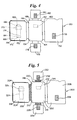
- a variant of the device shown in Figure 4 uses removably hingedly attachable modules for the test strip and the first and second reaction panels. This device is shown in Figure 5.
- the device 200 includes a first module 202 and a second module 204.
- the first module 202 includes a first support panel 206 including thereon a sample preparation zone 208.
- the first module 202 also has a second support panel 210 having an aperture therein 212 with first, second, third, and fourth sides 214, 216, 218, and 220.
- the second support panel 210 is hingedly attached to the first support panel 206 via the first side 214 of the second support panel 210.
- the second module 204 comprises a third support panel with first and second surfaces 221 and 222.
- the third support panel includes thereon a test strip 224 on the second surface 222 of the third support panel.
- the second module 204 is removably hingedly attachable to the third side 218 of the second support panel 210 of the first module 202.
- the second module 204 also can include an aperture 225 to allow viewing of the test strip 224.
- the device further comprises a third module 226 that is a first reaction panel having a first reaction pad 228 thereon and that is removably hingedly attachable to the second side 216 of the second support panel 210 of the first module 202.
- the device further comprises a fourth module 230 that is a second reaction panel that has a second reaction pad 232 thereon and that is removably hingedly attachable to the fourth side 220 of the second support panel 210 of the first module 202.
- This device operates exactly as the device shown in Figure 4 except for the removably hingedly attachable components.
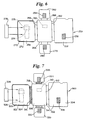
- Another device is substantially similar to that shown in Figure 4 but instead of a test strip permanently mounted on the third support panel, it has a receptacle for a test strip.
- a test strip backed with adhesive and a releasable liner is provided. The releasable liner is removed and the test strip is inserted into the receptacle.
- the device 250 has a first support panel 252, a second support panel 254, and a third support panel 256.
- the first support panel 252 has thereon a sample preparation zone 258 as described above.
- the second support panel 254 is hingedly attachable to the first support panel 252 and has an aperture 260.
- the second support panel 254 is shaped to have first, second, third, and fourth sides 262, 264, 266, and 268, as described above.
- the first side 262 is hingedly attached to the first support panel 252.
- the third support panel 256 is hingedly attached to the third side 266 of the second support panel 254.
- the third support panel 256 has first and second surfaces 270 and 272 and has a receptacle 274 for a test strip 276 so that when a test strip is inserted into the receptacle 274, the surface of the test strip 276 is accessible from the second surface 272 of the third support panel 256.
- the device further comprises a first reaction panel 278 hingedly attached to the second side 264 of the second support panel 254 and having thereon a first reaction pad 280.
- the device further comprises a second reaction panel 282 hingedly attached to the fourth side 268 of the second support panel 254 and having thereon a second reaction pad 284.
- test strip is inserted into the receptacle at the appropriate time during the performance of the assay. This can be either before or after the addition of the sample to the sample preparation zone.
- FIG. 7 Another device employs both the multiplicity of removably hinged panels of Figure 5 and the insertable test strip of Figure 6. This assay device is depicted in Figure 7.
- the assay device 300 has a first module 302 including a first support panel 304 and a second support panel 306.
- the first support panel 304 includes thereon a sample preparation zone 308.
- the second support panel has an aperture 310 and has first, second, third, and fourth sides 312, 314, 316, and 318 as described above.
- the second support panel 306 is hingedly attached to the first support panel 304 via the first side 312 of the second support panel 306.
- the device further comprises a second module 320 comprising a third support panel, the third support panel having first and second surfaces 322 and 324 and having a receptacle 326 for a test strip 328.
- the receptacle 326 is positioned such that when the test strip 328 is inserted into the receptacle 326, the surface of the test strip is accessible from the second surface 324 of the third support panel.
- the second module 320 is removably hingedly attachable to the third side 316 of the second support panel 306 of the first module 302.
- the device further comprises a third module 330 that is a first reaction panel that has a first reaction pad 332 thereon.
- the third module 330 is removably hingedly attachable to the second side 314 of the second support panel 306 of the first module 302.
- the device further comprises a fourth module 334 that is a second reaction panel that has a second reaction pad 336 thereon.
- the fourth module 330 is removably hingedly attachable to the fourth side 318 of the second support panel 306 of the first module 302.
- the operation of this device is substantially equivalent to that of the device shown in Figure 5, except that, as for the device shown in Figure 6, a test strip is inserted into the receptacle during the performance of the assay.
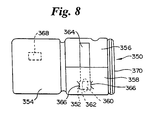
- test strip slides between a first position in operable contact with a receptacle for a sample collection device and a second position in which the test strip is not in operable contact with the receptacle for the sample collection device.
- the device 350 has a first opposable component 352 and a second opposable component 354 hingedly attached to the first opposable component 352.
- the first opposable component 352 includes a first panel 356 and a second panel 358.
- the second panel 358 is mounted on the first panel 356 generally parallel to the first panel 356 with space between the first and second panels 356 and 358.
- the second panel 358 has an opening forming a first receptacle 360 for a sample collection device.
- a second receptacle 362 for a test strip 364 is formed by the first panel 356 and the second panel 358.
- the test strip 364 is placed in the second receptacle 362 and forms part of the device 350.
- the second receptacle 362 has slidable contact means 366 to hold the test strip 364 slidably in one of two positions: a first position in which the test strip 364 is in operable contact with a sample collection device placed in the first receptacle 360, and a second position in which the test strip 364 is not in operable contact with a sample collection device placed in the first receptacle 360.
- the first opposable component 304 typically has an aperture 368 for viewing of at least a portion of the test strip 364.
- the first and second opposable components 352 and 354 are also preferably joined by engaging means such as a lock 370 to hold the first and second opposable components 352 and 354 together in proper relation for performance of the assay.
- the device 350 is supplied with the test strip 364 in its first position.
- the test strip 364 is then moved to its second position and a sample collection device such as a swab is placed in the first receptacle 360.
- Sample extraction or other manipulations are performed, and the test strip 364 is then moved back to its first position and the device 350 closed by bringing the first and second opposable components 352 and 354 into opposition. This initiates performance of the assay.
- test kits for the performance of assays using the devices described above including those of the present invention.
- insertable test strips and removably hingedly attachable components provide great flexibility in the assembly of test kits.
- test kit comprises, in separately packaged containers:
- This test kit can further comprise, separately packaged, at least one additional reagent for application either to the sample collection device or the test strip.
- the additional reagent can form an extraction reagent when applied to the sample collection device; a typical extraction reagent formed is nitrous acid.
- test kit can comprise:
- This test kit can further comprise at least one additional reagent as described above.
- test kit comprises, packaged in separate containers:
- This test kit can further comprise at least one additional reagent as described above as well.
- test device of Figure 3 has two separable modules
- an alternative test kit employing this device can comprise:
- the test kit can comprise at least two second modules of the assay device so that alternate tests can be performed, for example, for two different bacterial or viral antigens.
- at least two test strips are provided, one for each second module.
- Each test strip is backed with adhesive and a releasable liner.
- test kits comprises, in separately packaged containers:
- Another test kit can comprise:
- Another test kit can comprise:
- the assay device of Figure 7 can be packaged in its individual modules so that the first, second, third, and fourth modules can be packaged separately.
- multiple third or fourth modules can be furnished to allow the performance of different types of assays, perhaps involving different enzymes or other labels.
- at least one additional reagent can also be included.
- Another test kit can comprise:
- test kits can be packaged separately and can be in liquid or solid form (freeze-dried, crystallized, precipitated, or aggregated). If the latter, they are resolubilized by the user, typically with distilled or purified water, physiological saline, or a buffer solution. Other aqueous solvents can also be used.
- the analytes suitable for detection with any of the assay devices described above include antigens, haptens, and antibodies.
- Antigens detectable with an assay device according to the present invention include hemoglobin, Streptococcus A and B antigens, antigens specific for the protozoan parasite Giardia, and viral antigens, including antigens specific for HIV and the Australia antigen specific for hepatitis.
- Antibodies that can be assayed include antibodies to bacteria such as Helicobacter pylori and viruses, including HIV.
- Haptens detectable include any haptens to which antibodies of sufficient specificity can be prepared.
- the first and second specific binding partners are preferably antibodies. In many applications, it is preferable that the first and second specific binding partners are antibodies to different epitopes on the analyte, but this is not required.
- the antibodies can be polyclonal or monoclonal, and can be IgG, IgM, or IgA. In many applications, polyclonal antibodies are preferred, as their natural variability may allow more accurate detection in systems in which antigenic polymorphisms exist or may exist.
- the first and second specific binding partners be antibodies binding different epitopes; otherwise, there may be an undesirable competition reaction set up that may interfere with binding of the complex of the labeled specific binding partner and the analyte to the immobilized second specific binding partner. It is recognized that not all haptens are large enough to accommodate more than one epitope; however, some haptens that are not large enough to induce antibody formation when injected by themselves, are nevertheless large enough that they possess more than one epitope. In cases where antibodies to more than one epitope of a hapten cannot be obtained, competitive assay procedures are generally preferred.
- the first specific binding partner is typically a labeled antibody that binds the analyte on the basis of species, class, or subclass (isotype) specificity. It is highly preferred that the first specific binding partner to an antibody analyte bind to the constant region of the antibody analyte, in order to prevent interference.
- the second specific binding partner is preferably an antigen orhapten for which the antibody analyte is specific.
- an IgM antibody can be used that may be difficult to label directly.
- a secondary specific binding partner specific for the mobile first specific binding partner can be labeled, Typically, the labeled secondary specific binding partner binds to the antibody that is the first specific binding partner on the basis of species, class, or subclass specificity.
- the first specific binding partner can be conjugated to biotin and an avidin-conjugated label can be used.
- assay devices described above and according to the present invention typically perform sandwich immunoassays, such devices can also perform competitive immunoassays.
- Various combinations of labeled and unlabeled specific binding partners and analyte analogues are known in the art and can be used.
- Example is for illustrative purposes only and is not to be construed as limiting the scope of the invention in any manner.
- a test for Group A streptococci is run using the device of Figure 1.
- a swab containing Group A streptococci is placed into the first receptacle.
- Nitrous acid, or another suitable extraction reagent is added to the swab in the first receptacle.
- Such a reagent serves as a carrier, and, if necessary, a means of treating the specimen thereby releasing or exposing the analyte to be detected.
- a labeled specific binding panner to the analyte is added, such as gold-labeled anti-Group A streptococcal antibody.
- the labeled specific binding partner can be present on the test strip in resolubilizable form.
- the housing is closed and sealed along the margins by the closure. This action serves two functions. First, the sample delivery system is positioned properly to receive the test strip assembly. Second, closure of the housing provides containment of the specimen which minimizes the risk of exposure to potentially pathogenic agents.
- test strip assembly is then inserted into the device after the backing is removed from the test strip.
- the components are keyed in such a manner that the test strip assembly can only be inserted into the housing in the proper orientation.
- the test strip assembly contacts the swab and fluid migration occurs.
- the result of the test is then read after the appropriate incubation period, typically 5 minutes, through the aperture. If Group A streptococci are present in the sample, a colored band or zone appears in the aperture.
- Chromatographic assay devices provide an advantage in being constructed of opposable elements.
- the use of opposable elements provides great versatility, as it permits the performance of reactions in a number of different sequences. This is possible because the use of such opposable elements allows the delivery of reagents to precisely defined regions of a test strip or other reaction component.
- the use of opposable elements also provides optimum performance with minimum consumption of reagents by ensuring that reagents are not wasted by being sequestered in dead volumes of apparatus.
- the use of opposable components provides optimum containment of possibly contaminated blood samples, such as those containing HIV or hepatitis virus.
- chromatographic assay devices described herein as well as other assay devices not employing chromatography allow the rapid and accurate detection of clinically important antigens, such as Streptococcus A and B antigen, hemoglobin for the determination of fecal occult blood, and antibody to Helicobacter pylori, as well as many other antigens.
- the construction of the devices allows more even application of samples and reagents to the chromatographic medium or other test strip, and reduces interference that might otherwise be introduced by particulates or colored samples.
- Extraction of biological samples such as blood, sputum, or feces can be performed directly in the devices, reducing the quantity of contaminated material that must be disposed and reducing the likelihood of accidental infection of physicians, technicians, or the public by such contaminated material. Additionally, the devices are capable of performing bidirectional chromatography to further increase accuracy and reduce interference. Test methods using devices according to the present invention have a wide dynamic range and are substantially free from false negatives that may occur in other test methods at high concentrations of analyte.
- the assay devices of the present invention also provide savings in manufacturing costs and time, particularly in packaging, because of their construction. Only the biologically active components need be sealed in a low humidity environment. The housings need not be moisture-free, and the steps needed to ensure that the housings would be moisture-free can be eliminated. This saves on equipment and production costs. The elimination of moisture-free packaging for the housings also reduces the volume of packaging material required and saves on storage and shipment.
- test strip assembly or chromatographic medium allows for further flexibility in the performance of the immunochromatographic or other test.
- the housing and its attached sample delivery system can be placed into a heating device.
- more stringent conditions can be employed to treat a sample, such as the use of heat extraction, if the test procedure warrants.
- the separate test strip once developed, can be removed from the device for insertion into a reading device, such as a spectrophotometer or fluorimeter, for quantitation of the result.
Landscapes
- Health & Medical Sciences (AREA)
- Immunology (AREA)
- Life Sciences & Earth Sciences (AREA)
- Engineering & Computer Science (AREA)
- Molecular Biology (AREA)
- Biomedical Technology (AREA)
- Chemical & Material Sciences (AREA)
- Hematology (AREA)
- Urology & Nephrology (AREA)
- Food Science & Technology (AREA)
- Biochemistry (AREA)
- Cell Biology (AREA)
- Biotechnology (AREA)
- Medicinal Chemistry (AREA)
- Physics & Mathematics (AREA)
- Analytical Chemistry (AREA)
- Microbiology (AREA)
- General Health & Medical Sciences (AREA)
- General Physics & Mathematics (AREA)
- Pathology (AREA)
- Investigating Or Analysing Biological Materials (AREA)
- Sampling And Sample Adjustment (AREA)
- Investigating Or Analysing Materials By Optical Means (AREA)
- Measurement Of The Respiration, Hearing Ability, Form, And Blood Characteristics Of Living Organisms (AREA)
- Automatic Analysis And Handling Materials Therefor (AREA)
Applications Claiming Priority (3)
| Application Number | Priority Date | Filing Date | Title |
|---|---|---|---|
| US08/853,760 US5939252A (en) | 1997-05-09 | 1997-05-09 | Detachable-element assay device |
| PCT/US1998/007599 WO1998050778A1 (en) | 1997-05-09 | 1998-04-15 | Detachable-element assay device |
| US853760 | 2001-05-14 |
Publications (3)
| Publication Number | Publication Date |
|---|---|
| EP0980517A1 EP0980517A1 (en) | 2000-02-23 |
| EP0980517A4 EP0980517A4 (en) | 2003-01-22 |
| EP0980517B1 true EP0980517B1 (en) | 2007-02-14 |
Family
ID=25316824
Family Applications (1)
| Application Number | Title | Priority Date | Filing Date |
|---|---|---|---|
| EP98918257A Expired - Lifetime EP0980517B1 (en) | 1997-05-09 | 1998-04-15 | Detachable-element assay device |
Country Status (8)
| Country | Link |
|---|---|
| US (1) | US5939252A (enExample) |
| EP (1) | EP0980517B1 (enExample) |
| JP (1) | JP4104669B2 (enExample) |
| AT (1) | ATE354082T1 (enExample) |
| AU (1) | AU730243B2 (enExample) |
| CA (1) | CA2286680C (enExample) |
| DE (1) | DE69837087T2 (enExample) |
| WO (1) | WO1998050778A1 (enExample) |
Families Citing this family (63)
| Publication number | Priority date | Publication date | Assignee | Title |
|---|---|---|---|---|
| TW356712U (en) * | 1998-03-04 | 1999-04-21 | Yung-Shiang Liou | Testing apparatus of immune |
| AUPP915799A0 (en) * | 1999-03-11 | 1999-04-15 | Enterix Inc. | Sample collection and testing system |
| DE10002819B4 (de) * | 2000-01-24 | 2004-07-08 | Sension, Biologische Detektions- Und Schnelltestsysteme Gmbh | Nachweissystem zur Prüfung der Originalität eines Objekts und Testvorrichtung zur Durchführung der Prüfung |
| US6316205B1 (en) | 2000-01-28 | 2001-11-13 | Genelabs Diagnostics Pte Ltd. | Assay devices and methods of analyte detection |
| US6607922B2 (en) | 2000-03-17 | 2003-08-19 | Quantum Design, Inc. | Immunochromatographic assay method and apparatus |
| JP3680090B2 (ja) * | 2000-05-25 | 2005-08-10 | 株式会社ニチレイ | 分析装置 |
| USD468437S1 (en) | 2000-11-21 | 2003-01-07 | Acon Laboratories, Inc. | Test platform |
| US7039033B2 (en) * | 2001-05-07 | 2006-05-02 | Ixi Mobile (Israel) Ltd. | System, device and computer readable medium for providing a managed wireless network using short-range radio signals |
| US7300633B2 (en) | 2001-07-25 | 2007-11-27 | Oakville Hong Kong Company Limited | Specimen collection container |
| US7270959B2 (en) | 2001-07-25 | 2007-09-18 | Oakville Hong Kong Company Limited | Specimen collection container |
| GB0123151D0 (en) * | 2001-09-26 | 2001-11-21 | Biotrace Ltd | Device for use in monitoring swab technique |
| US7560272B2 (en) | 2003-01-04 | 2009-07-14 | Inverness Medical Switzerland Gmbh | Specimen collection and assay container |
| US7425302B2 (en) * | 2003-02-24 | 2008-09-16 | Binax, Inc. | Dry chemistry, lateral flow-reconstituted chromatographic enzyme-driven assays |
| US7300802B2 (en) * | 2003-04-25 | 2007-11-27 | Biodigit Laboratories Corp. | Membrane strip biosensor system for point-of-care testing |
| US7517495B2 (en) | 2003-08-25 | 2009-04-14 | Inverness Medical Switzerland Gmbh | Biological specimen collection and analysis system |
| CA2834041C (en) * | 2003-12-31 | 2017-05-16 | President And Fellows Of Harvard College | Assay device and method |
| SE0400191D0 (sv) * | 2004-01-30 | 2004-01-30 | Tendera Ab | A test kit for detecting periodontal disease |
| US7488450B2 (en) * | 2004-03-04 | 2009-02-10 | Beckman Coulter, Inc. | Analyte collection and detection devices |
| US7297530B2 (en) | 2004-04-01 | 2007-11-20 | Biotrace Limited | Device for use in monitoring a swab technique |
| US20050272112A1 (en) * | 2004-04-28 | 2005-12-08 | Imi International Medical Innovations, Inc. | Direct assay of cholesterol in skin removed by tape stripping |
| US8679420B2 (en) * | 2004-07-22 | 2014-03-25 | Immunostics, Inc. | Fecal sampling device and method |
| EP1807212A4 (en) * | 2004-10-06 | 2009-06-03 | Binax Inc | SAMPLE RECEIVING DEVICE AND USE METHOD THEREFOR |
| US7396689B2 (en) * | 2005-02-04 | 2008-07-08 | Decision Biomarkers Incorporated | Method of adjusting the working range of a multi-analyte assay |
| US8614101B2 (en) * | 2008-05-20 | 2013-12-24 | Rapid Pathogen Screening, Inc. | In situ lysis of cells in lateral flow immunoassays |
| US7189522B2 (en) | 2005-03-11 | 2007-03-13 | Chembio Diagnostic Systems, Inc. | Dual path immunoassay device |
| WO2006098804A2 (en) | 2005-03-11 | 2006-09-21 | Chembio Diagnostic Systems, Inc. | Dual path immunoassay device |
| GB2435512A (en) | 2006-02-23 | 2007-08-29 | Mologic Ltd | A binding assay and assay device |
| GB2435510A (en) * | 2006-02-23 | 2007-08-29 | Mologic Ltd | Enzyme detection product and methods |
| GB2435511A (en) | 2006-02-23 | 2007-08-29 | Mologic Ltd | Protease detection |
| GB2435927A (en) * | 2006-03-03 | 2007-09-12 | Ethicon Inc | Sample collection and testing device with pivot arm |
| US7976792B2 (en) * | 2007-05-30 | 2011-07-12 | Ally Shivji | Biological specimen collection card |
| JP4865664B2 (ja) * | 2007-09-28 | 2012-02-01 | 富士フイルム株式会社 | 多孔性担体内で2以上の液を混合する方法 |
| WO2009091501A1 (en) * | 2008-01-18 | 2009-07-23 | Response Biomedical Corporation | Heated assays for influenza |
| US20130196310A1 (en) | 2008-05-20 | 2013-08-01 | Rapid Pathogen Screening, Inc. | Method and Device for Combined Detection of Viral and Bacterial Infections |
| US8815609B2 (en) | 2008-05-20 | 2014-08-26 | Rapid Pathogen Screening, Inc. | Multiplanar lateral flow assay with diverting zone |
| US9797898B2 (en) | 2008-05-20 | 2017-10-24 | Rapid Pathogen Screening, Inc. | Methods and devices for using mucolytic agents including N-acetyl cysteine (NAC) |
| US8609433B2 (en) | 2009-12-04 | 2013-12-17 | Rapid Pathogen Screening, Inc. | Multiplanar lateral flow assay with sample compressor |
| US8962260B2 (en) | 2008-05-20 | 2015-02-24 | Rapid Pathogen Screening, Inc. | Method and device for combined detection of viral and bacterial infections |
| JP5117928B2 (ja) * | 2008-05-27 | 2013-01-16 | 富士フイルム株式会社 | イムノクロマトグラフデバイス |
| US20100022916A1 (en) | 2008-07-24 | 2010-01-28 | Javanbakhsh Esfandiari | Method and Apparatus for Collecting and Preparing Biological Samples for Testing |
| KR101027036B1 (ko) * | 2009-05-28 | 2011-04-11 | 주식회사 인포피아 | 금 이온의 환원에 의한 측방유동 분석에서의 신호 증폭 방법 및 이를 이용한 측방유동 분석 디바이스 |
| GB2470962A (en) * | 2009-06-12 | 2010-12-15 | Dna Supernova Ltd | Amplification medium for use with a solid-phase substrate |
| CN102782495B (zh) * | 2009-11-04 | 2014-12-31 | 托马斯·M·布坎南 | 用于在快速侧流免疫测定中增强灵敏度以及评估样品充足性和试剂反应性的方法和装置 |
| US9877672B2 (en) | 2010-01-28 | 2018-01-30 | Ellume Pty Ltd | Sampling and testing device for the human or animal body |
| US8956859B1 (en) | 2010-08-13 | 2015-02-17 | Aviex Technologies Llc | Compositions and methods for determining successful immunization by one or more vaccines |
| JP2012177677A (ja) * | 2011-02-02 | 2012-09-13 | Arkray Inc | 分析装置 |
| US8603835B2 (en) | 2011-02-10 | 2013-12-10 | Chembio Diagnostic Systems, Inc. | Reduced step dual path immunoassay device and method |
| US10890590B2 (en) | 2012-09-27 | 2021-01-12 | Ellume Limited | Diagnostic devices and methods |
| US9618428B2 (en) | 2012-11-30 | 2017-04-11 | Ge Healthcare Uk Limited | Biometric device and means for electronic storage and retrieval of biometric data |
| CN103149331B (zh) * | 2013-03-01 | 2015-12-23 | 陈德鑫 | 一种杂草调查测报器 |
| JP6721501B2 (ja) * | 2013-05-14 | 2020-07-15 | フィブロテックス エー | 側方流動分析装置 |
| ES2906853T3 (es) | 2014-04-02 | 2022-04-20 | Chembio Diagnostic Systems Inc | Inmunoensayo que utiliza conjugado de atrapamiento |
| JP6294155B2 (ja) * | 2014-05-20 | 2018-03-14 | 株式会社ダスキン | アレルゲン検査装置 |
| US20160116466A1 (en) | 2014-10-27 | 2016-04-28 | Chembio Diagnostic Systems, Inc. | Rapid Screening Assay for Qualitative Detection of Multiple Febrile Illnesses |
| US10786229B2 (en) | 2015-01-22 | 2020-09-29 | Ellume Limited | Diagnostic devices and methods for mitigating hook effect and use thereof |
| US10808287B2 (en) | 2015-10-23 | 2020-10-20 | Rapid Pathogen Screening, Inc. | Methods and devices for accurate diagnosis of infections |
| US11090649B2 (en) | 2016-04-19 | 2021-08-17 | Purdue Research Foundation | Temperature controlled valves for paper-based microfluidic systems |
| US20180024073A1 (en) * | 2016-07-21 | 2018-01-25 | Ronald Schornstein | Reach-extended test strip |
| JP7066212B2 (ja) * | 2017-01-06 | 2022-05-13 | ディーエヌティー サイエンティフィック リサーチ,エルエルシー | 駆動流技術による迅速診断試験装置 |
| WO2024026498A2 (en) * | 2022-07-28 | 2024-02-01 | University Of Houston System | Sample collection apparatus and methods of use |
| CN115980347A (zh) * | 2023-02-09 | 2023-04-18 | 深圳市绿诗源生物技术有限公司 | 用于检测猪轮状病毒的试剂盒及检测方法 |
| GB2630612B (en) * | 2023-05-31 | 2026-04-29 | Eclateral Ltd | Lateral flow test systems and methods |
| CN121948225A (zh) * | 2023-09-05 | 2026-05-01 | 哈尔滨商业大学 | 一种含有消毒装置的折叠式检测试纸固定结构 |
Family Cites Families (306)
| Publication number | Priority date | Publication date | Assignee | Title |
|---|---|---|---|---|
| US35306A (en) * | 1862-05-20 | Improvement in combined cultivator and seeding-machine | ||
| US31006A (en) * | 1861-01-01 | Feeding mechanism for spoke-machines | ||
| US30267A (en) * | 1860-10-02 | Bed-bottom | ||
| NL286850A (enExample) * | 1961-12-18 | 1900-01-01 | ||
| US3511608A (en) * | 1967-12-14 | 1970-05-12 | Harold P Anderson | Multiple layer paper test strip |
| US3720760A (en) * | 1968-09-06 | 1973-03-13 | Pharmacia Ab | Method for determining the presence of reagin-immunoglobulins(reagin-ig)directed against certain allergens,in aqueous samples |
| US3644177A (en) * | 1969-11-12 | 1972-02-22 | Yissum Res Dev Co | Monitoring penicillin in biological substances |
| US3723064A (en) * | 1971-07-26 | 1973-03-27 | L Liotta | Method and device for determining the concentration of a material in a liquid |
| CA983358A (en) * | 1971-09-08 | 1976-02-10 | Kenneth D. Bagshawe | Performance of chemical or biological reactions |
| US3785930A (en) * | 1971-12-22 | 1974-01-15 | Eckrich P Sons Inc | Microbiological activity testing device |
| US3798004A (en) * | 1972-04-18 | 1974-03-19 | Ames Yissum Ltd | Test device |
| US4012198A (en) * | 1972-07-25 | 1977-03-15 | Burroughs Wellcome Co. | Immunodiffusion device |
| CA1023251A (en) * | 1973-06-22 | 1977-12-27 | The Standard Oil Company | Method and paper test strip for determining low levels of lead in hydrocarbon fuels |
| US3992158A (en) * | 1973-08-16 | 1976-11-16 | Eastman Kodak Company | Integral analytical element |
| US3901657A (en) * | 1974-04-29 | 1975-08-26 | Sun Scient Inc | Device for testing solutions and body fluids |
| US3915647A (en) * | 1974-08-16 | 1975-10-28 | Polaroid Corp | Device for determining the concentration of a substance in a fluid |
| US3933594A (en) * | 1974-08-16 | 1976-01-20 | Polaroid Corporation | Method and device for determining the concentration of a substance in a fluid |
| US4018662A (en) * | 1975-01-03 | 1977-04-19 | Max-Planck-Gesellschaft Zur Forderung Der Wissenschaften E.V. | Method and apparatus for simultaneous quantitative analysis of several constituents in a sample |
| SE388694B (sv) * | 1975-01-27 | 1976-10-11 | Kabi Ab | Sett att pavisa ett antigen exv i prov av kroppvetskor, med utnyttjande av till porost berarmaterial bundna eller adsorberande antikroppar |
| CA1054034A (en) * | 1975-06-20 | 1979-05-08 | Barbara J. Bruschi | Multilayer analytical element |
| US4042335A (en) * | 1975-07-23 | 1977-08-16 | Eastman Kodak Company | Integral element for analysis of liquids |
| US4474878A (en) * | 1975-09-29 | 1984-10-02 | Cordis Laboratories, Inc. | Sandwich EIA for antigen associated with hepatitis |
| US4642285A (en) * | 1975-09-29 | 1987-02-10 | Diamedix Corporation | Sandwich EIA for antigen |
| US3990850A (en) * | 1976-01-06 | 1976-11-09 | Akzona Incorporated | Diagnostic test card |
| US4094647A (en) * | 1976-07-02 | 1978-06-13 | Thyroid Diagnostics, Inc. | Test device |
| US4055394A (en) * | 1976-10-18 | 1977-10-25 | Akzona Incorporated | Diagnostic test card |
| US4407943A (en) * | 1976-12-16 | 1983-10-04 | Millipore Corporation | Immobilized antibody or antigen for immunoassay |
| US4200690A (en) * | 1976-12-16 | 1980-04-29 | Millipore Corporation | Immunoassay with membrane immobilized antibody |
| CA1095819A (en) * | 1977-01-14 | 1981-02-17 | Eastman Kodak Company | Element for analysis of liquids |
| US4108729A (en) * | 1977-05-16 | 1978-08-22 | U.S. Packaging Corp. | Paper booklet for presumptive diagnosis of Neisseria Gonorrhoeae in the male |
| US4110079A (en) * | 1977-06-09 | 1978-08-29 | Eastman Kodak Company | Analytical element for clinical analysis |
| AT360176B (de) * | 1977-07-01 | 1980-12-29 | Roehm Gmbh | Testkarte fuer den nachweis okkulten bluts im stuhl |
| US4153668A (en) * | 1978-01-03 | 1979-05-08 | Eastman Kodak Company | Multi-zone analytical element and method using same |
| US4160008A (en) * | 1978-01-26 | 1979-07-03 | Miles Laboratories, Inc. | Multilayered test device for determining the presence of a liquid sample component, and method of use |
| GB2016687B (en) | 1978-03-20 | 1982-09-08 | Abbott Lab | Sugar coated reagents for solid phase immunoassay |
| US4631174A (en) * | 1978-05-02 | 1986-12-23 | Fuji Photo Film Co., Ltd. | Multilayer chemical analysis member having an outer waterproof layer |
| US4212742A (en) * | 1978-05-25 | 1980-07-15 | United States Of America | Filtration apparatus for separating blood cell-containing liquid suspensions |
| JPS587332Y2 (ja) * | 1978-06-06 | 1983-02-08 | 富士写真フイルム株式会社 | 多層血液化学分析材料 |
| NL7807532A (nl) * | 1978-07-13 | 1980-01-15 | Akzo Nv | Metaal-immunotest. |
| DE2932973A1 (de) * | 1978-08-14 | 1980-02-28 | Fuji Photo Film Co Ltd | Integrales mehrschichtiges material fuer die chemische analyse des blutes |
| US4233029A (en) * | 1978-10-25 | 1980-11-11 | Eastman Kodak Company | Liquid transport device and method |
| US4254083A (en) * | 1979-07-23 | 1981-03-03 | Eastman Kodak Company | Structural configuration for transport of a liquid drop through an ingress aperture |
| US4189304A (en) * | 1978-10-27 | 1980-02-19 | Miles Laboratories, Inc. | Device and method for detecting myoglobin |
| US4246339A (en) * | 1978-11-01 | 1981-01-20 | Millipore Corporation | Test device |
| JPH0142041Y2 (enExample) * | 1978-12-11 | 1989-12-11 | ||
| US4258001A (en) * | 1978-12-27 | 1981-03-24 | Eastman Kodak Company | Element, structure and method for the analysis or transport of liquids |
| US4361537A (en) * | 1979-01-12 | 1982-11-30 | Thyroid Diagnostics, Inc. | Test device and method for its use |
| US4235601A (en) * | 1979-01-12 | 1980-11-25 | Thyroid Diagnostics, Inc. | Test device and method for its use |
| US4288228A (en) * | 1979-01-31 | 1981-09-08 | Technicon Instruments Corporation | Whole blood analyses and diffusion apparatus therefor |
| US4301139A (en) * | 1979-06-21 | 1981-11-17 | Ames-Yissum Ltd. | Multilayer column chromatography specific binding assay method, test device and test kit |
| US4271119A (en) * | 1979-07-23 | 1981-06-02 | Eastman Kodak Company | Capillary transport device having connected transport zones |
| JPS5647761A (en) * | 1979-09-27 | 1981-04-30 | Fuji Photo Film Co Ltd | Laminated analyzing piece and immunity analyzing method using the same |
| US5156953A (en) | 1979-12-26 | 1992-10-20 | Syntex (U.S.A.) Inc. | Simultaneous calibration heterogeneous immunoassay |
| US4391904A (en) * | 1979-12-26 | 1983-07-05 | Syva Company | Test strip kits in immunoassays and compositions therein |
| FI61965C (fi) * | 1980-01-17 | 1982-10-11 | Suovaniemi Finnpipette | Foerfarande foer detektering av hemoglobin i avfoering |
| US4323536A (en) * | 1980-02-06 | 1982-04-06 | Eastman Kodak Company | Multi-analyte test device |
| US5009996A (en) | 1980-06-30 | 1991-04-23 | International Immunoassay Laboratories, Inc. | Two site cross-reaction immunometric sandwich assay method |
| US5009997A (en) | 1980-06-30 | 1991-04-23 | Shah Vipin D | Two site cross-reaction immunometric sandwich assay method |
| US4376110A (en) * | 1980-08-04 | 1983-03-08 | Hybritech, Incorporated | Immunometric assays using monoclonal antibodies |
| US4486530A (en) * | 1980-08-04 | 1984-12-04 | Hybritech Incorporated | Immunometric assays using monoclonal antibodies |
| US4816224A (en) | 1980-08-05 | 1989-03-28 | Boehringer Mannheim Gmbh | Device for separating plasma or serum from whole blood and analyzing the same |
| DE3029579C2 (de) * | 1980-08-05 | 1985-12-12 | Boehringer Mannheim Gmbh, 6800 Mannheim | Verfahren und Mittel zur Abtrennung von Plasma oder Serum aus Vollblut |
| US4366241A (en) * | 1980-08-07 | 1982-12-28 | Syva Company | Concentrating zone method in heterogeneous immunoassays |
| JPS5767860A (en) | 1980-10-15 | 1982-04-24 | Fuji Photo Film Co Ltd | Material for multilayer analysis |
| US4668619A (en) * | 1980-10-30 | 1987-05-26 | Miles Laboratories, Inc. | Multilayer homogeneous specific binding assay device |
| JPS5782766A (en) * | 1980-11-11 | 1982-05-24 | Konishiroku Photo Ind Co Ltd | Amynological measuring element |
| DE3044385A1 (de) * | 1980-11-25 | 1982-06-24 | Boehringer Mannheim Gmbh, 6800 Mannheim | Verfahren zur durchfuehrung analytischer bestimmungen und hierfuer geeignetes rotoreinsatzelement |
| US4752562A (en) * | 1981-01-23 | 1988-06-21 | Baxter Travenol Laboratories, Inc. | Detection of serum antibody and surface antigen by radial partition immunoassay |
| US4517288A (en) * | 1981-01-23 | 1985-05-14 | American Hospital Supply Corp. | Solid phase system for ligand assay |
| US4426451A (en) * | 1981-01-28 | 1984-01-17 | Eastman Kodak Company | Multi-zoned reaction vessel having pressure-actuatable control means between zones |
| US4425438A (en) * | 1981-03-13 | 1984-01-10 | Bauman David S | Assay method and device |
| US4442204A (en) * | 1981-04-10 | 1984-04-10 | Miles Laboratories, Inc. | Homogeneous specific binding assay device and preformed complex method |
| US4447526A (en) * | 1981-04-20 | 1984-05-08 | Miles Laboratories, Inc. | Homogeneous specific binding assay with carrier matrix incorporating specific binding partner |
| EP0063810B1 (en) | 1981-04-29 | 1986-03-05 | Ciba-Geigy Ag | New devices and kits for immunological analysis |
| US4365970A (en) * | 1981-05-01 | 1982-12-28 | Smithkline Instruments, Inc. | Specimen test slide and method for testing occult blood |
| JPS57200862A (en) * | 1981-06-05 | 1982-12-09 | Fuji Photo Film Co Ltd | Mutilayer analysis element utilizing unique binding reaction |
| US4390343A (en) * | 1981-07-06 | 1983-06-28 | Miles Laboratories, Inc. | Multilayer analytical element having an impermeable radiation diffusing and blocking layer |
| ATE15229T1 (de) * | 1981-07-16 | 1985-09-15 | Hoffmann La Roche | Verfahren zum nachweisen von okkultem humanblut in humanstuhlproben. |
| JPS5818167A (ja) * | 1981-07-24 | 1983-02-02 | Fuji Photo Film Co Ltd | 分析フイルム及びこれを用いる分析方法 |
| US4363874A (en) * | 1981-08-07 | 1982-12-14 | Miles Laboratories, Inc. | Multilayer analytical element having an impermeable radiation nondiffusing reflecting layer |
| DE3134611A1 (de) | 1981-09-01 | 1983-03-10 | Boehringer Mannheim Gmbh, 6800 Mannheim | Verfahren zur durchfuehrung analytischer bestimmungen und hierfuer geeignetes mittel |
| US4446232A (en) * | 1981-10-13 | 1984-05-01 | Liotta Lance A | Enzyme immunoassay with two-zoned device having bound antigens |
| US4938927A (en) | 1982-01-08 | 1990-07-03 | Environmental Diagnostics, Inc. | Rotary fluid manipulator |
| US5073484A (en) | 1982-03-09 | 1991-12-17 | Bio-Metric Systems, Inc. | Quantitative analysis apparatus and method |
| ZA831268B (en) | 1982-04-30 | 1984-10-31 | Hematec Corp | Home diagnostic aid and method for determining the presence of occult blood for use by the general public |
| US4486536A (en) * | 1982-05-28 | 1984-12-04 | Smithkline Diagnostics, Inc. | Specimen slide for occult blood testing |
| US4435504A (en) * | 1982-07-15 | 1984-03-06 | Syva Company | Immunochromatographic assay with support having bound "MIP" and second enzyme |
| JPS5934154A (ja) * | 1982-08-19 | 1984-02-24 | Konishiroku Photo Ind Co Ltd | 免疫分析素子測定法 |
| US4447546A (en) * | 1982-08-23 | 1984-05-08 | Myron J. Block | Fluorescent immunoassay employing optical fiber in capillary tube |
| US4459358A (en) * | 1982-12-29 | 1984-07-10 | Polaroid Corporation | Multilayer element for analysis |
| AU529210B3 (en) * | 1983-02-02 | 1983-04-14 | Australian Monoclonal Development Pty. Ltd. | Monoclonal antibody in occult blood diagnosis |
| US4578358A (en) * | 1983-05-03 | 1986-03-25 | Warner-Lambert Company | Collection of specimens and detection of occult blood therein |
| AU2706384A (en) | 1983-05-06 | 1984-11-08 | Monoclonal Antibodies Inc. | Colorimetric immunoassay on solid surface |
| DE3323973A1 (de) | 1983-07-02 | 1985-01-03 | Boehringer Mannheim Gmbh, 6800 Mannheim | Erythrozyten-rueckhaltesubstrate |
| US4637978A (en) * | 1983-10-28 | 1987-01-20 | Eastman Kodak Company | Assay for analysis of whole blood |
| US4594327A (en) * | 1983-11-02 | 1986-06-10 | Syntex (U.S.A.) Inc. | Assay method for whole blood samples |
| GB8331514D0 (en) | 1983-11-25 | 1984-01-04 | Janssen Pharmaceutica Nv | Visualization method |
| IT1196349B (it) * | 1983-12-02 | 1988-11-16 | Vertrik Bioteknik Ab | Dispositivo per le analisi chimiche ed impiego di esso |
| DE3484505D1 (de) * | 1983-12-19 | 1991-05-29 | Daiichi Pure Chemicals Co Ltd | Immuntest. |
| US4895809A (en) | 1984-01-09 | 1990-01-23 | Varian Associates, Inc. | Immobilized antigen-antibody displacement process |
| US4742002A (en) * | 1984-01-16 | 1988-05-03 | Helena Laboratories Corporation | Test kit and method for determining the presence of blood in a specimen and for testing the effectiveness of peroxidase inactivating solution |
| US5273888A (en) | 1984-01-16 | 1993-12-28 | Helena Laboratories Corporation | Chemical test kit and method for determining the presence of blood in a specimen and for verifying the effectiveness of the chemicals |
| US4676950A (en) * | 1984-02-03 | 1987-06-30 | Foster Research Corporation | Indicator and test device for detecting occult blood |
| US4703017C1 (en) * | 1984-02-14 | 2001-12-04 | Becton Dickinson Co | Solid phase assay with visual readout |
| US4757004A (en) | 1984-03-16 | 1988-07-12 | Syntex (U.S.A.) Inc. | Chromatographic devices having modified edges |
| US4743560A (en) * | 1984-03-26 | 1988-05-10 | Becton Dickinson And Company | Solid phase assay |
| US4756828A (en) | 1984-04-12 | 1988-07-12 | Syntex (U.S.A.) Inc. | Chromatographic strip having non-compressed edges |
| US4945205A (en) | 1984-04-12 | 1990-07-31 | Syntex (U.S.A.) Inc. | Chromatographic strip having non-compressed edges |
| US4632901A (en) * | 1984-05-11 | 1986-12-30 | Hybritech Incorporated | Method and apparatus for immunoassays |
| EP0170746A1 (en) | 1984-08-07 | 1986-02-12 | Covalent Technology Corporation | Biologically active material test |
| US4826759A (en) | 1984-10-04 | 1989-05-02 | Bio-Metric Systems, Inc. | Field assay for ligands |
| US4999285A (en) | 1984-11-15 | 1991-03-12 | Syntex (U.S.A.) Inc. | Chromatographic cassette |
| US4624929A (en) * | 1984-12-03 | 1986-11-25 | Syntex (U.S.A.) Inc. | Sample collector and assay device and method for its use |
| DE3445816C1 (de) | 1984-12-15 | 1986-06-12 | Behringwerke Ag, 3550 Marburg | Flaechenfoermiges diagnostisches Mittel |
| US4740468A (en) | 1985-02-14 | 1988-04-26 | Syntex (U.S.A.) Inc. | Concentrating immunochemical test device and method |
| US4804518A (en) | 1985-02-25 | 1989-02-14 | Levine Robert A | Device for occult blood testing |
| JPS61228351A (ja) | 1985-04-02 | 1986-10-11 | Kyoto Ikagaku Kenkyusho:Kk | 糞便中のヘモグロビンの検出方法 |
| US4678757A (en) * | 1985-04-11 | 1987-07-07 | Smithkline Diagnostics, Inc. | Device and method for whole blood separation and analysis |
| JPH076984B2 (ja) | 1985-05-31 | 1995-01-30 | 株式会社日立製作所 | 複数項目分析方法 |
| US4623461A (en) * | 1985-05-31 | 1986-11-18 | Murex Corporation | Transverse flow diagnostic device |
| US4693834A (en) * | 1986-05-05 | 1987-09-15 | Murex Corporation | Transverse flow diagnostic kit |
| EP0204579A3 (en) | 1985-06-05 | 1987-10-28 | Synbiotics Corporation | Immunoassay incubation device |
| US4931385A (en) | 1985-06-24 | 1990-06-05 | Hygeia Sciences, Incorporated | Enzyme immunoassays and immunologic reagents |
| DE3523439A1 (de) | 1985-06-29 | 1987-01-08 | Boehringer Mannheim Gmbh | Testtraeger |
| US4670381A (en) * | 1985-07-19 | 1987-06-02 | Eastman Kodak Company | Heterogeneous immunoassay utilizing horizontal separation in an analytical element |
| US4806311A (en) | 1985-08-28 | 1989-02-21 | Miles Inc. | Multizone analytical element having labeled reagent concentration zone |
| US4806312A (en) | 1985-08-28 | 1989-02-21 | Miles Inc. | Multizone analytical element having detectable signal concentrating zone |
| DE3530993A1 (de) * | 1985-08-30 | 1987-03-05 | Miles Lab | Teststreifen mit festlegbarer probenaufnahmekapazitaet |
| US4900663A (en) | 1985-09-13 | 1990-02-13 | Environmental Diagnostics, Inc. | Test kit for determining the presence of organic materials and method of utilizing same |
| US4761381A (en) | 1985-09-18 | 1988-08-02 | Miles Inc. | Volume metering capillary gap device for applying a liquid sample onto a reactive surface |
| TW203120B (enExample) | 1985-10-04 | 1993-04-01 | Abbott Lab | |
| GB8526741D0 (en) | 1985-10-30 | 1985-12-04 | Boots Celltech Diagnostics | Binding assay device |
| US4868108A (en) | 1985-12-12 | 1989-09-19 | Hygeia Sciences, Incorporated | Multiple-antibody detection of antigen |
| CA1291031C (en) | 1985-12-23 | 1991-10-22 | Nikolaas C.J. De Jaeger | Method for the detection of specific binding agents and their correspondingbindable substances |
| US4916056A (en) | 1986-02-18 | 1990-04-10 | Abbott Laboratories | Solid-phase analytical device and method for using same |
| US4645743A (en) * | 1986-03-11 | 1987-02-24 | Smithkline Diagnostics, Inc. | Method and device for collecting and testing for fecal occult blood |
| JPH0750114B2 (ja) | 1986-03-17 | 1995-05-31 | 富士写真フイルム株式会社 | 免疫分析器具を用いる分析方法 |
| DE3616105A1 (de) | 1986-05-13 | 1987-11-19 | Merck Patent Gmbh | Teststreifen |
| US4786594A (en) | 1986-05-14 | 1988-11-22 | Syntex (U.S.A.) Inc. | Enzyme immunoassay |
| US4837145A (en) | 1986-06-09 | 1989-06-06 | Liotta Lance A | Layered immunoassay using antibodies bound to transport particles to determine the presence of an antigen |
| AU602694B2 (en) | 1986-06-09 | 1990-10-25 | Ortho Diagnostic Systems Inc. | Improved colloidal gold membrane assay |
| US4959305A (en) | 1986-06-18 | 1990-09-25 | Miles Inc. | Reversible immobilization of assay reagents in a multizone test device |
| US4812293A (en) | 1986-06-30 | 1989-03-14 | Becton, Dickinson And Company | Vacuum actuated assay device and method of using same |
| US5120504A (en) | 1986-07-14 | 1992-06-09 | Hybritech Incorporated | Apparatus for immunoassays with vent chennels in the container side wall |
| CA1288690C (en) | 1986-07-14 | 1991-09-10 | Virginia Petro-Roy | Apparatus and process for immunoassays |
| US4790979A (en) | 1986-08-29 | 1988-12-13 | Technimed Corporation | Test strip and fixture |
| US5260194A (en) | 1986-09-05 | 1993-11-09 | Syntex (U.S.A.) Inc. | Immunoseparating strip |
| US5085988A (en) | 1986-09-05 | 1992-02-04 | Syntex (U.S.A.) Inc. | Immunoseparating strip |
| US4959307A (en) | 1986-09-05 | 1990-09-25 | Syntex (U.S.A.) Inc. | Immunoseparating strip |
| US5085987A (en) | 1986-09-05 | 1992-02-04 | Syntex (U.S.A.) Inc. | Immunoseparating strip |
| US4963468A (en) | 1986-09-05 | 1990-10-16 | Syntex (U.S.A.) Inc. | Immunoseparating strip |
| US5260193A (en) | 1986-09-05 | 1993-11-09 | Syntex (U.S.A.) Inc. | Immunoseparating strip |
| DE3630999A1 (de) | 1986-09-12 | 1988-03-17 | Boehringer Mannheim Gmbh | Mehrschichtiger testtraeger |
| US4960691A (en) | 1986-09-29 | 1990-10-02 | Abbott Laboratories | Chromatographic test strip for determining ligands or receptors |
| US4753776A (en) * | 1986-10-29 | 1988-06-28 | Biotrack, Inc. | Blood separation device comprising a filter and a capillary flow pathway exiting the filter |
| US5135719A (en) | 1986-10-29 | 1992-08-04 | Biotrack, Inc. | Blood separation device comprising a filter and a capillary flow pathway exiting the filter |
| GB8626081D0 (en) | 1986-10-31 | 1986-12-03 | Unilever Plc | Printing processes |
| US5232835A (en) | 1986-11-07 | 1993-08-03 | Syntex (U.S.A.) Inc. | Qualitative immunochromatographic method and device |
| US5030558A (en) | 1986-11-07 | 1991-07-09 | Syntex (U.S.A.) Inc. | Qualitative immunochromatographic method and device |
| US5156952A (en) | 1986-11-07 | 1992-10-20 | Syntex (U.S.A.) Inc. | Qualitative immunochromatographic method and device |
| DE3638654A1 (de) | 1986-11-12 | 1988-05-26 | Boehringer Mannheim Gmbh | Testtraeger zur analytischen bestimmung eines bestandteils einer koerperfluessigkeit |
| US4789629A (en) | 1986-11-24 | 1988-12-06 | Smithkline Beckman Corporation | Method and device for collecting and testing for fecal occult blood |
| DE3787078T2 (de) | 1986-11-24 | 1993-12-09 | Abbott Lab | Proberichtwirkung für analytisches Festphasengerät. |
| US4770853A (en) | 1986-12-03 | 1988-09-13 | New Horizons Diagnostics Corporation | Device for self contained solid phase immunodiffusion assay |
| US5169789A (en) | 1986-12-03 | 1992-12-08 | New Horizons Diagnostics Corporation | Device and method for self contained solid phase immunodiffusion assay |
| US4976926A (en) | 1986-12-15 | 1990-12-11 | Pall Corporation | Vacuum diagnostic device |
| US4789526A (en) | 1986-12-15 | 1988-12-06 | Pall Corporation | Vacuum diagnostic device |
| DE3643516A1 (de) | 1986-12-19 | 1988-06-30 | Boehringer Mannheim Gmbh | Testtraeger fuer die analytische bestimmung von bestandteilen von koerperfluessigkeiten |
| US5079142A (en) | 1987-01-23 | 1992-01-07 | Synbiotics Corporation | Orthogonal flow immunoassays and devices |
| US4797260A (en) | 1987-01-27 | 1989-01-10 | V-Tech, Inc. | Antibody testing system |
| EP0281251A3 (en) | 1987-02-04 | 1988-09-28 | International Immunoassay Laboratories, Inc. | A method for preparing a fecal sample composition for immunoassay testing |
| EP0279574B1 (en) | 1987-02-17 | 1992-08-19 | CMB Foodcan plc | Analytical test strip |
| GB8703578D0 (en) | 1987-02-17 | 1987-03-25 | Metal Box Plc | Analytical test strip |
| AU592174B2 (en) | 1987-02-17 | 1990-01-04 | Genesis Labs, Inc. | Immunoassay test strip |
| US4920046A (en) | 1987-02-20 | 1990-04-24 | Becton, Dickinson And Company | Process, test device, and test kit for a rapid assay having a visible readout |
| US4847199A (en) | 1987-02-27 | 1989-07-11 | Eastman Kodak Company | Agglutination immunoassay and kit for determination of a multivalent immune species using a buffered salt wash solution |
| US4918025A (en) | 1987-03-03 | 1990-04-17 | Pb Diagnostic Systems, Inc. | Self contained immunoassay element |
| CA1303983C (en) | 1987-03-27 | 1992-06-23 | Robert W. Rosenstein | Solid phase assay |
| JPH0684970B2 (ja) | 1987-03-31 | 1994-10-26 | 株式会社京都医科学研究所 | 糞便中の潜血検出方法 |
| US5137808A (en) | 1987-04-07 | 1992-08-11 | Syntex (U.S.A.) Inc. | Immunoassay device |
| US4857453A (en) | 1987-04-07 | 1989-08-15 | Syntex (U.S.A.) Inc. | Immunoassay device |
| US4956275A (en) | 1987-04-14 | 1990-09-11 | Molecular Devices Corporation | Migratory detection immunoassay |
| ES2150428T3 (es) | 1987-04-27 | 2000-12-01 | Unilever Nv | Ensayos de union especifica. |
| DE3715485A1 (de) | 1987-05-09 | 1988-11-17 | Boehringer Mannheim Gmbh | Stabilisierung von ss-galactosidase |
| US4855240A (en) | 1987-05-13 | 1989-08-08 | Becton Dickinson And Company | Solid phase assay employing capillary flow |
| US5238847A (en) | 1987-05-20 | 1993-08-24 | Boehringer Mannheim Gmbh | Test kit and process for the determination of an analyte in a pasty sample |
| US4943522A (en) | 1987-06-01 | 1990-07-24 | Quidel | Lateral flow, non-bibulous membrane assay protocols |
| CA1313616C (en) | 1987-06-01 | 1993-02-16 | Robert B. Sargeant | Lateral flow, non-bibulous membrane protocols |
| IL85899A0 (en) | 1987-06-10 | 1988-09-30 | Miles Inc | Method,test device and test kit for separating labeled reagent in an immunometric binding assay |
| US4810470A (en) | 1987-06-19 | 1989-03-07 | Miles Inc. | Volume independent diagnostic device |
| US4999287A (en) | 1988-05-19 | 1991-03-12 | Chemtrak Corporation | Direct measuring assay strip and method of use thereof |
| US4959324A (en) | 1989-03-16 | 1990-09-25 | Chemtrak, Inc. | Sample pad assay initiation device and method of making |
| US4973549A (en) | 1987-06-22 | 1990-11-27 | Chemtrak Corporation | Quantitative diagnostic assay employing signal producing agent bound to support and measuring migration distance of detectable signal |
| JPH0623759B2 (ja) | 1987-07-08 | 1994-03-30 | 富士写真フイルム株式会社 | 全血分析要素 |
| US5120643A (en) | 1987-07-13 | 1992-06-09 | Abbott Laboratories | Process for immunochromatography with colloidal particles |
| US4883764A (en) | 1987-07-20 | 1989-11-28 | Kloepfer Mary A | Blood test strip |
| US4981786A (en) | 1987-09-04 | 1991-01-01 | Syntex (U.S.A.) Inc. | Multiple port assay device |
| ATE86746T1 (de) | 1987-09-11 | 1993-03-15 | Abbott Lab | Geraet fuer die laterale immunochromatographische bestimmung. |
| US4956302A (en) | 1987-09-11 | 1990-09-11 | Abbott Laboratories | Lateral flow chromatographic binding assay device |
| US4912034A (en) | 1987-09-21 | 1990-03-27 | Biogenex Laboratories | Immunoassay test device and method |
| US4853335A (en) | 1987-09-28 | 1989-08-01 | Olsen Duane A | Colloidal gold particle concentration immunoassay |
| DE3733084A1 (de) | 1987-09-30 | 1989-04-13 | Boehringer Mannheim Gmbh | Testtraeger zur analytischen bestimmung eines bestandteils einer koerperfluessigkeit |
| US5006464A (en) | 1987-10-01 | 1991-04-09 | E-Y Laboratories, Inc. | Directed flow diagnostic device and method |
| US4902629A (en) | 1987-10-06 | 1990-02-20 | Personal Diagnostics, Inc. | Apparatus and processes for facilitating reaction between analyte and test reagent system |
| US4859612A (en) | 1987-10-07 | 1989-08-22 | Hygeia Sciences, Inc. | Metal sol capture immunoassay procedure, kit for use therewith and captured metal containing composite |
| US5275785A (en) | 1987-10-30 | 1994-01-04 | Unilever Patent Holdings B.V. | Test device for detecting an analyte in a liquid sample |
| US5256372A (en) | 1987-11-06 | 1993-10-26 | Idexx Corporation | Dipstick test device including a removable filter assembly |
| DE3878167T2 (de) | 1987-11-16 | 1993-05-27 | Janssen Pharmaceutica Nv | Auf ultrakleine kolloidale metallteilchen gegruendetes, allgemein anwendbares nachweissystem. |
| DE3740471A1 (de) | 1987-11-28 | 1989-06-08 | Boehringer Mannheim Gmbh | Testtraeger zur analyse einer probenfluessigkeit und verfahren zu seiner herstellung |
| US4818677A (en) | 1987-12-03 | 1989-04-04 | Monoclonal Antibodies, Inc. | Membrane assay using focused sample application |
| US5006474A (en) | 1987-12-16 | 1991-04-09 | Disease Detection International Inc. | Bi-directional lateral chromatographic test device |
| US4988627A (en) | 1987-12-18 | 1991-01-29 | Eastman Kodak Company | Test device with dried reagent drops on inclined wall |
| CA1312544C (en) | 1987-12-21 | 1993-01-12 | James L. Wilcox | Chromatographic binding assay devices and methods |
| US4977078A (en) | 1987-12-22 | 1990-12-11 | Olympus Optical Co., Ltd. | Plate substrate immunoassay device and method for performing a multi-test immunoassay on a specimen |
| US5209904A (en) | 1987-12-23 | 1993-05-11 | Abbott Laboratories | Agglutination reaction device utilizing selectively impregnated porous material |
| US5114673A (en) | 1988-01-21 | 1992-05-19 | Boehringer Mannheim Corporaton | Apparatus for determination of a component in a sample |
| US5206177A (en) | 1988-01-21 | 1993-04-27 | Boehringer Mannheim Corporation | Apparatus for determining an analyte and method therefor |
| US4952517A (en) | 1988-02-08 | 1990-08-28 | Hygeia Sciences, Inc. | Positive step immunoassay |
| US5104793A (en) | 1988-02-16 | 1992-04-14 | Boehringer Mannheim Corporation | Method for determining an analyte in a liquid sample using a zoned test device and an inhibitor for a label used in said method |
| NL8800796A (nl) | 1988-03-29 | 1989-10-16 | X Flow Bv | Werkwijze voor de chemische analyse van bestanddelen van een lichaamsvloeistof, alsmede een testinrichting en testpakket voor een dergelijke analyse. |
| DE3814370A1 (de) | 1988-04-28 | 1989-11-09 | Boehringer Mannheim Gmbh | Testtraeger fuer die analyse einer probenfluessigkeit, verfahren zur durchfuehrung einer solchen analyse und herstellungsverfahren |
| US5145784A (en) | 1988-05-04 | 1992-09-08 | Cambridge Biotech Corporation | Double capture assay method employing a capillary flow device |
| US4963325A (en) | 1988-05-06 | 1990-10-16 | Hygeia Sciences, Inc. | Swab expressor immunoassay device |
| US5137804A (en) | 1988-05-10 | 1992-08-11 | E. I. Du Pont De Nemours And Company | Assay device and immunoassay |
| US5164294A (en) | 1988-05-17 | 1992-11-17 | Syntex (U.S.A.) Inc. | Method for immunochromatographic analysis |
| US5039607A (en) | 1988-05-17 | 1991-08-13 | Syntex (U.S.A.) Inc. | Method for immunochromatographic analysis |
| US5013669A (en) | 1988-06-01 | 1991-05-07 | Smithkline Diagnostics, Inc. | Mass producible biologically active solid phase devices |
| US5051237A (en) | 1988-06-23 | 1991-09-24 | P B Diagnostic Systems, Inc. | Liquid transport system |
| US5096809A (en) | 1988-07-25 | 1992-03-17 | Pacific Biotech, Inc. | Whole blood assays using porous membrane support devices |
| US4877586A (en) | 1988-07-27 | 1989-10-31 | Eastman Kodak Company | Sliding test device for assays |
| US5338513A (en) | 1988-07-30 | 1994-08-16 | Boehringer Mannheim Gmbh | Test carrier for the analytical determination of a component of a liquid sample |
| DE3826057A1 (de) | 1988-07-30 | 1990-02-01 | Boehringer Mannheim Gmbh | Testtraeger zur analytischen bestimmung eines bestandteils einer fluessigen probe |
| US5030555A (en) | 1988-09-12 | 1991-07-09 | University Of Florida | Membrane-strip reagent serodiagnostic apparatus and method |
| US5182191A (en) | 1988-10-14 | 1993-01-26 | Pacific Biotech, Inc. | Occult blood sampling device and assay |
| US5079174A (en) | 1988-12-08 | 1992-01-07 | Boehringer Mannheim Corporation | Apparatus for sequential determination of an analyte in a fluid sample |
| US5106758A (en) | 1988-12-12 | 1992-04-21 | Technicon Instruments Corporation | Analytical test device and the use thereof |
| DE3842702A1 (de) | 1988-12-19 | 1990-06-21 | Boehringer Mannheim Gmbh | Testtraeger zur analytischen untersuchung einer probenfluessigkeit mit hilfe einer spezifischen bindungsreaktion zweier bioaffiner bindungspartner und entsprechendes testverfahren |
| US5202268A (en) | 1988-12-30 | 1993-04-13 | Environmental Diagnostics, Inc. | Multi-layered test card for the determination of substances in liquids |
| US5028535A (en) | 1989-01-10 | 1991-07-02 | Biosite Diagnostics, Inc. | Threshold ligand-receptor assay |
| US5252293A (en) | 1989-01-17 | 1993-10-12 | Vladimir Drbal | Analytical slide with porous filter membrane |
| US5200317A (en) | 1989-02-02 | 1993-04-06 | Abbott Laboratories | Method and device for quantitative chromatography |
| GB8903627D0 (en) | 1989-02-17 | 1989-04-05 | Unilever Plc | Assays |
| US5260221A (en) | 1989-03-16 | 1993-11-09 | Ramel Urs A | Sample pad assay initiation device |
| US5264180A (en) | 1989-03-16 | 1993-11-23 | Chemtrak, Inc. | Mobile reagents in an analyte assay in a self-contained apparatus |
| US5416000A (en) | 1989-03-16 | 1995-05-16 | Chemtrak, Inc. | Analyte immunoassay in self-contained apparatus |
| US5064541A (en) | 1989-04-07 | 1991-11-12 | Abbott Laboratories | Devices and methods for the collection of a predetermined volume of plasma or serum |
| US4933092A (en) | 1989-04-07 | 1990-06-12 | Abbott Laboratories | Methods and devices for the separation of plasma or serum from whole blood |
| NL8901090A (nl) | 1989-04-28 | 1990-11-16 | X Flow Bv | Werkwijze voor het vervaardigen van een microporeus membraan en een dergelijk membraan. |
| US5100619A (en) | 1989-05-09 | 1992-03-31 | Beckman Instruments, Inc. | Device and method for collecting fecal occult blood specimens |
| US5120662A (en) | 1989-05-09 | 1992-06-09 | Abbott Laboratories | Multilayer solid phase immunoassay support and method of use |
| US5234813A (en) | 1989-05-17 | 1993-08-10 | Actimed Laboratories, Inc. | Method and device for metering of fluid samples and detection of analytes therein |
| US5087556A (en) | 1989-05-17 | 1992-02-11 | Actimed Laboratories, Inc. | Method for quantitative analysis of body fluid constituents |
| DE3922960A1 (de) | 1989-07-12 | 1991-01-17 | Boehringer Mannheim Gmbh | Verfahren zur bestimmung eines analyten |
| AU640162B2 (en) | 1989-08-28 | 1993-08-19 | Lifescan, Inc. | Blood separation and analyte detection techniques |
| US5306623A (en) | 1989-08-28 | 1994-04-26 | Lifescan, Inc. | Visual blood glucose concentration test strip |
| US5185127A (en) | 1989-09-21 | 1993-02-09 | Becton, Dickinson And Company | Test device including flow control means |
| CA2025476A1 (en) | 1989-09-27 | 1991-03-28 | Shan F. Ching | Hydrophilic laminated porous membranes and methods of preparing same |
| US5075078A (en) | 1989-10-05 | 1991-12-24 | Abbott Laboratories | Self-performing immunochromatographic device |
| US5064766A (en) | 1989-10-18 | 1991-11-12 | Wardlaw Stephen C | Method for differentiating the source of occult gastrointestinal bleeding |
| US5104812A (en) | 1989-11-27 | 1992-04-14 | Syntex (U.S.A.) Inc. | Device and method for interrupting capillary flow |
| US5135873A (en) | 1989-11-27 | 1992-08-04 | Syntex (U.S.A.) Inc. | Device and method for completing a fluidic circuit which employs a liquid expandable piece of bibulous material |
| US5260222A (en) | 1989-11-27 | 1993-11-09 | Syntex (U.S.A.) Inc. | Device and method for completing a fluidic circuit which employs a liquid expandable piece of bibulous material |
| US5252496A (en) | 1989-12-18 | 1993-10-12 | Princeton Biomeditech Corporation | Carbon black immunochemical label |
| US5435970A (en) | 1989-12-18 | 1995-07-25 | Environmental Diagnostics, Inc. | Device for analysis for constituents in biological fluids |
| JP2618727B2 (ja) | 1990-01-19 | 1997-06-11 | 富士写真フイルム株式会社 | 全血中の被検成分の定量方法 |
| US5141850A (en) | 1990-02-07 | 1992-08-25 | Hygeia Sciences, Inc. | Porous strip form assay device method |
| US5096837A (en) | 1990-02-08 | 1992-03-17 | Pacific Biotech, Inc. | Immunochromatographic assay and method of using same |
| DE4005021A1 (de) | 1990-02-19 | 1991-08-22 | Boehringer Mannheim Gmbh | Testtraeger zur analyse einer probenfluessigkeit |
| DE69023476T2 (de) | 1990-02-22 | 1996-03-21 | Editek Inc | Mehrschicht-Testvorrichtung zur Bestimmung von Substanzen in Flüssigkeiten. |
| JP3070764B2 (ja) | 1990-03-12 | 2000-07-31 | バイオサイト・ダイアグノスティックス・インコーポレイテッド | 生物学的検定装置及びそれを用いた検定方法 |
| JP2576910B2 (ja) | 1990-04-13 | 1997-01-29 | 富士写真フイルム株式会社 | 免疫分析要素および免疫分析方法 |
| US5258163A (en) | 1990-04-14 | 1993-11-02 | Boehringer Mannheim Gmbh | Test carrier for analysis of fluids |
| US5212060A (en) | 1990-04-27 | 1993-05-18 | Genesis Labs, Inc. | Dry test strip comprising a dextran barrier for excluding erythrocytes |
| DE4015378A1 (de) | 1990-05-14 | 1991-11-21 | Boehringer Mannheim Gmbh | Testtraeger fuer die analytische bestimmung eines bestandteils einer probenfluessigkeit |
| DE4015589A1 (de) | 1990-05-15 | 1991-11-21 | Boehringer Mannheim Gmbh | Vorrichtung und deren verwendung zur abtrennung von plasma aus vollblut |
| US5238652A (en) | 1990-06-20 | 1993-08-24 | Drug Screening Systems, Inc. | Analytical test devices for competition assay for drugs of non-protein antigens using immunochromatographic techniques |
| US5158869A (en) | 1990-07-06 | 1992-10-27 | Sangstat Medical Corporation | Analyte determination using comparison of juxtaposed competitive and non-competitive elisa results and device therefore |
| DE4022655A1 (de) | 1990-07-17 | 1992-01-23 | Boehringer Mannheim Gmbh | Testkit zur bestimmung eines analyten in einer pastoesen probe, insbesondere in stuhl |
| US5200321A (en) | 1990-09-07 | 1993-04-06 | The United States Of America As Represented By The Secretary Of The Navy | Microassay on a card |
| US5118428A (en) | 1990-11-13 | 1992-06-02 | Quidel | Method to remove red blood cells from whole blood samples |
| AU9039691A (en) | 1990-11-14 | 1992-06-11 | Southern Research Institute | Rapid diagnostic device and kit |
| US5106582A (en) | 1990-12-18 | 1992-04-21 | Smithkline Diagnostics, Inc. | Specimen test slide and method of testing for fecal occult blood |
| JP2786336B2 (ja) | 1991-03-04 | 1998-08-13 | 富士写真フイルム株式会社 | 免疫分析要素および免疫分析方法 |
| JP3108115B2 (ja) | 1991-03-28 | 2000-11-13 | ロート製薬株式会社 | イムノクロマトグラフ法による物質検出法 |
| JPH04351962A (ja) | 1991-05-29 | 1992-12-07 | Mochida Pharmaceut Co Ltd | 特異結合分析方法および特異結合分析装置 |
| US5468648A (en) | 1991-05-29 | 1995-11-21 | Smithkline Diagnostics, Inc. | Interrupted-flow assay device |
| US5451504A (en) | 1991-07-29 | 1995-09-19 | Serex, Inc. | Method and device for detecting the presence of analyte in a sample |
| US5540888A (en) | 1991-11-11 | 1996-07-30 | British Technology Group Limited | Liquid transfer assay devices |
| JPH05188053A (ja) | 1992-01-10 | 1993-07-27 | Sanwa Kagaku Kenkyusho Co Ltd | 血液から血清又は血漿成分を分離する器具 |
| US5171529A (en) | 1992-01-24 | 1992-12-15 | Robert Schreiber | Occult blood testing device |
| DE4202850A1 (de) | 1992-01-31 | 1993-08-05 | Boehringer Mannheim Gmbh | Analysenelement fuer immunoassays |
| US5314804A (en) | 1992-03-24 | 1994-05-24 | Serim Research Corporation | Test for Helicobacter pylori |
| US5308580A (en) | 1992-05-19 | 1994-05-03 | Millipore Corporation | Sample collection and analytical device |
| US5458852A (en) | 1992-05-21 | 1995-10-17 | Biosite Diagnostics, Inc. | Diagnostic devices for the controlled movement of reagents without membranes |
| US5395754A (en) | 1992-07-31 | 1995-03-07 | Hybritech Incorporated | Membrane-based immunoassay method |
| DE4229591C1 (de) | 1992-09-04 | 1994-03-24 | Draegerwerk Ag | Immunologisches Verfahren zur Bestimmung eines Analyten |
| US5354692A (en) | 1992-09-08 | 1994-10-11 | Pacific Biotech, Inc. | Analyte detection device including a hydrophobic barrier for improved fluid flow |
| US5308775A (en) | 1992-09-15 | 1994-05-03 | Abbott Laboratories | Assay devices for concurrently detecting an analyte and confirming the test result |
| US5500375A (en) | 1993-04-13 | 1996-03-19 | Serex, Inc. | Integrated packaging-holder device for immunochromatographic assays in flow-through or dipstick formats |
| US5397479A (en) | 1993-04-26 | 1995-03-14 | International Remote Imaging Systems, Inc. | Composition and method for enrichment of white blood cells from whole human blood |
| US5441698A (en) | 1993-09-10 | 1995-08-15 | Beckman Instruments, Inc. | Bevel closure and device |
| ES2145034T3 (es) | 1993-11-12 | 2000-07-01 | Unilever Nv | Dispositivos analiticos y procedimientos para el uso de los mismos. |
| US5491096A (en) | 1993-12-27 | 1996-02-13 | Eli Lilly And Company | Antigen detection with affinity chromatography and parallel processing a control |
| US5521102A (en) | 1994-08-08 | 1996-05-28 | Quidel Corporation | Controlled sensitivity immunochromatographic assay |
| US5569608A (en) | 1995-01-30 | 1996-10-29 | Bayer Corporation | Quantitative detection of analytes on immunochromatographic strips |
| US5766962A (en) | 1995-12-22 | 1998-06-16 | Universal Healthwatch, Inc. | Device for collecting and testing samples |
-
1997
- 1997-05-09 US US08/853,760 patent/US5939252A/en not_active Expired - Fee Related
-
1998
- 1998-04-15 JP JP54809498A patent/JP4104669B2/ja not_active Expired - Fee Related
- 1998-04-15 EP EP98918257A patent/EP0980517B1/en not_active Expired - Lifetime
- 1998-04-15 CA CA002286680A patent/CA2286680C/en not_active Expired - Fee Related
- 1998-04-15 AU AU71219/98A patent/AU730243B2/en not_active Ceased
- 1998-04-15 DE DE69837087T patent/DE69837087T2/de not_active Expired - Fee Related
- 1998-04-15 AT AT98918257T patent/ATE354082T1/de not_active IP Right Cessation
- 1998-04-15 WO PCT/US1998/007599 patent/WO1998050778A1/en not_active Ceased
Also Published As
| Publication number | Publication date |
|---|---|
| CA2286680A1 (en) | 1998-11-12 |
| JP4104669B2 (ja) | 2008-06-18 |
| WO1998050778A1 (en) | 1998-11-12 |
| AU730243B2 (en) | 2001-03-01 |
| JP2002503335A (ja) | 2002-01-29 |
| EP0980517A1 (en) | 2000-02-23 |
| ATE354082T1 (de) | 2007-03-15 |
| DE69837087T2 (de) | 2007-10-31 |
| DE69837087D1 (de) | 2007-03-29 |
| AU7121998A (en) | 1998-11-27 |
| CA2286680C (en) | 2007-02-20 |
| US5939252A (en) | 1999-08-17 |
| EP0980517A4 (en) | 2003-01-22 |
Similar Documents
| Publication | Publication Date | Title |
|---|---|---|
| US5939252A (en) | Detachable-element assay device | |
| EP0733210B1 (en) | Assay device with a barrier for regulating reagent application | |
| US5879951A (en) | Opposable-element assay device employing unidirectional flow | |
| AU703468B2 (en) | Competitive immunoassay device | |
| EP0586595B1 (en) | Assay device | |
| US5846838A (en) | Opposable-element assay device employing conductive barrier | |
| US5998220A (en) | Opposable-element assay devices, kits, and methods employing them | |
| EP0692097B1 (en) | Opposable-element chromatographic assay device | |
| CA2172993A1 (en) | Interrupted-flow assay device |
Legal Events
| Date | Code | Title | Description |
|---|---|---|---|
| PUAI | Public reference made under article 153(3) epc to a published international application that has entered the european phase |
Free format text: ORIGINAL CODE: 0009012 |
|
| 17P | Request for examination filed |
Effective date: 19991202 |
|
| AK | Designated contracting states |
Kind code of ref document: A1 Designated state(s): AT BE CH CY DE DK ES FI FR GB GR IE IT LI LU MC NL PT SE |
|
| A4 | Supplementary search report drawn up and despatched |
Effective date: 20021205 |
|
| AK | Designated contracting states |
Kind code of ref document: A4 Designated state(s): AT BE CH CY DE DK ES FI FR GB GR IE IT LI LU MC NL PT SE |
|
| 17Q | First examination report despatched |
Effective date: 20040806 |
|
| GRAP | Despatch of communication of intention to grant a patent |
Free format text: ORIGINAL CODE: EPIDOSNIGR1 |
|
| GRAS | Grant fee paid |
Free format text: ORIGINAL CODE: EPIDOSNIGR3 |
|
| GRAA | (expected) grant |
Free format text: ORIGINAL CODE: 0009210 |
|
| AK | Designated contracting states |
Kind code of ref document: B1 Designated state(s): AT BE CH CY DE DK ES FI FR GB GR IE IT LI LU MC NL PT SE |
|
| PG25 | Lapsed in a contracting state [announced via postgrant information from national office to epo] |
Ref country code: NL Free format text: LAPSE BECAUSE OF FAILURE TO SUBMIT A TRANSLATION OF THE DESCRIPTION OR TO PAY THE FEE WITHIN THE PRESCRIBED TIME-LIMIT Effective date: 20070214 Ref country code: LI Free format text: LAPSE BECAUSE OF FAILURE TO SUBMIT A TRANSLATION OF THE DESCRIPTION OR TO PAY THE FEE WITHIN THE PRESCRIBED TIME-LIMIT Effective date: 20070214 Ref country code: FI Free format text: LAPSE BECAUSE OF FAILURE TO SUBMIT A TRANSLATION OF THE DESCRIPTION OR TO PAY THE FEE WITHIN THE PRESCRIBED TIME-LIMIT Effective date: 20070214 Ref country code: DK Free format text: LAPSE BECAUSE OF FAILURE TO SUBMIT A TRANSLATION OF THE DESCRIPTION OR TO PAY THE FEE WITHIN THE PRESCRIBED TIME-LIMIT Effective date: 20070214 Ref country code: CH Free format text: LAPSE BECAUSE OF FAILURE TO SUBMIT A TRANSLATION OF THE DESCRIPTION OR TO PAY THE FEE WITHIN THE PRESCRIBED TIME-LIMIT Effective date: 20070214 Ref country code: BE Free format text: LAPSE BECAUSE OF FAILURE TO SUBMIT A TRANSLATION OF THE DESCRIPTION OR TO PAY THE FEE WITHIN THE PRESCRIBED TIME-LIMIT Effective date: 20070214 Ref country code: AT Free format text: LAPSE BECAUSE OF FAILURE TO SUBMIT A TRANSLATION OF THE DESCRIPTION OR TO PAY THE FEE WITHIN THE PRESCRIBED TIME-LIMIT Effective date: 20070214 |
|
| REG | Reference to a national code |
Ref country code: GB Ref legal event code: FG4D |
|
| REG | Reference to a national code |
Ref country code: CH Ref legal event code: EP |
|
| REF | Corresponds to: |
Ref document number: 69837087 Country of ref document: DE Date of ref document: 20070329 Kind code of ref document: P |
|
| REG | Reference to a national code |
Ref country code: IE Ref legal event code: FG4D |
|
| PG25 | Lapsed in a contracting state [announced via postgrant information from national office to epo] |
Ref country code: SE Free format text: LAPSE BECAUSE OF FAILURE TO SUBMIT A TRANSLATION OF THE DESCRIPTION OR TO PAY THE FEE WITHIN THE PRESCRIBED TIME-LIMIT Effective date: 20070514 |
|
| PG25 | Lapsed in a contracting state [announced via postgrant information from national office to epo] |
Ref country code: ES Free format text: LAPSE BECAUSE OF FAILURE TO SUBMIT A TRANSLATION OF THE DESCRIPTION OR TO PAY THE FEE WITHIN THE PRESCRIBED TIME-LIMIT Effective date: 20070525 |
|
| PG25 | Lapsed in a contracting state [announced via postgrant information from national office to epo] |
Ref country code: PT Free format text: LAPSE BECAUSE OF FAILURE TO SUBMIT A TRANSLATION OF THE DESCRIPTION OR TO PAY THE FEE WITHIN THE PRESCRIBED TIME-LIMIT Effective date: 20070716 |
|
| NLV1 | Nl: lapsed or annulled due to failure to fulfill the requirements of art. 29p and 29m of the patents act | ||
| ET | Fr: translation filed | ||
| REG | Reference to a national code |
Ref country code: CH Ref legal event code: PL |
|
| PLBE | No opposition filed within time limit |
Free format text: ORIGINAL CODE: 0009261 |
|
| STAA | Information on the status of an ep patent application or granted ep patent |
Free format text: STATUS: NO OPPOSITION FILED WITHIN TIME LIMIT |
|
| 26N | No opposition filed |
Effective date: 20071115 |
|
| PG25 | Lapsed in a contracting state [announced via postgrant information from national office to epo] |
Ref country code: IT Free format text: LAPSE BECAUSE OF FAILURE TO SUBMIT A TRANSLATION OF THE DESCRIPTION OR TO PAY THE FEE WITHIN THE PRESCRIBED TIME-LIMIT Effective date: 20070214 Ref country code: GR Free format text: LAPSE BECAUSE OF FAILURE TO SUBMIT A TRANSLATION OF THE DESCRIPTION OR TO PAY THE FEE WITHIN THE PRESCRIBED TIME-LIMIT Effective date: 20070515 |
|
| PG25 | Lapsed in a contracting state [announced via postgrant information from national office to epo] |
Ref country code: IE Free format text: LAPSE BECAUSE OF NON-PAYMENT OF DUE FEES Effective date: 20070416 |
|
| PGFP | Annual fee paid to national office [announced via postgrant information from national office to epo] |
Ref country code: DE Payment date: 20080602 Year of fee payment: 11 |
|
| PGFP | Annual fee paid to national office [announced via postgrant information from national office to epo] |
Ref country code: FR Payment date: 20080417 Year of fee payment: 11 |
|
| PGFP | Annual fee paid to national office [announced via postgrant information from national office to epo] |
Ref country code: GB Payment date: 20080429 Year of fee payment: 11 |
|
| PG25 | Lapsed in a contracting state [announced via postgrant information from national office to epo] |
Ref country code: MC Free format text: LAPSE BECAUSE OF NON-PAYMENT OF DUE FEES Effective date: 20070430 |
|
| PG25 | Lapsed in a contracting state [announced via postgrant information from national office to epo] |
Ref country code: CY Free format text: LAPSE BECAUSE OF FAILURE TO SUBMIT A TRANSLATION OF THE DESCRIPTION OR TO PAY THE FEE WITHIN THE PRESCRIBED TIME-LIMIT Effective date: 20070214 |
|
| PG25 | Lapsed in a contracting state [announced via postgrant information from national office to epo] |
Ref country code: LU Free format text: LAPSE BECAUSE OF NON-PAYMENT OF DUE FEES Effective date: 20070415 |
|
| GBPC | Gb: european patent ceased through non-payment of renewal fee |
Effective date: 20090415 |
|
| REG | Reference to a national code |
Ref country code: FR Ref legal event code: ST Effective date: 20091231 |
|
| PG25 | Lapsed in a contracting state [announced via postgrant information from national office to epo] |
Ref country code: DE Free format text: LAPSE BECAUSE OF NON-PAYMENT OF DUE FEES Effective date: 20091103 |
|
| PG25 | Lapsed in a contracting state [announced via postgrant information from national office to epo] |
Ref country code: GB Free format text: LAPSE BECAUSE OF NON-PAYMENT OF DUE FEES Effective date: 20090415 Ref country code: FR Free format text: LAPSE BECAUSE OF NON-PAYMENT OF DUE FEES Effective date: 20091222 |