EP0962987B1 - Vertical trench-gate power MOSFET having stripe geometry and high cell density - Google Patents
Vertical trench-gate power MOSFET having stripe geometry and high cell density Download PDFInfo
- Publication number
- EP0962987B1 EP0962987B1 EP99110268A EP99110268A EP0962987B1 EP 0962987 B1 EP0962987 B1 EP 0962987B1 EP 99110268 A EP99110268 A EP 99110268A EP 99110268 A EP99110268 A EP 99110268A EP 0962987 B1 EP0962987 B1 EP 0962987B1
- Authority
- EP
- European Patent Office
- Prior art keywords
- cell
- region
- mosfet
- power mosfet
- cells
- Prior art date
- Legal status (The legal status is an assumption and is not a legal conclusion. Google has not performed a legal analysis and makes no representation as to the accuracy of the status listed.)
- Expired - Lifetime
Links
Images






Classifications
-
- H—ELECTRICITY
- H10—SEMICONDUCTOR DEVICES; ELECTRIC SOLID-STATE DEVICES NOT OTHERWISE PROVIDED FOR
- H10D—INORGANIC ELECTRIC SEMICONDUCTOR DEVICES
- H10D30/00—Field-effect transistors [FET]
- H10D30/60—Insulated-gate field-effect transistors [IGFET]
-
- H—ELECTRICITY
- H10—SEMICONDUCTOR DEVICES; ELECTRIC SOLID-STATE DEVICES NOT OTHERWISE PROVIDED FOR
- H10D—INORGANIC ELECTRIC SEMICONDUCTOR DEVICES
- H10D30/00—Field-effect transistors [FET]
- H10D30/60—Insulated-gate field-effect transistors [IGFET]
- H10D30/64—Double-diffused metal-oxide semiconductor [DMOS] FETs
- H10D30/66—Vertical DMOS [VDMOS] FETs
- H10D30/668—Vertical DMOS [VDMOS] FETs having trench gate electrodes, e.g. UMOS transistors
-
- H—ELECTRICITY
- H10—SEMICONDUCTOR DEVICES; ELECTRIC SOLID-STATE DEVICES NOT OTHERWISE PROVIDED FOR
- H10D—INORGANIC ELECTRIC SEMICONDUCTOR DEVICES
- H10D30/00—Field-effect transistors [FET]
- H10D30/60—Insulated-gate field-effect transistors [IGFET]
- H10D30/63—Vertical IGFETs
-
- H—ELECTRICITY
- H10—SEMICONDUCTOR DEVICES; ELECTRIC SOLID-STATE DEVICES NOT OTHERWISE PROVIDED FOR
- H10D—INORGANIC ELECTRIC SEMICONDUCTOR DEVICES
- H10D62/00—Semiconductor bodies, or regions thereof, of devices having potential barriers
- H10D62/10—Shapes, relative sizes or dispositions of the regions of the semiconductor bodies; Shapes of the semiconductor bodies
- H10D62/124—Shapes, relative sizes or dispositions of the regions of semiconductor bodies or of junctions between the regions
- H10D62/126—Top-view geometrical layouts of the regions or the junctions
- H10D62/127—Top-view geometrical layouts of the regions or the junctions of cellular field-effect devices, e.g. multicellular DMOS transistors or IGBTs
-
- H—ELECTRICITY
- H10—SEMICONDUCTOR DEVICES; ELECTRIC SOLID-STATE DEVICES NOT OTHERWISE PROVIDED FOR
- H10D—INORGANIC ELECTRIC SEMICONDUCTOR DEVICES
- H10D62/00—Semiconductor bodies, or regions thereof, of devices having potential barriers
- H10D62/10—Shapes, relative sizes or dispositions of the regions of the semiconductor bodies; Shapes of the semiconductor bodies
- H10D62/17—Semiconductor regions connected to electrodes not carrying current to be rectified, amplified or switched, e.g. channel regions
- H10D62/393—Body regions of DMOS transistors or IGBTs
-
- H—ELECTRICITY
- H10—SEMICONDUCTOR DEVICES; ELECTRIC SOLID-STATE DEVICES NOT OTHERWISE PROVIDED FOR
- H10D—INORGANIC ELECTRIC SEMICONDUCTOR DEVICES
- H10D84/00—Integrated devices formed in or on semiconductor substrates that comprise only semiconducting layers, e.g. on Si wafers or on GaAs-on-Si wafers
- H10D84/101—Integrated devices comprising main components and built-in components, e.g. IGBT having built-in freewheel diode
- H10D84/141—VDMOS having built-in components
- H10D84/148—VDMOS having built-in components the built-in components being breakdown diodes, e.g. Zener diodes
-
- H—ELECTRICITY
- H10—SEMICONDUCTOR DEVICES; ELECTRIC SOLID-STATE DEVICES NOT OTHERWISE PROVIDED FOR
- H10D—INORGANIC ELECTRIC SEMICONDUCTOR DEVICES
- H10D84/00—Integrated devices formed in or on semiconductor substrates that comprise only semiconducting layers, e.g. on Si wafers or on GaAs-on-Si wafers
- H10D84/80—Integrated devices formed in or on semiconductor substrates that comprise only semiconducting layers, e.g. on Si wafers or on GaAs-on-Si wafers characterised by the integration of at least one component covered by groups H10D12/00 or H10D30/00, e.g. integration of IGFETs
- H10D84/811—Combinations of field-effect devices and one or more diodes, capacitors or resistors
-
- H—ELECTRICITY
- H10—SEMICONDUCTOR DEVICES; ELECTRIC SOLID-STATE DEVICES NOT OTHERWISE PROVIDED FOR
- H10D—INORGANIC ELECTRIC SEMICONDUCTOR DEVICES
- H10D89/00—Aspects of integrated devices not covered by groups H10D84/00 - H10D88/00
- H10D89/60—Integrated devices comprising arrangements for electrical or thermal protection, e.g. protection circuits against electrostatic discharge [ESD]
- H10D89/601—Integrated devices comprising arrangements for electrical or thermal protection, e.g. protection circuits against electrostatic discharge [ESD] for devices having insulated gate electrodes, e.g. for IGFETs or IGBTs
- H10D89/611—Integrated devices comprising arrangements for electrical or thermal protection, e.g. protection circuits against electrostatic discharge [ESD] for devices having insulated gate electrodes, e.g. for IGFETs or IGBTs using diodes as protective elements
Definitions
- a power MOSFET is typically formed in a geometric pattern of cells.
- the cells may be in the shape of a closed figure such as a square or hexagon or they may comprise a series of parallel longitudinal stripes.
- the cell is defined at its perimeter by the gate electrode, and the interior of each cell normally contains a source diffusion and a body diffusion.
- a single drain is normally located on the opposite side of the chip from the source and body and thus underlies the cells.
- Figs 1A, 1B and 1C illustrate overhead views of a single cell of a trench-gated MOSFET in a square, hexagonal and stripe configuration, respectively.
- the outermost region represents one-half of the trenched gate (the other half belonging to the adjacent cell)
- the middle region represents the source region
- the innermost region represents the body contact region.
- the body region is in effect a continuation of the body contact region and extends under the source region to the sidewall of the trench, where the channel is located.
- the hatched regions represent the overlying metal source contact which in many power MOSFETs also contacts the body region to prevent the parasitic bipolar transistor from turning on.
- each cell is defined by Ysb, which is the width of the source and body regions, i.e., the mesa inside the gate trench, and Yg, which is the width of the gate. As indicated, one-half of Yg is located on each side of the source/body region.
- the overall width or pitch of the cell is equal to Ysb + Yg.
- EP 0746042A2 discloses a bidirectional blocking trench power MOSFET.
- EP 0755076A2 discloses a vertical MOS semiconductor with recessed gate and method of manufacturing the same.
- Non-prepublished EP 0923137A2 discloses a trenched field effect transistor and method of its manufacture.
- a figure of merit for a power MOSFET is the area/perimeter ratio or A/W, which is amount of area that is required to provide a given channel width.
- A/W area/perimeter ratio
- the area and channel width (measured horizontally along the wall of the trench), and the resulting value of A/W, can be calculated for each of cells shown in Figs. 1A, 1B and 1C .
- Fig. 2 is a graph showing A/W as a function of cell density for three types of cells.
- Curve A represents A/W for a striped cell
- curve B represents A/W for a square cell having a gate width Yg of 1 ⁇ m
- curve C represent A/W for a square cell having a gate width of 0.65 ⁇ m.
- the cell density which is measured in millions of cells per square inch, is intended to be a measure of the cell dimension that must be defined by photolithographic processes.
- the density of the striped cells in order to be equivalent to the density of the square cells, is figured on the basis of the number of square cells having a side dimension equal to the width of the stripe that would occupy 6.45 cm 2 (a square inch).
- the corresponding cell pitch is shown at the top of the graph, a pitch of about 4.5 ⁇ m corresponding, for example, to a cell density of 4.96 Mcells/cm 2 (32 Mcells/in 2 ).
- this limit arises because of the necessity of forming a body contact region within each cell to avoid parasitic bipolar turn-on, as shown in Figs. 1A-1C .
- Another cause is the need to form a deep diffusion within each cell, as taught in U.S. Patent No. 5,072,266 to Bulucea et al ., to protect the gate oxide layer. In conjuction, these factors place a lower limit on the lateral dimension of each cell and hence the cell density.
- a trench-gated power MOSFET having a cell density as high as 27.6 Mcells/cm 2 (178 Mcells/in 2 ) is fabricated, using a striped cell geometry. As indicated in Fig. 2 , this requires that the cell pitch be about 1.9 ⁇ m.
- This reduced cell pitch is obtained by providing a power MOSFET in accordance with the present invention, as set out in claim 1. Specific embodiments are defined in the dependent claims.
- Body contact regions are formed at both ends of the stripe ; in embodiments body contact regions are further formed at intervals along the stripe to limit resistive losses and consequent voltage drops from occurring between the source and body in portions of the striped cell.
- the gate oxide layer may be protected by forming a deep diffusion at periodic intervals throughout the cell lattice, as taught in U.S. Patent No. 5,998,837 .
- the cell pitch can be reduced to about 1.9 ⁇ m, thereby reducing the area/perimeter ratio by a factor on the order of 36%.
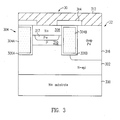
- MOSFET cell 30 is formed on an N-type epitaxial (epi) layer 302, which is grown on an N+ substrate 300.
- Cell 30 is stripe-shaped and is defined on two sides by opposing gate sections 304A and 304B which are positioned within trenches formed at the top surface of N-epi layer 302.
- Sections 304A and 304B are two sections of a gate 304 which contains a plurality of similar gate sections arranged in a parallel array to form a corresponding plurality of parallel striped cells.
- Gate sections 304A and 304B are electrically isolated from N-epi layer 302 by gate oxide layers 306A and 306B, respectively.
- Gate sections 304A and 304B are electrically tied together at some location on the MOSFET.
- the polysilicon layer that is normally used to form gate 304 can be patterned in such a way that the parallel gate sections merge in some region.
- Generally cell 30 has a length dimension parallel to gate sections 304A and 304B that is at least ten times its width dimension perpendicular to gate sections 304A and 304B.
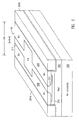
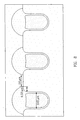
- Fig. 17 shows a top view of a power MOSFET chip which contains three rows of stripe MOSFET cells. Each row would typically contain thousands of cells.
- Cell 30 contains an N+ source region 308 and a P-body 310. Electrical contact is made with N+ source region 308 by means of a metal layer 312 through an opening in an oxide layer 314. Oxide layer 314 generally overlies the gate sections 304A and 304B but extends some distance over N+ source region 308 to insure that metal layer 312 does not come into contact with gate sections 304A and 304B. Shorting the gate to the source would disable the MOSFET.
- the MOSFET when the MOSFET is turned on current flows vertically between the metal layer 312 and a drain contact (not shown) that is formed at the bottom of the N+ substrate 300.
- the path of the current runs through the N+ source region 308, the P-body 312, the N-epi layer 302 and the N+ substrate 300.
- the current flows through a channel region located adjacent the trench in the P-body, and the flow of current through the channel region can be interrupted by biasing the gate 304 appropriately so as to turn the MOSFET off.
- Deep P+ diffusion 316 forms a PN junction with the N-type material in the N-epi layer 302. This PN junction functions as a diode.
- Metal layer 312 ties the deep P+ diffusion 316 (i.e., one terminal of the diode) to N+ source region 308 of MOSFET cell 30 such that the diode is connected in parallel with the channel of the MOSFET cell.
- Deep P+ diffusion 316 operates to reduce the strength of the electric field across the gate oxide layers 306A, 306B and at the corners of the trenches and limits the formation of hot carriers in the vicinity of the trench.
- the diode also operates as a voltage clamp and thereby limits the voltage across the gate oxide layer. While the PN junction in diode cell 32 is shown as being below the bottom of the trench, this need not be the case so long as the diode breaks down before the MOSFET cell 30
- one protective diode cell is provided for a selected number of MOSFET cells in a repetitive pattern across the MOSFET.
- the number of diode cells per MOSFET cells is determined by the design criteria of the MOSFET. In general, for example, MOSFETs which are expected to experience breakdown more often will require a greater proportion of diode cells.
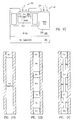
- Figs. 6 and 7 show top views of MOSFETs 60 and 70, respectively, each of which contains two MOSFET cells 62, 72 for each diode cell 64, 74.
- the numerals 66A-66D and 76A-76D designate sections of the gates of MOSFETs 60 and 70.
- Diode cell 64 occupies the entire region between gate sections 66C and 66D whereas diode cell 74 is interrupted in a portion of the region between gate sections 76C and 76D to allow an additional MOSFET cell 78 to be formed.
- MOSFET cell 30 also contains a P+ region 317 immediately below N+ source region 308.
- the dopant concentration of P+ region 317 is in the range of 5 x 10 18 to 8 x 10 19 cm -3 (preferably about 3-4 x 10 19 cm -3 ), as compared to a dopant concentration in the range of 8 x 10 15 to 7 x 10 17 cm -3 for P-body 310 generally.
- P+ region 317 does not reach the surface of epi layer 302 in the plane of Fig. 3 . Instead the contact to P+ region 317 is made as shown in Fig.
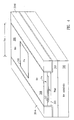
- FIG. 4 is a perspective view of MOSFET 30 without metal layer 312 and oxide layer 314 (as is apparent, Figs. 3 and 4 are drawn to a different scale).
- P+ region 317 is brought to the surface of epi layer 302 in a location (316) outside the plane of Fig. 3 . This location may be at the end of the stripe cell, or as shown in Fig. 6 , there can be a series of P+ contact regions in a ladder arrangement along the stripe cell.
- a metal layer is deposited over the structure, along with oxide layers over the trenches as shown in Fig. 3 , the N+ source regions and P-body regions are shorted together.
- the cell pitch y sb + y g can be reduced to as low as 1.9 ⁇ m or even less, allowing a cell density of 27.6 Mcells/cm 2 (178 Mcells/in 2 ) or more.
- MOSFET cell 50 is similar to MOSFET cell 30 in all respects, except that P+ region 317 is replaced by P+ region 517, which is additionally allowed to come to the surface of epi layer 302 along a thin band at the center of the cell. Since the width Yb of the band is much less than would normally be required to provide a good body contact, the presence of the thin surface band does not significantly affect the width Ysb of the mesa between gate sections 304A and 304B. As with the embodiment of Fig. 4 , the areas where the P+ body contact region is brought to the surface across the entire mesa between gate section 304A and 304B can be located at the end of the cell or periodically at intervals along the length of the cell.
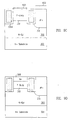
- Fig. 8 shows a MOSFET cell having a pitch of 1.9 microns.
- the width of the trench (Yg) is 0.65 ⁇ m and the width of the mesa between trenches (Ysb) is 1.25 ⁇ m.
- the oxide layer overlying the gate trenches extends 0.325 ⁇ m over the mesa, leaving a width of 0.6 ⁇ m for the source/body contact.
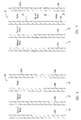
- FIGs. 9A-9E illustrate an exemplary process for fabricating the MOSFETs shown in Figs. 3-5 .
- the starting point is the N+ substrate 300 on which the N-epitaxial layer 302 is grown using known processes.
- a thick oxide layer 930 is grown, masked and etched, and a thin oxide layer 931 is grown on the top surface of the structure where deep P+ diffusion 316 is to be formed. Deep P+ diffusion 316 is then implanted through thin oxide layer 931 at a dose of 1 x 10 14 to 7 x 10 15 cm -2 and an energy of 60-100 keV, and then driven in to a depth of from 1 to 3 ⁇ m (typically 1.5 to 2 ⁇ m). The resulting structure is illustrated in Fig. 9A . Oxide layers 930 and 931 are then removed.
- a thick oxide layer 932 is grown and removed by photomasking except over deep P+ diffusion 316, and a thin oxide layer 933 is grown.
- Thin oxide layer 933 is masked and removed from the portions of the structure where the trenches are to be formed, as shown in Fig. 9B .
- the trenches are then masked and etched using known techniques of reactive ion or plasma dry etching. Then the trench is oxidized to form gate oxide layers 306A, 306B, and polysilicon is deposited into the trench until it overflows the top of the trench.
- the polysilicon is then doped with phosphorus by POCl 3 predeposition or ion implantation at a dose of 5 x 10 13 to 5 x 10 15 cm -2 and an energy of 60 keV, giving it a sheet resistance of 20-70 ⁇ /square.
- the polysilicon is doped with boron using ion implantation to a sheet resistance of roughly 40-120 ⁇ /square.
- the polysilicon is then etched back until it is planar with the surface of the trench except where a mask protects it, so that it can subsequently be contacted with metal.
- P-body 310 is then implanted through the thin oxide layer 933 (e.g., boron at a dose of 5 x 10 12 to 9 x 10 13 cm -2 and an energy of 40-100 keV, typically 90 keV), and driven in at 1050° C for 3-10 hours to a depth of 2-3 ⁇ m.
- the thin oxide layer 933 e.g., boron at a dose of 5 x 10 12 to 9 x 10 13 cm -2 and an energy of 40-100 keV, typically 90 keV
- a similar method is used in fabricating a P-channel device except that the dopant is phosphorus.
- the resulting structure is illustrated in Fig. 9C .
- the N+ source region 34 is then introduced using a mask and an arsenic or phosphorus ion implantation (or a boron ion implantation for a P-channel device) at a dose of 1 x 10 15 to 1 x 10 16 cm -2 at 20 to 100 keV. An anneal is then performed to correct for damage to the crystal. The resulting structure is shown in Fig. 9D .
- the mask that is used during the N+ source implant covers all areas other than the intended source regions.
- the N+ source mask would cover the areas which are to be doped P+ at the surface to allow for contact to the P-body region.
- the P+ region 317 is formed underneath the N+ source region 308. This can be done by implanting boron at a high energy (e.g., 200 keV to 2 MeV) along the entire stripe so that the dopant ends up concentrated beneath the N+ source region 308.
- the dose of this implant would typically be in the range of 1 x 10 14 to 5 x 10 15 cm -2 .
- this implant can be conducted before the N+ source region 308 is formed.
- the P+ implant can conveniently be performed through the contact holes after the oxide layer 314 has been deposited over the trenches. Otherwise, a separate mask would be required for the P+ implant. This process is illustrated in Fig. 9E .
- the P+ dopant can be implanted at a much lower energy (e.g., 20 to 60 keV) before the N+ source region 308 is formed, and the P+ dopant can be driven in until it reaches the desired depth below the yet-to-be-formed N+ source region 308.
- a much lower energy e.g. 20 to 60 keV
- Metal layer 312 is deposited, forming contacts with the source and body regions and the deep P+ region through the contact holes.
- the die is then passivated with SiN or BPSG, and pad mask windows are etched to facilitate bonding.
- Fig. 11 is a detailed view of MOSFET cell 50 shown in Fig. 5 or Fig. 10C , illustrating how the P+ region 17 may be formed.
- the dashed lines 522 indicate where the edges of the mask used to form the N+ source region 308 were located.
- the letter "a” indicates the amount by which oxide layer 314 overlaps the mesa between the gate trenches. Thus, the edges of the N+ source mask were spaced a distance a + b from the trenches.
- the letter "c” indicates the lateral diffusion of the N+ source region 308 during drive-in.
- the width of the central P+ band 520 was 0.28 ⁇ m .
- the metal contact (not shown) would be 0.80 ⁇ m wide (2b + 2c + d) and the contact with the N+ source region 308 would be 0.52 ⁇ m wide (2b + 2c).
- the narrow width of the metal contact opening (0.80 ⁇ m) would require that the oxide layer 314 be kept thin enough to avoid the formation of voids when metal layer 314 is deposited.
- both the central P+ band 520 and the overlying metal layer substantially reduces the amount of the voltage drop in the body in the MOSFETs of Figs. 5 , 10C and 11 .
- a larger body voltage drop may be tolerated if the breakdown voltage of the diode cell 32 is significantly below the breakdown voltage of the MOSFET cell 30, since in that case the risk that parasitic bipolar transistor (N+ source region 308, P-body 310 and N-epi layer 302) will turn on is lessened. If so, the MOSFETs shown in Figs. 3 , 4 , 10A and 10B may be satisfactory.
- Another advantage of the MOSFET of this invention is that there is only a limited need for the channel blocks described in U.S. Patent No. 5,468,982 to prevent current leakage.
- the proportional area occupied by the channel blocks, which are located at the corners of the cells increases as the dimensions of cell are reduced. With a striped cell arrangement, the effect of the channel blocks is negligible.
- Figs. 12-16 illustrate the advantages of a 27.6 Mcell/cm 2 (178 Mcell/in 2 ) device.
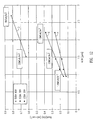
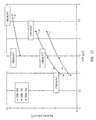
- Fig. 12 shows the specific on-resistance RonA (mohm-cm 2 ) as a function of the area/perimeter ratio.
- Curve D is for a 500A 60V device with cell densities ranging from 1.24 Mcell/cm 2 (8 Mcell/in 2 ) to 4.96 Mcell/cm 2 (32 Mcell/in 2 ).
- Curve E is for a 500A 30V device with cell densities ranging from 1.86 Mcell/cm 2 (12 Mcell/in 2 ) to 27.6 Mcell/cm 2 (178 Mcell/in 2 ).
- Curve F is for a 300A 20V device with cell densities ranging from 1.86 Mcell/cm 2 (12 Mcell/in 2 ) to 27.6 Mcell/cm 2 (178 Mcell/in 2 ). In each case the gate voltage was 10V. The specific on-resistance is clearly significantly less in the 27.6 Mcell/cm 2 (178 Mcell/in 2 ) device.
- Fig. 13 shows the same data plotted on semilog paper, with curves G, H and I corresponding to curves D, E and F, respectively.
- Fig. 14 shows RonA as a function of cell density.
- Curve J is for a 500A 60V device
- curve K is for a 500A 30V device
- curve L is for a 300A 30V device. Again the gate voltage was 10V.
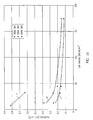
- Fig. 15 shows RonA as a function of the area/perimeter ratio for four simulations: curve M is for a 500A device, curve N is for a 300A device, curve O is for a 175A device, and curve P is for a 125A device. Also shown are measured data points for 500A and 300A devices which confirm the simulated data.
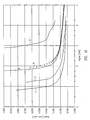
- Fig. 16 shows simulated RonA as a function of the gate voltage for four 27.6 Mcell/cm 2 (178 Mcell/in 2 ) devices: curve Q is for a 500A device, curve R is for a 300A device, curve S is for a 175A device, and curve T is for a 125A device.
- the diamonds show measured data points for the 300A device.
Landscapes
- Metal-Oxide And Bipolar Metal-Oxide Semiconductor Integrated Circuits (AREA)
- Insulated Gate Type Field-Effect Transistor (AREA)
- Electrodes Of Semiconductors (AREA)
Applications Claiming Priority (2)
| Application Number | Priority Date | Filing Date | Title |
|---|---|---|---|
| US09/089,250 US6204533B1 (en) | 1995-06-02 | 1998-06-02 | Vertical trench-gated power MOSFET having stripe geometry and high cell density |
| US89250 | 1998-06-02 |
Publications (3)
| Publication Number | Publication Date |
|---|---|
| EP0962987A2 EP0962987A2 (en) | 1999-12-08 |
| EP0962987A3 EP0962987A3 (en) | 2002-02-13 |
| EP0962987B1 true EP0962987B1 (en) | 2009-09-16 |
Family
ID=22216558
Family Applications (1)
| Application Number | Title | Priority Date | Filing Date |
|---|---|---|---|
| EP99110268A Expired - Lifetime EP0962987B1 (en) | 1998-06-02 | 1999-05-27 | Vertical trench-gate power MOSFET having stripe geometry and high cell density |
Country Status (6)
| Country | Link |
|---|---|
| US (1) | US6204533B1 (enExample) |
| EP (1) | EP0962987B1 (enExample) |
| JP (1) | JP4671456B2 (enExample) |
| KR (1) | KR100429475B1 (enExample) |
| DE (1) | DE69941415D1 (enExample) |
| TW (1) | TW486728B (enExample) |
Cited By (5)
| Publication number | Priority date | Publication date | Assignee | Title |
|---|---|---|---|---|
| US8222691B2 (en) | 2007-02-16 | 2012-07-17 | Power Integrations, Inc. | Gate pullback at ends of high-voltage vertical transistor structure |
| US8410551B2 (en) | 2007-02-16 | 2013-04-02 | Power Integrations, Inc. | Checkerboarded high-voltage vertical transistor layout |
| US8653583B2 (en) | 2007-02-16 | 2014-02-18 | Power Integrations, Inc. | Sensing FET integrated with a high-voltage transistor |
| US9543396B2 (en) | 2013-12-13 | 2017-01-10 | Power Integrations, Inc. | Vertical transistor device structure with cylindrically-shaped regions |
| EP3742499A1 (en) * | 2019-05-20 | 2020-11-25 | NXP USA, Inc. | Current sensing device structure for power mosfet and method of manufacture |
Families Citing this family (56)
| Publication number | Priority date | Publication date | Assignee | Title |
|---|---|---|---|---|
| US6429481B1 (en) | 1997-11-14 | 2002-08-06 | Fairchild Semiconductor Corporation | Field effect transistor and method of its manufacture |
| US7078296B2 (en) | 2002-01-16 | 2006-07-18 | Fairchild Semiconductor Corporation | Self-aligned trench MOSFETs and methods for making the same |
| KR20030077299A (ko) * | 2002-03-26 | 2003-10-01 | 주식회사 하이닉스반도체 | 에스오아이 반도체소자의 제조 방법 |
| DE10245249B4 (de) * | 2002-09-27 | 2008-05-08 | Infineon Technologies Ag | Verfahren zum Herstellen eines Trenchtransistors |
| US6867083B2 (en) * | 2003-05-01 | 2005-03-15 | Semiconductor Components Industries, Llc | Method of forming a body contact of a transistor and structure therefor |
| US7960833B2 (en) * | 2003-10-22 | 2011-06-14 | Marvell World Trade Ltd. | Integrated circuits and interconnect structure for integrated circuits |
| US7851872B2 (en) * | 2003-10-22 | 2010-12-14 | Marvell World Trade Ltd. | Efficient transistor structure |
| US7091565B2 (en) * | 2003-10-22 | 2006-08-15 | Marvell World Trade Ltd. | Efficient transistor structure |
| JP4059846B2 (ja) * | 2003-12-26 | 2008-03-12 | Necエレクトロニクス株式会社 | 半導体装置及びその製造方法 |
| DE102004029297A1 (de) * | 2004-04-20 | 2005-11-17 | Infineon Technologies Ag | Vertikaler Feldeffekt-Leistungstransistor und Verfahren zur Herstellung |
| JP2006012967A (ja) * | 2004-06-23 | 2006-01-12 | Toshiba Corp | 半導体装置 |
| CN100421233C (zh) * | 2004-09-22 | 2008-09-24 | 台湾茂矽电子股份有限公司 | 一种集成电路的制作方法及结构 |
| US7138315B2 (en) * | 2004-10-14 | 2006-11-21 | Semiconductor Components Industries, L.L.C. | Low thermal resistance semiconductor device and method therefor |
| US7022564B1 (en) | 2004-10-14 | 2006-04-04 | Semiconductor Components Industries, L.L.C. | Method of forming a low thermal resistance device and structure |
| JP2006228906A (ja) * | 2005-02-16 | 2006-08-31 | Sanyo Electric Co Ltd | 半導体装置およびその製造方法 |
| JP2007081229A (ja) * | 2005-09-15 | 2007-03-29 | Matsushita Electric Ind Co Ltd | 半導体装置 |
| JP5168876B2 (ja) * | 2006-10-17 | 2013-03-27 | 富士電機株式会社 | 半導体装置およびその製造方法 |
| US9437729B2 (en) * | 2007-01-08 | 2016-09-06 | Vishay-Siliconix | High-density power MOSFET with planarized metalization |
| US7468536B2 (en) * | 2007-02-16 | 2008-12-23 | Power Integrations, Inc. | Gate metal routing for transistor with checkerboarded layout |
| US7557406B2 (en) * | 2007-02-16 | 2009-07-07 | Power Integrations, Inc. | Segmented pillar layout for a high-voltage vertical transistor |
| US9947770B2 (en) | 2007-04-03 | 2018-04-17 | Vishay-Siliconix | Self-aligned trench MOSFET and method of manufacture |
| JP2009076540A (ja) * | 2007-09-19 | 2009-04-09 | Nec Electronics Corp | 半導体装置 |
| US9484451B2 (en) | 2007-10-05 | 2016-11-01 | Vishay-Siliconix | MOSFET active area and edge termination area charge balance |
| US8017995B2 (en) | 2007-11-20 | 2011-09-13 | International Business Machines Corporation | Deep trench semiconductor structure and method |
| JP2009170629A (ja) * | 2008-01-16 | 2009-07-30 | Nec Electronics Corp | 半導体装置の製造方法 |
| DE112009005017T5 (de) | 2009-06-29 | 2012-07-26 | Fujitsu Limited | Halbleitervorrichtung und Verfahren zur Herstellung einer Halbleitervorrichtung |
| US9443974B2 (en) | 2009-08-27 | 2016-09-13 | Vishay-Siliconix | Super junction trench power MOSFET device fabrication |
| JP2011091086A (ja) * | 2009-10-20 | 2011-05-06 | Mitsubishi Electric Corp | 半導体装置 |
| US9431530B2 (en) * | 2009-10-20 | 2016-08-30 | Vishay-Siliconix | Super-high density trench MOSFET |
| US8377756B1 (en) * | 2011-07-26 | 2013-02-19 | General Electric Company | Silicon-carbide MOSFET cell structure and method for forming same |
| JP5920970B2 (ja) | 2011-11-30 | 2016-05-24 | ローム株式会社 | 半導体装置 |
| US9842911B2 (en) | 2012-05-30 | 2017-12-12 | Vishay-Siliconix | Adaptive charge balanced edge termination |
| CN103117308A (zh) * | 2013-02-07 | 2013-05-22 | 上海新进半导体制造有限公司 | 一种沟槽mosfet功率整流器件及其制造方法 |
| US10325988B2 (en) | 2013-12-13 | 2019-06-18 | Power Integrations, Inc. | Vertical transistor device structure with cylindrically-shaped field plates |
| US10608104B2 (en) | 2014-03-28 | 2020-03-31 | Infineon Technologies Ag | Trench transistor device |
| US9887259B2 (en) | 2014-06-23 | 2018-02-06 | Vishay-Siliconix | Modulated super junction power MOSFET devices |
| EP4565029A3 (en) | 2014-08-19 | 2025-07-30 | Vishay-Siliconix | Mosfet semiconductor device |
| KR102098996B1 (ko) | 2014-08-19 | 2020-04-08 | 비쉐이-실리코닉스 | 초접합 금속 산화물 반도체 전계 효과 트랜지스터 |
| DE102014117780B4 (de) | 2014-12-03 | 2018-06-21 | Infineon Technologies Ag | Halbleiterbauelement mit einer Grabenelektrode und Verfahren zur Herstellung |
| US9716144B2 (en) * | 2014-12-19 | 2017-07-25 | General Electric Company | Semiconductor devices having channel regions with non-uniform edge |
| DE102014119465B3 (de) | 2014-12-22 | 2016-05-25 | Infineon Technologies Ag | Halbleitervorrichtung mit streifenförmigen trenchgatestrukturen, transistormesas und diodenmesas |
| JP6406361B2 (ja) | 2015-02-03 | 2018-10-17 | 富士電機株式会社 | 半導体装置及びその製造方法 |
| CN106537603B (zh) | 2015-02-16 | 2019-12-13 | 富士电机株式会社 | 半导体装置和半导体装置的制造方法 |
| DE102015215024B4 (de) * | 2015-08-06 | 2019-02-21 | Infineon Technologies Ag | Halbleiterbauelement mit breiter Bandlücke und Verfahren zum Betrieb eines Halbleiterbauelements |
| JP6958011B2 (ja) * | 2017-06-15 | 2021-11-02 | 富士電機株式会社 | 半導体装置および半導体装置の製造方法 |
| US10497777B2 (en) * | 2017-09-08 | 2019-12-03 | Hestia Power Inc. | Semiconductor power device |
| DE102018103973B4 (de) | 2018-02-22 | 2020-12-03 | Infineon Technologies Ag | Siliziumcarbid-halbleiterbauelement |
| DE102019111308A1 (de) | 2018-05-07 | 2019-11-07 | Infineon Technologies Ag | Siliziumcarbid halbleiterbauelement |
| DE102018124740B4 (de) | 2018-10-08 | 2025-08-28 | Infineon Technologies Ag | Verfahren zur herstellung eines halbleiterbauelements |
| US10903322B2 (en) | 2018-11-16 | 2021-01-26 | Infineon Technologies Ag | SiC power semiconductor device with integrated body diode |
| US10586845B1 (en) | 2018-11-16 | 2020-03-10 | Infineon Technologies Ag | SiC trench transistor device and methods of manufacturing thereof |
| US10985248B2 (en) | 2018-11-16 | 2021-04-20 | Infineon Technologies Ag | SiC power semiconductor device with integrated Schottky junction |
| CN117099215A (zh) * | 2021-10-15 | 2023-11-21 | 富士电机株式会社 | 半导体装置 |
| US12495577B2 (en) | 2022-08-17 | 2025-12-09 | Analog Devices, Inc. | Self-aligned silicide gate for discrete shielded-gate trench power MOSFET |
| CN115939172A (zh) * | 2022-11-23 | 2023-04-07 | 电子科技大学 | 一种实现栅极可控性增强的新型igbt结构 |
| TWI910808B (zh) * | 2024-09-05 | 2026-01-01 | 世界先進積體電路股份有限公司 | 半導體裝置 |
Family Cites Families (16)
| Publication number | Priority date | Publication date | Assignee | Title |
|---|---|---|---|---|
| JPS5939071A (ja) * | 1982-08-27 | 1984-03-03 | Nissan Motor Co Ltd | 縦型パワ−mos・fet |
| JPS60254658A (ja) * | 1984-05-30 | 1985-12-16 | Toshiba Corp | 導電変調型mosfet |
| JPH01198076A (ja) * | 1988-02-02 | 1989-08-09 | Mitsubishi Electric Corp | 半導体装置 |
| JPH0286171A (ja) * | 1988-09-22 | 1990-03-27 | Hitachi Ltd | 半導体素子およびその製造方法 |
| JP3297060B2 (ja) * | 1990-09-17 | 2002-07-02 | 株式会社東芝 | 絶縁ゲート型サイリスタ |
| US5326711A (en) * | 1993-01-04 | 1994-07-05 | Texas Instruments Incorporated | High performance high voltage vertical transistor and method of fabrication |
| JP3204792B2 (ja) * | 1993-04-27 | 2001-09-04 | 株式会社東芝 | 半導体装置 |
| JPH07273319A (ja) * | 1994-03-31 | 1995-10-20 | Nippondenso Co Ltd | 半導体装置 |
| US5674766A (en) * | 1994-12-30 | 1997-10-07 | Siliconix Incorporated | Method of making a trench MOSFET with multi-resistivity drain to provide low on-resistance by varying dopant concentration in epitaxial layer |
| JP3288218B2 (ja) * | 1995-03-14 | 2002-06-04 | 三菱電機株式会社 | 絶縁ゲート型半導体装置およびその製造方法 |
| US5998837A (en) * | 1995-06-02 | 1999-12-07 | Siliconix Incorporated | Trench-gated power MOSFET with protective diode having adjustable breakdown voltage |
| DE69631995T2 (de) * | 1995-06-02 | 2005-02-10 | Siliconix Inc., Santa Clara | Bidirektional sperrender Graben-Leistungs-MOSFET |
| EP0746030B1 (en) * | 1995-06-02 | 2001-11-21 | SILICONIX Incorporated | Trench-gated power MOSFET with protective diodes in a periodically repeating pattern |
| JP3384198B2 (ja) * | 1995-07-21 | 2003-03-10 | 三菱電機株式会社 | 絶縁ゲート型半導体装置およびその製造方法 |
| JP3410286B2 (ja) * | 1996-04-01 | 2003-05-26 | 三菱電機株式会社 | 絶縁ゲート型半導体装置 |
| US6429481B1 (en) * | 1997-11-14 | 2002-08-06 | Fairchild Semiconductor Corporation | Field effect transistor and method of its manufacture |
-
1998
- 1998-06-02 US US09/089,250 patent/US6204533B1/en not_active Expired - Lifetime
-
1999
- 1999-05-27 DE DE69941415T patent/DE69941415D1/de not_active Expired - Lifetime
- 1999-05-27 EP EP99110268A patent/EP0962987B1/en not_active Expired - Lifetime
- 1999-05-28 JP JP14976099A patent/JP4671456B2/ja not_active Expired - Lifetime
- 1999-06-02 KR KR10-1999-0020147A patent/KR100429475B1/ko not_active Expired - Fee Related
- 1999-08-27 TW TW088108984A patent/TW486728B/zh not_active IP Right Cessation
Cited By (5)
| Publication number | Priority date | Publication date | Assignee | Title |
|---|---|---|---|---|
| US8222691B2 (en) | 2007-02-16 | 2012-07-17 | Power Integrations, Inc. | Gate pullback at ends of high-voltage vertical transistor structure |
| US8410551B2 (en) | 2007-02-16 | 2013-04-02 | Power Integrations, Inc. | Checkerboarded high-voltage vertical transistor layout |
| US8653583B2 (en) | 2007-02-16 | 2014-02-18 | Power Integrations, Inc. | Sensing FET integrated with a high-voltage transistor |
| US9543396B2 (en) | 2013-12-13 | 2017-01-10 | Power Integrations, Inc. | Vertical transistor device structure with cylindrically-shaped regions |
| EP3742499A1 (en) * | 2019-05-20 | 2020-11-25 | NXP USA, Inc. | Current sensing device structure for power mosfet and method of manufacture |
Also Published As
| Publication number | Publication date |
|---|---|
| EP0962987A3 (en) | 2002-02-13 |
| US6204533B1 (en) | 2001-03-20 |
| TW486728B (en) | 2002-05-11 |
| DE69941415D1 (de) | 2009-10-29 |
| JP4671456B2 (ja) | 2011-04-20 |
| KR100429475B1 (ko) | 2004-05-03 |
| EP0962987A2 (en) | 1999-12-08 |
| JP2000031484A (ja) | 2000-01-28 |
| KR20000005824A (ko) | 2000-01-25 |
Similar Documents
| Publication | Publication Date | Title |
|---|---|---|
| US6204533B1 (en) | Vertical trench-gated power MOSFET having stripe geometry and high cell density | |
| EP0746030B1 (en) | Trench-gated power MOSFET with protective diodes in a periodically repeating pattern | |
| US6140678A (en) | Trench-gated power MOSFET with protective diode | |
| US5998837A (en) | Trench-gated power MOSFET with protective diode having adjustable breakdown voltage | |
| US6096608A (en) | Bidirectional trench gated power mosfet with submerged body bus extending underneath gate trench | |
| EP0717450B1 (en) | Vertical insulated gate semiconductor device and method of manufacturing the same | |
| US5877538A (en) | Bidirectional trench gated power MOSFET with submerged body bus extending underneath gate trench | |
| US7427800B2 (en) | Semiconductor device containing dielectrically isolated PN junction for enhanced breakdown characteristics | |
| US6476443B1 (en) | MOSgated device with trench structure and remote contact and process for its manufacture | |
| US6979865B2 (en) | Cellular mosfet devices and their manufacture | |
| EP0923137A2 (en) | Trenched field effect transistor and method of its manufacture | |
| US5986304A (en) | Punch-through prevention in trenched DMOS with poly-silicon layer covering trench corners | |
| KR100642803B1 (ko) | 엷게 도핑된 소스 구조를 구비한 트렌치 dmos트랜지스터 | |
| EP1364410B1 (en) | Semiconductor devices and their peripheral termination | |
| EP1266406B1 (en) | Trench gate DMOS field-effect transistor | |
| KR100510096B1 (ko) | 트렌치-게이트형 파워 mosfet | |
| US20240339494A1 (en) | Vertical mosfet with high short circuit withstand time capability | |
| EP4160692A1 (en) | Transistor device | |
| EP1500144B1 (en) | Trench-gate semiconductor devices | |
| EP0961325B1 (en) | High integration density MOS technology power device | |
| KR100396956B1 (ko) | 트렌치 트랜지스터 및 그의 제조방법 | |
| US10038088B2 (en) | Power MOSFET having improved manufacturability, low on-resistance and high breakdown voltage |
Legal Events
| Date | Code | Title | Description |
|---|---|---|---|
| PUAI | Public reference made under article 153(3) epc to a published international application that has entered the european phase |
Free format text: ORIGINAL CODE: 0009012 |
|
| AK | Designated contracting states |
Kind code of ref document: A2 Designated state(s): AT BE CH CY DE DK ES FI FR GB GR IE IT LI LU MC NL PT SE Kind code of ref document: A2 Designated state(s): DE FR GB IT NL |
|
| AX | Request for extension of the european patent |
Free format text: AL;LT;LV;MK;RO;SI |
|
| 17P | Request for examination filed |
Effective date: 20000609 |
|
| PUAL | Search report despatched |
Free format text: ORIGINAL CODE: 0009013 |
|
| RIC1 | Information provided on ipc code assigned before grant |
Free format text: 7H 01L 29/78 A, 7H 01L 29/10 B, 7H 01L 21/336 B |
|
| AK | Designated contracting states |
Kind code of ref document: A3 Designated state(s): AT BE CH CY DE DK ES FI FR GB GR IE IT LI LU MC NL PT SE |
|
| AX | Request for extension of the european patent |
Free format text: AL;LT;LV;MK;RO;SI |
|
| AKX | Designation fees paid |
Free format text: DE FR GB IT NL |
|
| 17Q | First examination report despatched |
Effective date: 20040402 |
|
| GRAP | Despatch of communication of intention to grant a patent |
Free format text: ORIGINAL CODE: EPIDOSNIGR1 |
|
| RTI1 | Title (correction) |
Free format text: VERTICAL TRENCH-GATE POWER MOSFET HAVING STRIPE GEOMETRY AND HIGH CELL DENSITY |
|
| GRAS | Grant fee paid |
Free format text: ORIGINAL CODE: EPIDOSNIGR3 |
|
| GRAA | (expected) grant |
Free format text: ORIGINAL CODE: 0009210 |
|
| AK | Designated contracting states |
Kind code of ref document: B1 Designated state(s): DE FR GB IT NL |
|
| REG | Reference to a national code |
Ref country code: GB Ref legal event code: FG4D |
|
| REF | Corresponds to: |
Ref document number: 69941415 Country of ref document: DE Date of ref document: 20091029 Kind code of ref document: P |
|
| PLBE | No opposition filed within time limit |
Free format text: ORIGINAL CODE: 0009261 |
|
| STAA | Information on the status of an ep patent application or granted ep patent |
Free format text: STATUS: NO OPPOSITION FILED WITHIN TIME LIMIT |
|
| 26N | No opposition filed |
Effective date: 20100617 |
|
| PGFP | Annual fee paid to national office [announced via postgrant information from national office to epo] |
Ref country code: GB Payment date: 20140527 Year of fee payment: 16 |
|
| PGFP | Annual fee paid to national office [announced via postgrant information from national office to epo] |
Ref country code: IT Payment date: 20140527 Year of fee payment: 16 Ref country code: NL Payment date: 20140526 Year of fee payment: 16 Ref country code: FR Payment date: 20140519 Year of fee payment: 16 |
|
| GBPC | Gb: european patent ceased through non-payment of renewal fee |
Effective date: 20150527 |
|
| PG25 | Lapsed in a contracting state [announced via postgrant information from national office to epo] |
Ref country code: IT Free format text: LAPSE BECAUSE OF NON-PAYMENT OF DUE FEES Effective date: 20150527 |
|
| REG | Reference to a national code |
Ref country code: NL Ref legal event code: MM Effective date: 20150601 |
|
| REG | Reference to a national code |
Ref country code: FR Ref legal event code: ST Effective date: 20160129 |
|
| PG25 | Lapsed in a contracting state [announced via postgrant information from national office to epo] |
Ref country code: NL Free format text: LAPSE BECAUSE OF NON-PAYMENT OF DUE FEES Effective date: 20150601 Ref country code: GB Free format text: LAPSE BECAUSE OF NON-PAYMENT OF DUE FEES Effective date: 20150527 |
|
| PG25 | Lapsed in a contracting state [announced via postgrant information from national office to epo] |
Ref country code: FR Free format text: LAPSE BECAUSE OF NON-PAYMENT OF DUE FEES Effective date: 20150601 |
|
| PGFP | Annual fee paid to national office [announced via postgrant information from national office to epo] |
Ref country code: DE Payment date: 20170530 Year of fee payment: 19 |
|
| REG | Reference to a national code |
Ref country code: DE Ref legal event code: R119 Ref document number: 69941415 Country of ref document: DE |
|
| PG25 | Lapsed in a contracting state [announced via postgrant information from national office to epo] |
Ref country code: DE Free format text: LAPSE BECAUSE OF NON-PAYMENT OF DUE FEES Effective date: 20181201 |