EP0829470A1 - 2-Cyano-3,5-dihydroxy-hex-2-en-carbonsäure-amidderivate, Verfahren zu ihrer Herstellung und ihre Verwendung als Arzneimittel - Google Patents
2-Cyano-3,5-dihydroxy-hex-2-en-carbonsäure-amidderivate, Verfahren zu ihrer Herstellung und ihre Verwendung als Arzneimittel Download PDFInfo
- Publication number
- EP0829470A1 EP0829470A1 EP97115520A EP97115520A EP0829470A1 EP 0829470 A1 EP0829470 A1 EP 0829470A1 EP 97115520 A EP97115520 A EP 97115520A EP 97115520 A EP97115520 A EP 97115520A EP 0829470 A1 EP0829470 A1 EP 0829470A1
- Authority
- EP
- European Patent Office
- Prior art keywords
- formula
- phenyl
- methyl
- compound
- alkyl
- Prior art date
- Legal status (The legal status is an assumption and is not a legal conclusion. Google has not performed a legal analysis and makes no representation as to the accuracy of the status listed.)
- Granted
Links
- 0 CN(C(c1c(N2*)nc[n]1*)=O)C2=O Chemical compound CN(C(c1c(N2*)nc[n]1*)=O)C2=O 0.000 description 1
Classifications
-
- C—CHEMISTRY; METALLURGY
- C07—ORGANIC CHEMISTRY
- C07D—HETEROCYCLIC COMPOUNDS
- C07D333/00—Heterocyclic compounds containing five-membered rings having one sulfur atom as the only ring hetero atom
- C07D333/02—Heterocyclic compounds containing five-membered rings having one sulfur atom as the only ring hetero atom not condensed with other rings
- C07D333/04—Heterocyclic compounds containing five-membered rings having one sulfur atom as the only ring hetero atom not condensed with other rings not substituted on the ring sulphur atom
- C07D333/26—Heterocyclic compounds containing five-membered rings having one sulfur atom as the only ring hetero atom not condensed with other rings not substituted on the ring sulphur atom with hetero atoms or with carbon atoms having three bonds to hetero atoms with at the most one bond to halogen, e.g. ester or nitrile radicals, directly attached to ring carbon atoms
-
- A—HUMAN NECESSITIES
- A61—MEDICAL OR VETERINARY SCIENCE; HYGIENE
- A61P—SPECIFIC THERAPEUTIC ACTIVITY OF CHEMICAL COMPOUNDS OR MEDICINAL PREPARATIONS
- A61P1/00—Drugs for disorders of the alimentary tract or the digestive system
- A61P1/02—Stomatological preparations, e.g. drugs for caries, aphtae, periodontitis
-
- A—HUMAN NECESSITIES
- A61—MEDICAL OR VETERINARY SCIENCE; HYGIENE
- A61P—SPECIFIC THERAPEUTIC ACTIVITY OF CHEMICAL COMPOUNDS OR MEDICINAL PREPARATIONS
- A61P19/00—Drugs for skeletal disorders
- A61P19/02—Drugs for skeletal disorders for joint disorders, e.g. arthritis, arthrosis
-
- A—HUMAN NECESSITIES
- A61—MEDICAL OR VETERINARY SCIENCE; HYGIENE
- A61P—SPECIFIC THERAPEUTIC ACTIVITY OF CHEMICAL COMPOUNDS OR MEDICINAL PREPARATIONS
- A61P21/00—Drugs for disorders of the muscular or neuromuscular system
-
- A—HUMAN NECESSITIES
- A61—MEDICAL OR VETERINARY SCIENCE; HYGIENE
- A61P—SPECIFIC THERAPEUTIC ACTIVITY OF CHEMICAL COMPOUNDS OR MEDICINAL PREPARATIONS
- A61P29/00—Non-central analgesic, antipyretic or antiinflammatory agents, e.g. antirheumatic agents; Non-steroidal antiinflammatory drugs [NSAID]
-
- A—HUMAN NECESSITIES
- A61—MEDICAL OR VETERINARY SCIENCE; HYGIENE
- A61P—SPECIFIC THERAPEUTIC ACTIVITY OF CHEMICAL COMPOUNDS OR MEDICINAL PREPARATIONS
- A61P3/00—Drugs for disorders of the metabolism
-
- A—HUMAN NECESSITIES
- A61—MEDICAL OR VETERINARY SCIENCE; HYGIENE
- A61P—SPECIFIC THERAPEUTIC ACTIVITY OF CHEMICAL COMPOUNDS OR MEDICINAL PREPARATIONS
- A61P3/00—Drugs for disorders of the metabolism
- A61P3/12—Drugs for disorders of the metabolism for electrolyte homeostasis
- A61P3/14—Drugs for disorders of the metabolism for electrolyte homeostasis for calcium homeostasis
-
- C—CHEMISTRY; METALLURGY
- C07—ORGANIC CHEMISTRY
- C07C—ACYCLIC OR CARBOCYCLIC COMPOUNDS
- C07C255/00—Carboxylic acid nitriles
- C07C255/01—Carboxylic acid nitriles having cyano groups bound to acyclic carbon atoms
- C07C255/23—Carboxylic acid nitriles having cyano groups bound to acyclic carbon atoms containing cyano groups and carboxyl groups, other than cyano groups, bound to the same unsaturated acyclic carbon skeleton
-
- C—CHEMISTRY; METALLURGY
- C07—ORGANIC CHEMISTRY
- C07C—ACYCLIC OR CARBOCYCLIC COMPOUNDS
- C07C255/00—Carboxylic acid nitriles
- C07C255/01—Carboxylic acid nitriles having cyano groups bound to acyclic carbon atoms
- C07C255/32—Carboxylic acid nitriles having cyano groups bound to acyclic carbon atoms having cyano groups bound to acyclic carbon atoms of a carbon skeleton containing at least one six-membered aromatic ring
- C07C255/41—Carboxylic acid nitriles having cyano groups bound to acyclic carbon atoms having cyano groups bound to acyclic carbon atoms of a carbon skeleton containing at least one six-membered aromatic ring the carbon skeleton being further substituted by carboxyl groups, other than cyano groups
-
- C—CHEMISTRY; METALLURGY
- C07—ORGANIC CHEMISTRY
- C07C—ACYCLIC OR CARBOCYCLIC COMPOUNDS
- C07C255/00—Carboxylic acid nitriles
- C07C255/49—Carboxylic acid nitriles having cyano groups bound to carbon atoms of six-membered aromatic rings of a carbon skeleton
- C07C255/57—Carboxylic acid nitriles having cyano groups bound to carbon atoms of six-membered aromatic rings of a carbon skeleton containing cyano groups and carboxyl groups, other than cyano groups, bound to the carbon skeleton
-
- C—CHEMISTRY; METALLURGY
- C07—ORGANIC CHEMISTRY
- C07D—HETEROCYCLIC COMPOUNDS
- C07D213/00—Heterocyclic compounds containing six-membered rings, not condensed with other rings, with one nitrogen atom as the only ring hetero atom and three or more double bonds between ring members or between ring members and non-ring members
- C07D213/02—Heterocyclic compounds containing six-membered rings, not condensed with other rings, with one nitrogen atom as the only ring hetero atom and three or more double bonds between ring members or between ring members and non-ring members having three double bonds between ring members or between ring members and non-ring members
- C07D213/04—Heterocyclic compounds containing six-membered rings, not condensed with other rings, with one nitrogen atom as the only ring hetero atom and three or more double bonds between ring members or between ring members and non-ring members having three double bonds between ring members or between ring members and non-ring members having no bond between the ring nitrogen atom and a non-ring member or having only hydrogen or carbon atoms directly attached to the ring nitrogen atom
- C07D213/24—Heterocyclic compounds containing six-membered rings, not condensed with other rings, with one nitrogen atom as the only ring hetero atom and three or more double bonds between ring members or between ring members and non-ring members having three double bonds between ring members or between ring members and non-ring members having no bond between the ring nitrogen atom and a non-ring member or having only hydrogen or carbon atoms directly attached to the ring nitrogen atom with substituted hydrocarbon radicals attached to ring carbon atoms
- C07D213/54—Radicals substituted by carbon atoms having three bonds to hetero atoms with at the most one bond to halogen, e.g. ester or nitrile radicals
- C07D213/57—Nitriles
-
- C—CHEMISTRY; METALLURGY
- C07—ORGANIC CHEMISTRY
- C07D—HETEROCYCLIC COMPOUNDS
- C07D307/00—Heterocyclic compounds containing five-membered rings having one oxygen atom as the only ring hetero atom
- C07D307/02—Heterocyclic compounds containing five-membered rings having one oxygen atom as the only ring hetero atom not condensed with other rings
- C07D307/34—Heterocyclic compounds containing five-membered rings having one oxygen atom as the only ring hetero atom not condensed with other rings having two or three double bonds between ring members or between ring members and non-ring members
- C07D307/38—Heterocyclic compounds containing five-membered rings having one oxygen atom as the only ring hetero atom not condensed with other rings having two or three double bonds between ring members or between ring members and non-ring members with substituted hydrocarbon radicals attached to ring carbon atoms
- C07D307/54—Radicals substituted by carbon atoms having three bonds to hetero atoms with at the most one bond to halogen, e.g. ester or nitrile radicals
-
- C—CHEMISTRY; METALLURGY
- C07—ORGANIC CHEMISTRY
- C07D—HETEROCYCLIC COMPOUNDS
- C07D317/00—Heterocyclic compounds containing five-membered rings having two oxygen atoms as the only ring hetero atoms
- C07D317/08—Heterocyclic compounds containing five-membered rings having two oxygen atoms as the only ring hetero atoms having the hetero atoms in positions 1 and 3
- C07D317/44—Heterocyclic compounds containing five-membered rings having two oxygen atoms as the only ring hetero atoms having the hetero atoms in positions 1 and 3 ortho- or peri-condensed with carbocyclic rings or ring systems
- C07D317/46—Heterocyclic compounds containing five-membered rings having two oxygen atoms as the only ring hetero atoms having the hetero atoms in positions 1 and 3 ortho- or peri-condensed with carbocyclic rings or ring systems condensed with one six-membered ring
- C07D317/48—Methylenedioxybenzenes or hydrogenated methylenedioxybenzenes, unsubstituted on the hetero ring
- C07D317/50—Methylenedioxybenzenes or hydrogenated methylenedioxybenzenes, unsubstituted on the hetero ring with only hydrogen atoms, hydrocarbon or substituted hydrocarbon radicals, directly attached to atoms of the carbocyclic ring
- C07D317/60—Radicals substituted by carbon atoms having three bonds to hetero atoms with at the most one bond to halogen, e.g. ester or nitrile radicals
-
- C—CHEMISTRY; METALLURGY
- C07—ORGANIC CHEMISTRY
- C07D—HETEROCYCLIC COMPOUNDS
- C07D333/00—Heterocyclic compounds containing five-membered rings having one sulfur atom as the only ring hetero atom
- C07D333/02—Heterocyclic compounds containing five-membered rings having one sulfur atom as the only ring hetero atom not condensed with other rings
- C07D333/04—Heterocyclic compounds containing five-membered rings having one sulfur atom as the only ring hetero atom not condensed with other rings not substituted on the ring sulphur atom
- C07D333/06—Heterocyclic compounds containing five-membered rings having one sulfur atom as the only ring hetero atom not condensed with other rings not substituted on the ring sulphur atom with only hydrogen atoms, hydrocarbon or substituted hydrocarbon radicals, directly attached to the ring carbon atoms
- C07D333/24—Radicals substituted by carbon atoms having three bonds to hetero atoms with at the most one bond to halogen, e.g. ester or nitrile radicals
-
- C—CHEMISTRY; METALLURGY
- C07—ORGANIC CHEMISTRY
- C07D—HETEROCYCLIC COMPOUNDS
- C07D473/00—Heterocyclic compounds containing purine ring systems
- C07D473/02—Heterocyclic compounds containing purine ring systems with oxygen, sulphur, or nitrogen atoms directly attached in positions 2 and 6
- C07D473/04—Heterocyclic compounds containing purine ring systems with oxygen, sulphur, or nitrogen atoms directly attached in positions 2 and 6 two oxygen atoms
-
- C—CHEMISTRY; METALLURGY
- C07—ORGANIC CHEMISTRY
- C07B—GENERAL METHODS OF ORGANIC CHEMISTRY; APPARATUS THEREFOR
- C07B2200/00—Indexing scheme relating to specific properties of organic compounds
- C07B2200/07—Optical isomers
-
- C—CHEMISTRY; METALLURGY
- C07—ORGANIC CHEMISTRY
- C07C—ACYCLIC OR CARBOCYCLIC COMPOUNDS
- C07C2601/00—Systems containing only non-condensed rings
- C07C2601/02—Systems containing only non-condensed rings with a three-membered ring
Definitions
- the invention relates to 2-cyano-3,5-dihydroxy-hex-2-ene-carboxamide derivatives, processes for their preparation and use thereof as medicaments.
- Hyaline articular cartilage is an elastic supporting and sliding tissue, the biomechanical function of which is guaranteed by the special architecture of its matrix and its regulated renewal by the cartilage cells or chondrocytes.
- Degenerative joint diseases such as arthrosis, but also inflammatory, immunological, or metabolic arthritis and arthropathy are characterized by progressive cartilage destruction, which can lead to functional impairment and pain or complete joint stiffness.
- different triggers are held responsible for the various forms of disease, the resulting cartilage loss is common according to the general belief that it begins with increased proteoglycan degradation and is controlled by the chondrocytes.
- Conventional therapeutic agents for these diseases are primarily non-steroidal anti-inflammatory drugs for degenerative joint diseases, and so-called basic therapeutic agents such as gold compounds, penicillamine, chloroquine derivatives and methotrexate or combinations thereof, for autoimmunologically characterized arthritis, but all have in common that they cannot stop the progressive cartilage destruction.
- Osteoarthritis is a degenerative joint disease with inflammatory episodes and progressive cartilage destruction, which can lead to functional impairment or complete stiffening. So far, the accompanying inflammation and pain conditions can be treated with this disease, but there are no drugs available that have been shown to stop or heal the progressive cartilage breakdown.
- Known therapeutic agents for arthrosis are, for example, mixtures of sulfated glucose aminoglycans (Current Therapeutic Research, 40.6 (1986) 1034) or non-steroidal anti-inflammatory agents, which, however, cannot stop the loss of cartilage.
- chondrocytes (cartilage cells) are significantly involved in the increased loss of matrix, and that the proteoglycans (PG) are the first of the main constituents of this matrix to be enzymatically degraded .
- the compounds of the formula I according to the invention either directly stimulate the proteoglycan synthesis of the cartilage cell or inhibit the increased proteoglycan degradation induced by interleukin-1.
- the compounds according to the invention are outstandingly suitable for the treatment and prophylaxis of degenerative joint diseases, but also of diseases of the rheumatic type, in which cartilage breakdown can be recorded, such as chronic polyarthritis, joint trauma and in the case of cartilage loss after prolonged immobilization of the joint.
- alkyl, alkenyl or alkynyl is understood to mean residues whose carbon chain can be straight-chain, branched or cyclic; the double or triple bonds can occur multiple times.
- Cyclic alkyl radicals are, for example, 3- to 7-membered monocycles such as cyclopropyl, cyclobutyl, cyclopentyl, cyclohexyl or cycloheptyl.
- the term "4- to 7-membered heterocyclic radical with 1 or 2 heteroatoms from the group consisting of oxygen, nitrogen and sulfur” includes e.g.
- Halogen means chlorine, bromine, iodine or fluorine.
- Suitable physiologically compatible salts of the compound of formula I are, for example, alkali, alkaline earth and ammonium salts, including those of organic ammonium bases.
- the deprotonation of the cyanoacetic acid derivative is preferably carried out using sodium hydride in an aprotic anhydrous solvent such as tetrahydrofuran or dichloromethane. Deprotonation and condensation preferably take place in a temperature range from 0 ° C. to room temperature.
- the protective groups which may be carried along to protect further functional groups are then split off by methods known from the literature.
- Process B) is particularly suitable for the preparation of chiral compounds whose asymmetry centers in the carboxylic acid part can be carried in a defined chirality, as exemplified in Example 10, in the form of a protected secondary or tertiary alcohol, while according to process A) the chiral secondary alcohols can be carried out in the Usually arise as enantiomeric mixtures.
- physiologically compatible alkali, alkaline earth and organic ammonium salts are prepared by dissolving or suspending the parent compound in a protic or polar aprotic solvent and adding the base in equimolar amounts or in excess, using polar aprotic solvents such as water or lower alcohols usually a clear solution of the corresponding Salt is formed, which can be brought into a solid, preferably crystalline form by freeze drying, concentration of the solution or precipitation by adding a non-polar solvent.
- the invention also relates to pharmaceuticals, characterized by an effective content of at least one compound of the formula I. and / or a physiologically compatible salt of the compound of formula I and / or an optionally stereoisomeric form of the compound of formula I, wherein the radicals R 1 , R 2 , R 3 or R 4 are as defined above, together with a pharmaceutically suitable and physiologically compatible carrier, additive and / or other active substances and auxiliaries.
- the compounds according to the invention are outstandingly suitable for the prophylaxis and therapy of all such diseases or disorders in the course of which an increased breakdown of connective tissue and cartilage is involved.
- diseases or disorders in the course of which an increased breakdown of connective tissue and cartilage is involved.
- diseases of the musculoskeletal system such as inflammatory, immunological or metabolic acute and chronic arthritis and arthropathies, but also myalgias, disorders of the bone metabolism and degenerative joint diseases.
- These include osteoarthritis and spondylosis, but also cartilage loss after joint trauma or prolonged immobilization.
- the invention further relates to the use of the compound of formula I for the manufacture of medicaments for the prophylaxis and therapy of diseases of the connective tissue such as collagenosis and periodontal tissue changes.
- the invention also relates to a process for the preparation of a medicament, which is characterized in that at least one compound of the formula I is brought into a suitable dosage form with a pharmaceutically suitable and physiologically tolerable carrier and, if appropriate, other suitable active ingredients, additives or auxiliaries.
- Suitable solid or galenical forms of preparation are, for example, granules, powders, dragees, tablets, (micro) capsules, suppositories, syrups, juices, suspensions, emulsions, drops or injectable solutions as well as preparations with protracted active ingredient release, in the preparation of which conventional auxiliaries, such as carriers , Explosives, binders, coating agents, swelling agents, lubricants or lubricants, flavoring agents, sweeteners and solubilizers are used.
- auxiliaries such as carriers , Explosives, binders, coating agents, swelling agents, lubricants or lubricants, flavoring agents, sweeteners and solubilizers are used.
- Magnesium carbonate, titanium dioxide, lactose, mannitol and other sugars, talc, milk protein, gelatin, starch, cellulose and its derivatives, animal and vegetable oils such as cod liver oil, sunflower, peanut or sesame oil, polyethylene glycol and solvents such as sterile are common additives Water and monohydric or polyhydric alcohols such as glycerin.
- the pharmaceutical preparations are preferably produced and administered in dosage units, each unit containing as active ingredient a certain dose of the compound of the formula I according to the invention.
- this dose can be up to about 1000 mg, but preferably about 50 to 300 mg, and for injection solutions in ampoule form up to about 300 mg, but preferably about 10 to 100 mg .
- daily doses for the treatment of an adult patient weighing approximately 70 kg, daily doses of approximately 20 mg to 1000 mg of active ingredient, preferably from 100 mg to 500 mg, are indicated, depending on the effectiveness of the compounds according to formula I. However, higher or lower daily doses may also be possible to be appropriate.
- the daily dose can be administered either by single administration in the form of a single dosage unit or else several smaller dosage units, or by multiple administration of divided doses at certain intervals.
- cartilage cells can maintain their characteristic cartilage matrix metabolism ex vivo, ie the regulated build-up and breakdown of the matrix macromolecules, over a period of several weeks to months. These processes can be influenced chemically.
- test compounds on the normal renewal of the cartilage matrix proteoglycans by the chondrocytes is described (A), and on the other hand the effect on a pathologically increased proteoglycan degradation and inhibited synthesis in chondrocytes or cartilage tissue by adding interleukin 1 (B).
- the stimulating effect of the test substance is expressed by a stimulation factor, which is calculated from the quotient of the determined proteoglycan content under the active ingredient condition divided by the proteoglycan content under the control condition.
- the control condition is the untreated control group
- this is the interleukin-1 (IL-1) -treated control group.
- IL-1 interleukin-1
- Cartilage samples are taken from the fetlock joints of freshly slaughtered bulls under sterile conditions, incubated with 1% Pronase (Boehringer) solution in Ham's F12 medium (Serva) at 37 ° C for 1 hour, the enzyme solution by a 0.025% collagenase type A (Worthington ) Solution in medium replaced and incubated overnight.
- Pronase Boehringer
- Ham's F12 medium Serva
- the enzyme solution by a 0.025% collagenase type A (Worthington ) Solution in medium replaced and incubated overnight.
- the samples are overlaid with 0.5 ml / well medium, which is enriched with 5% serum, 25 ⁇ m / ml ascorbic acid, and in groups of 6-8 wells with 10 ⁇ m of the test substance.
- the medium with the same composition is renewed every other day.
- the mixture is washed with medium, 1 ml per well of a buffered (pH 5.6) 1% strength Alcian blue (Sigma) solution, enriched with 25% glutaraldehyde in a 7: 1 ratio, added and incubated for 48 hours.
- the ascending alcohol series is dewatered up to 70% ethanol content, and then the bound dye is extracted with 8 M guanidine hydrochloride at 4 ° C. for 24 hours.
- the cell preparation is carried out as described under A, if cartilage tissue explants are used, these are put directly into the enriched culture medium described above after punching out cartilage discs of 4 mm in diameter and a height which comprises the entire cartilage layer.
- interleukin-1 is added to the medium, 8 units / well for the cell culture, 20 units / well for the tissue culture, and also added again every other day over a period of 8 days when the medium is changed.
- 1 ⁇ Ci Na 2 35 SO 4 / well is added and incubated for 24 hours.
- the remaining gels or explants in the microtiter plates are digested by repeated freezing and thawing and extracted with 8 M guanidine hydrochloride. After centrifugation, the supernatant is separated into free and incorporated sulfate on a PD10 Sephadex column and the radioactivity of the samples, which is a measure of the newly formed amount of proteoglycan, is determined in the ⁇ -counter. Table 1 shows the results.
Landscapes
- Organic Chemistry (AREA)
- Chemical & Material Sciences (AREA)
- Health & Medical Sciences (AREA)
- Veterinary Medicine (AREA)
- Chemical Kinetics & Catalysis (AREA)
- General Chemical & Material Sciences (AREA)
- Medicinal Chemistry (AREA)
- Nuclear Medicine, Radiotherapy & Molecular Imaging (AREA)
- Pharmacology & Pharmacy (AREA)
- Life Sciences & Earth Sciences (AREA)
- Animal Behavior & Ethology (AREA)
- General Health & Medical Sciences (AREA)
- Public Health (AREA)
- Bioinformatics & Cheminformatics (AREA)
- Engineering & Computer Science (AREA)
- Rheumatology (AREA)
- Orthopedic Medicine & Surgery (AREA)
- Diabetes (AREA)
- Physical Education & Sports Medicine (AREA)
- Obesity (AREA)
- Hematology (AREA)
- Pain & Pain Management (AREA)
- Immunology (AREA)
- Neurology (AREA)
- Endocrinology (AREA)
- Pharmaceuticals Containing Other Organic And Inorganic Compounds (AREA)
- Organic Low-Molecular-Weight Compounds And Preparation Thereof (AREA)
- Acyclic And Carbocyclic Compounds In Medicinal Compositions (AREA)
- Heterocyclic Compounds Containing Sulfur Atoms (AREA)
- Furan Compounds (AREA)
- Pyridine Compounds (AREA)
Abstract
Description
- Die Erfindung betrifft 2-Cyano-3,5-dihydroxy-hex-2-en-carbonsäureamidderivate, Verfahren zu ihrer Herstellung und Verwendung derselben als Arzneimittel.
- Hyaliner Gelenk-Knorpel ist ein elastisches Stütz- und Gleitgewebe, dessen biomechanische Funktion durch die spezielle Architektur seiner Matrix sowie deren geregelte Erneuerung seitens der Knorpelzellen oder Chondrozyten gewährleistet wird. Degenerative Gelenkserkrankungen wie Arthrosen, aber auch entzündlich, immunologisch, oder stoffwechselbedingte Arthritiden und Arthropathien sind gekennzeichnet durch eine progrediente Knorpelzerstörung, die über Funktionsbeeinträchtigung und Schmerz bis hin zur völligen Gelenkversteifung führen kann. Wenn auch für die verschiedenen Krankheitsformen unterschiedliche Auslöser dafür verantwortlich gemacht werden, so ist dem resultierenden Knorpelverlust nach allgemeiner Lehrmeinung doch gemeinsam, daß er mit verstärktem Proteoglykan-Abbau beginnt und von den Chondrozyten gesteuert wird.
- Herkömmliche Therapeutika dieser Erkrankungen sind für degenerative Gelenkserkrankungen vor allem nicht steroidale Antiinflammatorika, sowie für autoimmunologisch geprägte Arthritiden sogenannte Basistherapeutika wie Goldverbindungen, Penicillamin, Chloroquin-Derivate und Methotrexat bzw. Kombinationen derselben, allen ist jedoch gemeinsam, daß sie die fortschreitende Knorpelzerstörung nicht aufzuhalten vermögen.
- Arthrose ist eine degenerative Gelenkerkrankung mit entzündlichen Episoden und progredienter Knorpelzerstörung, die zu Funktionsbeeinträchtigung bis hin zu völliger Versteifung führen kann. Bisher sind zwar die begleitenden Entzündungen und Schmerzzustände bei dieser Erkrankung therapierbar, es stehen aber keine Arzneimittel zur Verfügung, die erwiesenermaßen den fortschreitenden Knorpelabbau aufzuhalten oder zu heilen vermögen. Bekannte Therapeutika der Arthrose sind beispielsweise Mischungen von sulfatierten Glucoseaminoglykanen (Current Therapeutic Research, 40,6 (1986) 1034) oder nicht steroidale Antiinflammatorika, die jedoch den Knorpelverlust nicht aufzuhalten vermögen.
- Wenn auch die Pathogenese der Arthrose noch nicht im Einzelnen aufgeklärt ist, gilt als gesichert, daß die Chondrozyten (Knorpelzellen) maßgeblich an dem verstärkten Matrixverlust beteiligt sind, und daß von den Hauptbestandteilen dieser Matrix vor allem die Proteoglykane (PG) als erste enzymatisch abgebaut werden.
- Es wurde nun gefunden, daß die erfindungsgemäßen Verbindungen der Formel I die Proteoglykansynthese der Knorpelzelle entweder direkt stimuliert oder den durch Interleukin-1-induzierten verstärkten Proteoglykanabbau hemmt.
- Aufgrund ihrer pharmakologischen Eigenschaften eignen sich die erfindungsgemäßen Verbindungen hervorragend zur Behandlung und Prophylaxe von degenerativen Gelenkserkrankungen, aber auch von Erkrankungen des rheumatischen Formenkreises, bei denen Knorpelabbau zu verzeichnen ist, wie bei der chronischen Polyarthritis, dem Gelenktrauma sowie bei Knorpelschwund nach längerer Immobilisation des Gelenks.
- Die Erfindung betrifft eine Verbindung der Formel I
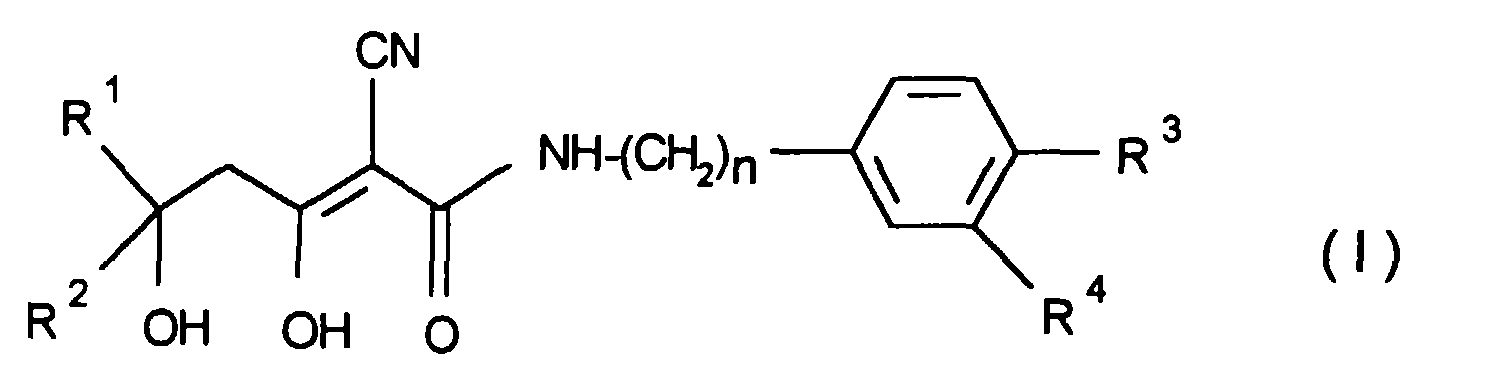
- R1 für
- a) Wasserstoffatom oder
- b) (C1-C4)-Alkyl steht,
- R2 für
- a) (C1-C12)-Alkyl,
- b) (C2-C12)-Alkenyl,
- c) (C2-C12)-Alkinyl,
- d) (C3-C7)-Cycloalkyl,
- e) ein 4- bis 7-gliedriger heterozyklischer Rest mit 1 oder 2 Heteroatomen aus der Gruppe Sauerstoff, Stickstoff und Schwefel
- f) Phenyl,
- g) Phenyl, ein- bis dreifach substituiert durch
- 1) (C1-C4)-Alkyl,
- 2) Halogen,
- 3) -CN,
- 4) -CF3,
- 5) -O-(C1-C4)-Alkyl,
- 6) -O-(C1-C4)-Alkyl substituiert durch Phenyl, oder
- 7) Methylendioxyl,
- h) (C1-C6)-Alkyl, einmal substituiert durch
- 1) Phenyl oder
- 2) Rest der Formel II,

- i) (C2-C6)-Alkenyl, einmal substituiert durch Phenyl oder Rest der Formel II, oder
- k) (C2-C6)-Alkinyl, einmal substituiert durch Phenyl oder Rest der Formel II, steht, oder
- l) R1 und R2 zusammen = 0 bedeuten,
- R3 für
- a) -CF3,
- b) -O-CF3,
- c) -S-CF3,
- d) -OH,
- e) -NO2,
- f) Halogen,
- g) Benzyl,
- h) Phenyl,
- i) -O-Phenyl,
- j) Wasserstoffatom,
- k) -CN,
- l) -O-Phenyl, ein oder mehrfach substituiert durch
- 1) (C1-C4)-Alkyl,
- 2) Halogen,
- 3) -O-CF3 oder
- 4) -O-CH3, steht,
- R4 für
- a) (C1-C4)-Alkyl
- b) Halogen, oder
- c) Wasserstoffatom steht, und
- n für die ganze Zahl Null, 1, 2, 3 oder 4 steht.
- Bevorzugt ist eine Verbindung der Formel I und/oder ein physiologisch verträgliches Salz der Verbindung der Formel I und/oder eine gegebenenfalls stereoisomere Form der Verbindung der Formel I, wobei
- R1 für Wasserstoffatom oder Methyl, steht,
- R2 für
- a) (C1-C4)-Alkyl,
- b) (C2-C7)-Alkenyl,
- c) Cyclopropyl,
- d) Phenyl,
- e) ein 5- bis 6-gliedriger heterozyklischer Rest aus der Gruppe
- 1) Pyridin,
- 2) Furan oder
- 3) Thiophen,
- f) Phenyl, ein- bis dreifach substituiert durch
- 1) Methyl,
- 2) -CN,
- 3) -CF3,
- 4) -O-Methyl,
- 5) -O-Methylphenyl oder
- 6) Methylendioxyl,
- g) (C1-C4)-Alkyl substituiert durch den Rest der Formel II, worin R5 und R6 unabhängig voneinander für Methyl oder Propyl stehen,
- h) Vinyl, substituiert durch Phenyl, oder
- i) Ethinyl, substituiert durch Phenyl, steht, oder
- k) R1 und R2 zusammen = 0 bedeuten,
- R3 für
- a) -CF3,
- b) -Cl oder
- c) Methyl steht,
- R4 für Wasserstoffatom oder Methyl steht, und
- n für die ganze Zahl Null, 1 oder 2 steht.
- Insbesondere bevorzugt ist eine Verbindung der Formel I und/oder ein physiologisch verträgliches Salz der Verbindung der Formel I und/oder eine gegebenenfalls stereoisomere Form der Verbindung der Formel I, wobei
- R1 für Wasserstoffatom oder Methyl steht,
- R2 für
- a) Methyl,
- b) Butyl,
- c) Vinyl,
- d) 1-Methyl-ethenyl,
- e) 2-Methyl-prop-enyl,
- f) 2,6-Dimethyl-hepta-1,5-dienyl,
- g) Cyclopropyl,
- h) Phenyl,
- i) Phenyl, ein- oder mehrfach substituiert durch
- 1) Methylendioxyl,
- 2) 4-Methyl,
- 3) Benzyloxy,
- 4) 4-Trifluormethyl,
- 5) Cyano oder
- 6) 3,4,5-Trimethoxy,
- k) Furanyl,
- l) Pyridyl,
- m) Thiophenyl oder
- n) Ethinylphenyl steht, oder
- o) R1 und R2 zusammen = 0 bedeuten,
- R3 für
- a) -CF3,
- b) -Cl oder
- c) Wasserstoffatom steht,
- R4 für Wasserstoffatom oder Methyl steht und
- n für die ganze Zahl Null, 1 oder 2 steht.
- Unter dem Begriff Alkyl, Alkenyl oder Alkinyl werden Reste verstanden deren Kohlenstoffkette geradkettig, verzweigt oder cyclisch sein kann; die Doppel- oder Dreifachbindungen können mehrfach vorkommen. Cyclische Alkylreste sind beispielsweise 3- bis 7-gliedrige Monocyclen wie Cyclopropyl, Cyclobutyl, Cyclopentyl, Cyclohexyl oder Cycloheptyl. Zu dem Begriff "4- bis 7-gliedriger heterozyklischer Rest mit 1 oder 2 Heteroatomen aus der Gruppe Sauerstoff, Stickstoff und Schwefel" gehören z.B. Reste, die sich von Azetidin, Pyrrol, Pyran, Azepin, Pyrrolin, Pyrrolidin, Pyridin, Piperidin, Imidazol, Pyrimidin, Furan, 1,2-Diazepin, Oxazol, Pyrazin, Piperazin, Isoxazol, Isoxazolin, Morpholin, Thiazol, Isothiazol, Isothiazolidin, Thiomorpholin, Thiopyran oder Thiophen ableiten. Halogen bedeutet Chlor, Brom, Jod oder Fluor.
- Geeignete physiologisch verträgliche Salze der Verbindung der Formel I sind beispielsweise Alkali-, Erdalkali- und Ammoniumsalze einschließlich solcher von organischen Ammoniumbasen.
- Die Erfindung betrifft auch ein Verfahren zur Herstellung der Verbindung der Formel I und/oder ein physiologisch verträgliches Salz der Verbindung der Formel I und/oder eine gegebenenfalls stereoisomere Form der Verbindung der Formel I, das dadurch gekennzeichnet ist, daß man
- A) ein entsprechend substituiertes 5-Methyl-isoxazol-3-carbonsäureamid oder - anilid bei tiefer Temperatur, bevorzugt bei -80 bis -40°C, mit einem Überschuß (ca. 3 Äquivalente) an starken organischen oder bevorzugt metallorganischen Basen wie Butyllithium, tert.-Butyllithium oder Lithiumdiisopropylamid in wasserfreien organischen Lösungsmitteln, wie Diethylether, Tetrahydrofuran oder tert.-Butylmethylether behandelt, wobei neben der baseninduzierten Ringöffnung des Isoxazolringes eine Deprotonierung der Methylgruppe stattfindet und diese deprotonierte Zwischenstufe mit elektrophilen Reagenzien wie Aldehyden, Ketonen oder Kohlendioxid nach entsprechender Aufarbeitung durch Ansäuern und Extraktion zu einer Addition an die Carbonylgruppe im Sinne einer C-C Verknüpfung führt oder
- B) eine Carbonsäure, die mit weiteren funktionellen - oder in Form geschützter Vorstufen vorliegenden - Gruppen substituiert sein kann, nach literaturbekannten Verfahren in ein Säurehalogenid, vorzugsweise ein Säurechlorid überführt, und mit der deprotonierten Form eines geeignet substituierten Cyanessigsäureamides oder -anilides im Sinne einer Kondensation umsetzt.
- Die Deprotonierung des Cyanessigsäurederivates wird bevorzugt mittels Natriumhydrid in einem aprotischen wasserfreien Lösungsmittel wie Tetrahydrofuran oder Dichlormethan durchgeführt. Deprotonierung und Kondensation verlaufen bevorzugt in einem Temperaturbereich von 0°C bis Raumtemperatur. Die zum Schutz weiterer funktioneller Gruppen gegebenenfalls mitgeführten Schutzgruppen werden danach nach literaturbekannten Verfahren abgespalten. Verfahren B) eignet sich besonders zur Herstellung chiraler Verbindungen, deren Asymmetriezentren im Carbonsäureteil in definierter Chiralität, wie exemplarisch in Beispiel 10 ausgeführt, in Form eines geschützten sekundären oder tertiären Alkohols, mitgeführt werden können, während nach Verfahren A) die chiralen sekundären Alkohole in der Regel als Enantiomerengemische entstehen. Die Herstellung der meist wasserlöslichen und daher besonders für eine intravenöse Applikation geeigneten physiologisch verträglichen Alkali-, Erdalkali- und organischen Ammoniumsalze erfolgt durch Lösen oder Suspendieren der Stammverbindung in einem protischen oder polaren aprotischen Lösungsmittel und Zugabe der Base äquimolar oder im Überschuß, wobei unter Verwendung polarer aprotischer Lösungsmittel wie Wasser oder niederer Alkohole meist eine klare Lösung des entsprechenden Salzes entsteht, das durch Gefriertrocknung, Aufkonzentrieren der Lösung oder Fällung durch Zugabe eines unpolareren Lösungsmittel in eine feste, bevorzugt kristalline Form gebracht werden kann.
- Die Erfindung betrifft auch Arzneimittel, gekennzeichnet durch einen wirksamen Gehalt an mindestens einer Verbindung der Formel I

- Aufgrund der pharmakologischen Eigenschaften eignen sich die erfindungsgemäßen Verbindungen hervorragend zur Prophylaxe und Therapie all solcher Erkrankungen oder Störungen, an deren Verlauf ein verstärkter Bindegewebs- und Knorpel-Abbau beteiligt ist. Dies sind vor allem Erkrankungen des Bewegungsapparates wie entzündlich, immunologisch oder stoffwechselbedingte akute und chronische Arthritiden und Arthropathien, aber auch Myalgien, Störungen des Knochenstoffwechsels, sowie degenerative Gelenkserkrankungen. Darunter zählen Osteoarthrosen und Spondylosen, aber auch Knorpelschwund nach Gelenk-Trauma oder längerer Ruhigstellung.
- Die Erfindung betrifft ferner die Verwendung der Verbindung der Formel I zur Herstellung von Arzneimitteln zur Prophylaxe und Therapie von Erkrankungen des Bindegewebes wie Kollagenosen und peridontalen Gewebsveränderungen.
- Die Erfindung betrifft auch ein Verfahren zur Herstellung eines Arzneimittels, das dadurch gekennzeichnet, daß man mindestens eine Verbindung der Formel I mit einem pharmazeutisch geeigneten und physiologisch verträglichen Träger und gegebenenfalls weiteren geeigneten Wirk-, Zusatz- oder Hilfsstoffen in eine geeignete Darreichungsform bringt.
- Geeignete feste oder galenische Zubereitungsformen sind beispielsweise Granulate, Pulver, Dragees, Tabletten, (Mikro)Kapseln, Suppositorien, Sirupe, Säfte, Suspensionen, Emulsionen, Tropfen oder injizierbare Lösungen sowie Präparate mit protrahierter Wirkstoff-Freigabe, bei deren Herstellung übliche Hilfsmittel, wie Trägerstoffe, Spreng-, Binde-, Überzugs-, Quellungs-, Gleit- oder Schmiermittel, Geschmacksstoffe, Süßungsmittel und Lösungsvermittler, Verwendung finden. Als häufig verwendete Hilfsstoffe seien Magnesiumcarbonat, Titandioxid, Laktose, Mannit und andere Zucker, Talkum, Milcheiweiß, Gelatine, Stärke, Cellulose und ihre Derivate, tierische und pflanzliche Öle wie Lebertran, Sonnenblumen-, Erdnuß- oder Sesamöl, Polyethylenglykol und Lösungsmittel wie etwa steriles Wasser und ein- oder mehrwertige Alkohole wie Glycerin, genannt.
- Vorzugsweise werden die pharmazeutischen Präparate in Dosierungseinheiten hergestellt und verabreicht, wobei jede Einheit als aktiven Bestandteil eine bestimmte Dosis der erfindungsgemäßen Verbindung der Formel I enthält. Bei festen Dosierungseinheiten wie Tabletten, Kapseln, Dragees oder Suppositorien, kann diese Dosis bis zu etwa 1000 mg, bevorzugt jedoch etwa von 50 bis 300 mg und bei Injektionslösungen in Ampullenform bis zu etwa 300 mg, vorzugsweise aber etwa von 10 bis 100 mg, betragen.
- Für die Behandlung eines erwachsenen, etwa 70 kg schweren Patienten sind - je nach Wirksamkeit der Verbindungen gemäß Formel I, Tagesdosen von etwa 20 mg bis 1000 mg Wirkstoff, bevorzugt von 100 mg bis 500 mg indiziert. Unter Umständen können jedoch auch höhere oder niedrigere Tagesdosen angebracht sein. Die Verabreichung der Tagesdosis kann sowohl durch Einmalgabe in Form einer einzelnen Dosierungseinheit oder aber mehrerer kleinerer Dosierungseinheiten als auch durch Mehrfachgabe unterteilter Dosen in bestimmten Intervallen erfolgen.
- In 320 ml wasserfreiem Tetrahydrofuran werden unter Schutzgas (Argon) 0,025 Mol (5 g) 4-Phenylaminocarbonyl-5-methyl-isoxazol gelöst. Im Kältebad (-78°C) werden dann 0,08 Mol (32 ml) Butyl-Lithium (2,5 molar in Hexan) zugetropft, wobei ein Temperaturanstieg bis -55°C beobachtet wird. Nach einer Stunde Rühren bei -78°C werden dann 0,13 Mol (7,4 g) absolutes Aceton zugetropft, nach weiteren 1 ½ Stunden bei -78°C, wird mit 20 ml Wasser hydrolysiert und der Ansatz auf etwa 0°C erwärmt. Mit 1 N Salzsäure wird ein pH-Wert von 2 eingestellt, mit Ethylacetat extrahiert, die organische Phase zweimal mit Wasser und einmal mit gesättigter NaCl-Lösung gewaschen, anschließend mit Na2SO4 getrocknet und unter vermindertem Druck eingeengt und aus Ethylacetat und Petrolether kristallisiert. Die erhaltenen farblosen Kristalle haben einen Schmelzpunkt von 103°C.
- Ausbeute: 3,8 g (58 %)
- 0,077 Mol (10,0 g) Ethyl-(R)-3-hydroxybutyrat werden in 90 ml Dimethylformamid gelöst und 0,151 Mol (10,3 g) Imidazol zugesetzt. Es wird unter Schutzgas im Eisbad auf 0°C abgekühlt und 0,083 Mol (16,05 g) Triisopropylsilylchlorid während 5 min zugetropft. Es wird noch 5 Stunden bei Raumtemperatur gerührt, mit Wasser hydrolysiert, das Produkt mit tert. Butylmethylether extrahiert, die organische Phase mit Na2SO4 getrocknet und am Rotationsverdampfer unter vermindertem Druck eingeengt.
- Ausbeute: 21,78 g (99,8 %) eines dünnflüssigen Öles.
- 0,0755 Mol (21,78 g) des Produktes von Stufe 1 werden in 1,51 Liter einer 0,01 molarer Lithiumhydroxydlösung in einem Tetrahydrofuran/Wasser 1:1-Gemisch 5 Tage bei 60°C gerührt. Es wird mit wäßriger Zitronensäure angesäuert und mit Ethylacetat das Produkt extrahiert. Die organische Phase wird mit Wasser gewaschen, über Natriumsulfat getrocknet und unter vermindertem Druck eingeengt.
- Ausbeute: 12,35 g (63 %) eines öligen Produktes
- 0,0475 Mol (12,36 g ) des Produktes von Stufe 2 werden in 200 ml absolutem Dichlormethan gelöst und unter Rühren mit 0,0523 Mol (6,64 g) Oxalylchlorid versetzt. Nach 5 Stunden bei Raumtemperatur wird unter vermindertem Druck eingeengt.
-
- Ausbeute: 12,9 g (98 %) eines öligen Produktes.
- 0,0140 Mol (3,2 g) Cyanessigsäure-4-trifluormethylanilid werden in 125 ml wasserfreiem Tetrahydrofuran gelöst und auf 2 bis 5°C abgekühlt. Der Lösung werden unter Rühren und Schutzgas portionsweise 0,031 Mol NaH (0,93 g, 80 %ig in Mineralöl) zugesetzt, wobei die Temperatur unter 10°C gehalten wird. Es wird dann für 2 Stunden bei Raumtemperatur gerührt (dabei leichte Gasentwicklung). Im Anschluß wird auf 10°C abgekühlt und 0,168 Mol (4,69 g) des Produktes von Stufe 3 portionsweise zugegeben. Bei 15°C wird noch für 20 min gerührt und dann werden 3,2 ml Eisessig zugesetzt, weitere 30 min bei 15°C gerührt, mit 125 ml Eiswasser, das 3,2 ml konzentrierte Salzsäure enthält, versetzt und mit Dichlormethan extrahiert. Die organische Phase wird mit Wasser und gesättigter Natriumchloridlösung gewaschen, mit Natriumsulfat getrocknet und am Rotationsverdampfer eingeengt.
- Ausbeute: 9,1 g an Rohprodukt, das an Kieselgel (Ethylacetat/Petrolether,
- Gradient: 1/1 bis 12/1) chromatographiert wird. Die Produktfraktionen werden unter vermindertem Druck eingeengt.
- Ausbeute 0,72 g eines öligen Produktes.
- 0,0015 Mol (0,72 g) des Produktes von Stufe 4 werden in 30 ml 2N wäßrigmethanolischer Salzsäure bei Raumtemperatur gelöst. Nach 4 Tagen wird am Rotationsverdampfer unter vermindertem Druck konzentriert. Der sich dabei abscheidende Niederschlag wird abgesaugt und getrocknet.
- Ausbeute: 0,36 g
- Schmelzpunkt: 156°C, Drehwert: -18,3° (c=1 in Ethanol).
- Herstellung erfolgte analog zu Beispiel 10a ausgehend von Ethyl-(S)-3-hydroxybutyrat
- Schmelzpunkt: 157°C, Drehwert: + 16,9° (c=1 in Ethanol).
- 0,063 Mol (20,0 g) des Produktes aus Beispiel 9 werden in 1 Liter Wasser suspendiert und durch Zusatz von 0,063 Mol (10,3 g) Lysin x H2O bei einem pH-Wert von 7,2 in Lösung gebracht. Die Lösung wird filtriert und gefriergetrocknet. Die weitgehend amorphe Substanz hat einen Schmelzpunkt von 135-138°C.
- Ausbeute: 27,74 g (96 %).
- In geeigneter Zell- oder Gewebskultur können Knorpelzellen ex vivo ihren charakteristischen Knorpelmatrix-Stoffwechsel, d.h. den geregelten Auf- und Abbau der Matrix-Makromoleküle, über einen Zeitraum von etlichen Wochen bis Monaten aufrechterhalten. Diese Prozesse können chemisch beeinflußt werden. In den nachfolgenden Versuchsbeschreibungen wird zum Einen die Wirkung von Prüfverbindungen auf die normale Erneuerung der Knorpelmatrix-Proteoglykane durch die Chondrozyten beschrieben (A), und zum Anderen die Wirkung auf einen pathologisch gesteigerten Proteoglykanabbau sowie gehemmter Synthese in Chondrozyten bzw. Knorpelgewebe durch Zugabe von Interleukin-1 (B). In beiden Assays wird die stimulierende Wirkung der Prüfsubstanz ausgedrückt durch einen Stimulationsfaktor, der sich errechnet aus dem Quotient des bestimmten Proteoglykangehaltes unter Wirkstoffbedingung dividiert durch den Proteoglykangehalt unter Kontrollbedingung. In Versuch A ist die Kontrollbedingung die unbehandelte Kontrollgruppe, in Versuchsanordnung B ist dies die Interleukin-1 (IL-1)-behandelte Kontrollgruppe. Ein Faktor = 1 läßt somit keine Wirkung erkennen, ein Faktor > 1 weist auf eine Stimulation, ein Faktor < 1 auf eine Hemmwirkung hin.
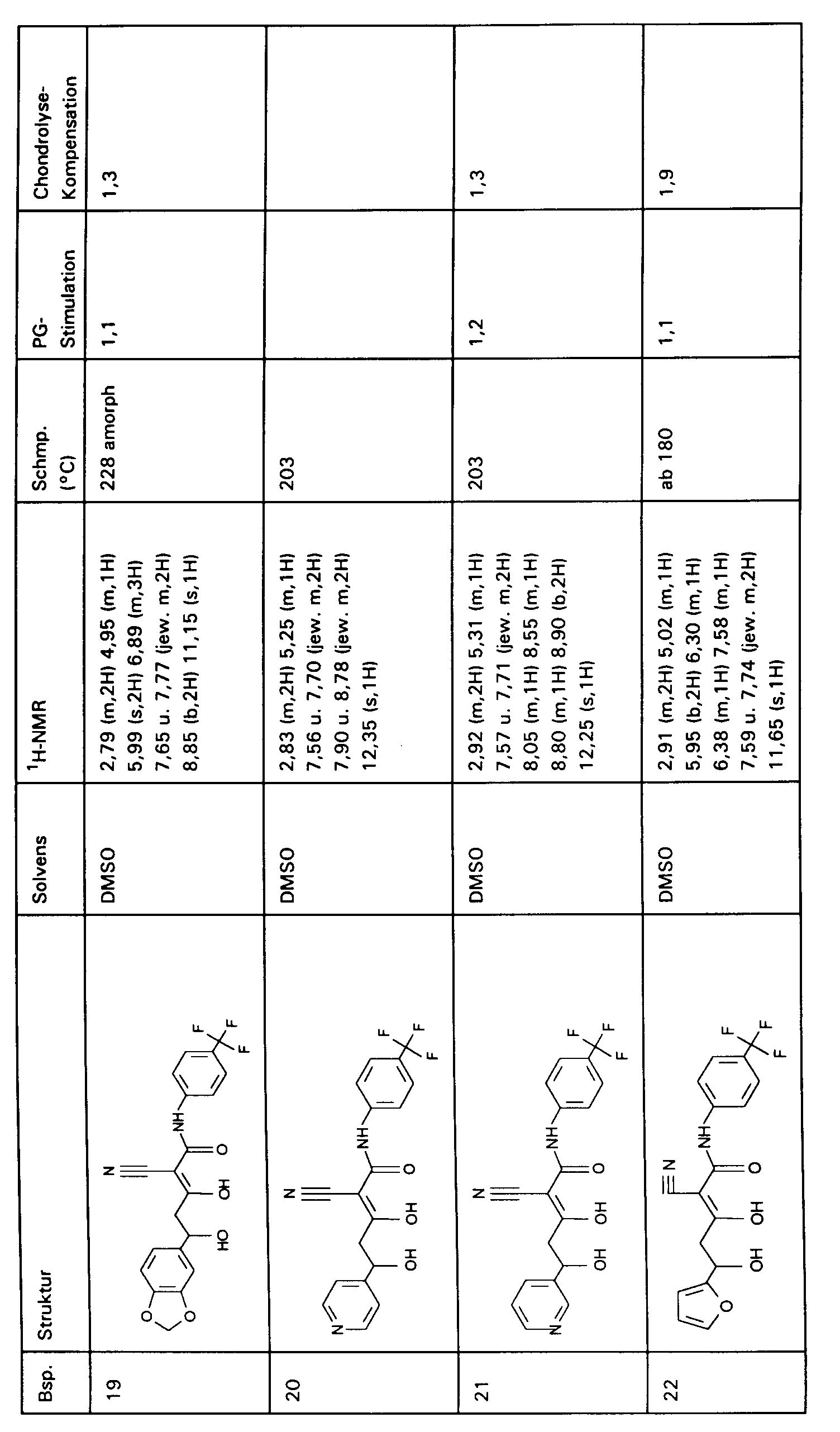
- Aus Fesselgelenken frisch geschlachteter Stiere werden unter sterilen Bedingungen Knorpelproben entnommen, mit 1%iger Pronase (Boehringer)-Lösung in Ham's F12 Medium (Serva) bei 37°C für 1 Stunde inkubiert, die Enzymlösung durch eine 0,025 %ige Collagenase Typ A (Worthington)-Lösung in Medium ersetzt und über Nacht inkubiert. Nach Filtern über 50 µm Nylonfilter, Zentrifugation, Resuspension und Vitalitätsprüfung wird eine Zellsuspension von 4 x 10⁶ Zellen/ml Medium, mit 20 % fötalem Kälberserum angereichert, hergestellt und bei etwa 38°C mit 2 %iger niedrig schmelzender Agarose (Seplaque) im Verhältnis 1:1 gemischt und davon 0,1 ml in jedes Well einer 24 Well-Mikrotiterplatte pipettiert. Nach Gelieren werden die Proben mit 0,5 ml/well Medium überschichtet, das mit 5 % Serum, 25 µm/ml Ascorbinsäure, sowie in Gruppen zu 6-8 Wells mit 10 µm der Prüfsubstanz angereichert ist. Für einen Behandlungszeitraum von 8 Tagen wird das Medium in gleichbleibender Zusammensetzung jeden zweiten Tag erneuert. Am Ende der Behandlung wird mit Medium gewaschen, pro Well 1 ml einer gepufferten (pH 5,6) 1 %igen Alcianblau (Sigma)-Lösung, mit 25 %igem Glutaraldehyd im Verhältnis 7:1 angereichert, zugegeben und für 48 Stunden inkubiert. Nach Waschen und Differenzieren mit 3 %iger Essigsäure wird über die aufsteigende Alkoholreihe bis zu 70 %igem Ethanolgehalt entwässert, und dann der gebundene Farbstoff mit 8 M Guanidinhydrochlorid bei 4°C über 24 Stunden extrahiert. Die stöchiometrische Bindung des Alcianblau an die Chondroitinsulfat-Seitenketten der Proteoglykane erlaubt eine Quantifizierung der angereicherten Matrix über die Bestimmung der Extinktion der Farblösung bei 610 nm. Tabelle 1 zeigt die Ergebnisse.
- Die Zell-Präparation erfolgt wie unter A beschrieben, im Falle des Einsatzes von Knorpel-Gewebsexplantaten werden diese nach Ausstanzen von Knorpelscheiben von 4 mm Durchmesser und einer Höhe, die die gesamte Knorpelschicht umfaßt, direkt in das oben beschriebene angereicherte Kulturmedium gegeben. Nach 5-tägiger Adaptation wird dem Medium Interleukin-1- zugegeben, für die Zellkultur 8 Units/well, für die Gewebskultur 20 Units/well, und über die Behandlungsdauer von 8 Tagen ebenfalls jeden zweiten Tag bei Mediumwechsel erneut zugesetzt. Am Versuchsende wird 1µCi Na2 35SO4/well zugefügt und über 24 Stunden inkubiert. Nach Entfernen des Überstands werden die verbliebenen Gele bzw. Explanate in den Mikrotiterplatten durch wiederholtes Tieffrieren und Auftauen aufgeschlossen und mit 8 M Guanidinhydrochlorid extrahiert. Nach Zentrifugation wird der Überstand über eine PD10 Sephadex-Säule in freies und inkorporiertes Sulfat getrennt und im β-Counter die Radioaktivität der Proben bestimmt, die ein Maß für die neugebildete Proteoglykanmenge darstellt. Tabelle 1 zeigt die Ergebnisse.
- Die Beispiele 2-9 und 11-33 wurden analog zu Beispiel 1 unter Verwendung der entsprechend substituierten (käuflichen) Aldehyde bzw. Ketone als elektrophile Reagenzien hergestellt. Zur Herstellung der Beispiele 34 und 35 wurden 3-Methyl-(5-oxohexyl)-7-propylxanthin (Propentofyllin) bzw 1-(5-Oxohexyl)-theobromin (Pentoxifyllin) eingesetzt. Beispiel 36 wurde durch Verwendung von festem CO2 als Elektrophil synthetisiert.
- 1H-NMR-Spektren sind an einem 200-MHz-Gerät der Firma Varian aufgenommen worden, in der Regel mit Tetramethylsilan (TMS) als internem Standard und bei Raumtemperatur 22-26°C (RT). Temperaturangaben in Grad Celsius. Die verwendeten Abkürzungen sind entweder erläutert oder entsprechen den üblichen Konventionen.




Claims (9)
- Verbindung der Formel I,
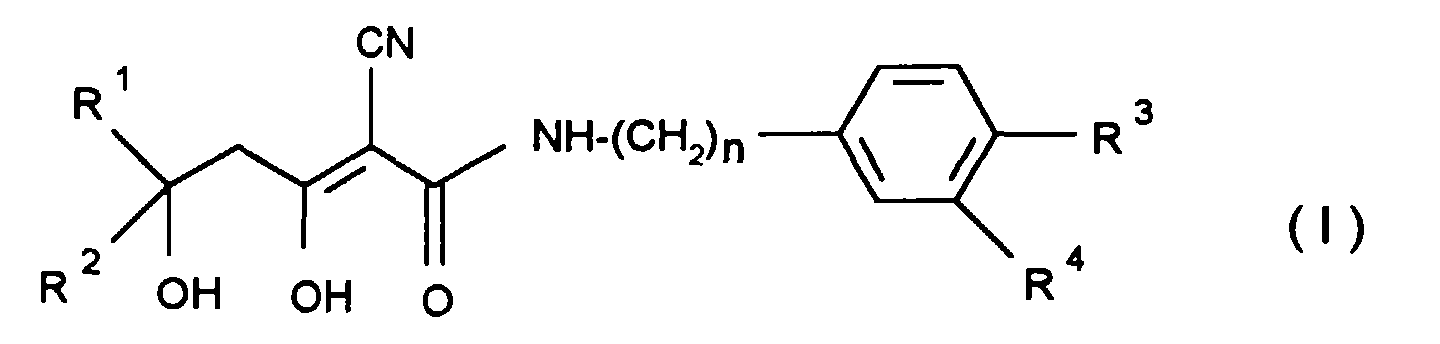 R1 füra) Wasserstoffatom oderb) (C1-C4)-Alkyl steht,R2 füra) (C1-C12)-Alkyl,b) (C2-C12)-Alkenyl,c) (C2-C12)-Alkinyl,d) (C3-C7)-Cycloalkyl,e) ein 4- bis 7-gliedriger heterozyklischer Rest mit 1 oder 2 Heteroatomen aus der Gruppe Sauerstoff, Stickstoff und Schwefelf) Phenyl,g) Phenyl, ein- bis dreifach substituiert durch1) (C1-C4)-Alkyl,2) Halogen,3) -CN,4) -CF3,5) -O-(C1-C4)-Alkyl,6) -O-(C1-C4)-Alkyl substituiert durch Phenyl, oder7) Methylendioxyl,h) (C1-C6)-Alkyl, einmal substituiert durch1) Phenyl oder2) Rest der Formel II,
 1) Wasserstoffatom oder2) (C1-C4)-Alkyl stehen,i) (C2-C6)-Alkenyl, einmal substituiert durch1) Phenyl oder2) Rest der Formel II, oderk) (C2-C6)-Alkinyl, einmal substituiert durch1) Phenyl oder2) Rest der Formel II, steht, oderl) R1 und R2 zusammen = O bedeuten,R3 füra) -CF3,b) -O-CF3,c) -S-CF3,d) -OH,e) -NO2,f) Halogen,g) Benzyl,h) Phenyl,i) -O-Phenyl,j) Wasserstoffatom,k) -CN,l) -O-Phenyl, ein oder mehrfach substituiert durch1) (C1-C4)-Alkyl,2) Halogen,3) -O-CF3 oder4) -O-CH3, steht,R4 füra) (C1-C4)-Alkyl,b) Halogen oderc) Wasserstoffatom steht, undn für die ganze Zahl Null, 1, 2, 3 oder 4 steht.
 - Verbindung der Formel I gemäß Anspruch 1 und/oder ein physiologisch verträgliches Salz der Verbindung der Formel I und/oder eine gegebenenfalls stereoisomere Form der Verbindung der Formel I, wobeiR1 füra) Wasserstoffatom oderb) Methyl, steht,R2 füra) (C1-C4)-Alkyl,b) (C2-C7)-Alkenyl,c) Cyclopropyl,d) Phenyl,e) ein 5- bis 6-gliedriger heterozyklischer Rest aus der Gruppe1) Pyridin,2) Furan oder3) Thiophen,f) Phenyl, ein- bis dreifach substituiert durch1) Methyl,2) -CN,3) -CF3,4) -O-Methyl,5) -O-Methylphenyl oder6) Methylendioxy,g) (C1-C4)-Alkyl substituiert durch den Rest der Formel II, worin R5 und R6 unabhängig voneinander für Methyl oder Propyl stehen,h) Vinyl, substituiert durch Phenyl, oderi) Ethinyl, substituiert durch Phenyl, steht, oderk) R1 und R2 zusammen = O bedeuten,R3 füra) -CF3,b) -Cl oderc) Methyl steht,R4 füra) Wasserstoffatom oderb) Methyl steht, undn für die ganze Zahl Null, 1 oder 2 steht.
- Verbindung der Formel I gemäß Anspruch 1 oder 2 und/oder ein physiologisch verträgliches Salz der Verbindung der Formel I und/oder eine gegebenenfalls stereoisomere Form der Verbindung der Formel I, wobeiR1 für Wasserstoffatom oder Methyl steht,R2 füra) Methyl,b) Butyl,c) Vinyl,d) 1-Methyl-ethenyl,e) 2-Methyl-prop-enyl,f) 2,6-Dimethyl-hepta-1,5-dienyl,g) Cyclopropyl,h) Phenyl,i) Phenyl, ein- oder mehrfach substituiert durch1) Methylendioxyl,2) 4-Methyl,3) Benzyloxy,4) 4-Trifluormethyl,5) Cyano oder6) 3,4,5-Trimethoxy,k) Furanyl,l) Pyridyl,m) Thiophenyl odern) Ethinylphenyl steht, odero) R1 und R2 zusammen = O bedeuten,R3 füra) -CF3,b) -Cl oderc) Wasserstoffatom steht,R4 für Wasserstoffatom oder Methyl steht undn für die ganze Zahl Null, 1 oder 2 steht.
- Verfahren zur Herstellung der Verbindung der Formel I gemäß der Ansprüche 1 bis 3, dadurch gekennzeichnet, daß manA) ein entsprechend substituiertes 5-Methyl-isoxazol-3-carbonsäureamid oder -anilid bei tiefer Temperatur, bevorzugt bei -80 bis -40°C, mit einem Überschuß (ca. 3 Äquivalente) an starken organischen oder bevorzugt metallorganischen Basen wie Butyllithium, tert.-Butyllithium oder Lithiumdiisopropylamid in wasserfreien organischen Lösungsmitteln, wie Diethylether, Tetrahydrofuran oder tert.-Butylmethylether behandelt, wobei neben der baseninduzierten Ringöffnung des Isoxazolringes eine Deprotonierung der Methylgruppe stattfindet und diese deprotonierte Zwischenstufe mit elektrophilen Reagenzien wie Aldehyden, Ketonen oder Kohlendioxid nach entsprechender Aufarbeitung durch Ansäuern und Extraktion zu einer Addition an die Carbonylgruppe im Sinne einer C-C Verknüpfung führt oderB) eine Carbonsäure, die mit weiteren funktionellen - oder in Form geschützter Vorstufen vorliegenden - Gruppen substituiert sein kann, in ein Säurehalogenid, vorzugsweise ein Säurechlorid, überführt, und mit der deprotonierten Form eines geeignet substituierten Cyanessigsäureamides oder -anilides im Sinne einer Kondensation umsetzt.
- Arzneimittel, enthaltend eine wirksame Menge mindestens einer Verbindung der Formel I gemäß Anspruch 1

- Verwendung von mindestens einer Verbindung der Formel I nach einem oder mehreren der Ansprüche 1 bis 4, zur Herstellung von Arzneimitteln zur Prophylaxe und Therapie von Erkrankungen oder Störungen, an deren Verlauf ein verstärkter Bindegewebs- und/oderKnorpel-Abbau beteiligt ist.
- Verwendung gemäß Anspruch 6, dadurch gekennzeichnet, daß Erkrankungen des Bewegungsapparates wie entzündlich, immunologisch oder stoffwechselbedingte akute und chronische Arthritiden und Arthropathien, oder Myalgien, Störungen des Knochenstoffwechsels, sowie degenerative Gelenkserkrankungen wie Osteoarthrosen und Spondylosen, oder Knorpelschwund nach Gelenk-Trauma oder längerer Ruhigstellung behandelt werden.
- Verwendung gemäß Anspruch 6, dadurch gekennzeichnet, daß Erkrankungen wie Kollagenosen und peridontalen Gewebsveränderungen behandelt werden.
- Verfahren zur Herstellung eines Arzneimittels nach Anspruch 5, dadurch gekennzeichnet, daß man mindestens eine Verbindung der Formel I gemäß Anspruch 1 und/oder eine nach dem Verfahren gemäß Anspruch 4 erhaltene Verbindung mit physiologisch annehmbaren Hilfs- und Trägerstoffen und gegebenenfalls weiteren Zusatzstoffen und/oder anderen Wirkstoffen in eine geeignete Darreichungsform bringt.
Applications Claiming Priority (2)
| Application Number | Priority Date | Filing Date | Title |
|---|---|---|---|
| DE19636974A DE19636974A1 (de) | 1996-09-12 | 1996-09-12 | 2-Cyano-3,5-dihydroxy-hex-2-en- carbonsäureamidderivate |
| DE19636974 | 1996-09-12 |
Publications (2)
| Publication Number | Publication Date |
|---|---|
| EP0829470A1 true EP0829470A1 (de) | 1998-03-18 |
| EP0829470B1 EP0829470B1 (de) | 1999-12-15 |
Family
ID=7805301
Family Applications (1)
| Application Number | Title | Priority Date | Filing Date |
|---|---|---|---|
| EP97115520A Expired - Lifetime EP0829470B1 (de) | 1996-09-12 | 1997-09-08 | 2-Cyano-3,5-dihydroxy-hex-2-en-carbonsäure-amidderivate, Verfahren zu ihrer Herstellung und ihre Verwendung als Arzneimittel |
Country Status (10)
| Country | Link |
|---|---|
| US (3) | US6121316A (de) |
| EP (1) | EP0829470B1 (de) |
| JP (1) | JP4044651B2 (de) |
| AT (1) | ATE187714T1 (de) |
| AU (1) | AU714637B2 (de) |
| CA (1) | CA2214670C (de) |
| DE (2) | DE19636974A1 (de) |
| DK (1) | DK0829470T3 (de) |
| ES (1) | ES2143276T3 (de) |
| GR (1) | GR3032686T3 (de) |
Cited By (1)
| Publication number | Priority date | Publication date | Assignee | Title |
|---|---|---|---|---|
| WO2015077535A2 (en) | 2013-11-22 | 2015-05-28 | Genzyme Corporation | Novel methods for treating neurodegenerative diseases |
Families Citing this family (4)
| Publication number | Priority date | Publication date | Assignee | Title |
|---|---|---|---|---|
| US6552204B1 (en) * | 2000-02-04 | 2003-04-22 | Roche Colorado Corporation | Synthesis of 3,6-dialkyl-5,6-dihydro-4-hydroxy-pyran-2-one |
| DE10311763A1 (de) * | 2003-03-18 | 2004-10-07 | Aventis Pharma Deutschland Gmbh | Verfahren zur Herstellung von 2-Cyan-3-hydroxy-N-(phenyl)but-2-enamiden |
| US6894184B2 (en) * | 2003-03-18 | 2005-05-17 | Aventis Pharma Deutschland Gmbh | Process for preparing 2-cyano-3-hydroxy-N-(phenyl)but-2-enamides |
| US20060217440A1 (en) * | 2003-03-24 | 2006-09-28 | Hiroki Omori | Porcess for production of 2-cyano-3-hydroxy-n-(4-trifluoromethylphenyl)hept-2-en-6-ynamide and process for production of polymorphs thereof |
Citations (2)
| Publication number | Priority date | Publication date | Assignee | Title |
|---|---|---|---|---|
| WO1994024095A1 (en) * | 1993-04-16 | 1994-10-27 | Abbott Laboratories | Immunosuppressive agents |
| EP0652214A1 (de) * | 1993-11-04 | 1995-05-10 | Roussel Uclaf | N-Aryl-2-cyano-3-hydroxypropenamidderivate, Verfahren zu ihrer Herstellung, ihre Verwendung als Medikamente und diese enthaltende pharmazeutische Zubereitungen |
-
1996
- 1996-09-12 DE DE19636974A patent/DE19636974A1/de not_active Withdrawn
-
1997
- 1997-09-04 CA CA002214670A patent/CA2214670C/en not_active Expired - Fee Related
- 1997-09-08 AT AT97115520T patent/ATE187714T1/de active
- 1997-09-08 ES ES97115520T patent/ES2143276T3/es not_active Expired - Lifetime
- 1997-09-08 EP EP97115520A patent/EP0829470B1/de not_active Expired - Lifetime
- 1997-09-08 DE DE59700841T patent/DE59700841D1/de not_active Expired - Lifetime
- 1997-09-08 DK DK97115520T patent/DK0829470T3/da active
- 1997-09-10 AU AU37486/97A patent/AU714637B2/en not_active Ceased
- 1997-09-10 US US08/927,085 patent/US6121316A/en not_active Expired - Lifetime
- 1997-09-11 JP JP24675897A patent/JP4044651B2/ja not_active Expired - Fee Related
-
1999
- 1999-11-24 US US09/448,449 patent/US6172103B1/en not_active Expired - Lifetime
-
2000
- 2000-02-18 GR GR20000400384T patent/GR3032686T3/el unknown
- 2000-10-23 US US09/694,036 patent/US6387934B1/en not_active Expired - Fee Related
Patent Citations (2)
| Publication number | Priority date | Publication date | Assignee | Title |
|---|---|---|---|---|
| WO1994024095A1 (en) * | 1993-04-16 | 1994-10-27 | Abbott Laboratories | Immunosuppressive agents |
| EP0652214A1 (de) * | 1993-11-04 | 1995-05-10 | Roussel Uclaf | N-Aryl-2-cyano-3-hydroxypropenamidderivate, Verfahren zu ihrer Herstellung, ihre Verwendung als Medikamente und diese enthaltende pharmazeutische Zubereitungen |
Non-Patent Citations (2)
| Title |
|---|
| CHEMICAL ABSTRACTS, vol. 109, no. 13, 26 September 1988, Columbus, Ohio, US; abstract no. 109846a, A. YU SIZOV ET AL: "Acylation of cyanoacetic ester with diacid chlorides under phase transfer catalysts" page 567; XP002048438 * |
| IZV. AKAD. NAUK SSSR, SER. KHIM., no. 11, 1987, pages 2604 - 2606 * |
Cited By (1)
| Publication number | Priority date | Publication date | Assignee | Title |
|---|---|---|---|---|
| WO2015077535A2 (en) | 2013-11-22 | 2015-05-28 | Genzyme Corporation | Novel methods for treating neurodegenerative diseases |
Also Published As
| Publication number | Publication date |
|---|---|
| EP0829470B1 (de) | 1999-12-15 |
| US6121316A (en) | 2000-09-19 |
| JPH10101636A (ja) | 1998-04-21 |
| DE59700841D1 (de) | 2000-01-20 |
| DK0829470T3 (da) | 2000-05-22 |
| AU714637B2 (en) | 2000-01-06 |
| JP4044651B2 (ja) | 2008-02-06 |
| CA2214670A1 (en) | 1998-03-12 |
| ES2143276T3 (es) | 2000-05-01 |
| MX9706931A (es) | 1998-03-31 |
| US6387934B1 (en) | 2002-05-14 |
| GR3032686T3 (en) | 2000-06-30 |
| US6172103B1 (en) | 2001-01-09 |
| ATE187714T1 (de) | 2000-01-15 |
| CA2214670C (en) | 2006-10-31 |
| DE19636974A1 (de) | 1998-03-19 |
| AU3748697A (en) | 1998-03-19 |
Similar Documents
| Publication | Publication Date | Title |
|---|---|---|
| DE3783988T2 (de) | Zyklische enolderivate, herstellung und anwendung. | |
| DE2933441C2 (de) | Spiro-[4H-2,3-dihydrobenzopyran(4,5')oxazolidin]-2',4'-dione und solche Verbindungen enthaltende Arzneimittel | |
| DE2228012C3 (de) | Phthalidester der 6- [D(-)- a Aminophenylacetamido] -penicillansäure und Verfahren zu seiner Herstellung | |
| DE2332878C2 (de) | Salze von Cephalosporinen mit Arginin und Lysin, ihre Herstellung und injizierbare pharmazeutische Zubereitungen | |
| DE69321087T2 (de) | Alpha-aminoketon Derivate | |
| DE2615693A1 (de) | Antibakterielle mittel und verfahren zu ihrer herstellung | |
| DE3239157C2 (de) | 3-Oximinoacylamino-4-fluormethyl-1-sulfoazetidinone, ihre Herstellung, Zwischenprodukte und pharmazeutische Zusammensetzungen | |
| DE2448966A1 (de) | Penicillinderivate | |
| DE3306006C2 (de) | ||
| AT376976B (de) | Verfahren zur herstellung von neuen 5-substituierten oxazolidin-2,4-dionen und ihren salzen | |
| EP0003056A1 (de) | N-substituierte omega-Aminoalkanoyl-omega-aminoalkansäuren, ihre Verwendung und Verfahren zu ihrer Herstellung sowie diese Verbindungen enthaltende Arzneimittel | |
| DE2165962A1 (de) | 4-Hydroxy-6-arylpyrimidine. Ausscheidung aus: 2149249 | |
| EP0397175B1 (de) | Substituierte Pyrrolizinverbindungen und deren Anwendung in der Pharmazie | |
| EP0829470B1 (de) | 2-Cyano-3,5-dihydroxy-hex-2-en-carbonsäure-amidderivate, Verfahren zu ihrer Herstellung und ihre Verwendung als Arzneimittel | |
| DE69119509T2 (de) | Benzhydryloxyethylpiperidyl-Derivate aliphatischer Carbonsäuren und ihre Anwendung zur Behandlung von Allergien und Asthma | |
| DE69110217T2 (de) | Derivate der Kaffeinsäure und sie enthaltende pharmazeutische Zusammensetzungen. | |
| DE2457358A1 (de) | Cephalosporin- und penicillinantibiotika | |
| EP0723969A1 (de) | Phosphonocarbonsäure-Derivate und deren Verwendung zur Behandlung von degenerativen Gelenkserkrankungen | |
| DE2600842C2 (de) | ||
| DE1670222B2 (de) | a-(Benzyloxycarbonyl)-thienylmethylpenicilline und deren Salze, Verfahren zu deren Herstellung und diese Verbindungen enthaltende antibakterielle Mittel | |
| DE69608983T2 (de) | Thiophenverbindungen, Verfahren zu deren Herstellung und diese enthaltende pharmazeutische Zubereitungen | |
| EP0764637B1 (de) | 2-Cyano-3-mercaptocrotonsäureamide | |
| DE2751041A1 (de) | Beta-lactame, verfahren zu ihrer herstellung und ihre verwendung bei der behandlung bakterieller infektionen | |
| DE69111530T2 (de) | Pyridincarbonsäure-Amid-Derivate und diese enthaltende pharmazeutische Zusammensetzungen. | |
| EP0276194A1 (de) | 2,1-Benzothiazepin-2,2-dioxid-5-carbonsäurederivate |
Legal Events
| Date | Code | Title | Description |
|---|---|---|---|
| PUAI | Public reference made under article 153(3) epc to a published international application that has entered the european phase |
Free format text: ORIGINAL CODE: 0009012 |
|
| AK | Designated contracting states |
Kind code of ref document: A1 Designated state(s): AT BE CH DE DK ES FI FR GB GR IE IT LI LU NL PT SE |
|
| AX | Request for extension of the european patent |
Free format text: AL;LT;LV;RO;SI |
|
| DAX | Request for extension of the european patent (deleted) | ||
| 17P | Request for examination filed |
Effective date: 19980918 |
|
| AKX | Designation fees paid |
Free format text: AT BE CH DE DK ES FI FR GB GR IE IT LI LU NL PT SE |
|
| RBV | Designated contracting states (corrected) |
Designated state(s): AT BE CH DE DK ES FI FR GB GR IE IT LI LU NL PT SE |
|
| GRAG | Despatch of communication of intention to grant |
Free format text: ORIGINAL CODE: EPIDOS AGRA |
|
| 17Q | First examination report despatched |
Effective date: 19990322 |
|
| GRAG | Despatch of communication of intention to grant |
Free format text: ORIGINAL CODE: EPIDOS AGRA |
|
| GRAH | Despatch of communication of intention to grant a patent |
Free format text: ORIGINAL CODE: EPIDOS IGRA |
|
| GRAH | Despatch of communication of intention to grant a patent |
Free format text: ORIGINAL CODE: EPIDOS IGRA |
|
| GRAA | (expected) grant |
Free format text: ORIGINAL CODE: 0009210 |
|
| AK | Designated contracting states |
Kind code of ref document: B1 Designated state(s): AT BE CH DE DK ES FI FR GB GR IE IT LI LU NL PT SE |
|
| REF | Corresponds to: |
Ref document number: 187714 Country of ref document: AT Date of ref document: 20000115 Kind code of ref document: T |
|
| REG | Reference to a national code |
Ref country code: CH Ref legal event code: EP |
|
| ET | Fr: translation filed | ||
| REF | Corresponds to: |
Ref document number: 59700841 Country of ref document: DE Date of ref document: 20000120 |
|
| ITF | It: translation for a ep patent filed | ||
| REG | Reference to a national code |
Ref country code: IE Ref legal event code: FG4D |
|
| GBT | Gb: translation of ep patent filed (gb section 77(6)(a)/1977) |
Effective date: 20000223 |
|
| REG | Reference to a national code |
Ref country code: PT Ref legal event code: SC4A Free format text: AVAILABILITY OF NATIONAL TRANSLATION Effective date: 19991229 |
|
| RAP2 | Party data changed (patent owner data changed or rights of a patent transferred) |
Owner name: AVENTIS PHARMA DEUTSCHLAND GMBH |
|
| REG | Reference to a national code |
Ref country code: ES Ref legal event code: FG2A Ref document number: 2143276 Country of ref document: ES Kind code of ref document: T3 |
|
| REG | Reference to a national code |
Ref country code: DK Ref legal event code: T3 |
|
| NLT2 | Nl: modifications (of names), taken from the european patent patent bulletin |
Owner name: AVENTIS PHARMA DEUTSCHLAND GMBH |
|
| PLBE | No opposition filed within time limit |
Free format text: ORIGINAL CODE: 0009261 |
|
| STAA | Information on the status of an ep patent application or granted ep patent |
Free format text: STATUS: NO OPPOSITION FILED WITHIN TIME LIMIT |
|
| 26N | No opposition filed | ||
| REG | Reference to a national code |
Ref country code: PT Ref legal event code: PC4A Free format text: AVENTIS PHARMA DEUTSCHLAND GMBH DE Effective date: 20010322 |
|
| REG | Reference to a national code |
Ref country code: GB Ref legal event code: IF02 |
|
| NLS | Nl: assignments of ep-patents |
Owner name: AVENTIS PHARMA DEUTSCHLAND GMBH |
|
| REG | Reference to a national code |
Ref country code: FR Ref legal event code: TP |
|
| REG | Reference to a national code |
Ref country code: GB Ref legal event code: 732E |
|
| REG | Reference to a national code |
Ref country code: CH Ref legal event code: PFA Owner name: SANOFI-AVENTIS DEUTSCHLAND GMBH Free format text: AVENTIS PHARMA DEUTSCHLAND GMBH#BRUENINGSTRASSE 50#65929 FRANKFURT AM MAIN (DE) -TRANSFER TO- SANOFI-AVENTIS DEUTSCHLAND GMBH##65926 FRANKFURT AM MAIN (DE) |
|
| NLT1 | Nl: modifications of names registered in virtue of documents presented to the patent office pursuant to art. 16 a, paragraph 1 |
Owner name: SANOFI-AVENTIS DEUTSCHLAND GMBH |
|
| REG | Reference to a national code |
Ref country code: FR Ref legal event code: CD Ref country code: FR Ref legal event code: CA |
|
| PGFP | Annual fee paid to national office [announced via postgrant information from national office to epo] |
Ref country code: IE Payment date: 20100910 Year of fee payment: 14 Ref country code: CH Payment date: 20100914 Year of fee payment: 14 |
|
| PGFP | Annual fee paid to national office [announced via postgrant information from national office to epo] |
Ref country code: SE Payment date: 20100913 Year of fee payment: 14 Ref country code: IT Payment date: 20100918 Year of fee payment: 14 Ref country code: FI Payment date: 20100910 Year of fee payment: 14 Ref country code: AT Payment date: 20100910 Year of fee payment: 14 |
|
| PGFP | Annual fee paid to national office [announced via postgrant information from national office to epo] |
Ref country code: GR Payment date: 20100817 Year of fee payment: 14 |
|
| PGFP | Annual fee paid to national office [announced via postgrant information from national office to epo] |
Ref country code: PT Payment date: 20100902 Year of fee payment: 14 Ref country code: NL Payment date: 20100910 Year of fee payment: 14 Ref country code: DK Payment date: 20100910 Year of fee payment: 14 |
|
| PGFP | Annual fee paid to national office [announced via postgrant information from national office to epo] |
Ref country code: LU Payment date: 20101014 Year of fee payment: 14 Ref country code: BE Payment date: 20100915 Year of fee payment: 14 |
|
| PGFP | Annual fee paid to national office [announced via postgrant information from national office to epo] |
Ref country code: ES Payment date: 20101018 Year of fee payment: 14 |
|
| REG | Reference to a national code |
Ref country code: PT Ref legal event code: MM4A Free format text: LAPSE DUE TO NON-PAYMENT OF FEES Effective date: 20120308 |
|
| BERE | Be: lapsed |
Owner name: *SANOFI-AVENTIS DEUTSCHLAND G.M.B.H. Effective date: 20110930 |
|
| REG | Reference to a national code |
Ref country code: NL Ref legal event code: V1 Effective date: 20120401 |
|
| REG | Reference to a national code |
Ref country code: CH Ref legal event code: PL Ref country code: DK Ref legal event code: EBP |
|
| REG | Reference to a national code |
Ref country code: GR Ref legal event code: ML Ref document number: 20000400384 Country of ref document: GR Effective date: 20120403 |
|
| PG25 | Lapsed in a contracting state [announced via postgrant information from national office to epo] |
Ref country code: IT Free format text: LAPSE BECAUSE OF NON-PAYMENT OF DUE FEES Effective date: 20110908 Ref country code: PT Free format text: LAPSE BECAUSE OF NON-PAYMENT OF DUE FEES Effective date: 20120308 Ref country code: FI Free format text: LAPSE BECAUSE OF NON-PAYMENT OF DUE FEES Effective date: 20110908 |
|
| REG | Reference to a national code |
Ref country code: IE Ref legal event code: MM4A |
|
| PG25 | Lapsed in a contracting state [announced via postgrant information from national office to epo] |
Ref country code: BE Free format text: LAPSE BECAUSE OF NON-PAYMENT OF DUE FEES Effective date: 20110930 |
|
| REG | Reference to a national code |
Ref country code: SE Ref legal event code: EUG |
|
| PG25 | Lapsed in a contracting state [announced via postgrant information from national office to epo] |
Ref country code: LI Free format text: LAPSE BECAUSE OF NON-PAYMENT OF DUE FEES Effective date: 20110930 Ref country code: IE Free format text: LAPSE BECAUSE OF NON-PAYMENT OF DUE FEES Effective date: 20110908 Ref country code: NL Free format text: LAPSE BECAUSE OF NON-PAYMENT OF DUE FEES Effective date: 20120401 Ref country code: CH Free format text: LAPSE BECAUSE OF NON-PAYMENT OF DUE FEES Effective date: 20110930 |
|
| PG25 | Lapsed in a contracting state [announced via postgrant information from national office to epo] |
Ref country code: GR Free format text: LAPSE BECAUSE OF NON-PAYMENT OF DUE FEES Effective date: 20120403 |
|
| PG25 | Lapsed in a contracting state [announced via postgrant information from national office to epo] |
Ref country code: DK Free format text: LAPSE BECAUSE OF NON-PAYMENT OF DUE FEES Effective date: 20110930 |
|
| PGFP | Annual fee paid to national office [announced via postgrant information from national office to epo] |
Ref country code: GB Payment date: 20120905 Year of fee payment: 16 |
|
| REG | Reference to a national code |
Ref country code: AT Ref legal event code: MM01 Ref document number: 187714 Country of ref document: AT Kind code of ref document: T Effective date: 20110908 |
|
| PGFP | Annual fee paid to national office [announced via postgrant information from national office to epo] |
Ref country code: FR Payment date: 20120926 Year of fee payment: 16 Ref country code: DE Payment date: 20120905 Year of fee payment: 16 |
|
| PG25 | Lapsed in a contracting state [announced via postgrant information from national office to epo] |
Ref country code: AT Free format text: LAPSE BECAUSE OF NON-PAYMENT OF DUE FEES Effective date: 20110908 |
|
| REG | Reference to a national code |
Ref country code: ES Ref legal event code: FD2A Effective date: 20130417 |
|
| PG25 | Lapsed in a contracting state [announced via postgrant information from national office to epo] |
Ref country code: ES Free format text: LAPSE BECAUSE OF NON-PAYMENT OF DUE FEES Effective date: 20110909 Ref country code: SE Free format text: LAPSE BECAUSE OF NON-PAYMENT OF DUE FEES Effective date: 20110909 |
|
| PG25 | Lapsed in a contracting state [announced via postgrant information from national office to epo] |
Ref country code: LU Free format text: LAPSE BECAUSE OF NON-PAYMENT OF DUE FEES Effective date: 20110908 |
|
| GBPC | Gb: european patent ceased through non-payment of renewal fee |
Effective date: 20130908 |
|
| REG | Reference to a national code |
Ref country code: DE Ref legal event code: R119 Ref document number: 59700841 Country of ref document: DE Effective date: 20140401 |
|
| REG | Reference to a national code |
Ref country code: FR Ref legal event code: ST Effective date: 20140530 |
|
| PG25 | Lapsed in a contracting state [announced via postgrant information from national office to epo] |
Ref country code: GB Free format text: LAPSE BECAUSE OF NON-PAYMENT OF DUE FEES Effective date: 20130908 |
|
| PG25 | Lapsed in a contracting state [announced via postgrant information from national office to epo] |
Ref country code: FR Free format text: LAPSE BECAUSE OF NON-PAYMENT OF DUE FEES Effective date: 20130930 Ref country code: DE Free format text: LAPSE BECAUSE OF NON-PAYMENT OF DUE FEES Effective date: 20140401 |